Article

Full-Scale Efficient Production and Economic Analysis of SCFAs from UPOW and Its Application as a Carbon Source for Sustainable Wastewater Biological Treatment


1
School of Government Management, University of International Business and Economics, Beijing 100029, China
2
Shanghai Municipal Engineering Design Institute (Group) Co., Ltd., Shanghai 200092, China
*
Author to whom correspondence should be addressed.
Sustainability 2026, 18(1), 262; https://doi.org/10.3390/su18010262 (registering DOI)
Submission received: 23 November 2025 / Revised: 19 December 2025 / Accepted: 22 December 2025 / Published: 26 December 2025

Abstract

There are large amounts of carbohydrates and proteins in rban perishable organic waste (UPOW), which can be converted to short chain fatty acids (SCFAs) through microbial methods. In this study, the mass balance and properties of organic slurry generated from UPOW pretreatment were investigated first. Then, the optimal conditions for SCFAs production from organic slurry of UPOW was studied. It was found that under the conditions of pH 8 ± 0.5 and reaction time of 3 d, the yield of SCFAs, mainly composed of acetic and propionic acids, in the full-scale reactor was 0.68 gCOD/gTCOD of organic slurry. Under the conditions of influent NH4+-N, total nitrogen, soluble ortho-phosphorus, and soluble COD of 27–39, 33–45, 2–9, and 220–300 mg/L, respectively, the use of SCFAs-enriched fermentation liquid (100 mg COD/L) as the additional carbon source for full-scale biological municipal wastewater treatment showed a higher total nitrogen and phosphorus removal efficiency than that of sodium acetate (88.1 ± 5.2% against 81.4 ± 4.5% and 96.9 ± 3.1% versus 91.5 ± 2.8%) due to greater key enzyme activity and short-cut nitrification and denitrification capacity. Finally, based on the actual operation process, an economic benefit analysis on the production of SCFAs-enriched fermentation liquid from UPOW was conducted, and the issues that need to be addressed for the promotion and application of this technology were discussed. This study contributes to achieving sustainable synergistic treatment of organic waste and wastewater.

1. Introduction

With the acceleration of urbanization, the amount of urban perishable organic waste (UPOW), such as kitchen waste and waste-activated sludge (WAS) generated by wastewater treatment plants (WWTPs) continues to increase. Globally, about one-third of the food consumed by humans is wasted or lost each year, which is equivalent to nearly 1.3 billion tons per year [1]. In China, there are over 90 million tons of kitchen waste and 60 million tons of WAS (based on a water content of 80%) produced annually. These UPOWs contain abundant organic matter (mainly carbohydrates and protein substances). If not treated and directly discharged into the environment, it not only pollutes the environment but also causes resource waste. At present, anaerobic digestion has been widely applied to treat UPOW, which converts organic matter into methane containing gas through the appropriate pretreatment and processes, including hydrolysis, acidification, and methane production under anaerobic conditions [2,3].
On the other hand, the acceleration of urbanization has also led to a continuous increase in the amount of urban sewage discharged. Taking China as an example, the annual discharge of municipal wastewater has exceeded 6 × 10¹⁰ m3. The activated sludge process, as the mainstream technology for treating urban sewage, mainly uses functional microorganisms to utilize organic matter (i.e., carbon source) in wastewater as electron donors and energy substances, converting nutrients (nitrogen and phosphorus) into gaseous nitrogen and polyphosphate for removal [4]. Due to insufficient carbon sources in urban sewage for biological nutrient removal (BNR), wastewater treatment plants typically require the addition of a large amount of chemical carbon sources (including methanol, acetic acid, etc.) to meet discharge standards, such as total nitrogen (TN) and total phosphorus (TP) in the effluent being below 15 mg/L and 0.5 mg/L, respectively [5,6]. The extensive use of chemical carbon sources will consume limited human resources and cannot meet the needs of sustainable social development.
To address the carbon source issue required for sustainable and efficient wastewater treatment while enhancing the application value of UPOW, previous studies have reported the use of urban perishable organic waste to prepare a fermentation liquid that is rich in short chain fatty acids (SCFAs) [7,8,9,10]. According to the literature, when kitchen waste and/or waste-activated sludge are used as substrates, the carbohydrates and proteins contained therein can be converted into SCFAs through the action of anaerobic microorganisms, and the fermentation liquid can be used as a carbon source for low carbon-to-nitrogen ratio wastewater biological phosphorus and nitrogen removal, or for the synthesis of medium-chain carboxylic acids [11,12,13,14,15,16]. However, so far, there are very few studies in the literature on full-scale efficient production and economic analysis of SCFAs from UPOW and its application as a carbon source for biological wastewater treatment.
Regulating pH value is a commonly used strategy in the literature to improve the fermentation production of SCFAs from kitchen waste, sludge, and other urban perishable organic waste, but the optimal pH value in previous studies was achieved via short-term batch experiments [17,18]. In addition, researchers have conducted studies on the semi-continuous long-term fermentation of kitchen waste to produce SCFAs under constant pH 7 conditions [19]. Given that the actual production process is mainly based on long-term operation, it is necessary to determine the optimal conditions for UPOW fermentation to produce SCFAs through long-term operating experiments.
Considering that there is currently no report on the optimal pH conditions for producing SCFAs from UPOW through long-term fermentation, the feasibility of using the generated SCFA as a carbon source for wastewater treatment, and the economic benefit analysis, this paper therefore focused firstly on the influence of pH values and reaction time on the fermentation of UPOW slurry to produce SCFAs in long-term operating systems. Then, full-scale SCFAs-enriched fermentation liquid production from UPOW slurry and full-scale wastewater treatment with SCFAs-enriched fermentation liquid as an additional carbon source were carried out, respectively. Finally, an economic analysis was conducted on the production of SCFAs from UPOW, according to the full-scale data. The results of this study will have important practical significance for the resource utilization of organic waste and the low-carbon, sustainable, and efficient treatment of wastewater.

2. Materials and Methods

2.1. UPOW, Inoculated Sludge, and Municipal Wastewater

The UPOW used in this study was composed of vegetables, rice, bones, meat, lipids, and so on. The amount of UPOW processed during long-term fermentation to produce SCFAs was recorded daily. Considering the frequent changes in the composition of UPOW, its main properties were analyzed every 4–5 d throughout the entire experimental period. Its basic physical and chemical properties were a water content of 84.6 ± 2.1%, total solid (TS) of 15.4 ± 1.76%, and carbon-to-nitrogen ratio (C/N) of 27.8 ± 6.22. The activated sludge was used as the inoculated microorganism, obtained from the secondary sedimentation tank of a sewage treatment plant and concentrated by settling at 4°C for 24 h. Its main properties were pH 6.8, total suspended solids (TSS) 12,442 ± 421 mg/L, and volatile suspended solids (VSS) 9285 ± 336 mg/L. The municipal wastewater had an average soluble COD, soluble ortho-phosphate (SOP or PO43−-P), ammonia nitrogen (NH4 +-N), and total nitrogen (TN) of 175 and 166, 5.6 and 5.2, 36.7 and 33.4, and 40.2 and 38.3 mg/L, respectively, during the laboratory and full-scale experiments.

2.2. Optimization of pH Value and Time for Anaerobic Fermentation of Organic Slurry of UPOW to Produce SCFAs in Laboratory Reactors

In this study, the levels of nitrogen and phosphorus in UPOW did change at different times, but the experiments showed that their variations had no significant effect on the yield of SCFAs (p (TN) = 0.15, n = 4; p (SOP) = 0.089, n = 4) after artificially adding different amounts of ammonia nitrogen and phosphate to the anaerobic fermentation systems. As the pH value and fermentation time were observed to significantly affect SCFAs production, the optimization of pH value and time for anaerobic fermentation of organic slurry to produce SCFAs was investigated by the following experiments. A total of 15 laboratory continuous stirred tank reactors (CSTR) were divided into 5 groups: namely, Group 1, Group 2, Group 3, Group 4, and Group 5, with Group 5 serving as the control group (Table 1). Each reactor had a volume of 10 L, and 1 L of sludge and 5 L of organic slurry of UPOW generated by the following method were added. The pH value of the mixture was manually adjusted every 6 h with 6 M sodium hydroxide and 4 M hydrochloric acid solution. The mixture in each reactor was purged with N2 for 10 min, then sealed with a rubber stopper, and anaerobically stirred (speed of 20 rpm) in a constant temperature chamber at 25 °C. During the first 5 d of the experiments, the mixture was not discharged, nor was the fresh organic slurry added. Then, a certain volume of the mixture was discharged from the reactor every morning and an equal volume of fresh organic slurry was replenished from the 6th day to achieve a different solids retention time (SRT) or hydraulic retention time (HRT) (see Table 1). After the concentration of SCFAs in the reactor became relatively stable, the data were reported and the reaction time and pH value to maximize SCFAs production were determined.

2.3. Full-Scale Organic Slurry Preparation from UPOW and SCFAs-Enriched Fermentation Liquid Production from Organic Slurry

The process flow was shown in Figure 1, mainly including the pre-treatment of UPOW (around 20 t/d) to produce organic slurry and anaerobic fermentation of the slurry to produce SCFAs. The slurry production was carried out in batches, while the anaerobic fermentation of the slurry to produce SCFAs was semi-continuous. The process of preparing the slurry was as follows. After the UPOW was crushed, it was lifted by a screw conveyor and entered into the sorting equipment to sort out large-sized impurities and UPOW with a particle size of less than 60 mm, which were, respectively, transported to the garbage pool and the equipment for preparing organic slurry. The organic slurry was pumped into the cooking tank (75–80 °C), and then separated into oil, water, and slag with a three-phase centrifugal device. The extracted oil phase (i.e., crude oil, sold to biodiesel processing companies), solid phase (sold to black soldier fly breeding plants), and organic slurry (stored in a slurry storage tank (100 m3) were collected separately. The process of anaerobic fermentation of slurry to produce SCFAs-enriched fermentation liquid was as follows. Firstly, organic slurry (around 14.8 t) was added to an anaerobic fermentation reactor (CSTR) (24 m3) and 10% sludge was inoculated. Then, the mixture was stirred (1.5 W/m3) at a pH of 8.0 ± 0.5 (automatically adjusted with 6 M NaOH and 4 M hydrochloric acid solution) and a reaction temperature that was automatically controlled at 35–40 °C for 3 d. On the morning of the 4th day, 5 t of mixture was discharged to a settling tank, resulting in a SRT or HRT of approximately 3 d, and 5 t of fresh slurry were added before continuing to stir to produce SCFAs. After 6 h of settlement, the supernatant in the settling tank was discharged and stored as a supplementary carbon source for the following full-scale municipal wastewater treatment, and the sediment was collected together with the solid phase obtained through three-phase separation. It should be noted that the data reported here were the values at which the concentration of SCFAs in the reactor became relatively stable.

2.4. The Influence of Fermentation Liquid Dosage and Nitrogen and Phosphorus Present in Fermentation Liquid on Municipal Wastewater BNR in Laboratory Reactors

The experiments were conducted in three parallel laboratory anaerobic–anoxic–oxic (AAO-1, AAO-2, and AAO-3) wastewater treatment systems, which were placed in a constant temperature (25 ± 2 °C) chamber. The volume ratio of the anaerobic/anoxic/oxic tank was 1:1:3 and the total volume of each AAO was 20 L. The municipal wastewater influent flow rate was 2 L/h, with an HRT of 18 h, SRT of approximately 20 d, return activated sludge ratio (RASR) of 100%, and internal recycle ratio (IRR) of 300%. The dissolved oxygen (DO) concentration in the aerobic tank was 2.5–3.5 mg/L, and the mixed liquid suspended solid (MLSS) and mixed liquid volatile suspended solids (MLVSS) was 2546–3410 and 1912–2601 mg/L. The fermentation liquid added to AAO-1, AAO-2, and AAO-3 was, respectively, 50, 100, and 150 mg COD/L. After the effluent nitrogen and phosphorus concentrations in each system reached relatively stable, continuous measurements were made for 30 d and the data were reported.
The effects of nitrogen and ortho-phosphorus present in the fermentation liquid on the biological nitrogen and phosphorus removal of municipal wastewater were conducted in three parallel laboratory anaerobic–anoxic–oxic (AAO-4, AAO-5, and AAO-6) reactors. These reactors were operated as described above and received the same amount of fermentation broth (100 mg COD/L), but were supplemented with different amounts of ammonium chloride and sodium phosphate to achieve average concentrations of TN and SOP in the influent of the three reactors of 38.2 and 5.4 mg/L (AAO-4), 41.1 and 6.6 mg/L (AAO-5), and 44.4 and 7.8 mg/L (AAO-6), respectively. After the effluent nitrogen and phosphorus concentrations in all reactors reached relatively stable, the data were reported and compared.

2.5. Full-Scale Municipal Wastewater Treatment with SCFAs-Enriched Fermentation Liquid as an Additional Carbon Source

The wastewater was treated by the AAO process, with the volume ratio of anaerobic/anoxic/oxic tank of 1:1:3 (total volume 1875 m3). Two AAO systems were compared, and they received, respectively, 100 mg COD/L sodium acetate (i.e., SA-AAO) and 100 mg COD/L SCFAs-enriched fermentation liquid (i.e., FL-AAO) as the additional carbon source. It should be noted that the released ammonia nitrogen and phosphate in the SCFAs rich fermentation liquid were not removed when the fermentation liquid was used as a supplementary carbon source for wastewater treatment, as it did not result in a significant increase in nitrogen and phosphorus concentrations in the influent. The added carbon source concentration was 100 mg COD/L in each AAO. Both the SA-AAO and FL-AAO were operated at a constant municipal wastewater influent flow rate of 2500 m3/d with an HRT of 18 h, SRT of approximately 20 d, RASR of 100%, and IRR of 300%. The DO concentration in the aerobic tank was 1.9–3.0 mg/L, and the MLSS and MLVSS during the experiment were, respectively, 2410 ± 315 and 1812 ± 293 mg/L (SA-AAO) and 2506 ± 280 and 1873 ± 321 mg/L (FL-AAO). The data were not reported until nitrogen and phosphorus removal in two systems was relatively stable.

2.6. Comparison of Short-Cut Nitrification–Denitrification Capacity Between SA-AAO and FL-AAO Biomasses

The short-cut nitrification capacity tests of two biomasses were conducted as follows. A total of 1500 mL of activated sludge was withdrawn from the oxic tank of SA-AAO or FL-AAO on day 210 and centrifuged for 10 min at 20 g before being re-suspended in the effluent of SA-AAO or FL-AAO, with a final volume of 1500 mL. The mixture was divided equally into 3 parallel rectors (CSTR, 3 L each), and NH4Cl (160.5 g/L) was added to maintain the final concentration of NH4+-N at around 40 mg/L in each reactor. All reactors were maintained at 25 ± 2 °C and aerobically stirred at the DO concentration of 3.0 ± 0.5 mg/L for 7.2 h. The concentrations of nitrites were then measured.
To compare the short-cut denitrification capacity between two biomasses, the following experiments were conducted. A total of 1500 mL of activated sludge was withdrawn from the anoxic tank of SA-AAO or FL-AAO on day 212 and centrifuged for 10 min at 20 g before being re-suspended in the municipal wastewater with a final volume of 1500 mL. The mixture was divided equally into 3 parallel rectors (CSTR, 3 L each), and NaNO2 (0.05 g) and 100 mg COD/L of carbon source (sodium acetate or SCFAs-enriched fermentation liquid) were added to each reactor before being sparged with nitrogen gas for 10 min and anaerobically stirred at 25 ± 2 °C for 2.4 h. The concentration of nitrite was assayed.

2.7. Analytical Methods

Acetic acid and propionic acid were the two most abundant SCFAs in the fermentation liquid, so the key enzymes related to their formation were analyzed. Acetate kinase (AK) is one of the key enzymes for acetic acid production, and propionyl CoA to succinyl CoA transferase (CoAT) plays an important role in forming propionic acid. Before enzyme analysis, 25 mL of the fermentation mixture was taken out of the reactor and washed and resuspended in 10 mL of the 100 mM sodium phosphate buffer (pH 4.0–11.0). The suspension was sonicated at 20 kHz and 4 °C for 30 min to break down the cells of acidogenic bacteria and then centrifuged at 10,000 rpm and 4 °C for 30 min to remove the waste debris. The extracts were kept cold on ice before they were used for the enzyme activity assay. AK and CoAT were measured according to the literature, as follows [20,21]. Acetate kinase: The 300 μL reaction mixture contained 81 mM potassium acetate, 4 mM ATP, 4 mM MgCl2, 1.6 mM phosphoenolpyruvate, 0.04 mM NADH, 0.4 U/mL lactate dehydrogenase, 0.4 U/mL pyruvate kinase, and 160 μL cell extract. Propionyl CoA to succinyl CoA transferase: The 250 μL reaction mixture contained 100 μL reaction mixture 1 (250 mM Tris-HCl, 1 mM sodium malate, and 2.5 mM NAD), 10 μL reaction mixture 2 (220 U/mL of malate dehydrogenase, 35 U/mL of citrate synthase, and 100 M potassium phosphate buffer pH 6.8), 10 μL of 1.5 M sodium acetate, 30 μL of 55 mM succinyl CoA, 40 μL distilled water, and 60 μL cell extract. One unit of the enzyme activity was defined as the amount of enzyme catalyzing the conversion of 1 μmol of substrate per minute. The specific enzyme activity was defined as the unit of enzyme activity per 100 mg VSS [22].
Soluble COD (SCOD), total COD (TCOD), NH4+-N, SOP, TN, TS, TSS, MLSS, MLVSS, and VSS were measured by standard methods [23]. Protein and carbohydrate were quantified by the Coomassie brilliant blue method and the anthrone–sulfuric method, respectively [24,25]. The concentrations (represented by mgCOD/L) of acetic acid, propionic acid, n-butyric acid, iso-butyric acid, n-valeric acid, and iso-valeric acid were determined by gas chromatography (Agilent 7820 N) equipped with a flame ionization detector (FID) and DB-FFAP column (30 m × 1.0 μm × 0.53 mm), and their sum was the total SCFAs. Humic acids were estimated according to the reported method [26]. The activity of protease and α-glucosidase was measured according to the literature [27]. The measurements of the activity of ammonia monooxygenase (AMO), nitrate reductase (NAR), nitrite reductase (NIR), and polyphosphate kinase (PPK) were referred to in a previous publication [28].

2.8. Statistical Analysis

Unless otherwise stated, all tests were carried out in triplicate, and the results were expressed as the mean ± standard deviation. One-way analysis of variance was used to test the significance of the results, and p < 0.05 was the threshold for determining statistical significance.

3. Results and Discussion

3.1. Mass Balance and Properties of Organic Slurry Generated from UPOW Pretreatment

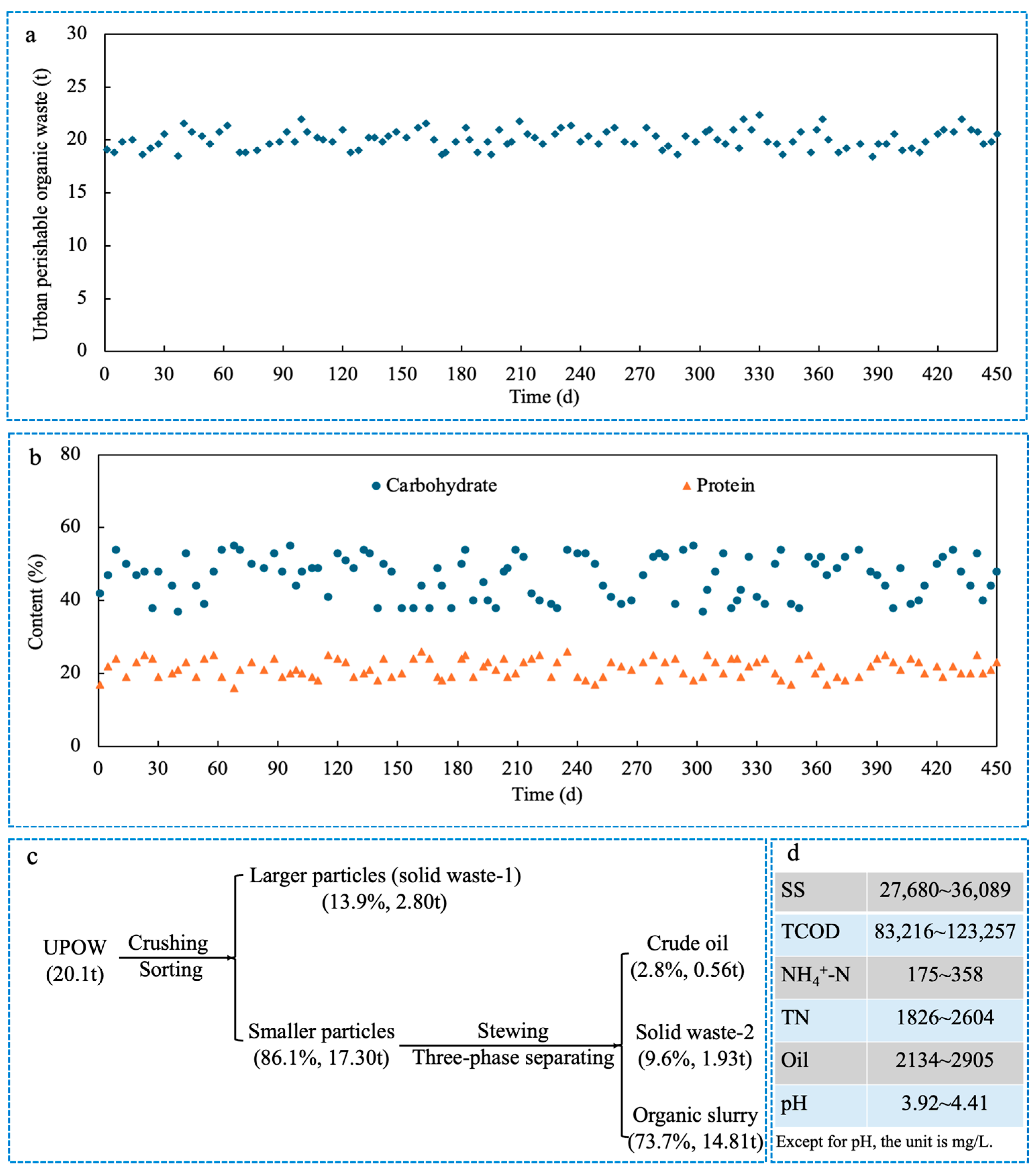
When the concentration of SCFAs generated in the reactor reached a relatively stable level, the change in the amount of UPOW disposed was shown in Figure 2a, with a minimum and maximum of 18.5 and 22 t, respectively, and the average daily amount of UPOW processed was 20.1 t. After analyzing the organic matter components in UPOW during the 450 d operation period, it was found that carbohydrates and proteins were the two most abundant organic substances. Their content changes in UPOW were shown in Figure 2b, where carbohydrates accounted for 37.6–55.1% (average 46.6%) of the dry weight of UPOW, while proteins accounted for 16.7–25.6% (average 21.4%). The sum of these two types of organic matter accounted for about 70% of the dry weight of UPOW, suggesting that the SCFAs were mainly derived from the anaerobic conversion of carbohydrates and proteins.
Based on the daily amount of UPOW processed and the amount of crude oil, solid waste, and organic slurry generated, the mass balance for the entire experimental stage of UPOW pretreatment was obtained. As shown in Figure 2c, 2.8 t of larger particles (solid waste-1), 0.6 t of crude oil, 1.9 t of solid waste after three-phase separation (i.e., solid waste-2), and 14.8 t of organic slurry could be generated each day when 20.1 tons of UPOW were processed. The crude oil and solid waste were sold to the biodiesel processing plants and the black soldier fly brewing plants, respectively. The organic slurry was used to prepare the SCFAs-enriched fermentation liquid in the next step. Figure 2d displayed the main properties of the organic slurry, with TCOD ranging from 83,216 to 123,257 mg/L, ammonia nitrogen ranging from 175 to 358 mg/L, and TN ranging from 1826 to 2604 mg/L. The average TCOD/TN ratio was 53.4/1. In addition, the organic slurry also contained a small amount of oil (2134–2905 mg/L), but in this study, it was found that it had no significant effect on the subsequent anaerobic fermentation of the organic slurry to produce SCFAs under weakly alkaline conditions (p = 0.71, n = 12).

3.2. The Optimal pH Value and Reaction Time for SCFAs Production from Organic Slurry

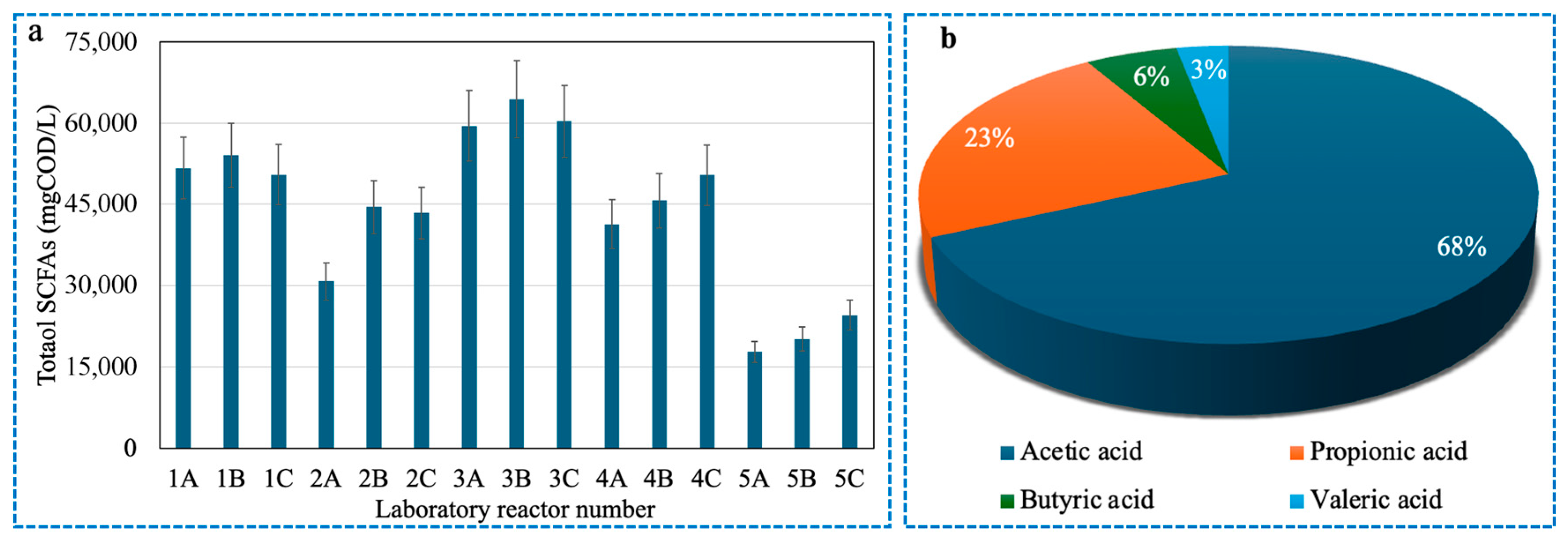
Previous studies using batch reactors to produce SCFAs from kitchen waste indicated that the amount of SCFAs produced was influenced by the pH value and reaction time [17]. However, there are few reports on the optimal pH value and reaction time for the fermentation of UPOW slurry to produce SCFAs in long-term operating reactors. In this study, the average concentrations of SCFAs in 15 long-term stable laboratory reactors were shown in Figure 3a. The concentration of SCFAs in the 3B reactor (i.e., pH 8 ± 0.5 and reaction time 3 d) was observed to be the highest, reaching 64,367 mgCOD/L, which was 162% higher than the highest value of 24,587 mgCOD/L (i.e., reactor 5C) in the unadjusted pH reactors (5C). Therefore, pH 8 ± 0.5 and the reaction time of 3 d were selected as the optimal conditions for full-scale fermentation of UPOW slurry to produce SCFAs.
Further analysis of the SCFAs composition in the 3B reactor showed that on any given day, acetic acid was the highest in content and propionic acid ranked second. Similar results were observed for other reactors. For the 3B reactor, during the 30 d operation period, the acetic acid content changed within the range of 56–75%. Propionic acid was the second most abundant SCFA, which accounted for 17–30%. The content of butyric acid (including n-butyric acid and iso-butyric acid) ranked third (3–10%), and valeric acid (including n-valeric acid and iso-valeric acid) was the lowest, ranging from 0 to 5%. It should be emphasized that due to the large amount of data, specific results for 30 d were not provided here. The average contents of individual SCFAs in the 3B reactor were shown in Figure 3b, where acetic acid, propionic acid, butyric acid, and valeric acid accounted for 68%, 23%, 6%, and 3%, respectively. It can be seen that the total amount of acetic acid and propionic acid was about 90%.
For these five groups (Group 1, 2, 3, 4, and 5) of long-term operated reactors, Table 2 displayed the activities of key enzymes related to the formation of acetic and propionic acid in the reactors with the highest SCFA production in each group. Also, the highest SCFA production in each group was listed in Table 2. For AK, the key enzyme relevant to acetic acid production, the order of its activity in the five reactors was 3B > 1B > 4C > 2B > 5C. The same observation could be made for CoAT, the key enzyme involved in propionic acid generation. It can be seen that the higher the activity of these two enzymes, the higher the yield of SCFAs. The AK and CoAT activities were highest in the 3B reactor, resulting in the highest SCFA production.

3.3. Full-Scale Organic Slurry Preparation and SCFAs-Enriched Fermentation Liquid Production

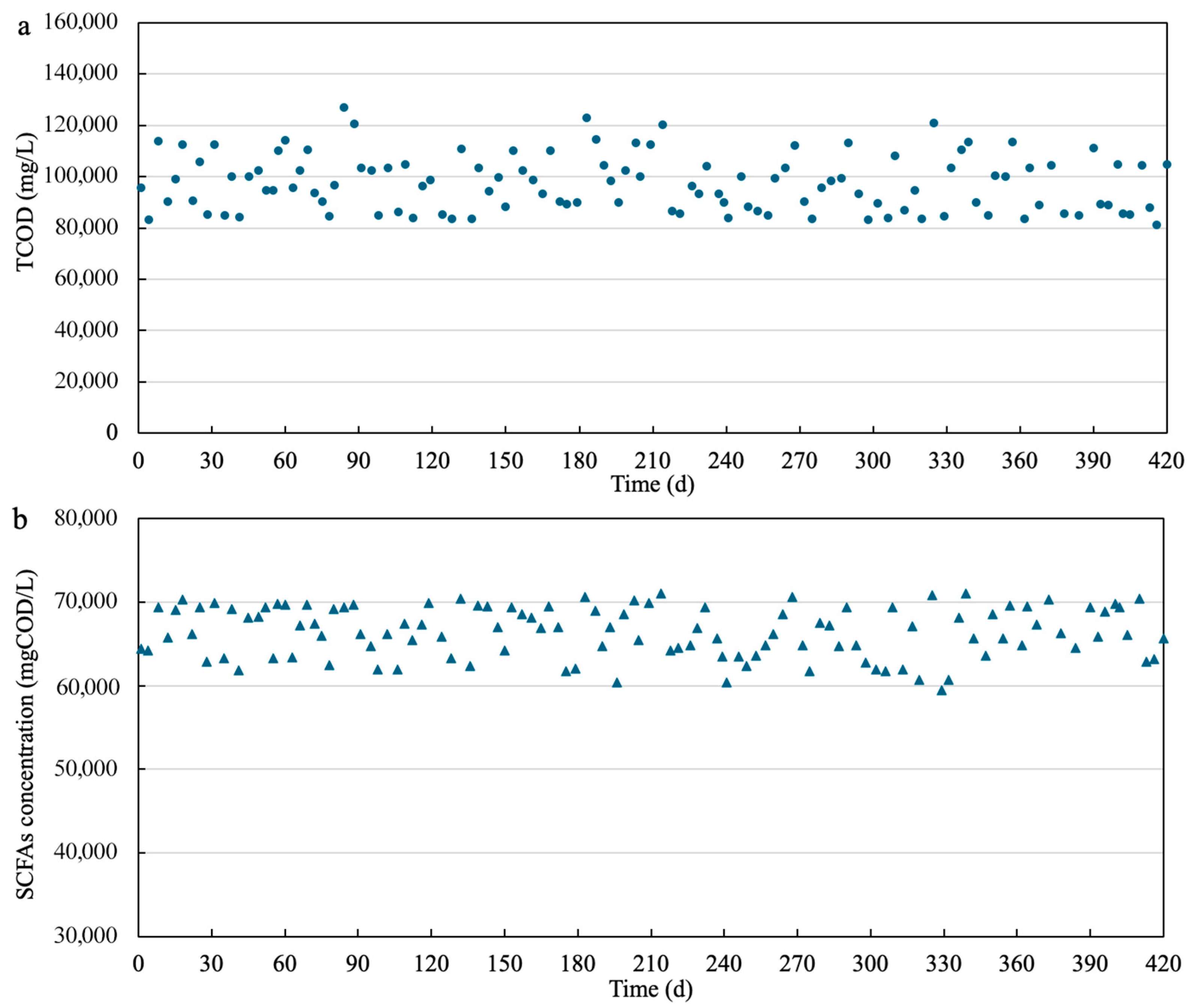
Based on the optimal conditions determined above, the UPOW organic slurry was fermented to produce SCFAs in a full-scale reactor. When the SCFAs production reached relatively stable, the TCOD of organic slurry prepared from UPOW and the SCFAs produced by organic slurry fermentation on the on-site device were shown in Figure 4a,b, respectively. During the 420 d operation time, the average TCOD data could be obtained from Figure 4a as 97,414 mg/L. Figure 4b showed that the concentration of SCFAs in the acid-producing reactor was 59,472–70,985 mgCOD/L, with an average value of 66,373 mg COD/L. The efficiency of converting the organic slurry to produce SCFAs (i.e., SCFAs yield) could be calculated, which was 0.68 gCOD/g TCOD (average data). Further analysis of the components of SCFAs revealed that the order from high to low was acetic acid (65%) > propionic acid (24%) > butyric acid (8%) > valeric acid (3%), which was consistent with those observed in the laboratory reactors (Figure 3b).
In the literature, Xiao et al. studied the SCFAs production from the organic slurry of kitchen waste in an anaerobic membrane bioreactor at pH 9 and obtained a SCFAs yield of 0.50 gCOD/gCOD [7]. They did not optimize the pH value. It was speculated that the reason for the higher yield of SCFAs in this study compared to the literature (0.68 against 0.50 gCOD/gCOD) might be that pH 9 was not the optimal pH value. Liu et al. found, in a short-term batch experiment, that the production of SCFAs from the organic slurry of kitchen waste decreased significantly as the pH value increased from 8 to 9 [17]. To our knowledge, the current study was the first to determine through long-term experiments that pH 8 was the optimal condition for the anaerobic fermentation of UPOW organic slurry to produce SCFAs.

3.4. The Influence of SCFAs-Enriched Fermentation Liquid on Wastewater BNR

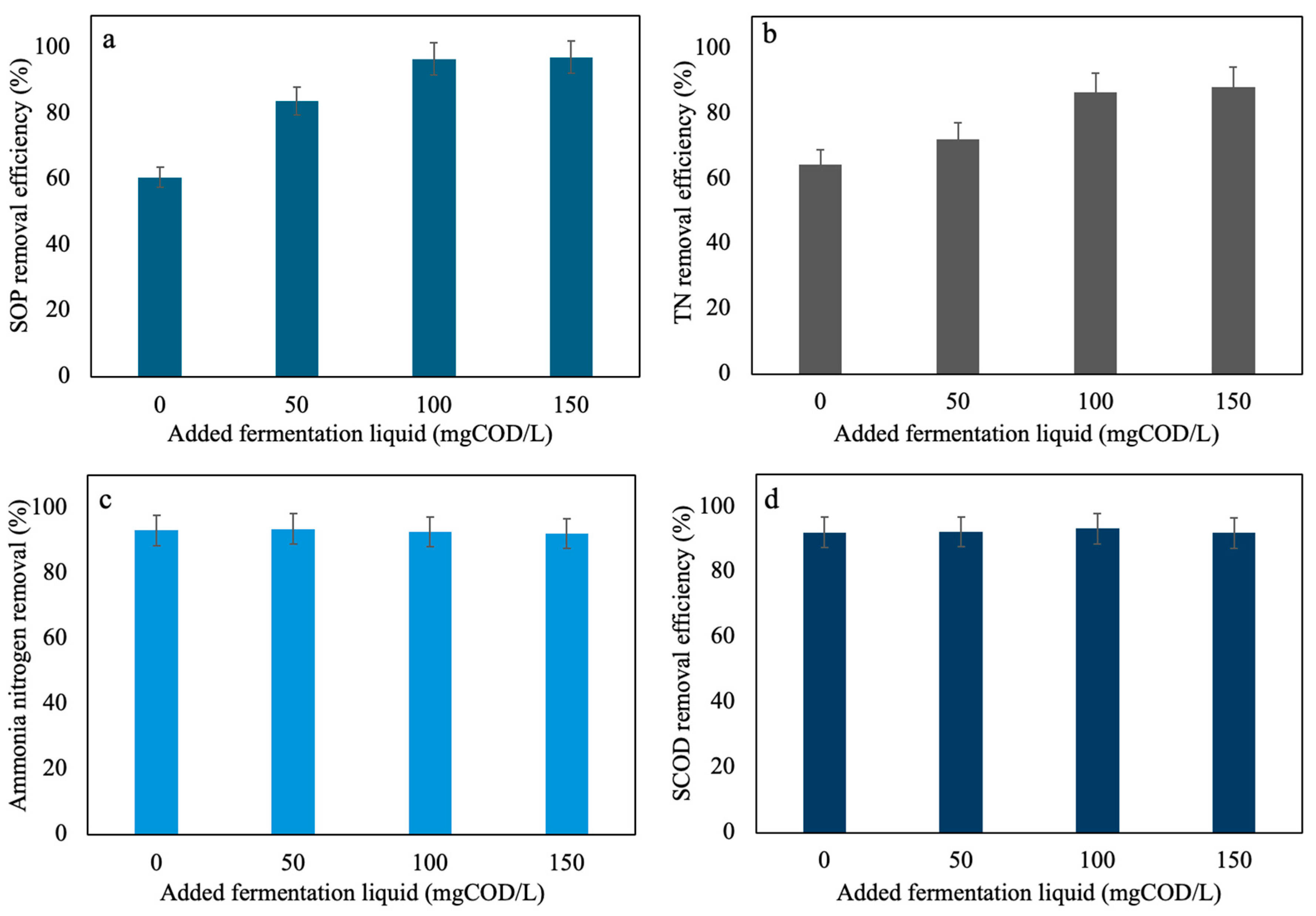
In order to verify whether the fermentation liquid produced above can be used as a carbon source for biological wastewater nitrogen and phosphorus removal and determine its appropriate amount for addition, the effects of three different fermentation liquid amounts (50, 100, 150 mgCOD/L) on biological nitrogen and phosphorus removal efficiency were studied in a laboratory-scale AAO system. When the concentrations of SOP, ammonia nitrogen, total nitrogen, and COD in the effluent of the three systems became relatively stable, they were continuously measured for 30 d, and the average values were shown in Figure 5.
As seen in Figure 5a,b, the removal efficiencies of SOP and TN were increased with fermentation liquid addition in the range of 0–100 mg COD/L. Further increasing the fermentation liquid from 100 to 150 mg COD/L, the SOP and TN removal efficiencies increased from 96.7% and 86.6% to 97.2% and 88.4%, respectively, which were statistically insignificant (p (SOP) = 0.119, n = 4; p (TN) = 0.143, n = 4). The results of Figure 5c,d showed that the addition of fermentation liquid to the BNR system had no significant effect on the removal of NH4+-N and SCOD (p (NH4+-N) = 0.094, n = 4; p (SCOD) = 0.324, n = 4). Therefore, in the following full-scale wastewater treatment studies, the amount of fermentation liquid added was chosen to be 100 mg COD/L.

3.5. Full-Scale Wastewater Treatment with SCFAs-Enriched Fermentation Liquid as Additional Carbon Source

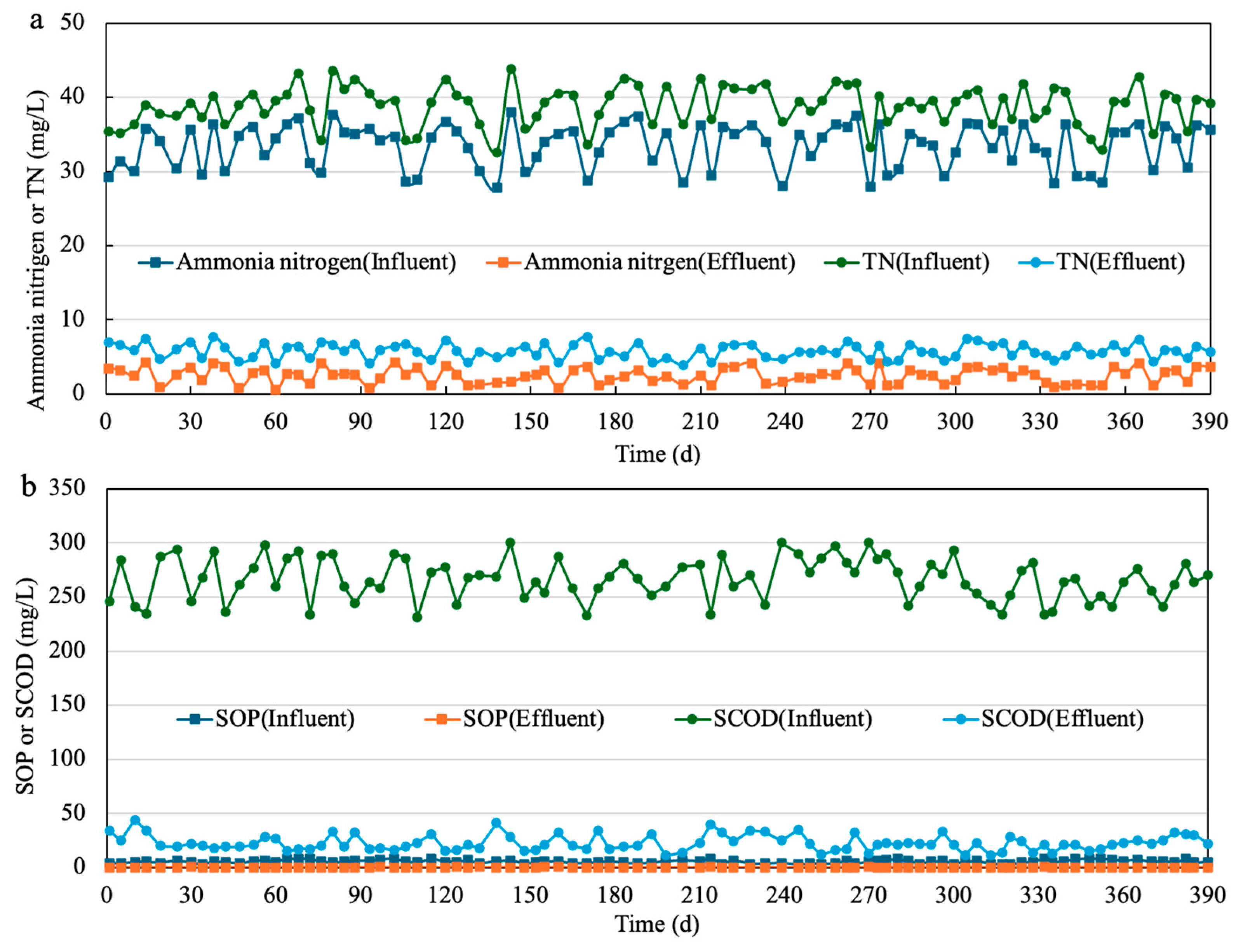
Two AAOs (FL-AAO and SA-AAO) received, respectively, SCFAs-enriched fermentation liquid and sodium acetate as the additional carbon source. After the nitrogen and phosphorus removal in FL-AAO and SA-AAO became relatively stable, the influent and effluent NH4+-N, TN, SOP, and SCOD were measured, and the data were reported in Figure 6. To FL-AAO, as seen in Figure 6a,b, the influent and effluent NH4+-N, TN, SOP, and SCOD varied between 27.8 and 37.6 and 0.6–4.2 mg/L, 33.6–43.8 and 4.1–7.6 mg/L, 2.9–8.4 and 0.03–0.33 mg/L, and 231–300 and 11–44 mg/L, respectively. The average influent and effluent concentrations in FL-AAO were 33.4 and 2.4 mg/L (NH4+-N), 38.8 and 5.8 mg/L (TN), 5.4 and 0.17 mg/L (SOP), and 266 and 23 mg/L (SCOD). According to the influent and effluent data, the average removal efficiency of NH4+-N, TN, SOP, and SCOD could be calculated, which was 92.8% (NH4+-N), 85.1% (TN), 96.9% (SOP), and 91.4% (SCOD) (Table 3). It was noted that the fermentation liquid (with an average SCOD data of 96,287 mg/L) contained a certain amount of TN (average 2215 mg/L) and ortho-phosphate (72 mg/L). Nevertheless, the amount of supplemented fermentation liquid in the sewage treatment system was only 100 mg COD/L, indicating that the added fermentation liquid was diluted by about 963 times, which would result in an increase of only 2.3 and 0.07 mg/L of TN and phosphate in the influent, respectively. Compared to the variation range of TN and phosphate in the influent (33.6–43.8 and 2.9–8.4 mg/L), this increase was very small. Further experiments by adding different amounts of ammonium chloride and sodium phosphate to the influent showed that when the influent TN and SOP were increased from 38.2 and 5.4 mg/L to 41.1 and 6.6 mg/L, and further increased to 44.4 and 7.8 mg/L, the removal efficiencies of ammonia nitrogen, TN, and phosphate were (92.9 ± 3.1)%, (87.6 ± 4.6)%, and (96.7 ± 2.9)%, (92.4 ± 3.4)%, (87.2 ± 4.4)%, and (96.5 ± 3.2)%, and (92.7 ± 4.2)%, (86.8 ± 3.8)%, and (96.8 ± 2.6)%, respectively. It is evident that although the addition of the fermentation liquid led to a slight increase in TN and phosphate in the influent, the slight increase in TN and phosphate did not result in a remarkable change in the wastewater’s biological nitrogen and phosphorus removal efficiency.
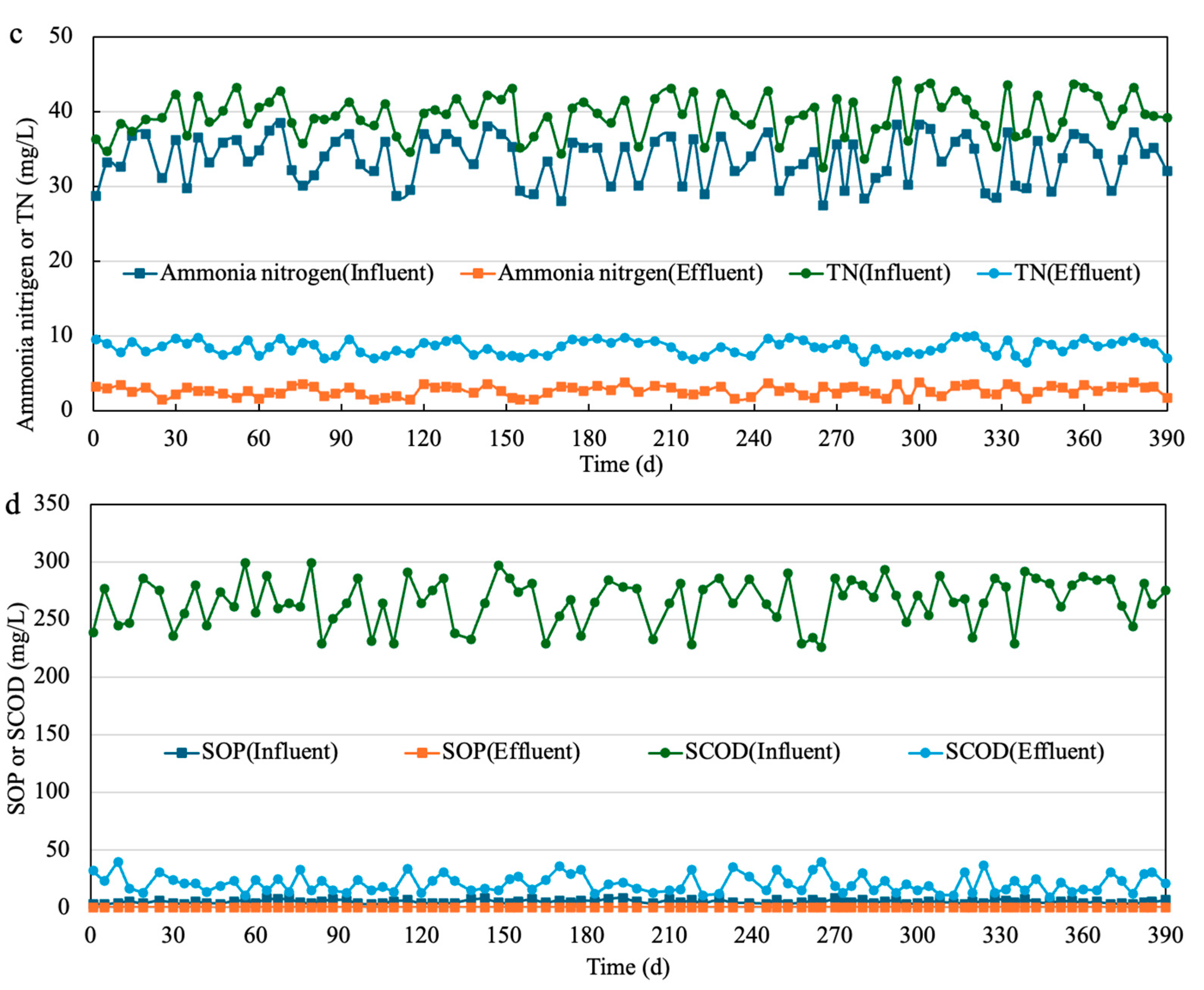
For SA-AAO, it can be seen from Figure 6c,d that the influent NH4+-N, TN, SOP and SCOD varied between 27.5 and 38.5, 34.7–44.1, 3.1–8.5, and 226–299 mg/L, respectively, with the corresponding average values of 33.6, 39.4, 5.2 and 266 mg/L. The effluent NH4+-N, TN, SOP, and SCOD changed in the ranges of 1.5–3.8, 6.6–9.8, 0.29–0.48, and 9–40 mg/L, and the average effluent data were NH4+-N 2.7 mg/L, TN 8.5 mg/L, SOP 0.44 mg/L, and SCOD 21 mg/L. The calculated average removal efficiency of NH4+-N, TN, SOP, and SCOD was 92.0%, 78.4%, 91.5%, and 92.1%, respectively (Table 3). The statistical analysis showed that there was no significant difference in NH4+-N and SCOD removal between FL-AAO and SA-AAO, but FL-AAO had a higher TN and SOP removal efficiency than SA-AAO, suggesting that when the same amount of carbon source (COD-based) was added to the municipal wastewater, the biological denitrification and phosphorus removal efficiency of the fermentation liquid was better than that of sodium acetate.
As is well known, the main factors affecting the biological phosphorus and nitrogen removal efficiency of sewage include the treatment process, temperature, carbon source concentration and types, DO, etc. In this study, the wastewater treatment process, carbon source concentration, temperature, and DO of SA-AAO and FL-AAO were the same, but the types of carbon sources were different. Sodium acetate and SCFAs-enriched fermentation liquid were used, respectively, as the supplementary carbon source of SA-AAO and FL-AAO, and there was not only acetic acid but also propionic acid in the fermentation liquid. According to the studies, propionic acid or its mixture with acetic acid showed a better biological nitrogen and phosphorus removal efficiency than acetic acid [29,30]. In addition, in this study, it was found that there was a higher concentration of humic acid in the influent of FL-AAO than that of SA-AAO (average 36.5 versus average 11.3 mg/L). Previous studies reported that the presence of humic substances improved the biological denitrification efficiency [31,32]. The activity determination of enzymes related to biological nitrogen and phosphorus removal showed that the AMO (related to the conversion of ammonia nitrogen to nitrite nitrogen during nitrification), NAR and NIR (related to the conversion of nitrate and nitrite nitrogen during denitrification), and PPK (related to phosphorus removal) activities in FL-AAO were 0.023 ± 0.006 μ mol NO2-N/(min·mg protein), 0.428 ± 0.013 mg N/(min·g VSS), 0.293 ± 0.012 mg N/(min·g VSS), and 0.289 ± 0.009 μmol NADPH/(min·mg protein), respectively, while the activities of these enzymes in SA-AAO were 0.018 ± 0.007 μmol NO2-N/(min·mg protein), 0.383 ± 0.011 mg N/(min·g VSS), 0.281 ± 0.014 mg N/(min·g VSS), and 0.256 ± 0.008 μ mol NADPH/(min·mg protein). Therefore, FL-AAO exhibited a higher biological nitrogen and phosphorus removal efficiency than SA-AAO.
It was reported that in biological wastewater treatment, the removal of 1 mg N and 1 mg P requires 6–8 mg and 7–10 mg SCOD, respectively [33,34]. In the current study, after the fermentation liquid or sodium acetate were supplemented to FL-AAO or SA-AAO, the average influent of TN, SOP, and SCOD was around 39, 5, and 270 mg/L, respectively, suggesting that the amount of SCOD was not enough for removal of all nitrogen and phosphorus. By studying the nitrification and denitrification characteristics of activated sludge in the FL-AAO system and comparing it with SA-AAO, it was found that the microorganisms of FL-AAO showed greater short-cut nitrification capacity than that of SA-AAO (3.88 ± 0.42 versus 1.29 ± 0.24 mg/g MLVSS). Also, the short-cut denitrification ability of FL-AAO was found to be 3.11-fold of that of SA-AAO. It seems that using the fermentation liquid as a carbon source makes it easier for wastewater biological treatment systems to undergo short-cut nitrification and denitrification. Since short-cut denitrification consumed less of the carbon source than the traditional one, greater nitrogen and phosphorus removal efficiency in FL-AAO was observed when the influent carbon source was not enough.

3.6. Economic Benefit Analysis of the Actual Operation Process of UPOW Producing SCFAs

All economic data here were obtained from actual operations and did not include various equipment investments and site construction costs. Within one year of operation (348 d), based on the total amount of UPOW processed (6995 t) and the payment bills for each item, the average input cost for processing 1 t of UPOW was obtained, including a labor cost of CNY 26.34, water and electricity bills of CNY 9.32, a NaOH and HCl consumption cost of CNY 6.24, an equipment testing and maintenance cost of CNY 7.86, a garbage collection and transportation cost of CNY 110, and miscellaneous property expenses of CNY 8.56. The total average input cost was CNY 168.32 (see Table 4).
Based on the annual production of crude oil, solid waste after three-phase separation, and SCFAs-enriched fermentation liquid, it was calculated that an average of 20.1 t of UPOW were processed per day, resulting in 0.56 tons of crude oil, 1.93 tons of solid waste, and 13.07 t of SCFAs-enriched fermentation liquid. Therefore, processing 1 t of UPOW yielded 0.028 t of crude oil, 0.096 t of solid waste, and 0.65 t of SCFAs-enriched fermentation liquid. Over the course of a year, the average selling prices of crude oil, solid waste, and SCFAs-enriched fluidization liquid per ton were CNY 6000, CNY 60, and CNY 240, respectively. Therefore, the average revenue obtained from processing 1 ton of UPOW could be calculated as follows: crude oil CNY 168, solid waste after three-phase separation CNY 5.76, SCFAs-enriched fermentation liquid CNY 156. The total output was CNY 329.76. Thus, the net income for processing 1 t of UPOW was CNY 161.44 (Table 4).
According to the results of this study, it can be seen that by appropriately treating UPOW, crude oil with a high application value and the supplementary carbon sources required for wastewater treatment plants can be obtained, generating certain economic benefits and achieving the goal of waste treatment. Also, wastewater treatment plants can save a significant amount of chemical carbon (such as commercial acetate, methanol, glucose, etc.) input each year, reducing carbon emissions. However, it was also found that the research results are more suitable for use in situations where long-distance transportation of fermentation liquid is not required, otherwise it will increase the cost of transportation. Therefore, in the future, efficient fermentation techniques should be studied to further increase the content of SCFAs in the fermentation liquid. Alternatively, concentration technology can be used to obtain a high COD concentration in fermentation products, which will help the fermentation liquid to be used over longer distances and promote the application of the research results.

4. Conclusions

In this study, full-scale production and economic analysis of SCFAs from UPOW and its application as a carbon source for biological wastewater treatment were reported. After the pretreatment of UPOW and three-phase separation, the organic slurry was subjected to anaerobic fermentation to produce SCFAs with a yield of 0.68 gCOD/gTCOD of organic slurry under the determined optimal process conditions. The greatest content in the fermentative SCFAs was acetic acid, followed by propionic acid, which together accounted for nearly 90%. The use of SCFAs-enriched fermentation liquid as the additional carbon source of the biological municipal wastewater treatment indicated that it resulted in a higher total nitrogen and phosphorus removal efficiency than the commonly used carbon source (sodium acetate). Finally, the input and output data of the operation process for over a year were analyzed, and the results showed that fermenting UPOW to produce carbon sources (i.e., SCFAs-enriched fermentation liquid) for wastewater biological treatments could generate good economic benefits.
In future research, it is necessary to consider seasonal changes in UPOW and the possible presence of inhibitory compounds in the fermentation broth, and to further optimize the parameters of the fermentation process to obtain a higher concentration of SCFAs in the fermentation broth. In addition, it is necessary to analyze the microbial communities of the UPOW fermentation system for producing SCFAs and the fermentation broth used as a supplementary carbon source system for wastewater treatment.

Author Contributions

Experiments, Economic analysis, Writing—original draft, Y.C.; Experiments, Methodology, Writing—review and editing, L.D.; Supervision, Resources, Writing—review and editing, X.Z. All authors have read and agreed to the published version of the manuscript.

Funding

This research was funded by Shanghai “Oriental Talents Program” Youth Project (QNGZ2024004).

Institutional Review Board Statement

Not applicable.

Informed Consent Statement

Not applicable.

Data Availability Statement

The original contributions presented in this study are included in the article. Further inquiries can be directed to the corresponding author.

Conflicts of Interest

Authors Lei Dong and Xin Zhang were employed by the company Shanghai Municipal Engineering Design Institute (Group) Co., Ltd. The remaining authors declare that the research was conducted in the absence of any commercial or financial relationships that could be construed as a potential conflict of interest.

References

  1. FAO. State of Food and Agriculture. Moving Forward on Food Loss and Waste Reduction. 2019. Available online: https://www.fao.org/3/ca6030en/ca6030en.pdf (accessed on 19 December 2025).
  2. Jana, R.; Ikbal, S.; Chowdhury, R. Boosting of energy efficiency and by-product quality of anaerobic digestion of kitchen waste: Hybridization with pyrolysis using zero-waste strategy. Energy Convers. Manag. 2025, 324, 119290. [Google Scholar] [CrossRef]
  3. Huang, Y.Z.; Lee, Y.Y.; Fan, C.; Chung, Y.C. Recycling of domestic sludge cake as the inoculum of anaerobic digestion for kitchen waste and its benefits to carbon negativity. J. Environ. Manag. 2024, 370, 122863. [Google Scholar] [CrossRef] [PubMed]
  4. Chen, G.; van Loosdrecht, M.C.M.; Ekama, M.G.A.; Brdjanovic, D. Biological Wastewater Treatment: Principles, Modelling and Design, 2nd ed.; IWA Publishing: London, UK, 2020. [Google Scholar]
  5. Maheepala, S.S.; Fuchigami, S.; Hatamoto, M.; Akashi, T.; Watari, T.; Yamaguchi, T. Stable denitrification performance of a mesh rotating biological reactor treating municipal wastewater. Environ. Technol. Innov. 2022, 27, 102543. [Google Scholar] [CrossRef]
  6. Yin, F.F.; Guo, H.F. Influence of additional methanol on both pre- and post-denitrification processes in treating municipal wastewater. Water Sci. Technol. 2022, 85, 1434–1443. [Google Scholar] [CrossRef]
  7. Xiao, X.; Shan, Z.; Pan, T.; Huang, Z.; Ruan, W. Characteristics of volatile fatty acids production and microbial succession under acid fermentation via anaerobic membrane bioreactor treating kitchen waste slurry. Bioresour. Technol. 2025, 429, 132502. [Google Scholar] [CrossRef]
  8. Rózsenberszki, T.; Kalauz-Simon, V.; Fejes, R.; Bakonyi, P.; Koók, L.; Kurdi, R.; Nemestóthy, N.; Bélafi-Bakó, K. Carboxylic acid production from kitchen waste and sewage sludge digestate inoculation via acidogenic fermentation at high organic load. Waste Biomass Valor. 2025, 16, 3733–3743. [Google Scholar] [CrossRef]
  9. Fu, Z.; Zhao, J.; Zhong, Z.; Li, B.; Sun, Y.; Fan, H.; Wang, H.; Xie, J.; Hu, Y.; Su, Y.; et al. Novel insights into liquid digestate-derived hydrochar enhances volatile fatty acids production from anaerobic co-digestion of sludge and food waste. Chem. Eng. J. 2025, 507, 160635. [Google Scholar] [CrossRef]
  10. Wang, H.; Liu, X.; Sun, Y.; Nan, J.; Wang, Z.; Zhou, L. Enhanced SCFAs production from waste activated sludge by ultrasonic pretreatment with enzyme-assisted anaerobic fermentation. J. Environ. Chem. Eng. 2025, 13, 115589. [Google Scholar] [CrossRef]
  11. Muñoz, A.C.; Olsson, J.; Malovanyy, A.; Baresel, C.; Machamada-Devaiah, N.; Schnürer, A. Impact of thermal hydrolysis on VFA-based carbon source production from fermentation of sludge and digestate for denitrification: Experimentation and upscaling implications. Water Res. 2024, 266, 122426. [Google Scholar] [CrossRef]
  12. Grana, M.; Catenacci, A.; Ficara, E. Denitrification capacity of volatile fatty acids from sludge fermentation: Lab-scale testing and full-scale assessment. Fermentation 2024, 10, 25. [Google Scholar] [CrossRef]
  13. Li, X.; Liu, W.; Zhang, W.; Zhou, A.; Xu, Q.; He, Z.; Yang, C.; Wang, A. Short-chain fatty acid production from waste activated sludge and in situ use in wastewater treatment plants with life cycle assessment. Resour. Conserv. Recycl. 2023, 198, 107186. [Google Scholar] [CrossRef]
  14. Ossiansson, E.; Bengtsson, S.; Persson, F.; Cimbritz, M.; Gustavsson, D.J.I. Primary filtration of municipal wastewater with sludge fermentation—Impacts on biological nutrient removal. Sci. Total Environ. 2023, 902, 166483. [Google Scholar] [CrossRef] [PubMed]
  15. Arhin, S.G.; Cesaro, A.; Di Capua, F.; Esposito, G. Acidogenic fermentation of food waste to generate electron acceptors and donors towards medium-chain carboxylic acids production. J. Environ. Manag. 2023, 348, 119379. [Google Scholar] [CrossRef] [PubMed]
  16. Wang, Y.; Zhang, X.; Chen, Y. The enhancement of caproic acid synthesis from organic solid wastes: A review. J. Environ. Manag. 2024, 371, 123215. [Google Scholar] [CrossRef]
  17. Liu, F.; Wang, T.; Feng, L.; Chen, Y. The mechanisms of pH regulation on promoting volatile fatty acids production from kitchen waste. J. Environ. Sci. 2025, 147, 414–423. [Google Scholar] [CrossRef]
  18. Li, X.F.; Zhang, W.S.; Qi, S.; Zhao, J.F.; Sun, Z.Y.; Tang, Y.Q. Anaerobic volatile fatty acid production performance and microbial community characteristics from solid fraction of alkali-thermal treated waste-activated sludge: Focusing on the effects of different pH conditions. Appl. Biochem. Biotechnol. 2025, 197, 4565–4585. [Google Scholar] [CrossRef]
  19. Swiatkiewicz, J.; Slezak, R.; Krzystek, L.; Ledakowicz, S. Production of volatile fatty acids in a semi-continuous dark fermentation of kitchen waste: Impact of organic loading rate and hydraulic retention time. Energies 2021, 14, 2993. [Google Scholar] [CrossRef]
  20. Feng, L.; Chen, Y.; Zheng, X. Enhancement of waste activated sludge protein conversion and volatile fatty acids accumulation during waste activated sludge anaerobic fermentation by carbohydrate substrate addition: The effect of pH. Environ. Sci. Technol. 2009, 43, 4373–4380. [Google Scholar] [CrossRef]
  21. Suwannakham, S.; Yang, S. Enhanced propionic acid fermentation by Propionibacterium acidipropionici mutant obtained by adaptation in a fibrous-bed bioreactor. Biotechnol. Bioeng. 2005, 91, 325–337. [Google Scholar] [CrossRef]
  22. Wang, D.; Chen, Y.; Zheng, X.; Li, X.; Feng, L. Short-chain fatty acid production from different biological phosphorus removal sludges: The Influences of PHA and gram- staining bacteria. Environ. Sci. Technol. 2013, 47, 2688–2695. [Google Scholar] [CrossRef]
  23. APHA. Standard Methods for the Examination of Water and Wastewater, 20th ed.; American Public Health Association: Washington, DC, USA, 1998. [Google Scholar]
  24. Bradford, M.M. A rapid and sensitive method for the quantitation of microgram quantities of protein utilizing the principle of protein-dye binding. Anal. Biochem. 1976, 72, 248–254. [Google Scholar] [CrossRef] [PubMed]
  25. Morris, D.L. Quantitative determination of carbohydrates with Dreywood’s anthrone reagent. Science 1948, 107, 254–255. [Google Scholar] [CrossRef] [PubMed]
  26. Lee, M.C.; Snoeyink, V.L.; Crittenden, J.C. Activated carbon adsorption of humic substances. J. Am. Water Works Assoc. 1981, 73, 440–446. [Google Scholar] [CrossRef]
  27. Miron, Y.; Zeeman, G.; van Lier, J.B.; Lettinga, G. The role of sludge retention time in the hydrolysis and acidification of lipids, carbohydrates and proteins during digestion of primary sludge in CSTR systems. Water Res. 2000, 34, 1705–1713. [Google Scholar] [CrossRef]
  28. Chen, Y.; Wang, D.; Zhu, X.; Zheng, X.; Feng, L. Long-term effects of copper nanoparticles on wastewater biological nutrient removal and N2O generation in the activated sludge process. Environ. Sci. Technol. 2012, 46, 12452–12458. [Google Scholar] [CrossRef]
  29. Li, H.; Chen, Y.; Gu, G. The effect of propionic to acetic acid ratio on anaerobic-aerobic (low dissolved oxygen) biological phosphorus and nitrogen removal. Bioresour. Technol. 2008, 99, 4400–4407. [Google Scholar] [CrossRef]
  30. Li, X.; Li, X.; Li, C.; Li, N.; Zou, P.; Gao, X.; Cao, Q. Nitrogen removal performances and metabolic mechanisms of denitrification systems using different volatile fatty acids as external carbon sources. Chem. Eng. J. 2023, 474, 145998. [Google Scholar] [CrossRef]
  31. Ji, Z.; Chen, Y. Using sludge fermentation liquid to improve wastewater short-cut nitrification-denitrification and denitrifying phosphorus removal via nitrite. Environ. Sci. Technol. 2010, 44, 8957–8963. [Google Scholar] [CrossRef]
  32. Li, M.; Su, Y.; Chen, Y.; Wan, R.; Zheng, X.; Liu, K. The effects of fulvic acid on microbial denitrification: Promotion of NADH generation, electron transfer, and consumption. Appl. Microbiol. Biotechnol. 2016, 100, 5607–5618. [Google Scholar] [CrossRef]
  33. Daigger, G.T.; Bowen, P.T. Economic considerations on the use of fermenters in biological nutrient removal systems. Use of fermentation to enhance biological nutrient removal. In Proceedings of the Conference Seminar, 67th Annual Water Environment Federation Conference & Exposition, Chicago, IL, USA, 15–19 October 1994. [Google Scholar]
  34. Sedlak, R.I. Principles and Practice of Phosphorus and Nitrogen Removal from Municipal Wastewater; Lewis Publishers: Ann Arbor, MI, USA, 1992. [Google Scholar]
Figure 1. Process for preparation of slurry and production of SCFAs-enriched fermentation liquid from slurry.
Sustainability 18 00262 g001
Figure 2. Daily amount of UPOW processed (a), the percentage of carbohydrates and protein substances in the dry weight of UPOW (b), the mass balance during the pre-treatment stage of UPOW (c), and the main properties of the slurry after three-phase separation (d).
Sustainability 18 00262 g002
Figure 3. The average concentration of total SCFAs in 15 long-term operating laboratory reactors after becoming relatively stable (a) and the average content of each SCFAs in the reactor with the highest SCFAs production (b). The error bar represents the standard deviation of 30 d.
Sustainability 18 00262 g003
Figure 4. Changes in the organic slurry TCOD (a) and the concentration of fermentative SCFAs produced from organic slurry (b) in full-scale on-site reactors.
Sustainability 18 00262 g004
Figure 5. The influence of fermentation liquid addition on the removal of SOP (a), TN (b), NH4+-N (c), and SCOD (d) during municipal wastewater biological treatment in laboratory AAO systems. These data are the averages and their standard deviations during one-month measurements.
Sustainability 18 00262 g005
Figure 6. The variations in influent and effluent NH4+-N, TN, SOP, and SCOD in FL-AAO (a,b) and SA-AAO (c,d) after the nitrogen and phosphorus removal became relatively stable. The experiments started on 23 September 2023 and ended on 16 October 2024.
Sustainability 18 00262 g006aSustainability 18 00262 g006b
Table 1. Main operating parameters of 15 laboratory reactors *.
ReactorGrouppHDaily Renewed Mixture Volume (L)Corresponding Reaction Time (d)
1A16 ± 0.51.54
1B23
1C32
2A27 ± 0.51.54
2B23
2C32
3A38 ± 0.51.54
3B23
3C32
4A49 ± 0.51.54
4B23
4C32
5A5- **1.54
5B23
5C32
* The volume of mixture in each reactor was 6 L. ** The pH value was not adjusted and set as the control.
Table 2. Comparison of activities of key enzymes related to the formation of acetic and propionic acid in different reactors.
ReactorActivity of AK
(U/100 mg VSS)
Activity of CoAT
(U/100 mg VSS)
SCFAs Production
(mg COD/L)
1B5.332 ± 0.2873.042 ± 0.31154,046 ± 4358
2B3.147 ± 0.2161.264 ± 0.15644,505 ± 3874
3B8.465 ± 0.4225.323 ± 0.42764,367 ± 4895
4C4.563 ± 0.3011.788 ± 0.17950,375 ± 4011
5C1.345 ± 0.1150.631 ± 0.07224,587 ± 1978
Table 3. Comparison of the removal efficiency of NH4+-N, TN, SOP, and SCOD between FL-AAO and SA-AAO.
NH4+-N (%)TN (%)SOP (%)SCOD (%)
FL-AAO93.8 ± 3.488.1 ± 5.296.9 ± 3.192.4 ± 2.3
SA-AAO93.0 ± 2.981.4 ± 4.591.5 ± 2.893.1 ± 1.9
Table 4. The actual input, output, and net income for producing SCFA from 1 t of UPOW.
ItemCost or Benefit (¥/t)
Input
Labor cost26.34
Water and electricity bills9.32
NaOH and HCl consumption6.24
Equipment testing and maintenance7.86
Garbage collection and transportation110
Miscellaneous property expenses8.56
Total168.32
Output
Crude oil168
Solid waste after three-phase separation5.76
SCFAs-enriched fermentation liquid156
Total329.76
Net income161.44
Disclaimer/Publisher’s Note: The statements, opinions and data contained in all publications are solely those of the individual author(s) and contributor(s) and not of MDPI and/or the editor(s). MDPI and/or the editor(s) disclaim responsibility for any injury to people or property resulting from any ideas, methods, instructions or products referred to in the content.