
Insurance in the Aspects of Sustainable Development: The Behavioral and Cognitive Determinants of Consumer Demand Using SEM

Abstract
1. Introduction
2. Materials and Methods
2.1. Questionnaire Structure and Measurement Scales
2.2. Sample and Data Collection
2.3. Measurement Model
2.4. Structural Model
3. Results
3.1. Measurement Model Assessment
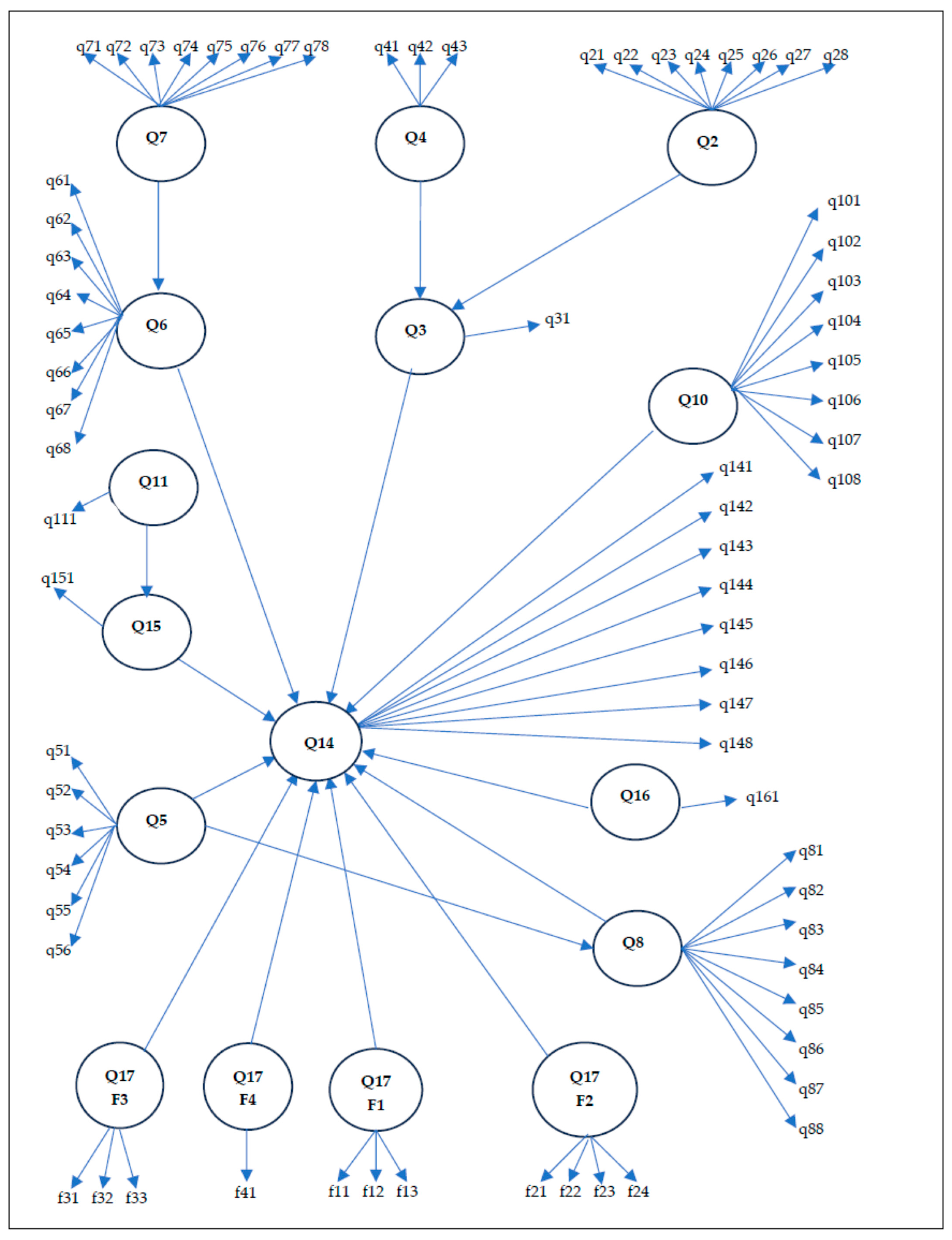
3.2. Model Path Graph
- Perceived insurance value → normative attitude, β = 0.48, meaning that the belief in the product’s reasonableness is a strong predictor of the emergence of the “it’s worth insuring” norm;
- Experiences of random events → fear of events, β = 0.42, confirming that real risk experience creates awareness of threats;
- The role of the advisor and the need for knowledge → positive experiences, β = 0.44, indicating the crucial importance of education and interpersonal relationships in shaping market trust.
3.3. Direct Effects—Interpretation
3.4. Indirect Effects
3.5. Integration of Direct and Indirect Effects
- Perceived value → attitude → ownership;
- Experience → concerns → ownership;
- Advisor → experiences → ownership.
4. Discussion
5. Conclusions
Author Contributions
Funding
Institutional Review Board Statement
Informed Consent Statement
Data Availability Statement
Conflicts of Interest
References
- Outreville, J.F. The Relationship Between Insurance and Economic Development: 85 Empirical Papers for a Review of the Literature. Risk Manag. Insur. Rev. 2013, 16, 71–122. [Google Scholar] [CrossRef]
- Thamtarana, K.; Sornsaruht, P. Antecedents to Thai Consumer Insurance Policy Purchase Intention: A Structural Equation Model Analysis. Sage Open 2024, 14, 21582440241239474. [Google Scholar] [CrossRef]
- Maman, D.; Rosenhek, Z. Facing Future Uncertainties and Risks through Personal Finance: Conventions in Financial Education. J. Cult. Econ. 2020, 13, 303–317. [Google Scholar] [CrossRef]
- Chen, W.; Yuan, X. Financial Inclusion in China: An Overview. Front. Bus. Res. China 2021, 15, 4. [Google Scholar] [CrossRef]
- Dwivedi, R.; Prasad, K.; Mandal, N.; Singh, S.; Vardhan, M.; Pamucar, D. Performance Evaluation of an Insurance Company Using an Integrated Balanced Scorecard (BSC) and Best-Worst Method (BWM). Decis. Mak. Appl. Manag. Eng. 2021, 4, 33–50. [Google Scholar] [CrossRef]
- Terdpaopong, K.; Rickards, R.C. Thai Non-Life Insurance Companies’ Resilience and the Historic 2011 Floods: Some Recommendations for Greater Sustainability. Sustainability 2021, 13, 8890. [Google Scholar] [CrossRef]
- Hussain, S.; Mubeen, M.; Jatoi, W.N.; Tahir, M.; Ahmad, S.; Farid, H.U.; ur Rahman, M.H.; Ali, M.; Qaisrani, S.A.; Ahmad, I. Sustainable Development Goals and Governments’ Roles for Social Protection. In Climate Change Impacts on Agriculture: Concepts, Issues and Policies for Developing Countries; Springer: Berlin/Heidelberg, Germany, 2023; pp. 209–222. [Google Scholar]
- Xie, S.; Zhang, J.; Li, X.; Xia, X.; Chen, Z. The Effect of Agricultural Insurance Participation on Rural Households’ Economic Resilience to Natural Disasters: Evidence from China. J. Clean. Prod. 2024, 434, 140123. [Google Scholar] [CrossRef]
- Lemkowska, M. Funkcje ubezpieczeń gospodarczych a zrównoważony rozwój. Wiadomości Ubezpieczeniowe 2020, 2, 45–76. [Google Scholar] [CrossRef]
- Weedige, S.S.; Ouyang, H.; Gao, Y.; Liu, Y. Decision Making in Personal Insurance: Impact of Insurance Literacy. Sustainability 2019, 11, 6795. [Google Scholar] [CrossRef]
- Jahnert, J.R.; Schmeiser, H.; Zehnle, M. Consumer Perceptions and Purchasing Behavior of Sustainable Insurance Products. Geneva Pap. Risk Insur. Issues Pract. 2025, 50, 619–649. [Google Scholar] [CrossRef]
- Masud, M.M.; Ismail, N.A.; Rahman, M. A Conceptual Framework for Purchase Intention of Sustainable Life Insurance: A Comprehensive Review. Int. J. Innov. Sustain. Dev. 2020, 14, 351. [Google Scholar] [CrossRef]
- Pawłowska-Tyszko, J.; Soliwoda, M. Agricultural insurance vs. economic and financial sustainability of farms. Pract. Nauk. Uniw. Ekon. Wrocławiu 2017, 478, 337–346. [Google Scholar] [CrossRef]
- Baranauskas, G.; Raišienė, A.G. Reflections on the Customer Decision-Making Process in the Digital Insurance Platforms: An Empirical Study of the Baltic Market. Appl. Sci. 2021, 11, 8524. [Google Scholar] [CrossRef]
- Lin, X.; Lee, C.Y.; Fan, C.K. Analysis of Innovative Green Marketing Corresponding to Consumer Preferences: A Case Study of the Insurance Industry. Sustainability 2025, 17, 2179. [Google Scholar] [CrossRef]
- Rita, P.; Ramos, R.F. Global Research Trends in Consumer Behavior and Sustainability in E-Commerce: A Bibliometric Analysis of the Knowledge Structure. Sustainability 2022, 14, 9455. [Google Scholar] [CrossRef]
- Stępień, S.; Śmigla, M. Zarządzanie ryzykiem cenowym w rolnictwie w praktyce wybranych krajów na świecie. Zesz. Nauk. SGGW W Warszawie-Probl. Rol. Swiat. 2012, 12, 158–167. [Google Scholar] [CrossRef]
- Ranganathan, K. Do Personal Values Explain Variation in Satisficing Measures of Risk? Manag. Decis. 2021, 59, 1642–1663. [Google Scholar] [CrossRef]
- Kunreuther, H.; Pauly, M. Insurance Decision-Making and Market Behavior. Found. Trends® Microecon. 2006, 1, 63–127. [Google Scholar] [CrossRef]
- Kunreuther, H.C.; Pauly, M.V. Behavioral Economics and Insurance: Principles and Solutions. In Research Handbook on the Economics of Insurance Law; Edward Elgar Publishing: Cheltenham, UK, 2015; pp. 15–35. [Google Scholar]
- Huber, C.; Gatzert, N.; Schmeiser, H. How Does Price Presentation Influence Consumer Choice? The Case of Life Insurance Products. J. Risk Insur. 2015, 82, 401–432. [Google Scholar] [CrossRef]
- Sakvarelidze, A. The Impact of Behavioral Economics on Consumer Decision-Making in The Insurance Industry. Health Policy Econ. Sociol. 2024, 8, 2960–9992. [Google Scholar] [CrossRef]
- Richter, A.; Schiller, J.; Schlesinger, H. Behavioral Insurance: Theory and Experiments. J. Risk Uncertain 2014, 48, 85–96. [Google Scholar] [CrossRef]
- Richter, A.; Ruß, J.; Schelling, S. Insurance Customer Behavior: Lessons from Behavioral Economics. Risk Manag. Insur. Rev. 2019, 22, 183–205. [Google Scholar] [CrossRef]
- Spinnewijn, J. Insurance and Perceptions: How to Screen Optimists and Pessimists. Econ. J. 2013, 123, 606–633. [Google Scholar] [CrossRef]
- Lin, X.; Bruhn, A.; William, J. Extending Financial Literacy to Insurance Literacy: A Survey Approach. Account. Financ. 2019, 59, 685–713. [Google Scholar] [CrossRef]
- Wicka, A.; Świstak, J. Homo Sapiens Oeconomicus, Komo Oeconomicus—Are Our Decisions on Insurance Are Taken on the Basis of Rational Factors Only? Zesz. Nauk. Uniw. Szczecińskiego Finans. Rynk. Finans. Ubezpieczenia 2017, 89, 403–411. [Google Scholar] [CrossRef]
- Fezzi, C.; Menapace, L.; Raffaelli, R. Estimating Risk Preferences Integrating Insurance Choices with Subjective Beliefs. Eur. Econ. Rev. 2021, 135, 103717. [Google Scholar] [CrossRef]
- Shai, O. Out of Time? The Effect of an Infrequent Traumatic Event on Individuals’ Time and Risk Preferences, Beliefs, and Insurance Purchasing. J. Health Econ. 2022, 86, 102678. [Google Scholar] [CrossRef]
- Baicker, K.; Congdon, W.J.; Mullainathan, S. Health Insurance Coverage and Take-Up: Lessons from Behavioral Economics. Milbank Q. 2012, 90, 107–134. [Google Scholar] [CrossRef] [PubMed]
- Krishnan S., S.; Iyer, S.S.; Balaji Smr, S. Insights from Behavioral Economics for Policymakers of Choice-based Health Insurance Markets: A Scoping Review. Risk Manag. Insur. Rev. 2022, 25, 115–143. [Google Scholar] [CrossRef]
- Sarstedt, M.; Ringle, C.M.; Hair, J.F. Partial Least Squares Structural Equation Modeling. In Handbook of Market Research; Springer: Berlin/Heidelberg, Germany, 2021; pp. 587–632. [Google Scholar]
- Hair, J.F.; Matthews, L.M.; Matthews, R.L.; Sarstedt, M. PLS-SEM or CB-SEM: Updated Guidelines on Which Method to Use. Int. J. Multivar. Data Anal. 2017, 1, 107. [Google Scholar] [CrossRef]
- Kline, R.B. Principles and Practice of Structural Equation Modeling; Guilford Publications: New York, NY, USA, 2023. [Google Scholar]
- Chin, W.W. The Partial Least Squares Approach to Structural Equation Modeling. In Modern Methods for Business Research; Psychology Press: Hove, UK, 1998; pp. 295–336. [Google Scholar]
- Henseler, J.; Ringle, C.M.; Sarstedt, M. A New Criterion for Assessing Discriminant Validity in Variance-Based Structural Equation Modeling. J. of the Acad. Mark. Sci. 2015, 43, 115–135. [Google Scholar] [CrossRef]
- Hair, J.F.; Risher, J.J.; Sarstedt, M.; Ringle, C.M. When to Use and How to Report the Results of PLS-SEM. Eur. Bus. Rev. 2019, 31, 2–24. [Google Scholar] [CrossRef]
- Fornell, C.; Larcker, D.F. Evaluating Structural Equation Models with Unobservable Variables and Measurement Error. J. Mark. Res. 1981, 18, 39–50. [Google Scholar] [CrossRef]
- Ajzen, I. The Theory of Planned Behavior. Organ. Behav. Hum. Decis. Process. 1991, 50, 179–211. [Google Scholar] [CrossRef]
- Huang, W.S.; Chang, C.T.; Sia, W.Y. An Empirical Study on the Consumers’ Willingness to Insure Online. Pol. J. Manag. Stud. 2019, 20, 2081–7452. [Google Scholar] [CrossRef]
- Achmadi, H.; Suk, K.S.; Meranga, I.; Samuel, S. The Influence of Attitude, Perceived Behavior Control, Subjective Norms, Sex and Age to Intention to Purchase Healthcare Insurance. J. Manag. Mark. Rev. (JMMR) 2024, 9, 2636–9168. [Google Scholar] [CrossRef]
- Wang, H.; Zhang, D.; Guariglia, A.; Fan, G.Z. Growing out of the Growing Pain’: Financial Literacy and Life Insurance Demand in China. Pac.-Basin Financ. J. 2021, 66, 101459. [Google Scholar] [CrossRef]
- Lin, C.; Hsiao, Y.J.; Yeh, C.Y. Financial Literacy, Financial Advisors, and Information Sources on Demand for Life Insurance. Pac.-Basin Financ. J. 2017, 43, 218–237. [Google Scholar] [CrossRef]
- Dercon, S.; Gunning, J.; Zeitlin, A. The Demand for Insurance Under Limited Trust: Evidence from a Field Experiment in Kenya. 2019. Available online: https://ora.ox.ac.uk/objects/uuid:c59af3dd-67b8-4c10-b9b4-4536a8c5caf5/files/sqn59q4471 (accessed on 10 September 2025).
- Beck, T.; Webb, I. Economic, Demographic, and Institutional Determinants of Life Insurance Consumption across Countries. World Bank Econ. Rev. 2003, 17, 51–88. [Google Scholar] [CrossRef]
- Çelik, S.; Kayali, M.M. Determinants of Demand for Life Insurance in European Countries. Probl. Perspect. Manag. 2009, 7, 32–37. [Google Scholar]
- Kurdyś-Kujawska, A.; Sompolska-Rzechuła, A. Determinants of Demand for Life Insurance: The Example of Farmers from North-West Poland. Pract. Nauk. Uniw. Ekon. Wrocławiu 2019, 63, 71–81. [Google Scholar] [CrossRef]
- Eling, M.; Pradhan, S.; Schmit, J.T. The Determinants of Microinsurance Demand. Geneva Pap. Risk Insur. Issues Pract. 2014, 39, 224–263. [Google Scholar] [CrossRef]
- Eling, M.; Ghavibazoo, O.; Hanewald, K. Willingness to Take Financial Risks and Insurance Holdings: A European Survey. J. Behav. Exp. Econ. 2021, 95, 101781. [Google Scholar] [CrossRef]
- Agyei, J.; Sun, S.; Abrokwah, E.; Penney, E.K.; Ofori-Boafo, R. Influence of Trust on Customer Engagement: Empirical Evidence from the Insurance Industry in Ghana. Sage Open 2020, 10, 2158244019899104. [Google Scholar] [CrossRef]
- Kawiński, M.; Majewski, P. Financial and Insurance Literacy in Poland. Wiadomości Ubezpieczeniowe 2016, 4, 21–32. [Google Scholar]
- Sliwinski, A.; Michalski, T.; Roszkiewicz, M. Demand for Life Insurance—An Empirical Analysis in the Case of Poland. Geneva Pap. Risk Insur. Issues Pract. 2013, 38, 62–87. [Google Scholar] [CrossRef]


| Latent Variables | Measurable Variables | ||
|---|---|---|---|
| Symbol | Variable Definition | Symbol | Variable Definition |
| Q2 | Whether to get insurance | q21 | Theft |
| q22 | Flood | ||
| q23 | Fire | ||
| q24 | Serious illness | ||
| q25 | Death | ||
| q26 | Accident | ||
| q27 | Securing my children’s future | ||
| q28 | Securing my own future | ||
| Q3 | Normative attitude to insurance | q31 | Which position is closer to you? I want/need to have insurance |
| Q4 | Decision to insure due to events | q41 | People affected by the flood shouldn’t expect financial support from the government—they should have taken out insurance beforehand |
| q42 | Since having children, I’ve found it worthwhile to take out insurance | ||
| q43 | After the flood in Silesia, I decided to take out insurance | ||
| Q5 | Insurance or other action | q51 | I don’t see the point of insuring yourself against theft. A better solution is having a dog, an alarm system, a good neighbor, etc. |
| q52 | It’s not worth insuring yourself; it doesn’t provide any benefits | ||
| q53 | I have nothing to insure | ||
| q54 | I protect myself against risk well enough | ||
| q55 | To insure yourself, you need to know what you’re doing | ||
| q56 | The customer will still be cheated by insurance companies | ||
| Q6 | Concerns | q61 | Theft |
| q62 | Flood | ||
| q63 | Fire | ||
| q64 | Serious illness | ||
| q65 | Death | ||
| q66 | Accident | ||
| q67 | For my children’s future | ||
| q68 | For my future | ||
| Q7 | Events | q71 | Theft |
| q72 | Flood | ||
| q73 | Fire | ||
| q74 | Serious illness | ||
| q75 | Death | ||
| q76 | Accident | ||
| q77 | Feeling that you haven’t adequately provided for my children’s future | ||
| q78 | Feeling that you haven’t adequately provided for myself for the future | ||
| Q8 | Insurance customization | q81 | Theft |
| q82 | Flood | ||
| q83 | Fire | ||
| q84 | Serious illness | ||
| q85 | Death | ||
| q86 | Accident | ||
| q87 | Protecting my children for the future | ||
| q88 | Protecting myself for the future | ||
| Q10 | Knowledge about offers | q101 | Theft |
| q102 | Flood | ||
| q103 | Fire | ||
| q104 | Serious illness | ||
| q105 | Death | ||
| q106 | Accident | ||
| q107 | Protecting my children for the future | ||
| q108 | Protecting myself for the future | ||
| Q11 | Insurance agent support | q111 | To what extent do you agree with the opinion that using an agent’s advice protects against the risk of making the wrong decision when purchasing insurance? |
| Q14 | Insurance held | q141 | Theft |
| q142 | Flood | ||
| q143 | Fire | ||
| q144 | Serious illness | ||
| q145 | Death | ||
| q146 | Accident | ||
| q147 | Protecting my children for the future | ||
| q148 | Protecting myself for the future | ||
| Q17 F1 | Activation activities of insurance companies | f11 | Attractive insurance offer |
| f12 | Advice and assistance from an insurance agent | ||
| f13 | Transparent insurance rules | ||
| Q17 F2 | Buying Insurance—Concerns | f21 | When I get older |
| f22 | Fear about the future | ||
| f23 | Fear of running out of money when I retire | ||
| f24 | Fear of accidents, illnesses | ||
| Q17 F3 | Knowledge, attitude, and encouragement | f31 | I need to learn more about insurance |
| f32 | I need to change my attitude towards insurance | ||
| f33 | Incentives from insurance companies | ||
| Q17 F4 | Income | f41 | I need to earn more |
| Specification | Fit Statistics |
|---|---|
| SRMR | 0.074 |
| d_ULS | 1.871 |
| d_G1 | 0.562 |
| d_G2 | 0.465 |
| Chi-Square | 846.040 |
| NFI | 0.650 |
| No. | Relationship Between Constructs | Coefficient (β) |
|---|---|---|
| 1.1 | “I need/want to insure” attitude → Having insurance | 0.29 |
| 1.2 | Knowledge about insurance offers and the ability to choose insurance → Having insurance | 0.20 |
| 1.3 | Barrier beliefs about insurance → Having insurance | 0.14 |
| 1.4 | Expecting an attractive offer, clear rules, and a trusted advisor → Having insurance | 0.17 |
| 1.5 | Postponing the decision to take out insurance (“I’ll get insurance when…”) → Having insurance | −0.19 |
| 1.6 | Concerns about random events → Having insurance | 0.07 |
| 1.7 | Feeling that insurance offers are tailored to one’s needs → Having insurance | 0.07 |
| 1.8 | Positive experiences with previous insurance → Having insurance | 0.07 |
| 1.9 | Perceived value of insurance → “I have to/want to be insured” attitude | 0.42 |
| 1.10 | Own or loved ones’ experiences with random events → Concerns about random events | 0.48 |
| 1.11 | Belief about the role of an advisor and the need for knowledge → Positive experiences with insurance | 0.44 |
| No. | Indirect Path | Indirect Effect (β) |
|---|---|---|
| 2.1 | Perceived value of insurance → “I need/want to be insured” attitude → Having insurance | 0.14 |
| 2.2 | My own or loved ones’ experiences with random events → Fear of events → Having insurance | 0.03 |
| 2.3 | Belief about the role of an advisor and the need for knowledge → Positive experiences → Having insurance | 0.03 |
| 2.4 | Barrier beliefs about insurance → Sense of matching offers → Having insurance | 0.014 |
Disclaimer/Publisher’s Note: The statements, opinions and data contained in all publications are solely those of the individual author(s) and contributor(s) and not of MDPI and/or the editor(s). MDPI and/or the editor(s) disclaim responsibility for any injury to people or property resulting from any ideas, methods, instructions or products referred to in the content. |
© 2025 by the authors. Licensee MDPI, Basel, Switzerland. This article is an open access article distributed under the terms and conditions of the Creative Commons Attribution (CC BY) license.
Share and Cite
Idzik, M.; Majewski, J. Insurance in the Aspects of Sustainable Development: The Behavioral and Cognitive Determinants of Consumer Demand Using SEM. Sustainability 2026, 18, 233. https://doi.org/10.3390/su18010233
Idzik M, Majewski J. Insurance in the Aspects of Sustainable Development: The Behavioral and Cognitive Determinants of Consumer Demand Using SEM. Sustainability. 2026; 18(1):233. https://doi.org/10.3390/su18010233
Chicago/Turabian StyleIdzik, Marcin, and Janusz Majewski. 2026. "Insurance in the Aspects of Sustainable Development: The Behavioral and Cognitive Determinants of Consumer Demand Using SEM" Sustainability 18, no. 1: 233. https://doi.org/10.3390/su18010233
APA StyleIdzik, M., & Majewski, J. (2026). Insurance in the Aspects of Sustainable Development: The Behavioral and Cognitive Determinants of Consumer Demand Using SEM. Sustainability, 18(1), 233. https://doi.org/10.3390/su18010233