
Innovative Operational Strategy for Variable Speed Limits Based on AV Spacing Policy Under Mixed Traffic, with a Sustainable Approach


Abstract
1. Introduction
1.1. Variable Speed Limit Control (VSL)
1.2. Time Headway and “Spacing Policy,” in AV
1.3. Background and Motivation
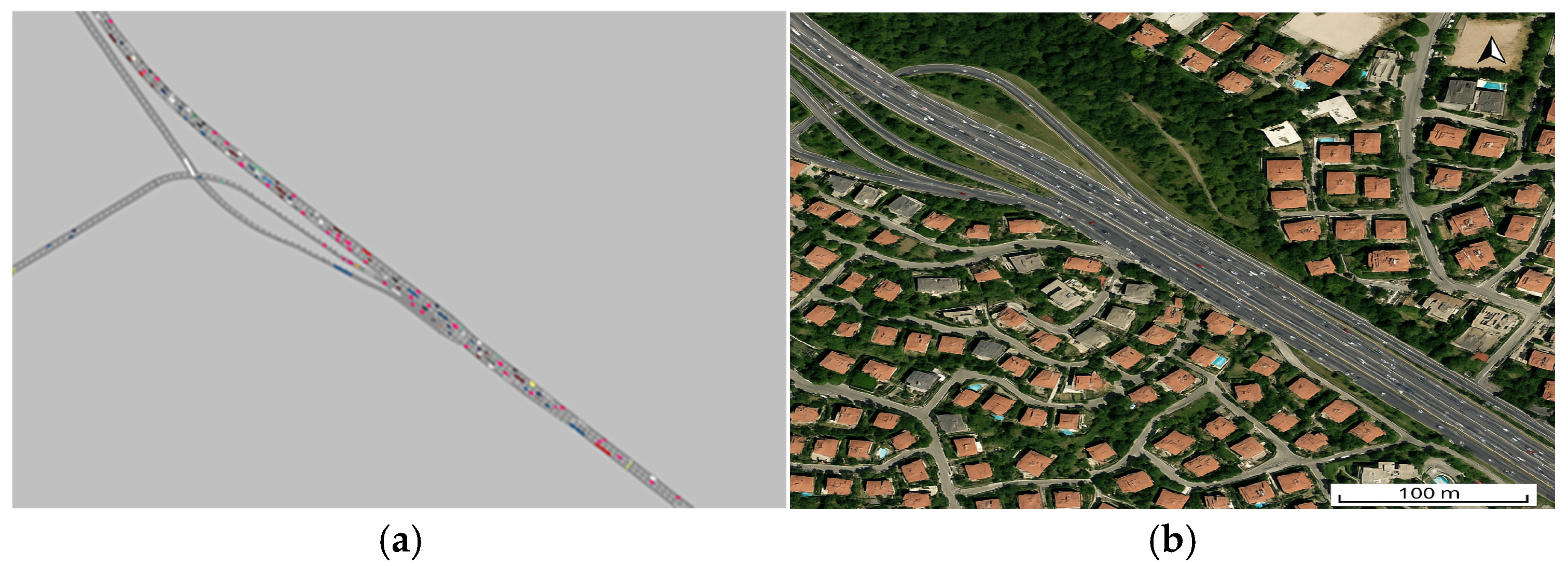
2. VISSIM Simulation Model for the Study Area
2.1. Simulation and Evaluation Settings
2.2. Model Calibration and Validation
3. Developing a Novel VSL Strategy to Control Autonomous Vehicles
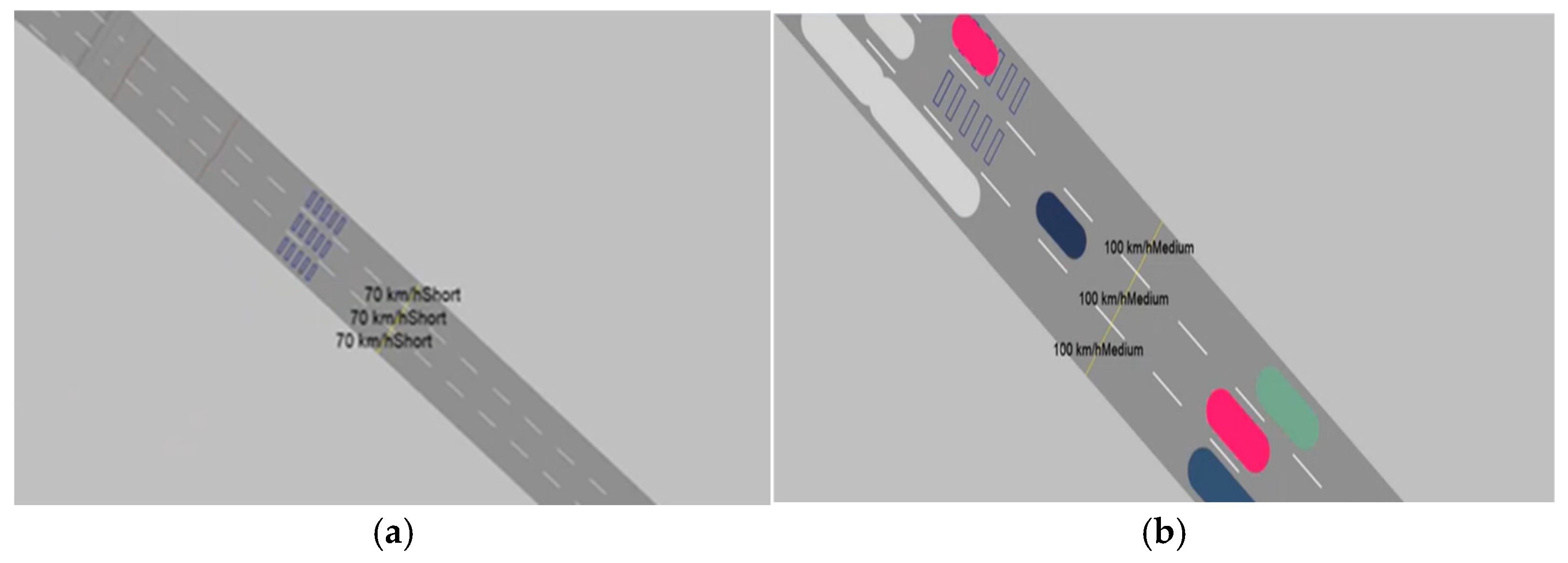
3.1. Modeling the Variable Speed Limit Control (VSL)
3.2. Modeling (Time-Gap Recommendation Strategy)
3.3. Simulation Scenarios
3.4. Scenario 1: No Traffic Control
3.5. Scenario 2: Variable Speed Limit (VSL) Control Strategy
3.6. Scenario 3: Time-Gap Recommendation Strategy (TGR) Based on Spacing Policy
3.7. Scenario 4: Integrated Control Strategy for Operating Variable Speed Limits Based on AV Spacing Policy
4. Results and Discussions
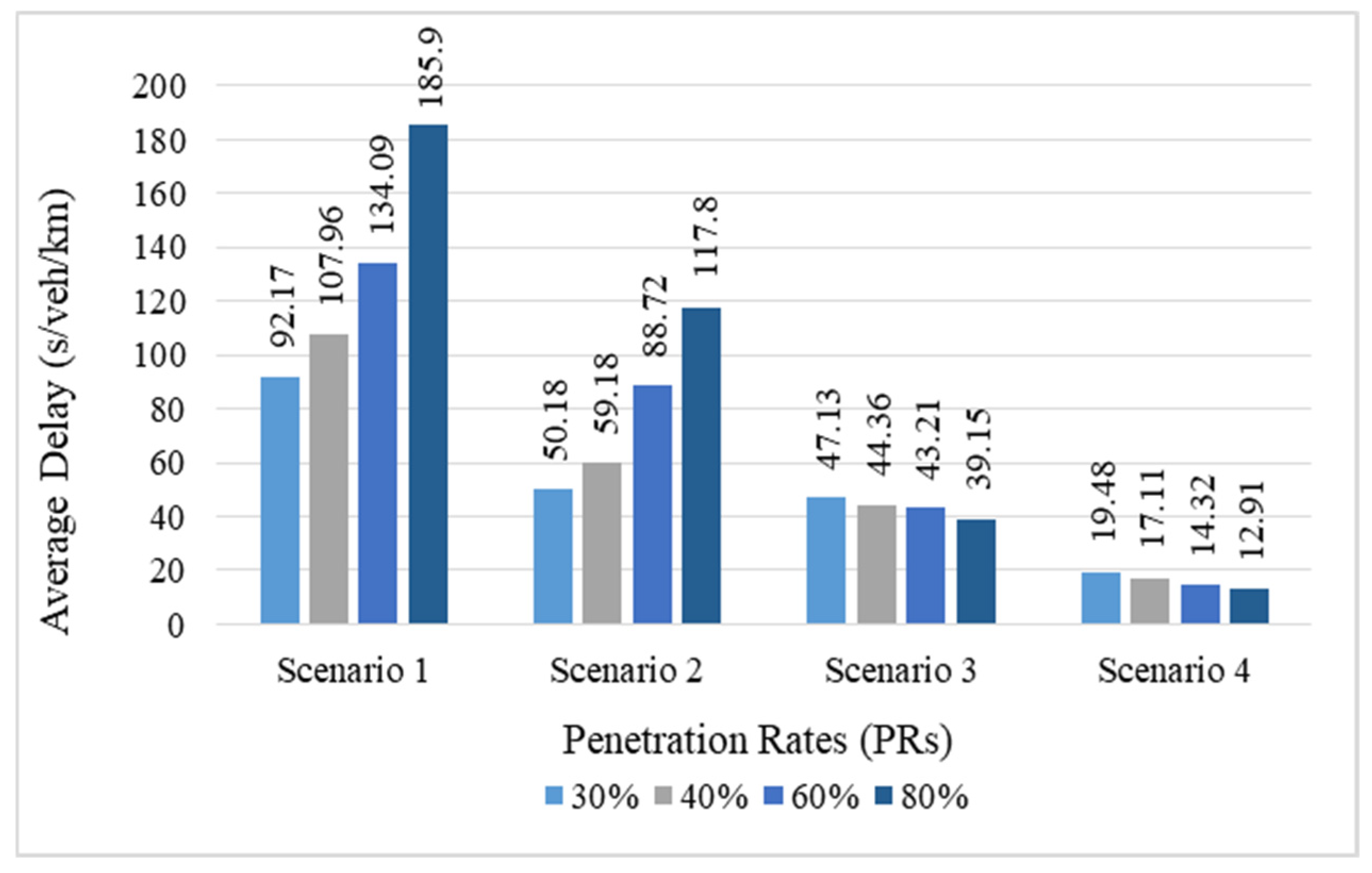
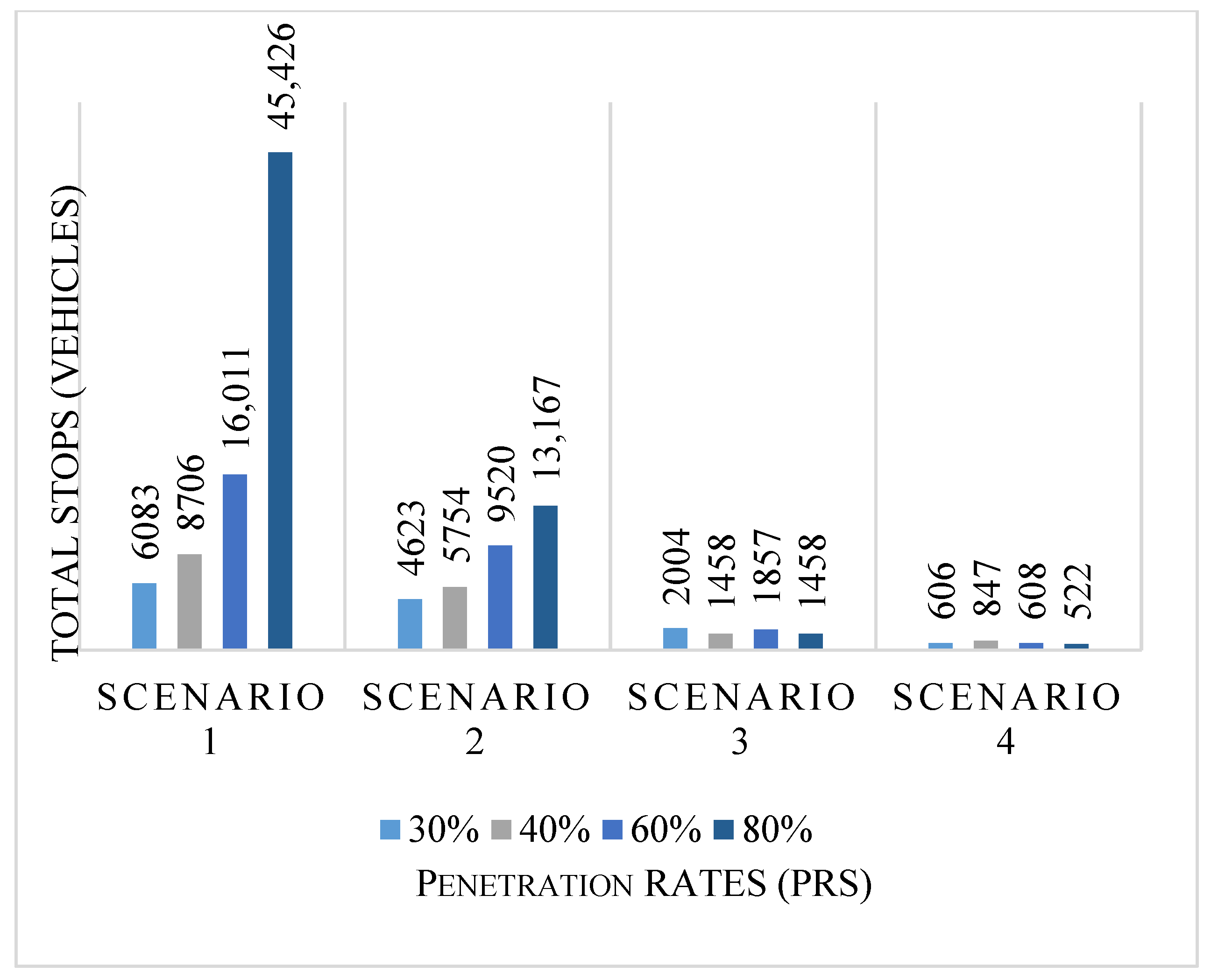
4.1. Average Delay and Total Stops
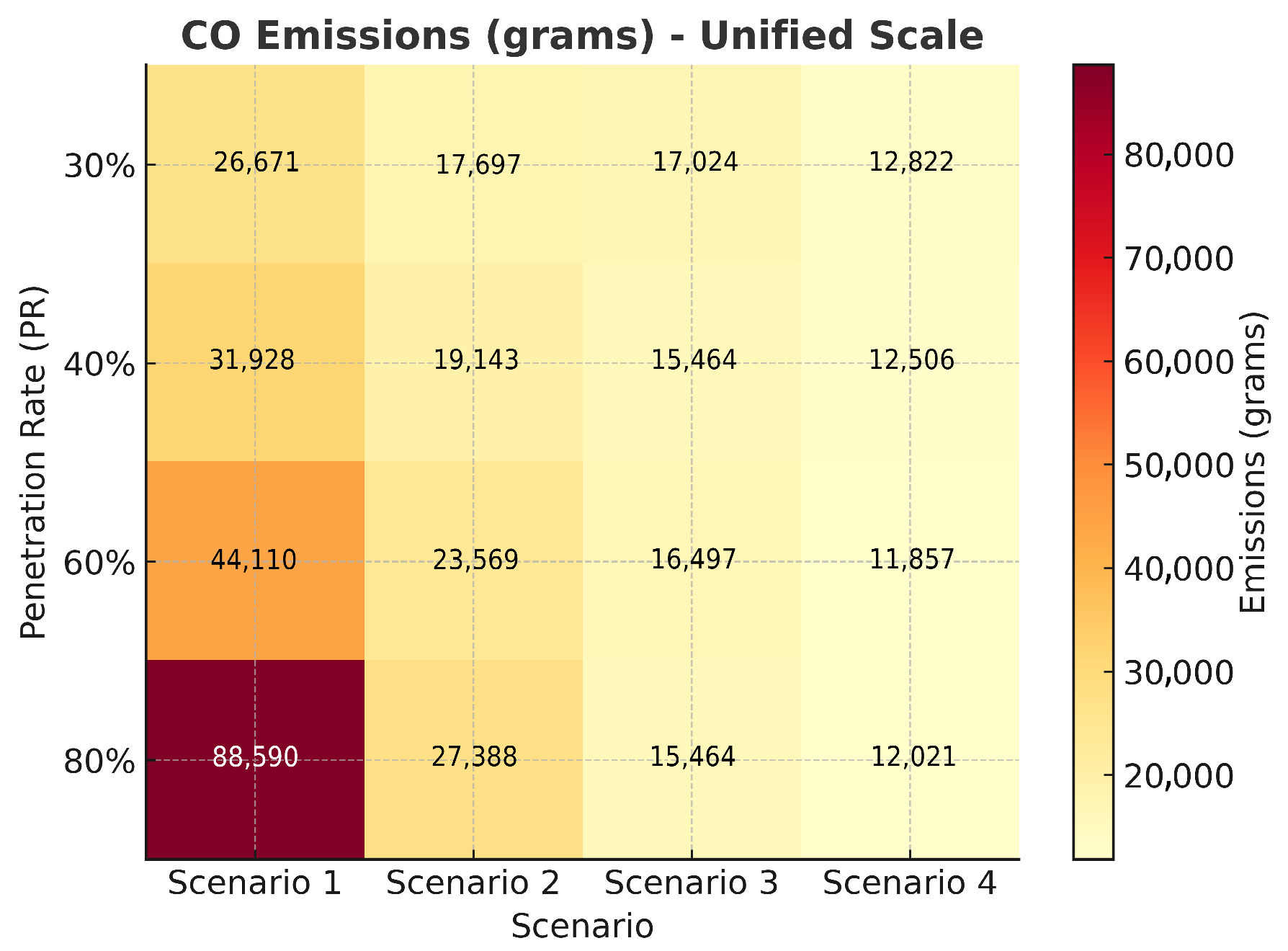
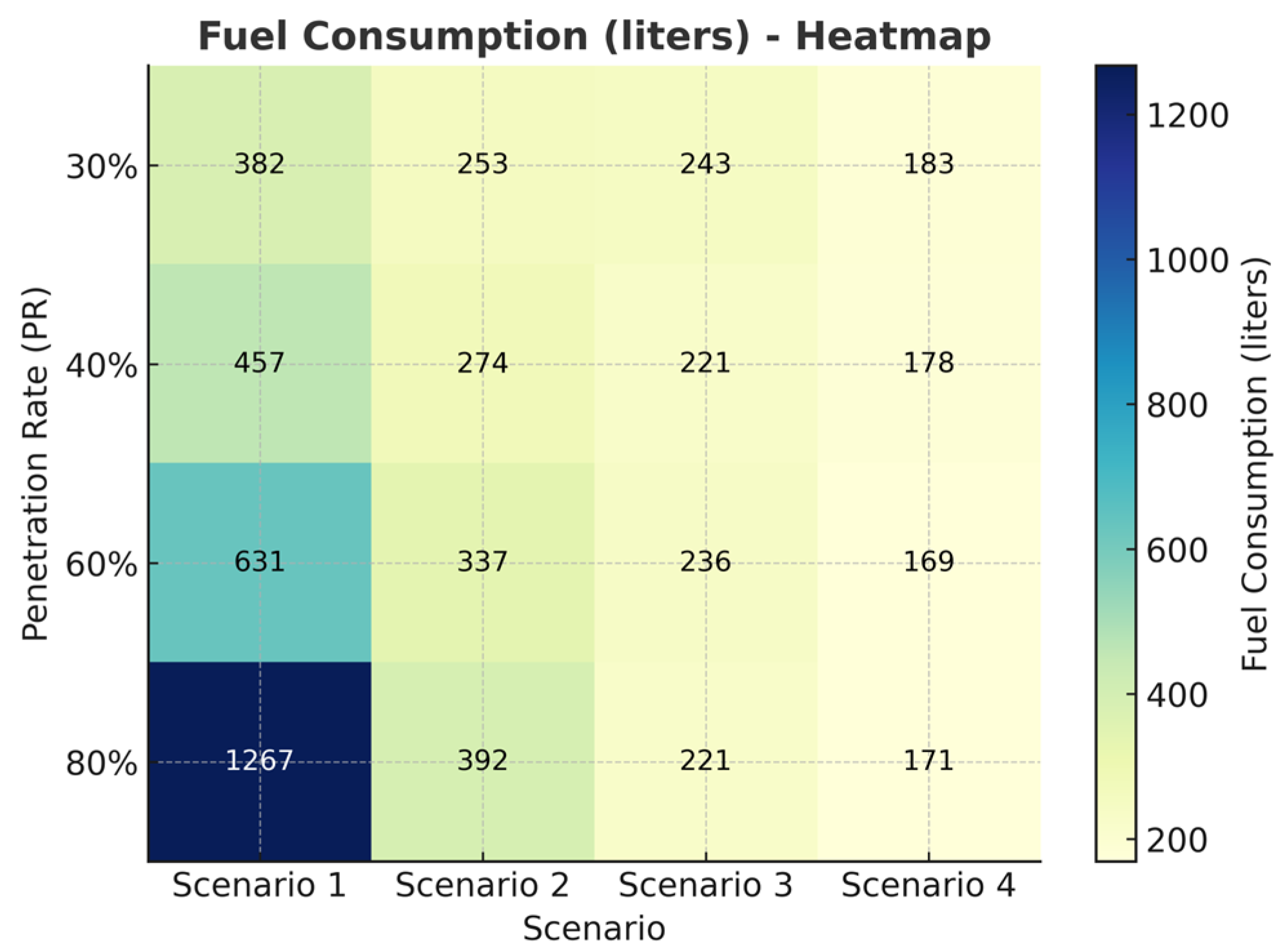
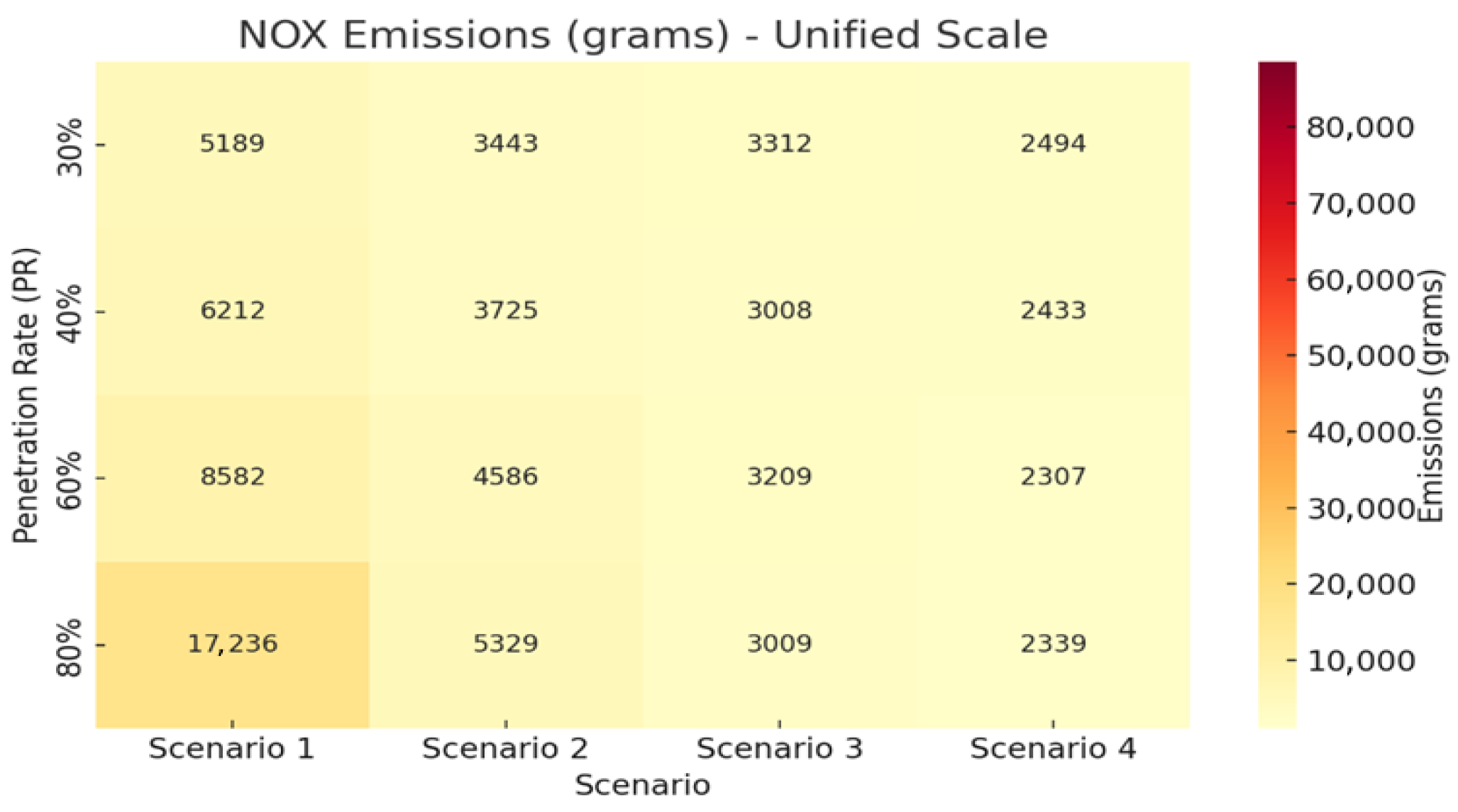
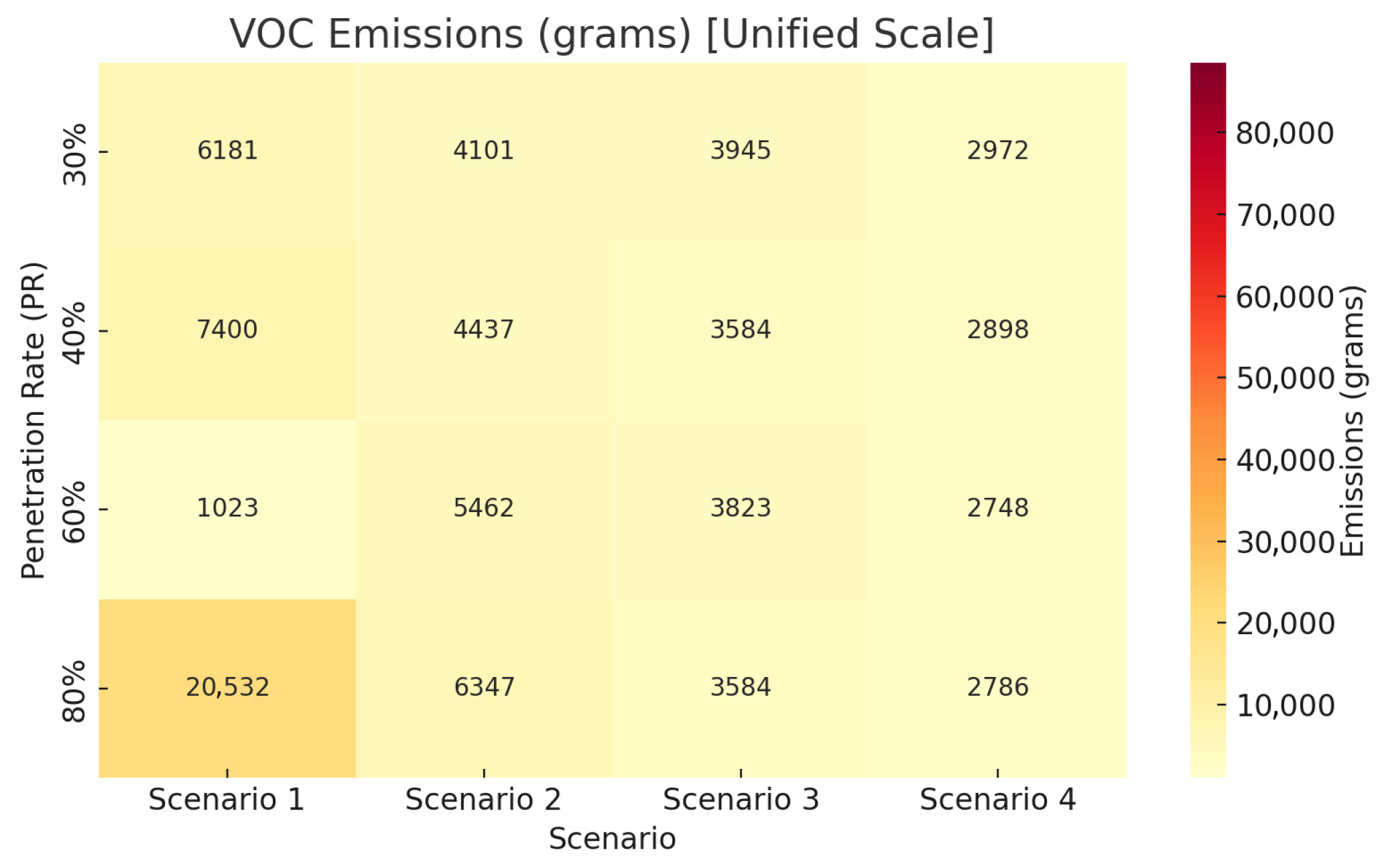
4.2. Fuel Consumption and Emissions
5. Conclusions
Author Contributions
Funding
Institutional Review Board Statement
Informed Consent Statement
Data Availability Statement
Acknowledgments
Conflicts of Interest
Abbreviations
| VSL | Variable Speed Limit Control |
| ACC | Adaptive Cruise Control |
| VisVAP | vehicle-actuated programming |
| CACC | Cooperative Adaptive Cruise Control |
| SAE | Society of Automotive Engineers |
| AV | Automated Vehicles |
| CS | Constant Spacing |
| CTG | Constant Time Gap |
| VTG | Variable Time Gap |
| ITS | Intelligent Transportation System |
| VMS | Variable Message Signs |
| TfL | Transport for London |
| HDVs | human-driven vehicles |
| GEH | Geoffrey E. Havers |
| HCM | Highway Capacity Manual |
| LOS | Level of Service (Grade A–F based on Highway Capacity Manual (HCM)) |
| PCU | Passenger Car Unit |
| TGR | Time-gap Recommendation |
| PR | Penetration Rate |
| AVD | Average Vehicle Delay (in sec for all vehicles) |
| CO | Carbon Monoxide (grams). |
| NOx | Nitrogen Oxides (grams). |
| VOC | Volatile Organic Compounds (grams). |
| TFC | Total Fuel Consumption (liter). |
| # of Stops | Total Stops for all vehicles (total number). |
| ADAS | Advanced Driver Assistance Systems |
Appendix A

| Driving Behavior | Parameters | HDVs Freeway | HDVs Merging | Metro Bus Freeway | Metro Bus Merging | ACC-AVs Freeway | ACC-AVsMerging |
|---|---|---|---|---|---|---|---|
| Following Parameters | Look ahead distance(m) | 0.00–250 | 0.00–250 | 0.00–250 | 0.00–250 | 0.00–250 | 0.00–250 |
| Look-back distance (m) | 0.00–150 | 0.00–150 | 0.00–150 | 0.00–150 | 0.00–150 | 0.00–150 | |
| Number of interacting objects | 2 | 6 | 2 | 6 | 2 | 4 | |
| Car following Parameters | CC0 | 1.5 m | 1.5 m | 1.5 m | 0.7 m | 0.7 m | 1.5 m |
| CC1 | 0.9 s | 0.4 s | 0.9 s | 0.4 s | 0.8 s | 0.8 s | |
| CC2 | 4.0 m | 4.0 m | 3.0 m | 3.0 m | 0.0 m | 0.0 m | |
| CC3 | −8.0 s | −8.0 s | −8.0 s | −8.0 s | −8.0 s | −8.0 s | |
| CC4 | −0.10 | −0.10 | −0.10 | −0.10 | −0.10 | −0.10 | |
| CC5 | 0.10 | 0.10 | 0.10 | 0.10 | 0.10 | 0.10 | |
| CC6 | 0.00 | 0.00 | 0.00 | 0.00 | 0.00 | ||
| CC7 | 0.10 m/s2 | 0.10 m/s2 | 0.10 m/s2 | 0.10 m/s2 | 0.10 m/s2 | 0.10 m/s2 | |
| CC8 | 3.5 m/s2 | 3.5 m/s2 | 3.5 m/s2 | 3.5 m/s2 | 3.5 m/s2 | 3.5 m/s2 | |
| CC9 | 1.5 m/s2 | 1.5 m/s2 | 1.5 m/s2 | 1.5 m/s2 | 1.5 m/s2 | 1.5 m/s2 | |
| lane change Parameters | Maximum deceleration, own vehicle (m/s2) | 4.0 | 4.0 | 4.00 | 4.00 | −4.00 | −4.00 |
| Maximum deceleration, trailing vehicle (m/s2) | 3.0 | 3.0 | 4.5 | 4.5 | −3.00 | −3.00 | |
| −1 m/s2 per distance, own vehicle and trailing vehicle (m) | 200 | 200 | 200 | 200 | 200 | 200 | |
| Accepted deceleration, own vehicle (m/s2) | −1.0 | −0.8 | −1.0 | −1.0 | −1.0 | −1.0 | |
| Accepted deceleration, trailing vehicle (m/s2) | −1.0 | −1.5 | −1.5 | −1.5 | −0.5 | −0.5 | |
| Waiting time before diffusion (s) | 60 | 120.0 | 120.0 | 120.0 | 60.0 | 60.0 | |
| Minimum Clearance, front/rear (m) | 0.5 | 0.3 | 0.3 | 0.3 | 0.5 | 0.5 | |
| Safety distance reduction factor | 0.6 | 0.10 | 0.10 | 0.10 | 0.6 | 0.6 | |
| Maximum deceleration for cooperative braking (m/s2) | −3.0 | −3.5 | −5.0 | −5.0 | −3.0 | −3.0 | |
| Zipper Merging (s) | Not activated | activated | Not activated | activated | Not activated | activated | |
| Cooperative lane change | activated | activated | activated | activated | activated | activated | |
| Maximum collision time (s) | 10.0 | 10.0 | 10.0 | 10.0 | 10.0 | 10.0 | |
| Maximum speed difference (km/h) | 15 | 30.0 | 30.0 | 50.0 | 50.0 | 50.0 | |
| lateral | Observe adjacent lanes | activated | activated | activated | activated | activated | activated |
| Collision time gain (s) | 2 | 2 | 2 | 2 | 2 | 2 |
Appendix B
- Define constants: PCU_HGV, PCU_BusMetro, PCU_BusNormal, PCU_BusMini.
- Define smoothing factor ALFA ∈ (0, 1].
- Define flow thresholds (e.g., Qat120ToDecSp).
- Define evaluation interval IntervalLength (seconds).
- If init = 0 (first run):
- Set initial desired speeds (km/h): Lights = 120, ACC = 120, Heavy vehicles = 100, Metro buses = 80.
- Apply speeds to vehicle groups.
- Measure and store initial flow rates as previous values: qCarPrev, qHGVPrev, qBusMetroPrev, qBusNormalPrev, qBusMiniPrev.
- Start periodic evaluation timer with interval IntervalLength.
- Set init←1.
- Every evaluation period (IntervalLength): Measure current flow rates: qCar, qHGV, qBusMetro, qBusNormal, qBusMini.
- Apply Exponential Moving Average (EMA): qCarZ = ALFA × qCar + (1 − ALFA) × qCarPrev; qHGVZ = ALFA × qHGV + (1 − ALFA) × qHGVPrev; qBusMetroZ = ALFA × qBusMetro + (1 − ALFA) × qBusMetroPrev; qBusNormalZ = ALFA × qBusNormal + (1 − ALFA) × qBusNormalPrev; qBusMiniZ = ALFA × qBusMini + (1 − ALFA) × qBusMiniPrev.
- Compute total equivalent flow: Qb = qCarZ + (PCU_HGV × qHGVZ) + (PCU_BusMetro × qBusMetroZ) + (PCU_BusNormal × qBusNormalZ) + (PCU_BusMini × qBusMiniZ).
- Record Qb and individual smoothed flows.
- If v_des_Light ≥ 120 then:
- If Qb > Qat120ToDecSp, reduce speeds: Lights = 100, ACC = 100, others adjusted proportionally.
- Apply new speeds to all vehicle groups.
- Else: maintain current speeds.
- Else: apply lower-tier adjustment rules (e.g., 100→80 km/h).
- Update previous flow values: qCarPrev←qCar; qHGVPrev←qHGV; qBusMetroPrev←qBusMetro; qBusNormalPrev←qBusNormal; qBusMiniPrev←qBusMini
References
- Society of Automotive Engineers J3016: Taxonomy and Definitions for Terms Related to Driving Automation Systems for On-Road Motor Vehicles. 2021. Available online: https://www.sae.org/standards/content/j3016_202104/ (accessed on 1 December 2024).
- Alshabibi, N.M. Impact Assessment of Integrating AVs in Optimizing Urban Traffic Operations for Sustainable Transportation Planning in Riyadh. World Electr. Veh. J. 2025, 16, 246. [Google Scholar] [CrossRef]
- Louati, A.; Louati, H.; Kariri, E. Harmonized Autonomous–Human Vehicles via Simulation for Emissions Reduction in Riyadh City. Futur. Internet 2025, 17, 342. [Google Scholar] [CrossRef]
- Peng, Y.; Liu, D.; Wu, S.; Yang, X.; Wang, Y.; Zou, Y. Enhancing Mixed Traffic Flow with Platoon Control and Lane Management for Connected and Autonomous Vehicles. Sensors 2025, 25, 644. [Google Scholar] [CrossRef] [PubMed]
- James, R.; James, R.; Melson, C.L.; Hu, J.; Bared, J. Characterizing the Impact of Production Adaptive Cruise Control on Traffic Flow: An Investigation. Transp. B Transp. Dyn. 2018, 7, 992–1012. [Google Scholar] [CrossRef]
- Rosca, M.A.; Oprea, F.C.; Dragu, V.; Dinu, O.M.; Costea, I.; Burciu, S. Evaluating the impact of automated vehicle penetration on traffic flow: A microsimulation-based approach. Systems 2025, 13, 751. [Google Scholar]
- Makridis, M.; Mattas, K.; Ciuffo, B. Response Time and Time Headway of an Adaptive Cruise Control. An Empirical Characterization and Potential Impacts on Road Capacity. IEEE Trans. Intell. Transp. Syst. 2020, 21, 1677–1686. [Google Scholar] [CrossRef]
- Li, X.; Yang, T.; Liu, J.; Qin, X.; Yu, S. Effects of vehicle gap changes on fuel economy and emission performance of the traffic flow in the ACC strategy. PLoS ONE 2018, 13, e0200110. [Google Scholar] [CrossRef]
- Yu, H.; Jiang, R.; He, Z.; Zheng, Z.; Li, L.; Liu, R.; Chen, X. Automated vehicle-involved traffic flow studies: A survey of assumptions, models, speculations and perspectives. Transp. Res. Part C Emerg. Technol. 2021, 127, 103101. [Google Scholar] [CrossRef]
- Suleiman, G.M.; Bezgin, N.Ö.; Ergun, M.; Gürsoy, M.; Karaşahin, M. Effects of speed management and roadway parameters on traffic flow along arterials. Proc. Inst. Civ. Eng.-Transp. 2017, 170, 346–362. [Google Scholar]
- Nezamuddin, N.; Jiang, N.; Zhang, T.; Waller, S.T.; Sun, D. Traffic Operations and Safety Benefits of Active Traffic Strategies on TxDOT Freeways; Technical Report; The University of Texas at Austin: Austin, TX, USA, 2011; p. 1. [Google Scholar]
- Ha, P.Y.J.; Chen, S.; Dong, J.; Du, R.; Li, Y.; Labi, S. Leveraging the Capabilities of Connected and Autonomous Vehicles and Multi-Agent Reinforcement Learning to Mitigate Highway Bottleneck Congestion. arXiv 2020, arXiv:2010.05436. [Google Scholar] [CrossRef]
- Yamin, A.E. Optimal Differential Variable Speed Limit Control in a Connected and Autonomous Vehicle Environment for Freeway Off-Ramp Bottlenecks. J. Transp. Eng. Part A Syst. 2023, 149, 04023009. [Google Scholar] [CrossRef]
- Xiao, L. Cooperative Adaptive Cruise Control Vehicles on Highways: Modelling and Traffic Flow Characteristics. Ph.D. Thesis, TU Delft Transport and Planning, Delft, The Netherlands, 2020. [Google Scholar] [CrossRef]
- Xie, D.-F.; Gao, Z.-Y.; Zhao, X.-M. The effect of ACC vehicles to mixed traffic flow consisting of manual and ACC vehicles. Chin. Phys. B 2008, 17, 4440–4445. [Google Scholar] [CrossRef]
- Aittoniemi, E. Evidence on impacts of automated vehicles on traffic flow efficiency and emissions: Systematic review. IET Intell. Transp. Syst. 2022, 16, 1306–1327. [Google Scholar] [CrossRef]
- Shladover, S.E.; Nowakowski, C.; Lu, X.Y.; Hoogendoorn, R. Using Cooperative Adaptive Cruise Control (CACC) to Form High-Performance Vehicle Streams; UC Berkeley: California Partners for Advanced Transportation Technology: Berkeley, CA, USA, 2014. [Google Scholar]
- Postigo, I.; Olstam, J.; Rydergren, C. Effects on traffic performance due to heterogeneity of automated vehicles on motorways: A microscopic simulation study. In Proceedings of the 7th International Conference on Vehicle Technology and Intelligent Transport Systems, Online, 28–30 April 2021; SciTePress: Setúbal, Portugal, 2021; pp. 142–151. [Google Scholar]
- Ntousakis, I.A.; Nikolos, I.K.; Papageorgiou, M. On microscopic modelling of adaptive cruise control systems. Transp. Res. Procedia 2015, 6, 111–127. [Google Scholar] [CrossRef]
- Suweda, I.W. Time headway analysis to determine the road capacity. J. Spektran 2016, 42, 9. [Google Scholar]
- Mathew, T. Fundamental Parameters of Traffic Flow; IIT Bombay: Mumbai, India, 2017. [Google Scholar]
- Milanés, V.; Shladover, S.E.; Ferlis, R.; Laabs, G.; Nowakowski, C.; Kawazoe, H.; Nakamura, M. Cooperative Adaptive Cruise Control in Real Traffic Scenarios. IEEE Trans. Intell. Transp. Syst. 2014, 15, 296–303. [Google Scholar]
- Treiber, M.; Kesting, A. Traffic Flow Dynamics: Data, Models and Simulation; Springer: Berlin/Heidelberg, Germany, 2013. [Google Scholar]
- van Arem, B.; van Driel, C.J.; Visser, R. The impact of cooperative adaptive cruise control on traffic-flow characteristics. IEEE Trans. Intell. Transp. Syst. 2006, 7, 429–436. [Google Scholar] [CrossRef]
- Li, T.; Li, X.; Sai, Y.; Carrese, S.; Di Luca, L. Evaluation of throughput in ACC-equipped traffic using behaviorally plausible models. arXiv 2021, arXiv:2105.05380. [Google Scholar]
- Zhu, M.; Wang, X.; Wang, X. Car-following headways in different driving situations: A naturalistic driving study. In Proceedings of the 16th COTA International Conference of Transportation Professionals, Shanghai, China, 6–9 July 2016; pp. 1419–1428. [Google Scholar]
- Yang, H.; Rakha, H.A. Feedback control speed harmonization algorithm: Methodology and preliminary testing. Transp. Res. Part C Emerg. Technol. 2017, 81, 209–226. [Google Scholar] [CrossRef]
- An, L.; Hu, J.; Dong, Y. Speed harmonization with enhanced precision. J. Intell. Transp. Syst. 2024, 1–16. [Google Scholar] [CrossRef]
- Hu, J.; Lian, Z.; Wang, H.; Zhang, Z.; Qian, R.; Li, D.; Zheng, J. Anti-bullying Adaptive Cruise Control: A proactive right-of-way protection approach. arXiv 2024, arXiv:2412.12197. [Google Scholar]
- El-Baklish, S.K.; Kouvelas, A.; Makridis, M.A. Driving towards stability and efficiency: A variable time gap strategy for Adaptive Cruise Control. Transp. Res. Part C Emerg. Technol. 2025, 174, 105074. [Google Scholar]
- Wu, C.; Xu, Z.; Liu, Y.; Fu, C.; Li, K.; Hu, M. Spacing policies for adaptive cruise control: A survey. IEEE Access 2020, 8, 50149–50162. [Google Scholar] [CrossRef]
- van Willigen, W.H.; Schut, M.C.; Kester, L.J. Approximating safe spacing policies for adaptive cruise control strategies. In Proceedings of the 2011 IEEE Vehicular Networking Conference (VNC), Amsterdam, The Netherlands, 14–16 November 2011; IEEE: New York, NY, USA, 2011; pp. 9–16. [Google Scholar]
- Zhang, J.; Ioannou, P. Adaptive vehicle following control system with variable time headways. In Proceedings of the 44th IEEE Conference on Decision and Control, Seville, Spain, 15 December 2005; pp. 3880–3885. [Google Scholar]
- Wang, J.; Rajamani, R. Should adaptive cruise-control systems be designed to maintain a constant time gap between vehicles? IEEE Trans. Veh. Technol. 2004, 53, 1480–1490. [Google Scholar]
- Zhao, J.; Oya, M.; El Kamel, A. A safety spacing policy and its impact on highway traffic flow. In Proceedings of the 2009 IEEE Intelligent Vehicles Symposium, Xi’an, China, 3–5 June 2009; pp. 960–965. [Google Scholar]
- Kanellakopoulos, I.; Nelson, P.; Stafsudd, O. Intelligent sensors and control for commercial vehicle automation. Annu. Rev. Control. 1999, 23, 117–124. [Google Scholar]
- Li, Y.; Wang, H.; Wang, W.; Liu, S.; Xiang, Y. Reducing the risk of rear-end collisions with infrastructure-to-vehicle integration of variable speed limit control and adaptive cruise control system. Traffic Inj. Prev. 2016, 17, 745–752. [Google Scholar]
- Fondzenyuy, S.K. The impact of speed limit change on emissions: A systematic review. Sustainability 2024, 16, 7712. [Google Scholar] [CrossRef]
- Nowakowski, C.; Shladover, S.E.; Cody, D.; Bu, F.; O’Connell, J.; Spring, J.; Dickey, S.; Nelson, D. Cooperative Adaptive Cruise Control: Testing Drivers’ Choices of Following Distances; UC Berkeley ITS Research Center: Berkeley, CA, USA, 2010. [Google Scholar]
- Transport for London. Microsimulation Modelling Guidelines; Version 1.0; Transport for London: London, UK, 2010. [Google Scholar]
- Feldman, O. The GEH measure and quality of the highway assignment models. In Proceedings of the European Transport Conference, Salzburg, Austria, 7–11 October 2012; pp. 1–18. [Google Scholar]
- Abdel-Aty, M.; Haleem, K.; Cunningham, R.; Gayah, V. Application of variable speed limits and ramp metering to improve safety and efficiency of freeways. In Proceedings of the 2nd International Symposium on Freeway and Tollway Operations, Honolulu, HI, USA, 21–24 June 2009; pp. 1–13. [Google Scholar]
- Dadashzadeh, N.; Ergun, M. An integrated variable speed limit and ALINEA ramp metering model in the presence of high bus volume. Sustainability 2019, 11, 6326. [Google Scholar] [CrossRef]
- Xiong, C.; Yang, X.T.; Zhang, L.; Lee, M.; Zhou, W.; Raqib, M. An integrated modeling framework for active traffic management and its applications in the Washington, DC area. J. Intell. Transp. Syst. 2021, 25, 609–625. [Google Scholar] [CrossRef]
- Zeidler, V.; Buck, H.S.; Kautzsch, L.; Vortisch, P.; Weyland, C.M. Simulation of autonomous vehicles based on Wiedemann’s car following model in PTV vissim. In Proceedings of the 98th Annual Meeting of the Transportation Research Board (TRB), Washington, DC, USA, 13 January 2019; pp. 13–17. [Google Scholar]
- Papageorgiou, M.; Kosmatopoulos, E.; Papamichail, I. Effects of Variable Speed Limits on Motorway Traffic Flow. Transp. Res. Rec. J. Transp. Res. Board 2008, 2047, 37–48. [Google Scholar] [CrossRef]
- Chen, D.; Ahn, S. Variable speed limit control for severe non-recurrent freeway bottlenecks. Transp. Res. Part C Emerg. Technol. 2015, 51, 210–230. [Google Scholar] [CrossRef]
- Franz, M.L.; Chang, G.-L. Applications of Variable Speed Control for Contending with Recurrent Highway Congestion. 2014. Available online: https://rosap.ntl.bts.gov/view/dot/27725 (accessed on 2 December 2024).
- Lin, P.-W.; Chang, G.-L. A general rule-based variable speed limit control strategy for freeway bottlenecks. In Proceedings of the TRB Annual Meeting, Washington, DC, USA, 11–15 January 2004. [Google Scholar]
- Abdel-Aty, M.; Cunningham, R.J.; Gayah, V.V.; Hsia, L. Dynamic variable speed limit strategies for real-time crash risk reduction on freeways. Transp. Res. Rec. 2008, 2078, 108–116. [Google Scholar]
- Khondaker, B.; Kattan, L. Variable speed limit: A microscopic analysis in a connected vehicle environment. Transp. Res. Part C 2015, 58, 146–159. [Google Scholar]
- Transportation Research Board. Highway Capacity Manual; Transportation Research Board: Washington, DC, USA, 2000; Volume 2. [Google Scholar]
- ISO 15622:2010; Intelligent Transport Systems—Adaptive Cruise Control Systems—Performance Requirements and Test Procedures. International Organization for Standardization: Geneva, Switzerland, 2010.
- Manolis, D.; Spiliopoulou, A.; Vandorou, F.; Papageorgiou, M. Real time adaptive cruise control strategy for motorways. Transp. Res. Part C Emerg. Technol. 2020, 115, 102617. [Google Scholar] [CrossRef]
- Mohammed, D.; Horváth, B. Vehicle automation impact on traffic flow and stability: A review of literature. Acta Polytech. Hung. 2023, 20, 132–154. [Google Scholar] [CrossRef]
- Bai, J.; Lee, J.; Mao, S. Effects of Adaptive Cruise Control System on Traffic Flow and Safety Considering Various Combinations of Front Truck and Rear Passenger Car Situations. Transp. Res. Rec. J. Transp. Res. Board 2024, 2678, 1009–1028. [Google Scholar] [CrossRef]
- Korbmacher, R.; Khound, P.; Tordeux, A. Understanding Collective Stability of ACC Systems: From Theory to Real-World Observations. arXiv 2025, arXiv:2504.04530. [Google Scholar] [CrossRef]
- Hou, Y.; Edara, P.; Sun, C. Speed limit effectiveness in short-term rural interstate work zones. Transp. Lett. 2013, 5, 8–14. [Google Scholar] [CrossRef]
- Boateng, R.A.; Fontaine, M.D.; Khattak, Z.H. Driver response to variable speed limits on I-66 in northern Virginia. J. Transp. Eng. Part A Syst. 2019, 145, 04019021. [Google Scholar]
- Rakha, H.; Ding, Y. Impact of stops on vehicle fuel consumption and emissions. J. Transp. Eng. 2003, 129, 23–32. [Google Scholar] [CrossRef]
- Ahn, K.; Rakha, H.; Trani, A.; Van Aerde, M. Estimating vehicle fuel consumption and emissions based on instantaneous speed and acceleration levels. J. Transp. Eng. 2002, 128, 182–190. [Google Scholar] [CrossRef]




| Model Settings | Value | Model Settings |
|---|---|---|
| Simulation time | 5400 s | Simulation time |
| Initial random seed | 555 | Initial random seed |
| Simulation resolution | 5 | Simulation resolution |
| Number of runs | 20 | Number of runs |
| Seed increment | 1 | Seed increment |
| Simulation speed | Factor 10 | Simulation speed |
| Location | Calibration Data | Validation Data | GEH Test Results | ||||
|---|---|---|---|---|---|---|---|
| Observed Volume (vph) | Simulated Volume (vph) | GEH Test | Observed Volume (vph) | Simulated Volume (vph) | GEH Test | Conformity | |
| Mainline before merge | 4501 | 4684 | 2.70 | 3997 | 4190 | 3.01 | <5% (Fitting) |
| On-ramp | 752 | 699 | 3.60 | 806 | 876 | 2.41 | <5% (Fitting) |
| Metro bus lane | 171 | 180 | 0.60 | 150 | 196 | 3.49 | <5% (Fitting) |
| Mainline after merge | 5420 | 5563 | 1.90 | 4953 | 5262 | 4.32 | <5% (Fitting) |
| Desired Speed | Qb Condition | Action |
|---|---|---|
| 120 km/h | Qb < 3000 veh/h | Maintain current speed (no action) |
| 120 km/h | Qb ≥ 3000 veh/h | Decrease speed to 100 km/h |
| 100 km/h | Qb < 2750 veh/h | Increase speed to 120 km/h |
| 100 km/h | Qb ≥ 4450 veh/h | Decrease speed to 85 km/h |
| 85 km/h | Qb < 4045 veh/h | Increase speed to 100 km/h |
| 85 km/h | Qb ≥ 6350 veh/h | Decrease speed to 70 km/h |
| 70 km/h | Qb < 5750 veh/h | Increase speed to 85 km/h |
| SN | Traffic Control State Scenarios | VSL | Random Time-Gap Selection | Time-Gap Recommendation (TGR) |
|---|---|---|---|---|
| 1 | No traffic control | ✗ | ✔ | ✗ |
| 2 | VSL only | ✔ | ✔ | ✗ |
| 3 | Time-gap recommendation only | ✗ | ✗ | ✔ |
| 4 | Integrated VSL + TGR strategy | ✔ | ✗ | ✔ |
| Scenario 1 | Scenario 2 | Scenario 3 | Scenario 4 | |||||
|---|---|---|---|---|---|---|---|---|
| PR | No Traffic Control | VSL | Time-Gap Recommendation | Integrated VSL + TGR Strategy | ||||
| AVD | # of Stops | AVD | # of Stops | AVD | # of Stops | AVD | # of Stops | |
| 30% | 92.17 | 6083 | 50.18 | 4623 | 47.13 | 2004 | 19.48 | 1031 |
| 40% | 107.96 | 8706 | 59.84 | 5754 | 44.36 | 1458 | 17.11 | 847 |
| 60% | 134.09 | 16,011 | 88.72 | 9520 | 43.21 | 1857 | 14.32 | 608 |
| 80% | 185.90 | 45,426 | 117.80 | 13,167 | 39.15 | 1458 | 12.91 | 522 |
| PR | Scenario 1 Scenario 2 | Scenario 3 Scenario 4 |
|---|---|---|
| 30% | 26,671 17,697 | 17,024 12,822 |
| 40% | 31,928 19,143 | 15,464 12,506 |
| 60% | 44,110 23,569 | 16,497 11,857 |
| 80% | 88,590 27,388 | 15,464 12,021 |
| PR | Scenario 1 Scenario 2 | Scenario 3 Scenario 4 |
|---|---|---|
| 30% | 5189 3443 | 3312 2494 |
| 40% | 6212 3725 | 3008 2433 |
| 60% | 8582 4586 | 3209 2307 |
| 80% | 17,236 5329 | 3009 2339 |
| PR | Scenario 1 Scenario 2 | Scenario 3 Scenario 4 |
|---|---|---|
| 30% | 6181 4101 | 3945 2972 |
| 40% | 7400 4437 | 3584 2898 |
| 60% | 10,223 5462 | 3823 2748 |
| 80% | 20,532 6347 | 3584 2786 |
| PR | Scenario 1 Scenario 2 | Scenario 3 Scenario 4 |
|---|---|---|
| 30% | 382 253 | 243 183 |
| 40% | 457 274 | 221 178 |
| 60% | 631 337 | 236 169 |
| 80% | 1267 392 | 221 171 |
Disclaimer/Publisher’s Note: The statements, opinions and data contained in all publications are solely those of the individual author(s) and contributor(s) and not of MDPI and/or the editor(s). MDPI and/or the editor(s) disclaim responsibility for any injury to people or property resulting from any ideas, methods, instructions or products referred to in the content. |
© 2025 by the authors. Licensee MDPI, Basel, Switzerland. This article is an open access article distributed under the terms and conditions of the Creative Commons Attribution (CC BY) license.
Share and Cite
Abdullah, R.S.; Karaşahin, M.; Ergun, M. Innovative Operational Strategy for Variable Speed Limits Based on AV Spacing Policy Under Mixed Traffic, with a Sustainable Approach. Sustainability 2026, 18, 224. https://doi.org/10.3390/su18010224
Abdullah RS, Karaşahin M, Ergun M. Innovative Operational Strategy for Variable Speed Limits Based on AV Spacing Policy Under Mixed Traffic, with a Sustainable Approach. Sustainability. 2026; 18(1):224. https://doi.org/10.3390/su18010224
Chicago/Turabian StyleAbdullah, Ruba Safi, Mustafa Karaşahin, and Murat Ergun. 2026. "Innovative Operational Strategy for Variable Speed Limits Based on AV Spacing Policy Under Mixed Traffic, with a Sustainable Approach" Sustainability 18, no. 1: 224. https://doi.org/10.3390/su18010224
APA StyleAbdullah, R. S., Karaşahin, M., & Ergun, M. (2026). Innovative Operational Strategy for Variable Speed Limits Based on AV Spacing Policy Under Mixed Traffic, with a Sustainable Approach. Sustainability, 18(1), 224. https://doi.org/10.3390/su18010224