Article

How Existing Infrastructure and Governance Arrangement Affect the Development of Sustainable Wastewater Solutions


by
Henno P. van Dokkum
1,2
1
AISSR, University of Amsterdam, P.O. Box 19268, 1000 GG Amsterdam, The Netherlands
2
Patella Strategie, Advies & Management, Beeklaan 4A, 2191 AA De Zilk, The Netherlands
Sustainability 2026, 18(1), 217; https://doi.org/10.3390/su18010217
Submission received: 23 November 2025 / Revised: 17 December 2025 / Accepted: 20 December 2025 / Published: 24 December 2025

Abstract

This paper examines the tensions between existing infrastructure and the need for transitional change in Dutch municipal wastewater collection and treatment. In the Netherlands, sanitation is primarily managed by public actors, with local government playing a major role. The paper demonstrates how local governments navigate these tensions and are both restricted and enabled by the current infrastructure and governance arrangements. Based on interviews, literature reviews, and analyses of statistical trends, it describes five attempts at reform in Dutch sanitation from 1980 to 2020: phosphorus removal; separating stormwater from combined sewers; water cycle companies; energy factories; and decentralized sanitation. The multi-level governance system, with decentralized infrastructure and financing, allows local governments to experiment with alternative practices, develop knowledge, and employ various interactions to mainstream innovations. However, the division of tasks in Dutch sanitation governance tends to optimize sub-systems rather than the entire system. For nationwide implementation, legislation and strong central coordination are essential. Additionally, New Public Management reinforces existing infrastructure lock-in. The paper enhances our understanding of the local government’s role in transitional change and offers insights into how the challenges of existing infrastructure can be mitigated in pursuit of sustainable wastewater solutions.

1. Introduction

1.1. Local Government, Infrastructure, and Sustainability Transitions

This paper examines a specific aspect of sustainability transitions: the role of local and regional governments in relation to local infrastructure. The paper investigates the agency and actions of (local) government.
Undesirable side effects, including resource depletion and environmental pollution have accompanied economic development since the Industrial Revolution. The challenge for society in general and for governments in particular is to shift away from unsustainable practices so that negative effects are minimized and environmental goals are met. However, many environmental issues are complex and long-lasting, and incremental changes are not enough; instead, transitional change is necessary. Transition sciences have examined how to achieve these fundamental changes [1,2,3]. A key insight is that a specific practice is embedded within socio-technical systems with which it has co-evolved [4]. These systems include structures such as institutional contexts, material infrastructures, and discourses [2,5,6,7].
Although transition science has provided many insights into transitional change, the role of government in sustainability transitions requires further conceptualization [8], considering that ‘government’ is a complex network of interacting stakeholders with a wide range of interests and power [7,9,10,11]. Traditionally, little agency is attributed to local government in the literature on sustainability transitions (see review by [12]). However, in fields such as urban transformations [13,14], alternative energy solutions [15,16], or alternative transportation [17], local governments are seen as key actors in (local) transitional change. A common theme in these studies is the significance of decentralized (public) infrastructure or the potential to replace centralized infrastructure with new decentralized systems. The ownership and management of infrastructure place local governments in a key role as drivers of transitional change. As actors ‘at the heart of the regime’ [18], they can either adhere to the existing regime or choose to experiment with alternative practices [18,19]. This role is further strengthened by the decentralization of tasks and responsibilities from central to regional and local governments, a process that has taken place in Western Europe since the 1980s [20].
The agency of local government is limited by the capital-intensive nature and long lifespans of infrastructure, such as urban infrastructure, sewer systems, transportation networks, and energy production and distribution systems. Local governments must navigate between the need for transitional change and the longevity of existing infrastructure. This paper will analyze how local governments handle this tension and how they use their agency to initiate change—or sometimes the opposite. The Dutch sanitation case will be used to analyze government actions. This case was selected because of the significant involvement of public actors at various governance levels, the central role of infrastructure, and the need for transitional change. Urban water systems offer a comprehensive and representative context for examining transition processes and dynamics [21].

1.2. Theoretical Framework

Multi-level governance is a suitable analytical framework for urban water management [22,23,24] because it emphasizes that governance operates across multiple levels with interconnected and interacting jurisdictions ranging from international to local [24,25]. Strategies and activities occur both horizontally and vertically. Vertical interactions can be described as “multi-level games” [26], which illustrate how actors attempt to overcome barriers at their own level by strategically leveraging negotiation processes at other levels (cf [4], pp. 297–300).
Previous research indicates that this multi-level structure may complicate the shift toward a more sustainable sewage system. It could face significant resistance to change [25]; local actors might often lack enough interest in this ‘dirty’ issue to develop the agency needed for change [27] and to address tensions between levels [25]. This paper aims to better understand how local governments interact when faced with the need for transitional change, while being limited (and possibly enabled) by the governance arrangement and the durability of existing infrastructure. In doing so, it advances our understanding of governing transitional change, including the influence of scientific knowledge.
The role of local governments has been examined previously. Four distinct modes of governance at the local level can be identified [28,29], along with six types of capacity for local governments [30]. Van Dokkum et al. [7] and Verhoeven & Duyvendak [31] describe how local governments can assume nearly activist roles. Ehnert et al. [24] differentiate between the hard power and soft power of local governments. In a multi-level governance setting, additional focus should be placed on the interactions between government levels, as power is distributed across them. The two-way relationships in multilevel governance within a context of transitional change are an area requiring further investigation [24], and this paper offers a contribution. Of particular interest is the role of decentralized infrastructure. Despite the clear path dependency that results, Kuzemko & Britton [30] highlight (i) the two-way relationship between policy and infrastructure and (ii) how the decentralized nature of (in their case, energy) infrastructure influences power distribution and increases the agency of local actors.

2. Sanitation in The Netherlands

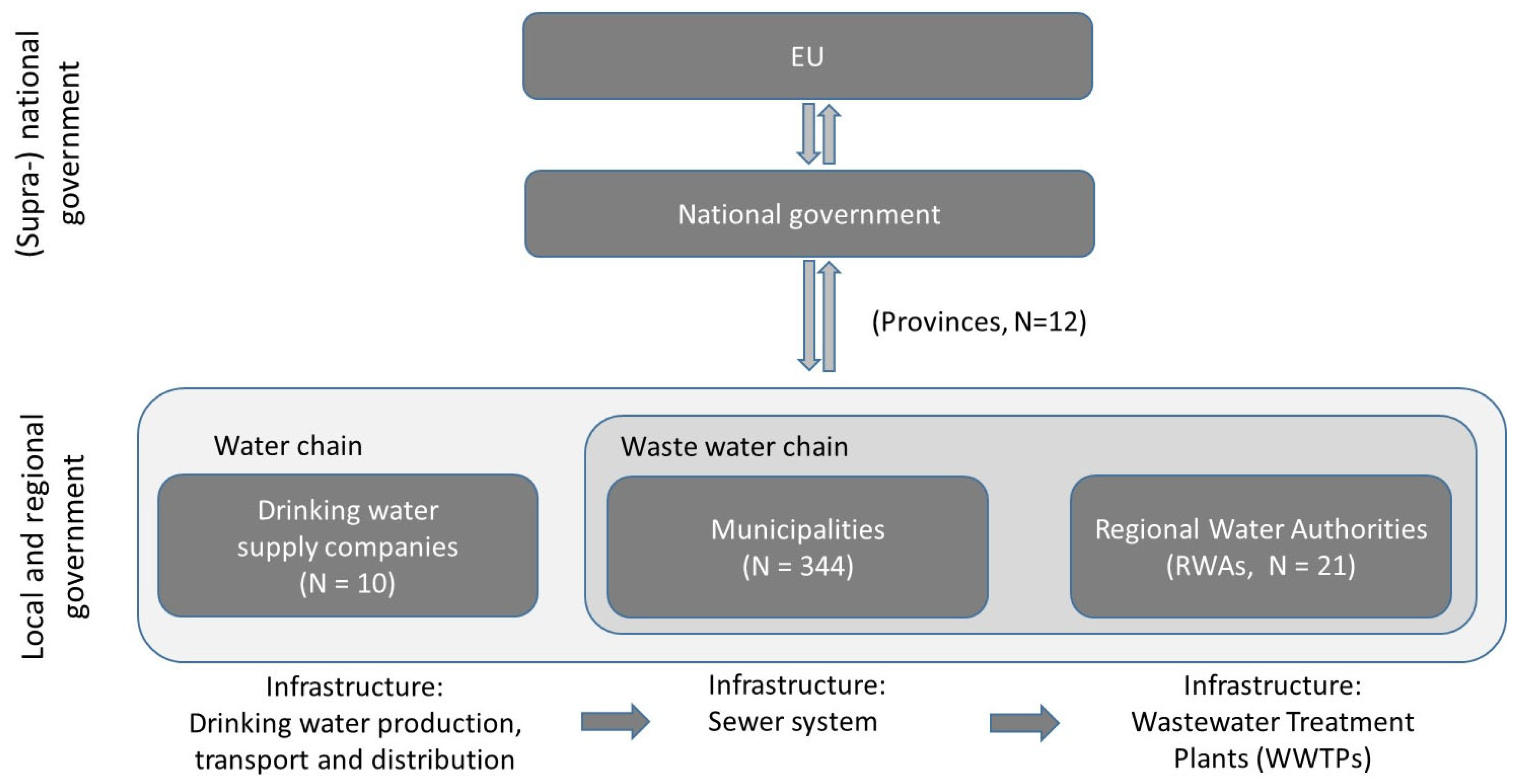
In the Netherlands, managing the ‘water chain’ is a public responsibility (Figure 1). Semi-public drinking water companies produce drinking water and supply it to urban areas. Municipal sewage water is collected and transported through sewer systems managed by municipalities. Municipalities (public entities) are also responsible for managing stormwater runoff. Regional Water Authorities (RWAs) treat the sewage water at Wastewater Treatment Plants (WWTPs). Local governments operate within national and EU frameworks. This case study focuses on the ‘wastewater chain’: the collection and treatment of municipal wastewater (sanitation).
A substantial infrastructure is necessary for sanitation. Historically, stormwater and municipal wastewater were combined in combined sewer systems. In the Netherlands, the total length of the sewer system is 168,000 km. The gravity sewer system, which is 109,000 km long, includes separate sewers (58,000 km, stormwater + wastewater sewers) and combined sewers (51,000 km). The sewer system contains 14,600 combined sewer overflows [32], designed to activate about 7 times per year. The average lifespan of sewer systems is 64 years; therefore, the current replacement rate of 800 km per year for gravity sewers is too slow [32], leading to system aging. Approximately 1.8 billion m3 of municipal wastewater per year [33] is treated by 313 WWTPs (CBS-Statline). These WWTPs were designed to treat wastewater from the essentially combined sewer system, meaning diluted wastewater. The Netherlands needs to make significant investments in WWTPs: about 2 billion euros annually [33].
Many of the current sustainability problems related to sanitation stem from the historical decision to combine stormwater and municipal sewage in a single combined sewer system [27,34]. Although sanitation has significantly improved human health, it also presents many environmental and sustainability challenges. Sewer overflows cause pollution of surface waters and eutrophication [34,35]. Climate change leads to more frequent sewer overflows and requires more local water retention, which calls for different approaches to rainwater management [36,37,38]. The push to shift from fossil fuel energy to renewable sources highlights that sewage treatment consumes a lot of energy; however, sewage is also a potential energy source [34,39,40]. Lastly, the move toward a more circular economy emphasizes sewage as a resource for various materials [39,40,41,42,43].
Although the need for a more sustainable, circular approach to managing rainwater and municipal wastewater is evident, changing current practices is challenging due to the lock-in of existing infrastructure [44,45]. Sewers can last up to 100 years [46]. Moreover, current methods are deeply rooted in existing institutions and narratives [47].

3. Research Design

Examples of change and stasis in Dutch sanitation over the past 40 years are examined as a case study, focusing on the role of local government and infrastructure. For this purpose, changes that were imagined but did not occur are just as interesting as those that did happen. To understand the changes that were envisioned in the past, four visions of the future of the water chain, published at different times over the past 40 years, were analyzed. In hindsight, we can determine whether these changes took place or not, and how government actors within the multi-level governance framework and within infrastructure constraints acted to bring about change. The four vision documents, labelled Vision I to Vision IV, are described in Table 1. They were selected based on the author’s personal experience. These vision documents broadly cover the period from 1980 to 2020.
The main source of information on the actions of local and regional government consists of 11 semi-structured in-depth interviews with key individuals involved in sanitation practice (Interviewee I1 to I11). The first five interviewees were selected for their broad overview of the field. The interviews focused on verifying the vision documents, identifying any changes that had occurred or not, and exploring the reasons and methods behind these changes. Elements from the vision documents listed in Table 1 were included as topics in the interview guides. The next seven interviews provided a more detailed exploration of the (absence of) changes identified in the initial interviews, such as the energy factory or the separation of stormwater and sewage. The interviews were coded and analyzed. Several interviewees contributed to vision IV, while the author contributed to vision III.
Next, the results of the interviews were used to create (sub-)cases: examples of stasis and change. Each case explores (i) what transitional change was envisioned; (ii) what actually occurred; (iii) the context in which it happened; and (iv) the actions of governments and their interactions. To support and elaborate on these cases, interview data were triangulated with literature research and historical data on sanitation, available at CBS Statline and benchmarks (Rioned).

4. Results

4.1. What Changes Were Envisioned?

The four visions (Table 1) used for this study were developed in 1994, 1997, 2003, and 2013. They are believed to reflect the main problems and discussions at the time they were created. Vision I results from a national program that began in 1988, aimed at strengthening the scientific foundation for sewagewater treatment and developing new techniques for nitrogen and phosphorus removal as well as WWTP sludge management. Although coordinated by the national government, RWAs, research institutes, and companies were actively involved in this program. Vision II was developed by ministries and research institutes. Municipalities and RWAs were not closely involved, and the interviewees are unfamiliar with the vision. The high ambition (a 20-fold reduction in environmental pressure) requires transformational rather than incremental change. The proposed changes concern both governance and infrastructure (e.g., source separation and treatment; separation of rainwater from combined sewer systems). Vision III, developed by a national program organization for sustainable development from 2000 to 2003, aims for a paradigm shift toward the valorization of wastewater. Some local and national governments were involved. Vision IV aims to valorize wastewater and close cycles through customized local solutions. It was started by RWAs and is well-known among the interviewees; several contributed to this vision.

4.2. Case 1: Phosphorus Removal

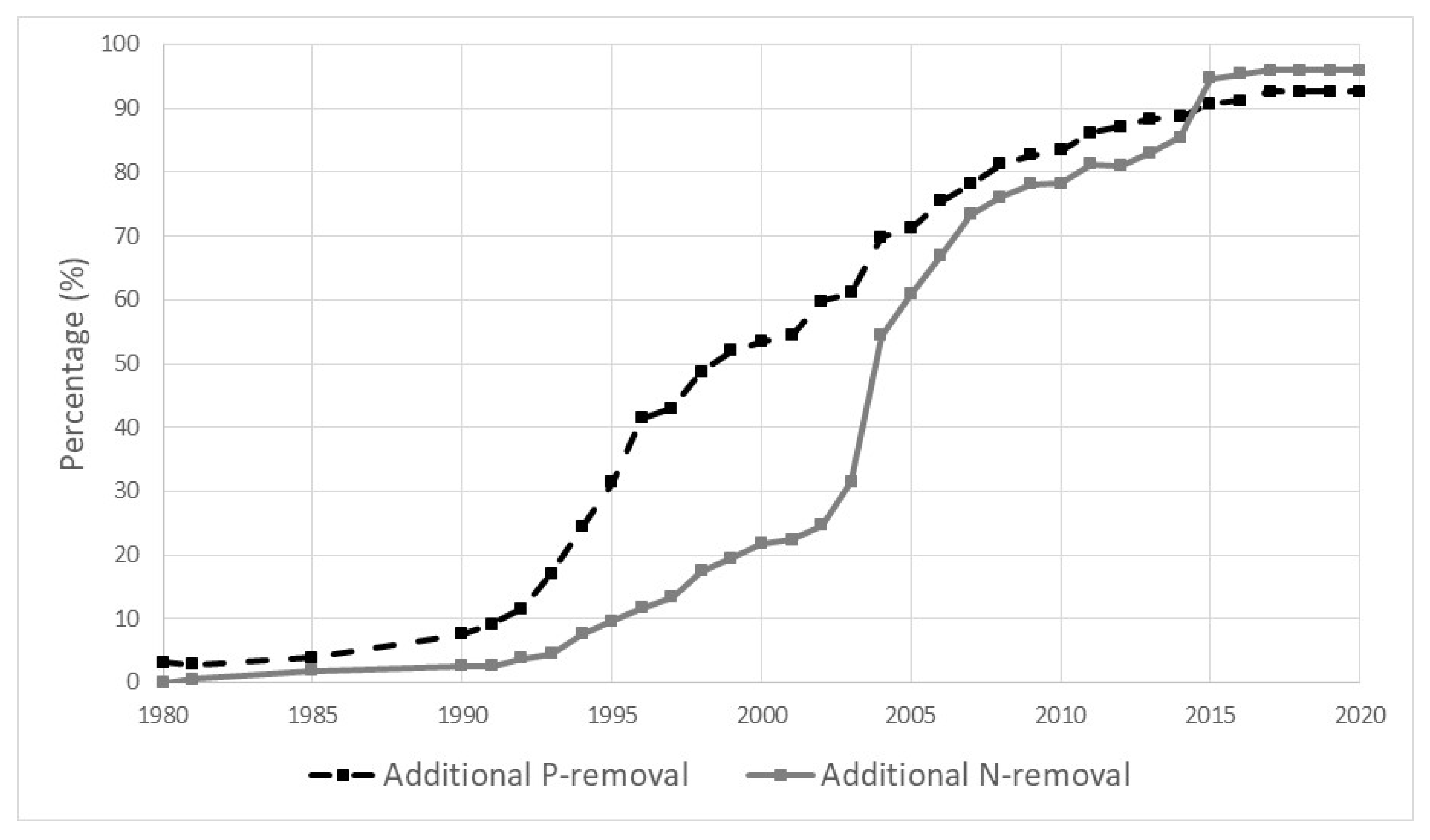
Early Wastewater Treatment Plants (WWTPs) were initially designed to remove organic matter. A significant shift, which was central to Vision I, involved adapting the WWTPs to also remove nutrients like nitrogen and phosphorus—an effort aimed at reducing eutrophication in surface waters. Data shows that this change did occur (Figure 2), and interviewees [I1, I2, I3, I6] view it as a good example of how infrastructure can be altered, despite its long lifespan and high costs.
At first glance, the main driver was a change in European legislation on urban wastewater (91/271/EEG), which was incorporated into Dutch national law in 1991–1992 as 75% emission reduction targets. It took 15–20 years to achieve these reduction targets (Figure 2). The adaptation of WWTPs was within the authority of RWAs, as they could raise taxes to fund the necessary changes. The required knowledge was developed through the research program connected to Vision I [48,49], with coordination at the national level, participation from RWAs, and involvement of universities and the market. In other words, there was a sense of urgency (compliance with EU guidelines), and coordination by the national government.
However, (local) governments were also involved in the agenda-setting period that preceded European legislation, when (according to I1 and I6) several RWAs had already experimented with innovative P-removal techniques. Loeber ([53] pp. 95–139) details the agenda-setting and policy development process regarding eutrophication, phosphorus sources, and source control in the Netherlands. The closure marked a change in the institutional structures for sewagewater collection and treatment: international action plans on emission reduction in 1985 (the North Sea region) and 1987 (the River Rhine catchment and a National Program on phosphorus emission reduction measures), followed by covenants between the national government, regional water authorities, and laundry detergent producers in 1987. Lastly, in 1992, the EU Urban Wastewater directive was issued.
During the agenda-setting and policy development process, Dutch Water Authorities (DWA) advocated for source control measures alongside end-of-pipe solutions (I2). Although most RWAs were hesitant to invest in phosphorus removal techniques, some pioneering RWAs experimented with innovative P-removal methods before they became mandatory [54]. Blankesteijn [54] details the story of one RWA, Hoogheemraadschap Rijnland (HHR). HHR “wanted to prove that a decentral water authority is indeed capable to bear responsibility for a topic of general interest” (p. 144). However, in 1973, HHR hired a hydrobiologist PhD researcher to investigate the causes of eutrophication, aiming to ensure that P-removal was effective in combating it. Unexpectedly, nitrogen rather than phosphorus was identified as the main cause in most waters, sparking debate in the national discussion on eutrophication. Despite the uncertainty, in 1977, HHR installed P-removal techniques at three WWTPs as “an experiment” (p. 153), thus investing in knowledge development.
We can learn several lessons about the interaction between different levels of government from this case. First, EU legislation, enforced by the national government, can bring about significant infrastructure changes at the local level, although this process may take over 20 years. Local governments influence implementation, for example, by participating in the collaborative research program WWTP2000. Second, local governments can actively shape the agenda and develop policy (in this case, on eutrophication) by experimenting and gathering knowledge beyond their assigned tasks. Third, local governments advocate for source control measures instead of end-of-pipe solutions (through branch organization DWA), which might seem like resistance, while at the same time, pioneering organizations experiment with new technology to enable change.

4.3. Case 2: Separation of Stormwater and Municipal Wastewater

A second example of (envisioned) change is the separation of stormwater (rainwater) from combined sewerage systems in urban areas. Separate collection and treatment of stormwater and rainwater is a key element for a more sustainable water chain, and as such it is included in Visions II, III, and IV. In the Netherlands, combined sewers dominate, and the challenge is to separate stormwater from the existing combined sewerage systems. This reduces combined sewer overflows and allows for smaller future sizes of sewers and WWTPs. Additionally, more concentrated sewagewater facilitates efficient treatment and resource recovery. Finally, groundwater is replenished, and desiccation is prevented [I1, I3, I6].
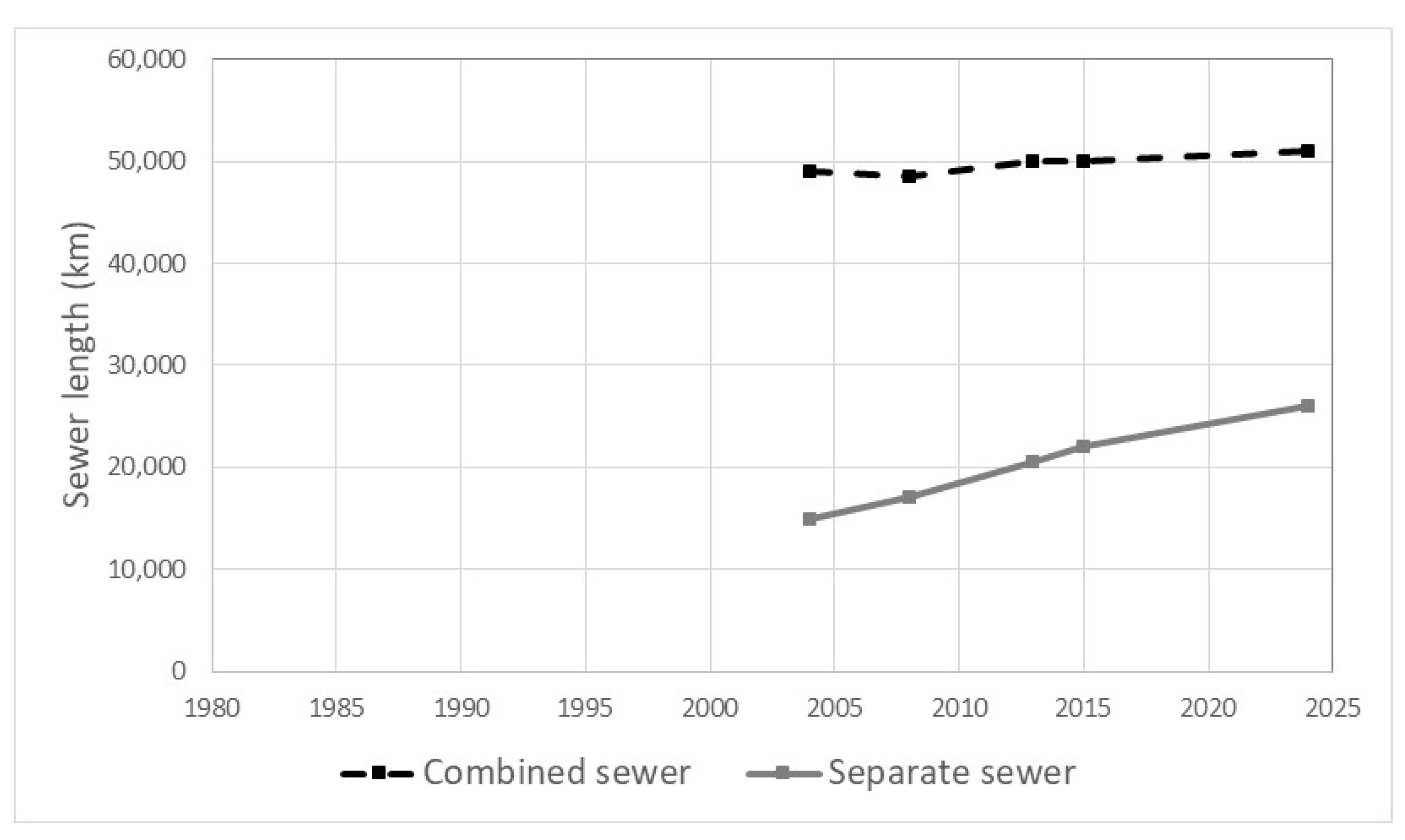
According to the interviewees, large-scale separation has not occurred. This is supported by the limited data on sewer system development in the Netherlands. Figure 3 presents benchmark data from 2004 to 2024 [32,55,56,57,58]. An earlier benchmark [59] is not included because its data significantly deviate from later years. Based on these limited data, it can be concluded that most sewer systems remain combined (Figure 3), and new installations are primarily separate sewer systems.
RWAs, despite their evident interest, have not actively tried to promote this change. A representative quote [I3] states that RWAs “regard the supply [of wastewater, HvD] at the gate [of the WWTP, HvD] as God given, you cannot influence it.” This lack of interest reflects the institutionalized task division between municipalities (sewer) and RWAs (sewagewater treatment). With the current infrastructure, wastewater treatment is relatively inexpensive [I1].
Separating stormwater and sewagewater in existing combined sewer systems is costly, and the expenses outweigh the benefits in the short term [I10]. A direct result of the Dutch municipal sewagewater governance arrangement is that the effort and costs of separating rainwater in existing urban areas fall on the municipality, while the benefits—such as reduction in wastewater volume, concentration of wastewater, and reduction in sewer overflows—are experienced by the RWA. Therefore, change is unlikely to occur externally stimulus.
This stimulus arose in the 1990s due to deteriorating water quality. The increasing concern about eutrophication and international agreements to reduce nutrient loads (see case 1) brought attention to sewer overflows. Based on research by a national task force in the nineteen eighties [35], a national commission defined the ‘basic effort’ in 1992: a reduction in emissions from sewer systems down to a theoretical reference level, to be reached by 1998 [60], later extended to 2005. Governments at the national, regional, and local levels participated in both the national task force and the national commission.
The fact that both the municipality and RWA had to invest to meet the reduction targets led to a series of optimization studies where municipalities and RWAs together conducted integrated analyses of measures, costs, and the distribution of expenses to achieve emission reduction goals. Therefore, the municipality and RWA can collaborate on efficient and cost-effective actions to bring about change across the water chain, despite the institutional division of tasks. Once the emission reductions were achieved, external pressure disappeared. The current apparent stagnation can be attributed to the lack of a stimulus, combined with the belief that the most cost-effective separation measures have already been implemented [46].
Since 2004, separate sewers have been the standard for new urban developments due to increased awareness of climate change. For existing urban areas, switching to separate sewer systems is only considered when sewers need to be replaced; the average replacement rate is 1% per year [58].
The case shows how stasis results from the institutionalized task division in the Dutch sanitation governance system, where the municipality bears the investments while the RWA benefits. Additionally, central government can create conditions for cooperation between local governments, as it eventually did by setting emission reduction targets (‘basic effort’) for both actors, making cooperation more cost-effective.

4.4. Case 3: Water Cycle Companies

Another change that did not occur between 1980 and 2020 is the development of governance arrangements toward water cycle companies. As managers of the entire water chain, water cycle companies could theoretically enable system-wide optimization and innovation. Water cycle companies were mentioned in vision II and were noted by most interviewees (I1 to I5; I7 to I9). Between 2005 and 2015, several initiatives started in the Netherlands (e.g., Waternet, Aquario, Cooperation Noordwijkerhout), but all were eventually terminated.
While several interviewees (I1, I7) consider water cycle companies a plausible alternative, citing successful institutional arrangements in other countries, some respondents (I2, I4) describe water cycle companies as an external threat to the RWAs that was managed successfully: “We navigated along the edge of the ravine” (I4). Several interviewees note that elected officials of both municipalities (I7) and RWAs (I2, I5, I7) are not eager to transfer responsibilities to water cycle companies.
The rise and fall of water cycle companies fits within a broader context of New Public Management as the main coordination mechanism, with a focus on cost reduction [61], driven by the 2008 economic crisis. Before 2014, the independence of RWAs as government entities was at risk [62]. In 2011, a parliamentary motion asked the Ministry to consider transferring tasks from RWAs to provinces and municipalities, citing efficiency, cost savings, and reduced administrative complexity as main reasons. In February 2012, the Minister replied that she would not transfer tasks after RWAs committed to a cost reduction of up to 750 million euros annually for water management, including 300 million through better cooperation with municipalities [63]. It was therefore a big surprise to RWAs (according to Havekes) that the new cabinet Rutte II (November 2012–2017) mentioned reorganizing regional government and RWAs in its Coalition Agreement later that year [64].
The interviewees mentioned several strategies that Dutch Water Authorities used to maintain independence: (i) creating new public value (see case 4); (ii) committing to the previously mentioned cost reduction in sanitation through improved cooperation; and (iii) requesting the OECD to audit the Dutch water sector. The cost reduction was incorporated into the National Administrative Agreement Water [65]. A committee led by a former Minister was formed to audit municipalities and RWAs and to report on cooperation and cost reduction. Dutch Water Authorities successfully lobbied for an OECD audit of Dutch water management (according to I4), which provided a relatively positive assessment of the RWAs, ending the debate about their future [66], without any institutional change.
In this case, we see how a shifting discourse on ‘government’ and ‘the state’ (i.e., New Public Management) puts pressure on the current governance structure. This was seen as a threat by RWAs and municipalities, and agency is used to deflect this threat. The outcome is a continuation of the governance structure, with even greater emphasis on costs. This encourages the exploitation of existing infrastructure and blocks transitional change for reasons other than cost reduction.

4.5. Case 4: Energy Factories

The transition from wastewater treatment plants (WWTPs) to energy factories was discussed in eight interviews, generally as an example of transitional change. The valuation of energy and resources from wastewater plays a key role in visions III and IV.
In the Netherlands, sewage sludge has long been regarded as a by-product of wastewater treatment. Since the 1970s, the sludge has been digested for reasons of stabilization and volume reduction, a process in which methane is produced. The proposal of the ‘Energy factory’ is that, with an optimized digestion process and additional technology, a WWTP can produce more energy (biogas-methane) than it consumes; hence ‘energy factory’.
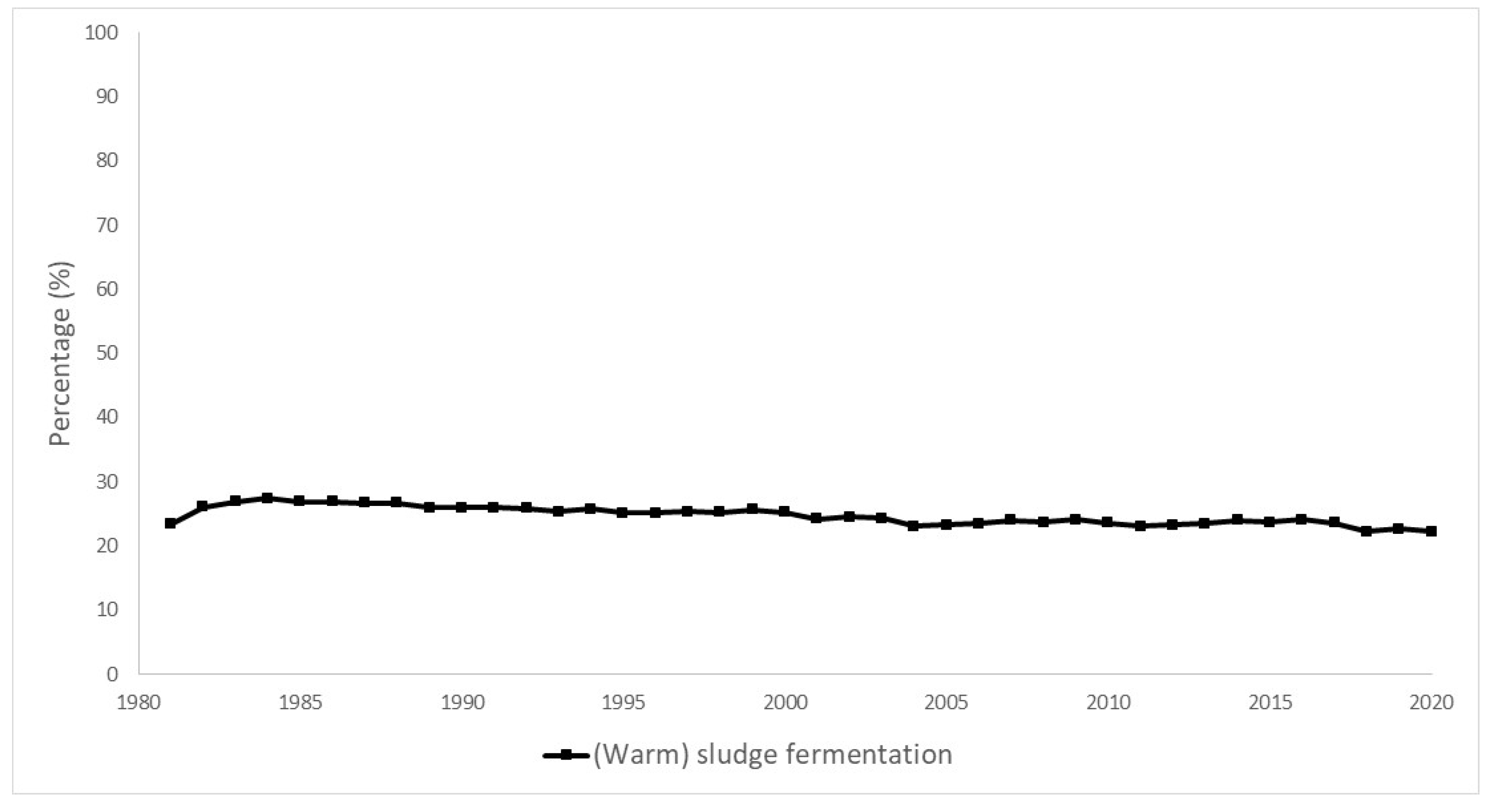
There are no statistics on the number of energy factories in the Netherlands, although Van Leeuwen et al. [39] mention energy production from biogas at 100 installations (out of about 320) in 2018, producing 120 million m3 of biogas. Data on sludge fermentation at WWTPs from CBS-Statline (Figure 4) shows no significant changes from 1980 to 2020; according to this source, 72 WWTPs were equipped with (warm) sludge fermentation in 2018. The same source records biogas production starting from 2013. Production increased from 110 million m3 in 2013 to 130 million m3 in 2020 (CBS Statline; not included in the graph). The Energy Factory was proposed in 2009. It is clear that sludge fermentation and biogas production existed before 2009, and biogas production has increased since 2013, but there is not enough data to draw definitive conclusions about the spread of energy factories.
The idea arose during the political debate about the future of RWAs as independent organizations (see previous case). In 2008, the chairman of the Dutch Water Authorities started a network of young creative employees to link the RWAs to relevant societal issues. This network organized a competition, and the ‘Energy Factory’ won in 2009. The jury launched an innovation program with four leading RWAs as core participants. Interviewees [I4, I5, I8] mention the multiple aspects of the ‘Energy Factory’. Discourse-wise, this links sewagewater treatment and RWAs to new discussions on energy, sustainability, and climate change; thus creating positive publicity and a modern, positive image for RWAs, boosting their public value [67]. Technically, it connects technology from the process industry to sewage treatment. Institutionally, energy production connects RWAs to new (business) partners in new value chains. The Energy Factory is considered successful by the interviewees because it improved the image and social relevance of the RWAs in the Netherlands.
A specific example of agency concerns successful efforts by leading RWAs to change the institutional context. Interviewees [I4, I5, I8] describe the case of transforming a WWTP (in Den Bosch) into an energy factory. The responsible -front-runner- RWA (and initiator of the energy factory) encountered a significant institutional barrier: the new role of energy producer goes beyond the legal core tasks of RWAs. The RWA sought support from Dutch Water Authorities. Together, they invited the Secretary-General of Energy from the Ministry for a visit. Despite the fact that the ministry could not publicly support the new role of energy producer, it suggested the RWA informally to proceed with the project, as ‘laws regulate the problems of the past, and new cases are required to develop new rules’. This informal support was subsequently used by the chairman of the RWA to convince the RWA executives to accept the risks. After several years of collaborative efforts by the Dutch Water Authorities and the Energy factory network, a letter from the Minister to Parliament [68] officially confirmed a broader interpretation of the law and legitimized the new role of RWAs as energy producers (within certain limits). Later, Dutch Water Authorities hired a leading consultant to publish a manual on the (im-) possibilities for RWAs to generate energy and resources, aiming to provide clarity [69]. In 2016, the Minister reaffirmed the legitimacy of energy production by RWAs to Parliament, referencing this manual [70].
This case illustrates how external pressure on governance systems that challenges a government layer’s legitimacy can initiate transitional change, even when the original aim was to maintain the status quo, such as continuing as an independent actor. In this situation, existing infrastructure was redefined and shaped to connect with new societal discourses. Another insight is that local government actors can demonstrate agency by experimenting with innovations outside (or on the fringes of) the rules set by the central government. By showcasing successful innovations, they can influence rule changes.

4.6. Case 5: Decentralised Sanitation

Finally, a transitional change that did not occur between 1980 and 2020 is the breakthrough of decentralized sanitation: the separate collection, treatment, and valorization of different water and waste streams on a local scale. Despite numerous pilot projects (133 are mentioned in an overview: [71]), the dominant trend in the Netherlands remains centralization. Decentralized sanitation was included in Visions II and, to some extent, IV.
The topic was addressed in four interviews. Three interviewees [I1, I3, I6] believed that decentralized sanitation is not a serious option for the future. They cited reasons such as (i) lack of motivation, (ii) higher costs—considering that collective sewer systems and WWTPs are already in place (the lock-in) and the benefits of economy of scale—and (iii) the active participation of citizens required by many concepts. One interviewee [I6] described decentralized sanitation as a ‘hobby project’, with two research institutes driving this effort in the Netherlands. Additionally, two interviewees [I3, I6] noted that the RWAs do not learn collectively from decentralized pilot projects.
The outcomes align with Van Vliet [72], who depicts the community of decentralized sanitation as a small, self-referential group of believers. As additional reasons why pilot projects lack follow-up, she points out the focus on technology while the bottlenecks are socio-cultural, and the absence of key actors such as municipalities, housing corporations, or the national government in these projects. Moreover, there is no perceived sense of urgency for system change outside the group of believers. This was confirmed by [47] in a study on discourses in Dutch sanitation. The dominant discourse (supported by all RWAs, and the Energy Factory coalition) is based on large-scale infrastructure, market development and legislative changes. A sub-dominant discourse (not well-structured and with low institutionalization), supported in part by the research institutes mentioned by [I6] and the actors identified by Van Vliet as the community of believers, uses storylines that align with decentralized sanitation, such as mixed scales, citizen awareness, and local economies. The studies by Ampe and Van Vliet show that decentralized sanitation does not conform to the current dominant discourse in Dutch sanitation. Additionally, the interviewees employ storylines from the dominant discourse.
This case demonstrates the power of the dominant discourse. It hinders serious consideration of decentralized sanitation as an alternative to current practices. This is evident in the interviews. However, the governance structure provides enough niches for innovation, and therefore new pilot projects continue to emerge even though the discourse on decentralized sanitation remains subordinate.

5. Discussion

The aim of this paper is to explore the (inter-)actions of local governments facing the need for transitional change but limited or supported by existing infrastructure, governance structures, and other frameworks such as discursive structures. The previous sections discussed cases of (attempts at) change in Dutch sanitation. Here, we use these cases to extract some general insights.

5.1. Change in Relation to the Governance Arrangement and Infrastructure

The distribution and concentration of power among government levels are shaped by the national governance context [24]. In The Netherlands, as a decentralized unitary state, responsibilities for sewagewater transport and treatment, combined with infrastructure ownership and the authority to levy taxes for funding, grant municipalities and RWAs a degree of autonomy. As governing bodies by provision [28], they are positioned to initiate change. Therefore, the situation of sanitation in The Netherlands can be added to other cases where local governments have agency over decentralized infrastructure, such as local energy systems [30] and urban transformation efforts [13,14]. However, a key feature of the Dutch sanitation system is its institutionalized task division (see Figure 1), which divides responsibilities among three local government actors.
An analysis of the five cases (Table 2) shows that a systemic transition involving the entire water cycle or chain did not occur. Due to the lock-in of the governance structure, changes were confined to subsystems, such as WWTP, under the responsibility of a single local government. System-level transitional changes, like those outlined in Visions II, III, and IV, require strong cooperation among the drinking water company, municipality, and regional water authority. Temporarily, specific pressure from the central government can overcome the institutionalized task division and the resulting uneven distribution of costs and benefits, as seen in cases 2 and 3; in both cases, cooperation between the municipality and RWA was effective in meeting emission reduction (case 2) or cost reduction (case 3) targets. However, cooperation lasts only as long as the pressure is applied.
Of the five cases, only the first one leads to a full-scale implementation of the change; currently, the vast majority of WWTPs in the Netherlands are equipped with phosphorus removal technology. The combination of binding European and national legislation and strong vertical coordination by the central government ensures action by local authorities. The lock-in caused by existing infrastructure can be overcome as the technology can be applied when (part of) the WWTP is amortized and renovations are needed. The change aligns well with the dominant discourse of centralized wastewater treatment [47]. In the other cases, there is no compelling legislation, and less coordination by the national government.
Phosphorus removal (case 1) and energy factories (case 4) align with the current infrastructure, where combined sewers carry a mix of stormwater and (diluted) wastewater to large-scale, centralized WWTPs. Both require upgrades at the WWTPs but not to the sewer system or the overall treatment scale. Therefore, investing in phosphorus removal or energy factories essentially reinforces the existing infrastructure lock-in and supports the dominant narrative of centralized wastewater treatment. Decentralized sanitation, in contrast, focuses on local reuse. Nonetheless, both phosphorus removal and energy factories offer (local) governments strategies to address evolving environmental discourses while maintaining long-lasting infrastructure—either by meeting environmental standards (phosphorus removal) or by reinterpreting the infrastructure through new discourses (energy factory).

5.2. Agency by (Local) Government

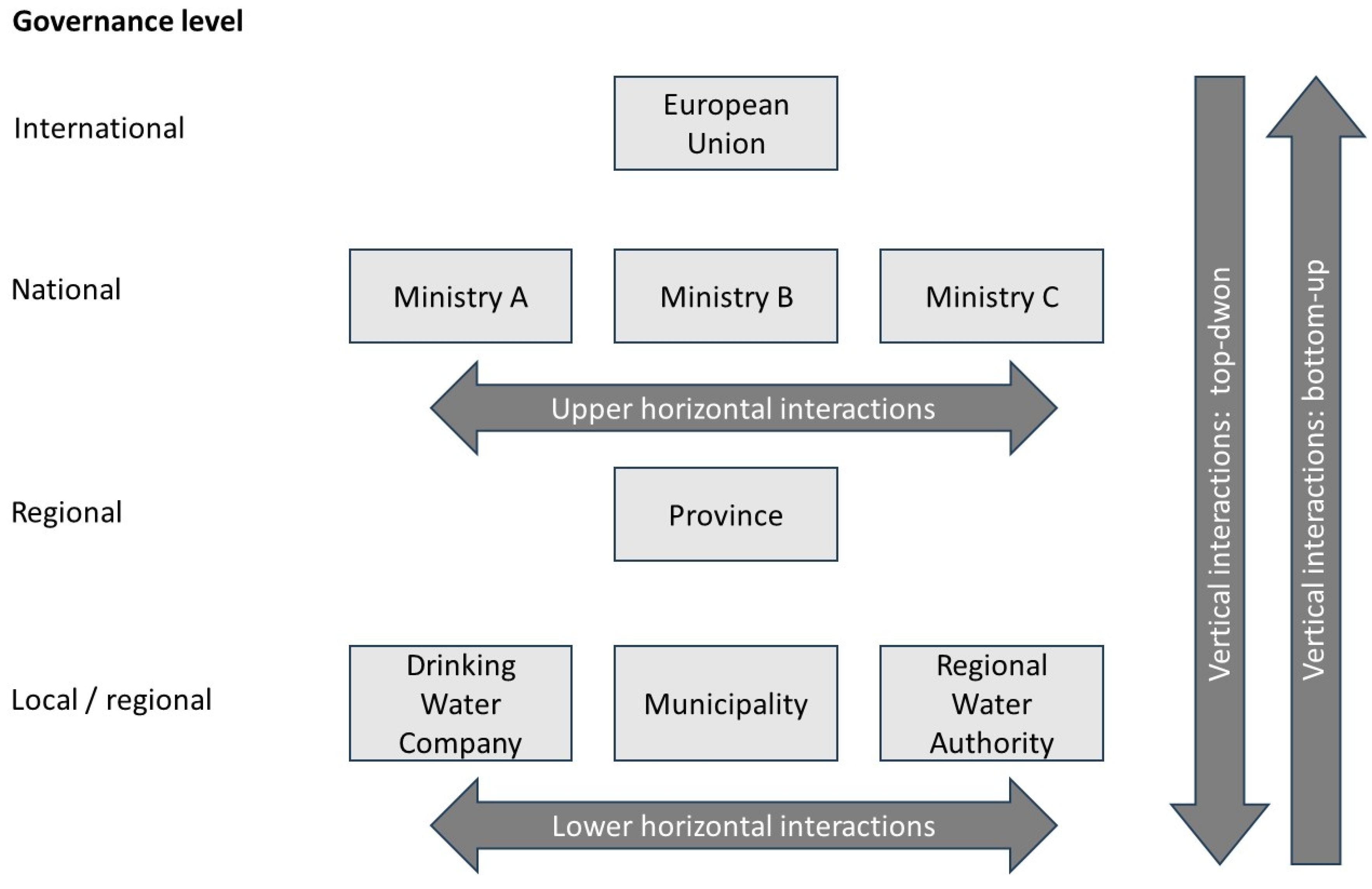
The previous section suggests that legislation, strong coordination by the central government, and compatibility with existing infrastructure and dominant discourse are necessary to achieve full-scale change. However, this does not adequately recognize the agency of local government. In this section, the multi-level governance framework [22,23] (see Figure 5) will be used to further explore this agency.
The cases demonstrate that the primary contribution of local government to change occurs early on, in agenda-setting and mainstreaming innovations. Case 1 illustrates how a RWA advances scientific knowledge on phosphorus removal and tests removal techniques. United within Dutch Water Authorities, RWAs help shape the debate on phosphorus sources and mitigation measures. Through these vertical bottom-up interactions (Figure 5), local authorities initially influence legislation that will later compel them to act, representing vertical top-down interaction.
Another manifestation of agency by local government in these cases is enabling niche experiments and contributing to ‘mainstreaming,’ that is, integrating alternative systems into current socio-technical configurations [29,73,74], leveraging their position as actors ‘at the heart of the regime’ [18]. The cases present several examples of mainstreaming through vertical, bottom-up interactions. One example is demonstrating alternatives to current practices, which lends credibility to them and influences the discursive context. Decentralized sanitation projects (case 5), the first energy factories (case 4), and small-scale water cycle companies (case 3) are all examples. Showcasing these alternatives increases their credibility in agenda-setting and policy formulation debates (vertical bottom-up interactions, Figure 5). A similar process is described by [16] for UK municipalities experimenting with local sustainable energy production.
Case 4 (Energy Factory) illustrates how local governments (specifically RWAs) initiate a new innovation and actively coordinate to promote it. This example depicts lower horizontal interactions (Figure 5) and bottom-up vertical interactions. The case demonstrates how demonstration projects encourage changes in institutional rules to enable innovation. It also shows how local governments redefine existing infrastructure in terms of new societal discourses, such as energy neutrality.
Another type of agency observed in the cases involves actions by the central government to initiate change in the decentralized, fragmented governance system (top-down vertical interactions). It relates to encouraging cooperation between municipalities and regional water authorities (i.e., lower horizontal interactions) through the creation of appropriate incentives: emission reduction targets (case 2) and cost reduction targets (case 3). In other words, the central government’s interventions aim to influence the agency of local governments.
Finally, the cases exhibited actions aimed at changing the distribution of responsibilities and power within the multi-level governance framework (cases 3 and 4). Regional governments (such as provinces and drinking water agencies) saw an opportunity to expand their role in wastewater collection and treatment, prompting a response from RWAs (case 4). The outcome of this episode was institutional stasis, but there was a shift in steering toward efficiency and cost reduction, thereby reinforcing the infrastructure lock-in.

5.3. The Question of Coordination

The various actions by local and national governments are summarized in Table 3. However, it raises the question of coordination. Sustainability transitions need a delicate balance between coordination and integration on one side, and diversity and creativity on the other [24], which is a challenge for multi-level governance. Pahl-Wostl & Kranz [75], p. 569) conclude from several case studies that “some degree of decentralization combined with effective vertical integration and cross-level interactions seem to be an effective approach for increasing performance” (to deal with climate change).
When analyzing the cases from a coordination perspective, two patterns stand out. First, over the past 40 years, the actions of local government actors focused mainly on their own subsystem (e.g., WWTP for RWA). Because of the governance structure with distributed responsibilities, transitional change at the system level will not occur without coordination from a higher level of governance. This is a key difference from the sustainable energy cases discussed by Kuzemko [15,16]. An exception is decentralized sanitation projects, where alternatives at the system level are demonstrated. The second pattern is that, although local governments help set the agenda through knowledge development, demonstration, mainstreaming of innovations, and bottom-up coordination, fully implementing these innovations requires legislation and strong coordination by the national government. The governance structure, consisting of many municipalities and regional water authorities, along with numerous physical opportunities for innovation (e.g., WWTP renovations, new urban developments), provides ample chances for demonstrating innovations. At the same time, the decentralized nature of the infrastructure and the numerous actors involved require coordination to ensure consistent implementation of changes.
To add to the complexity, the institutional structure and distribution of power continually change, and environmental developments can influence governance arrangements and how power is allocated [30,76]. A key development in this area is New Public Management. In the Netherlands, it has led to decentralization, outsourcing, and a focus on cost efficiency [20,77]. Also, the way the central government directs decisions in the Netherlands shifted between 1980 and 2020—from multiannual programs in the 1970s and 1980s to a more horizontal approach [78], involving covenants and deals. It is no coincidence that the case with the strongest national coordination (phosphorus removal, case 1) is also the oldest. New Public Management has also emphasized efficiency and cost reduction, evident in case 3. This focus on cost reduction encourages the exploitation of existing infrastructure rather than investing in alternatives that may benefit the long term but require additional short-term costs. Thus, New Public Management reinforces infrastructure lock-in.

6. Conclusions

This paper enhances our understanding of the challenges and opportunities presented by existing infrastructure and governance arrangements in pursuing sustainable wastewater solutions. It adds to the growing body of literature on the role of local government in sustainability transitions. It offers deeper insights into how multi-level governance and infrastructure enable certain directions for the co-evolution of practices and embedding structures, while preventing others. It examines the actions of local and regional governments, demonstrating that the combination of decentralized responsibility and infrastructure grants local governments significant but specific agency.
Due to the institutionalized task division between municipalities, regional water authorities, and drinking water companies, each actor tends to focus on optimizing the sub-system it is responsible for. Transitional changes that require cooperation at the system level, such as separating stormwater and wastewater in existing urban areas or shifting from centralized to decentralized sanitation, have not occurred in the past 40 years. Within their sub-system, local governments contribute to incremental and transitional change through knowledge development, initiating innovations, demonstrating and mainstreaming those innovations, and generally contributing to agenda setting and policy formation. However, the results show that for a nationwide implementation of sustainable solutions, legislation and strong coordination by the national government are necessary. The challenge for the national government is to guide the overall development of the system in the desired direction [79] or, in terms of Grin [80], to redirect the evolution of practice and the structures in which it is embedded. The governance arrangement encourages the optimization of subsystems, and new investments strengthen the lock-in through infrastructure and the institutionalized division of tasks. New Public Management, with less top-down control by the central government and a greater emphasis on costs, further reinforces this lock-in.
Although the transitional changes envisioned in Vision documents II, III, and IV did not occur, the (incremental) measures, resulting from a combination of legislation, temporary top-down incentives, and bottom-up initiatives, have had some effect in reducing the ‘unsustainabilities’ that were the driving force behind the visions. Phosphorus emissions to surface water, with the wastewater chain as a substantial source, have decreased from 22.3 million kg P in 1990 to 10.0 million kg P in 2023 [81]. Biogas production from sludge has increased (see Section 4.5). The combined sewer system, a root cause of the unsustainabilities in Dutch sanitation, will slowly be replaced by a largely separate sewer system (see Section 4.3). However, without transitional change, the pace of change will follow the replacement rate, meaning it could take up to 100 years.

Funding

This research received no funding.

Institutional Review Board Statement

Ethical review and approval were waived for this study as it does not involve any personally identifiable information.

Informed Consent Statement

Informed consent was obtained from all subjects involved in the study.

Data Availability Statement

The raw data supporting the conclusions of this article will be made available by the authors on request.

Acknowledgments

The author is grateful to John Grin and Anne Loeber for the stimulating discussions and thanks the anonymous reviewers for their constructive feedback comments.

Conflicts of Interest

The author is employed by the company ‘Patella Strategie, Advies & Management’ and declares that the research was conducted in the absence of any commercial or financial relationships that could be construed as a potential conflict of interest.

Abbreviations

DWADutch Water Authorities
EUEuropean Union
HHRHoogheemraadschap Rijnland (a Dutch RWA)
LCALife Cycle Assessment
NPMNew Public Management
OECDOrganisation for Economic Cooperation and Development
P-removalPhosphorus removal
RWARegional Water Authority
WWTPWastewater Treatment Plant

References

  1. Markard, J.; Raven, R.; Truffer, B. Sustainability transitions: An emerging field of research and its prospects. Res. Policy Spec. Sect. Sustain. Transit. 2012, 41, 955–967. [Google Scholar] [CrossRef]
  2. Grin, J. Transition Studies: Basic Ideas and Analytical Approaches. In Handbook on Sustainability Transition and Sustainable Peace, Hexagon Series on Human and Environmental Security and Peace; Brauch, H.G., Oswald Spring, Ú., Grin, J., Scheffran, J., Eds.; Springer International Publishing: Cham, Switzerland, 2016; pp. 105–121. [Google Scholar] [CrossRef]
  3. Loorbach, D.; Frantzeskaki, N.; Avelino, F. Sustainability Transitions Research: Transforming Science and Practice for Societal Change. Annu. Rev. Environ. Resour. 2017, 42, 599–626. [Google Scholar] [CrossRef]
  4. Grin, J. Understanding transitions from a governance perspective. In Transitions to Sustainable Development. New Directions in the Study of Long Term Transformative Change; Grin, J., Rotmans, J., Schot, J., Eds.; Routledge: New York, NY, USA, 2010; p. 397. [Google Scholar]
  5. Geels, F.W. Regime Resistance against Low-Carbon Transitions: Introducing Politics and Power into the Multi-Level Perspective. Theory Cult. Soc. 2014, 31, 21–40. [Google Scholar] [CrossRef]
  6. Levy, D.; Scully, M. The Institutional Entrepreneur as Modern Prince: The Strategic Face of Power in Contested Fields. Organ. Studies 2007, 28, 971–991. [Google Scholar] [CrossRef]
  7. Van Dokkum, H.P.; Loeber, A.M.C.; Grin, J. Understanding the role of government in sustainability transitions: A conceptual lens to analyse the Dutch gas quake case. Technol. Forecast. Soc. Chang. 2023, 194, 122685. [Google Scholar] [CrossRef]
  8. Johnstone, P.; Newell, P. Sustainability transitions and the state. Environ. Innov. Soc. Transit. 2018, 27, 72–82. [Google Scholar] [CrossRef]
  9. Rhodes, R.A.W. The New Governance: Governing without Government. Political Stud. 1996, 44, 652–667. [Google Scholar] [CrossRef]
  10. Jessop, B. The State: Past, Present, Future; Polity Press: Cambridge, MA, USA, 2016. [Google Scholar]
  11. Pahl-Wostl, C.; Knieper, C. Pathways towards improved water governance: The role of polycentric governance systems and vertical and horizontal coordination. Environ. Sci. Policy 2023, 144, 151–161. [Google Scholar] [CrossRef]
  12. Fischer, L.-B.; Newig, J. Importance of Actors and Agency in Sustainability Transitions: A Systematic Exploration of the Literature. Sustainability 2016, 8, 476. [Google Scholar] [CrossRef]
  13. Wolfram, M. The Role of Cities in Sustainability Transitions: New Perspectives for Science and Policy. In Quantitative Regional Economic and Environmental Analysis for Sustainability in Korea, New Frontiers in Regional Science: Asian Perspectives; Kim, E., Kim, B.H.S., Eds.; Springer: Singapore, 2016; pp. 3–22. [Google Scholar]
  14. Loorbach, D.; Shiroyama, H. The Challenge of Sustainable Urban Development and Transforming Cities. In Governance of Urban Sustainability Transitions: European and Asian Experiences, Theory and Practice of Urban Sustainability Transitions; Loorbach, D., Wittmayer, J.M., Shiroyama, H., Fujino, J., Mizuguchi, S., Eds.; Springer: Tokyo, Japan, 2016; pp. 3–12. [Google Scholar] [CrossRef]
  15. Kuzemko, C.; Lockwood, M.; Mitchell, C.; Hoggett, R. Governing for sustainable energy system change: Politics, contexts and contingency. Energy Res. Soc. Sci. 2016, 12, 96–105. [Google Scholar] [CrossRef]
  16. Kuzemko, C. Re-scaling IPE: Local government, sustainable energy and change. Rev. Int. Political Econ. 2019, 26, 80–103. [Google Scholar] [CrossRef]
  17. Sunio, V.; Argamosa, P.; Caswang, J.; Vinoya, C. The State in the governance of sustainable mobility transitions in the informal transport sector. Res. Transp. Bus. Manag. 2020, 38, 100522. [Google Scholar] [CrossRef]
  18. Grin, J. ‘Doing’ system innovations from within the heart of the regime. J. Environ. Policy Plan. 2020, 22, 682–694. [Google Scholar] [CrossRef]
  19. Fudge, S.; Peters, M.; Woodman, B. Local authorities as niche actors: The case of energy governance in the UK. Environ. Innov. Soc. Transit. 2016, 18, 1–17. [Google Scholar] [CrossRef]
  20. Naschold, F. New Frontiers in the Public Sector Management: Trends and Issues in State and Local Government in Europe, Reprint 2017 ed.; De Gruyter: Berlin, Germany, 2017. [Google Scholar] [CrossRef]
  21. De Haan, F.J.; Rogers, B.C.; Frantzeskaki, N.; Brown, R.R. Transitions through a lens of urban water. Environ. Innov. Soc. Transit. 2015, 15, 1–10. [Google Scholar] [CrossRef]
  22. Charbit, C. Governance of Public Policies in Decentralised Contexts: The Multi-level Approach (OECD Regional Development Working Papers No. 2011/04); OECD: Paris, France, 2011. [Google Scholar]
  23. OECD. Water Governance in OECD Countries: A Multi-Level Approach; Organisation for Economic Co-Operation and Development: Paris, France, 2011. [Google Scholar]
  24. Ehnert, F.; Kern, F.; Borgström, S.; Gorissen, L.; Maschmeyer, S.; Egermann, M. Urban sustainability transitions in a context of multi-level governance: A comparison of four European states. Environ. Innov. Soc. Transit. 2018, 26, 101–116. [Google Scholar] [CrossRef]
  25. Allen, C.; Malekpour, S.; Mintrom, M. Cross-scale, cross-level and multi-actor governance of transformations toward the Sustainable Development Goals: A review of common challenges and solutions. Sustain. Dev. 2023, 31, 1250–1267. [Google Scholar] [CrossRef]
  26. Mayer, F.W. Mult-level games. In Handbook on Multi-Level Governance; Enderlein, H., Walti, L., Zurn, M., Eds.; Edward Elgar Publishing: Cheltenham, UK, 2011; pp. 47–65. [Google Scholar]
  27. Mulder, K.F. Future options for sewage and drainage systems three scenarios for transitions and continuity. Sustainability 2019, 11, 1383. [Google Scholar] [CrossRef]
  28. Bulkeley, H.; Kern, K. Local Government and the Governing of Climate Change in Germany and the UK. Urban Stud. 2006, 43, 2237–2259. [Google Scholar] [CrossRef]
  29. Smedby, N.; Quitzau, M.-B. Municipal Governance and Sustainability: The Role of Local Governments in Promoting Transitions. Environ. Policy Gov. 2016, 26, 323–336. [Google Scholar] [CrossRef]
  30. Kuzemko, C.; Britton, J. Policy, politics and materiality across scales: A framework for understanding local government sustainable energy capacity applied in England. Energy Res. Soc. Sci. 2020, 62, 101367. [Google Scholar] [CrossRef]
  31. Verhoeven, I.; Duyvendak, J.W. Understanding governmental activism. Soc. Mov. Stud. 2017, 16, 564–577. [Google Scholar] [CrossRef]
  32. Rioned. Monitor Gemeentelijke Watertaken 2024; Stichting Rioned: Ede, The Netherlands, 2025; Available online: https://rioned-web-prod.azurewebsites.net/media/lq2ek3dm/monitor-gemeentelijke-watertaken-2024-webversie-maart-2025.pdf (accessed on 6 December 2025).
  33. Ambient, 2024. Landelijke Visie, Strategie en Uitvoeringsagenda Voor de Waterketen Richting 2050. Utrecht, The Netherlands. Available online: https://unievanwaterschappen.nl/wp-content/uploads/Visie-en-strategie-waterketen-11-december-defintief.pdf (accessed on 6 December 2025).
  34. Meijer, H.; van Leeuwen, J.; Jansen, L.; Bakker, C.; Bouwmeester, H.; Kievid, T.; van Grootveld, G.; Vergragt, P. (Eds.) DTO Sleutel water. In Modellen Van een Duurzame Waterketen; Ten Hagen & Stam B.V.: Den Haag, The Netherlands, 1997. [Google Scholar]
  35. Van Sluis, J.W.; Ten Hove, D.; De Boer, B. NWRW Eindrapport. In Eindrapportage en Evaluatie van Het Onderzoek 1982–1989 (NWRW); Ministerie van VROM: Den Haag, The Netherlands, 1989. [Google Scholar]
  36. Van der Brugge, R.; Rotmans, J.; Loorbach, D. The transition in Dutch water management. Reg Env. Change 2005, 5, 164–176. [Google Scholar] [CrossRef]
  37. Dai, L.; Wörner, R.; van Rijswick, H.F.M.W. Rainproof cities in the Netherlands: Approaches in Dutch water governance to climate-adaptive urban planning. Int. J. Water Resour. Dev. 2018, 34, 652–674. [Google Scholar] [CrossRef]
  38. Nieuwenhuis, E.; Cuppen, E.; Langeveld, J.; de Bruijn, H. De toekomst van het stedelijk watersysteem: Opereren in een stad vol transities. Water Gov. 2019, 3, 48–56. [Google Scholar]
  39. Van Leeuwen, K.; de Vries, E.; Koop, S.; Roest, K. The Energy & Raw Materials Factory: Role and Potential Contribution to the Circular Economy of the Netherlands. Environ. Manag. 2018, 61, 786–795. [Google Scholar] [CrossRef]
  40. Andersson, K.; Rosemarin, A.; Dickin, S.; Trimmer, C. Sanitation, Wastewater Management and Sustainability: From Waste Disposal to Resource Recovery, 2nd ed.; United Nations Environmental Institute and Stockholm Environmental Institute: Stockholm, Sweden, 2021. [Google Scholar]
  41. Wallis-Lage, C.L.; Scanlan, P.; deBarbadillo, C.; Barnard, J.; Shaw, A.; Tarallo, S. The Paradigm Shift: Wastewater Plants to Resource Plants; Black & Veatch: Kansas City, MO, USA, 2011. [Google Scholar]
  42. Van der Hoek, J.P.; de Fooij, H.; Struker, A. Wastewater as a resource: Strategies to recover resources from Amsterdam’s wastewater. Resour. Conserv. Recycl. 2016, 113, 53–64. [Google Scholar] [CrossRef]
  43. Schaum, C. Wastewater treatment of the future: Health, water and resource protection. In Phosphorus: Polluter and Resource of the Future—Removal and Recovery from Wastewater; IWA Publishing: London, UK, 2018; pp. 537–554. [Google Scholar]
  44. Corvellec, H.; Zapata Campos, M.J.; Zapata, P. Infrastructures, lock-in, and sustainable urban development: The case of waste incineration in the Göteborg Metropolitan Area. J. Clean. Prod. 2013, 50, 32–39. [Google Scholar] [CrossRef]
  45. Unruh, G.C. Understanding carbon lock-in. Energy Policy 2000, 28, 817–830. [Google Scholar] [CrossRef]
  46. Hermans, R. Afkoppelen kost meer dan het aan zuiveringskosten bespaart. Water Gov. 2015, 4, 24–28. [Google Scholar]
  47. Ampe, K.; Paredis, E.; Asveld, L.; Osseweijer, P.; Block, T. A transition in the Dutch wastewater system? The struggle between discourses and with lock-ins. J. Environ. Policy Plan. 2019, 22, 155–169. [Google Scholar] [CrossRef]
  48. RWS-RIZA. Symposium RWZI 2000: De Stand van Zaken (RWZI-2000 89-08); RWS-RIZA, STORA: Lelystad, The Netherlands, 1989. [Google Scholar]
  49. RWS-RIZA. Evaluatie van Het Onderzoeksprogramma “RWZI 2000” (No. RWZI 2000 95-05); RWS-RIZA, STOWA: Lelystad, The Netherlands, 1994. [Google Scholar]
  50. Van der Woude, N. NIDO Programma “Waarden van Water” Afgesloten. H2O 2003, 8, 6–7. [Google Scholar]
  51. Loeber, A. Inbreken in het Gangbare. In Transitiemanagement in de Praktijk: De NIDO Benadering; NIDO: Leeuwarden, The Netherlands, 2003. [Google Scholar]
  52. UvW; VNG. Routekaart Afvalwaterketen. In Visiebrochure Afvalwaterketen Tot 2030; Unie van Waterschappen: Den Haag, The Netherlands, 2013. [Google Scholar]
  53. Loeber, A.M.C. Practical wisdom in Risk Society. In Methods and Practice of Interpretive Analysis on Questions of Sustainable Development; University of Amsterdam, ISSR: Amsterdam, the Netherlands, 2004. [Google Scholar]
  54. Blankesteijn, M.L. Tussen Wetten en Weten: De Rol van Kennis in Waterbeheer in Transitie; Boom Lemma Uitgevers: Den Haag, The Netherlands, 2011. [Google Scholar]
  55. Rioned. Riool in Cijfers 2005–2006; Stichting Rioned: Ede, The Netherlands, 2005. [Google Scholar]
  56. Rioned. Riool in Cijfers 2009–2010; Stichting Rioned: Ede, The Netherlands, 2009. [Google Scholar]
  57. Rioned. Riolering in Beeld. In Benchmark Rioleringszorg 2013; Stichting Rioned: Ede, The Netherlands, 2013. [Google Scholar]
  58. Rioned. Het nut van stedelijk waterbeheer. In Monitor Gemeentelijke Watertaken 2016; Stichting Rioned: Ede, The Netherlands, 2016. [Google Scholar]
  59. Rioned. Riool in Cijfers 2002–2003; Stichting Rioned: Ede, The Netherlands, 2002. [Google Scholar]
  60. CUWVO. Overstortingen uit Rioolstelsels en Regenwaterlozingen. Aanbevelingen voor het Beleid en de Vergunningverlening. Coördinatiecommissie Uitvoering Wet Verontreiniging Oppervlaktewateren, Werkgroep VI; CUWVO: The Hague, Netherlands, 1992. [Google Scholar]
  61. Stellinga, B. Dertig Jaar Privatisering, Verzelfstandiging en Marktwerking. (No. Nr. 65); WRR Webpublicaties: Den Haag, The Netherlands, 2012. [Google Scholar]
  62. Havekes, H.J.M. Verandering en continuïteit in de polder. De institutionele ontwikkeling van het waterschap in de periode 1992–2017. Tijdschr. Voor Waterstaatsgeschied. 2018, 27, 47–70. [Google Scholar]
  63. TK. Brief van de Staatssecretaris van Infrastructuur en Milieu (Tweede Kamer, Vergaderstukken No. 2011–2012, 27625, Nr. 255); Tweede Kamer der Staten-Generaal: Den Haag, The Netherlands, 2012. [Google Scholar]
  64. Bruggen Slaan. Regeerakkoord VVD–PvdA. 2012. Available online: https://groenkennisnet.nl/zoeken/resultaat/bruggen-slaan-:-regeerakkoord-vvd---pvda?id=429999 (accessed on 6 December 2025).
  65. Bestuursakkoord Water. Ministerie van Infrastructuur en Milieu, IPO, UvW, VNG, VWM. 2011. Available online: https://open.rijkswaterstaat.nl/@106642/bestuursakkoord-water/ (accessed on 6 December 2025).
  66. TK. Brief van de Minister van Infrastructuur en Milieu (Tweede Kamer, Vergaderstukken No. 2013–2014, 28, 966, Nr. 27); Tweede Kamer der Staten-Generaal: Den Haag, The Netherlands, 2014. [Google Scholar]
  67. Moore, M.H. Managing for Value: Organizational Strategy in for-Profit, Nonprofit, and Governmental Organizations. Nonprofit Volunt. Sect. Q. 2000, 29, 183–204. [Google Scholar] [CrossRef]
  68. TK. Vaststelling van de begrotingsstaat van het Deltafonds voor het jaar 2013. In Brief van de Minister van Infrastructuur en Milieu. (Tweede Kamer, Vergaderstukken No. 2012–2013, 33, 400J, Nr. 19); Tweede Kamer der Staten-Generaal: Den Haag, The Netherlands, 2013. [Google Scholar]
  69. Sloover, I.S.; Klootwijk, K. Juridische Handreiking Duurzame Energie en Grondstoffen Waterschappen (STOWA Report No. 2014–40); Berenschot Groep B.V.: Utrecht, The Netherlands, 2014. [Google Scholar]
  70. TK. Vaststelling van de begrotingsstaat van het Deltafonds voor het jaar 2017. In Verslag van een Wetgevingsoverleg. (Tweede Kamer, Vergaderstukken No. 2016–2017, 34, 550J, nr. 24); Tweede Kamer der Staten-Generaal: Den Haag, The Netherlands, 2016. [Google Scholar]
  71. STOWA & Rioned. s.a. Saniwijzer: Nieuwe Sanitatie in de Praktijk. Available online: https://www.saniwijzer.nl/projecten/nederland/?menu=4&step=0021 (accessed on 6 December 2025).
  72. Van Vliet, J. Trans(h)ition? Exploring the Actor-Networks Constituting the Arena for a Transition in Dutch Sanitation. Master’s Thesis, Wageningen University and Researchcenter, Wageningen, The Netherlands, 2006. [Google Scholar]
  73. Smith, A. Translating Sustainabilities between Green Niches and Socio-Technical Regimes. Technol. Anal. Strateg. Manag. 2007, 19, 427–450. [Google Scholar] [CrossRef]
  74. Späth, P.; Rohracher, H. Local Demonstrations for Global Transitions—Dynamics across Governance Levels Fostering Socio-Technical Regime Change Towards Sustainability. Eur. Plan. Stud. 2012, 20, 461–479. [Google Scholar] [CrossRef]
  75. Pahl-Wostl, C.; Kranz, N. Water governance in times of change. Environ. Sci. Policy 2010, 13, 567–570. [Google Scholar] [CrossRef]
  76. Hensengerth, O.; Lam, T.H.O.; Tri, V.P.D.; Hutton, C.; Darby, S. How to promote sustainability? The challenge of strategic spatial planning in the Vietnamese Mekong Delta. J. Environ. Policy Plan. 2024, 26, 91–103. [Google Scholar] [CrossRef]
  77. OECD. The Netherlands 2010. In Value for Money in Government; OECD: Paris, France, 2011. [Google Scholar]
  78. Blom, M.; Schillemans, T. De ondefinieerbare staat: Horizontale en verticale sturing door de rijksoverheid sinds 1980. Beleid En Maatsch. 2010, 37, 341–355. [Google Scholar] [CrossRef]
  79. Meadowcroft, J. Who is in Charge here? Governance for Sustainable Development in a Complex World. J. Environ. Policy Plan. 2007, 9, 299–314. [Google Scholar] [CrossRef]
  80. Grin, J. Reflexive modernization as a governance issue–or: Designing and shaping Re-structuration. In Reflexive Governance for Sustainable Development; Edward Elger: Cheltenham, UK, 2006; pp. 54–81. [Google Scholar]
  81. Netherlands National Emissions Registration Database. Available online: https://www.emissieregistratie.nl/data/overzichtstabellen-water/belasting-naar-oppervlaktewater (accessed on 6 December 2025).
Figure 1. Multi-level governance of the water chain in the Netherlands: government actors, infrastructure, and definition of subsystems.
Sustainability 18 00217 g001
Figure 2. Percentage of wastewater treatment plants (WWTPs) in The Netherlands with additional phosphorus (dashed line) or nitrogen (solid line) removal. Source: CBS Statline.
Sustainability 18 00217 g002
Figure 3. Development of sewer systems in The Netherlands. Data from benchmarks [32,55,56,57,58].
Sustainability 18 00217 g003
Figure 4. Changes in (warm) sludge fermentation at WWTPs in The Netherlands. Source: CBS Statline.
Sustainability 18 00217 g004
Figure 5. Multi-level governance interactions, based on [23].
Sustainability 18 00217 g005
Table 1. Description of four visions on transitional change in Dutch sanitation, from 1994, 1997, 2003, and 2013.
Vision I.
Name: WWTP 2000
Year: 1988–1994
Scope: 2000
Programme “Future generation sewagewater treatment plant” 1988–1994, by the Ministry of Transport and Water management, RWS-RIZA, and STORA/STOWA.
Aim: (i) to develop new treatment techniques that either enhance treatment quality at the same cost or reduce costs while maintaining quality; (ii) to integrate fundamental, long-term scientific research into more empirically focused wastewater treatment research.
References: [48,49]
Vision II.
Name: DTO Water
Year: 1993–1997
Scope: 2040
DTO (Sustainable Technology Development) programme, subprogramme ‘Water’ (1993–1997), by 5 Ministries.
Aim: Achieve a sustainable water chain by 2040; reduce environmental pressure per unit of wealth twentyfold, based on LCA. Reduce ‘unsustainabilities’.
Reference: [34]
Vision III.
Name: NIDO Values of water
Year: 2000–2003
Scope: not specified
Programme by the National Initiative for Sustainable Development (NIDO). Subprogramme on the water chain.
Aim: Stimulate a transition to more sustainable (waste-) water management
References: [50,51]
Vision IV.
Name: Roadmap Wastewater Chain 2030
Year: 2013
Scope: 2030
Roadmap Wastewater Chain 2030, by UvW and VNG.
Aim: To support a sustainable society by valorizing (waste)water and closing cycles. Waste will be (re)turned into resources, energy, and clean water.
References: [52]
Table 2. Comparison of the five cases.
Case 1
Phosphorus
removal
Case 2
Separation of stormwater
Case 3
Water cycle companies
Case 4
Energy factory
Case 5
Decentralised sanitation
ScaleSub-system
(WWTP)
Sub-system
(sewer)
System
(governance)
Sub-system
(WWTP)
System
Successful?YesPartiallyNoPartially?No
Type of changeIncrementalIncrementalTransitionIncremental/TransitionTransition
PressureWater qualityWater quality
Climate change
New Public ManagementClimate changeSustainability
InitiativeTop-downTop-down
(temporary)
Bottom-upBottom-upBottom-up
Table 3. Observed (inter-)action by government actors in the multi-level governance arrangement.
Action by GovernmentType of InteractionObserved
in Case
Create incentives/conditions to improve cooperation between local governments, to overcome the institutionalised task divisionVertical top-down (to achieve lower horizontal)2
Prescribe more sustainable measures (technology) by local governmentsVertical top-down2
Utilise (material) niches for innovation to experiment with and demonstrate alternatives for the wastewater chain; lending credibility to themLower horizontal; vertical bottom-up5
Redefine and modify existing infrastructure to connect to new discourses in societyVertical bottom-up4
Contribute to national debate (agenda setting, policy development) by experimenting with new technology and production of knowledge.Vertical bottom-up1
Change the rules by experimenting with innovations outside or at the fringes of the regime (case 4, energy factory);Vertical bottom-up4
Utilise changes in the institutional context to either change or to maintain the institutional status quo. Unintended effect was increased focus on costsVertical bottom-up3
Disclaimer/Publisher’s Note: The statements, opinions and data contained in all publications are solely those of the individual author(s) and contributor(s) and not of MDPI and/or the editor(s). MDPI and/or the editor(s) disclaim responsibility for any injury to people or property resulting from any ideas, methods, instructions or products referred to in the content.