1. Introduction
Addressing climate change and reducing carbon emissions is among the most urgent priorities for global policymakers. As the top carbon emitter in the world, China faces enormous pressure and responsibility to fulfill its “Dual Carbon” goals, namely a peaking of carbon emissions by 2030 and carbon neutrality by 2060. This requires a change in the economic development pattern away from traditional, polluting forms of development to green and sustainable. In this context, the digital revolution, which involves technologies such as artificial intelligence, big data and the Internet of Things, is a powerful enabler of this transformation [
1,
2]. Digital innovation is fundamentally reshaping production processes, consumption patterns, and governance systems, holding significant promise for enhancing resource efficiency and mitigating environmental impacts [
3].
A growing body of existing literature has started to investigate the relationship between the digital economy and environmental outcomes. Many studies confirm a negative relationship between pollution emissions and digitalization, suggesting that digital technologies can contribute to lower pollution levels [
4,
5,
6]. However, most of these studies treat the impact of digital innovation as a “black box”, focusing mainly on aggregate effects at the national, regional or city level [
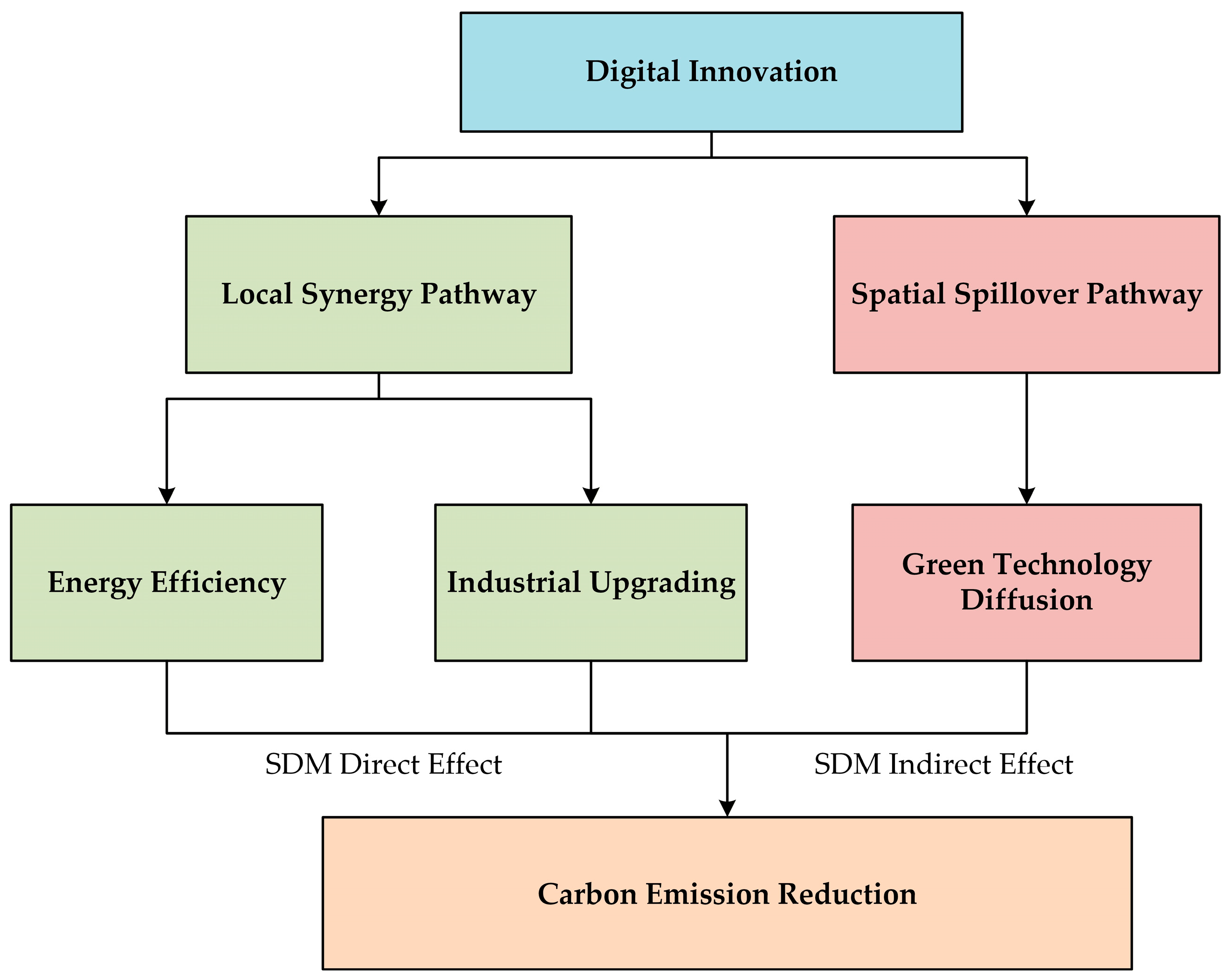
7]. This approach overlooks the complex ways in which digital innovation spreads and operates across space. The digital innovation-driven carbon reduction process is unlikely to be confined within the administrative boundaries of a single city. Building on the spatial econometrics literature that distinguishes direct and indirect spatial effects, we conceptualize two distinct yet simultaneous pathways: an intra-city synergistic effect and an inter-city spatial spillover effect.
The first pathway refers to the internal optimization processes within a city, or the local synergistic effect. Digital innovation can improve energy efficiency by supporting smart grids, logistics, and energy management for industries [
8]; it can also promote upgrading in the service level and industrial structure by developing knowledge-intensive low-carbon service industries and digitally transforming traditional manufacturing [
9,
10]. These developments generate a synergistic effect that directly reduces carbon emissions in the innovating city. The second pathway, the spatial spillover effect, extends beyond the city’s boundary [
11]. Green digital solutions embedded in patents are mobile in nature, as they are technological and knowledge-based. Through trade, investment, imitation, and the mobility of talents, they can spread to neighboring cities [
12,
13]. As a consequence, these neighboring cities can benefit from other cities’ innovation efforts for carbon reduction. If these two effects are not disentangled, then it can lead to an overestimation of the true impact of digital innovation and to ill-suited universal policies [
14]. In our framework, the local synergistic and spatial spillover pathways correspond to the direct and indirect spatial effects in spatial econometrics, which we interpret and empirically implement in the context of digital innovation and urban carbon emissions. As such, the main scientific questions that this study attempts to answer are: What is the overall impact of digital innovation on urban carbon emissions in China? More significantly, to what extent is this outcome attributable to the local synergistic influences of the city itself and to what extent to positive spillovers to and from neighboring cities? What are the specific channels through which these local and spatial effects work?
This study fills this gap by assessing the impact of digital technological innovation on urban carbon emissions through local synergistic and spatial spillover effects. We construct the panel dataset from 283 Chinese cities from 2010 to 2020, and employ the spatial Durbin model (SDM) to disentangle the effects. We begin by estimating the overall impact of digital innovation on carbon emissions using two-way fixed effects. Using the SDM, we further decompose into direct local synergy effect and indirect spatial spillover effect. In addition, to effectively address the potential endogeneity problem arising from reverse causality, we select historical telecommunications infrastructure and historical education levels as instrumental variables and conduct instrumental variable testing using the two-stage least squares method to ensure the robustness of the estimation results in this paper. We finally conduct mechanism tests to identify how each pathway operates, looking at energy efficiency upgrade and industrial structure upgrade for local synergy effect, and green technology diffusion for spatial spillover effect.
The empirical results reveal several key findings. First, digital innovation significantly reduces urban carbon emissions, with the overall effect being statistically and economically significant. The spatial decomposition estimates that 65.3% of this effect is generated by local synergies in cities and 34.7% by positive spatial spillovers to neighboring cities. We confirm through mechanism analyses that the local effects of green patents are mainly attributed to energy efficiency improvement and industrial upgrading. Spatial spillovers occur due to the transborder flow of green patents and technology. In technology-intensive industries and economically developed areas, the heterogeneity analysis indicates that these impacts are accentuated, which demonstrates how contextual factors influence the environmental impact of digital innovation.
Our findings relate to and extend the growing literature on the relationship between digitalization and sustainable development [
15,
16]. A large number of studies document that the development of the digital economy is negatively associated with pollution and carbon emissions at the national, provincial, and urban level [
17,
18], highlighting the potential of digital technologies as an instrument for green transition. Despite these advances, two important gaps remain in the existing literature. First, most studies examine the impact of digitalization on carbon emissions within a non-spatial framework and largely treat regions or cities as independent units, thereby overlooking potential spatial heterogeneity and cross-city spillovers in the environmental effects of digital innovation [
19,
20]. Second, even when a negative relationship between digitalization and emissions is documented, the underlying channels are often treated as a “black box”, with limited effort to distinguish local mechanisms from spatial mechanisms [
21,
22]. This paper aims to fill these gaps by adopting a spatial econometric perspective and by explicitly analyzing both the local and spatial pathways through which digital innovation may affect urban carbon emissions.
This research expands the current literature in three important ways. First, building on the well-established distinction between direct and indirect spatial effects, we develop a theory-guided dual-pathway framework that links digital innovation to urban carbon emissions through explicitly identified local mechanisms (energy efficiency improvement and industrial structure upgrading) and spatial mechanisms (green technology diffusion). Rather than proposing a new spatial concept, our contribution lies in mapping these mechanisms onto the standard direct and indirect effects and clarifying how digital innovation operates across different spatial scales [
23]. Second, we empirically operationalize and validate these pathways in a panel of 283 Chinese cities from 2010 to 2020 by employing a Spatial Durbin Model that decomposes the total effect into local synergy and spatial spillover components, while addressing spatial dependence and potential endogeneity through appropriate econometric strategies. This approach allows for a more precise quantification of the environmental benefits of digital innovation [
24]. Third, we further identify and test the specific channels through which each pathway operates and explore heterogeneous effects across regions and industries. These insights deepen our understanding of how and where digital innovation contributes to carbon reduction and provide evidence-based guidance for designing differentiated yet coordinated regional climate and digitalization policies [
25].
The remainder of this paper is organized as follows. In
Section 2, we build the theoretical framework that uncovers the two paths through which digital innovation affects carbon emissions. We further develop testable hypotheses about local synergistic effects and spatial spillover effects.
Section 3 introduces the empirical strategy in this paper, specifically how relevant variables accounting for digital innovation and carbon emissions were built and econometric specification.
Section 4 contains the main results that were presented in baseline regressions and spatial decomposition analysis and a number of robust checks which con-firm the results. In
Section 5, we provide evidence into the operational mechanisms that lead to the formation of local effects and spillover effects. In
Section 6, we conduct heterogeneity analysis based on different characteristics in industries and cities.
Section 7 discusses the conclusions and policy implications.
4. Empirical Results
4.1. Baseline Results: The Overall Effect of Digital Innovation on Carbon Emissions
We start our empirical examination by examining the overall effect of digital technological innovation on urban carbon emissions employing a two-way fixed effects model. The results from four progressively more demanding specifications are reported in
Table 2 to show robustness of different sets of control variables.
Column (1) shows the most basic specification containing only our core explanatory variable (lnDTI) without any control variables or fixed effects. The coefficient on lnDTI is −0.142 and statistically significant at the 5% level, suggesting that a 1% increase in digital innovation is associated with a 0.142% decrease in carbon emissions. This preliminary result provides initial support for Hypothesis H1, indicating that digital innovation exerts a significant inhibitory effect on carbon emissions even without controlling for other factors.
Column (2) introduces city and year fixed effects to control for the time-invariant city characteristics and common shocks over time. The coefficient on lnDTI does not change much and it continues to be significant at 5%. The fact that the coefficient stays stable despite the adjustment in the model finds support for the digital innovation-carbon emissions relationship.
Column (3) includes a collection of important city-level control variables that might impact a city’s digital innovation capacity and environmental performance. To reduce the omitted variable bias that occurs because of the regional economic heterogeneity, the log PGDP, log Density, and IS are added. The coefficient on lnDTI slightly adjusts to −0.144, and statistically significant at the 5% level. The level of economic development as a control variable yields a positive and significant coefficient (0.165, p < 0.01). This finding corroborates with the Environmental Kuznets Curve hypothesis which shows that initial economic growth does raise the pressure on the environment. However, the distress may fall due to economic growth at high levels of income. Population density exhibits a positive coefficient (0.079, p < 0.05), reflecting the aggregation effect of population concentration on energy consumption and emissions. The industrial structure variable has a coefficient of –0.135. This means cities with a larger industrial scale are likely to have more opportunity for technological and emission upgrading through digital transformation.
The complete model in Column (4) is our preferred specification and contains the full set of controls. The coefficient on lnDTI, which equal to −0.148 and significant at the 1% level. This coefficient is stable across specifications and takes values between −0.142 and −0.148 which strongly suggests that our results are robust. As for the control variables, the positive coefficient on FDI (1.189, p < 0.10) may show that foreign investors not only bring advanced technology but also bring large scale of production. Government intervention, with a positive coefficient of 0.225, suggests that more active government involvement in the economy tends to be linked with larger economic scales that initially increase emissions. The urbanization rate has a positive coefficient (0.119, p < 0.10), consistent with the notion that urban expansion may initially increase energy consumption and emissions.
By systematically adding control variables and fixed effects, we observe that the impact of digital innovation is not much affected. This pattern suggests that our identification strategy mitigates omitted-variable bias and yields a stable negative relationship between digital innovation and carbon emissions. As we add controls, R-squared rises from 0.105 for the most parsimonious specification to 0.643 for the full model. Our controls thus explain a very large part of the carbon emissions variation. Even more significantly, the lnDTI coefficient remains stable, and the coefficient always carries the same weight across specifications, thus providing robust evidence which suggests that digital innovation significantly inhibits city-level carbon emission.
4.2. Spatial Effect Decomposition Results
The baseline results show an overall negative effect, but cannot distinguish between local and spatial effects which will be important in testing our two-pathway hypotheses. To explore the dual effects of digital innovation, we use the Spatial Durbin Model (SDM) to separate the total effect into direct local synergistic effect and indirect spatial spillover effect. The decomposition is fundamental to elucidating the geographical distribution of digital innovation’s environmental benefits to test Hypotheses H2 and H3. Before estimating the spatial Durbin model, we conduct a series of diagnostic tests following established procedures in spatial econometrics to ensure that the use of a spatial econometric model was justified [
35].
First, we test for the presence of global spatial autocorrelation in the dependent variable using Moran’s I test. The results, presented in
Table 3, show that the Moran’s I statistic is positive and highly significant (
p < 0.01) across all years of our sample. This confirms the existence of strong spatial dependence in urban carbon emissions, rejecting the null hypothesis of spatial randomness and justifying the use of a spatial econometric model. Second, we employ Lagrange Multiplier (LM) tests to determine the appropriate form of the spatial model. As shown in
Table 3, both the LM-lag and LM-error tests are statistically significant. However, the robust forms of these tests (Robust LM-lag and Robust LM-error) provide more reliable guidance when both basic LM statistics are significant. In our case, the Robust LM-lag test is significant while the Robust LM-error test is not, suggesting that the spatial autoregressive model (SAR) is more appropriate than the spatial error model (SEM) as a starting point. Finally, we estimated the SDM and tested whether it could be simplified to the SAR or SEMs using Likelihood Ratio (LR) tests. The LR tests for the common factor hypothesis are both rejected at the 1% significance level. This indicates that the SDM is a more general and appropriate specification than either the SAR or SEM, as it cannot be simplified without loss of information. Therefore, these findings indicate that the SDM provides a more appropriate and flexible framework for capturing both local effects and spatial spillovers in our setting.
Table 4 reports the results. According to the estimation results of SDM, spatial autoregressive coefficient (
) was found to be 0.225 which is statistically significant at 1 percent (
p < 0.001), indicating strong spatial dependence in urban carbon emissions. The finding supports theory since the environmental outcomes of cities that are close together geographically are related due to economic linkages, technology diffusion and policy spillovers. The value of
indicated that for a neighboring city’s carbon emission increase of 1%, the city’s carbon emissions would increase by approximately 0.225%. This clearly highlights the need for regional cooperation in environmental governance.
The effect decomposition sheds light on how digital innovation affects carbon emissions by two channels. The direct effect, at −0.162, is significant at the 1% level and indicates local synergy between innovating cities. The large effect size of this finding lends significant support to H2, suggesting that digital innovation leads to a substantial reduction of carbon emissions through intra-city optimization processes. A 1% higher digital innovation decreases local carbon emissions by 0.162% on condition that the magnitude which is above baseline estimate −0.148%. This difference underscores the importance of accounting for spatial interactions when estimating environmental effects.
The significant indirect effect (spatial spillover) of −0.086 is even more noteworthy. The result confirms Hypothesis H3 because it shows a city’s digital innovation creates positive environmental externalities for surrounding cities. The mechanism likely works via knowledge diffusion, technology spillovers, and demonstration effects, where neighboring cities can learn from and adopt the innovations developed in innovating cities. The research shows that the indirect effect accounted for around 34.7% of total effect suggesting that more than one-third of the overall carbon reduction impact of digital innovation is attributable to spatial spillovers. The fact that a sizeable share of total emissions comprises inter-city interactions demonstrate the critical role of inter-city interactions and regional cooperation in achieving carbon re-duction goals.
The overall effect amounting to −0.248 indicates that the environmental benefit from digital innovation is significantly higher when considering the local and spatial effects. In the spatial model, the overall effect is −0.248 and in the baseline case it is −0.148. Thus, the benchmark estimates which consider the conventional non-spatial model leads one to seriously understate the environmental benefit of digital innovation, as it ignores spillover effects.
4.3. Robustness Checks
Despite our exact research design, the coefficient estimates may suffer from specification issues, measurement error, and omitted variable biases. In addressing these concerns, we run a substantial number of robustness checks to ensure the validity of our findings. Every examination is intended to reveal the sensitivity of our results to certain methodological choices and possible limitations.
4.3.1. Alternative Spatial Weight Matrices
In spatial econometrics, the choice of spatial weight matrix is an important specification decision, as different matrices capture distinct kinds of spatial interdependence. To confirm that our findings are not impacted by arbitrary weighting choices, we examine the robustness of our results using three alternative specifications. First, we employ a K-nearest neighbors’ matrix, which connects each city to its four geographically closest neighbors (K = 4). This matrix uses binary weights (1 for neighbors, 0 otherwise) and is row-standardized. It captures a localized, fixed-number neighbor effect, testing whether spillovers are concentrated among immediate geographical clusters. Second, we use an economic-distance matrix, which defines connectivity based on the inverse of the absolute difference in per capita GDP between city pairs. This matrix examines whether spatial interactions, particularly technology transfers and knowledge spillovers, are stronger among cities with similar levels of economic development. Third, we construct a hybrid economic-geography matrix by taking the element-wise product of the inverse-distance matrix and the economic-distance matrix. This composite matrix incorporates both geographical and economic dimensions, offering a more nuanced representation of spatial relationships that depend on both proximity and structural similarity.
The results presented in
Table 5 show that our core findings remain consistent across all alternative matrix specifications. The local synergistic effects of digital innovation range from −0.158 to −0.165 and are statistically significant at the 1% level. The spatial spillover effects range from −0.082 to −0.088 and are significant at least at the 5% level. The remarkable stability in both the magnitude and significance of these key coefficients across fundamentally different construction methods of spatial weight matrices strongly indicates that the dual-pathway carbon reduction effect we identify is not an artifact of a specific spatial weighting scheme. Our conclusion that digital innovation reduces emissions through both local and spatial channels is robust to alternative conceptualizations of spatial connectivity.
4.3.2. Alternative Measurement of Key Variables
To mitigate the mismeasurement problem of key variables (digital innovation and carbon emissions), we consider using other ways of measuring variables to examine the baseline effect. Initially, we use digital technology patent grants instead of applications in order to measure the quality of innovation. Patent grants undergo rigorous examination and represent more valuable technological breakthroughs. Also, we use carbon emission intensity (emissions per unit of GDP), as an alternative dependent variable. This captures efficiency improvements, not just absolute reduction. The factor captures scale economies effect and it might reflect true environmental productivity improvements. Furthermore, we opt for a substantially narrower definition of digital patents. We rely on definitions based on the dominant core digital technology classifications. This restrictiveness ensures that we capture truly digital patents as opposed to some peripheral technologies. As can be seen from
Table 6, the findings are robust to alternative measures. The alternative specifications also show direct and indirect effects that are statistically significant. Moreover, their magnitudes are similar to the main results. The finding strengthens our confidence in the validity of findings as opposed to artifacts from measurement due to the consistency across measurement strategies.
4.3.3. Sample Composition
Different decisions regarding sample selection can alter the estimation results in an essential way, particularly if a subset drives overall estimations. Thus, we carry out further robustness checks conducted in which we alter the sample composition to allay specific sample representativeness and confounding concerns. We start with the exclusion of four province-level municipalities (Beijing, Shanghai, Tianjin, Chongqing) because they are too special in terms of administrative status and economy. Second, we erase cities that took environmental pilot policy measures during the sample time to isolate the effect of digital innovation from concurrent environmental regulations. Specifically, we consider the environmental policy most relevant to this paper, namely the Carbon Emissions Trading Scheme pilots, which set up market-based mechanisms to incentivize emission reduction. Furthermore, to ensure our results are not skewed by outliers with extreme carbon emission levels, we exclude cities whose average carbon emissions fall in the top and bottom 5% of the distribution across the sample period. Finally, we limit the sample to manufacturing industries only to test whether the effects are concentrated in the sector most directly affected by production technologies.
Table 7 presents the results from these sample robustness tests. The results show that all specifications produce qualitatively similar results and our direct and indirect effects remain statistically significant across various sample restrictions. Therefore, our findings are stable even in these alternative samples, which suggests that our results are not driven by specific city characteristics or sample composition choices.
4.3.4. Endogeneity and Instrumental Variable Approach
Although our spatial econometric framework tackles some of the endogeneity concerns, reverse causality may yet persist. Specifically, digital innovation can influence carbon emissions, although low-emission cities may be more capable of investing in digital technologies. In addition, digital innovation and environmental outcomes could be affected by unobserved time-varying factors. We thus use an instrumental variable approach to further address endogeneity and strengthen the causal interpretation of our estimates, employing two instruments that are designed to satisfy relevance and exclusion restrictions.
The first instrument we consider is historical telecommunications infrastructure, which we measure with the number of landline telephones per capita. in 1984 (Historical_Telecom). This is different from current connectivity status which is captured by our other instruments. This instrument meets the requirement of relevance. Due to the fact that the historical communication infrastructure was capable of enabling later digit. Cities with better historical tele-com infrastructure were better positioned to adopt modern digital technologies. In addition, this instrument variable likely meets the exclusion restriction because 1984 telecommunications levels are unlikely to affect carbon emissions today except via the path-dependent influence on digital infrastructure development. To reflect the time-varying nature of the instrumental variable, we construct an interaction term with national digital infrastructure investment growth for instrumental testing [
37].
The second instrument variable we use is the city-level historical educational attainment (Education_2000). Educational levels in history reflect human capital accumulation, which is important for adopting and using digital technologies. The term interactivity captures exogenous variability related to the adoption of digital resources affected human capital and national investments. The relevance condition is met as education level impacts the ability to develop or adopt digital technology. Further, it is plausible that the exclusion restriction holds, as 2000 education levels are predetermined. Moreover, such levels are unlikely to affect contemporary carbon emissions through some channels. Consistent with the first instrumental variable, we still use the interaction term constructed between the city-level historical education level and national digital infrastructure investment growth to reflect the time-varying nature of the instrumental variable.
Table 8 presents the two-stage least squares (2SLS) results. The first-stage results show strong predictive power of our instruments, with both coefficients statistically significant at the 1% level. The first-stage F-statistic of 32.47 far exceeds the Stock–Yogo weak identification test critical value of 16.38, indicating that our instruments are strong predictors of digital innovation and alleviating concerns about weak-instrument bias. The second-stage results show an IV estimate of −0.193, which is larger in magnitude than the baseline estimate (−0.148). The IV estimate is statistically significant (
p < 0.01) and economically large, providing evidence of a negative effect of digital innovation on carbon emissions that is consistent with a causal interpretation under the maintained validity of the instruments. Regarding the effectiveness of the instrumental variables, the Hansen J test has a
p-value of 0.285, and thus we do not reject the null that the over-identifying restrictions are valid. While this does not prove instrument exogeneity, it is supportive of our identifying assumptions that the instruments affect carbon emissions only through digital innovation. The Kleibergen–Paap LM statistic of 28.34 (
p < 0.001) rejects the null hypothesis of underidentification, confirming that our instruments provide sufficient variation for identification.
In summary, the evidence produced from the baseline regressions, spatial decomposition, robustness checks, and instrumental-variable analysis is consistent with our hypotheses that digital innovation is associated with lower carbon emissions mainly through synergistic local effects and spatial spillover effects. While residual endogeneity cannot be completely ruled out, the robustness of the results across a variety of specifications and identification strategies lends credibility to this interpretation. These findings provide an empirical foundation for understanding the dual pathways through which digital transformation may contribute to environmental sustainability.
5. Mechanism Analysis
Having documented a robust negative association between digital technological innovation and carbon emission reduction that is consistent with a causal interpretation under our identification strategy, we now seek to understand the mechanisms through which this relationship operates. Our theoretical framework incorporates two distinctive yet complementary pathways: that is, the local synergistic effect channel, including energy efficiency improvement and industrial structure upgrading, and the spatial spillover effect channel, primarily through green technology diffusion. To clarify the theoretical channels through which digital innovation affects carbon emissions, we first develop a conceptual framework that explicitly links digital innovation, mechanism variables, and environmental outcomes. Further, we employ a mediation-style framework to examine whether digital innovation is associated with improvements in energy efficiency, industrial structure upgrading, and green patent diffusion, and whether these factors are in turn related to changes in carbon emissions. The purpose of this analysis is to provide supportive evidence that is consistent with the proposed channels through which digital innovation may affect emissions, rather than to offer definitive proof of causal mediation.
Energy Efficiency Channel: We posit that digital innovation enhances energy efficiency, thereby reducing the carbon intensity of economic output. Specifically, digital technologies enhance the efficiency of energy use by enabling real-time monitoring, optimizing industrial processes, and integrating renewable energy sources [
38]. To capture this, we measure energy efficiency as the reciprocal of energy consumption per unit of GDP. An increase in this value signifies that more economic output is generated per unit of energy input, directly leading to lower CO
2 emissions for the same level of economic activity.
Industrial Structure Upgrading Channel: We theorize that digital innovation accelerates the transition from energy-intensive industrial sectors to less carbon-intensive service and knowledge-based sectors. This structural transformation reduces the economy-wide carbon intensity [
39]. We proxy industrial structure upgrading using the ratio of the value-added of the service sector to that of the industrial sector. A higher ratio indicates an economic structure that is inherently less reliant on heavy energy consumption, which is a fundamental driver of long-term emission reductions.
Green Technology Diffusion Channel: For the spatial spillover effect, we argue that green digital technologies diffuse from innovating cities to their neighbors through knowledge spillovers. Specifically, digital innovation facilitates the codification, mobility, and dissemination of green technologies across cities through patent flows, talent mobility, and inter-firm linkages. This allows follower cities to reduce emissions without incurring full R&D costs [
40]. We measure this mechanism using the spatially lagged green patent stock (W × GreenPatent), which captures the inflow of green inventive knowledge from neighboring cities. This variable directly reflects the potential for technological spillovers that reduce emissions outside the innovating city.
Overall, these mechanisms constitute a coherent framework in which digital innovation reduces carbon emissions both locally through efficiency gains and structural transformation and spatially through the diffusion of cleaner technologies. This conceptual model guides our empirical analysis and provides a theoretically grounded interpretation of the mechanism test results.
5.1. Mechanism Analysis Framework and Methodology
The empirical strategy employs the established approach adopted in mediation analysis, where the impact of digital innovation on the potential mechanism variables is first evaluated followed by the assessment of the impact of these mechanism variables on the carbon emissions. Formally, we estimate the following system of equations:
where
represents the mechanism variables,
denotes the city-level control variables,
and
represent city and year fixed effects, respectively. This approach allows us to examine digital innovation affects the proposed mechanism variables. And then we can examine whether these proposed mechanism variables affect carbon emission.
5.2. Local Synergistic Mechanism Analysis
5.2.1. Energy Efficiency Improvement Channel
The theory relating to energy efficiency improvement suggests that digital innovation will enhance energy utilization efficiency through smart energy management systems, enhanced production processes, and better resource allocation. To begin with, energy monitoring can be done in real-time with the help of digital technologies. It is possible due to IoT sensors and smart meters. They make it possible to detect and correct energy waste instantly. AI can manage the patterns of energy consumption to make best use of the available energy. By reducing the time machinery is out of order and making business operations more efficient, predictive maintenance algorithms lower the energy consumed per output unit. Further, digital platforms allow for the smooth integration of renewable energy sources into the grid, making the system efficient. Therefore, we assess this mechanism using energy efficiency, measured as the reciprocal of energy consumption per unit of GDP, with higher values indicating greater energy efficiency.
The complete findings on the energy efficiency channel are in
Table 9. The first-stage results in Column (1) indicate that digital innovation significantly and positively affects energy efficiency, with a coefficient of 0.135 and
p-value < 0.01. This means that a 1% increase in digital innovation will lead to a near 0.135% increase in energy efficiency. Further, the results are shown in column (2), where panel B shows that better energy efficiency significantly reduces carbon emissions (coefficient = −0.284,
p < 0.01). By improving energy efficiency by one percent, carbon emission will be reduced by 0.284 percent. This implies a positive green impact. The evidence from both stages strongly supports Hypothesis H2a. These results are consistent with energy efficiency acting as an important channel through which digital innovation may reduce carbon emissions.
5.2.2. Industrial Structure Upgrading Channel
As per industrial structure upgrading hypothesis, Digital innovation can help the economy transit from energy-intensive manufacturing industries to low-carbon intensity knowledge-intensive services, thereby reducing the carbon intensity of economic output [
39]. This change takes place through multiple linkages or pathways. Specifically, digitalization expands the development of knowledge services sectors such as software, data and digital content, which are characterized by lower carbon intensity as compared to manufacturing. Serving as a primary enabler of servitization, digital technologies increase the likelihood that manufacturers will supply digital services with physical goods. This has two implications. First, it creates alternative sources of revenue. Second, it reduces material throughput. In addition, the digital platforms support the emergence of sharing economy models that enhance resource use and limit wasteful consumption. Finally, having digital tools can support supply chain management that reduces emissions from transportation. To examine the mechanism of industrial structure upgrading, we use the proportion of a sector’s value added to those of the other sectors as a measure of industrial structure; higher measures indicate greater advance.
The results of the industrial structure upgrading channel are shown in
Table 10. As explained in Column (1), a positive and significant influence of digital innovation on industrial structure upgrading was noted (coefficient = 0.118,
p < 0.05). A 1% increase in digital innovation corresponds to a rise of about 0.118% in the service-to-industry ratio. The economic size accounts for roughly 34% of one standard deviation in upgrading industrial structure, which reflects a substantial transformation effect. As portrayed in column (2), upgrading the structure of industry can significantly reduce carbon emissions (coefficient = −0.192,
p < 0.01). With every one percent improvement in the service-to-industry ratio, emissions can drop by 0.192%. The findings strongly affirm Hypothesis H2b which suggests that industrial upgrading is positively associated with digital innovation and negatively associated with carbon emissions, which is consistent with the view that industrial upgrading may serve as one channel linking digital innovation to emission reductions.
5.3. Spatial Spillover Mechanism Analysis
Green Technology Diffusion Channel
The spatial spillover effect operates primarily through the cross-border diffusion of green technological knowledge. The mechanism operates through various channels of technological diffusion. First, formal technology licensing agreements allow neighboring cities to adopt green technologies developed in innovation-leading cities. Second, research collaborations and joint innovation projects facilitate the sharing of technical knowledge and best practices. Third, skilled labor mobility enables the transfer of tacit knowledge about green technology implementation. Fourth, demonstration effects from successful green technology applications in leading cities encourage adoption in follower cities by reducing uncertainty and proving feasibility. Fifth, supply chain linkages transmit environmental standards and technological requirements across city boundaries. We test this mechanism using a spatial lag term of green invention patents (W × GreenPatent) from neighboring cities to capture the inflow of green technological knowledge. This variable is constructed using the same spatial weight matrix as in our main analysis, ensuring consistency in measuring spatial interactions.
The results for the green technology diffusion channel are displayed in
Table 11. As shown in Column (1), digital innovation in a city significantly increases the diffusion of green technology to neighboring cities (coefficient = 0.126;
p < 0.05). Results demonstrate that a 1% rise in digital dimensions propels a growth of about 0.126% in companies’ green knowledge spillovers towards neighboring zones. The economic size represents about 14% of one standard deviation in the diffusion of green technologies, indicative of a substantial knowledge transfer effect. Column (2) indicates that green technology diffusion significantly reduces carbon emissions in the recipients’ cities (coefficient = −0.165,
p < 0.01). A one percent rise in green technology diffusion reduces carbon emissions by a 0.165 percent. These results strongly support Hypothesis H3a, indicating that green patent diffusion is positively related to digital innovation and negatively related to carbon emissions in neighboring cities, which is consistent with green patent diffusion being an important pathway behind the observed spatial spillover effects.
5.4. Comprehensive Mechanism Assessment and Contribution Analysis
Based on the importance of each mechanism pathway, we then quantify the contribution of each to the overall carbon reduction effect. In particular, we use the product of coefficients method to compute the proportion of the total effects mediated through each pathway. The process is conducted multiplying the coefficient of digital innovation on each mechanism variable (from the first-stage regression) with the coefficient of the mechanism variable on carbon emissions (from the second-stage regression) and comparing it with the total effect estimated in our baseline spatial Durbin model.
The quantitative assessment provides a complex view of how digital innovation reduces carbon. The energy efficiency channel is the most significant channel with around 38.2% of the overall carbon reduction effect. This large contribution shows the important role of technical optimization in improving energy productivity. Digital technologies, through smart grid systems, real-time monitoring, and predictive maintenance capabilities, enable more efficient energy utilization patterns that directly translate into emission reductions. For example, many cities have deployed digital load-balancing tools in industrial parks to smooth electricity demand peaks, and factories increasingly rely on sensor-based monitoring to detect abnormal energy use. The magnitude of this impact suggests the considerable room for improving energy efficiency in China’s urban industrial sectors, where energy consumption patterns have traditionally been characterized by significant waste and resource misallocation.
The channel of industrial structure upgrading contributes around 31.7% to the total effect, indicating its significant role in structural transformation. This finding shows that digital innovation can drive economies to shift from energy-intensive manufacturing to knowledge-intensive services and, in turn, lower the carbon intensity of output. The strong contribution of this mechanism shows that digital transformation is not just a technology upgrade, but a fundamental economic restructuring that moves inputs from polluting to cleaner production activities. In practice, digital platforms have enabled manufacturing firms to provide remote equipment diagnostics and process-optimization services, effectively accelerating their transition toward service-oriented and less carbon-intensive business models.
The green technology diffusion channel through spatial spillovers accounts for 34.7% of the total effect, suggesting that this channel is also significant. This pathway works by means of formal or informal technological diffusion channels, including patent licensing, joint research, movement of skilled labor, and demonstration effects. For instance, cities with stronger digital industries often become regional hubs from which green production algorithms or energy-saving control systems diffuse to neighboring cities through supplier networks or collaborative industrial clusters. This mechanism contributes almost as much as the local effects, demonstrating that the environmental advantages of digital innovation are regional in nature. It emphasizes the need for cross-city collaboration to mitigate climate change.
The close range of percentages (31.7% to 38.2%) of the three different pathways indicates that digital innovation reduces carbon emissions through complementary pathways and not through one dominant pathway. The plurality of channels indicates that digital transformation enhances technical efficiency, changes the economic structure, and keeps the region connected. The findings indicate that any efforts to maximize the environmental benefits from digitalization should unfold through all three dimensions and not through only one.
6. Heterogeneity Analysis
On the basis of the established dual-pathway mechanism for the carbon emission reduction effect of digital innovation, this paper further studies its heterogeneous effects of different industry characteristics and regional development levels. The purpose of the heterogeneity analysis is to identify boundary conditions under which digital innovation can be effective for carbon reduction, thereby providing insights for targeted policy interventions. Our analysis specifically focuses on two critical dimensions: technology-intensive industries and the development levels of the region, which are important factors influencing both innovation absorption capacity and emission reduction potential.
6.1. Industry Heterogeneity: Technology-Intensive vs. Traditional Industries
The impact of digital innovation on carbon reduction will differ greatly between technology-rich and traditional industries due to differences in their technological capabilities, innovation capacities and knowledge absorption capabilities. As a result of the aforementioned conditions, relative to less adept manufacturers, industries relying heavily on technology may possess a greater ability to develop and implement their own digital carbon-cutting solutions. The tech absorption theory states that strong-novelty industries are more capable of absorbing, innovating, and exploiting new digital technologies for environmental benefits. To conduct the heterogeneity analysis at the industry level, we classify industries into technology-intensive and traditional groups based on the OECD classification framework, which considers R&D expenditure intensity, proportion of technical personnel, and technological output indicators. Specifically, technology-intensive industries are those that are associated with telecommunication, computer services, and the making of medicines and research services. On the other hand, traditional industries refer to agriculture, basic manufacturing and conventional services. It makes sure that there is international comparison and theoretical congruence.
Table 12 shows the estimation results. The results show that digital innovation reduces carbon emissions differently depending on the type of industry. In technology-intensive industries, the direct effect of digital innovation on carbon reduction is significantly stronger (coefficient = −0.238,
p < 0.01) compared with traditional industries (coefficient = −0.124,
p < 0.05). The 0.114 difference in the magnitudes of the effects represents a larger effect size (92%) for technology-intensive sectors. This shows that these sectors have a better capability to translate digital technology into environmental benefits. In addition, there are significant differences in the spillover effects. The spillover effect is higher among technology intensive industries (indirect effect = −0.152,
p < 0.01) which indicates more effective knowledge diffusion and technology transfer among innovation-leading firms. In contrast, traditional industry sectors have limited spillover effects (indirect effect = −0.078,
p < 0.10), indicating limited learning and technology adoption across the sectors. The outcome corroborates the view espoused in the literature on technology diffusion that absorptive capacity is important to benefit from external spillovers.
6.2. City Heterogeneity: More Developed vs. Less Developed Cities
The effectiveness of digital innovation to reduce carbon emissions varies across cities at different level of development. Such variance can be attributed to differences in their technological infrastructures, human capital and institutional environment. Innovation ecosystems, technological capabilities and workforce skills in developed regions are relatively more advanced than in less developed regions. Such superiority may give the former an advantage in developing and deploying digital solutions for carbon abatement. To examine the heterogeneous effect at the city level, we classify all the prefecture-level cities in China into more developed and less developed categories. Specifically, we employ a multidimensional classification approach that considers economic development indicators (GDP per capita, industrial structure), innovation capacity (R&D investment, patent applications), and digital infra-structure (broadband penetration, internet coverage) to conduct the city-level heterogeneity analysis. The classification of regions into more developed and less developed using cluster analysis where such categorized regions are not just more developed or less developed but captured the full range of development characteristics.
Table 13 presents the heterogeneity results. The results demonstrate that the carbon reduction effect of digital innovation varies significantly by regions. In the more developed regions, the direct effect is −0.226 (
p < 0.01), which is much larger than the −0.132 (
p < 0.05) in the less developed regions. The 71% difference in effect size highlights the importance of the level of region’s development as a conditioning factor. The strong effect in developed regions is due to advanced technological infrastructure, higher innovation efficiency and more intensive market mechanisms which facilitate implementation and scaling of digital initiatives. In addition, the regional differences also reveal spatial effects. Knowledge spillover effects are stronger in developed areas (indirect effect = −0.141,
p < 0.01) than the less developed (indirect effect = −0.069,
p < 0.10). The difference indicates that developed area’s innovation network and knowledge diffusion channels were more effective as the benefits of digital innovations are being distributed across geographical boundaries.
7. Conclusions and Policy Implications
7.1. Conclusions
This study provides strong evidence that digital technological innovation affects urban carbon emission reduction in China through two pathways. By using a two-way fixed effects model, a spatial Durbin model and complete mechanism analysis, we draw several important conclusions about the digitalization-environment relationship. The major re-search findings are as follows:
First, digital technological innovations have a statistically significant and economically meaningful inhibitory effect on carbon emissions, with a mean reduction effect of about 14.8%. This finding is confirmed after taking endogeneity into any consideration and undergoing extensive robustness tests, confirming that digital transformation is critical in achieving China’s carbon peak and neutrality target. Second, the carbon reduction effect mainly operates through two effects, namely, local synergistic effect and spatial spillover effect. Local synergistic effect, whose magnitude was calculated to be about 65.3%, mainly has energy efficiency improvement and upgrading industrial structure. On the other hand, the spatial spillover effect works mainly through green technology diffusion of 34.7%. This dual-pathway framework offers a more nuanced understanding beyond the conventional focus on direct effects in existing literature. Third, substantial heterogeneity exists in digital innovation’s environmental effectiveness. Carbon reduction impacts are especially strong for technology-rich industries and more developed regions, indicating the relevance of innovation capacity and level of economic development as boundary conditions.
7.2. Policy Implications
Based on our evidence about the considerable potential of digital technological innovation in reducing urban carbon emissions through its local synergistic effects and spatial spillovers, we offer three concrete policy proposals grounded in our empirical findings for using the digital transformation for sustainable development.
First, to strengthen the dominant local synergistic pathway identified in our study, we recommend creating specialized zones for digital-green innovations. The research shows that digital innovation reduces carbon emissions through local optimization processes and spatial knowledge spillovers. We recommend creating zones that include digital infrastructure with green technology development to enhance these effects. These zones must ensure that integrated planning for digital and green infrastructure is done so that high-speed internet, IoT sensors and smart energy systems are set up together. Spatial diffusion of green digital innovations is one significant mechanism identified in the study. Thus, the zones should establish technology sharing platforms as well to facilitate the spatial diffusion of green digital innovations. Also, they should provide tailored support services to technology-intensive sectors where we identified the highest carbon reduction impacts, including R&D subsidies and technical assistance to integrate digital and green technology.
Second, to address the heterogeneous effects across regions confirmed by our analysis and leverage the spatial spillover effects, we propose implementing a regional digital transformation with differentiated programs. Heterogeneity analysis suggests the effectiveness of digital innovation varies largely with the level of development of cities. We propose a tiered support system that aligns with these differential impacts. Specifically, in the more developed regions where effects are strongest, innovation policies should promote the development of cutting-edge applications in smart energy systems and AI-forward emissions management, supporting the creation of regional innovation centers to strengthen spatial knowledge spillovers. In less developed regions, programs should focus on deploying digital infrastructure and building capacity, such as training the workforce in digital skills and subsidizing the adoption of established green digital technologies. Additionally, based on our finding of significant green technology diffusion through spatial spillovers, partnership initiatives across different regions should be established for the transfer of technology from advanced regions to the less advanced ones.
Third, to comprehensively act on the multiple channels identified in our mechanism analysis, we recommend creating integrated incentive mechanisms for digital carbon reduction. Our results show that digital innovation reduces emissions via multiple channels. We recommend that comprehensive policy packages are developed to push on all identified pathways. To start with, we advise setting up systems to trace and verify emission reductions from digital technologies. The aforementioned mechanism should be complemented by specific incentives for investments in energy-efficient digital solutions, with emphasis on the energy efficiency improvements which our mechanism analysis identified as a major contributor. The scheme should also facilitate the upgrading of the industrial structure through digitalization subsidies and technical assistance to traditional industries for cleaner production. Ultimately, based on our spatial analysis results confirming technology diffusion as a key spillover channel, we recommend establishing certification standards for green digital technologies and cross-regional technology sharing platforms. In this regard, these measures would foster greater spatial diffusion of effective solutions and better address the heterogeneous impacts faced by regions and sectors.
7.3. Limitations and Future Research
This study has certain limitations that also point to directions for future research. First, while we employ a spatial Durbin model and instrumental variables to address endogeneity, establishing absolute causality remains challenging due to the complex, dynamic interactions between digital innovation, economic structure, and environmental outcomes. Future research could employ more granular firm-level data or natural experiments to better identify causal effects. Second, our measurement of digital innovation, based on patent data, primarily captures codified technological knowledge. It may not fully encompass the broader process of digital transformation, which includes intangible investments, organizational changes, and skill development. Constructing a multi-dimensional index of digital innovation that includes infrastructure, adoption, and human capital could be a valuable extension. Third, the spatial spillover mechanism is proxied by green patent diffusion. While this is a direct measure, future work could investigate alternative or complementary channels, such as the flow of skilled labor, inter-city supply chain linkages, or the role of digital platforms in facilitating knowledge exchange. Finally, our analysis is conducted within the context of Chinese cities. The generalizability of our findings to other institutional and developmental contexts warrants further investigation. Comparative studies across different countries would help elucidate the role of national policies, market structures, and governance systems in shaping the relationship between digital innovation and carbon emissions. Addressing these limitations would further deepen our understanding of how the digital revolution can be harnessed for global sustainable development. Moreover, our spatial econometric framework relies on proximity- and similarity-based weight matrices and does not explicitly model firm-level networks, platform-based interactions, or formal institutional coordination across cities; future research could integrate network-based spatial structures to more precisely disentangle these different channels of diffusion.