Brief Report

White Hydrogen and the Future of Power-to-X: A Policy Reassessment of Europe’s Green Hydrogen Strategy


by
Bo Nørregaard Jørgensen
* and
Zheng Grace Ma
SDU Center for Energy Informatics, Maersk Mc-Kinney Moller Institute, The Faculty of Engineering, University of Southern Denmark, 5230 Odense, Denmark
*
Author to whom correspondence should be addressed.
Sustainability 2026, 18(1), 190; https://doi.org/10.3390/su18010190
Submission received: 17 November 2025 / Revised: 22 December 2025 / Accepted: 22 December 2025 / Published: 24 December 2025
(This article belongs to the Section Energy Sustainability)

Abstract

Europe’s hydrogen strategy has centred almost exclusively on green hydrogen produced through renewable electrolysis as the cornerstone of its decarbonisation agenda. However, recent discoveries of naturally occurring “white hydrogen” in France, Spain, and other parts of Europe raise the prospect of a new, abundant, and low-cost clean energy resource. White hydrogen, generated geologically and extractable directly from subsurface reservoirs, could complement or even disrupt the current power-to-X pathway by offering production costs estimated at €0.75–1 per kilogram, far below today’s €6–8 for green hydrogen. Early geological findings suggest potentially vast reserves, yet the scale, renewability, and environmental impacts remain uncertain. This policy note critically reassesses the European Union’s hydrogen strategy in light of these developments, examining the economic, environmental, and regulatory implications of integrating white hydrogen. It argues for a balanced, adaptive approach: continuing to scale green hydrogen to meet near-term decarbonisation targets while fostering exploration, regulation, and pilot projects for white hydrogen. Such an approach can safeguard Europe’s climate ambitions, mitigate energy security risks, and avoid stranded investments, while positioning the EU to benefit if natural hydrogen proves viable at scale.

1. Introduction

Europe’s push to decarbonise its economy has elevated hydrogen to a central role in energy strategy. Hydrogen can serve as a “fuel of the future” that emits only water when burned, making it attractive for replacing fossil fuels in hard-to-electrify sectors like steelmaking, fertilisers, and heavy transport [1,2]. The EU’s hydrogen roadmap, laid out in the European Green Deal and subsequent strategies, prioritises green hydrogen produced via renewable-powered electrolysis—power-to-X. Power-to-X refers to the conversion of electricity, primarily from renewable sources, into hydrogen and hydrogen-derived products that can be used as fuels, chemical feedstocks, or energy carriers across multiple sectors. The EU hydrogen strategy, therefore, links renewable electricity expansion, hydrogen production, infrastructure development, and industrial decarbonisation into a single integrated policy framework. However, in late 2022, hydrogen was still under 2% of Europe’s energy mix, and 96% of it came from natural gas (so-called grey hydrogen), underscoring the need to scale up cleaner alternatives [3]. The REPowerEU plan accordingly set ambitious targets: by 2030, the EU aims to produce 10 million tonnes of renewable hydrogen domestically and import an additional 10 million tonnes, with hydrogen projected to meet ~10% of EU energy demand by 2050 [3]. To jump-start this transition, the EU has introduced dedicated market support instruments, most notably the first €800 million pilot auction under the European Hydrogen Bank, which is designed to subsidise renewable hydrogen production through competitive bidding and fixed premium contracts, alongside complementary policies aimed at developing hydrogen infrastructure and demand [3,4].
This policy brief addresses the growing tension between the EU’s capital-intensive green hydrogen strategy and emerging evidence of potentially abundant, low-cost natural hydrogen resources in Europe. Against this policy and strategic context, recent discoveries of naturally occurring “white” hydrogen have sparked renewed debate about whether Europe’s hydrogen strategy should be reassessed. White hydrogen refers to hydrogen gas that is produced by natural geological processes and extracted directly from the ground, rather than manufactured via industrial processes [1,4]. In mid-2023, a team exploring old mining wells in Lorraine, France stumbled upon a substantial reservoir of natural hydrogen, a find that one researcher hailed as possibly “the largest potential natural hydrogen discovered to date in Europe” [5,6]. This discovery and others like it have prompted policymakers to ask whether Europe’s singular focus on green hydrogen should be reassessed. Could white hydrogen provide a cheaper, abundant, and carbon-free complement to Europe’s hydrogen strategy? And if so, how should EU policy adapt, without compromising environmental standards or derailing investments in renewables? This policy note examines those questions in an academic policy context, beginning with the science and recent evidence on white hydrogen, then comparing its economics and impacts to green hydrogen, and finally discussing implications for Europe’s power-to-X strategy and energy policy. Hence, the contribution of this note lies not in reporting new geological discoveries, but in providing a structured policy reassessment of the European hydrogen strategy in light of recent white hydrogen findings. As a communication-oriented policy brief, it synthesises emerging scientific evidence, economic considerations, and regulatory developments to evaluate how natural hydrogen could complement existing Power to X pathways, and to identify implications for European energy policy, infrastructure planning, and long-term investment strategies.

2. Understanding White Hydrogen vs. Green Hydrogen

White hydrogen refers to naturally occurring hydrogen gas found in subsurface geological formations. Unlike “grey” hydrogen (from natural gas) or “green” hydrogen (from splitting water with renewable electricity), white hydrogen is not made by human-driven processes; it is continually generated by the Earth through phenomena such as water–mineral reactions (e.g., serpentinization of certain rocks) and radiolysis (natural radioactive decay splitting water molecules) [1,7]. For decades, scientists assumed almost no free hydrogen gas existed underground because hydrogen is highly reactive and light. That view changed after an accidental discovery in Mali in the 1980s, where a borehole for water began yielding nearly pure hydrogen, which was later successfully used to generate electricity [2,4]. Similar “gold hydrogen” seeps (such as the eternally burning hydrogen flames of Turkey) have since been recognized, indicating that geologic hydrogen may be more common than once thought [1].
From an energy perspective, white hydrogen’s allure is that it could be extracted and used directly as a primary fuel, without the substantial energy input required to produce green hydrogen. Green hydrogen is made by electrolysing water, an energy-intensive and currently expensive process, which requires large amounts of renewable electricity, new infrastructure, and still costs on the order of €6–8 per kilogram in Europe under current market conditions [5,8]. White hydrogen, by contrast, is already hydrogen; if a concentrated reservoir can be tapped, the gas needs only to be brought to the surface and purified. As a result, researchers estimate the production cost of white hydrogen could be as low as €0.75–1 per kg, essentially an order of magnitude cheaper than green H2 under current conditions [5,8]. Moreover, the climate credentials of white hydrogen appear strong: its extraction does not entail CO2 emissions (no fossil fuels or grid electricity are needed in principle), and when the hydrogen is used (combusted or in fuel cells), it emits only water vapor [9]. In effect, white hydrogen offers the holy grail of being a zero-carbon fuel with minimal upfront energy cost, if the resource can be confirmed and extracted safely.
However, it is important to note that white hydrogen is still an underexplored resource. Until very recently, little systematic research went into prospecting for natural H2. Geologists now hypothesize that hydrogen gas can accumulate in subsurface traps much like natural gas, potentially replenishing on human time scales. Unlike fossil fuels, which take millions of years to form, natural hydrogen may be continuously generated by ongoing geochemical processes, making it renewable in a broad sense [2]. Yet, the true scale and distribution of viable hydrogen reservoirs remain uncertain; they could be rare exceptions or a widespread untapped resource. Furthermore, any extraction will face technical challenges akin to those in oil and gas drilling (discussed later). Given these unknowns, white hydrogen is not a panacea but rather a promising frontier.

3. European Natural Hydrogen Discoveries and Reserves

Several discoveries across Europe have revealed that white hydrogen exists in significant quantities on the continent, reinvigorating exploration efforts. Below, we summarize the most notable cases to date within Europe (focusing on EU countries), all of which have emerged since 2022:
  • Lorraine, France (2023): In May 2023, the French company La Française d’Énergie (FDE) detected substantial native hydrogen while checking for firedamp in abandoned coal mines of the Lorraine region [5,6]. Subsequent analysis suggests the Lorraine basin could contain up to ~46 million tonnes of hydrogen [5]—an astonishing figure equivalent to roughly half of current global annual hydrogen production [5]. Some researchers have even speculated that the resource might be larger if deeper stratigraphy is considered, possibly “up to 250 million tonnes” of H2 gas in place [10]. If confirmed, this would be by far the largest natural hydrogen deposit ever identified. The hydrogen concentration in drill samples was around 15–20% at 1250 m depth and appeared to increase with depth [9], indicating a deep source. The discovery, described as a “game changer,” has spurred follow-up drilling plans: FDE aims to drill deeper in 2024–2025 to delineate the deposit, with hopes of beginning pilot production before 2028 [10]. French authorities have responded by updating mining regulations to include hydrogen, ensuring a legal pathway for exploration and eventual exploitation [1,8].
  • Aragon, Spain (2023): In northern Spain, at the foothills of the Pyrenees, an Anglo-Spanish startup called Helios Aragón announced access to a “giant” natural hydrogen reservoir and is preparing Europe’s first dedicated hydrogen well [8]. The site near Monzón, Huesca, was originally identified from a 1960s exploratory well that found hydrogen traces (Figure 1); new surveys showed strong hydrogen readings, prompting Helios to plan a 3850 m deep exploratory drill in 2024 [8]. If the deposit is as expected, the company projects commercial extraction by 2028, ramping up to 55,000 tonnes of H2 per year (roughly 10% of Spain’s current hydrogen usage) with a 20-year production horizon [8]. Helios estimates a production cost of ~€0.75/kg, claiming it could deliver “the cheapest H2 in the world” from this site [8]. Notably, the main hurdle so far has been regulatory: Spain’s current law (as of 2023) forbids hydrocarbon exploration, which, by a strict reading, includes pure hydrogen gas (despite hydrogen’s different nature) [8]. The Aragon regional government has declared the project of “regional interest,” and Spain is now moving to amend mining laws to accommodate natural hydrogen extraction, following France’s lead [1,8]. Helios’s initiative has, therefore, become a test case for how quickly Europe can adapt policy to this new resource.
  • Other European Occurrences: Beyond these two flagships, evidence of white hydrogen has surfaced in several other locations. In Germany, a 2024 field study in northern Bavaria detected surprisingly high hydrogen in soil gas (up to 1000 ppm H2)—a “sensational” reading indicating a likely subsurface source [7]. German geologists believe commercially viable deposits could exist in parts of Bavaria and elsewhere, though systematic exploration is only just beginning [7]. In Serbia, geologists have likewise pointed to promising geology; Serbia is often noted in studies as a region where natural hydrogen might be found, and initiatives are reportedly underway to investigate it [9]. Even outside the EU, nearby Switzerland joined the hunt in 2023, finding natural hydrogen seeps in the Alps (Graubünden canton) and launching further probes in Valais [2]. These early signs suggest that Europe’s geology could contain multiple hydrogen-rich sites. Mapping of “hydrogen-prone” structures (such as ancient cratons, iron-rich minerals, or deep faults) is now accelerating, driven by startups (e.g., France’s Mantle8, Germany’s H2 Natural, etc.) and research projects aiming to identify where white hydrogen might accumulate. In short, while France and Spain currently lead with confirmed large finds, the resource could be more widespread, and European governments are starting to pay attention.

4. Economic and Environmental Implications of White Hydrogen

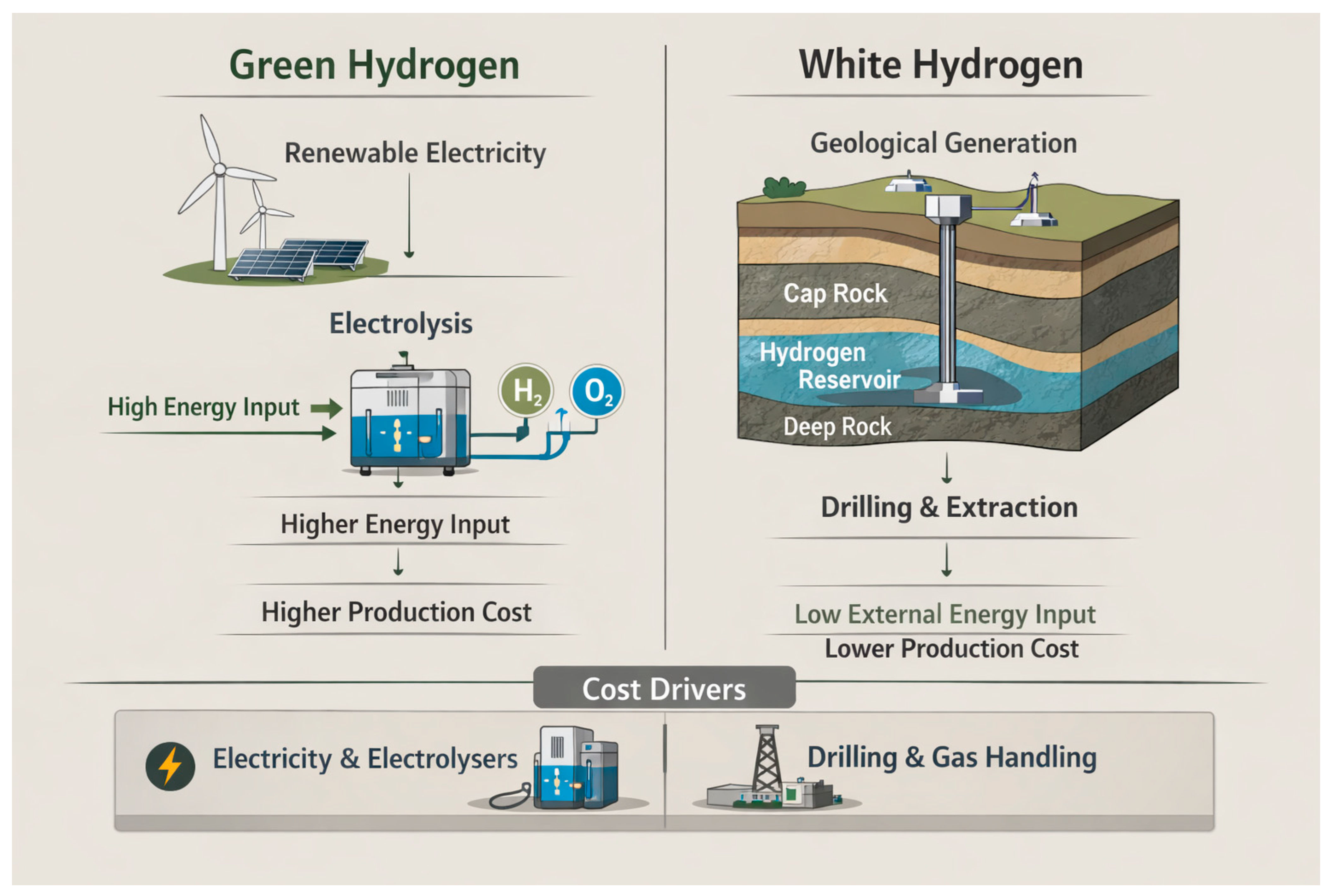
Cost and Energy Efficiency: The most immediate advantage of white hydrogen is its potential to drastically lower the cost of clean hydrogen supply at the point of production. Current green hydrogen in Europe, produced via renewable electrolysis, remains expensive, typically in the range of €6–8 per kg, largely due to the high electricity demand of electrolysers and associated capital costs [5,8]. By contrast, if natural hydrogen reservoirs can be exploited at scale, production costs are estimated at approximately €0.75–1 per kg, reflecting primarily drilling, gas handling, and purification costs [5,8]. While this comparison focuses on production costs, it is important to note that hydrogen transport costs are largely independent of the hydrogen’s origin. Both green and white hydrogen require similar infrastructure for compression, storage, and transmission, and face comparable challenges related to leakage control and material compatibility. Consequently, the principal economic differentiation between green and white hydrogen lies upstream at the production stage rather than in downstream transport. This huge cost differential implies that white H2 could undercut green H2 by 5–10 times, fundamentally altering hydrogen economics. Sourcing hydrogen from the ground also means bypassing the energy losses of electrolysis. Producing 1 kg of green H2 typically consumes ~50–60 kWh of electricity (because electrolysers are ~60–70% efficient). To support this comparison, the schematic illustration in Figure 2 summarises the key differences between green and white hydrogen in terms of production pathways, energy inputs, and dominant cost drivers.
In a renewable-constrained Europe, dedicating that much clean power to H2 means opportunity costs elsewhere. White hydrogen, essentially “energy delivered by geology,” arrives without consuming electric power, aside from what’s needed to drill and compress the gas. In other words, geologic H2 is a far less energy-intensive pathway to hydrogen [1], which could free up renewable electricity for other uses or reduce the total new generation capacity Europe must build for its clean energy transition. If white hydrogen can be produced at scale, industries such as steel, ammonia, refining, and heavy-duty transport (which are targeted to use green H2) would benefit from cheaper hydrogen feedstock, potentially lowering the cost of green steel, green fertilisers, or e fuels, that is, synthetic fuels produced using hydrogen and captured carbon dioxide, typically intended for applications such as aviation and shipping where direct electrification is difficult. The whole power-to-X chain, converting renewable power to hydrogen, and then to chemicals or fuels, might become more economically viable if the “power-to-H2” step is circumvented by nature. This could accelerate Europe’s decarbonization by making hydrogen-based solutions competitive sooner than expected. It also has energy security implications: domestic white hydrogen could reduce Europe’s reliance on imported energy or imported green hydrogen (e.g., plans to import millions of tonnes from abroad by 2030 [10]), providing a home-grown source much as North Sea gas once did. Climate and Environmental Considerations: From a climate perspective, both green and white hydrogen are attractive because using hydrogen emits zero CO2, and neither involves the routine burning of fossil fuels to produce the hydrogen. White hydrogen, in particular, has a minimal carbon footprint at the point of extraction; there is no methane feedstock to reform (as in grey H2) and no fossil-powered electricity needed (as long as drilling operations themselves are run on clean energy). Lifecycle analyses suggest that geologic hydrogen could be among the lowest-carbon hydrogen sources, so long as extraction is managed properly [1]. Crucially, however, proper management is the key requirement. Hydrogen is a small, highly diffusive molecule, and significant leakage of H2 could pose indirect climate risks. While hydrogen itself is not a greenhouse gas, if it escapes to the atmosphere, it can extend the lifetime of methane and alter atmospheric chemistry in ways that contribute to warming. Thus, preventing leaks during extraction, storage, and transport of white H2 will be vital [1]. Additionally, natural hydrogen reservoirs often coexist with other gases; for example, some wells might also release methane, nitrogen, or hydrogen sulphide. Any co-produced methane (a potent GHG) must be captured or flared to avoid negating the climate benefits. This means environmental safeguards and monitoring need to be in place at hydrogen production sites [1].
Other environmental and social impacts of white hydrogen extraction are expected to be similar to those of natural gas drilling, and these warrant careful consideration. Although hydrogen wells would not involve fracking in many cases (if the hydrogen is in porous reservoirs, it can flow without rock fracturing), some drilling campaigns might still use techniques like high-pressure injection if the hydrogen is trapped in non-porous rock. Reports emphasize that drilling for geologic hydrogen shares many of the environmental risks of hydrocarbon extraction, such as land disturbance, water usage, and potential groundwater contamination [1]. For instance, constructing well pads and roads can disrupt local ecosystems or communities. Drilling deep wells (3–4 km) requires significant volumes of drilling muds and possibly water; if not managed, this could strain local water resources or cause chemical leaks. Any large-scale hydrogen development in Europe would have to abide by strict environmental regulations, as the Heinrich Böll Foundation notes, robust safeguards will be critical to ensure hydrogen extraction is safe and sustainable [1]. It is also worth noting that white hydrogen remains geologically uncertain: many prospective deposits might lie too deep or too diffuse to be economically recovered, and we do not yet have experience with long-term yields. Some scientists caution that while the Earth does produce hydrogen continuously, the flux might be relatively slow—a reservoir could deplete faster than it replenishes if not managed properly [9]. In summary, the upside of white hydrogen is enormous in theory (cheap, zero-carbon fuel), but it comes with non-trivial challenges: unknown size of the prize, technical extraction hurdles, and the need to minimize environmental footprint. These realities temper the more hype-driven visions and underscore why white hydrogen is not a guaranteed silver bullet for the 2030 climate targets, though it could be a major factor by 2040 or 2050.

5. Policy Implications: Reassessing Europe’s Hydrogen Strategy

The emergence of white hydrogen discoveries places European policymakers at a crossroads. The EU’s current hydrogen strategy was formulated with green hydrogen as the cornerstone, essentially assuming that clean hydrogen must be manufactured via renewable electricity, a pathway that is capital-intensive and still relatively costly. The strategy has accordingly funnelled billions of euros into electrolyser deployments, innovation funding, and partnerships for green hydrogen production and import [3]. Natural hydrogen was not on the radar when these plans were made; indeed, EU institutions are only beginning to acknowledge its existence. As of late 2023, officials in Brussels were “still drafting the definitions of the different colours of hydrogen and were far from talking about its native version” [4]. In other words, white hydrogen is not yet integrated into EU energy policy frameworks; it falls outside the neatly defined categories of “renewable” or “low-carbon” hydrogen that underpin EU targets and regulations. This gap creates both a risk and an opportunity.
On the one hand, excluding natural hydrogen from the strategy could mean missing out on a transformative opportunity. If ongoing exploration confirms that Europe holds vast white hydrogen resources (tens of millions of tonnes in France, Spain, and elsewhere), then Europe has at its disposal a home-grown, dispatchable clean energy source that could significantly advance its decarbonization and energy security goals. It could reduce the need to import expensive green hydrogen or ammonia from abroad and save public money by achieving hydrogen supply targets at lower cost. There is also a first-mover advantage: European companies like FDE, Helios Aragón, and others are developing expertise in hydrogen exploration; supportive policies could spur a new industry, creating jobs and technological leadership in a field that aligns with clean energy objectives. For example, France and Spain have already moved to adapt policies. France updated its mining code in 2023 to explicitly cover hydrogen, and Spain’s government is reviewing legal barriers to hydrogen exploration [1,8]. These steps will make it easier to license pilot projects and attract investment. The EU could consider similar measures at a union-wide level: for instance, including white (geologic) hydrogen under the definition of “low-carbon hydrogen” eligible for incentives, or funding R&D and geological surveys to map hydrogen plays across Europe. Proactively integrating white hydrogen into the EU’s hydrogen roadmap would signal flexibility and commitment to “all of the above” solutions for net-zero, potentially accelerating the transition.
On the other hand, policymakers must remain clear-eyed and critical about the challenges. There is a danger of over-correcting strategy based on early excitement. White hydrogen may not be a panacea for the 2020s: experts suggest that large-scale production is unlikely before ~2040, given the nascent state of technology and the time needed to appraise and develop geologic reservoirs [1]. If Europe were to shift focus away from green hydrogen too soon, it might undermine momentum in building renewable capacity and electrolyser supply chains, tools that are still absolutely needed for deep decarbonization (especially if natural hydrogen proves less abundant than hoped). Striking the right balance is key. In practical terms, this means the EU should reassess and refine its hydrogen strategy rather than completely rewrite it. A balanced policy reassessment could involve:
  • Incorporating White H2 into Planning: Acknowledge natural hydrogen in EU strategic documents and conduct a formal study on its potential. For instance, the EU could task geological agencies or a body like the JRC (Joint Research Centre) to evaluate Europe’s white hydrogen resource base and its possible contribution to the 2030–2050 climate targets. This would put data behind the hype and inform targets accordingly. If white hydrogen can realistically supply, say, 1–2 million tonnes by 2035, that could be factored into infrastructure planning.
  • Developing Regulatory Frameworks: Create guidelines for licensing, environmental assessment, and safety for white hydrogen drilling projects. As noted, current laws in many EU countries did not anticipate hydrogen extraction, leading to legal grey areas or outright prohibitions (by analogies to hydrocarbons) [8]. The EU could facilitate best-practice sharing or even propose amendments to relevant directives (such as the Mining Waste Directive or fuel quality regulations) to cover geologic hydrogen. Ensuring strict environmental safeguards—e.g., leak detection standards, water protection, methane management—will be critical to address the valid concerns raised by environmental groups [1]. This can prevent a “wild west” of hydrogen drilling and align the industry with Europe’s sustainability values.
  • Aligning Incentives and Definitions: Currently, EU hydrogen incentives (such as carbon contracts for difference, the Hydrogen Bank auctions, etc.) are geared toward green hydrogen. The EU might consider extending some form of support or at least recognition to “ultra-low carbon” hydrogen, that is, hydrogen whose lifecycle greenhouse gas emissions are substantially lower than those of conventional fossil-based hydrogen, as long as it meets stringent GHG criteria (e.g., 70%+ emissions savings over fossil, which white H2 easily could [3]). This could be done by tweaking the taxonomy or delegated acts; for example, counting white hydrogen as a renewable fuel of non-biological origin (RFNBO) if it meets additionality and sustainability requirements. At minimum, clarity that using white hydrogen will count toward industrial decarbonization targets (for steel, ammonia, etc.) would remove uncertainty for investors. One might imagine, for instance, a steel mill being allowed to offtake white hydrogen and have it qualify under the same quotas that mandate a share of renewable hydrogen use in industry [3].
  • Avoiding Stranded Assets: The EU’s hydrogen strategy should also guard against the risk of stranded assets or long-term economic inefficiencies. From a technical perspective, hydrogen molecules are chemically identical regardless of whether they originate from electrolysis or geological sources. Infrastructure compatibility is, therefore, determined not by origin, but by factors such as gas purity, pressure management, material integrity, and leakage control. This implies that, provided harmonised technical standards are enforced, hydrogen infrastructure such as pipelines and storage facilities can, in principle, accommodate hydrogen from multiple production pathways. Designing infrastructure with this flexibility in mind would reduce the risk of lock-in to high-cost production routes and allow Europe to adapt its hydrogen supply mix as new evidence on white hydrogen availability emerges. The worst-case scenario would be Europe locking itself into very high-cost hydrogen production (needing perpetual subsidies to compete) while a cheaper resource lies untapped. A prudent policy will hedge bets: continue scaling green H2 in the near term (since we know we need it), while aggressively researching white H2 so that it can complement or substitute when ready.
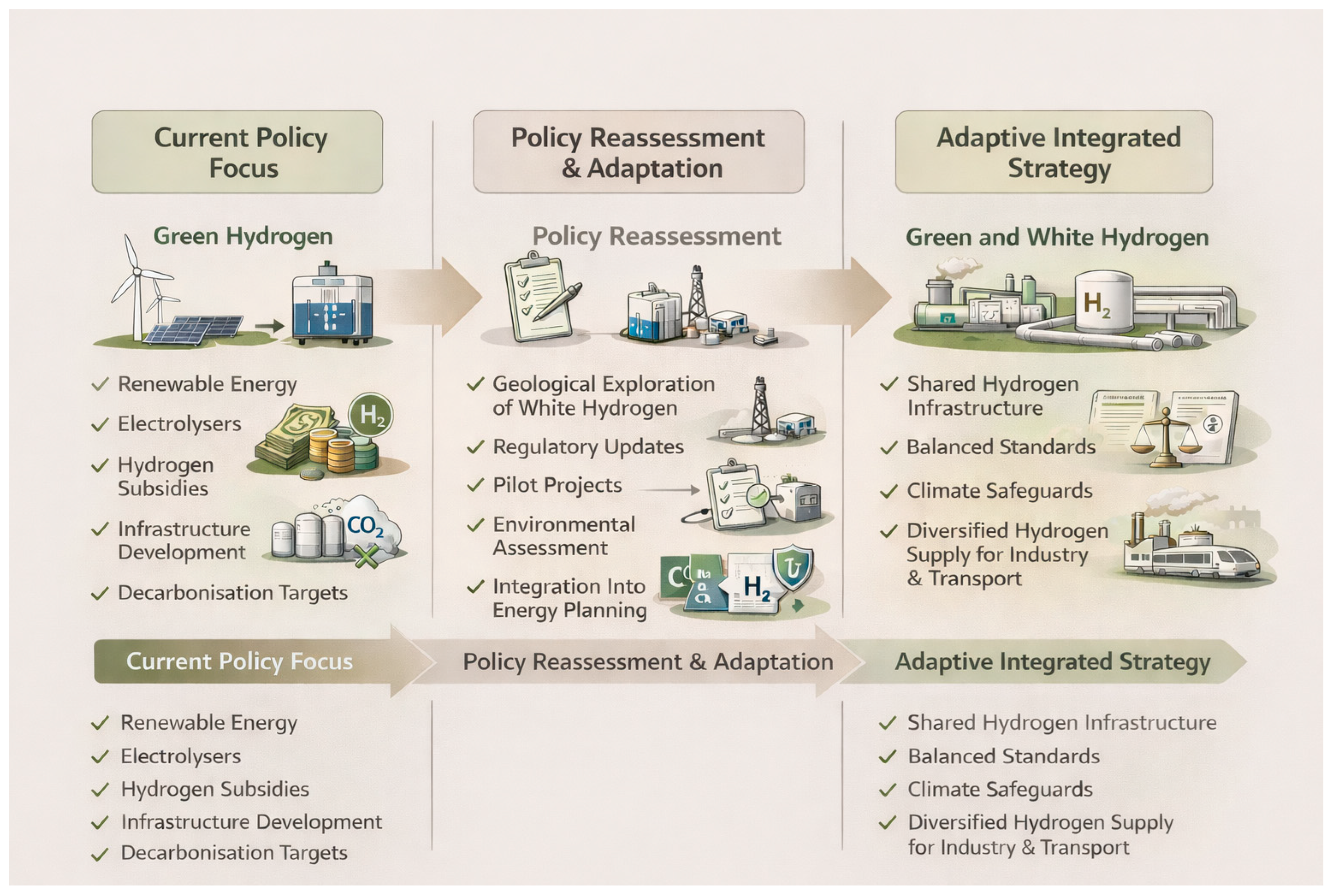
As of today, Europe’s green hydrogen strategy stands at an inflection point. White hydrogen offers a tantalizing prospect to bolster the hydrogen economy with a naturally occurring, low-cost supply, one that could greatly ease the path to decarbonization and strengthen energy autonomy. Early discoveries in France and Spain have proven the resource exists in Europe and more may be found in the coming years. It would be short-sighted for EU policymakers to ignore this “white” elephant in the room. A balanced reassessment is warranted, one that remains grounded in the reality that green hydrogen and renewables are still indispensable, but also critically evaluates how policy can accommodate and encourage innovation around white hydrogen. The tone of this reassessment should evolve from open-minded exploration to, eventually, hard-nosed critical evaluation of results. In the near term, curiosity and cautious optimism should drive support for pilot projects and studies. But by the time any significant white H2 production is technically proven, the EU must be prepared to ask tough questions: Does it deliver the promised cost and carbon benefits at scale? Can it be done without environmental harm? And how should subsidies or mandates adjust in response? If the answers are positive, the EU’s hydrogen strategy and broader power-to-X ambitions will need a recalibration, one that integrates natural hydrogen as a real option for fuelling industry and transport. Indeed, Europe’s vision of running steel mills, ships, or power plants on hydrogen might be achieved sooner and more cheaply with a mix of green and white hydrogen, rather than green alone. Figure 3 illustrates how the current EU hydrogen policy framework could evolve toward a more adaptive strategy that integrates both green and white hydrogen while maintaining climate and environmental safeguards.
Going forward, a pragmatic, evidence-based policy course is recommended. Europe should neither remain stubbornly committed to one “colour” of hydrogen nor jump blindly to a new shiny solution. Instead, it can champion a diversified hydrogen strategy that harnesses the best of both: scaling up green hydrogen where it makes sense but also unlocking the secret hydrogen stores beneath our feet. Such an adaptive strategy will ensure that Europe’s hydrogen transition is resilient to new information and is driven by science and economics rather than dogma. In the long run, the success of Europe’s hydrogen agenda and its power-to-X sector may well depend on embracing innovation like white hydrogen, all while rigorously safeguarding the environmental and social values at the heart of EU energy policy. As one expert noted, if natural hydrogen’s promise is realised, it could imply a major geopolitical and economic upheaval—potentially democratizing energy resources across countries [4]. It is in Europe’s interest to anticipate that future and shape it, rather than be caught off guard. The time is ripe for a policy course-correction that keeps Europe at the forefront of the clean hydrogen revolution, whatever colour it may be.

Author Contributions

Conceptualization, B.N.J.; methodology, Z.G.M.; validation, Z.G.M. and B.N.J.; formal analysis, Z.G.M. and B.N.J.; investigation, Z.G.M. and B.N.J.; resources, B.N.J.; data curation, Z.G.M.; writing—original draft preparation, B.N.J.; writing—review and editing, Z.G.M. and B.N.J.; visualization, B.N.J. All authors have read and agreed to the published version of the manuscript.

Funding

This research received no external funding.

Institutional Review Board Statement

Not applicable.

Informed Consent Statement

Not applicable.

Data Availability Statement

No new data were created or analyzed in this study.

Conflicts of Interest

The authors declare no conflicts of interest.

References

  1. Haas, J.; Gnant, E. Geogenic Hydrogen: Exploring a New Frontier of the Energy Transition. Available online: https://www.boell.de/en/2024/11/22/geogenic-hydrogen-exploring-new-frontier-energy-transition (accessed on 26 October 2025).
  2. Symons, A. What is ‘White Hydrogen’? The Pros and Cons of Europe’s Latest Clean Energy Source. Available online: https://www.euronews.com/green/2023/11/05/what-is-white-hydrogen-the-pros-and-cons-of-europes-latest-clean-energy-source (accessed on 26 October 2025).
  3. European, C. Hydrogen (EU Energy System). Available online: https://energy.ec.europa.eu/topics/eus-energy-system/hydrogen_en (accessed on 26 October 2025).
  4. Carnevali, A. Scientists are Shocked by the Discovery of White Hydrogen in France: Could it be Europe’s Fuel? Available online: https://www.euronews.com/next/2024/02/07/scientists-are-shocked-by-the-discovery-of-white-hydrogen-in-france-could-it-be-europes-fu (accessed on 26 October 2025).
  5. Gold, H. Natural Hydrogen Find in France. Available online: https://www.goldhydrogen.com.au/updates/natural-hydrogen-find-in-france/ (accessed on 26 October 2025).
  6. Hydrogen, E. Excitement Grows About ‘Natural H₂’ as Huge Reserves Found in France. Available online: https://hydrogeneurope.eu/excitement-grows-about-natural-h2-as-huge-reserves-found-in-france/ (accessed on 26 October 2025).
  7. Friedrich-Alexander-Universität, E.-N. Natural hydrogen—The Treasure Hidden Underground. Available online: https://www.fau.eu/2024/11/news/natural-hydrogen-the-treasure-hidden-underground/ (accessed on 26 October 2025).
  8. Hydrogen, C. Spain—Aragon Launches Exploration in Huesca for a ‘Treasure’ of Natural Hydrogen. Available online: https://hydrogen-central.com/spain-aragon-launches-exploration-in-huesca-treasure-natural-hydrogen/ (accessed on 26 October 2025).
  9. Vujasin, M. White Hydrogen: Sustainable Energy from Depths of Earth. Available online: https://balkangreenenergynews.com/white-hydrogen-sustainable-energy-from-depths-of-earth/ (accessed on 26 October 2025).
  10. Meza, E.; Wehrmann, B. Natural Hydrogen Discoveries near French-German Border Fuel Hopes for H₂ Abundance. Available online: https://www.cleanenergywire.org/news/natural-hydrogen-discoveries-near-french-german-border-fuel-hopes-h2-abundance (accessed on 26 October 2025).
  11. Parkes, R. Massive Underground Reservoir of Natural Hydrogen in Spain ‘Could Deliver the Cheapest H2 in the World’. Available online: https://www.hydrogeninsight.com/innovation/massive-underground-reservoir-of-natural-hydrogen-in-spain-could-deliver-the-cheapest-h2-in-the-world/2-1-1431515 (accessed on 26 October 2025).
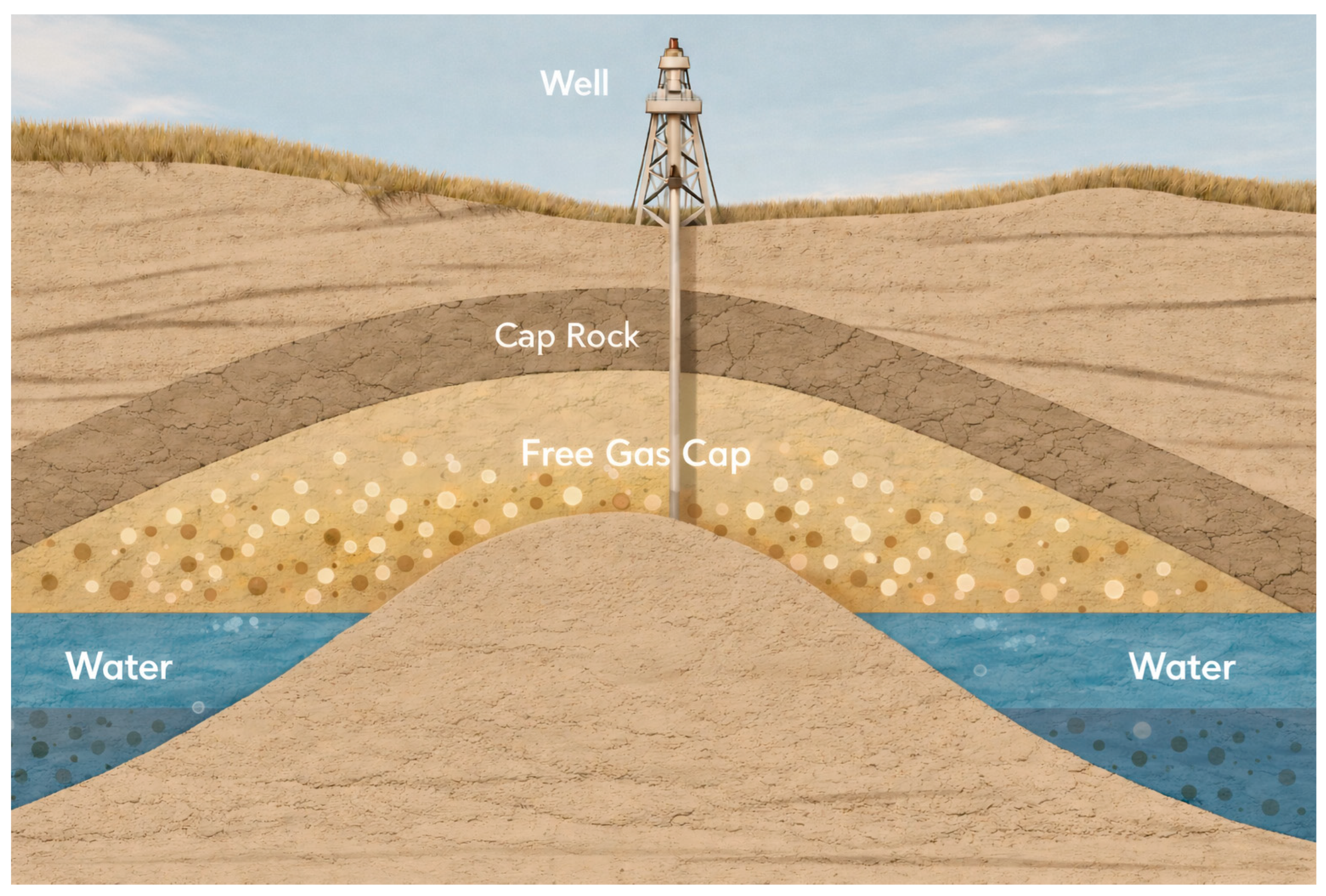
Figure 1. Illustration of a subsurface white hydrogen reservoir accumulating beneath an impermeable cap rock (orange layer) in a geologic dome structure, with a production well tapping the trapped hydrogen gas (Helios Aragón project, Spain) [11].
Sustainability 18 00190 g001
Figure 2. Schematic comparison of green and white hydrogen production pathways, illustrating differences in energy inputs, production processes, and dominant cost drivers.
Sustainability 18 00190 g002
Figure 3. Conceptual illustration of an adaptive European hydrogen policy pathway integrating green and white hydrogen within a unified Power to X strategy.
Sustainability 18 00190 g003
Disclaimer/Publisher’s Note: The statements, opinions and data contained in all publications are solely those of the individual author(s) and contributor(s) and not of MDPI and/or the editor(s). MDPI and/or the editor(s) disclaim responsibility for any injury to people or property resulting from any ideas, methods, instructions or products referred to in the content.