Towards Sustainable Intelligent Transportation Systems: A Hierarchical Spatiotemporal Graph–Hypergraph Network for Urban Traffic Flow Prediction


Abstract
1. Introduction
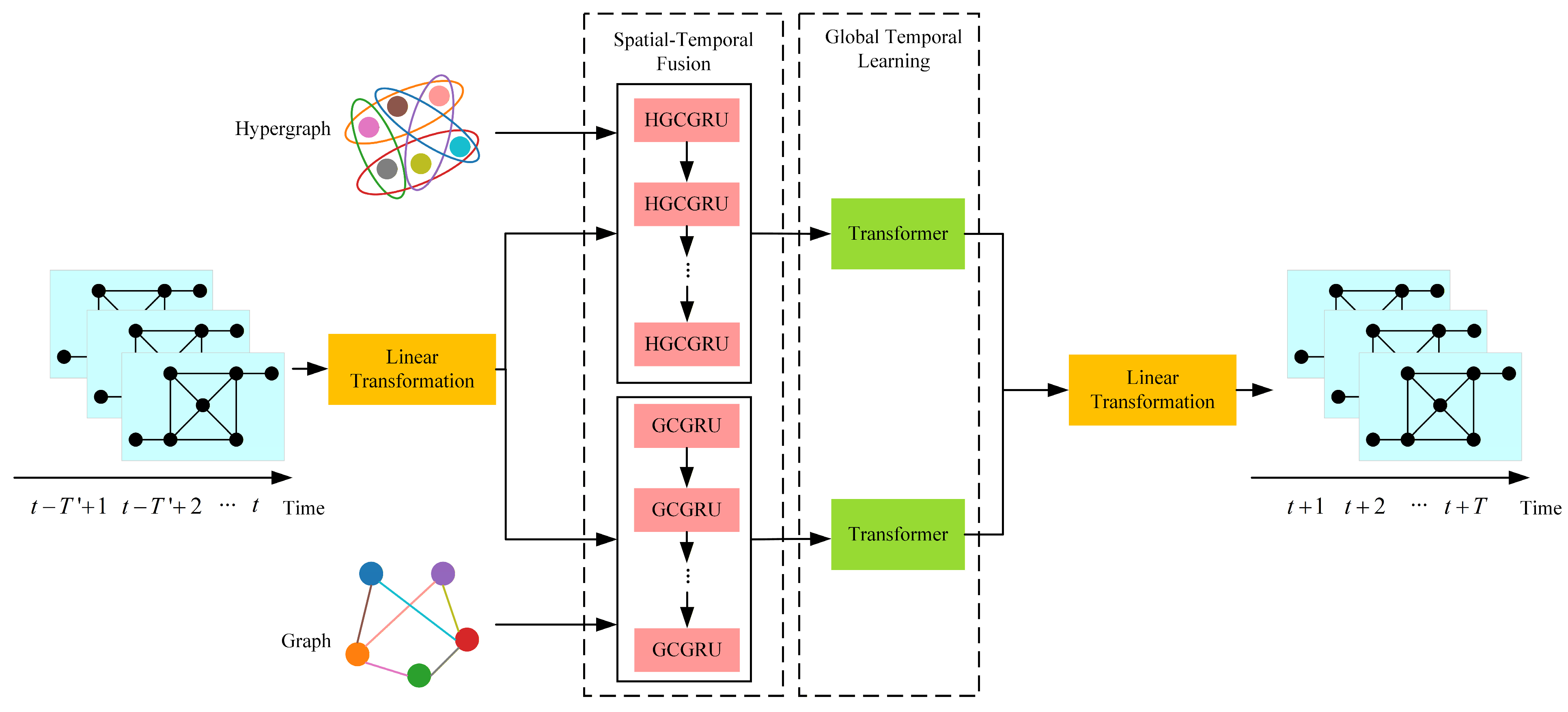
- We introduce a hypergraph neural network module to capture high-order interactions in traffic networks. Leveraging a hypernode mechanism, the model effectively represents complex correlations among multiple road segments, while a data-driven adaptive adjacency matrix with forward and backward traffic flow priors enhances the accuracy and robustness of spatial representations.
- By combining the complementary strengths of GRU and Transformer, the model jointly captures short-term and long-term temporal dependencies, enabling more effective prediction under complex temporal structures.
- Extensive experiments on multiple benchmark datasets show that HSTGHN consistently outperforms state-of-the-art baselines in both predictive accuracy and stability, with particularly strong improvements in long-term forecasting and dynamic traffic scenarios.
2. Related Works
2.1. Graph Convolutional Networks and Hypergraph Convolutional Networks
2.2. Graph Structure Learning
2.3. Spatiotemporal Traffic Flow Forecasting
3. Method
3.1. Overview
3.2. Dynamic Spatial Dependency Modeling via Graph–Hypergraph Fusion
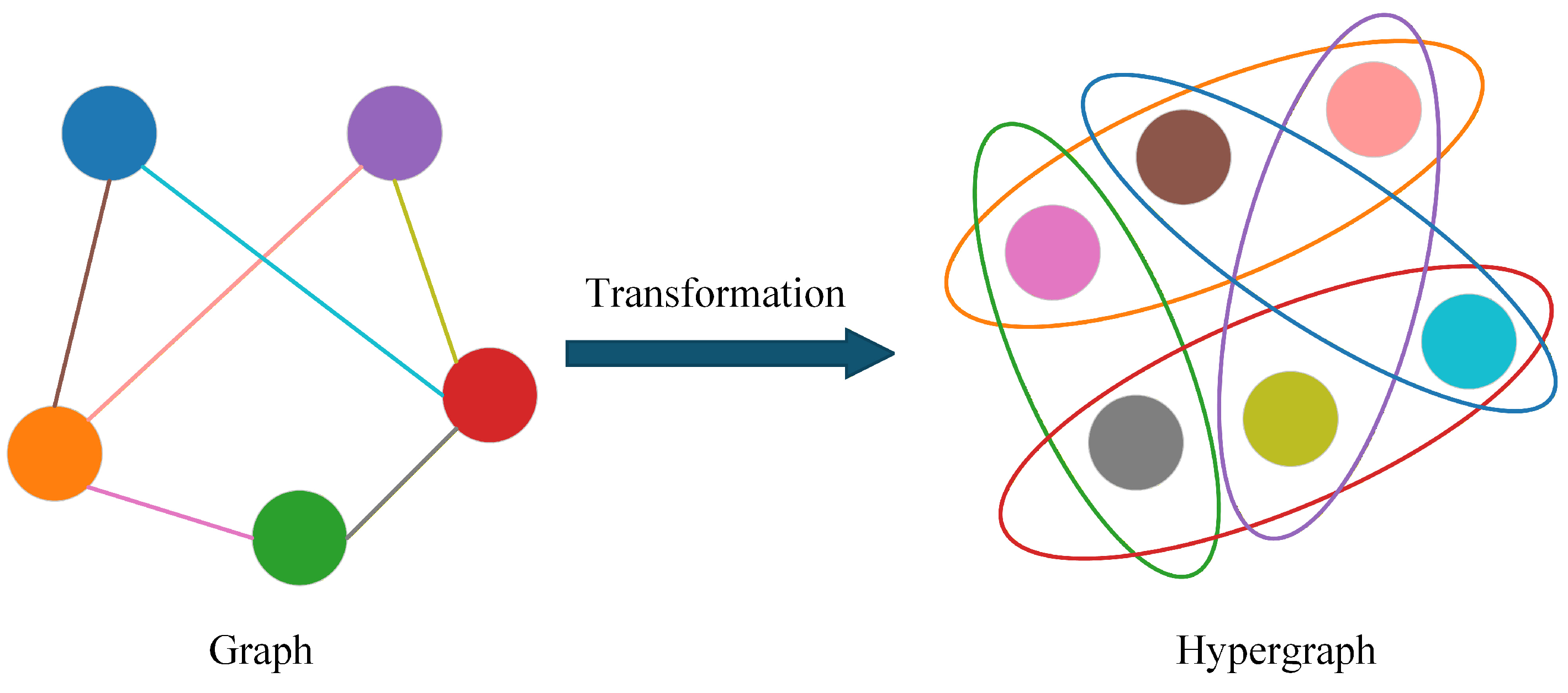
3.2.1. High-Order Spatial Dependency Modeling via Hypergraph Convolution
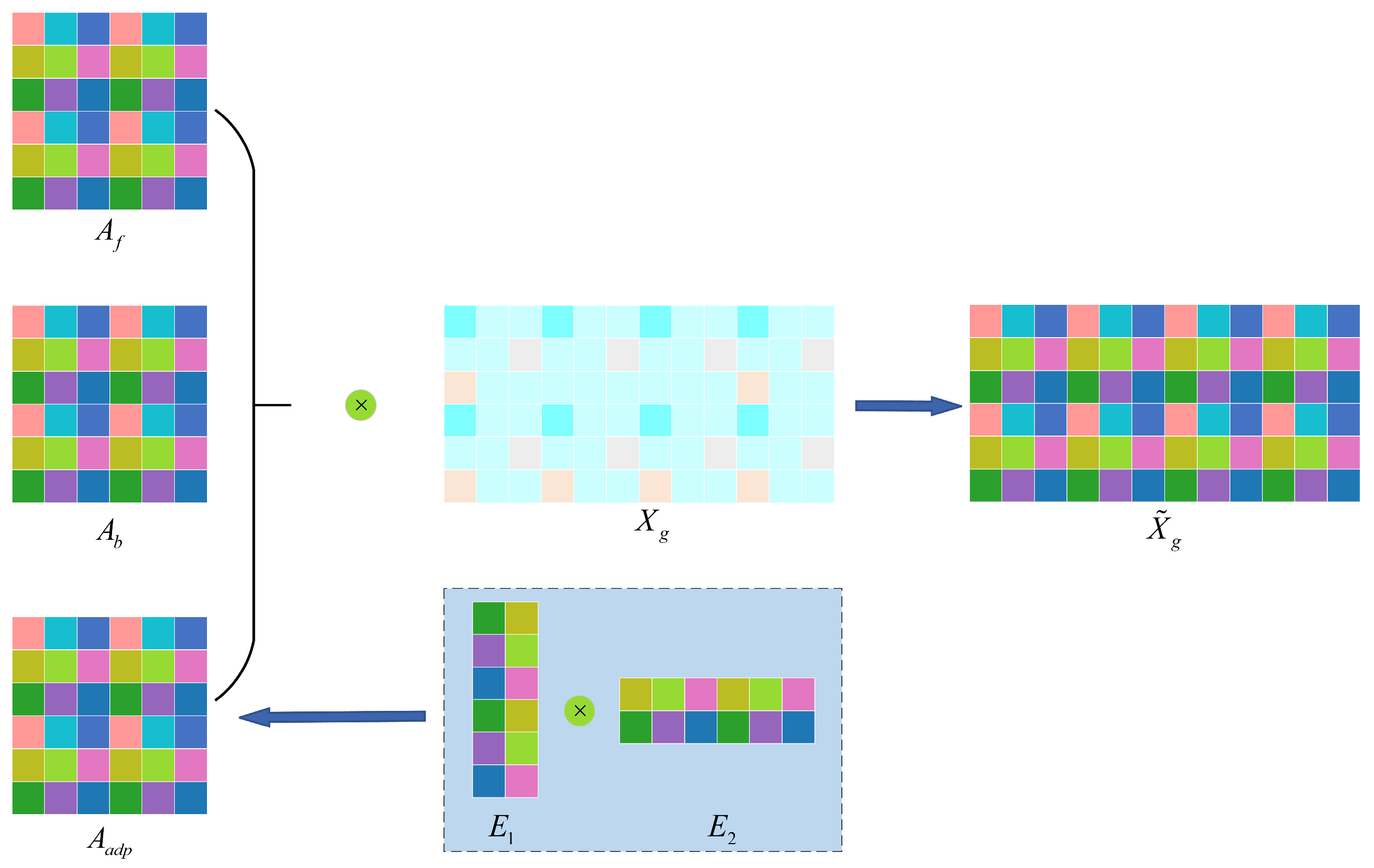
3.2.2. Adaptive Graph Structure Learning
3.3. Hierarchical Temporal Feature Extraction with Local and Global Dependencies
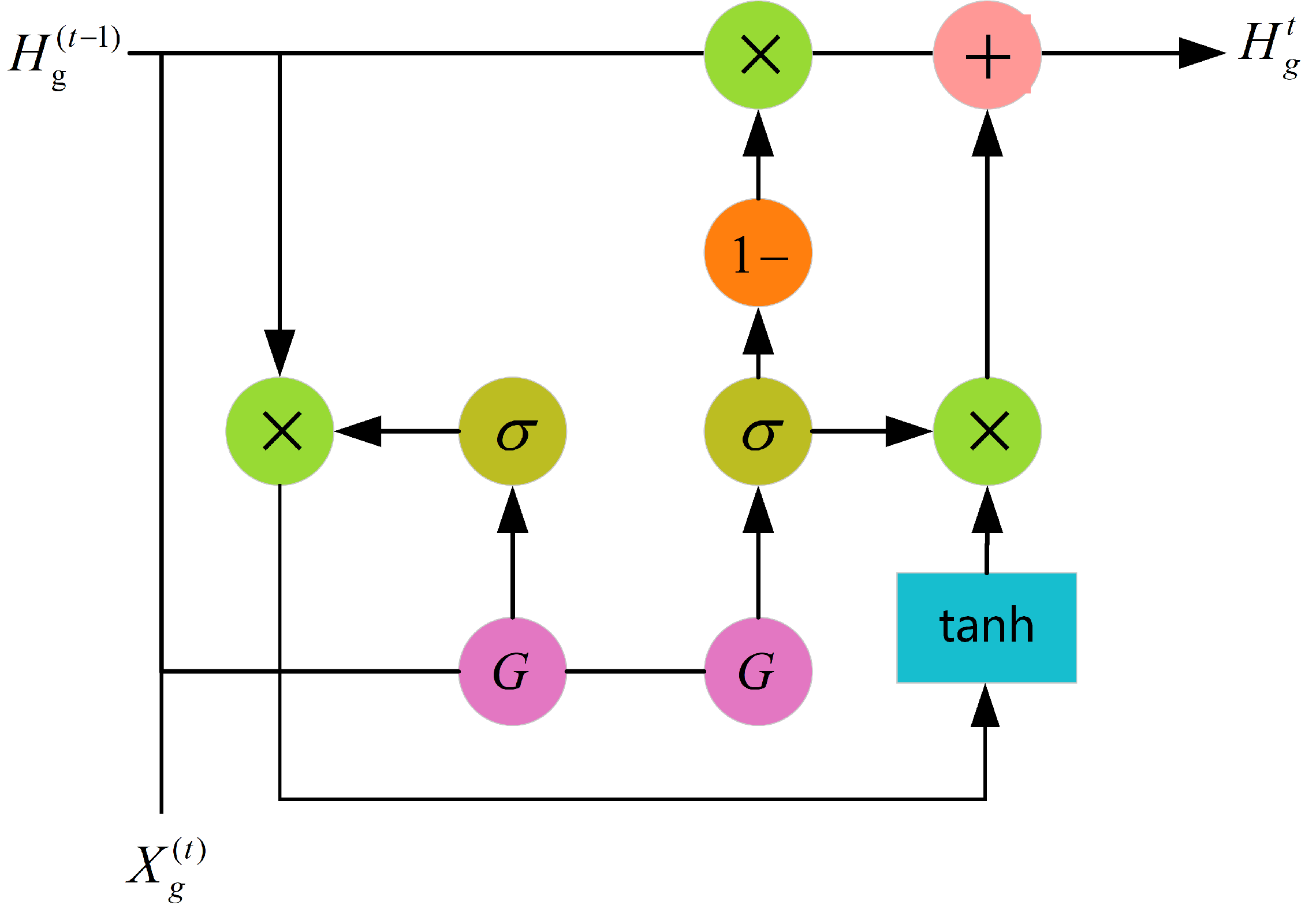
3.3.1. Local Temporal Dependency Modeling with Gated Mechanisms
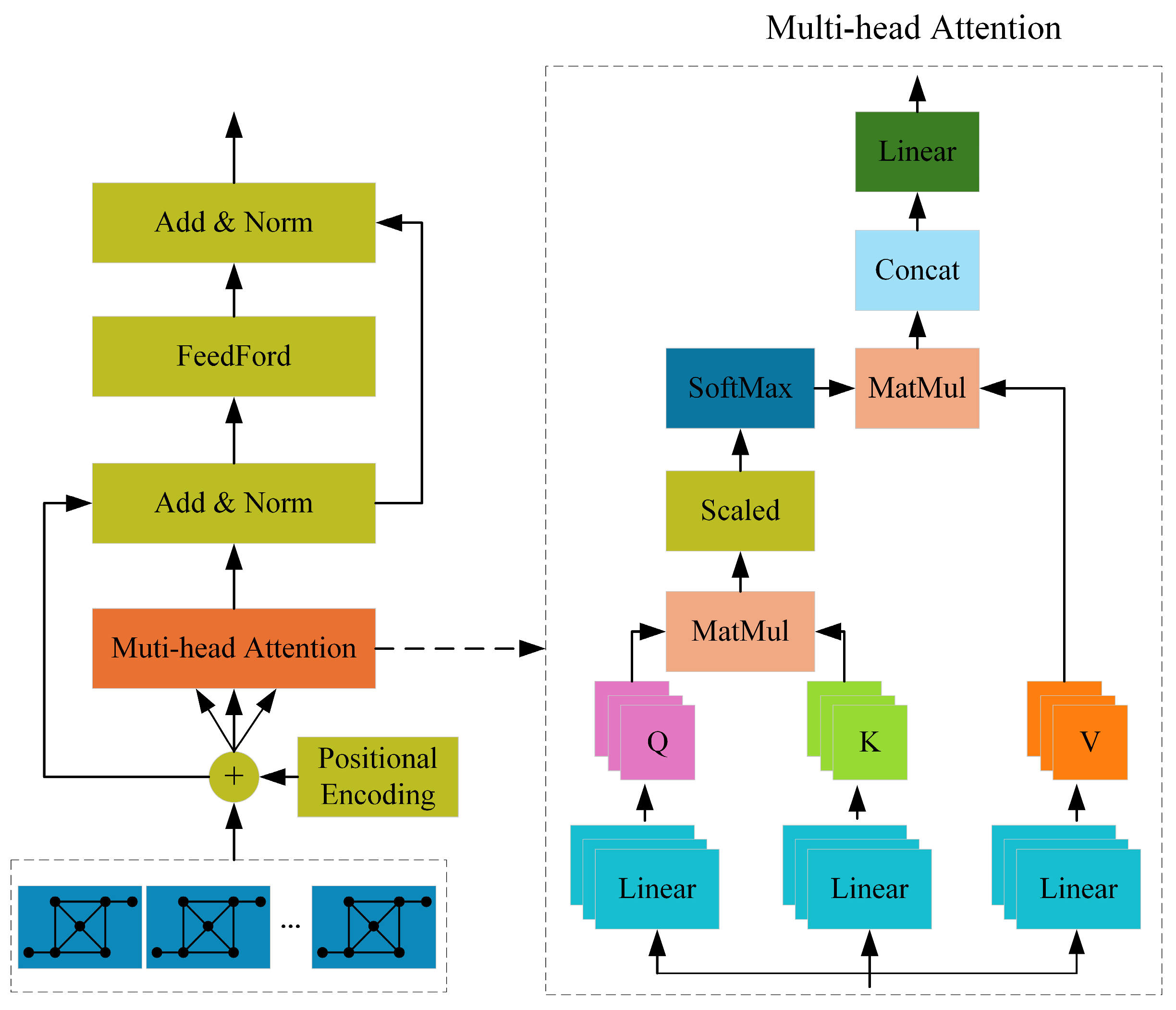
3.3.2. Global Temporal Feature Extraction Based on Transformer
3.4. Loss Function
4. Experiments
4.1. Experimental Settings
4.1.1. Dataset Description and Preprocessing
4.1.2. Baselines
- ARIMA [43]: A classical statistical learning model that captures linear temporal dependencies using autoregressive and moving average components. While effective for linear sequences, ARIMA struggles with the nonlinear and multi-scale variations typical of traffic flows.
- LSTM [52]: Long Short-Term Memory networks incorporate input, forget, and output gates to mitigate the gradient vanishing problem in traditional RNNs. LSTM excels at capturing long-range temporal dependencies.
- GRU [10]: Gated Recurrent Units are structurally simpler than LSTMs, containing only update and reset gates, which reduces the number of parameters while maintaining high predictive accuracy and computational efficiency.
- DCRNN [23]: Diffusion Convolutional Recurrent Neural Networks introduce diffusion convolutions on directed weighted graphs to simulate traffic flow propagation, combined with sequence-to-sequence RNNs for temporal modeling.
- ASTGCN [15]: Attention-based Spatiotemporal Graph Convolutional Networks employ temporal attention, spatial attention, and spatiotemporal convolution modules to dynamically adjust the importance of different time slices and nodes.
- Graph WaveNet [37]: Graph WaveNet integrates first-order graph convolution with an adaptive adjacency matrix learning mechanism, leveraging dilated convolutions for multi-scale temporal modeling and capable of learning latent spatial connections without prior knowledge of the road network.
- DDSTGCN [33]: Dual Dynamic Spatiotemporal Graph Convolutional Networks combine static adjacency matrices with adaptive dynamic graphs to enhance spatial correlation modeling flexibility, and incorporate multi-scale convolutions along the temporal dimension.
- D2STGNN [53]: Dual Dynamic Spatiotemporal Graph Neural Networks introduce dynamic graph construction mechanisms along both spatial and temporal dimensions, allowing the model to adapt to time-varying traffic network structures.
- MegaCRN [42]: Memory-augmented Graph Convolutional Recurrent Networks capture long-term global patterns via memory units while learning dynamic adjacency matrices, balancing historical dependencies with real-time response to traffic perturbations.
4.1.3. Evaluation Metrics
4.1.4. Experimental Environment and Hyperparameter Settings
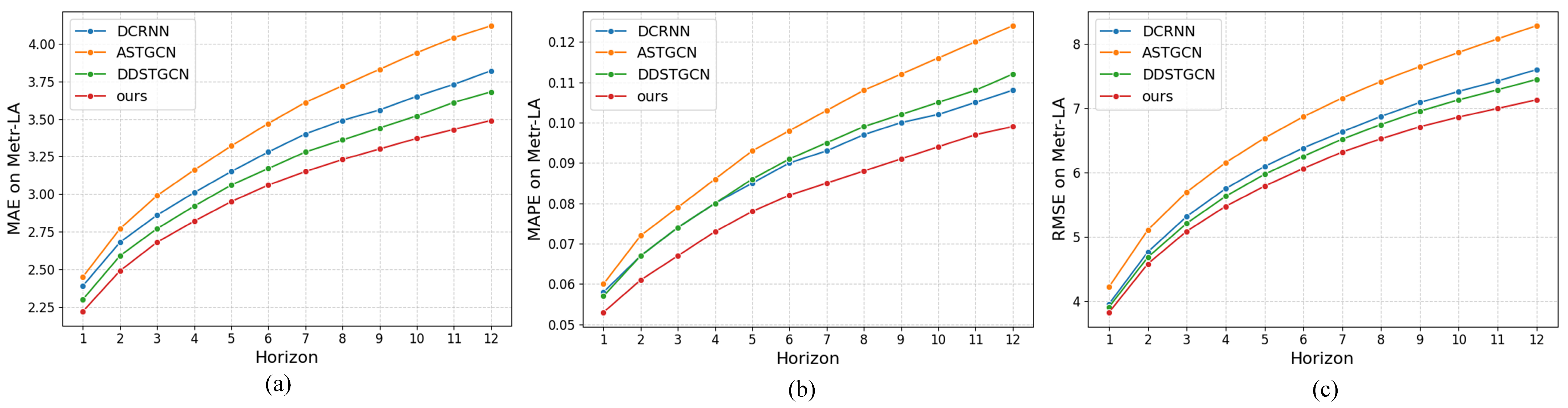
4.2. Comparative Analysis of Results
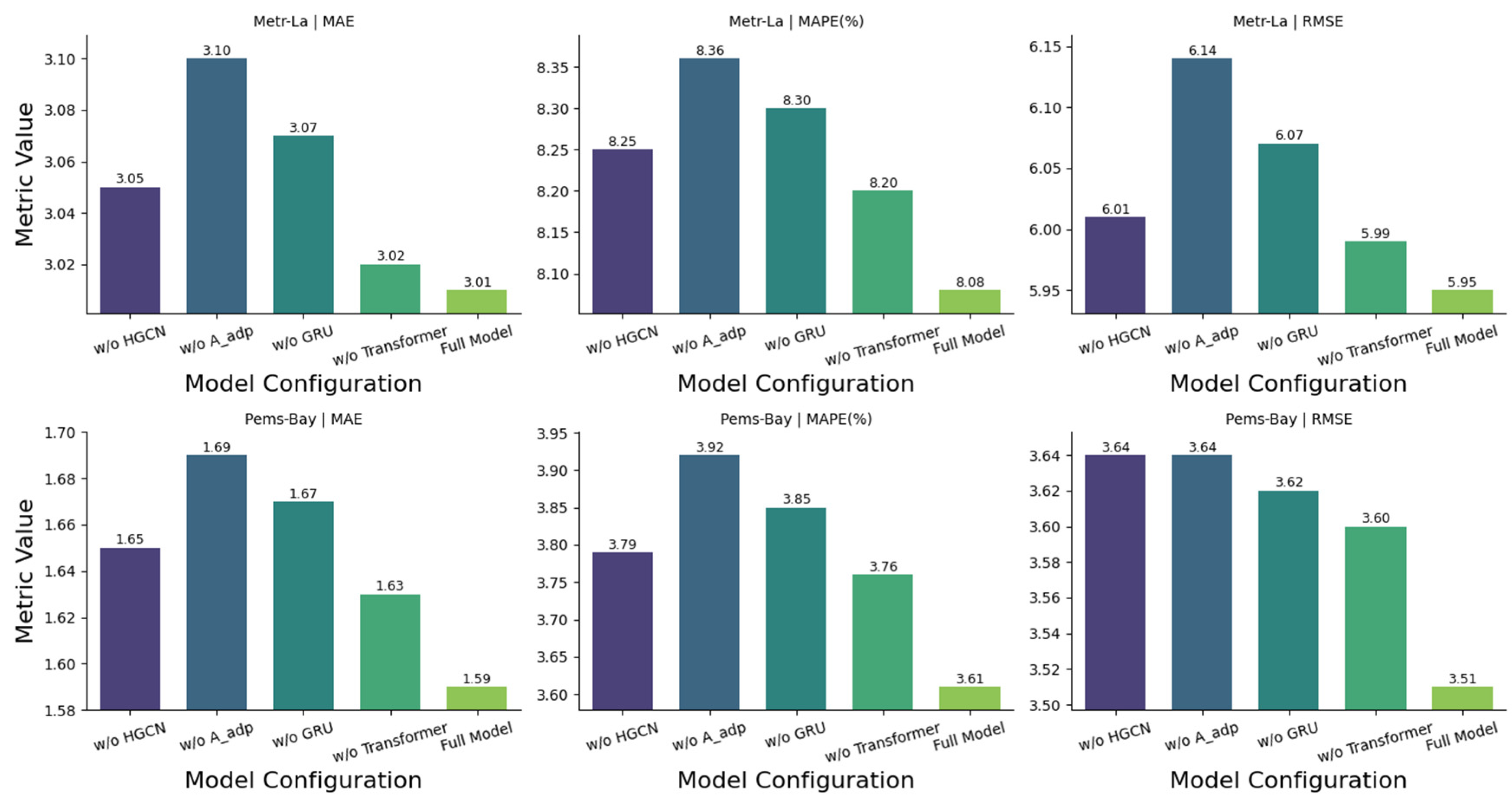
4.3. Ablation Studies
- w/o HGCN: replacing the hypergraph convolution in the HCGRU module with a standard graph convolution.
- w/o : removing the adaptive adjacency matrix in the GCGRU module and using only the static prior adjacency matrix.
- w/o GRU: the GRU module in HCGRU and GCGRU is removed and replaced with a linear layer.
- w/o Transformer: discarding the Transformer module in the temporal modeling part and substituting it with a linear layer.
4.4. Sensitivity Analysis of Hyperparameters
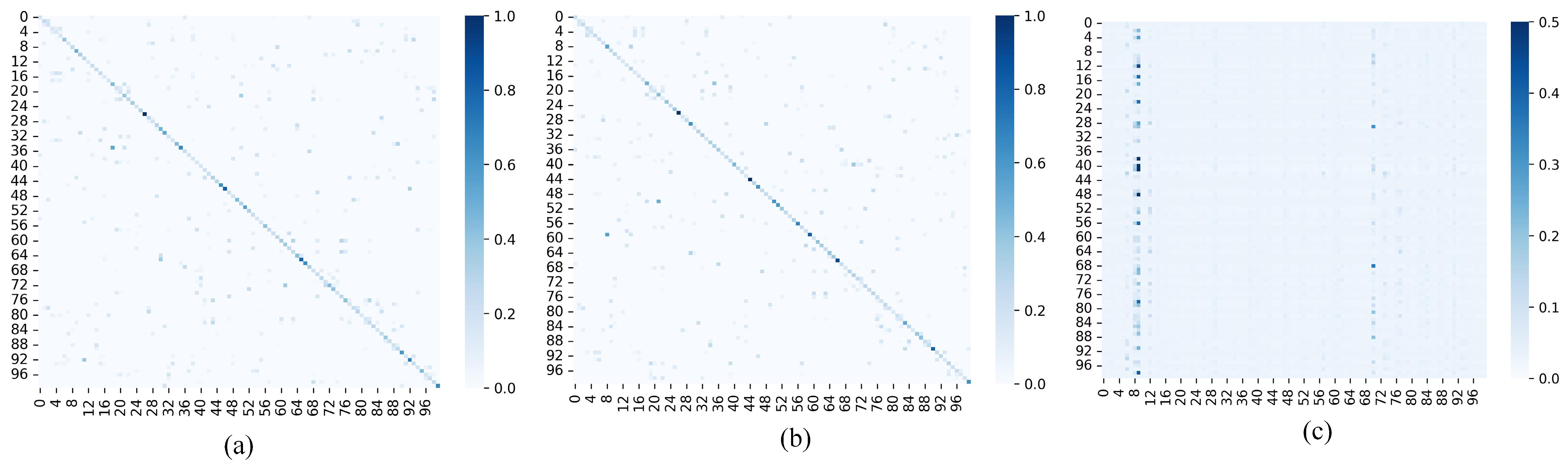
4.5. Visualization of Experimental Results
5. Conclusions
6. Limitations and Future Work
Author Contributions
Funding
Institutional Review Board Statement
Informed Consent Statement
Data Availability Statement
Conflicts of Interest
References
- Kumar, R.; Bhanu, M.; Mendes-Moreira, J.; Chandra, J. Spatio-temporal predictive modeling techniques for different domains: A survey. ACM Comput. Surv. 2024, 57, 1–42. [Google Scholar] [CrossRef] [Scilit]
- Yang, H.; Yao, X.A.; Roozkhosh, F.; Liu, R.; Mai, G. From theory to deep learning: Understanding the impact of geographic context factors on traffic violations. Comput. Environ. Urban Syst. 2025, 119, 102268. [Google Scholar] [CrossRef] [Scilit]
- Zhang, L.; Li, S.; Liu, Y.; Huang, H.; Van de Weghe, N. From grids to dendrites: Quantifying spatial heterogeneity in urban road networks. Comput. Environ. Urban Syst. 2025, 121, 102309. [Google Scholar] [CrossRef] [Scilit]
- Klepsch, J.; Klüppelberg, C.; Wei, T. Prediction of functional ARMA processes with an application to traffic data. Econ. Stat. 2017, 1, 128–149. [Google Scholar] [CrossRef] [Scilit]
- Tian, M.; Sun, C.; Wu, S. An EMD and ARMA-based network traffic prediction approach in SDN-based internet of vehicles. Wirel. Netw. 2021, 1–13. [Google Scholar] [CrossRef] [Scilit]
- Yuan, C.; Yu, X.; Li, D.; Xi, Y. Overall traffic mode prediction by VOMM approach and AR mining algorithm with large-scale data. IEEE Trans. Intell. Transp. Syst. 2018, 20, 1508–1516. [Google Scholar] [CrossRef] [Scilit]
- Chen, R.; Liang, C.-Y.; Hong, W.-C.; Gu, D.-X. Forecasting holiday daily tourist flow based on seasonal support vector regression with adaptive genetic algorithm. Appl. Soft Comput. 2015, 26, 435–443. [Google Scholar] [CrossRef] [Scilit]
- Hou, Y.; Edara, P.; Sun, C. Traffic flow forecasting for urban work zones. IEEE Trans. Intell. Transp. Syst. 2014, 16, 1761–1770. [Google Scholar] [CrossRef] [Scilit]
- Huang, W.; Song, G.; Hong, H.; Xie, K. Deep architecture for traffic flow prediction: Deep belief networks with multitask learning. IEEE Trans. Intell. Transp. Syst. 2014, 15, 2191–2201. [Google Scholar] [CrossRef] [Scilit]
- Cho, K.; van Merrienboer, B.; Gulcehre, C.; Bougares, F.; Schwenk, H.; Bengio, Y. Learning phrase representations using RNN encoder-decoder for statistical machine translation. In Proceedings of the Conference on Empirical Methods in Natural Language Processing (EMNLP 2014), Doha, Qatar, 26–28 October 2014. [Google Scholar]
- Lea, C.; Flynn, M.D.; Vidal, R.; Reiter, A.; Hager, G.D. Temporal convolutional networks for action segmentation and detection. In Proceedings of the IEEE Conference on Computer Vision and Pattern Recognition, Honolulu, HI, USA, 21–26 July 2017; pp. 156–165. [Google Scholar]
- Fafoutellis, P.; Vlahogianni, E.I. A theory-informed multivariate causal framework for trustworthy short-term urban traffic forecasting. Transp. Res. Part C Emerg. Technol. 2025, 170, 104945. [Google Scholar] [CrossRef] [Scilit]
- Wu, X.; Chow, A.H.; Ma, W.; Lam, W.H.; Wong, S.C. Prediction of traffic state variability with an integrated model-based and data-driven Bayesian framework. Transp. Res. Part C Emerg. Technol. 2025, 171, 104953. [Google Scholar] [CrossRef] [Scilit]
- Chen, J.; Ye, H.; Ying, Z.; Sun, Y.; Xu, W. Dynamic trend fusion module for traffic flow prediction. Appl. Soft Comput. 2025, 174, 112979. [Google Scholar] [CrossRef] [Scilit]
- Guo, S.; Lin, Y.; Feng, N.; Song, C.; Wan, H. Attention based spatial-temporal graph convolutional networks for traffic flow forecasting. In Proceedings of the AAAI Conference on Artificial Intelligence, Honolulu, HI, USA, 27 January–1 February 2019; pp. 922–929. [Google Scholar]
- Kipf, T. Semi-Supervised Classification with Graph Convolutional Networks. arXiv 2016, arXiv:1609.02907. [Google Scholar]
- Ta, X.; Liu, Z.; Hu, X.; Yu, L.; Sun, L.; Du, B. Adaptive spatio-temporal graph neural network for traffic forecasting. Knowl.-Based Syst. 2022, 242, 108199. [Google Scholar] [CrossRef] [Scilit]
- Li, Z.; Zhou, J.; Lin, Z.; Zhou, T. Dynamic spatial aware graph transformer for spatiotemporal traffic flow forecasting. Knowl.-Based Syst. 2024, 297, 111946. [Google Scholar] [CrossRef] [Scilit]
- Liu, A.; Zhang, Y. Spatial–temporal dynamic graph convolutional network with interactive learning for traffic forecasting. IEEE Trans. Intell. Transp. Syst. 2024, 25, 7645–7660. [Google Scholar] [CrossRef] [Scilit]
- Bruna, J.; Zaremba, W.; Szlam, A.; LeCun, Y. Spectral networks and deep locally connected networks on graphs. In Proceedings of the 2nd International Conference on Learning Representations, ICLR 2014, Banff, AB, Canada, 14–16 April 2014. [Google Scholar]
- Defferrard, M.; Bresson, X.; Vandergheynst, P. Convolutional neural networks on graphs with fast localized spectral filtering. Adv. Neural Inf. Process. Syst. 2016, 29, 3844–3852. [Google Scholar]
- Hamilton, W.; Ying, Z.; Leskovec, J. Inductive representation learning on large graphs. Adv. Neural Inf. Process. Syst. 2017, 30, 1024–1034. [Google Scholar]
- Li, Y.; Yu, R.; Shahabi, C.; Liu, Y. Diffusion Convolutional Recurrent Neural Network: Data-Driven Traffic Forecasting. In Proceedings of the International Conference on Learning Representations, Vancouver, BC, Canada, 30 April–3 May 2018. [Google Scholar]
- Zhang, W.; Zhu, F.; Lv, Y.; Tan, C.; Liu, W.; Zhang, X.; Wang, F.-Y. AdapGL: An adaptive graph learning algorithm for traffic prediction based on spatiotemporal neural networks. Transp. Res. Part C Emerg. Technol. 2022, 139, 103659. [Google Scholar] [CrossRef] [Scilit]
- Bai, S.; Zhang, F.; Torr, P.H. Hypergraph convolution and hypergraph attention. Pattern Recognit. 2021, 110, 107637. [Google Scholar] [CrossRef] [Scilit]
- Antelmi, A.; Cordasco, G.; Polato, M.; Scarano, V.; Spagnuolo, C.; Yang, D. A survey on hypergraph representation learning. ACM Comput. Surv. 2023, 56, 1–38. [Google Scholar] [CrossRef] [Scilit]
- Wang, K.; Shen, Z.; Lei, Z.; Liu, X.; Zhang, T. Towards multi-agent reinforcement learning based traffic signal control through spatio-temporal hypergraphs. IEEE Trans. Mob. Comput. 2025, 24, 8258–8271. [Google Scholar] [CrossRef] [Scilit]
- Qi, S.; Lin, B.; Hu, X.; Zhang, C.; Zheng, L.; Qian, L.; Wu, Y. Throughput Optimization for Multi-UAV-Assisted Offshore Internet of Things: A Hypergraph Approach. Tsinghua Sci. Technol. 2025, 30, 2452–2466. [Google Scholar] [CrossRef] [Scilit]
- Feng, J.; Zhang, Y.; Piao, X.; Hu, Y.; Yin, B. Traffic Anomaly Detection based on Spatio-Temporal Hypergraph Convolution Neural Networks. Phys. A Stat. Mech. Its Appl. 2024, 646, 129891. [Google Scholar] [CrossRef] [Scilit]
- Karantaidis, G.; Sarridis, I.; Kotropoulos, C. Adaptive hypergraph learning with multi-stage optimizations for image and tag recommendation. Signal Process. Image Commun. 2021, 97, 116367. [Google Scholar] [CrossRef] [Scilit]
- Li, K.; Huang, Z.; Jia, Z. Rahg: A role-aware hypergraph neural network for node classification in graphs. IEEE Trans. Netw. Sci. Eng. 2023, 10, 2098–2108. [Google Scholar] [CrossRef] [Scilit]
- Gao, C.; Zhu, J.; Zhang, F.; Wang, Z.; Li, X. A novel representation learning for dynamic graphs based on graph convolutional networks. IEEE Trans. Cybern. 2022, 53, 3599–3612. [Google Scholar] [CrossRef] [Scilit]
- Sun, Y.; Jiang, X.; Hu, Y.; Duan, F.; Guo, K.; Wang, B.; Gao, J.; Yin, B. Dual dynamic spatial-temporal graph convolution network for traffic prediction. IEEE Trans. Intell. Transp. Syst. 2022, 23, 23680–23693. [Google Scholar] [CrossRef] [Scilit]
- Ye, Z.; Wang, H.; Przystupa, K.; Majewski, J.; Hots, N.; Su, J. Dynamic spatio-temporal hypergraph convolutional network for traffic flow forecasting. Electronics 2024, 13, 4435. [Google Scholar] [CrossRef] [Scilit]
- Su, J.; Wang, H.; Przystupa, K.; Kochan, O.; Liu, D. Dynamic Spatio-Temporal Residual Hypergraph Convolutional Networks for Traffic Flow Forecasting. Transp. Res. Rec. 2025, 2679, 596–614. [Google Scholar] [CrossRef] [Scilit]
- Wang, J.; Zhang, Y.; Wang, L.; Hu, Y.; Piao, X.; Yin, B. Multitask hypergraph convolutional networks: A heterogeneous traffic prediction framework. IEEE Trans. Intell. Transp. Syst. 2022, 23, 18557–18567. [Google Scholar] [CrossRef] [Scilit]
- Wu, Z.; Pan, S.; Long, G.; Jiang, J.; Zhang, C. Graph wavenet for deep spatial-temporal graph modeling. arXiv 2019, arXiv:1906.00121. [Google Scholar]
- Sun, L.; Liu, M.; Liu, G.; Chen, X.; Yu, X. FD-TGCN: Fast and dynamic temporal graph convolution network for traffic flow prediction. Inf. Fusion 2024, 106, 102291. [Google Scholar] [CrossRef] [Scilit]
- Wang, J.; Huang, J.X.; Tu, X.; Wang, J.; Huang, A.J.; Laskar, M.T.R.; Bhuiyan, A. Utilizing bert for information retrieval: Survey, applications, resources, and challenges. ACM Comput. Surv. 2024, 56, 1–33. [Google Scholar] [CrossRef] [Scilit]
- Khan, S.; Naseer, M.; Hayat, M.; Zamir, S.W.; Khan, F.S.; Shah, M. Transformers in vision: A survey. ACM Comput. Surv. (CSUR) 2022, 54, 1–41. [Google Scholar] [CrossRef] [Scilit]
- Xiao, J.; Long, B. A multi-channel spatial-temporal transformer model for traffic flow forecasting. Inf. Sci. 2024, 671, 120648. [Google Scholar] [CrossRef] [Scilit]
- Jiang, R.; Wang, Z.; Yong, J.; Jeph, P.; Chen, Q.; Kobayashi, Y.; Song, X.; Suzumura, T.; Fukushima, S. MegaCRN: Meta-Graph Convolutional Recurrent Network for Spatio-Temporal Modeling. arXiv 2022, arXiv:2212.05989. [Google Scholar]
- Miao, Y.; Bai, X.; Cao, Y.; Liu, Y.; Dai, F.; Wang, F.; Qi, L.; Dou, W. A novel short-term traffic prediction model based on svd and arima with blockchain in industrial internet of things. IEEE Internet Things J. 2023, 10, 21217–21226. [Google Scholar] [CrossRef] [Scilit]
- Yu, B.; Yin, H.; Zhu, Z. Spatio-Temporal Graph Convolutional Networks: A Deep Learning Framework for Traffic Forecasting. In Proceedings of the Twenty-Seventh International Joint Conference on Artificial Intelligence, Stockholm, Sweden, 13–19 July 2018; pp. 3634–3640. [Google Scholar]
- Zhang, J.; Xie, C.; Cai, H.; Shen, W.; Yang, R. Knowledge Distillation-Based Spatio-Temporal MLP Model for Real-Time Traffic Flow Prediction. IEEE Trans. Intell. Transp. Syst. 2024, 25, 18122–18135. [Google Scholar] [CrossRef] [Scilit]
- Zheng, C.; Fan, X.; Wang, C.; Qi, J. Gman: A graph multi-attention network for traffic prediction. In Proceedings of the AAAI Conference on Artificial Intelligence, New York, NY, USA, 7–12 February 2020; pp. 1234–1241. [Google Scholar]
- Al-Huthaifi, R.; Li, T.; Al-Huda, Z.; Li, C. FedAGAT: Real-time traffic flow prediction based on federated community and adaptive graph attention network. Inf. Sci. 2024, 667, 120482. [Google Scholar] [CrossRef] [Scilit]
- Wang, C.; Zuo, K.; Zhang, S.; Lei, H.; Hu, P.; Shen, Z.; Wang, R.; Zhao, P. PFNet: Large-scale traffic forecasting with progressive spatio-temporal fusion. IEEE Trans. Intell. Transp. Syst. 2023, 24, 14580–14597. [Google Scholar] [CrossRef] [Scilit]
- Han, J.; Zhang, W.; Liu, H.; Tao, T.; Tan, N.; Xiong, H. Bigst: Linear complexity spatio-temporal graph neural network for traffic forecasting on large-scale road networks. Proc. VLDB Endow. 2024, 17, 1081–1090. [Google Scholar] [CrossRef] [Scilit]
- Bai, L.; Yao, L.; Li, C.; Wang, X.; Wang, C. Adaptive graph convolutional recurrent network for traffic forecasting. Adv. Neural Inf. Process. Syst. 2020, 33, 17804–17815. [Google Scholar]
- Zhang, W.; Wang, H.; Zhang, F. Spatio-temporal Fourier enhanced heterogeneous graph learning for traffic forecasting. Expert Syst. Appl. 2024, 241, 122766. [Google Scholar] [CrossRef] [Scilit]
- Luo, Y.; Zheng, J.; Wang, X.; Tao, Y.; Jiang, X. GT-LSTM: A spatio-temporal ensemble network for traffic flow prediction. Neural Netw. 2024, 171, 251–262. [Google Scholar] [CrossRef] [Scilit]
- Shao, Z.; Zhang, Z.; Wei, W.; Wang, F.; Xu, Y.; Cao, X.; Jensen, C.S. Decoupled dynamic spatial-temporal graph neural network for traffic forecasting. Proc. VLDB Endow. 2022, 15, 2733–2746. [Google Scholar] [CrossRef] [Scilit]



| Dataset | Nodes | Edges | Time Steps | Predicted Value |
|---|---|---|---|---|
| METR-LA | 207 | 1515 | 34,272 | speed |
| PEMS-BAY | 325 | 2369 | 52,116 | speed |
| PEMS03 | 358 | 547 | 26,208 | flow |
| PEMS04 | 307 | 340 | 16,992 | flow |
| PEMS08 | 170 | 295 | 17,856 | flow |
| Category | Hyperparameters | Values |
|---|---|---|
| Training Hyperparameters | Epoch | 200 |
| Dropout | 0.3 | |
| Optimizer | Adam | |
| Learning rate | 0.001 | |
| Decay rate | 0.97 | |
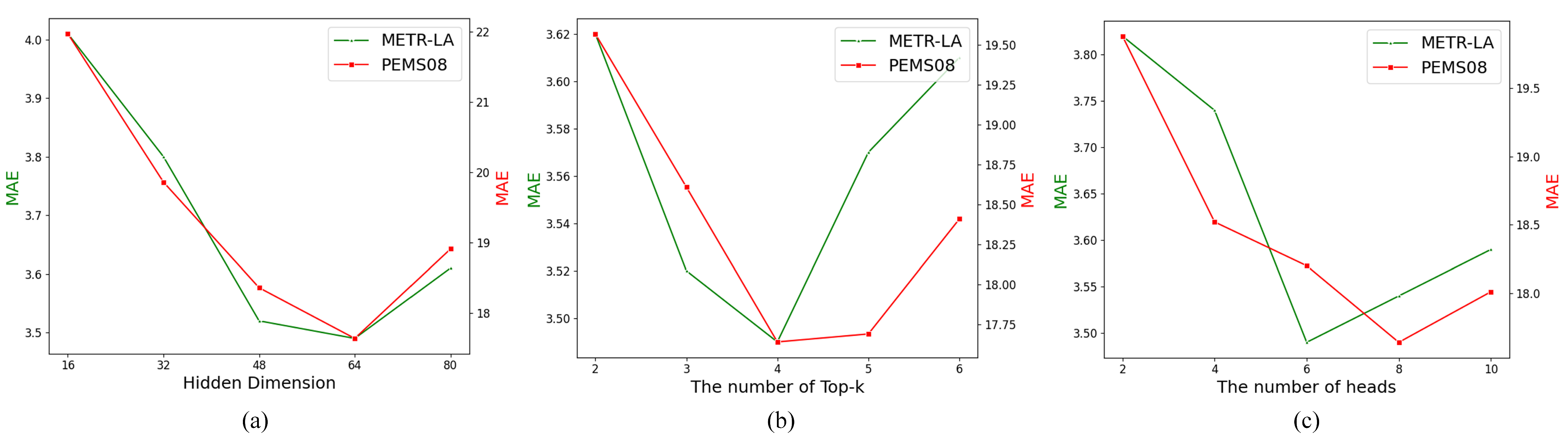
| Sensitivity Analysis Hyperparameters | hidden layer dimensions. | 64 |
| Number of Top-k. | 4 | |
| Number of Attention Heads. | 6 |
| Dataset | Models | MAE Horizon @3/6/12 | MAPE(%) Horizon @3/6/12 | RMSE Horizon @3/6/12 |
|---|---|---|---|---|
| Metr-La | ARIMA | 3.36/4.07/5.21 | 9.04/11.59/15.43 | 6.39/7.84/9.84 |
| LSTM | 3.09/3.79/4.88 | 8.20/10.64/14.72 | 6.09/7.64/9.56 | |
| GRU | 3.04/3.67/4.59 | 8.18/10.57/13.24 | 5.97/7.38/9.11 | |
| DCRNN | 2.86/3.27/3.82 | 7.40/8.94/10.81 | 5.32/6.38/7.60 | |
| ASTGCN | 2.98/3.47/4.15 | 7.95/9.81/12.31 | 5.70/6.87/8.29 | |
| GraphWaveNet | 2.84/3.25/3.80 | 7.43/9.10/11.18 | 5.29/6.38/7.59 | |
| DDSTGCN | 2.74/3.16/3.66 | 7.42/9.01/11.16 | 5.21/6.25/7.45 | |
| D2STGNN | 2.75/3.14/3.63 | 6.90/8.47/10.29 | 5.24/6.26/7.39 | |
| MegaCRN | 2.73/3.12/3.58 | 7.32/8.90/10.72 | 5.13/6.18/7.26 | |
| HSTGHN(ours) | 2.67/3.05/3.49 | 6.77/8.18/9.90 | 5.09/6.06/7.13 | |
| Pems-Bay | ARIMA | 1.64/2.16/2.89 | 3.48/4.84/6.98 | 3.53/4.95/6.52 |
| LSTM | 1.55/2.04/2.78 | 3.19/4.47/6.60 | 3.35/4.79/6.41 | |
| GRU | 1.45/1.91/2.53 | 3.06/4.37/6.39 | 3.07/4.33/5.78 | |
| DCRNN | 1.41/1.85/2.40 | 2.94/4.23/6.03 | 3.04/4.28/5.54 | |
| ASTGCN | 1.71/1.92/2.40 | 4.14/4.60/5.95 | 3.72/4.26/5.41 | |
| GraphWaveNet | 1.54/2.04/2.77 | 3.19/4.47/6.60 | 3.35/4.79/6.41 | |
| DDSTGCN | 1.42/1.74/2.06 | 3.19/4.03/4.89 | 2.92/3.81/4.60 | |
| D2STGNN | 1.40/1.72/2.06 | 3.12/4.02/4.91 | 2.92/3.84/4.62 | |
| MegaCRN | 1.36/1.71/2.07 | 2.88/3.90/4.97 | 2.86/3.81/4.69 | |
| HSTGHN(ours) | 1.30/1.62/1.93 | 2.71/3.64/4.57 | 2.73/3.66/4.45 |
| Dataset | Models | MAE Horizon @3/6/12 | MAPE(%) Horizon @3/6/12 | RMSE Horizon @3/6/12 |
|---|---|---|---|---|
| PEMS03 | ARIMA | 21.44/25.33/33.06 | 68.76/72.78/85.84 | 33.02/38.93/50.59 |
| LSTM | 18.64/22.23/36.17 | 16.68/21.85/39.78 | 25.11/29.07/43.72 | |
| GRU | 17.10/20.13/26.65 | 25.40/27.32/35.28 | 28.35/32.90/42.01 | |
| DCRNN | 16.64/19.91/27.18 | 17.70/19.91/27.18 | 27.58/32.39/43.23 | |
| ASTGCN | 19.02/18.75/21.82 | 24.89/24.03/28.94 | 31.66/31.70/36.27 | |
| GraphWaveNet | 13.73/15.09/17.61 | 14.57/15.37/17.44 | 23.53/25.95/29.66 | |
| DDSTGCN | 13.91/15.20/17.32 | 14.65/15.54/16.65 | 24.25/26.18/29.11 | |
| D2STGNN | 14.03/15.28/17.52 | 14.42/16.23/19.64 | 24.26/26.38/29.25 | |
| MegaCRN | 14.03/15.32/17.32 | 18.32/19.26/20.09 | 23.94/25.96/28.91 | |
| HSTGHN(ours) | 13.68/14.97/17.06 | 14.12/15.05/16.57 | 22.00/24.55/28.20 | |
| PEMS04 | ARIMA | 25.16/30.88/50.15 | 20.43/23.14/42.92 | 35.27/41.66/62.16 |
| LSTM | 22.24/26.21/35.05 | 29.21/31.98/38.46 | 34.96/40.51/52.24 | |
| GRU | 22.15/26.09/34.83 | 28.06/30.79/37.44 | 34.54/40.01/51.76 | |
| DCRNN | 21.27/24.63/32.06 | 17.79/19.76/25.28 | 32.98/37.54/47.37 | |
| ASTGCN | 22.96/22.49/26.30 | 19.12/18.31/21.04 | 36.32/35.99/41.82 | |
| GraphWaveNet | 20.01/21.90/25.39 | 14.31/15.10/17.20 | 31.30/34.01/38.70 | |
| DDSTGCN | 18.86/20.35/22.73 | 13.16/14.11/15.76 | 29.93/32.07/35.24 | |
| D2STGNN | 19.26/20.97/23.82 | 14.59/16.57/18.52 | 30.34/32.61/36.45 | |
| MegaCRN | 19.11/20.76/23.62 | 13.57/14.56/16.45 | 30.19/32.42/36.23 | |
| HSTGHN(ours) | 18.55/19.78/21.94 | 13.08/13.88/15.41 | 29.61/31.35/34.16 | |
| PEMS08 | ARIMA | 26.35/30.45/39.49 | 16.25/27.39/42.19 | 50.08/62.04/75.88 |
| LSTM | 17.80/21.22/29.02 | 30.62/32.52/39.90 | 27.67/33.03/43.77 | |
| GRU | 17.58/20.90/28.48 | 19.03/21.37/27.54 | 29.08/34.14/42.58 | |
| DCRNN | 16.14/18.25/22.83 | 12.05/13.25/16.76 | 24.79/28.17/34.64 | |
| ASTGCN | 19.26/19.69/23.75 | 15.98/15.86/19.49 | 28.29/29.45/35.22 | |
| GraphWaveNet | 16.30/17.70/20.36 | 11.46/12.41/15.13 | 25.04/27.40/31.27 | |
| DDSTGCN | 14.88/16.24/18.94 | 11.35/12.10/13.75 | 23.05/25.29/29.21 | |
| D2STGNN | 14.70/16.01/18.35 | 11.90/12.35/13.36 | 22.80/25.05/28.45 | |
| MegaCRN | 14.62/16.22/18.99 | 11.16/12.18/13.24 | 22.97/25.62/29.55 | |
| HSTGHN(ours) | 14.30/15.53/17.64 | 9.72/10.54/11.99 | 22.46/24.53/27.61 |
| Components | Dataset | ||||||||
|---|---|---|---|---|---|---|---|---|---|
| HGCN | GRU | Transformer | METR-LA | PEMS-BAY | |||||
| MAE | MAPE(%) | RMSE | MAE | MAPE(%) | RMSE | ||||
| ✓ | ✓ | ✓ | 3.05 | 8.25 | 6.01 | 1.65 | 3.79 | 3.64 | |
| ✓ | ✓ | ✓ | 3.10 | 8.36 | 6.14 | 1.69 | 3.92 | 3.64 | |
| ✓ | ✓ | ✓ | 3.07 | 8.30 | 6.07 | 1.67 | 3.85 | 3.62 | |
| ✓ | ✓ | ✓ | 3.02 | 8.20 | 5.99 | 1.63 | 3.76 | 3.60 | |
| ✓ | ✓ | ✓ | ✓ | 3.01 | 8.08 | 5.95 | 1.59 | 3.61 | 3.51 |
Disclaimer/Publisher’s Note: The statements, opinions and data contained in all publications are solely those of the individual author(s) and contributor(s) and not of MDPI and/or the editor(s). MDPI and/or the editor(s) disclaim responsibility for any injury to people or property resulting from any ideas, methods, instructions or products referred to in the content. |
© 2025 by the authors. Licensee MDPI, Basel, Switzerland. This article is an open access article distributed under the terms and conditions of the Creative Commons Attribution (CC BY) license.
Share and Cite
Jiao, X.; Zhang, X. Towards Sustainable Intelligent Transportation Systems: A Hierarchical Spatiotemporal Graph–Hypergraph Network for Urban Traffic Flow Prediction. Sustainability 2026, 18, 180. https://doi.org/10.3390/su18010180
Jiao X, Zhang X. Towards Sustainable Intelligent Transportation Systems: A Hierarchical Spatiotemporal Graph–Hypergraph Network for Urban Traffic Flow Prediction. Sustainability. 2026; 18(1):180. https://doi.org/10.3390/su18010180
Chicago/Turabian StyleJiao, Xin, and Xinsheng Zhang. 2026. "Towards Sustainable Intelligent Transportation Systems: A Hierarchical Spatiotemporal Graph–Hypergraph Network for Urban Traffic Flow Prediction" Sustainability 18, no. 1: 180. https://doi.org/10.3390/su18010180
APA StyleJiao, X., & Zhang, X. (2026). Towards Sustainable Intelligent Transportation Systems: A Hierarchical Spatiotemporal Graph–Hypergraph Network for Urban Traffic Flow Prediction. Sustainability, 18(1), 180. https://doi.org/10.3390/su18010180