


Abstract
The environmental and human health impacts of mono-crystalline silicon (mono-Si) module assembly in Mexico were estimated using a regionalized Life Cycle Assessment (LCA). A detailed inventory was completed through fieldwork consisting of arranged visits to four manufacturers to collect on-site data. The main findings demonstrate that, on average, between 10% and 35% of the photovoltaic cells imported from China for module assembly in Mexico are discarded during the manufacturing process. Furthermore, experimental studies conducted in our laboratories with samples collected from the manufacturing plants showed that the busbars and finger contacts on the cells and strings indicate the presence of lead and a lack of silver in the aluminum-based alloys used for soldering and coating the strings. The LCA study includes end-of-life scenarios, with particular attention to open-dump waste disposal, the most common option in Mexico, which generates three-times-greater environmental impacts than waste incineration. The impact of different transport options for importing cells from China yielded Global Warming Potential (GWP) values of 157.52 kg CO2 eq and a Cumulative Energy Demand (CED) of 2204.9 MJ eq, compared to 8.9 kg CO2 eq and 123.3 MJ eq, respectively, obtained for sea transport. These results highlight the importance of including transport and end-of-life scenarios to obtain realistic environmental and human health impacts from photovoltaic module manufacturing.
1. Introduction
Solar energy has become one of the strongest options in efforts to reduce the use of fossil fuels. However, as with all products and services, the production of components, the operational phase, and the end of life, including their potential recycling, have environmental impacts that must be assessed [1,2,3]. The International Renewable Energy Agency (IEA) [4] pointed out that developing countries participate in a globally integrated market, in which photovoltaic (PV) components such as wafers, cells, modules, inverters, and junction boxes, as well as the equipment that produces them, travel around the world every day, thus generating a highly distributed value chain for the production of PV systems. Although c-Si, wafer, and cell production is almost exclusively concentrated in Asia, module assembly plants are more widely distributed and have undergone recent reorganization and growth, acting as import hubs for components and export hubs for assembled PV modules. Mexico is the only Latin American country ranked among the top six developing countries (India, Thailand, Mexico, Philippines, Vietnam, Malaysia) exporting PV components, such as regulators, inverters, and silicon PV modules [4].
The case of Mexico is illustrative of a similar pattern of PV module assembly around the world: importing PV cells from Asia (mainly China), assembling modules, selling them in local markets, or re-exporting the modules to third countries (usually to the USA). In Latin America, Brazil has the largest PV module assembly manufacturing capacity, with Mexico in second place, followed by Colombia [5].
Although the standardization of c-Si module manufacturing is taken for granted, there are many plants in developing countries where there is still a significant contribution of human labor or old equipment, which entails quality problems, resulting in waste, in addition to waste inherent to the process and transportation of raw materials that could limit the environmental benefits of PV energy. In this context, Life Cycle Assessment (LCA) is recognized as a robust tool to assess the environmental performance of products and systems and is regulated by ISO 14040 and ISO 14044 standards [6,7].
We identified twelve LCA reviews related to PV module production from 2010 to March 2025 [8,9,10,11,12,13,14,15,16,17,18,19] which examine in detail research on the impacts of PV modules and point out unaddressed considerations. Two reviews concluded that information on PV systems omits details of the panel assembly study, although paradoxically, an important factor for the expansion of PV systems is to understand their environmental performance, even if they are promoted as a “net-zero energy product” [8,18].
Reviews prior to 2018 recommend increasing studies on the end of life (EoL) of PV systems and including the assembly and raw materials stages in the LCA because the production of PV cells represents the greatest impact [9,10,11,12,13,15,17,18,19]; although not a full LCA study, a case study of Mexico already pointed toward the large amount of expected waste related to PV systems (an estimation of 31 million PV modules) [20]; therefore, this study covers the EoL with field and laboratory data. Reviews published since 2019 recognize the large number of EoL studies; however, it can be observed that in the studies that include the assembly and raw material stages, field data collection was omitted. In this case, the present study gathered field data. One study reported, in its inventory, having conducted survey questionnaires on the module assembly lines and raw materials used by Chinese companies [20]. Apart from this, the rest of the studies (151) covered in the twelve reviews completed their inventories of PV cells and PV modules using databases (DB) as a constant practice that leads to collecting fixed data and obtaining fixed results, without field data collection, thereby depreciating direct solid waste emissions from module manufacturing. In this sense, this study fills the gap. One review concludes that the current consensus regarding the carbon footprint of PV modules made in China presents numerous notable gaps and gray areas; however, the review did not include an analysis of the module production waste [21].
Since cell production represents the dominant environmental burden in LCA studies on PV systems, and the amount of silver is critical for their function, we characterized the materials of the assembled cells at the laboratory level from field-collected samples, which has not been performed in previous LCAs to date according to the twelve reviews.
On the other hand, previous studies [22,23,24,25,26] made an effort to analyze the transportation of PV systems, the import of PV modules from assemblers to foreign countries where the PV system is installed, or the transportation from the installation site, where the module reaches the end of its useful life and becomes waste, to its final destination; they concluded that for the same PV system, installation in different locations strongly affected its environmental impacts. The sensitivity analysis of the transportation of the components by air or sea to the panel assembly plants will be part of further studies.
This paper reports the LCA of mono-crystalline silicon (mono-Si) Passivated Emitter and Rear Cell (PERC) photovoltaic module production in Mexico. The results aim to support future studies to compare these considerations of fieldwork that can change the behavior of the LCA of PV systems. As a complementary objective, the authors conduct four sensitivity analyses varying (a) the amount of PV cell waste generated, (b) the transport route of the PV components, (c) the EoL of the PV waste, and (d) different PV cell materials based on laboratory studies.
2. Materials and Methods
Fieldwork was carried out to collect life cycle inventory data for the assembly stage of mono-Si PERC PV modules from four different PV module manufacturing plants located in Mexico.
The manufacturing capacity of PV modules in Mexico is concentrated in a few manufacturing sites, linked to multinational companies: solar module manufacturer Maxeon Solar Technologies [27] in Mexicali, Baja California, Mexico; ERM Solar [28] in Veracruz; Indisect [29] in Tlaxcala; SAYA [30] in Aguascalientes; and so on. Up to nine module assembly factories are currently operating in Mexico. It is difficult to track the exact number because the status of operations on their websites is constantly changing, and there is no government compendium of information on all PV panel assemblers in Mexico. Due to confidentiality agreements, the specific sites have been anonymized and, with the due arrangements, four factories were visited and field data was collected at those manufacturing plants. The authors acknowledge potential bias during the plant selection and the limitation of the lack of information on the total number of existing plants in Mexico.
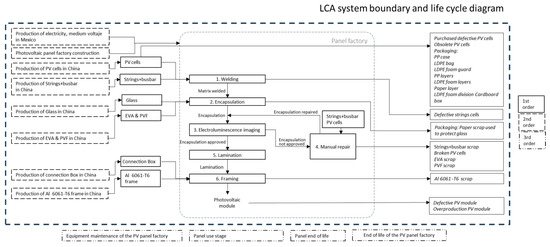
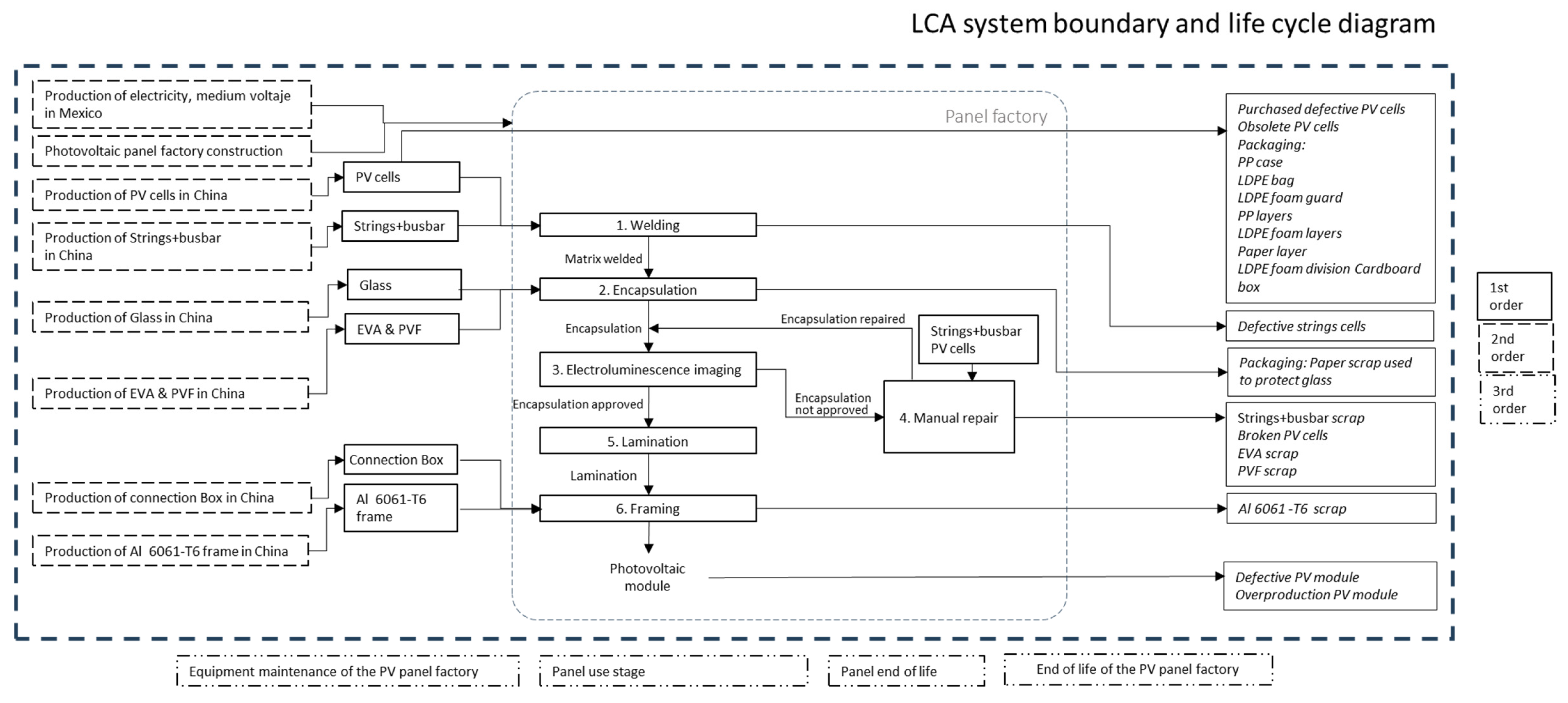
Visits to the manufacturing sites were carried out by a team from the National Autonomous University of Mexico (UNAM). To ensure data randomization, sample and data collection took place at four assembly plants in four different states across the country. Data were collected from 3 observations for each complete panel process, giving a total of 12 observations. The observed data are represented by Figure 1. Among the different PV module technologies, single crystalline silicon PV was selected because it continues to be, by far, the most produced and installed, representing more than 95% of the global market in 2023 [5], and production in Mexico is no exception, according to interviews with plant production managers. Thirteen samples of 1 cm2 were taken from the largest production plant visited: solar cell, ribbon, finger, solder, ethylene-vinyl acetate (EVA), aluminum, TPT, cardboard, packaging paper sheets, low-density poly-ethylene (LDPE) for dividing cell packaging, polypropylene (PP) case, LDPE bag, and LDPE foam; no specific random method was followed.
Figure 1.
LCA system boundary and life cycle diagram of PV module assembly.
Data collection from the different processes constitutes part of the inventory, together with sample analysis in the laboratory (materials inputs, outputs, and generated waste) and access to the Ecoinvent database. The LCA study followed the ISO 14040 and ISO 14044 standards [6,7]. These standards establish four steps for the development of the LCA: (1) goal and scope definition, (2) life cycle inventory, (3) life cycle impact assessment, and (4) LCA result interpretation. The OpenLCA software v 2.1 with Ecoinvent V3.9 [31], released in 2024, was used to configure the model structure for all scenarios, with cut-off LCI-unit DB criteria because it was considered that producers of waste do not receive any credit for recycling or reuse of products resulting from any waste treatment. The functional unit (FU) was chosen as 1 m2 of manufactured mono-Si PV module PERC technology.
The impact categories Global Warming Potential (GWP100), Material Resources Depletion (MRD), Human Toxicity Cancer (HTC) and non-cancer (HTnC), and Cumulative Energy Demand (CED) were chosen because they are the most representative categories for studies involving renewable energy according to the latest review [8]. The ReCiPe 2016 v1.03 midpoint (H) global-average [32] methodology was used in the categories of MRD, GWP100, and CED for scenarios 1 to 8 to analyze the global impact of the assembly process carried out in Mexico with components from Asia.
The categories of HTC and HTnC were calculated using the regionalized methodology Impact World+ Continental Latin America Midpoint v1.251 [33], because it was considered that emissions are released into the environment with local impacts; then, a comparison was made with ReCiPe H and USEtox [34] results. Also, four final destinations of waste were compared: open dump (OD), burning (BU), sanitary landfill (SL), and recycling (RE).
2.1. Description of the System
The LCA system boundary and life cycle diagram of the study is presented in Figure 1. The life cycle diagram begins with the production of the components. The number of components and materials used in the process were counted in the field. The components used in the processes were manufactured in Asia, predominantly in China, with a few exceptions from Thailand. The present study considers that all the components came from China. The electricity mix used in the assembly of the PV modules is the medium-voltage grid of Mexico.
2.2. Elementary Composition of the PV Cell
The elements contained in c-Si PV cells are usually silicon, aluminum, iron, manganese, titanium, nickel, tin, lead, copper, and silver. Among them, special attention must be paid to the presence of high-impact elements such as silver and/or toxic elements, highlighting lead as a toxic element, which even in very small quantities must be treated and eliminated appropriately, although there is still insufficient application of regulations in developing countries [35,36,37,38].
During factory visits, samples of PV cells, tabwires, and buswires were collected (one of each due to the factories use of the same brand and model of these components for the PV module). These samples were examined using scanning electron microscopy (SEM) using secondary-electron and backscattered-electron detectors, which in the latter case provide greater sensitivity generated by the contrast between heavier and lighter elements (according to their atomic number). Energy-dispersive X-ray (EDX) spectroscopy was performed on selected samples to identify and quantify the number of metals present in busbars, connecting wires, and solder material. The density of the waste samples was determined by measuring their volume with the help of a Mitutoyo Digimatic 500-321 Model Cd6 Vernier Caliper (manufacturer: Mitutoyo, Utsunomiya, Japan); a Massan MB90 moisture meter with a scale was used to measure their mass (manufacturer: OHAUS, Parsippany, NJ, USA). A Zeiss EVO 15 scanning electron microscope (manufacturer: Carl Zeiss, Jena, Germany) was used, the software used was SmartSEM v8.0. Measurement conditions for SEM and EDX were 18 kV and 1 nA at the electron gun; samples were kept in high vacuum at a working distance of around 8 mm in all cases. EDX measurements were collected with different acquisition times to ensure good sensitivity for both point spectra and mapping, secondary electrons and backscattered electrons were used for imaging, and EDX spectra were collected in spots, areas, and lines, allowing the construction of elemental detection maps.
Fingers of PV Cell
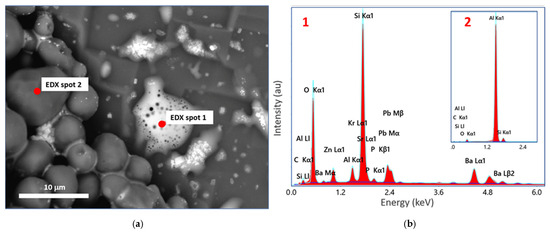
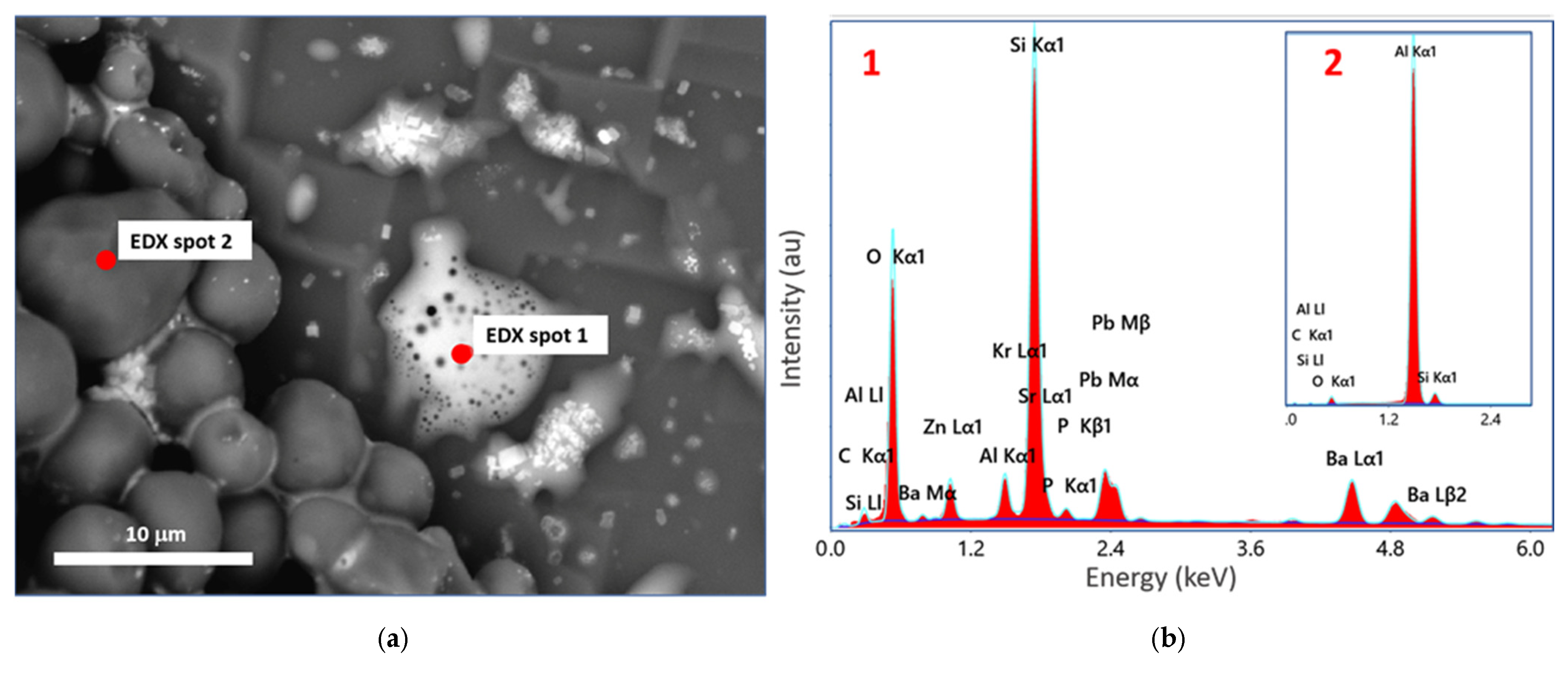
An SEM image of a mono-Si PERC is shown in Figure 2, with the detail of a contact finger on the cell surface. In order to provide chemical sensitivity in the analysis of the elements in the cell and on the finger, backscattered electrons are analyzed (Figure 2a), thus providing contrast for the heavier elements (lighter). In addition, the surface texture of the micropyramids is clearly visible in the image. Figure 2b presents the EDX elemental analysis. It can be observed that the screen-printed finger is made of almost pure aluminum (darker grains) with a granular texture, and traces of solder containing lead and barium are also detected (lighter structures).
Figure 2.
Border analysis of the mono-Si PV cell fingers (a). SEM detail image using a backscattered electron detector (b). EDX spectrum. EDX spot 1 points to fused silica, EDX spot 2 indicates almost-pure aluminum from the darker grains.
The presence of lead in the solder material for chain interconnection was demonstrated in all samples by EDX measurements (Table 1). No sample has a silver signal. The SEM images of the cell fingers with a larger microscope area are displayed in the Supplementary Materials. Detailed finger, buswire, busbar, and tabwire analyses are presented in the Supplementary Materials.
Table 1.
Compositions in % by weight of the core and coating of the fingers, busbars, and tab/buswires.
Table 1 shows the compositions in % by weight of the metals from the PV module obtained in the laboratory by measuring the collected samples. The presence of lead is especially significant, as it is a toxic material, still present mainly in the coatings of strings and busbars: 33.1% wt in these specific components, which translates into 3.0658 × 10⁻⁴ kg/m2 FU. This observed amount of lead, despite being high, is lower than the amount reported previously by other authors, for example, 7.20 × 10⁻⁴ kg/m2 of the PV module [20], probably due to stricter regulations and the tendency of the industry to reduce lead amounts in PV panels. This is consistent with trends reported by the IEA-PVPS Task 12 workgroup [39].
2.3. Life Cycle Inventory
Table 2 summarizes the average physical and electrical characteristics of the set of PV modules in the sampled processes. Fieldwork was carried out to compile the inventory of mono-Si PV modules.
Table 2.
Physical and electrical average characteristics of the PV module.
Table 3 presents the aggregated and averaged data from the four plants, corresponding to the same type of panel, described in Table 2, manufactured by the plants. Table 3 shows the purchased defective PV cells, defective strings, obsolete PV cells, and broken PV cells depending on the warehouse inventory and PV cell quality, as explained in the Supplementary Materials. Additional data on the composition of the metal alloys used in the cell, string, and module contacts, including soldering material, were provided by the laboratory experiments (SEM and EDX microanalysis, as described in Section 2.2). In this study, the elemental constitution of the cell fingers, busbar, and collector wires was determined by laboratory analysis. In this way, the PV cell, the mono-Si wafer library in Ecoinvent 3.9, was modified to aluminum paste metallization as presented in the Supplementary Materials; also, the Solder bar Sn63Pb37 library was selected for welding in the configuration of the panel. The unit process (UPR) names from Ecoinvent 3.9 are shown in the Supplementary Materials.
Table 3.
Life cycle inventory of 1 m2 PV module from data field.
2.4. Sensitivity Analysis
2.4.1. Different Percentage of Broken Cells
When comparing the data observed in the four assembly processes, the amount of damaged cell waste showed a large difference between each assembly line; this difference varied between 10% and 35% of damage losses. Even though this waste represents a high percentage of cells, it has never been considered in an LCA study, to the authors’ knowledge.
For this reason, we set 0%, 10%, 20%, and 35% as the broken cell scenarios. The highest percentage observed was 35%. The most common percentage observed in the field was 20%, set as a baseline (BL). The 10% scenario was analyzed to observe a mid-range comparison, and the 0% scenario represents the consideration of the studies that do not take into account waste at the assembly stage of PV system modules.
2.4.2. Transport
Another important fact to consider in the observed processes is that their components have been imported by air in two case studies and by sea in the other two. Therefore, a comparison between air and sea routes was made. The distances from manufacturing plants in China to PV module assembly plants in Mexico were configured by using transport calculation websites [40,41]. The PV cells are always transported by air (12,930 km) followed by freight (172 km), while the other components required for module manufacture are considered in two different scenarios: one in which they are also transported by air and freight (same distances), and another one in which they are transported by sea (18,995 km) followed by freight (625 km).
2.4.3. Scenarios for Final Destination of PV Waste
The processes observed during the fieldwork do not specify in detail the final destination of their waste. Four final waste disposal scenarios were considered to observe the variation in environmental impacts: (OD) open dump, (BU) burning, (SL) sanitary landfill, and (RE) recycling. This is because OD and SL are the most common practices in developing countries, while BU and RE are the recommended practices.
2.4.4. PV Cell Materials
Through laboratory analysis of the cell and the solders, a sensitivity analysis of the PV cell with only aluminum metallization paste and with common silver metallization paste was performed (Table 4).
Table 4.
Description of scenarios for sensitivity analysis. Assembly process as described in Table 3.
Table 4 describes each scenario (S) of sensitivity analysis in the study. The most common scenario found in the fieldwork is the S6BL (baseline) scenario described in Table 2, with the inventory from Table 3, considering 20% of broken cells, waste disposed in OD, and components transported by sea (only PV cells by air).
3. Results and Discussion
3.1. Environmental Impacts of PV Module Under Broken Cell Scenarios
The scenarios designed based on the number of broken cells are complemented by an in-depth analysis of the impacts of transportation alternatives, whether air or sea. Table 5 shows the environmental burdens of PV module manufacturing. The ReCiPe (H) global-average methodology was used in the categories of MRD, GWP100, and CED to analyze the global impact of the assembly process carried out in Mexico with components from Asia. The categories of HTC and HTnC were calculated using the regionalized methodology Impact World + Continental Latin America Midpoint v1.251 (see Section 2). S1, S3, S5, and S7 represent the components transported by air. S2, S4, S6BL, and S8 consider the transport of PV cells by air and the rest of the components by sea. It can be observed that the impact increases logically and proportionally as the number of broken PV cells increases, but when transport is carried out by air, the impacts for each category are up to 50% greater. The scenarios in Table 5 consider OD as the final disposal of waste to observe the worst-case scenario because the common practice is to store the waste, which will most likely be taken to a landfill or OD.
Table 5.
Sensitivity analysis of transport types per percentage of broken PV cells (FU).
3.2. Environmental Impacts of Different Transport
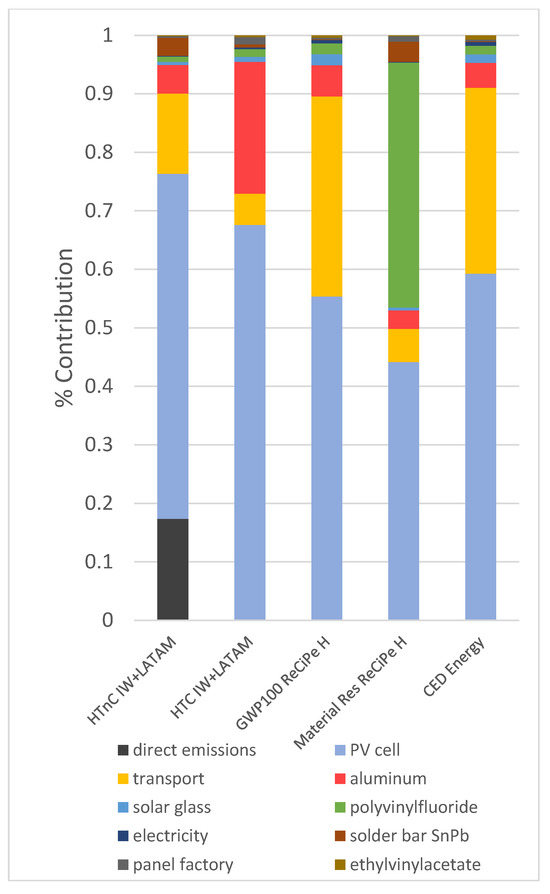
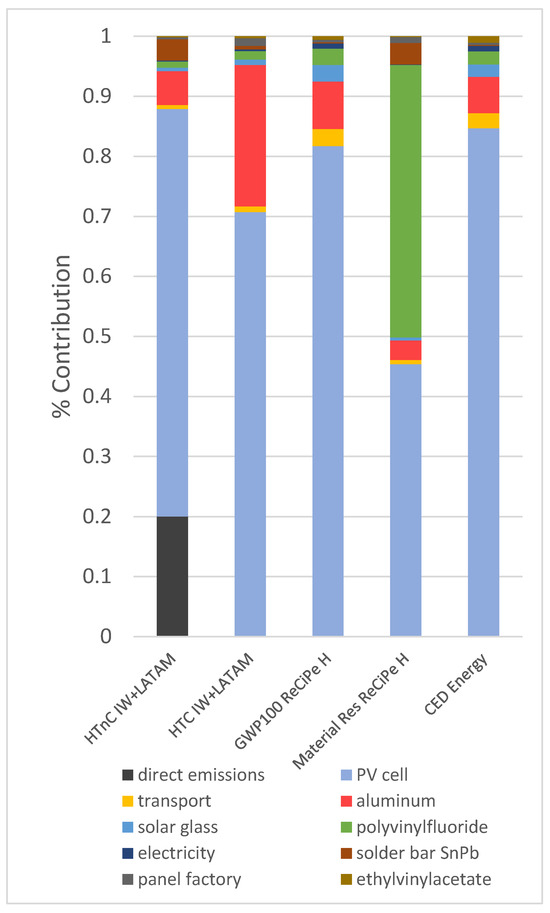
Figure 3 and Figure 4 show the relative percentage contribution of the scenarios with 20% of broken cells. These scenarios are S5 (Figure 3), corresponding to air transport, and S6BL (Figure 4), corresponding to sea transport. Figure 4 shows that the impact of the production of the PV cell contributes between 46 and 58% in the categories Global Warming Potential (GWP100), Cumulative Energy Demand (CED), Human Toxicity Cancer (HTC), and Human Toxicity non-cancer (HTnC). But unlike what is reported in the literature, the impact of the transport of components has a huge burden, representing around 33% of the impacts of the module in the categories CED and GWP100, of which 91% was due to fuel production; this establishes the importance of not underestimating the transport of components. In Figure 4, the contribution of the transport impacts on S5 (only cells transported by air) in GWP100 is 2.8%, MR 1.2%, and CED 2.5%. Therefore, it is consistent with the literature; when components are imported by ship, the impact of transport is not representative, thus emphasizing the importance of impacts arising from the amount of waste generated in situ, that is, at the location where modules are assembled.
Figure 3.
Percent relative contribution of characterized values midpoint LCA results of S5 considering aircraft.
Figure 4.
Percent relative contribution of characterized values midpoint LCA results of S6BL considering seacraft.
Transportation analysis is a growing concern, as is the case with studies from China reporting on domestic transportation of components to manufacturing and/or modules to installation. It was reported, with aggregated results, that component transportation accounts for 3.8% of the impacts of PV module assembly considering the Chinese total environmental index ECER-135 (which analyzes energy saving and GWP emission reduction targets) [42]. They assumed the domestic transportation distance to be 3500 km because it is the worst case. Also, national transportation of components (China and the USA) and sea freight of PV modules to installation sites in the USA (34,400 km) were considered, and it was concluded with aggregate percentages that transportation makes a relatively small contribution to overall GWP and CED, constituting <6% for China and <2% for North America [26]. In one study, the distance between the PV module plants and the installation site is assumed to be 2000 km; however, air transport is not taken into account [43].
A previous study reported 9.1% of GWP and 0.01% of MR [kg Cu eq] [23]. These discrepancies may be due to the fact that they analyzed poly-Si PV panels and they did not differentiate the data from the type of transport based on the components up to the assembly plant, as in the case of the four plants analyzed in this study, as an interview revealed: the PV cell is always transported by air, but the other components could be transported by sea (although not always). Then, ref. [23] assumed 13,351.68 km as the distance by sea traveled by the modules imported from China to Mexico, and did not detail this case: modules assembled in Mexico with components that come by different types of transport.
Other previous studies [22,23,24,25,26,44] made the effort to analyze transport with aggregated data. In fact, they did not consider transport from countries producing PV components to assemblers of PV modules, but they analyzed the import of PV modules to countries abroad where the PV system is installed, or the waste of PV modules transported until the end of their useful life. Under these criteria, they concluded that for the same PV system, installation in different locations strongly affected its environmental impacts [45]. According to field interviews, Longi and Sunpower are among the most commonly used component suppliers; their EPD showed disaggregated transportation data. Longi’s EPD [46] reports that the transportation impact is 0.8% of GWP, 0.6% of CED, and 0.034% of abiotic depletion potential (ADP). The distance from the component factories to the assembly plant is 50 km by lorry [46]. Sunpower’s EPD mentioned that they produce their silicon wafers in Norway and the USA, ship them to their solar cell factories in the Philippines, and then ship them to Mexico where they produce the finished solar module. However, the transportation only shows the low count of 8800 km by sea [47]. Meanwhile, in this study, S5 shows that the sea transportation distance from China to Mexico is 18,995 km (Table 4); it is necessary to disaggregate and detail the data in the EPD because they are crucial in LCA investigations as they contribute to the energy used and greenhouse gasses emissions of the PV system.
3.3. PV Components Impacts
The results in Figure 4 (S6BL) show the disaggregated impacts of the manufacturing of each component. Cell manufacturing has the highest impact (82 and 85%) in the categories of GWP100 and CED, respectively, while the large contribution of PVF (43%) in the MR category is due to the intensive use of energy and resources for the manufacturing of PVF. The contribution of aluminum manufacturing is 3–8%. In Figure 3 (S5), in the HTC category, the value of the environmental load of the PV cell is 67%, while the production of the aluminum frame contributes 22% of the impact due to the extraction of resources for the manufacturing of the alloy. Another study analyzed a partial separation of components and five steps of PV cell production to then assemble them into the module, and concluded, as an aggregate percentage across seventeen midpoint impact categories, that more than 73% of the burdens in module production are due to the aluminum alloy (used for the module frame), the glass, and the electricity consumption for the process [25]. In this sense, other studies report that the manufacturing of PV components contributes to the impacts, showing a growing concern to differentiate the impacts of each component, but aggregated as endpoint categories and without field data [23].
Other studies only report aggregate results as PV module components [42,48,49] so it is not possible to compare with them.
3.4. Final Destination of PV Waste
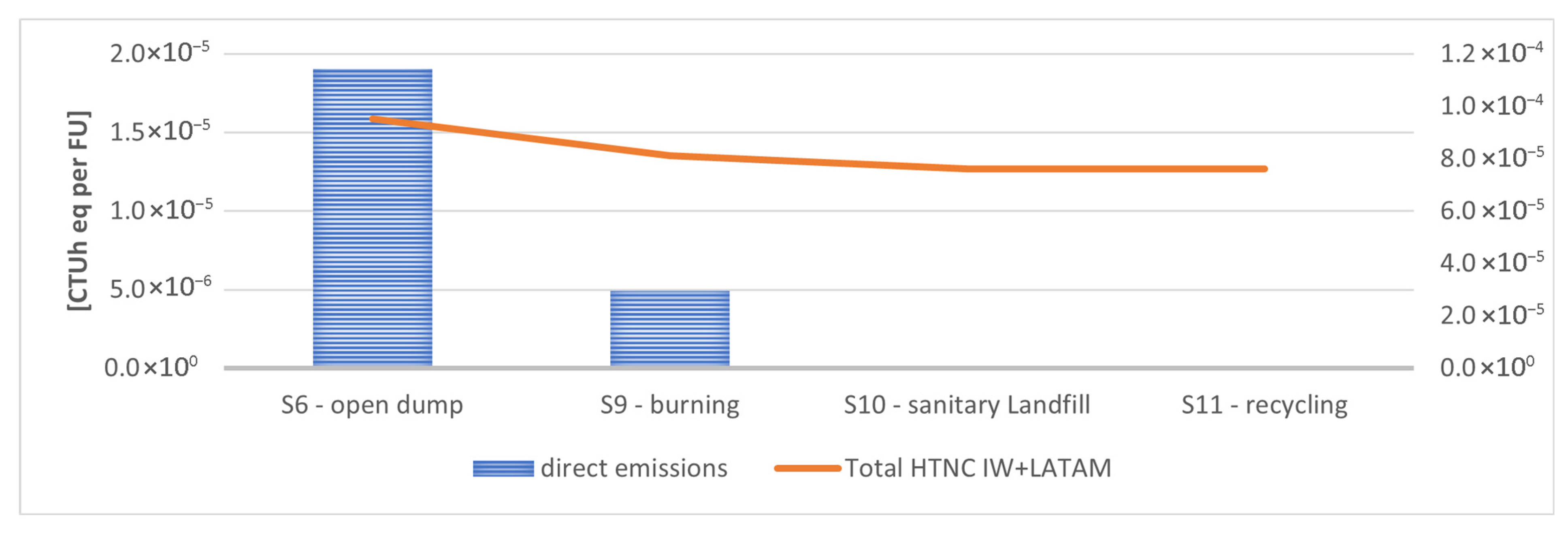
One of the main findings of the article is the unexpectedly high amount of waste generated during the module assembly process; this fact emphasizes the need for waste treatment at this stage of production, in contrast with usual treatment at the EoL of the modules. Several scenarios for waste treatment have been considered in this LCA study as described in Section 2.4. In Figure 3 and Figure 4, the HTnC category shows the environmental impacts of direct emissions of the chemical elements in the waste from the assembly process that come from the disposal of PV waste (Table 5) in ODs that Mexico carries out as a common practice together with SL; the worst scenario was modeled. These emissions show environmental impacts of around 20% in this category, so it is necessary that future LCAs of PV modules and environmental improvements do not ignore them. Different studies show the impacts of PV modules, but the data are grouped as “PV module production phase” and the direct emissions of the chemical elements are not categorized as waste at the end of the manufacturing process and or even during the different intermediate steps. The lack of categorization in similar studies complicates a direct comparison between data for impacts. However, there are some studies that are already assigning impact, and, in particular, greenhouse gas emissions associated with the generation of waste during processing of PV modules [22,23,24,25,26,42,50]. Other studies do not mention waste from the assembly stage [48,51,52,53,54].
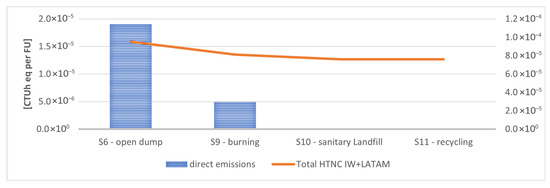
Figure 5 presents a sensitivity analysis based on the final destination of the waste generated during the manufacturing process. The bars correspond to the impacts of the waste, while the red line indicates the total value of the impacts of the set of PV modules. The greatest impact corresponds to the disposal of the waste in OD (S6BL). The OD site, according to Ecoinvent v3.9 [31], is a place that has no type of control and does not have a geomembrane, so it introduces leachates and contamination into the environment. The waste shown in Table 3 are broken cells and lead, tin, and copper from their connectors. These elements were modeled as direct emissions disposed in ODs with agricultural soil as final fate in order to observe the worst impact scenario. The emission with the greatest impact is lead in this S6BL.
Figure 5.
Final destination sensitivity. HTnC category. IW + LATAM. Left axis corresponds to the bars, right axis corresponds to the red line.
According to the results presented in this article, the amount of lead not accounted for in previous studies is much higher than expected due to cell waste during the module manufacturing process. Therefore, lead recycling routes must be incorporated into a circular value chain for solder material within the manufacturing country. The Supplementary Materials provide more information about the health effects of lead and recycling technologies.
S9 corresponds to the incineration in a municipal solid waste (MSW) incinerator as part of a mixture of communal waste. It was considered that 1.2% of the burnt lead is dispersed in the air, while 0.05% of the tin is dispersed as inorganic dust and fumes [55]; gases are emitted in places with low population.
S10 has controlled confinement with geomembrane, gas incineration, and wastewater treatment for leachates. There are no direct emissions of the released chemical elements. S11RE was modeled considering that cardboard, paper, plastic, aluminum, and glass waste are sent to recycling processes. However, there is no recycling process for welded, broken, or even assembled cells in the existing databases. Due to the above, both S10 and S11 present zero values in the emissions from the bars, but the red line indicates that the total values are quite close to each other since the final disposal and waste treatment processes are too early and do not yet show the possible impacts. At the time of this study, according to the published literature, there is no study that has reported the impacts of the final destination of module assembly waste. There are studies that analyze the end of life of the modules [2,25,43] and report negative impacts on recycling because they consider the recovery of silver materials, but in this paper, the field study shows that the module is composed of cells without silver. In addition, it is necessary to take into account that recycling high-value materials from PV panels at the end of their useful life is not yet recognized by researchers as a practical solution [56].
However, it is important to note that all PV module assemblers mention the practice of storing (without a time period) broken cells without assembly, sections of cell strings, or even defective modules. They argue that there are no industrial recycling processes in Mexico and the costs are very high when hiring a company for transportation services, in addition to hazardous waste containment services.
3.5. Different Metallization Paste of PV Cell
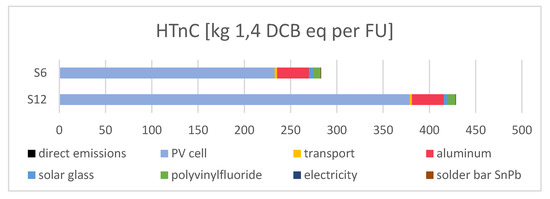
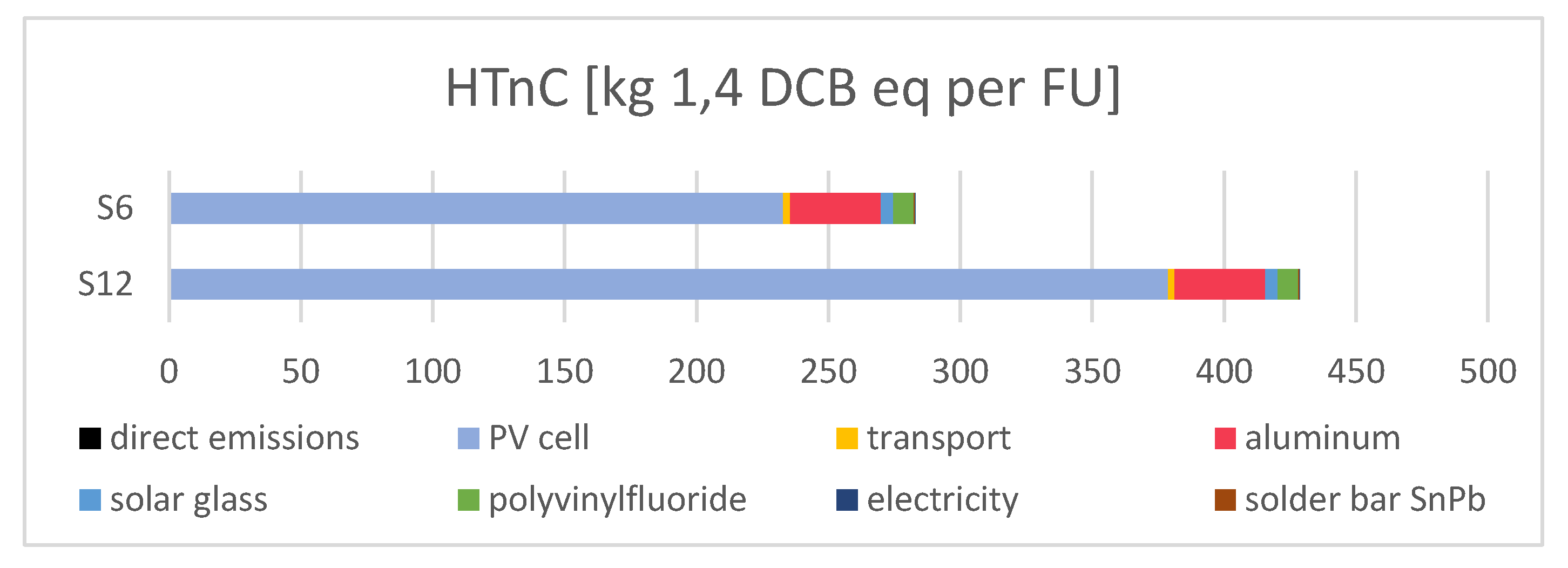
Based on the findings from the laboratory cell studies, the production comparison between aluminum (S6) vs. silver + aluminum (S12) printed cells was performed for the HTnC category (Figure 6). The ReCiPe H methodology was used because the PV cell used in it has a global market. The aluminum screen-printed cell accounts for 61% of the impacts of the silver + aluminum printed cell. This is due to the substances released in silver mine operations and the electricity used for mineral extraction.
Figure 6.
Sensitivity analysis of the aluminum vs. aluminum + silver PV cell. HTnC category. ReCiPe H.
It is important to note that none of the research in the reported studies analyzed their own cell in a laboratory; they commonly used the silver + aluminum screen-printed mono-Si cell from the Ecoinvent PV cell library [22,23,42,43,54,57,58,59] or from specific national data [25,26,48]. However, this is not the case for all PV cells on the market; therefore, it is important to know and analyze the type of metal in the metallization paste because it can change the impacts in PV studies [60].
3.6. HTnC Sensitivity Analysis of Final Disposal Emissions of Wastes
Due to the amount of waste produced during module assembly and the treatment of waste at this stage being two of the parameters that have provided a wider range of values collected on-site, a sensitivity analysis was performed on this variation. S6BL was assessed with the HTnC impact category using different methodologies: IW+ Latin America midpoint 1.251 [33], ReCiPe 2016 v1.03, midpoint (H) global averages [32], and USEtox v2.0 [34]. The choice of methodology may hide values for impacts in the HTnC category due to direct emissions of the chemical elements in the waste. ReCiPe (H) reflects the lowest contribution of direct emissions (0.24%) of the total process; USEtox 2.0 reflects a value of 8.52% and IW+ LATAM 19.99%, due to ReCiPe H having the lowest characterization factors. The comparison was possible using a conversion factor of 3.87 × 10⁻⁷ [61]: lead 4.063 × 10⁻⁴ CTUh/kg (1050 kg 1,4 DCB eq/kg) and copper 1.0256 × 10⁻⁸ CTUh/kg (0.0265017 kg 1,4 DCB eq/kg). USEtox presents a lead CF of 0.0265017 CTUh/kg and copper CF of 3.74152 × 10⁻⁵ CTUh/kg but also presents global averages. While the IW+ Latin America methodology values corresponding to Latin America are more suitable for Mexico, the CF for lead is 0.0537 CTUh/kg and the copper CF is 1.14 × 10⁻⁴ CTUh/kg.
Additionally, we can compare the HTnC impact calculated in our study with values reported; Table 6 shows a study that evaluated the impacts of a functional unit of 1 kWp (nominal peak power of c-Si PV modules in STC) obtained by the ReCiPe 2016 impact assessment method with access to Ecoinvent 3.8, released in 2021, and considering the contributions of sea transport [23]. To compare results with our LCA study, a conversion of functional units must be performed: from 1 kWp to 1 m2; the power conversion efficiency (PCE) of the manufactured modules is the only value-choosing parameter required for the calculation, assuming a PCE of 20% for c- Si PV modules.
Table 6.
Comparison of HTnC values vs. [23] [kg 1,4 DCB eq].
For the HTnC category, Reference [23] concluded that case study II on landfills generated impacts of 758.35 kg of 1,4-DCB eq, with transportation contributing approximately 18 kg of 1,4-DCB eq. Applying functional unit conversion, the midpoint impact categories are shown in Table 6. The values published by [23] are lower than our impacts, mainly because they considered poly-crystalline cells, while we considered mono-crystalline, including the unexpectedly large amount of waste cells observed in the field throughout module assembly reported in the present study, in addition to the differences showed in Table 6.
3.7. PV Waste Regulations in Mexico and Recommendations
The Mexican government discussed regulations on PV module waste in order to amend the General Act for the Prevention and Comprehensive Management of Waste of the country (LGPGIR by Spanish acronym) [64]. The Mexican Senate has proposed treating glass, copper, and aluminum from modules as separate entities, and inverters and batteries as electronic waste. It also recognizes the presence of small amounts of toxic heavy metals such as lead, arsenic, antimony, and cadmium in these wastes. Still, the focus of the discussions has been on recycling and end of life; the waste generated in PV module production lines is not addressed. The Mexican Senate has proposed changes to the LGPGIR, establishing that waste PV modules must be treated with special processes (modification of Art. 19), in accordance with a waste management plan (modification of Art. 28) [65].
Currently, PV waste does not have a waste management plan in the Mexican legislation. There are no PV waste recycling companies. The only legal alternative is final disposal, but this is expensive and overly bureaucratic, so PV module assemblers resort to uncontrolled final disposal or storing their PV waste within their facilities without knowing the deadline for this practice.
Final disposal sites for urban solid waste and special handling in Mexico do not receive PV waste due to the high cost of laboratory analysis to determine whether its heavy metal content is within the maximum permissible concentration according to the Mexican Standard 052 of the Mexican Ministry of Environment and Natural Resources (SEMARNAT by Spanish acronym) [66]. The generator of the PV waste should perform the extraction laboratory test (PECT), which determines the mobility of the toxic constituents of a waste, established by SEMARNAT [67,68]. This test must be performed every time a new type of waste PV is received, which means that the operation of these procedures is a pending task in the country.
Mexican regulations consider toxic materials such as lead as a chemical compound or as part of products such as batteries, although they do not specify PV modules (NOM-002-SCT-2023 standard) [69]. The health risks caused by some heavy metals and their acceptable uses are described in the NOM-004-SSA1-2013 standard [70], which establishes the lead toxicology. Although its use is recommended to be avoided, lead is used in products such as paints, ceramics, toys, school supplies, various types of solder, and some electrical and electronic products. This includes the solder used in the manufacture of PV modules, which is most commonly a lead–tin alloy (Sn60Pb40). Therefore, to strengthen environmental regulations related to this substance and consider transportation, the first step is to amend the law to establish impact analysis obligations for domestic and foreign raw material producers, importers, exporters, distributors, and assemblers in the PV industry to adhere to quantitative environmental impact reduction, based on comprehensive studies, such as Life Cycle Assessments, which must include maritime and air transportation. The problem with the practical approach for this application is the scarcity of standardized LCA studies that provide the necessary quantitative data. The second step is to develop management plans to minimize the generation of hazardous waste, maximize the recovery of other components, and assume responsibility for proper recycling and final disposal. In this regard, emphasis should be placed on the impact of transportation at all stages of the PV module life cycle: from the component manufacturing site to the assembly plants. This includes the waste generated from manufacturing to recycling plants and, finally, at the end of their useful life, the collection of PV modules for transport to logistics centers and, subsequently, to dismantling and recycling plants. The third step is to conduct a new Life Cycle Assessment to evaluate the designed improvements and the results of the management plans compared to the previous situation. Finally, the fourth step is to incorporate the new regulations and plans into Mexico’s National Waste Prevention and Management Program.
4. Conclusions
A Life Cycle Assessment (LCA) of photovoltaic (PV) module assembly in Mexico was conducted using field observation data and samples collected from four manufacturing plants. The results show that significant differences can arise when LCAs are performed using data from databases compared to studies that include inventory data collected through fieldwork at manufacturing plants.
A key finding reported in this article is that between 10% and 35% of PV cells imported from China for module assembly in Mexico are broken or discarded during the manufacturing process, generating impacts, often invisible, on the environment and human health. The significance of this lies in the well-known and dominant impact of manufacturing, which can account for up to 98% of the Global Warming Potential (GWP100), according to the literature. Reducing these losses opens a clear path to increasing sustainability and reducing the economic costs of PV module manufacturing processes.
Another factor that significantly influences the environmental and human health impacts at the midpoint is transportation. This study compared air and sea transport of the PV components using a sensitivity analysis. The results show that the impact of transportation increases to 45% when transported by air, in all scenarios, across two impact categories: (a) GWP100, for example, 393 kg CO2 eq (by air) vs. 269.1 kg CO2 eq (by sea), and (b) Cumulative Energy Demand (CED), for example, 5901.2 MJ eq by air vs. 4166.5 MJ eq (by sea) for scenarios S1 and S2, respectively. This establishes the importance of impact analysis for the combined parameters of transportation and the number of solar cells wasted during production.
Laboratory results from scanning electron microscopy (SEM) and energy-dispersive X-ray (EDX) spectroscopy of in situ-collected samples of cells (with finger connections), busbars, and strings demonstrated the presence of a significant amount of lead, reaching up to 33% in the string, tabwire, and busbar coatings. No traces of silver were found, with aluminum and copper being the main elements. The presence of lead and absence of silver is significant for the developing countries that assemble the panels, as they must manage PV waste. Even without producing the solar cells themselves, the incentive to recycle broken solar cells no longer exists if they do not contain silver. The impacts of panel production were compared considering a cell screened with only aluminum versus an aluminum–silver cell in the Human Toxicity non-cancer (HTnC) category. The results show that the former accounts for 61% of the impacts but can affect electricity production capacity. Since lead is a toxic element, special regulations should be applied for the collection and recycling of PV module waste (not only at the end of its life cycle, but also during module assembly in the countries where they are assembled). Widely used databases for LCA studies should consider the actual composition of all cell wiring components to provide reliable inventories. Further research is recommended to understand the environmental impact of manufacturing even before PV module assembly, including PV cells, wafer cutting, wafer processing, various waste materials, and other components, in order to reduce waste, promote improvements in value chains, and reduce uncertainties in calculations.
The regionalization of the LCA was carried out using the regionalized IW+ Life Cycle Impact Assessment (LCIA) methodology in the HTnC category. The result was that direct emissions of chemical elements present in waste disposed of in open landfills contribute 19.9% to the total process. This is important because in the literature, the analysis of waste, and especially the collection of data on-site, is still a pending task. A comparison was made with two other methodologies: (a) ReCiPe (H) global average (0.24% contribution) and (b) USEtox (8.52% contribution). This is because ReCiPe (H) global average has the lowest characterization factors; however, this is not the reality in every developing country. This reinforces the recommendation to make efforts to regionalize LCA studies. These results can be used as a reference to adjust the design of future regionalized LCA models of PV systems depending on their metallization paste, the transport used, and the sensitivity analysis of possible broken cells.
Nowadays, there is a lack of a management plan specifically for PV waste. Recycling companies do not industrialize or valorize it because the cost of equipment and operations for recycling materials, including transportation and storage, cannot be recovered in a free-market framework. This emphasizes the need for stricter regulations and the design of economic incentives to overcome this fundamental difficulty. Increasing the local manufacturing of complete PV modules in Mexico can be a measure to reduce carbon emissions by prioritizing maritime transport. To achieve this, it is necessary to improve logistics value chains, plan material requirements, and improve the export–import infrastructure of PV components and PV panels in producing countries. Finally, the need to develop local recycling systems for PV waste in Mexico is highlighted, along with strengthening regulations for an energy transition policy to prevent unwanted environmental impacts, especially those derived from open-air waste dumping.
Supplementary Materials
The following supporting information can be downloaded at https://www.mdpi.com/article/10.3390/su18010175/s1, Refs. [71,72,73,74,75,76,77,78,79,80,81,82,83,84] are cited in Supplementary Material.
Author Contributions
Project administration, F.H.-P. and V.B.; funding acquisition, F.H.-P., A.U. and V.B.; investigation, F.H.-P., A.U. and V.B.; methodology, F.H.-P. and A.U.; software, F.H.-P.; formal analysis, F.H.-P.; writing—original draft, F.H.-P.; visualization, F.H.-P.; writing—review and editing, F.H.-P., A.U. and V.B. All authors have read and agreed to the published version of the manuscript.
Funding
This research was funded by the Program of Support for Research Projects and Technological Innovation (PAPIIT, by its name in Spanish: Programa de Apoyo a Proyectos de Investigación e Innovación Tecnológica) of the National Autonomous University of Mexico, project number IA106723; the Spanish Ministry of Science and Innovation, Agencia Estatal de Investigación, MCIN/AEI/10.13039/501100011033 including European Union funds from the program “NextGenerationEU”/PRTR, project number TED2021-132368B-C21; and Gobierno de Navarra (Spain) project number PC24-ORAIN-005-002.
Institutional Review Board Statement
This study was waived for ethical review by the Ethics Committee for Research and Teaching of the Faculty of Engineering, Universidad Nacional Autónoma de México (UNAM), as it adhered to the section addressing privacy and protection of personal data of the UNAM’s Code of Ethics. Because of this, the participants’ personal data have been treated as confidential and the company’s names visited has been completely anonymized and de-identified.
Informed Consent Statement
Verbal informed consent was obtained from the participants on the condition that the names of the company’s and personal names will be treated as confidential. Verbal consent was obtained rather than written because the study began in 2020 and ended in 2023, and during that time, the Faculty of Engineering at UNAM did not have established procedures for Institutional Review Board Statements or Informed Consent Statements for manufacturing process research where no sensitive personal data is involved.
Data Availability Statement
The code for Ecoinvent can be found at https://doi.org/10.1007/s11367-016-1087-8. The version of the code employed for this study is version 3.9. Wernet, G., Bauer, C., Steubing, B., Reinhard, J., Moreno-Ruiz, E., and Weidema, B., 2016. The ecoinvent database version 3 (part I): overview and methodology. The International Journal of Life Cycle Assessment, [online] 21(9), pp. 1218–1230. Available at http://link.springer.com/10.1007/s11367-016-1087-8, (accessed on 10 April 2024). This study was carried out using publicly available data from AirRates (AirRates, 2024) at https://www.airrates.com/tools/air-cargo-tracking/, (accessed on 18 April 2024) and SeaRates (SeaRates, 2024) https://www.searates.com/, (accessed on 18 April 2024). Collected data described in Table 3 are not available for confidentiality requirements. Collected data described in Table 2 are available at https://www.tecnoligente.com/product/paneles-solares-monocristalinos-72-celdas-ja-solar-440w/, (accessed on 10 May 2024), https://www.claroshop.com/producto/16186553/panel-solar-fotovoltaico-de-400-w-monocristalino, (accessed on 10 May 2024), and https://es.sunketsolar.com/standard-mono-solar-panel/58624311.html, (accessed on 10 May 2024).
Conflicts of Interest
The authors declare no conflicts of interest.
Abbreviations
The following abbreviations are used in this manuscript:
| BL | Baseline |
| BU | Burning |
| CED | Cumulative Energy Demand (impact category) |
| c-Si | Crystalline silicon |
| DB | Database |
| EDX | Energy-dispersive X-ray spectroscopy |
| FU | Functional unit |
| GWP100 | Global Warming Potential 100 years (impact category) |
| HTC | Human Toxicity Cancer |
| HTnC | Human Toxicity non-cancer |
| IRENA | International Renewable Energy Agency |
| LCA | Life Cycle Assessment |
| mono-Si | Mono-crystalline silicon |
| MR | Material Resources (impact category) |
| OD | Open dump |
| PV | Photovoltaic |
| PVF | Polyvinylfluoride |
| RE | Recycling |
| SEM | Scanning electron microscopy |
| SL | Sanitary landfill |
References
- Mao, D.; Yang, S.; Ma, L.; Ma, W.; Yu, Z.; Xi, F.; Yu, J. Overview of life cycle assessment of recycling end-of-life photovoltaic panels: A case study of crystalline silicon photovoltaic panels. J. Clean. Prod. 2024, 434, 140320. [Google Scholar] [CrossRef] [Scilit]
- Ozturk, S. Photovoltaic Waste Assessment and Recovery Potential: A Case Study in Chile. Sustainability 2025, 17, 8746. [Google Scholar] [CrossRef] [Scilit]
- Sanathi, R.; Banerjee, S.; Bhowmik, S. A technical review of crystalline silicon photovoltaic module recycling. Sol. Energy 2024, 281, 112869. [Google Scholar] [CrossRef] [Scilit]
- International Renewable Energy Agency. IRENA Trading into a Bright Energy Future: The Case for Open, High-Quality Solar Photovoltaic Markets. 2021. Available online: https://www.irena.org/-/media/Files/IRENA/Agency/Publication/2021/Jul/IRENA_WTO_Trading_Energy_Future_2021.pdf (accessed on 9 April 2023).
- Fraunhofer ISE. Fraunhofer ISE Photovoltaics Report. 2024. Available online: https://www.ise.fraunhofer.de/en/publications/studies/photovoltaics-report.html (accessed on 2 December 2024).
- ISO 14040:2006; Environmental Management-Life Cycle Assessment-Principles and Framework. International Standard Organization: Geneva, Switzerland, 2006.
- ISO 14044:2006; Environmental Management-Life Cycle Assessment-Requirements and Guidelines. International Standard Organization: Geneva, Switzerland, 2006.
- Amrollahi Biyouki, Z.; Zaman, A.; Marinova, D.; Minunno, R.; Askari Shayegan, M. Solar Photovoltaics Value Chain and End-of-Life Management Practices: A Systematic Literature Review. Sustainability 2024, 16, 7038. [Google Scholar] [CrossRef] [Scilit]
- Darling, S.B.; You, F. The case for organic photovoltaics. RSC Adv. 2013, 3, 17633. [Google Scholar] [CrossRef] [Scilit]
- Gerbinet, S.; Belboom, S.; Léonard, A. Life Cycle Analysis (LCA) of photovoltaic panels: A review. Renew. Sustain. Energy Rev. 2014, 38, 747–753. [Google Scholar] [CrossRef] [Scilit]
- Lamnatou, C.; Chemisana, D. Concentrating solar systems: Life Cycle Assessment (LCA) and environmental issues. Renew. Sustain. Energy Rev. 2017, 78, 916–932. [Google Scholar] [CrossRef] [Scilit]
- Lizin, S.; Van Passel, S.; De Schepper, E.; Maes, W.; Lutsen, L.; Manca, J.; Vanderzande, D. Life cycle analyses of organic photovoltaics: A review. Energy Environ. Sci. 2013, 6, 3136. [Google Scholar] [CrossRef] [Scilit]
- Ludin, N.A.; Mustafa, N.I.; Hanafiah, M.M.; Ibrahim, M.A.; Asri Mat Teridi, M.; Sepeai, S.; Zaharim, A.; Sopian, K. Prospects of life cycle assessment of renewable energy from solar photovoltaic technologies: A review. Renew. Sustain. Energy Rev. 2018, 96, 11–28. [Google Scholar] [CrossRef] [Scilit]
- Muteri, V.; Cellura, M.; Curto, D.; Franzitta, V.; Longo, S.; Mistretta, M.; Parisi, M.L. Review on Life Cycle Assessment of Solar Photovoltaic Panels. Energies 2020, 13, 252. [Google Scholar] [CrossRef] [Scilit]
- Peng, J.; Lu, L.; Yang, H. Review on life cycle assessment of energy payback and greenhouse gas emission of solar photovoltaic systems. Renew. Sustain. Energy Rev. 2013, 19, 255–274. [Google Scholar] [CrossRef] [Scilit]
- Rabaia, M.K.H.; Abdelkareem, M.A.; Sayed, E.T.; Elsaid, K.; Chae, K.-J.; Wilberforce, T.; Olabi, A.G. Environmental impacts of solar energy systems: A review. Sci. Total Environ. 2021, 754, 141989. [Google Scholar] [CrossRef] [Scilit] [PubMed]
- Sherwani, A.F.; Usmani, J.A.; Varun. Life cycle assessment of solar PV based electricity generation systems: A review. Renew. Sustain. Energy Rev. 2010, 14, 540–544. [Google Scholar] [CrossRef] [Scilit]
- Srinivasan, S.; Kottam, V.K.R. Solar photovoltaic module production: Environmental footprint, management horizons and investor goodwill. Renew. Sustain. Energy Rev. 2018, 81, 874–882. [Google Scholar] [CrossRef] [Scilit]
- Wong, J.H.; Royapoor, M.; Chan, C.W. Review of life cycle analyses and embodied energy requirements of single-crystalline and multi-crystalline silicon photovoltaic systems. Renew. Sustain. Energy Rev. 2016, 58, 608–618. [Google Scholar] [CrossRef] [Scilit]
- Domínguez, A.; Geyer, R. Photovoltaic waste assessment in Mexico. Resour. Conserv. Recycl. 2017, 127, 29–41. [Google Scholar] [CrossRef] [Scilit]
- Mariutti, E. The Limits of the Current Consensus Regarding the Carbon Footprint of Photovoltaic Modules Manufactured in China: A Review and Case Study. Energies 2025, 18, 1178. [Google Scholar] [CrossRef] [Scilit]
- Duan, Y.; Guo, F.; Huang, Z.; Gardy, J.; Jiang, X.; Li, C. Life cycle assessment of recycling waste crystalline silicon photovoltaic modules: A comparison between traditional and green solvent recycling processes. Chem. Eng. J. 2024, 500, 157132. [Google Scholar] [CrossRef] [Scilit]
- Hernández-López, D.-A.; Vega-De-Lille, M.I.; Sacramento-Rivero, J.C.; Ponce-Caballero, C.; El-Mekaoui, A.; Navarro-Pineda, F. Life cycle assessment of photovoltaic panels including transportation and two end-of-life scenarios: Shaping a sustainable future for renewable energy. Renew. Energy Focus 2024, 51, 100649. [Google Scholar] [CrossRef] [Scilit]
- Pattanaik, S.S.; Sahoo, A.K.; Panda, R.; Behera, S. Life cycle assessment and forecasting for 30 kW solar power plant using machine learning algorithms. E-Prime Adv. Electr. Eng. Electron. Energy 2024, 7, 100476. [Google Scholar] [CrossRef] [Scilit]
- Yu, H.F.; Hasanuzzaman, M.; Rahim, N.A. Environmental impact of photovoltaic modules in Malaysia: Recycling versus landfilling. Renew. Sustain. Energy Rev. 2025, 210, 115177. [Google Scholar] [CrossRef] [Scilit]
- Yuan, X.; Xu, Z. Life cycle assessment of decommissioned silicon photovoltaic module recycling using different technological configurations in China. J. Environ. Manag. 2024, 370, 122476. [Google Scholar] [CrossRef] [Scilit] [PubMed]
- Maxeon. Sunpower Maxeon. 2024. Available online: https://mediaroom.maxeon.com/2023-09-27-Maxeons-SunPower-One-Home-Energy-Solution-Now-Available-in-Europe-and-Australia (accessed on 1 December 2024).
- ERDM. ERDM SOLAR. 2024. Available online: https://erdm-solar.com/home-es/en/ (accessed on 1 December 2024).
- Indisect. Indisect Enterpraise in Mexico. 2024. Available online: https://www.indisect.com/ (accessed on 1 December 2024).
- Saya. Solar Saya. 2024. Available online: https://www.sayaindustrial.com/ (accessed on 1 December 2024).
- Wernet, G.; Bauer, C.; Steubing, B.; Reinhard, J.; Moreno-Ruiz, E.; Weidema, B. The ecoinvent database version 3 (part I): Overview and methodology. Int. J. Life Cycle Assess. 2016, 21, 1218–1230. [Google Scholar] [CrossRef] [Scilit]
- Huijbregts, M.; Steinmann, Z.; Elshout, P.; Stam, G.; Verones, F.; Vieira, M.; Van Zelm, R. ReCiPe2016. A Harmonized Life Cycle Impact Assessment Method at Midpoint and Endpoint Level; Report I: Characterization; RIVM Report 2016–0104; National Institute for Human Health and the Environment: Bilthoven, The Netherlands, 2016. [Google Scholar]
- Bulle, C.; Margni, M.; Patouillard, L.; Boulay, A.-M.; Bourgault, G.; De Bruille, V.; Cao, V.; Hauschild, M.; Henderson, A.; Humbert, S.; et al. IMPACT World+: A globally regionalized life cycle impact assessment method. Int. J. Life Cycle Assess. 2019, 24, 1653–1674. [Google Scholar] [CrossRef] [Scilit]
- Fantke, P.; Bijster, M.; Hauschild, M.Z.; Huijbregts, M.; Jolliet, O.; Kounina, A.; Magaud, V.; Margni, M.; McKone, T.E.; Rosenbaum, R.K.; et al. USEtox® 2.0 Documentation (Version 1.00). 2017. Available online: https://usetox.org/model/documentation (accessed on 3 November 2023).
- Oteng, D.; Zuo, J.; Sharifi, E. An evaluation of the impact framework for product stewardship on end-of-life solar photovoltaic modules: An environmental lifecycle assessment. J. Clean. Prod. 2023, 411, 137357. [Google Scholar] [CrossRef] [Scilit]
- Nain, P.; Kumar, A. Metal dissolution from end-of-life solar photovoltaics in real landfill leachate versus synthetic solutions: One-year study. Waste Manag. 2020, 114, 351–361. [Google Scholar] [CrossRef] [Scilit]
- Domínguez, A.; Geyer, R. Photovoltaic waste assessment of major photovoltaic installations in the United States of America. Renew. Energy 2019, 133, 1188–1200. [Google Scholar] [CrossRef] [Scilit]
- Tao, M.; Fthenakis, V.; Ebin, B.; Steenari, B.; Butler, E.; Sinha, P.; Corkish, R.; Wambach, K.; Simon, E.S. Major challenges and opportunities in silicon solar module recycling. Prog. Photovolt. Res. Appl. 2020, 28, 1077–1088. [Google Scholar] [CrossRef] [Scilit]
- Weckend, S.; Wade, A.; Heath, G. End-of-Life Management: Solar Photovoltaic Panels; IRENA in Collaboration with IEA-PVPS Task 12; U.S. Department of Energy’s Office of Scientific and Technical Information: Oak Ridge, TN, USA, 2016; p. 100. Available online: https://www.osti.gov/biblio/1561525 (accessed on 4 November 2021).
- AirRates. Air Cargo Tracking & Status. 2024. Available online: https://www.airrates.com/tools/air-cargo-tracking/?shipment-type=air (accessed on 1 December 2024).
- SeaRates. Freight Quote. 2024. Available online: https://www.searates.com/ (accessed on 1 December 2024).
- Qi, X.; Yao, X.; Guo, P.; Han, Y.; Liu, L. Applying life cycle assessment to investigate the environmental impacts of a PV–CSP hybrid system. Renew. Energy 2024, 227, 120575. [Google Scholar] [CrossRef] [Scilit]
- Wang, Z.; Liu, Y.; Gao, F.; Sun, B.; Gong, X.; Nie, Z. Environmental impact assessment of the manufacture and use of N- type and P-type photovoltaic modules in China. J. Clean. Prod. 2024, 470, 143187. [Google Scholar] [CrossRef] [Scilit]
- Adiansyah, J.S.; Agusdinata, D.B.; Putra, A.P. Environmental impacts of solar PV energy systems for small-island communities in Indonesia: A life cycle assessment approach. Energy Sustain. Dev. 2025, 85, 101651. [Google Scholar] [CrossRef] [Scilit]
- Zhang, L.; Chang, S.; Wang, Q.; Zhou, D. Projection of Waste Photovoltaic Modules in China Considering Multiple Scenarios. Sustain. Prod. Consum. 2022, 33, 412–424. [Google Scholar] [CrossRef] [Scilit]
- LONGI Environmental Product Declaration. Solar Photovoltaiic Module (LR5-54HIH). 2023. p. 27. Available online: https://www.solotecenergiteknik.se/wp-content/uploads/sites/11/2024/03/international_epd-longi_april_2023.pdf (accessed on 1 December 2024).
- SUNPOWER Environmental Product Declaration. Maxeon 3 Mono-Crystalline Photovoltaiic Module. 2021. p. 10. Available online: https://www.epd-global.com/getfile.php/13204988-1741716236/EPDer/Byggevarer/NEPD-3087-1726_MAXEON-3-MONO-CRYSTALLINE-PHOTOVOLTAIC-MODULE.pdf (accessed on 1 December 2024).
- Yuan, J.; Xu, X.; Huang, B.; Li, Z.; Wang, Y. Regional planning of solar photovoltaic technology based on LCA and multi-objective optimization. Resour. Conserv. Recycl. 2023, 195, 106977. [Google Scholar] [CrossRef] [Scilit]
- Mansour, M.; Harajli, H.; El Zakhem, H.; Manneh, R. Cradle-to-grave life cycle assessment of a photovoltaic–diesel hybrid system: The case of an industrial facility. Environ. Dev. Sustain. 2024, 26, 17353–17381. [Google Scholar] [CrossRef] [Scilit]
- Jiang, T.; Yin, P.; Jin, Q. Performances of typical photovoltaic module production from the perspective of life cycle sustainability assessment. Sustain. Energy Technol. Assess. 2024, 64, 103703. [Google Scholar] [CrossRef] [Scilit]
- Badza, K.; Soro, Y.M.; Sawadogo, M. Life cycle assessment of a 33.7 MW solar photovoltaic power plant in the context of a developing country. Sustain. Environ. Res. 2023, 33, 38. [Google Scholar] [CrossRef] [Scilit]
- Naveen, S.; Aravind, S.; Yamini, B.; Vasudhareni, R.; Gopinath, K.P.; Arun, J.; Pugazhendhi, A. A review on solar energy intensified biomass valorization and value-added products production: Practicability, challenges, techno economic and lifecycle assessment. J. Clean. Prod. 2023, 405, 137028. [Google Scholar] [CrossRef] [Scilit]
- Riondet, L.; Rio, M.; Perrot-Bernardet, V.; Zwolinski, P. Towards ecodesign for upscaling: An illustrative case study on photovoltaic technology in France. Procedia CIRP 2024, 122, 407–412. [Google Scholar] [CrossRef] [Scilit]
- Roy, R.; Pearce, J.M. Is small or big solar better for the environment? Comparative life cycle assessment of solar photovoltaic rooftop vs. ground-mounted systems. Int. J. Life Cycle Assess. 2024, 29, 516–536. [Google Scholar] [CrossRef] [Scilit]
- Tossavainen, A. Metal fumes in foundries. Scand. J. Work. Environ. Health 1976, 2, 42–49. [Google Scholar] [CrossRef] [Scilit]
- Chadly, A.; Moawad, K.; Salah, K.; Omar, M.; Mayyas, A. State of global solar energy market: Overview, China’s role, Challenges, and Opportunities. Sustain. Horiz. 2024, 11, 100108. [Google Scholar] [CrossRef] [Scilit]
- Khan, A.A.; Reichel, C.; Molina, P.; Friedrich, L.; Subasi, D.M.; Neuhaus, H.; Nold, S. Global warming potential of photovoltaics with state-of-the art silicon solar cells: Influence of electricity mix, installation location and lifetime. Sol. Energy Mater. Sol. Cells 2024, 269, 112724. [Google Scholar] [CrossRef] [Scilit]
- Singh, S.; Dhar, A.; Powar, S. Perspectives on life cycle analysis of solar technologies with emphasis on production in India. J. Environ. Manag. 2024, 366, 121755. [Google Scholar] [CrossRef] [Scilit] [PubMed]
- Wikoff, H.M.; Reese, S.B.; Reese, M.O. Embodied energy and carbon from the manufacture of cadmium telluride and silicon photovoltaics. Joule 2022, 6, 1710–1725. [Google Scholar] [CrossRef] [Scilit]
- Tan, D.; Wu, Y.; Zhang, Z.; Jiao, Y.; Zeng, L.; Meng, Y. Assessing the Life Cycle Sustainability of Solar Energy Production Systems: A Toolkit Review in the Context of Ensuring Environmental Performance Improvements. Sustainability 2023, 15, 11724. [Google Scholar] [CrossRef] [Scilit]
- Dong, Y.; Hossain, M.U.; Li, H.; Liu, P. Developing Conversion Factors of LCIA Methods for Comparison of LCA Results in the Construction Sector. Sustainability 2021, 13, 9016. [Google Scholar] [CrossRef] [Scilit]
- Fu, Y.; Liu, X.; Yuan, Z. Life-cycle assessment of multi-crystalline photovoltaic (PV) systems in China. J. Clean. Prod. 2015, 86, 180–190. [Google Scholar] [CrossRef] [Scilit]
- Latunussa, C.E.L.; Ardente, F.; Blengini, G.A.; Mancini, L. Life Cycle Assessment of an innovative recycling process for crystalline silicon photovoltaic panels. Sol. Energy Mater. Sol. Cells 2016, 156, 101–111. [Google Scholar] [CrossRef] [Scilit]
- Official Gazette of the Federation (DOF). General Act for the Prevention and Comprehensive Management of Waste, Mexico (LGPGIR by its Acronym in Spanish). 2003. Available online: https://nicholasinstitute.duke.edu/sites/default/files/plastics-policies/5979_N_2003_General_Law_for.pdf (accessed on 6 November 2024).
- Mexican Senate Opinion of the United Commissions on the Environment, Natural Resources and Climate Change and Legislative studies, Second, to Two Initiatives with a Draft Decree that Reforms and Adds Various Provisions of the General Act for the Prevention and Comprehensive Management of Waste. 2023. Available online: https://apps.fas.usda.gov/newgainapi/api/Report/DownloadReportByFileName?fileName=Mexico%20Enacts%20the%20General%20Law%20on%20Appropriate%20and%20Sustainable%20Food_Mexico%20City_Mexico_MX2024-0023.pdf (accessed on 6 November 2024).
- NOM-052-SEMARNAT-2005; Which Establishes the Characteristics, Identification Procedure, Classification and Listings of Hazardous Waste. Official Gazette of the Federation (DOF): Mexico, Mexico, 2005.
- NOM-053-SEMARNAT-1993; Which Establishes the Procedure to Carry Out the Extraction Test to Determine the Constituents That Make a Waste Hazardous due to Its Toxicity to the Environment. Official Gazette of the Federation (DOF): Mexico, Mexico, 1993.
- SEMARNAT Manifest of Delivery, Transport and Reception of Hazardous Waste. Ministry of Environment and Natural Resources (SEMARNAT by Spanish Acronym). 2018. Available online: https://www.gob.mx/semarnat/documentos/manifiesto-de-entrega-transporte-y-recepcion-de-residuos-peligrosos (accessed on 6 November 2024).
- NOM-002-SCT-SEMAR-ARTF/2023; List of Hazardous Substances and Materials (Dangerous Goods). Official Gazette of the Federation (DOF): Mexico, Mexico, 2023.
- NOM-004-SSA1-2013; Environmental Health. Limitations and Sanitary Specifications for the Use of Lead Compounds. Official Gazette of the Federation (DOF): Mexico, Mexico, 2013.
- WHO. Exposure to Lead: A Major Public Health Concern, 3rd ed.; World Health Organization: Geneva, Switzerland, 2023; Available online: https://www.who.int/publications/i/item/9789240078130 (accessed on 6 November 2024).
- Ruckart, P.Z.; Jones, R.L.; Courtney, J.G.; LeBlanc, T.T.; Jackson, W.; Karwowski, M.P.; Cheng, P.-Y.; Allwood, P.; Svendsen, E.R.; Breysse, P.N. Update of the Blood Lead Reference Value—United States, 2021. Mmwr-Morbidity Mortal. Wkly. Rep. 2021, 70, 1509–1512. [Google Scholar] [CrossRef] [Scilit]
- Bidwai, S. Recycled Lead Market Size, Share, and Trends 2024 to 2034; India-Canada, Report Code: 2144, 2024. Available online: https://www.precedenceresearch.com/recycled-lead-market (accessed on 10 January 2024).
- Ichlas, Z.; Rustandi, R.; Mubarok, M. Selective nitric acid leaching for recycling of lead-bearing solder dross. J. Clean. Prod. 2020, 264, 121675. [Google Scholar] [CrossRef] [Scilit]
- Jha, M.K.; Kumari, A.; Choubey, P.K.; Lee, J.-C.; Kumar, V.; Jeong, J. Leaching of lead from solder material of waste printed circuit boards (PCBs). Hydrometallurgy 2012, 121–124, 28–34. [Google Scholar] [CrossRef] [Scilit]
- Zhang, W.; Yang, J.; Wu, X.; Hu, Y.; Yu, W.; Wang, J.; Dong, J.; Li, M.; Liang, S.; Hu, J.; et al. A critical review on secondary lead recycling technology and its prospect. Renew. Sustain. Energy Rev. 2016, 61, 108–122. [Google Scholar] [CrossRef] [Scilit]
- Liu, B.; Shi, C.; Huang, Y.; Han, G.; Sun, H.; Zhang, L. Intensifying separation of Pb and Sn from waste Pb-Sn alloy by ultrasound-assisted acid leaching: Selective dissolution and sonochemistry mechanism. Ultrason. Sonochemistry 2024, 102, 106758. [Google Scholar] [CrossRef] [Scilit] [PubMed]
- Li, M.; Widijatmoko, S.D.; Wang, Z.; Hall, P. A methodology to liberate critical metals in waste solar panel. Appl. Energy 2023, 337, 120900. [Google Scholar] [CrossRef] [Scilit]
- NEW TEK, Class of Cells. 2018. Available online: http://www.newtek-schmid.com/en/solar_energy/type_cell (accessed on 1 December 2021).
- Fazal, M.; Rubaiee, S. Progress of PV cell technology: Feasibility of building materials, cost, performance, and stability. Sol. Energy 2023, 258, 203–219. [Google Scholar] [CrossRef] [Scilit]
- Deng, R. End-of-Life Recycling of Silicon Photovoltaic Modules: Towards a Circular Economy. Ph.D. Thesis, UNSW, Sydney, Australia, 2021. [Google Scholar] [CrossRef]
- Pujari, N.S.; Poh, E.; Sarkar, S.; Murphy, M.; Bilgrien, C. New Challenges for Tabbing and Stringing Liquid Fluxes. Energy Procedia 2018, 150, 28–35. [Google Scholar] [CrossRef] [Scilit]
- Akram, M.W.; Li, G.; Jin, Y.; Zhu, C.; Javaid, A.; Akram, M.Z.; Khan, M.U. Study of manufacturing and hotspot formation in cut cell and full cell PV modules. Sol. Energy 2020, 203, 247–259. [Google Scholar] [CrossRef] [Scilit]
- Zhang, L.; Yu, J.-M.; Shan, X.-Y.; Shao, J.; Ye, H.-P. Characterization of welding fume and airborne heavy metals in electronic manufacturing workshops in Hangzhou, China: Implication for occupational population exposure. Environ. Sci. Pollut. Res. 2023, 30, 57398–57409. [Google Scholar] [CrossRef] [Scilit]

Disclaimer/Publisher’s Note: The statements, opinions and data contained in all publications are solely those of the individual author(s) and contributor(s) and not of MDPI and/or the editor(s). MDPI and/or the editor(s) disclaim responsibility for any injury to people or property resulting from any ideas, methods, instructions or products referred to in the content. |
© 2025 by the authors. Licensee MDPI, Basel, Switzerland. This article is an open access article distributed under the terms and conditions of the Creative Commons Attribution (CC BY) license.