Evaluation of Mine Land Ecological Resilience: Application of the Vague Sets Model Under the Nature-Based Solutions Framework

Abstract
1. Introduction
2. Basic Theories
2.1. Vague Sets Theory
2.2. Theoretical Framework for MLER
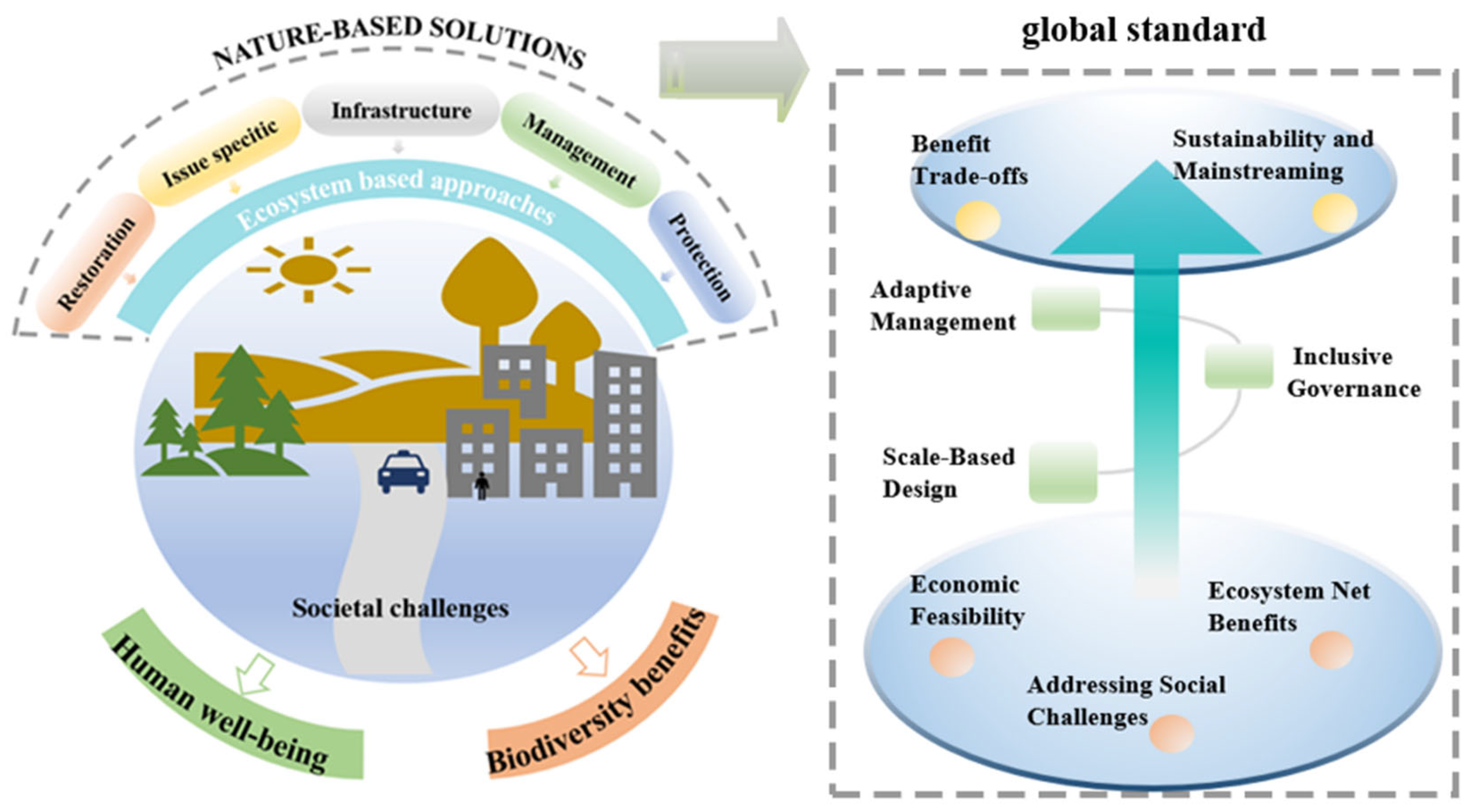
2.2.1. NbS Theory
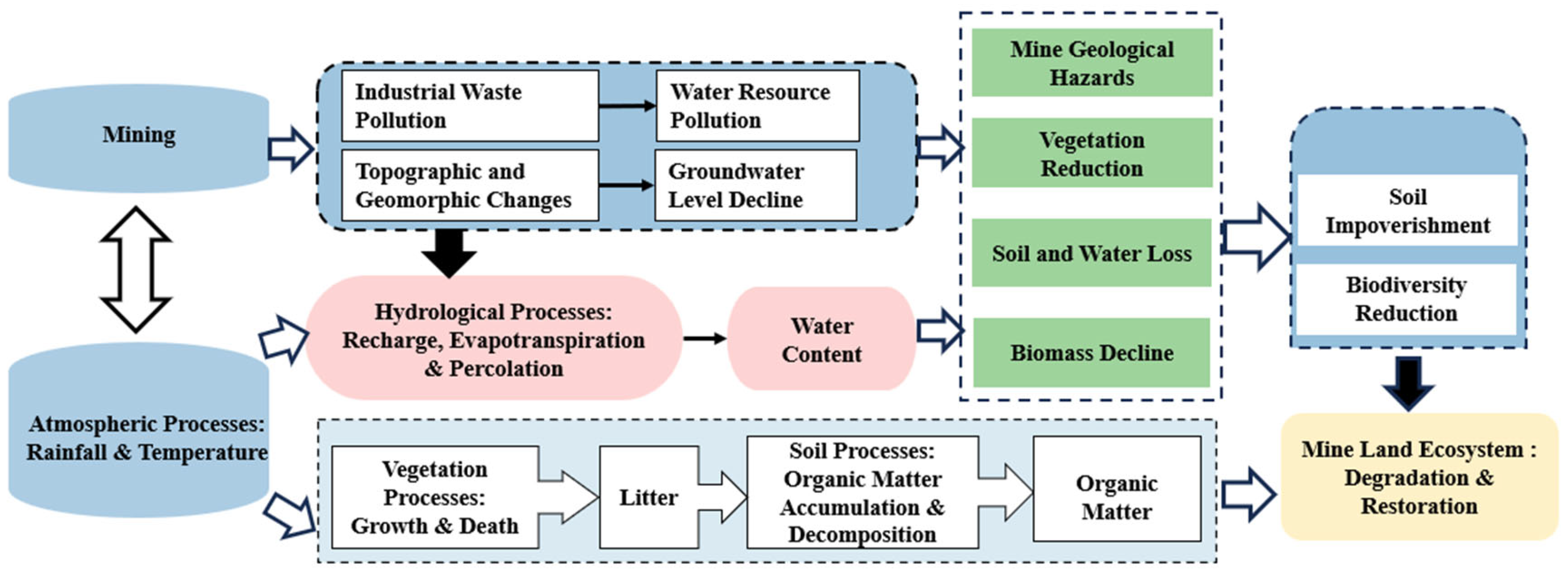
2.2.2. MLER
2.2.3. Coupling Mechanism Analysis
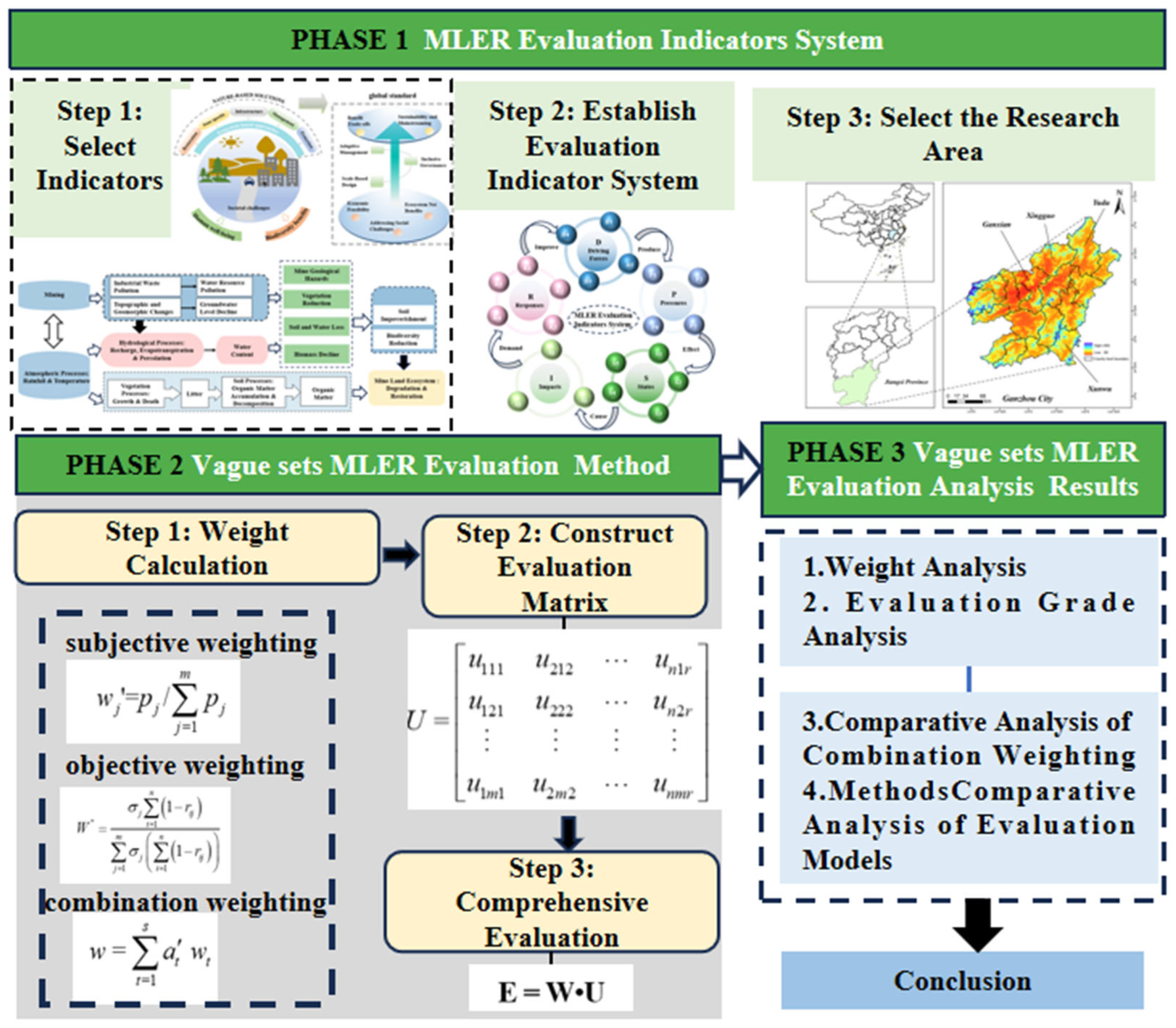
3. Evaluation Model Based on Vague Sets
3.1. Weight Calculation
3.1.1. AHP
3.1.2. CRITIC Method
3.1.3. Game-Theoretic Combination Weighting Method
3.2. Construction of Evaluation Matrix
3.3. Comprehensive Evaluation
4. Case Study Application
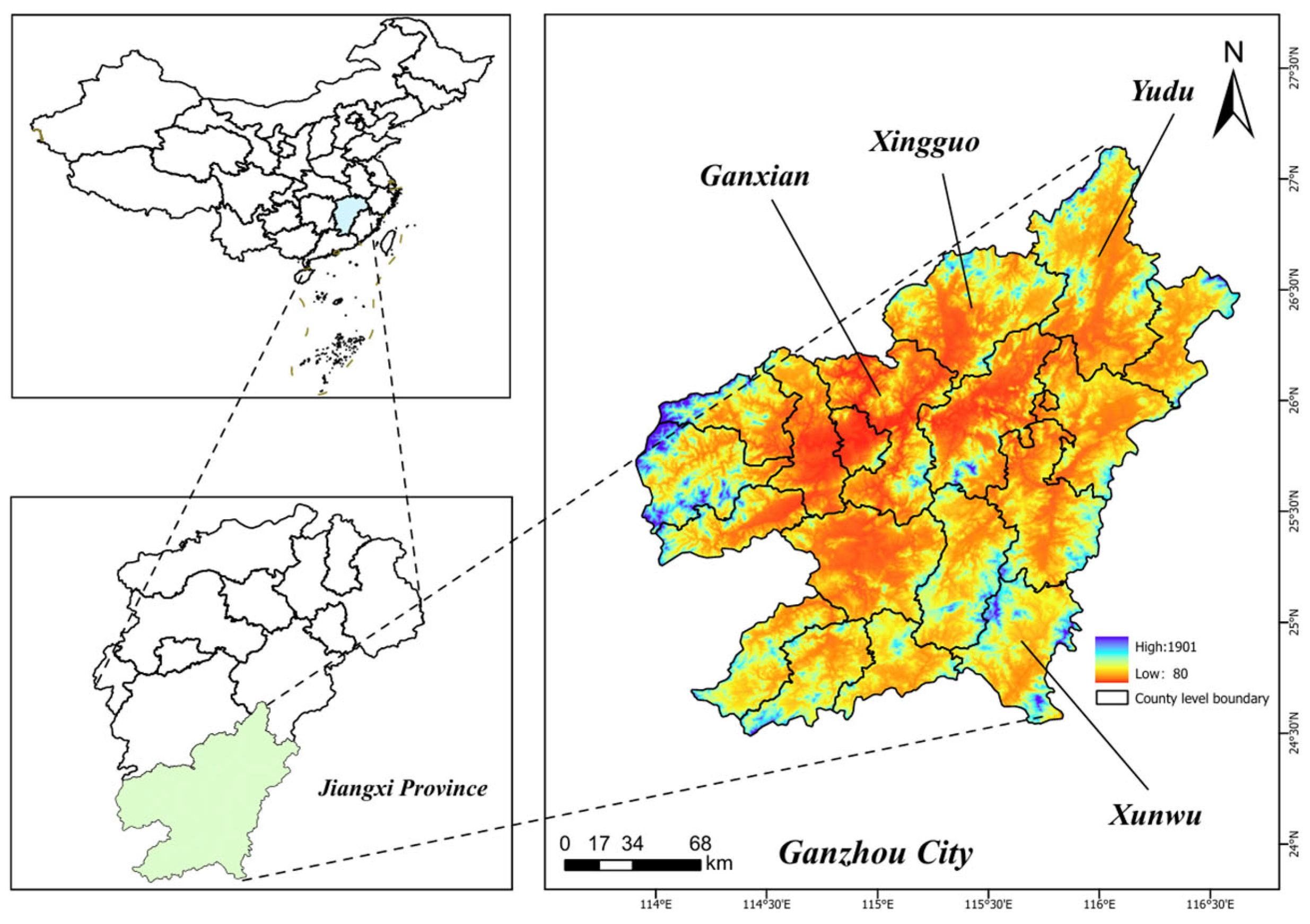
4.1. Overview of the Study Area for MLER
4.2. Establishment of MLER Evaluation Indicator System
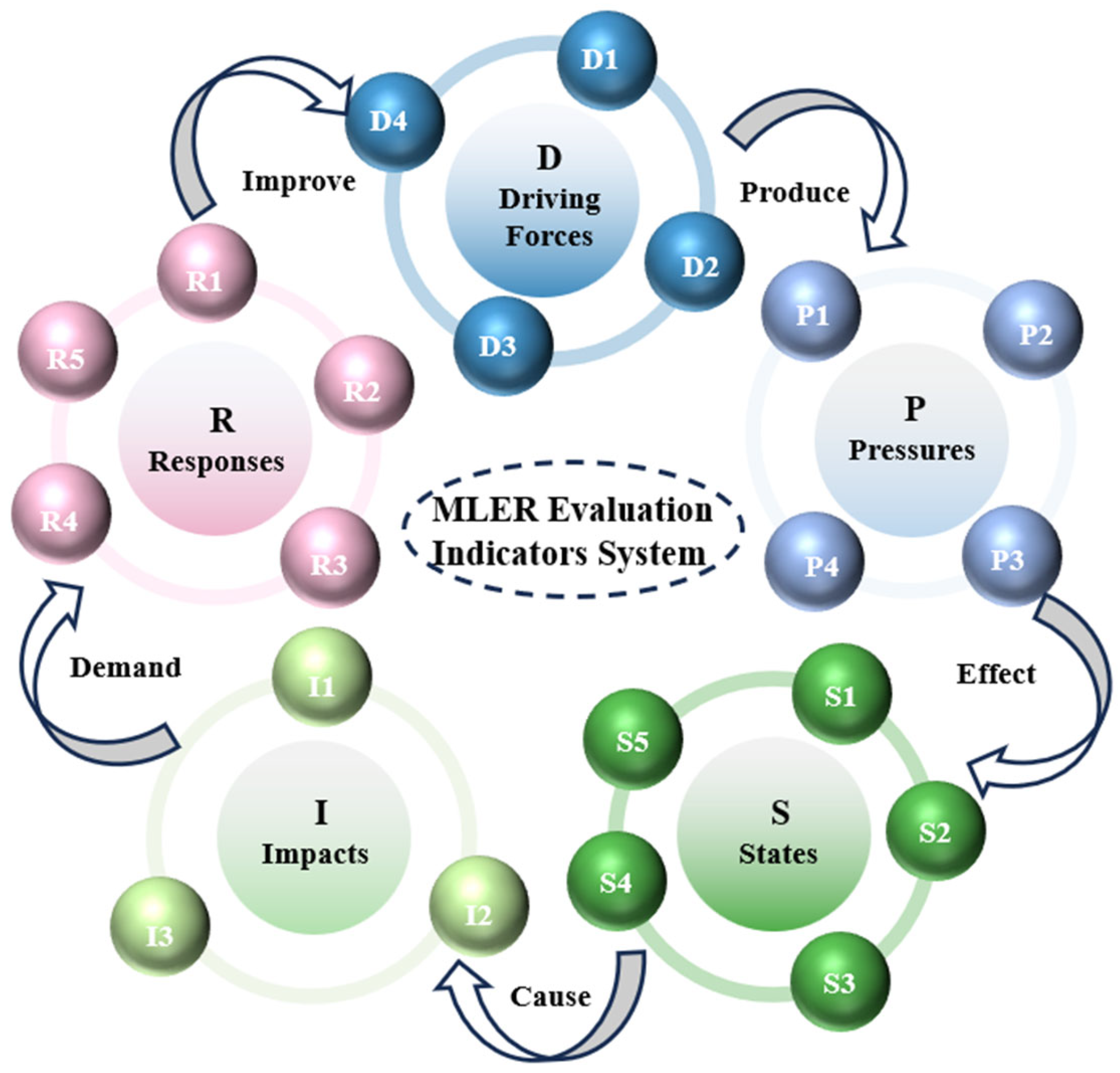
4.2.1. DPSIR Full-Dimensional Evaluation Indicator System
4.2.2. MLER Indicator Connotation
4.2.3. MLER Grading Standards
4.3. Data Sources for the MLER
4.4. Weight Calculation for the MLER Model
4.5. Construction of the Evaluation Matrix for MLER
4.6. Comprehensive Evaluation Results of the Mine Land Resilience Grading Model
5. Results and Discussion
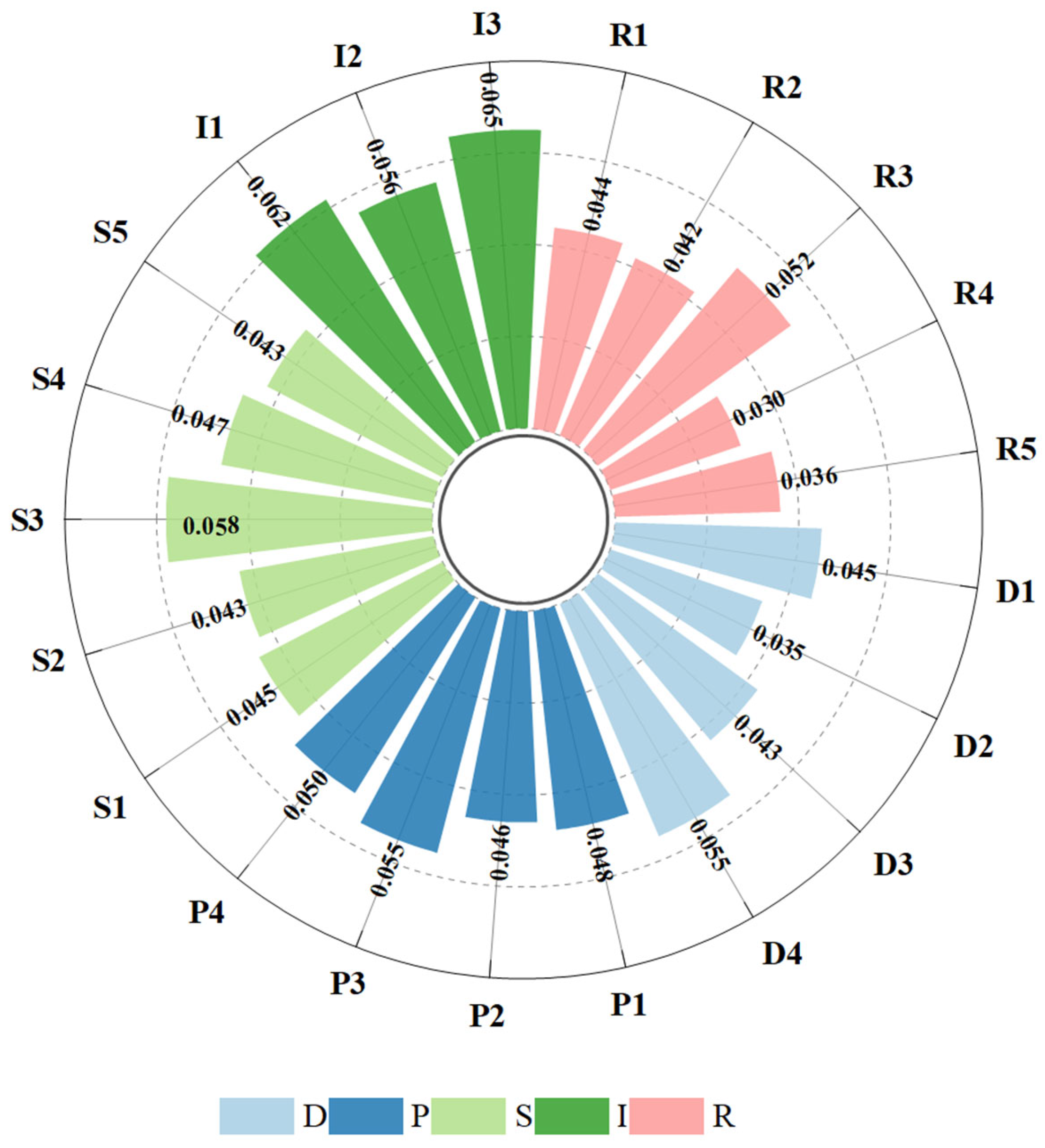
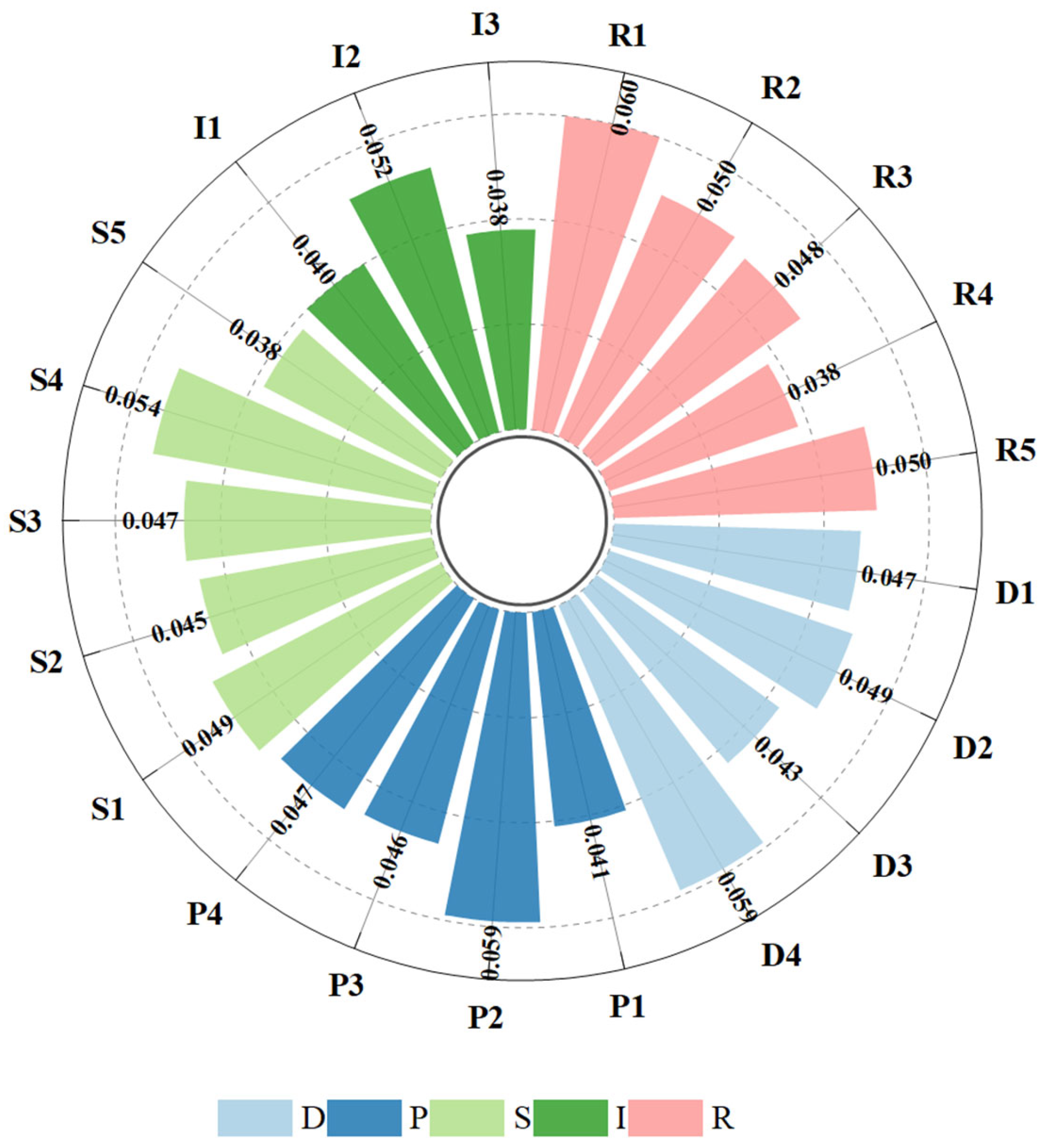
5.1. Weight Analysis
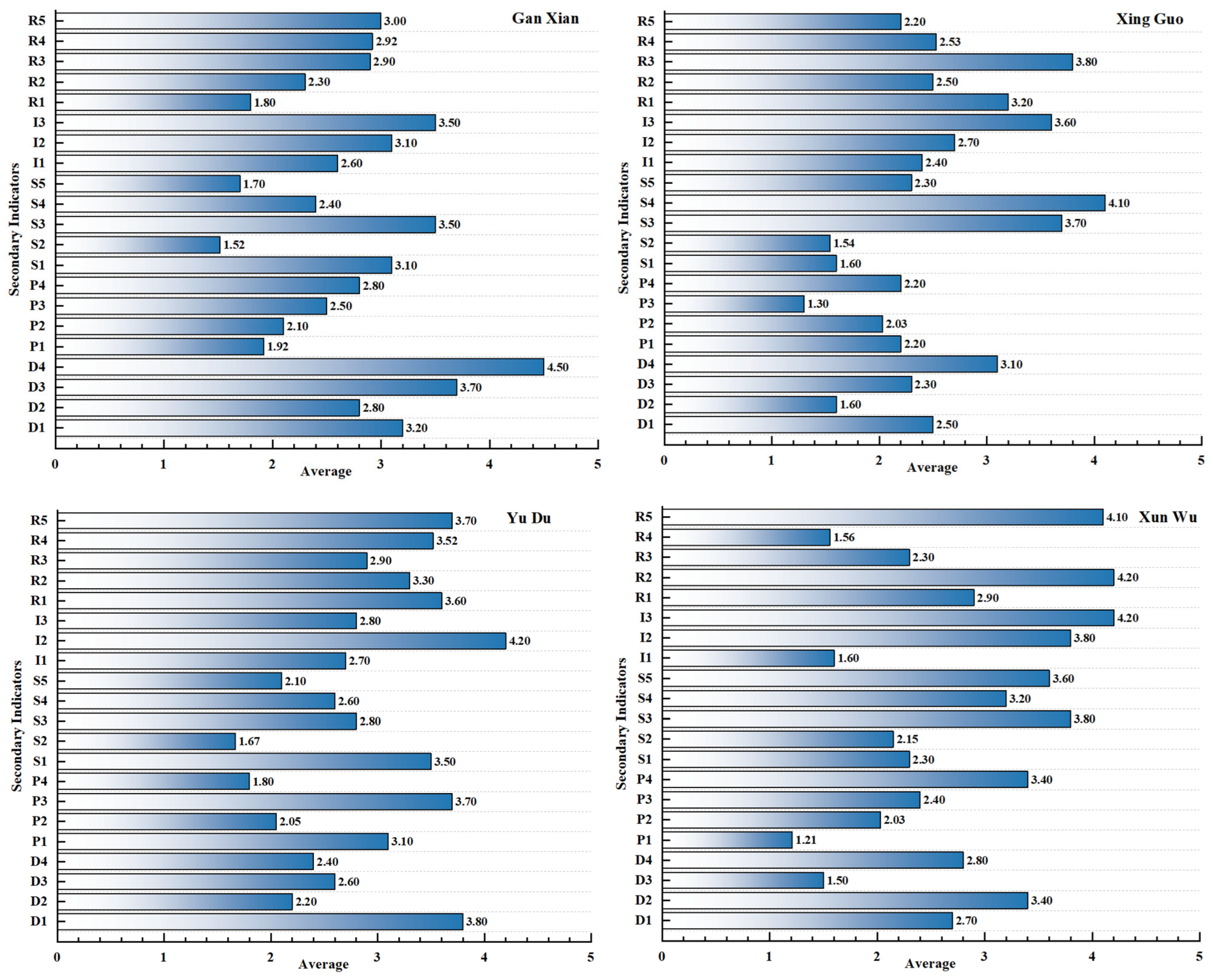
5.2. MLER Evaluation Level Analysis
5.3. Recommendations for Enhancing MLER
6. Analysis of Models
6.1. Comparative Analysis of Combined Weight Methods
6.2. Comparative Analysis of MLER Model
6.3. Limitations of Comprehensive Evaluation Model Based on Vague Sets
7. Conclusions
- (1)
- Guided by the NbS concept, a MLER evaluation indicator system is developed, which integrates NbS criteria with the DPSIR framework. This system includes 21 secondary indicators across five dimensions—drivers, pressure, state, impact, and response—breaking through the traditional limitation of focusing on short-term restoration while neglecting long-term sustainability. It achieves a “restoration—social adaptation—economic feasibility” sustainable goal, providing a targeted evaluation tool for ecological restoration in mining areas.
- (2)
- This research proposes a coupled evaluation model utilizing AHP-CRITIC game theory-based combined weighting and Vague sets, with the sustainable philosophy of NbS at its core. The combined weighting approach achieves a balance between subjective and objective weights through game theory, while the Vague sets effectively accommodate fuzzy information and data gaps within the evaluation process. By characterizing the continuous transitional features between different restoration levels through interval-based membership degrees, the Vague sets transcend the limitations of traditional discrete classification. This provides a scientific tool for the quantitative evaluation of the complex system that is mine ecological resilience.
- (3)
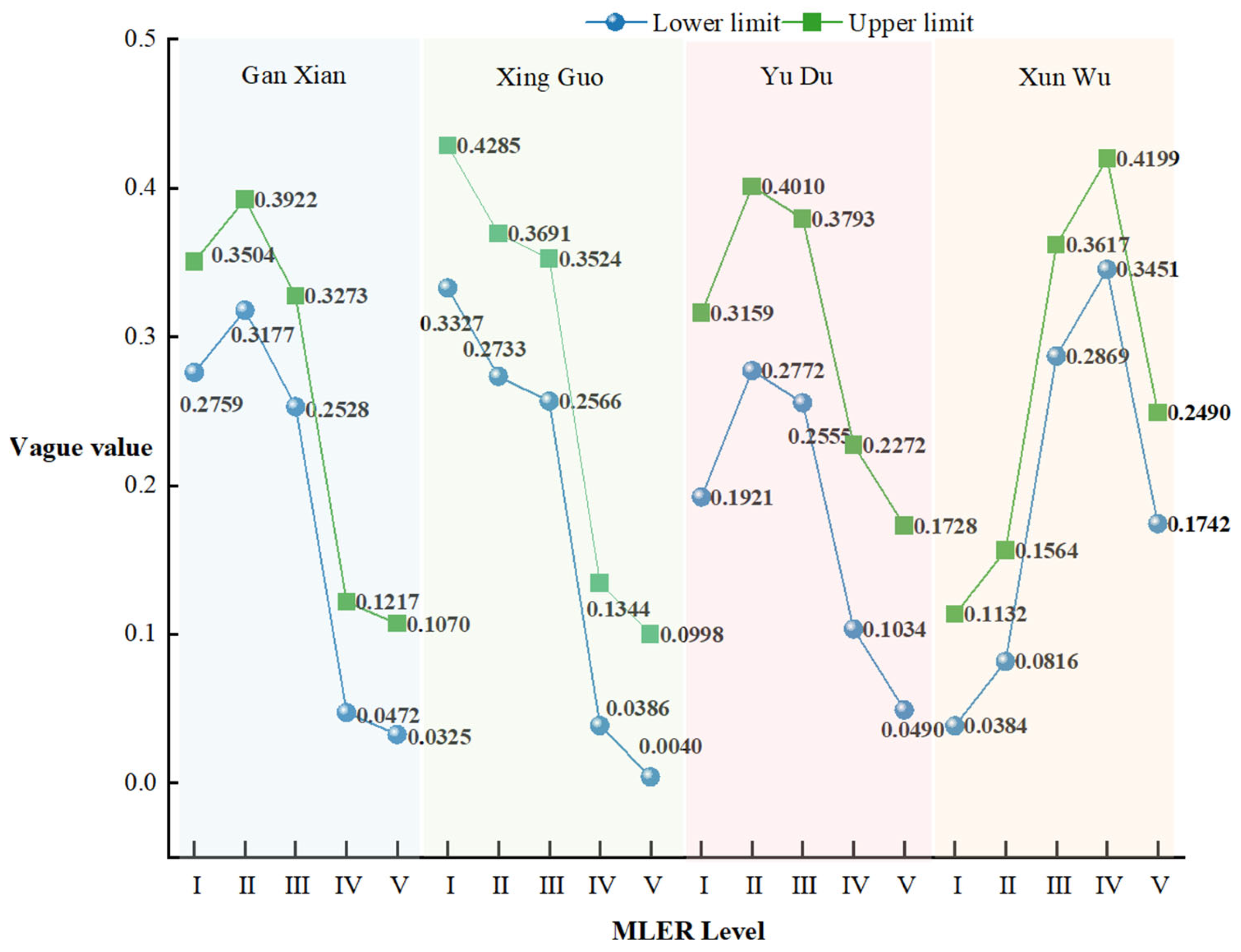
- The empirical research in four mining areas of Jiangxi Province validates the effectiveness of the NbS-guided evaluation model and reveals significant differences in ecological restoration capacity across the areas. The results show that Xing Guo mining areas have a “I” level of MLER, the Gan Xian and Yu Du mining areas have a “II” level of MLER, while the Xun Wu mining area is rated as “IV,” providing a scientific basis for the localization of the NbS concept and the formulation of differentiated restoration strategies.
- (4)
- This study verifies the applicability of the Vague sets in evaluating MLER, yet certain limitations remain. First, as the model is constructed based on static data, it is challenging to accurately depict long-term dynamic processes, such as the accumulation of soil fertility and vegetation succession. Second, the validation samples are concentrated in non-ferrous metal mining areas in the humid regions of Southern China, meaning the model’s universality for coal mines in northern arid regions and salt lake mines on high-altitude plateaus requires further improvement. Future research should introduce time-series Vague sets to optimize dynamic characterization and update the indicator system in alignment with regional ecological conditions, thereby further expanding the application scenarios of the model.
Author Contributions
Funding
Institutional Review Board Statement
Informed Consent Statement
Data Availability Statement
Acknowledgments
Conflicts of Interest
References
- Xiao, W.; Chen, W.; Deng, X. Coupling and Coordination of Coal Mining Intensity and Social-Ecological Resilience in China. Ecol. Indic. 2021, 131, 108167. [Google Scholar] [CrossRef] [Scilit]
- Yang, Y.; Erskine, P.D.; Zhang, S.; Wang, Y.; Bian, Z.; Lei, S. Effects of Underground Mining on Vegetation and Environmental Patterns in a Semi-Arid Watershed with Implications for Resilience Management. Environ. Earth Sci. 2018, 77, 605. [Google Scholar] [CrossRef] [Scilit]
- Wu, Z.; Lei, S.; Yan, Q.; Bian, Z.; Lu, Q. Landscape Ecological Network Construction Controlling Surface Coal Mining Effect on Landscape Ecology: A Case Study of a Mining City in Semi-Arid Steppe. Ecol. Indic. 2021, 133, 108403. [Google Scholar] [CrossRef] [Scilit]
- Moghimi Dehkordi, M.; Pournuroz Nodeh, Z.; Soleimani Dehkordi, K.; Salmanvandi, H.; Rasouli Khorjestan, R.; Ghaffarzadeh, M. Soil, Air, and Water Pollution from Mining and Industrial Activities: Sources of Pollution, Environmental Impacts, and Prevention and Control Methods. Results Eng. 2024, 23, 102729. [Google Scholar] [CrossRef] [Scilit]
- Deng, X.; Xiao, W.; Guo, J. Ecological Resilience Study in Mining Area: Current Status and Future Trends. Int. J. Coal Sci. Technol. 2025, 12, 67. [Google Scholar] [CrossRef] [Scilit]
- Yuan, Y.; Bai, Z.; Zhang, J.; Xu, C. Increasing Urban Ecological Resilience Based on Ecological Security Pattern: A Case Study in a Resource-Based City. Ecol. Eng. 2022, 175, 106486. [Google Scholar] [CrossRef] [Scilit]
- McKenna, P.B.; Lechner, A.M.; Phinn, S.; Erskine, P.D. Remote Sensing of Mine Site Rehabilitation for Ecological Outcomes: A Global Systematic Review. Remote Sens. 2020, 12, 3535. [Google Scholar] [CrossRef] [Scilit]
- Junxia, T.; Meng, S.; Xuanyun, Z.; Shichao, Z.; Juan, H.E. Ecological benefit evaluation of limestone gravel mine ecologic virescence project based on concept of Nature-based Solutions. Agric. Eng. 2025, 15, 123–131. [Google Scholar] [CrossRef]
- Xia, S.; Yang, W.; Tan, S. Evaluation of Ecological Rehabilitation Models for Abandoned Mines Using Analytic Hierarchy Process–Entropy Method and Sustainable Development Strategies. Sustainability 2024, 16, 10668. [Google Scholar] [CrossRef] [Scilit]
- Pan, Y.; Jiao, S.; Hu, J.; Guo, Q.; Yang, Y. An Ecological Resilience Assessment of a Resource-Based City Based on Morphological Spatial Pattern Analysis. Sustainability 2024, 16, 6476. [Google Scholar] [CrossRef] [Scilit]
- Xie, L.; Li, P.; Mu, D. Spatial Distribution, Source Apportionment and Potential Ecological Risk Assessment of Trace Metals in Surface Soils in the Upstream Region of the Guanzhong Basin, China. Environ. Res. 2023, 234, 116527. [Google Scholar] [CrossRef] [Scilit] [PubMed]
- Duan, Y.; Xiong, J.; Cheng, W.; Wang, N.; Li, Y.; He, Y.; Liu, J.; He, W.; Yang, G. Flood Vulnerability Assessment Using the Triangular Fuzzy Number-Based Analytic Hierarchy Process and Support Vector Machine Model for the Belt and Road Region. Nat. Hazards 2022, 110, 269–294. [Google Scholar] [CrossRef] [Scilit]
- Jiskani, I.M.; Zhou, W.; Hosseini, S.; Wang, Z. Mining 4.0 and Climate Neutrality: A Unified and Reliable Decision System for Safe, Intelligent, and Green & Climate-Smart Mining 4.0. J. Clean. Prod. 2023, 410, 137313. [Google Scholar] [CrossRef] [Scilit]
- Tayyab, M.; Hussain, M.; Zhang, J.; Ullah, S.; Tong, Z.; Rahman, Z.U.; Al-Aizari, A.R.; Al-Shaibah, B. Leveraging GIS-Based AHP, Remote Sensing, and Machine Learning for Susceptibility Assessment of Different Flood Types in Peshawar, Pakistan. J. Environ. Manag. 2024, 371, 123094. [Google Scholar] [CrossRef] [Scilit] [PubMed]
- Li, S.; Xiao, W.; Zhao, Y.; Lv, X. Incorporating Ecological Risk Index in the Multi-Process MCRE Model to Optimize the Ecological Security Pattern in a Semi-Arid Area with Intensive Coal Mining: A Case Study in Northern China. J. Clean. Prod. 2020, 247, 119143. [Google Scholar] [CrossRef] [Scilit]
- Nabukonde, A.; Barakagira, A.; Akwango, D. The Use of Geographical Information System (GIS) and Remote Sensing (RS) Technologies in Generation of Information Used to Mitigate Risks from Landslide Disasters: An Application Review. Arch. Curr. Res. Int. 2023, 23, 43–49. [Google Scholar] [CrossRef] [Scilit]
- Xu, W.; Wang, J.; Zhang, M.; Li, S. Construction of Landscape Ecological Network Based on Landscape Ecological Risk Assessment in a Large-Scale Opencast Coal Mine Area. J. Clean. Prod. 2021, 286, 125523. [Google Scholar] [CrossRef] [Scilit]
- Li, Y.; Zhao, G.; Wu, P.; Qiu, J. An Integrated Gray DEMATEL and ANP Method for Evaluating the Green Mining Performance of Underground Gold Mines. Sustainability 2022, 14, 6812. [Google Scholar] [CrossRef] [Scilit]
- Härdle, W.K.; Simar, L.; Fengler, M.R. Principal Component Analysis. In Applied Multivariate Statistical Analysis; Springer International Publishing: Cham, The Netherlands, 2024; pp. 309–345. ISBN 978-3-031-63832-9. [Google Scholar]
- Zhao, L.; Xie, H.; Cheng, L.; Sun, Z.; Li, X.; Yuan, Q. A New Method for Small Current Grounding Fault Line Selection Based on Fuzzy Entropy Weight Vague Set. Electr. Technol. Econ. 2024, 165–170. [Google Scholar]
- Yang, D.; Tsai, W.-T. Linear Consensus Protocol Based on Vague Sets and Multi-Attribute Decision-Making Methods. Electronics 2024, 13, 2461. [Google Scholar] [CrossRef] [Scilit]
- Hu, N.; Wang, M. An Effective Distance Measurement Formula Based on FuzzySet Theory. J. Hefei Univ. (Compr. Ed.) 2024, 41, 22–27. [Google Scholar]
- Kahraman, C.; Alkan, N.; Istanbul Technical University, Industrial Engineering Department. Circular Intuitionistic Fuzzy TOPSIS Method with Vague Membership Functions: Supplier Selection Application Context. Notes Intuitionistic Fuzzy Sets 2021, 27, 24–52. [Google Scholar] [CrossRef] [Scilit]
- Zhang, B.; Gai, Y.; Lu, Y. Comprehensive evaluation of high-speed railway station operation safetybased on IEM-Vague sets theory. China Saf. Sci. J. 2017, 27, 164–169. [Google Scholar] [CrossRef]
- Shan, R.; Wang, C.; Chen, X. Research on Emergency Rescue Capability of Coal Mine Based on Vague Set Theory. Coal Technol. 2016, 35, 320–321. [Google Scholar] [CrossRef]
- Yi, X. Method Improvement of Construction Project Risk EvaluationBased on ANP and Vague Sets Theory. J. East China Jiaotong Univ. 2013, 30, 9–15. [Google Scholar]
- Seddon, N.; Chausson, A.; Berry, P.; Girardin, C.A.J.; Smith, A.; Turner, B. Understanding the Value and Limits of Nature-Based Solutions to Climate Change and Other Global Challenges. Philos. Trans. R. Soc. B 2020, 375, 20190120. [Google Scholar] [CrossRef] [Scilit]
- Seddon, N.; Smith, A.; Smith, P.; Key, I.; Chausson, A.; Girardin, C.; House, J.; Srivastava, S.; Turner, B. Getting the Message Right on Nature-based Solutions to Climate Change. Glob. Change Biol. 2021, 27, 1518–1546. [Google Scholar] [CrossRef] [Scilit]
- Fischer, S.; Mörth, C.; Rosqvist, G.; Chalov, S.R.; Efimov, V.; Jarsjö, J. Microbial Sulfate Reduction (MSR) as a Nature-Based Solution (NBS) to Mine Drainage: Contrasting Spatiotemporal Conditions in Northern Europe. Water Resour. Res. 2022, 58, e2021WR031777. [Google Scholar] [CrossRef] [Scilit]
- Yongjun, Y.; Shaoliang, Z.; Huping, H.O.U.; Fu, C. Resilience mechanism of land ecosystem in mining area based on nonlinear dynamic model. Mtxb 2019, 44, 3174–3184. [Google Scholar] [CrossRef]
- Xu, H.; Waheed, A.; Kuerban, A.; Muhammad, M.; Aili, A. Dynamic Approaches to Ecological Restoration in China’s Mining Regions: A Scientific Review. Ecol. Eng. 2025, 214, 107577. [Google Scholar] [CrossRef] [Scilit]
- Jia, M.X.; Wang, J.M.; Li, Y.N.; Zhang, Y.F.; Gao, Y.T.; Wu, D.W. Ecological restoration of mines based on Nature-based Solution: A review. Coal Sci. Technol. 2024, 52, 209–221. [Google Scholar]
- Hong, L.; Feng, S.; Li, P.; Wang, A. Ecological Restoration and Regeneration Strategies for the Gumi Mountain Mining Area in Wuhan Guided by Nature-Based Solution (NbS) Concepts. Sustainability 2025, 17, 1913. [Google Scholar] [CrossRef] [Scilit]
- Koval, V.; Kryshtal, H.; Udovychenko, V.; Soloviova, O.; Froter, O.; Kokorina, V.; Veretin, L. Review of Mineral Resource Management in a Circular Economy Infrastructure. Min. Miner. Depos. 2023, 17, 61–70. [Google Scholar] [CrossRef] [Scilit]
- Wang, X.; Ke, Y.; Zhang, Q.; Luo, Y. Mining method optimization of transition from open pitto underground mining based on AHP-TOPSIS. J. Guangxi Univ. Nat. Sci. Ed. 2012, 37, 1273–1279. [Google Scholar] [CrossRef]
- Ke, Y.; Wang, C.; Fang, L.; Liao, B. Mine Safety Production Status Evaluation Based on Combination Weight and Matter Element Analysis. Gold Sci. Technol. 2020, 28, 910–919. [Google Scholar]
- Saaty, R.W. The Analytic Hierarchy Process—What It Is and How It Is Used. Math. Model. 1987, 9, 161–176. [Google Scholar] [CrossRef] [Scilit]
- Zhao, R.; Fang, C.; Liu, H.; Liu, X. Evaluating Urban Ecosystem Resilience Using the DPSIR Framework and the ENA Model: A Case Study of 35 Cities in China. Sustain. Cities Soc. 2021, 72, 102997. [Google Scholar] [CrossRef] [Scilit]
- Young, R.E.; Gann, G.D.; Walder, B.; Liu, J.; Cui, W.; Newton, V.; Nelson, C.R.; Tashe, N.; Jasper, D.; Silveira, F.A.O.; et al. International Principles and Standards for the Ecological Restoration and Recovery of Mine Sites. Restor. Ecol. 2022, 30, e13771. [Google Scholar] [CrossRef] [Scilit]
- Jiang, Y.; Li, H.; Zhang, Z.; Ren, G.; Zhang, J. Enhancing Ecological Sustainability in Ion-Adsorption Rare Earth Mining Areas: A Multi-Scale Model for Assessing Spatiotemporal Dynamics and Ecological Resilience. Ecol. Model. 2025, 502, 111038. [Google Scholar] [CrossRef] [Scilit]
- Xie, J.; Liu, Y.; Xie, M.; Xia, L.; Yang, R.; Li, J. Exploring the Restoration Stability of Abandoned Open-Pit Mines by Vegetation Resilience Indicator Based on the LandTrendr Algorithm. Ecol. Indic. 2024, 166, 112392. [Google Scholar] [CrossRef] [Scilit]
- Huang, L.; Erskine, P.; Parry, D.; Roddy, B.; Tibbett, M.; Fourie, A.B.; Boggs, G. Transforming Engineering into Ecological Engineering for Developing Resilient Ecosystems on Mined Landscapes; Australian Centre for Geomechanics: Crawley, Australia, 2022; pp. 29–48. [Google Scholar]
- Chen, Z.; Yang, Y.; Zhou, L.; Hou, H.; Zhang, Y.; Liang, J.; Zhang, S. Ecological Restoration in Mining Areas in the Context of the Belt and Road Initiative: Capability and Challenges. Environ. Impact Assess. Rev. 2022, 95, 106767. [Google Scholar] [CrossRef] [Scilit]
- Wen, C.; Qian, Y.; Wu, C.; Qiu, Y.; Cheng, W.U. Application of Spatial Analytical Methods to Nature-based Solutions: Review of Research Progress. South Archit. 2023, 6, 86–95. [Google Scholar]
- Hu, H.; Yang, L.; Li, J.; Su, L.; Feng, C. Evaluating the Performance of Nature-Based Solutions in Urban regeneration: A Case Study of the Shibalidian Area, Chaoyang District, Beijing. City Plan. Rev. 2025, 49, 97–107. [Google Scholar]
- Ganzhou Government. Ganzhou Statistical Yearbook 2024; China Statistics Press: Beijing, China, 2024. [Google Scholar]
- Zine, H.; Hakkou, R.; Papazoglou, E.G.; Elmansour, A.; Abrar, F.; Benzaazoua, M. Revegetation and Ecosystem Reclamation of Post-Mined Land: Toward Sustainable Mining. Int. J. Environ. Sci. Technol. 2024, 21, 9775–9798. [Google Scholar] [CrossRef] [Scilit]
- Du, L.; Hou, Y.; Zhong, S.; Qu, K. Identification of Priority Areas for Ecological Restoration in Coal Mining Areas with a High Groundwater Table Based on Ecological Security Pattern and Ecological Vulnerability. Sustainability 2024, 16, 159. [Google Scholar] [CrossRef] [Scilit]
- Ma, X.; Zhang, J.; Guo, L.; Yang, L.; Wang, J. Traps and improvements of PSR model: An eco-environmental perspective. Acta Ecol. Sin. 2024, 44, 4923–4932. [Google Scholar] [CrossRef]
- Begentayev, M.M.; Kuldeev, Y.I.; Nurpeissova, M.B.; Nurpeisova, T.B.; Kirgizbaeva, D.M. The Role of Environmental and Industrial Safety during Subsoil Development. Eng. J. Satbayev Univ. 2025, 147, 42–48. [Google Scholar] [CrossRef] [Scilit]
- Zhu, L. Research and Application of AHP-Fuzzy Comprehensive Evaluation Model. Evol. Intell. 2022, 15, 2403–2409. [Google Scholar] [CrossRef] [Scilit]



| Standard Value | Description |
|---|---|
| 1 | Two factors are equally important |
| 3 | One factor is slightly more important than the other |
| 5 | One factor is significantly more important than the other |
| 7 | One factor is strongly more important than the other |
| 9 | One factor is absolutely more important than the other |
| 1, 2, 4, 6, 8 | Represent the midpoint between the adjacent standard values |
| n | 1 | 2 | 3 | 4 | 5 | 6 | 7 | 8 | 9 |
| RI | 0.00 | 0.00 | 0.58 | 0.90 | 1.12 | 1.24 | 1.32 | 1.41 | 1.45 |
| Indicator | Grading Standards | ||||
|---|---|---|---|---|---|
| I | II | III | IV | V | |
| [5.00, 4.00) | [4.00, 3.00) | [3.00, 2.00) | [2.00, 1.00) | [1.00, 0.00) | |
| D1 | NbS specific policy covering the entire restoration cycle; compliance rectification rate 100%. | NbS supporting policies covering core stages; compliance rectification rate 80%. | General policies mention NbS, covering implementation stage only; compliance rectification rate 60–79%. | Scattered documents mention restoration; compliance rectification rate low 60%. | No restoration policies; compliance rectification |
| D2 | 100% capital matches ecological demand; long-term revenue mechanism in place. | 80–99% capital matches ecological demand; short-term revenue mechanism in place. | 60–79% capital matches ecological demand; only short-term appropriations. | <60% capital matches ecological demand; no revenue mechanism. | Capital completely decoupled from demand; insufficient capital guarantee, restoration difficult to advance. |
| D3 | opinion adoption rate 100%; supervision linked to performance assessment. | opinion adoption rate 80%; supervision included in performance assessment. | opinion adoption rate 60–79%; supervision at key nodes. | opinion adoption rate < 60% no supervision. | no feedback channels; prohibited from intervening in supervision. |
| D4 | Completely matches natural conditions; no parameter adjustment required; no adaptation risk; allows for natural succession. | Matches major natural conditions, minor incompatibility with secondary conditions; only minor parameter adjustment; low adaptation risk; largely allows for natural succession. | Generally matches major conditions, incompatible with secondary conditions; core stages require modification; moderate adaptation risk; requires manual assistance. | Match degree with major conditions < 60%; significant technical modification required; high adaptation risk; ecosystem prone to degradation. | Match degree with major conditions < 30%; unable to adapt; risk > 30%; easily triggers secondary environmental problems. |
| Category | CR |
|---|---|
| Dimension | 0.042 |
| D | 0.056 |
| P | 0.047 |
| S | 0.053 |
| I | 0.092 |
| R | 0.037 |
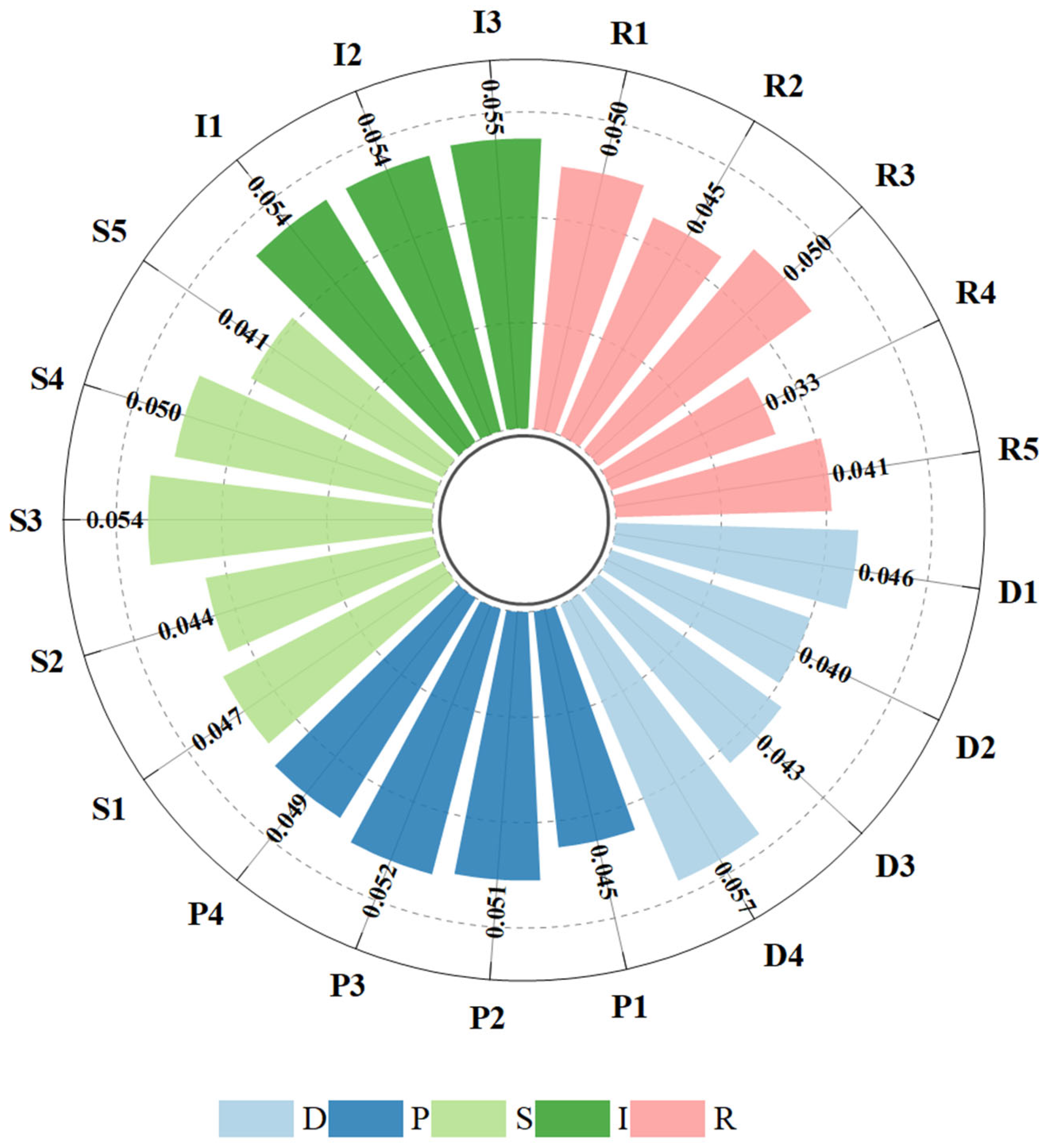
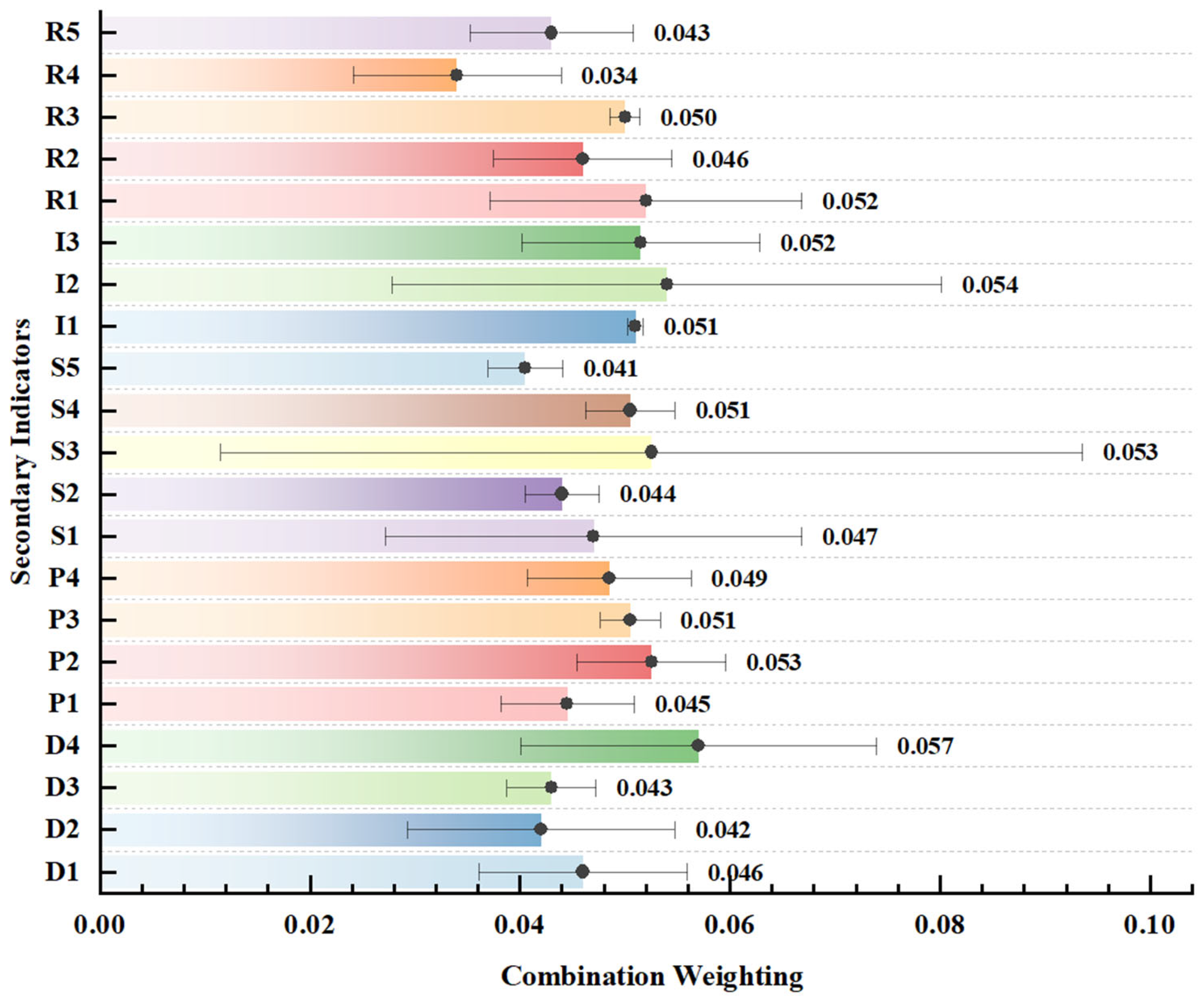
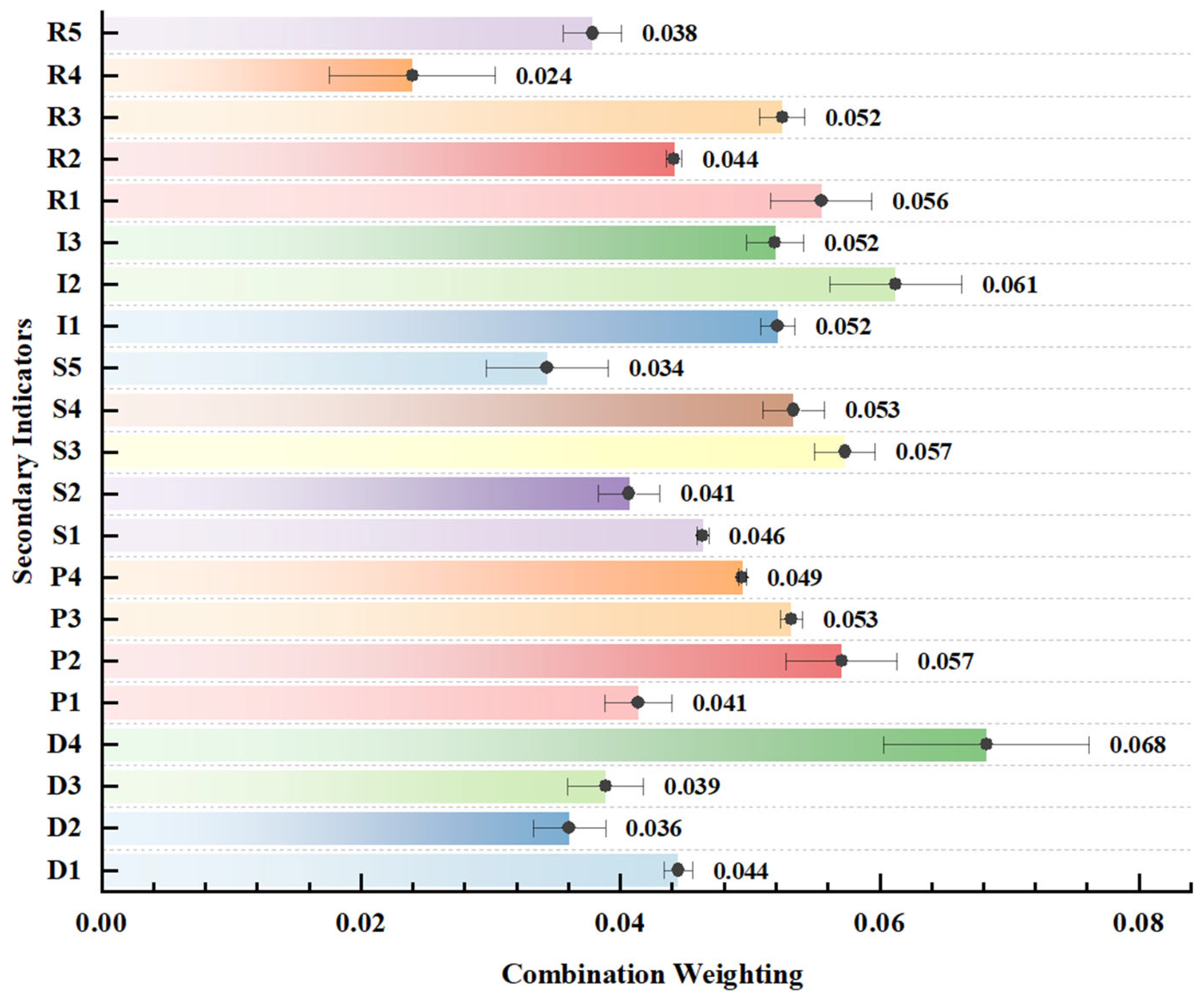
| Dimension | W′ | W″ | W | Secondary Indicators | W′ | W″ | W |
|---|---|---|---|---|---|---|---|
| D | 0.178 | 0.198 | 0.186 | D1 | 0.045 | 0.047 | 0.046 |
| D2 | 0.035 | 0.049 | 0.040 | ||||
| D3 | 0.043 | 0.043 | 0.043 | ||||
| D4 | 0.055 | 0.059 | 0.057 | ||||
| P | 0.199 | 0.193 | 0.197 | P1 | 0.048 | 0.041 | 0.045 |
| P2 | 0.046 | 0.059 | 0.051 | ||||
| P3 | 0.055 | 0.046 | 0.052 | ||||
| P4 | 0.050 | 0.047 | 0.049 | ||||
| S | 0.236 | 0.233 | 0.235 | S1 | 0.045 | 0.049 | 0.047 |
| S2 | 0.043 | 0.045 | 0.044 | ||||
| S3 | 0.058 | 0.047 | 0.054 | ||||
| S4 | 0.047 | 0.054 | 0.050 | ||||
| S5 | 0.043 | 0.038 | 0.041 | ||||
| I | 0.183 | 0.13 | 0.163 | I1 | 0.062 | 0.04 | 0.054 |
| I2 | 0.056 | 0.052 | 0.054 | ||||
| I3 | 0.065 | 0.038 | 0.055 | ||||
| R | 0.204 | 0.246 | 0.220 | R1 | 0.044 | 0.06 | 0.050 |
| R2 | 0.042 | 0.05 | 0.045 | ||||
| R3 | 0.052 | 0.048 | 0.050 | ||||
| R4 | 0.030 | 0.038 | 0.033 | ||||
| R5 | 0.036 | 0.05 | 0.041 |
| Dimension | Secondary Indicators | I | II | III | IV | V |
|---|---|---|---|---|---|---|
| D | D1 | [0.50, 0.60] | [0.20, 0.30] | [0.10, 0.20] | [0.10, 0.20] | [0.00, 0.10] |
| D2 | [0.30, 0.50] | [0.30, 0.50] | [0.10, 0.30] | [0.10, 0.30] | [0.00, 0.20] | |
| D3 | [0.20, 0.40] | [0.20, 0.40] | [0.30, 0.50] | [0.00, 0.20] | [0.10, 0.30] | |
| D4 | [0.40, 0.50] | [0.40, 0.50] | [0.10, 0.20] | [0.00, 0.10] | [0.00, 0.10] | |
| P | P1 | [0.30, 0.40] | [0.10, 0.20] | [0.50, 0.60] | [0.00, 0.10] | [0.10, 0.20] |
| P2 | [0.00, 0.00] | [0.50, 0.50] | [0.50, 0.50] | [0.00, 0.00] | [0.00, 0.00] | |
| P3 | [0.40, 0.50] | [0.40, 0.50] | [0.10, 0.20] | [0.00, 0.10] | [0.00, 0.10] | |
| P4 | [0.40, 0.50] | [0.20, 0.30] | [0.10, 0.20] | [0.00, 0.10] | [0.10, 0.20] | |
| S | S1 | [0.30, 0.30] | [0.20, 0.20] | [0.30, 0.30] | [0.20, 0.20] | [0.00, 0.00] |
| S2 | [0.20, 0.30] | [0.40, 0.50] | [0.10, 0.20] | [0.00, 0.10] | [0.20, 0.30] | |
| S3 | [0.50, 0.50] | [0.50, 0.50] | [0.00, 0.00] | [0.00, 0.00] | [0.00, 0.00] | |
| S4 | [0.30, 0.40] | [0.50, 0.60] | [0.10, 0.20] | [0.00, 0.10] | [0.00, 0.10] | |
| S5 | [0.00, 0.00] | [1.00, 1.00] | [0.00, 0.00] | [0.00, 0.00] | [0.00, 0.00] | |
| I | I1 | [0.50, 0.60] | [0.20, 0.30] | [0.10, 0.20] | [0.10, 0.20] | [0.00, 0.10] |
| I2 | [0.30, 0.30] | [0.30, 0.30] | [0.40, 0.40] | [0.00, 0.00] | [0.00, 0.00] | |
| I3 | [0.20, 0.20] | [0.20, 0.20] | [0.50, 0.50] | [0.10, 0.10] | [0.00, 0.00] | |
| R | R1 | [0.30, 0.40] | [0.10, 0.20] | [0.10, 0.20] | [0.20, 0.30] | [0.20, 0.30] |
| R2 | [0.00, 0.00] | [0.00, 0.00] | [1.00, 1.00] | [0.00, 0.00] | [0.00, 0.00] | |
| R3 | [0.20, 0.30] | [0.50, 0.60] | [0.10, 0.20] | [0.10, 0.20] | [0.00, 0.10] | |
| R4 | [0.10, 0.10] | [0.50, 0.50] | [0.30, 0.30] | [0.10, 0.10] | [0.00, 0.00] | |
| R5 | [0.20, 0.40] | [0.00, 0.20] | [0.60, 0.80] | [0.00, 0.20] | [0.00, 0.20] |
| Dimensions | MLER Level | ||||
|---|---|---|---|---|---|
| I | II | III | IV | V | |
| D | [0.0664, 0.0933] | [0.0526, 0.0795] | [0.0272, 0.0541] | [0.0086, 0.0355] | [0.0043, 0.0312] |
| P | [0.0539, 0.0685] | [0.0606, 0.0752] | [0.0581, 0.0727] | [0.0000, 0.0146] | [0.0094, 0.0240] |
| S | [0.649, 0.0743] | [0.1200, 0.1294] | [0.0235, 0.0329] | [0.0094, 0.0188] | [0.0088, 0.0182] |
| I | [0.0542, 0.0596] | [0.0380, 0.0434] | [0.0545, 0.0599] | [0.0109, 0.0163] | [0.0000, 0.0054] |
| R | [0.0365, 0.0547] | [0.0465, 0.0647] | [0.0895, 0.1077] | [0.0183, 0.0365] | [0.0100, 0.0282] |
| Region | MLER Level | Final Level | ||||
|---|---|---|---|---|---|---|
| I | II | III | IV | V | ||
| Gan Xian | [0.2759, 0.3504] | [0.3177, 0.3922] | [0.2528, 0.3273] | [0.0472, 0.1217] | [0.0325, 0.1070] | II |
| Xing Guo | [0.3327,0.4285] | [0.2733, 0.3691] | [0.2566, 0.3524] | [0.0386, 0.1344] | [0.0040, 0.0998] | I |
| Yu Du | [0.1921, 0.3159] | [0.2772, 0.4010] | [0.2555, 0.3793] | [0.1034, 0.2272] | [0.0490, 0.1728] | II |
| Xun Wu | [0.0384, 0.1132] | [0.0816, 0.1564] | [0.2869, 0.3617] | [0.3451, 0.4199] | [0.1742, 0.2490] | IV |
| Evaluation Method | MLER Level | Final Level | ||||
|---|---|---|---|---|---|---|
| I | II | III | IV | V | ||
| Vague sets | [0.2759, 0.3504] | [0.3177, 0.3922] | [0.2528, 0.3273] | [0.0472, 0.1217] | [0.0325, 0.1070] | II |
| AHP-Fuzzy comprehensive | 0.307 | 0.348 | 0.245 | 0.067 | 0.033 | II |
Disclaimer/Publisher’s Note: The statements, opinions and data contained in all publications are solely those of the individual author(s) and contributor(s) and not of MDPI and/or the editor(s). MDPI and/or the editor(s) disclaim responsibility for any injury to people or property resulting from any ideas, methods, instructions or products referred to in the content. |
© 2025 by the authors. Licensee MDPI, Basel, Switzerland. This article is an open access article distributed under the terms and conditions of the Creative Commons Attribution (CC BY) license.
Share and Cite
Feng, L.; Xie, J.; Ke, Y. Evaluation of Mine Land Ecological Resilience: Application of the Vague Sets Model Under the Nature-Based Solutions Framework. Sustainability 2026, 18, 164. https://doi.org/10.3390/su18010164
Feng L, Xie J, Ke Y. Evaluation of Mine Land Ecological Resilience: Application of the Vague Sets Model Under the Nature-Based Solutions Framework. Sustainability. 2026; 18(1):164. https://doi.org/10.3390/su18010164
Chicago/Turabian StyleFeng, Lu, Jing Xie, and Yuxian Ke. 2026. "Evaluation of Mine Land Ecological Resilience: Application of the Vague Sets Model Under the Nature-Based Solutions Framework" Sustainability 18, no. 1: 164. https://doi.org/10.3390/su18010164
APA StyleFeng, L., Xie, J., & Ke, Y. (2026). Evaluation of Mine Land Ecological Resilience: Application of the Vague Sets Model Under the Nature-Based Solutions Framework. Sustainability, 18(1), 164. https://doi.org/10.3390/su18010164