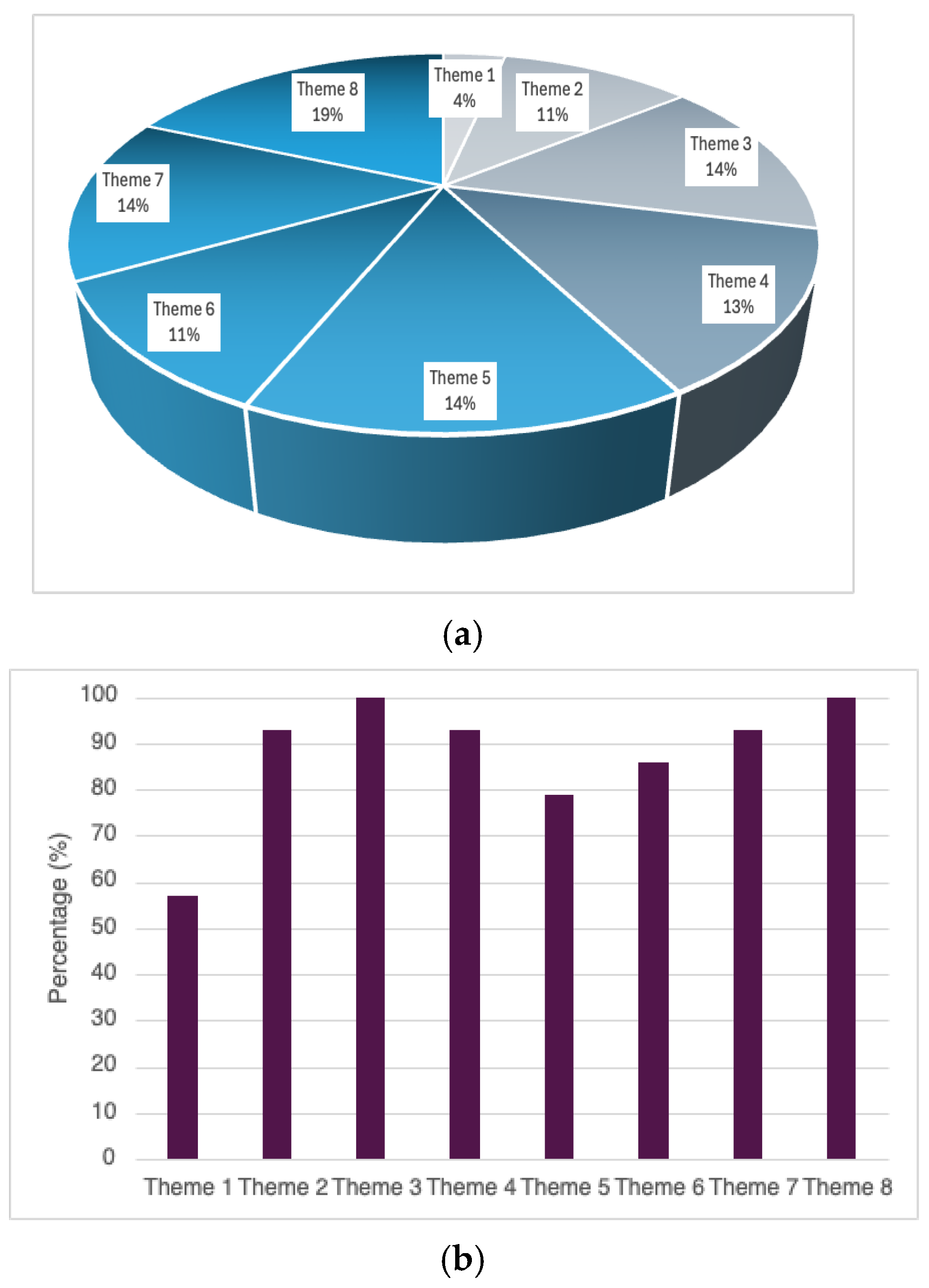
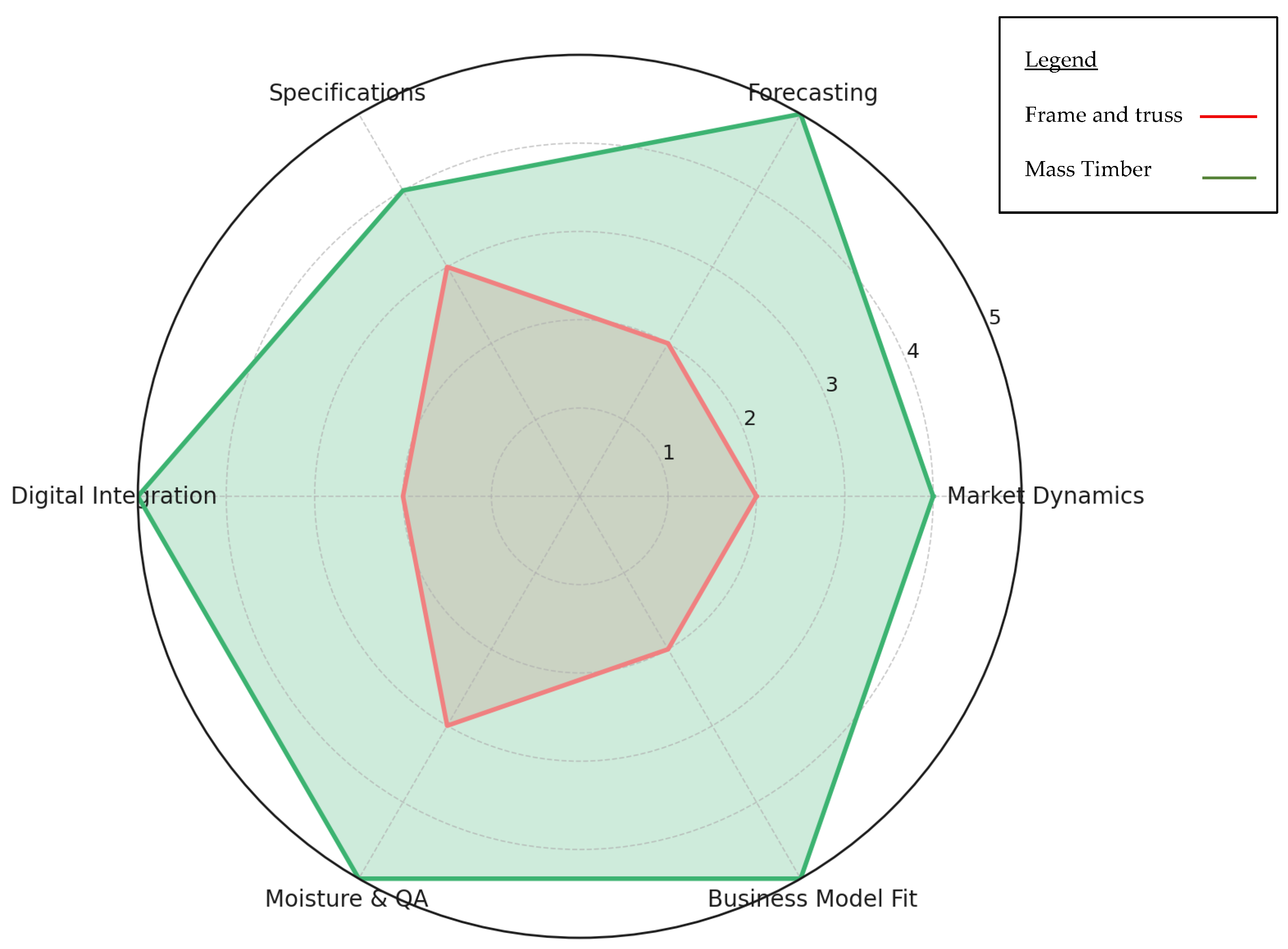
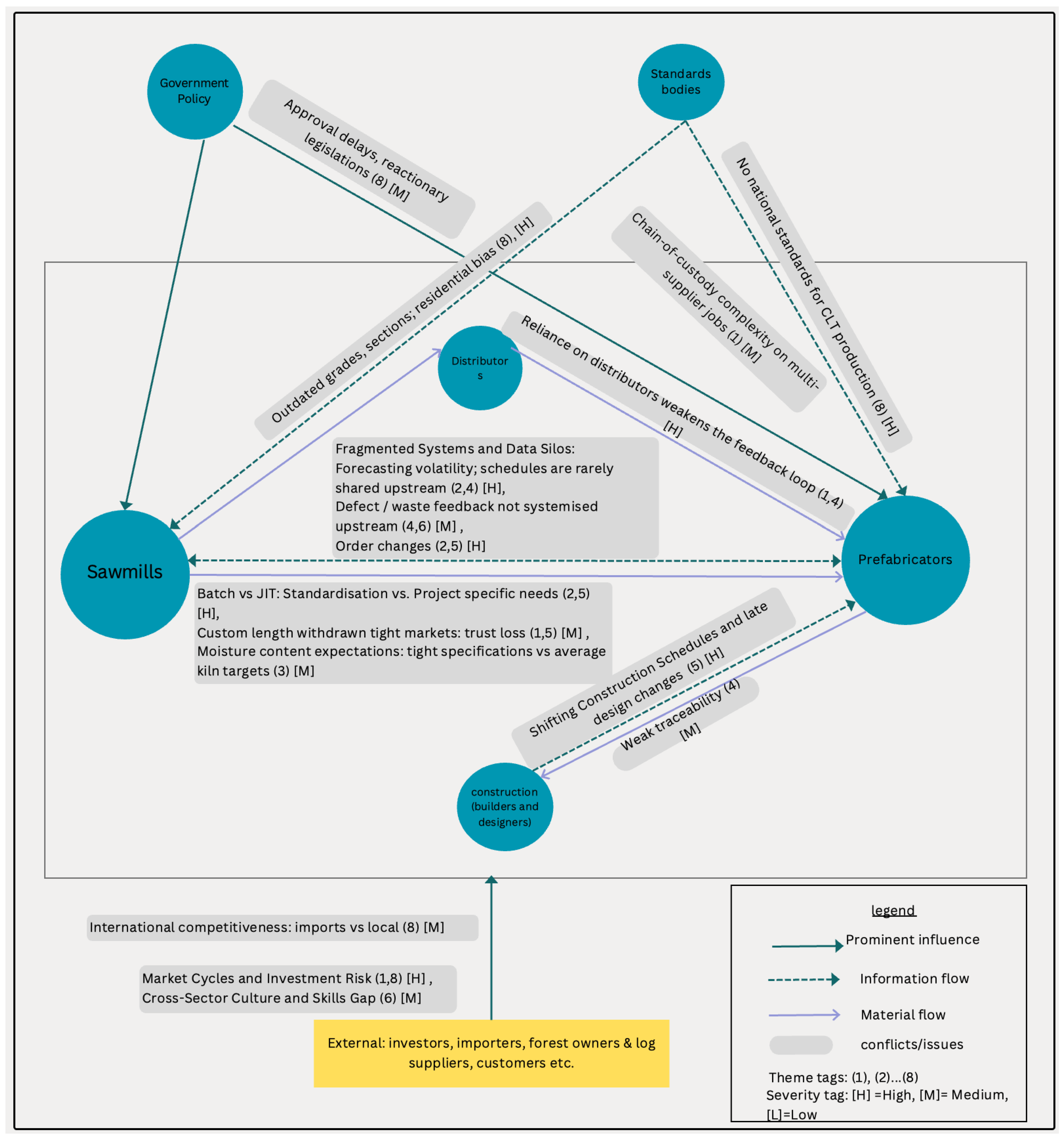
3.2. Thematic Analysis and Interpretation
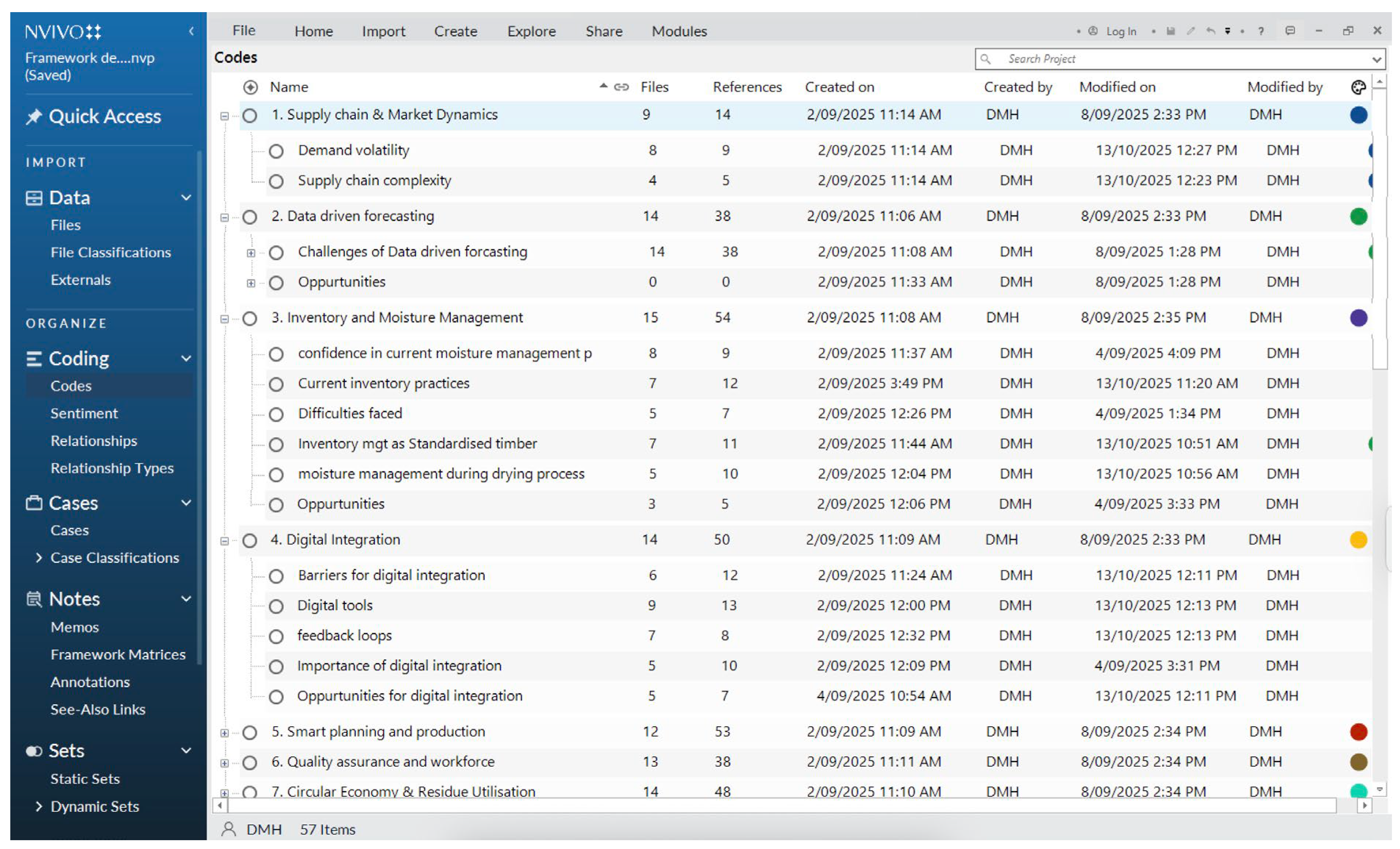
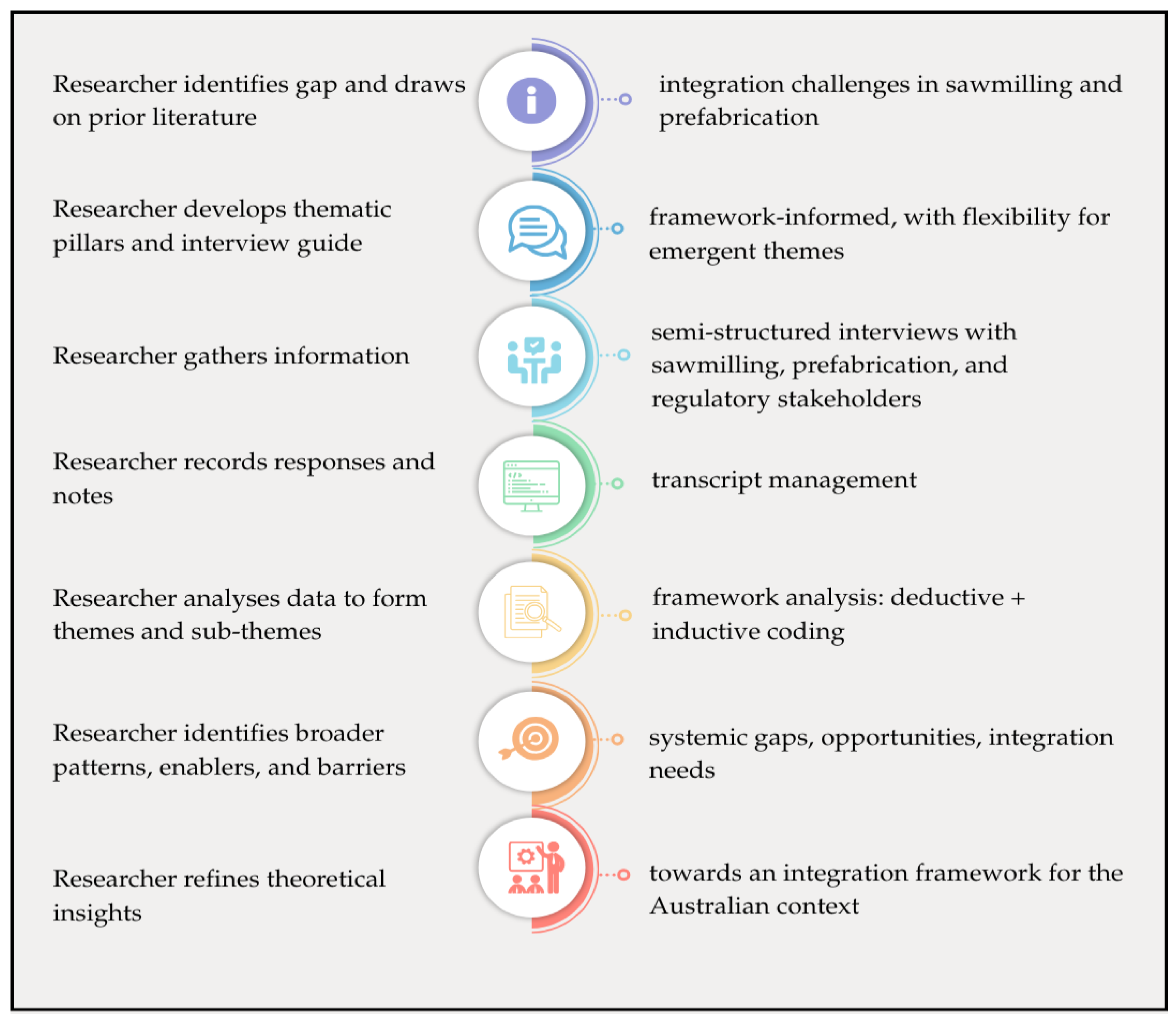
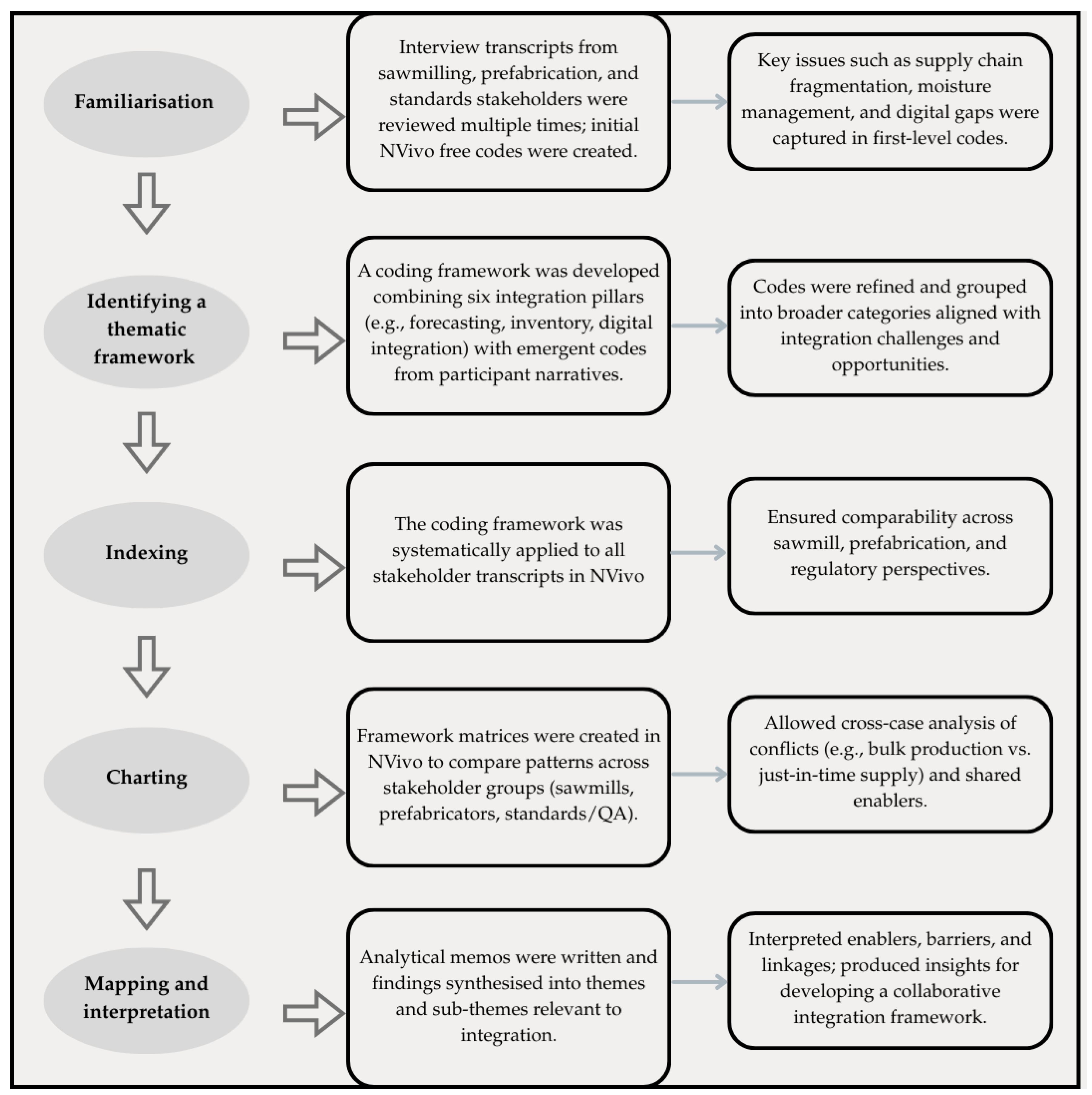
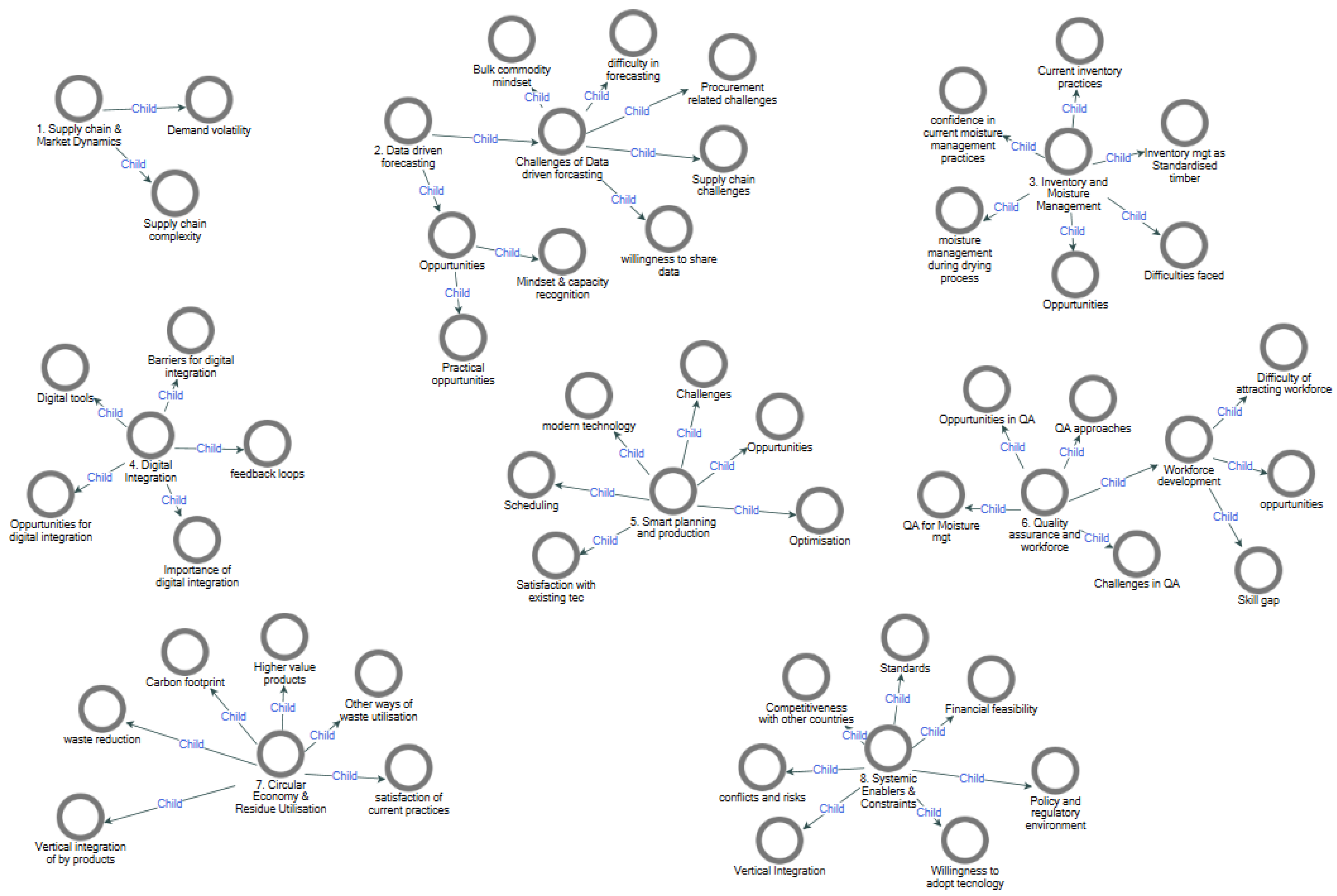
The Framework Matrix, developed and analysed in NVivo, guided the organisation and interpretation of stakeholder interviews, resulting in eight interrelated themes. These themes capture the key factors influencing the integration of sawmilling and prefabrication manufacturing in Australia, spanning operational, technical, and systemic dimensions. The interpretation was informed by an iterative coding process aligned with the analytical framework established in
Section 2. The following
Section 3.2.1,
Section 3.2.2,
Section 3.2.3,
Section 3.2.4,
Section 3.2.5,
Section 3.2.6,
Section 3.2.7 and
Section 3.2.8 present detailed thematic narratives supported by illustrative quotations from participants, reflecting the breadth and depth of perspectives captured across the study.
3.2.1. Theme 1: Supply Chain & Market Dynamics
This theme reflects external conditions largely beyond individual firms’ control. Stakeholders repeatedly stressed the importance of addressing fragmentation, distributor-led purchasing, and exposure to boom–bust cycles, all of which destabilise alignment between supply and demand.
In practice, supply is rarely a one-to-one relationship, and most prefabricators do not buy directly from mills. As P13 noted, “most prefabrication industries source timber through distributors, not directly from mills,” limiting the opportunities for integrated planning. As P01 put it, “the timber industry in Australia is quite fragmented….” P10 illustrated the consequence on a single job: “you can have a single truss job with timber from five different companies. That makes chain of custody impossible.”
The cyclical volatility of demand further compounds these challenges. One prefabrication expert explained, “the market is very cyclical, going through boom-and-bust phases, which adds complexity” (P10). Another participant linked this volatility to structural instability within the sector: “right now, the market is unstable, and demand fluctuates a lot. For example, demand surged during COVID, then dropped sharply. Companies change hands, plants close, and the whole sector struggles with long-term certainty” (P02). Such fluctuations make both forecasting and procurement planning highly uncertain, with ripple effects that extend across the entire supply chain.
3.2.2. Theme 2: Data-Driven Forecasting
Forecasting is central to integration since prefabricators’ project schedules must align with sawmills’ long production and drying cycles to ensure reliable delivery and reduced lead-time variability. This theme revealed that forecasting is central but remains limited by a bulk-commodity mindset, informal practices, and limited adoption of digital tools. While stakeholders acknowledged opportunities for better alignment, significant barriers persist.
Several participants emphasised that sawmilling continues to operate under a bulk-commodity logic, producing standardised outputs rather than tailoring supply to specific project needs. As one stakeholder put it, “we can’t make three pieces of timber for one truss manufacturer and twenty for another with specific attributes. Timber is a bulk commodity, internationally traded and highly standardised” (P03). This mindset makes it difficult for mills to adjust production to the more variable requirements of prefabrication.
Forecasting itself was described as inherently difficult, especially given the time required for drying and processing. One technical officer admitted, “forecasting is reasonably difficult. We run high-level forecasting models and they’re inevitably wrong, just a matter of how wrong” (P03). A project engineer also reflected on this uncertainty, noting that “we forecast as much as we can, but projects fail, change, or are delayed by up to a year… drying timber takes about a year, so forecasting is only ever going to be an estimate” (P02). These accounts demonstrate the tension between long production cycles in sawmilling and short-term volatility in construction demand. A younger designer highlighted the impact of construction cycles, noting that “even when we have confirmed orders, uncertainty in when land will be released for construction makes it difficult for companies like ours to forecast accurately and streamline production” (P06). P15 reinforced the operational importance of forward visibility, noting that “we forecast three months in advance at the Stock Keeping Unit (SKU) level… an order is the best form of forecast; it confirms that the demand is real and specifies the timing.” Unlike most participants who emphasised the difficulty of forecasting, this perspective demonstrates that systematic SKU-level forecasting is already practiced within advanced mills, albeit aggregated rather than customer-specific.
Procurement-related challenges also emerged as a barrier. One manager explained that greater visibility could improve efficiency but would require changes in procurement processes: “if sawmills had visibility of demand and upcoming projects in the pipeline, how would that affect procurement, especially competitive tendering?” (P04). In a similar vein, prefabricators expressed frustration at late-stage design changes and a lack of clarity about project pipelines, which prevent sawmills from adjusting production schedules effectively.
Data sharing was widely seen as a potential enabler of forecasting. A project engineer argued that “sharing project schedules would absolutely help. If prefabricators can specify log selection and book requirements in advance, then the process becomes far more efficient” (P02). However, most participants agreed that such practices remain rare, with information exchange typically informal and unsystematic.
Despite these challenges, stakeholders acknowledged opportunities. A standards CEO noted that “its relevance depends on the size of the prefabrication market. If it becomes a significant customer, forecasting will be very relevant” (P01). Larger mills and mass timber prefabrication manufacturers that supply CLT and GLT already use simpler forecasting models, which can be scaled further if demand from prefabrication grows. A supply chain and innovation manager added that “if a prefabrication customer knows their pipeline of work, they can place orders in advance… the sooner someone has certainty and places an order, the better,” highlighting how base-load orders could stabilise production and reduce reliance on estimations (P15). These reflections point to forecasting as both a current weakness and a future opportunity for tighter integration.
3.2.3. Theme 3: Inventory & Moisture Management
Moisture control and inventory management represent a key integration point, where sawmills’ drying and grading processes must connect with downstream handling and storage to minimise defects and rework. Moisture management is particularly critical for prefabrication processes involving adhesive connections, such as CLT and GLT production, where lamellae must meet strict tolerances to ensure bond strength and durability. Stakeholders consistently highlighted moisture control, storage practices, and inventory balancing as critical points. While some expressed confidence in current practices, others emphasised persistent difficulties, particularly in downstream handling and the reliance on standardised rather than project-specific approaches.
Inventory management was described as both necessary and costly. Participants explained that stockpiling and buffer inventories remain common, even when not ideal for efficiency. One designer noted, “depending on demand and usage, we maintain a certain level of stock” at prefabrication yards. (P06), while a quality specialist explained that at the sawmilling yard, “we rely heavily on finished goods inventory to meet immediate customer demand. At the same time, we look at the order bank to decide how many packs should receive one type of treatment versus another” (P12). Other participants pointed to difficulties associated with handling, storage, and market volatility. This reliance on inventory reflects the unpredictability of demand and the challenge of balancing responsiveness with efficiency. Participants also acknowledged the structural reliance on standardisation for inventory control. A quality specialist described their approach: “our output is mostly standard sizes, grades, and lengths. We do a little bit of customisation for internal engineered customers… but overall, we’ve kept things standardised” (P12). Another respondent emphasised the limitation this creates, remarking that “bulk production at sawmills limits responsiveness to specific customer or project-based demand” (P08). Standardisation ensures efficiency but restricts adaptability to prefabricators’ variable needs.
P15 provided a detailed account of moisture variation and seasonality, explaining that “production in September can result in slightly higher moisture content, and when those products are used later in the hot, dry months of November, they tend to lose additional moisture on site.” Inline moisture systems automatically reject wet boards during grading, yet natural variation persists. This reinforces that even with technological controls, seasonal conditions remain a key challenge in maintaining consistent moisture profiles.
The drying process itself was also noted as technically complex. A project engineer explained, “monitoring moisture is most critical during air drying and while kiln drying, since you’re trying to reach the correct moisture content. The difficulty is you can’t measure every piece continuously—you only sample enough to get an overall picture” (P02). A technical officer from a sawmill echoed this, describing how “we run large continuous kilns, which means we have very limited flexibility… all we can really do is dry to an ongoing average and minimise the standard deviation” (P03). For higher-value products such as CLT, however, stricter practices apply: “for CLT and GLT, we need to carefully control the moisture content of the lamellas before production. At our CLT plant, moisture is measured piece by piece before production” (P14).
Finally, participants highlighted opportunities for improvement through technology. As one project engineer noted, “real-time monitoring would be ideal, but in practice it means testing selected pieces, recording the data manually, and inputting it. Continuous real-time data is much more complex” (P02). A quality specialist observed that “quality assurance systems haven’t fully kept up with the advances in data availability. There’s definitely an opportunity to better use the richer data we now have” (P12). These views point to a gap between the availability of digital tools and their integration into routine moisture and inventory management practices.
Several participants were confident that sawmills generally manage moisture effectively during drying. As one project engineer observed, “in practice, if timber is kiln dried, properly processed, and then stored well, moisture is not really a major issue” (P02). A prefabrication coordinator added a similar view, stating, “from a feedstock perspective, since we receive all timber already graded and moisture-controlled, I haven’t seen any issues” (P14). These accounts reflect a perception that many moisture-related challenges arise not at the mill but later in the supply chain. One prefabrication CEO explained, “we do get a lot of moisture problems, but I don’t believe they necessarily come from the sawmill. More often, it’s when timber sits too long in members’ yards or on site after delivery” (P10).
A participant (P15) further noted that “we wrap all products in waterproof plastic for protection… warehouse storage is used for most items, though overflow stock is sometimes stored outside,” confirming the role of packaging and storage logistics in mitigating moisture-related risks.
Taken together, these perspectives show a divide between sawmills and prefabricators. Sawmills expressed confidence in their drying and grading processes but admitted reliance on standardised stock. Prefabricators pointed to problems downstream, particularly in storage and construction scheduling, where timber can be exposed to damaging conditions. Standards experts stressed the need for better Quality Assurance (QA) systems and education around handling. Overall, moisture and inventory management emerged as a technically solvable but organisationally fragmented area, requiring investment in monitoring, stronger assurance protocols, and shared responsibility across the supply chain.
3.2.4. Theme 4: Digital Integration
Digital systems underpin integration by enabling orders, traceability, and quality data to flow between sawmills and prefabricators, reducing manual inefficiencies and improving accountability. Stakeholders consistently discussed both the barriers and opportunities associated with adopting digital tools across sawmilling and prefabrication. While advanced mills are already experimenting with traceability systems, prefabricators often remain constrained by fragmented systems, supplier-driven software, and a reluctance to share data.
P15 described a mixed digital environment in the industry where “many frame and truss fabricators still place orders manually, often by phone or email, while larger corporate customers operate through electronic data interchange (EDI) systems.” This shows the coexistence of advanced EDI platforms and legacy communication modes. Short retailer lead times—“sometimes only 72 h between order placement and expected delivery”—underscore the pressure on stock visibility and digital responsiveness. Relationship-driven forecasting still plays a complementary role, as “sales representatives relay forward-looking information when a fabricator secures a large project,” blending digital and interpersonal channels.
Barriers to digital integration were emphasised by several participants who pointed to the lack of interoperability, cost, and resistance to change. One manager noted that order placement in their company with a vertically integrated business “happened informally. I don’t think they had any BIM or CAD integration” (P04). A project engineer described the inefficiencies of current processes, observing that “lead time and late design changes are major challenges… at the moment, nothing interfaces properly—systems are fragmented and there’s still a lot of manual work” (P02). Others remained sceptical about outcomes, with one participant reflecting, “I generally think digital integration has less potential than people expect. I’ve been involved in a couple of digital integration projects, and they’ve always been a lot of hard work and generally yielded fewer results than people were hoping for” (P04).
Participants also acknowledged the importance of digitalisation for future competitiveness. One standards expert argued that “it would be applicable, particularly for larger, more modern, and technologically advanced sawmills. However, smaller sawmills may not be in a position to apply it” (P01). A prefabrication expert suggested the potential of consumer-facing applications: “it would be great if a consumer could scan a QR code on a piece of timber and instantly see its processing line and everything it’s been through” (P10). At the same time, others warned that progress should be incremental: “broad sweeping changes are hard for large players to adopt. Small, realistic step changes in digital data transfer are more viable” (P05).
A participant stressed the importance of this capability: “smart tracking through QR codes and similar systems is essential, especially when this material is going into large-scale commercial buildings where the risk is high” (P05). A manager described how input lumber at the prefabrication yard is traced back via pack-level IDs: “Every time a pack is received, the pack tag—an individual identifier—is scanned in. When the pack is used, it’s scanned out. So, everything has that traceability attached” (P07).
The need for stronger feedback loops between prefabricators and sawmills was repeatedly mentioned. A prefabrication manager stressed that “it’s very important that data flows both ways between sawmills and prefabricators” (P05). However, a standards expert cautioned that “feedback loops… do exist, but they are fragmented. If data on defects and wastage could be fed back directly to the sawmills, it would be very useful” (P13). These perspectives reveal that while some systems capture detailed process data, this information rarely travels across the chain.
Taken together, sawmills highlighted their investment in QR-based traceability, but admitted difficulties in linking these systems with downstream partners. Prefabricators described dependence on proprietary software from suppliers, which restricted flexibility, while standards experts underscored the need for interoperability to enable accountability and chain of custody. Overall, digital integration was framed as both an inevitability and a challenge: without industry-wide standards, commitment, and willingness to adopt, progress will remain piecemeal despite the availability of sophisticated tools.
3.2.5. Theme 5: Smart Planning & Production
Stakeholders described planning and production challenges as central to integration, especially around scheduling, procurement, and the alignment of sawmill batch-driven operations with prefabricators’ just-in-time requirements. While sawmilling optimisation technologies are well developed, their benefits are limited by misaligned planning horizons and fragmented industry practices.
Scheduling emerged as one of the most pressing issues. A supply chain expert (P15) exemplifies how planning is operationalised. Their mill maintains “around 1600 active product types” and tracks each item through a “sales-versus-forecast monitoring tool” refreshed several times daily. Products are categorised by safety stock levels, and deviations above or below 100% trigger production adjustments. “It’s about reducing how wrong you are,” the participant reflected, emphasising continuous learning rather than predictive perfection. This structured monitoring, even if Excel-based, shows how practical analytics can support adaptive production planning in sawmilling. A technical officer explained that “our operations have to balance the forecast product mix against customer demand. Each mill produces thousands of stock keeping units… if we need a particular product mix for next month, that dictates the product mix required in the green mill today” (P03). From the prefabrication side, the problem lies in the timing of orders. A commercial manager noted that “once we reach a certain size, most mills ask us to place an order for next month by the 20th of the current month. The challenge is that we don’t get all our customer orders on the 1st; they come spread out across the month” (P07).
Despite these barriers, participants identified several practical opportunities. Sawmills emphasised the optimisation systems already in place, describing technologies that maximise yield from each log. A technical officer reported, “we also run cut-pattern optimisation systems, so there’s already significant optimisation in place” (P03). Similarly, a production manager noted that “most sawmills use shape recognition—they scan the log for its true shape and then make intelligent decisions about how best to fit rectangular boards within that round log” (P09). A prefabrication CEO summarised the benefits of this approach: “there’s no doubt that increased optimisation through sawing technology has reduced a lot of waste and allows our members to cut the timber accordingly” (P10). Frame and truss prefabricators often prefer long lengths to cut in-house, as one participant explained: “because we do our own cutting in-house, we prefer to get long lengths and then cut them into the required final pieces on our linear saws, which are optimised to minimise waste” (P07).
A prefabrication engineer added that efficiency depends heavily on timing and early coordination: “lead time and late design changes are major challenges… if a project design is finalised and locked in early, the whole process becomes much more efficient” (P02). Standardisation of common elements was also seen as a potential improvement, with a prefabrication manager pointing out that “studs are another example. There are basically three standard stud sizes used throughout the whole industry. If mills cut and delivered those directly, it would save a lot of handling and cut down on waste across the sector” (P07). Others suggested that better communication could allow sawmills to leverage their existing optimisation systems more effectively. As one business development manager explained, “modern sawmills are very advanced in how they scan and optimise yield from logs, so if they know the requirements in advance, they can target and align outputs more effectively” (P05).
Procurement-related challenges were also raised, particularly in relation to visibility and competitive processes. One timber construction manager asked, “if sawmills had visibility of demand and upcoming projects in the pipeline, how would that affect the procurement process, especially competitive tendering?” (P04).
Together, these perspectives highlight the divide between efficiency-driven sawmill operations and the variable, project-based needs of prefabrication. While sawmills have advanced optimisation tools and long-term planning systems, prefabricators seek flexibility, real-time coordination, and assurance against late design changes. Standards experts emphasised the potential of early specification lock-in and product standardisation (such as studs and lamellas) to bridge this gap. Overall, smart planning and production were seen not as technical shortcomings but as coordination challenges that require greater transparency and trust across the supply chain.
3.2.6. Theme 6: Quality Assurance (QA) & Workforce
Quality assurance and workforce skills are critical to integration since consistent grading, moisture tolerances, and trained personnel build the trust and reliability needed across the supply chain. Stakeholders consistently stressed the importance of quality systems, certification, and workforce skills as foundations for integration. While strong QA programs exist in some large sawmills and prefabrication facilities, inconsistencies in grading, limited training pathways, and workforce attraction challenges remain significant barriers.
Participants described quality assurance systems as generally well embedded in larger operations. One standards expert explained that “most of the larger sawmills have strong QA programmes and participate in product certification schemes. There’s also a good level of technical support available” (P01). P15 described the traceability systems: “each board carries a grade brand with a date and time stamp… we can immediately identify the batch, retrieve its production records, and examine detailed quality data, including moisture, strength, and grading calibration.” This demonstrates a mature QA infrastructure with digital traceability to the second of production. A sawmill product developer confirmed that “in both the mills and the engineered product plants, we already have a range of quality checks in place. We also have staff specifically allocated to quality roles who carry out these checks and report on them” (P11). Systems for addressing customer concerns were also mentioned, with one participant noting that “we conduct customer service surveys… when customer complaints come in, they are logged in the system and allocated to relevant staff for follow-up to improve the quality” (P11).
Moisture management was highlighted as a critical QA issue. A prefabrication coordinator explained that “for CLT and GLT, we need to carefully control the moisture content of the lamellas before production… if the timber is not dry enough—around 12% moisture plus or minus 2–3%—then the piece is rejected” (P14). A sawmill quality specialist described regional variation in standards: “we follow the Australian standards for moisture content. Regional variation matters—for example, timber destined for Tasmania versus Cairns ends up in different humidity environments, so customers expect slightly different equilibrium moisture levels” (P12). At the same time, a prefabrication CEO pointed out that failures often occur downstream: “we do get a lot of moisture problems, but I don’t believe they necessarily come from the sawmill. More often, it’s when timber sits too long in members’ yards or on site after delivery” (P10).
Capacity building and workforce development were also seen as crucial. A prefabrication business manager suggested that “cross-training between sawmills and prefabrication would be a great opportunity. Having that workflow integrated somewhere along the procurement chain would be very valuable” (P05). Another participant emphasised that “quality assurance and capacity building should not be too difficult to implement. Capacity building and quality assurance both have a strong impact” (P03).
Despite these opportunities, many highlighted ongoing difficulties in attracting and retaining skilled staff. A sawmill quality specialist explained, “sometimes it’s about location, but often it’s about expectations of work. People want continuous change, so retention can be harder than attraction” (P12). Others pointed to training lags, with one designer noting that “there’s also a noticeable training and experience lag when it comes to carrying out certain operations” (P06).
Underlying these issues is a wider skill gap in the timber sector. A technical officer observed, “in other trades, such as electricians or saw doctors, clear qualifications and pathways exist. But once you move into the technical quality area of timber manufacturing, nothing comparable is available” (P03). The same participant described how many QA professionals are recruited from unrelated backgrounds: “for example, we have a QA manager who came from another industry. But most of the people working in quality… have been trained in-house. There isn’t an integrated training pathway or formal qualification that specifically covers modern manufacturing quality in timber” (P03).
Taken together, these perspectives illustrate that while QA frameworks and certification schemes are widely recognised and applied, their effectiveness is undermined by inconsistent implementation, regional variation in moisture requirements, and weak training pathways. Sawmills largely emphasised compliance and internal QA systems, prefabricators stressed the impact of inconsistent grading and downstream moisture problems, and standards experts highlighted the absence of formal qualifications for QA professionals. Integration will depend not only on improving technical QA processes but also on strengthening workforce development to support consistency and trust across the supply chain.
3.2.7. Theme 7: Circular Economy & Residue Utilisation
Residue utilisation supports integration by linking by-products from sawmilling and prefabrication into shared value streams, advancing both efficiency and sustainability. Stakeholders highlighted how residues and offcuts, traditionally treated as waste, are increasingly seen as resources. Practices included energy generation, landscaping applications, and innovative product development, but challenges remain in logistics, investment, and scaling higher-value solutions.
Some participants connected residue utilisation to broader sustainability goals, noting the potential role of carbon accounting. As one engineer suggested, “beyond waste, I think we also need to consider carbon capture. It’s similar to what we see in the steel industry, where products can be traced back to the supplier, including the carbon footprint” (P08).
Others emphasised opportunities to move from low-value to higher-value products. A sustainability officer explained that “products that in Australia are often treated as low-value byproducts—destined for burning, landfill, or animal bedding—are converted overseas into higher-value outputs such as pellets for heating or even advanced products” (P03). A production manager highlighted the magnitude of this opportunity: “offcuts that currently go to the chipper for about $50 a cubic metre could be turned into prefabrication material worth $500–$1000 a cubic metre” (P09). In some cases, these opportunities have already been realised. One participant explained, “we built a plant to produce wood–plastic composite decking—it allows us to take a low-value byproduct and combine it with other materials to create a higher-value product” (P03).
Current practices for residue use were also discussed, often focused on energy and landscaping. A sawmill manager described that “we burn sawdust to generate heat energy for kiln drying, we sell our chip to packaging companies for cardboard production, and our bark goes to landscaping companies for soils and mulch” (P09). Another explained how networks of secondary users have developed: “one bought a shredder, processes all his waste, and supplies it to horse studs in Woodend, where it’s used as high-quality bedding. Another sends mostly treated offcuts to a canola mills, where they’re burned to power the plant” (P10). P15 described a highly integrated residue pathway: “we’re co-located with a board manufacturing plant, so all our sawdust, chips, and shavings are transported there for use in board production… achieving close to 100% utilisation of material delivered to the mill.” Bark is sold to compost producers, and export or biomass energy options are maintained as contingencies. The participant argued that “the best way to ensure the industry’s future is to maximise value from every cubic metre of timber,” directly linking residue valorisation to economic resilience
Despite these practices, some participants felt the impact at the prefabrication end was limited. As one commercial manager reflected, “even though we’ve got waste down to what I’d call best practice levels—probably between 1.5% and 2.5%—we still end up with a large skip bin at the end of each month. The best we can do as a prefabrication plant is pay to drop it off somewhere” (P07). Another added, “prefabrication facilities don’t generate much waste, so their contribution is relatively small. Compared to sawmilling, their waste volumes are minimal and may not justify secondary product streams” (P05).
Vertical integration was described as an effective strategy for creating value from residues. One sustainability officer explained, “vertical integration works for us when it comes to residue utilisation, such as producing wood–plastic composite products, because it doesn’t put us in competition with our customers” (P03). A quality specialist similarly noted that “our organisation is already fairly vertically integrated, and one of the main goals of that is to create value from residue products—whether that’s bark, sawdust, shavings, offcuts, or low-grade timber—by engineering them into higher-value products” (P12).
Finally, some participants stressed that waste minimisation has already improved significantly, particularly with modern sawmilling technologies. A prefabrication CEO explained, “there’s no doubt that increased optimisation through sawing technology has reduced a lot of waste and allows our members to cut the timber accordingly” (P10). An R&D engineer added that “with software integration, wastage is already quite low, and if the software is used to its full potential, waste could be reduced even further” (P08).
In summary, sawmills highlighted extensive use of residues in energy, landscaping, and secondary product streams, while acknowledging untapped opportunities in higher-value applications. Prefabricators expressed satisfaction with already low waste levels but emphasised disposal costs as a lingering issue. Standards and QA participants pointed to the importance of carbon accounting and lifecycle considerations in residue utilisation. Together, these perspectives suggest that residue management is a relative strength of the Australian timber sector, but one with considerable potential for advancing circular economy practices through vertical integration, digital traceability, and policy support.
3.2.8. Theme 8: Systemic Enablers & Constraints
Stakeholders agreed that integration between sawmilling and prefabrication cannot be achieved through technical solutions alone. Broader systemic factors including financial feasibility, international competitiveness, policy frameworks, standards, and industry culture either enable or constrain progress.
Competitiveness with overseas producers was a recurring concern. Participants pointed out that structural differences in timber quality place Australian producers at a disadvantage. A sawmill production manager observed that “European species such as spruce and fir grow slowly, have smaller knots, and higher stiffness. Their lower-grade timber often still meets or exceeds Australia’s structural framing requirements. As a result, Australian CLT products often cannot compete with imports” (P09). A standards CEO added that “with education, support, and a strong business case, however, the industry could make itself ready. In comparison to Europe, Australia still has much room for improvement” (P01).
Financial feasibility emerged as a major barrier to innovation and technology adoption. A project engineer explained that “the issue is more about investment. Right now, the market is unstable, demand fluctuates a lot, and businesses are reluctant to commit significant resources. If there was more stability, they would be more willing to invest” (P02). A business development manager noted the divide between large and small operators: “it requires significant investment to implement high-end technology, which makes it harder for smaller sawmills to access or adopt. There’s still some work needed to make these solutions more viable and practical for the wider industry” (P05). Willingness to adopt technology was seen as a cultural barrier as much as a financial one. A standards expert remarked that “in technology, the solutions already exist, but the key issue is willingness to adopt and invest” (P01). A prefabrication engineer added that “change management is a big issue in the timber industry. Many people still prefer traditional methods, so efficiency gains aren’t fully realised” (P08). For some, the solution lies in incrementalism: “broad sweeping changes are hard for large players to adopt—small, realistic step changes in digital data transfer are more viable” (P05).
Participants also discussed policy and regulatory frameworks as either supportive or obstructive. One standards expert argued that “in the policy space, government incentives and support for prefab adoption would help” (P01). A designer pointed to procedural bottlenecks: “I don’t believe the policies themselves prevent industry growth. However, there are bottlenecks in government procedures that create major short-term challenges—for example, delays in land registry approvals have created significant backlogs” (P06). A manager described a broader frustration: “it feels like we have a very reactionary legislative environment, particularly in New South Wales” (P04). P15 stressed the importance of policy coordination, recalling that “during the pandemic, stimulus measures caused a massive surge in demand, but the sector wasn’t prepared for it.” They suggested that advance notice of government housing programs would allow mills to “prepare by recruiting and training workers in advance,” smoothing demand volatility and supporting sustained workforce retention.
The role of standards was emphasised by several stakeholders. A standards expert noted that “current timber standards are 25–30 years old and geared toward residential construction. New grades and section sizes better suited to prefabrication could be developed” (P01). Others pointed to gaps in design codes, with a prefabrication coordinator explaining that “another gap is the absence of a national standard for designing CLT structures. Structural engineers often rely on international standards such as Eurocode 5, approving projects through performance-based assessments rather than deemed-to-satisfy provisions” (P14).
Vertical integration was identified as both an enabler and a risk. A standards CEO suggested that “vertical integration makes a lot of sense here, and if a sawmill invests downstream into prefabrication, essentially becoming its own customer, then the model could work effectively” (P01). Similarly, a sustainability officer explained that “that’s why vertical integration has worked for us in composites, CLT, and GLT—we didn’t have customers in those markets, so we weren’t competing with them” (P03). A sawmill quality specialist summarised its potential, stating that “vertical integration definitely has potential. It breaks down barriers between businesses and makes resource utilisation more viable” (P12). Conflicts and risks were also raised, particularly around integration models. One sustainability officer warned that “if we were to integrate with one prefabricator, it would create conflicts with others. That’s why no sawmill owns a truss manufacturer—it would drive away competitors” (P03).
Trust was another issue, with one commercial manager recalling that “once you build your operations around dock-to-length supply and it’s taken away, you’re left without the cutting capacity to handle it yourself. That’s why many in the industry don’t want to rely on mills for that again” (P07).