Article

Prospects for the Development of Onshore Wind Energy in Light of the Implementation of the European Landscape Convention: The Example of Poland

by
Krzysztof Badora
* and
Radosław Wróbel
Institute of Environmental Engineering and Biotechnology, Faculty of Natural Sciences and Technology, University of Opole, 45-032 Opole, Poland
*
Author to whom correspondence should be addressed.
Sustainability 2026, 18(1), 11; https://doi.org/10.3390/su18010011
Submission received: 11 November 2025 / Revised: 15 December 2025 / Accepted: 17 December 2025 / Published: 19 December 2025

Abstract

The development of onshore wind energy is linked to the conditions for landscape protection and development established during the implementation of the European Landscape Convention (ELC). In Poland, the implementation of the ELC results in the designation and protection of priority landscapes, which may restrict the construction of new wind farms. The widespread ratification of the ELC by European countries where wind farms are being developed makes the possibility of limiting wind energy development through ELC implementation an important issue from a research and practical perspective. Experience from Poland can be helpful in optimizing the implementation process without impacting the total installed capacity of wind farms. Using GIS tools and a multi-criteria assessment of the conditions for excluding areas from wind energy development in Poland, the scale of territorial barriers was assessed in the variants without and with priority landscapes. The resources available for wind farms and the reduction in these resources associated with the implementation of the ELC were assessed quantitatively and spatially. The amount of capacity that can be connected and that will be limited by the implementation of the ELC was estimated. The analysis was conducted for the country, its regions, and zones with varying wind conditions predisposing to wind energy development. An approximately 5% reduction in the territorial potential for onshore wind energy development was observed due to the implementation of the ELC. Significant spatial variation was observed, including regional limitations on wind farms associated with the implementation of the ELC. Spatial barriers to development result not only from the presence of high-quality landscapes but also from varying regional policies for their protection and shaping. There is a lack of national coordination of regional policies for the implementation of the ELC, and there is no coordination of this process with other plans and strategies, including energy transformation and security. Despite the identified limitations to wind energy development, no threat to the achievement of strategic wind energy development goals related to connecting new capacity by 2030 and 2040 has been identified. However, in the longer term, as areas available for wind energy development become increasingly scarce, implementing ELC may pose a significant barrier to energy transition. Research indicates that the ELC implementation model in Poland, which emphasizes landscape protection rather than landscape planning and sustainable management, is not beneficial for onshore wind energy. It is necessary to integrate landscape protection policy with energy transition policy, particularly in zones with the most favorable wind (economic) conditions for onshore wind energy development.

1. Introduction

The development of wind energy is determined by many factors, of varying importance in different regions of the world [1,2,3,4,5,6,7,8,9,10,11]. In addition to technological and economic factors [1,2,3,4,10,12], related to, among others, the availability of areas with suitable wind conditions and cost–benefit analysis, key factors limiting the location and intensity of wind farm development are environmental protection conditions, closely linked to social acceptance of this form of energy [13,14,15,16,17,18,19,20,21,22]. Among them, an important element is the impact of wind farms on the landscape [1,2,3,4,13,15,16,17,18,19,20,21,22,23,24,25,26,27,28,29,30,31,32,33,34,35,36,37,38,39,40]. This impact includes changes in the structural elements of the landscape and its functioning, as well as changes in viewing conditions. The latter impact is identified as the most common due to the large visibility ranges of wind farms.
An important landscape determinant influencing the development of wind energy is the implementation of regional, national, and international plans and policies for land-scape protection and shaping [34,35,41,42]. On an international scale, covering Europe, the most important of these is the European Landscape Convention (ELC), ratified by 40 countries and drawn up in Florence on 20 October 2020 [43,44,45,46,47,48]. It is the only international convention entirely dedicated to landscape protection and shaping. It obliges states to establish and implement landscape policies focused on landscape protection, management, and planning, as well as their integration with national spatial planning policies [43]. The convention’s special measures specify the need for states to identify their own landscapes, analyze their characteristics and the forces and pressures transforming them, record changes, and valorize landscapes [43]. Once these have been implemented, each country should take steps to introduce instruments aimed at protecting, managing, and planning the landscape. Implementing the convention in all countries that have ratified it has created new conditions for wind energy, including the possibility of restrictions on its development and, in extreme cases, the impossibility of such development in some areas. Due to the widespread ratification of the convention by European countries across the continent, a new, important condition for wind energy has emerged, which is also a significant research and implementation topic. This occurs alongside work on the Euro-pean Union’s energy transition, which involves a shift away from fossil fuels and ensuring energy security. This creates a potential for conflict at the interface between wind energy and landscape.
The ELC does not impose a single implementation scheme on countries. Individual countries have autonomy to act within the general provisions of the convention, depending on the regional specificity of landscapes, policies and strategies for their protection and shaping, the system of state organization, and socio-cultural conditions. Experiences from Sweden and Italy clearly indicate the need for different treatment of different areas of Europe [47].
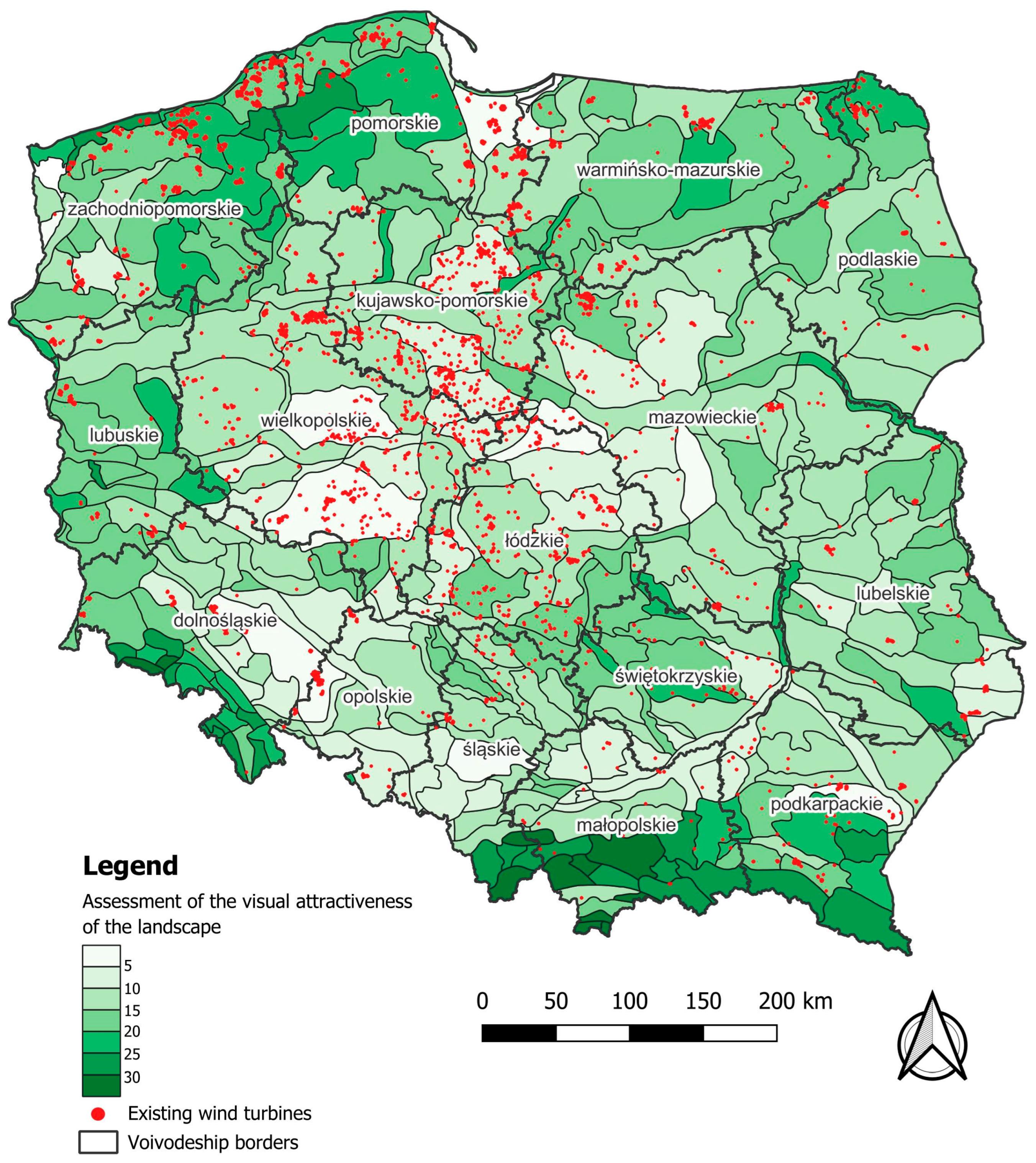
Poland, like other countries, has diverse landscape values, with varying predispositions to spatial conflicts related to wind energy development. Areas with high visual landscape values sensitive to wind energy development are located particularly in the south of the country in mountainous regions and in the north along the Baltic Sea coast and lake districts [49] (Figure 1), characterized by diverse terrain, extensive forest cover, and the presence of coastlines and lakes. As in other countries with intensive wind energy development, Poland experiences spatial variation in the intensity of this development. The highest density of wind farms occurs in the coastal zone and the central-northern Kujawsko–Pomorskie region (Figure 1).
The ELC was ratified in Poland on 24 June 2004 [50]. However, it was not until 2015 that the Act implementing the provisions of the convention was passed [51]. The implementation of the convention’s provisions was the subject of numerous analyses at that time, e.g., [52,53,54,55,56]. Ultimately, the most important instrument for implementing landscape protection and shaping in accordance with the principles of the convention became the requirement to prepare landscape audits in individual regions of the country—voivodeships. The most important role of landscape audits became to identify so-called priority landscapes and prepare recommendations and conclusions for them, which should be included in spatial planning [51,57]. The implementation of the ELC was primarily carried out at the regional level, without significant coordination at the national level and without coordination with other development-related policies, including energy transformation.
In practice, the priority landscapes identified in the audits encompass the most valuable fragments of Poland’s landscapes and include recommendations and conclusions, among others, limiting the development of investments that may negatively impact the structure, functioning, and visual values of the landscape. Among the investments with the greatest impact on the landscape are onshore wind farms [1,2,3,4,13,15,16,17,18,19,20,21,22,23,24,25,26,27,28,29,30,31,32,33,34,35,36,37,38,39,40]. Therefore, the implementation of the ELC, and, in particular, the identification and protection of priority landscapes, creates development constraints for wind energy.
Landscape audits are prepared and adopted by regional local governments. Their provisions should be integrated with regional and local spatial planning. Most regions adopted them in 2024–2025, and in several, final public consultations are underway before adoption. In two regions, Podlaskie and Lublin, the preliminary state of preparation of the audits prevents an assessment of their impact on the development of various forms of landscape development. Adopting landscape audits creates new conditions for landscape protection and shaping and may impact the development of wind energy.
At the same time, Poland is intensively working on the next phases of the necessary development of industrial onshore wind energy. The development of wind energy is consistent with the country’s energy development policies and strategies, which aim to reduce emissions from conventional energy sources, particularly hard coal and lignite. According to Poland’s Energy Policy until 2040 [58] and the draft National Energy and Climate Plan [59], the planned installed capacity of onshore wind farms by 2030 is expected to reach approximately 15.8 GW, and by 2040, 20 GW.
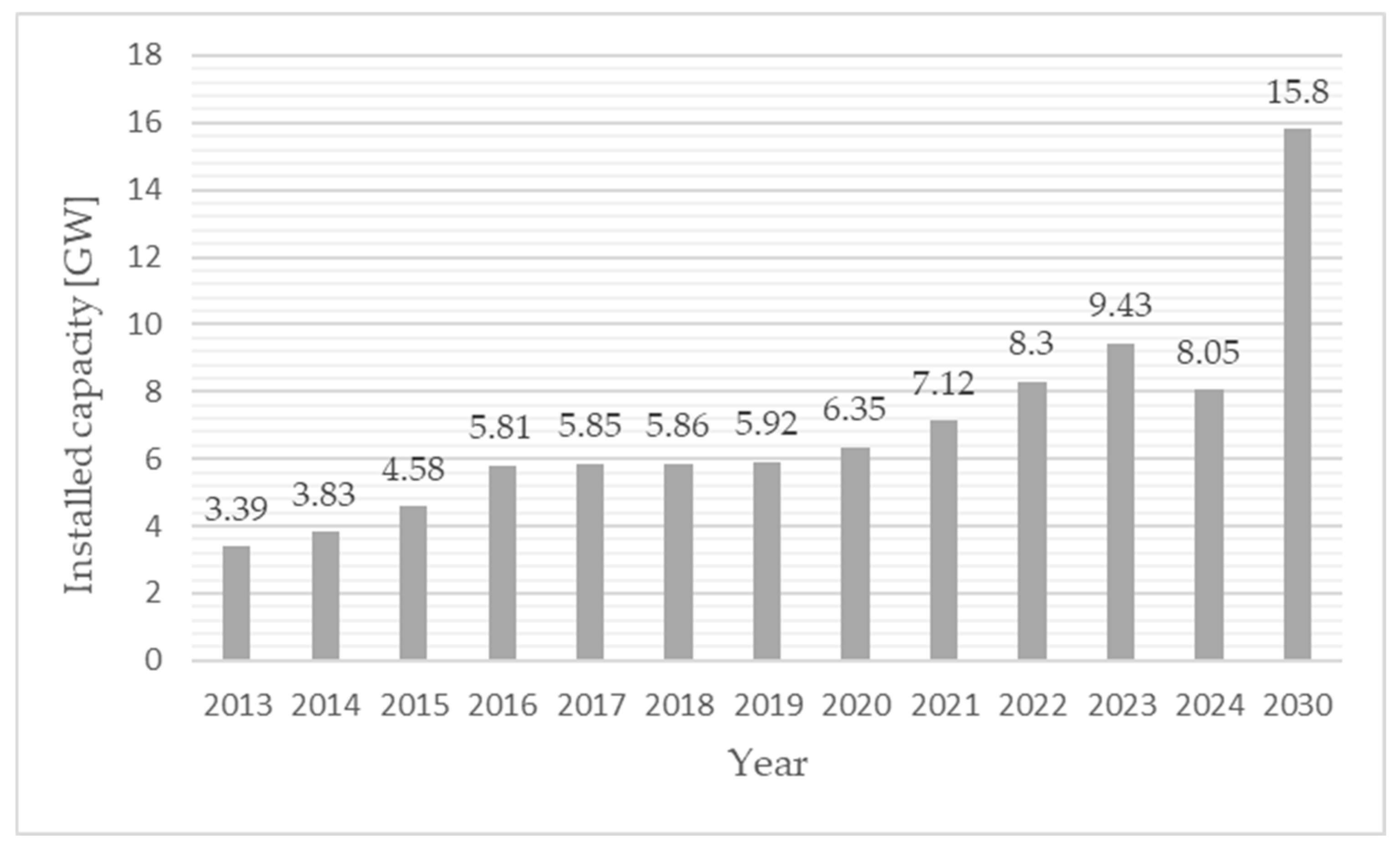
As of March 2025, the installed capacity of wind farms in Poland amounted to 10.8 GW [60], which represents 29% of the capacity from all renewable sources. In recent years, with minor exceptions, there has been a constant and dynamic increase in the connected capacity (Figure 2) [60,61]; e.g., compared to June 2024, this capacity increased by 7.6%. It is estimated that in 2030 this capacity will amount to 15.8 GW.
The available land resources for the development of onshore wind farms are limited. Under current regulations, wind farms cannot be located in national parks (approximately 1% of the country’s territory), nature reserves (approximately 0.5%), landscape parks (approximately 8.4%), or Natura 2000 areas (approximately 19.5%) [62]. Furthermore, wind farms cannot be located closer than 700 m from residential developments, ten times the height of the wind farm from national parks, and 500 m from nature reserves. The anticipated development of wind energy in Poland may be limited by another barrier limiting the availability of land resulting from the implementation of the ELC, in particular the designation and protection of priority landscapes.
The aim of this article is to assess the scale of limitations on the development of onshore wind energy in Poland related to the implementation of the European Landscape Convention and, in particular, the designation and protection of priority landscapes. The assessment will take into account existing development limitations resulting from, among other things, legal regulations [62] and forms of development unfavorable to wind farms (e.g., residential areas, surface waters, etc.). The first part will determine the territorial potential for wind energy development resulting from existing forms of development and forms of landscape protection limiting the possibility of locating wind farms. The current state of wind farm development will also be taken into account (Figure 1). Next, the prospects for further limitations in land accessibility resulting from the designation of priority landscapes will be assessed. The assessment will be conducted quantitatively and spatially across the country, regions, and zones with varying wind conditions for wind energy development. The connection capacity that may be lost due to the designation and protection of priority landscapes during the implementation of the ELC will be estimated.

2. Materials and Methods

A vector spatial database—the Topographic Object Database (BDOT10k) [63]—was used to analyze the territorial potential for wind energy development and its limitations related to the designation of priority landscapes for protection within the framework of the European Landscape Convention. It contains the spatial location of topographic objects and their basic descriptive characteristics. The database’s level of detail corresponds to a scale of 1:10,000, which is highly detailed in analyses performed at regional and national scales.
To analyze the state of wind energy development, a map of the location of wind farms was created using data from the Geoserwis database of the General Directorate for Environmental Protection in Warsaw [64]. All wind farms built in Poland with a height exceeding 10 m were analyzed.
To determine the areas of territorial potential for wind energy development, we used data on existing forms of nature conservation in Poland, provided by the General Directorate for Environmental Protection [64], as well as vector data locating priority landscapes obtained from the websites of voivodeship governments, which, as part of implementing ELC regulations, designate particularly valuable landscapes (priority landscapes) for protection. Because such landscapes were not identified for the Lublin and Podlaskie regions, they were not included in the analysis. Neither region is characterized by intensive wind energy development or particularly valuable wind conditions (excluding the northern part of the Podlaskie region), and their absence from the analysis should not significantly impact the effectiveness of the research process.
Multi-criteria spatial analyses of vector data were performed in QGIS v. 3.34. Data were processed in .shp format in the 1992 coordinate system (ETRF2000-PL/CS92, EPSG 2180). Spatial analyses related to overlap, intersection, difference, buffering, aggregation, and generation of data intersections were performed.
In the first stage, in order to identify the territorial development potential of wind farms, the indicator of the Territorial Potential for Wind Energy development (TPWE) was calculated according to the following formula:
T P W E = T A B W F R P L N P
where
TPWE—Territorial Potential for Wind Energy development [km2];
TA—total area [km2];
B—area of built-up areas related to housing with a buffer of 700 m [km2];
W—surface of standing and flowing water areas with a buffer of 50 m [km2];
F—area of forest areas [km2];
R—the area of highways, expressways, and national and voivodeship roads with a buffer of 300 m, district roads with a buffer of 200 m, and paved municipal roads with a buffer of 100 m [km2];
PL—area of the highest-voltage power lines (>220 kV) with a buffer of 400 m and high- and medium-voltage power lines with a buffer of 100 m [km2];
NP—the area of nature conservation areas excluded from the development of wind energy: national parks with a buffer of 2000 m, nature reserves with a buffer of 500 m, landscape parks, and Natura 2000 areas [km2].
The above-mentioned restriction areas include types of areas where the location of wind farms is impossible due to existing forms of land development and restrictions in force in Poland resulting from the provisions of the Act of 20 May 2016 on investments in wind farms [62].
From the obtained TPWE areas, polygons with an area of <0.25 ha were removed, which for technical and technological (construction) reasons are not suitable for locating wind farms—they are too small.
The designated priority landscapes also excluded the same areas considered in the multi-criteria analysis of the TPWE indicator. This identified areas within the priority landscapes where wind farms could be located if they were not protected.
The calculated values of the TPWE indicator for Poland and the regions were compared with the areas of priority landscapes that have no restrictions for wind farms, thus analysing the conflicting nature of the restrictions resulting from designating these landscapes for protection.
For the purpose of testing the degree of limitation of the territorial development possibilities of wind energy by designating priority landscapes, the area energy efficiency index AEE was calculated according to the formula
A E E = T C A O
where
AEE—area energy efficiency index [GW/km2];
TC—total connection capacity of wind farms [GW];
AO—area occupied by wind farms [km2].
The AO index includes the sum of the area occupied by individual power plants, calculated for each of them within a distance from the tower equal to the height of the power plant. The total area occupied by AO power plants was thus calculated to be 269.3 km2. The TC was assumed to be 10.8 GW. Therefore, the calculated AEE index value for Poland at the beginning of 2025 is 0.0401 GW/km2.
In the next step, the connectable capacity within the TPWE was calculated. Then, knowing the areas occupied by priority landscapes that reduce the TPWE, the total capacity that may not be installed due to the designation of these landscapes was calculated. The assessment was performed in relation to the wind energy development goals in Poland [58,59], by 2030 an installed capacity of 15.8 GW and by 2040 one of 20 GW, as well as taking into account three wind energy development scenarios:
I—the connection capacity obtained from TPWE in GW/km2 will be at the current level achieved through many years of wind energy development in Poland,
II—the connection capacity obtained from TPWE in GW/km2 will be 25% higher than the current level due to technological developments in wind energy,
III—the connection capacity obtained from TPWE in GW/km2 will be 50% higher than the current level due to technological developments in wind energy.
The analyses were performed and presented for the country but also from a regional perspective in accordance with the legal conditions ensuring the autonomy of the regions in creating spatial planning and landscape protection policies, as well as strategic planning.
Taking into account the diversity of wind conditions in Poland, a separate assessment of the impact of possible TPWE reduction by priority landscapes in zones with different levels of useful wind energy presented in the Polish Climate Atlas [65] is also presented. This analysis is linked to a greater extent than the previous one with the economic efficiency and profitability of wind energy development.

3. Results

3.1. The Status and Territorial Potential of Wind Energy Development and Their Spatial Differentiation

Poland is characterized by a significant dynamic intensity of onshore wind energy development and considerable spatial variation in this intensity across regions (Figure 1 and Figure 2, Table 1). Over 5270 wind turbines have been built to date, most of them operating in clusters—wind farms. Small turbines between 10 m and 50 m in height comprise 795, medium-sized turbines between 51 and 100 m in height comprise 1184, tall turbines between 101 and 150 m in height comprise 2254, and tall turbines > 150 m in height comprise 1040. Large turbines exceeding 100 m in height (over 62%) and with a unit capacity exceeding 1 MW dominate the analyzed set. The average density of power plant deployment for the country, which is 1.7 units/100 km2, is more than 2.5 times higher in the regions with the highest intensity of wind farm development—Zachodniopomorskie and Kujawsko–Pomorskie Voivodeships.
The current level of land occupancy by existing wind farms does not exceed 0.5% of the area in any region and for Poland as a whole is approximately 0.1%. Areas already occupied by wind energy development have development prospects primarily through repowering. Most Polish regions, such as the Świętokrzyskie, Dolnośląskie, Podlaskie, Lubelskie and Śląskie Voivodeships, have wind farms in less than 0.1% of their area, while in the Małopolskie Voivodeship it is only 0.03%.
An analysis of the distribution of wind farms against the background of a map of landscape physiognomic values (Figure 1) indicates that areas with the highest wind energy development intensity are rarely located in physiogeographic regions with high landscape physiognomic values. In the case of the southern part of the country, located within the Sudetes and Carpathians, this relationship is completely absent. Mountainous areas in Poland are not yet zones of intensive wind energy development and also have unfavorable natural and settlement conditions for the development of this form of renewable energy source. Potential spatial conflicts at the interface between wind energy and landscape are much more pronounced in northwestern Poland, in the coastal zone of the Baltic Sea and in the adjacent lake districts.
The indicator of the territorial potential for wind energy development (TPWE) for Poland as a whole is 16,925.8 km2, which represents 5.3% of the country’s territory (Table 2). Taking into account the AEE indicator, which characterizes the current scale of wind energy development, wind farms with a total capacity of approximately 679 GW could theoretically be installed in TPWE areas, which is 62 times more than the current installed capacity in the country (10.8 GW). Furthermore, wind farms are not being built in Poland in forest areas that are not part of the TPWE structure, although this is possible and implemented in other European countries. However, it should be noted that the availability of TPWE for wind energy is theoretical, and there are many factors that limit the potential for actual use of these areas.
The territorial potential for wind energy development in Poland varies across administrative regions, ranging from 193.1 km2 in the Małopolskie Voivodeship to 2240.7 km2 in the Zachodniopomorskie Voivodeship and from 1.3% of the Małopolskie Voivodeship to 13.8% of the Opolskie Voivodeship. In eight regions, the share of TPWE areas is in the 5–10% range, in one it is >10%, and in the remaining regions it is between 1% and 5%.
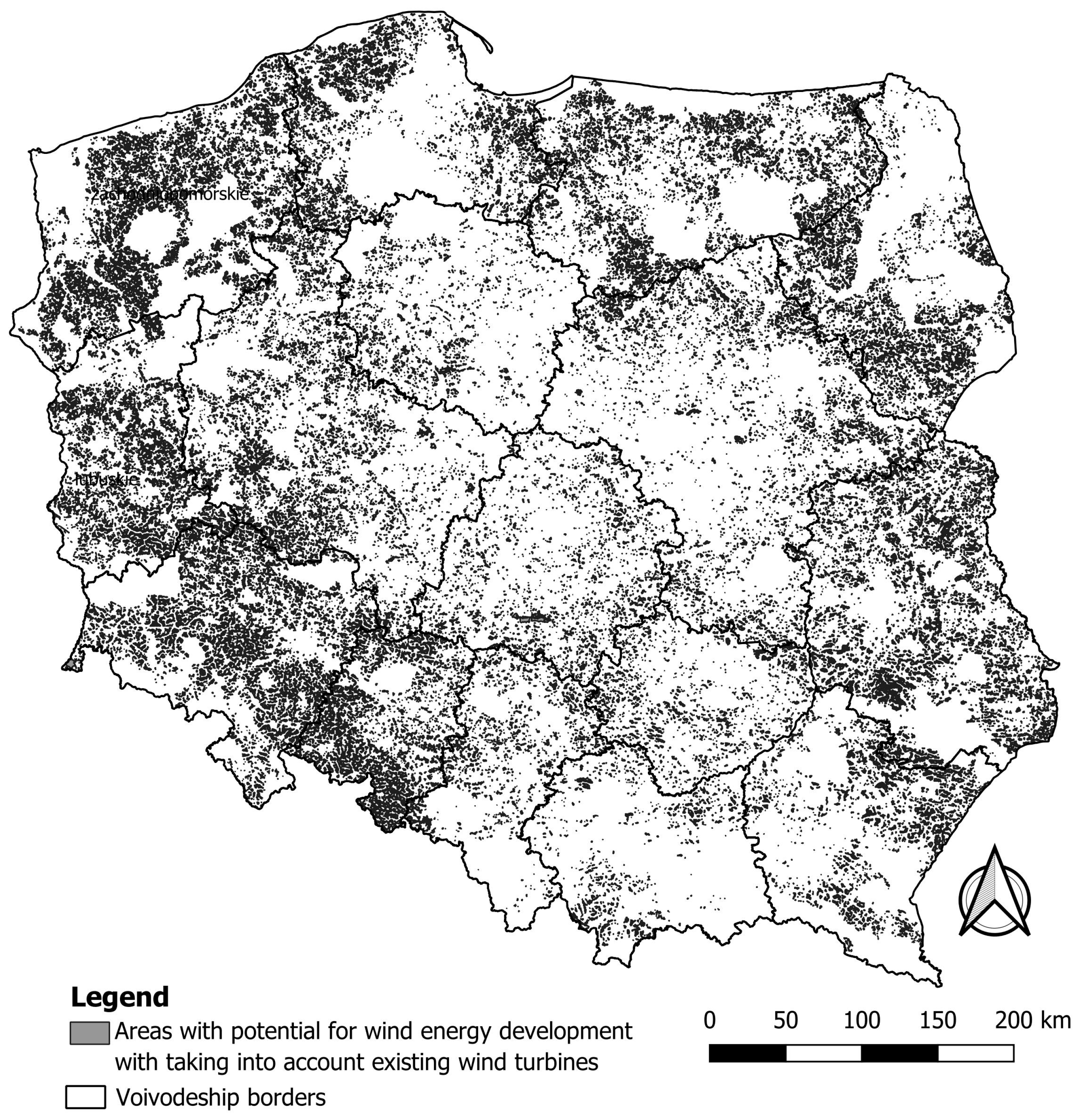
There is considerable spatial variation in the territorial potential for wind energy development under current conditions (Figure 3). The greatest potential lies in the western area within the Opolskie, Dolnośląskie, Lubuskie, Wielkopolskie, and Pomorskie regions. This constitutes the so-called western national area of wind energy development potential. Second, there are significant reserves of land for wind energy development in the eastern part of the country (eastern national area of wind energy development potential), but these areas generally experience poorer wind conditions and individual wind farms have lower density indices (Figure 3). The potential in the southern part of the country, in mountainous areas, particularly the Carpathians (Figure 3), is very limited. This is due to the extensive forest cover, the presence of numerous national and landscape parks, and the dispersion of residential development, which, under current legal regulations, eliminates most non-forest areas. The entire central part of Poland has limited prospects for wind energy development, given the current legal constraints related to distances from residential areas. This is an area of highly dispersed settlement, which is not conducive to the location of wind farms.
Analysis of the set of polygons (isolated zones) constituting the TPWE indicates their fragmentation, which is unfavorable for the development of wind energy. The most favorable condition for the economic efficiency of wind farm construction and operation is the presence of large units, where from a dozen to several dozen wind farms can be built. Meanwhile, as many as 62,873 TPWE polygons are in the 0.25–10 ha range, 18,853 in the 10–50 ha range, 4784 in the 50–100 ha range, 2462 in the 100–200 ha range, 1111 in the 200–500 ha range, 85 in the 500–700 ha range, and 41 in the 700–1000 ha range. Only 17 polygons exceed 1000 ha.

3.2. Limitations on the Development of Wind Energy Related to the Implementation of the European Landscape Convention

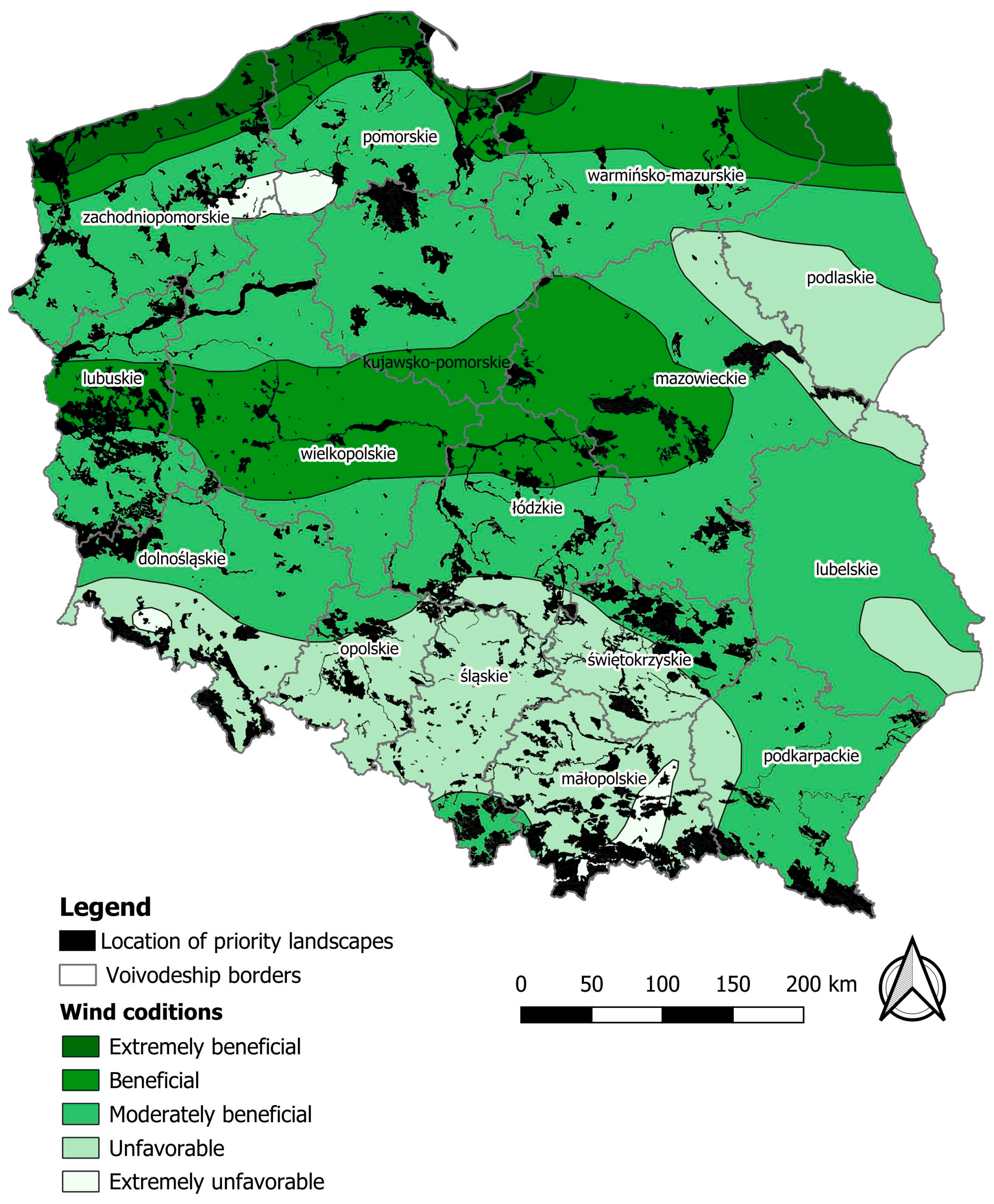
The results of regional landscape audits implementing the ELC in Poland indicate that nationwide, 36,075.5 km2 (Table 3), representing 11.5%, has been designated as priority landscapes, the protection and shaping of which may limit the development of wind energy. Significant variation in the spatial distribution of priority landscapes (Figure 4) can also be observed, which is not due to landscape quality determinants, but rather the specificity of the regional approach to landscape audit preparation. Clearly distinguishable regions include those that have adopted landscape protection policies in priority landscapes (e.g., Lubuskie Voivodeship), regions with a balanced intensity of designation of these landscapes (e.g., Łódzkie Voivodeship), and regions that have designated significantly fewer landscapes than existing landscape quality constraints (e.g., Wielkopolskie Voivodeship).
Regional variation in the area share of priority landscapes is high. The smallest share is in the Wielkopolskie Voivodeship (4.7%) and the largest in the Małopolskie Voivodeship (31.0%). Apart from the latter, only the Lubuskie and Świętokrzyskie regions have area shares of priority landscapes exceeding 25%. With the exception of three regions, the remaining regions have shares of 10%, which may not potentially create significant con-flict areas at the wind energy–landscape interface.
Relatively small individual areas of priority landscapes are characteristic throughout the country. The average area of such units is 14.9 km2. This means that priority landscapes are quite common nationwide, but outside of certain regions where they exceed 20% of the area, they will not constitute spatial arrangements that limit the development of wind energy.
A comparison of Figure 3 and Figure 4 shows that areas with a large share of priority landscapes do not always coincide with the concentration of zones with the greatest territorial potential for wind energy development (TPWE). The best example is the Małopolskie Voivodeship and southern Poland in general, where large areas of priority landscapes occur in the mountains, but there are no significant TPWE areas. In the west of the country, the greatest conflict may concern the Lubuskie Voivodeship, where there is high territorial potential and very large areas of priority landscapes.
Data analysis indicates significant variation in the availability of land for wind farms due to priority landscapes across different regions of the country. Currently, approximately 890 km2 (5.3%) of the area available for the development of this form of energy—TPWE—is limited by the designation and protection of priority landscapes (Table 2). However, significant regional variation can be observed. As much as 280.5 km2 of the area of potential wind energy development in the Lubuskie region may be limited by the implementation of priority landscape protection as part of the ELC implementation. This represents as much as 24.1% of the total area available for wind energy development in this region. In areas exceeding 100 km2, wind energy may be limited by designated priority landscapes in the Pomorskie and Łódzkie regions, which reduces the territorial potential of TPWE by approximately 10.3% in the former and by 22.8% in the latter. Significant areas >50 km2 may not be available in the Małopolskie and Zachodniopomorskie regions, with the former reducing the wind energy development area by 40.5% and the latter by only 3.4%. Relatively large exclusion areas also occur in the Dolnośląskie region (46.0 km2) and the Opolskie region (46.6 km2). However, in both regions, the potential for wind energy development in the TPWE region is very large, and designating priority landscapes does not significantly reduce the TPWE share. It will be reduced by 2.3% and 3.6%, respectively.
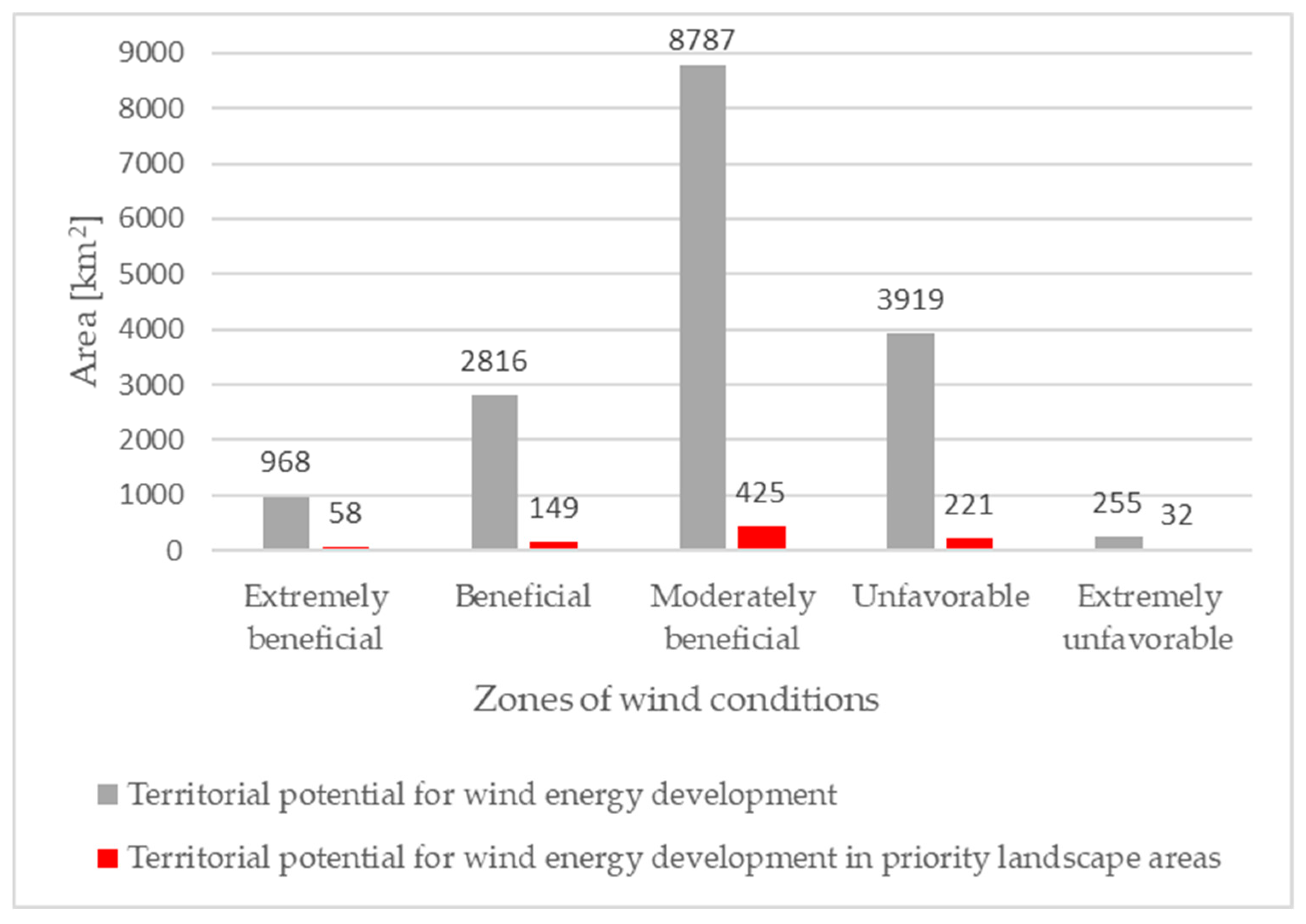
From a technical and economic perspective, the potential impact of protecting priority landscapes on limiting the availability of land for wind energy development in zones with the most favorable wind conditions is of fundamental importance (Figure 4). Research results indicate that only some priority landscapes may limit wind energy development in zones with the most favorable and advantageous wind conditions (extremely beneficial and beneficial in Figure 4). These landscapes are located in the northern part of the Pomorskie, Zachodniopomorskie, Warmińsko–Mazurskie, and Podlaskie regions, as well as in central Poland from the Lubuskie to the Mazowieckie regions. A significant portion of priority landscapes were designated in areas with less favorable conditions for wind energy development, particularly in the Sudetes and Carpathians, as well as in Śląskie, Małopolskie, Świętokrzyskie, and southern parts of the Łódzkie region.
Designating priority landscapes may limit wind energy development in the 58.1 km2 zone with the most favorable wind conditions, which represents 6.0% of this zone’s territorial potential (Figure 5). Taking into account the AEE index, this means limiting the theoretical connection capacity of 2.3 GW of wind power, or approximately one-fifth of the capacity currently installed in Poland. Furthermore, this capacity has the potential for the most favorable investment profitability. In the zone with favorable wind conditions, restrictions related to the protection of priority landscapes are three times larger in area, covering 149.5 km2, which, due to the large total area of this zone, accounts for 5.3%. The loss of connection capacity in this case is approximately 6 GW, or more than half of the existing connected capacity in Poland. In the zone with moderately favorable wind conditions, the territorial potential of the TPWE will be limited by as much as 424.9 km2, which is 4.8%, in the zone of unfavorable conditions 221.4 km2, 5.6%, and in the zone of least favorable conditions 31.6 km2, 12.4%.
In each of the adopted onshore wind energy development scenarios, the implementation of the ELC will not pose a threat to the achievement of wind energy development goals in Poland by 2030 (installed capacity of 15.8 GW) and by 2040 (20 GW). While designating priority landscapes may mean a loss of connection capacity of approximately 36 GW in Scenario I, which assumes maintaining the current AEE indicator level, there is still a TPWE resource available for approximately 641 GW, with 5.0 GW required for connection by 2030 and 9.2 GW by 2040. However, the exclusion of areas located in priority landscapes with a total potential connection capacity three times greater than the current one indicates a significant problem with the scale of the potential limitation.
In Scenario II, which assumes a 25% increase in the AEE efficiency, the capacity to connect 43.2 GW will be reduced, but over 600 GW will still remain in the resource in other TPWE areas. Similarly, Scenario III, assumes a 50% increase in the AEE efficiency compared to the current level.

4. Discussion

The implementation of the European Landscape Convention varies across European countries [46,65,66]. The implementation model adopted in Poland primarily involves designating priority landscapes, which are subject to protective measures, and leaving landscapes other than priority landscapes. Moreover, the protection of landscapes of national parks, nature reserves, and landscape parks is provided [51]. From the perspective of wind energy development, the adopted model is unfavorable. In priority landscapes, it creates very strong constraints on the development of wind farms, while in other areas without a rational landscape development policy, it can lead to significant changes, which are perceived as a significant impact of wind energy on people’s lives [34,35,36]. This method of implementing ELC creates potential barriers to achieving the strategic goals of energy transformation and the country’s energy security [58,59] and also poses a risk of intensifying social conflicts. The lack of social acceptance of wind energy development creates development constraints and reduces its profitability [67,68]. Currently, the level of acceptance of onshore wind energy in Poland is quite high [37,69]. Therefore, more sustainable instruments for implementing wind farm development should be considered.
Moreover, the ELC implementation model in Poland does not take into account the important social participation, which in light of the experience of Norway, one of the first countries to implement ELC, is very important [70]. According to the ELC, landscape is a value perceived by people and planning its change should be subject to social acceptance.
The ELC refers to three landscape-related components: protection, management, and planning [50,71]. The implementation of the convention in Poland primarily covers the protection segment, while for the development of wind energy and for local communities, the management and planning components are more important and are integrated with development plans and strategies, including the energy sector. Limiting the broad importance of landscape in the implementation of the ELC does not reflect the complexity of this issue [72,73]. The European Commission also points out the need to integrate wind energy development with rational landscape shaping and protection within the implementation of the ELC [45].
From the perspective of wind energy–landscape interactions, the problem with ELC implementation is the application of regional and local levels of action without ensuring national coordination and integration of 16 regional landscape protection and development policies. While a regional approach to ELC implementation is appropriate [74], the use of cohesion instruments is essential. Integration of landscape audits with other policies and development strategies has also not been considered. Implementing the convention requires interdisciplinary and transdisciplinary research [75], not limited only to landscape but also taking into account aspects of landscape management, including wind energy development [45,46,47].
Poland is characterized by a rapid increase in wind energy development and relatively good development prospects [60,61,76,77]. The research conducted in this article indicates that designating and protecting priority landscapes as part of ELC implementation may reduce the territorial potential for onshore wind energy development by approximately 5.3%. However, it should be noted that these are not the only limitations related to landscape protection. Wind farms are not built in national parks, nature reserves, landscape parks, or Natura 2000 areas [62]. Some forms of protection overlap, but in total, landscape protection limits the development of wind energy on approximately 25% of the country’s area. The cumulative effect of the development barrier related to, among other things, landscape protection and lack of accessibility based on other assessment criteria is significant [78].
The assessment of the potential of areas available for onshore wind energy development is influenced by the adopted assessment criteria, which result in part from objective development barriers and, in Poland, from changing and, compared to other countries, stringent legal regulations. Currently, the 10 H rule, which distances wind farms from residential areas by more than ten times the height of the farm, has been discontinued, but numerous restrictions still exist, including some rather unreasonable ones concerning Natura 2000 special conservation areas. While prohibiting the location of wind farms in Natura 2000 bird sanctuaries (Special Protection Areas) is rational, it is not rational in habitat sanctuaries (Special Areas of Conservation) where bats do not occur, provided that the farms do not transform protected habitats. The situation is similar with priority landscapes for ELC implementation. They may restrict wind farm development without individual recognition of the landscape’s visual conditions.
In research [78] published in 2024, taking into account the situation as of 2022–2023, the land investment status of wind farms for Poland was calculated at 460.7 km2, and the available favorable areas for development amounted to 7555.91 km2 (2.34%). Other criteria were partially adopted, which were not used in the current research, including a buffer of 100 m from forest areas, 500 m from existing power plants, additional forms of nature protection and distance buffers from their boundaries, and different distances from roads. The results of the analyses also indicate significant development potential for wind energy in selected regions of Poland. A similar analysis using similar criteria but with different buffer zones was also conducted in 2017 [79].
The conducted research indicates the usefulness of GIS methods in optimizing wind energy development. In particular, they enable rapid multi-criteria assessments [80,81,82].
Significant barriers to wind energy development in Poland include the instability of legal regulations, particularly those related to the need to maintain distances from various forms of development [60,61,77,78,79]. Regulatory stability is crucial in long, multi-year investment cycles. This also applies to ELC implementation, including landscape audits and the designation and protection of priority landscapes. Changes in regulations also impact the economic aspects of wind farm location [83].
The research results do not indicate any threats to achieving Poland’s strategic energy transformation goals or ensuring the country’s energy security. However, they do indicate a lack of coordination of the country’s spatial development policy in key areas.

5. Conclusions

Based on the conducted research, the following conclusions can be drawn:
(1) The development of onshore wind energy is determined by numerous factors, including the increasingly limited availability of land for new wind farms, amidst intense competition from other forms of development, such as settlements.
(2) The main constraints on the development of onshore wind energy in Poland include nature and landscape protection, which covers approximately 1.3% of the country’s territory. Implementation of the ELC, which increases landscape protection areas where wind energy may not be feasible, increases this limitation.
(3) Calculations regarding the availability of new land for wind energy development, as well as estimates of the potential installed capacity, indicate that the ELC does not currently pose a threat to the achievement of the strategic goals of onshore wind energy development by 2040. However, in the longer term, as the areas for possible wind farm development decrease, this threat may increase.
(4) A significant factor contributing to the potential for spatial conflicts between wind farm development and landscape protection is the inappropriate implementation model of the ELC in Poland, which focuses on protection rather than landscape planning and management. Proper landscape planning and management, taking into account multiple natural, social, and economic criteria, could create a more flexible system for shaping landscapes than restrictive protection. Protection alone may not be accepted by society. Furthermore, protection is uniform across entire, often large, landscape units, and planning and management instruments could differentiate the principles and intensity of development in different zones of priority landscapes, for example, enabling the development of wind farms in areas lacking significant landscape physiognomy.
(5) The implementation of the ELC in Poland is not linked to development strategies, including energy transformation, and is insufficiently publicized, which increases the risk of development dysfunctions and social conflicts.
(6) The share of regions covered by priority landscapes varies greatly, from 4.7% in the Wielkopolskie Voivodeship to 31.0% in the Małopolskie Voivodeship. Therefore, the potential for restrictions on wind energy development due to ELC implementation will vary spatially, which may impact the stability of the energy system (strong development of wind farms in some regions and very limited in others).
(7) The results of the assessment of priority landscape coverage and the reduction in wind farm development opportunities for two neighboring regions—Lubuskie and Wielkopolskie, which have similar landscape potential—indicate a very significant impact of landscape protection policy at a regional level and a lack of coordination across the country.
(8) Due to the inconsistent ELC implementation policy across the country and the preference for landscape protection over landscape planning and management, the territorial potential for the development of TPWE wind energy across the country may amount to 5.3%, with very large regional differences, ranging from 0.8% in the Mazowieckie Voivodeship to over 40% in the Małopolskie Voivodeship.
(9) In further optimizing the implementation of ELC from the perspective of reconciling it with the development of wind energy, it is essential to take into account wind conditions, which determine the profitability and energy costs.
(10) The energy transformation implemented in Europe, including Poland, with its pillars of energy security and reduced greenhouse gas emissions, is a dynamic, multifaceted, difficult, and sensitive process. Landscape protection and development, including those related to the implementation of the ELC, will influence the development of various forms of renewable energy, including wind farms. The principle of sustainable development should be the basis for establishing a balance between landscape protection and development and the development of onshore wind energy.

Author Contributions

Conceptualization, K.B. and R.W.; methodology, K.B. and R.W., software, R.W.; validation, K.B. and R.W.; formal analysis, K.B. and R.W.; investigation, K.B. and R.W.; resources, K.B. and R.W.; data curation, K.B. and R.W.; writing—original draft preparation, K.B.; writing—review and editing, K.B. and R.W.; visualization, R.W.; supervision, K.B. and R.W.; project administration, K.B. and R.W.; funding acquisition, K.B. and R.W. All authors have read and agreed to the published version of the manuscript.

Funding

This research received no external funding.

Institutional Review Board Statement

Not applicable.

Informed Consent Statement

Not applicable.

Data Availability Statement

The original contributions presented in this study are included in the article. Further inquiries can be directed to the corresponding author.

Conflicts of Interest

The authors declare no conflicts of interest.

Abbreviations

The following abbreviation is used in this manuscript:
ELCEuropean Landscape Convention
NDNo data

References

  1. Letcher, T.M. (Ed.) Wind Energy Engineering. A Handbook for Onshore and Offshore Wind Turbines, 2nd ed.; Elsevier & Academic Press: London, UK, 2017. [Google Scholar]
  2. Burton, T.; Sharpe, D.; Jenkins, N.; Bossayi, E. (Eds.) Wind Energy Handbook, 2nd ed.; Willey & Sons: Chichester, UK, 2011. [Google Scholar]
  3. Manwell, J.F.; Blanlard, E.; McGowan, J.G.; Ram, B. Wind Energy Explained: On Land and Offshore, 3rd ed.; Willey & Sons: New York, NY, USA, 2024. [Google Scholar]
  4. Gipe, P. Wind Energy Comes of Age; Willey & Sons: New York, NY, USA, 1995. [Google Scholar]
  5. Gonzales, J.S.; Lacal-Arantegui, R. A review of regulatory framework for wind energy in European Union countries: Current state and expected developments. Renew. Sustain. Energy Rev. 2016, 56, 588–602. [Google Scholar] [CrossRef]
  6. Kiunke, T.; Gemignani, N.; Malheiro, P.; Brudermann, T. Key factors influencing onshore wind energy development: A case study from the German North Sea region. Energy Policy 2022, 165, 112962. [Google Scholar] [CrossRef]
  7. Wagner, H.J. Introduction to wind energy system. EPJ Web Conf. 2015, 98, 04002. [Google Scholar] [CrossRef]
  8. Sahin, A.D. Progress and recent trends in wind Energy. Prog. Energy Combust. Sci. 2004, 30, 501–543. [Google Scholar] [CrossRef]
  9. Pryor, S.C.; Barthelmie, R.J. Climate change impacts on wind energy: A review. Renew. Sustain. Energy Rev. 2010, 14, 430–437. [Google Scholar] [CrossRef]
  10. Herbert, G.M.J.; Iniyan, S.; Sreevalsan, E.; Rajapandian, S. A review of wind energy technologies. Renew. Sustain. Energy Rev. 2007, 11, 1117–1145. [Google Scholar] [CrossRef]
  11. Rosales-Asensio, E.; Borge-Diez, D.; Blanes-Peiró, J.; Pérez-Hoyos, A.; Comenar-Santos, A. Review of wind energy technology and associated market and economic conditions in Spain. Renew. Sustain. Energy Rev. 2019, 101, 415–427. [Google Scholar] [CrossRef]
  12. Blanco, M.I. The economics of wind energy. Renew. Sustain. Energy Rev. 2009, 13, 1372–1382. [Google Scholar] [CrossRef]
  13. Wang, S.; Wang, S. Impacts of wind energy on environment: A review. Renew. Sustain. Energy Rev. 2015, 49, 437–443. [Google Scholar] [CrossRef]
  14. Dai, K.; Bergot, A.; Liang, C.; Xiang, W.; Huang, Z. Environmental issues associated with wind energy—A review. Renew. Energy 2015, 75, 911–921. [Google Scholar] [CrossRef]
  15. Katsaprakakis, D.A. A review of the environmental and human impacts from wind parks. A case study for the Prefecture of Lasithi, Crete. Renew. Sustain. Energy Rev. 2012, 16, 2850–2863. [Google Scholar] [CrossRef]
  16. Saidur, R.; Rahim, N.A.; Islam, R.M.; Salangi, K.H. Environmental impact of wind energy. Renew. Sustain. Energy Rev. 2011, 15, 2423–2430. [Google Scholar] [CrossRef]
  17. Jaber, S. Environmental impact of wind energy. J. Clean Energy Technol. 2013, 1, 251–254. [Google Scholar] [CrossRef]
  18. Leung, D.Y.C.; Yang, Y. Wind energy development and its environmental impact: A review. Renew. Sustain. Energy Rev. 2012, 16, 1031–1039. [Google Scholar] [CrossRef]
  19. Nazir, M.S.; Ali, N.; Bilal, M.; Iqbal, H.M.N. Potential environmental impacts of wind energy development: A global perspective. Curr. Opin. Environ. Sci. Health 2020, 13, 85–90. [Google Scholar] [CrossRef]
  20. Mann, J.; Teilmann, J. Environmental impact of wind energy. Environ. Res. Lett. 2013, 8, 035001. [Google Scholar] [CrossRef]
  21. Karydis, M. Public attitudes and environmental impacts of wind farms: A review. Glob. NEST J. 2013, 15, 581–600. [Google Scholar]
  22. Clarke, A. Wind farm lacation and environmental impact. Int. J. Ambient Energy 1989, 10, 129–144. [Google Scholar] [CrossRef]
  23. Guan, J. Landscape Visual Impact Evaluation for Onshore Wind Farm: A Case Study. ISPRS Int. J. Geo-Inf. 2022, 11, 594. [Google Scholar] [CrossRef]
  24. Firestone, J.; Bates, A.; Knapp, L.A. See me, Feel me, Touch me, Heal me: Wind turbines, culture, landscapes, and sound impressions. Land Use Policy 2015, 46, 241–249. [Google Scholar] [CrossRef]
  25. Eichhorn, M.; Masurowski, F.; Becker, R.; Thrän, D. Wind energy expansion scenarios—A spatial sustainability assessment. Energy 2019, 180, 367–375. [Google Scholar] [CrossRef]
  26. Sklenicka, P.; Zouhar, J. Predicting the visual impact of onshore wind farms via landscape indices: A method for objectivizing planning and decision processes. Appl. Energy 2018, 209, 445–454. [Google Scholar] [CrossRef]
  27. Bishop, I.D. Determination of thresholds of visual impact: The case of wind turbines. Environ. Plan. B Plan. Des. 2002, 29, 707–718. [Google Scholar] [CrossRef]
  28. Molnarova, K.; Sklenicka, P.; Stiborek, J.; Svobodova, K.; Salek, M.; Brabec, E. Visual preferences for wind turbines: Location, numbers and respondent characteristics. Appl. Energy 2012, 92, 269–278. [Google Scholar] [CrossRef]
  29. Hallan, C.; González, A. Adaptive responses to landscape changes from onshore wind energy development in the Republic of Ireland. Land Use Policy 2020, 97, 104751. [Google Scholar] [CrossRef]
  30. Cetkovský, S.; Nováková, E. Assessment of the impact of wind turbines on landscape character: Implications for landscape planning. Morav. Geogr. Rep. 2009, 17, 28–34. [Google Scholar]
  31. Diffendorfer, J.E.; Dorning, M.A.; Keen, J.R.; Kramer, L.A.; Taylor, R.V. Geographic context affects the landscape change and fragmentation caused by wind energy facilities. PeerJ 2019, 7, e7129. [Google Scholar] [CrossRef]
  32. Lothian, A. Scenic Perceptions of the Visual Effects of Wind Farms on South Australian Landscapes. Geogr. Res. 2008, 46, 196–207. [Google Scholar] [CrossRef]
  33. Abromas, J.; Kamičaitytė-Virbašienė, J.; Ziemeļniece, A. Visual impact assessment of wind turbines and their farms on landscape of Kretinga region (Lithuania) and Grobina townscape (Latvia). J. Environ. Eng. Landsc. Manag. 2015, 23, 39–49. [Google Scholar] [CrossRef][Green Version]
  34. Zografos, C.; Martínez-Alier, J. The politics of landscape value: A case study of wind farm conflict in rural Catalonia. Environ. Plan. A 2009, 41, 1726–1744. [Google Scholar] [CrossRef]
  35. Pavlis, E. Large-scale wind energy farm development and its impacts on the landscape: A review of the Greek case. J. Landsc. Ecol. 2025, 18, 24–61. [Google Scholar] [CrossRef]
  36. Pasqualetti, M. Social barriers to renewable energy landscapes. Geogr. Rev. 2011, 101, 201–223. [Google Scholar] [CrossRef]
  37. Świdyńska, N.; Witkowska-Dąbrowska, M.; Jakubowska, D. Influence of Wind Turbines as Dominants in the Landscape on the Acceptance of the Development of Renewable Energy Sources in Poland. Energies 2024, 17, 3268. [Google Scholar] [CrossRef]
  38. Jerpåsen, G.B.; Larsen, K.C. Visual impact of wind farms on cultural heritage: A Norwegian case study. Environ. Impact Assess. Rev. 2011, 31, 206–215. [Google Scholar] [CrossRef]
  39. Van der Horst, D.; Toke, D. Exploring the landscape of wind farm developments; local area characteristics and planning process outcomes in rural England. Land Use Policy 2010, 27, 214–221. [Google Scholar] [CrossRef]
  40. Meyerhoff, J.; Ohl, C.; Hartje, V. Landscape externalities from onshore wind power. Energy Policy 2010, 38, 82–92. [Google Scholar] [CrossRef]
  41. Nadai, A.; Van der Horst, D. Wind power planning, landscapes and publics. Land Use Policy 2010, 27, 181–184. [Google Scholar] [CrossRef]
  42. Cowell, R. Wind power, landscape and strategic, spatial planning—The construction of ‘acceptable locations’ in Wales. Land Use Policy 2010, 27, 222–232. [Google Scholar] [CrossRef]
  43. Council of Europe (CoE). European Landscape Convention (ELC). Presented at the Committee of Ministers of the Council of Europe, Strasbourg, France, 19 July 2000. [Google Scholar]
  44. Woźniak, M. Landscape Protection vs. Onshore Wind Energy Investments in Poland—A Legal Perspective. Int. J. Semiot. Law 2025, 38, 1199–1218. [Google Scholar] [CrossRef]
  45. Council of Europe. Landscape and Wind Turbines, Report. In Proceedings of the 6th Council of Europe Conference on the European Landscape Convention (CEP-CDPATEP, 11E), Strasbourg, France, 3–4 May 2011. [Google Scholar]
  46. Oles, T.; Hammarlund, K. The European landscape Convention, Wind Power, and the Limits of the Local: Notes from Italy and Sweden. Landsc. Res. 2011, 36, 471–485. [Google Scholar] [CrossRef]
  47. Schöbel, S. The Energy Transition as a Design Task: Wind Energy Planning and Design Strategies and Principles Based on the European Landscape Convention. Landsc. Archit. Front. 2025, 13, 88–95. [Google Scholar]
  48. Contesse, E. Landscape and wind turbines. Cities Territories Governance. 2017. Available online: https://www.citego.org/bdf_fiche-document-2715_en.html (accessed on 24 September 2025).
  49. Śleszyński, P. Ocena atrakcyjności wizualnej mezoregionów Polski. In Znaczenie badań krajobrazowych dla zrównoważonego rozwoju. Profesorowi Andrzejowi Richlingowi W; Uniwersytet śląski: Katowice, Poland, 2007; Volume 70, pp. 697–714. [Google Scholar]
  50. European Landscape Convention, Signed in Florence on 20 October 2000 (Journal of Laws 2004, No. 14, Item 98). Available online: https://isap.sejm.gov.pl/isap.nsf/download.xsp/WDU20060140098/O/D20060098.pdf (accessed on 24 September 2025).
  51. Act of 24 April 2015 Amending Certain Acts in Connection with Strengthening Landscape Protection Tools (Journal of Laws 2015, Item 774). Available online: https://isap.sejm.gov.pl/isap.nsf/download.xsp/WDU20150000774/U/D20150774Lj.pdf (accessed on 24 September 2025).
  52. Myga-Piątek, U.; Nita, J. Polityka krajobrazowa Polski—U progu wdrożeń. Przegląd Geogr. 2015, 87, 5–25. [Google Scholar] [CrossRef]
  53. Chmielewski, T.J.; Tajchman, K. Polityka krajobrazowa Polski w świetle Europejskiej Konwencji Krajobrazowej i oczekiwań społecznych. In Ochrona Przyrody w Polsce Wobec Współczesnych Wyzwań Cywilizacyjnych; Mirek, Z., Nikiel, A., Eds.; Komitet Ochrony Przyrody PAN: Kraków, Poland, 2014; pp. 65–88. Available online: https://www.researchgate.net/publication/307593196_Polityka_krajobrazowa_Polski_w_swietle_Europejskiej_Konwencji_Krajobrazowej_i_oczekiwan_spolecznych_The_Polish_landscape_policy_in_the_light_of_the_European_Landscape_Convention_and_the_expectations_o (accessed on 25 September 2025).
  54. Degórski, M. Identyfikacja problemów w polityce krajobrazowej Polski w kontekście ochrony krajobrazu i zagospodarowania przestrzennego kraju. Biul. Kom. Przestrz. Zagospod. Kraj. PAN 2016, 261, 9–33. [Google Scholar]
  55. Degórski, M.; Ostaszewska, K.; Richling, A.; Solon, J. Współczesne kierunki badań krajobrazowych w kontekście wdrażania Europejskiej Konwencji Krajobrazowej. Przegląd Geogr. 2014, 86, 295–316. [Google Scholar] [CrossRef]
  56. Krajewski, P.; Mrozik, K. Audyt krajobrazowy a realizacja zapisów europejskiej konwencji krajobrazowej w Polsce na przykładzie wybranego obszaru podmiejskiego Wrocławia. Stud. Pr. WNEiZ US 2017, 47, 207–218. [Google Scholar] [CrossRef]
  57. Regulation of the Council of Ministers of 11 January 2019 on the Preparation of Landscape Audits (Consolidated Text: Journal of Laws 2024, Item 537). Available online: https://isap.sejm.gov.pl/isap.nsf/download.xsp/WDU20190000394/O/D20190394.pdf (accessed on 25 September 2025).
  58. Announcement of the Minister of Climate and Environment of 2 March 2021 on the National Energy Policy Until 2040 (M.P.2021, Item 264). Available online: https://isap.sejm.gov.pl/isap.nsf/download.xsp/WMP20210000264/O/M20210264.pdf (accessed on 25 September 2025).
  59. National Energy and Climate Plan for 2021-2030—2019 Version. Ministry of State Assets. 2019. Available online: https://www.gov.pl/web/energia/krajowy-plan-na-rzecz-energii-i-klimatu-na-lata-2021-2030---wersja-z-2019-r2 (accessed on 25 September 2025).
  60. Polish Wind Energy Association. Wind Energy in Poland Report 2025; Polish Wind Energy Association: Szczecin, Warsaw, 2025; Available online: https://www.psew.pl/wp-content/uploads/2025/06/Wind-energy-in-Poland-Report-2025.pdf (accessed on 25 September 2025).
  61. Polish Wind Energy Association. Wind Energy in Poland Report 2024; Polish Wind Energy Association: Szczecin, Warsaw, 2024; Available online: https://www.psew.pl/wp-content/uploads/2024/10/Wind-energy-in-Poland-Report-2024.pdf (accessed on 25 September 2025).
  62. Act of 20 May 2016 on Investments in Wind Farms (Journal of Laws of 2024, Item 317). Available online: https://isap.sejm.gov.pl/isap.nsf/download.xsp/WDU20160000961/U/D20160961Lj.pdf (accessed on 24 September 2025).
  63. Database of Topographic Objects BDOT 10k—National Geoportal of the Head Office of Geodesy and Cartography. Available online: https://mapy.geoportal.gov.pl/imap/Imgp_2.html?gpmap=gp0 (accessed on 10 February 2025).
  64. Geoserwis—Spatial database of the General Directorate for Environmental Protection in Warsaw. Available online: https://geoserwis.gdos.gov.pl/mapy (accessed on 20 September 2025).
  65. Lorenc, H. (Ed.) Atlas Klimatu Polski; Instytut Meteorologii i Gospodarki Wodnej: Warszawa, Poland, 2005. [Google Scholar]
  66. Montis, A.D. Impacts of the European Landscape Convention on national planning systems: A comparative investigation of six case studies. Landsc. Urban Plan. 2014, 124, 53–65. [Google Scholar] [CrossRef]
  67. Wyrobek, A.; Zyguła, A.; Popławski, Ł.; Lula, P.; Dziekański, P. The impact of socio-political factors on the profitability of wind farms in selected European Union countries. Econ. Environ. 2025, 93, 962. [Google Scholar] [CrossRef]
  68. Bednarek-Szczepańska, M. Wind energy as a subject of location conflicts in Poland. Polityka Energ. Energy Policy J. 2016, 19, 53–72. [Google Scholar]
  69. Badora, K. Społeczna percepcja energetyki wiatrowej na przykładzie farmy wiatrowej Kuniów. Proc. ECOpole 2017, 11, 463–470. [Google Scholar] [CrossRef]
  70. Eiter, S.; Lange Vik, M. Public participation in landscape planning: Effective methods for implementing the European Landscape Convention in Norway. Land Use Policy 2015, 44, 44–53. [Google Scholar] [CrossRef]
  71. Déjeant-Pons, M. The European Landscape Convention. Landsc. Res. 2006, 31, 363–384. [Google Scholar] [CrossRef]
  72. Olwig, K.R. The Practice of Landscape ‘Conventions’ and the Just Landscape: The Case of the European Landscape Convention. In Justice, Power and the Political Landscape; Olwig, K.R., Mitchell, D., Eds.; Routledge: New York, NY, USA, 2009; pp. 1–304. [Google Scholar]
  73. Scott, A. Beyond the conventional: Meeting the challenges of landscape governance within the European Landscape Convention? J. Environ. Manag. 2011, 92, 2754–2762. [Google Scholar] [CrossRef] [PubMed]
  74. Dempsey, K.E.; Wilbrand, S.M. The role of the region in the European Landscape Convention. Reg. Stud. 2017, 51, 909–919. [Google Scholar] [CrossRef]
  75. Pătru-Stupariu, I.; Nita, A. Impacts of the European Landscape Convention on interdisciplinary and transdisciplinary research. Landsc. Ecol. 2022, 37, 1211–1225. [Google Scholar] [CrossRef]
  76. Gnatowska, R.; Moryń-Kucharczyk, E. Current status of wind energy policy in Poland. Renew. Energy 2019, 135, 232–237. [Google Scholar] [CrossRef]
  77. Igliński, B.; Iglińska, A.; Koziński, G.; Skrzatek, M.; Buczkowski, R. Wind Energy in Poland History, current state, surveys, Renewable Energy Sources Act, SWOT analysis. Renew. Sustain. Energy Rev. 2016, 64, 19–33. [Google Scholar] [CrossRef]
  78. Amsharuk, A.; Łaska, G. Site Selection of Wind Farms in Poland: Combining Theory with Reality. Energies 2024, 17, 2635. [Google Scholar] [CrossRef]
  79. Hajto, M.; Cichocki, Z.; Bidłasik, M.; Borzyszkowski, J.; Kuśmierz, A. Constraints on Development of Wind Energy in Poland due to Environmental Objectives. Is There Space in Poland for Wind Farm Siting? Environ. Manag. 2017, 59, 204–217. [Google Scholar] [CrossRef]
  80. Villacreses, G.; Gaona, G.; Martínez-Gómez, J.; Jijón, D.J. Wind Farms Suitability Location Using Geographical Information System (GIS), Based on Multi-Criteria Decision Making (MCDM) Methods: The Case of Continental Ecuador. Renew. Energy 2017, 109, 275–286. [Google Scholar] [CrossRef]
  81. Li, M.; Xu, Y.; Guo, J.; Li, Y.; Li, W. Application of a GIS-Based Fuzzy Multi-Criteria Evaluation Approach for Wind Farm Site Selection in China. Energies 2020, 13, 2426. [Google Scholar] [CrossRef]
  82. Baban, S.M.J.; Parry, T. Developing and Applying a GIS-Assisted Approach to Locating Wind Farms in the UK. Renew. Energy 2001, 24, 59–71. [Google Scholar] [CrossRef]
  83. Gnatowska, R.; Wąs, A. Wind Energy in Poland—Economic analysis of wind farm. E3S Web Conf. 2017, 14, 01013. [Google Scholar] [CrossRef]
Figure 1. Location of existing wind farms against the background of the landscape visual attractiveness assessment map of Poland’s physiogeographical regions and administrative regions. Source: Authors, based on [49].
Sustainability 18 00011 g001
Figure 2. Installed capacity of wind farms in Poland in 2013–2024 with a forecast for 2030. Source: [60,61] completed.
Sustainability 18 00011 g002
Figure 3. TPWE wind energy potential development zones in Poland.
Sustainability 18 00011 g003
Figure 4. Distribution of priority landscapes in Polish regions (excluding Podlaskie and Lubelskie, where the audit is in the initial stages of preparation) against the background of wind conditions zones. Source: own study based on [65].
Sustainability 18 00011 g004
Figure 5. Areas of the zones of territorial potential for the development of wind energy TPWE and zones limiting this potential by designating priority landscapes in areas with different wind conditions in Poland. Source: authors’ own study based on [65].
Sustainability 18 00011 g005
Table 1. Basic quantitative and spatial parameters of wind energy development in Poland in a regional system.
VoivodeshipArea
[km2]
Number of Wind Turbines [pcs]Power Plant Density [pcs/100 km2]
Dolnośląskie19,9471500.8
Kujawsko–Pomorskie17,9717594.2
Lubelskie25,1221280.5
Lubuskie13,9881240.9
Łódzkie18,2194832.7
Małopolskie15,184360.2
Mazowieckie35,5593130.9
Opolskie94121201.3
Podkarpackie17,8451550.9
Podlaskie20,1871550.8
Pomorskie19,5476013.1
Śląskie12,334780.6
Świętokrzyskie11,709630.5
Warmińsko–Mazurskie24,1742941.2
Wielkopolskie29,8278012.7
Zachodniopomorskie22,90910134.4
Poland in total313,93452731.7
Table 2. Territorial potential for wind energy development in Poland TPWE in a regional system and its limitations related to the designation of priority landscapes.
VoivodeshipTerritorial Potential for Wind Energy Development TPWE
[km2]
TPWE Share in Total Area
[%]
TPWE Located in Priority Landscapes
[km2]
Percentage of TPWE Reduction by Priority Landscapes
[%]
Dolnośląskie1960.69.846.02.3
Kujawsko–Pomorskie330.01.816.14.9
Lubelskie1958.67.8NDND
Lubuskie1162.78.3280.524.1
Łódzkie486.42.7110.822.8
Małopolskie193.11.378.240.5
Mazowieckie952.42.77.40.8
Opolskie1290.613.846.63.6
Podkarpackie660.63.710.81.6
Podlaskie1065.55.3NDND
Pomorskie1121.55.7115.110.3
Śląskie341.52.829.98.8
Świętokrzyskie292.82.537.612.9
Warmińsko–Mazurskie1352.95.613.21.0
Wielkopolskie1516.15.121.61.4
Zachodniopomorskie2240.79.876.23.4
Total16,925.85.3890.0 15.3 1
1 excluding the Podlaskie and Lubelskie Voivodeships.
Table 3. Basic data on the landscapes of priority landscape audits on a regional basis.
VoivodeshipNumber of Priority LandscapesArea of Priority Landscapes
[km2]
Area Share of Priority Landscapes
[%]
Dolnośląskie1733180.015.9
Kujawsko–Pomorskie1151906.010.6
LubelskieNDNDND
Lubuskie1573993.028.5
Łódzkie1712678.614.7
Małopolskie2824710.231.0
Mazowieckie3522996.48.4
Opolskie691434.415.2
Podkarpackie1341972.211.1
PodlaskieNDNDND
Pomorskie1522371.412.1
Śląskie1841656.813.4
Świętokrzyskie2103084.126.3
Warmińsko–Mazurskie1031401.55.8
Wielkopolskie1201404.54.7
Zachodniopomorskie1973286.414.3
Total2419 136,075.5 111.5 1
1 excluding the Podlaskie and Lubelskie Voivodeships.
Disclaimer/Publisher’s Note: The statements, opinions and data contained in all publications are solely those of the individual author(s) and contributor(s) and not of MDPI and/or the editor(s). MDPI and/or the editor(s) disclaim responsibility for any injury to people or property resulting from any ideas, methods, instructions or products referred to in the content.