Article

Selective Sustainability Practices: Evidence from Local Government

by
Nqobile S. Zungu
* and
Gerhard P. Nortjé
Department of Environmental Sciences, Florida Science Campus, University of South Africa, Pretoria 0002, South Africa
*
Author to whom correspondence should be addressed.
Sustainability 2025, 17(9), 3786; https://doi.org/10.3390/su17093786
Submission received: 22 March 2025 / Revised: 17 April 2025 / Accepted: 21 April 2025 / Published: 23 April 2025

Abstract

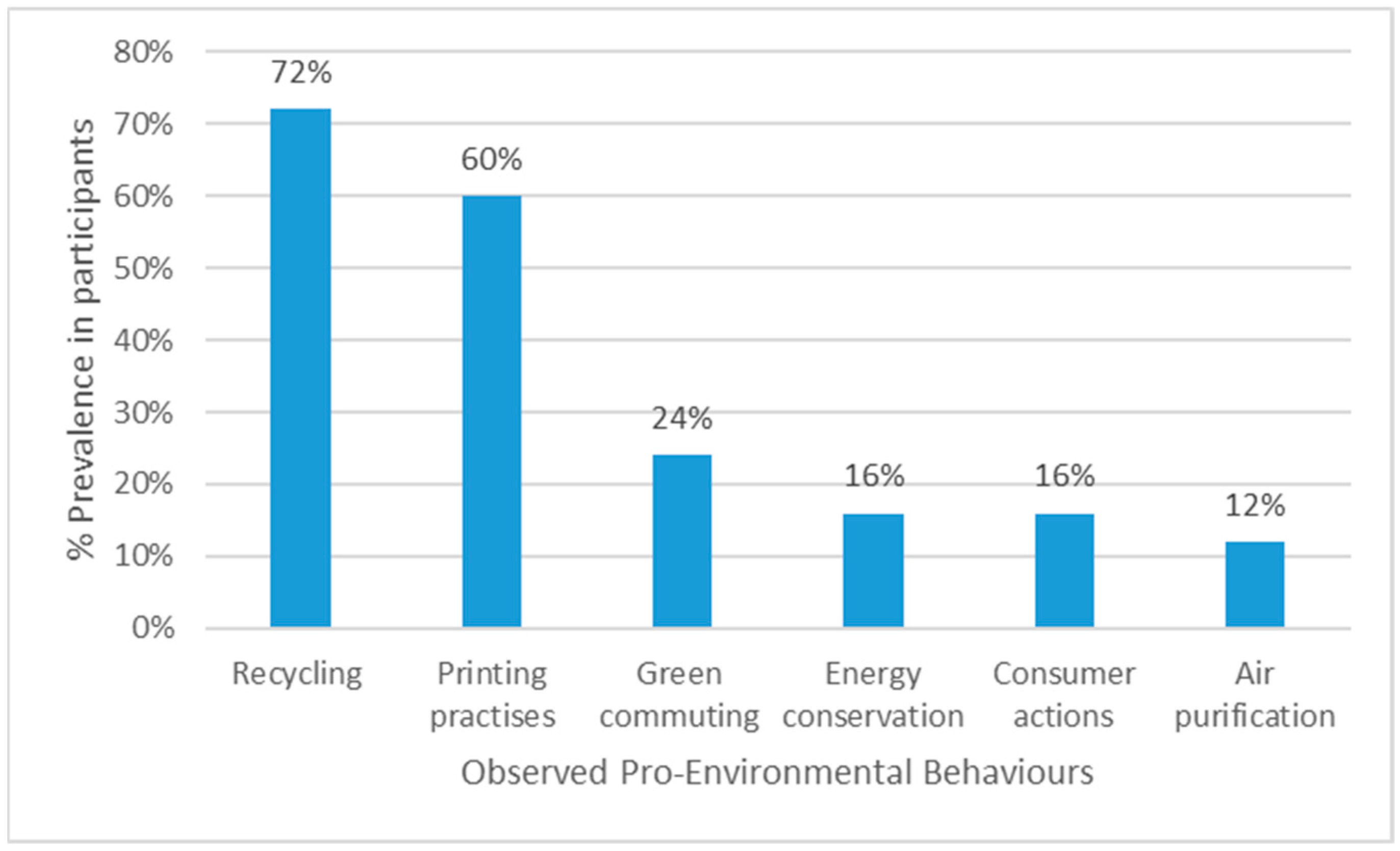
With anthropogenic harm to the environment, ranging from pollution to climate change and loss of biodiversity, there is a desperate need to adopt environmentally friendly practices. Through participation in pro-environmental behaviours (PEBs) as individuals and communities, we contribute to sustainability. The study aimed to examine the PEBs practised by local government officials, the factors that affect their behaviours, and their views on environmental issues. The article focused on 10 municipalities in the KwaZulu-Natal province, South Africa. A qualitative approach and a case study research design were used, with 16 interviews and 25 observations conducted. Data were analysed following the principles of thematic analysis and triangulated with quantitative content analysis. The results show that while officials have an understanding of environmental issues, their participation in PEB is selective, with a prominent preference for recycling and green commuting over comprehensive sustainability practices. Furthermore, some officials indicated that these behaviours went beyond the workplace into their households and communities, mainly in rural areas. Barriers to participation were resource limitations and varying levels of interest. These insights can be used by policy makers and cross-sector stakeholders to promote the mitigation of environmental impacts and develop sustainability interventions.
Keywords: sustainability; pro-environmental behaviour; local government; municipalities; environmental knowledge sustainability; pro-environmental behaviour; local government; municipalities; environmental knowledge