Article

The Hedging Strategies of Enterprises in the European Union Allowances Market—Implementation Actions for Sustainable Development


by
Małgorzata Błażejowska
1,
Anna Czarny
2,
Iwona Kowalska
3,*,
Andrzej Michalczewski
4 and
Paweł Stępień
5
1
Faculty of Economic Sciences, Koszalin University of Technology, 75-343 Koszalin, Poland
2
Faculty of Economics, West Pomeranian University of Technology, 71-270 Szczecin, Poland
3
Institute of Economics and Finance, Warsaw University of Life Sciences—SGGW, 02-787 Warsaw, Poland
4
Doctoral School, University of Szczecin, 70-384 Szczecin, Poland
5
Institute of Economics and Finance, University of Szczecin, 71-101 Szczecin, Poland
*
Author to whom correspondence should be addressed.
Sustainability 2025, 17(5), 2099; https://doi.org/10.3390/su17052099
Submission received: 9 December 2024 / Revised: 20 February 2025 / Accepted: 22 February 2025 / Published: 28 February 2025

Abstract

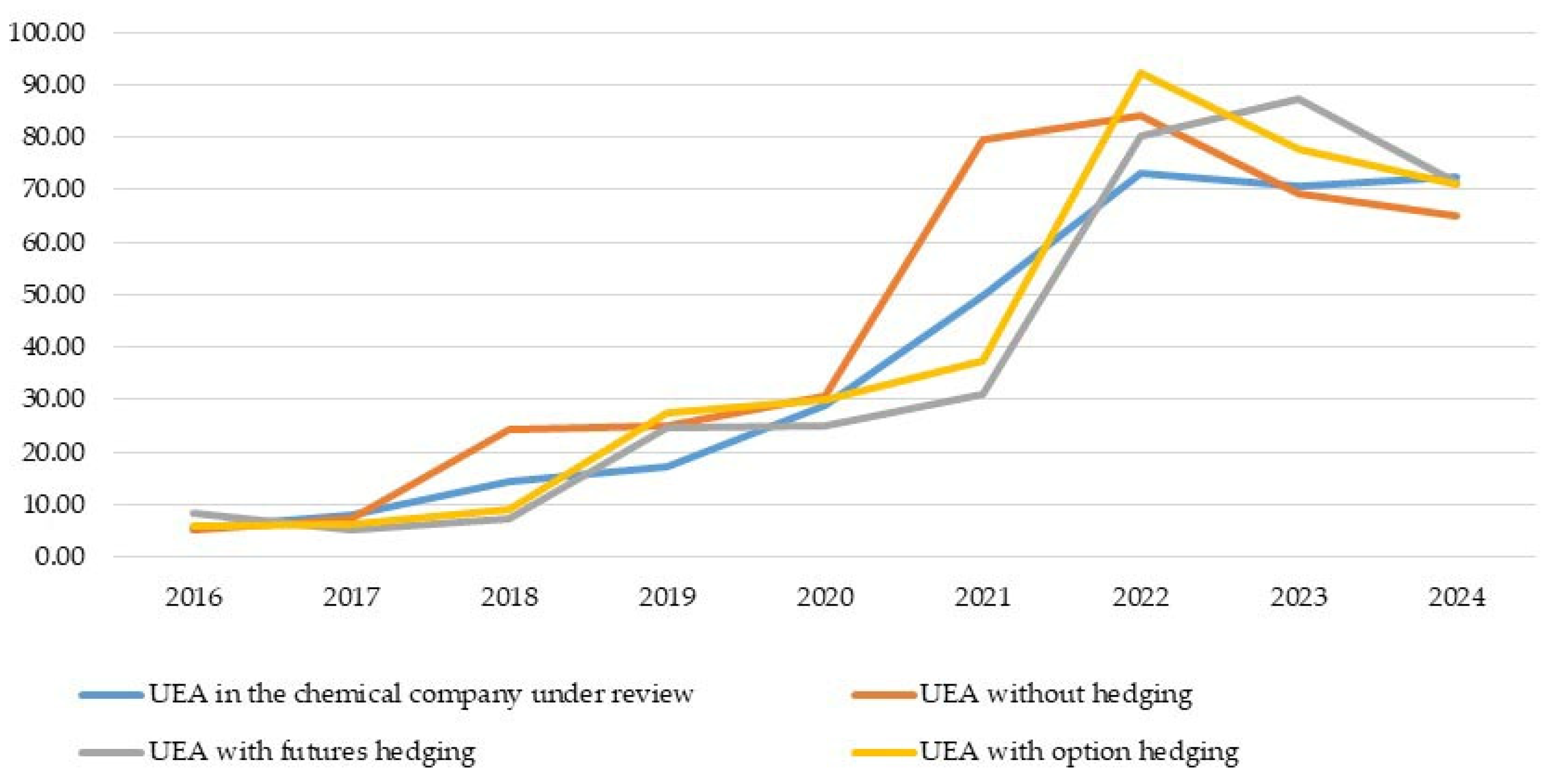
The pursuit of sustainable development in the implementation of EU energy policy concerns, among other things, the area of trading greenhouse gas emission allowances. The increasing price volatility in the European Union Allowances (EUA) market necessitates the implementation of hedging strategies to minimize the impact of price risk on the operational performance of European enterprises. An intriguing research goal (both in terms of cognitive and practical applications) was to compare the effectiveness of hedging strategies for purchasing EUA in three scenarios: (1) without hedging; (2) hedging based on an unconditional instrument; and (3) hedging based on a conditional instrument. The analysis was conducted on a theoretical-comparative variant and on the example of an entity operating in the real economy. The research objectives were supported by the following methods: 1. Data collection, which included a review of the literature on hedging EUA purchases in the context of connections with financial risk management theories and corporate responsibility, as well as connections with EU ETS policy regulations. 2. Data processing, which involved a quantitative analysis of data mainly from the ICE Endex exchange and its historical quotations (2016–September 2024), including the determination of option pricing using the Black–Scholes model. 3. Expert judgment was used to justify the time frames adopted for the research. The findings revealed that the use of hedging in EUA purchases was effective and led to a reduction in the overall cost of acquisition throughout the analyzed period. The effectiveness of hedging based on an unconditional instrument, such as a futures contract, was higher than that of hedging based on a conditional instrument, such as an option. The results obtained provide a good basis for continuing research on the effectiveness of EUA hedging in extreme scenarios and in conditions of increased volatility. This research approach is justified by the upcoming dismantling of climate initiatives starting in 2025, related to the USA’s withdrawal from the Paris Agreement.
Keywords: sustainability; CO2 emission; EUA; EU ETS; enterprise; hedging sustainability; CO2 emission; EUA; EU ETS; enterprise; hedging