1. Introduction
China’s rapid industrialization over the past four decades has generated remarkable economic growth alongside substantial environmental pressures, with GHG emissions emerging as a central global concern. These GHG emissions include CO
2, CH
4, N
2O, and fluorinated gases (HFCs, PFCs, SF
6, NF
3), aggregated as CO
2-equivalents (CO
2e) to account for their relative global warming potentials. Historically dependent on coal and other fossil fuels, China’s development model has produced escalating pollution, public health risks, and international scrutiny [
1].
While successive governments have introduced policies to mitigate environmental impacts, their effectiveness has often been constrained by fragmented enforcement, local protectionism, and the prioritization of economic growth over ecological sustainability [
2]. The ascent of Xi Jinping in 2012 introduced the Ecological Civilization framework, signaling a policy-driven institutional shift toward coordinated emissions reduction, renewable energy expansion, and strengthened centralized oversight [
3].
Despite these reforms, it remains unclear whether post-2012 policies represent minor adjustments or a substantive structural shift in China’s emissions trajectory. Existing studies largely provide descriptive accounts of policy measures, energy use, and air quality, while paying limited attention to the effectiveness of these interventions, institutional constraints, and governance mechanisms. This lack of empirical evidence limits our understanding of how governance, enforcement, and political economy factors shape emission dynamics.
The study focuses on two research questions that are directly aligned with the empirical strategy: Did post-2012 environmental reforms generate identifiable structural breaks in China’s GHG emission trajectory, as detected through the Bai–Perron multiple-break methodology, and how are these shifts associated with institutional fragmentation, enforcement gaps, and local protectionism? How has the expansion of renewable energy affected GHG emissions within the EKC framework, and what does the COVID-19 shock reveal about the short-term resilience of state-led emission reductions? By grounding both questions in the study’s econometric approach, the analysis remains methodologically coherent and avoids overly broad or exploratory formulations.
By integrating Bai–Perron structural break analysis with EKC modeling to provide a temporally precise and empirically grounded assessment of China’s emissions trajectory. By comparing observed emission shifts with EKC-implied turning points, the analysis evaluates whether reductions are primarily income-driven, policy-driven, or a combination. It further examines the role of renewable energy deployment and external shocks in shaping the resilience and sustainability of state-led emission reductions.
This integration constitutes the study’s novel methodological contribution by integrating Bai–Perron multiple structural break analysis with EKC modeling to assess China’s GHG emissions trajectory from 1969 to 2022. The approach moves beyond descriptive accounts of policy intent or short-term improvements, providing temporally precise evidence on the timing, magnitude, and persistence of emission shifts. By linking structural breaks to institutional reforms, enforcement gaps, and the expansion of renewable energy, the study disentangles the respective roles of economic growth, governance, and state-led interventions.
The empirical results reveal three core patterns. First, a major structural break in GHG emissions emerges after 2012, coinciding with the consolidation of the Ecological Civilization reforms. Second, emissions continue to rise but at a slower pace, while LULUCF displays sustained gains in carbon sequestration. Third, the EKC estimations show heterogeneous pollutant-specific trajectories, indicating that recent improvements are driven less by income dynamics and more by institutional reforms and governance changes. These findings underscore the central role of post-2012 policy shifts in shaping China’s current emissions pathway.
2. Literature and Conceptual Background
This study combines the EKC framework with Bai–Perron structural break analysis to examine China’s greenhouse gas emissions. The EKC provides a lens to explore potential nonlinear relationships between economic growth and environmental impact, while Bai–Perron allows identification of structural shifts linked to major economic or policy transitions. Together, these approaches support a nuanced evaluation of government interventions and help interpret deviations from the traditional EKC pattern.
At the foundation of environmental economics lies the concept of negative externalities, where the social costs of pollution are not reflected in market prices [
4,
5]. Recent empirical studies continue to confirm the need for state intervention through market-based and regulatory mechanisms. Both specific and general taxes yield similar results, as does the carbon emission trading system, which promotes investment and the creation of efficient, low-carbon enterprises [
6,
7]. During the early stages of industrialization, particularly in resource- and energy-intensive economies, firms face incentives to expand output while shifting environmental costs onto society.
Rapid industrialization and urbanization amplified externalities, as coal-based energy and heavy manufacturing formed the backbone of growth. In this context, theoretical models have been developed to regulate pollution and assess the benefits and costs of environmental programs [
8]. Pollution effectively acted as an implicit subsidy to development, creating a gap between private and social welfare. From a welfare perspective, these externalities constitute a market failure and justify state intervention through taxes, emission standards, or cap-and-trade systems [
9].
In China, however, the effectiveness of such instruments has historically depended on institutional capacity and incentive structures: while national environmental directives existed, local governments often prioritized GDP growth over enforcement, reflecting the constraints of fiscal decentralization and the cadre evaluation system [
10]. Consequently, emissions outcomes are shaped not only by prices and technology but also by governance design, enforcement mechanisms, and the political economy of local implementation.
The EKC framework describes the relationship between economic growth and emissions: Kuznets [
11] provides the theoretical foundation, and Grossman & Krueger [
12] offer early empirical evidence, showing that as income rises, environmental quality initially worsens and then improves, with turning points typically occurring before per capita income reaches
$8000.
Stern [
13] offers a critical assessment, noting that recent evidence questions the classic EKC, showing that developing countries can address environmental issues effectively. Dinda [
14] proposes methodological extensions. The EKC suggests that environmental pressure rises and then falls with income, but evidence is mixed, mainly observed for local pollutants, and there is no consensus on the income level at which improvement begins. This conceptualization guides the current study in analyzing China’s emission patterns under policy interventions.
Yet, in China, the EKC dynamics are strongly mediated by state-led interventions: centralized environmental governance, binding energy intensity targets, renewable energy expansion, and provincial performance evaluations can accelerate or shift turning points, indicating that policy—not income alone—drives structural decoupling. Empirical evidence shows heterogeneity across regions and pollutants, and CO
2 turning points are often estimated at income levels beyond current national averages [
15].
Sustainability economics further emphasizes that emissions represent a stock problem with intergenerational consequences, since the accumulation of atmospheric carbon and the ongoing degradation of natural capital may significantly constrain future economic potential, indicating that sustainable long-term development cannot rely on continuous environmental depletion [
16].
In the Chinese context, integrating classical environmental economics, the EKC, and sustainability perspectives requires explicit attention to institutional instruments—such as fiscal centralization, cadre evaluations, and Five-Year Plans—that operationalize state-led mitigation and shape the effectiveness and durability of emissions reductions [
17]. Between 2006 and 2017, environmental regulation in China nonlinearly reduced emissions, being most effective in technologically advanced, high-FDI regions, with impacts varying over time and across levels of economic development.
China’s environmental challenges—including water stress, air pollution, and green innovation—reflect industrial growth and policy interventions: water quality improves via economic, technological, and institutional reforms; SO
2, NOx, and particulate matter have declined, but ozone and smog remain; and local government competition affects green innovation differently under fixed versus floating environmental tax systems m [
18,
19,
20].
Research shows that China’s rapid economic growth has caused severe air pollution from SO
2, NOx, and fine particulates, while heavy metal pollution remains a serious public health concern; efforts in environmental governance, technology, and policy have improved air quality and advanced multiple SDGs such as health, though regional disparities and persistent pollutants highlight the need for continued targeted interventions [
21,
22,
23].
Research on planning mechanisms, such as the Five-Year Plans, similarly illustrates the tension between top-down policy ambitions and local implementation challenges, including fiscal decentralization and structural constraints [
24,
25,
26]. These studies show that observed reductions in pollution may not uniformly reflect systemic changes but are shaped by enforcement capacity and institutional design.
China’s environmental policies have shown mixed effectiveness: the 1982 pollution levy system produced widely variable and inefficient abatement across mills, suggesting that tradable permits could outperform forced closures; SO
2 emissions have declined mainly through engineering, structural, and administrative measures, with engineering desulfurization leading reductions during China’s 11 Five-Year Plan, structural measures more effective at controlling pollutants and greenhouse gases, and agricultural emissions of chemical oxygen demand, total nitrogen, and total phosphorus potentially reducible by 16–20% [
27,
28,
29].
Since 2001, downstream counties in Chinese provinces have up to 20% more polluting activities due to relaxed enforcement, with private firms contributing most. Emission trading policies reduce enterprise emissions through cleaner production and improve energy efficiency. China still faces air pollution from legislative gaps and poor policy integration, requiring stronger local regulations and clearer responsibilities. Major river basins need 60–97% reductions in nitrogen and phosphorus to achieve pollution equality [
30,
31,
32,
33].
Several studies emphasize the influence of state-owned enterprises, regional rivalries, and enforcement gaps, highlighting that technical or market-based measures alone are insufficient for achieving lasting emissions reductions. Research on the decoupling of economic growth and emissions, as well as citizen engagement, further illustrates the complex interplay between economic structure, public demand, and institutional capacity [
34,
35,
36,
37,
38].
In China, coordinated pollution and carbon reduction policies have demonstrated clear synergistic effects, leading to simultaneous decreases in carbon dioxide and air pollutant emissions. The magnitude of these reductions varies across regions, reflecting differences in industrial structure, energy use, and policy implementation. Key drivers of the synergy include improvements in energy efficiency, optimization of industrial activities, and advances in technology. Some regions, such as the Yangtze River Delta, achieve higher levels of coordinated emission reduction, while others, like Beijing, Tianjin, and Hebei, show lower synergy levels [
39,
40,
41,
42].
Indirect eco-innovation from other regions often reduces pollution more effectively than local efforts in China, with outcomes shaped by environmental regulations and the level of financial development. In urban agglomerations such as Chengdu-Chongqing, coordinated reductions in air pollutants and carbon emissions display moderate imbalance but strong spatial integration and path dependence at the county level. Likewise, in the Yellow River Basin, social space structure has the greatest impact on industrial pollution, while physical space expansion plays a smaller role, and their coordination is gradually improving across different urban regions [
43,
44,
45].
A combination of industrial restructuring, environmental tax reforms, and green fiscal policies in China has been effective in stabilizing carbon emissions, enhancing energy efficiency, and reducing multiple pollutants across regions. These measures operate primarily through green technological innovation, industrial upgrading, and public participation, with the strongest impacts seen in coastal, eastern, and non-resource-based cities [
46,
47,
48].
These thematic clusters suggest that environmental improvements in China emerge from a combination of targeted policy interventions, institutional capacity, and economic dynamics rather than from income growth alone. This perspective provides a natural bridge to the EKC framework: while EKC models offer a stylized representation of the income–emissions relationship [
11,
14].
Thus, understanding China’s trajectory requires integrating them with the country’s political economy, institutional reforms, and governance mechanisms. By situating EKC analyses within this broader context, the study avoids overgeneralization and emphasizes that observed emission trends are shaped jointly by economic growth and state-led policy interventions.
Previous research shows that China’s environmental outcomes are shaped by a combination of institutional capacity, sectoral policies, and governance reforms. Technical measures and renewable energy initiatives reduce emissions, but effectiveness varies across regions. Policy innovations, such as ecological civilization and green finance, can accelerate improvements, though structural constraints limit uniform success. This study extends prior work by integrating EKC and Bai–Perron analyses to link economic growth and policy interventions to observed emissions patterns.
This study hypothesizes that post-2012 environmental reforms in China have generated identifiable structural shifts in GHG emissions, which can be detected through the Bai–Perron multiple-break methodology, with these shifts likely influenced by institution, enforcement, and local protectionism. It further hypothesizes that the expansion of renewable energy has affected GHG emissions within the EKC framework, while external shocks such as COVID-19 may reveal the short-term resilience of state-led emission reductions.
3. Method
This study employs two complementary econometric approaches to analyze the evolution and determinants of GHG emissions in China over the period 1969–2022. First, the Bai–Perron multiple structural break model is applied to identify endogenous shifts in emission trajectories, enabling detection of statistically significant regime changes associated with major policy interventions or economic transformations. Second, the EKC framework is used to examine how GHG emissions respond to key macroeconomic factors, including income, trade openness, and foreign direct investment (FDI), rather than treating economic growth as the primary object of study.
Together, these methods provide both a temporal dimension—identifying when structural changes occurred—and a behavioral dimension—characterizing how emissions respond to macroeconomic dynamics. Compared to conventional EKC approaches, the integrated Bai–Perron and EKC methodology allows precise identification of structural breaks associated with policy interventions, enhancing temporal resolution and interpretability of income–emission relationships relative to standard regression or panel-based methods.
3.1. Data and Variables
All variables were obtained from the World Development Indicators (WDI) database published by the World Bank, covering the period 1969–2022. While more recent GHG data (post-2022) are emerging, the 1969–2022 period captures all major structural breaks associated with economic reforms and policy shifts, providing a robust basis for analyzing China’s long-run emission trajectory. The analysis examines four complementary indicators of greenhouse gas emissions, each capturing distinct dimensions of China’s environmental performance, as seen in
Table 1.
To complement these environmental indicators, the study integrates macroeconomic control variables that capture trade exposure, capital dynamics, and structural transformation in the Chinese economy, as displayed in
Table 2. Structural transformation is proxied by the sectoral composition of GDP and gross capital formation, capturing the economy’s shift from agriculture to industry and services, as reflected in the macroeconomic indicators listed in
Table 2.
All data series were organized at an annual frequency and checked for consistency across reporting periods to ensure comparability over time. The GDP series, expressed in monetary terms, was transformed using natural logarithms to stabilize variance and allow interpretation of coefficients as elasticities. Other macroeconomic indicators (percentages of GDP or growth rates) were analyzed in their original units.
Table 3 presents descriptive statistics for the key variables used in the analysis from 1969 to 2022, including means, medians, standard deviations, and ranges. The data show that total and per capita GHG emissions are positively skewed, while land-use emissions exhibit slight negative skewness. Additionally, economic indicators such as gross capital formation, trade, and foreign direct investment display moderate variability over the studied period.
3.2. Bai–Perron Multiple Structural Break Analysis
The Bai–Perron multiple structural break procedure [
49,
50] was applied independently to each emission series to endogenously identify both the number and timing of structural shifts, avoiding the need for a priori break dates as required in traditional tests like the Chow test. The model specification is:
where
denotes the emission level at year
,
and
are the intercept and slope for regime
,
are the endogenously determined breakpoints, and
is the number of structural breaks selected by minimizing the Bayesian Information Criterion (BIC). Heteroskedasticity- and autocorrelation-consistent (HAC) standard errors were applied to account for potential serial correlation and heteroskedasticity.
Breakpoints were estimated using the breakpoints() function from the R package strucchange (R version 4.3.1), with a minimum segment length of 15% of total observations. Sensitivity checks varying this segment length confirmed the robustness of identified breaks. Detected break years were converted to calendar years for historical interpretation, and key periods—including the post-2012 Xi Jinping era—were highlighted in visualizations to link structural shifts to major policy interventions.
3.3. Environmental Kuznets Curve (EKC) Model
Prior to estimating the EKC regressions, unit root tests were conducted to assess the stationarity of the variables. While the main estimations rely on OLS, we acknowledge potential endogeneity between GDP per capita and emissions; robustness checks confirmed that the results are stable, although methodological limitations of OLS remain. The EKC hypothesis, tested for China over 1969–2022, posits an inverted U-shaped relationship between income and environmental degradation. It is operationalized with the semi-log quadratic specification:
where
represents the natural logarithm of greenhouse gas emissions in year
,
denotes the log of real GDP per capita, and
is a stochastic error term, assumed to be independently and identically distributed (i.i.d.) with zero mean and constant variance (homoskedastic). The log-log specification facilitates interpretation of coefficients as elasticities and helps stabilize variance in the presence of exponential growth trends. The parameters
and
jointly determine the functional form of the income–emission relationship:
The orientation of the parabola (U-shape or inverted-U) is determined solely by the sign of the quadratic coefficient β2. The linear term β1 only affects the location of the turning point along the income axis, not the curve’s orientation.
For a quadratic specification with β2 ≠ 0, the turning point is computed directly as GDP* = exp(−β1/2β2).
A critical aspect of EKC interpretation involves assessing whether the estimated turning point falls within the observed income range or lies beyond plausible future development trajectories. Turning points that exceed empirical bounds suggest that the EKC may hold theoretically but remain policy-irrelevant, as spontaneous income-driven environmental improvements are unlikely without deliberate regulatory intervention.
3.4. Model Estimation and Comparative EKC Specification
To empirically evaluate the EKC hypothesis across different dimensions of China’s emissions profile, four separate regression models were estimated, each corresponding to a distinct greenhouse gas indicator. For each series, annual data were merged with macroeconomic covariates using the year variable as the key. Observations with missing or zero emission values were removed to ensure the log transformation was defined.
All variables expressed in monetary terms were transformed using natural logarithms. To capture potential non-linear income effects, the square of ln(GDP) was computed. The extended EKC specification estimated for each emission indicator is given by:
where
is the logarithm of the emission indicator,
captures economic scale effects,
allows for curvature in the income–emission relationship,
is trade openness (% of GDP),
is net foreign direct investment inflows (% of GDP).
This specification allows emissions to +respond not only to economic growth but also to structural integration into global markets and capital inflows. All models were estimated in R using Ordinary Least Squares (OLS). This cross-model framework enables systematic comparison of:
The sign and statistical significance of and ,
The implied shape of the income–emission relationship (inverted-U, U-shaped, or monotonic),
The economic feasibility of turning points,
The moderating effects of trade openness and FDI.
Finally, the turning point for each model (when ) was calculated as GDP* = exp(−β1/2β2); and then benchmarked against observed Chinese income levels to assess whether the curve is theoretically present but practically unattainable.
The quadratic EKC specification may not fully capture more complex nonlinear relationships between income and emissions. Moreover, using annual WDIs may mask sectoral heterogeneity and seasonal variations relevant to the analysis. Although the Bai–Perron model detects real structural breaks in emissions, their causes may reflect a combination of policy interventions and other factors such as economic fluctuations, so causal interpretation should be made with caution.
4. Results
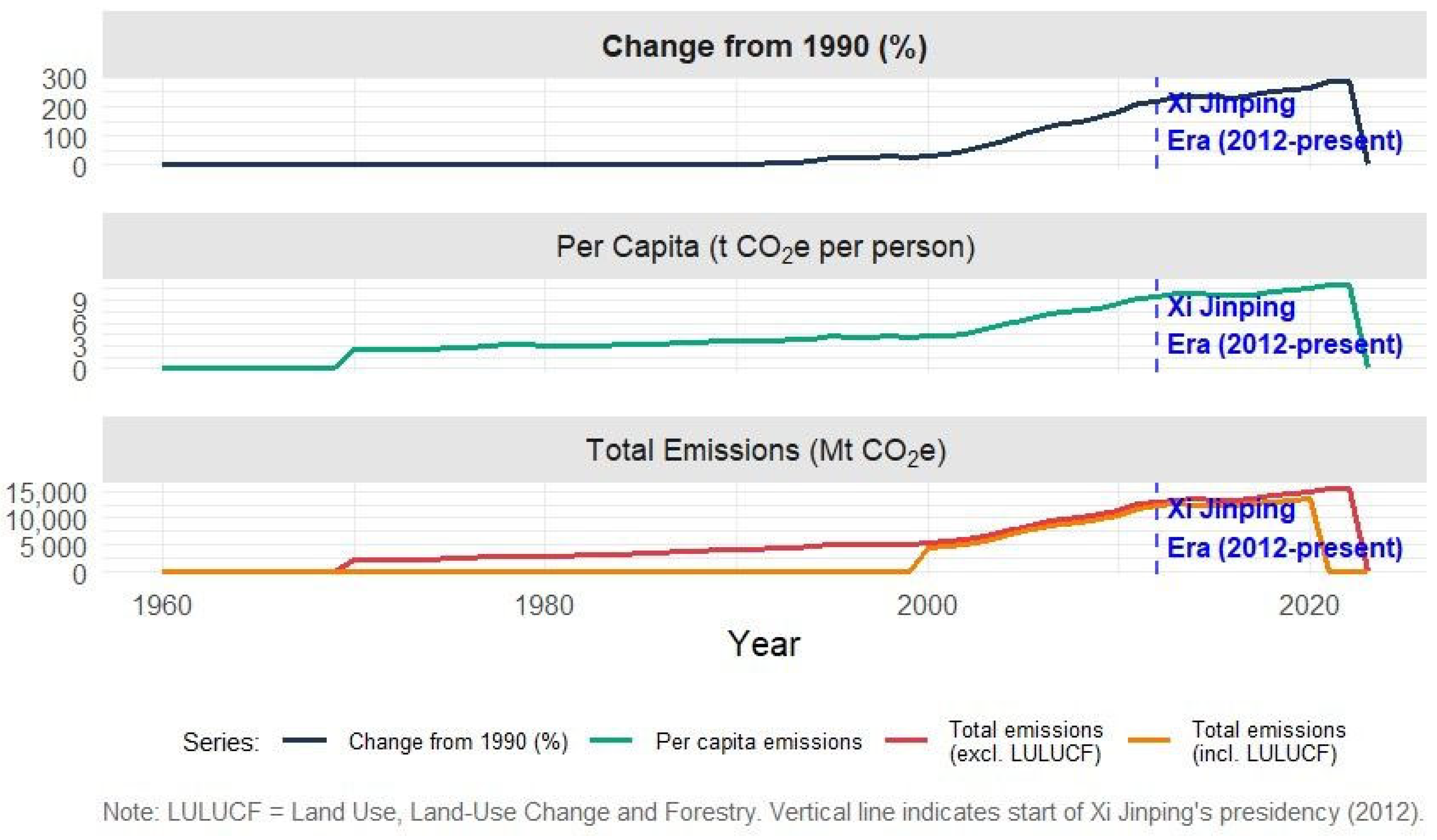
Figure 1 illustrates the comparative evolution of GHG emissions in China from 1969 to 2022 across four complementary indicators: total emissions excluding land use, land-use change, and forestry (LULUCF); total emissions including LULUCF; per capita emissions; and LULUCF-specific emissions. The temporal dynamics reveal three distinct phases, each corresponding to major economic transformations and policy transitions, providing a clear framework to interpret long-term emission trends and their underlying drivers.
Phase I: Early Industrial Expansion (1970–1990): During this period, all emission indicators exhibit a gradual upward trend, reflecting the initial acceleration of industrialization following the economic reforms initiated in the late 1970s. The steady increase suggests a foundational shift in production structures and energy consumption patterns.
Phase II: Rapid Growth and Global Integration (1990–2012): This phase is characterized by a pronounced surge in both total and non-LULUCF emissions, coinciding with China’s accession to the World Trade Organization and the intensification of export-oriented manufacturing. Per capita emissions also rose significantly, indicating that the benefits of industrial growth translated into higher individual carbon footprints. The steep trajectory of emissions during this period underscores the carbon-intensive nature of China’s economic expansion.
Phase III: Stabilization and Policy-Driven Inflection (Post-2012): Following 2012—demarcated by the dashed line in
Figure 1—a relative deceleration in emissions growth is observed, particularly in total and per capita indicators. This shift aligns with the implementation of Xi Jinping’s environmental governance agenda, including the “ecological civilization” framework, stricter environmental regulations, and extensive reforestation programs. Notably, the LULUCF series displays substantial negative values during this phase, indicative of net carbon sequestration efforts through forest expansion and land restoration initiatives.
The comparative trends suggest that China’s GHG emissions reached a structural turning point after 2012. While absolute emission levels remain elevated, the observed moderation in growth rates implies that environmental policy reforms may be beginning to curb the trajectory of carbon-intensive development.
4.1. Total Greenhouse Gas Emissions Excluding LULUCF (Mt CO2e)
The Bai–Perron structural break analysis across all four GHG indicators highlights a consistent deceleration in emissions growth after the early 2010s. Key breakpoints correspond to major phases of China’s economic and policy trajectory: early industrial expansion (1970s–1990s), export-oriented industrialization and coal dependence (1990s–2000s), post-WTO industrial acceleration (2002–2013), and the post-2012/2014 slowdown under the Ecological Civilization framework.
While total and per capita emissions continued to rise, the pace of growth slowed markedly, reflecting coordinated policy interventions, renewable energy expansion, and strengthened monitoring and enforcement. Including LULUCF shows that carbon sinks and reforestation initiatives further contributed to the net reduction in growth rates during 2013–2020. This consolidated presentation highlights the structural nature of emission dynamics, as summarized in
Table 4.
4.2. Environmental Kuznets Curve Estimation Results
Following the structural break analysis, we applied the previously specified EKC models to examine the functional relationship between economic growth and greenhouse gas emissions. To account for China’s deep integration into the global economy and its role as a major recipient of foreign capital, the models include macroeconomic controls for trade openness and foreign direct investment (FDI), both of which have been extensively documented as important determinants of emission trajectories in developing economies.
Table 5 presents the regression results for all four EKC models estimated using ordinary least squares with robust standard errors. All specifications span the maximum available period for each indicator, ranging from 21 observations for emissions including LULUCF (2000–2020) to 54 observations for total and per capita emissions (1969–2022).
4.3. Interpretation of Regression Results
The estimation results reveal striking heterogeneity in the income–emission relationship across indicators, challenging the notion of a universal EKC pattern for China. The models display high explanatory power, with R2 values ranging from 0.78 to 0.96, indicating that the combined effects of income growth, trade integration, and foreign investment account for the vast majority of variation in emission trajectories over the study period.
Income–Emission Relationships. Two fundamentally different functional forms emerge from the analysis. Models for total emissions including LULUCF (EN.GHG.ALL.LU.MT) and percentage change relative to 1990 (EN.GHG.TOT.ZG) produce positive linear coefficients (β1 = 13.46 and 21.24, respectively) and negative quadratic terms (β2 = −0.216 and −0.337), conforming to the traditional inverted-U EKC specification. However, both implied turning points occur at GDP levels of approximately 3.4 × 10¹³ and 4.7 × 10¹³ constant 2015 US dollars—values that substantially exceed China’s current GDP (approximately 2.5 × 10¹³ in 2022) and lie well beyond any realistic medium-term development trajectory. These results suggest that, while the models satisfy the mathematical conditions for an EKC, the income threshold for spontaneous emission decline remains economically unattainable without deliberate policy intervention.
In stark contrast, models for total emissions excluding LULUCF (EN.GHG.ALL.MT) and per capita emissions (EN.GHG.ALL.PC) exhibit negative linear coefficients (β1 = −2.33 and −4.05) and positive quadratic terms (β2 = 0.0487 and 0.0769), which mathematically produce U-shaped relationships. However, the magnitude of these positive quadratic terms is very small compared to conventional EKC coefficients, so they should not be interpreted as strong evidence of a U-shaped relationship between emissions and income.
The turning points for these models (GDP ≈ 2.41 × 10¹⁰ and 2.87 × 10¹¹) fall within or near China’s observed income range (ln(GDP) ≈ 25.8–30.2), suggesting that emissions initially declined during early development stages but have since accelerated with industrialization, urbanization, and rising consumption. This pattern aligns closely with China’s post-1978 reform trajectory, particularly its post-2001 WTO accession period, characterized by rapid manufacturing expansion and export-led growth.9
Trade and Globalization Effects. The coefficient on trade openness reveals differential impacts across emission measures. Trade intensity exhibits no significant effect on emissions including LULUCF (β3 = 0.00172, p = 0.35) or growth rates (β = 0.00468, p = 0.14), but shows positive and statistically significant relationships with both total emissions excluding LULUCF (β = 0.00579, p < 0.01) and per capita emissions (β = 0.00631, p < 0.01). These results suggest that China’s integration into global value chains has contributed to emission increases primarily through scale effects—expanding the volume of energy-intensive manufacturing for export markets—rather than through composition or technique effects that might reduce emission intensity. The lack of significance in the LULUCF model may reflect the limited role of international trade in land-use decisions, which are predominantly determined by domestic agricultural and forestry policies.
Foreign Direct Investment. The FDI coefficient displays mixed effects across specifications. It is statistically insignificant in three of the four models, but exhibits a strong positive effect on emission growth rates (β = 0.119, p < 0.01). This finding contradicts the pollution haven hypothesis, which predicts that FDI from developed countries should reduce emissions through technology transfer and improved environmental standards. Instead, the positive coefficient suggests that foreign investment in China has been associated with emission-intensive sectors, possibly reflecting the concentration of FDI in manufacturing industries during the sample period. The negative but insignificant coefficients in the total and per capita models (β = −0.0188 and −0.0101) hint at potential offsetting effects, where technology improvements from FDI may be overwhelmed by scale effects from expanded production.
Model Performance and Specification. All F-statistics are highly significant (p < 0.01), confirming the joint significance of the explanatory variables. The consistently high R2 values indicate that the quadratic specification with trade and FDI controls provides an adequate empirical representation of emission dynamics, though alternative functional forms (e.g., cubic specifications or threshold models) may merit exploration in future research. The relatively lower R2 for the emissions growth model (0.78 versus 0.94–0.96 for other specifications) likely reflects the higher volatility inherent in annual growth rates compared to absolute levels.
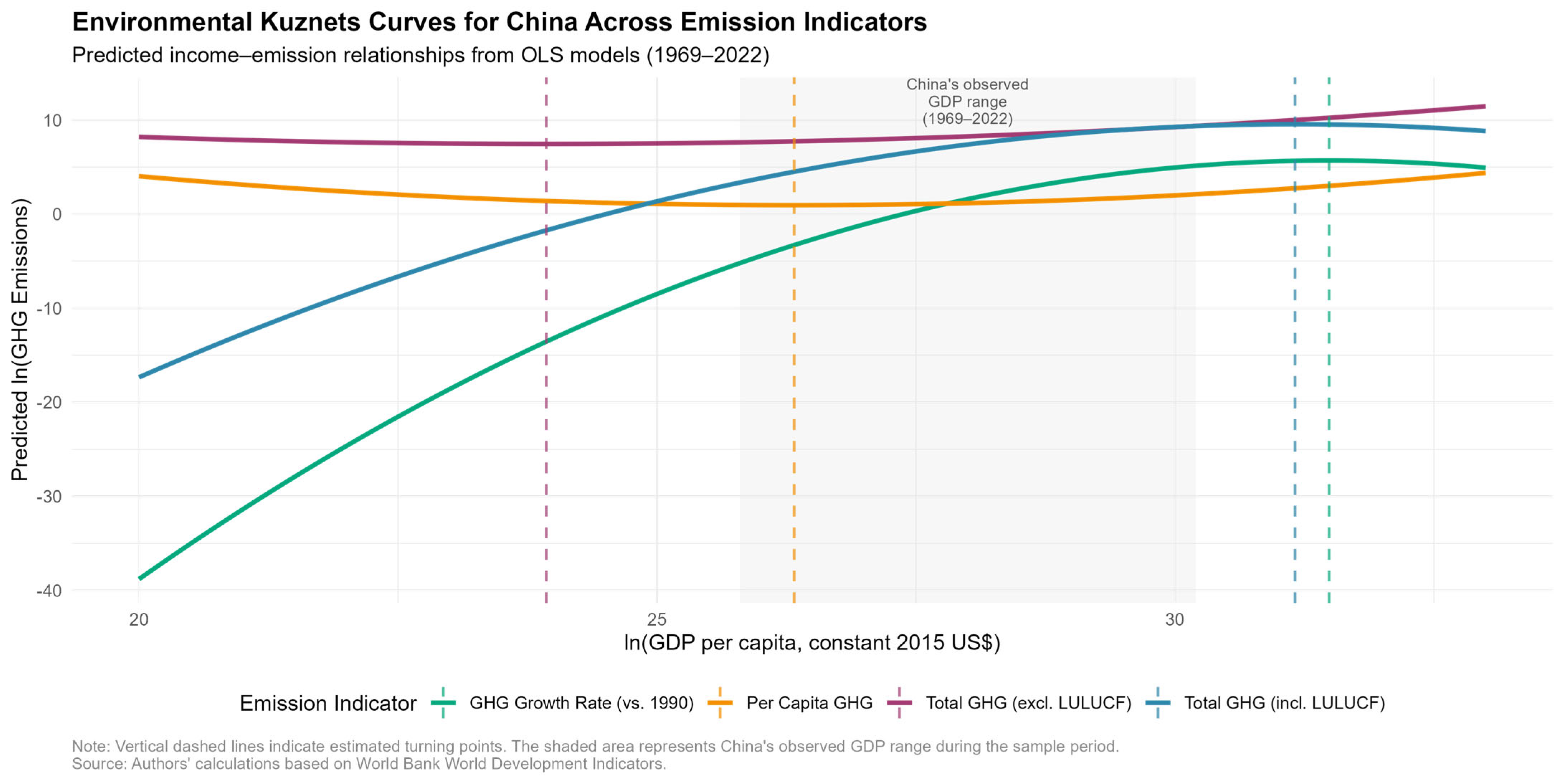
Visual Comparison of EKC Trajectories. To enable an intuitive comparison of the income–emission relationships across indicators,
Figure 2 displays the fitted EKCs over a common range of log GDP values (ln(GDP) ∈ [
20,
33]), corresponding to real GDP per capita levels from approximately 4.85 × 10
8 to 5.32 × 10
14 constant 2015 US dollars. This interval encompasses China’s entire observed development trajectory from 1969 to 2022 (ln(GDP) ≈ 25.8–30.2; shaded area) and extends to hypothetical lower and higher income levels to illustrate the long-run implications of each functional specification.
Interpretation of Trajectory Patterns
The visual comparison reveals four distinct income–emission trajectories that challenge the notion of a universal EKC pattern for China. The divergence among curves is particularly pronounced at both extremes of the income distribution, with important implications for understanding China’s historical development path and future emission scenarios.
Inverted-U Trajectories (Traditional EKC). Two models—total GHG including LULUCF (blue line) and GHG growth rate relative to 1990 (green line)—exhibit the theoretically predicted inverted-U shape, with turning points indicated by vertical dashed lines at ln(GDP) ≈ 31.2 and 31.5, respectively. Critically, both inflection points fall substantially to the right of China’s observed income range (shaded area), implying that China has not yet approached the income threshold where emissions would spontaneously begin to decline. At China’s 2022 income level (ln(GDP) ≈ 30.2), both curves remain on their upward-sloping segments, predicting continued emission growth absent policy intervention. The theoretical turning points correspond to GDP per capita levels of 3.40 × 10¹³ and 4.73 × 10¹³—approximately 13–19 times China’s current GDP—rendering these thresholds economically implausible for the foreseeable future.
U-Shaped Trajectories (Inverse EKC). In stark contrast, the models for total GHG excluding LULUCF (purple line) and per capita emissions (orange line) display U-shaped relationships with turning points at ln(GDP) ≈ 23.9 and 26.3, respectively. These inflection points fall within or near the left edge of China’s observed income range, suggesting that emissions initially declined during the early reform period (pre-1980s) but subsequently accelerated as income surpassed critical thresholds. The steep upward trajectory of both curves after their turning points reflects the emissions-intensive nature of China’s post-reform industrialization and urbanization. Notably, the per capita curve (orange) exhibits a steeper slope in the post-turning point region compared to the aggregate curve (purple), indicating that individual-level consumption growth has outpaced efficiency improvements on a per capita basis.
Divergence and Policy Implications. At China’s current development stage (right edge of shaded area), the four models predict vastly different emission levels, ranging from ln(GHG) ≈ 4 to ln(GHG) ≈ 10. This twenty-fold difference in predicted emission levels underscores the critical importance of indicator selection for policy analysis and scenario modeling. The fact that the LULUCF-inclusive model (blue) remains relatively flat across China’s income range—while the per capita and total emissions excluding LULUCF models (orange and purple) show steep increases—suggests that land-use policies and carbon sequestration efforts have partially offset emission growth from energy and industrial sources.
The visual evidence strongly contradicts the optimistic interpretation of EKC theory, which posits that economic growth naturally leads to environmental improvement beyond a certain income threshold. Instead,
Figure 1 demonstrates that China’s emission trajectory has been predominantly upward throughout its development process, with the post-2012 slowdown documented in the structural break analysis (
Section 3.1) appearing as a subtle flattening of curves rather than a clear turning point. This pattern reinforces the conclusion that observed emission deceleration reflects policy-driven structural transformation rather than income-driven spontaneous improvement, highlighting the indispensable role of deliberate environmental regulation in achieving emission reductions.
4.4. Integrated Interpretation of Structural Breaks and EKC Estimates
Taken together, the Bai–Perron breakpoints and the EKC results provide a coherent interpretation of China’s long-run emission dynamics. The structural breaks identify major shifts in the country’s economic and policy regimes, and these regime transitions help explain the changes observed in the income–emissions relationship captured by the EKC models.
In particular, the breakpoints coincide with periods in which the slope and significance of the EKC terms change, indicating that the turning points and emission responses are not uniform over time but conditioned by broader structural transformations—such as industrial restructuring, policy tightening, or phases of accelerated growth.
By interpreting the EKC estimates within the temporal regimes revealed by the break tests, the two approaches become analytically connected: the structural breaks contextualize when and why the EKC relationship strengthens, weakens, or reverses. This integrated reading aligns both methods and reinforces the manuscript’s contribution to understanding China’s evolving emissions trajectory.
5. Discussion
The findings of this study situate China’s GHG emission dynamics within the broader context of institutional and political economy constraints highlighted in the literature. While prior work often emphasizes technological optimism, market-based solutions, or broad regulatory intent [
19,
26], our integration of Bai–Perron structural break analysis with EKC modeling provides a temporally precise assessment of associations between policy interventions and emissions trajectories. The structural breaks identified with the Bai–Perron test help contextualize shifts in China’s GHG emissions, while the EKC explanatory variables (e.g., FDI, trade, capital formation) serve as proxies reflecting institutional and political economy constraints.
Three key insights emerge from the analysis. First, the post-2012 slowdown in emissions growth coincides with the consolidation of environmental governance under the Ecological Civilization framework, including binding energy intensity targets, renewable energy expansion, and enhanced monitoring and accountability systems. These observations suggest that targeted, enforceable interventions were associated with measurable shifts in emission trajectories rather than gradual income-driven decoupling [
21].
The 2013 break-point, incorporating LULUCF effects, further highlights the complementary role of afforestation and ecological restoration alongside industrial regulations [
27,
28]. While the Bai–Perron results identify statistically significant breaks, it is important to emphasize that these are correlational findings; alternative factors—such as global economic fluctuations, unobserved policy measures, or structural shocks—may also contribute to the observed patterns.
Second, the EKC results indicate that income alone cannot explain observed emission dynamics, underscoring the importance of policy-driven structural shifts identified in the Bai–Perron analysis. Estimated turning points lie well beyond China’s current income levels, and trade or FDI effects are weak and inconsistent, reinforcing critiques that growth-based mechanisms are insufficient to account for emission reductions [
15].
Third, governance appears as the principal mechanism shaping environmental outcomes. The effectiveness of post-2012 reforms seems linked to top-down coordination, provincial accountability, and mechanisms such as ecological civilization principles, which mitigated local resistance, fragmented enforcement, and entrenched industrial interests [
31,
32,
44]. Despite these associations, structural constraints—including regional disparities, bureaucratic incentives, and reliance on coal—underscore the fragility of progress.
Sustaining decarbonization will likely require continuous political commitment, structural industrial reforms, local incentive realignment, and strengthened financial and technological support for renewable energy integration. By explicitly acknowledging these limitations, this analysis situates China’s observed emission dynamics within both their institutional context and the empirical boundaries of the study, providing a nuanced interpretation that balances inference with methodological caution.
6. Conclusions
This study demonstrates that China’s greenhouse gas emissions trajectory from 1969 to 2022 has been shaped by discrete structural shifts associated with targeted policy and governance interventions, rather than by automatic, income-driven decoupling. By combining Bai–Perron structural break analysis with EKC modeling, the research identifies prolonged periods of emissions growth interrupted by inflection points linked to major institutional reforms—from WTO accession and binding energy intensity targets to the post-2012 consolidation under the Ecological Civilization framework.
While these breaks suggest policy influence, formal statistical tests (e.g., Chow tests) would be needed to confirm slope differences and robustly establish structural decoupling. EKC regressions further indicate that income alone cannot explain emissions reductions, as estimated turning points exceed China’s current income levels and trade or FDI effects remain weak and inconsistent. The post-2012 period under Xi Jinping’s administration corresponds to the lowest growth rates in GHG emissions, despite continued economic expansion, highlighting the impact of policy-driven environmental governance on emission trajectories.
The findings have clear policy implications. The post-2012 slowdown underscores the effectiveness of coordinated top-down governance, large-scale renewable energy deployment, systematic monitoring, and accountability mechanisms. Sustaining these gains will require structural reforms beyond administrative enforcement, including phasing down coal dependence, reforming local fiscal incentives tied to industrial output, reducing regional regulatory disparities, and strengthening financial and technological support for renewable energy integration.
Future research should examine whether these policy-driven decoupling trends persist amid economic slowdown, geopolitical pressures, and energy security challenges, and subnational analyses could clarify heterogeneity in policy impacts. Broadly, the study shows that in state-capitalist contexts like China, environmental outcomes are shaped less by income growth and more by institutional design, governance prioritization, and enforcement capacity, offering critical insights for the EKC debate and policy-driven pathways toward sustainable development. Additionally, future research could integrate the structural breaks identified by Bai–Perron into EKC regressions to better capture period-specific changes in emission dynamics.