Article

The Living Water of Policies: How Can Water Rights Trading Pilots Promote the Net Carbon Sink Intensity of the Planting Industry

1
Institute of the History of Science and Technology, Inner Mongolia Normal University, Hohhot 010022, China
2
School of Economics and Management, Inner Mongolia University of Technology, Hohhot 010051, China
3
Inner Mongolia Autonomous Region Machinery Equipment Complete Set Co., Ltd., Hohhot 010000, China
4
School of Agricultural Economics and Rural Development, Renmin University of China, Beijing100872, China
*
Authors to whom correspondence should be addressed.
Sustainability 2025, 17(24), 11343; https://doi.org/10.3390/su172411343 (registering DOI)
Submission received: 21 November 2025 / Revised: 14 December 2025 / Accepted: 15 December 2025 / Published: 17 December 2025

Abstract

Water rights trading policies play a crucial role in optimizing water resource allocation, improving agricultural water use efficiency, and promoting the sustainability of both agriculture and the environment, while also providing strong support for achieving the ‘dual-carbon’ goals. Utilizing data from 291 prefecture-level cities between 2009 and 2023, this research applies the PSM-DID model to examine how the water rights trading policy affects the net carbon sink intensity in the planting sector. The findings are as follows: First, the water rights trading policy can significantly enhance the net carbon sink intensity of the planting industry, with an average increase of 1.110 tons per hectare. Second, the mediating effect model is employed to test the underlying mechanism. The results show that the water rights trading policy can play a role through two paths: reducing the proportion of food crop planting and reducing the use of fertilizer. Third, heterogeneity analysis is conducted using subgroup regression. The heterogeneity analysis reveals that the policy’s impact is more pronounced in cities characterized by abundant water resources, higher farmer incomes, and those situated in Eastern China. Fourth, a spatial-effect analysis is performed with the spatial Durbin model. The results further reveal that the policy not only directly enhances the net carbon sink intensity in the planting industry but also generates significant spatial spillover effects. In the future, efforts should focus on enhancing the market structure for water rights trading and reinforcing region-specific implementation strategies, guiding the green optimization of the planting structure, preventing the rebound effect of water conservation, and emphasizing the role of spatial linkage to create a new model of regionally coordinated low-carbon development in agriculture.

1. Introduction

In response to the escalating risks of global climate change and aligned with the objectives of the 2015 Paris Agreement, the Chinese government has made a formal commitment to the ambitious “dual-carbon” goals: achieving peak carbon emissions by 2030 and carbon neutrality by 2060. As a critical component of the agricultural system, the planting industry constitutes a key sector in the ecosystem’s carbon cycle, possessing the dual identity of both a carbon source and a carbon sink [1]. Agricultural activities in China account for approximately 10% of global agricultural carbon emissions, according to existing research [2], with emissions from the planting industry exceeding half of the total agrarian emissions in China, highlighting its central position in the agricultural greenhouse gas emissions pattern [3]. Additionally, crops absorb and fix atmospheric CO2 through photosynthesis, converting it into biomass and storing it in plant tissues. At the same time, through soil processes in farmland, long-term carbon sequestration occurs, partially offsetting the greenhouse gas effects of agricultural emissions. Boosting the net carbon sink of the planting sector serves as a key pathway to achieving two overarching objectives: supporting China’s “dual-carbon” strategy and facilitating the transition towards a more sustainable and low-carbon agricultural system.
Water rights trading policies are essential tools for optimizing water resource allocation and alleviating shortages, directing water to efficient, high-value areas. Since 2014, pilot water rights reforms have been launched by China’s Ministry of Water Resources across seven provinces, such as Ningxia, Jiangxi, Hubei, Inner Mongolia, Henan, Gansu, and Guangdong. This initiative now represents a key component of innovative water resource management practices in China [4]. In 2016, the “Interim Measures for Managing Water Rights Trading” were introduced, which clarified the scope, entities, duration, pricing mechanisms, and platform rules for trading. In the same year, the China Water Rights Exchange officially began operations, marking the advancement of water rights market development [5]. In 2022, the “Guiding Opinions on Promoting Water Rights Reform” were issued, providing guidance for improving the water rights market [6]. With the comprehensive enforcement of water rights policies, their impact on high-quality agricultural development has become increasingly important, helping to optimize water resource allocation, improve efficiency, and promote rural high-quality construction. In 2025, the State Council issued the “Guidelines on Advancing the Market-Oriented Allocation System for Resource and Environmental Factors” [7], proposing improvements to the water resource market mechanism and enhancing resource utilization efficiency and ecological management. Water rights trading has emerged as a crucial policy mechanism for mitigating conflicts between water supply and demand, as well as for optimizing environmental governance. In agriculture, water rights trading improves regional water resource allocation efficiency through market regulation. It has a profound impact on agricultural structure, land use, and crop planting patterns, which could further impact the carbon cycle of agricultural ecosystems and the net carbon sequestration intensity in planting industries. Consequently, a systematic examination of how water rights trading influences the net carbon sink intensity of agricultural cultivation, along with its underlying transmission pathways, is essential for driving the green and low-carbon transition of agriculture and supporting the fulfillment of the “dual-carbon” targets.
Given the relatively recent implementation of water rights trading policies in China, systematic research on the topic remains limited. Existing studies primarily examine the objectives and challenges of water rights trading [8], as well as the pricing mechanism [9]. Regarding the economic and environmental impacts, research primarily focuses on water-saving [10,11], increasing farmers’ income [12], food production [13], and agricultural green development [14]. A few scholars have conducted micro-level studies, showing that water rights trading policies improve total factor productivity in enterprises [15]. However, despite the presence of existing research on the diverse impacts of water rights trading, there is still insufficient exploration of its impact and mechanisms within the agricultural ecological context, particularly regarding the net carbon sink of the planting industry. Within the framework of the “dual-carbon” objectives, clarifying the current status and intensity of the planting industry’s net carbon sink is essential for achieving low-carbon agricultural development. Current research mainly focuses on the calculation methods, spatial–temporal features [16], and influencing factors [17] of agricultural net carbon sinks. As research deepens, some scholars have started to focus on the calculation and spatial–temporal features of the planting industry’s net carbon sink [18]. Still, related studies on driving factors have concentrated only on planting structure [19] and agricultural mechanization [20], with insufficient focus on other potential factors (see Table 1). Therefore, existing studies have yet to fully delineate the specific pathways through which emissions reduction and carbon sequestration can be enhanced within the planting sector. Water rights trading enhances the net carbon sink capacity of the agricultural planting sector through optimized water resource allocation and the promotion of water-saving irrigation technologies. Therefore, a systematic investigation into the impact of water rights trading policies on net carbon sink intensity in the planting industry, as well as their underlying mechanisms, is essential to fostering synergistic water–carbon resource management and advancing green development through integrated carbon–water strategies.
Building upon this foundation, the present research employs panel data spanning the years 2009 to 2023, encompassing 291 cities across China. Employing a propensity score matching–difference-in-differences (PSM-DID) model, this study examines the effect of water rights trading policies on net carbon sink intensity within the planting sector. The objective is to offer novel insights and policy recommendations for reducing agricultural emissions and enhancing carbon sequestration. Compared to the existing literature, this study contributes primarily in two key areas. First, from a research focus perspective, this research addresses a significant gap in the current literature by examining the linkage between water rights trading policies and net carbon sinks within the planting industry. Taking the implementation of water rights trading policy as the analytical entry point, it investigates the mechanisms through which this policy influences the net carbon sink intensity of the planting industry. This study assesses the impact of the water rights trading policy and provides theoretical insights for promoting emissions reductions and enhancing carbon sinks in the planting industry. Second, regarding research design, this study refines the analytical scope to the national prefecture-level city scale, enabling a more precise assessment of the net carbon sink intensity in the planting industry. Meanwhile, a multi-period DID model is constructed to test policy effectiveness; additionally, a spatial Durbin model (SDM) is incorporated to assess spatial spillover effects, thereby providing a theoretical basis for expanding the geographical reach of water rights trading policy implementation.

2. Theoretical Analysis

2.1. Direct Effect Analysis

Water rights trading activates agricultural production factors through market mechanisms, and adjusts planting methods and resource-use patterns, thereby influencing the net carbon sink intensity of the agricultural planting sector. Its intervention helps smallholder farming break free from dependence on environmental overdraft, advances the transformation of agriculture towards precision and sustainable development, and redefines the pathways for emissions reduction and carbon sequestration. Specifically, water rights trading promotes precise irrigation through incentive mechanisms, thereby improving water use efficiency [14], reducing energy consumption, and enhancing carbon sequestration. Property rights theory suggests that clarifying water rights helps achieve efficient resource allocation and utilization [21]. Due to the quasi-public-good nature and non-exclusivity of water resources, without clear water rights, water-saving benefits are often externalized, leaving farmers without incentives to conserve. However, water rights clarification strengthens farmers’ awareness of ownership, increasing their willingness and efficiency in water conservation. The water rights market, through pricing and trading mechanisms, reallocates water resources to ecological uses, including efforts like restoring degraded soils and establishing a farmland forest network, thereby enhancing carbon sink capacity, improving regional carbon sink efficiency, and stabilizing ecosystems [22]. Additionally, revenues from water rights trading can promote ecological governance and agricultural infrastructure development, thereby motivating government and business investments. The results of rights clarification indicate that agriculture uses the most water and has the greatest potential for water savings, thereby creating a “signaling effect” that guides enterprises to increase investments in water-saving technologies and infrastructure [23]. Inter-industry water rights transfers provide enterprises with a stable water source, and enterprises invest in water-saving projects by purchasing long-term water rights and adopting contract-based water-saving models [24], thereby improving water transport efficiency and further promoting emissions reduction and carbon sequestration.
Hypothesis 1:
The implementation of the water rights trading policy will significantly increase the net carbon sink intensity of the planting industry.

2.2. Indirect Effect Analysis

2.2.1. Reducing the Proportion of Food Crop Cultivation

The adjustment of planting structure is an independent decision made by farmers based on rational choices, with its core goal of maximizing profits and minimizing risks in agricultural operations. The fundamental drive behind the conversion of cultivated land to non-grain uses lies in the comparative relationship between associated costs and benefits [25]. The output per unit of water for cash crops is significantly higher than that for food crops, and cash crops also have higher water use efficiency [26]. Overall, cash crops exhibit better performance in terms of both water consumption intensity and output per unit of water. From a behavioral economics perspective, water rights trading strengthens the incentive for farmers to use water resources efficiently, thereby promoting the shift from food crops to cash crops, such as vegetables and fruits. This not only adjusts the planting structure but also curbs excessive water consumption. Simultaneously, water rights trading reallocates water resources to non-agricultural sectors, optimizes overall allocation, meets the growing demand for non-agricultural water use, and enhances social and economic benefits. Grain production is a resource-intensive industry that relies heavily on irrigation [27]. However, the sustainability of grain cultivation, with its high dependence on irrigation, is constrained by water resource endowments and the transfer of water resources to non-agricultural sectors. In the absence of external compensation and adequate resource substitution, the diversion of water resources to non-agricultural uses creates a “crowding-out effect” on agricultural water use, leading farmers to prefer planting cash crops that require relatively less water [28]. Compared with food crops, which are water-intensive, high-input, and high in emissions, cash crops are mainly perennial woody crops, which possess stronger photosynthetic carbon absorption capacity and soil carbon accumulation effects. Therefore, cash crops have a higher net carbon sink intensity.
Hypothesis 2:
Water rights trading can promote the increase in the net carbon sink intensity of the planting industry by reducing the proportion of food crop cultivation.

2.2.2. Enhancing the Intensity of Irrigation Water Use

Water rights trading has heightened farmers’ awareness of the economic value of water resources, leading them to recognize that such value encompasses not only immediate use but also the potential trading value of surplus rights [29]. Driven by the economic incentives of water rights trading, farmers are increasingly inclined to adopt efficient water-saving technologies, such as drip irrigation, sprinkler irrigation, and piped irrigation, to improve both soil moisture retention and irrigation water use efficiency [30,31]. Firstly, these technologies can reduce irrigation water waste, lower energy consumption, and minimize carbon emissions from water transport and irrigation in the cultivation process. Secondly, reasonable control of irrigation amounts can minimize nutrient leaching with water, thus lowering greenhouse gas emissions [32]. Studies show that in a farmland system, alternating wet and dry irrigation can significantly reduce methane (CH4) emissions compared to traditional flooding methods [33]. Precision irrigation effectively prevents the formation of anaerobic soil environments, thereby lowering the emissions of greenhouse gases, including CH4 [34]. Lastly, efficient water-saving technologies help improve soil moisture management, thereby enhancing the soil’s carbon storage capacity. Proper moisture management can maintain good soil structure, promote microbial activity, and promote the breakdown of organic matter, thus enhancing soil organic carbon content. At the same time, moderate moisture control can suppress excessive microbial activation and organic matter decomposition, further increasing soil organic carbon storage [35].
Hypothesis 3:
Water rights trading can promote the increase in the net carbon sink intensity of the planting industry by enhancing the intensity of irrigation water use.

2.2.3. Reduce the Use of Chemical Fertilizers

Cutting down on fertilizer usage can improve crop growth environment, as well as yield and quality, and thus enhance the net carbon sink of agriculture [22]. Crop carbon sinks and soil carbon sinks together form agricultural carbon sinks. Precision fertilization can directly deliver water and fertilizer to the plant roots, and it has the following effects on carbon sinks [36]. Firstly, it can prevent over-fertilization, where excess fertilizer leaches away with water. This allows crops to absorb sufficient nitrogen, phosphorus, potassium, and other nutrients, resulting in healthy growth and high yields. Through photosynthesis, crops absorb atmospheric CO2 and synthesize carbohydrates, maximizing the carbon sink potential of crops [37]. Secondly, soil organic carbon represents a fundamental component of the soil carbon pool. It forms stable organic carbon through the decomposition of plant residues by microorganisms and mineral binding; this helps to lower the concentration of greenhouse gases in the atmosphere. Precision fertilization not only increases crop yield and root biomass [38], which enhances organic carbon input, but also improves soil structure and reduces organic carbon loss [39].
Hypothesis 4:
Water rights trading can increase the net carbon sink strength of agriculture by reducing fertilizer usage.

3. Research Design and Data Sources

3.1. Selection and Explanation of Main Variables

3.1.1. Explained Variable

(1) Total Carbon Emissions from the Planting Industry
Currently, the academic community holds two perspectives on understanding carbon emissions from the agricultural industry. Some scholars suggest that carbon emissions from the plantation industry encompass greenhouse gases released directly or indirectly through human activities during production. The six types of carbon sources included are the following: chemical fertilizers, pesticides, agricultural films, diesel, irrigation, and plowing [40,41,42]. Other scholars, however, argue that the carbon emissions scope of the planting industry should also encompass emissions generated from rice cultivation [43,44]. Nevertheless, the rice carbon emissions coefficient already accounts for the effect of fertilization on CH4 emissions from paddy fields, leading to double counting with the carbon emissions from chemical fertilizers in the production process [45]. Accordingly, drawing on methodologies employed in prior research [46,47,48,49,50], this study analyzes both direct and indirect carbon emissions from six carbon sources in the planting production process. Given the lack of city-level data on the utilization of these six carbon sources, this study extends the methodology established in the research by Xu et al. [51]. Specifically, the usage of agricultural plastic films, agricultural diesel oil, and pesticides at the provincial level per unit of effective irrigation area is multiplied by each city’s effective irrigation area to calculate the respective usages of these carbon sources in each town. Then, carbon emissions from the planting industry in each city are determined using emissions coefficients for different carbon sources. The formula is presented as follows:
CE = CE i = T i   ×   i
In Formula (1), CE denotes the total carbon emissions from the planting sector, while CEi refers to the carbon emissions attributable to each specific type of carbon source. Where Ti represents the quantity of input for the i-th carbon source, and εi corresponds to the carbon emission coefficient of the i-th carbon source. Table 2 summarizes the main carbon emissions sources within the planting industry along with their respective carbon emissions coefficients.
(2) Carbon Sink Capacity of the Planting Industry
The main sources of agricultural carbon sink capacity include biological carbon sequestration and soil carbon sequestration in cultivated land [22]. Biological carbon sequestration primarily comes from the absorption of CO2 by crops through photosynthesis during their growth [57], while soil carbon sequestration mainly originates from crop residues and fertilizer application. Due to the highly complex internal dynamic mechanism of soil carbon sequestration and its inability to form a stable carbon sink within a short period, as noted in existing studies [43], the role of farmland soil carbon sequestration is not accounted for in carbon sink accounting. Given the completeness of the data, the primary sources of carbon sink in the planting industry are categorized into 12 crops: rice, wheat, corn, legumes, tubers, cotton, rapeseed, peanuts, vegetables, sugarcane, sugar beets, and tobacco [58]. Because yield data for 12 crop types at the city level cannot be directly obtained, crop planting patterns and natural resource conditions are relatively consistent across most provinces. In the absence of detailed data at the city level, referring to the research of Xu [51], the total planting area of crops in provincial units, including rice, wheat, corn, legumes, tubers, cotton, rapeseed, peanuts, vegetables, sugarcane, sugar beet, and tobacco, is multiplied by the city-level crop areas to calculate the yields of the 12 crop types at the city level. The formula for determining the total carbon sink in crop cultivation is as follows:
C S = C S i = C i × P i × ( 1 W ) / a i
In Formula (2), CS indicates the total carbon sink capacity of the planting industry, and CSi refers to the carbon sink capacity contributed by different crop types. Ci denotes the amount of carbon absorbed by crops to synthesize a unit of organic matter via photosynthesis, Pi represents the crop yield, W signifies the water content present in the economically harvested portion of crops, and ai denotes the economic coefficient of the crops. The carbon absorption rates and economic coefficients for different crops are drawn from relevant studies by Wang [44] and Jin [59], as detailed in Table 3.
(3) Net Carbon Sink Intensity of the Planting Industry
The net carbon sink intensity of the planting industry is calculated by subtracting total carbon emissions from the overall urban carbon sink, and then dividing the resulting value by the total sown area of farmland. The formula is as follows:
  N c i = C S i C E i
N c k i = N c i ÷ F A i
In Formulas (3) and (4), Nci denotes the net carbon sink amount of the planting industry in city i, and Ncki represents its net carbon sink intensity; CSi refers to the carbon sink amount from the planting industry in city i, while CEi indicates the carbon emissions generated by the planting industry in the same city. FAi stands for the total sown area of crops in city i.

3.1.2. Core Explanatory Variable: Implementation Status of the Water Rights Trading Policy

In this study, the water rights trading policy is treated as a dummy variable and serves as the core explanatory variable. If a region implemented agricultural water rights trading in a given year, the variable is assigned a value of one; otherwise, it is assigned zero. Specifically, to promote water rights trading, the Ministry of Water Resources released guiding opinions and initiated a pilot program in 2014, designating Ningxia, Jiangxi, Hubei, Inner Mongolia, Henan, Gansu, and Guangdong as pilot provinces. All cities in the pilot provinces form the treatment group and are assigned a value of one for the year 2014 and all subsequent years. All cities in non-pilot provinces form the control group and are assigned a value of zero.

3.1.3. Control Variables

To reduce endogeneity bias from omitted variables, six control variables are selected: urban industrial structure, total water resources, rural residents’ income, intensity of agricultural machinery use, agricultural technological innovation, and number of agricultural employees.

3.2. Empirical Model Specification

3.2.1. PSM-DID Model

By employing the PSM method, the comparability between treatment and control groups is enhanced, thereby eliminating selection bias. The DID model assesses the impact of a specific external policy shock by identifying the differences it creates across cross-sectional units and over time, while effectively removing the influence of unobservable factors on the analysis outcomes. This study utilizes the propensity score matching–difference-in-differences (PSM-DID) approach to empirically assess the impact of water rights trading policy on the net carbon sink intensity of the planting industry. With reference to the practices of Zhu [60] and Guo [61], the baseline regression model is specified as follows:
N c k i t = α 0 + α 1 D I D i t + α 2 X i t + μ i + λ t + ε i t
In Equation (5), Nckit denotes the dependent variable, representing the net carbon sink intensity of the planting industry in city i during year t; DIDit is the explanatory variable, which serves as the interaction term between “whether the year is after 2014 (denoted as ‘time’)” and “whether the city is a water rights trading pilot (denoted as ‘treated’)”; α1 is the to-be-estimated coefficient of the explanatory variable; Xit refers to a set of control variables; α0 is the intercept term; α2 is the to-be-estimated coefficient of the control variables; and μi, λt, and εit represent the city fixed effect, time fixed effect, and random disturbance term, respectively.
To eliminate the impact of sample self-selection bias on the estimation results, this study employs 1:3 nearest-neighbor matching with replacement within a specified caliper to pair the samples. Some samples are excluded to ensure a relatively large standard support range, thereby obtaining control group samples that achieve the optimal matching effect with the treatment group. The PSM-DID model is constructed as follows:
N c k i t p s m = α 0   +   α 1 D I D i t   +   α 2 X i t   +   μ i   +   λ t   +   ε i t
In Equation (6), N c k i t p s m is the core explained variable after propensity score matching.

3.2.2. Mechanism Testing Model

Based on the theoretical analysis of the mechanism previously outlined, and with reference to the studies by Guo [19] and Chang [62], this study introduces the planting structure and irrigation water use intensity as mechanism variables. It constructs the mechanism testing model as follows:
M e d i a t i o n i t = α 0   +   α 3 D I D i t   +   α 2 X i t   +   μ i   +   λ t   +   ε i t
                      N c k i t = α 0 + α 4 D I D i t × M e d i a t i o n i t + α 2 X i t + μ i + λ t + ε i t
In Equations (7) and (8), mediationit represents the two types of mechanism variables, namely planting structure and irrigation water use intensity; α0 is the intercept term; the coefficient α3 captures the extent to which the explanatory variable influences the mechanism variables; following the introduction of the mechanism variables, α4 represents the estimated coefficient corresponding to the core explanatory variable.

3.2.3. Spatial Durbin Test Model

To conduct a systematic analysis, building on the results of model selection and matching, and drawing on the methodology of Zhang et al. [63], this study further applies the spatial Durbin model (SDM) for analysis. The model is as follows:
N c k i t = α 0   +   ρ W N c i i t   +   α 1 D I D i t   +   β 1 W D I D i t   +   α 2 X i t   +   β 2 W X i t   +   μ i   +   λ t   +   ε i t
In Equation (9), W represents the spatial weight matrix constructed using geographic distance; ρ denotes the spatial autocorrelation coefficient of the dependent variable; β1 captures the spatial spillover effect of the water rights trading policy; and the other variables are consistent with those in Model (5).

3.3. Data Sources and Descriptive Statistics of Variables

The data employed in this study are sourced primarily from the China City Statistical Yearbook, spanning the years 2010 through 2024. Inter-provincial data are sourced from the China Statistical Yearbook (2010–2024), China Rural Statistical Yearbook (2010–2024), China Environmental Statistical Yearbook (2010–2024), and statistical reports on the economic and social development of provinces and cities across China. Urban agricultural patent data are obtained from the InCopat database. Some urban-level indicator values are calculated using urban-level and inter-provincial data. Samples with a large number of missing indicator values are excluded, and a few missing values are filled using the linear interpolation method. Finally, a panel dataset covering 291 cities nationwide from 2009 to 2023 is obtained (excluding Hong Kong, Macao, Taiwan, and the Tibet Autonomous Region). Definitions and descriptive statistics for the primary variables are provided in Table 4.

4. Empirical Results and Analysis

4.1. Analysis of Benchmark Regression Results

Table 5 reports the baseline regression results analyzing the effect of the water rights trading policy on net carbon sink intensity within the planting industry. The analysis utilizes a two-way fixed effects model, integrating both firm-specific and time-specific fixed effects to account for unobserved heterogeneity. In Column (1), which presents estimates without control variables, the coefficient of the core explanatory variable is 0.953, showing a statistically significant positive effect at the 1% level. Column (2) reports results after incorporating control variables, where the coefficient of the core explanatory variable is 1.110, remaining significantly positive at the 1% level. The findings show that the water rights trading policy significantly increases the net carbon sink intensity of the planting sector, with an average increase of 1.110 tons per hectare. This offers empirical validation for Hypothesis H1.

4.2. DID Estimation Validity Test

4.2.1. Parallel Trend Test Analysis

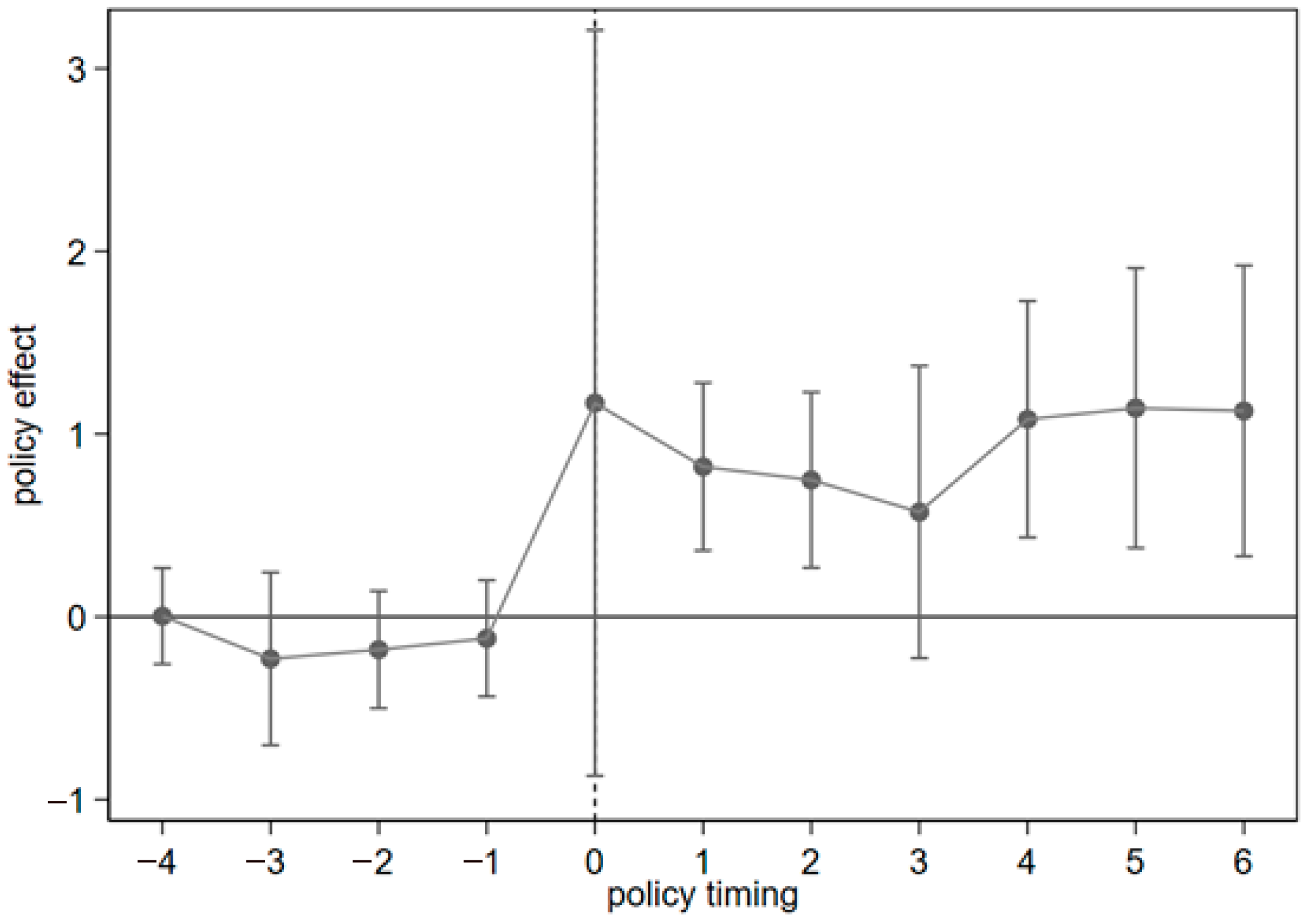
The DID method relies on the parallel trend assumption as a prerequisite, which means that before the implementation of the water rights trading pilot program, there was no systematic difference in the net carbon sink intensity of the planting industry between pilot cities and non-pilot cities. To test the parallel trend assumption and capture the dynamic evolution of policy effects, this study adopts the dynamic event study framework. It estimates the benchmark regression model by adding dummy variables for the four periods before and the six periods after policy implementation. Taking 2014 as the base period, this study examines the changes in annual effects before and after the implementation of the pilot program. As shown in Figure 1, prior to the launch of the pilot program, the coefficients of the interaction term oscillated around zero, and the confidence interval crossed zero, suggesting no significant difference in the net carbon sink intensity between the two city types. After the policy was implemented, the interaction term coefficient was significantly positive and continued to increase, indicating that the net carbon sink intensity of pilot cities was considerably higher than that of non-pilot cities. Thus, the model meets the parallel trend assumption.

4.2.2. Placebo Test Analysis

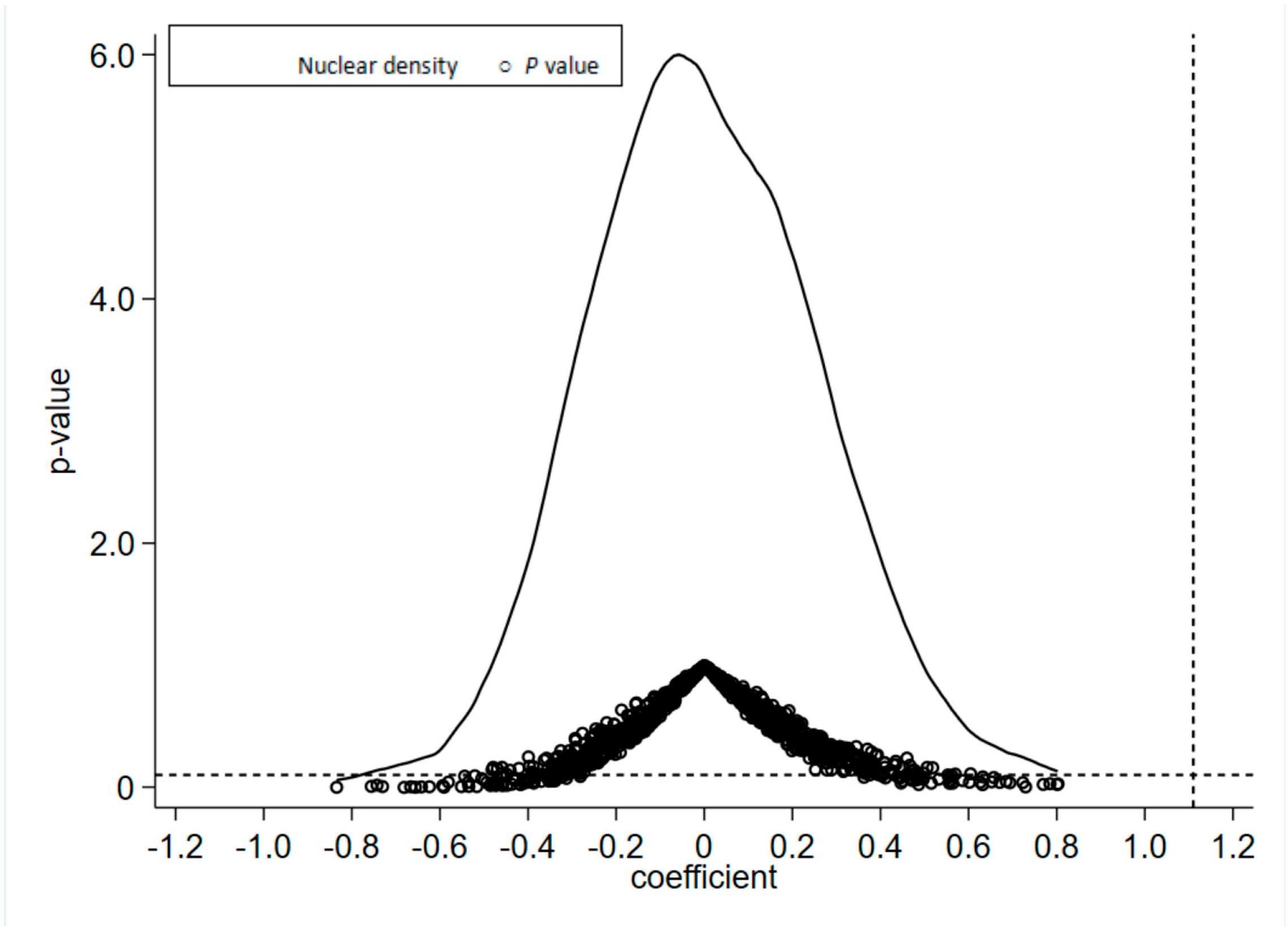
To validate the benchmark findings, a placebo test is conducted in which cities are randomly reassigned to the treatment group. It redefines the experimental and control groups for the water rights trading pilot program, uses the net carbon sink intensity of the urban planting industry as the dependent variable, and performs random sampling with 1000 repeated estimations. As shown in Figure 2, the estimated coefficients from the random simulation are largely concentrated around zero, which is quite different from the actual estimated value of 1.110, and approximately follow a normal distribution. Moreover, most p-values exceed 0.1. These results indicate that omitted variables do not significantly affect the regression results, and the benchmark regression is robust.

4.3. Robustness Test

4.3.1. Propensity Score Matching Test

To ensure the accuracy of the difference-in-differences (DID) results, this study conducts a balance test of the propensity score matching (PSM) results before the baseline regression. The treatment group comprises all cities in the seven pilot provinces, and propensity score matching is performed using the control variables from the baseline regression as covariates. The study employs both caliper nearest-neighbor matching and kernel matching methods. As shown in Table 6, after matching, the bias rates of all variables are within 10%, and the t-tests are not significant, indicating that there are no systematic differences between the treatment and control groups, and indicating that the sample matching is effective.
Based on the regression conducted using the benchmark DID model, the matching process via PSM is summarized in Table 7. In Columns (1) and (2), after controlling for the control variables, the regression coefficients for the water rights trading policy on the net carbon sink intensity of the planting industry are 1.204 and 1.112, respectively, both positive at the 1% significance level. The estimation results from the PSM-DID model align with the baseline regression in both the direction and significance of the coefficients. This further corroborates the robustness of the conclusion that water rights trading policies significantly enhance the net carbon sink intensity of the planting industry.

4.3.2. Other Robustness Tests

To assess the reliability and robustness of the baseline regression results, this study conducts four robustness checks. First, the sample excluding municipalities directly under the central government is re-estimated. The results reported in Table 7 (3) indicate that the estimated coefficient remains positive and significant at the 1% level, confirming the robustness of the water rights trading policy’s positive effect on the net carbon sink intensity of the planting industry. Second, the sample time span is adjusted to 2011–2020 for re-estimation. Results shown in Table 7 (4) demonstrate that both the direction and significance of the estimates are consistent with the baseline model, and this further confirms the robustness of the model. Third, to reduce the influence of outliers, the sample is winsorized at the 1% level, following the method proposed by Guo et al. [64]. The results in Table 7 (5) show that after cutting, the estimated coefficient continues to show a significant positive value, indicating that outliers do not considerably affect the results. Finally, the dependent variable is replaced with net carbon sink (Nc) for re-estimation. The results in Table 7 (6) continue to demonstrate the statistically significant and positive effect of the water rights trading policy on the planting industry’s net carbon sink, consistent with the baseline results. In conclusion, through multi-dimensional robustness checks, the baseline regression results presented in this study exhibit strong reliability and robustness.

5. Further Analysis

5.1. Mechanism Analysis

This study explores how the water rights trading policy impacts the net carbon sink intensity of the planting industry from three angles: adjustments to planting structure, improvements in irrigation water use intensity, and reduction in the use of chemical fertilizers. The specific methods are as follows: First, this step tests whether the mechanism variables serve as potential channels through which the policy exerts its influence. Second, the model includes interaction terms between the independent variable and mechanism variables (DID × Grain, DID × ln_irrigation, DID ×Fertilizer) to test the policy’s indirect effect paths. The results of the mechanism analysis are reported in Table 8.
The mediating role of planting structure adjustment in the policy’s effect on net carbon sink intensity is examined in Columns (1) and (2) of Table 8. Column (1) presents a regression coefficient of −1.075 for the proportion of food crop planting, which is significant at the 1% level. This suggests that the water rights trading policy significantly lowers the proportion of land allocated to food crops, driving the trend of “de-cerealization” in agricultural production. This encourages farmers to optimize planting decisions, reduce the cultivation of high-water-use and low-value-added food crops, and shift towards low-water-use and high-benefit economic crops, thereby optimizing the agricultural water structure and resource allocation efficiency. In Column (2), after including the proportion of food crops (grain) as a mediator, the regression coefficient is −0.075, which is significantly negative at the 1% level. This suggests that reducing the proportion of food crops enhances the net carbon sink intensity of the planting industry. The water rights trading policy has a direct positive effect, as well as an indirect effect mediated by planting structure adjustment, on the net carbon sink intensity. This dual effect provides conclusive evidence in support of Hypothesis 2.
As presented in Column (3) of Table 8, the coefficient for the irrigation water intensity variable (ln_irrigation) is 0.010, which is positive but not statistically significant. This indicates that the direct impact of the water rights trading policy on irrigation water intensity is limited. Column (4) reveals that irrigation water intensity significantly lowers the net carbon sink intensity of the planting industry. There are two possible reasons: First, the development of agricultural water conservancy infrastructure increases the irrigated area, leading to a rebound in water use [65]. Recently, the government has ramped up investment in agrarian water conservancy infrastructure, advancing the development of high-standard and permanent basic farmland [66]. Water rights trading provides enterprises with access to water resources, enabling them to invest in agricultural irrigation or water conservancy infrastructure through contract-based water-saving measures [24]. These infrastructure improvements reduce marginal costs in the planting industry [67] and decrease input costs for pesticides and fertilizers. For example, under different irrigation conditions, fields with better irrigation conditions use significantly less fertilizer than those with poorer conditions [68]. As planting costs decrease, farmers tend to expand the irrigated area or increase irrigation frequency. Additionally, agricultural water conservancy infrastructure reallocates water resources to dry and barren land, further expanding the sowing area [69]. To increase yield, farmers expand irrigated areas, leading to a rebound in irrigation water use that counteracts the expected water-saving effect driven by economic benefits [70,71]. Existing research indicates that water rights trading in Australia’s Murray–Darling Basin and California, USA has improved water use efficiency. However, such market-driven mechanisms have simultaneously stimulated increased water demand, thereby undermining the intended water-conservation outcomes [72,73]. In conclusion, water rights trading has not increased irrigation water use intensity. Hypothesis 3 does not hold.
Columns (5) and (6) of Table 8 examine the mediating role of reduced fertilizer application in the effect of water rights trading policies on agricultural net carbon sink intensity. Column (5) shows that the water rights trading policy significantly lowered fertilizer application (coefficient = −0.291, p < 0.05), encouraging farmers to adopt more environmentally friendly farming practices, thereby lowering fertilizer consumption. This reduction helps reduce greenhouse gas emissions from fertilizer use. Column (6) further introduces fertilizer usage as a mediating variable, and the results show that its reduction contributes to enhancing the net carbon sink strength of agriculture (coefficient = 0.920, p < 0.01). Through dual pathways—directly reducing fertilizer use and emissions, and indirectly enhancing soil carbon sequestration—the water rights trading policy effectively increases agriculture’s net carbon sink intensity. This finding provides robust evidence in support of Hypothesis 4.

5.2. Heterogeneity Analysis

Due to variations in natural conditions, resource endowments, and development stages among provinces and regions in China, the effect of the water rights trading policy on the net carbon sink intensity of the planting industry may display regional heterogeneity. This study conducts a heterogeneity analysis across three main dimensions: differences in resource endowments, income levels, and geographical locations. Table 9 displays the results.

5.2.1. Heterogeneity of Water Resource Endowments

To investigate how the effect of the water rights trading policy varies with water resource endowments, the sample is divided into three groups (low, medium, and high) according to the tertiles of total water resources for subgroup regression analysis. The results in Table 9 indicate that the water rights trading policy positively influences the net carbon sink intensity of the planting industry across all water resource endowment levels, with the strongest effect observed in regions with abundant water resources. This is because regions with abundant water resources can allocate and use them more efficiently, allowing farmers to manage water flexibly and avoid over-extraction, thereby reducing carbon emissions. In areas with plentiful water resources, crop growth conditions are favorable, resulting in higher carbon sequestration intensity and further enhancing net carbon sequestration capacity.

5.2.2. Heterogeneity of Income Levels

The income level of rural residents not only reflects farmers’ economic capacity but also their ability to respond to and bear the impact of policies. In this study, samples were categorized into three groups (low-income, middle-income, and high-income) according to income tertiles for regression analysis. The detailed results are detailed in Columns (4), (5), and (6) of Table 9. The regression results indicate that the water rights trading policy has a significant impact on rural residents in high-income groups, but not those in low-income groups. The reason is that farmers in high-income regions have stronger investment capabilities and greater capacity to absorb technology; policy implementation there is more robust, and levels of marketization and informatization are relatively high, enabling them to adopt technologies for emissions reduction and carbon sink enhancement more quickly. In contrast, low-income regions are constrained by insufficient funds, backward technology, and limited information, which easily lead to transaction frictions and thus restrict the policy effects.

5.2.3. Heterogeneity Across Eastern, Central, and Western Regions

Based on geographical location, the 291 city samples were classified into three regions—Eastern, Central, and Western China—to explore how the effect of water rights trading pilots on net carbon sink intensity varies across different regions. The regression results (see Table 10) indicate that the water rights trading policy significantly enhances net carbon sink intensity in both the Eastern and Central regions, with the most pronounced impact observed in the East. Meanwhile, it has no notable impact on the Western region. The possible reasons are as follows: the Eastern and Central regions have strong infrastructure and factor agglomeration capabilities, which are conducive to the application of emissions reduction and carbon sink technologies. Additionally, these regions have a high level of marketization, and the water rights trading market operates in a standardized manner. In contrast, the Western region is constrained by various factors, such as harsh natural conditions, insufficient water-conservation facilities for agriculture, and the priority being given to ecological water use, making it difficult to achieve significant policy outcomes.

5.3. Spatial Spillover Effect Analysis

1. Global Moran’s I
Before using the spatial econometric model, Global Moran’s I was employed to evaluate spatial autocorrelation in net carbon sink intensity using a spatial adjacency weight matrix. The results indicate that the Global Moran’s I for net carbon sink intensity displays positive spatial autocorrelation at the 1% significance level (see Table 11), suggesting interregional interactions and spillover effects.
2. LM Test
Under the spatial adjacency weight matrix, both the spatial error term and the spatial lag term were statistically significant in the LM and Robust-LM tests (see Table 12). Furthermore, LR and Wald tests rejected the null hypothesis at the 1% significance level, supporting the selection of the spatial Durbin model (SDM).
3. Spatial Spillover Effect
The spatial autoregressive coefficient reported in Column (1) of Table 13 is 0.195 and statistically significant at the 1% level, reflecting a significant positive spatial spillover effect. Given the significant spatial spillover effect, the impact of the water rights trading policy is decomposed into direct, indirect, and total effects to provide a comprehensive assessment of its influence. The results in Columns (2), (3), and (4) show that the coefficients for the direct impact, indirect effect, and total effect of the water rights trading policy are all statistically significant and positive. This demonstrates that the water rights trading policy not only enhances the net carbon sink intensity of the local planting industry, but also exerts a significant positive influence on neighboring regions. The primary reasons can be summarized into four key points: First, the similarity between neighboring regions allows the policy effects to be naturally transmitted and extended. Second, implementing the water rights trading policy not only enhances the net carbon sink strength of local agriculture but also influences surrounding areas through regional synergies, promoting the overall agricultural sustainability of the region. Third, the geographical and economic interconnection enables neighboring areas to be affected through market and resource flows, ultimately leading to positive spillover effects. Additionally, the phenomenon of learning and imitation between neighboring regions, coupled with positive feedback mechanisms, further strengthens the spatial spillover effect. Therefore, while the water rights trading policy enhances the net carbon sink intensity of local agriculture, it also exerts positive cross-regional effects on surrounding areas through spatial spillover mechanisms.

6. Conclusions, Implications, and Limitations

6.1. Conclusions

Based on data from 291 cities across China from 2009 to 2023, this study uses the PSM-DID model to analyze the impact of water rights trading policies on the net carbon sequestration intensity of agriculture. The results show that water rights trading mainly promotes the increase in net carbon sinks by reducing the proportion of grain crop cultivation and the use of chemical fertilizers. In contrast, irrigation water use intensity does not have a significant impact. The effect of water rights trading policies is more potent in regions with high resource endowment and high income, and in Eastern areas, with substantial spatial spillover effects.

6.2. Implications

To enhance the effectiveness of water rights trading in agricultural emissions reduction and carbon sequestration, it is essential to enhance the water rights registration, pricing, and trading system, establish robust mechanisms for registration, transactions, and settlements, promote market-oriented water resource allocation, and facilitate interregional water adjustments, thus achieving a virtuous cycle of “water conservation–efficiency improvement–structural optimization–carbon sink enhancement.” Policies should be tailored to the specific conditions of each region: regions with high resource endowments should improve the trading market, areas with low resource endowments should strengthen water-saving infrastructure, and Central and Western regions and low-income areas should increase financial and technical support to enhance farmers’ participation and promote policy fairness. The price signal for water should guide adjustments to planting structures, with a focus on developing low-water-consuming, high-carbon-sink ecological agriculture while ensuring food security, and on establishing an incentive mechanism that uses carbon sink revenues to support agriculture. The risks of “water conservation—expansion—rebound” should be avoided by strengthening dual controls on total water use and intensity, ensuring that water-saving benefits are translated into ecological and carbon sink outcomes. Finally, a cross-regional water rights collaboration and ecological compensation mechanism should be established to promote resource sharing, policy coordination, and sustainable regional development.

6.3. Limitations

This study has the following limitations. First, due to data availability, this study calculates the total carbon emissions of the planting industry based on input factors for agricultural production activities, including fertilizers, pesticides, tillage, irrigation, films, and diesel. However, this blurs the differences in carbon emissions among different crops. Orlova demonstrated through field experiments that the carbon footprints of different crops vary [74]. Therefore, future research can combine microdata from field experiments to more accurately estimate total carbon emissions from the planting industry by crop type. Second, this paper did not fully account for the potential interference of contextual factors in the results. For example, the prices of water fees, farming systems, and compensation measures may have an impact. Future research can fully consider the influence of contextual factors on the carbon emissions or carbon sinks of the planting industry. Finally, our research focuses on China’s water rights trading system, and many countries have similar systems. Therefore, the applicability of our research conclusions to other countries can be further explored.

Author Contributions

Y.Z.: conceptualization, methodology, software, writing—original draft. S.C.: formal analysis, resources, writing—original draft. Y.X.: supervision, validation. L.J.: data curation, review and editing. All authors have read and agreed to the published version of the manuscript.

Funding

This research received no external funding.

Institutional Review Board Statement

Not applicable.

Informed Consent Statement

Not applicable.

Data Availability Statement

Data will be made available on request.

Conflicts of Interest

Author Shaobo Cui was employed by Inner Mongolia Autonomous Region Machinery Equipment Complete Set Co., Ltd. The remaining authors declare that the research was conducted in the absence of any commercial or financial relationships that could be construed as a potential conflict of interet.

References

  1. Singh, J.; Kumar, S. Responses of soil microbial community structure and greenhouse gas fluxes to crop rotations that include winter cover crops. Geoderma 2020, 385, 114843. [Google Scholar]
  2. Yun, T.; Junbiao, Z.; Bo, L. Agricultural carbon emissions in China: Calculation, spatial-temporal comparison and decoupling effects. Resour. Sci. 2012, 34, 2097–2105. [Google Scholar]
  3. Li, J.; Shen, J.; Song, J. Analysis of the spatial and temporal evolution and drivers of net carbon efficiency of plantations in China. J. Clean. Prod. 2024, 445, 141346. [Google Scholar] [CrossRef]
  4. Liu, D.; Yu, N.; Wan, H.; Ou, J.; Yao, S.; Wang, Q. Water rights trading and corporate productivity: Evidence from a quasi-natural experiment of China’s pilot policy. J. Econ. Surv. 2024, 38, 1846–1872. [Google Scholar] [CrossRef]
  5. Ministry of Water Resources. Notice on Issuing the Interim Measures for the Management of Water Rights Trading. Available online: http://www.mwr.gov.cn/zwgk/gknr/201604/t20160420_1441989.html (accessed on 25 April 2016).
  6. Ministry of Water Resources; National Development and Reform Commission; Ministry of Finance. Guiding Opinions on Promoting Water Rights Reform. Available online: http://www.gov.cn/zhengce/zhengceku/2022-09/01/content_5707831.htm (accessed on 26 August 2022).
  7. General Office of the CPC Central Committee; General Office of the State Council. Opinions on Improving the Market-Oriented Allocation System for Resource and Environmental Elements. Available online: https://www.gov.cn/zhengce/202505/content_7025725.htm (accessed on 29 May 2025).
  8. Shen, J.; Wu, F.; Yu, Q.; Zhang, Z.; Zhang, L.; Zhu, M.; Fang, Z. Standardization of exchanged water with different properties in China’s water rights trading. Int. J. Environ. Res. Public Health 2020, 17, 1730. [Google Scholar] [CrossRef] [PubMed]
  9. Wu, X.Y.; Wu, F.P.; Li, F.; Xu, X. Dynamic adjustment model of the water rights trading price based on water resource scarcity value analysis. Int. J. Environ. Res. Public Health 2021, 18, 2281. [Google Scholar] [PubMed]
  10. Zhang, H.; Zhou, Q.; Zhang, C. Evaluation of agricultural water-saving effects in the context of water rights trading: An empirical study from China’s water rights pilots. J. Clean. Prod. 2021, 313, 127725. [Google Scholar] [CrossRef]
  11. Lin, F.; Wu, F. Can water rights trading scheme promote regional water conservation in China? Evidence from a time-varying DID analysis. Int. J. Environ. Res. Public Health 2020, 17, 6679. [Google Scholar]
  12. Gohar, A.A.; Ward, F.A. Gains from expanded irrigation water trading in Egypt: An integrated basin approach. Ecol. Econ. 2010, 69, 2535–2548. [Google Scholar] [CrossRef]
  13. Lyu, H.; Xing, H.; Duan, T. Optimizing water resource allocation for food security: An evaluation of China’s water rights trading policy. Sustainability 2024, 16, 10443. [Google Scholar] [CrossRef]
  14. Pan, J.; Peng, J.; Yang, X.; Xuan, S. Does water rights trading promote resource utilization efficiency and green growth? Evidence from China’s resources trading policy. Resour. Policy 2023, 86, 104235. [Google Scholar] [CrossRef]
  15. Qi, M.; Wei, S.; Lin, T.; Yang, N.; Liu, Y. Water rights and firm productivity: Evidence from the water rights trading policy in China. Appl. Econ. 2025, 57, 6650–6664. [Google Scholar] [CrossRef]
  16. Huang, J.; Sun, Z.; Zhong, P. The spatial disequilibrium and dynamic evolution of the net agriculture carbon effect in China. Sustainability 2022, 14, 13975. [Google Scholar] [CrossRef]
  17. Li, J.; Ning, J.; Song, J.; Chen, X. Analysis of the spatial mismatch pattern of net carbon in agriculture and its influencing factors. Environ. Impact Assess. Rev. 2024, 106, 107522. [Google Scholar] [CrossRef]
  18. Cui, Y.; Khan, S.U.; Deng, Y.; Zhao, M. Regional difference decomposition and its spatiotemporal dynamic evolution of Chinese agricultural carbon emission: Considering carbon sink effect. Environ. Sci. Pollut. Res. 2021, 28, 38909–38928. [Google Scholar] [CrossRef]
  19. Guo, H.; Xie, S.; Pan, C. The impact of planting industry structural changes on carbon emissions in the three northeast provinces of China. Int. J. Environ. Res. Public Health 2021, 18, 705. [Google Scholar]
  20. Zhu, Y.; Zhang, Y.; Piao, H. Does agricultural mechanization improve the green total factor productivity of China’s planting industry? Energies 2022, 15, 940. [Google Scholar] [CrossRef]
  21. Alchian, A.; Demsetz, H. The property right paradigm. J. Econ. Hist. 1973, 33, 16–27. [Google Scholar] [CrossRef]
  22. Liu, X.; Wang, S.; Zhuang, Q.; Jin, X.; Bian, Z.; Zhou, M.; Zhang, Y. A review on carbon source and sink in arable land ecosystems. Land 2022, 11, 580. [Google Scholar] [CrossRef]
  23. Wang, Q.; Zhao, Q. Assessing ecological infrastructure investments—A case study of water rights trading in Lu’an City, Anhui Province, China. Int. J. Environ. Res. Public Health 2022, 19, 2443. [Google Scholar] [CrossRef] [PubMed]
  24. Klozen, W.H. Water markets between Mexican water user associations. Water Policy 1998, 1, 437–455. [Google Scholar] [CrossRef]
  25. Chen, Y.; Cai, M.; Zhang, Z.; Li, M. The impact of land transfer-in on crop planting structure and its heterogeneity among farmers: Evidence from China. Land 2024, 13, 87. [Google Scholar] [CrossRef]
  26. Sun, S.K.; Wu, P.T.; Wang, Y.B.; Zhao, X.N. Impact of changing crop pattern on the regional agricultural water productivity. J. Agric. Sci. 2015, 153, 767–778. [Google Scholar] [CrossRef]
  27. Wang, J.; Li, Y.; Huang, J.; Yan, T.; Sun, T. Growing water scarcity, food security and government responses in China. Global Food Sec. 2017, 14, 9–17. [Google Scholar] [CrossRef]
  28. Li, C.; Zhou, Y. Non-agricultural use of water resources and the vulnerability of food production. J. South China Agric. Univ. (Soc. Sci. Ed.) 2023, 22, 25–37. [Google Scholar]
  29. Zhu, M.; Wu, F.; Shen, J.; Bi, F. Water rights trading application to water-rich regions in southern China. J. Water Resour. Plan. Manag. 2021, 147, 05021013. [Google Scholar] [CrossRef]
  30. Liu, D.; Yu, N.; Wan, H. Does water rights trading affect corporate investment? The role of resource allocation and risk mitigation channels. Econ. Model. 2022, 117, 106063. [Google Scholar] [CrossRef]
  31. Shi, C.; Li, L.; Chiu, Y.-H.; Pang, Q.; Zeng, X. Spatial differentiation of agricultural water resource utilization efficiency in the Yangtze River Economic Belt under changing environment. J. Clean. Prod. 2022, 346, 131200. [Google Scholar] [CrossRef]
  32. Sapkota, A.; Haghverdi, A.; Avila, C.C.E.; Ying, S.C. Irrigation and greenhouse gas emissions: A review of field-based studies. Soil Syst. 2020, 4, 20. [Google Scholar] [CrossRef]
  33. Han, Z.; Hou, H.; Yao, X.; Qian, X.; Zhou, M. Substituting partial chemical fertilizers with bio-organic fertilizers to reduce greenhouse gas emissions in water-saving irrigated rice fields. Agronomy 2024, 14, 544. [Google Scholar] [CrossRef]
  34. Fangueiro, D.; Becerra, D.; Albarrán, Á.; Peña, D.; Sanchez-Llerena, J.; Rato-Nunes, J.M.; López-Piñeiro, A. Effect of tillage and water management on GHG emissions from Mediterranean rice growing ecosystems. Atmos. Environ. 2017, 150, 303–312. [Google Scholar]
  35. Gillabel, J.; Denef, K.; Brenner, J.; Merckx, R.; Paustian, K. Carbon sequestration and soil aggregation in center-pivot irrigated and dryland cultivated farming systems. Soil Sci. Soc. Am. J. 2007, 71, 1020–1028. [Google Scholar] [CrossRef]
  36. Trost, B.; Prochnow, A.; Drastig, K.; Meyer-Aurich, A.; Ellmer, F.; Baumecker, M. Irrigation, soil organic carbon and N2O emissions: A review. Agron. Sustain. Dev. 2013, 33, 733–749. [Google Scholar] [CrossRef]
  37. She, W.; Wu, Y.; Huang, H.; Chen, Z.D.; Cui, G.X.; Zheng, H.B.; Guan, C.Y.; Chen, F. Integrative analysis of carbon structure and carbon sink function for major crop production in China’s typical agriculture regions. J. Clean. Prod. 2017, 162, 702–708. [Google Scholar] [CrossRef]
  38. Smith, K.R.; Waring, B.G. Broad-scale patterns of soil carbon (C) pools and fluxes across semiarid ecosystems are linked to climate and soil texture. Ecosystems 2018, 22, 742–753. [Google Scholar] [CrossRef]
  39. Yue, K.; Peng, Y.; Peng, C.; Yang, W.; Peng, X.; Wu, F. Stimulation of terrestrial ecosystem carbon storage by nitrogen addition: A meta-analysis. Sci. Rep. 2016, 6, 19895. [Google Scholar] [CrossRef] [PubMed]
  40. Zhang, X.; Liu, C.; Zhang, J.; Liu, J.; Hu, W. Evolution trends in carbon emissions and sustainable development paths in China’s planting industry from the perspective of carbon sources. Sustainability 2025, 17, 2772. [Google Scholar] [CrossRef]
  41. Yang, N.; Sun, X.; Qi, Q. Impact of factor quality improvement on agricultural carbon emissions: Evidence from China’s high-standard farmland. Front. Environ. Sci. 2022, 10, 989684. [Google Scholar] [CrossRef]
  42. Tang, F.; Tan, J.; Qiu, F.; Gu, S. How agricultural technological innovation influences carbon emissions: Insights from China. Front. Sustain. Food Syst. 2025, 9, 1596762. [Google Scholar] [CrossRef]
  43. Liu, X.; Ye, Y.; Ge, D.; Wang, Z.; Liu, B. Study on the evolution and trends of agricultural carbon emission intensity and agricultural economic development levels—Evidence from Jiangxi Province. Sustainability 2022, 14, 14265. [Google Scholar] [CrossRef]
  44. Wan, Y.; Yang, J.; Duan, C. Research on the spatial-temporal patterns of carbon effects and carbon-emission reduction strategies for farmland in China. Sustainability 2023, 15, 10314. [Google Scholar]
  45. Min, J.; Hu, H. Estimation of greenhouse gas emissions from agricultural production in China. China Popul. Resour. Environ. 2012, 22, 21–27. [Google Scholar]
  46. Liu, D.; Zhu, X.; Wang, Y. China’s agricultural green total factor productivity based on carbon emission: An analysis of evolution trend and influencing factors. J. Clean. Prod. 2021, 278, 123692. [Google Scholar] [CrossRef]
  47. Yan, Z.; Hou, F.; Hou, F. Energy balances and greenhouse gas emissions of agriculture in the Shihezi Oasis of China. Atmosphere 2020, 11, 781. [Google Scholar] [CrossRef]
  48. Dachraoui, M.; Sombrero, A. Effect of tillage systems and different rates of nitrogen fertilisation on the carbon footprint of irrigated maize in a semiarid area of Castile and Leon, Spain. Soil Till. Res. 2020, 196, 104472. [Google Scholar] [CrossRef]
  49. Zhu, L.; Li, W.; Huang, Y.; Li, J. Spatiotemporal evolution and features of net carbon sink of farmland vegetation in Chongqing, China. Int. J. Sustain. Dev. Plan. 2020, 20, 219–226. [Google Scholar] [CrossRef]
  50. Torn, M.S.; Swanston, C.W.; Castanha, C.; Trumbore, S.E. Storage and turnover of organic matter in soil. In Biophysico-Chemical Processes Involving Natural Nonliving Organic Matter in Environmental Systems; Wiley Publishing: Hoboken, NJ, USA, 2009; pp. 219–272. [Google Scholar]
  51. Xu, Q.; Zhang, G. The spatial spillover effect of agricultural mechanization on agricultural carbon emission intensity: An empirical study based on panel data from 282 cities. China Popul. Resour. Environ. 2022, 32, 23–33. [Google Scholar]
  52. Intergovernmental Panel on Climate Change. Special Report on Climate Change and Land. In Proceedings of the Intergovernmental Panel on Climate Change (IPCC), Geneva, Switzerland, 2–6 August 2019; IPCC: Georgia Batumi, Switzerland, 2019. [Google Scholar]
  53. West, T.O.; Post, W.M. Soil organic carbon sequestration rates by tillage and crop rotation: A global data analysis. Soil Sci. Soc. Am. J. 2002, 66, 1930–1946. [Google Scholar] [CrossRef]
  54. Chen, X.; Shuai, C.; Wu, Y.; Zhang, Y. Analysis on the carbon emission peaks of China’s industrial, building, transport, and agricultural sectors. Sci. Total Environ. 2020, 709, 135768. [Google Scholar] [CrossRef]
  55. Zhou, J.; Chen, C.; He, Z.; Tang, J. Carbon emissions and economic growth in the planting industry: Evidence from China. Sustainability 2025, 17, 2570. [Google Scholar] [CrossRef]
  56. Zhang, G.; Wang, S. China’s Agricultural Carbon Emission: Structure, Efficiency and Its Determinants. Issues Agric. Econ. 2014, 35, 18–26+110. [Google Scholar]
  57. Jia, L.; Wang, M.; Yang, S.; Zhang, F.; Wang, Y.; Li, P.; Wang, M. Analysis of agricultural carbon emissions and carbon sinks in the Yellow River Basin based on LMDI and Tapio decoupling models. Sustainability 2024, 16, 468. [Google Scholar] [CrossRef]
  58. Zhu, C.; Yang, S.; Liu, P. Study on the factors influencing the carbon emissions of Shaanxi Province’s transportation industry in China. Sustainability 2022, 14, 8610. [Google Scholar] [CrossRef]
  59. Jin, B.; Cui, C.; Wen, L.; Shi, R.; Zhao, M. Regional differences and convergence of agricultural carbon efficiency in China: Embodying carbon sink effect. Ecol. Indic. 2024, 169, 112929. [Google Scholar] [CrossRef]
  60. Zhu, B.; Zhang, M.; Huang, L.; Wang, P.; Su, B.; Wei, Y.M. Exploring the effect of carbon trading mechanism on China’s green development efficiency: A novel integrated approach. Energy Econ. 2020, 85, 104601. [Google Scholar]
  61. Guo, X.; Xiao, B.; Song, L. Emission reduction and energy-intensity enhancement: The expected and unexpected consequences of China’s coal consumption constraint policy. J. Clean. Prod. 2020, 271, 122691. [Google Scholar] [CrossRef]
  62. Chang, G.; Liu, H.; Yin, Z.; Wang, J.; Li, K.; Gao, T. Agricultural production can be a carbon sink: A case study of Jinchang City. Sustainability 2023, 15, 12872. [Google Scholar] [CrossRef]
  63. Zhang, X.; Shen, M.; Luan, Y.; Cui, W.; Lin, X. Spatial evolutionary characteristics and influencing factors of urban industrial carbon emission in China. Int. J. Environ. Res. Public Health 2022, 19, 11227. [Google Scholar] [PubMed]
  64. Guo, J.; Zhou, D. The impact of national innovative city policy on urban green development performance: Based on the mediating role of technological innovation and resource dependence. Soft Sci. 2021, 35, 85–92. [Google Scholar]
  65. Greening, L.A.; Greene, D.L.; Difiglio, C. Energy efficiency and consumption—The rebound effect—A survey. Energy Policy 2000, 28, 389–401. [Google Scholar] [CrossRef]
  66. Chen, L.; Peng, J.; Chen, Y.; Cao, Q. Will agricultural infrastructure construction promote land transfer? Analysis of China’s high-standard farmland construction policy. Sustainability 2024, 16, 9234. [Google Scholar] [CrossRef]
  67. Li, R.; Zhou, W.; Guo, S.; Song, J.; Xu, D. The impact of high-standard farmland construction on farmland abandonment by farm households: Evidence from rural China. Appl. Econ. 2025, 1–17. [Google Scholar] [CrossRef]
  68. Liu, W.; Fei, X.; Wang, C. Study on the influencing factors of excessive fertilizer application behavior. Ecol. Rural Environ. 2018, 8, 726–732. [Google Scholar]
  69. Xu, H.; Song, J. Drivers of the irrigation water rebound effect: A case study of Hetao irrigation district in the Yellow River basin, China. Agric. Water Manag. 2022, 266, 107567. [Google Scholar] [CrossRef]
  70. Song, J.; Guo, Y.; Wu, P.; Sun, S. The agricultural water rebound effect in China. Ecol. Econ. 2018, 146, 497–506. [Google Scholar] [CrossRef]
  71. Sheng, J.; Zhang, R.; Yang, H.; Chen, C. Water markets and water rebounds: China’s water rights trading policy. Ecol. Econ. 2025, 229, 108471. [Google Scholar]
  72. Crase, L.; O’Keefe, S.; Dollery, B. Talk is cheap, or is it? The cost of consulting about uncertain reallocation of water in the Murray–Darling Basin, Australia. Ecol. Econ. 2013, 88, 206–213. [Google Scholar] [CrossRef]
  73. Lu, S.; Lian, Z.; Sun, H.; Wu, X.; Bai, X.; Wang, C. Simulating trans-boundary watershed water resources conflict. Res. Policy 2021, 73, 102139. [Google Scholar]
  74. Orlova, L.V.; Safin, R.I.; Knurova, G.V.; Platonov, V.I.; Vasenev, I.I.; Ermolaeva, D.R.; Gerasimov, E.S. Carbon footprint of crop production using soil-protective and resource-saving farming technologies, Russia. Zemledelie 2024, 7, 9–13. [Google Scholar]
Figure 1. Parallel trend test.
Sustainability 17 11343 g001
Figure 2. Placebo test.
Sustainability 17 11343 g002
Table 1. Comparative analysis of existing research on water rights trading and net carbon sinks.
Water Rights TradingNet Carbon Sink in Agriculture
The goals and issues of water rights trading [8]The calculation methods and spatio-temporal characteristics of net carbon sinks in agriculture [16]
The formation mechanism of water rights trading prices [9]Influencing factors of net carbon sinks in agriculture [17]
The economic effects of water rights trading (including water conservation [10,11], farmers’ income increase [12], and grain production [13])Measurement and spatio-temporal characteristics of net carbon sinks in the planting industry [18]
The green development effect of water rights trading on agriculture [14]The driving factors of net carbon sinks in the planting industry (including planting structure [19] and agricultural mechanization [20])
Table 2. Main carbon emissions sources and carbon emissions coefficients in the planting industry.
Carbon SourceCarbon Emissions CoefficientReference Sources
Diesel Oil0.59 kg/kgIPCC2013 [52]
Chemical Fertilizers0.89 kg/kgOak Ridge National Laboratory [53]
Pesticides4.93 kg/kg
Agricultural Plastic Films5.18 kg/kgAgricultural Resource and Ecological Environment Research Institute, Nanjing Agricultural University [54]
Irrigation266.48 kg/hm2Zhou [55]
Tillage312.60 kg/km2Zhang [56]
Table 3. Crop carbon sink calculation coefficients.
VarietyEconomic CoefficientWater Content (%)Carbon Absorption RateCoefficient Value
Rice0.45120.4140.8096
Wheat0.4120.4851.0670
Corn0.4130.4711.0244
Beans0.34130.451.1515
Tubers0.7700.4230.1813
Cotton0.180.454.1400
Rapeseed0.25100.4501.6200
Peanut0.43100.450.9419
Vegetable0.6900.4500.0750
Sugar cane0.5500.4500.4500
Beet0.7750.4070.1454
Tobacco0.55850.4500.1227
Table 4. Descriptive statistics and calculation methods of the variables.
Variable NameVariable SymbolVariable RepresentationObsMeanStd. Dev.MinMax
Net carbon sink intensityNck(Carbon sink—carbon emission)/total sown area of crops(T·hm−2)43656.5426.175−0.199102.932
Water rights trading policyDidWhether it is a transaction item after 2014 and whether it is a pilot city for water rights trading43650.1990.4000.0001.000
Industrial structureIndustryOutput value of the primary industry/GDP(%)436512.4888.1840.03062.199
The logarithm of the total water resourcesln_waterLogarithm of total water resources(×104 m3)436512.7791.2109.05717.165
The logarithm of rural residents’ incomeln_incomeThe logarithm of per capita disposable income of rural residents(yuan)43659.4130.5247.71210.920
The intensity of agricultural machinery usageMachineTotal power of agricultural machinery/total sown area of crops(×104 w·hm−2)43657.3776.6920.000118.491
The total number of agricultural patent applicationsTechTotal number of agricultural patent applications (one hundred pieces)43652.4934.6760.00064.120
The number of agricultural employeesEmployThe proportion of people employed in the primary industry (%)43652.4286.5490.00073.969
The proportion of food crop cultivationGrainSown area of food crops/total sown area of crops (%)436565.98017.7780.00099.471
The logarithm of the intensity of irrigation water usageln_irrigationWater consumption for farmland irrigation/total sown area of crops (m3·hm−2)43657.5640.8751.33710.598
The amount of chemical fertilizer applied per unit sown areaFertilizerFertilizer usage (×104 t × 103 hm−2)42751.7936.4420.041120.869
Table 5. Benchmark regression results.
Variable(1)(2)
Did0.953 ***
(0.295)
1.110 ***
(0.285)
Industry 0.056 **
(0.025)
ln_water −0.184
(0.132)
ln_income −2.490 **
(0.963)
Machine −0.174 ***
(0.023)
Tech 0.063 **
(0.028)
Employ 0.036 ***
(0.009)
Cons6.298 ***
(0.099)
28.198 ***
(9.309)
N43654365
R20.0380.132
CityYesYes
YearYesYes
Note: ***, **, and * denote statistical significance at the 1%, 5%, and 10% levels, respectively; figures in parentheses are city-level cluster-robust standard errors. This convention applies to all subsequent tables as well.
Table 6. Balance test of PSM-DID.
VariableNearest-Neighbor Matching Within Caliper (After Matching)Kernel Matching (After Matching)
t-Valuep-Value% Biast-Value After Matchingp-Value% Bias
Industry0.650.5172.40.320.7531.2
ln_water−0.410.681−1.7−0.840.399−3.3
ln_income−1.270.203−4.9−0.570.571−2.2
Machine1.230.2183.60.300.7680.9
Tech−0.930.352−2.8−0.950.343−2.9
Employ0.360.7181.1−0.020.981−0.1
Table 7. Robustness tests.
Variable(1)(2)(3)(4)(5)(6)
Caliper Nearest-Neighbor MatchingKernel MatchingExclude Municipalities Directly under the Central GovernmentAdjust the YearWinsorizationReplace the Dependent Variable
NckNckNckNckNckNc
Did1.204 ***1.112 ***1.100 ***1.102 ***1.076 ***6.512 **
(0.290)(0.285)(0.283)(0.270)(0.269)(2.979)
Controlsyesyesyesyesyesyes
Cons31.541 ***30.179 ***31.010 ***22.870 **28.444 ***318.560 ***
(9.623)(8.605)(8.461)(9.214)(7.472)(98.348)
Cityyesyesyesyesyesyes
Yearyesyesyesyesyesyes
N323043624305291043654365
R20.1130.1320.1330.0950.2220.188
Table 8. Results of mechanism test.
Variable(1)(2)(3)(4)(5)(6)
GrainNckLn_IrrigationNckFertilizerNck
Did−1.075 ***1.028 ***0.0101.135 ***−0.291 **0.920 ***
(0.379)(0.145)(0.027)(0.273)(0.128)(0.149)
Grain −0.075 ***
(0.006)
ln_irrigation −2.500 **
(0.995)
Chemistry −0.118 ***
(0.018)
Control VariablesYesYesYesYesYesYes
Constant Term81.471 ***36.354 ***7.608 ***49.223 ***36.342 ***33.748 ***
(12.535)(4.828)(0.992)(11.825)(4.158)(4.893)
CityYesYesYesYesYesYes
YearYesYesYesYesYesYes
Obs436543654365436542754275
R20.0260.1650.2800.1940.0430.144
Sobel Z-statistic2.762−0.6482.146
Table 9. Heterogeneity analysis by resource endowments and income levels.
Variable(1)(2)(3)(4)(5)(6)
Low Water ResourcesMedium Water ResourcesHigh Water ResourcesLow IncomeMiddle IncomeHigh Income
NckNckNckNckNckNck
Did1.051 ***1.039 *1.161 *0.3350.696 ***6.813 ***
(0.301)(0.550)(0.598)(0.228)(0.216)(1.979)
Control VariablesYesYesYesYesYesYes
Constant Term23.026 ***40.741 ***22.1257.679 ***5.930 ***6.564 ***
(7.180)(13.480)(16.699)(1.405)(1.718)(1.371)
CityYesYesYesYesYesYes
YearYesYesYesYesYesYes
Observations145514551455145514551455
R20.1140.1940.1470.5200.0700.201
Table 10. Heterogeneity analysis by geographic location.
Variable(1)(2)(3)
Eastern RegionCentral RegionWestern Region
NckNckNck
Did2.911 ***0.972 ***0.044
(0.860)(0.265)(0.301)
Control VariablesYesYesYes
Constant Term24.64236.875 ***19.743 *
(15.409)(11.060)(10.777)
CityYesYesYes
YearYesYesYes
Observations151515001350
R20.1300.4960.172
Table 11. Global Moran’s I of net carbon sink density.
YearMoran’s IZp-Value
20090.1574.9930.000
20100.1544.8920.000
20110.1264.1160.000
20120.1324.4160.000
20130.1304.4130.000
20140.1012.9100.004
20150.1474.9660.000
20160.1294.4040.000
20170.1062.8900.004
20180.1685.1130.000
20190.1935.8580.000
20200.1945.8690.000
20210.1875.7330.000
20220.1875.6920.000
20230.1885.6680.000
Table 12. LM Tests.
Table 12. LM Tests.
TestLM Valuep-Value
LM-Lag Test178.8660.000
Robust LM-Lag Test22.7920.000
LM-Error Test165.8200.000
Robust LM-Error Test9.7460.002
Table 13. Spatial econometric regression.
(1)(2)(3)(4)
VariableMain RegressionDirect EffectIndirect EffectTotal Effect
Did0.616 **0.656 **0.675 *1.331 ***
(0.278)(0.272)(0.361)(0.208)
Industry0.081 ***0.080 ***−0.0150.065 **
(0.017)(0.016)(0.025)(0.026)
ln_water−0.081−0.078−0.217−0.295 *
(0.124)(0.115)(0.180)(0.164)
ln_income−1.473 **−1.559 **−1.769 *−3.328 ***
(0.664)(0.626)(0.952)(0.816)
Machine−0.188 ***−0.187 ***0.036 **−0.150 ***
(0.011)(0.010)(0.017)(0.016)
Tech0.001 ***0.001 ***0.001 **0.001 ***
(0.000)(0.000)(0.000)(0.000)
Employ0.0090.0150.119 ***0.134 ***
(0.012)(0.012)(0.022)(0.025)
Rho0.195 ***
(0.020)
Sigma2_e3.926 ***
(0.084)
CityYesYesYesYes
YearYesYesYesYes
Obs4365436543654365
Disclaimer/Publisher’s Note: The statements, opinions and data contained in all publications are solely those of the individual author(s) and contributor(s) and not of MDPI and/or the editor(s). MDPI and/or the editor(s) disclaim responsibility for any injury to people or property resulting from any ideas, methods, instructions or products referred to in the content.