Review

Towards Sustainable Factories: A Systematic Review of Energy-Conscious Job-Shop Scheduling Models and Algorithms


1
School of Mechanical and Electronic Engineering, Wuhan University of Technology, Wuhan 430070, China
2
School of Environmental Science and Engineering, Huazhong University of Science and Technology, Wuhan 430074, China
*
Author to whom correspondence should be addressed.
Sustainability 2025, 17(24), 11330; https://doi.org/10.3390/su172411330
Submission received: 1 November 2025 / Revised: 11 December 2025 / Accepted: 15 December 2025 / Published: 17 December 2025

Abstract

Job-shop scheduling plays a pivotal role in sustainable manufacturing because scheduling decisions strongly influence energy consumption, machine utilization, and environmental performance. Traditional job-shop scheduling research has mainly optimized makespan, throughput, and tardiness; however, growing sustainability pressures and Industry 4.0 technologies have shifted attention toward energy-conscious scheduling. This review systematically analyzes 2083 publications retrieved from SCOPUS, Web of Science, and IEEE Xplore to map the evolution of energy-efficient job-shop scheduling (EEJSS) models, methods, and industrial applications. Compared with prior surveys, this work contributes a sector-specific analysis, an updated classification of energy-aware models, and the first structured mapping of EEJSS research to sustainability and Industry 4.0 capabilities. Further, challenges such as computational complexity, absence of standardized energy benchmarks, limited industrial deployment, and narrow sustainability metrics are addressed. Overall, this review consolidates the state of EEJSS and positions energy-aware scheduling as a foundational enabler of low-carbon, resilient, and intelligent manufacturing systems.

1. Introduction

The environmental impact caused by global industrial systems has reached unprecedented scales. Recent data reveals alarming trends, with total energy-related CO2 emissions increased by 0.8% in 2024 compared to the preceding year [1]. This trend underscores an urgent need to balance productivity with environmental responsibility in manufacturing, a model central to sustainable industrial transformation. Within this context, production scheduling emerges as a critical operational lever for decarbonization as it directly governs machine activity, process sequencing, and overall energy demand. By optimizing when and how machines operate, scheduling decisions can significantly reduce idle energy, shift loads to times of lower carbon intensity, and integrate renewable energy availability, directly translating into measurable CO2 reductions at the plant level. Thus, advancing energy-aware scheduling is not merely an operational improvement but a strategic necessity for industries aiming to reduce their carbon footprint and comply with increasingly stringent environmental regulations. In recent years, numerous studies have explored energy-conscious job-shop scheduling, with some incorporating energy-related constraints or objectives into the scheduling formulation by expanding the decision scope to include machine status control (on/off) variable, equipment operating speeds, and time slot allocation strategies. In this review, we systematically examine all such contributions to energy-efficient job-shop scheduling, irrespective of whether energy consumption is optimized, constrained, or influenced through operational adjustments such as equipment status or processing speed.
This work provides a consolidated examination of energy saving strategies in job-shop scheduling encompassing exact methods, artificial intelligence (AI) and machine learning (ML) techniques, real-time approaches, heuristic and metaheuristic algorithms, and hybrid models, and aligns these methods with the specific energy dimensions they target. It also serves as an updated and extended synthesis of prior surveys, offering a structured reference for future research and practice. Furthermore, it underscores the need for a publicly accessible benchmark library to enable consistent solution evaluation in forthcoming studies.
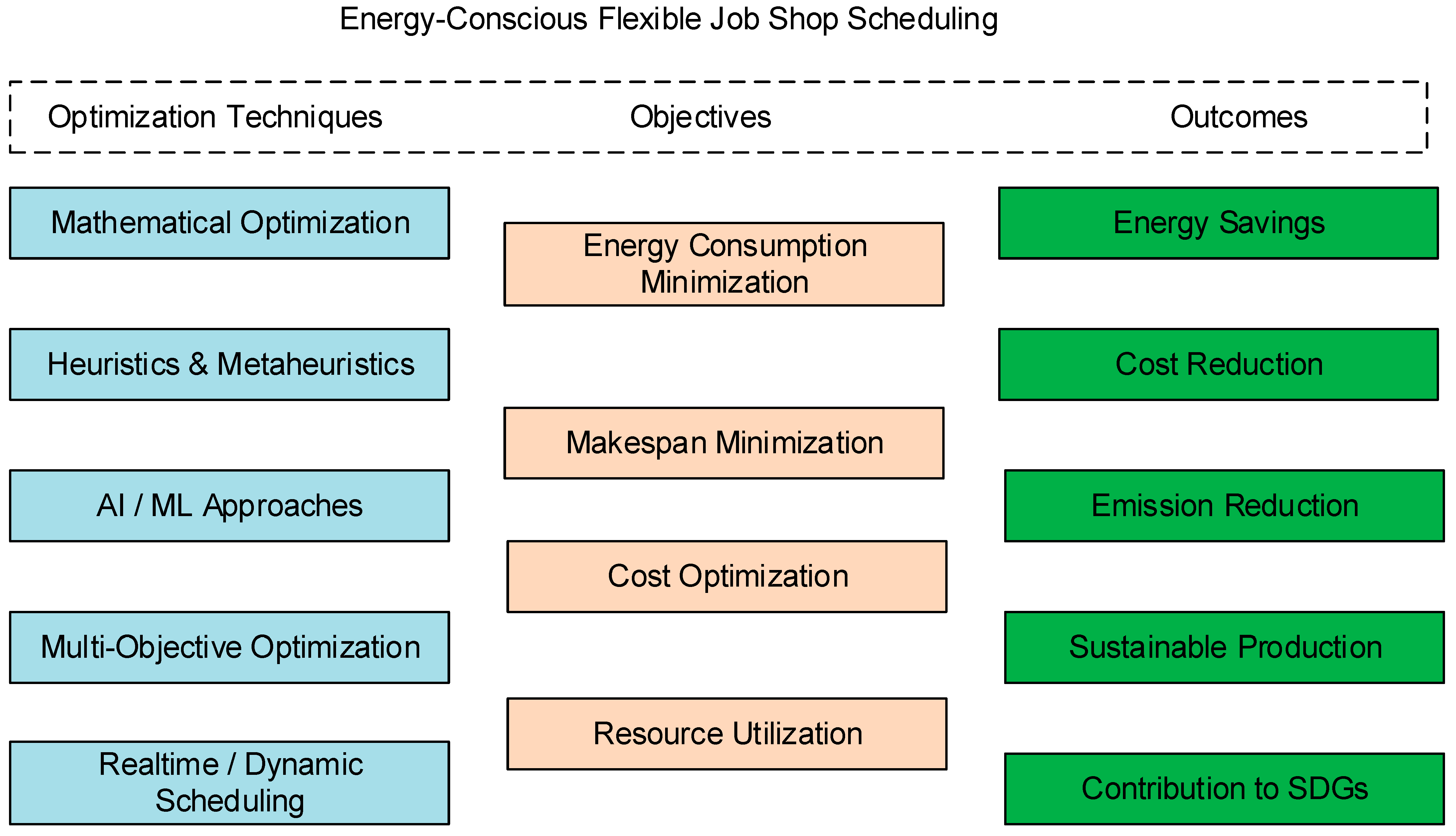
The JSSP is particularly significant within this context. Given that job-shop environments are characterized by high variability, diverse product mixes, and complex routing requirements, scheduling decisions not only become challenging but also pivotal in determining operational performance. The JSSP represents unique complex and challenging optimization challenges in modern manufacturing environments. The JSSP involves allocating a set of jobs to multiple machines while respecting predefined constraints, including technological processing sequences, machine capabilities, and temporal relationships [2,3]. This complexity is further amplified in flexible job-shop problem (FJSP) environments, where operations can be processed on multiple eligible machines, introducing additional decision dimensions regarding resource allocation [4,5]. Traditionally, scheduling objectives have emphasized productivity metrics such as makespan, throughput, and tardiness [6]. However, with the rising emphasis on sustainability, energy efficiency has been increasingly integrated into scheduling objectives [7,8,9]. Figure 1 illustrates how incorporating energy awareness reshapes traditional job-shop scheduling objectives in classical scheduling techniques such as mathematical optimization, heuristics, metaheuristics, multiobjective models, and AI, which are primarily used to minimize makespan and reduce costs. When these same techniques are adapted for energy-aware scheduling, the objective space expands to include energy consumption, peak load avoidance, and resource efficiency. This shift changes the outcome of scheduling decisions. Instead of focusing solely on productivity metrics, the resulting schedules also generate energy savings, emission reductions, and broader sustainability benefits aligned with SDGs. Thus, Figure 1 clarifies how traditional optimization approaches evolve when energy becomes an explicit decision criterion.
Energy-efficient job-shop scheduling, therefore, represents a crucial intersection between operational optimization and sustainability. Reductions in energy lower production costs whilst contributing to emission reduction and resource conservation [10]. This dual benefit highlights the broader role of scheduling in advancing sustainable manufacturing systems and supporting global climate action initiatives.
Studies on energy efficiency topic integration into the broader job-shop scheduling have gradually increased over the years but remain limited, hence the need to bridge this gap and contribute to the literature by conducting this review. The aim is to critically examine the methods and applications of energy-conscious job-shop scheduling reported in the literature, specifically by synthesizing existing approaches ranging from mathematical optimization to heuristics and metaheuristics to AI, while also assessing their practical applications in industrial contexts. By so doing, this paper identifies prevailing trends, methodological strengths, and limitations, as well as gaps that offer avenues for future research.
The overall structure of this paper is arranged as follows. Section 2 presents the theoretical foundations of job-shop scheduling and energy efficiency in manufacturing systems. Section 3 outlines the methodology adopted for the literature review. Section 4 provides a detailed synthesis of methods applied in energy-efficient job-shop scheduling, while Section 5 discusses their applications and case studies. Section 6 identifies key challenges and research gaps, and Section 7 highlights future research directions. Lastly, Section 8 concludes with the major findings and contributions of this review.

2. Theoretical Foundations

2.1. Job-Shop Foundations

Manufacturing systems consume large amounts of energy, especially in job shops where machines operate under variable loads. Energy use arises from machining, idling, setup operations, and auxiliary systems such as cooling and ventilation. Poor scheduling often increases idle times and peak loads, which raises both energy costs and environmental impacts [11]. Energy-aware scheduling addresses these challenges by treating energy consumption as a primary decision variable. Strategies may include reducing nonproductive energy use, aligning production with tariff periods, or balancing machine loads to avoid peaks. These decisions contribute directly to energy savings, lower costs, and reduced emissions. Energy efficiency also links to broader sustainability goals: economic, environmental, and social. The economic dimension focuses on cutting energy costs and improving resource utilization. The environmental dimension targets lower carbon emissions and reduced waste. The social dimension includes factors that affect workers and communities. Examples include designing schedules that reduce night shift fatigue, limiting long continuous working hours, improving worker safety around high-energy equipment, and supporting corporate social responsibility through fair labor practices. These social considerations help ensure that scheduling decisions support worker wellbeing and long-term societal benefits.
The JSSP is one of the most widely studied optimization problems in operations research and industrial engineering. It involves determining the optimal sequence of jobs to be processed on a set of machines, subject to technological constraints such as job routing, machine availability, and precedence relationships. In a typical job shop, each job consists of a series of operations that must be executed on specific machines in a predefined order [2]. As machines can process only one job at a time, conflicts arise that require efficient scheduling decisions.
The key features of the JSSP include combining dynamic and complex objectives in a multiobjective decision space where even small instances are computationally challenging due to the exponential growth of possible schedules as the number of jobs and machines increases [12]. Traditionally, research on the JSSP has prioritized operational efficiency primary optimizing metrics such as makespan and tardiness [13]. Makespan is described as the total time required to complete all jobs, commonly minimized to improve throughput [14,15]. Tardiness or lateness involves the degree to which job completion deviates from due dates, reflecting delivery reliability [16,17]. These metrics prioritize efficiency and customer satisfaction but often overlook resource consumption, particularly energy, which has become increasingly critical in modern sustainable manufacturing.

2.2. Energy Efficiency in Manufacturing Systems

Manufacturing processes are inherently energy-intensive, especially in job-shop environments where diverse machines operate under variable load conditions. Energy consumption arises not only from active machining operations but also from machine idling, setup, and auxiliary processes such as cooling and ventilation [18]. In many cases, inefficient scheduling results in prolonged idle times and peak demand loads, which increase both energy costs and environmental impacts [19]. The concept of energy-conscious scheduling has emerged as a response to these challenges. Unlike traditional scheduling approaches that optimize for makespan or throughput alone, energy-conscious scheduling explicitly incorporates energy consumption as a key decision variable. This may involve strategies such as minimizing nonproductive energy use [20,21], aligning production schedules with periods of lower energy tariffs [22,23,24], or balancing machine loads to reduce peak demand [25]. These scheduling decisions directly contribute to energy savings, cost reductions, and lower greenhouse gas emissions [26]. Energy efficiency in scheduling must also be understood through the broader lens of sustainability, which encompasses three interrelated dimensions:
  • Economic: reducing energy costs and improving resource utilization to enhance competitiveness.
  • Environmental: lowering carbon emissions, minimizing waste, and supporting regulatory compliance.
  • Social: promoting sustainable industrial practices that contribute to broader societal goals, including job security, worker health, and alignment with the SDGs.
Incorporating energy efficiency into the JSSP not only improves operational performance but also positions job-shop scheduling as a strategic tool for advancing sustainable manufacturing systems.

3. Review Methodology

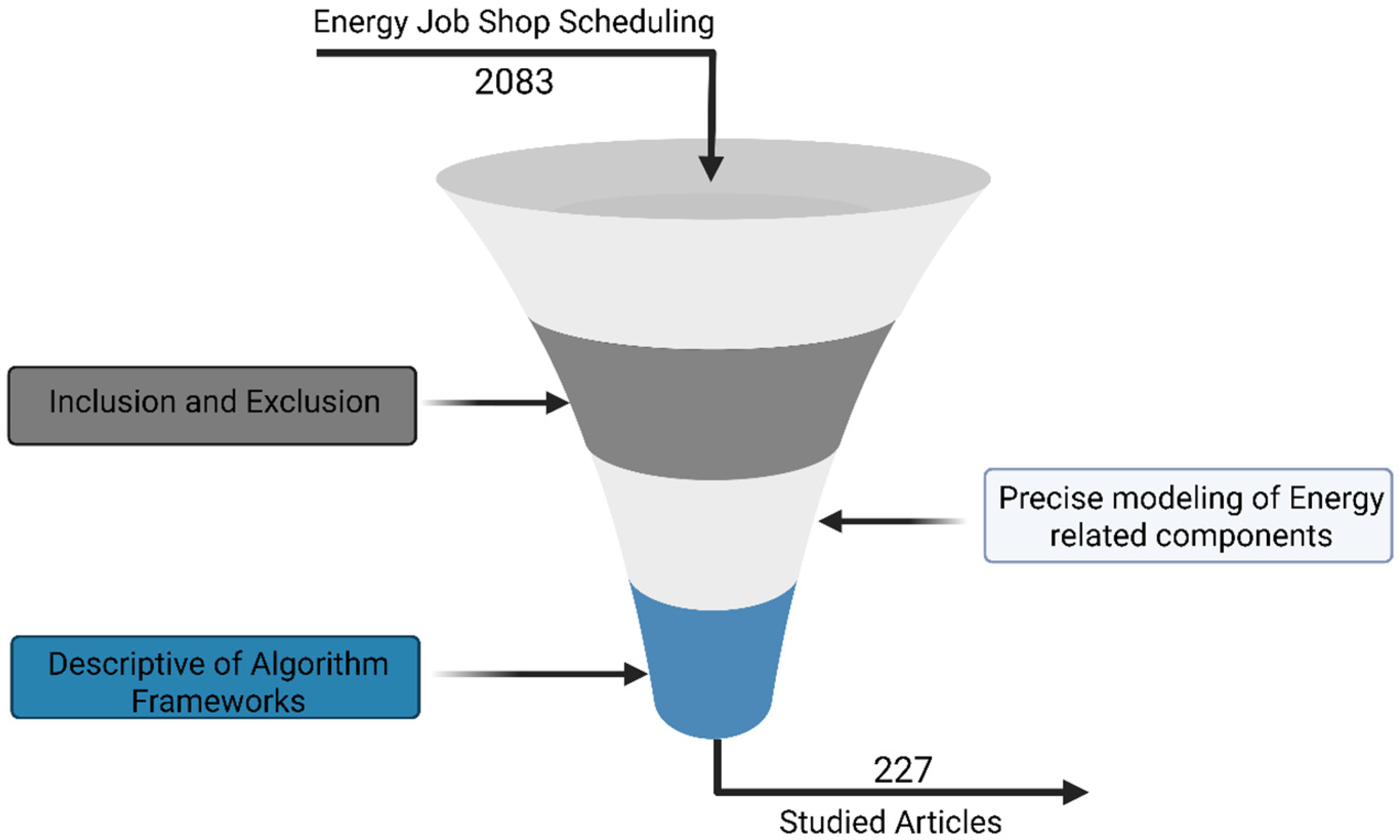
A systematic review was conducted in accordance with the Preferred Reporting Items for Systematic Reviews and Meta-Analyses (PRISMA) guidelines to ensure methodological transparency and reproducibility. The search strategy targeted research on energy-oriented job-shop scheduling across three major scientific databases, namely, Web of Science, Scopus, and IEEE Xplore. These platforms were selected because they index the highest proportion of peer-reviewed engineering, operations research, and computational optimization literature. The search began with a broad query using the term “energy job-shop scheduling”, which yielded a total of 2083 records after database aggregation. This initial query was intentionally inclusive to capture the full landscape of the scheduling literature in which energy concepts are mentioned, even when not central to the modeling framework. To progressively narrow the dataset toward studies in which energy is a primary optimization objective or constraint, the search was refined through the addition of more specific terms. The query “energy-efficient job-shop scheduling” reduced the dataset to 1299 records by filtering out publications that referenced energy only in passing without integrating efficiency metrics into the scheduling model. A subsequent refinement using “energy-aware job-shop scheduling” further reduced the dataset to 972 records, retaining studies that explicitly incorporate energy into decision variables, cost functions, or machine state modeling.
A final refinement using “energy-conscious job-shop scheduling” produced 533 records, isolating papers in which energy is treated as a core sustainability, operational, or economic consideration in multiobjective scheduling frameworks. All results from the refined search queries were merged, and duplicates were removed prior to screening. Each of the retrieved articles was subjected to a strict evaluation based on predefined inclusion and exclusion criteria. In short, publications were included only if they directly addressed job-shop scheduling and incorporated an explicit energy-related objective or constraint, supported by contributions such as an algorithm or mathematical model. Only peer-reviewed journal articles were included. Alternatively, publications were excluded if they lacked a direct focus on job-shop scheduling, did not incorporate an energy-related objective, were nonscientific or not peer-reviewed, were duplicates, or failed to provide sufficient methodological detail for comparison. Non-English studies were also removed to ensure consistency and accurate interpretation across all of the included literature (Figure 2).
During the eligibility phase, full text screening was carried out to verify that each study provided precise modeling of energy-related components, including machine (on/off) dynamics, power consumption profiles, and the trade-offs between makespan and energy usage. The assessment also ensured that the studies reported performance indicators that allowed meaningful comparison, such as percentage energy reduction, computational time, and multiobjective Pareto fronts. In addition, each article was to present a clear and reproducible description of the algorithmic framework employed, whether based on genetic algorithms, particle swarm optimization, simulated annealing, ant colony optimization, mixed-integer linear programming, or hybrid metaheuristic approaches. Only studies that met all of these methodological requirements were considered eligible for inclusion. As a result, after applying all criteria, the final set of 227 papers constituted the core analytical dataset for the systematic review.
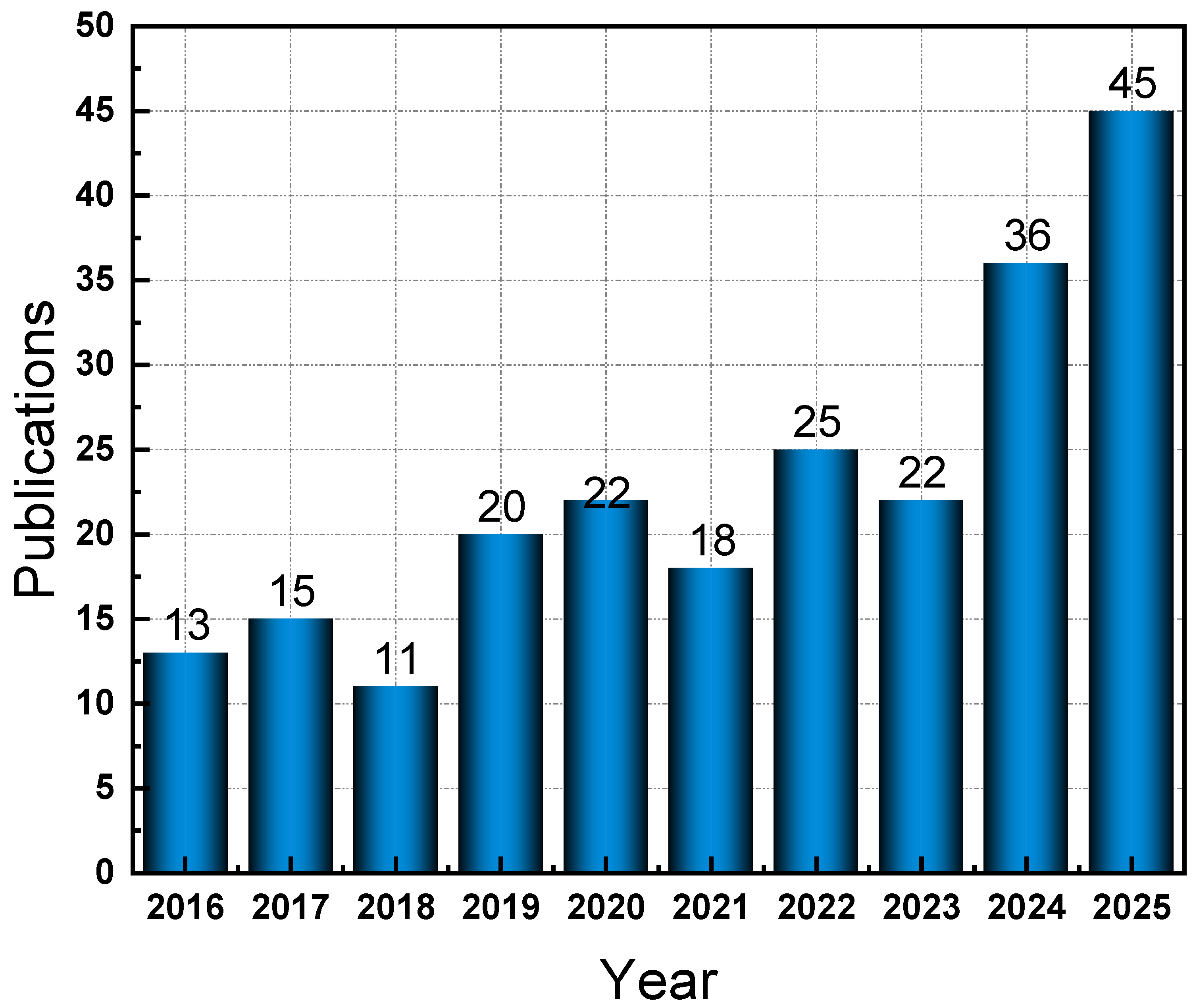
The annual distribution of the studied publications between January 2016 and September 2025 is depicted in Figure 3. Any journal cited from October 2025 is considered “in press” or “forthcoming”. While fluctuation in the publications is evident, the rising trajectory is significantly seen. This progression signifies not only a growing scholarly engagement with multiobjective job-shop scheduling but also the consolidation of energy-aware considerations as a prominent and increasingly mature research direction. The observed trend underscores the necessity of a comprehensive synthesis to capture the evolution and current state of knowledge in this domain. The detailed examination of prevailing research trends and the principal contributions identified within the selected studies is further analyzed.
Several valuable studies on energy-efficient scheduling exist, such as those focusing on metaheuristic applications [27,28,29], economic and environmental trade-offs [30], or specific problem formulations [31,32]. Recent analyses highlight that these streams often remain siloed, lacking the integrative frameworks needed for truly sustainable and adaptive manufacturing systems [33]. This work, therefore, differentiates itself through its breadth of structure and integrative perspective. Unlike prior surveys that often concentrate on specific algorithmic families or traditional energy objectives, this review systematically synthesizes research across five methodological streams (exact methods, metaheuristics, AI/ML, real-time scheduling, and hybrid models) and links them explicitly to sustainability dimensions and Industry 4.0 enablers. Specifically, our contributions include the following:
(1)
An updated and expanded classification of energy-aware models that incorporates machine states, dynamic pricing, speed scaling, and renewable integration.
(2)
The first structured mapping of EEJSS research to U.N. Sustainable Development Goals and Industry 4.0 capabilities, clarifying the role of scheduling in low-carbon smart manufacturing.
(3)
A sector specific analysis that contextualizes findings in high-impact industries such as aerospace, automotive, and electronics.
By offering this comprehensive cross-domain synthesis, this review not only consolidates a rapidly evolving field but also provides a forward-looking framework to guide research and practice toward genuinely sustainable production systems.

4. Methods for Energy-Efficient Job-Shop Scheduling

Energy efficiency integration with JSSP has motivated the development of diverse solution strategies. These methods range from exact optimization models to heuristic and metaheuristics, AI, and real-time adaptive frameworks. Each approach offers unique advantages and limitations, particularly when applied to complex and large-scale manufacturing systems. This section critically reviews the main methodological categories.

4.1. Problem Modeling and Formulations for EEJSSP

Firstly, the integration of energy efficiency into the classical JSSP requires extending its fundamental model. The standard JSSP model focuses on sequencing jobs on machines to optimize time-based metrics like makespan. The EEJSSP model expands this by incorporating energy-specific decision variables, parameters, and objectives. Core modeling extensions include machine power state modeling, energy cost integration, auxiliary energy consumption, and multiobjective formulation. The choice of model (deterministic vs. stochastic, linear vs. nonlinear, single vs. multiobjective) directly influences the applicable solution strategies. A deterministic, linear model with few discrete variables may be suitable for exact methods, while a stochastic model with nonlinear constraints and multiple objectives typically necessitates heuristic, metaheuristic, or AI-based approaches. The following sections review the solution methods developed to solve these increasingly complex EEJSSP formulations.

4.2. Exact and Mathematical Optimization Methods

Mixed-integer programming (MIP) and linear or nonlinear programming remain among the most widely used exact optimization techniques for modeling energy-efficient JSSPs. These mathematical approaches enable the precise representation of scheduling constraints, including job precedence relations, machine availability, and detailed energy consumption profiles for both operational and idle states [34]. By formulating the scheduling task as a rigorous optimization problem, they allow for the simultaneous consideration of multiple sustainability-oriented objectives, such as minimizing makespan, total energy use, or greenhouse gas emissions associated with production activities [35].
A key strength of exact methods is their ability to guarantee optimality and generate certifiable solutions. In practice, this makes them highly valuable for small to moderate problem sizes, typically, up to 10–15 jobs with 10 machines, or full enumeration of instances with fewer than 7–8 jobs, as well as for academic test cases and high-quality benchmarks used to evaluate heuristic and metaheuristic methods [36]. In this benchmarking role, optimal solutions provide a critical reference point for quantifying optimality gaps and assessing the accuracy of faster approximate algorithms.
From a sustainability perspective, exact methods offer important insights into trade-offs between productivity and resource efficiency [37]. They provide decision-makers with quantitative evidence for reducing carbon footprints, improving energy efficiency, and aligning production planning with environmental regulations and low-carbon manufacturing strategies [38]. However, despite these benefits, exact methods remain constrained by the NP-hard nature of the JSSP [39]. The combinatorial explosion of feasible schedules causes computational effort to grow exponentially as problem size increases. As a result, while exact techniques perform well on smaller instances, they become computationally intractable for industrial-scale problems (e.g., more than 20 jobs or 15 machines), especially in dynamic, real-time environments [40]. Consequently, their practical role in sustainable manufacturing is often limited to providing benchmark solutions, informing heuristic design, or being embedded within hybrid frameworks that combine mathematical rigor with the scalability of metaheuristics [41].

4.3. Heuristic and Metaheuristics

To overcome the scalability and computational challenges associated with exact optimization methods, a wide range of heuristic and metaheuristic algorithms have been extensively applied to energy-aware job-shop scheduling. These approaches are designed to efficiently explore complex and high-dimensional solution spaces, providing high-quality solutions within acceptable computation times. Unlike exact methods, which become computationally prohibitive as problem size grows, heuristics and metaheuristics offer a practical means of addressing large-scale, dynamic, and real-time scheduling environments often encountered in modern manufacturing systems [42].

4.3.1. Comparative Analysis of Common Metaheuristics

Common metaheuristic techniques include genetic algorithms (GAs), which rely on evolutionary principles of selection, crossover, and mutation to search across broad solution landscapes and have demonstrated strong performance in balancing trade-offs between makespan and energy consumption [43]. Simulated annealing is another widely studied approach, employing probabilistic acceptance criteria to escape local optima and gradually converge toward high-quality solutions, particularly in problems with complex energy constraints [44,45]. Tabu Search leverages adaptive memory structures to avoid cycling and guide the search toward promising solution regions [46], while particle swarm optimization inspired by collective swarm intelligence is effective in tackling multiobjective and multidimensional scheduling tasks including energy-aware objectives [47]. The selection of an appropriate metaheuristic is problem-dependent as each algorithm possesses distinct strengths and weaknesses driven by its core inspiration and search strategy. Table 1 provides a comparative analysis of these common techniques.

4.3.2. Parameter Tuning and Algorithm Configuration

A critical challenge in applying these metaheuristics is their performance sensitivity to parameter settings. To achieve consistent and high-quality results, systematic tuning strategies are essential. Design of experiments (DOE) is a statistical methodology that efficiently samples the parameter space to model performance and identifies significant factor interactions with limited computational runs. For more intensive fine tuning, Bayesian optimization is a sequential model-based approach that constructs a probabilistic surrogate to approximate the algorithm’s performance, guiding the search for optimal parameters by balancing exploration and exploitation. These methods form a complementary workflow for robust algorithmic calibration, moving beyond ad hoc trial and error.
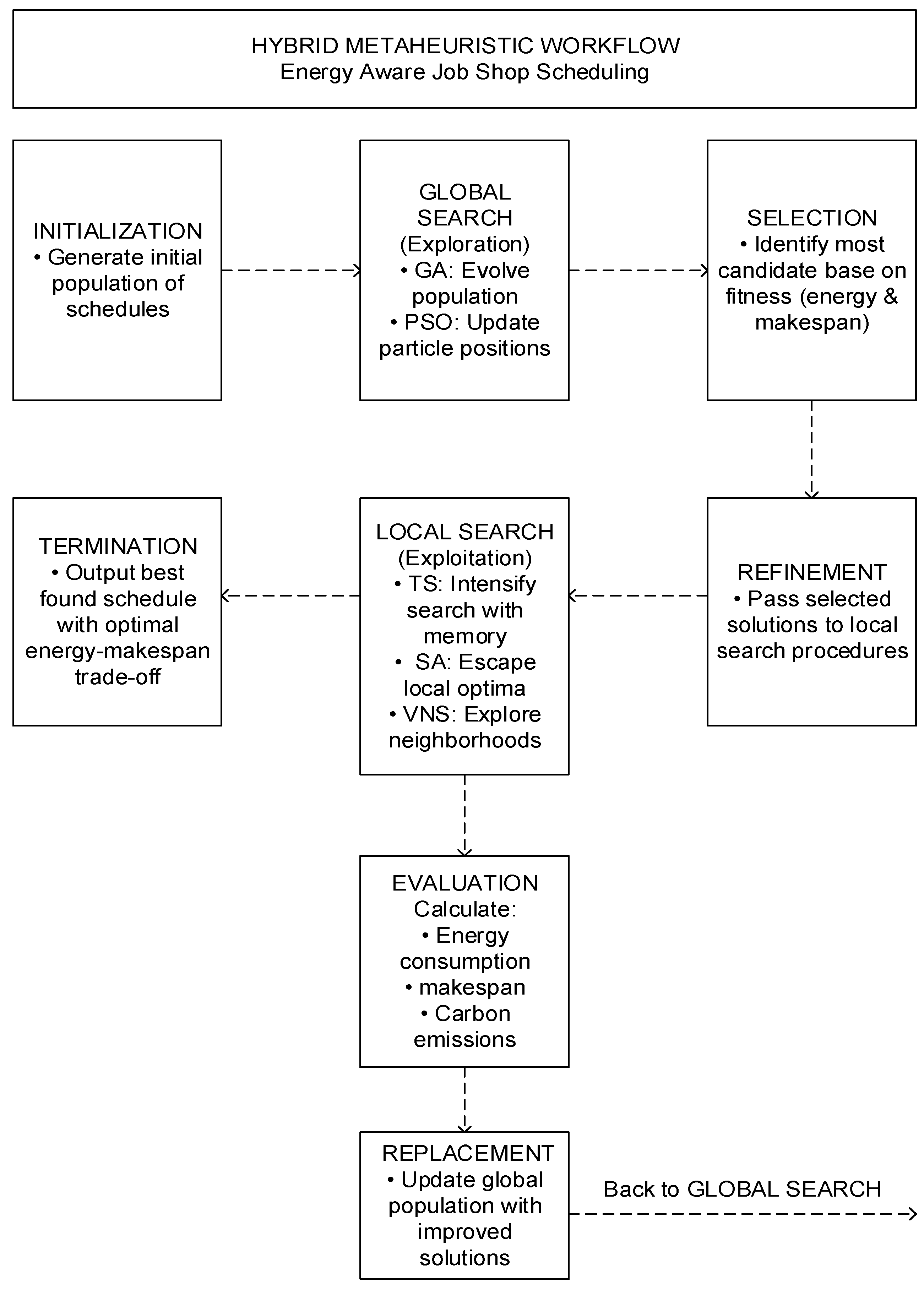
Several studies illustrate the applicability of these methods in sustainability-oriented scheduling. For example, to optimize energy consumption in distributed flexible job-shop scheduling, Zhang et al. developed the MACROE framework, a multiagent reinforcement learning (RL) method that decomposes the problem and employs a dynamic weighting mechanism to balance makespan and total energy consumption [48]. Similarly, GAs were used wherein the dynamic job shop, which includes both job tardiness and job cost with machine breakdown, as well as alternate job routine, are involved [49]. Beyond standalone methods, hybrid strategies have been developed to combine the complementary strengths of different algorithms. For instance, Du et al. proposed a hybrid estimation of the distribution algorithm combined with variable neighborhood search (EDAVNS) to solve the distributed flexible job-shop scheduling problem with crane transportation constraints, optimizing for both makespan and energy consumption [50]. Other research has embedded heuristic rules within MIP formulations to enhance computational tractability. These hybrid methods not only improve convergence speed but also enhance energy-saving outcomes by more effectively capturing machine idle states and setup-dependent power consumption (see Figure 4).
A sustainability perspective can further be illustrated by the workflow in Figure 4 wherein heuristic and metaheuristic methods are particularly shown to accommodate multiple, and sometimes conflicting, objectives such as reducing makespan, minimizing energy costs, and lowering carbon emissions within a single optimization framework [51]. Moreover, their adaptability allows them to incorporate renewable energy availability, variable electricity tariffs, and low-carbon production policies, making them highly relevant for industries aiming to align with SDGs and environmental regulations [38].
However, while these approaches typically generate near-optimal solutions in reasonable computation times, they present some limitations. Their performance is often sensitive to parameter tuning, requiring cautious calibration to achieve consistent results [38]. Furthermore, unlike exact optimization methods, metaheuristics cannot guarantee global optimality, which may pose challenges when precise benchmarks are required [52]. Consequently, the use of systematic configuration methods like DOE and Bayesian optimization is critical to mitigate this sensitivity and ensure algorithmic robustness. Nonetheless, their flexibility, efficiency, and ability to model realistic sustainability related constraints ensure that heuristic and metaheuristic approaches will remain central to the development of energy-aware and environmentally responsible scheduling systems [53].

4.4. Artificial Intelligence and Machine Learning Approaches

Recent advances in AI and ML have opened new avenues for adaptive and intelligent scheduling in manufacturing systems, particularly when addressing energy efficiency and sustainability concerns. Unlike traditional optimization techniques which often rely on predefined mathematical formulations, AI- and ML-based methods are capable of learning complex patterns directly from data and adapting dynamically to changing shop floor conditions. This makes them highly relevant in the context of Industry 4.0, where cyber-physical systems, Industrial Internet of Things (IoT), and data-driven decision support tools are increasingly integrated into production environments.

4.4.1. Key Techniques and Applications

Reinforcement learning has, thus, attracted significant attention for its ability to generate adaptive scheduling policies through trial-and-error interactions within the environmental space. By continuously updating decision policies based on real-time feedback, RL enables production systems to adapt to fluctuations in job arrivals, machine breakdowns, or energy price variability. For instance, Zhang et al. developed an evolutionary algorithm that incorporates RL to solve the energy-conscious flexible job-shop scheduling problem with transportation and setup times, optimizing for multiple objectives including makespan and total energy consumption [54]. Similarly, Liu et al. proposed a graph RL approach with a dual attention mechanism to address energy-efficient flexible job-shop scheduling under incentive-based demand response, demonstrating its potential to improve sustainable manufacturing by significantly reducing peak energy demand and improving grid resilience [55]. RL approaches can directly optimize scheduling decisions to reduce energy costs and participate in industrial demand response programs, effectively managing the production and energy nexus without requiring separate predictive models [56]. Surrogate modeling is particularly effective in the context of large-scale DT simulations, where a single high-fidelity run is computationally prohibitive. By training a surrogate model to approximate the DT’s behavior, schedulers can perform rapid scenario analysis and optimization in near-real time, which would be impossible using the original simulation model [57]. In addition, predictive analytics offers the capability to leverage historical production and energy consumption data to forecast future energy demand. This forecasting is crucial for enabling two key strategies: participating in industrial demand response programs by predicting grid peak periods and shifting loads to capitalize on financial incentives, and enhancing renewable energy integration by aligning energy-intensive tasks with forecasts of high solar or wind generation. By aligning job release times and machine utilization with these predictions, proactive scheduling strategies can significantly reduce operational costs and carbon footprints [58].

4.4.2. Challenges and Pathways to Industrial Adoption

From a sustainability perspective, AI and ML provide adaptability, scalability, and robustness in uncertain environments, making them well suited for data-rich smart manufacturing systems. They enable multiobjective optimization by simultaneously addressing traditional performance indicators such as makespan or tardiness alongside sustainability metrics like energy consumption and CO2 emissions. Despite their significant promise, the industrial adoption of these AI and ML methods faces critical challenges rooted in data and trust. A primary barrier is data availability and quality, as these data-intensive models require large volumes of high-fidelity historical data that is often difficult to acquire in manufacturing settings. Furthermore, the “black-box” nature of complex models erodes operational trust, making plant managers hesitant to rely on nontransparent recommendations for critical production decisions. These challenges of data infrastructure and model interpretability significantly hinder the transition from successful simulation to widespread real-world implementation. To bridge this gap, several pathways are emerging to explore explainable artificial intelligence (XAI) to improve transparency and facilitate adoption in real manufacturing contexts [59]. Overall, AI- and ML-based scheduling approaches hold considerable promise in advancing sustainable manufacturing by supporting intelligent, adaptive, and energy-aware decision making in complex, dynamic shop floor environments.

4.5. Multiobjective Approaches

Scheduling in sustainable manufacturing rarely revolves around a single objective. Instead, decision-makers are typically confronted with the need to balance multiple, and often conflicting, goals such as minimizing energy consumption, reducing makespan, lowering production costs, and decreasing carbon emissions. This inherent trade-off requires optimization strategies that can provide a spectrum of high-quality solutions rather than a single “best” outcome. Multiobjective optimization techniques are well suited to this challenge because they generate sets of Pareto optimal solutions, where there is no objective to be enhanced without sacrificing performance in another dimension. These Pareto sets allow production managers to evaluate alternative trade-offs and align scheduling decisions with their organizational priorities, such as economic performance, environmental compliance, or customer service requirements [60]. The knee point method identifies the solution on the Pareto front that represents the most balanced trade-off, where any minor improvement in one objective would necessitate a significant worsening of another. It is typically selected as a default when no explicit preferences between objectives are specified by the decision-maker. This approach automatically finds the region of maximum marginal benefit, providing a well-rounded compromise without requiring manual input. The ε-Constraint method transforms a multiobjective problem into a single objective one by optimizing a primary goal while converting all other objectives into inequality constraints. The decision-maker defines allowable limits (ε-values) for these secondary objectives, effectively setting strict performance thresholds that must be met. This approach is particularly valuable when dealing with regulatory requirements or when one objective has unambiguous priority over others.
Among the most widely applied methods in this domain are evolutionary algorithms, including the Nondominated Sorting Genetic Algorithm II and III (NSGAII, NSGAIII), the Multiobjective Evolutionary Algorithm based on Decomposition (MOEA/D), and the Indicator-Based Evolutionary Algorithm (IBEA). These algorithms are particularly effective in handling the complex, nonlinear, and combinatorial nature of job-shop scheduling problems. For instance, NSGAII has been applied to optimize flexible job-shop scheduling with the dual objectives of minimizing makespan and energy consumption, achieving diverse Pareto fronts that highlight trade-offs between operational efficiency and sustainability [61]. Zhang et al. employed the NSGA-III multiobjective optimization algorithm to demonstrate that increasing the nonfossil energy share to 23.5–32.7% is a critical pathway enabling China to achieve carbon peaking while sustaining its economic growth targets [62]. Similarly, MOEA/D has been successfully used to decompose large scheduling problems into smaller subproblems, enabling more efficient exploration of solution spaces and yielding competitive performance in balancing production efficiency with energy-aware objectives [63]. Whilst the authors could not find studies where IBEA is used to solve sustainability goals, Cao et al. proposed the IBEA algorithm, which utilizes an enhanced diversity indicator and a shape-conforming convergence metric to more effectively solve many objective optimization problems [64]. From a sustainability perspective, multiobjective optimization provides an essential mechanism for integrating environmental goals, such as energy consumption, into traditional production planning. This was demonstrated by Wu et al., who addressed the prior neglect of energy factors by developing a comprehensive flexible job-shop scheduling model that includes energy consumption from transport, setup, and idle stages [65]. By explicitly considering these multiple objectives, their approach helps manufacturing systems reduce energy use, adapting to green regulations and energy market fluctuations while still meeting critical operational deadlines. Furthermore, advanced variants such as indicator-based evolutionary algorithms and hybrid multiobjective approaches that integrate heuristics or mathematical models have been shown to improve both convergence and diversity of Pareto fronts in energy-aware scheduling scenarios [66].
However, while evolutionary multiobjective algorithms excel at producing diverse solution sets, they also introduce challenges for practical decision making. In real-world industrial contexts, managers may be faced with large Pareto fronts containing dozens, or even hundreds, of candidate schedules, which can overwhelm decision-makers and complicate the selection process. Without appropriate decision support tools such as clustering techniques, preference-based ranking methods, or interactive visualization, extracting actionable insights from Pareto sets can be difficult [67]. Future research directions are, therefore, focusing on decision support integration, where multiobjective optimization is combined with decision-making frameworks to guide stakeholders toward solutions that are not only mathematically efficient but also practically implementable in sustainable manufacturing environments.

4.6. Real-Time and Dynamic Scheduling

In real-world job-shop environments, uncertainty and variability are inevitable, making static schedules insufficient for practical implementation. Factors such as unexpected machine breakdowns, fluctuating customer demands, variable electricity pricing, and the increasing integration of renewable energy sources require adaptive and resilient scheduling approaches. Unlike static optimization, which assumes fixed conditions, real-time and dynamic scheduling methods are designed to continuously reoptimize schedules in response to disruptions and environmental fluctuations, thereby ensuring both production efficiency and energy sustainability. Recent advances in predictive analytics, DT technology, and IoT-enabled monitoring systems have significantly enhanced the capacity of real-time scheduling. By leveraging real-time shop floor data, predictive analytics can anticipate disturbances (e.g., machine maintenance needs or demand surges), enabling proactive adjustments [68]. DTs’ virtual replicas of physical systems further strengthen dynamic scheduling by simulating alternative scheduling decisions and their impacts on energy consumption before implementation, thereby supporting more sustainable and risk-averse decision making [69]. Meanwhile, IoT-based monitoring provides granular visibility into machine status, energy use, and process variations, allowing schedulers to rapidly reconfigure plans in line with energy-aware objectives [70]. The effectiveness of these technologies hinges on a robust data infrastructure with specific performance characteristics. Low-latency communication networks (e.g., 5G, TSN) are critical to ensure that decision-making cycles occur within relevant timeframes, often requiring subsecond latency for control-level actions. Furthermore, high-frequency data sampling from milliseconds for machine state to seconds for energy meters is necessary to accurately capture the transient events such as machine startups or peak power draws that are essential for precise energy monitoring and dynamic control.
From a sustainability perspective, these methods enhance both system resilience and energy adaptability. Multiobjective optimization is crucial for integrating sustainability into production planning. The value of this approach is clear in real-time scheduling scenarios. For example, Zhang 2017 [71] showed that a dynamic game theory method using real-time IoT data can successfully reduce energy consumption while maintaining production efficiency. Building on this principle, real-time scheduling can be further enhanced by integrating external signals like time-of-use energy pricing. This can shift energy-intensive operations away from peak periods, thereby lowering both operational costs and greenhouse gas emissions. Similarly, dynamic scheduling can coordinate with renewable energy availability (e.g., solar or wind) by aligning production tasks with periods of surplus green electricity, thereby reducing reliance on fossil-fuel-based energy [72]. These strategies are particularly relevant to the global push toward low-carbon manufacturing and the achievement of SDGs, such as SDG 9 (Industry, Innovation, and Infrastructure) and SDG 12 (Responsible Consumption and Production).
Despite these promising opportunities, the successful deployment of real-time and dynamic scheduling in industry faces several challenges. Effective implementation depends on the presence of robust data infrastructure, including reliable sensors, high-frequency data acquisition, and secure data management systems. It also requires advanced control systems capable of supporting rapid decision making, as well as seamless integration between cyber-level optimization and physical shop floor operations [73]. Additionally, the computational complexity of real-time reoptimization under multiple uncertain factors highlights the need for hybrid approaches that combine predictive analytics, heuristic or metaheuristic algorithms, and AI-driven decision support.
In summary, real-time and dynamic scheduling offers a powerful framework for maintaining feasible, cost-efficient, and energy-adaptive production plans under uncertainty. By integrating advanced data-driven technologies with sustainability-driven objectives, these methods represent a critical enabling of future smart and green manufacturing systems.
By classifying energy-aware job-shop scheduling studies according to their primary methodological strategy, Table 2 provides an overview of the research landscape and its distribution across five key approaches. These include exact methods, AI/ML, real-time decision frameworks, heuristic and metaheuristic search techniques, and, notably, hybrid methods that integrate two or more of the aforementioned strategies. This classification clarifies the predominant computational paradigms in the literature and highlights the growing reliance on hybrid modeling structures, which combine diverse techniques to address the complexity of energy-efficient scheduling. By organizing studies in this manner, the table not only distinguishes methodological pathways but also underscores the trend toward integrated and versatile solution frameworks in EEJSS research.
Additionally, Table 3 isolates the energy-related contributions of each study, revealing which works emphasize machine on/off dynamics, energy pricing, machine speed adjustment, or additional sustainability considerations. It shows how different frameworks operationalize energy efficiency and highlights where gaps remain in modeling real industrial energy behavior.

5. Application and Case Studies

The practical deployment of EEJSS approaches has been explored across a wide range of industrial domains, simulation-based testbeds, and benchmarking studies. These applications illustrate the transition of EEJSS research from theoretical modeling toward real-world implementation, emphasizing both the opportunities and challenges associated with embedding sustainability into day-to-day scheduling decisions. By demonstrating tangible impacts such as energy savings, carbon emission reductions, and improved production efficiency these case studies highlight the growing role of EEJSS in advancing green manufacturing practices and supporting industrial responses to global sustainability goals.

5.1. Industrial Application

An industrial demonstration was conducted in a large cement equipment manufacturing facility in China, where high electricity demand and complex material flows posed significant challenges for achieving sustainable production. The implementation employed a hybrid metaheuristic scheduling framework combining a genetic algorithm, Glowworm Swarm Optimization, and a Green Transport Heuristic Strategy (GA–GSO–GTHS) [108]. Central to the approach was a mixed-integer programming model that jointly optimized machine operations and overhead crane transportation using real workshop layout information and detailed machine power state profiles. The optimization objective targeted simultaneous reductions in comprehensive energy consumption including machining and material handling, energy, and total makespan. Compared with the legacy manual dispatching method, the proposed framework achieved substantial improvements, realizing a 44.21% reduction in total energy consumption and a 37.23% decrease in makespan. These gains were primarily attributed to more efficient machine allocation, shortened crane transport distances, and the near elimination of crane idle time.
Although the original case study reported a specific estimate of annual energy savings, the value cannot be independently verified within the present research. Nevertheless, the environmental implications of such efficiency gains can be quantitatively assessed using standard carbon accounting methods. For any validated energy savings value Esaved, the associated reduction in CO2 emissions can be computed using the regional grid emission factor EF (kg CO2/kWh) as follows:
CO2,reduction = Esaved × EF
This formulation provides a transparent and transferable mechanism for evaluating the climate benefits of energy-efficient scheduling interventions. The demonstrated reductions in both energy use and production time underscore the potential of advanced scheduling algorithms to contribute meaningfully to sustainability objectives, aligning operational excellence with significant carbon mitigation opportunities in energy-intensive manufacturing sectors.
Another real-world application was carried out in an aerospace manufacturing facility, also in China, where the production system is characterized by multivariety and small-batch orders with highly dynamic scheduling requirements. The company faced significant challenges in coordinating energy-intensive machining processes under frequent job changes and tight delivery deadlines. To address this problem, the study implemented a dynamic energy-efficient scheduling framework driven by a multiobjective mathematical model that simultaneously minimized total energy consumption, makespan, and machining cost. The solution approach employed a novel multiobjective bi-population differential artificial bee colony (BDABC) algorithm, whose parameters were calibrated using a Taguchi experimental design to ensure robust performance under real operating conditions.
The methodology integrated detailed machine level energy states and dynamic job routing constraints derived from actual workshop data in the aerospace plant. The experimental results confirmed that the BDABC framework delivered markedly improved Pareto optimal solutions across all objectives, enabling the enterprise to reduce machining energy usage, shorten completion times, and lower operational costs relative to existing scheduling approaches [85].

5.2. Simulation and Digital Twin Studies

A more recent and transformative trend is the integration of DT technology into scheduling research. A DT acts as a virtual replica of a physical manufacturing system, continuously synchronized with real-time shop floor data via Industrial Internet of Things platforms and cyber-physical systems. By coupling real-time sensing data with advanced scheduling models, DTs allow for dynamic reoptimization in the presence of disruptions or environmental changes by means of either simulation or mimicking the physical model. Simulation environments provide researchers and practitioners with virtual testbeds in which diverse scheduling strategies can be examined under dynamic conditions such as fluctuating job demand, unexpected machine failures, and varying energy pricing schemes. For instance, Liu et al. created a multilevel simulation model to handle the complex and unpredictable aircraft overhaul process. Their method uses different detail levels of simulation to find optimal schedules efficiently without excessive computational demands [139]. In cases of machine breakdowns or renewable energy fluctuations, DT-enabled scheduling can proactively simulate alternative scenarios and adjust schedules in near-real time, minimizing both energy costs and production delays [69]. From a sustainability standpoint, simulation and DT-based studies are particularly valuable because they enable multiobjective evaluation of scheduling policies that balance economic performance with environmental targets, such as carbon emission reduction and energy efficiency. Dai et al. developed a digital twin framework for AGV scheduling that successfully reduced energy consumption in a plant factory environment [140]. By embedding energy awareness into intelligent, data-driven scheduling architectures, these studies demonstrate how modern factories can transition from reactive to proactive decision making, thereby enhancing resilience, reducing operational energy footprints, and advancing broader sustainability objectives.

5.3. Benchmarking Studies

Benchmarking plays a critical role in evaluating and advancing energy-aware scheduling approaches. While traditional job-shop scheduling instances (e.g., Fisher & Thompson, Lawrence, and Taillard benchmarks) have been widely used to assess algorithmic performance on conventional metrics like makespan and tardiness, there is a recognized need to develop and adopt energy-aware benchmarks that move beyond these classical sets [101]. These standard benchmarks, though valuable for establishing computational efficiency and solution quality for traditional objectives, lack the specific parameters such as machine power states, time varying energy prices, and transport energy demands required to adequately assess energy-focused performance. Consequently, researchers have begun developing extended benchmark instances that incorporate machine-specific power profiles, time-dependent energy costs, and material handling energy consumption [66]. This evolved approach to benchmarking not only validates methodological advancements but also provides valuable decision support for industry practitioners, clearly illustrating the practical benefits of transitioning from conventional to sustainability-oriented scheduling strategies.
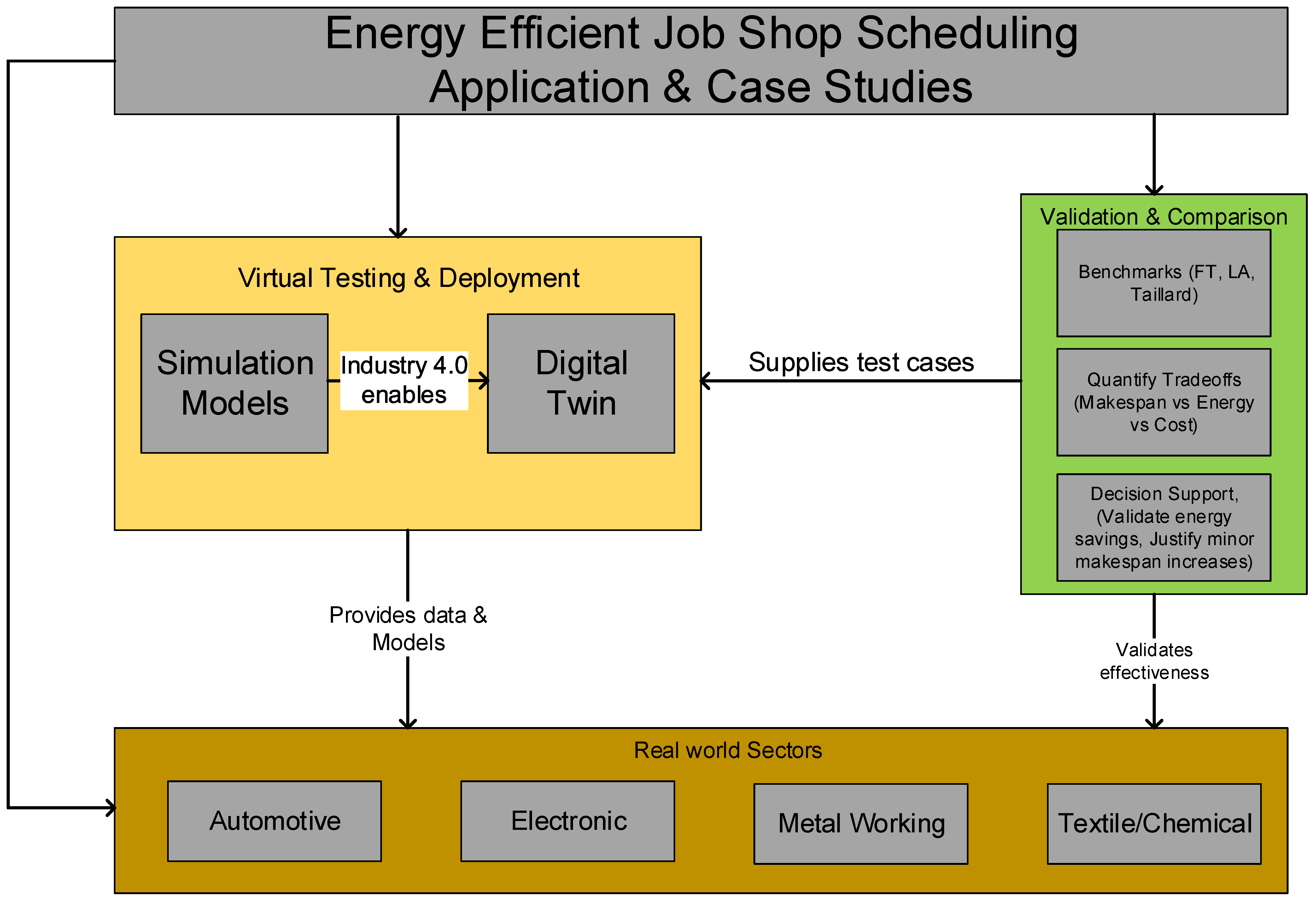
Advancing sustainable manufacturing requires a coordinated approach that connects benchmarking, DT simulation, and industrial implementation within EEJSS research. Figure 5 depicts the synergistic relationship between benchmarking, DT simulation, and industrial application in the development and validation of EEJSS strategies. The figure illustrates the three main application domains and how they interact, moving from theoretical concepts to practical implementation and validation. It illustrates a comprehensive methodology for enhancing manufacturing sustainability through EEJSS. It highlights how Industry 4.0 technologies, specifically the use of a DT for simulation and virtual testing, enable the quantification of key trade-offs between productivity (makespan) and energy consumption. The framework provides critical decision support for validating energy savings and justifying potential trade-offs, demonstrating a practical pathway for reducing the environmental footprint in sectors like automotive and electronics. Ultimately, it validates the effectiveness of integrating energy efficiency directly into production planning and operational decision making.
In summary, the tangible benefits of EEJSS are demonstrated through direct quantitative outcomes. The economic gains include substantial reductions in energy costs, major variable expense, and enhanced asset utilization through shorter production cycles. The environmental benefits are directly measurable as significant reductions in absolute energy consumption and greenhouse gas emissions. Furthermore, these optimized systems often lead to social benefits, such as improved worker satisfaction due to more predictable workflows and the creation of higher skilled positions focused on managing these advanced systems.

6. Challenges and Research Gaps

Despite the growing body of research on EEJSS, several challenges continue to hinder its widespread adoption and impact on sustainable manufacturing. These gaps highlight opportunities for future research to enhance both methodological robustness and industrial applicability.

6.1. Computational Complexity of Large Scale JSSP

The EEJSS inherits the NP-hard complexity of the classical JSSP, which is exacerbated by the integration of dynamic energy objectives. For large-scale industrial instances involving hundreds of jobs and machines, exact optimization methods (e.g., MILP) become computationally intractable within practical time limits. This necessitates the use of heuristic, metaheuristic, and machine learning approaches, which trade guaranteed optimality for feasible computation.
The evaluation of these algorithms hinges on two critical classes of performance metrics:
  • Solution quality: measured by primary objectives like makespan, total energy consumption, total cost, and carbon emissions. In multiobjective optimization, quality is assessed via Pareto front analysis using indicators such as hypervolume and spread.
  • Computational efficiency: quantified by CPU/wall-clock time, convergence speed (iterations to a target solution), time-to-target quality, and scalability with problem size.
A central challenge is developing hybrid algorithms that effectively balance these often competing metrics, achieving high-quality, sustainable schedules without prohibitive runtimes.

Complexity of Renewable Integration: Uncertainty and Storage

Integrating variable renewable energy (VRE) sources, such as solar and wind, introduces a profound layer of stochastic complexity largely underdeveloped in classic EEJSS models. Moving beyond static energy price assumptions, VRE requires scheduling under generation uncertainty. This transforms the problem into a stochastic or robust optimization challenge, where schedules must be resilient to forecast errors in green energy availability. Furthermore, the coupling of scheduling with energy storage systems (e.g., batteries) adds a strategic, time-coupled decision variable. The scheduler must now co-optimize production sequences with storage dispatch decisions, determining when to store surplus renewable energy for use during low-generation periods. This integration creates a tightly coupled energy production nexus, significantly increasing the state space and computational burden of the optimization.

6.2. Integration of Renewable Energy and Smart Grids

Beyond conventional grid electricity, several renewable and low-carbon energy-generation alternatives such as solar photovoltaics, wind turbines, biomass systems, hydropower, and on-site cogeneration offer promising pathways for reducing manufacturing carbon footprints [141]. However, each alternative presents real operational and scheduling limitations that constrain their direct incorporation into job-shop scheduling models. Solar and wind energy, despite their widespread adoption, suffer from inherent intermittency and weather dependence, resulting in unpredictable and fluctuating power outputs that complicate real-time scheduling decisions [142]. Biomass and biofuel systems provide more stable generation but require continuous feedstock supply, raising logistical challenges, higher operating costs, and emissions considerations [143]. Hydropower offers reliable generation but is geographically restricted and, in most regions, not feasible for factory-level integration [144]. Even combined heat and power (CHP) or gas-based cogeneration units, although more controllable, remain constrained by fuel price volatility, maintenance needs, and the fact that they are not fully carbon-neutral [145].
From a scheduling standpoint, these limitations translate into fluctuating energy availability, inconsistent generation capacity, and the need for accurate short-term forecasting capabilities that most existing JSSP models do not yet incorporate. Storage technologies such as batteries can mitigate intermittency, but they introduce additional constraints related to storage capacity, charging/discharging efficiencies, degradation, and cost. As a result, aligning production schedules with alternative energy sources requires advanced hybrid optimization methods that integrate energy forecasting, stochastic power modeling, and adaptive decision making [146]. Addressing these limitations is essential for enabling factories to move beyond tariff-driven scheduling strategies and toward genuinely renewable synchronized, low-carbon production systems.

6.3. Lack of Standardized Benchmarks for Energy-Aware Scheduling

The transition to low-carbon manufacturing hinges on the ability to reliably measure, validate, and compare the environmental performance of production systems. The absence of standardized benchmarks for assessing the energy and carbon efficiency of production schedules persists in the domain of energy-aware scheduling. While classical scheduling benchmarks evaluate traditional productivity metrics, they fail to account for the energy consumption patterns and carbon intensity that define a facility’s environmental footprint. This lack of standardized, transparent test instances leads to fragmented and often irreproducible research. Studies proposing new “green” scheduling algorithms are forced to use custom, noncomparable energy models, making it impossible to objectively verify claims of energy savings or emission reductions. This undermines scientific rigor and, more critically, slows the adoption of promising tools by industry, which requires validated and comparable evidence of environmental benefit.
To credibly support the green transition, the research community must urgently establish open access benchmark suites that integrate real-world sustainability constraints. These benchmarks should move beyond simple productivity to model the following:
  • Dynamic carbon intensity: Time-varying grid carbon emission factors and on-site renewable generation profiles.
  • Comprehensive energy flows: Power states of machinery (processing, idle, standby) and energy costs of essential logistics (e.g., crane movements, AGV transport).
  • Circular economy indicators: Parameters related to waste reduction, tool wear, and resource reuse that extend the environmental assessment beyond direct energy use.
The development of such benchmarks is not merely a technical exercise but a foundational step for sustainable industrial policy. It would enable the following:
  • Transparent verification: Independent validation of claimed carbon and energy savings from scheduling algorithms.
  • Informed decision making: Equipping industry practitioners with robust, comparable data to select technologies that genuinely advance their sustainability targets.
  • Targeted innovation: Focusing research efforts on solving the most material challenges in industrial decarbonization, directly aligning with Sustainable Development Goals (SDGs) 9 (Industry, Innovation) and 12 (Responsible Consumption).
Closing this benchmarking gap is, therefore, essential for transforming energy-aware scheduling from a promising concept into a trustworthy, scalable instrument for reducing the carbon footprint of global manufacturing.

6.4. Limited Real-World Implementation Compared to Simulation

A profound and persistent implementation gap exists between the promising simulation results of EEJSS and its widespread adoption in industry, representing a critical bottleneck for manufacturing decarbonization. The transition from digital models to daily practice is hindered not by a lack of algorithmic sophistication, but by deeply embedded socio-technical barriers within industrial ecosystems. Foremost among these is the challenge of integrating advanced scheduling logic with legacy manufacturing execution and enterprise resource planning systems, which are often massive, proprietary, and lack the interoperability required for real-time energy-responsive control. Compounding this technological inertia is a significant organizational readiness gap. Success requires not only data infrastructure but also a workforce trained in both sustainable production principles and new digital tools, alongside a shift in performance metrics and incentives from pure throughput to include energy efficiency and carbon footprint. Furthermore, managers face justifiable risk aversion when considering operational changes that could affect production reliability for uncertain environmental returns. Therefore, bridging this gap necessitates moving beyond purely technical research to foster socio-technical collaborations through codesigned pilot projects that de-risk implementation, by development of clear business cases quantifying both energy and carbon savings, and creating phased integration pathways for legacy infrastructure. Overcoming these multifaceted barriers is essential to translate theoretical gains in energy and emissions reduction into tangible progress toward industrial sustainability goals.

6.5. Need for Holistic Sustainability Metrics

The prevailing focus of scheduling research on energy efficiency and cost, while foundational, represents a critical bias that limits its contribution to genuine industrial sustainability. Optimizing for these narrow metrics risks creating unintended negative trade-offs such as increased material waste or heightened worker strain, which undermine the holistic goals of a sustainable enterprise. A transformative shift is, therefore, required towards integrated sustainability metrics that reflect the complex interplay of environmental, social, and circular economy imperatives. In particular, future frameworks must explicitly incorporate measurable social indicators and circular economy criteria to ensure that scheduling decisions support not only reduced energy use but also worker wellbeing and resource regeneration. This means moving beyond kilowatt-hours to evaluate a production schedule’s total carbon and water footprint, its implications for worker safety and ergonomic load, and its alignment with circular principles like material efficiency, waste minimization, and the facilitation of repair and remanufacturing. Developing such multidimensional frameworks is essential to ensure that smart scheduling acts not merely as a tool for incremental efficiency but as a deliberate driver of regenerative value creation. By enabling decision-makers to visualize and balance these interconnected dimensions, comprehensive metrics can transform production planning into a pivotal practice for operationalizing the United Nations Sustainable Development Goals (SDGs) and building resilient, equitable, and circular industrial systems.

7. Future Directions

Building on the identified challenges, future research on energy-efficient job-shop scheduling (EEJSS) must aim to bridge the gap between theoretical advances and industrial applicability, while aligning more closely with the broader goals of sustainable manufacturing. Several research avenues are particularly promising.

7.1. Scalable and Hybrid Optimization Frameworks

Future research should address the NP-hard nature of large-scale EEJSS by developing scalable hybrid frameworks. Scalability can be improved through problem decomposition techniques such as Benders decomposition or Lagrangian relaxation, the use of massively parallel computing on GPUs for metaheuristics, and surrogate models that use neural networks to approximate costly simulations or objective functions. The overarching aim is to design hybrid methods that integrate exact, heuristic, and machine learning approaches to produce high-quality, verifiable solutions for industry-scale problems within practical time limits.

7.2. Integration of Renewable Energy and Smart Grids

Future scheduling systems must do more than recognize variability, they need to actively participate in the smart grid. This requires concrete mechanisms for coupling, such as direct integration with on-site energy storage systems to buffer renewable generation, participation in microgrid energy management systems for local balance, and algorithmic interfaces with demand response markets to monetize load flexibility. Scheduling models must evolve to optimize both production sequences with dynamic energy asset decisions using stochastic programming or robust optimization to handle forecast uncertainty. This transforms manufacturing plants into proactive, grid-responsive entities.

7.3. Development of Standardized Energy-Aware Benchmarks

To enable fair comparison and reproducibility, a community-driven effort is needed to create open access benchmark libraries. These must extend classical JSSP instances with standardized energy-aware attributes, including machine-level power profiles for processing, idle, setup, and shutdown states; temporal dynamics such as time-of-use tariffs and carbon intensity factors; logistics energy costs for material handling; and renewable generation profiles. Defining these characteristics will create a common foundation for evaluating the true sustainability energy, cost, and carbon performance of any proposed algorithm.

7.4. Transition from Simulation to Real-World Implementations

Bridging the simulation-to-reality gap requires a structured risk-mitigated implementation pathway. Future research should advocate for and test a phased deployment model, starting with a DT pilot for validation and stakeholder buy in; to “shadow mode” operation, where the algorithm runs in parallel with the legacy system to build confidence and refine logic; and, finally, culminating in guided industrial deployment with human-in-the-loop oversight. This roadmap must be coupled with research into socio-technical barriers, developing business cases that quantify multifaceted return on investment (energy, carbon, maintenance) to drive organizational adoption.

7.5. Holistic Sustainability-Oriented Scheduling

Future scheduling frameworks must embed a broad and practical view of sustainability. This means integrating lifecycle-assessment-based indicators such as cradle-to-gate carbon emissions and material criticality directly into the optimization goals. These models should also account for worker wellbeing by considering factors like ergonomic strain and cognitive load, as well as circular economy principles, by improving resource efficiency, supporting disassembly, and reducing waste. Advancing in this direction will require new multiobjective optimization methods that can balance environmental, social, and economic trade-offs in a transparent and robust way.

7.6. Towards Autonomous and Intelligent Scheduling Systems

The trajectory toward autonomous scheduling must prioritize trust and safety along-side intelligence. Research must integrate XAI techniques to make RL- or deep-learning-based scheduler decisions interpretable to plant managers. Safe reinforcement learning frameworks are needed to ensure that algorithms explore operational improvements without violating critical safety or quality constraints. Ultimately, the focus should be on designing human-centric, collaborative systems where AI handles complex optimization and humans provide strategic oversight. This will build the trust necessary for industrial adoption and create resilient, adaptive, and sustainable manufacturing ecosystems.

8. Conclusions

This systematic review elucidates the pivotal role of the energy-conscious JSSP as a strategic enabler for the transition to sustainable industrial systems. The synthesis of recent research demonstrates a clear paradigm shift: production scheduling is evolving from a tool focused solely on operational efficiency to a critical lever for reducing the environmental footprint of manufacturing. By integrating energy-efficiency objectives, scheduling decisions directly contribute to mitigating climate change, conserving resources, and aligning with circular economy principles. The findings confirm that a diverse arsenal of methodologies, from hybrid to AI-driven adaptive systems, are the most increasingly used to effectively navigate the complex trade-offs between productivity, cost, and energy consumption. The successful application of these strategies across various industrial sectors underscores their practical potential to achieve triple-bottom-line benefits, which involve, but are not limited to, reducing operational expenses (economic), lowering greenhouse gas emissions (environmental), and enhancing compliance with green regulations, which in turn supports sustainable industry practices and community wellbeing (social). This alignment with the SDGs, particularly SDG 9 and SDG 12, positions EEJSSP as a tangible contribution to global sustainability frameworks. However, for this potential to be fully realized, several challenges must be addressed. The future of the field lies not only in overcoming computational hurdles but also in embracing a more holistic view of sustainability. To achieve this, the focus on, firstly, the deepening renewable energy integration needs practice. This involves moving beyond static energy costs to dynamically synchronized production with the intermittent nature of solar and wind power, thereby fostering low-carbon manufacturing ecosystems. The second is adopting holistic metrics by expanding the scope of optimization beyond energy use to incorporate full-lifecycle environmental impacts, such as carbon emissions, water usage, and waste generation, enabling truly sustainable decision making. Finally, the gap between simulation and real-world application remains the largest barrier. Therefore, bridging the implementation gap by fostering the transition from theoretical models and simulations to real-world deployments through industry partnerships is essential for delivering measurable environmental benefits. Therefore, energy-conscious scheduling represents a fundamental convergence of operational research and sustainability science. The continued advancement of this field is not merely an academic exercise but a necessary step towards building resilient, efficient, and environmentally responsible factories. Future research must focus on creating integrative, scalable, and policy-relevant solutions that empower manufacturers to meet their economic objectives while fulfilling their critical role as stewards of a sustainable future.

Author Contributions

M.M. and S.G.; methodology, M.M.; software, M.M. and E.L.; validation, M.M.; formal analysis, M.M.; investigation, M.M.; resources, S.G.; data curation, M.M.; writing—original draft preparation, M.M.; writing—review and editing, M.M., S.G. and E.L.; visualization, M.M. and E.L.; supervision, S.G.; project administration, M.M.; funding acquisition, S.G. All authors have read and agreed to the published version of the manuscript.

Funding

This research received no external funding.

Institutional Review Board Statement

Not applicable.

Informed Consent Statement

Not applicable.

Data Availability Statement

The data presented in this study are openly available in [Science Direct] at [https://www.sciencedirect.com/].

Conflicts of Interest

The authors declare no conflicts of interest. The funders had no role in the design of the study; in the collection, analyses, or interpretation of data; in the writing of the manuscript; or in the decision to publish the results.

Abbreviations

The following abbreviations are used in this manuscript:
JSSPJob-Shop Scheduling Problem
AIArtificial Intelligence
MLMachine Learning
EEJSSEnergy-Efficient Job-Shop Scheduling
FJSPFlexible Job-Shop Problem
SDGsUnited Nations Sustainable Development Goals
MIPMixed-Integer Programming
GAGenetic Algorithm
DOEDesign of Experiments
RLReinforced Learning
XAIExplainable Artificial Intelligence
IoTInternet of Things
NSGAIINondominated Sorting Genetic Algorithm II
MOEA/DMultiobjective Evolutionary Algorithm based on Decomposition
IBEAIndicator-Based Evolutionary Algorithm
DTDigital Twin
VREVariable Renewable Energy

References

  1. Agency, I.E. Global Energy Review 2025; International Energy Agency: Paris, France, 2025. [Google Scholar]
  2. Liu, C.; Chen, K.; Wang, H.; Yang, B.; Leng, J. Job shop scheduling by Deep Dual-Q Network with Prioritized Experience Replay for resilient production control in flexible manufacturing system. Comput. Oper. Res. 2025, 183, 107190. [Google Scholar] [CrossRef]
  3. Zhang, X.; Zhu, G.-Y. A literature review of reinforcement learning methods applied to job-shop scheduling problems. Comput. Oper. Res. 2025, 175, 106929. [Google Scholar] [CrossRef]
  4. Andrade-Pineda, J.L.; Canca, D.; Gonzalez-R, P.L.; Calle, M. Scheduling a dual-resource flexible job shop with makespan and due date-related criteria. Ann. Oper. Res. 2020, 291, 5–35. [Google Scholar]
  5. Li, J.; Li, X.; Gao, L.; Wang, C.; Chen, H. A multitasking workforce-constrained flexible job shop scheduling problem: An application from a real-world workshop. J. Manuf. Syst. 2025, 83, 196–215. [Google Scholar] [CrossRef]
  6. He, X.; Pan, Q.-K.; Gao, L.; Neufeld, J.S.; Gupta, J.N.D. Minimising Makespan and total tardiness for the flowshop group scheduling problem with sequence dependent setup times. Eur. J. Oper. Res. 2025, 324, 436–453. [Google Scholar] [CrossRef]
  7. Meng, Y.; Yang, Y.; Chung, H.; Lee, P.-H.; Shao, C. Enhancing sustainability and energy efficiency in smart factories: A review. Sustainability 2018, 10, 4779. [Google Scholar] [CrossRef]
  8. Gahm, C.; Denz, F.; Dirr, M.; Tuma, A. Energy-efficient scheduling in manufacturing companies: A review and research framework. Eur. J. Oper. Res. 2016, 248, 744–757. [Google Scholar] [CrossRef]
  9. Chen, X.; Li, J.; Wang, Z.; Li, J.; Gao, K. A genetic programming based cooperative evolutionary algorithm for flexible job shop with crane transportation and setup times. Appl. Soft Comput. 2025, 169, 112614. [Google Scholar] [CrossRef]
  10. Dai, S. Optimal energy management of multi-energy multi-microgrid networks using mountain gazelle optimizer for cost and emission reduction. Energy 2025, 329, 136640. [Google Scholar] [CrossRef]
  11. Zhang, H.; Qin, C.; Xu, G.; Chen, Y.; Gao, Z. An energy-saving distributed flexible job shop scheduling with machine breakdowns. Appl. Soft Comput. 2024, 167, 112276. [Google Scholar] [CrossRef]
  12. Fernandez-Viagas, V.; Talens, C.; Prata, B.d.A. A speed-up procedure and new heuristics for the classical job shop scheduling problem: A computational evaluation. Eur. J. Oper. Res. 2025, 322, 783–794. [Google Scholar] [CrossRef]
  13. Wu, Z.; Sun, S.; Yu, S. Optimizing makespan and stability risks in job shop scheduling. Comput. Oper. Res. 2020, 122, 104963. [Google Scholar] [CrossRef]
  14. Wang, H.; Peng, T.; Li, X.; He, J.; Liu, W.; Tang, R. An integrated simulation–optimization method for flexible assembly job shop scheduling with lot streaming and finite transport resources. Comput. Ind. Eng. 2025, 200, 110790. [Google Scholar] [CrossRef]
  15. Sreekara Reddy, M.B.S.; Ratnam, C.h.; Agrawal, R.; Varela, M.L.R.; Sharma, I.; Manupati, V.K. Investigation of reconfiguration effect on makespan with social network method for flexible job shop scheduling problem. Comput. Ind. Eng. 2017, 110, 231–241. [Google Scholar] [CrossRef]
  16. Atsmony, M.; Mor, B.; Mosheiov, G. Minimizing tardiness scheduling measures with generalized due-dates and a maintenance activity. Comput. Oper. Res. 2023, 152, 106133. [Google Scholar] [CrossRef]
  17. Chen, R.; He, R.; Yuan, J. Preemptive scheduling to minimize total weighted late work and weighted number of tardy jobs. Comput. Ind. Eng. 2022, 167, 107969. [Google Scholar] [CrossRef]
  18. Raoufi, K.; Sutherland, J.W.; Zhao, F.; Clarens, A.F.; Rickli, J.L.; Fan, Z.; Huang, H.; Wang, Y.; Lee, W.J.; Mathur, N.; et al. Current state and emerging trends in advanced manufacturing: Smart systems. Int. J. Adv. Manuf. Technol. 2024, 134, 3031–3050. [Google Scholar] [CrossRef]
  19. Lu, X.; Zhou, K.; Zhang, X.; Yang, S. A systematic review of supply and demand side optimal load scheduling in a smart grid environment. J. Clean. Prod. 2018, 203, 757–768. [Google Scholar] [CrossRef]
  20. Liu, Y.; Dong, H.; Lohse, N.; Petrovic, S.; Gindy, N. An investigation into minimising total energy consumption and total weighted tardiness in job shops. J. Clean. Prod. 2014, 65, 87–96. [Google Scholar] [CrossRef]
  21. Duan, J.; Wang, J. Energy-efficient scheduling for a flexible job shop with machine breakdowns considering machine idle time arrangement and machine speed level selection. Comput. Ind. Eng. 2021, 161, 107677. [Google Scholar] [CrossRef]
  22. Saberi-Aliabad, H.; Reisi-Nafchi, M.; Moslehi, G. Energy-efficient scheduling in an unrelated parallel-machine environment under time-of-use electricity tariffs. J. Clean. Prod. 2020, 249, 119393. [Google Scholar] [CrossRef]
  23. Dunke, F.; Nickel, S. Approximate and exact approaches to energy-aware job shop scheduling with dynamic energy tariffs and power purchase agreements. Appl. Energy 2025, 380, 125065. [Google Scholar] [CrossRef]
  24. Zhao, F.; Wang, W.; Zhu, N.; Xu, T. An inverse reinforcement learning algorithm with population evolution mechanism for the multi-objective flexible job-shop scheduling problem under time-of-use electricity tariffs. Appl. Soft Comput. 2025, 170, 112764. [Google Scholar] [CrossRef]
  25. Li, L.; Huang, H.; Zhao, F.; Sutherland, J.W.; Liu, Z. An Energy-Saving Method by Balancing the Load of Operations for Hydraulic Press. IEEE/ASME Trans. Mechatron. 2017, 22, 2673–2683. [Google Scholar] [CrossRef]
  26. Bouakkaz, A.; Mena, A.J.G.; Haddad, S.; Ferrari, M.L. Efficient energy scheduling considering cost reduction and energy saving in hybrid energy system with energy storage. J. Energy Storage 2021, 33, 101887. [Google Scholar] [CrossRef]
  27. Wang, J.-j.; Wang, L. A cooperative memetic algorithm with feedback for the energy-aware distributed flow-shops with flexible assembly scheduling. Comput. Ind. Eng. 2022, 168, 108126. [Google Scholar] [CrossRef]
  28. Yang, J.; Xu, H.; Cheng, J.; Li, R.; Gu, Y. A decomposition-based memetic algorithm to solve the biobjective green flexible job shop scheduling problem with interval type-2 fuzzy processing time. Comput. Ind. Eng. 2023, 183, 109513. [Google Scholar] [CrossRef]
  29. Shi, Z.; Si, J.; Zhang, J.; Pang, Z.; Chen, H.; Ding, G. A deep reinforcement learning method based on Hindsight experience replay for multi-objective dynamic job-shop scheduling problem. Expert Syst. Appl. 2025, 284, 127989. [Google Scholar] [CrossRef]
  30. Giglio, D.; Paolucci, M.; Roshani, A. Integrated lot sizing and energy-efficient job shop scheduling problem in manufacturing/remanufacturing systems. J. Clean. Prod. 2017, 148, 624–641. [Google Scholar]
  31. Duan, J.; Liu, F.; Zhang, Q.; Qin, J.; Zhou, Y. Genetic programming hyper-heuristic-based solution for dynamic energy-efficient scheduling of hybrid flow shop scheduling with machine breakdowns and random job arrivals. Expert Syst. Appl. 2024, 254, 124375. [Google Scholar] [CrossRef]
  32. Wang, W.; Yuan, G.; Pham, D.T.; Zhang, H.; Wang, D.; Tian, G. Lot-streaming in energy-efficient three-stage remanufacturing system scheduling problem with inequal and consistent sublots. Comput. Electr. Eng. 2024, 120, 109813. [Google Scholar] [CrossRef]
  33. Hudaifah, H.; Saleh, H.; Alghazi, A.; Kolus, A.; Alturki, U.; Elferik, S. Human-aware scheduling for sustainable manufacturing: A review of dynamic job shop scheduling in the era of Industry 5.0. Robot. Comput. Integr. Manuf. 2026, 98, 103143. [Google Scholar] [CrossRef]
  34. Hussain, A.; Khalid, Q.S.; Alkahtani, M.; Khan, A.M. A Mathematical Model for Optimizing NPV and Greenhouse Gases for Construction Projects Under Carbon Emissions Constraints. IEEE Access 2024, 12, 31875–31891. [Google Scholar] [CrossRef]
  35. Hartman, S.; Briskorn, D. A survey of variants and extensions of the resource-constrained project scheduling problem Cc: 000. Oper. Res. Manag. Sci. 2011, 51, 67. [Google Scholar]
  36. Penas, D.R.; Henriques, D.; González, P.; Doallo, R.; Saez-Rodriguez, J.; Banga, J.R. A parallel metaheuristic for large mixed-integer dynamic optimization problems, with applications in computational biology. PLoS ONE 2017, 12, e0182186. [Google Scholar] [CrossRef]
  37. Abdelaoui, F.Z.E.; Jabri, A.; Barkany, A.E. Optimization techniques for energy efficiency in machining processes—A review. Int. J. Adv. Manuf. Technol. 2023, 125, 2967–3001. [Google Scholar] [CrossRef]
  38. Aziz, S.; Ahmed, I.; Khan, K.; Khalid, M. Emerging trends and approaches for designing net-zero low-carbon integrated energy networks: A review of current practices. Arab. J. Sci. Eng. 2024, 49, 6163–6185. [Google Scholar] [CrossRef]
  39. Tian, G.; Wang, W.; Zhang, H.; Zhou, X.; Zhang, C.; Li, Z. Multi-objective optimization of energy-efficient remanufacturing system scheduling problem with lot-streaming production mode. Expert Syst. Appl. 2024, 237, 121309. [Google Scholar] [CrossRef]
  40. Meng, L.; Zhang, C.; Zhang, B.; Gao, K.; Ren, Y.; Sang, H. MILP modeling and optimization of multi-objective flexible job shop scheduling problem with controllable processing times. Swarm Evol. Comput. 2023, 82, 101374. [Google Scholar] [CrossRef]
  41. Meng, L.; Ren, Y.; Zhang, B.; Li, J.-Q.; Sang, H.; Zhang, C. MILP modeling and optimization of energy-efficient distributed flexible job shop scheduling problem. IEEE Access 2020, 8, 191191–191203. [Google Scholar] [CrossRef]
  42. Jiang, T.; Zhu, H.; Liu, L.; Gong, Q. Energy-conscious flexible job shop scheduling problem considering transportation time and deterioration effect simultaneously. Sustain. Comput. Inform. Syst. 2022, 35, 100680. [Google Scholar] [CrossRef]
  43. Burmeister, S.C.; Guericke, D.; Schryen, G. A two-level approach for multi-objective flexible job shop scheduling and energy procurement. Clean. Energy Syst. 2025, 10, 100178. [Google Scholar] [CrossRef]
  44. Garza-Santisteban, F.; Sánchez-Pámanes, R.; Puente-Rodríguez, L.A.; Amaya, I.; Ortiz-Bayliss, J.C.; Conant-Pablos, S.; Terashima-Marín, H. A simulated annealing hyper-heuristic for job shop scheduling problems. In Proceedings of the 2019 IEEE Congress on Evolutionary Computation (CEC), Wellington, New Zealand, 10–13 June 2019; pp. 57–64. [Google Scholar]
  45. Zhang, G.; Sun, J.; Lu, X.; Zhang, H. An improved memetic algorithm for the flexible job shop scheduling problem with transportation times. Meas. Control 2020, 53, 1518–1528. [Google Scholar] [CrossRef]
  46. Zambrano-Rey, G.M.; González-Neira, E.M.; Forero-Ortiz, G.F.; Ocampo-Monsalve, M.J.; Rivera-Torres, A. Minimizing the expected maximum lateness for a job shop subject to stochastic machine breakdowns. Ann. Oper. Res. 2024, 338, 801–833. [Google Scholar] [CrossRef]
  47. Tang, D.; Dai, M.; Salido, M.A.; Giret, A. Energy-efficient dynamic scheduling for a flexible flow shop using an improved particle swarm optimization. Comput. Ind. 2016, 81, 82–95. [Google Scholar] [CrossRef]
  48. Zhang, Z.-Q.; Li, X.-W.; Qian, B.; Jin, H.-P.; Hu, R.; Yang, J.-B. Multi-Agent Cooperative Multi-Network Group Framework for Energy-Efficient Distributed Fuzzy Flexible Job Shop Scheduling Problem. Appl. Soft Comput. 2025, 181, 113474. [Google Scholar] [CrossRef]
  49. Chryssolouris, G.; Subramaniam, V. Dynamic scheduling of manufacturing job shops using genetic algorithms. J. Intell. Manuf. 2001, 12, 281–293. [Google Scholar] [CrossRef]
  50. Du, Y.; Li, J.-Q.; Luo, C.; Meng, L.-L. A hybrid estimation of distribution algorithm for distributed flexible job shop scheduling with crane transportations. Swarm Evol. Comput. 2021, 62, 100861. [Google Scholar] [CrossRef]
  51. Hu, Y.; Zhang, L.; Zhang, Z.; Li, Z.; Tang, Q. Matheuristic and learning-oriented multi-objective artificial bee colony algorithm for energy-aware flexible assembly job shop scheduling problem. Eng. Appl. Artif. Intell. 2024, 133, 108634. [Google Scholar] [CrossRef]
  52. Güven, A.F.; Mengi, O.Ö.; Bajaj, M.; Azar, A.T.; El-Shafai, W. Integrated techno-economic optimization and metaheuristic benchmarking of grid-connected hybrid renewable energy systems using real-world load and climate data. e-Prime-Adv. Electr. Eng. Electron. Energy 2025, 13, 101099. [Google Scholar] [CrossRef]
  53. Para, J.; Del Ser, J.; Nebro, A.J. Energy-Aware Multi-Objective Job Shop Scheduling Optimization with Metaheuristics in Manufacturing Industries: A Critical Survey, Results, and Perspectives. Appl. Sci. 2022, 12, 1491. [Google Scholar] [CrossRef]
  54. Zhang, G.; Yan, S.; Song, X.; Zhang, D.; Guo, S. Evolutionary algorithm incorporating reinforcement learning for energy-conscious flexible job-shop scheduling problem with transportation and setup times. Eng. Appl. Artif. Intell. 2024, 133, 107974. [Google Scholar] [CrossRef]
  55. Liu, M.; Rui, Z.; Zhang, X.; Ge, M.; Ling, L.; Wang, X.; Liu, C. EFJSP-IBDR: Energy-efficient flexible job shop scheduling under incentive-based demand response via graph reinforcement learning with dual attention mechanism. Expert Syst. Appl. 2025, 280, 127340. [Google Scholar] [CrossRef]
  56. Rui, Z.; Zhang, X.; Liu, M.; Ling, L.; Wang, X.; Liu, C.; Sun, M. Graph reinforcement learning for flexible job shop scheduling under industrial demand response: A production and energy nexus perspective. Comput. Ind. Eng. 2024, 193, 110325. [Google Scholar] [CrossRef]
  57. Tong, J.; Cui, M.; Tian, M.; He, Y. Surrogate model-based energy-efficient scheduling for LPWA-based environmental monitoring systems. IEEE Access 2018, 6, 59940–59948. [Google Scholar] [CrossRef]
  58. Park, M.-J.; Ham, A. Energy-aware flexible job shop scheduling under time-of-use pricing. Int. J. Prod. Econ. 2022, 248, 108507. [Google Scholar] [CrossRef]
  59. Samek, W.; Montavon, G.; Lapuschkin, S.; Anders, C.J.; Müller, K.-R. Explaining deep neural networks and beyond: A review of methods and applications. Proc. IEEE 2021, 109, 247–278. [Google Scholar] [CrossRef]
  60. Deb, K.; Pratap, A.; Agarwal, S.; Meyarivan, T. A fast and elitist multiobjective genetic algorithm: NSGA-II. IEEE Trans. Evol. Comput. 2002, 6, 182–197. [Google Scholar] [CrossRef]
  61. Sun, X.; Shen, W.; Fan, J.; Vogel-Heuser, B.; Zhang, C. An improved non-dominated sorting genetic algorithm II for distributed heterogeneous hybrid flow-shop scheduling with blocking constraints. J. Manuf. Syst. 2024, 77, 990–1008. [Google Scholar] [CrossRef]
  62. Zhang, X.-B.; Lou, Y.-J.; Yang, J.-R.; Zhang, Y.; Wu, C.-L. Balancing economic growth and carbon peaking in China: An integrated LSTM-NSGA-III framework for sustainable energy transitions. Environ. Sustain. Indic. 2025, 27, 100784. [Google Scholar] [CrossRef]
  63. Luo, C.; Gong, W.; Li, R.; Lu, C. Problem-specific knowledge MOEA/D for energy-efficient scheduling of distributed permutation flow shop in heterogeneous factories. Eng. Appl. Artif. Intell. 2023, 123, 106454. [Google Scholar] [CrossRef]
  64. Cao, J.; Yang, L.; Li, K.; Zhang, Y.; Tian, J.; Wang, D. An enhanced diversity indicator-based many-objective evolutionary algorithm with shape-conforming convergence metric. Appl. Soft Comput. 2024, 166, 112161. [Google Scholar] [CrossRef]
  65. Wu, M.; Yang, D.; Zhou, B.; Yang, Z.; Liu, T.; Li, L.; Wang, Z.; Hu, K. Adaptive Population NSGA-III with Dual Control Strategy for Flexible Job Shop Scheduling Problem with the Consideration of Energy Consumption and Weight. Machines 2021, 9, 344. [Google Scholar] [CrossRef]
  66. Luo, S.; Zhang, L.; Fan, Y. Energy-efficient scheduling for multi-objective flexible job shops with variable processing speeds by grey wolf optimization. J. Clean. Prod. 2019, 234, 1365–1384. [Google Scholar] [CrossRef]
  67. Yang, Z.; Yang, K.; Wang, Y.; Su, L.; Hu, H. Long-term multi-objective power generation operation for cascade reservoirs and risk decision making under stochastic uncertainties. Renew. Energy 2021, 164, 313–330. [Google Scholar] [CrossRef]
  68. Shiue, Y.-R.; Lee, K.-C.; Su, C.-T. Real-time scheduling for a smart factory using a reinforcement learning approach. Comput. Ind. Eng. 2018, 125, 604–614. [Google Scholar] [CrossRef]
  69. Guo, M.; Fang, X.; Wu, Q.; Zhang, S.; Li, Q. Joint multi-objective dynamic scheduling of machine tools and vehicles in a workshop based on digital twin. J. Manuf. Syst. 2023, 70, 345–358. [Google Scholar] [CrossRef]
  70. Gao, Q.; Gu, F.; Li, L.; Guo, J. A framework of cloud-edge collaborated digital twin for flexible job shop scheduling with conflict-free routing. Robot. Comput.-Integr. Manuf. 2024, 86, 102672. [Google Scholar] [CrossRef]
  71. Zhang, Y.; Wang, J.; Liu, Y. Game theory based real-time multi-objective flexible job shop scheduling considering environmental impact. J. Clean. Prod. 2017, 167, 665–679. [Google Scholar] [CrossRef]
  72. Zhang, R.; Chiong, R. Solving the energy-efficient job shop scheduling problem: A multi-objective genetic algorithm with enhanced local search for minimizing the total weighted tardiness and total energy consumption. J. Clean. Prod. 2016, 112, 3361–3375. [Google Scholar] [CrossRef]
  73. Wang, J.; Liu, Y.; Ren, S.; Wang, C.; Ma, S. Edge computing-based real-time scheduling for digital twin flexible job shop with variable time window. Robot. Comput.-Integr. Manuf. 2023, 79, 102435. [Google Scholar] [CrossRef]
  74. Meng, L.; Zhang, C.; Shao, X.; Ren, Y. MILP models for energy-aware flexible job shop scheduling problem. J. Clean. Prod. 2019, 210, 710–723. [Google Scholar] [CrossRef]
  75. Meng, L.; Duan, P.; Gao, K.; Zhang, B.; Zou, W.; Han, Y.; Zhang, C. MIP modeling of energy-conscious FJSP and its extended problems: From simplicity to complexity. Expert Syst. Appl. 2024, 241, 122594. [Google Scholar] [CrossRef]
  76. Darghouth, M.; Attia, A. Sustainable scheduling for job shops with joint maintenance, machine speed scaling, and uncertain processing times. Robot. Comput.-Integr. Manuf. 2026, 97, 103091. [Google Scholar] [CrossRef]
  77. Yuan, M.; Ye, Y.; Huang, H.; Zhang, Z.; Pei, F.; Gu, W. Multi-objective energy-efficient scheduling of distributed heterogeneous hybrid flow shops via multi-agent double deep Q-Network. Swarm Evol. Comput. 2025, 98, 102076. [Google Scholar] [CrossRef]
  78. Li, F.; Ma, R.; Du, J.; Han, H. Decomposition-based multi-objective reinforcement learning for dynamic disassembly job shop scheduling with urgency guidance. Swarm Evol. Comput. 2025, 97, 102040. [Google Scholar] [CrossRef]
  79. Cheng, W.; Zhang, C.; Meng, L.; Zhang, B.; Gao, K.; Sang, H. Deep reinforcement learning for solving efficient and energy-saving flexible job shop scheduling problem with multi-AGV. Comput. Oper. Res. 2025, 181, 107087. [Google Scholar] [CrossRef]
  80. Luo, J.; El Baz, D.; Xue, R.; Hu, J. Solving the dynamic energy aware job shop scheduling problem with the heterogeneous parallel genetic algorithm. Future Gener. Comput. Syst. 2020, 108, 119–134. [Google Scholar] [CrossRef]
  81. Li, Y.; Yang, Z.; Wang, L.; Tang, H.; Sun, L.; Guo, S. A hybrid imperialist competitive algorithm for energy-efficient flexible job shop scheduling problem with variable-size sublots. Comput. Ind. Eng. 2022, 172, 108641. [Google Scholar] [CrossRef]
  82. Wang, W.; Zhao, J. An enhanced memetic algorithm for energy-efficient and low-carbon flexible job shop scheduling problem considering machine restart. J. Manuf. Syst. 2025, 80, 457–478. [Google Scholar] [CrossRef]
  83. Ebrahimi, A.; Jeon, H.W.; Lee, S.; Wang, C. Minimizing total energy cost and tardiness penalty for a scheduling-layout problem in a flexible job shop system: A comparison of four metaheuristic algorithms. Comput. Ind. Eng. 2020, 141, 106295. [Google Scholar] [CrossRef]
  84. Xu, W.; Shao, L.; Yao, B.; Zhou, Z.; Pham, D.T. Perception data-driven optimization of manufacturing equipment service scheduling in sustainable manufacturing. J. Manuf. Syst. 2016, 41, 86–101. [Google Scholar] [CrossRef]
  85. Tian, Z.; Jiang, X.; Liu, W.; Li, Z. Dynamic energy-efficient scheduling of multi-variety and small batch flexible job-shop: A case study for the aerospace industry. Comput. Ind. Eng. 2023, 178, 109111. [Google Scholar] [CrossRef]
  86. Sun, M.; Cai, Z.; Zhang, H. A teaching-learning-based optimization with feedback for LR fuzzy flexible assembly job shop scheduling problem with batch splitting. Expert Syst. Appl. 2023, 224, 120043. [Google Scholar] [CrossRef]
  87. An, Y.; Chen, X.; Zhang, J.; Li, Y. A hybrid multi-objective evolutionary algorithm to integrate optimization of the production scheduling and imperfect cutting tool maintenance considering total energy consumption. J. Clean. Prod. 2020, 268, 121540. [Google Scholar] [CrossRef]
  88. Wang, D.; Qian, L.; Zhang, K.; Li, D.; Zhao, S.; Li, J. A self-learning classification-based multi-objective evolutionary algorithm for machine multi-state energy-efficient flexible job shop scheduling under time-of-use pricing. Swarm Evol. Comput. 2025, 99, 102142. [Google Scholar] [CrossRef]
  89. Jia, Z.; Jia, Y.; Liu, C.; Xu, G.; Li, K. A self-learning multi-population evolutionary algorithm for flexible job shop scheduling under time-of-use pricing. Comput. Ind. Eng. 2024, 189, 110004. [Google Scholar] [CrossRef]
  90. Gondran, M.; Kemmoe, S.; Lamy, D.; Tchernev, N. Bi-objective optimisation approaches to Job-shop problem with power requirements. Expert Syst. Appl. 2020, 162, 113753. [Google Scholar] [CrossRef]
  91. Gong, X.; De Pessemier, T.; Martens, L.; Joseph, W. Energy-and labor-aware flexible job shop scheduling under dynamic electricity pricing: A many-objective optimization investigation. J. Clean. Prod. 2019, 209, 1078–1094. [Google Scholar] [CrossRef]
  92. He, L.; Chiong, R.; Li, W. Energy-efficient open-shop scheduling with multiple automated guided vehicles and deteriorating jobs. J. Ind. Inf. Integr. 2022, 30, 100387. [Google Scholar] [CrossRef]
  93. Zhou, S.; Jin, M.; Du, N. Energy-efficient scheduling of a single batch processing machine with dynamic job arrival times. Energy 2020, 209, 118420. [Google Scholar] [CrossRef]
  94. Yao, Y.; Wang, Q.; Wang, C.; Li, X.; Gao, L.; Xia, K. Knowledge-based multi-objective evolutionary algorithm for energy-efficient flexible job shop scheduling with mobile robot transportation. Adv. Eng. Inform. 2024, 62, 102647. [Google Scholar] [CrossRef]
  95. Fan, L.; Lei, Q.; Song, Y.; Liu, Y.; Yang, Y. Knowledge-enhanced multi-objective memetic algorithm for energy-efficient flexible job shop scheduling with limited multi-load automated guided vehicles. Eng. Appl. Artif. Intell. 2025, 159, 111771. [Google Scholar] [CrossRef]
  96. Ullah, W.; Ab Rashid, M.F.F.; Mu’tasim, M.A.N. Greedy-assisted teaching-learning-based optimization algorithm for cost-based hybrid flow shop scheduling. Expert Syst. Appl. 2025, 273, 126955. [Google Scholar] [CrossRef]
  97. Yu, F.; Lu, C.; Zhou, J.; Yin, L.; Wang, K. A knowledge-guided bi-population evolutionary algorithm for energy-efficient scheduling of distributed flexible job shop problem. Eng. Appl. Artif. Intell. 2024, 128, 107458. [Google Scholar] [CrossRef]
  98. Zhao, F.; Yin, F.; Zhang, J.; Xu, T.P. A learning-based co-evolution optimization framework for energy-aware distributed heterogeneous flexible flow shop lot-streaming scheduling problem. Expert Syst. Appl. 2026, 296, 128986. [Google Scholar] [CrossRef]
  99. Yan, J.; Li, L.; Zhao, F.; Zhang, F.; Zhao, Q. A multi-level optimization approach for energy-efficient flexible flow shop scheduling. J. Clean. Prod. 2016, 137, 1543–1552. [Google Scholar] [CrossRef]
  100. Abedi, M.; Chiong, R.; Noman, N.; Zhang, R. A multi-population, multi-objective memetic algorithm for energy-efficient job-shop scheduling with deteriorating machines. Expert Syst. Appl. 2020, 157, 113348. [Google Scholar] [CrossRef]
  101. Perez, C.; March, C.; Salido, M.A. Driving Energy Efficiency in Scheduling Manufacturing: An Advanced Instance Generation and a Metaheuristic Approach. Expert Syst. Appl. 2025, 288, 128138. [Google Scholar] [CrossRef]
  102. Wang, G.; Gao, L.; Li, X.; Li, P.; Tasgetiren, M.F. Energy-efficient distributed permutation flow shop scheduling problem using a multi-objective whale swarm algorithm. Swarm Evol. Comput. 2020, 57, 100716. [Google Scholar] [CrossRef]
  103. Wei, Z.; Liao, W.; Zhang, L. Hybrid energy-efficient scheduling measures for flexible job-shop problem with variable machining speeds. Expert Syst. Appl. 2022, 197, 116785. [Google Scholar] [CrossRef]
  104. Wu, X.; Cao, Z. An improved multi-objective evolutionary algorithm based on decomposition for solving re-entrant hybrid flow shop scheduling problem with batch processing machines. Comput. Ind. Eng. 2022, 169, 108236. [Google Scholar] [CrossRef]
  105. Peng, Z.; Qin, H. A single-individual based variable neighborhood search algorithm for the blocking hybrid flow shop group scheduling problem. Egypt. Inform. J. 2024, 27, 100509. [Google Scholar] [CrossRef]
  106. Mokhtari, M.; Mohamadi, P.H.A.; Aernouts, M.; Singh, R.K.; Vanderborght, B.; Weyn, M.; Famaey, J. Energy-aware multi-robot task scheduling using meta-heuristic optimization methods for ambiently-powered robot swarms. Robot. Auton. Syst. 2025, 186, 104898. [Google Scholar] [CrossRef]
  107. Jiang, X.; Tian, Z.; Liu, W.; Suo, Y.; Chen, K.; Xu, X.; Li, Z. Energy-efficient scheduling of flexible job shops with complex processes: A case study for the aerospace industry complex components in China. J. Ind. Inf. Integr. 2022, 27, 100293. [Google Scholar] [CrossRef]
  108. Liu, Z.; Guo, S.; Wang, L. Integrated green scheduling optimization of flexible job shop and crane transportation considering comprehensive energy consumption. J. Clean. Prod. 2019, 211, 765–786. [Google Scholar] [CrossRef]
  109. Li, R.; Gong, W.; Lu, C. Self-adaptive multi-objective evolutionary algorithm for flexible job shop scheduling with fuzzy processing time. Comput. Ind. Eng. 2022, 168, 108099. [Google Scholar] [CrossRef]
  110. Hao, L.; Zou, Z.; Liang, X. Solving multi-objective energy-saving flexible job shop scheduling problem by hybrid search genetic algorithm. Comput. Ind. Eng. 2025, 200, 110829. [Google Scholar] [CrossRef]
  111. Fu, Y.; Tian, G.; Fathollahi-Fard, A.M.; Ahmadi, A.; Zhang, C. Stochastic multi-objective modelling and optimization of an energy-conscious distributed permutation flow shop scheduling problem with the total tardiness constraint. J. Clean. Prod. 2019, 226, 515–525. [Google Scholar] [CrossRef]
  112. Fathollahi-Fard, A.M.; Woodward, L.; Akhrif, O. Sustainable distributed permutation flow-shop scheduling model based on a triple bottom line concept. J. Ind. Inf. Integr. 2021, 24, 100233. [Google Scholar] [CrossRef]
  113. Wang, G.; Li, X.; Gao, L.; Li, P. Energy-efficient distributed heterogeneous welding flow shop scheduling problem using a modified MOEA/D. Swarm Evol. Comput. 2021, 62, 100858. [Google Scholar] [CrossRef]
  114. He, A.; Liu, X.; Gong, G.; Yuan, Z.; Huang, H.; Zhou, Y.; Li, J. Multi-objective optimization for distributed flexible job shop scheduling problem with job priority. Swarm Evol. Comput. 2025, 98, 102075. [Google Scholar] [CrossRef]
  115. Li, W.; Li, H.; Han, Y.; Wang, Y. An improved multi-objective evolutionary algorithm for the low-carbon flexible job shop scheduling with automated guided vehicles. Appl. Soft Comput. 2025, 175, 113048. [Google Scholar] [CrossRef]
  116. Cui, W.; Lu, B. Energy-aware operations management for flow shops under TOU electricity tariff. Comput. Ind. Eng. 2021, 151, 106942. [Google Scholar] [CrossRef]
  117. Zhang, Z.-Q.; Wu, F.-C.; Qian, B.; Hu, R.; Wang, L.; Jin, H.-P. A Q-learning-based hyper-heuristic evolutionary algorithm for the distributed flexible job-shop scheduling problem with crane transportation. Expert Syst. Appl. 2023, 234, 121050. [Google Scholar] [CrossRef]
  118. Mokhtari, H.; Hasani, A. An energy-efficient multi-objective optimization for flexible job-shop scheduling problem. Comput. Chem. Eng. 2017, 104, 339–352. [Google Scholar] [CrossRef]
  119. Yin, L.; Li, X.; Gao, L.; Lu, C.; Zhang, Z. A novel mathematical model and multi-objective method for the low-carbon flexible job shop scheduling problem. Sustain. Comput. Inform. Syst. 2017, 13, 15–30. [Google Scholar] [CrossRef]
  120. Akram, K.; Bhutta, M.U.; Butt, S.I.; Jaffery, S.H.I.; Khan, M.; Khan, A.Z.; Faraz, Z. A Pareto-optimality based black widow spider algorithm for energy efficient flexible job shop scheduling problem considering new job insertion. Appl. Soft Comput. 2024, 164, 111937. [Google Scholar] [CrossRef]
  121. González, M.A.; Rasconi, R.; Oddi, A. Metaheuristics for multiobjective optimization in energy-efficient job shops. Eng. Appl. Artif. Intell. 2022, 115, 105263. [Google Scholar] [CrossRef]
  122. Li, J.-Q.; Deng, J.-W.; Li, C.-Y.; Han, Y.-Y.; Tian, J.; Zhang, B.; Wang, C.-G. An improved Jaya algorithm for solving the flexible job shop scheduling problem with transportation and setup times. Knowl.-Based Syst. 2020, 200, 106032. [Google Scholar] [CrossRef]
  123. Schulz, S.; Schönheit, M.; Neufeld, J.S. Multi-objective carbon-efficient scheduling in distributed permutation flow shops under consideration of transportation efforts. J. Clean. Prod. 2022, 365, 132551. [Google Scholar] [CrossRef]
  124. Zhang, B.; Che, A. An enhanced decomposition-based multi-objective evolutionary algorithm with neighborhood search for multi-resource constrained job shop scheduling problem. Swarm Evol. Comput. 2025, 93, 101834. [Google Scholar] [CrossRef]
  125. Xiao, B.; Zhao, Z.; Wu, Y.; Zhu, X.; Peng, S.; Su, H. An improved MOEA/D for multi-objective flexible job shop scheduling by considering efficiency and cost. Comput. Oper. Res. 2024, 167, 106674. [Google Scholar] [CrossRef]
  126. Hou, Y.; Liao, X.; Chen, G.; Chen, Y. Co-Evolutionary NSGA-III with deep reinforcement learning for multi-objective distributed flexible job shop scheduling. Comput. Ind. Eng. 2025, 203, 110990. [Google Scholar] [CrossRef]
  127. Ding, L.; Guan, Z.; Luo, D.; Yue, L. Data-driven hierarchical multi-policy deep reinforcement learning framework for multi-objective multiplicity dynamic flexible job shop scheduling. J. Manuf. Syst. 2025, 80, 536–562. [Google Scholar] [CrossRef]
  128. Zhang, F.; Li, R.; Gong, W. Deep reinforcement learning-based memetic algorithm for energy-aware flexible job shop scheduling with multi-AGV. Comput. Ind. Eng. 2024, 189, 109917. [Google Scholar] [CrossRef]
  129. Zhao, S.; Zhou, H. Learning-driven memetic algorithm for solving integrated distributed production and transportation scheduling problem. Swarm Evol. Comput. 2025, 96, 101945. [Google Scholar] [CrossRef]
  130. Wang, Y.; Li, K.; Gan, S.; Cameron, C. Analysis of energy saving potentials in intelligent manufacturing: A case study of bakery plants. Energy 2019, 172, 477–486. [Google Scholar] [CrossRef]
  131. Zhao, S.; Zhou, H.; Zhao, Y.; Wang, D. DQL-assisted competitive evolutionary algorithm for energy-aware robust flexible job shop scheduling under unexpected disruptions. Swarm Evol. Comput. 2024, 91, 101750. [Google Scholar] [CrossRef]
  132. Zhang, H.; Chen, Y.; Xu, G.; Zhang, Y. Distributed assembly flexible job shop scheduling with dual-resource constraints via a deep Q-network based memetic algorithm. Swarm Evol. Comput. 2025, 98, 102086. [Google Scholar] [CrossRef]
  133. Luo, J.; Fujimura, S.; El Baz, D.; Plazolles, B. GPU based parallel genetic algorithm for solving an energy efficient dynamic flexible flow shop scheduling problem. J. Parallel Distrib. Comput. 2019, 133, 244–257. [Google Scholar] [CrossRef]
  134. Zhang, L.; Tang, Q.; Wu, Z.; Wang, F. Mathematical modeling and evolutionary generation of rule sets for energy-efficient flexible job shops. Energy 2017, 138, 210–227. [Google Scholar] [CrossRef]
  135. Cheng, L.; Tang, Q.; Zhang, L.; Zhang, Z. Multi-objective Q-learning-based hyper-heuristic with Bi-criteria selection for energy-aware mixed shop scheduling. Swarm. Evol. Comput. 2021, 69, 100985. [Google Scholar] [CrossRef]
  136. Tang, J.; Gong, G.; Peng, N.; Zhu, K.; Huang, D.; Luo, Q. An effective memetic algorithm for distributed flexible job shop scheduling problem considering integrated sequencing flexibility. Expert Syst. Appl. 2024, 242, 122734. [Google Scholar] [CrossRef]
  137. Zhang, W.; Zheng, Y.; Ahmad, R. An energy-efficient multi-objective scheduling for flexible job-shop-type remanufacturing system. J. Manuf. Syst. 2023, 66, 211–232. [Google Scholar] [CrossRef]
  138. Aghelinejad, M.M.; Masmoudi, O.; Ouazene, Y.; Yalaoui, A. Multi-state two-machine permutation flow shop scheduling optimisation with time-dependent energy costs. IFAC-PapersOnLine 2020, 53, 11156–11161. [Google Scholar] [CrossRef]
  139. Liu, M.; Fang, S.; Dong, H. Multi-fidelity digital twin based optimization for aircraft overhaul shop scheduling. J. Manuf. Syst. 2025, 82, 700–729. [Google Scholar] [CrossRef]
  140. Dai, M.; Shen, Y.; Liu, W.; Lü, M. Digital twin-based optimization of AGV scheduling under energy constraints in plant factories. J. Clean. Prod. 2025, 519, 146016. [Google Scholar] [CrossRef]
  141. Zhang, Y.; Sun, H.; Tan, J.; Li, Z.; Hou, W.; Guo, Y. Capacity configuration optimization of multi-energy system integrating wind turbine/photovoltaic/hydrogen/battery. Energy 2022, 252, 124046. [Google Scholar] [CrossRef]
  142. Ma, Q.; Lu, Y.; Wu, N.; Zhu, Q.; Yao, L.; Zhang, T. A renewable energy aware multi-agent reinforcement learning approach for the dynamic flexible job shop scheduling problem. Adv. Eng. Inform. 2026, 70, 104113. [Google Scholar] [CrossRef]
  143. Li, P.; Liang, J.; Xue, Y.; Tan, S. Optimization of agricultural biomass Supply: Dual reduction of cost and carbon emissions based on multi-objective arithmetic optimization algorithm. J. Clean. Prod. 2025, 511, 145670. [Google Scholar] [CrossRef]
  144. Chavez Flores, I.A.; Mendoza Paz, S.; Villazón Gómez, M.F.; Willems, P.; Gobin, A. Impacts of climate change on the hydropower potential of a multipurpose storage system project in Bolivian Andes. J. Hydrol. Reg. Stud. 2025, 62, 102903. [Google Scholar] [CrossRef]
  145. Beiron, J.; Göransson, L.; Normann, F.; Johnsson, F. Flexibility provision by combined heat and power plants—An evaluation of benefits from a plant and system perspective. Energy Convers. Manag. 2022, 16, 100318. [Google Scholar] [CrossRef]
  146. Wang, J.; Tan, C.; Chen, P.; Lu, M.; Feng, G.; Gao, X.; Liu, B.; Jing, L. Optimization of staggered peak intermittent pumping operation scheduling of pumping unit well clusters under wind, solar and energy storage microgrid with improved adaptive GAPSO hybrid algorithm. Geoenergy Sci. Eng. 2025, 252, 213897. [Google Scholar] [CrossRef]
Figure 1. A conceptual framework linking scheduling techniques and objectives to sustainable manufacturing outcomes and United Nations Sustainable Development Goals (SDGs).
Sustainability 17 11330 g001
Figure 2. Systematic literature screening process for identifying energy-aware multiobjective scheduling studies relevant to sustainable production.
Sustainability 17 11330 g002
Figure 3. Trends in energy-conscious multiobjective job-shop scheduling research.
Sustainability 17 11330 g003
Figure 4. Conceptual workflow of a cooperative hybrid metaheuristic for multiobjective, energy-aware scheduling.
Sustainability 17 11330 g004
Figure 5. Application of EEJSS techniques in industry.
Sustainability 17 11330 g005
Table 1. Comparative analysis of common metaheuristics in job-shop scheduling.
FeatureGenetic Algorithm (GA)Simulated Annealing (SA)Particle Swarm Optimization (PSO)Tabu Search (TS)
Core inspirationBiological evolution (natural selection).Thermodynamics (annealing of metals).Social behavior (flock of birds, school of fish).Memory and learning.
Solution representationTypically, a “chromosome” (bit string, integer list, etc.).A single state (any data structure).A swarm of “particles” with position & velocity.A single current solution (any data structure).
Search strategyPopulation-based, explores multiple areas in parallel.Single solution, stochastic hill climbing with a “temperature”.Population-based, particles fly through the space influenced by personal and social best.Single solution, guided local search using memory to avoid cycles.
Key operators/mechanismsSelection, crossover, mutation.Neighbor generation, acceptance probability (Boltzmann criterion).Velocity update (inertia, cognitive, social components).Neighborhood search, Tabu list (short-term memory).
StrengthsGood for complex, multimodal problems. Explores diverse areas of the search space.Simple to implement. Very effective at escaping local optima, especially in early stages.Fast convergence on many problems. Simple concept, few parameters to tune.Excellent intensification. Systematically explores promising regions without repeating moves.
WeaknessesCan be computationally heavy. Sensitive to parameter tuning (crossover/mutation rates).Convergence can be slow. Cooling schedule is critical and problem-dependent.Can converge prematurely to a local optimum if not careful.Defining an effective neighborhood and Tabu list can be problem specific.
Best suited forDiscrete and combinatorial problems (e.g., scheduling, routing).Problems where a good enough solution is needed quickly, or as a component of a hybrid algorithm.Continuous optimization problems, but also applied to discrete spaces.Combinatorial problems like vehicle routing, graph coloring, and scheduling.
Table 2. Classification of energy-aware job-shop scheduling studies according to their primary solution strategy.
CategoryStudy
Exact methods[30,74,75,76]
Artificial intelligence and machine learning[29,55,56,77,78,79]
Real time[47,69,71,80]
Heuristic and metaheuristic[20,27,28,50,61,66,72,81,82,83,84,85,86,87,88,89,90,91,92,93,94,95,96,97,98,99,100,101,102,103,104,105,106,107,108,109,110,111,112,113,114]
Hybrid[43,48,51,54,70,115,116,117,118,119,120,121,122,123,124,125,126,127,128,129,130,131,132,133,134,135,136,137]
Table 3. Comparison of studies based on the specific energy dimensions addressed.
Energy AspectStudy
On/off (machine state control)[27,28,29,50,74,77,81,82,83,84,85,86,120,121,122,134]
Energy cost (pricing, tariffs)[30,55,56,70,79,87,88,89,90,91,92,93,94,95,96,115,116,117,118,128,129,130,133,138]
Machine speed (variable energy consumption)[20,43,47,48,51,54,61,69,71,75,76,78,107,113,114,123,124,125,126,127,131,132,136,137]
Other considerations (e.g., temperature, renewables)[66,72,80,102,103,119,135]
Disclaimer/Publisher’s Note: The statements, opinions and data contained in all publications are solely those of the individual author(s) and contributor(s) and not of MDPI and/or the editor(s). MDPI and/or the editor(s) disclaim responsibility for any injury to people or property resulting from any ideas, methods, instructions or products referred to in the content.