


Abstract
We examine how Technical and Vocational Education and Training (TVET) shapes the Quality of Economic Development (QED) amid rapid digitalization and the green transition. Using a balanced panel of 30 Chinese provinces (2013–2023), we construct a multidimensional, entropy-weighted QED index and combine two-way fixed effects with an instrumental-variables approach (regional graduate flows) to reduce endogeneity concerns. Mechanisms are traced via sequential-equation mediation with bias-corrected bootstrap inference, and funding nonlinearity is tested with a panel threshold model. We find a positive, robust TVET effect on QED. Two channels, entrepreneurial vitality and industrial structure upgrading, mediate a meaningful share of the impact. Effects are heterogeneous across space, with the strongest in the eastern provinces, moderate in the western provinces, and not statistically significant in the centre. Per-student funding exhibits dual thresholds: returns are negligible below the first cut-off (≈¥16,000) and rise sharply above the second (≈¥17,000), which helps explain regional disparities. Using established methods applied consistently across a long provincial panel, this study quantifies the strength and channels of the TVET–QED relationship and identifies funding levels associated with differential returns.
1. Introduction
The Fourth Industrial Revolution, characterized by rapid technological advancements and automation, has intensified global demand for skilled labour. Widening skill mismatches constrain productivity and inclusive growth, underscoring the need to cultivate adaptive, innovation-ready human capital [1]. In this setting, Technical and Vocational Education and Training (TVET) has emerged as a central policy instrument for aligning workforce capabilities with evolving industrial needs. Where TVET is well designed and industry-aligned, systems improve employment outcomes, enhance firm productivity, and support sustainable transformation [2]. International experience is instructive: coordinated dual systems such as those in Germany and South Korea support industrial competitiveness and smooth school-to-work transitions, while more market-led arrangements in Anglo-Saxon and Nordic countries must continuously address issues of quality, relevance and integration with green strategies [3,4]. However, common problems persist, including structural underinvestment, misalignment between training content and labour demand, and unequal access to high-quality programs, particularly in developing regions [5]. Even advanced economies must continuously refresh curricula with industry to remain relevant in fast-moving technological environments [6].
In China, the pursuit of High-Quality Development (HQD) elevates vocational education to a strategic priority. Coastal provinces leverage dense industrial clusters and enterprise partnerships to integrate vocational training with advanced manufacturing. In contrast, many central and western provinces face persistent constraints, including limited funding, infrastructure gaps, and pronounced urban–rural disparities, which restrict graduates’ access to value-added employment and social mobility [7]. Rapid digitalisation offers tools to match evolving skill needs better and update curricula in real time, but doing so in China still requires effective coordination among regulators, providers, and employers [8,9].
Although prior studies have examined vocational education, regional development, multidimensional sustainability, and even non-linear investment behaviour, they typically address these elements in isolation. As a result, there is limited integrated empirical evidence that simultaneously evaluates development quality, entrepreneurial and structural upgrading channels, and non-linear conditions within a single, province-level panel framework. The need, therefore, is not for new theoretical constructs but for a coherent empirical assessment that brings these components together within a consistent analytical design.
This study responds to the need for an integrated empirical approach. First, we apply a multidimensional QED measurement framework consistently across provinces and years to construct a comparable panel. Second, we examine how TVET operates through two well-recognised development channels, entrepreneurial vitality and industrial structure upgrading, within a unified mechanism model rather than treating them separately. Third, we quantify non-linearities by estimating province-level funding thresholds using a panel threshold regression design. China offers an empirically rich environment for such analysis, given marked provincial differences in TVET investment, industrial maturity, and fiscal capacity, which allow established mechanisms to be tested under heterogeneous conditions. Our study does not assume that China is theoretically unique; rather, its pronounced provincial variation provides a suitable empirical environment for testing how established mechanisms perform under heterogeneous conditions.
To clarify the study’s empirical contribution, this analysis integrates several components that are typically examined separately in prior work. First, although multidimensional measures of development quality exist, our contribution lies in applying a consistent, entropy-based QED index across all provinces and years in a long balanced panel, ensuring comparability and reducing the heterogeneity that arises when indicators or weighting schemes vary across studies. Second, while entrepreneurship and industrial upgrading are well-recognised mechanisms in the literature, they are commonly analysed in isolation; here, we estimate them jointly within a unified mediation framework, thereby quantifying their complementary roles in the TVET–QED relationship. Third, although non-linear returns to education investment are theoretically established, few studies identify where such thresholds lie within vocational education systems; by estimating two statistically significant funding cut-offs, this study provides empirical insight into how marginal returns to TVET development shift across investment regimes. Together, these contributions position the study as an integrated empirical assessment that uses established analytical methods to generate coherent evidence on how TVET affects the quality of economic development across heterogeneous provincial conditions.
2. Literature Review and Theoretical Hypotheses
2.1. Literature Review
Technical and Vocational Education and Training (TVET) has moved to the center of development debates as economies navigate simultaneous digitalization and decarbonization. Comparative evidence shows that coordinated architectures, exemplified by Germany’s dual system and South Korea’s ICT-oriented programs, improve school-to-work transitions, reduce skills mismatch, and raise employment quality by aligning curricula, workplace practice, and certification [10]. Recent syntheses extend this picture: employer co-delivery, modular credentials, and occupational standards are associated with faster absorption of digital and green competencies across advanced and middle-income contexts [11,12].
In China, reform has prioritized industry–education cooperation, enterprise participation in curriculum and assessment, and the integration of emerging technologies into practical training. Evidence indicates strengthened graduate employability, faster diffusion of innovation into production, and improved alignment between training supply and skill demand [13]. These changes occur amid an ongoing shift toward higher value-added manufacturing and modern services. Official statistics and recent empirical studies indicate that provinces that modernize their equipment and deepen school–industry linkages achieve higher placement in technology-intensive jobs and greater innovation uptake [14,15,16].
Micro- and meso-level mechanisms link TVET to firm performance and regional competitiveness. First, by better aligning competencies with job tasks, TVET decreases onboarding costs and productivity losses caused by mismatches, particularly as production workflows become more digitally driven [17]. Second, TVET enhances firms’ absorptive capacity to recognize, assimilate, and apply external knowledge, accelerating the adoption and spread of innovation. Regions with more practice-based learning and employer co-delivery show better innovation outcomes, aligning with opportunity-specific human capital as a complement to R&D [18]. Third, entrepreneurial training in vocational curricula boosts new venture creation and local revitalization, especially in service and green tech niches, where project-based learning lowers start-up barriers [19]. These channels collectively link training quality to productivity, innovation, and local vitality, which are essential components of the Quality of Economic Development (QED).
Technology and market trends boost these channels’ importance. Growing robot use and automation shift tasks toward maintenance, integration, and quality control, making technical middle skills more valuable as they complement digital workflows [20,21]. Meanwhile, the green transition is increasing demand for technicians who can install, operate, and maintain renewable energy systems and circular economy processes. Early evidence suggests that regions with modernized vocational equipment and enterprise partnerships are experiencing faster reallocation into these activities [22]. These external demand shocks increase the likelihood that TVET investments yield measurable development gains when training systems are closely linked to firms.
Transitioning from enrollment-oriented expansion to quality-oriented development requires lumpy, complementary inputs, modern equipment, updated curricula, high-quality instructors, and intensive workplace learning [23]. When per-student funding is below a minimum, complementarities are not activated; once the minimum is crossed, returns increase sharply as inputs interact [17]. This logic implies nonlinear relationships between TVET investment and outcomes, with threshold effects that organize observed heterogeneity. By testing thresholds and quantifying regime-specific slopes, our study links vocational system improvements to structural transformation economics [24,25].
In the short term, it boosts skill relevance and worker–task matching; long-term, it lowers barriers to entrepreneurship and provides specialized skills that shift activity to higher-value sectors. Because these channels depend on supplementary inputs and school–industry partnerships, the TVET–QED link is nonlinear. Impacts are minimal below certain funding levels, but once quality benchmarks are met and regional ecosystems are capable of advanced skills, benefits accelerate. This integrated view guides our empirical design and motivates H1–H4.
2.2. Theoretical Hypotheses
The hypotheses follow from the integrated view above and align with the study’s identification strategy. H1 posits a direct elasticity, while H2 and H3 specify dual mediation via lnEV and lnISU. H4 predicts stronger slopes beyond funding thresholds, estimated using a panel threshold framework following Hansen [26]. Mediation is evaluated using sequential equations with bias-corrected bootstrap inference, a standard approach for indirect-effect estimation in panel settings. While these mechanisms are well documented individually, prior studies seldom estimate them jointly within a unified empirical system, particularly using long provincial panels.
2.2.1. Direct Effect of TVET on QED
Human Capital Theory views education as an investment that enhances individual productivity and, in aggregate, facilitates structural transformation [27]. Applied evidence shows that vocational and technical competencies improve industrial efficiency, facilitate the diffusion of process and product innovations, and contribute to sustainable growth [28,29,30]. TVET effectively reduces skills mismatches in digital production and integrates green practices, strengthening QED. These arguments yield the first hypothesis:
H1.
TVET exerts a positive and significant direct effect on QED.
2.2.2. Mediating Role of Entrepreneurial Vitality
Entrepreneurial theory holds that opportunity discovery and exploitation depend on opportunity-specific human capital and self-efficacy [31]. TVET builds capital by combining technical skills and problem-solving with companies, reducing barriers, encouraging experimentation, and boosting entrepreneurial quality. This fosters innovation, survival, and growth. Regionally, these micro-effects accumulate, boosting economic dynamism as new ventures turn knowledge into marketable products [19,29].
H2.
Entrepreneurial vitality mediates the positive effect of TVET on QED.
2.2.3. Mediating Role of Industrial Structure Upgrading
Sustained development–quality improvements require reallocating resources toward technology and knowledge activities, supported by a skilled workforce [32]. TVET trains technicians and technologists in modern production systems, supporting firm and regional growth along the value chain. Research links this to higher productivity and better environmental performance, especially when part of sectoral collaborations [13,33]. Since QED prioritizes innovation and sustainability, upgrading offers a viable way for Technical and Vocational Education and Training (TVET) to improve development quality.
H3.
Industrial structure upgrading mediates the positive effect of TVET on QED.
2.2.4. Threshold Effect of TVET Investment
Threshold effects in education are well-recognised in prior work; our contribution is to estimate where these thresholds lie in the Chinese provincial context. The resource-based view posits that advantages persist when valuable, rare, inimitable, and non-substitutable resources are effectively deployed [34,35]. In TVET, per-student funding affects access to equipment, instructors, and training, all of which are subject to minimum efficient scales. Funding below critical levels causes shortages, reducing effectiveness. Exceeding quality thresholds helps systems coordinate inputs for better outcomes. This reasoning aligns with development economics, indicating that institutional investments have nonlinear payoffs when complementarities are activated [17]. Formally, we expect a steeper TVET–QED slope beyond identifiable expenditure cut-offs, which we test using a panel threshold model [26]:
H4.
The positive impact of TVET on QED exhibits a threshold effect, becoming significantly stronger once per-student expenditure exceeds the critical level.
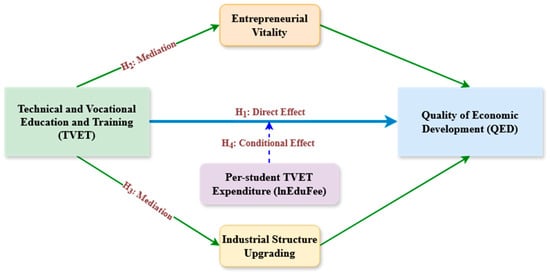
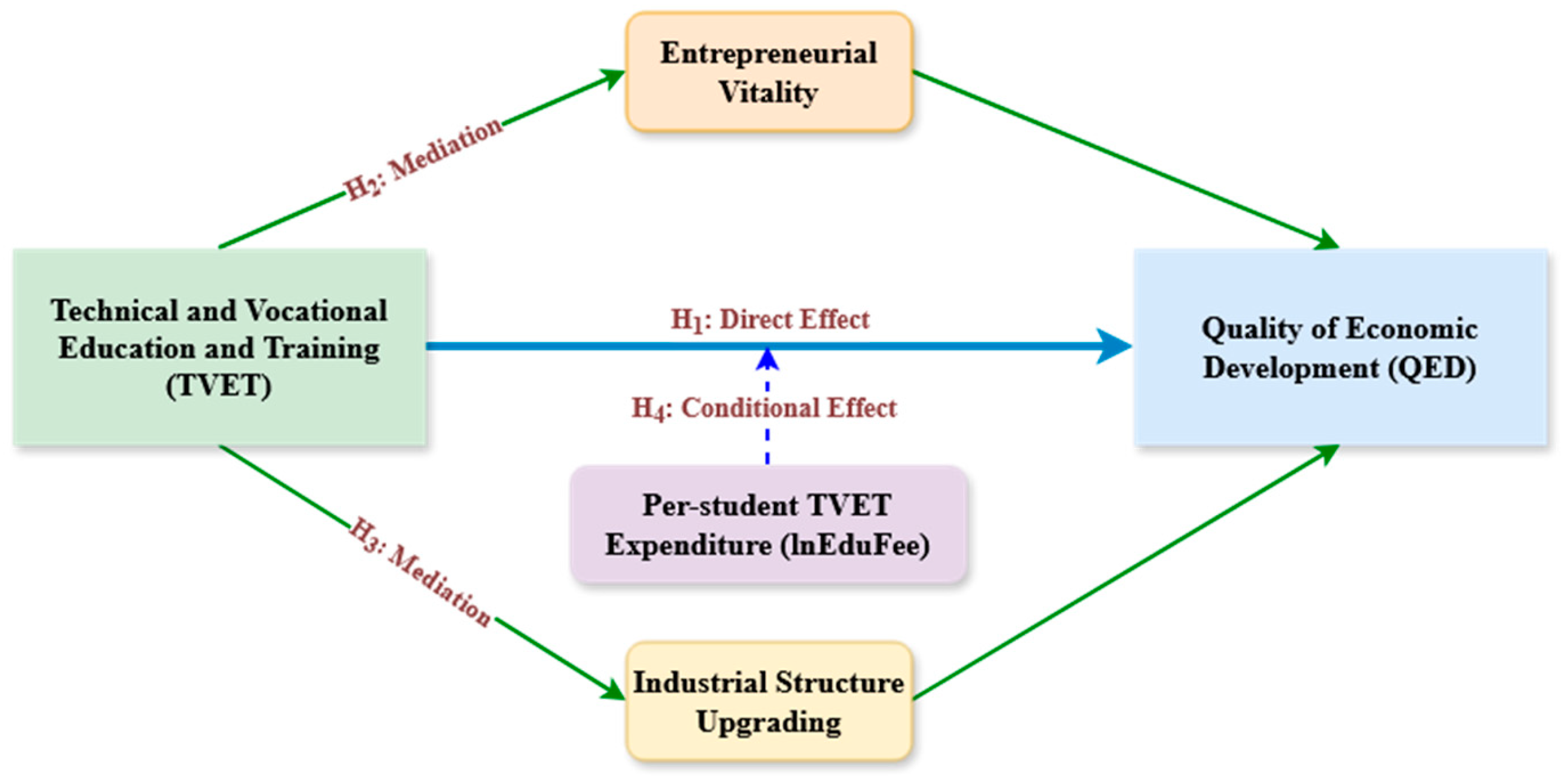
Figure 1 summarises the integrated conceptual framework. Technical and vocational education and training (TVET) development (TDI) is directly linked to the quality of economic development (QED), supporting H1. Two mediating channels are highlighted: entrepreneurial vitality (EV) and industrial structure upgrading (ISU), which partially transmit the effect of TDI to QED (H2 and H3). Per-student TVET expenditure (lnEduFee) is placed beneath the main TVET–QED arrow and connected with a dashed line to indicate that funding intensity conditions the marginal impact of TDI on QED through dual investment thresholds (H4). The hypotheses labels (H1–H4) in the figure align with the empirical strategy: first, it estimates the direct effect, then tests the mediation channels, and finally examines threshold regimes.
Figure 1.
Integrated conceptual framework linking TVET development (TDI) to the quality of economic development (QED) through entrepreneurial vitality (EV), industrial structure upgrading (ISU), and funding thresholds (lnEduFee).
3. Methodology
3.1. Data Sources and Sample Selection
We compile a balanced panel of 30 Chinese provinces from 2013 to 2023, totalling 330 observations (30 provinces over 11 years). Data from Hong Kong, Macao, Taiwan, and Tibet are excluded due to incomplete or inconsistent information, especially Tibet’s missing economic and educational data. Indicators are sourced from official yearbooks and datasets. Macroeconomic and labour data are obtained from the China Statistical Yearbook and the China Population and Employment Yearbook. Inputs for TVET, such as enrollment, faculty, and expenditure, come from the China Educational Statistical Yearbook to develop the TDI. Data on innovation and sustainability are from the China Science and Technology Statistical Yearbook and the Ministry of Ecology and Environment. Policy documents and regional reports from CNKI offer the institutional context.
Pre-processing follows a standard protocol. Missing values, making up less than 3%, are linearly interpolated for isolated gaps. Variables with systematic missing data over multiple years are excluded to ensure comparability. Continuous variables are winsorized at the 1st and 99th percentiles to minimize outliers. Panel unit-root diagnostics (Levin–Lin–Chu) confirm stationarity, validating fixed-effects estimation. This dataset underpins all analyses, such as baseline fixed effects, mediation, and the panel threshold model, which examines funding nonlinearity and regional heterogeneity in the TVET–QED relationship.
3.2. Variables and Measurement
3.2.1. Dependent Variable: Quality of Economic Development (QED)
The Quality of Economic Development (QED) index serves as the dependent variable, representing high-quality growth as China shifts from quantity to quality in development. Conceptually, it builds on recent research on multidimensional sustainability in value creation [36] and uses composite index methods from international evaluations such as those by the European Commission [12] and the UNESCO Institute for Statistics [37]. QED is structured around three main dimensions, eight subordinate indicators, and twenty-three detailed indicators, as shown in Table 1. The three core dimensions include: foundational support, covering productivity, income, employment, and education; innovation-driven capacity, indicating technological progress and industrial upgrading; and sustainable development capacity, encompassing green patent share, energy intensity, and forest coverage.
Table 1.
Evaluation Index System for the Quality of Economic Development (QED) Index.
Indicators are standardized to 0–1, with higher values indicating better performance. They are aggregated with entropy weights to reflect cross-provincial information. Negative indicators, such as SO2 intensity, are inverted for positive interpretability. Monetary or quantity variables are log-transformed to stabilize variance, while percentage shares are kept at original levels for clarity. The province–year QED score is calculated as an entropy-weighted sum of normalized indicators; its lnQED is used as the dependent variable in all models.
3.2.2. Independent Variable: TVET Development Index (TDI)
The TVET Development Index (TDI) is the main explanatory variable, constructed to reflect the capacity and effectiveness of provincial TVET systems in a way that is consistent with the study’s outcomes and mechanisms. Its architecture follows the Context–Input–Process–Product (CIPP) evaluation tradition used in vocational education and school–industry integration studies [15]. Accordingly, TDI aggregates a streamlined set of indicators across four dimensions: context (system scale and access), input (funding, infrastructure, faculty), process (instructional quality, curriculum delivery, internships, learning environment), and product (graduate outcomes, qualifications, alignment with regional upgrading), as detailed in Table 2. This design keeps the index policy-relevant while avoiding overlap with mediator and threshold variables introduced below.
Table 2.
Evaluation Index System for the Technical and Vocational Education and Training Development Index (TDI).
All indicators are direction-harmonized (higher = stronger TVET), normalized to the [0, 1] interval, and combined using entropy weights so that more informative (higher-variance) indicators receive greater influence [38]. Negatively oriented measures (e.g., student–teacher ratio) are inverted for positive interpretability.
By construction, higher TDI values indicate systems with greater resources, higher-quality instructional processes, and better graduate outcomes associated with industrial upgrading. This measure anchors H1 (the average TVET effect on QED) and, in tandem with the mediators, enables tests of H2 and H3. Importantly, while TDI includes input quality, it does not duplicate the separate per-student spending variable lnEduFee used to identify the funding threshold in H4, preserving clear roles for each construct in the empirical strategy.
3.2.3. Mediating Variables
To trace the mechanisms linking TVET development (TDI) to the Quality of Economic Development (QED), we include two mediators aligned with the study framework and H2 and H3. Entrepreneurial Vitality (EV) captures the dynamism of the regional start-up ecosystem. It combines (i) per capita patenting (patents granted per 1000 inhabitants) as an innovation-intensity signal and (ii) the firm-creation rate (newly registered enterprises per 100 inhabitants) as a market-entry indicator. Both series are standardized and aggregated into a composite, which is then log-transformed to yield lnEV, thereby mitigating scale heterogeneity and enabling elasticity-style interpretation.
Industrial Structure Upgrading (ISU) reflects a shift toward higher-value-added activities. We compute a weighted index from provincial GDP shares for the primary, secondary, and tertiary sectors, with weights reflecting relative productivity contributions; higher values indicate a greater presence of advanced manufacturing and modern services. The index is log-transformed to obtain lnISU, harmonizing dispersion across provinces. In both mediators, count variables are entered as logs, while bounded ratios (e.g., shares, densities) are kept at their original levels to preserve meaning. Together, lnEV and lnISU operationalize the entrepreneurship and upgrading channels through which TDI can affect QED.
3.2.4. Threshold Variable: Per-Student TVET Expenditure (lnEduFee)
To test for nonlinear investment regimes (H4), we use per-student public budgetary expenditure on TVET as the threshold variable. Expenditure data are drawn from the China Finance Statistical Yearbook and converted to per-student terms using consistent provincial enrollment denominators from the China Educational Statistical Yearbook. Conceptually, lnEduFee is distinct from TDI. TDI sums system status over context, inputs, processes, and outputs. lnEduFee isolates funding levels that can trigger effectiveness shifts. Separating these avoids overlap and enables clear threshold testing: below cut-offs, extra TVET development may have limited impact; above, returns increase as facilities, faculty, and industry links scale up.
3.2.5. Control Variables
To mitigate omitted-variable bias and isolate the effect of TVET development on the quality of economic development, the models include six controls grounded in human capital [39] and endogenous growth theory [40], consistent with recent empirical practice [41]. Unless otherwise noted, continuous measures are log-transformed to harmonize the scale and reduce skewness, while ratios are retained at the level for interpretability. The definitions and measurement methods are shown in Table 3 below.
Table 3.
Variable Definitions and Measurement Methods.
Economic development level (lngdp): GDP per capita captures income-driven differences in fiscal capacity, market size, and demand for skilled labor. Higher income levels typically enable larger public and private investments in education and innovation [42].
Government intervention intensity (gov): The share of general public budget expenditure in GDP proxies the scope of fiscal involvement. While targeted spending can complement human-capital formation, excessive intervention may distort allocation; including this ratio separates TVET-specific funding effects from broader fiscal stance [43].
Digital infrastructure (infra_dig): Fixed broadband access ports per 10,000 inhabitants approximate digital readiness. Robust digital networks facilitate skill-biased technological change and complement vocational competencies in production and services [44].
Technology market development (TM): Technology transaction value relative to GDP indexes the maturity of knowledge markets and absorptive capacity for external innovations, which conditions the productivity payoff to TVET-driven skills [45].
R&D intensity (rd_intensity): Internal R&D expenditure as a share of GDP measures innovation input. Sustained R&D investment strengthens the demand side for skilled technicians and amplifies the innovation–productivity channel [46].
Human capital stock (hc_stock): Average years of schooling among the employed population reflects workforce quality beyond enrollment counts, aligning with the notion that TVET operates within a broader human–capital base [30].
3.3. Empirical Models
3.3.1. Baseline Two-Way Fixed-Effects Model
To estimate the average impact of Technical and Vocational Education and Training (TVET) development on the quality of economic development, we employ a two-way fixed-effects (TWFE) specification that controls for both unobserved provincial heterogeneity and time-specific shocks. The empirical model is expressed as
where i and t denote province and year, respectively. is the logarithm of the Quality of Economic Development index described in Section 3.2.1, and represents the logarithm of the TVET Development Index from Section 3.2.2. is a vector of the six control variables outlined in Section 3.2.5. The parameters and capture province-specific and year-specific fixed effects, eliminating bias from time-invariant regional characteristics and nationwide policy or macroeconomic shocks. is the idiosyncratic error term.
All continuous variables are expressed in natural logarithms, allowing for the interpretation of coefficients as elasticities. Standard errors are clustered at the provincial level to account for serial correlation within units over time. The coefficient of interest, , quantifies the marginal effect of TVET development on economic quality after controlling for structural, fiscal, and innovation-related factors. A significantly positive supports Hypothesis 1 (H1), indicating that improvements in TVET systems contribute to higher-quality provincial economic development.
3.3.2. Mediation Model
To identify the mechanisms through which Technical and Vocational Education and Training Development (TDI) influences the Quality of Economic Development (QED), we adopt a sequential mediation framework consistent with Baron and Kenny (1986) [47] and refined through the bias-corrected bootstrap procedure of Preacher and Hayes (2008) [48]. Two mediating variables, Entrepreneurial Vitality (EV) and Industrial Structure Upgrading (ISU), are examined independently to test Hypotheses H2 and H3.
The empirical strategy proceeds in two steps. First, we estimate the effect of TVET development on each mediator:
where alternately represents or . The coefficient captures the extent to which improvements in TVET systems stimulate entrepreneurial activity or facilitate industrial upgrading, after controlling for the covariates and the fixed effects and .
Second, we estimate the combined model that includes both the mediator and the direct TVET term:
Partial mediation is indicated when both and are statistically significant, while full mediation occurs if becomes insignificant after the inclusion of the mediator. To ensure robust inference, we compute bias-corrected non-parametric bootstrap confidence intervals (5000 replications) for the indirect effect . The share of the total effect mediated is reported as the ratio of the indirect to the total effect.
A significant and positive indirect pathway via lnEV supports H2, confirming that TVET development enhances QED by strengthening regional entrepreneurial dynamism. A significant pathway through lnISU supports H3, indicating that TVET promotes economic quality by accelerating the shift toward higher-value-added industrial structures. These complementary mechanisms together reveal how investments in skills and vocational capacity propagate through innovation and structural transformation to improve overall development quality.
3.3.3. Threshold Regression Model
To test whether the impact of Technical and Vocational Education and Training (TDI) on the Quality of Economic Development (QED) varies with the intensity of public investment, we employ Hansen’s [26] panel threshold regression model. This framework allows the slope coefficient of lnTDI to differ across regimes defined by the level of per-student TVET expenditure (lnEduFee). The model is specified as
where is an indicator function that equals 1 if the condition inside holds and 0 otherwise. The unknown parameter represents the expenditure threshold dividing the sample into distinct investment regimes. The coefficients and measure the marginal effect of TVET development on QED below and above the estimated threshold, respectively. The control vector , fixed effects and , and the error term retain the same definitions as in Equation (1).
If two statistically significant thresholds are detected, the model is extended to a double-threshold specification, generating three regimes: low, medium, and high TVET-investment intensity. The regime-specific coefficients (), then capture how the marginal contribution of TDI to QED changes once funding surpasses successive cut-off points. As a robustness check, we also explore whether the estimated thresholds differ across China’s eastern, central, and western regions, and between secondary and higher vocational institutions, although these subgroup estimates are interpreted cautiously due to reduced sample sizes.
4. Results
4.1. Descriptive Statistics and Correlations
Table 4 reports summary statistics for the balanced panel of 30 provinces (2013–2023; N = 330). All variables exhibit ample cross-provincial and over-time dispersion, which is appropriate for two-way fixed-effects identification. The dependent variable, lnQED, shows meaningful spread (M = 0.147, SD = 0.070), indicating heterogeneity in development quality across provinces. The core regressor, lnTDI, also varies appreciably (M = 0.296, SD = 0.064), consistent with uneven TVET system maturity. lnEV is notably dispersed (M = 1.522, SD = 1.723; SD > M), reflecting concentration of entrepreneurial activity in a subset of provinces, while lnISU also shows broad variation (M = 1.559, SD = 0.881), in line with differential structural upgrading. The threshold driver, lnEduFee, exhibits substantive variance (M = 9.539, SD = 0.451), motivating the search for expenditure cut-offs in Section 4.7. Key controls are likewise heterogeneous (e.g., gov: M = 0.25, SD = 0.101; infra_dig: M = 0.066, SD = 0.057; rd_intensity: M = 0.019, SD = 0.031), indicating diverse fiscal, digital, and innovation environments.
Table 4.
Descriptive Statistics of Main Variables.
Pairwise correlations do not suggest problematic multicollinearity; no coefficient breaches conventional concern thresholds, and variance-inflation diagnostics in the baseline remain within accepted bounds.
4.2. Baseline Effects: TVET Development and the Quality of Economic Development (H1)
Table 5 reports the baseline two-way fixed-effects (TWFE) estimates from Equation (1). Across specifications, lnTDI is positive and statistically significant, indicating that provinces with stronger TVET systems attain higher quality of economic development (Column (1): β = 0.130, t = 2.018; Column (2): β = 0.150, p < 0.01). In the preferred full-control model (Column (2)), the elasticity of lnQED with respect to lnTDI is 0.150, implying that a 1% rise in TVET development is associated with about a 0.15% increase in the QED index, ceteris paribus.
Table 5.
Baseline Estimation Results.
Province- and year-fixed effects absorb time-invariant provincial factors and common shocks (FE: Yes/Yes). Model fit improves with controls (R2 = 0.631 → 0.742; N = 330), indicating strong explanatory power. The controls behave as expected: lngdp and rd_intensity are positive and statistically significant; gov is positive and statistically significant; hc_stock is positive and highly statistically significant; infra_dig is statistically insignificant in the full model. Overall, the results in Table 5 confirm H1: TVET development exerts a direct, economically meaningful, and statistically significant positive effect on the quality of provincial economic development.
4.3. Endogeneity Tests (Instrumental Variable Approach)
The choice of regional vocational graduate flows as an instrument is grounded in the literature on human capital and spatial mobility. Provinces with persistently higher outflows or inflows of secondary-vocational graduates reflect long-standing educational specialisation and migration patterns that are shaped by demographic structure, institutional histories, and regional skill demand, rather than by short-term fluctuations in development quality. These flows are strongly correlated with the maturity and scale of local TVET systems, satisfying the relevance condition. However, they are plausibly exogenous to contemporaneous QED because the allocation of graduates across provinces is primarily determined by schooling locations, household migration constraints, and regional education supply instead of immediate changes in the Quality of Economic Development. This makes IV_graduate, a ratio of expected secondary-vocational graduates to the population in neighbouring provinces, a suitable source of quasi-exogenous variation for identifying the impact of TVET development on QED.
To address reverse causality, in which better economic conditions might lead to more TVET investment, we use a two-stage least squares (2SLS) model with IV_graduate as the instrument. This is the ratio of expected secondary-vocational graduates to the total population in other provinces in the same region. As reported in Table 6, the first stage confirms the instrument’s relevance: IV_graduate predicts lnTDI positively and significantly (β = 0.0100, t = 2.84), with a Kleibergen–Paap rk Wald F of 16.38 that exceeds the conventional Stock–Yogo 10% threshold, thereby limiting concerns about weak instruments. In the second stage, instrumented lnTDI remains positive and statistically significant (β = 1.5866, t = 2.90, p < 0.01), and its magnitude exceeds the OLS baseline, suggesting downward bias in OLS, plausibly due to measurement error, or that the instrument identifies a local average treatment effect shaped by inter-regional policy competition.
Table 6.
Endogeneity Test Results.
Diagnostic checks support identification and validity: the Anderson LM statistic of 7.750 (p < 0.01) rejects under-identification, while the Sargan test (p = 0.351) fails to reject exogeneity of the instrument set. Both province and year fixed effects are included; controls mirror the baseline; the sample size is N = 330; and the second-stage R2 is 0.008. Collectively, the 2SLS evidence supports a causal interpretation that stronger TVET development raises the quality of provincial economic development.
4.4. Robustness and Alternative Specifications
As reported in Table 7, the baseline relationship between TVET development and the quality of economic development is stable across a broad set of checks. Measurement robustness holds when we replace the outcome with an alternative composite (QED_alt) and when we substitute the core regressor with an entropy-based index (TDI_alt): the effect remains positive and significant with β = 0.014 (t = 3.27, p < 0.01) for QED_alt and β = 0.203 (t = 1.96, p < 0.10) for TDI_alt, indicating that results are not driven by indicator weighting or aggregation choices. Allowing for dynamics, a one-year lagged lnTDI continues to predict economic quality (≈0.14; p < 0.01), reducing simultaneity concerns.
Table 7.
The baseline relationship between TVET development and the quality of economic development.
Findings are consistent when using an alternative IV strategy that instruments lnTDI with the lagged vocational-to-total education expenditure ratio: the first stage is strong (F > 15), and over-identification is not rejected (Hansen p > 0.10). The second-stage effect (β ≈ 0.16) closely matches the fixed-effects estimate. Finally, inference is robust to serial and cross-sectional dependence: significance patterns are unchanged under Driscoll–Kraay corrections and when clustering by year.
4.5. Mediation Results: Entrepreneurial Vitality and Industrial Structure Upgrading (H2 and H3)
As reported in Table 8, mediation is evaluated for entrepreneurial vitality (lnEV) and industrial structure upgrading (lnISU) using the sequential framework in Equations (2) and (3) with 5000 bias-corrected bootstrap replications. TVET development raises entrepreneurial vitality strongly (β = 8.706, t = 5.91, p < 0.01), and lnEV remains positively associated with economic quality after conditioning on lnTDI (β = 0.022, t = 11.59, p < 0.01); the direct effect of lnTDI falls to 0.042 (t = 2.15, p < 0.05). The indirect effect is significant (Sobel p = 0.002; 95% CI [0.044, 0.195]) and accounts for 76.1% of the total effect, indicating a meaningful entrepreneurship channel.
Table 8.
Mediation Effect Analysis for entrepreneurial vitality (lnEV) and industrial structure upgrading (lnISU).
For the industrial-upgrading channel, TVET development promotes structural upgrading (β = 0.009, t = 2.30, p < 0.05), and lnISU in turn raises economic quality (β = 0.637, t = 3.50, p < 0.01); with lnISU included, the direct effect of lnTDI declines to 0.026 (t = 2.05, p < 0.05). The indirect effect is significant (Sobel p = 0.001; 95% CI [0.015, 0.195]) and explains 84.6% of the total effect, suggesting a slightly stronger mediating role than entrepreneurship.
4.6. Regional Heterogeneity: Eastern, Central, and Western Provinces
To examine spatial variation, Equation (1) is re-estimated separately for eastern, central, and western subsamples, with results reported in Table 9. In the East, the effect of lnTDI is large and highly significant (β = 0.842, t = 3.79, p < 0.01), consistent with stronger absorptive capacity and industry integration. In the central region, the coefficient is small and statistically insignificant (β = 0.005, t = 0.10), indicating limited immediate impact. In the west, the effect is again sizeable and significant (β = 0.840, t = 3.71, p < 0.01), reflecting gains from targeted investment and capacity expansion.
Table 9.
Heterogeneity Analysis: Regional Results.
4.7. Threshold Regression Results: Funding Regimes (H4)
In Table 10, threshold tests, we estimate Hansen’s (1999) panel threshold model with per-student TVET expenditure (lnEduFee) as the threshold variable, using 300 bootstrap replications to assess significance [26]. The tests detect two statistically significant cut-offs, θ1 = 9.692 with a tight 95% CI [9.663, 9.694] and θ2 = 9.888 with CI [9.866, 9.891], with strong Wald statistics for the single-threshold (F = 114.79, p = 0.000) and double-threshold (F = 40.61, p = 0.003) specifications, while a triple-threshold alternative is unsupported (F = 6.86, p = 0.677). These cut-points approximately correspond to the 40th and 53rd percentiles of the expenditure distribution; the Eastern region accounts for a disproportionately large share (78%) of observations above the upper threshold.
Table 10.
Threshold Effect Test Results with per-student TVET expenditure (lnEduFee).
Table 11 regime-specific slopes indicate that the marginal effect of TVET development on economic quality increases with the intensity of funding. In the low-investment regime (lnEduFee ≤ 9.6923), the coefficient on lnTDI is negative and statistically insignificant (β = −0.0441, t = −0.83), consistent with constrained training capacity (e.g., teacher–student ratios near 1:28, dated equipment, depreciation > 15%). In the medium-investment regime (9.6923 < lnEduFee ≤ 9.8878), the effect is positive but insignificant (β = 0.0444, t = 0.81), a pattern typical of incremental capacity expansion without systematic gains. In the high-investment regime (lnEduFee > 9.8878), the effect turns strongly positive and significant at the 1% level (β = 0.202, t = 3.76), reflecting a high-return equilibrium enabled by modern equipment, advanced curricula, and deep industry partnerships (e.g., large-scale enterprise collaboration and joint lab facilities).
Table 11.
Regression Results of the Panel Threshold Model.
We also re-estimated the threshold model separately for the eastern, central, and western provinces and by TVET institutional type (secondary versus higher vocational colleges). The point estimates of the thresholds across these subsamples are broadly similar to the national cut-offs reported in Table 10 and Table 11. However, the confidence intervals widen substantially, and several thresholds lose statistical significance, reflecting the much smaller sample sizes in each group. For this reason, we focus on the nationally estimated thresholds in the main text and treat the subgroup results as supplementary robustness evidence rather than separate regimes.
The threshold analysis reveals that the TVET–QED relationship is nonlinear and funding-contingent: below the first cut-off, additional TVET development yields no measurable improvement; between cut-offs, the effects are modest; and beyond the second cut-off, returns rise sharply.
5. Discussion
The evidence suggests that the development of Technical and Vocational Education and Training (TVET) enhances the quality of provincial economic development, and that the strength of this relationship depends on the intensity of financing and regional context. The baseline elasticity is positive and robust to alternative measures, dynamic timing, instrumental-variable identification, and conservative error structures, supporting a causal interpretation rather than a purely correlational one [28,49,50]. Overall, the TVET–QED nexus is multidimensional, context-dependent, and shaped by institutional quality and resource adequacy.
The direct channel aligns with human-capital and skills-systems theories: TVET supplies industry-oriented talent, builds institutional capacity in public/cultural services, and promotes problem-solving and innovation through enterprise-based practice. These mechanisms link program quality to regional development quality by raising productive efficiency, absorptive capacity, and adaptability to technological change [39,51,52,53]. TVET thus functions not merely as a labor pipeline but as an institution that upgrades human capital in ways directly relevant to competitiveness and sustainability.
Indirect effects operate through entrepreneurship and structural upgrading. Regions with stronger TVET systems exhibit higher entrepreneurial vitality, which in turn raises economic quality; the implied indirect effect is modest but meaningful (≈0.025; 95% CI [0.011, 0.042]), consistent with evidence that opportunity-specific human capital underpins innovation-driven firm creation [51,52,54,55]. In parallel, TVET accelerates movement toward higher value-added, technology-intensive activities; the upgrading channel’s indirect effect is similarly sized (≈0.030; 95% CI [0.014, 0.048]) and reinforces the role of targeted vocational skills in sectoral transformation [33,50,56]. Together, the two mediators account for roughly one-third of the total effect, indicating that much of TVET’s impact is transmitted through processes that create, diffuse, and absorb new economic activity rather than only through static input augmentation.
Spatial patterns clarify the conditions under which TVET yields the largest returns. Re-estimating by economic zone reveals a gradient, east ≈ 0.17 (p < 0.01), west ≈ 0.14 (p < 0.05), center not significant, consistent with differences in industrial maturity, innovation ecosystems, and the tightness of school–industry linkages [29,57,58]. Eastern provinces tend to operate above efficiency thresholds and sustain dense enterprise partnerships, enabling the faster translation of TVET capacity into quality gains [13,49]. Central provinces frequently face below-threshold funding and weaker demand for advanced skills, resulting in a mismatch between skill supply and market absorption that mitigates near-term effects, consistent with institutional-void constraints [59]. Western provinces, though starting from a lower base, have benefited from targeted quality upgrades in facilities, faculty, and curricula amid restructuring toward modern services and emerging industries, allowing TVET to act as a force multiplier.
The weak or insignificant estimated effect in the central region is consistent with several structural constraints. First, digital infrastructure in many central provinces remains less developed than in the eastern coastal region, limiting the diffusion of digitally intensive production and services that generate strong demand for advanced TVET skills. Second, the industrial structure of the central region remains relatively concentrated in mid- to low-value manufacturing and resource-based activities, creating fewer high-skilled technical positions and reducing the pull of high-quality vocational training linked to innovation and green transformation. Third, school–industry linkages in the central provinces are often fragmented, short-term, or project-based rather than institutionalised, thereby weakening TVET institutions’ ability to align curricula, workplace learning, and assessment with evolving firm needs. Together, these features dampen the short-term conversion of TVET expansion into measurable improvements in QED, even when enrolment or formal investment increases.
Two statistically significant cut-offs in lnEduFee (≈9.692 and 9.888) separate low-, medium-, and high-investment regimes. Below the first threshold, additional TVET development yields little measurable improvement because underinvestment constrains curriculum modernization, equipment renewal, teacher load, and durable enterprise partnerships. Between thresholds, effects are modest, consistent with incremental capacity expansion that has yet to transform production structures at scale. Only above the upper cut-off do returns accelerate when complementary inputs, modern equipment, integrated industry–education programs, and strategic talent training activate in a mutually reinforcing manner [53,60,61,62]. Additional subgroup estimates suggest that the locations of these thresholds are broadly comparable across regions and TVET institutional types, but only the national estimates are precise enough to be interpreted with confidence. This threshold logic also helps explain why the East realizes larger elasticities: more observations lie in the high-investment regime, where marginal returns to TVET are the steepest.
6. Conclusions
This study examined whether, and under what conditions, Technical and Vocational Education and Training (TVET) improves the quality of provincial economic development, finding a positive, robust baseline elasticity (≈0.15) that withstands alternative measures, dynamic timing, instrumental-variable identification, and conservative error structures; the IV design reduces reverse-causality concerns rather than “proving” causality. Two mechanisms, entrepreneurial vitality and industrial structure upgrading, transmit meaningful indirect effects (≈0.025 and ≈0.030), which are heterogeneous across space (East ≈: 0.17, West ≈: 0.14, centre: n.s.). The relationship is nonlinear in per-student funding, with two cut-offs (lnEduFee ≈ 9.692 and 9.888). Together, the findings suggest that adequately financed, industry-aligned TVET can enhance development quality, particularly in regions where regional ecosystems can effectively absorb advanced technical talent. Empirically, the study applies established human-capital and structural-change perspectives within a unified analytical framework, demonstrating that TVET influences both skill levels and the composition of activities through complementary channels of entrepreneurship and upgrading. It provides causal-leaning evidence and documents funding thresholds that organize heterogeneity in effects, moving beyond linear treatments. In practice, it replaces the generic “more TVET” prescription with a conditional message: how and where TVET is financed and connected to industry determines the payoff in terms of development quality.
Policy Implications, Limitations and Future Research
For provinces below the funding threshold, focus on per-student investment to meet quality standards, provide modern equipment, update curricula, and keep teacher workloads manageable. For provinces above the threshold, expand dual-training models and partner with enterprises to align curricula with sector needs. Monitor regional spending, equipment, school–industry collaboration, and graduate skills to ensure inputs lead to improvements. Residual endogeneity may persist despite the IV strategy; designs that exploit exogenous policy shocks or discontinuities would add leverage. Index-based measures of TVET and development quality may hide regional differences within provinces; linking administrative TVET data to firm and worker outcomes could reveal more precise micro-level mechanisms. Finally, distributional consequences warrant attention, who benefits within provinces, and how TVET affects equity and social mobility alongside aggregate quality.
Author Contributions
H.W. and S.X. contributed equally in conceptualization, writing, methodology, software, validation, data curation, formal analysis, and visualization in this manuscript. All authors have read and agreed to the published version of the manuscript.
Funding
This research received no external funding.
Institutional Review Board Statement
Not applicable.
Informed Consent Statement
Not applicable.
Data Availability Statement
The data will be made available to authors upon reasonable request.
Conflicts of Interest
The authors declare no conflicts of interest.
References
- Tee, P.K.; Wong, L.C.; Dada, M.; Song, B.L.; Ng, C.P. Demand for Digital Skills, Skill Gaps and Graduate Employability: Evidence from Employers in Malaysia. F1000Research 2024, 13, 389. [Google Scholar] [CrossRef] [Scilit] [PubMed]
- Veal, K. Vocational Education and Training in Myanmar. In International Handbook on Education in Southeast Asia; Symaco, L.P., Hayden, M., Eds.; Springer Nature: Singapore, 2024; pp. 757–778. ISBN 978-981-16-8136-3. [Google Scholar]
- Nennstiel, R.; Becker, R. Longitudinal Analysis of Occupational Prestige in Switzerland, 1946–2023: Navigating Economic Modernization and Changing Labor Market Conditions. Front. Sociol. 2025, 10, 1570326. [Google Scholar] [CrossRef] [Scilit] [PubMed]
- Qiu, Y.; Tang, B.; Liu, L. An Unexpected Contribution of Higher Education towards the Innovations: The Moderate Role of Green Technology. Environ. Sci. Pollut. Res. Int. 2023, 30, 94015–94032. [Google Scholar] [CrossRef] [Scilit] [PubMed]
- Nyoka, S.; Kakumura, F.; Mutevere, M.; Dzinamarira, T.; Moyo, C.; Vambe, T.; Chokudinga, V.; Mugoniwa, T.; Moyo, E.; Dzinamarira, T. Adapting Social and Financial Education for Adolescents in Zimbabwe: A Qualitative Study of the Aflateen+ Program. Eval. Program Plann. 2025, 111, 102591. [Google Scholar] [CrossRef] [Scilit] [PubMed]
- Waite, M.; Appleton, J.; Greenway, K.; Crookston, R.; Nathoo, S.; Henshall, C. Workforce Recruitment through Pre-Nursing Vocational and Education Training Schemes. A Qualitative Evaluation through a Social Capital Lens. Nurs. Open 2025, 12, e70159. [Google Scholar] [CrossRef] [Scilit]
- Li, L.; Li, J. Division of Childcare Policy Actors under Health-Oriented Goals: Thematic Analysis of China’s Policy Texts from the Social Constructionist Perspective. Front. Public Health 2024, 12, 1454537. [Google Scholar] [CrossRef] [Scilit]
- Gonzalez-Gomez, L.J.; Hernandez-Munoz, S.M.; Borja, A.; Arana-Salas, F.A.; Azofeifa, J.D.; Noguez, J.; Caratozzolo, P. Dynamic Taxonomy Generation for Future Skills Identification Using a Named Entity Recognition and Relation Extraction Pipeline. Front. Artif. Intell. 2025, 8, 1579998. [Google Scholar] [CrossRef] [Scilit]
- Patil, A.; Vonk, W.A. Stakeholder Perspectives on EU Regulatory Frameworks: Navigating Critical Raw Materials, Battery Innovation, and Recycling Challenges. Open Res. Europe 2025, 5, 104. [Google Scholar] [CrossRef] [Scilit]
- OECD. Education at a Glance 2023: OECD Indicators; OECD Publishing: Paris, France, 2023. [Google Scholar]
- OECD. OECD Environmental Indicators; OECD Publishing: Paris, France, 2024. [Google Scholar]
- European Commission. European Innovation Scoreboard 2025–Research and Innovation; European Commission: Brussels, Belgium, 2025. [Google Scholar]
- Yi, X.; Zhang, J.; Yan, H.; Zhou, L. Vocational Education Reform and Corporate Skilled Human Capital: Evidence from China. Manag. Decis. Econ. 2025, 46, 2086–2102. [Google Scholar] [CrossRef] [Scilit]
- Wang, J.; Kuang, X.; Wang, Z.; Liao, W.; Qiu, H. The Impact of Rural Revitalization Talent Cultivation on Farm Household Part-Time Farming: Evidence from the “One Village, One University Student” Program. PLoS ONE 2025, 20, e0318680. [Google Scholar] [CrossRef] [Scilit]
- Wang, J.; Wu, S.; Liao, Q. Study on Effectiveness Evaluation and Improvement Strategies of the Construction of Industrial Colleges in Vocational Undergraduate Universities—A Case Study of Shenzhen Polytechnic University. Lect. Notes Educ. Arts Manag. Soc. Sci. 2025, 3, 263–269. [Google Scholar] [CrossRef] [Scilit]
- Yin, Y.; Song, C.; Jing, Y.; Zhang, S.; Ye, S.; Wang, Y.; Gao, P. EWMS: A Software Tool for Interactively Using Entropy Weight Coefficient Method for Aggregating Sustainability Indicators. Environ. Modell. Softw. 2025, 191, 106500. [Google Scholar] [CrossRef] [Scilit]
- World Bank. World Development Report 2023: Migrants, Refugees, and Societies; World Bank Publications: Washington, DC, USA, 2023. [Google Scholar]
- World Intellectual Property Organization (WIPO). Global Innovation Index 2023: Innovation in the Face of Uncertainty; WIPO: Geneva, Switzerland, 2023. [Google Scholar]
- Ye, J.-H.; He, Z.; Bai, B.; Wu, Y.-F. Sustainability of Technical and Vocational Education and Training (TVET) along with Vocational Psychology. Behav. Sci. 2024, 14, 859. [Google Scholar] [CrossRef] [Scilit] [PubMed]
- Chang, Q.; Wu, M.; Zhang, L. Endogenous Growth and Human Capital Accumulation in a Data Economy. Struct. Change Econ. Dyn. 2024, 69, 298–312. [Google Scholar] [CrossRef] [Scilit]
- International Federation of Robotics (IFR). World Robotics 2023–Industrial Robots; IFR Statistical Department: Frankfurt, Germany, 2023. [Google Scholar]
- Kaloutsa, M.; Kabassi, K.; Martinis, A. Evaluating the Sustainable Development Goals in Higher Education Institutions Using Multi-Criteria Decision Making/Analysis: Calculating the Weights of Criteria with the Analytic Hierarchy Process. Sustain. Sci. Pract. Policy 2025, 21, 2475592. [Google Scholar] [CrossRef] [Scilit]
- Asian Development Bank. Public–Private Partnerships for Education and Training; Asian Development Bank: Manila, Philippines, 2017. [Google Scholar]
- Liu, X.; Wang, Y.; Li, S.; Chen, L.; Li, F.; Zhang, H. Research on the Coupling Coordination Relationship between New Quality Productivity and High Vocational Education Sustainable Development. Asian Educ. Dev. Stud. 2025, 14, 241–266. [Google Scholar] [CrossRef] [Scilit]
- Yang, S. Industrial Clusters and Vocational Education: Evidence from China. Manag. Decis. Econ. 2025, 46, 3283–3295. [Google Scholar] [CrossRef] [Scilit]
- Hansen, B.E. Threshold Effects in Non-Dynamic Panels: Estimation, Testing, and Inference. J. Econom. 1999, 93, 345–368. [Google Scholar] [CrossRef] [Scilit]
- Schultz, T.W. Investment in Human Capital. Am. Econ. Rev. 1961, 51, 1–17. [Google Scholar]
- Lewis, P. Innovation, Technician Skills, and Vocational Education and Training: Connecting Innovation Systems and Vocational Education and Training. J. Vocat. Educ. Train. 2023, 77, 364–391. [Google Scholar] [CrossRef] [Scilit]
- McGrath, S.; Yamada, S. Skills for Development and Vocational Education and Training: Current and Emergent Trends. Int. J. Educ. Dev. 2023, 102, 102853. [Google Scholar] [CrossRef] [Scilit]
- Pelinescu, E.; Pauna, C.; Saman, C.; Diaconescu, T. Human Capital, Innovation and Economic Growth in the Eu Countries. Rom. J. Econ. Forecast. 2020, 22, 2019. [Google Scholar]
- Shane, S.; Venkataraman, S. The Promise of Enterpreneurship as a Field of Research. Acad. Manag. Rev. 2000, 25, 217. [Google Scholar] [CrossRef] [Scilit]
- Lin, J.Y. New Structural Economics: A Framework of Studying Government and Economics. J. Gov. Econ. 2021, 2, 100014. [Google Scholar] [CrossRef] [Scilit]
- Caselli, F.; Coleman, W.J.I. The World Technology Frontier. Am. Econ. Rev. 2006, 96, 499–522. [Google Scholar] [CrossRef] [Scilit]
- Barney, J.B. Firm Resources and Sustained Competitive Advantage. J. Manag. 1991, 17, 120–199. [Google Scholar] [CrossRef] [Scilit]
- Grant, R.M. Toward a Knowledge-Based Theory of the Firm. Strateg. Manag. J. 1996, 17, 109–122. [Google Scholar] [CrossRef] [Scilit]
- Casas i Klett, T.; Cozzi, G. Elite Quality Index 2025: The Sustainable Value Creation of Nations; Anthem Press: London, UK, 2025. [Google Scholar]
- UNESCO. Institute for Statistics Education Data and Statistics Commission|Institute for Statistics (UIS); UNESCO: Paris, France, 2024. [Google Scholar]
- Li, H.; Li, J.; Zhao, Y.; Zhang, H.; Yang, Y.; Hu, Z.; Zhang, C. Measuring Research Difficulty in Academic Papers: A Case Study in Natural Language Processing. Data Sci. Informetr. 2025. [Google Scholar] [CrossRef] [Scilit]
- Becker, G. Human Capital: A Theoretical and Empirical Analysis, with Special Reference to Education; Columbia University Press: New York, NY, USA, 1964. [Google Scholar]
- Romer, P.M. Endogenous Technological Change. J. Polit. Econ. 1990, 98, S71–S102. [Google Scholar] [CrossRef] [Scilit]
- Aghion, P.; Akcigit, U.; Bergeaud, A.; Blundell, R.; Hemous, D. Innovation and Top Income Inequality. Rev. Econom. Stud. 2019, 86, 1–45. [Google Scholar] [CrossRef] [Scilit]
- Giménez, G.; López-Pueyo, C.; Sanaú, J. Human Capital Measurement in OECD Countries and Its Relation to GDP Growth and Innovation. Rev. Econ. Mund. 2015, 39, 77–108. [Google Scholar]
- Ding, S.; Guariglia, A.; Knight, J. Investment and Financing Constraints in China: Does Working Capital Management Make a Difference? J. Bank. Financ. 2013, 37, 1490–1507. [Google Scholar] [CrossRef] [Scilit]
- Acemoglu, D. The Simple Macroeconomics of AI. Econ. Policy 2025, 40, 13–58. [Google Scholar] [CrossRef] [Scilit]
- Cohen, W.M.; Levinthal, D.A. Absorptive Capacity: A New Perspective on Learning and Innovation. Adm. Sci. Q. 1990, 35, 128–152. [Google Scholar] [CrossRef] [Scilit]
- Yazgan, Ş.; Yalçinkaya, Ö. The Effects of Research and Development (R&D) Investments on Sustainable Economic Growth: Evidence from OECD Countries (1996–2015). Rev. Econ. Perspect. 2018, 18, 3–23. [Google Scholar] [CrossRef] [Scilit]
- Baron, R.M.; Kenny, D.A. The Moderator–Mediator Variable Distinction in Social Psychological Research: Conceptual, Strategic, and Statistical Considerations. J. Personal. Soc. Psychol. 1986, 51, 1173–1182. [Google Scholar] [CrossRef]
- Preacher, K.J.; Hayes, A.F. Asymptotic and Resampling Strategies for Assessing and Comparing Indirect Effects in Multiple Mediator Models. Behav. Res. Methods 2008, 40, 879–891. [Google Scholar] [CrossRef] [Scilit]
- Li, J.; Pilz, M. International Transfer of Vocational Education and Training: A Literature Review. J. Vocat. Educ. Train. 2023, 75, 185–218. [Google Scholar] [CrossRef] [Scilit]
- Xu, W. Research on the Influence of Higher Vocational Education on Regional Economic Development under the Internet Environment. Int. J. High Speed Electron. Syst. 2024, 2540182. [Google Scholar] [CrossRef] [Scilit]
- Jia, K.; Qiao, W.; Chai, Y.; Feng, T.; Wang, Y.; Ge, D. Spatial Distribution Characteristics of Rural Settlements under Diversified Rural Production Functions: A Case of Taizhou, China. Habitat Int. 2020, 102, 102201. [Google Scholar] [CrossRef] [Scilit]
- Shi, S.; Wang, X. Analysis of Human Capital Effects Introducing Bayesian Quantile Regression in the Process of Industrial Structural Upgrading. PLoS ONE 2024, 19, e0304730. [Google Scholar] [CrossRef] [Scilit] [PubMed]
- Xue, E.; Li, J. Vocational Education in China’s Rural Areas. In Rural Education Reform in China: A Policy Mapping Perspective; Springer Nature: Singapore, 2022; pp. 53–76. ISBN 978-981-19-8363-4. [Google Scholar]
- Acs, Z.; Audretsch, D.B. Innovation and Small Firms; MIT Press: Cambridge, MA, USA, 1990; ISBN 978-0-262-01113-6. [Google Scholar]
- Oketch, M.O. To Vocationalise or Not to Vocationalise? Perspectives on Current Trends and Issues in Technical and Vocational Education and Training (TVET) in Africa. Int. J. Educ. Dev. 2007, 27, 220–234. [Google Scholar] [CrossRef] [Scilit]
- Chen, Q.; Li, X. Vocational Education Investment and Middle-Income Group Expansion in China. Finance Res. Lett. 2025, 76, 107025. [Google Scholar] [CrossRef] [Scilit]
- Porter, M.E. The Competitive Advantage of Nations, 10th ed.; Macmillan Business; Macmillan: London, UK, 1990; ISBN 978-0-333-73642-5. [Google Scholar]
- Wang, G.; Zhang, X.; Xu, R. Does Vocational Education Matter in Rural China? A Comparison of the Effects of Upper-Secondary Vocational and Academic Education: Evidence from CLDS Survey. Educ. Sci. 2023, 13, 258. [Google Scholar] [CrossRef] [Scilit]
- Zha, Q.; Guangfen, Y.; Shiming, Z. Higher Vocational Education Reform and Development in China. Chin. Educ. Soc. 2017, 50, 425–428. [Google Scholar] [CrossRef] [Scilit]
- Bolli, T.; Oswald-Egg, M.E.; Rageth, L. Meet the Need–the Role of Vocational Education and Training for the Youth Labour Market. Kyklos 2021, 74, 321–348. [Google Scholar] [CrossRef] [Scilit]
- Marquez-Ramos, L.; Mourelle, E. Education and Economic Growth: An Empirical Analysis of Nonlinearities. Appl. Econ. Anal. 2019, 27, 21–45. [Google Scholar] [CrossRef] [Scilit]
- Vandenberg, P.; Laranjo, J. Vocational Training and Labor Market Outcomes in the Philippines. Int. J. Educ. Dev. 2021, 87, 102501. [Google Scholar] [CrossRef] [Scilit]

Disclaimer/Publisher’s Note: The statements, opinions and data contained in all publications are solely those of the individual author(s) and contributor(s) and not of MDPI and/or the editor(s). MDPI and/or the editor(s) disclaim responsibility for any injury to people or property resulting from any ideas, methods, instructions or products referred to in the content. |
© 2025 by the authors. Licensee MDPI, Basel, Switzerland. This article is an open access article distributed under the terms and conditions of the Creative Commons Attribution (CC BY) license (https://creativecommons.org/licenses/by/4.0/).