Article

Academic Adaptation and Performance Among International Students in China: The Mediating Role of Student Engagement

School of Educational Studies, Universiti Sains Malaysia, Penang 11800, Malaysia
*
Authors to whom correspondence should be addressed.
Sustainability 2025, 17(24), 11256; https://doi.org/10.3390/su172411256
Submission received: 16 November 2025 / Revised: 7 December 2025 / Accepted: 11 December 2025 / Published: 16 December 2025
(This article belongs to the Section Sustainable Education and Approaches)

Abstract

Academic adaptation is widely recognized as a critical challenge for international students, with direct implications for their academic success and performance. While existing research has established a positive correlation between academic adaptation and performance, it has not adequately explored this relationship in the context of international students in China. Moreover, the potential mediating role of student engagement warrants further empirical investigation. To address this gap, this study employs a cross-sectional survey of 427 international students in China. The findings confirm a significant positive relationship between academic adaptation and academic performance. Moreover, student engagement was identified as a significant, albeit limited, mediator in this relationship. This result indicates that the effect of student engagement on academic performance may be more immediate, whereas its effect on academic adaptation may be prior. By elucidating this complex mediating pathway, this study advances our understanding of the processes linking adaptation to performance. It offers practical insights for educators seeking to enhance the international student experience.

1. Introduction

The internationalization of higher education refers to the integration of international, intercultural, and global perspectives across an institution’s educational goals, functions, and offerings [1], which aims to enhance educational quality and contribute to society. The internationalization of higher education has some significant impacts on international students’ academic performance, such as improved language skills [2], enhanced critical thinking skills [3], improved employability [4], and increased global competencies [5]. However, internationalization also presents challenges. Difficulties in academic adaptation and social integration can adversely affect international students’ academic performance [6]. Both academic adaptation and academic performance are significant in the educational domain. Moreover, student engagement is essential in higher education, affecting academic performance, retention rates, and overall student success, and it is believed that enhancing student engagement is essential for academic success and performance [7]. According to Schaufeli [8], student engagement can be a mediating variable to explore the relationship with other variables.
In recent years, China has emerged as a major global destination for international students. Since 2017, it has consistently ranked as the leading study-abroad destination in Asia and the third globally, trailing only the United States and the United Kingdom [9]. Despite this trend, research on the academic performance of international students in China remains limited, especially when compared to the focus on domestic student performance. While some studies have addressed this [10,11], with only a few studies having disclosed the academic performance of international students at certain universities in China, with qualitative data outweighing quantitative data [12], the existing work underscores a significant need for further investigation into the academic performance of the international student population.
Within the educational domain, both academic adaptation and academic performance are recognized as crucial. As Crede and Niehorster [13] state, academic adaptation is a vital determinant of academic performance. A substantial body of scholarship links cross-cultural adaptation directly to academic adaptation for international students, positing it as central to their overall adaptation [14]. This argument is exemplified by Zhu [15], who defines cross-cultural adaptation as encompassing psychological, social, and academic dimensions. Conversely, other researchers such as Dunn [16] argued that the primary challenges stem from the students’ academic roles, with their foreign status acting as a secondary influential factor.
Student engagement, widely regarded as a cornerstone of educational quality [17], serves as a key factor for enhancing learning experiences. Consistent with established models [18], effective academic adaptation promotes student engagement, which in turn enhances learning processes and outcomes. However, compared to their domestic peers, the investigation of international students’ engagement has been relatively overlooked. Research consistently indicates that international students often lack the requisite foundational knowledge and adaptive capabilities necessary for effective academic engagement, resulting in poor academic performance among international students in China [19,20,21].
This study aims to investigate these three factors about international students who are studying in Chinese universities, how the international students’ adaptation and student engagement affect their academic performance, and whether student engagement has a mediating impact on their academic performance by addressing the research questions listed below:
  • Is there any significant influence of academic adaptation on academic performance among international students in China?
  • Is there any significant influence of academic adaptation on student engagement among international students in China?
  • Is there any significant influence of student engagement on academic performance among international students in China?
  • Is there any significant mediating influence of student engagement on the relationship between academic adaptation and academic performance among international students in China?

2. Literature Review

2.1. Academic Performance

Academic performance is a crucial metric for assessing educational quality [22] and a significant predictor of student success in higher education [23]. The most prevalent indicators include grade point average (GPA) and course grades, encompassing cumulative GPA, major-specific GPA, individual course grades [24], and class ranking [25]. Beyond these, standardized test scores, such as entrance examinations and language proficiency assessments, provide uniform benchmarks for evaluating academic capabilities [26]. Research accomplishments, including publications, conference presentations, and thesis work, further demonstrate a student’s research competence and potential for academic innovation [27]. It cannot be neglected that learning achievement and learning gain are equal to academic performance. Additionally, academic progress metrics like credit completion rate and time to degree offer dynamic perspectives on student progress. As higher education evolves, the framework for assessing academic performance has expanded beyond traditional metrics. This study employs Zhu & Wang’s [28] comprehensive definition of academic performance, which draws from Xing’s [29] research. They conceptualize academic success as the quantifiable behavioral outcomes or improvements that occur during the learning process, assessable across three domains: knowledge acquisition, skills development, and personal growth.

2.2. Academic Adaptation

The conceptual foundation of academic adaptation originates from Tinto’s [30] research on student dropout, which posits that students must achieve academic and social integration to persist in their studies. Pioneering the operationalization of this concept, Baker and Siryk [31] transformed it into measurable, multidimensional indicators encompassing academic adjustment, social integration, personal-emotional adaptation, and institutional attachment, thereby expanding the research into psychosocial adaptation. More recently, Deng [32] defined academic adaptation as the process of adjusting one’s perception and behavior to fit the learning environment, overcome difficulties, and achieve academic success. One strand of scholarship equates cross-cultural adaptation with academic adaptation, considering it a significant component of the students’ overall adjustment [19,33]. Conversely, other researchers assert that the principal challenges arise from their identity as students, with their status as foreigners serving as a secondary influencing factor [34].

2.3. Student Engagement

Student engagement is widely conceptualized as a multifaceted construct encompassing behavioral, cognitive, and emotional dimensions [35]. Grounded in the work of scholars and frameworks such as Schaufeli et al. [8] and the NSSE [36], these dimensions offer a comprehensive lens for understanding how students interact with their learning environments. According to Fredricks et al. [7], it represents a state characterized by sustained energy, mental resilience, a positive emotional tone, and a deep, valued immersion in learning. Behavioral engagement, evidenced by regular attendance, active participation, and timely task completion, is consistently linked to positive academic outcomes like higher grades and lower dropout rates. Cognitive engagement involves the investment of intentional effort in deep learning, employing higher-order thinking and metacognitive strategies to overcome challenges and achieve a profound understanding. Educational practices that foster this dimension often emphasize active learning and problem-solving. Emotional engagement refers to students’ affective responses, including their sense of belonging, interest, and enthusiasm. Positive emotions enhance motivation and long-term commitment, whereas negative emotions like anxiety can be detrimental. Cultivating a supportive and inclusive school climate is crucial for nurturing this dimension.

2.4. Transformative Theory

Mezirow [37] introduced the concept of perspective transformation, which he subsequently developed into the theory of transformative learning within adult education. He asserted that adults, influenced by their cumulative experiences, frequently establish enduring cognitive, evaluative, and behavioral patterns. While these established frameworks constitute personal knowledge assets, they can also impede the acquisition of new information, rendering adult learning fundamentally distinct from that of children in formal settings [38]. Mezirow emphasized that adults must engage in transformative learning by opening themselves to new perspectives and altering these entrenched patterns. Only through such a process can they effectively enhance their capacity for adaptation. Transformative learning theory, a significant topic in adult education, provides a crucial framework for understanding the academic adaptation of international students. The theory has been progressively applied and broadened in this context. For instance, KuMi-Yeboah [39] observed that African international graduate students in the United States acclimated to their new academic environment by critically reflecting on their original academic concepts and learning methods, engaging in academic activities, and interacting with faculty and peers.

2.5. Hypotheses and Conceptual Model

2.5.1. The Relationship Between Academic Adaptation and Academic Performance

There is a strong correlation between academic adaptation and academic performance. Converging evidence from previous studies identifies academic adaptation as a primary predictor of academic performance [40]. Students who successfully acclimate to their educational environment by adopting effective study habits and coping strategies typically attain superior results [41]. These adaptation challenges often stem from systemic disparities between home and host universities, exacerbated by language barriers, differing pedagogical approaches, and sociocultural factors [42,43]. Conversely, difficulties in adapting manifest in inadequate academic performance. These shortcomings can be evidenced by challenges such as an inability to manage academic workloads, low tolerance for pressure, and fractured interpersonal relationships with supervisors, as reported by international students and their advisors.
H1. 
There is a significant influence of international students’ academic adaptation on academic performance in China.

2.5.2. The Relationship Between Academic Adaptation and Student Engagement

A well-established body of research posits that successful academic adaptation is a critical antecedent to elevated student engagement. This relationship is empirically supported: academic adaptation significantly predicts student engagement [44,45], with increased adaptability being substantially correlated with active involvement in academics [46]. Specifically, successful adapters exhibit positive engagement behaviors, such as active participation and strong instructor relationships [47]. Conversely, inadequate adaptation often results in negative engagement, marked by apathy and a detrimental disengagement from academic life.
H2. 
There is a significant influence of international students’ academic adaptation on student engagement in China.

2.5.3. The Relationship Between Student Engagement and Academic Performance

Previous research has shown that student engagement is related to student retention and academic performance [36,48]. According to previous empirical consensus, student engagement is widely recognized as a critical factor influencing academic performance in higher education. A substantial body of research establishes that higher levels of engagement are positively correlated with improved academic performance and lower dropout rates [49]. Moreover, this relationship is further reinforced by findings that engagement is a robust predictor of student success [50]. Furthermore, Boulton et al. [51] acknowledge student engagement as a significant factor influencing student success and performance in higher education. Evidence from the Chinese context confirms that, demonstrating that sustained student engagement is significantly associated with greater educational gains, higher performance rankings, and continuous academic improvement [52,53].
H3. 
There is a significant influence of student engagement on academic performance among international students in China.

2.5.4. Mediating Role of Student Engagement

Research on student engagement originated with Schaufeli’s [8] conceptual distinction between learning engagement and work engagement. Galve-González [54] demonstrated that engagement mediates the effects of social integration and self-regulation on academic satisfaction and dropout intentions. Moreover, Godsk and Møller [55] emphasize the mediating function of learning engagement in converting technology-enhanced learning into enhanced outcomes. Chinese scholarship provides consistent validation. Student engagement has been operationalized as a mediator between gratitude and achievement [56], between self-efficacy and achievement [57], as well as between environment and learning gain [58]. Such evidence confirms the mediating pathway of student engagement to boost achievement and retention. In this study, student engagement explored its appropriateness as a mediating construct for clarifying how academic adaptation translates into performance within international student populations.
H4. 
There is a significant mediating influence of student engagement on the relationship between international students’ academic adaptation and academic performance in China.

2.5.5. Conceptual Framework

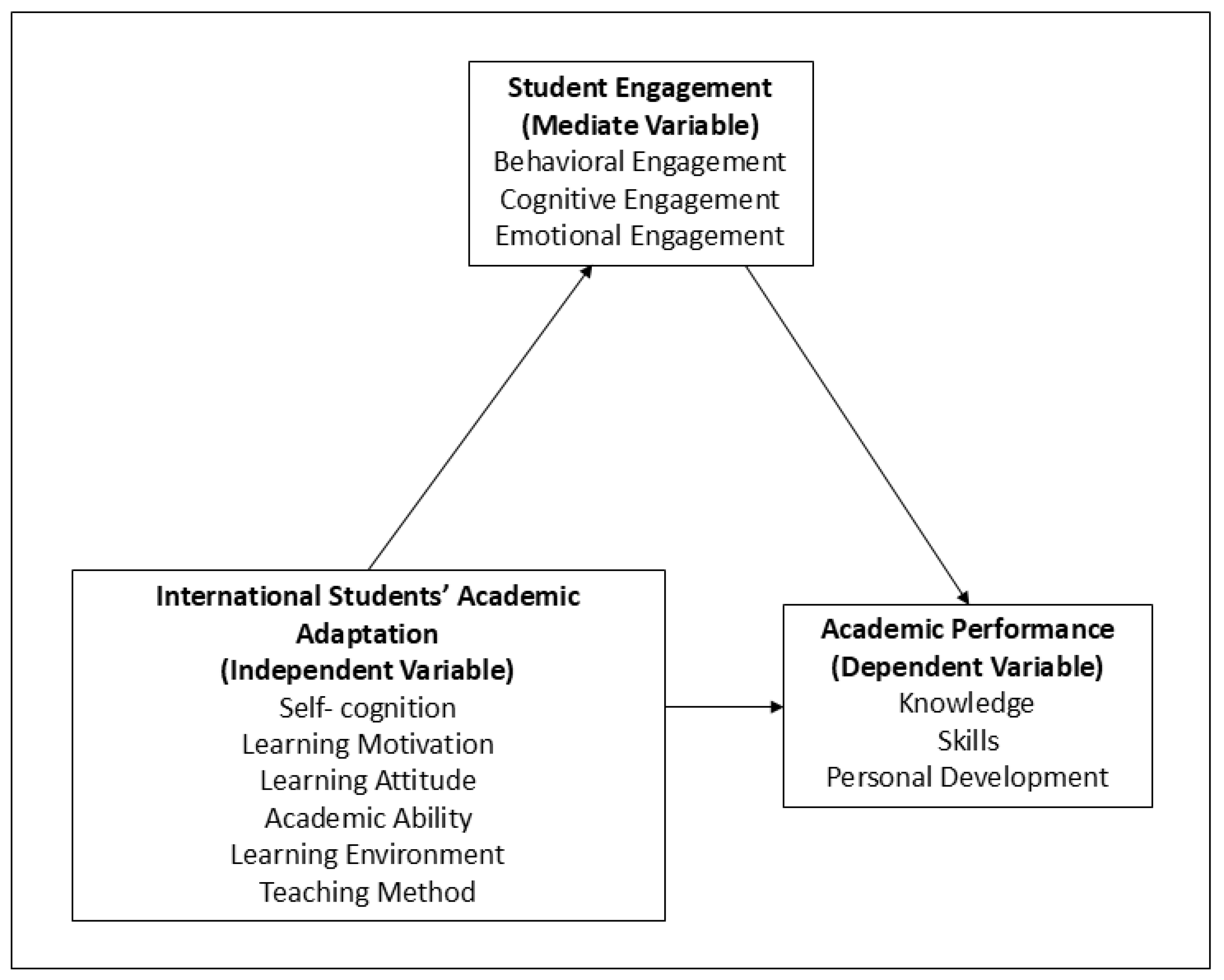
A conceptual framework represents the core ideas and their connections that structure a research inquiry [59]. Figure 1 shows a diagrammatic illustration of the conceptual framework, which is based on the literature review. The conceptual framework of this research developed from “Transformative Theory” “Model of Academic adaptation [32]” “Model of Student engagement [7]” and “Model of Academic performance [29]”, in which the variables involved are international students’ academic adaptation as the independent variable, academic performance as the dependent variable, and student engagement as the mediating variable.

3. Data and Methodology

3.1. Measuring Instruments

This study utilized three self-report instruments. The academic adaptation of international students was measured using a scale adapted from Deng’s [32] academic adaptation scale for international students in China. The instrument comprises 34 items across six dimensions: (a) self-perception (6 items, e.g., I am satisfied with my current learning status.), (b) learning motivation (6 items, e.g., I want to learn Chinese to stay and work in China in the future.), (c) learning attitude (5 items, e.g., I actively participate in extracurricular academic activities.), (d) academic ability (5 items, e.g., I can use library’s resources to search for journals or literature.), (e) learning environment (6 items, e.g., The university classrooms, study rooms, laboratories, and other teaching facilities can meet my learning needs.), and (f) teaching method (6 items, e.g., I can keep up with the teaching progress of my teachers.), reported the overall Cronbach’s alpha of 0.946, and Cronbach’s alpha for each dimension ranged from 0.828 to 0.923, indicating good internal consistency reliability.
Student engagement was assessed with a scale adapted from Wang [50], which consists of 12 items, rated on 3 dimensions: (a) behavioral engagement (4 items, e.g., I always review what was taught right after class.), (b) cognitive engagement (5 items, e.g., I always question what I have learned.), and (c) emotional engagement (3 items, e.g., I am curious about what I learn.). The overall Cronbach’s alpha was 0.892, with individual dimension coefficients of 0.868, 0.854, and 0.805, respectively, indicating strong reliability in the measurement.
Academic performance was measured using a scale based on Zhu and Wang [28], which was designed to assess three aspects of academic performance, including (a) knowledge (3 items, e.g., I extend my knowledge to other subject areas.), (b) skill (3 items, e.g., I always think critically and analytically.), and (c) personal development (3 items, e.g., I clarify my future development and plans.). All instruments employ five-point Likert scales, from 1 (Strongly Disagree) to 5 (Strongly Agree). The measure demonstrated strong reliability, with a Cronbach’s alpha of 0.89 for the overall scale, and 0.73, 0.83, and 0.80 for its three dimensions, respectively.

3.2. Procedure and Respondent

The study utilized purposive sampling, targeting international undergraduates in China who were sophomores and over the age of 18. This focus was informed by the theoretical understanding that the second year constitutes a critical post-transition stage for deepened academic integration. As such, this cohort was selected for its potential to yield considered insights into the interplay between academic adaptation, engagement, and performance. The data collection procedure was anonymous, and the volunteers could not answer the questions before clicking “agree” with the participant information and informed consent form.
The data were collected through an online survey administered via WeChat. A structured questionnaire was designed and disseminated using “Wenjuanxing”, which is seamlessly integrated with WeChat. To target the specific cohort of sophomore international students, the survey link was distributed through relevant student community networks. 500 questionnaires were distributed, and 427 were validly collected.
As detailed in Table 1, the study sample comprised 427 participants, with a majority being male (52.69%, n = 225) compared to female (47.31%, n = 202). In terms of nationality, the nationalities represented were Thai (11.71%), Korean and Indian (11.01% each), Vietnamese (10.77%), with the remaining groups each below 7%. Regarding academic disciplines, Engineering was the most pursued field (27.40%), ahead of Chinese Language Studies (18.03%), Management (14.52%), and Engineering & Technology (11.71%). In terms of Chinese proficiency, HSK 4 was the most common level (62.53%), significantly surpassing HSK 3 (18.74%), HSK 5 (18.27%), and HSK 6 (0.47%). Finally, regarding the medium of instruction, courses were primarily conducted in Chinese (63.7%), with English (24.56%) and a bilingual approach (11.7%) being less common.

4. Results

Due to its many advantages over alternative approaches, the Partial Least Squares Structural Equation Modeling (PLS-SEM) technique was adopted in this research, which facilitates a comprehensive evaluation of both the measurement model (assessing reliability and validity) and the structural model (testing the research hypotheses). Data analysis was conducted using SPSS version 29 and Smart-PLS 4.1.

4.1. Measurement Model

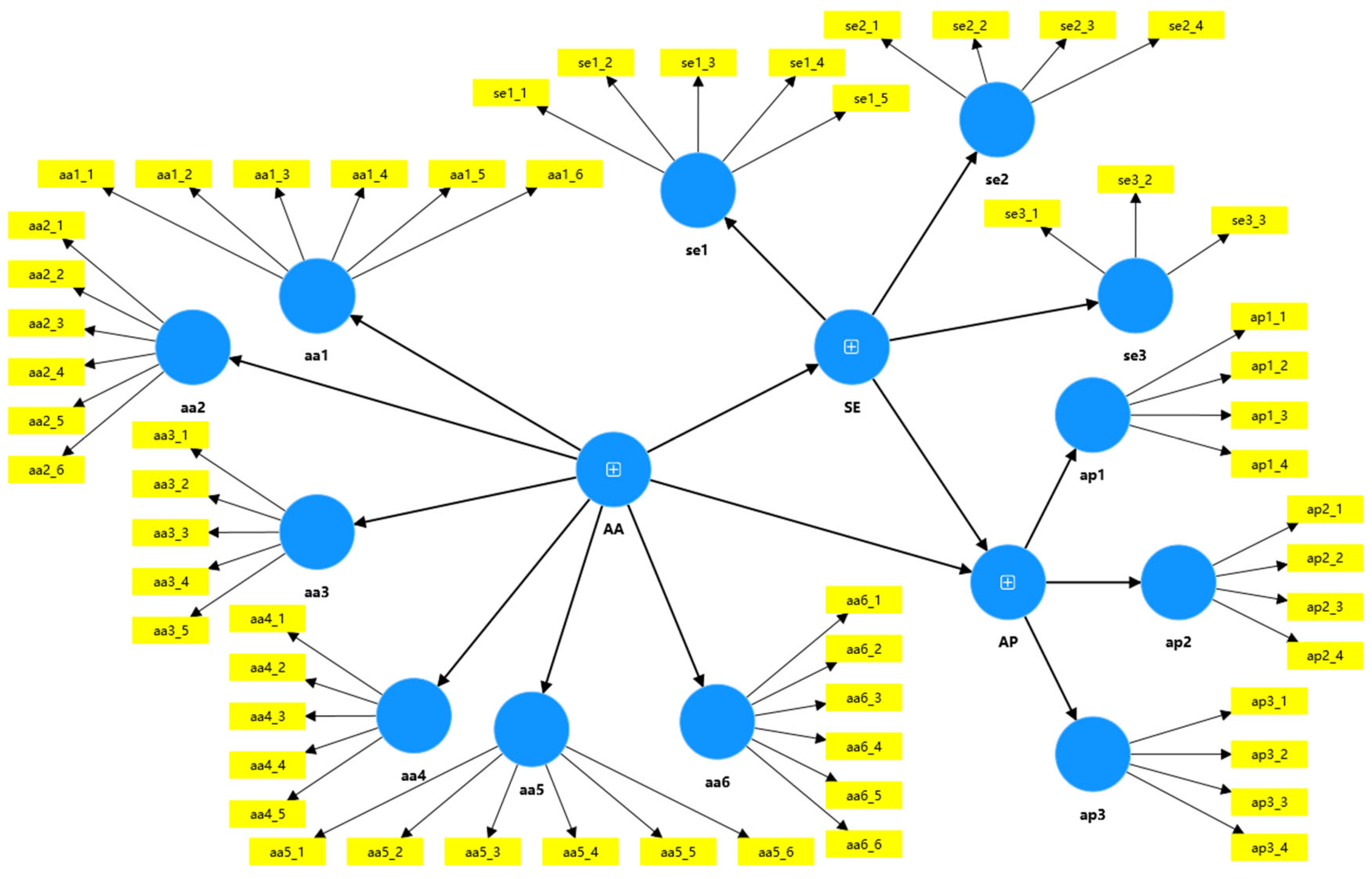
This research proposes a Reflective-Formative Hierarchical Component Model (HCM), since three multidimensional scales were used. In this model, higher-order latent variables are formatively composed of their lower-order dimensions, each of which is measured reflectively by its corresponding observed indicators. The evaluation of the measurement model begins with the first-order model depicted in Figure 2, which involves evaluating three essential criteria: indicator reliability, internal consistency, and convergent validity.
The results of the first-order measurement model demonstrated strong reliability and validity, as shown in Table 2. According to Hair et al. [60], the internal consistency of all constructs was confirmed, with both Cronbach’s alpha and composite reliability values surpassing the 0.7 criterion. Furthermore, convergent validity was established, as the Average Variance Extracted (AVE) for every construct exceeded 0.5 and all outer loadings were high and significant.
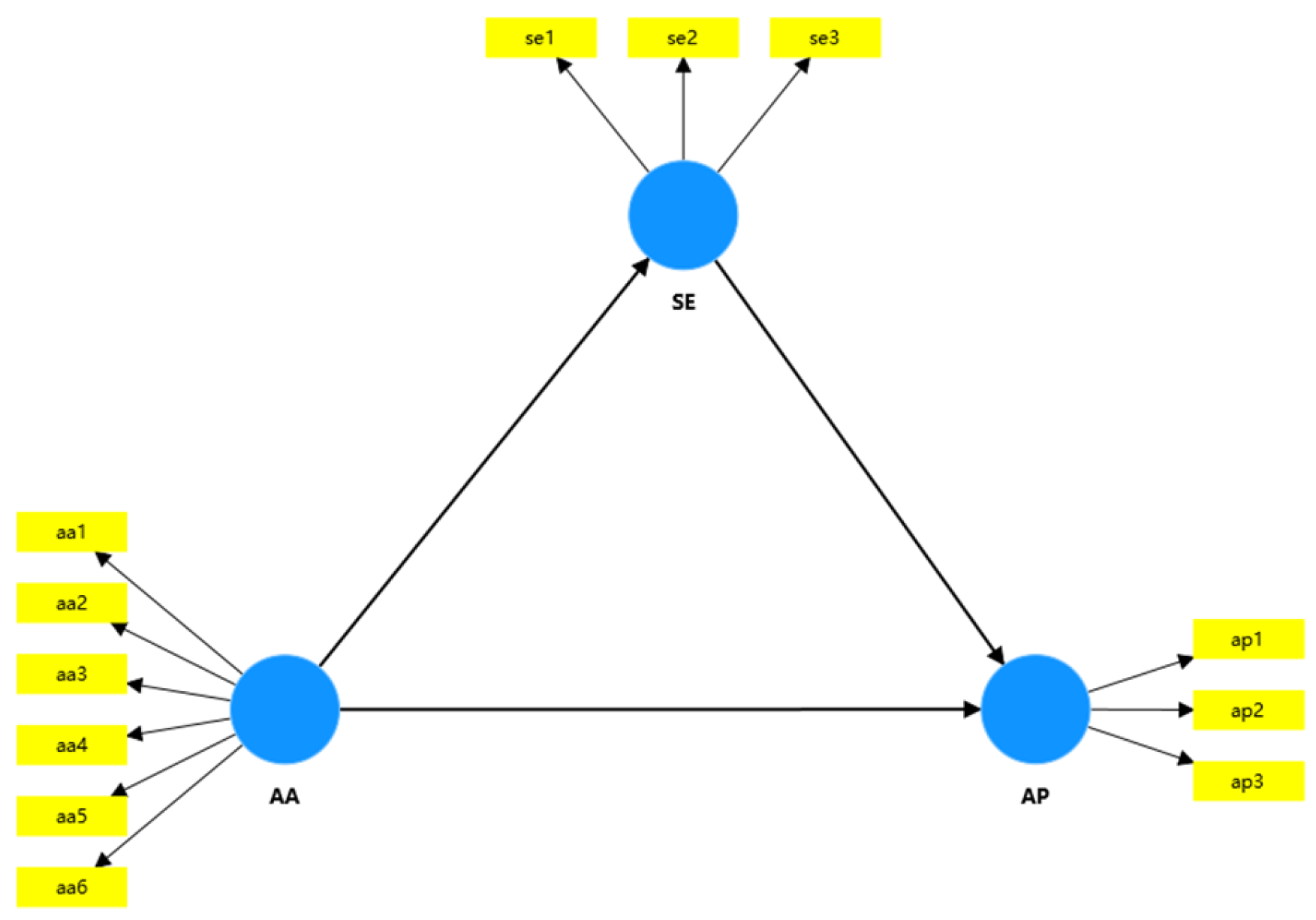
After evaluating the first-order measurement model, the second-order measurement model was evaluated for reliability, internal consistency, convergent validity, and discriminant validity. The structural configuration is illustrated in Figure 3, and the corresponding results are presented in Table 3 and Table 4.
According to Hair et al. [60], the second-order measurement model was assessed for reliability, internal consistency, and convergent validity. As shown in Table 3, all outer loadings were high, ranging from 0.906 to 0.957 across the constructs of academic adaptation, student engagement, and academic achievement, indicating strong indicator reliability. Internal consistency was confirmed as both Cronbach’s Alpha and Composite Reliability (CR) values for all constructs exceeded the 0.70 threshold, with results ranging from 0.927 to 0.969. Furthermore, convergent validity was established, as the Average Variance Extracted (AVE) for each construct was well above the recommended 0.50 level, with values of 0.865 for academic adaptation, 0.904 for student engagement, and 0.873 for academic performance.
Simultaneously, discriminant validity was evaluated through cross-loading analysis and the Fornell-Larcker criterion [60]. The results in Table 4 show that all indicators had the highest loadings on their assigned constructs [61], and the square root of each construct’s AVE was greater than its inter-construct correlations, thereby supporting discriminant validity. Thereby, discriminant validity was supported.

4.2. Structural Model

In this part, the variance inflation factor (VIF) values for the structural model were primarily examined to assess multicollinearity, with the results presented in Table 5. The VIF for Student Engagement was below the threshold of 3, while those for Academic Adaptability and Academic Performance, though exceeding the more conservative threshold of 5, remained within the acceptable limit of 10 [62]. Therefore, multicollinearity is not a concern in this study.
According to Chin [63], the predictive accuracy of the structural model was evaluated using the coefficient of determination (R2). As shown in Table 6, the model demonstrates exceptionally high explanatory power, the minimal difference between the R2 and adjusted R2 values suggests a robust and parsimonious model without overfitting. The elevated R2 value observed in this study can be attributed to the model’s well-supported theoretical pathway, in which student engagement mediates the relationship between academic adaptation and academic performance. Specifically, the academic adaptation component is adapted from Deng’s model [32] for international students, which originated from the first Chinese university student academic adaptation model by Feng et al. [64]. The academic performance component is based on the structure of Educational and Personal Growth by Kuh [65], as operationalized in self-reported learning gains scales [36]. The student engagement component is underpinned by the classic theoretical framework proposed by Fredricks et al. [7]. Consequently, the model’s strong theoretical foundation and clear structure offer a coherent explanation for the high proportion of variance explained (R2).

4.3. Research Hypotheses

To test the research hypotheses, this study examines the relationships between academic adaptation, student engagement, and academic performance. Table 7 presents the findings of the hypotheses.

4.3.1. Is There Any Significant Influence of Academic Adaptation on Academic Performance Among International Students in China?

Academic adaptation has a significant positive and direct effect on academic performance (β = 0.754, t = 12.741, p ≤ 0.05) at a significance level of 0.1, which H1 was validated. This indicates that for every one-standard-deviation increase in a student’s academic adaptation, their academic performance rises by approximately three-quarters of a standard deviation. The magnitude of this relationship is strikingly consistent with prior research. Particularly, it closely mirrors the results of Mao et al. [43], who found adaptation explained in a different sample. The consistency across studies underscores the vital role of academic adaptation in international students’ academic success.

4.3.2. Is There Any Significant Influence of Academic Adaptation on Student Engagement Among International Students in China?

Academic adaptation has a direct and positive effect on student involvement, as indicated by (β = 0.909, t = 95.550, p ≤ 0.05) at a significance level of 0.1. The 95% confidence interval for the adjusted bias excluded the zero value. As a result, H2 was supported. This indicates that when international students adapt well academically, their academic performance improves. In the previous study, it is also found that international students’ academic adaptation had a direct impact on student engagement replication with 318 international students who study in China reported an almost identical standardized coefficient (β = 0.450, p ≤ 0.05) between “academic adaptation” and “student engagement” [66]. The converging evidence confirms the pivotal role of academic adaptation in fostering student engagement.

4.3.3. Is There Any Significant Influence of Student Engagement on Academic Performance Among International Students in China?

Student engagement has a direct impact on academic performance, as indicated by a positive effect (β = 0.166, t = 2.688, p ≤ 0.05) at the 0.1 significance level. Despite its modest effect size, student engagement exerts a significant positive direct influence on academic performance, rendering it a crucial contributing factor. As a result, H3 was confirmed. This suggests that higher levels of engagement are associated with improved grades, yet the strength of this relationship is relatively weak. This is the same as the previous research from McClenney et al. [49], which showed greater chances of achieving good academic results. This weak correlation can be explained by the assessment structure in Chinese universities, where heavily weighted final exams may incentivize last-minute surface study over sustained, meaningful engagement, thereby diminishing the measurable impact of engagement on grades.

4.3.4. Is There Any Significant Mediating Influence of Student Engagement on the Relationship Between International Students’ Academic Adaptation and Academic Performance Among International Students in China?

Student engagement serves as a mediator in the relationship between academic adaptation and academic performance. A significant positive direct relationship is observed between academic adaptation and academic performance (β = 0.754, t = 12.741, p ≤ 0.05). Additionally, a significant positive indirect relationship is identified involving academic adaptation, student engagement, and academic performance (β = 0.151, t = 2.701, p ≤ 0.05), at a significance level of 0.1. The 95% confidence interval for the adjusted bias excluded zero, suggesting that both direct and indirect correlations were significant and positive in this study [60,67]. A mediation effect was identified, thereby supporting H4. Compared to prior research by Ma et al. [58], this study advances the understanding of how academic adaptation impacts academic performance via student engagement among international students in China. The impact of student engagement on academic performance among international students in China is relatively weak. Because the participants have just become sophomores after completing their first year of university, the impact of student engagement may be diluted by academic adaptation, resulting in less impact on academic performance.

5. Conclusions and Implications

Based on the PLS-SEM analysis of the measurement and structural models, the measurement model’s analysis results are reliable and can be used for further measurement. The findings established the direct and indirect effects of academic adaptation, student engagement, and academic performance. The results indicate that academic adaptation and student engagement individually have a direct impact on academic performance, while student engagement partially mediates the relationship between academic adaptation and academic performance. Existing literature on international students’ academic adaptation has often exhibited a myopic focus on their cross-cultural identity, framing adaptation primarily as a facet of acculturation [20,68]. In contrast, this study reconceptualizes academic adaptation as a fundamentally educational phenomenon whose complexities are principally driven by academic systems and learning processes rather than cultural dissonance alone. Therefore, this research develops and evaluates an integrative model that connects academic adaptation, student engagement, and academic performance, which expands the application of student development theory [65,69] in the unique academic ecosystem of international students and Chinese higher education.
However, it is crucial to consider its potential limitations, which will lead to a more comprehensive understanding of the applicability and depth of the research conclusions.
First, there are several methodological limitations. The cross-sectional study design limits our ability to make absolute inferences about causal relationships between variables. The relationship between academic adaptation, student engagement, and academic performance is likely dynamic and mutually influential. Longitudinal studies would be more effective in elucidating their trajectories and reciprocal effects over time.
Second, the specificities of the research sample necessitate caution in generalizing the conclusions. Within China, significant subgroup differences may exist across institution types (e.g., research-intensive universities versus applied technology colleges) and students’ countries of origin (e.g., Belt and Road Initiative countries versus Western nations). Future research could employ multi-group analyses to compare pathways among students from diverse cultural backgrounds, disciplines, or institutional types, thereby enriching our understanding of the complexities inherent in the academic adaptation process.
Based on the above research findings and limitations, this study can generate more targeted policy and practical recommendations. First, systematize and proactively advance academic adaptation support. In orientation programs, provide subject-specific workshops on academic norms like Chinese citation formats and lab report writing, and assign “academic buddies”, who are senior international students or dedicated mentors. Second, establish a fast track for academic feedback. Establish regular, informal academic consultation times for international students, focusing on their learning difficulties and adaptation challenges, and providing timely formative feedback. Third, proactively and strategically integrate into the academic community. Encourage students to consciously view academic adaptation as a learning strategy that requires proactive management, rather than a passive experience [70]. This includes proactively contacting mentors, selectively joining academic societies, and forming course study groups with local students.

Author Contributions

Conceptualization, Y.L. and A.I.; literature review, Y.L.; methodology, Y.L.; software, Y.L.; investigation, Y.L.; data analysis, Y.L.; writing—original draft preparation, Y.L.; writing—review and editing, Y.L.; supervision, A.I. All authors have read and agreed to the published version of the manuscript.

Funding

This research received no external funding.

Institutional Review Board Statement

Ethical review and approval were waived for this study by Institution Committee due to Legal Regulations. In accordance with the local legislation and institutional requirements: this study meets the requirements of Article 32 of the “Ethical Review Measures for Life Science and Medical Research Involving Human Subjects” ([2023] No. 4, which the National Health Commission, the Ministry of Education, the Ministry of Science and Technology, and the State Administration of Traditional Chinese Medicine jointly issued) “Research involving humans that uses human information data or biological samples may be exempt from ethical review if it does not harm the human body and involve sensitive personal information or commercial interests, thus reducing unnecessary burdens on researchers and promoting research.” Therefore, Ethics Committee or Institutional Review Board approval is not required.

Informed Consent Statement

Informed consent was obtained from all participants involved in the study.

Data Availability Statement

The data that support the findings of this study are available from the corresponding author upon reasonable request.

Acknowledgments

We thank all reviewers for their insightful comments and suggestions.

Conflicts of Interest

The authors declare no conflicts of interest.

References

  1. Altbach, P.G.; Knight, J. The internationalization of higher education: Motivations and realities. J. Stud. Int. Educ. 2007, 11, 290–305. [Google Scholar] [CrossRef]
  2. Wilczewski, M.; Alon, I. Language and communication in international students’ adaptation: A bibliometric and content analysis review. High. Educ. 2023, 85, 1235–1256. [Google Scholar] [CrossRef]
  3. Loes, C.; Pascarella, E.; Umbach, P. Effects of diversity experiences on critical thinking skills: Who benefits? J. High. Educ. 2012, 83, 1–25. [Google Scholar] [CrossRef]
  4. Crossman, J.E.; Clarke, M. International experience and graduate employability: Stakeholder perceptions on the connection. High. Educ. 2010, 59, 599–613. [Google Scholar] [CrossRef]
  5. Deardorff, D.K. Identification and assessment of intercultural competence as a student outcome of internationalization. J. Stud. Int. Educ. 2006, 10, 241–266. [Google Scholar] [CrossRef]
  6. Rienties, B.; Beausaert, S.; Grohnert, T.; Niemantsverdriet, S.; Kommers, P. Understanding academic performance of international students: The role of ethnicity, academic and social integration. High. Educ. 2012, 63, 685–700. [Google Scholar] [CrossRef]
  7. Fredricks, J.A.; Blumenfeld, P.C.; Paris, A.H. School engagement: Potential of the concept, state of the evidence. Rev. Educ. Res. 2004, 74, 59–109. [Google Scholar] [CrossRef]
  8. Schaufeli, W.B.; Salanova, M.; González-Romá, V.; Bakker, A.B. The measurement of engagement and burnout: A two sample confirmatory factor analytic approach. J. Happiness Stud. 2002, 3, 71–92. [Google Scholar] [CrossRef]
  9. Project Atlas Infographics. 2018. Available online: https://www.iie.org/research-initiatives/project-atlas/explore-global-data/ (accessed on 11 February 2024).
  10. Al-Tameemi, R.A.N.; Johnson, C.; Gitay, R.; Abdel-Salam, A.S.G.; Al Hazaa, K.; BenSaid, A.; Romanowski, M.H. Determinants of poor academic performance among undergraduate students—A systematic literature review. Int. J. Educ. Res. Open 2023, 4, 100232. [Google Scholar] [CrossRef]
  11. Jiang, Q.; Horta, H.; Yuen, M. International medical students’ perspectives on factors affecting their academic success in China: A qualitative study. BMC Med. Educ. 2022, 22, 574. [Google Scholar] [CrossRef]
  12. Liu, Y.; Guo, J. Analysis Report on Academic Performance of International Students in China—Taking the 2017 Autumn Semester Results of XX University’s 2017 International Students as an Example. Int. Public Relat. 2020, 214–215. [Google Scholar] [CrossRef]
  13. Crede, M.; Niehorster, S. Adjustment to college as measured by the student adaptation to college questionnaire: A quantitative review of its structure and relationships with correlates and consequences. Educ. Psychol. Rev. 2012, 24, 133–165. [Google Scholar] [CrossRef]
  14. Andrade, M.S. International students in English-speaking universities: Adjustment factors. J. Res. Int. Educ. 2006, 5, 131–154. [Google Scholar] [CrossRef]
  15. Zhu, G. Cross-Cultural Adaptation of Undergraduates Studying in China. Doctor’s Thesis, East China Normal University, Shanghai, China, 2011. Available online: https://kns.cnki.net/KCMS/detail/detail.aspx?dbname=CDFD0911&filename=1011129211.nh (accessed on 31 January 2023).
  16. Dunn, J.W. Academic Adjustment of Chinese Graduate Students in United States Institutions of Higher Education. Ph.D. Dissertation, University of Minnesota, Minneapolis, MN, USA, 2006. [Google Scholar]
  17. Kahn, P.E. Theorizing student engagement in higher education. Br. Educ. Res. J. 2014, 40, 1005–1018. [Google Scholar] [CrossRef]
  18. Tinto, V. Leaving College: Rethinking the Causes and Cures of Student Attrition, 2nd ed.; University of Chicago Press: Chicago, IL, USA, 1993. [Google Scholar]
  19. Zhao, S.Q.; Wu, F.; Sun, Y.L.; Zhou, Q.; Zuo, Y.Y. Cross-cultural adaptation and management strategies of Vietnamese students: A survey of Vietnamese students in Yunnan University of Traditional Chinese Medicine. Value Eng. 2017, 31, 249–251. [Google Scholar] [CrossRef]
  20. Chen, X.; Gong, X. Investigation and analysis of cross-cultural academic adaptation of African students studying in China. Educ. Rev. 2018, 9, 55–59. [Google Scholar]
  21. Liu, J. Master’s Degree in Education Quality Research for International Students in China from the Perspective of Learning Engagement. Master’s Dissertation, Jilin University, Jilin, China, 2020. [Google Scholar]
  22. Suleiman, I.B.; Okunade, O.A.; Dada, E.G.; Ezeanya, U.C. Key factors influencing students’ academic performance. J. Electr. Syst. Inf. Technol. 2024, 11, 41. [Google Scholar] [CrossRef]
  23. York, T.T.; Gibson, C.; Rankin, S. Defining and measuring academic success. Pract. Assess. Res. Eval. 2015, 20, 1–20. [Google Scholar] [CrossRef]
  24. Schneider, M.; Preckel, F. Variables associated with achievement in higher education: A systematic review of meta-analyses. Psychol. Bull. 2017, 143, 565–600. [Google Scholar] [CrossRef]
  25. Niu, S.X.; Tienda, M. Test scores, class rank and college performance: Lessons for broadening access and promoting success. Rass. Ital. Di Sociol. 2012, 53, 199–226. [Google Scholar] [CrossRef]
  26. Kuncel, N.R.; Hezlett, S.A. Standardized tests predict graduate students’ success. Science 2007, 315, 1080–1081. [Google Scholar] [CrossRef]
  27. Pascarella, E.T.; Terenzini, P.T. How College Affects Students: A Third Decade of Research; Jossey-Bass: Hoboken, NJ, USA, 2005. [Google Scholar]
  28. Zhu, G.; Wang, X. An Empirical Study on the Impact of High School Academic Preparation on College Students’ Academic Performance. Jiangsu High. Educ. 2023, 10, 32–38. [Google Scholar] [CrossRef]
  29. Xing, Q. Master’s Degree in Empirical Research on the Relationship Between Undergraduate Students’ Learning Engagement and Academic Performance Based on CCSS Survey. Master’s Dissertation, Chongqing University, Chongqing, China, 2015. [Google Scholar]
  30. Tinto, V. Dropout from higher education: A theoretical synthesis of recent research. Rev. Educ. Res. 1975, 45, 89–125. [Google Scholar] [CrossRef]
  31. Baker, R.W.; Siryk, B. Measuring adjustment to college. J. Couns. Psychol. 1984, 31, 179–189. [Google Scholar] [CrossRef]
  32. Deng, W. Study on the Academic Adaptability of ASEAN International Graduate Students in China Under the Background of Convergent Management. Master’s Thesis, Guangxi University, Nanning, China, 2021. [Google Scholar]
  33. Wang, D. The Cross-cultural academic adaptation of Chinese students in an American university: Academic challenges, influential factors and coping strategies. Res. Soc. Sci. 2022, 5, 43–53. [Google Scholar] [CrossRef]
  34. Wang, T.; Shan, X. A Qualitative Study on Chinese Postgraduate Students’ Learning Experiences in Australia. In Proceedings of the AARE 2006 International Education Research Conference, Adelaide, Australia, 26–30 November 2006. [Google Scholar]
  35. Finn, J.D. Withdrawing from School. Rev. Educ. Res. 1989, 59, 117–142. [Google Scholar] [CrossRef]
  36. Pascarella, E.T.; Seifert, T.A.; Blaich, C. How Effective are the NSSE Benchmarks in Predicting Important Educational Outcomes? Change Mag. High. Learn. 2010, 42, 16–22. [Google Scholar] [CrossRef]
  37. Mezirow, J. Perspective Transformation. Adult Educ. Q. 1978, 28, 100–110. [Google Scholar] [CrossRef]
  38. Taylor, E.W.; Cranton, P. A theory in progress? Issues in transformative learning theory. Eur. J. Res. Educ. Learn. Adults 2013, 4, 33–47. [Google Scholar] [CrossRef]
  39. Kumi–Yeboah, A.; James, W. Transformative learning experiences of international graduate students from Asian countries. J. Transform. Educ. 2014, 12, 25–53. [Google Scholar] [CrossRef]
  40. Rienties, B.; Luchoomun, D.; Tempelaar, D. Academic and social integration of Master students: A cross-institutional comparison between Dutch and international students. Innov. Educ. Teach. Int. 2014, 51, 130–141. [Google Scholar] [CrossRef]
  41. Richardson, M.; Abraham, C.; Bond, R. Psychological correlates of university students’ academic performance: A systematic review and meta-analysis. Psychol. Bull. 2012, 138, 353–387. [Google Scholar] [CrossRef] [PubMed]
  42. Yu, L.; Rahman, M.S.; Li, X. The effects of academic adaptation on depression of international students in China: A case study on South Asian students of TCSOL teacher program. Int. J. Intercult. Relat. 2023, 94, 101804. [Google Scholar] [CrossRef]
  43. Mao, Y. Academic adaptation of international students in the Chinese higher education environment: A case study with mixed methods. Int. J. Intercult. Relat. 2024, 103, 102082. [Google Scholar] [CrossRef]
  44. Gebhard, J.G. International students’ adjustment problems and behaviors. J. Int. Stud. 2012, 2, 158–164. [Google Scholar] [CrossRef]
  45. Collie, R.; Holliman, A.; Martin, A. Adaptability, engagement, and academic achievement at university. Educ. Psychol. 2016, 37, 632–647. [Google Scholar] [CrossRef]
  46. Martin, A.J.; Nejad, H.; Colmar, S.; Liem, G.A.D. Adaptability: Conceptual and Empirical Perspectives on Responses to Change, Novelty and Uncertainty. Aust. J. Guid. Couns. 2012, 22, 58–81. [Google Scholar] [CrossRef]
  47. Holliman, A.J.; Martin, A.J.; Collie, R.J. Adaptability, engagement, and degree completion: A longitudinal investigation of university students. Educ. Psychol. 2018, 38, 785–799. [Google Scholar] [CrossRef]
  48. Kuh, G.D.; Kinzie, J.; Schuh, J.H.; Whitt, E.J. Fostering student success in hard times. Change Mag. High. Learn. 2011, 43, 13–19. [Google Scholar] [CrossRef]
  49. McClenney, K.; Marti, C.N.; Adkins, C. Student Engagement and Student Outcomes: Key Findings from CCSSE Validation Research; Community college survey of student engagement: Austin, TX, USA, 2012; pp. 1–6. Available online: http://www.ccsse.org/center (accessed on 30 August 2025).
  50. Wang, Y. The Research on the Development of The College Student Engagement Questionnaire—Based on the Data Analysis of “National College Students’ Learning Situation Investigation”. J. Hebei Univ. Sci. Technol. (Soc. Sci. Ed.) 2015, 3, 101–106. [Google Scholar]
  51. Boulton, C.A.; Hughes, E.; Kent, C.; Smith, J.R.; Williams, H.T.P. Student engagement and wellbeing over time at a higher education institution. PLoS ONE 2019, 14, e0225770. [Google Scholar] [CrossRef] [PubMed]
  52. Zhang, Z. Modelling Undergraduate Student Engagement in China. Theory Pract. Lang. Stud. 2019, 9, 1501–1512. [Google Scholar] [CrossRef]
  53. Li, X.; Qin, X. Research on the relationship between students’ learning engagement and learning gains in the Top-notch Plan. Jiangsu High. Educ. 2019, 12, 102–108. [Google Scholar] [CrossRef]
  54. Galve-González, C.; Bernardo, A.B.; Núnez, J.C. Trayectorias académicas: El papel del compromiso como mediador en la decisión de abandono o permanencia universitaria. Rev. Psicodidáctica 2024, 29, 130–138. [Google Scholar] [CrossRef]
  55. Godsk, M.; Møller, K.L. Engaging students in higher education with educational technology. Educ. Inf. Technol. 2025, 30, 2941–2976. [Google Scholar] [CrossRef]
  56. Wen, C.; Zhang, W.; Li, D.; Yu, C.; Dai, W. The relationship between gratitude and academic achievement of junior high school students: The intermediary role of learning input. Psychol. Dev. Educ. 2010, 6, 598–605. [Google Scholar]
  57. Meng, Q.; Zhang, Q. The influence of academic self-efficacy on university students’ academic performance: The mediating effect of academic engagement. Sustainability 2023, 15, 5767. [Google Scholar] [CrossRef]
  58. Ma, J.; Sun, C.; Wang, Y. The mediating role of learning engagement on learning gains of international students in Chinese higher education institutions. Sustainability 2022, 14, 14052. [Google Scholar] [CrossRef]
  59. Adom, D.; Hussein, E.K.; Agyem, J.A. Theoretical and conceptual framework: Mandatory ingredients of a quality research. Int. J. Sci. Res. 2018, 7, 438–441. [Google Scholar] [CrossRef]
  60. Henseler, J. Partial least squares path modeling. In Advanced Methods for Modeling Markets; Springer: Cham, Switzerland, 2017; pp. 361–381. [Google Scholar] [CrossRef]
  61. Hair, J.F.; Risher, J.J.; Sarstedt, M.; Ringle, C.M. When to use and how to report the results of PLS-SEM. Eur. Bus. Rev. 2019, 31, 2–24. [Google Scholar] [CrossRef]
  62. Hair, J.F. Multivariate data analysis: An overview. Int. Encycl. Stat. Sci. 2011, 904–907. [Google Scholar] [CrossRef]
  63. Chin, W.W. The partial least squares approach to structural equation modeling. Mod. Methods Bus. Res. 1998, 295, 295–336. [Google Scholar]
  64. Feng, T.; Liu, Y.; Yi, Y.; Zhang, Y. A review on the research of learning adjustment of undergraduates and educational measures. J. Southwest Univ. (Soc. Sci. Ed.) 2010, 36, 135–139. [Google Scholar]
  65. Kuh, G.D. The national survey of student engagement: Conceptual and empirical foundations. New Dir. Institutional Res. 2009, 141, 5–20. [Google Scholar] [CrossRef]
  66. Li, W.; Zhang, C.; Jiang, X.; Bikorimana, E. The impact of Academic adaptation to learning engagement among international postgraduates in China. Jiangsu High. Educ. 2022, 38, 67–74. [Google Scholar] [CrossRef]
  67. Zhao, X.; Lynch, J.G., Jr.; Chen, Q. Reconsidering Baron and Kenny: Myths and truths about mediation analysis. J. Consum. Res. 2010, 37, 197–206. [Google Scholar] [CrossRef]
  68. Zhang, Q. A study on the conflict manifestations and coping strategies of cross-cultural adaptation of ASEAN international students in China. Teach. Educ. (High. Educ. Forum) 2016, 21, 38–41. [Google Scholar]
  69. Tinto, V. Reflections: Rethinking engagement and student persistence. Stud. Success 2023, 14, 1–7. [Google Scholar] [CrossRef]
  70. Cho, H.J.; Levesque-Bristol, C.; Yough, M. International students’ self-determined motivation, beliefs about classroom assessment, learning strategies, and academic adjustment in higher education. High. Educ. 2021, 81, 1215–1235. [Google Scholar] [CrossRef]
Figure 1. Conceptual model.
Sustainability 17 11256 g001
Figure 2. The first-order model.
Sustainability 17 11256 g002
Figure 3. The second-order model.
Sustainability 17 11256 g003
Table 1. The profile of respondents.
DescriptionFrequency (n = 427)Percentage (%)
Gender
Male22552.69%
Female20247.31%
Age
19–2014734.43%
21–2217540.98%
23–248219.20%
25–26235.39%
Nationality
India4711.01%
South Korea4711.01%
Pakistan214.92%
Thailand5011.71%
Bangladesh153.51%
Tanzania102.34%
Ghana122.81%
Indonesia419.6%
Nigeria163.75%
Russia296.79%
Malaysia266.09%
Kenya102.34%
Vietnam4610.77%
Others5713.35%
Major Category
Engineering11727.40%
Western Medicine327.49%
Management6214.52%
Economics5412.65%
Chinese language7718.03%
Chinese Medicine255.85%
Science429.84%
Others184.22%
Chinese proficiency
HSK38018.74%
HSK426762.53%
HSK57818.27%
HSK620.47%
Medium of Instruction
Chinese27263.7%
English10524.56%
Bilingual5011.7%
Table 2. The measurement model assessment (first order).
ConstructItemOuter LoadingCronbach’s AlphaCRAVE
Academic Adaptation0.9840.9850.657
Self-perceptionSB010.878 0.9260.9270.732
SB020.852
SB030.902
SB040.814
SB050.825
SB060.826
Learning motivationSB070.726 0.8940.9030.655
SB080.860
SB090.698
SB100.842
SB110.858
SB120.817
Learning attitudeSB130.808 0.8980.9000.712
SB140.804
SB150.868
SB160.889
SB170.825
Academic abilitySB180.870 0.9440.9450.816
SB190.896
SB200.938
SB210.901
SB220.893
Learning environmentSB230.8810.9580.9580.825
SB240.931
SB250.918
SB260.922
SB270.913
SB280.865
Teaching methodSB290.922 0.9540.9570.815
SB300.934
SB310.935
SB320.849
SB330.826
SB340.923
Student Engagement0.9670.9680.735
Behavioral engagementSC010.904 0.9120.9150.742
SC020.813
SC030.889
SC040.807
SC050.860
Cognitive engagementSC060.906 0.9440.9450.900
SC070.916
SC080.922
SC090.915
Emotional engagementSC100.942 0.9380.9380.842
SC110.959
SC120.938
Academic Performance0.9580.9590.687
KnowledgeSD010.884 0.9080.9090.784
SD020.891
SD030.892
SD040.853
SkillsSD050.861 0.9270.9270.820
SD060.912
SD070.922
SD080.915
Personal developmentSD090.908 0.8960.8990.763
SD100.892
SD110.866
SD120.809
Table 3. The measurement model assessment (second order).
ConstructItemItem ParcelOuter LoadingCronbach’s AlphaCRAVE
Academic AdaptationSB01-06aa10.9270.9690.9690.865
SB07-12aa20.906
SB13-17aa30.925
SB18-22aa 40.933
SB23-28aa50.939
SB29-34aa60.950
Student EngagementSC01-05se10.9440.9470.9470.904
SC06-09se20.957
SC10-12se30.952
Academic PerformanceSD01-04ap10.9240.9270.9280.873
SD05-08ap20.930
SV09-12ap30.949
Table 4. Discriminant validity.
Academic AdaptationAcademic PerformanceStudent Engagement
Academic Ability0.9330.8160.885
Behavioral Engagement0.8750.8050.944
Cognitive Engagement0.8450.8000.957
Emotional Engagement0.8730.8220.952
Knowledge0.8350.9240.796
Learning Attitude0.9250.8340.867
Learning Environment0.9390.8350.837
Learning Motivation0.9060.8560.793
Personal development0.8580.9490.809
Self-perception0.9270.8690.807
Skills0.8430.9300.781
Teaching Method0.9500.8390.883
A V E Academic AdaptationAcademic PerformanceStudent Engagement
Academic Adaptation0.930
Academic Performance0.9040.935
Student Engagement0.9090.8510.951
Table 5. Collinearity issue.
Academic AdaptationAcademic PerformanceStudent Engagement
Academic Adaptation 5.7761.000
Academic Performance
Student Engagement 5.776
Table 6. Coefficient of Determination (R2).
R-SquareR-Square Adjusted Level
Academic Performance0.823 0.822 High
Student Engagement0.827 0.826 High
Table 7. Direct and indirect effect and Hypotheses Testing.
HypothesisRelationshipβ ValueSDT Statisticsp ValuesCI95%
H1Academic Adaptation -> Academic Performance 0.7540.05912.7410.000[0.635, 0.865]
H2Academic Adaptation -> Student Engagement 0.9090.01095.5500.000[0.889, 0.926]
H3Student Engagement -> Academic Performance 0.1660.0622.6880.007[0.049, 0.285]
H4Academic Adaptation -> Student Engagement -> Academic Performance0.1510.0562.7010.007[0.045, 0.259]
Disclaimer/Publisher’s Note: The statements, opinions and data contained in all publications are solely those of the individual author(s) and contributor(s) and not of MDPI and/or the editor(s). MDPI and/or the editor(s) disclaim responsibility for any injury to people or property resulting from any ideas, methods, instructions or products referred to in the content.