Article

Analyzing Added Wave and Superstructure Resistance Based on North Pacific Ocean Sea State

by
Burak Göksu
1,* and
Kadir Emrah Erginer
2
1
Marine Engineering Department, Zonguldak Bulent Ecevit University, Zonguldak 67300, Türkiye
2
Marine Engineering Department, Dokuz Eylul University, Izmir 35390, Türkiye
*
Author to whom correspondence should be addressed.
Sustainability 2025, 17(24), 11245; https://doi.org/10.3390/su172411245
Submission received: 3 October 2025 / Revised: 8 December 2025 / Accepted: 12 December 2025 / Published: 15 December 2025

Abstract

It is recognized that a ship’s performance, speed, fuel consumption, and resistance are impacted by the marine environment. The magnitude of this effect, which can be altered by ship design and operational conditions, necessitates added resistance calculations for optimizing these phases. Ship designers can generate efficient hull forms and operators can make sound navigational decisions to reduce emissions within the service zone. For this research, air and wave resistances were calculated using the KCS hull form with a superstructure during a simulated voyage in the North Pacific Ocean. To verify the results, data from towing tank tests available in the literature were used, along with calm water resistance calculations obtained from a computational fluid dynamics (CFD) analysis conducted for this study. When transporting 3600 loaded containers, sea conditions at model-scale impact the ship’s power requirements, leading to air resistance from the superstructure (aerodynamic) and hull resistance from head waves. This research compares the increased wave and air resistance with calm water resistance to provide important insights into the main engine power requirements when traveling in this region. Cruising between 14 and 18 knots generates 8–11% added resistance when encountering head waves at Sea State 5.

1. Introduction

The performance of a ship, encompassing its speed, fuel consumption, and resistance, is significantly influenced by the marine environment. The magnitude of this environmental effect, which can be modified by ship design and operational conditions, necessitates added resistance calculations to optimize these phases. By accurately assessing added resistance, ship designers can develop efficient hull forms, and operators can make informed navigational decisions to reduce emissions within the service zone. Overall, there is a growing emphasis on studies aimed at reducing propulsion power, fuel consumption, and operational costs due to environmental and economic considerations. A key objective in these efforts is to ensure the reliability of the ship’s propulsion system while minimizing power, fuel consumption, and costs.
The International Maritime Organization (IMO), founded on 17 March 1948, by United Nations member nations, is the primary authoritative entity responsible for establishing regulations. These regulations have since broadened to include promoting safe navigation, fair management practices, and environmental protection. The IMO’s current objective prioritizes sustainable maritime transportation by 2030, which includes imposing limitations on carbon-containing fuel consumption by ships and promoting the adoption of fuel types and advanced systems to reduce greenhouse gas emissions [1].
To address rising pollution rates, the IMO’s implementation of environmental regulations, such as the Energy Efficiency Design Index (EEDI) and the Energy Efficiency Existing Ship Index (EEXI), has made the accurate prediction of ship power and resistance essential [2]. Even with sustainable design, regulations mandate energy efficiency measures throughout a ship’s operational lifecycle [3]. While suitable propulsion system configurations are chosen during the design phase based on navigation and operational needs, ships must also meet specific configuration requirements due to diverse environmental variables and additional operational demands. SEEMP and EEOI provide operational measures that form the basis for cost-effective energy efficiency enhancements. EEOI allows for monitoring and controlling ship and fleet efficiency performance over time. Suggestions for SEEMP development for new and existing vessels include optimal fuel utilization strategies and instructions for voluntary EEOI adoption. EEOI implementation enables technical solutions like enhanced cruise planning, regular propeller cleaning, promotion of waste heat recovery systems, and propeller replacement [4,5,6,7]. Conversely, SEEMP promotes the use of novel technologies and methodologies by ship owners, operators, or managers to enhance ship performance across all operational stages [8]. Precise forecasting of fuel usage in maritime activities is essential due to rising fuel prices and the need to decrease emissions. Research by Cepowski and Drozd (2023) established mathematical correlations between fuel consumption and operational characteristics such as propeller rotational speed, draft, trim, hull fouling time, wind speed, wave height, and seawater temperature, highlighting their hierarchical influence on fuel consumption [6].
For this research, air and wave resistances were calculated using the KCS hull form with a superstructure during a simulated voyage in the North Pacific Ocean. The KRISO Container Ship (KCS) model, a Panamax class ship form, is widely used in research and academic studies and has been tested by the International Towing Tank Conference (ITTC). The choice of the KCS hull form is supported by the availability of trustworthy empirical data for benchmarking studies. For container ships, draft is a function of both total length and container carrying capacity [9]. While air resistance is generally minimal compared to wave resistance, for ships with substantial superstructures like container ships, it can vary based on superstructure geometry, loading, and container configuration (Grlj et al. 2023 [5]). Studies have shown that air resistance can account for a significant portion of total resistance, with factors like trim angle and container configuration having notable impacts [8].
Ship resistance poses a considerable challenge to efficient navigation, being closely correlated with fuel consumption and emissions. Route optimization is a fundamental strategy to mitigate added resistance, requiring a comprehensive understanding of external environmental variables. Studies conducted by Bilgili (2023) have identified swell direction and wave direction as primary factors influencing resistance [10]. Numerical analyses have also been employed to determine added resistance in various wave conditions for the KCS hull [11]. The calculation of added resistance due to air and waves is essential for fuel efficiency, environmental considerations, and safe maritime navigation, linking directly to IMO maneuverability standards and hull design [12]. Data from diverse navigation conditions are recommended by [13] as reference values to mitigate uncertainties in CFD methodology for assessing wave-induced ship movements and resistance [14]. Furthermore, the semi-empirical SNNM (SHOPERA-NTUA-NTU-MARIC) approach for predicting the added resistance of ships in waves [15] has been successfully developed and is extensively utilized by the maritime industry.
This study focuses on quantifying the added wave and air resistance exerted on the hull of a fully loaded cargo ship navigating the North Pacific Ocean while encountering head waves, utilizing the Star-CCM+ (version 2022.1) software package. In this context, wind resistance from environmental conditions is disregarded; instead, air resistance considered is the force generated by the relative airflow due to the ship’s ahead velocity. The calculations were performed under the assumption that the ship maintained its route without deviation when encountering waves. This assumption is also supported by ITTC 7.5-04-01-01.1 and ISO 15016 standards [16,17]; it is asserted that the prevalent difficulty faced during sea trials is wave disturbance, so a vessel must navigate into prevailing waves during a sea trial [18].
The primary research question is to predict the power demand of the propulsion system for the superstructured KCS model, building upon existing resistance calculations in calm water and various wave conditions conducted by other researchers. This analysis specifically examines navigation in the North Pacific, a major container shipping route, to quantify the marine environment’s impact on added wave and air resistance. This thorough analysis aims to provide critical insights for ship designers to develop efficient hull forms and for operators to make informed navigation decisions that minimize emissions in the operational region. The research further compares the increased wave and air resistance with calm water resistance to offer important insights into the main engine power requirements for travel in this region. Cruising between 14 and 18 knots generates 8–11% added resistance when encountering head waves at Sea State 5.

2. Research Material

This section defines the essential components and criteria evaluated in this study. The study initiates with a comprehensive overview of the case ship’s specific properties, subsequently outlining the key dimensionless parameters employed for the analysis. The section subsequently examines the different factors of resistance impacting the ship’s hull, such as calm water resistance, added wave resistance, and added air resistance. Additionally, it investigates the influence of environmental factors on the North Pacific Ocean and concludes by defining the ship’s route along with the prevailing environmental conditions encountered.

2.1. Ship Characteristics

The KRISO container ship has been commonly employed in benchmarking studies to assess ship resistance. Reference ships with similar forms and proportions serve as the basis for developing the ship’s propulsion and machinery system design. The availability of trustworthy empirical data is a key factor in selecting this vessel for such studies. The full-size ship’s (1:1 scale) and 1:31.599 scaled model ship’s specifications are listed in Table 1, and the hull of the KCS is depicted in Figure 1.
Figure 1. The hull lines plan of the case ship [19].
Sustainability 17 11245 g001
Table 1. Main characteristics of the KRISO container ship.
ParametersValuesUnit
Ship-ScaleModel-Scale
Displacement tonnage53,3301.645t (ship)–kg (model)
Displacement volume52,0301.649m3
Length on waterline (Lwl)232.57.357m
Length between perpendiculars (Lbp)230.07.279m
Breadth (B)32.21.019m
Depth (D)19.00.601m
Draft amidships (T)10.80.342m
Wetted area (Aw) (rudder incl.)96459.553m2
Froude number range0.108; 0.152; 0.195; 0.227; 0.260; 0.282
Speed range9.97; 14.04; 18.01; 20.96; 24.01; 26.040.9126; 1.2844; 1.6478; 1.9182; 2.1970; 2.3829knots; m/s
Towing tests are generally not feasible or practical for full-scale ships. Scaled ship models are used in model testing, often known as towing tests. The results of the CFD simulation were compared with the test results of the KCS calm water model in this study. Using CFD to calculate KCS’s added resistance values rather than testing saves time and money. Numerical simulation results were generated with higher accuracy by confirming calm water simulations with model test results. As a result, this procedure helps determine the values of the variables for use in the CFD approach. This study’s scale factor, 1:31.599, is also in line with the size employed in MOERI (Maritime and Ocean Engineering Research Institute) studies.
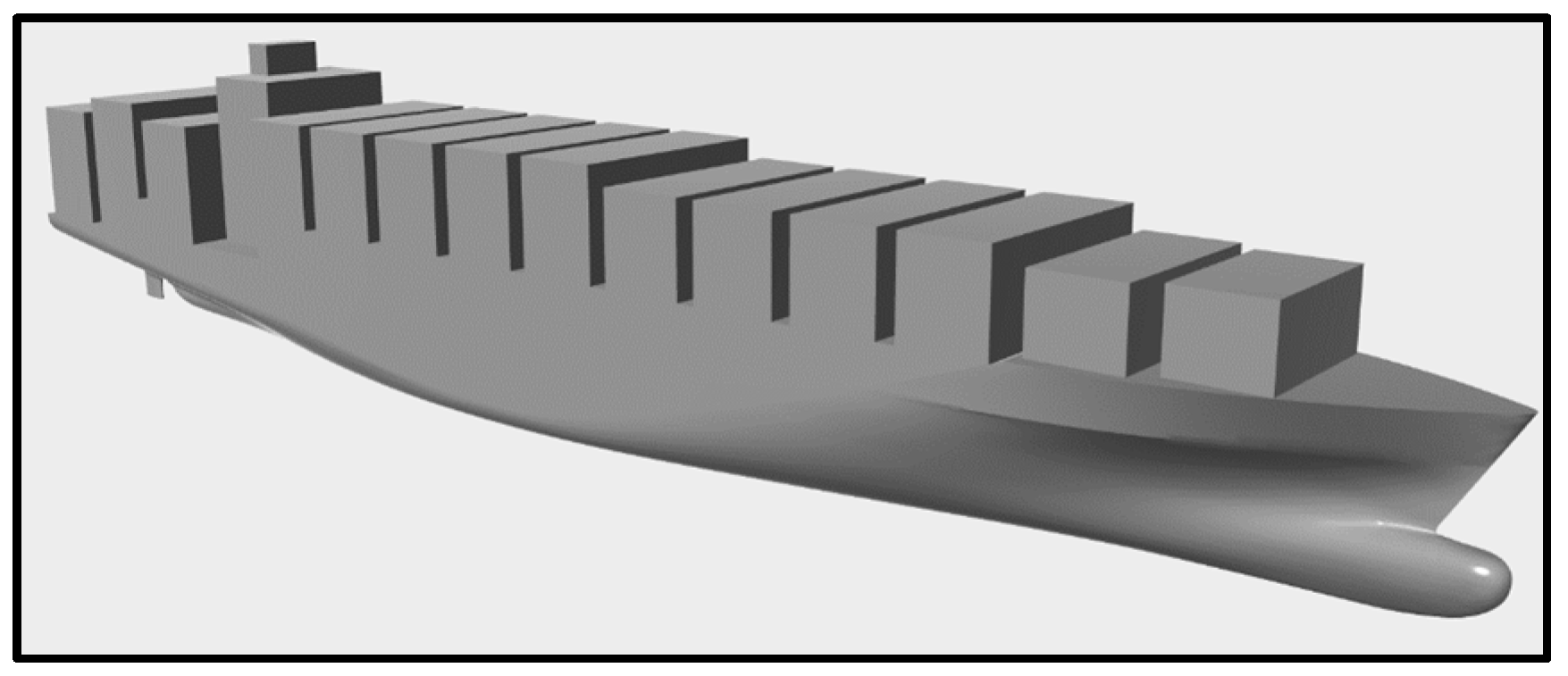
Since KCS is a container ship, any cargo carried on its deck results in increased air resistance caused by the airflow passing over the ship. In the literature, the analysis of added resistance does not consider the influence of air in the navigation zone. When a ship moves through water, its forward speed causes air resistance on the ship’s superstructure and exposed deck areas. Only self-generated air resistance was considered in this study. Based on research by Seok and Park (2020) on a container ship of comparable dimensions and load capacity [20], the KCS was assumed to have a total cargo capacity of 3600 TEU and the superstructure arrangement shown in Figure 2. In the following resistance analysis of the study, it was presumed that the ship is at maximum capacity, and the ship model with the current superstructure was used. Eleven container groups were positioned in block configuration forward of the ship’s accommodation block, while three block container arrangements were located in the aft section. The blocks in the forward part were arranged starting at the forecastle of the deck as 2 blocks of 4 rows, 4 blocks of 5 rows, and 5 blocks of 6 rows. In the aft part, there are three block container layouts, beginning at the stern, consisting of rows of 5, 6, and 5 containers, respectively.

2.2. Dimensionless Parameters

The key distinction between model-scale and ship-scale is defined by the Reynolds number (Re) (Equation (1)), where ρ denotes the fluid density [kg/m3], V represents the speed of the ship or model [m/s], L indicates the characteristic length (ship or model) [m], and μ represents the dynamic viscosity of the fluid [Pa.s]. In model-scale analysis, the Reynolds number is around 107, whereas for ship-scale assessments, it is about 109.
R e = ρ V L μ
The Froude number ( F n ), as shown in Equation (2), serves as an essential dimensionless parameter in ship design, where g represents the acceleration due to gravity.
F n = V g L

2.3. Calm Water Resistance

The International Towing Tank Conference (ITTC) establishes a method for evaluating ship resistance through a detailed analysis of its components and outlines the essential procedures required for this calculation. Vessels having design speeds with F n values below 0.45 are generally categorised as conventional displacement ships. The total resistance coefficient ( C T ), as defined in Equation (3), serves as a dimensionless parameter representing the total resistance that is experienced by a ship while moving through water. The definition involves the ratio of total resistance ( R T ) [N] to the dynamic pressure of the fluid, which is then multiplied by the wetted surface area ( S ) [m2] of the vessel’s hull [21].
C T = R T 1 2 ρ S V 2
C T = C V + C W
C V denotes the viscous resistance coefficient, while C W refers to the wave-making resistance coefficient.
C V = C F ( 1 + k )
The term (1 + k) represents the form factor of the ship, determined using the formula of Holtrop and Mennen (1982) [22]. Additionally, C F denotes the frictional resistance coefficient, which can be calculated through various methodologies. The ITTC-1957 formula specifies C F as represented in Equation (6) [23].
C F = 0.075 ( log 10 R e 2 ) 2
The C F parameters are derived from the Reynolds number and are assessed separately for both the model and ship scales. The C T M value is calculated based on the R T M value obtained from the results of the model-scale analysis. Following this, the C V M and C W values are obtained through the calculation of the Reynolds number at the velocity of the model-scale. The wave-making coefficient, which is affected by the hull’s shape, remains unchanged across both model and ship scales [20]. Consequently, the total resistance coefficient of the vessel is calculated using C F S obtained at full-scale.

2.4. Added Wave Resistance

A vessel experiences six degrees of freedom when interacting with waves: surge, sway, heave, roll, pitch, and yaw. The motions induced by waves, combined with the direct interaction between the waves and the hull, result in increased added resistance compared to conditions in calm water. Any vessel navigating in waves does not experience the same conditions as in calm water; the resistance varies as a result of its ongoing acceleration and deceleration, the upward and downward movement of wave slopes, and the fluctuating water pressures acting on its hull [24]. The variation is dependent on the frequency and amplitude of the waves. The added wave resistance is typically represented as an average value over multiple wave interactions.
The added resistance due to the waves ( R A W ) is determined by subtracting the calm water resistance ( R T , c a l m ) from the average drag force value in waves ( R T , w a v e ), as presented in Equation (7). This is expressed in a non-dimensional form in Equation (8).
R A W = R T , w a v e R T , c a l m
σ A W = R A W ρ g ζ a 2 B w l 2 / L
where ζ a is the harmonic amplitudes of the incident wave profile [m] and B w l is the width of the hull at waterline [m].
The presence of the added wave resistance coefficient ( σ A W ) facilitates the comparison of wave resistance performance across different vessels and allows for the extrapolation of model test results to full-scale ships. An increase in wavelength generally leads to a notable increase in added resistance [25,26]. Additionally, the increased resistance is significantly influenced by the ratio of the wavelength ( λ ) to the waterline length ( L w l ) of the vessel. Various forms of motion lead to unique peaks in the added resistance noted at specific frequencies. Head seas typically lead to the highest added resistance in comparison to following and beam seas [27,28].

2.5. Added Air Resistance

The superstructure of a ship, which refers to the section of the vessel located above the main deck, plays a crucial role in determining its overall air resistance [20]. This aspect can influence various operational parameters, including fuel consumption, speed, and maneuverability, particularly under conditions of strong winds [5]. The resistance introduced is determined by the design, shape, and the projected frontal and lateral areas of the superstructure [29].
The results derived from the numerical simulations are presented in alignment with the literature [29,30,31]. The Fujiwara regression formula offers a technique for calculating wind resistance by classifying the ship’s superstructure into accommodation, funnel, and additional components, resulting in the computation of wind forces and moments acting on the vessel [32]. Furthermore, Blendermann’s (1994) empirical method, derived from wind tunnel experiments on ship models in uniform flow, employs characteristic coefficients to calculate wind loads and moments at different angles of attack [33]. On the other hand, the ITTC guidelines [34] establish a procedure for calculating air load force ( R A A X ) when the air velocity is directed towards the stern, as seen in Equation (9), which is generated by subtracting the calm water resistance from the average drag force ( R T , a i r ) value of the superstructured model.
R A A X = R T , a i r R T , c a l m
The non-dimensional air load coefficient ( C D A X ) can be calculated by Equation (10).
C D A X = R A A X 0.5 ρ A V A A 2 A V X
where ρ A is the density of air flow [kg/m3], V A A represents the relative air velocity [m/s], and A V X is the transverse projected area of the windage surface [m2].

2.6. Environmental Factors and Their Effects

International rules and demands from customers determine the dimensions of machinery, equipment, and structural components when constructing maritime vehicles, ensuring that they are in line with the intended usage and operating environment. As a result, route planning for a navigation area takes current wind and wave conditions into consideration [35].
Today, the Beaufort scale, which is used in maritime navigation and spans from levels 0 to 12, is well-defined. The extended scale, ranging from 13 to 17, is specifically used in areas characterized by tropical climatic conditions. The relationship between wind speed and the Beaufort scale, as established in 1921 by the United Kingdom Meteorological Office, can be expressed by Equation (11):
v = 1.87 × B e a u f o r t   n o 3 / 2 [ m i l e s h o u r ]
In 1926, the International Meteorological Committee officially accepted the formula as Equation (12):
v = 0.837 × B e a u f o r t   n o 3 / 2 [ m / s ]
The ship’s propulsion power is directly influenced by environmental conditions, which encompass resistance from calm water, waves, wind, and currents [18]. Rapidly evaluating ship resistance during operation is a challenge. The process of averaging ship response in various sea states allows for the estimation of resistance with a specified level of variation [36].

2.7. Route and Environmental Conditions

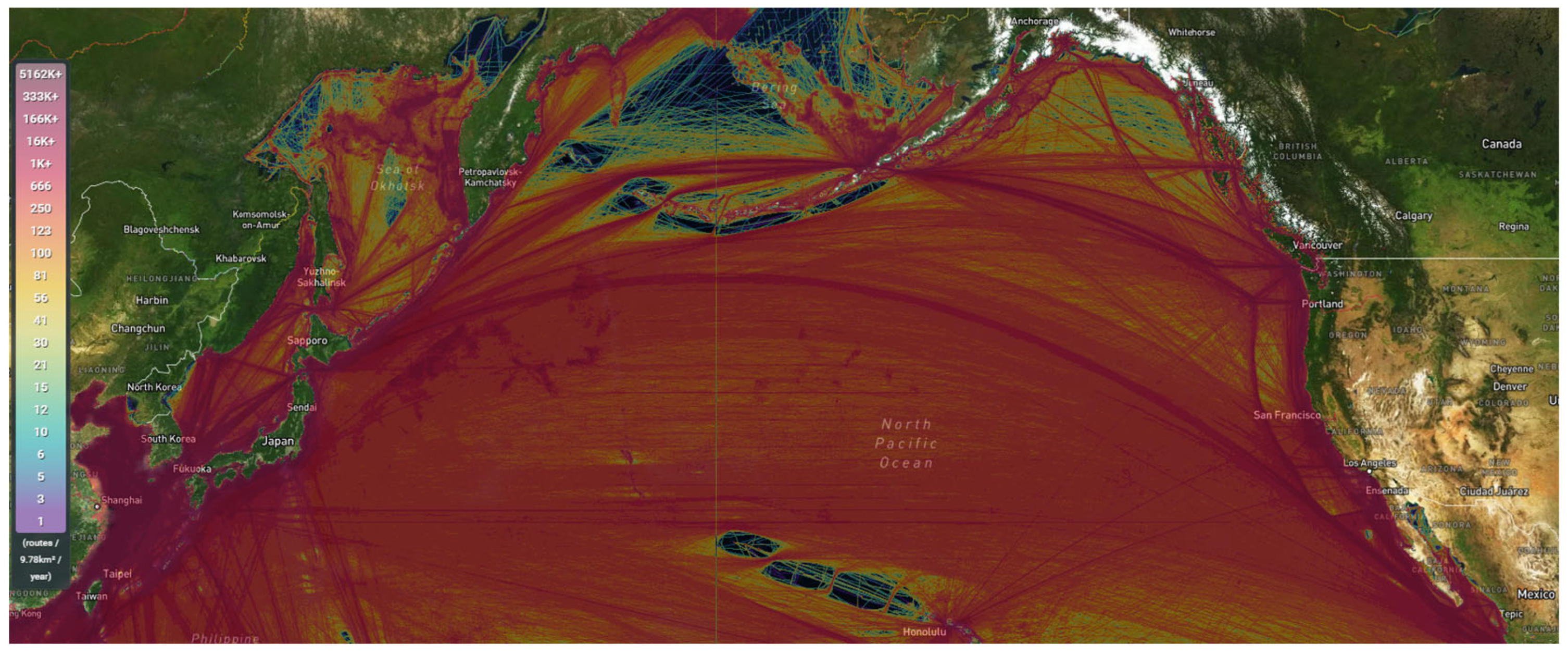
The Trans-Pacific line carried a total of 31.2 million TEU of goods in 2021, establishing itself as the route with the highest volume of container transit. The Asia-Europe line handled 26.3 million TEU containers in 2021, whereas the Trans-Atlantic line transported 8 million TEU containers [37]. Based on the statistics given, it can be inferred that the North Pacific Ocean is extensively used for container transportation. Hence, Figure 3 shows a maritime transport density map specifically focusing on transoceanic voyages conducted by commercial vessels in the North Pacific Ocean.
The analysis of the North Pacific Ocean reveals the distinct characteristics and probabilities for Sea States 4, 5, and 6. For Sea State 4, the mean significant wave height ( H 1 / 3 ) is 1.88 m, with a most probable modal wave period ( T m ) of 8.8 s (consistent across both Bales (1983) [39] and Lee and Bales (1985) [40] methods). The average probability of encountering Sea State 4 is 29.7%, based on averaging the 27.8% [39] and 31.6% [40] figures. Moving to Sea State 5, the mean significant wave height increases to 3.25 m, and the modal wave period ( T m ) slightly increases to 9.7 s. This sea state has an average probability of 22.22%, derived from individual measurements of 23.5% and 20.94%. Finally, the most severe condition, Sea State 6, features a mean H 1 / 3 of 5.0 m and a notably higher average modal wave period ( T m ) of 13.1 s (ranging from 13.8 s to 12.4 s. Sea State 6 is present 15.67% of the time on average. Notably, the probability of exceedance for these conditions is 48.2% for Sea State 4, dropping to 25.98% for Sea State 5, and 10.32% for Sea State 6. Furthermore, it was observed that Sea State 5 is suitable for computing the mean added resistance experienced by a ship operating in this region [41].

3. Methodology

Although ship resistance calculation methods have made significant progress, the ship design process still necessitates precise and thorough application of fundamental engineering principles. The ship resistance force, derived from Newton’s Third Law, is essentially the force that opposes the desired motion of a ship in calm water. To determine this force that opposes the ship’s movement, it is necessary to determine its causes, components, and elements that influence resistance. Currently, despite the progress made in technological infrastructure, experimental techniques, and computational methodologies, the scale effect between actual ships and model ships has not been completely understood [42]. The ITTC established the methodology for determining ship resistance by analyzing its components and outlining the necessary procedures for its calculation [23].
Ships need resistance and power estimates to ensure their propulsion systems can navigate safely at the service speed, especially in severe conditions. The required propulsive force can also be used to estimate the ship’s propulsion system’s dimensions, weight, and operational costs. Experimental, numerical, and theoretical methods are needed to calculate propulsion power. A ship’s hydrodynamic parameters present challenges in precise determination due to the boundary layer and free surface wave system that arises when the hull form interacts with water [43].
Estimating resistance is crucial, particularly when choosing the service speed [35]. Utilizing the precise dimensions of the vessel throughout both experimental and numerical computations necessitates significant computational resources and time. An effective approach to addressing this issue is to perform computations using a reduced model-scale ship, as suggested by Terziev et al. (2019) [44]. Nevertheless, the resistance values acquired for a model-scale ship are significantly lower in comparison to the full-scale values. When transitioning from the model to the full-scale, it is imperative to employ the extrapolation procedure. This is the standard method for determining full-scale ship resistance from model tests [43].

3.1. Numerical Analysis Parameters

The resistance exerted on the ship hull can be determined by simulating the fluid flow around the ship and analyzing the boundary conditions and dimensions of the calculation geometry. In this process, the form and size of finite volumes are of utmost importance. It is effective to discretize the fluid field into mesh elements, within which the governing equations are solved, and then analyze the results.
A ship floating on the sea can move with six degrees of freedom. Nevertheless, it is necessary to restrict the amount of time and computational resources needed for the execution of mathematical solution algorithms. Therefore, in these simulations, only heave and pitch motions are typically considered. The restriction on motion also extends to investigations with ship models and is universally recognized [23].
The calculation parameters determined from the validation studies of the CFD method were intended to yield analysis results with an acceptable level of error in the most efficient manner. The essence of CFD analysis conducted using the finite volume method involves dividing the geometry into small volumes and solving the governing equations for the physical parameters within each volume. This procedure was accompanied by a set of parameters and limits. The following is a comprehensive list:
  • Determining the size of the control volume;
  • Defining the fluid properties;
  • Defining initial and boundary conditions;
  • Defining the ship’s allowed degrees of freedom, and;
  • Defining mesh characteristics.
The selection of equations for the solution procedure was determined based on these assumptions and constraints. The characteristics of the numerical solution employed in this study are described below.
  • Unsteady Reynolds-Averaged Navier–Stokes equations;
  • Multiphase flow condition;
  • Volume of Fluid methodology with HRIC (High-Resolution Interface Capturing) algorithm to simulate free surface and multiphase interactions;
  • Segregated flow solver for velocity and pressure calculations;
  • Turbulent flow modelling with Realizable k-epsilon two-layer wall treatment algorithm;
  • Dynamic Fluid Body Interaction (DFBI) motion with activated heave and pitch motions for ship geometry;
  • Ship release time 1.0 s and ramp time 5.0 s to mitigate errors during initial iterations;
  • Total simulation time 250 s.
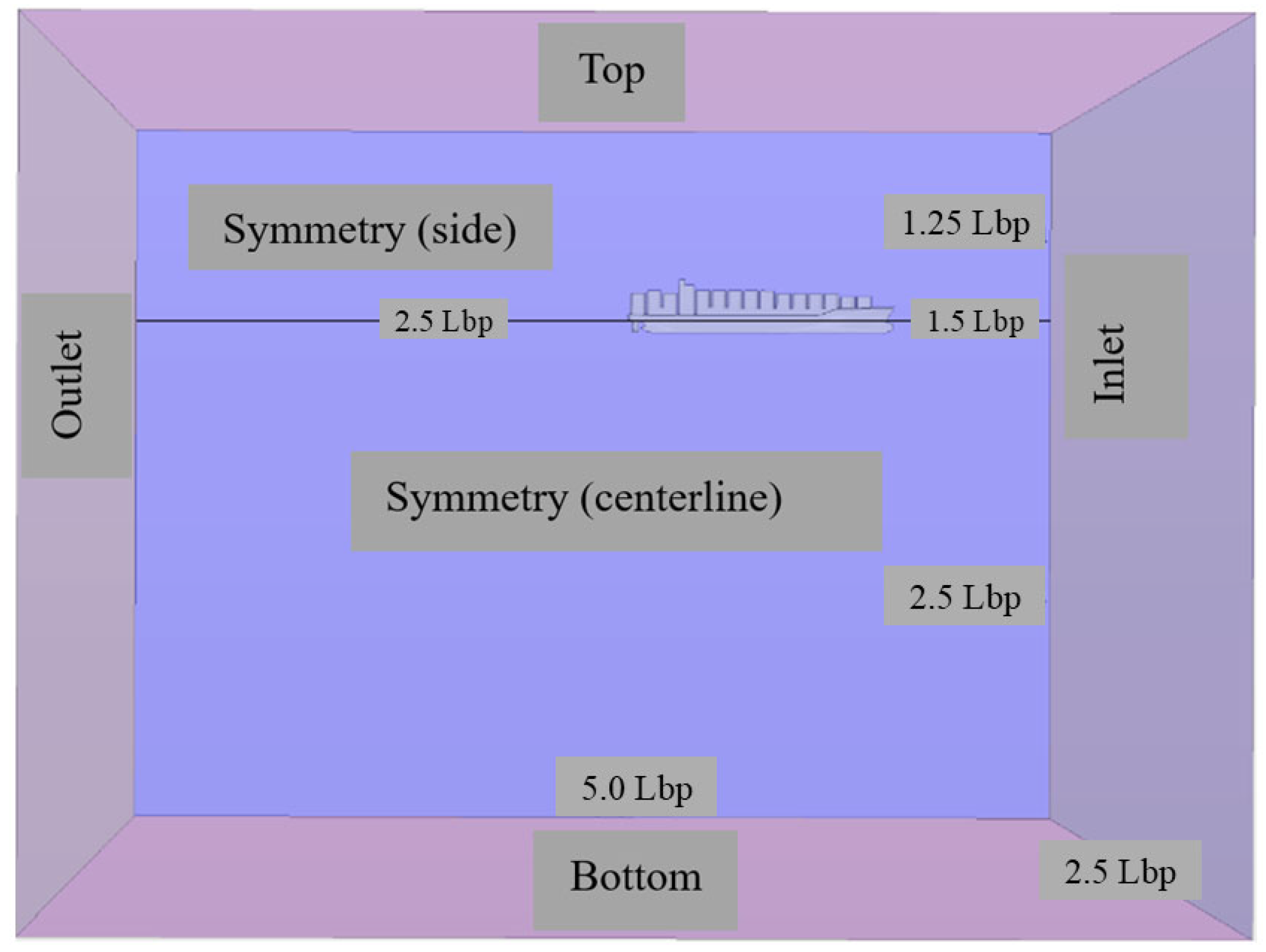
Figure 4 displays the control volume dimensions and boundary conditions based on the provided parameters. The surface designated as the ‘Inlet’ (velocity inlet) was partitioned into two sections: a 1.25 × L b p height air inlet and a 2.5 × L b p depth water inlet. The fluid velocities entering the control volume remain constant throughout time, and in order to reach the bow of the ship, it must travel a distance equivalent to 1.5 × L b p from the inlet to reach the bow of the ship. The ‘Outlet’ surface (pressure outlet) is where fluid exits the domain, typically defined with conditions that allow for the natural development of the flow. Fluid that passes the ship’s hull must travel a distance of approximately 2.5 × L b p to reach this outlet. The ‘Top’ surface (velocity inlet) refers to the uppermost surface of the air-filled space above the waterline, via which air enters the control volume. The ‘Bottom’ surface (velocity inlet) refers to the area that is situated 2.5 × L b p under the free water surface or waterline. This depth ensures that the ship’s movement is not affected by seabed proximity (deep water condition). To expedite CFD calculations, one might define ‘Symmetry (centerline)’ by acknowledging the substantial similarity between the port and starboard sections of the ship. By employing this approach, the amount of time required for calculations was reduced. As half of the resultant forces exerted on the ship were computed, the analysis results were doubled in the post-processing phase. The surface referred to as the ‘Symmetry (side)’ was positioned 2.5 × L b p away from the centerline of the model ship. This distance is sufficient to ensure that the generation of free surface waves is not impeded. Simultaneously, this definition inhibited the reflection of water and air from the lateral surface.
The water density utilized in CFD analyses is 997.561   k g m 3 , accompanied by a dynamic viscosity of 8.8871 × 10 4   P a . s . The density of air is 1.18415   k g m 3 and its dynamic viscosity is assumed to be 1.85508 × 10 5   P a . s . The ship’s center of gravity experiences a gravitational acceleration of 9.81   m s 2 .
All computational fluid dynamics simulations performed in this research are time-dependent, simulating a duration of 250 s for ship motion in each investigation. In calm water resistance analyses, the time step was fixed at 0.006 s. In the study of the irregular wave system, the time step was calculated as the wave period divided by 256. Additionally, the simulation of irregular sea states was conducted using the Unsteady Reynolds-Averaged Navier–Stokes equations with the Volume of Fluid methodology, coupled with the HRIC algorithm, and turbulence modeled by the Realizable k-epsilon model. Utilizing the Pierson–Moskowitz wave spectrum, a physical wave signal was implemented at the computational domain’s ‘Inlet’ boundary by applying a generated time-series profile derived from 500 wave frequencies. For each distinct test case, one continuous time-series signal was generated and simulated over a duration of 250 s in head sea conditions. To ensure physical stability and derive statistically significant mean results, the resistance values were computed as the time-averaged mean throughout the last 100 s of stable hull motion, explicitly excluding the initial 50-s transient period. The time step was precisely calculated as the wave period divided by 256 to guarantee temporal resolution. Also, the characteristics of the Pierson–Moskowitz wave spectrum used to generate the irregular sea waves in this study are presented in Table 2, based on annual sea state data from the North Pacific Ocean and a model-scale of 31.599. Furthermore, as a limitation, we can explicitly state that the results represent the time-averaged mean added resistance for the chosen wave realization under the Pierson–Moskowitz spectrum, not a full statistical distribution analysis.
To convert annual sea state data from ship-scale to model-scale, the square root of the scale factor was applied.
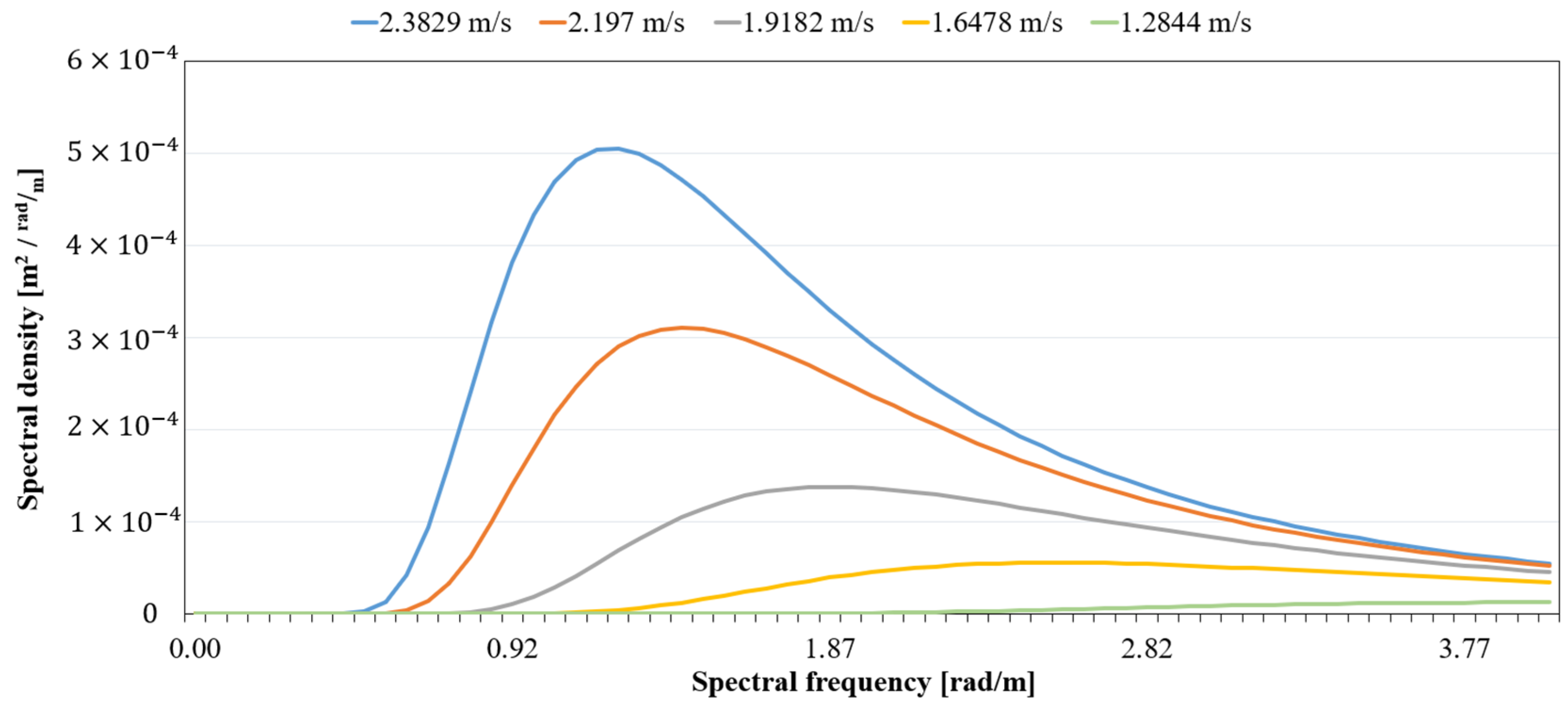
A well-known model of the energy distribution of ocean waves in fully developed seas, primarily caused by wind, is the Pierson–Moskowitz (PM) wave spectrum. This spectrum is defined by an empirical formulation that links wave energy density to wind speed and wave frequency. The PM spectrum is crucial for comprehending wave dynamics in offshore settings and functions as a fundamental model for diverse applications, such as offshore wind energy evaluations and wave energy forecasts [45]. The spectral density for model-scale resistance calculations is shown in Figure 5.
It is essential to assess navigation safety in severe weather circumstances while operating at speeds ranging from 0.108 to 0.282 Froude number within the designated operational region. The IMO guide titled ‘Revised Guidance to the Master for Avoiding Dangerous Situations in Adverse Weather and Sea Conditions’ suggests that if the encounter wave period ( T e ) nears twice the wave period ( T m ), navigation safety is at risk [46].
T e = 3 T m 2 3 T m + V cos α [ s ]
where V is for ship velocity [knot], and α wave direction angle ( α = 0 ° headwaves)
The assessment of sea states for the CFD analyses conducted at the model-scale is detailed in Table 3, encompassing sea states 4, 5, and 6 of the North Pacific Ocean in head sea condition.
Table 3 illustrates that speed reduction is a critical operational measure to mitigate hazards in the marine environment. It is advised not to exceed a Froude number of 0.26 for Sea State 4. This is also applicable to Sea States 5 and 6. Furthermore, all assessed conditions remain within the parameters of safe navigation.
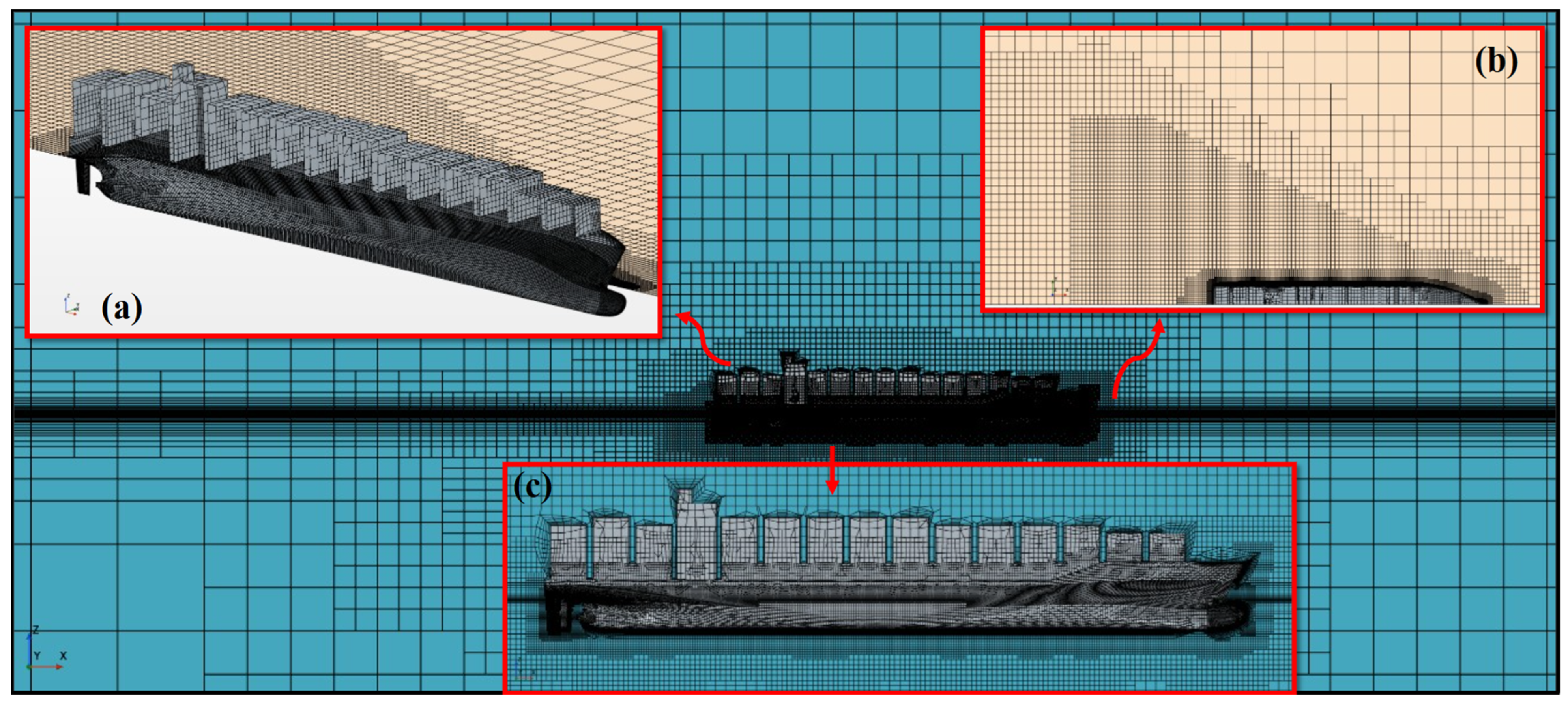
Figure 6 displays the mathematical solution network view, which was generated using the previously calculated mesh parameters shown in Table 4, specifically amidships. The mesh structure around the ship geometry and the ocean surface exhibits high refinement (is dense), whereas the refinement decreases (becomes coarser) further away from these regions. The resistance acting on the ship’s hull while moving through a fluid field was calculated. The influence of the hull on the flow field diminishes with distance, so a highly refined mesh is not required throughout the entire control volume. This study aims to calculate the air resistance generated by the superstructure, along with the hydrodynamic forces acting on the portion of the ship in contact with the water. The properties of mesh distribution for the hull and superstructure were adapted accordingly. To maintain consistency, a y + value of 50 was chosen for the calculation of hydrodynamic and aerodynamic forces throughout the study. The computational mesh for the superstructure model, configured for a F n value of 0.26, contains approximately 9.7 × 10 5 mesh elements based on y + = 50 . Moreover, distinct prism layers were defined for varying ship velocities.
In this study, only heave and pitch motions are actively examined due to the focus on head waves; thus, rolling and yawing motions that compromise stability were excluded from consideration. The study focuses on estimating the installed engine power, excluding consideration of transverse stability issues, while assuming the ship was at an even keel, meaning the LCB (Longitudinal Centre of Buoyancy) is vertically aligned with the LCG (Longitudinal Centre of Gravity) for zero trim. Analyses were performed using the assumption that the transverse center of gravity is on the centerline, and the vertical center of gravity was positioned 0.3418 m above the keel for the model ship, assuming an evenly distributed weight.

3.2. Verification Study

In this study, the CFD simulation findings were validated using model experiment data, as is commonly done in similar research. Therefore, once validated, the CFD method was used for further analyses by varying relevant parameters. The experimental test conducted in the calm water towing tank (EFD) [19] and the computational fluid dynamics (CFD) results of a scale factor of 1:31.599 model of KCS, without considering the superstructure, are provided in Table 5.
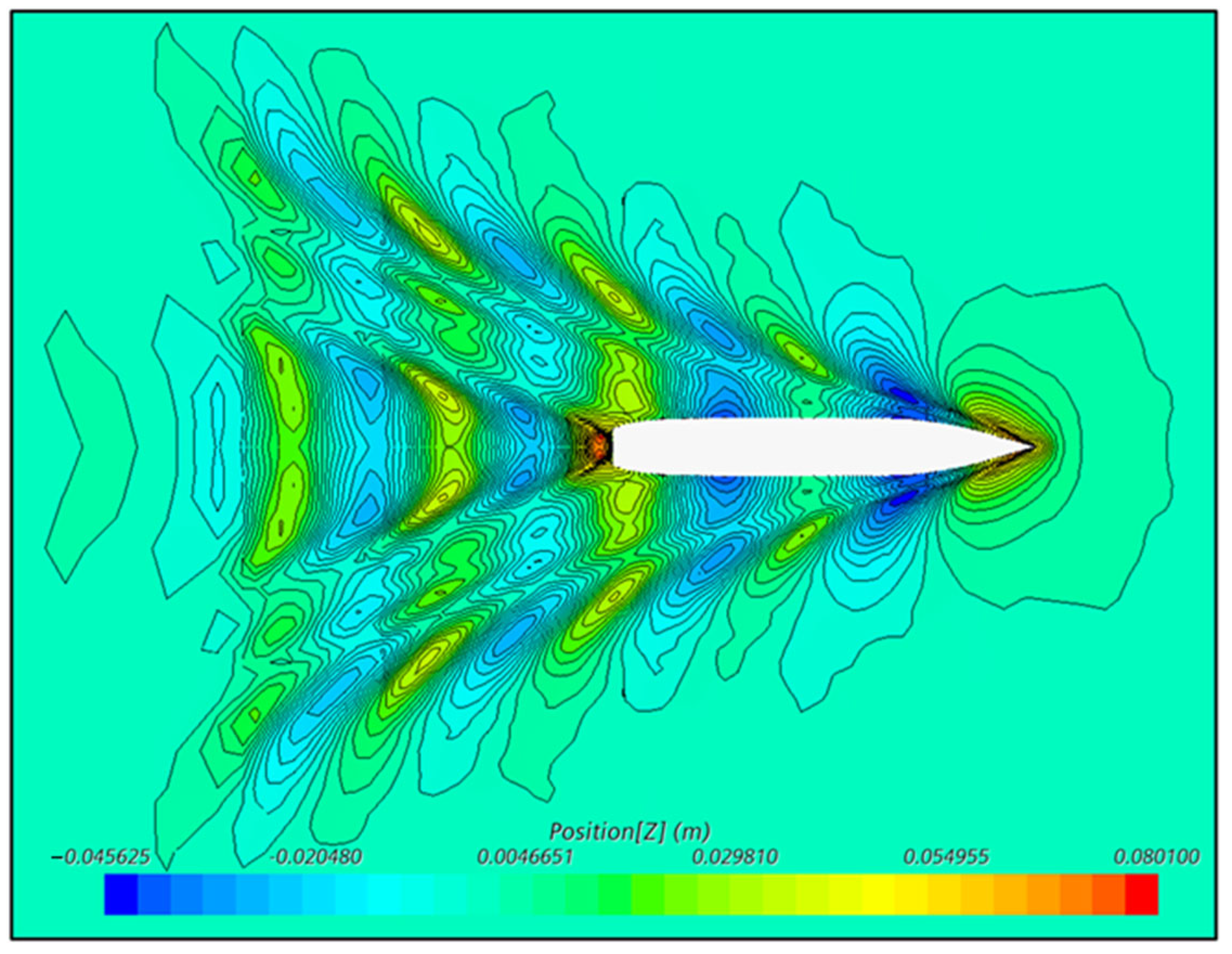
Given that the typical margin of error in these investigations is approximately 5% [19], the calculation parameters used in the CFD approach were considered suitable for conducting further analyses within the considered scope. The free surface wave pattern, resulting from the ship’s forward motion in the water and observed during the validation investigations, is depicted in Figure 7. A convergence criterion of approximately 10 3 was applied to all analyses.
The relationship between model ship speed V m and full-scale ship speed V s is given by Froude number scaling (Equation (14)):
V m = V s / ( L s L m ) 0.5
where L s is the calculation length of the ship and L m is the calculation length of the model.
To get robust and accurate analysis results, the choice of numerical model parameters should prioritize accurate geometric representation of the ship’s hull, particularly in the bow and stern areas. In CFD, experimental tests can be simulated by either moving the ship geometry through a stationary fluid domain or by having fluid flow past a stationary ship geometry. Both methods involve the ship undergoing heaving and pitching motions, allowing for the determination of the ship’s pitch and heave values at various speeds. Furthermore, the CFD method can be used to predict added resistance in various sea conditions. The reference calm water resistance component of this method was verified with calm water test results.
Uncertainty analysis in numerical simulations is a fundamental aspect of computational modelling, especially in domains such as fluid dynamics, structural engineering, and environmental research. This examination seeks to evaluate the uncertainties inherent in model inputs and their propagation during the simulation process, which ultimately influences the dependability of the results. Numerous researchers have developed methodologies aimed at minimizing uncertainty [47].
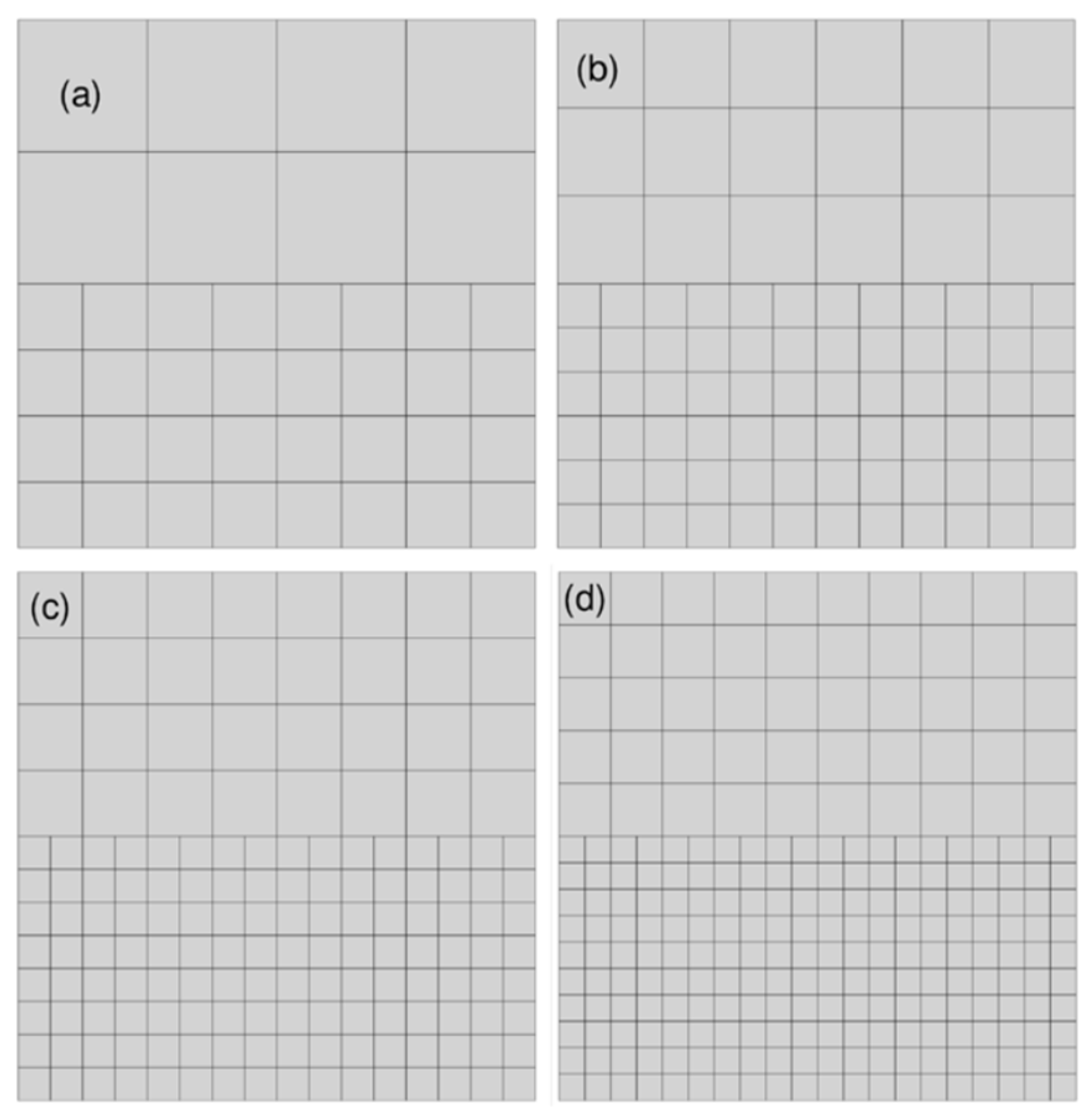
A series of geometrically comparable grids is crucial for accurately estimating numerical uncertainty, ensuring consistent grid characteristics and a uniform refinement ratio throughout the computational domain. The generation of a series of systematically refined grids can be accomplished by either coarsening a fine grid or refining a coarse grid. Figure 8 provides an obvious illustration of this series [48].
The uncertainty analysis applied to the CFD methodology in this study utilized the analysis parameters listed in Table 6.
The total resistance value for the model ship, operating at F n = 0.26 under conditions of upright and straight-ahead run, is documented in Table 7 within the context of the uncertainty analysis.
To ensure consistency of results in the subsequent analyses of this study, various mesh sizes and time steps were evaluated in the calm water resistance calculations conducted on the model ship form without the superstructure. Consequently, Table 7 illustrates the effect of mesh base size on the calculated resistance, with fine meshes (smaller base size) yielding different resistance values as the solution approaches grid independence.
By obtaining the specified solutions, one can determine whether the solution converges in a monotonic manner, exhibits oscillatory behavior, or diverges. The calculation uses the convergence ratio, as specified in Equation (15) [49].
R = ε 21 / ε 32
where f 1 ,   f 2   a n d   f 3 are the results; ε 21 = f 2 f 1 represents the change between medium and fine, and ε 32 = f 3 f 2 represents the change between coarse and medium. The convergence conditions are defined by the ITTC (2021) as follows [48]:
  • for 0 < R < 1 : Monotonic convergence;
  • for R < 0 : Oscillatory convergence;
  • for R > 1 : Divergence.
To determine the order of accuracy ( p ), refer to Equation (16) [49].
p = 1 ln r ln ε 32 ε 21 + q ( p )
where the function q p = 0 for a uniform refinement ratio; for a non-uniform refinement ratio, it is given in Equation (17).
q p = ln r 21 p s r 32 p s
where s = s i g n ( ε 32 / ε 21 ) , refinement ratios between medium-fine ( r 21 p ) and coarse-medium ( r 32 p ). Then, the extrapolated solution ( f e x t ) is predicted by Equation (18).
f e x t = ( r 21 p f 1 f 2 ) / ( r 21 p 1 )
For Grid Convergence Index (GCI), Equation (19) was given.
G C I 21 = 1.25 f 1 f 2 f 1 / ( r 21 p 1 )
This study reveals that while a decrease in the mesh base size led to some discrepancies with experimental results, an evaluation of the GCI values shown in Table 8 demonstrates that the CFD results maintain a high standard of quality. The modifications made to the base size were limited to the fluid domain, which ensured that the mesh structure of the hull and superstructure remained unchanged. This method was implemented to maintain the geometric integrity of these essential components, thereby ensuring consistency in the simulation results. A refinement process similar to [50] that was used for the mesh base size was also applied to the time step, and the consistency of the chosen temporal discretization was thoroughly examined. The methodical analysis produced GCI values of 1.37% for the base size and 2.45% for the time step. The observed satisfactory GCI values support the suitability of the created mesh structure for use in future analyses. Additionally, the chosen base mesh dimension of 0.1125 m complies with the guidelines established by the ITTC for computational fluid dynamics analyses performed in wave conditions. The guidelines define a minimum requirement of 80 cells for each wavelength and 10 cells for each wave height. The adherence to these criteria supports the rationale for utilizing this mesh configuration in analyses related to wave interactions as well as in scenarios involving calm water conditions.

3.3. Benchmarking Air Resistance Against Standardized Methods

To mitigate the inherent uncertainties associated with CFD and to validate the accurate implementation of the RANS solver, this section presents a benchmark of calculated added resistance values against literature and industry-standard predictive methodologies. The comparison process is crucial for verifying the dependability and practical applicability of the employed methodology, as it involves corroborating the results with established research on the benchmark KCS hull form and assessing adherence to formal ITTC semi-empirical standards. ITTC [23] recommended the calculation of the air resistance coefficient ( C A A ) is denoted as in Equation (20):
C A A = C D A ρ A A V X ρ S S S
where ρ A is the density of air [kg/m3], A V X is the projection area above the waterline [m2], ρ S is the density of sea water [kg/m3] and S S is the wetted surface area of the hull [m2], and the factors for calculating the C A A are given, respectively, as: 1.23 kg/m3, 1.04 m2, 1025.9 kg/m3, 9.553 m2. The ITTC recommends using 0.8 as the default value for C D A (air drag coefficient above the waterline) within the range of 0.5 to 1.0 when the particular value is unknown.
Kristensen and Lützen’s [51] proposed the C A A estimation, as presented in Equation (21), is predicated on a container ship’s cargo capacity and does not exceed 0.09.
C A A × 1000 = 0.28 × T E U 0.126   l e s s   t h a n   0.09
Efforts to quantify air resistance on ships’ surface structures by simplified and standardized techniques are frequently undertaken due to the time and costs associated with computer simulations. Nevertheless, when exact calculations are necessary, a meticulously calibrated CFD analysis is employed to provide more accurate findings. Table 9 illustrates that the values derived from the ITTC-recommended approach and the CFD study corroborate each other. The method developed by Kristensen and Lützen also yields results that are not significantly divergent from these findings, making it preferable for establishing a preliminary value in scenarios with limited data availability.

4. Results

Accurately evaluating vessel performance and their power requirements in realistic operational scenarios is of paramount significance. This requires moving beyond simplistic assumptions of calm water to consider the complex interplay of environmental variables, such as various sea states and air resistance effects. This comprehensive approach becomes even more pertinent given the maritime industry’s increasing emphasis on energy efficiency and alternative propulsion systems. The present study undertakes such an evaluation by analyzing the hydrodynamic properties of the KCS model ship, including resistance and motions, under a variety of simulated environmental conditions.
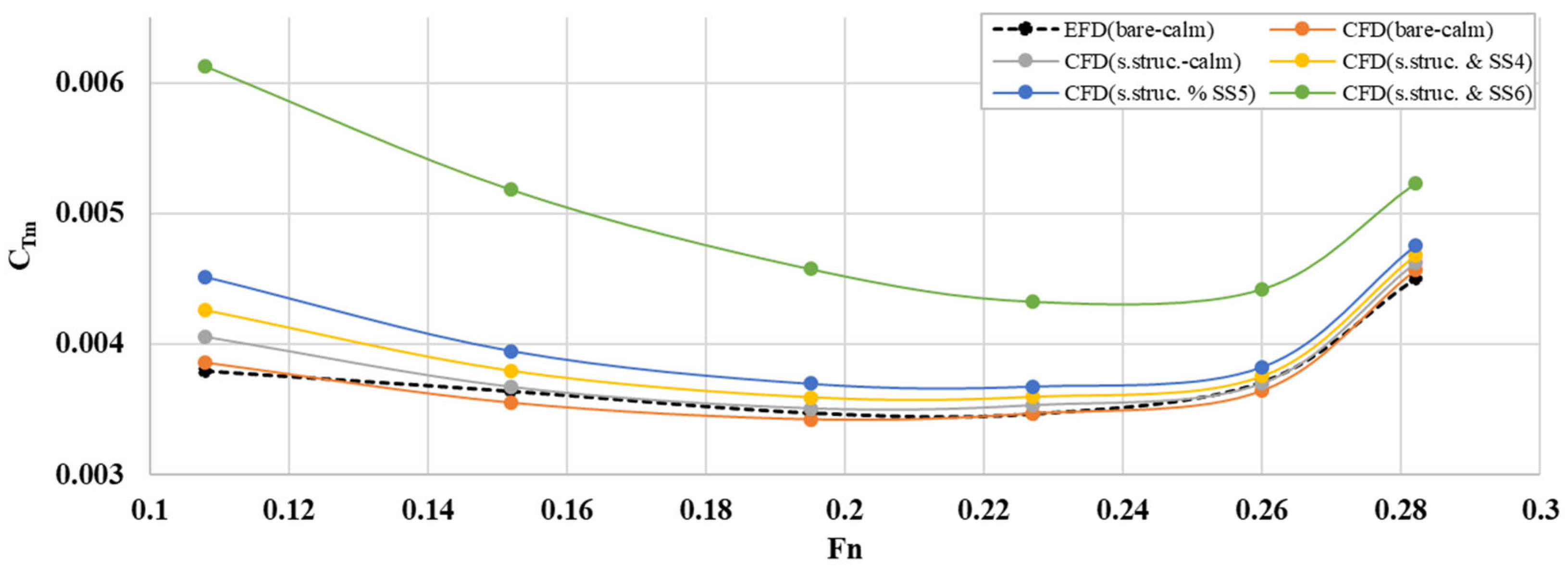
Figure 9 demonstrates the total resistance coefficients ( C T m ) for the vessel against the Froude number, comparing bare hull and superstructured conditions in calm water, as well as various open sea states. Notably, the minimum resistance coefficient is generally observed between Fn = 0.20 and Fn = 0.24. This situation illustrates that the optimal cruising point is determined by a combination of factors, including wave-making resistance and viscous resistance, which affect the ship’s performance at varying Froude numbers. At low Froude numbers, viscous resistance dominates, whereas at higher Froude numbers, wave-making resistance increases. The optimal combination of these two factors yields a minimal total resistance coefficient within a specified Froude number range. Additionally, the CFD predictions for the bare hull exhibit satisfactory alignment with EFD data, albeit with minor divergences. The addition of a superstructure invariably leads to an increase in total resistance. Furthermore, increasing sea state severity results in considerable and consistent increases in C T m when compared to calm water conditions, emphasizing the significant added resistance caused by waves. This phenomenon is evident across the Froude number range, with the influence of SS6 being especially significant at lower Froude numbers. These results emphasize the crucial impact of structural configuration and environmental conditions on the hydrodynamic performance of a vessel.
Table 10 reveals several significant trends concerning added resistance, expressed as a percentage of calm water bare hull resistance. At the minimum Froude number, F n = 0.108 , the added wave resistance increases from 5.33% in SS4 and 11.83% in SS5 to a significantly increased 53.76% in SS6. This significant rise can be attributed to the phenomenon where, at lower speeds, the vessel “collides” with the waves, a situation that becomes more noticeable. When the vessel moves at a lower speed, it directly absorbs the energy of the waves, resulting in a substantial rise in resistance. At higher velocities, the vessel can move through the waves faster, so reducing the relative impact of wave-making resistance to a certain extent. Consequently, the ratios for added air resistance in calm water, and for added wave resistance across Sea States 4, 5, and 6, decrease as the Froude number increases. This trend indicates that these added resistances constitute a smaller fraction relative to the calm water bare hull resistance at higher speeds. The influence of sea state severity is also pronounced: for any specified Froude number, the added wave resistance ratio increases dramatically from SS4 to SS5, and further to SS6. For example, at F n = 0.108 , added wave resistance climbs from 5.33% in SS4 to 11.83% in SS5, and to a substantial 53.76% in SS6. This demonstrates that added wave resistance, even in moderate and especially in severe sea conditions, significantly exceeds the relatively minor contribution of added air resistance, which ranges from 1.28% to 5.21%. The most severe sea state, SS6, accounts for the largest percentage of added resistance, particularly at lower Froude numbers, emphasizing its substantial impact on the vessel’s total resistance in challenging conditions.
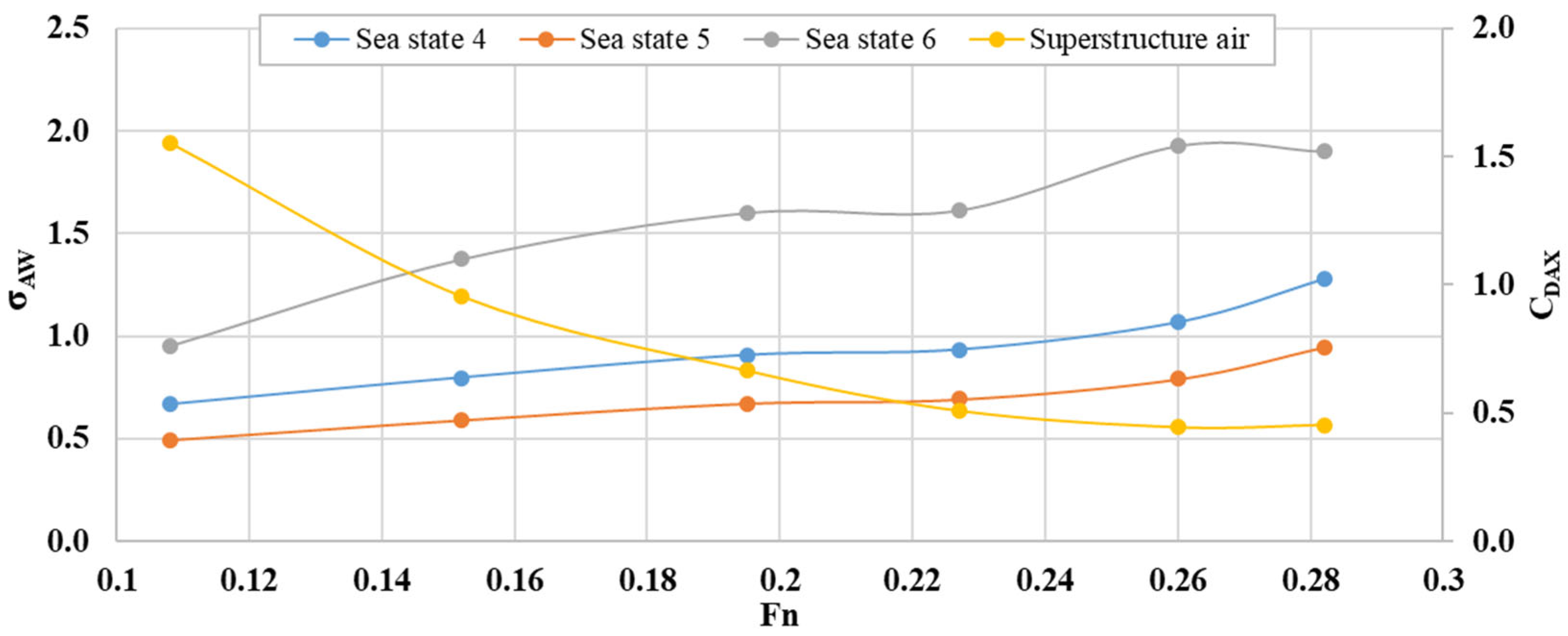
Figure 10 presents the relationship between two specific coefficients and the Froude number: σ A W , which denotes an added wave resistance coefficient (or a related wave effect parameter) for Sea States 4, 5, and 6, and C D A X , which represents an air drag coefficient associated with the superstructure in calm water conditions. A prominent conclusion is that σ A W generally increases with increasing the Froude number; Sea State 6 exhibits the highest values, followed by Sea State 4, and then Sea State 5. The wave frequencies and wavelength-to-ship length ratios of the SS4 condition yield more significant results for this ship form compared to those of SS5. Notably, Sea State 6 displays a complex pattern, starting relatively high at low F n values, experiencing a substantial increase, followed by a more gradual rise with some fluctuation, and ultimately reaching a peak towards the higher end of the F n range shown. In contrast, the superstructure air drag coefficient, C D A X , shows a clear decreasing trend as the Froude number increases. Consequently, at higher Froude numbers, C D A X values become significantly lower than those of σ A W for all depicted sea states, emphasizing the distinct responses of wave-induced and aerodynamic factors to variations in vessel speed.
Figure 10 illustrates a significant trend indicating that the non-dimensional added wave resistance coefficient ( σ A W ) for Sea State 4 is consistently greater than that for Sea State 5 throughout the majority of Froude numbers. This ostensibly paradoxical outcome arises from the normalization factor in σ A W (Equation (8)), which incorporates the square of the wave amplitude ( ζ a 2 ). Although the absolute added resistance ( R A W ) is elevated in SS5 due to the increased wave height (as demonstrated by the greater total resistance coefficients in Figure 9), the non-dimensional coefficient is determined by the vessel’s resonance characteristics. The modal wave period of the simulated SS4 (8.8 s at ship scale) is more closely aligned with the natural pitch and heave periods of the KCS hull form compared to the modal period of SS5 (9.7 s). The frequency alignment induces a more pronounced dynamic motion response in the SS4 condition compared to its wave energy, leading to an increased non-dimensional added resistance coefficient ( σ A W ). This phenomenon demonstrates that the added resistance is significantly influenced by the ratio of wavelength to ship length ( λ / L w l ), which governs the emergence of resonance peaks.
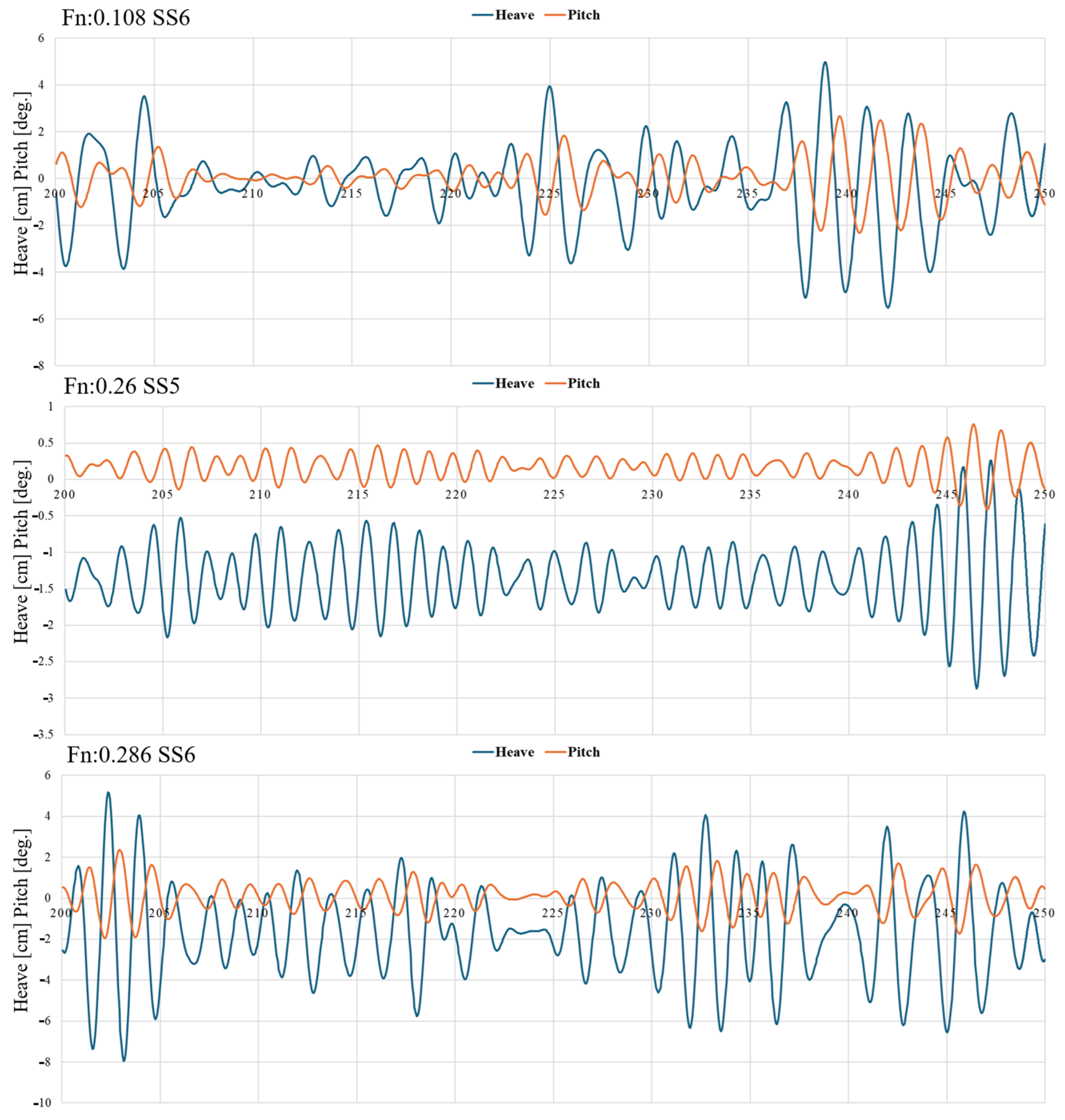
The preceding sections presented the hull characteristics, the irregular wave environment, and the parameter values of the numerical solver. The calm sea environment does not accurately represent real voyage conditions. Considering this and the growing interest in alternative propulsion systems, it is crucial to calculate vessel power requirements during navigation based on environmental variables. Given that the North Pacific Ocean, the marine environment examined in the study, is heavily trafficked by container vessels, it is essential to understand the correlation between hull motions and the marine environment, beginning with the mean annual sea conditions. Consequently, the heave and pitch motions of the model ship in various sea states are illustrated in Figure 11.
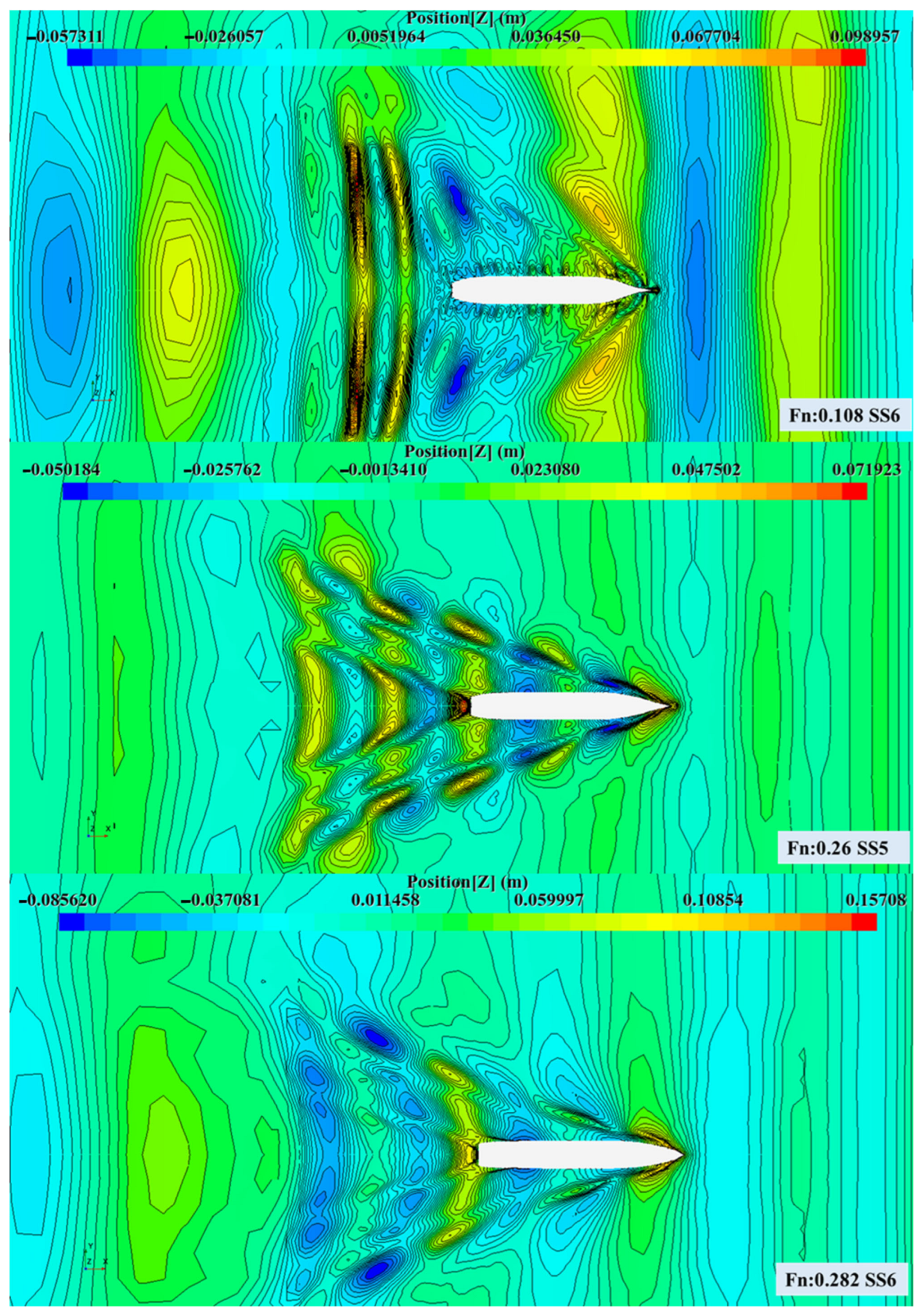
Figure 12 presents the wave conditions observed during the last second of a 250-s analysis period, detailing different sea states and model ship velocities, while emphasizing the free surface affected by the vessel’s speed and the characteristics of the sea state.
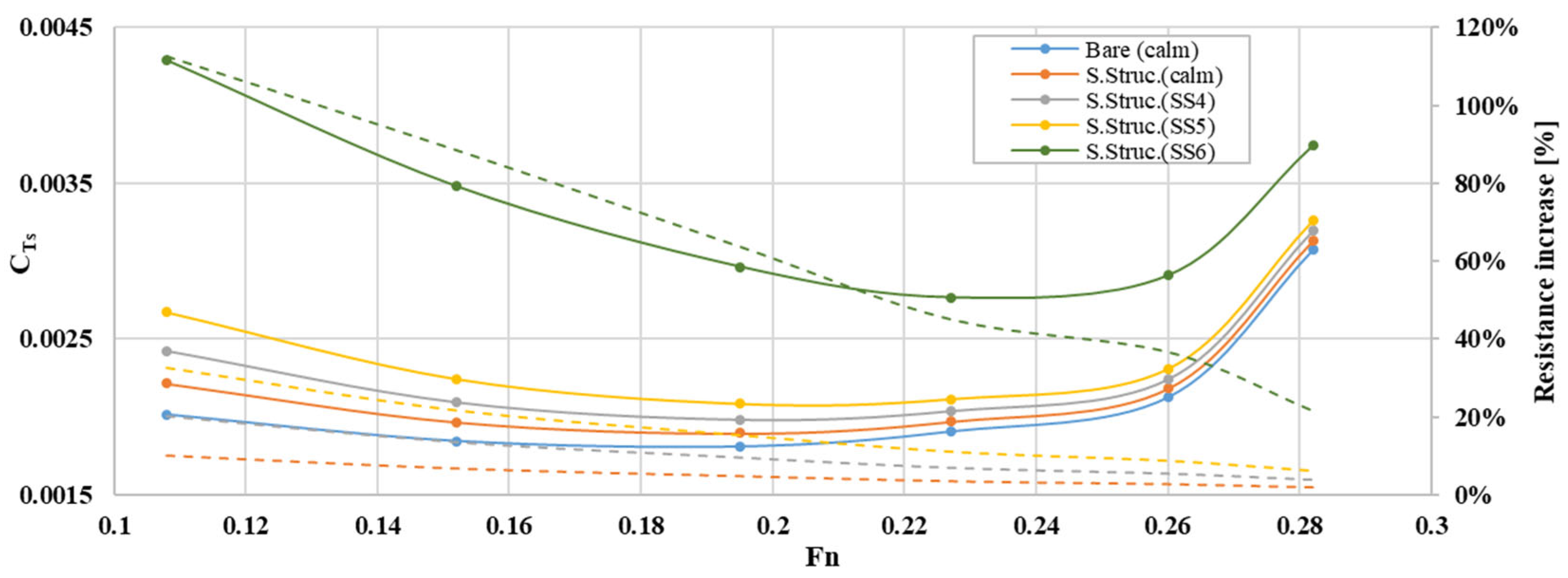
Figure 13 shows the total resistance coefficient at the ship-scale for several conditions, together with the resistance increase ratios [%] by dashed lines. When operating in calm water, integrating a superstructure produces a consistent increase in resistance compared to the bare hull model. Moreover, increasing the sea state from calm to SS4, SS5, and finally SS6 produces a clear and consistent rise in CTs for the superstructured vessel over all speeds. Relative to the superstructured calm water condition, the resistance increase ratios due to waves show that the influence of waves is most significant at lower Froude numbers, declining as F n increases until a certain interval. The effect is especially pronounced in Sea State 6, where the added resistance from low-speed waves might surpass the superstructured calm water resistance of the vessel. In this regard, the resistance increase ratio related only to the superstructure (in contrast to the bare hull) similarly peaks at low Fn. These results indicate that while the added resistance caused by waves can be significant at various speeds, its impact is greatest at lower speeds, which especially raises the power needed for SS6.

5. Discussions and Conclusions

This study investigated the hydrodynamic properties of the KCS model ship, analyzing resistance and motions under a variety of simulated wave conditions to highlight the importance of moving beyond simplistic calm water assumptions for accurately evaluating vessel performance. Consequently, essential conclusions can be drawn regarding fuel efficiency and the reduction in environmental impact in maritime transportation operations. To align with the goals of sustainable maritime transportation, it is essential to develop strategies for minimizing resistance, particularly to meet the IMO carbon emission reduction targets. Understanding and accurately calculating resistance, as demonstrated, will support beneficial impacts on the sector by aligning with strategies aimed at reducing carbon emissions. Route and operational conditions in heavily trafficked shipping routes like the North Pacific can influence global supply chain duration. Increased ship resistance can result in higher fuel consumption and increased costs, which ultimately impact shipping rates. Enhancing efficiency, particularly for container ships, plays a crucial role in promoting the sustainability and reliability of the supply chain.
Typically, a vessel’s overall resistance may escalate by 15% to 30% relative to its resistance in calm waters, with this rise potentially being more significant under extreme conditions [25]. The added resistance ratio ( R w a v e / R c a l m ) for a container ship was around 5.4% in bow quartering seas (60°) and remained significant at 2.3% in stern quartering seas (135°) at moderate environmental conditions, and on the other hand, an average increase of 3.9% attributed to oblique waves may result in a speed reduction exceeding 0.2 knots [52].
The analysis indicated that the minimum C T m for the case KCS model is typically found within the Froude number range of 0.20 to 0.24. The calculations from CFD for the bare hull showed a strong correlation with the experimental data. The incorporation of a superstructure consistently resulted in an increase in total resistance when compared to the bare hull. Additionally, increasingly severe sea states (SS4, SS5, and SS6) resulted in significant and consistent increases in C T m when compared to calm water conditions. This highlights the considerable added resistance caused by waves throughout the assessed Froude number range. The observed effect was consistent across all Froude numbers, with SS6 demonstrating a notably significant impact on the lower Froude numbers. The findings collectively emphasize the significant impact of structural configuration and existing wave conditions on a vessel’s hydrodynamic performance.
Expressed as a percentage of the bare hull’s calm water resistance, both the added air resistance in calm water and the added wave resistance in Sea States 4, 5, and 6 decrease as Froude numbers increase. This trend indicates that as operational speeds increase, the components contributing to added resistance represent a decreasing fraction of the total resistance when compared to the calm water bare hull resistance. The magnitude of the sea state had considerable consequences; for each specific Froude number, the increase in wave resistance ratio increased substantially from SS4 to SS5 and then increased further to SS6. At a Froude number of 0.108, the added wave resistance indicated an increase from 5.33% in SS4 to 11.83% in SS5, and finally to a prominent 53.76% in SS6. This demonstrates that the increase in wave resistance, especially in moderate to severe sea conditions, significantly exceeds the relatively small impact of added air resistance, which ranged from 1.28% to 5.21%. As a result, the most critical condition, SS6, accounted for the highest share of added resistance, particularly at lower Froude numbers, emphasizing its substantial effect on the vessel’s total resistance in harsh conditions.
The study emphasizes that digitalization is becoming increasingly significant in fields like route optimization and the monitoring of weather and sea conditions in maritime contexts. Cutting-edge technologies like machine learning and data analytics facilitate real-time operational decisions by predicting ship resistance under various sea conditions. Technological integrations have the potential to enhance the speed and cost-efficiency of operational processes in the maritime sector. Proactively addressing environmental resistance impacts demonstrates the potential for compliance with existing regulations while also offering a competitive advantage. Adhering to IMO emission limitations and energy efficiency regulations can enhance companies’ brand value and position them to meet more stringent environmental requirements in the future.
The present analysis was limited to head sea conditions (0° angle), self-generated air resistance (disregarding environmental wind), and a single, fully loaded, even-keel condition. Consequently, future research will be directed toward a more comprehensive model investigating the combined effects of ambient wind and waves from various angles. Further studies will also evaluate the impact of different container stowage arrangements on superstructure air resistance and ship performance at various trim angles to identify optimal operational conditions. Ultimately, this expanded dataset will allow these findings to be directly correlated with energy efficiency indicators, providing a clear methodology for quantifying the impact of added resistance on a vessel’s EEXI and EEDI.

Author Contributions

Conceptualization, B.G.; Methodology, B.G.; Software, B.G.; Formal analysis, K.E.E.; Investigation, K.E.E.; Data curation, K.E.E.; Writing—original draft, B.G.; Writing—review and editing, K.E.E.; Visualization, B.G.; Supervision, K.E.E. All authors have read and agreed to the published version of the manuscript.

Funding

This research received no external funding.

Institutional Review Board Statement

Not applicable.

Informed Consent Statement

Not applicable.

Data Availability Statement

The original contributions presented in this study are included in the article. Further inquiries can be directed to the corresponding author.

Conflicts of Interest

The authors declare no conflicts of interest.

Nomenclature

The following abbreviations are used in this manuscript.
Roman SymbolsDefinitionUnit
AwWetted aream2
AVXTransverse projected area of the windage surfacem2
BBreadth (of ship)m
BwlWidth of the hull at waterlinem
CAAAir resistance coefficient-
CDAAir drag coefficient above the waterline-
CDAXNon-dimensional air load coefficient-
CFFrictional resistance coefficient-
CTTotal resistance coefficient-
CTMTotal resistance coefficient (model-scale)-
CVViscous resistance coefficient-
CWWave-making resistance coefficient-
DDepth (of ship)m
fextExtrapolated solution (for uncertainty analysis)-
f1, f2, f3Solution results (fine, medium, coarse grid)-
FnFroude number-
gAcceleration due to gravitym/s2
H1/3Mean significant wave heightm
kForm factor-
LCharacteristic lengthm
LbpLength between perpendicularsm
LmCalculation length of the modelm
LsCalculation length of the shipm
LwlLength on waterlinem
pOrder of accuracy (for uncertainty analysis)-
RConvergence ratio (for uncertainty analysis)-
rRefinement ratio (for uncertainty analysis)-
RAAXAir load force (added air resistance)N
RAWAdded resistance due to wavesN
ReReynolds number-
RTTotal resistanceN
RT,airAverage drag force with superstructureN
RT,calmCalm water resistanceN
RT,waveAverage drag force in wavesN
RTMTotal resistance (Model scale)N
SWetted surface aream2
SSWetted surface area of ship hullm2
TDraft amidshipsm
TeEncounter wave periods
TmModal (most probable) wave periods
VSpeed of ship or modelm/s
VAARelative air velocitym/s
VmModel ship speedm/s
VsFull-scale ship speedknot
y+Dimensionless wall distance-
Greek SymbolsDefinitionUnit
αWave direction angle°
ϵ21Change between medium and fine solution-
ϵ32Change between coarse and medium solution-
ζaHarmonic amplitude of incident wavem
λWavelengthm
μDynamic viscosity of fluidPa·s
ρ Density of fluid (water)kg/m3
ρ A Density of air flowkg/m3
ρ S Density of sea waterkg/m3
σ A W Added wave resistance coefficient-

References

  1. Nguyen, H.P.; Hoang, A.T.; Nizetic, S.; Nguyen, X.P.; Le, A.T.; Luong, C.N.; Chu, V.D.; Pham, V.V. The Electric Propulsion System as a Green Solution for Management Strategy of CO2 Emission in Ocean Shipping: A Comprehensive Review. Int. Trans. Electr. Energy Syst. 2020, 31, e12580. [Google Scholar] [CrossRef]
  2. IMO Marine Environment Protection Committee (MEPC 76), 10 to 17 June 2021 (Remote Session). Available online: https://www.imo.org/en/MediaCentre/MeetingSummaries/Pages/MEPC76meetingsummary.aspx (accessed on 4 November 2021).
  3. Kaya, A.Y.; Erginer, K.E. An Analysis of Decision-Making Process of Shipowners for Implementing Energy Efficiency Measures on Existing Ships: The Case of Turkish Maritime Industry. Ocean Eng. 2021, 241, 110001. [Google Scholar] [CrossRef]
  4. Seo, S.; Park, S.; Koo, B.Y. Effect of Wave Periods on Added Resistance and Motions of a Ship in Head Sea Simulations. Ocean Eng. 2017, 137, 309–327. [Google Scholar] [CrossRef]
  5. Grlj, C.G.; Degiuli, N.; Tuković, Ž.; Farkas, A.; Martić, I. The Effect of Loading Conditions and Ship Speed on the Wind and Air Resistance of a Containership. Ocean Eng. 2023, 273, 113991. [Google Scholar] [CrossRef]
  6. Cepowski, T.; Drozd, A. Measurement-Based Relationships between Container Ship Operating Parameters and Fuel Consumption. Appl. Energy 2023, 347, 121315. [Google Scholar] [CrossRef]
  7. Nielsen, R.F.; Haglind, F.; Larsen, U. Design and Modeling of an Advanced Marine Machinery System Including Waste Heat Recovery and Removal of Sulphur Oxides. Energy Convers. Manag. 2014, 85, 687–693. [Google Scholar] [CrossRef]
  8. El Moctar, O.; Lantermann, U.; Shigunov, V.; Schellin, T.E. Experimental and Numerical Investigations of Effects of Ship Superstructures on Wind-Induced Loads for Benchmarking. Phys. Fluids 2023, 35, 045124. [Google Scholar] [CrossRef]
  9. Ammar, N.R.; Seddiek, I.S. Enhancing Energy Efficiency for New Generations of Containerized Shipping. Ocean Eng. 2020, 215, 107887. [Google Scholar] [CrossRef]
  10. Bilgili, L. Determination of the Weights of External Conditions for Ship Resistance. Ocean Eng. 2023, 276, 114141. [Google Scholar] [CrossRef]
  11. Tsujimoto, M.; Yasukawa, H.; Yamamoto, K.; Lee, T. Il Validation of Added Resistance in Waves by Tank Tests and Sea Trial Data. Ship Technol. Res. 2023, 70, 14–25. [Google Scholar] [CrossRef]
  12. Himaya, A.N.; Sano, M. Course-Keeping Performance of a Container Ship with Various Draft and Trim Conditions under Wind Disturbance. J. Mar. Sci. Eng. 2023, 11, 1052. [Google Scholar] [CrossRef]
  13. Abdelwahab, H.S.; Wang, S.; Parunov, J.; Guedes Soares, C. A New Model Uncertainty Measure of Wave-Induced Motions and Loads on a Container Ship with Forward Speed. J. Mar. Sci. Eng. 2023, 11, 1042. [Google Scholar] [CrossRef]
  14. Lee, S.H.; Kim, C.; Paik, K.J.; Kim, H.; Chun, J. A Numerical Study of Added Resistance Performance and Hydrodynamics of KCS Hull in Oblique Regular Waves and Estimation of Resistance in Short-Crested Irregular Waves through Spectral Method. Int. J. Nav. Archit. Ocean Eng. 2024, 16, 100563. [Google Scholar] [CrossRef]
  15. Liu, S.; Papanikolaou, A.; Zaraphonitis, G. Prediction of Added Resistance of Ships in Waves. Ocean Eng. 2011, 38, 641–650. [Google Scholar] [CrossRef]
  16. ITTC 7.5-04-01-01.1; Full Scale Measurements Speed and Power Trials Preparation and Conduct of Speed/Power Trials. ITTC: Zürich, Switzerland, 2005.
  17. ISO 15016; Ships and marine technology—Specifications for the Assessment of Speed and Power Performance by Analysis of Speed Trial Data. ISO: Geneva, Switzerland, 2025.
  18. Wang, J.; Bielicki, S.; Kluwe, F.; Orihara, H.; Xin, G.; Kume, K.; Oh, S.; Liu, S.; Feng, P. Validation Study on a New Semi-Empirical Method for the Prediction of Added Resistance in Waves of Arbitrary Heading in Analyzing Ship Speed Trial Results. Ocean Eng. 2021, 240, 109959. [Google Scholar] [CrossRef]
  19. Islam, H.; Rahaman, M.M.; Akimoto, H.; Islam, M.R. Calm Water Resistance Prediction of a Container Ship Using Reynolds Averaged Navier-Stokes Based Solver. Procedia Eng. 2017, 194, 25–30. [Google Scholar] [CrossRef]
  20. Seok, J.; Park, J.C. Comparative Study of Air Resistance with and without a Superstructure on a Container Ship Using Numerical Simulation. J. Mar. Sci. Eng. 2020, 8, 267. [Google Scholar] [CrossRef]
  21. ITTC. ITTC—Recommended Procedures and Guidelines Resistance Test. 2021. Available online: https://www.ittc.info/media/9595/75-02-02-01.pdf (accessed on 12 June 2025).
  22. Holtrop, J.; Mennen, G.G.J. An Approximate Power Prediction Method. Int. Shipbuild. Prog. 1982, 29, 166–170. [Google Scholar] [CrossRef]
  23. ITTC. ITTC—Recommended Procedures and Guidelines 1978 ITTC Performance Prediction Method. 2017. Available online: https://www.ittc.info/media/8017/75-02-03-014.pdf (accessed on 6 December 2025).
  24. Söding, H.; Shigunov, V.; Schellin, T.E.; El Moctar, O. A Rankine Panel Method for Added Resistance of Ships in Waves. J. Offshore Mech. Arct. Eng. 2014, 136, 031601. [Google Scholar] [CrossRef]
  25. Martić, I.; Degiuli, N.; Farkas, A.; Gospić, I. Evaluation of the Effect of Container Ship Characteristics on Added Resistance in Waves. J. Mar. Sci. Eng. 2020, 8, 696. [Google Scholar] [CrossRef]
  26. Lee, S.H.; Paik, K.J.; Lee, J.H. A Study on Ship Performance in Waves Using a RANS Solver, Part 2: Comparison of Added Resistance Performance in Various Regular and Irregular Waves. Ocean Eng. 2022, 263, 112174. [Google Scholar] [CrossRef]
  27. Kim, M.; Hizir, O.; Turan, O.; Day, S.; Incecik, A. Estimation of Added Resistance and Ship Speed Loss in a Seaway. Ocean Eng. 2017, 141, 465–476. [Google Scholar] [CrossRef]
  28. Cepowski, T. Utilizing Artificial Neural Network Ensembles for Ship Design Optimization to Reduce Added Wave Resistance and CO2 Emissions. Energies 2024, 17, 5326. [Google Scholar] [CrossRef]
  29. Park, H.; Lee, P.; Kim, J.; Kim, H.; Lee, H.; Lee, Y. Study on the Estimation Method of Wind Resistance Considering Self-Induced Wind by Ship Advance Speed. J. Mar. Sci. Eng. 2024, 12, 1694. [Google Scholar] [CrossRef]
  30. Liu, S.; Papanikolaou, A. Improvement of the Prediction of the Added Resistance in Waves of Ships with Extreme Main Dimensional Ratios through Numerical Experiments. Ocean Eng. 2023, 273, 113963. [Google Scholar] [CrossRef]
  31. Liu, S.; Papanikolaou, A. Fast Approach to the Estimation of the Added Resistance of Ships in Head Waves. Ocean Eng. 2016, 112, 211–225. [Google Scholar] [CrossRef]
  32. Fujiwara, T. A New Estimation Method of Wind Forces and Moments Acting on Ships on the Basis of Physical Components Models. J. Japan Soc. Nav. Archit. Ocean Eng. 2005, 2, 243–255. [Google Scholar]
  33. Blendermann, W. Parameter Identification of Wind Loads on Ships. J. Wind Eng. Ind. Aerodyn. 1994, 51, 339–351. [Google Scholar] [CrossRef]
  34. ITTC. ITTC—Recommended Procedures and Guidelines Guideline on the CFD-Based Determination of Wind Resistance Coefficients. 2024. Available online: https://www.ittc.info/media/11962/75-03-02-05.pdf (accessed on 6 June 2025).
  35. Prpić-Oršić, J.; Vettor, R.; Faltinsen, O.M.; Guedes Soares, C. The Influence of Route Choice and Operating Conditions on Fuel Consumption and CO2 Emission of Ships. J. Mar. Sci. Technol. 2016, 21, 434–457. [Google Scholar] [CrossRef]
  36. Bentin, M.; Zastrau, D.; Schlaak, M.; Freye, D.; Elsner, R.; Kotzur, S. A New Routing Optimization Tool-Influence of Wind and Waves on Fuel Consumption of Ships with and without Wind Assisted Ship Propulsion Systems. Transp. Res. Procedia 2016, 14, 153–162. [Google Scholar] [CrossRef]
  37. UNCTAD Review of Maritime Report 2021. 2021. Available online: https://unctad.org/publication/review-maritime-transport-2021 (accessed on 20 March 2022).
  38. Marinetraffic MarineTraffic: Global Ship Tracking Intelligence. Available online: https://www.marinetraffic.com/en/ais/home/centerx:-164.9/centery:42.8/zoom4 (accessed on 12 October 2023).
  39. Bales, S.L. Designing Ships to the Natural Environment. Nav. Eng. J. 1983, 95, 31–40. [Google Scholar] [CrossRef]
  40. Lee, W.T.; Bales, S.L. Standardized Wind and Wave Environments for North Pacific Ocean Areas. 1985. Available online: https://apps.dtic.mil/sti/tr/pdf/ADA159393.pdf (accessed on 8 August 2025).
  41. Durante, D.; Broglia, R.; Diez, M.; Olivieri, A.; Campana, E.F.; Stern, F. Accurate Experimental Benchmark Study of a Catamaran in Regular and Irregular Head Waves Including Uncertainty Quantification. Ocean Eng. 2020, 195, 106685. [Google Scholar] [CrossRef]
  42. Sun, W.; Hu, Q.; Hu, S.; Su, J.; Xu, J.; Wei, J.; Huang, G. Numerical Analysis of Full-Scale Ship Self-Propulsion Performance with Direct Comparison to Statistical Sea Trail Results. J. Mar. Sci. Eng. 2020, 8, 24. [Google Scholar] [CrossRef]
  43. Molland, A.F.; Turnock, S.R.; Hudson, D.A. Ship Resistance and Propulsion: Practical Estimation of Ship Propulsive Power, 2nd ed.; Cambridge University Press: Cambridge, UK, 2017; Volume 3, ISBN 9781107142060. [Google Scholar]
  44. Terziev, M.; Tezdogan, T.; Incecik, A. A Geosim Analysis of Ship Resistance Decomposition and Scale Effects with the Aid of CFD. Appl. Ocean Res. 2019, 92, 101930. [Google Scholar] [CrossRef]
  45. Ahn, S. Modeling Mean Relation between Peak Period and Energy Period of Ocean Surface Wave Systems. Ocean Eng. 2021, 228, 108937. [Google Scholar] [CrossRef]
  46. IMO Revised Guidance To The Master For Avoiding Dangerous Situations In Adverse Weather And Sea Conditions. 2007. Available online: https://wwwcdn.imo.org/localresources/en/OurWork/Safety/Documents/Stability/MSC.1-CIRC.1228.pdf (accessed on 7 August 2024).
  47. Wackers, J.; Deng, G.; Guilmineau, E.; Leroyer, A.; Queutey, P.; Visonneau, M.; Palmieri, A.; Liverani, A. Can Adaptive Grid Refinement Produce Grid-Independent Solutions for Incompressible Flows? J. Comput. Phys. 2017, 344, 364–380. [Google Scholar] [CrossRef]
  48. ITTC. ITTC—Recommended Procedures and Guidelines Uncertainty Analysis in CFD Verification and Validation Methodology and Procedures. Available online: https://www.ittc.info/media/9765/75-03-01-01.pdf (accessed on 12 June 2024).
  49. Celik, I.B.; Ghia, U.; Roache, P.J.; Freitas, C.J.; Coleman, H.; Raad, P.E. Procedure for Estimation and Reporting of Uncertainty Due to Discretization in CFD Applications. J. Fluids Eng. ASME 2008, 130, 078001. [Google Scholar] [CrossRef]
  50. Göksu, B.; Garad, S.; Pandini, S.; Sirolla, E.; Palin, R.; Townsend, N.; Tezdogan, T. Impact of Leeway and Rudder Angles on Ship Resistance: A Numerical Planar Motion Mechanism Approach. Ocean Eng. 2025, 338, 121952. [Google Scholar] [CrossRef]
  51. Kristensen, H.O.; Lützen, M. Prediction of Resistance and Propulsion Power of Ships; University of Southern Denmark: Copenhagen, Denmark, 2012. [Google Scholar]
  52. Shigunov, V.; el Moctar, O.; Papanikolaou, A.; Potthoff, R.; Liu, S. International Benchmark Study on Numerical Simulation Methods for Prediction of Manoeuvrability of Ships in Waves. Ocean Eng. 2018, 165, 365–385. [Google Scholar] [CrossRef]
Figure 2. The fully loaded model ship geometry.
Sustainability 17 11245 g002
Figure 3. North Pacific Ocean density map [38].
Sustainability 17 11245 g003
Figure 4. Control volume dimensions and boundary conditions.
Sustainability 17 11245 g004
Figure 5. Spectral density for Pierson–Moskowitz wave spectrum.
Sustainability 17 11245 g005
Figure 6. Mesh distribution in the centerline of the computational volume ((a): perspective, (b): top and (c): profile view of the calculation domain).
Sustainability 17 11245 g006
Figure 7. A free water surface wave pattern at 0.26 Froude number in calm water.
Sustainability 17 11245 g007
Figure 8. An example series of mesh structure: (a) coarser, (b) coarse, (c) fine, (d) finer [48].
Sustainability 17 11245 g008
Figure 9. Total resistance coefficients for different conditions at model scale.
Sustainability 17 11245 g009
Figure 10. Corresponding added air and wave resistance coefficients against Froude numbers.
Sustainability 17 11245 g010
Figure 11. Model ship motions at different sea conditions and speeds.
Sustainability 17 11245 g011
Figure 12. Free surface wave patterns for various conditions.
Sustainability 17 11245 g012
Figure 13. Total resistance coefficient values for different speeds and environmental conditions at ship scale (The dotted lines are for percentage changes).
Sustainability 17 11245 g013
Table 2. Properties of the irregular waves.
Sea StateMean H1/3 [m] (Model Ship) Wave   Period   T m [s] (Model Ship)
40.05951.5655
50.10291.7256
60.15822.4549
Number of frequencies: 500.
Table 3. Encounter periods for various sea states and model-scale velocities.
Vm [m/s]FnSea State 4Sea State 5Sea State 6
T e [s]
0.91260.1081.141.291.98
1.28440.1521.021.161.83
1.64780.1950.931.071.71
1.91820.2270.871.001.63
2.19700.2600.820.951.55
2.38290.2820.790.911.51
Table 4. Mesh structure features of the mathematical model of resistance analysis for Fn = 0.26.
FeaturesValues
Base mesh size0.1125 m
Target mesh size (for fluid domain)0.05625 m
Target mesh size (for ship hull)0.028125 m
Minimum mesh size (for all surfaces)0.00703125 m
Maximum mesh size (for outer surfaces)1.8 m
Mesh surface growth rate1.3
Boundary layer thickness on ship hull/superstructure0.0987 m/0.175 m
Boundary layer quantity on ship hull/superstructure20/6
Boundary layer growth rate on ship hull/superstructure1.13/1.23
Meshing modelTrimmed cell mesher
Table 5. Towing tank test and numerical analysis results of the bare ship model.
Vm
[m/s]
FnRe (×107)RTm
(EFD) [N]
CTm (EFD)RTm
(CFD) [N]
CTm
(CFD)
Error
[%]
0.9130.1080.7515.0640.00379615.300.0038561.57
1.2840.1521.0628.6200.00364127.890.003548−2.55
1.6480.1951.3644.9550.00347544.260.003421−1.55
1.9180.2271.5860.7800.00346760.750.003465−0.05
2.1970.2601.8185.3480.00371183.740.003641−1.88
2.3830.2821.97121.7760.004501123.550.0045661.45
Table 6. Specified characteristics for computational fluid dynamics uncertainty analysis.
Mesh TypeBase Mesh Sizes [m]Time Step Size [s]
Coarse mesh0.22500.0120
Medium mesh0.15750.0084
Fine mesh0.11250.0060
Table 7. Resistance values derived from uncertainty analysis of CFD parameters.
Base Mesh Sizes [m]Time Steps [s]
0.01200.00840.0060
0.225087.77485.88485.734
0.157586.33685.06084.124
0.112585.37284.42483.744
Table 8. Grid and time step convergence study for total resistance.
Rt for Mesh Base Size Convergence
(with Monotonic Convergence)
Rt for Time Step Convergence
(with Monotonic Convergence)
r21, r32 2 2
f183.74483.744
f284.12484.424
f385.73485.372
R0.2360.717
p4.1660.959
fext83.62782.019
GCI211.37%2.45%
Table 9. Comparison of air resistance coefficients according to different methods.
ITTC
Method
Kristensen
and Lützen
Computational Fluid Dynamics Results
Froude Numbers
0.1080.1520.1950.2270.2600.282Average
C D A 0.80.68951.55410.95490.66510.50850.44450.45360.7634
C A A   ×   10000.10340.09000.20290.12460.08680.06640.05800.05920.0996
Table 10. Added air and wave resistance ratios compared by calm water bare resistance values.
FnAdded Air Resistance at Calm WaterAdded Wave Resistance at SS 4Added Wave Resistance at SS 5Added Wave Resistance at SS 6
%
0.1085.215.3311.8353.76
0.1523.483.507.7642.60
0.1952.512.515.5631.25
0.2271.901.884.1722.95
0.2601.581.563.4619.89
0.2821.281.262.8113.28
Disclaimer/Publisher’s Note: The statements, opinions and data contained in all publications are solely those of the individual author(s) and contributor(s) and not of MDPI and/or the editor(s). MDPI and/or the editor(s) disclaim responsibility for any injury to people or property resulting from any ideas, methods, instructions or products referred to in the content.