
A BIM-Based Automated Framework for Waste Quantification and Management in the Deconstruction of Historical Buildings


Abstract
1. Introduction
2. Literature Review
2.1. Residential Buildings in Budapest from the Late 19th and Early 20th Centuries
2.2. Trends and Tools of Demolition Waste Management
3. Framework for Demolition Waste Management
3.1. Data Input and Element Inventory
3.2. Initial Quantification
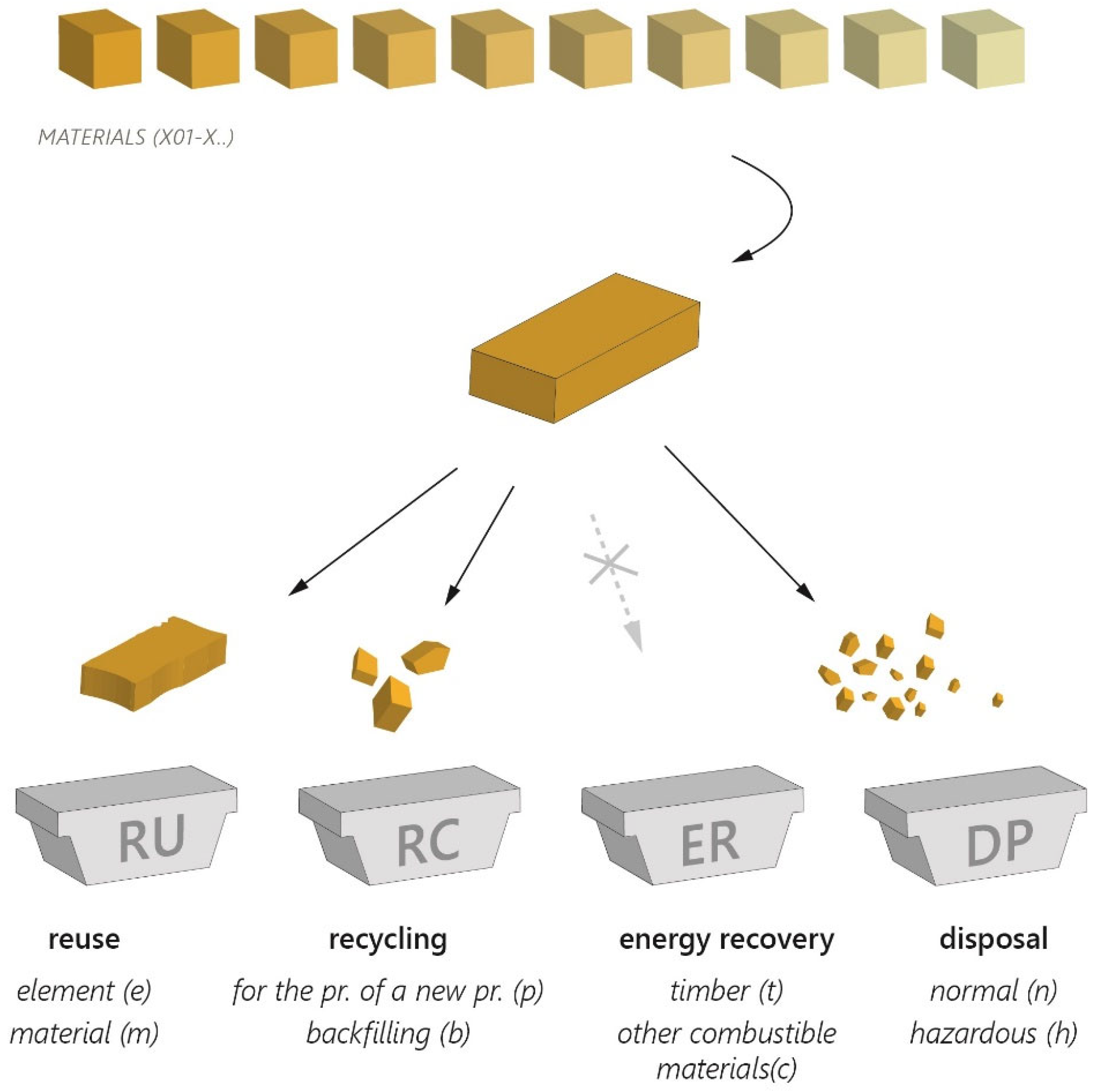
3.3. Waste Stream Allocation
Waste Management Hierarchy
3.4. Demolition Waste Calculation
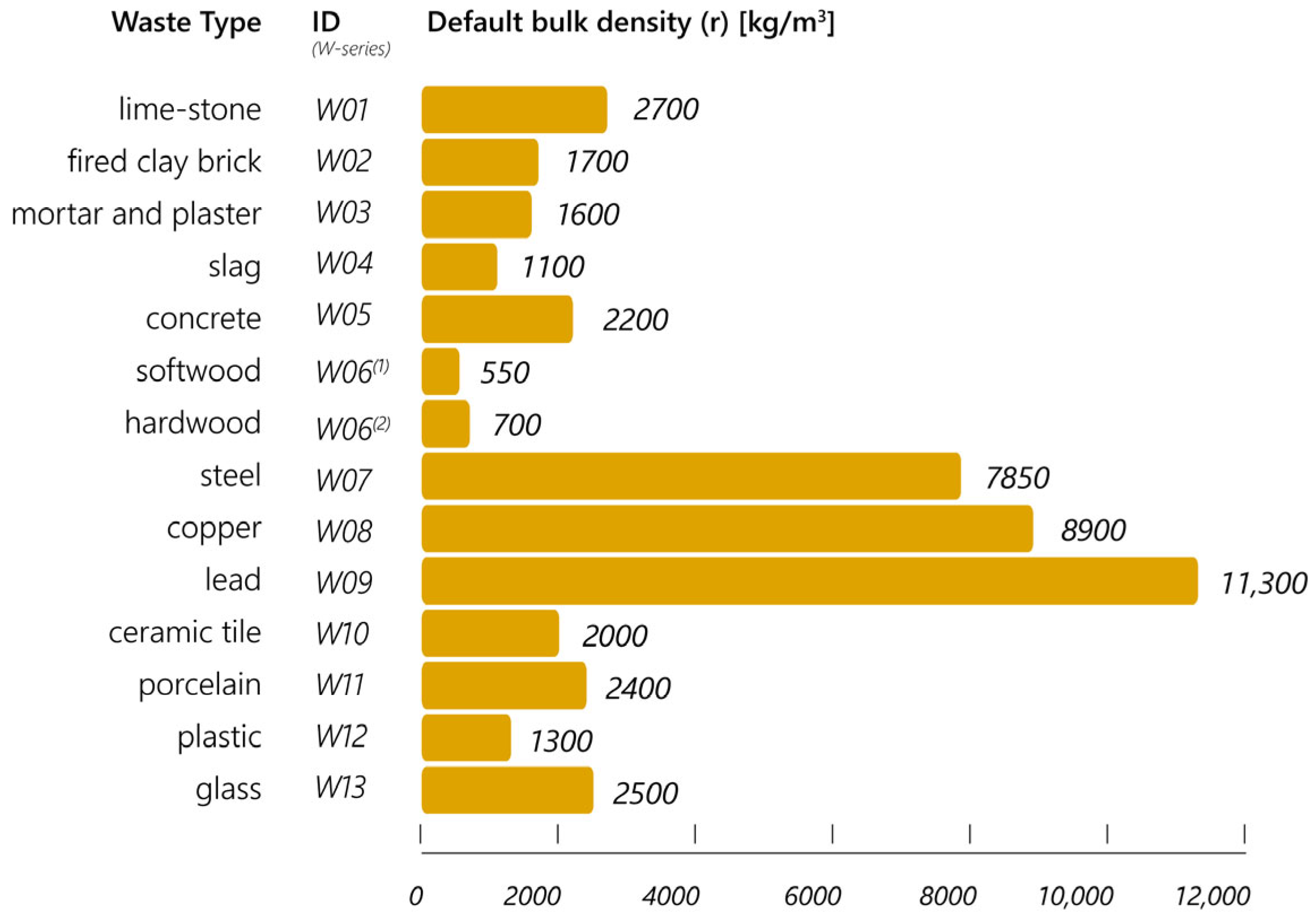
3.4.1. Determination of Waste Types and Bulk Density of Materials
- (a)
- Softwood (W06/1): Roof structures were typically constructed from coniferous species, primarily Scots pine (Pinus sylvestris), with smaller proportions of spruce and fir. The density of these species generally ranges between 430 and 650 kg/m3. According to The Wood Database [37], the average oven-dry density of Scots pine is approximately 550 kg/m3, which corresponds to the value adopted in the present calculations. This value is considered to represent a realistic average for timber of varying quality and origin.
- (b)
- Hardwood (W06/2): The load-bearing elements of heavily loaded floor structures (e.g., tenon-jointed beam floors) were predominantly made from higher-density hardwood species, most commonly oak (Quercus spp.), and to a lesser extent beech or ash. While the use of softwood has occasionally been observed in intermediate floors—due to the reduced load requirements—the predominance of hardwood in intermediate floors justified the use of a single representative density value for all such applications. The density of these hardwood species typically falls between 650 and 750 kg/m3 [38], with a value of 700 kg/m3 applied in the model.
3.4.2. Methodology for Waste Stream Classification
- Demolition technology and selectivity: The technological implementation of demolition fundamentally determines the integrity of the recovered structural elements and materials. Selective demolition (e.g., manual dismantling) enables the extraction of elements (e.g., bricks, timber beams) with minimal or no damage, thereby maximizing the potential for element-level reuse (reuse/element). In contrast, mechanical demolition typically results in fragmentation of the elements, which leads to the classification of materials into lower levels of the waste hierarchy, such as recycling or disposal categories.
- Physical condition of structural elements: Pre-demolition condition assessments play a crucial role. Degradation processes impairing the integrity of structural elements—such as advanced corrosion of steel structures or biological damage caused by pests (e.g., fungi, insects) to wooden components—can exclude their reuse. While elements in sound condition are preferably assigned to the reuse/element category, damaged components are generally suitable only for material recovery (recycling) or energy recovery.
- Material properties and bonding between components: The demolishability of complex structures (e.g., foundations, masonry, vaults) and the recoverability of their components are closely dependent on the type and quality of the applied binding materials. In the case of weak hydraulic, loose lime mortars, a relatively high recovery rate of masonry elements (brick, stone) in intact condition is enabled. In contrast, when high-strength cement mortars are used, the probability of damage to masonry elements during demolition is increased, resulting in a decreased proportion of reusable fractions.
- Cultural and historical value: Architectural or heritage-significant structural elements (e.g., carved stone cantilevers, ornate facade decorations) are given priority for element-level reuse (reuse/element), even if this requires minor restoration interventions. The preservation and secondary reuse of such elements are justified from sustainability and cultural heritage protection perspectives, regardless of the building’s protection status [42].
- The physical and technical condition of the examined structural elements is assumed to be adequate, allowing for treatment at the highest levels of the waste hierarchy.
- The demolition process is carried out using selective technology, minimizing damage to the elements.
- The classification of each waste fraction is performed according to the most favorable option defined by the waste management hierarchy, in order to maximize sustainability.
3.4.3. The Impact of Demolition Technology on Waste Stream Distribution
Definition and Application of the Demolition Technology Modification Factor (μD)
- For manual demolition (selective deconstruction), μD = 1, meaning the distribution among WMCs is not modified.
- For mechanical demolition, the new proportion for the reuse category is calculated by multiplying the original proportion by the modification factor.
Methodological Assumption: The Role of Mortar Type
Application of the Modification Factor: Case Studies
3.4.4. The Role and Application of the Bulking Factor (kb)
3.4.5. Determination of the Volume and Mass of Demolition Waste
Calculation of Reusable Waste Quantity
Generalized Model for Waste Stream Determination
4. Case Study: Application and Validation of the Framework
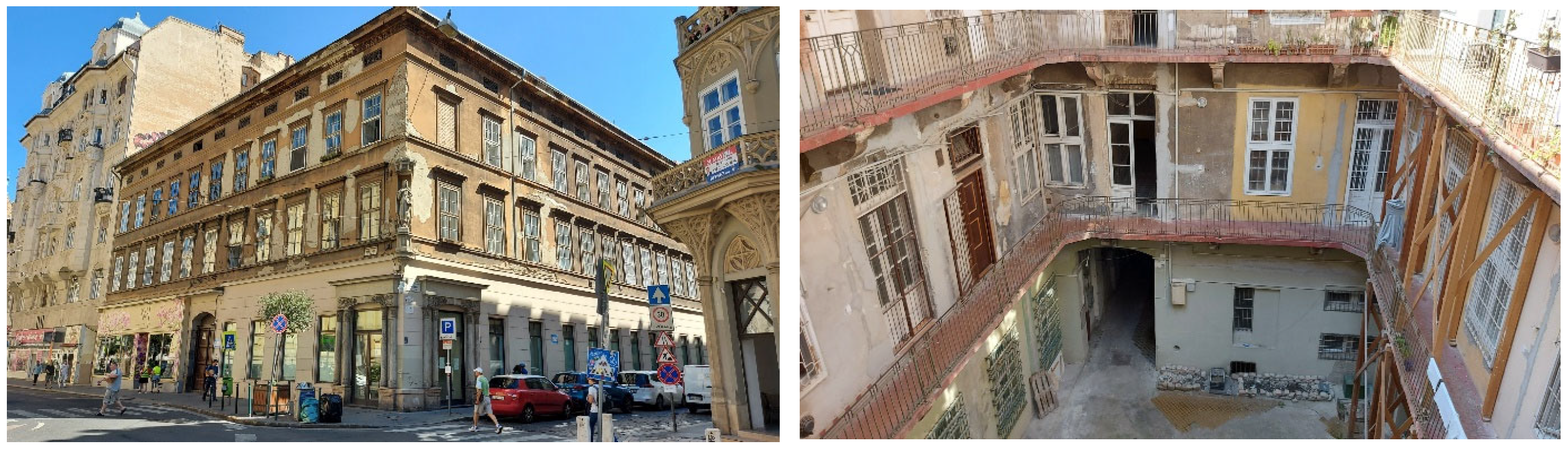
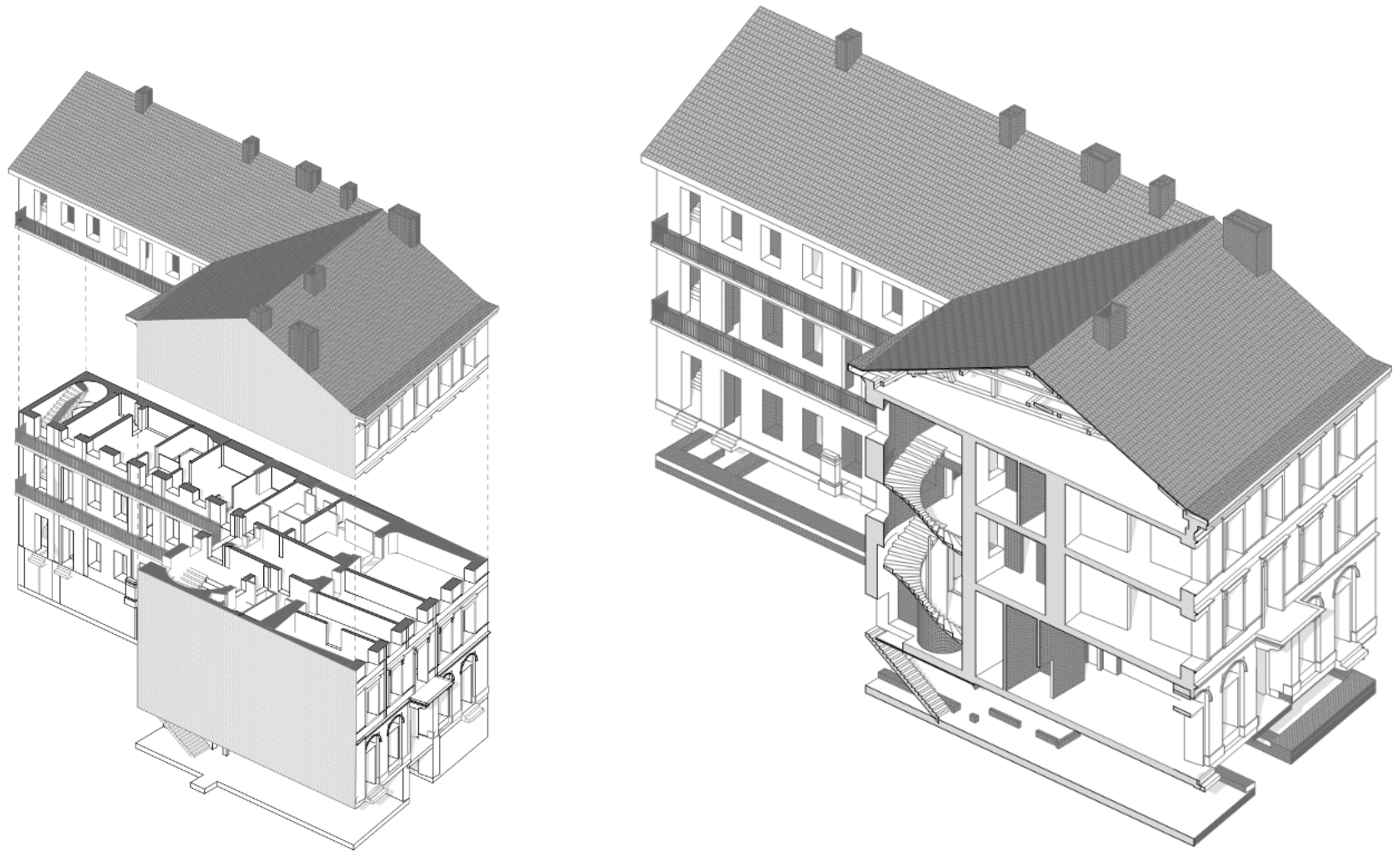
4.1. Building Description
4.2. Investigated Demolition Scenarios
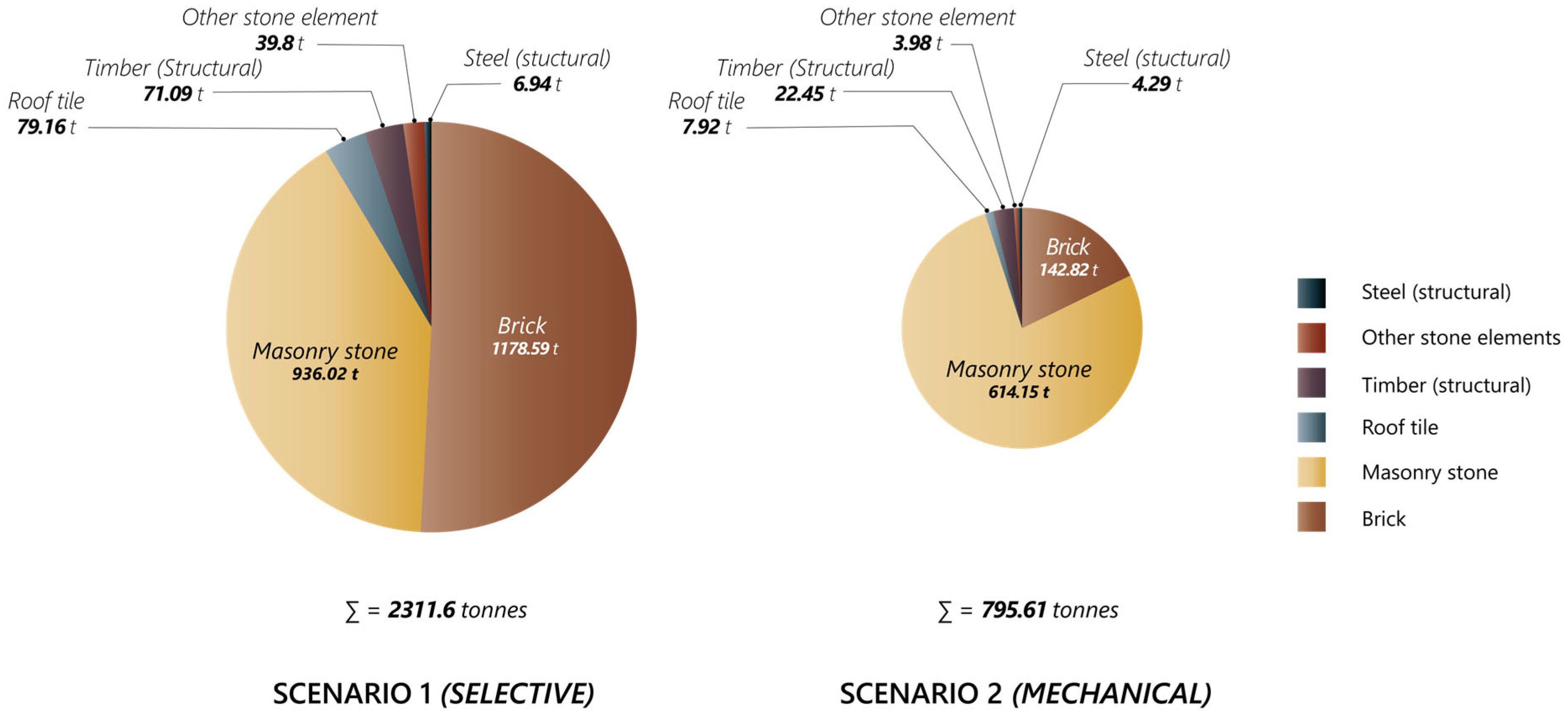
- Scenario 1 (Selective deconstruction): This assumes manual and small-scale mechanical demolition methods aimed at the maximum, non-destructive recovery of building materials and structural elements. In this case, the value of the demolition technology modification factor is μD = 1.
- Scenario 2 (Conventional mechanical demolition): This models conventional, heavy-machinery demolition (e.g., hydraulic hammer), which is faster but results in significant fragmentation of materials. In this case, the values of the μD factor are the material-differentiated values defined in Table 4.
4.3. Results
5. Discussion
5.1. Evaluation of the Framework
5.2. The Relationship Between Demolition Technology and the Circular Economy
5.3. Limitations of the Framework and Future Research Directions
- Neglect of structural condition: The current model assumes an ideal, impeccable physical and technical condition. In reality, the degradation of structural elements (e.g., corrosion, biological damage) can significantly affect their reuse potential. The next phase of the research aims to supplement the model with a condition assessment module capable of quantifying the extent of damage and modeling its impact through the allocation factors. In practice, we envision this in the form of integration with the CBDF system [51].
- Cultural and architectural value: The model currently does not differentiate between unique elements with architectural value and those forming a mass structure. In the future, we plan to integrate a “heritage” factor that identifies elements of particular importance from a cultural heritage perspective, mandating manual demolition and reuse (reuse/element) for them, overriding purely economic or technological considerations.
- Flexibility of input data: The system is currently based on LOD 300 BIM models. The next development step is to create a module that can also import data from traditional 2D survey documentation (floor plans, sections), thereby significantly increasing the model’s applicability for less-documented building stock.
- Refinement of parameters: Further refinement of the modification factors used in the model (e.g., kb, μD) is necessary. We plan to differentiate the bulking factor according to waste management categories (e.g., a different kb value for orderly stacked reusable beams versus bulk metal scrap for recycling), which would further improve the accuracy of logistics planning.
- Integration of other utilization options: The current phase of the developed method primarily focuses on demolition processes and the management of the resulting waste, disregarding heritage preservation aspects to allow for the development of an evaluation system based on sustainability and economic principles. In the next phase of the research, we will also analyze renovation and conversion as alternatives to demolition, which will make it possible to compare different intervention strategies, thereby promoting the long-term sustainable management of the urban building stock.
- Limitations of Survey Technologies: While modern survey technologies like Terrestrial Laser Scanning (TLS) offer high geometric precision, they are insufficient on their own for waste estimation. TLS only captures the surface and cannot identify internal material layers (e.g., floor fill). Therefore, building an LOD 300 model based on archival research and physical probes is a necessary step for accurate material identification.
- Lack of Environmental Impact Assessment: The current model focuses on the mass-based waste hierarchy. Detailed Life Cycle Assessment (LCA) and CO2 savings calculations were excluded from this study due to the lack of reliable Environmental Product Declarations (EPD) or Life Cycle Inventory (LCI) datasets specifically reflecting 19th-century manufacturing technologies. Integrating these data is part of future developments.
6. Conclusions
- The developed model successfully integrates BIM data with a detailed element inventory and a multi-factor evaluation system, enabling an accurate structure- and material-level forecast of the quantity and composition of the generated waste.
- The case study has quantitatively verified that the choice of demolition technology is the most critical factor in maximizing circular potential. In the case of the studied building, the application of selective, manual demolition increased the mass of recovered, high value-added reusable materials by 190% compared to conventional mechanical demolition. While the environmental benefit of selective demolition might be intuitively expected, the main value of this study lies in precise quantification. The ability to accurately forecast, for example, 1178 tonnes of reusable brick versus 142 tonnes from mechanical demolition creates a data-driven foundation for logistics planning and business modeling that general qualitative statements cannot provide.
- The model can serve as an effective decision-support tool during the planning phase of demolition projects, aiding in the development of more sustainable waste management strategies and the practical implementation of circular economy principles in the construction industry.
Author Contributions
Funding
Institutional Review Board Statement
Informed Consent Statement
Data Availability Statement
Acknowledgments
Conflicts of Interest
References
- European Commission—Department: Energy—In Focus, Energy Efficiency in Buildings. 2020. Available online: https://commission.europa.eu/news-and-media/news/focus-energy-efficiency-buildings-2020-02-17_en (accessed on 17 June 2025).
- European Environment Agency. Greenhouse Gas Emissions from Energy Use in Buildings in Europe. 2025. Available online: https://www.eea.europa.eu/en/analysis/indicators/greenhouse-gas-emissions-from-energy (accessed on 9 December 2025).
- European Commission, Construction and Demolition Waste. Available online: https://environment.ec.europa.eu/topics/waste-and-recycling/construction-and-demolition-waste_en (accessed on 17 June 2025).
- European Commission. A New Circular Economy Action Plan: For A Cleaner and More Competitive Europe. 2020. Available online: https://eur-lex.europa.eu/resource.html?uri=cellar:9903b325-6388-11ea-b735-01aa75ed71a1.0017.02/DOC_1&format=PDF (accessed on 17 June 2025).
- Central Statistical Office (KSH)—Census Database. 2022. Available online: https://nepszamlalas2022.ksh.hu/adatbazis/ (accessed on 19 September 2025).
- Central Statistical Office (KSH)—Housing Stock, Housing Density. 1 January 2025. Available online: https://www.ksh.hu/stadat_files/lak/hu/lak0002.html (accessed on 19 September 2025).
- Central Statistical Office (KSH)—Housing Stock and Housing Density by County and Region. 1 January 2025. Available online: https://www.ksh.hu/stadat_files/lak/hu/lak0017.html (accessed on 19 September 2025).
- Déry, A. Tenement Houses—Building Types in Hungary After the Compromise of 1867 (Hun: Bérházak–Épülettípusok a Kiegyezés Utáni Magyarországon); Építésügyi Tájékoztatási Központ Kft: Budapest, Hungary, 1995. [Google Scholar]
- Tomay, K. Decline and renewal—the case of Budapest (Hun: Slumosodás és városrehabilitáció budapesten). Tér és Társadalom 2006, 20, 93–107. [Google Scholar] [CrossRef]
- Ertsey, A.; Hanczár, Z.; Illyés, Z.; Medgyasszay, P.; Szilágyi, L.; Takács, E.R.; Tiderencz, G.; Zielinszky, S. Autonomus City, Professional Vision—2004 (Hun: Autonóm Város, Szakértői Vízió—2004.); Független Ökológiai Központ: Budapest, Hungary, 2004. [Google Scholar]
- Sugár, V.; Talamon, A.; Horkai, A.; Kita, M. Energy saving retrofit in a heritage district: The case of the Budapest. J. Build. Eng. 2020, 27, 100982. [Google Scholar] [CrossRef]
- Ámon, K.; Czirfusz, M.; Feldmár, N.; Koritár, Z. Affordability, Annual Report on Housing Poverty (Hun: Megfizethetőség—Éves Jelentés a Lakhatási Szegénységről). 2023. Available online: https://habitat.hu/sites/lakhatasi-jelentes-2023/wp-content/uploads/sites/14/2024/01/Habitat_EvesJelentes2023_egybe_240116_02.pdf (accessed on 5 September 2025).
- European Commission. A Renovation Wave for Europe—Greening Our Buildings, Creating Jobs, Improving Lives. 2020. Available online: https://eur-lex.europa.eu/legal-content/EN/TXT/?uri=CELEX:52020DC0662 (accessed on 5 September 2025).
- Menegaki, M.; Damigos, D. A review on current situation and challenges of construction and demolition waste management. Curr. Opin. Green Sustain. Chem. 2018, 13, 8–15. [Google Scholar] [CrossRef]
- BIMForum LOD Specification. 2024. Available online: https://bimforum.org/wp-content/uploads/2024/11/LOD-Spec-2024-Part-I-official-English.pdf (accessed on 5 September 2025).
- Scottish Environment Protection Agency. Guidance on Using the European Waste Catalogue (EWC) to Code Waste. 2015. Available online: https://www.sepa.org.uk/media/163421/ewc_guidance.pdf (accessed on 5 September 2025).
- BuildEXT, h17 Apartment Building (Hun: h17 Társasház). Available online: https://buildext.com/projektek/h17-tarsashaz/ (accessed on 25 August 2025).
- Kabirifar, K.; Mojtahedi, M.; Wang, C.C.; Tam, V.W.Y. Effective construction and demolition waste management assessment through waste management hierarchy; a case of Australian large construction companies. J. Clean. Prod. 2021, 312, 127790. [Google Scholar] [CrossRef]
- Ministry for Innovation and Technology, National Waste Management Plan (2021–2027), (Hun: Országos Hulladékgazdá-lkodási Terv (2021–2027)). 2018. Available online: https://cdn.kormany.hu/uploads/document/9/92/921/921c2f798773d4336ee3f45884a662d3018bb3d7.pdf (accessed on 9 December 2025).
- Coelho, A.; De Brito, J. Influence of Construction and Demolition Waste Management on the Environmental Impact of Build-ings. Waste Manag. 2012, 32, 532–541. [Google Scholar] [CrossRef]
- European Commission. Waste Framework Directive. 2023. Available online: https://environment.ec.europa.eu/topics/waste-and-recycling/waste-framework-directive_en (accessed on 5 September 2025).
- Hussien, A.; Zubaidi, R.A.; Jannat, N.; Ghanim, A.; Maksoud, A.; Al-Shammaa, A. The effects of tea waste additive on the physical and mechanical characteristics of structural unfired clay bricks. Alex. Eng. J. 2024, 83, 10390–10405. [Google Scholar] [CrossRef]
- Xu, J.; Shi, Y.; Xie, Y.; Zhao, S. A BIM-Based construction and demolition waste information management system for greenhouse gas quantification and reduction. J. Clean. Prod. 2019, 229, 308–324. [Google Scholar] [CrossRef]
- Sanchez, B.; Rausch, C.; Haas, C.; Hartmann, T. A framework for BIM-based disassembly models to support reuse of building components. Resour. Conserv. Recycl. 2021, 175, 105825. [Google Scholar] [CrossRef]
- Bertin, I.; Mesnil, R.; Jaeger, J.M.; Feraille, A.; Le Roy, R. A BIM-Based Framework and Databank for Reusing Load-Bearing Structural Elements. Sustainability 2020, 12, 3147. [Google Scholar] [CrossRef]
- Assefa, G.; Ambler, C. To demolish or not to demolish: Life cycle consideration of repurposing buildings. Sustain. Cities Soc. 2017, 28, 146–153. [Google Scholar] [CrossRef]
- Sassi, P. Study of current building methods that enable the dismantling of building structures and their classifications according to their ability to be reused, recycled or downcycled. In Proceedings of the International Conference for Sustainable Building, Oslo, Norway, 23–25 September 2002; Pettersen, T.D., Ed.; University of Nottingham: Nottinghamshire, UK, 2002. [Google Scholar]
- Gorgolewski, M. The recycled building project. In Sustainable Building; Aeneas: Maastricht, The Netherlands, 2000; pp. 125–127. [Google Scholar]
- Rose, C.M.; Stegemann, J.A. From Waste Management to Component Management in the Construction Industry. Sustainability 2018, 10, 229. [Google Scholar] [CrossRef]
- Schamne, A.N.; Szerzők, T.N. BIM in construction waste management: A conceptual model based on IFC. Autom. Constr. 2024, 159, 105283. [Google Scholar] [CrossRef]
- Garber, R. BIM Design: Realising the Creative Potential of Building Information Modelling; Wiley: Hoboken, NJ, USA, 2014; ISBN 978-1-118-71979-4. [Google Scholar]
- Kang, K.; Besklubova, S.; Dai, Y.; Zhong, R.Y. Building demolition waste management through smart BIM: A case study in Hong Kong. Waste Manag. 2022, 143, 69–83. [Google Scholar] [CrossRef]
- Shi, Y.; Xu, J. BIM-based information system for econo-enviro-friendly end-of-life disposal of construction and demolition waste. Autom. Constr. 2021, 125, 103611. [Google Scholar] [CrossRef]
- Han, D.; Kalantari, M.; Rajabifard, A. Building Information Modeling (BIM) for Construction and Demolition Waste Management in Australia: A Research Agenda. Sustainability 2021, 13, 12983. [Google Scholar] [CrossRef]
- Khalil, H.B. HBIM and environmental simulation. In Heritage Building Information Modelling; Arayici, Y., Counsell, J., Mahdjoubi, L., Nagy, G., Hawas, S., Dweidar, K., Eds.; Routledge: London, UK, 2017; 292p. [Google Scholar]
- Edwards, J. It’s BIM—But not as we know it! In Heritage Building Information Modelling; Arayici, Y., Counsell, J., Mahdjoubi, L., Nagy, G., Hawas, S., Dweidar, K., Eds.; Routledge: London, UK, 2017; 292p. [Google Scholar]
- The Wood Database, Scots Pine. 2023. Available online: www.wood-database.com/scots-pine/ (accessed on 5 September 2025).
- The Wood Database, English Oak. 2023. Available online: www.wood-database.com/english-oak/ (accessed on 5 September 2025).
- Pavía, S.; Treacy, E. A comparative study of the durability and behaviour of fat lime and feebly-hydraulic lime mortars. Mater. Struct. 2006, 39, 391–398. [Google Scholar] [CrossRef]
- Almeida, L.; Silva, A.S.; Veiga, R.; Mirão, J. 20th Century Mortars: Physical and Mechanical Properties from Awarded Buildings in Lisbon (Portugal)—Studies towards Their Conservation and Repair. Buildings 2023, 13, 2468. [Google Scholar] [CrossRef]
- Zhang, C.; Hu, M.; Di Maio, F.; Sprecher, B.; Yang, X.; Tukker, A. An overview of the waste hierarchy framework for analyzing the circularity in construction and demolition waste management in Europe. Sci. Total Environ. 2022, 803, 149892. [Google Scholar] [CrossRef] [PubMed]
- Gáspár, L.L. Diagnostics and Renovation of Historic Building Structures (Hun: Történeti Épületszerkezetek Diagnosztikája és Felújítása); TERC Kft: Budapest, Hungary, 2009. [Google Scholar]
- Horváth, D.; Szabó, T. Hazardous Materials in Residential Buildings of the Early 20th Century: Risks of Lead-Based Paints (Hun: Veszélyes Anyagok a 20. Század Első Felének Lakóépületeiben: Az Ólomtartalmú Festékek Kockázatai). Műemlékvédelem 2018, 62, 110–121. [Google Scholar]
- Bertino, G.; Kisser, J.; Zeilinger, J.; Langergraber, G.; Fischer, T.; Österreicher, D. Fundamentals of Building Deconstruction as a Circular Economy Strategy for the Reuse of Construction Materials. Appl. Sci. 2021, 11, 939. [Google Scholar] [CrossRef]
- Akinade, O.O.; Oyedele, O.L.; Bilal, M.; Ajayi, S.O.; Owolabi, H.A.; Alaka, H.A.; Bello, S.A. Waste minimisation through deconstruction: A BIM based Deconstructability Assessment Score (BIM-DAS). Resour. Conserv. Recycl. 2015, 105, 167–176. [Google Scholar] [CrossRef]
- Maljaee, H.; Silva, A.S.; Velosa, A. Characterization of Mortar from Casa Barbot (Portugal), a Case Study from the Beginning of the 20th Century. Buildings 2023, 13, 232. [Google Scholar] [CrossRef]
- Loadscan. Inaccurate Bulking and Compaction Factors. 2024. Available online: https://www.loadscan.com/bulking-compaction/ (accessed on 13 September 2025).
- Li, H.; Chen, Z.; Tang, Y.; Yang, H.; Zhao, Y. Construction and demolition waste management: A systematic review and future research directions. J. Build. Eng. 2022, 3, 924926. [Google Scholar] [CrossRef]
- Gorgolewski, M.; Straka, V.; Edmonds, J.; Sergio, C. Facilitating Greater reuse and Recycling of Structural Steel in the Construction and Demolition Process, Final Report. 2006. Available online: https://natural-resources.canada.ca/sites/www.nrcan.gc.ca/files/mineralsmetals/pdf/mms-smm/busi-indu/rad-rad/pdf/re-ste-fin-eng.pdf?utm_source=chatgpt.com (accessed on 13 September 2025).
- Lu, W.; Yuan, L.; Xue, F. Investigating the bulk density of construction waste: A big data-driven approach. Resour. Conserv. Recycl. 2021, 169, 105480. [Google Scholar] [CrossRef]
- Bukovics, Á.; Lilik, F.; Kóczy, L.T. Complex Building’s Decision Support Method Based on Fuzzy Signatures. Buildings 2024, 14, 1630. [Google Scholar] [CrossRef]

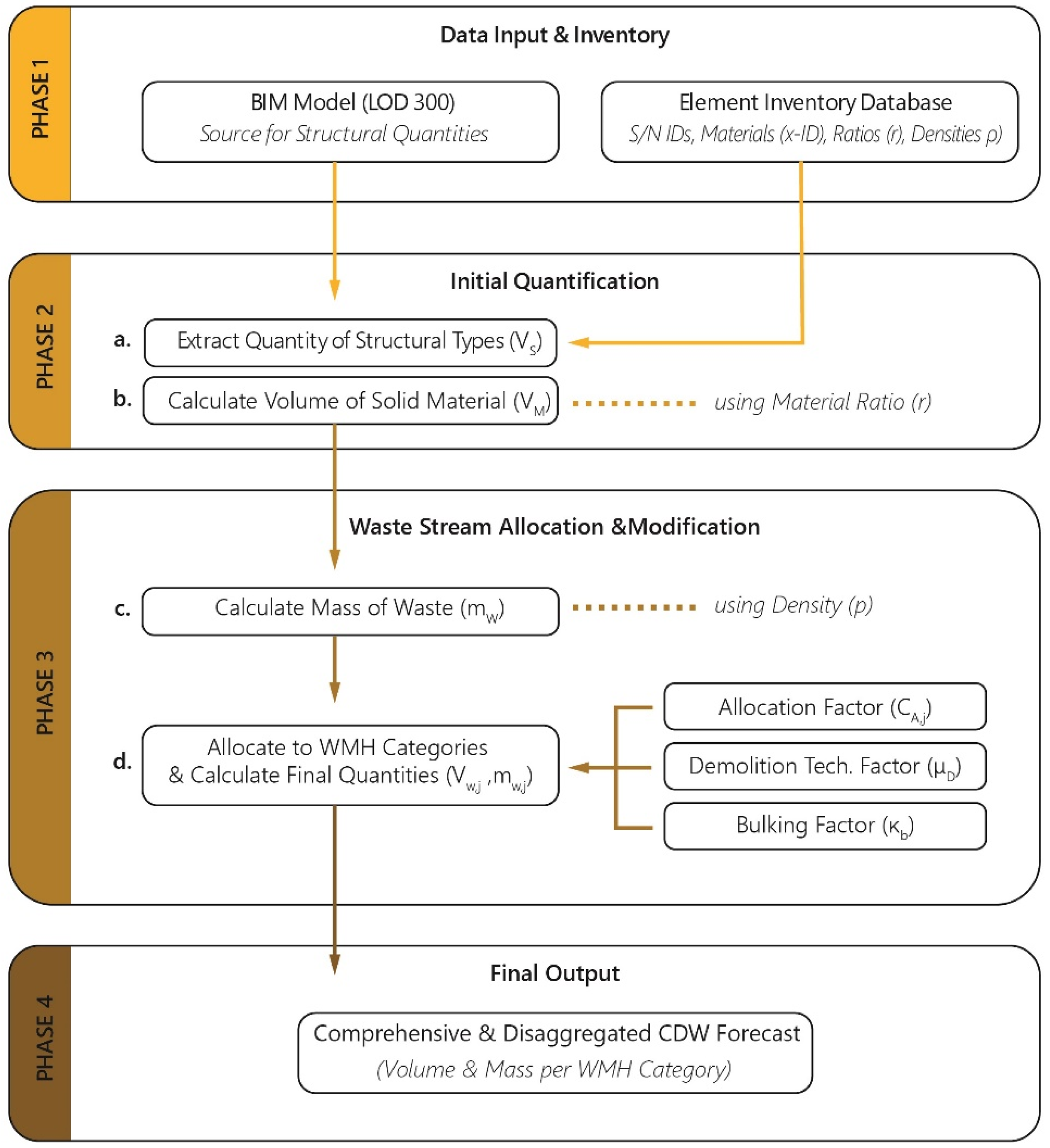
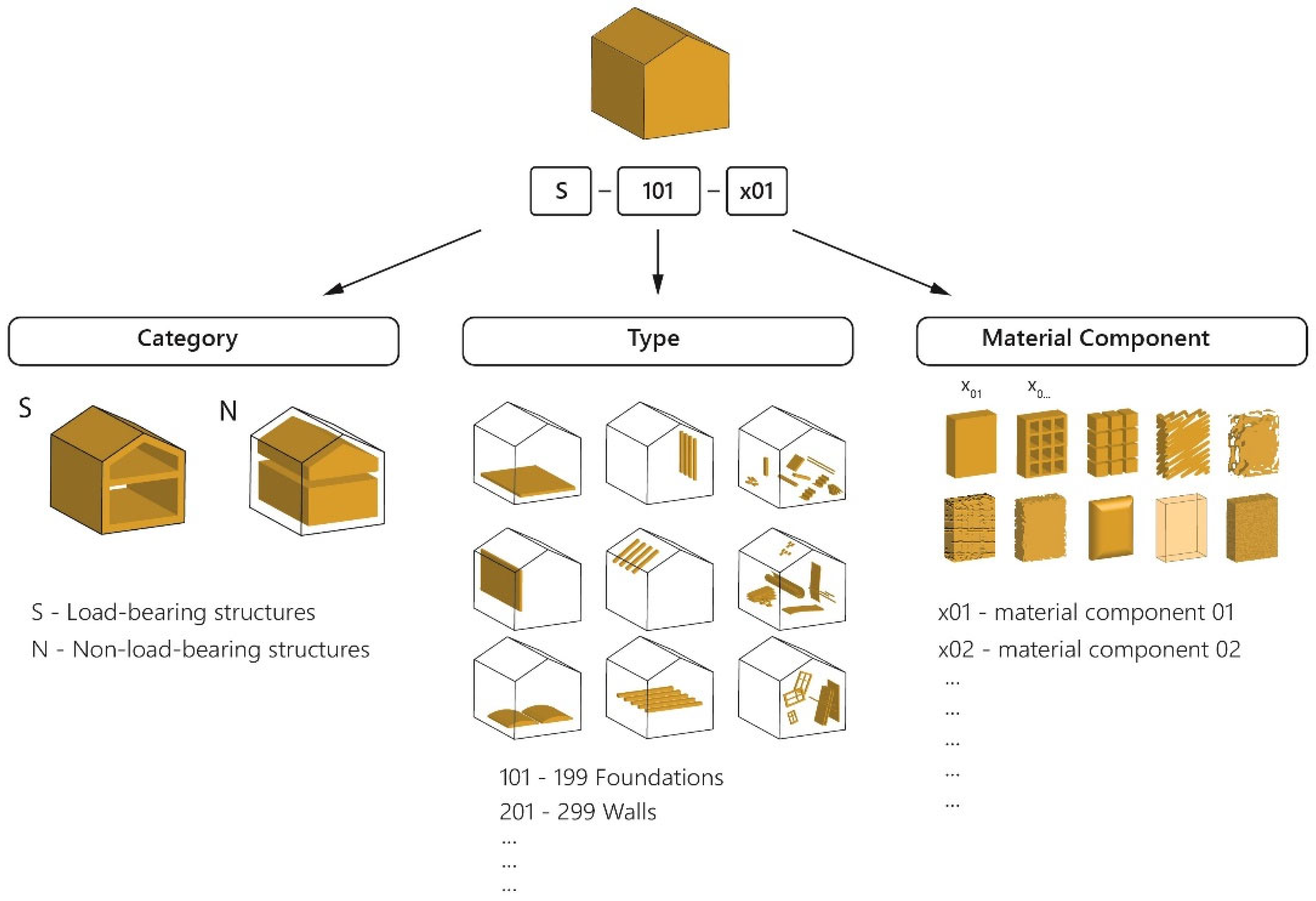
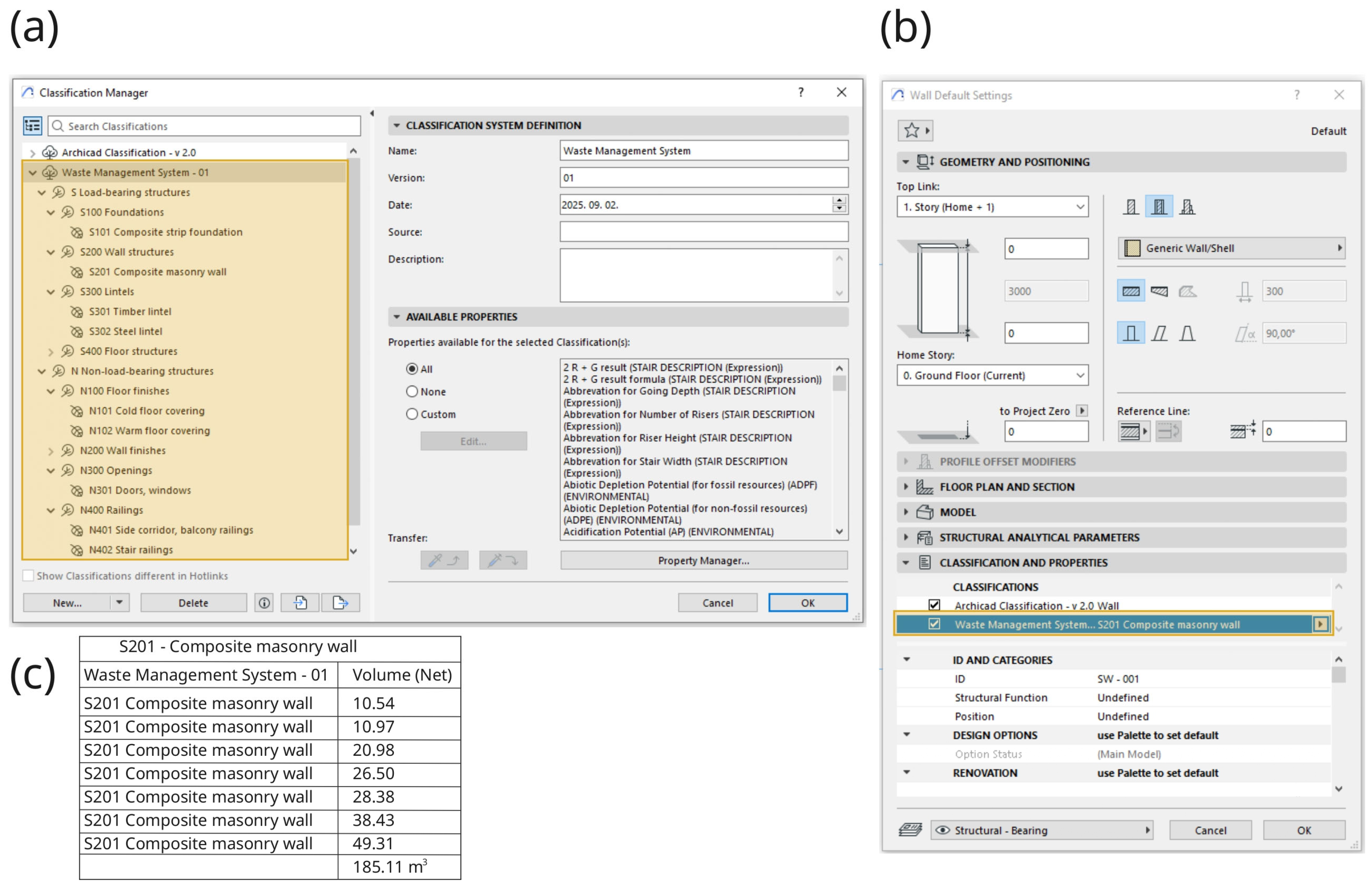

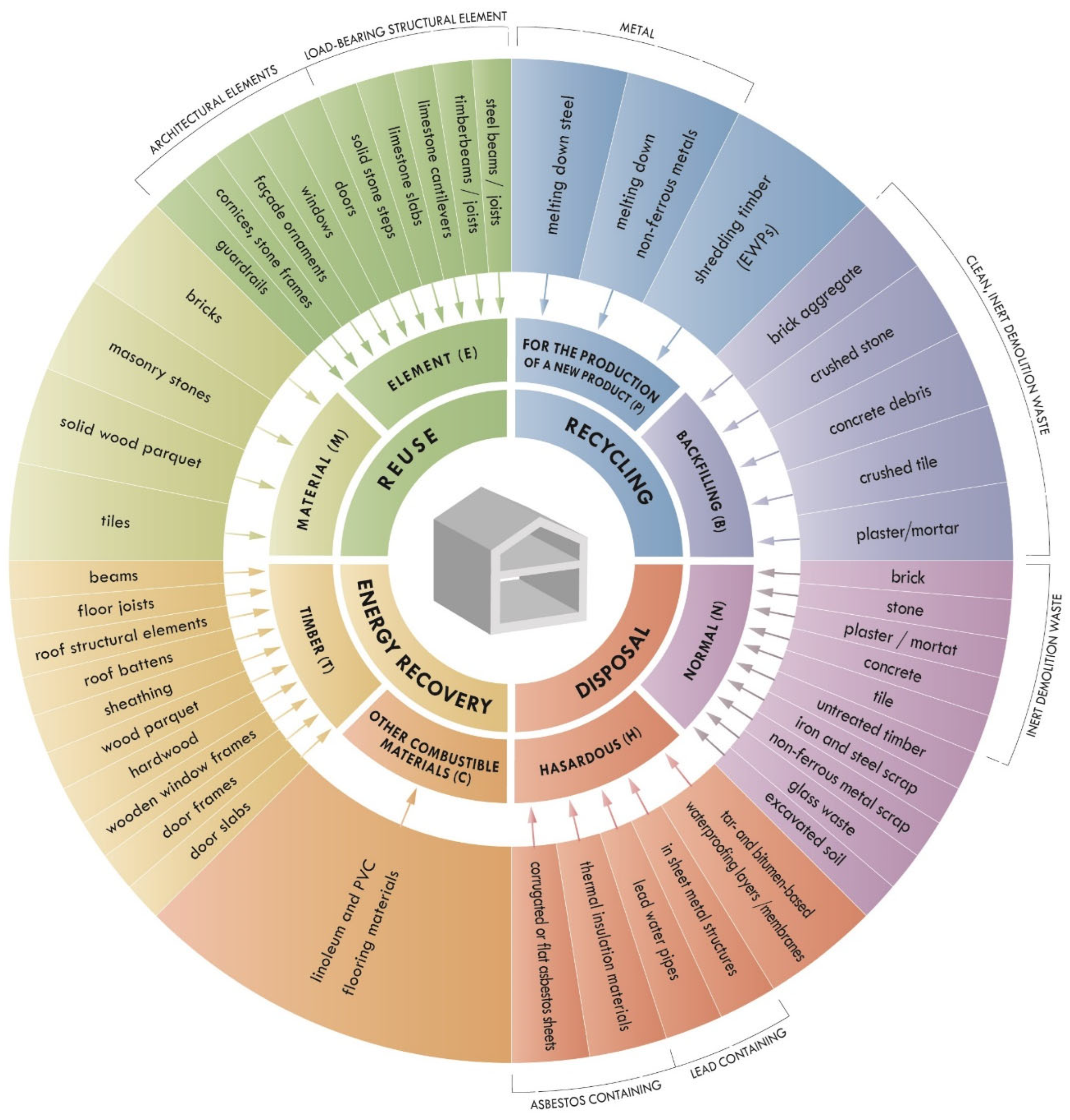



| Category | Structural Type | ID (s) | Material Component | ID (m) |
|---|---|---|---|---|
| Load-Bearing Structures (S) | ||||
| Foundations | Composite strip foundation | S101 | Solid brick | x01 |
| Cavity fill | x02 | |||
| Mortar | x03 | |||
| Wall Structures | Composite masonry wall | S201 | Limestone | x01 |
| Solid brick | x02 | |||
| Mortar | x03 | |||
| Lintels | Timber lintel | S301 | Timber beam | x01 |
| Steel lintel | S302 | Steel beam | x01 | |
| Floor Structures | Brick vault (barrel or sail) | S401 | Solid brick | x01 |
| Mortar | x02 | |||
| Plaster | x03 | |||
| Slag infill | x04 | |||
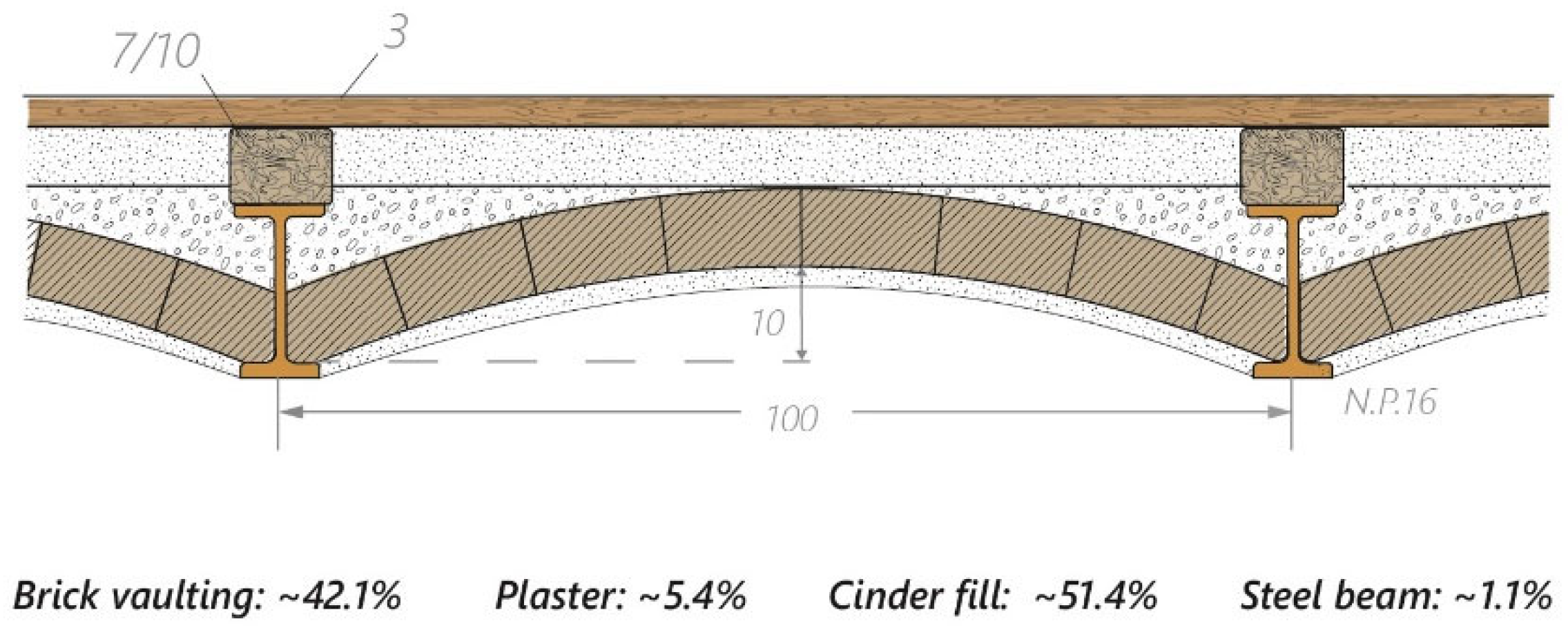
| Prussian vault (flat brick vault between steel/I-beams) | S402 | Steel beam | x01 | |
| Solid brick | x02 | |||
| Mortar | x03 | |||
| Plaster | x04 | |||
| Slag infill | x05 | |||
| Timber-joisted floor | S403 | Timber beam | x01 | |
| Slag infill | x02 | |||
| Reed and plaster | x03 | |||
| Side Corridors and Balconies | Monolithic RC slab on stone cantilevers | S501 | Limestone cantilever | x01 |
| Concrete (from RC) | x02 | |||
| Steel reinforcement | x03 | |||
| Steel edge beam | x04 | |||
| Balcony (limestone slab on limestone cantilevers) | S502 | Limestone cantilever | x01 | |
| Limestone slab | x02 | |||
| Staircases | Main staircase (floating limestone steps) | S601 | Limestone step | x01 |
| Secondary staircase (floating limestone steps) | S602 | Limestone step | x01 | |
| Timber cellar stair | S603 | Timber step | x01 | |
| Roof Structures | Roof structure and covering | S701 | Timber beam | x01 |
| Roof batten | x02 | |||
| Roof tile | x03 | |||
| Other | Mezzanine | S801 | Steel beam/column | x01 |
| Timber beam/column | x02 | |||
| Non-Load-Bearing Structures (N) | ||||
| Floor Finishes | Cold floor covering | N101 | Floor tiling | x01 |
| Cement mortar bed | x02 | |||
| Concrete screed | x03 | |||
| Warm floor covering | N102 | Timber parquet | v01 | |
| Subfloor + joists | x02 | |||
| Wall Finishes | Cold wall covering | N201 | Tile | x01 |
| Warm wall covering | N202 | Timber paneling | x01 | |
| Openings | Doors, windows | N301 | Timber | x01 |
| Steel | x02 | |||
| Glass | x03 | |||
| Railings | Side corridor, balcony railings | N401 | Steel | x01 |
| Stair railings | N402 | Steel | x01 | |
| Sanitary Ware | Bathtub | N501 | Enameled steel/cast iron | x01 |
| Toilet bowl, sink | N502 | Porcelain | x01 | |
| Fixtures | Kitchen cabinet | N601 | Timber | x01 |
| Kitchen fittings | N602 | Steel | x01 | |
| Plastic | x02 | |||
| Rainwater System | Gutters, downpipes | N701 | Steel/galvanized sheet | x01 |
| Electrical Installation | Wiring, conduits, fittings | N801 | Plastic | x01 |
| Steel | x02 | |||
| Copper | x03 | |||
| Glass lampshade | x04 | |||
| Building Services (MEP) | Heating, water, sewage, gas systems | N901 | Steel, cast iron | x01 |
| Plastic | x02 | |||
| Lead | x03 | |||
| Copper | x04 | |||
| ID (s) | ID (m) | RU,e | RU,m | RC,p | RC,b | ER,t | ER,c | DP,n | DP,h |
|---|---|---|---|---|---|---|---|---|---|
| S101 | x01 | 0.00 | 0.60 | 0.00 | 0.40 | 0.00 | 0.00 | 0.00 | 0.00 |
| x02 | 0.00 | 0.60 | 0.00 | 0.40 | 0.00 | 0.00 | 0.00 | 0.00 | |
| x03 | 0.00 | 0.00 | 0.00 | 1.00 | 0.00 | 0.00 | 0.00 | 0.00 | |
| S201 | x01 | 0.00 | 0.80 | 0.00 | 0.20 | 0.00 | 0.00 | 0.00 | 0.00 |
| x02 | 0.00 | 0.80 | 0.00 | 0.20 | 0.00 | 0.00 | 0.00 | 0.00 | |
| x03 | 0.00 | 0.00 | 0.00 | 1.00 | 0.00 | 0.00 | 0.00 | 0.00 | |
| x04 | 0.00 | 0.00 | 0.00 | 0.00 | 0.00 | 0.00 | 1.00 | 0.00 | |
| S301 | x01 | 0.90 | 0.00 | 0.10 | 0.00 | 0.00 | 0.00 | 0.00 | 0.00 |
| S302 | x01 | 0.90 | 0.00 | 0.10 | 0.00 | 0.00 | 0.00 | 0.00 | 0.00 |
| S401 | x01 | 0.00 | 0.70 | 0.00 | 0.30 | 0.00 | 0.00 | 0.00 | 0.00 |
| x02 | 0.00 | 0.00 | 0.00 | 1.00 | 0.00 | 0.00 | 0.00 | 0.00 | |
| x03 | 0.00 | 0.00 | 0.00 | 0.00 | 0.00 | 0.00 | 1.00 | 0.00 | |
| x04 | 0.00 | 0.00 | 0.00 | 1.00 | 0.00 | 0.00 | 0.00 | 0.00 | |
| S402 | x01 | 0.90 | 0.00 | 0.10 | 0.00 | 0.00 | 0.00 | 0.00 | 0.00 |
| x02 | 0.00 | 0.80 | 0.00 | 0.20 | 0.00 | 0.00 | 0.00 | 0.00 | |
| x03 | 0.00 | 0.00 | 0.00 | 1.00 | 0.00 | 0.00 | 0.00 | 0.00 | |
| x04 | 0.00 | 0.00 | 0.00 | 0.00 | 0.00 | 0.00 | 1.00 | 0.00 | |
| x05 | 0.00 | 0.00 | 0.00 | 1.00 | 0.00 | 0.00 | 0.00 | 0.00 | |
| S403 | x01 | 0.90 | 0.00 | 0.10 | 0.00 | 0.00 | 0.00 | 0.00 | 0.00 |
| x02 | 0.00 | 0.00 | 0.00 | 1.00 | 0.00 | 0.00 | 0.00 | 0.00 | |
| x03 | 0.00 | 0.00 | 0.00 | 0.00 | 0.00 | 0.00 | 1.00 | 0.00 | |
| S501 | x01 | 0.90 | 0.00 | 0.00 | 0.10 | 0.00 | 0.00 | 0.00 | 0.00 |
| x02 | 0.00 | 0.00 | 0.00 | 1.00 | 0.00 | 0.00 | 0.00 | 0.00 | |
| x03 | 0.00 | 0.00 | 1.00 | 0.00 | 0.00 | 0.00 | 0.00 | 0.00 | |
| x04 | 0.00 | 0.00 | 1.00 | 0.00 | 0.00 | 0.00 | 0.00 | 0.00 | |
| x05 | 0.00 | 0.00 | 0.00 | 0.00 | 0.00 | 0.00 | 1.00 | 0.00 | |
| S502 | x01 | 0.90 | 0.00 | 0.00 | 0.10 | 0.00 | 0.00 | 0.00 | 0.00 |
| x02 | 0.90 | 0.00 | 0.00 | 0.10 | 0.00 | 0.00 | 0.00 | 0.00 | |
| S601 | x01 | 0.90 | 0.00 | 0.00 | 0.10 | 0.00 | 0.00 | 0.00 | 0.00 |
| S602 | x01 | 0.90 | 0.00 | 0.00 | 0.10 | 0.00 | 0.00 | 0.00 | 0.00 |
| S603 | x01 | 0.00 | 0.00 | 1.00 | 0.00 | 0.00 | 0.00 | 0.00 | 0.00 |
| S701 | x01 | 0.70 | 0.00 | 0.30 | 0.00 | 0.00 | 0.00 | 0.00 | 0.00 |
| x02 | 0.00 | 0.00 | 1.00 | 0.00 | 0.00 | 0.00 | 0.00 | 0.00 | |
| x03 | 0.00 | 0.80 | 0.20 | 0.00 | 0.00 | 0.00 | 0.00 | 0.00 | |
| S801 | x01 | 0.90 | 0.00 | 0.10 | 0.00 | 0.00 | 0.00 | 0.00 | 0.00 |
| x02 | 0.90 | 0.00 | 0.10 | 0.00 | 0.00 | 0.00 | 0.00 | 0.00 | |
| N101 | x01 | 0.00 | 0.00 | 0.00 | 1.00 | 0.00 | 0.00 | 0.00 | 0.00 |
| x02 | 0.00 | 0.00 | 0.00 | 1.00 | 0.00 | 0.00 | 0.00 | 0.00 | |
| x03 | 0.00 | 0.00 | 0.00 | 1.00 | 0.00 | 0.00 | 0.00 | 0.00 | |
| N102 | x01 | 0.00 | 0.80 | 0.20 | 0.00 | 0.00 | 0.00 | 0.00 | 0.00 |
| x02 | 0.00 | 0.00 | 1.00 | 0.00 | 0.00 | 0.00 | 0.00 | 0.00 | |
| N201 | x01 | 0.00 | 0.00 | 0.00 | 1.00 | 0.00 | 0.00 | 0.00 | 0.00 |
| N202 | x01 | 0.00 | 0.00 | 1.00 | 0.00 | 0.00 | 0.00 | 0.00 | 0.00 |
| N301 | x01 | 0.00 | 0.00 | 0.00 | 0.00 | 0.20 | 0.00 | 0.00 | 0.80 |
| x02 | 0.00 | 0.00 | 1.00 | 0.00 | 0.00 | 0.00 | 0.00 | 0.00 | |
| x03 | 0.00 | 0.00 | 1.00 | 0.00 | 0.00 | 0.00 | 0.00 | 0.00 | |
| N401 | x01 | 0.90 | 0.00 | 0.10 | 0.00 | 0.00 | 0.00 | 0.00 | 0.00 |
| N402 | x01 | 0.90 | 0.00 | 0.10 | 0.00 | 0.00 | 0.00 | 0.00 | 0.00 |
| N501 | x01 | 0.00 | 0.00 | 1.00 | 0.00 | 0.00 | 0.00 | 0.00 | 0.00 |
| N502 | x01 | 0.00 | 0.00 | 0.00 | 1.00 | 0.00 | 0.00 | 0.00 | 0.00 |
| N601 | x01 | 0.00 | 0.00 | 0.00 | 0.30 | 0.00 | 0.00 | 0.70 | |
| N602 | x01 | 0.00 | 0.00 | 1.00 | 0.00 | 0.00 | 0.00 | 0.00 | 0.00 |
| x02 | 0.00 | 0.00 | 0.20 | 0.00 | 0.00 | 0.80 | 0.00 | 0.00 | |
| N701 | x01 | 0.00 | 0.00 | 1.00 | 0.00 | 0.00 | 0.00 | 0.00 | 0.00 |
| N801 | x01 | 0.00 | 0.00 | 0.10 | 0.00 | 0.00 | 0.80 | 0.10 | 0.00 |
| x02 | 0.00 | 0.00 | 0.90 | 0.00 | 0.00 | 0.00 | 0.10 | 0.00 | |
| x03 | 0.00 | 0.00 | 0.90 | 0.00 | 0.00 | 0.00 | 0.10 | 0.00 | |
| x04 | 0.00 | 0.00 | 0.80 | 0.00 | 0.00 | 0.00 | 0.20 | 0.00 | |
| N901 | x01 | 0.00 | 0.00 | 0.90 | 0.00 | 0.00 | 0.00 | 0.10 | 0.00 |
| x02 | 0.00 | 0.00 | 0.10 | 0.00 | 0.00 | 0.80 | 0.10 | 0.00 | |
| x03 | 0.00 | 0.00 | 0.00 | 0.00 | 0.00 | 0.00 | 0.00 | 1.00 | |
| x04 | 0.00 | 0.00 | 0.90 | 0.00 | 0.00 | 0.00 | 0.10 | 0.00 |
| Structural ID (s) | Material ID (m) | Correction Factor (mD) |
|---|---|---|
| S101 | x01 | 0.53 |
| x02 | 0.15 | |
| S201 | x01 | 0.66 |
| x02 | 0.12 | |
| S301 | x01 | 0.33 |
| S302 | x01 | 0.72 |
| S401 | x01 | 0.13 |
| S402 | x01 | 0.72 |
| x02 | 0.13 | |
| S403 | x01 | 0.33 |
| S501 | x01 | 0.1 |
| S502 | x01 | 0.1 |
| x02 | 0.1 | |
| S601 | x01 | 0.1 |
| S602 | x01 | 1.0 |
| S701 | x01 | 0.33 |
| x02 | 0.1 | |
| S801 | x01 | 0.68 |
| x02 | 0.33 | |
| N102 | x01 | 0.1 |
| N301 | x01 | 0.1 |
| N401 | x01 | 0.1 |
| N402 | x01 | 0.1 |
| Category | Material/Component | Notation | Bulking Factor (kb) |
|---|---|---|---|
| Inert Granular Materials | Brick (recovered as material) | kb,br | 1.5 |
| Limestone masonry unit | kb,lsm | 1.5 | |
| Concrete (crushed) | kb,con | 1.5 | |
| Plaster, mortar, debris infill | kb,pl | 1.3 | |
| Tile | kb,tile | 1.5 | |
| Porcelain | kb,por | 1.5 | |
| Glass (fragmented) | kb,gls | 1.6 | |
| Structural Elements | Limestone structural elements (cantilever, slab, step) | kb,lse | 1.4 |
| Timber structural elements | kb,ti | 1.9 | |
| Steel structural elements | kb,st | 4.5 | |
| Metals and Other Materials | Copper (pipes, wires) | kb,cu | 2.0 |
| Lead (pipes, sheets) | kb,pb | 2.0 | |
| Plastic (mixed) | kb,pls | 3.0 |
| Index (j) | Waste Management Category | Allocation Factor |
|---|---|---|
| RU,e | reuse/element | CA,RU,e(s,m) |
| RU,m | reuse/material | CA,RU,m(s,m) |
| RC,p | recycle/for the production of a new product | CA,RC,p(s,m) |
| RC,b | recycle/backfilling | CA,RC,b(s,m) |
| ER,t | energy recovery/timber | CA,ER,t(s,m) |
| ER,c | energy recovery/other combustive material | CA,ER,c(s,m) |
| DP,n | disposal/normal | CA,DP,n(s,m) |
| DP,h | disposal/hazardous | CA,DP,h(s,m) |
| Waste Management Category | Scenario 1 (Selective Demolition) | Scenario 2 (Mechanical Demolition) | Change (Percentage Points) |
|---|---|---|---|
| Reuse | 56.8% | 19.6% | −37.2 |
| Recycling | 36.5% | 73.7% | +37.2 |
| Energy recovery | 0.1% | 0.1% | 0 |
| Disposal | 6.6% | 6.6% | 0 |
| Total | 100% | 100% | - |
| Material Type | Scenario 1 (Selective Demolition) | Scenario 2 (Mechanical Demolition) | Loss (%) |
|---|---|---|---|
| Brick | 1178.59 t | 142.82 t | −87.88% |
| Masonry Stone | 936.02 t | 614.15 t | −34.39% |
| Other Stone Elements (cantilever, slab, step) | 39.80 t | 3.98 t | −90.00% |
| Timber (structural) | 71.09 t | 22.45 t | −68.42% |
| Steel (structural) | 6.94 t | 4.29 t | −38.20% |
| Roof Tile | 79.16 t | 7.92 t | −90.00% |
| Total (Reuse) | 2311.60 t | 795.61 t | −65.58% |
Disclaimer/Publisher’s Note: The statements, opinions and data contained in all publications are solely those of the individual author(s) and contributor(s) and not of MDPI and/or the editor(s). MDPI and/or the editor(s) disclaim responsibility for any injury to people or property resulting from any ideas, methods, instructions or products referred to in the content. |
© 2025 by the authors. Licensee MDPI, Basel, Switzerland. This article is an open access article distributed under the terms and conditions of the Creative Commons Attribution (CC BY) license (https://creativecommons.org/licenses/by/4.0/).
Share and Cite
Bukovics, Á.; Ajtayné Károlyfi, K.; Géczy, N. A BIM-Based Automated Framework for Waste Quantification and Management in the Deconstruction of Historical Buildings. Sustainability 2025, 17, 11214. https://doi.org/10.3390/su172411214
Bukovics Á, Ajtayné Károlyfi K, Géczy N. A BIM-Based Automated Framework for Waste Quantification and Management in the Deconstruction of Historical Buildings. Sustainability. 2025; 17(24):11214. https://doi.org/10.3390/su172411214
Chicago/Turabian StyleBukovics, Ádám, Kitti Ajtayné Károlyfi, and Nóra Géczy. 2025. "A BIM-Based Automated Framework for Waste Quantification and Management in the Deconstruction of Historical Buildings" Sustainability 17, no. 24: 11214. https://doi.org/10.3390/su172411214
APA StyleBukovics, Á., Ajtayné Károlyfi, K., & Géczy, N. (2025). A BIM-Based Automated Framework for Waste Quantification and Management in the Deconstruction of Historical Buildings. Sustainability, 17(24), 11214. https://doi.org/10.3390/su172411214