

Does Xenophobia Among Local Residents Affect Sustainable Tourism Development in China? A Study Based on Attribution Theory and Social Identity Theory


Abstract
1. Introduction
2. Theoretical Background and Hypothesis Development
2.1. Attribution Theory
2.2. Social Identity Theory
2.2.1. The Effect of Cultural Identity
2.2.2. The Effect of Environmental Identity
2.2.3. The Effect of Place Identity
2.3. The Effects of Xenophobia and Its Mediating Role
2.4. The Moderating Effect of Social Distance
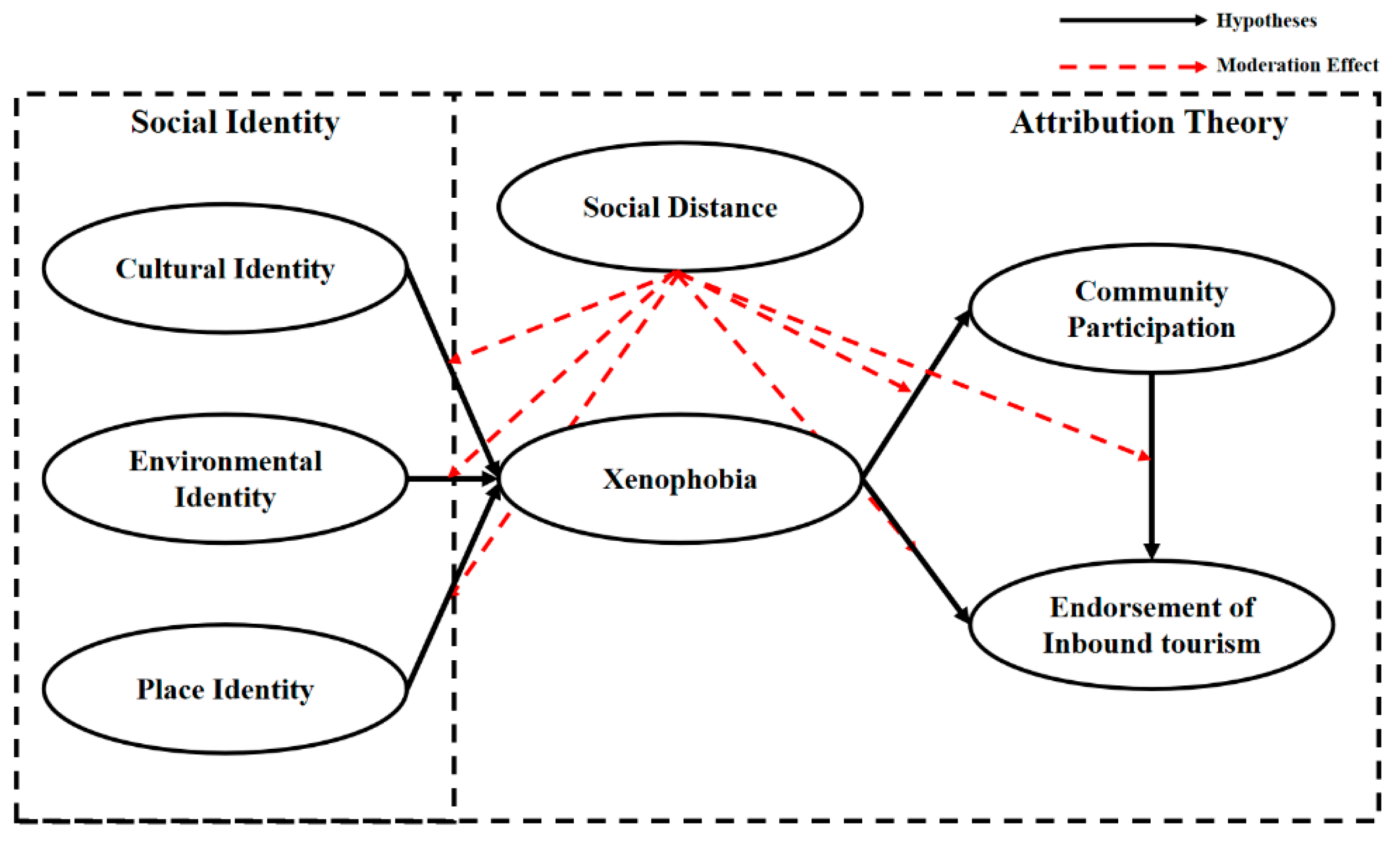
2.5. Conceptual Framework
3. Methodology
3.1. Procedure for Data Acquisition
3.2. Measurement Development
3.3. Data Analysis
4. Results
4.1. Assessment of the Measurement Model
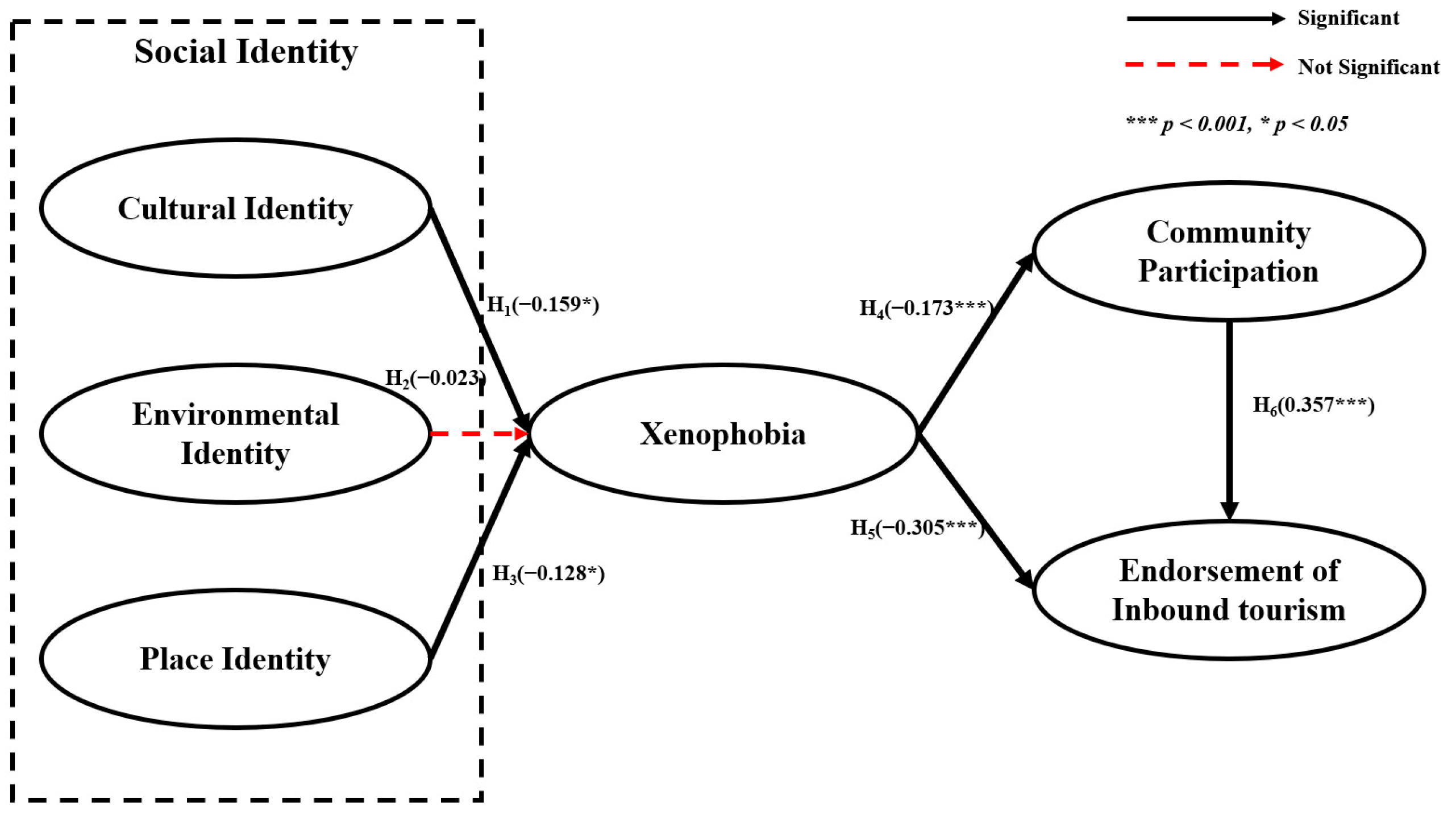
4.2. Assessment of the Structural Model
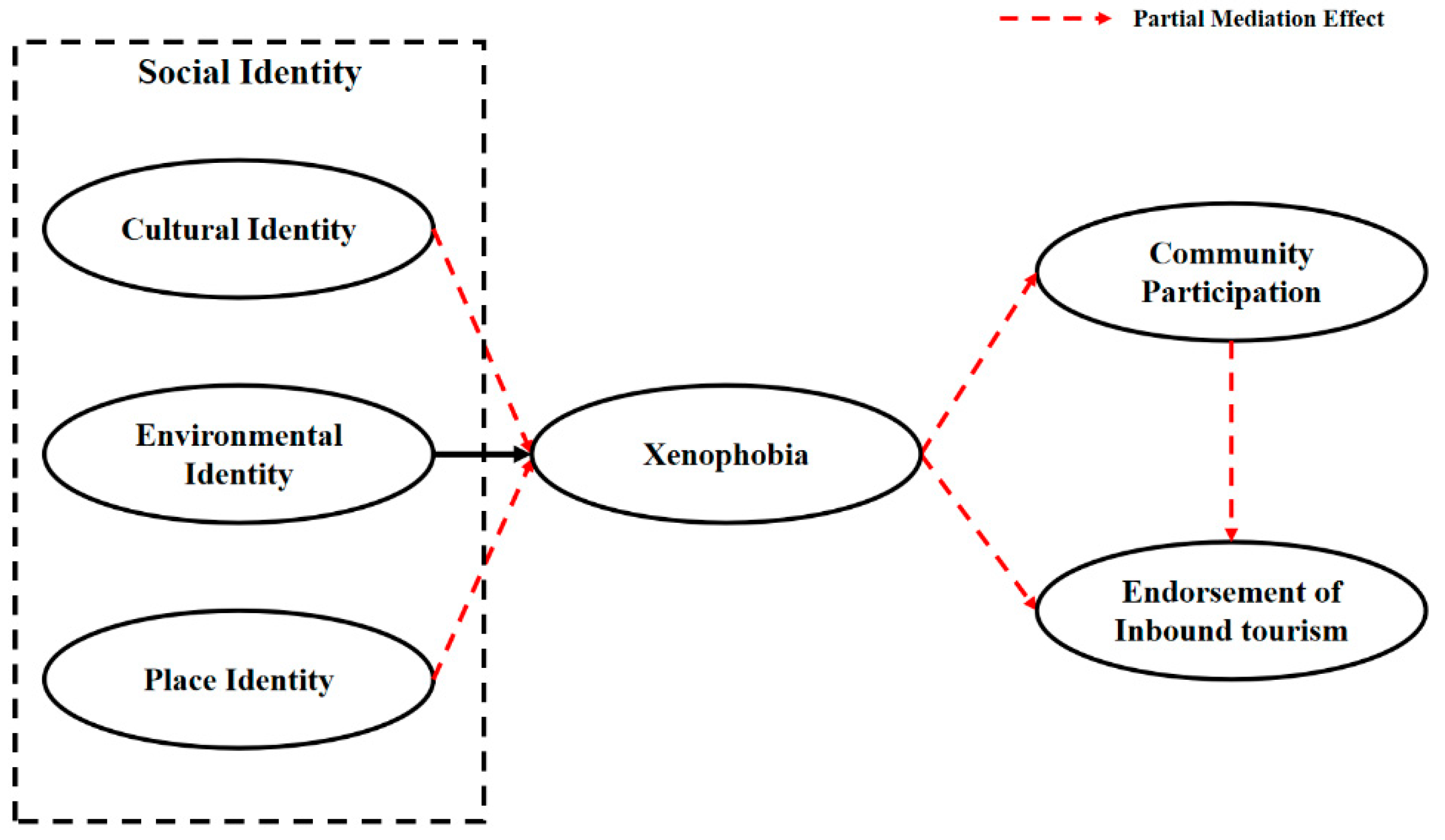
4.3. Assessment of the Mediating Effects
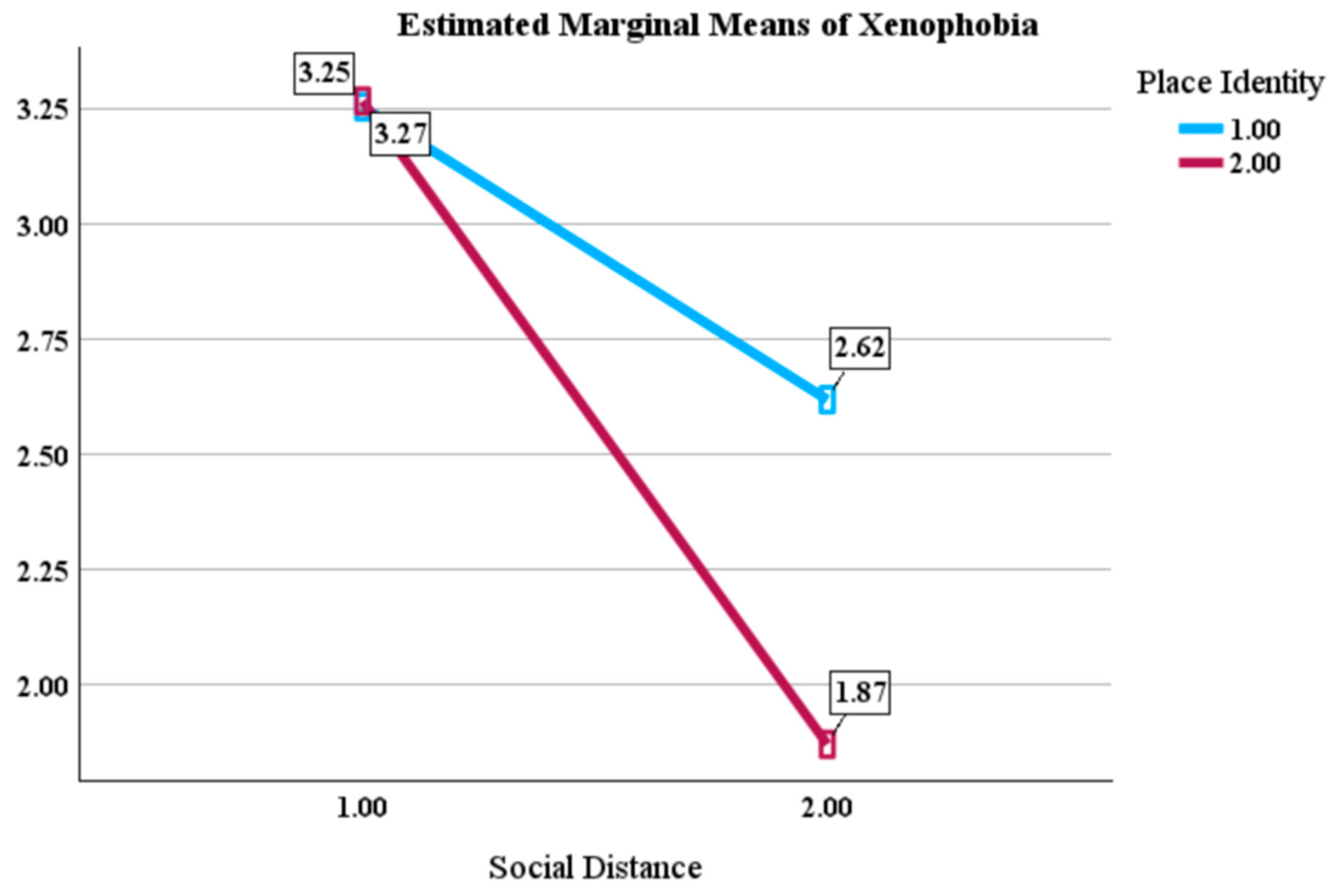
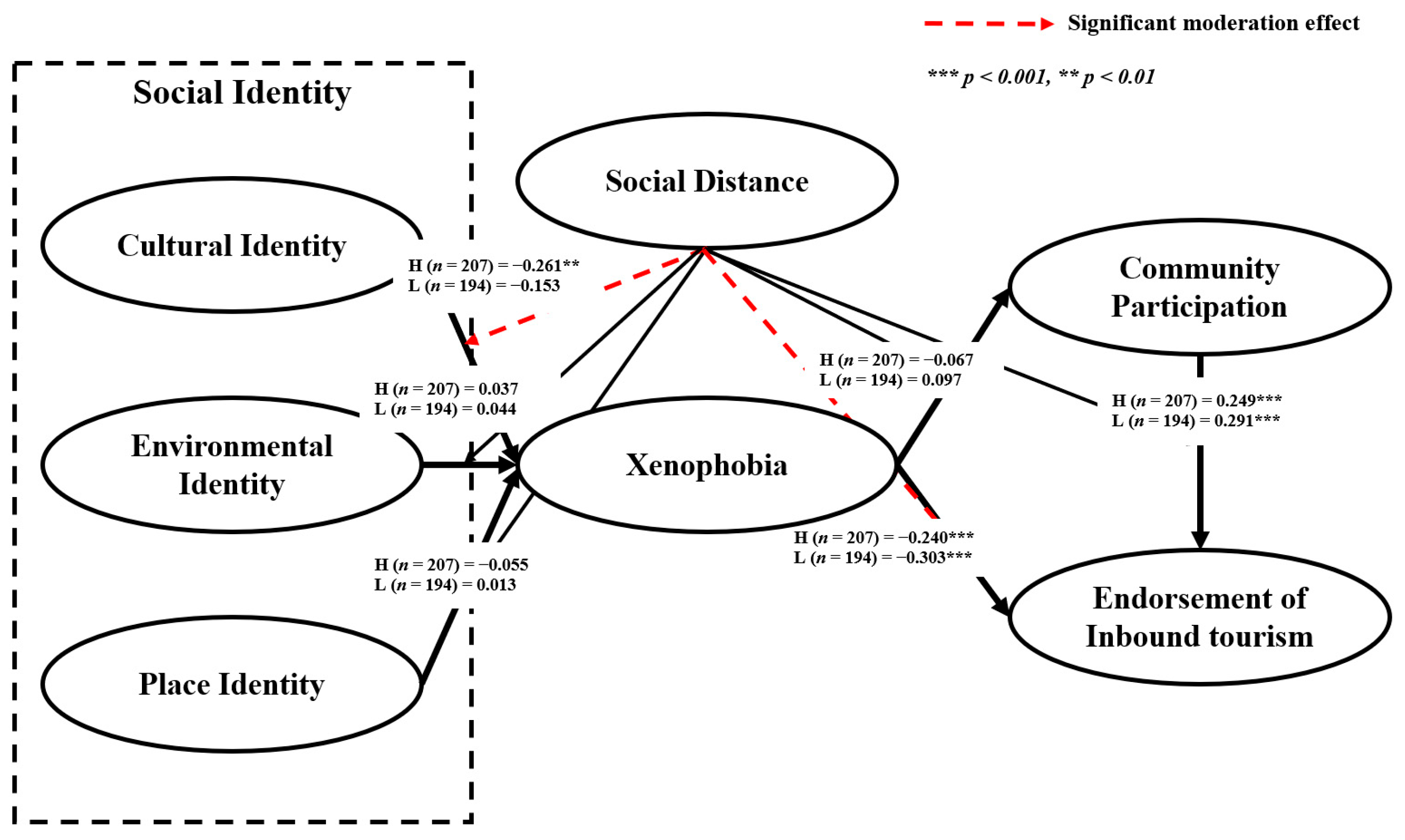
4.4. Assessment of the Moderating Effects
5. Discussion
5.1. Theoretical Implications
5.2. Practical Implications
5.3. Limitations and Future Research
Author Contributions
Funding
Institutional Review Board Statement
Informed Consent Statement
Data Availability Statement
Conflicts of Interest
Appendix A
Appendix A.1. Interaction Tests

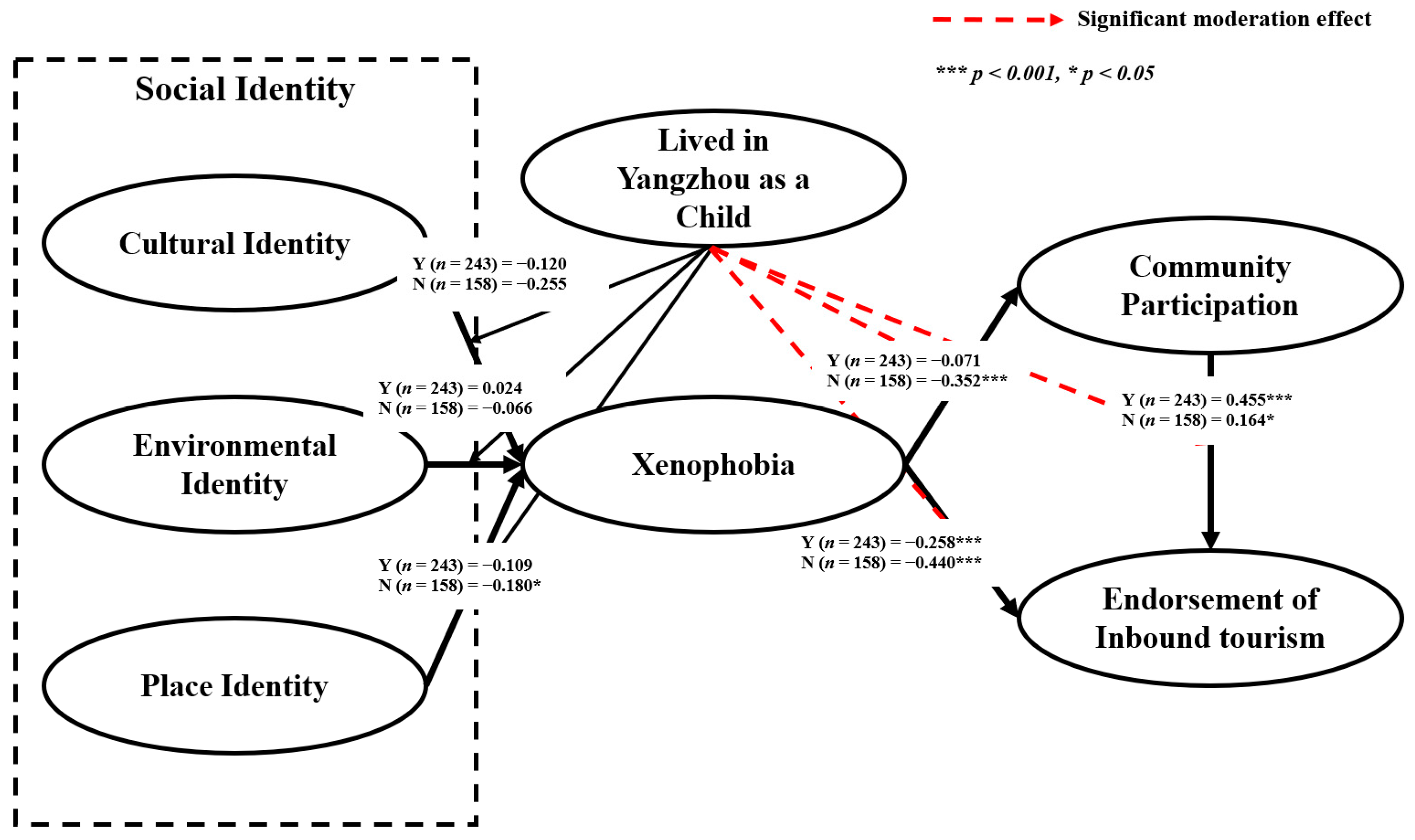
Appendix A.2. The Moderating Role of Having Lived in Yangzhou as a Child

| Path | Yes (n = 243) | No (n = 158) | χ2 | DF | Δχ2 |
|---|---|---|---|---|---|
| Coefficient | Coefficient | ||||
| CI–XEN | −0.120 | −0.255 | 1769.478 | 538 | 23.379 |
| EI–XEN | 0.024 | −0.066 | |||
| PI–XEN | −0.109 | −0.180 * | |||
| XEN–CP | −0.071 | −0.352 *** | |||
| XEN–EOIT | −0.258 *** | −0.440 *** | |||
| CP–EOIT | 0.455 *** | 0.164 * |
Appendix B
| Construct | Items | Cronbach’s Alpha |
| CI | Q1: I feel very proud to identify with Yangzhou culture | 0.930 |
| Q2: I consider it very important to maintain Yangzhou culture | ||
| Q3: It is very important for me to remain close to Yangzhou culture | ||
| EI | Q1: I am very concerned about the natural environment of Yangzhou | 0.920 |
| Q2: I am very protective of the natural environment in Yangzhou | ||
| Q3: I am respectful of Yangzhou natural environment | ||
| PI | Q1: I have a strong identity with Yangzhou | 0.936 |
| Q2: I feel attached to Yangzhou | ||
| Q3: I feel a sense of belonging to Yangzhou | ||
| Q4: Living and working in Yangzhou means a lot about who I am | ||
| XEN | Q1: I try to avoid contact with foreign tourists | 0.956 |
| Q2: I feel anxious when interacting with foreign tourists | ||
| Q3: Interacting with foreign tourists makes me uneasy | ||
| Q4: I don’t think foreign tourists and I can understand each other | ||
| Q5: Foreign tourists should not be trusted | ||
| CP | Q1: I actively participate in tourism related activities in Yangzhou | 0.946 |
| Q2: I understand Yangzhou tourism related planning and policies | ||
| Q3: I have participated in the decision-making related to tourism in Yangzhou | ||
| Q4: I have participated in tourism related training in Yangzhou | ||
| Q5: The government regularly seeks my advice on developing tourism in Yangzhou | ||
| EOIT | Q1: I believe inbound tourism should be actively encouraged in Yangzhou | 0.964 |
| Q2: I support the promotion of inbound tourism in Yangzhou | ||
| Q3: I support the development of new tourism facilities that attract more foreign tourists to Yangzhou | ||
| Q4: I support Yangzhou’s continued development as a popular tourist destination | ||
| Q5: I agree that tourism will continue to play a major role in Yangzhou’s economy | ||
| SD | Q1: I welcome foreign tourists as friends or family | 0.929 |
| Q2: I would like to have a close personal relationship with foreign tourists | ||
| Q3: I would like to invite foreign tourists into my home |
- Note: CI = Cultural identity, EI = Environmental identity, PI = Place identity, XEN = Xenophobia, CP = Community participation, EOIT = Endorsement of inbound tourism, SD = Social distance.
References
- Rasool, H.; Maqbool, S.; Tarique, M. The relationship between tourism and economic growth among BRICS countries: A panel cointegration analysis. Future Bus. J. 2021, 7, 1. [Google Scholar] [CrossRef]
- UN Tourism. World Tourism Barometer; UN Tourism: Madrid, Spain, 2025; Volume 23. [Google Scholar] [CrossRef]
- National Bureau of Statistics of China. National Data. Available online: https://data.stats.gov.cn/easyquery.htm?cn=C01 (accessed on 28 February 2025).
- Xinhuanet. Xinhua headlines: Visa Policy Eases Boost China Travel and Beyond. Available online: https://english.news.cn/20241201/aa6a214a2fc7405089c9b1037110eb77/c.html (accessed on 1 December 2024).
- Khalid, U.; Okafor, L.E.; Shafiullah, M. The effects of economic and financial crises on international tourist flows: A cross-country analysis. J. Travel Res. 2019, 59, 315–334. [Google Scholar] [CrossRef]
- Li, Z.; Huo, T.; Shao, Y.; Zhao, Q.; Huo, M. Inbound tourism—A bibliometric review of SSCI articles (1993–2021). Tour. Rev. 2022, 77, 322–338. [Google Scholar] [CrossRef]
- Muddasir, M.; Borges, A.P.; Vieira, E.; Vieira, B.M. The impact of macroeconomic factors on the European travel and leisure sector: The context of Russo–Ukrainian war. Tour. Rev. 2025, 80, 513–528. [Google Scholar] [CrossRef]
- Portella-Carbó, F.; Pérez-Montiel, J.; Ozcelebi, O. Tourism-led economic growth across the business cycle: Evidence from Europe (1995–2021). Econ. Anal. Policy 2023, 78, 1241–1253. [Google Scholar] [CrossRef]
- Gao, P.; Zhu, Z.-Y. Sustainable tourism development in China: An analysis of local residents’ attitudes toward tourists. Tour. Hosp. 2025, 6, 97. [Google Scholar] [CrossRef]
- Hasan, A.A.-T.; Rahman, M.M.; Gani, M.O. Exploring factors influencing smart tourism destination visiting behaviors in a historic country: A theory of e-consumption behavior. Eur. J. Manag. Bus. Econ. 2024. [Google Scholar] [CrossRef]
- Ibragimov, K.; Perles-Ribes, J.F.; Ramon-Rodriguez, A.B. The economic determinants of tourism in Central Asia: A gravity model applied approach. Tour. Econ. 2022, 28, 1749–1768. [Google Scholar] [CrossRef]
- Li, S.; Wang, Z. Analysis of intermediary variables in the market image identity influencing on experience willingness about micro-vacation destinations. J. Clean. Prod. 2023, 422, 138492. [Google Scholar] [CrossRef]
- Antwi, C.O.; Ntim, S.Y.; Boadi, E.A.; Asante, E.A.; Brobbey, P.; Ren, J. Sustainable cross-border tourism management: COVID-19 avoidance motive on resident hospitality. J. Sustain. Tour. 2022, 31, 1831–1851. [Google Scholar] [CrossRef]
- Matiza, T. The ‘xenophobic’ resident: Modelling the interplay between phobic cognition, perceived safety and hospitality post the Chinese ‘zero-COVID-19′ policy. Curr. Issues Tour. 2023, 27, 1769–1783. [Google Scholar] [CrossRef]
- Kim, S.; Kang, Y.; Park, J.-H.; Kang, S.-E. The Impact of Residents’ Participation on Their Support for Tourism Development at a Community Level Destination. Sustainability 2021, 13, 4789. [Google Scholar] [CrossRef]
- Kock, F.; Josiassen, A.; Assaf, A.G.; Karpen, I.; Farrelly, F. Tourism ethnocentrism and its effects on tourist and resident behavior. J. Travel Res. 2018, 58, 427–439. [Google Scholar] [CrossRef]
- Kock, F.; Josiassen, A.; Assaf, A.G. The xenophobic tourist. Ann. Tour. Res. 2019, 74, 155–166. [Google Scholar] [CrossRef]
- Zenker, S.; Braun, E.; Gyimóthy, S. Too afraid to travel? Development of a pandemic (COVID-19) anxiety travel scale (PATS). Tour. Manag. 2021, 84, 104286. [Google Scholar] [CrossRef] [PubMed]
- Gyimóthy, S.; Braun, E.; Zenker, S. Travel-at-home: Paradoxical effects of a pandemic threat on domestic tourism. Tour. Manag. 2022, 93, 104613. [Google Scholar] [CrossRef]
- Zenker, S.; Kock, F. The coronavirus pandemic—A critical discussion of a tourism research agenda. Tour. Manag. 2020, 81, 104164. [Google Scholar] [CrossRef]
- Heider, F. The Psychology of Interpersonal Relations; Wiley: New York, NY, USA, 1958. [Google Scholar]
- Qi, H. The influence of attributional style on decision related to symbolic consumption. Manag. World 2007, 5, 162–163. [Google Scholar]
- Zhang, J.; Zhu, Z. How does mental simulation affect causal attribution? Acta Psychol. Sin. 2003, 35, 237. [Google Scholar]
- Josiassen, A.; Kock, F.; Nørfelt, A. Tourism affinity and its effects on tourist and resident behavior. J. Travel Res. 2020, 61, 299–313. [Google Scholar] [CrossRef]
- González-Reverté, F. The perception of overtourism in urban destinations: Empirical evidence based on residents’ emotional response. Tour. Plan. Dev. 2021, 19, 451–477. [Google Scholar] [CrossRef]
- Zhang, Y.; Prayag, G.; Song, H. Attribution theory and negative emotions in tourism experiences. Tour. Manag. Perspect. 2021, 40, 100904. [Google Scholar] [CrossRef]
- Huitt, W.; Cain, S. An overview of the conative domain. Educ. Psychol. Interact. 2005, 3, 45. [Google Scholar]
- Tajfel, H. Human Groups and Social Categories; Cambridge University Press: Cambridge, UK, 1981. [Google Scholar]
- Tajfel, H.; Turner, J.C. An integrative theory of intergroup conflict. In The Social Psychology of Intergroup Relations; Austin, W.G., Worchel, S., Eds.; Brooks-Cole: Monterey, CA, USA, 1979; pp. 33–47. [Google Scholar]
- Cohen, J. Defining identification: A theoretical look at the identification of audiences with media characters. In Advances in Foundational Mass Communication Theories; Routledge: London, UK, 2018; pp. 253–272. [Google Scholar]
- Chen, N.; Hsu, C.H.C.; Li, X. Feeling superior or deprived? Attitudes and underlying mentalities of residents towards Mainland Chinese tourists. Tour. Manag. 2018, 66, 94–107. [Google Scholar] [CrossRef]
- Genkova, P.; Schaefer, C.D.; Karch, S. Intergroup contact as a potential path to neutralize the detrimental effect of national identification on xenophobia in Germany. J. Int. Migr. Integr. 2021, 23, 1903–1919. [Google Scholar] [CrossRef]
- Kelley, H.H. The processes of causal attribution. Am. Psychol. 1973, 28, 107. [Google Scholar] [CrossRef]
- Weiner, B. A theory of motivation for some classroom experiences. J. Educ. Psychol. 1979, 71, 3. [Google Scholar] [CrossRef]
- Weiner, B. Reflections on the history of attribution theory and research: People, personalities, publications, problems. Soc. Psychol. 2008, 39, 151–156. [Google Scholar] [CrossRef]
- Hewett, R.; Shantz, A.; Mundy, J.; Alfes, K. Attribution theories in human resource management research: A review and research agenda. Int. J. Hum. Resour. Manag. 2017, 29, 87–126. [Google Scholar] [CrossRef]
- Kim, D.; Lee, J.S.; Jang, W.; Ko, Y.J. Does causal reasoning lead to moral reasoning? Consumers’ responses to scandalized athletes and endorsements. Int. J. Sports Mark. Spons. 2022, 23, 465–484. [Google Scholar] [CrossRef]
- Nguyen, T.; Croucher, S.M.; Diers-Lawson, A.; Maydell, E. Who’s to blame for the spread of COVID-19 in New Zealand? Applying attribution theory to understand public stigma. Commun. Res. Pract. 2021, 7, 379–396. [Google Scholar] [CrossRef]
- Fu, X.; Liu, X.; Hua, C.; Li, Z.; Du, Q. Understanding tour guides’ service failure: Integrating a two-tier triadic business model with attribution theory. J. Hosp. Tour. Manag. 2021, 47, 506–516. [Google Scholar] [CrossRef]
- Alamrawy, M.A.T.; Hassan, T.H.; Saleh, M.I.; Abdelmoaty, M.A.; Salem, A.E.; Mahmoud, H.M.E.; Abdou, A.H.; Helal, M.Y.; Abdellmonaem, A.H.; El-Sisi, S.A.-W. Tourist attribution toward destination brands: What do we know? What we do not know? Where should we be heading? Sustainability 2023, 15, 4448. [Google Scholar] [CrossRef]
- Hassan, T.; Saleh, M.I. Tourism metaverse from the attribution theory lens: A metaverse behavioral map and future directions. Tour. Rev. 2023, 79, 1088–1104. [Google Scholar] [CrossRef]
- Ashforth, B.E.; Mael, F. Social identity theory and the organization. Acad. Manag. Rev. 1989, 14, 20–39. [Google Scholar] [CrossRef]
- Scott, S.G.; Lane, V.R. A stakeholder approach to organizational identity. Acad. Manag. Rev. 2000, 25, 43–62. [Google Scholar] [CrossRef]
- Hogg, M.A. Social Identity Theory; Springer International Publishing: Cham, Switzerland, 2016; pp. 3–17. [Google Scholar]
- Hsieh, J.-K. The impact of influencers’ multi-SNS use on followers’ behavioral intentions: An integration of cue consistency theory and social identity theory. J. Retail. Consum. Serv. 2023, 74, 103397. [Google Scholar] [CrossRef]
- Nunkoo, R.; Gursoy, D. Residents’ support for tourism: An Identity Perspective. Ann. Tour. Res. 2012, 39, 243–268. [Google Scholar] [CrossRef]
- Sinclair-Maragh, G.; Gursoy, D. Residents’ identity and tourism development: The Jamaican perspective. Int. J. Tour. Sci. 2017, 17, 107–125. [Google Scholar] [CrossRef]
- Wang, S.; Chen, J.S. The influence of place identity on perceived tourism impacts. Ann. Tour. Res. 2015, 52, 16–28. [Google Scholar] [CrossRef]
- Chen, G.; Bie, S.; Zhang, C.; Li, Z. Exploring tourists’ social identities in a similar-others destination: The case of Chinese tourists in North Korea. Tour. Rev. 2024, 79, 825–839. [Google Scholar] [CrossRef]
- Jiang, X.; Qin, J.; Gao, J.; Gossage, M.G. How tourists’ perception affects travel intention: Mechanism pathways and boundary conditions. Front. Psychol. 2022, 13, 821364. [Google Scholar] [CrossRef]
- Lee, T.H.; Jan, F.-H. Ecotourism behavior of nature-based tourists: An integrative framework. J. Travel Res. 2017, 57, 792–810. [Google Scholar] [CrossRef]
- Wan, C.; Chew, P.Y.G. Cultural knowledge, category label, and social connections: Components of cultural identity in the global, multicultural context. Asian J. Soc. Psychol. 2013, 16, 247–259. [Google Scholar] [CrossRef]
- Jameson, D.A. Reconceptualizing cultural identity and its role in intercultural business communication. J. Bus. Commun. 2007, 44, 199–235. [Google Scholar] [CrossRef]
- Kranz, D.; Goedderz, A. Coming home from a stay abroad: Associations between young people’s reentry problems and their cultural identity formation. Int. J. Intercult. Relat. 2020, 74, 115–126. [Google Scholar] [CrossRef]
- Hall, S. Cultural identity and diaspora. In Colonial Discourse and Post-Colonial Theory; Routledge: London, UK, 1994; pp. 392–403. [Google Scholar]
- Parboteeah, K.P.; Cullen, J.B. Social institutions and work centrality: Explorations beyond national culture. Organ. Sci. 2003, 14, 137–148. [Google Scholar] [CrossRef]
- Besculides, A.; Lee, M.E.; McCormick, P.J. Residents’ perceptions of the cultural benefits of tourism. Ann. Tour. Res. 2002, 29, 303–319. [Google Scholar] [CrossRef]
- Brida, J.G.; Osti, L.; Barquet, A. Segmenting resident perceptions towards tourism—A cluster analysis with a multinomial logit model of a mountain community. Int. J. Tour. Res. 2010, 12, 591–602. [Google Scholar] [CrossRef]
- Andereck, K.L.; Valentine, K.M.; Knopf, R.C.; Vogt, C.A. Residents’ perceptions of community tourism impacts. Ann. Tour. Res. 2005, 32, 1056–1076. [Google Scholar] [CrossRef]
- Sinclair-Maragh, G.; Gursoy, D. Imperialism and tourism: The case of developing island countries. Ann. Tour. Res. 2015, 50, 143–158. [Google Scholar] [CrossRef]
- Stets, J.E.; Biga, C.F. Bringing identity theory into environmental sociology. Sociol. Theory 2003, 21, 398–423. [Google Scholar] [CrossRef]
- Clayton, S. Environmental identity: A conceptual and an operational definition. In Identity and the Natural Environment: The Psychological Significance of Nature; MIT Press: Cambridge, MA, USA, 2003; pp. 45–65. [Google Scholar]
- Jones, D.L.; Jurowski, C.; Uysal, M. Host community residents’ attitudes: A comparison of environmental viewpoints. Tour. Hosp. Res. 2000, 2, 129–156. [Google Scholar] [CrossRef]
- Li, D.-X.; Kim, S.; Lee, Y.-K.; Griffin, M. Sustainable environmental development: The moderating role of environmental identity. Asian J. Soc. Psychol. 2016, 19, 298–310. [Google Scholar] [CrossRef]
- Franks, T.R. Managing sustainable development: Definitions, paradigms, and dimensions. Sustain. Dev. 1996, 4, 53–60. [Google Scholar] [CrossRef]
- Douglas, C.H. Small island states and territories: Sustainable development issues and strategies—Challenges for changing islands in a changing world. Sustain. Dev. 2006, 14, 75–80. [Google Scholar] [CrossRef]
- Guo, Z.-H. Local revitalization: Support from local residents. Sustainability 2022, 14, 8298. [Google Scholar] [CrossRef]
- Choi, H.C.; Murray, I. Resident attitudes toward sustainable community tourism. J. Sustain. Tour. 2010, 18, 575–594. [Google Scholar] [CrossRef]
- Hernández, B.; Martín, A.M.; Ruiz, C.; Hidalgo, M.D.C. The role of place identity and place attachment in breaking environmental protection laws. J. Environ. Psychol. 2010, 30, 281–288. [Google Scholar] [CrossRef]
- Bott, S.; Cantrill, J.G.; Myers, O.E., Jr. Place and the promise of conservation psychology. Hum. Ecol. Rev. 2003, 10, 100–112. [Google Scholar]
- Zhou, S.Y.; Tang, S.Y.; Dai, J.C. Identification of the significance of the concept of place to branches under human geography. Hum. Geogr. 2011, 26, 10–13. [Google Scholar]
- Proshansky, H.M. The city and self-identity. Environ. Behav. 1978, 10, 147–169. [Google Scholar] [CrossRef]
- Wang, J.; Lan, H.; Chen, J. Defend and remould—Residents’ place identity construction in traditional villages in the rural tourism context: A case study of Cuandixia village, Beijing. Tour. Crit. Pract. Theory 2024, 5, 21–43. [Google Scholar] [CrossRef]
- Wang, Y.; Wu, B.; Li, J.; Yuan, Q.; Chen, N. Can positive social contact encourage residents’ community citizenship behavior? The role of personal benefit, sympathetic understanding, and place identity. Behav. Sci. 2024, 14, 307. [Google Scholar] [CrossRef]
- Wang, S.; Chen, S.; Xu, H. Resident attitudes towards dark tourism: A perspective of place-based identity motives. Curr. Issues Tour. 2017, 22, 1601–1616. [Google Scholar] [CrossRef]
- Kadić-Maglajlić, S.; Lages, C.R.; Sobhy Temerak, M. Dual perspective on the role of xenophobia in service sabotage. Tour. Manag. 2024, 101, 104831. [Google Scholar] [CrossRef]
- Ikeji, T.; Nagai, H. Residents’ attitudes towards peer-to-peer accommodations in Japan: Exploring hidden influences from intergroup biases. Tour. Plan. Dev. 2020, 18, 491–509. [Google Scholar] [CrossRef]
- Hjerm, M. National identities, national pride and xenophobia: A comparison of four Western countries. Acta Sociol. 1998, 41, 335–347. [Google Scholar] [CrossRef]
- Nunkoo, R.; So, K.K.F. Residents’ support for tourism: Testing Alternative Structural Models. J. Travel Res. 2016, 55, 847–861. [Google Scholar] [CrossRef]
- Nugroho, P.; Numata, S. Resident support of community-based tourism development: Evidence from Gunung Ciremai National Park, Indonesia. J. Sustain. Tour. 2020, 30, 2510–2525. [Google Scholar] [CrossRef]
- Park, R.E. The concept of social distance: As applied to the study of racial relations. J. Appl. Sociol. 1924, 8, 334–339. [Google Scholar]
- Yilmaz, S.S.; Tasci, A.D.A. Circumstantial impact of contact on social distance. J. Tour. Cult. Change 2014, 13, 115–131. [Google Scholar] [CrossRef]
- Parrillo, V.N.; Donoghue, C. Updating the Bogardus social distance studies: A new national survey. Soc. Sci. J. 2005, 42, 257–271. [Google Scholar] [CrossRef]
- Nyaupane, G.P.; Timothy, D.J.; Poudel, S. Understanding tourists in religious destinations: A social distance perspective. Tour. Manag. 2015, 48, 343–353. [Google Scholar] [CrossRef]
- Aleshinloye, K.D.; Fu, X.; Ribeiro, M.A.; Woosnam, K.M.; Tasci, A.D.A. The influence of place attachment on social distance: Examining mediating effects of emotional solidarity and the moderating role of interaction. J. Travel Res. 2019, 59, 828–849. [Google Scholar] [CrossRef]
- Thyne, M.; Woosnam, K.M.; Watkins, L.; Ribeiro, M.A. Social distance between residents and tourists explained by residents’ attitudes concerning tourism. J. Travel Res. 2022, 61, 150–169. [Google Scholar] [CrossRef]
- Joo, D.; Tasci, A.D.A.; Woosnam, K.M.; Maruyama, N.U.; Hollas, C.R.; Aleshinloye, K.D. Residents’ attitude towards domestic tourists explained by contact, emotional solidarity and social distance. Tour. Manag. 2018, 64, 245–257. [Google Scholar] [CrossRef]
- Gong, Y.; Chow, I.H.-S.; Ahlstrom, D. Cultural diversity in China: Dialect, job embeddedness, and turnover. Asia Pac. J. Manag. 2010, 28, 221–238. [Google Scholar] [CrossRef]
- China Daily. Yangzhou shines with historical heritage and cultural charm. Available online: http://subsites.chinadaily.com.cn/yangzhoutravel/2022-02/09/c_706822.htm (accessed on 9 February 2022).
- The Paper. Let the world discover the beauty of Yangzhou! A cultural tourism invitation from the “Three Capitals”. Available online: https://m.thepaper.cn/baijiahao_29448882 (accessed on 25 November 2024).
- Seo, K.; Jordan, E.; Woosnam, K.M.; Lee, C.-K.; Lee, E.-J. Effects of emotional solidarity and tourism-related stress on residents’ quality of life. Tour. Manag. Perspect. 2021, 40, 100874. [Google Scholar] [CrossRef]
- Lai, I.K.W.; Hitchcock, M. Local reactions to mass tourism and community tourism development in Macau. J. Sustain. Tour. 2016, 25, 451–470. [Google Scholar] [CrossRef]
- Wang, Y.; Hu, W.; Park, K.-S.; Yuan, Q.; Chen, N. Examining residents’ support for night tourism: An application of the social exchange theory and emotional solidarity. J. Destin. Mark. Manag. 2023, 28, 100780. [Google Scholar] [CrossRef]
- Zhang, S.-N.; Ruan, W.-Q.; Yang, T.-T. National identity construction in cultural and creative tourism: The double mediators of implicit cultural memory and explicit cultural learning. Sage Open 2021, 11, 21582440211040789. [Google Scholar] [CrossRef]
- Cleveland, M.; Rojas-Méndez, J.I.; Laroche, M.; Papadopoulos, N. Identity, culture, dispositions and behavior: A cross-national examination of globalization and culture change. J. Bus. Res. 2016, 69, 1090–1102. [Google Scholar] [CrossRef]
- Qin, Y.; Albrecht, J.N.; Tao, L. The effects of migratory village residents’ social identity on community participation in tourism. J. China Tour. Res. 2024, 20, 811–837. [Google Scholar] [CrossRef]
- Woosnam, K.M.; Joo, D.; Ribeiro, M.A.; Johnson Gaither, C.; Sánchez, J.J.; Brooks, R. Rural residents’ social distance with tourists: An affective interpretation. Curr. Issues Tour. 2023, 27, 939–953. [Google Scholar] [CrossRef]
- von der Gracht, H.A. Consensus measurement in Delphi studies. Technol. Forecast. Soc. Change 2012, 79, 1525–1536. [Google Scholar] [CrossRef]
- Suhr, D.D. Exploratory or Confirmatory Factor Analysis? SAS Institute: Cary, NC, USA, 2006. [Google Scholar]
- George, D. SPSS for Windows Step by Step: A Simple Study Guide and Reference, 17.0 Update, 10/e; Pearson Education India: New Delhi, India, 2011. [Google Scholar]
- Hair, J.F.; Anderson, R.E.; Babin, B.J.; Black, W.C. Multivariate Data Analysis: A Global Perspective, 7th ed.; Pearson Education: Upper Saddle River, NJ, USA, 2010. [Google Scholar]
- Fornell, C.; Larcker, D.F. Structural equation models with unobservable variables and measurement error: Algebra and statistics. J. Mark. Res. 1981, 18, 382–388. [Google Scholar] [CrossRef]
- Cocola-Gant, A. Tourism gentrification. In Handbook of Gentrification Studies; Lees, L., Phillips, M., Eds.; Edward Elgar Publishing: Cheltenham, UK, 2018; pp. 281–293. [Google Scholar] [CrossRef]
- Nghiêm-Phú, B.; Phạm, H.L. Local residents’ attitudes toward reopening inbound tourism amid COVID-19: A study in Vietnam. Sage Open 2022, 12, 21582440221099515. [Google Scholar] [CrossRef]
- Erul, E.; Woosnam, K.M.; McIntosh, W.A. Considering emotional solidarity and the theory of planned behavior in explaining behavioral intentions to support tourism development. J. Sustain. Tour. 2020, 28, 1158–1173. [Google Scholar] [CrossRef]
- Uygur, M.R.; Eser, H.B.; Çoksan, S.; Sarıdağ, S. Multiculturalism, social distance, and xenophobia among non-WEIRD individuals toward Syrian refugees: Positive and negative emotions as moderators. Curr. Psychol. 2024, 43, 22859–22871. [Google Scholar] [CrossRef]
- Nunkoo, R.; Smith, S.L.J.; Ramkissoon, H. Residents’ attitudes to tourism: A longitudinal study of 140 articles from 1984 to 2010. J. Sustain. Tour. 2013, 21, 5–25. [Google Scholar] [CrossRef]
- Taskin, S.; Yildirim Kurtulus, H.; Satici, S.A.; Deniz, M.E. Doomscrolling and mental well-being in social media users: A serial mediation through mindfulness and secondary traumatic stress. J. Community Psychol. 2024, 52, 512–524. [Google Scholar] [CrossRef] [PubMed]
- Nguyen, N.D.; Truong, N.-A.; Quang Dao, P.; Nguyen, H.H. Can online behaviors be linked to mental health? Active versus passive social network usage on depression via envy and self-esteem. Comput. Hum. Behav. 2025, 162, 108455. [Google Scholar] [CrossRef]
- Baron, R.M.; Kenny, D.A. The moderator–mediator variable distinction in social psychological research: Conceptual, strategic, and statistical considerations. J. Pers. Soc. Psychol. 1986, 51, 1173–1182. [Google Scholar] [CrossRef] [PubMed]
- Klein, A.; Moosbrugger, H. Maximum likelihood estimation of latent interaction effects with the LMS method. Psychometrika 2000, 65, 457–474. [Google Scholar] [CrossRef]


| Classification | Count (n) | Proportion (%) | |
|---|---|---|---|
| Gender | Male | 164 | 40.9% |
| Female | 237 | 59.1% | |
| Age | 18–30 | 37 | 9.2% |
| 31–40 | 228 | 56.9% | |
| 41–50 | 127 | 31.7% | |
| 51–60 | 3 | 0.7% | |
| Over 60 | 6 | 1.5% | |
| Marital Status | Unmarried | 34 | 8.5% |
| Married | 349 | 87% | |
| Other | 18 | 4.5% | |
| Education | Junior high school or below | 98 | 24.4% |
| High school/Technical secondary | 119 | 29.7% | |
| Associate degree (Junior college) | 72 | 18% | |
| Bachelor’s degree | 97 | 24.2% | |
| Master’s degree or above | 15 | 3.7% | |
| Length of residence (years) | 1–5 | 21 | 5.2% |
| 6–10 | 54 | 13.5% | |
| 11–20 | 141 | 35.2% | |
| More than 20 | 185 | 46.1% | |
| Working in tourism sector | Yes | 34 | 8.5% |
| No | 367 | 91.5% | |
| Current home in Yangzhou | Own | 357 | 89% |
| Rent | 44 | 11% | |
| Live in Yangzhou as a child | Yes | 243 | 60.6% |
| No | 158 | 39.4% | |
| Unstandardized | S.E. | C.R. | Standard | p | AVE | CR | |
|---|---|---|---|---|---|---|---|
| CI: CI1 | 1.000 | --- | --- | 0.901 | --- | 0.855 | 0.946 |
| CI: CI2 | 0.974 | 0.033 | 29.417 | 0.932 | *** | ||
| CI: CI3 | 0.983 | 0.038 | 26.060 | 0.880 | *** | ||
| EI: EI1 | 1.000 | --- | --- | 0.824 | --- | 0.829 | 0.936 |
| EI: EI2 | 1.068 | 0.045 | 24.008 | 0.940 | *** | ||
| EI: EI3 | 1.114 | 0.048 | 23.161 | 0.913 | *** | ||
| PI: PI1 | 1.000 | --- | --- | 0.852 | --- | 0.694 | 0.900 |
| PI: PI2 | 0.990 | 0.042 | 23.614 | 0.886 | *** | ||
| PI: PI3 | 1.206 | 0.047 | 25.408 | 0.923 | *** | ||
| PI: PI4 | 1.050 | 0.044 | 23.603 | 0.886 | *** | ||
| XEN: XEN1 | 1.000 | --- | --- | 0.874 | --- | 0.581 | 0.874 |
| XEN: XEN2 | 1.032 | 0.037 | 27.785 | 0.922 | *** | ||
| XEN: XEN3 | 1.044 | 0.038 | 27.745 | 0.922 | *** | ||
| XEN: XEN4 | 1.029 | 0.037 | 27.936 | 0.924 | *** | ||
| XEN: XEN5 | 1.022 | 0.042 | 24.154 | 0.864 | *** | ||
| CP: CP1 | 1.000 | --- | --- | 0.771 | --- | 0.528 | 0.848 |
| CP: CP2 | 1.070 | 0.058 | 18.579 | 0.836 | *** | ||
| CP: CP3 | 1.478 | 0.066 | 22.410 | 0.964 | *** | ||
| CP: CP4 | 1.495 | 0.068 | 21.945 | 0.948 | *** | ||
| CP: CP5 | 1.253 | 0.064 | 19.472 | 0.867 | *** | ||
| EOIT: EOIT 1 | 1.000 | --- | --- | 0.899 | --- | 0.840 | 0.963 |
| EOIT: EOIT 2 | 1.042 | 0.033 | 32.017 | 0.939 | *** | ||
| EOIT: EOIT 3 | 1.075 | 0.033 | 32.359 | 0.943 | *** | ||
| EOIT: EOIT 4 | 1.024 | 0.032 | 31.733 | 0.937 | *** | ||
| EOIT: EOIT 5 | 0.942 | 0.036 | 26.505 | 0.874 | *** |
| CI | EI | PI | XEN | CP | EOIT | |
|---|---|---|---|---|---|---|
| CI | 1 (0.925) | |||||
| EI | 0.715 | 1 (0.910) | ||||
| PI | 0.452 | 0.441 | 1 (0.833) | |||
| XEN | −0.224 | −0.185 | −0.202 | 1 (0.762) | ||
| CP | 0.376 | 0.404 | 0.437 | −0.168 | 1 (0.727) | |
| EOIT | 0.599 | 0.518 | 0.528 | −0.360 | 0.411 | 1 (0.917) |
| Path | Estimate | S. E | C. R | p |
|---|---|---|---|---|
| CI–XEN | −0.159 | 0.155 | −1.993 | * |
| EI–XEN | −0.023 | 0.163 | −0.292 | 0.771 |
| PI–XEN | −0.128 | 0.086 | −2.156 | * |
| XEN–CP | −0.173 | 0.043 | −3.329 | *** |
| XEN–EOIT | −0.305 | 0.028 | −6.468 | *** |
| CP–EOIT | 0.357 | 0.035 | 7.331 | *** |
| R2 (XEN) = 0.065 R2 (CP) = 0.029 R2 (EOIT) = 0.466 | Total effect on EOIT CI = 0.499 *** PI = 0.245 *** | Indirect effect βCI—XEN—EOIT = 0.035 * βCI—XEN—CP—EOIT = 0.004 * βPI—XEN—EOIT = 0.022 * βPI—XEN—CP—EOIT = 0.002 * | ||
| Path | Social Distance Is Above Average (n = 207) | Social Distance Is Below Average (n = 194) | χ2 | DF | Δχ2 |
|---|---|---|---|---|---|
| Coefficient | Coefficient | ||||
| CI–XEN | −0.261 ** | −0.153 | 1612.313 | 538 | 18.010 |
| EI–XEN | 0.037 | 0.044 | |||
| PI–XEN | −0.055 | 0.013 | |||
| XEN–CP | −0.067 | 0.097 | |||
| XEN–EOIT | −0.240 *** | −0.303 *** | |||
| CP–EOIT | 0.249 *** | 0.291 *** |
Disclaimer/Publisher’s Note: The statements, opinions and data contained in all publications are solely those of the individual author(s) and contributor(s) and not of MDPI and/or the editor(s). MDPI and/or the editor(s) disclaim responsibility for any injury to people or property resulting from any ideas, methods, instructions or products referred to in the content. |
© 2025 by the authors. Licensee MDPI, Basel, Switzerland. This article is an open access article distributed under the terms and conditions of the Creative Commons Attribution (CC BY) license (https://creativecommons.org/licenses/by/4.0/).
Share and Cite
Gao, P.; Zhu, Z.-Y. Does Xenophobia Among Local Residents Affect Sustainable Tourism Development in China? A Study Based on Attribution Theory and Social Identity Theory. Sustainability 2025, 17, 11201. https://doi.org/10.3390/su172411201
Gao P, Zhu Z-Y. Does Xenophobia Among Local Residents Affect Sustainable Tourism Development in China? A Study Based on Attribution Theory and Social Identity Theory. Sustainability. 2025; 17(24):11201. https://doi.org/10.3390/su172411201
Chicago/Turabian StyleGao, Peng, and Zong-Yi Zhu. 2025. "Does Xenophobia Among Local Residents Affect Sustainable Tourism Development in China? A Study Based on Attribution Theory and Social Identity Theory" Sustainability 17, no. 24: 11201. https://doi.org/10.3390/su172411201
APA StyleGao, P., & Zhu, Z.-Y. (2025). Does Xenophobia Among Local Residents Affect Sustainable Tourism Development in China? A Study Based on Attribution Theory and Social Identity Theory. Sustainability, 17(24), 11201. https://doi.org/10.3390/su172411201