Article

Long-Term Trends and Characteristics of Water Temperature Extremes of a Large Lowland River During the Summer Season from 1920 to 2023—Case Study of the Bug River in Poland, Eastern Europe


1
Department of Hydraulics, Water and Sanitary Engineering, Warsaw University of Life Sciences—SGGW, Nowoursynowska 159, 02-776 Warsaw, Poland
2
Department of Environmental Management and Remote Sensing, Warsaw University of Life Sciences—SGGW, Nowoursynowska 159, 02-776 Warsaw, Poland
3
Department of Hydrology, Meteorology and Water Management, Warsaw University of Life Sciences—SGGW, Nowoursynowska 159, 02-776 Warsaw, Poland
*
Author to whom correspondence should be addressed.
Sustainability 2025, 17(24), 11189; https://doi.org/10.3390/su172411189
Submission received: 29 October 2025 / Revised: 5 December 2025 / Accepted: 9 December 2025 / Published: 14 December 2025
(This article belongs to the Section Sustainable Water Management)

Abstract

Sustainable water resource management must address the current challenges posed by changes in the thermal regime of water bodies. The ongoing increase in air temperature leads to higher water temperatures, resulting in various unfavorable changes in the aquatic environment and limiting its capacity to meet human subsistence and economic needs. The aim of this study was to evaluate the impact of climate change on the thermal regime of the Bug River, a large lowland river in Eastern Europe (Poland) that remains thermally unpolluted. Using archival sources, we collected, reconstructed, and standardized water temperature data for the Bug River at the Wyszków profile during the summer months (April to October) from 1920 to 2023, despite several gaps in the data. Our analysis revealed a significant increase in the average summer water temperature, along with maximum and minimum temperatures, although there was considerable month-to-month variability throughout the study period. The observed upward trend in water temperature corresponds to the rise in air temperature. Between the subsequent 30-year climate norms of 1971–2000, 1981–2010, and 1991–2020, we noted a steady increase of 0.4 °C in average summer water temperatures. The highest average monthly water temperatures in recent years occurred during the summer seasons of 2018, 2019, 2021, and 2023. Notably, we also recorded some of the highest water temperatures in July 1951, June 1932, and July 1947 and 2010. Furthermore, we found a significant relationship (R2 = 0.68) between maximum water temperature during low flow events and the average discharge. The results of this study indicate a warming trend in the waters of the Bug River.

1. Introduction

Temperature is one of the most important physical factors of water, as it significantly affects biological and chemical processes. The great interest in the thermodynamics of flowing waters in Europe in past centuries is evidenced by Forster’s 1894 work [1], which contains a brief historical overview of research on the temperature of rivers in Central Europe. The observations concerned daily measurements and examined the relationship between water temperature and climatic phenomena. According to Gołek [2], these studies from the 18th and 19th centuries, due to the use of various types of instruments that were generally not very accurate, are of historical value. In Poland, the earliest observations of water temperature focused on large rivers, such as the Vistula, Dunajec, San, and Bug. The main development of a network of systematic water temperature observations occurred after the Second World War. The 1952 guidelines for water temperature measurements [3] specified the practical scope and objectives of thermal condition measurements, emphasizing water supply, fishing, and forecasting ice formation and break-up. Recent studies have enhanced our understanding of surface water temperature patterns, including seasonal and long-term variations. These findings can be utilized to evaluate the quality of aquatic ecosystems, as water temperature serves as a crucial indicator of environmental change [4].
The temperature of river water is influenced by several factors related to the morphological and geological conditions of the river valley, the presence of aquatic vegetation, shading and development of the shoreline, and the supply of springs, peat bogs, groundwater, and rainwater. Additionally, the temperature of tributaries and the inflow of municipal and industrial sewage also play important roles. However, solar activity and air temperature significantly influence the temperature of running waters [2,5,6]. Nevertheless, this relationship is not linear. Research by Łaszewski [7] shows that in temperate climates for lowland rivers, the relationship between air temperature and water temperature is clearly stronger during the spring rise and autumn fall of the water temperature. In contrast, this relationship is weaker during the winter and summer months. It should also be noted that water is characterized by high thermal inertia, i.e., rapid and short-term changes in air mass temperature or insolation cause relatively small changes in river water temperature [5]. Therefore, long-term observations are crucial for assessing the nature of changes in water temperature. However, the literature indicates that long-term series of water temperature measurements are scarce [8,9].
The widespread belief that air and water temperatures have been rising steadily over the past decades is reflected in numerous studies and publications [6,8,10,11]. In Poland, the evolution of climate warming has reached an air temperature increase of 0.8 °C per 100 years, which has changed the structure of the four seasons typical for Poland [12]. Longer summers and warmer winters are being observed. Climate change in Poland has primarily consisted of increased air temperature since the late 1980s, with no significant changes in the total amount of precipitation (only in its distribution). The increase in air temperature and evaporation causes changes in the water balance and the volume and distribution of river runoff in Poland on an annual cycle [13]. The progressive increase in air temperature determines an increase in water temperature, which causes several adverse physicochemical, biochemical and ecological changes in water bodies and additional restrictions on the sustainable management of water resources.
One of the goals of sustainable development is to ensure that all people have access to water through the sustainable management of water resources [14]. However, achieving sustainable development goals requires recognizing the current challenges in water management. These challenges include assessing the impacts of climate change and economic activities on water resources. Sustainable development cannot occur without sustainable economic practices—those that consider their environmental impact. With regard to water temperature, as highlighted by Moatar and Gailhard [9], it is essential to understand how the thermal regime has changed in the past to predict future changes more accurately.
Thermal pollution of water poses a threat to the biodiversity of the environment but also has the potential to accelerate natural chemical reactions, release excess nutrients, and increase the solubility of heavy metals, resulting in higher treatment costs [15,16]. As a result of changes in the thermal structure and mixing of waters, a decline in productivity has been observed in some lakes, which poses a threat to human communities that depend on fishing as a source of food and income [10]. The increase in water temperature contributes to its deterioration and toxic cyanobacterial blooms. In Poland, a temporary deterioration in water quality due to cyanobacterial blooms is observed during the bathing season, especially in inland lake bathing areas [17]. There is also an increased risk of deterioration in the sanitary condition of bathing areas indirectly related to the increase in water temperature resulting from the growing interest of bathers in warmer water [18].
Increases in water temperature can result not only from climate warming but also from human activities. These activities can significantly alter the thermal regime of rivers through the discharge of heated sewage, the construction of dams, and water abstraction [8]. A literature review presented in the report [19] indicates that thermal power plants with once-through cooling systems are responsible for 80% of all thermal pollution in open waters. In Poland, from 2000 to 2019, nearly 75% of water abstracted from surface resources was cooling water used for electricity production [20]. The report’s authors [19] reference [21] in stating that since 1981, the average water temperature has increased due to thermal pollution by approximately 0.16 °C in rivers across Europe, Russia, China, and India, by about 0.5 to 0.8 °C in other Asian rivers, and by around 0.4 to 2.0 °C in rivers in the eastern United States. The hot cooling wastewater from thermal power plants can adversely affect the living conditions of aquatic plants and animals, hinder the migration of cold-water fish, such as salmon, to their breeding sites, and destroy organisms that are transported by the current into the hot wastewater stream [19]. Using the Vistula River in Poland as an example, the report’s authors note that the combination of rising water temperatures due to global warming and other human-induced factors could eventually lead to the extinction of sensitive fish species. The literature emphasizes the importance of analyzing the impacts of substantial industrial wastewater discharges into rivers, highlighting the need to minimize negative effects on the hydrological regime. Therefore, careful analysis, monitoring, and mitigation measures are critical to balancing energy production needs with the protection of aquatic ecosystems and water quality [22]. Thermal pollution can be quantified using mixing models to create an appropriate Temperature Duration Curve (TDC), which can serve as a predictive tool in risk assessments for both power plants and aquatic ecosystems [23]. Comprehensive studies conducted between 1961 and 2010 on the thermal regime of Polish rivers indicate an increase in water temperature. This rise is more pronounced in larger rivers, such as the Vistula, Oder, and Bug, while medium-sized rivers like the Wda, Biebrza, Łyna, and Rega exhibit a smaller increase. This trend is primarily attributed to changes in climatic factors, particularly the rise in air temperature, rather than to anthropogenic pressures, such as thermal pollution, or local conditions [15]. However, as Graf and Wrzesiński [4] report, numerous European studies—similar to those carried out for rivers in Poland—have not led to a uniform pattern of water temperature trends in rivers.
The results regarding Austrian rivers indicate that the nature and extent of water temperature changes over the past century (1900–2000) vary significantly between catchments of different sizes and characteristics. Long-term data reveal a notable increase in river temperatures throughout the 20th century, primarily driven by rising air temperatures [8]. In a similar analysis, water temperature data from the Loire River spanning from 1976 to 2003 demonstrated significant increases during spring and summer, with temperature rises ranging from 1.5 °C to 2 °C. These increases were less pronounced in winter and were not observed in autumn [9]. The authors attribute the rise in Loire River water temperature not only to increasing air temperatures but also to decreased water flow, highlighting the extremely dry conditions of 2003 as a significant factor. During the summer of 2003, the Loire experienced low water levels combined with a heatwave, resulting in record high temperatures—averaging 25.4 °C from June to August, which is 4 °C above the inter-annual mean [9]. Similarly, research on the Ticino River in northern Italy revealed that extreme water temperatures were recorded during low-flow periods, with minimum temperatures occurring in February and maximum temperatures in August [24]. For the Danube River, a study by Ducić et al. [25] analyzed the Bogojevo profile from 1961 to 2013 and found a statistically significant increase in the mean annual water temperature, averaging 0.039 °C per year, along with increases in all mean monthly values. Nonetheless, from 1998 to 2013, there was a decline in values. The authors [25] noted that the longest periods of negative trends (27 years) occurred in January and February, suggesting that natural factors played a significant role in the decrease in winter air and water temperatures in the Danube.
In the case of Polish rivers, water temperatures and trends in their changes vary in time and space, as do changes in river discharge regimes [4]. An analysis of 53 rivers in Poland at 94 water gauge stations shows varying positive and negative trends in water temperature series from 1971 to 2015. A positive and statistically significant trend in the average annual water temperature is observed at approximately 85% of measuring stations in spring, summer and autumn, especially in the summer (June-August). On the other hand, no statistically significant trends in water temperature changes in rivers in Poland are observed in the winter half-year (November–April), but the direction of change is positive [4]. We should also emphasize that studies on the occurrence of ice phenomena in Polish rivers clearly indicate a reduction in their duration, which is a direct result of the increase in water temperature and, in the case of some rivers, also of anthropogenic pressure (including the operation of dam reservoirs) [26,27,28].
A reduction in the duration of ice phenomena and changes in the volume and distribution of river runoff in Poland accompany the observed changes in the thermal regime of rivers. Based on analyses of the last 70 years (1951–2020), a decrease in maximum daily discharges has been observed, especially in spring and summer, caused by decreasing snow cover and more frequent mid-winter thaws. The most significant decreases in flood peaks are observed in rivers in central and eastern Poland, and these changes are statistically significant. In the case of average low discharges, an increase in their values is observed in the winter–spring period and a decrease in the summer–autumn months [29,30]. Adverse changes in snow cover in the winter half-year lead to water deficits in spring and summer [31]. Droughts in Poland in recent years, as in Europe, are becoming more frequent [30,32]. Rainfall-free and dry periods are becoming longer during the warm season [12]. A marked change in runoff and an increase in air and water temperatures have been observed in Poland since the 1980s [4,15,30,33,34]. Recent hydrological years, including 2012, 2015, 2016, 2019, 2020, 2022 and 2023, have been arid [35], with the lowland areas of Poland being the most vulnerable to prolonged and severe droughts [36,37]. However, long dry periods are interrupted by sudden floods, which can cause significant damage to society and the economy, such as the recent flood in September 2024 in the Odra river basin in southern Poland and in the neighboring Czech Republic [38]. The observed changes in the thermal regime and river runoff will necessitate new regulations and the transformation of agriculture, energy, fisheries, water supply, and tourism towards a more sustainable model.
This paper addresses the issue of changes in the thermal regime of rivers due to climate warming. It responds to the view raised in the literature [4] that determining changes in the thermal regime caused by climate change and variability requires analyses based on data relating exclusively to objects with quasi-natural hydrological and thermal conditions. The Bug River, selected for the study, is natural and thermally unpolluted in the sections under consideration. According to Gołek [2] the water temperature profile is typical for the Central Polish Lowlands of Eastern Europe. For the study, archival data on water temperatures were obtained, allowing changes in the river’s thermal regime to be traced from 1920 to 2023. The historical data are unique in that the fundamental development of the water temperature network in Europe has only been recorded since the second half of the 20th century. Pomianowski et al. [39] report that in 1939, the network of stations measuring water temperature was generally sparse. In Central Europe, Poland had the densest network with 35 stations, followed by Germany with 29 stations and Sweden with 20 stations.
The study aims to analyze long-term changes in water temperature of the Bug River during the summer season and streamflow droughts, using historical data for comparison.

2. Materials and Methods

2.1. Standardization of Data Series

We based our assessment of changes in the thermal regime of the Bug River during the summer season on observations published in archival hydrographic yearbooks and previous studies. Additionally, we utilized data from the contemporary IMGW-PIB service available at [40].
The summer period was defined as 7 months (April–October), separating it from the winter season (November–March), during which Polish rivers freeze over, and water temperatures are at their lowest. We selected this definition of the summer season to enable a comparison of our findings with the initial comprehensive study on the thermal conditions of Polish rivers, conducted by Gołek [2]. In that study, the author defined the summer season as the period from April to October.
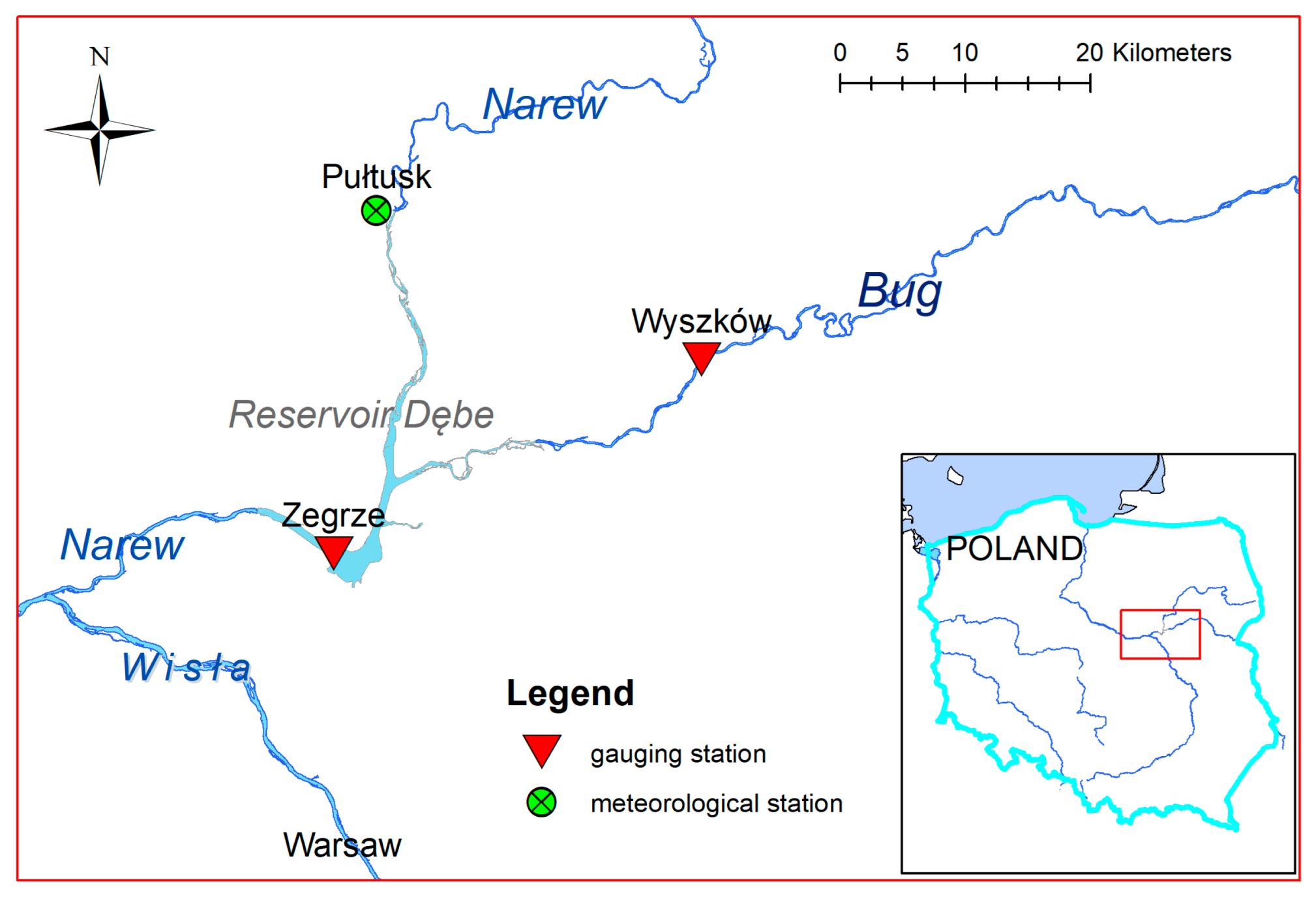
The analysis of water temperature concerned two profiles located in the lower reach of the Bug River: Zegrze and Wyszków (Figure 1). For the Zegrze profile, the data was collected over the following periods: 1920–1923 [41,42,43,44]; 1925–1934 [45,46,47,48,49,50,51,52,53,54]; 1940 [55], 1942–1943 [56]. In contrast, the Wyszków profile data spans from 1928 to 1930 [48,49,50], 1941 to 1943 [55,56], and from 1947 to 2023 [40,57,58,59,60,61,62,63,64,65,66,67,68,69,70,71,72,73,74,75,76,77,78,79,80,81,82,83,84,85,86,87,88,89,90]. The material collected over more than 100 years is not uniform; there are gaps in the observations (due to military operations in a significant area of Poland). In the case of the Wyszków profile, some of the available years have incomplete data: 1941 (November, December); 1942 (January–March, November–December); 1943 (January–August); 1947 (May–December); 1952 (June–December) 1953 (January, April–December); 1954 (January, March–December); 1955 (January–March, May–December). Hydrological services conducted observations on the analyzed profiles at various times throughout the day, specifically at 6:00, 7:00, 11:00, and 12:00 local time, as well as at 6:00 UTC (Table 1).
According to the 1927 guidelines for measuring water temperature [91], the measurement was taken in a place with free water discharge, shaded, and not too shallow. In the case of measurements taken once a day, the most appropriate time according to the instructions was 11 a.m., as it was mistakenly believed that this was when the average daily temperature was usually reached. The 11 a.m. time mainly applied to measurements taken in Poland during the interwar period (1918–1939). It was not until the instructions issued in 1953 that the examination of the daily temperature curve using thermographs revealed that this assumption was incorrect. In the later years, at the beginning of the second half of the 20th century, the instructions specified 7 a.m. as the time for taking temperature measurements, immediately following the morning water gauge reading. It was also noted that this measurement time is used in many countries [3,92]. The established measurement standards remained in effect for several decades throughout the 20th century. Between 2001 and 2005, as part of the National Monitoring System project in Poland, the measurement network was modernized to include automatic hydrological and meteorological stations. Since that time, water temperature has been measured using sensors at 6 UTC, with an accuracy of 0.1 °C.
In order to enable analysis of water temperature, observations measured at 7 and 11 a.m., the temperature values from 11 a.m. were reduced based on corrections established by Gołek [2] for lowland rivers in Poland (Table 2). For 1929 and 1930, when water temperature measurements were taken at noon, the reduction was also based on Gołek’s correction [2] for 11 a.m. (Table 2).

2.2. Gaps in the Dataset and the Preprocessing Procedure to Reconstruct Them

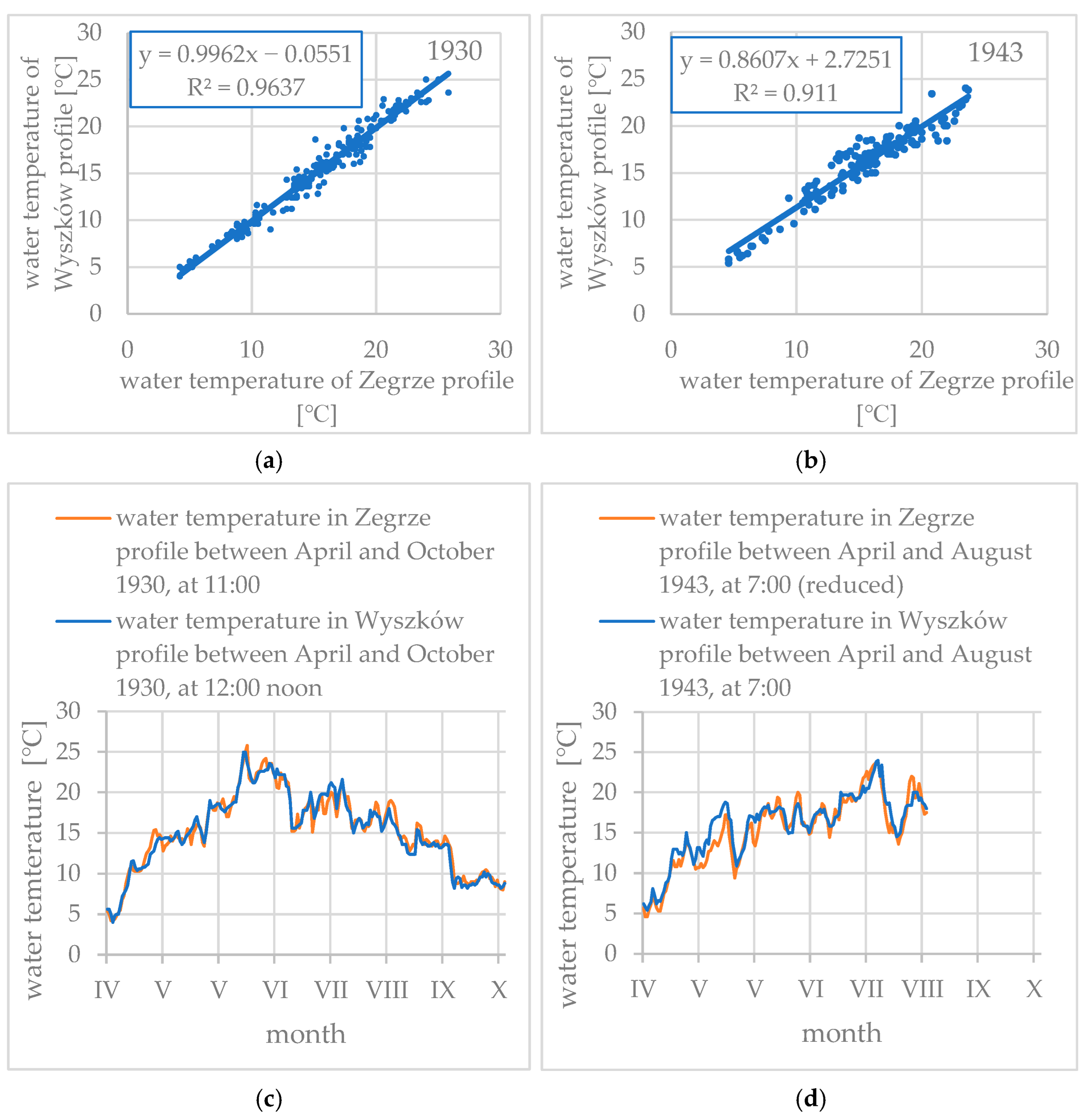
To supplement the water level observations at the Wyszków profile on the Bug River, observations from the Zegrze profile, which is located downstream, were used. For the Wyszków profile, data from the summer period (April–October) for the years 1920–1923, 1925–1927, 1928 and 1931–1934 were supplemented based on the relationship between water temperatures at the Wyszków and Zegrze profiles during the summer of 1930 (see Table 3 and Figure 2). However, data for the Wyszków profile in April–October 1940, 1942, and 1943 were supplemented using the relationship between the Wyszków and Zegrze profiles in 1943, for which data from both stations in April–August were available (Table 3, Figure 2). This was because the 1943 relationship was chronologically closer to the 1940, 1942 and 1943 relationships than the 1930 relationship. A relationship could be established between the water temperatures at the Wyszków and Zegrze stations in 1930 and 1943 because the relationship between the two stations remained undisturbed during the period when the temperature values were supplemented, unlike in later years. The Zegrze Reservoir was created in 1963 due to the Dębe barrage damming the Narew River and connecting the waters of the Narew and Bug rivers [93]. Additionally, at that time, the waters of the Bug River in the Zegrze profile were not thermally polluted by the combined heat and power plant in Ostrołęka on the Narew River, which was in later years. For the years 1947, 1952 and 1955, it was not possible to reconstruct the missing data for the summer period (1947—April; 1952—April, May; 1955—April), as the last published water temperature measurements in the Zegrze profile were for 1943 (Table 1). Therefore, the average temperature for the summer period was not calculated for these years.
We utilized R software (version 4.5.2 (2025-10-31ucrt) to analyze the functional relationships between the profiles and to conduct an error analysis of this reconstruction. Both reconstructions used ordinary least squares (OLS) linear regression to assess the relationship between the Wyszków and Zegrze profiles. Both models for 1930 and 1943 confirm a strong positive relationship between them (Table 3). The model for 1930 shows lower residual variance and smaller standard errors, indicating a more precise estimation of the temperature. Both models confirm a strong positive effect of the Zegrze profile; however, the 1930 model establishes a tighter, nearly one-to-one relationship with minimal uncertainty.

2.3. Study Area

The study area covers the lower reach of the Bug River, one of the largest rivers in Poland. The river covered by the study is natural and thermally unpolluted in the sections under consideration, and the water temperature profile is typical for the Central Polish Lowlands. The broad and shallow shape of the Bug riverbed facilitates the evaluation of the thermal conditions of flowing waters affected by air temperature and sunlight. The length of the Bug from its source to its mouth at Lake Zegrze is 772 km, and its catchment area is 39,400 km2. The Bug’s upper reach (185 km) is located outside Poland. The section from Gołębie to Niemirów (363 km) forms a natural border between Poland, Ukraine and Belarus. The lower reach of the Bug, 207 km long, from Niemirów to the mouth, is located in Poland. The last 17 km of the river is located in the backwater of Lake Zegrze [93]. The area of the Bug River basin up to the Wyszków profile is 38,395 km2, and up to the Zegrze profile is 69,513 km2. The Wyszków profile is located 34.8 km from the Bug River, and the Zegrze profile is at 29.1 km. The Zegrze profile ceased to be observed in 1962, when it was located in the backwater of the dam built in Dębe [94].

2.4. Comparison of Data Across Climate Norm Periods

We analyzed the monthly water temperatures (minimum, maximum, average) at the Wyszków profile on the Bug River during the designated summer season (April to October) for each year from 1920 to 2023, utilizing descriptive statistics. We compared the average, maximum, and minimum monthly values in individual climate norms for which complete data were available: 1961–1990, 1971–2000, 1981–2010, and 1991–2020. Additionally, we compared these results with those from the first study on the thermodynamics of Polish rivers [2], which published average monthly water temperatures for the summer period (April to October) at the Wyszków profile on the Bug River, based on observations from 1928 to 1930 and 1948 to 1956.
From 1956 to 2023, continuous water temperature observations were available at the Wyszków profile. During this period, we calculated the average, minimum, and maximum water temperatures for the summer months. We also examined the presence of trends in these measurements and assessed their statistical significance using the Mann–Kendall test in Trend software (ver. 1.0.2).

2.5. Meteorological Background

We compared the summer water temperatures of the Bug River with the average summer and annual air temperature values recorded at the Pułtusk station. The selected station is located 30 km from the Wyszków profile, where air temperature has been measured since 1951. The data is sourced from the national meteorological service at the Institute of Meteorology and Water Management [40]. We compared the water temperature curve for the summer season at the Wyszków profile of the Bug River to runoff depth values (H) from 1951 to 2023, both during the summer season and across individual hydrological years. Additionally, we likened it to the minimum annual discharge (NQ) recorded during the summer months (April to October) over the same period from 1951 to 2023.
During the investigated period from 1920 to 2023, the analysis covered selected dry years identified in the literature [35,95,96], during which streamflow droughts occurred on rivers in Poland (Table 4). In the selected dry years: 1921, 1930, 1947, 1954, 1964, 1983, 1992, 2003, 2015, 2020, and 2023 (refer to Table 4), we evaluated the characteristic monthly values (average, maximum, and minimum) of water temperature for the summer months (April to October). For the dry years of 1921, 1930, 1947, 1954, 1964, 1992, 2003, 2015, and 2023, we also determined the characteristic water temperature values during the streamflow drought at the Bug River, specifically at the Wyszków profile. These values include the minimum (Tmin,n), maximum (Tmax,n), and average (Tav,n) temperatures. It is important to note that in the dry years of 1983 and 2020, no streamflow drought in surface waters was detected according to the definition used in this article.

2.6. Hydrological Background

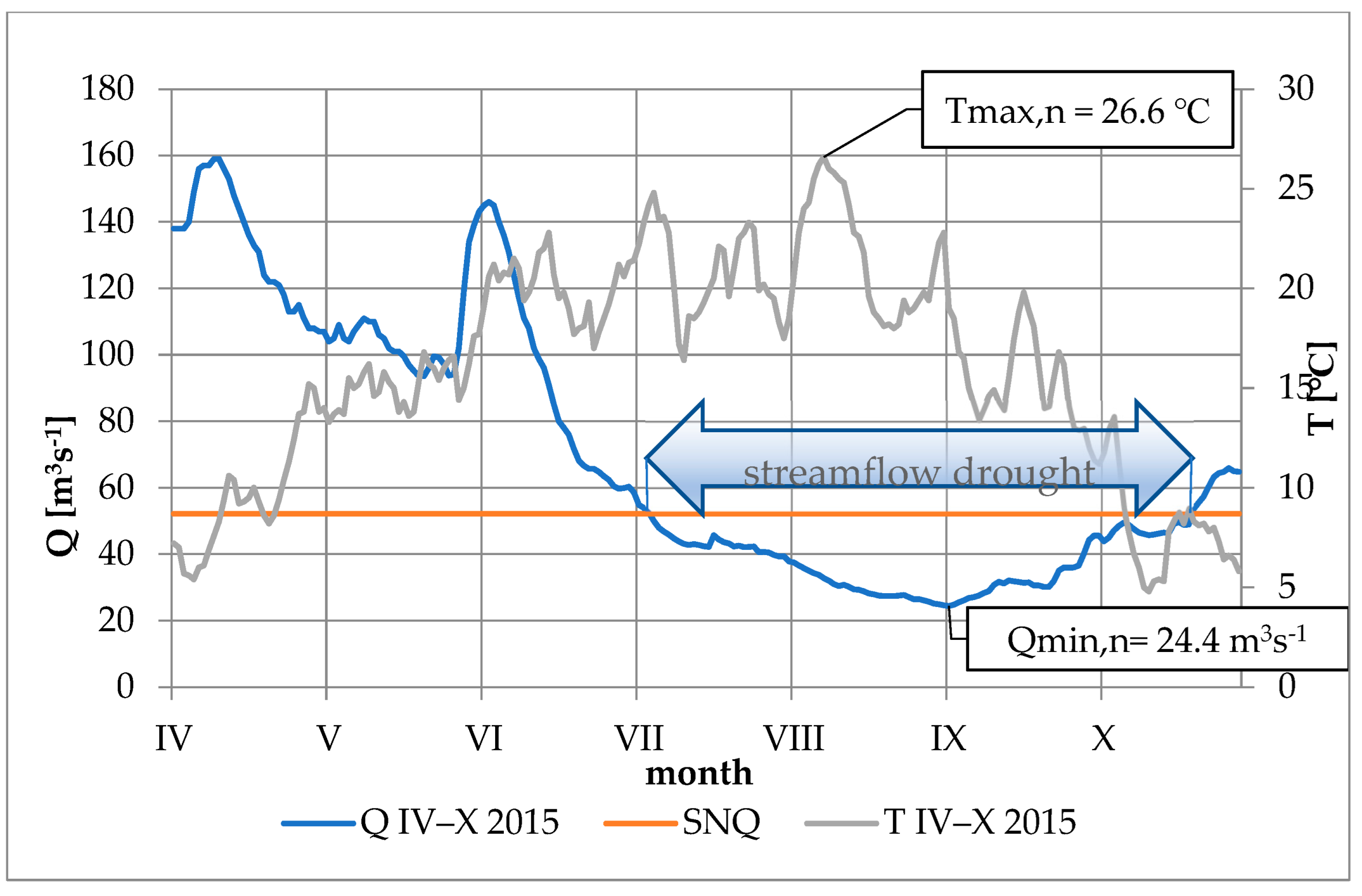
In this study, we investigated the hydrological phenomenon of streamflow drought in surface waters by analyzing daily discharge data from the Wyszków profile on the Bug River. Our analysis encompassed the years from 1951 to 2023 and followed the methodology outlined by Hejduk et al. [98]. Data on daily discharge in the Wyszków profile came from the IMGW-PIB service [40]. In this article, we defined hydrological streamflow drought as a period during which water discharges were at or below a specific truncation level. We referred to this limit for streamflow drought as the SNQ value, which represents the average of the lowest annual discharges [m3s−1]. For the Wyszków profile, this value is 52.2 [m3s−1], determined over the period from 1951 to 2023 (73 years). The selected streamflow drought limit discharge—SNQ—distinguishes deep, extreme low discharges on hydrographs, with significant effects on the environment and the economy. The minimum duration of the phenomenon was set at 20 days. This criterion is frequently employed in studies on streamflow drought in surface waters in Poland by numerous researchers [98]. We prepared daily discharge hydrographs for hydrological years, running from 1 November to 31 October, from 1951 to 2023, as input data for assessing streamflow drought. Using the NIZOWKA2003 model [99], we analyzed the daily discharge hydrographs to identify the beginning and end of the streamflow drought period. We also determined several quantitative parameters, including the duration of the streamflow drought (Tn), the volume of the streamflow drought deficit (Vn), the average streamflow drought deficit (Vav.n), the minimum streamflow drought discharge (Qmin,n), and the average streamflow drought discharge (Qav.n). The volume of the streamflow drought deficit, denoted as Vn, refers to the amount of water deficit represented by the area between the hydrograph line and the assumed truncation level [98]. The average streamflow drought deficit, represented as Vav.n, is calculated by dividing the total volume of the streamflow drought deficit by its duration. This ratio reflects the daily volume of streamflow drought deficit during the drought period.
Based on hydrographs of daily water levels at the Wyszków profile, we identified the phenomenon of streamflow drought for the years prior to 1951. The data on water levels for the period from 1920 to 1947 is sourced from the archival hydrographic yearbooks [42,50,57], which were published by the Polish Hydrographic Service with significant effort after Poland regained independence following World War I and during the conflicts of World War II. From the discharge rate curve of the Bug River at the Wyszków water gauge for the period from 1920 to 1937, as reported by [100], we can establish the water level that corresponds to the SNQ streamflow drought limit discharge. For an SNQ discharge of 52.2 [m3s−1], the corresponding water level was −20 cm. This value indicates the streamflow drought truncation level on water stage hydrographs for the period from 1920 to 1941. However, beginning in 1942, the truncation level for streamflow drought on water level hydrographs, which corresponds to the SNQ discharge of 52.2 [m3s−1], was recorded at 180 cm. This change occurred because the zero point of the water gauge at the Wyszków profile was lowered by 2 m in 1942 [94].

3. Results and Discussion

3.1. Characteristics of Average Water Temperature in Relation to the Hydro-Meteorological Conditions

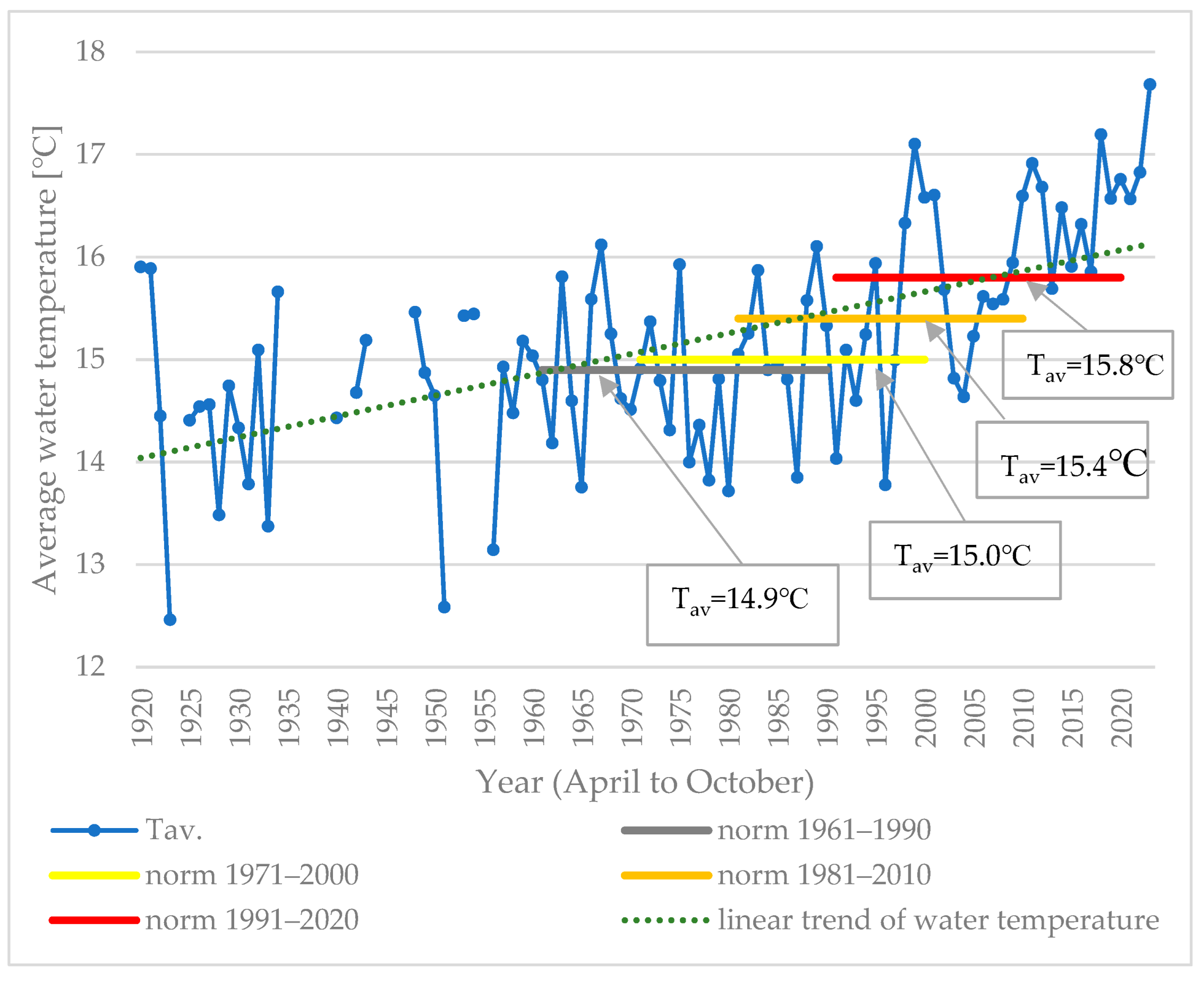
This paper analyzes long-term observations of water temperature in the Bug River in relation to global warming. We examined daily morning water temperature readings recorded at the Wyszków profile, along with additional measurements taken from the Zegrze profile. To illustrate the changes in water temperature values from 1920 to 2023, Figure 3 presents the average values calculated for the summer period (April to October). A clear upward trend in water temperatures is evident. A statistical significance analysis conducted at the α = 0.01 level for the period from 1956 to 2023 (spanning a total of 68 years) utilized a continuous data series without measurement gaps, confirming this upward trend. Furthermore, we evaluated the statistical significance of both minimum and maximum water temperatures for each summer (April to October) from 1956 to 2023 at the α = 0.01 level, which also revealed positive trends.
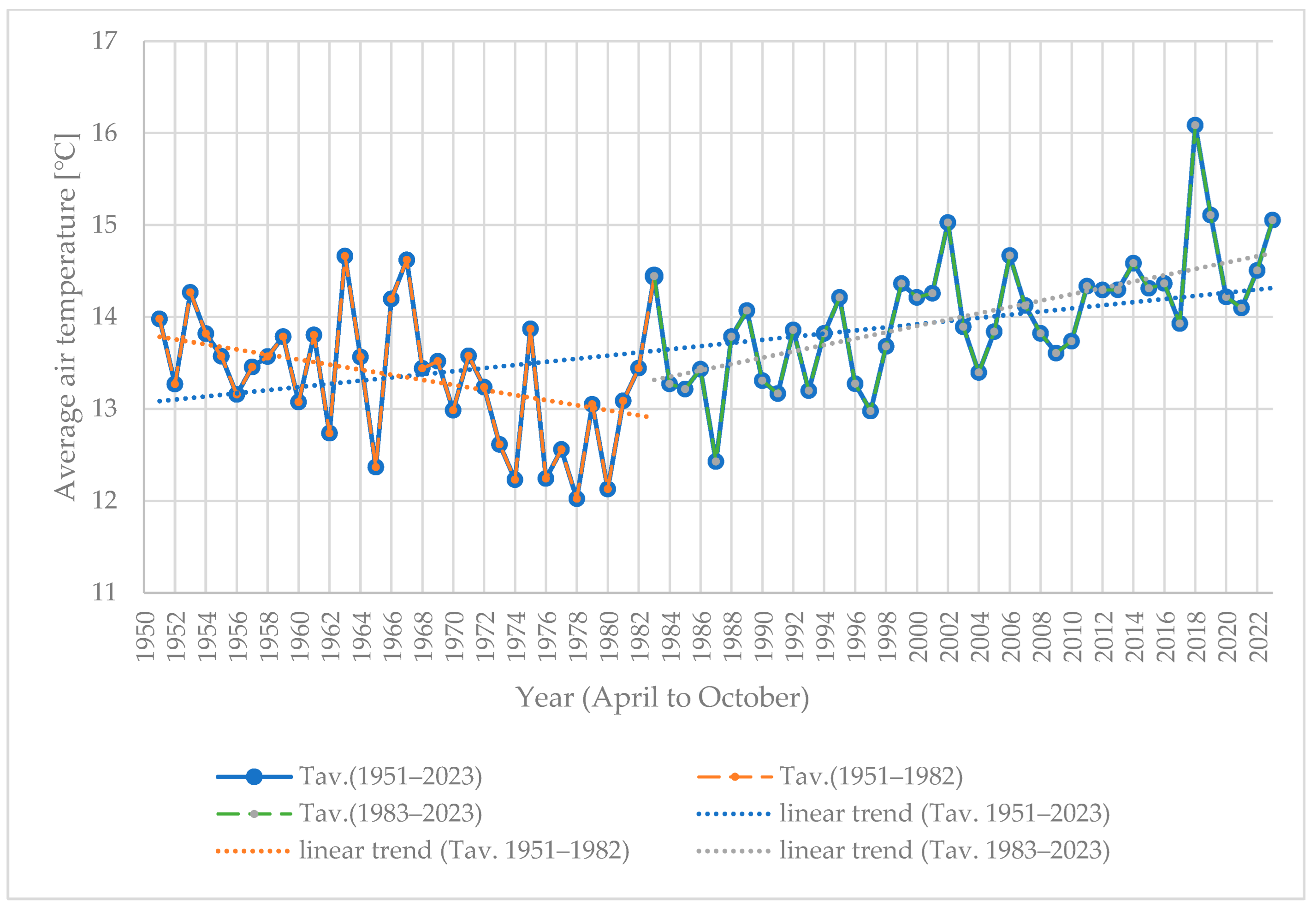
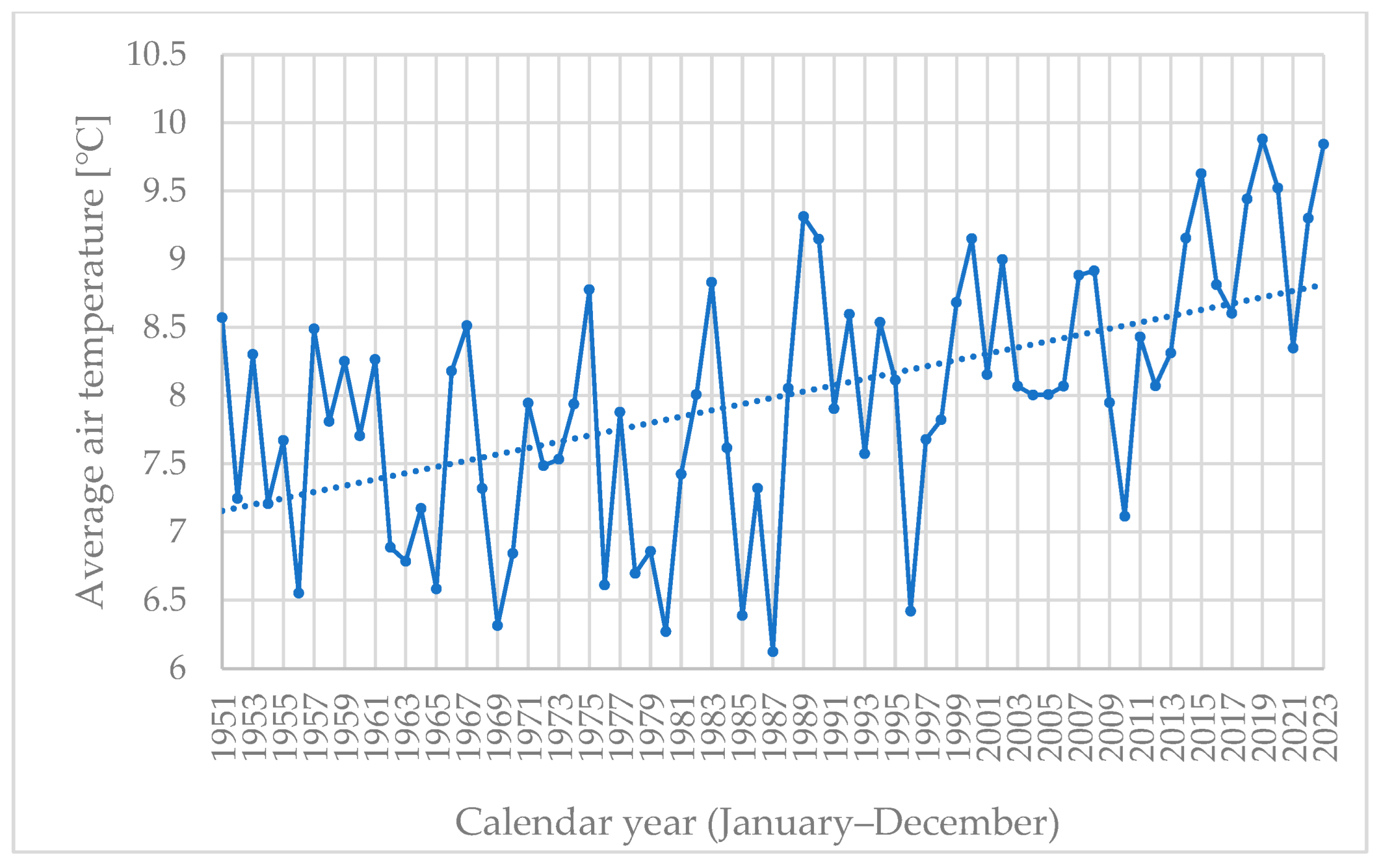
The literature clearly demonstrates a correlation between water temperature and air temperature. To investigate this relationship, we compared the observed positive trends with the average air temperature recorded at the Pułtusk station. From 1951 to 2023 (spanning 73 years), the average air temperature during the summer months (April to October) in Pułtusk has shown an increasing trend, as illustrated in Figure 4. This trend is statistically significant at the level of α = 0.01. Additionally, the average annual air temperature (from January to December) has also increased, as shown in Figure 5.
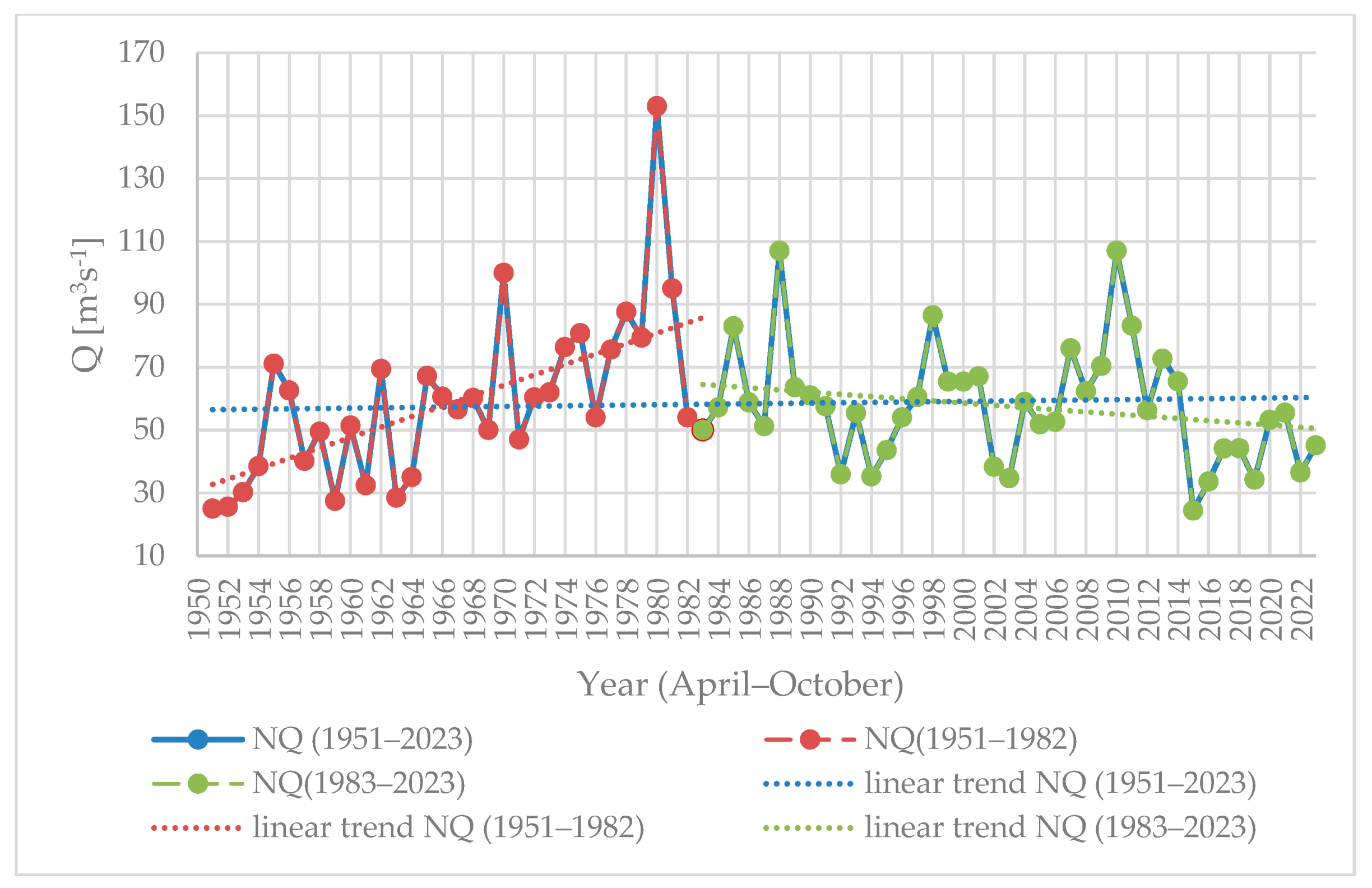
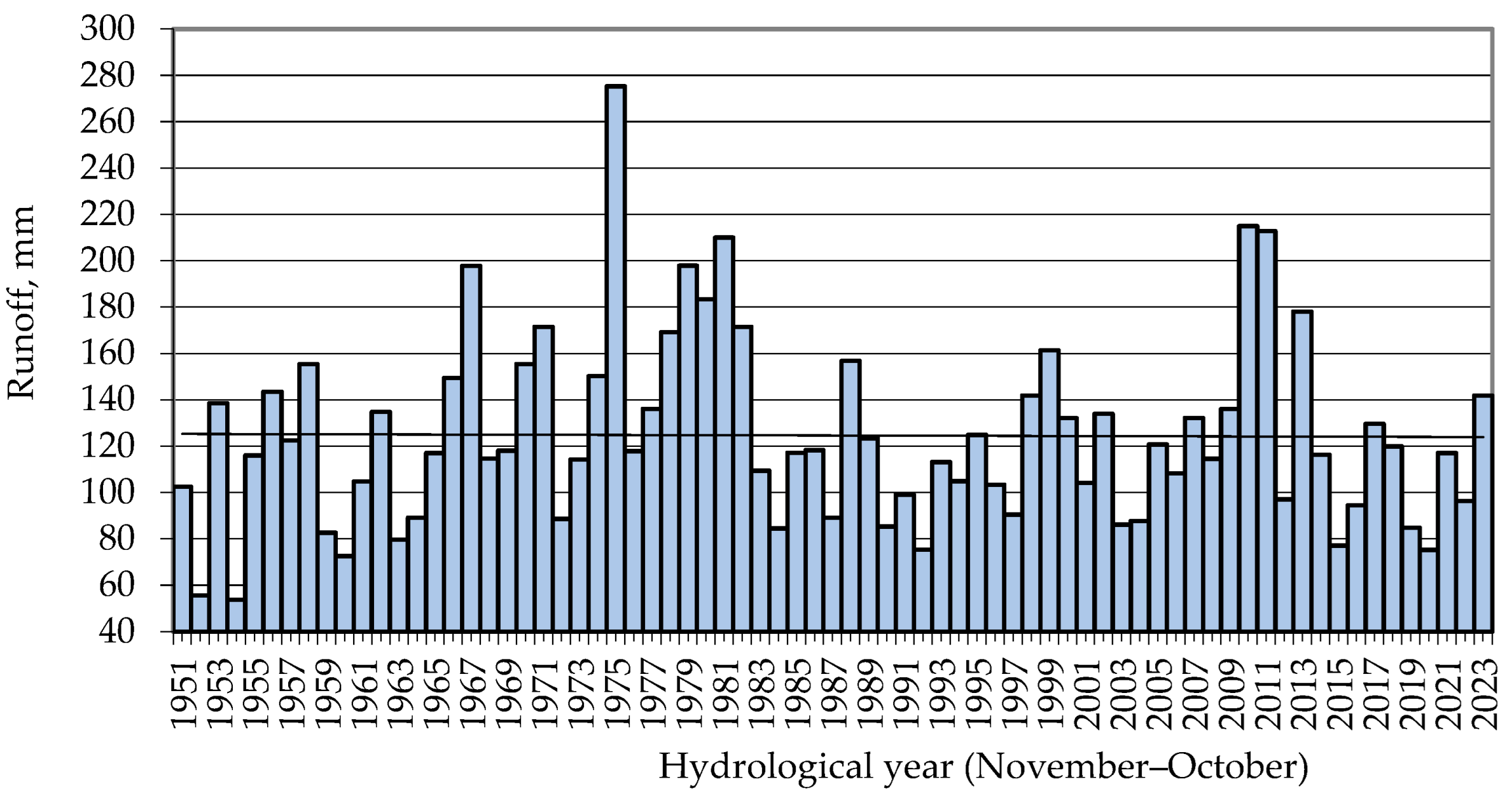
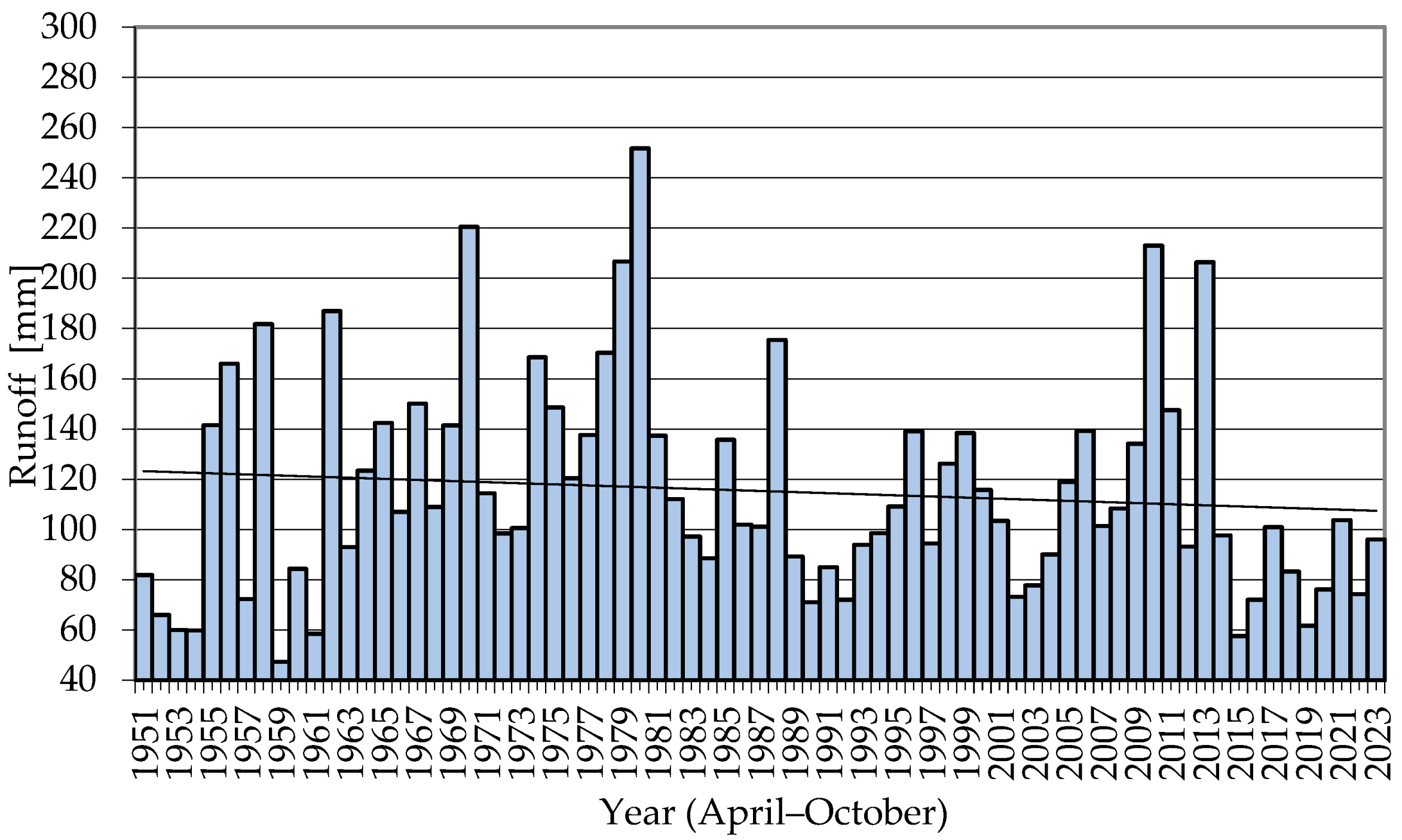
There were no statistically significant changes in the discharge from the Bug River basin at the Wyszków profile in relation to the increasing water and air temperatures during the hydrological years from 1951 to 2023 (Figure 6). An analysis of runoff (in mm) and minimum discharge rates (NQ) during the summer months (April to October) for individual years throughout this period also indicated no statistically significant trend (Figure 7 and Figure 8). The only noticeable trend observed was a decrease in runoff during the summer season (Figure 7). Additionally, there has been a change in the trend direction for minimum discharge values from increasing to decreasing since 1983 (Figure 8); however, this change is not statistically significant.
Since the 1980s, there has been a noticeable change in the volume of river outflows in Poland, which has been documented extensively in the literature [33,101,102,103]. The late 1970s and early 1980s marked a period characterized by an increase in both the intensity and frequency of extreme weather events globally and locally [103]. In Europe, as well as in Poland—particularly in the central, western, and southwestern regions—there has been an uptick in the frequency and intensity of streamflow drought [30]. Since 1983, droughts have been occurring with greater frequency in Poland (see Table 4). Additionally, the rise in warmer winters with reduced snow cover and mid-winter thaws has contributed to water deficits in the spring and summer months [30].
Examining the Bug River from 1951 to 2023, two distinct periods can be identified: from 1951 to 1982 and from 1983 to 2023. During the first period, there was a decrease in air temperature alongside an increase in streamflow drought, whereas the second period saw a statistically significant rise in air temperature (at the level of α = 0.01) and a decrease in streamflow drought (see Figure 4 and Figure 8). Climatological studies in Poland indicate a significant rise in average annual air temperature since 1951, largely attributed to a temperature rise that began after 1988, a change linked to an increase in sunshine duration [104].
The authors Marsz and Styszyńska [104] highlight the significant influence of North Atlantic thermal state changes on the variability of thermal conditions in Poland. They explain that the increase in sunshine duration corresponds to a shift in macro-circulation conditions; between 1987 and 1989, a change occurred from circulation epoch E to epoch W. This shift resulted from a change in the phase of the North Atlantic thermohaline circulation (NA THC) from negative to positive. Consequently, after 1988, there was a radical transformation in the structure of synoptic situations and the associated weather patterns, leading to a considerable increase in sunshine duration. This increase, in turn, caused higher temperatures during the warmest months, July and August, in Poland and the vast expanse of Europe [104].

3.2. Characteristics of Maximum, Minimum, and Average Water Temperatures

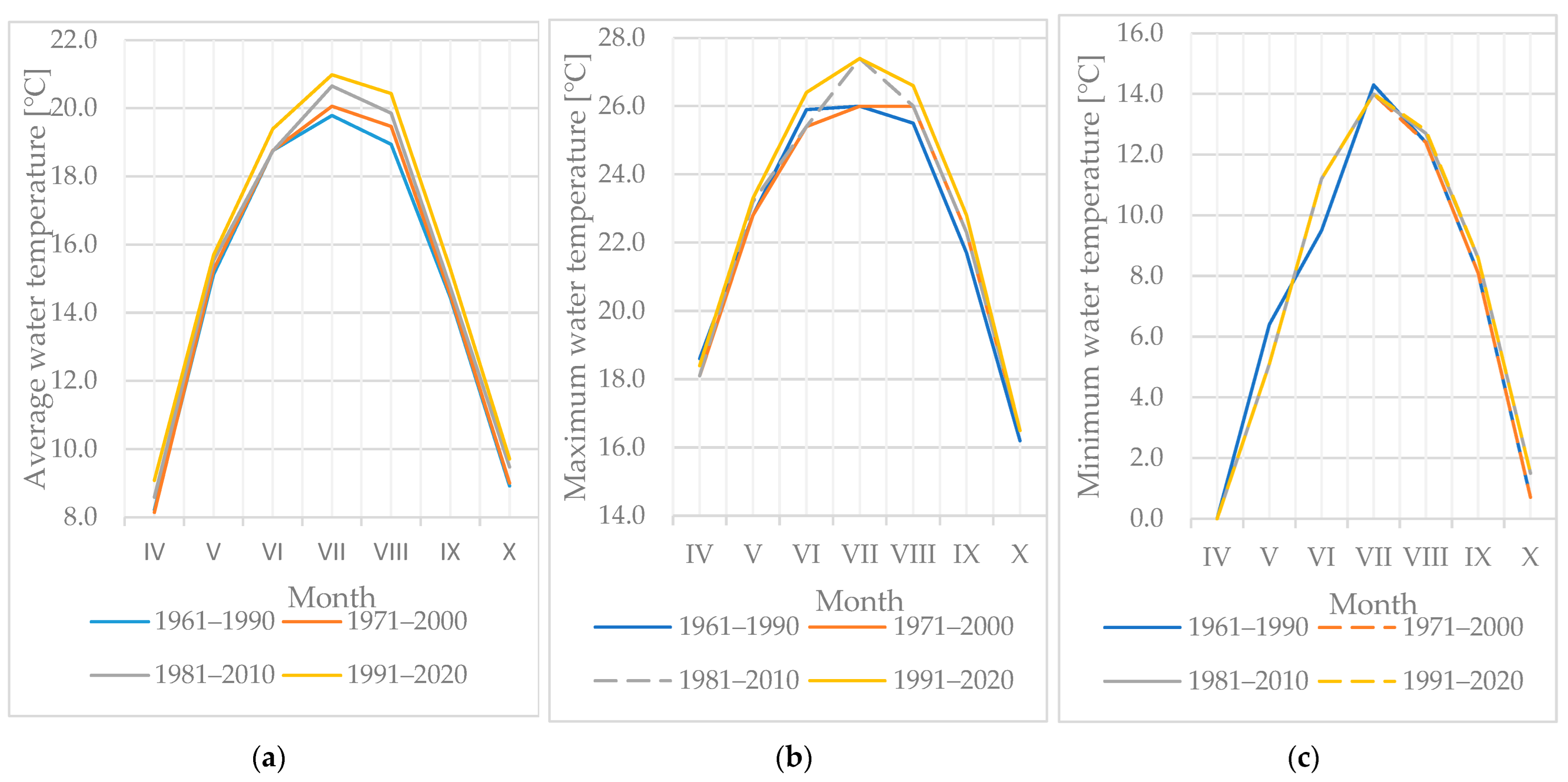
Studies on changes in river water temperatures in Poland show significant increases during the summer months (June to August), while no statistically significant changes are observed during the winter months (November to April) [4]. This research examines the changes in average, maximum, and minimum water temperatures for the Bug River during the summer months (April to October) across individual years from 1920 to 2023. It also considers climate norms from the periods 1961–1990, 1971–2000, 1981–2010, and 1991–2020 (refer to Figure 9, Figure 10 and Figure 11 and Table 5 and Table 6).
When analyzing the average, minimum, and maximum water temperatures of the Bug River at the Wyszków profile from 1920 to 2023, a noticeable increase in these values is evident (see Figure 9 and Figure 10). This trend is particularly apparent when comparing the water temperatures recorded during different climate periods (refer to Figure 11; Table 5 and Table 6). The average monthly water temperatures rise consistently throughout the summer months (April to October) (Table 5), with the highest values observed in the recent years of 2018, 2019, 2021, and 2023 (Figure 9). The differences between the lowest and highest average water temperatures for each month during the summer season from 1920 to 2023 range from 7.7 to 9.6 °C. June exhibited the largest range of average water temperatures, varying from 14 °C to 23.6 °C, while May had the smallest range, from 11.6 °C to 18.9 °C (Figure 9).
Comparing the average water temperatures for individual summer months (April to October) between the periods of 1961–1990 and 1990–2020 reveals an increase of 0.6 °C to 1.5 °C, depending on the month (Table 5). The smallest increase observed was in May and June (0.6 °C), while the largest increases were in August (1.5 °C) and July (1.2 °C) (Table 5). Moreover, the average water temperature for the entire summer period (April to October) was 14.9 °C during the 1961–1990 norm and increased to 15.9 °C in the most recent 1991–2020 norm, reflecting a rise of 0.9 °C (Table 6).
It is important to note that during the summer period (April to October), there has been an increase in the average water temperature of 0.4 °C across successive 30-year climate norms: 1971–2000 (average water temperature: 15.0 °C), 1981–2020 (15.4 °C), and 1991–2020 (15.8 °C) (Table 6, Figure 3 and Figure 11). According to Gołek [2], the average summer water temperature of the Bug River for the period of 1948–1956 was 14.5 °C, which is 0.4 °C lower than the average temperature for the 1961–1990 norm (14.9 °C) (Table 6; Figure 11). The average water temperatures for the 1961–1990 and 1971–2000 periods (Table 6; Figure 11) vary by only 0.1 °C. This small variation supports the trend documented in the literature, which indicates that the rise in water temperatures in Polish rivers has accelerated since the 1980s [4,15].
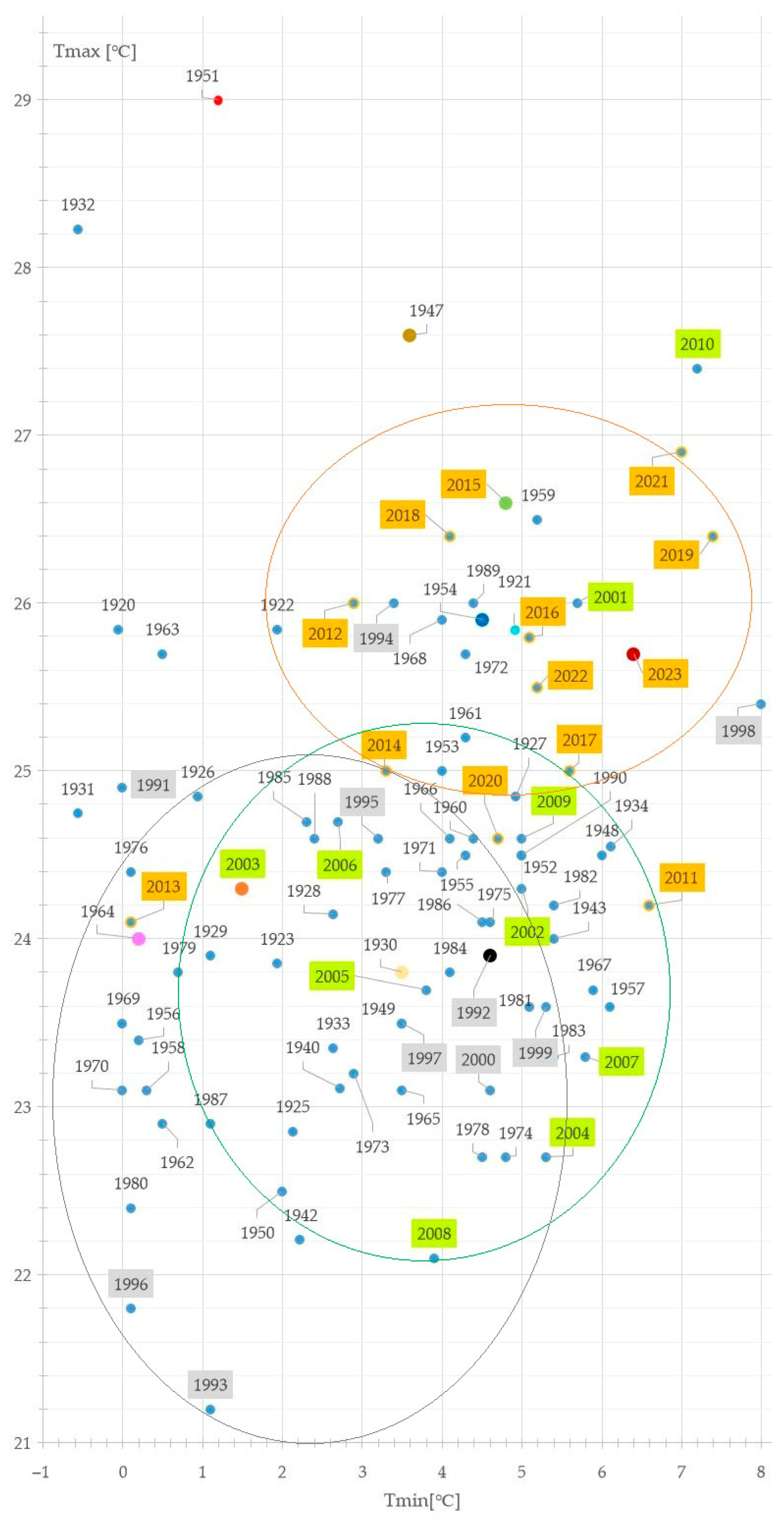
The maximum and minimum water temperatures at the Wyszków profile from April to October during the summer months, recorded between 1920 and 2023, are shown in Figure 10. The years from 1991 to 2000 were highlighted in gray, those from 2001 to 2010 were marked in green, and the last two incomplete decades (2011–2023) were indicated in orange. It is evident that the most recent decades display higher maximum (Tmax) and minimum (Tmin) values compared to those of earlier decades. Notably, the year 1951 recorded the highest water temperature to date, reaching 29 °C on 16 July (Figure 10). Exceptionally high, maximum temperatures were recorded in 1932 (5 June: 28.3 °C), 1947 (1 July: 27.6 °C), and 2010 (23 July: 27.7 °C) (see Figure 10).
The difference in maximum water temperatures between the 30-year climate norms for the periods 1961–1990 and 1991–2020 across individual summer months (April to October) was as follows: 0.2 °C for April; 0.5 °C for May; 0.5 °C for June; 1.4 °C for July; 1.1 °C for August; 1.1 °C for September; and 0.3 °C for October (refer to Table 5). Regarding minimum water temperatures, the differences between the periods were 0.0 °C for April; 1.3 °C for May; 1.7 °C for June; 0.3 °C for July; 0.4 °C for August; 0.5 °C for September; and 0.8 °C for October (also see Table 5).
For the months of June, August, September, and October, the highest and lowest temperatures recorded during the 1991–2020 period were higher than those in the earlier period of 1961–1990. This supported previous observations regarding the warming of the water in the Bug River. Notably, the largest differences in minimum temperatures from 1961–1990 to 1991–2020 occurred at the beginning of the summer period (1.3 °C for May; 1.7 °C for June) and at the end (0.8 °C for October). The largest differences in maximum temperatures were observed in July (1.4 °C), August (1.1 °C), and September (1.1 °C) (see Table 5).
Interestingly, in May (6.4 °C; 3 May 1970) and July (14.3 °C; 14 July 1986), higher minimum water temperatures were recorded in the earlier period (1961–1990) compared to the later period (1991–2020), where the respective temperatures were 5.1 °C for May and 14.0 °C for July. Similarly, in April, the highest temperature recorded was 18.6 °C in the period 1961–1990 (on 24 April 1962), while the highest value recorded in the following 30 years (1991–2020) was lower, at 18.4 °C (see Table 5).
This indicates that long-term trends in water temperature are more evident when analyzing average values for the summer period, compared to examining individual extreme values (both maximum and minimum). The latter tend to be more influenced by monthly air temperature anomalies in the Polish climate. Table 6 presents the average maximum (Tmax IV-X) and minimum (Tmin IV–X) water temperatures for each year during the summer period (IV–X) across four 30-year climate norms (1961–1990; 1971–2000; 1981–2010; 1991–2020).
The comparison between the periods 1961–1990 and 1991–2020 indicates that the average minimum water temperature for the summer period (Tav.,min IV–X = 3.1 °C) in the earlier period was 1 °C lower than that in the later period (Tav.,min IV–X = 4.1 °C). Similar trends were observed for the average maximum water temperatures (Tav.,max IV–X), with a difference of 0.5 °C between 1961 and 1990 (Tav.,max IV–X = 24.0 °C) and 1991–2020 (Tav.,max IV–X = 24.5 °C) (see Table 6).
In the analyzed 30-year climate norm periods (1961–1990; 1971–2000; 1981–2010; 1991–2020), the amplitude between the average maximum (Tav.,max IV–X) and minimum (Tav.,min IV–X) values was examined, yielding the following results: 1961–1990: 20.9 °C; 1971–2000: 20.5 °C; 1981–2010: 20.1 °C; and 1991–2020: 20.4 °C.
By comparing the extreme periods of 1961–1990 and 1991–2020, it is evident that the amplitude between the average maximum (Tav.,max IV–X) and minimum (Tav.,min IV–X) values during the summer period (IV–X) decreased by 0.5 °C. This reduction in the difference between the average highest and lowest water temperatures during the summer period (from 1961–1990 to 1991–2020) is attributed to a more significant rise in the average minimum temperature (an increase of 1 °C) compared to the increase in the average maximum temperature (an increase of 0.5 °C) (see Table 6).
The final analysis in this chapter focuses on comparing the results related to water temperature of the Bug River in Wyszków with the earliest published work by Gołek [2], which examined the thermodynamics of Polish rivers. Table 6 presents the minimum (Tmin IV–X), maximum (Tmax IV–X), and average (Tav. IV–X) water temperatures of the Bug River in Wyszków during the summer season (April–October, IV–X) from 1948 to 1956. It also includes the average maximum (Tav.,max IV–X) and minimum (Tav.,min IV–X) temperatures for each year within that period. During 1948–1956, the lowest recorded summer temperature (Tmin IV–X) was 0.2 °C higher than the lowest recorded temperature since 1961. Similarly, the maximum water temperature recorded during the summer of 1948–1956 (Tmax IV–X) was 1.6 °C higher than the highest recorded temperature since that time. In terms of average maximum and minimum values for the summer period (IV–X), the average minimum temperature (Tav.,min IV–X) of 3.1 °C from 1948 to 1956 was 1 °C lower than the average minimum water temperature (Tav.,min IV–X = 4.1 °C) for the later period of 1991–2020. Conversely, the average maximum temperature (Tav.,max IV–X) of 24.8 °C from 1948 to 1956 was 0.3 °C higher than that of 24.5 °C, recorded for the same summer period from 1991 to 2020 (see Table 6). The differences observed may result from the fact that Gołek’s study [2] covers only nine years (1948–1956), which does not adequately reflect the average conditions over a longer 30-year period. Notably, the years 1948–1956 included seven dry years, with five of those experiencing particularly severe streamflow droughts across a large area of Poland (see Table 4).

3.3. Characteristics of Water Temperature in Dry Years and During Streamflow Droughts

Water temperature is a key factor linking climate change to various reactions and phenomena in aquatic environments [105]. An increase in air temperature directly affects the thermal conditions of surface waters, prompting adverse processes in aquatic systems. According to Ślesicki [106], rising temperatures lead to a decrease in dissolved oxygen levels, an increase in biochemical oxygen demand (BOD), and an acceleration of nitrification and ammonia oxidation processes. These changes can result in oxygen deficits in water. Higher temperatures also accelerate chemical and biological reactions and can increase the toxicity of many substances. Consequently, it can be inferred that the period most sensitive to thermal changes in river ecosystems occurs during streamflow drought. During this time, significant water shortages intensify the negative effects of rising water temperatures on biocenosis and the economic use of rivers.
During the period from 1920 to 2023, eleven dry years were identified (as shown in Table 7) that were marked by streamflow drought, impacting significant areas of Poland (refer to Table 4). These selected dry years were spaced apart by at least a few years to account for potential changes in water temperature characteristics over time. Table 7 presents the minimum, maximum, and average water temperatures of the Bug River at the Wyszków profile for each month of the summer season (April to October). The objective was to determine whether any trends in the characteristic monthly water temperatures—both average and extreme—have emerged in these dry years over the 1920–2023 period.
It was observed that in the selected dry years, the lowest minimum water temperatures for individual summer months (with the exception of October 2003) were recorded in 1921, 1947, and 1964. From 1983 onwards, dry years (excluding 2003) exhibited higher minimum water temperatures during the summer months compared to those observed in the first half and early second half of the 20th century.
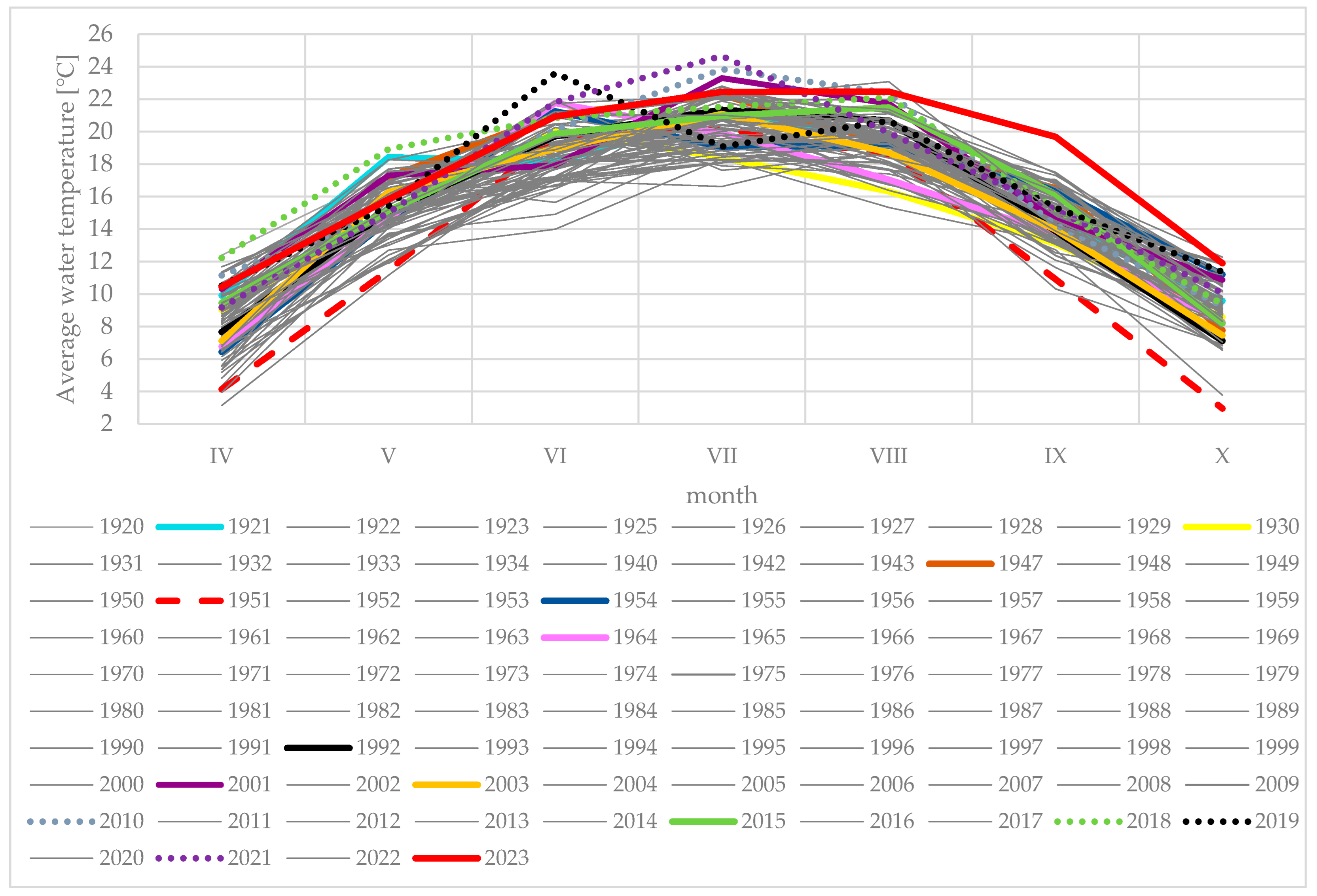
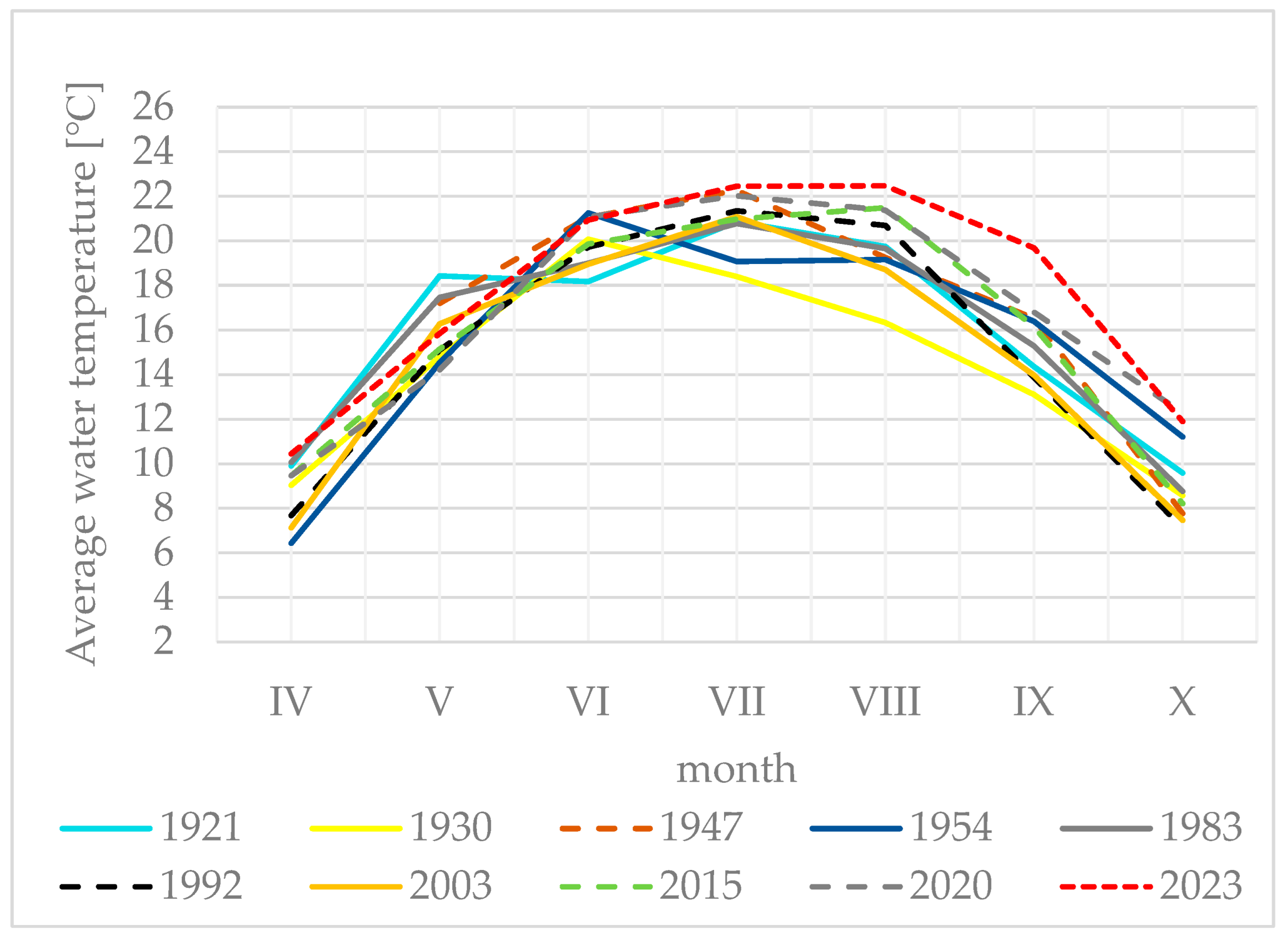
Regarding the maximum water temperatures of the Bug River at Wyszków during the summer months in the selected dry years, there was significant variability in the results. The highest maximum temperatures recorded for individual months from 1920 to 2023 occurred in different years: April recorded 16.9 °C in 1921, May reached 22.8 °C in 1983, June recorded 27.1 °C and July hit 27.6 °C in 1947, August peaked at 26.6 °C and September at 22.8 °C in 2015, and October reached 16.6 °C in 2023 (see Table 7). Despite the high variability in the observed data, it is noteworthy that the highest water temperatures recorded for August, September, and October were linked to the recent dry summers of 2015 and 2023. Furthermore, in the last dry year of 2023, there were more months during the summer period that recorded the highest average monthly water temperatures: April (10 °C), July (22.4 °C), August (22.5 °C), and September (19.7 °C) (refer to Table 7). It is important to note that the conclusions presented here pertain to selected dry years and not to all years or all dry years between 1920 and 2023. Throughout this entire period, the highest water temperature recorded in August was 26.6 °C on 9 August 2015. In September, the highest water temperature occurred on 2 September 1929, reaching 23.9 °C (with a reduction from 11 a.m. to 7 a.m.). For October, the peak temperature of 16.6 °C was observed on 1 October 2023. According to the Institute of Meteorology and Water Management—National Research Institute (IMGW-PIB) [107], the average air temperature for Poland in 2023 was classified as “extremely warm”. This year was the second warmest since 1951, following only 2019, which recorded an average temperature of 10.2 °C. The average air temperature in Poland for 2023 was 10.0 °C, which is 1.3 °C above the long-term norm (calculated from 1991 to 2020 most significant negative anomalies in average monthly air temperatures were observed in April (average −0.9 °C) and May (average −0.5 °C). In contrast, September experienced a positive anomaly of nearly 4 °C in average monthly air temperature [107]. Hence, in the summer period (April–October) in 2023, the average water temperature in the Bug River in September (19.3 °C) (Table 7, Figure 12) was as much as 4.4 °C higher than the norm from the period 1991–2020, which for September in the Wyszków profile was 15.3 °C (Table 5).
The increases in both the minimum and maximum water temperatures of the Bug River in the Wyszków profile from 1920 to 2023, as observed in previous analyses, are not as clearly evident when examining selected dry years from recent decades (Figure 10). However, the trends showing an increase in water temperature were more pronounced when looking at the average values for the summer period (April to October) over the entire 1920–2023 time frame (Figure 3). This trend was also observable in specific periods within the ranges of 1961–1990, 1971–2000, 1981–2010, and 1991–2020 (Figure 11).
In selected dry years, an analysis of the average monthly water temperature during the summer months revealed an increase in temperatures for April, July, August, September, and October (Figure 12). However, in May and June, some dry years in the 20th century recorded higher average water temperatures than those observed in recent years of the 21st century (Figure 12, Table 7). It is important to note that when considering all available data from 1920 to 2023, the highest average monthly water temperatures in recent years were recorded in May (2018) and June (2019). This supports the observed increase in the water temperature of the Bug River in Wyszków during the summer.
For future studies on this topic, it would be beneficial to refine the analysis to include all dry years from 1920 to 2023, as well as data from the current year (2025) and future years. In September of 2025, the discharge values at the Wyszków section of the Bug River were significantly below normal, at 0.8 SNQ, indicating streamflow drought [108].
During the period from 1920 to 2023, a study of selected drought years—specifically 1921, 1930, 1947, 1954, 1964, 1992, 2003, 2015, and 2023—was conducted to determine the hydrological streamflow drought phenomenon on the Bug River at the Wyszków profile (Table 4). This analysis utilized an established threshold discharge, known as SNQ (the average low discharge from 1951 to 2023), which is 52.2 m3s−1. A total of nine episodes of streamflow drought were recorded during these dry years. Notably, no streamflow droughts were observed in 1983 and 2020 according to the definition used in this article (Table 8). Approximately 70% of the identified streamflow droughts exhibited a prolonged duration, lasting over three months. Shorter streamflow drought periods, exceeding one month, were noted in 1930, 1992, and 2023. The onset of streamflow drought typically occurred in July, followed by August, with some instances noted in the last days of May and June. The phenomenon often ends in October or November. The minimum discharge recorded during these streamflow drought episodes (Qmin,n) ranged from 24.4 to 45.1 m3s−1, which is equivalent to 0.5 to 0.9 times the SNQ. Prolonged streamflow droughts were observed in the following dry years: 1921 (113 days), 1947 (176 days), 1954 (118 days), 1964 (149 days), 2003 (105 days), and 2015 (108 days). The lowest recorded discharges (Qmin,n) occurred in 2015 at 24.4 m3s−1 (Figure 13) and in 1947 at approximately 30 m3s−1 (Table 8), a value derived from the discharge intensity curve for the Wyszków profile from 1920 to 1937. For the designated streamflow droughts of the Bug River at the Wyszków profile in these selected dry years, characteristic water temperature values were recorded during their duration. These included average temperature (Tav.n), maximum temperature (Tmax.n), and minimum temperature (Tmin.n), as compiled in Table 9. The analysis excluded measurements from November since the study defined the summer period as lasting from April to October. For streamflow drought periods extending into November, the last recorded water temperature value from 31 October was included. The obtained temperature values exhibited high variability, influenced by the duration of the streamflow drought. Some periods covered only warmer months (such as in 1930 and 1992), while others spanned both warmer and cooler months (like those in 1921, 1947, 1954, 1964, 2003, 2015, and 2023). For example, the streamflow drought with the highest average water temperature (Tav.n = 19.6 °C) occurred in 1992, lasting 41 days from 30 July to 8 September. Similarly, the streamflow drought of 1930 lasted 40 days from 2 July to 10 August and recorded an average temperature of 18.2 °C. Longer streamflow droughts that were analyzed until the end of October in 1992, 1954, and 1964 showed lower average temperatures of 14.5 °C, 16.3 °C, and 15.4 °C, respectively. Excluding 1947, when the average water temperature during the streamflow drought was 17.4 °C. The longest streamflow drought occurred in 1947 (spanning 176 days) and experienced the highest recorded water temperature of 27.6 °C among the analyzed dry years. Consequently, no consistent trends in water temperatures during the hydrological streamflow drought periods were evident over time. However, a comparison can be made between the streamflow droughts of the dry years 2003 and 2015, which were quite similar in duration. The streamflow drought of 2003 extended from 10 July to 22 October, while that of 2015 lasted from 6 July to 21 October. The latter part of 2015 showed increased water temperatures: 1.2 °C higher for Tav.n, 2.3 °C higher for Tmax.n, and 0.2 °C higher for Tmin.n compared to 2003, as shown in Table 9. It is important to highlight that the year 2015, among the selected 11 dry years, experienced the lowest streamflow drought. Specifically, it recorded the minimum streamflow drought (Qmin,n = 24.4 m3s−1), the largest deficit of streamflow drought volume, and the lowest average streamflow drought (Qav,n = 36.7 m3s−1) (see Table 8 and Figure 13).
Among all the summers recorded between 1951 and 2023, the summer of 2015 had the lowest discharge rate. Slightly higher discharge rates were observed in the summers of 1951 (25 m3s−1) and 1952 (25.6 m3s−1), both of which were also dry (see Figure 8, Table 4). Therefore, a relationship can be established between the maximum water temperature (Tmax,n) during the streamflow drought and its quantitative parameters, including average discharge (Qav.n), minimum discharge (Qmin,n), deficit volume (Vn), and average deficit volume (Vav.n). Based on the analysis of nine low water periods from selected dry years, we can preliminarily conclude the following: The strongest correlation (R2 = 0.69) is observed between the maximum water temperature during the streamflow drought and the average deficit volume. Additionally, there is a strong correlation (R2 = 0.68) between the maximum water temperature during this period and the average discharge of streamflow drought. The correlation between the maximum water temperature and the minimum discharge of streamflow drought is weaker, with a value of R2 = 0.62. The weakest relationship was found between the maximum water temperature during the streamflow drought and the volume deficit of the streamflow drought, which has a correlation of R2 = 0.46 (see Table 10). These results suggest a correlation between maximum water temperature during streamflow drought and the amount of water present during this period, as lower water amounts are more susceptible to heating. To obtain statistically significant results, future studies should expand the dataset to include all designated dry years as well as all available years from 1920 to 2023.

4. Conclusions

This article focuses on the impact of climate warming on the summer water temperature of a large lowland river in Eastern Europe. The research responds to the need identified in the literature [4] for analyses of how climate change and variability affect the thermal regime of sites with quasi-natural hydrological and thermal conditions. For the selected natural and thermally unpolluted Bug River, archived daily water temperature values were reconstructed at the Wyszków profile using measurements from the Zegrze profile, covering the period from 1920 to 2023, with a few gaps.
Forecasts prepared by IMWM-PIB [109] for the period from 2011 to 2030 (most of which is already known) project an average warming of 0.5 °C across most of Poland, based on the reference period of 1971–1990. The climate change in Poland is largely attributed to a rise in air temperature since the late 1980s, driven by a significant increase in sunshine duration [104]. An increase in the frequency of droughts has also been observed [30], while no significant changes in precipitation have occurred [98]. The ongoing rise in air temperature leads to an increase in water temperature. However, as noted by Graf and Wrzesiński [4], the trends in water temperature in Polish rivers can vary both temporally and spatially, as do the changes in river runoff regimes.
Over the analyzed multi-year period of 1920–2023, the average water temperature of the Bug River at the Wyszków profile significantly increased during the summer months (April–October). Minimum and maximum temperatures have also risen along with the average temperature. In the subset of years from 1956 to 2023 (68 years with no gaps in data), the increases in mean, maximum, and minimum water temperatures during the summer period are statistically significant at a level of α = 0.01. These observed positive trends in water temperature are directly linked to the rise in air temperature.
For the Pułtusk station, located near the Wyszków profile, the average air temperature during the summer months of the 1951–2023 period has similarly increased, with statistical significance at α = 0.01. However, this increase in air temperature is not accompanied by a significant downward trend in runoff volume (mm) in the Bug River catchment at the Wyszków profile, nor in minimum discharge (NQ) during the summer months over the same period. Nevertheless, a notable shift in the trend from increasing to decreasing minimum discharge (NQ) since 1983 is evident, contrasting with the rising trend in average summer air temperature. The increase in the frequency and intensity of streamflow droughts is associated with drought phenomena and has been documented in Europe, particularly affecting central, western, and southwestern regions of Poland [30].
This study investigated changes in the average, maximum, and minimum water temperatures of the Bug River during the summer months (April to October) from 1920 to 2023. It focused on individual years within established climate norms (1961–1990, 1971–2000, 1981–2010, and 1991–2020). Over the 1920–2023 period, significant variability in the average monthly water temperatures was observed at the Wyszków profile of the Bug River, with the highest temperatures recorded in June and the lowest in May. Poland, like much of Central Europe, experiences considerable variability in weather conditions and substantial fluctuations in seasonal patterns from year to year [4]. Notably, the years 2018, 2019, 2021, and 2023 exhibited the highest average monthly water temperatures during the summer season. The analysis showed a gradual increase of 0.4 °C in average summer water temperatures (April–October) across successive 30-year climate norms: 1971–2000, 1981–2010, and 1991–2020. In contrast, the average summer water temperature for the period 1948–1956 was 0.4 °C lower than the average temperature established for the 1961–1990 norm. The average water temperatures for the periods 1961–1990 and 1971–2000 differ by only 0.1 °C, which supports previous findings that the increase in water temperature in Polish rivers has accelerated since the 1980s [4,15]. A noticeable trend of increasing average water temperature in the Bug River is also evident in the maximum and minimum values. The last two decades, from 2011 to 2023, were characterized by higher maximum and minimum water temperatures compared to earlier decades. When comparing the periods of 1961–1990 (30 years) and 1991–2020 (30 years), a greater increase in the average minimum temperature (1 °C) was observed compared to the average maximum temperature (0.5 °C) during the summer. This reinforces previous observations regarding the warming of water in the Bug River. The analysis also revealed that long-term trends in water temperature changes are more apparent when analyzing average summer values rather than individual month extremes (maximum and minimum), which are more susceptible to monthly air temperature anomalies in Poland’s climate. The highest water temperature recorded was 29 °C on 16 July 1951. Exceptionally high maximum temperatures were also documented in June 1932, as well as in July 1947 and 2010.
Adverse changes in the aquatic environment due to rising water temperatures may become more pronounced during dry years, which are typically characterized by streamflow drought. This study analyzed eleven dry years from the period of 1920 to 2023 (specifically, the years 1921, 1930, 1947, 1954, 1964, 1983, 1992, 2003, 2015, 2020, and 2023), focusing on the monthly water temperature values on the Bug River in Wyszków during the summer months (April to October). Similarly to previous analyses, significant variability in the maximum water temperatures recorded during summer months was observed. Notably, the highest maximum temperatures in individual months occurred in different years over the 1920–2023 period. However, it is worth noting that the highest water temperatures recorded for August, September, and October are from the more recent dry years of 2015 and 2023. Conversely, the lowest water temperatures recorded were from selected dry years since 1983 (excluding 2003), which showed higher minimum water temperatures during the summer months compared to those from the first half and early second half of the 20th century. The criteria for determining hydrological streamflow drought in the Bug River were based on the SNQ and a minimum duration of 20 days for the phenomenon to be classified as such. According to the definitions used in this study, no hydrological streamflow drought was observed in the dry years of 1983 and 2020. In the other dry years selected, nearly 70% of the identified streamflow droughts lasted for over three months. For the eleven dry years analyzed, no consistent changes in water temperature over time were observed during the hydrological streamflow drought periods. The water temperature values showed considerable variability, influenced by the duration of streamflow drought, which included only warmer months or both warmer and colder months. The streamflow droughts of 2003 and 2015 can be compared, as they occurred in a similar timeframe (from early July to the third week of October). The streamflow drought in 2015 had higher water temperatures than the one in 2003, and during 2015, the lowest summer discharge in the Bug River from 1951 to 2023 was recorded. Data analysis revealed a correlation between the maximum water temperature during the streamflow drought and the volume of water present; smaller water volumes are more susceptible to heating. To achieve statistically significant results in future analyses, the dataset should be expanded to include all dry years from 1920 to 2023, as well as additional years. It would also be valuable to compare the rate of change in water temperatures in the Bug River during the summer half of the year versus the winter half, as well as on an annual basis. While the analysis conducted in this paper does not fully address the issues at hand, the over 100 years of research data collected provide substantial potential for further investigation. However, it can be concluded that, under natural conditions—not influenced by human activity—climate warming has a clear impact on summer water temperatures in the Bug River, which reflects a typical water temperature profile for the Central Polish Lowlands in Eastern Europe. Furthermore, the increasing frequency of droughts, combined with streamflow droughts, may exacerbate the negative effects of rising water temperatures, leading to additional challenges for the sustainable management of water resources.

Author Contributions

Conceptualization, E.K.; methodology, E.K.; writing—original draft preparation, E.K. and M.W.; formal analysis, E.K., L.H., M.S. and A.H.; investigation, E.K.; writing—review and editing, M.W., L.H., A.H., and M.S.; visualization, M.W. All authors have read and agreed to the published version of the manuscript.

Funding

This research received no external funding.

Institutional Review Board Statement

Not applicable.

Informed Consent Statement

Not applicable.

Data Availability Statement

The data are available on request.

Conflicts of Interest

The authors declare no conflicts of interest.

Abbreviations

The following abbreviations are used in this manuscript:
IMGW-PIBInstitute of Meteorology and Water Management—National Research Institute
UTCCoordinated Universal Time
NQminimum annual discharge
Hrunoff depth value
SNQaverage of the lowest annual discharges
BODbiochemical oxygen demand

References

  1. Forster, A. Die Temperatur fliesender Gewasser Mitteleuropas; Geographische Abhandlungen; E.D. Hölzel: Wien, Austria, 1894. [Google Scholar]
  2. Gołek, J. Termika Rzek Polskich; Prace Państwowego Instytutu Hydrologiczno-Meteorologicznego: Warsaw, Poland, 1961. [Google Scholar]
  3. Instrukcja Dotycząca Pomiarów Temperatury Wody. Wskazówki Dla Obserwatorów Wodowskazowych; Seria A Instrukcje i podręczniki; Wydawnictwa komunikacyjne: Warszawa, Poland, 1952.
  4. Graf, R.; Wrzesiński, D. Detecting Patterns of Changes in River Water Temperature in Poland. Water 2020, 12, 1327. [Google Scholar] [CrossRef]
  5. Gołek, J.; Meyer, W. Hydrologia; Wydawnictwo Komunikacji i Łączności: Warszawa, Poland, 1968. [Google Scholar]
  6. Kolada, A. Stres Termiczny—Jak Podwyższona Temperatura Wód Zmienia Ekosystemy Wodne. Available online: https://wodnesprawy.pl/stres-termiczny-jak-podwyzszona-temperatura-wod-zmi/ (accessed on 20 September 2025).
  7. Łaszewski, M.A. The Effect of Environmental Drivers on Summer Spatial Variability of Water Temperature in Polish Lowland Watercourses. Environ. Earth Sci. 2020, 79, 244. [Google Scholar] [CrossRef]
  8. Webb, B.W.; Nobilis, F. Long-Term Changes in River Temperature and the Influence Ofclimatic and Hydrological Factors. Hydrol. Sci. J. Des Sci. Hydrol. 2007, 52, 74–85. [Google Scholar] [CrossRef]
  9. Moatar, F.; Gailhard, J. Water Temperature Behaviour in the River Loire since 1976 and 1881. Comptes Rendus. Géoscience 2006, 338, 319–328. [Google Scholar] [CrossRef]
  10. O’Reilly, C.M.; Sharma, S.; Gray, D.K.; Hampton, S.E.; Read, J.S.; Rowley, R.J.; Schneider, P.; Lenters, J.D.; McIntyre, P.B.; Kraemer, B.M.; et al. Rapid and Highly Variable Warming of Lake Surface Waters around the Globe. Geophys. Res. Lett. 2015, 42, 10–773. [Google Scholar] [CrossRef]
  11. Ptak, M.; Sojka, M.; Graf, R.; Choiński, A.; Zhu, S.; Nowak, B. Warming Vistula River—The Effects of Climate and Local Conditions on Water Temperature in One of the Largest Rivers in Europe. J. Hydrol. Hydromech. 2022, 70, 1–11. [Google Scholar] [CrossRef]
  12. Lorenc, H. Wstęp. In Współczesne Problemy Klimatu Polski; Seria Publikacji Naukowo-Badawczych IMGW-PIB; Instytut Meteorologii i Gospodarki Wodnej Państwowy Instytut Badawczy: Warsaw, Poland, 2019; pp. 5–6. ISBN 978-83-64979-33-0. [Google Scholar]
  13. Wrzesiński, D. Zmiany Wybranych Cech Reżimu Rzek w Polsce w Warunkach Ocieplenia Klimatu. Acta Geogr. Lodz. 2024, 115, 175–195. [Google Scholar] [CrossRef]
  14. Zgromadzenie Ogólne. Rezolucja Przyjęta przez Zgromadzenie Ogólne w Dniu 25 Września 2015 r; Zgromadzenie Ogólne: Krakow, Poland, 2015. [Google Scholar]
  15. Tomalski, P.; Pius, B.; Jokiel, P.; Marszelewski, W. Changes in the Thermal Regime of Rivers in Poland with Different Sizes and Levels of Human Impact Based on Daily Data (1961–2020). Geogr. Pol. 2025, 98, 29–52. [Google Scholar] [CrossRef]
  16. Jokiel, P. Człowiek i Woda. Acta Geogr. Lodz 2024, 115, 7–21. [Google Scholar] [CrossRef]
  17. Kaznowska, E.; Wasilewicz, M. Bathing Waters in Poland—Issues of Organization and Supervision of Bathing Areas in the Light of Changes in the Water Law. Acta Sci. Pol. Form. Circumiectus 2019, 18, 187–208. [Google Scholar] [CrossRef]
  18. Budzińska, K.; Szejniuk, B.; Michalska, M.; Berleć, K. Occurrence and Survivability of Escherichia Coli and Enterococci in Waters Used as Bathing Areas. Annu. Set Environ. Prot. Rocz. Ochr. Sr. 2018, 20, 309–325. [Google Scholar]
  19. Cebula, M.; Ciężak, K.; Mikołajczyk, Ł.; Mikołajczyk, T.; Nowak, M.; Skowronek, D.; Wawręty, R.; Żurek, R. Wybrane Spekty Środowiskowych Skutków Zrzutu Wód Pochłodniczych przez Elektrownie Termiczne z Otwartym Systemem Chłodzenia. In Raport z Badań Terenowych Przeprowadzonych w Latach 2019 i 2020; Stowarzyszenie Pracownia na rzecz Wszystkich Istot: Oświęcim, Poland, 2021. [Google Scholar]
  20. Kędra, M. Cooling Water for Electricity Production in Poland: Assessment and New Perspectives. Energies 2023, 16, 2822. [Google Scholar] [CrossRef]
  21. Liu, S.; Xie, Z.; Liu, B.; Wang, Y.; Gao, J.; Zeng, Y.; Xie, J.; Xie, Z.; Jia, B.; Qin, P.; et al. Global River Water Warming Due to Climate Change and Anthropogenic Heat Emission. Glob. Planet. Change 2020, 193, 103289. [Google Scholar] [CrossRef]
  22. Kuznietsov, P.M.; Biedunkova, O.O.; Yaroschuk, O.V.; Pryshchepa, A.M.; Antonyuk, O.O. Analysis of the Impact of Water Use and Consumption for a Nuclear Power Plant on Alterations in the Hydrological and Temperature Regimes of a River: A Case Study. IOP Conf. Ser. Earth Environ. Sci. 2024, 1415, 012100. [Google Scholar] [CrossRef]
  23. Logan, L.H.; Stillwell, A.S. Water Temperature Duration Curves for Thermoelectric Power Plant Mixing Zone Analysis. J. Water Resour. Plann. Manag. 2018, 144, 04018058. [Google Scholar] [CrossRef]
  24. Salmaso, F.; Quadroni, S.; Gentili, G.; Crosa, G. Thermal Regime of a Highly Regulated Italian River (Ticino River) and Implications for Aquatic Communities. J. Limnol. 2016, 76, 23–33. [Google Scholar] [CrossRef]
  25. Ducic, V.; Milenkovic, M.; Milijasevic, D.; Vujacic, D.; Bjeljac, Z.; Lovic, S.; Gajic, M.; Andjelkovic, G.; Djordjevic, A. Hiatus in Global Warming—Example of Water Temperature of the Danube River at Bogojevo Gauge (Serbia). Therm. Sci. 2015, 19, 467–476. [Google Scholar] [CrossRef]
  26. Fukś, M. Zmienność występowania pokrywy lodowej na rzekach karpackich w świetle wieloletnich serii obserwacyjnych. Współczesne Probl. Gospod. Zasobami Wodnymi 2022, 45, 33–47. [Google Scholar]
  27. Ptak, M. Zmiany Temperatury Wody i Zjawisk Lodowych Rzeki Ner (Centralna Polska) w Latach 1965–2014. Pol. J. Sustain. Dev. 2017, 21, 49–56. [Google Scholar] [CrossRef]
  28. Ptak, M.; Nowak, B. Zmiany Temperatury Wody w Prośnie w Latach 1965–2014. Woda Sr. Obsz. Wiej. 2017, 17, 101–112. [Google Scholar]
  29. Brzezińska, W.; Wrzesiński, D. Maximum River Runoff in Poland under Climate Warming Conditions. Quaest. Geogr. 2025, 44, 85–105. [Google Scholar] [CrossRef]
  30. Brzezińska, W.; Perz, A.; Wrzesiński, D. Niskie Odpływy Rzek w Polsce w Warunkach Ocieplenia Klimatu. Czas. Geogr. 2025, 96, 455–484. [Google Scholar] [CrossRef]
  31. Kaznowska, E.; Wasilewicz, M. Historical streamflow droughts on the Vistula River in Warsaw in the context of the current ones. Acta Sci. Pol. Form. Circumiectus 2020, 19, 53–81. [Google Scholar]
  32. Kaznowska, E.; Wasilewicz, M.; Hejduk, L.; Krajewski, A.; Hejduk, A. The Groundwater Resources in the Mazovian Lowland in Central Poland during the Dry Decade of 2011–2020. Water 2024, 16, 201. [Google Scholar] [CrossRef]
  33. Krajewski, A.; Sikorska-Senoner, A.E.; Hejduk, L.; Banasik, K. An Attempt to Decompose the Impact of Land Use and Climate Change on Annual Runoff in a Small Agricultural Catchment. Water Resour. Manag. 2021, 35, 881–896. [Google Scholar] [CrossRef]
  34. Somorowska, U. Changes in Drought Conditions in Poland over the Past 60 Years Evaluated by the Standardized Precipitation-Evapotranspiration Index. Acta Geophys. 2016, 64, 2530–2549. [Google Scholar] [CrossRef]
  35. Biuletyn IMGW nr 9(276); Biuletyn Państwowej Służby Hydrologiczno-Meteorologicznej. Instytut Meteorologii i Gospodarki Wodnej–Państwowy Instytut Badawczy: Warszawa, Poland, 2024.
  36. Baran-Gurgul, K.; Wałęga, A. Seasonal and Regional Patterns of Streamflow Droughts in Poland: A 50-Year Perspective. Sustainability 2025, 17, 7531. [Google Scholar] [CrossRef]
  37. Czerepko, J.; Boczoń, A.; Pierzgalski, E.; Sokołowski, A.W.; Wróbel, M. Habitat Diversity and Spontaneous Succession of Forest Wetlands in Bialowieza Primeval Forest. In Wetlands: Monitoring, Modelling and Management: Proceedings of the International Conference W3M “Wetlands: Modelling, Monitoring, Management”, Wierzba, Poland, 22–25 September 2005; Okruszko, T., Maltby, E., Szatyłowicz, J., Mirosław-Świątek, D., Kotowski, W., Eds.; Taylor & Francis Group: London, UK, 2007; pp. 37–43. [Google Scholar]
  38. Państwowe Gospodarstwo Wodne Wody Polskie. Raport z Przeglądu i Aktualizacji Wstępnej Oceny Ryzyka Powodziowego w 3 Cyklu Planistycznym. Załącznik Nr 7. Powódź We Wrześniu 2024; Państwowe Gospodarstwo Wodne Wody Polskie: Warszawa, Poland, 2025. [Google Scholar]
  39. Pomianowski, K.; Rybczyński, M.; Wóycicki, K. Hydrologia Część III. Hydrografia i Hydrometria Wód Powierzchniowych; Komisja wydawnicza Towarzystwa Bratniej Pomocy Studentów Politechniki Warszawskiej: Warszawa, Poland, 1939. [Google Scholar]
  40. Dane Publiczne IMGW. Available online: https://danepubliczne.imgw.pl/data/dane_pomiarowo_obserwacyjne/ (accessed on 1 September 2025).
  41. Ministerstwo Robót Publicznych. Rocznik Hydrograficzny 1920. Spostrzeżenia wodowskazowe. Dorzecze Wisły; Ministerstwo Robót Publicznych: Warszawa, Poland, 1921. [Google Scholar]
  42. Ministerstwo Robót Publicznych. Rocznik Hydrograficzny 1921. Spostrzeżenia wodowskazowe. Dorzecze Wisły; Ministerstwo Robót Publicznych: Warszawa, Poland, 1922. [Google Scholar]
  43. Ministerstwo Robót Publicznych. Rocznik Hydrograficzny 1922. Dorzecze Wisły; Ministerstwo Robót Publicznych: Warszawa, Poland, 1923. [Google Scholar]
  44. Ministerstwo Robót Publicznych. Rocznik Hydrograficzny 1923. Dorzecze Wisły; Ministerstwo Robót Publicznych: Warszawa, Poland, 1925. [Google Scholar]
  45. Ministerstwo Robót Publicznych. Rocznik Hydrograficzny 1925. Dorzecze Wisły; Ministerstwo Robót Publicznych: Warszawa, Poland, 1927. [Google Scholar]
  46. Ministerstwo Robót Publicznych. Rocznik Hydrograficzny 1926. Dorzecze Wisły; Ministerstwo Robót Publicznych: Warszawa, Poland, 1929. [Google Scholar]
  47. Ministerstwo Robót Publicznych. Rocznik Hydrograficzny 1927. Dorzecze Wisły; Ministerstwo Robót Publicznych: Warszawa, Poland, 1930. [Google Scholar]
  48. Ministerstwo Robót Publicznych. Rocznik Hydrograficzny 1928. Dorzecze Wisły; Ministerstwo Robót Publicznych: Warszawa, Poland, 1930. [Google Scholar]
  49. Ministerstwo Robót Publicznych. Rocznik Hydrograficzny 1929. Dorzecze Wisły; Ministerstwo Komunikacji: Warszawa, Poland, 1932. [Google Scholar]
  50. Ministerstwo Robót Publicznych. Rocznik Hydrograficzny 1930. Dorzecze Wisły; Ministerstwo Komunikacji: Warszawa, Poland, 1933. [Google Scholar]
  51. Ministerstwo Robót Publicznych. Rocznik Hydrograficzny 1931. Dorzecze Wisły; Ministerstwo Komunikacji: Warszawa, Poland, 1936. [Google Scholar]
  52. Ministerstwo Robót Publicznych. Rocznik Hydrograficzny 1932. Dorzecze Wisły; Ministerstwo Komunikacji: Warszawa, Poland, 1936. [Google Scholar]
  53. Ministerstwo Robót Publicznych. Rocznik Hydrograficzny 1933. Dorzecze Wisły; Ministerstwo Komunikacji: Warszawa, Poland, 1936. [Google Scholar]
  54. Ministerstwo Robót Publicznych. Rocznik Hydrograficzny 1934. Dorzecze Wisły; Ministerstwo Komunikacji: Warszawa, Poland, 1939. [Google Scholar]
  55. Wydawnictwa Komunikacji i Łączności. Rocznik Hydrograficzny 1939-1941, Dorzecze Wisły; Wydawnictwa Komunikacji i Łączności: Warszawa, Poland, 1962. [Google Scholar]
  56. Wydawnictwa Komunikacji i Łączności. Rocznik Hydrograficzny 1942-1944, Dorzecze Wisły; Wydawnictwa Komunikacji i Łączności: Warszawa, Poland, 1962. [Google Scholar]
  57. Wydawnictwa Komunikacji i Łączności. Rocznik Hydrograficzny 1947, Wisła i rzeki Przymorza na wschód od Wisły; Wydawnictwa komunikacyjne: Warszawa, Poland, 1953. [Google Scholar]
  58. Wydawnictwa Komunikacji i Łączności. Rocznik Hydrograficzny 1948, Wisła i rzeki Przymorza na wschód od Wisły; Wydawnictwa komunikacyjne: Warszawa, Poland, 1954. [Google Scholar]
  59. Wydawnictwa Komunikacji i Łączności. Rocznik Hydrograficzny 1949, Wisła i rzeki Przymorza na wschód od Wisły; Wydawnictwa komunikacyjne: Warszawa, Poland, 1954. [Google Scholar]
  60. Wydawnictwa Komunikacji i Łączności. Rocznik Hydrograficzny 1950, Wisła i rzeki Przymorza na wschód od Wisły; Wydawnictwa komunikacyjne: Warszawa, Poland, 1955. [Google Scholar]
  61. Wydawnictwa Komunikacji i Łączności. Rocznik Hydrograficzny 1951, Wisła i rzeki Przymorza na wschód od Wisły; Wydawnictwa komunikacyjne: Warszawa, Poland, 1957. [Google Scholar]
  62. Wydawnictwa Komunikacji i Łączności. Rocznik Hydrograficzny 1952, Wisła i rzeki Przymorza na wschód od Wisły; Wydawnictwa komunikacyjne: Warszawa, Poland, 1958. [Google Scholar]
  63. Wydawnictwa Komunikacji i Łączności. Rocznik Hydrograficzny 1953, Wisła i rzeki Przymorza na wschód od Wisły; Wydawnictwa komunikacyjne: Warszawa, Poland, 1958. [Google Scholar]
  64. Wydawnictwa Komunikacji i Łączności. Rocznik Hydrograficzny 1954, Wisła i rzeki Przymorza na wschód od Wisły; Wydawnictwa komunikacyjne: Warszawa, Poland, 1959. [Google Scholar]
  65. Wydawnictwa Komunikacji i Łączności. Rocznik Hydrograficzny 1955, Wisła i rzeki Przymorza na wschód od Wisły; Wydawnictwa komunikacyjne: Warszawa, Poland, 1959. [Google Scholar]
  66. Wydawnictwa Komunikacji i Łączności. Rocznik Hydrograficzny 1956, Wisła i rzeki Przymorza na wschód od Wisły; Wydawnictwa Komunikacji i Łączności: Warszawa, Poland, 1961. [Google Scholar]
  67. Wydawnictwa Komunikacji i Łączności. Rocznik Hydrograficzny 1957, Wisła i rzeki Przymorza na wschód od Wisły; Wydawnictwa Komunikacji i Łączności: Warszawa, Poland, 1962. [Google Scholar]
  68. Wydawnictwa Komunikacji i Łączności. Rocznik Hydrograficzny 1958, Wisła i rzeki Przymorza na wschód od Wisły; Wydawnictwa Komunikacji i Łączności: Warszawa, Poland, 1963. [Google Scholar]
  69. Wydawnictwa Komunikacji i Łączności. Rocznik Hydrograficzny 1959, Wisła i rzeki Przymorza na wschód od Wisły; Wydawnictwa Komunikacji i Łączności: Warszawa, Poland, 1964. [Google Scholar]
  70. Wydawnictwa Komunikacji i Łączności. Rocznik Hydrograficzny 1960, Wisła i rzeki Przymorza na wschód od Wisły; Wydawnictwa Komunikacji i Łączności: Warszawa, Poland, 1965. [Google Scholar]
  71. Wydawnictwa Komunikacji i Łączności. Rocznik Hydrologiczny wód Powierzchniowych, Dorzecze Wisły i rzeki Przymorza na wschód od Wisły 1961; Wydawnictwa Komunikacji i Łączności: Warszawa, Poland, 1966. [Google Scholar]
  72. Wydawnictwa Komunikacji i Łączności. Rocznik Hydrologiczny wód Powierzchniowych, Dorzecze Wisły i rzeki Przymorza na wschód od Wisły 1962; Wydawnictwa Komunikacji i Łączności: Warszawa, Poland, 1967. [Google Scholar]
  73. Wydawnictwa Komunikacji i Łączności. Rocznik Hydrologiczny wód Powierzchniowych, Dorzecze Wisły i rzeki Przymorza na wschód od Wisły 1963; Wydawnictwa Komunikacji i Łączności: Warszawa, Poland, 1968. [Google Scholar]
  74. Wydawnictwa Komunikacji i Łączności. Rocznik Hydrologiczny wód Powierzchniowych, Dorzecze Wisły i rzeki Przymorza na wschód od Wisły 1964; Wydawnictwa Komunikacji i Łączności: Warszawa, Poland, 1969. [Google Scholar]
  75. Wydawnictwa Komunikacji i Łączności. Rocznik Hydrologiczny wód Powierzchniowych, Dorzecze Wisły i rzeki Przymorza na wschód od Wisły 1965; Wydawnictwa Komunikacji i Łączności: Warszawa, Poland, 1969. [Google Scholar]
  76. Wydawnictwa Komunikacji i Łączności. Rocznik Hydrologiczny wód Powierzchniowych, Dorzecze Wisły i rzeki Przymorza na wschód od Wisły 1966; Wydawnictwa Komunikacji i Łączności: Warszawa, Poland, 1970. [Google Scholar]
  77. Wydawnictwa Komunikacji i Łączności. Rocznik Hydrologiczny wód Powierzchniowych, Dorzecze Wisły i rzeki Przymorza na wschód od Wisły 1967; Wydawnictwa Komunikacji i Łączności: Warszawa, Poland, 1971. [Google Scholar]
  78. Wydawnictwa Komunikacji i Łączności. Rocznik Hydrologiczny wód Powierzchniowych, Dorzecze Wisły i rzeki Przymorza na wschód od Wisły 1968; Wydawnictwa Komunikacji i Łączności: Warszawa, Poland, 1971. [Google Scholar]
  79. Wydawnictwa Komunikacji i Łączności. Rocznik Hydrologiczny wód Powierzchniowych, Dorzecze Wisły i rzeki Przymorza na wschód od Wisły 1969; Wydawnictwa Komunikacji i Łączności: Warszawa, Poland, 1972. [Google Scholar]
  80. Wydawnictwa Komunikacji i Łączności. Rocznik Hydrologiczny wód Powierzchniowych, Dorzecze Wisły i rzeki Przymorza na wschód od Wisły 1970; Wydawnictwa Komunikacji i Łączności: Warszawa, Poland, 1973. [Google Scholar]
  81. Wydawnictwa Komunikacji i Łączności. Rocznik Hydrologiczny wód Powierzchniowych, Dorzecze Wisły i rzeki Przymorza na wschód od Wisły 1971; Wydawnictwa Komunikacji i Łączności: Warszawa, Poland, 1975. [Google Scholar]
  82. Wydawnictwa Komunikacji i Łączności. Rocznik Hydrologiczny wód Powierzchniowych, Dorzecze Wisły i rzeki Przymorza na wschód od Wisły 1972; Wydawnictwa Komunikacji i Łączności: Warszawa, Poland, 1975. [Google Scholar]
  83. Wydawnictwa Komunikacji i Łączności. Rocznik Hydrologiczny wód Powierzchniowych, Dorzecze Wisły i rzeki Przymorza na wschód od Wisły 1973; Wydawnictwa Komunikacji i Łączności: Warszawa, Poland, 1976. [Google Scholar]
  84. Wydawnictwa Komunikacji i Łączności. Rocznik Hydrologiczny wód Powierzchniowych, Dorzecze Wisły i rzeki Przymorza na wschód od Wisły 1974; Wydawnictwa Komunikacji i Łączności: Warszawa, Poland, 1977. [Google Scholar]
  85. Wydawnictwa Komunikacji i Łączności. Rocznik Hydrologiczny wód Powierzchniowych, Dorzecze Wisły i rzeki Przymorza na wschód od Wisły 1975; Wydawnictwa Komunikacji i Łączności: Warszawa, Poland, 1979. [Google Scholar]
  86. Wydawnictwa Komunikacji i Łączności. Rocznik Hydrologiczny wód Powierzchniowych, Dorzecze Wisły i rzeki Przymorza na wschód od Wisły 1976; Wydawnictwa Komunikacji i Łączności: Warszawa, Poland, 1980. [Google Scholar]
  87. Wydawnictwa Komunikacji i Łączności. Rocznik Hydrologiczny wód Powierzchniowych, Dorzecze Wisły i rzeki Przymorza na wschód od Wisły 1977; Wydawnictwa Komunikacji i Łączności: Warszawa, Poland, 1981. [Google Scholar]
  88. Wydawnictwa Komunikacji i Łączności. Rocznik Hydrologiczny wód Powierzchniowych, Dorzecze Wisły i rzeki Przymorza na wschód od Wisły 1978; Wydawnictwa Komunikacji i Łączności: Warszawa, Poland, 1982. [Google Scholar]
  89. Wydawnictwa Komunikacji i Łączności. Rocznik Hydrologiczny wód Powierzchniowych, Dorzecze Wisły i rzeki Przymorza na wschód od Wisły 1979; Wydawnictwa Komunikacji i Łączności: Warszawa, Poland, 1984. [Google Scholar]
  90. Wydawnictwa Komunikacji i Łączności. Rocznik Hydrologiczny wód Powierzchniowych, Dorzecze Wisły i rzeki Przymorza na wschód od Wisły 1980; Wydawnictwa Komunikacji i Łączności: Warszawa, Poland, 1985. [Google Scholar]
  91. Państwowa Służba Hydrograficzna w Polsce. Instrukcja Dotycząca Pomiarów Temperatury Wód Płynących (Dla Użytku Obserwatorów Stacyj Wodowskazowych) Zatwierdzona Reskryptem Ministerstwa Robót Publicznych z Dnia 30 Czerwca 1927; Państwowa Służba Hydrograficzna w Polsce: Warszawa, Poland, 1927. [Google Scholar]
  92. Wydawnictwa Komunikacyjne. Instrukcja Dotycząca Pomiarów Temperatury Wody. Wskazówki Techniczne Dla Organów Nadzorujących; Seria A Instrukcje i podręczniki; Wydawnictwa komunikacyjne: Warszawa, Poland, 1953. [Google Scholar]
  93. Magnuszewski, A. 60 Lat Jeziora Zegrzyńskiego 1963-2023, Gmina Nieporęt; Urząd Gminy Nieporęt; Dział Informacji Publicznej i Promocji Gminy: Nieporęt, Poland, 2023; ISBN 978-83-962175-2-3. [Google Scholar]
  94. Ujda, K. (Ed.) Wodowskazy Na Rzekach Polski Cz, I.I. Wodowskazy w Dorzeczu Wisły i Na Rzekach Przymorza Na Wschód Od Wisły; Wydawnictwa Komunikacji i Łączności: Warszawa, Poland, 1972. [Google Scholar]
  95. Fal, B. Czy Niżówki Ostatnich Lat Są Zjawiskiem Wyjątkowym? Gaz. Obs. IMGW 2004, 3, 16–18. [Google Scholar]
  96. Farat, R.; Kępińska-Kasprzak, M.; Kowalczyk, P.; Mager, P. Susze Na Obszarze Polski w Latach 1951–1990 [Droughts in Poland in the Years 1951–1990]; Materiały Badawcze IMGW. Gospodarka Wodna i Ochrona Wód; IMGW: Warszawa, Poland, 1995. [Google Scholar]
  97. Tokarczyk, T. Niżówka Jako Wskaźnik Suszy Hydrologicznej; Monografie Instytutu Meteorologii i Gospodarki Wodnej; Instytut Meteorologii i Gospodarki Wodnej Państwowy Instytut Badawczy: Warszawa, Poland, 2010. [Google Scholar]
  98. Hejduk, L.; Kaznowska, E.; Wasilewicz, M.; Hejduk, A. Hydrological Droughts in the Białowieża Primeval Forest, Poland, in the Years 1951–2020. Forests 2021, 12, 1744. [Google Scholar] [CrossRef]
  99. Jakubowski, W.; Radczuk, L. Nizowka2003 Software. In Hydrological Drought—Processes and Estimation Methods for Streamflow and Groundwater; Tallaksen, L.M., van Lanen, H.A.J., Eds.; Developments in Water Science; Elsevier: Amsterdam, The Netherlands, 2004. [Google Scholar]
  100. Jarocki, W. Charakterystyczne Stany Wody i Objętości Przepływu w Ważniejszych Przekrojach Wodowskazowych Rzeki Bugu; Prace Państwowego Instytutu Hydrologiczno-Meteorologicznego; Ministerstwo Komunikacji Państwowy Instytut Hydrologiczno-Meteorologiczny: Warszawa, Poland, 1949; Volume 7. [Google Scholar]
  101. Maksymiuk, A.; Rozbicki, T.; Okruszko, T.; Ignar, S. Wieloletnie tendencje zmian pokrywy śnieżnej i odpływu w wybranych zlewniach północno-wschodniej częsci Polski (Multiyear tendencies changes of snow cover and runoff in selected catchments in the north eastern part of Poland). Rocz. Akad. Rol. W Pozn. 2004, 25, 355–362. [Google Scholar]
  102. Kaznowska, E. Analysis of Hydrological Drought in the Biebrza River at the Burzyn Gauge 1951-2002. In Wetlands: Monitoring, Modelling and Management: Proceedings of the International Conference w3m “Wetlands: Modelling, Monitoring, Management”, Wierzba, Poland, 22–25 September 2005; Okruszko, T., Maltby, E., Szatyłowicz, J., Mirosław-Świątek, D., Kotowski, W., Eds.; Taylor & Francis Group: London, UK, 2007; pp. 3–7. [Google Scholar]
  103. Kępińska-Kasprzyk, M. Zagrożenie wystąpieniem niżówki w Polsce. Hydrol. W Inżynierii I Gospod. Wodnej 2014, 1, 163–172. [Google Scholar]
  104. Marsz, A.; Styszyńska, A. Skala i Przyczyny Zmian Temperatury Najcieplejszych Miesięcy Roku Nad Obszarem Polski Po Roku 1988 (The Scale and Causes of Changes in the Temperature of the Warmest Months of the Year over the Area of Poland after 1988). In Współczesne Problemy Klimatu Polski; Chojnacka-Ożga, L., Lorenc, H., Eds.; Seria Publikacji Naukowo-Badawczych IMGW-PIB; Instytut Meteorologii i Gospodarki Wodnej Państwowy Instytut Badawczy: Warszawa, Poland, 2019; pp. 9–26. ISBN 978-83-64979-33-0. [Google Scholar]
  105. Gutowska-Siwiec, L. Wprowadzenie do części II. In Zrównoważone Gospodarowanie Zasobami Wodnymi Oraz Infrastrukturą Hydrotechniczną w Świetle Prognozowanych Zmian Klimatycznych; Majewski, W., Walczykiewicz, T., Eds.; Seria Publikacji Naukowo-Badawczych IMGW-PIB; Instytut Meteorologii i Gospodarki Wodnej Państwowy Instytut Badawczy: Warszawa, Poland, 2012; pp. 107–108. ISBN 978-83-61102-68-7. [Google Scholar]
  106. Ślesicki, M. Wplyw zmian klimatycznych na wybrane wskaźniki jakości wód powierzchniowych. In Zrównoważone Gospodarowanie Zasobami Wodnymi Oraz Infrastrukturą Hydrotechniczną w Świetle Prognozowanych Zmian Klimatycznych; Majewski, W., Walczykiewicz, T., Eds.; Seria Publikacji Naukowo-Badawczych IMGW-PIB; Instytut Meteorologii i Gospodarki Wodnej Państwowy Instytut Badawczy: Warszawa, Poland, 2012; pp. 107–108. ISBN 978-83-61102-68-7. [Google Scholar]
  107. Biuletyn Państwowej Służby Hydrologiczno-Meteorologicznej. Biuletyn Państwowej Służby Hydrologiczno-Meteorologicznej Rok 2023; Biuletyn nr 13 (267); Państwowa Służba Hydrologiczno-Meteorologiczna: Warszawa, Poland, 2023. [Google Scholar]
  108. Biuletyn Państwowej Służby Hydrologiczno-Meteorologicznej. Biuletyn IMGW nr 9(289). Biuletyn Państwowej Służby Hydrologiczno-Meteorologicznej: Warszawa, Poland, 2025.
  109. Maciejewski, M. Od Autora projektu. In Zrównoważone Gospodarowanie Zasobami Wodnymi Oraz Infrastrukturą Hydrotechniczną w Świetle Prognozowanych Zmian Klimatycznych; Majewski, W., Walczykiewicz, T., Eds.; Seria Publikacji Naukowo-Badawczych IMGW-PIB; Instytut Meteorologii i Gospodarki Wodnej Państwowy Instytut Badawczy: Warszawa, Poland, 2012; pp. 107–108. ISBN 978-83-61102-68-7. [Google Scholar]
Figure 1. The location of the Wyszków and Zegrze profiles on the Bug River before the creation of Lake Zegrze (also called Reservoir Dębe). Source: own work.
Sustainability 17 11189 g001
Figure 2. Water temperatures of the Bug River: (a) Relationship between the Wyszków and Zegrze profiles in 1930; (b) Relationship between the Wyszków and Zegrze profiles in 1943; (c) Trends in temperature during the summer 1930; (d) Trends in temperature during the summer 1943.
Sustainability 17 11189 g002
Figure 3. The average water temperatures of the Bug River in Wyszków during the summer season (April–October) are from 1920 to 2023.
Sustainability 17 11189 g003
Figure 4. The average air temperature at the Pułtusk meteorological station during summer (April–October) from 1951 to 2023.
Sustainability 17 11189 g004
Figure 5. The average annual air temperature at the Pułtusk meteorological station from 1951 to 2023. The dotted line represents the linear trend line.
Sustainability 17 11189 g005
Figure 6. The annual runoff volumes from the Bug River basin at the Wyszków profile from 1951 to 2023. The line represents the linear trend line.
Sustainability 17 11189 g006
Figure 7. The runoff from the Bug River basin at the Wyszków profile during the summer period (April–October) from 1951 to 2023. The line represents the linear trend line.
Sustainability 17 11189 g007
Figure 8. The flow patterns of the lowest discharges (NQ) in the Wyszków profile on the Bug River during the summer months (April–October) from 1951 to 2023.
Sustainability 17 11189 g008
Figure 9. The average monthly water temperatures of the Bug River at the Wyszków profile during the summer (April–October) in individual years between 1920 and 2023.
Sustainability 17 11189 g009
Figure 10. The diagram of maximum (Tmax) and minimum (Tmin) water temperatures during the summer (April to October) at the Wyszków profile from 1920 to 2023. The years from 1991 to 2000 were highlighted in gray, those from 2001 to 2010 were marked in green, and the last two incomplete decades (2011–2023) were indicated in orange.
Sustainability 17 11189 g010
Figure 11. The water temperature of the Bug River at the Wyszków profile during the summer months (April–October) across selected climate norm periods: 1961–1990, 1971–2000, 1981–2010, and 1991–2020; (a) average value; (b) maximum value; (c) minimum value.
Sustainability 17 11189 g011
Figure 12. Average monthly water temperatures of the Bug River during the summer months (April–October) at the Wyszków profile in selected dry years from the 1920–2023 multi-year period.
Sustainability 17 11189 g012
Figure 13. The water discharge in the Bug River at the Wyszków water gauge and the water temperature during the summer months (April to October) in the dry year of 2015.
Sustainability 17 11189 g013
Table 1. The list of water temperature measurements in the Zegrze and Wyszków profile on the Bug River.
Zegrze Gauging StationWyszków Gauging Station
Observation PeriodTime of MeasurementObservation PeriodTime of Measurement
1920–1923
1925–1926
1927


1928–1930
1931–1932
1933–1934
1940
1942
1943
7 a.m. local time *1
January and February—8 a.m. local time
From March to September—6 a.m. local time
From October to December—11 a.m. local time
11 a.m. local time
11 a.m. local time *2
11 a.m. local time
11 a.m. local time
No information *3
11 a.m. local time
1928


1929–1930
1941
1942–1943
1947–1983
1984–2000
2000–2023
August—6 a.m. local time
Other months—12. a.m. local time *4
12 a.m.
No information *5
7 a.m. local time
7 a.m. local time
7 a.m. local time
6 UTC (at 8 a.m. summertime in Poland, at 7 a.m. wintertime in Poland)
*1 In a given hydrographic yearbook [41,42,43,44], the exact time of measurement was not specified, only that the measurement was taken in the morning. Gołek [2] states that it was 7 a.m. *2 The exact time of measurement is not given in the hydrographic yearbook [51,52]. Gołek [2] states that it was 11 a.m. *3 The exact time of measurement is not given in the hydrographic yearbook [56]. It was assumed that it was 11 a.m., based on information from records in neighboring years. *4 The given hydrographic yearbook [48] contains a note that the observations are inaccurate. *5 The exact time of measurement is not given in the hydrographic yearbook [55]. It was assumed that it was 7 a.m., based on information from records in neighboring years.
Table 2. Corrections in °C for temperature reduction from 11:00 a.m. to 7:00 a.m. (source [2]).
MonthsIVVVIVIIVIIIIXX
Lowland rivers0.50.81.20.71.00.70.6
Table 3. The reconstruction of water temperatures in the Wyszków profile on the Bug River based on regression relationships between water temperatures in the Wyszków and Zegrze profiles.
YearRegression Equation y = ax + b
y—Wyszków Profile
x—Zegrze Profile
R2p-ValueRSEF-Statistic (df1, df2)
1920–1923; 1925–1927; 1928 *1
1931–1934
y = 0.9962x − 0.05510.96<0.0010.8985624 (1.212)
1940; 1942–1943 *2y = 0.8607x + 2.72510.91<0.0011.1831546 (1.151)
*1 In 1928, water temperature measurements in the Wyszków profile were inaccurate. *2 In 1942–1943, water temperature measurements in the Wyszków profile were incomplete.
Table 4. The list of dry years with hydrological streamflow droughts in surface waters in Poland from 1901 to 2025, based on a literature review [35,95,96,97].
Period Dry Years with the Hydrological Streamflow Drought of Surface Water
1901–20001901 1904 1911 1913 1920 1921 1925 1928 1929 1930 1934 1943 1947 1948
1949 1950 1951 1952 1953 1954 1959 1961 1963 1964 1969 1970 1983 1985
1989 1990 1992 1993 1994 2000
2001–20252002 2003 2005 2006 2008 2012 2015 2016 2019 2020 2022 2023 2025
Note 1: Severe droughts in Poland are characterized by years in bold. Note 2: The years underlined were selected for comparison of temperature trends during dry years and streamflow drought phenomena.
Table 5. Characteristic values of the Bug River water temperature [in °C] in the Wyszków profile during the summer months in selected climate norm periods 1961–1990, 1971–2000, 1981–2010, 1991–2020.
MonthBasic StatisticsClimate Norm Period
1961–19901971–20001981–20101991–2020
AprilMinimum 0.00.00.00.0
Average8.28.18.69.1
Maximum18.618.118.118.4
MaiMinimum 6.45.15.15.1
Average15.115.315.515.7
Maximum22.822.823.223.3
JuneMinimum 9.511.211.211.2
Average18.818.818.719.4
Maximum25.925.425.426.4
JulyMinimum 14.314.014.014.0
Average19.820.120.721.0
Maximum26.026.027.427.4
AugustMinimum 12.412.412.712.8
Average18.919.519.920.4
Maximum25.526.026.026.6
SeptemberMinimum 8.18.18.68.6
Average14.414.514.715.3
Maximum21.722.322.322.8
OctoberMinimum 0.70.71.51.5
Average8.99.09.59.7
Maximum16.216.516.516.5
Table 6. Characteristic water temperature values of the Bug River in the Wyszków profile during the summer (April–October) in selected climate norm periods: 1961–1990, 1971–2000, 1981–2010, 1991–2020.
April–October Value According to Gołek [2]Climate Norm Period
1948–19561961–19901971–20001981–20101991–2020
Tmin IV–X[°C]0.20.00.00.00.0
Tmax IV–X29.026.026.027.427.4
Tav. IV–X14.514.915.015.415.8
Tav.,min IV–X2.83.13.44.04.1
Tav.maxIV–X24.824.023.924.124.5
ΔTav.,max IV–X –Tav.min IV–X)22.020.920.520.120.4
Table 7. Characteristic values of the Bug River water temperature at the Wyszków profile during the summer months in selected dry years from 1920 to 1923.
MonthBasic StatisticsDry Years from 1920 to 2023
19211930194719541964198319922003201520202023
AprilMinimum 6.93.5-4.50.26.75.32.75.44.76.4
Average9.99.0-6.46.810.17.77.19.59.510.5
Maximum16.913.9-9.514.316.012.313.015.213.614.4
MaiMinimum 12.912.89.010.711.112.811.313.613.310.812.3
Average18.414.817.214.514.717.515.116.315.114.215.8
Maximum21.918.221.620.320.522.819.720.717.617.419.6
JuneMinimum 11.916.416.717.519.716.715.916.617.015.018.5
Average18.220.121.121.321.819.019.719.019.921.120.9
Maximum25.823.827.125.924.021.622.521.522.824.623.8
JulyMinimum 15.914.917.016.015.016.819.117.816.419.620.1
Average20.918.422.319.119.920.821.321.121.022.022.4
Maximum25.822.227.622.323.423.323.924.324.824.224.7
AugustMinimum 16.914.012.016.614.617.218.112.817.518.518.8
Average19.716.319.219.217.019.720.718.721.521.422.5
Maximum24.820.622.122.720.722.023.923.526.624.525.7
SeptemberMinimum 10.911.712.710.210.010.811.911.512.914.017.4
Average14.413.116.516.413.715.313.914.016.116.819.7
Maximum16.915.520.821.218.319.422.316.322.819.022.0
OctoberMinimum 4.97.63.67.23.25.44.61.54.88.98.5
Average9.68.67.811.28.38.87.17.58.212.311.9
Maximum11.912.811.015.111.812.812.113.013.615.416.6
Note: Blue color represents the lowest minimum temperatures, yellow color indicates the highest average temperatures, and orange color denotes the highest maximum water temperatures recorded during the summer months from April to October.
Table 8. Characteristics of parameters for selected streamflow drought of the Bug River at the Wyszków profile from 1920 to 2023.
No.Date
dd.mm.yyyy
Characteristics of Streamflow Droughts
TnVnVav.,nQav.,nQmin,nDate of Qmin,n
daysth.m3th.m3m3s−1m3s−1dd.mm.yyyy
102.08–23.11.1921113---35.0 *113.11.1921
202.07–10.08.193040---40.0 *209.07.1930
329.05–20.11.1947176---30.0 *319–22.08.1947
405.07–08.11.195411873,76858645.438.525.09.1954
520.06–15.11.1964149104,33770044.135.026.07.1964
630.07–08.09.19924142,733104240.135.923.08.1992
710.07–22.10.200310591,07486742.234.727.08.2003
806.07–21.10.2015108144,357133736.724.403.09.2015
929.08–21.10.20235416,87431248.745.129.09.2023
*1 flow value read from the discharge intensity curve for the Wyszków profile for the period 1920–1937 at the lowest level = −46 cm. *2 discharge value read from the discharge intensity curve for the Wyszków profile for the period 1920–1937 at the lowest level = −29 cm. *3 approximate discharge value read from the discharge intensity curve for the Wyszków profile for the period 1920–1937 at the lowest level = −61 (139 cm read on the water gauge reduced by 200 cm due to the lowering of the water gauge zero by 2 m). The symbols found in the table are clarified in the text.
Table 9. Water temperature characteristics for selected streamflow drought of the Bug River at the Wyszków profile from 1920 to 2023.
No.Date
dd.mm.yyyy
Characteristics of Water Temperature During Streamflow Droughts
Tav.nTmax,nTmin,nDate of Tmax,nDate of Tmin,n
°C°C°Cdd.mm.yyyydd.mm.yyyy
102.08–23.11.1921 *14.524.84.903–04.08.192131.10.1921
202.07–10.08.193018.221.514.902–05.07.193009–11.07.1930
329.05–20.11.1947 *17.427.63.601.07.194725.10.1947
405.07–08.11.1954 *16.322.77.206.08.195428.10.1954
520.06–15.11.1964 *15.423.53.221.06.196431.10.1964
630.07–08.09.199219.623.911.911.08.199207.09.1992
710.07–22.10.200316.124.34.629–30.07.200322.10.2003
806.07–21.10.201517.326.64.809.09.201513.10.2015
929.08–21.10.202317.023.48.529.08.202319–20.10.2023
* Measurements in November were not taken into account in the analysis of water temperatures during streamflow drought periods. The symbols found in the table are clarified in the text.
Table 10. The correlation between the maximum water temperature Tmax,n streamflow drought and quantitative parameters of streamflow drought (deficit volume, average deficit volume, average streamflow drought discharge, minimum streamflow drought discharge) for selected events.
y = ax + b
y—Tmax,n;
x—Parameters of Streamflow Droughts
Parameters of Streamflow Droughts
Qav.nQmin,nVnVav.n
m3s−1m3s−1th.m3th.m3
n6966
R20.680.620.460.69
Note 1: Correlations are determined for the values listed in Table 8 and Table 9. Note 2: “n” means number of points from which the relationship was determined.
Disclaimer/Publisher’s Note: The statements, opinions and data contained in all publications are solely those of the individual author(s) and contributor(s) and not of MDPI and/or the editor(s). MDPI and/or the editor(s) disclaim responsibility for any injury to people or property resulting from any ideas, methods, instructions or products referred to in the content.