
Transformative Change in Coastal Biodiversity Conservation: A Systematic Literature Review of Governance, Social–Ecological, and Cultural Pathways


Abstract
1. Introduction
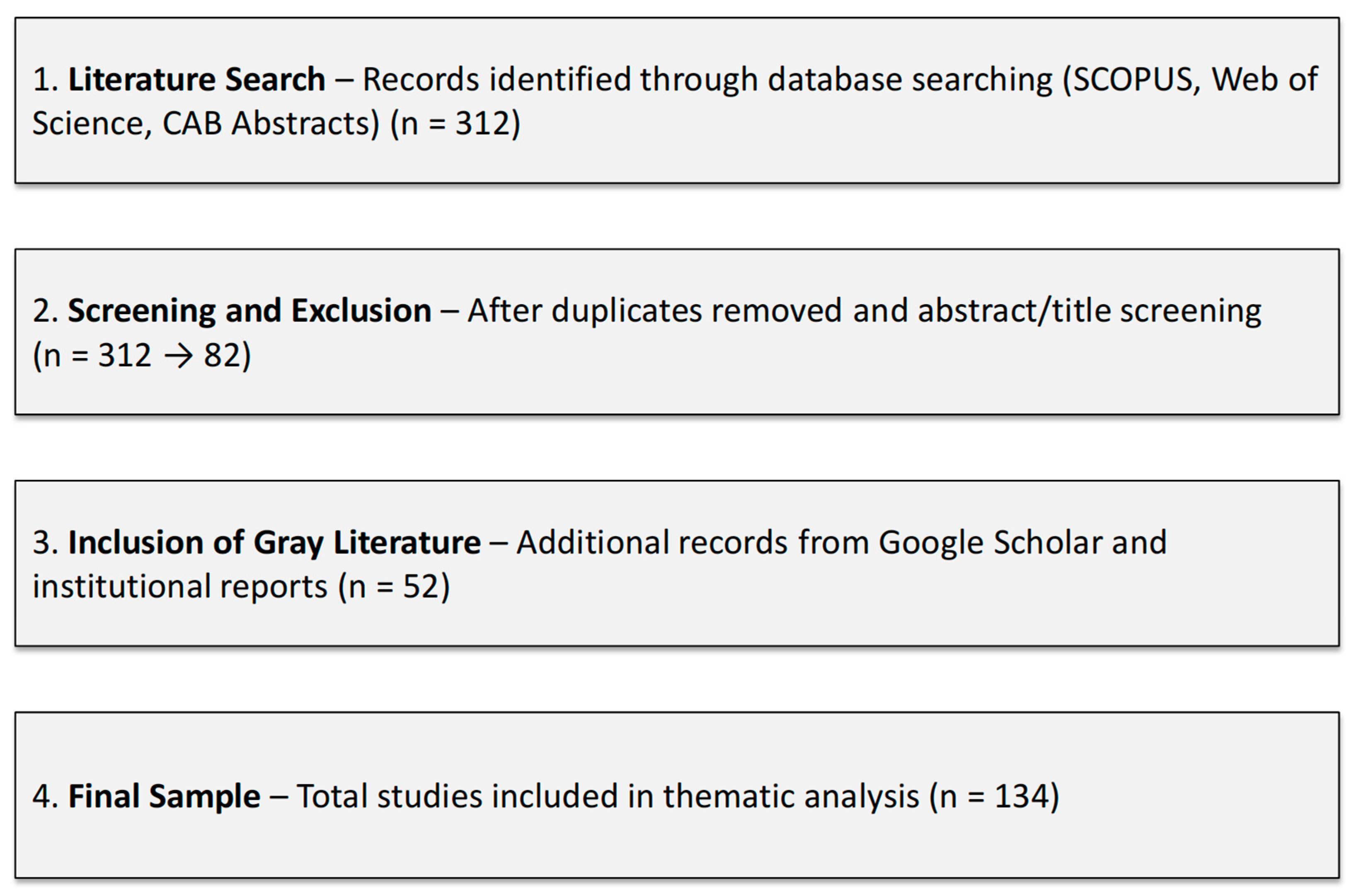
2. Method
- Studies examining transformative change, behavioral change or transformation, or fundamental system change in the context of biodiversity conservation;
- Focus on coastal, marine, or estuarine ecosystems (including studies that address coastal-terrestrial interfaces);
- Empirical studies (quantitative, qualitative, or mixed methods), theoretical papers, or review articles that contribute to understanding transformative change processes;
- Published in peer-reviewed journals or as gray literature from reputable organizations (e.g., Intergovernmental Science-Policy Platform on Biodiversity and Ecosystem Services (IPBES));
- Available in English language.
- Studies focusing solely on terrestrial ecosystems without coastal components;
- Studies addressing only incremental or adaptive changes without transformative elements;
- Opinion pieces, editorials, or commentary articles without substantial analytical content;
- Studies focusing exclusively on technological innovations without broader system change considerations;
- Conference abstracts without full-text availability;
- Studies published before 2010 (to focus on contemporary transformative change discourse).
3. Key Findings from the Literature Review on Transformative Change
3.1. Publication Patterns and Research Evolution
3.2. RQ1: Characteristics, Approaches, and Mechanisms of Transformative Change
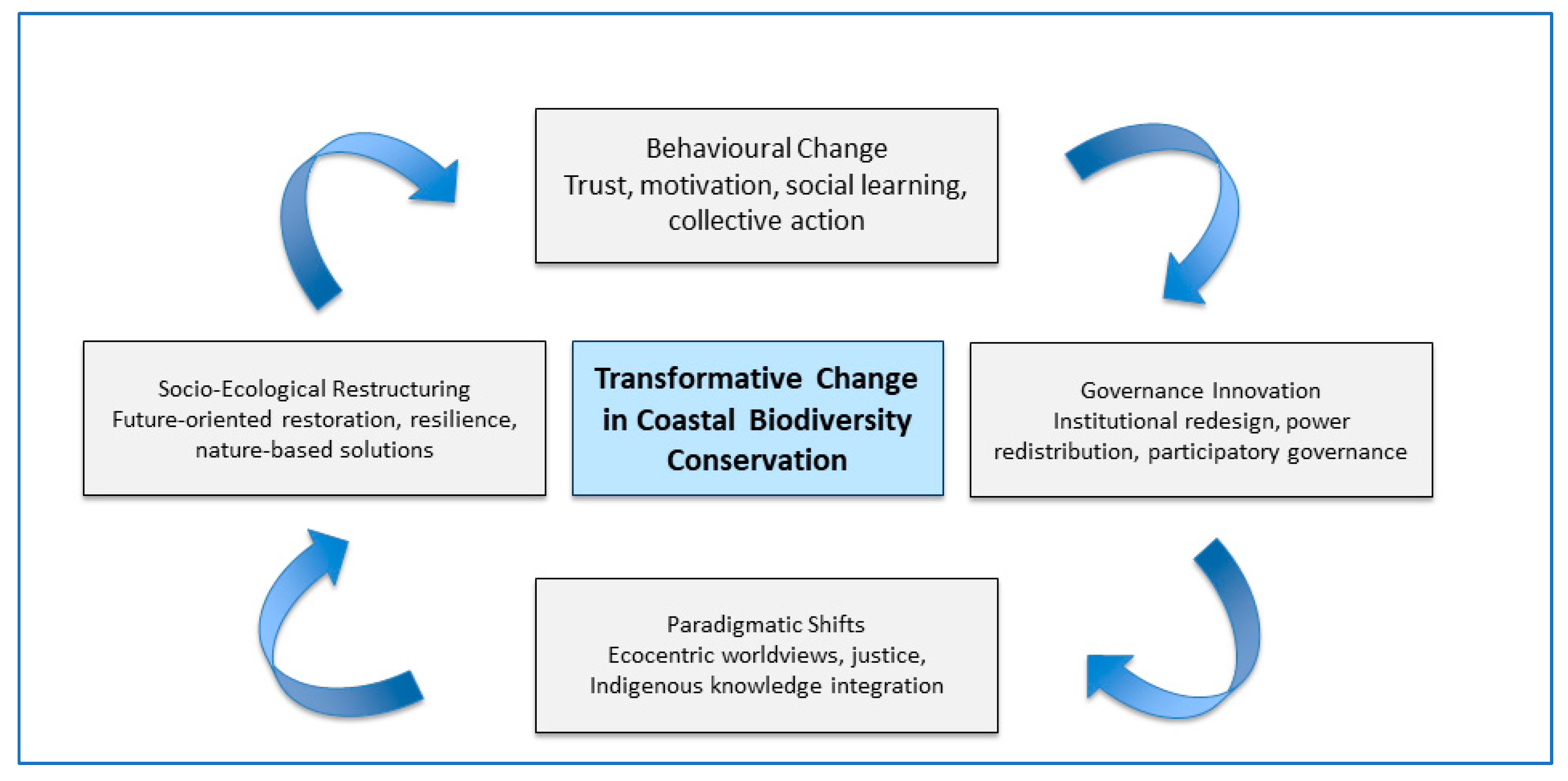
3.2.1. Governance Innovation
3.2.2. Socio-Ecological Restructuring
3.3. RQ2: Enabling and Constraining Factors
3.3.1. Enabling Factors
3.3.2. Constraining Factors
3.4. RQ3: The Utility and Limits of the Social–Ecological Systems (SES) Framework
4. Synthesis: Towards a Complex Understanding of Transformation in Coastal Conservation
- Integration across fragmented literature—By mapping governance, ecological, and normative pathways together, the review provides the first comprehensive synthesis of how transformation is operationalized in coastal conservation, offering a typology that connects ecological sciences, political ecology, and social sciences.
- Identification of enabling and constraining dynamics—The review reveals consistent patterns of enablers (leadership, social capital, knowledge integration) and barriers (institutional inertia, vested interests, fragmentation) that operate across scales. This contributes a theoretically grounded framework for analyzing conditions under which transformation succeeds or fails.
- Critical engagement with frameworks—While the Social–Ecological Systems Framework offers analytical structure, the review shows its blind spots regarding politics, power, and justice. This invites future research to hybridize SES with critical governance and justice perspectives, thereby strengthening its capacity as a tool for transformative practice.
4.1. Implications for Practice
- Repoliticizing Conservation Practice
- Conservation professionals must recognize that technical interventions (such as marine zoning, protected area designation, or ecosystem restoration) are inherently political acts that shape access, rights, and responsibilities.
- Practitioners should adopt reflexive approaches that explicitly confront issues of power, representation, and legitimacy in decision-making.
- Building equitable partnerships with local and Indigenous communities is essential—not through consultative tokenism but through genuine co-management, shared decision-making, and redistribution of authority.
- Embedding Justice, Equity, and Behavioral Transformation in Governance
- Policies should embed social justice and behavioral inclusion as core criteria for success, ensuring that the costs and benefits of conservation are distributed fairly across social groups. Embedding behavioral principles—such as transparency, reciprocity, and shared responsibility -can strengthen trust between institutions and communities [40,47].
- Mechanisms such as community-led monitoring, participatory budgeting, and co-design of management plans not only institutionalize equity but also encourage collective behavioral change by fostering ownership, legitimacy, and long-term engagement. These participatory processes translate abstract equity goals into everyday practices of cooperation and shared governance.
- Capacity-building programs should strengthen both structural and behavioral agency among historically marginalized groups, enhancing their ability to shape conservation priorities and decision-making. Empowering communities in this way promotes self-efficacy, a key behavioral condition for sustained engagement and transformation.
- Adopting Future-Oriented Restoration Practices
- Restoration must move beyond recreating historical ecosystems toward designing resilient futures that integrate human well-being with ecological integrity.
- Nature-based solutions—such as mangrove rehabilitation, living shorelines, and blue carbon initiatives—should be implemented as adaptive, multifunctional systems that deliver both ecological and social benefits.
- Long-term monitoring frameworks should be established to track adaptive outcomes and learn from ecological feedbacks, rather than measuring success solely against fixed benchmarks.
- Institutionalizing Learning, Adaptation, and Behavioral Transformation
- Transformation requires iterative learning processes embedded in governance, where experimentation, feedback, and reflexivity are normalized as part of everyday practice. Embedding behavioral learning loops—through reflection, adaptation, and mutual accountability—enables institutions and stakeholders to internalize change and sustain it over time [22].
- Cross-sectoral collaboration among scientists, policymakers, communities, and NGOs fosters collective behavioral intelligence, reducing policy fragmentation and strengthening the social infrastructure for transformation. This collaboration encourages openness, empathy, and perspective-taking—key behavioral enablers of systemic learning.
- Practitioners should cultivate “transformative leadership” that models behavioral flexibility, builds trust, and encourages innovation rather than rigid adherence to established norms. Such leadership helps create psychologically safe environments where stakeholders can experiment, make mistakes, and learn collectively—conditions essential for long-term adaptation and resilience.
- Leveraging Cultural and Normative Change
- Conservation practice must integrate cultural narratives, traditional knowledge, and local worldviews into decision-making frameworks.
- Education and communication strategies should promote values of stewardship, interdependence, and ecological justice, shifting public perception from control of nature toward coexistence.
- Engaging art, storytelling, and place-based learning can help translate abstract sustainability goals into meaningful community action.
- Power Redistribution: Establish Indigenous and local co-management committees to ensure equitable decision-making and accountability.
- Behavioral Empowerment: Foster trust-building, participatory education, and peer learning to anchor behavioral transformation within community practice.
- Institutional Learning: Embed reflexive monitoring and adaptive governance cycles to sustain long-term transformation and learning-by-doing.
- Cross-Scale Integration: Connect local initiatives to regional and global policy frameworks to enhance coherence, scalability, and systemic impact.
- Justice and Inclusion: Mainstream social justice and equity criteria in all stages of conservation planning and implementation to ensure fair distribution of benefits and responsibilities.
4.2. Research Directions
- 1.
- Longitudinal and Comparative Studies
- 2.
- Cross-Scale Governance and Multi-Level Interactions
- 3.
- Equity, Power, and Justice in Behavioral Transformation
- 4.
- Methodological Integration and Knowledge Co-Production
- 5.
- Theorizing Transformation as Process, Not Outcome
5. Conclusions
Supplementary Materials
Author Contributions
Funding
Institutional Review Board Statement
Informed Consent Statement
Data Availability Statement
Acknowledgments
Conflicts of Interest
References
- Ceballos, G.; Ehrlich, P.R.; Barnosky, A.D.; García, A.; Pringle, R.M.; Palmer, T.M. Accelerated modern human–induced species losses: Entering the sixth mass extinction. Sci. Adv. 2015, 1, e1400253. [Google Scholar] [CrossRef] [PubMed]
- Schickhoff, U.; Bobrowski, M.; Offen, I.A.; Mal, S. The biodiversity crisis in the Anthropocene. In Geography and the Anthropocene; Springer: Berlin/Heidelberg, Germany, 2024; pp. 79–111. [Google Scholar] [CrossRef]
- Vardakas, L.; Perdikaris, C.; Freyhof, J.; Zimmerman, B.; Ford, M.; Vlachopoulos, K.; Giamas, C.; Economou, A.N.; Kalogianni, E. Global patterns and drivers of freshwater fish extinctions: Can we learn from our losses? Glob. Change Biol. 2025, 31, e70244. [Google Scholar] [CrossRef]
- United Nations Environment Programme (UNEP). Making Peace with Nature: Ascientific Blueprint to Tackle the Climate Biodiversity Pollution Emergencies, Nairobi; UNEP 2021. Available online: https://www.unep.org/resources/making-peace-nature (accessed on 17 January 2024).
- He, Q.; Silliman, B.R.; Liu, Z. Climate change, human impacts, and coastal ecosystems: Implications for the future. Curr. Biol. 2019, 29, R972–R982. [Google Scholar] [CrossRef]
- Duarte, C.M.; Agusti, S.; Barbier, E.; Britten, G.L.; Castilla, J.C.; Gattuso, J.P.; Fulweiler, R.W.; Hughes, T.P.; Knowlton, N.; Lovelock, C.E.; et al. Rebuilding marine life. Nature 2020, 580, 39–51. [Google Scholar] [CrossRef]
- Hilmi, N.; Sutherland, M.; Farahmand, S.; Haraldsson, G.; van Doorn, E.; Ernst, E.; Allemand, D.; Bax, N.; Calcinai, B.; Carvalho, S.; et al. Deep sea nature-based solutions to climate change. Front. Clim. 2023, 5, 1169665. [Google Scholar] [CrossRef]
- Intergovernmental Science-Policy Platform on Biodiversity and Ecosystem Services (IPBES). Transformative Change Assessment—Summary for Policymakers: Thematic Assessment of the Underlying Causes of Biodiversity Loss, Determinants of Transformative Change, and Options for Achieving the 2050 Vision for Biodiversity; IPBES Secretariat: Bonn, Germany, 2024. [Google Scholar] [CrossRef]
- Intergovernmental Science-Policy Platform on Biodiversity Ecosystem Services (IPBES). Global Assessment Report on Biodiversity Ecosystem Services of the Intergovernmental Science-Policy Platform on Biodiversity Ecosystem Services; Brondizio, E.S., Settele, J., Díaz, S., Ngo, H.T., Eds.; IPBES Secretariat: Bonn, Germany, 2019. [Google Scholar] [CrossRef]
- Chivian, E.; Bernstein, A. (Eds.) Sustaining Life: How Human Health Depends on Biodiversity; Oxford University Press: Oxford, UK, 2008. [Google Scholar]
- Dirzo, R.; Young, H.S.; Galetti, M.; Ceballos, F.; Isaac, N.J.B.; Collen, B. Defaunation in the Anthropocene. Science 2014, 345, 401–406. [Google Scholar] [CrossRef]
- Leclère, D.; Obersteiner, M.; Alkemade, R.; Almond, R.; Barrett, M.; Bunting, G.; Carvalheiro, L.G.; Cramer, W.; Drouet, L.; Dürauer, M.; et al. Towards pathways bending the curve of terrestrial biodiversity trends within the 21st century. Nature 2018, 585, 551–556. [Google Scholar] [CrossRef]
- McRae, L.; Böhm, M. Biodiversity: The decline in global biodiversity and how education can be part of the solution. In Meeting the Challenges of Existential Threats Through Educational Innovation; Routledge: Milton Park, UK, 2021; pp. 42–66. [Google Scholar] [CrossRef]
- Marris, E. Rambunctious Garden: Saving Nature in a Post-Wild World; Bloomsbury Publishing (BMY): New York, NY, USA, 2013. [Google Scholar]
- Büscher, B.; Fletcher, R. Towards convivial conservation. Conserv. Soc. 2019, 17, 283–296. [Google Scholar] [CrossRef]
- Harris, L.; Bessinger, M.; Dayaram, A.; Holness, S.; Kirkman, S.; Livingstone, T.-C.; Lombard, A.; Lück-Vogel, M.; Pfaff, M.; Sink, K.; et al. Advancing land-sea integration for ecologically meaningful marine management. Biol. Conserv. 2019, 236, 1–10. [Google Scholar] [CrossRef]
- Ward, N.D.; Megonigal, J.P.; Bond-Lamberty, B.; Bailey, V.L.; Butman, D.E.; Canuel, E.A.; Diefenderfer, H.L.; Kroeger, K.D.; Mayorga, E.; Neumann, R.B.; et al. Representing the function and sensitivity of coastal interfaces in global Earth-system models. Nat. Commun. 2020, 11, 2458. [Google Scholar] [CrossRef]
- Kuhl, L.; Rahman, M.F.; McCraine, S.; Krause, D.; Hossain, M.F.; Bahadur, A.V.; Huq, S. Transformational adaptation in the context of coastal cities. Annu. Rev. Environ. Resour. 2021, 46, 449–479. [Google Scholar] [CrossRef]
- Refulio-Coronado, S.; Lacasse, K.; Dalton, T.; Humphries, A.; Basu, S.; Uchida, H.; Uchida, E. Coastal and marine socio-ecological systems: A systematic review of the literature. Front. Mar. Sci. 2021, 8, 648006. [Google Scholar] [CrossRef]
- Siddik, M.A.; Islam, A.R.M.T. Review of coastal land transformation: Factors, impacts, adaptation strategies, and future scopes. Geogr. Sustain. 2024, 5, 167–178. [Google Scholar] [CrossRef]
- Nienaber, A.; Spundflasch, S.; Soares, A. Sustainable Urban Mobility in Europe—Implementation Needs Behavioral Change; SUITS Policy Brief 3a. 2020. Available online: https://www.suits-project.eu/wp-content/uploads/2019/12/SUITS_Policy-brief-3a.pdf (accessed on 3 January 2024).
- Nienaber, A.-M.; Spundflasch, S.; Soares, A.E.; Woodcock, A. Behavioral change in local authorities to increase organisational capacity. In Capacity Building in Local Authorities for Sustainable Transport Planning; Woodcock, A., Saunders, J., Fadden-Hopper, K., Eds.; Smart Innovation, Systems and Technologies; Springer: Singapore, 2023; Volume 319, pp. 341–360. [Google Scholar] [CrossRef]
- Ostrom, E. A general framework for analyzing sustainability of social–ecological systems. Science 2009, 325, 419–422. [Google Scholar] [CrossRef]
- McGinnis, M.D.; Ostrom, E. Social-ecological system framework: Initial changes and continuing challenges. Ecol. Soc. 2014, 19, 30. [Google Scholar] [CrossRef]
- Bryman, A. Social Research Methods, 5th ed.; Oxford University Press: Oxford, UK, 2016. [Google Scholar]
- Rockström, J.; Steffen, W.; Noone, K.; Persson, Å.; Chapin, F.S., III; Lambin, E.; Lenton, T.M.; Scheffer, M.; Folke, C.; Schellnhuber, H.J.; et al. A safe operating space for humanity. Nature 2009, 461, 472–475. [Google Scholar] [CrossRef]
- Whiteman, G.; Walker, B.; Perego, P. Planetary boundaries: Ecological foundations for corporate sustainability. J. Manag. Stud. 2013, 50, 307–336. [Google Scholar] [CrossRef]
- Temper, L.; Walter, M.; Rodriguez, I.; Kothari, A.; Turhan, E. A perspective on radical transformations to sustainability: Resistances, movements and alternatives. Sustain. Sci. 2018, 13, 747–764. [Google Scholar] [CrossRef]
- Folke, C.; Colding, J.; Berkes, F. Synthesis: Building resilience and adaptive capacity in social-ecological systems. In Navigating Social-Ecological Systems: Building Resilience for Complexity and Change; Berkes, F., Colding, J., Folke, C., Eds.; Cambridge University Press: Cambridge, UK, 2003; pp. 352–387. [Google Scholar] [CrossRef]
- Gallopín, G.C. Linkages between vulnerability, resilience, and adaptive capacity. Glob. Environ. Change 2006, 16, 293–303. [Google Scholar] [CrossRef]
- Nienaber, A.; Spundflasch, S.; Soares, A.; Woodcock, A. Distrust as a hazard for future sustainable mobility planning: Rethinking employees’ vulnerability when introducing new technologies in local authorities. Int. J. Hum.–Comput. Interact. 2021, 37, 390–401. [Google Scholar] [CrossRef]
- Reed, M.S. Stakeholder participation for environmental management: A literature review. Biol. Conserv. 2008, 141, 2417–2431. [Google Scholar] [CrossRef]
- Berkes, F. Rethinking community-based conservation. Conserv. Biol. 2004, 18, 621–630. [Google Scholar] [CrossRef]
- Keahey, J. Sustainable development and participatory action research: A systematic review. Syst. Pract. Action Res. 2021, 34, 291–306. [Google Scholar] [CrossRef]
- Moore, O.-L.; Olsson, P.; Nilsson, W.; Rose, L.; Westley, F.R. Navigating emergence and system reflexivity as key transformative capacities. Ecol. Soc. 2018, 23, 38. [Google Scholar] [CrossRef]
- Aguiar, S.; Mastrángelo, M.E.; Brancalion, P.H.S.; Meli, P. Transformative governance for linking forest and landscape restoration to human well-being in Latin America. Ecosyst. People 2021, 17, 523–538. [Google Scholar] [CrossRef]
- Bacha, M.S.; Muhammad, M.; Kılıç, Z.; Nafees, M. The dynamics of public perceptions and climate change in Swat Valley, Khyber Pakhtunkhwa, Pakistan. Sustainability 2021, 13, 4464. [Google Scholar] [CrossRef]
- Siwertsson, A.; Lindström, U.; Aune, M.; Berg, E.; Skarðhamar, J.; Varpe, Ø.; Primicerio, R. Rapid climate change increases diversity and homogenizes composition of coastal fish at high latitudes. Glob. Change Biol. 2024, 30, e17273. [Google Scholar] [CrossRef]
- Wolfram, M.; Borgström, S.; Farrelly, M. Urban transformative capacity: From concept to practice. Ambio 2019, 48, 437–448. [Google Scholar] [CrossRef]
- Nienaber, A.-M.; Hofeditz, M.; Romeike, P.D. Vulnerability and trust in leader–follower relationships. Pers. Rev. 2015, 44, 567–591. [Google Scholar] [CrossRef]
- Agrawal, A. The politics of development and conservation: Legacies of colonialism. Peace Change 1997, 22, 463–482. [Google Scholar] [CrossRef]
- Feola, G. Societal transformation in response to global environmental change: A review of emerging concepts. Ambio 2015, 44, 376–390. [Google Scholar] [CrossRef]
- Eriksen, S.H.; Nightingale, A.J.; Eakin, H. Reframing adaptation: The political nature of climate change adaptation. Glob. Environ. Change 2015, 35, 523–533. [Google Scholar] [CrossRef]
- Ostrom, E. Governing the Commons: The Evolution of Institutions for Collective Action; Cambridge University Press: Cambridge, UK, 1990. [Google Scholar] [CrossRef]
- Ribot, J. Vulnerability before adaptation: Toward transformative climate action. Glob. Environ. Change 2011, 21, 1160–1162. [Google Scholar] [CrossRef]
- Ajzen, I. The theory of planned behavior. Organ. Behav. Hum. Decis. Process. 1991, 50, 179–211. [Google Scholar] [CrossRef]
- Nienaber, A.M.; Romeike, P.D.; Searle, R.; Schewe, G. A qualitative meta-analysis of trust in supervisorrsubordinate relationships. J. Manag. Psychol. 2015, 30, 507–534. [Google Scholar] [CrossRef]
- Page, M.J.; McKenzie, J.E.; Bossuyt, P.M.; Boutron, I.; Hoffmann, T.C.; Mulrow, C.D.; Shamseer, L.; Tetzlaff, J.M.; Akl, E.A.; Brennan, S.E.; et al. The PRISMA 2020 statement: An updated guideline for reporting systematic reviews. BMJ 2021, 372, n71. [Google Scholar] [CrossRef]



| Dimension | Key Findings | Contribution to Theory | Implications for Practice |
|---|---|---|---|
| GOVERNANCE INNOVATION | Institutional restructuring must be coupled with redistribution of power to move beyond symbolic participation. Transformation is a deeply political process shaped by authority, legitimacy, and equity. | Advances theories of transformative governance by integrating power and justice dimensions into socio-ecological systems theory; emphasizes governance as a dynamic, contested process. | Re-politicize conservation practice; institutionalize participatory governance as genuine power-sharing; embed justice and equity in decision-making; strengthen capacity and leadership for inclusive governance. |
| SOCIO-ECOLOGICAL RESTRUCTURING | Restoration focused narrowly on historical baselines risks perpetuating fragility. Transformative approaches emphasize future-oriented resilience integrating climate adaptation, ecosystem services, and human well-being. | Expands resilience theory by integrating ecological and socio-economic systems and foregrounding adaptive, future-oriented restoration. | Adopt flexible, adaptive management systems; prioritize nature-based and climate-resilient restoration; link local initiatives with larger-scale ocean and climate governance frameworks; promote learning-by-doing. |
| PARADIGMATIC SHIFTS | Sustainable futures depend on behavioral transformations, including values, attitudes and traditions toward ecocentric worldviews, ecological justice, and recognition of Indigenous and local knowledge systems. | Extends transformation theory by embedding normative and cultural dimensions; aligns with political ecology and decolonial perspectives. | Integrate Indigenous and local knowledge into conservation design; foster cultural and value change through education, storytelling, and community engagement; promote ecological justice and reciprocity. |
| CROSS-SCALE AND SYSTEMIC INTEGRATION | Transformation emerges through interdependence among governance, ecological, and behavioral pathways. Isolated action within one domain rarely achieves durable change. | Provides a typology of transformation as a complex adaptive process; bridges social–ecological systems theory with critical governance and justice frameworks. | Design integrated, cross-scale interventions that align institutional redesign, ecological restoration, and cultural change; encourage polycentric and networked governance arrangements. |
| RESEARCH DIRECTIONS | Current evidence remains fragmented and short-term; transformation -particularly its behavioral dimensions-is under-theorized as a process rather than an outcome. | Identifies priorities for longitudinal, cross-scale, equity-centered, and mixed-methods research to advance theory and application. | Promote long-term, comparative studies; operationalize equity metrics; institutionalize co-production and participatory research; develop adaptive frameworks for tracking transformative outcomes. |
Disclaimer/Publisher’s Note: The statements, opinions and data contained in all publications are solely those of the individual author(s) and contributor(s) and not of MDPI and/or the editor(s). MDPI and/or the editor(s) disclaim responsibility for any injury to people or property resulting from any ideas, methods, instructions or products referred to in the content. |
© 2025 by the authors. Licensee MDPI, Basel, Switzerland. This article is an open access article distributed under the terms and conditions of the Creative Commons Attribution (CC BY) license (https://creativecommons.org/licenses/by/4.0/).
Share and Cite
Nienaber, A.-M.; Imrie-Kuzu, D. Transformative Change in Coastal Biodiversity Conservation: A Systematic Literature Review of Governance, Social–Ecological, and Cultural Pathways. Sustainability 2025, 17, 11186. https://doi.org/10.3390/su172411186
Nienaber A-M, Imrie-Kuzu D. Transformative Change in Coastal Biodiversity Conservation: A Systematic Literature Review of Governance, Social–Ecological, and Cultural Pathways. Sustainability. 2025; 17(24):11186. https://doi.org/10.3390/su172411186
Chicago/Turabian StyleNienaber, Ann-Marie, and Durukan Imrie-Kuzu. 2025. "Transformative Change in Coastal Biodiversity Conservation: A Systematic Literature Review of Governance, Social–Ecological, and Cultural Pathways" Sustainability 17, no. 24: 11186. https://doi.org/10.3390/su172411186
APA StyleNienaber, A.-M., & Imrie-Kuzu, D. (2025). Transformative Change in Coastal Biodiversity Conservation: A Systematic Literature Review of Governance, Social–Ecological, and Cultural Pathways. Sustainability, 17(24), 11186. https://doi.org/10.3390/su172411186