
Systematic Review

Accessibility by Design: A Systematic Review of Inclusive E-Book Standards, Tools, and Practices


1
Department of Computing, Federal University of the Semi-Arid Region, Av. Francisco Mota, 572, Mossoró 59625-900, Brazil
2
Center for Excellence in Social Technologie, Av. Lourival Melo Mota, S/N, Maceió 57072-970, Brazil
3
Computing Institute, Federal University of Alagoas, Av. Lourival Melo Mota, S/N, Maceió 57072-970, Brazil
4
Informatics Department, Alagoas Federal Institute of Education, Science, and Technology, Av. do Ferroviário, 530, Maceió 57020-600, Brazil
5
National Fund for Educational Development, Setor Bancário Sul, Quadra 2, Bloco F, Brasília 70070-929, Brazil
*
Author to whom correspondence should be addressed.
Sustainability 2025, 17(24), 11173; https://doi.org/10.3390/su172411173 (registering DOI)
Submission received: 31 October 2025 / Revised: 25 November 2025 / Accepted: 28 November 2025 / Published: 13 December 2025
(This article belongs to the Special Issue Technology Enhanced Education and the Sustainable Development)

Abstract

Digital technologies have transformed how information is accessed and shared; however, individuals with disabilities continue to face significant barriers in engaging with educational content. The shift to electronic formats presents an opportunity to promote inclusion by integrating accessibility features. Accessible e-books are essential for fostering equitable participation in learning environments, supporting lifelong learning, and aligning with global sustainability goals such as SDG 4 (Quality Education) and SDG 10 (Reduced Inequalities). While international frameworks like the Web Content Accessibility Guidelines (WCAG) advocate for accessible publishing, significant gaps remain. This paper presents a Systematic Literature Review (SLR) aimed at examining the role of accessibility features in shaping the quality, usability, and affordability of e-books. Based on well-defined guidelines, we defined and executed an SLR protocol, identifying 1618 studies in seven different scientific databases. At the end of the review process, we selected 74 studies to answer four research questions related to the accessibility features employed by e-books and their reading platforms. By synthesizing existing evidence, this review highlights barriers, best practices, and strategic pathways to inform educators, publishers, and policymakers. Ultimately, this study advocates for the development of inclusive and sustainable digital content ecosystems that meet the diverse needs of all learners.

1. Introduction

The advancement of digital technologies has significantly transformed the way information is accessed and consumed, offering new opportunities for inclusive and equitable education. However, individuals with disabilities—including those who are blind or visually impaired, deaf or hard of hearing, dyslexic, or with cognitive and motor impairments—continue to face substantial barriers in engaging with both printed and digital educational content [1,2]. These challenges underscore a broader concern: the need to ensure that technological innovations are inclusive by design, in line with global efforts toward sustainable development. The Sustainable Development Goals (SDGs) of the United Nations [3], especially SDG 4 (Quality Education) and SDG 10 (Reduced Inequalities), emphasize the importance of inclusive and accessible education for all. Accessibility in educational technologies is not only a technical or design issue: it is a critical dimension of digital equity, social sustainability, and lifelong learning [4]. As higher education institutions increasingly adopt e-books, learning management systems, and other forms of educational technology (EdTech), the accessibility of these resources becomes a decisive factor in ensuring equitable participation for learners with disabilities [5].
Research underscores the critical importance of designing products and digital resources that cater to the needs of visually impaired users, particularly in educational contexts [6]. Accessible electronic publications, such as e-books, journals, and training tools, have been shown to play a pivotal role in supporting the inclusion of disabled students and professionals, allowing their active participation in both classroom and remote learning environments [7]. Furthermore, studies demonstrate that accessible e-books allow visually impaired individuals to derive the same educational and informational benefits as their sighted peers, with a comparable level of effort [5,8]. These findings highlight the transformative potential of accessible digital resources in fostering equity and inclusion for people with print disabilities.
Accessibility is a critical component of creating an inclusive digital environment that enables people with diverse abilities to engage with and contribute to the Web effectively. Despite advances, significant challenges remain, as evidenced by the WebAIM finding that 96.3% of the top 1,000,000 websites do not comply with the Web Content Accessibility Guidelines (WCAG) 2.0 or later [9]. Established by the World Wide Web Consortium (W3C), WCAG serves as the most widely accepted standard for web accessibility, aiming to ensure an equally usable internet that is easy to navigate and interact with for all users [10]. These guidelines are integral to global efforts to reduce disability discrimination and are highlighted in the UNESCO report ’Inclusion and Education’ as essential for achieving SDG 4 [10]. Furthermore, international initiatives such as the Marrakech Treaty underscore the importance of accessibility by requiring exceptions to copyright laws to facilitate the distribution of accessible formats for individuals who are blind, visually impaired, or print disabled [11]. Collectively, these efforts emphasize the ongoing need for robust accessibility standards to ensure inclusivity and equal opportunities for all.
The adoption of e-books among school students, while offering numerous benefits, is accompanied by several challenges that hinder their widespread use [12]. A significant barrier is poor ergonomic design, which can cause eye strain, inadequate screen size and resolution, inappropriate font size and spacing, cumbersome navigation, and physical discomfort during prolonged use. In addition, technical limitations, such as slow Internet connections, often result in difficulties in downloading or accessing e-textbooks, further complicating their adoption. User experience (UX) also plays a critical role, as students frequently encounter challenges related to overall satisfaction and usability. Complex navigation systems, for instance, can impede students’ ability to locate and access information efficiently, underscoring the importance of intuitive and user-friendly interfaces. Furthermore, the financial burden associated with e-textbooks poses another obstacle, as many students lack access to the necessary devices or struggle to pay subscription fees, which add ongoing costs to their educational expenses [13]. These challenges highlight the need to address ergonomic, technical and financial barriers to ensure a seamless transition to digital learning environments.
Another critical aspect of e-books that warrants attention is the relationship between accessibility features and pricing strategies. Research by Dantas et al. [14] explores revenue sharing and wholesale pricing contracts within distribution channels, demonstrating that revenue sharing contracts not only improve profits compared to wholesale price contracts but also result in lower consumer prices, making them a favorable option for both publishers and consumers. This analysis is particularly relevant to the price of e-books, as it highlights the economic dynamics that influence accessibility and affordability. Furthermore, Mikkonen [15] examines various e-book pricing models from the perspective of centralized consortium acquisition, providing information on how pricing strategies can impact digital content accessibility and distribution. Together, these studies underscore the importance of analyzing pricing models in conjunction with accessibility features to ensure that e-books are economically viable and inclusive for all users.
Despite the growing recognition of the importance of accessibility, significant gaps persist in the literature regarding the integration of accessibility features in e-books. Many digital platforms remain only partially accessible, with inconsistent standards and limited consideration of diverse learning needs. These limitations not only exclude a segment of the population, but also hinder the development of truly sustainable digital education ecosystems. Although the broader significance of accessibility in digital content is widely acknowledged, there is limited research exploring whether publishers are actively incorporating these features into their e-books or the specific standards and guidelines they adhere to. In addition, key aspects such as the types of accessibility features being implemented, the target audiences of related studies, and the tools used to assess accessibility remain underexamined. This lack of comprehensive research not only hinders the development of effective best practices but also limits the ability to ensure equitable access to digital content for all users, particularly those with disabilities. Addressing these gaps is essential for advancing inclusivity in the digital publishing landscape.
The goal of this paper is to address these gaps by conducting a systematic review of the literature to provide a comprehensive analysis of accessibility features in e-books. Specifically, the study aims to explore the role of accessibility features in shaping the quality and value of e-books, as well as their potential impact on pricing strategies. By addressing these research questions, this article seeks to inform publishers, educators, and policymakers about the current state of accessibility in e-books, identify critical areas for improvement, and advocate for the development of inclusive digital content that meets the diverse needs of all users. Through this work, our objective is to identify current best practices, recurring barriers, and emerging trends in the development of accessible educational technologies. By framing accessibility within the larger context of sustainable development and digital transformation, this review contributes to the growing interdisciplinary discourse on how EdTech can advance both inclusion and sustainability in higher education.
The structure of this article is organized as follows. Section 3 details the Systematic Literature Review Protocol, outlining the defined research years, research questions, strategy, selection, and extraction process, following the guidelines proposed by Kitchenham and Charters [16]. Section 4 presents a thorough analysis of the key findings obtained after applying the Systematic Literature Review protocol. Finally, Section 6 discusses the main insights derived from the study and provides the final remarks.

2. Related Work

Research on technical accessibility has largely focused on developing and implementing standards and guidelines to ensure e-books are compatible with assistive technologies. Rello et al. [17] introduced an Android-based e-book reader designed to enhance accessibility based on user needs. Specifically, the study targeted individuals with dyslexia, proposing a set of layout guidelines derived from a user study involving 22 participants. The research combined quantitative data from eye-tracking tests with qualitative insights from interviews, questionnaires, and the think-aloud technique. The resulting e-book display incorporated the most readable options identified through eye-tracking and user preferences, with customizable settings to improve accessibility.
The accessibility of e-books in educational settings has been a critical area of study, particularly for students with disabilities. Fichten et al. [18] reviewed the history of assistive technologies in post-secondary education in the United States and Canada, highlighting trends in e-learning accessibility and the role of universal design principles. The study underscored the necessity of integrating accessibility considerations from the early stages of digital content development. Emerging technologies have been explored as potential solutions to e-book accessibility challenges. Zdravkova [19] emphasized that education is a fundamental human right and that assistive technologies play a crucial role in inclusive education. The study highlighted the increasing use of artificial intelligence (AI) in developing educational tools for individuals with disabilities, including those with visual, auditory, cognitive, and motor impairments. Additionally, the research discussed future assistive technologies and the ethical considerations associated with AI-supported educational tools.
Marcus-Quinn et al. [20] examined challenges associated with teachers independently creating digital learning materials, raising concerns about the effectiveness and usability of e-books. Their work emphasized the importance of promoting digital literacy and ensuring accessibility in digital educational resources. Despite advancements, significant challenges remain in achieving universal e-book accessibility. Tlili et al. [21] provided a comprehensive survey on the state of e-book accessibility, identifying issues such as inconsistent implementation of standards and the high cost of producing accessible content. Similarly, Alshehri [22] explored the impact of digital books on student performance in mathematics, drawing on a systematic literature review of 23 studies. The research employed thematic analysis using NVivo 12, revealing key factors influencing students’ mathematical learning, including motivation, technological advancements, learning objectives, and challenges related to traditional learning styles and digital accessibility.
Considering the aforementioned works, we can see that each work addresses accessibility issues in e-books in a specific way for a particular audience without adhering to universal standards, guidelines, and/or tools. Therefore, the systematic review proposed in this work aims to identify these initiatives in the literature and discuss such solutions more broadly.
Some previous literature reviews on e-books were identified. However, these either do not consider accessibility issues in e-books or only partially consider them, with specific emphasis on features and functionalities incorporated into applications for accessing content. For instance, Op ‘t Eynde et al. [23] analyzed, in their systematic review, the characteristics of illustrated books used by adults in reading to children, focusing on teaching mathematics. The authors evaluated in 49 studies the frequency, quality, and effectiveness of these reading activities, referred to as SPBR (shared picture book reading). Wan Sulaiman and Mustafa [24] conducted a systematic literature review of 17 studies to evaluate the understanding of usability components in developing digital books to meet the expectations of reading users. They identified 17 usability factors and characterized 49 properties that authors should consider when creating digital books. However, these systematic literature reviews failed to address accessibility issues in e-books. Finally, Ba Matraf et al. [25] reviewed the literature to identify usability and accessibility requirements for e-books for people with visual impairments. A total of 24 requirements were identified and compared with the results of an online survey with seven participants. The authors state that these requirements can be used as a checklist to ensure the needs of this audience of e-book readers.

Benefits of Assistive Technologies in Accessible E-Books

Accessible e-books, enabled by assistive technologies, expand autonomy and enhance the reading experience of people with disabilities. Features such as screen readers and formatting adjustments ensure compliance with international accessibility guidelines [26]. Standards and tools from the DAISY Consortium ensure structured navigation, alternatives in multiple formats, and cross-platform compatibility [27], allowing users with visual or motor disabilities to access content equitably. These solutions promote educational equity and digital sustainability, aligning with the global inclusion agenda. Accessible e-books contribute to the inclusive education advocated by UNESCO, ensuring that students with special needs are not left behind [28]. By removing barriers to information access, such resources address a global demand: the WHO estimates that more than 1 billion people require assistive technologies [29]. In this way, the adoption of accessible e-books reinforces the Sustainable Development Goals, promoting inclusion and equal opportunities.

3. Systematic Literature Review Protocol

This Systematic Literature Review (SLR) follows the guidelines outlined by Kitchenham and Charters [16] and also PRISMA (Preferred Reporting Items for Systematic reviews and Meta-Analyses) [30]. Our goal is to understand how accessibility features are being applied to e-books and their reader platforms, as well as to identify other associated aspects addressed in the literature.
We fixed the period for the search as the years between 2011 and August 2024. The year 2011 was defined as the initial year considering our interest in studies published since the launch of version 3.0 of the EPUB standard (approved as an IDPF Recommendation in October 2011), an international standard for the exchange and distribution of digital publications and documents, especially electronic books (e-books) [31].
We established four main steps for defining and executing this SLR, namely:
  • define the research questions;
  • define search strategies;
  • a paper selection process; and
  • extraction of relevant fields.

3.1. Challenges

To contextualize the protocol and make explicit the constraints that shaped our decisions, we summarize the main challenges encountered when planning and executing this SLR on accessibility in e-books:
  • Terminology and scope. The literature uses overlapping terms (e.g., e-book, ebook, eTextbook, EPUB) and mixes accessibility, usability, and universal design, complicating precise scoping and query construction [32,33,34,35,36,37].
  • Standards heterogeneity. Studies refer to different—and evolving—versions of standards and guidelines (e.g., WCAG 2.0/2.1/2.2, EPUB 3.x, DAISY, PDF/UA), which affects comparability across time and venues [38,39].
  • Underreporting of methods. Many papers omit which guidelines were applied, which features were implemented, or which checking tools were used, limiting reproducibility and synthesis [40].
  • Assessing accessibility. Automated checkers cover only parts of the requirements; many aspects (e.g., alternative-text quality, reading order, keyboard focus management) require expert judgment, leading to hybrid manual–automated assessment procedures [41,42].
  • Access and availability. A fraction of potentially relevant papers lacked downloadable full texts or were behind paywalls/platform restrictions, reducing the analyzable set despite broad database coverage [43,44].
  • Population coverage. There is a concentration on visual impairments relative to other needs (hearing, cognitive, motor, low literacy, older adults), which biases reported features and evaluation metrics [45,46].
  • Publication and venue bias. The corpus is skewed toward conference outputs and uneven database returns, which may reflect search engine behavior and venue practices rather than the absence of work [40,47].
  • Reproducibility over time. Rapidly changing platforms, authoring tools, and checkers (with version-dependent behavior) hinder exact replication of earlier results [48,49,50].
To mitigate these risks, we used a multi-database strategy, dual-reviewer screening with consensus, predefined inclusion/exclusion criteria, and a structured data-extraction form.

3.2. Research Questions

We analyzed primary studies employing accessibility resources for e-books. Within this context, the study addresses the following research questions (RQs):
RQ1: What accessibility standards or guidelines are considered in e-books?
RQ2: What accessibility features are incorporated into e-books?
RQ3: Who is the target audience of the studies?
RQ4: What tools are being used to check the accessibility features of e-books?

3.3. Measurement Parameters and Operational Definitions

The unit of analysis is the individual primary study. The time window is 2011–August 2024; searches span ACM DL, IEEE Xplore, ScienceDirect, SpringerLink, Scopus, Web of Science, and EI Compendex, with duplicates removed before screening. “General process” figures use N = 96 (post-screening set); RQ-specific analyses use N = 75 (full-text available). Percentages are computed as ( count / N ) × 100 and rounded to one decimal; because categories are multi-label, totals may exceed 100%.
RQ1 (standards/guidelines). Multi-label binary variables for each named standard/guideline (e.g., WCAG 2.x, WAI-ARIA, DAISY, EPUB 3.x, ISO 14289-1/PDF/UA). Versions are recorded when stated; counts aggregate across versions unless specified.
RQ2 (accessibility features). Multi-label binary using a predefined taxonomy: assistive interfaces/AT; personalization; alternative text; content structure/semantics; navigation; interactive features; text-to-speech/narration; multimedia; metadata; color contrast; screen-reader support; tagging; exporting; multilingual; download/offline; Braille; multi-modal; MathML; OCR; screen magnifier. A feature is marked present if implemented, evaluated, or prescribed with sufficient detail. “Not specified” is used when no concrete feature is reported.
RQ3 (target audience). Multi-label binary: visual impairment; low vision; hearing impairment; cognitive impairment/dyslexia; motor/physical impairment; low literacy; older adults; students; general. Groups are assigned when explicitly stated in aims, participants, or design targets.
RQ4 (accessibility checking tools). Variables captured: tool name; check modality (Automated/Manual/Hybrid); tool class (Checker, Assistive Technology, Authoring tool, Conversion tool, Non-AT utility); distribution (Open-source/Closed-source); license (Free/Proprietary). “Open-source” denotes source code availability; “Free” denotes zero-cost licensing.
Counting and normalization rules. Synonyms are unified (e.g., ebook/e-textbook → “e-book”). WCAG mentions without version are counted as “WCAG”. Screen readers (e.g., NVDA, JAWS, VoiceOver) are recorded individually and consolidated as “screen-reader support” for RQ2. If a study evaluates multiple artifacts, labels apply if any evaluated artifact satisfies the condition.
Screening and reliability. Two reviewers independently screened (title/abstract, then full text) with predefined inclusion/exclusion criteria; disagreements were resolved by consensus and logged.
Missing-data policy. Variables not explicitly stated are marked “Not specified” and excluded from that variable’s numerator while the study remains in the denominator N for that RQ.

3.4. Search Strategies

In this study, we conducted a database search using a specified search string defined based on well-established guidelines [16,30]. Figure 1 presents an overview of the review process.

3.4.1. Search Terms

For the Step 1, our objective was to identify the keywords used for the search string (Step 2) and facilitate the subsequent database search (Step 3). With our goal in mind, we established the following keywords: “accessibility”, “guideline” and “electronic book”.
In Step 2, we established the synonymous for the keywords identified in Step 1. For example, for “guideline” we used “standard” and for “electronic book” we employed “e-book”, “digital book”, and “epub”. The resulting search string used for study retrieval is detailed as follows:
( a c c e s s i b i l i t y ) A N D ( g u i d e l i n e O R s t a n d a r d ) A N D ( e p u b O R d i g i t a l b o o k O R e l e c t r o n i c b o o k O R e - b o o k )

3.4.2. Data Sources

This study considered seven academic databases in Step 3: ACM Digital Library (https://dl.acm.org/, accessed on 22 August 2024), IEEE Xplore (https://ieeexplore.ieee.org/, accessed on 22 August 2024), ScienceDirect (https://www.sciencedirect.com/, accessed on 22 August 2024), SpringerLink (https://www.springer.com/, accessed on 22 August 2024), Scopus (https://www.elsevier.com/products/scopus, accessed on 22 August 2024), Web of Science (https://webofscience.help.clarivate.com/, accessed on 22 August 2024), and EI Compendex (https://www.engineeringvillage.com/, accessed on 22 August 2024).
We chose these databases to search for studies in this SLR because they are sources commonly used in research involving both areas of Computing and Education, as in Silva et al. [51,52].

3.5. Selection Process

In order to screen the studies considering the main objective of the SLR, we performed Step 4. The focus was to exclude studies that did not meet the criteria of the review protocol and select only studies that were relevant to answering the research questions defined in Section 3.2. We included primary studies published in journals, conferences, or workshops on the accessibility features applied to e-books. Additionally, we established a set of Exclusion Criteria (EC) as outlined below:
  • a duplicate;
  • does not focus on accessibility for e-books;
  • not published as a conference paper or journal article (e.g., book, book chapter, magazine, and thesis); and
  • not considered a complete study (less that five pages);
  • unavailable for download.
We employed a two-stage approach to screen the studies, representing Steps 5 and 6. Firstly (Step 5), we assessed the studies using the adaptive reading approach [53], involving two reviewers that outperformed a selection based on metadata reading. This means a study is only accepted when both reviewers agree with the inclusion. Secondly (Step 6), we conducted a filtering of the papers thorough analysis of the full texts of the studies, employing a peer-review process led by a data extractor and data checker [54,55].
The data from the studies were extracted in Step 7, and those that did not meet the criteria defined in the review protocol were excluded. Section 3.6 provides more detailed information about the data extraction process. It is worth noting that because the number of studies selected for the data extraction stage was considered sufficient, there was no need to use the Snowballing technique [56] to search for new studies.
Finally, in Step 8 we summarize the data extracted from each study and generate graphical artifacts and tables as results of the review, generating inputs for our discussions.

3.6. Extraction of Relevant Fields

In the fourth and final step of the SLR, we extracted relevant data from the complete reading of the selected studies. In this step, the studies were distributed equally between two reviewers for content analysis and data extraction. Then, the reviewers exchanged the subsets of studies to check the information extracted by the other reviewer, ensuring the reliability of the process. In cases of disagreement between reviewers regarding data extracted by one reviewer, the reviewer acting as validator, upon identifying such disagreement, requested the reviewer acting as extractor for that study to revisit the study content together and, by mutual agreement, decide on the correctness of the extracted information. Thus, there was no need for a third reviewer. Table 1 displays all the fields extracted from the studies.
In the next sections, the results and discussions about the execution of this SLR protocol will be presented to answer the research questions and achieve the objective of the review.

4. Findings

Initially, we present an overview of the results related to the SLR process, including selected studies for data extraction steps, but which, for reasons of unavailability of access to the full content of the article, were later excluded from SLR.

4.1. Summary of General Results

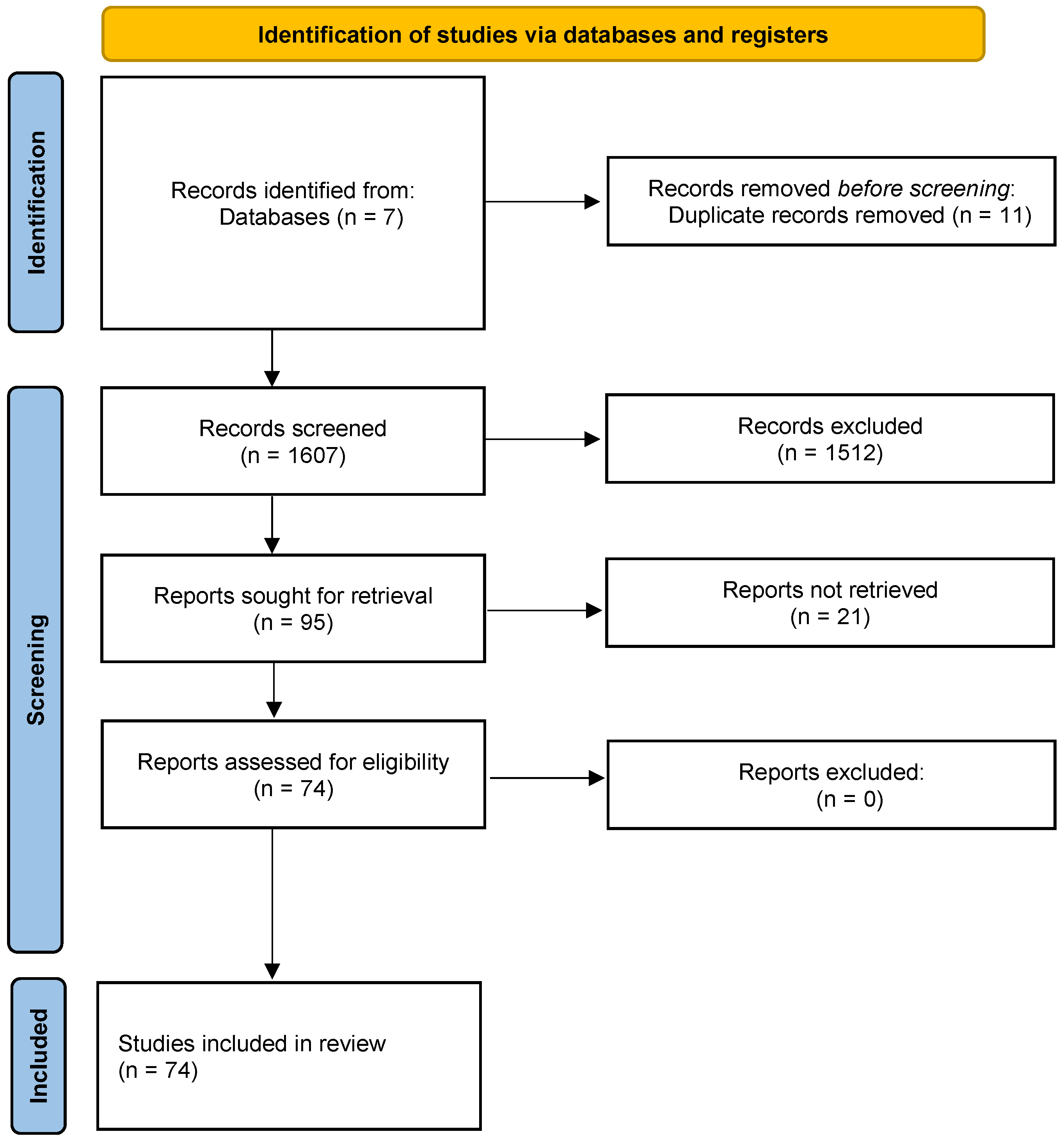
The PRISMA flow diagram, shown in Figure 2, illustrates the stages of identification, screening, and inclusion as part of the SLR protocol. These stages helped us arrive at the final set of studies that we analyzed to address the research questions of the SLR.
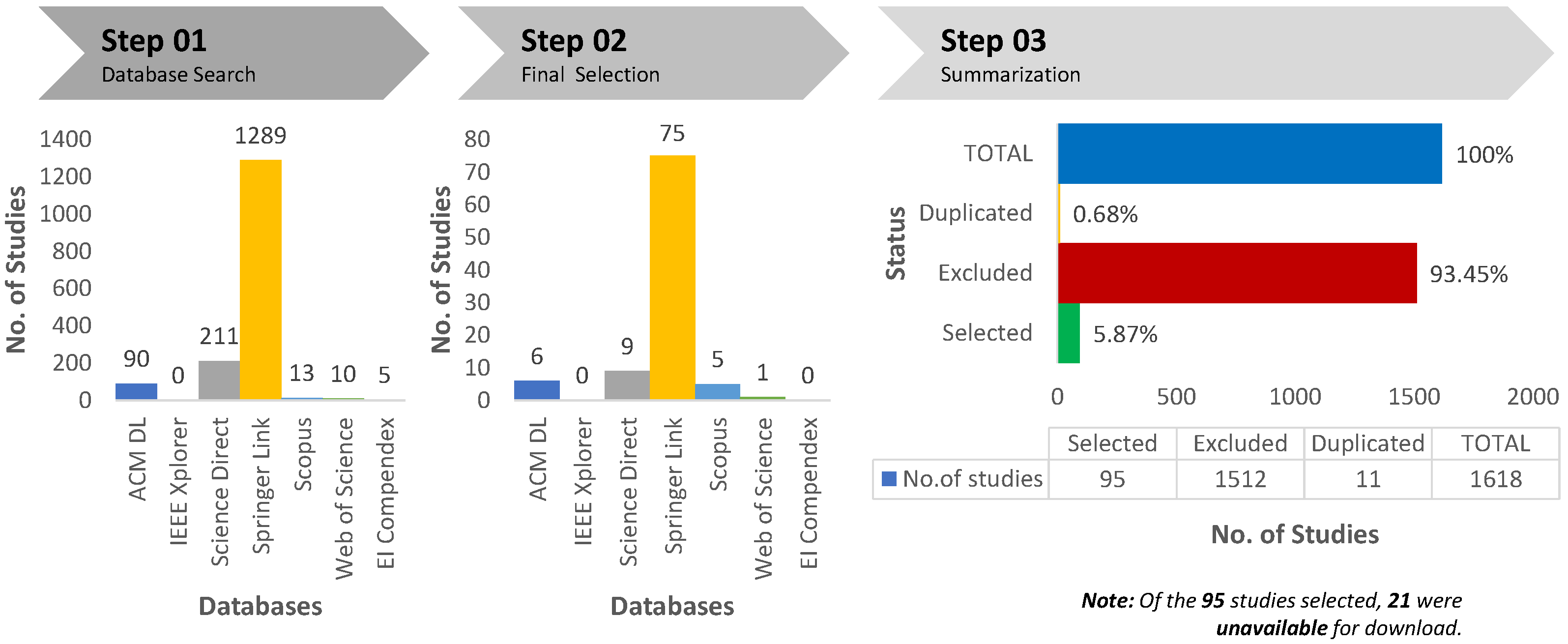
In Figure 3, we show in detail the results of the review process in each protocol execution step. Step 1 refers to the search for studies in the chosen databases, being associated with each database the number of studies identified by executing string of search defined in the protocol. Of 1618 studies identified in the seven databases, approximately 79.7% (1289 studies) came from Springer Link. The remaining studies are distributed among other databases, 211 (approx. 13%) at Science Direct, followed by ACM DL with 90 studies (approx. 5.6%), Scopus with 13 studies (0.8%), Web of Science with 10 studies (0.6%) and EI Compendex with 5 (0.3%) studies. No study was returned to the IEEE Xplorer database. It is essential to clarify that no variations of the search string were executed in the IEEE Xplore database. We take this decision to avoid distorting the SLR protocol and maintain the scientific rigor defined by the guidelines used to guide the literature review process, ensuring the reproducibility of this study.
In Step 2 of Figure 3, the Final Selection step, we present the selected studies number after applying the inclusion criteria and verifying the exclusion criteria. We reduce the quantity of SLR studies from 1618 to 95, an approximate reduction of 94% of the initially identified studies set.
In Step 3 of Figure 3, we summarize the results of the review process regarding the total number of identified studies, the number of studies identified in multiple databases (Duplicated), the number of studies excluded from the review by satisfying some criterion of Exclusion (Excluded), and finally the number of studies selected for extraction step (Selected). At this step, studies are fully read to obtain answers to SLR research questions. However, we highlighted that 21 of the 95 studies selected were not available for download. Consequently, we excluded these studies from the analysis conducted to address the research questions of this review. In an attempt to reduce the number of studies to exclude, we searched for them in other databases, such as Google Scholar (https://scholar.google.com/, accessed on 22 August 2024) and Research Gate (https://www.researchgate.net/, accessed on 22 August 2024), but without success. Therefore, the final set consists of 74 selected studies to answer the questions of this SLR.
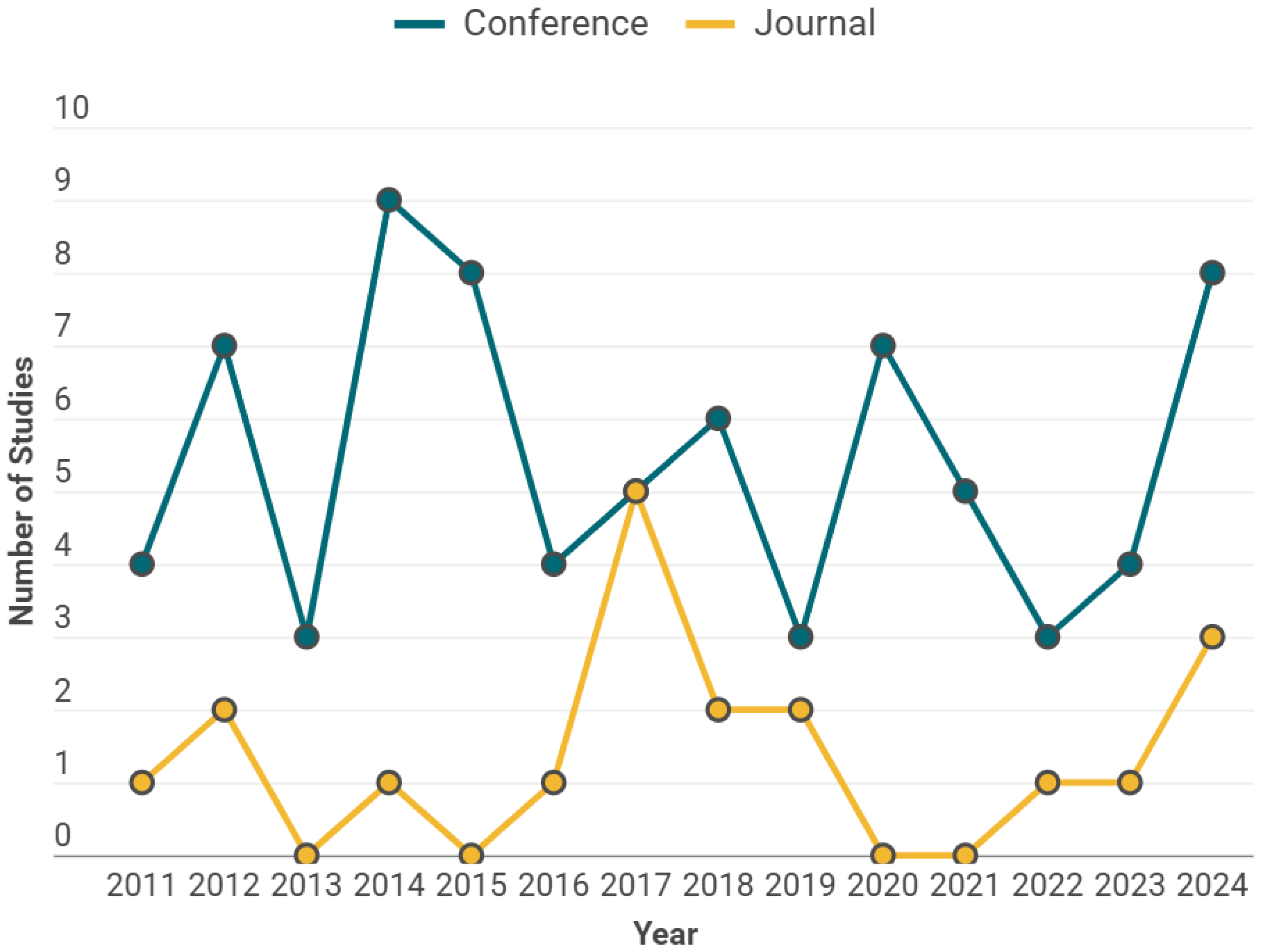
Since the objective of this section is to discuss SLR’s more general results, the following artifacts take into account the 95 studies identified as relevant to achieving the purpose of this review. Figure 4 line chart presents the number of studies published per year and grouped by type of publication.
We evidenced a relatively similar tendency of publications in conferences and journals but with some minor differences. For example, in 2016, the number of studies published in conferences decreased, while in journals this number increased. Already in 2018 and 2020 occurred the opposite, the number of studies published in conferences increased, while in journals decreased. There was a negative tendency towards the number of conference publications from 2020 to 2022 but with a positive resumption from 2023. For journal publications, this growth begins in 2022.
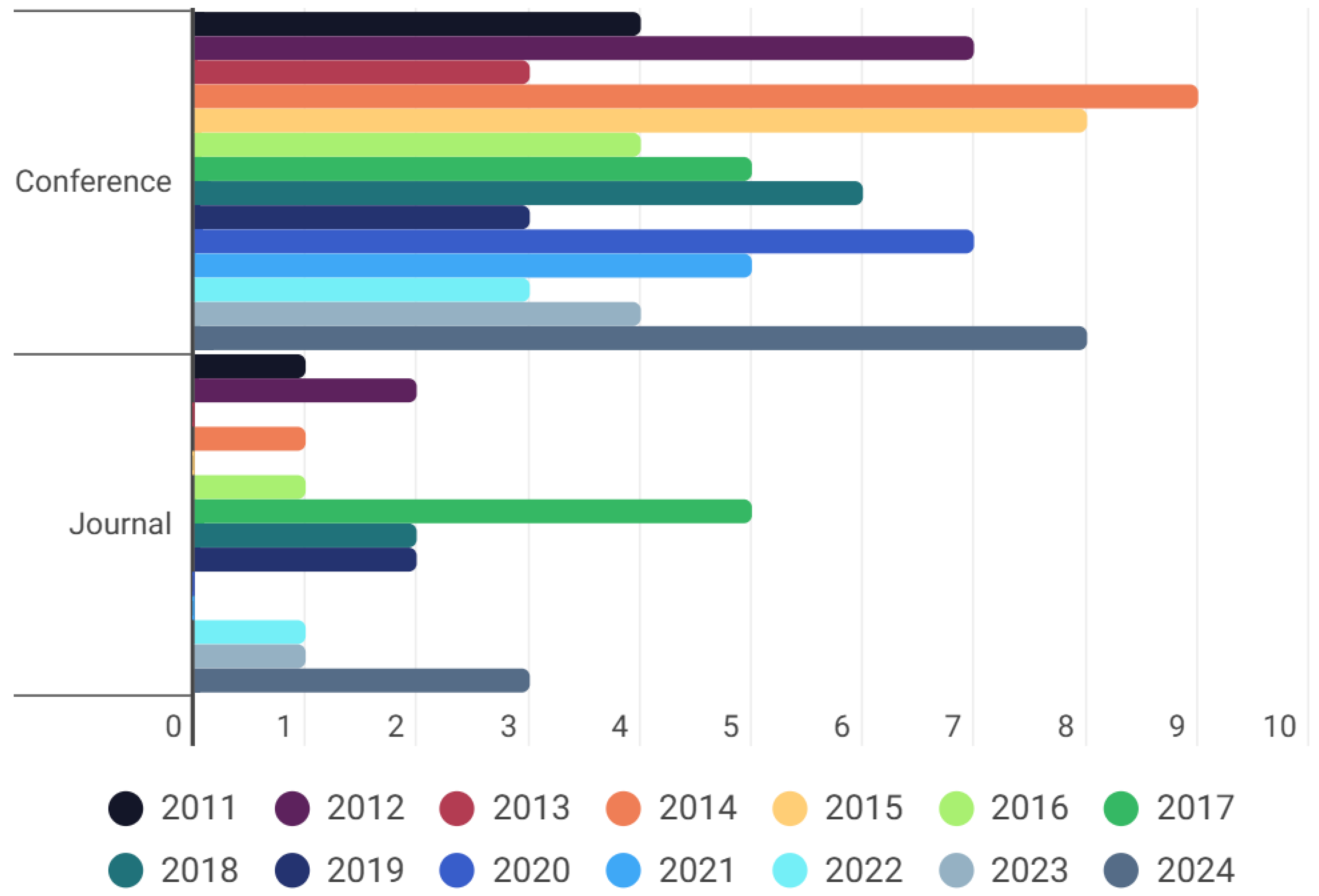
As also shown in the Figure 5 bar chart, the number of studies published in conferences (76 studies) exceeds the quantity published in journals (20 studies), showing the researchers’ sense of urgency to present to the scientific community the results of the advances of their studies regarding related issues accessibility in the context of electronic books.
Table 2 presents the number of studies selected for RSL published in Conferences. In this case, we identified a wide range of scientific events focused on publishing studies on accessibility and electronic books. This finding serves as a guide for other researchers, providing them with valuable sources of related research and opportunities to present their research at international scientific events. Among these, there are four main events:
  • International Conference on Computers Helping People with Special Needs;
  • International Conference on Computers for Handicapped Persons;
  • International Conference on Human-Computer Interaction;
  • International Conference on Universal Access in Human-Computer Interaction.
These four aforementioned scientific events total 36 studies, representing about 47.4% of the total studies published in conferences and 37.5% of the total studies selected for this RSL.
Table 3 presents the number of studies selected for RSL published in Journals. In the case of Journal publications, the distribution of studies was relatively balanced. However, the journal Universal Access in the Information Society had four studies published between 2011 and 2024. The journal Procedia Computer Science had two studies published during the same period, while all other journals featured only one study each.
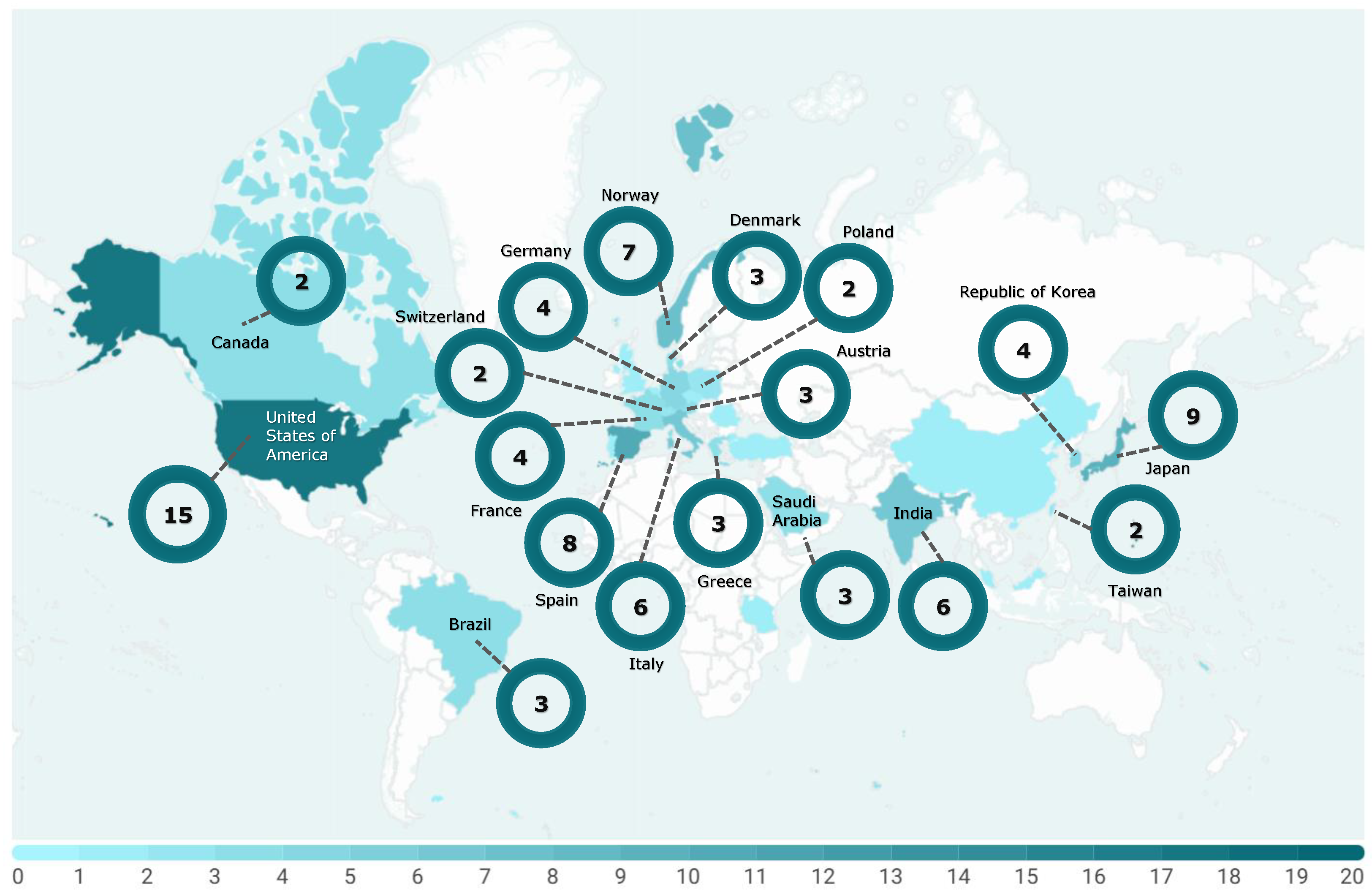
To understand how geographically the studies on e-book accessibility are being conducted around the world, we obtained information related to the country of the first author of each paper and created the infographic presented in Figure 6. The United States is responsible for 15.8% (15 studies) of the studies published and identified in this RSL, followed by Japan, Spain, and Norway with 9, 8, and 7 published studies, respectively. Italy and India have 6 studies published between 2011 and 2024, followed by Germany, France, and the Republic of Korea with 4 studies, and Denmark, Austria, Greece, Saudi Arabia, and Brazil with 3 publications each. Two published studies are from Canada, Switzerland, Poland, and Taiwan. Finally, Belgium, China, the Czech Republic, Malaysia, Portugal, Romania, Tanzania, Turkey, and the United Kingdom have a single published study. If we group the studies identified in the RSL by continent, Europe accumulates 48 (50.5%) publications, followed by Asia with 26 studies (approx. 27.4%), and the Americas with 20 publications (21.05%). The African continent has only one study (approx. 1.05%), while in Oceania no study published in the period was identified.
Considering the results presented so far, we can see, based on the number of studies identified and analyzed in this SLR, that there is a global movement of research related to the theme of accessibility in e-books, mainly in Europe. Several Conferences and Journals are aware of this hot research topic and are therefore opening calls for the publication of studies in this context, in the case of new tracks in Conferences and special issues in Journals. In addition, there was a regularity in the number of studies published on this theme from 2011 to 2024.

4.2. Summary of Specific Results

In this section, we present the results of the data extraction stage of the final set of 75 studies identified in the SLR and presented in the Table 4. The data extracted from these studies were summarized, and artifacts were produced to answer this review’s Research Questions on accessibility in e-books.
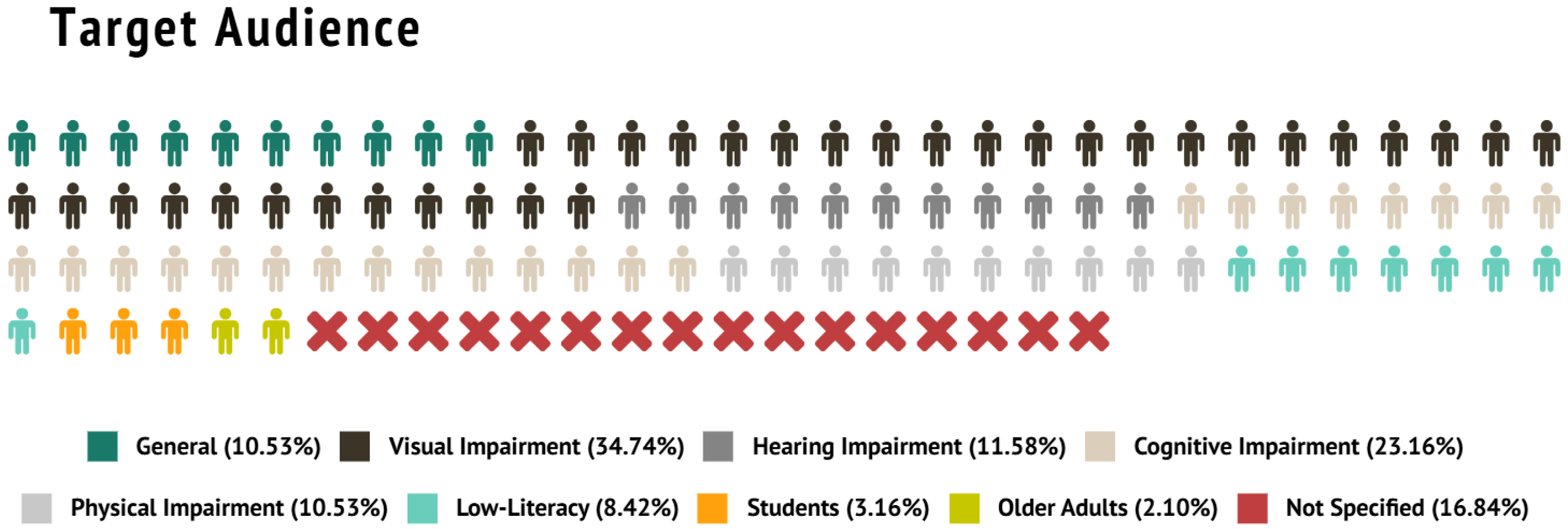
Figure 7 shows the distribution of studies according to the target audience for which the study was conducted. As we can see, 34.74% of the studies were aimed at people with visual impairments, evidencing a relevant focal group to be considered by authors, publishers, and developers of e-book reading platforms and tools.
Another target audience for this market niche is people with some cognitive, hearing, or physical disability, who represent, respectively, 23.16%, 11.58%, and 10.53% of the studies identified in the review. Studies that include people with low literacy, which characterizes an audience with specific needs about the activity of reading digital content, represent 8.42%. This also occurs with the audience of older adults, who total 2.10% of the studies. It is important to note that a single study can target more than one audience. Therefore, the sum of the percentages presented above exceeds 100%.
Considering the profiles of user groups that consume products and services related to e-books, we exemplify the specific needs of each group, relating their difficulties regarding the accessibility features present in digital books and their reading platforms. We used as a reference the personas created by a cross-unit team from Penn State World Campus [131], and we adapted them to the context of our SLR, as shown in Table 5. For example, Sean is a blind student who lost his sight in a car accident and is learning to use JAWS (assistive technology) to access his course content. Thus, content that is technically accessible may still present challenges for him, such as the lack of a clear heading structure, ambiguous link text, and assignments that require tools that rely on vision. Therefore, Sean could carry out its activities if all course pages, external websites, and third-party tools are compatible with JAWS and keyboard commands. In addition, math content should be provided in MathML. Therefore, understanding these difficulties faced by each group of readers allows us to create solutions for e-books that meet their specific needs while also being accessible for all.
Accessibility requirements in electronic books differ substantially between K-12 learners and higher-education students. Recent updates introduced in the Universal Design for Learning (UDL) Guidelines 3.0 [132] broaden the conceptual foundations for such comparative analyses. Beyond the traditional emphasis on multiple means of engagement, representation, and action, the UDL 3.0 framework foregrounds learner identity, cultural and linguistic diversity, systemic barriers, and principles of design justice. In K-12 environments, these expanded directives underscore the need for digital materials that not only provide structural supports—such as simplified navigation, read-aloud features, and adjustable visual formatting—but also foster belonging, joy, and culturally responsive representation. Such features are essential given the developmental heterogeneity of younger learners and the critical role of classroom climate in shaping equitable participation.
In higher education, while technical accessibility remains fundamental—including semantic markup, assistive-technology compatibility, and comprehensive accessibility metadata—the UDL 3.0 guidelines highlight additional expectations related to learner agency, linguistic inclusion, and recognition of diverse identities and academic trajectories. Digital resources must therefore support advanced customization, multi-modal scholarly engagement, and disciplinary specificity, while simultaneously addressing institutional structures that may reinforce exclusion. Across both educational levels, UDL 3.0 views accessibility as a dependent resource of the alignment among content design, institutional policies, and sociocultural contexts. As such, the updated model re-frames accessible e-books not merely as tools optimized for individual variability, but as participatory environments intentionally designed to cultivate autonomy, equity, and authentic engagement for all learners [132].
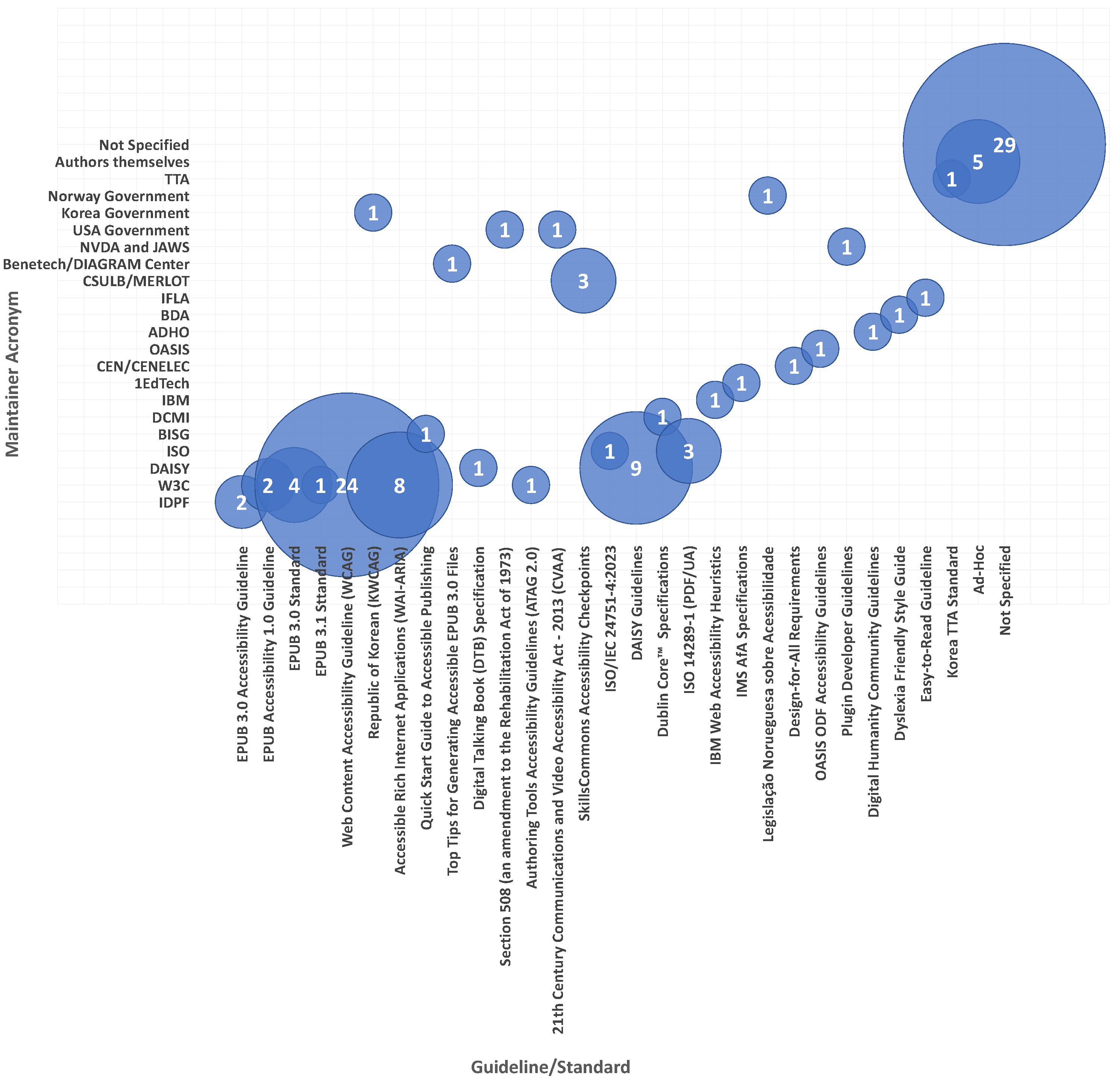
To map the accessibility standards and guidelines used to address accessibility issues in e-books, we obtained this data, together with the current maintainer of the standard or guideline, and generated a bubble chart, as shown in Figure 8. Except for the 29 studies that do not specify the use of an accessibility standard or guideline, the remaining studies associate this information with their work, either as a theoretical basis for the development of the work or for practical purposes of incorporating accessibility resources into their solutions. As with the data on the target audience, the sum of the number of studies per standard or guideline exceeds the size of the final set of 74 studies analyzed at this stage of the review. This is justified because the same study can use more than one standard and/or guideline. For instance, in the study by Gupta et al. [66], the authors used EPUB Accessibility 1.0 and WAI-ARIA (Accessible Rich Internet Applications) specifications, with one study being included for each of the standards.
Summarizing the results presented in Figure 8, we have that 24 studies (32.43%) used the Web Content Accessibility Guideline (WCAG), a guideline maintained by the W3C (World Wide Web Consortium), which makes a series of recommendations to make Web content more accessible. The DAISY Guidelines were used in 9 studies, followed by the WAI-ARIA specification with 8 studies, and the EPUB 3.0 Standard with 4 studies.
The ISO 14289-1 (PDF/AU) [133] specification for the production of accessible electronic documents was used in 3 studies. This same number of studies was also repeated for the SkillsCommons Accessibility Checkpoints specification developed by California State University Long Beach (CSULB) and the MERLOT Program (Multimedia Educational Resources for Learning and Online Teaching). The EPUB 3.0 Accessibility Guideline and EPUB Accessibility 1.0 Guideline guidelines were used in only 2 studies.
Other guidelines and standards shown in the bubble chart were used in a single study, except for 5 studies that, despite not explicitly using any standard or guideline, used a set of ad hoc procedures to address accessibility issues in their studies.
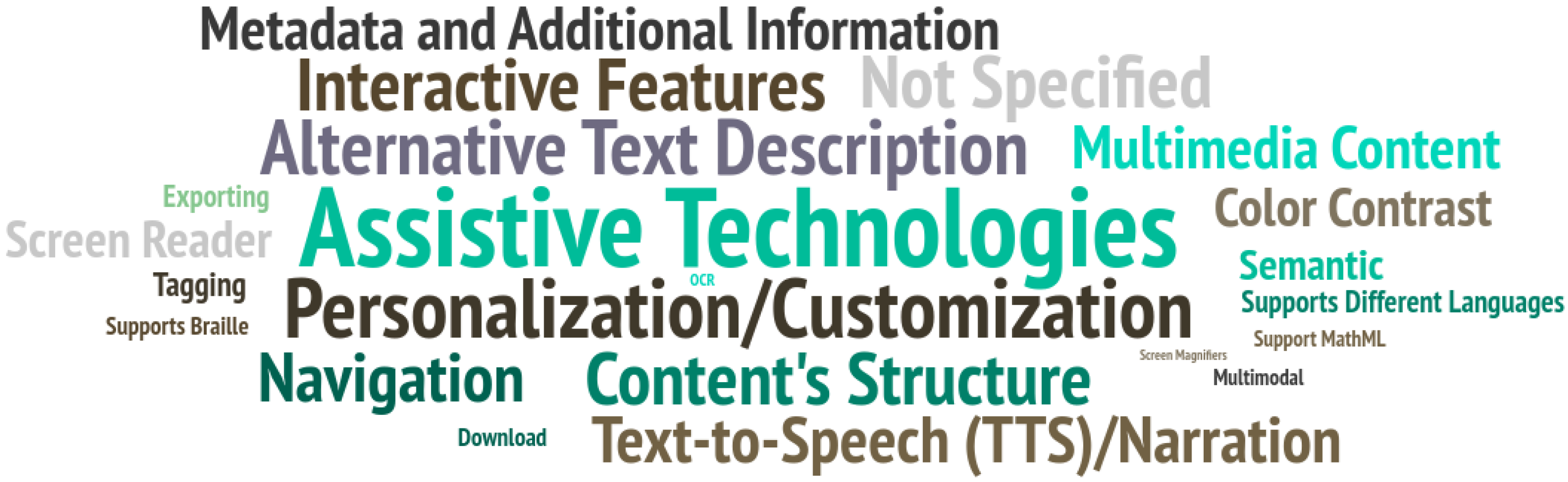
We present in Figure 9 a word cloud representing the main accessibility features employed in the studies analyzed in this review. The highlights are the Assistive Interfaces/Technologies (e.g., reading record and playback, touch, zoom text) present in 23 studies and the Personalization/Customization of content or platforms and screen readers discussed in 17 studies.
At the same level of importance, the following features can also be highlighted: Alternative Text Description, Content’s Structure, Interactive Features, Navigation, Text-to-Speech (TTS)/Narration, Metadata and Additional Information, Multimedia Content, Color Contrast, and Screen Reader.
In Table 6, we can see other accessibility features discussed or used in the studies of this SLR. Once again, the sum of the number of studies that used each accessibility resource presented in the table exceeds the value of 74 because there are studies that use more than one resource. Other accessibility features identified in the studies include resources for adding tags to content (Tagging), exporting to other formats (Exporting), downloading content for offline reading (Download), as well as support for different languages and Braille. In 15 of the 74 studies analyzed, the accessibility features used were not explicitly specified.
Regarding the use of tools for checking and evaluating accessibility features in e-books, Table 7 presents this result, including the name of the tool and the company responsible, and the number of studies that used it. In addition, we classified these tools concerning the type of distribution and license, with this information being better presented in Figure 10.
According to Table 7, most studies do not specify whether they use any tool to check the accessibility of their products or solutions, representing 57.3% (43 studies). Another 11 studies performed this check of Manual mode, representing 14.66%. Five studies (6.66%) use the resources of the e-book Authoring Tools or Conversion Tools themselves as a guarantee that they are meeting some accessibility requirements.
In the review studies we identified several accessibility checking tools, among which the following are particularly notable: EPUBCheck, ACE (Accessibility Checker for EPUB) by DAISY, ODT Accessibility Checker, PDF Accessibility Validation Engine (PAVE), PDF Accessibility Checker (PAC), and Color Contrast Analyzer (CCA). The CCA tool was also counted as a tool in the Non-AT Tools (non-assistive technology) category used in a single study. The tools JAWS, Kurzweil 3000, NVDA, and ZoomText were counted individually, although these also belong to the AT Tools (assistive technology) category.
Table 8 presents comparative data among the main tools in Table 7, allowing for a more detailed analysis between them. For example, in terms of content type, while EPUBCheck and ACE by DAISY handle e-books in EPUB format, the PAVE and PAC tools work exclusively with PDF files. CCA, on the other hand, can be used with images, websites, PowerPoint files, and InDesign files, in addition to PDF files. As it is screen reader software, NVDA works with different types of content.
In terms of modality of use, interaction with the EPUBCheck tool is via a command line interface (CLI) or using a JAVA library. In addition to CLII mode, Ace by DAISY also supports other types of interaction, including graphical user interface (GUI), JavaScript node module, and Web API (HTTP). The interaction with PAVE is via the Web, while the remaing tools (i.e., PAC, CCA, and NVDA) via a desktop application. In terms of focus, EPUBCheck is used to validate the structure of an EPUB, and ACE by DAISY is used to evaluate the accessibility features built into the EPUB. PAVE also evaluates accessibility features, but in PDF files. With a focus on verifying compliance with WCAG and PDF/AU guidelines, we can mention the PAVE tool. Exclusively focused on color contrast according to WCAG, we have the CCA tool. Finally, NVDA focuses on general accessibility issues. In terms of compliance, both EPUBCheck and ACE by DAISY are related to EPUB guidelines. With WCAG and PDF/AU guidelines, we can mention the PAVE and PAC tools. The CCA tool already deals directly with the WCAG guidelines, specifically from version 2.1 onwards. Finally, NVDA does not refer to any accessibility guidelines. With regard to the types of reports generated by these tools, EPUBCheck reports are simple and are viewed in a command line. The ACE by DAISY tool, on the other hand, issues detailed reports in HTML. The PAVE tool allows you to generate reports step-by-step, and in PAC, reports can be summarized or detailed. Unlike the CCA tool, which allows you to export reports, NVDA only reports textual formatting errors (e.g., font name and size, style, and spelling errors). In terms of support for different languages, EPUBCheck, ACE by DAISY, CCA, and NVDA work with multiple languages, while PAVE and PAC only work with English and German. Finally, regarding the tools’ ability to automatically correct errors, only PAVE provides some functionality for partial correction, unlike the other tools, which require manual intervention to correct errors reported in the reports.
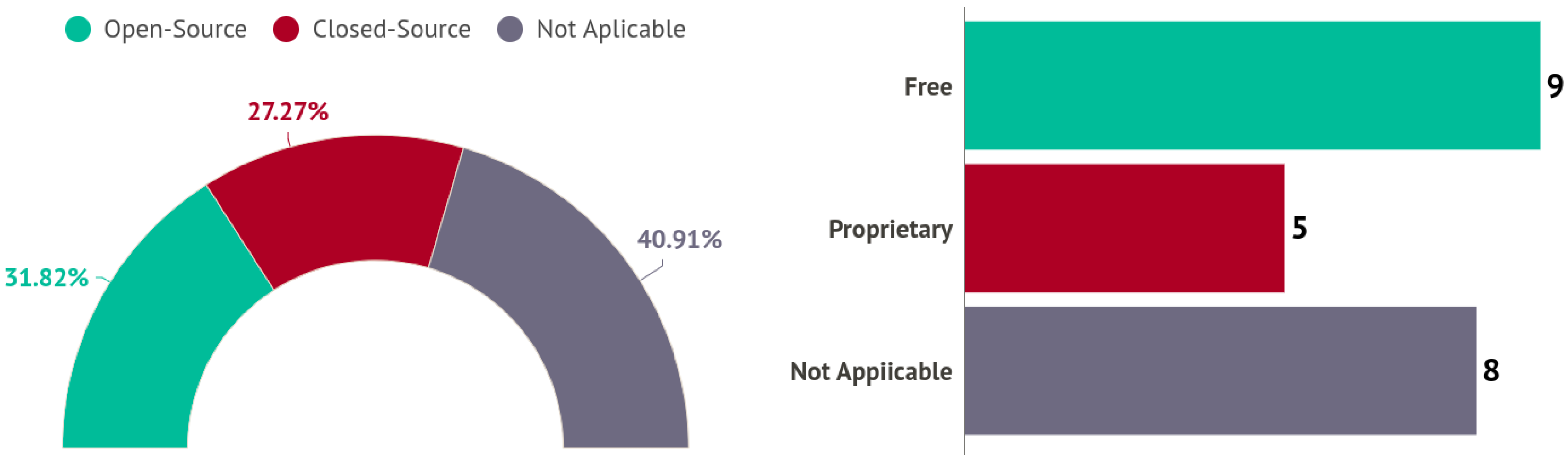
Finally, in Figure 10, we categorize accessibility resource checking tools according to their distribution method and license type. Regarding the distribution method, the verification tools were classified as Open-Source and Closed-Source. According to Khanjani and Sulaiman [134], an open-source software is available with its respective source code, whereas in closed-source software, the right to access the source code belongs to the owner, not the buyer. Thus, 31.82% of the tools identified and presented in Table 7 were classified as Open-Source, while 27.7% as Closed-Source. We used the Not Applicable classification for studies that did not explicitly use accessibility checkers for their solutions, representing 40.91%.
Regarding the type of license of the verification tools identified in the studies of this SLR, we also categorized them into Free and Proprietary. A software with a Free license is one whose license allows studying and modifying its source code. In contrast, a Proprietary license characterizes that the software belongs to a company or person and has been licensed under the exclusive legal rights of its owner [134]. Therefore, we classified nine accessibility verification tools as Free and five as Proprietary. We also adopted the same classification criteria for the studies that did not explicitly mention the use of any verification tool, assigning them the Not Applicable category. This classification was also assigned to some tools whose information about their license was not found on the official web pages. Therefore, for the license type, we applied the category Not Applicable to eight items from Table 7. The PRISMA checklist applied to this SLR is available in the Supplementary Material for this article (https://www.mdpi.com/article/10.3390/su172411173/s1).

5. Discussion

This systematic review identifies a fragmented landscape of e-book accessibility research and practice. We highlight four central themes across the 74 studies analyzed: (i) Inconsistent adoption of accessibility standards and guidelines; (ii) Different implementation of accessibility features across educational and non-educational contexts; (iii) lack of structured editorial workflows for producing accessible digital books; and (iv) the limitations of both automated and manual evaluation tools. Together, these findings indicate challenges for the design, production, and evaluation of inclusive e-book ecosystems and highlight the necessity of prioritizing accessibility as an essential component of digital publishing.

5.1. Interpretation of the Results

The reviewed studies describe a broad range of international guidelines, such as EPUB 3 and WCAG, yet their adoption remains inconsistent and partial. Although these standards provide robust frameworks for inclusive digital publishing, their practical application varies widely about educational contexts, publishing environments, and technological platforms. As prior reviews indicate (e.g., Marcus-Quinn et al. [20]; Tlili et al. [21]), gaps persist between theoretical guidance and real-world production by resulting in content that is technically compliant in some respects but still unusable or inaccessible in others. This fragmentation suggests that accessibility is often treated as a downstream corrective effort, rather than as a core design requirement. A shift toward standards-integrated design processes (i.e., where accessibility is embedded upstream) remains imperative for consistency, scalability, and long-term sustainability.
The features identified across studies (e.g., alternative text, semantic structure, captions, keyboard support, multi-modal rendering, and interface personalization) are implemented unequally and often narrowly tailored to specific user groups. Even in research focused on visual impairments, many accessibility features appear incompletely or inconsistently applied. This finding aligns with Ba Matraf et al. [25], who identified substantial gaps between user requirements and existing e-book implementations. Such patterns indicate that accessibility in e-books is not yet rooted in universal design principles. Instead, it tends to be reactive, driven by perceived audience needs rather than by holistic, anticipatory design frameworks that accommodate diverse abilities and preferences. A significant proportion of studies reveal ad hoc or improvised editorial practices, especially in educational contexts where teachers create digital materials without formal training in accessibility. This lack of systematic workflow design leads to repeated issues: missing semantic markup, inaccessible media, inconsistent metadata, and limited interoperability with assistive technologies. Because accessibility retrofits are costly and time-consuming, the absence of defined workflows contributes directly to inequitable reading experiences.
Likewise, the field urgently needs production pipelines that make accessibility a default outcome and not like an optional enhancement. Although tools such as EPUBCheck (https://www.w3.org/publishing/epubcheck/, accessed on 10 February 2025), ACE (https://daisy.github.io/ace/getting-started/ace-app/, accessed on 10 February 2025), PAVE [135]), PAC (https://pac.pdf-accessibility.org/en, accessed on 10 February 2025), and CCA (https://www.tpgi.com/color-contrast-checker/, accessed on 10 February 2025) provide valuable automated checks, none of them can fully capture the contextual, semantic, or experiential dimensions of accessibility. Most studies report little or no use of such tools, indicating that integration into workflows is rare. Manual evaluations remain essential but require expertise that many authors and educators lack. Hybrid evaluation approaches that combine automated detection with expert analysis are promising but underdeveloped. They represent a critical frontier where workflow innovation, tooling design, and authoring support can converge to enable scalable, high-quality accessibility verification.
By considering the research questions defined in this review (i.e., RQ1 to RQ4), we identify the following implications: (i) Accessibility remains reactive rather than proactive since the most accessible features are added after content creation, thus leading to inefficiencies and gaps in quality; (ii) A substantial skills gap persists because many creators lack training in accessibility and rely on superficial or inconsistent practices; (iii) Tooling ecosystems are necessary but insufficient since automated tools cannot replace the costly and scarce nature of human expertise; (iv) lack of end-to-end workflows harms consistency because without standardized pipelines, quality varies widely across contexts; and (v) Universal design has not yet been fully realized. In other words, accessibility practices remain targeted and fragmented rather than systemic and inclusive.

5.2. Design Innovations

Although existing research maps the current state of accessibility, it seldom articulates the design futures of accessible digital reading. Rapid technological advancements (particularly in generative AI, immersive XR media, and adaptive personalization) create unprecedented opportunities to move beyond compliance toward transformative, experience-centered accessibility.
Generative AI can fundamentally redefine how accessibility is conceived, produced, and experienced. Current workflows depend on manual description and static metadata, but AI systems now have the capacity to automatically interpret and describe complex images, diagrams, equations, and data visualizations. Moreover, these systems also could: (i) generate multi-modal alternatives (tactile diagrams, simplified visuals, narrative audio descriptions), converting inaccessible legacy formats into structured, standards-compliant EPUB; (ii) adapting content linguistically (summaries, simplifications, lexical adjustments) to support cognitive accessibility, and; (iii) personalizing accessibility outputs based on user profiles, learning contexts, and assistive technologies. These capabilities position AI not merely as a validator but as a co-creator of accessibility, enabling dynamic, user-responsive interpretation of content. This shift raises urgent research questions for design, such as: how should AI be supervised when generating descriptions? How are the author’s intent, emotional tone, and scientific precision preserved? What forms of user control are required to ensure trust and transparency?
The traditional e-book is a two-dimensional medium. XR technologies expand this paradigm into spatial, interactive, and multi-sensory forms by utilizing: (i) AR overlays that augment printed or digital pages with descriptions, translations, or 3D models; (ii) VR reading environments that optimize lighting, sensory load, and focus for neurodiverse users; (iii) Mixed-reality tactile representations for diagrams, anatomical illustrations, or mathematical objects; and (iv) Haptic cues that support navigation, emphasis, or conceptual structure. Therefore, these possibilities challenge the notion of reading, opening new design territories that consider key design questions (e.g., “How can XR environments remain accessible while minimizing cognitive load?” and “What constitutes an accessible interaction in 3D space?”) to better comprehend how accessibility could be supported through embodied interaction.
Current e-books provide static accessibility features, but future reading platforms could be dynamically personalized. For instance, interfaces could be adapted to readers’ cognitive load, systems could recommend multi-modal pathways based on user needs, real-time simplification or elaboration of content, emotion-sensitive reading support using affective computing and predictive assistance based on learning analytics could contribute for future researches. Emerging technologies invite new models of accessibility as co-creation, because: (i) readers contributing alt-text, captions, or annotations; (ii) Community moderation of AI-generated descriptions; (iii) Collaborative accessibility dashboards embedded into platforms; and (iv) Shared taxonomies and templates by ensuring consistent implementation.
The future accessibility must ensuring transparency and auditability of AI-generated content, managing intellectual property concerns related to co-generated descriptions, addressing bias in generative models—linguistic, cultural, sensory, or disability-based, developing policy frameworks for immersive, AI-enhanced accessibility, and ensuring privacy and data security in adaptive systems.

5.3. Policy Recommendations

By integrating backward-looking evidence with forward-looking design innovation, this discussion re-frames accessibility not as a static compliance task but as a dynamic, creative, and evolving design challenge. Emerging technologies offer transformative opportunities to re-imagine e-books as adaptive, multi-modal, intelligent, and participatory reading environments. Yet these opportunities also demand new methods, ethical frameworks, interdisciplinary collaborations, and design research agendas. A future-ready approach to e-book accessibility must therefore combine rigorous standards and workflows, innovative technologies, user-centered and participatory design, and meaningful governance structures. Only through such integration can digital reading ecosystems move toward equitable, inclusive, and enriching experiences for all.
Policymakers should promote accessibility-by-design across the digital publishing ecosystem by mandating the adoption of interoperable standards (e.g., EPUB 3, WCAG), requiring publishers and educational institutions to implement structured editorial workflows with hybrid (automated + expert) accessibility checks, and establishing funding programs that support the integration of emerging technologies—such as generative AI for alternative text generation and immersive media for multi-sensory learning—into accessible content creation. Policies should also require ongoing accessibility training for educators and content producers, incentivize the development of open-source accessibility tools, and create regulatory frameworks that ensure transparency, auditability, and fairness in AI-generated accessibility features. Finally, governments should support participatory, user-centered accessibility governance by enabling readers with disabilities to report issues, contribute improvements, and shape standards, ensuring that accessibility remains a dynamic, collaborative, and continuously improving public good.

5.4. Practical Implications

Considering the findings identified from the 74 studies analyzed in this SLR, we can suggest the following operational activities to compose a possible pipeline for verifying accessibility features in e-books that every publisher should consider in their editorial process. The goal of proposing an editorial pipeline for e-book accessibility features for different potential users is to ensure compliance with existing international guidelines (e.g., WCAG, DAYSE and EPUB Accessibility), while ensuring equal and universal access to their content, without restricting the types of features available or the target audience.
Therefore, based on the set of accessibility features identified in this SLR and shown in Table 6, we propose a list of essential activities for a future editorial pipeline to be applied in the industry of accessible e-books:
  • Integrate Features of Assistive Technologies (ATs): According to the World Health Organization (WHO), ATs “[…] is the application of organized knowledge and skills related to assistive products, including systems and services” [136]. Improving access to ATs can contribute to the achievement of the SDGs and ensuring that no one is left behind [137]. This ideology should be fully aligned with the e-book publishing market, as it serves as an essential tool for people of all ages and with all kinds of functional difficulties (e.g., cognition, communication, self-care, hearing, mobility, or vision) in all areas of life, including Education [136]. Examples of accessibility features that should be used in assistive products for Education include Alternative Text, Color Contrast, Text-to-Speech (TTS), and Metadata and Additional Information for Screen Readers.
  • Content’s Structure and Navigation: The way the content of an e-book is structured and organized also needs to be inclusive, taking into account the characteristics of different reader groups [136]. Linked to this need, based on RSL, we highlight the usefulness of key marking elements to facilitate and make navigation more flexible to sections and content of particular interest to each reader at each moment of reading. To this end, the reading platforms need to provide resources that offer readers a rich learning experience through digital books. For example, multiple ways of navigating, focus order, and focus visible, page titled, heading and labels, link purpose, and the user’s location.
  • Multimedia and Interactive Content: According to Costa et al. [1], the modernization of the digital publishing industry should focus on the creation, distribution, and accessibility of electronic books. The authors claim that the lack of interactivity, adaptivity, and immersive elements limits their ability to create engaging and personalized learning experiences, restricting students and educators from benefiting from cutting-edge educational tools. In this context, it is essential to establish a standardized yet flexible approach to developing interactive, immersive, and intelligent digital textbooks grounded in multimedia learning principles and universal design for learning.
  • Allow Personalization and Customization: Each group of e-book users has its own interests and specific needs [136]. For example, these interests and needs may vary according to age, gender, area of residence, and the physical and mental condition of these users. Therefore, it is crucial to allow readers to personalize the presentation of a digital book’s content to fit their individual preferences. Additionally, they should be able to customize the features of the platform they use to access this content, such as e-readers.
  • Testing and Validating using Accessibility Checkers Tools: Last but not least, it is mandatory that an accessible e-book be tested using official tools that verify compliance with key international guidelines (e.g., WCAG and EPUB Accessibility). Tools such as ACE by DAISY (https://daisy.org/activities/software/ace/, accessed on 10 February 2025) and EPUBCheck (https://www.w3.org/publishing/epubcheck/, accessed on 10 February 2025) verify and report on an e-book’s compliance with these guidelines, generating reports that can serve as checklists for publishers to identify gaps and inconsistencies for correction before publication. Other tools could be used in conjunction with the aforementioned checkers to make the validation of accessibility features in e-books more robust. A typical example of such a tool would be the NVDA screen reader (https://www.nvaccess.org/about-nvda/, accessed on 10 February 2025).
Therefore, the editorial industry needs to recognize that integrating assistive technologies and accessible features into its products and services is a long-term investment to promote an inclusive society. Additionally, this mindset aggregates value to these products and services, ensuring that they will not be abandoned [136].

6. Conclusions

In this article, we analyze various studies that focus on accessibility issues in e-books. To achieve this, we outline a systematic literature review (SLR) protocol in Section 3. This protocol follows established guidelines (i.e., Kitchenham and Charters [16], Page et al. [57]) that have been widely used and referenced in previous research. By adhering to these standards, we ensure the reliability and transparency of the review process, allowing other researchers to build upon our findings. Despite this, there remains a natural risk in the selection process and data extraction of the studies analyzed in the SLR, due to subjective bias in these activities carried out by researchers.
This SLR addresses research questions regarding the standards and guidelines employed in the production, conversion, and evaluation of e-books, specifically regarding the incorporation of accessibility features. As a result, we have identified the main types of accessibility features that are currently being studied by the scientific community and should be widely adopted by the publishing industry in the coming years.
Additionally, we have outlined a range of tools and procedures used to support the accessibility assessment of e-books, utilizing both automatic and manual methods, and in some instances, a combination of both approaches. Finally, we categorized the different target audience groups featured in these studies, providing essential information that can guide the development of tailored solutions for each reader category.
Based on the information gathered from the 74 studies analyzed, we can conclude that the objective of the SLR was successfully achieved, and all research questions defined in the protocol were answered. In addition, we mapped the geographic regions that gave the greatest attention to the topic of accessibility in e-books in the world, as well as identifying the main publication venues for studies on the subject, ranking the conferences and journals with the highest number of publications.
Our findings strongly support the global imperative for equitable access to education, directly contributing to SDG 4 (Quality Education). Accessible e-books serve as essential tools in ensuring that learners with disabilities, learning difficulties, or socioeconomic barriers are not excluded from digital learning ecosystems. In addition, by identifying disparities in the geographic distribution of research efforts and access to accessibility tools, our work brings visibility to systemic gaps, an issue central to SDG 10 (Reduced Inequalities).
The main limitation of this is that the IEEE Xplorer database did not return any studies involving the topic. This may be attributed to the specific terms used in the search string outlined in the review protocol. Another fact that reinforces this evidence is that in other databases, such as Scopus, Web of Science, and EI Compendex, the number of studies returned was also much lower compared to other databases such as ACM, Science Direct, and Springer Link. However, the literature review process was not impaired and the objective of the SLR was achieved, with 1618 studies being analyzed with results and discussions carried out considering a set of 74 studies that were read in full to extract data and answer the research questions of this review. Therefore, to minimize bias related to the search string used in the SLR, we performed the search in seven scientific databases widely used in the fields of Engineering and Computing. Therefore, although the search string restricted the results to zero studies when executed in IEEE Xplore, the final set of selected studies allowed us to answer all the SLR research questions.
Another limitation we can highlight in this SLR is the fact that we excluded 21 studies from the final set of studies used to answer the research questions. These studies could complement the results and discussions presented in the article, for example, by bringing other standards, guidelines, and accessibility resources for e-books, as well as verification tools, in addition to possibly also characterizing other target audiences. In the future, we will attempt to contact the corresponding authors of these studies directly to request access to the studies excluded from this SLR and then review them.
In analyzing a significant number of studies on accessibility in e-books, we found that the topic is still in a phase of growth and development. This is evident due to the lack of standardization in the application of guidelines, standards, and tools, as well as the low level of maturity in the processes for producing and evaluating e-books.
In future work, we intend to investigate more specific aspects of e-book design through various global initiatives from the publishing industry and scientific community. We also consider evaluating the practical effectiveness of the accessibility checker tools identified in this SLR. In order to treat the limitations of this SLR, we will contact the corresponding authors of the 21 excluded studies to request access and then review them. Additionally, we will investigate the reasons why the search string returned zero studies when executed in IEEE Xplore. Finally, we will update this SLR in due course, searching for more recent articles since the period in which the searches were carried out in the sources specified in the SLR protocol presented in this article. We also acknowledge the relevance of including examples of successful cases and highlighting real-world implementations. However, the primary objective of this work is theoretical, focusing on mapping standards, technologies, and practices. Although a detailed analysis of practical cases is beyond the scope of this article, future investigations may benefit from a more focused review of implementation experiences and documented outcomes in the field of inclusive digital publishing.

Supplementary Materials

The following supporting information can be downloaded at: https://www.mdpi.com/article/10.3390/su172411173/s1. The PRISMA Checklist applied to this website. Reference [138] are cited in the Supplementary Materials.

Author Contributions

Conceptualization, L.S. (Lenardo Silva) and B.P.; methodology, L.S. (Lenardo Silva); investigation, L.S. (Lenardo Silva) and B.P.; data curation, L.S. (Lenardo Silva); writing—original draft preparation, L.S. (Lenardo Silva), B.P., B.D. and R.E.; writing—review and editing, L.S. (Lenardo Silva), B.P., B.D., R.E. and R.S.; visualization, L.S. (Lenardo Silva); supervision, R.S.; project administration, N.C.; funding acquisition, N.C. and L.S. (Laisa Sousa). All authors have read and agreed to the published version of the manuscript.

Funding

This research was funded by National Fund for Educational Development (FNDE) from Brazilian Ministry of Education (MEC) grant number TED 11470.

Institutional Review Board Statement

Not applicable.

Informed Consent Statement

Not applicable.

Data Availability Statement

The data that support the findings of this study are contained within the article.

Acknowledgments

We thank the members of the Center for Excellence in Social Technologies (NEES/UFAL), who collaborated with this research. We also thank the FNDE/MEC from Brazil for supporting this research through the agreement contract TED 11470.

Conflicts of Interest

The author Nicholas Cruz has received research grants from the FNDE in Brazil. The remaining authors are members of the NEES/UFAL.

References

  1. Costa, B.; dos Santos, R.E.; Pimentel, B.; Cruz, N.; Fusco, J.; Silva, L.; Silva, R. PNLD Digital Textbook Reference Model: A Framework for Next-Generation Interactive and Intelligent Educational Resources. In Proceedings of the EDULEARN25 Proceedings, IATED, 17th International Conference on Education and New Learning Technologies, Palma, Spain, 30 June–2 July 2025; pp. 5199–5208. [Google Scholar]
  2. da Costa, B.D.; dos Santos Escarpini, R.; Pimentel, B.A.; da Cruz, N.T.; Lobo, J.F.; Chaves, L.; de Amorim Silva, R. An evolutionary taxonomy for digital textbooks: Towards intelligent and immersive learning environments. In Proceedings of the EDULEARN25 Proceedings, IATED, 17th International Conference on Education and New Learning Technologies, Palma, Spain, 30 June–2 July 2025; pp. 4117–4126. [Google Scholar]
  3. Fund, S. Sustainable Development Goals. 2015. Available online: https://www.un.org/sustainabledevelopment/inequality (accessed on 17 June 2025).
  4. UNESCO Institute for Statistics. Literacy Definition. 2025. Available online: https://uis.unesco.org/en/glossary-term/literacy (accessed on 5 March 2025).
  5. Leporini, B. An Accessible and Usable E-Book as an Educational Tool: How To Get It? In Proceedings of the CVHI, Granada, Spain, 28–31 August 2007. [Google Scholar]
  6. Shin, H.; Gil, Y.H.; Yu, C.; Kim, H.K.; Lee, J.; Jee, H.K. Improved and accessible e-book reader application for visually impaired people. In Proceedings of the SIGGRAPH Asia 2017 Posters, Bangkok, Thailand, 27–30 November 2017; pp. 1–2. [Google Scholar]
  7. Calabrò, A.; Contini, E.; Leporini, B. Book4All: A tool to make an e-book more accessible to students with vision/visual-impairments. In Proceedings of the HCI and Usability for e-Inclusion: 5th Symposium of the Workgroup Human-Computer Interaction and Usability Engineering of the Austrian Computer Society, USAB 2009, Linz, Austria, 9–10 November 2009; Proceedings 5. Springer: Berlin/Heidelberg, Germany, 2009; pp. 236–248. [Google Scholar]
  8. Ahmed, M.R.; Naveed, M.A. Information accessibility for visually impaired students. Pak. J. Inf. Manag. Libr. 2021, 22, 16–36. [Google Scholar] [CrossRef]
  9. Singh, U.; Divya Venkatesh, J.; Muraleedharan, A.; Saluja, K.S.; JH, A.; Biswas, P. Accessibility analysis of educational websites using WCAG 2.0. Digit. Gov. Res. Pract. 2024, 5, 1–28. [Google Scholar] [CrossRef]
  10. Iniesto, F.; Rodrigo, C. The use of WCAG and automatic tools by computer science students: A case study evaluating MOOC accessibility. J. Univers. Comput. Sci. 2024, 30, 85–105. [Google Scholar] [CrossRef]
  11. Ferri, D. The Marrakesh treaty to facilitate access to published works for persons who are blind, visually impaired or otherwise print disabled in the European Union: Reflecting on its implementation and gauging its impact from a disability perspective. IIC-Int. Rev. Intellect. Prop. Compet. Law 2024, 55, 89–109. [Google Scholar] [CrossRef]
  12. Ntagwabira, V.; Ngabonziza, J.D.D.A.; Anguru, P.U. Factors Influencing Electronic Textbooks’ Reading Skills among Students in Secondary Schools of Muhanga District, Rwanda. Afr. J. Empir. Res. 2024, 5, 35–47. [Google Scholar] [CrossRef]
  13. Al Masuudi, N.K.; Nawi, H.S.A.; Osman, S.; Al-Maqbali, H.A. Understanding the Barriers in Adopting the E-Textbooks Among Public School Students in Oman. TEM J. 2024, 13, 1667. [Google Scholar] [CrossRef]
  14. Dantas, D.C.; Taboubi, S.; Zaccour, G. Which business model for e-book pricing? Econ. Lett. 2014, 125, 126–129. [Google Scholar] [CrossRef]
  15. Mikkonen, P. Analyzing e-book pricing options and models based on FinELib e-book strategy. In Proceedings of the Presentation, World Library and Information Congress: 72nd IFLA General Conference and Council, Seoul, Republic of Korea, 20–24 August 2006. [Google Scholar]
  16. Kitchenham, B.; Charters, S. Guidelines for Performing Systematic Literature Reviews in Software Engineering; Technical Report; Schoolf of Computer Science and Mathematics, Keele University: Newcastle, UK, 2007. [Google Scholar]
  17. Rello, L.; Kanvinde, G.; Baeza-Yates, R. A Mobile Application for Displaying More Accessible eBooks for People with Dyslexia. Procedia Comput. Sci. 2012, 14, 226–233. [Google Scholar] [CrossRef]
  18. Fichten, C.S.; Asuncion, J.; Scapin, R. Digital Technology, Learning, and Postsecondary Students with Disabilities: Where We’ve Been and Where We’re Going. J. Postsecond. Educ. Disabil. 2014, 27, 369–379. [Google Scholar]
  19. Zdravkova, K. The potential of artificial intelligence for assistive technology in education. In Handbook on Intelligent Techniques in the Educational Process: Vol 1 Recent Advances and Case Studies; Springer: Berlin/Heidelberg, Germany, 2022; pp. 61–85. [Google Scholar]
  20. Marcus-Quinn, A.; Fotiadis, T.; Yeratziotis, A.; Papadopoulos, G.A. Accessibility of e-books for Secondary School Students in Ireland and Cyprus. In Transforming Media Accessibility in Europe: Digital Media, Education and City Space Accessibility Contexts; Springer Nature Switzerland: Cham, Switzerland, 2024; pp. 229–245. [Google Scholar]
  21. Tlili, A.; Zhao, J.; Yang, K.; Wang, Y.; Bozkurt, A.; Huang, R.; Bonk, C.J.; Ashraf, M.A. Going beyond books to using e-books in education: A systematic literature review of empirical studies. Interact. Learn. Environ. 2024, 32, 2207–2231. [Google Scholar] [CrossRef]
  22. Alshehri, S.M. The E-books and Students’ Mathematics Performance: A Qualitative Systematic Review. Páginas Educación 2024, 17, e3479. [Google Scholar] [CrossRef]
  23. Op ‘t Eynde, E.; Depaepe, F.; Verschaffel, L.; Torbeyns, J. Shared Picture Book Reading in Early Mathematics: A Systematic Literature Review. J. Math. Didakt. 2023, 44, 505–531. [Google Scholar] [CrossRef]
  24. Wan Sulaiman, W.; Mustafa, S. Usability Elements in Digital Textbook Development: A Systematic Review. Publ. Res. Q. 2020, 36, 74–101. [Google Scholar] [CrossRef]
  25. Ba Matraf, M.S.; Hashim, N.L.; Hussain, A. Visually Impaired Usability Requirements for Accessible Mobile Applications: A Checklist for Mobile E-book Applications. J. Inf. Commun. Technol. 2023, 22, 421–447. [Google Scholar] [CrossRef]
  26. World Wide Web Consortium. Web Content Accessibility Guidelines (WCAG) 2.1. W3C Recommendation (June 2018). 2018. Available online: https://www.w3.org/TR/WCAG21/ (accessed on 8 January 2025).
  27. DAISY Consortium. Accessible Publishing Knowledge Base. 2020. Available online: https://kb.daisy.org/ (accessed on 8 January 2025).
  28. UNESCO. Global Education Monitoring Report 2020: Inclusion and Education—All Means All; UNESCO: Paris, France, 2020. [Google Scholar]
  29. World Health Organization. Global Report on Assistive Technology; Technical Report; World Health Organization: Geneva, Switzerland, 2022. [Google Scholar]
  30. Haddaway, N.R.; Page, M.J.; Pritchard, C.C.; McGuinness, L.A. PRISMA2020: An R package and Shiny app for producing PRISMA 2020-compliant flow diagrams, with interactivity for optimised digital transparency and Open Synthesis. Campbell Syst. Rev. 2022, 18, e1230. [Google Scholar] [CrossRef]
  31. IDPF. EPUB Publications 3.0; International Digital Publishing Forum: Seattle, USA, 2011. [Google Scholar]
  32. Vassiliou, M.; Rowley, J. Progressing the definition of “e-book”. Libr. Tech 2008, 26, 355–368. [Google Scholar] [CrossRef]
  33. Lee, H.J.; Messom, C.; Yau, K. e-Textbooks: Types, characteristics and open issues. J. Comput. 2012, 4, 2151–9617. [Google Scholar]
  34. Iwarsson, S.; Ståhl, A. Accessibility, usability and universal design—positioning and definition of concepts describing person-environment relationships. Disabil. Rehabil. 2003, 25, 57–66. [Google Scholar] [CrossRef]
  35. Chandrashekar, S.; Benedyk, R. Accessibility vs. Usability–Where is the Dividing Line? In Contemporary Ergonomics 2006; Taylor & Francis: Abingdon, UK, 2020; pp. 231–235. [Google Scholar]
  36. Yesilada, Y.; Brajnik, G.; Vigo, M.; Harper, S. Understanding web accessibility and its drivers. In Proceedings of the International Cross-Disciplinary Conference on Web Accessibility, Lyon, France, 16–17 April 2012; pp. 1–9. [Google Scholar]
  37. Aizpurua, A.; Harper, S.; Vigo, M. Exploring the relationship between web accessibility and user experience. Int. J. Hum.-Comput. Stud. 2016, 91, 13–23. [Google Scholar] [CrossRef]
  38. Caldwell, B.; Cooper, M.; Reid, L.G.; Vanderheiden, G.; Chisholm, W.; Slatin, J.; White, J. Web content accessibility guidelines (WCAG) 2.0. WWW Consort. (W3C) 2008, 290, 5–12. [Google Scholar]
  39. Thirasi, W.; Illangasinghe, I.; Dickwella, U.; Jayakody, A.; Peiris, G.; Lokuliyana, S. Digital talking book. Int. J. Comput. Appl. 2015, 121, 48–53. [Google Scholar] [CrossRef]
  40. Kitchenham, B. Procedures for performing systematic reviews. Keele Univ. 2004, 33, 1–26. [Google Scholar]
  41. Lempola, A.; Poranen, T.; Zhang, Z. Comparing automatic accessibility testing tools. In Proceedings of the Annual Doctoral Symposium of Computer Science, CEUR-WS, Vaasa, Finland, 10–11 June 2024; pp. 43–53. [Google Scholar]
  42. Silva, C.A.; de Oliveira, A.F.; Mateus, D.A.; Costa, H.A.X.; Freire, A.P. Types of problems encountered by automated tool accessibility assessments, expert inspections and user testing: A systematic literature mapping. In Proceedings of the 18th Brazilian Symposium on Human Factors in Computing Systems, Vitoria, ES, Brazil, 22–25 October 2019; pp. 1–11. [Google Scholar]
  43. Schroeder, S.B. Publicly Funded Research Behind Private Paywalls: The Open Access Movement; SAGE Business Cases Originals; SAGE Publications: Washington, DC, USA, 2021. [Google Scholar]
  44. Haddaway, N.R.; Collins, A.M.; Coughlin, D.; Kirk, S. The role of Google Scholar in evidence reviews and its applicability to grey literature searching. PLoS ONE 2015, 10, e0138237. [Google Scholar] [CrossRef]
  45. Pichiliani, T.C.P.B.; Pizzolato, E.B. Cognitive disabilities and web accessibility: A survey into the Brazilian web development community. J. Interact. Syst. 2021, 12, 308–327. [Google Scholar] [CrossRef]
  46. Souza, A.; de Souza Filho, J.C.; Bezerra, C.; Alves, V.A.; Lima, L.; Marques, A.B.; Teixeira Monteiro, I. Accessibility Evaluation of Web Systems for People with Visual Impairments: Findings from a Literature Survey. In Proceedings of the XXIII Brazilian Symposium on Human Factors in Computing Systems, Brasília, DF, Brazil, 7–11 October 2024; pp. 1–13. [Google Scholar]
  47. Scherer, R.W.; Saldanha, I.J. How should systematic reviewers handle conference abstracts? A view from the trenches. Syst. Rev. 2019, 8, 264. [Google Scholar] [CrossRef]
  48. Mukherjee, S.; Almanza, A.; Rubio-González, C. Fixing dependency errors for Python build reproducibility. In Proceedings of the 30th ACM SIGSOFT International Symposium on Software Testing and Analysis, Virtual, 11–17 July 2021; pp. 439–451. [Google Scholar]
  49. Peng, R.D. Reproducible research in computational science. Science 2011, 334, 1226–1227. [Google Scholar] [CrossRef]
  50. Collberg, C.; Proebsting, T.A. Repeatability in computer systems research. Commun. ACM 2016, 59, 62–69. [Google Scholar] [CrossRef]
  51. Silva, L.C.; de Carvalho César Sobrinho, Á.A.; Cordeiro, T.D.; Melo, R.F.; Bittencourt, I.I.; Marques, L.B.; da Cunha Matos, D.D.M.; da Silva, A.P.; Isotani, S. Applications of convolutional neural networks in education: A systematic literature review. Expert Syst. Appl. 2023, 231, 120621. [Google Scholar] [CrossRef]
  52. Silva, L.C.; Sobrinho, Á.; Cordeiro, T.; da Silva, A.P.; Dermeval, D.; Marques, L.B.; Bittencourt, I.I.; dos Santos Júnior, J.J.; Melo, R.F.; dos Santos Portela, C.; et al. Assessing students’ handwritten text productions: A two-decades literature review. Expert Syst. Appl. 2024, 250, 123780. [Google Scholar] [CrossRef]
  53. Ali, N.B.; Petersen, K.; Wohlin, C. A systematic literature review on the industrial use of software process simulation. J. Syst. Softw. 2014, 97, 65–85. [Google Scholar] [CrossRef]
  54. Brereton, P.; Kitchenham, B.A.; Budgen, D.; Turner, M.; Khalil, M. Lessons from applying the systematic literature review process within the software engineering domain. J. Syst. Softw. 2007, 80, 571–583. [Google Scholar] [CrossRef]
  55. Staples, M.; Niazi, M. Experiences using systematic review guidelines. J. Syst. Softw. 2007, 80, 1425–1437. [Google Scholar] [CrossRef]
  56. Wohlin, C. Guidelines for Snowballing in Systematic Literature Studies and a Replication in Software Engineering. In Proceedings of the 18th International Conference on Evaluation and Assessment in Software Engineering, New York, NY, USA, 13–14 May 2014. [Google Scholar] [CrossRef]
  57. Page, M.J.; Moher, D.; Bossuyt, P.M.; Boutron, I.; Hoffmann, T.C.; Mulrow, C.D.; Shamseer, L.; Tetzlaff, J.M.; Akl, E.A.; Brennan, S.E.; et al. PRISMA 2020 explanation and elaboration: Updated guidance and exemplars for reporting systematic reviews. BMJ 2021, 372, n160. [Google Scholar] [CrossRef] [PubMed]
  58. Park, J.H.; Kim, H.Y.; Lim, S.B. Development of an electronic book accessibility standard for physically challenged individuals and deduction of a production guideline. Comput. Stand. Interfaces 2019, 64, 78–84. [Google Scholar] [CrossRef]
  59. Mune, C.; Agee, A. Are e-books for everyone? An evaluation of academic e-book platforms’ accessibility features. J. Electron. Resour. Librariansh. 2016, 28, 172–182. [Google Scholar] [CrossRef]
  60. Leporini, B.; Minardi, L.; Pellegrino, G. Using InDesign Tool to Develop an Accessible Interactive EPUB 3: A Case Study; SciTePress: Setúbal, Portugal, 2019; pp. 396–403. [Google Scholar] [CrossRef]
  61. Sun, Y.T.; Vu, K.P.L.; Strybel, T.Z. A validation test of an accessibility evaluation method. Adv. Intell. Syst. Comput. 2018, 607, 625–633. [Google Scholar] [CrossRef]
  62. Leporini, B.; Meattini, C. Personalization in the Interactive EPUB 3 Reading Experience: Accessibility Issues for Screen Reader Users; Association for Computing Machinery, Inc.: New York, NY, USA, 2019. [Google Scholar] [CrossRef]
  63. Kasdorf, B. Why accessibility is hard and how to make it easier: Lessons from publishers. Learn. Publ. 2018, 31, 11–18. [Google Scholar] [CrossRef]
  64. Roig, J.; Ribera, M.; Alcaraz, R. Authoring tools are critical to the accessibility of the documents: Recommendations for word processors, including interaction design. In Proceedings of the 10th International Conference on Software Development and Technologies for Enhancing Accessibility and Fighting Info-Exclusion, New York, NY, USA, 31 August–2 September 2022; pp. 160–165. [Google Scholar] [CrossRef]
  65. Roig, J.; Ribera, M. Implementation of the OOXML standard since its approval until today. In Proceedings of the 9th International Conference on Software Development and Technologies for Enhancing Accessibility and Fighting Info-Exclusion, New York, NY, USA, 2–4 December 2020; pp. 129–134. [Google Scholar] [CrossRef]
  66. Gupta, T.; Aflatoony, L.; Leonard, L. “A Helping Hand”: Design and Evaluation of a Reading Assistant Application for Children with Dyslexia. In Proceedings of the 33rd Australian Conference on Human-Computer Interaction, New York, NY, USA, 30 November–2 December 2021; pp. 242–251. [Google Scholar] [CrossRef]
  67. Rayar, F.; Oriola, B.; Jouffrais, C. ALCOVE: An accessible comic reader for people with low vision. In Proceedings of the 25th International Conference on Intelligent User Interfaces, New York, NY, USA, 17–20 March 2020; pp. 410–418. [Google Scholar] [CrossRef]
  68. Axtell, B.; Munteanu, C.; Demmans Epp, C.; Aly, Y.; Rudzicz, F. Touch-Supported Voice Recording to Facilitate Forced Alignment of Text and Speech in an E-Reading Interface. In Proceedings of the 23rd International Conference on Intelligent User Interfaces, New York, NY, USA, 7–11 March 2018; pp. 129–140. [Google Scholar] [CrossRef]
  69. Epp, C.D.; Munteanu, C.; Axtell, B.; Ravinthiran, K.; Aly, Y.; Mansimov, E. Finger tracking: Facilitating non-commercial content production for mobile e-reading applications. In Proceedings of the 19th International Conference on Human-Computer Interaction with Mobile Devices and Services, New York, NY, USA, 4–7 September 2017; pp. 1–15. [Google Scholar] [CrossRef]
  70. Øiestad, S.; Bugge, M.M. Digitisation of publishing: Exploration based on existing business models. Technol. Forecast. Soc. Change 2014, 83, 54–65. [Google Scholar] [CrossRef]
  71. Guzmán, J.L.; Piguet, Y.; Dormido, S.; Berenguel, M.; Costa-Castelló, R. New Interactive Books for Control Education. IFAC-PapersOnLine 2018, 51, 190–195. [Google Scholar] [CrossRef]
  72. Nakajima, T.; Shinohara, S.; Tamura, Y. Typical Functions of e-Textbook, Implementation, and Compatibility Verification with Use of ePub3 Materials. Procedia Comput. Sci. 2013, 22, 1344–1353. [Google Scholar] [CrossRef]
  73. Gorghiu, L.M.; Gorghiu, G.; Bîzoi, M.; Suduc, A.M. The electronic book—A modern instrument used in teachers’ training process. Procedia Comput. Sci. 2011, 3, 563–567. [Google Scholar] [CrossRef]
  74. Figueiredo, M.; Bidarra, J. The Development of a Gamebook for Education. Procedia Comput. Sci. 2015, 67, 322–331. [Google Scholar] [CrossRef]
  75. Roskos, K.; Brueck, J.; Lenhart, L. An analysis of e-book learning platforms: Affordances, architecture, functionality and analytics. Int. J. Child-Comput. Interact. 2017, 12, 37–45. [Google Scholar] [CrossRef]
  76. Fouh, E.; Karavirta, V.; Breakiron, D.A.; Hamouda, S.; Hall, S.; Naps, T.L.; Shaffer, C.A. Design and architecture of an interactive eTextbook—The OpenDSA system. Sci. Comput. Program. 2014, 88, 22–40. [Google Scholar] [CrossRef]
  77. Han, F. The impact of the book publishing transmedia storytelling model on business performance: The moderating role of the innovation environment. J. Organ. Change Manag. 2024, 37, 1–17. [Google Scholar] [CrossRef]
  78. Sun, Y.; Fritz, R.M.; Yorba, L.; Manabat, A.K.M.; Katz, N.A.; Vu, K.P.L. E-book Accessibility Evaluations. In Advances in Human Factors in Training, Education, and Learning Sciences; Andre, T., Ed.; Advances in Intelligent Systems and Computing; Springer International Publishing: Cham, Switzerland, 2018; Volume 596, pp. 328–336. [Google Scholar] [CrossRef]
  79. Schwarz, T.; Rajgopal, S.; Stiefelhagen, R. Accessible EPUB: Making EPUB 3 Documents Universal Accessible. In Computers Helping People with Special Needs; Miesenberger, K., Kouroupetroglou, G., Eds.; Lecture Notes in Computer Science; Springer International Publishing: Cham, Switzerland, 2018; Volume 10896, pp. 85–92. [Google Scholar] [CrossRef]
  80. Bartalesi, V.; Leporini, B. An Enriched ePub eBook for Screen Reader Users. In Universal Access in Human-Computer Interaction. Access to Today’s Technologies; Antona, M., Stephanidis, C., Eds.; Lecture Notes in Computer Science; Springer International Publishing: Cham, Switzerland, 2015; Volume 9175, pp. 375–386. [Google Scholar] [CrossRef]
  81. Sciarretta, E.; Ingrosso, A.; Carriero, A. Guidelines for Designing Accessible Digital (Text) Books: The Italian Case. In Universal Access in Human-Computer Interaction. Access to Learning, Health and Well-Being; Antona, M., Stephanidis, C., Eds.; Lecture Notes in Computer Science; Springer International Publishing: Cham, Switzerland, 2015; Volume 9177, pp. 202–213. [Google Scholar] [CrossRef]
  82. Bartalesi Lenzi, V.; Leporini, B. Investigating an Accessible and Usable ePub Book via VoiceOver: A Case Study. In Human Factors in Computing and Informatics; Hutchison, D., Kanade, T., Kittler, J., Kleinberg, J.M., Mattern, F., Mitchell, J.C., Naor, M., Nierstrasz, O., Pandu Rangan, C., Steffen, B., et al., Eds.; Lecture Notes in Computer Science; Springer: Berlin/Heidelberg, Germany, 2013; Volume 7946, pp. 272–283. [Google Scholar] [CrossRef]
  83. Sun, Y.T.; Manabat, A.K.M.; Chan, M.L.; Chong, I.; Vu, K.P.L. Accessibility Evaluation: Manual Development and Tool Selection for Evaluating Accessibility of E-Textbooks. In Advances in Neuroergonomics and Cognitive Engineering; Hale, K.S., Stanney, K.M., Eds.; Advances in Intelligent Systems and Computing; Springer International Publishing: Cham, Switzerland, 2017; Volume 488, pp. 327–337. [Google Scholar] [CrossRef]
  84. Draffan, E.A.; McNaught, A.; James, A. eBooks, Accessibility and the Catalysts for Culture Change. In Computers Helping People with Special Needs; Miesenberger, K., Fels, D., Archambault, D., Peňáz, P., Zagler, W., Eds.; Lecture Notes in Computer Science; Springer International Publishing: Cham, Switzerland, 2014; Volume 8548, pp. 543–550. [Google Scholar] [CrossRef]
  85. Strobbe, C.; Frees, B.; Engelen, J. Accessibility Evaluation for Open Source Word Processors. In Information Quality in e-Health; Holzinger, A., Simonic, K.M., Eds.; Lecture Notes in Computer Science; Springer Berlin Heidelberg: Berlin/Heidelberg, Germany, 2011; Volume 7058, pp. 575–583. [Google Scholar] [CrossRef]
  86. Chan, M.L.; Sun, Y.T.; Tesoro, A.M.; Vu, K.P.L. Development of a Scoring System for Evaluating the Accessibility of eTextbooks. In Advances in Neuroergonomics and Cognitive Engineering; Hale, K.S., Stanney, K.M., Eds.; Advances in Intelligent Systems and Computing; Springer International Publishing: Cham, Switzerland, 2017; Volume 488, pp. 339–349. [Google Scholar] [CrossRef]
  87. Suzuki, M.; Yamaguchi, K. On Automatic Conversion from E-born PDF into Accessible EPUB3 and Audio-Embedded HTML5. In Computers Helping People with Special Needs; Miesenberger, K., Manduchi, R., Covarrubias Rodriguez, M., Peňáz, P., Eds.; Lecture Notes in Computer Science; Springer International Publishing: Cham, Switzerland, 2020; Volume 12376, pp. 410–416. [Google Scholar] [CrossRef]
  88. Nakai, R.; Ito, K.; Yanagi, H.; Mima, Y. HapTalker: E-book User Interface for Blind People. In HCI International 2019—Posters; Stephanidis, C., Ed.; Communications in Computer and Information Science; Springer International Publishing: Cham, Switzerland, 2019; Volume 1032, pp. 282–288. [Google Scholar] [CrossRef]
  89. Jensen, B.W.; Moe, S. Accessibility in Multimodal Digital Learning Materials. In Universal Access in Human-Computer Interaction. Universal Access to Information and Knowledge; Hutchison, D., Kanade, T., Kittler, J., Kleinberg, J.M., Kobsa, A., Mattern, F., Mitchell, J.C., Naor, M., Nierstrasz, O., Pandu Rangan, C., et al., Eds.; Lecture Notes in Computer Science; Springer International Publishing: Cham, Switzerland, 2014; Volume 8514, pp. 337–348. [Google Scholar] [CrossRef]
  90. Gharbieh, D.; Punz, M.; Miesenberger, K.; Salinas-Lopez, V. Flex Picture eBook Builder—Simplifying the Creation of Accessible eBooks. In Computers Helping People with Special Needs; Miesenberger, K., Peňáz, P., Kobayashi, M., Eds.; Lecture Notes in Computer Science; Springer Nature Switzerland: Cham, Switzerland, 2024; Volume 14750, pp. 63–71. [Google Scholar] [CrossRef]
  91. Pierrès, O.; Schmitt-Koopmann, F.; Darvishy, A. PDF Accessibility in International Academic Publishers. In Computers Helping People with Special Needs; Miesenberger, K., Peňáz, P., Kobayashi, M., Eds.; Lecture Notes in Computer Science; Springer Nature Switzerland: Cham, Switzerland, 2024; Volume 14750, pp. 38–46. [Google Scholar] [CrossRef]
  92. Ballieu Christensen, L.; Chourasia, A. Document Transformation Infrastructure. In Universal Access in Human-Computer Interaction. Universal Access to Information and Knowledge; Hutchison, D., Kanade, T., Kittler, J., Kleinberg, J.M., Kobsa, A., Mattern, F., Mitchell, J.C., Naor, M., Nierstrasz, O., Pandu Rangan, C., et al., Eds.; Lecture Notes in Computer Science; Springer International Publishing: Cham, Switzerland, 2014; Volume 8514, pp. 93–100. [Google Scholar] [CrossRef]
  93. Huang, C.H.; Wang, C.M. Usability Analysis in Gesture Operation of Interactive E-Books on Mobile Devices. In Design, User Experience, and Usability. Theory, Methods, Tools and Practice; Marcus, A., Ed.; Lecture Notes in Computer Science; Springer: Berlin/Heidelberg, Germany, 2011; Volume 6769, pp. 573–582. [Google Scholar] [CrossRef]
  94. Berget, G.; Fagernes, S. Reading Experiences and Reading Efficiency Among Adults with Dyslexia: An Accessibility Study. In Universal Access in Human-Computer Interaction. Access to Media, Learning and Assistive Environments; Antona, M., Stephanidis, C., Eds.; Lecture Notes in Computer Science; Springer International Publishing: Cham, Switzerland, 2021; Volume 12769, pp. 221–240. [Google Scholar] [CrossRef]
  95. Kourbetis, V.; Karipi, S.; Boukouras, K. Digital Accessibility in the Education of the Deaf in Greece. In Universal Access in Human-Computer Interaction. Applications and Practice; Antona, M., Stephanidis, C., Eds.; Lecture Notes in Computer Science; Springer International Publishing: Cham, Switzerland, 2020; Volume 12189, pp. 102–119. [Google Scholar] [CrossRef]
  96. Beyene, W.M. Realizing Inclusive Digital Library Environments: Opportunities and Challenges. In Research and Advanced Technology for Digital Libraries; Fuhr, N., Kovács, L., Risse, T., Nejdl, W., Eds.; Lecture Notes in Computer Science; Springer International Publishing: Cham, Switzerland, 2016; Volume 9819, pp. 3–14. [Google Scholar] [CrossRef]
  97. Chahal, A.; Belani, M.; Bansal, A.; Jadhav, N.; Balakrishnan, M. Template Based Approach for Augmenting Image Descriptions. In Computers Helping People with Special Needs; Miesenberger, K., Kouroupetroglou, G., Eds.; Lecture Notes in Computer Science; Springer International Publishing: Cham, Switzerland, 2018; Volume 10896, pp. 104–112. [Google Scholar] [CrossRef]
  98. Drümmer, O. Using Layout Applications for Creation of Accessible PDF: Technical and Mental Obstacles When Creating PDF/UA from Adobe Indesign CS 5.5. In Computers Helping People with Special Needs; Hutchison, D., Kanade, T., Kittler, J., Kleinberg, J.M., Mattern, F., Mitchell, J.C., Naor, M., Nierstrasz, O., Pandu Rangan, C., Steffen, B., et al., Eds.; Lecture Notes in Computer Science; Springer: Berlin/Heidelberg, Germany, 2012; Volume 7382, pp. 610–616. [Google Scholar] [CrossRef]
  99. Ferati, M.; Beyene, W.M. Developing Heuristics for Evaluating the Accessibility of Digital Library Interfaces. In Universal Access in Human–Computer Interaction. Design and Development Approaches and Methods; Antona, M., Stephanidis, C., Eds.; Lecture Notes in Computer Science; Springer International Publishing: Cham, Switzerland, 2017; Volume 10277, pp. 171–181. [Google Scholar] [CrossRef]
  100. Elias, M.; Lohmann, S.; Auer, S. Ontology-Based Representation of Learner Profiles for Accessible OpenCourseWare Systems. In Knowledge Engineering and Semantic Web; Różewski, P., Lange, C., Eds.; Communications in Computer and Information Science; Springer International Publishing: Cham, Switzerland, 2017; Volume 786, pp. 279–294. [Google Scholar] [CrossRef]
  101. Bernier, A.; Burger, D. XML-Based Formats and Tools to Produce Braille Documents. In Computers Helping People with Special Needs; Hutchison, D., Kanade, T., Kittler, J., Kleinberg, J.M., Mattern, F., Mitchell, J.C., Naor, M., Nierstrasz, O., Pandu Rangan, C., Steffen, B., et al., Eds.; Lecture Notes in Computer Science; Springer: Berlin/Heidelberg, Germany, 2012; Volume 7382, pp. 500–506. [Google Scholar] [CrossRef]
  102. Pino, A.; Kouroupetroglou, G.; Riga, P. HERMOPHILOS: A Web-Based Information System for the Workflow Management and Delivery of Accessible eTextbooks. In Computers Helping People with Special Needs; Miesenberger, K., Bühler, C., Penaz, P., Eds.; Lecture Notes in Computer Science; Springer International Publishing: Cham, Switzerland, 2016; Volume 9758, pp. 409–416. [Google Scholar] [CrossRef]
  103. Chourasia, A.; Tobias, J.; Githens, S.; Ding, Y.; Vanderheiden, G. ICT Access in Libraries for Elders. In Human Aspects of IT for the Aged Population. Design for Aging; Zhou, J., Salvendy, G., Eds.; Lecture Notes in Computer Science; Springer International Publishing: Cham, Switzerland, 2015; Volume 9193, pp. 307–316. [Google Scholar] [CrossRef]
  104. Mansor, M.; Wan Adnan, W.A.; Abdullah, N. Slow Learner Children Profiling for Designing Personalized eBook. In Learning and Collaboration Technologies. Designing and Developing Novel Learning Experiences; Hutchison, D., Kanade, T., Kittler, J., Kleinberg, J.M., Kobsa, A., Mattern, F., Mitchell, J.C., Naor, M., Nierstrasz, O., Pandu Rangan, C., et al., Eds.; Lecture Notes in Computer Science; Springer International Publishing: Cham, Switzerland, 2014; Volume 8523, pp. 302–311. [Google Scholar] [CrossRef]
  105. Bianchetti, R.; Erle, M.; Hofer, S. Mainstreaming the Creation of Accessible PDF Documents by a Rule-Based Transformation from Word to PDF. In Computers Helping People with Special Needs; Hutchison, D., Kanade, T., Kittler, J., Kleinberg, J.M., Mattern, F., Mitchell, J.C., Naor, M., Nierstrasz, O., Pandu Rangan, C., Steffen, B., et al., Eds.; Lecture Notes in Computer Science; Springer: Berlin/Heidelberg, Germany, 2012; Volume 7382, pp. 595–601. [Google Scholar] [CrossRef]
  106. Bernier, A.; Burger, D. AcceSciTech: A Global Approach to Make Scientific and Technical Literature Accessible. In Universal Access in Human-Computer Interaction. Applications and Services for Quality of Life; Hutchison, D., Kanade, T., Kittler, J., Kleinberg, J.M., Mattern, F., Mitchell, J.C., Naor, M., Nierstrasz, O., Pandu Rangan, C., Steffen, B., et al., Eds.; Lecture Notes in Computer Science; Springer: Berlin/Heidelberg, Germany, 2013; Volume 8011, pp. 283–290. [Google Scholar] [CrossRef]
  107. Christensen, L.B.; Keegan, S.J.; Stevns, T. SCRIBE: A Model for Implementing Robobraille in a Higher Education Institution. In Computers Helping People with Special Needs; Hutchison, D., Kanade, T., Kittler, J., Kleinberg, J.M., Mattern, F., Mitchell, J.C., Naor, M., Nierstrasz, O., Pandu Rangan, C., Steffen, B., et al., Eds.; Lecture Notes in Computer Science; Springer: Berlin/Heidelberg, Germany, 2012; Volume 7382, pp. 77–83. [Google Scholar] [CrossRef]
  108. Henry, S.L. Developing Text Customisation Functionality Requirements of PDF Reader and Other User Agents. In Computers Helping People with Special Needs; Hutchison, D., Kanade, T., Kittler, J., Kleinberg, J.M., Mattern, F., Mitchell, J.C., Naor, M., Nierstrasz, O., Pandu Rangan, C., Steffen, B., et al., Eds.; Lecture Notes in Computer Science; Springer: Berlin/Heidelberg, Germany, 2012; Volume 7382, pp. 602–609. [Google Scholar] [CrossRef]
  109. Banerjee, J.; Chakraborty, D.; Chakraborty, B.; Basu, A. Effective Teaching Aids for People with Dyslexia. In Key Digital Trends Shaping the Future of Information and Management Science; Garg, L., Sisodia, D.S., Kesswani, N., Vella, J.G., Brigui, I., Misra, S., Singh, D., Eds.; Lecture Notes in Networks and Systems; Springer International Publishing: Cham, Switzerland, 2023; Volume 671, pp. 602–610. [Google Scholar] [CrossRef]
  110. Morris, J.; Mueller, J. Blind and Deaf Consumer Preferences for Android and iOS Smartphones. In Inclusive Designing; Langdon, P.M., Lazar, J., Heylighen, A., Dong, H., Eds.; Springer International Publishing: Cham, Switzerland, 2014; pp. 69–79. [Google Scholar] [CrossRef]
  111. Al-Megren, S.; Almutairi, A. Assessing the Effectiveness of an Augmented Reality Application for the Literacy Development of Arabic Children with Hearing Impairments. In Cross-Cultural Design. Applications in Cultural Heritage, Creativity and Social Development; Rau, P.L.P., Ed.; Lecture Notes in Computer Science; Springer International Publishing: Cham, Switzerland, 2018; Volume 10912, pp. 3–18. [Google Scholar] [CrossRef]
  112. Lin, W.; Lin, H.C.; Yueh, H.P. Explore Elder Users’ Reading Behaviors with Online Newspaper. In Cross-Cultural Design; Hutchison, D., Kanade, T., Kittler, J., Kleinberg, J.M., Kobsa, A., Mattern, F., Mitchell, J.C., Naor, M., Nierstrasz, O., Pandu Rangan, C., et al., Eds.; Lecture Notes in Computer Science; Springer International Publishing: Cham, Switzerland, 2014; Volume 8528, pp. 184–192. [Google Scholar] [CrossRef]
  113. Eidaroos, A.; Alkraiji, A. Evaluating the Usability of Library Websites Using an Heuristic Analysis Approach on Smart Mobile Phones: Preliminary Findings of a Study in Saudi Universities. In New Contributions in Information Systems and Technologies; Rocha, A., Correia, A.M., Costanzo, S., Reis, L.P., Eds.; Advances in Intelligent Systems and Computing; Springer International Publishing: Cham, Switzerland, 2015; Volume 353, pp. 1141–1152. [Google Scholar] [CrossRef]
  114. Mikułowski, D.; Brzostek-Pawłowska, J. Multi-sensual Augmented Reality in Interactive Accessible Math Tutoring System for Flipped Classroom. In Intelligent Tutoring Systems; Kumar, V., Troussas, C., Eds.; Lecture Notes in Computer Science; Springer International Publishing: Cham, Switzerland, 2020; Volume 12149, pp. 1–10. [Google Scholar] [CrossRef]
  115. Kulkarni, T.; Jha, S.; Gupta, S.; Gote, A. Implementation of Braille Tab. In Innovations in Computer Science and Engineering; Saini, H.S., Sayal, R., Govardhan, A., Buyya, R., Eds.; Lecture Notes in Networks and Systems; Springer Singapore: Singapore, 2021; Volume 171, pp. 9–18. [Google Scholar] [CrossRef]
  116. Dias, A.; Ordaz, M.G.; López, F.M. The Wisdom Innovation Model - Adjusting New Insights and Hosting New Perspectives to Human Augmented Reality. In ENTERprise Information Systems; Cruz-Cunha, M.M., Varajão, J., Powell, P., Martinho, R., Eds.; Communications in Computer and Information Science; Springer: Berlin/Heidelberg, Germany, 2011; Volume 219, pp. 73–85. [Google Scholar] [CrossRef]
  117. Almutairi, A.; Al-Megren, S. Preliminary Investigations on Augmented Reality for the Literacy Development of Deaf Children. In Advances in Visual Informatics; Badioze Zaman, H., Robinson, P., Smeaton, A.F., Shih, T.K., Velastin, S., Terutoshi, T., Jaafar, A., Mohamad Ali, N., Eds.; Lecture Notes in Computer Science; Springer International Publishing: Cham, Switzerland, 2017; Volume 10645, pp. 412–422. [Google Scholar] [CrossRef]
  118. Ajayi, L.K.; Azeta, A.; Misra, S.; Odun-Ayo, I.; Ajayi, P.T.; Azeta, V.; Agrawal, A. Enhancing the ow Adoption Rate of M-commerce in Nigeria Through Yorùbá Voice Technology. In Hybrid Intelligent Systems; Abraham, A., Hanne, T., Castillo, O., Gandhi, N., Nogueira Rios, T., Hong, T.P., Eds.; Advances in Intelligent Systems and Computing; Springer International Publishing: Cham, Switzerland, 2021; Volume 1375, pp. 516–524. [Google Scholar] [CrossRef]
  119. Suzuki, M.; Yamaguchi, K. Conversion of Multi-lingual STEM Documents in E-Born PDF into Various Accessible E-Formats. In Computers Helping People with Special Needs; Miesenberger, K., Kouroupetroglou, G., Mavrou, K., Manduchi, R., Covarrubias Rodriguez, M., Penáz, P., Eds.; Lecture Notes in Computer Science; Springer International Publishing: Cham, Switzerland, 2022; Volume 13341, pp. 7–14. [Google Scholar] [CrossRef]
  120. Santos, R.; Luz, B.N.; Martins, V.F.; Dias, D.C.; De Paiva Guimarães, M. Teaching-Learning Environment Tool to Promote Individualized Student Assistance. In Computational Science and Its Applications—ICCSA 2015; Gervasi, O., Murgante, B., Misra, S., Gavrilova, M.L., Rocha, A.M.A.C., Torre, C., Taniar, D., Apduhan, B.O., Eds.; Lecture Notes in Computer Science; Springer International Publishing: Cham, Switzerland, 2015; Volume 9155, pp. 143–155. [Google Scholar] [CrossRef]
  121. Yamaguchi, K.; Suzuki, M. Accessible Authoring Tool for DAISY Ranging from Mathematics to Others. In Computers Helping People with Special Needs; Hutchison, D., Kanade, T., Kittler, J., Kleinberg, J.M., Mattern, F., Mitchell, J.C., Naor, M., Nierstrasz, O., Pandu Rangan, C., Steffen, B., et al., Eds.; Lecture Notes in Computer Science; Springer: Berlin/Heidelberg, Germany, 2012; Volume 7382, pp. 130–137. [Google Scholar] [CrossRef]
  122. Riga, P.; Kouroupetroglou, G.; Ioannidou, P.P. An Evaluation Methodology of Math-to-Speech in Non-English DAISY Digital Talking Books. In Computers Helping People with Special Needs; Miesenberger, K., Bühler, C., Penaz, P., Eds.; Lecture Notes in Computer Science; Springer International Publishing: Cham, Switzerland, 2016; Volume 9758, pp. 27–34. [Google Scholar] [CrossRef]
  123. Hyková, T.; Sporka, A.J.; Vystrčil, J.; Klíma, M.; Slavík, P. Pregnancy Test for the Vision-Impaired Users. In Universal Access in Human-Computer Interaction. Applications and Services; Stephanidis, C., Ed.; Lecture Notes in Computer Science; Springer: Berlin/Heidelberg, Germany, 2011; Volume 6768, pp. 335–344. [Google Scholar] [CrossRef]
  124. Ribera, M.; Pozzobon, R.; Sayago, S. Publishing accessible proceedings: The DSAI 2016 case study. Univers. Access Inf. Soc. 2020, 19, 557–569. [Google Scholar] [CrossRef]
  125. Ha, S.; Kim, J.; Kim, S.; Moon, G.; Kim, S.B.; Kim, J.; Kim, S. Improving webtoon accessibility for color vision deficiency in South Korea using deep learning. Univers. Access Inf. Soc. 2024, 24, 3049–3066. [Google Scholar] [CrossRef]
  126. Marchetti, E.; Valente, A. Interactivity and multimodality in language learning: The untapped potential of audiobooks. Univers. Access Inf. Soc. 2018, 17, 257–274. [Google Scholar] [CrossRef]
  127. Yi, Y.J. Web accessibility of healthcare Web sites of Korean government and public agencies: A user test for persons with visual impairment. Univers. Access Inf. Soc. 2020, 19, 41–56. [Google Scholar] [CrossRef]
  128. Wu, H.Y.; Calabrèse, A.; Kornprobst, P. Towards accessible news reading design in virtual reality for low vision. Multimed. Tools Appl. 2021, 80, 27259–27278. [Google Scholar] [CrossRef]
  129. Arslantas, T.K.; Gul, A. Digital literacy skills of university students with visual impairment: A mixed-methods analysis. Educ. Inf. Technol. 2022, 27, 5605–5625. [Google Scholar] [CrossRef] [PubMed]
  130. Zingoni, A.; Taborri, J.; Calabrò, G. A machine learning-based classification model to support university students with dyslexia with personalized tools and strategies. Sci. Rep. 2024, 14, 273. [Google Scholar] [CrossRef] [PubMed]
  131. Penn State World Campus. Universal Design with Personas; World Health Organization: Geneva, Switzerland, 2025; Available online: https://sites.psu.edu/personas/ (accessed on 19 November 2025).
  132. CAST. Universal Design for Learning Guidelines (Version 3.0); Resource Website; CAST, Inc.: Woodcliff Lake, NJ, USA, 2024; Available online: https://udlguidelines.cast.org (accessed on 19 November 2025).
  133. ISO 14289-1; Document Management Applications—Electronic Document File Format Enhancement for Accessibility—Part 1: Use of ISO 32000-1 (PDF/UA-1). International Organization for Standardization: Geneva, Switzerland, 2014.
  134. Khanjani, A.; Sulaiman, R. The aspects of choosing open source versus closed source. In Proceedings of the 2011 IEEE Symposium on Computers & Informatics, Kuala Lumpur, Malaysia, 20–23 March 2011; pp. 646–649. [Google Scholar] [CrossRef]
  135. Doblies, L.; Stolz, D.; Darvishy, A.; Hutter, H.P. PAVE: A Web Application to Identify and Correct Accessibility Problems in PDF Documents. In Computers Helping People with Special Needs. ICCHP 2014; Miesenberger, K., Fels, D., Archambault, D., Peňáz, P., Zagler, W., Eds.; Springer International Publishing: Cham, Switzerland, 2014; pp. 185–192. [Google Scholar] [CrossRef]
  136. WHO and UNICEF. Global Report on Assistive Technology. Technical Report. World Health Organization (WHO) and the United Nations Children’s Fund (UNICEF). 2022. Available online: https://www.who.int/southeastasia/publications/i/item/9789240049451 (accessed on 17 November 2025).
  137. WHO. Assistive Technology; World Health Organization: Geneva, Switzerland, 2024; Available online: https://www.who.int/news-room/fact-sheets/detail/assistive-technology (accessed on 17 November 2025).
  138. Page, M.J.; McKenzie, J.E.; Bossuyt, P.M.; Boutron, I.; Hoffmann, T.C.; Mulrow, C.D.; Shamseer, L.; Tetzlaff, J.M.; Akl, E.A.; Brennan, S.E.; et al. The PRISMA 2020 statement: An updated guideline for reporting systematic reviews. BMJ 2021, 372, n71. [Google Scholar] [CrossRef] [PubMed]
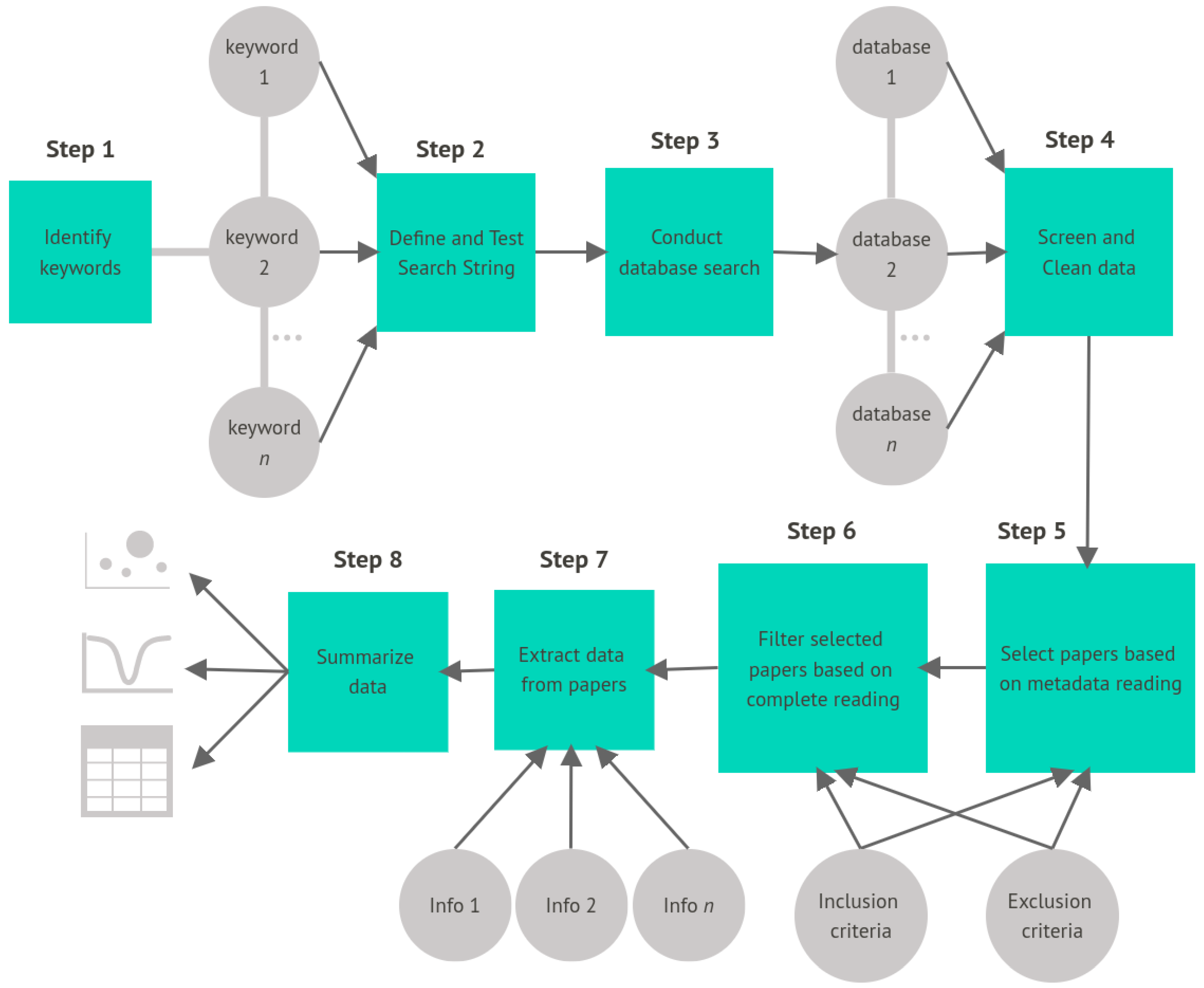
Figure 1. Overview of our review process.
Sustainability 17 11173 g001
Figure 2. Results of the review process in the PRISMA perspective. Adapted from Page et al. [57].
Sustainability 17 11173 g002
Figure 3. Review process and the number of studies in the SLR step.
Sustainability 17 11173 g003
Figure 4. Number of Studies published by Year.
Sustainability 17 11173 g004
Figure 5. Types of Publication by Year.
Sustainability 17 11173 g005
Figure 6. Number of studies per country of the first author.
Sustainability 17 11173 g006
Figure 7. Number of studies by Target Audience.
Sustainability 17 11173 g007
Figure 8. Number of studies by Guideline and/or Standard.
Sustainability 17 11173 g008
Figure 9. Word cloud with accessibility features discussed in studies.
Sustainability 17 11173 g009
Figure 10. Classification of the Checkers Tools used in studies.
Sustainability 17 11173 g010
Table 1. Information extracted from the studies.
NumberFieldDescription
1IDUnique identifier for the study.
2TitleTitle of the study.
3AuthorsAuthors of the study.
4YearYear of publication.
5CountryCountry of the first author of the study.
6TypeConference, journal, and workshop study.
7ContextThe research context of the study.
8GoalThe goal of the study.
9SolutionA brief description of the solution proposed in the study.
10Accessibility FeaturesThe accessibility features employed in the study.
11Target AudienceFor which users the solution was developed.
12GuidelinesWhich guidelines and/or standards were used in the study.
13Accessibility Checkers ToolsWhich tools for checking the accessibility of the e-books were used in the study.
14ExperimentsA brief experiment description carried out in the study.
15Main resultsMain results presented in the study.
16InsightsMain insights discussed by the authors.
Table 2. Number (#) of Studies published by Conference.
Publication Title# Studies
Int. Conf. on Computers Helping People with Special Needs14
Int. Conf. on Computers for Handicapped Persons10
Int. Conf. on Human-Computer Interaction6
Int. Conf. on Universal Access in Human-Computer Interaction6
World Conf. on Information Systems and Technologies3
Int. Conf. on Software Development and Technologies for Enhancing Accessibility and Fighting Info-exclusion2
Int. Conf. on Cross-Cultural Design2
Iberoamerican Conf. on Applications and Usability of Interactive TV2
Int. Conf. on Intelligent User Interfaces2
Int. Conf. on Web Information Systems and Technologies1
International Web for All Conference1
Australian Conf. on Human-Computer Interaction1
Int. Conf. on Human-Computer Interaction with Mobile Devices and Services1
International Federation of Automatic Control1
Int. Conf. in Knowledge Based and Intelligent Information and Engineering Systems1
Int. Conf. on Human Factors in Computing and Informatics1
Int. Conf. on Applied Human Factors and Ergonomics1
Symposium of the Austrian HCI and Usability Engineering Group1
Int. Conf. on Neuroergonomics and Cognitive Engineering1
Int. Conf. of Design, User Experience, and Usability1
Int. Conf. on Theory and Practice of Digital Libraries1
Int. Conf. on Knowledge Engineering and the Semantic Web1
Scandinavian Conf. on Information Systems1
Int. Conf. on Human Aspects of IT for the Aged Population1
Int. Conf. on Technological Advancement in Embedded and Mobile Systems1
Int. Conf. on Learning and Collaboration Technologies1
Int. Conf. on Information Systems and Management Science1
Cambridge Workshop on Universal Access and Assistive Technology1
Int. Conf. on Intelligent Tutoring Systems1
Int. Conf. on Innovations in Computer Science and Engineering1
ENTERprise Information Systems1
Int. Conf. on Advanced Computing Technology1
International Visual Informatics Conference1
Hybrid Intelligent Systems1
World Conference on Information Systems for Business Management1
Int. Conf. on Computational Science and Its Applications1
Int. Conf. in Methodologies and intelligent Systems for Tech. Enhanced Learning1
Universal Access in Human-Computer Interaction. Applications and Services1
Table 3. Number (#) of Studies published by Journal.
Publication Title# Studies
Universal Access in the Information Society4
Procedia Computer Science2
Computer Standards & Interfaces1
Journal of Electronic Resources Librarianship1
Learned Publishing1
ACM Transactions on Accessible Computing1
Technological Forecasting and Social Change1
International Journal of Child-Computer Interaction1
Science of Computer Programming1
Journal of Organizational Change Management1
Education, and Learning Sciences, Advances in Intelligent Systems and Computing1
Advances in Neuroergonomics and Cognitive Engineering1
Multimedia Tools and Applications1
Education and Information Technologies1
Scientific Reports1
Table 4. Selected studies in the SLR.
IDTitle and Reference
01Development of an electronic book accessibility standard for physically challenged individuals and deduction of a production guideline [58]
02Are e-books for everyone? An evaluation of academic e-book platforms’ accessibility features [59]
03Using InDesign tool to develop an accessible interactive EPUB 3: A case study [60]
04A validation test of an accessibility evaluation method [61]
05Personalization in the Interactive EPUB 3 Reading Experience: Accessibility Issues for Screen Reader Users [62]
06Why accessibility is hard and how to make it easier: Lessons from publishers [63]
07Authoring tools are critical to the accessibility of the documents: Recommendations for word processors, including interaction design [64]
08Implementation of the OOXML standard since its approval until today [65]
09“A Helping Hand”: Design and Evaluation of a Reading Assistant Application for Children with Dyslexia [66]
10ALCOVE: an accessible comic reader for people with low vision [67]
11Touch-Supported Voice Recording to Facilitate Forced Alignment of Text and Speech in an E-Reading Interface [68]
12Finger tracking: facilitating non-commercial content production for mobile e-reading applications [69]
13Digitisation of publishing: Exploration based on existing business models [70]
14New Interactive Books for Control Education [71]
15Typical Functions of e-Textbook, Implementation, and Compatibility Verification with Use of ePub3 Materials [72]
16The electronic book—a modern instrument used in teachers’ training process [73]
17The Development of a Gamebook for Education [74]
18An analysis of e-book learning platforms: Affordances, architecture, functionality and analytics [75]
19A Mobile Application for Displaying More Accessible eBooks for People with Dyslexia [17]
20Design and architecture of an interactive eTextbook—The OpenDSA system [76]
21The impact of the book publishing transmedia storytelling model on business performance: the moderating role of the innovation environment [77]
22E-book Accessibility Evaluations [78]
23Accessible EPUB: Making EPUB 3 Documents Universal Accessible [79]
24An Enriched ePub eBook for Screen Reader Users [80]
25Guidelines for Designing Accessible Digital (Text) Books: The Italian Case [81]
26Investigating an Accessible and Usable ePub Book via VoiceOver: A Case Study [82]
27Accessibility Evaluation: Manual Development and Tool Selection for Evaluating Accessibility of E-Textbooks [83]
28eBooks, Accessibility and the Catalysts for Culture Change [84]
29Accessibility Evaluation for Open Source Word Processors [85]
30Development of a Scoring System for Evaluating the Accessibility of eTextbooks [86]
31On Automatic Conversion from E-born PDF into Accessible EPUB3 and Audio-Embedded HTML5 [87]
32HapTalker: E-book User Interface for Blind People [88]
33Accessibility in Multimodal Digital Learning Materials [89]
34Flex Picture eBook Builder - Simplifying the Creation of Accessible eBooks [90]
35PDF Accessibility in International Academic Publishers [91]
36Document Transformation Infrastructure [92]
37Usability Analysis in Gesture Operation of Interactive E-Books on Mobile Devices [93]
38Reading Experiences and Reading Efficiency Among Adults with Dyslexia: An Accessibility Study [94]
39Digital Accessibility in the Education of the Deaf in Greece [95]
40Realizing Inclusive Digital Library Environments: Opportunities and Challenges [96]
41Template Based Approach for Augmenting Image Descriptions [97]
42Using Layout Applications for Creation of Accessible PDF: Technical and Mental Obstacles When Creating PDF/UA from Adobe Indesign CS 5.5 [98]
43Developing Heuristics for Evaluating the Accessibility of Digital Library Interfaces [99]
44Ontology-Based Representation of Learner Profiles for Accessible OpenCourseWare Systems [100]
45XML-Based Formats and Tools to Produce Braille Documents [101]
46HERMOPHILOS: A Web-Based Information System for the Workflow Management and Delivery of Accessible eTextbooks [102]
47ICT Access in Libraries for Elders [103]
48Slow Learner Children Profiling for Designing Personalized eBook [104]
49Mainstreaming the Creation of Accessible PDF Documents by a Rule-Based Transformation from Word to PDF [105]
50AcceSciTech: A Global Approach to Make Scientific and Technical Literature Accessible [106]
51SCRIBE: A Model for Implementing Robobraille in a Higher Education Institution [107]
52Developing Text Customisation Functionality Requirements of PDF Reader and Other User Agents [108]
53Effective Teaching Aids for People with Dyslexia [109]
54Blind and Deaf Consumer Preferences for Android and iOS Smartphones [110]
55Assessing the Effectiveness of an Augmented Reality Application for the Literacy Development of Arabic Children with Hearing Impairments [111]
56Explore Elder Users’ Reading Behaviors with Online Newspaper [112]
57Evaluating the Usability of Library Websites Using an Heuristic Analysis Approach on Smart Mobile Phones: Preliminary Findings of a Study in Saudi Universities [113]
58Multi-sensual Augmented Reality in Interactive Accessible Math Tutoring System for Flipped Classroom [114]
59Implementation of Braille Tab [115]
60The Wisdom Innovation Model—Adjusting New Insights and Hosting New Perspectives to Human Augmented Reality [116]
61Preliminary Investigations on Augmented Reality for the Literacy Development of Deaf Children [117]
62Enhancing the ow Adoption Rate of M-commerce in Nigeria Through Yorùbá Voice Technology [118]
63Conversion of Multi-lingual STEM Documents in E-Born PDF into Various Accessible E-Formats [119]
64Teaching-Learning Environment Tool to Promote Individualized Student Assistance [120]
65Accessible Authoring Tool for DAISY Ranging from Mathematics to Others [121]
66An Evaluation Methodology of Math-to-Speech in Non-English DAISY Digital Talking Books [122]
67Pregnancy Test for the Vision-Impaired Users [123]
68Publishing accessible proceedings: the DSAI 2016 case study [124]
69Improving webtoon accessibility for color vision deficiency in South Korea using deep learning [125]
70Interactivity and multi-modality in language learning: the untapped potential of audiobooks [126]
71Web accessibility of healthcare Web sites of Korean government and public agencies: a user test for persons with visual impairment [127]
72Towards accessible news reading design in virtual reality for low vision [128]
73Digital literacy skills of university students with visual impairment: A mixed-methods analysis [129]
74A machine learning-based classification model to support university students with dyslexia with personalized tools and strategies [130]
Table 5. Universal Design with Personas for Accessible E-books. Adapted from Penn State World Campus [131].
PersonaDescriptionDifficultiesNeeds
SeanA blind student who lost his sight in a car accident.Lack of a clear heading structure, ambiguous link text, and assignments that require tools that rely on vision.All course pages, external websites, and third-party tools are compatible with JAWS and keyboard commands. In addition, math content is provided in MathML.
AndyA Human Resources professional, with experience working with individuals who are deaf and colorblind.Videos that lack captions or transcripts, as well as visuals or text content where meaning is conveyed primarily through color.Videos have captions, audio files have transcripts, and data representations in charts and graphs have good color contrast.
LindaA vocational rehabilitation counselor with mobility impaired.Content that cannot be accessed with a keyboard, and material readings are not provided in an accessible digital format.Link text is meaningful and clearly identifies the destination and content type, as well as applications that allow speech-to-text input.
PhilAn older adult with low vision, Post Traumatic Stress Disorder (PTSD), and Traumatic Brain Injury (TBI).Most readings are particularly PDFs that are low-quality scans and incompatible materials with magnifiers.Content is provided as real text, online content can be magnified to 400% without distortion, and images have good resolution, high color contrast, and readable font.
SarahA student working part-time with depression and anxiety.Text-heavy lesson pages with no headings to break up content, and highly structured sequential content.Consistent navigation and pages have a clear heading structure. Additionally, videos are captioned and transcribed so that she can use transcripts for note taking.
JennaA student working part-time with ADHD (Attention Deficit/Hyperactivity Disorder).Videos that are longer than five minutes, text displayed as an image without alternative text, and inconsistent navigation.Hear the text read aloud, paragraphs of text are kept short and content is left aligned, as well as a logical heading structure and a clear outline where critical information is easy to find.
MicaelA student diagnosed with Autism Spectrum Disorder (ASD)Long readings that are just text, and a lack of support and a clear rubric for completing writing assignments.Text is broken up visually with good images and icons, text font and color can be customized by the user, and consistent navigation and pattern.
Table 6. Number (#) of studies that discussed an accessibility feature.
Feature# Studies
Assistive Technologies22
Personalization/Customization17
Alternative Text16
Content’s Structure14
Interactive Features15
Navigation13
Text-to-Speech (TTS)/Narration13
Multimedia Content12
Metadata and Additional Information12
Color Contrast10
Screen Reader10
Semantic7
Tagging6
Exporting5
Support Different Languages5
Download4
Support Braille4
Multi-modal3
Support MathML3
OCR2
Screen Magnifiers1
Not Specified15
Table 7. Number (#) of studies that discussed the use of some tool for checking accessibility features.
Tool# StudiesEnterpriseDistributionLicense
EPUBCheck (https://www.w3.org/publishing/epubcheck/)3W3C (Cambridge, MA, USA)Open-SourceFree
ACE (Accessibility Checker for EPUB: https://daisy.org/activities/software/ace/)2DAISY Consortium (Grave, The Netherlands)Open-SourceFree
ODT Accessibility Checker (https://sourceforge.net/projects/accessodf/)1-Open-SourceFree
PDF Accessibility Validation Engine (PAVE: https://pave-pdf.org/)1ZHAW—Accessibility Lab. (Winterthur, Switzerland)Open-SourceFree
PDF Accessibility Checker (PAC: https://pac.pdf-accessibility.org/)2axes4 GmbH (Zurich, Switzerland)Closed-SourceFree
MS Word wizard (https://www.microsoft.com/pt-br/microsoft-365/word)1Microsoft Corp. (Redmond, WA, USA)Closed-SourceProprietary
Adobe® Acrobat DC (https://get.adobe.com/br/reader/)1Adobe Inc. (San Jose, CA, USA)Closed-SourceProprietary
Non-AT Tools (non-assistive technology)1---
Color Contrast Analyzer (CCA: https://www.tpgi.com/color-contrast-checker/)1TPGi, LLC. (Clearwater, FL, USA)Open-SourceFree
AT Tools (assistive technology)2---
JAWS (https://www.freedomscientific.com/products/software/jaws/)3Freedom Scientific, Inc. (Clearwater, FL, USA)Closed-SourceProprietary
Kurzweil 3000 (https://www.kurzweil3000.com/)1Kurzweil Education (Dallas, TX, USA)Closed-SourceProprietary
NVDA (https://www.nvaccess.org/)3NV Access (Brisbane, Australia)Open-SourceFree
ZoomText (https://www.freedomscientific.com/products/software/zoomtext/)2Freedom Scientific, Inc. (Clearwater, FL, USA)Closed-SourceProprietary
Ad-hoc3---
Manual11---
Conversion Tools2---
Authoring Tools5---
Expressive Sign Language Test Application1---
WebRTC (JavaScript Library: https://webrtc.org/)1Apple (Cupertino, CA, USA), Google (Mountain View, CA, USA), Microsoft (Redmond, WA, USA), and Mozilla (San Francisco, CA, USA)Open-SourceFree
Toptal Colorblind Web Page Filter (https://www.toptal.com/designers/colorfilter)1Toptal, LLC. (Wilmington, DC, USA)-Free
Not Specified43---
Table 8. Comparison among the Accessibility Checking Tools for E-Books.
ToolContent TypeModeFocusComplianceReportsLanguagesCorrection
EPUB CheckEPUBCLI/ Java LibEPUB structure validationEPUB 3.3Simple, CLIMultipleManual
Ace by DAISYEPUBCLI, JS node, Web API, GUIEPUB accessibilityEPUB accessibilityDetailed HTMLEnglish, othersManual
PAVEPDFWebPDF accessibility, with partial fixesPDF/UA, WCAGGraduallyGerman, EnglishAutomatic (partial)
PACPDFDesktopPDF/UA and WCAG compliance checkingPDF/UA, WCAGSummary or DetailedGerman, EnglishManual
CCAImage, Web, PDF, PowerPoint and InDesign filesDesktopWCAG color contrast checkingWCAG 2.0/2.1/2.2Exportable12 languagesManual
NVDAGeneral (Screen Reader)DesktopPractical screen reader testingNot ApplicableSimpleMultipleManual
Disclaimer/Publisher’s Note: The statements, opinions and data contained in all publications are solely those of the individual author(s) and contributor(s) and not of MDPI and/or the editor(s). MDPI and/or the editor(s) disclaim responsibility for any injury to people or property resulting from any ideas, methods, instructions or products referred to in the content.