You are currently viewing a new version of our website. To view the old version click .
Sustainability
  • Article
  • Open Access

12 December 2025

The Valuation of Assets as a Non-Monetary Contribution to a Water Management Company

,
and
Faculty of Civil Engineering, Brno University of Technology, 602 00 Brno, Czech Republic
*
Author to whom correspondence should be addressed.
Sustainability2025, 17(24), 11171;https://doi.org/10.3390/su172411171 
(registering DOI)
This article belongs to the Section Sustainable Water Management

Abstract

A large number of state-owned companies were privatized in the Czech Republic after the end of the communist regime, mostly through their transformation into joint-stock companies. The water management sector was no exception from this process. The ownership of infrastructure networks was transferred to individual municipalities, which are legally obliged to provide their inhabitants with water supply and sewerage disposal. Subsequently, the municipalities joined together in joint-stock companies to enhance their capacity to provide sufficient financial resources for the rehabilitation and development of water infrastructure and also to enable the implementation of sustainable water management strategies, which are key to environmental protection. Assets contributed to joint-stock companies in the form of non-monetary contributions serve as a basis for a proportionate allocation of shares, representing the shareholder’s share of participation in the company’s management. An analysis of the asset performance within these companies indicates the necessity of developing an optimized methodology for determining the number of shares allocated for such non-monetary contributions. This need arises from significant disparities in both profitability and cost-efficiency among municipalities, depending on factors such as population size (revenues) and the length and technical characteristics of the infrastructure networks (costs) contributed to the joint-stock companies. The authors of the article present the research project results, aimed at developing a methodological procedure for determining the price (value) of municipal infrastructure assets contributed as non-monetary capital to a joint-stock company that owns and operates water management networks, from which the secondary objective of determining the fair value of a municipality’s water management infrastructure assets based on the developed methodology is derived. The proposed methodological procedure is primarily based on establishing the ratio between the fixed and variable costs of the municipality.

1. Introduction

Following 1989, state-owned companies responsible for the operation of infrastructure networks in the Czech Republic were privatized. This privatization involved a fundamental transformation of companies from state ownership to shareholder ownership. The municipalities themselves (towns and cities), foreign companies, and companies operating in the Czech Republic were among these shareholders.
The majority of joint-stock companies that both own and operate infrastructure assets are municipally owned. In 2023, there were 8423 owners of infrastructure networks and 3176 operators registered in the Czech Republic, according to the Blue Reports published annually by the Ministry of Agriculture [1]. These data indicate a significant fragmentation of infrastructure assets into small water management companies. Individual owners hold infrastructure networks (assets) valued at CZK 1447 billion (approximately EUR 58 billion). The Ministry of Justice annually publishes a list of the 25 largest owners of infrastructure networks, who, together, own nearly 50% of the total value of infrastructure assets in the Czech Republic [2]. Over 70% of these 25 largest owners are joint-stock companies. The remaining ownership is represented by associations of municipalities, municipal unions, and statutory cities. Joint-stock companies are 90% municipally owned. A financial analysis of the balance sheets of the 25 largest owners of infrastructure assets, covering the period 2003–2022, indicates that the median proportion of long-term tangible assets representing infrastructure networks within these companies amounts to 99% of total long-term assets [3]. This extensive analysis demonstrates that infrastructure networks constitute a dominant component of the companies’ asset base and involve substantial financial volumes, highlighting the importance of their careful management.
The management of long-term or fixed assets in water management companies has been addressed by numerous authors worldwide. In their paper, the authors Yazdani and Jeffrey focused on complex network analysis of water distribution systems. This paper explored a variety of strategies for understanding the formation, structure, efficiency, and vulnerability of water distribution networks. Water supply systems were studied as spatially organized networks for which the practical applications of abstract evaluation methods were critically evaluated. Their observations provided a framework for the study of water distribution systems and the level of similarity or difference between water distribution networks and other types of (spatial) network. Using mainly topological network techniques and measurements presented answers to several basic questions [4]. Vilarinho, Dinverno, Nóvoa, and Camanho focused on assessing the performance of asset management of water management companies, examining managerial practices and the state of infrastructure. Their case study was based on nationwide data from the Portuguese regulatory authority for water and sewerage services [5]. They examined the overall competitive conditions in global value chain networks. The authors Angelidis, Ioannidis, Makris, Antoniou, and Varsakelis investigated competitive conditions in global value chains (GVCs) for a period of fifteen years (2000–2014), focusing on sector structure, countries’ dominance, and diversification. Their research showed that countries wishing to enter or increase their participation in global trade should implement more concentrated trade policies in less centralized sectoral networks. A dominant country is not necessarily diversified, and developing economies should adopt diversification strategies to improve their market situation [6].
Cao, Deng, and Shao, in their article, focused on the relationship between the management of fixed assets (i.e., long-term tangible assets) and increased pollution costs, examining a sample of 201,926 manufacturing companies in China [7]. The impact of leasing financing of long-term assets on the circular economy was investigated by Bocok, Hinke, and Abrham in their study [8]. The concept of sustainable development, in terms of analyzing expenditures on long-term assets for environmental protection depending on the type of investment, was addressed by Tabor [9]. Her study found that investment-related expenditures are primarily dominated by water protection, with these expenditures increasing annually. Further research by Beuken, Eijkman, Savic, Hummelen, and Blokker from the Netherlands, conducted over a 20-year period, focused on asset management, concentrating on five phases that illustrate the transition from questions about how asset management concepts can support better planning of distribution network replacement to integrated decision-making regarding the asset system as a whole. Their study employed various models and scenarios within asset management, with particular emphasis on the quality of input data [10]. Shah, Lai, Shad, Hamad, and Ellili focused on exploring the effect of enterprise risk management for ESG risks on green growth. This study explored risk management and its impact on green growth. It is evident from the study that organizations tend to emphasize ERM (enterprise risk management) to mitigate ESG risks and foster GG [11]
Laucelli, Enriquez, Ariza, Ciliberti, and Berardi focused on the digitalization of water management companies with the aim of enhancing asset management efficiency in real-world systems. They applied comprehensive digital water management strategies to two actual case studies using data provided by the Italian water management company Acquedotto Pugliese [12]. Masyita and Susanti examined the analysis of a risk-based asset management plan to improve the performance of a local water management company. Their study aimed to develop a risk-based asset management planning concept in accordance with governmental regulations and international asset management standards, with the objective of enhancing the performance of the Regional Water Management Company (PDAM) in Aceh Province. The plan contained asset acquisition plans, operational asset plans, maintenance plans, and asset lubrication [13]. Tscheikner-Gratl, Caradot, Cherqui, et al. addressed the management of sewerage assets. They described the current state of sewerage asset management across its diverse aspects, highlighting existing research gaps and providing insights into future development and research directions [14]. Asset management strategies from the perspectives of modeling, integrated planning, and long-term sustainability assessment have been addressed by numerous authors, including Caradot, Sonnenberg, Kropp, Ringe, Denhez, Hartmann, and Rouault [15], Kleidorfer, Möderl, Tscheikner-Gratl, Hammerer, Kinzel, and Rauch [16], and Bruaset, Rygg, and Sægrov [17].
For determining the value of assets to be contributed to a joint-stock company, it is essential to consider the valuation perspective of these assets. There are specific legislative regulations in the Czech Republic governing the valuation of all types of assets, namely Act No. 151/1997 Coll., on Asset Valuation and Amendments to Certain Acts [18]; Decree No. 441/2013 Coll., implementing the Act on Asset Valuation [19]; and Act No. 526/1990 Coll., on Prices [20]. Abroad, the issue of long-term asset valuation is approached primarily from a corporate perspective, focusing on the methods and techniques of asset valuation applied in different countries [21,22,23,24,25]. Some authors also explore the incorporation of digitalization and the application of artificial intelligence in the valuation of long-term assets [26]. The processes and step-by-step procedures involved in valuation were examined in detail in the research conducted by Setijono and Čibera [27,28].
The basis for determining the value of long-term assets in relation to non-monetary contributions lies in the division of total costs associated with these assets into fixed and variable components. In economic theory, a fixed cost is understood as a cost that is not directly related to the production process. This cost is necessary to cover regardless of production performance. In contrast, a variable cost is linked to the production process and is directly dependent on its performance. Fülöp addressed the identification of fixed and variable costs in his study, applying mathematical methods to determine these costs in water management companies [29]. The issue of project planning and project cash flow in relation to fixed and variable costs was examined by Correia and Lee [30,31]. Only a limited number of studies have been found within the context of identifying, managing, and planning fixed and variable costs in water management companies. However, numerous authors have addressed the issue of cost allocation in connection with other sectors, including Tabush, Parmacli, Machka, Ryan, Spencer, Dyakova, and Oktavia [32,33,34,35,36,37,38].
From the above literature review, it follows that the authors focus on specific areas that are related to the topic of our research. The contribution of our research lies in setting a clear methodology for valuing assets (infrastructure assets) as a non-monetary contribution to a joint-stock company.
The research team addressed its research objective—to determine the fair value of a municipality’s water management infrastructure assets based on a detailed analysis of the asset performance structure of the water management joint-stock company (WMC) and numerous international findings described above. This value represents the amount of the municipality’s non-monetary contribution (as a new shareholder) to the WMC and determines the number of shares acquired, thereby defining the share of the municipality’s participation in the company’s management. The aim of associating municipalities into larger units (joint-stock companies) is to provide comprehensive optimization of water management in the region and the possibility of large-scale infrastructure investments aimed at saving water, improving its quality, and minimizing negative impacts on the environment.

2. Material and Methods

The methods used for the case study are based on basic mathematical principles used in different sectors and countries. This is mainly the principle of costing, the breakdown of costs according to different aspects, and their relationship with units of measurement such as quantity and length. Costing in the sense of fixed and variable costs and their determination in a unit of measurement are described in many studies, e.g., Synek [39], Máče [40], and Irwin [41], and also many papers, e.g., Machka, Beran [34], Dyakova [37], Jegers, Buts, and Van Puyvelde [42].
In order to develop a methodology for the valuation of assets as non-monetary contributions to a water management company, it was necessary to specify the relevant corporate areas associated with this issue and through which the required input data were obtained. These include the following:
  • Asset records—the company’s asset management department.
  • Records of fixed and variable costs related to assets—accounting department.
  • Records of fixed and variable costs of municipal units related to assets—internal accounting department.
  • Records of water supply and sewerage quantities within the company’s water and sewerage services—operational department.
  • Records of water supply and sewerage quantities within the municipal units of the company—internal operational department.
  • Determination of the number of shares issued for contributed assets in relation to the determined value of the assets—strategic department.
Since water management companies are structured as joint-stock companies and the shareholders are individual municipalities contributing their assets to the company, it is necessary to maintain thorough internal records within the company. Within the company’s property management department, all assets are recorded together with information on which municipality contributed the respective asset to the company and at what value. This value is determined based on an expert valuation report developed in compliance with the legal regulations governing asset valuation.
Infrastructure assets are associated with costs that must be covered by revenues from water supply and sewerage charges. These costs are of both fixed and variable nature. The company’s accounting department records all expenses related to the ownership and operation of these assets. The expenses are classified into fixed and variable costs, including those within the company’s internal records (by individual municipalities records).
The aforementioned fixed and variable costs associated with the company’s assets can be allocated to a cost unit, specifically to one cubic meter (m3) of water supplied or sewage treated. This information is provided by the company’s operational department. In the same manner, but with reference to individual municipalities (operational units), the assets contributed by the company can be recalculated per cost unit—m3—of water supplied or sewage treated in relation to the respective municipality. This approach also ensures the assessment of each municipality’s performance, i.e., the number of consumers served by that municipality.
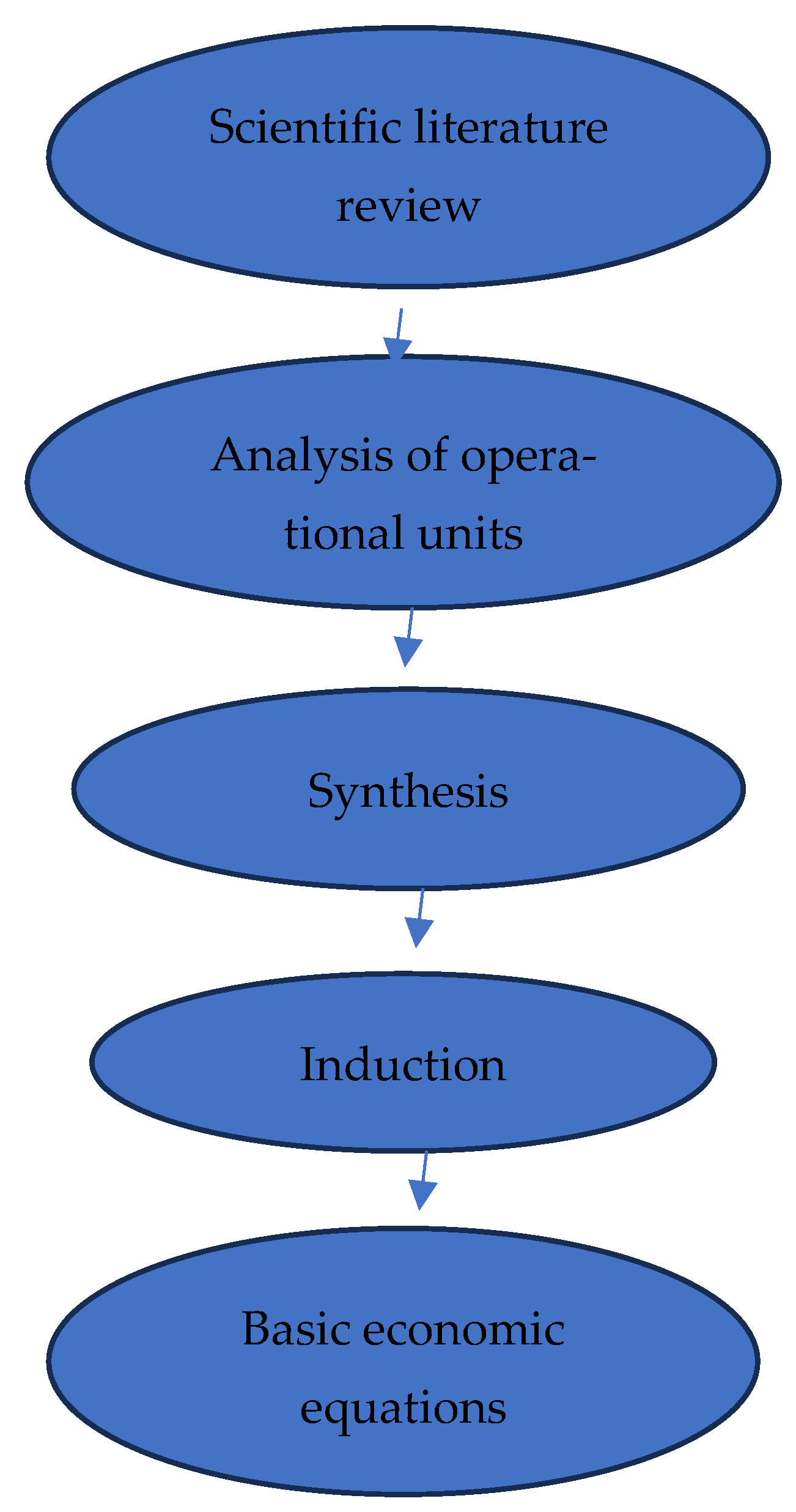
When the value of the assets contributed by a municipality to the company and the related cost structure of those assets are known, it is possible to determine the number of shares that the given municipality will receive in exchange for its asset contribution to the company. This information is provided by the company’s strategic department. It follows that the following methods and approaches were applied in developing a methodology for the valuation of assets considering infrastructure networks as a non-monetary contribution to a water management company, see Figure 1.
Figure 1. General procedure for developing the dividend policy methodology [own processing].
A thorough international literature review on the researched topic was carried out. The review revealed that existing authors focus primarily on fixed and variable costs in relation to determining the price of water supply and sewerage services; however, they do not use this information for determining the ownership shares (number of shares) of shareholders. This finding identifies a research gap, indicating the need for scientific investigation with subsequent potential for practical application. Subsequently, an analysis of the economic data collection within a WMC was performed. The findings and their interrelations were synthesized and used to establish the individual steps of the methodology. The specific characteristics of individual companies were generalized through induction so that the methodology could be applied universally to joint-stock companies dealing with similar issues. Basic economic equations related to the determination of full costs were employed for the actual calculations.

3. Results

Within the research team’s focus on the issue of dividend policy in municipally owned water management companies, a methodology based on the above-stated general procedure and individual methodological steps leading to the determination of the number of shares for an individual municipality that wants to contribute its infrastructure assets to a water management company—a joint-stock company—was proposed. The relevant areas, including explanations which are essential for the calculation itself, are defined below to facilitate understanding of the methodology.
The long-term tangible assets in the form of infrastructure owned by municipalities which want to become shareholders of a joint-stock company operating water supply and sewerage systems and which should be provided as a non-monetary contribution to the company primarily consist of water mains, sewers, sewerage lines, aboveground and underground hydrants, pressure pipelines, gravity pipelines, pumping stations, sludge pumps, etc.
The economic result arising from the assets contributed by municipalities in relation to the calculation of water supply or sewerage charges by the joint-stock company basically consists of the following two components:
  • Revenues (from sales),
  • Individual types of costs (excluding depreciation).
Revenues are generated as the product of the volume of water supplied/sewerage collected by households and other entities in cubic meters (m3) and the unit selling price for the current period. Costs are composed of individual cost items according to the calculation formula.
The individual types of costs are determined by legal regulations, which precisely stipulate which costs may be incurred within the calculation of water supply and sewerage charges. These primarily include costs for materials, services, personnel, other operating expenses, and additional items.
The economic result is calculated as the difference between revenues and costs. Individual municipalities may show profitability or losses within this economic result.
The valuation of assets as a non-monetary contribution to a WMC is performed for the current year of contribution. It consists of the following two main parts:
  • Determination of the value of the assets contributed by the municipality,
  • Determination of the value of the assets contributed by the municipality as a non-monetary contribution to the WMC.
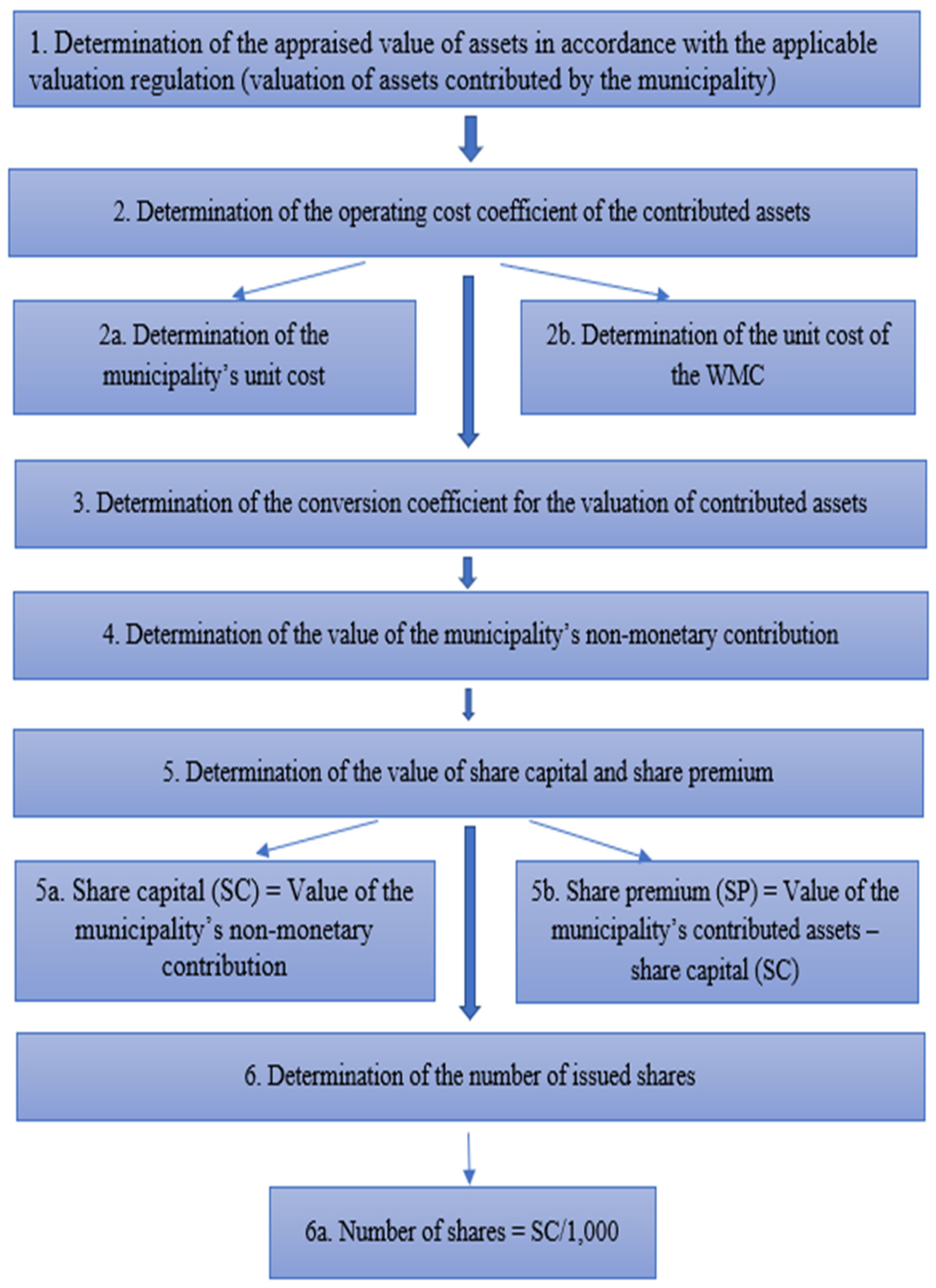
The following Figure 2 illustrates the methodological procedure for valuating a municipality’s assets as a non-monetary contribution to a WMC, which was established, tested, and verified by the research team on several samples within the water management joint-stock company.
Figure 2. Diagram of sequential methodological steps for determining the value of a non-monetary contribution (source and processing: own).
The individual steps of the methodological procedure are presented and described step by step in the following subsections.

3.1. Determination of the Value of the Municipality’s Contributed Assets

The value of the total assets contributed by a municipality to the WMC is determined as the sum of the individual items of the contributed assets, divided into water supply network assets and sewerage network assets. The determination of this value is, in the Czech Republic, for example, regulated by legislation [17].

3.2. Determination of the Asset Operation Cost Coefficient

The cost coefficient Cc expresses the difference in operational costs between the assets contributed by the municipality and the operational costs of the WMC’s assets.
It is determined as the ratio of the municipality’s unit costs of water supply or sewerage services in CZK/m3 to the unit costs of the WMC in CZK/m3. The water and sewerage costs are derived from the WMC calculation formula, which includes the following cost items:
  • Direct material,
  • Direct wages,
  • Other direct costs,
  • Indirect costs (production overhead, administrative overhead, depreciation, and the amount of rent for leased assets),
  • Other costs.
The individual cost items in the water or sewerage calculation formula are divided into fixed and variable costs for the purposes of this methodology. Both cost categories together constitute the full production costs of water supply or sewerage services in the WMC’s calculation formula.
Fixed costs are independent of production volume and are primarily associated with asset management. Fixed costs in the WMC’s calculation formula include operating costs, other depreciation, financial costs, financial revenues, production overhead, and administrative overhead.
Variable costs vary with production volume. Variable costs in the WMC’s calculation formula include costs for materials, energy, wages, and other direct costs (excluding other depreciation, which is included in fixed costs).
However, when determining the municipality’s unit costs of water supply or sewerage services, future depreciation resulting from the registration of assets in the WMC is taken into account, which increases costs in the company’s water or sewerage calculation formula.
Procedure for determining the cost coefficient:
(a)
Division of the total production costs in the WMC’s water/sewerage calculation formula into fixed and variable costs.
  • Fixed costs include other depreciation, operating costs, production overhead, and administrative overhead.
  • Variable costs include materials, energy, wages, and other direct costs, excluding other depreciation.
F O C = F C + V C
F O C = M + E + W + O D C + O C + F i C F i R + P O H + A O H
F C = O D + O C + P O H + A O H
V C = M + E + W + ( O D C O D )
where
  • FOC: Full own costs.
  • FC: Fixed costs.
  • VC: Variable costs.
  • M: Material.
  • E: Energy.
  • W: Wages.
  • ODC: Other direct costs (including other depreciation, wastewater treatment plant depreciation, infrastructure asset repairs, infrastructure asset rent, infrastructure asset renewal funds).
  • OD: Other depreciation.
  • OC: Operating costs.
  • FiC: Financial Costs.
  • FiR: Financial Revenues.
  • POH: Production overhead.
  • AOH: Administrative overhead.
(b)
Determination of unit fixed costs of water supply/sewerage in CZK/lm for the WMC.
The unit fixed costs of the WMC are calculated as the ratio of the difference between the sum of fixed costs identified in step (a) and the other depreciation costs associated with the WMC to the total length of water supply or sewerage network managed by the WMC, as follows:
F C u = F C O D L
where
  • FCu: Unit fixed costs of the WMC.
  • FC: Fixed costs of the WMC.
  • OD: Other depreciation costs of the WMC.
  • L: Length of the WMC’s network in linear meters.
(c)
Determination of unit variable costs of water/sewerage in CZK/m3 for the WMC:
The unit variable costs of the WMC are calculated as the ratio of the sum of variable costs identified in step (a) to the volume of billed drinking, sewerage, and stormwater, as follows:
V C u = V C V
where
  • VCu: Unit variable costs of the WMC.
  • VC: Variable costs of the WMC.
  • V: Volume of billed water of the WMC in m3.
(d)
Determination of total fixed costs of water/sewerage for the municipality in CZK.
The municipality’s fixed costs are determined as the sum of the product of the unit fixed costs of water/sewerage of the WMC (calculated in step (b)) and the length of the water supply or sewerage network representing the municipality’s contributed assets, plus the value of depreciation of the municipality’s assets being contributed to the WMC.
F C m = ( F C u × L m ) + O D m
where
  • FCm: Full fixed costs of the municipality.
  • FCu: Unit fixed costs of the WMC.
  • Lm: Length of the municipality’s contributed water/sewerage network in lm.
  • ODm: Depreciation of the municipality’s contributed assets.
(e)
Determination of the amount of variable costs of water/sewerage services for the municipality in CZK:
The amount of variable costs for the municipality is determined by multiplying the unit variable costs of the WMC, determined in point (c), by the volume of water consumed in m3 (drinking or sewage) by the given municipality.
V C m = V C u × V m
where
  • VCm: Variable cost of the municipality.
  • VCu: Unit variable cost of the WMC.
  • Vm: Volume of water consumed by the municipality in m3.
(f)
Determination of the full own costs of water/sewerage services for the municipality in CZK.
The total own costs of the municipality are determined as the sum of the fixed costs of the municipality determined in point (d) and the variable costs of the municipality determined in point (e).
F O C m = F C m + V C m
where
  • FOCm: Full own costs of the municipality.
  • FCm: Fixed costs of the municipality.
  • VCm: Variable costs of the municipality.
(g)
Determination of the unit costs of water/sewerage services for the municipality (UCm) in CZK/m3.
The unit costs of the municipality are determined as the ratio of the full own costs of the municipality determined in point (f) to the volume of drinking or sewage consumed.
U C m = F O C m V m
where
  • UCm: Unit cost of water/sewerage services for the municipality.
  • FOCm: Full own costs of the municipality.
  • Vm: Volume of water consumed by the municipality in m3.
(h)
Determination of the unit costs of the WMC (UCWMC) in CZK/m3.
The unit costs of water and/or sewerage services of the WMC (UCWMC) are determined as the ratio of the full own costs of water and/or sewerage services (including the existing “other depreciation” of the WMC) to the volume of water supplied or discharged by the WMC.
U C W M C = F O C V
where
  • UCWMC: Unit cost of water/sewerage services of the WMC.
  • FOC: Full own costs of water/sewerage services of the WMC.
  • V: Volume of water supplied or discharged by water supply and sewerage network of the WMC in m3.
(i)
Determination of the asset cost coefficient of the municipality.
The asset cost coefficient of the municipality is determined using the following formula:
A C c = U C m U C WMC
where
  • ACC: Asset cost coefficient.
  • UCm: Unit costs of the municipality in CZK/m3.
  • UCWMC: Unit costs of the WMC in CZK/m3.

3.3. Determination of the Conversion Coefficient for the Value of Contributed Assets

The conversion coefficient for the value of contributed assets (COc) expresses the change in the operating costs of the water supply and sewerage network joint-stock company as a result of receiving the municipality’s contributed assets. If a municipality has a high cost coefficient COc (the fact that the total costs include a high proportion of fixed costs, mostly the length of networks), and, thus, significantly burdens the costs of the entire company, this fact must also be taken into account when assigning a share of the potential positive economic result.
The conversion coefficient can be expressed by the following formula:
C O c = 1 ( A C c 1 )
where
  • COc: Conversion coefficient.
  • ACc: Asset cost coefficient determined in point (i).
If COc ≥ 1, this means that the municipality has a cost per unit of m.j. identical to or lower than the cost of the entire water management company and does not affect the total cost of the company in any way, or only slightly.
If COc < 0, this means that the cost of the municipality is high (high share of fixed costs), and, thus, burdens the economic results of the entire company; therefore, it is necessary to make a proportional reduction in the share of the economic result.
The conversion coefficient was chosen according to the following values, which more fairly balance the ratio between the costs and potential revenues of municipalities and water management companies, i.e., the existing owners, arising from the entry of another municipality into the joint-stock company.
The conversion coefficient COc is applied as follows:
If:
  • COc < 0.000 K: The value of the contributed assets will always be multiplied by a conversion coefficient of 0.3.
  • 0.000 ≤ COc < 0.500: The value of the contributed assets will always be multiplied by a conversion coefficient of 0.5.
  • 0.500 ≤ COc < 1.000: The value of the contributed assets will always be multiplied by the calculated conversion coefficient.
  • COc ≥ 1.000: The value of the contributed assets will always be multiplied by a conversion coefficient of 1.0.

3.4. Determination of the Value of the Municipality’s Non-Monetary Contribution

The value of the municipality’s contributed assets as a non-monetary contribution is determined as the product of the value of the assets contributed by the municipality, which is determined in the first step of this methodology, and the conversion coefficient (see step 3.3 of this methodology).
V N C m = V A C m × C O c
where
  • VNCm: Value of the non-monetary contribution of the municipality.
  • VACm: Value of the assets contributed by the municipality.
  • COc: Conversion coefficient.

3.5. Determination of the Value of the Share Capital and Share Premium

The value of the share capital is equal to the value of the municipality’s non-monetary contribution to the WMC. The total share capital of the WMC will be increased by this amount.
S C = V N C m
where
  • SC: Share capital of the WMC.
  • VNCm: Value of the non-monetary contribution of the municipality.
The value of the share premium is determined as the difference between the value of the assets contributed by the municipality and the value of the municipality’s non-monetary contribution to the WMC.
S P = V A C m S C
where
  • SP: Share premium.
  • VACm: Value of the assets contributed by the municipality.
  • SC: Share capital of the WMC.

3.6. Determination of the Number of Issued Shares

The number of issued shares is determined as the ratio of the share capital of the WMC to 1000 (the nominal value of the shares). The number of shares is always rounded down.

4. Case Study

The case study shows the specific outputs of the methodology used on real data. It was carried out for the WMC, in which eleven municipalities intended to contribute their infrastructural assets to the company. These municipalities are represented numerically as 1–11 in the case study. It was necessary to divide the assets into water supply infrastructure assets and sewerage infrastructure assets for each municipality. Furthermore, the study separately determined the water supply charge and the sewerage network charge applicable to each municipality. The following Table 1 presents the municipalities intending to contribute their infrastructural assets, broken down into water supply and sewerage infrastructure (network).
Table 1. Input data—Characteristics of infrastructural assets for calculating the non-monetary contribution of individual municipalities (source and processing: own).
The calculations were carried out according to the individual steps of the proposed methodology. Due to the excessive volume of data, the steps are illustrated using Municipality No. 10, which was used as a test sample for the proposed methodology.
The resulting values for all municipalities are presented at the end of this chapter, with the aim of determining the number of shares for each municipality in relation to the assets they contribute. These calculations serve as a verification, confirming the correctness of each step within the proposed methodology.

4.1. Determination of the Value of Assets Contributed by Individual Municipalities

The value of assets contributed by the individual municipalities was determined by an expert institute based on a developed expert opinion. The value of Municipality No. 10 was determined at CZK 5,790,840.00. It should be noted that the value of the assets determined in this way differs from the acquisition cost, which reflects the expenses associated with acquiring the assets at their historical cost.

4.2. Determination of the Cost Coefficient

The unit cost for the WMC was determined as the ratio of the company’s sewerage full own costs to the total volume of sewerage discharged to the WMC and was calculated at CZK 35.10/m3.
The unit cost of Municipality No. 10 was determined as the ratio of the municipality’s sewerage full own costs (the sum of fixed and variable costs of the municipality) to the municipality’s total sewerage volume and was calculated at CZK 144.23/m3.
The cost coefficient was determined as the ratio of the municipality’s unit cost to the unit cost of the WMC, amounting to 4.11.
C c = CZK / m 3   144.23   CZK / m 3   35.10   = 4.11

4.3. Determination of the Conversion Coefficient

The conversion coefficient depends on the value of the cost coefficient determined in Section 4.2. According to the formula provided in the methodology in Section 3.3, it amounts to −2.11.
COc = 1 − (4.11 − 1) = −2.11
According to the methodology in Section 3.3, in cases where the conversion coefficient is negative (Cc < 0.000), it is set to a value of 0.3.

4.4. Determination of the Value of Municipal Non-Monetary Contributions

The value of a municipality’s non-monetary contribution is, according to the methodology in Section 3.4, calculated as the product of the value of the contributed assets (as determined in Section 4.1) and the conversion coefficient, taking into account the recommended limits (COc value determined in Section 4.3).
The value of the non-monetary contribution for Municipality No. 10 was determined to be CZK 1,737,252.
VNCm = CZK 5,790,840.00 ∗ 0.3 = CZK 1,737,252

4.5. Determination of Share Capital and Share Premium Values

The value of the share capital, according to the methodology in Section 3.5, is equal to the value of the municipality’s non-monetary contribution. Thus, the share capital value was determined at CZK 1,737,252.
VNCm = CZK 1,737,252
The value of the share premium, according to the methodology in Section 3.5, is calculated as the difference between the value of the contributed assets and the value of the municipality’s non-monetary contribution.
The share premium was determined at CZK 4,053,588.
SP = CZK 5,790,840.00 − CZK 1,737,252 = CZK 4,053,588

4.6. Determination of the Number of Issued Shares

The number of issued shares, according to the methodology in Section 3.6, is calculated as the ratio of the share capital to 1000 (the nominal value of one share).
For Municipality No. 10, the number of issued shares was determined to be 1737 shares = CZK 1,737,252/CZK 1000.
The calculations show that, although this municipality contributes infrastructural assets to the water management company (joint-stock company) worth approximately CZK 5.8 million, its high cost structure reduces the number of issued shares to 30% of the nominal value.
This approach was applied to verify the methodology by determining the number of issued shares for the contributed assets of the remaining ten municipalities.
The table below presents the output values for all 11 municipalities (including the 1 used as a test sample) that intended to contribute infrastructural assets to the WMC. The objective of the methodology is to accurately determine the number of shares issued based on the contribution of infrastructural assets by the municipalities to the WMC.
The number of shares was determined with reference to the following criteria:
  • The value of the infrastructural assets, related to the relevant location and time, based on market value;
  • The cost structure of the assets contributed by the municipalities, represented by fixed and variable costs;
  • The performance of the contributed assets by the municipalities, represented by water consumption and sewerage discharge.
The number of shares must reflect both the municipality’s performance (in terms of revenue from water supply and sewerage services, as well as costs associated with operating and maintaining the municipality’s infrastructure) and the efficiency of the WMC in accepting the infrastructural assets from the municipality.
It follows from the above-stated facts that the proposed methodology is functional. The individual steps of the methodology were first tested on Municipality No. 10 and subsequently verified on ten additional samples within the testing process, see Table 2. and Table 3. Although the proposed methodology involves various steps concerning asset management, it has been properly designed to accurately represent the ratio between the value of the contributed assets and their associated cost intensity for the water management joint-stock company.
Table 2. Output values from the individual steps of the proposed methodology—Part 1 of verification: Samples 1–6 (source and processing: own).
Table 3. Output values from the individual steps of the proposed methodology—Part 2 of verification: Samples 7–10 (source and processing: own).
A sensitivity analysis was performed on the input data, namely the amount of assets (asset valuation) and the average costs of water and sewage of the given company. The sensitivity analysis was performed by increasing the above-mentioned values by +10%. If the value of assets entering the joint-stock company was increased by 10%, there was no impact on the output in terms of the number of shares. If the average costs of the water and sewage company were increased by +10%, the impact on the number of shares was recorded only for municipality No. 5—sewerage, from the initial resulting value of 98.12% to the resulting value of 100%. It follows that if the cost coefficient of the municipality approached the value of 1.00, then the sensitivity change would be reflected in the result. A sensitivity analysis of the mentioned items by −10% was also performed. The impact on the output was similar for municipality No. 2, where the cost coefficient approached 2.00 and the output changed from the initial resulting value of 50% to the resulting value of 30%. The other municipalities in the case study were not affected by the ±10% sensitivity change.

5. Discussion

Within the academic community, the proposed methodology is recognized as a significant outcome of applied research with societal impact, as it offers a unique solution to the issue of non-monetary contributions to water management companies in terms of fair redistribution. The uniqueness of the proposed methodology lies in its integration of economic analysis, a regulatory framework, and practical mechanisms for determining the level of non-monetary contributions to water management joint-stock companies in the form of infrastructural networks, which inherently involve high cost intensity. The problem that is mainly addressed in this work concerns the ratio of fixed and variable costs, of which fixed costs represent the length of infrastructure networks—especially depreciation. The work does not address the optimization of the length of individual connections; it works with existing assets and, thus, takes into account the given fact. However, in terms of costs for future network construction, it points out the necessity of optimizing the length of networks between production and the final consumer, as discussed in the paper by Yazdani and Jeffrey. They write that, “the analysis of the shortest distances between all pairs of nodes and the distribution of the path lengths may reveal important information about the levels of efficiency and accessibility in a network and will be partially correlated with reliability in terms of meeting the objectives of the system” [4].
In general, these are water management companies whose majority ownership is held by municipalities. The privatization of water management companies occurred in the 1990s, when they were transformed from state companies into joint-stock companies. This methodology remains highly relevant in addressing a broad range of related issues. It should be noted that during privatization, shares were also purchased by foreign companies; however, the present methodology does not apply to such entities.
Comparable systems of water management companies operate in neighboring countries such as Slovakia and Austria.
The proposed methodology contains one adjustable aspect, which any given water management company may modify according to its strategic preferences, namely, the proposed intervals within the conversion coefficient for the value of contributed assets, as specified in Section 3.3 of the methodology.
The proposed methodology has several limitations. The first is the internal organization, which precisely defines the costs for individual municipalities (centers). Another limitation is the valuation of assets, the output of which is very dependent on the output of the number of shares. The last limitation can be seen in the setting of the conversion coefficient. Companies can set this according to their strategies within the shareholders’ share.

6. Conclusions

The article focuses on the development of a methodology for determining the value of a municipality’s non-monetary contribution as an existing or incoming shareholder in a WMC. The objective of the methodological approach is to ensure a fair allocation of the asset value into two key components of share capital—namely, the share premium and the value (or corresponding number) of issued shares based on their nominal value. The core of the methodology lies in determining the cost intensity of the existing municipal water supply and sewerage networks contributing assets in comparison with the current cost intensity of the networks operated by the WMC. A crucial step in this process is the separation of costs into fixed and variable costs. An increasing ratio of fixed to variable costs results in higher water supply and sewerage discharge charges.
The proposed methodology was initially tested through a step-by-step application within Municipality No. 10. These outputs are presented in Section 4.1, Section 4.2, Section 4.3, Section 4.4, Section 4.5 and Section 4.6 After verifying the correctness of the proposed steps within the methodology, further testing was carried out on ten additional samples.
In conclusion, it was determined that the proposed methodology is fully functional and properly structured, taking into account both the receiving institution, the water management joint-stock company, and the contributing institutions—the municipalities.
The methodology has been designed in a general way, allowing for its application in any water management company owned by municipalities. Fair procedures for merging water and sewerage networks of individual municipalities into larger units (joint-stock companies) is a necessary prerequisite for possible strategic measures in water management leading to sustainability in individual regions.

Author Contributions

Conceptualization, E.V. and J.K.; methodology, E.V. and J.K.; validation, E.V., J.K., and G.K.; formal analysis, G.K.; investigation, J.K.; resources, E.V.; data curation, G.K.; writing—original draft preparation, E.V.; writing—review and editing, G.K.; visualization, G.K.; supervision, E.V.; project administration, G.K.; funding acquisition, J.K. All authors have read and agreed to the published version of the manuscript.

Funding

This paper has been worked out under the project of the Specific research at Brno University of Technology, “FAST-S-25-8819 Management of selected technical and economic processes taking place on construction projects”.

Institutional Review Board Statement

Not applicable.

Data Availability Statement

The original contributions presented in this study are included in the article. Further inquiries can be directed to the corresponding author(s).

Conflicts of Interest

The authors declare no conflicts of interest. The funders had no role in the design of the study; in the collection, analyses, or interpretation of data; in the writing of the manuscript; or in the decision to publish the results.

Abbreviations

The following abbreviations are used in this manuscript:
ACCAsset cost coefficient
ACcAsset cost coefficient determined in point i)
AOHAdministrative overhead
COcConversion coefficient
CZKCzech crown
EEnergy
FCFixed costs
FCmFixed costs of the municipality
FCuUnit fixed costs of the WMC
FiCFinancial Costs
FiRFinancial Revenues
FOCFull own costs
FOCmFull own costs of the municipality
LLength of the WMC’s network in linear meters
LmLength of the municipality’s contributed water/sewerage network in lm
MMaterial
OCOperating costs
ODOther depreciation
ODCOther direct costs (including other depreciation, wastewater treatment plant depreciation, infrastructure asset repairs, infrastructure asset rent, infrastructure asset renewal funds)
ODmDepreciation of the municipality’s contributed assets
POHProduction overhead
SCShare capital of the WMC
SPShare premium
UCmUnit cost of water/sewerage services for the municipality
UCmUnit costs of the municipality in CZK/m3
UCWMCUnit cost of water/sewerage services of the WMC
UCWMCUnit costs of the WMC in CZK/m3
VVolume of water supplied or discharged by water supply and sewerage network of the WMC in m3
VACmValue of the assets contributed by the municipality
VCVariable costs
VCmVariable cost of the municipality
VCuUnit variable costs of the WMC
VmVolume of water consumed by the municipality in m3
VNCmValue of the non-monetary contribution of the municipality
WWages
WMCWater Management Company

References

  1. Ministry of Agriculture of the Czech Republic. Available online: https://mze.gov.cz/public/portal/mze/voda/osveta-a-publikace/publikace-a-dokumenty/modre-zpravy/modra-zprava-2024 (accessed on 3 May 2025).
  2. Ministry of Agriculture of the Czech Republic. Available online: https://mze.gov.cz/public/portal/mze/-a62828---bD_x83-o/vodovody-a-kanalizace-ceske-republiky-2023?_linka=a621442 (accessed on 3 May 2025).
  3. Vitkova, E. Management of Long-Term Assets of Water Management Companies. Habilitation Thesis, BUT, Brno, Czech Republic, 2024. Available online: https://www.vut.cz/uredni-deska/habilitace?fakulta=3&stav=&textnajit=V%C3%ADtkov%C3%A1&znak=v (accessed on 5 March 2025).
  4. Yazdani, A.; Jeffrey, P. Complex Network Analysis Of Water Distribution Systems. Chaos Interdiscip. J. Nonlinear Sci. 2011, 21, 016111. [Google Scholar] [CrossRef] [PubMed]
  5. Vilarinho, H.; D’iNverno, G.; Nóvoa, H.; Camanho, A.S. The Measurement of Asset Management Performance of Water Companies. Socio-Econ. Plan. Sci. 2023, 87, 101545. [Google Scholar] [CrossRef]
  6. Angelidis, G.; Ioannidis, E.; Makris, G.; Antoniou, I.; Varsakelis, N. Competitive Conditions In Global Value Chain Networks: An Assessment Using Entropy And Network Analysis. Entropy 2020, 22, 1068. [Google Scholar] [CrossRef] [PubMed]
  7. Cao, X.; Deng, Q.; Li, X.; Shao, Z. Fine Me If You Can: Fixed Asset Intensity And Enforcement Of Environmental Regulations In China. Regul. Gov. 2022, 16, 983–1004. [Google Scholar] [CrossRef]
  8. Bocok, V.; Hinke, J.; Abrham, J. Leasing From The Perspective Of Environmental Management And Its Influence On Business Performance. Front. Environ. Sci. 2023, 11, 1272816. [Google Scholar] [CrossRef]
  9. Tabor, J. Implementation of the Sustainable Development Concept in Manufacturing Companies. Manag. Sustain. Dev. 2014, 6, 29–34. [Google Scholar] [CrossRef]
  10. Beuken, R.; Eijkman, J.; Savic, D.; Hummelen, A.; Blokker, M. Twenty Years of Asset Management Research for Dutch Drinking Water Utilities. Water Sci. Technol. Water Supply 2020, 20, 2941–2950. [Google Scholar] [CrossRef]
  11. Shah, S.Q.A.; Lai, F.-W.; Shad, M.K.; Hamad, S.; Ellili, N.O.D. Exploring the Effect of Enterprise Risk Management For Esg Risks Towards Green Growth. Int. J. Product. Perform. Manag. 2025, 74, 224–249. [Google Scholar] [CrossRef]
  12. Laucelli, D.B.; Enriquez, L.V.; Ariza, A.D.; Ciliberti, F.G.; Berardi, L.; Giustolisi, O. A Digital Water Strategy Based on the Digital Water Service Concept to Support Asset Management in a Real System. J. Hydroinformatics 2023, 25, 2004–2016. [Google Scholar] [CrossRef]
  13. Masyita, D.; Susanti, L. Analysis of Risk-Based Asset Management Plan to Increase Performance of Water Local Company. J. Bisnis Dan Manaj. 2019, 20, 59–70. [Google Scholar] [CrossRef]
  14. Tscheikner-Gratl, F.; Caradot, N.; Cherqui, F.; Leitão, J.P.; Ahmadi, M.; Langeveld, J.G.; Le Gat, Y.; Scholten, L.; Roghani, B.; Rodríguez, J.P.; et al. Sewer Asset Management—State of the Art and Research Needs. Urban Water J. 2019, 16, 662–675. [Google Scholar] [CrossRef]
  15. Caradot, N.; Sonnenberg, H.; Kropp, I.; Ringe, A.; Denhez, S.; Hartmann, A.; Rouault, P. The Relevance of Sewer Deterioration Modelling to Support Asset Management Strategies. Urban Water J. 2017, 14, 1007–1015. [Google Scholar] [CrossRef]
  16. Kleidorfer, M.; Möderl, M.; Tscheikner-Gratl, F.; Hammerer, M.; Kinzel, H.; Rauch, W. Integrated Planning of Rehabilitation Strategies for Sewers. Water Sci. Technol. 2013, 68, 176–183. [Google Scholar] [CrossRef] [PubMed]
  17. Bruaset, S.; Rygg, H.; Sægrov, S. Reviewing the Long-Term Sustainability of Urban Water System Rehabilitation Strategies with an Alternative Approach. Sustainability 2018, 10, 1987. [Google Scholar] [CrossRef]
  18. Act No. 151/1997 Coll.; On Property Valuation and Amendments to Certain Acts. Collection of Laws: Prague, Czech Republic, 1997.
  19. Decree No. 441/2013 Coll.; Implementing the Property Valuation Act. Collection of Laws: Prague, Czech Republic, 2013.
  20. Act No. 526/1990 Coll.; Price Law. Collection of Laws: Prague, Czech Republic, 1990.
  21. Radović, M.; Vitormir, J.; Popović, S.; Stojanović, A. The Importance of Establishing Financial Valuation of Fixed Assets in Public Companies Whose Founders Are Local Self-Government Units in the Republic of Serbia. Eng. Econ. 2023, 34, 246–257. [Google Scholar] [CrossRef]
  22. Shkulipa, L.V. Analysis of the Methodology of Fixed Assets in Accordance With Ias 16 “Fixed Assets” and P(S)Bu 7 “Fixed Assets”: Theory and Practice. Sci. Bull. Natl. Acad. Stat. Account. Audit. 2018, 4, 102–112. [Google Scholar] [CrossRef]
  23. Chyrva, O.H.; Demchenko, T.A.; Kovalev, L.E.; Mykhailovyna, S.O. Role of Main Activities in Formation of the Capital of an Enterprise, Their Evaluation and Control. Financ. Crédit Act. Probl. Theory Pr. 2019, 3, 215–224. [Google Scholar] [CrossRef]
  24. Rady, A.; Meshreki, H.; Ismail, A.; Núñez, L. Variations in Valuation Methodologies and the Cost of Capital: Evidence from Mena Countries. Emerg. Mark. Financ. Trade 2019, 55, 2106–2123. [Google Scholar] [CrossRef]
  25. Gawron, K.; Yakymchuk, A.; Tyvonchuk, O. The Bankrupt Entity’s Assets Valuation Methods: Polish Approach. Investig. Manag. Financ. Innov. 2019, 16, 319–331. [Google Scholar] [CrossRef]
  26. El Yamani, S.; Hajji, R.; Billen, R.; Ohori, K.A.; van der Vaart, J.; Hakim, A.; Stoter, J. Towards Extending Citygml for Property Valuation: Property Valuation Ade. ISPRS Ann. Photogramm. Remote Sens. Spat. Inf. Sci. 2024, X-4/W5-2024, 127–135. [Google Scholar] [CrossRef]
  27. Setijono, D. Behavioural shortcomings to avoid in asset valuation using comparable method—Insights from a survey experiment. J. Prop. Investig. Financ. 2025, 43, 340–356. [Google Scholar] [CrossRef]
  28. Čibera, R.; Krabec, T. Asset Valuation in Insolvency in the Czech Republic: An Empirical Investigation. Int. Adv. Econ. Res. 2017, 23, 135–136. [Google Scholar] [CrossRef]
  29. Fülöp, Á.-Z.; Bakó, K.-E.; Stanciu, A. Separation of Fixed and Variable Costs from Mixed Costs at a Water and Sewerage Operator. Analele Univ. Din Oradea. Ştiinţe Econ. 2021, 30, 220–226. [Google Scholar] [CrossRef] [PubMed]
  30. Correia, I.; Saldanha-da-Gama, F. The Impact of Fixed and Variable Costs in a Multi-Skill Project Scheduling Problem: An Empirical Study. Comput. Ind. Eng. 2014, 72, 230–238. [Google Scholar] [CrossRef]
  31. Lee, R.T. Fixed and Variable Costs: When Accounting is the Opposite of Cash Flow Reality. J. Corp. Account. Financ. 2016, 27, 31–35. [Google Scholar] [CrossRef]
  32. Tabbush, V. Understanding Costs: How Cbos Can Build Business Acumen for Future Partnerships. Generations 2018, 42, 61–64. [Google Scholar]
  33. Parmacli, D.; Soroka, L.; Bakhchivanji, L. Methodical Bases of Graduation of Indicators of Efficiency of Realized Production in Agriculture. Agric. Resour. Econ. 2019, 5, 107–121. [Google Scholar] [CrossRef]
  34. Machka, M.; Beran, T. Monitoring of Material and Energy Flows: Integration of Mfca System with an Open Input–Output Model Separating Variable and Fixed Costs. Mob. Netw. Appl. 2024, 29, 1053–1066. [Google Scholar] [CrossRef]
  35. Ryan, P.; Skally, M.; Duffy, F.; Farrelly, M.; Gaughan, L.; Flood, P.; McFadden, E.; Fitzpatrick, F. Evaluation of Fixed and Variable Hospital Costs due to Clostridium Difficile Infection: Institutional Incentives and Directions for Future Research. J. Hosp. Infect. 2017, 95, 415–420. [Google Scholar] [CrossRef]
  36. Spencer, K.; Defourny, N.; Tunstall, D.; Cosgrove, V.; Kirkby, K.; Henry, A.; Lievens, Y.; Hall, P. Variable and Fixed Costs in Nhs Radiotherapy; Consequences for Increasing Hypo Fractionation. Radiother. Oncol. 2022, 166, 180–188. [Google Scholar] [CrossRef]
  37. Dyakova, O.V. Development of a Methodology for Sharing the Enterprise Total Costs into the Fixed and Variable Components in the Cost-Management Tools’ Improvement. IOP Conf. Ser. Mater. Sci. Eng. 2020, 913, 52024. [Google Scholar] [CrossRef]
  38. Oktavia, M.; Aman, A.; Hanum, F. Utilization of Groundwater for the Bottled Water Industry by Minimizing Fixed and Variable Cost. IOP Conf. Ser. Earth Environ. Sci. 2019, 299, 12036. [Google Scholar] [CrossRef]
  39. Synek, M. Manažerská Ekonomika, 4., Aktualiz. a Rozš. Vyd. In Expert; Grada: Praha, Czech Republic, 2007; Available online: http://www.digitalniknihovna.cz/mzk/uuid/uuid:f3007bd0-e42b-11e5-8d5f-005056827e51 (accessed on 3 May 2025).
  40. Máče, M. Účetnictví a Finanční Řízení. Grada. 2013. Available online: https://www.bookport.cz/kniha/ucetnictvi-a-financni-rizeni-2224/ (accessed on 5 May 2025).
  41. Irwin, D. Finanční řízení. In Cesta K Finanční Svobodě; Profess Consulting: Prague, Czech Republic, 2005. [Google Scholar]
  42. Jegers, M.; Buts, C.; Van Puyvelde, S. Welfare Effects of Variable and Fixed Cost Subsidies in Profit, Non-Profit and Mixed Markets. Manag. Decis. Econ. 2024, 45, 4138–4156. [Google Scholar] [CrossRef]
Disclaimer/Publisher’s Note: The statements, opinions and data contained in all publications are solely those of the individual author(s) and contributor(s) and not of MDPI and/or the editor(s). MDPI and/or the editor(s) disclaim responsibility for any injury to people or property resulting from any ideas, methods, instructions or products referred to in the content.

Article Metrics

Citations

Article Access Statistics

Multiple requests from the same IP address are counted as one view.