Article

Bioprospecting Native Oleaginous Microalgae for Wastewater Nutrient Remediation and Lipid Production: An Environmentally Sustainable Approach

1
School of the Environment, Florida A&M University, 1515 S. MLK Blvd., Suite 305B, Building FSHSRC, Tallahassee, FL 32307, USA
2
Département de biochimie, chimie, physique et science forensique, Université du Québec à Trois-Rivières, Trois-Rivières, QC G9A5H7, Canada
*
Author to whom correspondence should be addressed.
Sustainability 2025, 17(24), 11166; https://doi.org/10.3390/su172411166
Submission received: 22 September 2025 / Revised: 2 December 2025 / Accepted: 8 December 2025 / Published: 12 December 2025
(This article belongs to the Section Environmental Sustainability and Applications)

Abstract

Subtropical climate in Florida offers a unique opportunity for sustainable biofuel production using native microalgae cultivated in untreated wastewater. This study bioprospected oleaginous microalgal consortia from a wastewater holding tank at the Thomas P. Smith Water Reclamation Facility in Tallahassee, Florida, aiming to identify strains capable of both nutrient remediation and lipid accumulation. Using Fluorescence-Activated Cell Sorting (FACS), chlorophyll-containing cells were isolated and cultured on BG-11 media. Shotgun metagenomics revealed that the most robust consortia—labeled C3, C4, and C9—were dominated by Chlamydomonas, Acutodesmus, and Volvox spp., alongside diverse bacterial, fungal, and archaeal communities. Functional gene analysis indicated active pathways for photosynthesis, lipid biosynthesis, and nutrient assimilation. In microcosm experiments, these consortia achieved up to 100% ammonia, 95% phosphorus, and 89% nitrate removal, outperforming control treatments. Lipid screening confirmed significant accumulation, with consortium C9 showing the highest yield. These findings underscore the potential of native microalgal consortia for integrated wastewater treatment and biofuel production, advancing circular bioeconomy strategies for subtropical regions.

1. Introduction

The increasing research in biofuel development is a global collaborative effort to combat climate change, respond to higher energy consumption, and secure energy supply to meet the demand of the increasing world population, which is projected to rise above 10 billion by 2050 [1]. Biomass energy lies at the heart of renewable energy needs due to the global distribution of biomass, making the world demand for biomass energy (biofuel) grow by 41 to 53 billion liters from 2021 to 2026 [2].
Microalgae are one of the most promising sources of biofuels because they grow rapidly, yield large amounts of lipids, and can also remove pollutants while thriving in wastewater nutrients [3]. Microalgae as a feedstock for renewable bioenergy production have the potential to meet the global biofuel demand, as the lipid yield of some microalgae strains can exceed that of most productive oil crops [4]. According to Williams [5], a conservative estimate between 30,000 and 50,000 L of lipids per hectare/year can be obtained from microalga cultivation compared with 1300 to 2400 L per hectare/year for plants with a high oil yield such as jatropha and palm oil, and the cost of biofuel production from microalgae is much cheaper than that from other biofuel sources [5].
The recent assessment of the potential benefits of microalgae has undoubtedly boosted the research focus on this subject, with many studies looking into the factors that could improve the biomass and lipid yield in controlled photobioreactors, thus reducing the risks associated with large-scale outdoor cultivation [4]. Several factors that influence the yield of biomass and lipids from microalga cultivation have been particularly investigated. In a recent study, Gopalakrishnan et al. [6], applied a response surface methodology (RSM) experimental design and reported that biomass yield from microalgae could increase up to 102 cells/mL at the optimum conditions of CO2 level, light intensity, harvest time, and co-culture ratio of bacteria and microalgae, and the lipid yield could increase up to 108 at the same optimum condition [6]. The co-culturing of bacteria and microalgae, through mechanisms ranging from mutualism to antagonism, has been reported as an important factor for the functionality and sustainable productivity of microalgal biomass and lipid yields [7]. Dao et al. [8] identified that bacteria co-cultured with microalgae can secrete Indole Acetic Acid (IAA), which enhances algal growth, and microalgae in turn can selectively enhance the secretion of IAA. Also, climatic conditions, such as the light intensity, are critical to the overall metabolic activities of microalgae [9,10]. Nevertheless, the existing technologies seem not to have addressed the need to improve the economic viability of microalgae-based biofuel [11].
Nutrients such as nitrogen (N) and phosphorus (P) in water are essential for plant growth, but in excess, they can lead to significant problems; one such problem is accelerated eutrophication [12]. Eutrophication occurs when a disproportionate amount of phosphorus and nitrogen enters the environment, mainly through animal fecal material, wastewater, and sewage sludge, resulting in algal blooms causing a decline of aquatic life due to hypoxia and suffocation [13,14]. Commonly, excess nutrients in wastewater are treated by chemical precipitation [15]. However, the Enhanced Biological Phosphorus Removal (EBPR) approach is gaining momentum due to the relatively low capital and operational costs and friendliness to the environment [16]. EBPR requires the enrichment of wastewater with Polyphosphate Accumulating Organisms (PAOs), notable among which are Candidatus Accumulibacter phosphatis, Candidatus Halomonas phosphatis, and Pseudomonas putida spp. [17]. An emerging aspect of EBPR, often referred to as Photo-Enhanced Biological Phosphorus Removal (PEBPR), combines PAOs with algal species, which rely on the light/dark cycle to create the aerobic/anaerobic conditions that are needed to effectively remove excess nutrients in wastewater [18]. However, a better understanding of the wastewater microbial communities, especially the microalgal–bacterial consortia that will effectively reduce the wastewater nutrient load, will significantly reduce the operation costs of wastewater treatment plants and reduce eutrophication and its associated environmental challenges. To provide additional context, this study was based on samples obtained from the secondary wastewater holding tanks located at the Thomas P. Smith Water Reclamation Facility (TPSWRF) in Tallahassee, Florida. The TPSWRF is a state-of-the-art municipal wastewater treatment plant designed to meet Advanced Wastewater Treatment (AWT) standards [19]. The facility employs a multi-stage treatment train that begins with preliminary treatment, where mechanical screening and grit removal protect downstream processes by eliminating large solids and abrasive materials. This is followed by primary clarification, which uses sedimentation to remove settleable solids and floating scum. The secondary treatment stage incorporates a Modified Ludzack–Ettinger activated sludge process, enabling efficient biological oxidation and nutrient removal. To further polish the effluent, tertiary treatment steps such as filtration and disinfection are applied, ensuring compliance with stringent water quality regulations. Through this integrated approach, TPSWRF effectively reduces organic load, nutrients, and pathogens, producing reclaimed water suitable for environmental reuse and safeguarding regional water resources.
Most of the previous studies on microalgae isolated for biofuel production have relied on axenic or isolated monocultures, paying less attention to the potential of microalgal–microbial consortia [18,20,21]. While these approaches have proven effective in academic research, they have shown limited industrial viability [22]. The productivity of monoalgal cultures remains constrained due to the limited opportunities for optimization, and the available strategies, such as nutrient supplementation, contamination prevention, novel bioreactor systems, and genetic engineering, are not often cost-effective for large-scale applications [22,23]. Co-cultivating microalgae with other microorganisms that are either naturally present in their growth media or that are added externally has the potential to encourage cell development and the synthesis of a variety of very valuable compounds [24]. The early 1950s saw the first mention of the symbiosis between algae and other microorganisms (i.e., bacteria) as a means of enhancing the oxygen (O2) supply to oxidation ponds in wastewater treatment plants [25]. Microalgae and other microbes have evolved a symbiotic relationship that includes all relationships known to exist in nature, including mutualism, commensalism, and parasitism [26,27]. The mechanism of the interactions among the communities in the consortia may be quite complex, but it is expected that the natural associations would enhance the algal metabolic activities, including the biofuel yields [8]. It is, however, imperative to isolate high-lipid-producing microorganisms by bioprospecting different environmental niches and then evaluate their taxonomic and genomic traits prior to their successful application in wastewater remediation coupled with biofuel production.
Therefore, the objectives of this study are: (1) to isolate high-lipid-accumulating algal consortia from the Thomas P. Smith Water Reclamation Facility (TPSWRF), located in Tallahassee, Florida; (2) to characterize the isolated strains to better understand their taxonomic lineages; and (3) to evaluate their ability to remediate wastewater such that a circular bioeconomic process that is environmentally sustainable can be developed for sub-tropical southern states such as Florida in the United States.

2. Materials and Methods

2.1. Wastewater Site Description and Sample Collection

Water samples were collected from the Thomas P. Smith Water Reclamation Facility (TPSWRF) in Tallahassee, Florida (Figure 1). The facility is designed to receive municipal sewage from homes and businesses within the Tallahassee Urban Service Area through the sanitary sewage collection system [28]. The treatment process at the TPSWRF consists of preliminary treatment, primary clarification, biological treatment, secondary clarification, tertiary treatment, and disinfection. The first two steps are meant to remove debris, sand, grease, oil, and other solid particles before the biological treatment, which basically enhances microbial growth for the decomposition of the organic matter. Products from the biological treatment are stored in a pond (secondary clarifier) to separate solids from liquids before the chemical treatment and disinfection [29].
At the holding pond of the secondary clarifier of the TPSWRF (Figure 1), we collected three wastewater samples (3 L each) using sterile plastic containers. The samples were tightly sealed and taken at room temperature to the Environmental Biotechnology Laboratory, School of Environment, Florida A&M University, for further analysis. Typical influent wastewater characteristics at the Thomas P. Smith Water Reclamation Facility (TPSWRF), Tallahassee, Florida, are shown in Figure S1. Values represent approximate ranges for municipal wastewater based on facility reports and literature, thus providing context for nutrient removal experiments and justifying the selection of ammonia and nitrate as key indicators, as they are the dominant nitrogen species in municipal wastewater and critical for assessing treatment performance.

2.2. Cell Sorting Using FACS

The three wastewater samples, S1, S2, and S3, were filtered using a 50 μm mesh, and then 80 mL of each sample was inoculated into 100 mL BG-11 growth medium and incubated at 25 ± 2 °C for microbial enrichment with a light cycle of 16/8 h on/off set at 1200 Lux for 7 days. This enrichment step is necessary to ensure that the fast-growing species are eventually selected over the slow-growing species [30]. We then applied a fluorochrome-BODIPY 505/515 (4,4-Difluoro-1,3,5,7-Tetramethyl-4-Bora-3a,4a-Diaza-s-Indacene), a high oil/water coefficient fluorescent dye developed to effectively screen lipid accumulation in microalgae, which can maintain its fluorescence for longer than 30 min at the optimum concentration of 0.067 µg/mL [31]. BODIPY 505/515 was dissolved in 0.2% dimethyl sulfoxide (DMSO) to a stock concentration of 1 mM and was added to stain the enriched cells at a final concentration of 1µM. The stained samples were then mixed gently and incubated in the dark at 25 °C for 5 min before sorting in the Fluorescence-Activated Cell Sorting (FACS) system from Cytek (Fremont, CA, USA). The FACS analysis was conducted with the four-laser, 10-color FACSCanto instrument at the Flow Cytometry Lab, College of Medicine, Florida State University, following the operational procedures (https://med.fsu.edu/flowCytometryLab/home, accessed on 7 December 2025).
Briefly, the BODIPY-stained samples were loaded onto the FACS platform, and events were logged for 5 min. To provide visual data, events were plotted by the side scattering angles against the fluorescence intensity; this data was visually inspected, and gates P2, P3, P4, P5, and P6 were generated on the resolved bands. For the first sample (S1), due to the events with a higher relative fluorescence unit (RFU), gate P3 was sorted onto 96-well microtiter plates filled with solid BG-11 at a rate of 10 events per well, based on the high event concentration. The FACS platform was washed with a 10% bleach solution after sorting S1, followed by sterile Milli-Q water, and then S2 and S3 were sorted like the S1 sample was. For samples S2 and S3, Gates P2 and P6 were sorted into 96-well microtiter plates filled with solid BG-11, respectively. The sorting strategies for untreated wastewater samples S1, S2, and S3 are demonstrated in Supplementary Figures S2–S4.
After sorting the samples, all the 96-well plates were incubated at room temperature, cultures were checked on a weekly basis, and signs of growth and contamination were visually monitored. Actively growing cultures were sub-cultured onto BG11 solid media under 50 W glow bulbs. Several hundred isolates were recovered from the FACS experiment, and these were further narrowed to ten distinct samples that showed notably faster biomass development under the treatment conditions.
For further analysis, the ten best grown consortia from FACS were cultured and maintained in lab-scale bubble flasks (250 mL suspension volume each in BG-11 media) under continuous light, 14 h daylight (400 µmol photons m−2 s−1) and 10 h dark period, at 25 ± 4 °C as the best practice [32]. The pH was measured regularly using the ST-3100 pH Meter (OHAUS Corporation, Parsippany, NJ, USA), and the biomass concentration was determined by measuring the optical density of samples at a wavelength of 750 nm (OD750) using an ultraviolet–visible range of spectrophotometer (SpectraMax M5, Molecular Devices, Sunnyvale, CA, USA). These cultures were then subjected to lipid screening to find a suitable consortium for further analysis.

2.3. Screening of the Algal–Microbial Consortia for Lipid Production

Nine consortial isolates obtained from the FACS analysis were subject to Sulfo-Phospho-Vanillin (SPV) screening for lipid accumulation [33]. Briefly, 10 mL of the algal cultures were centrifuged at 3000 rpm for 10 min. The supernatant was discarded, and the residue was dried in an oven at 60 °C. Then, 3 mg of dried algae was scraped off and put in a pre-labeled 15 mL centrifuge tube; 100 µL of sterile water was added to the tubes, followed by 2 mL sulfuric acid. The tubes were heated at 100 °C for 10 min in a water bath (Buchi Waterbath B-481, Uster, Switzerland) and incubated in an ice bath for 5 min. After the incubation, 5 mL SPV was added to the tubes and kept on a shaking incubator at 37 °C for 15 min at 200 rpm. The absorbance was measured in triplicate at 530 nm by a micro-volume spectrophotometer (Accuris, SmartReader 96, Edison, NJ, USA). The lipid yield was calculated using a triolein standard calibration (R2 = 0.97). Consortia with over 50% (dry weight) lipid yields were selected for further analysis.

2.4. Sequencing and Bioinformatics Analysis of the Isolated Strains

Genomic DNA from the actively growing strains labeled as consortia 3, 4, and 9 and a mix of all consortia was extracted using the DNeasy PowerLyzer Microbial Kit, following the manufacturer’s directions (Qiagen, Germantown, MD, USA, https://www.qiagen.com/us/products/, 7 December 2025). Sequence libraries for shotgun metagenomics were prepared utilizing the Illumina Nextera XT kit, according to the manufacturer’s instructions (Illumina, San Diego, CA, USA). Sequencing was performed on an Illumina NextSeq500 instrument employing a mid-output kit with 2 × 150 paired-end sequencing. Raw reads were mapped to the NCBI non-redundant protein database for taxonomic profiling using DIAMOND [34]. Taxonomic summaries per read were obtained using MEGAN’s Least Common Ancestor algorithm [35] and then summarized across all reads to create counts per taxon. Functional profiling at subsystem levels 1 and 3 was performed using SUPER-FOCUS [36], and raw counts were normalized to counts per million (CPM) units for relative abundance estimates. Stacked bar plots were generated on the relative abundance estimates from each sample at the phylum and genus levels separately for bacteria, archaea, and fungi. For the pure strains, sequencing for the strain identification was carried out using the Illumina MiseqV3 at the Carver Biotechnology Center (CBC) University of Illinois, USA. The DNA was extracted using the Bio-Rad (Berkeley, CA, USA) DNA extraction kits, and the genetic primers for the amplicon analysis were cyano-specific CYA106f and CYA781R. Raw reads were mapped to the NCBI non-redundant protein database for taxonomic profiling and then summarized across all reads to create taxon pie chart.

2.5. Nutrient Depletion from Wastewater Using the Isolated Consortia

The isolated pure strains were cultured and maintained in lab-scale bubble flasks (250 mL suspension volume each in BG-11 media) under continuous light, with 14 h of daylight (400 µmol photons m−2 s−1) and a 10 h dark period, at 25 ± 4 °C for 10 days as the best practice [32]. The strains were centrifuged at 5000 rpm for 10 min, a safe centrifugal condition without much cell disruption [37]. The cell biomass was collected, and the wet weight was taken. Wastewater samples were collected from the Thomas P. Smith Water Reclamation Facility (TPSWRF) in Tallahassee, FL, USA, which were spiked with algal consortia and measured for depletion in nitrate and phosphate for 12 days. Briefly, 200 mL of triplicate wastewater samples were autoclaved and added into plastic buckets. Then, 2 g wet weight of the algal cells was inoculated into the wastewater samples. Samples were then collected daily for 12 days and measured for total phosphate (TP) and total nitrate (TN) analysis.

2.6. Phosphate, Ammonia, and Nitrate Analyses

Total phosphorus in the wastewater samples was analyzed using the Inductively Coupled Plasma Optical Emission Spectrometry (ICP-OES, Model: Optima 8000, CT, USA) at the core lab facility, School of the Environment, Florida A&M University. Samples were first digested by adding 1 mL of concentrated H2SO4 and 0.5 g potassium persulfate (K2S2O8), followed by heating in a water bath at 100 °C for 1 h, followed by filtration using a 0.45 µm membrane. The filtrate was then injected into the machine, and the total phosphorus was measured at 213 nm against phosphorus ICP standard solutions. The phosphate concentration was calculated by multiplying the total phosphorus by 3.06—used to convert the total phosphorus (P) to phosphate (PO43−) concentration because of the difference in molecular weights.
Nitrate analysis was carried out colorimetrically using a UV spectrophotometer(Accuris, SmartReader 96, Edison, NJ, USA) at 220 nm and 275 nm. The absorbance difference was calculated by subtracting the absorbance corresponding to organic matter interference at 275 nm from the absorbance at 220 nm [38]. A calibration standard was prepared using a potassium nitrate (KNO3) standard solution. Wastewater-dissolved ammonia was analyzed using a handheld photometer (Lumiso Ammonia Photometer, Palintest, UK. https://www.waterindustryjournal.co.uk/).

2.7. Metagenomic Sequence Accession Numbers

The shotgun metagenomic sequence data obtained from this study are available from NCBI’s Sequence Read Archive/European Nucleotide Archive, accession under BioProject ID PRJNA1198942, Biosample numbers, and SAMN45875459, SAMN45875460, SAMN45875461, and SAMN45875462, respectively. A direct link to the data is as follows: https://submit.ncbi.nlm.nih.gov/subs/sra/SUB14932812/overview, 7 December 2025.

2.8. Statistical Analysis

To assess whether differences in nutrient removal efficiency among consortia C3, C4, and C9 were statistically significant, we performed a one-way Analysis of Variance (ANOVA) for each nutrient type (phosphate, nitrate, and ammonia). Triplicate measurements for each consortium were used as replicates. Prior to ANOVA, data were checked for normality using the Shapiro–Wilk test and for homogeneity of variances using Levene’s test. When assumptions were met, ANOVA was conducted, followed by Tukey’s Honest Significant Difference (HSD) post hoc test to identify pairwise differences. Statistical significance was set at p < 0.05. Analyses were performed using R (version 4.3.2) and visualized with boxplots generated in Plotly (Version 4:11:0).

3. Results and Discussion

3.1. Isolation of Microalgae from Wastewater Samples

Using Fluorescence-Activated Cell Sorting (FACS) on secondary treated wastewater samples, we were able to isolate hundreds of green pigmented and potentially microalgal strains, as shown in Supplementary Figures S1–S4. We believe that this approach is more applicable for the quick isolation of environmental lipid-producing strains relative to the traditional culture-based laboratory approach, which is labor-intensive and generally takes a much longer time [22]. We expect that other researchers will also apply the FACS technique, leading to a high-throughput isolation system yielding high-lipid-producing isolates. However, note that the application of Fluorescence-Activated Cell Sorting (FACS) in this study was primarily aimed at high-throughput isolation of lipid-rich microalgal cells from complex wastewater consortia. While BODIPY 505/515 staining [31] is widely recognized as a reliable proxy for intracellular lipid content in microalgae, we acknowledge that fluorescence intensity can vary among species due to differences in cell wall permeability, dye uptake, and lipid composition. In this work, the correlation between fluorescence intensity and lipid content was indirectly validated by subsequent Sulfo-Phospho-Vanillin (SPV) assays on sorted isolates, which confirmed that consortia exhibiting higher fluorescence generally had greater lipid yields. However, a quantitative calibration across all species present was not performed, and this represents a limitation of the current approach. Future studies should incorporate species-specific calibration curves or complementary imaging techniques to strengthen the quantitative relationship between fluorescence signal and lipid content in mixed consortia.
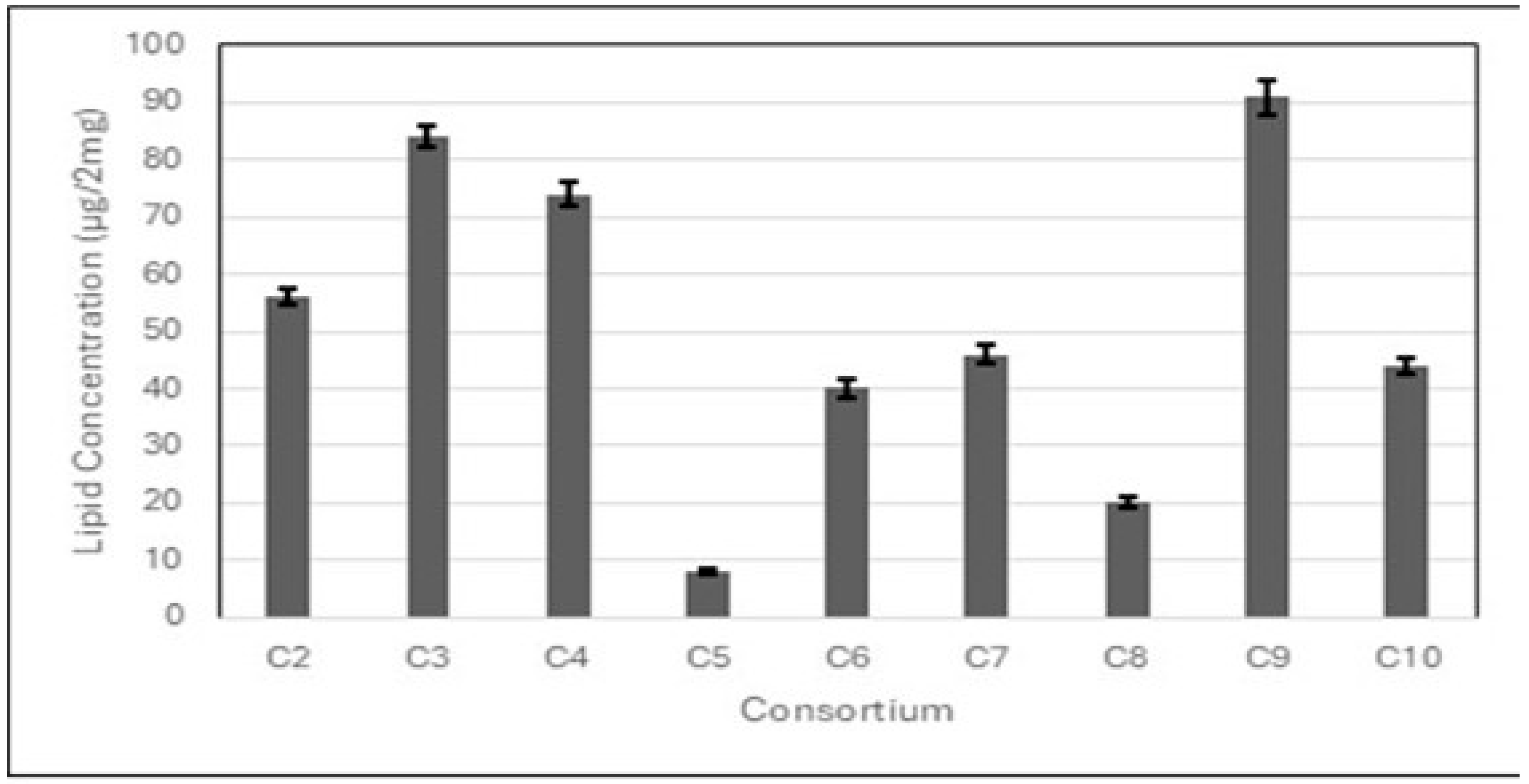
The Sulfo-Phospho-Vanillin (SPV) method was then applied to screen the isolated nine strains using triolein standard calibration. Figure 2 shows that consortium C9 had the highest lipid accumulation, followed by C3 and C4, with lipid yields of 91, 86, and 75 µg/3 mg, representing 3.1, 2.9, and 2.5% (w/w), respectively. Other consortia had lipid yields of less than 2.0%; hence, consortia C9, C3, and C4 were selected for further analysis. The lipid contents of these consortia were much below the average for some notable high lipid-producing microalgae such as Nannochloropsis, Scenedesmus, and Schizochytrium, whose lipid yields range from 37 to 60, 30 to 50, and 50 to 77 wt.%, respectively [39]. They demonstrate the potential for simultaneous wastewater remediation and lipid production. Therefore, the lipid accumulation results confirm that the isolated consortia can serve as dual-purpose agents—removing nutrients while generating biomass enriched in lipids. However, growth optimization studies are needed to optimize the lipid productivity from the newly isolated consortia. Moreover, strategies such as nutrient stress induction, co-culture engineering, and photobioreactor design could enhance lipid productivity. Linking these findings to the introduction, this study provides a proof-of-concept for integrating wastewater treatment with bioenergy production, advancing circular bioeconomy goals.
Note that the Sulfo-Phospho-Vanillin (SPV) assay was selected for lipid quantification due to its simplicity and compatibility with high-throughput screening. However, we acknowledge that SPV can be influenced by interfering compounds such as pigments and carbohydrates, which are abundant in mixed microalgal consortia. To mitigate these effects, samples were thoroughly washed and dried prior to analysis, and lipid estimates were normalized against a triolein calibration curve to improve accuracy. Despite these precautions, SPV remains a colorimetric method that provides semi-quantitative results rather than absolute lipid content, particularly in heterogeneous samples. Future work should incorporate complementary techniques such as gravimetric extraction or gas chromatography–mass spectrometry (GC-MS) to validate SPV results and ensure robust quantification across diverse species.

3.2. Identification of the Wastewater Consortium

Shotgun metagenomics was performed to evaluate the algal consortium taxonomy and gene functions. Once the abundance files from each consortium were obtained, they were analyzed using the microbiomeanalyst pipeline [40]. Data were filtered for low count and low variance using default parameters, which resulted in the removal of 132 low-abundance features based on prevalence and 126 low-variance features based on the Interquartile Range (IQR). A total of 1128 features remained for downstream processing after the data filtering step. Sequences were then rarefied to the minimum library size, and total sum scaling was performed to account for sample variability so that biologically meaningful comparisons could be drawn.
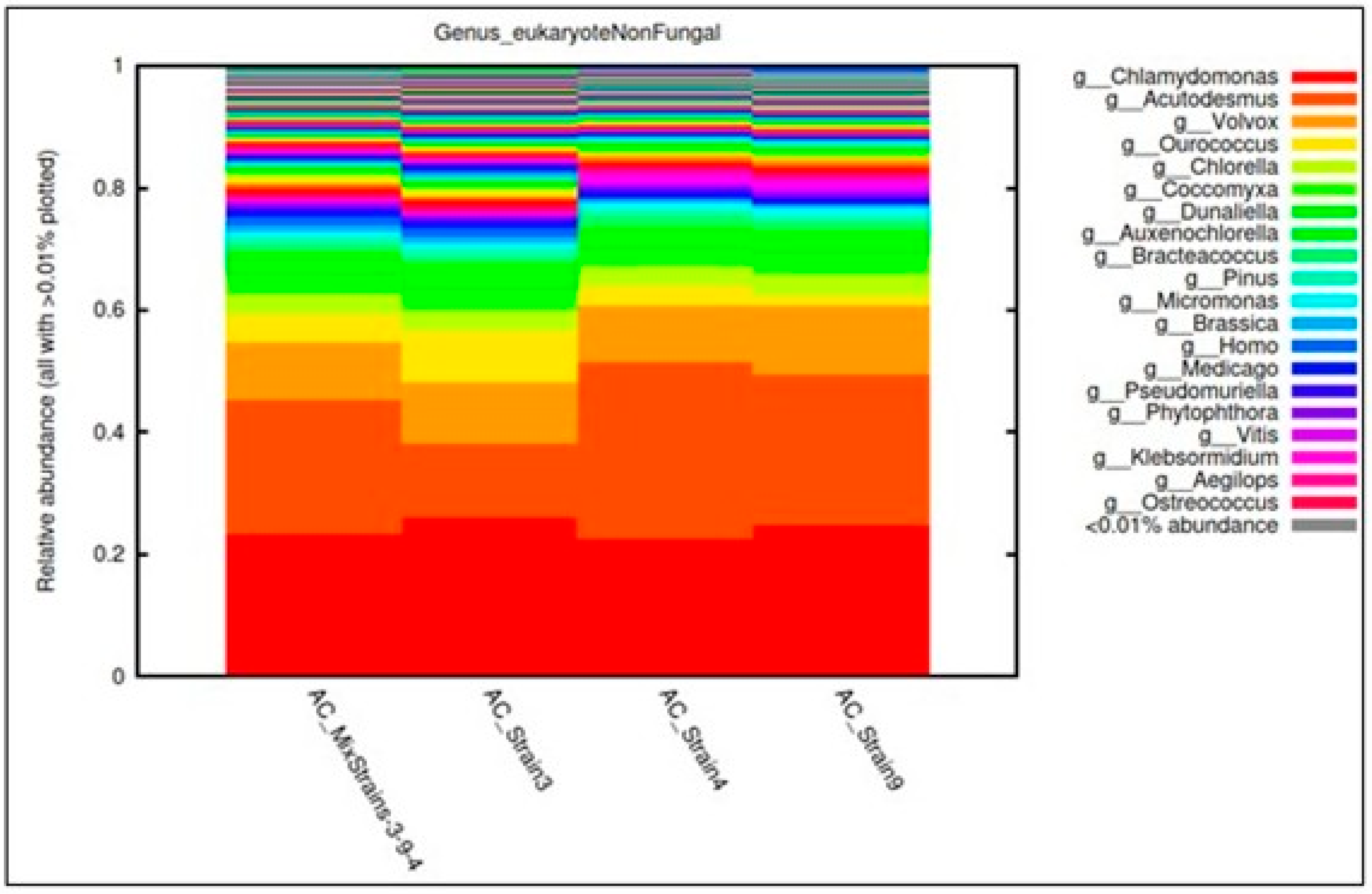
As shown in Figure 3, regardless of the sample, the algal consortia were dominated by Chlamydomonas spp., which form the core microbiome in these samples. Notably, Chlamydomonas has been found in diverse ecological niches ranging from fresh to marine environments and wastewater [41]. Moreover, Chlamydomonas are known for their rigorous biodegradative abilities in the presence or absence of bacteria [42]. Another group working on phytoremediation of wastewater found that Chlamydomonas was a prime candidate for removing the nutrients and significantly decreasing the amount of nitrate and orthophosphate [43].
In addition to Chlamydomonas, our algal consortia were represented by at least 20% of Acutodesmus spp., which have also been studied to reduce nutrients in wastewater from anaerobic digesters using mixtures of agro-industrial wastes [44]. The third genus in our consortia was represented at about 15% by Volvox sp., which has been identified to uptake nutrients in freshwater [45]. With these diverse groups of algae, it can be hypothesized that they are working in tandem to uptake wastewater nutrients and produce lipid precursors for biodiesel production.

3.3. Bacterial, Archaeal, and Fungal Assemblages in the Consortia

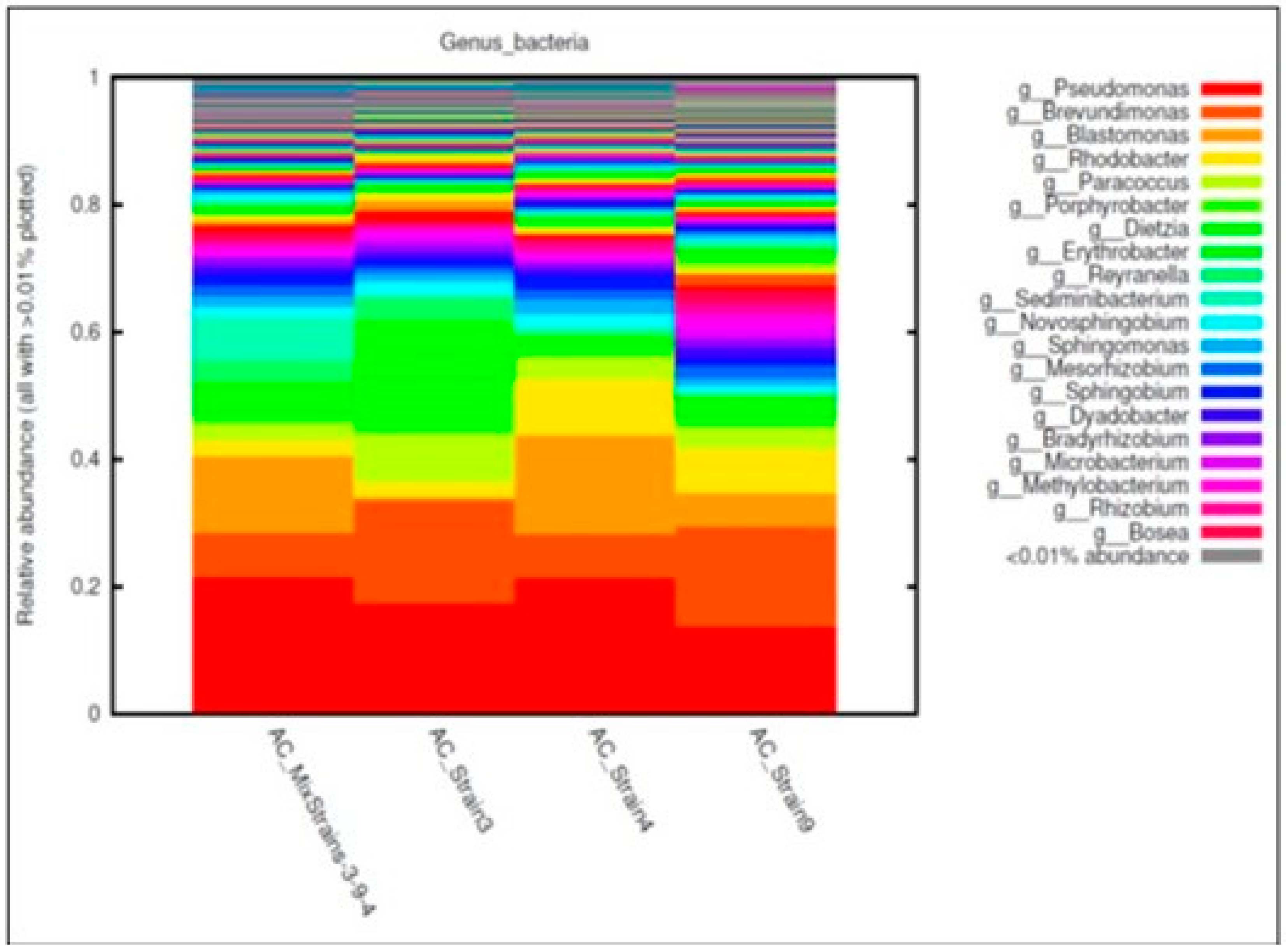
Shotgun-based metagenomic analysis revealed that the microalgal consortium used in this study mainly comprised five phyla that accounted for more than 90% of the total relative abundance. Among these were Pseudomonadota (synonym “Proteobacteria”), which accounted for over 70% of the significant diversity, followed by Actinomycetota (or Actinobacteria), Bacteroidota, and Bacillota. Pseudomonadota have been commonly found dominating bacterial phyla in microalgal consortia, possibly due to the carbon degradation ability of Pseudomonadota, requiring oxygen from the microalgae and supplying CO2 in a symbiotic relationship [46]. Similar studies by Numberger et al. [47] in a wastewater treatment plant in Berlin, Germany, also showed these phyla to be predominant wastewater microorganisms. Furthermore, 16S’s identification of a wastewater microbial community in Shanxi, China, also showed the abundance of Pseudomonadota and Actinomycetota, with the members of the genus Thiobacillus and Comamonas dominating the overall bacterial population [48].
At the genus level, it was observed that Pseudomonas, Brevundimoas, Blastomonas, and Rhodobacter were the most prevalent genera in the consortia, consisting of over 40% of the group (Figure 4). It does appear that the bacterial community is diverse and has a mutualistic symbiotic relationship with the algae. Along the lines of our findings, Numberger et al. [47] also concluded that Pseudomonas was a major environmental microorganism in wastewater treatment compared to the whole genomic community. Likewise, Pastore and Sforza [49] identified a symbiotic relationship between Chlorella protothecoides and Brevundimonas in which nutrients were exchanged/converted for growth during water remediation. In addition, Lee et al. [50] discovered Blastomonas to be a novel species related to wastewater treatment that also has high fatty acid content. Finally, Rhodobacter is known to have diverse metabolic activities based on the environment, and one pathway is bioremediation [51].
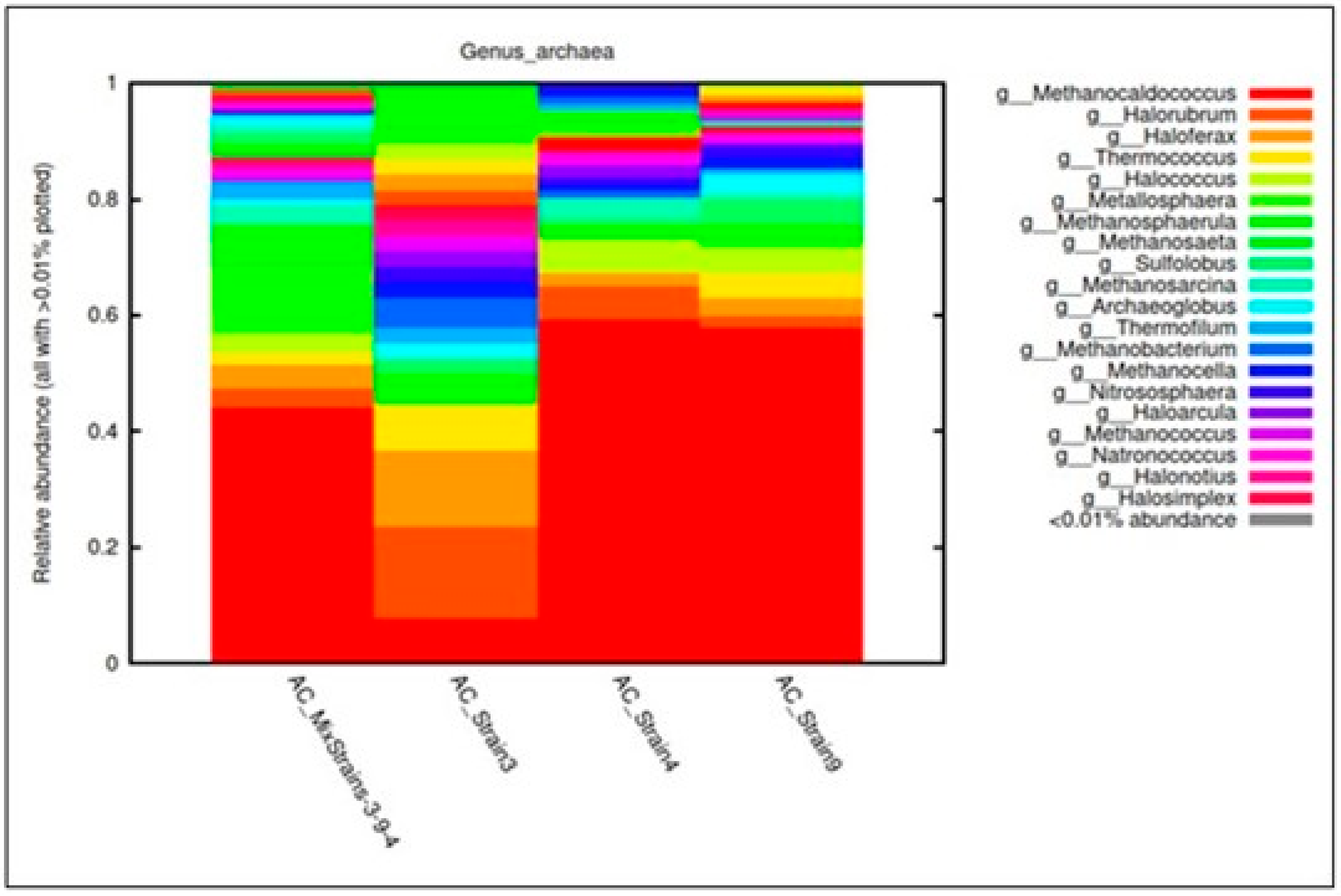
Among the archaeal members, phyla Euryarchaeota, Thaumarchaeota, and Crenarchaeota dominated the archaeal group in the consortia. The percentage abundance of the phylum Euryarchaeota in C4 and C9 was over 80% and the phylum Thaumarchaeota was about 25% in the mixed consortia. However, Jabari et al. [52] found that the phylum Euryarchaeota was only 8.9% of the microorganisms in wastewater and 70% less than the identified phyla in the consortia. Antwi et al. [53] found that the phylum Euryarchaeota was the second most abundant group in wastewater at 22%, so Euryarchaeota is a consistent member of wastewater algal consortia. In addition, the phylum Thaumarchaeota was only identified to make up to 5.4% of the total community in municipal wastewater [54]. The phylum Crenarchaeota was low in the consortia because it has been previously discovered to have less tolerance to wastewater [55,56].
At the genus level, the archaeal members of the consortium community mainly consisted of Methanocaldococcus spp. (Figure 5), followed by Halorubrum and Haloferax spp. Notably, Methanosarcina spp. have been reported to enhance the generation of n-alkane-rich biofuels from microalgae [57]. It is highly likely that Methanosarcina spp. play critical roles within the wastewater treatment, especially under anaerobic conditions [58]. Halorubrum is an extremophile that grows in harsh environments such as Salt Lakes in Africa and the Antarctic ice [59,60], and such a trait could explain why it overcomes the harsh wastewater environment. Further microorganisms that are known for bioremediation are Haloferax spp., which have been found with an anaerobic metabolism pathway for denitrification in various media [61]. In all, the archaeal members of the consortia were already known for their crucial ecological roles in the community.
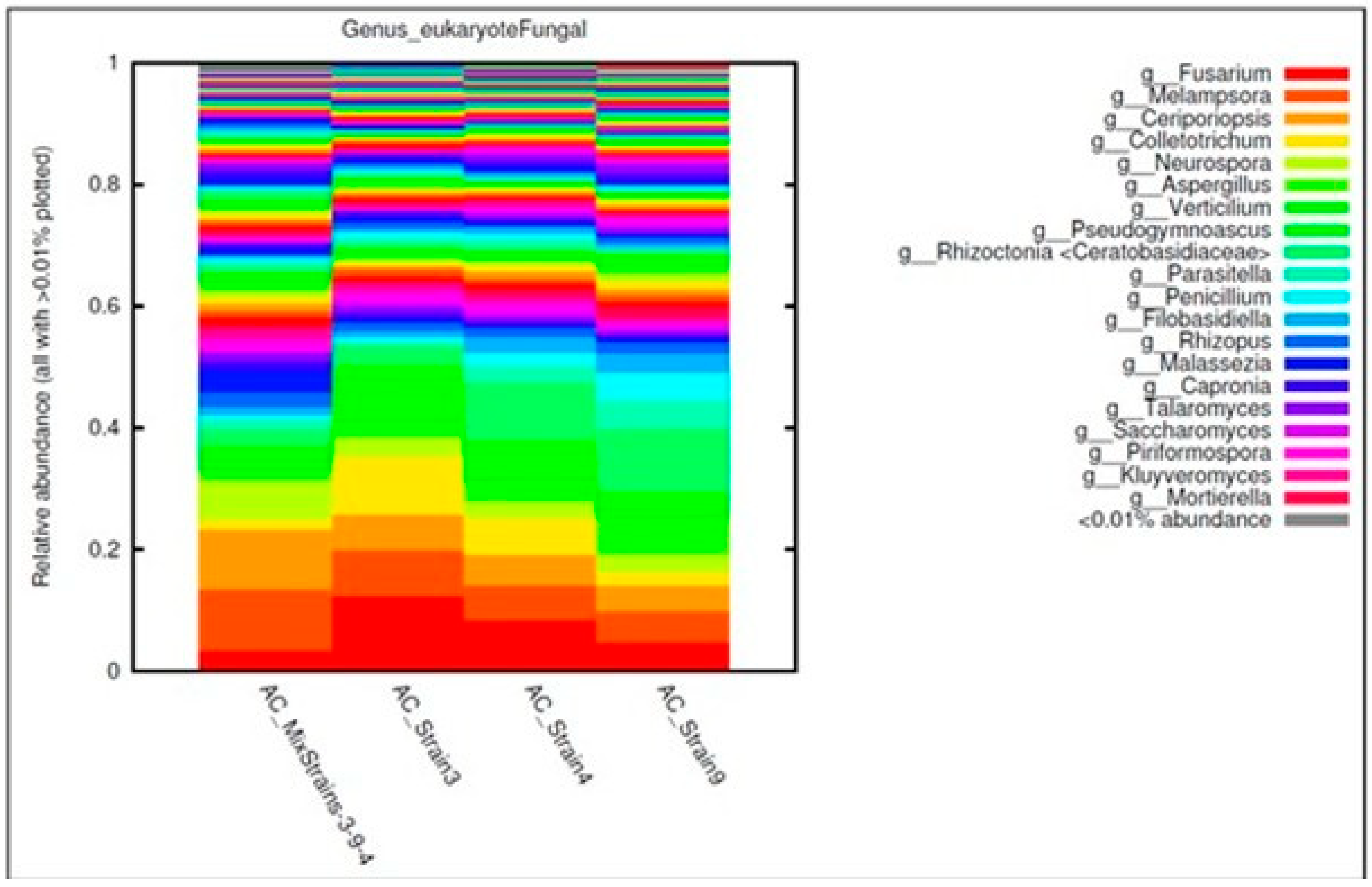
Looking at the fungal community in the consortia, the Ascomycota and Basidiomycota phyla dominated over 97% of the total relative abundance of the fungal members. Other members of the community were Glomeromycota and Chytridiomycota, Cryptomycota and Blastocladiomycota, being present in exceptionally low abundance in the consortia. There are comparable results in a South African study, where three wastewater treatment plants were sampled, and the fungal members of the consortia were dominated by Ascomycota and Basidiomycota [62]. At the genus level, Fusarium spp. dominated (Figure 6). The Fusarium-Chlorella consortium has treatment of wastewater better than monocultures [63].

3.4. Gene Functional Analysis in the Consortia

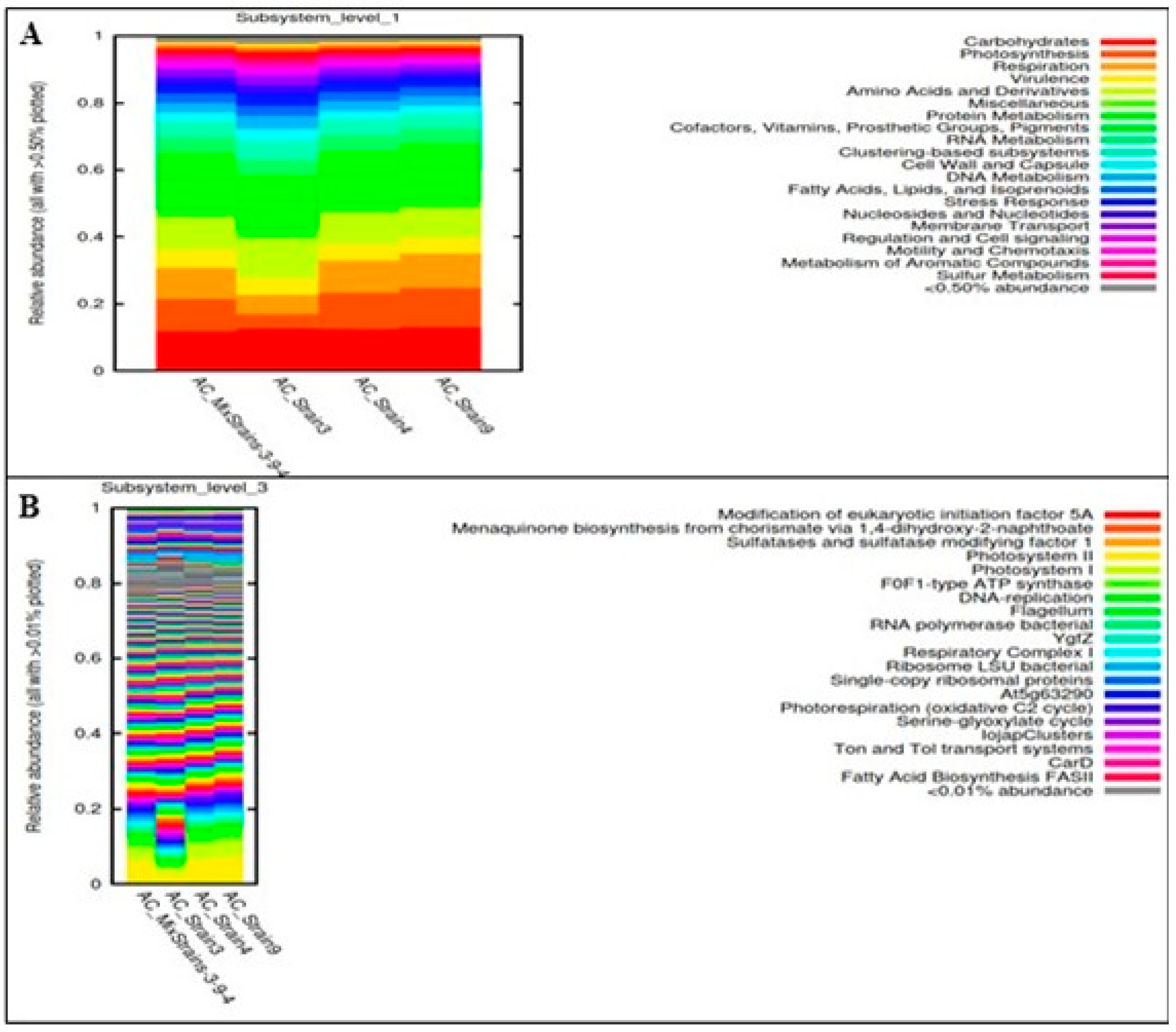
We also investigated the gene functions of algal, bacterial, archaeal, and fungal communities in the consortium. As shown in Figure 7A, functional metagenomics at subsystem level 1 indicated that genes performing functions related to carbohydrate metabolism, photosynthesis, protein metabolism, amino acids and derivatives, and respiration were the most abundant functions being performed in the consortium. Although at lower levels, functions related to stress response, membrane transport, fatty acids, lipids and isoprenoids, and metabolism of aromatic compounds were also observed in the consortium.
It was noteworthy that at subsystem level 3, several gene classes known to facilitate the growth of algae, including the photosystem I and II, YgfZ proteins, photorespiration (oxidative C2 cycle), and fatty acid biosynthesis FASII, were observed in the consortia (Figure 7B). The high abundance of carbohydrate metabolic genes in microalgae is required for biofuel production and cell maintenance [64].

3.5. Wastewater Remediation by the Isolated Consortia

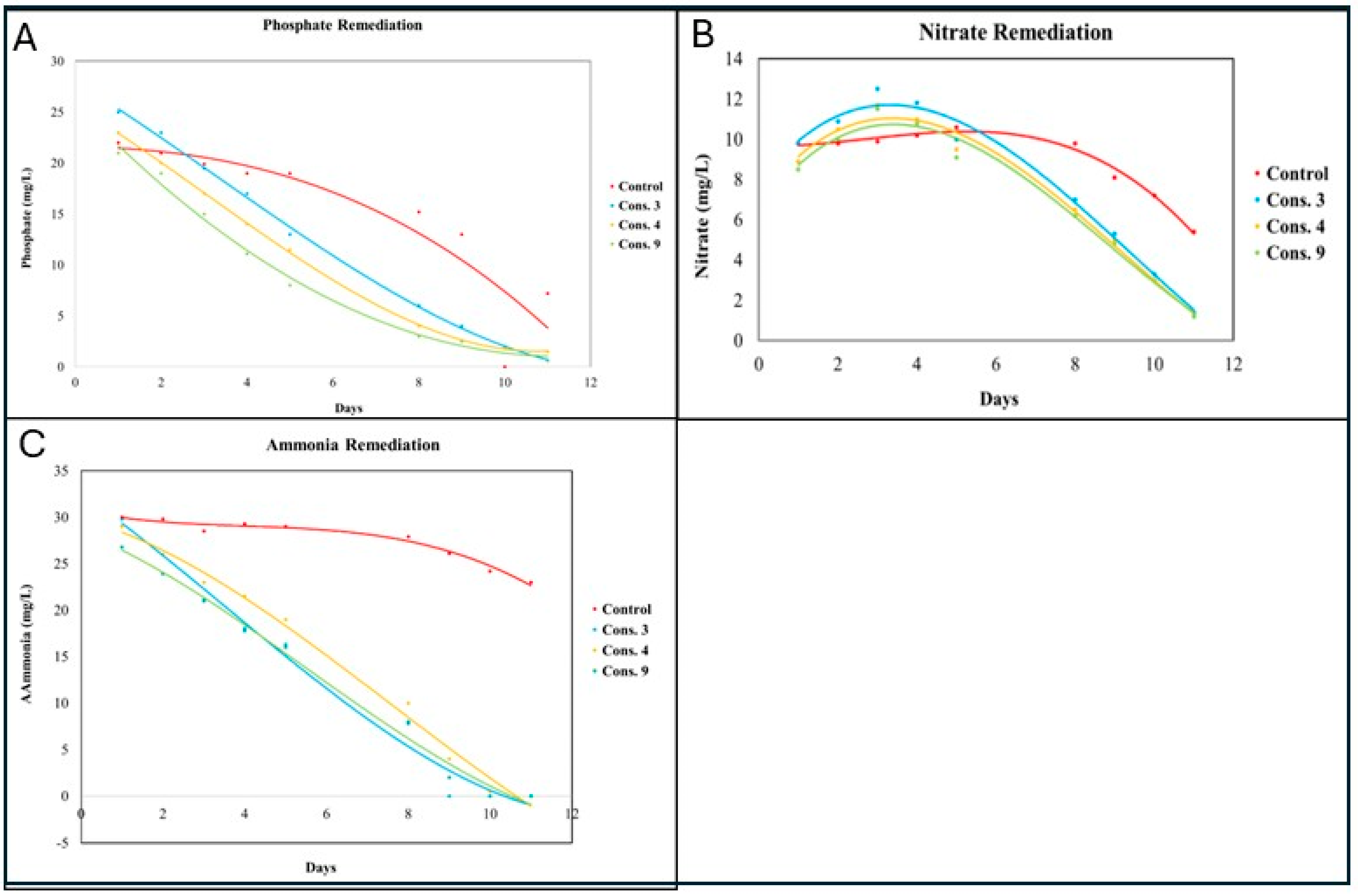
Consortia 3, 4, and 9 were evaluated for their ability to utilize wastewater nutrients, specifically phosphate, ammonia, and nitrate. As shown in Figure 8A–C, the phosphate, nitrate, and ammonia were effectively consumed by the consortial members over a 12-day period. For phosphorus (P), the experimental data demonstrated varying efficiencies of (P) removal from wastewater by three microbial consortia—Consortia 3, 4, and 9—compared to the control, which did not contain any strain but just wastewater (Figure 8). Consortium 9 exhibited the highest phosphorus utilization, showing a rapid and near-complete depletion of P over the course of the experiment. This suggests a robust metabolic capacity and strong adaptation to wastewater conditions. Consortium 4 showed moderate efficiency, with a steady decline in phosphorus levels, indicating effective but less aggressive uptake. In contrast, Consortium 3 displayed the lowest performance, with slower and less complete phosphorus removal. P in the control experiment also declined, but the consortial treatments reduced P at a significantly higher rate. These findings highlight Consortium 9 as a promising candidate for bioremediation and phosphorus recovery applications.
The nitrogen (N) depletion experiment revealed differential efficiencies among microbial consortia in removing nitrogen from wastewater (Figure 8B). Consortium 9 exhibited the highest nitrogen utilization, characterized by a rapid and substantial decline in nitrogen concentration, indicating robust metabolic activity and the effective assimilation or transformation of nitrogenous compounds. Consortium 4 demonstrated moderate performance, with a consistent but less pronounced reduction in nitrogen levels, suggesting functional nitrogen uptake mechanisms with potentially lower metabolic rates or substrate affinity. In contrast, Consortium 3 showed the least efficiency, with minimal nitrogen removal observed throughout the experimental period. The control treatment exhibited negligible changes in nitrogen concentration, confirming that the observed depletion was attributable to microbial activity. These findings highlight Consortium 9 as a promising candidate for nitrogen bioremediation and wastewater treatment applications, while further optimization may be required to enhance the performance of Consortia 3 and 4.
As shown for P and N, the ammonia depletion profile indicates differential capabilities among microbial consortia in removing ammonia from wastewater (Figure 8C). Again, Consortium 9 demonstrated the highest efficiency, with a rapid and pronounced decrease in ammonia concentration, suggesting strong nitrification or assimilation activity. Consortium 4 showed moderate performance, characterized by a steady but less aggressive reduction in ammonia levels, indicating functional but potentially slower metabolic pathways. Consortium 3 exhibited the lowest ammonia removal efficiency, with minimal depletion observed over the experimental period. The control treatment showed negligible change in ammonia concentration, confirming that the observed reductions were attributable to microbial activity. These results position Consortium 9 as a promising candidate for ammonia bioremediation and wastewater treatment, while further optimization may be necessary to enhance the performance of Consortia 3 and 4. We point out that the presentation of ammonia rather than ammonium in our results reflects the relatively alkaline pH of the wastewater (6.8–7.5), which favors the un-ionized form (NH3). Free ammonia is known to be toxic to many microalgal species, potentially inhibiting photosynthesis and growth at elevated concentrations. In our experiments, toxicity may have been mitigated by two factors: (i) the presence of mixed consortia, which likely facilitated ammonia assimilation through synergistic interactions with bacteria, and (ii) controlled aeration and light conditions that promoted rapid uptake and conversion of ammonia into biomass. No visible growth inhibition was observed during the 12-day incubation, suggesting that the consortia were either tolerant to the tested concentrations or adapted to wastewater conditions. Future studies should quantify free ammonia toxicity thresholds for these consortia and explore strategies such as pH adjustment or staged nitrogen removal to minimize inhibitory effects in large-scale applications.
It is also noteworthy to add that environmental parameters were carefully controlled to ensure comparability among consortia for nutrient remediation abilities. All nutrient removal experiments were conducted under standardized conditions: light intensity was maintained at approximately 400 µmol photons m−2 s−1 with a 14:10 light/dark cycle, temperature was held at 25 ± 4 °C, and pH was monitored regularly to remain near neutral (6.8–7.2). Inoculum size was normalized by wet weight (2 g per 200 mL wastewater) across all treatments, and mixing was consistent to prevent sedimentation. These controls were implemented to minimize confounding factors and ensure that observed differences in nutrient removal efficiency reflected biological variability among consortia rather than environmental fluctuations.
However, even though these parameters were standardized, micro-scale variations in consortial composition could still influence performance. Future work could incorporate real-time monitoring of dissolved oxygen and CO2 to further refine environmental control and better understand metabolic dynamics.
Of relevance to mention here is that the US Environmental Protection Agency generally recommends a limit of 1.0 mg/L total phosphorus and total nitrogen for wastewater effluents. However, limits to nutrient contents of wastewater are being placed and enforced by the state environmental agency depending on the wastewater treatment facility. For example, the T.P. Waste Reclamation Facility (TPWRF) has a total nitrogen limit of 3 mg/L and total phosphorus of 1.0 mg/L [29]. The consortial strains isolated in this project have exhibited the capacity to reduce the nutrient contents of the influent to the T.P. Waste Reclamation Facility below the acceptable limit. Overall, the coupled approach for wastewater serving as the medium for algal biomass production has tremendous potential to achieve sustainable production of biofuels and other biobased products.
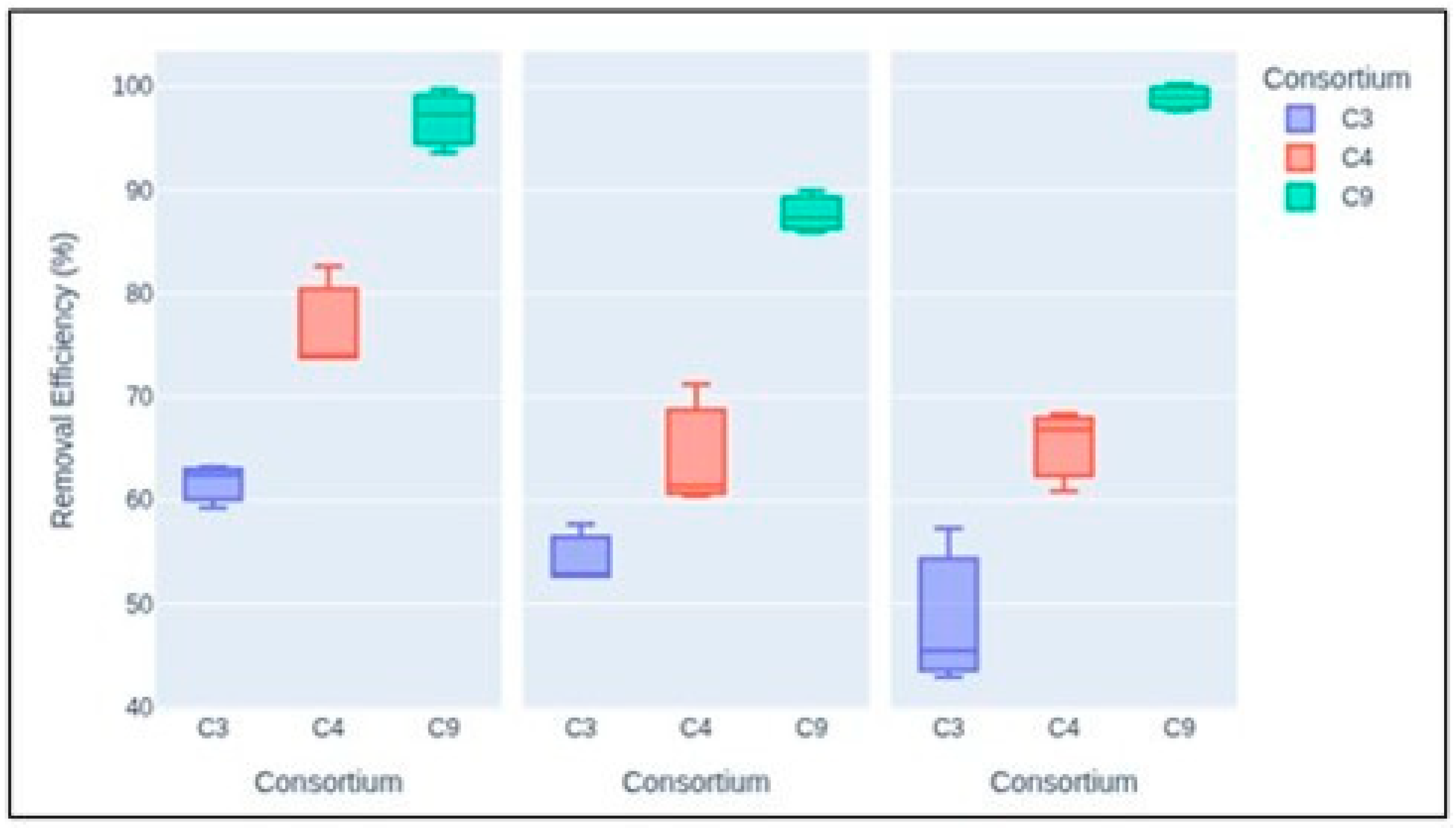
Finally, statistical analysis using ANOVA revealed significant differences in nutrient removal performance among the three consortia for all tested parameters (Figure 9). For phosphate removal, F(2,6) = 315.71, p < 0.0001, with C9 showing the highest mean removal (95%), significantly greater than C4 (80%) and C3 (60%). For nitrate removal, F(2,6) = 374.73, p < 0.0001, with C9 (89%) outperforming C4 (70%) and C3 (50%). Similarly, ammonia removal differed significantly among consortia, F(2,6) = 199.06, p < 0.0001, with C9 achieving near-complete removal (100%), followed by C4 (85%) and C3 (65%).
Tukey’s post hoc test confirmed that C9 was significantly different from both C3 and C4 for all nutrients, while C4 and C3 also differed significantly for ammonia and phosphate but not for nitrate. Boxplots (Figure 9) illustrate these differences and variability within replicates. The statistical analysis confirms that the observed differences in nutrient removal among consortia are biologically meaningful and not due to experimental variability. Consortium C9 consistently demonstrated superior performance across all nutrient categories, suggesting a more efficient metabolic network or synergistic interactions among its microbial members. The significant differences between C4 and C3 in terms of phosphate and ammonia removal indicate that even moderate shifts in community composition can substantially impact bioremediation efficiency. These findings underscore the importance of consortial structure in wastewater treatment applications and highlight C9 as a promising candidate for scale-up. Future work should explore the functional genomics underlying these differences and assess whether environmental optimization could further enhance performance.
One final cautionary interpretation on the nutrient removal trends observed in Figure 8; we believe that these are primarily attributed to biological activity within the algal–microbial consortia; however, abiotic mechanisms may also contribute. Adsorption of phosphate and ammonium ions onto cell surfaces or extracellular polymeric substances, as well as chemical precipitation of phosphorus under certain pH and ionic conditions, are known to occur in wastewater environments. While our experimental setup maintained relatively stable pH and did not include chemical additives, these processes cannot be completely excluded. Future studies should incorporate abiotic controls (e.g., sterilized biomass or filtered wastewater) to quantify the relative contributions of biological versus physicochemical mechanisms, thereby improving interpretation of nutrient removal pathways.
It should also be noted that the potential application of these consortia in wastewater treatment systems raises important biosafety and ecological considerations. Although the strains were isolated from municipal wastewater and are therefore native to such environments, concentrating and reintroducing them could alter microbial community dynamics or facilitate unintended dispersal of opportunistic species. Risks include horizontal gene transfer, proliferation of antibiotic resistance genes, and ecological imbalance if consortia escape into natural water bodies. While our study did not specifically evaluate these risks, future work should incorporate comprehensive biosafety assessments, including pathogenicity screening, antibiotic resistance profiling, and ecological impact modeling. Regulatory compliance with local and federal guidelines (e.g., EPA and state environmental agencies) will be essential before any large-scale deployment.

4. Conclusions

This study demonstrates the potential of native oleaginous microalgal consortia isolated from the Thomas P. Smith Water Reclamation Facility for integrated wastewater nutrient remediation and lipid production. The consortia, dominated by Chlamydomonas, Acutodesmus, and Volvox species, exhibited robust metabolic capabilities, achieving near-complete removal of ammonia, nitrate, and phosphorus while accumulating lipids suitable for biofuel applications. Functional metagenomic analysis revealed active pathways for photosynthesis, fatty acid biosynthesis, and nutrient assimilation, underscoring the ecological and biotechnological relevance of these communities. By coupling wastewater treatment with bioenergy generation, this approach advances circular bioeconomy strategies and offers a sustainable solution for nutrient management in subtropical regions. Future research should incorporate multi-site sampling across diverse climatic zones and seasonal variations to validate the robustness and scalability of the proposed approach for integrated wastewater remediation and biofuel production.

Supplementary Materials

The following supporting information can be downloaded at: https://www.mdpi.com/article/10.3390/su172411166/s1, Figure S1: An aerial image of the TP Smith Wastewater Reclamation Facility, Tallahassee, Fl. Three untreated wastewater samples- S1, S2 and S3 for the isolation of oleaginous consortia were collected from the holding tanks and further processed as stated in the main article; Figure S2: The FACS event log and gating strategy for sample S1. Shown are A, that demonstrates the gating strategy used to select event clusters for the sorting, plotted by the relative fluorescence units (RFU) at 660/20nm against RFU at 780/60 nm. The events gated in “A” obtained a unique color set which corresponds to the gate that was carried forward to all plots associated with the sort as shown in B Gate P3 was sorted onto 96-well microtiter plates containing solid BG-11 growth media; Figure S3: The FACS event log and gating strategy for sample S2. Gates P9, P8, P7, and P6 were created. Gate P6 was sorted at a rate of 1 event per well, onto 96-well microtiter plates containing solid BG11 growth media; Figure S4: The FACS Event Log and Gating Strategy for sample S3. Graph A plots RFU at 530/30 nm against Side Scatter Complexity (SCC)-a measure of inner cell complexity as a function of light diffraction through the event. The events gated in A obtained a unique color set which corresponds to the gate that was carried forward to all plots associated with the sort as shown in B. Gate P2 was sorted at a rate of 1 event per well onto 96-well microtiter plates containing solid BG11 growth media; Figure S5: Green colonies that grew on BG11 microtiter plates were further streaked and isolated onto BG11 agar plates for this study.

Author Contributions

B.E.III, D.A., A.P. and A.C. designed experiments. B.E.III performed the lab experiments. A.P. performed the bioinformatics. B.E.III, A.P., D.P.S. and A.C. wrote the manuscript. All authors have read and agreed to the published version of the manuscript.

Funding

The Florida Department of Agriculture and Consumer Service (FDACs) Office of Energy supported this work through agreement #24552. This research was also partly funded by the Department of Energy (DOE) Minority Serving Institution Partnership Program (MSIPP) task order agreement 800002172; the National Science Foundation awards 1901371 and 2200615; Department of Energy’s University Training & Research Program University Coal Research (UCR) and Historically Black Colleges and Universities and Other Minority Institutions (HBCU-OMI) award #DE-FE0032198; and the Department of Defense contract #W911NF2210145.

Institutional Review Board Statement

Not applicable.

Informed Consent Statement

Not applicable.

Data Availability Statement

The shotgun metagenomic sequence data obtained from this study are available from NCBI’s Sequence Read Archive/European Nucleotide Archive, accession under BioProject ID PRJNA1198942, Biosample numbers, and SAMN45875459, SAMN45875460, SAMN45875461 and SAMN45875462, respectively. A direct link to the data is as follows: https://submit.ncbi.nlm.nih.gov/subs/sra/SUB14932812/overview, accessed on 7 December 2025.

Conflicts of Interest

The authors declare no conflicts of interest.

References

  1. Neste Corporation. 4 Reasons why the World Needs Biofuels, 2016. Available online: https://www.neste.com/news/4-reasons-why-the-world-needs-biofuels (accessed on 13 March 2025).
  2. US Department of Energy (DOE). Biofuel Basics. Available online: https://www.energy.gov/eere/bioenergy/biofuel-basics (accessed on 12 March 2025).
  3. Kozyatnyk, I.; Benavente, V.; Weidemann, E.; Jansson, S. Adsorption of organic contaminants of emerging concern using microalgae-derived hydrochars. Sci. Rep. 2025, 15, 9059. [Google Scholar] [CrossRef]
  4. Wang, M.; Ye, X.; Bi, H.; Shen, Z. Microalgae biofuels: Illuminating the path to a sustainable future amidst challenges and opportunities. Biotechnol. Biofuels 2024, 17, 10. [Google Scholar] [CrossRef]
  5. Williams, P. Biofuel: Microalgae cut the social and ecological costs. Nature 2007, 450, 478. [Google Scholar] [CrossRef]
  6. Gopalakrishnan, K.; Wager, Y.Z.; Roostaei, J. Co-cultivation of microalgae and bacteria for optimal bioenergy feedstock production in wastewater by using response surface methodology. Sci. Rep. 2024, 14, 20703. [Google Scholar] [CrossRef]
  7. Berthold, D.E.; Shetty, K.G.; Jayachandran, K.; Laughinghouse, H.D.; Gantar, M. Enhancing algal biomass and lipid production through bacterial co-culture. Biomass Bioenergy 2019, 122, 280–289. [Google Scholar] [CrossRef]
  8. Dao, G.; Wu, G.; Wang, X.; Zhang, T.; Zhan, X.; Hu, H. Enhanced microalgae growth through stimulated secretion of indole acetic acid by symbiotic bacteria. Algal Res. 2018, 33, 345–351. [Google Scholar] [CrossRef]
  9. Gao, Y.; Bernard, O.; Fanesi, A.; Perré, P.; Lopes, F. The effect of light intensity on microalgae biofilm structures and physiology under continuous illumination. Sci. Rep. 2024, 14, 1151. [Google Scholar] [CrossRef] [PubMed]
  10. Cabanelas, I.T.D.; Slegers, P.M.; Böpple, H.; Kleinegris, D.M.; Wijffels, R.H.; Barbosa, M.J. Outdoor performance of Chlorococcum littorale at different locations. Algal Res. 2017, 27, 55–64. [Google Scholar] [CrossRef]
  11. Okoro, V.; Azimov, U.; Munoz, J.; Hernandez, H.H.; Phan, A.N. Microalgae cultivation and harvesting: Growth performance and use of flocculants—A review. Renew. Sustain. Energy Rev. 2019, 115, 109364. [Google Scholar] [CrossRef]
  12. Zhou, J.; Leavitt, P.R.; Zhang, Y.; Qin, B. Anthropogenic eutrophication of shallow lakes: Is it occasional? Water Res. 2022, 221, 118728. [Google Scholar] [CrossRef]
  13. Wright, H. Phosphorus in Wastewater: What Is It & Why Must It Be Removed? 2022. Available online: https://www.garrisonminerals.com/post/phosphorus-in-wastewater (accessed on 12 March 2025).
  14. Pinelli, D.; Bovina, S.; Rubertelli, G.; Martinelli, A.; Guida, S.; Soares, A.; Frascari, D. Regeneration and modelling of a phosphorous removal and recovery hybrid ion exchange resin after long term operation with municipal wastewater. Chemosphere 2022, 286, 131581. [Google Scholar] [CrossRef]
  15. Hasan, M.N.; Altaf, M.M.; Khan, N.A.; Khan, A.H.; Khan, A.A.; Ahmed, S.; Kumar, P.S.; Naushad, M.; Rajapaksha, A.U.; Iqbal, J.; et al. Recent technologies for nutrient removal and recovery from wastewaters: A review. Chemosphere 2021, 277, 130328. [Google Scholar] [CrossRef] [PubMed]
  16. Marques, R.; Santos, J.; Nguyen, H.; Carvalho, G.; Noronha, J.; Nielsen, P.H.; Reis, M.A.; Oehmen, A. Metabolism and ecological niche of Tetrasphaera and Ca. Accumulibacter in enhanced biological phosphorus removal. Water Res. 2017, 122, 159–171. [Google Scholar] [CrossRef] [PubMed]
  17. Zheng, Y.; Wan, Y.; Zhang, Y.; Huang, J.; Yang, Y.; WTsang, D.C.; Wang, H.; Chen, H.; Gao, B. Recovery of phosphorus from wastewater: A review based on current phosphorous removal technologies. Crit. Rev. Environ. Sci. Technol. 2022, 53, 1148. [Google Scholar] [CrossRef] [PubMed]
  18. Plouviez, M.; Brown, N. Polyphosphate accumulation in microalgae and cyanobacteria: Recent advances and opportunities for phosphorus upcycling. Curr. Opin. Biotechnol. 2024, 90, 103207. [Google Scholar] [CrossRef]
  19. Thomas, P. Smith Water Reclamation Facility. Available online: https://en.wikipedia.org/wiki/Thomas_P._Smith_Water_Reclamation_Facility (accessed on 3 November 2025).
  20. Faried, M.; Khalifa, A.; Samer, M.; Attia, Y.A.; Moselhy, M.A.; Yousef, R.S.; Abdelbary, K.; Abdelsalam, E.M. Biostimulation of green microalgae Chlorella sorokiniana using nanoparticles of MgO, Ca10(PO4)6(OH)2, and ZnO for increasing biodiesel production. Sci. Rep. 2023, 13, 19730. [Google Scholar] [CrossRef]
  21. Ren, H.; Xiao, R.; Kong, F.; Zhao, L.; Xing, D.; Ma, J.; Ren, N.; Liu, B. Enhanced biomass and lipid accumulation of mixotrophic microalgae by using low-strength ultrasonic stimulation. Bioresour. Technol. 2019, 272, 606–610. [Google Scholar] [CrossRef]
  22. Laezza, C.; Salbitani, G.; Carfagna, S. Fungal Contamination in Microalgal Cultivation: Biological and Biotechnological Aspects of Fungi-Microalgae Interaction. J. Fungi 2022, 8, 1099. [Google Scholar] [CrossRef]
  23. Huy, M.; Kumar, G.; Kim, H.; Kim, S. Photoautotrophic cultivation of mixed microalgae consortia using various organic waste streams towards remediation and resource recovery. Bioresour. Technol. 2018, 247, 576–581. [Google Scholar] [CrossRef]
  24. Acién Fernández, F.G.; María, J. Recovery of Nutrients from Wastewaters Using Microalgae. Front. Sustain. Food Syst. 2018, 2, 396930. [Google Scholar] [CrossRef]
  25. Oswald, W.; Gotaas, H. Photosynthesis in Sewage Treatment. Trans. Am. Soc. Civ. Eng. 1957, 122, 73–105. [Google Scholar] [CrossRef]
  26. Ramanan, R.; Kim, B.; Cho, D.; Oh, H.; Kim, H. Algae–bacteria interactions: Evolution, ecology and emerging applications. Biotechnol. Adv. 2016, 34, 14–29. [Google Scholar] [CrossRef]
  27. Su, M.; Dell’Orto, M.; D’Imporzano, G.; Bani, A.; Dumbrell, A.J.; Adani, F. The structure and diversity of microalgae-microbial consortia isolated from various local organic wastes. Bioresour. Technol. 2022, 347, 126416. [Google Scholar] [CrossRef]
  28. City of Tallahassee. Waste Water Services. Available online: https://www.talgov.com/you/wastewater (accessed on 15 March 2025).
  29. Pfeffer, K. Tallahassee WRF: Stringent Limits and Information Modeling, 2025. Available online: https://www.hazenandsawyer.com/projects/process-and-information-modeling-tallahassee-wrf (accessed on 15 March 2025).
  30. Pereira, H.; Barreira, L.; Mozes, A.; Florindo, C.; Polo, C.; Duarte, C.V.; Custódio, L.; Varela, J. Microplate-based high throughput screening procedure for the isolation of lipid-rich marine microalgae. Biotechnol. Biofuels 2011, 4, 61. [Google Scholar] [CrossRef]
  31. Govender, T.; Ramanna, L.; Rawat, I.; Bux, F. BODIPY staining, an alternative to the Nile Red fluorescence method for the evaluation of intracellular lipids in microalgae. Bioresour. Technol. 2012, 114, 507–511. [Google Scholar] [CrossRef]
  32. Rayati, M.; Rajabi Islami, H.; Shamsaie Mehrgan, M. Light Intensity Improves Growth, Lipid Productivity, and Fatty Acid Profile of Chlorococcum oleofaciens (Chlorophyceae) for Biodiesel Production. BioEnergy Res. 2020, 13, 1235–1245. [Google Scholar] [CrossRef]
  33. Mishra, S.K.; Suh, W.I.; Farooq, W.; Moon, M.; Shrivastav, A.; Park, M.S.; Yang, J.-W. Rapid quantification of microalgal lipids in aqueous medium by a simple colorimetric method. Bioresour. Technol. 2014, 155, 330–333. [Google Scholar] [CrossRef]
  34. Buchfink, B.; Xie, C.; Huson, D.H. Fast and sensitive protein alignment using DIAMOND. Nat. Methods 2015, 12, 59–60. [Google Scholar] [CrossRef]
  35. Huson, D.H.; Auch, A.F.; Qi, J.; Schuster, S.C. MEGAN analysis of metagenomic data. Genome Res. 2007, 17, 377–386. [Google Scholar] [CrossRef] [PubMed]
  36. Silva, G.G.Z.; Green, K.T.; Dutilh, B.E.; Edwards, R.A. SUPER-FOCUS: A tool for agile functional analysis of shotgun metagenomic data. Bioinformatics 2016, 32, 354–361. [Google Scholar] [CrossRef] [PubMed]
  37. Xu, Y.; Milledge, J.; Abubakar, A.; Swamy, R.; Bailey, D.; Harvey, P. Effects of centrifugal stress on cell disruption and glycerol leakage from Dunaliella salina. Microalgae Biotechnol. 2015, 1, 20–27. [Google Scholar] [CrossRef]
  38. Karlsson, M.; Karlberg, B.; Olsson, R.J. Determination of nitrate in municipal waste water by UV spectrophotometer. Anal. Chim. Acta 1995, 312, 107–113. [Google Scholar] [CrossRef]
  39. Shivakumar, S.; Serlini, N.; Esteves, S.M.; Miros, S.; Halim, R. Cell Walls of Lipid-Rich Microalgae: A Comprehensive Review on Characterisation, Ultrastructure, and Enzymatic Disruption. Fermentation 2024, 10, 608. [Google Scholar] [CrossRef]
  40. Dhariwal, A.; Chong, J.; Habib, S.; King, I.L.; Agellon, L.B.; Xia, J. Microbiome Analyst: A web-based tool for comprehensive statistical, visual and meta-analysis of microbiome data. Nucleic Acids Res. 2017, 45, W180–W188. [Google Scholar] [CrossRef] [PubMed]
  41. Kong, Q.X.; Li, L.; Martinez, B.; Chen, P.; Ruan, R. Culture of microalgae Chlamydomonas reinhardtii in wastewater for biomass feedstock production. Appl. Biochem. Biotechnol. 2010, 160, 9–18. [Google Scholar] [CrossRef] [PubMed]
  42. Sun, J.; Simsek, H. Bioavailability of Wastewater Derived Dissolved Organic Nitrogen to Green Microalgae Selenastrum capricornutum, Chlamydomonas reinhardtii, and Chlorella vulgaris with/without Presence of Bacteria. J. Environ. Sci. 2017, 57, 346–355. [Google Scholar] [CrossRef]
  43. Shaker, S.; Nemati, A.; Montazeri-Najafabady, N.; Mobasher, M.A.; Morowvat, M.H.; Ghasemi, Y. Treating Urban Wastewater: Nutrient Removal by Using Immobilized Green Algae in Batch Cultures. Int. J. Phytoremediat. 2015, 17, 1177–1182. [Google Scholar] [CrossRef] [PubMed]
  44. Koutra, E.; Grammatikopoulos, G.; Kornaros, M. Microalgal post-treatment of anaerobically digested agro-industrial wastes for nutrient removal and lipids production. Bioresour. Technol. 2017, 224, 473–480. [Google Scholar] [CrossRef]
  45. Goldstein, R.E. Green Algae as Model Organisms for Biological Fluid Dynamics. Annu. Rev. Fluid Mech. 2015, 47, 343–375. [Google Scholar] [CrossRef]
  46. Rodriguez, D.; Santos, K.N.; Nagpala, R.T.; Opulencia, R.B. Metataxonomic Characterization of Enriched Consortia Derived from Oil Spill-Contaminated Sites in Guimaras, Philippines, Reveals Major Role of Klebsiella sp. in Hydrocarbon Degradation. Int. J. Microbiol. 2023, 2023, 3247448. [Google Scholar] [CrossRef]
  47. Numberger, D.; Ganzert, L.; Zoccarato, L.; Mühldorfer, K.; Sauer, S.; Grossart, H.-P.; Greenwood, A.D. Characterization of bacterial communities in wastewater with enhanced taxonomic resolution by full-length 16S rRNA sequencing. Sci. Rep. 2019, 9, 9673. [Google Scholar] [CrossRef]
  48. Ma, Q.; Qu, Y.-Y.; Zhang, X.-W.; Shen, W.-L.; Liu, Z.-Y.; Wang, J.-W.; Zhang, Z.-J.; Zhou, J.-T. Identification of the microbial community composition and structure of coal-mine wastewater treatment plants. Microbiol. Res. Spec. Issue Biodivers. 2015, 175, 1–5. [Google Scholar] [CrossRef]
  49. Pastore, M.; Sforza, E. Exploiting symbiotic interactions between Chlorella protothecoides and Brevundimonas diminuta for an efficient single-step urban wastewater treatment. Water Sci. Technol. 2018, 78, 216–224. [Google Scholar] [CrossRef] [PubMed]
  50. Lee, H.-G.; Ko, S.-R.; Lee, J.-W.; Lee, C.S.; Ahn, C.-Y.; Oh, H.-M.; Jin, L. Blastomonas fulva sp. nov., aerobic photosynthetic bacteria isolated from a Microcystis culture. Int. J. Syst. Evol. Microbiol. 2017, 67, 3071–3076. [Google Scholar] [CrossRef]
  51. Costa, S.; Ganzerli, S.; Rugiero, I.; Pellizzari, S.; Pedrini, P.; Tamburini, E. Potential of Rhodobacter capsulatus Grown in Anaerobic-Light or Aerobic-Dark Conditions as Bioremediation Agent for Biological Wastewater Treatments. Water 2017, 9, 108. [Google Scholar] [CrossRef]
  52. Jabari, L.; Gannoun, H.; Khelifi, E.; Cayol, J.; Godon, J.; Hamdi, M.; Fardeau, M. Bacterial ecology of abattoir wastewater treated by an anaerobic digestor. Braz. J. Microbiol. 2016, 47, 73–84. [Google Scholar] [CrossRef]
  53. Antwi, P.; Li, J.; Boadi, P.O.; Meng, J.; Koblah Quashie, F.; Wang, X.; Ren, N.; Buelna, G. Efficiency of an upflow anaerobic sludge blanket reactor treating potato starch processing wastewater and related process kinetics, functional microbial community and sludge morphology. Bioresour. Technol. 2017, 239, 105–116. [Google Scholar] [CrossRef]
  54. Meerbergen, K.; Geel, M.V.; Waud, M.; Willems, K.A.; Dewil, R.; Impe, J.V.; Appels, L.; Lievens, B. Assessing the composition of microbial communities in textile wastewater treatment plants in comparison with municipal wastewater treatment plants. MicrobiologyOpen 2017, 6, e00413. [Google Scholar] [CrossRef]
  55. Cortés-Lorenzo, C.; Sipkema, D.; Rodríguez-Díaz, M.; Fuentes, S.; Juárez-Jiménez, B.; Rodelas, B.; Smidt, H.; González-López, J. Microbial community dynamics in a submerged fixed bed bioreactor during biological treatment of saline urban wastewater. Ecol. Eng. 2014, 71, 126–132. [Google Scholar] [CrossRef]
  56. Gray, N.D.; Miskin, I.P.; Kornilova, O.; Curtis, T.P.; Head, I.M. Occurrence and activity of Archaea in aerated activated sludge wastewater treatment plants. Environ. Microbiol. 2002, 4, 158–168. [Google Scholar] [CrossRef]
  57. Yamane, K.; Matsuyama, S.; Igarashi, K.; Utsumi, M.; Shiraiwa, Y.; Kuwabara, T. Anaerobic coculture of microalgae with Thermosipho globiformans and Methanocaldococcus jannaschii at 68 °C enhances generation of n-alkane-rich biofuels after pyrolysis. Appl. Environ. Microbiol. 2013, 79, 924–930. [Google Scholar] [CrossRef]
  58. Tabatabaei, M.; Rahim, R.A.; Abdullah, N.; Wright, A.G.; Shirai, Y.; Sakai, K.; Sulaiman, A.; Hassan, M.A. Importance of the methanogenic archaea populations in anaerobic wastewater treatments. Process Biochem. 2010, 45, 1214–1225. [Google Scholar] [CrossRef]
  59. Karray, F.; Ben Abdallah, M.; Baccar, N.; Zaghden, H.; Sayadi, S. Production of Poly(3-Hydroxybutyrate) by Haloarcula, Halorubrum, and Natrinema Haloarchaeal Genera Using Starch as a Carbon Source. Archaea 2021, 2021, 8888712. [Google Scholar] [CrossRef] [PubMed]
  60. Salwan, R.; Sharma, V. (Eds.) Physiological and Biotechnological Aspects of Extremophiles; Academic Press: Cambridge, MA, USA, 2022. [Google Scholar] [CrossRef]
  61. Torregrosa-Crespo, J.; Martínez-Espinosa, R.; Esclapez, J.; Bautista, V.; Pire, C.; Camacho, M.; Richardson, D.; Bonete, M. Anaerobic Metabolism in Haloferax Genus: Denitrification as Case of Study. Adv. Microb. Physiol. 2016, 68, 41–85. [Google Scholar] [CrossRef] [PubMed]
  62. Assress, H.A.; Selvarajan, R.; Nyoni, H.; Ntushelo, K.; Mamba, B.B.; Msagati, T.A.M. Diversity, Co-occurrence and Implications of Fungal Communities in Wastewater Treatment Plants. Sci. Rep. 2019, 9, 14056. [Google Scholar] [CrossRef]
  63. Zhang, H.; Shangguan, M.; Zhou, C.; Peng, Z.; An, Z. Construction of a mycelium sphere using a Fusarium strain isolate and Chlorella sp. For polyacrylamide biodegradation and inorganic carbon fixation. Front. Microbiol. 2023, 14, 1270658. [Google Scholar] [CrossRef]
  64. Andreeva, A.; Budenkova, E.; Babich, O.; Sukhikh, S.; Dolganyuk, V.; Michaud, P.; Ivanova, S. Influence of Carbohydrate Additives on the Growth Rate of Microalgae Biomass with an Increased Carbohydrate Content. Mar. Drugs 2021, 19, 381. [Google Scholar] [CrossRef]
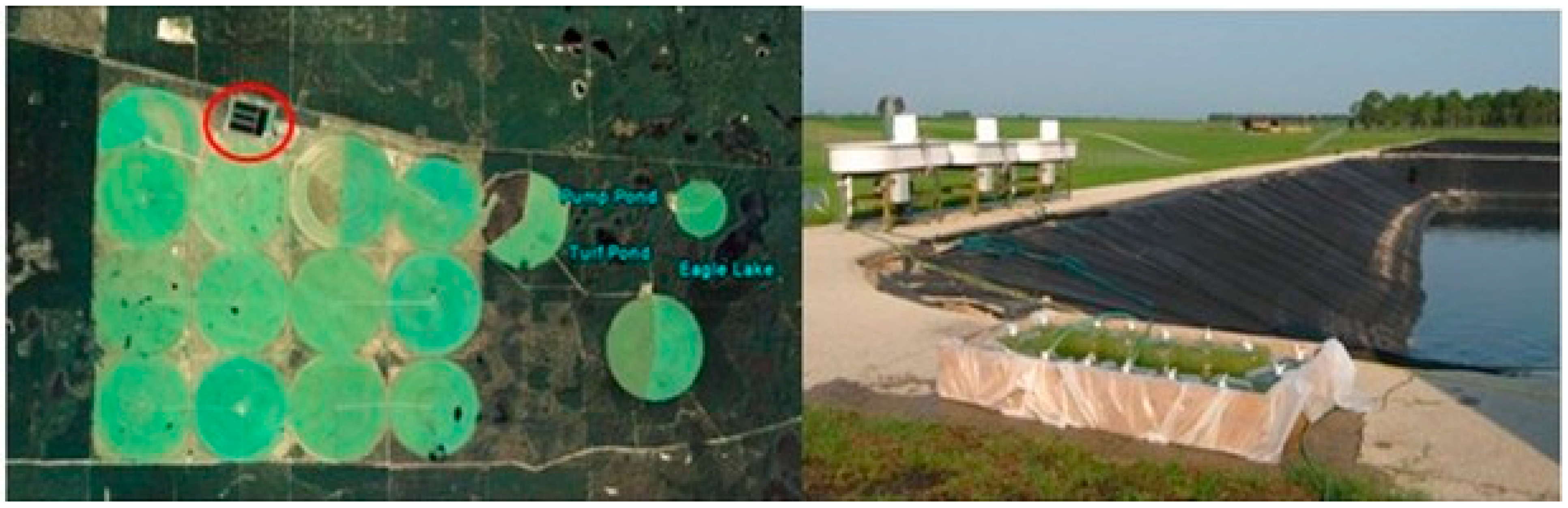
Figure 1. Sampling Site, Wastewater Reclamation Facility, TP Smith, Tallahassee, FL: Secondary treated water, rich in nitrogenous compounds, is pumped into the holding ponds, circled in red and displayed on the right in greater detail. The wastewater is then sprayed on the adjacent fields; however, excessive nutrient leaching into the underground cart plain resulted in extensive eutrophication in the Wakulla County watershed.
Sustainability 17 11166 g001
Figure 2. The lipid yield of the microalgal consortia isolated from the TP Smith Wastewater Reclamation Facility, Tallahassee, FL.
Sustainability 17 11166 g002
Figure 3. Shotgun metagenomics analysis showing the taxonomic composition of eukaryotic non-fungal communities in the oleaginous consortia isolated from the TP Smith Wastewater Reclamation Facility, Tallahassee, FL.
Sustainability 17 11166 g003
Figure 4. Shotgun metagenomics analysis showing the taxonomic composition of bacterial communities in the oleaginous consortia isolated from the TP Smith Wastewater Reclamation Facility, Tallahassee, FL.
Sustainability 17 11166 g004
Figure 5. Shotgun metagenomics analysis showing the taxonomic composition of archaeal communities in the oleaginous consortia isolated from the TP Smith Wastewater Reclamation Facility, Tallahassee, FL.
Sustainability 17 11166 g005
Figure 6. Shotgun metagenomics analysis showing the taxonomic composition of fungal communities in the oleaginous consortia isolated from the TP Smith Wastewater Reclamation Facility, Tallahassee, FL.
Sustainability 17 11166 g006
Figure 7. Shotgun metagenomics analysis showing the suite of genes present in the oleaginous consortia isolated from the TP Smith Wastewater Reclamation Facility, Tallahassee, FL. Shown are (A), the functional genes at subsystem level 1with genes performing functions related with carbohydrate metabolism, photosynthesis, respiration, virulence, amino acids and derivatives and respiration as the most abundant functions being performed in the consortia; (B), the gene functional analysis at subsystem level 3 which revealed gene classes known to facilitate the growth of algae, including the photosystem I and II, YgfZ proteins, photorespiration, oxidative C2 cycle, and fatty acids biosynthesis FASII in the consortia.
Sustainability 17 11166 g007
Figure 8. Phosphate (A), Nitrate (B), and Ammonia (C) removal by the oleaginous consortia isolated from the TP Smith Wastewater Reclamation Facility, Tallahassee, FL. A control treatment was included, consisting of only an unautoclaved wastewater sample without the addition of isolated consortia strains.
Sustainability 17 11166 g008
Figure 9. Boxplots showing nutrient removal efficiencies (phosphate, nitrate, and ammonia) for consortia C3, C4, and C9. Statistical differences were evaluated using one-way ANOVA (α = 0.05). ANOVA results: phosphate F(2,6) = 315.71, p < 0.0001; nitrate F(2,6) = 374.73, p < 0.0001; ammonia F (2,6) = 199.06, p < 0.0001. Higher F-values indicate strong between-group variance relative to within-group variance, confirming significant differences among consortia for all nutrients.
Sustainability 17 11166 g009
Disclaimer/Publisher’s Note: The statements, opinions and data contained in all publications are solely those of the individual author(s) and contributor(s) and not of MDPI and/or the editor(s). MDPI and/or the editor(s) disclaim responsibility for any injury to people or property resulting from any ideas, methods, instructions or products referred to in the content.