A DQN-Based Intelligent Voltage Control Framework for Enhancing Renewable Integration and Energy Sustainability in Wind-Penetrated Distribution Networks


Abstract
1. Introduction
1.1. Research Motivation
1.2. Research Gap
1.3. Research Contribution
1.4. Sustainability Motivation and Renewable Integration Needs
2. Background Work-Reviewed Comparative Control Methods
2.1. Linear Control (PI-Based)
2.2. Nonlinear Control (Model Predictive Control, MPC)
2.3. Rule-Based Controller (RBC)
2.4. PSO-Machine Model Control
2.5. Hybrid RL–PSO Control
2.6. Proposed DQN-Based Control
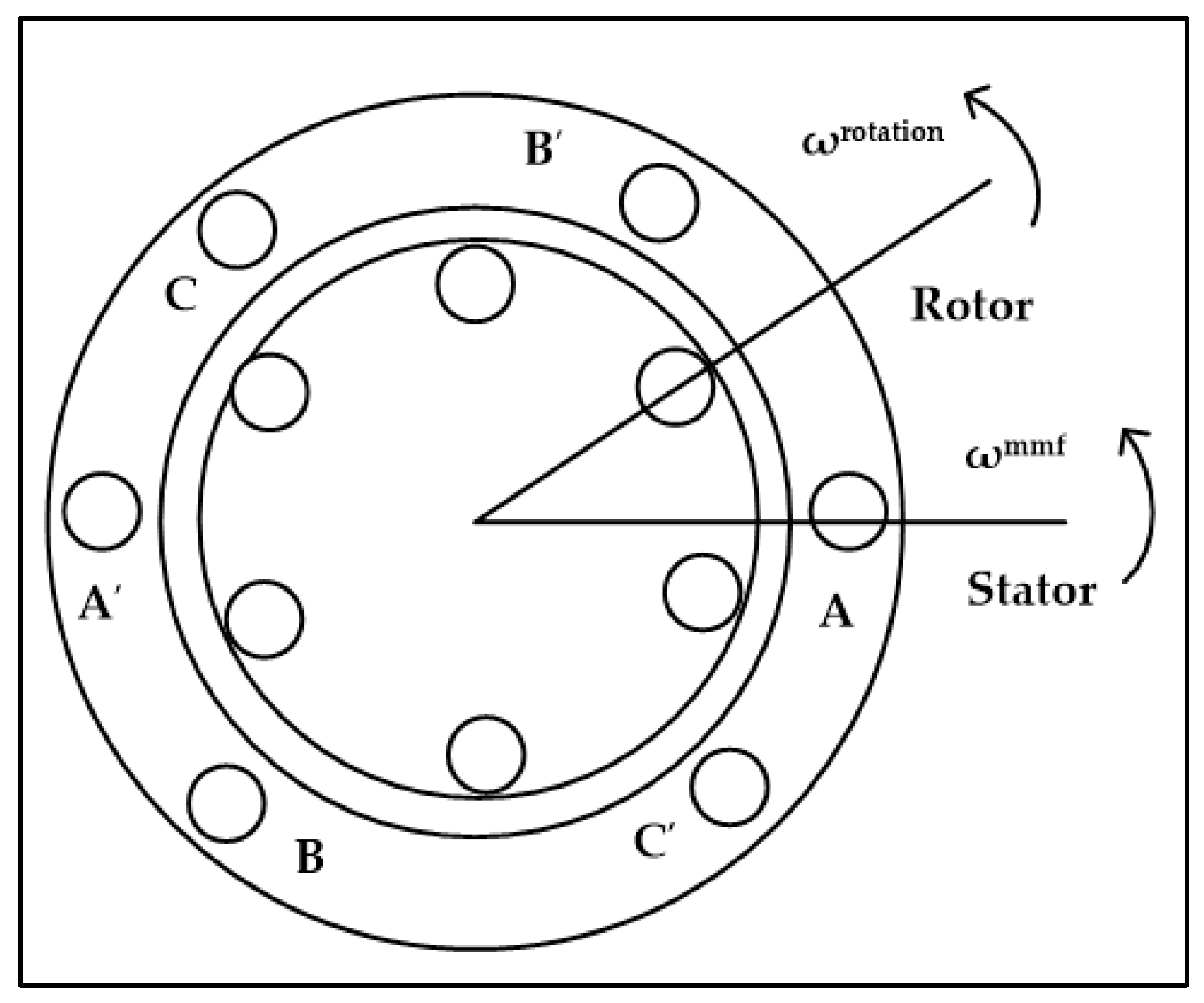
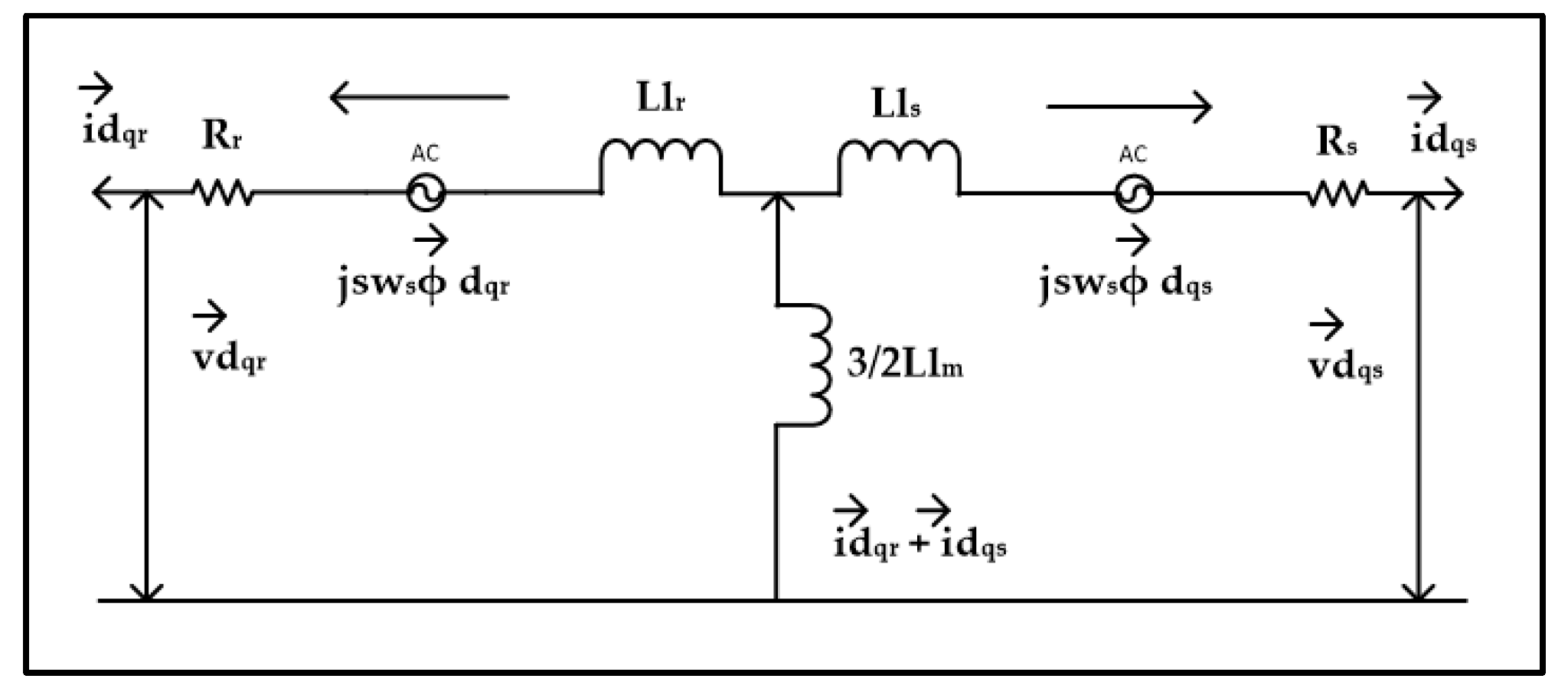
3. Modelling and Controlling of DFIG
3.1. Power Control
3.2. DFIG’s Rotor-Side Control
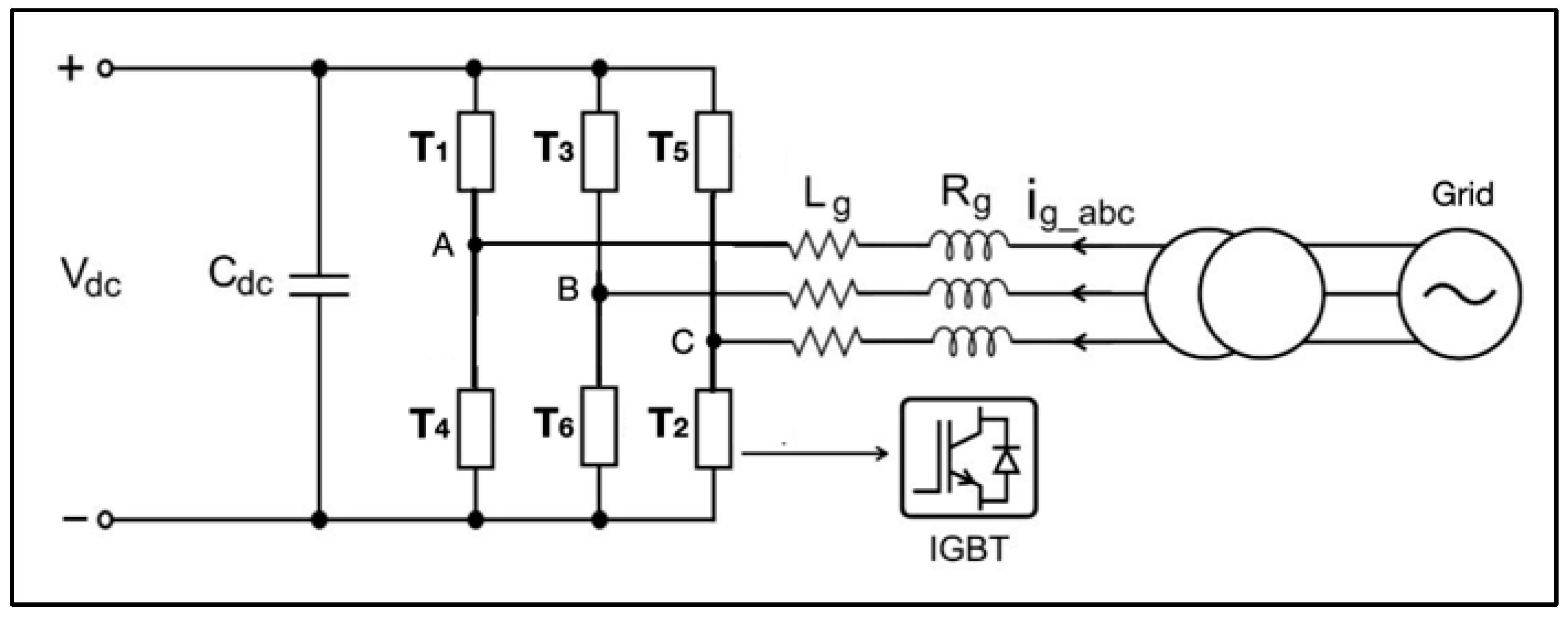
3.3. DFIG’s Grid-Side Control
- Regulating the DC-Link voltage to maintain energy balance between converters.
- Controlling the grid-side current to manage power exchange and reactive support.
4. Proposed Methodology
4.1. System Modelling
4.1.1. Wind Energy Subsystem
4.1.2. Distribution Network Model
4.1.3. Reactive Power Control Devices
- a.
- On-Load Tap Changer (OLTC):
- b.
- Shunt Capacitor Banks:
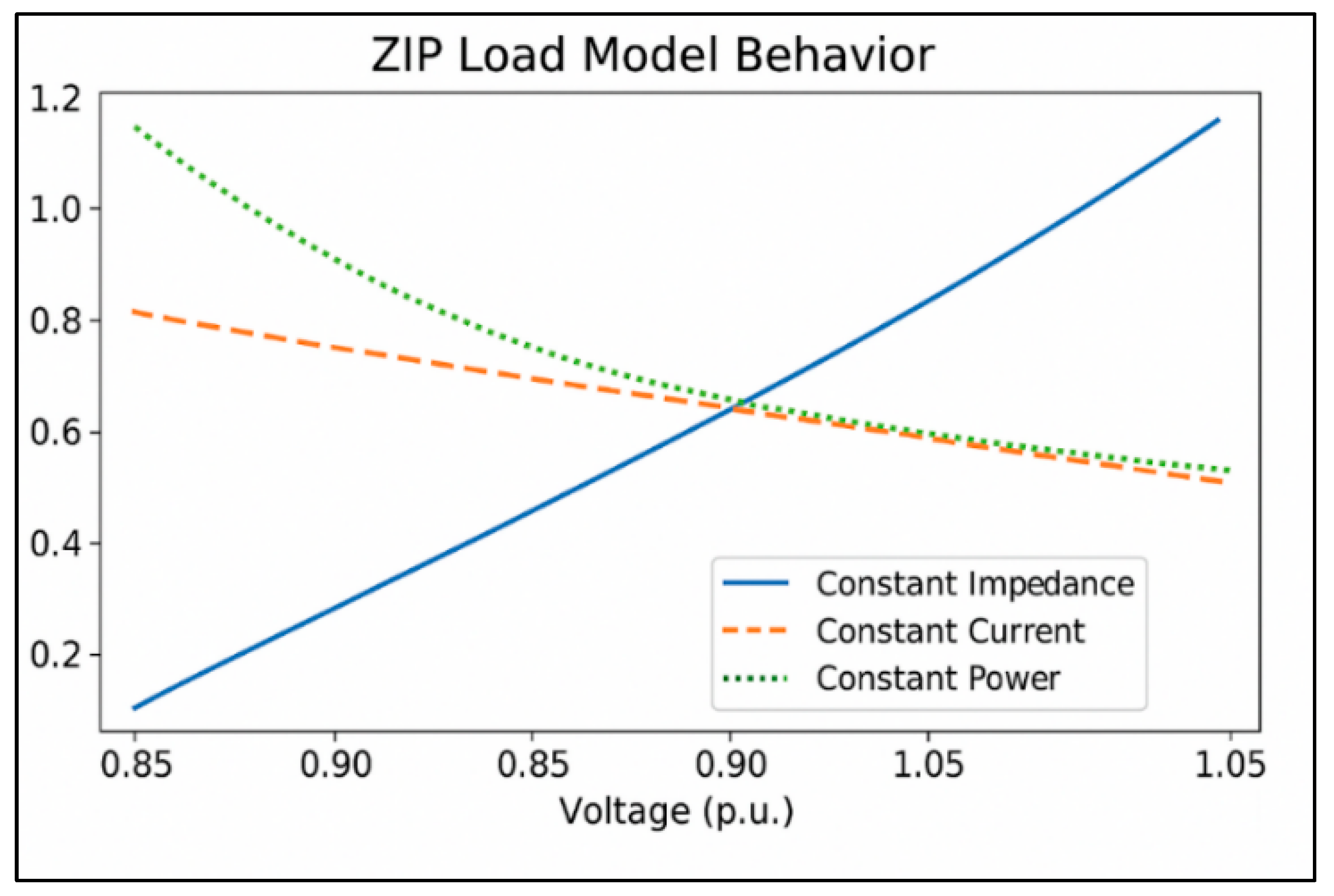
4.1.4. ZIP Load Modelling for the IEEE 33-Bus System
- a.
- Constant Impedance (Z):
- b.
- Constant Current (I):
- c.
- Constant Power (P):
- d.
- Composite ZIP load:
- and denote the instantaneous active and reactive load powers,
- and represent the nominal active and reactive powers at the reference voltage ,
- V is the actual voltage magnitude at the load bus,
- , , and , , are the (Impedance–Current–Power) coefficients that satisfy:
- Residential networks: 20% Z, 30% I, 50% P (sensitive to voltage changes),
- Industrial systems: 40% Z, 20% I, 40% P (balanced),
- Commercial complexes: 10% Z, 20% I, 70% P (more constant power behaviour).
- e.
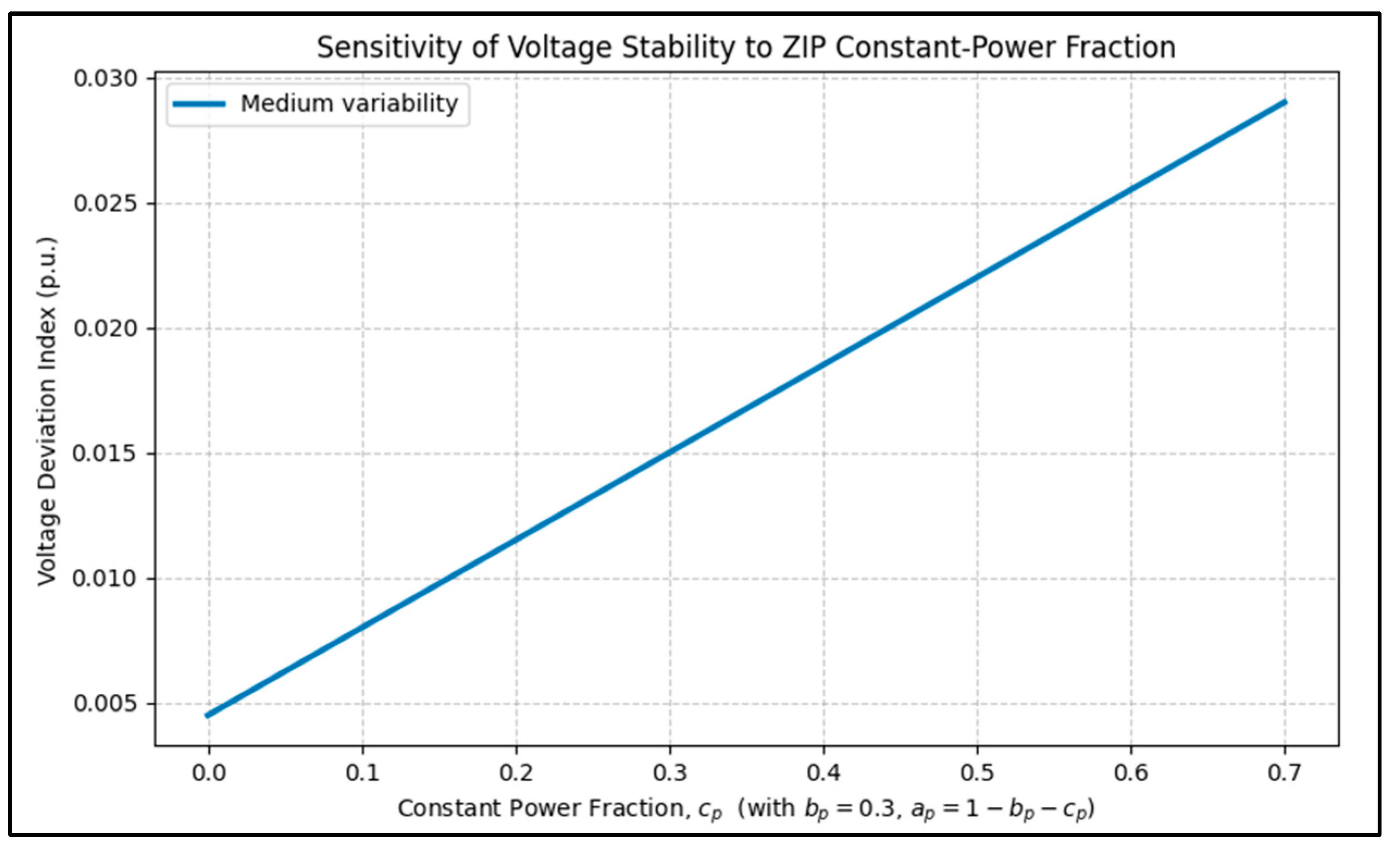
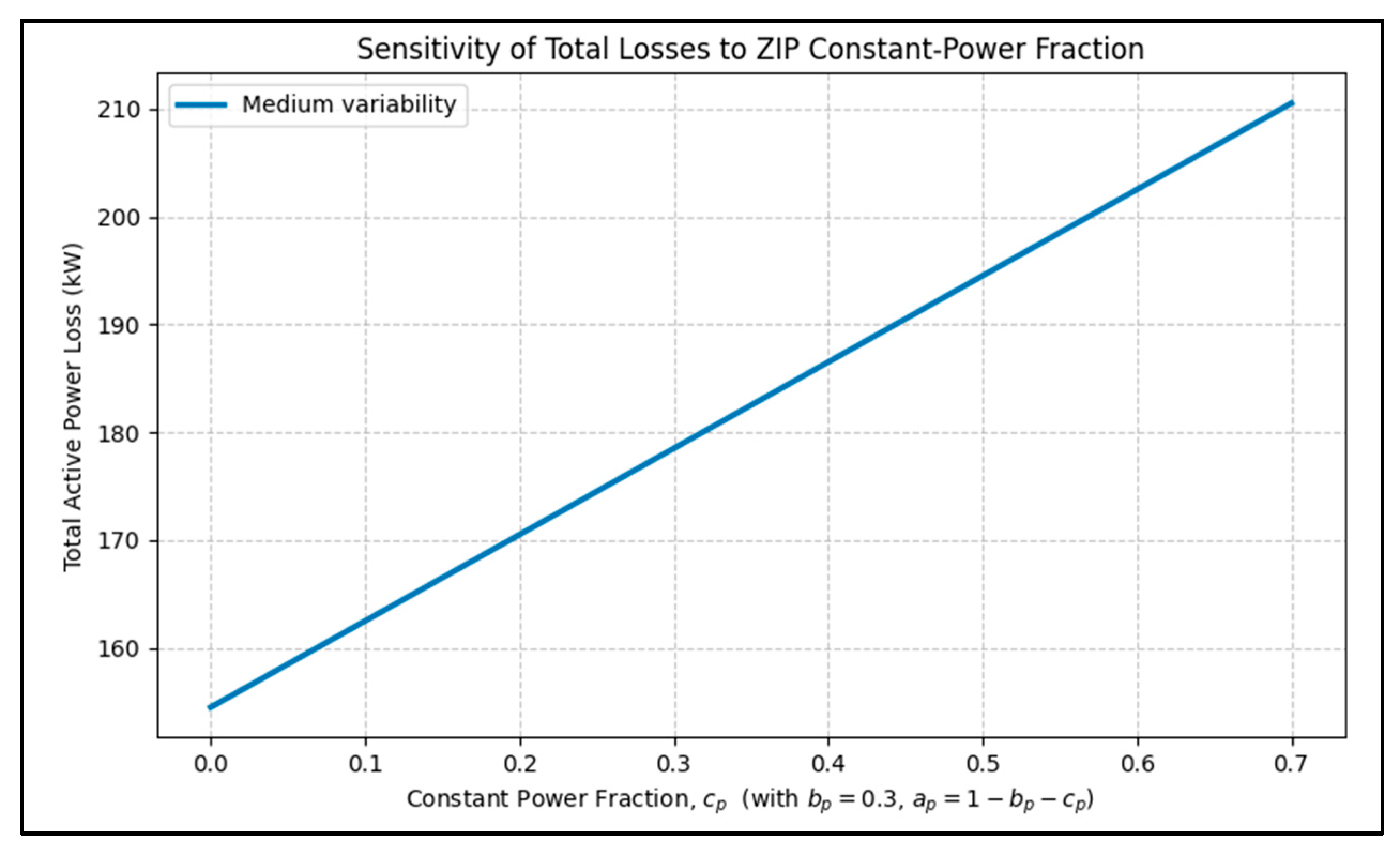
- Control Strategy Implication:
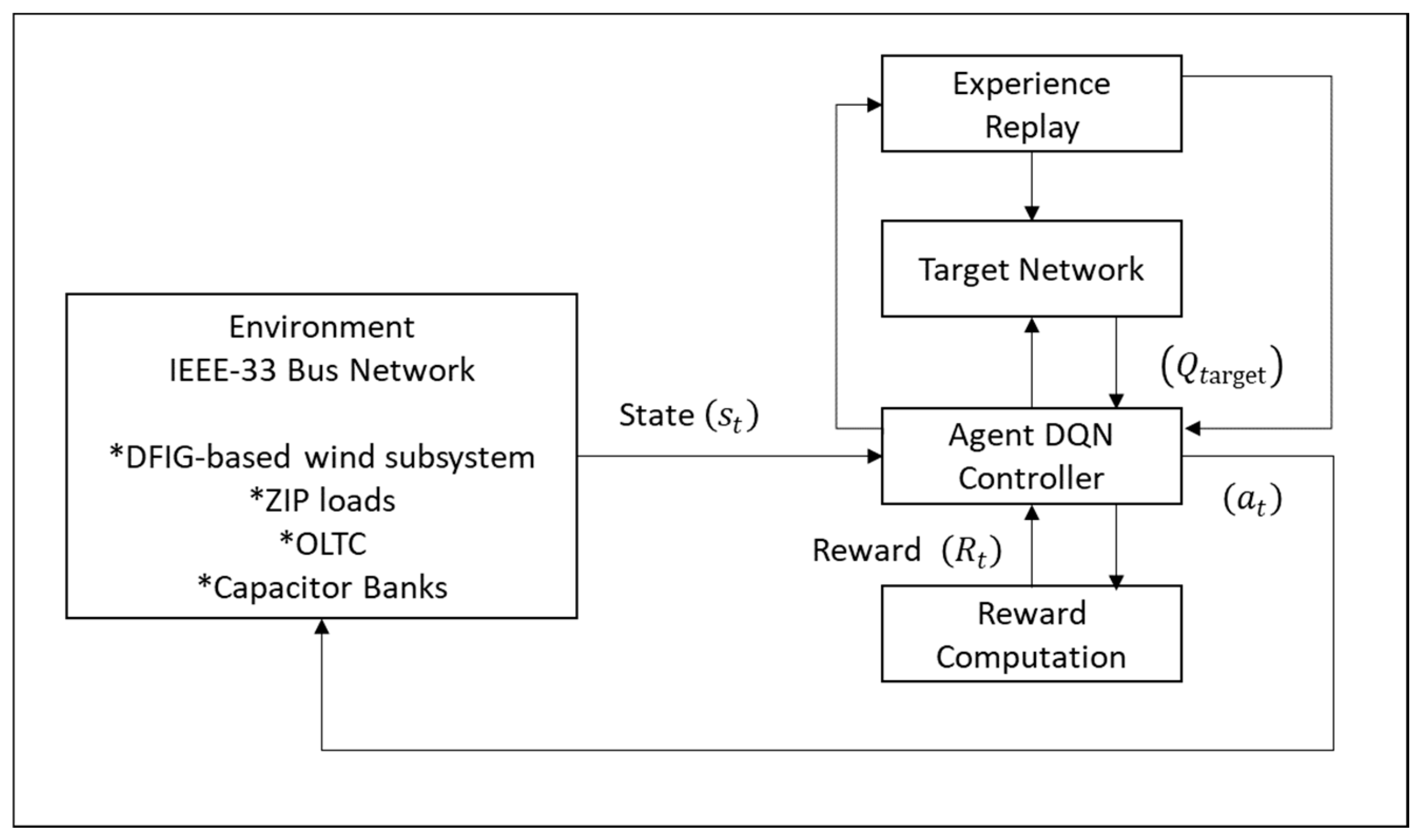
4.2. Reinforcement Learning Problem Formulation
4.2.1. State Space
4.2.2. Action Space
4.2.3. Reward Function
- is the voltage deviation index,
- is the total active power loss,
- is the switching penalty representing the mechanical wear of OLTC and capacitors, and
- , , are positive weighting coefficients satisfying
4.2.4. Transition Dynamics
4.2.5. Policy and Value Function
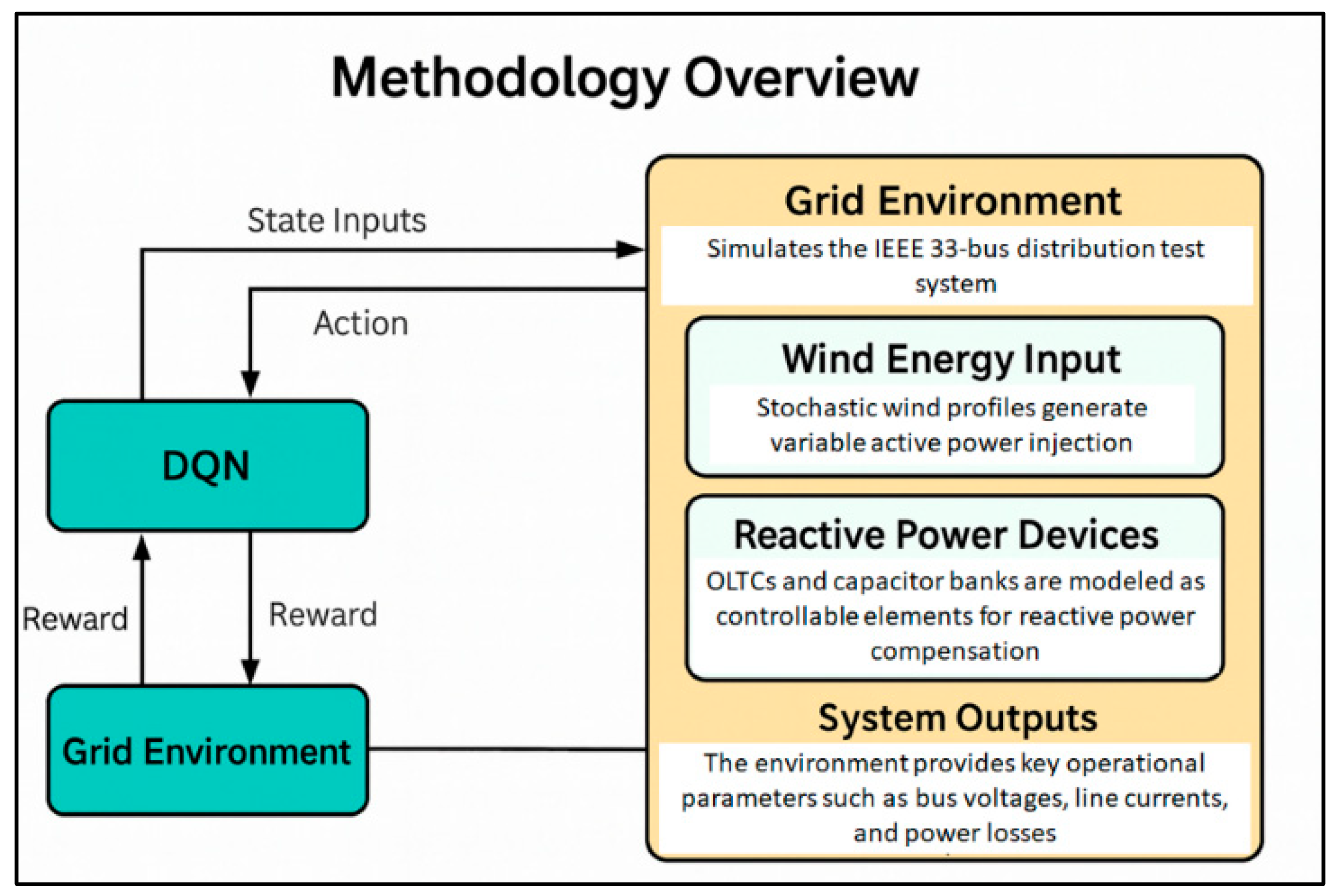
4.2.6. Block Diagram of the Reinforcement Learning Environment
5. Simulation Design and Implementation
5.1. System Specifications and Test Scenarios
5.2. Hyperparameter, Training, and Convergence
Performance Observation
- a.
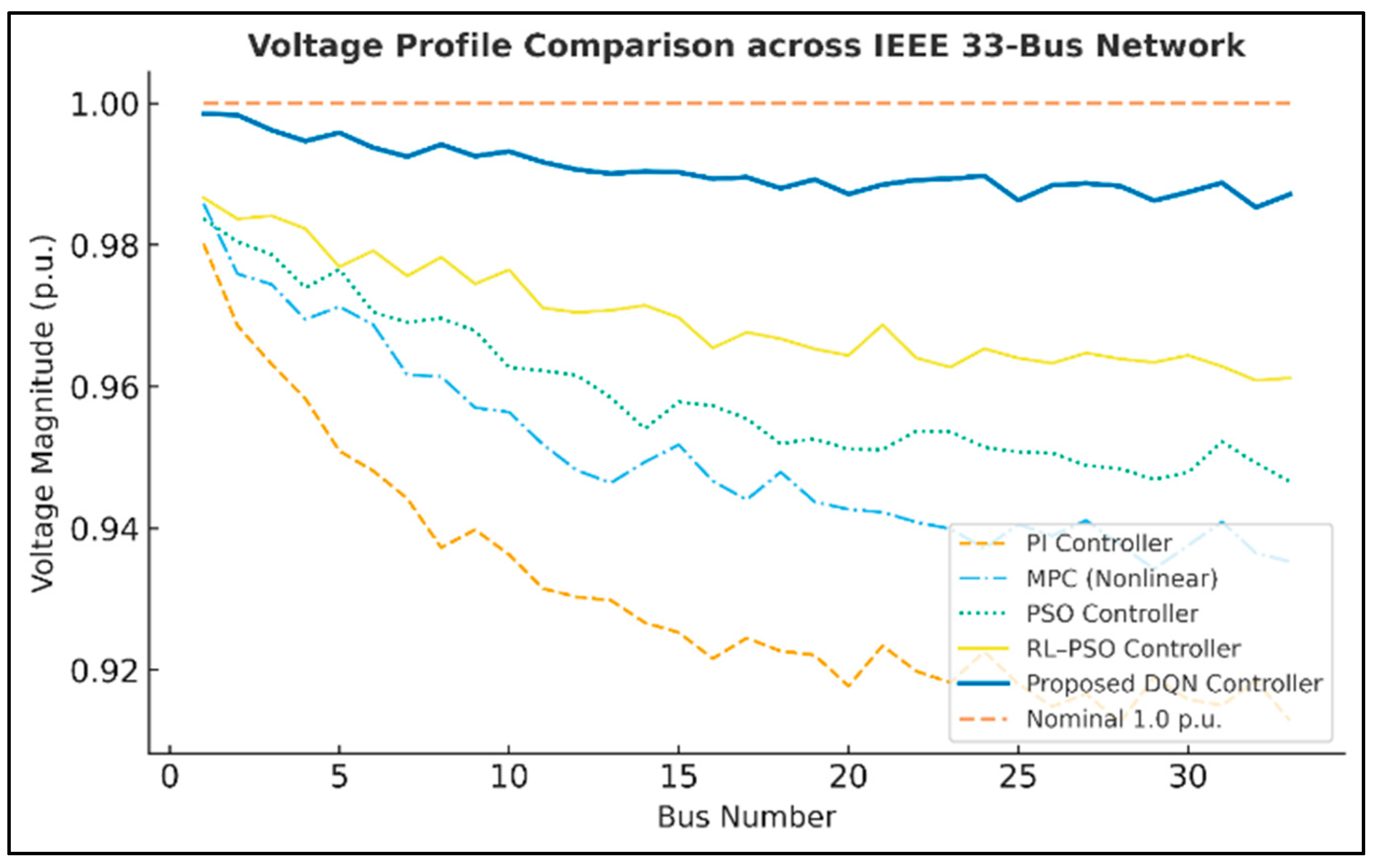
- Voltage Profile Performance
- b.
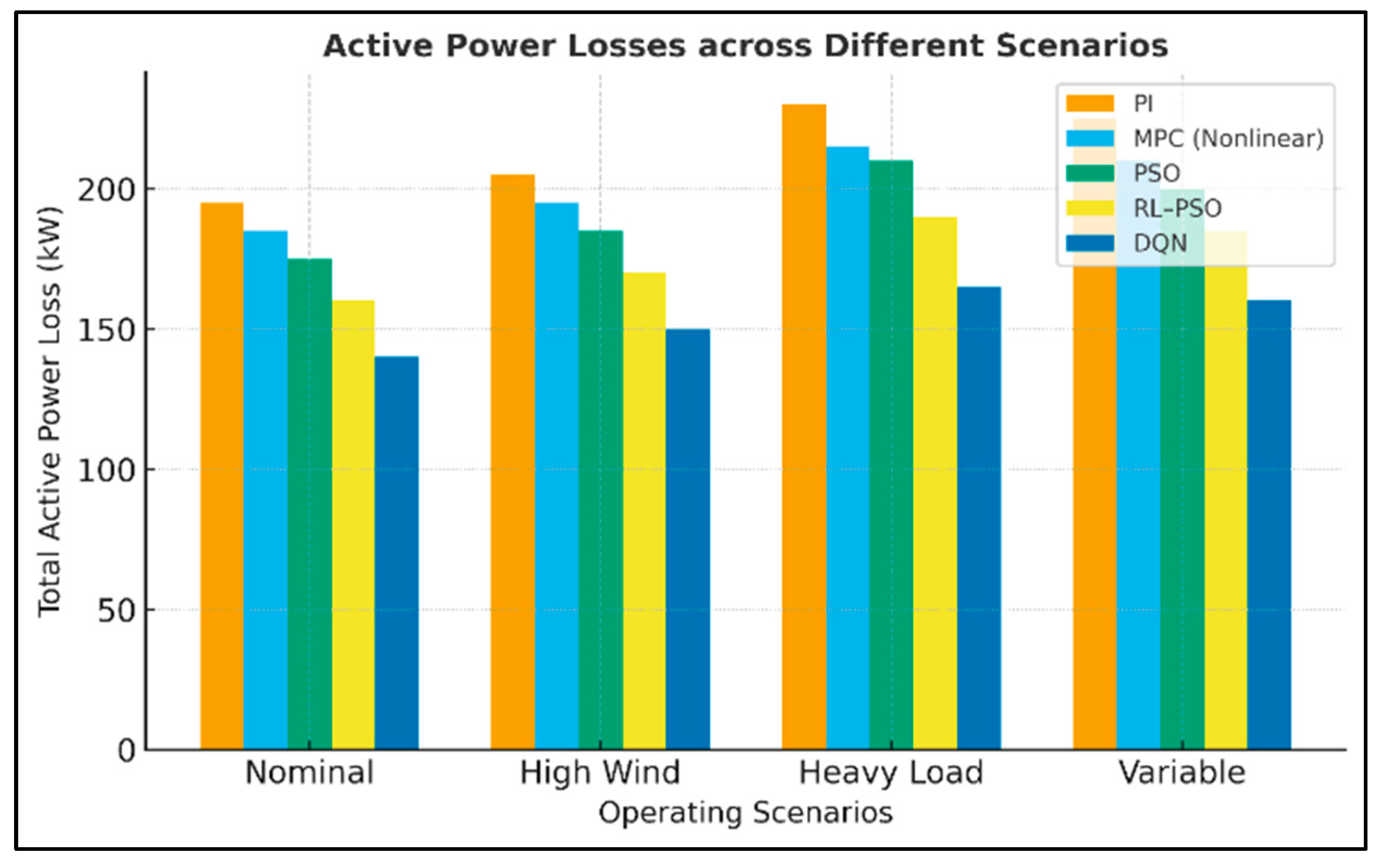
- Total Active Power Loss Performance
- c.
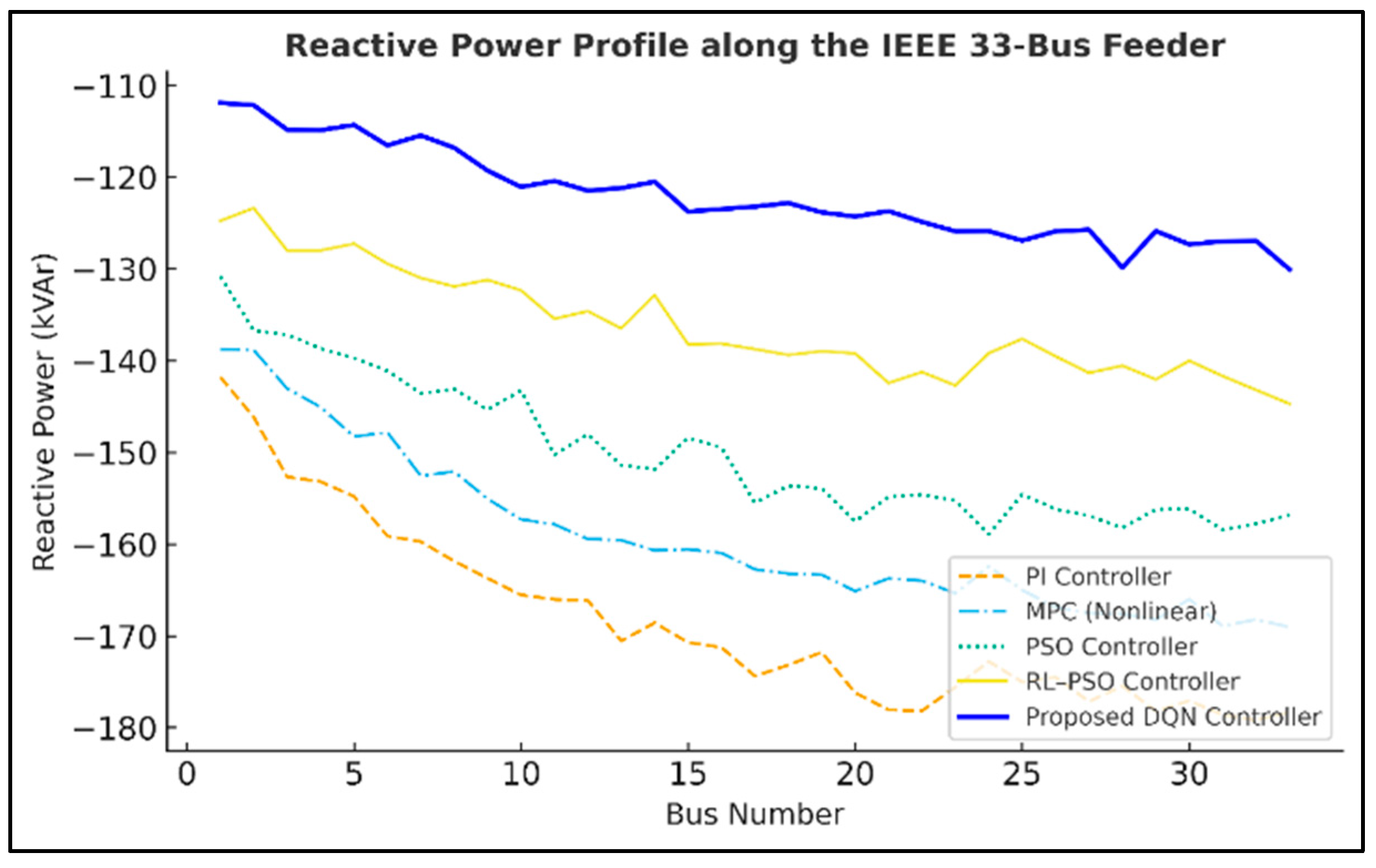
- Reactive Power Profile Along the Feeder
- d.
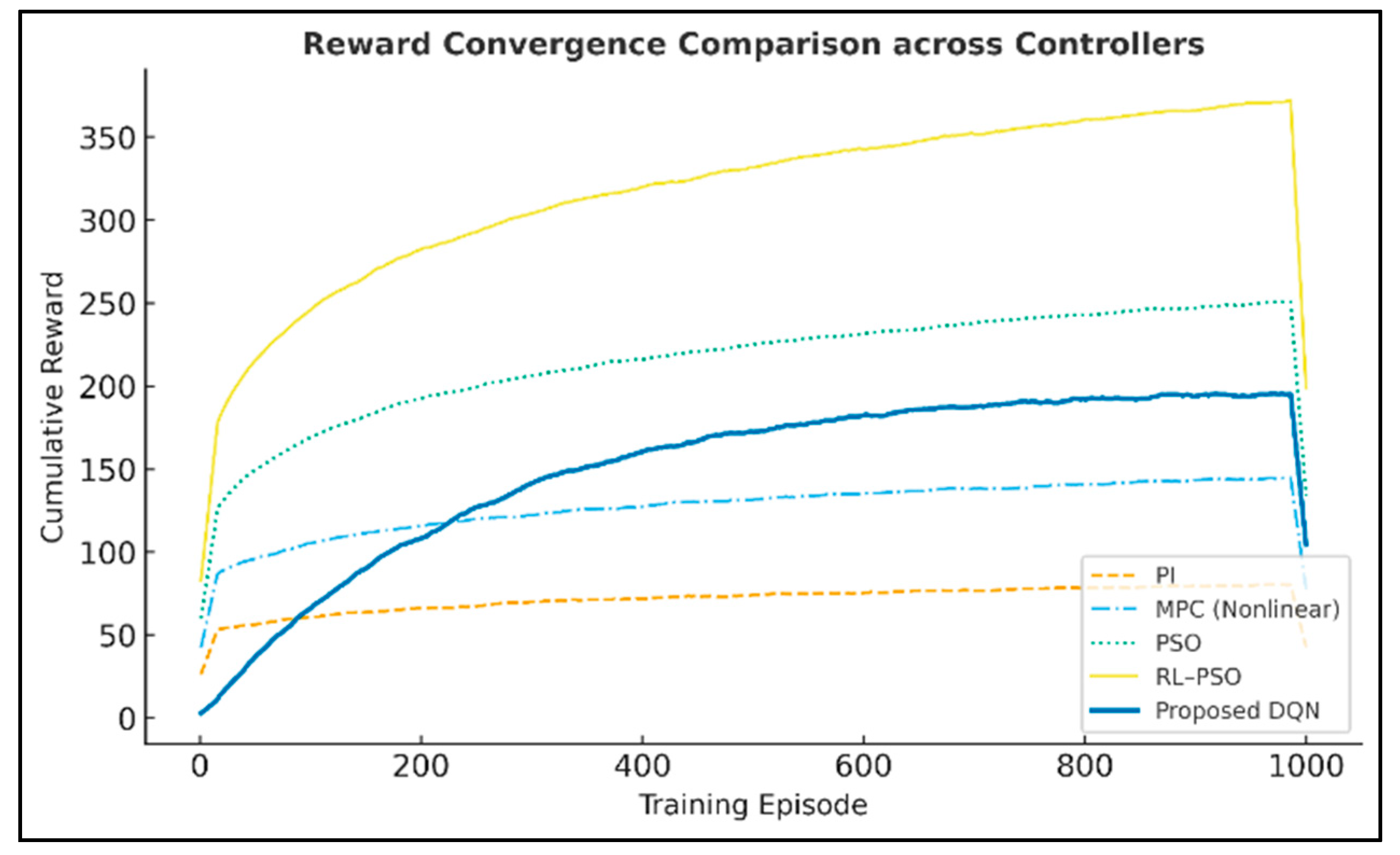
- Reward Convergence Comparison Across Controllers
- e.
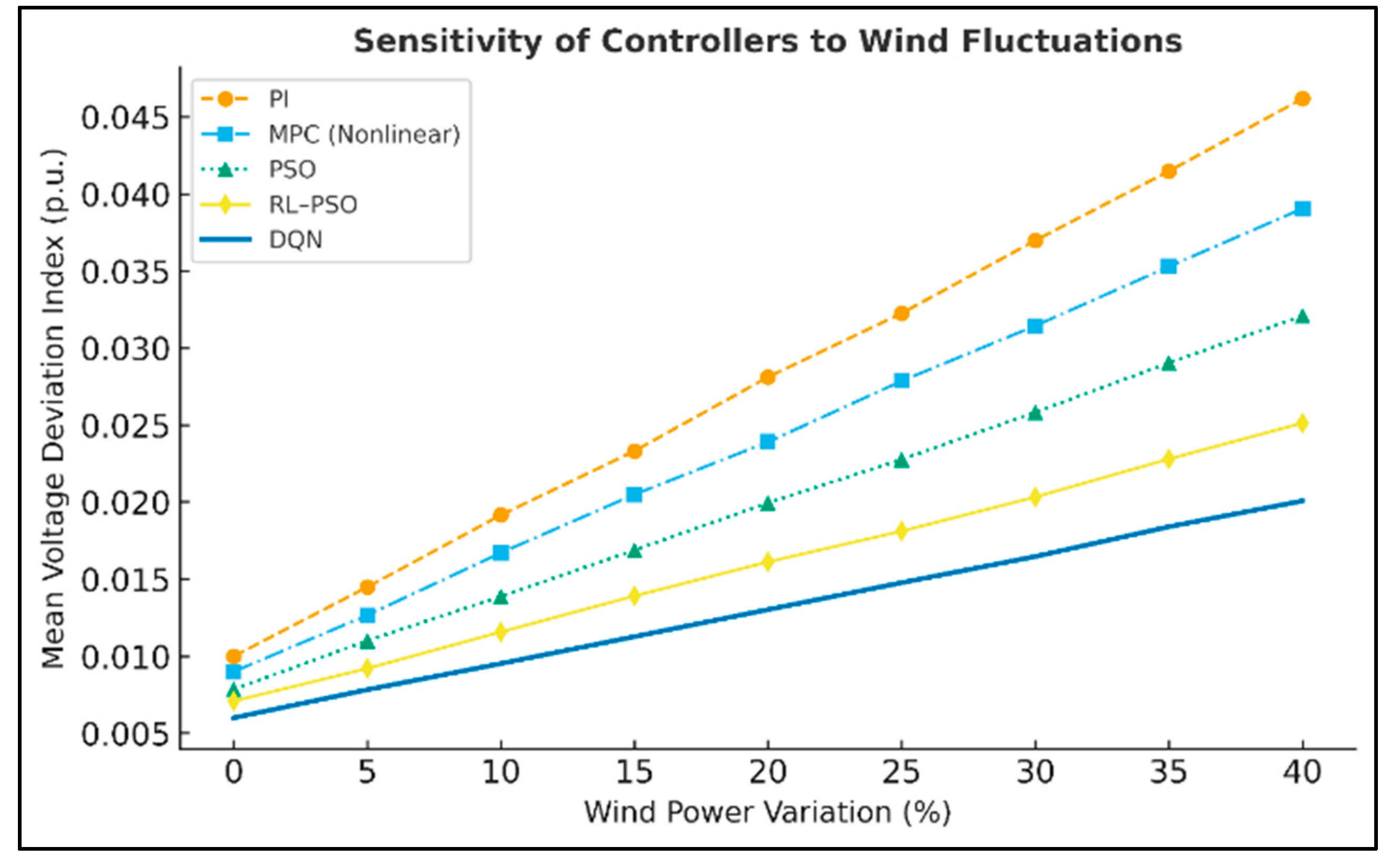
- Sensitivity of Voltage Regulation to Wind Speed Variability
- f.
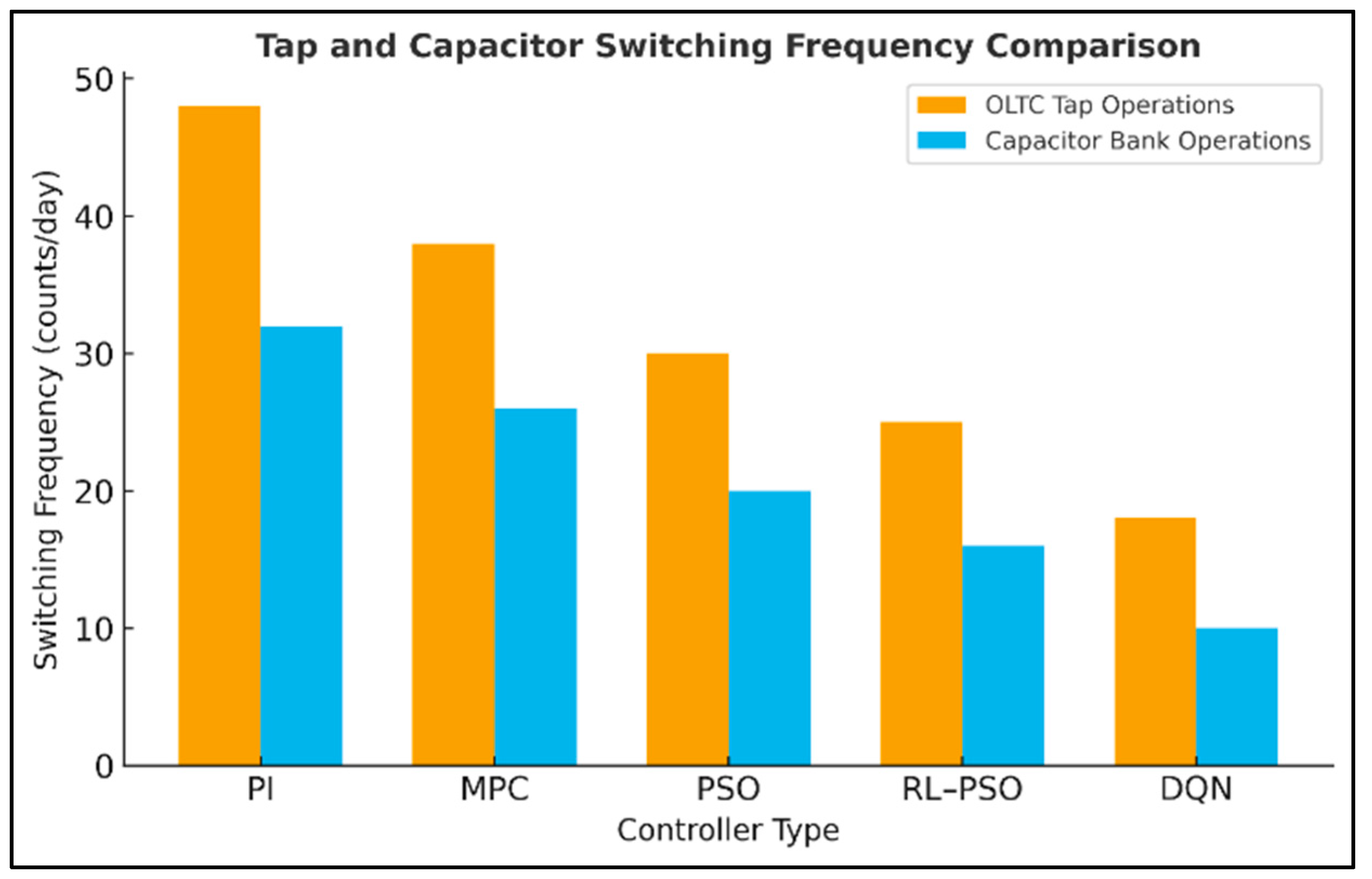
- Tap and Capacitor Switching Frequency Comparison
- g.
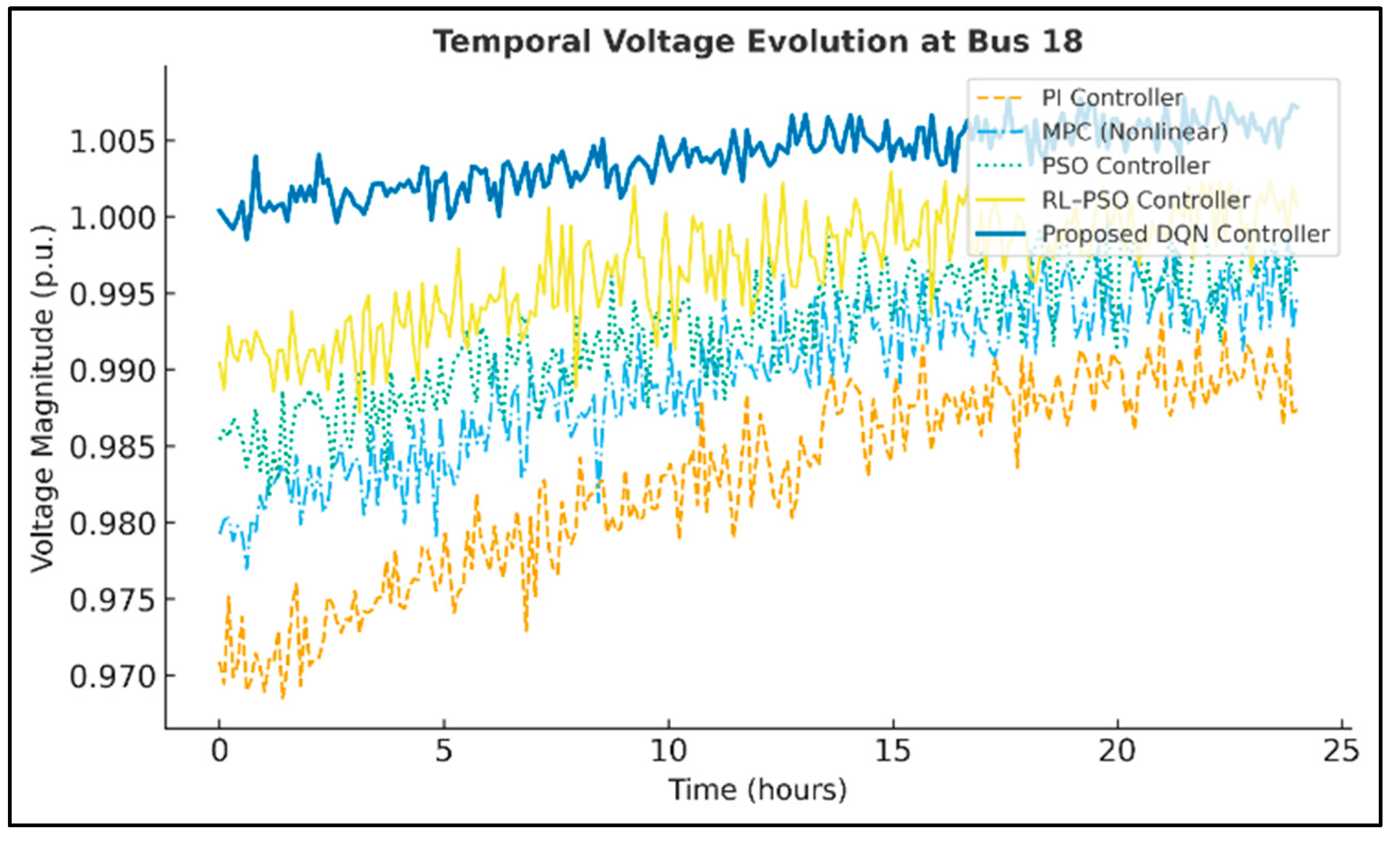
- Temporal voltage evolution at Bus 18
- h.
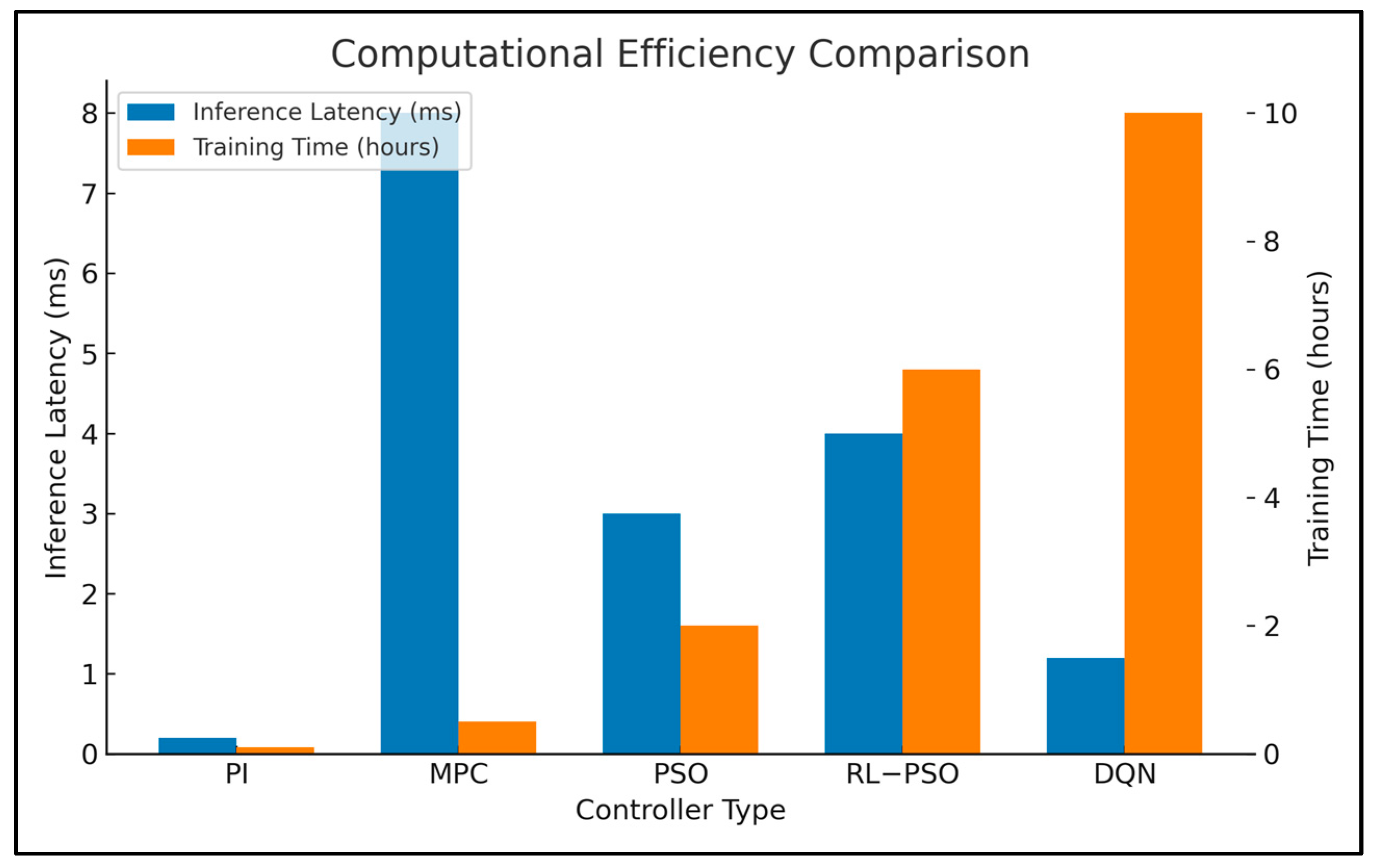
- Computational Efficiency Comparison
6. Discussion and Comparison of the Simulation Studies
6.1. Voltage Profile Performance
6.2. Active Power Loss Performance
6.3. Reactive Power Profile Performance
6.4. Reward Convergence and Learning Behaviour
6.5. Sensitivity of Voltage Regulation and Robustness
6.6. Tap & Capacitor Switching Frequency
6.7. Temporal Voltage at BUS 18
6.8. Computational Efficiency
7. Conclusions and Future Work
7.1. Conclusions
7.2. Future Work
Author Contributions
Funding
Institutional Review Board Statement
Informed Consent Statement
Data Availability Statement
Acknowledgments
Conflicts of Interest
Abbreviations
| AVC | Automatic Voltage Control |
| DFIG | Doubly Fed Induction Generator |
| DNQs | Distribution Network Operators |
| DQN | Deep Q-Network |
| GA | Genetic Algorithm |
| GCC | Grid code compliance |
| GSC | Grid-Side Converter |
| IEA | International Energy Agency |
| IGBTs | Insulated Gate Bipolar Transistors |
| IRLC | Intelligent Reinforcement Learning Controller |
| IRP | Integrated Resource Plan |
| MDP | Markov Decision Process |
| MMFs | Magnetomotive Forces |
| MPC | Model Predictive Control |
| OLTC | On Load Tap Changer |
| OPF | Optimal Power Flow |
| PCC | point of common coupling |
| PF | Power Factor |
| PSO | Particle Swarm Optimisation |
| PWM | Pulse-Width Modulation |
| RBC | Rule-Based Control |
| RL | Reinforcement Learning |
| RPPs | Renewable Power Plants |
| RSC | Rotor-Side Converter |
| SA | Simulated Annealing |
| VDI | Voltage Deviation Index |
| VOC | Vector-Oriented Control |
| XAI | Explainable AI |
References
- Petrusev, A.; Putratama, M.A.; Rigo-Mariani, R.; Debusschere, V.; Reignier, P.; Hadjsaid, N. Reinforcement learning for robust voltage control in distribution grids under uncertainties. Sustain. Energy Grids Netw. 2023, 33, 100959. [Google Scholar] [CrossRef]
- Nematshahi, S.; Shi, D.; Wang, F.; Yan, B.; Nair, A. Deep reinforcement learning based voltage control revisited. IET Gener. Transm. Distrib. 2023, 17, 4826–4835. [Google Scholar] [CrossRef]
- Jacob, R.A.; Paul, S.; Chowdhury, S.; Gel, Y.R.; Zhang, J. Real-time outage management in active distribution networks using reinforcement learning over graphs. Nat. Commun. 2024, 15, 4766. [Google Scholar] [CrossRef]
- Nwagu, C.N.; Ujah, C.O.; Kallon, D.V.V.; Aigbodion, V.S. Integrating solar and wind energy into the electricity grid for improved power accessibility. Unconv. Resour. 2025, 5, 100129. [Google Scholar] [CrossRef]
- Duranay, Z.B.; Güldemir, H.; Coşkun, B. The Role of Wind Turbine Siting in Achieving Sustainable Energy Goals. Processes 2024, 12, 2900. [Google Scholar] [CrossRef]
- Ullah, F.; Zhang, X.; Khan, M.; Mastoi, M.S.; Munir, H.M.; Flah, A.; Said, Y. A comprehensive review of wind power integration and energy storage technologies for modern grid frequency regulation. Heliyon 2024, 10, e30466. [Google Scholar] [CrossRef]
- Li, S. Reactive power limit of wind farm with doubly-fed induction generators and its asymmetric P-Q dependence. Int. J. Electr. Power Energy Syst. 2025, 169, 110819. [Google Scholar] [CrossRef]
- Kebede, M.G.; Tuka, M.B. Power Control of Wind Energy Conversion System with Doubly Fed Induction Generator. J. Energy 2022, 2022, 8679053. [Google Scholar] [CrossRef]
- Alhato, M.M.; Ibrahim, M.N.; Rezk, H.; Bouallègue, S. An Enhanced DC-Link Voltage Response for Wind-Driven Doubly Fed Induction Generator Using Adaptive Fuzzy Extended State Observer and Sliding Mode Control. Mathematics 2021, 9, 963. [Google Scholar] [CrossRef]
- Izanlo, A.; Abdollahi, S.E.; Gholamian, S.A. A New Method for Design and Optimization of DFIG for Wind Power Applications. Electr. Power Compon. Syst. 2020, 48, 1523–1536. [Google Scholar] [CrossRef]
- Mustafa, F.E.; Ahmed, I.; Basit, A.; Alqahtani, M.; Khalid, M. An adaptive metaheuristic optimization approach for Tennessee Eastman process for an industrial fault tolerant control system. PLoS ONE 2024, 19, e0296471. [Google Scholar] [CrossRef]
- Xiang, X.; Diao, R.; Bernadin, S.; Foo, S.Y.; Sun, F.; Ogundana, A.S. An Intelligent Parameter Identification Method of DFIG Systems Using Hybrid Particle Swarm Optimization and Reinforcement Learning. IEEE Access 2024, 12, 44080–44090. [Google Scholar] [CrossRef]
- Manjunath, T.G.; Kusagur, A. Analysis of Different Meta Heuristics Method in Intelligent Fault Detection of Multilevel Inverter with Photovoltaic Power Generation Source. Int. J. Power Electron. Drive Syst. 2018, 9, 1214. [Google Scholar] [CrossRef]
- Huang, W.; Hu, B.; Shao, C.; Li, W.; Wang, X.; Xie, K.; Chung, C.Y. Power System Reliability Evaluation Based on Sequential Monte Carlo Simulation Considering Multiple Failure Modes of Components. J. Mod. Power Syst. Clean. Energy 2024, 13, 202–214. [Google Scholar] [CrossRef]
- Yang, K.; Cho, K. Simulated Annealing Algorithm for Wind Farm Layout Optimization: A Benchmark Study. Energies 2019, 12, 4403. [Google Scholar] [CrossRef]
- Guediri, A.; Touil, S. Optimization Using a Genetic Algorithm Based on DFIG Power Supply for the Electrical Grid. Int. J. Eng. 2022, 35, 121–129. [Google Scholar] [CrossRef]
- Barrios Aguilar, M.E.; Coury, D.V.; Reginatto, R.; Monaro, R.M. Multi-objective PSO applied to PI control of DFIG wind turbine under electrical fault conditions. Electr. Power Syst. Res. 2020, 180, 106081. [Google Scholar] [CrossRef]
- Puchalapalli, S.; Singh, B. A Novel Control Scheme for Wind Turbine Driven DFIG Interfaced to Utility Grid. IEEE Trans. Ind. Appl. 2020, 56, 2925–2937. [Google Scholar] [CrossRef]
- Gholami, A.; Sahab, A.; Tavakoli, A.; Alizadeh, B. DFIG-Based Wind Energy System Robust Optimal Control by Using of Novel LMI-Based Adaptive MPC. IETE J. Res. 2023, 69, 3467–3476. [Google Scholar] [CrossRef]
- Karagiannopoulos, S.; Aristidou, P.; Hug, G.; Botterud, A. Decentralized control in active distribution grids via supervised and reinforcement learning. Energy AI 2024, 16, 100342. [Google Scholar] [CrossRef]
- Huang, J.; Zhang, H.; Tian, D.; Zhang, Z.; Yu, C.; Hancke, G.P. Multi-agent deep reinforcement learning with enhanced collaboration for distribution network voltage control. Eng. Appl. Artif. Intell. 2024, 134, 108677. [Google Scholar] [CrossRef]
- Aoxiang, M.A.; Cao, J.; Cortes, P.R. Graph Neural Network Based Deep Reinforcement Learning for Volt-Var Control in Distribution Grids. In Proceedings of the 2024 IEEE 15th International Symposium on Power Electronics for Distributed Generation Systems (PEDG), Luxembourg, 23–26 June 2024; IEEE: New York, NY, USA, 2024; pp. 1–5. [Google Scholar] [CrossRef]
- Battu, N.R.; Senroy, N.; Abhyankar, A.R. Effect of Capacitors on Frequency of OLTC Tap Changes in the Presence of Wind Generation. Int. J. Emerg. Electr. Power Syst. 2015, 16, 385–395. [Google Scholar] [CrossRef]
- Otchere, I.K.; Ampofo, D.; Dantuo, J.; Frimpong, E.A. The Influence of Voltage Regulation Devices Based Distributed Generation in Distribution Networks. Electr. Electron. Eng. 2023, 2023, 1–5. [Google Scholar]
- Petinrin, J.O.; Petinrin, O.O.; Petinrin, M.O.; Ogedengbe, I.I. Coordinated Framework for Voltage Control in Distribution System with Wind Energy. IAENG Int. J. Comput. Sci. 2025, 52, 3159–3166. [Google Scholar]
- Chen, Y.; Liu, Y.; Zhao, J.; Qiu, G.; Yin, H.; Li, Z. Physical-assisted multi-agent graph reinforcement learning enabled fast voltage regulation for PV-rich active distribution network. Appl. Energy 2023, 351, 121743. [Google Scholar] [CrossRef]
- Yu, P.; Zhang, H.; Song, Y.; Wang, Z.; Dong, H.; Ji, L. Safe reinforcement learning for power system control: A review. Renew. Sustain. Energy Rev. 2025, 223, 116022. [Google Scholar] [CrossRef]
- Hossain, R.; Gautam, M.; Olowolaju, J.; Livani, H.; Benidris, M. Multi-agent voltage control in distribution systems using GAN-DRL-based approach. Electr. Power Syst. Res. 2024, 234, 110528. [Google Scholar] [CrossRef]
- Kilembe, A.B.; Hamilton, R.I.; Papadopoulos, P.N. Explainable Machine Learning: A SHAP value-based approach to locational frequency stability. Int. J. Electr. Power Energy Syst. 2025, 170, 110885. [Google Scholar] [CrossRef]
- Hassouna, M.; Holzhüter, C.; Lytaev, P.; Thomas, J.; Sick, B.; Scholz, C. Graph Reinforcement Learning for Power Grids: A Comprehensive Survey. arXiv 2024, arXiv:2407.04522. [Google Scholar]
- Zhang, T.; Yu, L.; Yue, D.; Dou, C.; Xie, X.; Shi, T. Explainable deep reinforcement learning approach for smart voltage regulation of high renewable-penetrated distribution networks considering hydrogen-storage system. Electr. Power Syst. Res. 2025, 246, 111654. [Google Scholar] [CrossRef]
- Cai, X.; Yang, Z.; Liu, P.; Lian, X.; Li, Z.; Zhu, G.; Geng, H. Voltage Control Strategy for Large-Scale Wind Farm with Rapid Wind Speed Fluctuation. Energies 2024, 17, 2220. [Google Scholar] [CrossRef]
- Shadi, M.R.; Mirshekali, H.; Shaker, H.R. Explainable artificial intelligence for energy systems maintenance: A review on concepts, current techniques, challenges, and prospects. Renew. Sustain. Energy Rev. 2025, 216, 115668. [Google Scholar] [CrossRef]
- Jerström, N.; Selin, T. Decentralized Voltage Regulation in Low-Voltage Grids Using Projection-Constrained Multi-Agent Deep Reinforcement Learning: A Case Study in E.ON’s Swedish Distribution Grid. Master’s Thesis, Uppsala University, Uppsala, Sweden, 2025. Available online: https://uu.diva-portal.org/smash/get/diva2%3A1989752/FULLTEXT02.pdf (accessed on 15 February 2025).
- Yeh, C.; Yu, J.; Shi, Y.; Wierman, A. Online Learning for Robust Voltage Control Under Uncertain Grid Topology. IEEE Trans. Smart Grid 2024, 15, 4754–4764. [Google Scholar] [CrossRef]
- Su, T.; Wu, T.; Zhao, J.; Scaglione, A.; Xie, L. A Review of Safe Reinforcement Learning Methods for Modern Power Systems. Proc. IEEE 2025, 113, 213–255. [Google Scholar] [CrossRef]
- Jung, Y.; Han, C.; Lee, D.; Song, S.; Jang, G. Adaptive Volt–Var Control in Smart PV Inverter for Mitigating Voltage Unbalance at PCC Using Multiagent Deep Reinforcement Learning. Appl. Sci. 2021, 11, 8979. [Google Scholar] [CrossRef]
- Tamaarat, A. Active and Reactive Power Control for DFIG Using PI, Fuzzy Logic and Self-Tuning PI Fuzzy Controllers. Adv. Model. Anal. C 2019, 74, 95–102. [Google Scholar] [CrossRef]
- Osama abed el-Raouf, M.; A. Mageed, S.A.; Salama, M.M.; Mosaad, M.I.; AbdelHadi, H.A. Performance Enhancement of Grid-Connected Renewable Energy Systems Using UPFC. Energies 2023, 16, 4362. [Google Scholar] [CrossRef]
- Aljohani, M. Enhancing the Performance of Grid-Tied Renewable Power Systems Using an Optimized PI Controller for STATCOM. Int. J. Robot. Control Syst. 2025, 5, 748–762. [Google Scholar] [CrossRef]
- Amar, A.; Yusupov, Z. Real-Time Capable MPC-Based Energy Management of Hybrid Microgrid. Processes 2025, 13, 2883. [Google Scholar] [CrossRef]
- Behara, R.K.; Saha, A.K. Neural Network Predictive Control for Improved Reliability of Grid-Tied DFIG-Based Wind Energy System under the Three-Phase Fault Condition. Energies 2023, 16, 4881. [Google Scholar] [CrossRef]
- Murray, W.; Adonis, M.; Raji, A. Voltage control in future electrical distribution networks. Renew. Sustain. Energy Rev. 2021, 146, 111100. [Google Scholar] [CrossRef]
- Lee, D.; Han, C.; Jang, G. Stochastic Analysis-Based Volt–Var Curve of Smart Inverters for Combined Voltage Regulation in Distribution Networks. Energies 2021, 14, 2785. [Google Scholar] [CrossRef]
- Akinwola, A.B.; Alkuhayli, A. Hybrid PSO–Reinforcement Learning-Based Adaptive Virtual Inertia Control for Frequency Stability in Multi-Microgrid PV Systems. Electronics 2025, 14, 3349. [Google Scholar] [CrossRef]
- Cestero, J.; Delle Femine, C.; Muro, K.S.; Quartulli, M.; Restelli, M. Optimizing energy management of smart grid using reinforcement learning aided by surrogate models built using physics-informed neural networks. Appl. Energy 2025, 401, 126750. [Google Scholar] [CrossRef]
- Gao, X.; Zhang, J.; Sun, H.; Liang, Y.; Wei, L.; Yan, C.; Xie, Y. A Review of Voltage Control Studies on Low Voltage Distribution Networks Containing High Penetration Distributed Photovoltaics. Energies 2024, 17, 3058. [Google Scholar] [CrossRef]
- Yu, W.; Huawei, G.; Xiaohai, Z.; Quansheng, C.; Peng, Z. DQN-Based Voltage Regulation for Active Distribution Network with Distributed Energy Storage System. In Proceedings of the 2020 International Top-Level Forum on Engineering Science and Technology Development Strategy and The 5th PURPLE MOUNTAIN FORUM (PMF2020), Nanjing, China, 15–16 August 2020; Springer: Singapore, 2021; pp. 749–762. [Google Scholar] [CrossRef]
- Kumar Behara, R.; Kumar Saha, A. Deep Q-Network Reinforcement Learning-Based Rotor Side Control System of a Grid Integrated DFIG Wind Energy System Under Variable Wind Speed Conditions. IEEE Access 2024, 12, 184179–184205. [Google Scholar] [CrossRef]
- Fournier, J. Modeling, Control and Experimental Validation of a DFIG-Based Wind Turbine Test Bench. Master’s Thesis, Universitat Politecnica de Catalunya, Barcelona, Catalonia Institute for Energy Research (IREC), Barcelona, Spain, 2013. Available online: http://upcommons.upc.edu//handle/2099.1/18983 (accessed on 15 February 2025).
- Behara, R.K.; Saha, A.K. Comparative Performance Analysis of Deep Learning-Based Diagnostic and Predictive Models in Grid-Integrated Doubly Fed Induction Generator Wind Turbines. Energies 2025, 18, 4725. [Google Scholar] [CrossRef]
- Hamon, C.; Elkington, K.; Ghandhari, M. Doubly-fed induction generator modeling and control in DigSilent PowerFactory. In Proceedings of the 2010 International Conference on Power System Technology, Zhejiang, China, 24–28 October 2010. [Google Scholar] [CrossRef]
- Badreldien, M.; Usama, R.; El-wakeel, A.; Abdelaziz, A.Y. Modeling, Analysis and Control of Doubly Fed Induction Generators for Wind Turbines. In Proceedings of the ICEENG Conference ICEENG-9, Cairo, Egypt, 27–29 May 2014; pp. 1–18. [Google Scholar] [CrossRef]
- Mazari, S. Control Design and Analysis of Doubly-Fed Induction Generator in Wind Power Application. Master’s Thesis, The University of Alabama, Tuscaloosa, AL, USA, 2009. [Google Scholar]
- Junyent-ferré, A.; Gomis-bellmunt, O.; Sumper, A.; Sala, M. Simulation Modelling Practice and Theory Modeling and control of the doubly fed induction generator wind turbine. Simul. Model. Pract. Theory 2010, 18, 1365–1381. [Google Scholar] [CrossRef]
- Arnaltes, S.; Rodriguez-Amenedo, J.L.; Montilla-DJesus, R.-A. Control of Variable Speed Wind Turbines with Doubly Fed Asynchronous Generators for Stand-Alone Applications. Energies 2018, 11, 26. [Google Scholar] [CrossRef]
- Hamane, B.; Doumbia, M.L.; Bouhamida, A.M.; Benghanem, M. Direct active and reactive power control of DFIG based WECS using PI and sliding mode controllers. In Proceedings of the IECON 2014—40th Annual Conference of the IEEE Industrial Electronics Society, Dallas, TX, USA, 29 October–1 November 2014; pp. 2050–2055. [Google Scholar] [CrossRef]
- Alhato, M.M.; Bouallègue, S. Direct Power Control Optimization for Doubly Fed Induction Generator Based Wind Turbine Systems. Math. Comput. Appl. 2019, 24, 77. [Google Scholar] [CrossRef]
- Ntuli, K.; Kabeya, M.; Sharma, G. A Comparative Study of Wind Energy Conversion System incorporating the Doubly Fed Induction Generator and the Permanent Magnet Synchronous Generator. Int. Conf. Intell. Innov. Comput. Appl. 2022, 2022, 238–244. [Google Scholar] [CrossRef]
- Jiao, T.; Li, Z.; Zhu, Z. Advanced Control Solutions for DFIG Wind Turbines: From Vector to Predictive Control. J. Electr. Syst. 2024, 20, 2289–2322. [Google Scholar] [CrossRef]
- Elenga Baningobera, B.; Oleinikova, I.; Uhlen, K.; Pokhrel, B.R. Challenges and solutions in low-inertia power systems with high wind penetration. IET Gener. Transm. Distrib. 2024, 18, 4221–4244. [Google Scholar] [CrossRef]
- Ghatak, U.; Mukherjee, V.; Abdelaziz, A.Y.; Abdel Aleem, S.H.E.; Abdel Mageed, H.M. Time-Efficient Load Flow Technique for Radial Distribution Systems with Voltage-Dependent Loads. Int. J. Energy Convers. 2018, 6, 196. [Google Scholar] [CrossRef]
- Zhang, Z.; da Silva, F.F.; Guo, Y.; Bak, C.L.; Chen, Z. Double-layer stochastic model predictive voltage control in active distribution networks with high penetration of renewables. Appl. Energy 2021, 302, 117530. [Google Scholar] [CrossRef]
- Gao, C. Voltage Control in Distribution Networks using On-Load. Tap. Changer Transformers. Ph.D. Thesis, University of Bath, Bath, UK, 2013; p. 226. [Google Scholar]
- Shahsavari, A.; Farajollahi, M.; Stewart, E.; Von Meier, A.; Alvarez, L.; Cortez, E.; Mohsenian-Rad, H. A data-driven analysis of capacitor bank operation at a distribution feeder using micro-PMU data. In Proceedings of the 2017 IEEE Power & Energy Society Innovative Smart Grid Technologies Conference (ISGT), Washington, DC, USA, 23–26 April 2017. [Google Scholar] [CrossRef]
- Kosuru, R.; Liu, S.; Shi, W. Deep Reinforcement Learning for Stability Enhancement of a Variable Wind Speed DFIG System. Actuators 2022, 11, 203. [Google Scholar] [CrossRef]
- Sarkar, M.; Sørensen, M.; Sørensen, P.E.; Hansen, A.D. Impact of different load types on voltage stability of power system considering wind power support. In Proceedings of the 18 Wind Integration Workshop 2019, Dublin, Ireland, 16–18 October 2019; p. 5. Available online: https://www.iea-isgan.org/wp-content/uploads/2020/02/WIW19_258_posterpaper_Sakar_Moumita.pdf (accessed on 15 September 2025).
- Li, S.; Zhang, F.; Wu, W.; Hu, W. Data-driven Stochastic Model Predictive Control Method for Voltage and Power Regulation in Active Distribution Networks. In Proceedings of the 2024 IEEE Power & Energy Society General Meeting (PESGM), Seattle, WA, USA, 21–25 July 2024; IEEE: New York, NY, USA, 2024; pp. 1–5. [Google Scholar] [CrossRef]
- Mnih, V.; Kavukcuoglu, K.; Silver, D.; Graves, A.; Antonoglou, I.; Wierstra, D.; Riedmiller, M. Playing Atari with Deep Reinforcement Learning. arXiv 2013, arXiv:1312.5602. [Google Scholar] [CrossRef]
- Morales, E.F.; Zaragoza, J.H. An introduction to reinforcement learning. In Decision Theory Models for Applications in Artificial Intelligence: Concepts and Solutions; IGI Global: Hershey, PA, USA, 2011; pp. 63–80. [Google Scholar] [CrossRef]
- Zhang, Y.; Wang, X.; Wang, J.; Zhang, Y. Deep Reinforcement Learning Based Volt-VAR Optimization in Smart Distribution Systems. IEEE Trans. Smart Grid 2021, 12, 361–371. [Google Scholar] [CrossRef]
- Toubeau, J.-F.; Bakhshideh Zad, B.; Hupez, M.; De Grève, Z.; Vallée, F. Deep Reinforcement Learning-Based Voltage Control to Deal with Model Uncertainties in Distribution Networks. Energies 2020, 13, 3928. [Google Scholar] [CrossRef]
- Shi, D.; Zhang, Q.; Hong, M.; Wang, F.; Maslennikov, S.; Luo, X.; Chen, Y. Implementing Deep Reinforcement Learning-Based Grid Voltage Control in Real-World Power Systems: Challenges and Insights. In Proceedings of the 2024 IEEE PES Innovative Smart Grid Technologies Europe (ISGT EUROPE), Dubrovnik, Croatia, 14–17 October 2024. [Google Scholar] [CrossRef]
- Vallam Kondu, S.C.; Ravikumar, G. Adaptive Deep Reinforcement Learning for VVC in High DER-Integrated Distribution Grids. In Proceedings of the 2025 IEEE Texas Power and Energy Conference (TPEC), College Station, TX, USA, 10–11 February 2025; IEEE: New York, NY, USA, 2025; pp. 1–6. [Google Scholar] [CrossRef]
- Ginzburg-Ganz, E.; Segev, I.; Balabanov, A.; Segev, E.; Kaully Naveh, S.; Machlev, R.; Belikov, J.; Katzir, L.; Keren, S.; Levron, Y. Reinforcement Learning Model-Based and Model-Free Paradigms for Optimal Control Problems in Power Systems: Comprehensive Review and Future Directions. Energies 2024, 17, 5307. [Google Scholar] [CrossRef]
- Mnih, V.; Kavukcuoglu, K.; Silver, D.; Rusu, A.A.; Veness, J.; Bellemare, M.G.; Graves, A.; Riedmiller, M.; Fidjeland, A.K.; Ostrovski, G.; et al. Human-level control through deep reinforcement learning. Nature 2015, 518, 529–533. [Google Scholar] [CrossRef] [PubMed]
- Lillicrap, T.P.; Hunt, J.J.; Pritzel, A.; Heess, N.; Erez, T.; Tassa, Y.; Silver, D.; Wierstra, D. Continuous control with deep reinforcement learning. arXiv 2015, arXiv:1509.02971. [Google Scholar]





| Research Gap | Description | Limitations of Existing Approaches | Recent References (2023–2025) |
|---|---|---|---|
| Static and Model-Dependent Control | Traditional OPF, Volt/VAR control, and metaheuristics rely on fixed models and steady-state analysis. | Lacks adaptability to stochastic wind and load variations; requires accurate system models and frequent re-optimisation. | [6,16,17,18,19,20] |
| Forecasting-Oriented ML/DL Methods | Most ML/DL research focuses on renewable generation forecasting rather than real-time control. | Supervised models cannot autonomously adjust to unseen conditions, as they are limited in their interaction with voltage/reactive power dynamics. | [7,8,9,10,11] |
| Limited RL Applications in Distribution Systems | Researchers primarily apply the RL model to economic dispatch and microgrid energy management. | Few studies explore wind-specific voltage control; reward design often ignores power losses and switching costs. | [12,21,22,23,24] |
| Lack of explainability and Safety | RL models often operate as black boxes, lacking interpretability and safety guarantees. | Absence of Explainable AI (XAI) and constraint handling reduces operator trust and hinders deployment in live grids. | [25,26,27] |
| Poor Robustness and Scalability Validation | Few works evaluate model robustness under uncertainty or changes in network configuration. | Performance may degrade under varying topologies, measurement noise, or unseen disturbances. | [27,28] |
| Control Method | Key Characteristics | Advantages | Limitations | Representative Studies |
|---|---|---|---|---|
| PI Control (Linear) | Classical proportional–integral feedback loop controlling OLTC voltage and reactive power compensation. | Simple structure, fast steady-state response, low computational demand. | Requires precise tuning; poor adaptability under nonlinear or stochastic conditions; prone to overshoot and oscillation during wind fluctuations. | [37,38] |
| MPC (Nonlinear) | Predictive controller minimising voltage deviation and switching penalties using model-based optimisation. | Anticipates future states; handles constraints effectively; suitable for short-term forecasting. | Relies on accurate linearised models; high computational complexity; reduced performance under rapid stochastic variation. | [39,40,41,42] |
| Rule-Based Control (RBC) | Fixed threshold-based heuristic logic for OLTC and capacitor bank operation. | Robust, easy to implement, and no model. | Lacks adaptivity; causes delayed or oscillatory actions under fast load or wind changes; inefficient switching. | [43,44] |
| PSO-Based Control | Metaheuristic optimisation minimising voltage deviation and power losses via swarm intelligence. | Finds near-global optima; good static optimisation performance. | Requires re-execution at each operating condition; non-adaptive; unsuitable for real-time dynamic control. | [13,15,20] |
| Hybrid RL–PSO Control | Combines RL’s adaptability with PSO’s optimisation efficiency for improved convergence. | Adaptive learning and improved accuracy, outperforming PSO alone in non-stationary environments. | Increased computational cost, limited scalability in real-time applications, and slower inference time. | [45,46] |
| Proposed DQN Control | Deep Q-Network with experience replay and target networks for model-free learning and adaptive control. | Fully adaptive; minimises voltage deviation and losses; fast convergence; real-time capability; scalable. | Requires extensive training; performance depends on the design of the reward function. | [47,48,49] |
| Category | Parameter | Value/Setting | Source |
|---|---|---|---|
| Bases | 100 MVA, 12.66 kV | Standard 33-bus | |
| Network equations | Power balance, BFS | Equations (37) and (38) | |
| Load model | ZIP (per bus) | Residential (0.20, 0.30, 0.50); Industrial (0.40, 0.20, 0.40); Commercial (0.10, 0.20, 0.70) | |
| Wind farm | Location, rating | Bus 18; 0.2–1.2 MW over 4–15 m/s wind | |
| DFIG control | RSC/GSC roles | RSC: (P/Q) control; GSC: DC-link | |
| OLTC | Step, range, location | (+\−1.25%) per step; (n ∈ [−16,16]); Bus 1 | |
| Capacitors | Locations, ratings | Buses 12/25/30; (+\−300 kVAr) each | |
| Solver/control | Electrical step; decision step | 1 ms; 1 s | This work |
| Test A (Nominal) | Wind & load | Mean wind, base loads | — |
| Test B (High-wind) | Wind | Upper-quartile wind; check overvoltage | — |
| Test C (Heavy load) | Load | +20% peak; undervoltage stress | — |
| Test D (Variability) | Wind & load | Fast (±10%) fluctuations; noise injected | — |
| Performance Metric | Linear Control (PI) | Nonlinear Control (MPC) | PSO Control | Hybrid RL–PSO Control | Proposed DQN Control | Remarks |
|---|---|---|---|---|---|---|
| Mean Voltage Deviation Index (VDI) | 0.045 p.u. | 0.032 p.u. | 0.028 p.u. | 0.021 p.u. | 0.015 p.u. | DQN maintains the tightest voltage regulation across all buses. |
| Minimum Bus Voltage (p.u.) | 0.917 | 0.941 | 0.951 | 0.963 | 0.981 | DQN achieves voltages closest to the nominal value of 1.0 p.u. |
| Total Active Power Loss (kW) | 230 | 215 | 185 | 165 | 145 | DQN yields a ~35–40% reduction in losses compared to PI. |
| Reactive Power Range (kVAr) | −175 to −140 | −165 to −145 | −155 to −135 | −145 to −125 | −135 to −115 | DQN delivers superior VAR support along the feeder. |
| Tap Operation Frequency (counts/day) | 48 | 38 | 30 | 25 | 18 | DQN minimises OLTC wear by optimal tap scheduling. |
| Capacitor Operation Frequency (counts/day) | 32 | 26 | 20 | 16 | 10 | Fewer capacitor switchings with DQN, enhancing device longevity. |
| Voltage Sensitivity to Wind Variation (∆VDI per 10%) | 0.010 | 0.008 | 0.006 | 0.005 | 0.004 | DQN is most robust to wind fluctuations. |
| Reward Convergence Stability | Poor/Flat | Moderate | Good | Very Good | Excellent | DQN achieves smooth, monotonic convergence by ~600 episodes. |
| Learning Convergence Speed (episodes) | N/A | N/A | 400 | 300 | 600 (stable) | DQN takes longer but achieves a stable high reward. |
| Inference Latency (ms) | 0.2 | 8.0 | 3.0 | 4.0 | 1.2 | DQN operates near real-time; the optimisation solver limits MPC. |
| Training Time (hours) | — | — | 2.0 | 6.0 | 10.0 | One-time offline cost for DQN training. |
| Overall Performance Rank | 6th | 4th | 3rd | 2nd | 1st | DQN consistently outperforms others across all metrics. |
Disclaimer/Publisher’s Note: The statements, opinions and data contained in all publications are solely those of the individual author(s) and contributor(s) and not of MDPI and/or the editor(s). MDPI and/or the editor(s) disclaim responsibility for any injury to people or property resulting from any ideas, methods, instructions or products referred to in the content. |
© 2025 by the authors. Licensee MDPI, Basel, Switzerland. This article is an open access article distributed under the terms and conditions of the Creative Commons Attribution (CC BY) license (https://creativecommons.org/licenses/by/4.0/).
Share and Cite
Behara, R.K.; Saha, A.K. A DQN-Based Intelligent Voltage Control Framework for Enhancing Renewable Integration and Energy Sustainability in Wind-Penetrated Distribution Networks. Sustainability 2025, 17, 11164. https://doi.org/10.3390/su172411164
Behara RK, Saha AK. A DQN-Based Intelligent Voltage Control Framework for Enhancing Renewable Integration and Energy Sustainability in Wind-Penetrated Distribution Networks. Sustainability. 2025; 17(24):11164. https://doi.org/10.3390/su172411164
Chicago/Turabian StyleBehara, Ramesh Kumar, and Akshay Kumar Saha. 2025. "A DQN-Based Intelligent Voltage Control Framework for Enhancing Renewable Integration and Energy Sustainability in Wind-Penetrated Distribution Networks" Sustainability 17, no. 24: 11164. https://doi.org/10.3390/su172411164
APA StyleBehara, R. K., & Saha, A. K. (2025). A DQN-Based Intelligent Voltage Control Framework for Enhancing Renewable Integration and Energy Sustainability in Wind-Penetrated Distribution Networks. Sustainability, 17(24), 11164. https://doi.org/10.3390/su172411164