Article

Serial Mediation Effects of Driver Fatigue and Cognitive Impairment on the Relationship Between Occupational Stressors and Wellbeing Among Commercial Truck Drivers: A PLS-SEM Analysis

by
Ekkasit Akkarasrisawad
1 and
Pongtana Vanichkobchinda
2,*
1
Graduate School, University of Thai Chamber of Commerce, Bangkok 10400, Thailand
2
Faculty of Engineering, University of Thai Chamber of Commerce, Bangkok 10400, Thailand
*
Author to whom correspondence should be addressed.
Sustainability 2025, 17(24), 11162; https://doi.org/10.3390/su172411162
Submission received: 16 November 2025 / Revised: 5 December 2025 / Accepted: 11 December 2025 / Published: 12 December 2025
(This article belongs to the Section Sustainable Transportation)

Abstract

This study examines two primary research objectives: (1) to investigate the roles of work stress, logistics infrastructure, financial stress, and environmental stress as antecedent factors influencing the wellbeing of truck drivers in Thailand, and (2) to explore the mediating roles of driver fatigue, cognitive impairment, and accident risk in the relationship between antecedent factors and wellbeing. Data were collected from 534 Thai truck drivers through voluntary participation in an online survey utilizing a validated five-point Likert scale instrument with established reliability and validity. The data collected was analyzed using Partial Least Squares Structural Equation Modeling (PLS-SEM). The findings demonstrate that Work Stress, Financial Stress, and Environmental Stress constitute antecedent factors with direct effects on wellbeing. Driver fatigue, cognitive impairment, and accident risk function as complementary partial mediators in the relationships between work stress, environmental stress and wellbeing, while simultaneously serving as competitive partial mediators in the relationship between financial stress and wellbeing. Moreover, these three mediating variables collectively operate as full serial mediators in the relationship between logistic infrastructure and wellbeing. The results show that all antecedent factors significantly affect wellbeing, with financial stress having the strongest impact, followed by environmental stress. Together, these factors explain a substantial portion of wellbeing variance among Thai truck drivers.

1. Introduction

The global freight industry relies on millions of truck drivers facing escalating workplace hazards. Recent evidence shows that fatigue causes 31% of commercial vehicle crashes, while truck drivers experience depression rates that are 13.6% higher than other workers [1,2].
Thailand’s emergence as a major logistics hub has intensified these challenges. The country’s trucking industry employs over two million drivers who transport most national freight, making driver wellbeing critical for economic stability. In 2023, heavy commercial vehicles accounted for 15.44% of highway accident involvement, with driver-related factors (reckless driving and fatigue) responsible for 92% of crashes [3].
While existing research documents multiple occupational stressors affecting drivers [4,5,6,7,8], critical gaps remain: (1) studies examine stressors in isolation rather than their combined effects, (2) mediating mechanisms connecting workplace conditions to wellbeing outcomes remain poorly understood, and (3) no research has systematically tested serial mediation pathways through which driver fatigue and cognitive impairment sequentially link occupational stressors to wellbeing deterioration.
This research addresses these critical gaps by developing and testing a comprehensive theoretical model that examines how Work Stress, Logistics Infrastructure, Financial Stress, and Environmental Stress influence truck driver wellbeing through the serial mediating effects of Driver Fatigue, Cognitive Impairment, and Accident Risk. Utilizing Partial Least Squares Structural Equation Modeling (PLS-SEM) with data from 534 Thai truck drivers, this study provides the first systematic investigation of these complex relationships within a southeast Asian context.
This research makes three distinct advances: First, it provides the first systematic examination of serial mediation pathways through which occupational stressors influence wellbeing via sequential Driver Fatigue → Cognitive Impairment → Accident Risk mechanisms. Second, it simultaneously tests four distinct antecedent stressors (Work, Infrastructure, Financial, and Environmental) within a unified framework, revealing differential mediation patterns (complementary vs. competitive vs. full mediation). Third, it provides the first comprehensive analysis of these relationships within a southeast Asian context, where rapid logistics growth creates unique stressor combinations that are absent in Western studies.
Moreover, this research aligns with multiple United Nations Sustainable Development Goals (SDGs), particularly SDG 3 (Good Health and Wellbeing), by addressing occupational health challenges that affect millions of truck drivers globally. The study directly contributes to SDG8 (Decent Work and Economic) by investigating working conditions that impact driver welfare and economic productivity. Furthermore, the research supports SDG9 (Industry, Innovation, and Infrastructure) by examining how logistics infrastructure affects worker wellbeing and transportation efficiency. The findings also relate to SDG11 (Sustainable Cities and Communities) through implications for urban freight transportation systems and road safety. The findings support policy development and driver support systems, helping maintain transportation resilience while balancing economic growth with worker wellbeing in increasingly pressured global supply chains.

2. Literature Review

2.1. Antecedent Factors Affecting Driver Wellbeing

Research identifies four interconnected occupational stressors that fundamentally influence truck driver wellbeing through distinct yet overlapping mechanisms: Work Stress, Logistics Infrastructure Quality, Financial Pressures, and Environmental Conditions.

2.1.1. Work Stress: The Occupational Burden

Work Stress represents the most extensively studied factor. Useche, Ortiz [9] demonstrated through structural equation modeling that work-related fatigue fully mediates the relationship between job strain and risky driving behaviors, establishing fatigue as the primary mechanism linking occupational stress to dangerous practices. The temporal dimension is critical: drivers working 40–60 h weekly face nearly triple the risk of dangerous fatigue compared to those under 40 h, while poor sleep quality multiples this risk sevenfold [4]. Wise, Heaton [10] revealed that this stress operates simultaneously through physical tiredness, cognitive impairments, and emotional exhaustion, which demonstrates multiple pathway impacts.

2.1.2. Logistics Infrastructure: The Physical Environment Foundation

Logistics Infrastructure affects wellbeing through physical rather than psychological pathways. Road roughness and surface irregularities generate vertical accelerations and vibrations that reduce comfort, accelerate fatigue development, and necessitate continuous postural adjustments, resulting in cognitive overload [11]. These are also speed-reducing and accident-inducing effects [12]. Importantly, different road types create distinct fatigue patterns: freeways cause drowsiness through monotonous conditions while urban roads induce fatigue through constant stop–start driving [13]. Infrastructure-related accidents peak during circadian vulnerability periods (5–9 a.m. and 5–10 p.m.).

2.1.3. Financial Stress: Economic Pressures and Wellbeing Concerns

Financial stress creates self-reinforcing deterioration cycles. Hege, Lemke [8] demonstrated that financial stress mediates the relationship between poor sleep quality and elevated disease risk, with sleep quality significantly predicting both cardiovascular (OR = 0.41) and metabolic disease outcomes (OR = 0.38). The economic mechanisms are clear, which are that low wages and irregular payments force drivers to work excessive hours, averaging 12.7 h daily, creating destructive cycles where due to economic necessity, drivers endure sleep deprivation and make poor health choices [5]. Productivity-based payment systems further incentivize drivers to work excessive hours and compromise rest periods to achieve earnings targets, creating fundamental conflicts between financial security and health [14].

2.1.4. Environmental Stress: The Physical Context of Driving

Environmental stress directly impairs physiological and cognitive capabilities. Noise pollution (87.95–103.4 decibels), vibration, and extreme temperatures significantly reduce driver performance by increasing tiredness and diminishing mental sharpness [6,7]. Challenging weather conditions and solar glare accelerate exhaustion and compromise alertness [15,16], while environmental stressors impair reflexes, awareness, and focus, with cognitive performance deteriorating within two hours of continuous driving under adverse conditions [17].
Moreover, recent research reinforces these concerns. Studies show that perceptions of warning signs and hazard marking varies significantly across demographic groups, with visual information processing playing a critical role in traffic safety [18]. This finding supports the conceptualization of cognitive functioning as a crucial mediating factor, as environmental stressors may impair the visual–cognitive processing necessary for hazard recognition and safe driving responses.

2.2. Mediating Variables: The Pathways to Wellbeing Deterioration

Three critical mediating variables serve as sequential mechanisms through which stressors translate into wellbeing deterioration.

2.2.1. Driver Fatigue: The Primary Mediator

Driver Fatigue functions as the primary mediator linking antecedent stressors to outcomes. Fatigue substantially compromises mental abilities, slowing response times and judgment while causing 20% of crashes and directly impairing transportation performance through reduced awareness [19,20]. Al-Mekhlafi, Isha [21] established through structural equation modeling that cognitive decline serves as the main pathway through which work stress leads to safety problems.

2.2.2. Cognitive Impairment

Cognitive Impairment represents the intermediate deterioration stage where accumulated fatigue manifests as measurable performance deficits, bridging the gap between physical exhaustion and concrete safety outcomes.

2.2.3. Accident Risk: The Ultimate Consequence

Accident Risk constitutes the ultimate consequence and immediate precursor to wellbeing deterioration. Comprehensive evidence shows that accident risks are primarily attributed to cognitive impairment and driver fatigue, significantly impairing judgment, coordination, and reaction times [1,22,23]. Long working hours, poor sleep quality, and social isolation together increase crash risk by up to seven times compared to well-rested drivers [4,24,25].

2.3. Research Gaps and Theoretical Contribution

The pyramidal concept in research is a way of organizing scientific contributions into levels, from a broad base of descriptive studies to the narrow top of the pyramid, where the most advanced and theory-extending studies are located, which helps clarify not only what has been performed but also what remains missing in a field. In the context of the study, this concept is used to map the existing literature on truck driver wellbeing; low tiers contain studies that simply describe stress, fatigue, and accidents, or examine simple relationships, the middle tier includes integrative, theory-based models such as JD-R and COR-grounded serial mediation framework, and the upper tier represents dynamic, multi-level, intervention-oriented models that do not yet exist in the Thai trucking context. Using this structure makes it easier to see that the most important research gaps lie at the upper tier, where current work has not extended COR and JD-R as dynamic resource processes over time, has not integrated organizational and objective data into a single model, and has rarely tested concrete interventions for policy and practice. The theoretical contribution is that the study elevates the field from lower tiers to a higher, integrative tier, and the study will target the unoccupied apex by developing and testing an advanced framework that refines COR and JD-R and provides actionable guidance for improving truck driver wellbeing and logistics performance [26,27].

2.4. Research Objectives

(1)
To examine the role of Work Stress, Logistics Infrastructure, Financial Stress, and Environmental Stress as antecedent factors affecting the Wellbeing of truck drivers in Thailand;
(2)
To study the role of Driver Fatigue, Cognitive Impairment, and Accident Risk as mediating variables between antecedent factors and Wellbeing.

2.5. Conceptual Framework

Based on the literature review, the following conceptual framework and research hypotheses were developed:
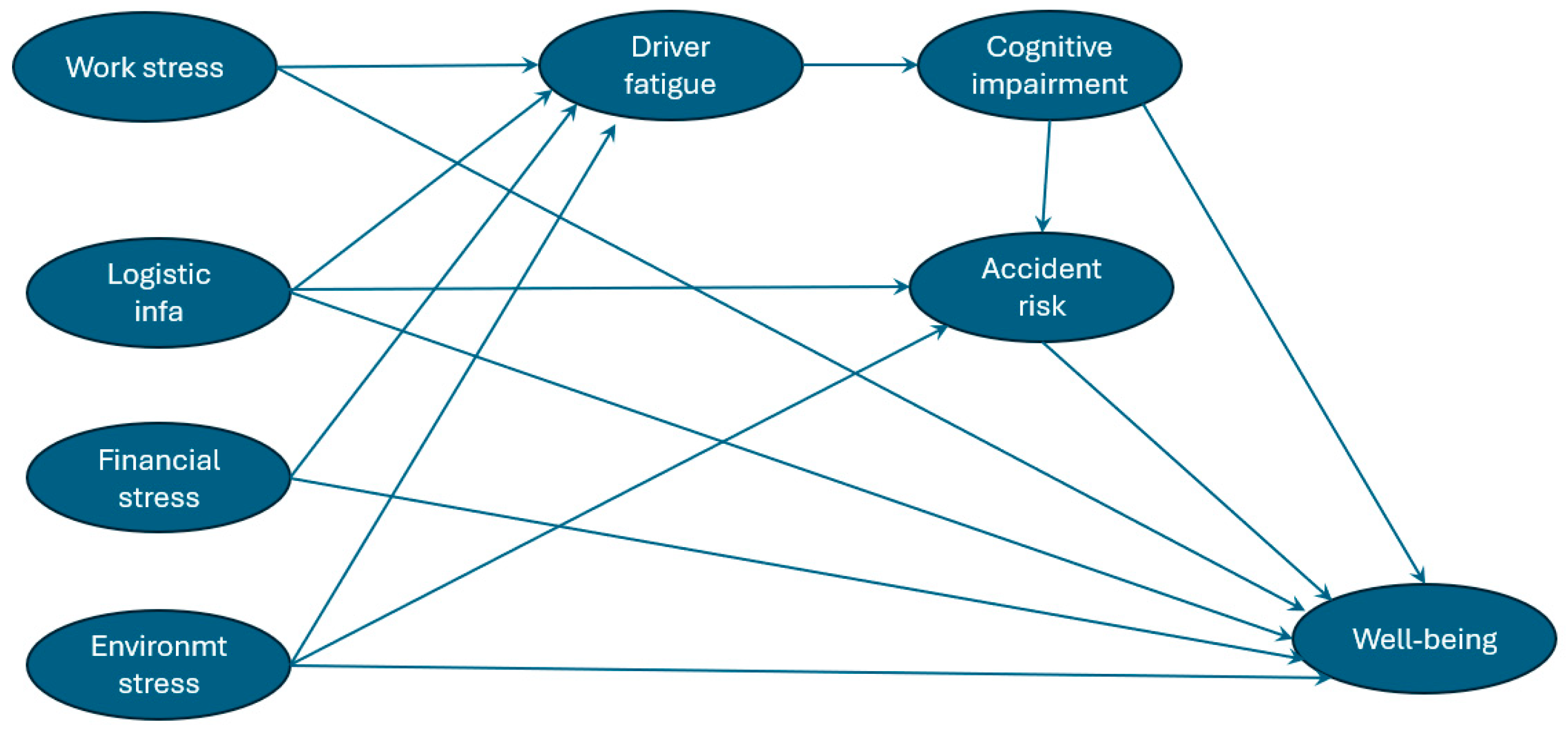
Figure 1 presents the proposed theoretical framework relating to external factors (Work Stress, Logistics Infrastructure, Financial Stress, and Environmental Stress) that impact Driver Fatigue, Cognitive Impairment, and Accident Risk, ultimately impacting the Wellbeing among truck drivers in Thailand.
The model incorporates 18 research hypotheses:
H1. 
Work Stress has a direct effect on Driver Fatigue.
H2. 
Logistics Infrastructure has a direct effect on Driver Fatigue.
H3. 
Financial Stress has a direct effect on Driver Fatigue.
H4. 
Environmental Stress has a direct effect on Driver Fatigue.
H5. 
Logistics Infrastructure has a direct effect on Accident Risk.
H6. 
Environmental Stress has a direct effect on Accident Risk.
H7. 
Driver Fatigue has a direct effect on Cognitive Impairment.
H8. 
Cognitive Impairment has a direct effect on Accident Risk.
H9. 
Cognitive Impairment has a direct effect on Wellbeing.
H10. 
Accident Risk has a direct effect on Wellbeing.
H11. 
Work Stress has a direct effect on Wellbeing.
H12. 
Logistics Infrastructure has a direct effect on Wellbeing.
H13. 
Financial Stress has a direct effect on Wellbeing.
H14. 
Environmental Stress has a direct effect on Wellbeing.
H15. 
Work Stress has an indirect effect on Wellbeing through the mediating variables Driver Fatigue, Cognitive Impairment, and Accident Risk.
H16. 
Environmental Stress has an indirect effect on Wellbeing through the mediating variables Driver Fatigue, Cognitive Impairment, and Accident Risk.
H17. 
Logistics Infrastructure has an indirect effect on Wellbeing through the mediating variables Driver Fatigue, Cognitive Impairment, and Accident Risk.
H18. 
Financial Stress has an indirect effect on Wellbeing through the mediating variables Driver Fatigue, Cognitive Impairment, and Accident Risk.

3. Research Methodology

3.1. Data Collection and Sampling

Data for this study was collected through an online survey conducted by researchers between January 2025 and April 2025. The survey targeted truck drivers in Thailand. Participation in the online questionnaire was voluntary. The population consisted of truck drivers in Thailand holding valid truck driver licenses. According to the database of the Ministry of Transport of Thailand, there were a total of 1,241,250 truck drivers (data of 29 February 2024) [28].
After examining the data from the questionnaire responses and cleaning the data to eliminate missing values, the distribution characteristics of responses were checked to ensure normal distribution according to the Hair Jr, Page [29] criteria.
Hair Jr, Page [29] explains that skewness and kurtosis measure the symmetry of variable distribution. When the distribution extends toward the right or left tail, it indicates skewness that tends toward non-normal distribution. Specifically, skewness values between −1 and +1 are considered excellent and −2 and +2 indicate significant non-normality [30,31,32].
Consequently, data collected from this research established that responses from Thai truck drivers for each question must demonstrate a skewness and kurtosis value between −2 and +2 for the response pattern to be considered normally distributed. The final sample comprised 534 participants, as presented in Table 1.
The demographic data of 534 truck drivers in Thailand shows that the majority are male, aged 35–54 years, have completed primary education, have more than 10 years of truck driving experience, drive semi-trailer/trailers, are permanent employees with salaries, and drive distances not exceeding 300 km.

3.2. Measurement Scales

All variables in this study utilized a five-point Likert scale (1 = strongly disagree and 5 = strongly agree). The questionnaire was adapted from previous studies and modified to suit the context of this research. Content validity was assessed using the Index of Item-Objective Congruence (IOC) by three experts in content and research methodology. A pilot test was conducted with a sample of 50 participants which was similar to the target sample before the actual data collection to assess the reliability using Cronbach’s alpha coefficients.
The pilot test results showed that all eight dimensions had acceptable reliability: Work Stress (four items: WS1–WS4), α = 0.729; Logistics Infrastructure (five items: LI1–LI5), α = 0.753; Financial Stress (five items: FS1–FS5), α = 0.735; Environmental Stress (five items: ES1–ES5), α = 0.849; Driver Fatigue (five items: DF1–DF5), α = 0.842; Cognitive Impairment (four items: CI1–CI4), α = 0.879; Accident Risk (four items: AR1–AR4), α = 0.779; and Wellbeing (six items: WB1–WB6), α = 0.752. These figures indicate satisfactory internal consistency, exceeding the recommended threshold of 0.70 for reliability [29].
The questionnaire design was grounded in an integrated theoretical framework, which combined the Job Demands–Resources (JD-R) theory and Conservation of Resources (COR) theory. The JD-R theory categorizes work characteristics into job demands and job resources [33], while the COR theory explains that individuals strive to obtain, retain, and protect resources, with stress occurring when resources are threatened, lost, or inadequate to meet demands [34]. The above-mentioned theories explain how resource depletion leads to wellbeing deterioration.
Regarding the sample items, the Driver Fatigue construct represents an ideal example of how COR and JD-R theories work together.
Samples items with theoretical rationale:
  • “I feel tired and exhausted while driving” (DF1);
  • “I often lack sleep due to long driving hours” (DF2);
  • “I feel physically exhausted from long-distance driving” (DF3);
  • “It is difficult to concentrate and stay alert while driving long distances” (DF4);
  • “I drove while tired and have not slept enough for days” (DF5).
Four antecedent factors cause different types of resource loss: Work Stress uses up time, Financial Stress threatens money, Environmental Stress drains physical energy, and poor Logistics Infrastructure shows structural problems. The mediating factors show how resource loss grows over time, following the COR theory; for instance, Driver Fatigue starts the loss, Cognitive Impairment makes it worse, and Accident Risk leads to even bigger problems. Wellbeing is the final result of losing resources or reflects the ultimate effect of cumulative depletion.

3.3. Data Analysis

To test the validity of the proposed research model (Figure 1), Partial Least Squares Structural Equation Modeling (PLS-SEM) was employed instead of Covariance-based Structural Equation Modeling (CB-SEM). PLS-SEM is particularly suitable for exploratory research and testing new theories and concepts, making it more appropriate for discovering and creating new insights than traditional CB-SEM. Additionally, it reduces limitations regarding sample size and the number of measurement items, meaning that sample sizes need not be large, and single indicators can be used to reflect latent variables [35,36].
The analysis was conducted using SmartPLS (version 4.1.2). Before hypothesis testing, it was essential to assess construct validity in the measurement model, as all constructs in the research model follow a reflective structure. Construct validity assessment considers (1) outer loadings, which should be no less than 0.70, though values below 0.70 require consideration of (2) reliability measures, which should be no less than 0.70 (including internal consistency through Cronbach’s alpha (α) and composite reliability, rho_a and rho_c, and (3) convergent validity, measured by Average Variance Extracted (AVE), which should be no less than 0.50.
Subsequently, discriminant validity was assessed to ensure the constructs do not exhibit high collinearity. Two criteria were used: (1) the heterotrait–monotrait ratio of correlations (HTMT), where values should not exceed 0.80 according to Henseler, Ringle [37] and F. Hair Jr, Sarstedt [38], and (2) the Fornell–Larcker criterion, comparing the square root of AVE for each construct with its highest correlation with other constructs.
Hypothesis testing was conducted using 5000 bootstrap samples with a 95% confidence interval. The structural model was also evaluated using multiple indices including coefficient of determination (R2), effect size (f2) [29], and model fit measures [39].

4. Results

4.1. Measurement Scale Assessment

The reliability of constructs was assessed using Cronbach’s alpha (α), reflecting the relationship between observed variables and internal consistency through composite reliability, considering outer loadings of the PLS model.
Cronbach’s alpha coefficients for each construct ranged from 0.763 to 0.894, demonstrating acceptable internal consistency above the 0.70 threshold. The composite reliability values exceeded 0.70 for all constructs, and the convergent validity measured by AVE ranged from 0.524 to 0.742, exceeding the 0.50 threshold, indicating no issues with construct validity [29], as shown in Table 2.
However, some questionnaire items were removed from the measurement due to inadequate reliability (α) and/or convergent validity (AVE): LI3, FS4, FS5, AR4, and WB3. After removing these items, the remaining constructs demonstrated good construct validity, as shown in Table 2.
The next step involved assessing discriminant validity to ensure the constructs do not exhibit inappropriate relationships with other constructs. The results in Table 3 indicate compliance with both the Henseler, Ringle [35] criteria, requiring HTMT values below 0.80, and the Fornell and Larcker [40] criteria, comparing square root of AVE with correlations between constructs. All of the constructs demonstrated adequate discriminant validity, leading to high-quality research conclusions.

4.2. Evaluation of the Structural Model

Key criteria for evaluating the structural model include the coefficients of determination (R2), effect size (f2), predictive relevance (Q2), and model fit.
The coefficient of determination (R2) measures the percentage of variance in endogenous constructs that is explained by all connected exogenous constructs. To reduce bias from the number of exogenous variables, adjusted R2 was used. Table 4 shows that Wellbeing has the highest value at 0.548, followed by Driver Fatigue, Cognitive Impairment, and Accident Risk at approximately 0.547, 0.517, and 0.471, respectively, which are all considered moderate levels, indicating adequate explanatory power.
The subsequent evaluation examined whether endogenous constructs (dependent variables) were significantly influenced by their causal predictors, utilizing effect size (f2) measurements [29]. A value of f2 exceeding 0.02, 0.15, and 0.35 indicates small, medium, and large effect sizes, respectively. Table 5 presents the f2 results.
The most substantial effect was observed for Driver Fatigue’s impact on Cognitive Impairment (f2 = 1.076). Medium effects were demonstrated by Logistics Infrastructure on Accident Risk (f2 = 0.310), Financial Stress on Wellbeing (f2 = 0.256), and Work Stress on Driver Fatigue (f2 = 0.240).
Small effects were identified for Environmental Stress on Accident Risk (f2 = 0.112), Financial Stress on Driver Fatigue (f2 = 0.099), Environmental Stress on Wellbeing (f2 = 0.096), Environmental Stress on Driver Fatigue (f2 = 0.051), Cognitive Impairment on Wellbeing (f2 = 0.035), Accident Risk on Wellbeing (f2 = 0.035), and Logistics Infrastructure on Driver Fatigue (f2 = 0.026).
Negligible effects were found for Work Stress on Wellbeing (f2 = 0.016), Cognitive Impairment on Accident Risk (f2 = 0.015), and Logistics Infrastructure on Wellbeing (f2 = 0.001).
In this study, the overall goodness of fit (GOF) serves as an indicator whereby higher GOF values signify a superior fit compared to lower GOF values. Specifically, GOF values ranging from 0.1 to 0.25 indicate low model fit, values between 0.25 and 0.36 represent moderate model fit, and GOF values of 0.36 and above demonstrate high model fit [39].
The GOF of the structural model is assessed by calculating the square root of the product derived from the average coefficient of determination (R2) and the average AVE (Average Variance Extracted). Concerning the research model, the calculated GOF value equals 0.575 (as shown in Table 6), which demonstrates that the research model exhibits a high level of coherence. Consequently, it can be concluded that this research model is exceptionally appropriate.

4.3. Hypothesis Testing

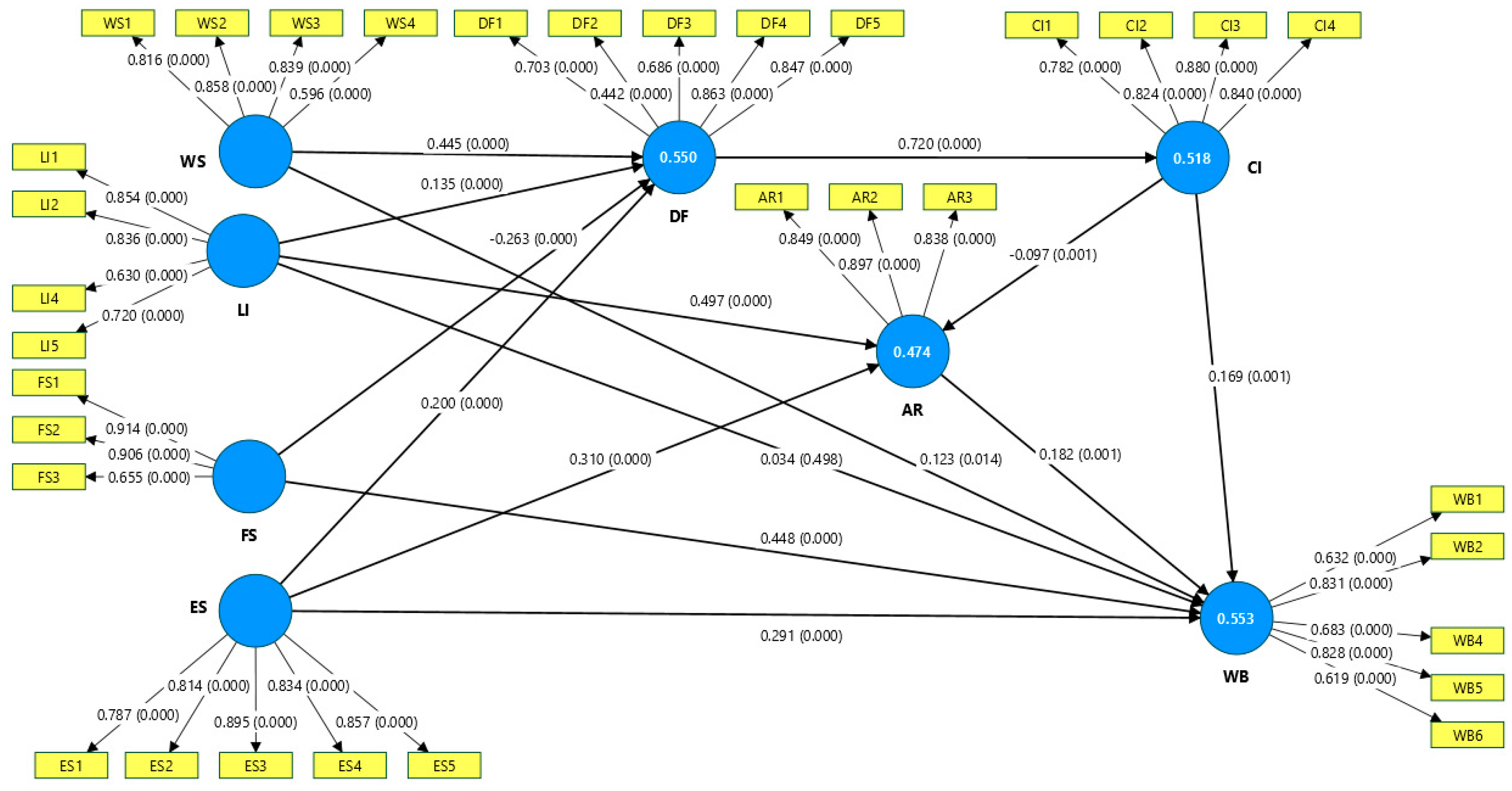
Finally, following the examination of construct validity of latent variables and discriminant validity among all latent variables, the analysis of causal relationships between structural variables was conducted to determine the significance of causal structural variables through path coefficient estimation using bootstrap sampling with 5000 random samples at a 95% confidence interval. The t-value and p-value were employed to test whether the path coefficient β demonstrated statistical significance, as illustrated in Figure 2 and Table 7. Out of the 14 direct paths (H1–H14), 13 hypotheses received statistical support, with H12 (Logistics Infrastructure to Wellbeing) being the only exception that was not supported.
Moreover, the hypotheses proposing that Work Stress, Logistics Infrastructure, Financial Stress, and Environmental Stress impact Wellbeing through the serial mediating variables of Driver Fatigue, Cognitive Impairment, and Accident Risk (H15–H18) were all supported as statistically significant (as shown in Table 8). The test results indicate that the mediating variables Driver Fatigue, Cognitive Impairment, and Accident Risk function as complementary partial mediators for the influence of Work Stress and Environmental Stress on Wellbeing, whilst serving as competitive partial mediators for the influence of Financial Stress on Wellbeing.
Regarding the role of the three mediating variables (Driver Fatigue, Cognitive Impairment, and Accident Risk) in the relationship between Logistics Infrastructure and Wellbeing, it was found that all three mediators function as full serial mediators of the influence of Logistics Infrastructure on Wellbeing.
The non-significant direct effect of Logistics Infrastructure on Wellbeing (H12: β = 0.034, p = 0.498), despite significant total effects through mediation (Table 8), suggests that infrastructure quality influences wellbeing exclusively through physiological pathways rather than conscious psychological appraisal. Unlike financial or work stress, which drivers directly perceive as threats, infrastructure deficiencies operate as gradual physical stressors. Poor road conditions generate vibration and require continuous postural adjustments [11], depleting physical resources and inducing fatigue without immediate conscious distress. The experienced drivers in the sample (68.4% with over 10 years of experience) appear to be psychologically adapted to infrastructure conditions and no longer experience direct wellbeing impacts, yet the physical toll continues accumulating through fatigue mechanisms. The seemingly counterintuitive negative coefficient for Financial Stress → Driver Fatigue (β = −0.263), p < 0.001) reflects a ‘necessity effect’, whereby financial pressures force drivers to remain hyper vigilant and suppress fatigue perception to maintain productivity and earnings, particularly under Thailand’s mile-based compensation systems. However, this suppressed fatigue manifests through cognitive impairment and accident risk, explaining why Financial Stress ultimately harms wellbeing despite its negative association with reported fatigue. This pattern exemplifies competitive partial mediation, where direct protective effects are overwhelmed by harmful indirect effects through cognitive deterioration.
The final section presents the total effects (TE) of each causal variable on Wellbeing, as illustrated in Table 9. The findings reveal that all causal variables exerted statistically significant total effects on the Wellbeing construct.
Financial Stress demonstrated the strongest overall influence on Wellbeing (TE = 0.421), followed by Environmental Stress (TE = 0.369), and Driver Fatigue exhibited the weakest total effect on Wellbeing (TE = 0.108).

5. Discussion

The findings of this study highlight that financial stress and environmental stress are the most influential determinants of truck driver wellbeing, while logistics infrastructure affects wellbeing mainly through its indirect impact on fatigue, cognitive impairment, and accident risk. These results are consistent with and extend the existing occupational health literature because they confirm that multiple work-related stressors operate through cascading mechanisms rather than isolated pathways, which supports the integrated use of the Job Demands–Resources (JD-R) theory and Conservation of Resources (COR) theory in the trucking context. Simultaneously, the observed patterns of complementary partial mediation for work and environmental stress, competitive partial mediation for financial stress, and full serial mediation for logistics infrastructure provide a more nuanced picture of how different stressors erode driver’s resources and wellbeing.
In addition, the application of the pyramidal concept of scientific contribution helps to clarify the position of this study within the broader body of research on truck driver wellbeing. Most previous work remains at lower and middle levels of the pyramid, where studies either describe stressors and health outcomes or test relatively simple relationships. In contrast, the present study advances the field toward a higher tier by offering a comprehensive serial mediation model that integrates four major antecedent factors and three mediating mechanisms within a coherent theoretical framework. This perspective also reveals clear theoretical gaps at the top of the pyramid, particularly in relation to dynamic resource loss processes over time, the role of multi-level organizational and infrastructural determinants, and the development of intervention-oriented frameworks that future research should address.
This research also achieved both objectives by examining relationships between antecedent factors and truck drivers’ wellbeing in Thailand using PLS-SEM analysis. The findings also support multi-level interventions addressing both direct stressors and mediating pathways, contributing to sustainable transportation systems balancing economic efficiency with worker welfare.
Three of four antecedent factors directly impact wellbeing, which are Financial Stress (β = 0.449, p < 0.001), Environmental Stress (β = 0.291, p < 0.001), and Work Stress (β = 0.122, p < 0.05). Logistics Infrastructure showed no direct effect (β = 0.034, p = 0.498), influencing wellbeing only through indirect pathways. Financial Stress demonstrated the strongest total effect (TE = 0.421), followed by Environmental Stress (TE = 0.369).
Driver Fatigue, Cognitive Impairment, and Accident Risk showed distinct mediation patterns, which are complementary partial mediation for Work Stress and Environmental Stress, competitive partial mediation for Financial Stress, and complete serial mediation for Logistics Infrastructure. The substantial effect of Driver Fatigue on Cognitive Impairment (f2 = 1.076) confirms cascading deterioration, with all variables explaining 54.8% of wellbeing variance.
Seventeen of the eighteen hypotheses were supported, with excellent model fit (GOF = 0.575) confirming the conceptual framework’s appropriateness.
Nonetheless, the findings align with established occupational health theories while revealing Thailand-specific patterns. Financial Stress as the primary predictor supports the Job Demand–Resources model, where economic pressure creates unsustainable work demands [41]. This reflects that Thai trucking’s mile-based compensation systems forcing excessive working hours, similarly to patterns observed in Indian truck drivers [5]. The competitive partial mediation suggests that financial pressures simultaneously provide job security benefits while harming wellbeing through fatigue pathways.
Environmental Stress findings align with the literature documenting acoustic pollution, vibration, and temperature effects on driver capabilities [6,7]. The complementary partial mediation confirms multi-pathway environment stress models, which are particularly relevant given that Thailand’s extreme weather and poor urban air quality affect the 55.1% of drivers operating within 300 km distances.
The complete mediation role of fatigue variables for Logistics Infrastructure validates the Ajayi, Kurien [11] framework, where road quality influences outcomes exclusively through physiological pathways. This suggests that infrastructure improvements benefit wellbeing only by reducing fatigue and cognitive load.
The infrastructure finding has critical policy implications often overlooked in transportation research. Infrastructure investments prioritizing structural quality alone may fail to improve driver wellbeing unless specifically targeting fatigue-reduction mechanisms, such as vibration dampening, rest area placement based on fatigue accumulation patterns, and road surface quality in high-traffic freight corridors. Similarly, the financial stress paradox underscores the dangers of productivity-based payment systems that incentivize fatigue suppression, creating hidden safety risks not captured by self-reported fatigue measures alone.
Further to the Thailand industry context, the demographic profile (95.3% male, 49.1% primary education, and 68.4% with >10 years of experience) reveals a mature workforce facing industry modernization pressures. Despite 86.5% permanent employment, financial stress persists, indicating inadequate wage structures rather than job insecurity. The substantial Driver Fatigue–Cognitive Impairment relationship (β = 0.721) demonstrates cascading deterioration patterns requiring urgent intervention.
Work Stress effects, while smaller, reflect Thailand’s hierarchical work culture and limited driver autonomy. The complementary partial mediation suggests that interventions addressing both direct stressors and fatigue pathways could be particularly effective.
However, the research supports multi-level interventions: financial stress mitigation through minimum wage standards and regulated working hours; environmental stress reduction via improved rest facilities and vehicle cabin conditions; and infrastructure investment prioritizing fatigue reduction over structural improvements alone.
Moreover, the research demonstrates profound alignment with United Nations Sustainable Development Goals, positioning driver wellbeing as integral to sustainable development. SDG3 (Good Health and Wellbeing) benefits from identified pathways through which occupational stressors compromise driver health, providing evidence-based intervention targets for global commercial driver populations. Financial stress findings have clear connections to SDG8 (Decent Work and Economic Growth) by revealing how inadequate compensation creates health deterioration cycles, which undermine economic productivity. The evidence supports policy interventions including minimum wage regulations and standardized working hours that simultaneously improve welfare and economic efficiency. SDG9 (Industry, Innovation, and Infrastructure) obtains from the revelation that infrastructure improvements alone cannot improve wellbeing without addressing fatigue mechanisms, which redirects investment priorities toward rest facilities of truck drivers and driver support systems, as well as fatigue-monitoring equipment. This will represent a paradigm shift from infrastructure-focused to human-centered approaches.
Furthermore, the accident risk findings also connect to SDG11 (Sustainable Cities and Communities) by showing how driver wellbeing directly impacts urban transportation safety. Cognitive impairment as a mediating factor between stress and accident risk provides evidence for urban planning policies prioritizing driver welfare as public safety measures. Driver wellbeing literally aligns with Sustainable Development Goals and supports evidence-based policies benefiting millions of commercial drivers. Targeted interventions can meaningfully improve occupational wellbeing, providing a foundation for transforming trucking practices toward safer, more sustainable transportation systems.

6. Limitation

This research acknowledges several limitations. Data exclusively from Thai truck drivers limits the generalizability to other national contexts with different regulatory environments and cultural work norms. Self-report measures may introduce socially desirable responding and common method variance, while the cross-sectional design prevents the establishment of definitive causal directions or the capture of temporal dynamics. The online survey methodology may exclude older drivers or those with limited digital literacy. The data collection, during January to April 2025, coincided with a post-holiday logistics surge and the hot season onset, potentially elevating stress levels beyond typical conditions. The study did not control for organizational variability across companies, route types, or payment structures. Future research should employ longitudinal designs, integrate objective fatigue measurement through physiological assessments, conduct cross cultural comparative studies, and investigate moderating variables including organizational safety culture and individual differences.

7. Conclusions

In conclusion, this study provides the first comprehensive serial mediation model linking occupational stressors to truck driver wellbeing in Thailand, revealing that financial stress exerts the strongest direct impact while logistics infrastructure influences wellbeing exclusively through fatigue, cognitive impairment, and accident risk pathways. Grounded in JD-R and COR theories, the findings underscore the cascading nature of resource depletion in high-demand trucking environments, with PLS-SEM analysis confirming robust mediation effects across the proposed framework. These insights advance occupational health research by integrating multiple antecedents and mediators in a southeast Asian context, highlighting financial and environmental stressors as priority targets for intervention.
The results align with global evidence on driver fatigue and mental health challenges yet emphasize the unique role of economic pressures in low-wage logistics sectors like those in Thailand. By demonstrating varied mediation types—complementary partial for work and environmental stress, competitive partial for financial stress, and full serial for infrastructure—this model refines the theoretical applications of JD-R and COR, offering a nuanced view of how stressors erode wellbeing over time. The limitations of the study include the cross-sectional design, which precludes causal inference, and reliance on self-reported data, suggesting the need for longitudinal and objective measures in future work.
Ultimately, these findings support United Nations Sustainable Development Goals 3, 8, and 9 by informing policies for decent work, health promotion, and resilient infrastructure. Recommendations include redesigning pay systems to mitigate financial stress, enhancing rest facilities to combat fatigue, and integrating driver wellbeing metrics into logistics planning. Future research should extend this framework with dynamic, multi-level analyses to test interventions.


Author Contributions

Conceptualization, E.A.; Methodology, E.A.; Software, E.A.; Validation, E.A. and P.V.; Formal analysis, E.A.; Investigation, E.A.; Resources, E.A.; Data curation, E.A. and P.V.; Writing—original draft, E.A.; Writing—review & editing, P.V.; Visualization, E.A.; Supervision, P.V.; Project administration, E.A. and P.V.; Funding acquisition, E.A. All authors have read and agreed to the published version of the manuscript.

Funding

This research received no external funding.

Institutional Review Board Statement

The study was conducted in accordance with the Declaration of Helsinki, and the protocol was approved by the Institutional Review Board of the University of Thai Chamber of Commerce (UTCC), A07052/2025 29 September 2025.

Informed Consent Statement

Informed consent for participation was obtained from all subjects involved in the study.

Data Availability Statement

The data presented in this study contain personal and confidential information collected from truck drivers. Therefore, the datasets are not publicly available due to privacy and ethical restrictions. However, the data may be made available from the corresponding author upon reasonable request and with permission from the Institutional Review Board of the University of Thai Chamber of Commerce.

Conflicts of Interest

The authors declare no conflict of interest.

Abbreviations

PLS-SEMPartial Least Squares Structural Equation Modeling
SDGsSustainable Development Goals
OROdds Ratio
WSWork Stress
LILogistics Infrastructure
FSFinancial Stress
ESEnvironmental Stress
DFDriver Fatigue
CICognitive Impairment
ARAccident Risk
WBWellbeing
CORConservation of Resources
JD-RJob Demand–Resource
CB-SEMCovariance Based–Structural Equation Modeling
AVEAverage Variance Extracted
GOFGoodness of Fit
TETotal Effects

References

  1. Garbarino, S.; Guglielmi, O.; Sannita, W.G.; Magnavita, N.; Lanteri, P. Sleep and Mental Health in Truck Drivers: Descriptive Review of the Current Evidence and Proposal of Strategies for Primary Prevention. Int. J. Environ. Res. Public Health 2018, 15, 1852. [Google Scholar] [CrossRef] [PubMed]
  2. Useche, S.A.; Alonso, F.; Cendales, B.; Llamazares, J. More than just “stressful”? Testing the mediating role of fatigue on the relationship between job stress and occupational crashes of long-haul truck drivers. Psychol. Res. Behav. Manag. 2021, 14, 1211–1221. [Google Scholar] [CrossRef] [PubMed]
  3. Department of Highways. Traffic Accident on National Highways in 2023: Annual Report 2023. 2023. Available online: http://bhs.doh.go.th/download/accident (accessed on 1 April 2023).
  4. Ren, X.; Pritchard, E.; van Vreden, C.; Newnam, S.; Iles, R.; Xia, T. Factors Associated with Fatigued Driving among Australian Truck Drivers: A Cross-Sectional Study. Int. J. Environ. Res. Public Health 2023, 20, 2732. [Google Scholar] [CrossRef] [PubMed]
  5. Tripathi, V.; Pareek, S. Navigating the Road to Resilience (RR): Understanding the work environment’s influence on mental health among Indian truck drivers. BMC Public Health 2025, 25, 1227. [Google Scholar] [CrossRef]
  6. Du, B.B.; Bigelow, P.L.; Wells, R.P.; Davies, H.W.; Hall, P.; Johnson, P.W. The impact of different seats and whole-body vibration exposures on truck driver vigilance and discomfort. Ergonomics 2018, 61, 527–528. [Google Scholar] [CrossRef]
  7. Mazloumi, A.; Golbabaei, F.; Khani, S.M.; Kazemi, Z.; Hosseini, M.; Abbasinia, M.; Dehghan, S.F. Evaluating Effects of Heat Stress on Cognitive Function among Workers in a Hot Industry. Health Promot. Perspect. 2014, 4, 240–246. [Google Scholar]
  8. Hege, A.; Lemke, M.K.; Apostolopoulos, Y.; Sönmez, S. The impact of work organization, job stress, and sleep on the health behaviors and outcomes of US long-haul truck drivers. Health Educ. Behav. 2019, 46, 626–636. [Google Scholar] [CrossRef]
  9. Useche, S.A.; Ortiz, V.G.; Cendales, B.E. Stress-related psychosocial factors at work, fatigue, and risky driving behavior in bus rapid transport (BRT) drivers. Accid. Anal. Prev. 2017, 104, 106–114. [Google Scholar] [CrossRef]
  10. Wise, J.M.; Heaton, K.; Patrician, P. Fatigue in long-haul truck drivers: A concept analysis. Workplace Health Saf. 2019, 67, 68–77. [Google Scholar] [CrossRef]
  11. Ajayi, O.O.; Kurien, A.M.; Djouani, K.; Dieng, L. Analysis of Road Roughness and Driver Comfort in ‘Long-Haul’ Road Transportation Using Random Forest Approach. Sensors 2024, 24, 6115. [Google Scholar] [CrossRef]
  12. Siriprasert, I.; Vanichkobchinda, P. Mathematical Models for Predicting Roadway-Characteristics-and-Level-of-Service-Dependent Travel Times on Rural Roads in Thailand. Int. J. Eng. Technol. 2012, 4, 82–85. [Google Scholar] [CrossRef]
  13. Niu, S.; Li, G. Fatigue driving prediction on commercial dangerous goods truck using location data: The relationship between fatigue driving and driving environment. J. Adv. Transp. 2020, 2020, 4219562. [Google Scholar] [CrossRef]
  14. Peters, S.E.; Grogan, H.; Henderson, G.M.; Gómez, M.A.L.; Maldonado, M.M.; Sanhueza, I.S.; Dennerlein, J.T. Working conditions influencing drivers’ safety and well-being in the transportation industry:“on board” program. Int. J. Environ. Res. Public Health 2021, 18, 10173. [Google Scholar] [CrossRef]
  15. Casey, G.J.; Miles-Johnson, T.; Stevens, G.J. Heavy vehicle driver fatigue: Observing work and rest behaviours of truck drivers in Australia. Transp. Res. Part F 2024, 104, 136–153. [Google Scholar] [CrossRef]
  16. Zhang, C.; Ma, Y.; Chen, S.; Zhang, J.; Xing, G. Exploring the occupational fatigue risk of short-haul truck drivers: Effects of sleep pattern, driving task, and time-on-task on driving behavior and eye-motion metrics. Transp. Res. Part F Traffic Psychol. Behav. 2024, 100, 37–56. [Google Scholar] [CrossRef]
  17. Horberry, T.; Mulvihill, C.; Fitzharris, M.; Lawrence, B.; Lenne, M.; Kuo, J.; Wood, D. Human-Centered Design for an In-Vehicle Truck Driver Fatigue and Distraction Warning System. IEEE Trans. Intell. Transp. Syst. 2021, 23, 5350–5359. [Google Scholar] [CrossRef]
  18. Ivanišević, T.; Simović, S.; Trifunović, A.; Vukšić, V. Perception of large danger lists and orange boards for marking transport units. J. Urban Dev. Manag. 2024, 3, 74–82. [Google Scholar] [CrossRef]
  19. Matthews, G. Towards a transactional ergonomics for driver stress and fatigue. Theor. Issues Ergon. Sci. 2002, 3, 195–211. [Google Scholar] [CrossRef]
  20. Meng, F.; Li, S.; Cao, L.; Li, M.; Peng, Q.; Wang, C.; Zhang, W. Driving fatigue in professional drivers: A survey of truck and taxi drivers. Traffic Inj. Prev. 2015, 16, 474–483. [Google Scholar] [CrossRef]
  21. Al-Mekhlafi, A.B.A.; Isha, A.S.N.; Chileshe, N.; Abdulrab, M.; Saeed, A.A.H.; Kineber, A.F. Modelling the Relationship between the Nature of Work Factors and Driving Performance Mediating by Role of Fatigue. Int. J. Environ. Res. Public Health 2021, 18, 6752. [Google Scholar] [CrossRef]
  22. Adachi, M.; Nobukawa, S.; Inagaki, K. Assessment of driver fatigue-related brain responses and causal factors during driving under different traffic conditions. Front. Appl. Math. Stat. 2024, 10, 1426253. [Google Scholar] [CrossRef]
  23. Mabry, J.E.; Camden, M.; Miller, A.; Sarkar, A.; Manke, A.; Ridgeway, C.; Iridiastadi, H.; Crowder, T.; Islam, M.; Soccolich, S.; et al. Unravelling the Complexity of Irregular Shiftwork, Fatigue and Sleep Health for Commercial Drivers and the Associated Implications for Roadway Safety. Int. J. Env. Res. Public Health 2022, 19, 14780. [Google Scholar] [CrossRef]
  24. Habybabady, R.; Okati-Aliabad, H.; Sabouri, M.; Mohammadi, M.; Ansari-Moghaddam, A. Prevalence and factors associated with road traffic crashes among truck drivers in Southeast Iran. PLoS ONE 2025, 20, e0320974. [Google Scholar] [CrossRef]
  25. Lim, J.; Jeon, J.-W.; Cho, E.; Oh, C.; Park, H.-C. Investigating influential factors for commercial vehicle crashes using a hierarchical model: Focusing on the occupational driver’s intrinsic factors. J. Korean Soc. Transp. 2021, 39, 807–825. [Google Scholar] [CrossRef]
  26. Milano, G. The hierarchy of the evidence-based medicine pyramid: Classification beyond ranking. Joints 2015, 3, 101. [Google Scholar] [CrossRef] [PubMed]
  27. Murad, M.H.; Asi, N.; Alsawas, M.; Alahdab, F. New evidence pyramid. Evid. Based Med. 2016, 21, 125–127. [Google Scholar] [CrossRef]
  28. Ministry of Transport. MOT DATA CATALOG. 2024. Available online: https://datagov.mot.go.th/dataset/dataset_stat_1_005/resource/cf3d0dba-f2ec-44cc-abad-2420e1965c2e?inner_span=True (accessed on 5 August 2025).
  29. Hair, J., Jr.; Page, M.; Brunsveld, N. Essentials of Business Research Methods; Routledge: Abingdon, UK, 2019. [Google Scholar]
  30. Gravetter, F.J.; Wallnau, L.B. Essentials of Statistics for the Behavioral Sciences; Wadsworth Cengage Learning: Boston, MA, USA, 2011. [Google Scholar]
  31. Hair, J.F., Jr. Partial Least Squares Structural Equation Modeling (PLS-SEM) Using R: A Workbook; Springer Nature: Berlin/Heidelberg, Germany, 2021. [Google Scholar]
  32. Trochim, W.; Donnelly, J. The Research Methods Knowledge; Atomic dog publishing: Cincinnati, OH, USA, 2006; Volume 17. [Google Scholar]
  33. Bakker, A.B.; Demerouti, E.; Sanz-Vergel, A. Job Demands–Resources Theory: Ten Years Later. Annu. Rev. Organ. Psychol. Organ. Behav. 2023, 10, 25–53. [Google Scholar] [CrossRef]
  34. Hobfoll, S.E. Conservation of resources: A new attempt at conceptualizing stress. Am. Psychol. 1989, 44, 513. [Google Scholar] [CrossRef]
  35. Henseler, J.; Ringle, C.M.; Sarstedt, M. A new criterion for assessing discriminant validity in variance-based structural equation modeling. J. Acad. Mark. Sci. 2015, 43, 115–135. [Google Scholar] [CrossRef]
  36. Sarstedt, M.; Ringle, C.M.; Hair, J.F. Partial Least Squares Structural Equation Modeling. In Handbook of Market Research; Springer: Berlin/Heidelberg, Germany, 2021; pp. 587–632. [Google Scholar]
  37. Henseler, J.; Ringle, C.M.; Sinkovics, R.R. The use of partial least squares path modeling in international marketing. In New Challenges to International Marketing; Emerald Group Publishing Limited: England, UK, 2009; pp. 277–319. [Google Scholar]
  38. Hair, J.F., Jr.; Sarstedt, M.; Hopkins, L.; Kuppelwieser, V.G. Partial least squares structural equation modeling (PLS-SEM). Eur. Bus. Rev. 2014, 26, 106–121. [Google Scholar] [CrossRef]
  39. Tenenhaus, M.; Vinzi, V.E.; Chatelin, Y.-M.; Lauro, C. PLS path modeling. Comput. Stat. Data Anal. 2005, 48, 159–205. [Google Scholar] [CrossRef]
  40. Fornell, C.; Larcker, D.F. Evaluating structural equation models with unobservable variables and measurement error. J. Mark. Res. 1981, 18, 39–50. [Google Scholar] [CrossRef]
  41. Hege, A.; Lemke, M.K.; Apostolopoulos, Y.; Sönmez, S. Occupational health disparities among US long-haul truck drivers: The influence of work organization and sleep on cardiovascular and metabolic disease risk. PLoS ONE 2018, 13, e0207322. [Google Scholar] [CrossRef] [PubMed]
Figure 1. Research conceptual framework.
Sustainability 17 11162 g001
Figure 2. Research model analysis results.
Sustainability 17 11162 g002
Table 1. Demographic characteristics of the survey sample.
VariableNumberPercentage
Gender
Male50995.3
Female254.7
Age (years)
Under 2561.1
25–345710.7
35–4417532.8
45–5418634.8
54 and above11020.6
Education Level
No formal education326.0
Primary education26249.1
Secondary education16931.6
Vocational education417.7
Bachelor’s degree or higher305.6
Truck Driving Experience
Less than 1 year203.7
1–3 years274.5
4–6 years539.9
7–10 years7213.5
More than 10 years36568.4
Type of Truck Driven
Six-wheeler5911.0
Ten-wheeler346.4
Semi-trailer/Trailer41177.0
Concrete Mixer20.4
Small four-wheeler (pickup)285.2
Employment Type
Permanent employee (salaried)46286.5
Freelance/Contract6712.5
Substitute/Backup driver50.9
Regular Driving Distance (round trip)
Less than 300 km29455.1
300–500 km12022.5
500–900 km5911.0
More than 900 km6111.4
Table 2. Construct validity: outer loading, α, rho_a, rho_c, and AVE.
Latent VariablesItemsOut Loadingst-Valueαrho_arho_cAVE
Work Stress (WS)WS10.81649.9680.7870.8170.8630.615
WS20.85866.681
WS30.83951.759
WS40.59615.039
Logistics Infrastructure (LI)LI10.85452.7970.7630.7980.8480.586
LI20.83652.943
LI40.63016.664
LI50.72026.110
Financial Stress (FS)FS10.914105.1080.7710.8160.8700.695
FS20.90672.259
FS30.65518.478
Environmental Stress (ES)ES10.78732.4680.8940.8980.9220.702
ES20.81437.307
ES30.89572.954
ES40.83446.773
ES50.85752.999
Driver Fatigue (DF)DF10.70325.0460.7610.8160.8410.524
DF20.44210.040
DF30.68622.835
DF40.86363.650
DF50.84758.404
Cognitive Impairment (CI)CI10.78233.3020.8520.8570.9000.692
CI20.82445.709
CI30.88078.737
CI40.84051.646
Accident Risk (AR)AR10.84942.1400.8260.8280.8960.742
AR20.89764.364
AR30.83844.506
Wellbeing (WB)WB10.63215.9040.7690.7930.8450.525
WB20.83140.541
WB40.68316.523
WB50.82841.107
WB60.61912.887
Table 3. Discriminant validity: HTMT criterion and Fornell–Larcker criterion.
ConstructsHTMT CriterionFornell–Larcker Criterion
ARCIDFESFSLIWBARCIDFESFSLIWBWS
AR- 0.862
CI0.222- 0.1880.832
DF0.3370.879- 0.2070.7200.724
ES0.6440.4570.567- 0.5560.4070.4180.838
FS0.4470.4570.6110.192- 0.348−0.348−0.4200.1420.834
LI0.7690.4590.5820.6930.323- 0.6440.3200.3610.5750.1360.765
WB0.7020.4770.5320.7070.5500.623-0.5680.2530.1700.5920.4420.4730.725
WS0.1840.7610.8350.4930.5780.4800.4760.1310.6260.6900.399−0.4580.3310.1740.784
Table 4. Coefficient of determination (R2).
ConstructsR-SquareR-Square AdjustedMeaning
AR0.4740.471Moderate
CI0.5180.517Moderate
DF0.5500.547Moderate
WB0.5530.548Moderate
Note: R2 = 0.75 (substantial); R2 = 0.50 (moderate); and R2 ≤ 0.25 (Weak). Adapted from [29].
Table 5. Effect size (f2).
ConstructsARCIDFWB
WS 0.2400.016
FS 0.0990.256
LI0.310 0.0260.001
ES0.112 0.0510.096
CI0.015 0.035
DF 1.076
AR 0.035
Table 6. Overall goodness of fit (GOF).
ConstructsR-Square AdjustedAVE
AR0.4710.742
CI0.5170.692
DF0.5470.524
WB0.5480.525
WS 0.615
LI 0.586
FS 0.695
ES 0.702
Average0.5210.635
GOF0.575
Table 7. Direct effect testing results.
HypothesisPathDirect Effectt-Valuep-ValuesSupported
H1WS → DF0.44810.694 ***0.000Yes
H2LI → DF0.1343.734 ***0.000Yes
H3FS → DF−0.2636.363 ***0.000Yes
H4ES → DF0.2005.696 ***0.000Yes
H5LI →AR0.5008.804 ***0.000Yes
H6ES → AR0.3085.114 ***0.000Yes
H7DF → CI0.72129.466 ***0.000Yes
H8CI →AR−0.0973.437 **0.001Yes
H9CI →WB0.1673.482 **0.001Yes
H10AR → WB0.1823.298 **0.001Yes
H11WS → WB0.1222.461 *0.014Yes
H12LI →WB0.0340.6770.498No
H13FS → WB0.4498.428 ***0.000Yes
H14ES → WB0.2915.731 ***0.000Yes
Note: * p < 0.05, ** p < 0.01, and *** p < 0.001.
Table 8. Total indirect effect testing results (H15–H18).
PathTotal Indirect Effectt-Valuep-ValuesSupportedRole of Mediators
ES → WB0.0783.598 ***0.000YesComplementary partial mediators
FS → WB−0.0282.780 **0.005YesCompetitive partial mediators
LI → WB0.1053.835 ***0.000YesFull mediators
WS → WB0.0482.818 **0.005YesComplementary partial mediators
Note: ** p < 0.01, and *** p < 0.001.
Table 9. Total effect testing.
Total Effectt-Valuep-ValuesSupported
AR → WB0.1823.298 **0.001Yes
CI → WB0.1503.052 **0.002Yes
DF → WB0.1083.033 **0.002Yes
ES → WB0.3697.543 ***0.000Yes
FS → WB0.4218.221 ***0.000Yes
LI → WB0.1393.101 **0.002Yes
WS → WB0.1703.862 ***0.000Yes
Note: ** p < 0.01, and *** p < 0.001.
Disclaimer/Publisher’s Note: The statements, opinions and data contained in all publications are solely those of the individual author(s) and contributor(s) and not of MDPI and/or the editor(s). MDPI and/or the editor(s) disclaim responsibility for any injury to people or property resulting from any ideas, methods, instructions or products referred to in the content.