Article

Optimization of Nitrogen Fertilizer Operation for Sustainable Production of Japonica Rice with Different Panicle Types in Liaohe Plain: Yield-Quality Synergy Mechanism and Agronomic Physiological Regulation

Agricultural College, Shenyang Agricultural University, Shenyang 110866, China
*
Author to whom correspondence should be addressed.
Sustainability 2025, 17(24), 11152; https://doi.org/10.3390/su172411152
Submission received: 24 October 2025 / Revised: 21 November 2025 / Accepted: 9 December 2025 / Published: 12 December 2025

Abstract

Northern japonica rice holds a significant position in China’s food security. However, the traditional nitrogen fertilizer management model (nitrogen application rate > 225 kg/ha, base fertilizer proportion > 50%) has led to serious sustainability problems: the nitrogen utilization rate is only 25–30%, resulting in a large amount of fertilizer waste and economic losses. At the same time, it causes a decline in rice quality, manifested as a 15–20% increase in chalkiness and an 8–12% decrease in palatability value. It has also brought about environmental problems such as soil acidification and eutrophication of water bodies. As an important japonica rice production area, the Liaohe Plain has significant differences in the response of semi-upright and curved panicle varieties to nitrogen fertilizer. However, the agronomic physiological mechanism for the coordinated improvement of yield and quality of japonica rice with different panicle types is still unclear at present, which limits the sustainable development of rice production in this region. For this purpose, in this study, the typical semi-upright spike variety Shendao 47 and the curved spike variety Shendao 11 from the Liaohe Plain were used as materials, and five nitrogen fertilizer treatments were set up: N1, no nitrogen application; N2–N4, conventional nitrogen application rate of 165–225 kg/ha; and N5, and optimized nitrogen application rate of 195 kg/ha allocated in the proportion of 40% base fertilizer, 15% tillering fertilizer, 25% tillering fertilizer, 15% panicle fertilizer, and 5% grain fertilizer. The synergistic regulatory effect of nitrogen fertilizer management on yield and rice quality was systematically explored, and the key agronomic physiological mechanisms were analyzed. The research results show that: (1) The optimized nitrogen fertilizer treatment (N5) achieved a significant increase in yield while reducing the input of nitrogen fertilizer. The yields of Shendao 47 and Shendao 11 reached 10.71–11.82 t/ha and 9.50–10.62 t/ha, respectively, increasing by more than 35% compared with the treatment without nitrogen. (2) The N5 treatment simultaneously improved the processing quality (the whole polished rice rate increased by 4.11%) and the appearance quality (the chalkiness decreased by 63.8% to 77%). (3) The dry matter accumulation during the tillering stage (≥3.2 t/ha) and the net assimilation rate during the scion development stage (≥12 g/m2/d) were identified as key agronomic physiological indicators for regulating the yield-quality synergy. Optimizing nitrogen fertilizer management ensures an adequate supply of photosynthetic products through the high photosynthetic rate of flag-holding leaves and the extended lifespan of functional leaves. The phased nitrogen application strategy of “40% base fertilizer + 25% tillering fertilizer + 15% panicle fertilizer + 5% grain fertilizer” proposed in this study provides a theoretical and practical basis for the sustainable development of japonica rice production in the Liaohe Plain. This plan has achieved the coordinated realization of multiple goals including resource conservation (reducing nitrogen by 13%), environmental protection (lowering the risk of nitrogen loss), food security guarantee (stable increase in yield), and quality improvement (enhancement of rice quality), effectively promoting the development of the northern japonica rice industry towards a green, efficient and sustainable direction. Develop in the right direction.

1. Introduction

Rice, as a major staple food crop in China, is closely related to national food security and people’s livelihood. With the upgrading of consumption, the market demand for high-quality rice is increasing day by day [1], but agricultural production still faces the challenge of being unable to balance high yield and high quality. The japonica rice from the Liaohe Plain holds an important position in national rice production due to its excellent taste and wide adaptability. As the largest japonica rice production base in China, the quality of japonica rice produced in Northeast China is of strategic significance to national food security [2].
Nitrogen fertilizer application is currently the most crucial factor affecting the yield and quality of rice [3]. Although traditional high-nitrogen cultivation can significantly increase yields, it often leads to problems such as decreased processing quality, increased chalkiness, elevated protein content, and deteriorated taste [4]. This not only reduces market value but also affects consumer experience. Excessive nitrogen application can also cause environmental problems such as soil acidification and eutrophication of water bodies [5], which deviates from the concept of green development in agriculture. Physiologically, nitrogen is involved in multiple growth and development processes of rice: during the vegetative growth period, it promotes tillering and leaf expansion [6]; during the reproductive growth period, it affects panicle differentiation and grain development. However, there is a complex interaction between nitrogen metabolism and carbon metabolism [7]. Excessive nitrogen application can lead to an imbalance in the carbon-nitrogen ratio of plants, affecting the efficiency of transporting photosynthetic products to grains and subsequently harming rice quality [8]. Scholars at home and abroad have conducted a large number of studies on nitrogen fertilizer management for rice.
In terms of yield formation, the tillering stage and the young panicle differentiation stage are regarded as the critical periods for nitrogen demand [9]. Tillering fertilizer promotes effective tillering [10], while panicle fertilizer increases the number of grains per panicle. The “V-shaped” fertilization method proposed by Japanese scholars emphasizes nitrogen supply in two stages and has achieved good results [11]. The leaf color diagnosis topdressing technology developed by South Korea has achieved precise regulation of nitrogen fertilizers [12]. In terms of quality, research shows that the nitrogen application rate is positively correlated with protein content but negatively correlated with palatability value. This phenomenon of “quality” incompatibility in production has become a research bottleneck [13]. Some studies have found that delaying the fertilization of ears can reduce chalkiness but may lead to yield reduction [14]. Adjusting the ratio of base fertilization can, to a certain extent, coordinate the relationship between yield and quality. However, the existing research has limitations: it mostly focuses on indica rice in the south and lacks systematic studies on different panicle types of japonica rice in the Liaohe Plain [15]. There is no deep understanding of the physiological mechanism by which nitrogen fertilizers affect the formation of quality. There is a lack of research on the overall coordinated regulation of output and quality. The operability of the existing technology in actual production needs to be improved.
This study aims to identify the optimal application techniques of nitrogen fertilizer suitable for northern japonica rice through field experiments, providing a theoretical basis and technical support for the coordinated improvement of yield and quality. Specific objectives include: (1) Clarifying the impact of different nitrogen fertilizer management on the yield and composition of northern japonica rice, and establishing a yield response model; (2) Analyzing the multi-dimensional effects of nitrogen fertilizer on the processing quality, appearance quality and eating quality of rice, and reveal the key regulatory nodes for quality formation; (3) Exploring the physiological mechanism by which nitrogen fertilizers regulate the synergistic improvement of yield and quality, and screen key indicators; (4) Establishing an optimized operation model for nitrogen fertilizers based on the coordinated improvement of production and quality, and propose technical solutions that take into account both economic and environmental benefits.

2. Materials and Methods

2.1. Test Time, Place, and Materials

The experiment was conducted in the teaching and research base of Shenyang Agricultural University in 2023 and 2024. The initial physical and chemical properties of the soil are shown in Table 1.
The rice varieties tested were semi-erect panicle type Shendao 47 and curved panicle type Shendao 11. These rice varieties have been widely used in rice production by local farmers.

2.2. Experimental Design

The experiment used a split-plot design, nitrogen treatment as the main split plot and rice varieties as the sub-split plot, with a total of three replicates. Plot layout and randomization: a split-plot design was adopted. The main plot was treated with 5 kinds of nitrogen fertilizers (N1–N5), and the secondary plot was treated with 2 varieties (Shendao 47, Shendao 11); this was repeated three times. The main area is randomly arranged, and the secondary areas are randomly arranged within the main area.
Each plot area was 24 m2 (5 m long, 4.8 m wide, with a spacing of 30 cm between rows, a total of 16 rows). Every year, the split-zone design was adopted, with three replicates and 30 experimental units in total. In this study, five nitrogen fertilizer application treatments were used, which were labeled as: no nitrogen fertilizer (N1), three conventional nitrogen fertilizer application rate treatments (N2, N3, and N4), and the N5 treatment, which is usually described as an “optimized” treatment. Under the three conventional nitrogen application rates, the total nitrogen content was 165 (N2), 195 (N3), and 225 kg/ha (N4), respectively, which were applied in the following order: 50% as the base fertilizer (one day before transplanting), 35% at the tillering stage (10 days after transplanting), and 15% at the heading stage. The application rate of N5 was 195 kg/ha, applied as follows: 40% as base fertilizer (one day before transplanting), 15% at the greening stage (three days after transplanting), 25% at the tillering stage (ten days after transplanting), 15% at the heading stage, and 5% at the spikelet differentiation stage. The application amount and time of nitrogen fertilizer in each treatment are listed in Table 2. All nitrogen fertilizers were applied in the form of urea, with a nitrogen content of 46%, evenly spread and irrigated before fertilization. The rice seeds were pre-germinated every year, and the pre-germinated seeds were planted on the seedbed on 19 April 2023 and 21 April 2024, respectively. Four-leaf seedlings were artificially transplanted to rice fields on 24 May 2023 and 26 May 2024, respectively. The transplanting density is 25 holes/m2, the transplanting specification is 13.3 × 30.0 cm, 3 seedlings per hole, 6 rows per plot, plot area of 10 m2, repeated 3 times, and the plot interval is PVC board, with a single row and single irrigation. Before transplanting, 402.5 t/hm2 of calcium superphosphate (containing 13.5% P2O5) and 75 t/hm2 of potassium sulfate (containing 50% K2O5) were applied in each plot. Field management was carried out according to high-yield cultivation management measures. In order to prevent leakage between adjacent plots, the plots were separated by ridges with a width of 50 cm, and plastic films were inserted into the soil in the ridges to a depth of 20 cm. After transplanting, the field was flooded, and the flooding depth was maintained at 3–5 cm until the tillering stage; drainage was carried out at the maximum tillering stage to reduce ineffective tillering. Re-watering was carried out at the heading stage, maintaining a water layer of 3–5 cm until the end of the heading stage. Dry–wet alternate irrigation was adopted during grouting, and water was drained one week before maturity. Weeds, pests, and diseases were intensively controlled by using chemical agents to avoid biomass loss and yield decline.

2.3. Research Items and Measurement Indicators

2.3.1. Photosynthetic Parameters and Leaf Area Index

In the heading stage, 20 days after heading, and the mature stage, five plants were selected (using the average number of tillers). For reference, specific leaves were selected in each picture, and the flag leaves and the upper leaves of the second leaf were marked with red lines to study photosynthesis and leaf area index. Two marked leaves were selected for photosynthesis measurement. On a sunny and calm day, the photosynthesis was measured by the LI-6400 photosynthesis system (Li-Cor Inc., Lincoln, NE, USA) from 9:00 to 11:00 a.m. The measured parameters include net photosynthetic rate (Pn), stomatal conductance (Gs), transpiration rate (E), and intercellular CO2 concentration (Ci), which are automatically recorded. The total green leaf area of each marker plant was measured by a leaf area meter to determine the leaf area index (LAI).
The above-mentioned five hills in each plot were taken to investigate leaf area. The total green leaf area of each labeled plant was measured by a leaf area meter (LI300, Li-Cor Inc., Lincoln, NE, USA) to determine the leaf area index (LAl).
The photosynthetic potential (×104 m2d ha−1) was calculated as follows:
Photosynthetic potential = (L1 + L2)/2 × (t2 − t1)
where L is leaf area, and t is the measured time.

2.3.2. Dry Matter Accumulation

In each treatment, five plant samples were selected to measure their biomass at the tillering stage, heading stage, filling stage, and mature stage. Before sampling, the average number of tillers per plant in each treatment was calculated. Then, taking the average tiller number as a reference, five representative plants were selected from each quadrat. After the number of tillers was recorded, the plant samples were separated into leaves, stem sheaths, and inflorescences (if any). All samples were dried to constant weight at 70 °C and then weighed. Parameters related to dry matter accumulation and redistribution in rice plants were calculated as follows:
Exportation percentage of the matter in the stem-sheath (EPMss,%)
= (dry matter of the stem–sheath at the heading stage − dry matter of the stem−sheath at maturity)/dry matter of the stem–sheath at the heading stage × 100
Transformation percentage of the matter in the stem–sheath (TPMss,%)
= (dry matter of the stem−sheath at the heading stage − dry matter of the stem–sheath at maturity)/grain weight at maturity × 100

2.3.3. Yield and Yield Components

At the mature stage, six representative small holes were horizontally extracted from the center of each plot as samples. The samples were then manually threshed. The grain was air-dried, and then the full spikelets were separated from the non-full spikelets by soaking them in 50% alcohol (water:alcohol = 1:1). The number of spikelets and the weight of 1000 grains were calculated by manually counting 30 g of samples of full grains (30 divided by the number of full spikelets, multiplied by 1000). All the spikelets that were not full were counted to calculate the total number of spikelets (full and not full). The number of spikelets per panicle and the seed setting rate were recorded and calculated. The leaves, stems, petioles, and filled and unfilled caryopses were measured after baking and drying. They were dried at 70 °C to a constant weight. Grain yield is obtained by measurement. Sampling was conducted for an area of 3.6 square meters (4 lines in the middle, each 3 m long). All rice crops within this area were harvested by hand with a sickle, and the grain yield was adjusted to 14.5% moisture content.

2.3.4. Determination of Quality Indicators

After harvesting, 100 g of rice was taken from each plot, repeated twice in the plot, and stored for three months. The brown rice rate, milled rice rate, and head rice rate were determined according to the standard NY/T83-2017 “Rice Quality Determination Method” of the People’s Republic of China (PRC) Ministry of Agriculture. According to the People’s Republic of China (PRC) national standard GB1354, the measurements were conducted using equipment from the Beijing Dongfang Fude Technology Development Center. The chalkiness rate, chalkiness, rice length, rice width, and aspect ratio were measured by the JMWT12 rice appearance quality detector. Amylose, protein, fatty acid content, and taste value were determined using the AN-700 taste analyzer produced by the Ktee company (Tokyo, Japan). The evaluation method of rice palatability refers to the evaluation standard of rice quality published in China in 1995: “Quality Evaluation of Rice–Cooking Test” (GB/T15682-2008).

2.4. Statistical Analysis

The analysis of variance (ANOVA) was carried out by using the GLM program in SAS (version 9.4, SAS Institute, Cary, NC, USA). At the probability level of 0.05, the average values of each treatment were compared by using the least significant difference (LSD) test. ANOVA did not show significant differences between years and nitrogen fertilizer application, and between years and varieties (Table 2). Similar results were observed under the same nitrogen fertilizer application strategy and different varieties in each year. Therefore, we use the reduced model to reanalyze the data and delete the insignificant factor, that is, the “year” factor. This paper mainly analyzes the data from 2023.
To facilitate subsequent model analysis, Origin Pro was used to perform principal component analysis on multiple quality indicators to achieve data dimensionality reduction. By evaluating the contribution rate of each principal component, the principal component with the highest contribution rate was selected as the comprehensive indicator of rice, called GQI (Grain Quality Index), and graphical analysis was performed.
In order to explore the key agronomic and physiological indices for improving RMSE yield and quality under different nitrogen management strategies, this study adopted three commonly used multi-objective predictive regression models: linear regression (LM), support vector regression (SVR), and ridge regression (RR), to evaluate the prediction accuracy of the models.

3. Results and Analysis

3.1. Effect of Nitrogen Fertilizer Application on Rice Yield and Quality

3.1.1. Rice Yield

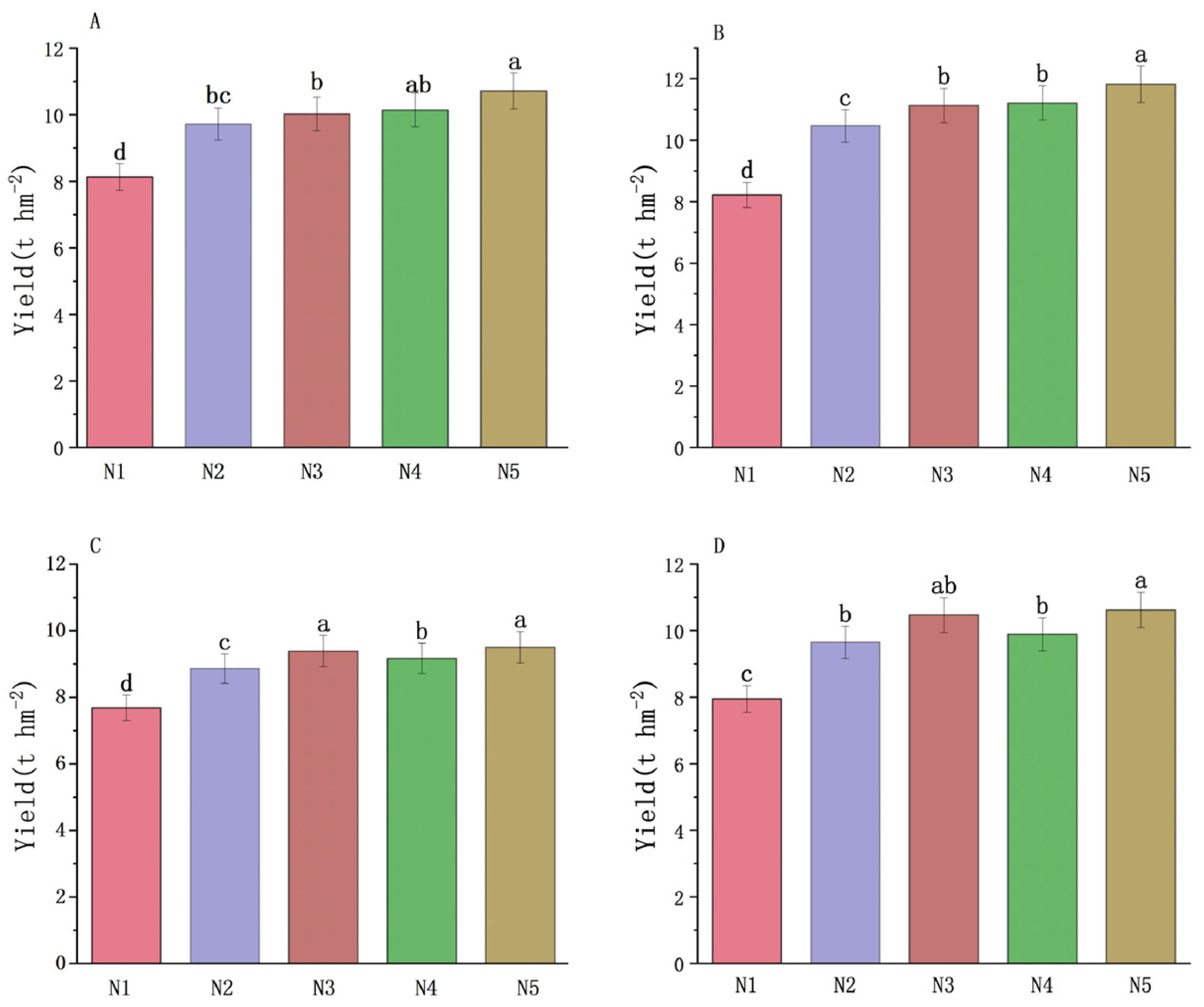
As shown in Figure 1, different nitrogen application strategies have significant effects on rice yield, which also varies among rice varieties and across different years. Among all nitrogen fertilizer operations, the yield of the N5 treatment is the highest. In the fixed nitrogen application treatments for Shendao 47, rice yield gradually increased. The yield of Shendao 11 under N3 treatment was second only to N5 treatment.
Specifically, in the fixed nitrogen application mode, with the increase of nitrogen application rate, the yield of rice increased significantly. Compared with N1 treatment without nitrogen application, the rice yield increased by 15.36~27.37%, 22.27~35.4% and 16.25~36.37% under N2, N3, and N4 treatments, respectively. Especially under the N5 treatment, the rice yield performance is particularly outstanding. In 2023–2024, the yield of Shendao 47 under N5 treatment reached 10.71 t/hm−2 and 11.82 t/hm2, respectively, and the yield of Shendao 11 under the same treatment also reached 9.50 t/hm2 and 10.62 t/hm2.

3.1.2. Rice Quality

It can be seen from Table 3 that the rice processing qualities (brown rice rate BR, polished rice rate MR, and whole polished rice rate HR) of Shendao 11 and Shendao 47 all showed significant responses to the nitrogen application rate, and the trends of the results over the two years (2023 and 2024) were basically the same. Under low-nitrogen (N1) treatment, the BR and MR of both varieties were at the lowest values, significantly lower than those under medium–high nitrogen treatment (N2~N5). When treated with medium to high nitrogen (N2~N5), BR and MR generally showed a trend of “first increasing and then stabilizing”: Shendao 11 BR2023 reached its maximum value under the N3 treatment in 2023, and reached its maximum value in the N4 treatment in 2024. There was no significant difference between N2 and N5. The BR of Shen Dao 47 was relatively stable at various nitrogen application levels. MR2023 was the highest in the N5 treatment, and MR2024 was the highest in the N4 treatment. However, the difference between N2 and N5 was not significant. HR is most sensitive to the nitrogen application rate: for both varieties, HR is lowest under N1 treatment and significantly increases with the increase of nitrogen application rate. In 2023, Shen Dao 11 had the highest HR under the N2 treatment, followed by the N5 treatment. In 2020, Shen Dao 11 had the highest HR under the N5 treatment, followed by the N2 treatment. In 2023, Shen Dao 47 reached its peak HR under the N5 treatment, and will reach its peak under the N4 treatment in 2024.
From Table 4, it can be concluded that the ratio of length to width of the two experimental varieties increased first and then decreased in the fertilization area, indicating that different varieties have different responses to nitrogen fertilizer levels. According to the different fertilization ratios at different stages, compared with N3, the length-width ratio of the two experimental varieties decreased, indicating that different fertilization stages have an impact on the length-width ratio of rice.
As can be seen from Table 5, nitrogen application rate, variety, and year all have varying degrees of influence on the nutritional quality of rice (protein and fatty acid content), and the trends of the results over the two years are basically the same. The protein content of Shendao 11 was the lowest in 2023 under low-nitrogen (N1) treatment, significantly increased under medium-high nitrogen (N2~N5) treatment, and reached the maximum value under N3 treatment. The overall protein content in 2024 was lower than that in 2023. The N3 treatment remained the highest, significantly higher than N1 and N5, while there was no significant difference between N2 and N4. The protein content of Shen Dao 47 showed an upward trend with the increase of nitrogen application rate. In 2023, the N4 treatment was the highest, significantly higher than that of N1. In 2024, the processing of N4 was the highest, followed by N3, and N1 was the lowest. There was no significant difference in fatty acid content among the nitrogen treatments of Shen Dao 11 over the two years, and the average value in 2024 was higher than that in 2023. In 2023, the fatty acid content of the N1 and N5 treatments in Shen Dao 47 was the highest, significantly higher than that of the medium nitrogen treatment. In 2024, N1 treatment reached its peak, significantly higher than N2 to N3, and high nitrogen (N4 to N5) rebounded. There was no significant difference in the average content of fatty acids over the two years. The protein content is more sensitive to the nitrogen application rate than fatty acids. Medium and high nitrogen (N2–N4) treatment can significantly increase the protein content of the two varieties. Among them, the N3 treatment is the best for Shendao 11, and the N4 treatment is the best for Shendao 47. The content of fatty acids is more affected by year (generally higher in 2024 than in 2023), and the differences among varieties are relatively small.
It can be concluded from Table 6 that the amylose content of the two varieties increased with the increase in fertilization amount, and the amylose content of Shendao 47 in the high-fertilizer area was significantly higher than that of Shendao 11. Compared with N5 and N3, the amylose content of Shendao 47 increased, while that of Shendao 11 decreased, which indicated that the amylose content was affected by the fertilization ratio in each period.

3.1.3. Effect of Nitrogen Fertilizer Operation on GQI

Rice quality in this study and different rice quality parameters (including eating quality, processing quality, appearance quality, and nutritional quality) were determined, and it was found that these rice qualities were significantly affected by nitrogen application, year, and variety (Table 1, Table 2, Table 3 and Table 4). Furthermore, principal component analysis (PCA) was used for dimensionality reduction analysis, and comprehensive indicators of rice quality were explored and constructed for subsequent model analysis. After dimensionality reduction by PCA, three principal components, PC1, PC2, and PC3, were extracted, and their feature interpretation rates were 57.46%, 31.15%, and 11.39%, respectively. Further analysis of the contribution of each principal component to the rice quality index (correlation coefficient > 0.5, p < 0.01) showed that Principal Component 1 had a significant positive load on brown rice rate (load coefficient 0.709), chalkiness rate (0.939), chalkiness degree (0.949), protein DM (0.944), and other indices, while exhibiting a strong negative loading on fatty acids (−0.854). This indicates that Principal Component 1 can comprehensively reflect the processing quality (brown rice rate), appearance quality (chalkiness rate, chalkiness degree), and partial nutritional quality (protein DM) of rice. For Principal Component 2, there is a high positive load on milled rice rate (0.980) and head milled rice rate (0.864), and there is a certain positive correlation with amylose (0.620), but the correlation with taste value is low (−0.272), which indicates that Principal Component 2 mainly reflects the processing quality (milled rice rate and head milled rice rate) and some taste of rice. Principal Component 3 has a significant positive load only on the length/width (0.922), and the load coefficient with other quality indices is generally lower than 0.4, indicating that its correlation with rice quality is small. Considering all factors, PC1 was selected as the grain quality index (GQI) in this study. The value of GQI is positively correlated with brown rice rate, chalkiness rate, chalkiness degree, and protein DM, and negatively correlated with fatty acid and taste value.
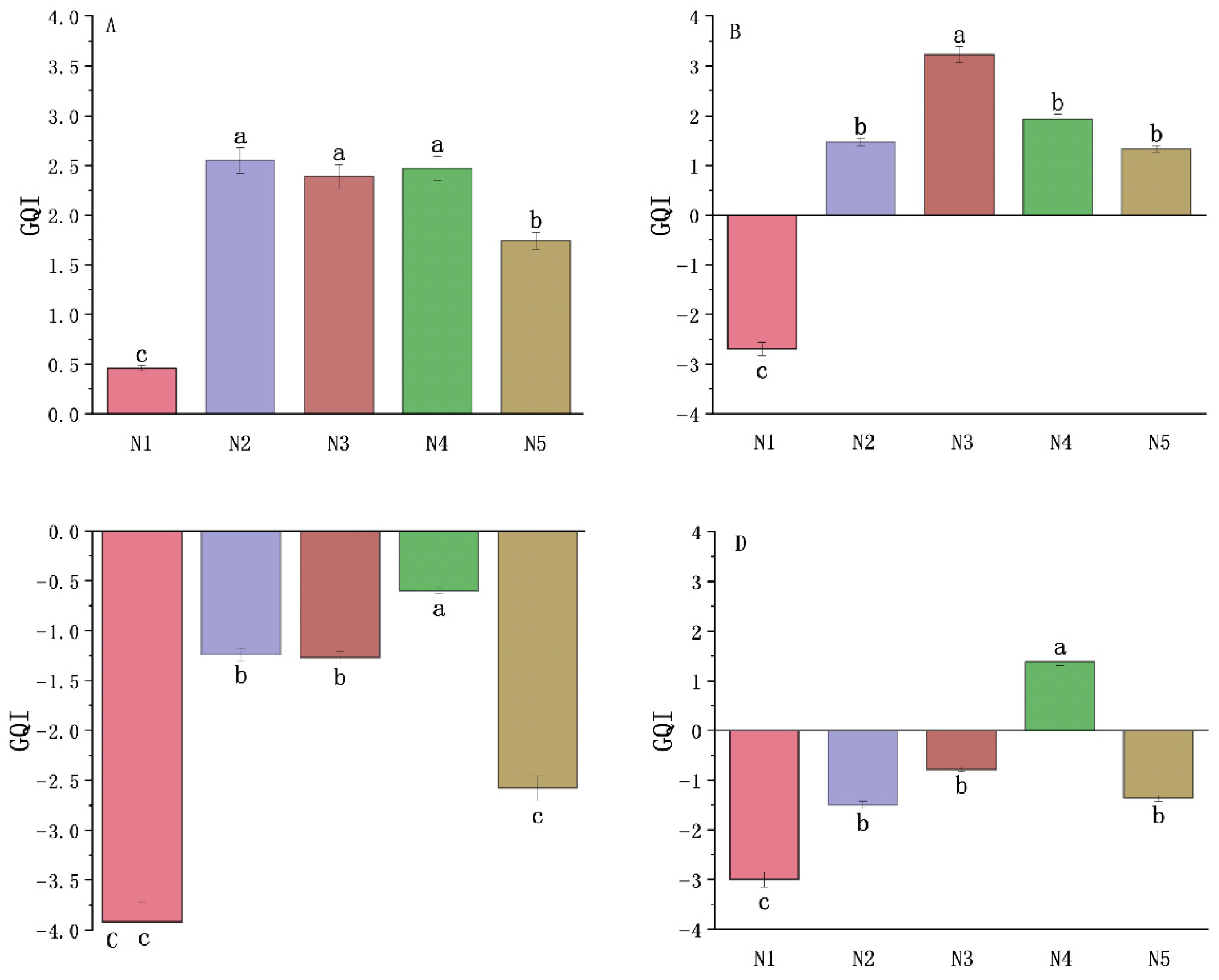
Similar to the performance of rice quality, the comprehensive quality index of rice is significantly affected by nitrogen application, year, and variety. The comprehensive rice quality index (GQI = −2.7~3.23) of Shendao 11 was significantly higher than that of Shendao 47 (GQI = −3.92~1.38), and the GQI in 2024 was significantly higher than that in 2023. The effects of different nitrogen application strategies on GOI vary with fertilization patterns (Figure 2). Under the condition of no nitrogen application, the value of GQI is usually the lowest.

3.2. Correlation Analysis of Rice Yield, Rice Comprehensive Quality (GQI), and Agronomic Indicators Under Nitrogen Application

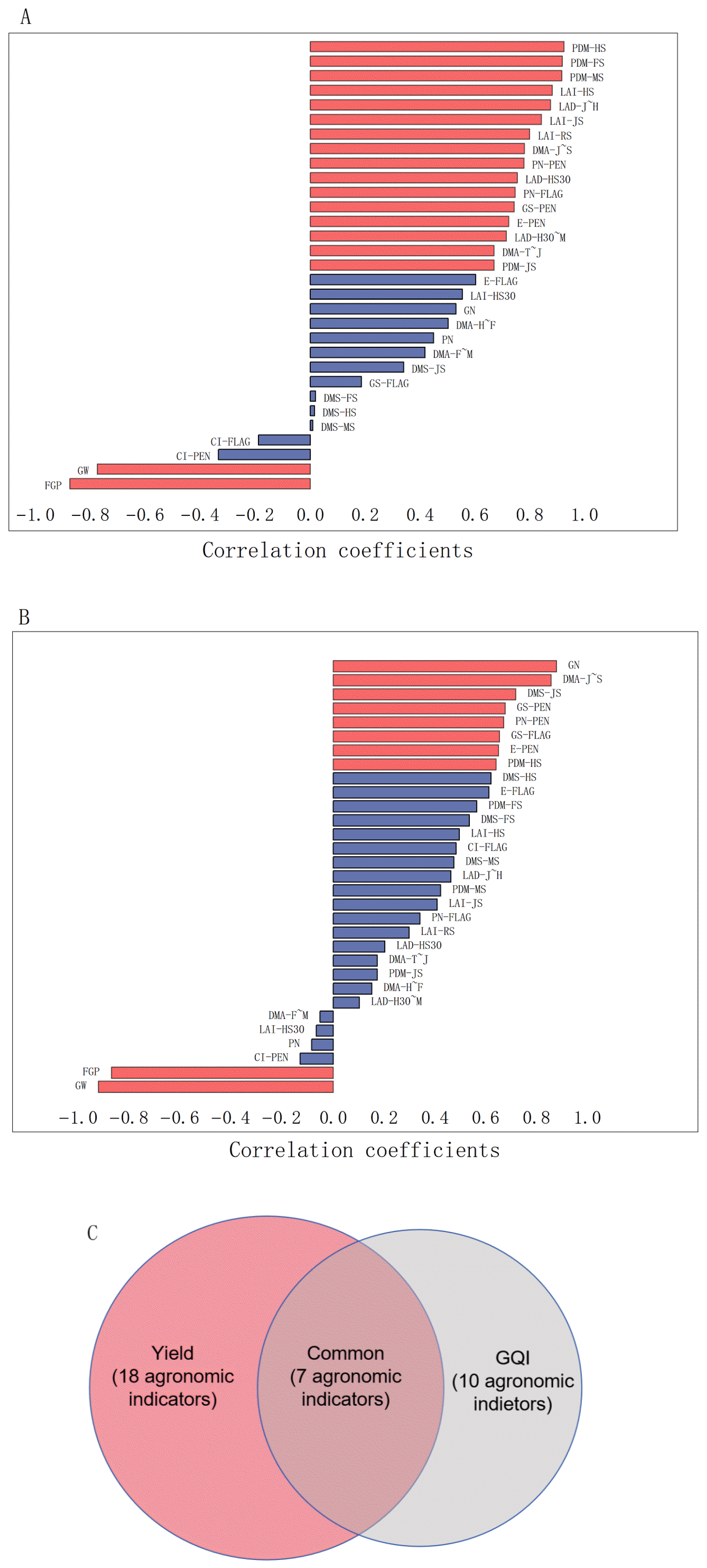
In order to deeply explore the influence of nitrogen fertilizer treatment on rice yield and rice quality, the correlation analysis of key agronomic indices with yield and GOI was further carried out (Figure 3). The results showed that among the agronomic indices of Shendao 47 and Shendao 11 in 2023–2024, 18 agronomic indices were significantly correlated with rice yield (Figure 3A), while 10 agronomic indices were significantly correlated with GQI (Figure 3B). Among them, 7 agronomic indices were significantly correlated with both yield and GQI (Figure 3C).
Figure 3A shows the correlation between rice yield and agronomic indicators, and the abscissa is the correlation coefficient, ranging from −1 to 1. The greater the absolute value, the stronger the correlation. Among them, the flag leaf transpiration rate (E-FLAG), leaf area index (LAI-HS30), and other indicators were significantly positively correlated with the yield, with a correlation coefficient of 0.8, while the intercellular O concentration (CI-PEN) and other indicators were negatively correlated with the yield, with a correlation coefficient of −0.6. Figure 3B shows the correlation between rice comprehensive index GQI and agronomic indices. The dry matter accumulation (DMA-F~M) from the filling stage to the maturity stage has a positive effect on GQI, with a correlation coefficient of 0.5, while the dry matter weight (PDM-JS) at the jointing stage has a negative correlation with GQI, with a correlation coefficient of −0.7. Figure 3C shows the relationship between yield and GQI-related indicators through a Wayne diagram. The yellow circle represents 18 indicators that are only significantly related to yield, such as effective panicle number (PN) and 1000-grain weight (GW). The green circle represents 10 indicators that are significantly related to only GQI, such as chalky grain rate and taste value. The overlapping area represents seven key indicators that affect yield and GQI at the same time, such as population biomass at the tillering stage and the net panicle development stage. On the whole, these charts reveal the key agronomic indices of coordinated regulation of rice yield and quality through correlation analysis and set an overlapping method, which provides a theoretical basis for the precise management of nitrogen fertilizer and variety improvement. It was replaced by the combined indices of PN-FLAG (photosynthetic efficiency), LAI-HS30 (photosynthetic area), and DMA-F~M (matter accumulation), which covered the physiological function of net assimilation rate (NAR) in the ear development period from three dimensions, namely efficiency, area, and total amount, and were significantly correlated with yield and GQI (the correlation coefficient between PN-FLAG and yield was 0.8).

3.3. Evaluation of Agro-Physiological Indices of Rice Yield and Quality Based on the Regression Model

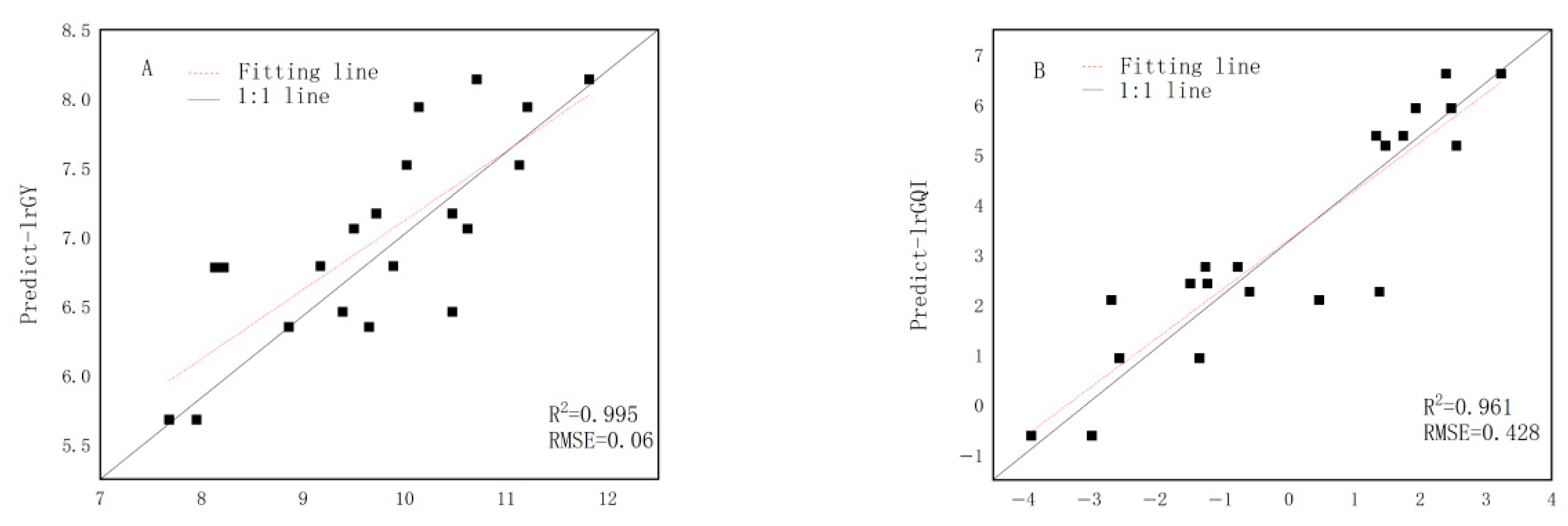
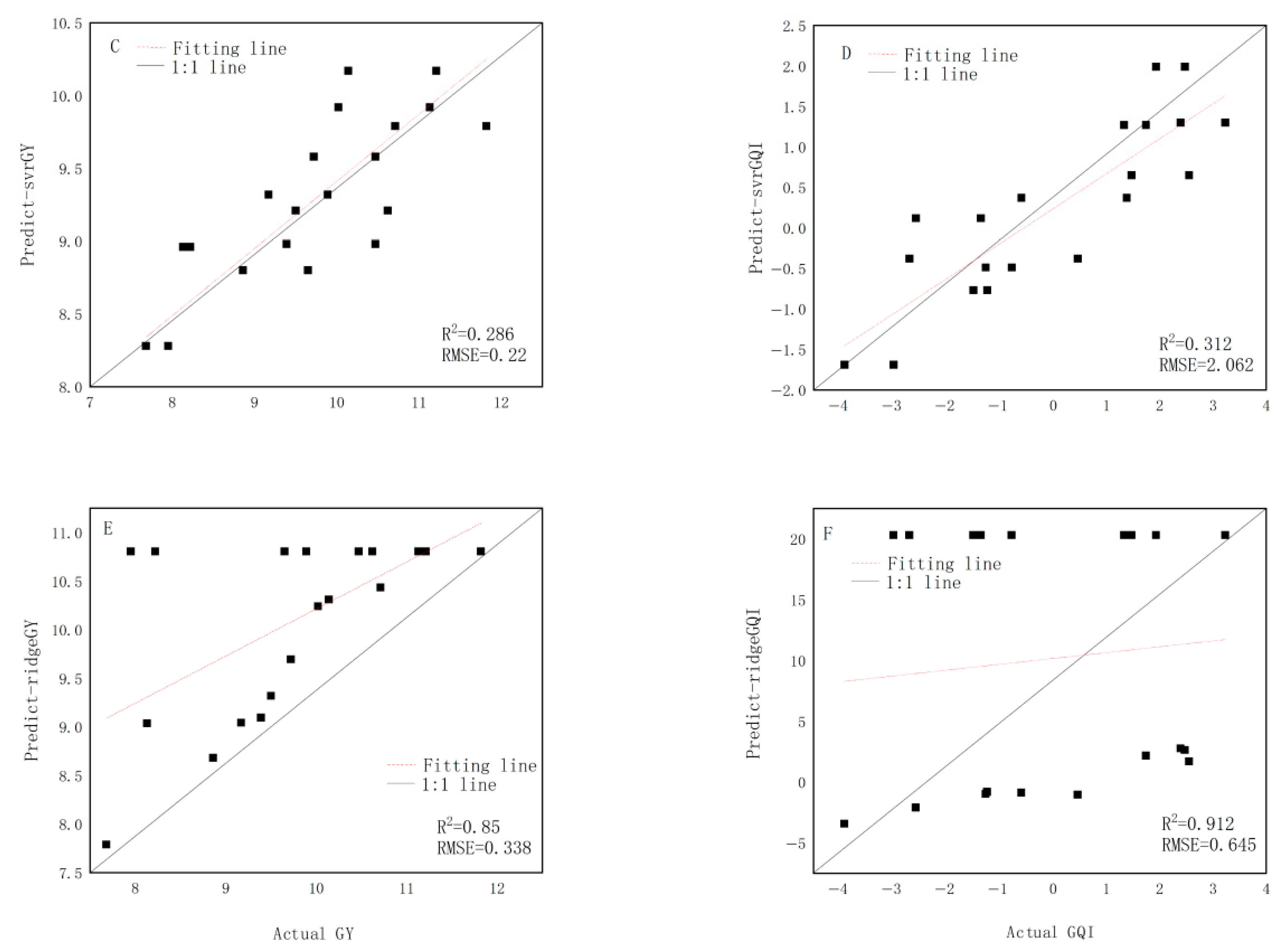
In order to explore the common agronomic and physiological indices of rice in response to rice yield and quality at different growth stages, the regression prediction method was used in this study to screen out the key agronomic characteristics closely related to rice yield and quality. Linear regression, support vector regression, and ridge regression models were selected as prediction models. A total of 18 agronomic indicators significantly related to rice yield and GQI were used as independent variables, and rice yield and GQI were used as dependent variables of the models to construct multiple regression models. The contribution of each indicator to model prediction was analyzed. The results showed that the three models all showed the ability to predict rice yield and quality. Specifically, when the linear regression model predicts rice yield, its R and RMSE are 0.995 and 0.06, respectively. The R and RMSE of the support vector regression model are 0.63 and 0.59, respectively. R and RMSE of the ridge regression model are 0.85 and 0.338, respectively. In GQI prediction, the R and RMSE of the linear regression model are 0.961 and 0.428, the R and RMSE of the support vector regression model are 0.312 and 2.062, and the R and RMSE of the ridge regression model are 0.912 and 0.645, respectively (Figure 4). This not only confirmed the validity of the model but also revealed that there were significant differences in the roles played by different agronomic indicators in the prediction.

4. Discussion

4.1. Effect Mechanism of Nitrogen Fertilizer Application on Rice Yield

In this study, different nitrogen treatments had significant effects on the yield of two Liaohe Plain japonica rice varieties, among which the optimized nitrogen application (N5) was the most prominent. In 2023–2024, the yield of Shendao 47 reached 10.71 t/ha and 11.82 t/ha, respectively, under N5 treatment, while that of Shendao 11 reached 9.50 t/ha and 10.62 t/ha, which increased by more than 35% compared with that without nitrogen application (N1). This result fully proved the remarkable effect of optimizing nitrogen application on yield improvement.
In terms of yield components, the yield-increasing effect of N5 treatment mainly comes from the synergistic improvement of effective panicle number, grains per panicle, and seed setting rate. This treatment adopts the staged nitrogen application strategy consisting of “40% base fertilizer + 15% greening fertilizer + 25% tillering fertilizer + 15% ear fertilizer + 5% grain fertilizer”. Compared with the conventional nitrogen application treatment (N3, 50% base fertilizer + 35% tillering fertilizer + 15% ear fertilizer), it is more in line with the nitrogen demand law of rice at different growth stages. In the vegetative growth stage, a reasonable proportion of greening fertilizer and tillering fertilizer promoted the formation of effective tillers and increased the number of effective panicles per unit area [16]. In the reproductive growth stage, the supplement of panicle fertilizer and grain fertilizer provided sufficient nitrogen supply for spikelet differentiation and grain filling, reduced spikelet degradation, and improved the number of grains per panicle and seed setting rate [17].
The response of different panicle types to nitrogen fertilizer applications is different [18]. The yield of semi-erect panicle variety Shendao 47 is higher than that of curved panicle variety Shendao 11 under all nitrogen application treatments, which may be related to its population structure and light energy utilization efficiency [19]. The panicle characteristics of Shendao 47 can maintain good ventilation and light transmission conditions during population growth, which is beneficial for photosynthesis and dry matter accumulation, so as to obtain higher yield at the same nitrogen application level.
In addition, by maintaining a high photosynthetic rate (PN-FLAG) of flag leaves and prolonging the life of functional leaves, the optimized nitrogen application treatment provided sufficient photosynthetic products for yield formation [20]. The heading stage and filling stage are the key periods for the accumulation of photosynthetic products in rice [21]. Flag leaves treated with N5 can maintain strong photosynthetic activity and ensure the supply of carbohydrates needed for grain filling, which is also an important physiological basis for the significant increase in its yield [22].

4.2. Regulation of Nitrogen Fertilizer Application on Rice Quality

The results of this study showed that the application of nitrogen fertilizer had significant effects on many dimensions of rice quality, especially the optimized nitrogen application (N5) in improving processing quality and appearance quality. In terms of processing quality, the head rice rate of N5 treatment was 4.11% higher than that of no nitrogen application (N1), which may be because reasonable nitrogen supply promoted the uniform development of grains and reduced the broken rice rate during processing [23]. From the data in Table 3, it can be seen that the brown rice rate, milled rice rate, and head rice rate of the two varieties are higher under nitrogen application than those without nitrogen application, and N5 treatment has certain advantages in head rice rate compared with other nitrogen application treatments, indicating that nitrogen application in stages is helpful to improve the processing quality of rice [24].
In terms of appearance quality, the chalkiness of the N5 treatment was significantly lower than that of other nitrogen application treatments, with a decrease of 63.8–77.6%. Chalkiness is an important index to measure the appearance quality of rice, and its level is closely related to the accumulation and distribution of substances during grain filling [25]. Optimizing nitrogen applications may reduce chalkiness formation by regulating grain filling rate and arrangement of starch grains [26]. As can be seen from Table 4, the chalkiness of Shendao 11 under N5 treatment in 2024 was only 6.27%, far lower than that under N1 treatment (11.23%). The chalkiness of Shendao 47 under N5 treatment in 2024 was 3.17%, which was also lower than most other nitrogen treatments, further verifying the positive effect of optimized nitrogen application on improving appearance quality [27].
The effects of nitrogen application on the nutritional quality and eating quality of rice are complicated. It was found that the content of protein increased first and then decreased with the increase in nitrogen application rate and reached a higher value in N3 and N4 treatments, while the content of protein in N5 treatment decreased. This may be because excessive nitrogen application will promote the absorption of nitrogen by plants and the transport to grains, leading to an increase in protein content [28], while optimizing nitrogen application can ensure the yield and avoid the influence of high protein content on the taste [29] by reasonably distributing the amount of nitrogen in each period. The palatability value was negatively correlated with protein content. Although the palatability value of N5 treatment was lower than that of no nitrogen application, it was higher than that of some high-nitrogen application treatments, which indicated that optimizing nitrogen application alleviated the negative impact of high nitrogen application on palatability quality to some extent [30].
The comprehensive quality index (GQI) of rice constructed by principal component analysis showed that processing quality and appearance quality were positively correlated with GQI, while the eating value was negatively correlated. N5 treatment not only improves processing quality and appearance quality, but also reduces the palatability value relatively slightly, so the comprehensive quality performance is better. This result provides an important reference for coordinating the relationship between rice yield and quality, that is, by optimizing nitrogen application, the comprehensive quality of rice can be improved to the maximum extent on the premise of ensuring yield.

4.3. Physiological Mechanism of Synergistic Improvement of Yield and Quality

Through correlation analysis and regression model screening, it was found that dry matter accumulation at the tillering stage and net assimilation rate (NAR) at the panicle development stage were the key agronomic and physiological indices for synergistic improvement of yield and quality. The tillering stage is the key period for constructing the population structure of rice, and sufficient dry matter accumulation lays the foundation for the formation of effective tillers and the later growth and development [31]. Optimized nitrogen application (N5) provided a suitable nitrogen supply at the tillering stage, promoted leaf growth and photosynthesis, and increased dry matter accumulation. These dry substances are not only used for the vegetative growth of plants, but also for the later ear development and grain filling, thus creating favorable conditions for the formation of quality while increasing yield [32].
The panicle development stage is critical for determining the panicle size and grain number, and the net assimilation rate (NAR) directly affects the accumulation of photosynthetic products and their transport efficiency to the panicle. N5 treatment maintained a high NAR at the ear development stage, which was closely related to its reasonable application of ear fertilizer. The supply of panicle fertilizer not only provided necessary nitrogen for panicle development but also promoted the photosynthetic function of leaves and increased the output of photosynthetic products per unit leaf area [33]. Higher NAR ensures sufficient material supply in the panicle, which is beneficial to the normal development of Yu Ying flowers and the formation of grains, thus improving the number of grains per panicle and the seed setting rate, and at the same time reducing quality problems such as chalkiness caused by insufficient material supply [34]
From the point of view of carbon and nitrogen metabolism, the optimized nitrogen application treatment coordinated the relationship between nitrogen metabolism and carbon metabolism and realized the synergistic improvement of yield and quality. Nitrogen is a component of chlorophyll, enzymes, and other important substances, playing a key role in regulating photosynthesis and substance metabolism [35], while carbon metabolism provides energy and structural substances for plant growth. Excessive nitrogen application will lead to an imbalance of the carbon-nitrogen ratio and affect the transport of photosynthetic products to grains [36]. The staged nitrogen application strategy of N5 treatment can match the nitrogen supply with the carbon metabolism process, which not only ensures the promotion of nitrogen to growth and development, but also avoids the inhibition of carbon metabolism due to excessive nitrogen, thus improving rice quality while increasing yield.
In addition, optimizing nitrogen application to maintain a high photosynthetic rate (PN-FLAG) of flag leaves and prolonging the life of functional leaves are also important reasons for the synergistic improvement of yield and quality [37]. The flag leaf is the main functional leaf in the rice grain filling stage, and its photosynthetic rate directly affects grain filling fullness [38]. Through reasonable nitrogen supply, N5 treatment delayed the senescence of flag leaves, enabled them to maintain strong photosynthetic capacity at the grain filling stage, and provided sufficient carbohydrates for grains, which not only increased the yield, but also improved the quality of grains, such as reducing chalkiness and increasing the head rice rate.

4.4. Practical Significance of Nitrogen Fertilizer Application in Liaohe Plain Japonica Rice

The optimized nitrogen application strategy put forward in this study provides a theoretical basis and technical support for the cultivation of japonica rice in northern China. In current agricultural production, although the traditional high-nitrogen cultivation mode can improve yield to a certain extent, it often leads to a decline in rice quality and environmental pollution [39]. Under the condition that the total nitrogen application rate of N5 treatment is 195 kg/hm (the same as that of N3 treatment), by adjusting the proportion of basal dressing and application period, the yield and quality can be improved synergistically, which means that the purpose of increasing yield and improving quality can be achieved by optimizing nitrogen application without increasing nitrogen input, which is in line with the requirements of green and sustainable agricultural development.
For Liaohe Plain japonica rice production, it is of great practical significance to adopt the phased nitrogen application strategy of “base fertilizer 40% + tiller fertilizer 25% + spike fertilizer 15% + grain fertilizer 5%”. According to the growth and development characteristics of japonica rice in the north and the law of nitrogen demand, this strategy can accurately supply nitrogen in different growth stages, which can not only ensure the population construction in the vegetative growth stage, but also meet the ear development and grain filling requirements in the reproductive growth stage [40]. At the same time, this strategy can also improve nitrogen utilization efficiency, reduce nitrogen loss and waste, and reduce environmental pollution [41].
Nitrogen management of different panicle types should be emphasized. The response of semi-erect panicle variety Shendao 47 and curved panicle variety Shendao 11 to nitrogen fertilizer is different. In actual production, the application ratio and period of nitrogen fertilizer should be adjusted according to the characteristics of varieties. For example, for semi-erect panicle varieties, the proportion of tillering fertilizer can be appropriately increased to give full play to their tillering advantages [42]. For curved panicle varieties, the proportion of panicle fertilizer can be appropriately increased to promote panicle development. This personalized nitrogen management measure can further improve the yield and quality of japonica rice in the north.
Future research can further explore the synergistic effect of nitrogen fertilizer application and other cultivation measures (such as water management, planting density, etc.), so as to build a more perfect cultivation technology system of japonica rice with high yield and good quality in the north. At the same time, the molecular mechanism of nitrogen regulating yield and quality formation can be studied in greater depth, which provides a theoretical basis for cultivating new japonica rice varieties with high nitrogen efficiency and good quality in the north.

5. Conclusions

The main innovation of this study lies in establishing a nitrogen fertilizer management strategy that simultaneously improves yield and quality for japonica rice in northern China, filling the research gap for Liaohe Plain rice varieties with different panicle types. In this study, the synergistic regulation mechanism of nitrogen fertilizer application on the yield and quality of japonica rice in northern China was systematically discussed. The results showed that the staged optimized nitrogen application strategy based on rice growth law could effectively coordinate the relationship between population construction and quality formation. Compared with conventional nitrogen application methods, optimized nitrogen application by stages can significantly improve the population structure, improve photosynthetic efficiency, and delay leaf senescence by reasonably distributing the proportion of base fertilizer and topdressing, thus laying a physiological foundation for improving yield and quality. It was found that there was an inherent temporal–spatial correlation between yield and quality: dry matter accumulation at the tillering stage laid the foundation for yield, while photosynthetic efficiency at the panicle development stage directly affected grain filling and quality formation. There are obvious differences in the response of different panicle varieties to nitrogen fertilizer. Semi-erect panicle varieties are more conducive to yield increase because of their superior light energy utilization efficiency, while curved panicle varieties show stronger plasticity in quality indicators. These findings not only provide new insights for understanding the physiological mechanism of rice “quantity-quality synergy” but also provide an important theoretical basis for formulating targeted high-yield and high-quality cultivation techniques. Yield performance under the optimized nitrogen treatment (N5) was 10.71–11.82 t/ha for the semi-erect panicle variety (Shendao 47) and 9.50–10.62 t/ha for the curved panicle variety (Shendao 11). Quality improvements included a 4.11% increase in head rice rate and a 63.8–77.6% reduction in chalkiness compared to conventional nitrogen treatments. Agrrophysiological thresholds identified for yield-quality synergy were tiller stage dry matter accumulation ≥3.2 t/ha and panicle development net assimilation rate (NAR) ≥ 12 g/m2/day.
The nitrogen application principle of “promoting before controlling and supplementing later” put forward in this study provides a feasible technical way to improve the quality and efficiency of rice production by accurately regulating the nitrogen supply in each growth period.

Author Contributions

Conceptualization, B.J.; methodology, B.J.; software, X.L.; validation, B.J. and S.W.; formal analysis, X.L., M.L. and L.Z.; investigation, B.J.; resources, B.J.; data curation, B.J.; writing—original draft preparation, X.L.; writing—review and editing, X.L., M.L. and L.Z.; visualization, X.L.; supervision, S.W., Y.W. (Yan Wang), Y.H., C.Z. and Y.W. (Yun Wang); project administration, B.J.; funding acquisition, B.J. All authors have read and agreed to the published version of the manuscript.

Funding

National Key R&D Program of China, 2023YFD2301603; Science and Technology Program Project of Liaoning Province, 2024JH5/10400001.

Institutional Review Board Statement

Not applicable.

Informed Consent Statement

Not applicable.

Data Availability Statement

The original contributions presented in this study are included in the article. Further inquiries can be directed to the corresponding author.

Conflicts of Interest

The authors declare no conflict of interest.

References

  1. Xiao, N.; Pan, C.; Li, Y.; Wu, Y.; Cai, Y.; Lu, Y.; Wang, R.; Yu, L.; Shi, W.; Li, A.; et al. Genomic insight into balancing high yield, good quality, and blast resistance of japonica rice. Genome Biol. 2021, 22, 283. [Google Scholar] [CrossRef] [PubMed]
  2. Lou, Q.; Guo, H.; Li, J.; Han, S.; Khan, N.U.; Gu, Y.; Zhao, W.; Zhang, Z.; Zhang, H.; Li, J.; et al. Cold-adaptive evolution at the reproductive stage in Geng/japonica subspecies reveals the role of OsMAPK3 and OsLEA9. Plant J. 2022, 111, 1032–1051. [Google Scholar] [CrossRef] [PubMed]
  3. Zhao, C.; Liu, G.; Chen, Y.; Jiang, Y.; Shi, Y.; Zhao, L.; Liao, P.; Wang, W.; Xu, K.; Dai, Q.; et al. Excessive nitrogen application leads to lower rice yield and grain quality by inhibiting the grain filling of inferior grains. Agriculture 2022, 12, 962. [Google Scholar] [CrossRef]
  4. Zhang, J.; Tong, T.; Potcho, P.M.; Huang, S.; Ma, L.; Tang, X. Nitrogen effects on yield, quality and physiological characteristics of giant rice. Agronomy 2020, 10, 1816. [Google Scholar] [CrossRef]
  5. Zhang, Y.; Ye, C.; Su, Y.; Peng, W.; Lu, R.; Liu, Y.; Huang, H.; He, X.; Yang, M.; Zhu, S. Soil Acidification caused by excessive application of nitrogen fertilizer aggravates soil-borne diseases: Evidence from literature review and field t rials. Agric. Ecosyst. Environ. 2022, 340, 108176. [Google Scholar] [CrossRef]
  6. Liu, Z.; Tao, L.; Liu, T.; Zhang, X.; Wang, W.; Song, J.; Yu, C.; Peng, X. Nitrogen application after low-temperature exposure alleviates tiller decrease in rice. Environ. Exp. Bot. 2019, 158, 205–214. [Google Scholar] [CrossRef]
  7. Zhou, Q.; Guo, W.; Chen, N.; Wang, Z.; Li, G.; Ding, Y.; Ninomiya, S.; Mu, Y. Analyzing nitrogen effects on rice panicle development by panicle detection and time-series tracking. Plant Phenomics 2023, 5, 0048. [Google Scholar] [CrossRef]
  8. Sun, W.; Huang, A.; Sang, Y.; Fu, Y.; Yang, Z. Carbon–nitrogen interaction modulates plant growth and expression of metabolic genes in rice. J. Plant Growth Regul. 2013, 32, 575–584. [Google Scholar] [CrossRef]
  9. Xu, Y.; Guan, X.; Han, Z.; Zhou, L.; Zhang, Y.; Asad, M.A.; Wang, Z.; Jin, R.; Pan, G.; Cheng, F. Combined effect of nitrogen fertilizer application and high temperature on grain quality properties of cooked rice. Front. Plant Sci. 2022, 13, 874033. [Google Scholar] [CrossRef]
  10. Zhou, S.; Liu, K.; Zhuo, X.; Wang, W.; Zhang, W.; Zhang, H.; Gu, J.; Yang, J.; Liu, L. Optimizing nitrogen regime improves dry matter and nitrogen accumulation during grain filling to increase rice yield. Agronomy 2023, 13, 1983. [Google Scholar] [CrossRef]
  11. Wen, R.; Zhu, M.; Yu, J.; Kou, L.; Ahmad, S.; Wei, X.; Jiao, G.; Hu, S.; Sheng, Z.; Hu, P.; et al. Photosynthesis regulates tillering bud elongation and nitrogen-use efficiency via sugar-induced NGR5 in rice. New Phytol. 2024, 243, 1440–1454. [Google Scholar] [CrossRef] [PubMed]
  12. Zhou, T.; Zhou, Q.; Li, E.; Yuan, L.; Wang, W.; Zhang, H.; Liu, L.; Wang, Z.; Yang, J.; Gu, J. Effects of nitrogen fertilizer on structure and physicochemical properties of ‘super’ rice starch. Carbohydr. Polym. 2020, 239, 116237. [Google Scholar] [CrossRef] [PubMed]
  13. Huai, Y.; Chen, Y.P.; Mao, G.J.; Xu, J.F. Fertilizer reduction of paddy rice in Japan: Experience and implications. China Rice 2018, 24, 6–10. [Google Scholar] [CrossRef]
  14. Tao, M.; Ma, X.; Huang, X.; Liu, C.; Deng, R.; Liang, K.; Qi, L. Smartphone-based detection of leaf color levels in rice plants. Comput. Electron. Agric. 2020, 173, 105431. [Google Scholar] [CrossRef]
  15. Liang, H.; Tao, D.; Zhang, Q.; Zhang, S.; Wang, J.; Liu, L.; Wu, Z.; Sun, W. Nitrogen fertilizer application rate impacts eating and cooking quality of rice after storage. PLoS ONE 2021, 16, e0253189. [Google Scholar] [CrossRef] [PubMed]
  16. Wei, H.H.; Ge, J.L.; Zhang, X.B.; Wang, Z.H.U.; Fei, D.E.N.G.; Ren, W.J.; Chen, Y.L.; Meng, T.Y.; Dai, Q.G. Decreased panicle N application alleviates the negative effects of shading on rice grain yield and grain quality. J. Integr. Agric. 2023, 22, 2041–2053. [Google Scholar] [CrossRef]
  17. Ma, R.; Jiang, C.; Shou, N.; Gao, W.; Yang, X. An optimized nitrogen application rate and basal topdressing ratio improves yield, quality, and water-and N-use efficiencies for forage maize (Zea mays L.). Agronomy 2023, 13, 181. [Google Scholar] [CrossRef]
  18. Huang, M.; Yang, C.; Ji, Q.; Jiang, L.; Tan, J.; Li, Y. Tillering responses of rice to plant density and nitrogen rate in a subtropical environment of southern China. Field Crops Res. 2013, 149, 187–192. [Google Scholar] [CrossRef]
  19. Zhang, J.; Zhang, Y.Y.; Song, N.Y.; Chen, Q.L.; Sun, H.Z.; Peng, T.; Huang, S.; Zhao, Q.Z. Response of grain-filling rate and grain quality of mid-season indica rice to nitrogen application. J. Integr. Agric. 2021, 20, 1465–1473. [Google Scholar] [CrossRef]
  20. Chen, H.; Yang, G.; Xiao, Y.; Zhang, G.; Yang, G.; Wang, X.; Hu, Y. Effects of nitrogen and phosphorus fertilizer on the eating quality of indica rice with different amylose content. J. Food Compos. Anal. 2023, 118, 105167. [Google Scholar] [CrossRef]
  21. Zhang, H.; Hou, D.P.; Peng, X.L.; Shao, S.M.; Jing, W.J.; Gu, J.F.; Liu, L.J.; Wang, Z.Q.; Liu, Y.Y.; Yang, J.C.; et al. Optimizing integrative cultivation management improves grain quality while increasing yield and nitrogen use efficiency in rice. J. Integr. Agric. 2019, 18, 2716–2731. [Google Scholar] [CrossRef]
  22. Sun, Y.; Ma, J.; Sun, Y.; Xu, H.; Yang, Z.; Liu, S.; Jia, X.; Zheng, H. The effects of different water and nitrogen managements on yield and nitrogen use efficiency in hybrid rice of China. Field Crops Res. 2012, 127, 85–98. [Google Scholar] [CrossRef]
  23. Honda, S.; Ohkubo, S.; San, N.S.; Nakkasame, A.; Tomisawa, K.; Katsura, K.; Ookawa, T.; Nagano, A.J.; Adachi, S. Maintaining higher leaf photosynthesis after heading stage could promote biomass accumulation in rice. Sci. Rep. 2021, 11, 7579. [Google Scholar] [CrossRef] [PubMed]
  24. Tanaka, M.; Keira, M.; Yoon, D.K.; Mae, T.; Ishida, H.; Makino, A.; Ishiyama, K. Photosynthetic enhancement, lifespan extension, and leaf area enlargement in flag leaves increased the yield of transgenic rice plants overproducing Rubisco under sufficient N fertilization. Rice 2022, 15, 10. [Google Scholar] [CrossRef]
  25. Ma, P.; Lan, Y.; Lv, X.; Fan, P.; Yang, Z.; Sun, Y.; Zhang, R.; Ma, J. Reasonable nitrogen fertilizer management improves rice yield and quality under a rapeseed/wheat–rice rotation system. Agriculture 2021, 11, 490. [Google Scholar] [CrossRef]
  26. Dou, Z.; Tang, S.; Li, G.; Liu, Z.; Ding, C.; Chen, L.; Wang, S.; Ding, Y. Application of nitrogen fertilizer at heading stage improves rice quality under elevated temperature during grain-filling stage. Crop Sci. 2017, 57, 2183–2192. [Google Scholar] [CrossRef]
  27. Cheng, C.; Ali, A.; Shi, Q.; Zeng, Y.; Tan, X.; Shang, Q.; Huang, S.; Xie, X.; Zeng, Y. Response of chalkiness in high-quality rice (Oryza sativa L.) to temperature across different ecological regions. J. Cereal Sci. 2019, 87, 39–45. [Google Scholar] [CrossRef]
  28. Guo, C.; Yuan, X.; Yan, F.; Xiang, K.; Wu, Y.; Zhang, Q.; Wang, Z.; He, L.; Fan, P.; Ma, J.; et al. Nitrogen application rate affects the accumulation of carbohydrates in functional leaves and grains to improve grain filling and reduce the occurrence of chalkiness. Front. Plant Sci. 2022, 13, 921130. [Google Scholar] [CrossRef]
  29. Wu, Q.; Wang, Y.; Chen, T.; Zheng, J.; Sun, Y.; Chi, D. Soil nitrogen regulation using clinoptilolite for grain filling and grain quality improvements in rice. Soil Tillage Res. 2020, 199, 104547. [Google Scholar] [CrossRef]
  30. The, S.V.; Snyder, R.; Tegeder, M. Targeting nitrogen metabolism and transport processes to improve plant nitrogen use efficiency. Front. Plant Sci. 2021, 11, 628366. [Google Scholar] [CrossRef]
  31. Ren, K.; Xu, M.; Li, R.; Zheng, L.; Liu, S.; Reis, S.; Wang, H.; Lu, C.; Zhang, W.; Gao, H.; et al. Optimizing nitrogen fertilizer use for more grain and less pollution. J. Clean. Prod. 2022, 360, 132180. [Google Scholar] [CrossRef]
  32. Cheng, B.; Jiang, Y.; Cao, C. Balance rice yield and eating quality by changing the traditional nitrogen management for sustainable production in China. J. Clean. Prod. 2021, 312, 127793. [Google Scholar] [CrossRef]
  33. Cheng, F.; Bin, S.; Iqbal, A.; He, L.; Wei, S.; Zheng, H.; Yuan, P.; Liang, H.; Ali, I.; Xie, D.; et al. High sink capacity improves rice grain yield by promoting nitrogen and dry matter accumulation. Agronomy 2022, 12, 1688. [Google Scholar] [CrossRef]
  34. Qiao, J.; Yang, L.; Yan, T.; Xue, F.; Zhao, D. Rice dry matter and nitrogen accumulation, soil mineral N around root and N leaching, with increasing application rates of fertilizer. Eur. J. Agron. 2013, 49, 93–103. [Google Scholar] [CrossRef]
  35. Ding, C.; You, J.; Chen, L.; Wang, S.; Ding, Y. Nitrogen fertilizer increases spikelet number per panicle by enhancing cytokinin synthesis in rice. Plant Cell Rep. 2014, 33, 363–371. [Google Scholar] [CrossRef]
  36. Mohapatra, P.K.; Panigrahi, R.; Turner, N.C. Physiology of spikelet development on the rice panicle: Is manipulation of apical dominance crucial for grain yield improvement? Adv. Agron. 2011, 110, 333–359. [Google Scholar] [CrossRef]
  37. Guan, C.; Zhang, D.; Chu, C. Interplay of light and nitrogen for plant growth and development. Crop J. 2025, 13, 641–655. [Google Scholar] [CrossRef]
  38. Raven, J.A.; Handley, L.L.; Andrews, M. Global aspects of C/N interactions determining plant–environment interactions. J. Exp. Bot. 2004, 55, 11–25. [Google Scholar] [CrossRef]
  39. Guo, P.; Ren, J.; Shi, X.; Xu, A.; Zhang, P.; Guo, F.; Feng, Y.; Zhao, X.; Yu, H.; Jiang, C. Optimized nitrogen application ameliorates the photosynthetic performance and yield potential in peanuts as revealed by OJIP chlorophyll fluorescence kinetics. BMC Plant Biol. 2024, 24, 774. [Google Scholar] [CrossRef]
  40. Huang, Y.; Xu, P.; Wang, L.; He, Y.; Wang, H.; Ke, J.; He, H.; Wu, L.; You, C. Effects of Exogenous Trehalose on Grain Filling Characteristics and Yield Formation of japonica Rice Cultivar W1844. Chin. J. Rice Sci. 2023, 37, 379. [Google Scholar] [CrossRef]
  41. Thenabadu, M.W. Influence of time and level of nitrogen application of growth and yield of rice. Plant Soil 1972, 36, 15–29. [Google Scholar] [CrossRef]
  42. Zou, Y.; Zhang, Y.; Cui, J.; Gao, J.; Guo, L.; Zhang, Q. Nitrogen fertilization application strategies improve yield of the rice cultivars with different yield types by regulating phytohormones. Sci. Rep. 2023, 13, 21803. [Google Scholar] [CrossRef]
Figure 1. Effect of nitrogen fertilizer treatment on the yield of different types of rice in 2023–2024. (A) and (B), respectively, represent the influence of nitrogen fertilizer application on the yield of Shendao 47 in 2023–2024; (C) and (D), respectively, represent the influence of nitrogen fertilizer application on the yield of Shendao 11 in 2023–2024; In the figure, the error bar indicates the standard error, and different lowercase letters indicate significant differences among different nitrogen fertilizer treatments (p < 0.05, LSD). Processing and abbreviations are the same as those in Table 2.
Sustainability 17 11152 g001
Figure 2. Effects of nitrogen application on GQI of different types of rice in 2023–2024. (A,B), respectively, represent the influence of nitrogen fertilizer application on GQI in Shendao 11 from 2023 to 2024; (C,D) represent the effects of nitrogen application on GQI in Shendao 47 from 2023 to 2024, respectively. GQI: comprehensive index of rice. In the figure, the error bar indicates the standard error, and different lowercase letters indicate significant differences among different nitrogen fertilizer treatments (p < 0.05, LSD). Processing and abbreviations are the same as those in Table 2.
Sustainability 17 11152 g002
Figure 3. Correlation diagram of rice yield and GQI with static agronomic indices in each growth period. (A,B) are the correlations between rice yield and GQI and the static agronomic indices of each growth period, with red indicating significant correlation (p < 0.05) and blue indicating no correlation. (C) is the number and proportion of agronomic indicators significantly related to rice yield and GQI in each growth period. GW: 1000-grain weight; FGP: Seed setting rate; CI-PEN: the intercellular O concentration of obovate leaves; PN: effective panicle number; LAI-HS30: leaf area index 30 days after heading; DMA-F~M: dry matter accumulation from filling stage to mature stage; LAD-H30~M: photosynthetic potential from 30 days after heading to maturity; DMA-H~F: dry matter accumulation from heading stage to filling stage; PDM-JS: dry matter weight of the population at jointing stage; DMA-T~J: dry matter accumulation from transplanting stage to jointing stage; LAD-HS30: photosynthetic potential at heading stage for 30 days; LAI-RS: leaf area index at maturity; PN-FLAG: the net photosynthetic rate of flag leaves; LAI-JS: leaf area index at jointing stage; PDM-MS: the dry matter of mature population is heavy; LAD-J~H: photosynthetic potential from jointing stage to heading stage; DMS-MS: dry matter weight per ear at maturity; CI-FLAG: intercellular O concentration of flag leaf; LAI-HS: leaf area index at heading stage; DMS-FS: dry matter weight per panicle at grain filling stage; PDM-FS: dry matter weight of population at filling stage; E-FLAG: flag leaf transpiration rate; DMS-HS: dry matter weight per ear at heading stage; PDM-HS: dry matter weight of population at heading stage; E-PEN: transpiration rate of inverted two leaves; GS-FLAG: stomatal conductance of flag leaf; PN-PEN: net photosynthetic rate of inverted two leaves; GS-PEN: stomatal conductance of inverted biphyll; DMS-JS: dry matter weight per panicle at jointing stage; DMA-J~S: dry matter accumulation from jointing stage to heading stage; GN: number of spikelets per ear.
Sustainability 17 11152 g003
Figure 4. Prediction accuracy of different regression models for rice yield and GQI. (A,C,E) are the predictions of rice yield by linear regression, support vector regression, and ridge regression models, respectively. (B,D,F) are the predictions of GQI by linear regression, support vector regression, and ridge regression models, respectively. Predict-lrGY: linear regression model to predict yield; Predict-svrGY: support vector regression model to predict yield; Predict-ridgeGY: ridge regression model to predict yield; Predict-lrGQI: linear regression model to predict GQI; Predict-svrGQI: support vector regression model to predict GQI; Predict-ridgeGQI: ridge regression model to predict GQI. Black squares: Each square corresponds to a sample, with its position determined jointly by the sample’s “actual value (X)” and “model predicted value (Y)”, providing an intuitive display of the discrepancy between the model’s prediction and the actual situation for that sample.
Sustainability 17 11152 g004aSustainability 17 11152 g004b
Table 1. Initial physical and chemical properties of soil.
TN (g/kg)PHSOM (g/kg)AP (mg/kg)AK (mg/kg)AN (mg/kg)EC (μs·cm−1)
1.226.826.9140.8491.3585.590.30
Table 2. Application amount and period of nitrogen fertilizer.
TreatmentTotal Pure Nitrogen (kg/hm2)Base Fertilizer (%)
(kg/hm2)
Green Fertilizer (%)
(kg/hm2)
Tillering Fertilizer (%)
(kg/hm2)
Ear Fertilizer (%)
(kg/hm2)
Granular Fertilizer (%)
(kg/hm2)
N1000000
N216582.5 (50%)057.75 (35%)24.75 (15%)0
N319597.5 (50%)068.25 (35%)29.25 (15%)0
N4225112.5 (50%)078.75 (35%)33.75 (15%)0
N519578.0 (40%)29.25 (15%)48.75 (25%)29.25 (15%)9.75 (5%)
Table 3. Differences in processing quality of rice varieties under different nitrogen application treatments.
Variety
Cultivars
Nitrogen Application Rate
Amount of N Application
In 2023In 2024
Brown Rice Rate
BR (%)
Polished Rice Rate
MR (%)
Head Milled Rice Rate
HR (%)
Brown Rice Rate
BR (%)
Polished Rice Rate
MR (%)
Head Milled Rice Rate
HR (%)
Shendao 11N181.83b72.97b63.51b81.86c72.01b64.31b
N282.88a74.14a68.16a83.28a74.10a68.13a
N383.36a74.77a67.11ab82.89ab73.88a68.03a
N482.94a73.89ab66.63ab82.57b73.51a66.29ab
N582.78a73.97ab68.01a83.20a74.40a68.42a
average82.7673.9566.6882.7673.5867.03
Shendao 47N181.33b73.35b65.70b81.76a73.10a65.49a
N282.36ab74.46ab70.33a81.65a73.02a68.98a
N382.34ab74.44ab68.99ab81.64a72.24a66.95a
N482.34ab74.37ab69.76a82.32a73.55a68.99a
N582.79a74.94a69.59a81.65a72.96a67.75a
average82.2374.3168.8781.872.9767.63
Note: Different letters after the same column of data indicate significant differences at the 5% level.
Table 4. Differences in appearance quality of rice varieties under different nitrogen application treatments.
Variety
Cultivars
Nitrogen Application Rate
Amount of N Application
In 2023In 2024
Length/WidthChalkiness RateChalkinessLength/WidthChalkiness RateChalkiness
L/WCR (%)CD (%)L/WCR (%)CD (%)
Shendao 11N11.95a17.33a17.33a2.08a12.60a11.23a
N21.90a19.07a19.07a2.09a24.30a11.70a
N31.97a17.40a17.40a2.42a22.70a10.30a
N42.08a18.20a18.20a2.33a30.03a10.50a
N51.91a15.33a15.33a2.28a21.33a6.27a
average1.9617.4717.472.2429.799.53
Shendao 47N11.79b7.10b7.10b2.17a12.57b2.57a
N21.75b10.50ab10.50ab2.01a16.33ab5.83a
N32.72a8.80b10.00ab2.23a15.97ab5.30a
N42.13ab14.17a14.17a2.28a22.17a4.50a
N51.97ab8.20b9.13ab2.17a14.90ab3.17a
average2.079.9410.182.1716.394.01
Note: Different letters after the same column of data indicate significant differences at the 5% level.
Table 5. Differences in nutritional quality of rice varieties under different nitrogen application treatments.
Variety
Cultivars
Nitrogen Application Rate
Amount of N Application
In 2023In 2024
Protein DM
Pr (%)
Fatty Acid
Fatty Acid (%)
Protein DM
Pr (%)
Fatty Acid
Fatty Acid (%)
Shendao 11N19.40b15.63a6.67c18.57a
N210.23ab15.43a7.07bc18.67a
N310.47ab15.60a7.80a18.43a
N410.17ab15.17a7.27b19.67a
N510.20ab15.33a7.00bc18.57a
average10.0915.437.1618.78
Shendao 47N18.80ab16.40a6.30b19.57a
N29.27a15.63a6.83ab18.33b
N39.43a15.60a7.23a18.23b
N49.53a15.67a7.37a19.10ab
N59.30a16.43a6.90ab18.97ab
average9.2715.956.9318.84
Note: Different letters after the same column of data indicate significant differences at the 5% level.
Table 6. Differences in cooking and eating quality of rice varieties under different nitrogen application treatments.
Variety
Cultivars
Nitrogen Application Rate
Amount of N Application
In 2023In 2024
Amylose
AC (%)
Taste Value
Taste Value
Amylose
AC (%)
Taste Value
Taste Value
Shendao 11N119.20a64.67a19.70a77.67a
N219.23a60.67ab19.70a75.33ab
N319.33a59.67b19.70a72.00c
N419.27a61.00ab19.87a74.33bc
N519.27a60.67ab19.63a76.00ab
average19.2661.3319.7275.07
Shendao 47N119.37a67.33a19.77a79.00a
N219.30a65.00b19.63a76.67ab
N319.33a64.33b19.77a74.67ab
N419.43a63.67b19.90a74.00b
N519.47a65.00b19.83a76.33ab
average19.3865.0719.7876.13
Note: Different letters after the same column of data indicate significant differences at the 5% level.
Disclaimer/Publisher’s Note: The statements, opinions and data contained in all publications are solely those of the individual author(s) and contributor(s) and not of MDPI and/or the editor(s). MDPI and/or the editor(s) disclaim responsibility for any injury to people or property resulting from any ideas, methods, instructions or products referred to in the content.