


Abstract
The huge impact of construction on the environment is becoming increasingly apparent, and it is unacceptable to many engineers and designers. A growing interest in sustainable construction has been observed for several years. This is especially true for commercial buildings, where achieving an appropriate standard is often the main criterion for investment. Many current publications deal with the topic of energy related to building use. In contrast, knowledge of the so-called embodied carbon footprint is not yet widespread but increasingly important in the context of low-carbon construction. The study created six different building types by juxtaposing different construction variants with different facade variants. The analysis was given to the “cradle to grave” phases, i.e., A1–A4, B4–B5 and C1–C4. Module D (material recycling) is omitted, as well as phases B1–B3 and B6–B7 related to use, maintenance, repair and energy and water consumption. Phases B1–B3 refer to maintenance repair and use activities that are the responsibility of the building manager, so they are taken as estimates at the concept stage. Phase B6 and B7 were excluded from the study, due to the fact that they are not responsible for the embodied carbon footprint, but the operational one. It was assumed that the values for B6 would be shown independently in the building’s energy performance and the final values would be comparable. The purpose of the study was to verify the factors that have the greatest impact on the results of the embodied environmental footprint. The study showed that changes in the building’s design and facade have the greatest impact on the embodied carbon footprint. Furthermore, not only the quantity of materials used but also their durability is crucial, so using durable finishes to minimize the need for repair and replacement can play a key role in reducing the building’s embodied carbon footprint. Differences between the variants reached approximately 107 kg CO2e/m2 (about 15%). The comparison of impact categories further indicates that solutions optimized for global warming potential are not necessarily favorable in other environmental dimensions. Finally, the relatively moderate spread between the most and least favorable variants within the analyzed scope indicates that material substitution alone is insufficient to achieve deep decarbonization of office buildings. Comprehensive strategies addressing material selection, durability, service life and design for disassembly and reuse are therefore required.
1. Introduction
The huge impact of construction on the natural environment is becoming increasingly visible and is unacceptable to many engineers and designers. In recent years, there has been a growing interest in sustainable construction. This particularly applies to commercial buildings, where achieving the appropriate standard is often the main investment criterion [1]. In Poland, the subject of Energy efficiency of buildings is discussed in scientific literature and industry magazines such as “Materiały budowlane” or “Instal”. The results of research published by Ryńska E. are worth mentioning. The book “Bioklimatyka a forma architektury” describes, using specific examples, dynamically developing methods of designing and building architectural objects that would be environmentally friendly [2]. Katarzyna Zielonko-Jung and Janusz Marchwiński analyzed modern pro-ecological solutions used or tested in the most developed countries as solutions defining new possibilities for shaping contemporary sustainable architecture [3]. Wacław Celadyn claims that the essence of environmentally, and therefore energetically, sustainable architecture is integrated design [4]. It covers the entire period of use of the facility and requires the active participation of specialists from many related industries [5]. A computer model of a building is not only a record of geometry, but also a mathematical description of the design process, which evolves in parallel with the development of the project. The idea of simulation and modeling of dynamic processes combines architecture with other fields of science. Due to its interdisciplinary nature, an architectural project is exceptionally easy to adapt to new solutions. Modern information techniques allow for simulation and analysis of the consequences of decisions made at early stages of design. One of the main parameters that determine the level of operating costs is energy requirements. This is one of the most desirable indicators for energy analyses. It is worth mentioning, however, that such analyses should focus not only on energy losses, but also on its gains [6].
The concept of energy in architecture has acquired new meanings related not only to the spatial, technical and esthetic parameters of objects, but also to the nature of the work of the participants in the design process [4]. According to Anna Bać, although the topic of energy saving in construction is often discussed, in Poland the awareness of energy issues is low and marginalized. Local or even nationwide developers try to limit investment expenditure, disregarding the environmental costs and the costs of using the building after it has been put into use [7].
Many current publications address the issue of energy related to building use, the so-called “energy-active” or “energy-responsive” architecture [8]. In this context, issues discussed include technologies aimed at energy-efficient construction, related to active energy harvesting by the building envelope [9,10]. In contrast, knowledge of the so-called embodied carbon footprint is not yet widespread but increasingly important in the context of low-carbon construction. Ploszaj-Mazurek believes that “in the 2050 perspective, the embodied carbon footprint is extremely important because most of the emissions from the embodied carbon footprint occur immediately, while operational emissions are spread evenly over the lifetime of the building [11]. This means that for a highly energy efficient building constructed in 2020, the emissions split in 2050 will be with an 80% predominance for the embodied footprint compared to 20% for the operational footprint, and only after approximately 90 years of the building’s existence will the operational carbon footprint be larger than the embodied footprint. It is worth bearing in mind that over time it is possible to change the energy mix of a building and thus minimize the operational carbon footprint over the subsequent years of the facility’s use, whereas embodied emissions occur immediately after the facility is put into use, so the time in which optimization should take place is much shorter.
Energy optimization of buildings has already been addressed in numerous studies concerning passive and zero-energy building technologies. Harnessing energy from renewable sources and minimizing energy losses from buildings as much as possible are currently imperative actions at the stage of architectural design and construction [12]. The challenge for the coming years is to develop a concept that would equally allow for the reduction in so-called “gray” energy, consumed in the production of materials, construction, and demolition.
A good example of how significant the embodied carbon footprint is can be seen in the production of commonly used construction materials, such as steel and cement. In 2017, the production of cement emitted approximately 20 Mt CO2e, and steel production emitted about 8 Mt CO2e, which together accounted for 31% of total emissions from the Polish industry. Nearly 25% of the carbon dioxide emissions from cement and steel production result from technological processes and the production of heat energy required in the aforementioned processes [13,14]. Studies comparing the environmental impact of three commonly used construction materials—concrete, steel, and wood—show that concrete, which is currently the most widely used building material, has a greater impact on the environment than steel, with the climate response of both options being dominated by high initial emissions associated with material production and construction (LCA analysis phases A1–A3) [13,14,15].
In order to reduce the inherent carbon footprint, implementing the principles of the circular economy in construction is just as important as selecting the right materials. Golański addressed this topic by describing possible scenarios for the cycle of construction material use [16]. Koźmińska believes that architecture in line with the principles of the circular economy requires the use of construction waste, material research and testing, a flexible design process, and numerous expert consultations [17]. Anna Lorens, on the other hand, wrote that “the operating cycle of the facility should be planned depending on the durability of the material, and its structure should be designed in such a way that it relates to the conditions of the location. Architecture is shaped no longer so much by context as by conditions”. She also believes that the design process should begin with a thorough analysis of the justification for introducing the “new” into circulation [18]. Marek Janik addressed the issue of urban planning in the context of the planned transformation of the European economy. He believes that an important issue in circular economy cities is the collaboration among local government officials, decision-makers, and practitioners with scientists. Academic research on issues of fundamental importance to cities often remains hermetic, abstract, and difficult to apply in practice [19].
To emphasize the need for these changes, many EU member states have begun formulating government plans for a circular economy [20]. It is worth noting that already 20 out of 27 member states have government plans for a circular economy, of which 58% were developed during 2022 [21].
The revised EPBD directive aims to accelerate the renovation of buildings, reduce greenhouse gas emissions and energy consumption, and promote the use of renewable energy in buildings. It would introduce a new EU definition of a ‘zero-emission building,’ applicable to all new buildings from 2027 and to all buildings undergoing renovation from 2030. The European Parliament’s position on the EPBD directive, which was put to a vote, calls for the establishment of EU-wide frameworks for calculating global warming potential (GWP) across the entire life cycle and for member states to publish action plans that introduce GWP limits and targets throughout the life cycle, including the embodied carbon footprint [22].
In order to standardize the calculation methodology and thus ensure harmonized rules for calculating the environmental performance of new and existing buildings, the European Committee for Standardization introduced the EN 15978:2011 standard [23]. It is used together with the EN 15804 standard [24], which defines the LCA methodology for construction products, including the rules for preparing a Product Environmental Declaration (EPD). The EN 15978 standard can be applied to assess different types of buildings and their functions, both for new construction and the renovation of existing buildings. Although the standard defines certain aspects of the LCA methodology, such as the modular structure used to define the different life cycle stages (A1–5, B1–7, C1–4, and D), it still leaves many aspects open to interpretation. It sets out the key principles underlying it but does not provide specific guidance on how to carry out the calculations. To improve the transparency and comparability of LCA results among buildings in Europe, the European Commission (EC) launched EU-wide frameworks for assessing building sustainability levels as defined in the Level(s) system. At the member state level, national institutions have conducted numerous projects on LCA methodology to support the development of building regulations. The article attempts, in part, to fill a research gap regarding the embodied carbon footprint of buildings in Poland. We practically have no such data, for example, for the purpose of creating reference points or benchmarks. In fact, the only publication on this topic is a report published in October 2025 [25], which presented analyses of buildings with different functions—a total of 13 analyses of the GWP indicator over the entire life cycle. There is also no official national database or developed national methodology.
2. Materials and Methods
For the purposes of this study, a building with a precisely made digital model was selected, the level of detail of which enabled accurate take-offs regarding the quantity and type of construction products and materials used in it. The building model was made using BIM (Building Modeling Information) technology in Autodesk Revit. The use of BIM technology and appropriate material classification at this stage allowed for an efficient preliminary take-off of the quantity of materials that make up the building. The prepared model allowed for the assembly of building parts in various configurations, such as the structure, façade, and internal arrangement elements. At the stage of creating the model, each component of the building was assigned an appropriate parameter regarding the material classification in accordance with the BREEAM UK classification, which allows for direct import of data from Autodesk Revit in the form of an appropriately grouped list of materials to the One Click LCA program. An analysis of the built-in carbon footprint was performed in the One Click LCA program. One Click LCA was selected as a tool validated by multiple sources and compliant with ISO 14040/14044 [26,27] as well as EN 15804 and EN 15978, supported by a rigorous internal data quality control system. The platform integrates all publicly available LCA datasets for the construction sector, provided they undergo a 10-step verification process (40+ checks) in accordance with One Click LCA’s Data Quality Policy. Data quality is assessed according to UNEP/ISO criteria, including geographical, technological and temporal representativeness. One Click LCA applies five principles—Availability, Plausibility, Consistency, Representativeness and Transparency—ensuring consistent treatment of biogenic carbon, comprehensive metadata and standardized life-cycle scenarios. In addition, One Click LCA uses a BRE-approved regionalization methodology (EN 15941:2024 [28]), enabling datasets from other countries to be adjusted to local conditions (e.g., electricity mix). As a result, the outcomes are reliable, comparable and compliant with relevant standards.
Currently, there is no national methodology for calculating the carbon footprint of buildings in Poland, defined as GWP (Global Warming Potential) or WLC (Whole Life Carbon). However, an analysis of methodologies implemented in other European Union countries, which have already developed and are applying such requirements, allows for outlining a potential direction for the development of this tool in Poland. WLC is already implemented in the regulations of countries such as Denmark, Finland, France, the Netherlands, and Sweden [29]. Although both the EN 15978:2011 standard and the Level(s) system, which is based on this standard, define a methodology for calculating the carbon footprint of buildings, member states of the EU can establish their own national methodologies, restricting certain aspects covered in the aforementioned documents. Other countries outside the EU, e.g., Norway, also define their own methodologies, often largely based on the European standard EN 15978:2011.
Since there is currently no national methodology in Poland that would allow for conducting an LCA analysis according to its assumptions, the purpose of performing a study of the building’s embodied carbon footprint, and the selection of which life cycle phases will be analyzed, a reference was made to the assumptions of the Royal Institute of British Architects (RIBA) [30]. The RIBA Institute has developed voluntary targets for both embodied and operational energy. Both the United Kingdom and France adopt the calculation methodology modules A1–A5, B1–B5, C1–C4, and carbon sequestration from module D. The reference service life in these countries is 60 and 50 years, respectively. It was decided to refer to the assumptions of the British Institute due to their creation of the clearest targets for embodied emissions for the years 2025 and 2030. As part of the comparative analysis, in which the external partitions and the building structure will undergo variations, it was assumed that for all examined variants, the demand for primary energy would be comparable in order to standardize the impact of module B6, which is not included in the calculations of the embedded carbon footprint. To verify this assumption, an energy performance assessment of the building was carried out in two façade variants: a system glass façade and a masonry façade with windows. Variants of buildings W1 and W3 have a facade in a curtain wall construction made of glass and aluminum. Variants of buildings W2, W4, W5, and W6 are based on a masonry facade with window openings of the same size, but with different exterior finishes. It was assumed that the differences in facade parameters for variants W2, W4, W5, and W6 would not affect heat transfer through the external partition (the same U-value was assumed). A comparative energy performance was carried out for variants W1 and W2, which differ the most from each other. Based on these calculations, it was determined that this method is not very sophisticated and may not provide clear and precise results—especially for building cooling demand. It was concluded that meeting national requirements and the minor differences in results are sufficient for this type of analysis in terms of the embodied carbon footprint. Future studies should take such analyses into account, particularly when using dynamic hourly minimum energy simulations.
The analysis covered an office building that is to serve as the headquarters of a sawmill located in Wiele, Poland. The building is to be constructed as a wooden structure, so its form and structure were determined by the specificity of the supporting material. In addition, it is a building with a simple shape, and in the plan, it has the form of two squares connected by a glass connector. The author of the project is the architectural studio APA Wojciechowski sp. z o.o. The basic data regarding the building are presented in Table 1.
Table 1.
Basic data about the building.
As part of the analysis, it was decided to compare six building variants (W1–W6), which differ in the type of construction or the type of facade. A summary of the selected variants is presented in Table 2.
Table 2.
Analyzed types of the building.
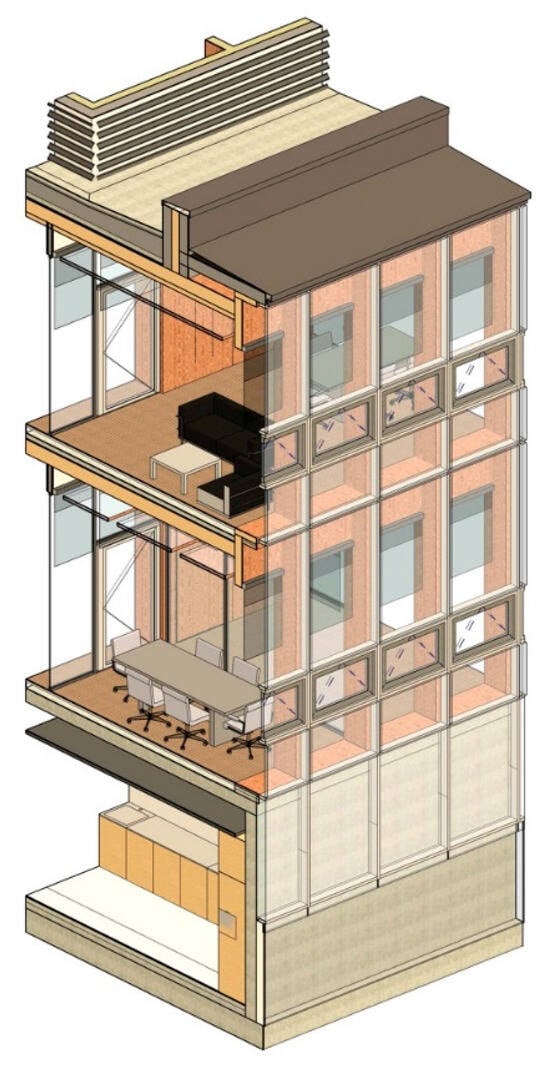
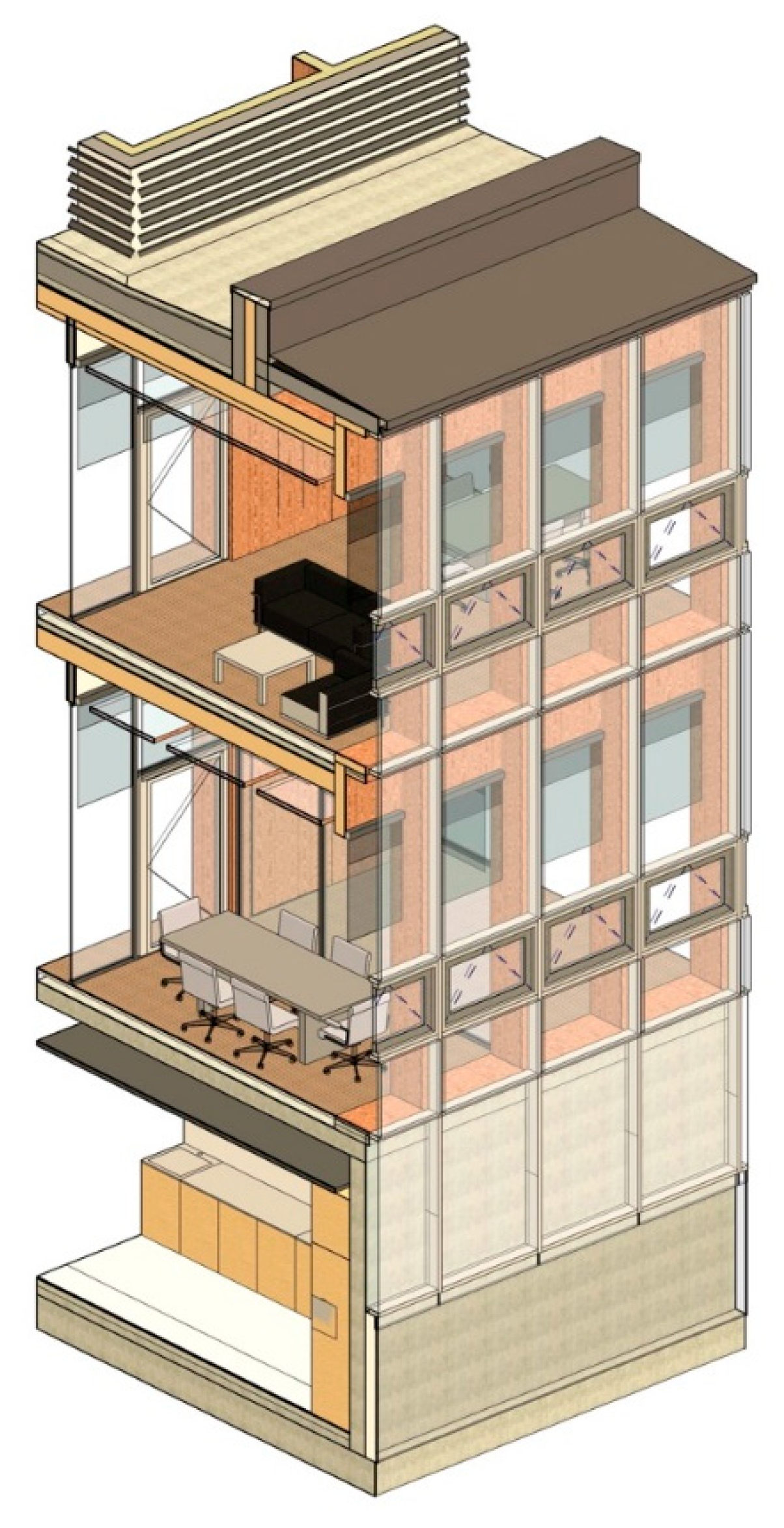
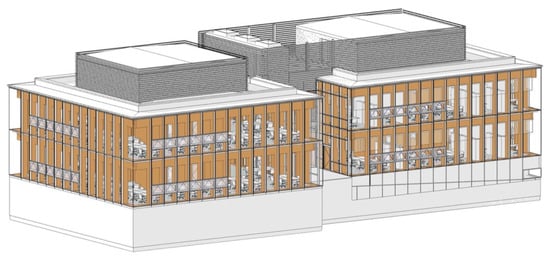
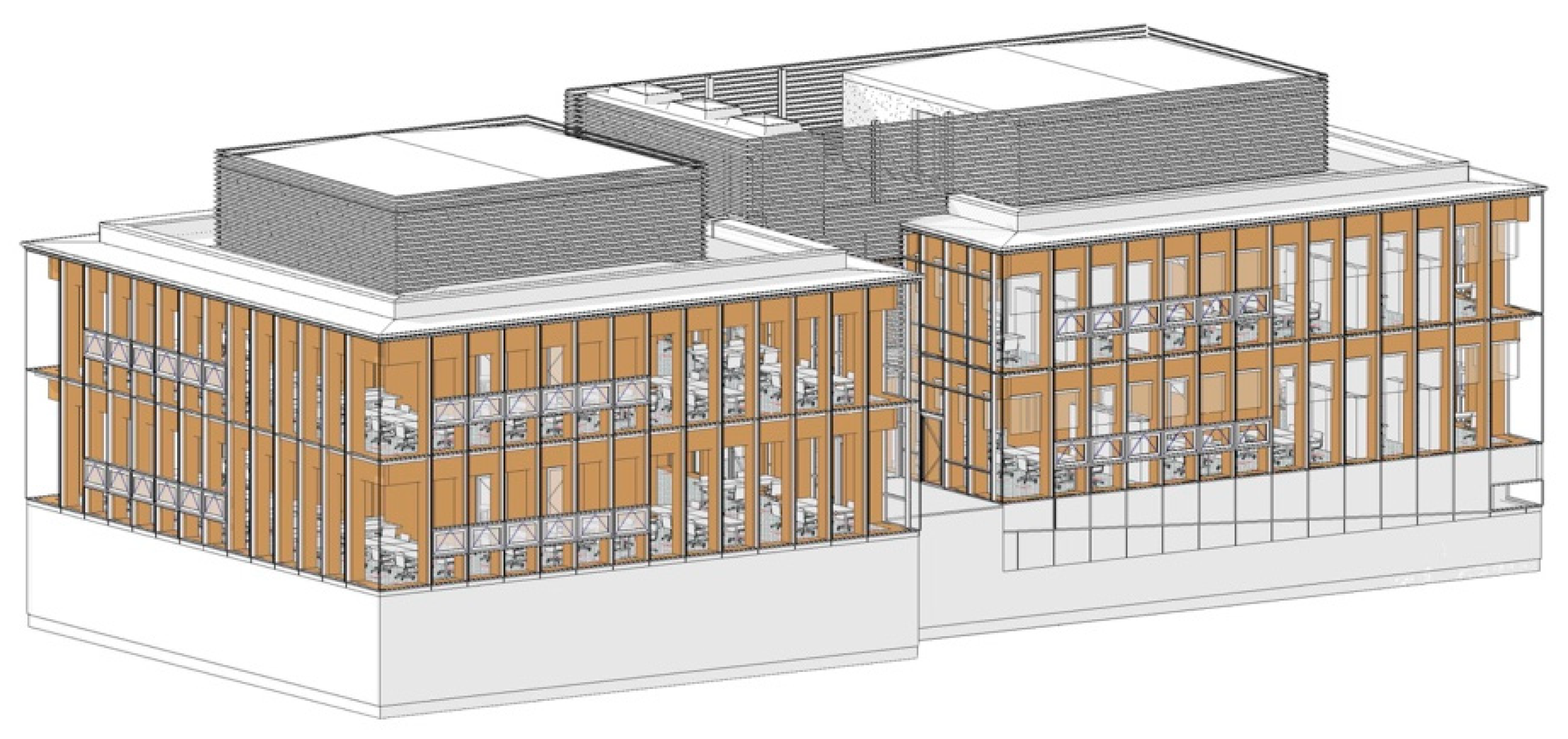
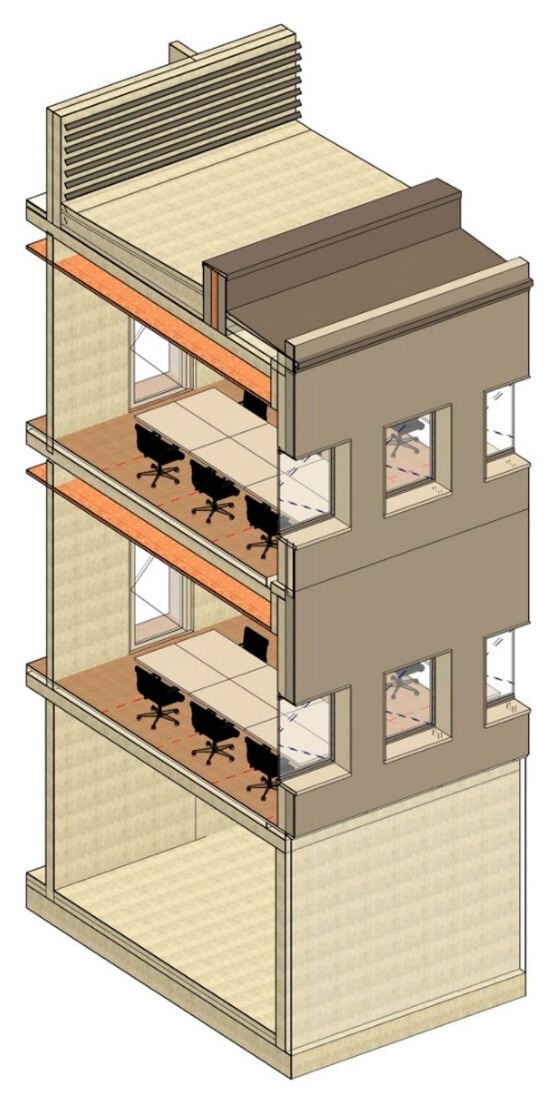
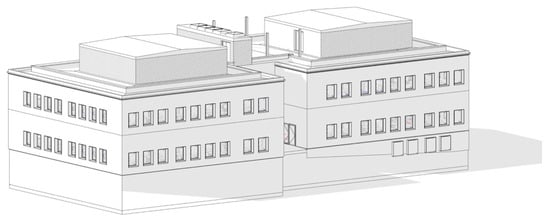
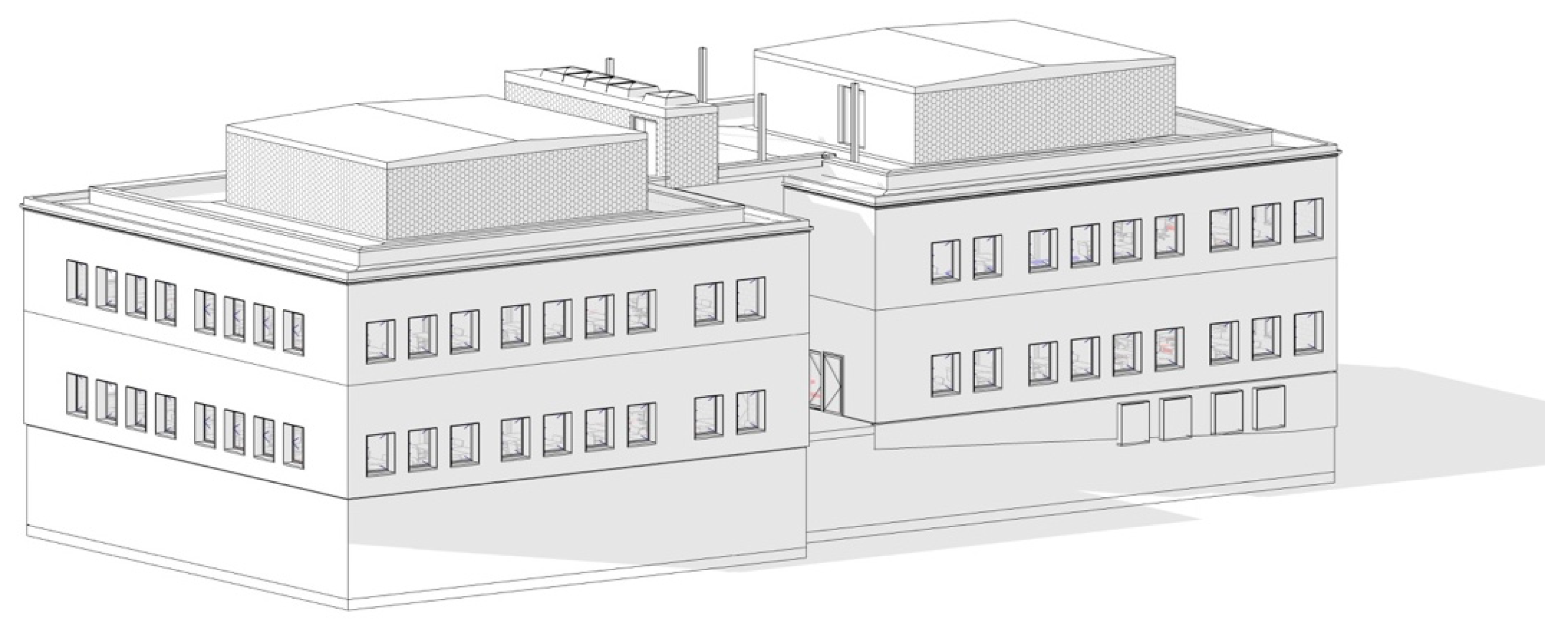
The W1 and W2 building variants differ the most—both their structure and the type of facade are different. The other variants (W3–W6) are other variations in the W1 and W2 types, based on these assumptions. Variant W1 is illustrated in Figure 1 and Figure 2. Variant W2, on the other hand, is shown in the following Figure 3 and Figure 4.
Figure 1.
Axonometric section—W1 building type: CLT structure variant with ventilated curtain wall facade made of glass and aluminum, own design based on the project.
Figure 2.
Axonometric projection of the building—CLT structure variant with ventilated curtain wall facade made of glass and aluminum, own design based on the project.
Figure 3.
Axonometric cross-section of the building—W2 building type: reinforced concrete structure with masonry façade, own design based on the project.
Figure 4.
Axonometric projection of the building—reinforced concrete structure with masonry facade, own design based on the project.
The following assumptions were made to analyze the embodied carbon footprint for an example office building.
In the case of the Cross Laminated Timber structure variant, it was assumed that reinforcing bars with 90% recycled steel content would be used in the required reinforced concrete elements of the basement and above-ground and that the proportion of Portland clinker in the concrete mix would be reduced by 50% through the use of CEM III cement. In addition, it was assumed that some of the reinforced concrete walls, ceilings and columns would be replaced with CLT structure.
For the reinforced concrete structure variant, it was assumed that reinforcing bars with 90% recycled steel content would be used in the reinforced concrete elements, but Portland clinker would not be replaced with CEM III cement. The study assumed that reinforcing steel is mainly steel produced in Poland, where the largest market share belongs to producers such as ArcelorMittal Poland [31] (approximately 70% market share) as well as CMC Poland and Celsa Group [32]. The products of these producers are characterized by a high recycled steel content, ranging from 92.5% up to even 100% (based on various Polish products according to EPD declarations). However, it should be noted that in recent years the share of imported steel in the Polish market has been increasing. These imports come mainly from other European countries, where the share of recycled steel in production is often significantly lower. As a result, the average recycled content of reinforcing steel available on the Polish market is gradually decreasing.
Since the One Click program is automated enough to pull values regarding the service life of materials based on selected EPD declarations, some of them were assigned automatically. Others, however, were entered manually, based on the document “Whole life carbon assessment for the built environment” RICS 2024 (2nd edition) or based on professional practice [33].
- -
- Building life span of 60 years,
- -
- For structural elements, a life span equal to the life span of the building,
- -
- For facade finishing elements, replacement of the entire set of components after 35 years for all facade variants,
- -
- For facade variants with a full curtain wall, the service life of massive and load-bearing elements was assumed to be equal to the service life of the building,
- -
- For the designed partition walls of the building, it was assumed that the layout of the space would need to be changed every 20 years,
- -
- A general renovation is planned halfway through the building’s life cycle, which would also include the replacement of floor underlays and system ceilings,
- -
- In addition to the structure, facade, internal partitions, roof, and finishing layers, the analysis also took into account building installations and building equipment. Due to the preliminary stage of the project, these elements were assumed on an indicative basis, based on estimates for similar buildings. For all building installations and equipment, a complete replacement every 20 years was assumed. Interior finishing elements are subject to replacement every 10–15 years.
In order to carry out a study of the building’s embodied carbon footprint and to decide which life cycle stages will be analyzed, reference was made to the assumptions of the Royal Institute of British Architects, RIBA [30] (Table 3).
Table 3.
RIBA 2030 Climate Challenge target metrics for non-domestic (new-build offices).
3. Results
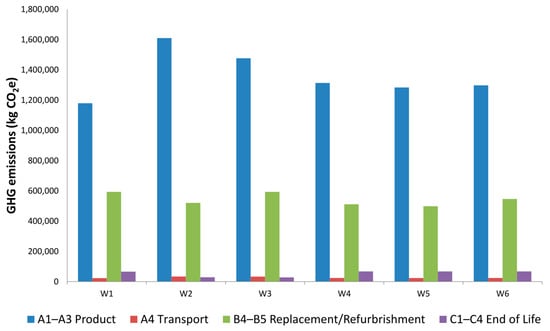
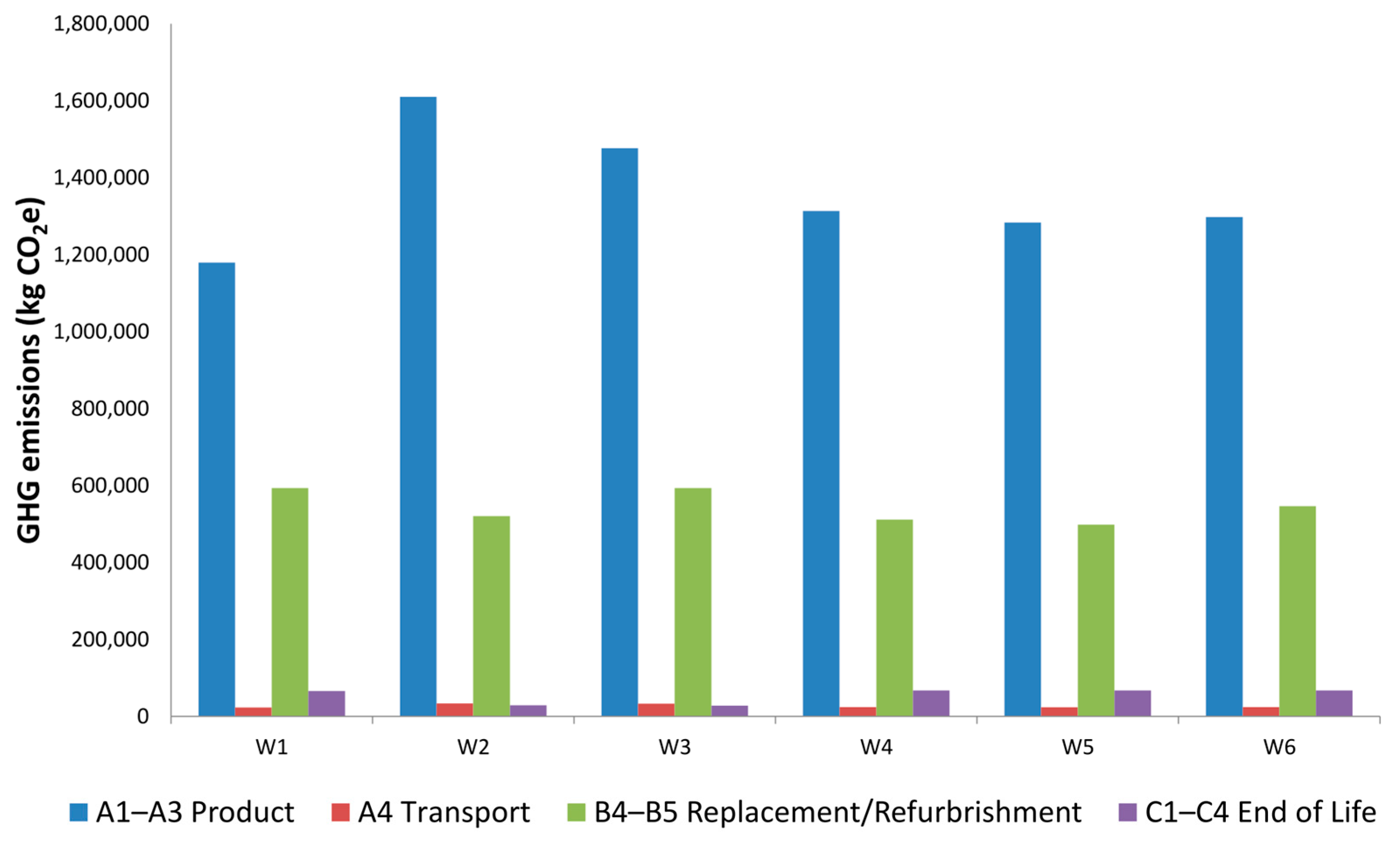
From the graph shown in Figure 5, it can be deduced that the highest GHG emissions are characterized by phases A1–A3 related to material production. For this phase, the most favorable results were achieved by the “W1” building variant, which is a building with a CLT structure and a system glass facade. However, it has the highest emissions for phases B4–B5 related to the replacement of building components. This has to do with the assumption made in the calculation regarding the replacement of the system glass facade after 35 years. It affects the additional emissions associated with the production of replacement components. Other assumptions were made for masonry facades, whose lifespan was assumed to be the same as for the entire building.
Figure 5.
GHG emissions (kg CO2e) in individual phases, own study, based on results from the One Click LCA program.
The least favorable parameters were achieved by variant W2: a building with a reinforced concrete structure and a masonry facade covered with aluminum cladding. Both reinforced concrete and aluminum have the highest emission rate of kg CO2e at the raw material production stage. For the end-of-life phase of the building (C1–C4), the best results were achieved by variants W2 and W3 due to the ease of dismantling and reusing the system glass façade.
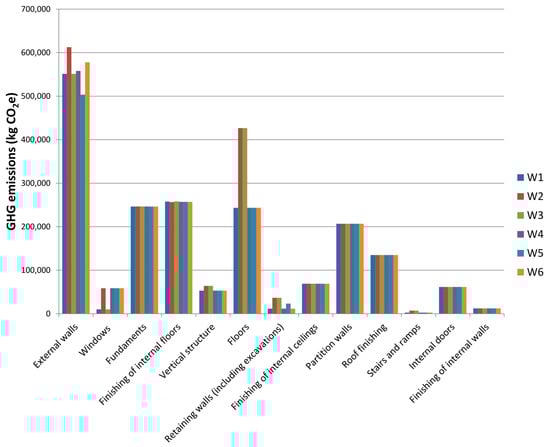
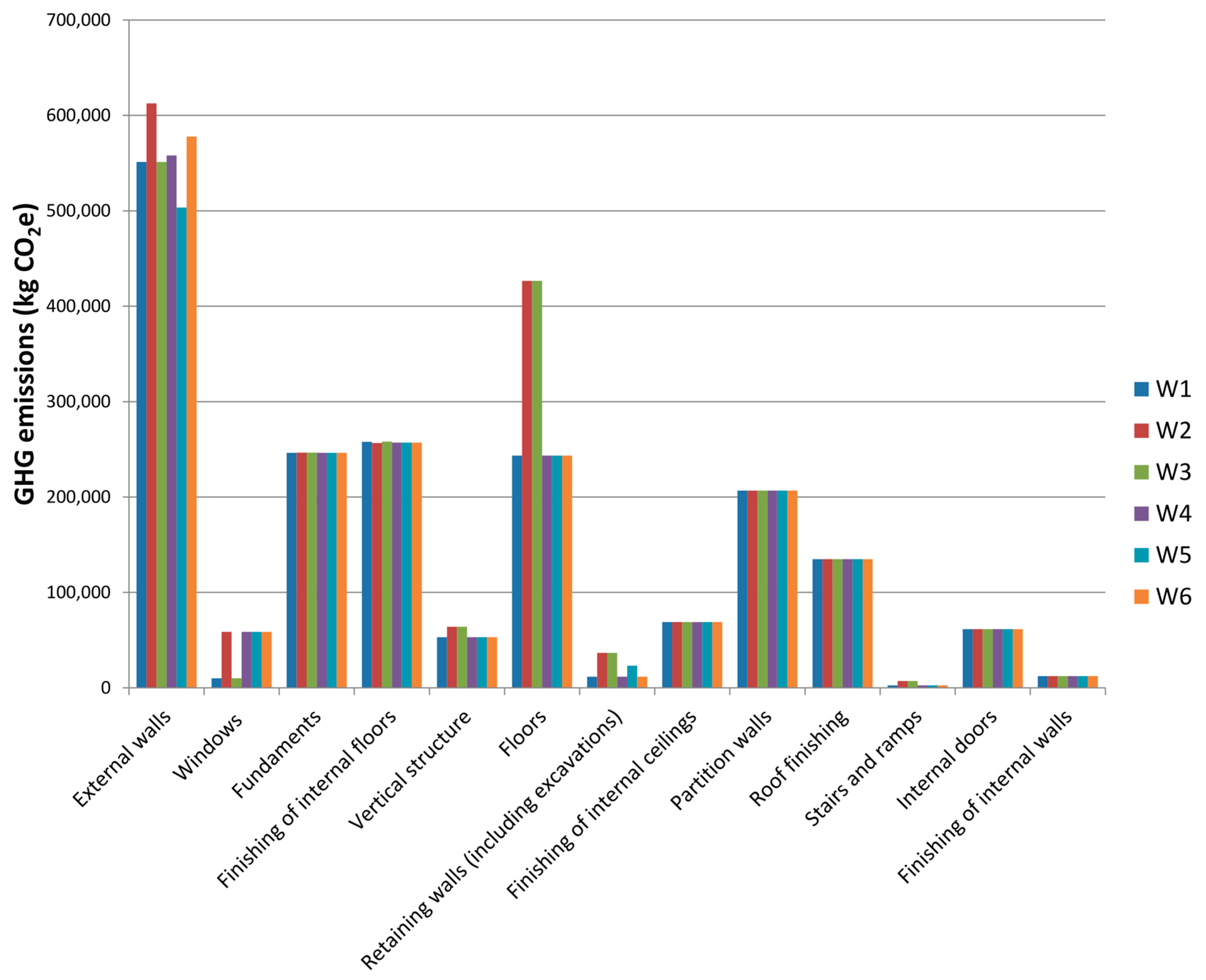
The next stage of the study was to verify the impact of individual building components on global warming. The developed results are presented in Figure 6.
Figure 6.
GHG emissions (kg CO2e) by building elements, own study, based on the results of the One Click LCA program.
The building elements that have the greatest impact on global warming are the external walls, which consist of their structure, casing and finish. The ventilated façade with fiber–cement board cladding on a massive, masonry curtain wall, i.e., variant W5, achieved the best results in relation to the external walls. Variants W1 and W3, which were proposed as a system glass façade on a steel and aluminum substructure, achieved better results than other façades made of masonry. The next largest emitters are the foundations, internal floor finishes and ceilings between stories. In the case of variants W2 and W3, reinforced concrete ceilings emit almost 2 times more kg CO2e than wooden ceilings used in other construction variants. Interior finishing elements, such as floor coverings and partition walls, are certainly important considerations. Their relatively short life cycle, which is on average 5–15 years, with a large material volume at the same time, causes an increase in kg CO2e emissions related to the phase of replacing elements with new ones. It is worth bearing in mind that not only the amount of materials used is important in the case of calculating the carbon footprint—an equally important parameter is the time after which the replacement of building components takes place. In this study, it was assumed that the main structure of the building would function for as many years as the entire building, but in the case of the façade, a scenario was adopted that the materials would be replaced after 35 years. For interior finishing elements, it was assumed that they would be replaced after 15 years, and for thermal, damp-proof and waterproof insulation after 30 years.
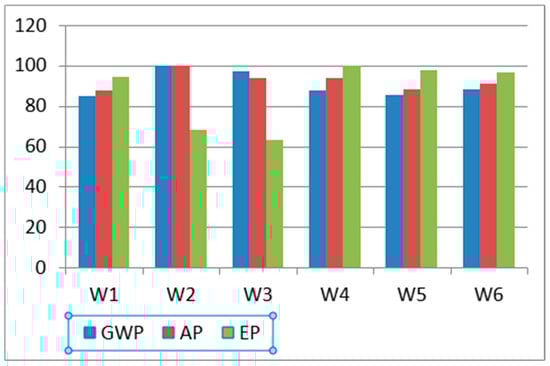
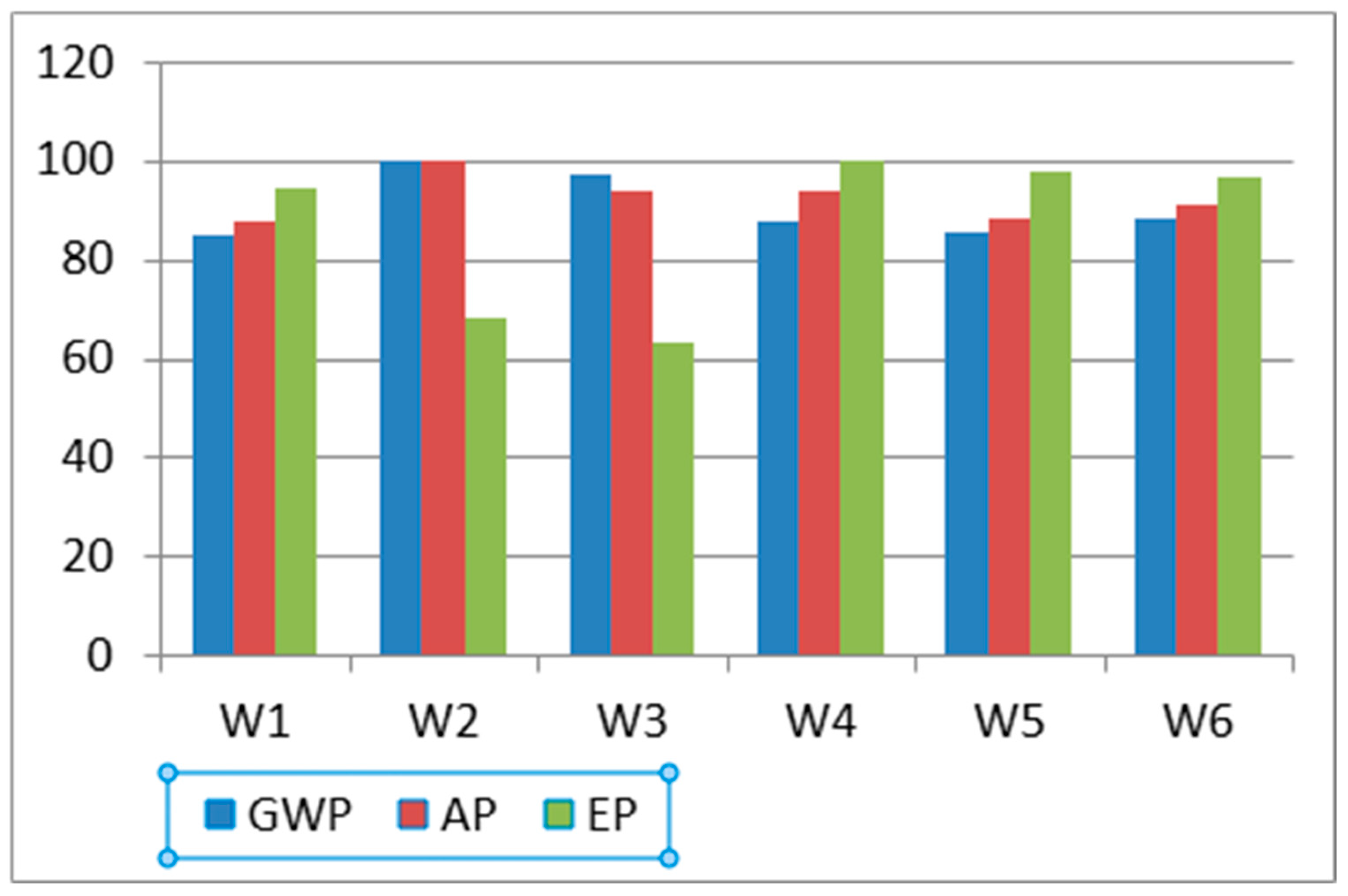
The next stage of the study was to check how individual building variants affect other categories of the environmental footprint, such as acidification potential or eutrophication potential. They were compared with the global warming potential. The results are presented in Figure 7.
Figure 7.
Impact of variants on different environmental footprint categories, own elaboration, based on results from One Click LCA program. Legend: GWP—Global Warming Potential, unit: kg CO2e, AP—Acidification Potential, unit: kg SO2e, EP—Eutrophication Potential, unit: kg PO4e.
The first variant has the lowest impact on the GWP and AP categories, but in the EP category, concerning the eutrophication potential, it performs worse than variants W2 and W3. Buildings W2 and W3 achieve the most optimal results in this category, because they use a reinforced concrete structure, and in the other cases a wooden one. The main cause of eutrophication of reservoirs is the excess of nitrogen and phosphorus, which increases water fertility. These elements largely come from agricultural sources, because very large amounts of them are found in fertilizers and animal excrements [34].
Timber production therefore contributes to greater eutrophication than concrete and steel production, partly due to the fertilizers used in cultivation. In addition, forest management practices—particularly in intensively managed forests—can lead to increased nutrient runoff, including nitrates and phosphates, as a result of fertilizer application, soil disturbance, and post-harvest runoff [35]. In the AP category, i.e., acidification potential, the largest environmental footprint is generated by the W2 variant. The metals used in this variant for the production of facade finishes, as well as reinforcing steel, generate the highest soil acidification index. According to research, soil acidification is caused to the greatest extent by anthropogenic activity related to the emission of gases such as SO2, NOx, NH4 in industrial processes [36].
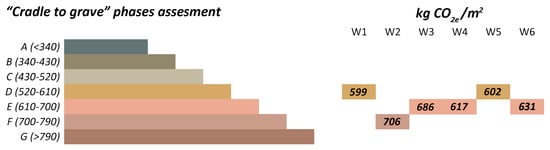
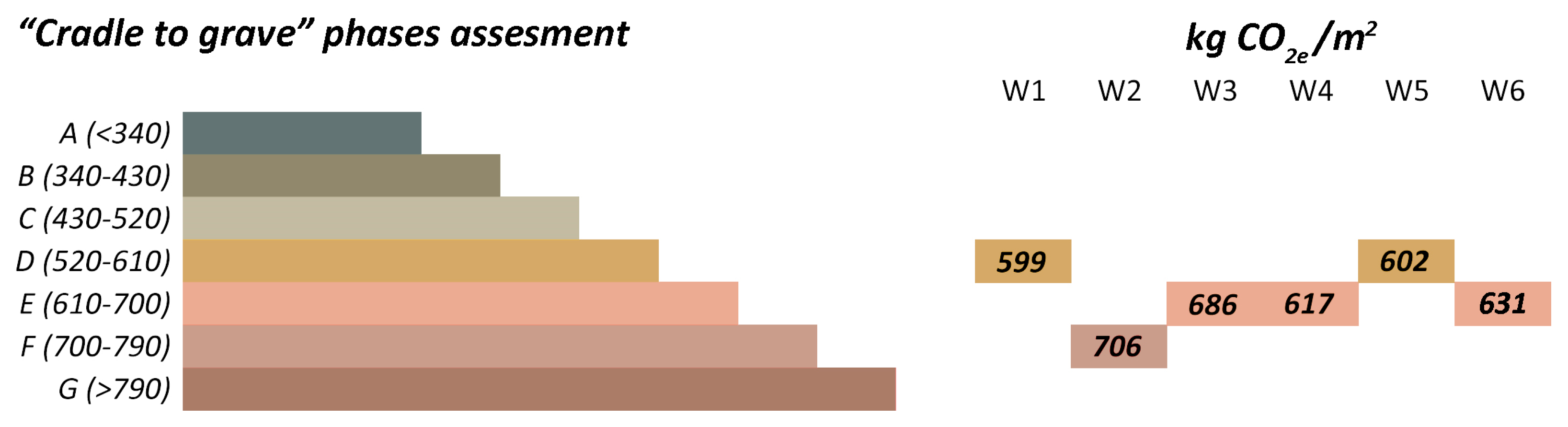
The last phase of the analysis was the assessment of GHG emissions (CO2e/m2) of individual building variants compared to the reference building. The sample for the reference building was Polish office buildings, where the source of data was One Click LCA program. The results are presented in Figure 8.
Figure 8.
Evaluation of GHG emissions (CO2e/m2) compared to the reference building (sample: Poland—office buildings, database: OneClick program), own study, based on the results of the One Click LCA program.
In the case of the W1 variant, the building achieved a result of 599 kg CO2e/m2, while the W5 variant achieved 602 kg CO2e/m2. They thus gained a “D” rating in the “cradle-to-grave” category. However, the difference between the most optimal option W1 and the least favorable option W2 differ by 107 kg CO2e/m2 (about 15%).
4. Discussion
Calculating the embodied environmental footprint by using Life Cycle Assessment (LCA) demonstrates how complex and multi-layered this assessment is [37,38]. To comprehensively evaluate the climate relevance of biogenic materials, not only total emissions but also their timing must be considered. The prevailing static approach (–1/+1), which assigns a negative emission at the time of CO2 uptake during tree growth and a corresponding positive emission at the end of life, enables the tracking of carbon flows but ignores their temporal dimension. This may distort the real climate performance of long-lived materials. An alternative, the dynamic LCA approach, employs Dynamic Characterization Factors (DCF) to capture the influence of emission timing and to assign climate impacts more accurately over time. This approach better reflects that delayed biogenic carbon re-emission can potentially support more robust comparisons between long-lived timber and other biobased materials.
Within the system boundaries adopted in this study, the production stage of materials (A1–A3) was identified as the dominant contributor to the embodied carbon footprint of the analyzed building variants, irrespective of the structural system. This is consistent with previous studies showing that, in highly energy-efficient buildings, the production stage remains the principal contributor to embodied greenhouse gas emissions. At the same time, the analysis reveals a trade-off between low initial emissions and the long-term impacts associated with component replacement in B4–B5. Variants with low production-stage emissions may exhibit increased impacts in later stages when short service-life components are assumed. This confirms the key role of durability and replacement cycles in embodied carbon assessments. The element-based interpretation shows that external walls, floor structures and interstory ceilings dominate the global warming potential, while interior finishing elements—despite small material quantities—can substantially increase total emissions due to frequent replacement. These findings indicate that finishing layers, often treated as secondary, significantly influence the embodied footprint. The comparison of impact categories further indicates that solutions optimized for global warming potential are not necessarily favorable in other environmental dimensions. Timber-based solutions tend to perform better in GWP but worse in eutrophication potential, whereas reinforced concrete systems show the opposite tendency, confirming the necessity of multi-criteria environmental assessment. Finally, the relatively moderate spread between the most and least favorable variants within the analyzed scope indicates that material substitution alone is insufficient to achieve deep decarbonization of office buildings. Comprehensive strategies addressing material selection, durability, service life and design for disassembly and reuse are therefore required.
The optimistic scenario examines the potential impact of end-of-life carbon sequestration, for example, through bioenergy with carbon capture. However, nationwide implementation of this technology is by no means guaranteed. Partial avoidance of end-of-life emissions may also be achieved through the reuse of wood components; however, attributing life-cycle impacts associated with reuse across multiple service lives presents significant methodological complexity [39]. The pessimistic scenario without new tree planting considers the case where sequestration is not considered. Such scenarios may also arise due to disturbances such as wildfires or pest infestation. For timber products, additional end-of-life (EoL) scenarios must be considered to fully assess their carbon balance. These include (i) reuse of structural elements, extending the period of carbon storage; (ii) material recycling, which retains biogenic carbon within the product cycle and delays its release; (iii) energy recovery through combustion, which causes immediate CO2 release but partially offsets fossil fuel use; and (iv) landfilling, which may lead to anaerobic methane emissions but can also preserve part of the stored carbon for longer periods. According to EN 15804 +A2, emissions related to these processes are to be reported in modules C1–C4, while avoided emissions and substitution benefits are included transparently in module D. Neglecting these stages—especially when assuming energy recovery as the only EoL option—may result in overly optimistic assessments of wood’s climate performance.
Two broader analytical scenarios can be outlined. The optimistic one assumes effective end-of-life carbon sequestration, for instance via bioenergy with carbon capture and storage (BECCS), or prolonged reuse and cascading material recovery. However, large-scale deployment of such technologies remains uncertain. The pessimistic scenario disregards new forest growth and carbon re-uptake, representing situations where harvesting is not compensated by replanting or where sequestration is inhibited by wildfires, pests, or land-use change. In such cases, the long-term global warming impact of timber structures could exceed that of concrete or steel.
Practical use of the EN 15804 standard [24] showed that there are many areas that are interpreted differently by entities issuing environmental declarations in Europe. Differences in declarations may be caused by factors such as selection, quality and availability of data, methodological details and assumptions, use scenarios, handling of module D (recycling), or exclusion of some life cycle stages from EPDs. This potential lack of comparability of results through calculation assumptions may create an obstacle to the use of EPDs from different countries on the free market, and also prevent the use of EPDs as a design tool [40]. Finally, the practical application of EN 15804 reveals significant inconsistencies in interpretation across Environmental Product Declarations (EPDs) in Europe. Variations arise from data quality and representativeness, methodological assumptions, system boundaries, or treatment of the D-module. These discrepancies hinder cross-country comparability and limit the use of EPDs as reliable design tools. Future standardization should therefore promote transparent end-of-life reporting and harmonized accounting of biogenic carbon flows, while gradually integrating time-dependent assessment methods into regulatory practice to ensure that the climate benefits of wood and other biobased materials are assessed credibly and consistently.
5. Conclusions
The study shows that changes to the structure and façade of a building have the greatest impact on the results regarding the building’s embodied carbon footprint. It confirms that the magnitude of embodied environmental impact is determined not only by the type and quantity of materials used but also by assumptions regarding the expected service life of building components [41]. Differences between the variants reached approximately 107 kg CO2e/m2 (about 15%), with the timber structure and system façade variant (W1) achieving the lowest values in modules A1–A3 but higher emissions in B4–B5 due to the assumed façade replacement after 35 years.
Materials such as floor finishes, relatively small in quantity compared to structural or façade materials, have a significant impact on the environmental footprint because they are replaced several times during the building’s life cycle (approximately every 5–10 years).
Understanding the influence of individual structural and finishing materials on the embodied footprint allows for more informed material choices already at the concept stage. Even small design adjustments—such as reducing glazing area—can substantially decrease embodied emissions.
The results also show that changes in material selection affect other environmental aspects beyond the most commonly analyzed carbon footprint. Solutions favorable for GWP may perform worse in other categories such as eutrophication (EP) or acidification (AP), highlighting the need for multi-criteria assessment. For design practice, this means that already in the early concept phase, it is advisable to limit glazing areas, prefer longer-lasting façades, and design elements that are easy to disassemble and reuse.
The ambitious goals of the European Union regarding the decarbonization of the economy by 2050 require the use of new measurement tools. In the building sector, there is a shift from requirements concerning energy demand to requirements concerning CO2 emissions or greenhouse gases in general. Moreover, these requirements will not only apply to emissions related to the building’s operational phase, but will cover the entire life cycle. Assessing the carbon footprint of buildings over their life cycle in Poland has so far been used in research studies and advanced environmentally friendly projects. The introduction of a universal obligation to perform such calculations, even if only for new buildings, as stated in the revised Energy Performance of Buildings Directive (EPBD), requires the creation of appropriate legal frameworks. The implementation of regulations for carbon footprint calculation requires a consistent and clear methodology. This approach will allow for comparison, reporting, and, in the longer term, the determination of future limits on carbon dioxide emissions throughout the entire life cycle. The target level of harmonization should cover at least the key elements of the calculations, such as system boundaries, the scope of building elements, and types of data sources on material emissions. In the project “Development of a methodology for measuring the carbon footprint of buildings in Poland,” implemented by NAPE S.A. and Asplan Viak as part of the EEA Norway Grants bilateral cooperation, it was decided to propose a national methodology for determining the carbon footprint of buildings [42].
It is recommended to establish a unified national WLCA methodology and an open public EPD database, and for biogenic materials—to gradually implement dynamic LCA and ensure consistent reporting of modules C and D.
Future work should include sensitivity analyses for end-of-life scenarios and validation across a broader range of building typologies, including module B6 (operational energy use) in the assessments. The correlation between the operational carbon footprint and the embodied carbon footprint could represent another interesting stage of the study.
Author Contributions
Conceptualization, A.P. and A.W.; methodology, A.P.; software, A.W.; validation, A.P., A.W. and M.P.; formal analysis, A.P.; investigation, A.P.; resources, A.P. and M.P.; data curation, A.P. and A.W.; writing—original draft preparation, A.P. and M.P.; writing—review and editing, A.P. and M.P. All authors have read and agreed to the published version of the manuscript.
Funding
This research received no external funding.
Institutional Review Board Statement
Not applicable.
Informed Consent Statement
Not applicable.
Data Availability Statement
The original contributions presented in this study are included in the article. Further inquiries can be directed to the corresponding author.
Conflicts of Interest
Author Anna Wojcieszek was employed by APA Wojciechowski sp. z o.o. The remaining authors declare that the research was conducted in the absence of any commercial or financial relationships that could be construed as a potential conflict of interest.
Abbreviations
The following abbreviations are used in this manuscript:
| LCA | Life Cycle Assessment |
| BIM | Building Modeling Information |
| GWP | Global Warming Potential |
| AP | Acidification Potential |
| EP | Eutrophication potential |
| DCF | Dynamic Characterization Factors |
| EoL | End of Life |
| EPD | Environmental Product Declaration |
| WLCA | Whole Life Carbon Assessment |
| GHG | Greenhouse Gases |
References
- Firląg, S.; Polskie Stowarzyszenie Budownictwa Ekologicznego (PLGBC) (Eds.) Zrównoważone Budynki Biurowe: Projektowanie, Uwarunkowania Prawne, Rozwiązania Technologiczne: Praca Zbiorowa; Wydawnictwo Naukowe PWN: Warszawa, Poland, 2018; ISBN 978-83-01-19513-7. [Google Scholar]
- Ryńska, E.D. Bioklimatyka a Forma Architektoniczna; Oficyna Wydawnicza Politechniki Warszawskiej: Warszawa, Poland, 2001; ISBN 978-83-7207-288-7. [Google Scholar]
- Marchwinski, J.; Zielonko-Jung, K. Współczesna Architektura Proekologiczna; Wydanie 1, Dodruk 1; Wydawnictwo Naukowe PWN SA: Warszawa, Poland, 2014; ISBN 978-83-01-17053-0. [Google Scholar]
- Celadyn, W. Energia w Architekturze. Kwart. Archit. Urban. 2012, 57, 36–56. [Google Scholar]
- Rynska, E.; Kozminska, U.; Zinowiec-Cieplik, K.; Rucinska, J.; Szybinska-Matusiak, B. (Eds.) Design Solutions for nZEB Retrofit Buildings; Advances in Civil and Industrial Engineering; IGI Global: Hershey, PA, USA, 2018; ISBN 978-1-5225-4105-9. [Google Scholar]
- Rynska, E.; Klimowicz, J.; Kowal, S.; Lyzwa, K.; Pierzchalski, M.; Rekosz, W. Smart Energy Solutions as an Indispensable Multi-Criteria Input for a Coherent Urban Planning and Building Design Process—Two Case Studies for Smart Office Buildings in Warsaw Downtown Area. Energies 2020, 13, 3757. [Google Scholar] [CrossRef] [Scilit]
- Bać, A. Architektura Energoaktywna po 2021. Tom 2. Zagadnienia Instalacyjno-Projektowe; Politechnika Wrocławska, Oficyna Wydawnicza: Wroclaw, Poland, 2020. [Google Scholar]
- Zielonko-Jung, K. Technologie prośrodowiskowe dla budynków miejskich. Kwart. Nauk. Uczel. Vistula 2017, 4, 142–152. [Google Scholar]
- Ryńska, E. Developing and Designing Circular Cities: Emerging Research and Opportunities; Practice, Progress, and Proficiency in Sustainability; IGI Global: Hershey, PA, USA, 2020; ISBN 978-1-7998-1886-1. [Google Scholar]
- Zielonko-Jung, K. Projektowanie Elewacji Aktywnej Energetycznie; Politechnika Wrocławska, Oficyna Wydawnicza: Wroclaw, Poland, 2020. [Google Scholar]
- Kuczera, A.; Płoszaj-Mazurek, M. Zerowy Ślad Węglowy Budynków, Mapa Drogowa Dekarbonizacji Budownictwa Do Roku 2050; Polskie Stowarzyszenie Budownictwa Ekologicznego PLGBC: Gliwice, Poland, 2021. [Google Scholar]
- Celadyn, W. Koncepcje Energetyczne Budynków—Metody Prezentacji; Wydaw PK: Kraków, Poland, 2011. [Google Scholar]
- Hauke, E.; Purta, M.; Speelman, E.; Szarek, G.; van del Pluijm, P. Neutralna Emisyjnie Polska 2050. Jak Wyzwanie Zmienić w Szansę; McKinsey & Company: New York, NY, USA, 2020. [Google Scholar]
- Anink, D.; Boonstra, C.; Mak, J.; Anink, D. Handbook of Sustainable Building: An Environmental Preference Method for Selection of Materials for Use in Construction and Refurbishment; Reprint; James & James: London, UK, 2004; ISBN 978-1-873936-38-2. [Google Scholar]
- Felmer, G.; Morales-Vera, R.; Astroza, R.; González, I.; Puettmann, M.; Wishnie, M. A Lifecycle Assessment of a Low-Energy Mass-Timber Building and Mainstream Concrete Alternative in Central Chile. Sustainability 2022, 14, 1249. [Google Scholar] [CrossRef] [Scilit]
- Golański, M. Recykling Materiałów Budowlanych. Przegląd Bud. 2011, 82, 46–51. [Google Scholar]
- Koźmińska, U. Projektowanie dla odzysku. Builder 2018, 12, 36–39. [Google Scholar]
- Lorens, A. Ekonomia Cyrkularna Jako Zrównoważony, Odpowiedzialny Proces Wyrażony Warchitekturze i Projektowaniu Produktu Cz. 1. Builder 2020, 271, 35–37. [Google Scholar] [CrossRef] [Scilit]
- Janik, M. W Stronę Urbanistyki Gospodarki Obiegu Zamkniętego. Builder 2022, 305, 30–32. [Google Scholar] [CrossRef] [Scilit]
- Komisja Europejska. Komunikat Komisji Do Parlamentu Europejskiego, Rady, Europejskiego Komitetu Ekonomiczno-Społecznego i Komitetu Regionów. In Nowy Plan Działania UE Dotyczący Gospodarki o Obiegu Zamkniętym Na Rzecz Czystszej i Bardziej Konkurencyjnej Europy 2020; Komisja Europejska: Brussels, Belgium, 2020. [Google Scholar]
- Intergovernmental Panel on Climate Change. Climate Change 2021—The Physical Science Basis: Working Group I Contribution to the Sixth Assessment Report of the Intergovernmental Panel on Climate Change, 1st ed.; Cambridge University Press: Cambridge, UK, 2023; ISBN 978-1-009-15789-6. [Google Scholar]
- Parlament Europejski. Energy Performance of Buildings Directive (Recast); Parlament Europejski: Brussels, Belgium, 2023. [Google Scholar]
- PN-EN 15978:2012; Zrównoważone Obiekty Budowlane—Ocena Środowiskowych Właściwości Użytkowych Budynków—Metoda Obliczania. Polski Komitet Normalizacyjny: Warsaw, Poland, 2012.
- PN-EN 15804+A1:2014-04; Zrównoważoność Obiektów Budowlanych—Deklaracje Środowiskowe Wyrobu—Podstawowe Zasady Kategoryzacji Wyrobów Budowlanych. Polski Komitet Normalizacyjny: Warsaw, Poland, 2014.
- Bartosz, D.; Kowalski, W.; Mirette, K.; Komur, W. Ślad Węglowy Budynku Pod Lupą: Od Diagnozy Do Działania; PLGBC: Gliwice, Poland, 2025. [Google Scholar]
- ISO 14040; Environmental Management—Life Cycle Assessment—Principles and Framework. ISO: Geneva, Switzerland, 2006.
- ISO 14044; Environmental Management—Life Cycle Assessment—Requirements and Guidelines. ISO: Geneva, Switzerland, 2006.
- EN 15941:2024; Sustainability of Construction Works—Data Quality for Environmental Assessment of Products and Construction Work—Selection and Use of Data. CEN: Brussels, Belgium, 2024.
- Steinmann, J.; Rock, M.; Lutzkendorf, T.; Allacker, K.; Le Den, X. Whole Life Carbon Models for the EU27 to Bring down Embodied Carbon Emissions from New Buildings. Review of Existing National Legislative Measures; RAMBOLL: Brussels, Belgium, 2022. [Google Scholar]
- Royal Institute of British Architects. RIBA 2030 Climate Challenge; Royal Institute of British Architects: London, UK, 2021. [Google Scholar]
- ArcelorMittal Europe. Environmental Product Declaration Type III; ArcelorMittal Europe: Luxembourg, 2024. [Google Scholar]
- CMC Poland Sp. z o.o. Type III Environmental Product Declaration; CMC Poland Sp. z o.o: Zarwiecie, Poland, 2023. [Google Scholar]
- Sturgis, S.; Anderson, J.; Astle, P.; Begenal George, C.; Bowles, L. Whole Life Carbon Assessment for the Built Environment; Royal Institution of Chartered Surveyors (RICS): London, UK, 2023. [Google Scholar]
- FDPA Eutrofizacja. Available online: https://www.fdpa.org.pl/eutrofizacja (accessed on 15 March 2023).
- Sukuman, T.; Gheewala, S.H.; Saizen, I.; Prapaspongsa, T. Life Cycle Assessment of Agricultural Systems toward Circularity. Sustain. Prod. Consum. 2025, 58, 203–220. [Google Scholar] [CrossRef] [Scilit]
- KalendarzRolnikow.pl Przyczyny i Skutki Zakwaszenia Gleb Oraz Jak Im Przeciwdziałać. Available online: https://www.kalendarzrolnikow.pl/2846/przyczyny-i-skutki-zakwaszania-gleb-oraz-jak-im-przeciwdzialac (accessed on 15 March 2023).
- Adamczyk, J. Wykorzystanie LCA (Life Cycle Assessment) do Oceny Środowiskowej Budynku. Ph.D. Thesis, University of Zielonogórski, Zielona Góra, Poland, 2005. [Google Scholar]
- Antypa, D.; Petrakli, F.; Gkika, A.; Voigt, P.; Kahnt, A.; Böhm, R.; Suchorzewski, J.; Araújo, A.; Sousa, S.; Koumoulos, E.P. Life Cycle Assessment of Advanced Building Components towards NZEBs. Sustainability 2022, 14, 16218. [Google Scholar] [CrossRef] [Scilit]
- De Wolf, C.; Hoxha, E.; Fivet, C. Comparison of Environmental Assessment Methods When Reusing Building Components: A Case Study. Sustain. Cities Soc. 2020, 61, 102322. [Google Scholar] [CrossRef] [Scilit]
- Piasecki, M. Ocena Właściwości Środowiskowych Wyrobów Jako Element Oceny Projektowanego Budynku. Rynek Instal. 2014, 7, 50–53. [Google Scholar]
- Golawski, P. Trwałość Materiałów Budowlanych. Jaka Jest Żywotność Domów? Available online: https://passion.house/trwalosc-materialow-budowlanych-jaka-jest-zywotnosc-domow/ (accessed on 15 March 2023).
- Narodowa Agencja Poszanowania Energii S.A. Propozycja Krajowej Metodyki Wyznaczania Śladu Węglowego Budynków; Narodowa Agencja Poszanowania Energii S.A.: Warsaw, Poland, 2024.

Disclaimer/Publisher’s Note: The statements, opinions and data contained in all publications are solely those of the individual author(s) and contributor(s) and not of MDPI and/or the editor(s). MDPI and/or the editor(s) disclaim responsibility for any injury to people or property resulting from any ideas, methods, instructions or products referred to in the content. |
© 2025 by the authors. Licensee MDPI, Basel, Switzerland. This article is an open access article distributed under the terms and conditions of the Creative Commons Attribution (CC BY) license (https://creativecommons.org/licenses/by/4.0/).