
Article

Modeled Bed Stress Patterns Around Pervious Oyster Shell Habitat Units Using Large-Eddy Simulations

by
Lauren Cope
1,
Jacob Waggoner
1,
Raphael Crowley
1,*,
Makaya Shemu
1,
Michael Roster
1,
Junyoung Jeong
1,
Hunter Mathews
2,
Kelly J. Smith
3,
Mohammad J. Uddin
4 and
Craig Hargis
5
1
School of Engineering, University of North Florida, Jacksonville, FL 32224, USA
2
Department of Biology, University of North Florida, Jacksonville, FL 32224, USA
3
Division of Mathematics and Natural Sciences, Elmira College, 1 Washington St., Elmira, NY 14901, USA
4
Department of Civil Engineering, Oklahoma State University, Stillwater, OK 74078, USA
5
Fortera, 100 Great Oaks Blvd, Suite 120, San Jose, CA 95119, USA
*
Author to whom correspondence should be addressed.
Sustainability 2025, 17(24), 11129; https://doi.org/10.3390/su172411129 (registering DOI)
Submission received: 1 November 2025 / Revised: 1 December 2025 / Accepted: 5 December 2025 / Published: 12 December 2025
(This article belongs to the Special Issue Coastal Management and Marine Environmental Sustainability)

Abstract

In recent years, pervious oyster shell habitat (POSH) units have been developed and deployed as part of living shoreline projects in Northeast Florida. POSH units are modular artificial oyster reef structures made from cement and recycled oyster shells. POSH units aim to improve oyster recruitment, attenuate wave energy, trap sediment, and restore salt marsh habitat. Previous studies demonstrated the units’ ability to attract oyster larvae and reduce shoreline bed stress in some areas. This paper further explores the effect of POSH unit placement on bed stress under boat wake conditions using large-eddy simulations (LES). Results indicated that certain POSH unit arrangements may be preferable; a small overlap between segments may help block flow and reduce associated stresses, while a chevron pattern may benefit sites subject to oblique waves. However, even these more “optimized” configurations resulted in bed stresses with similar orders of magnitude when compared to more linear arrangements. Understanding how POSH units affect bed stress and potential erosion patterns can help restoration stakeholders design future living shorelines with POSH units or other similar structures.

1. Introduction

Salt marshes, oyster reefs, and other coastal ecosystems are subject to a variety of natural and anthropogenic stresses. Coastal ecosystem loss can occur naturally due to destruction from storm events such as hurricanes [1]. Pollution, dredging, construction, and recreational boating [1] are additional mechanisms that can cause coastal habitat loss. In addition, sea-level rise adds pressure to coastal areas and ecosystems must keep pace with this changing global environment [2]. As a result of such stresses, healthy coastal ecosystems are disappearing at alarming rates. For example, 85% of global oyster reefs are estimated to have disappeared due to resource extraction and deteriorating conditions of coastal areas [3]. Oyster reefs are important to coastal salt marsh systems and like other habitats, coastal salt marshes provide shelter for many aquatic organisms and filter excess nutrients and pollutants from waterways [4,5]. Salt marshes are also capable of providing erosion control, shoreline stabilization, and carbon sequestration [5]. The services these coastal ecosystems provide help mitigate and reduce the severity of many pressures commonly experienced by coastal areas, making them a key component of resilient, healthy coastal communities. The loss of these ecosystems would result in losing the valuable benefits they provide, such as shoreline protection.
Recreational boating has detrimental effects on natural waterways. Boat wakes may seem insignificant at first but can steepen and break as they approach the shore, causing similar effects to ocean waves [6]. Sediment transport resulting from boat wakes can increase water turbidity, destabilize shorelines, and expose vegetation roots [6]. Recreational boating is popular along estuarine waterways, including in the southeast United States and many of these waterways are lined by salt marsh and wetland ecosystems. Previous studies have noted that vegetated shorelines have a critical wave threshold (at the 20th percentile level) for survival within the range between 15 and 30 cm and struggle to survive beyond these limits [7]. However, boats can produce wakes approaching this threshold; Waggoner observed boat wake heights up to 15 cm (under specific tidal conditions) along an eroded marsh shoreline in Northeast Florida [8]. This indicates that boats can produce wakes large enough to affect wetland shoreline survival and stability. If wakes continue to exceed these estimated wave thresholds, the vulnerability of wetland shorelines could continue to increase unless mitigated.
To protect against erosion caused by recreational boating and other stresses, hardened structures such as seawalls, revetments, breakwaters, or bulkheads are typically used. However, some structural systems such as seawalls and/or bulkheads can lower biodiversity and impact habitat value when compared to natural shorelines [9]. In recent years, natural alternatives of shoreline protection (i.e., living shorelines) have been designed to reduce the impact of coastal hazards while continuing to benefit the natural environment. These living shorelines are often composed of rocks, oysters, sand fill, and vegetation. In contrast to conventional engineering measures, living shorelines can also increase recreational use for coastal communities and protect biodiversity [10].
Oysters can keep pace with sea level rise by adapting their surface elevation to changing sea levels, making them ideal for living shoreline and habitat restoration designs [2]. Previous living shoreline projects have incorporated oysters via methods such as deploying loose oyster shells (cultch) and creating modular artificial reef structures to form reef breakwaters [11]. Modular artificial reef structures can vary from bagged shell units to concrete-based structures such as concrete rings, Reef Balls™, and Oysterbreak™ units [12,13,14]. These methods have a wide range of effectiveness in terms of increasing coastal resilience and protection, but there are downsides to some of the methods. For example, loose oyster shell is less effective for oyster recruitment when compared to other techniques [15]. Shell bags made from plastic can also degrade and pollute waterways long-term [16]. As such, solutions that minimize the amount of plastic, excess material, and chemicals in the environment would appear to be preferred.
Pervious oyster shell habitat (POSH) units are a new modular shoreline protection solution [16]. POSH units are dome-shaped structures made from recycled oyster shells and cement, designed to provide marine habitat enhancement and wave attenuation. Incorporating recycled oyster shells into the concrete mix allows for less cement, thereby helping reduce the construction carbon footprint [16]. The addition of oyster shells also provides more surface area for the recruitment of oyster larvae, while voids can provide a habitat for a variety of aquatic species [16]. In addition, the “hollow” design of the units allows for easy transportation and deployment [16]. Additional details about the POSH have been reported by several authors in recent years [8,16,17,18,19].
Few studies have examined the effectiveness of current POSH unit designs at attenuating waves, recruiting oysters, and reducing shoreline bed stress. Waggoner [8] found no statistically significant difference between POSH unit and standard “Oyster Ball” (a Reef Ball™ product) performance in terms of wave attenuation. Wave height amplification was even observed in some cases for both the POSH units and Oyster Balls, although these data did not take wave reflection into account, so the results were somewhat ambiguous. Waggoner [8] and Mathews et al. [20] reported that POSH units showed a higher level of oyster recruitment when compared to the Oyster Balls. This is promising since oyster recruitment should increase the units’ size and effectiveness in terms of wave attenuation while also increasing marine habitat and allowing low marsh vegetation to establish along the living shoreline [12]. Previous computational fluid dynamics (CFD) modeling studies with POSH units [17,18,21] found that POSH units can alter bed stress patterns and reduce stress in some areas, but stress reductions are likely minimal and may be partially offset by localized increases in bed stress in the vicinity of the POSH units. Regarding the POSH units in particular, more information is needed in the context of the hydrodynamics around complex configurations of these structures.
Other studies have examined the effectiveness of oyster reefs and artificial oyster reefs by quantifying wave attenuation, turbulence, and sediment trapping. Previous studies examined wave attenuation and transmission properties of different oyster reef breakwater modules [22,23,24]. Results from these studies indicated that wave transmission and attenuation are related to structure characteristics (i.e., crest height and width), water level, and additional hydrodynamic parameters. Others reported that the highest wave energy attenuation for oyster reefs occurred when water levels “bracket” reef crest elevations and that reef effectiveness decreases for deep water conditions. This is because as water depth increases, the interaction between the flow and reef crests decreases [25].
In addition to understanding wave attenuation provided by oyster reefs, recent research has focused on turbulence and shear stress over reefs. The presence of oysters can raise turbulence parameters when compared to a sandbank (i.e., drag coefficient, hydraulic roughness, etc.) due to the roughness provided by the oysters [26]. Increasing roughness and flow attenuation may increase sedimentation and adjacent habitat creation in protected areas [27]. It has also been demonstrated that oyster reef breakwaters are effective at trapping sediment, reducing erosion, and increasing salt marsh expansion [11].
Although oysters have been used in many living shoreline projects around the world, research gaps and uncertainties regarding the effectiveness of oyster reef structures and how to best merge ecological and engineering principles remain [12]. Others have emphasized [14] that many living shorelines do not optimize both engineering and ecological goals and there is a need to examine more reef parameters such as reef width in the context of wave attenuation. In addition, more knowledge about the role site-specific characteristics have on living shoreline effectiveness, erosion and deposition thresholds for oyster reefs, and how different sediment types affect such coastal processes would help inform the design of more effective living shorelines [13].
This paper aimed to examine shoreline bed stress patterns generated by POSH unit placement and understand POSH unit effectiveness in the context of reducing stress under boat wake conditions. This analysis was completed with commercially available CFD software—Siemens’ STAR-CCM+ [28]. Based on previous CFD modeling of POSH units, certain POSH unit arrangements may reduce stress more effectively than others. Further analysis of stress patterns resulting from different POSH unit layouts can help identify potential areas of accretion and erosion and help understand the morphological changes which occur from adding POSH units to the shoreline. Reducing bed stress in the vicinity of the units may increase vegetation establishment and lower shoreline erosion, and as a result, lower the overall shoreline vulnerability. For living shoreline projects involving oyster reef structures, many factors can impact project success. Understanding the effect of different parameters (reef layouts, water levels, wave conditions, etc.) can help restoration stakeholders design more effective deployments. That said, we acknowledge that this study is based upon computer modeling only and that this is a major weakness of this study in the sense that reliable validation data have not yet been collected at this site. In follow-on work, we will work to correct this gap to strengthen (or refute) results presented herein.

2. Methodology

2.1. Study Site

2.1.1. Kingsley Plantation

In recent years, POSH units have been deployed at multiple locations in Northeast Florida. The reference site for this study was a deployment location at Kingsley Plantation (Figure 1). Kingsley Plantation is part of the Timucuan Ecological and Historic Preserve in Northeast Florida. The Preserve is north of the St. John’s River near the Jacksonville, Florida metropolitan area. Kingsley Plantation is along the Fort George River, connecting to the Atlantic Ocean via the Fort George Inlet. Salt marsh with sections of natural oyster reefs historically lined the shoreline, but extreme erosion has led to salt marsh disappearance (Figure 1) and upland habitat loss. For further details on changes in marsh cover at Kingsley Plantation, please refer to [20]. Many human artifacts are located within this coastal region and will disappear with the increasing erosion of the shoreline. The National Park Service has observed boat wake action contributing to severe erosion at Kingsley Plantation, particularly where the Fort George River narrows due to natural river currents. Since fetch lengths across the river are relatively short, it is expected that the wave climate is dominated by vessel wakes. During peak seasons, the Fort George River can experience high boat traffic—video footage recorded by investigators indicated the river section near Kingsley Plantation can experience over 100 boats per hour during peak times (this is supported by observations from [8]). Visual observations note that boat traffic at the site primarily consists of smaller recreational and sailing vessels, ranging from 5 to 12 m in length.

2.1.2. POSH Unit Deployments

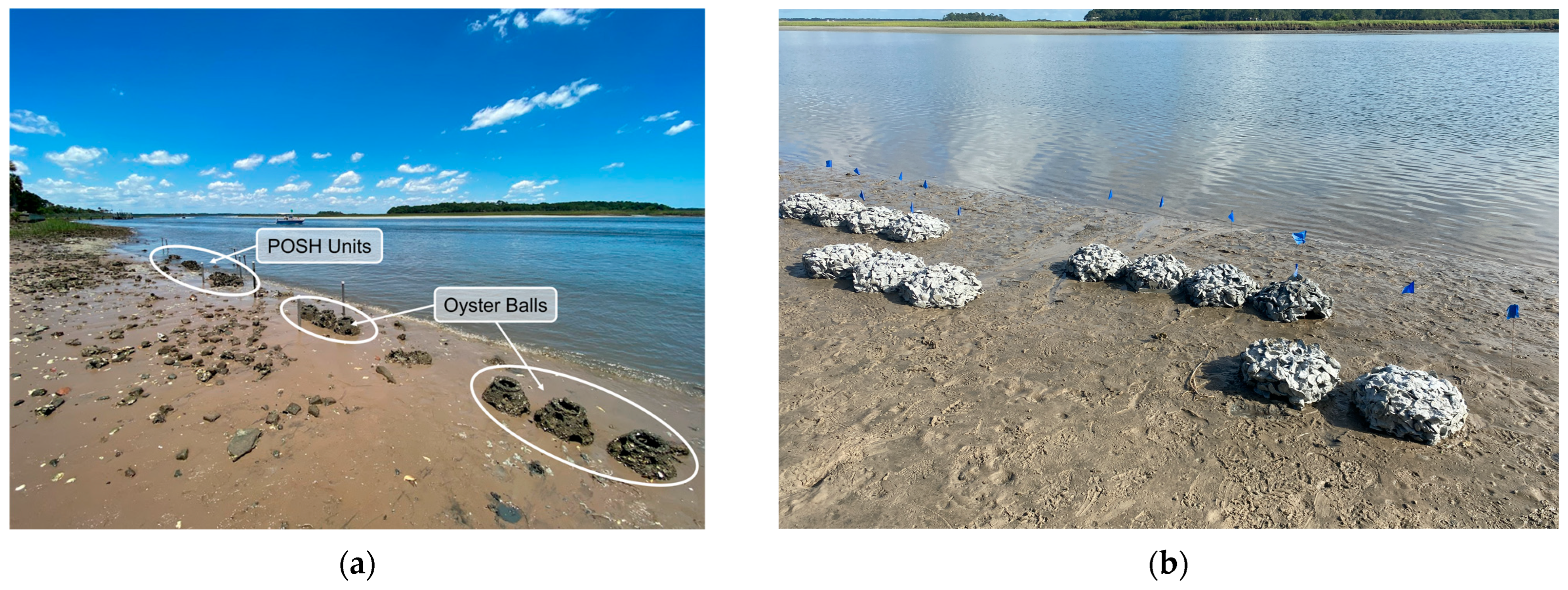
To help with wave attenuation, salt marsh growth, and oyster restoration at Kingsley Plantation, two deployments of POSH units and standard Oyster Balls were placed along the shoreline in June 2021 and August 2022 (Figure 2). The structures were placed parallel to the shoreline between the mean and low tide levels to allow for optimal oyster recruitment and growth of low marsh vegetation (i.e., Spartina alterniflora) landward of the structures [31,32]. POSH units and Oyster Balls for both deployments were placed in clusters of two to four units, with individual structures spaced approximately 5 cm apart. Small spaces between units will ideally be filled in with oysters as the units “merge” together to form a single reef. The reason unit clusters were used as opposed to a straight line of many units was due to building restrictions associated with marine mammals. There must be gaps to allow manatees (and other larger aquatic mammals) to move about freely within the living shoreline. As such, efforts were focused on understanding the best way to configure these clusters since there must be appropriate gaps and spacing for manatee allowance. A sample schematic of the June 2021 living shoreline design can be found in [20].

2.1.3. Preliminary Analyses

Multiple preliminary analyses were conducted to assist with CFD model development. These analyses include a beach profile survey, sediment grain size analysis, and wave staff deployment. The beach profile survey for the June 2021 deployment site was completed using a Sokkia SET2BII total station and a benchmark elevation established on the nearby seawall. For survey details and results, please refer to [8,17,18]. A steep scarp resulting from severe erosion was evident at the high tide mark. It was also noted that material (including small rocks and oysters) had accumulated in large amounts landward of the POSH units at the first deployment site when compared to the adjacent, unprotected beach [17]. Whether this accumulation is a result of natural sediment transport processes along the shoreline or the presence of the POSH units is still unclear and an area of further investigation.
Sediment samples were collected from four locations along the shoreline of the June 2021 deployment. Sieve analyses and grain size distribution curves were completed for each of the samples. For details regarding sieve analyses and sediment properties, please refer to [8,17,18]. To summarize, the median diameter was ~0.2 mm with coefficients of uniformity and curvature of ~1.4 and ~0.9, respectively. The soil was classified as a poorly graded sand (SP) according to the Unified Soil Classification System. The critical shear stress, τ c , was estimated using a standard Shields’ diagram [33] and the assumptions outlined in the literature [17]; τ c was approximated to be 0.07 Pa [17].
Finally, a wave staff array overlaying a group of POSH units and Oyster Balls at the June 2021 site was installed to record water level elevations for the purpose of evaluating boat wake attenuation. The wave staff array consisted of five Ocean Sensor Systems, Inc. (OSSI-010-002E) wave staffs. Water elevation data was collected on peak boating days in the summer of 2022. Water level data over the collection period indicated wake heights reaching up to 15 cm and the dominant wake periods of 2.5 s and 1.7 s [8]. Reported wake heights and periods are comparable to boat wake parameters measured in other studies along estuarine waterways in Florida [8,34,35]. Wave staff readings were used to create a representative boat wake for the CFD model for this study.

2.2. CFD Model Preparation

CFD modeling has become increasingly popular for assisting with the design and analysis of coastal structures due to the time and material costs of physical models. Many studies have used CFD modeling to examine properties such as wave dissipation, velocity profiles, and flow fields within artificial and natural coastal systems [36,37,38,39]. This study utilized Siemens’ STAR-CCM+ software [28] with turbulence modeling to simulate flow around the POSH units at Kingsley Plantation during representative boat wake action.

2.2.1. CFD Model Geometry and Mesh

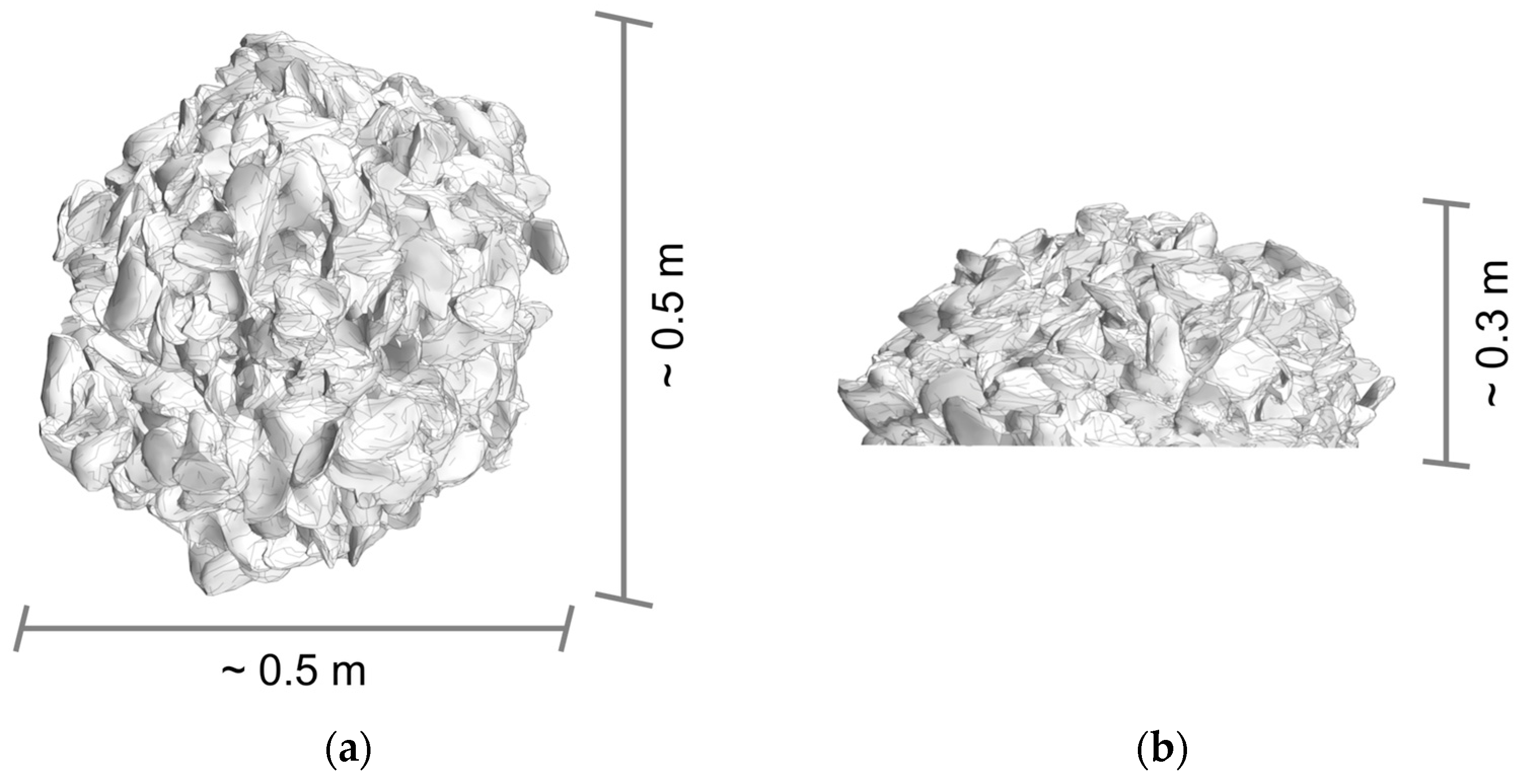
POSH units have a complex geometry due to the irregularity of oyster shells, as seen in Figure 2b. Previous studies used a photogrammetry approach to 3D scan artificial reef modules for their CFD modeling [37,38]. To capture POSH unit geometry for this study, a 3D scanning approach was also utilized (Figure 3). A Revopoint scanner, the Revopoint POP 3 Plus with advertised resolution up to 0.08 mm, and its associated software, HandyScan, were used to scan a POSH unit not deployed in the field to represent initial conditions and no oyster recruitment on the unit [40]. Autodesk Meshmixer was then utilized to make minor adjustments to the scanned unit, such as trimming excess surfaces the scanner captured.
Domain geometry was drawn directly in STAR-CCM+ using the built-in computer-aided design (CAD) package. The beach profile was drawn based on the results of the 2021 survey. The remainder of the domain was extruded around the profile. The domain was extended approximately 11 m beyond the vicinity of the POSH units perpendicular to the beach to minimize end effects. The scanned unit was imported, rotated to match the shoreline slope, then duplicated and arranged according to specific layouts (please see below). For the control simulation, POSH units were absent.
Meshes were generated using the automated mesh operation in STAR-CCM+ using its built-in surface wrapper, followed by a surface remesh and finally a volume mesh consisting of polyhedrals and a two-cell prism layer. Note that the dimensions of the flow domain, particularly its length, were chosen to minimize the risk of reflective effects. Put another way, domain length was chosen as a function of wave celerity vis-à-vis the amount of simulated time each model was to capture. As discussed in previous work [17], a mesh convergence study was conducted to verify computational convergence using a Richardson extrapolation. Extensive details associated with this convergence study are presented by [18].
The maximum mesh resolution used for the current study was approximately 20 cm per cell. Two refinement regions were also created to increase resolution in the vicinity of the POSH units and free surface. The two refinement regions had resolutions of 25% (i.e., 5 cm per cell) and 50% (i.e., 10 cm per cell) of the “base” mesh resolution. The exact cell count varied between simulations, depending on the planform arrangement of POSH units, but all simulations consisted of approximately six million cells.

2.2.2. CFD Model Physics

Numerical simulations for this study used the large-eddy simulation (LES) turbulence model. Several assumptions were made for the turbulent flow: (1) flow is incompressible, (2) flow is unsteady, and (3) flow is isothermal. The governing equations for LES models are the Navier–Stokes equations for the conservation of mass (Equation (1)) and momentum (Equation (2)).
ρ t + ρ u i x i = 0
u i t + u i u j x j = g i 1 ρ p x i + x j ν u i x j
where u i , p , ν ,   ρ and g i represent the velocity components, pressure, kinematic viscosity, density, and gravity, respectively. STAR-CCM+ divides each solution variable into a filtered and sub-filtered (also referred to as sub-grid) component (Equation (3)) [28].
ϕ = ϕ ~ + ϕ
where ϕ ~ represents the filtered component and ϕ represent the sub-grid component. For more details on the LES model, please refer to Star-CCM+’s documentation [28].
A wall-adapting local-eddy (WALE) viscosity model was used as the sub-grid scale turbulence model. The WALE model allows for proper scaling near the walls, is good for complex geometries, and is sensitive to the rotation rate of small fluctuations [41]. The all-y+ treatment was also utilized; this and the WALE model are the recommended options by STAR-CCM+ for an LES model [28]. The all-y+ treatment uses a low-y+ treatment and a high-y+ treatment for fine meshes and coarse meshes, respectively [28]. Multiphase and volume of fluid (VOF) models were implemented to account for the modeling of multiple components—for this study, air, and water.
For wave generation, the volume of fluid (VOF) waves model was implemented. This model simulates steadily progressing, surface gravity, periodic wave trains between two fluids and is often used in marine applications [28]. For this study, a first-order linear (i.e., Airy) VOF waves model was selected and varied to account for different wave amplitudes in a typical watercraft wave train. Since the model was applied at the upstream boundary (far from the area of interest) it was assumed that standard wave transformation processes, such as breaking, would occur as the waves propagated throughout the domain.
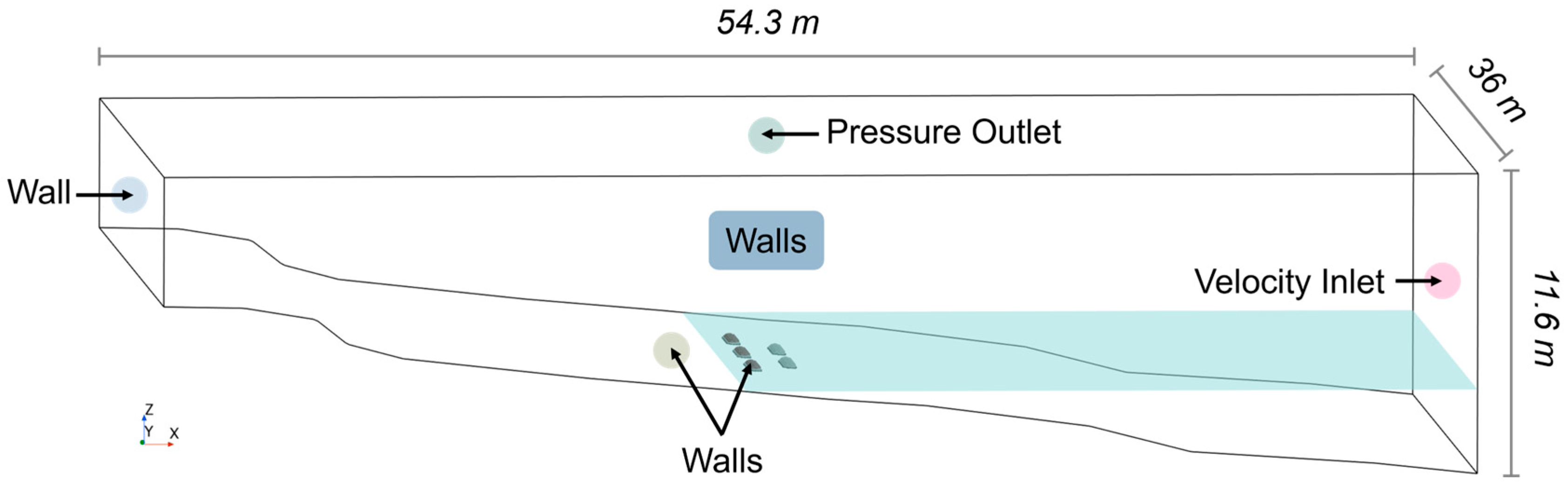
Figure 4 identifies the boundary conditions used for the model domain. The shoreline, downstream face, left-and right-hand boundaries, and POSH units were set as walls where velocity vectors tangential to the wall were zero [28]. The shorelines and POSH units were modeled as smooth surfaces, although we note that the bulk roughness associated with the POSH units was captured via the three-dimensional scanning discussed above. Since the goal of this study was simply to compare one configuration to another, this was deemed sufficient from a comparison perspective. A velocity inlet was set at the upstream face, where first-order waves were specified at the boundary and amplitudes were varied based on wave staff data [8]. Finally, the top of the flow domain was specified as a pressure outlet to allow air to vent from the model. STAR-CCM+’s built-in implicit unsteady solver was implemented with a time step of 10 ms. Simulations were run for 60 s of modeled time.

2.2.3. CFD Model Testing Conditions

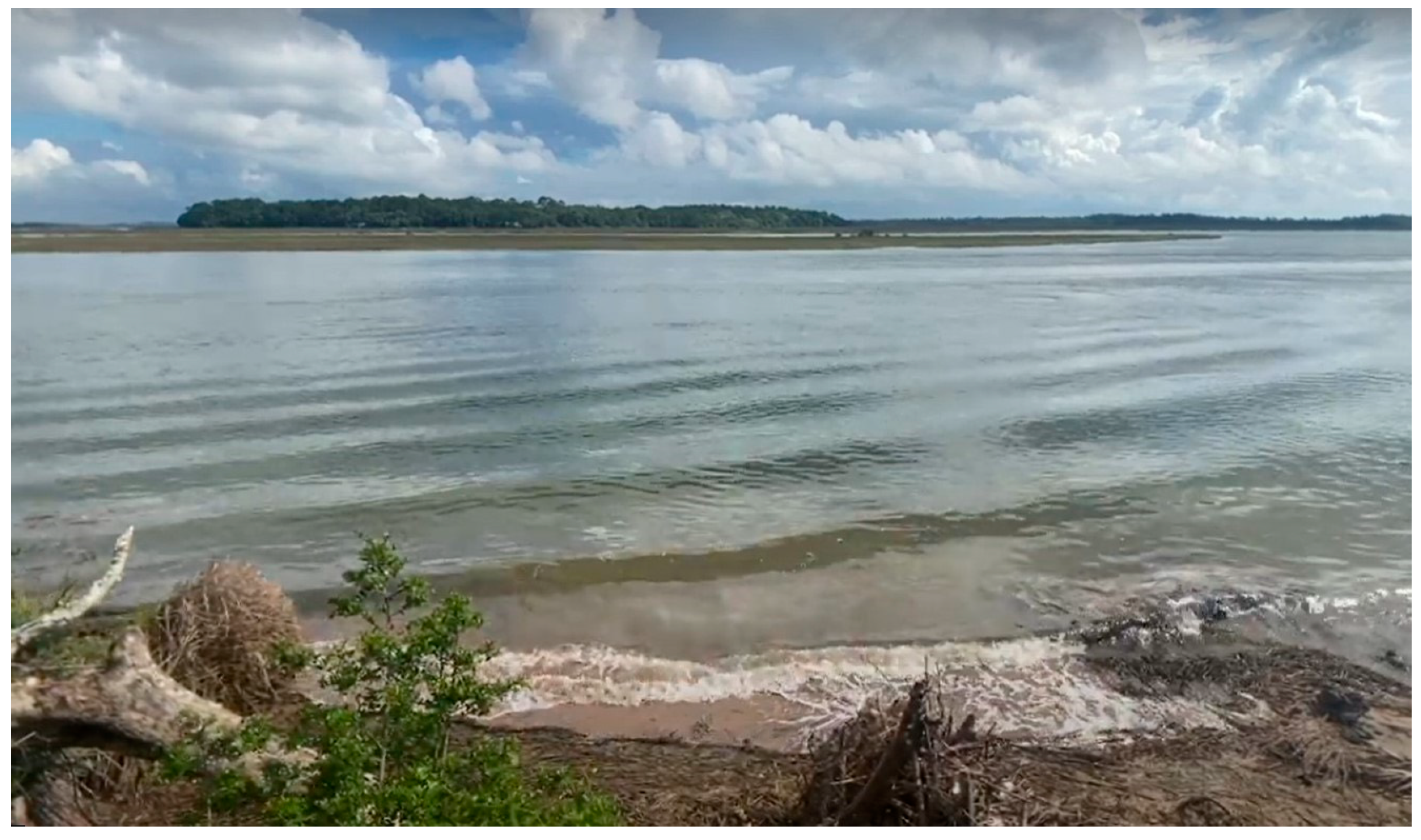
Many parameters contribute to boat wake characteristics and behavior. Vessel type, speed, shape, and navigation direction are among the many factors which define a wake train [6]. Boats generate two types of wakes while traveling through deep water—transverse wakes (wakes moving in the same direction as the sailing line) and diverging wakes (wakes moving obliquely away from the sailing line; [42]). Based on visual observations at Kingsley Plantation, both wind waves and wakes often approach the shoreline at an angle (Figure 5). To account for this angle, the modeled wakes were set approximately 20° to the shoreline.
As noted above, a representative wake train (Table 1) was defined at the upstream boundary by varying wave amplitude as a function of time-based on measurements recorded that showed dominant wake periods of 2.5 s and 1.7 s with wake amplitudes generally in the range of 6 cm and the highest amplitudes reaching approximately 15 cm [8]. During modeling, an approximate midpoint was selected, and the wake period was specified as 2 s for the simulations. We note that this midpoint is somewhat arbitrary; in future work, additional wakes will be investigated. It is important to reiterate that boat wake behavior is complex, and this study used a representative wake train based on limited field measurements. Other factors such as wind, currents, and wave interference were not considered. Finally, we note that a sensitivity analysis was conducted using the maximum (i.e., 2.5 s) and minimum (i.e., 1.7 s) boat wakes and results from this are previously reported in the literature [17].
The water level for this study was set to a depth of 3.25 m in the model, reaching slightly landward of the POSH units. Previous observations [17] indicated that changes in bed stress due to POSH unit presence were less apparent for a higher water level than a lower water level. This agrees with observations from others [25]; when water depths increase, the interaction between waves and oyster reef crests (or in this case, structures) decreases. This study aimed to capture a scenario where all units would likely have a significant effect and interaction with the wakes. Therefore, a lower water level resulting in a minimal structure freeboard was applied. The “first wave front” setting was applied at the upstream boundary in the model to ensure the water surface started from calm conditions with no initial wakes.
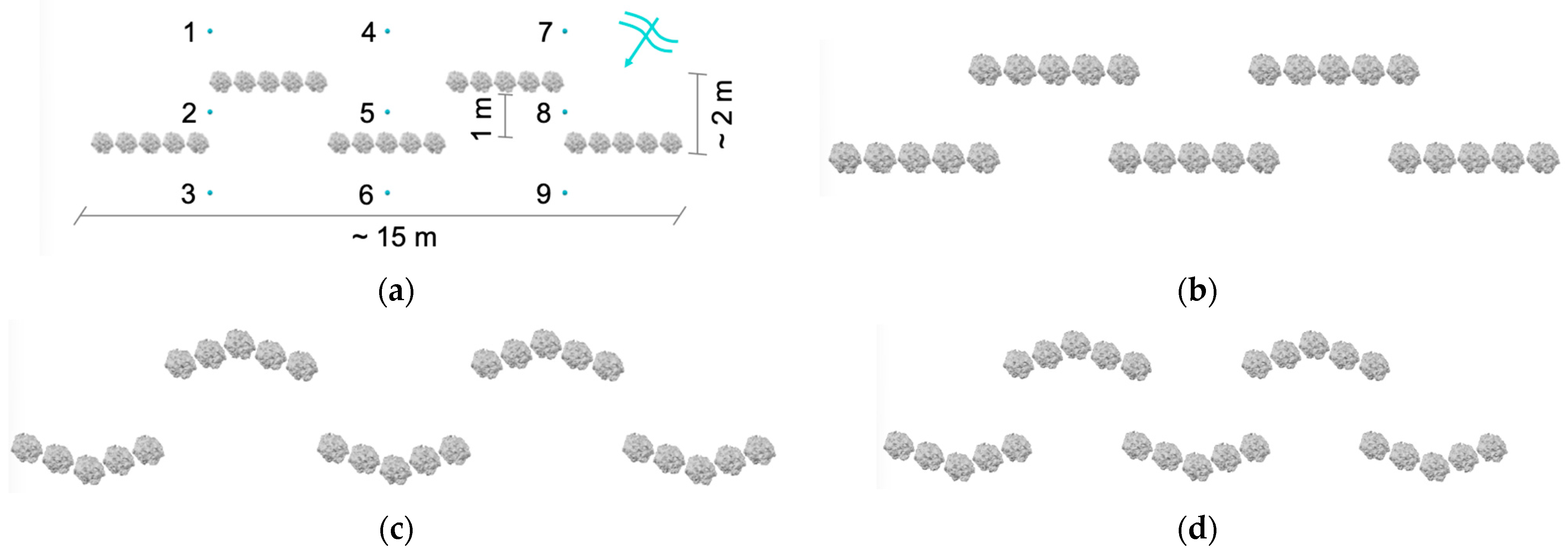
Five different planform arrangements were tested for this study—four of which followed a segmented breakwater pattern, along with a control case (no POSH units, referred to as Case A). POSH units were placed in the approximate cross-shore location where they are installed at Kingsley Plantation. Several decades ago, it was observed that staggered segmented breakwaters can provide relief against currents due to the presence of offsets between rows and gaps between segments [43]. It was hypothesized that a staggered arrangement may similarly reduce bed stress. Therefore, this study compared planform arrangements with (1) no overlap (i.e., where POSH unit groups were in-line with each other) and (2) an overlap by one POSH unit at each end of the group.
Two segment shapes were also tested—parallel and chevron shapes. The parallel shape resembles the current deployments at Kingsley Plantation, with multiple POSH unit groups arranged roughly parallel to the shoreline. A chevron shape to account for angled wakes was also of interest; the angled sections of units would potentially block more flow coming from boat wakes in both directions [21]. The chevron sides were arranged approximately 20° to the shoreline to be in line with the oncoming wakes. A similar concept was used, comprising a T-head groin configuration along a different channel with heavy boat traffic [44]. In that study, one section of the groins was angled at 45° to account for oblique ship wakes [44].
All configurations with units consisted of groups of five POSH units spaced approximately 5 cm apart, matching the current spacing at Kingsley Plantation. All configurations consisted of two rows within the intertidal zone. The offset between rows was 1.0 m, once again, following the approximate deployment spacing at Kingsley Plantation. Figure 6 shows the dimensions and layouts of all configurations and lists all model cases.

2.3. Modeled Bed Stress Data Collection

Modeled bed stress estimates (i.e., τ ) were collected using two methods: contour and vector images showing bed stress distributions, and bed stress time-series. Both methods captured bed stress changes as a function of space and time to compare modeled stresses against the sediment’s estimated τ c and field observations.

2.3.1. Bed Stress Distributions

Output images were generated for each timestep of the simulations. These images show the bed stress distribution along the shoreline in plan view. Vectors indicating the stress magnitude and direction were also added.
For Case A, worst-case bed stress scenarios were determined through video analysis of the distribution images. Timesteps for the worst-case stress scenarios were noted. Then, distributions corresponding to these timesteps for the other simulations were extracted to compare against the Case A distributions. It is recognized that maximum shear stresses may occur at different points throughout the simulation, but the goal was to compare the simulations with POSH units directly to the control case. Therefore, consistent time steps were used across all cases, although, as shown below, timesteps near these control worst-case timestamps were also analyzed to ensure that worst-case conditions were captured in each case.

2.3.2. Bed Stress Time-Series

A series of nine probes were placed throughout the study area and snapped to the domain floor for all simulations. Probe placement was consistent across all planform arrangements and probes were placed in locations deemed ideal for tracking changes in bed stress as waves propagated over the units (Figure 6). The bed stress magnitude along the domain floor was continuously measured at each probe.
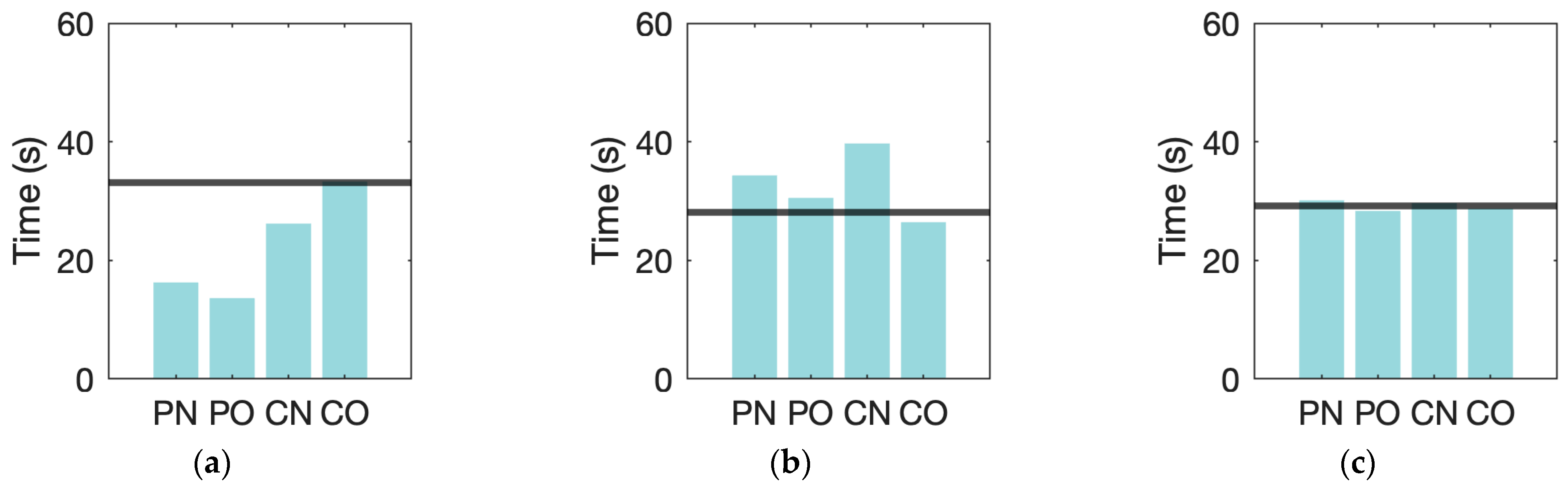
Using data from the bed stress time-series, the number of points above τ c were counted. Totals were converted to the amount of time the probe recorded values above τ c (referred to as Tc) using the timestep of 10 ms. Tc values for simulations with units were compared against Tc for Case A.

3. Results

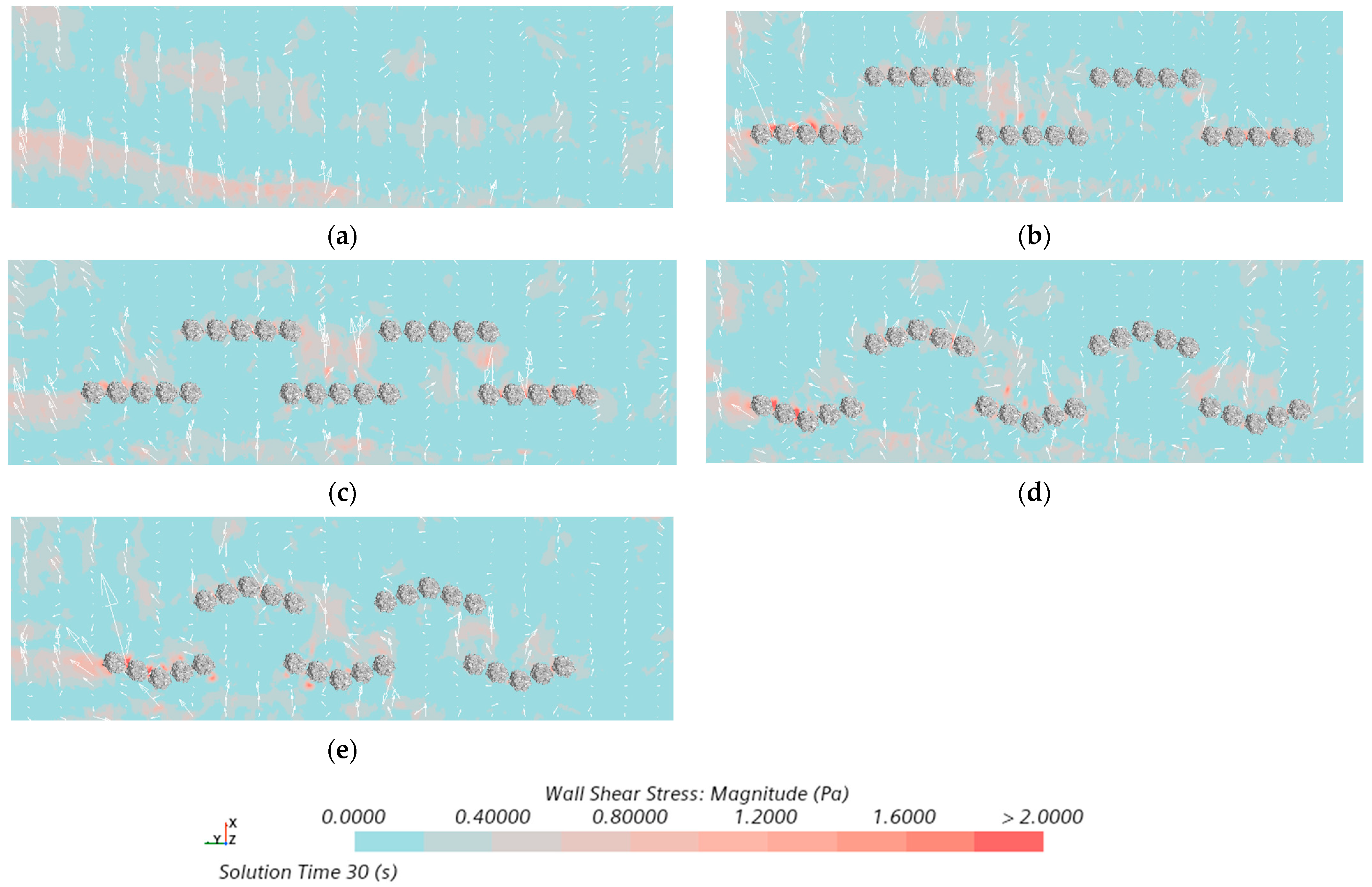
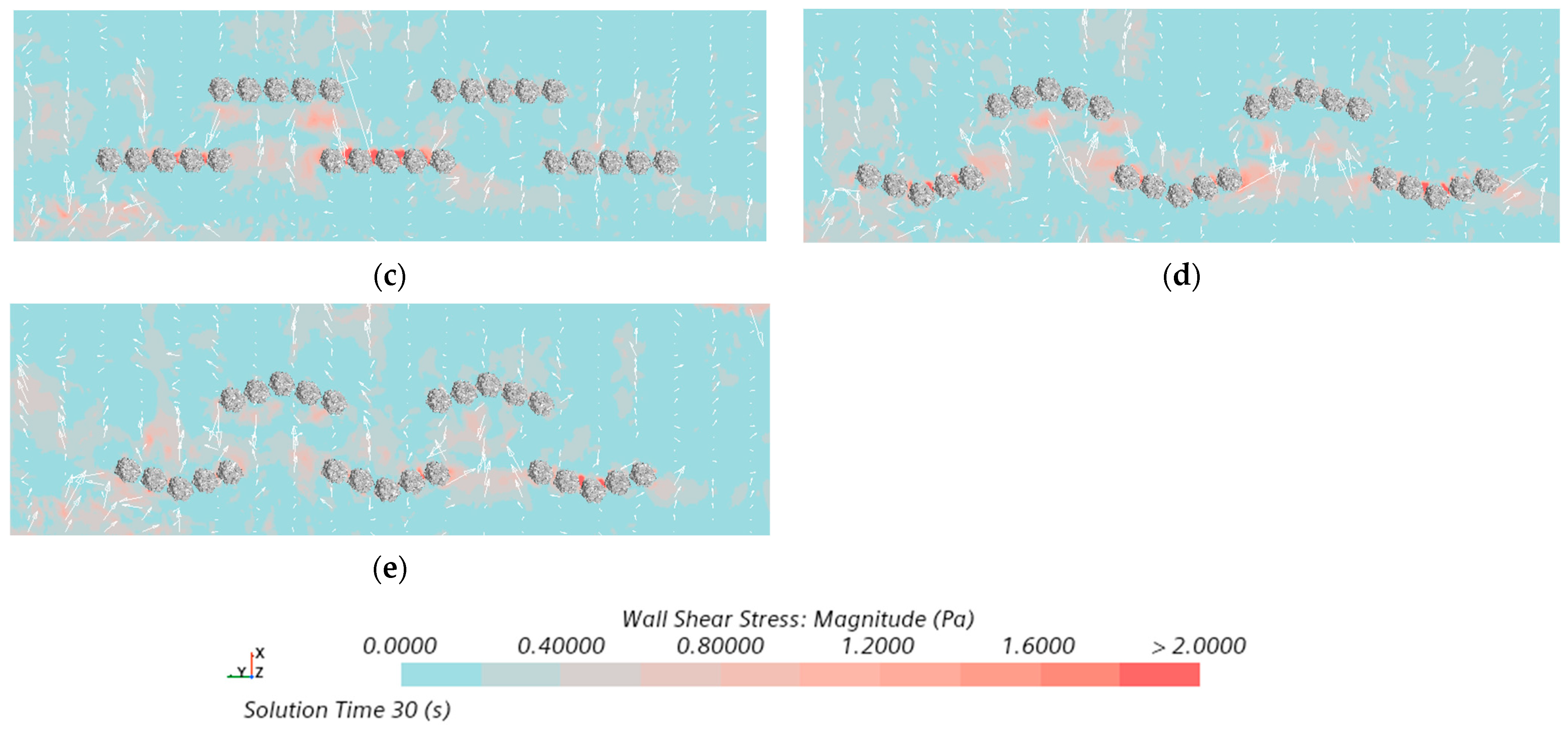
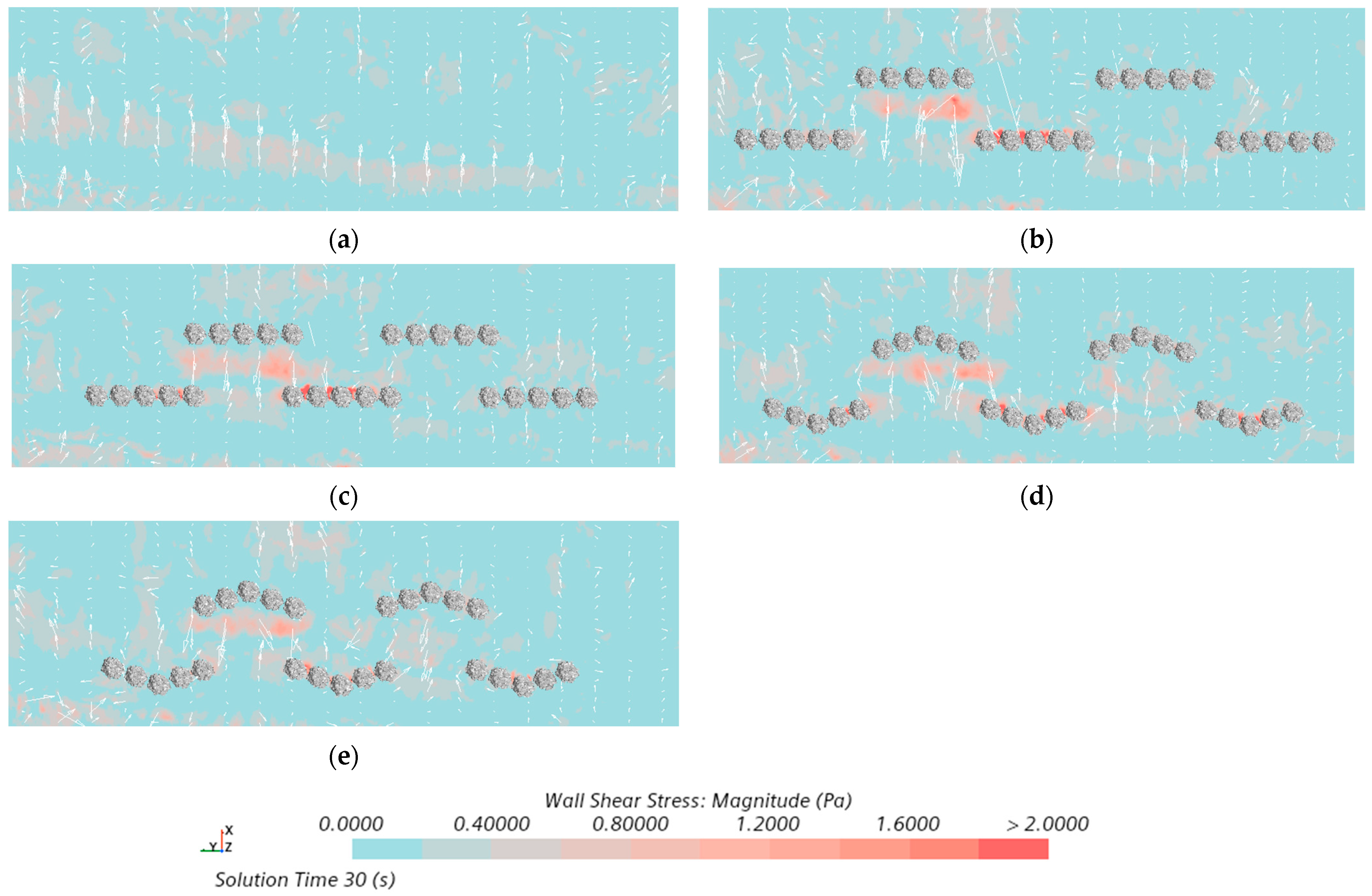
Figure 7, Figure 8 and Figure 9 present the bed stress distributions for all arrangements at 30 s, 31 s, and 32 s, respectively. The highest stresses for Case A occurred over this interval. Similarly, the highest stresses for the other cases also occurred during this interval. As seen in Figure 7a, Figure 8a and Figure 9a, stresses for Case A were often well above the estimated τ c of 0.07 Pa and often approached 2.0 Pa. Similarly, stress distributions for simulations with POSH units also recorded stresses above the estimated τ c . For simulations with units, the highest stresses typically occurred between rows, around the ends of groups, and between individual units. Many of the distributions with units also had “shadow zones”, or areas of reduced stress near the units. The shadow zones observed in this study occurred both landward and seaward of the units.
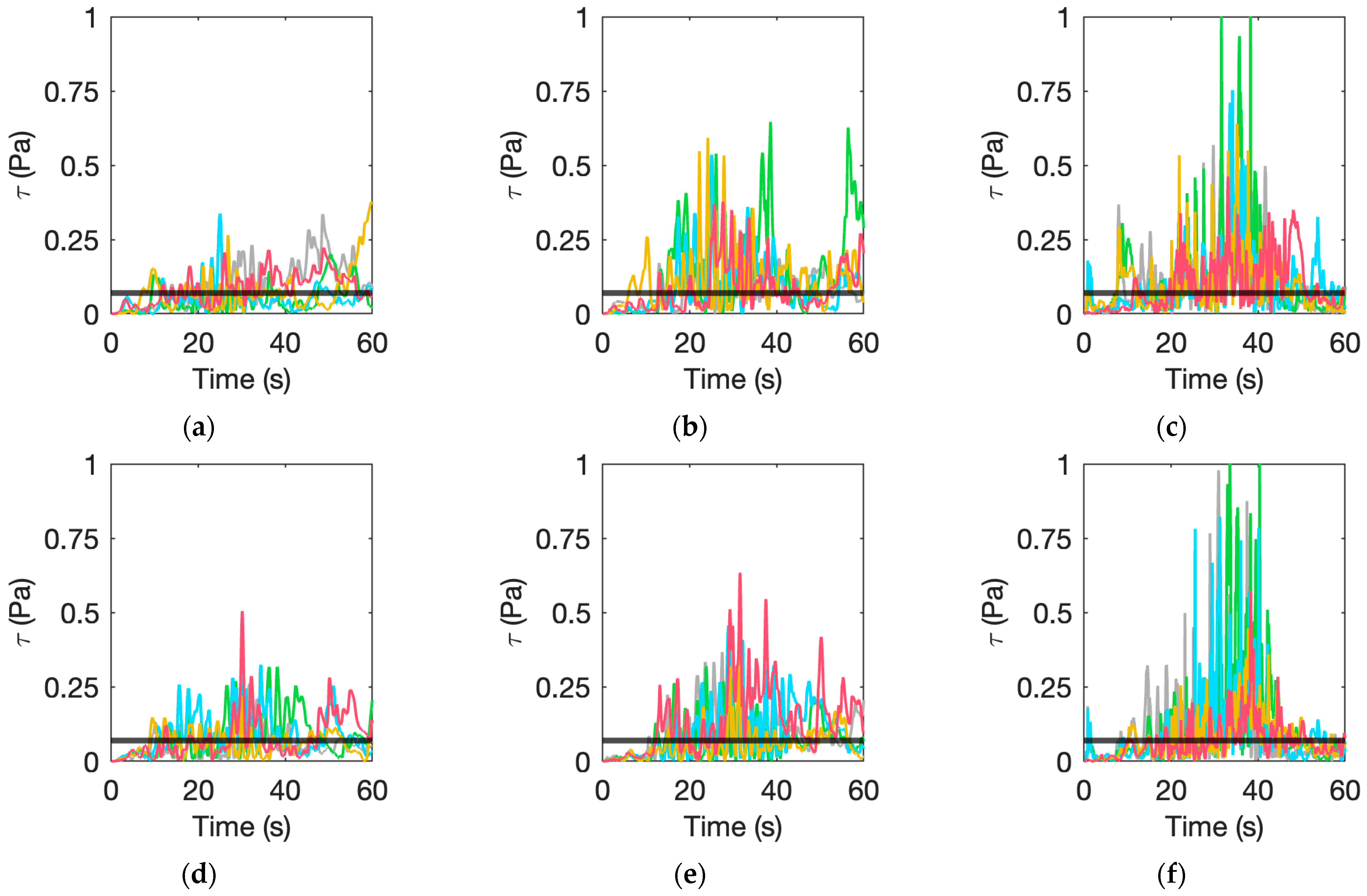
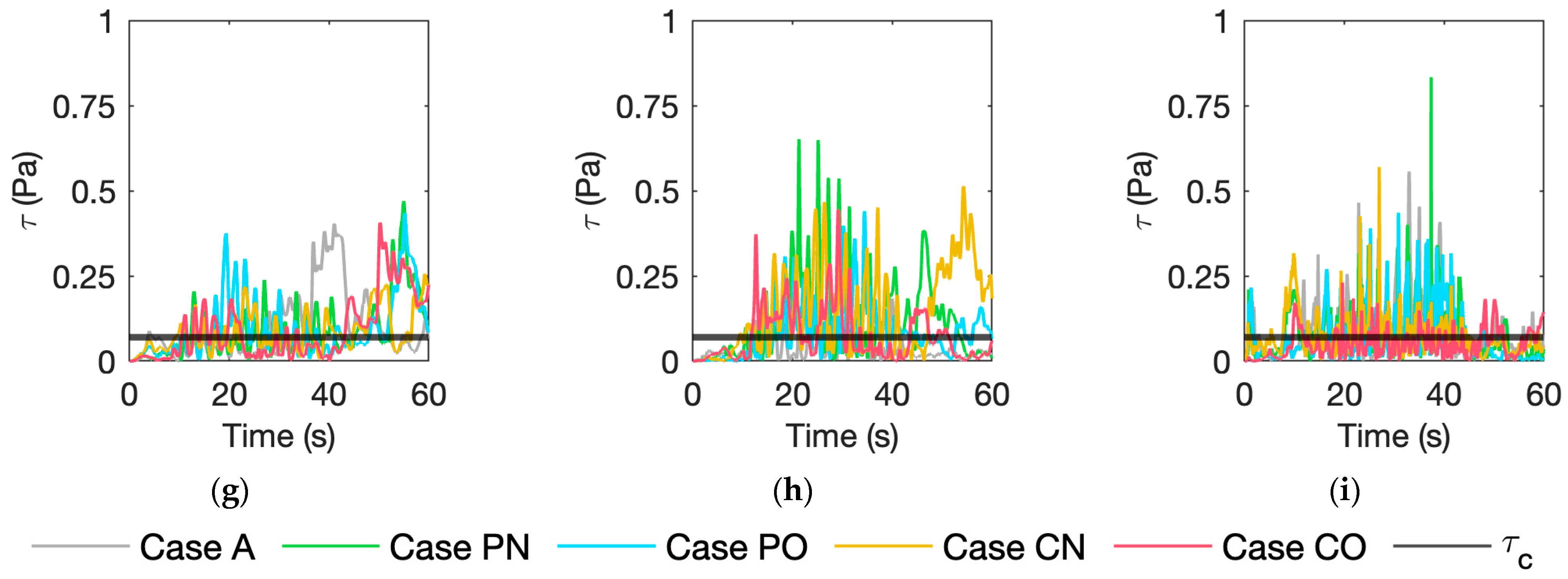
Figure 10 presents the bed stress time-series at each probe for all simulations. A line marking the estimated τ c has been added to the plots for reference. Overall, stress magnitudes varied greatly between probes and fluctuated between 0 and 1.4 Pa. Cyclical stress peaks often exceeded τ c . Probe 3 recorded the maximum stress across all probes of nearly 1.4 Pa, almost twenty times τ c . The time-series also differed based on how far offshore each probe was located. Probes 1, 2, 4, 5, 7, and 8 recorded smaller ranges of stress values and experienced stress fluctuations after the wake train passed. In contrast, Probes 3, 6, and 9 experienced sharp increases in stress and recorded low stresses before and after the wake train passed. It is also interesting to note that the highest peaks for Probes 3, 6, and 9 were mostly from Cases A, PN, and PO.
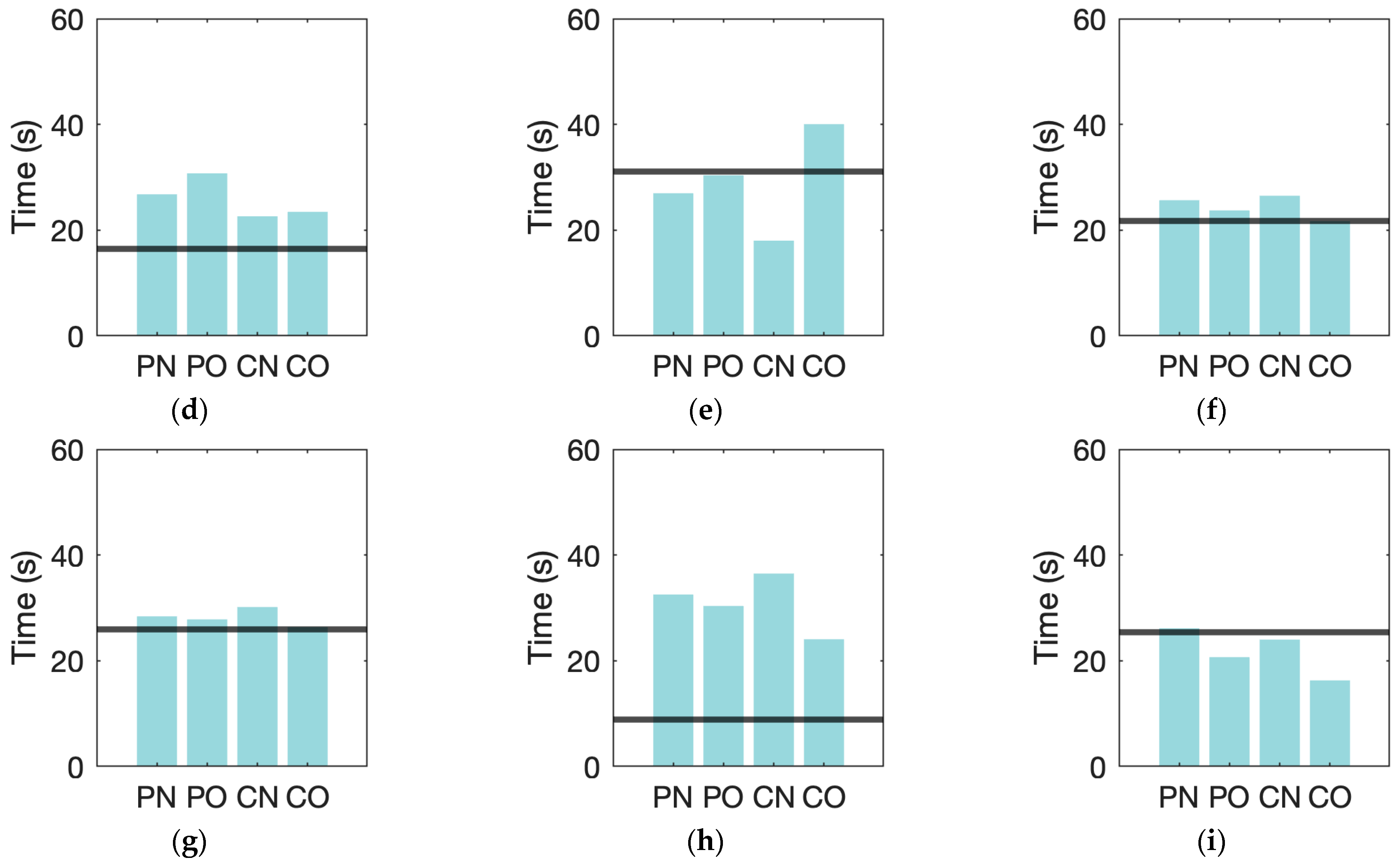
Tc values are presented in Figure 11. A line representing Tc for Case A was added for reference. Tc values varied greatly between simulations and probes. Probe 8 recorded large increases in Tc for all arrangements when compared to the other probes. This may be due to the location of Probe 8 in the sense that the probe may have experienced additional currents and stress once the units were added. Downdrift, Tc values at Probe 1 for cases with units were approximately the same or much lower than Tc values for Case A and the parallel arrangements recorded the lowest Tc values compared to the chevron arrangements. Looking at the most landward probes, Probe 3 recorded small decreases in Tc for both overlapping patterns while Probe 6 recorded minor increases in Tc values for Cases PN, PO, and CN but remained nearly the same for the CO case. Probe 9 recorded decreases in Tc values in all arrangements except Case PN. Case CO performed the best for Probes 6 and 9. Finally, in the middle of the array, Probe 5 recorded lower Tc values for all arrangements (except for Case CO) when compared to Case A. Interestingly, Cases PN and CN recorded the lowest Tc values at this probe, possibly resulting from the absence of overlaps within the arrangement.
In addition to this, several statistics were computed for each case. These are summarized below in Table 2, Table 3, Table 4, Table 5 and Table 6:
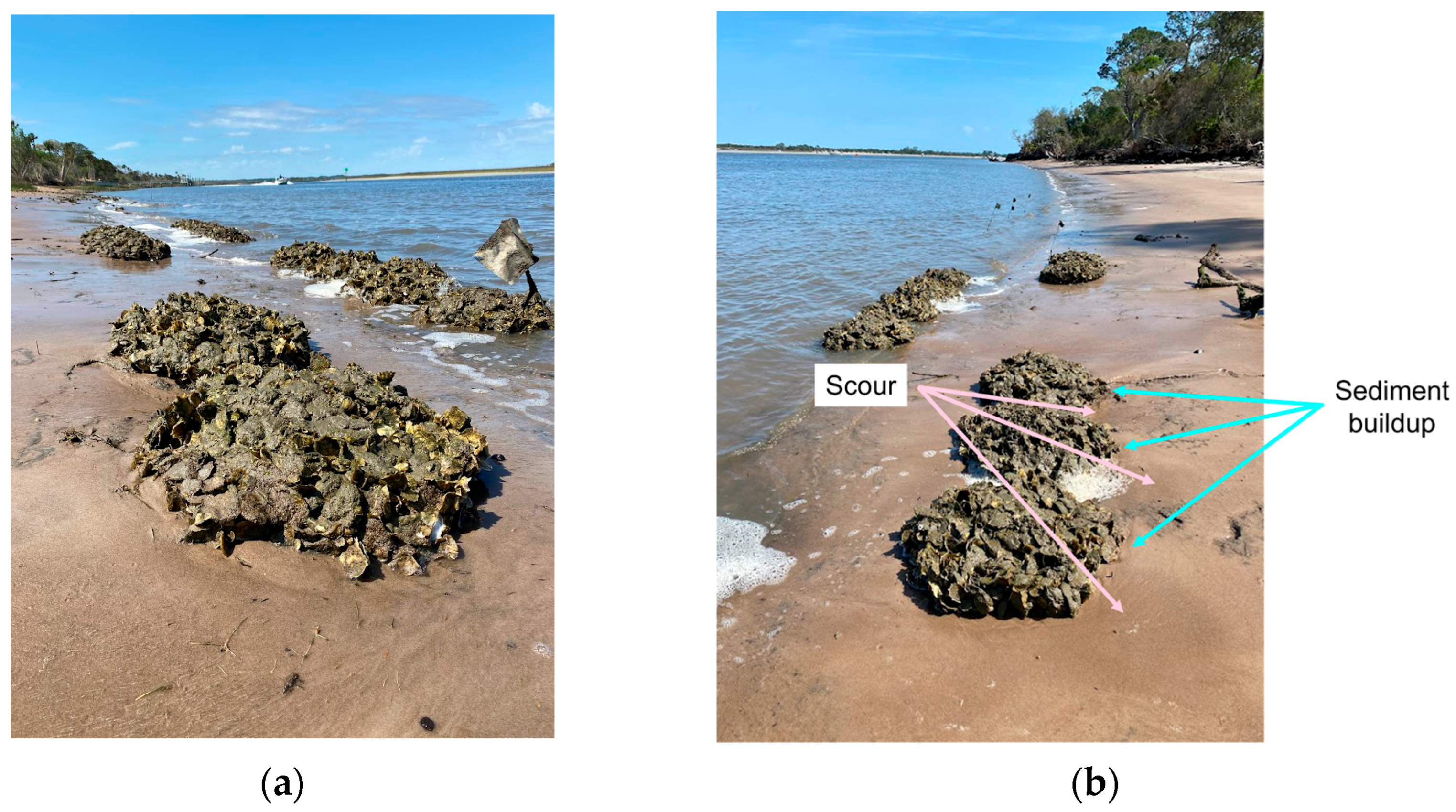
Modeled bed stress distributions were also qualitatively compared to field observations. Figure 12 shows POSH units from the second deployment at Kingsley Plantation as of March 2023 at low tide, and, as shown, a parallel arrangement was implemented. As indicated in Figure 12, scouring was seen between the units and around the end of the individual group. Sediment buildup was also observed landward of the units.

4. Discussion

4.1. Boat Wakes and Bed Stress

Based on CFD results, all arrangements under representative wake train conditions often experienced stresses greater than τ c . From Figure 7, Figure 8 and Figure 9, it is evident that POSH units alter bed stress patterns. Stress was more evenly distributed around the study area for simulations with units than it was for Case A, where it was concentrated along the breaker line. The direction of the vectors in Figure 7a, Figure 8a and Figure 9a also indicate that the greatest stresses occurred during back swash associated with return flow.
In the field, increased water turbidity was also observed after boats traveled near the shoreline, as seen in Figure 5. Modeled stress results, in combination with field observations, confirm that boat wakes at this location can generate stresses above τ c and cause sediment movement. However, it is important to remember that modeled stresses were for a representative boat wake and an estimated τ c . The goal of this study was not to present exact numerical results or conditions, but rather to provide an understanding of the interaction between POSH units and the hydrodynamic environment. Wave basin experiments for analyzing wake behavior and wave attenuation would provide additional data to validate the CFD model, and these tests are already underway and will be presented in a follow-on manuscript [22,23]. In addition, more comprehensive sediment erosion testing would help refine the estimated sediment properties and could provide predicted erosion and accretion rates for the site.

4.2. Effect of POSH Units on Bed Stress Patterns

4.2.1. Bed Stress Reductions

Areas which experienced reductions in bed stress when compared to the control case may allow for sediment accretion. Understanding potential areas of accretion is important for shoreline protection, and for living shorelines specifically, accretion can help support vegetation growth and success. Bed stress distributions for all cases with units in Figure 7, Figure 8 and Figure 9 showed stress reductions downdrift and seaward of the structures when compared to Case A. Addition of POSH units likely resulted in stress dispersion and reduction due to the wakes breaking over the units. Based on Figure 11a (Tc results for Probe 1), the addition of the units likely helped decrease stresses downdrift and seaward within the area of interest. Lower downdrift stresses may allow for downdrift accretion, which has been noted in previous studies. For example, others [44] observed downdrift accumulation at their living shoreline site with angled groins, also subject to vessel wakes. Similarly, as also noted in the literature [1,44,45] oblique wave interaction with submerged breakwaters may lead to downdrift accretion.
Bed stress distributions for most arrangements with POSH units also showed stress reduction landward of the landward set of units. In some cases (Figure 8c,e; i.e., cases PO and CO for 31 s) stress landward of the units was reduced to nearly zero. Based on the findings from Figure 7, Figure 8, Figure 9 and Figure 11c,f,i (Probes 3, 6, and 9 (most landward probes)), data suggest that the small overlaps may have a positive effect on stress reduction in the sense that the overlaps likely blocked or reduced the amount of flow reaching the landward areas. These results are encouraging since reduced landward stresses may allow for accretion upland of the living shoreline. Landward accretion has been noted previously in other studies [11].
From many of the distributions in Figure 7, Figure 8 and Figure 9, “shadow zones” (areas of low stress near the units) formed. These zones were evident both landward and seaward of the POSH units depending on the direction of flow, forming from the protection provided by the units. Sediment may also accumulate in these lower stress zones. Both Figure 12 and imagery from previous work [21] show sediment buildup landward of units in the equivalent “shadow zones” seen in the bed stress distributions.

4.2.2. Bed Stress Amplifications

Many of the bed stress distributions for arrangements with units showed an increase in stress between rows and around the ends of segments. This would be expected since segmented patterns create “channels” where higher flow velocities may occur around the ends of the segments [43]. Confined flow and higher velocities between rows likely led to an increase in stress—similar to stresses around circular cylinder arrays [46,47]. As noted in the literature by, scouring and uneven deposition can occur in gaps between structures at living shoreline sites [34,48]. Such processes may be a result of similar amplified stresses as observed in this study. The results from Figure 11 also indicate that the absence of overlaps may have some effect in relieving stress in the middle of the configuration (such as at Probe 5).
Placing structures (i.e., POSH units) close together can create narrow channels which accelerate flow between structures [49]. Flow velocities were likely faster through the 5 cm gap between POSH units and these channels and may have resulted in the high-stress zones between units. Looking closely, the high-stress zones between units appeared to be smaller in area for the chevron arrangements than the parallel arrangements. This might be due to the swash and back swash angles. Wakes approached obliquely, but if the swash returns at a 90° angle for example, a parallel arrangement will provide an easier flow path since the channels are in line with the back swash angle. This may have caused concentrated flow through these channels. With the chevron arrangements, the offset between units provides a slight blockage which may contribute to smaller high-stress areas between units for those arrangements. Arrangement aside, concentrated areas of high stress were an unintended consequence and may compromise the structural integrity and stability of POSH units in the future. That said—one of the primary goals of POSH unit placement—oyster recruitment—could render these issues moot in the medium-to-long-term in the sense that recruitment could be expected to “fill in” these gaps between units. This in turn would tend to reduce localized stresses and, in the long-term, help to reduce erosion and/or scour.
That said, Figure 12 shows erosion between rows and local scour between and around the units, in similar locations of the high-stress areas in Figure 7, Figure 8 and Figure 9. Based on the amount of accumulation observed in the field, unit burial may become a future concern. Unit burial may not only have negative implications for the structures but also oyster recruitment and survival. It is also important to note that the field observations do not take seasonal or small-scale sediment dynamics into account. Future investigations should focus on sediment monitoring to better understand the sediment dynamics of the site and sediment interactions with the POSH units.

4.2.3. Arrangement Evaluation

For all modeled arrangements, areas of increased and decreased stress were observed. Areas of high stress (i.e., between rows and individual units) may be mitigated by some of the areas of lower stress, creating a “balance” of sediment transport. The POSH units may be capable of capturing suspended sediment from high-stress areas that wash down from the beach [21]. The present findings demonstrated that overlapping patterns appeared to provide an advantage over non-overlapping patterns. Probes 3, 6, and 9 (the most landward probes) all recorded lower Tc values for overlapping patterns than non-overlapping patterns when compared to Case A. Overlapped arrangements also performed better in terms of Tc for six of nine probes and Case CO performed the best for five of nine probes in terms of Tc. Cases PO and CO also appeared to generally mitigate more stress in Figure 7, Figure 8 and Figure 9 with Case CO producing smaller zones of high stress between units.
Taken together, these results indicate that overlapped arrangements may have a positive effect on reducing landward stress due to flow blocked by the overlap. Table 2, Table 3, Table 4, Table 5 and Table 6 support this analysis in the sense that, the tables consistently indicate lower statistical values for the cases with overlap when compared with the cases with no overlap (and obviously the “base” case). Hydrodynamically, the overlap appeared to change the main path of the water flow slightly by “blocking” the flow between clusters of units to some extent.
The “chevron” pattern provided additional blockage in the sense that the chevron’s orientation relative to the boat wake direction (approximately perpendicular) minimized the amount of wave transmission through a given cluster of units, especially in the context of maximum stresses. However, in terms of other statistics, the parallel configurations performed similarly to the chevron patterns. But, since the chevron patterns reduced the maximum stresses more than the parallel arrangements and reduced the amount of time where τ c was exceeded, it is thought that the chevrons are likely preferable. Hydrodynamically, results suggest that the chevrons are reducing the maximum stresses and T c values further by providing more “blockage” when compared to the parallel configurations.

4.3. Recommendations for Future Living Shoreline Designs

There are many options for living shoreline designs and most designs have site-specific needs that must be met. Based on the results from this study, a few recommendations can be made for future living shoreline designs involving POSH units or other similar structures. First, shorelines with similar wave climates may benefit from an overlapping chevron living shoreline design. Field implementation or laboratory testing of the chevron-overlapped pattern would be the next step to further evaluate its effectiveness. Although the placement of structures such as POSH units is limited by oyster survival thresholds and local manatee restrictions [20], adding as many structures (i.e., rows) as possible within this range would be ideal [12,17]. More rows would potentially trap more sediment and maximize the attenuation benefits as the site undergoes different water elevations through the tidal cycle. In addition, eliminating gaps between units could potentially reduce sediment erosion and movement caused by the structures. Similar breakwater designs could still be used but with structures placed directly next to each other to form more “continuous” barriers. In another study on artificial reefs (also arranged in a chevron pattern), no gap between structures was found preferable for wave attenuation due to the lack of space for flow to pass through [50]. Based on their conclusions and the apparent high-stress areas between units observed in this study, eliminating the gap could be beneficial. Structures with higher porosity may also help alleviate some of the concentrated areas of stress. Although POSH units are “pervious”, the amount of water that travels through them is thought to be relatively small when compared to other structures such as Reef Balls™ (which have much larger holes for flow to travel through). Large holes in the structures could provide alternative flow paths and reduce the amount of flow going around and between units. Lastly, simulations of theoretical POSH unit growth from [21] indicated that taller POSH units increase the size and number of shadow zones. Allen and Meanwhile, others independently demonstrated that wave transmission coefficients decrease with non-dimensional height (the ratio of structure crest height to water depth); therefore, increasing unit heights during construction may be ideal [22,23].
Outside of modular artificial reef structures, other options such as cobble or cultch placement may be beneficial. A layer of cobbles or cultch spread across the seabed would eliminate the need to consider manatee permitting requirements or structural stabilization since structures would not be installed on the shoreline. Using a combination of living shoreline methods for sites with a large tidal range may also be beneficial, as oysters have a limited range for providing wave attenuation and stress reduction.

5. Conclusions

Oysters are commonly incorporated into many living shoreline designs, particularly with modular breakwater structures. Oysters can enhance and provide many benefits to a shoreline in addition to keeping pace with climate change. However, there are still many questions regarding the effectiveness of oyster use in living shorelines for shoreline protection and erosion prevention. This study investigated the effect of various POSH unit arrangements and their effects on shoreline bed stress. CFD modeling was utilized to better understand how POSH unit placement altered bed stress patterns and how effective POSH units are at reducing shoreline stresses. Understanding the changes in bed stress patterns can help identify and predict where potential erosion and accretion may occur within a POSH unit living shoreline design. The following main findings from this study are as follows:
(1)
Adding POSH units to a shoreline in a segmented breakwater arrangement can alter bed stress patterns. All four POSH unit arrangements changed bed stress patterns and resulted in areas of increased and decreased stress when compared to the control case. POSH units increased stress between the units and rows, where scouring and erosion could occur. However, they also reduced stress in other areas which could allow for accretion and sediment buildup.
(2)
Low-stress areas below τ c can potentially allow for accretion. Modeled CFD results indicated that POSH units could provide lower stress in shadow zones in the vicinity of individual units and landward of the units. Field observations confirmed that sediment is being trapped landward of the structures. This accumulation will hopefully build up the shoreline in the long term and allow for benefits such as vegetation growth and expansion.
(3)
An overlapping chevron pattern may be beneficial for a living shoreline at a site with waves approaching at an oblique angle, such as boat wakes. Chevron patterns were the most effective at reducing the time the shoreline spent above the sediment’s τ c and reducing high-stress areas between units. In addition, overlapping patterns appeared to reduce bed stress more than non-overlapping patterns, indicating that a slight overlap may be advantageous for blocking flow. In the context of practical engineering applications, this is the most important finding from this study. Results suggest that prior to installing a structure like a POSH unit cluster, the predominant incoming wave angle should be considered first, and the structures’ orientations should be engineered to be as close to perpendicular to this angle as possible. Doing so will reduce cost (fewer units needed) while increasing effectiveness of the installation. Or, at minimum, results suggest that short of wave angle information, an overlapping configuration will provide more benefit than a configuration with no overlaps.
There are still many areas of further investigation to better optimize both POSH unit design and placement. This includes optimization and refinement of the POSH unit modules themselves along with conducting additional studies to better understand their effectiveness for shoreline protection along with the effects of additional biological attachment/recruitment and long-term evolution of the shoreline around the units. This work contributes to the growing body of knowledge around living shorelines and artificial oyster reef structures. Observations and recommendations from this study can guide future POSH unit deployments and potentially be extended to assist restoration stakeholders with the design of living shorelines involving similar structures.

Author Contributions

Conceptualization: R.C., K.J.S., M.J.U., C.H.; methodology: L.C., J.W., R.C., M.S., M.R., J.J., H.M., K.J.S., M.J.U., C.H.; formal analysis and investigation: L.C., J.W., M.S., M.R., J.J., H.M.; writing—original draft preparation: L.C.; writing—review and editing: L.C., J.W., R.C., M.S., M.R., J.J., H.M., K.J.S., M.J.U., C.H.; funding acquisition: R.C., K.J.S.; supervision: R.C., K.J.S. All authors have read and agreed to the published version of the manuscript.

Funding

This work was supported by a Florida State Wildlife grant, a National Parks Service grant via a generous donation from Stericycle, a University of North Florida Institute of Environmental Research and Education Seed Grant, and the Taylor Engineering Research Institute. The authors declare they have no competing interests.

Institutional Review Board Statement

Not applicable.

Informed Consent Statement

Not applicable.

Data Availability Statement

The raw data supporting the conclusions of this article will be made available by the authors on request.

Conflicts of Interest

Author Craig Hargis was employed by Fortera. The remaining author declare that the research was conducted in the absence of any commercial or financial relationships that could be construed as a potential conflict of interest.

References

  1. Turner, R.E. Landscape Development and Coastal Wetland Losses in the Northern Gulf of Mexico. Am. Zool. 1990, 30, 89–105. [Google Scholar] [CrossRef]
  2. Ridge, J.T.; Rodriguez, A.B.; Fodrie, F.J. Evidence of Exceptional Oyster-reef Resilience to Fluctuations in Sea Level. Ecol. Evol. 2017, 7, 10409–10420. [Google Scholar] [CrossRef]
  3. Beck, M.W.; Brumbaugh, R.D.; Airoldi, L.; Carranza, A.; Coen, L.D.; Crawford, C.; Defeo, O.; Edgar, G.J.; Hancock, B.; Kay, M.C.; et al. Oyster Reefs at Risk and Recommendations for Conservation, Restoration, and Management. Bioscience 2011, 61, 107–116. [Google Scholar] [CrossRef]
  4. Kennish, M.J. Coastal Salt Marsh Systems in the U.S.: A Review of Anthropogenic Impacts. J. Coast. Res. 2001, 17, 731–748. [Google Scholar]
  5. Radabaugh, K.R.; Powell, C.E.; Moyer, R.P. Coastal Habitat Integrated Mapping and Monitoring Program Report for the State of Florida; Fish and Wildlife Research Institute, Florida Fish and Wildlife Conservation Commission: Tallahassee, FL, USA, 2017. [Google Scholar]
  6. Forlini, C.; Qayyum, R.; Malej, M.; Lam, M.Y.-H.; Shi, F.; Angelini, C.; Sheremet, A. On the Problem of Modeling the Boat Wake Climate: The Florida Intracoastal Waterway. J. Geophys. Res. Oceans 2021, 126, e2020JC016676. [Google Scholar] [CrossRef]
  7. Shafer, D.J.; Roland, R.; Douglass, S.L. Preliminary Evaluation of Critical Wave Energy Thresholds at Natural and Created Coastal Wetlands; WRP Technical Notes Collection (ERDC TN-WRP-HS-CP-2.2); US Army Engineer Research and Development Center: Vicksburg, MS, USA, 2003. [Google Scholar]
  8. Waggoner, J. Comparison between Pervious Oyster Shell Habitat (POSH) Unit and Reef Ball Performance along an Eroding Shoreline in Northeast Florida. Master’s Thesis, University of North Florida, Jacksonville, FL, USA, 2022. [Google Scholar]
  9. Gittman, R.K.; Scyphers, S.B.; Smith, C.S.; Neylan, I.P.; Grabowski, J.H. Ecological Consequences of Shoreline Hardening: A Meta-Analysis. Bioscience 2016, 66, 763–773. [Google Scholar] [CrossRef]
  10. Bilkovic, D.M.; Mitchell, M.M.; La Peyre, M.K.; Toft, J.D. (Eds.) Living Shorelines; Series: Marine; CRC Press: Boca Raton, FL, USA; Taylor & Francis: Oxfordshire, UK, 2017. [Google Scholar] [CrossRef]
  11. Chowdhury, M.S.N.; Walles, B.; Sharifuzzaman, S.; Shahadat Hossain, M.; Ysebaert, T.; Smaal, A.C. Oyster Breakwater Reefs Promote Adjacent Mudflat Stability and Salt Marsh Growth in a Monsoon Dominated Subtropical Coast. Sci. Rep. 2019, 9, 8549. [Google Scholar] [CrossRef]
  12. Morris, R.L.; Bilkovic, D.M.; Boswell, M.K.; Bushek, D.; Cebrian, J.; Goff, J.; Kibler, K.M.; La Peyre, M.K.; McClenachan, G.; Moody, J.; et al. The Application of Oyster Reefs in Shoreline Protection: Are We Over-engineering for an Ecosystem Engineer? J. Appl. Ecol. 2019, 56, 1703–1711. [Google Scholar] [CrossRef]
  13. Chowdhury, M.S.N.; La Peyre, M.; Coen, L.D.; Morris, R.L.; Luckenbach, M.W.; Ysebaert, T.; Walles, B.; Smaal, A.C. Ecological Engineering with Oysters Enhances Coastal Resilience Efforts. Ecol. Eng. 2021, 169, 106320. [Google Scholar] [CrossRef]
  14. Morris, R.L.; La Peyre, M.K.; Webb, B.M.; Marshall, D.A.; Bilkovic, D.M.; Cebrian, J.; McClenachan, G.; Kibler, K.M.; Walters, L.J.; Bushek, D.; et al. Large-Scale Variation in Wave Attenuation of Oyster Reef Living Shorelines and the Influence of Inundation Duration. Ecol. Appl. 2021, 31, e02382. [Google Scholar] [CrossRef] [PubMed]
  15. Theuerkauf, S.J.; Burke, R.P.; Lipcius, R.N. Settlement, Growth, and Survival of Eastern Oysters on Alternative Reef Substrates. J. Shellfish. Res. 2015, 34, 241–250. [Google Scholar] [CrossRef]
  16. Uddin, M.J.; Smith, K.J.; Hargis, C.W. Development of Pervious Oyster Shell Habitat (POSH) Concrete for Reef Restoration and Living Shorelines. Constr. Build. Mater. 2021, 295, 123685. [Google Scholar] [CrossRef]
  17. Cope, L.; Waggoner, J.; Mathews, H.; Smith Kelly, J.; Crowley, R. Effectiveness of Pervious Oyster Shell Habitat (POSH) Units at Reducing Shoreline Bed Stress and Erosion. In Proceedings of the Coastal Sediments, New Orleans, LA, USA, 11–15 April 2023; pp. 2048–2058. [Google Scholar] [CrossRef]
  18. Cope, L.; Waggoner, J.; Mathews, H.; Smith, K.J.; Crowley, R. Analysis of Pervious Oyster Shell Habitat (POSH) Unit Effectiveness Using Computational Fluid Dynamics (CFD) and Field Observations. In Proceedings of the Geo-Congress 2023, Los Angeles, CA, USA, 26–29 March 2023; pp. 35–44. [Google Scholar] [CrossRef]
  19. Shemu, M.; Roster, M.; Cope, L.; Waggoner, J.; Crowley, R.; Richardson, R. A Method for Small-Scale Field Sediment Transport Investigation around Low-Crested Oyster-Based Structures along the Fort George River. Shore Beach 2024, 93, 16–24. [Google Scholar] [CrossRef]
  20. Mathews, H.; Uddin, M.J.; Hargis, C.W.; Smith, K.J. First-Year Performance of the Pervious Oyster Shell Habitat (POSH) along Two Energetic Shorelines in Northeast Florida. Sustainability 2023, 15, 7028. [Google Scholar] [CrossRef]
  21. Cope, L.; Mathews, H.; Shemu, M.; Roster, M.; Jeong, J.; Waggoner, J.; Smith, K.J.; Crowley, R.; Baynard, C.; Richardson, R. Enhanced Analysis of Pervious Oyster Shell Habitat (POSH) Units’ Performance for Reducing Bed Stress and Mitigating Shoreline Erosion. In Proceedings of the Geo-Congress 2024, Vancouver, BC, Canada, 25–28 February 2024; American Society of Civil Engineers: Reston, VA, USA, 2024; pp. 549–558. [Google Scholar] [CrossRef]
  22. Webb, B.M.; Allen, R. Wave Transmission through Artificial Reef Breakwaters. In Proceedings of the Coastal Structures and Solutions to Coastal Disasters 2015, Boston, MA, USA, 9–11 September 2015; pp. 432–441. [Google Scholar] [CrossRef]
  23. Allen, R.J.; Webb, B.M. Determination of Wave Transmission Coefficients for Oyster Shell Bag Breakwaters. In Proceedings of the Coastal Engineering Practice (2011), San Diego, CA, USA, 21–24 August 2011; pp. 684–697. [Google Scholar] [CrossRef]
  24. Chauvin, J. Wave Attenuation by Constructed Oyster Reef Breakwaters. Master’s Thesis, Agricultural and Mechanical College, Louisiana State University, Baton Rouge, LA, USA, 2018. [Google Scholar] [CrossRef]
  25. Wiberg, P.L.; Taube, S.R.; Ferguson, A.E.; Kremer, M.R.; Reidenbach, M.A. Wave Attenuation by Oyster Reefs in Shallow Coastal Bays. Estuaries Coasts 2019, 42, 331–347. [Google Scholar] [CrossRef]
  26. Styles, R. Flow and Turbulence over an Oyster Reef. J. Coast. Res. 2015, 314, 978–985. [Google Scholar] [CrossRef]
  27. Kitsikoudis, V.; Kibler, K.M.; Walters, L.J. In-Situ Measurements of Turbulent Flow over Intertidal Natural and Degraded Oyster Reefs in an Estuarine Lagoon. Ecol. Eng. 2020, 143, 105688. [Google Scholar] [CrossRef]
  28. Simcenter STAR-CCM+; Version 2021.1.1; Siemens Industries Digital Software; Siemens: Munich, Germany, 2021.
  29. Google Earth Pro; version 7.3; U.S. Geological Survey: Reston, VA, USA, 2018.
  30. Google Earth Pro; version 7.3; Landsat/Copernicus Imagery; U.S. Geological Survey: Reston, VA, USA, 2019.
  31. Baillie, C.J.; Grabowski, J.H. Factors Affecting Recruitment, Growth and Survival of the Eastern Oyster Crassostrea Virginica across an Intertidal Elevation Gradient in Southern New England. Mar. Ecol. Prog. Ser. 2019, 609, 119–132. [Google Scholar] [CrossRef]
  32. Proffitt, C.E.; Travis, S.E.; Edwards, K.R. Genotype and elevation influence spartina alterniflora colonization and growth in a created salt marsh. Ecol. Appl. 2003, 13, 180–192. [Google Scholar] [CrossRef]
  33. Shields, A. Application of Similarity Principles and Turbulence Research to Bed-Load Movement (Translated from German); Soil Conservation Service Cooperative Laboratory, California Institute of Technology: Pasadena, CA, USA, 1936. [Google Scholar]
  34. Spiering, D.W.; Kibler, K.M.; Kitsikoudis, V.; Donnelly, M.J.; Walters, L.J. Detecting Hydrodynamic Changes after Living Shoreline Restoration and through an Extreme Event Using a Before-After-Control-Impact Experiment. Ecol. Eng. 2021, 169, 106306. [Google Scholar] [CrossRef]
  35. Manis, J.E.; Garvis, S.K.; Jachec, S.M.; Walters, L.J. Wave Attenuation Experiments over Living Shorelines over Time: A Wave Tank Study to Assess Recreational Boating Pressures. J. Coast. Conserv. 2015, 19, 1–11. [Google Scholar] [CrossRef]
  36. Maza, M.; Lara, J.L.; Losada, I.J. Tsunami Wave Interaction with Mangrove Forests: A 3-D Numerical Approach. Coast. Eng. 2015, 98, 33–54. [Google Scholar] [CrossRef]
  37. Maslov, D.; Johnson, J.; Pereira, E.; Duarte, D.; Miranda, T.; Lima, M.; Cruz, F.; Valente, I.; Pinheiro, M. Experimental Testing and CFD Modelling for Prototype Design of Innovative Artificial Reef Structures. In OCEANS 2019—Marseille; IEEE: Piscataway, NJ, USA, 2019; pp. 1–7. [Google Scholar] [CrossRef]
  38. Androulakis, D.N.; Dounas, C.G.; Banks, A.C.; Magoulas, A.N.; Margaris, D.P. An Assessment of Computational Fluid Dynamics as a Tool to Aid the Design of the HCMR-Artificial-ReefsTM Diving Oasis in the Underwater Biotechnological Park of Crete. Sustainability 2020, 12, 4847. [Google Scholar] [CrossRef]
  39. Gomes, A.; Pinho, J.L.S.; Valente, T.; Antunes do Carmo, J.S.; Hegde, A.V. Performance Assessment of a Semi-Circular Breakwater through CFD Modelling. J. Mar. Sci. Eng. 2020, 8, 226. [Google Scholar] [CrossRef]
  40. Revopoint. RevoScan 4.0.0.227a; Revopoint 3D Technologies Inc. Available online: https://www.revopoint3d.com/download/ (accessed on 1 February 2021).
  41. Nicoud, F.; Ducros, F. Subgrid-Scale Stress Modeling Based on Teh Square of the Velocity Gradient Tensor. Flow. Turbul. Combust. 1999, 62, 183–200. [Google Scholar] [CrossRef]
  42. Sorensen, R.M.; Weggel, J.R. Development of ship wave design information. Coast. Eng. Proc. 1984, 19, 216. [Google Scholar] [CrossRef]
  43. Dean, R.G.; Broder, A.E.; Goodrich, M.S.; Donaldson, D.G. Model Tests of the Proposed P.E.P. Reef Installation at Vero Beach, Florida; Gainesville, FL, USA, 1994. [Google Scholar]
  44. Everett, C.L.; Williams, O.; Ruggiero, E.; Larner, M.; Schaefer, R.; Malej, M.; Shi, F.; Bruck, J.; Puleo, J.A. Ship Wake Forcing and Performance of a Living Shoreline Segment on an Estuarine Shoreline. Front. Built Environ. 2022, 8, 917945. [Google Scholar] [CrossRef]
  45. Ranasinghe, R.; Turner, I.L. Shoreline Response to Submerged Structures: A Review. Coast. Eng. 2006, 53, 65–79. [Google Scholar] [CrossRef]
  46. Zdravkovich, M.M. Flow Around Circular Cylinders: A Comprehensive Guide Through Flow Phenomena, Experiments, Applications, Mathematical Models, and Computer Simulations; Oxford University Press: Oxford, UK, 1997. [Google Scholar]
  47. Zdravkovich, M.M. Flow Around Circular Cylinders: A Comprehensive Guide Through Flow Phenomena, Experiments, Applications, Mathematical Models, and Computer Simulations. Vol. 2, [Applications]; Oxford University Press: Oxford, UK, 2003. [Google Scholar]
  48. Polk, M.A.; Eulie, D.O. Effectiveness of Living Shorelines as an Erosion Control Method in North Carolina. Estuaries Coasts 2018, 41, 2212–2222. [Google Scholar] [CrossRef]
  49. Gijón Mancheño, A.; Jansen, W.; Uijttewaal, W.S.J.; Reniers, A.J.H.M.; van Rooijen, A.A.; Suzuki, T.; Etminan, V.; Winterwerp, J.C. Wave Transmission and Drag Coefficients through Dense Cylinder Arrays: Implications for Designing Structures for Mangrove Restoration. Ecol. Eng. 2021, 165, 106231. [Google Scholar] [CrossRef]
  50. Armono, H.D.; Manurung, A.; Sujantoko; Ketut Suastika, I. Wave Transmission Model over Hexagonal Artificial Reefs Using DualSPHysics. IOP Conf. Ser. Earth Environ. Sci. 2022, 1095, 12025. [Google Scholar] [CrossRef]
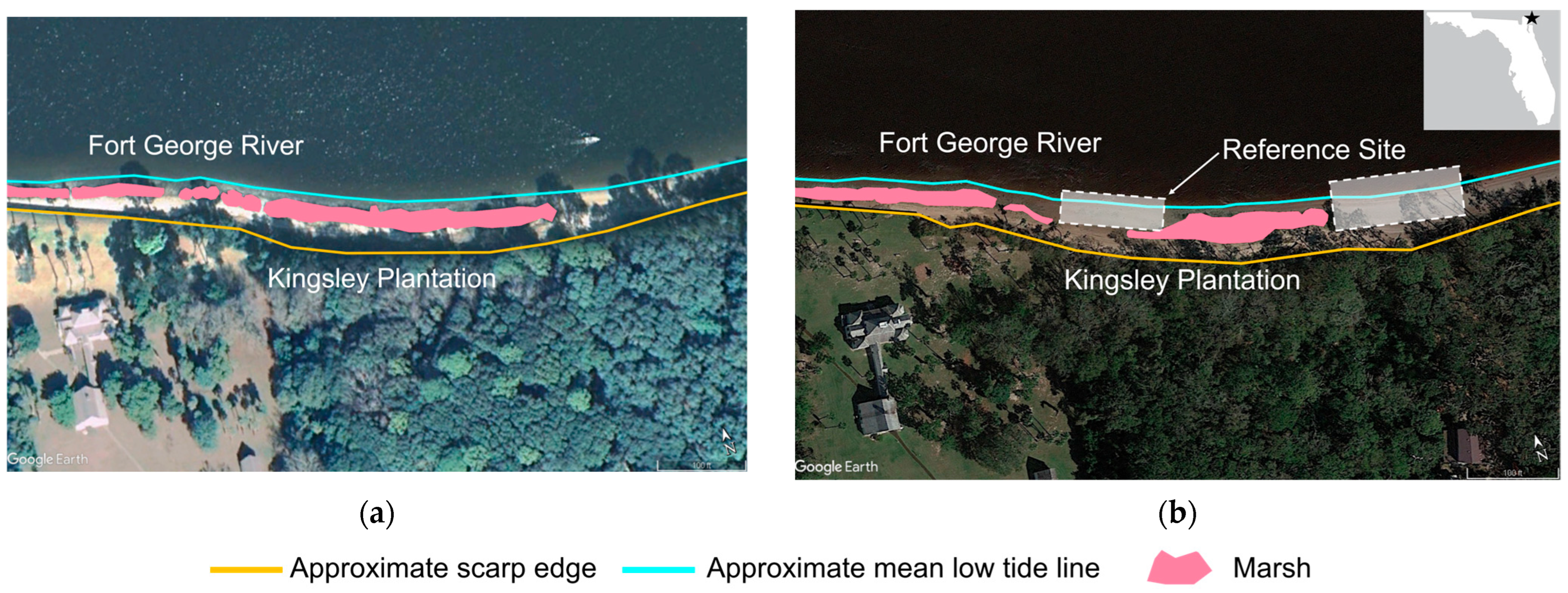
Figure 1. (a) shows Kingsley Plantation shoreline in 2004 [29]; (b) shows the POSH unit/Oyster Ball deployment locations [30]. Note the salt marsh disappearance along the shoreline between the two years. A scale is in the bottom right corner of each image.
Sustainability 17 11129 g001
Figure 2. June 2021 POSH unit and Oyster Ball deployment (a) and August 2022 POSH unit deployment (b) at Kingsley Plantation.
Sustainability 17 11129 g002
Figure 3. Plan (a) and profile (b) views of the 3D scanned POSH unit with approximate dimensions.
Sustainability 17 11129 g003
Figure 4. Sketch of the flow domain including boundary conditions.
Sustainability 17 11129 g004
Figure 5. Boat wake approaching the shoreline at Kingsley Plantation.
Sustainability 17 11129 g005
Figure 6. Tested POSH unit planform arrangements—parallel-no overlap (Case PN) (a), parallel-overlap (Case PO) (b), chevron-no overlap (Case CN) (c), and chevron-overlap (Case CO) (d). Probe locations and approximate study area dimensions are given for the PN arrangement; the study area is approximately the same for all arrangements. Waves approach from the top right of the study area.
Sustainability 17 11129 g006
Figure 7. Bed stress distributions for all arrangements at 30 s showing (a) Case A; (b) Case PN; (c) Case PO; (d) Case CN; and (e) Case CO; waves approached from the top right corner.
Sustainability 17 11129 g007
Figure 8. Bed stress distributions for all arrangements at 31 s showing (a) Case A; (b) Case PN; (c) Case PO; (d) Case CN; and (e) Case CO; waves approached from the top right corner.
Sustainability 17 11129 g008
Figure 9. Bed stress distributions for all arrangements at 32 s showing (a) Case A; (b) Case PN; (c) Case PO; (d) Case CN; and (e) Case CO; waves approached from the top right corner.
Sustainability 17 11129 g009aSustainability 17 11129 g009b
Figure 10. Modeled bed stress data for probes showing (a) Probe 1; (b) Probe 2; (c) Probe 3; (d) Probe 4; (e) Probe 5; (f) Probe 6; (g) Probe 7; (h) Probe 8; (i) Probe 9.
Sustainability 17 11129 g010aSustainability 17 11129 g010b
Figure 11. Tc values for all probes for all cases. A line indicating Tc for Case A has been added for reference. Shown are (a) Probe 1; (b) Probe 2; (c) Probe 3; (d) Probe 4; (e) Probe 5; (f) Probe 6; (g) Probe 7; (h) Probe 8; (i) Probe 9.
Sustainability 17 11129 g011aSustainability 17 11129 g011b
Figure 12. Sediment buildup and scour around POSH units as of March 2023 showing (a) an overview; and (b) sediment buildup and local scour.
Sustainability 17 11129 g012
Table 1. CFD field function inputs for the representative wake train.
Time (s)Amplitude (m)
0–20.03
2–40.04
4–60.045
6–80.04
8–100.075
10–120.065
12–140.08
14–160.105
16–180.09
18–200.05
20–220.04
22–240.03
24–260.01
>260
Table 2. Max stresses for all cases; all units in Pa.
ProbeCase ACase PNCase POCase CNCase CO
Probe 10.340.200.340.380.22
Probe 20.280.650.540.590.38
Probe 30.571.370.750.640.46
Probe 40.260.320.320.220.50
Probe 50.420.320.460.380.63
Probe 60.981.060.820.450.57
Probe 70.400.470.430.260.41
Probe 80.180.650.440.510.45
Probe 90.560.830.440.570.23
Table 3. Top 95% stresses for all cases; all units in Pa.
ProbeCase ACase PNCase POCase CNCase CO
Probe 10.240.150.120.240.18
Probe 20.160.430.260.260.26
Probe 30.360.390.320.270.28
Probe 40.150.220.230.120.22
Probe 50.250.200.260.150.37
Probe 60.290.490.330.220.18
Probe 70.340.260.310.210.28
Probe 80.120.370.250.380.23
Probe 90.250.230.240.190.13
Table 4. Top 75% stresses for all cases; all units in Pa.
ProbeCase ACase PNCase POCase CNCase CO
Probe 10.150.070.070.090.12
Probe 20.120.210.130.150.11
Probe 30.150.150.120.130.14
Probe 40.070.110.130.090.12
Probe 50.120.100.150.080.20
Probe 60.110.150.110.120.09
Probe 70.140.120.120.110.14
Probe 80.040.160.110.250.12
Probe 90.110.110.100.100.07
Table 5. Median stresses for all cases; all units in Pa.
ProbeCase ACase PNCase POCase CNCase CO
Probe 10.080.030.040.060.08
Probe 20.070.100.070.100.06
Probe 30.070.070.070.070.07
Probe 40.040.060.070.050.05
Probe 50.070.060.070.040.12
Probe 60.040.060.050.060.05
Probe 70.060.060.060.070.05
Probe 80.020.080.070.110.04
Probe 90.060.060.040.060.04
Table 6. Mean stresses for all cases; all units in Pa.
ProbeCase ACase PNCase POCase CNCase CO
Probe 10.090.050.050.080.09
Probe 20.080.140.090.110.08
Probe 30.110.120.100.100.09
Probe 40.060.080.090.060.08
Probe 50.090.070.100.060.14
Probe 60.090.120.090.080.07
Probe 70.100.090.100.090.09
Probe 80.040.110.080.150.07
Probe 90.080.080.070.080.05
Disclaimer/Publisher’s Note: The statements, opinions and data contained in all publications are solely those of the individual author(s) and contributor(s) and not of MDPI and/or the editor(s). MDPI and/or the editor(s) disclaim responsibility for any injury to people or property resulting from any ideas, methods, instructions or products referred to in the content.