

Article

Municipal-Level Analysis of Peer Effects in China’s Sustainable Rural Development: Mechanisms and Imitation Patterns

School of Economics & Managenment, Shaanxi University of Science & Technology, Xi’an 710021, China
*
Author to whom correspondence should be addressed.
Sustainability 2025, 17(24), 11122; https://doi.org/10.3390/su172411122
Submission received: 14 November 2025 / Revised: 4 December 2025 / Accepted: 9 December 2025 / Published: 11 December 2025
(This article belongs to the Section Sustainable Urban and Rural Development)

Abstract

Based on panel data from 274 prefecture-level cities in China (2011–2022), this study employs a peer effects model to examine three questions: whether peer effects exist in sustainable rural development, what mechanisms underlie them, and which regions are imitated. It thereby offers a new perspective on the endogenous drivers of rural development. The main findings are as follows. Baseline regression results confirm a significant positive peer effect on rural sustainable development. This result remains robust after a series of tests addressing endogeneity and robustness, including the replacement of explanatory variables, data indentation, exclusion of provincial capitals, placebo tests, and instrumental variable estimation. Heterogeneity analysis reveals that central and western regions are more inclined to learn from other cities in the process of sustainable rural development, whereas the eastern region leans more toward innovation. After the Rural Revitalization Strategy was introduced in 2017, regions have actively explored new rural development models, leading to a decline in the peer effects coefficient compared to the pre-2017 period. Mechanism analysis indicates that both learning-based imitation and competitive imitation serve as channels for peer effects in rural sustainable development. A region’s own development experience does not suppress peer effects. Economically more developed regions are more likely to become imitation targets. Moreover, performance pressure on local officials and the degree of competition among prefecture-level cities strengthen the peer effects. After reclassifying peer groups based on economic structure and geographical location, results show that in the process of rural sustainable development, local governments primarily learn from other regions within the same province that share similar economic structures and are geographically proximate. Based on these findings, this paper proposes differentiated policy recommendations to support sustainable rural development.

1. Introduction

Rural sustainable development is a comprehensive concept aimed at achieving long-term, healthy, and coordinated development in rural areas across multiple dimensions, including economic, social, environmental, and cultural aspects [1]. While rapid urbanization yields agglomeration benefits, it often concurrently exacerbates human capital outflow and undermines developmental momentum in rural areas, posing threats to food security, ecological sustainability, and economic efficiency. The pursuit of sustainable rural futures has become a paramount global policy concern. In response, many nations have launched macro-level rural sustainable development strategies, such as the Common Agricultural Policy in the EU [2], Farm Bill Conservation Programs in the USA [3], Integrated Development of Rural Areas in Russia [4], National Rural and Northern Growth Strategy in Canada [5], and Rural Revitalization Strategy in China [6]. Currently, most studies treat rural regions as independent units, focusing on the measurement [7] and implementation pathways of rural sustainable development [8,9]. Few studies examine whether significant mutual influences exist between geographically or socially adjacent rural regions. The demonstration, competition, or knowledge spillover effects existing among regions with similar characteristics are theoretically called the peer effects. The exploration of peer effects will help understand the micro-dynamics of rural sustainable development and is of significance for formulating coordinated development strategies.
The concept of peer effects, rooted in social network theory, posits that individual decisions are influenced not only by intrinsic attributes but also by the behaviors of others within a reference group. Originating in psychology, its analytical framework has been extended to sociology [10], organizational behavior [11], and economics. At the resident level, studies have examined peer effects on farmers’ use of digital finance [12], productive investment [13], and household financial risk-taking [14]. Enterprise-level research covers corporate governance [15], financial asset allocation [16,17], and social responsibility [18]. Regarding government behavior, peer effects have been identified in urban environmental regulation [19], foreign investment incentives [20], regional synergy [21], and major policy-making [22].
Meanwhile, research on the sustainable development of rural areas in China mainly focuses on three aspects: measurement, development paths, and their socio-economic impacts. For its measurement, there are two types: one is to design the index system from the perspective of rural revitalization [23], and the other is to design the index system from the perspective of inclusive growth [24]. The main measurement methods are objective weighting methods, such as the entropy value method. For the development paths, many studies have explored the influences of multi-dimensional factors such as rural governance [25], institutional reform [26], and education [27] on rural development. In recent years, some studies have emphasized that the digital economy, as the core driving force for rural development in the fourth industrial Revolution, includes digital inclusive finance [28], digital infrastructure [29], digital industries [30], and digital talent cultivation [31]. For the socio-economic impacts, studies focus on assessing the economic effects of sustainable rural development, including the connection between poverty alleviation and development [32], narrowing the urban–rural gap [33], industrial optimization [34], and ecological economic coordination [35].
Despite these academic contributions, there is still room for improvement. First of all, most rural development studies are conducted at the provincial level or in specific regions (Such as the Yellow River Basin and the Yangtze River Delta region [36]), lacking national analyses at the municipal level. Secondly, although peer effects research has flourished in studies of residents and enterprises, its application to government-led regional development, especially rural development, is rare. The spatial interdependence of rural sustainable development has been largely overlooked.
To make up for this overlooked, this study utilizes panel data from 274 prefecture-level regions in China (2011–2022) to investigate the peer effects in rural sustainable development. We seek to answer three core questions: (1) Do significant peer effects exist in the context of rural sustainable development across Chinese prefectures? (2) What are the primary underlying mechanisms, such as learning-based imitation or competitive imitation driving these effects? (3) Which specific peers (defined by geographic, economic, or administrative proximity) serve as the primary reference models for local governments?
The contributions of this article are mainly reflected in three aspects: (i) It was the first to apply the peer effects theory to rural sustainable development and conducted an empirical test on its significance. (ii) The underlying mechanisms, learning imitation and competitive imitation, were analyzed to quantify their impacts. (iii) Redefine peer groups based on geographical and economic proximity, systematically determine imitation targets, and provide information for targeted regional policies. By examining the strategic interactions among regions, this study reveals the spatial interdependence and internal mobilization logic of rural sustainable development in China. It provides strong micro-evidence for understanding the diffusion of rural regional policies and offers valuable insights for optimizing cross-regional coordination mechanisms and performance evaluation frameworks.

2. Research Hypothesis

2.1. Hypothesis on the Existence of Peer Effects in Rural Sustainable Development

The peer effects emphasize strategic interactions among economic actors, offering a refined perspective on spatial spillover effects [37]. In the context of rural sustainable development, key actors include governments, enterprises, and farmers. Here, government-led vertical transmission mechanisms shape the institutional environment [38]; horizontal competition among enterprises influences resource allocation efficiency; and the social embeddedness of farmers affects the inclusivity of development outcomes.
At the governmental level, peer effects primarily operate through a dual mechanism: top-down policy transmission and horizontal institutional imitation [39]. The central government establishes standardized governance models via a “pilot-and-promotion” approach, creating demonstration effects that spur inter-jurisdictional competition [40]. A prime example is when Zhejiang Province’s “Thousand Villages Project” was elevated to national policy, prompting 26 other provinces to launch similar rural improvement initiatives—illustrating a clear pathway where policy innovation in demonstration areas triggers emulation elsewhere. Furthermore, practices such as cadre exchanges [40,41] and the joint development of grassroots organizations [42] have further established structured channels for tacit knowledge flow and policy learning.
At the enterprise level, peer effects are primarily channeled through the evolution of industrial clusters [43,44]. Marshall’s theory of industrial districts posits that clusters function as spatial platforms that enhance the division of labor and facilitate knowledge spillovers. Their development is driven not only by traditional locational advantages—such as shared infrastructure and labor pooling—but also by strategic imitation among firms, which is amplified by peer effects. For instance, when an industry thrives in one region, enterprises in adjacent areas often engage in observational learning and adjust their strategies accordingly, triggering a virtuous cycle of success imitation, factor agglomeration, and regional brand formation.
At the farmer level, peer effects are deeply embedded in rural social networks. Informed by information cascade theory, farmers often infer potential benefits by observing the actions of their peers and subsequently adjust their own decisions [45,46]. In geographically proximate communities, frequent social interactions foster an environment of social comparison, where an individual’s perceived utility is directly influenced by their relative standing within the group. A telling example is Yuanjia Village in Shaanxi Province, where the initial success of pioneering homestay operators motivated 112 surrounding households to follow suit and invest within just 18 months, clearly demonstrating a powerful herd effect.
Hypothesis 1.
The sustainable development of rural areas is significantly influenced by the peer effects of other rural areas with similar geographical locations.

2.2. The Mechanisms of Peer Effects in Rural Sustainable Development

Learning-based imitation is a key mechanism underpinning the emergence of peer effects [47,48]. As rural regions develop, observe, and assimilate the successful experiences of other villages, they replicate their strategies and practices. Depending on the target of imitation, learning-based imitation involves internal or external learning [49]. Internal learning involves the systematic integration of indigenous practices and the extraction of lessons from prior successes to facilitate rural development. Grounded in behavioral economics, individuals learn from past experiences to change decisions and improve future behaviors. In this context, accumulated experience may lower local governments’ tendency to imitate outside sources, weakening the strength of peer effects. External learning involves assimilating successful strategies from other regions, particularly those at similar or higher levels of development. Less developed regions tend to emulate successful counterparts; this is partly due to information asymmetry and an incentive to “free-ride” by using proven models. Moreover, motivated by an aversion to risk aversion, these regions may prefer to replicate successful models to minimize trial-and-error costs. This discussion leads to the following hypothesis.
Hypothesis 2.
Learning-based imitation is a principal driver of peer effects in rural sustainable development.
Competitive imitation is another critical mechanism driving the emergence of peer effects [50]. It refers to the tendency of rural regions to emulate the development strategies of other localities to avoid falling behind [51]. Under China’s unique decentralized administrative structure, the central government has unified authority over national-level affairs; local governments have some level of autonomy and responsibility in policy implementation. Local authorities are empowered to formulate and enforce policies tailored to their specific regional contexts. The central government evaluates local officials using performance metrics during their term of office; comparative assessments are used to inform decisions regarding appointments and promotions. This creates two types of pressure for local governments: there is an explicit incentive to meet the evaluation criteria set by higher-level authorities, and there is implicit pressure to respond to the development trajectories of neighboring regions. This is referred to as yardstick competition. To stimulate local economic growth and enhance officials’ prospects for political advancement, local governments may introduce a range of preferential measures, such as tax incentives, land support, and infrastructure investment, to attract business and investment. In turn, peer regions want to avoid relative stagnation and may adopt similar policies as a result of benchmarking against more successful “focal” regions [52]. This dynamic fosters an environment of mutual emulation, eventually evolving into a state of competitive escalation. This analysis leads to the following hypothesis.
Hypothesis 3.
Competitive imitation is a primary driver of peer effects in rural sustainable development.

3. Sample Selection and Model Specification

3.1. Sample Selection

3.1.1. Rural Sustainable Development Level

There are mainly two research ideas for constructing an evaluation system for sustainable rural development. The first research approach is in line with the overall framework of the “Twenty-Character Policy” issued by the Chinese government, which takes into account prosperous industries, livable ecology, civilized rural customs, effective governance and affluent life. Scholars who adopt this framework select specific indicators among these five dimensions. There are significant differences in the formulation of secondary indicators. For instance, Jia et al. [53] employed the “Five-in-One” rural development strategy and proposed a multi-dimensional evaluation system with “six major transformations, four speeds, three governance methods, three cultural characteristics, and three spatial dimensions” as secondary indicators. The second research method introduces the main indicators of sustainable development from different theoretical perspectives. These perspectives encompass industrial sustainability, talent sustainability, cultural sustainability, ecological sustainability and organizational sustainability, and have formed an assessment system consisting of 13 secondary indicators.
Considering the characteristics of rural panel data, this study adopts the first method. This study draws on the method of Yang et al. [54] to construct a comprehensive evaluation index system for rural sustainable development that conforms to the “Twenty-Character Policy”. As shown in Table 1, this system consists of 5 primary indicators and 28 specific indicators.
  • Prosperous industries are crucial foundations for building a modern economic system in rural areas. This requires continuously strengthening the agricultural production capacity foundation, accelerating the upgrading of agricultural production efficiency, and enhancing the level of industrial integration. These efforts will advance the pace of agricultural modernization and reinforce agriculture’s foundational role in the national economy.
  • Livable ecology is a key initiative in creating a “Beautiful China” and a priority task in comprehensively advancing rural sustainable development. The Chinese government has clearly stated that beautiful villages with ecological livability should be developed by promoting Green development in agriculture, continuously improving rural living environments, and strengthening rural ecological conservation.
  • Civilized rural customs as a vital safeguard for modern civilization and constitute a sound cultural and institutional foundation. Generally, higher educational attainment of farmers greater progress in rural ideological and ethical development. Furthermore, transmission of traditional culture should be leveraged to disseminate civilized values and cultivate a harmonious rural ethos, thereby continuously elevating the overall level of civility in rural communities. It is also essential to vigorously develop rural public cultural services in rural areas, enhance the comprehensive quality of farmers, and promote harmonious coexistence among rural residents.
  • Effective governance serves as a crucial safeguard for political development and the social foundation for sustainable rural progress. The Chinese government emphasizes the need to strengthen governance capabilities and governance initiatives, gradually establishing a rural governance system that integrates the rule of law, moral governance, and self-governance.
  • Affluent life is an essential requirement of socialism and the fundamental goal of sustainable rural development. We must continuously raise farmers’ income levels and expand their income channels; improve farmers’ consumption structure and farmers’ living conditions to enhance the quality of life in areas such as clothing, food, housing, and transportation; strengthen rural infrastructure development level and improve the basic public service coverage level to enhance farmers’ sense of happiness and fulfillment, thereby progressively achieving common prosperity.
The entropy value method is adopted to determine the weights of each index. The entropy value method has the advantage of objective empowerment and can avoid the subjectivity of expert empowerment. Considering that the units of measurement of the indicators are not uniform, the indicators are standardized using Equation (1) before calculation.
x i j = x i j = X i j min   ( X i j ) max   ( X i j ) min   ( X i j ) i f   t h e   influence   d i r e c t i o n   o f   x i j   i s   p o s i t i v e x i j = max   ( X i j ) X i j max   ( X i j ) min   ( X i j ) i f   t h e   influence   d i r e c t i o n   o f   x i j   i s   n e g a t i v e
where x i j is denoted as x i j , and x i j is the value of the jth indicator for the ith region after treatment, where i = 1 , 2 , 3 m and j = 1 , 2 , 3 n . Calculation of the share of the ith region in the jth indicator with Equation (2).
p i j = x i j i = 1 m x i j
Calculate the entropy of the jth indicator with Equation (3).
e j = 1 ln K i = 1 m p i j ln p i j
Calculate the coefficient of variation for indicator j with Equation (4).
d j = 1 e j
Calculate the weight of the jth indicator in relation to all indicators with Equation (5).
w j = d j i = 1 m d j
Calculation of the composite score for each region with Equation (6).
S i = j = 1 n w j × x i j

3.1.2. Control Variables

This study incorporates both local characteristics and features of peer cities as control variables. There are five key control variables: urbanization rate (Urban), industrial structure (Ind), level of economic development (GDP), degree of government intervention (Gov), and trade openness (Open) [54,55]. Urbanization rate is measured using the ratio of the urban population to the total population. Industrial structure is measured by the share of the tertiary industry value added in total GDP. Economic development level is measured using the total GDP of each prefecture-level region. Government intervention is measured by the ratio of general public budget expenditure to GDP. Trade openness is measured by the ratio of total imports and exports to GDP. Among them, Urban injects vitality into rural areas by transferring labor and expanding the market, but it may also trigger the problem of hollowing out. Upgrading the Ind can drive the integration of rural industries and green employment, but it is necessary to prevent disconnection from the local area. The improvement of GDP provides an economic foundation for giving back to rural areas, but if the distribution is uneven, it will exacerbate the gap between urban and rural areas. Gov is the key to compensating for market failure and providing public goods, but excessive intervention may suppress endogenous motivation. Open has opened up international markets for rural products and introduced advanced concepts, while also exposing rural areas to external risks.

3.1.3. Definition of Peer Regions

Peer regions are defined as other prefecture-level regions located within the same province as the focal region. This definition is driven by several considerations. Regions within the same province often share similar geographic locations, economic linkages, and policy environments. This helps mitigate the influence of unobservable factors. In empirical studies on peer effects, the average or median value of a given indicator among peer units is typically used as a proxy for peer influence. This study uses the average rural sustainable development level of peer regions as the main explanatory variable in the baseline regression; the median value is applied in robustness checks to assess the consistency of results.

3.1.4. Data Sources and Variable Description

The dataset includes panel data from 274 prefecture-level regions in China for the years 2011 to 2022. Four centrally administered municipalities (Beijing, Tianjin, Shanghai, and Chongqing) are excluded from the regression analysis due to their unique administrative status. These regions are directly governed by the central government, have greater administrative authority, and have heightened strategic and economic significance. This enables them to respond more rapidly to central policies. Their distinct political and economic roles may introduce bias if included in the sample, so they are omitted.
Study data come from a wide range of authoritative sources. Among them, the data of the rural sustainable development indicator system mainly comes from the China Urban Statistical Yearbook, China Rural Statistical Yearbook, China Population and Employment Statistical Yearbook, China Education Statistical Yearbook, China Urban–Rural Construction Statistical Yearbook, China Environmental Statistical Yearbook, and China Agricultural Machinery Industry Yearbook. The data of the control variables are mainly derived from the China Statistical Yearbook. A small portion of the data comes from the statistical yearbooks and statistical bulletins of prefecture-level cities and autonomous regions, the EPS Database, and China’s economic and social big data research platform. For some missing data, they are estimated at the rate of change in the previous year by assuming that they maintain the same rate of change. The statistical description of study variables can be seen in Table 2.

3.2. Model Specification

This study adopts a benchmark econometric model based on a framework proposed by Leary and Roberts [56] to examine whether the rural sustainable development of a given region is influenced by the strategies adopted by other prefecture-level regions within the same province. The model is specified as follows:
R u r a l i , t = α 0 + α 1 R u r a l i , t ¯ + α 2 C o n t r o l s i , t + α 3 C o n t r o l s i , t ¯ + μ i + σ t + ε i , t
where i denotes the prefecture-level region and t denotes the year. The variable R u r a l i , t represents the rural sustainable development level of region i in year t. The term R u r a l i , t ¯ denotes the arithmetic mean of the rural sustainable development levels of all other regions within the same province, excluding region i in year t. If the estimated coefficient of R u r a l i , t ¯ is statistically nonsignificant, there is no significant peer effects. In contrast, a positive and statistically significant coefficient indicates the presence of a positive peer effect; that is, an improvement in the rural sustainable development level of peer regions positively influences the focal region. A negative and significant coefficient indicates a negative peer effect, while higher rural sustainable development levels in peer regions lower the performance of the focal region. The vector C o n t r o l i , t denotes a set of control variables characterizing region i; C o n t r o l i , t ¯ represents the corresponding average characteristics of peer regions. The model also incorporates region fixed effects of μ i and time fixed effects of σ t . The term ε i , t denotes the error term.
Manski [57] identified that empirical tests assessing the presence of peer effects often face a reflection problem, complicating the isolation of causal peer influences. In the context of this study, three distinct types of effects may arise:
  • Endogenous effects occur when the rural sustainable development levels of peer regions directly influence the rural sustainable development level of the focal region.
  • Exogenous effects occur when the focal region’s rural sustainable development outcome is affected by other characteristics of peer regions, such as economic development or urbanization levels.
  • Correlated effects occur if the focal region and its peers share similar underlying traits, institutional environments, or face common systemic shocks. This may lead to omitted variable bias.
This study primarily focuses on identifying endogenous peer effects. Several strategies are applied to address potential confounding influences from exogenous and correlated effects. To mitigate exogenous effects, the study tests the sensitivity of peer regions’ characteristic variables to the focal region’s rural sustainable development policies. This involves examining whether local policies elicit responses in the peer regions’ attributes. To alleviate correlated effects, both the focal region’s and peer regions’ characteristic variables are included as controls, and instrumental variable techniques are applied to address endogeneity concerns.

4. Analysis of Results

4.1. Baseline Regression Results

The empirical results are shown in Table 3. Column (1) presents results without control variables and fixed effects. Column (2) adds region and time fixed effects to Column (1). Column (3) includes control variables and fixed effects. The findings indicate that the implementation of rural sustainable development in peer regions positively influences local rural sustainable development. Specifically, a one-unit increase in peer regions’ rural sustainable development levels leads to a 0.601-unit increase in local rural sustainable development levels, validating Hypothesis 1. This finding aligns with a growing body of literature examining the interdependence between regional environments [58,59] and development policy spaces [22,60]. However, our focus on rural sustainability extends this line of inquiry beyond the typical urban or industrial contexts. The strength of the coefficient underscores that local governments do not make decisions in a vacuum; they are keenly observant of and influenced by the progress made by their peers.
An analysis of the control variables indicates that, among the local economic characteristics, only industrial structure and economic development level are significant predictors; this is consistent with the conclusion of Shi and Yang [55]. Other variables are not statistically significant. This indicates that rural sustainable development is largely exogenous to local economic characteristics. When considering peer regions’ economic characteristics, only the degree of government intervention in peer regions has a significant positive effect on the focal region’s rural sustainable development. Other peer characteristics do not pass significance tests. These findings indicate that the peer effects primarily operate through endogenous mechanisms, rather than through correlated or exogenous effects. This contrasts with those studies [54] that emphasize the importance of local economic basic elements, highlighting the radiating effects of sustainable development in rural areas of other regions on the local area.

4.2. Robustness Tests Results

Several robustness tests were conducted to assess the baseline regression results:
  • In peer effects research, the average or median values are commonly used to represent peer influence. In this study’s baseline regression, the mean rural sustainable development level of peer regions is used as the proxy; however, for the robustness test, the mean is replaced with the median rural sustainable development level of peer regions. The results in Table 4, Column (1) remain positive and statistically significant, which is consistent with the baseline findings.
  • Outliers or extreme values can distort the data distribution and potentially bias the results. To address this, all continuous variables are winsorized at the 1% and 99% quantiles. The regression results in Table 4, Column (2) remain positively significant. This confirms the robustness of the baseline estimates.
  • Provincial capital regions differ from ordinary prefecture-level regions in terms of administrative status, economic functions, and resource endowments; this is particularly true with respect to policy resource allocation, transportation infrastructure, and concentration of educational resources. Provincial capitals may have a siphoning effect on surrounding areas; as such, they are excluded from the sample to make the sample more homogeneous and increase estimation accuracy. The empirical results in Table 4, Column (3) confirm that the peer effects remain positive and significant after this exclusion. This supports the robustness of the main findings.
  • Placebo test. Rural sustainable development may be influenced by unobserved factors. As such, a placebo test is conducted to assess the robustness of the baseline regression results. Specifically, if unobserved common factors drive the baseline results, the peer effects should remain significant, even when peer regions are randomly reassigned to focal regions. Given this, the mean rural sustainable development level of peer regions is randomly shuffled among all sample regions, and 500 simulation iterations are performed. Figure 1 shows that the distribution of the regression coefficients is centered around zero and follows a normal distribution, and all absolute values are smaller than the baseline coefficient. This indicates that the randomly assigned peer effects are not statistically significant. This eliminates the possibility that unobserved common factors drive the baseline results and confirms the robustness of the spatial association effect in local rural sustainable development levels.
5.
Instrumental variable approach. To mitigate correlated effects, this study applies Zuo et al. [61]: the instrumental variable (IV) assessing the peer effects in rural sustainable development is defined as the average proportion of villages within the same province where the roles of village director and party secretary are concurrently held by the same individual. One person serving the dual role of village director and party secretary reflects grassroots governance efficiency; this impacts the effectiveness of rural sustainable development implementation within a locality. However, this variable is unlikely to directly influence rural sustainable development outcomes in other regions. As such, it satisfies the relevance and exclusion criteria of a valid instrument. The test results are presented in Table 4, Column (4). The LM test strongly rejects the null hypothesis of under-identification, and the Wald F-statistic significantly exceeds the conventional weak instrument critical value of 16.38 at the 10% significance level. This rejects the weak instrument hypothesis. The second-stage regression coefficient is 0.621 and is significant at the 1% level. This indicates that after controlling for endogeneity, the regional peer effects in rural sustainable development remain robust. This provides strong evidence for the validity of the baseline regression results.

4.3. Heterogeneity Analysis

4.3.1. Geographical Heterogeneity

The strength of peer effects in rural sustainable development likely varies across regions, given significant disparities in their economic foundations and resource endowments. Therefore, the 274 Prefecture-level Regions in the sample were divided into three regions: Eastern, Central, and Western China for separate regression analyses. The empirical results in Table 5, Columns (1), (2), and (3) indicate that the peer effects in rural sustainable development are significant in the Central and Western regions; the effect is stronger in the West than in the Central region. The effect is not significant in the Eastern region. This conclusion is consistent with the Chinese government’s differentiated development strategy for different regions. In the early days, China emphasized “getting rich first” and encouraged the rapid development of the eastern regions. As the development results accumulated, the Chinese government shifted its focus to “common prosperity” [62] and introduced strategies such as the Central Region’s Rise Promotion Strategy and the Western Development Strategy [63]. By taking over the industrial transfer and innovative resources from the eastern regions, the central and western regions achieved balanced development under the impetus of the eastern regions [64]. The guiding ideology for the sustainable development of rural areas is consistent. The Eastern region has a stronger economic base and tends to pursue innovative development strategies tailored to its local conditions. This reduces its reliance on imitating other regions. For instance, Zhejiang was the first to integrate the digital economy into rural development, established the Wuzhen Internet Town. Shanghai has developed the “central kitchen” industry in rural areas, achieving an integration of “production + ecology + life”. Shenzhen and Guangzhou, leveraging their well-developed private economic foundations and culturally ancient villages, have introduced art studios and brand stores to create high-quality rural micro-vacation destinations. In contrast, the Western and Central regions have lower levels of economic development and geographical remoteness. This results in greater information asymmetry. However, substantial government support incentivizes the Western and Central regions to emulate and learn from the successful experiences of other regions in rural development.

4.3.2. Temporal Heterogeneity

The Rural Revitalization Strategy was elevated to a national-level development agenda by the Chinese government in October 2017. Although rural sustainable development policies existed prior to this date, the official adoption of the strategy infused renewed momentum and focus into related initiatives. To examine potential temporal heterogeneity resulting from this policy shift, the sample period was divided into two sub-periods: 2011–2017 and 2018–2022. Regression results presented in Table 5, columns (4) and (5), indicate that the peer effects remain positive and statistically significant in both intervals. Notably, however, the magnitude of the peer effects coefficient is smaller in the post-2017 period. This result is in line with the policy guidelines of the Rural Revitalization Strategy. The Rural Revitalization Strategy emphasizes “adapting measures to local conditions”, that is, formulating development strategies in line with local realities based on the natural conditions, economic foundation, cultural characteristics, and resource endowments of different regions, avoiding the uniformity of all villages and achieving the unique charm of each village [65,66]. Furthermore, this result also provides a new idea for the diffusion of various policies from a temporal dynamic perspective—policy dissemination should shift from promoting imitation to stimulating differentiated development.

4.4. Mechanism Analysis

In the Chinese sociocultural context, collectivist consciousness has long been ingrained as a foundational organizing principle. This cultural backdrop encourages adherence to the “Doctrine of the Mean”, which prioritizes collective consensus and discourages marked deviation from group norms. When rural sustainable development advances in other regions within the same province, local officials are incentivized to enhance their own performance to avoid lagging behind. As a result, local governments often emulate or align with the development pathways of peer regions. Two plausible mechanisms underpinning such peer effects are learning-based imitation and competitive imitation. To disentangle their respective roles in shaping rural sustainable development outcomes, this study specifies the following model:
R u r a l i , t = β 1 R u r a l i , t ¯ + β 2 R u r a l i , t ¯ × V a r + β 3 V a r + β 4 C o n t r o l s i , t + β 5 C o n t r o l s i , t ¯ + μ i + σ t + ε i , t
The variable Var is the mechanism variable of the learning-based imitation or Competitive imitation set in the following text, and Rural i , t ¯ × V a r represents the interaction term. All other variables are defined and interpreted in the same way as in the baseline regression model. A statistically significant positive coefficient β 2 for the interaction term indicates that the mechanism variable strengthens the peer effects of rural sustainable development. In contrast, a significantly negative coefficient β 2 indicates that the mechanism variable attenuates these peer effects.

4.4.1. Learning-Based Imitation

Drawing on the analytical framework of Xu, Wang, Yang and Xiong [22], this study examines the mechanisms underlying peer effects in rural sustainable development through two distinct channels: internal learning and external learning.
Internal learning is proxied by the growth rate of rural sustainable development (GRR). A positive annual GRR indicates an improvement in rural sustainable development, suggesting that the region can draw on its own prior experience. Accordingly, GRR is coded as 1 if it exceeds zero, and 0 otherwise. If internal learning dominates, local governments would rely more heavily on their own historical development pathways when making decisions, potentially weakening the role of peer influence. Thus, a nonsignificant or significantly negative interaction term between GRR and the peer effects would suggest that internal learning attenuates peer effects. However, as shown in Column (1) of Table 6, the interaction term is significantly positive, indicating that accumulated experience in rural sustainable development strengthens, rather than diminishes, the peer effects. This result implies that internal learning is unlikely to be the primary mechanism driving peer effects in this context.
External learning is measured using per capita GDP (PGDP), under the assumption that regions with higher PGDP represent more economically advanced benchmarks and are thus more likely to be emulated. The estimation results in Column (2) of Table 6 reveal a significantly positive interaction term between PGDP and the peer effects, suggesting that learning from economically developed regions significantly amplifies peer effects. These findings confirm that external learning serves as a key channel through which peer effects operate in rural sustainable development, thereby supporting Hypothesis 2.

4.4.2. Competitive Imitation

Local governments operate under dual pressures during development: explicit performance evaluations from upper-level authorities and implicit competitive dynamics with neighboring jurisdictions. To capture these dimensions of competition at the prefecture level, this study employs the following measures:
  • Assessment Pressure: GDP growth remains a central indicator for evaluating economic performance and official promotion prospects. To reflect assessment pressure specifically related to rural sustainable development, this study uses the growth rate of the total agricultural output value (GAGDP) as a proxy for governmental performance in this domain.
  • Implicit Competitive Pressure: Government expenditure on agriculture, forestry, and water affairs (AFW) encompasses fiscal investments in agricultural modernization, forestry, water conservancy, poverty alleviation, and rural institutional reforms. Higher AFW spending is interpreted as reflecting greater governmental attention and resource commitment to rural development, thereby serving as an indicator of implicit competitive pressure.
As reported in Columns (3) and (4) of Table 6, the interaction terms for both GAGDP and AFW are statistically significant and positive, indicating that assessment pressure and implicit competition reinforce peer effects among local governments. These results suggest that competitive imitation constitutes an important mechanism through which peer effects operate in rural sustainable development. The empirical evidence supports Hypothesis 3.
Our mechanism analysis has unraveled the dual channels of the peer effects, providing empirical inspiration for the theoretical framework of regional imitation. The significance of external learning emphasizes that the imitation of rural sustainable development mainly looks outward, seeking to replicate the success of the advanced. This discovery is consistent with the demonstration effect mentioned by Xu, Guo and Peng [6]. More importantly, the significance of competitive imitation has fixed the focus on the promotion competition system for Chinese officials. This institutional system not only influences economic growth [67], urban expansion [68] and innovation performance [69], but also has a powerful impact on the sustainable development of rural areas.

5. Additional Analysis: Imitation Patterns

The baseline regressions define peer regions as those within the same province and confirm the existence of peer effects. In other words, rural sustainable development progress made in other regions within a province influences the focal region. Learning-based and competitive imitation are key channels generating these peer effects. However, an important question remains: Who are the focal region’s reference peers? This section redefines peer groups based on economic structure and geographic location to explore this question.

5.1. Redefining Peer Groups Based on Economic Structure

Local governments tend to emulate regions with comparable economic characteristics when formulating development strategies. To investigate how economic structure influences inter-region interactions, the share of agricultural GDP as a part of total GDP serves as a proxy for similarity in economic structure. First, the absolute difference in economic structure between the focal region and other regions is calculated and categorized into three groups: [0, 0.05), [0.05, 0.1), and [0.1, 0.15). Second, regions are further distinguished based on whether they are within the same province as the focal region (intra-provincial) or outside the province (inter-provincial). For each focal region, other regions are grouped into six categories according to these criteria (three distances, two city types). The average rural sustainable development level of regions in each group is then computed. For example, Shijiazhuang is set as the focal region, intra-provincial regions with an economic structure difference of less than 0.05 are defined as those within Hebei province whose agricultural GDP shares differ from Shijiazhuang’s by less than 0.05.
The results in Table 7 show that within the same province, the peer effects increase as economic structure differences narrow. In contrast, for inter-provincial regions, regions with differences in economic structure [0, 0.05) significantly inhibit the rural sustainable development of the focal region; regions with greater differences (>0.05) show no significant peer effects. This indicates that local governments primarily target intra-provincial regions with similar economic structures as their imitation benchmarks. This indirectly confirms the presence of promotion tournaments based on economic performance in China. Differences in economic policies, geographic resources, and local customs across provinces may cause rural development models to diverge. This helps explain the nonsignificant peer effects seen with inter-provincial regions.

5.2. Redefining Peer Groups Based on Geographic Proximity

Geographic proximity is often associated with greater similarity in natural resources, local customs, and social environments among regions. This may amplify mutual influences. This study categorizes peer regions into three groups according to their straight-line distance from the focal region: [0, 200), [200, 400), and [400, 600) kilometers. Regions are distinguished by whether they are within the same province as the focal region (intra-provincial) or outside it (inter-provincial). For each focal region, other regions are classified into six groups based on these criteria (three distances; two region types), and the arithmetic mean of the rural sustainable development level is calculated for each group. For example, when Shijiazhuang is the focal region, intra-provincial peer regions within 200 km include all regions in Hebei province located within 200 km of Shijiazhuang. The empirical results in Table 8 show significant peer effects among intra-provincial regions’ rural sustainable development. The strongest effect is seen for regions within the [200, 400] kilometer range. In contrast, the peer effects are negative for inter-provincial regions. This indicates that local governments primarily reference regions within their own province when formulating rural development policies.
The analysis that redefines peer groups provides new insights into the “subject” of imitative behavior in rural sustainable development. The research results show that the peer effects are not blind but highly influenced by economic similarity and administrative boundaries. Peer groups within the province with similar economic structures are most likely to serve as benchmarks. Administrative proximity (within the same province) can be a more powerful screening mechanism than simple geographical proximity. The negative or insignificant effects of inter-provincial peers have strengthened the core position of the provincial level as the main stage of policy competition. This discovery supplements the traditional perception in spatial econometrics that “influence decays with distance” [70], providing a crucial methodological and substantive contribution to the study of spatial spillover effects.

6. Conclusions and Policy Recommendations

This study incorporates the peer effects model into the analysis framework of rural sustainable development to empirically address three questions: Are there peer effects in the rural sustainable development of Chinese prefecture-level regions? What are the underlying mechanisms? Who are the main reference models for imitation? The study analysis was conducted using panel data for 274 prefecture-level regions in China from 2011–2022. The key findings are as follows:
  • There are significant peer effects with respect to China’s rural sustainable development. After a series of robustness checks, the results remain robust, indicating that local governments do not promote rural sustainable development in isolation; rather, they tend to imitate other regions.
  • Heterogeneity analyses reveal that the peer effects are significant in China’s central and western regions, but not in the eastern region. The effect before the year 2017, when the national Rural Revitalization Strategy was officially introduced, was greater than that after.
  • A mechanism analysis shows that both learning-based imitation and competitive imitation are important drivers of the peer effects. However, a region’s specific rural sustainable development experience does not inhibit its imitation behavior. Regions with higher economic development levels are more likely to become imitation targets. Government officials’ performance pressures and inter-regional competition further promote the peer effects.
  • The redefinition analysis of peer groups indicates that in the rural sustainable development process, local governments primarily imitate regions within the same province that share similar economic structures and geographic proximity.
Based on the specific empirical findings, we propose the following targeted and actionable policy recommendations:
  • Given the confirmed existence of peer effects, the central government should actively leverage and refine them to transform spontaneous imitation into an efficient and organized network for learning and innovation. This can be achieved by constructing a systematic national-level information and incentive platform, which would include a dynamically updated “Case Database for Sustainable Rural Development” to reduce learning costs for local governments. Incentives should also be provided to both widely emulated “front-runner” regions and “follower” regions that successfully implement localized innovations, thereby fostering a positive reinforcement cycle.
  • In light of the observed heterogeneity, differentiated rural development strategies should be promoted. At the technical level, a diagnostic mechanism should be established to identify local comparative advantages, using tools such as the “Rural Development Suitability Assessment” to map local natural and cultural assets. This process will inform the long-term planning of sustainable rural development initiatives. At the institutional level, relevant government agencies should issue differentiated implementation guidelines. Eastern regions could prioritize rural innovation, for example, by fostering creative industries through digital technologies. Central and western regions should formulate resource-adaptive pathways, such as enhancing distinctive local agriculture or developing rural tourism, instead of mechanically replicating coastal models.
  • Considering the results on imitation mechanisms, the performance evaluation system should be improved to guide healthy intergovernmental competition. First, within the assessment framework for grassroots leadership, indicators such as ecological livability, cultural vibrancy, and resident satisfaction should be incorporated, while reducing the relative weight of agricultural GDP growth. A multidimensional evaluation framework would help direct officials’ attention to the comprehensive development of rural areas. Second, to avoid extensive development driven by output-oriented singular subsidies, targeted financial support should be provided for local innovation. This could include establishing special funds to support research in distinctive and sustainable rural industries.
  • Following the redefinition results of the peer group, provincial-level demonstration cities should be developed. First, each province should identify and certify demonstration cities for sustainable rural development by category, for example, establishing emonstrations in sectors such as “agriculture-led,” “tourism-led,” and “industry-integration-led.” This will ensure the availability of provincial benchmarks. Second, a provincial-level exchange mechanism for sustainable rural development should be established. This mechanism would involve regularly organizing paired exchanges, including study visits, training sessions, official rotations, and joint projects, among cities with similar economic structures and geographical proximity, thereby facilitating effective learning for less-developed areas.

Author Contributions

Conceptualization, X.L.; Methodology, X.L.; Software, X.H.; Data curation, X.H.; Writing—original draft, X.L. and X.H.; Writing—review & editing, X.L. All authors have read and agreed to the published version of the manuscript.

Funding

This research received no external funding.

Institutional Review Board Statement

Not applicable.

Informed Consent Statement

Not applicable.

Data Availability Statement

Data are contained within the article.

Conflicts of Interest

The authors declare no conflict of interest.

References

  1. Burja, C.; Burja, V. Sustainable Development of Rural Areas: A Challenge for Romania. Environ. Eng. Manag. J. 2014, 13, 1861–1871. [Google Scholar] [CrossRef]
  2. Pe’er, G.; Bonn, A.; Bruelheide, H.; Dieker, P.; Eisenhauer, N.; Feindt, P.H.; Hagedorn, G.; Hansjürgens, B.; Herzon, I.; Lomba, Â. Action Needed for the Eu Common Agricultural Policy to Address Sustainability Challenges. People Nat. 2020, 2, 305–316. [Google Scholar] [CrossRef]
  3. Reimer, A.P.; Prokopy, L.S. Farmer Participation in U.S. Farm Bill Conservation Programs. Environ. Manag. 2014, 53, 318–332. [Google Scholar] [CrossRef]
  4. Kostyukov, A.V.; Pritula, O.D.; Davydova, S.G. Regional Aspects of Integrated Development of Rural Areas. IOP Conf. Ser. Earth Environ. Sci. 2021, 852, 012053. [Google Scholar] [CrossRef]
  5. Krawchenko, T.; Hayes, B.; Foster, K.; Markey, S. What Are Contemporary Rural Development Policies? A Pan-Canadian Content Analysis of Government Strategies, Plans, and Programs for Rural Areas. Can. Public Policy 2023, 49, 252–266. [Google Scholar] [CrossRef]
  6. Xu, Z.; Guo, Y.; Peng, R. Effectiveness Test of Rural Revitalization Demonstration Policy on Rural Economic Development in China: Analysis of Did Based on the Data of Henan Province in China. SAGE Open 2024, 14, 21582440241242539. [Google Scholar] [CrossRef]
  7. Abreu, I.; Nunes, J.; Mesias, F. Can Rural Development Be Measured? Design and Application of a Synthetic Index to Portuguese Municipalities. Soc. Indic. Res. 2019, 145, 1107–1123. [Google Scholar] [CrossRef]
  8. Duletić, R.; Đurić, K.; Tomaš-Simin, M. Ecotourism as a Factor of Sustainable Rural Development. J. Agron. Technol. Eng. Manag. 2024, 7, 1271–1275. [Google Scholar] [CrossRef]
  9. Sabet, N.S.; Khaksar, S. The Performance of Local Government, Social Capital and Participation of Villagers in Sustainable Rural Development. Soc. Sci. J. 2024, 61, 1–29. [Google Scholar] [CrossRef]
  10. Winston, G.C.; Zimmerman, D.J. Peer Effects in Higher Education. In College Choices: The Economics of Where to Go, When to Go, and How to Pay for It; Discussion Paper; University of Chicago Press: Chicago, IL, USA, 2004. [Google Scholar]
  11. Ahern, K.R.; Duchin, R.; Shumway, T. Peer Effects in Risk Aversion and Trust. Rev. Financ. Stud. 2014, 27, 3213–3240. [Google Scholar] [CrossRef]
  12. Zhou, J.; Zhao, G.; Yao, L. Peer Effects and Rural Households’ Online Shopping Behavior: Evidence from China. Agriculture 2025, 15, 1527. [Google Scholar] [CrossRef]
  13. He, W.; Wang, Q. The Peer Effect of Corporate Financial Decisions around Split Share Structure Reform in China. Rev. Financ. Econ. 2020, 38, 474–493. [Google Scholar] [CrossRef]
  14. Lyu, W.; Yu, L.; Zhang, J. Peer Effects in Digital Inclusive Finance Participation Decisions: Evidence from Rural China. Technol. Forecast. Soc. Change 2024, 208, 123645. [Google Scholar] [CrossRef]
  15. Qin, L.; He, Q.; Fu, X.; Wang, Y.; Wang, G. Peer Effects on Corporate Social Responsibility Engagement of Chinese Construction Firms through Board Interlocking Ties. J. Constr. Eng. Manag. 2024, 150, 04024064. [Google Scholar] [CrossRef]
  16. Yang, N. Economic Policy Uncertainty, Managerial Ability, and the Peer Effect of Corporate Investment. Math. Probl. Eng. 2022, 2022, 8231201. [Google Scholar] [CrossRef]
  17. Yang, S.; Zhang, H.; Zhang, Q.; Liu, T. Peer Effects of Enterprise Green Financing Behavior: Evidence from China. Front. Environ. Sci. 2022, 10, 1033868. [Google Scholar] [CrossRef]
  18. Cao, J.; Liang, H.; Zhan, X. Peer Effects of Corporate Social Responsibility. Manag. Sci. 2019, 65, 5487–5503. [Google Scholar] [CrossRef]
  19. Liu, H.; Zhou, R.; Yao, P.; Zhang, J. Assessing Chinese Governance Low-Carbon Economic Peer Effects in Local Government and under Sustainable Environmental Regulation. Environ. Sci. Pollut. Res. 2023, 30, 61304–61323. [Google Scholar] [CrossRef]
  20. Wang, R.; Zhou, W.C. Peer Effects in Outward Foreign Direct Investment: Evidence from China. Manag. Decis. 2020, 58, 705–724. [Google Scholar] [CrossRef]
  21. Ma, A.; Gao, Y.; Zhao, W. Research on Territorial Spatial Development Non-Equilibrium and Temporal–Spatial Patterns from a Conjugate Perspective: Evidence from Chinese Provincial Panel Data. Land 2024, 13, 797. [Google Scholar] [CrossRef]
  22. Xu, J.; Wang, J.; Yang, X.; Xiong, C. Peer Effects in Local Government Decision-Making: Evidence from Urban Environmental Regulation. Sustain. Cities Soc. 2022, 85, 104066. [Google Scholar] [CrossRef]
  23. Geng, Y.; Liu, L.; Chen, L. Rural Revitalization of China: A New Framework, Measurement and Forecast. Socio-Econ. Plan. Sci. 2023, 89, 101696. [Google Scholar] [CrossRef]
  24. Jiang, A.; Chen, C.; Ao, Y.; Zhou, W. Measuring the Inclusive Growth of Rural Areas in China. Appl. Econ. 2022, 54, 3695–3708. [Google Scholar] [CrossRef]
  25. Xiang, H.; Zhai, B.; Yang, Y. The Realization Logic of Rural Revitalization: Coupled Coordination Analysis of Development and Governance. PLoS ONE 2024, 19, e0305593. [Google Scholar] [CrossRef]
  26. Han, J. How to Promote Rural Revitalization Via Introducing Skilled Labor, Deepening Land Reform and Facilitating Investment? China Agric. Econ. Rev. 2020, 12, 577–582. [Google Scholar] [CrossRef]
  27. Xue, E.; Li, J.; Li, X. Sustainable Development of Education in Rural Areas for Rural Revitalization in China: A Comprehensive Policy Circle Analysis. Sustainability 2021, 13, 13101. [Google Scholar] [CrossRef]
  28. Xu, Q.; Zhong, M.; Dong, Y. Digital Finance and Rural Revitalization: Empirical Test and Mechanism Discussion. Technol. Forecast. Soc. Change 2024, 201, 123248. [Google Scholar] [CrossRef]
  29. Luo, G.; Yang, Y.; Wang, L. Driving Rural Industry Revitalization in the Digital Economy Era: Exploring Strategies and Pathways in China. PLoS ONE 2023, 18, e0292241. [Google Scholar] [CrossRef]
  30. Tian, Y.; Liu, Q.; Ye, Y.; Zhang, Z.; Khanal, R. How the Rural Digital Economy Drives Rural Industrial Revitalization—Case Study of China’s 30 Provinces. Sustainability 2023, 15, 6923. [Google Scholar] [CrossRef]
  31. Bin, M.; Qiong, H. Research on the Rural Revitalization Process Driven by Human Capital: Based on Farmers’ Professionalization Perspective. SAGE Open 2024, 14, 21582440241249252. [Google Scholar] [CrossRef]
  32. Duan, B.; Liu, S. Impact of Fiscal Poverty Alleviation Funds on Poverty Mitigation and Economic Expansion: Evidence from Provincial Panel Data in China. China Agric. Econ. Rev. 2024, 17, 114–130. [Google Scholar] [CrossRef]
  33. Ren, Y.-S.; Kuang, X.; Klein, T. Does the Urban–Rural Income Gap Matter for Rural Energy Poverty? Energy Policy 2024, 186, 113977. [Google Scholar] [CrossRef]
  34. Li, H.; Yang, S. The Road to Common Prosperity: Can the Digital Countryside Construction Increase Household Income? Sustainability 2023, 15, 4020. [Google Scholar] [CrossRef]
  35. Li, B.; Qiao, Y.; Yao, R. What Promote Farmers to Adopt Green Agricultural Fertilizers? Evidence from 8 Provinces in China. J. Clean. Prod. 2023, 426, 139123. [Google Scholar] [CrossRef]
  36. Chen, Y.-p.; Fu, B.-j.; Zhao, Y.; Wang, K.-b.; Zhao, M.M.; Ma, J.-f.; Wu, J.-H.; Xu, C.; Liu, W.-g.; Wang, H. Sustainable Development in the Yellow River Basin: Issues and strategies. J. Clean. Prod. 2020, 263, 121223. [Google Scholar] [CrossRef]
  37. Cao, D.; Xia, Q.; Zha, L. Urban Infrastructure Development in China: A Multi-Dimensional Spatial Peer Effect Perspective. Appl. Spat. Anal. Policy 2025, 18, 64. [Google Scholar] [CrossRef]
  38. Wang, Y. Institutional Interaction and Decision Making in China’s Rural Development. J. Rural Stud. 2020, 76, 111–119. [Google Scholar] [CrossRef]
  39. Zhang, J.; Xing, S. How Could Local Environmental Innovations Become a National Policy?—A Qualitative Comparative Study on the Factors Influencing the Diffusion of Bottom-up Environmental Policy Innovations. PLoS ONE 2025, 20, e0325811. [Google Scholar] [CrossRef] [PubMed]
  40. Zhu, X.-G.; Li, T.; Feng, T.-T. On the Synergy in the Sustainable Development of Cultural Landscape in Traditional Villages under the Measure of Balanced Development Index: Case Study of the Zhejiang Province. Sustainability 2022, 14, 11367. [Google Scholar] [CrossRef]
  41. Xi, D. The Role of Grass-Roots Cadres in the Construction of All-Round Rural Revitalization. In Proceedings of the 2024 7th International Conference on Humanities Education and Social Sciences (ICHESS 2024), Ningbo, China, 11–13 October 2024; pp. 863–875. [Google Scholar]
  42. Yang, M. Research on the Coordinated Co-Governance of Rural Grassroots Multi-Subjects under the Background of Rural Revitalization Strategy. J. Humanit. Arts Soc. Sci. 2022, 6, 395–398. [Google Scholar] [CrossRef]
  43. Zhang, L.; Ge, D.; Sun, P.; Sun, D. The Transition Mechanism and Revitalization Path of Rural Industrial Land from a Spatial Governance Perspective: The Case of Shunde District, China. Land 2021, 10, 746. [Google Scholar] [CrossRef]
  44. Chen, Y.; Sun, W. Research on the Role of Digital Economy in Promoting Rural Revitalization: A Study from the Perspective of Industrial Agglomeration. Adv. Manag. Intell. Technol. 2025, 1, 1–14. [Google Scholar] [CrossRef]
  45. Haryanto, Y.; Anwarudin, O.; Yuniarti, W. Progressive Farmers as Catalysts for Regeneration in Rural Areas through Farmer to Farmer Extension Approach. Plant Arch. 2021, 21, 867–874. [Google Scholar] [CrossRef]
  46. Wang, P. Research on the Mechanism of the Benefit Linkage of the Whole Chain Linking Farmers with Farmers under the Background of Rural Revitalization. In Proceedings of the 2021 International Conference on Social Sciences and Big Data Application (ICSSBDA 2021), Xi’an, China, 10–12 December 2021; pp. 199–206. [Google Scholar]
  47. Wang, J.; Wu, G.; Huang, X.; Sun, D.; Song, Z. Peer Effects of Corporate Product Quality Information Disclosure: Learning and Competition. J. Int. Financ. Mark. Inst. Money 2023, 88, 101824. [Google Scholar] [CrossRef]
  48. Xiong, H.; Payne, D.; Kinsella, S. Peer Effects in the Diffusion of Innovations: Theory and Simulation. J. Behav. Exp. Econ. 2016, 63, 1–13. [Google Scholar] [CrossRef]
  49. Zheng, H.; Ye, A. Direct Imitation or Indirect Reference?—Research on Peer Effects of Enterprises’ Green Innovation. Environ. Sci. Pollut. Res. 2023, 30, 41028–41044. [Google Scholar] [CrossRef] [PubMed]
  50. Peng, Z.; Lian, Y.; Forson, J.A. Peer Effects in R&D Investment Policy: Evidence from China. Int. J. Financ. Econ. 2021, 26, 4516–4533. [Google Scholar]
  51. Hsieh, K.-Y.; Tsai, W.; Chen, M.-J. If They Can Do It, Why Not Us? Competitors as Reference Points for Justifying Escalation of Commitment. Acad. Manag. J. 2015, 58, 38–58. [Google Scholar] [CrossRef]
  52. Zhang, Z.; Jin, T.; Meng, X. From Race-to-the-Bottom to Strategic Imitation: How Does Political Competition Impact the Environmental Enforcement of Local Governments in China? Environ. Sci. Pollut. Res. 2020, 27, 25675–25688. [Google Scholar] [CrossRef]
  53. Jia, J.; Li, X.; Shen, Y. Indicator System Construction and Empirical Analysis for the Strategy of Rural Vitalization. Financ. Econ 2018, 11, 70–82. [Google Scholar]
  54. Yang, X.; Li, W.; Zhang, P.; Chen, H.; Lai, M.; Zhao, S. The Dynamics and Driving Mechanisms of Rural Revitalization in Western China. Agriculture 2023, 13, 1448. [Google Scholar] [CrossRef]
  55. Shi, J.; Yang, X. Sustainable Development Levels and Influence Factors in Rural China Based on Rural Revitalization Strategy. Sustainability 2022, 14, 8908. [Google Scholar] [CrossRef]
  56. Leary, M.T.; Roberts, M.R. Do Peer Firms Affect Corporate Financial Policy? J. Financ. 2014, 69, 139–178. [Google Scholar] [CrossRef]
  57. Manski, C.F. Identification of Endogenous Social Effects: The Reflection Problem. Rev. Econ. Stud. 1993, 60, 531–542. [Google Scholar] [CrossRef]
  58. Shen, Q.; Pan, Y.; Wu, R.; Feng, Y. Peer Effects of Environmental Regulation on Sulfur Dioxide Emission Intensity: Empirical Evidence from China. Energy Environ. 2025, 36, 1871–1905. [Google Scholar] [CrossRef]
  59. Nilsson, A.; Bergquist, M.; Schultz, W.P. Spillover Effects in Environmental Behaviors, across Time and Context: A Review and Research Agenda. Environ. Educ. Res. 2017, 23, 573–589. [Google Scholar] [CrossRef]
  60. Stastna, L. Spatial Interdependence of Local Public Expenditures: Selected Evidence from the Czech Republic. Czech Econ. Rev. 2009, 3, 7–25. [Google Scholar]
  61. Zuo, Y.; Yang, C.; Xin, G.; Wu, Y.; Chen, R. Driving Mechanism of Comprehensive Land Consolidation on Urban–Rural Development Elements Integration. Land 2023, 12, 2037. [Google Scholar] [CrossRef]
  62. Fan, C.C. China’s Eleventh Five-Year Plan (2006–2010): From” Getting Rich First” to” Common Prosperity”. Eurasian Geogr. Econ. 2006, 47, 708–723. [Google Scholar] [CrossRef]
  63. Tian, Q. China Develops Its West: Motivation, Strategy and Prospect. J. Contemp. China 2004, 13, 611–636. [Google Scholar] [CrossRef]
  64. Dijk, M.P. A Different Development Model in China’s Western and Eastern Provinces? Mod. Econ. Online 2011, 2, 757–768. [Google Scholar] [CrossRef]
  65. Geng, Y.; Yang, X.; Zhang, N.; Li, J.; Yan, Y. Sustainable Rural Development: Differentiated Paths to Achieve Rural Revitalization with Case of Western China. Sci. Rep. 2024, 14, 31507. [Google Scholar] [CrossRef] [PubMed]
  66. Wu, Z.-J.; Wu, D.-F.; Zhu, M.-J.; Ma, P.-F.; Li, Z.-C.; Liang, Y.-X. Regional Differences in the Quality of Rural Development in Guangdong Province and Influencing Factors. Sustainability 2023, 15, 1855. [Google Scholar] [CrossRef]
  67. Su, F.; Tao, R.; Xi, L.; Li, M. Local Officials’ Incentives and China’s Economic Growth: Tournament Thesis Reexamined and Alternative Explanatory Framework. China World Econ. 2012, 20, 1–18. [Google Scholar] [CrossRef]
  68. Chen, Z.; Tang, J.; Wan, J.; Chen, Y. Promotion Incentives for Local Officials and the Expansion of Urban Construction Land in China: Using the Yangtze River Delta as a Case Study. Land Use Policy 2017, 63, 214–225. [Google Scholar] [CrossRef]
  69. Chen, B.; Wang, H.; Wang, X. Innovation Like China: Evidence from Chinese Local Officials’ Promotions. China Econ. Rev. 2024, 86, 102203. [Google Scholar] [CrossRef]
  70. LeSage, J.P. The Theory and Practice of Spatial Econometrics; University of Toledo: Toledo, OH, USA, 1999. [Google Scholar]
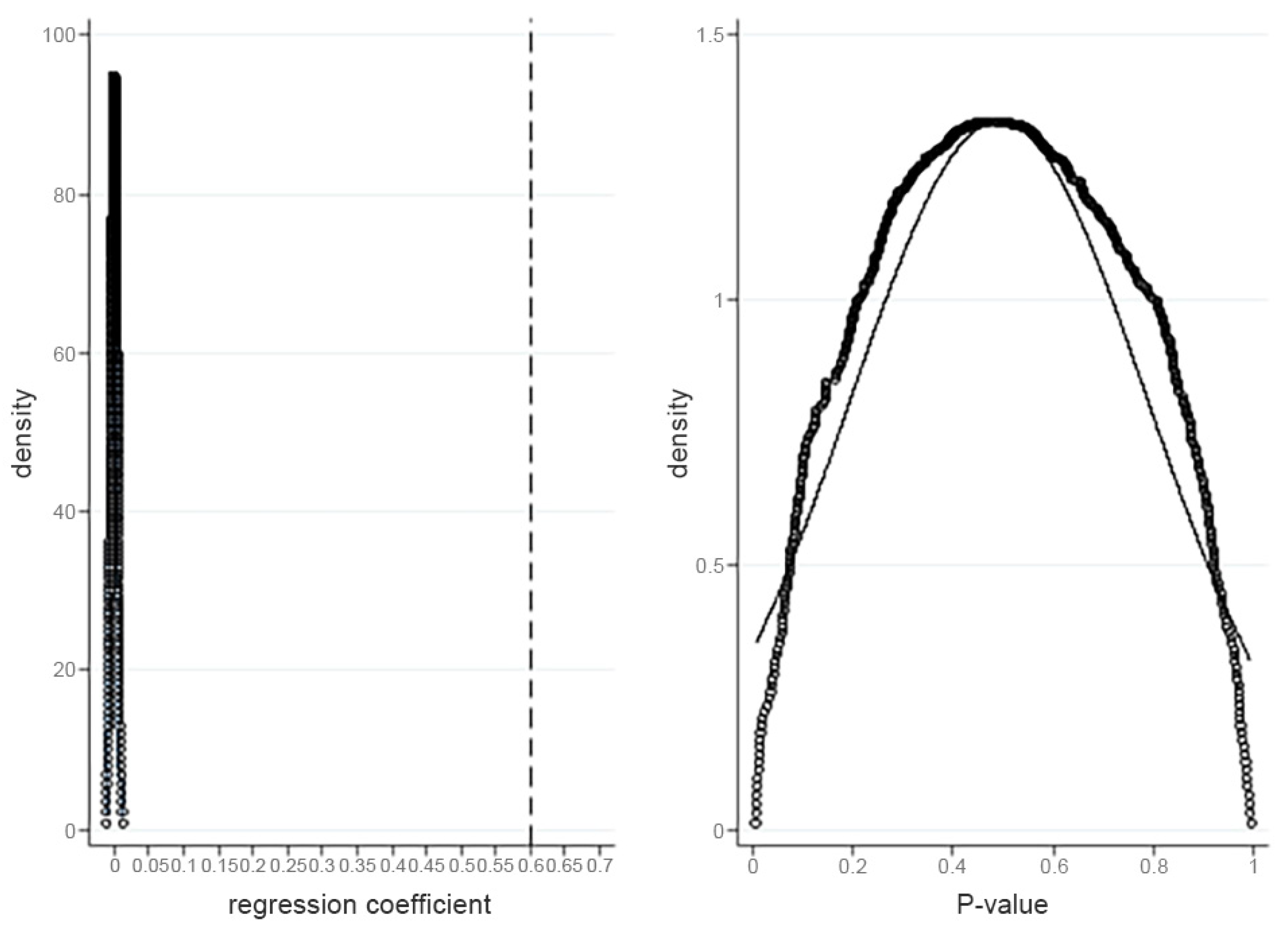
Figure 1. Results of the Placebo Test.
Sustainability 17 11122 g001
Table 1. The Measurement Index System of Rural Sustainable Development.
Target Variable Primary IndicatorsSecondary IndicatorsSpecific IndicatorsInfluence Direction
Rural Sustainable Development Prosperous industriesAgricultural production capacity foundation Total agricultural machinery power per capita+
Comprehensive grain production capacity+
Agricultural production efficiencyAgricultural labor productivity (primary industry output/GDP per capita)+
Level of industrial integrationMain business income of large-scale agricultural product processing enterprises+
Livable ecologyGreen development in agricultureIntensity of pesticide and fertilizer use-
Utilization rate of livestock and poultry manure+
Rural living environmentsProportion of administrative villages with domestic sewage treatment+
Proportion of administrative villages with domestic waste treatment+
Rural sanitary toilet coverage rate+
Rural ecological conservationRural greening coverage rate+
Civilized rural customsEducational attainment of farmersProportion of rural household expenditure on education, culture, and entertainment+
Proportion of qualified teachers in rural compulsory education schools with bachelor’s degrees or above+
Average years of schooling among rural residents+
Transmission of traditional cultureComprehensive population coverage of television programming+
Proportion of administrative villages with internet broadband access+
Rural public cultural developmentNumber of rural cultural stations+
Effective governanceGovernance capabilitiesProportion of villages where the same person holds village chief and Party secretary positions+
Governance initiativesProportion of administrative villages with completed village planning+
Proportion of administrative villages where village revitalization projects have been implemented+
Affluent lifeFarmers’ income levelsPer capita net income of farmers+
Growth rate of per capita rural income+
Urban–rural income ratio-
Rural poverty incidence rate-
Farmers’ consumption structureEngel coefficient of rural residents-
Farmers’ living conditionsNumber of cars per 100 households+
Per capita housing area of rural residents+
Infrastructure development levelVillage road hardening rate+
Basic public service coverage levelNumber of health technicians per 1000 rural residents+
Table 2. Descriptive Statistics of Study Variables.
Variable NameVariable SymbolObservationsMeanStandard DeviationMinimumMedian
Rural Sustainable Development LevelRural32880.3550.1320.0210.935
Rural Sustainable Development Level in Peer Regions R u r a l ¯ 32880.3550.1220.0440.547
Urbanization RateUrban32880.5630.1480.1821
Industrial StructureInd328842.5789.58614.3680.49
Level of Economic DevelopmentGDP32882.5983.130.13432.39
Government interventionGov32880.2020.1020.0440.916
Level of Trade OpennessOpen32880.1870.29902.643
Urbanization Rate in Peer Regions U r b a n ¯ 32880.5630.0820.2690.835
Industrial Structure in Peer Regions I n d ¯ 328842.5786.98826.08780.49
Economic Development Level in Peer Regions G D P ¯ 32882.5981.6150.2499.964
Government Intervention in Peer Regions G O V ¯ 32880.2020.0680.0940.495
Trade Openness Level in Peer Regions O p e n ¯ 32880.1870.1680.0070.753
Table 3. Benchmark Regression Results.
(1)(2)(3)
RuralRuralRural
R u r a l ¯ 0.986 ***0.656 ***0.601 ***
(0.00771)(0.0351)(0.0378)
Urban 0.0211
(0.0133)
Ind 0.000306 *
(0.000173)
GDP 0.00242 ***
(0.000579)
Gov 0.0105
(0.0203)
Open −0.00149
(0.00524)
U r b a n ¯ 0.00971
(0.0255)
I n d ¯ −0.000409
(0.000271)
G D P ¯ 0.000923
(0.00130)
G O V ¯ 0.0557 *
(0.0285)
O p e n ¯ −0.00617
(0.0125)
_cons0.00514 *0.102 ***0.0913 ***
(0.00289)(0.0105)(0.0176)
YearNOYESYES
CityNOYESYES
N328832883288
R20.8330.7050.708
Notes: Values in parentheses are standard errors. Single and triple asterisks (*, ***) indicate statistical significance at the 10% and 1% level.
Table 4. Robustness Check Results.
(1)(2)(3)(4)
Substitution of Explanatory VariablesWinsorization of DataExclusion of Provincial Capital CitiesInstrumental Variable (IV) Approach
The First StageThe Second Stage
R u r a l _ m e d i a n ¯ 0.424 ***
(0.0324)
IV 0.0180 ***
(0.000201)
R u r a l ¯ 0.602 ***0.571 *** 0.621 ***
(0.0368)(0.0393) (0.0442)
_cons0.135 ***0.0849 ***0.0879 *** 3288
(0.0171)(0.0171)(0.0185) 0.708
ControlsYESYESYES YES
YearYESYESYES YES
CityYESYESYES YES
LM statistic 2193.006
Wald F statistic 7992.103
N328832883000
R20.7010.7070.711
Notes: Values in parentheses are standard errors. Triple asterisks (***) indicate statistical significance at the 1% level.
Table 5. Heterogeneity Analysis.
(1)(2)(3)(4)(5)
EastCenterWest2011–20172018–2022
R u r a l ¯ −0.01020.492 ***0.675 ***0.342 ***0.160 *
(0.104)(0.0746)(0.0580)(0.0654)(0.0892)
_cons0.333 ***0.0973 ***0.03610.131 ***0.270 ***
(0.0459)(0.0344)(0.0397)(0.0311)(0.0538)
ControlsYESYESYESYESYES
YearYESYESYESYESYES
CityYESYESYESYESYES
N1164118893619181370
R20.7800.6630.6690.5210.274
Single and triple asterisks (*, ***) indicate statistical significance at the 10% and 1% level.
Table 6. Mechanism Analysis.
(1)(2)(3)(4)
RuralRuralRuralRural
R u r a l ¯ 0.548 ***0.463 ***0.556 ***0.451 ***
(0.0338)(0.0469)(0.0417)(0.0468)
GRR0.0262 ***
(0.00248)
G R R R u r a l ¯ 0.0135 **
(0.00658)
PGDP −0.00540 ***
(0.00118)
P G D P R u r a l ¯ 0.0143 ***
(0.00291)
GAGDP −0.0273 *
(0.0149)
G A G D P R u r a l ¯ 0.0671 *
(0.0368)
AFW −0.000532 ***
(0.000103)
A F W R u r a l ¯ 0.00143 ***
(0.000268)
_cons0.0924 ***0.146 ***0.103 ***0.152 ***
(0.0163)(0.0208)(0.0201)(0.0209)
ControlsYESYESYESYES
YearYESYESYESYES
CityYESYESYESYES
N3014328830143288
R20.7830.7110.6680.711
Notes: Values in parentheses are standard errors. Single, double, and triple asterisks (*, **, ***) indicate statistical significance at the 10%, 5%, and 1% level.
Table 7. Peer Effects Based on Economic Structure.
(1)(2)(3)(4)(5)(6)
RuralRuralRuralRuralRuralRural
The different ranges of the absolute values of economic structure differencesWithin-Province 0–0.050.214 ***
(0.0258)
Within-Province 0.05–0.1 0.175 ***
(0.0221)
Within-Province 0.1–0.15 0.138 ***
(0.0240)
Outside-Province 0–0.05 −0.144 ***
(0.0451)
Outside-Province 0.05–0.1 −0.0458
(0.0471)
Outside-Province 0.1–0.15 −0.0199
(0.0318)
_cons0.205 ***0.213 ***0.219 ***0.284 ***0.299 ***0.278 ***
(0.0124)(0.0122)(0.0131)(0.0254)(0.0280)(0.0220)
ControlsYESYESYESYESYESYES
YearYESYESYESYESYESYES
CityYESYESYESYESYESYES
N313730352213324832623265
R20.6920.6910.6800.6770.6760.675
Notes: Values in parentheses are standard errors. Triple asterisks (***) indicate statistical significance at the 1% level.
Table 8. Peer Effects Based on Geographic Location.
(1)(2)(3)(4)(5)(6)
RuralRuralRuralRuralRuralRural
The different ranges of geographical distance differencesWithin-Province
0–200
0.340 ***
(0.0299)
Within-Province 200–400 0.375 ***
(0.0306)
Within-Province 400–600 0.212 ***
(0.0307)
Outside-Province
0–200
−0.00490
(0.0299)
Outside-Province 200–400 −0.149 ***
(0.0466)
Outside-Province 400–600 −0.157 **
(0.0647)
_cons0.166 ***0.154 ***0.210 ***0.251 ***0.273 ***0.313 ***
(0.0149)(0.0153)(0.0189)(0.0186)(0.0241)(0.0317)
ControlsYESYESYESYESYESYES
YearYESYESYESYESYESYES
CityYESYESYESYESYESYES
N316832401632231631563240
R20.7020.7020.6930.6780.6810.685
Notes: Values in parentheses are standard errors. Double and triple asterisks (**, ***) indicate statistical significance at the 5%, and 1% level.
Disclaimer/Publisher’s Note: The statements, opinions and data contained in all publications are solely those of the individual author(s) and contributor(s) and not of MDPI and/or the editor(s). MDPI and/or the editor(s) disclaim responsibility for any injury to people or property resulting from any ideas, methods, instructions or products referred to in the content.


