1. Introduction
Since the adoption of the UNESCO World Heritage Convention, architectural cultural heritage has been globally recognized as an object of preservation and as a resource of educational, economic, and touristic value [
1,
2]. However, heritage management and conservation encompass more than merely maintaining the physical form of the past; they involve the intricate process of preserving and reinterpreting the memories and meanings embedded within heritage [
3,
4]. Consequently, interpretation and presentation have emerged as key aspects of contemporary heritage management. The interpretation of cultural heritage involves understanding its historical, cultural, and social contexts, facilitating the sharing of its meanings with the public. Presentation, on the other hand, effectively communicates this interpretation, allowing the heritage to be utilized as an educational, social, and tourist resource. Internationally, documents such as the ICOMOS Ename Charter emphasize the significance of interpretation and presentation, proposing a new paradigm for heritage management [
5].
Meanwhile, the concepts of authenticity and integrity have been central to international conservation principles, particularly within the framework of the UNESCO World Heritage Convention and the conservation guidelines established by ICOMOS. These concepts underwent a significant paradigm shift with the adoption of the Nara Document on Authenticity in 1994. The Nara Document acknowledged that authenticity can be interpreted relatively and plurally within diverse cultural and social contexts, thus highlighting the universal value of the heritage concept [
6,
7]. This shift underscored the necessity of integrating regional and cultural specificities, as well as advanced technological approaches, into heritage management beyond traditional preservation methods. In parallel, Pierre Nora, through the concept of Lieux de mémoire (sites of memory), elucidated how specific places become focal points for collective memory. This framework provides an important theoretical basis for the conservation, interpretation, and presentation of cultural heritage [
8,
9]. Similarly, Paul Ricoeur’s exploration of the relationship between memory and forgetting emphasizes that cultural heritage is not merely a reflection of the past but a construct reinterpreted from the perspective of the present [
10]. These discussions suggest that architectural cultural heritage must be understood and remembered not solely as a physical structure but as a multilayered entity embedded in its social significance and historical context [
11,
12].
In particular, the contemporary reinterpretation of heritage authenticity and integrity has emerged as a critical challenge for sustainable heritage management [
3,
13]. Recent studies further emphasize that authenticity must now be evaluated in relation to evolving digital environments and shifting modes of public engagement [
14]. Advances in digital technologies have significantly expanded the scope of these discussions. Technologies such as 3D modeling, virtual reality (VR), augmented reality (AR), holography, and digital-twin systems increasingly support both conservation and interpretation [
15,
16,
17]. These tools make heritage sites that are otherwise impossible or limited to restore physically more accessible to the public, contributing to the preservation and transmission of memory in novel ways [
18]. Moreover, XR-based applications and 3D-scanning technologies have been shown to increase the educational and experiential value of heritage while addressing the limitations of traditional restoration methods [
13,
19,
20]. For instance, recent research demonstrates how immersive simulations can reinstate lost architectural forms or present multiple interpretive scenarios, shaping the ways memory is reconstructed and circulated within contemporary society [
21,
22,
23]. At the same time, scholars caution that such digital reconstructions must be accompanied by ethical guidelines and clear communication of uncertainty to prevent the creation of overly authoritative or misleading narratives [
24,
25].
Mireuksa Temple Site, a UNESCO World Heritage Site in Korea, is a prominent cultural heritage that has undergone various transformations from the Three Kingdoms Period (1st century BCE–7th century CE) to the present. The West and East Pagoda and the Wooden Pagoda site within the temple each represent unique restoration or reconstruction approaches and reflect multiple layers of memory. This case illustrates how quality issues in the restoration process can impact the authenticity and credibility of heritage, highlighting the importance of conservation standards and accountability [
26]. Furthermore, it provides an opportunity to discuss how heritage is consumed and reconstructed in modern society, as the controversy surrounding the East Pagoda reflects tensions between public expectations and heritage management [
27]. The case also shows that digital restoration offers an alternative solution for heritage that is challenging to physically preserve, while maintaining the symbolism and narrative of heritage with multilayered meanings [
2,
28]. This demonstrates how digital technologies enable new interpretations of heritage and contribute to the formation of modern memory. Despite these developments, few studies have directly compared traditional restoration, speculative reconstruction, and digital mediation within a single heritage site. Existing research also lacks analysis of how these different approaches shape cultural memory and influence perceptions of authenticity. This gap is especially evident at Mireuksa, where each pagoda represents a distinct conservation pathway yet has not been examined together within a unified analytical framework.
This study addresses this gap by comparing the three Mireuksa pagodas to clarify the tensions between traditional conservation principles and modern methodologies. In doing so, it proposes a conceptual framework of “memory authenticity,” offering a new lens for evaluating interventions in contexts with fragmentary or lost evidence. The Mireuksa case demonstrates how divergent restoration strategies construct different forms of collective memory, underscoring the need for heritage practices that balance historical integrity with contemporary modes of interpretation.
2. Theoretical Framework
This study draws upon three interrelated theoretical domains—memory studies, the identity of cultural heritage, and the interpretation and presentation of heritage—to explore sustainable approaches to the conservation and communication of architectural cultural heritage. These perspectives establish the conceptual basis for understanding how architectural heritage operates not only as a material remnant but also as a medium that shapes collective identity and memory within a globalized context [
29].
Memory studies provide the core foundation for this investigation. Pierre Nora’s concept of lieux de mémoire emphasizes that heritage sites are not passive physical traces but active nodes in which collective memory is produced, stored, and contested [
9]. Complementing this, theories of “connective memory” clarify how acts of remembering are reshaped through contemporary media environments, allowing memory to circulate, mutate, and expand across digital networks [
15,
30]. Such perspectives help explain how the pagodas at the Mireuksa Temple Site function as symbolic interfaces between the past and the present, mediating cultural identity and public memory in ways that extend beyond their physical remains [
31]. Furthermore, Paul Ricoeur’s account of the dynamic interplay between memory and forgetting highlights that restoration is inherently a process of reinterpretation: the past is not simply recovered but reconfigured through present-day values, expectations, and ethical considerations [
10]. This view positions heritage conservation as a creative and interpretive practice, thereby establishing the theoretical foundation for later differentiating among authentic restoration, speculative reconstruction, and digital mediation as distinct pathways through which memory is constructed and sustained.
The identity of cultural heritage is a crucial determinant of restoration strategies and is closely intertwined with the concepts of authenticity and integrity. The Nara Document on Authenticity stresses that authenticity must be interpreted relationally, rather than by applying a universal standard, because cultural expressions and traditions vary across contexts [
6]. This perspective underscores that restoration should reflect historically embedded meanings rather than pursue the reproduction of a singular physical form. In the case of the Mireuksa pagodas, such an understanding helps illuminate how each restoration pathway embodies a different negotiation between historical evidence, cultural significance, and contemporary values. The idea of “present-centredness” in heritage further reiterates that restoration is not a neutral recovery of the past but an active process through which present-day societies construct identity through their engagement with inherited traces [
32]. This conceptual lens provides a foundation for distinguishing the philosophical and ethical orientations that differentiate authentic restoration, speculative reconstruction, and digital mediation.
The interpretation and presentation of cultural heritage form another key dimension of this theoretical framework, shaping how heritage is communicated, understood, and embedded in public consciousness. At Mireuksa, interpretation strategies aim to articulate the architectural and historical significance of the pagodas in ways that resonate with contemporary publics. Jean Baudrillard’s theory of simulacra highlights the potential of digital representations to both preserve and reframe authenticity by generating new layers of meaning through technologically mediated imagery [
33]. While such digital interventions can broaden access and enhance interpretive clarity, they also carry the risk of producing representations that appear authoritative despite being only partially grounded in evidence. In this respect, digital restoration techniques at the Mireuksa Temple Site operate simultaneously as tools for global dissemination and as agents that reconstruct the meaning of Baekje heritage from a contemporary standpoint. They position the pagodas not simply as reconstructions of the past, but as active mediators in the formation of national memory and regional identity. These theoretical considerations establish the basis for later assessing how each conservation approach—material restoration, physical reconstruction, and digital mediation—constructs and circulates memory differently, and for developing a framework that evaluates their respective conditions of applicability and potential risks.
This theoretical framework clarifies how different modes of heritage engagement—material restoration, physical reconstruction, and digital mediation—operate within a shared continuum of memory construction. It also provides a foundation for understanding how traditional conservation principles can be integrated with digital technologies without compromising the identity of the heritage, as demonstrated at the Mireuksa pagodas. Digital technologies, in particular, offer a viable interpretive pathway when material evidence is scarce or physical restoration is ethically constrained, enabling the visualization of lost forms, the reinterpretation of historical meanings, and the enhancement of educational and affective engagement. By articulating the epistemological and ethical conditions under which such technologies should be applied, this framework bridges the gap between heritage conservation and contemporary modes of representation. It thereby establishes a dynamic platform through which cultural heritage can remain historically grounded, publicly accessible, and meaningfully relevant in evolving social and technological contexts.
3. Methodology
3.1. Research Design & Study Sample
The pagodas at the Mireuksa Temple Site exemplify the architectural style of Baekje (18 BCE–660 CE), which integrated external influences from China, Silla, and other regions while developing a distinct architectural identity. Rather than presenting this solely as historical background, this study incorporates these intercultural dynamics as an analytical framework. Specifically, the concepts of “otherness” and “othering” [
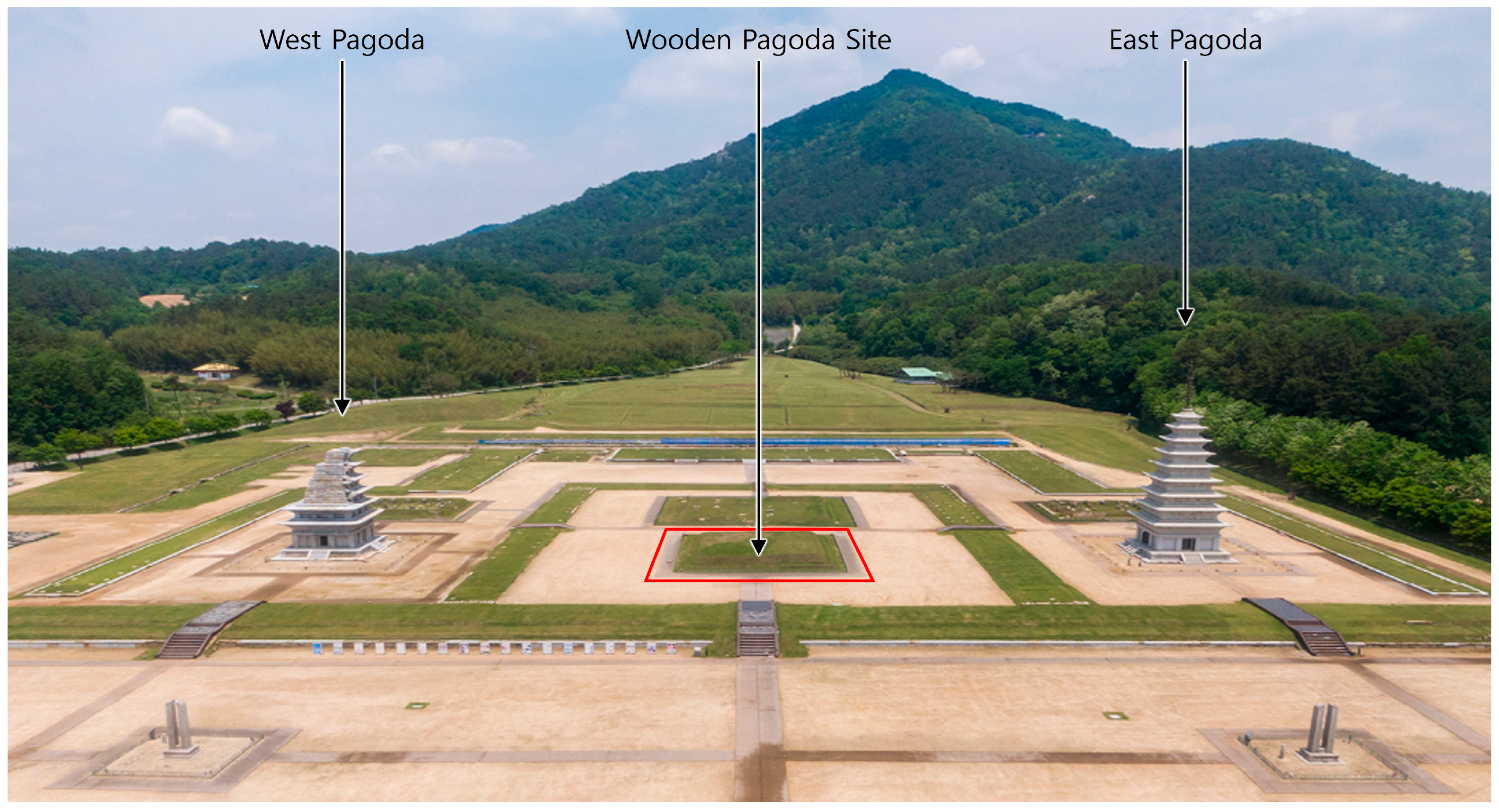
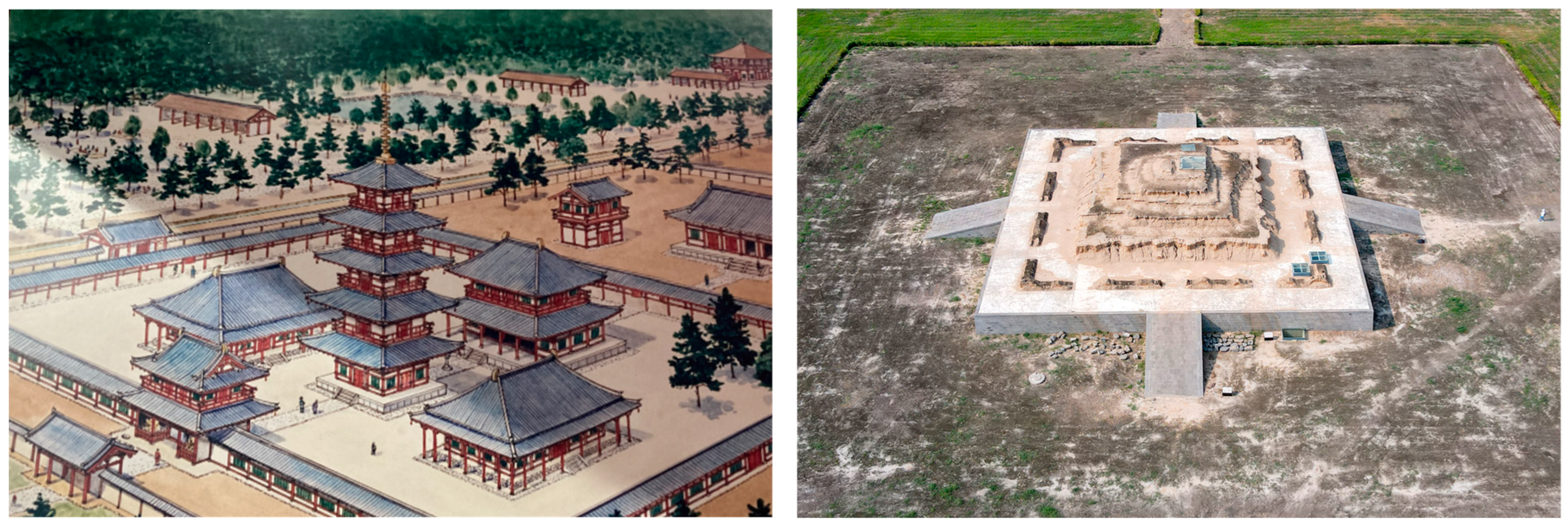
34] are employed as interpretive lenses to examine how each restoration approach constructs—or reconstructs—cultural identity through conservation practices. Building on this framework, the study conducts a comparative analysis of the three pagodas, focusing on restoration, reconstruction, and the application of digital technologies (
Figure 1). A wide range of literature, including academic papers, technical reports, policy documents, UNESCO World Heritage guidelines, and ICOMOS charters, has been reviewed. These sources were systematically evaluated using key international guidelines—particularly the Nara Document on Authenticity and the Ename Charter—to clarify the philosophical criteria applied to each intervention, with an emphasis on authenticity and integrity. The West Pagoda was selected as a representative case of traditional restoration, the East Pagoda as an example of inadequate reconstruction, and the Wooden Pagoda site as a case of modern approaches utilizing digital technologies to enhance the authenticity of cultural heritage. Through these cases, the study identified key issues and success factors by applying a criteria-based thematic analysis grounded in the Nara Document and critical heritage theory. Specifically, issues were coded according to material authenticity, historical verification, interpretive transparency, and public communication. Social and political implications were examined through a cross-analysis of restoration records, policy documents, and scholarly debates, allowing the study to trace how meanings and values assigned to the pagodas have evolved over time [
35]. In particular, the West and East Pagoda cases were examined to analyze how the interpretation and presentation of cultural heritage, grounded in “present-centeredness,” influence the construction of national identity and public perception [
36]. For the Wooden Pagoda site, the study specifically analyzed the use of technologies such as drones and media facade techniques during the digital restoration process, clearly delineating their technical contributions and limitations. Additionally, the research assessed how these technologies impact heritage conservation, interpretation, and presentation by maintaining authenticity while increasing public accessibility.
3.2. Data Collection & Analysis
Meanwhile, the research involved on-site observations conducted through participation in four research outcome presentations held between September 2019 and August 2022 as part of the Mireuksa restoration advisory meetings. During these sessions, the researcher observed presentations by heritage management experts, architects, and technical specialists attempting to reconstruct the original form of the Wooden Pagoda. Observation notes were recorded manually after each meeting, and the analysis drew on both the presented materials and the researcher’s handwritten field notes to examine how technical interpretations and restoration narratives were constructed. This enabled an in-depth understanding of decision-making processes, technical challenges, and ethical considerations during the restoration of the West and East Pagoda. Additionally, direct visits to the Mireuksa Temple Site were conducted to observe the digital reconstruction of the Wooden Pagoda, enhancing the reliability of the research findings. The study employed a comparative analytical framework grounded in memory studies and authenticity theory. Drawing on established discussions of collective memory, cultural identity, and heritage representation [
37,
38], the analysis critically compared the three Mireuksa pagodas as distinct manifestations of remembering—authentic conservation, problematic reconstruction, and digital mediation. This theoretical comparison enabled the study to examine how each intervention constructs, negotiates, or transforms cultural memory. Through this framework, the significance of the Mireuksa cases was evaluated not only in terms of technical interventions but also in relation to how they shape collective identity and the evolving meanings attributed to heritage. Furthermore, the integration of traditional restoration principles with emerging digital practices was assessed as part of a broader theoretical development in contemporary architectural conservation.
4. Case Site Profile: Historical and Spatial Context of the Mireuksa Temple Site
Mireuksa Temple Site, founded during the reign of King Mu of the Baekje Kingdom (600–641 CE), represents one of the most significant temple complexes of ancient Korea. Archaeological investigations conducted from the 1960s onward have revealed that the temple developed through multiple phases, evolving into a large-scale Buddhist complex characterized by a unique one-hall–three-pagoda layout. Among the three pagodas, only the West Pagoda retained substantial structural remains; the East Pagoda and the original Wooden Pagoda survived largely as fragmentary foundations. These archaeological findings shaped the foundation for subsequent conservation decisions, underscoring both the historical richness and interpretive challenges of the site. Following its initial designation as a Historic Site in 1966, Mireuksa Temple Site was integrated into national heritage management frameworks and later included in the Baekje Historic Areas, which were inscribed on the UNESCO World Heritage List in 2015. The site’s heritage designation reflects its significance as material evidence of Baekje’s architectural innovation and cross-cultural interactions within East Asia.
However, the conservation history of the site reveals notable contrasts across time. During the early 1990s, national cultural policies placed emphasis on symbolic reconstruction of monumental heritage as a means to reinforce national identity. This policy environment influenced the decision to reconstruct the East Pagoda despite limited archaeological evidence regarding its original form. In contrast, conservation practices in the early 2000s shifted toward evidence-based restoration, enabling the West Pagoda to undergo a detailed dismantling and restoration process grounded in extensive structural analysis, material research, and technical verification.
Spatially, the temple complex was organized around the Wooden Pagoda at the center, flanked symmetrically by the East and West Stone Pagodas. This spatial configuration embodied Baekje Buddhist cosmology and emphasized ritual orientation along the central axis. The complete loss of the Wooden Pagoda and the modern reconstruction of the East Pagoda have altered the spatial legibility of the site, resulting in a landscape where different conservation strategies—authentic restoration, interpretive reconstruction, and digital mediation—coexist within a single heritage context. Understanding these spatial and historical relationships is essential for interpreting the distinct conservation trajectories of the three pagodas. To consolidate this background,
Table 1 summarizes the major historical and conservation milestones of the Mireuksa Temple Site and the three pagodas.
5. Traditional Restoration: West Pagoda
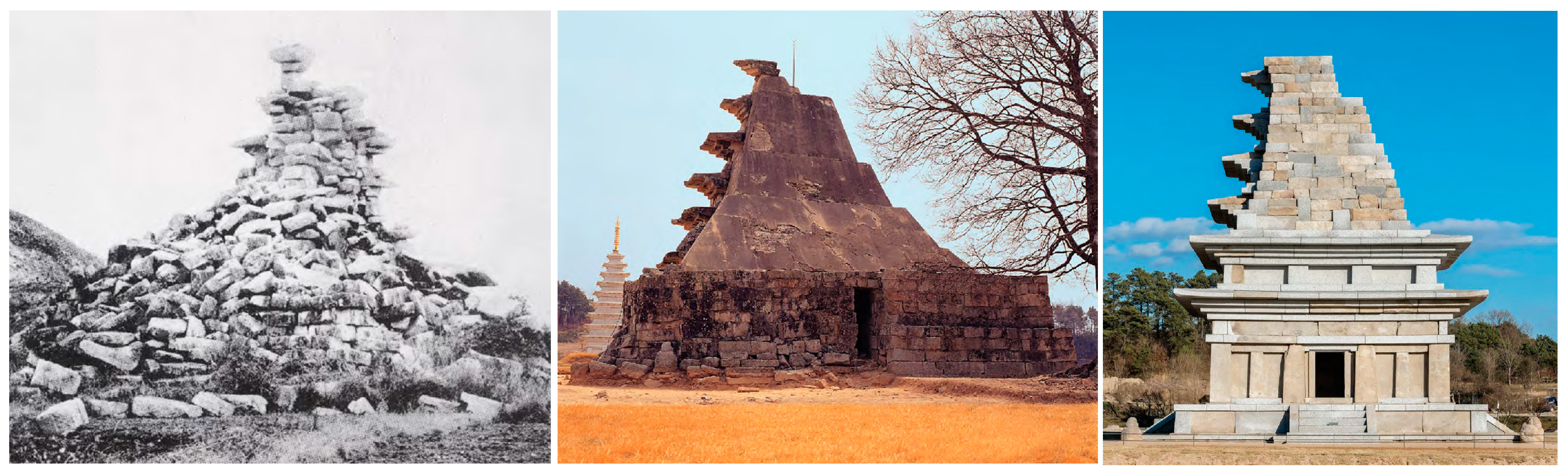
The West Pagoda at Mireuksa Temple Site is a representative heritage structure showcasing the advanced architectural technology of ancient Baekje. Its restoration process has garnered attention not only for its physical reconstruction but also as a case of reconstituting memory and assigning contemporary significance. The West Pagoda was recorded in Geummaji (1756) as the tallest stone pagoda in the East. Over the centuries, however, it was naturally subjected to neglect and deterioration (
Figure 2, left). During the Japanese colonial period (1910–1945), temporary reinforcement using concrete was implemented to prevent its collapse (
Figure 2, center).
This approach reflected the prevailing heritage conservation practices of the time, which often encouraged the use of new materials to recreate heritage in forms that did not originally exist. According to the perspective of Viollet-le-Duc, restoration was not merely about preserving the original state but rather about reconstructing an idealized version of the original using new materials and techniques. However, the use of concrete in the West Pagoda during this period, while aimed at maintaining structural stability, ultimately complicated efforts to recreate the original form. Concepts such as authenticity and integrity were not yet prominent in conservation philosophy during this era, a trend observed not only in Korea but also in Japan. Similar methods were applied to other significant cultural heritage sites, such as Korea’s Seokguram Grotto, where concrete was used for interior reinforcement, a practice entirely disconnected from the monument’s original form. Likewise, major Japanese heritage sites such as Osaka Castle and Nagoya Castle were reinforced with concrete. These practices reflect the technical limitations of the time and provide valuable lessons for the evolution of restoration philosophy, which later shifted to prioritize authenticity and integrity as central tenets.
After the National Cultural Heritage Committee’s decision in 1999 to dismantle and restore the West Pagoda, the restoration work was meticulously carried out over approximately 20 years. During the initial phase, 3D scanning and precision photography technologies were employed to document and analyze the structure and damage of the pagoda, forming the basis for the restoration design. The restoration process included the removal of concrete used during the Japanese colonial period and the dismantling of the pagoda’s components. About 80% of the original undamaged stones were classified for reuse, while damaged components were replaced with materials identical or similar to the original. Traditional stoneworking techniques were combined with modern equipment to produce these replacements with precision. The foundation was reconstructed to ensure structural stability, incorporating modern engineering designs to withstand external shocks such as earthquakes. The components were reassembled to reflect the original form as closely as possible, while reversible materials were used for unavoidable reinforcements to facilitate future restoration. The restoration was completed in 2019 with a structure that maintained some of its collapsed state while ensuring structural stability. This outcome is recognized as a significant example that reflects both the historical significance of the West Pagoda and the principles of contemporary conservation philosophy (
Figure 2, right).
The meticulous restoration process of the West Pagoda over the past two decades represents more than a simple reconstruction of its original form; it is a case of reconstituting its meaning as a (site of memory in the modern context. According to Pierre Nora’s concept of lieux de mémoire, certain monuments and places become focal points of collective memory, distinct from the continuous flow of history [
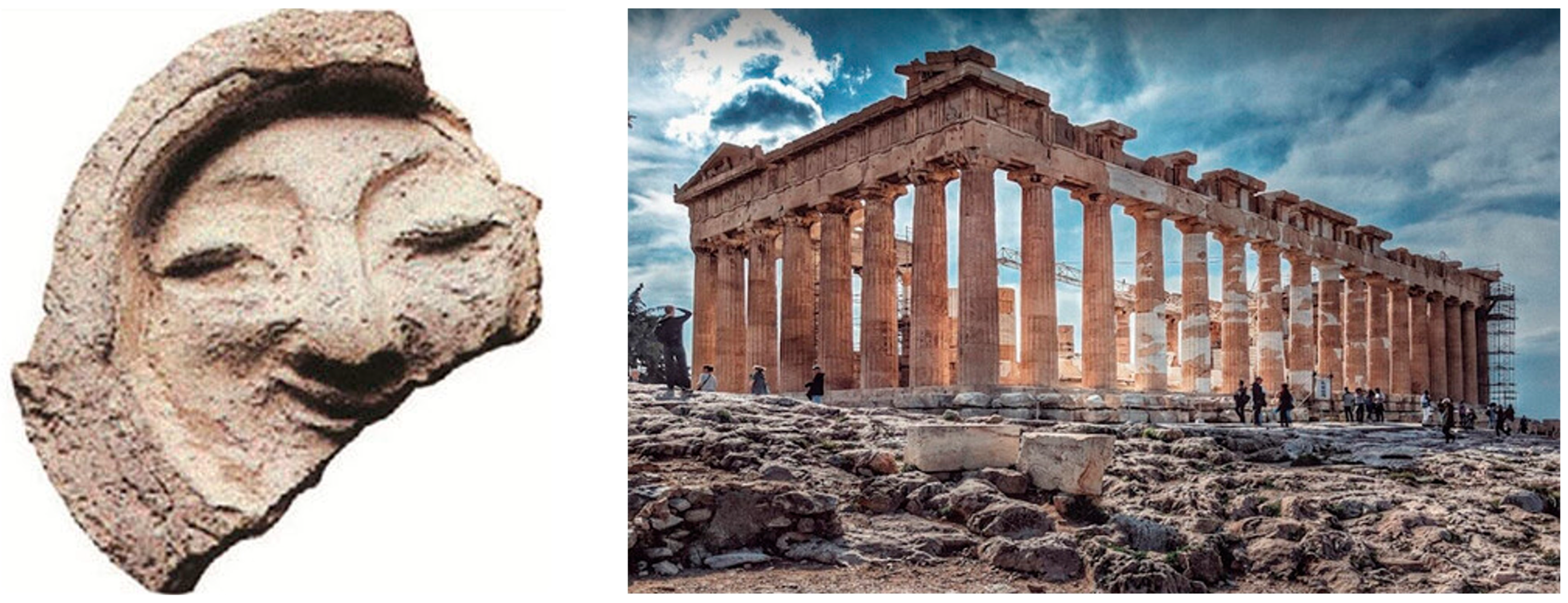
9]. The West Pagoda functions as such a site of memory, reconstructing the architectural techniques and historical legacy of the Baekje era within contemporary societal frameworks. Notably, the decision to retain part of the pagoda’s collapsed state during restoration was a deliberate choice, emphasizing incompleteness over full reproduction. This approach enhances its historical resonance and symbolic significance, allowing the West Pagoda to evoke a deeper emotional connection. The incomplete form conveys the passage of time and the weight of history, making the heritage appear more authentic to the public. This approach is comparable to the case of Korea’s face-patterned roof tiles (sumaksae), which, despite being fragmented and incomplete roof ornaments, are cherished as the “Smile of Silla.” Their imperfection paradoxically amplifies the beauty and aesthetic essence of Silla culture (
Figure 3, left). Similarly, iconic heritage sites such as the Parthenon and the Colosseum retain powerful historical significance and symbolic resonance despite their incomplete states (
Figure 3, right). These examples serve as symbolic mediators, enabling the public to imagine the original context and connect with the past. In this way, the restoration of the West Pagoda goes beyond mere reconstruction of history, functioning as a monument that encapsulates contemporary sensibilities and collective memory while preserving the tangible traces of the past.
This restoration approach reinforces the authenticity and symbolism of cultural heritage, reaffirming its value as connective memory that bridges the past and present [
40]. The restoration process emphasized not only preserving traces of the past but also embedding ethical responsibility and integrity in its execution. Paul Ricoeur views restoration not as a mere physical reconstruction but as an ethical process that reflects on the past while reconfiguring it from the perspective of the present [
10]. In the case of the West Pagoda, damaged components were replaced with new stones crafted from materials similar to the originals, demonstrating a careful effort to maintain a balance between fidelity to the original and necessary alterations. This approach underscores that restoration transcends physical replication, serving as a bridge connecting the past with the present and future. It carries ethical and philosophical significance by preserving the tangible and intangible heritage while adapting to the needs of modernity and sustainability.
6. The East Pagoda as a Case of False Memory
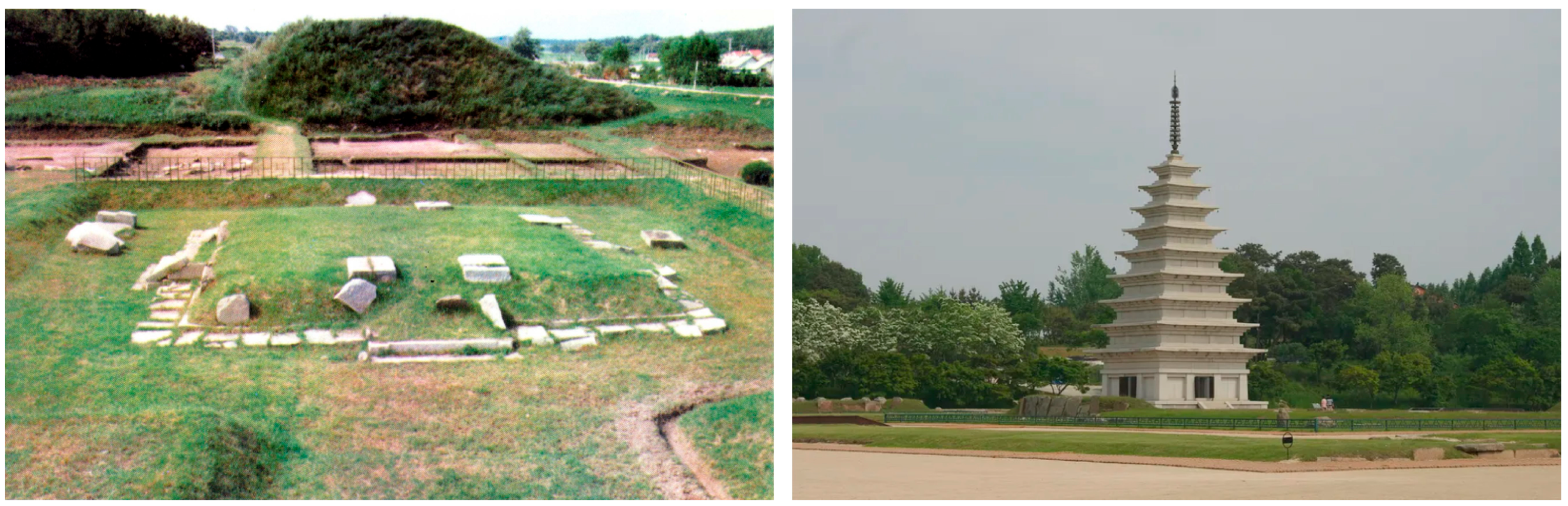
Unlike the West Pagoda, the reconstruction of the East Pagoda at the Mireuksa Temple Site has become a central reference in discussions on authenticity and the interpretation of cultural heritage. Originally built as a counterpart to the West Pagoda, it once represented the architectural refinement of Baekje; however, centuries of deterioration left only fragmentary remains (
Figure 4, left). Despite the limited documentation regarding its original structure and construction techniques, a full reconstruction was undertaken in the early 1990s, reflecting both the heritage policy climate and the technical constraints of the period. The project relied heavily on newly fabricated stones and modern construction methods, incorporating only a small percentage of original components. As a result, the present East Pagoda is largely an interpretive reconstruction shaped by contemporary assumptions rather than verifiable historical evidence (
Figure 4, right).
A major concern is the markedly low reuse of original materials. While the West Pagoda restoration reused approximately 80% of its original stones, the East Pagoda reconstruction is estimated to have incorporated only about 10–15%, replacing most components with newly quarried stones. This discrepancy has led scholars to question the historical authenticity of the rebuilt structure and to characterize it as a modern creation rather than a meaningful transmission of Baekje architectural identity. The absence of comprehensive documentation and insufficient archaeological verification prior to reconstruction further contributed to its speculative nature. Following the project, institutional narratives continued to emphasize the technical success of the reconstruction while offering little reflection on its historical uncertainties. Archaeological surveys conducted during the 1980s and early 1990s—including excavation notes from the Buyeo Cultural Heritage Research Institute and NRICH field assessments—had already indicated that only fragmentary foundation remains survived and that no reliable data existed regarding the East Pagoda’s original elevation, structural system, or construction techniques. Despite these documented limitations, state-led restoration policies of the early 1990s prioritized the visual revival of national monuments, and archival materials such as government project summaries and internal meeting minutes show that these expectations significantly shaped reconstruction decisions. Recent reports—such as the Buyeo Cultural Heritage Research Institute’s assessment [
41] and NRICH [
39] updates from 2018 to 2020—continue to focus primarily on structural stability and foundation conditions, remaining silent on the interpretive constraints inherent in the original reconstruction process. This institutional silence has been interpreted as an unwillingness to revisit the methodological shortcomings of the project. Nonetheless, scholarly and public critiques have pointed to the East Pagoda as an instructive case demonstrating how reconstructions undertaken with limited evidence can unintentionally produce misleading representations of the past. The case underscores the importance of restoration practices that are transparent, well-documented, and grounded in rigorous historical inquiry.
Concerns raised in the East Pagoda case parallel those observed in other East Asian contexts where historical evidence for reconstructing wooden pagodas is fragmentary. At Asuka-dera in Japan, debates from the 1960s through the 1980s centered on whether the original pagoda could be meaningfully rebuilt, given that only foundation stones and limited documentary evidence survive. Heritage scholars argued that reconstructing the pagoda during this period risked producing an authoritative yet unverifiable architectural form, potentially fixing a speculative hypothesis as historical fact (
Figure 5, left). A more recent example appears in China, where digital reconstructions of the Yongning Temple Pagoda—developed primarily from the 2000s onward—are presented as hypothetical visualizations informed by minimal archaeological remains and historical descriptions. Chinese heritage specialists emphasize the importance of clearly communicating the speculative nature of these models to avoid misleading the public about the structure’s original form (
Figure 5, right). Together, these cases show that across different historical periods—whether the postwar reconstruction debates in Japan, the early digital-heritage era in China, or the 1990s heritage-policy environment in Korea—attempts to reconstruct architecturally significant but poorly documented pagodas often risk creating persuasive yet historically uncertain narratives. When evidence is incomplete, reconstructed forms can unintentionally shape collective understandings of the past in ways that extend beyond what the archaeological record can support.
The East Pagoda exemplifies this risk. Its visually coherent and traditional appearance can easily be perceived as historically faithful, even though its form is largely based on modern conjecture. Because physical structures play a powerful role in shaping collective memory, such reconstructions can influence public perception of the past in ways that embed inaccuracies into shared historical consciousness. This dynamic resonates with Elizabeth Loftus’s research on the formation of “false memories,” which demonstrates how fabricated or altered information can be internalized as genuine recollection [
22]. While Loftus focuses on individual cognition, scholars of collective memory note that public institutions, visual media, and built environments play similar roles in shaping shared memories. Eric Hobsbawm’s concept of the “invention of tradition” further illuminates how the past may be selectively reconstructed to support contemporary goals [
12]. The East Pagoda reconstruction reflects not only Baekje heritage but also the sociopolitical environment of 1990s Korea, when large-scale reconstruction projects were frequently used to express national identity. Within this context, the pagoda can be interpreted as a symbolic structure shaped by modern heritage-management aspirations rather than by historical accuracy. Benedict Anderson’s notion of “imagined communities” also offers insight into how such reconstructions contribute to crafting national identity at a collective level [
42], demonstrating that cultural heritage is not a static artifact but a dynamic construct shaped by present-day values and purposes.
7. Digital Technology and the Wooden Pagoda
The Wooden Pagoda at the Mireuksa Temple Site is believed to have been the tallest and most symbolically significant structure, positioned between the two extant stone pagodas. Unlike the West Pagoda—and even more so than the East Pagoda—the Wooden Pagoda is entirely lost, with no surviving architectural remains or reliable documentation. This absence of evidence renders physical reconstruction exceptionally problematic. Lessons from the two stone pagodas illustrate this risk clearly: the East Pagoda reconstruction of the early 1990s revealed how limited archaeological verification can lead to speculative rebuilding and the erosion of authenticity, whereas the West Pagoda restoration (2001–2019) proceeded cautiously, supported by substantial extant fabric and detailed investigation. These contrasting outcomes highlight that physical restoration is viable only when supported by sufficient material and documentary evidence. Given that almost no structural traces of the Wooden Pagoda survive, any attempt at physical reconstruction would necessarily rely on assumptions that risk compromising the historical integrity of the site. Nevertheless, national heritage organizations continue to promote the idea of rebuilding the structure, emphasizing its symbolic and visual importance within the World Heritage landscape. While understandable from a cultural-policy perspective, such efforts raise concerns about the potential repetition of the interpretive and ethical issues exemplified by the East Pagoda. The tension between national identity building and the preservation of historical authenticity underscores the need for a more critical, evidence-based, and ethically grounded approach to the Wooden Pagoda—one that acknowledges the limits of physical restoration and seeks alternative methods for interpreting and communicating its lost form.
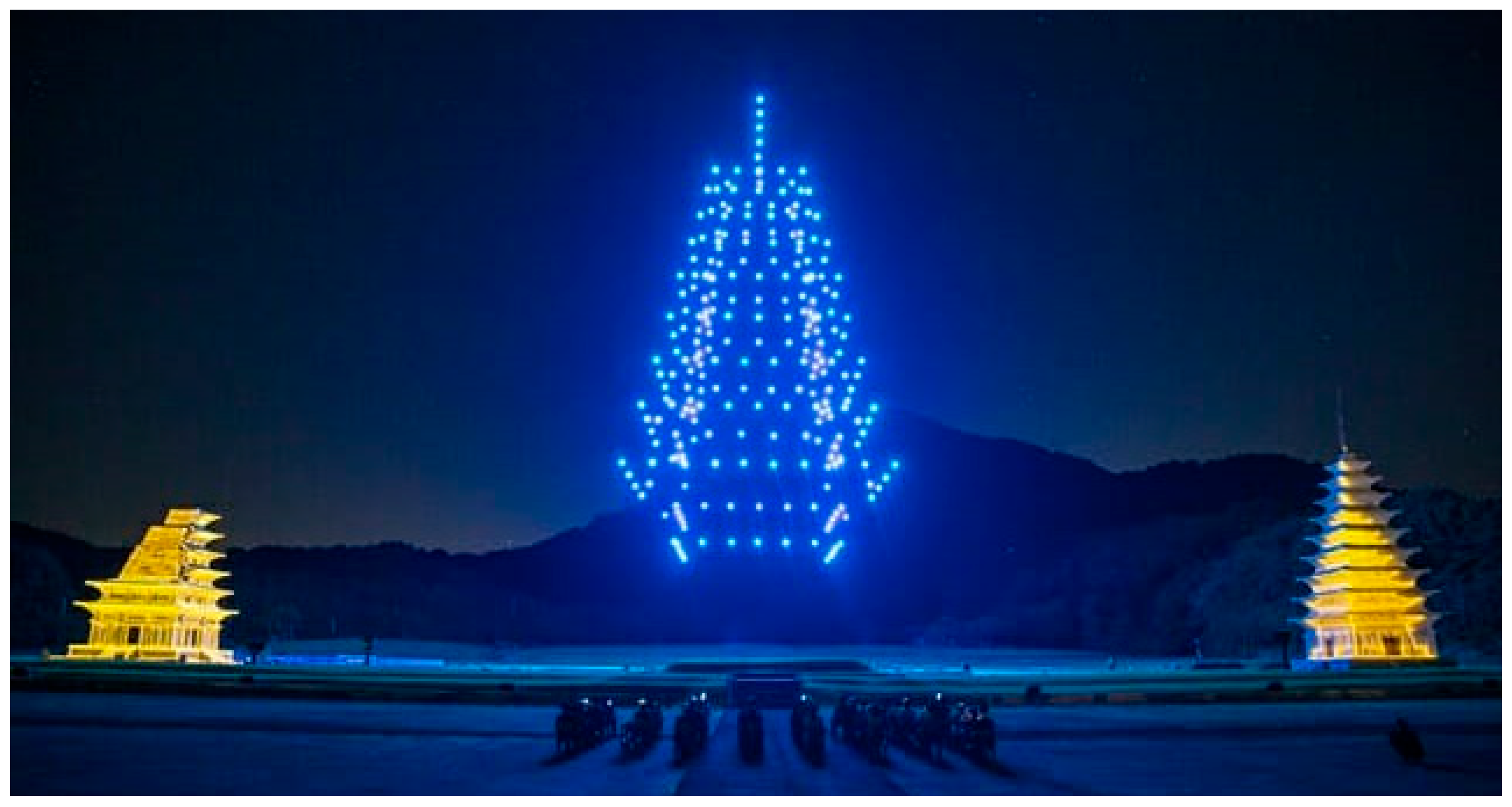
As an alternative to physical reconstruction, recent initiatives have turned toward digitally reimagining the Wooden Pagoda at the Mireuksa Temple Site. Digital heritage tools enable the visualization of structures that cannot be physically restored, offering a means of interpreting absent architecture without compromising material authenticity. The 2023 and 2024 Iksan Mireuksa Media Art Shows exemplify this trend by presenting the Wooden Pagoda through drone-based light formations and media-facade projections (
Figure 6). These events allowed visitors to encounter a three-dimensional representation of the lost pagoda in real time, making the experience more publicly accessible than VR or AR systems that require individual devices. While these digital productions expanded public engagement, their interpretive impact is more complex. Visitor responses, though not systematically documented, suggest that such displays can produce a strong affective experience, shaping how audiences imagine the original structure. Yet this very immediacy raises critical questions: the visual clarity of the drone projections may encourage the public to perceive the representation as historically grounded, even though it is based on hypothetical forms rather than verified evidence. Moreover, the temporal nature of these displays—limited to special events—creates a fleeting mode of engagement that may heighten spectacle but provide limited opportunities for sustained interpretation.
Thus, while digital technologies offer promising alternatives to physical reconstruction, they also risk creating visually persuasive but historically uncertain narratives. The challenge lies not only in expanding access to heritage but in ensuring that digital representations communicate their speculative nature. These issues highlight the need for a framework that can evaluate the historical, experiential, and interpretive dimensions of such digital interventions—an issue addressed in the following discussion on “memory authenticity.” Digital media art at Mireuksa employs contemporary technology to reinterpret the Wooden Pagoda, offering new cultural pathways for engaging with a heritage structure that no longer exists. Such representations inevitably participate in shaping cultural memory by visualizing a past that cannot be reconstructed materially. Jan Assmann notes that digital technologies can support the dissemination and sustainability of cultural memory, a point that resonates with the three-dimensional reimagining of the Wooden Pagoda [
19]. Yet this process is not merely preservational; it actively produces new meanings through selective visualization, foregrounding certain interpretations while obscuring others. Efforts to blend traditional heritage with modern technological forms thus raise broader questions about the conditions under which “authenticity” is preserved or transformed within digital contexts [
43]. While digital media can enhance emotional engagement—an important factor in contemporary heritage experience [
44]—it may also amplify narrative simplification by privileging visually compelling imaginaries over historically grounded interpretation. Andrew Hoskins’s notion of “connective memory” highlights how digital networks facilitate the rapid circulation and reconfiguration of shared memories [
15]. The digital reconstruction of the Wooden Pagoda operates within this milieu, enabling memories to be shared across space and time, but also subjecting them to the volatility and mutability characteristic of digital memory cultures. In this sense, the media-art interpretation of the Wooden Pagoda not only broadens access but also recontextualizes the monument within contemporary aesthetic and technological frameworks. Such recontextualization carries both potential and risk: it can democratize engagement with lost heritage, yet it can also reshape collective understanding in ways that diverge from the historical record. This duality underscores the need for a more explicit evaluative framework—one that considers how digital interventions contribute to, modify, or destabilize the authenticity of cultural memory.
However, the application of digital technologies in heritage interpretation does not guarantee positive outcomes. As seen in debates surrounding the East Pagoda, the globalization of Korean architectural heritage through World Heritage designation can create pressures that encourage visually compelling representations over historically grounded ones. In this context, digital tools may be mobilized to reinforce institutional or promotional narratives, sometimes at the expense of historical nuance. Jean Baudrillard’s concepts of simulacra and simulation highlight this risk: digital reconstructions can produce images that appear authentic while detaching the object from its material and historical referent, generating representations that are more persuasive than accurate [
16,
33]. When such images circulate widely, they may nudge cultural heritage toward a spectacle-driven, theme-park logic, in which symbolic coherence outweighs historical complexity.
These concerns underscore the need for an ethical and critically informed approach to digital heritage practice—one that foregrounds uncertainty rather than masking it through visually polished representations. The Wooden Pagoda case demonstrates that digital technologies can offer meaningful alternatives for presenting lost heritage, but their value depends on how clearly they communicate the provisional nature of their interpretations. When transparently framed, digital methods can complement traditional conservation by providing reversible, accessible forms of engagement that respect the limits of the historical record. To clarify how such digital mediation differs from traditional restoration and imaginative reconstruction more broadly,
Table 2 synthesizes the comparative advantages, risks, and ethical considerations of the three approaches, highlighting the distinct conditions under which each intervention becomes appropriate.
8. Discussion
The three pagodas of the Mireuksa Temple Site—West, East, and Wooden—together illustrate the full spectrum of challenges encountered in architectural heritage interpretation. The West Pagoda demonstrates how substantial surviving fabric enables evidence-based restoration, whereas the East Pagoda reveals the risks of reconstruction undertaken with insufficient archaeological verification. The Wooden Pagoda extends these concerns further: with no remaining architecture, any material reconstruction would inevitably rely on conjecture. These contrasting conditions underscore that authenticity in heritage cannot be understood solely through material survival but must also incorporate how the past is reconstructed, interpreted, and remembered.
This need becomes more apparent when situating the Mireuksa case within broader global traditions of heritage preservation. In the Western context, where stone architecture predominates, ruins often remain visibly present, allowing interpretation to proceed from surviving material evidence. Consequently, digital technologies tend to serve a supplementary role in documentation and public explanation. By contrast, East Asian wooden traditions rarely leave behind complete structures; foundations, traces, and textual references frequently constitute the only surviving evidence. This condition demands greater reliance on visual imagination and digital representation, not as optional embellishment but as a necessary means of engaging the public with largely vanished architectural forms. Thus, contexts such as Mireuksa require authenticity frameworks that extend beyond material concerns.
To address this gap, the concept of memory authenticity is introduced as a complement to traditional authenticity frameworks such as the Nara Document. Memory authenticity refers to the ethical responsibility to ensure that interpretations of lost or fragmentary heritage remain historically grounded, transparent about uncertainty, and reflexive about contemporary influences. It encompasses three interrelated dimensions: (1) historical verifiability, or the obligation to base reconstructions on documented evidence and clearly distinguish hypothetical elements; (2) ethical transparency, which requires communicating the limits of knowledge and avoiding representations that could be misinterpreted as factual; and (3) reflexive mediation, acknowledging that digital tools and institutional priorities inevitably shape how the past is visualized and shared. Together, these dimensions provide a conceptual guide for addressing situations in which material evidence is minimal or absent.
Digital heritage initiatives at Mireuksa demonstrate both the possibilities and limitations of applying this framework. Drone-based light formations and media-facade projections make the Wooden Pagoda accessible to broad public audiences, enabling affective and imaginative engagement without physical reconstruction. Yet their visual immediacy also carries risks: audiences may interpret these displays as historically authoritative despite their hypothetical basis, and the temporality of event-based installations can shift attention toward spectacle over sustained interpretation. These concerns echo Jean Baudrillard’s critique of simulacra, in which representations risk detaching from historical truth and becoming culturally persuasive in their own right. Digital technologies therefore require careful framing to avoid producing compelling but historically uncertain narratives. Operationalizing memory authenticity in practice involves explicitly differentiating between verified information and conjectural elements in digital models; incorporating multilayered interpretive interfaces that allow visitors to view the evidence behind reconstructions; and designing public narratives that acknowledge uncertainty without diminishing engagement. Such approaches enable digital reconstruction to serve as a sustainable tool for heritage interpretation, enhancing access while respecting the limits of the historical record.
This study has several limitations. Visitor responses to digital reconstructions at Mireuksa were not systematically collected, restricting the ability to evaluate interpretive impact empirically. In addition, while the East Asian–Western comparison clarifies structural differences in heritage environments, further cross-cultural research would strengthen these conclusions. Future studies could develop assessment tools for memory authenticity, conduct visitor-based evaluations of digital media, and expand comparative analyses of digital heritage practices. Overall, the Mireuksa case demonstrates that authenticity must be understood not only through material preservation but also through the ethics of memory and representation. By integrating the concept of memory authenticity with digital heritage practices, it is possible to create interpretive approaches that remain historically responsible while accommodating new technological possibilities.
9. Conclusions
This study examined the West, East, and Wooden Pagodas of the Mireuksa Temple Site to reveal how material evidence, cultural memory, and representational strategies interact in shaping heritage authenticity. The three pagodas—one materially preserved, one speculatively reconstructed, and one digitally reimagined—demonstrate that authenticity cannot be defined solely by the survival of physical fabric. Instead, it emerges through the ethical reconstruction, interpretation, and communication of the past. The concept of memory authenticity proposed in this study provides a useful framework for navigating this complexity by emphasizing three key principles: (1) historical verifiability, (2) ethical transparency, and (3) reflexive mediation in cases where evidence is fragmentary or absent.
The East Pagoda case shows how visually compelling reconstructions can shape public understanding in ways that parallel the formation of “false memory,” underscoring the need for communicative clarity and critical disclosure when material evidence is limited. In contrast, the digital reinterpretation of the Wooden Pagoda demonstrates how technologies can support engagement and accessibility while also requiring explicit acknowledgment of uncertainty to avoid producing authoritative yet unverifiable narratives. Beyond the Mireuksa site, these findings offer broader implications for heritage management. First, heritage practitioners may apply a decision-making framework that distinguishes when authentic restoration, modern reconstruction, or digital mediation is appropriate based on the quantity and quality of surviving evidence. Second, the Mireuksa experience highlights the need for institutional safeguards—such as independent review panels, transparent documentation standards, and multi-disciplinary oversight—to prevent state-driven overreach and ensure accountability during reconstruction initiatives. Third, the growing use of digital media calls for digital ethics guidelines that include requirements for disclosing uncertainty, differentiating hypothetical elements from verified information, and preventing the commodification or oversimplification of heritage through spectacle-driven representations.
This study also acknowledges limitations, including the need for systematic visitor research and further cross-cultural comparison of digital mediation practices. Future research may expand the applicability of memory authenticity by developing practical evaluative tools that integrate both material and representational dimensions of heritage. Ultimately, the three Mireuksa pagodas demonstrate that twenty-first-century heritage conservation requires not only safeguarding the physical traces of the past but also ensuring the integrity of the narratives through which the past is experienced and remembered. By linking traditional conservation principles with critical attention to memory, representation, and technological mediation, heritage practitioners can support more sustainable and ethically grounded forms of cultural heritage stewardship.