_Li.png)
An Investigation into the Contextual Effects of Green Organizational Climate in International Tourist Hotels: A Three-Level Analytical Framework


Abstract
1. Introduction
- (1)
- To examine the impact of employees’ brilliance quotient on job satisfaction in international tourism hotels.
- (2)
- To analyze the influence of workplace friendship on employees’ job satisfaction in international tourism hotels.
- (3)
- To investigate the direct effect of green organizational climate on employees’ job satisfaction in international tourism hotels.
- (4)
- To explore the direct effect of green organizational climate on peer workplace friendship in international tourism hotels.
- (5)
- To assess the moderating effect of workplace friendship on the relationship between employees’ brilliance quotient and job satisfaction in international tourism hotels.
- (6)
- To evaluate the moderating effect of green organizational climate on the relationship between employees’ brilliance quotient and job satisfaction in international tourism hotels.
- (7)
- To examine the moderating effect of green organizational climate on the interplay among workplace friendship, employees’ brilliance quotient, and job satisfaction in international tourism hotels.
- (8)
- Based on the empirical findings, to propose actionable recommendations to assist international tourism hotel operators in understanding employees’ perceptions of green organizational climate, workplace friendship, and brilliance quotient, thereby enhancing job satisfaction and improving work quality.
2. Literature Review
2.1. Theory of Green Organizational Climate and Related Research
- (1)
- Structure: The extent to which individuals perceive constraints within the group, such as green regulations and procedural restrictions; the degree to which the organization emphasizes formal rules versus a more relaxed or strict atmosphere.
- (2)
- Responsibility: The degree to which individuals feel empowered to make decisions independently, particularly concerning green environmental tasks and their effective management.
- (3)
- Reward: The perception that successful performance on tasks, including green initiatives, will be fairly rewarded; the fairness and reasonableness of compensation and promotion policies, and the influence of reward or punishment systems on member perceptions.
- (4)
- Risk: The extent to which individuals perceive risk and challenge in green-related work; whether the organization encourages calculated risk-taking or prioritizes safety and conservatism.
- (5)
- Warmth: The overall harmony among personnel regarding green issues; the emphasis on positive interpersonal relations, presence of informal social groups, and the nature of colleague interactions.
- (6)
- Support: The degree of mutual assistance perceived among supervisors and colleagues in green-related work, including trust and support from supervisors.
- (7)
- Standard: Individuals’ perceptions of the importance of organizational goals and performance standards related to green issues; the challenge level of individual and group goals and the value placed on work performance.
- (8)
- Conflict: The extent to which differing opinions on green issues are openly addressed or suppressed among supervisors and colleagues.
- (9)
- Identity: The sense of belonging individuals feel toward the organization concerning green issues; the degree to which they feel valued and cherish their status within the group.
2.2. Theoretical Foundations and Related Studies on Workplace Friendship
2.3. Theoretical Foundations and Related Research on Brilliant Quotient (BQ)
2.4. Theoretical Foundations and Related Research on Job Satisfaction
2.5. Employee-Level Factors (Brilliant Quotient) and Job Satisfaction in Hotels
2.6. Peer-Level Factors (Workplace Friendship) and Job Satisfaction in Hotels
2.7. Organizational-Level Factors (Green Organizational Climate) Affecting Job Satisfaction and Workplace Friendship in Hotels
2.8. Contextual Moderating Effects of Peer-Level (Workplace Friendship) and Organizational-Level (Green Organizational Climate) Factors in Hotels
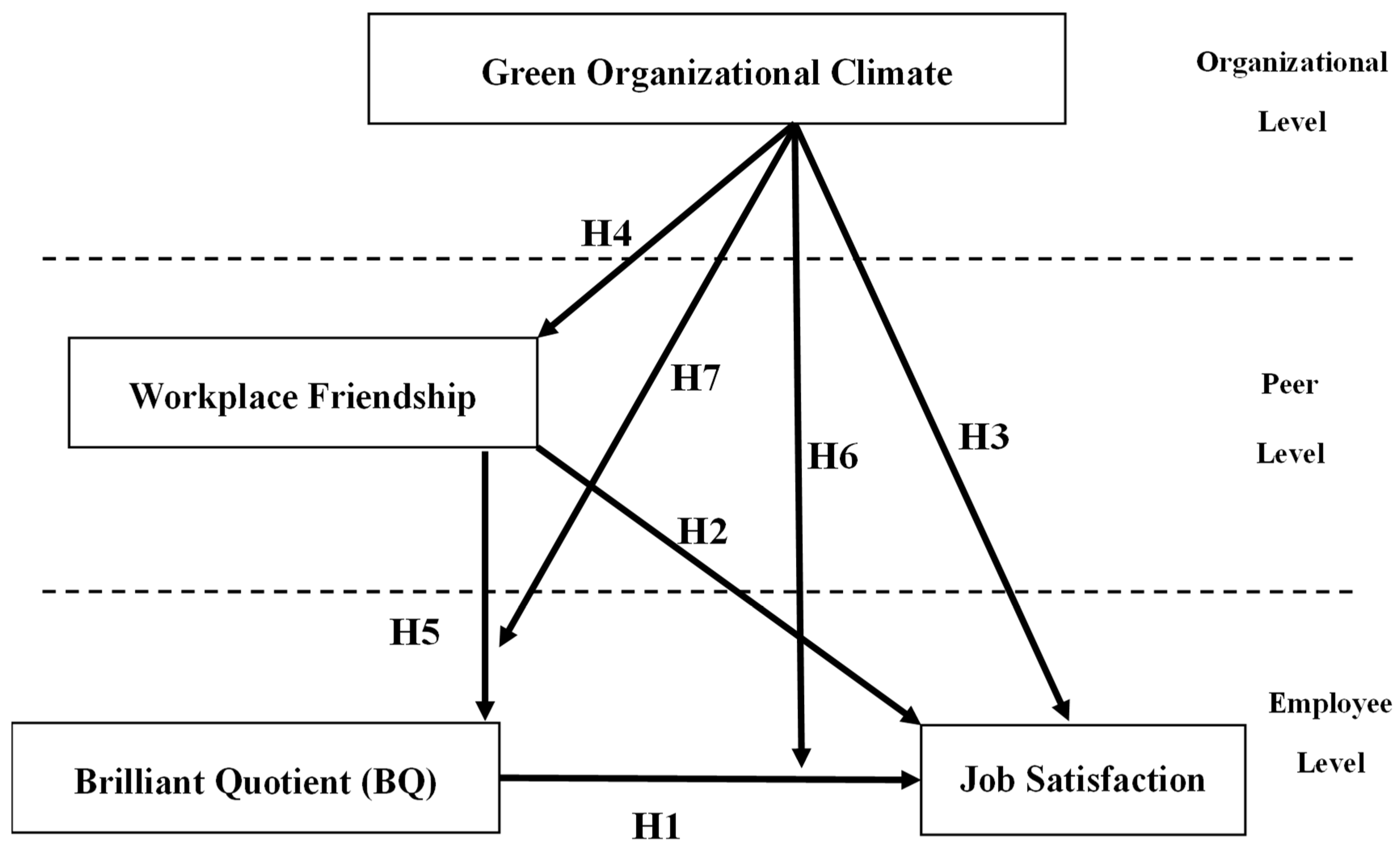
3. Mixed Methods Design
- -
- Organizational Level: Examination of the cross-level direct and moderating effects of the green organizational climate within international tourist hotels.
- -
- Peer Level: Investigation of the cross-level direct and moderating effects of workplace friendship among employees in international tourist hotels.
- -
- Employee Level: Assessment of the influence of employees’ Brilliant Quotient (BQ) on job satisfaction within international tourist hotels.
- -
- Hypothesis 1 (H1): Employees’ Brilliant Quotient in international tourist hotels positively influences job satisfaction.
- -
- Hypothesis 2 (H2:) Workplace friendship in international tourist hotels positively influences employees’ job satisfaction.
- -
- Hypothesis 3 (H3): Green organizational climate in international tourist hotels directly influences employees’ job satisfaction.
- -
- Hypothesis 4 (H4): Green organizational climate in international tourist hotels directly influences peer workplace friendship.
- -
- Hypothesis 5 (H5): Workplace friendship in international tourist hotels moderates the relationship between employee BQ and job satisfaction.
- -
- Hypothesis 6 (H6): Green organizational climate in international tourist hotels moderates the relationship between employee BQ and job satisfaction.
- -
- Hypothesis 7 (H7): Green organizational climate in international tourist hotels moderates the relationships among workplace friendship, employee BQ, and job satisfaction.
3.1. Modified Delphi Technique
3.1.1. Expert Panel Composition
3.1.2. Process Design
- (1)
- Round One: Utilized open-ended questionnaires, which were subsequently synthesized into 38 value proposition indicators.
- (2)
- Round Two: Employed Likert scale scoring and the Content Validity Index (CVI) to confirm content validity. The CVI was calculated at 0.86, surpassing the established threshold. Indicators with importance ratings equal to or exceeding 4.0 on a six-point scale were retained.
- (3)
- Round Three: Conducted a consensus meeting to finalize indicators exhibiting a quartile deviation ≤ 0.5 and a coefficient of variation (CV) below 25%, thereby confirming the final dimensions and indicators.
- (1)
- The Green Organizational Climate Scale converged into six dimensions and six key indicators, comprising a total of 27 items.
- (2)
- The Workplace Friendship Scale was consolidated into two dimensions and two key indicators, encompassing 12 items.
- (3)
- The Brilliant Quotient (BQ) Scale was refined into two dimensions and two key indicators, including 30 items.
- (4)
- The Job Satisfaction Scale was distilled into three dimensions and three key indicators, containing 15 items.
3.1.3. Consensus Criteria
3.2. Research Samples and Sampling Design
3.2.1. Pilot Questionnaire Sampling
3.2.2. Formal Questionnaire Distribution
3.3. Development of Research Instruments and Data Processing
3.3.1. Green Organizational Climate Scale
3.3.2. Workplace Friendship Scale
3.3.3. Brilliant Quotient Scale
3.3.4. Job Satisfaction Scale
4. Research Findings
4.1. Model and Hypothesis Evaluation: Null Model (Model 1)
4.2. Model and Hypothesis Testing: Random Parameter Regression Model (Model 2)
4.3. Cross-Level Analysis: Comprehensive Model Analysis of Workplace Friendship in International Tourism Hotels (Model 3)
4.4. Cross-Level Analysis: Comprehensive Model Analysis of Green Organizational Climate in International Tourism Hotels (Model 4)
5. Conclusions and Recommendations
5.1. Conclusions
5.1.1. Direct Effects on Job Satisfaction
5.1.2. Moderating Role of Friendship Universality
5.1.3. Moderating Effects of Responsibility Goals, Rewards, and Decision Structure
- (1)
- Responsibility goals positively moderate the interaction between Brilliance, friendship universality, and job satisfaction, alleviating the negative moderation imposed by friendship universality alone.
- (2)
- Responsibility goals negatively moderate the interaction between execution ability, friendship opportunities, and job satisfaction, revealing a previously unobserved effect that enhances job satisfaction.
- (3)
- Rewards and decision structure negatively moderate the interaction between friendship universality, execution ability, and job satisfaction, mitigating declines in job satisfaction.
5.1.4. Direct Influence of Responsibility Goals on Supervisors’ Emphasis on Workplace Friendship
5.1.5. Key Research Findings
5.2. Recommendations
5.2.1. Prioritize Enhancement of Employees’ Brilliance, Supervisors’ Friendship Universality, and Responsibility Goals
5.2.2. Recognize Differential Moderating Effects of Friendship Universality on Brilliance and Execution Ability
5.2.3. Leverage Responsibility Goals, Rewards, and Decision Structure to Foster Job Satisfaction
5.2.4. Provide Concrete Support for Supervisors to Cultivate Workplace Friendship
Author Contributions
Funding
Institutional Review Board Statement
Informed Consent Statement
Data Availability Statement
Conflicts of Interest
References
- Bohdanowicz, P.; Martinac, I. Determinants and benchmarking of resource consumption in hotels—Case study of Hilton International and Scandic in Europe. Energy Build. 2007, 39, 82–95. [Google Scholar] [CrossRef]
- Molina-Azorín, J.F.; Claver-Cortés, E.; López-Gamero, M.D.; Tarí, J.J. Green management and financial performance: A literature review. Manag. Decis. 2009, 47, 1080–1100. [Google Scholar] [CrossRef]
- Han, H.; Hsu, L.T.J.; Sheu, C. Application of the theory of planned behavior to green hotel choice: Testing the effect of environmental friendly activities. Tour. Manag. 2010, 31, 325–334. [Google Scholar] [CrossRef]
- Zientara, P.; Zamojska, A. Green organizational climates and employee pro-environmental behaviour in the hotel industry. J. Sustain. Tour. 2018, 26, 1142–1159. [Google Scholar] [CrossRef]
- Chan, E.S.; Wong, S.C. Motivations for ISO 14001 in the hotel industry. Tour. Manag. 2006, 27, 481–492. [Google Scholar] [CrossRef]
- Erbaşi, A. Green Organizational Climate: Measurement Scale Development and Validation to Measure Green Climate Structure in Organizations. Ege Akad. Bakis 2023, 23, 59–74. [Google Scholar] [CrossRef]
- Chou, C.J. Hotels’ environmental policies and employee personal environmental beliefs: Interactions and outcomes. Tour. Manag. 2014, 40, 436–446. [Google Scholar] [CrossRef]
- Mahran, K.; Ibrahim, B.A.; Albarrak, H.; Elamer, A.A. Green workforce in tourism and hospitality: A systematic review and future research agenda. Int. J. Hosp. Manag. 2025, 131, 104325. [Google Scholar] [CrossRef]
- Perez, J.A.E.; Galindo, S.M.; Farooq, M.; Ejaz, S.; Ahmed, S.; Ejaz, F. Examining pro-environmental behavior through green human resource management and green innovation moderating role of environmental strategy. Asia Pac. Manag. Rev. 2025, 30, 100345. [Google Scholar] [CrossRef]
- Liao, P.-W.; Yu, J.; Yu, J.-J. Applying Integrated Technology Acceptance Model and Innovation Diffusion General Model to Multilevel Analysis of Enterprise Digital Learning Adoption. J. Electron. Commer. 2012, 14, 657–688. [Google Scholar]
- Xie, J.-Y.; Liao, P.-W.; Chen, Y.-T.; Que, Z.-H.; Lin, Y.-Y. Does Emotional Labor Get Influenced by Organizational Environmental Factors? An Exploratory Study of Employee Behavior in Public, Private, and Non-Profit Sectors. J. Public Adm. Policy 2015, 61, 101–148. [Google Scholar]
- Pan, S.Y. A review of multilevel analysis in hospitality management. Int. J. Contemp. Hosp. Manag. 2023, 35, 3481–3496. [Google Scholar] [CrossRef]
- Suneera, K.K.; Mavoothu, D.; Sajid, M. Well! Fun forms and friendship uplift frontline employees’ positive affect for workplace well-being in the hospitality industry. J. Hosp. Tour. Insights 2025, 8, 654–673. [Google Scholar] [CrossRef]
- Tufail, M.; Rashid, M.H.U.; Afzal, I. From Culture to Citizenship: How Green Job Crafting Shapes the Impact of Green Organizational Culture on Environmental Behavior. J. Manag. Sci. Res. Rev. 2025, 4, 1658–1675. [Google Scholar] [CrossRef]
- KK, S.; Aboobaker, N.; D, M. Workplace Fun Fosters Employee Wellbeing: Exploring the Roles of Psychosocial Safety Climate and Psychological Capital in the Hospitality Industry. Int. J. Hosp. Tour. Adm. 2025, 1–24. [Google Scholar] [CrossRef]
- Klein, K.J.; Dansereau, F.; Hall, R.J. Level Issues in Theory Development, Data Collection, and Analysis. Acad. Manag. Rev. 1994, 19, 195–229. [Google Scholar] [CrossRef]
- Frances, D.H.; Sandberg, W.R. Friendship within entrepreneurial teams and its association with team and venture performance. Entrep. Theory Pract. 2000, 25, 5–25. [Google Scholar] [CrossRef]
- Lin, Z.-Y.; Zhang, W.-X.; Wu, L.-S. Exploring the Relationship between Workplace Friendship and Job Performance in International Tourist Hotels: The Mediating Role of Outstanding Ability Quotient. J. Sports Leis. Manag. 2022, 19, 82–102. [Google Scholar]
- Leeniwa, J. Competency of Hotel Employees Supporting the Development of Excellent Service Quality in Pattaya, Chonburi Province. HRD J. 2020, 11, 105–117. [Google Scholar]
- Andrade, M.S.; Miller, D.; Westover, J.H. Job Satisfaction in the Hospitality Industry: The Comparative Impacts of Work-Life Balance, Intrinsic Rewards, Extrinsic Rewards, and Work Relations. Am. J. Manag. 2021, 21, 39–56. [Google Scholar] [CrossRef]
- Chauhan, S.; Mishra, J. A study on job satisfaction of the employees in hospitality industry. Int. Res. J. Mod. Eng. Technol. Sci. 2022, 4, 1229–1232. [Google Scholar]
- Saxena, G.; Singh, N. A study on employee job satisfaction in the hotel industry: With special reference to Jaipur city. Aayushi Int. Interdiscip. Res. J. 2023, 10, 15. [Google Scholar]
- Heck, R.H.; Thomas, S.L. An Introduction to Multilevel Modeling Techniques, 2nd ed.; Quantitative Methodology Series; Routledge: New York, NY, USA, 2008. [Google Scholar]
- Hofmann, D.A.; Gavin, M.B. Centering Decisions in Hierarchical Linear Models: Implications for Research in Organizations. J. Manag. 1998, 24, 623–641. [Google Scholar]
- Liao, H.; Chuang, A. A Multilevel Investigation of Factors Influencing Employee Service Performance and Customer Outcomes. Acad. Manag. J. 2004, 47, 41–58. [Google Scholar] [CrossRef]
- Lin, M.; Ling, Q.; Liu, Y.; Hu, R. The effects of service climate and internal service quality on frontline hotel employees’ service-oriented behaviors. Int. J. Hosp. Manag. 2021, 97, 102995. [Google Scholar] [CrossRef]
- Hellriegel, D.; Slocum, J.W. Organizational climate: Measure, researches and contingencies. Acad. Manag. J. 1974, 17, 255–280. [Google Scholar] [CrossRef]
- Gao, R.-X. A Study on the Relationship among Leadership Behavior, Organizational Climate, and Service Quality: A Case Study of Kaohsiung Port Police Bureau. J. Hum. Resour. Manag. 2006, 6, 95–117. [Google Scholar]
- Litwin, G.H.; Stringer, R.A. Motivation and Organizational Climate; Harvard Business School, Division of Research: Cambridge, MA, USA, 1968. [Google Scholar]
- Wang, S.; Jiao, G.; Chen, Y.; Li, Y. Exploring why and when workplace friendship has a differentiated effect on relationship norms and helping behavior: A relationship motivation theory approach. Humanit. Soc. Sci. Commun. 2025, 12, 1533. [Google Scholar] [CrossRef]
- Nielsen, I.K.; Jex, S.M.; Adams, G.A. Development and validation of scores on a two-dimensional workplace friendship scale. Educ. Psychol. Meas. 2000, 60, 628–643. [Google Scholar] [CrossRef]
- Riordan, C.M.; Griffeth, R.W. The opportunity for friendship in the workplace: An underexplored construct. J. Bus. Psychol. 1995, 10, 141–154. [Google Scholar] [CrossRef]
- KPMG. KPMG Survey: Workplace Friendships Linked to 20% Salary Premium Amid Growing Isolation and Labor Market Uncertainty: As Loneliness Surges, 99% of Americans Are Interested in AI Chatbot That Could Become a Close Friend or Trusted Companion at Work. 9 September 2025. Available online: https://kpmg.com/us/en/media/news/friends-at-work-2025.html (accessed on 1 October 2025).
- Islam, T.; Chaudhary, A. Impact of workplace bullying on knowledge hiding: The mediating role of emotional exhaustion and moderating role of workplace friendship. Kybernetes 2024, 53, 238–255. [Google Scholar] [CrossRef]
- Wang, Y.; Lin, Q.; Zhang, S.; Chen, N. Dynamic relationship between workplace friendship and knowledge-sharing behavior: Formation, development and decline. J. Knowl. Manag. 2024, 28, 2038–2061. [Google Scholar] [CrossRef]
- Kumari, T.; Afroz, N. High-Quality Relationships Among Academicians: The Mediating Role of Job Crafting in Enhancing Psychological Well-Being. Educ. Urban Soc. 2025. [Google Scholar] [CrossRef]
- Cheng, Z.-Y.; Yang, Y.-M. Taiwan Workplace Personnel BQ Major Survey; Management Magazine; Commonwealth Publishing: Taipei, Taiwan, 2005; Volume 368, pp. 70–72. [Google Scholar]
- Lin, C.-Y.; Hong, R.-Y. An Empirical Study on the Outstanding Quotient and Organizational Behavior of International Tourist Hotel Employees: A Case Study of Three Major Hotel Chains in Taiwan. Mingxin J. 2008, 34, 1–8. [Google Scholar]
- Liu, J.; Liu, J.; Wang, Y. How to inspire green creativity among Gen Z hotel employees: An investigation of the cross-level effect of green organizational climate. J. Sustain. Tour. 2025, 33, 189–206. [Google Scholar] [CrossRef]
- Hoppock, R. Job Satisfaction; Random Harper: New York, NY, USA, 1935. [Google Scholar]
- Ducharme, L.J.; Martin, J.K. Unrewarding Work, Coworker Support, and Job Satisfaction: A Test of the Burffering Hypothesis. Work Occup. 2000, 27, 223–243. [Google Scholar] [CrossRef]
- Locke, E. The nature and causes of job satisfaction. In Handbook of Industrial and Organizational Psychology; Dunnette, M.D., Ed.; Rand McNally: Chicago, IL, USA, 1976; pp. 1297–1349. [Google Scholar]
- Yang, Y.-F.; Chen, X.-C.; Chen, Q.-Y. A Study on Employee Work Stress and Turnover Intention in Taiwan’s Tourism Industry: Exploring Job Satisfaction as a Moderating Factor. Manag. Sci. Res. 2012, 8, 47–66. [Google Scholar]
- Robbins, S.P.; Judge, T.A. Essentials of Organizational Behavior, 14th ed.; Pearson Education, Inc.: London, UK, 2018. [Google Scholar]
- Alderfer, C.P. Existence, Relatedness, and Growth; The Free Press: New York, NY, USA, 1972. [Google Scholar]
- Li, Y.-M.; Hsu, M.-S. A Study on Internal Marketing and Job Satisfaction of Hotel Employees: A Case Study of Three Different Types of Hotels in Southern Taiwan. J. Sports Leis. Hosp. Res. 2007, 2, 44–60. [Google Scholar]
- Berry, L.L.; Parasuraman, A. Marketing Services: Competing Through Quality; The Free Press: New York, NY, USA, 2004. [Google Scholar]
- Hsu, S.-W.; Yan, W.-S.; Chen, B.-H.; Hsu, Z.-J. Exploring the Relationship between Organizational Learning and Organizational Commitment in Five-Star Hotels with Job Satisfaction as a Mediator. Bus. Manag. Technol. Q. 2015, 16, 427–457. [Google Scholar]
- Agho, A.O.; Mueller, C.W.; Price, J.L. Determinants of Employee Job Satisfaction: An Empirical Test of a Casual Model. Hum. Relat. 1993, 46, 1007–1027. [Google Scholar] [CrossRef]
- Price, J.L. Reflections on the determinants of voluntary turnover. Int. J. Manpow. 2001, 22, 600–624. [Google Scholar] [CrossRef]
- Arnett, D.B.; Laverie, D.A.; McLane, C. Using job satisfaction and pride as internal-marketing tools. Cornell Hotel. Restaur. Adm. Q. 2002, 43, 87–96. [Google Scholar] [CrossRef]
- Williams, L.L. Impact of nurses’ job satisfaction on organizational trust. Health Care Manag. Rev. 2005, 30, 203–211. [Google Scholar] [CrossRef] [PubMed]
- Hsu, S.-W.; Wu, H.-Y. The Relationship among Perceived Work Environment, Job Satisfaction, and Service Quality: A Case Study of Banquet Hall Workers in Greater Taipei Area. J. Hosp. Home Econ. 2009, 6, 33–57. [Google Scholar]
- Purani, K.; Sahadev, S. The moderating role of industrial experience in the job satisfaction, intention to leave relationship: An empirical study among salesmen in India. J. Bus. Ind. Mark. 2008, 23, 475–485. [Google Scholar] [CrossRef]
- Wu, J.-L. The Impact of Volunteer Work Motivation on Job Performance in Non-Profit Organizations: A Case Study of the National Museum of Fine Arts and the National Palace Museum. Master’s Thesis, Graduate Institute of Human Resource Management, Central University, Hsinchu County, Taiwan, 2006. [Google Scholar]
- Zhang, W.-X. A Study on the Relationship Among Travel Agency Employees’ Workplace Friendship, Outstanding Ability Quotient, and Job Performance: A Case Study of Travel Agencies in Kaohsiung City. Ph.D. Dissertation, Graduate Institute of Business Administration, Chang Jung Christian University, Tainan, Taiwan, 2010. [Google Scholar]
- Seashore, S.E.; Taber, T.D. Job satisfaction indicators and their correlates. Am. Behav. Sci. 1975, 18, 333–368. [Google Scholar] [CrossRef]
- Liang, J. A Study on the Relationship between Internal Communication and Quality of Work Life among Highly Educated Underemployed Individuals. Jingwen J. 2004, 43–58. [Google Scholar]
- Glaman, J.H.; Jones, A.P.; Rozelle, R.M. The effects of co-worker similarity on the emergence of affect in work teams. Group Organ. Manag. 1996, 21, 192–215. [Google Scholar] [CrossRef]
- Duck, S.W. Friends, for Life: The Psychology of Close Relationships; St. Martin’s: New York, NY, USA, 1983. [Google Scholar]
- Kirmeyer, S.L.; Lin, T.-R. Social support: Its relationship to observed communication with peers and superiors. Acad. Manag. J. 1987, 30, 138–151. [Google Scholar] [CrossRef]
- Krackhardt, D.; Stern, R. Informal Networks and Organizational Crises: An Experimental Simulation. Soc. Psychol. Q. 1988, 51, 123–140. [Google Scholar] [CrossRef]
- Lin, C.-M.; Yan, W.-W. A Study on Leadership Styles and Workplace Friendship. Multinatl. Enterp. Manag. Rev. 2007, 1, 1–14. [Google Scholar]
- Chen, Y.-Y. A Study on the Impact of Employee Recommendations on Workplace Friendship. Ph.D. Dissertation, Graduate Institute of International Business Management, Chinese Culture University, Taipei, Taiwan, 2005. [Google Scholar]
- Liang, J.; Duan, Y. A Study on the Relationship among Supervisor Support, Self-Efficacy, and Employee Creative Effort. Jingwen J. 2005, 69–86. [Google Scholar]
- Sias, P.M.; Smith, G.; Avdeyeva, T. Sex and sex composition similarities and differences in workplace friendship development. Commun. Stud. 2003, 54, 322–340. [Google Scholar] [CrossRef]
- Rawlins, W.K. Friendship Matters: Communication, Dialectics, and the Life Course; Aldine de Gruyter: New York, NY, USA, 1992. [Google Scholar]
- Kozlowski, S.W.; Klein, K.J. A Multilevel Approach to Theory and Research in Organizations: Contextual, Temporal, and Emergent Process. In Multilevel Theory, Research, and Methods in Organizations: Foundations, Extensions, and New Directions; Klein, K.J., Kozlowski, S.W., Eds.; Jossey-Bass: San Francisco, CA, USA, 2000; pp. 3–90. [Google Scholar]
- Judge, T.A.; Woolf, E.F.; Hurst, C. Is Emotional Labor More Difficult for Some Than for Others? A Multilevel, Experience-Sampling Study. Pers. Psychol. 2009, 62, 57–88. [Google Scholar] [CrossRef]
- Totterdell, P.; Holman, D. Emotion regulation in customer service roles: Testing a model of emotional labor. J. Occup. Health Psychol. 2003, 8, 55. [Google Scholar] [CrossRef] [PubMed]
- Wu, R.-Y.; Li, K.-Q.; Zhang, D.-R. The Impact of ERP System Implementation on Organizational Climate and Job Satisfaction in the IT Department. Electron. Commer. Res. 2008, 6, 229–248. [Google Scholar]
- Adams, J.S. Towards an understanding of inequity. J. Abnorm. Soc. Psychol. 1963, 67, 422. [Google Scholar] [CrossRef]
- Dai, Y. A Study on the Relationships among Organizational Justice, Job Satisfaction, Organizational Commitment, and Organizational Citizenship Behavior of Employees in International Tourist Hotels. Island Tour. Stud. 2010, 3, 26–50. [Google Scholar]
- Lin, Z.-C. The Relationship between Impression Management Motivation and Supervisor-Oriented Organizational Citizenship Behavior from a Multilevel Perspective: The Moderating Role of Social Interaction and Organizational Political Climate. J. Manag. 2007, 24, 93–111. [Google Scholar]
- Zhang, W.-X. The Relationship among Organizational Climate, Emotional Labor, and Job Satisfaction in International Tourist Hotels and the Structural Model Gender Invariance Test. Tour. Manag. Res. 2020, 11, 65–86. [Google Scholar]
- Scott, B.A.; Barnes, C.M. A multilevel field investigation of emotional labor, affect, work withdrawal, and gender. Acad. Manag. J. 2011, 54, 116–136. [Google Scholar] [CrossRef]
- Scott, B.A.; Barnes, C.M.; Wagner, D.T. Chameleonic or consistent? A multilevel investigation of emotional labor variability and self-monitoring. Acad. Manag. J. 2012, 55, 905–926. [Google Scholar] [CrossRef]
- Diefendorff, J.M.; Erickson, R.J.; Grandey, A.A.; Dahling, J.J. Emotional Display Rules as Work Unit Norms: A Multilevel Analysis of Emotional Labor among Nurses. J. Occup. Health Psychol. 2011, 16, 170. [Google Scholar] [CrossRef] [PubMed]
- Sahibzada, Y.A.; Ali, M.; Toru, N.; Farooq Jan, M.; Ellahi, A. Exploitative leadership and green innovative behavior of hospitality employees: Mediation of emotional exhaustion and moderation of perceived organization support. J. Hosp. Tour. Insights 2025, 8, 1847–1866. [Google Scholar] [CrossRef]
- Berman, E.M.; West, J.P.; Richter, M.N. Workplace relations: Friendship patterns and consequences (according to managers). Public Adm. Rev. 2002, 62, 217–230. [Google Scholar] [CrossRef]
- Sias, P.M.; Cahill, D.J. From coworkers to friends: The development of Peer friendships in the workplace. West. J. Commun. 1998, 62, 273–299. [Google Scholar] [CrossRef]
- Chen, S.-L.; Huang, Y.-R. We are unable to locate this document. Please provide us with the DOI or the website address. NTU Manag. Rev. 2014, 25, 129–156. [Google Scholar] [CrossRef]
- Yan, C.-H.; Lin, Y.-Y.; Huang, W.-P.; Deng, X.-Y. A Study on Organizational Justice, Job Security, and Workplace Friendship: A Comparison between Full-Time and Temporary Workers. J. Hum. Resour. Manag. 2011, 11, 47–70. [Google Scholar]
- Rhoades, L.; Eisenberger, R. Perceived organizational support: A review of the literature. J. Appl. Psychol. 2002, 87, 698–714. [Google Scholar] [CrossRef]
- Xie, X.-L.; Lin, H.-M. Does Workplace Friendship Promote Organizational Citizenship Behavior? A Perspective from Equity Shortcut Theory. Labor Relat. Rev. 2011, 17, 60–88. [Google Scholar]
- Raza, S.A.; Khan, K.A. Impact of green human resource practices on hotel environmental performance: The moderating effect of environmental knowledge and individual green values. Int. J. Contemp. Hosp. Manag. 2022, 34, 2154–2175. [Google Scholar] [CrossRef]
- Elshaer, I.A.; Abdelrahman, M.A.; Azazz, A.M.; Alrawad, M.; Fayyad, S. Environmental transformational leadership and green innovation in the hotel industry: Two moderated mediation analyses. Int. J. Environ. Res. Public Health 2022, 19, 16800. [Google Scholar] [CrossRef]
- Alshehri, N.Z.; Baquero, A.; Abd-Elhady, M.H.; Salama, W.M.E.; Khairy, H.A.; Abouelenien, R.E.I. Green HRM and green competitive advantage in hotel and tourism industry: A mediated moderation model using eco-innovation and green psychological climate. GeoJ. Tour. Geosites 2024, 52, 313–322. [Google Scholar] [CrossRef]
- Uslu, F.; Keles, A.; Aytekin, A.; Yayla, O.; Keles, H.; Ergun, G.S.; Tarinc, A. Effect of green human resource management on green psychological climate and environmental green behavior of hotel employees: The moderator roles of environmental sensitivity and altruism. Sustainability 2023, 15, 6017. [Google Scholar] [CrossRef]
- Rehman, S.U.; Elrehail, H.; Alshwayat, D.; Ibrahim, B.; Alami, R. Linking hotel environmental management initiatives and sustainable hotel performance through employees’ eco-friendly behaviour and environmental strategies: A moderated-mediated model. Eur. Bus. Rev. 2023, 35, 184–201. [Google Scholar] [CrossRef]
- Sheikh, A.A.; Shan, A.; Hassan, N.M.; Khan, S.N.; AbdAlatti, A. Impact of green human resource management practices on hotels environmental performance: A mediation and moderation analysis. Sustain. Futures 2024, 8, 100409. [Google Scholar] [CrossRef]
- Liang, R.-Y.; Wei, Z.-X. The Mediating Role of Self-Efficacy in the Relationship between Organizational Climate and Employee Creativity. J. North. Bus. 2013, 24, 47–70. [Google Scholar]
- March, J.G.; Simon, H.A. Organizations; Wiley: New York, NY, USA, 1958. [Google Scholar]
- Staw, B.M. Organizational behavior: A review and reformulation of the field’s outcome variables. Annu. Rev. Psychol. 1984, 35, 627–666. [Google Scholar] [CrossRef]
- Van Gundy, A.B. Organizational creativity and innovation. In Frontiers of Creativity Research: Beyond the Basics; Isaksen, S.G., Ed.; Bearly Limited: Buffalo, NY, USA, 1987; pp. 358–379. [Google Scholar]
- Zhou, J.; George, J.M. When job dissatisfaction leads to creativity: Encouraging the expression of voice. Acad. Manag. J. 2001, 44, 682–696. [Google Scholar] [CrossRef]
- Cummings, A.; Oldham, G.R. Enhancing creativity: Managing work contexts for the high potential employee. Calif. Manag. Rev. 1997, 40, 22–38. [Google Scholar] [CrossRef]
- Xiao, J.-C. A Study on Factors Influencing Student Creativity: A Three-Level Analytical Framework. J. Spec. Educ. 2011, 33, 151–178. [Google Scholar]
- Zhang, W.-X.; Lin, Z.-Y. A Multilevel Analysis of Organizational Climate, Emotional Labor, and Cynicism in International Tourist Hotels. J. Sports Leis. Hosp. Res. 2015, 10, 24–43. [Google Scholar]
- Executive Yuan. Urban and Regional Development Statistical Compilation. 25 September 2025. Available online: https://data.gov.tw/en/datasets/6102 (accessed on 1 October 2025).
- Tourism Bureau, Ministry of Transportation and Communications. Summary Table of Number of Rooms and Hotels in Tourist Hotels. 2025. Available online: https://admin.taiwan.net.tw/businessinfo/FilePage?a=10812 (accessed on 1 October 2025).
- Vroom, V.H. Work and Motivation; Wiley: New York, NY, USA, 1964. [Google Scholar]
- Hallowell, R.; Schlesinger, L.A.; Zornitsdy, J. Internal service quality, customer and job satisfaction: Linkages and implications for management. Hum. Resour. Plan. 1996, 19, 20–31. [Google Scholar]
- Deng, W.-Z.; Lin, M.-R.; Cai, Z.-H. A Study on Employee Job Satisfaction as the Basis for Internal Service Quality Evaluation: A Case Study of International Tourist Hotels. Qual. Mon. 2005, 11, 79–83. [Google Scholar]
- Podsakoff, P.M.; Organ, D.W. Self-reports in organizational research: Problems and prospects. J. Manag. 1986, 12, 531–544. [Google Scholar] [CrossRef]
- Hofmann, D.A. An overview of the logic and rationale of hierarchical linear models. J. Manag. 1977, 23, 732. [Google Scholar] [CrossRef]
- Raudenbush, S.W.; Bryk, A.S. Hierarchical Linear Models: Applications and Data Analysis Methods, 2nd ed.; Sage: Thousand Oaks, CA, USA, 2002. [Google Scholar]
- Fornell, C.; Larcker, D.F. Evaluating structural equation models with unobservable variables and measurement error. J. Mark. Res. 1981, 12, 303–310. [Google Scholar]
- Chen, Z.-C.; Cheng, B.-L.; Chen, X.-F.; Liu, Z.-J. Multivariate Analysis Methods—Application of Statistical Software, 6th ed.; Wu-Nan Book Inc.: Taipei, Taiwan, 2023. [Google Scholar]
- Wen, F.-X.; Qiu, H.-Z. Multilevel Moderated Mediation Effects in Organizational Research: An Empirical Study of Organizational Innovation Climate, Organizational Commitment, and Job Satisfaction. J. Manag. 2009, 26, 189–211. [Google Scholar]
- Xie, J.-Y. Multilevel Analysis: Theory, Methods, and Practice, 2nd ed.; Ding-Mao Publishing: Taipei, Taiwan, 2015. [Google Scholar]
- Wen, F.-X. Multilevel Modeling Methodology: Key Issues and Solutions in Hierarchical Linear Modeling; Economic Management Publishing House: Taipei, Taiwan, 2015. [Google Scholar]
- Xie, J.-Y. HLM Multilevel Linear Analysis: Theory, Methods, and Practice; Ding-Mao Publishing: Taipei, Taiwan, 2010. [Google Scholar]


| Main Dimensions | Key Indicators | Cronbach’s α |
|---|---|---|
| Responsibility and Goals | When addressing green issues, clearly articulated objectives accompanied by explicitly defined accountability structures and performance monitoring systems at both individual and team levels. | 0.90 |
| Interpersonal Relations | When addressing green issues, the prevalence of trust and mutual support among colleagues, encompassing the degree of psychological safety within the workplace environment. | 0.89 |
| Risk | When addressing green issues, the organization’s acceptance of innovation and failure, characterized by opportunities for experimentation, tolerance for trial and error, and the allocation of resources toward such initiatives. | 0.85 |
| Openness | When addressing green issues, the extent of information transparency, freedom of expression, and the efficiency of communication across departmental boundaries. | 0.86 |
| Rewards | When addressing green issues, the degree to which compensation and reward frameworks are aligned with performance outcomes, perceived fairness, and their effectiveness in motivating employees. | 0.91 |
| Decision-Making Structure | When addressing green issues, the clarity in the distribution of decision-making authority and associated processes, including the level of stakeholder participation and the speed of decision execution. | 0.89 |
| Main Dimensions | Key Indicators | Cronbach’s α |
|---|---|---|
| Opportunities for Friendship | Casual interactions among coworkers, the duration of collaborative work, and the regularity of social engagements create conditions conducive to the development of interpersonal friendships. | 0.91 |
| Prevalence of Friendship | This study examines the prevalence of such friendships within the organizational context and assesses the proportion of employees who maintain these relational connections. | 0.90 |
| Main Dimensions | Key Indicators | Cronbach’s α |
|---|---|---|
| Charm | Personal presence and appeal encompass factors such as physical appearance, communicative charisma, and creative expression, all of which contribute to capturing attention and securing recognition. | 0.93 |
| Execution Ability | The effectiveness and quality of plan execution and goal attainment involve aspects such as time management, resource coordination, and the reliability of problem-solving processes. | 0.86 |
| Main Dimensions | Key Indicators | Cronbach’s α |
|---|---|---|
| Company Compensation | The extent to which compensation, benefits, opportunities for advancement, and job security correspond with the level of work effort and prevailing market standards. | 0.91 |
| Self-Expectations | The degree of alignment between individual career objectives and current occupational status, alongside the fulfillment derived from personal development and a sense of accomplishment. | 0.90 |
| Work Competence | The adequacy of existing skills and knowledge for job performance, availability of learning resources, and the regularity and efficacy of professional skill enhancement. | 0.92 |
| Hypothesis Models |
|---|
| 1. The Level 1 independent variables have a direct effect on the dependent variable. |
| 2. The Level 2 moderator variables have a direct effect on the dependent variable. |
| 3. The Level 2 moderator variables moderate the relationship between the independent variables and the dependent variable. |
| Verification Conditions |
| Condition 1: There must be both between-group and within-group variance components in the dependent variable. |
| Condition 2: The Level 1 intercept must exhibit variance. |
| Condition 3: The Level 1 slope must exhibit variance. |
| Condition 4: The variance component of the Level 1 intercept can be explained by Level 2 variables. |
| Condition 5: The variance component of the Level 1 slope can be explained by Level 2 variables. |
| Model 1 | Model 2 | Model 3 | Model 4 | |||||||||
|---|---|---|---|---|---|---|---|---|---|---|---|---|
| Parameter | Standard Error | t-Value | Parameter | Standard Error | t-Value | Parameter | Standard Error | t-Value | Parameter | Standard Error | t-Value | |
| b00 | ||||||||||||
| Average Job Satisfaction of Hotels γ000 | 88.26 | 1.26 | 48.29 * | 95.64 | 1.47 | 49.23 * | 94.98 | 2.02 | 51.08 * | 130.45 | 36.71 | 3.49 * |
| Effect of Average Responsibility Goals of Hotels on Job Satisfaction γ001 | −8.97 | 6.25 | −1.36 | |||||||||
| Effect of Average Interpersonal Relationships of Hotels on Job Satisfaction γ002 | 7.99 | 4.59 | 2.34 * | |||||||||
| Effect of Average Risk of Hotels on Job Satisfaction γ003 | −18.21 | 10.26 | −1.82 | |||||||||
| Effect of Average Openness of Hotels on Job Satisfaction γ004 | 13.51 | 8.21 | 1.57 | |||||||||
| Effect of Average Rewards of Hotels on Job Satisfaction γ005 | −8.9 | 7.91 | −1.72 | |||||||||
| Effect of Average Decision Structure of Hotels on Job Satisfaction γ006 | 7.82 | 7.81 | 2.02 | |||||||||
| b01 | ||||||||||||
| The effect of the average peer friendship opportunities on job satisfaction γ010 | 0.1 | 0.68 | 0.29 | −9.24 | 18.61 | −0.62 | ||||||
| The effect of the average responsibility goals of each hotel on peer friendship opportunities γ011 | 7.91 | 3.15 | 2.61 * | |||||||||
| The effect of the average interpersonal relationships of each hotel on peer friendship opportunities γ012 | −0.81 | 3.83 | −0.29 | |||||||||
| The effect of the average risk of each hotel on peer friendship opportunities γ013 | −2.39 | 7.57 | −0.67 | |||||||||
| The effect of the average openness of each hotel on peer friendship opportunities γ014 | 2.43 | 5.52 | 0.43 | |||||||||
| The effect of the average rewards of each hotel on peer friendship opportunities γ015 | −2.78 | 4.39 | −0.76 | |||||||||
| The effect of the average decision-making structure of each hotel on peer friendship opportunities γ016 | −1.48 | 4.67 | −0.28 | |||||||||
| b02 | ||||||||||||
| The effect of average peer friendship prevalence on job satisfaction γ020 | 0.1 | 0.18 | 2.45 * | 18.31 | 24.90 | 0.74 | ||||||
| The effect of average responsibility goals in each hotel on peer friendship prevalence γ021 | −8.86 | 3.56 | −2.49 * | |||||||||
| The effect of average interpersonal relationships in each hotel on peer friendship prevalence γ022 | 3.64 | 4.57 | 0.84 | |||||||||
| The effect of average risk in each hotel on peer friendship prevalence γ023 | 0.10 | 8.94 | 0.06 | |||||||||
| The effect of average openness in each hotel on peer friendship prevalence γ024 | −2.8 | 6.46 | −0.39 | |||||||||
| The effect of average rewards in each hotel on peer friendship prevalence γ025 | −0.59 | 5.81 | −0.37 | |||||||||
| The effect of average decision-making structure in each hotel on peer friendship prevalence γ026 | 5.29 | 6.48 | 0.66 | |||||||||
| b10 | ||||||||||||
| The Impact of Employee BQ Charm on Job Satisfaction γ100 | 0.38 | 0.21 | 2.35 * | 0.40 | 0.47 | 0.85 | −2.34 | 11.69 | −0.2 | |||
| The Role of Responsibility Goals in the Impact of Employee BQ Charm on Job Satisfaction γ101 | −1.98 | 2.48 | −0.82 | |||||||||
| The Role of Interpersonal Relationships in the Impact of Employee BQ Charm on Job Satisfaction γ102 | −0.22 | 1.63 | −0.21 | |||||||||
| The Role of Risk in the Impact of Employee BQ Charm on Job Satisfaction γ103 | 2.28 | 3.47 | 0.59 | |||||||||
| The Role of Openness in the Impact of Employee BQ Charm on Job Satisfaction γ104 | 2.51 | 2.48 | 0.73 | |||||||||
| The Role of Rewards in the Impact of Employee BQ Charm on Job Satisfaction γ105 | −0.42 | 2.53 | −0.27 | |||||||||
| The Role of Decision-Making Structure in the Impact of Employee BQ Charm on Job Satisfaction γ106 | −1.57 | 2.36 | −0.55 | |||||||||
| b11 | ||||||||||||
| The Impact of Peer Friendship Opportunities on Employees’ BQ Charm and Job Satisfaction γ110 | z | 0.61 | 0.59 | 0.78 | 0.80 | 0.86 | 0.81 | |||||
| b12 | ||||||||||||
| The Influence of Peer Friendship Prevalence on Employee BQ Charm and Job Satisfaction γ120 | −1.65 | 0.69 | −2.53 * | −3.8 | 19.5 | −0.2 | ||||||
| The Influence of Responsibility Goals on Peer Friendship Prevalence, Employee BQ Charm, and Job Satisfaction γ121 | −0.85 | 4.36 | −0.37 | |||||||||
| The Influence of Personal Relationships on Peer Friendship Prevalence, Employee BQ Charm, and Job Satisfaction γ122 | 2.53 | 1.57 | 2.23 * | |||||||||
| The Influence of Risk on Peer Friendship Prevalence, Employee BQ Charm, and Job Satisfaction γ123 | 3.68 | 5.57 | 0.71 | |||||||||
| The Influence of Openness on Peer Friendship Prevalence, Employee BQ Charm, and Job Satisfaction γ124 | 4.84 | 4.86 | −0.45 | |||||||||
| The Influence of Rewards on Peer Friendship Prevalence, Employee BQ Charm, and Job Satisfaction γ125 | −3.33 | 4.16 | −0.75 | |||||||||
| The Influence of Decision-Making Structure on Peer Friendship Prevalence, Employee BQ Charm, and Job Satisfaction γ126 | 0.09 | 5.04 | 0.05 | |||||||||
| b20 | ||||||||||||
| The Impact of Employee BQ Execution on Job Satisfaction γ200 | −0.19 | 0.39 | −0.42 | −0.18 | 0.50 | −0.43 | −2.87 | 10.86 | −0.38 | |||
| The Role of Responsibility Goals in the Impact of Employee BQ Execution on Job Satisfaction γ201 | 3.26 | 2.37 | 1.43 | |||||||||
| The Role of Personal Relationships in the Impact of Employee BQ Execution on Job Satisfaction γ202 | 0.38 | 1.56 | 0.37 | |||||||||
| The Role of Risk in the Impact of Employee BQ Execution on Job Satisfaction γ203 | −4.58 | 3.24 | −1.43 | |||||||||
| The Role of Openness in the Impact of Employee BQ Execution on Job Satisfaction γ204 | 1.45 | 2.48 | 0.54 | |||||||||
| The Role of Rewards in the Impact of Employee BQ Execution on Job Satisfaction γ205 | −1.66 | 3.72 | −0.51 | |||||||||
| b21 | ||||||||||||
| The Impact of Peer Friendship Opportunities on Employee BQ Execution and Job Satisfaction γ210 | 1.22 | 0.47 | 2.91 | −7.56 | 18.62 | −0.39 | ||||||
| The Impact of Responsibility Goals on Peer Friendship Opportunities, Employee BQ Execution, and Job Satisfaction γ211 | 1.82 | 3.87 | 0.55 | |||||||||
| The Impact of Personal Relationships on Peer Friendship Opportunities, Employee BQ Execution, and Job Satisfaction γ212 | 2.97 | 1.41 | 2.31 * | |||||||||
| The Impact of Risk on Peer Friendship Opportunities, Employee BQ Execution, and Job Satisfaction γ213 | −5.76 | 5.47 | −1.16 | |||||||||
| The Impact of Openness on Peer Friendship Opportunities, Employee BQ Execution, and Job Satisfaction γ214 | 3.72 | 4.28 | 0.83 | |||||||||
| The Impact of Rewards on Peer Friendship Opportunities, Employee BQ Execution, and Job Satisfaction γ215 | −5.87 | 3.36 | −1.75 | |||||||||
| The Impact of Decision-Making Structure on Peer Friendship Opportunities, Employee BQ Execution, and Job Satisfaction γ216 | 3.34 | 3.57 | 0.85 | |||||||||
| b22 | ||||||||||||
| The Influence of Peer Friendship Prevalence on Employee BQ Execution and Job Satisfaction γ220 | 1.71 | 0.68 | 2.57 * | −13.63 | 22.77 | −0.60 | ||||||
| The Influence of Responsibility Goals on Peer Friendship Prevalence, Employee BQ Execution, and Job Satisfaction γ221 | −0.28 | 4.84 | −0.10 | |||||||||
| The Influence of Personal Relationships on Peer Friendship Prevalence, Employee BQ Execution, and Job Satisfaction γ222 | −1.58 | 3.55 | −0.49 | |||||||||
| The Influence of Risk on Friendship Prevalence, Employee BQ Execution, and Job Satisfaction γ223 | 9.48 | 7.88 | 1.30 | |||||||||
| The Influence of Openness on Friendship Prevalence, Employee BQ Execution, and Job Satisfaction γ224 | −2.28 | 5.41 | −0.40 | |||||||||
| The Influence of Rewards on Peer Friendship Prevalence, Employee BQ Execution, and Job Satisfaction γ225 | 6.96 | 3.42 | 2.27 * | |||||||||
| The Influence of Decision-Making Structure on Peer Friendship Prevalence, Employee BQ Execution, and Job Satisfaction γ226 | −8.09 | 2.16 | −2.78 * | |||||||||
| Random Effects | ||||||||||||
| Variance Components | χ2 | p | Variance Components | χ2 | p | Variance Components | χ2 | p | Variance Components | χ2 | p | |
| Eijk | 186.53 | 187.54 | 187.85 | 186.96 | ||||||||
| r0jk | 48.84 | 768.55 | 0.000 | 48.48 | 770.56 | 0.000 | 48.67 | 773.21 | 0.000 | 48.79 | 762.24 | 0.000 |
| r1jk | 0.78 | 293.21 | 0.050 | 0.76 | 282 | 0.43 | 1.24 | 286.55 | 0.089 | |||
| u00k | 109.54 | 0.000 | 109.98 | 415.6 | 0.000 | 109.48 | 419.64 | 0.000 | 76.95 | 288.96 | 0.000 | |
Disclaimer/Publisher’s Note: The statements, opinions and data contained in all publications are solely those of the individual author(s) and contributor(s) and not of MDPI and/or the editor(s). MDPI and/or the editor(s) disclaim responsibility for any injury to people or property resulting from any ideas, methods, instructions or products referred to in the content. |
© 2025 by the authors. Licensee MDPI, Basel, Switzerland. This article is an open access article distributed under the terms and conditions of the Creative Commons Attribution (CC BY) license (https://creativecommons.org/licenses/by/4.0/).
Share and Cite
Lin, T.-Y.; Chang, W.-H.; Huang, Y.-Y. An Investigation into the Contextual Effects of Green Organizational Climate in International Tourist Hotels: A Three-Level Analytical Framework. Sustainability 2025, 17, 11096. https://doi.org/10.3390/su172411096
Lin T-Y, Chang W-H, Huang Y-Y. An Investigation into the Contextual Effects of Green Organizational Climate in International Tourist Hotels: A Three-Level Analytical Framework. Sustainability. 2025; 17(24):11096. https://doi.org/10.3390/su172411096
Chicago/Turabian StyleLin, Tzu-Yao, Wei-Hsiung Chang, and Yen-Ying Huang. 2025. "An Investigation into the Contextual Effects of Green Organizational Climate in International Tourist Hotels: A Three-Level Analytical Framework" Sustainability 17, no. 24: 11096. https://doi.org/10.3390/su172411096
APA StyleLin, T.-Y., Chang, W.-H., & Huang, Y.-Y. (2025). An Investigation into the Contextual Effects of Green Organizational Climate in International Tourist Hotels: A Three-Level Analytical Framework. Sustainability, 17(24), 11096. https://doi.org/10.3390/su172411096