Article

A Cloud Model-Based Framework for a Multi-Scale Seismic Robustness Evaluation of Water Supply Networks

School of Urban Construction, Yangtze University, Jingzhou 434000, China
*
Author to whom correspondence should be addressed.
Sustainability 2025, 17(24), 11081; https://doi.org/10.3390/su172411081
Submission received: 7 October 2025 / Revised: 1 December 2025 / Accepted: 6 December 2025 / Published: 10 December 2025

Abstract

This study proposed a cloud model-based framework for assessing the seismic robust-ness of water supply networks (WSN). A multi-scale robustness indicator system was developed, which considers physical-layer attributes (pipe material, length), topological-layer graph characteristics (node degree), and functional-layer hydraulic metrics (water supply adequacy rate). The cloud-probability density evolution method was employed to address parameter uncertainties, while Monte Carlo simulation was used to integrate these three indicators through the cloud composite weighting method to analyze the robustness qualitatively and quantitatively. The proposed method utilizes a forward cloud generator to generate the robustness distribution clouds for both net-work nodes and community-level systems, and its robustness level can be classified according to the standard cloud. A case study demonstrated the practical application of this assessment approach. The presented methodology for evaluating WSN robustness during seismic events provides critical insights for developing disaster prevention plans, formulating emergency response strategies, and implementing targeted seismic reinforcement measures. The integration of cloud theory with probabilistic assessment offers a novel paradigm for infrastructure resilience evaluation under uncertainty.

1. Introduction

With the acceleration of urbanization, the urban population and wealth have become more highly concentrated [1,2,3], resulting in a significant increase in the scale and complexity of urban critical infrastructure (such as water supply networks, power systems, and transportation networks) [4]. While this trend enhances the operational efficiency of cities, it also greatly amplifies the risks posed by earthquakes and other natural disasters, presenting unprecedented challenges to urban infrastructure systems. Earthquakes are characterized by their suddenness and strong destructive power [5] and are often accompanied by various secondary disasters [6], posing a huge threat to urban infrastructure. For instance, in the Wenchuan earthquake in China, the secondary geological disaster triggered by the earthquake severely damaged infrastructure systems, causing the collapse of water supply, power, and communication systems due to pipeline ruptures and tower collapses [7]. Similarly, in the 2015 Nepal earthquake, roads, bridges, and hydropower facilities were severely damaged, causing a nationwide power shortage and difficulties in reconstruction, which had a profound impact on the country’s energy security and economic recovery [8]. Furthermore, in the 2023 Kahramanmaraş earthquake in Turkey, a large number of hospitals, roads, and crucial infrastructures were severely damaged, not only causing massive casualties due to building collapses but also severely reducing the efficiency of post-disaster emergency response [9]. These cases reveal the extreme vulnerability of modern urban infrastructures when they face earthquakes and emphasize the urgency of strengthening their disaster resistance.
As one of the critical infrastructures sustaining normal urban operations, water supply network (WSN) exhibits characteristics such as extensive distribution, complex topological structures, and burial underground. When an earthquake occurs, they are not only prone to large-scale physical damage but may also trigger a cascading functional failure of related systems due to the failure of key pipelines. Moreover, post-disaster repair is often lengthy and challenging. A disruption in water supply not only compromises basic livelihoods but also halts critical emergency activities such as medical rescue and fire rescue [10,11]. Therefore, numerous scholars have conducted research on the resilience assessment [12,13,14,15,16] and enhancement [17,18,19,20,21] of WSN. The central role of robustness within resilience frameworks is well-established. Nariman et al. [22], in their study on the WSN of Sadra City, Iran, highlighted the critical role of robustness strategies based on pipeline vulnerability analysis for establishing repair priorities. And through simulation, it was demonstrated that prioritizing the repair or replacement of critical pipelines can significantly improve the system’s ability to resist seismic shocks and quickly recover functions. Similarly, Hou et al. [23] proposed a seismic resilience assessment framework where robustness, represented by the minimum performance indicator (Fmin), reflects the network’s ability to maintain basic functions post-earthquake. Furthermore, Chen et al. [24] introduced a comprehensive evaluation framework that quantifies robustness through “Residual Functionality after earthquakes”. introduced a comprehensive evaluation framework that quantifies robustness through “Residual Functionality after earthquakes”. These studies indicate that robustness is a critical component in the WSNs resilience assessment. Post-earthquake, WSN functions may degrade or be completely lost, and its robustness directly determines its recovery time and economic losses. Thus, quantitative and qualitative assessment of WSN robustness under seismic hazards is critical.
Different from traditional vulnerability analysis, robustness assessment emphasizes a system’s ability to maintain functional stability under disturbance, encompassing both resistance to hazard intensity and resilience during post-disaster recovery. The Community Resilience Framework (CRF) proposed by the National Institute of Standards and Technology (NIST) explicitly identifies infrastructure system robustness as a key indicator of urban resilience [25]. Existing research on WSN robustness primarily focuses on single-performance assessment [26,27] or seismic damage prediction [28,29]. Agathokleous et al. [30] proposed a dynamic topological robustness assessment framework using betweenness centrality, a graph theory metric, to analyze the WSN. By comparing continuous and intermittent water supply modes, their study revealed that critical network nodes (topological vulnerabilities) dynamically shift with changes in hydraulic conditions. Song et al. [31] developed a dynamic optimization model for the post-earthquake recovery process of WSN, integrating time-varying user demands and phased repair resource supply, and optimizing pipe repair sequences using genetic algorithms to quantify and enhance system recovery resilience. Similarly, Long et al. [32] established a multi-objective optimization framework that not only evaluated performance but also centered on the dynamic process of performance recovery (i.e., resilience) as the core assessment focus, with the ultimate goal of enhancing resilience. Additionally, Haghighi et al. [33] developed an artificial neural network (ANN) seismic damage prediction model using multi-layer perceptrons (MLPs) combined with the Levenberg–Marquardt algorithm (LMA). This model was based on buried pipeline seismic strain data extracted from 720 ABAQUS numerical simulations (with experimental validation error < 10%). This model successfully predicted the number of pipe breaks and leaks in Districts 1-4 of the WSN in Tehran under five seismic scenarios, providing data support for seismic resilience assessment. Although these studies assess network seismic performance from different dimensions, they lack an integrated methodology that comprehensively considers multidimensional factors such as system topology, material properties, hydraulic characteristics, and external environments. This limitation hinders accurate prediction of the overall seismic performance of network systems in practical engineering, as well as the provision of precise decision support for resilience enhancement.
Current seismic assessment research on WSN is primarily divided into three directions: empirical seismic damage prediction methods, physics-based numerical simulation methods, and data-driven statistical analysis methods. Empirical methods (e.g., HAZUS model) establish pipeline fragility curves using historical seismic damage data; while simple to operate, their accuracy is limited [34,35]. Numerical simulation methods (e.g., EPANET-Seismic) can characterize in detail the hydraulic–structural coupling behavior of networks but involve high computational complexity and depend on precise input parameters [30,36,37]. Statistical methods (e.g., machine learning models) excel at processing massive monitoring data but suffer from poor interpretability and require high-quality training samples [38,39]. Despite their respective advantages, these methods share several common shortcomings: First, existing assessments primarily focus on system failure under “worst-case scenarios” while neglecting the gradient impacts of spatial variability and temporal characteristics of ground motion parameters (e.g., peak ground acceleration (PGA), peak ground velocity (PGV)) on network performance. In reality, network responses exhibit distinct nonlinear features, and the performance degradation mechanisms under low-probability extreme events may fundamentally differ from those under frequent earthquakes [40]. Second, traditional methods struggle to quantify cognitive uncertainty (e.g., model errors) and random uncertainty (e.g., material parameter dispersion) in assessments. Additionally, most studies use deterministic indicators (e.g., node service rate) to measure system performance, failing to reflect the common need for fuzzy judgments in engineering decisions. In practical management, decision-makers often require qualitative evaluations such as “high/medium/low risk,” yet existing methods lack a bridge to convert precise numerical values into fuzzy concepts.
Cloud Model (CM), as a mathematical tool capable of handling the dual uncertainties of randomness and fuzziness, provides a feasible path to make up for the above-mentioned deficiencies. At present, the CM has been widely applied in fields such as intelligent control [41,42], prediction [43,44], and comprehensive assessment [45,46]. Yang et al. [47] proposed a risk assessment model for mountain torrent disasters based on the combined AHP-entropy weight method and normal cloud model. By establishing a hybrid weighting evaluation system and a cloud generator algorithm, the model enables the precise quantification of disaster risk levels as well as their internal relative probabilities. Xu et al. [48] developed a method for evaluating the suspension bridge condition based on the Normal Cloud Model (NCM), which utilizes the NCM to describe the fuzziness and randomness in the evaluation process, thereby supporting the assessment of the bridge condition comprehensively. The above studies show that it is feasible to deal with double uncertainty in complex system evaluation with CM.
Therefore, based on the previous research, to systematically address the limitations of existing methods in quantifying uncertainties and transforming qualitative concepts, this paper proposes a new cloud model (CM)-based framework for evaluating the seismic robustness of WSN. First, the initial nodal water demand is determined through analyzing the WSN hydraulically. Subsequently, the failure probability of the pipes is determined, and the failed pipelines are identified with a Monte Carlo simulation. The failed pipelines are then closed to determine failed nodes, and the network topology is updated. Hydraulic analysis of the updated network is performed to quantify node water demand deficits caused by pipe failures. Finally, node and network robustness are evaluated using three indicators: structural failure of network nodes, changes in node degree distribution, and node water shortage. Since a single random trial is insufficient to fully capture the probabilistic nature of pipe failures, multiple random trials are conducted to generate diverse network damage patterns and obtain sufficient samples. Following this, the robustness is analyzed qualitatively and quantitatively by using a cloud model (CM). Clouds representing community WSN and node robustness distributions are generated to analyze node robustness, and node/community robustness levels are then determined based on robustness classification standard clouds. A numerical example is provided to illustrate the application of the proposed robustness analysis method for WSN.

2. Methodology

2.1. Selecting Quantitative Robustness Indicators

To evaluate WSN resilience, it is crucial to select appropriate indicators to assess the WSN performance loss. Given the extensive research on earthquake impacts, various methods have been developed to assess WSN reliability and availability after earthquakes. Some researchers, based on graph theory, have determined the WSN performance by adopting indicators related to complex networks. For example, Ulusoy et al. [49] proposed a method for evaluating the WSN resilience based on Water Flow Edge Betweenness Centrality (WFEBC), which combines the current flow betweenness centrality in graph theory with the principle of pipe head loss. Sheikholeslami and Kaveh [50] selected graph theory metrics related to network robustness (such as connectivity, edge connectivity, and diameter) to assess the WSN vulnerability under component failures and applied them to the analysis of three different benchmark WSNs. Pagano et al. [51] proposed a pipe ranking method that integrates multiple graph-theoretic metrics (such as algebraic connectivity, central point dominance, and average path length) with Bayesian Belief Networks. This approach evaluates the resilience of WSN by simulating single-pipe failures for network degradation analysis, and was successfully applied and validated in a real Italian WSN. However, complex network metrics merely indicate topological structural changes after disasters and fail to reflect the satisfaction with the regional water demand served by the WSN. Therefore, several researchers have evaluated the WSN performance by considering whether the water supply demands at the nodes are met and the water pressure conditions, etc. Cimellaro et al. [52] quantified system performance using three criteria: the number of households with interrupted water supply, water tank water level, and water quality; Liu et al. [37] further quantified the WSN performance by considering the satisfaction of consumers’ node demands which is determined by the ratio of the required water head changes in the WSN. Based on the aforementioned research, some researchers have proposed integrating network topology and water supply demand to quantify performance more comprehensively. For instance, Hou et al. [53] evaluated nodal importance by considering user nodes’ roles in daily supply, post-earthquake emergency response, and inter-nodal water transmission, employing multiple metrics including routine service functionality, post-disaster rescue capacity, and topological influence; Zhang et al. [54] assessed nodal significance through the integration of nodal demand satisfaction rate and structural importance within the network. Ultimately, the selection of metrics for quantifying WSN performance has progressively evolved toward greater comprehensiveness. However, these metrics have largely overlooked the intrinsic structural attributes of pipelines and nodes within the network—specifically, structural failures induced by seismic events. To address this gap, this paper develops a composite quantification framework incorporating structural, topological, and operational metrics to evaluate the WSN robustness. The specific methodologies for indicator acquisition and quantification are detailed in Section 2.2.

2.2. Quantifying WSN Robustness

Analyzing the robustness of the WSN requires the collection of fundamental information. Based on the specific conditions of the WSN within the community, relevant data about nodes and pipelines is obtained through methods such as reviewing design drawings and conducting field surveys, supplemented by querying the Geographic Information System (GIS) database. The essential foundational information of the WSN includes its topological structure, number of nodes, elevation data, node water demand, number of pipes, pipe diameters, and pipe lengths.
By determining the area serving each node in the WSN, the community is partitioned into N nodal zones. Based on the research of [17,52], a comprehensive quantitative metric is proposed to quantify the WSN robustness which integrates the structural attributes, topological attributes and operational characteristics of WSNs. The performance loss of the node i is quantified in two steps: (1) identifying pipeline failures through probabilistic failure simulation; (2) determining the node water shortage serving the node i through hydraulic analysis. The nodal performance loss is mainly determined by three factors: structural failure, changes in the degree distribution, and water shortage. The performance loss of the node i can be calculated by Equation (1). The robustness of node i (R(i)) is calculated using Equation (2), while the robustness of the WSN (R) is calculated using Equation (3):
F l o s s ( i ) = α 1 F i s + α 2 F i d + α 3 F i q
R i = 1 F l o s s ( i )
R = 1 N i = 1 N R ( i )
where Floss(i) refers to the performance loss of node i. Fis represents the result from analyzing nodal structural failure, Fid refers to the result from analyzing nodal degree distribution, Fiq denotes the water shortage analysis result. When each of the pipelines linked to node i is in failure, Fis, Fid, and Fiq are set to 1; otherwise, Fis = 0, Fid and Fiq are calculated by Equation (8) and Equation (10), respectively. The specific methods can be found in Section 2.2.1, Section 2.2.2 and Section 2.2.3. a1, a2, and a3 represent the weights for structural failure, degree distribution, and water shortage, which were determined based on expert recommendations in this paper (where node numbers correspond to WSN node numbers). F(i) refers to the robustness of node i. F is the WSN robustness. N is the total number of nodes.
Conducting a simulation of the WSN requires determining its topological structure. Pipelines can be represented as edges in the topological structure, while nodes comprise connection points between pipelines, nodes supplying water (e.g., water supply plants, storage tanks), and nodes requiring water. Edges connect the nodes. Then, the WSN can be represented by an interconnected graph G = (U, L, W). Here, U = {uii ∈ {1, 2, …, N} }refers to the nodal collection. L = {lij = (ui, uj)│i, j ∈ {1, 2, …, N} ⊆ U × U} represents edges set. The connectivity matrix with all non-negative elements is defined as W = (wij)N×N. wij is determined by Equation (4) based on graph theory [55]:
w i j = 1 0 u i , u j L ( u i , u j ) L
If a pipeline connects nodes ui and node uj, then wij = 1; otherwise, wij = 0.

2.2.1. Node Structural Failure Analysis

Owing to its extensive distribution and complex structure, WSN exhibits highly uncertain damage under seismic action, influenced by factors such as ground motion intensity, pipeline structural characteristics, and complex soil conditions. Therefore, considering these factors as random variables is necessary in its seismic performance analysis. Furthermore, based on pipeline failure probability, its damage state after earthquakes is determined by employing probabilistic models, thereby calculating seismic performance. Consequently, a Poisson distribution is assumed to apply to pipeline damage along its length. Additionally, its damage among distinct pipelines is assumed to be statistically independent in the post-earthquake [56]. Therefore, the failure probability of a pipeline can be determined by using the widely applied exponential distribution model (Equation (5)) in the reliability analysis of the WSN [57].
P f P = 1 exp ( R R L p )
ln ( R R ) = 1.21 ln ( P G V ) 6.81 , ( C a s t   i r o n   p i p e s ) 1.84 ln ( P G V ) 9.40 , ( D u c t i l e   i r o n   p i p e ) 0.75 ln ( P G V ) 4.80 , ( S t e e l   p i p e , d i a m e t e r 600   mm ) 2.59 ln ( P G V ) 14.16 , ( S t e e l   p i p e , d i a m e t e r < 600   mm )
where Pfp refers to the pipeline failure probability, Lp represents its length (km). RR is its mean seismic damage density (damaged points/km). The correlation linking RR and seismic intensity PGV) was determined through the calculation equation fitted by Jeon and O’Rourke [58] and Wang [59] based on the seismic damage data of the Northridge earthquake water supply pipeline in 1994, as referenced in Equation (6).
The Pfp for each pipeline is converted into a specific failure mode as follows: First, a random number generator produces a random vector Y = [y1, y2, …, yr, …, yn], where each element Yr follows a random distribution Yr~Unif (0, 1). Yr corresponds to pipeline r in the WSN. For each pipeline r, its failure probability Pfpr is compared with the corresponding random number Yr. When Pfpryr, it means that the pipeline r is in failure and needs to be deleted in the WSN. Conversely, the pipeline r is normal. Ultimately, the WSN state is determined.
After identifying all failed pipelines, nodal connection status is analyzed. Fis, Fid, and Fiq are set to 1 when pipelines connected to node i are in a failure. Otherwise, Fis is set to 0, while Fid and Fiq are calculated according to Equations (8) and (10), respectively.

2.2.2. Node Water Shortages Analysis

To quantify the actual impact of earthquakes on the functionality of the WSN, the hydraulic performance of the network after the earthquake must be assessed. Earthquakes can cause pipeline ruptures or other damage, leading to their failure. Such earthquake-induced failures are simulated by closing the corresponding failed pipelines, which in turn alter the physical topological structure and hydraulic characteristics of the WSN. Hydraulic analysis of the water supply network adheres to three fundamental hydraulic equations. Therefore, to assess the impact, these hydraulic equations must be solved based on the new topological structure of the post-earthquake network to determine related parameters in the WSN, thereby obtaining its hydraulic performance.
To determine the water shortage, it is necessary to analyze the hydraulics of both the WNS normal state (before the earthquake) and the failed state (after the earthquake). Therefore, EPANET Toolkit was called through Matlab to simulate these two states. EPANET 2 adopts the pressure-independent demand model during calculation, that is, regardless of the water pressure at the node (as long as it is greater than 0), its output flow is fixed as the designed water demand. However, in the actual pipeline network, when the water pressure is lower than the service standard, the actual water supply at the nodes will decrease. To simulate this physical reality, after obtaining the water pressure results of EPANET, we used the pressure-driven analysis model for processing to calculate the actual water supply volume of the nodes more realistically. The specific steps are as follows: First, set the initial water demand QiInit, minimum water pressure Himin and maximum water pressure Himax of node i under normal state. Then, EPANET 2 was called to conduct a hydraulic analysis of the initial WSN, obtaining the initial nodal pressure HiInit. Subsequently, based on the results of the pipeline structural failure analysis, failed pipes were removed, and the WSN was updated. A hydraulic analysis is subsequently conducted again to obtain the water pressure Hiend at each node. The nodal actual water distribution Qiact is updated by Equation (7) based on Wagner model [60]. When HiendHimin or HimaxHiend, Qiact = 0; when Himin < Hiend < HiInit, Qiact increases as it rises; when HiInitHiend < Himax, the water supply capacity of the node is the strongest, and the actual water distribution volume reaches the maximum, which can meet the water demand, that is, Qiact = QiInit. Finally, the Fiq is determined through Equation (8).
Q i a c t = 0 , H i e n d H i m i n Q i I i n t H i e n d H i m i n H i I n i t H i m i n , H i m i n < H i e n d < H i I n i t Q i I n i t , H i I n i t H i e n d < H i m a x 0 , H i m a x
F i q = Q i I nit Q i a c t Q i I nit

2.2.3. Node Degree Analysis

Node degree, as an essential nodal characteristic, indicates a node’s importance in the WSN. It is measured by the count of nodes connected to it. Specifically, it is determined by Equation (9) based on graph theory [55]:
D i = j = 1 N w i j
After pipelines are damaged, the failed pipelines are removed, and Wend = (wij)N×N is updated. The Fid is determined based on DiIni t and Diend:
F i d = D i Init D i end D i Init
where Diend is determined based on the post-damage adjacency matrix Wend of the water network.

2.3. Seismic Robustness Assessment of WSN Based on Cloud Model

2.3.1. Fundamental and Computational Techniques of the Cloud Model

The CM is a qualitative and quantitative transformation model proposed by Li [61] based on traditional fuzzy mathematics [62] and probability statistics [63]. The CM can more accurately express data as concepts. It is an effective tool for converting qualitative concepts into quantitative expressions [64]. The definition of the CM is as follows: Let U be a quantitative domain, and C expressed by an exact numerical value is a qualitative concept on U. If the quantitative value xU and x is a random implementation of the qualitative concept C, the certainty of x with respect to C u(x) ∈ [0, 1] is a random number with a stable tendency:
u : U [ 0 , 1 ] x U x u ( x )
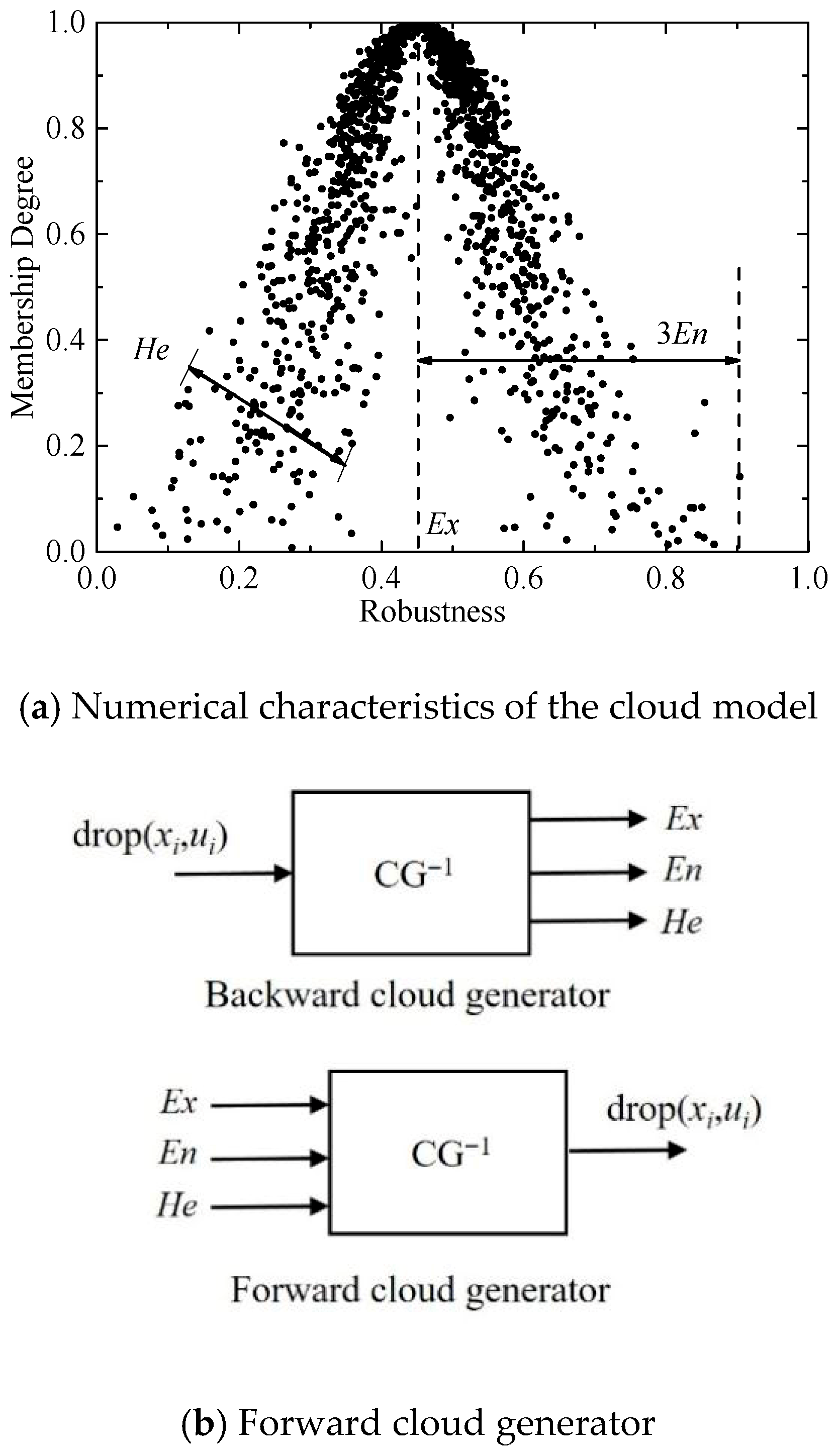
The distribution of x over the domain U is called a cloud, where x represents a cloud droplet. The integrity of concepts and the quantitative characteristics of qualitative knowledge are reflected through the three numerical features of cloud expectation Ex, entropy En and super entropy He, as shown in Figure 1a. The Ex is the domain central value, which is the point that best represents robustness and is the “highest point” which equals to 1 in cloud shape. The En indicates the measurable range of robustness. The greater the En, the more macroscopic the concept is, and the wider the measurable range is. En reflects the uncertainty of the qualitative concept, also known as fuzziness which represents the cloud “span”. With the En become greater, the “span” becomes greater. He is the entropy of En which refers to the entropy uncertainty. It indicates the dispersion degree among cloud droplets on the cloud diagram, and also represents the cloud depth in cloud shape. The cloud becomes deeper with the He becoming greater.
The normal cloud generator (CG) can be applied to calculate the CM, which has two types: forward cloud generator (FCG) and reverse cloud generator (RCG). The FCG converts evaluation results from qualitative to quantitative. Based on cloud numerical characteristics (Ex, En, He), cloud drops (xi, ui) of a normal CM are generated. The RCG converts quantitative values into qualitative concepts, and transforms precise data into (Ex, En, He). The cloud drop (xi, ui) to qualitative conversion can be achieved through RCG, as shown in Figure 1b.

2.3.2. Robustness Evaluation Based on Cloud Models

The methodology for applying the CM to evaluate WSN robustness is outlined as follows. The application and development of the CM have moderately reduced the fuzziness and randomness of evaluation. Therefore, applying it to assess the WSN robustness is useful to improve the accuracy and intuitiveness of results. Based on the CM theory and the aforementioned studies, the WSN performance loss Floss(i) at node i can be obtained in accordance with Section 2.2; meanwhile, the robustness R of the community WSN in a single simulation can be derived from Equation (2). However, a single random test is insufficient to reflect the pipeline failure probability. Thus, following the methods described in Section 2.2 and Section 2.3.1, M random tests were conducted to obtain multiple distinct pipeline failure patterns and a sufficient sample size. Both the node i and WSN robustness were calculated as the average of the results from the M simulations. Furthermore, a robustness evaluation model for community WSN was established based on the CM theory, rendering the evaluation results more reasonable.
First, in this paper, in accordance with Section 2.2 and Section 2.3.1, M simulations are conducted on community buildings and the WSN to obtain robustness data of nodes and the community WSN. Subsequently, the Ex, En, and He are determined through RCG. Then, based on these cloud numerical characteristics, a FCG is adopted to generate cloud droplets. Finally, the evaluation cloud of robustness is determined. The specific step is as follows:
(1)
Based on M simulations, the RCG is applied to determine nodal cloud numerical characteristics. The expectation Exi, entropy Eni, Hei of node i are shown in Equations (11), (12), and (13), respectively. Here, R(i,m) denotes the i-th nodal robustness in the m-th simulation (m = 1, 2, …, M). M is the total number of simulations.
(2)
Total cloud droplet number is denoted as Ncloud. The FCG is adopted to generate the quantitative values xi,k of Ncloud cloud droplets and the membership degrees yi,k of the concept represented by each cloud droplet. Specifically, xi,k follows a normal random distribution with an expected value of Exi and a standard deviation of Enni; Enni follows a normal random distribution with an expected value of Eni and a standard deviation of Hei. yi,k is the membership degree (k = 1, 2, …, Ncloud), determining by Equation (13).
(3)
Obtain the robustness evaluation cloud chart.
E x i = 1 M m = 1 M R ( i , m )
E n i = π 2 1 M m = 1 M | R ( i , m ) E x i | 2
H e i = | 1 M 1 m = 1 M ( R ( i , m ) E x i ) 2 E n i 2 |
y i , k = e [ ( x i , k E x i ) 2 / 2 E n n i 2 ]
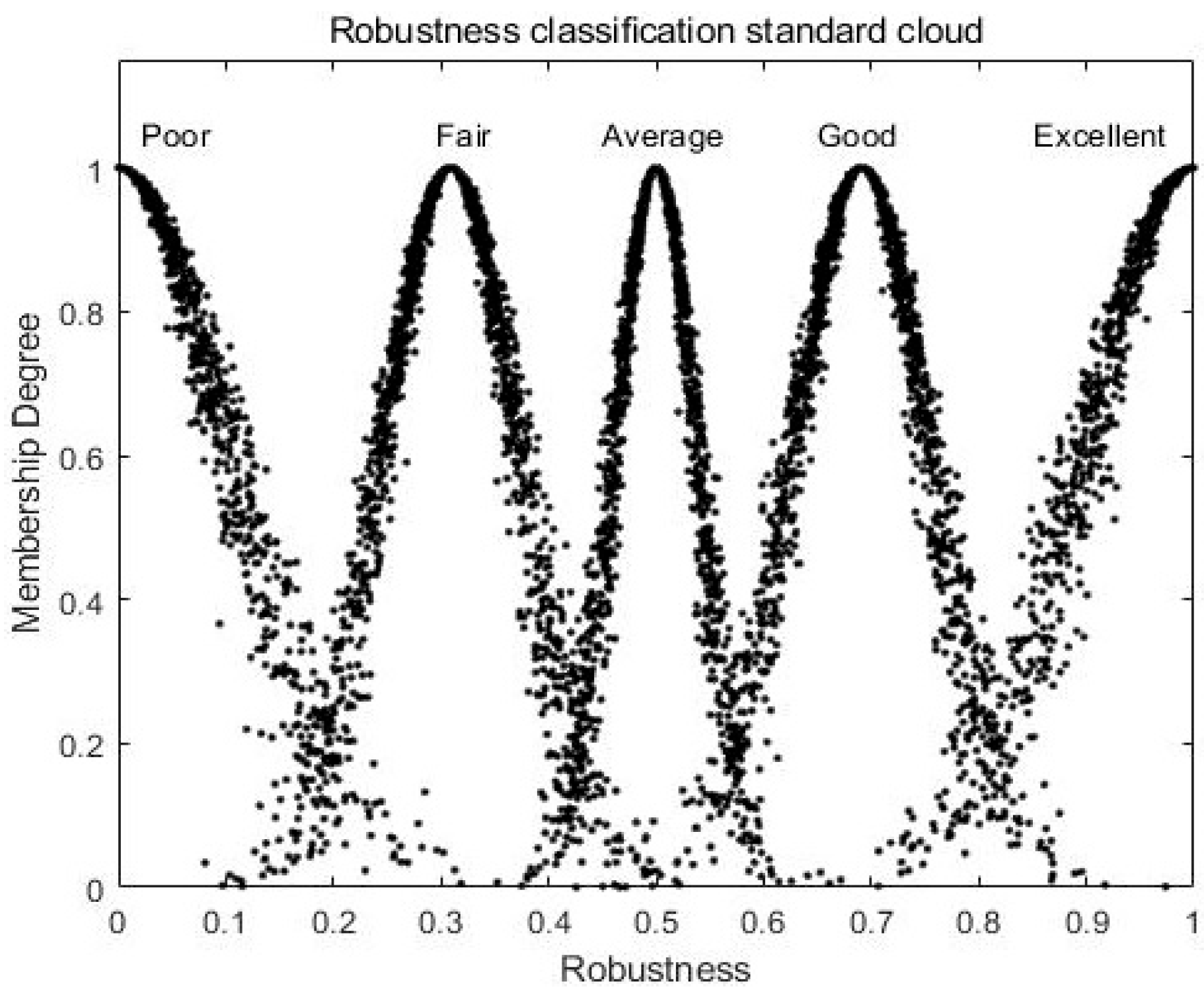
The WSN robustness grades and its nodes are defined through reviewing literature and consulting experts, the robustness grades were categorized into poor, fair, average, good, excellent. The robustness was partitioned using the golden ratio method [65]. Ex, En, and He of each grade are shown in Table 1. The FCG calculation was carried out to achieve the cloudification of the robustness evaluation grades, and the corresponding standard cloud diagram was generated, as illustrated in Figure 2.

3. Case Study

3.1. Case Study Introduction

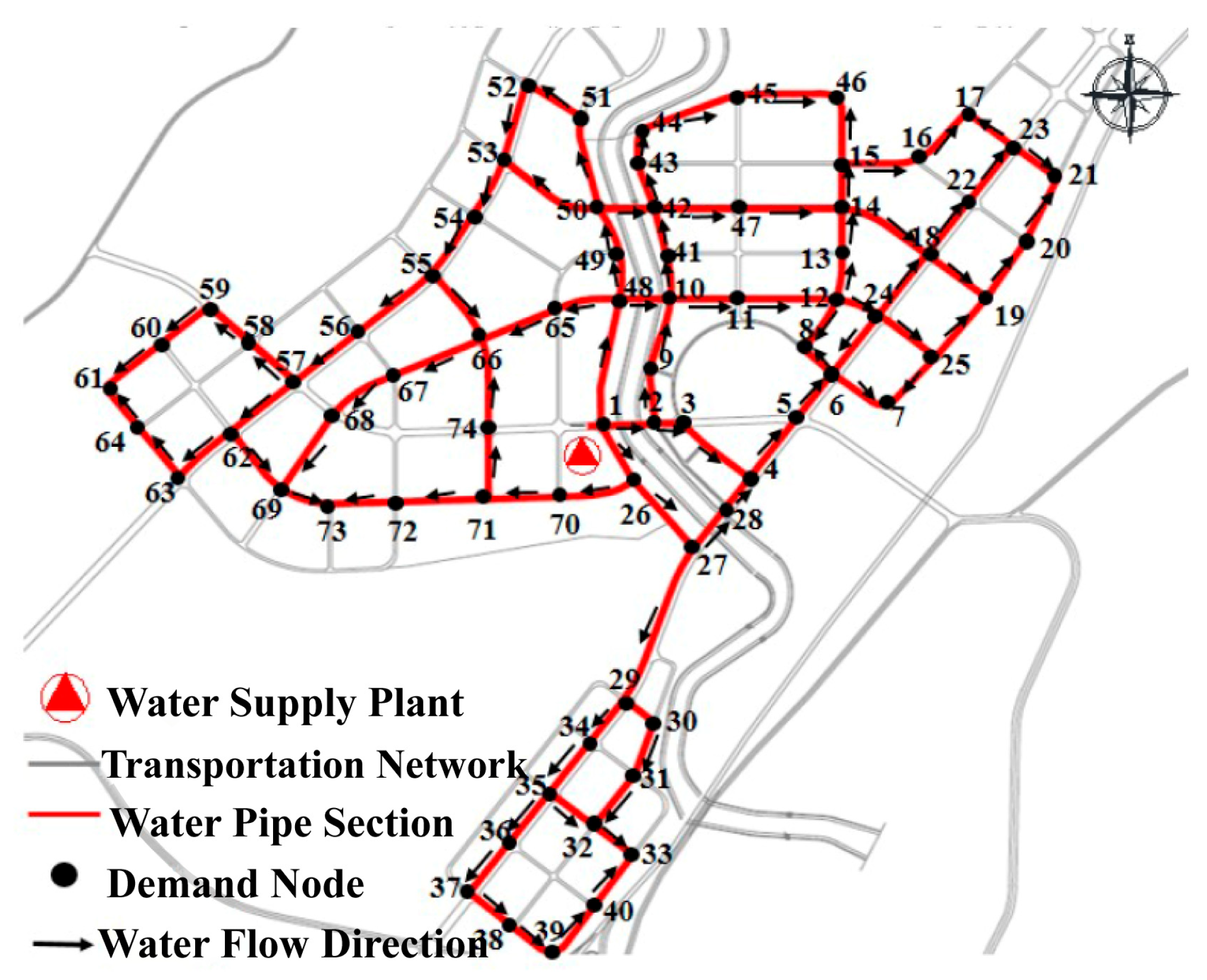
The proposed method was applied to evaluate the robustness of a community WSN in Dalian, China. The distribution of the community WSN and node division is shown in Figure 3. This WSN has 1 water source node, 74 demand nodes, and 94 pipelines. Table 2 provides nodal initial water demand QInit, elevation, and nodal initial water pressure HiInit obtained through EPANET hydraulic analysis simulation under normal operating conditions. HiInit ensures that the WSN meets the normal service pressure requirements before the earthquake. The nodal minimum service water pressure Himin is set to 1 to guarantee the minimum pressure constraint for water supply services; the maximum water pressure is set to Himax = 2HiInit to prevent excessive pressure on the pipelines. The pipeline numbers, start and termination nodes, and lengths Lp of the WSN are shown in Table 3. These basic data and hydraulic parameters together constitute the calculation basis for the robustness assessment of the WSN under subsequent earthquake scenarios.
Two seismic scenarios were considered: a design earthquake with a peak ground velocity (PGV) of 10 cm/s and a rare earthquake with PGV = 22 cm/s. Referring to Section 2.2, the failure simulation of the community WSN was conducted to obtain the performance loss of the WSN at each node when PGV = 10 cm/s and 22 cm/s. Then, the performance loss of node i can be calculated by Equation (1), the robustness of node i in simulation can be obtained by Equation (2), and the robustness of the WSN can be determined by Equation (3). Subsequently, based on the method proposed in Section 2.2 and Section 2.3, M (M = 1000) random trials were conducted to obtain a sufficient sample capacity, and (Ex, En, He). The node and community WSN robustness was evaluated by the standard robustness CM with Ncloud = 1500 (Ncloud refers to the number of cloud droplets). Node 75 is a water source node in the network, connected to the other pipes through pipe 1. Therefore, pipe 1 was assumed to remain intact during the simulation process, and the performance loss of node 75 was 0.

3.2. Result Analysis

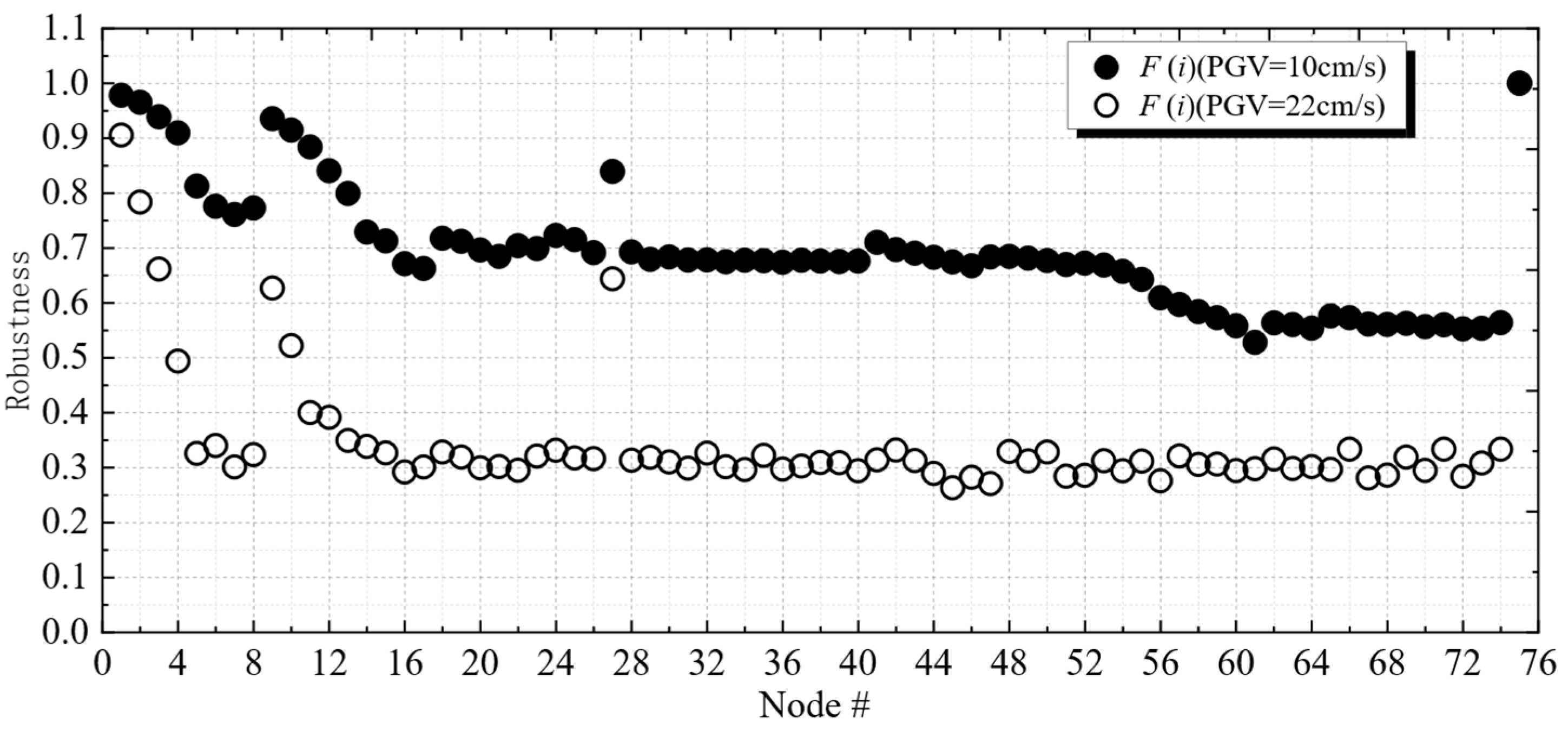
Based on the above method, the WSN was simulated, and the mean robustness values from the 1000 simulations for nodes and the WSN were taken as the robustness analysis results. Figure 4 shows the robustness results for each node when PGV = 10 cm/s and PGV = 22 cm/s. As illustrated in Figure 4, when PGV = 10 cm/s, the robustness of nodes 1, 2, 3, 4, 9, and 10 is all above 0.90, and the robustness of all nodes is greater than 0.5, with most nodes ranging between 0.50 and 0.75. Specifically, nodes 1 and 2 exhibited high robustness: R(1) = 0.978 and R(2) = 0.965. And the standard deviation of node 1 (0.040) is significantly smaller than that of node 2 (0.122). The robustness distribution (RD) of node 1was more concentrated in 1000 simulations, which means that node 1 outperformed node 2 both in terms of mean robustness and standard deviation (SD). The robustness of nodes 3 and 9 is 0.939 and 0.935, respectively, with SD of 0.173 and 0.179. Notably, the robustness of node 61 is the lowest, only 0.528. This is directly related to its high elevation (75 m) and extremely small initial pressure margin. Its topological position at the end of the network leads to a long water supply path and a large head loss. As a result, even a slight attenuation of system pressure under low-intensity seismic disturbances is sufficient to cause water cut-off at this node.
When PGV = 22 cm/s, the overall robustness of the nodes significantly decreases. Only nodes 1, 2, 3, 9, 10, and 27 maintain a robustness above 0.50, and most nodes are between 0.25 and 0.40. Nodes 1 and 2 still maintain relatively high robustness (0.905 and 0.784). At this time, node 45 becomes the node with the lowest robustness, with a robustness value of 0.263. This change is attributed to its high water demand (20.53) and distant location from the water source. When PGV increases, the long-distance water supply path it relies on is prone to severe damage, resulting in actual water delivery flow that cannot meet the demand, thereby causing severe functional failure. In contrast, although the robustness of node 61 is still low, due to its small water demand, its impact is relatively limited when the overall water supply capacity of the system decreases. In summary, the nodal robustness is significantly affected by PGV, with an overall decrease of 0.3 to 0.4. These results clearly indicate that nodal robustness is determined by elevation, water demand, and their positions in the network (such as distance from the water source, path length, and redundancy). Node 61 is highly sensitive to pressure decline due to its high elevation and end position; node 45 faces a severe risk of flow shortage under strong earthquakes due to its high water demand and long water supply path. In contrast, nodes 1, 2, etc., which are close to the water source, show strong robustness. Under different earthquake intensities, each node shows systematic performance differences due to its unique combination of attributes and positions.
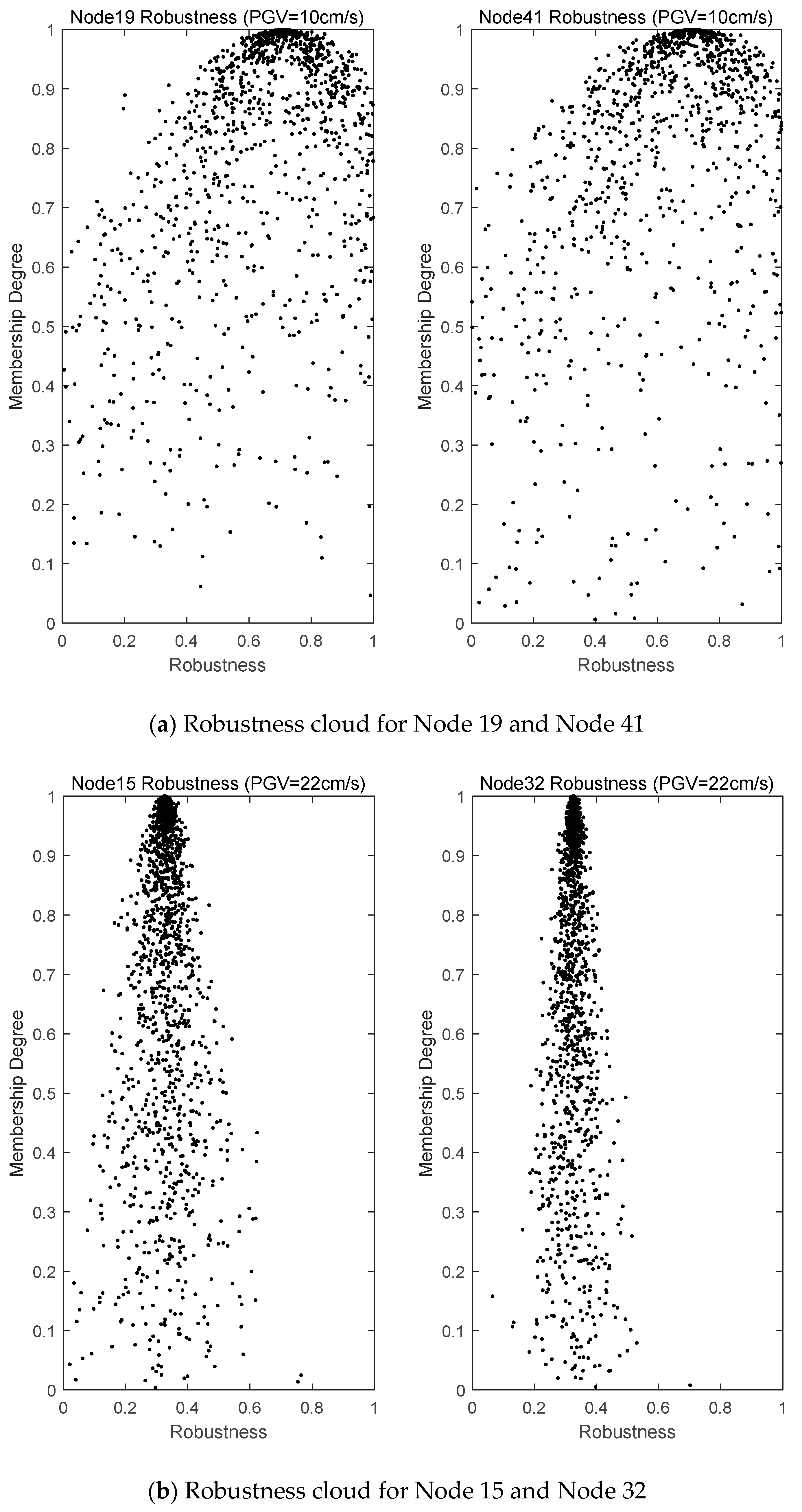
When PGV = 10 cm/s, both node 19 and node 41 have identical robustness, which is 0.711. Their SD are 0.306 and 0.322, respectively. To analyze their robustness more intuitively, the robustness cloud diagrams of the two nodes are plotted according to Section 2.3, as shown in Figure 5a. Their (Ex, En, He) are (0.711, 0.370, 0.208) and (0.711, 0.395, 0.228). Node 19 has a smaller cloud span, a smaller hyper-entropy, and lower dispersion; thus, the robustness of Node 19 is excellent to that of Node 41. Similarly, when PGV = 22 cm/s, both node 15 and node 32 have identical robustness, which is 0.326. Their SD are 0.079 and 0.048, respectively. Their robustness cloud diagrams are plotted according to Section 2.3, as shown in Figure 5b. Their (Ex, En, He) are (0.326, 0.027, 0.074) and (0.326, 0.017, 0.045), respectively. Node 32 has a smaller cloud span, a smaller hyper-entropy, and lower dispersion; thus, the robustness of node 32 is excellent to that of node 15.
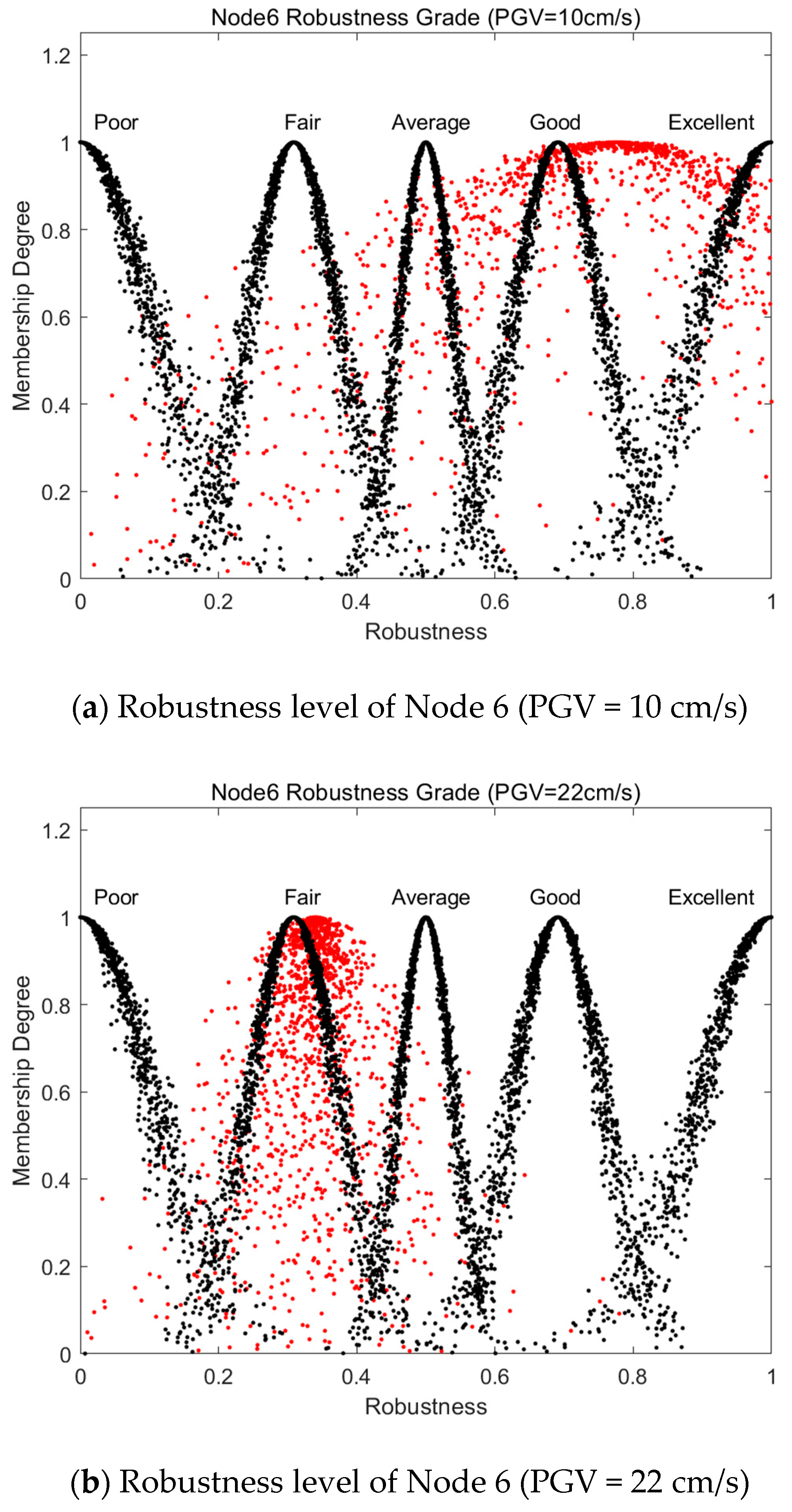
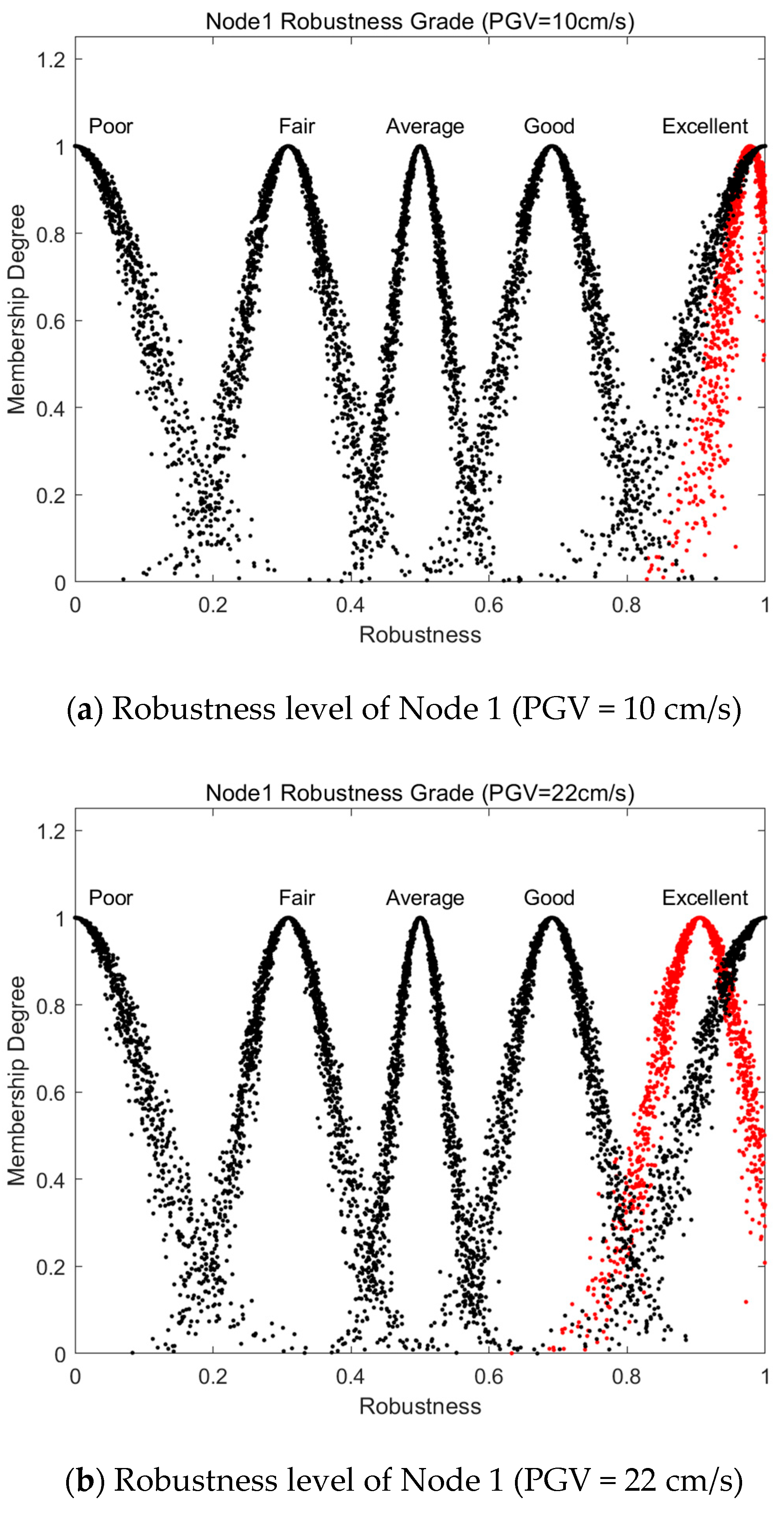
Robustness clouds for each node were plotted based on Section 2.3 to determine the robustness grades. The robustness grades for each node were then determined according to the standard cloud diagram, as shown in Figure 6. When PGV = 10 cm/s, Figure 6a indicates that the robustness of node 1 ranged from 0.8 to 1, was concentrated around 0.95, corresponding to an “Excellent” grade, which indicates high robustness. The cloud digital characteristics for node 1 were Ex = 0.978, En = 0.042, He = 0.011. The low entropy (En) indicates high reliability in the robustness evaluation, while the low hyper-entropy (He) suggests strong stability in its robustness performance. When PGV = 22 cm/s, Figure 6b shows that the robustness of node 1 ranges from 0.9 to 1, centered around 0.90, corresponding to an “Excellent” grade, which indicates high robustness. The cloud digital characteristics for node 1 were (Ex = 0.905, En = 0.038, He = 0.010). Compared to the RD of node 1 when PGV = 10 cm/s, both the stability and reliability of its robustness are slightly excellent when PGV = 22 cm/s. A similar analysis was conducted for node 6. When PGV = 10 cm/s, its robustness was mainly distributed between 0.5 and 1, concentrating around 0.75. As shown in Figure 7a, it was classified as “Good”. When PGV = 22 cm/s, its robustness was mainly distributed between 0.2 and 0.4, concentrating around 0.35, and was classified as “Fair” according to Figure 7b. The cloud digital characteristics of node 6 under the two conditions were (0.776, 0.317, 0.144) and (0.340, 0.024, 0.077), respectively. Compared to its distribution at PGV = 22 cm/s, the stability and reliability of its robustness were lower when PGV = 10 cm/s. Furthermore, in comparison with node 1, it exhibited lower reliability in robustness evaluation and poorer stability in robustness level.
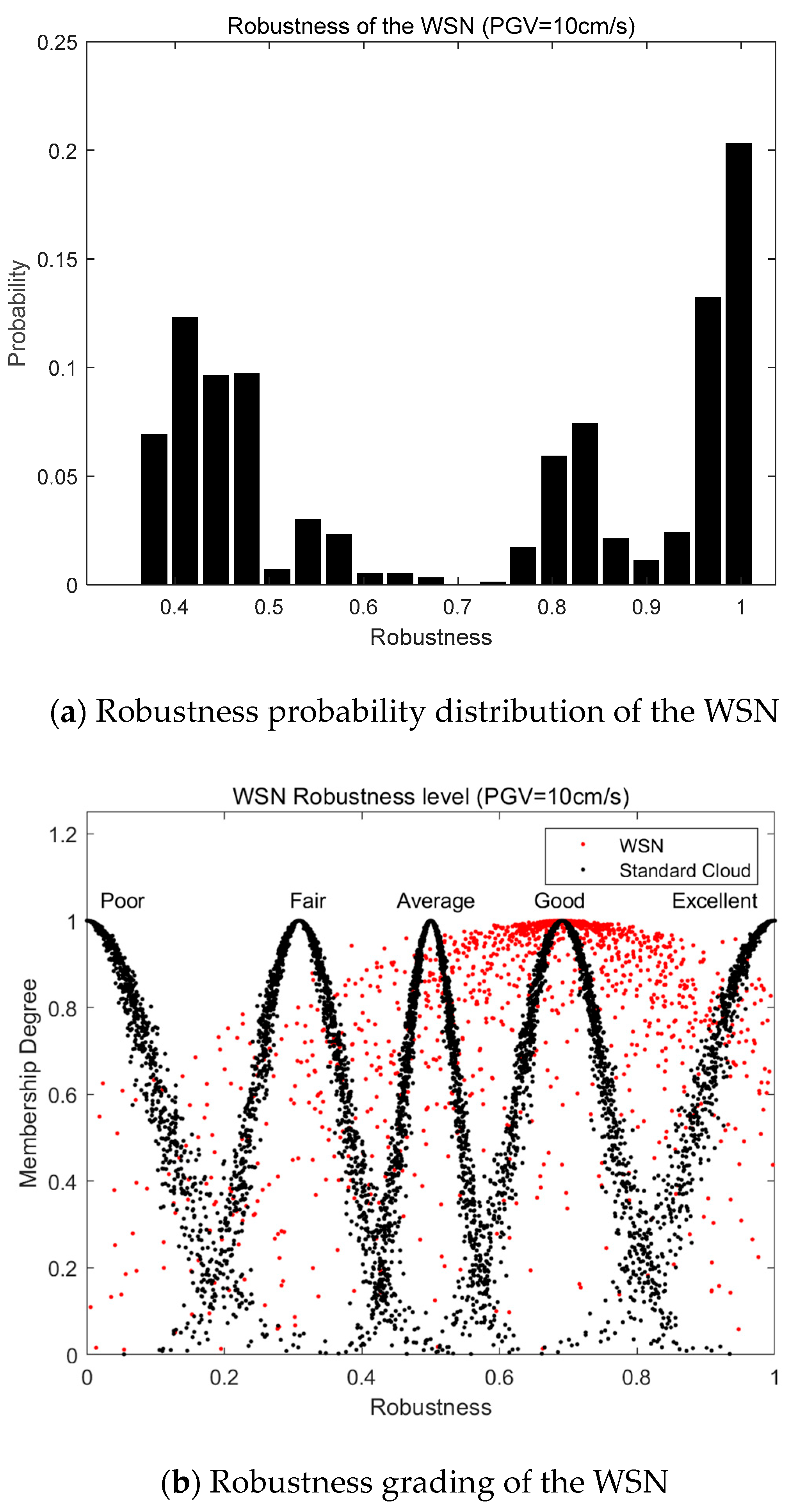
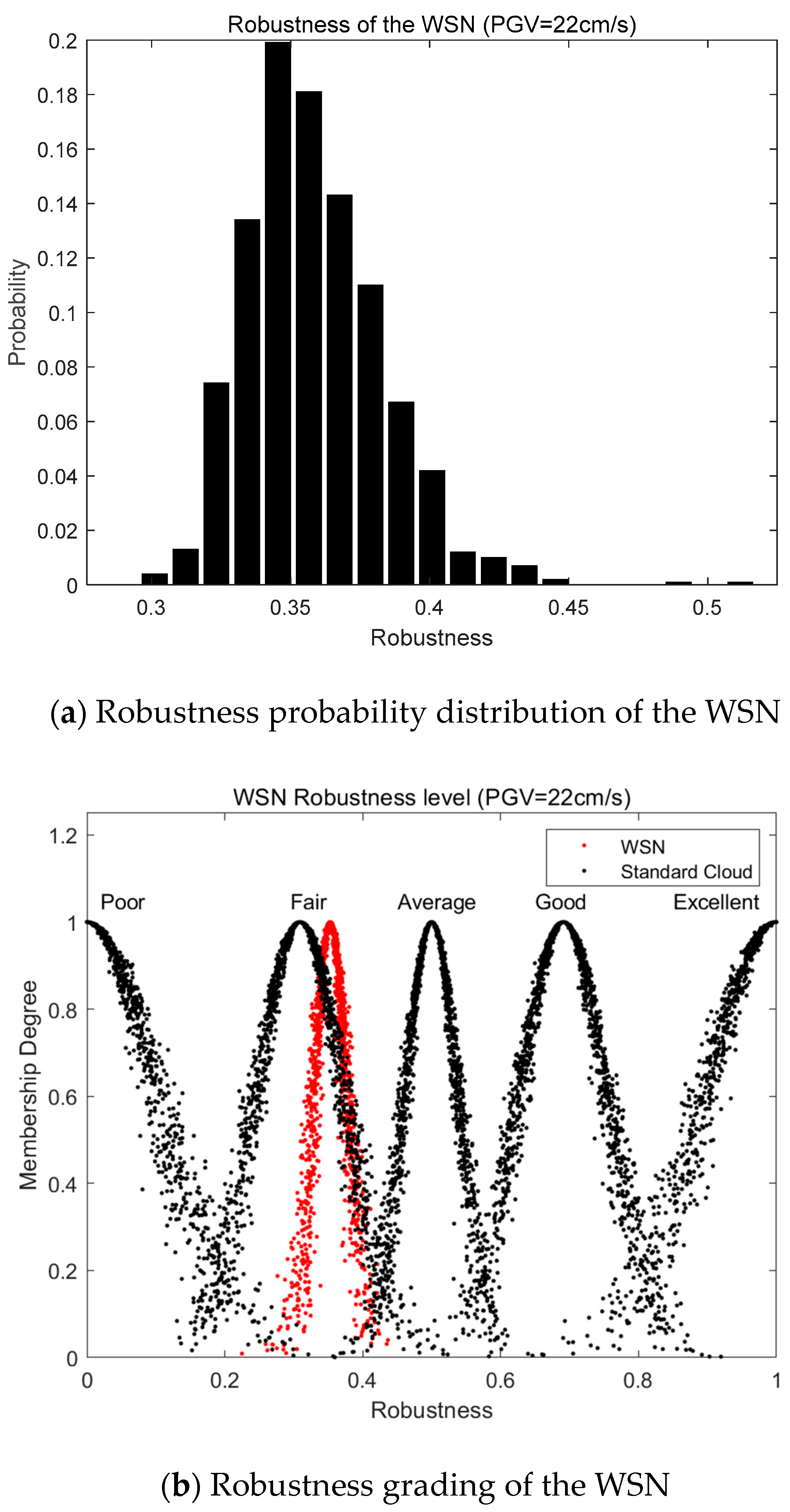
According to nodal robustness, the robustness of the community WSN was further analyzed. Figure 8a shows the frequency distribution of community robustness (CR) from 1000 simulations when PGV = 10 cm/s. From Figure 8a, it is obvious that the distribution is dispersed, primarily ranging from 0.4 to 1.0, with higher frequencies in the 0.4–0.5 and 0.8–1.0. CR was determined by selecting the average value in 1000 simulations, and the WSN robustness was 0.693. Then the WSN robustness cloud was plotted when PGV = 10cm/s as illustrated in Figure 8b, which shows that the community WSN robustness is at “Good” level. Ex, En, and He of the CR were (0.693, 0.298, 0.164). Compared to node 1, the CR had a higher entropy value (En), indicating lower reliability in the robustness assessment for this node. The higher hyper-entropy value (He) suggested poorer stability in the robustness level of the WSN. When PGV = 22 cm/s, the frequency distribution of CR from 1000 simulations is depicted in Figure 9a. From Figure 9a, it is obvious that the distribution is dispersed, primarily ranging from 0.30 to 0.45, with higher frequencies around 0.35. CR is defined in the same way as when PGV = 10 cm/s, the WSN robustness was 0.353. Then the WSN robustness cloud was plotted as shown in Figure 9b, indicating WSN robustness is at “Fair” level. The cloud digital characteristics of the CR are (0.353, 0.024, 0.005). Comparing with node 1, its En is smaller, which indicates that the reliability of the results of the robustness evaluation of node 1 is lower; and He is smaller, which indicates that the level of robustness of the WSN is more stable. The robustness distribution cloud diagram and the probability distribution map of WSN have similar distribution interval. Compared to the cloud diagram, the probability distribution map is more intuitive.
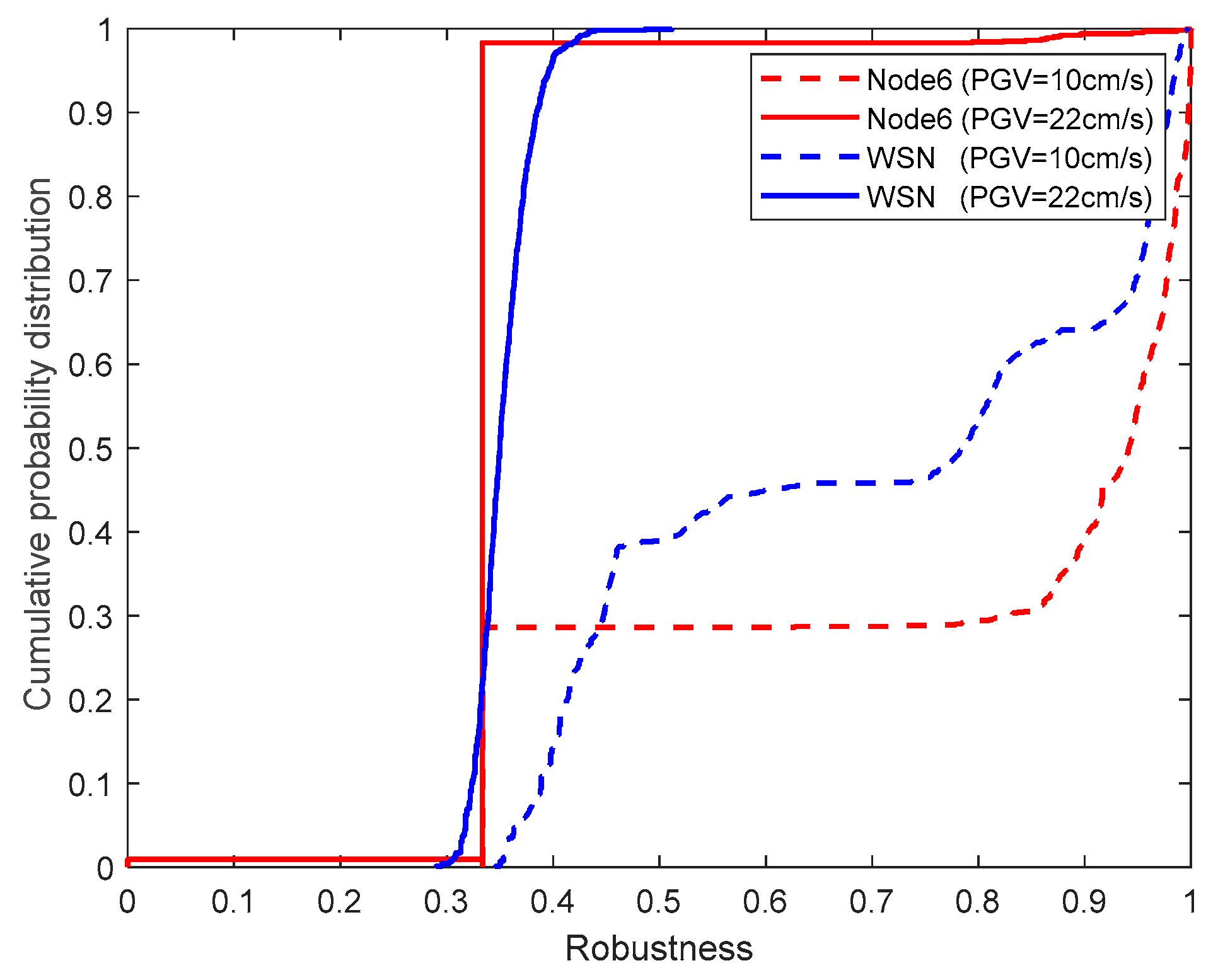
Table 4 presents the classification results for node robustness and community WSN robustness when PGV = 10 cm/s and PGV = 22 cm/s. As shown in Table 4, when PGV = 10 cm/s, block robustness predominantly falls within the “Good” and “Average” levels, while CR is at the “Sound” level. When PGV = 22 cm/s, most node robustness levels are Poor, while CR is Fair. An increase in PGV reduces the robustness levels of both nodes and the WSN. Figure 10 presents the cumulative probability distributions of node 6 and WSN robustness when PGV = 10 cm/s and PGV = 22 cm/s. As shown in Figure 10, it is evident that for both nodes and the WSN, the cumulative probability distribution of robustness when PGV = 22 cm/s is steeper than PGV = 10 cm/s. Furthermore, the RD range for the WSN is narrower than that for the nodes.

4. Conclusions

This paper proposes a method for evaluating the robustness of WSN (Water Supply Networks). This method analyzes the performance loss of WSN through three aspects: whether the node structure fails, the change in node degree distribution, and the node water shortage, thereby achieving robustness assessment. Because substantial uncertainties exist in robustness assessment, a comprehensive quantitative and qualitative analysis of WSN robustness is conducted based on the CM, yielding more authentic and reliable evaluation results. Simultaneously, taking a community in Dalian, China as a case study, simulation analysis was conducted, and the results indicate the following:
(1)
As peak seismic velocity increases, the robustness of nodes and WSN also markedly decreases; however, the reliability and stability of the robustness results correspondingly increase. Nodes with identical robustness values can be effectively evaluated for their reliability and stability based on their cloud distributions.
(2)
This method can effectively evaluate WSN robustness and intuitively reflect its reliability and stability. Meanwhile, it converts quantitative robustness evaluation results into qualitative assessments, rendering them more readily comprehensible. The analysis results exhibit considerable dispersion.
The proposed methodology for evaluating WSN robustness during disasters provides a basis for government administrators and relevant persons to develop disaster prevention policies, emergency response strategies, and take seismic mitigation measures for enhancing earthquake resistance.

5. Limitations and Future Research Work

This paper still has certain limitations. First, in this paper, two seismic scenarios were set based on specific PGV, which can effectively evaluate the robustness of the WSN under specific earthquakes, but fail to reflect the random characteristics of real earthquakes, thus limiting the applicability of the evaluation results. Second, the model assumes that pipeline damage events are independent and follow a Poisson distribution, which does not fully consider the spatial correlation of damage caused by geographical proximity or functional coupling in the WSN. This may affect the accuracy of the robustness assessment. Additionally, when the cloud model characterizes the robustness distribution through digital features (Ex, En, He), its assumption based on a normal distribution may have precision limitations when dealing with simulation results that significantly deviate from normality. To address these limitations, future research will focus on establishing failure models that consider the correlation among pipelines, develop robustness assessment algorithms suitable for non-normal distributions, and explore the integration of wireless sensor networks to achieve the fusion of dynamic monitoring data and assessment models in order to enhance the applicability and reliability of the robustness assessment method in real environments.

Author Contributions

Conceptualization, G.D.; Methodology, K.L.; Writing—original draft, P.L. and X.T.; Writing—review & editing, J.Z. All authors have read and agreed to the published version of the manuscript.

Funding

This work was supported by the Hubei Natural Science Foundation Project, Grant/Award Number: 2025AFB316; and scientific research project of Hubei Provincial Department of Education, Grant/Award Number: Q20231301.

Institutional Review Board Statement

Not applicable.

Informed Consent Statement

Not applicable.

Data Availability Statement

No new data were created or analyzed in this study. Data sharing is not applicable to this article.

Conflicts of Interest

The authors declare that they have no known competing financial interests or personal relationships that could have appeared to influence the work reported in this paper.

References

  1. Bloom, D.E.; Canning, D.; Fink, G. Urbanization and the Wealth of Nations. Science 2008, 319, 772–775. [Google Scholar] [CrossRef]
  2. Zenghelis, D. Cities, Wealth, and the Era of Urbanization. In National Wealth: What Is Missing, Why It Matters; Oxford University Press: Oxford, UK, 2017; Volume 1, pp. 315–340. ISBN 978-0-19-184411-9. [Google Scholar]
  3. Gu, C. Urbanization: Processes and Driving Forces. Sci. China Earth Sci. 2019, 62, 1351–1360. [Google Scholar] [CrossRef]
  4. Garcia, E.; Vale, B.; Vale, R. Growth and Resources. In Collapsing Gracefully: Making a Built Environment that Is Fit for the Future; Springer International Publishing: Cham, Switzerland, 2021; pp. 207–230. ISBN 978-3-030-77782-1. [Google Scholar]
  5. Apostolska, R.; Sheshov, V.; Salic Makreska, R.; Stojmanovska, M.; Bojadjieva, J.; Nanevska, A.; Kolic, M.; Mrvaljevic, D.; Zajazi, K.; Atalić, J.; et al. Enhancing Earthquake Disaster Risk Assessment: Insights from Pandemic Circumstances, Case Studies, and Lessons Learned. Nat. Hazards 2025, 121, 6777–6799. [Google Scholar] [CrossRef]
  6. Tang, Y.; Che, A.; Cao, Y.; Zhang, F. Risk Assessment of Seismic Landslides Based on Analysis of Historical Earthquake Disaster Characteristics. Bull. Eng. Geol. Environ. 2020, 79, 2271–2284. [Google Scholar] [CrossRef]
  7. Yin, Y.; Wang, F.; Sun, P. Landslide Hazards Triggered by the 2008 Wenchuan Earthquake, Sichuan, China. Landslides 2009, 6, 139–152. [Google Scholar] [CrossRef]
  8. Butler, C.; Rest, M. Calculating Risk, Denying Uncertainty: Seismicity and Hydropower Development in Nepal. Himalaya 2017, 37, 15–25. [Google Scholar]
  9. Birinci, Ş. Technical Efficiency of Post-Disaster Health Services Interventions: The 2023 Kahramanmaraş Earthquake in Turkey. Int. J. Health Manag. Tour. 2023, 8, 187–203. [Google Scholar] [CrossRef]
  10. Zhang, J.; Li, Y.; Yuan, H.; Du, G.; Zhang, M. A Demand-Based Three-Stage Seismic Resilience Assessment and Multi-Objective Optimization Method of Community Water Distribution Networks. Reliab. Eng. Syst. Saf. 2024, 250, 110279. [Google Scholar] [CrossRef]
  11. Carneiro, J.; Loureiro, D.; Cabral, M.; Covas, D. Comprehensive Resilience Assessment Framework for Water Distribution Networks. Water 2024, 16, 2611. [Google Scholar] [CrossRef]
  12. Bruneau, M.; Chang, S.E.; Eguchi, R.T.; Lee, G.C.; O’Rourke, T.D.; Reinhorn, A.M.; Shinozuka, M.; Tierney, K.; Wallace, W.A.; Von Winterfeldt, D. A Framework to Quantitatively Assess and Enhance the Seismic Resilience of Communities. Earthq. Spectra 2003, 19, 733–752. [Google Scholar] [CrossRef]
  13. Candelieri, A.; Soldi, D.; Archetti, F. Network Analysis for Resilience Evaluation in Water Distribution Networks. Environ. Eng. Manag. J. 2015, 14, 1261–1270. [Google Scholar] [CrossRef]
  14. Pandit, A.; Crittenden, J.C. Index of Network Resilience for Urban Water Distribution Systems. Int. J. Crit. Infrastruct. 2016, 12, 120–142. [Google Scholar] [CrossRef]
  15. Farahmandfar, Z.; Piratla, K.R.; Andrus, R.D. Resilience Evaluation of Water Supply Networks against Seismic Hazards. J. Pipeline Syst. Eng. Pract. 2017, 8, 04016014. [Google Scholar] [CrossRef]
  16. Farahmandfar, Z.; Piratla, K.R. Comparative Evaluation of Topological and Flow-Based Seismic Resilience Metrics for Rehabilitation of Water Pipeline Systems. J. Pipeline Syst. Eng. Pract. 2018, 9, 04017027. [Google Scholar] [CrossRef]
  17. Yazdani, A.; Otoo, R.A.; Jeffrey, P. Resilience Enhancing Expansion Strategies for Water Distribution Systems: A Network Theory Approach. Environ. Model. Softw. 2011, 26, 1574–1582. [Google Scholar] [CrossRef]
  18. Zhao, X.; Chen, Z.; Gong, H. Effects Comparison of Different Resilience Enhancing Strategies for Municipal Water Distribution Network: A Multidimensional Approach. Math. Probl. Eng. 2015, 2015, 438063. [Google Scholar] [CrossRef]
  19. Farahmandfar, Z.; Piratla, K.R.; Andrus, R.D. Flow-Based Modeling for Enhancing Seismic Resilience of Water Supply Networks. In Proceedings of the Pipelines 2015, Baltimore, MD, USA, 23–26 August 2015; American Society of Civil Engineers: Reston, VA, USA, 2015; pp. 756–765. [Google Scholar] [CrossRef]
  20. Han, Z.; Ma, D.; Hou, B.; Wang, W. Seismic Resilience Enhancement of Urban Water Distribution System Using Restoration Priority of Pipeline Damages. Sustainability 2020, 12, 914. [Google Scholar] [CrossRef]
  21. Najafi, J.; Peiravi, A.; Anvari-Moghaddam, A. Enhancing Integrated Power and Water Distribution Networks Seismic Resilience Leveraging Microgrids. Sustainability 2020, 12, 2167. [Google Scholar] [CrossRef]
  22. Nariman, A.; Fattahi, M.H.; Talebbeydokhti, N.; Sadeghian, M.S. Assessment of Seismic Resilience in Urban Water Distribution Network Considering Hydraulic Indices. Iran. J. Sci. Technol. Trans. Civ. Eng. 2023, 47, 1165–1179. [Google Scholar] [CrossRef]
  23. Hou, B.; Huang, J.; Miao, H.; Zhao, X.; Wu, S. Seismic Resilience Evaluation of Water Distribution Systems Considering Hydraulic and Water Quality Performance. Int. J. Disaster Risk Reduct. 2023, 93, 103756. [Google Scholar] [CrossRef]
  24. Chen, B.; Li, H.; Sun, G. Seismic Resilience Assessment Method and Multi-Objective Optimal Recovery Strategy for Large-Scale Urban Water Distribution Network System. Int. J. Disaster Risk Reduct. 2025, 127, 105689. [Google Scholar] [CrossRef]
  25. National Institute of Standards and Technology. Community Resilience Planning Guide for Buildings and Infrastructure Systems: Volume I; National Institute of Standards and Technology: Gaithersburg, MD, USA, 2015.
  26. Laucelli, D.; Giustolisi, O. Vulnerability Assessment of Water Distribution Networks under Seismic Actions. J. Water Resour. Plan. Manag. 2015, 141, 04014082. [Google Scholar] [CrossRef]
  27. Ismail, A.; Rahman, M.; Mortula, M.; Atabay, S.; Ali, T. Water Distribution Network Resilience Management Using Global Resilience Analysis-Based Index. Sustainability 2025, 17, 2353. [Google Scholar] [CrossRef]
  28. Dueñas-Osorio, L.; Craig, J.I.; Goodno, B.J. Seismic Response of Critical Interdependent Networks. Earthq. Eng. Struct. Dyn. 2007, 36, 285–306. [Google Scholar] [CrossRef]
  29. O’Rourke, M.; Ayala, G. Pipeline Damage Due to Wave Propagation. J. Geotech. Eng. 1993, 119, 1490–1498. [Google Scholar] [CrossRef]
  30. Agathokleous, A.; Christodoulou, C.; Christodoulou, S.E. Topological Robustness and Vulnerability Assessment of Water Distribution Networks. Water Resour. Manag. 2017, 31, 4007–4021. [Google Scholar] [CrossRef]
  31. Song, Z.; Liu, W.; Shu, S. Resilience-Based Post-Earthquake Recovery Optimization of Water Distribution Networks. Int. J. Disaster Risk Reduct. 2022, 74, 102934. [Google Scholar] [CrossRef]
  32. Long, L.; Pan, Z.; Yang, H.; Yang, Y.; Liu, F. A Multi-Objective Method for Enhancing the Seismic Resilience of Urban Water Distribution Networks. Symmetry 2025, 17, 1105. [Google Scholar] [CrossRef]
  33. Haghighi, M.; Delnavaz, A.; Safehian, M.; Delnavaz, M. Strategic Management and Seismic Resilience Enhancement of Water Distribution Network Using Artificial Neural Network Model. J. Pipeline Syst. Eng. Pract. 2025, 16, 04024053. [Google Scholar] [CrossRef]
  34. Franchin, P.; Cavalieri, F. Probabilistic Assessment of Civil Infrastructure Resilience to Earthquakes. Comput.-Aided Civ. Infrastruct. Eng. 2015, 30, 583–600. [Google Scholar] [CrossRef]
  35. Mazumder, R.K.; Salman, A.M.; Li, Y.; Yu, X. Seismic Functionality and Resilience Analysis of Water Distribution Systems. J. Pipeline Syst. Eng. Pract. 2020, 11, 04019045. [Google Scholar] [CrossRef]
  36. Shuang, Q.; Zhang, M.; Yuan, Y. Node Vulnerability of Water Distribution Networks under Cascading Failures. Reliab. Eng. Syst. Saf. 2014, 124, 132–141. [Google Scholar] [CrossRef]
  37. Liu, W.; Song, Z.; Ouyang, M.; Li, J. Recovery-Based Seismic Resilience Enhancement Strategies of Water Distribution Networks. Reliab. Eng. Syst. Saf. 2020, 203, 107088. [Google Scholar] [CrossRef]
  38. Fan, X.; Yu, X. (Bill) Resilience of Water Distribution Network: Enhanced Recovery Assisted by Artificial Intelligence (AI) Considering Dynamic Water Demand Change. In Proceedings of the Lifelines 2022, Virtual Conference, 31 January–11 February 2022; American Society of Civil Engineers: Reston, VA, USA, 2022; pp. 880–891. [Google Scholar] [CrossRef]
  39. Hu, Q.; Zhang, Y.; Liu, W.; Song, Z.; Ji, H.; Wang, F. Predicting Water Pipe Failures with Graph Neural Networks: Integrating Coupled Road and Pipeline Features. Water 2025, 17, 1307. [Google Scholar] [CrossRef]
  40. Pan, H.; Li, H.-N.; Li, C.; Tian, L. Parametric Study on Seismic Behaviors of a Buried Pipeline Subjected to Underground Spatially Correlated Earthquake Motions. J. Earthq. Eng. 2022, 26, 6329–6351. [Google Scholar] [CrossRef]
  41. Tao, M.; Qu, R.; Ke, Z.; Chen, Z.; Li, X.; Feng, Y. The Cloud Model Theory of Intelligent Control Method for Non-Minimum-Phase and Non-Self-Balancing System in Nuclear Power. In Proceedings of the 2018 26th International Conference on Nuclear Engineering, London, UK, 22–26 July 2018; ASME: New York, NY, USA, 2018; p. V001T04A013. [Google Scholar] [CrossRef]
  42. Li, D.; Lv, X.; Zhang, H.; Meng, X.; Xu, Z.; Chen, C.; Liu, T. Cloud Model-Based Intelligent Controller for Load Frequency Control of Power Grid with Large-Scale Wind Power Integration. Front. Energy Res. 2024, 12, 1477645. [Google Scholar] [CrossRef]
  43. Deng, W.; Wang, G.; Zhang, X. A Novel Hybrid Water Quality Time Series Prediction Method Based on Cloud Model and Fuzzy Forecasting. Chemom. Intell. Lab. Syst. 2015, 149, 39–49. [Google Scholar] [CrossRef]
  44. Zhou, K.; Lin, Y.; Deng, H.; Li, J.; Liu, C. Prediction of Rock Burst Classification Using Cloud Model with Entropy Weight. Trans. Nonferrous Met. Soc. China 2016, 26, 1995–2002. [Google Scholar] [CrossRef]
  45. Li, L.; Liu, L.; Yang, C.; Li, Z. The Comprehensive Evaluation of Smart Distribution Grid Based on Cloud Model. Energy Procedia 2012, 17, 96–102. [Google Scholar] [CrossRef]
  46. Zhang, B.; Xu, W.; Li, G.; Zhou, M. Cloud Model Based Power Quality Comprehensive Assessment Interactive Decision-Making Approach. In Proceedings of the 2014 China International Conference on Electricity Distribution (CICED), Shenzhen, China, 23–26 September 2014; IEEE: Piscataway, NJ, USA, 2014; pp. 1338–1341. [Google Scholar] [CrossRef]
  47. Yang, S.; Han, X.; Cao, B.; Li, B.; Yan, F. Cloud-Model-Based Method for Risk Assessment of Mountain Torrent Disasters. Water 2018, 10, 830. [Google Scholar] [CrossRef]
  48. Xu, X.; Huang, Q.; Ren, Y.; Sun, H.-B. Condition Assessment of Suspension Bridges Using Local Variable Weight and Normal Cloud Model. KSCE J. Civ. Eng. 2018, 22, 4064–4072. [Google Scholar] [CrossRef]
  49. Ulusoy, A.-J.; Stoianov, I.; Chazerain, A. Hydraulically Informed Graph Theoretic Measure of Link Criticality for the Resilience Analysis of Water Distribution Networks. Appl. Netw. Sci. 2018, 3, 31. [Google Scholar] [CrossRef] [PubMed]
  50. Sheikholeslami, R.; Kaveh, A. Vulnerability Assessment of Water Distribution Networks: Graph Theory Method. Int. J. Optim. Civ. Eng. 2015, 5, 283–299. [Google Scholar]
  51. Pagano, A.; Giordano, R.; Portoghese, I. A Pipe Ranking Method for Water Distribution Network Resilience Assessment Based on Graph-Theory Metrics Aggregated through Bayesian Belief Networks. Water Resour. Manag. 2022, 36, 5091–5106. [Google Scholar] [CrossRef]
  52. Cimellaro, G.P.; Tinebra, A.; Renschler, C.; Fragiadakis, M. New Resilience Index for Urban Water Distribution Networks. J. Struct. Eng. 2016, 142, C4015014. [Google Scholar] [CrossRef]
  53. Hou, B.; Ma, X.; Diao, K.; Zhong, Z.; Wu, S. Seismic Performance Assessment of Water Distribution Systems Based on Multi-Indexed Nodal Importance. Water 2021, 13, 2362. [Google Scholar] [CrossRef]
  54. Zhang, M.; Zhang, J.; Li, G.; Zhao, Y. A Framework for Identifying the Critical Region in Water Distribution Network for Reinforcement Strategy from Preparation Resilience. Sustainability 2020, 12, 9247. [Google Scholar] [CrossRef]
  55. Trudeau, R.J. Introduction to Graph Theory. In Dover Books on Advanced Mathematics; Dover Publications: New York, NY, USA, 1993; ISBN 978-0-486-67870-2. [Google Scholar]
  56. Shi, P. Seismic Response Modeling of Water Supply Systems. Ph.D. Thesis, Cornell University, Ithaca, NY, USA, 2006. [Google Scholar]
  57. Han, Z.; Ma, D.; Hou, B.; Wang, W. Post-Earthquake Hydraulic Analyses of Urban Water Supply Networkbased on Pressure Drive Demand Model. Sci. Sin. 2019, 49, 351–362. [Google Scholar]
  58. Jeon, S.S.; O’Rourke, T.D. Northridge Earthquake Effects on Pipelines and Residential Buildings. Bull. Seismol. Soc. Am. 2005, 95, 294–318. [Google Scholar] [CrossRef]
  59. Wang, Y. Seismic Performance Evaluation of Water Supply Systems. Ph.D. Thesis, Cornell University, Ithaca, NY, USA, 2006. [Google Scholar]
  60. Wagner, J.M.; Shamir, U.; Marks, D.H. Water Distribution Reliability: Simulation Methods. J. Water Resour. Plan. Manag. 1988, 114, 276–294. [Google Scholar] [CrossRef]
  61. Li, D. Uncertainty in Knowledge Representation. Eng. Sci. 2000, 2, 73–79. [Google Scholar] [CrossRef]
  62. Mares, M. Fuzzy Sets. Scholarpedia 2006, 1, 2031. [Google Scholar] [CrossRef]
  63. Wang, Z. Foundations and Applications of the Probability Theories; Beijing Normal University Press: Beijing, China, 1995. [Google Scholar]
  64. Li, X. Interval Cloud Model and Interval Cloud Generator. In Proceedings of the 2010 Second WRI Global Congress on Intelligent Systems, Wuhan, China, 16–17 December 2010; IEEE: Piscataway, NJ, USA, 2010; pp. 245–248. [Google Scholar] [CrossRef]
  65. Chong, E.K.P.; Żak, S.H. An Introduction to Optimization, 4th ed.; Wiley: Hoboken, NJ, USA, 2013; ISBN 978-1-118-27901-4. [Google Scholar]
Figure 1. Cloud Model.
Sustainability 17 11081 g001
Figure 2. Robustness Criteria Cloud.
Sustainability 17 11081 g002
Figure 3. WSN distribution and Node classification. Note: numbers indicate demand node labels.
Sustainability 17 11081 g003
Figure 4. Nodes robustness.
Sustainability 17 11081 g004
Figure 5. Nodes robustness cloud diagram.
Sustainability 17 11081 g005
Figure 6. Robustness level of Node 1. Note: Black dots: standard cloud; Red dots: nodal robustness cloud.
Sustainability 17 11081 g006
Figure 7. Robustness level of Node 6. Note: Black dots: standard cloud; Red dots: nodal robustness cloud.
Sustainability 17 11081 g007
Figure 8. Robustness level of the WSN (PGV = 10 cm/s).
Sustainability 17 11081 g008
Figure 9. Robustness level of the WSN (PGV = 22 cm/s).
Sustainability 17 11081 g009
Figure 10. Robustness cumulative probability distribution of Node 6 and the WSN.
Sustainability 17 11081 g010
Table 1. Robustness assessment criteria cloud model parameters.
GradeCloud Digital Characteristics
Poor(0, 0.103, 0.0131)
Fair(0.3029, 0.064, 0.0081)
Average(0.500, 0.039, 0.005)
Good(0.691, 0.064, 0.0081)
Excellent(1, 0.103, 0.0131)
Table 2. Nodes and blocks parameters.
NodeQInit (L/s)Elevation (m)HInit (m)NodeQInit (L/s)Elevation (m)HInit (m)
121.4416.1479.79381.1321.3067.29
20.8316.0179.44391.1321.9066.60
33.0916.4478.09401.1320.8367.60
425.1521.1473.344114.414.5078.69
530.7518.8171.164234.9312.7080.11
619.7717.4072.514320.5311.0080.53
78.3419.8070.004420.5310.0081.09
827.3515.3074.464520.5324.6063.56
91.6912.4282.374620.5341.5346.58
1030.4919.1074.824734.9322.4369.29
1119.0420.6471.964856.9812.6081.33
1243.3119.5071.504935.5412.0881.43
1322.4228.0062.695047.111.5081.57
1455.2737.5053.165111.5614.2078.66
1532.8239.0050.275228.8427.7265.02
1612.3245.0042.915366.9928.6664.00
1712.3247.0040.745469.7929.2563.31
1842.0524.6065.365559.0132.0460.44
1921.7122.5066.955643.4447.4144.39
2011.3824.5063.585744.6247.1243.78
2111.3828.5059.335814.9954.5135.54
2223.728.5059.965912.6558.8430.82
2323.732.3355.566012.6566.4022.09
2428.818.8071.556112.6575.0013.32
2518.6721.0068.866223.7940.6449.75
2623.1418.0077.186317.3545.2444.51
27016.5677.356412.6561.5826.89
282.9217.8676.326556.9825.0068.02
2916.2721.3569.796690.5826.4266.06
309.7218.0171.756733.637.0754.46
3110.8118.6670.236833.638.2552.26
3211.9419.4269.326948.5235.2055.18
3313.8520.0868.317025.3919.0075.23
3419.1622.2967.457123.0621.6071.92
3514.5324.7264.157238.4425.2066.09
362.6224.1164.687359.1430.5159.97
373.6322.8765.867442.1620.5372.23
Table 3. WSN pipeline parameters.
PipelinesSarting NodeTermination
Node
Lp (m)PipelinesSarting NodeTermination
Node
Lp (m)
175176.7483031325.8
212307.5493132378.9
323150.9503233279.8
434501.6512934310
545424.2523435378.9
656347.8533536375
767341.7543637369.2
868217.2553738320
929322.6563839277.8
10910426.8573940356.8
111011384.5584033375.1
121112556.7593532318.6
131213273.760148753.7
141314260.1614810289.5
151415263.9624849265.1
161516415.8634950290.2
171617410.0645042315.4
181819424.2655051547.8
191920400.4665152372.1
202021407.1675253467.7
21128343.9685053635
22246432.5695354363.5
232418444.7705455410.1
241822400.1715556541.5
252223400.1725657463.7
262317329.2735758337.0
272321315.6745859320.4
281224262.0755960347.0
292425406.9766061409.6
30257421.8774865371.6
312519450.6786566457.2
321418559.9796667555.6
331041268.0806768397.8
344142269.9816869532.1
354243278.0825762467.5
364344294.6836263394.8
374445586.5846364360.1
384546584.4856461308.3
391546370.4866269445.5
404247476.1872670442.8
414714590.7887071399.9
42126367.2897172532.6
432627524.0907273369.3
442728312.6917369263.0
45284207.3925566488.1
462729968.8937174402.1
472930217.3947466533.2
Table 4. Cloud Classification Levels.
NodesPGV
(10 cm/s)
PGV
(22 cm/s)
NodesPGV
(10 cm/s)
PGV
(22 cm/s)
NodesPGV
(10 cm/s)
PGV
(22 cm/s)
1ExcellentExcellent26GoodFair51GoodFair
2ExcellentGood27ExcellentGood52GoodFair
3ExcellentGood28GoodFair53GoodFair
4ExcellentAverage29GoodFair54GoodFair
5ExcellentFair30GoodFair55GoodFair
6GoodFair31GoodFair56GoodFair
7GoodFair32GoodFair57AverageFair
8GoodFair33GoodFair58AverageFair
9ExcellentGood34GoodFair59AverageFair
10ExcellentAverage35GoodFair60AverageFair
11ExcellentAverage36GoodFair61AverageFair
12ExcellentFair37GoodFair62AverageFair
13GoodFair38GoodFair63AverageFair
14GoodFair39GoodFair64AverageFair
15GoodFair40GoodFair65AverageFair
16GoodFair41GoodFair66AverageFair
17GoodFair42GoodFair67AverageFair
18GoodFair43GoodFair68AverageFair
19GoodFair44GoodFair69AverageFair
20GoodFair45GoodFair70AverageFair
21GoodFair46GoodFair71AverageFair
22GoodFair47GoodFair72AverageFair
23GoodFair48GoodFair73AverageFair
24GoodFair49GoodFair74AverageFair
25GoodFair50GoodFair75ExcellentExcellent
WSNGoodFair
Disclaimer/Publisher’s Note: The statements, opinions and data contained in all publications are solely those of the individual author(s) and contributor(s) and not of MDPI and/or the editor(s). MDPI and/or the editor(s) disclaim responsibility for any injury to people or property resulting from any ideas, methods, instructions or products referred to in the content.