
You are currently viewing a new version of our website. To view the old version click .
Sustainability
  • Article
  • Open Access

10 December 2025

Digital Finance, Regional Infrastructure, and Urban Carbon-Emission Efficiency: A Spatial Nonlinear Analysis Based on the New Western Land–Sea Corridor

,
and
1
School of Economics and Business Administration, Chongqing University of Education, Chongqing 400067, China
2
Institute of Financial Development and Socialization, Chongqing University of Education, Chongqing 400065, China
3
School of Modern Business and Trade, Chongqing Business Vocational College, Chongqing 401331, China
*
Author to whom correspondence should be addressed.
This article belongs to the Special Issue Low-Carbon Economy and Sustainable Environmental Management

Abstract

Against the backdrop of China’s “dual-carbon” targets and the digital era, examining how digital finance (DF) in the New Western Land–Sea Corridor (NWLSC) shapes urban carbon-emission efficiency (CEE) is pivotal for fostering high-quality economic development and advancing the large-scale development of western China. Building on a theoretical exposition of how DF influences urban CEE, we empirically investigate both the direction and the underlying mechanisms of this influence by applying fixed-effects and spatial-panel smooth-transition regression models to panel data covering 88 cities in the NWLSC from 2011 to 2022. The results reveal the following: (1) The direct impact of DF on urban CEE in the NWLSC follows a nonlinear inhibitory effect, which gradually weakens with the increase in DF. (2) The influence of DF on urban CEE exhibits pronounced heterogeneity across NWLSC regions over time and at different quantiles. (3) As transportation and information infrastructures improve incrementally, the effect of DF on local CEE traces a nonlinear inhibitory effect and has a nonlinear spillover effect on neighboring cities’ CEE. These findings imply that policymakers along the corridor should accelerate the development of DF and foster its organic integration with transportation and information infrastructures, so as to advance the high-quality construction of the NWLSC and, ultimately, China’s high-quality economic growth through regionally coordinated and context-specific strategies.

1. Introduction

The New Western Land–Sea Corridor (NWLSC) is a multimodal, outward-oriented corridor that leverages north–south land, sea, and air transport networks in western China to integrate organically with the Belt and Road Initiative and to foster connectivity with the Association of Southeast Asian Nations (ASEAN) and beyond. To accelerate its construction, the National Development and Reform Commission (NDRC) issued the Master Plan for the Western China New Land–Sea Corridor in August 2019, elevating the initiative from a regional project to a national strategy and ushering in a new phase of international cooperation. This shift is poised to reshape China’s regional opening-up landscape, reconfigure inter-regional coordination mechanisms and unlock fresh momentum for western development. In August 2021, the NDRC unveiled the Implementation Plan for High-Quality Construction of the Western China New Land–Sea Corridor under the 14th Five-Year Plan, laying out an updated policy blueprint for the corridor in the new era. In April 2024, President Xi chaired the Symposium on Promoting Western China’s Large-Scale Development in the New Era in Chongqing and called for “vigorous efforts to advance the New Western Land–Sea Corridor, open up areas along the route and achieve deeper integration with the joint pursuit of the Belt and Road Initiative”. Rapid socioeconomic growth and the ongoing NWLSC program expand transport and digital networks and enlarge western China’s foreign trade. Yet, transport remains a major contributor to carbon dioxide (CO2) emissions [1,2], and digital infrastructure sharply raises energy demand [3]. These pressures threaten the fragile western ecosystem, causing efficiency losses, resource depletion, and rising environmental loads. Therefore, NWLSC development must align economic expansion with environmental protection, maximizing efficiency while minimizing resource use and emissions. Carbon-emission efficiency (CEE), defined as the ratio of economic growth to CO2 emissions, captures how effectively energy and resources are converted into value and how much environmental damage is avoided. It integrates the economic, social, and environmental gains of energy-saving and carbon-reduction measures [4] and has attracted increasing scholarly attention [5,6].
Studies indicate that achieving China’s 2030 “carbon peak” and 2060 “carbon neutrality” targets (hereafter the “dual-carbon” goals) will require a total investment of 139 trillion RMB [7], yet public finance is expected to cover only 15% [8]. By the end of 2024, the NWLSC had accumulated over 600 billion RMB in both domestic and foreign currency financing across infrastructure, logistics, and trade sectors. This funding gap elevates the role of financial markets in both environmental governance and corridor construction. Concurrently, advances in cloud computing, mobile networks, and remote terminals have shifted financial services toward digital and mobile platforms. Digital finance (DF) is therefore viewed as a pivotal instrument for enhancing CEE [4,9]. Against the backdrop of expanding infrastructure and growing trade volumes, leveraging DF to simultaneously stimulate regional economic growth and mitigate environmental pressures has become a critical component of the NWLSC’s quality-oriented development. Addressing this dual imperative is therefore a priority for achieving the “dual-carbon” goals and for fostering sustainable, high-quality regional development, yet it remains empirically under-examined.
Extant studies treated DF or infrastructure as independent determinants of CEE [1,4], but no study integrates digital finance, reginal infrastructure, and CEE within a single framework. This gap is acute for the NWLSC, where mechanisms remain unexplored and no unified model exists. Motivated by these shortcomings, we pose three urgent questions: Does DF in the NWLSC exert a causal and nonlinear effect on CEE? How do spatial spillovers manifest? What role does infrastructure play in mediating this relationship? We construct a theoretical mechanism and test it with panel data covering 88 prefecture-level cities in the NWLSC from 2011 to 2022. Fixed-effects and spatial-panel smooth-transition regressions identify nonlinear and spatial effects of DF on CEE and quantify the mechanism role of infrastructure.
This paper makes three primary contributions. First, we embed DF, regional infrastructure, and CEE in a unified analytical framework and theoretically clarify the causal pathways among them. Second, by leveraging rigorous econometric models, we uncover a nonlinear effect of DF on CEE in the NWLSC. Third, by deploying a spatial-panel smooth-transition regression, we quantify how regional infrastructure modulates both the nonlinear impact and spatial spillovers of DF on CEE across distinct regimes. The resulting evidence informs the design of context specific digital-finance strategies under varying constraints, offering actionable guidance for elevating regional carbon efficiency and advancing China’s high-quality development.
This study organizes the following sections. Section 2 reviews the relevant literature. Section 3 develops the theoretical framework and derives testable hypotheses. Section 4 details the empirical model setting, variable selection, and data sources. Section 5 presents the estimation results and discussion. Section 6 concludes with findings and policy recommendations.

2. Literature Review

2.1. Definition, Measurement, and Driving Factors of CEE

Current research on CEE addresses three themes: how to define it, how to measure it, and what drives it. Single-factor proxies—carbon intensity or per capita emissions—omit substitution and complementarity among inputs [10]. We therefore define CEE as the maximum attainable output and minimum CO2 emissions for a given bundle of capital, labor, and energy. Measurement relies on two families of techniques. Stochastic frontier analysis (SFA) imposes a functional form, whereas data envelopment analysis (DEA) does not. Because DEA accommodates multiple inputs and outputs without distributional assumptions, it dominates the literature [11]. Scholars employed slack-based measure (SBM), super-efficiency SBM, epsilon-based measure (EBM), directional distance function (DDF), and non-radial DDF (NDDF) [4,5,12,13,14]. Determinant studies converged on some drivers: energy structure [15], renewable technology adoption [16], environmental regulation [17], green finance [18], and industrial structural upgrading [6].

2.2. Economic and Environmental Effects of DF

DF integrates digital technologies with traditional financial services. It expands credit through multiplier effects [19], reallocates capital to higher-productivity uses [20], and raises firm-level innovation [21] and capacity utilization [22]. These channels raise aggregate output [23,24]. Yet, the digital divide—especially pronounced in rural regions—still constrains these gains [25]. Beyond output, DF can cut energy and emission intensity by funding energy-saving technologies and improving managerial and production efficiency. Empirical evidence is mixed. Most studies report that DF reduces CO2 emissions [26,27], whereas others find positive effects [28,29] or nonlinear patterns [30]. Only a few papers link DF to CEE [4], and they rely on linear specifications. The possibility of threshold or other nonlinear influences on CEE remains unexplored.

2.3. The Impact of Infrastructure on the Economy and the Environment

A substantial body of the literature has already dissected the economic and environmental consequences of infrastructure. That transport infrastructure exerts a sizeable influence on economic growth is well documented, yet the direction of this influence remains contested. Transport networks redistribute resources from core to peripheral regions and raise regional output [31,32,33,34,35]. Excessive expansion, however, distorts spatial balance and can suppress growth [36,37]. Information infrastructures upgrade industrial structures and expand exports, further increasing output [38]. Taken together, these findings position infrastructure investment as a key driver of economic expansion.
Empirical evidence on the environmental effects of infrastructure is split. Transport studies present two opposing positions. One group shows that the construction, operation, and maintenance of transport networks raise energy use and therefore, CO2 emissions [1,2,39]. Additional channels—output growth, congestion, and demographic shifts—amplify the increase [2,40]. The opposing group finds that better transport infrastructure lowers emissions by improving economic, energy, and technical efficiency and by accelerating digital adoption [41,42,43]. These benefits emerge only after a critical scale is reached [44,45]. Spatial analyses mirror this conflict: Zhao et al. (2014) [46] report positive spillovers, whereas Wang et al. (2024) [47] find negative ones. Information infrastructure consistently reduces carbon emissions. Broadband policies [48], city-level evidence [49], and firm-level data [50] all confirm reductions. Mechanisms include industrial restructuring, energy-mix optimization, technological upgrading, and green-innovation diffusion [49,50,51,52]. Internet penetration also enlivens carbon markets [53]. Yet, data centers and network equipment raise electricity demand [3,54], and embodied emissions can exceed direct emissions [55]. These findings imply nonlinear relationships for both transport and information infrastructure. The possibility remains untested for CEE.

2.4. Literature Summary

The literature offers robust theoretical and empirical foundations for this field, but three critical gaps persist. First, extant work concentrates on prefecture-level cities [4,6], the Yangtze River Economic Belt [56], and developed urban agglomerations such as Beijing–Tianjin–Hebei, the Yangtze River Delta, and the Pearl River Delta [57,58]. The NWLSC region, by contrast, remains markedly understudied. Second, the relationship between DF and CEE is almost exclusively tested under linear assumptions; nonlinear pathways remain largely unexplored. Third, mechanisms advanced so far center on green-technology innovation [4], household consumption structure [23], and industrial upgrading [56]. Yet, the mechanism role of regional infrastructure has received little explicit attention.

3. Theoretical Analysis and Research Hypothesis

This study develops research hypotheses across three analytical dimensions—direct nonlinear effects, spatial spillovers, and indirect nonlinear pathways—to examine whether digital finance enhances urban carbon-emission efficiency in the NWLSC. The literature review and theoretical deduction further elucidate the underlying mechanisms. Figure 1 illustrates the conceptual framework and technical pathway of this study.
Figure 1. Mechanism framework of digital finance on carbon-emission efficiency in the NWLSC.

3.1. The Nonlinear Effect of DF on CEE

Within the NWLSC, the influence of DF on urban CEE may manifest as an interaction between promotive and inhibitory effects. The promotive effect manifests in three aspects. First, by leveraging big-data analytics, cloud computing, and blockchain, financial institutions can collect, process, and act on real-time production and operational data from heterogeneous firms, thereby mitigating information asymmetry and curbing adverse-selection behavior [59]. This inclusion channels capital to previously underserved “long-tail” enterprises and redirects credit toward green industries, ultimately elevating CEE. Second, digital-payment platforms and online-credit systems—enabled by fintech—embody environmentally friendly service models that circumvent the need for physical branches, curtail travel-related emissions and reduce paper-intensive operations [60], thereby improving urban CEE. Third, digital-trading platforms reshape consumer awareness and behavior, fostering a structural shift toward green consumption [61] that lowers carbon emissions and further enhances CEE.
Nevertheless, DF can dampen CEE under certain conditions. In its early stages, DF is typically oriented toward accelerating economic growth rather than improving environmental quality [62], channeling substantial capital into carbon-intensive, energy-heavy sectors such as infrastructure and the heavy industry. Firms then expand capacity through increased debt, raising both energy use and emissions [63]. Supporting hardware—data centers, cloud servers, and high-frequency trading systems—spike short-run electricity demand [64]. Greater payment convenience stimulates durable-goods consumption and further emissions [65]. Moreover, underdeveloped DF ecosystems trap capital in the financial sector and the digital divide deepens misallocation, compounding the negative effect [66].
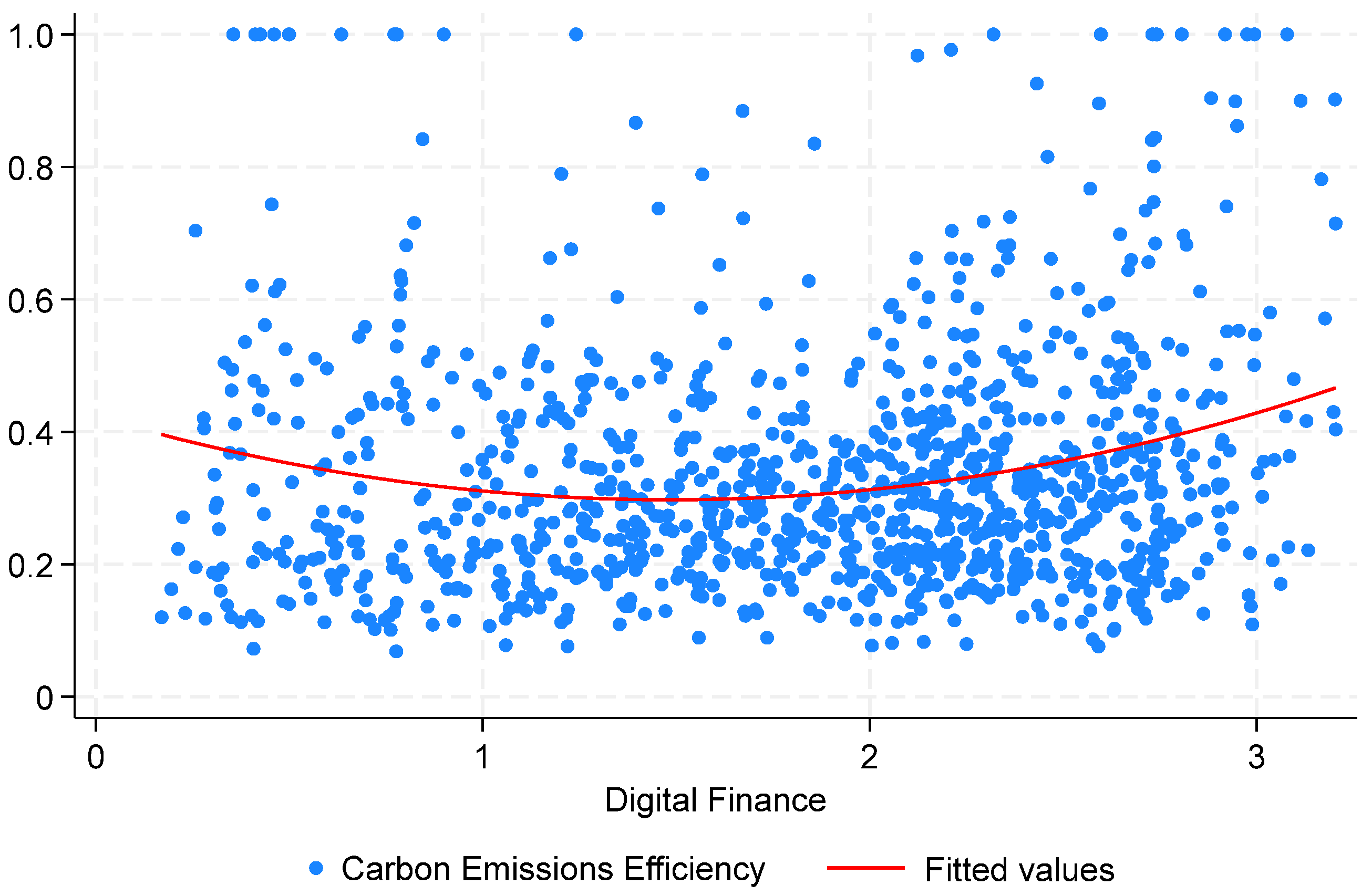
The preceding analysis suggests that DF exerts both positive and negative effects on CEE, with the net outcome unfolding over an extended horizon. To illustrate this relationship, we construct a scatter plot of the NWLSC digital-finance index against measured carbon-emission efficiency for 2011–2022 (Figure 2). Accordingly, the first hypothesis (H1) is proposed:
Figure 2. Scatter chart of digital finance and carbon-emission efficiency in the NWLSC.
H1. 
DF exhibits a nonlinear relationship with urban CEE in the NWLSC.

3.2. The Spatial Spillover Effect of DF on CEE

Existing studies rarely examine the spatial dimension of the DF and CEE relationship. New economic geography predicts that DF neutralizes administrative borders: network mobility transmits codified and tacit knowledge across space, eliminating capital-flow barriers and synchronizing efficiency gains in local and neighboring markets. A pioneering city thus produces a demonstration effect; neighbors replicate its policies, allocation models, and innovations, raising their own CEE [9]. Spillovers are bidirectional. Agglomeration advantages can trigger a siphon effect: early adopters relocate energy-intensive industries to lagging regions, stalling their digital uptake and increasing their emissions [67,68]. The net spatial externality of DF on CEE across the NWLSC is therefore an empirical question.
Spatial spillovers along the geographic dimension arise as DF optimizes inter-regional resource allocation, eliminating redundant logistics routes and curbing associated energy consumption, thereby directly lowering carbon emissions. Meanwhile, the agglomeration of logistics hubs—exemplified by multimodal centers in Chongqing and Guangxi—leverages the network externalities of DF to strengthen supply-chain coordination. This facilitates the diffusion of green technologies and low-carbon production modes across neighboring cities, generating a virtuous cycle of technology diffusion, efficiency gains, and declining emissions. Moreover, cross-regional financial services, such as cross-border credit-information sharing under the RCEP framework, reduce geographical frictions, enabling complementary adjustments in regional energy-mix configurations and amplifying spatial spillovers in CEE.
Spatial spillovers along the information and technology dimension emerge as NWLSC-based financial institutions create high-resolution carbon-footprint profiles for firms and monitor logistics energy consumption in real time. These capabilities enhance the timeliness and precision of resource allocation, curbing inefficient investment and energy waste arising from information asymmetry. Furthermore, IT-enabled digital-finance platforms, such as cross-border financial-service portals, accelerate the diffusion and standardized adoption of green technologies across regions, generating technology spillovers that elevate carbon-emission efficiency in neighboring areas. Nevertheless, the “digital-pollution” externalities associated with fintech could offset some of these gains; balancing them will require continuous technological upgrading and targeted policy interventions to preserve a net-positive spatial spillover along the information and technology dimension. Thus, this study proposes second hypothesis (H2):
H2. 
DF in the NWLSC generates spatial spillovers that affect urban CEE.

3.3. The Nonlinear Indirect Impact Pathways of DF on CEE

3.3.1. Nonlinear Indirect Effect of Transportation Infrastructure

Transportation infrastructure reduces mobility costs for capital and labor while facilitating face-to-face exchange of soft information. Empirical evidence shows improved transport reduces financial exclusion [69,70] and narrows lender–borrower information asymmetries. Within the NWLSC, transport quality is highly uneven [71]. In regions with poor transport, DF alleviates credit constraints and accelerates energy-intensive projects (e.g., highway expansion), increasing short-term emissions (output effect). As transport networks mature, the same digital tools facilitate soft information exchange, optimize logistics via big-data routing, fund new-energy vehicles, and commercialize green patents like smart dispatching systems (energy-saving effect). This creates a positive feedback loop: capital → low-carbon transport → technology diffusion. Consequently, CEE follows a U-shaped trajectory, initially declining as transport improves and digital finance mitigates emissions, then rising as infrastructure and digital tools co-evolve to drive sustainable growth. Accordingly, we propose the third hypothesis (H3):
H3. 
The influence of DF on urban CEE in the NWLSC is nonlinear and exhibits a threshold effect that is conditioned by transportation infrastructure.

3.3.2. Nonlinear Indirect Effect of Information Infrastructure

Information infrastructure facilitates seamless data exchange across industries, regions, and agencies. It lowers transaction costs and enhances market transparency, forming the technological foundation for DF. In the NWLSC, coverage remains uneven: low broadband penetration and a significant digital divide confine DF to core cities. Marginalized populations depend on energy-intensive data centers and terminals, increasing emissions, while weak innovation incentives perpetuate high-carbon production and suppress CEE. When 5G and universal internet access reach a critical threshold, DF expands to underserved areas. Inclusive finance then directs capital toward green-technology projects, such as green-logistics financing, and encourages low-carbon consumption through digital-payment-based sharing platforms, raising CEE. Beyond localized impacts, this threshold shift amplifies spatial spillovers: knowledge, capital, and technology spread from core cities to adjacent regions, intensifying emission-reduction benefits. Building on the foregoing analysis, the fourth hypothesis (H4) is proposed:
H4. 
The influence of DF on urban CEE in the NWLSC is nonlinear and exhibits a threshold effect that is conditioned by information infrastructure.

4. Methodology and Data

4.1. Econometric Model

To test the nonlinear impact of DF on urban CEE within the NWLSC, we specify the following benchmark model based on H1:
C E E i t = α 0 + α 1 D F i t + α 2 D F i t 2 + k α k C o n t r o l s k , i t + μ i + ϕ t + ε i t
In Equation (1), subscripts i and t index cities and years, respectively; CEE denotes carbon-emission efficiency, DF denotes digital finance, and DF2 is its squared term. Controls represent a vector of control variables comprising real per capita gross domestic product (RGDP), the ratio of fiscal sci-tech and education expenditure to total government expenditure (FSTE), fiscal decentralization (FD), industrial structure upgrading (STRU), and environmental regulation (ER). μ i captures individual fixed effects; ϕ t captures time fixed effects; and ε i t is the random error term.
Building on our theoretical discussion, the heterogeneous transportation and information infrastructures across NWLSC cities are likely to accentuate the nonlinear impact of DF on CEE. Conventional threshold models impose abrupt jumps, yet real economies shift gradually [72]. To capture cross-sectional heterogeneity in panel data more accurately, we employ the panel smooth-transition regression (PSTR) model. Meanwhile, the nonlinear relationship is further shaped by spatial interactions with neighboring regions. Following Bai et al. (2023) [73], we therefore embed the PSTR within a spatial-panel specification and jointly estimate parameters and threshold values. The model is specified as follows:
C E E i t = ρ j = 1 n W i j C E E j t + β 1 D F i t + θ 1 j = 1 n W i j D F j t + k β k C o n t r o l s k , i t + δ i X i t G ( s i t , γ , c ) + μ i + ε i t   ,                                   ε i t = λ j = 1 n W i j ε j t + τ i t ,   i = 1 , 2 , n ,   t = 1 , 2 , T
where CEE, DF, and Controls retain the definitions given in Equation (1). W denotes the spatial-weight matrix. We use geographical distance as the spatial-weight matrix because the NWLSC involves land transportation across a large geographic area. The element Wij equals the inverse squared surface distance between cities i and j for I ≠ j and is set to zero when i = j. Distances are calculated from the latitude and longitude coordinates of each city. Because the NWLSC spans a vast area, we cap the first-order nearest neighbor distance at a maximum threshold. The term Wij⋅DFjt captures the influence of neighboring cities’ DF on the local CEE. Xit = [DFit, Wij⋅DFit] stacks digital finance and its spatial lag; δ denotes the regime-varying coefficients that capture how the interaction between G(·) and Xit evolves across regimes. μ i and ε i t retain the same interpretations as in Equation (1). Parameters ρ and λ are the spatial-autoregressive and spatial-error coefficients, respectively. Setting λ   = 0 yields the spatial-autoregressive panel smooth-transition regression (SAR-PSTR) model; setting ρ   = 0 yields the spatial-error panel smooth-transition regression (SEM-PSTR) model. If δ   = 0 , the specification collapses to a conventional spatial-panel model without regime transitions. When ρ = λ = δ = 0 , the model reduces to a standard linear-panel specification. The transition function G(·) is a continuous, bound mapping of the transition variable s onto the unit interval [0, 1]; the regression coefficients of the explanatory variables are β (or θ ) when G = 0 and β + δ (or θ + δ ) when G = 1. Common specifications for G(·) include the logistic, exponential, and normal functional forms:
G ( s i t , γ , c ) = [ 1 + exp ( γ ( s i t c ) ) ] 1 L o g i s t i c ,   o r   L S T R 1 exp ( γ ( s i t c ) 2 ) E x p o n e n t i a l ,   o r   E S T R Φ ( γ ( s i t c ) ) N o r m a l   C D F
where γ is the positive slope of the conversion function; it controls the rate of transition between regions. LSTR generalizes to multiple forms [74]; the specific form is listed below.
G ( s i t , γ , c ) = { 1 + exp [ γ j = 1 m ( s i t c ) ] } 1
where the transition variable s is alternately specified as the transportation infrastructure (TIN) and information infrastructure (INF). Parameter c denotes the location parameter—the threshold at which the transition variable shifts the system from the low regime to the high regime. m indexes the number of transition functions (or regime dimensions). González et al. (2005) [72] showed that m = 1 or 2 was sufficient to capture the salient regime patterns. When m = 1, the model identifies a single regime transition. As s i t , G ( s i t , γ , c ) 0 (low regime); as s i t + , G ( s i t , γ , c ) 1 (high regime). The continuous movement of G(·) between 0 and 1 ensures a smooth transition between the two regimes. When s i t = c or γ 0 , G = 0.5 and the specification collapses to a linear fixed-effects model.
When m = 2, the transition function incorporates two location parameters and takes the form:
G ( s i t , γ , c 1 , c 2 ) = { 1 + exp [ γ ( s i t c 1 ) ( s i t c 2 ) ] } 1
The transition function G ( s i t , γ , c 1 , c 2 ) is symmetrical around s i t = ( c 1 + c 2 ) / 2 , attaining its minimum at this point. For s i t < c 1 and s i t > c 2 , the model collapses to two identical regimes. As s i t ± , G ( s i t , γ , c 1 , c 2 ) 1 , placing the system in the high regime; when s i t = c or γ 0 , G ( s i t , γ , c 1 , c 2 ) = 0.5 and the specification reverts to a linear fixed-effects model.

4.2. Variables Selection

4.2.1. Explained Variable

We quantify CEE with a non-radial directional distance function (NDDF) applied to an input–output indicator system [4]. For each city, CEE equals the maximum attainable gross regional product and the minimum CO2 emissions that can be achieved with capital stock, labor force, and energy inputs. Table 1 lists the indicators.
Table 1. Description of input–output indicators.

4.2.2. Explanatory Variable

DF, the focal explanatory variable, is proxied by the Peking University Digital Financial Inclusion Index (PKU-DFIIC). Comprising 33 constituent indicators, the index systematically and comprehensively captures coverage, inclusiveness, and diversity, thereby overcoming the digital limitations of traditional financial measures and gaining wide academic acceptance [78]. Given the rapid expansion of digital-finance, its specific indicators have been processed by the logarithmic power-function method, so as to reduce outlier impacts and maintain index stability. The index is further disaggregated into coverage breadth (COB), usage depth (USD), and digitalization level (DIL) [79], which jointly reflect the service value of digital finance and allow cross-city, cross-year comparisons under a unified metric—rendering it well suited for heterogeneous analyses. To enhance estimation precision, we rescale the index by dividing its raw values by 100 and use the resulting metric to gauge city-level digital-finance development.

4.2.3. Transition Variables

Transportation infrastructure (TIN). Designed to open western China’s maritime gateways and integrate the Belt and Road Initiative, the NWLSC focuses on land-based transport; consequently, TIN is confined to terrestrial modes. Drawing on Wang et al. (2024) [47], we proxy TIN with road density. Expansion of these terrestrial networks raises emissions during construction and operation yet also shortens distances, accelerates digital-industry integration, and lowers carbon intensity, thereby shaping total-factor carbon efficiency [80].
Information infrastructure (INF). It is proxied by internet penetration, measured as broadband subscriptions per capita. Expanding information infrastructure fosters the digital economy and, via digital technologies, can lower aggregate carbon emissions. Yet, the substantial infrastructure requirements of information and communication technologies (ICT) imply that embodied carbon can substantially exceed direct emissions [55]; large-scale roll-out and rising penetration inevitably raise urban electricity and energy consumption, thereby increasing city-level carbon emissions [3].

4.2.4. Control Variables

Controlling for key determinants of CEE yields more reliable estimates.
Economic development (lnRGDP) is proxied by the natural logarithm of real per capita GDP in each city. Higher development enhances resource utilization and technological adoption, yet also intensifies resource consumption and environmental degradation, thereby influencing CEE.
Sci-tech and education development (FSTE) is measured as the ratio of subnational fiscal spending on sci-tech and education to total local government expenditure [81]. Higher FSTE signals superior green-technology innovation and greater human-capital accumulation, enhancing both the efficiency and diffusion of energy-saving technologies and thereby improving carbon-emission efficiency. Yet, elevated sci-tech and education expenditure can crowd out other environmental investments in the short run, and—if research resources are misallocated—may foster technological path dependence, dampening improvements in CEE.
Fiscal decentralization (FD) is proxied by the ratio of local fiscal revenue to local fiscal expenditure [82]. FD is another key determinant of carbon-emission efficiency. Under the “promotion tournament” logic, local governments frequently pursue growth at the expense of environmental quality, thereby exerting downward pressure on carbon performance.
Industrial structure (STRU) is measured by the ratio of tertiary-industry value added to secondary-industry value added [56]. Industrial upgrading shifts resources from resource-intensive to technology- and capital-intensive sectors, reducing energy consumption and CO2 emissions while improving urban CEE.
Environmental regulation (ER) is proxied by a composite index constructed following Zhang et al. (2022) [83]. Implementing environmental regulations changes urban production processes, resource allocation, capital investment, labor intensity, and R&D innovation, leading to shifts in CEE.

4.2.5. NDDF with Desired and Undesired Outputs

Treating carbon emissions as an undesirable output, we employ NDDF to estimate urban CEE. By relaxing the proportional-change restriction between desirable and undesirable outputs [84,85], the NDDF mitigates the outcome discrepancies and slacks-related biases inherent in conventional radial and oriented DEA models [86].
To measure the urban CEE in the NWLSC, we treat the N cities as decision-making units (DMUs) over the period 2011–2022 and adopt the input–output variables listed in Table 1. To enhance inter-temporal comparability of CEE, our baseline model employs a global production technology [87], formalized as
P = ( K , L , E , Y , C ) : t = 1 T i = 1 N λ i t K i t K , t = 1 T i = 1 N λ i t L i t L , t = 1 T i = 1 N λ i t E i t E , t = 1 T i = 1 N λ i t Y i t Y , t = 1 T i = 1 N λ i t C i t = C ,   λ i t 0 ,   t = 1 , 2 , , T ,   i = 1 , 2 , , N
The distance function is then defined. Following Zhou et al. (2012) [84], the NDDF with undesirable outputs is specified as
N D = ( K , L , E , Y , C ; g ) = s u p ω T β : ( ( K , L , E , Y , C ) + g d i a g ( β ) ) P
where β = ( β K , β L , β E , β Y , β C ) T 0 is the vector of slack variables that scales the expansion of desirable outputs and the contraction of inputs and undesirable outputs; its elements may differ across variables. ω T = ( ω K , ω L , ω E , ω Y , ω C ) T denotes the weight vector of inputs and outputs in CEE, g = ( g K , g L , g E , g Y , g C ) is the directional vector specifying the direction of expansion and contraction, and d i a g ( β ) transforms β into a diagonal matrix.
Because the non-parametric DEA framework lacks an explicit functional form, assigning equal weights to all input and output variables is a reasonable default [85]. Meanwhile, there exists substitutability among input factors. In the measurement of total-factor energy carbon-emission efficiency, the extent of energy waste in the real economy and the potential for emission reduction cannot be determined unless the inefficiency of capital and labor is separated out [88]. Consequently, K and L are excluded from the CEE index by assigning them both zero weight [84]; energy input receives a weight of 1/3, while the single desirable and undesirable outputs are each given 1/3. The direction vector g = ( 0 , 0 , E , Y , C ) is defined accordingly. The distance function in Equation (7) is solved via the following linear programming problem:
N D ( K , L , E , Y , C ; g ) = max { 1 3 β E + 1 3 β Y + 1 3 β C } s . t .         t = 1 T i = 1 N λ i t K i t K ,   t = 1 T i = 1 N λ i t L i t L ,                     t = 1 T i = 1 N λ i t E i t ( 1 β E ) E ,   t = 1 T i = 1 N λ i t Y i t ( 1 + β Y ) Y ,                     t = 1 T i = 1 N λ i t C i t = ( 1 β C ) C ,   λ i t 0 ,   β Y 0 ,                       0 β E , β W , β S , β D , β P 1                       i = 1 , 2 , , N ;   t = 1 , 2 , , T
With capital and labor held constant, the optimal slack vector obtained from Equation (8) maximizes desirable output while minimizing undesirable output. Using this optimal solution and following Zhang and Liu (2022) [4], CEE is computed as
C E E i t = 1 2 ( 1 β E , i t * ) + 1 2 ( 1 β C , i t * ) 1 + β Y , i t * = 1 1 2 ( β E , i t * + β C , i t * ) 1 + β Y , i t *

4.3. Regional Background and Data Sources

4.3.1. Research Background

In August 2017, Chongqing, Guangxi, Guizhou, and Gansu signed the Framework Agreement on Jointly Building the China–Singapore Connectivity Initiative Southern Corridor (hereafter “Framework Agreement”). The corridor was renamed the New International Land–Sea Trade Corridor in December 2018, and its construction was elevated to a national strategy in August 2019. The corridor now operates under a “13 + 2” cooperation framework that covers twelve western provincial-level units—Chongqing, Guangxi, Guizhou, Gansu, Qinghai, Xinjiang, Yunnan, Ningxia, Shaanxi, Sichuan, Inner Mongolia, and Tibet—plus Hainan province, Zhanjiang (Guangdong), and Huaihua (Hunan). Its logistics network reaches 123 countries and 514 ports worldwide. Collectively, these jurisdictions account for 72.3% of China’s land area—nearly three-quarters of the country. By the end of 2024, trade between corridor provinces and the ten ASEAN economies totaled 1.07 trillion yuan; the corridor’s railway network spanned 71,000 km—43.9% of China’s total; and rail freight handled 965,700 TEUs. Railway-port foreign-trade throughput and container throughput rose by 57.9% and 33.5%, respectively. The release of the Chengdu–Chongqing Joint Plan for Building the Western China Financial Center as a pillar of China’s regional development strategy. Complemented by the “East Data West Computing” Project—which accelerates digital-infrastructure deployment in western China—these policies provide the institutional context for examining the environmental–economic effects of digital finance within the NWLSC.

4.3.2. Data Sources and Descriptive Statistics

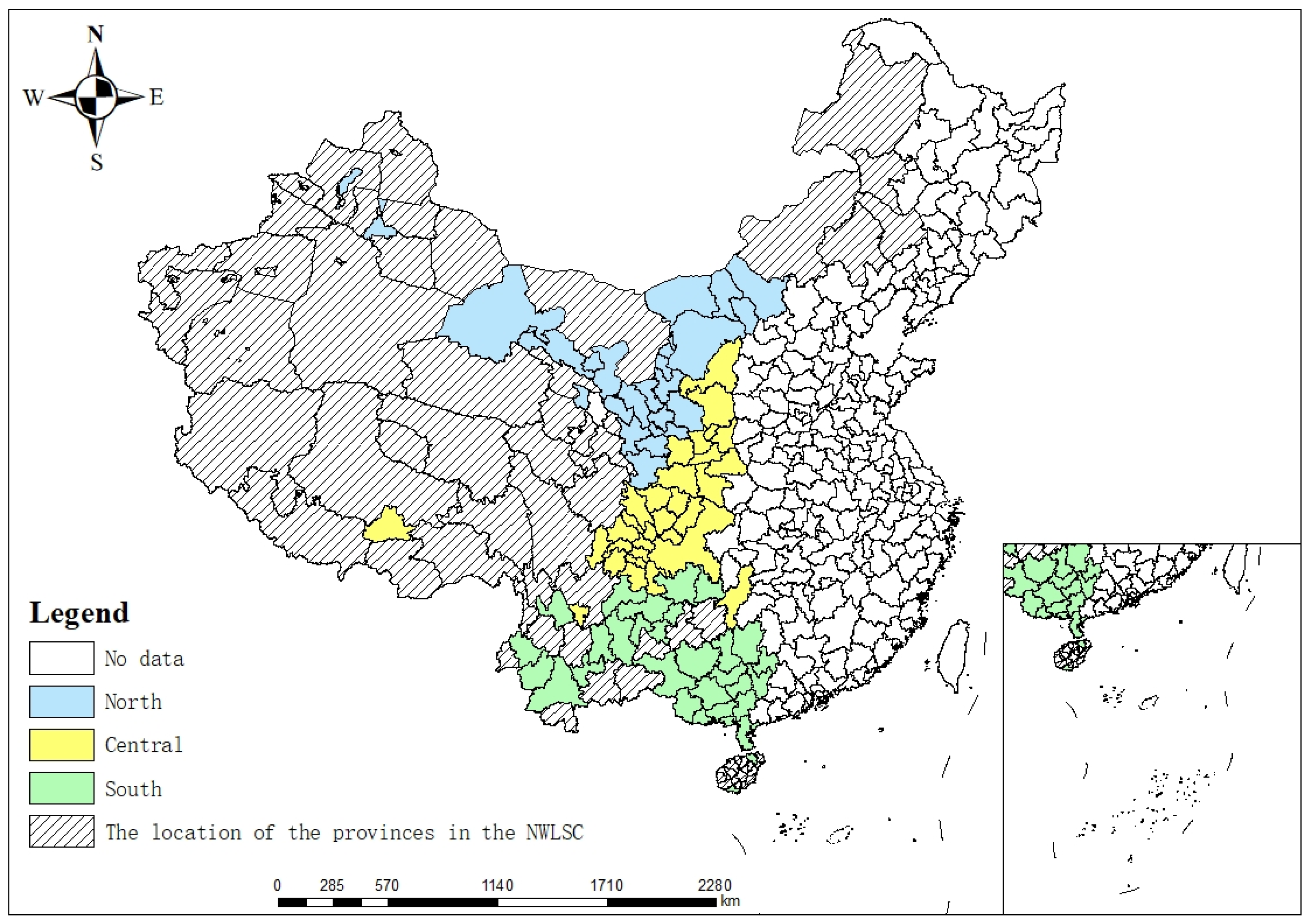
Balancing data availability, reliability, and completeness—and noting that the digital-finance index begins in 2011—we restrict the sample to 88 cities across 13 provinces and municipalities in China’s western region from 2011 to 2022 (See in Figure 3); data limitations exclude Shigatse, Qamdo, Nyingchi, Shannan, Nagqu, Turpan, Hami, Haidong, Sansha, and Danzhou. Original data are drawn from the China City Statistical Yearbook, China Regional Economic Yearbook, and annual statistical yearbooks and bulletins of each prefecture. Missing observations are imputed by linear interpolation. Descriptive statistics are presented in Table 2.
Figure 3. Urban distribution and regional division in the NWLSC.
Table 2. Descriptive statistics for the variables.

5. Empirical Results

5.1. Analysis of the NWLSC Typical Facts

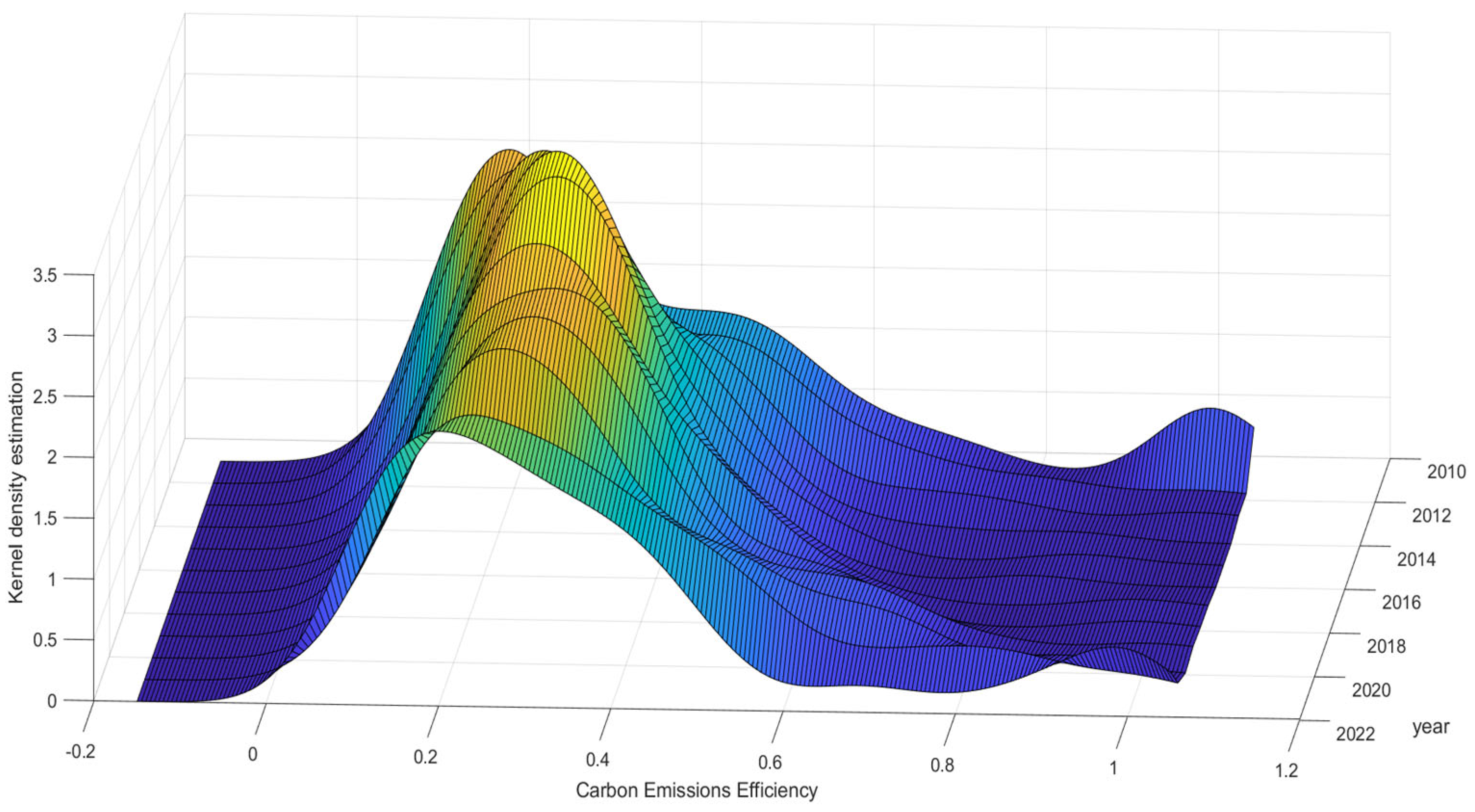
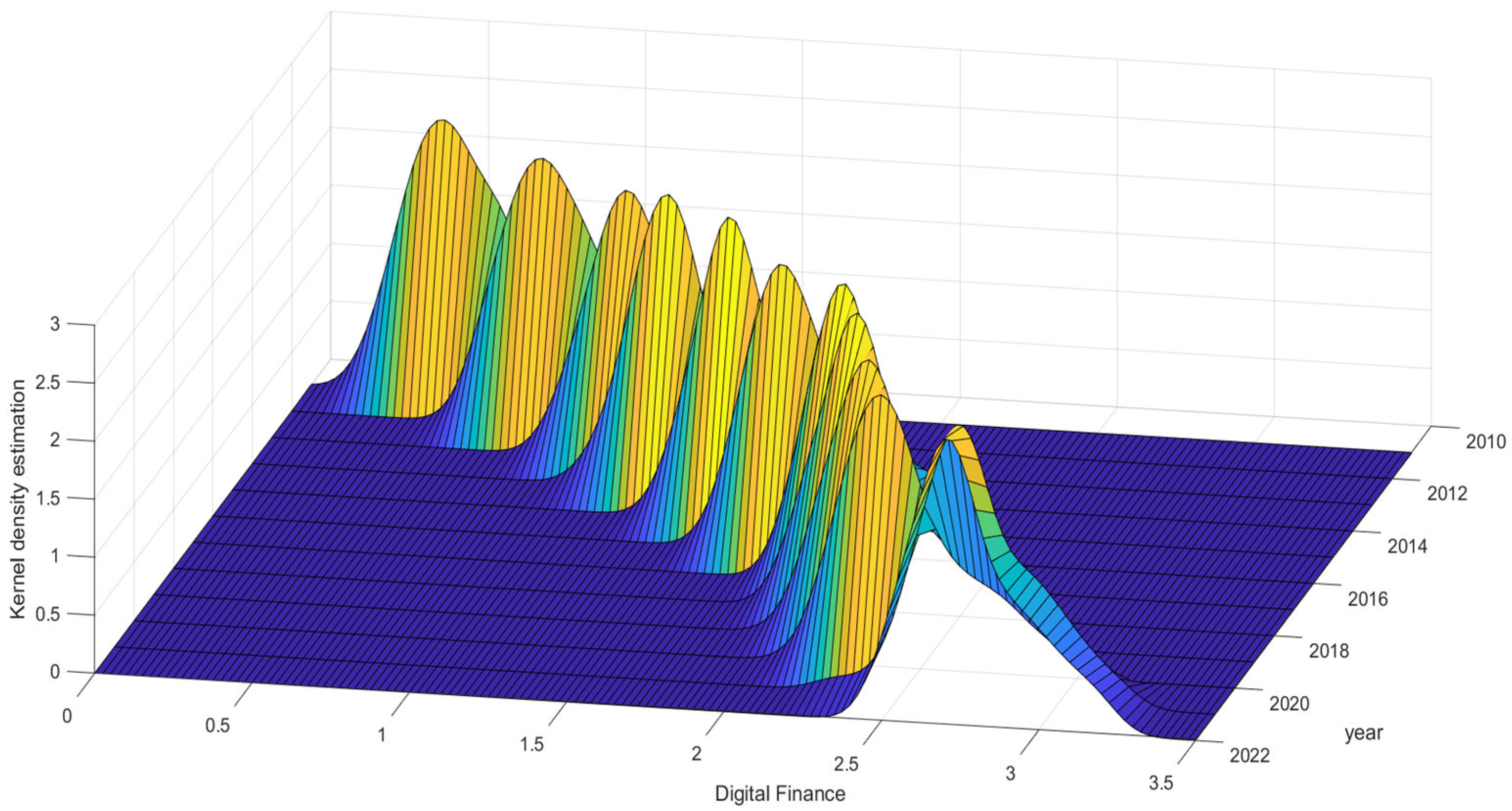
Before estimating the models, we conduct kernel-density estimations of CEE and DF to characterize their spatio-temporal evolution in terms of location, shape, spread, and polarization (Figure 4 and Figure 5).
Figure 4. Kernel-density distribution of NWLSC urban carbon-emission efficiency.
Figure 5. Kernel-density distribution of digital finance in the NWLSC.
Figure 4 plots the annual kernel-density distributions of CEE across NWLSC cities from 2011 to 2022. The curve first shifts rightwards and then leftwards, indicating an initial rise followed by a decline in urban CEE. This trajectory underscores the challenges the corridor faces in transitioning to environmentally oriented high-quality development. Peak height rises and then falls, while bandwidth widens, revealing a growing absolute gap among cities. A pronounced right tail emerges and gradually thickens, revealing that high-CEE cities continue to expand vigorously, further distancing themselves from the rest. Polarization has become increasingly evident: the distribution now exhibits a dominant primary peak alongside a smaller secondary peak, indicating a mild but persistent bifurcation in urban CEE. This confirms the presence of substantial spatial heterogeneity in CEE within the corridor.
Figure 5 depicts the annual kernel-density distributions of DF across NWLSC cities from 2011 to 2022. The density curve shifts steadily rightward, signaling rapid improvement in the DF index. The upward movement of the mean further confirms an overall increase in DF levels across cities. The shape of the dominant mode also evolves: the 2011 flat, broad profile becomes sharp and narrow by 2022. The tall, narrow peak in 2022 indicates both higher aggregate DF and a marked reduction in regional disparities.

5.2. Benchmark Regression Results

A Hausman test (p < 0.01) leads us to adopt a fixed-effects specification. Table A1 reports the benchmark regression estimates. Columns (1)–(4) present, respectively, pooled OLS, time-fixed, individual-fixed, and two-way fixed-effects estimates. Among the four models, the two-way fixed-effects specification delivers the best fit. Specifically, it yields the highest R2 and log-likelihood and the lowest AIC and BIC relative to the pooled, time-fixed, and individual-fixed alternatives. Consequently, all subsequent analyses rely on the two-way fixed-effects model.
Table 3 shows the estimation results of DF and its three dimensions. In columns (1) and (2), the coefficients on DF are negative and significant, whereas that on DF2 are positive and significant at the 1% level, confirming a nonlinear relationship between digital finance and carbon-emission efficiency in the NWLSC and validating H1.
Table 3. Regression results of digital finance and its sub-dimensions.
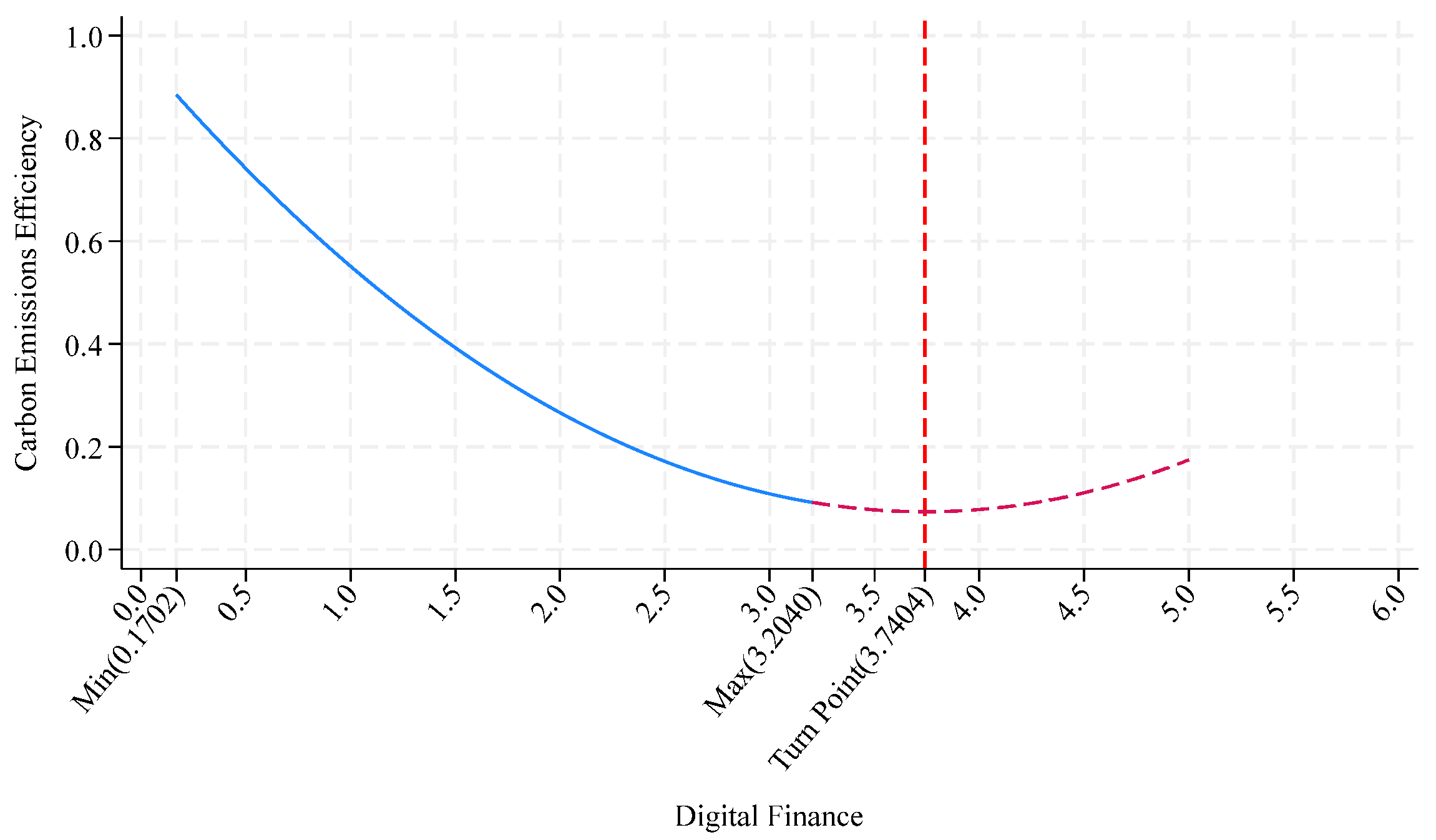
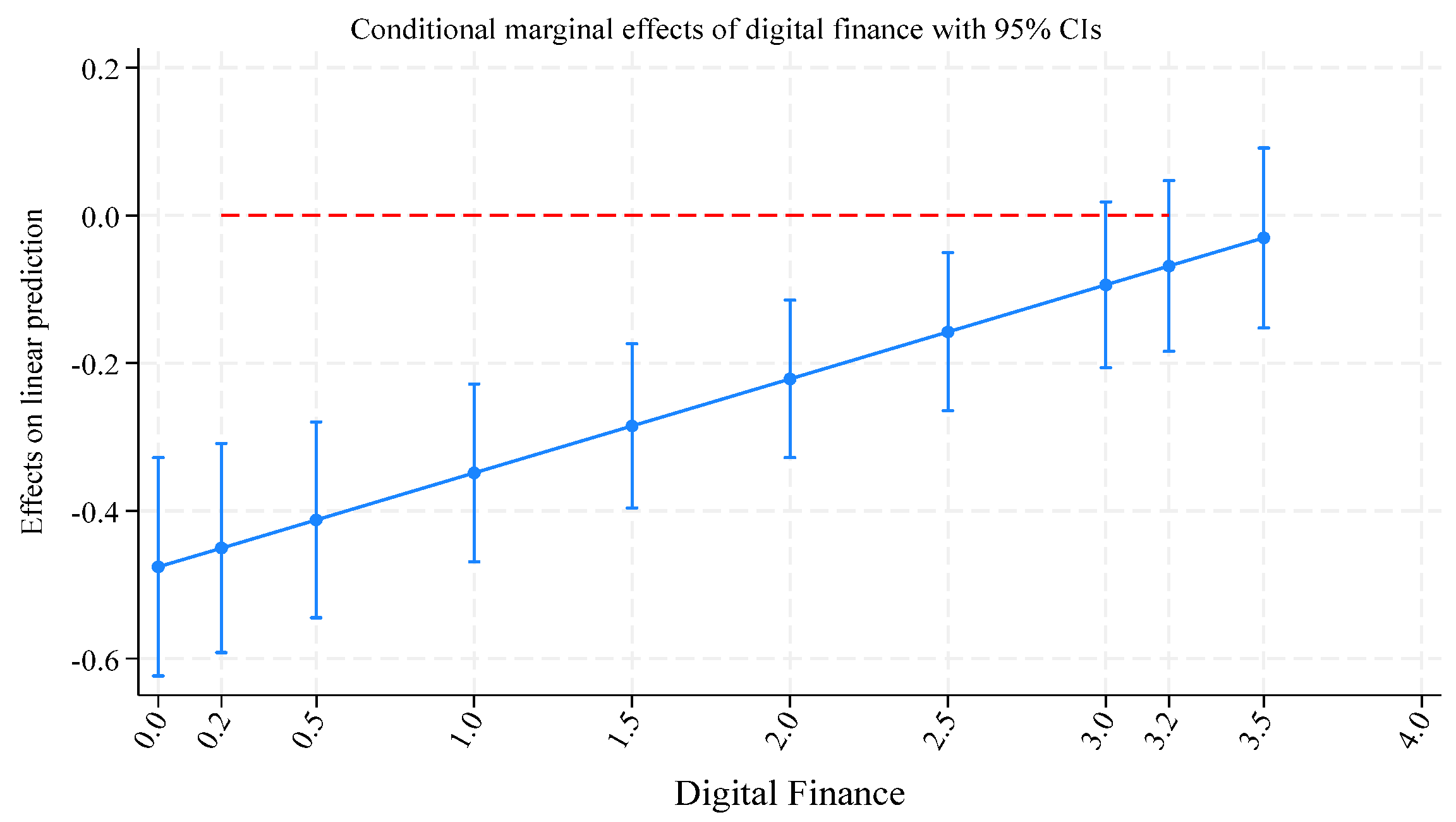
To further examine whether a U-shaped relationship existed between DF and urban CEE, we plotted the nonlinear relationship (Figure 6) and marginal effects (Figure 7) based on estimation results from column (1) of Table 3. The turning point of the curve occurs at 3.7404, with the observed range of DF values not extending beyond this threshold. However, as DF increases, its marginal effect on urban CEE becomes progressively less negative. These findings indicate that digital-finance does not exhibit a U-shaped relationship with urban CEE in the NWLSC; rather, it demonstrates a nonlinear negative effect that diminishes in magnitude with advancing digital-finance development.
Figure 6. Nonlinear relationship between DF and urban CEE in the NWLSC.
Figure 7. The marginal effect of DF on urban CEE in the NWLSC.
Because the digital-finance index comprises three sub-dimensions—coverage breadth (COB), usage depth (USD), and digitalization level (DIL)—we re-estimate the two-way fixed-effects model for each component to identify which aspects drive CEE in the NWLSC. The columns (3)–(5) of Table 3 show that COB bears a nonlinear relationship with CEE and USD enhances CEE, whereas DIL dampens it.
Rising COB reflects the integration of traditional finance with modern digital technologies, which removes geographical constraints and delivers adequate digital-finance services to NWLSC micro-, small-, and medium-sized enterprises. The resulting expansion of the financial-services sector upgrades urban industrial structures and improves carbon-emission efficiency. Yet, large inter-city disparities persist in financial development and digital-infrastructure endowments; northern cities in particular exhibit narrower service coverage and slower industrial transformation, offsetting potential CEE gains.
Higher USD—manifesting in increased payment, credit, insurance, credit-scoring, investment, and money-market-fund services—improves product availability. The richer array of financial instruments, deeply embedded in the real economy, meets firms’ needs for R&D, resource utilization, and logistics, thereby enhancing economic performance, cutting CO2 emissions, and raising CEE.
Expanding DIL signals deeper integration of finance and digital technologies; however, operating data centers, cloud platforms, and trading systems is energy-intensive and may raise short-term energy consumption. Simultaneously, digital finance leverages technology and credit multipliers to enlarge capital supply, enabling firms to scale up production and capacity, thereby increasing energy use and carbon emissions and dampening CEE improvements.
Estimates for the control variables indicate that lnRGDP is positive and significant, confirming that higher economic development improves urban CEE. Rising economic performance within the NWLSC implies more efficient resource use and heightened public demand for environmental quality, both of which enhance CEE. The coefficient on FSTE equals 0.810 and is significant at the 1% level, indicating that a 1% increase in sci-tech and education expenditure raises CEE by 0.810%. This reflects deliberate government efforts to channel sci-tech and education resources into western China, fostering green innovation and human-capital accumulation that elevate CEE. Coefficients on FD (−0.121) and STRU (−0.038) are both negative and significant, implying that fiscal decentralization and the existing industrial structure curb urban CEE. Western China is sparsely populated and ethnically diverse, with many provinces hosting large minority communities. To accelerate NWLSC development, the central government offers generous transfers and paired-assistance programs that enlarge local budgets and incentivize production-oriented and heavy-industry projects, prompting jurisdictions to compete for growth at the expense of environmental quality. The industrial structure remains secondary-sector-dominated, and infrastructure-driven energy expansion further undermines CEE. The coefficient on ER is insignificant, suggesting that environmental regulations have no discernible effect on urban CEE.

5.3. Endogeneity Tests

Considering the potential bidirectional causality between digital-finance and carbon-emission efficiency, which may lead to estimation bias and endogeneity concerns, this study addresses the issue by incorporating the one-period lagged digital-finance index as an alternative explanatory variable in the baseline model. Regression results for Equation (1) are reported in column (1) of Table 4. The coefficients of L.DF and L.DF2 exhibit negative and positive signs, respectively, and are statistically significant at the 1% level, consistent with the regression results presented earlier in this paper.
Table 4. Results of Endogeneity tests.
To address potential endogeneity issues, including omitted variable bias in the empirical regression framework, this study employs the two-stage least squares (2SLS) estimation approach. For the instrumental variable (IV) estimation, we adopt the mean digital-finance index of other cities within the NWLSC (excluding the local city) as an IV for DF. Digital-finance development exhibits considerable homogeneity across cities within the NWLSC, suggesting that a given city’s digital-finance status correlates with the average level of other cities. Concurrently, the mean digital-finance index of other cities does not directly affect the carbon-emission efficiency of the focal city, thereby satisfying the exclusion restriction required for valid instrumental variables. As shown in column (2), the estimated coefficients for DF and its quadratic term maintain consistent signs and statistical significance compared with previous findings. The Anderson–Rubin LM statistic for this instrument equals 136.869 (p < 0.001), rejecting the null hypothesis of under identification. The Cragg–Donald Wald F statistic substantially exceeds the critical value of 7.03 at the 10% significance level for the weak instrument test, thereby rejecting the presence of weak instruments. These diagnostic tests confirm that the nonlinear relationship between digital-finance development and urban carbon-emission efficiency remains robust after adequately addressing endogeneity concerns.
To rigorously assess the robustness of our IV estimates, we construct a Bartik-type instrument for DF and its quadratic term following the methodology proposed by Bartik [89]. Results reported in column (3) confirm the persistence of the nonlinear relationship between digital-finance development and urban carbon-emission efficiency, thereby validating the robustness of our empirical findings.
Concurrently, this study implements the Generalized Method of Moments (GMM) to further address endogeneity concerns arising from potential bidirectional causality between the focal variables. Columns (4) and (5) report the estimation results from difference-GMM and system-GMM specifications, respectively. The Sargan test yields p-values exceeding 0.1 in both specifications, failing to reject the null hypothesis of valid instrumental variables. Similarly, the AR(2) test statistics confirm the absence of second-order serial correlation in the residuals. These diagnostic assessments indicate that both the difference-GMM and system-GMM estimators produce consistent and reliable parameter estimates. These findings confirm that the nonlinear relationship between DF and CEE persists across estimation methodologies, corroborating the empirical patterns documented in Table 3.

5.4. Robustness Tests

This study assess the robustness of our findings through four complementary tests, with the results reported in Table 5.
Table 5. Results of robustness tests.

5.4.1. Winsorization of Core Variables

Column (1) presents estimates after winsorizing the explained and key explanatory variables at the 1% level to mitigate outlier influence. The coefficients for DF (−0.515) and DF2 (0.063) are both statistically significant at the 1% level, confirming a nonlinear relationship between digital finance and urban carbon-emission efficiency in NWLSC. This result aligns with the baseline findings in Table 3.

5.4.2. Replace Explanatory Variable

Column (2) reports estimates obtained after replacing the core explanatory variable. Following Feng et al. (2023) [90], we construct a fintech index (FT) as an alternative proxy for digital finance and re-estimate the model. The results are presented in column (2) of Table 5. The coefficient on FT is −0.102 (significant at the 1% level), whereas that on FT2 is 0.010 (significant at the 5% level), confirming the robustness of our earlier findings.

5.4.3. Replace the Estimation Model

Column (3) presents estimates obtained with an alternative econometric specification. The Tobit model is a censored regression technique suited to dependent variables that are truncated or censored; it mitigates bias from the bound distribution of efficiency scores that would otherwise distort OLS estimates. Because the computed CEE values lie between 0.0684 and 1.0000, the variable is censored, making the Tobit estimator appropriate. The results in column (3) reveal coefficients of −0.188 and 0.056 for DF and DF2, respectively, both significant at the 1% level, confirming that the nonlinear effect of digital finance on CEE remains robust.

5.4.4. Estimation of Reduced Samples

Column (4) reports estimation after excluding municipality-level cities and provincial capitals. We omitted these major administrative centers to reduce bias from their atypical socioeconomic characteristics, which disproportionately influence NWLSC development. The coefficients for DF (−0.561) and its squared term (0.080) remain statistically significant at the 1% level, confirming the robustness of core findings to this exclusion.

5.5. Heterogeneity Analysis

We conduct heterogeneity tests from three perspectives to examine how NWLSC digital finance influences local carbon-emission efficiency, with the results presented in Table 6 and Table 7.
Table 6. Estimation Results of heterogeneity analysis.
Table 7. Quantile estimation results.

5.5.1. Regional Heterogeneity

To facilitate comparative analysis, we partition the NWLSC into three regions consistent with its spatial master plan (See in Figure 3): the North (Inner Mongolia, Gansu, Qinghai, Ningxia, and Xinjiang), Central (Chongqing, Sichuan, Shaanxi, Huaihua in Hunan, and Lhasa in Tibet) and South (Guangxi, Hainan, Guizhou, Yunnan, and Zhanjiang in Guangdong). Columns (1)–(3) of Table 6 report the regional estimates. In the North and Central regions, the DF coefficients are −0.629 and −0.784, respectively (both significant at the 1% level), and the corresponding squared terms are 0.082 and 0.105 (also significant at 1%). By contrast, neither DF nor DF2 is significant in the South. These patterns likely reflect the North’s resource- and heavy-industry orientation: during the early stage of digital finance, capital was channeled into infrastructure and the heavy industry, expanding output while simultaneously increasing energy use. Central cities, serving as key logistics hubs and manufacturing–service clusters, required large amounts of electricity to operate data centers, cloud platforms, and trading systems, further raising short-term energy consumption. Both mechanisms initially suppressed CEE in the North and Central regions. As infrastructure improved, industrial structures greened, and the spillover effects of digital finance materialized, CEE in these regions began to recover. The South, such as Hainan Free Trade Port, operates a “transit economy” centered on port trans-shipment, cross-border trade, and primary logistics. Despite rapid circulation of production factors, digital finance merely facilitates short-chain trade settlement and liquidity financing; it fails to penetrate local high-carbon industries for green transformation. Consequently, its impact on carbon-emission efficiency remains marginal.

5.5.2. Temporal Heterogeneity

Using the 2017 signing of the Framework Agreement as a cutoff, we split the sample into 2011–2016 (pre-establishment) and 2017–2022 (post-establishment) periods to examine whether the establishment of the southbound corridor induced heterogeneous effects of digital finance on carbon-emission efficiency. Columns (4)–(5) of Table 6 show that after corridor establishment, the coefficient on DF is −2.045 (significant at 1%) and that on DF2 is 0.324 (also significant at 1%), whereas neither term is significant beforehand, indicating that the nonlinear relationship emerges only after 2017. Intensive corridor construction enabled cities to leverage abundant natural and energy resources and improved connectivity to attract coal, power, petrochemical, and natural-gas projects; the inclusive and low-cost nature of digital finance channeled substantial capital into these carbon-intensive sectors, initially depressing CEE. As China–Europe Railway Express services stabilized, falling logistics costs amplified positive spillovers from cleaner technologies; digital finance then redirected capital toward green industries and accelerated the construction of green corridors, ultimately raising corridor-wide CEE.

5.5.3. Quantile Estimation Results

To examine how digital finance affects cities with differing carbon-emission efficiencies, we estimate a panel quantile regression at the Q10, Q25, Q50, Q75, and Q90 percentiles (Table 7). Across all quantiles, both DF and DF2 are statistically significant, regardless of whether cities exhibit low or high efficiency. Comparing coefficients across quantiles reveals that as CEE rises, the DF coefficient switches from positive to negative, whereas the DF2 coefficient switches from negative to positive. This implies that the nonlinear effect of digital finance reverses as CEE improves. Consequently, this nonlinear promotive effect is gradually weakened for low-efficiency cities, and the nonlinear negative effect is also weakened for high-efficiency ones.

5.6. Spatial Nonlinear Effect and Mechanism Analysis

5.6.1. Spatial Model Setting

The spatial models primarily consist of two forms: spatial lag and spatial error. The former incorporates the spatial lag of the dependent variable into the explanatory variables, depicting the essence of spatial autocorrelation; the latter includes the spatial lag of the error term, describing the spatial-disturbance correlation. The Lagrange multiplier (LM) test results, as shown in Table 8, indicate that LM(lag) > LM(error), with the R-LM(lag) being significantly larger than the R-LM(error), suggesting that the spatial-lag model is more appropriate than the spatial-error model for construction.
Table 8. Statistical test of spatial-econometric model.

5.6.2. Nonlinear Test and Model Selection

Before estimating the nonlinear model parameters, we must determine the number of transition functions, because m governs the specification of the transition function G ( s i t , γ , c ) . Identification of PSTR requires that the underlying relationship be nonlinear and that the panel exhibits heterogeneity. We therefore conduct a non-linearity test before proceeding to estimation. The test evaluates the null hypothesis H 0 : γ = 0 . To circumvent the identification problem, we approximate G ( s i t , γ , c ) by a first-order Taylor expansion around γ = 0 and construct the auxiliary regression:
C E E i t = μ i + δ 0 X i t + δ 1 X i t s i t + δ 2 X i t s i t 2 + + δ m X i t s i t m + ε i t
Accordingly, testing H 0 : γ = 0 is equivalent to testing H 0 : δ 0 = δ 1 = δ 2 = = δ m = 0 . Failure to reject the null implies a linear specification, whereas rejection indicates pronounced non-linearity. The results for our sample are reported in Table 9.
Table 9. Results of nonlinear tests.
Test statistics for both transition variables reject the null hypothesis H 0 : γ = 0 at the 1% level. This confirms pronounced panel heterogeneity and supports the presence of a nonlinear effect between DF and urban CEE within the NWLSC, validating the model specification. Subsequent tests for residual linearity fail to reject the null of no additional regimes. Hence, a single transition function ( γ = 1 ) is sufficient.
Once the model is restricted to a single transition function, the dimension of the location parameter and the appropriate model variant must be determined. Following Escribano and Jordá (1999) [91] and Lin and Teräsvirta (1994) [92], we perform the corresponding linearity tests for each model; the results are reported in Table 10. The Escribano–Jorda linearity test indicates that, for Model 1, the p-value for H013 is smaller than that for H024, and the sequential test of Teräsvirta yields the smallest p-value for H01. Consequently, Model 1 should be specified as an LSTR with m = 1. Combining these findings with the test results in Table 10, we set Model 1 to an LSTR with m = 1 and r = 1. Since the p-value of H024 is lower than that of H013, and H02 demonstrates the lowest p-value, Model 2 is more appropriately specified as an ESTR model.
Table 10. Statistical tests for model selection.

5.6.3. Parameter Estimation

All spatial-autoregressive coefficients ( ρ ), smoothing parameters (γ), threshold parameters (c), and variable estimates are reported in Table 11. Both models yield positive and statistically significant ρ coefficients at the 1% level, indicating pronounced positive spatial spillovers of CEE—local CEE is strongly influenced by that of neighboring cities. The threshold parameter c governs the transition from the low regime to the high regime; its value equals the regime-weighted average of the transition variable. The estimation results show that the nonlinear coefficients ( δ ) are all statistically significant, confirming that the model adequately captures the nonlinear impact of digital finance on urban carbon-emission efficiency within the NWLSC.
Table 11. Estimation results of spatial PSTR model and endogeneity tests.
In column (1), transportation infrastructure (TIN) serves as the transition variable, its threshold is estimated at 0.635 and is statistically significant at the 1% level. On either side of this threshold, the effect of DF on local CEE differs markedly. The estimates reveal that DF( β ) and DF( δ ) are −0.420 and 0.335, respectively, and both are significant at the 1% levels, demonstrating an initial significant suppression followed by a deceleration in the negative effects ( β < 0 , β < β + δ < 0 ). Specifically, when the regime is low (TIN below the threshold), the marginal effect of digital finance is −0.420, implying that a 1% increase in digital finance reduces local carbon-emission efficiency by 0.420% when transportation infrastructure is underdeveloped. When TIN exceeds the threshold, DF operates within the high-TIN regime, with the combined coefficient β + δ of −0.085. This indicates that even with advanced transportation infrastructure, digital finance continues to suppress local carbon-emission efficiency, though this inhibitory effect is comparatively attenuated. The estimated smoothing parameter γ = 5.659 indicates a gradual transition: the marginal effect of digital finance shifts smoothly from the low regime to the high regime as transport infrastructure surpasses the threshold.
Estimation results from column (1) further reveal statistically significant coefficients of 0.425 (at the 1% level) and −0.316 (at the 1% level) for the spatial-interaction terms W × DF( θ ) and W × DF( δ ), respectively, indicating a nonlinear enhancing effect of neighboring cities’ digital finance on regional carbon-emission efficiency. Specifically, when local transportation infrastructure is below the threshold (low regime), a 1% increase in neighboring digital finance raises local carbon-emission efficiency by 0.425%. Simultaneously, when local transportation infrastructure exceeds the threshold (high regime), the combined coefficient θ + δ of 0.109 indicates that a 1% increase in neighboring digital finance corresponds to a 0.109% improvement in local carbon-emission efficiency. Consequently, H2 and H3 are supported. Notably, the enhancing effect of neighboring cities’ digital finance on local carbon-emission efficiency progressively diminishes with advancing transportation infrastructure development. This attenuation may stem from diminished geographical barriers and enhanced factor mobility following the maturation of local transportation infrastructure. Under these conditions, further advancement of digital finance in neighboring cities, while maintaining positive technological spillovers, may simultaneously trigger siphoning effects and competitive reallocation of scarce green production resources. These emergent competitive and diversionary effects partially offset positive spatial spillovers, thereby attenuating the net enhancing effect of the neighboring regions’ digital finance.
Column (2) adopts information infrastructure (INF) as the transition variable; the estimated threshold is 0.212 and is statistically significant at the 1% level, indicating that the effect of DF on local CEE differs markedly across regimes. The estimates show that DF( β ) and DF( δ ) equal −0.372 and 0.367, respectively, and both are significant at the 1% level. Because β < 0 and β < β + δ < 0 , the marginal effect is initially negative and then becomes less negative as INF rises. Specifically, when INF remains below the threshold, a 1% increase in digital finance reduces carbon efficiency by 0.372%. As information infrastructure improves beyond the threshold, the negative impact of digital finance on local carbon efficiency diminishes monotonically, exhibiting a declining-marginal-damage pattern. Finally, the smoothing parameter γ = 2.528 implies a gradual transition between regimes: the marginal effect of digital finance evolves smoothly from the low-regime value to the high-regime value as INF crosses the threshold.
Column (2) also reveals that the coefficients on W × DF( θ ) and W × DF( δ ) are 0.356 and −0.333, respectively, and both are statistically significant at the 1% level, generating a nonlinear promotional effect of neighboring digital finance on local carbon efficiency. When local information infrastructure is below the threshold (low regime), a 1% increase in neighboring digital finance raises local carbon efficiency by 0.356%. Once local information infrastructure exceeds the threshold (high regime), the same increment attenuates the efficiency gain, adding merely 0.023%. Consequently, H4 is supported. Against a backdrop of regional competition and cooperation, high-tech, low-carbon industries—such as digital services and clean technologies—in cities with advanced information infrastructure may experience outward pressure on capital and talent. As neighboring digital finance deepens, it attracts mobile factors of production, eroding the resource base required for industrial upgrading in the core region and thereby retarding improvements in carbon efficiency.
Traditional spatial econometric models depend on the strict exogeneity of the spatial-weight matrix W. However, as W is determined by economic factors, the assumption of strict exogeneity may be violated in empirical analyses, resulting in endogeneity issues [93]. To address the endogeneity of spatial-lag terms, following Qu and Lee (2015) [93], we employ the spatial lags of explanatory variables, W2X and W3X, as instrumental variables. Results presented in columns (3) and (4) of Table 11 reveal no substantial differences in the coefficient signs and statistical significance of the estimated effects for DF and W × DF. This finding suggests that, after accounting for the endogeneity of W, the nonlinear effects of digital finance on carbon-emission efficiency in both local and neighboring cities remain robust.
To assess robustness, columns (1) and (2) of Table 12 present estimation results after excluding municipalities directly under the central government and provincial capital cities. Compared with the results reported in columns (1) and (2) of Table 11, the estimated coefficients for DF and W × DF exhibit no substantial differences. Additionally, we conduct further robustness checks by substituting the digital-finance index with a fintech index (FT) as an alternative measure. Columns (3) and (4) present the estimation results following this substitution, revealing similar nonlinear relationships between fintech and carbon-emission efficiency in both local and neighboring cities. These findings confirm the robustness of our estimation results.
Table 12. Estimation results of robustness tests.

6. Conclusion and Recommendation

6.1. Conclusions

Drawing on panel data for 88 prefecture-level cities in the NWLSC from 2011 to 2022, this study first elucidates the theoretical mechanisms linking digital finance to urban carbon-emission efficiency and then empirically examines its nonlinear effects, spatial spillovers, and transmission channels using two-way fixed-effects and spatial-panel smooth-transition models. The main findings are summarized below.
First, the direct impact of DF on urban CEE within the NWLSC presents a nonlinear inhibitory effect, which gradually weakens with the increase in DF. This conclusion survives a battery of robustness checks—including endogeneity corrections, winsorization, alternative proxies, and alternative estimators—and is driven primarily by the nonlinear impact of coverage breadth.
Second, the effect of DF on CEE is markedly heterogeneous. Across regions, a significant nonlinear inhibitory effect is observed in the Northern and Central regions, whereas the nonlinear effect is insignificant in the Southern region. Temporally, the nonlinear relationship emerges only after the corridor was established. DF’s positive effect on CEE diminishes across lower quantiles, while its negative effect weakens across higher quantiles.
Third, as the transportation and information infrastructure smoothly shift between high and low regimes, the DF exhibits a nonlinear inhibitory effect on the local CEE in the NWLSC. Concurrently, the neighboring cities’ DF demonstrates a nonlinear promotional effect on the local CEE. Specifically, during the process of regional infrastructure transitioning from low to high, the inhibitory effect of DF on the local CEE can be mitigated, and the promotional effect of DF in neighboring cities can also be weakened.

6.2. Policy Recommendations

These findings provide policymakers with actionable insights into how digital-finance initiatives within the NWLSC can be leveraged to enhance carbon-emission efficiency.
First, local governments should optimize the structural development of digital-finance by prioritizing balanced advancement between service coverage and quality enhancement. Municipalities along the NWLSC should avoid prioritizing rapid expansion of service coverage in digital-finance development; instead, they should focus on enhancing the precision and depth of digital financial services. Specifically, local governments could establish dedicated green digital-finance guidance funds to strategically allocate financial resources toward low-carbon industries and energy conservation projects. Concurrently, they should develop a quality assessment framework for digital finance that incorporates carbon-emission efficiency into institutional performance metrics, thereby facilitating the sector’s transition from mere scale expansion toward environmentally sustainable and precision-oriented service models.
Second, local governments should calibrate digital-finance policies according to regional characteristics and developmental stages. Northern and Central regions should leverage the nonlinear effect of digital finance to accelerate its deep integration with green industrial ecosystems, whereas Southern regions should prioritize strengthening foundational infrastructure to unlock latent CEE gains. Specifically, municipalities with below-median CEE should implement targeted digital-finance support measures to sustain positive developmental impacts; conversely, high-efficiency municipalities require optimized digital-finance resource allocation to mitigate adverse rebound effects. Moreover, all regions must capitalize on the post-corridor-establishment policy window to cultivate a complementary digital-finance landscape with regionally specialized functions.
Third, local governments should co-develop transportation and digital-infrastructure systems while amplifying inter-city spatial synergies. Municipalities along the NWLSC should balance intra-urban infrastructure enhancement with regional coordination imperatives. Specifically, authorities should accelerate deployment of next-generation digital infrastructure—including 5G networks and data centers—while concurrently upgrading multimodal transport networks to enable digital finance’s decarbonization pathways; concurrently, establishing interjurisdictional digital-finance coordination mechanisms—such as jointly developing regional service platforms and sharing carbon-emission datasets—is essential to sustain positive spatial spillovers among neighboring municipalities and prevent the erosion of regional synergies caused by infrastructure leapfrogging in individual cities.

Author Contributions

Conceptualization, M.Z.; methodology, M.Z.; software, X.H.; validation, X.H. and Y.X.; formal analysis, X.H.; investigation, Y.X.; data curation, Y.X.; writing—original draft preparation, M.Z.; writing—review and editing, X.H. and Y.X.; visualization, M.Z.; supervision, M.Z.; project administration, M.Z.; funding acquisition, M.Z. All authors have read and agreed to the published version of the manuscript.

Funding

This research was funded by Humanities and Social Sciences Youth Foundation of Chongqing Municipal Education Commission (Grant No. 24SKGH324).

Institutional Review Board Statement

Not applicable.

Data Availability Statement

All data can be available on request.

Conflicts of Interest

The authors declare no conflicts of interest.

Appendix A

Table A1. Benchmark regression results.
(1)(2)(3)(4)
DF−0.151 ***−0.282 **−0.181 ***−0.467 ***
(−4.473)(−2.571)(−8.570)(−5.952)
DF20.055 ***0.048 **0.054 ***0.058 ***
(5.723)(2.164)(10.091)(4.444)
lnRGDP−0.0030.0060.064 **0.048 *
(−0.158)(0.298)(2.538)(1.721)
FSTE0.1620.1460.664 ***0.810 ***
(1.051)(0.935)(4.857)(5.786)
FD0.215 ***0.311 ***−0.136 **−0.121 **
(4.753)(5.989)(−2.388)(−2.030)
STRU−0.035 ***−0.033 ***−0.020 **−0.038 ***
(−3.898)(−3.507)(−1.996)(−3.488)
ER−0.035 ***−0.038 ***0.000−0.001
(−8.481)(−8.937)(0.123)(−0.315)
Constant0.406 **0.558 ***−0.2740.008
(2.226)(2.874)(−1.093)(0.030)
City FENONOYESYES
Year FENOYESNOYES
N1056105610561056
R20.1610.1540.1400.182
Log-L392.149401.7301098.7301124.846
AIC−768.299−787.459−2181.461−2211.692
BIC−728.601−747.761−2141.763−2117.409
Note: t-statistics in parentheses; * p < 0.1, ** p < 0.05, *** p < 0.01.

References

  1. Xie, R.; Fang, J.; Liu, C. The effects of transportation infrastructure on urban carbon emissions. Appl. Energy 2017, 196, 199–207. [Google Scholar] [CrossRef]
  2. Churchill, S.A.; Inekwe, J.; Ivanovski, K.; Smyth, R. Transport infrastructure and CO2 emissions in the OECD over the long run. Transp. Res. Part D Transp. Environ. 2021, 95, 102857. [Google Scholar] [CrossRef]
  3. Zhou, X.; Zhou, D.; Wang, Q. How information and communication technology drives carbon emissions: A sector-level analysis for China. Energy Econ. 2018, 81, 380–392. [Google Scholar] [CrossRef]
  4. Zhang, M.; Liu, Y. Influence of digital finance and green technology innovation on China’s carbon emission efficiency: Empirical analysis based on spatial metrology. Sci. Total Environ. 2022, 838, 156463. [Google Scholar] [CrossRef]
  5. Li, Y.; Zheng, Z.; Zhao, M.; Liu, Z. How does digital trade impact urban carbon emissions efficiency? Evidence from China’s cross-border e-commerce pilot zones. J. Clean. Prod. 2024, 456, 142363. [Google Scholar] [CrossRef]
  6. Tao, X.; Yan, J.; Cai, D. Exploring the spatial spillover effect of industrial structural upgrading on carbon emissions efficiency: Evidence from China. J. Environ. Manag. 2025, 391, 126539. [Google Scholar] [CrossRef]
  7. Qian, H.; Ma, R.; Wu, L. Market-based solution in China to finance the clean from the dirty. Fundam. Res. 2024, 4, 324–333. [Google Scholar] [CrossRef]
  8. Liu, X.; Zhang, W.; Cheng, J.; Zhao, S.; Zhang, X. Green credit, environmentally induced R&D and low carbon transition: Evidence from China. Environ. Sci. Pollut. Res. 2022, 29, 89132–89155. [Google Scholar] [CrossRef]
  9. Sun, H.; Chen, T.; Wang, C. Spatial impact of digital finance on carbon productivity. Geosci. Front. 2024, 15, 101674. [Google Scholar] [CrossRef]
  10. Zhou, P.; Ang, B.; Han, J. Total factor carbon emission performance: A Malmquist index analysis. Energy Econ. 2010, 32, 194–201. [Google Scholar] [CrossRef]
  11. Dong, Y.; Hamilton, R.; Tippett, M. Cost efficiency of the Chinese banking sector: A comparison of stochastic frontier analysis and data envelopment analysis. Econ. Model. 2014, 36, 298–308. [Google Scholar] [CrossRef]
  12. Choi, Y.; Zhang, N.; Zhou, P. Efficiency and abatement costs of energy-related CO2 emissions in China: A slacks-based efficiency measure. Appl. Energy 2012, 98, 198–208. [Google Scholar] [CrossRef]
  13. Du, K.; Lu, H.; Yu, K. Sources of the potential CO2 emission reduction in China: A nonparametric meta-frontier approach. Appl. Energy 2014, 115, 491–501. [Google Scholar] [CrossRef]
  14. Zhao, P.; Zeng, L.; Li, P.; Lu, H.; Hu, H.; Li, C.; Zheng, M.; Li, H.; Yu, Z.; Yuan, D.; et al. China’s transportation sector carbon dioxide emissions efficiency and its influencing factors based on the EBM DEA model with undesirable outputs and spatial durbin model. Energy 2022, 238, 121934. [Google Scholar] [CrossRef]
  15. Wang, G.; Deng, X.; Wang, J.; Zhang, F.; Liang, S. Carbon emission efficiency in China: A spatial panel data analysis. China Econ. Rev. 2019, 56, 101313. [Google Scholar] [CrossRef]
  16. He, A.; Xue, Q.; Zhao, R.; Wang, D. Renewable energy technological innovation, market forces, and carbon emission efficiency. Sci. Total Environ. 2021, 796, 148908. [Google Scholar] [CrossRef]
  17. Zhou, L.; Tang, L. Environmental regulation and the growth of the total-factor carbon productivity of China’s industries: Evidence from the implementation of action plan of air pollution prevention and control. J. Environ. Manag. 2021, 296, 113078. [Google Scholar] [CrossRef] [PubMed]
  18. Zhang, W.; Liu, X.; Zhao, S.; Tang, T. Does green finance agglomeration improve carbon emission performance in China? A perspective of spatial spillover. Appl. Energy 2024, 358, 112561. [Google Scholar] [CrossRef]
  19. Broby, D.; Hoepner, A.; Klausmann, J.; Adamsson, H. The Output and Productivity Benefits of Fintech Collaboration: Scotland and Ireland. SIFI Fintech 2018, 1–13. Available online: https://strathprints.strath.ac.uk/64269/1/Broby_etal_2018_The_output_and_productivity_benefits_of_fintech_collaboration_Scotland_and_Ireland.pdf (accessed on 10 October 2025).
  20. Demertzis, M.; Merler, S.; Wolff, G.B. Capital markets union and the fintech opportunity. J. Financ. Regul. 2018, 4, 157–165. [Google Scholar] [CrossRef]
  21. Beck, T.; Pamuk, H.; Ramrattan, R.; Uras, B.R. Payment Instruments, Finance and Development. J. Dev. Econ. 2018, 133, 162–186. [Google Scholar] [CrossRef]
  22. Liu, Y.; Luan, L.; Wu, W.; Zhang, Z.; Hsu, Y. Can digital financial inclusion promote China’s economic growth? Int. Rev. Financ. Anal. 2021, 78, 101889. [Google Scholar] [CrossRef]
  23. Sun, Y.; Tang, X. The impact of digital inclusive finance on sustainable economic growth in China. Financ. Res. Lett. 2022, 50, 103234. [Google Scholar] [CrossRef]
  24. Lv, C.; Song, J.; Lee, C.C. Can digital finance narrow the regional disparities in the quality of economic growth? Evidence from China. Econ. Anal. Policy 2022, 76, 502–521. [Google Scholar] [CrossRef]
  25. de Clercq, M.; D’Haese, M.; Buysse, J. Economic growth and broadband access: The European urban-rural digital divide. Telecommun. Policy 2023, 47, 102579. [Google Scholar] [CrossRef]
  26. Zaidi, S.A.H.; Hussain, M.; Zaman, Q.U. Dynamic linka-ges between financial inclusion and carbon emissions: Evidence from selected OECD countries. Resour. Environ. Sustain. 2021, 4, 100022. [Google Scholar] [CrossRef]
  27. Lee, C.C.; Wang, F. How does digital inclusive finance affect carbon intensity? Econ. Anal. Policy 2022, 75, 174–190. [Google Scholar] [CrossRef]
  28. Kihombo, S.; Saud, S.; Ahmed, Z.; Chen, S. The effects of research and development and financial development on CO2 emissions: Evidence from selected WAME economies. Environ. Sci. Pollut. Res. Int. 2021, 28, 51149–51159. [Google Scholar] [CrossRef]
  29. Zhang, R.; Wu, K.; Cao, Y.; Sun, H. Digital inclusive finance and consumption-based embodied carbon emissions: A dual perspective of consumption and industry upgrading. J. Environ. Manag. 2023, 325, 116632. [Google Scholar] [CrossRef]
  30. Aghion, P.; Bechtold, S.; Cassar, L.; Herz, H. The causal effects of competition on innovation: Experimental evidence. J. Law Econ. Organ. 2018, 34, 162–195. [Google Scholar] [CrossRef]
  31. Baum-Snow, N. Did highways cause suburbanization? Q. J. Econ. 2007, 122, 775–805. [Google Scholar] [CrossRef]
  32. Duranton, G.; Turner, M.A. Urban growth and transportation. Rev. Econ. Stud. 2012, 79, 1407–1440. [Google Scholar] [CrossRef]
  33. Duranton, G.; Morrow, P.M.; Turner, M.A. Roads and trade: Evidence from the US. Rev. Econ. Stud. 2014, 81, 681–724. [Google Scholar] [CrossRef]
  34. Baum-Snow, N.; Brandt, L.; Henderson, V.J.; Turner, M.A.; Zhang, Q. Roads, railroads and decentralization of Chinese cities. Rev. Econ. Stat. 2017, 99, 435–448. [Google Scholar] [CrossRef]
  35. Abeberese, A.B.; Chen, M. Intranational trade costs, product scope and productivity: Evidence from India’s golden quadrilateral project. J. Dev. Econ. 2022, 156, 102791. [Google Scholar] [CrossRef]
  36. Ortega, E.; Lopez, E.; Monzon, A. Territorial cohesion impacts of high-speed rail at different planning levels. J. Transp. Geogr. 2012, 24, 130–141. [Google Scholar] [CrossRef]
  37. Duan, L.; Sun, W.; Zheng, S. Transportation network and venture capital mobility: An analysis of air travel and high-speed rail in China. J. Transp. Geogr. 2020, 88, 102852. [Google Scholar] [CrossRef]
  38. Zhang, P.; Wang, J.; Li, M.; Xiao, F. Research on the mechanism of information infrastructure affecting industrial structure upgrading. Sci. Rep. 2022, 12, 19962. [Google Scholar] [CrossRef]
  39. Dominković, D.F.; Bačeković, I.; Pedersen, A.S.; Krajačić, G. The future of transportation in sustainable energy systems: Opportunities and barriers in a clean energy transition. Renew. Sustain. Energy Rev. 2018, 82, 1823–1838. [Google Scholar] [CrossRef]
  40. Chen, Z.; Wang, W.; Li, F.; Zhao, W. Congestion assessment for the Belt and Road countries considering carbon emission reduction. J. Clean. Prod. 2020, 242, 118405. [Google Scholar] [CrossRef]
  41. Lin, B.; Chen, Y. Will land transport infrastructure affect the energy and carbon dioxide emissions performance of China’s manufacturing industry? Appl. Energy 2020, 260, 114266. [Google Scholar] [CrossRef]
  42. Sharif, F.; Tauqir, A. The effects of infrastructure development and carbon emissions on economic growth. Environ. Sci. Pollut. Res. 2021, 28, 36259–36273. [Google Scholar] [CrossRef]
  43. Wang, D.; Ma, C.; Chen, Y.; Wen, A.; Hu, M.; Luo, Q. Carbon Reduction Effects in Transport Infrastructure: The Mediating Roles of Collusive Behavior and Digital Control Technologies. Sustainability 2024, 16, 8390. [Google Scholar] [CrossRef]
  44. Acheampong, A.O.; Dzator, J.; Dzator, M.; Salim, R. Unveiling the effect of transport infrastructure and technological innovation on economic growth, energy consumption and CO2 emissions. Technol. Forecast. Soc. Chang. 2022, 182, 121843. [Google Scholar] [CrossRef]
  45. Xu, H.; Cao, S.; Xu, X. The development of highway infrastructure and CO2 emissions: The mediating role of agglomeration. J. Clean. Prod. 2022, 337, 130501. [Google Scholar] [CrossRef]
  46. Zhao, X.; Burnett, J.W.; Fletcher, J.J. Spatial analysis of China province-level CO2 emission intensity. Renew. Sustain. Energy. Rev. 2014, 33, 1–10. [Google Scholar] [CrossRef]
  47. Wang, L.; Du, K.; Shao, S. Transportation infrastructure and carbon emissions: New evidence with spatial spillover and endogeneity. Energy 2024, 297, 131268. [Google Scholar] [CrossRef]
  48. Dong, F.; Li, Y.; Qin, C.; Zhang, X.; Chen, Y.; Zhao, X.; Wang, C. Information infrastructure and greenhouse gas emission performance in urban China: A difference-in-differences analysis. J. Environ. Manag. 2022, 316, 115252. [Google Scholar] [CrossRef] [PubMed]
  49. Lyu, Y.; Ji, Z.; Liang, H.; Wang, T.; Zheng, Y. Has information infrastructure reduced carbon emissions?-Evidence from panel data analysis of Chinese cities. Buildings 2022, 12, 619. [Google Scholar] [CrossRef]
  50. Qiao, L.; Li, L.; Fei, J. Can “new infrastructure” reverse the “growth with pollution” profit growth pattern? An empirical analysis based on listed companies in China. Environ. Sci. Pollut. Res. 2022, 29, 30441–30457. [Google Scholar] [CrossRef]
  51. Li, S.; Zhou, C.; Wang, S. Does modernization affect carbon dioxide emissions A panel data analysis. Sci. Total Environ. 2019, 663, 426–435. [Google Scholar] [CrossRef] [PubMed]
  52. Liang, D.; Liu, J.; Liu, M.; Sun, J. Does information infrastructure and technological infrastructure reduce carbon dioxide emissions in the context of sustainable development? Examining spatial spillover effect. Sustain. Dev. 2024, 32, 1599–1615. [Google Scholar] [CrossRef]
  53. Dong, F.; Dai, Y.; Zhang, S.; Zhang, X.; Long, R. Can a carbon emission trading scheme generate the Porter effect? Evidence from pilot areas in China. Sci. Total Environ. 2019, 653, 565–577. [Google Scholar] [CrossRef] [PubMed]
  54. Hamdi, H.; Sbia, R.; Shahbaz, M. The nexus between electricity consumption and economic growth in Bahrain. Econ. Model. 2014, 38, 227–237. [Google Scholar] [CrossRef]
  55. Avom, D.; Nkengfack, H.; Fotio, H.K.; Totouom, A. ICT and environmental quality in Sub-Saharan Africa: Effects and transmission channels. Technol. Forecast. Soc. Chang. 2020, 155, 120028–120040. [Google Scholar] [CrossRef]
  56. Jia, W.; Wang, Z.; Liu, L. Digital Inclusive Finance and Carbon Emissions Efficiency: Evidence from China’s Economic Zones. Sustainability 2025, 17, 409. [Google Scholar] [CrossRef]
  57. Du, W.; Liu, X.; Liu, Y.; Xie, J. Digital Economy and carbon emissions efficiency in three major urban agglomerations of China: A U-shaped journey towards green development. J. Environ. Manag. 2025, 373, 123571. [Google Scholar] [CrossRef]
  58. Wei, Q.; Xue, L.; Zhang, H.; Chen, P.; Yang, J.; Niu, B. Spatiotemporal analysis of carbon emissions efficiency across economic development stages and synergistic emissions reduction in the Beijing-Tianjin-Hebei region. J. Environ. Manag. 2025, 377, 124609. [Google Scholar] [CrossRef]
  59. Tian, J.; Tan, Q.; Chen, Y. Digital Inclusive Finance, Factor Distortion and Green Total Factor Productivity. West Forum 2021, 31, 82–96. (In Chinese) [Google Scholar]
  60. Li, J.; Wu, Y.; Xiao, J. The Impact of Digital Finance on Household Consumption: Evidence from China. Econ. Model. 2020, 86, 317–326. [Google Scholar] [CrossRef]
  61. Qin, X.; Wu, H.; Li, R. Digital finance and household carbon emissions in China. China Econ. Rev. 2022, 76, 101872. [Google Scholar] [CrossRef]
  62. Zhong, S.; Li, A.; Wu, J. How does digital finance affect environmental total factor productivity: A comprehensive analysis based on econometric model. Environ. Dev. 2022, 44, 100795. [Google Scholar] [CrossRef]
  63. Dasgupta, S.; Laplante, B.; Mamingi, N. Pollution and Capital Markets in Developing Countries. J. Environ. Econ. Manag. 2001, 42, 310–335. [Google Scholar] [CrossRef]
  64. Yang, Z.; Gao, W.; Han, Q.; Qi, L.; Cui, Y.; Chen, Y. Digitalization and Carbon Emissions: How Does Digital City Construction Affect China’s Carbon Emission Reduction? Sustain. Cities Soc. 2022, 87, 104201. [Google Scholar] [CrossRef]
  65. Sadorsky, P. The Impact of Financial Development on Energy Consumption in Emerging Economies. Energy Policy 2010, 38, 2528–2535. [Google Scholar] [CrossRef]
  66. Yu, Y.; Zhang, Q.; Song, F. Non-Linear Impacts and Spatial Spillover of Digital Finance on Green Total Factor Productivity: An Empirical Study of Smart Cities in China. Sustainability 2023, 15, 9260. [Google Scholar] [CrossRef]
  67. Liao, G.; Yao, D.; Hu, Z. The spatial effect of the efficiency of regional financial resource allocation from the perspective of internet finance: Evidence from Chinese provinces. Emerg. Mark. Finance Trade 2020, 56, 1211–1223. [Google Scholar] [CrossRef]
  68. Shen, Y.; Hueng, C.J.; Hu, W. Measurement and spillover effect of digital financial inclusion: A cross-country analysis. Appl. Econ. Lett. 2021, 28, 1738–1743. [Google Scholar] [CrossRef]
  69. Joassart-Marcelli, P.; Stephens, P. Immigrant banking and financial exclusion in Greater Boston. J. Econ. Geogr. 2010, 10, 883–912. [Google Scholar] [CrossRef]
  70. Sarma, M.; Pais, J. Financial inclusion and development. J. Int. Dev. 2011, 23, 613–628. [Google Scholar] [CrossRef]
  71. Ma, Y.; Jiang, Y.; Bao, H. Transportation Infrastructure, Digital Economy and Trade Growth: A Research on the Regions along the New Western Land-Sea Route. Reform 2023, 06, 142–155. (In Chinese) [Google Scholar]
  72. González, A.; Tersvirta, T.; Dijk, D.V. Panel Smooth Transition Regression Models. Res. Pap. 2005. Available online: https://mail.tku.edu.tw/niehcc/paper/GTD(2005-wp)PST-Hansen.pdf (accessed on 10 October 2025).
  73. Bai, L.; Guo, T.; Xu, W.; Liu, Y.; Kuang, M.; Jiang, L. Effects of digital economy on carbon emission intensity in Chinese cities: A life-cycle theory and the application of non-linear spatial panel smooth transition threshold model. Energy Policy 2023, 183, 113792. [Google Scholar] [CrossRef]
  74. Davidian, M.; Giltinan, D.M. Nonlinear models for repeated measurement data: An overview and update. J. Agric. Biol. Environ. Stat. 2003, 8, 387–419. [Google Scholar] [CrossRef]
  75. Ke, S.; Xiang, J. Estimation of China’s urban fixed capital stock from 1996 to 2009. Stat. Res. 2012, 29, 19–24. [Google Scholar]
  76. Zhu, K.; Ma, R.; Du, L. Does digital inclusive finance affect the urban green economic efficiency? New evidence from the spatial econometric analysis of 284 cities in China. Environ. Sci. Pollut. Res. 2023, 30, 63435–63452. [Google Scholar] [CrossRef] [PubMed]
  77. Liu, B.; Tian, C.; Li, Y.; Song, H.; Ma, Z. Research on the effects of urbanization on carbon emissions efficiency of urban agglomerations in China. J. Clean. Prod. 2018, 197, 1374–1381. [Google Scholar] [CrossRef]
  78. Zhang, X.; Li, W. The impact of digital inclusive finance on agricultural carbon emissions at the city level in China: The role of rural entrepreneurship and agricultural innovation. J. Clean. Prod. 2025, 505, 145469. [Google Scholar] [CrossRef]
  79. Guo, F.; Wang, J.; Wang, F.; Cheng, Z.; Kong, T.; Zhang, X. Measuring the development of China’s digital financial inclusion: Index compilation and spatial characteristics. Economics 2020, 19, 1401–1418. (In Chinese) [Google Scholar]
  80. Chen, Y.; Lin, B. Understanding the green total factor energy efficiency gap between regional manufacturing—Insight from infrastructure development. Energy 2021, 237, 121553. [Google Scholar] [CrossRef]
  81. Li, Y.; Zhang, J.; Lyu, Y. Toward inclusive green growth for sustainable development: A new perspective of labor market distortion. Bus. Strateg. Environ. 2023, 32, 3927–3950. [Google Scholar] [CrossRef]
  82. Sun, H.; Mao, W.; Dang, Y.; Luo, D. What inhibits regional inclusive green growth? Empirical evidence from China. Environ. Sci. Pollut. Res. 2022, 29, 39790–39806. [Google Scholar] [CrossRef] [PubMed]
  83. Zhang, W.; Liu, X.; Wang, D.; Zhou, J. Digital economy and carbon emission performance: Evidence at China’s city level. Energy Policy 2022, 165, 112927. [Google Scholar] [CrossRef]
  84. Zhou, P.; Ang, B.W.; Wang, H. Energy and CO2 emission performance in electricity generation: A non-radial directional distance function approach. Eur. J. Oper. Res. 2012, 221, 625–635. [Google Scholar] [CrossRef]
  85. Zhang, N.; Choi, Y. Total-factor carbon emission performance of fossil fuel power plants in China: A metafrontier non-radial Malmquist index analysis. Energy Econ. 2013, 40, 549–559. [Google Scholar] [CrossRef]
  86. Fukuyama, H.; Weber, W.L. A directional slacks-based measure of technical efficiency. Socio-Econ. Plan. Sci. 2009, 43, 274–287. [Google Scholar] [CrossRef]
  87. Oh, D.H. A global Malmquist-Luenberger productivity index. J. Prod. Anal. 2010, 34, 183–197. [Google Scholar] [CrossRef]
  88. Lin, B.; Du, K. The Energy Effect of Factor Market Distortion in China. Econ. Res. 2013, 48, 125–136. (In Chinese) [Google Scholar]
  89. Bartik, T.J. How do the effects of local growth on employment rates vary with initial labor market conditions? Upjohn Inst. Work. Pap. 2009, 9–148. [Google Scholar] [CrossRef]
  90. Feng, S.; Xu, D.; Zhong, R. How does the Development of Digital Finance Reduce CO2 Emissions?—Empirical Analysis Based on Prefecture-level Cities. Mod. Econ. Sci. 2023, 45, 15–28. (In Chinese) [Google Scholar]
  91. Escribano, A.; Jordá, O. Improved Testing and Specification of Smooth Transition Autoregressive Models. In Nonlinear Time Series Analysis of Economic and Financial Data; Rothman, P., Ed.; Springer: Boston, MA, USA, 1999; pp. 289–319. [Google Scholar]
  92. Lin, C.J.; Teräsvirta, T. Testing the constancy of regression parameters against continuous structural change. J. Econometrics 1994, 62, 211–228. [Google Scholar] [CrossRef]
  93. Qu, X.; Lee, L. Estimating a spatial autoregressive model with an endogenous spatial weight matrix. J. Econom. 2015, 184, 209–232. [Google Scholar] [CrossRef]
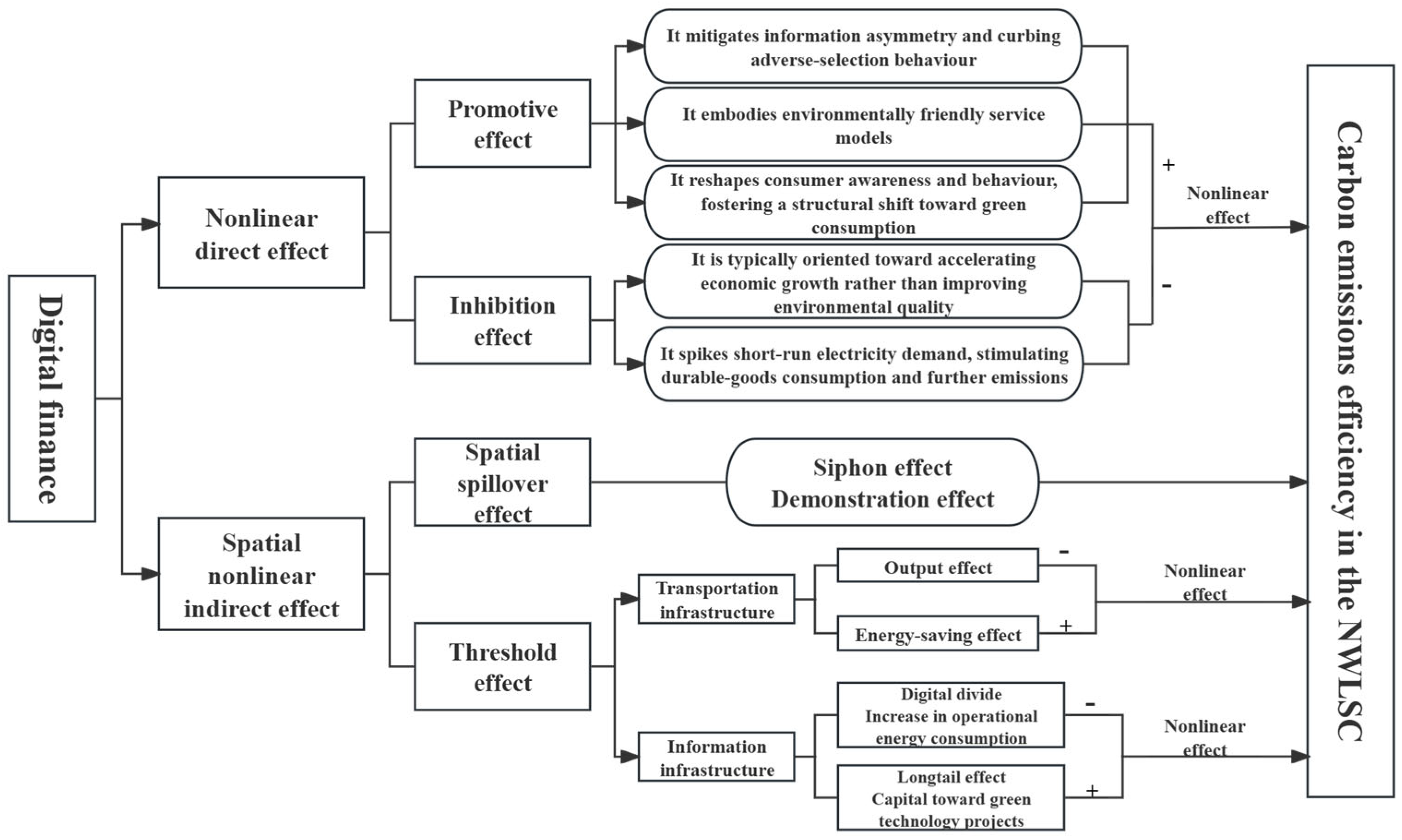
Disclaimer/Publisher’s Note: The statements, opinions and data contained in all publications are solely those of the individual author(s) and contributor(s) and not of MDPI and/or the editor(s). MDPI and/or the editor(s) disclaim responsibility for any injury to people or property resulting from any ideas, methods, instructions or products referred to in the content.

Article Metrics

Citations

Article Access Statistics

Multiple requests from the same IP address are counted as one view.