

From Awareness to Action: Using Immersive Augmented Reality to Promote Sustainable Food Practices


Abstract
1. Introduction
- How can the concept of the surplus food economy be utilized to address the issue of surplus bread in Macau and applied to immersive, interactive virtual experiences?
- From the perspective of the Technology Acceptance Model (TAM), what are users’ attitudes toward immersive virtual interactive experience systems?
- How do system quality, information quality, and perceived playfulness affect users’ behaviors within immersive virtual interactive systems?
2. Literature Review
2.1. The Surplus Food Economy of Bread
2.2. Immersive AR Interactive Experiences and Learning
2.3. Technology Acceptance Model and Perceived Playfulness
2.4. Information Quality Has a Significant Effect on Perceived Usefulness, and System Quality Has a Significant Effect on Perceived Ease of Use
2.5. Perceived Playfulness Has a Significant Effect on Attitudes Toward Use and Behavioral Intention
2.6. Summary
3. Research Method
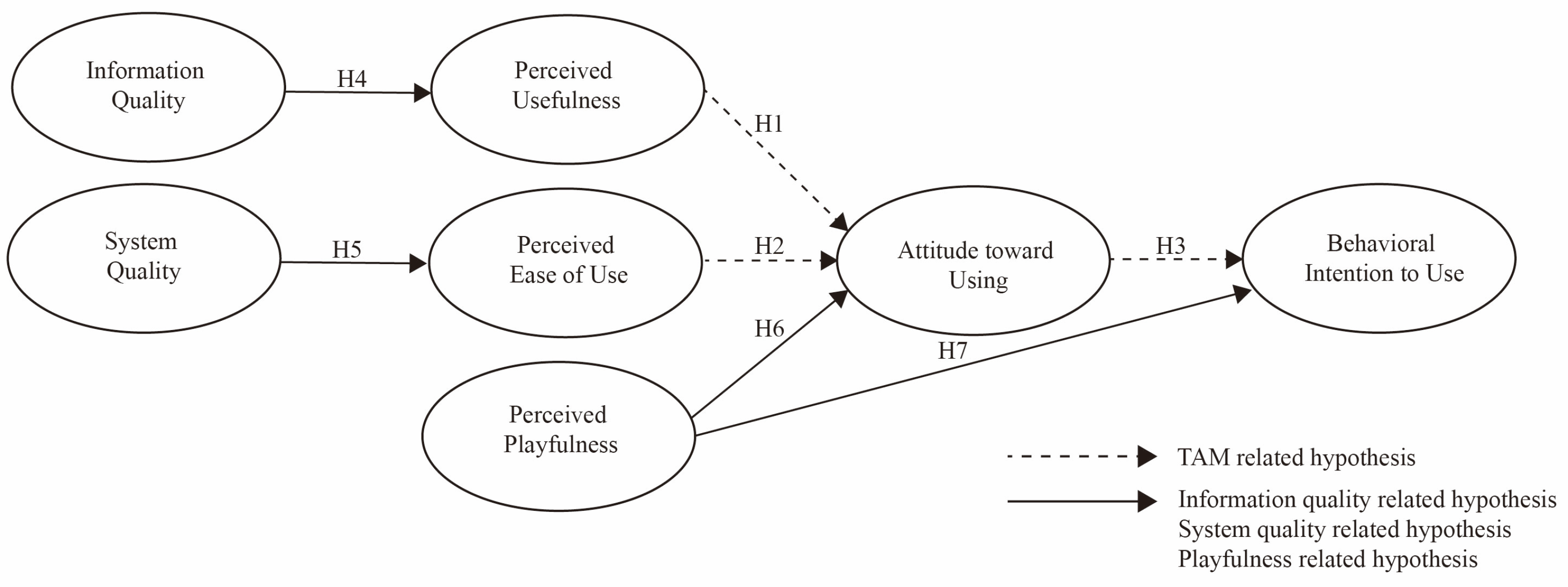
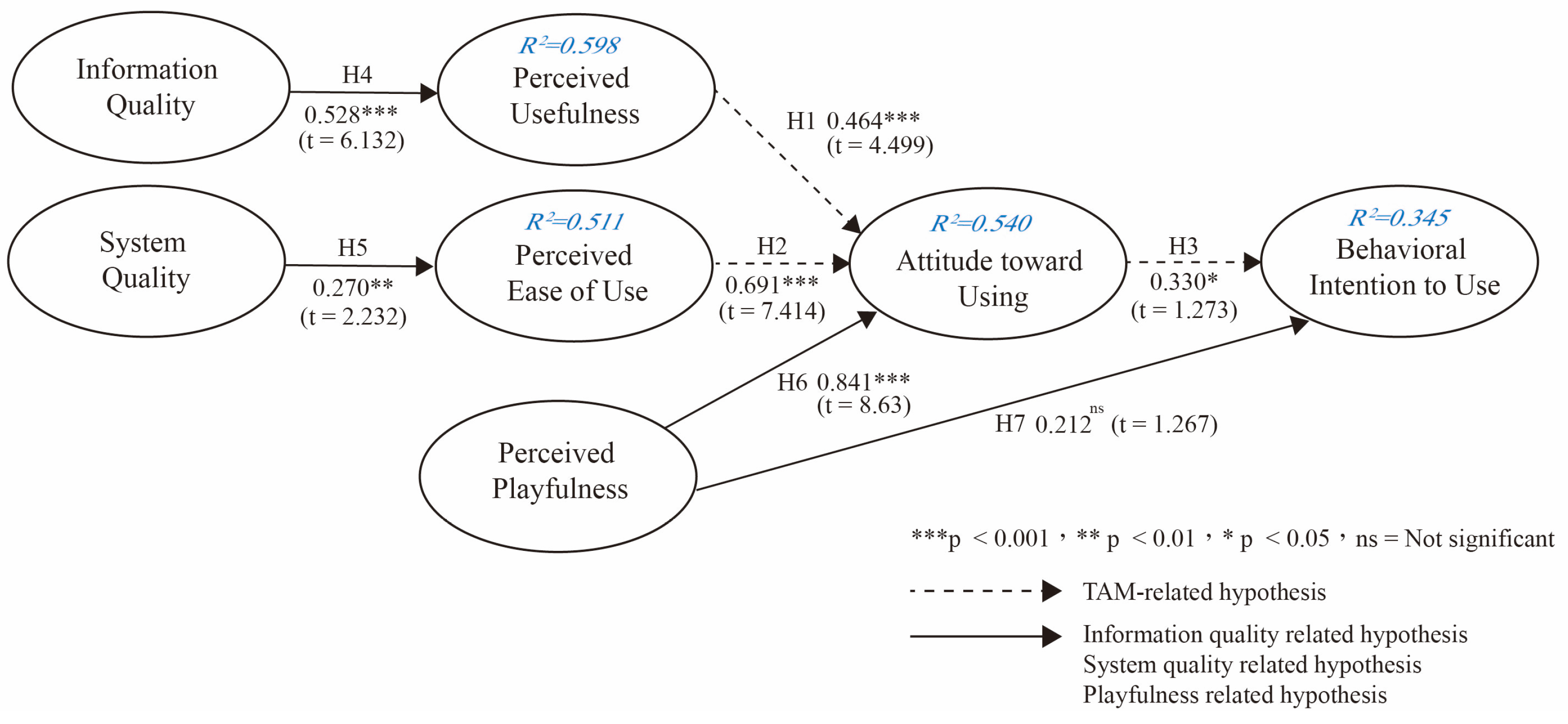
3.1. Research Structure and Hypotheses
3.2. Experimental Procedure and Participants
- A briefing session and a set of system operating instructions: (5 min): to explain the purpose, procedure, timing, and operational methods of the experimental activities.
- An immersive 15 min AR surplus bread shopping experience: participants are guided through the full system journey, from logging in to independently browsing and checking surplus bread availability, then using AR to scan bread tags for an immersive experience, and finally completing a carbon reduction task to earn rewards.
- Questionnaire data collection and user interviews (10 min): participants are guided to complete the questionnaire and collect their feedback after using the system. The session will be recorded via video and audio for subsequent data organization and analysis.
3.3. Research Tools
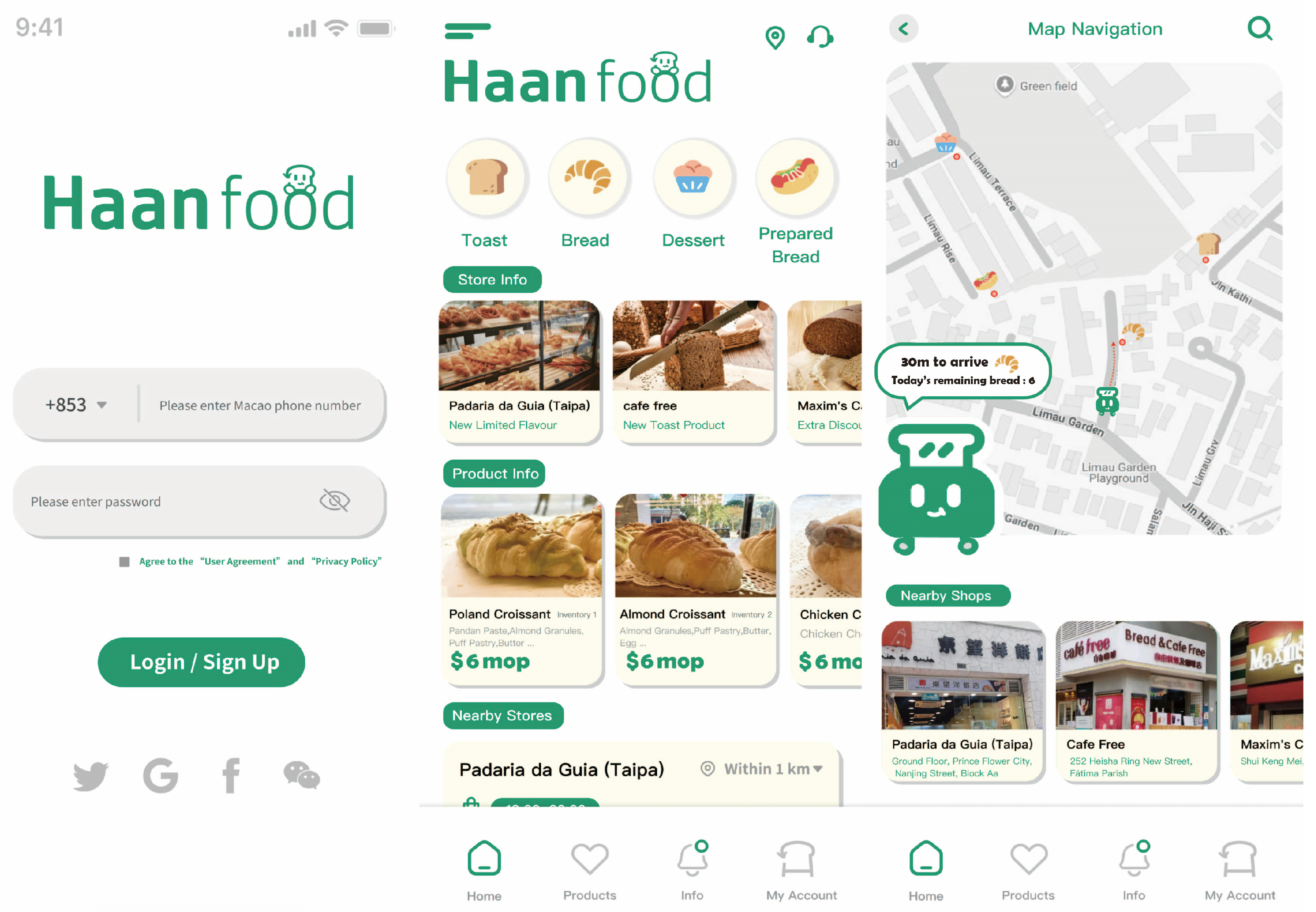
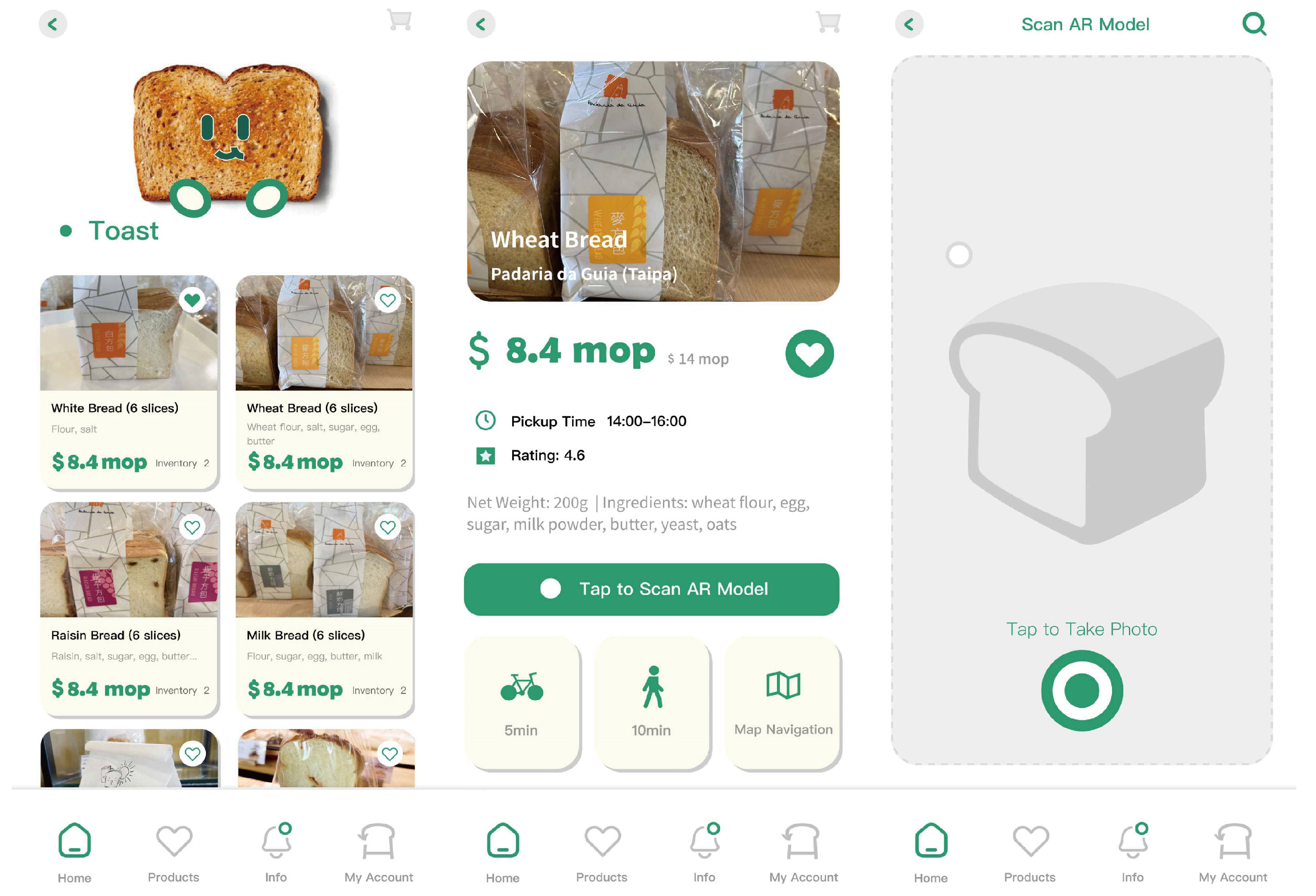
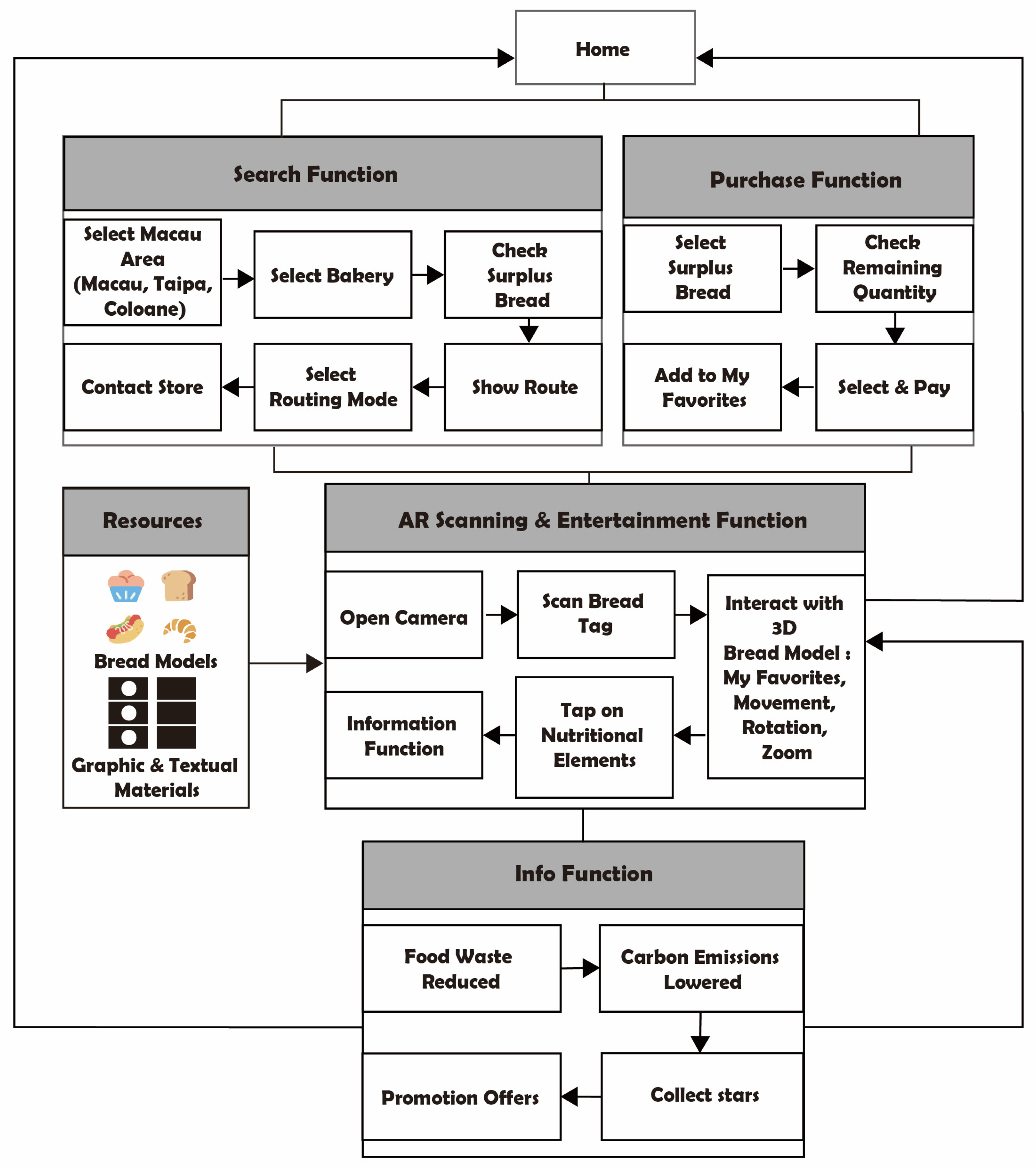
3.4. System Workflow and Experimental Interface
- Homepage: Users primarily log in by entering their mobile phone number and password to access the main page.
- Search Function: Allows users to search for surplus bread available at participating bakeries on the current day (covering Macau, Taipa, and Coloane). After selecting desired items, users can choose a route and navigation mode, with a virtual bread character guiding them along the path.
- Purchase Function: After selecting bread, users specify quantities, confirm the order, and proceed with payment. Upon completion, users can save the bakery and specific bread items as favorites for easier access and repurchase in the future.
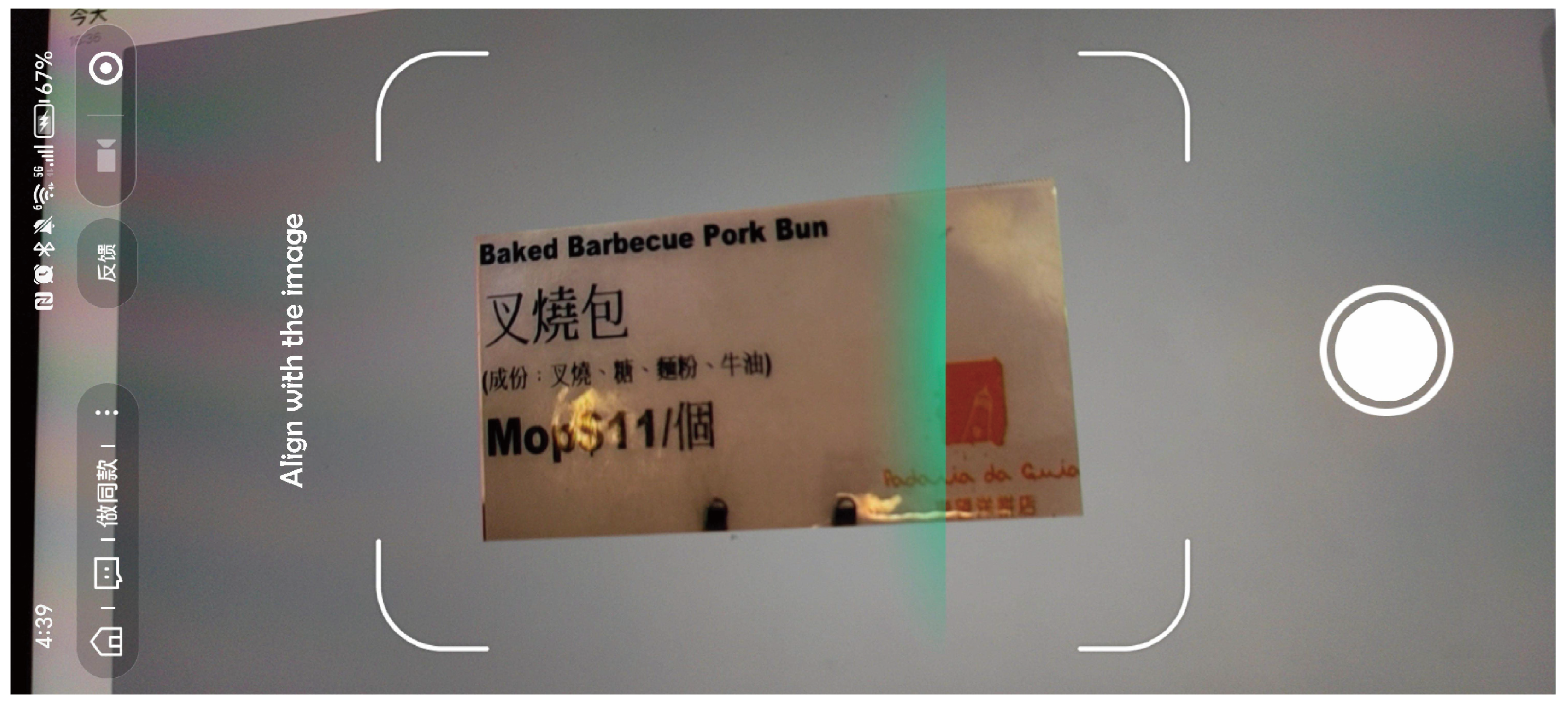
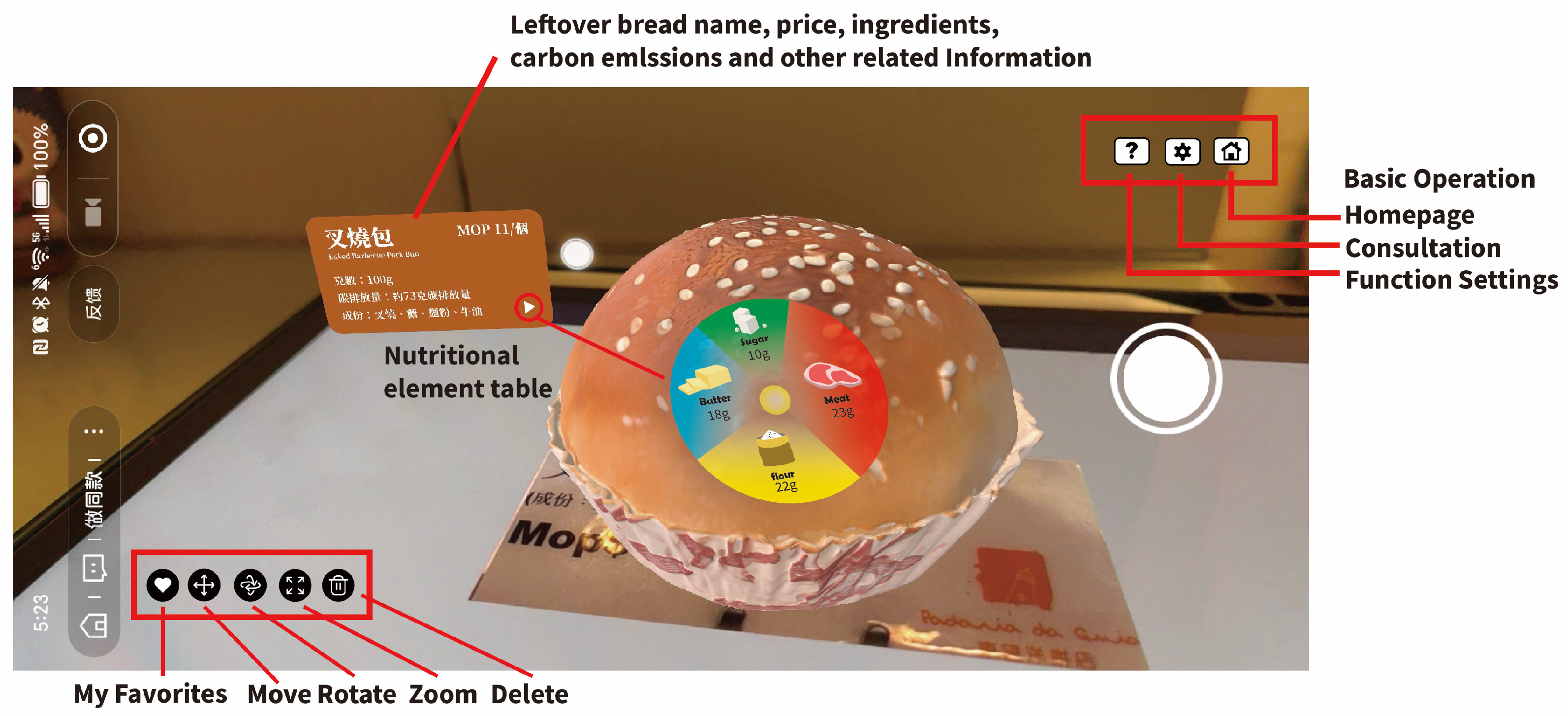
- AR scanning and Entertainment Function: When purchasing bread, users can scan the bread tags to view 3D models of the products. In addition to basic browsing, users can tap on different nutritional elements to see detailed ingredients and nutrition information, and from there access the information function page.
- Information Function: After learning about the nutritional content through the entertainment function, the system will display the specific amounts of “food waste reduced” and “carbon emissions lowered” upon completion of the purchase, the former is calculated in MOP, and the latter is shown in grams. Based on these values, users can collect and accumulate stars. Once they reach a certain threshold, or in conjunction with store promotions, they can redeem bread for free.
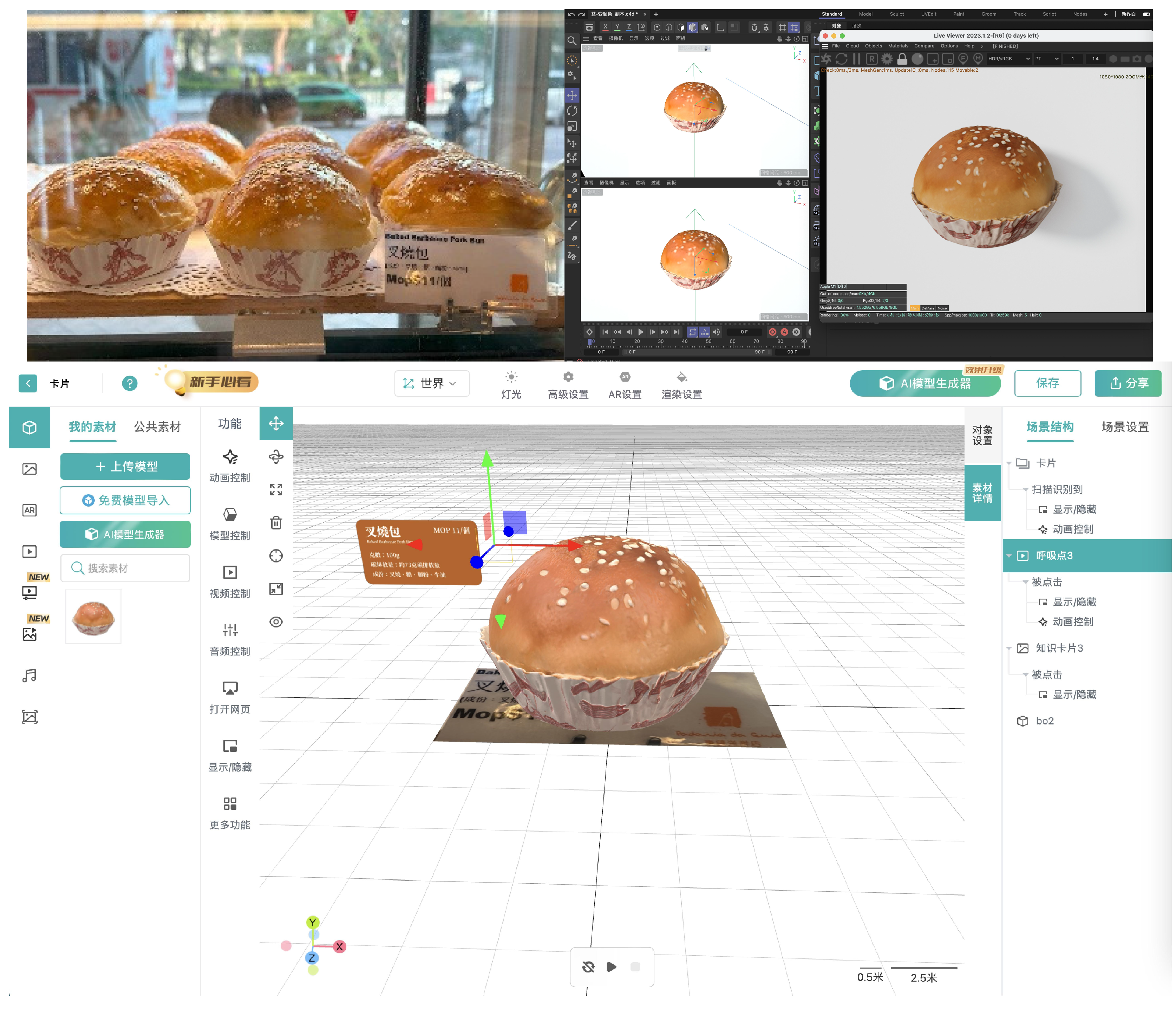
- Resources: The design team is responsible for collecting and creating all visual and textual content as well as the 3D bread models, and for continuously updating and expanding current and future related resources to ensure the information remains complete and up to date.
4. Results and Discussion
4.1. Results
4.1.1. Predictive Test and Participant Analysis
4.1.2. Reliability, Validity, and Structural Model Analysis
4.1.3. Path Analysis and Comparison of Results
4.2. Discussion
4.2.1. Harnessing the Surplus Food Economy to Address Surplus Bread in Macau Through Immersive Virtual Interactive Experiences
4.2.2. Users’ Attitudes Toward Immersive Virtual Interactive Experience Systems from the Perspective of the Technology Acceptance Model (TAM)
4.2.3. Effects of System Quality, Information Quality, and Perceived Playfulness on User Behavior
5. Conclusions
5.1. Theoretical Significance
5.2. Practical Significance
5.3. Study Limitations and Future Studies
Author Contributions
Funding
Institutional Review Board Statement
Informed Consent Statement
Data Availability Statement
Conflicts of Interest
References
- Liang, Y.Y.; Song, Q.P.; Liu, G.; Li, J.H. Uncovering residents and restaurants’ attitude and willingness toward effective food waste management: A case study of Macau. Waste Manag. 2021, 130, 107–116. [Google Scholar] [CrossRef]
- Aschemann-Witzel, J.; Giménez, A.L.; Ares, G. Household food waste in an emerging country and the reasons why: Consumeŕs own accounts and how it differs for target groups. Resour. Conserv. Recycl. 2019, 145, 332–338. [Google Scholar] [CrossRef]
- Schanes, K.; Dobernig, K.; Gözet, B. Food waste matters—A systematic review of household food waste practices and their policy implications. J. Clean. Prod. 2018, 182, 978–991. [Google Scholar] [CrossRef]
- DSPA to Launch New Pilot Project for Food Waste Collection at Private Buildings. Available online: https://macaudailytimes.com.mo/dspa-to-launch-new-pilot-project-for-food-waste-collection-at-private-buildings.html (accessed on 9 September 2025).
- Brancoli, P.; Rousta, K.; Bolton, K. Life cycle assessment of supermarket food waste. Resour. Conserv. Recycl. 2017, 118, 39–46. [Google Scholar] [CrossRef]
- Brancoli, P.; Lundin, M.; Bolton, K.; Eriksson, M. Bread loss rates at the supplier-retailer interface–analysis of risk factors to support waste prevention measures. Resour. Conserv. Recycl. 2019, 147, 128–136. [Google Scholar] [CrossRef]
- WRAP. Reducing Household Bakery Waste. Available online: https://www.wrap.ngo/resources/report/reducing-household-bakery-waste (accessed on 9 September 2025).
- Hellwig, C.; Rousta, N.; Wikandari, R.; Taherzadeh, M.J.; Kronlöf, G.H.; Bolton, K.; Rousta, K. Household fermentation of leftover bread to nutritious food. Waste Manag. 2022, 150, 39–47. [Google Scholar] [CrossRef] [PubMed]
- Bajželj, B.; Quested, T.E.; Röös, E.; Swannell, R.P.J. The role of reducing food waste for resilient food systems. Ecosyst. Serv. 2020, 45, 101–140. [Google Scholar] [CrossRef] [PubMed]
- Breves, P.; Heber, V. Into the wild: The effects of 360° immersive nature videos on feelings of commitment to the environment. Environ. Commun. 2020, 14, 332–346. [Google Scholar] [CrossRef]
- Levstek, M.; Papworth, S.; Woods, A.; Archer, L.; Arshad, I.; Dodds, K.; Holdstock, J.S.; Bennett, J.; Dalton, P. Immersive storytelling for pro-environmental behaviour change: The Green Planet augmented reality experience. Comput. Hum. Behav. 2024, 161, 108379. [Google Scholar] [CrossRef]
- Ahn, S.J.; Bailenson, J.N.; Park, D. Short- and long-term effects of embodied experiences in immersive virtual environments on environmental locus of control and behavior. Comput. Hum. Behav. 2014, 39, 235–245. [Google Scholar] [CrossRef]
- Sung, E.; Han, D.I.D.; Choi, Y.K. Augmented reality advertising via a mobile app. Psychol. Mark. 2022, 39, 543–558. [Google Scholar] [CrossRef]
- Liu, Y.; Sun, J.C.Y.; Chen, S.K. Comparing technology acceptance of AR-based and 3D map-based mobile library applications: A multigroup SEM analysis. Interact. Learn. Environ. 2023, 31, 4156–4170. [Google Scholar] [CrossRef]
- Diekmann, L.; Germelmann, C.C. Leftover Consumption as a Means of Food Waste Reduction in Public Space? Qualitative Insights from Online Discussions. Sustainability 2021, 13, 13564. [Google Scholar]
- Smil, V. Improving Efficiency and Reducing Waste in Our Food System. Environ. Sci. 2004, 1, 17–26. [Google Scholar] [CrossRef]
- Redlingshöfer, B.; Barles, S.; Weisz, H. Are waste hierarchies effective in reducing environmental impacts from food waste? A systematic review for OECD countries. Resour. Conserv. Recycl. 2020, 156, 104723. [Google Scholar] [CrossRef]
- Persson, D.; Erlandsson, L.K. Ecopation: Connecting sustainability, glocalisation and well-being. J. Occup. Sci. 2014, 21, 12–24. [Google Scholar] [CrossRef]
- Principato, L.; Secondi, L.; Pratesi, C.A. Reducing food waste: An investigation on the behaviour of Italian youths. Br. Food J. 2015, 117, 731–748. [Google Scholar] [CrossRef]
- Li, W.H.; Feng, Q.; Zhu, X.; Yu, Q.; Wang, Q. Effect of summarizing scaffolding and textual cues on learning performance, mental model, and cognitive load in a virtual reality environment: An experimental study. Comput. Educ. 2023, 200, 104793. [Google Scholar] [CrossRef]
- Chung, S.J.; Choi, L.J. Expanding Horizons: Fostering Creativity and Curiosity through Spherical Video-Based Virtual Reality in Project-Based Language Learning. TESOL Q. 2024, 58, 1786–1800. [Google Scholar]
- Birtill, M.; King, J.; Jones, D.; Thyer, L.; Pap, R.; Simpson, P. The use of immersive simulation in paramedicine education: A scoping review. Interact. Learn. Environ. 2023, 31, 2428–2443. [Google Scholar] [CrossRef]
- Bhavadharini, B.; Monica, V.; Anbarasan, R.; Mahendran, R. Virtual, augmented, and mixed reality as a versatile tool in food consumer behavior evaluation: Recent advances in aroma, taste, and texture incorporation. Compr. Rev. Food Sci. Food Saf. 2023, 22, 4925–4956. [Google Scholar] [CrossRef]
- Pini, V.; Orso, V.; Pluchino, P.; Gamberini, L. Augmented grocery shopping: Fostering healthier food purchases through AR. Virtual Real. 2023, 27, 2117–2128. [Google Scholar] [CrossRef]
- Ahn, J.; Williamson, J.; Gartrell, M.; Han, R.; Lv, Q.; Mishra, S. Supporting healthy grocery shopping via mobile augmented reality. ACM Trans. Multimed. Comput. Commun. Appl. 2015, 12, 1–24. [Google Scholar] [CrossRef]
- Davis, F.D. Perceived usefulness, perceived ease of use, and user acceptance of information technology. MIS Q. 1989, 13, 319–340. [Google Scholar] [CrossRef]
- Akman, I.; Mishra, A. Sector diversity in Green Information Technology practices: Technology Acceptance Model perspective. Comput. Hum. Behav. 2015, 49, 477–486. [Google Scholar] [CrossRef]
- Oyman, M.; Bal, D.; Ozer, S. Extending the technology acceptance model to explain how perceived augmented reality affects consumers’ perceptions. Comput. Hum. Behav. 2022, 128, 107127. [Google Scholar] [CrossRef]
- Hilken, T.; Heller, J.; Chylinski, M.; Keeling, D.I.; Mahr, D.; Ruyter, K.D. Making omnichannel an augmented reality: The current and future state of the art. J. Res. Interact. Mark. 2018, 12, 509–523. [Google Scholar] [CrossRef]
- Barnett, L.A. Characterizing playfulness: Correlates with individual attributes and personality traits. Play. Cult. 1991, 4, 371–393. [Google Scholar]
- Webster, J.; Martocchio, J.J. Microcomputer Playfulness: Development of a Measure with Workplace Implications. MIS Q. 1992, 16, 201–226. [Google Scholar] [CrossRef]
- Lee, M.; Lee, S.A.; Jeong, M.; Oh, H. Quality of virtual reality and its impacts on behavioral intention. Int. J. Hosp. Manag. 2020, 90, 102595. [Google Scholar] [CrossRef]
- Zhu, D.H.; Chang, Y.P. Investigating consumer attitude and intention toward free trials of technology-based services. Comput. Hum. Behav. 2014, 30, 328–334. [Google Scholar] [CrossRef]
- Yim, M.Y.C.; Chu, S.C.; Sauer, P.L. Is augmented reality technology an effective tool for E-commerce? An interactivity and vividness perspective. J. Interact. Mark. 2017, 39, 89–103. [Google Scholar] [CrossRef]
- Arghashi, V.; Yuksel, C.A. Interactivity, Inspiration, and Perceived Usefulness! How retailers’ AR-apps improve consumer engagement through flow. J. Retail. Consum. Serv. 2022, 64, 102756. [Google Scholar] [CrossRef]
- Dacko, S.G. Enabling smart retail settings via mobile augmented reality shopping apps. Technol. Forecast. Soc. Change 2017, 124, 243–256. [Google Scholar] [CrossRef]
- Baek, T.H.; Yoo, H.; Yoon, S. Augment yourself through virtual mirror: The impact of self-viewing and narcissism on consumer responses. Int. J. Advert. 2018, 37, 421–439. [Google Scholar] [CrossRef]
- Ebrahimabad, F.Z.; Yazdani, H.; Hakim, A.; Asarian, M. Augmented Reality Versus Web-Based Shopping: How Does AR Improve User Experience and Online Purchase Intention. Telemat. Inform. Rep. 2024, 15, 100152. [Google Scholar] [CrossRef]
- Ali, F. Hotel website quality, perceived flow, customer satisfaction and purchase intention. J. Hosp. Tour. Technol. 2016, 7, 213–228. [Google Scholar] [CrossRef]
- Kumar, H.; Srivastava, R. Exploring the role of augmented reality in online impulse behaviour. Int. J. Retail. Distrib. Manag. 2022, 50, 1281–1301. [Google Scholar] [CrossRef]
- Javornik, A. ‘It’s an illusion, but it looks real!’ Consumer affective, cognitive and behavioural responses to augmented reality applications. J. Mark. Manag. 2016, 32, 987–1011. [Google Scholar] [CrossRef]
- Sengupta, A.; Cao, L.L. Augmented reality’s perceived immersion effect on the customer shopping process: Decision-making quality and privacy concerns. Int. J. Retail. Distrib. Manag. 2022, 50, 1039–1061. [Google Scholar] [CrossRef]
- Zhang, K.; Wang, J.G.; Zhang, J.Y.; Wang, Y.; Zeng, Y.J. Exploring the impact of location-based augmented reality on tourists’ spatial behavior, experience, and intention through a field experiment. Tour. Manag. 2024, 102, 104886. [Google Scholar] [CrossRef]
- Pantano, E.; Priporas, C.V.; Dennis, C. A new approach to retailing for successful competition in the new smart scenario. Int. J. Retail. Distrib. Manag. 2018, 46, 264–282. [Google Scholar] [CrossRef]
- Iannilli, V.M.; Spagnoli, A. Phygital retailing in fashion. Experiences, opportunities and innovation trajectories. ZoneModa J. 2021, 11, 43–69. [Google Scholar]
- Xue, L.C.; Parker, C.J.; Hart, C.A. How augmented reality can enhance fashion retail: A UX design perspective. Int. J. Retail. Distrib. Manag. 2023, 51, 59–81. [Google Scholar] [CrossRef]
- Tan, Y.C.; Chandukala, S.R.; Reddy, S.K. Augmented Reality in Retail and Its Impact on Sales. J. Mark. 2021, 86, 48–66. [Google Scholar] [CrossRef]
- Lederer, A.L.; Maupin, D.J.; Sena, M.P.; Zhuang, Y. The technology acceptance model and the world wide web. Decis. Support Syst. 2000, 29, 269–282. [Google Scholar] [CrossRef]
- Jiang, Q.L.; Gu, C.; Feng, Y.; Wei, W.; Tsai, W.C. Study on the continuance intention in using virtual shoe-try-on function in mobile online shopping. Kybernetes 2023, 52, 4551–4575. [Google Scholar] [CrossRef]
- Feng, Y.; Xie, Q. Demystifying Novelty Effects: An Analysis of Consumer Responses to YouTube Videos Featuring Augmented Reality Out-of-Home Advertising Campaigns. J. Curr. Issues Res. Advert. 2019, 40, 36–53. [Google Scholar] [CrossRef]
- Nguyen, T.V.; Nguyen, T.V.; Nguyen, D.V. Exploring the Influence of Virtual Reality and Augmented Reality on User Satisfaction in Virtual Tourism. J. Distrib. Sci. 2024, 22, 33–44. [Google Scholar]
- Manis, K.T.; Choi, D. The virtual reality hardware acceptance model (VR-HAM): Extending and individuating the technology acceptance model (TAM) for virtual reality hardware. J. Bus. Res. 2019, 100, 503–513. [Google Scholar] [CrossRef]
- Ibáñez-Sánchez, S.; Orús, C.; Flavián, C. Augmented reality filters on social media. Analyzing the drivers of playability based on uses and gratifications theory. Psychol. Mark. 2022, 39, 559–578. [Google Scholar] [CrossRef]
- Tu, J.C.; Jia, X.H. A Study on Immersion and Intention to Pay in AR Broadcasting: Validating and Expanding the Hedonic Motivation System Adoption Mode. Sustainability 2024, 16, 2040. [Google Scholar] [CrossRef]
- Hung, S.W.; Chang, C.W.; Ma, Y.C. A new reality: Exploring continuance intention to use mobile augmented reality for entertainment purposes. Technol. Soc. 2021, 67, 101757. [Google Scholar] [CrossRef]
- Naveen, L.; Khan, M.I.; Saleh, M.A.; Subudhi, R.N. The influence of mobile augmented reality on consumer behavior: Insights into affective, cognitive, and behavioral responses. Comput. Hum. Behav. 2025, 165, 108558. [Google Scholar] [CrossRef]
- Iranmanesh, M.; Senali, M.G.; Foroughi, B.; Ghobakhloo, M.; Asadi, S.; Tirkolaee, E.B. Effect of augmented reality applications on attitude and behaviours of customers: Cognitive and affective perspectives. Asia-Pac. J. Bus. Adm. 2024, 16, 1067–1092. [Google Scholar] [CrossRef]
- Chau, P.Y.K.; Hu, P.J. Examining a Model of Information Technology Acceptance by Individual Professionals: An Exploratory Study. J. Manag. Inf. Syst. 2002, 18, 191–229. [Google Scholar] [CrossRef]
- Davis, F.D.; Bagozzi, R.P.; Warshaw, P.R. User acceptance of computer technology: A comparison of two theoretical models. Manag. Sci. 1989, 35, 982–1003. [Google Scholar] [CrossRef]
- Delone, W.H.; McLean, E.R. Information Systems Success: The Quest for the Dependent Variable. Inf. Syst. Res. 1992, 3, 60–95. [Google Scholar] [CrossRef]
- Yoo, J. The Effects of Perceived Quality of Augmented Reality in Mobile Commerce—An Application of the Information Systems Success Model. Informatics 2020, 7, 14. [Google Scholar] [CrossRef]
- Kowalczuk, P.; Siepmann, C.; Adler, J. Cognitive, affective, and behavioral consumer responses to augmented reality in e-commerce: A comparative study. J. Bus. Res. 2021, 124, 357–373. [Google Scholar] [CrossRef]
- Parker, J.R.; Lehmann, D.R.; Xie, Y. Decision comfort. J. Consum. Res. 2016, 43, 113–133. [Google Scholar] [CrossRef]
- Kim, J.; Forsythe, S. Adoption of virtual try-on technology for online apparel shopping. J. Interact. Mark. 2008, 22, 45–59. [Google Scholar] [CrossRef]
- Salimon, M.G.; Aliyu, O.A.; Yusr, M.M.; Perumal, S. Smartphone banking usage in Nigeria: Gamification, technology acceptance and cultural factors empirical perspectives. Electron. J. Inf. Syst. Dev. Ctries. 2021, 87, e12174. [Google Scholar] [CrossRef]
- Lin, T.T.C.; Li, L. Perceived characteristics, perceived popularity, and playfulness: Youth adoption of mobile instant messaging in China. China Media Res. 2014, 10, 60–71. [Google Scholar]
- Anderson, J.C.; Gerbing, D.W. Structural equation modeling in practice: A review and recommended two-step approach. Psychol. Bull. 1988, 103, 411–423. [Google Scholar] [CrossRef]
- Bagozzi, R.P.; Yi, Y. On the evaluation of structural equation models. J. Acad. Mark. Sci. 1988, 16, 74–94. [Google Scholar] [CrossRef]
- Hair, J.F., Jr.; Black, W.C.; Babin, B.J.; Anderson, R.E. Multivariate Data Analysis; Pearson Education: Upper Saddle River, NJ, USA, 2010. [Google Scholar]
- Carmines, E.G.; McIver, J.P. Analyzing models with unobserved variables: Analysis of covariance structure. In Social Measurement: Current Issues; Bohrnstedt, G.W., Borgatta, E.F., Eds.; Sage: Beverly Hills, CA, USA, 1981; pp. 65–115. [Google Scholar]
- Ullman, J.B. Structural equation modeling. In Using Multivariate Statistics; Tabachnick, B.G., Fidell, L.S., Eds.; Pearson Education: Boston, MA, USA, 2001. [Google Scholar]
- Kline, R.B. Principles and Practice of Structural Equation Modeling, 2nd ed.; Guilford: New York, NY, USA, 2005. [Google Scholar]
- Jöreskog, K.G.; Sörbom, D. LISREL 7: A Guide to the Program and Applications; SPSS Inc.: Chicago, IL, USA, 1989. [Google Scholar]
- Hu, L.T.; Bentler, P.M. Cutoff criteria for fit indexes in covariance structure analysis: Conventional criteria versus new alternatives. Struct. Equ. Model. 1999, 6, 1–55. [Google Scholar] [CrossRef]
- McDonald, R.P.; Ho, M.R. Principles and practice in reporting structural equation analysis. Psychol. Methods 2002, 7, 64–82. [Google Scholar] [CrossRef]
- Hair, J.F., Jr.; Matthews, L.M.; Matthews, R.L.; Sarstedt, M. PLS-SEM or CB-SEM: Updated guidelines on which method to use. Int. J. Multivar. Data Anal. 2017, 1, 107–123. [Google Scholar] [CrossRef]
- Jeganathan, K.; Szymkowiak, A. Bridging Digital Product Passports and in-store experiences: How augmented reality enhances decision comfort and reuse intentions. J. Retail. Consum. Serv. 2025, 84, 104242. [Google Scholar] [CrossRef]
- Strecker, J.; Wu, J.; Bektaş, K.; Vaslin, C.; Mayer, S. ShoppingCoach: Using diminished reality to prevent unhealthy food choices in an offline supermarket scenario. Ext. Abstr. CHI Conf. Hum. Factors Comput. Syst. 2024, 288, 1–8. [Google Scholar]
- Nadeem, W.; Ashraf, A.F.; Kumar, V. Fostering consumer engagement with sustainability marketing using augmented reality (SMART): A climate change response. J. Bus. Res. 2025, 192, 115289. [Google Scholar] [CrossRef]
- Shahzad, M.; Qu, Y.; Javed, S.A.; Zafar, A.U.; Rehman, S.U. Relation of environment sustainability to CSR and green innovation: A case of Pakistani manufacturing industry. J. Clean. Prod. 2020, 253, 119938. [Google Scholar] [CrossRef]
- Alahmari, M.; Issa, T.; Issa, T.; Nau, S.Z. Faculty awareness of the economic and environmental benefits of augmented reality for sustainability in Saudi Arabian universities. J. Clean. Prod. 2019, 226, 259–269. [Google Scholar] [CrossRef]
- Huang, T.L.; Liao, S.L. A model of acceptance of augmented-reality interactive technology: The moderating role of cognitive innovativeness. Electron. Commer. Res. 2015, 15, 269–295. [Google Scholar] [CrossRef]
- Flavián, C.; Ibáñez-Sánchez, S.; Orús, C. The impact of virtual, augmented and mixed reality technologies on the customer experience. J. Bus. Res. 2019, 100, 547–560. [Google Scholar] [CrossRef]
- Ngo, T.T.A.; Tran, T.T.; An, G.K.; Nguyen, P.T. Investigating the influence of augmented reality marketing application on consumer purchase intentions: A study in the E-commerce sector. Comput. Hum. Behav. Rep. 2025, 18, 100648. [Google Scholar] [CrossRef]
- Bae, S.; Kim, T.J. Consumer perceptions and acceptance of AR menus in the restaurant industry. J. Qual. Assur. Hosp. Tour. 2024, 1–24. [Google Scholar] [CrossRef]
- Shahab, M.H.; Ghazali, E.; Mohtar, M. The role of elaboration likelihood model in consumer behaviour research and its extension to new technologies: A review and future research agenda. Int. J. Consum. Stud. 2021, 45, 664–689. [Google Scholar] [CrossRef]
- Sun, J.; Wang, Y.; Miao, W.; Wei, W.; Yang, C.; Chen, J.J.; Yang, F.F.; Ren, L.F.; Gu, C. A study on how to improve users’ perceived playfulness in and continuance intention with VR technology to paint in virtual natural landscapes. Heliyon 2023, 9, e16201. [Google Scholar] [CrossRef] [PubMed]
- Liu, L.; Hsu, Y. Motivators factors behind the public’s use of smart recycling systems: Perceived playfulness and environmental concern. Humanit. Soc. Sci. Commun. 2022, 9, 328. [Google Scholar] [CrossRef]
- Voicu, M.C.; Sîrghi, N.; Toth, D.D.M. Consumers’ experience and satisfaction using augmented reality apps in E-shopping: New empirical evidence. Appl. Sci. 2023, 13, 9596. [Google Scholar] [CrossRef]
- Holdack, E.; Lurie-Stoyanov, K.; Fromme, H.F. The role of perceived enjoyment and perceived informativeness in assessing the acceptance of AR wearables. J. Retail. Consum. Serv. 2022, 65, 102259. [Google Scholar] [CrossRef]
- Massa, A.; Axpe, E.; Atxa, E.; Hernández, I. Sustainable, carbonated, non-alcoholic beverages using leftover bread. Int. J. Gastron. Food Sci. 2022, 30, 100607. [Google Scholar] [CrossRef]
- Al-Mekhlafi, F.A.; Abutaha, N.; Wadaan, M.A.; Al-Khalifa, M.S. Leftover bread as a potential feed additive: Impact on growth, fatty acid content, and antioxidant properties in Tenebrio molitor larvae. J. King Saud Univ. Sci. 2024, 36, 103388. [Google Scholar] [CrossRef]



| Variable | Question | Number | Literature |
|---|---|---|---|
| Information quality, IQ | The system shows highly responsive performance. | IQ1 | [60,61,62] |
| The system delivers messages and graphics smoothly. | IQ2 | ||
| The information within the system is easy to browse. | IQ3 | ||
| The system’s interface is easy to understand and operate. | IQ4 | ||
| System quality, SQ | The system’s content is relevant to real-world information. | SQ1 | [56,63] |
| The information provided by the system is trustworthy. | SQ2 | ||
| The system’s functions are clearly labeled, and the information meets my needs. | SQ3 | ||
| The messages in the system are easy to understand. | SQ4 | ||
| Perceived usefulness, PU | The system has enhanced my understanding of surplus bread. | PU1 | [59,64] |
| Using the system has enhanced my ability to learn about surplus bread. | PU2 | ||
| I find the system helpful in understanding the issue of surplus bread. | PU3 | ||
| Perceived ease of use, PEOU | Learning to operate the system was easy for me. | PEOU 1 | [54,65] |
| I can use the system proficiently. | PEOU 2 | ||
| I think the system is easy to comprehend. | PEOU 3 | ||
| Perceived playfulness, PP | I find the system both attractive and enjoyable. | PP1 | [55,66] |
| I believe using the system makes the concept of reducing surplus bread more interesting and motivating. | PP2 | ||
| The system enhances my knowledge of and interest in surplus bread. | PP3 | ||
| Attitude, AT | Using the system is a great idea. | AT1 | [34,35] |
| I think the use of this system is very popular. | AT2 | ||
| I believe that using the system is entertaining and enjoyable. | AT3 | ||
| Behavior intention, BI | I will purchase the products I reviewed. | BI1 | [35] |
| I will recommend the system to my friends and family. | BI2 | ||
| I will use the system again to buy bread. | BI3 |
| Basic Questions | Items | Sample | Percentage (%) |
|---|---|---|---|
| Gender | Male | 95 | 58.3 |
| Female | 68 | 41.7 | |
| Age | 20–24 | 80 | 48.6 |
| 25–29 | 55 | 33.0 | |
| 30–34 | 12 | 8.7 | |
| 35+ | 16 | 9.7 | |
| Occupation | Student | 93 | 57.1 |
| Office worker | 35 | 21.5 | |
| Teacher | 9 | 5.5 | |
| Part-time worker | 10 | 6.1 | |
| Retiree | 10 | 6.1 | |
| Other | 6 | 3.7 | |
| Frequency of app use per week | Never | 1 | 0.6 |
| 1 time | 4 | 2.5 | |
| 2–4 times | 55 | 33.7 | |
| 5 times or more | 103 | 63.2 | |
| Types of AR experienced | Games | 50 | 30.7 |
| Travel | 31 | 19.0 | |
| Museums | 45 | 27.6 | |
| Education | 17 | 10.4 | |
| Shopping | 15 | 9.2 | |
| Other | 2 | 1.3 | |
| None | 3 | 1.8 |
| Item | Avg. | Factor Loading | t-Value | Cronbach’s α | CR | AVE |
|---|---|---|---|---|---|---|
| IQ1 | 3.99 | 0.874 | 7.935 | 0.83 | 0.92 | 0.75 |
| IQ2 | 4.03 | 0.960 | ||||
| IQ3 | 3.88 | 0.813 | ||||
| IQ4 | 3.84 | 0.885 | ||||
| SQ1 | 3.94 | 0.913 | 8.066 | 0.82 | 0.93 | 0.78 |
| SQ2 | 3.85 | 0.891 | ||||
| SQ3 | 3.84 | 0.845 | ||||
| SQ4 | 3.96 | 0.875 | ||||
| PU1 | 4.10 | 0.912 | 7.413 | 0.82 | 0.89 | 0.73 |
| PU2 | 4.12 | 0.835 | ||||
| PU3 | 3.91 | 0.821 | ||||
| PEOU 1 | 3.67 | 0.813 | 7.939 | 0.84 | 0.90 | 0.76 |
| PEOU 2 | 3.79 | 0.887 | ||||
| PEOU 3 | 3.82 | 0.907 | ||||
| PP1 | 4.17 | 0.872 | 6.926 | 0.91 | 0.88 | 0.71 |
| PP2 | 4.24 | 0.824 | ||||
| PP3 | 4.13 | 0.827 | ||||
| AT1 | 4.11 | 0.785 | 7.710 | 0.80 | 0.86 | 0.67 |
| AT2 | 4.21 | 0.803 | ||||
| AT3 | 4.05 | 0.861 | ||||
| BI1 | 3.91 | 0.840 | 8.128 | 0.82 | 0.89 | 0.73 |
| BI2 | 4.20 | 0.854 | ||||
| BI3 | 4.10 | 0.876 |
| IQ | SQ | PU | PEOU | PP | AT | BI | |
|---|---|---|---|---|---|---|---|
| IQ | 1 | ||||||
| SQ | 0.842 | 1 | |||||
| PU | 0.618 | 0.760 | 1 | ||||
| PEOU | 0.528 | 0.644 | 0.774 | 1 | |||
| PP | 0.596 | 0.620 | 0.531 | 0.854 | 1 | ||
| AT | 0.391 | 0.260 | 0.270 | 0.671 | 0.801 | 1 | |
| BI | 0.373 | 0.433 | 0.464 | 0.763 | 0.677 | 0.922 | 1 |
| Internal Variables | Path | β | SE | p-Value | Result |
|---|---|---|---|---|---|
| H1 | PU → AT | 0.464 | 0.330 | *** | Accepted |
| H2 | PEOU → AT | 0.691 | 0.109 | *** | Accepted |
| H3 | AT → BI | 0.330 | 0.132 | * | Accepted |
| H4 | IQ → PU | 0.528 | 0.083 | *** | Accepted |
| H5 | SQ → PEOU | 0.270 | 0.094 | ** | Accepted |
| H6 | PP → AT | 0.841 | 0.081 | *** | Accepted |
| H7 | PP → BI | 0.212 | 0.113 | ns | Rejected |
Disclaimer/Publisher’s Note: The statements, opinions and data contained in all publications are solely those of the individual author(s) and contributor(s) and not of MDPI and/or the editor(s). MDPI and/or the editor(s) disclaim responsibility for any injury to people or property resulting from any ideas, methods, instructions or products referred to in the content. |
© 2025 by the authors. Licensee MDPI, Basel, Switzerland. This article is an open access article distributed under the terms and conditions of the Creative Commons Attribution (CC BY) license (https://creativecommons.org/licenses/by/4.0/).
Share and Cite
Hsaio, P.-W.; Kong, L.-Q.; Ti, Y. From Awareness to Action: Using Immersive Augmented Reality to Promote Sustainable Food Practices. Sustainability 2025, 17, 11050. https://doi.org/10.3390/su172411050
Hsaio P-W, Kong L-Q, Ti Y. From Awareness to Action: Using Immersive Augmented Reality to Promote Sustainable Food Practices. Sustainability. 2025; 17(24):11050. https://doi.org/10.3390/su172411050
Chicago/Turabian StyleHsaio, Peng-Wei, Ling-Qi Kong, and Ying Ti. 2025. "From Awareness to Action: Using Immersive Augmented Reality to Promote Sustainable Food Practices" Sustainability 17, no. 24: 11050. https://doi.org/10.3390/su172411050
APA StyleHsaio, P.-W., Kong, L.-Q., & Ti, Y. (2025). From Awareness to Action: Using Immersive Augmented Reality to Promote Sustainable Food Practices. Sustainability, 17(24), 11050. https://doi.org/10.3390/su172411050