


Abstract
Food waste is a global issue, and Macau is no exception. Throughout this study, it was found that most local bakeries in Macau employed promotional strategies to reduce surplus bread waste; however, a significant amount of unsold bread was still discarded. Meanwhile, as consumer behavior shifts toward environmental consciousness, technologies such as augmented reality (AR) are reshaping market dynamics. Many apps now incorporate the Sustainable Development Goals (SDGs) to raise consumer awareness. Within this context, this study recorded unsold bread types in real-time for four bakeries in Macau and integrated this information into an app system featuring interactive AR scanning technology to engage users and facilitate operations. Applying the Technology Acceptance Model (TAM), this study surveyed 163 local participants in Macau. Users expressed interest in immersive AR experiences that incorporated entertainment elements, allowing them to quickly search for and purchase surplus bread products, thereby reducing bread waste. However, excessive entertainment features were found to distract users from their purchasing goals, causing operational difficulties. Therefore, integrating AR into a well-structured shopping information system with streamlined operations would be more effective than adding excessive entertainment features. Future enhancements could include the addition of a comment section to facilitate discussion of the role of various virtual interactive systems in explaining surplus food concepts through experience. Emphasis should be placed on integrating sustainable practices into emerging technologies to increase users’ environmental awareness and achieve the Sustainable Development Goals.
1. Introduction
Food, one of the essential pillars of human life, is universally valued. While people enjoy eating, they often overlook the importance of respecting and preserving food. Food waste has become a pressing global concern. According to statistics, one-third of the world’s food supply is discarded or wasted, even though this quantity could alleviate the suffering of nearly one billion people experiencing hunger [1,2,3]. Following the post-pandemic economic recovery, the number of inbound tourists in Macau has steadily increased. According to a 2023 report by the local environmental authority, the total volume of municipal solid waste and the per capita waste generation rose by 14.8% and 14.1%, respectively, compared to 2022. Notably, food waste increased by 37.4%, highlighting the severity of the issue [4].
While most people associate food waste with surplus meals, bread—commonly consumed for breakfast—is among the most frequently wasted food items. Similar cases have been observed internationally. A market study in Sweden found that bread waste ranked second only to meat in terms of negative environmental impact [5]. Brancoli et al. (2019) also emphasized that bread, a dietary staple in many countries, contributes significantly to food waste throughout the entire supply chain in Sweden [6]. In the UK, WRAP et al. [7] reported that bakery waste accounts for 10% of total food waste, yet bread is rarely explicitly addressed in food waste assessments. This suggests that bread waste is often overlooked compared to other categories of surplus food [8].
Macau is no exception. Although most local bakeries begin “buy two, get one free” promotions after 6 p.m. each day, a considerable amount of unsold bread still ends up being discarded. Due to food safety concerns, bakeries have stopped donating surplus bread to charitable organizations and instead opt to dispose of it entirely.
Therefore, various countries have begun applying sustainability-oriented concepts, strategies, and systems to address the problem of surplus food. In 2015, Danish entrepreneurs Lucie Basch and Jamie Crummie launched the Too Good To Go app, which now operates in nine European countries. This platform enables restaurants and grocery stores to sell surplus food each day—including prepared meals and bread—at a 70% discount. The developers also collaborate with international governmental bodies to instill sustainability awareness in children from an early age. Sustainability-focused companies play a crucial role by implementing inventory management systems, donating unsold food to charities, and participating in initiatives to reduce food waste in the food service industry [9].
On the other hand, immersive experience technologies are advancing rapidly. Compared to traditional computer screens or text-based formats, immersive systems offer enhanced experiential engagement, a stronger sense of presence, and improved user connectivity [10,11]. Ahn and his team found that immersive virtual environments significantly increase participants’ awareness of environmental behaviors, subsequently leading to behavioral improvements [12]. Sung et al. (2022) demonstrated that AR and mixed-reality technologies stimulate consumer engagement and offer novel interaction methods, thereby advertising effectiveness and eliciting positive consumer responses [13]. As virtual technologies attract increasing attention across disciplines, it is essential to examine how users perceive and adopt these new technologies compared to those with which they are already familiar [14].
Moreover, a significant research gap remains in the technological application and communication of sustainable concepts, particularly in relation to bread. Study outcomes are still relatively scarce and underdeveloped. As a result, this study aimed to address the following research questions:
- How can the concept of the surplus food economy be utilized to address the issue of surplus bread in Macau and applied to immersive, interactive virtual experiences?
- From the perspective of the Technology Acceptance Model (TAM), what are users’ attitudes toward immersive virtual interactive experience systems?
- How do system quality, information quality, and perceived playfulness affect users’ behaviors within immersive virtual interactive systems?
2. Literature Review
2.1. The Surplus Food Economy of Bread
Food waste is unjustifiable not only from an economic standpoint but also from the perspectives of social responsibility and consumer behavior. The consumption of surplus food is closely related to community awareness and efforts to reduce food waste, with the consequences of food waste increasingly regarded as threats to health and social order [15]. This highlights the need to minimize food waste, particularly at the consumption stage, to reduce production factors that may harm the environment [16]. Most bakeries in Macau produce their own bread in-house, functioning as both retailers and manufacturers. The limited existing studies, all from other countries, suggest that the way suppliers interact with retailers directly affects bread waste. When both parties adopt a Take-Back Agreement (TBA) model, bakeries are responsible for forecasting, ordering, stocking, and removing unsold products and must bear the financial costs of any unsold inventory. Brancoli et al. (2019) further noted that, at the retail level, surplus bread—bread that is overproduced and remains unsold but is still in good and safe condition—is frequently wasted [6]. Therefore, the prevention, effective sorting, and reuse of surplus food are among the highest-priority strategies [17]. Moreover, public awareness of the dangers associated with bread fermentation, along with the promotion of related knowledge, is critical for fostering citizens’ sense of responsibility in preventing food waste. Teaching individuals to reflect on food waste and motivating them to value food more deeply can lead to changes in consumer behavior. Repurposing surplus bread to create new edible products while avoiding unnecessary resource consumption represents a tangible manifestation of the value within the surplus food economy, benefiting the environment, economy, and society [18,19].
2.2. Immersive AR Interactive Experiences and Learning
Immersive media have become increasingly integral in modern life, with numerous studies exploring their applications in interaction, education, healthcare, and entertainment. These studies have revealed that, compared to traditional media, users immersed in 360-degree experiences exhibit a stronger sense of presence and environmental connectedness [10]. Researchers have also emphasized that immersion is a key differentiating factor among current technological tools [20]. Within immersive environments, users actively engage with digital objects and tools in virtual physical settings, which promotes exploratory learning. These processes enhance attention, satisfaction, participation, and motivation, positively influencing learning outcomes [21,22]. Furthermore, VR, AR, and MR have been shown to influence real-time food selection behavior, with different interactive forms eliciting emotional responses. A comprehensive system can deliver nutritional content, provide health warnings, identify fresh fruits and vegetables, estimate caloric content, and maintain food safety through AR image recognition [23,24]. To facilitate consumer behavior in supermarkets and retail environments, several AR-based applications have been developed. These tools help users locate healthy food items, reducing shopping time by up to half or two-thirds. A study on these applications found that 74% of customers expressed satisfaction, 69% demonstrated adaptability, 54% found them easy to use, and only 3% to 11% considered them unappealing [25].
2.3. Technology Acceptance Model and Perceived Playfulness
The Technology Acceptance Model (TAM), introduced by Davis (1989), emphasizes the importance of perceived usefulness (PU) and perceived ease of use (PEOU) [26]. Users believe that a scientific or technological system will improve their working convenience and availability based on whether it can offer assistance and enhance working efficiency to achieve specific goals [26]. Therefore, these two factors influence attitudes toward using the technology, behavioral intention to use it, and ultimately actual system use. This model is among the most widely adopted frameworks for understanding and predicting the adoption of information systems [27].
An individual’s tendency toward innovation also positively affects behavioral intention toward virtual technologies and attitudes toward AR applications. With AR, users can gain realistic experiences without physically interacting with the product. In one study, most consumers reported being more inclined to shop through AR, and 40% of respondents indicated they would pay more for AR-enhanced products [28,29]. In human–computer interaction studies, Barnett (1991) and Webster and Martocchio (1992) proposed a theoretical framework for perceived enjoyment, which included two core traits: a focus on a playful nature and the user’s state of enjoyment [30,31]. Based on these traits, they developed the Microcomputer Playfulness Scale and found that users with stronger playfulness traits exhibited more positive emotions and better task performance. Related studies have further suggested that providing immersive gameplay experiences offers a convenient means of contact, fosters global interaction among consumers, and enriches consumption enjoyment by blending entertainment with functional use [32].
When users encounter a new information technology, they actively adapt and invest time in operating it, thereby increasing their willingness to use the service. Zhu and Chang [33] found that when technological services offered perceived usefulness and perceived ease of use free of charge, these factors significantly shaped users’ attitudes toward them, enhancing their confidence in leveraging specific technological systems to improve their work performance. Yim et al. (2017) confirmed that AR apps had higher perceived usefulness than traditional ones [34]. Arghashi and Yuksel (2022) also confirmed that technologies such as smartphones and mobile apps have changed how consumers interact [35]. Products with AR functions positively reinforce the relationship between attitude toward use and PU [35]. AR supports highly interactive and immersive experiences by overlaying digital objects (such as video or 3D items) onto real-world environments, bridging the gap between online and offline shopping and providing a genuine shopping experience. Therefore, when leveraging an AR model, immersive AR interaction and novelty play positive roles in increasing purchase intention and user engagement [36,37,38]. Numerous studies have shown that, with the development of technologies and the popularity of virtual content, AR in smart retail environments influences customers’ attitudes and decision-making, facilitating the adoption of various marketing methods online and offline (including family environments), and meeting consumers’ demands regarding touching and sensory experience [39,40]. Marketing messages delivered through precise geolocation and personalized functions can strengthen trust, influence attitudes, and enhance purchase intentions [41,42,43]. This study proposes the following hypotheses, H1–H3:
H1:
Perceived usefulness will have a positive effect on attitudes toward use.
H2:
Perceived ease of use will have a positive effect on attitudes toward use.
H3:
Attitudes toward use will have a positive effect on behavioral intention.
2.4. Information Quality Has a Significant Effect on Perceived Usefulness, and System Quality Has a Significant Effect on Perceived Ease of Use
With the rapid evolution of e-commerce, accelerated by the COVID-19 pandemic, many retailers believe that consumers’ behavior has changed significantly. Retail is shifting from product-centered to customer- or service-centered models [44]. Detailed online information, such as product reviews, specifications, and after-sales services—collectively referred to as information quality—can improve shopping efficiency and motivation [45,46]. However, if AR content and image design are bland or outdated, they reduce the perceived usefulness of the technology. When multiple brands offer similar products, AR enables users to compare offerings at any time. Through information obtained from comments and visual observation, transparency and informed decision-making can be achieved [47]. System quality plays a critical role in both perceived usefulness and perceived ease of use. According to Lederer et al. (2000), high-quality systems are easier for users to understand, navigate, and forecast, enabling them to solve their problems quickly while operating the systems [48]. When these expectations are met, decision-making becomes easier. Hence, system quality is an indispensable component that integrates operational information and related data into the system platform, and the effectiveness of AR technology significantly influences the user experience of system quality [49,50,51]. Based on the above analysis, H4 and H5 were derived:
H4:
Information quality will have a positive effect on perceived usefulness.
H5:
System quality will have a positive effect on perceived ease of use.
2.5. Perceived Playfulness Has a Significant Effect on Attitudes Toward Use and Behavioral Intention
Perceived playfulness refers to the enjoyment and pleasure users experience while using a system, which is distinct from perceived performance. In studies on information systems, pleasure is typically described in three interdependent dimensions. Manis and Choi (2019) investigated whether enhanced enjoyment in VR contexts influences attitudes toward use and behavioral intentions [52]. Other scholars have incorporated perceived enjoyment into TAM, showing that AR can enhance user experience across sectors, such as entertainment, healthcare, and retail. Immersive AR scenarios foster curiosity and engagement, especially in gaming, where users exhibit strong emotional and attitudinal responses [53,54,55]. Naveen et al. (2025) also noted that, within the context of AR retail, playful design in AR retail apps enhances perceived playfulness, user participation, and satisfaction [56]. Therefore, this intrinsic enjoyment fosters stronger connections between users and applications and favorable usage intentions [57]. Based on these arguments, the following hypotheses, H6 and H7, are presented:
H6:
Perceived playfulness will have a positive effect on attitudes toward use.
H7:
Perceived playfulness will have a positive effect on behavioral intention.
2.6. Summary
The reviewed literature suggests that the prevention, classification, and reuse of surplus food are among the most urgent priorities. Although bakeries in Macau have implemented various promotional strategies, their information updates are not timely, and product names often fail to accurately reflect the bread’s characteristics in a way that can be conveyed visually. Therefore, integrating AR into an app—combining the surplus food economy concept with light entertainment—can help users identify surplus food, determine the amount of surplus bread, learn about nutritional content and carbon footprints, and make purchasing decisions more efficiently. This study further examines the relationships among information quality, system quality, and perceived playfulness within the TAM framework.
3. Research Method
3.1. Research Structure and Hypotheses
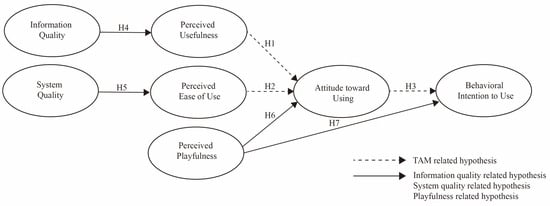
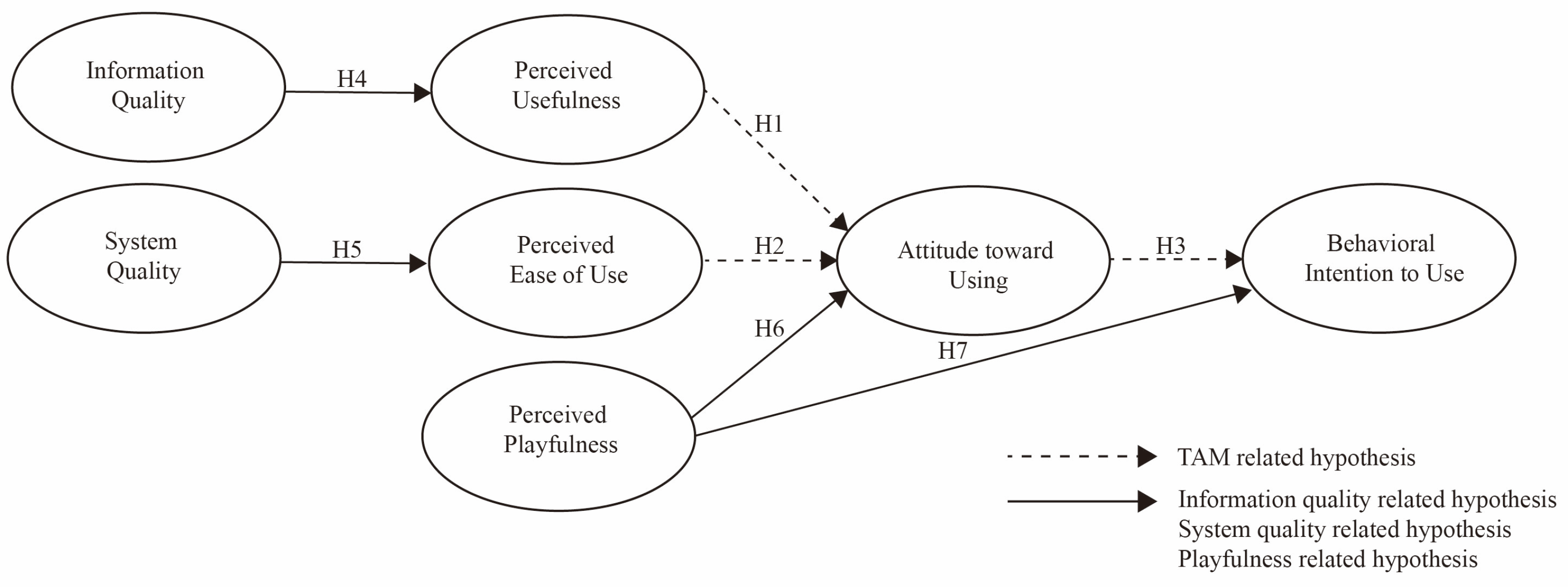
Drawing from the conclusions regarding the surplus food economy presented above, immersive AR interactive experiences and learning, and the TAM, as well as perceived playfulness, this study builds upon the technology-based model by Davis et al. (1989), which extends the Theory of Reasoned Action (TRA) to predict individual attitudes and behavioral intentions [58,59]. The objective is to investigate how the information quality (IQ), perceived usefulness (PU), system quality (SQ), perceived ease-of-use (PEOU), and perceived playfulness (PP) of the Haan Food AR Interactive System influence users’ attitude (AT) toward use and behavioral intention (BI). This study establishes the theoretical framework shown in Figure 1 to examine the interactions among these factors. The framework and the corresponding hypotheses are shown in Figure 1.
Figure 1.
Research hypothesis diagram.
3.2. Experimental Procedure and Participants
In this study, we enrolled 180 Macau residents who had prior experience of using mobile phone apps for shopping and had engaged with AR experiences. The experimental period lasted 14 days, from 29 July 2024 to 11 August 2024. In general, Macau bakeries offer discounts and “buy one, get one free” promotions after 17:00. Since students usually finish school between 17:30 and 19:00, and most bakeries are located around school areas, this study therefore selected students as the main sample group and conducted random sampling among them. The procedure was divided into three parts:
- A briefing session and a set of system operating instructions: (5 min): to explain the purpose, procedure, timing, and operational methods of the experimental activities.
- An immersive 15 min AR surplus bread shopping experience: participants are guided through the full system journey, from logging in to independently browsing and checking surplus bread availability, then using AR to scan bread tags for an immersive experience, and finally completing a carbon reduction task to earn rewards.
- Questionnaire data collection and user interviews (10 min): participants are guided to complete the questionnaire and collect their feedback after using the system. The session will be recorded via video and audio for subsequent data organization and analysis.
Before distributing the questionnaire, participants were asked whether they had ever used a shopping app developed in Macau. We aimed to assess the influence of the perceived level of playfulness integrated into the surplus bread app system on attitudes toward use and behavioral intention. Additionally, we evaluated the effectiveness of information quality and system quality within the AR-enhanced interface.
3.3. Research Tools
Leveraging the concept of the surplus food economy, this study developed an app that provides users with an immersive experience. The questionnaire was formulated with reference to the preceding literature review and relevant academic studies (Table 1). The demographic section collected background information from participants through six items: gender, age, educational level, occupation, frequency of app use per week, and types of AR experiences encountered. These items were used to compile descriptive statistics of the target participants. The questionnaire was divided into seven sections. All items were measured using a five-point Likert scale, where 1 = Strongly disagree, 2 = Disagree, 3 = Neutral, 4 = Agree, and 5 = Strongly agree. A higher score indicated greater agreement with the statement.
Table 1.
The constructs and their corresponding literature sources for the post-experience questionnaire on the Macau surplus bread AR immersive experience system.
3.4. System Workflow and Experimental Interface
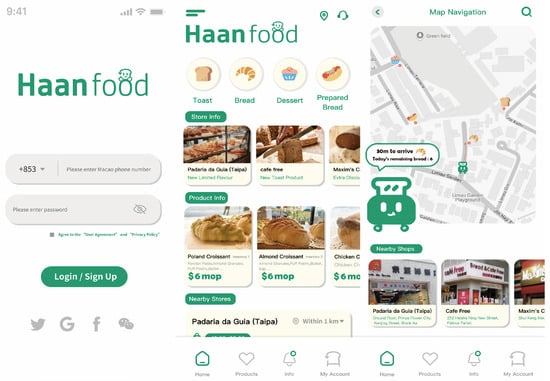
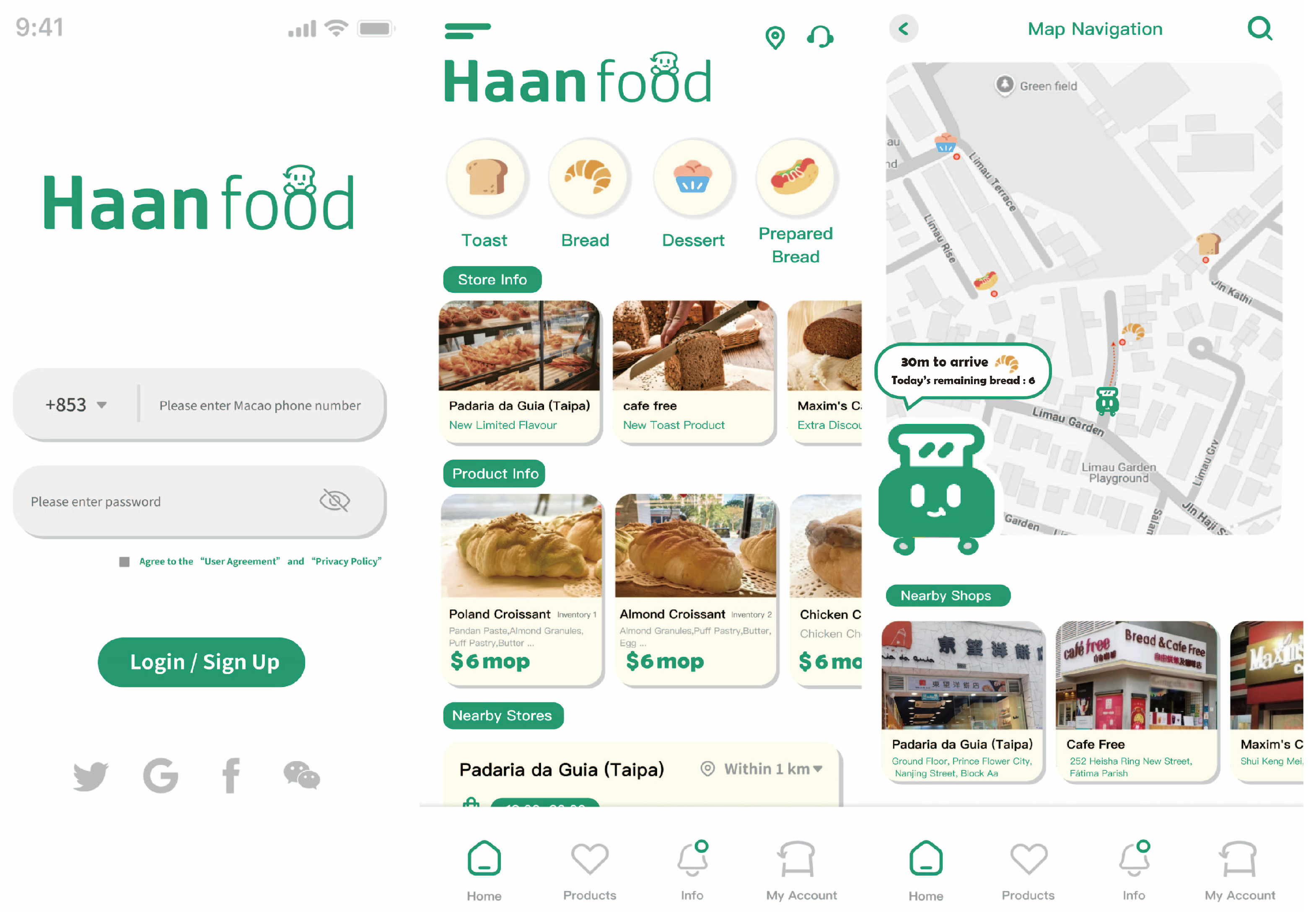
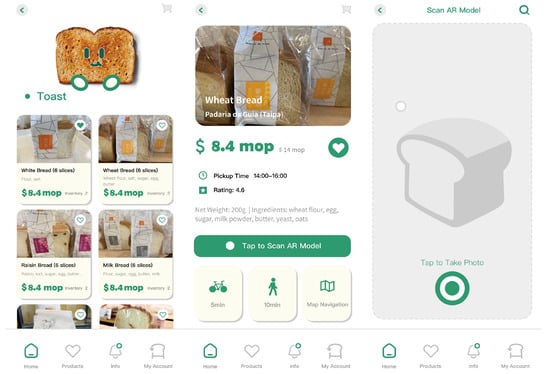
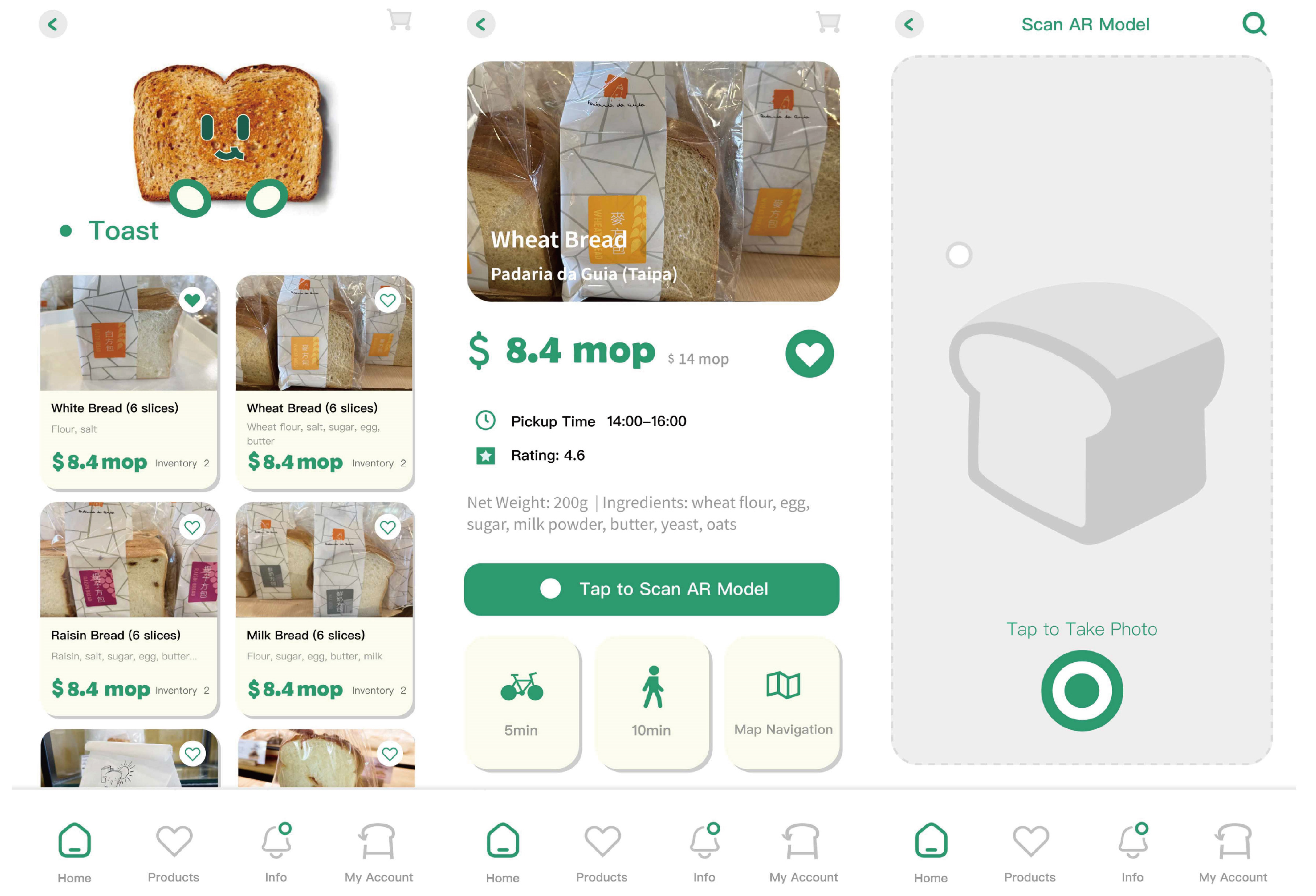
The system was designed by integrating surplus bread data from Macau bakeries into an AR-enhanced app (Macau, China) centered on the concept of surplus food. The app was named “Haan Food,” derived from a Cantonese expression meaning “to save food,” and featured this theme prominently on its homepage. The advertising slogan “Save·Food·Life” was introduced to reflect a modern lifestyle philosophy. The campaign promotes the idea that, regardless of financial status, people should be mindful of food conservation to support the Sustainable Development Goals (SDGs). The design further incorporates the letter “H” as a core visual element. Inspired by both the structure of the English alphabet and the international recycling symbol, the “H” was stylized using a gradient stroke—from thick to thin—to represent the concept of reducing surplus and food waste (Figure 2). In addition, a cartoon mascot based on the letter “H” was developed as a character IP to strengthen emotional connection. In the navigation function, the H-shaped bread mascot serves as a guide, leading users to their desired location. A speech bubble displays real-time information, such as the distance to the store and the quantity of surplus bread remaining each day (Figure 3). The research team conducted onsite data collection and photographed the real-time surplus bread inventory of four bakeries in Macau: Café Free, ELYSEE, Fun Cakes Macau, and Dong Wang Yang Bakery. All collected information was integrated into the app system, which was further enhanced with AR scanning technologies to provide users with a unique experience and operational approach (Figure 4).
Figure 2.
Logo main visual design.
Figure 3.
Haan Food login, store information, and an entertainment-based navigation page.
Figure 4.
Surplus bread pricing and AR interaction page.
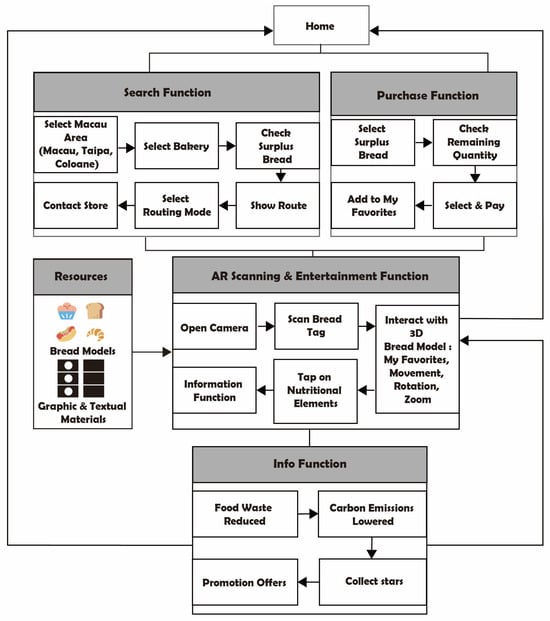
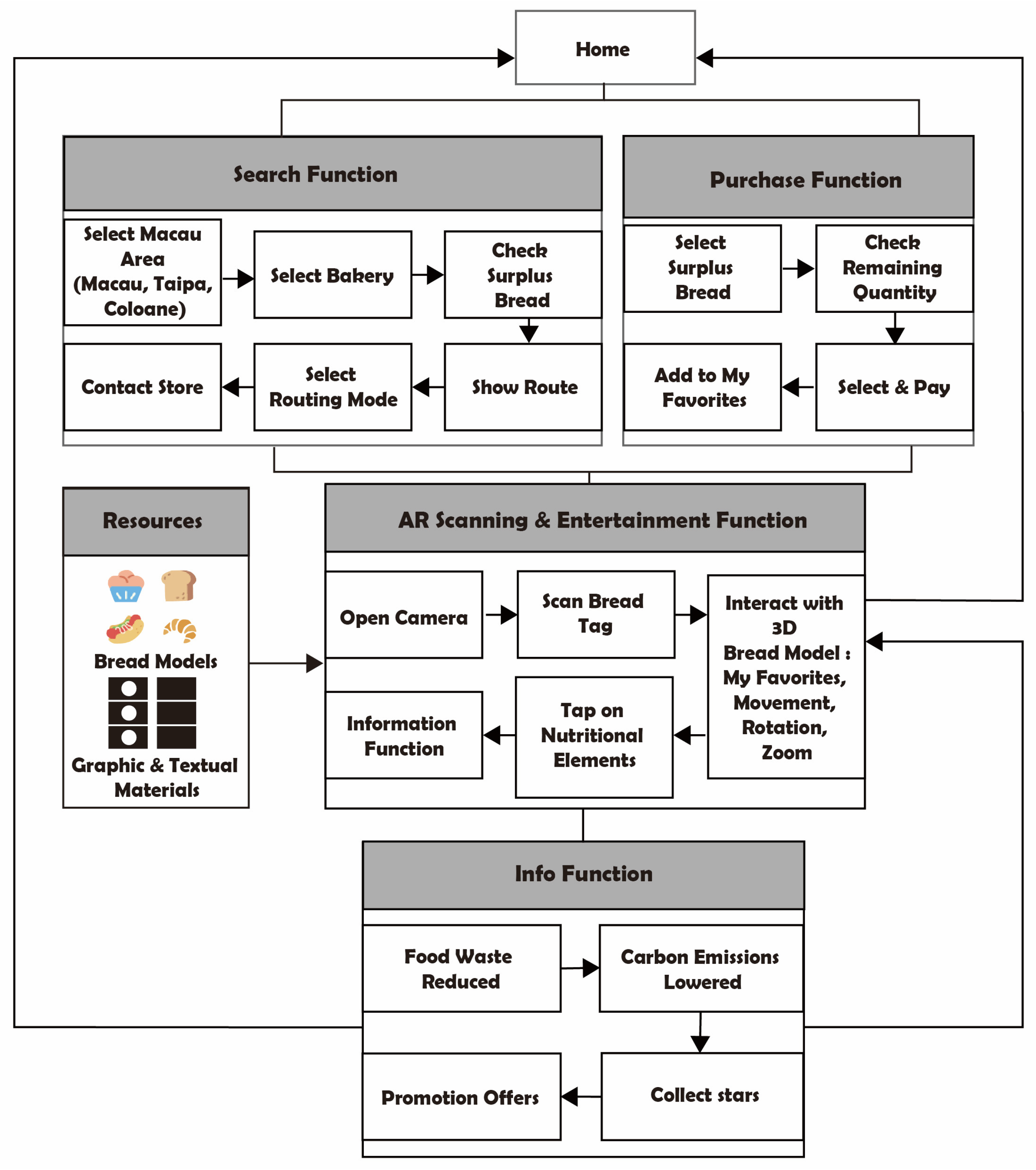
The functional architecture of the surplus bread system (Figure 5) includes the homepage, search function, purchase function, AR scanning entertainment function, and information resource function. Each function can return to the homepage and repeated operations can be performed. The detailed explanation is as follows:
Figure 5.
The operational process and architecture diagram of the surplus bread system.
- Homepage: Users primarily log in by entering their mobile phone number and password to access the main page.
- Search Function: Allows users to search for surplus bread available at participating bakeries on the current day (covering Macau, Taipa, and Coloane). After selecting desired items, users can choose a route and navigation mode, with a virtual bread character guiding them along the path.
- Purchase Function: After selecting bread, users specify quantities, confirm the order, and proceed with payment. Upon completion, users can save the bakery and specific bread items as favorites for easier access and repurchase in the future.
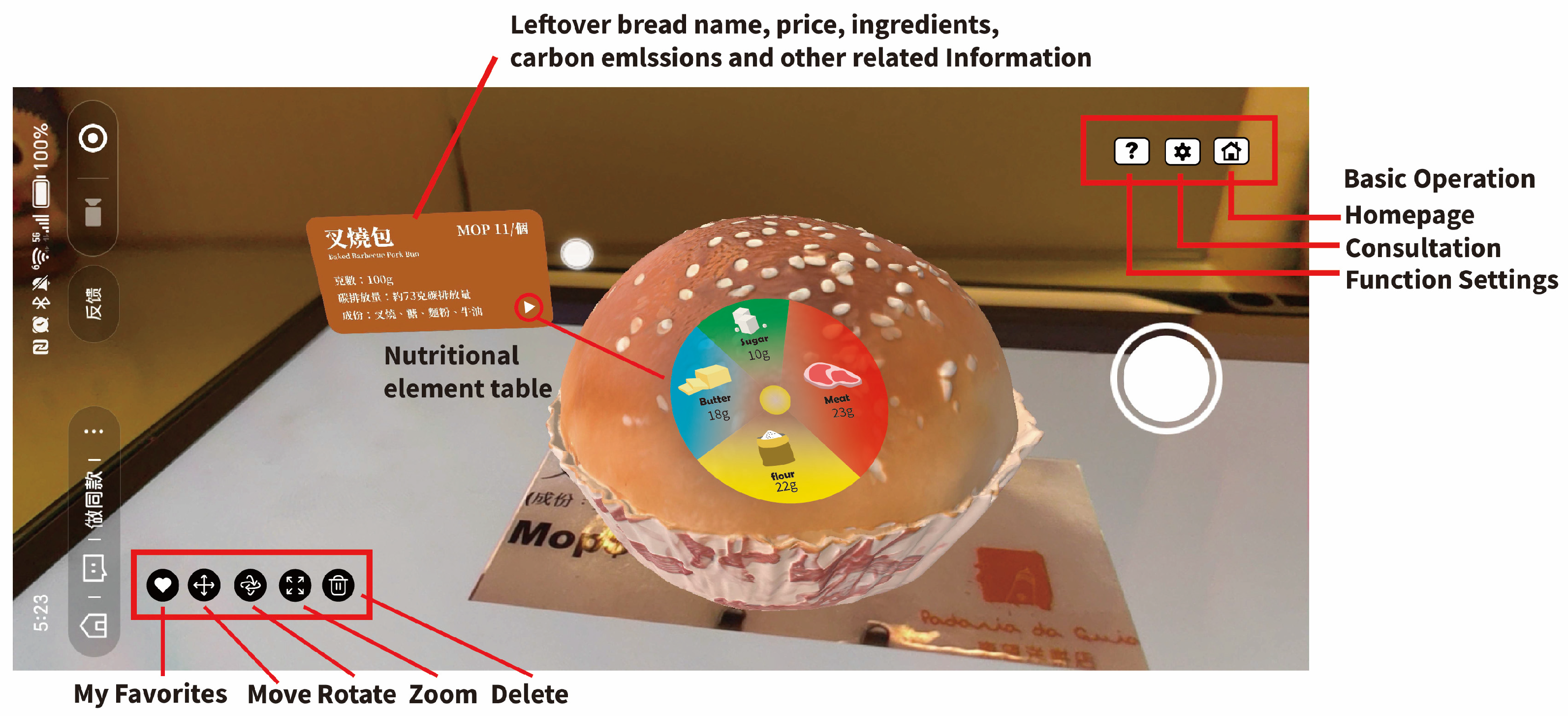
- AR scanning and Entertainment Function: When purchasing bread, users can scan the bread tags to view 3D models of the products. In addition to basic browsing, users can tap on different nutritional elements to see detailed ingredients and nutrition information, and from there access the information function page.
- Information Function: After learning about the nutritional content through the entertainment function, the system will display the specific amounts of “food waste reduced” and “carbon emissions lowered” upon completion of the purchase, the former is calculated in MOP, and the latter is shown in grams. Based on these values, users can collect and accumulate stars. Once they reach a certain threshold, or in conjunction with store promotions, they can redeem bread for free.
- Resources: The design team is responsible for collecting and creating all visual and textual content as well as the 3D bread models, and for continuously updating and expanding current and future related resources to ensure the information remains complete and up to date.
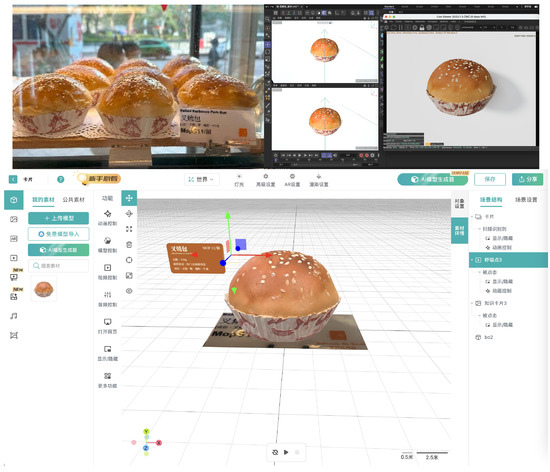
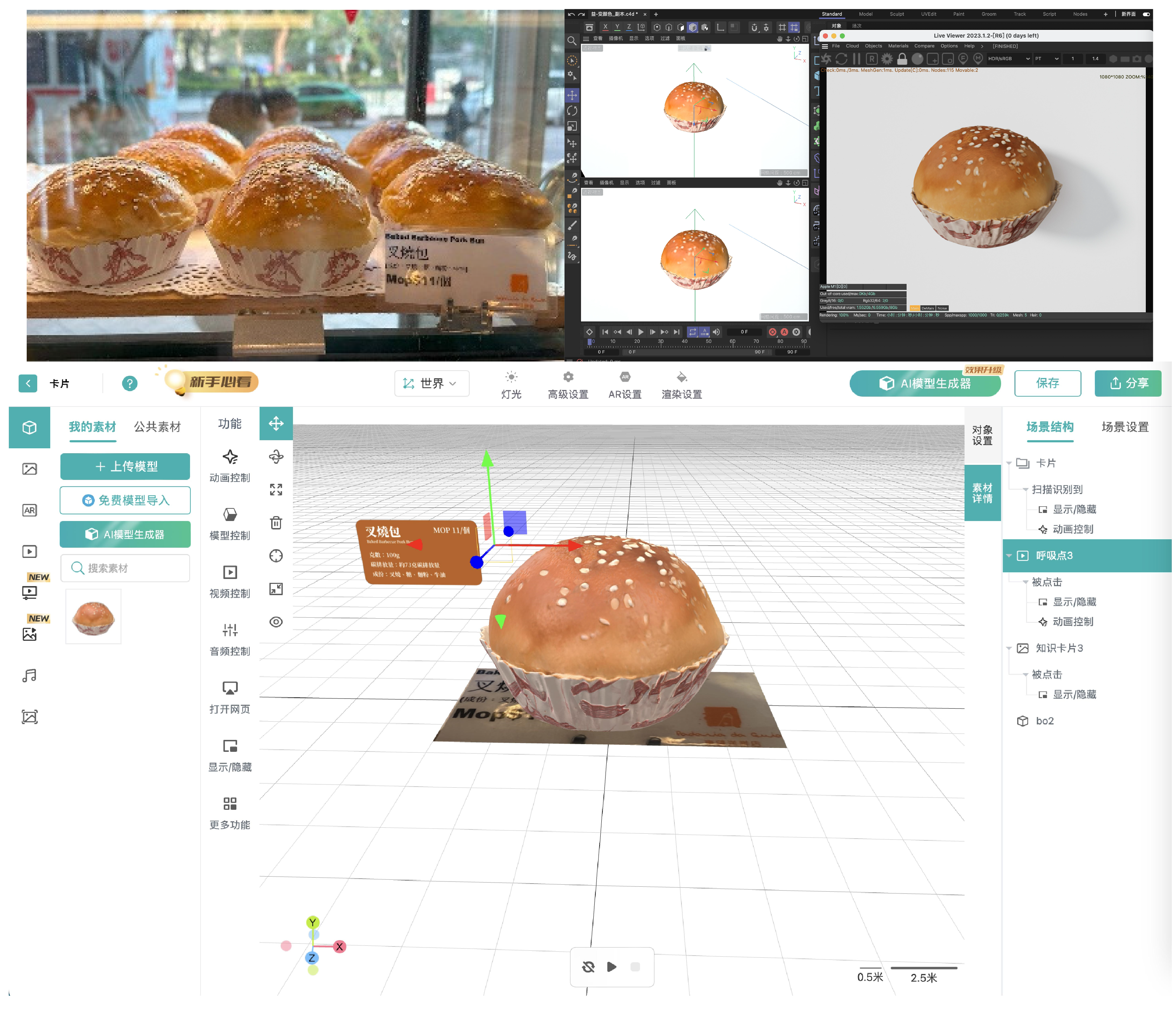
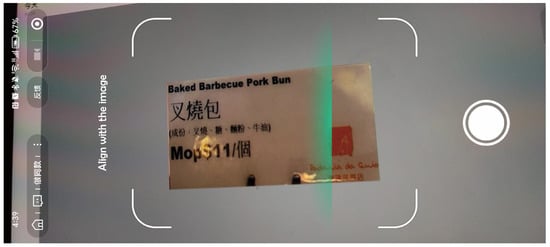
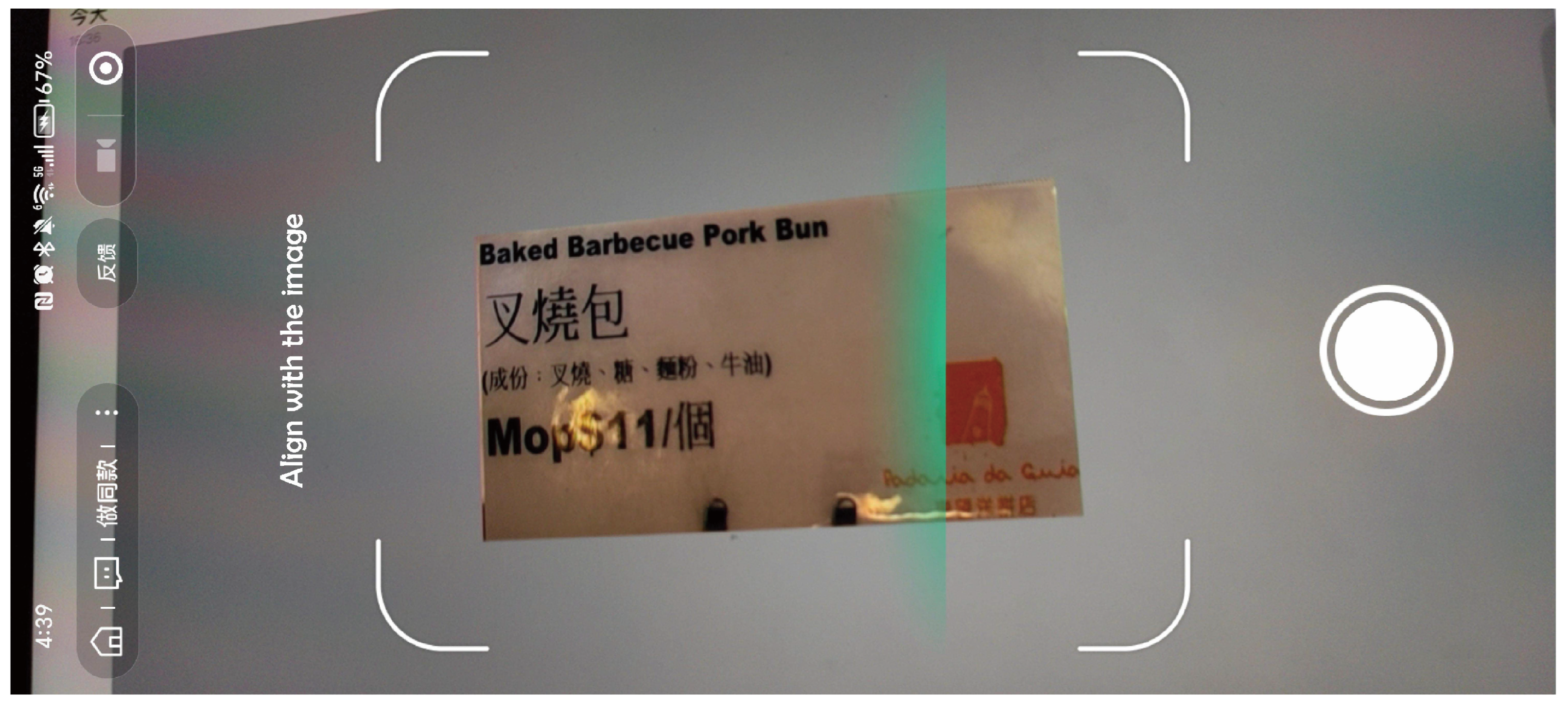
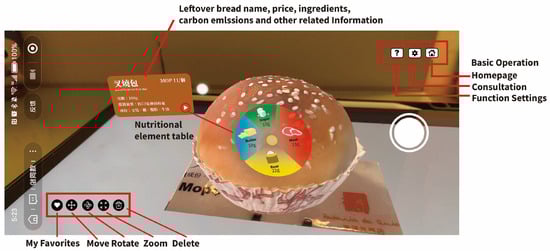
The research team subsequently conducted 3D modeling of the most frequently occurring surplus bread items at the four participating bakeries based on one week of inventory data. Information on the selected bread items was collected through direct inquiries with bakery owners and was systematically incorporated into the system design. When users browse the selection, whether onsite or via the app, they can instantly view a complete visual representation of each product, including its nutritional content and carbon footprint. After capturing high-resolution 2D images of the bread onsite, the team utilized Tripo 3D AI (v3.0) to automatically generate 3D models of each item (Figure 6). These initial models were then imported into Cinema 4D (v2025.1.0) for refinement and enhancement of visual details. The finalized models were uploaded to the Kivicube platform to enable AR-based scanning and recognition. In addition to the platform’s built-in scanning and capture functions, the system was programmed with basic functions (Homepage, Inquiry, Settings), and AR entertainment features (including My Favorites, Movement, Rotation, and Zoom options). Once a model is loaded, it automatically performs a 360-degree rotation, allowing users to examine the bread’s appearance in full detail. At the same time, informational cards and nutritional pie charts are displayed synchronously to provide a quick overview of the product type, ingredients, and related data (Figure 7 and Figure 8). This experience facilitates real-time purchasing decisions and helps reduce bread waste.
Figure 6.
Physical capture in bakeries and a 3D simulation effect.
Figure 7.
Align with the bread tag and perform an AR scan.
Figure 8.
AR scanning and interactive function effects.
4. Results and Discussion
4.1. Results
4.1.1. Predictive Test and Participant Analysis
To evaluate the impact of integrating surplus bread and interactive design into an immersive AR system within the TAM framework, this study examined not only the effects of PU and PEOU on attitude toward use and behavioral intentions but also the influence of external factors, including information quality on PU, system quality on PEOU, and perceived playfulness on attitudes toward use and behavioral intention (Table 2). A total of 180 responses were collected, and 163 valid questionnaires were retained for analysis, with 17 invalid ones removed. Participants were primarily local Macau residents or students with prior experience of using mobile phone apps. Of these, 95 were male (58.3%) and 68 were female (41.7%). Regarding age distribution, 80 participants (49.1%) were aged 20–24, 55 (33.7%) were aged 25–29, 12 (7.4%) were aged 30–34, and 16 (9.8%) were aged 35 or older. Regarding employment status, 93 were students (57.1%), 35 were office workers (21.5%), 9 were teachers (5.5%), 10 were part-time workers (6.1%), 10 were retirees (6.1%), and 6 were classified as “other” (3.7%). Finally, to further explore participants’ fluency in mobile phone shopping procedures, the questionnaire assessed their frequency of app use and prior AR shopping experiences. A majority (153 participants) used apps more than twice per week, with 55 using them 2–4 times and 103 using them more than 5 times. Only 5 participants used them less than twice weekly. Most participants had experienced AR, with 50 (30.7%) using it for gaming, 31 (19.0%) for museum visits, and 45 (27.6%) in tourism. Only 15 (9.2%) had used AR in shopping, and 3 (1.8%) had no prior AR experience. These findings indicate that AR experiences are becoming increasingly common, particularly in museum and tourism contexts.
Table 2.
Narrative statistics.
4.1.2. Reliability, Validity, and Structural Model Analysis
Using structural equation modeling (SEM), this study employed AMOS 21.0 and SPSS 22.0 All constructs were incorporated into a confirmatory factor analysis (CFA) to validate the measurement model. In terms of the testing method for samples, following Anderson and Gerbing (1988), both convergent and discriminant validity were tested in the first stage to confirm the adequacy of the measurement model [67]. In addition, following the guidelines by Bagozzi and Yi (1988) and Hair et al. (2010) [68,69], each factor loading was required to exceed 0.7. As shown in Table 3, all factor loadings were above 0.8, except for AT1 (0.785), and all were statistically significant (p < 0.001). Furthermore, the composite reliability (CR) and Cronbach’s α for each construct exceeded 0.7, ranging from 0.86 to 0.93, indicating high internal consistency. Finally, the average variance extracted (AVE) for each construct also exceeded 0.5, with values of 0.75, 0.78, 0.73, 0.76, 0.71, 0.67, and 0.73, thereby confirming acceptable convergent validity [68,69].
Table 3.
Reliability and validity dimensions.
Additionally, the chi-squared value is the most fundamental index in SEM and serves as the basis for calculating many goodness-of-fit indices. Carmines and McIver (1981) suggested that when the chi-squared value is fixed, the chi-squared/degree-of-freedom ratio should be 2:1 or 3:1 [70]. Some studies also indicate that a ratio below 2 is considered a good model fit, while a ratio below 3 is acceptable. Moreover, a lower chi-squared/degree of freedom ratio indicates a better model fit [70,71,72]. Based on the model’s chi-squared statistic and modification of indices to improve model fit, the following indices were measured: χ2 = 1623.40, df = 573, χ2/df = 2.83 (<3). The final degree-of-freedom results were lower than the recommended threshold. The Comparative Fit Index (CFI) was 0.957, and the Tucker–Lewis Index (TLI) was 0.949. A lower SRMR value indicates a better model fit values below 0.05 are generally considered a good fit [73]. Hu and Bentler (1999) suggested that a value below 0.08 indicates a good model fit [74]. These scholars also recommended that the RMSEA be less than or equal to 0.06, with values between 0.05 and 0.08 indicating a fair fit [74,75]. Therefore, the SRMR and RMSEA values measured in the model were 0.064 and 0.058, respectively. These indices all fall within the standards proposed by scholars, indicating that the theoretical model adequately represents the observed data. Furthermore, participants were asked to provide open-ended feedback after using the system, allowing for a discussion of data analysis across various dimensions and supporting in-depth interpretation of qualitative data and content. Each participant was assigned an identifier starting with “P” (for Participant), followed by a number corresponding to their order of participation (e.g., 1: P1, 2: P2, and so on). The final outcomes included system improvement suggestions and subsequent adjustment measures.
To evaluate discriminant validity, this study employed the Heterotrait–Monotrait Ratio (HTMT), which is calculated as the ratio of between-trait correlations to within-trait correlations. As shown in Table 4, most HTMT values were below the 0.85 threshold [76], except for the perceived playfulness-behavioral intention pair, which slightly exceeded the standard. Interviews provided insights into this anomaly:
Table 4.
HTMT evaluation discriminant validity scale.
P5, P30, P31: “This App is quite fun, but it feels too complicated—unlike regular shopping apps. The interface is not very intuitive.” P31 additionally noted: “I’ve used VR before, and it felt more immersive. If you ever develop that, I’d love to try it”.
P60: “I’m 65. This App and AR stuff are novel, but without young people to guide me, I do not know how to use it.” He added, “Some older bakeries I frequently go to are not listed. I’d prefer if the App included more of those shops”.
P23: “I’ve used AR in museums and events. This AR worked well—I could get information on surplus bread, locations, and prices, and some interactive elements”.
P47, P48: “After class, we often stop by bakeries to grab surplus bread for breakfast. This App shows the remaining stock and store distance with AR features, but it lacks other functions. Sometimes I decide based on reviews”.
These responses suggest that while the app is considered entertaining by many users, older users may find it overly complex, which can negatively impact their behavior and attitudes. Younger users, on the other hand, expressed a desire for more functional variety. Some users familiar with food delivery and shopping apps found the surplus bread app harder to use. From Table 4, it can be observed that most variables meet the criterion. The higher values can be attributed to factors such as descriptive statistics, the context of the AR experience, and TAM-related variables. This pattern indicates that higher correlation coefficients reflect stronger relationships. However, this does not invalidate the model’s overall discriminant validity.
4.1.3. Path Analysis and Comparison of Results
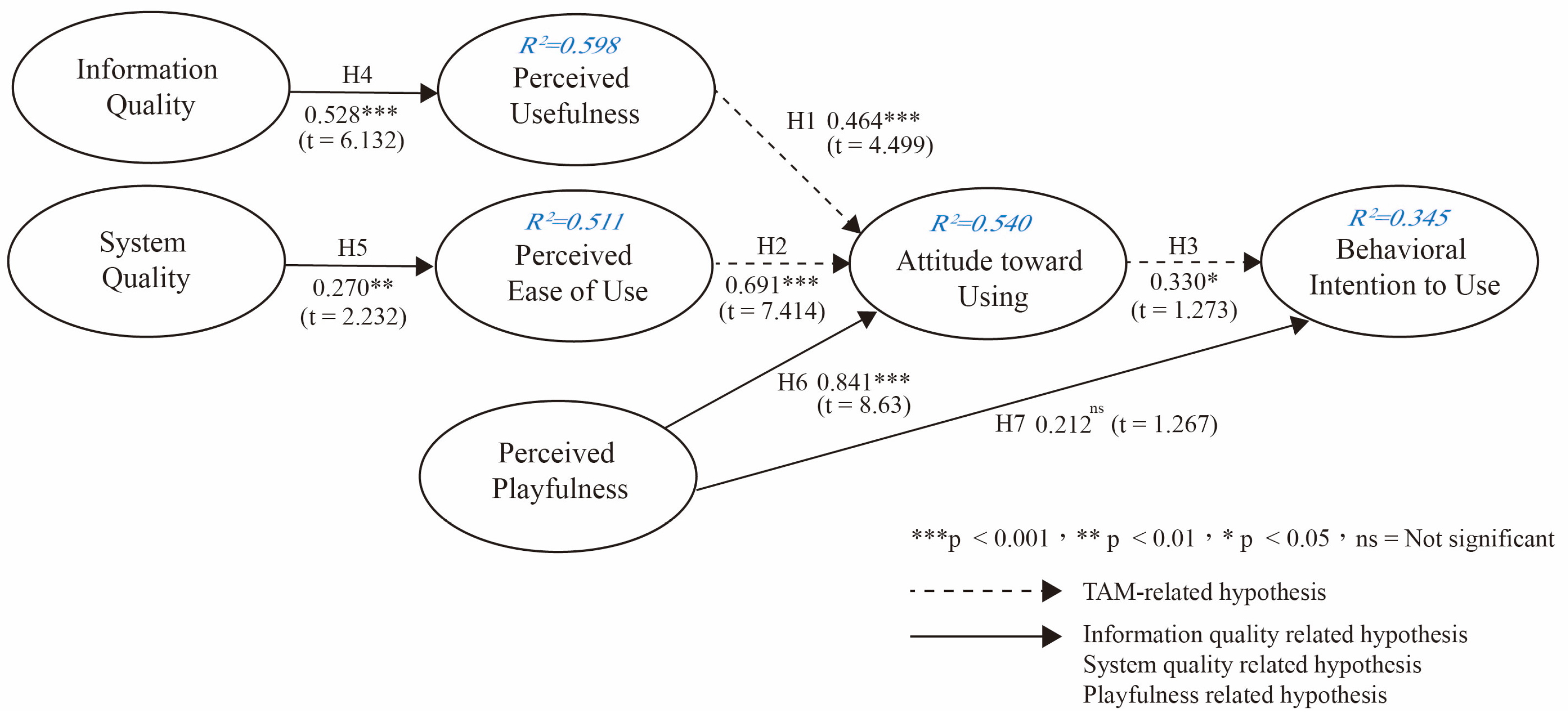
The SEM results were used to estimate the standardized path coefficients between dimensions. Of the seven hypotheses proposed (H1–H7), six were supported at the p < 0.05 level, reaching significance level, with H7 being the exception (Table 5). First, this study found that for users under TAM, H1: perceived usefulness (PU) → attitude toward use (AT) (β = 0.464, SE = 0.330, p < 0.001); H2: perceived ease-of-use (PEOU) → attitude toward use (AT) (β = 0.691, SE = 0.109, p < 0.001); and H3: attitude toward use (AT) → behavioral intention (BI) (β = 0.330, SE = 0.132, p < 0.05), with all reaching the significance level. These results indicate that when users perceive the app as useful and easy to use, their attitudes toward it improve. Although attitudes toward use also reached statistical significance, the relatively low level of significance, coupled with interviewees’ reports of usability issues, suggests that the novelty and complexity of the system’s features may negatively influence attitudes toward use, thereby contributing to a decrease in behavioral intention.
Table 5.
Hypothesis testing results.
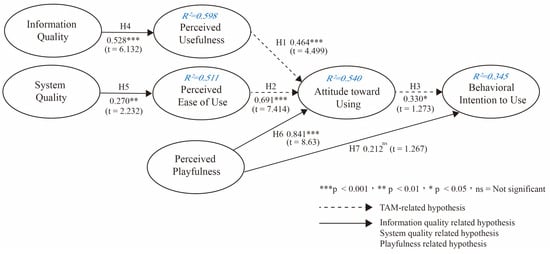
For H4: system quality (SQ) → perceived usefulness (PU) (β = 0.528, SE = 0.083, p < 0.001) and H5: information quality (IQ) → (perceived ease-of-use) PEOU (β = 0.270, SE = 0.094, p < 0.01), both showed positive effects. This indicates that a well-designed and clear system improves user understanding and usability, while well-structured information helps reduce operational complexity. On the other hand, information quality and planning further enhance user understanding, while well-designed systems simplify user operation. Finally, this study examined the impact of perceived playfulness on attitudes toward use and behavioral intention. For H6: perceived playfulness (PP) → attitude toward use (AT) (β = 0.841, SE = 0.081, p < 0.001), the app’s entertainment elements (e.g., cartoon character, animated navigation, AR interaction) significantly increased attitudes toward use. However, H7, perceived playfulness (PP) → behavioral intention (BI) (β = 0.212, SE = 0.113, p > 0.05) did not reach significance, suggesting that entertainment alone does not directly increase behavioral intention. All results are visually summarized in the testing model (Figure 9).
Figure 9.
Hypothesis testing results.
4.2. Discussion
4.2.1. Harnessing the Surplus Food Economy to Address Surplus Bread in Macau Through Immersive Virtual Interactive Experiences
Based on prior studies and the findings of this study, AR experiences are increasingly ubiquitous. Numerous studies indicate that AR applications play a critical role in meeting user needs by providing “realistic” shopping experiences that are unrestricted by time or space, fostering a sense of social presence and offering both informational value and intrinsic enjoyment [35,37,77]. For example, Strecker et al. (2024) developed an AR tool to identify unhealthy food in supermarkets using digital overlays, which helped participants make more informed decisions and reduce waste [78]. Similarly, a collaboration between scholars and the e-learning department at a Saudi Arabian university produced a green AR-based system that addresses environmental and economic challenges, thereby promoting sustainability. These examples illustrate the pivotal role of technological innovation in advancing sustainability. AR not only helps reduce food waste but also enables new digital services and experiences, offering innovative solutions to environmental challenges [79,80,81]. Although AR is most commonly experienced in museums, gaming, and tourism, its use in shopping is expanding, primarily for functional products such as clothing, cosmetics, and food delivery services. In contrast, AR applications targeting surplus food—particularly bread—remain limited. This study demonstrated that integrating real-time surplus bread data from local bakeries into an AR app, along with educational content on the surplus food economy, proved both engaging and appealing for users in Macau.
4.2.2. Users’ Attitudes Toward Immersive Virtual Interactive Experience Systems from the Perspective of the Technology Acceptance Model (TAM)
Applying the TAM to this study’s AR-based immersive system for surplus bread in Macau revealed that users found the novel technology engaging, and that AR features enhanced the relationship between attitudes toward use and PU [35]. Previous research also indicates that PEOU significantly affects users’ willingness to adopt new technologies, fosters sustained engagement, and has both direct and indirect effects on participation [28,82]. Users with high levels of PU and PEOU are generally more eager to explore new experiences and diversify their information sources [64]. The findings also align with those of Zhu and Chang (2014), who reported that systems perceived as both useful and easy to use positively influence user attitudes, particularly during free trials [33]. Since the current system is still in the testing phase and has not yet been officially released, users are encouraged to explore the app’s purpose: helping reduce bread waste by monitoring and purchasing surplus bread from local bakeries. By combining practicality, entertainment, and rich information, the system allows users to enjoy the experience while gaining valuable knowledge, thereby enhancing behavioral intention. However, overly complex systems with excessive functions may cause technology overload, potentially reducing user satisfaction.
4.2.3. Effects of System Quality, Information Quality, and Perceived Playfulness on User Behavior
AR facilitates high levels of interactivity and immersive experiences by bridging the physical and digital environments. Consequently, the quality of digital content and 3D models is crucial, as it directly contributes to realism and virtual product presence during shopping. This study found that immersive AR interaction, combined with well-presented product information, improves system navigation and enhances the overall shopping experience. These results confirm that system quality and information quality in AR significantly influence user behavior [38,46,47].
Furthermore, the strong association between AR interactivity and perceived enjoyment aligns with frameworks proposed by Yim et al. (2017) and Flavián et al. (2019) [34,83]. In AR marketing, perceived playfulness is closely linked to immersive and entertaining aspects rather than functional utility alone. This study showed that incorporating entertaining features—such as interactive elements, engaging design, and casual experiences—into an AR immersive system for surplus bread strongly motivated users. In addition, many participants expressed curiosity and enjoyment, indicating that the AR content increased their knowledge of and interest in surplus bread. However, perceived playfulness did not significantly influence purchasing intention. While users enjoyed the experience, it did not necessarily lead to increased willingness to purchase. This finding suggests that, although novel AR features are perceived as useful and enjoyable, they may not sustain long-term engagement or directly translate into purchasing behavior [84].
5. Conclusions
5.1. Theoretical Significance
This study aimed to investigate food waste reduction behavior from the perspectives of surplus food consumption, community awareness, and food waste reduction practices. Through an onsite investigation of surplus ready-to-eat bread in bakeries across Macau and an analysis of their disposal practices, it was found that public awareness of surplus bread and related knowledge is limited and that promotional efforts from the government and relevant organizations remain insufficient. Public attention tends to focus broadly on food waste without addressing specific categories such as bread. In response, this study explored an innovative system that combines concepts from the surplus food economy with app-based, immersive AR experiences. This design integrates 3D modeling and mobile devices, incorporating gamified experience elements to explore the interrelationships and influences among perceived ease of use, perceived usefulness, attitudes toward use, and behavioral intention within the TAM. The combined use of AR and food-related research is expanding, as seen in AR menus in restaurants to stimulate consumption and AR applications that influence consumer decision-making in physical retail settings [85,86]. It is evident that traditional TAM research has predominantly focused on external factors (information quality and system quality). Significant theoretical gaps exist concerning studies that integrate shopping systems, sustainability concepts (e.g., carbon footprint tracking), AR, and perceived playfulness to investigate their impact on user attitudes and behavioral intentions. Meanwhile, existing literature demonstrates that incorporating perceived playfulness into systems integrating VR and smart recycling significantly enhances user experience [87,88]. Therefore, this study innovatively combines AR’s interactive entertainment features with sustainability principles to construct a multi-dimensional technology–behavioral intervention framework. Through systematic investigation of its moderating effects on user decision-making processes, this approach establishes the core theoretical contribution of our research paradigm. Methods for disseminating sustainability education and knowledge have been proposed. However, few studies have focused specifically on AR-enhanced experiences surrounding surplus bread, aligning with the concept of the surplus food economy. Beyond the TAM, future research could explore factors such as sustainable food education, cognitive load, system loyalty, and continued usage intention to establish a broader theoretical foundation.
5.2. Practical Significance
AR is increasingly being integrated into various experiential activities, particularly in gaming, tourism, and museums. These applications can overcome spatial and temporal limitations, enabling users to intuitively observe product appearances and quickly access related information. AR also facilitates faster knowledge dissemination. To achieve high user satisfaction, curiosity, and enjoyment, it is crucial that AR applications deliver high-quality systems and information, both of which influence attitudes toward use [89,90].
In this study, system quality significantly impacted PU, and information quality significantly affected PEOU, indicating that well-designed AR experiences—rich in both information and entertainment—can improve user satisfaction, reduce decision-making uncertainty, and increase the likelihood of repeated digital engagement. The incorporation of 3D models enhanced visual interactivity. Whether shopping online or in-store, users can view product appearances, nutritional information, and carbon footprints in real-time, allowing them to make informed choices and reduce daily waste from surplus bread. Most research on surplus bread still primarily focuses on upcycled foods and sustainable material applications [91,92]. At present, discussions of bread waste are concentrated in European countries where bread is a staple, with comparatively little attention in Asia. Most practical apps on the market are shopping-oriented, and applications that integrate surplus bread with AR are exceedingly rare in practice. Through our investigation, we found that Macau bakeries have a large amount of surplus bread every day, but it is not being properly utilized. Therefore, in terms of practice-oriented innovation, we focus on helping Macau residents understand the daily status of surplus bread in bakeries, the nutritional profiles and carbon footprints of each type of bread, and on using a system to reduce bread waste.
Nevertheless, the current system still has limitations. The entertainment elements require further refinement, and the system lacks a section for social feedback or reviews. In the current digital landscape, many shopping, food, and tourism platforms heavily rely on ratings and user reviews, which significantly influence consumer decision-making. Therefore, implementing a feedback mechanism could promote responsible consumption, aligning with SDG 12: Responsible Consumption and Production.
5.3. Study Limitations and Future Studies
Although this study successfully introduced an AR-based surplus food economy in Macau for surplus bread and integrated perceived playfulness, system quality, and information quality into the TAM framework for empirical validation, several limitations remain. The most notable limitation is the incomplete data collection regarding surplus bread. Only a portion of chain bakeries provided inventory data, leaving some regions of Macau uncovered. Future efforts should expand the data set to include a more diverse, representative set of bakery partners, thereby improving the completeness of surplus bread distribution data within the system.
Moreover, while the AR immersive experience proved effective overall, user feedback identified areas for improvement, such as adding a comment/review section and incorporating non-chain bakeries commonly frequented by local residents. In today’s information-driven society, consumers tend to rely on highly rated reviews and after-sales support when making purchase decisions. Well-designed service experiences can foster stronger customer loyalty and help mitigate food waste.
Given the growing importance of immersive technologies, future research could explore other immersive modalities, such as VR or MR, to investigate alternative formats for communicating surplus food knowledge. Emphasizing the integration of sustainability practices into emerging technologies will be key to raising environmental awareness and ultimately achieving long-term SDGs.
Meanwhile, given that the clearance hours at Macau bakeries for selling surplus bread closely coincide with school dismissal times, the study sample consisted primarily of students. That said, the system’s learning curve varies across user groups; students tend to adapt more readily, but qualitative feedback indicates that not all students feel that adding entertainment elements enhances the user experience. Therefore, it is important to balance usability with the level of entertainment. Future research could extend to other time periods (e.g., weekends) and other groups (working adults, older adults), employ random sampling to collect data, and examine in depth different populations’ acceptance, usage behaviors, and attitudes toward the AR surplus bread system.
Author Contributions
Conceptualization, P.-W.H. and L.-Q.K.; methodology, P.-W.H.; software, P.-W.H.; validation, P.-W.H.; formal analysis, P.-W.H.; investigation, P.-W.H.; resources, P.-W.H., L.-Q.K. and Y.T.; data curation, P.-W.H. and L.-Q.K.; writing—original draft preparation, P.-W.H.; writing—review and editing, L.-Q.K. and Y.T.; visualization, P.-W.H.; supervision, L.-Q.K.; project administration, P.-W.H.; funding acquisition, P.-W.H. All authors have read and agreed to the published version of the manuscript.
Funding
This research was mainly supported by the Science and Technology Development Fund, FDCT (funding number: 0045/2023/ITP2) and the Major Project of the National Social Science Fund in Arts titled “The Combination of Two” and the Innovation Research on Contemporary Chinese Art Theory (funding number: 24ZD02).
Institutional Review Board Statement
The study was conducted in accordance with the Declaration of Helsinki, and ap-proved by the Ethics Committee of Macao Polytechnic University (MPU) and Science and Technology Development Fund (FDCT) (protocol code 0045/2023/ITP2/E01 and 11 December 2023).
Informed Consent Statement
Informed consent was obtained from all subjects involved in the study.
Data Availability Statement
The data presented in this study are available on request from the corresponding author.
Conflicts of Interest
The authors declare no conflicts of interest.
References
- Liang, Y.Y.; Song, Q.P.; Liu, G.; Li, J.H. Uncovering residents and restaurants’ attitude and willingness toward effective food waste management: A case study of Macau. Waste Manag. 2021, 130, 107–116. [Google Scholar] [CrossRef] [Scilit]
- Aschemann-Witzel, J.; Giménez, A.L.; Ares, G. Household food waste in an emerging country and the reasons why: Consumeŕs own accounts and how it differs for target groups. Resour. Conserv. Recycl. 2019, 145, 332–338. [Google Scholar] [CrossRef] [Scilit]
- Schanes, K.; Dobernig, K.; Gözet, B. Food waste matters—A systematic review of household food waste practices and their policy implications. J. Clean. Prod. 2018, 182, 978–991. [Google Scholar] [CrossRef] [Scilit]
- DSPA to Launch New Pilot Project for Food Waste Collection at Private Buildings. Available online: https://macaudailytimes.com.mo/dspa-to-launch-new-pilot-project-for-food-waste-collection-at-private-buildings.html (accessed on 9 September 2025).
- Brancoli, P.; Rousta, K.; Bolton, K. Life cycle assessment of supermarket food waste. Resour. Conserv. Recycl. 2017, 118, 39–46. [Google Scholar] [CrossRef] [Scilit]
- Brancoli, P.; Lundin, M.; Bolton, K.; Eriksson, M. Bread loss rates at the supplier-retailer interface–analysis of risk factors to support waste prevention measures. Resour. Conserv. Recycl. 2019, 147, 128–136. [Google Scholar] [CrossRef] [Scilit]
- WRAP. Reducing Household Bakery Waste. Available online: https://www.wrap.ngo/resources/report/reducing-household-bakery-waste (accessed on 9 September 2025).
- Hellwig, C.; Rousta, N.; Wikandari, R.; Taherzadeh, M.J.; Kronlöf, G.H.; Bolton, K.; Rousta, K. Household fermentation of leftover bread to nutritious food. Waste Manag. 2022, 150, 39–47. [Google Scholar] [CrossRef] [Scilit] [PubMed]
- Bajželj, B.; Quested, T.E.; Röös, E.; Swannell, R.P.J. The role of reducing food waste for resilient food systems. Ecosyst. Serv. 2020, 45, 101–140. [Google Scholar] [CrossRef] [Scilit] [PubMed]
- Breves, P.; Heber, V. Into the wild: The effects of 360° immersive nature videos on feelings of commitment to the environment. Environ. Commun. 2020, 14, 332–346. [Google Scholar] [CrossRef] [Scilit]
- Levstek, M.; Papworth, S.; Woods, A.; Archer, L.; Arshad, I.; Dodds, K.; Holdstock, J.S.; Bennett, J.; Dalton, P. Immersive storytelling for pro-environmental behaviour change: The Green Planet augmented reality experience. Comput. Hum. Behav. 2024, 161, 108379. [Google Scholar] [CrossRef] [Scilit]
- Ahn, S.J.; Bailenson, J.N.; Park, D. Short- and long-term effects of embodied experiences in immersive virtual environments on environmental locus of control and behavior. Comput. Hum. Behav. 2014, 39, 235–245. [Google Scholar] [CrossRef] [Scilit]
- Sung, E.; Han, D.I.D.; Choi, Y.K. Augmented reality advertising via a mobile app. Psychol. Mark. 2022, 39, 543–558. [Google Scholar] [CrossRef] [Scilit]
- Liu, Y.; Sun, J.C.Y.; Chen, S.K. Comparing technology acceptance of AR-based and 3D map-based mobile library applications: A multigroup SEM analysis. Interact. Learn. Environ. 2023, 31, 4156–4170. [Google Scholar] [CrossRef] [Scilit]
- Diekmann, L.; Germelmann, C.C. Leftover Consumption as a Means of Food Waste Reduction in Public Space? Qualitative Insights from Online Discussions. Sustainability 2021, 13, 13564. [Google Scholar]
- Smil, V. Improving Efficiency and Reducing Waste in Our Food System. Environ. Sci. 2004, 1, 17–26. [Google Scholar] [CrossRef] [Scilit]
- Redlingshöfer, B.; Barles, S.; Weisz, H. Are waste hierarchies effective in reducing environmental impacts from food waste? A systematic review for OECD countries. Resour. Conserv. Recycl. 2020, 156, 104723. [Google Scholar] [CrossRef] [Scilit]
- Persson, D.; Erlandsson, L.K. Ecopation: Connecting sustainability, glocalisation and well-being. J. Occup. Sci. 2014, 21, 12–24. [Google Scholar] [CrossRef] [Scilit]
- Principato, L.; Secondi, L.; Pratesi, C.A. Reducing food waste: An investigation on the behaviour of Italian youths. Br. Food J. 2015, 117, 731–748. [Google Scholar] [CrossRef] [Scilit]
- Li, W.H.; Feng, Q.; Zhu, X.; Yu, Q.; Wang, Q. Effect of summarizing scaffolding and textual cues on learning performance, mental model, and cognitive load in a virtual reality environment: An experimental study. Comput. Educ. 2023, 200, 104793. [Google Scholar] [CrossRef] [Scilit]
- Chung, S.J.; Choi, L.J. Expanding Horizons: Fostering Creativity and Curiosity through Spherical Video-Based Virtual Reality in Project-Based Language Learning. TESOL Q. 2024, 58, 1786–1800. [Google Scholar]
- Birtill, M.; King, J.; Jones, D.; Thyer, L.; Pap, R.; Simpson, P. The use of immersive simulation in paramedicine education: A scoping review. Interact. Learn. Environ. 2023, 31, 2428–2443. [Google Scholar] [CrossRef] [Scilit]
- Bhavadharini, B.; Monica, V.; Anbarasan, R.; Mahendran, R. Virtual, augmented, and mixed reality as a versatile tool in food consumer behavior evaluation: Recent advances in aroma, taste, and texture incorporation. Compr. Rev. Food Sci. Food Saf. 2023, 22, 4925–4956. [Google Scholar] [CrossRef] [Scilit]
- Pini, V.; Orso, V.; Pluchino, P.; Gamberini, L. Augmented grocery shopping: Fostering healthier food purchases through AR. Virtual Real. 2023, 27, 2117–2128. [Google Scholar] [CrossRef] [Scilit]
- Ahn, J.; Williamson, J.; Gartrell, M.; Han, R.; Lv, Q.; Mishra, S. Supporting healthy grocery shopping via mobile augmented reality. ACM Trans. Multimed. Comput. Commun. Appl. 2015, 12, 1–24. [Google Scholar] [CrossRef] [Scilit]
- Davis, F.D. Perceived usefulness, perceived ease of use, and user acceptance of information technology. MIS Q. 1989, 13, 319–340. [Google Scholar] [CrossRef] [Scilit]
- Akman, I.; Mishra, A. Sector diversity in Green Information Technology practices: Technology Acceptance Model perspective. Comput. Hum. Behav. 2015, 49, 477–486. [Google Scholar] [CrossRef] [Scilit]
- Oyman, M.; Bal, D.; Ozer, S. Extending the technology acceptance model to explain how perceived augmented reality affects consumers’ perceptions. Comput. Hum. Behav. 2022, 128, 107127. [Google Scholar] [CrossRef] [Scilit]
- Hilken, T.; Heller, J.; Chylinski, M.; Keeling, D.I.; Mahr, D.; Ruyter, K.D. Making omnichannel an augmented reality: The current and future state of the art. J. Res. Interact. Mark. 2018, 12, 509–523. [Google Scholar] [CrossRef] [Scilit]
- Barnett, L.A. Characterizing playfulness: Correlates with individual attributes and personality traits. Play. Cult. 1991, 4, 371–393. [Google Scholar]
- Webster, J.; Martocchio, J.J. Microcomputer Playfulness: Development of a Measure with Workplace Implications. MIS Q. 1992, 16, 201–226. [Google Scholar] [CrossRef] [Scilit]
- Lee, M.; Lee, S.A.; Jeong, M.; Oh, H. Quality of virtual reality and its impacts on behavioral intention. Int. J. Hosp. Manag. 2020, 90, 102595. [Google Scholar] [CrossRef] [Scilit]
- Zhu, D.H.; Chang, Y.P. Investigating consumer attitude and intention toward free trials of technology-based services. Comput. Hum. Behav. 2014, 30, 328–334. [Google Scholar] [CrossRef] [Scilit]
- Yim, M.Y.C.; Chu, S.C.; Sauer, P.L. Is augmented reality technology an effective tool for E-commerce? An interactivity and vividness perspective. J. Interact. Mark. 2017, 39, 89–103. [Google Scholar] [CrossRef] [Scilit]
- Arghashi, V.; Yuksel, C.A. Interactivity, Inspiration, and Perceived Usefulness! How retailers’ AR-apps improve consumer engagement through flow. J. Retail. Consum. Serv. 2022, 64, 102756. [Google Scholar] [CrossRef] [Scilit]
- Dacko, S.G. Enabling smart retail settings via mobile augmented reality shopping apps. Technol. Forecast. Soc. Change 2017, 124, 243–256. [Google Scholar] [CrossRef] [Scilit]
- Baek, T.H.; Yoo, H.; Yoon, S. Augment yourself through virtual mirror: The impact of self-viewing and narcissism on consumer responses. Int. J. Advert. 2018, 37, 421–439. [Google Scholar] [CrossRef] [Scilit]
- Ebrahimabad, F.Z.; Yazdani, H.; Hakim, A.; Asarian, M. Augmented Reality Versus Web-Based Shopping: How Does AR Improve User Experience and Online Purchase Intention. Telemat. Inform. Rep. 2024, 15, 100152. [Google Scholar] [CrossRef] [Scilit]
- Ali, F. Hotel website quality, perceived flow, customer satisfaction and purchase intention. J. Hosp. Tour. Technol. 2016, 7, 213–228. [Google Scholar] [CrossRef] [Scilit]
- Kumar, H.; Srivastava, R. Exploring the role of augmented reality in online impulse behaviour. Int. J. Retail. Distrib. Manag. 2022, 50, 1281–1301. [Google Scholar] [CrossRef] [Scilit]
- Javornik, A. ‘It’s an illusion, but it looks real!’ Consumer affective, cognitive and behavioural responses to augmented reality applications. J. Mark. Manag. 2016, 32, 987–1011. [Google Scholar] [CrossRef] [Scilit]
- Sengupta, A.; Cao, L.L. Augmented reality’s perceived immersion effect on the customer shopping process: Decision-making quality and privacy concerns. Int. J. Retail. Distrib. Manag. 2022, 50, 1039–1061. [Google Scholar] [CrossRef] [Scilit]
- Zhang, K.; Wang, J.G.; Zhang, J.Y.; Wang, Y.; Zeng, Y.J. Exploring the impact of location-based augmented reality on tourists’ spatial behavior, experience, and intention through a field experiment. Tour. Manag. 2024, 102, 104886. [Google Scholar] [CrossRef] [Scilit]
- Pantano, E.; Priporas, C.V.; Dennis, C. A new approach to retailing for successful competition in the new smart scenario. Int. J. Retail. Distrib. Manag. 2018, 46, 264–282. [Google Scholar] [CrossRef] [Scilit]
- Iannilli, V.M.; Spagnoli, A. Phygital retailing in fashion. Experiences, opportunities and innovation trajectories. ZoneModa J. 2021, 11, 43–69. [Google Scholar]
- Xue, L.C.; Parker, C.J.; Hart, C.A. How augmented reality can enhance fashion retail: A UX design perspective. Int. J. Retail. Distrib. Manag. 2023, 51, 59–81. [Google Scholar] [CrossRef] [Scilit]
- Tan, Y.C.; Chandukala, S.R.; Reddy, S.K. Augmented Reality in Retail and Its Impact on Sales. J. Mark. 2021, 86, 48–66. [Google Scholar] [CrossRef] [Scilit]
- Lederer, A.L.; Maupin, D.J.; Sena, M.P.; Zhuang, Y. The technology acceptance model and the world wide web. Decis. Support Syst. 2000, 29, 269–282. [Google Scholar] [CrossRef] [Scilit]
- Jiang, Q.L.; Gu, C.; Feng, Y.; Wei, W.; Tsai, W.C. Study on the continuance intention in using virtual shoe-try-on function in mobile online shopping. Kybernetes 2023, 52, 4551–4575. [Google Scholar] [CrossRef] [Scilit]
- Feng, Y.; Xie, Q. Demystifying Novelty Effects: An Analysis of Consumer Responses to YouTube Videos Featuring Augmented Reality Out-of-Home Advertising Campaigns. J. Curr. Issues Res. Advert. 2019, 40, 36–53. [Google Scholar] [CrossRef] [Scilit]
- Nguyen, T.V.; Nguyen, T.V.; Nguyen, D.V. Exploring the Influence of Virtual Reality and Augmented Reality on User Satisfaction in Virtual Tourism. J. Distrib. Sci. 2024, 22, 33–44. [Google Scholar]
- Manis, K.T.; Choi, D. The virtual reality hardware acceptance model (VR-HAM): Extending and individuating the technology acceptance model (TAM) for virtual reality hardware. J. Bus. Res. 2019, 100, 503–513. [Google Scholar] [CrossRef] [Scilit]
- Ibáñez-Sánchez, S.; Orús, C.; Flavián, C. Augmented reality filters on social media. Analyzing the drivers of playability based on uses and gratifications theory. Psychol. Mark. 2022, 39, 559–578. [Google Scholar] [CrossRef] [Scilit]
- Tu, J.C.; Jia, X.H. A Study on Immersion and Intention to Pay in AR Broadcasting: Validating and Expanding the Hedonic Motivation System Adoption Mode. Sustainability 2024, 16, 2040. [Google Scholar] [CrossRef] [Scilit]
- Hung, S.W.; Chang, C.W.; Ma, Y.C. A new reality: Exploring continuance intention to use mobile augmented reality for entertainment purposes. Technol. Soc. 2021, 67, 101757. [Google Scholar] [CrossRef] [Scilit]
- Naveen, L.; Khan, M.I.; Saleh, M.A.; Subudhi, R.N. The influence of mobile augmented reality on consumer behavior: Insights into affective, cognitive, and behavioral responses. Comput. Hum. Behav. 2025, 165, 108558. [Google Scholar] [CrossRef] [Scilit]
- Iranmanesh, M.; Senali, M.G.; Foroughi, B.; Ghobakhloo, M.; Asadi, S.; Tirkolaee, E.B. Effect of augmented reality applications on attitude and behaviours of customers: Cognitive and affective perspectives. Asia-Pac. J. Bus. Adm. 2024, 16, 1067–1092. [Google Scholar] [CrossRef] [Scilit]
- Chau, P.Y.K.; Hu, P.J. Examining a Model of Information Technology Acceptance by Individual Professionals: An Exploratory Study. J. Manag. Inf. Syst. 2002, 18, 191–229. [Google Scholar] [CrossRef] [Scilit]
- Davis, F.D.; Bagozzi, R.P.; Warshaw, P.R. User acceptance of computer technology: A comparison of two theoretical models. Manag. Sci. 1989, 35, 982–1003. [Google Scholar] [CrossRef] [Scilit]
- Delone, W.H.; McLean, E.R. Information Systems Success: The Quest for the Dependent Variable. Inf. Syst. Res. 1992, 3, 60–95. [Google Scholar] [CrossRef] [Scilit]
- Yoo, J. The Effects of Perceived Quality of Augmented Reality in Mobile Commerce—An Application of the Information Systems Success Model. Informatics 2020, 7, 14. [Google Scholar] [CrossRef] [Scilit]
- Kowalczuk, P.; Siepmann, C.; Adler, J. Cognitive, affective, and behavioral consumer responses to augmented reality in e-commerce: A comparative study. J. Bus. Res. 2021, 124, 357–373. [Google Scholar] [CrossRef] [Scilit]
- Parker, J.R.; Lehmann, D.R.; Xie, Y. Decision comfort. J. Consum. Res. 2016, 43, 113–133. [Google Scholar] [CrossRef] [Scilit]
- Kim, J.; Forsythe, S. Adoption of virtual try-on technology for online apparel shopping. J. Interact. Mark. 2008, 22, 45–59. [Google Scholar] [CrossRef] [Scilit]
- Salimon, M.G.; Aliyu, O.A.; Yusr, M.M.; Perumal, S. Smartphone banking usage in Nigeria: Gamification, technology acceptance and cultural factors empirical perspectives. Electron. J. Inf. Syst. Dev. Ctries. 2021, 87, e12174. [Google Scholar] [CrossRef] [Scilit]
- Lin, T.T.C.; Li, L. Perceived characteristics, perceived popularity, and playfulness: Youth adoption of mobile instant messaging in China. China Media Res. 2014, 10, 60–71. [Google Scholar]
- Anderson, J.C.; Gerbing, D.W. Structural equation modeling in practice: A review and recommended two-step approach. Psychol. Bull. 1988, 103, 411–423. [Google Scholar] [CrossRef]
- Bagozzi, R.P.; Yi, Y. On the evaluation of structural equation models. J. Acad. Mark. Sci. 1988, 16, 74–94. [Google Scholar] [CrossRef]
- Hair, J.F., Jr.; Black, W.C.; Babin, B.J.; Anderson, R.E. Multivariate Data Analysis; Pearson Education: Upper Saddle River, NJ, USA, 2010. [Google Scholar]
- Carmines, E.G.; McIver, J.P. Analyzing models with unobserved variables: Analysis of covariance structure. In Social Measurement: Current Issues; Bohrnstedt, G.W., Borgatta, E.F., Eds.; Sage: Beverly Hills, CA, USA, 1981; pp. 65–115. [Google Scholar]
- Ullman, J.B. Structural equation modeling. In Using Multivariate Statistics; Tabachnick, B.G., Fidell, L.S., Eds.; Pearson Education: Boston, MA, USA, 2001. [Google Scholar]
- Kline, R.B. Principles and Practice of Structural Equation Modeling, 2nd ed.; Guilford: New York, NY, USA, 2005. [Google Scholar]
- Jöreskog, K.G.; Sörbom, D. LISREL 7: A Guide to the Program and Applications; SPSS Inc.: Chicago, IL, USA, 1989. [Google Scholar]
- Hu, L.T.; Bentler, P.M. Cutoff criteria for fit indexes in covariance structure analysis: Conventional criteria versus new alternatives. Struct. Equ. Model. 1999, 6, 1–55. [Google Scholar] [CrossRef] [Scilit]
- McDonald, R.P.; Ho, M.R. Principles and practice in reporting structural equation analysis. Psychol. Methods 2002, 7, 64–82. [Google Scholar] [CrossRef]
- Hair, J.F., Jr.; Matthews, L.M.; Matthews, R.L.; Sarstedt, M. PLS-SEM or CB-SEM: Updated guidelines on which method to use. Int. J. Multivar. Data Anal. 2017, 1, 107–123. [Google Scholar] [CrossRef] [Scilit]
- Jeganathan, K.; Szymkowiak, A. Bridging Digital Product Passports and in-store experiences: How augmented reality enhances decision comfort and reuse intentions. J. Retail. Consum. Serv. 2025, 84, 104242. [Google Scholar] [CrossRef] [Scilit]
- Strecker, J.; Wu, J.; Bektaş, K.; Vaslin, C.; Mayer, S. ShoppingCoach: Using diminished reality to prevent unhealthy food choices in an offline supermarket scenario. Ext. Abstr. CHI Conf. Hum. Factors Comput. Syst. 2024, 288, 1–8. [Google Scholar]
- Nadeem, W.; Ashraf, A.F.; Kumar, V. Fostering consumer engagement with sustainability marketing using augmented reality (SMART): A climate change response. J. Bus. Res. 2025, 192, 115289. [Google Scholar] [CrossRef] [Scilit]
- Shahzad, M.; Qu, Y.; Javed, S.A.; Zafar, A.U.; Rehman, S.U. Relation of environment sustainability to CSR and green innovation: A case of Pakistani manufacturing industry. J. Clean. Prod. 2020, 253, 119938. [Google Scholar] [CrossRef] [Scilit]
- Alahmari, M.; Issa, T.; Issa, T.; Nau, S.Z. Faculty awareness of the economic and environmental benefits of augmented reality for sustainability in Saudi Arabian universities. J. Clean. Prod. 2019, 226, 259–269. [Google Scholar] [CrossRef] [Scilit]
- Huang, T.L.; Liao, S.L. A model of acceptance of augmented-reality interactive technology: The moderating role of cognitive innovativeness. Electron. Commer. Res. 2015, 15, 269–295. [Google Scholar] [CrossRef] [Scilit]
- Flavián, C.; Ibáñez-Sánchez, S.; Orús, C. The impact of virtual, augmented and mixed reality technologies on the customer experience. J. Bus. Res. 2019, 100, 547–560. [Google Scholar] [CrossRef] [Scilit]
- Ngo, T.T.A.; Tran, T.T.; An, G.K.; Nguyen, P.T. Investigating the influence of augmented reality marketing application on consumer purchase intentions: A study in the E-commerce sector. Comput. Hum. Behav. Rep. 2025, 18, 100648. [Google Scholar] [CrossRef] [Scilit]
- Bae, S.; Kim, T.J. Consumer perceptions and acceptance of AR menus in the restaurant industry. J. Qual. Assur. Hosp. Tour. 2024, 1–24. [Google Scholar] [CrossRef] [Scilit]
- Shahab, M.H.; Ghazali, E.; Mohtar, M. The role of elaboration likelihood model in consumer behaviour research and its extension to new technologies: A review and future research agenda. Int. J. Consum. Stud. 2021, 45, 664–689. [Google Scholar] [CrossRef] [Scilit]
- Sun, J.; Wang, Y.; Miao, W.; Wei, W.; Yang, C.; Chen, J.J.; Yang, F.F.; Ren, L.F.; Gu, C. A study on how to improve users’ perceived playfulness in and continuance intention with VR technology to paint in virtual natural landscapes. Heliyon 2023, 9, e16201. [Google Scholar] [CrossRef] [Scilit] [PubMed]
- Liu, L.; Hsu, Y. Motivators factors behind the public’s use of smart recycling systems: Perceived playfulness and environmental concern. Humanit. Soc. Sci. Commun. 2022, 9, 328. [Google Scholar] [CrossRef] [Scilit]
- Voicu, M.C.; Sîrghi, N.; Toth, D.D.M. Consumers’ experience and satisfaction using augmented reality apps in E-shopping: New empirical evidence. Appl. Sci. 2023, 13, 9596. [Google Scholar] [CrossRef] [Scilit]
- Holdack, E.; Lurie-Stoyanov, K.; Fromme, H.F. The role of perceived enjoyment and perceived informativeness in assessing the acceptance of AR wearables. J. Retail. Consum. Serv. 2022, 65, 102259. [Google Scholar] [CrossRef] [Scilit]
- Massa, A.; Axpe, E.; Atxa, E.; Hernández, I. Sustainable, carbonated, non-alcoholic beverages using leftover bread. Int. J. Gastron. Food Sci. 2022, 30, 100607. [Google Scholar] [CrossRef] [Scilit]
- Al-Mekhlafi, F.A.; Abutaha, N.; Wadaan, M.A.; Al-Khalifa, M.S. Leftover bread as a potential feed additive: Impact on growth, fatty acid content, and antioxidant properties in Tenebrio molitor larvae. J. King Saud Univ. Sci. 2024, 36, 103388. [Google Scholar] [CrossRef] [Scilit]



Disclaimer/Publisher’s Note: The statements, opinions and data contained in all publications are solely those of the individual author(s) and contributor(s) and not of MDPI and/or the editor(s). MDPI and/or the editor(s) disclaim responsibility for any injury to people or property resulting from any ideas, methods, instructions or products referred to in the content. |
© 2025 by the authors. Licensee MDPI, Basel, Switzerland. This article is an open access article distributed under the terms and conditions of the Creative Commons Attribution (CC BY) license (https://creativecommons.org/licenses/by/4.0/).