Article

Temporal Variability of Arsenic in the Caplina Aquifer, La Yarada Los Palos, Peru: Implications for Risk-Based Drinking Water Management


by
Luis Johnson Paúl Mori Sosa
*,
Dante Ulises Morales Cabrera
and
Walter Dimas Florez Ponce De León
Faculty of Engineering, National University Jorge Basadre Grohmann, Tacna 23000, Peru
*
Author to whom correspondence should be addressed.
Sustainability 2025, 17(24), 11025; https://doi.org/10.3390/su172411025
Submission received: 31 October 2025 / Revised: 27 November 2025 / Accepted: 5 December 2025 / Published: 9 December 2025

Abstract

Arsenic (As) in groundwater often fluctuates around the 10 µg/L health-based guideline, complicating compliance assessment and risk-based management. This study investigates the short-term temporal behavior of As and its implications for compliance at three supply wells in the Caplina aquifer (La Yarada Los Palos, Tacna, Peru), based on a one-year fortnightly time series. At each visit, in situ electrical conductivity (EC), total dissolved solids (TDS), pH, and temperature were measured, and total As was determined by inductively coupled plasma–mass spectrometry (ICP–MS). The dataset was evaluated using robust descriptive statistics, exceedance proportions with Wilson 95% confidence intervals, Spearman rank correlations, simple time-series diagnostics, and comparisons of deterministic monthly schemes against the fortnightly reference. Exceedances were widespread—100% at Point 1 and 91.7% at Points 2 and 3—yielding 94.4% at the network scale, with no consistent seasonal signal. Relative variability was low yet operationally decisive (coefficient of variation (CV) ≈ 7–10%; interquartile range ≈ 1.3–1.6 µg/L), and typical fortnightly oscillations of ~0.5–1.5 µg/L were sufficient to flip compliance labels under monthly sampling. Point-wise associations were generally weak, except for a moderate As–TDS correlation at Point 1, supporting an interpretation dominated by geogenic As under arid, alkaline, and saline conditions, modulated by redox processes, anion competition, and mixing/pumping dynamics. The findings support risk-based monitoring with a fortnightly baseline and adaptive escalation when predefined activation criteria and action thresholds are met, using EC/TDS, pH, and simple redox indicators as operational early warnings. To reduce exposure in such settings, priority should be given to source management, pre-oxidation of As(III) to As(V), and adsorption onto iron media (or membranes where appropriate), while future work should integrate high-frequency sensing, in situ or inline speciation, reactive-transport modeling, and locally trained risk mapping to strengthen contributions to Sustainable Development Goals 3 (Good Health and Well-Being) and 6 (Clean Water and Sanitation).

1. Introduction

Arsenic (As) in groundwater is a global problem. Its spatial distribution is governed mainly by geogenic factors (As-rich lithologies, redox conditions, groundwater age) and by hydroclimatic drivers that control As mobility and accumulation in aquifers. Recent reviews show that geogenic contaminants, including As, compromise drinking water safety across a broad range of regions, with critical hotspots showing concentrations above recommended values [1].
From a public health standpoint, inorganic As is highly toxic: prior studies indicate that chronic exposure to inorganic As, chiefly via drinking water, constitutes a global health concern. Toxicity depends on the oxidation state (As(III) > As(V)) and biotransformation processes (methylation) that promote oxidative stress and cellular damage; epidemiological evidence links it to skin lesions, cancer, and cardiovascular and metabolic disorders [2]. Accordingly, the World Health Organization maintains a guideline value of 0.010 mg/L (10 µg/L) for drinking water [3]; this value is considered provisional due to practical challenges in removal, and concentrations should be reduced as much as possible, and below the threshold wherever resources permit [4]. Consequently, the priority mitigation pathway is source control (compliance ≤ 10 µg/L) and, where applicable, removal through appropriate technologies [5].
Beyond geogenic controls, recent research shows that prolonged droughts and pumping-induced piezometric decline increase the probability of exceeding 10 µg/L by concentrating solutes and fostering reducing conditions; under scenarios of aridification and extreme events, climate change acts as a risk multiplier for groundwater quality (seawater intrusion, evapoconcentration, hydrological extremes) [6,7]. In Latin America, updated syntheses confirm widespread occurrence related to volcanic/geothermal sources and alkaline–saline environments, which are typical of arid zones [8,9], while reactive-transport models corroborate that elevated pH and carbonate levels decrease retention and promote desorption of As(V) [10].
Global-scale risk modeling estimates indicate that millions of people, on the order of 94–220 million, may be consuming groundwater with As contents above 10 µg/L [11], with “hotspots” in South Asia and relevant foci in Latin America, Africa, and other regions. These figures underscore the need for location-based, risk-informed monitoring and mitigation strategies [11].
Arsenic is mobilized mainly through two pathways: reductive dissolution of Fe/Mn oxides releasing adsorbed As(III)/As(V) and arsenate desorption under oxidizing, high-pH conditions typical of arid basins. Elevated salinity and hydroclimatic concentration cycles intensify both, making sustained compliance with the 10 µg/L standard difficult across settings [12]. In arid and semi-arid regions, scarcity drives groundwater reliance, while evaporation concentrates salts and raises pH, enhancing As mobility; these conditions demand periodic monitoring, risk communication, and, when needed, removal or source substitution [12]. Globally, the problem is widespread yet heterogeneous: aquifer As reflects region-specific mixes of geogenic and hydroclimatic controls, producing dispersed concentrations and spatial contrasts in risk [13]. Reviews consolidate occurrence, health risks, and mitigation options, stressing locally tailored strategies [14]. In parallel, advances in our understanding of the global biogeochemical cycle show how natural fluxes and human disturbances regulate wellhead and mobilization, informing water-resource management and groundwater risk assessment [15].
Finally, because many arid regions oscillate around the 10 µg/L threshold, any monitoring program must account for temporal variability to avoid misclassification of compliance—an issue that is addressed in this study for the case of La Yarada Los Palos (Peru).
The La Yarada Los Palos district, in Peru’s far south, is an emblematic hyper-arid coastal plain where municipal supply and irrigation depend almost entirely on the Caplina aquifer. Regional hydrogeological evidence identifies La Yarada as the principal source for municipal, agricultural, and industrial use, with signs of overexploitation and water quality degradation, which are typical of extremely dry climates [16]. In this context, the National Water Authority (ANA) updated the Caplina–Locumba Water Resources Management Plan, prioritizing water quality surveillance, management of groundwater abstractions, and vulnerability reduction in critical areas such as La Yarada Los Palos [17].
In the Atacama Desert—a transboundary hydroclimatic analog—persistent water deficits and overextraction have been shown to accelerate seawater intrusion and salinization with trace-element enrichment, heightening risks for humans and agricultural use in hyper-arid coastal aquifers [18]. At the national scale, previous studies report groundwater depletion trends across several Peruvian regions, supporting the need for periodic surveillance and adaptive management in Tacna [19]. From a public health perspective, a prospective cohort (2019) study in Tacna confirmed urinary As exposure during pregnancy (median ≈ 33 µg/L), providing local biomarkers that complement household water measurements [20].
In La Yarada, recent studies show the coexistence of geogenic inputs and anthropogenic pressures that degrade groundwater quality. In sectors that are under intensive pumping, indications of seawater intrusion and salinization are evident; without treatment, these conditions compromise water’s suitability for drinking and irrigation [21]. From a health perspective, investigations in Tacna have measured As levels in household drinking water consumed by pregnant women and, more recently, urinary biomarkers of exposure during pregnancy, underscoring the relevance of studying population-level exposure in the region [22].
Within the regulatory framework, Peru’s Environmental Quality Standards for Water (Supreme Decree No. 004-2017-MINAM [23]) set 0.010 mg/L (10 µg/L) as the reference value for As in categories intended for drinking water production, in line with WHO guidance; groundwater sources exceeding this threshold therefore require treatment or alternative supplies to ensure safety [24].
In summary, La Yarada Los Palos combines (i) structural dependence on the Caplina aquifer in a hyper-arid setting, (ii) hydrogeochemical indications of salinization/intrusion under anthropogenic influence, and (iii) evidence of population-level As exposure—together constituting a scenario that demands periodic surveillance, control of abstractions, and deployment of removal technologies to sustain compliance with the 10 µg/L threshold [16].
Building on this toxicological and regulatory context, protecting public health in As-affected settings requires coordinated progress on three fronts: (i) water-quality monitoring at a temporal resolution sufficient to capture seasonal and operational swings; (ii) confirmation of chemical speciation, because a higher As(III) fraction elevates risks through greater mobility and poorer removability; and (iii) epidemiologic follow-up and/or biomarker tracking in vulnerable populations [12,25,26,27,28,29,30,31,32,33]. On the technology side, current reviews concur that reliable pre-oxidation of As(III) to As(V), followed by adsorption onto iron-based media or other context-adapted options (coagulation–filtration, ion exchange, membranes, and emerging processes), can provide effective removal when pH, competing ions and operating conditions are adequately controlled [12,31,34,35,36,37,38,39,40]. Field studies, including recent community-scale plants in Peru, underscore that long-term performance depends as much on engineering details, supply chains, operation and maintenance, and residual management as on media selection, and that small systems benefit from integrated architectures that combine sustained exposure reduction, independent verification, and prioritization of vulnerable groups [14,38,41,42,43].
Although maps and models delineate the spatial occurrence of As in aquifers, temporal dynamics—daily, seasonal, and interannual—have received far less systematic attention. Without dense time series, oscillations around 10 µg/L can go unnoticed and lead to erroneous compliance classifications [44]. Recent evidence shows that wells used for drinking water exhibit variability over days to months, modulated by river–aquifer interactions, recharge, and pumping regimes, with direct implications for public health and risk management [45]. In arid and monsoon-affected contexts, seasonal changes associated with precipitation/evaporation and pumping and irrigation operations have also been documented, reinforcing the need for monitoring schemes that are capable of capturing transient peaks rather than only point-in-time snapshots [46].
Research concerning high-mountain rivers affected by geothermal inputs shows pronounced spatial heterogeneity and a clear seasonal arsenic pattern. Thermal discharges—typically at microgram-per-liter levels—tend to dominate the arsenic load, whereas concentrations in the main channel drop during the wet season because of dilution [47].
Health guidance also notes that when values lie near 10 µg/L, compliance should be evaluated through periodic sampling and verification [4]. In the Caplina aquifer, this temporal behavior remains insufficiently documented: it is unclear whether arsenic is roughly stable or displays intra-annual shifts linked to recharge, water table fluctuations, and agricultural pumping, which restricts realistic risk assessment and the design of control and risk communication procedures. In this context, the study directly contributes to Sustainable Development Goals 3 (Good Health and Well-Being) and 6 (Clean Water and Sanitation) by providing locally sourced evidence on chronic arsenic exceedances, short-term variability around the 10 µg/L guideline, and operational indicators to support safer drinking-water management in arid, saline settings.
The aim of this study was to evaluate, using the 2024–2025 fortnightly series at three points in the Caplina aquifer (La Yarada–Los Palos, Tacna), the temporal variability of As and its effect on the classification of compliance with the 10 µg/L guideline. Specifically, in this study, we (i) characterized the temporal variation in As by point and period (annual and semiannual) and quantified the proportion of exceedances of the 10 µg/L threshold (definition: exceedance = As > 10 µg/L; As = 10.0 µg/L is considered compliant) using descriptive statistics (mean, median, standard deviation (SD), coefficient of variation (CV), interquartile range (IQR)) and the absolute change between visits (ΔAs); (ii) analyzed the association of As with EC/TDS, pH, and temperature to interpret concentration–dilution patterns using nonparametric Spearman’s correlations; and (iii) evaluated how exceedance proportions and their Wilson 95% confidence intervals, derived from fortnightly records, inform compliance classification and misclassification risk for near-threshold wells when the sampling frequency is reduced.

2. Materials and Methods

2.1. Study Area

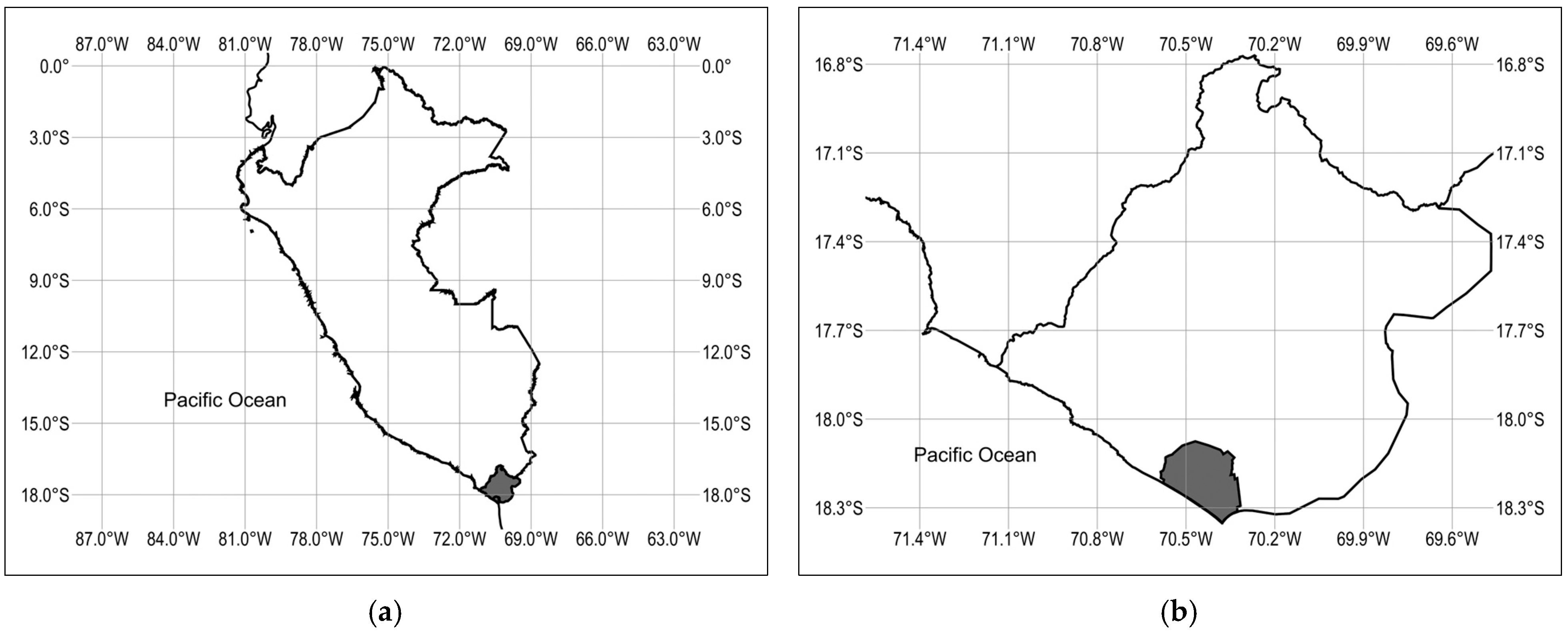
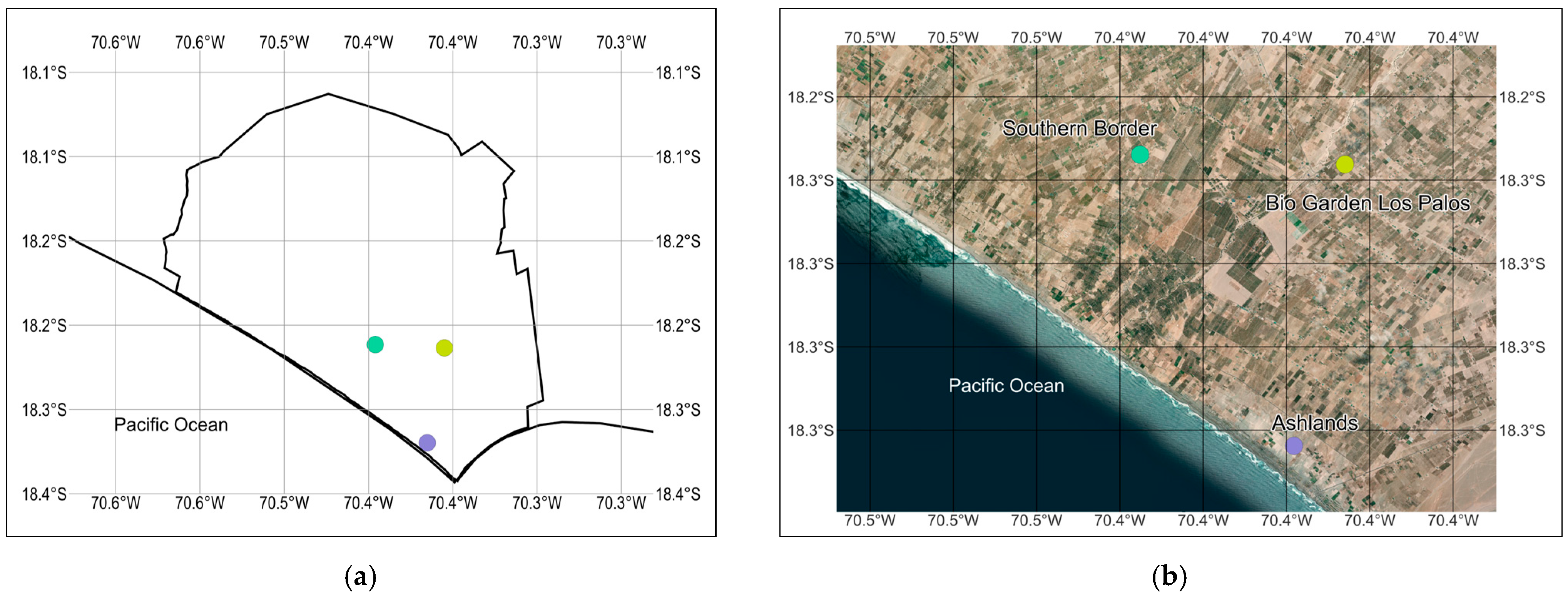
Monitoring was conducted at the Caplina aquifer, La Yarada Los Palos district (Tacna, Peru) (Figure 1), an arid area where the mean annual temperature is ≈18.5 °C and precipitation is <50 mm/year. The high radiation and evaporation favor salt concentration and the natural mobilization of As in groundwater [48,49]. The local geology—sedimentary formations that contain sulfides/arsenical minerals—facilitates the release of As through weathering and leaching, with point measurements of >0.04 mg/L being reported in the area, exceeding the 0.01 mg/L guideline value for drinking water [49]. Historically, the system shifted from a balanced regime (recharge–withdrawal) through the 1970s to an unbalanced regime since the 1980s, with salinization and seawater intrusion and Andean geothermal contributions that impact the water quality [48]. In La Yarada Media, local hydrogeological studies document quality deterioration and a transition from an acceptable to poor quality in sectors of the aquifer, in line with increasing abstractions [50]. From a management perspective, the Uchusuma–Caplina Major Hydraulic Sector integrates surface contributions (Uchusuma, reservoirs) and groundwater from the El Ayro wells; a portion of these sources is abstracted for public drinking water supply, with scheduled operations and official water budgets [51]. This scheme is framed by the Caplina–Locumba Basin Water Resources Management Plan—a public instrument that guides quantity and quality management—and supports the relevance of temporal monitoring of As and comparing these measurements with in situ parameters (EC/TDS/pH/temperature) for operational decisions [17]. To capture the local hydrochemical gradient, three strategic areas that are recognized as high-vulnerability zones were selected for analysis to assess water quality and As risk: Southern Border, Bio Garden Los Palos, and Ashlands [49].

2.2. Sampling Design

A fixed fortnightly sampling scheme was implemented at three points in the Caplina aquifer (Point 1: Southern Border; Point 2: Bio Garden Los Palos; Point 3: Ashlands) from September 2024 to August 2025, with site visits scheduled on the 1st and 15th of each month. Each record was identified with a unique code and an associated field log (date, time, operational observations), ensuring traceability and temporal comparability across points.
To minimize misclassification near the 10 µg/L threshold, a fortnightly sampling frequency was chosen because As levels in supply wells can fluctuate on a scale from sub-daily to weekly–monthly due to pumping, recharge, and physicochemical changes. Previous high-frequency series have documented variations of this order, which have direct implications for sampling design and interpretation of monthly schemes. In addition, in situ stabilization criteria were applied prior to sampling (pH, EC/TDS, and temperature) following operational guidance. Preservation, labeling, and chain of custody complied with current international standards, and low-flow purging was used where appropriate to minimize aquifer disturbance [52,53,54].
Site selection was guided by hydrochemical representativeness (coverage of a salinity and ionic content gradient, measured by EC/TDS) and operational relevance (abstractions in use and of interest for local management), while maintaining year-round accessibility. The fortnightly design aims to capture potentially meaningful fortnightly fluctuations for compliance with the 10 µg/L threshold and support subsequent comparisons among frequency schemes (fortnightly vs. monthly).
At each visit, a standard sequence was followed: site inspection, verification of safety and operating conditions, in situ measurements (EC, TDS, pH, temperature), and collection of a sample for total As content measurements. Where applicable, the abstraction was sampled after stabilization of field parameters, as indicated in Section 2.4.
The campaign yielded 24 observations per point (total n = 72). No imputations or data substitutions were performed; any operational incidents were documented in the field log for consideration in the analysis.

2.3. In Situ Measurement

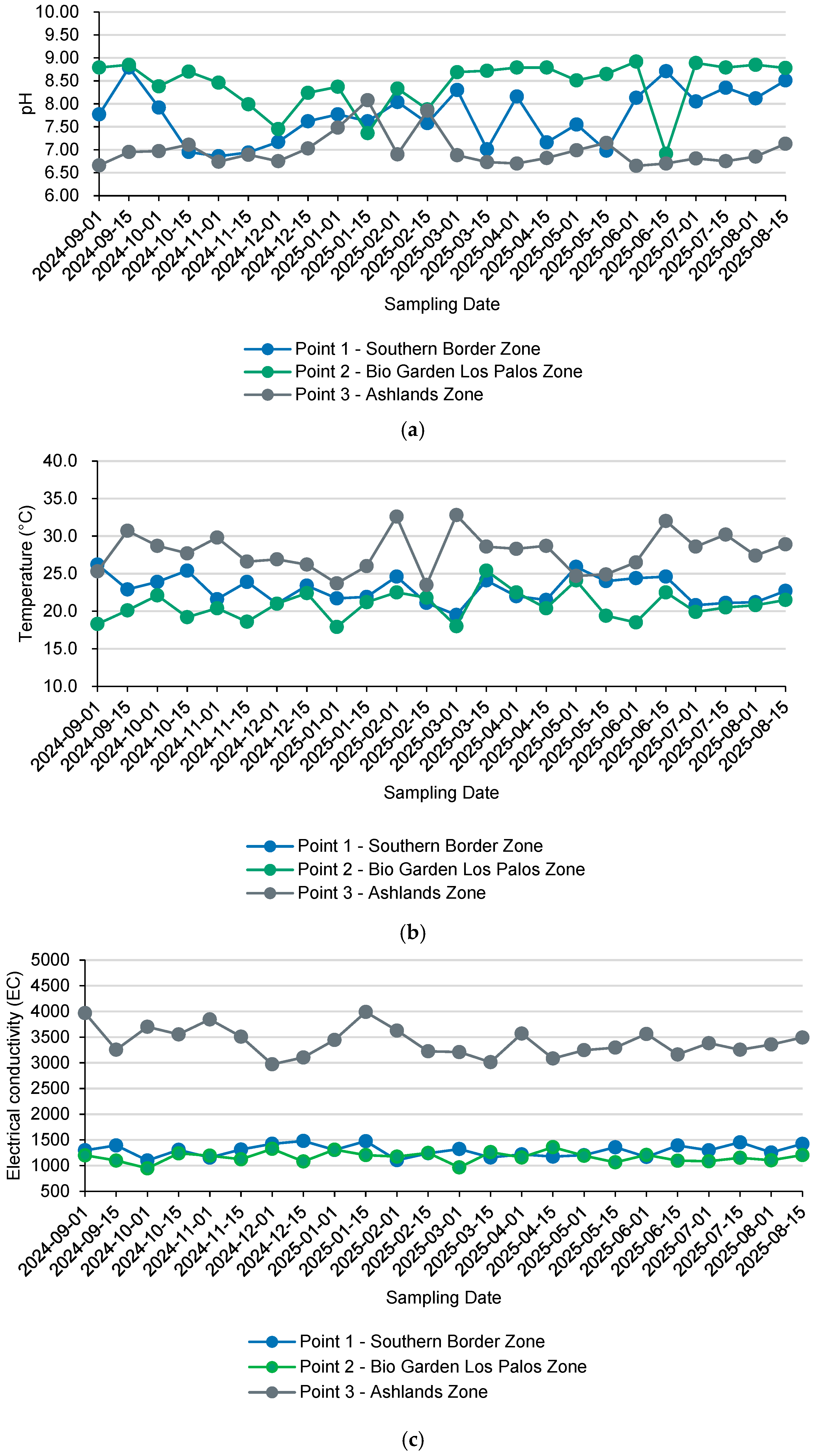
pH, temperature (°C), electrical conductivity (EC, µS/cm), and total dissolved solids (TDS, mg/L) were measured at each visit (Figure 2 and Table 1) with a portable multiparameter meter (Hanna HI 98194; manufactured by Hanna Instruments in Sălaj County, Romania; sourced in Peru), equipped with a combined pH/temperature probe and a conductivity cell with automatic temperature compensation (ATC). The instrument was calibrated prior to each campaign using certified standards (pH, 4.01/7.00/10.01; EC, 1413 and 12,880 µS/cm, or equivalents as per the manufacturer’s specifications) and verified in the field with an intermediate standard to assess drift. TDS were recorded as a direct reading, computed by the meter from normalized EC to 25 °C using an internal NaCl-equivalent conversion factor, which was kept constant throughout the study.
Before each reading, the probe was rinsed with sample-site water, and contact with bottoms and sediments was avoided, following water-sampling protocols for chemical analysis [55]. Prior to sampling, pH, EC/TDS, and temperature were calibrated daily; during low-flow purging, readings were taken every 1–2 min until stabilization (operational criterion: variation ≤±0.1 pH units, ≤±3% EC, and ≤±0.2 °C across three consecutive readings). The field sequence included safety checks, rinses, inline measurement, and logging on data sheets; metal samples were preserved with ultrapure HNO3 (pH < 2), labeled under a chain of custody, and refrigerated until analysis. Procedures followed USGS-NFM A6.0 and ISO 5667-3:2024; low-flow sampling was applied where appropriate to minimize well disturbance [53,54,56]. When the variability exceeded the criteria, the procedure was repeated after additional rinsing.
Each campaign included at least one equipment blank (ultrapure water brought into contact with the probes) and field duplicates (~10% of visits) to verify contamination and repeatability. At the end of sampling, the probes were rinsed with ultrapure water, and the pH electrode was stored in its storage solution. All readings were recorded on field sheets with the date and time, environmental conditions, and operational observations such as active pumping, turbidity, and any incidents, ensuring traceability to the sample code.
At the wellhead, purging and sampling were conducted only after stabilization (drift <±0.02 pH units; <±2% EC/TDS; steady oxidation–reduction potential (ORP)). Immediately afterwards, pH/EC/TDS/ORP were measured in situ, dissolved analytes were filtered at 0.45 μm, and samples were preserved according to protocol. Sampling at the source avoids artifacts from open wells—CO2 loss, re-oxygenation, evaporation and yields aquifer-representative data for regulation and risk.

2.4. Sampling, Preservation, and Analysis of As

Total As content was sampled in 1 L high-density polyethylene (HDPE) bottles that had been preconditioned by washing and rinsing with 10% HNO3 and ultrapure water; in the field, bottles were rinsed with site water prior to the final fill. Each sample was labeled with point–date–time and documented under a chain of custody. For preservation, samples were acidified to pH < 2 with trace-metal-grade HNO3, kept at 4 ± 2 °C in insulated coolers, and transported to the laboratory within 12 h of collection. Total As content was quantified by inductively coupled plasma–mass spectrometry (ICP-MS) using an Agilent 7900 ICP-MS instrument (Agilent Technologies, Tokyo, Japan), following ISO 17294-2 [56] and U.S. Environmental Protection Agency (US EPA) Method 200.8. A multi-point calibration (≥5 levels) with independent verification at the start and during the run was employed, together with internal standardization to correct for drift and matrix effects and detection at ^75As with control of polyatomic interferences (mitigation of ArCl+ via helium collision cell) [57,58,59,60]. Typical operating parameters were a plasma power of ~1550 W, nebulizer argon flow of ~1 L/min, and plasma argon flow of ~15 L/min; data were processed using an Agilent MassHunter Workstation (version C.01.04). Quality assurance and quality control included a reagent blank, an independent control standard with a typical acceptance of ±10%, sample duplicates (~10% of the sequence, evaluated by the relative percent difference), and matrix/blank spikes with target recoveries of 85–115%; analyses were repeated when warranted. The laboratory reported a limit of detection of ≤1 µg/L (0.001 mg/L), which was adequate for quantifying values around the health-based threshold of 10 µg/L. Results were given in mg/L (four decimals) and converted to µg/L for statistical analysis using As (µg/L) = As (mg/L) × 1000. Unlike previous work in the area, no speciation (As(III)/As(V)) was performed; high-performance liquid chromatography (HPLC) was not employed, and only total As content was reported [61]. Only total As was measured, without As(III)/As(V) speciation, which introduces uncertainty because the redox state affects sorption, mobility, and treatment choice. To partially address this limitation, total concentrations were interpreted jointly with pH, EC/TDS, and redox indicators, acknowledging that brief redox shifts may not alter totals. Consequently, risk and compliance assessments use total As as the regulatory metric. Quality assurance and quality control (QA/QC) included field blanks, lab duplicates, and an independent check standard for each run; acceptance criteria were met.

2.5. Data Analysis

The analysis focused on As levels, expressed in µg/L, by sampling point (n = 24 per point; total n = 72). Given potential non-normality and the moderate sample size, robust and nonparametric statistics were used to describe temporal variation, exceedances of the 10 µg/L health-based threshold, and the effect of sampling frequency/date.

2.5.1. Temporal Variability

Sample mean and sample standard deviation:
x ̄ = 1 n i = 1 n x i ,         s = i = 1 n x i   x ̄ 2 n 1
Coefficient of variation (relative):
C V % = 100 s x ̄
CV% is only reported when x ̄ > 0. Because CV% can be biased with skewed distributions or values near the LOD, it is always interpreted alongside the median and the IQR.
Interquartile range (robust dispersion):
I Q R = Q 3   Q 1
Absolute change between consecutive visits (fortnightly oscillation):
Δ A s i = x i   x i 1 ,   i = 2 , , n ,   Δ As ~ = median Δ A s i
where
-
x i : arsenic concentration (µg/L) at visit i ;
-
n : number of visits per point (24);
-
x ̄ : mean;
-
s : sample standard deviation;
-
Q 1 , Q 3 : 25th and 75th percentiles;
-
Δ As ~ : median of the absolute changes between consecutive visits; summarizes the typical fortnightly oscillation and provides information about the risk of missing transient peaks;
-
The median of Δ A s i is computed ignoring missing values and retains the measurement units (µg/L).

2.5.2. Exceedances of the Health-Based Threshold (10 µg/L)

Exceedance proportion:
p ^ = 1 n i = 1 n 1 x i > 10
(Consistent with the definition adopted in this study, As = 10.0 µg/L is treated as compliant.)
95% confidence interval (Wilson):
C I 95 % W i l s o n = p ^ + z 2 2 n ± z p ^   1 p ^ n + z 2 4 n 2 1 + z 2 n , z = 1.96
where
-
1 ( ) : is the indicator function (=1 if the condition holds; 0 otherwise);
-
p ^ is the proportion of measurements with As > 10 µg/L; the Wilson method performs well with moderate n and proportions near 0 or 1 [62].

2.5.3. Correlation Analysis with In Situ Variables

Spearman’s correlation (monotonic, nonparametric):
ρ s =   corr rank X ,   rank Y
(When there are no ties, ρ s = 1 6 d i 2 n n 2 1 , with d i representing the rank differences.)
Here,
-
X : As (µg/L); Y : EC, TDS, pH, or temperature (evaluated at each point);
-
ρ s : Spearman’s coefficient; ρₛ and its p-value are reported (two-sided test, with α = 0.05);
Rationale: Robustness to non-normality and differing measurement scales, as well as capturing monotonic relationships that are relevant for operational criteria, including the use of EC/TDS as an alert for As peaks.

2.5.4. Sampling Schemes and Compliance Assessment

Two deterministic monthly schemes—using only day 1 or only day 15—were compared against the fortnightly series (reference).
Annual compliance status by scheme:
C k = 1 max i I k   x i > 10 ,   k   { d a y   1 , d a y   15 , f o r t n i g h t l y }
where Ik is the set of observations under scheme k. Thus, Ck = 1 if at least one measurement exceeds 10 µg/L during the year (non-compliant), and Ck = 0 otherwise; by definition, As = 10.0 µg/L is compliant.
Misclassification rate (vs. fortnightly reference):
m k = C k   C f o r t n i g h t l y
This is computed per point and period; mk = 1 when the monthly scheme’s classification differs from the reference, and mk = 0 otherwise.
Difference in exceedance proportions (monthly reference):
Δ p ^ k = p ^ k p ^ f o r t n i g h t l y
Sensitivity to detect exceedance episodes (if the reference shows exceedances):
s e n s k = # i     I k   :   x i > 10 # i I f o r t n i g h t l y : x i > 10
with p ^ being defined as the proportion of measurements with As > 10 µg/L (As = 10.0 µg/L is treated as compliant) and reported with Wilson 95% confidence intervals,
  • where
-
k : sampling scheme (day 1, day 15, fortnightly);
-
I k : set of observation indices included under scheme k (used in the formulas above);
-
C k : annual non-compliance indicator (=1 if under scheme k there is any measurement > 10 µg/L);
-
m k : change in status relative to the fortnightly reference (0 = agrees; 1 = misclassifies);
-
p ^ k : exceedance proportion under scheme k ;
-
s e n s k : fraction of exceedance episodes captured by the monthly scheme relative to those observed with the fortnightly reference.
Uncertainty (bootstrap by month, 1000 replicates): For Δ p ^ k , m k , and s e n s k , 95% Cis were obtained via a nonparametric bootstrap, resampling months with replacements (preserving the day within each month). This approach respects the temporal structure and is appropriate, with n = 24 per point.
Point-wise analyses with an exploratory–operational focus found no multiplicity adjustments. No values were excluded as “outliers”, except for field/laboratory incidents documented in the logs.
Exceedance proportions and their Wilson 95% confidence intervals were computed for the full annual record and again separately for each semester (H1: Sep–Feb, H2: Mar–Aug).

3. Results

3.1. Overall As Concentrations and Comparison with the 10 µg/L Threshold

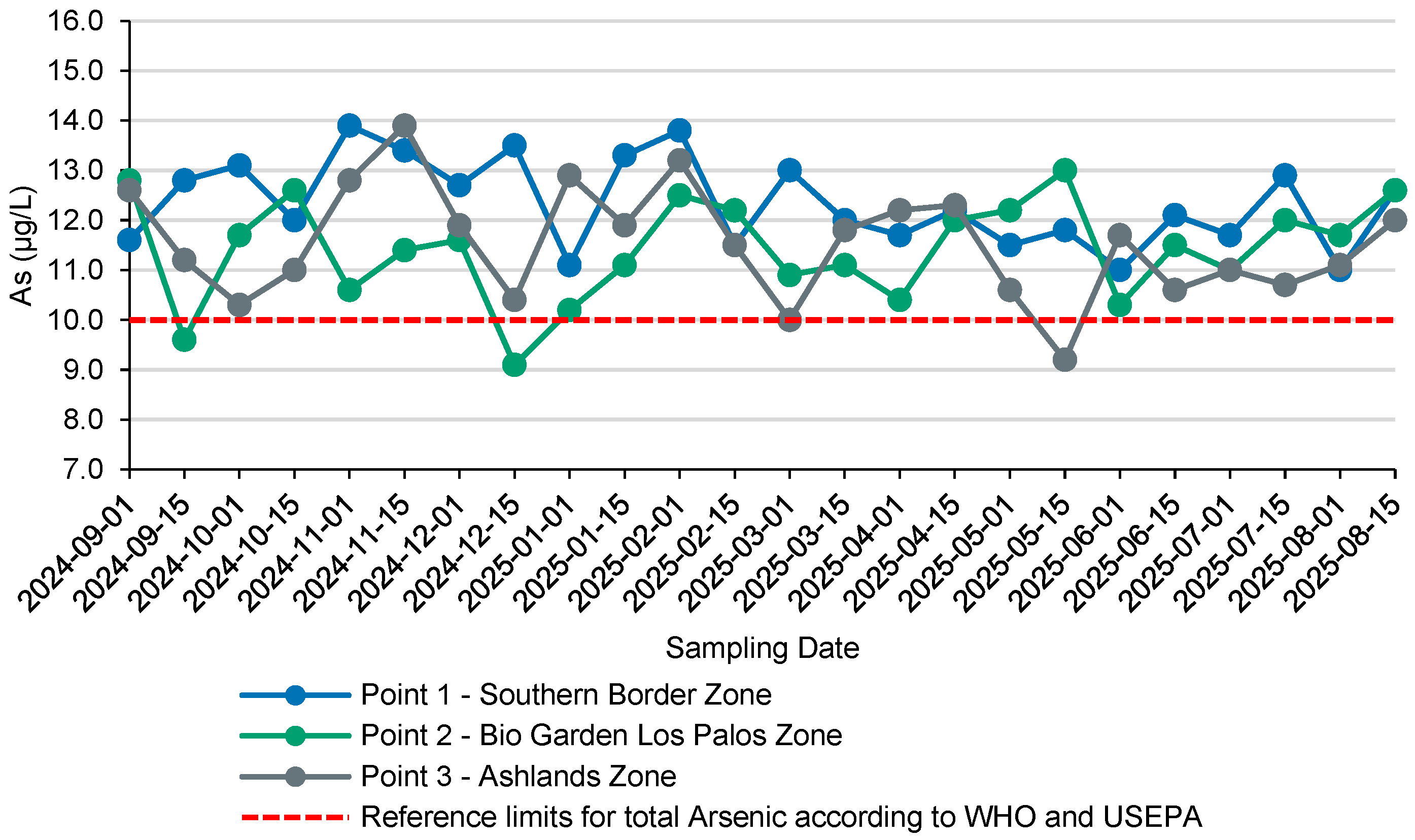
The 2024–2025 fortnightly series shows As concentrations consistently close to, but mostly above, the 10 µg/L threshold at all three points (Figure 3). At Point 1 (Southern Border), values ranged from approximately 11.0 to 13.9 µg/L, with no measurements below the threshold. At Point 2 (Bio Garden Los Palos), the lowest values in the set were observed, with minima ≈ 9.1–9.6 µg/L in some episodes and maxima ≈ 13.0 µg/L. At Point 3 (Ashlands), concentrations varied between ≈ 9.2 and 13.9 µg/L, with occasional dips below 10 µg/L. Across the three sites, fortnightly oscillations in the order of ~0.5–1.5 µg/L are evident, with short peaks toward late austral spring–summer and no pronounced seasonal pattern at the annual scale. These patterns suggest that single monthly samples may under- or overestimate compliance status, particularly at Points 2 and 3.

3.2. Intra-Annual Variability of As: Point-Wise Descriptive Statistics

Intra-annual variability was low at all three points (CV < 10%), with moderately robust dispersion (IQR ≈ 1.3–1.6 µg/L) (Table 2). The most variable site was Point 3 (CV = 9.65%; IQR = 1.55 µg/L), which also showed the largest fortnightly oscillation (median ΔAs—absolute change between consecutive visits; |Ast − Ast−1|—= 1.30 µg/L). Point 1 exhibited the highest mean (12.34 µg/L) and the lowest relative dispersion (CV = 7.21%), whereas Points 2 and 1 had very similar IQRs (1.38 and 1.35 µg/L, respectively), indicating comparable amplitudes of typical variation. Visit-to-visit fluctuations clustered around ~1 µg/L (median ΔAs: 1.00, 0.90, and 1.30 µg/L at Points 1–3), and observed ranges were 11.0–13.9 µg/L (Point 1), 9.1–13.0 µg/L (Point 2), and 9.2–13.9 µg/L (Point 3). Taken together, the patterns indicate low-amplitude but frequent variations; therefore, an exclusively monthly scheme could underestimate brief peaks that the fortnightly design captures.
To complement these descriptive statistics, a simple exploration of temporal structure was performed. Lag-1 autocorrelation coefficients, ρ 1, were computed for the fortnightly As series at each monitoring point. The resulting values were −0.05 for Point 1, −0.04 for Point 2, and 0.19 for Point 3, indicating negligible serial dependence on the fortnightly scale. In addition, linear correlations between As and sampling order (treated as a time index) were 0.39, 0.19, and 0.29 for Points 1–3, respectively, and the corresponding regression slopes were numerically very small (rounding to 0.0000 mg/L per fortnight at all points). These results suggest that, within the one-year window, no strong monotonic trend can be resolved and that fluctuations are better described as small-amplitude deviations around a chronically elevated baseline.

3.3. Exceedances of the 10 µg/L Health-Based Threshold

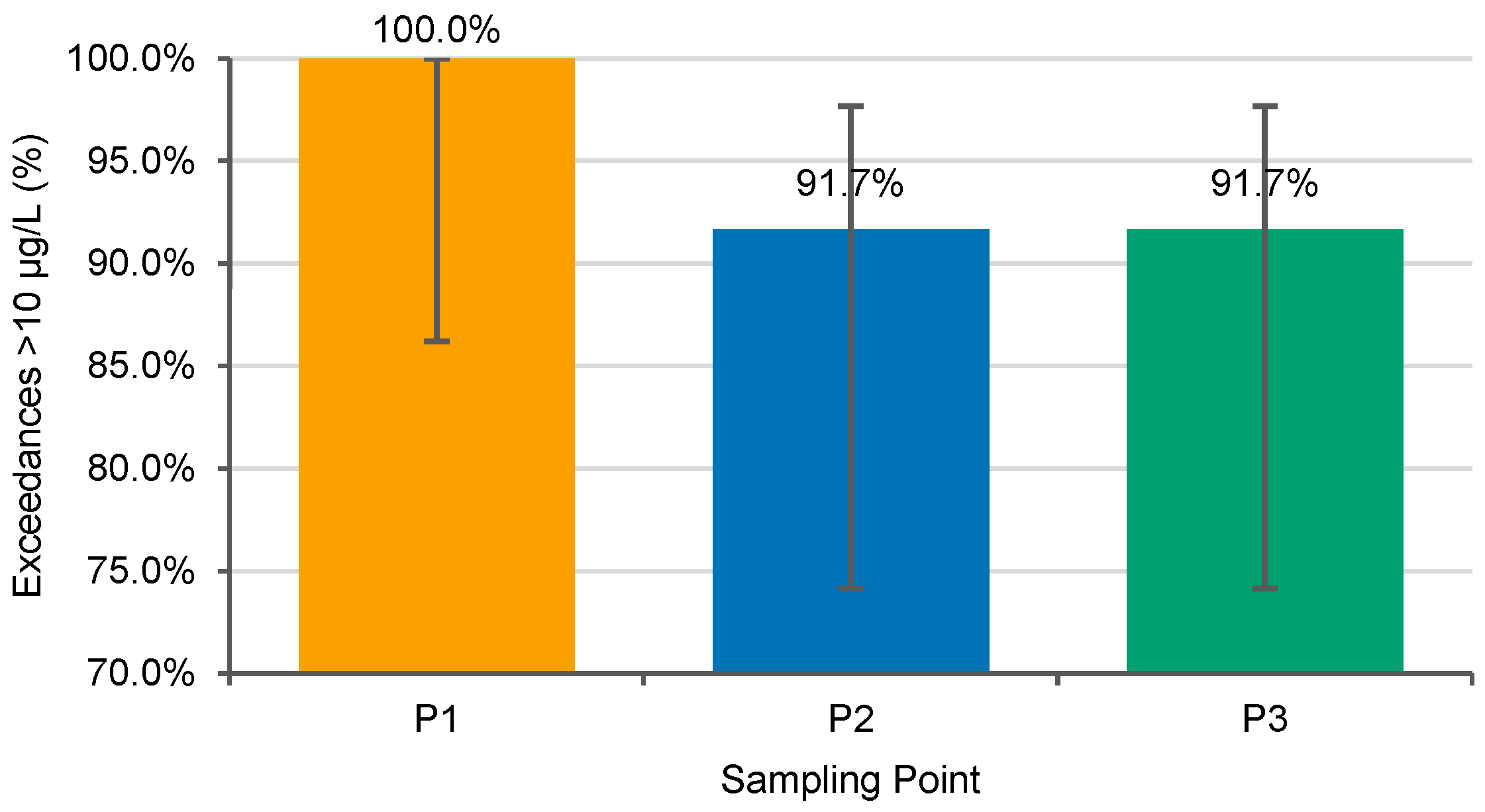
Exceedance is defined as As > 10 µg/L (10.0 µg/L is considered compliant) and, for each point, the proportion of samples exceeding the threshold was estimated together with its Wilson 95% CI (n = 24 per point) (Figure 4). Point 1 recorded 100% exceedances (24/24; 95% CI: 86.2–100.0%). Points 2 and 3 each showed 91.7% exceedance rates (22/24; 95% CI: 74.2–97.7%), with two compliant events per site (Point 2: 15 September 2024, 9.6 µg/L; 15 December 2024, 9.1 µg/L; Point 3: 1 March 2025, 10.0 µg/L; 15 May 2025, 9.2 µg/L).
Overall, exceedances are very frequent at all three points (≥91.7%), with Point 1 showing the worst performance (sustained exceedance throughout the period). The Wilson intervals for Points 2 and 3 overlap broadly, which does not suggest clear differences between them in exceedance rate, although they do differ in their temporal variability.

3.4. Operational Associations with In Situ Variables

Fortnightly in situ time series of pH, electrical conductivity (EC), and temperature at the three monitoring points are shown in Figure 5. To explore operational relationships between As levels and field-measurable covariates, Spearman rank correlations (ρₛ) were calculated by sampling point, as well as overall (n = 72); this is a robust approach to non-normality, outliers, and monotonic nonlinear relations (Table 3). Overall, associations were weak (|ρₛ| ≤ 0.21) and non-significant for most combinations. Point 1 stands out: As–TDS showed a moderate positive correlation (ρₛ = 0.58, p = 0.003, n = 24), consistent with local concentration–dilution effects or covariation with dissolved species contributing to TDS. At Point 3, As–EC was also positive and of moderate magnitude (ρₛ = 0.38), but not statistically significant at the 5% level (p = 0.071), suggesting a trend that would require greater statistical power to confirm. At Point 2, correlations of As with EC and TDS were low (ρₛ = 0.13 and 0.29, p = 0.534 and 0.167, respectively). Associations of As with pH and temperature were very small at all three sites (|ρₛ| ≤ 0.16, 0.05 ≤ p ≤ 0.82), with no evidence of a relationship. The overall analysis (n = 72) also showed no significant associations (|ρₛ| ≤ 0.06, 0.605 ≤ p ≤ 0.739), suggesting site-specific controls that are diluted when combining points with differing behaviors. From an operational standpoint, TDS at Point 1 can serve as an indicator of As status at the fortnightly scale, whereas at Point 3, it may be advisable to prioritize EC monitoring (and potentially TDS monitoring) to verify the suggested trend; at Point 2 and in the pooled dataset, the considered indicators do not explain the variability in As levels over the study period.
To further explore salinity-related patterns, As concentrations were partitioned into low- and high-salinity subsets using the site-specific TDS median at each point. Across all three monitoring points, the median As level was consistently higher in the high-TDS subset than in the low-TDS subset (Point 1: 11.9 vs. 12.8 µg/L; Point 2: 11.3 vs. 11.6 µg/L; Point 3: 11.3 vs. 11.8 µg/L), with differences on the order of 0.3–1.0 µg/L. Although these contrasts are modest and no formal hypothesis tests were conducted, they are coherent with the positive As–TDS association at Point 1 and suggest a weak tendency for As to increase under more saline conditions at the other sites.

3.5. Exceedance Frequency of the 10 µg/L Threshold by Point and Semester

The frequency of exceedance of the 10 µg/L guideline was quantified by point and semester (H1: Sep–Feb; H2: Mar–Aug), reporting the point estimate as p ^ = Exceed/n and uncertainty with Wilson 95% confidence intervals, which are appropriate measures for small-to-moderate n and proportions near the bounds. Table 4 shows sustained non-compliance at all sites: Point 1 reached 100% in both semesters (12/12 each), yielding 100% annually (24/24; 95% CI: 86.2–100.0%). Point 2’s exceedance rate was 91.7% annually (22/24; 74.2–97.7%), with 83.3% in H1 (10/12; 55.2–95.3%) and 100% in H2 (12/12; 75.7–100.0%). Point 3 also reached 91.7% annually (22/24; 74.2–97.7%), but with the opposite semester pattern—100% in H1 (12/12; 75.7–100.0%) and 83.3% in H2 (10/12; 55.2–95.3%). Although Points 2 and 3 display contrasting semester patterns, their confidence intervals overlap, and the semester sample size (n = 12) limits the precision of these contrasts. Given these wide Wilson intervals (e.g., 55.2–95.3%), the apparent differences between Points 2 and 3 should be interpreted only as indicative, and not as statistically robust evidence of contrasting seasonal patterns.
Pooling across points, Table 5 indicates that exceedance remains high and shows no consistent seasonal pattern at the network scale: 94.4% annually (68/72; 86.6–97.8%) and 94.4% in both H1 and H2 (34/36 each; 81.9–98.5%). Even the global lower bounds exceed 80%, reinforcing the interpretation of pervasive, year-round exceedance of the 10 µg/L guideline and supporting the prioritization of management actions aimed at sustained reduction in dissolved arsenic concentrations.

4. Discussion

4.1. Main Findings and Magnitude of Fluctuations

The data indicate chronic non-compliance with the 10 µg/L guideline at all three sampling points [2]. On an annual basis, the proportion of exceedances was 100.0% at Point 1 (24/24) and 91.7% at Points 2 and 3 (22/24 each); network-wide, it was 94.4% (68/72). At the semester scale, the proportion remained 94.4% in both H1 and H2 (34/36 in each case). Although Points 2 and 3 display opposing semester patterns, the Wilson 95% confidence intervals clearly overlap with a semester sample size of 12, indicating that these differences do not constitute robust evidence of seasonality.
Temporal variability is low in relative terms yet decisive near the threshold. The intra-annual coefficients of variation were 7.21% at Point 1, 8.99% at Point 2, and 9.65% at Point 3; robust dispersion was indicated, with IQR ≈ 1.3–1.6 µg/L. The fortnightly series shows oscillations of ~0.5–1.5 µg/L. A simple way to visualize this is as a line undulating around 10 µg/L: when a site remains near the threshold, one or two samples can flip the compliance label over a short window. Accordingly, Point 1—which was always above the threshold with 24 of 24 exceedances—is stable in its classification, whereas Points 2 and 3—with 22 of 24 measurements exceeding the threshold—register isolated compliant episodes between 9.1 and 10.0 µg/L, despite similar means.
The low-amplitude variability observed in this study is characterized by coefficients of variation on the order of 7–10%, and, more importantly, by an interquartile range of approximately 1.3–1.6 µg/L around the 10 µg/L health threshold. Absolute fluctuations of this magnitude are sufficient to move individual observations across a fixed regulatory limit over short windows, even when relative variability appears modest. Similar behavior has been reported elsewhere, with within-well variation exceeding 7 µg/L in multi-year datasets sampled every two months and with seasonal contrasts emerging in some coastal aquifers depending on the local hydrogeochemical context. This helps to explain why, in the present dataset, the “semester effect” is not robust despite slight opposing tendencies across sites [63,64,65].
The near-zero lag-1 autocorrelation coefficients and the very small linear trends further support this interpretation, indicating that fortnightly deviations are only weakly persistent and that the dominant pattern is chronic exceedance with modest short-term fluctuations rather than strongly autocorrelated peaks or a marked monotonic drift over the study period.
When concentrations hover around the threshold, increasing the temporal resolution reduces the risk of compliance misclassification. For wells near one-half of the limit, more frequent sampling is recommended; moreover, sub-daily variations associated with pumping have been documented, reinforcing the value of a fortnightly scheme to capture rapid oscillations [66].
In this high-exceedance case, the annual compliance classification is the same under all three sampling schemes defined in Section 2.5.4; the indicators in that section are therefore used mainly to quantify exceedance proportions with Wilson 95% confidence intervals and to discuss misclassification risk in near-threshold situations. Methodologically, this dynamic justifies the fortnightly frequency. With n = 12 per semester, even with p ^ = 1.000, the Wilson interval spans 75.7–100.0%, which favors overlap between semesters and limits the precision of identifying seasonal contrasts. Increasing the temporal resolution reduces the chance that a monthly cut misclassifies the compliance status when concentrations oscillate around the threshold by ~1 µg/L. In sum, high and persistent exceedance predominates, with low-amplitude fluctuations that nonetheless matter for compliance assessments; in this context, fortnightly monitoring adds value for decision making. For clarity, the proportion is defined as p ^ = Exceed/n.

4.2. Hydrogeochemical Drivers of Arsenic Variability

The prevailing pattern points to geogenic sources shaped by physicochemical conditions that are typical of arid–hyper-arid settings [11,12]. In alkaline, saline waters under oxic conditions, arsenic occurs mainly as arsenate and is released from Fe/Al (oxy)hydroxide surfaces as adsorption weakens; higher pH and ionic strength reduce surface affinity and favor persistence in the aqueous phase [12,67]. Evaporative concentration further raises TDS levels, reinforcing this behavior [68,69]. Where the hydrochemical signal remains seasonally steady, exceedances are expected to persist with small-amplitude variability, in accordance with the fortnightly record obtained in this study.
Point-wise associations between As and in situ parameters help to ground these mechanisms in the data. At Point 1, the moderate As–TDS correlation (ρ = 0.58, p = 0.003) is consistent with a salinity-related control, whereby higher ionic strength and concentration–dilution effects modestly modulate dissolved As around a geogenically elevated baseline. In contrast, correlations at Points 2 and 3 are weaker (|ρ| < 0.40) and statistically non-significant, and the pooled dataset shows essentially no monotonic association between As and EC, TDS, pH, or temperature (|ρ| ≤ 0.06, p ≥ 0.60). Together with the narrow, moderately alkaline pH range, these patterns suggest that short-term fluctuations in As are not driven by strong week-to-week swings in acidity or redox-sensitive field parameters, but rather by small variations within a hydrogeochemically buffered, saline–alkaline system. Under such conditions, geogenic sources, sorption–desorption on Fe/Mn (oxyhydr)oxides, and competitive interactions with co-occurring anions remain plausible dominant controls, even if they cannot be fully resolved with the present set of variables.
The pH values recorded at the three wells fall within a relatively narrow, moderately alkaline interval. The very small As–pH Spearman’s coefficients (|ρ| ≤ 0.16, 0.05 ≤ p ≤ 0.82; Table 3), reveal no clear monotonic pattern. This indicates that short-term As fluctuations are not driven by large pH or redox swings on the fortnightly scale, but occur within a hydrogeochemically buffered alkaline environment.
This is further supported by the fact that, at each monitoring point, the median As level was systematically higher in the high-TDS subset than in the low-TDS subset (by approximately 0.3–1.0 µg/L), indicating that salinity exerts at least a modest modulatory effect on dissolved As around the geogenically elevated baseline.
Redox controls and anion competition complete the picture. In sectors with organic matter or diminished oxygenation, arsenite (As(III)) can be mobilized or arsenate (As(V)) can be released via the reductive dissolution of Fe oxides, partially decoupling As from TDS and EC. In addition, anions such as phosphate and silicate compete with arsenate for adsorption sites; as their availability increases, surface retention of As decreases, and the dissolved fraction grows [12,67,70]. Superimposed variable transit times and episodic recharge yield the exact signal observed here: gentle oscillations of 0.5–1.5 µg/L around an elevated background, with sporadic dips below 10 µg/L at points that hover near the threshold [65,71,72].
From a hydrological standpoint, small changes in source mixing or abstraction can shift water chemistry without altering the background trend [65,71]. A temporary increase in pumping favors the inflow of more saline or longer-residence waters, raising TDS levels and, by extension, the likelihood of higher As levels; a relaxation of pumping or localized recharge can produce the opposite effect. This explains why, even under low relative variability, short-term changes become decisive for compliance classification when the system operates close to the threshold.
The persistence of exceedances and the subtle differences among points are explained by a combination of factors: elevated pH and ionic strength reduce adsorption, evaporative concentration increases TDS levels, local redox controls mobilize As from the solid phase, and mixing/pumping dynamics modulate the short-term signal [12,65,67,68,69,71]. For practical field experiments, a useful rule of thumb is to track three indicators together: TDS or EC as a concentration–dilution signal, pH as an early warning of desorption, and any trace of redox change. When two of the three move in an unfavorable direction, a higher probability of exceedance at the next sampling can reasonably be expected.
In saline systems or under seawater intrusion, increases in specific conductivity (EC) and ionic strength can promote the desorption of oxyanions (the “salt effect”) and, concurrently, intensify competition with phosphate for adsorption sites on Fe and Al (oxy)hydroxides. Recent observations report positive relationships between conductivity and dissolved As in coastal aquifers and deltas, which is consistent with the geochemical framework described [73].

4.3. Implications for Monitoring and Risk Management

Because the probability of exceedance is both high and persistent, the objective should shift from merely detecting exceedances to quantifying their magnitude and duration and to anticipating episodes using operational signals such as TDS levels, electrical conductivity (EC), and pH. To preserve sensitivity near the 10 µg/L threshold, a fortnightly frequency is recommended. When resources are constrained, an adaptive scheme can be applied: monthly monitoring as the baseline and escalation to fortnightly when objective triggers are activated, e.g., a recent series with two consecutive measurements above 10 µg/L or a sustained increase in TDS or EC above the 75th percentile of its own local history. This logic is consistent with Water Safety Plans, which promote risk-based monitoring and frequency adjustments according to hazards and system performance [2].
To classify a point as “high risk”, a minimum rule can be used: if p ^ = Exceed/n ≥ 0.75 in the last three months and if the lower bound of the Wilson 95% CI is ≥0.50, surveillance should be maintained or intensified; if both p ^ and its lower bound are ≥0.75, management actions should be triggered. The Wilson interval reduces the undercoverage and overconfidence of the Wald method when the sample size is moderate, or the true proportion approaches 0 or 1, as shown by recent comparative evaluations and the classic literature [62,74].
Even with increased frequency, the informational value hinges on consistent field procedures (purging, equipment blanks/field duplicates, preservation, batch-level QC). Adopting standardized protocols [54] and logging operational metadata (purge time, pumping rate, stability of online parameters) improves temporal comparability and the interpretation of small (~1 µg/L) changes near the threshold [54].
When concentrations sit around or repeatedly exceed 10 µg/L, the immediate priorities are as follows: (i) source control and operational management—blending or alternating abstractions where the hydrochemistry allows; (ii) context-appropriate treatment—adsorptive iron media, coagulation–filtration, or reverse osmosis at point of use or in small plants; and (iii) risk communication, with provision of alternative supplies when required. These actions are consistent with health and regulatory guidance that adopts 10 µg/L as the reference/maximum for drinking water [2].
Where values “hover” near the threshold, point-specific auxiliary indicators offer operational foresight: TDS/EC as concentration–dilution signals and pH as a modulator of adsorption–desorption. A practical rule is to act on concordant evidence: if two of the following are present—sustained increases in TDS or EC, a persistently high pH, and a recent rise in As contents—intensify sampling in the next cycle and prepare a response, such as adjusting blending or activating treatment. This approach reduces the risk of misclassification under monthly sampling and guides decisions in proportion to the actual risk.
Although the 10 µg/L guideline is considered provisional due to the practical challenges of removal in some settings, the ALARP principle (as low as reasonably practicable) remains applicable: the greater and more persistent the exceedance is, the more robust the monitoring and mitigation response should be [3].
At this stage, the proposed risk-based rules should be interpreted as a transparent operational starting point rather than as an optimized monitoring design. A full decision-analytic evaluation of the adaptive scheme—quantifying trade-offs between sampling load, detection delay, and missed exceedances—would require explicit optimization criteria and multi-year datasets and is therefore beyond the scope of the present work. Here, the scheme is proposed as an operational framework that can be further tested and calibrated as longer time series and additional wells become available.

4.4. Strengths, Limitations, and Future Directions

This study provides local, up-to-date evidence on arsenic’s behavior in groundwater under an explicit temporal scheme (annual and seasonal), enabling interpretation of exceedances of the 10 µg/L threshold within a risk-management framework. Two design choices strengthen the analysis: the use of a fortnightly series, which captures low-amplitude fluctuations that monthly schemes could miss, and the application of Wilson confidence intervals for exceedance proportions, consistent with recommendations for moderate sample sizes and probabilities near 0 or 1 [46].
Alignment with previous work in the Caplina basin facilitates triangulation of the hydrochemical context and arsenic species reported in the area, supporting a territorially grounded interpretation of the observed patterns [61].
Taken together, these observations position the present dataset as a useful baseline for local risk management. However, several limitations constrain inference and guide future work. The one-year horizon and three monitoring points limit the characterization of inter-annual cycles and spatial heterogeneity, and the presence of values near the quantification limit highlights the need for explicit treatment of censored data and analytical uncertainty [74,75,76,77,78]. At the semester scale, the small sample size (n = 12 per period) yields wide Wilson confidence intervals, so the apparent differences between semesters at Points 2 and 3 should be interpreted only as indicative rather than as statistically robust evidence of seasonal structure; resolving seasonal patterns would require multi-year records and, ideally, additional monitoring points.
From an analytical perspective, only simple time-series tools were applied: lag-1 autocorrelation and linear trends based on As versus sampling order. Although these metrics indicate weak short-term persistence and no strong monotonic trend over the one-year window, the record length (n = 24 per point) remains insufficient to exploit more formal time-series frameworks (e.g., multi-lag autocorrelation structure, seasonal decomposition, or nonlinear trend tests). Extending the monitoring period would allow richer temporal models to be fitted and would strengthen inferences about intra- and interannual structure.
A further constraint is the exclusive use of total As: the absence of As(III)/As(V) speciation, master variables (Fe, Mn, phosphate), and hydrologic tracers restricts causal attribution and the direct translation of results into optimized treatment trains [28,45,46,79].
Recent developments in reactive-transport and hydrobio geochemical models for arsenic-enriched groundwater and riverbank aquifers illustrate how coupling flow, geochemistry, and seasonality can improve process-level understanding [80,81]. In parallel, new microfluidic and paper-based electrochemical platforms are beginning to enable in-field speciation of inorganic arsenic at relevant concentration ranges [82,83]. Critical reviews of iron-based adsorbents underline the need to link such process insights with treatment performance when designing removal trains for vulnerable communities [84]. Finally, machine-learning models trained on large, well databases are emerging as powerful tools for arsenic risk mapping and exposure assessment, offering a template for future work in the Caplina basin [85]. Such an integrated approach would strengthen explanations of As pulses, refine exposure estimates, and support adaptive management under arid, saline conditions.

5. Conclusions

The 2024–2025 fortnightly series shows chronic non-compliance with the 10 µg/L guideline at the three monitored points in the Caplina aquifer. Exceedance proportions reached 100% at Point 1 and 91.7% at Points 2 and 3, yielding 94.4% at the network scale. Occasional compliant dips at Points 2 and 3 (≈9.1–10.0 µg/L) did not alter the overall pattern of sustained non-compliance. Typical fortnightly oscillations of ~0.5–1.5 µg/L around the threshold indicate frequent but low-amplitude variability that is nevertheless sufficient to alter compliance labels over short windows.
The relative variability was modest in percentage terms (CV ≈ 7–10%; IQR ≈ 1.3–1.6 µg/L) but operationally decisive because concentrations cluster around the 10 µg/L limit. Under these conditions, a single monthly sample can misrepresent the true status of a well, whereas fortnightly sampling reduces the misclassification risk and provides a more faithful picture of exceedance magnitude and persistence. Simple time-series diagnostics (lag-1 autocorrelation and linear trends versus sampling order) indicate weak short-term persistence and no strong monotonic trend over the one-year window, consistent with a chronically elevated baseline with modest short-term fluctuations rather than strongly autocorrelated peaks or pronounced seasonal cycles.
The dominant hydrogeochemical signal is compatible with geogenic As in an arid, alkaline, and saline aquifer, where high pH, elevated ionic strength, and evaporative concentration reduce adsorption and favor persistence of dissolved As. Point-wise associations support this framework: a moderate As–TDS correlation at Point 1 and a weaker As–EC trend at Point 3 suggest a salinity-related control superimposed on a geogenically elevated background, whereas correlations at Point 2 remain low. Very small As–pH correlations and a narrow, moderately alkaline pH range indicate that fortnightly As fluctuations are not driven by large pH swings, but rather occur within a hydrogeochemically buffered environment.
In operational terms, monitoring should prioritize characterizing the magnitude and duration of exceedances and anticipating episodes rather than merely detecting their presence. A fortnightly baseline is recommended for wells hovering near the 10 µg/L threshold, with adaptive escalation when objective triggers are met—for example, repeated exceedances over successive visits or sustained increases in TDS/EC above the local upper quantiles. Tracking TDS or EC as concentration–dilution signals, together with pH and simple redox indicators, provides a practical early-warning system for risk-based adjustments in sampling frequency and for preparing management responses.
The persistence of exceedances warrants immediate exposure-reduction measures in accordance with the ALARP principle (as low as reasonably practicable). Priority actions include source management where hydrochemistry allows (e.g., blending or alternating abstractions), robust pre-oxidation of As(III) to As(V), and subsequent removal by iron-based adsorption media, complemented by membrane processes where necessary. Effective implementation depends on standard field practices—purging protocols, equipment blanks and field duplicates, preservation, and systematic logging of operational metadata—so that changes on the order of ~1 µg/L near the threshold can be interpreted reliably over time.
Inference in this study remains constrained by the one-year horizon, the three monitoring points, and the exclusive use of total As without speciation or master variables such as Fe, Mn, and phosphate, which limits causal attribution and the evaluation of interannual behavior. Nevertheless, the dataset provides an operationally relevant baseline for La Yarada Los Palos and demonstrates the value of explicit temporal design for compliance assessment in hyper-arid coastal aquifers. Future work should combine multi-year monitoring at an expanded network of wells, high-frequency sensing at strategic piezometers, in situ or inline speciation, reactive-transport modeling, and locally trained risk-mapping tools. Such an integrated approach would increase the accuracy of prediction, optimize treatment and source-management options, and support progress toward Sustainable Development Goals 3 (Good Health and Well-Being) and 6 (Clean Water and Sanitation) in arsenic-affected communities of the Caplina basin.

Author Contributions

Conceptualization, L.J.P.M.S. and D.U.M.C.; methodology, L.J.P.M.S. and D.U.M.C.; software, L.J.P.M.S. and D.U.M.C.; validation, L.J.P.M.S. and D.U.M.C.; formal analysis, L.J.P.M.S.; investigation, L.J.P.M.S.; data curation, L.J.P.M.S. and W.D.F.P.D.L.; writing—original draft preparation, L.J.P.M.S.; writing—review and editing, L.J.P.M.S.; visualization, L.J.P.M.S. and W.D.F.P.D.L.; supervision, L.J.P.M.S.; project administration, L.J.P.M.S. All authors have read and agreed to the published version of the manuscript.

Funding

This research was self-funded by the National University Jorge Basadre Grohmann through Canon, Sobrecanon, and Mining Royalties number 2021-I, and did not receive any specific funding from external agencies or organizations.

Institutional Review Board Statement

Not applicable.

Informed Consent Statement

Not applicable.

Data Availability Statement

The data that support the results of this study can be requested by contacting the author by email.

Acknowledgments

This article was made possible thanks to the National University Jorge Basadre Grohmann through its Vice-Rectorate for Research and Research Institute, as part of the Research Project “Presence of Arsenite and Arsenate in the Water of the Caplina Watershed—Tacna and their Removal through Technologies Based on Renewable Energy”.

Conflicts of Interest

The authors declare no conflicts of interest.

References

  1. Mukherjee, A.; Coomar, P.; Sarkar, S.; Johannesson, K.H.; Fryar, A.E.; Schreiber, M.E.; Ahmed, K.M.; Alam, M.A.; Bhattacharya, P.; Bundschuh, J.; et al. Arsenic and Other Geogenic Contaminants in Global Groundwater. Nat. Rev. Earth Environ. 2024, 5, 312–328. [Google Scholar] [CrossRef]
  2. World Health Organization. Arsenic. Fact Sheet; World Health Organization: Geneva, Switzerland, 2022. [Google Scholar]
  3. World Health Organization (Ed.) Guidelines for Drinking-Water Quality; Fourth edition incorporating the first and second addenda; World Health Organization: Geneva, Switzerland, 2022; ISBN 978-92-4-004506-4. [Google Scholar]
  4. World Health Organization. Arsenic in Drinking-Water: Background Document for Development of WHO Guidelines for Drinking-Water Quality; World Health Organization: Geneva, Switzerland, 2019. [Google Scholar]
  5. Genchi, G.; Lauria, G.; Catalano, A.; Carocci, A.; Sinicropi, M.S. Arsenic: A Review on a Great Health Issue Worldwide. Appl. Sci. 2022, 12, 6184. [Google Scholar] [CrossRef]
  6. Lombard, M.A.; Daniel, J.; Jeddy, Z.; Hay, L.E.; Ayotte, J.D. Assessing the Impact of Drought on Arsenic Exposure from Private Domestic Wells in the Conterminous United States. Environ. Sci. Technol. 2021, 55, 1822–1831. [Google Scholar] [CrossRef]
  7. Dao, P.U.; Heuzard, A.G.; Le, T.X.H.; Zhao, J.; Yin, R.; Shang, C.; Fan, C. The Impacts of Climate Change on Groundwater Quality: A Review. Sci. Total Environ. 2024, 912, 169241. [Google Scholar] [CrossRef]
  8. Bundschuh, J.; Armienta, M.A.; Morales-Simfors, N.; Alam, M.A.; López, D.L.; Delgado Quezada, V.; Dietrich, S.; Schneider, J.; Tapia, J.; Sracek, O.; et al. Arsenic in Latin America: New Findings on Source, Mobilization and Mobility in Human Environments in 20 Countries Based on Decadal Research 2010–2020. Crit. Rev. Environ. Sci. Technol. 2021, 51, 1727–1865. [Google Scholar] [CrossRef]
  9. Costa, F.C.R.; Moreira, V.R.; Guimarães, R.N.; Moser, P.B.; Amaral, M.C.S. Arsenic in Natural Waters of Latin-American Countries: Occurrence, Risk Assessment, Low-Cost Methods, and Technologies for Remediation. Process Saf. Environ. Prot. 2024, 184, 116–128. [Google Scholar] [CrossRef]
  10. Gao, Z.P.; Jia, Y.F.; Guo, H.M.; Zhang, D.; Zhao, B. Quantifying Geochemical Processes of Arsenic Mobility in Groundwater From an Inland Basin Using a Reactive Transport Model. Water Resour. Res. 2020, 56, e2019WR025492. [Google Scholar] [CrossRef]
  11. Podgorski, J.; Berg, M. Global Threat of Arsenic in Groundwater. Science 2020, 368, 845–850. [Google Scholar] [CrossRef] [PubMed]
  12. Kanel, S.R.; Das, T.K.; Varma, R.S.; Kurwadkar, S.; Chakraborty, S.; Joshi, T.P.; Bezbaruah, A.N.; Nadagouda, M.N. Arsenic Contamination in Groundwater: Geochemical Basis of Treatment Technologies. ACS Environ. Au 2023, 3, 135–152. [Google Scholar] [CrossRef] [PubMed]
  13. Shaji, E.; Santosh, M.; Sarath, K.V.; Prakash, P.; Deepchand, V.; Divya, B.V. Arsenic Contamination of Groundwater: A Global Synopsis with Focus on the Indian Peninsula. Geosci. Front. 2021, 12, 101079. [Google Scholar] [CrossRef]
  14. Sultan, M.W.; Qureshi, F.; Ahmed, S.; Kamyab, H.; Rajendran, S.; Ibrahim, H.; Yusuf, M. A Comprehensive Review on Arsenic Contamination in Groundwater: Sources, Detection, Mitigation Strategies and Cost Analysis. Environ. Res. 2025, 265, 120457. [Google Scholar] [CrossRef]
  15. Schlesinger, W.H.; Klein, E.M.; Vengosh, A. The Global Biogeochemical Cycle of Arsenic. Glob. Biogeochem. Cycles 2022, 36, e2022GB007515. [Google Scholar] [CrossRef]
  16. Vera, A.; Pino-Vargas, E.; Verma, M.P.; Chucuya, S.; Chávarri, E.; Canales, M.; Torres-Martínez, J.A.; Mora, A.; Mahlknecht, J. Hydrodynamics, Hydrochemistry, and Stable Isotope Geochemistry to Assess Temporal Behavior of Seawater Intrusion in the La Yarada Aquifer in the Vicinity of Atacama Desert, Tacna, Peru. Water 2021, 13, 3161. [Google Scholar] [CrossRef]
  17. Autoridad Nacional del Agua; Consejo de Recursos Hídricos de la Cuenca Caplina–Locumba. Plan de Gestión de Recursos Hídricos de la Cuenca Caplina–Locumba, Actualizado al 2023; Autoridad Nacional del Agua: Lima, Peru, 2023; Available online: https://repositorio.ana.gob.pe/handle/20.500.12543/5652 (accessed on 15 October 2025).
  18. González-Domínguez, J.; Mora, A.; Chucuya, S.; Pino-Vargas, E.; Torres-Martínez, J.A.; Dueñas-Moreno, J.; Ramos-Fernández, L.; Kumar, M.; Mahlknecht, J. Hydraulic Recharge and Element Dynamics during Salinization in an Overexploited Coastal Aquifer of the World’s Driest Zone: Atacama Desert. Sci. Total Environ. 2024, 954, 176204. [Google Scholar] [CrossRef]
  19. Gonzales, E.; Alvarez, V.; Gonzales, K. Two Decades of Groundwater Variability in Peru Using Satellite Gravimetry Data. Appl. Sci. 2025, 15, 8071. [Google Scholar] [CrossRef]
  20. Fano-Sizgorich, D.; Gribble, M.O.; Vásquez-Velásquez, C.; Ramírez-Atencio, C.; Aguilar, J.; Wickliffe, J.K.; Lichtveld, M.Y.; Barr, D.B.; Gonzales, G.F. Urinary Arsenic Species and Birth Outcomes in Tacna, Peru, 2019: A Prospective Cohort Study. UCL Open Environ. 2024, 6, e3146. [Google Scholar] [CrossRef] [PubMed]
  21. Chucuya, S.; Vera, A.; Pino-Vargas, E.; Steenken, A.; Mahlknecht, J.; Montalván, I. Hydrogeochemical Characterization and Identification of Factors Influencing Groundwater Quality in Coastal Aquifers, Case: La Yarada, Tacna, Peru. Int. J. Environ. Res. Public Health 2022, 19, 2815. [Google Scholar] [CrossRef] [PubMed]
  22. Fano, D.; Vásquez-Velásquez, C.; Aguilar, J.; Gribble, M.O.; Wickliffe, J.K.; Lichtveld, M.Y.; Steenland, K.; Gonzales, G.F. Arsenic Concentrations in Household Drinking Water: A Cross-Sectional Survey of Pregnant Women in Tacna, Peru, 2019. Expo Health 2020, 12, 555–560. [Google Scholar] [CrossRef]
  23. MINAM. Decreto Supremo No. 004-2017-MINAM: Estándares de Calidad Ambiental (ECA) para Agua; El Peruano: Lima, Peru, 2017. [Google Scholar]
  24. Gopang, M.; Yazdi, M.D.; Moyer, A.; Smith, D.M.; Meliker, J.R. Low-to-Moderate Arsenic Exposure: A Global Systematic Review of Cardiovascular Disease Risks. Environ. Health 2025, 24, 29. [Google Scholar] [CrossRef]
  25. Nigra, A.E.; Moon, K.A.; Jones, M.R.; Sanchez, T.R.; Navas-Acien, A. Urinary Arsenic and Heart Disease Mortality in NHANES 2003–2014. Environ. Res. 2021, 200, 111387. [Google Scholar] [CrossRef]
  26. Moon, K.A.; Oberoi, S.; Barchowsky, A.; Chen, Y.; Guallar, E.; Nachman, K.E.; Rahman, M.; Sohel, N.; D’Ippoliti, D.; Wade, T.J.; et al. A Dose-Response Meta-Analysis of Chronic Arsenic Exposure and Incident Cardiovascular Disease. Int. J. Epidemiol. 2017, 46, 1924–1939. [Google Scholar] [CrossRef]
  27. Issanov, A.; Adewusi, B.; Saint-Jacques, N.; Dummer, T.J.B. Arsenic in Drinking Water and Lung Cancer: A Systematic Review of 35 Years of Evidence. Toxicol. Appl. Pharmacol. 2024, 483, 116808. [Google Scholar] [CrossRef]
  28. Issanov, A.; Adewusi, B.; Dummer, T.J.B.; Saint-Jacques, N. Arsenic in Drinking Water and Urinary Tract Cancers: A Systematic Review Update. Water 2023, 15, 2185. [Google Scholar] [CrossRef]
  29. Notario-Barandiaran, L.; Compañ-Gabucio, L.M.; Bauer, J.A.; Vioque, J.; Karagas, M.R.; Signes-Pastor, A.J. Arsenic Exposure and Neuropsychological Outcomes in Children: A Scoping Review. Toxics 2025, 13, 542. [Google Scholar] [CrossRef] [PubMed]
  30. Liu, R.; Qu, J. Review on Heterogeneous Oxidation and Adsorption for Arsenic Removal from Drinking Water. J. Environ. Sci. 2021, 110, 178–188. [Google Scholar] [CrossRef] [PubMed]
  31. Demissie, S.; Mekonen, S.; Awoke, T.; Mengistie, B. Assessing Acute and Chronic Risks of Human Exposure to Arsenic: A Cross-Sectional Study in Ethiopia Employing Body Biomarkers. Environ. Health Insights 2024, 18, 11786302241257365. [Google Scholar] [CrossRef]
  32. Backer, L.; Stearns, D.; Daniel, J.; Tomazin, R.; Harvey, D.; Williams, T.; Peterson-Wright, L.; Strosnider, H.; Freedman, M.; Yip, F. Changes in Exposure to Arsenic Following the Installation of an Arsenic Removal Treatment in a Small Community Water System. Water 2025, 17, 1743. [Google Scholar] [CrossRef]
  33. Rahidul Hassan, H. A Review on Different Arsenic Removal Techniques Used for Decontamination of Drinking Water. Environ. Pollut. Bioavailab. 2023, 35, 2165964. [Google Scholar] [CrossRef]
  34. Kraaijeveld, E.; Rijsdijk, S.; Van Der Poel, S.; Van Der Hoek, J.P.; Rabaey, K.; Van Halem, D. Electrochemical Arsenite Oxidation for Drinking Water Treatment: Mechanisms, by-Product Formation and Energy Consumption. Water Res. 2024, 253, 121227. [Google Scholar] [CrossRef]
  35. ALSamman, M.T.; Sotelo, S.; Sánchez, J.; Rivas, B.L. Arsenic Oxidation and Its Subsequent Removal from Water: An Overview. Sep. Purif. Technol. 2023, 309, 123055. [Google Scholar] [CrossRef]
  36. Neisan, R.S.; Saady, N.M.C.; Bazan, C.; Zendehboudi, S.; Al-nayili, A.; Abbassi, B.; Chatterjee, P. Arsenic Removal by Adsorbents from Water for Small Communities’ Decentralized Systems: Performance, Characterization, and Effective Parameters. Clean Technol. 2023, 5, 352–402. [Google Scholar] [CrossRef]
  37. Nguyen, T.H.; Nguyen, T.V.; Vigneswaran, S.; Ha, N.T.H.; Ratnaweera, H. A Review of Theoretical Knowledge and Practical Applications of Iron-Based Adsorbents for Removing Arsenic from Water. Minerals 2023, 13, 741. [Google Scholar] [CrossRef]
  38. Zeng, H.; Zeng, Y.; Xu, H.; Zhao, W.; Han, S.; Zhang, J.; Li, D. Selective Adsorption of Arsenic by Water Treatment Residuals Cross-Linked Chitosan in Co-Existing Oxyanions Competition System. Environ. Res. 2024, 263, 120192. [Google Scholar] [CrossRef]
  39. Mojiri, A.; Razmi, E.; KarimiDermani, B.; Rezania, S.; Kasmuri, N.; Vakili, M.; Farraji, H. Adsorption Methods for Arsenic Removal in Water Bodies: A Critical Evaluation of Effectiveness and Limitations. Front. Water 2024, 6, 1301648. [Google Scholar] [CrossRef]
  40. Chavez, M.; Ruffner, B.A. Field Study of an Arsenic Removal Plant for Drinking Water Using Activated Carbon and Iron in a Rural Community in the Province of Pisco, Peru. J. Water Health 2024, 22, 329–336. [Google Scholar] [CrossRef]
  41. Yadav, A.K.; Yadav, H.K.; Naz, A.; Koul, M.; Chowdhury, A.; Shekhar, S. Arsenic Removal Technologies for Middle- and Low-Income Countries to Achieve the SDG-3 and SDG-6 Targets: A Review. Environ. Adv. 2022, 9, 100262. [Google Scholar] [CrossRef]
  42. Ghosh, S.; Igwegbe, C.A.; Malloum, A.; Elmakki, M.A.E.; Onyeaka, H.; Fahmy, A.H.; Aquatar, M.O.; Ahmadi, S.; Alameri, B.M.; Ghosh, S.; et al. Sustainable Technologies for Removal of Arsenic from Water and Wastewater: A Comprehensive Review. J. Mol. Liq. 2025, 427, 127412. [Google Scholar] [CrossRef]
  43. Ayotte, J.D.; Belaval, M.; Olson, S.A.; Burow, K.R.; Flanagan, S.M.; Hinkle, S.R.; Lindsey, B.D. Factors Affecting Temporal Variability of Arsenic in Groundwater Used for Drinking Water Supply in the United States. Sci. Total Environ. 2015, 505, 1370–1379. [Google Scholar] [CrossRef] [PubMed]
  44. U.S. Geological Survey. Rapid Fluctuations in Groundwater Quality—Featured Study: Temporal Variability of Arsenic in Groundwater. USGS Water Resources. 2019. Available online: https://www.usgs.gov/mission-areas/water-resources/science/rapid-fluctuations-groundwater-quality (accessed on 15 October 2025).
  45. Yin, S.; Yang, L.; Wen, Q.; Wei, B. Temporal Variation and Mechanism of the Geogenic Arsenic Concentrations in Global Groundwater. Appl. Geochem. 2022, 146, 105475. [Google Scholar] [CrossRef]
  46. Zhang, J.-W.; Yan, Y.-N.; Zhao, Z.-Q.; Li, X.-D.; Guo, J.-Y.; Ding, H.; Cui, L.-F.; Meng, J.-L.; Liu, C.-Q. Spatial and Seasonal Variations of Dissolved Arsenic in the Yarlung Tsangpo River, Southern Tibetan Plateau. Sci. Total Environ. 2021, 760, 143416. [Google Scholar] [CrossRef]
  47. Pino, E.V. El Acuífero Costero La Yarada, Después de 100 Años de Explotación Como Sustento de Una Agricultura En Zonas Áridas: Una Revisión Histórica. Idesia 2019, 37, 39–45. [Google Scholar] [CrossRef]
  48. Mori Sosa, L.J.P. Efficiency Evaluation of a Photovoltaic-Powered Water Treatment System with Natural Sedimentation Pretreatment for Arsenic Removal in High Water Vulnerability Areas: Application in La Yarada Los Palos District, Tacna, Peru. Sustainability 2025, 17, 2987. [Google Scholar] [CrossRef]
  49. Pino, E.V.; Coarita, F.A. Caracterización Hidrogeológica Para Determinar El Deterioro de La Calidad Del Agua En El Acuífero La Yarada Media. Rev. Investig. Altoandinas 2018, 20, 477–490. [Google Scholar] [CrossRef]
  50. Gobierno Regional de Tacna. Proyecto Especial “Afianzamiento y Ampliación de los Recursos Hídricos de Tacna” (PET) Programa de Distribución de Agua del Sector Hidráulico Mayor Uchusuma Caplina—Clase B: Periodo Agosto 2024–Julio 2025; Anexo 80 de la Resolución Directoral No. 1041-2024-ANA-AAA.CO.; Gobierno Regional de Tacna—Proyecto Especial (PET): Tacna, Perú, 2024. [Google Scholar]
  51. Degnan, J.R.; Levitt, J.P.; Erickson, M.L.; Jurgens, B.C.; Lindsey, B.D.; Ayotte, J.D. Time Scales of Arsenic Variability and the Role of High-Frequency Monitoring at Three Water-Supply Wells in New Hampshire, USA. Sci. Total Environ. 2020, 709, 135946. [Google Scholar] [CrossRef] [PubMed]
  52. ANA. Protocolo Nacional Para el Monitoreo de la Calidad de los Recursos Hídricos Superficiales; Autoridad Nacional del Agua (ANA): Lima, Perú, 2016.
  53. U.S. Geological Survey. National Field Manual for the Collection of Water-Quality Data: U.S. Geological Survey Techniques of Water-Resources Investigations; U.S. Geological Survey: Reston, VA, USA, 2015; Book 9.
  54. Ministerio del Ambiente (MINAM). Manual de Buenas Prácticas en la Investigación de Sitios Contaminados: Muestreo de Aguas Subterráneas; Ministerio del Ambiente: Lima, Perú, 2016. [Google Scholar]
  55. ISO 5667-3:2024; Water Quality—Sampling; Preservation and Handling of Water Samples; Revision Underway. ISO: Geneva, Switzerland, 2024; ISBN 978-0-539-22390-3.
  56. ISO 17294-2:2016; Water Quality—Application of Inductively Coupled Plasma Mass Spectrometry (ICP-MS); Determination of Selected Elements Including Uranium Isotopes; Withdrawn. ISO: Geneva, Switzerland, 2016; ISBN 978-0-580-82291-9.
  57. Creed, J.T.; Brockhoff, C.A.; Martin, T.D. Method 200.8, Revision 5.4: Determination of Trace Elements in Waters and Wastes by Inductively Coupled Plasma–Mass Spectrometry; Methods for the Determination of Metals in Environmental Samples—Supplement I; U.S. Environmental Protection Agency, Office of Research and Development: Cincinnati, OH, USA, 1994.
  58. ASTM D516-22; Test Method for Sulfate Ion in Water. D19 Committee ASTM International: West Conshohocken, PA, USA, 2023. [CrossRef]
  59. ASTM D888-18 D19; Test Methods for Dissolved Oxygen in Water. Committee ASTM International: West Conshohocken, PA, USA, 2018. [CrossRef]
  60. Mori Sosa, L.J.P.; Morales Cabrera, D.U.; Florez Ponce De León, W.D.; Hinojosa Ramos, E.A.; Torres Ventura, A.Y. Study of Arsenic Contamination in the Caplina Basin, Tacna, Peru: Arsenite and Arsenate Analysis Using Inductively Coupled Plasma Mass Spectrometry and High-Performance Liquid Chromatography. Sustainability 2025, 17, 611. [Google Scholar] [CrossRef]
  61. Franco, C.; Little, R.J.A.; Louis, T.A.; Slud, E.V. Comparative Study of Confidence Intervals for Proportions in Complex Sample Surveys. J. Surv. Stat. Methodol. 2019, 7, 334–364. [Google Scholar] [CrossRef]
  62. Levitt, J.P.; Degnan, J.R.; Flanagan, S.M.; Jurgens, B.C. Arsenic Variability and Groundwater Age in Three Water Supply Wells in Southeast New Hampshire. Geosci. Front. 2019, 10, 1669–1683. [Google Scholar] [CrossRef]
  63. Uddin, M.R.; Uddin, A.; Lee, M.-K.; Nelson, J.; Zahid, A.; Haque, M.M.; Sakib, N. Geochemistry of Arsenic and Salinity-Contaminated Groundwater and Mineralogy of Sediments in the Coastal Aquifers of Southwest Bangladesh. Water 2024, 16, 1442. [Google Scholar] [CrossRef]
  64. Bradley, P.M.; Hicks, E.C.; Levitt, J.P.; Lloyd, D.C.; McDonald, M.M.; Romanok, K.M.; Smalling, K.L.; Ayotte, J.D. A Brief Note on Substantial Sub-Daily Arsenic Variability in Pumping Drinking-Water Wells in New Hampshire. Sci. Total Environ. 2024, 919, 170838. [Google Scholar] [CrossRef]
  65. Mailloux, B.J.; Procopio, N.A.; Bakker, M.; Chen, T.; Choudhury, I.; Ahmed, K.M.; Mozumder, M.R.H.; Ellis, T.; Chillrud, S.; Van Geen, A. Recommended Sampling Intervals for Arsenic in Private Wells. Groundwater 2021, 59, 80–89. [Google Scholar] [CrossRef]
  66. Tiberg, C.; Sjöstedt, C.; Eriksson, A.K.; Klysubun, W.; Gustafsson, J.P. Phosphate Competition with Arsenate on Poorly Crystalline Iron and Aluminum (Hydr)Oxide Mixtures. Chemosphere 2020, 255, 126937. [Google Scholar] [CrossRef] [PubMed]
  67. Cao, W.; Ren, Y.; Dong, Q.; Li, Z.; Xiao, S. Enrichment of High Arsenic Groundwater Controlled by Hydrogeochemical and Physical Processes in the Hetao Basin, China. Int. J. Environ. Res. Public Health 2022, 19, 13489. [Google Scholar] [CrossRef]
  68. Wang, H.-Y.; Guo, H.-M.; Xiu, W.; Bauer, J.; Sun, G.-X.; Tang, X.-H.; Norra, S. Indications That Weathering of Evaporite Minerals Affects Groundwater Salinity and As Mobilization in Aquifers of the Northwestern Hetao Basin, China. Appl. Geochem 2019, 109, 104416. [Google Scholar] [CrossRef]
  69. Bae, J.; Kim, S.; Kim, K.S.; Hwang, H.-K.; Choi, H. Adsorptive Removal of Arsenic by Mesoporous Iron Oxide in Aquatic Systems. Water 2020, 12, 3147. [Google Scholar] [CrossRef]
  70. Wallis, I.; Prommer, H.; Berg, M.; Siade, A.J.; Sun, J.; Kipfer, R. The River–Groundwater Interface as a Hotspot for Arsenic Release. Nat. Geosci. 2020, 13, 288–295. [Google Scholar] [CrossRef]
  71. Smith, R.; Knight, R.; Fendorf, S. Overpumping Leads to California Groundwater Arsenic Threat. Nat. Commun. 2018, 9, 2089. [Google Scholar] [CrossRef] [PubMed]
  72. Frisbie, S.H.; Mitchell, E.J.; Molla, A.R. Sea Level Rise from Climate Change Is Expected to Increase the Release of Arsenic into Bangladesh’s Drinking Well Water by Reduction and by the Salt Effect. PLoS ONE 2024, 19, e0295172. [Google Scholar] [CrossRef]
  73. McGrath, O.; Burke, K. Binomial Confidence Intervals for Rare Events: Importance of Defining Margin of Error Relative to Magnitude of Proportion. Am. Stat. 2024, 78, 437–449. [Google Scholar] [CrossRef]
  74. Van Zweel, K.N.; Gourdol, L.; Iffly, J.F.; Léonard, L.; Barnich, F.; Pfister, L.; Zehe, E.; Hissler, C. One Year of High-Frequency Monitoring of Groundwater Physico-Chemical Parameters in the Weierbach Experimental Catchment, Luxembourg. Earth Syst. Sci. Data 2025, 17, 2217–2229. [Google Scholar] [CrossRef]
  75. Dwivedi, S.; Mishra, S.; Kumar, V.; Agnihotri, R.; Sharma, P.; Tiwari, R.K.; Gupta, A.; Singh, A.P.; Kumar, S.; Sinam, G. A Comprehensive Review on Spatial and Temporal Variation of Arsenic Contamination in Ghaghara Basin and Its Relation to Probable Incremental Life Time Cancer Risk in the Local Population. J. Trace Elem. Med. Biol. 2023, 80, 127308. [Google Scholar] [CrossRef]
  76. George, B.J.; Gains-Germain, L.; Broms, K.; Black, K.; Furman, M.; Hays, M.D.; Thomas, K.W.; Simmons, J.E. Censoring Trace-Level Environmental Data: Statistical Analysis Considerations to Limit Bias. Environ. Sci. Technol. 2021, 55, 3786–3795. [Google Scholar] [CrossRef]
  77. Hites, R.A. Correcting for Censored Environmental Measurements. Environ. Sci. Technol. 2019, 53, 11059–11060. [Google Scholar] [CrossRef]
  78. Demissie, S.; Mekonen, S.; Awoke, T.; Mengistie, B. Dynamics of Spatiotemporal Variation of Groundwater Arsenic in Central Rift Vally of Ethiopia: A Serial Cross-Sectional Study. Environ. Health Insights 2024, 18, 11786302241285391. [Google Scholar] [CrossRef]
  79. Deng, F.; Wu, J.; Yang, Y.; Li, J.; Xie, X.; Jiang, J.; Zhu, X. Improved Physics-Informed Neural Network for Reactive Transport Modeling of Groundwater Arsenic Enrichment. Sci. China Earth Sci. 2025, 68, 2781–2796. [Google Scholar] [CrossRef]
  80. Huang, K.; Liu, Y.; Yang, C.; Duan, Y.; Yang, X.; Liu, C. Identification of Hydrobiogeochemical Processes Controlling Seasonal Variations in Arsenic Concentrations Within a Riverbank Aquifer at Jianghan Plain, China. Water Resour. Res. 2018, 54, 4294–4308. [Google Scholar] [CrossRef]
  81. Saadati, A.; Farshchi, F.; Hasanzadeh, M.; Liu, Y.; Seidi, F. Colorimetric and Naked-Eye Detection of Arsenic(III) Using a Paper-Based Microfluidic Device Decorated with Silver Nanoparticles. RSC Adv. 2022, 12, 21836–21850. [Google Scholar] [CrossRef] [PubMed]
  82. Pungjunun, K.; Praphairaksit, N.; Chailapakul, O. A Facile and Automated Microfluidic Electrochemical Platform for the In-Field Speciation Analysis of Inorganic Arsenic. Talanta 2023, 265, 124906. [Google Scholar] [CrossRef]
  83. Hao, L.; Liu, M.; Wang, N.; Li, G. A Critical Review on Arsenic Removal from Water Using Iron-Based Adsorbents. RSC Adv. 2018, 8, 39545–39560. [Google Scholar] [CrossRef]
  84. Lombard, M.A.; Bryan, M.S.; Jones, D.K.; Bulka, C.; Bradley, P.M.; Backer, L.C.; Focazio, M.J.; Silverman, D.T.; Toccalino, P.; Argos, M.; et al. Machine Learning Models of Arsenic in Private Wells Throughout the Conterminous United States As a Tool for Exposure Assessment in Human Health Studies. Environ. Sci. Technol. 2021, 55, 5012–5023. [Google Scholar] [CrossRef] [PubMed]
  85. Fan, R.; Deng, Y.; Du, Y.; Xie, X. Predicting Geogenic Groundwater Arsenic Contamination Risk in Floodplains Using Interpretable Machine-Learning Model. Environ. Pollut. 2024, 340, 122787. [Google Scholar] [CrossRef]
Figure 1. (a) Geographic setting of Peru, showing the national boundary and the location of the Tacna region in the far south. (b) Detailed view of the Tacna region, with the coastal district of La Yarada Los Palos delineated within the regional boundary.
Sustainability 17 11025 g001
Figure 2. (a) Study area detail in the La Yarada Los Palos district, showing the sampling wells. (b) Location of the sampling wells: Southern Border, Bio Garden Los Palos, and Ashlands. In both subfigures, dots of the same color correspond to the same sector.
Sustainability 17 11025 g002
Figure 3. Fortnightly time series of total As levels (µg/L) at the three monitoring points in the Caplina aquifer. The horizontal line indicates the 10 µg/L threshold.
Sustainability 17 11025 g003
Figure 4. Percentage of samples exceeding 10 µg/L (As > 10 µg/L) by point (P1–P3), with Wilson 95% confidence intervals (n = 24 per point).
Sustainability 17 11025 g004
Figure 5. Fortnightly in situ field parameters at the three monitoring points: (a) pH, (b) temperature (°C), and (c) electrical conductivity (EC).
Sustainability 17 11025 g005
Table 1. Coordinates and altitude of sampling points in the study area.
UTM 19S (WGS 84) Coordinates
Sampling PointZoneEastNorthAltitude (m.a.s.l.)
Point 1Southern Border347,704 m E7,981,265 m S45
Point 2Bio Garden Los Palos353,151 m E7,980,461 m S68
Point 3Ashlands352,342 m E7,973,450 m S19
Table 2. Intra-annual variability of As levels (µg/L) by point: mean, SD, CV, IQR, median ΔAs, and min–max (n = 24 per point).
PointnMean (µg/L)SDCV (%)IQR (µg/L)Median ΔAs (µg/L)MinMax
Point 12412.340.897.211.351.0011.013.9
Point 22411.421.038.991.380.909.113.0
Point 32411.531.119.651.551.309.213.9
ΔAs = absolute visit-to-visit change (|Ast − Ast−1|); CV = 100·SD/Mean.
Table 3. Spearman’s correlations (ρₛ) between As levels and in situ variables, by point and overall.
Pointnρₛ As–ECp (As–EC)ρₛ As–TDSp (As–TDS)ρₛ As–pHp (As–pH)ρₛ As–Tempp (As–Temp)
Point 1240.210.3350.580.003−0.120.570−0.090.676
Point 2240.130.5340.290.167−0.050.8170.090.679
Point 3240.380.0710.320.127−0.160.458−0.060.783
Global720.060.638−0.060.605−0.050.704−0.040.733
ρₛ: Spearman’s rank correlation coefficient (two-sided); p: p-value, computed using the t approximation (df = n − 2). Ties are handled by average ranks. EC: electrical conductivity (µS/cm); TDS: total dissolved solids (mg/L); Temp: temperature (°C).
Table 4. Proportion of exceedances (As > 10 µg/L) by sampling point and semester (H1: Sep–Feb; H2: Mar–Aug), with Wilson 95% confidence intervals.
PointPeriodnExceed p ^ 95% CI
(Wilson)—L
95% CI
(Wilson)—U
Point 1Annual24.00241.000086.2%100.0%
Point 1H1 (Sep–Feb)12.00121.000075.7%100.0%
Point 1H2 (Mar–Aug)12.00121.000075.7%100.0%
Point 2Annual24.00220.916774.2%97.7%
Point 2H1 (Sep–Feb)12.00100.833355.2%95.3%
Point 2H2 (Mar–Aug)12.00121.000075.7%100.0%
Point 3Annual24.00220.916774.2%97.7%
Point 3H1 (Sep–Feb)12.00121.000075.7%100.0%
Point 3H2 (Mar–Aug)12.00100.833355.2%95.3%
Table 5. Global exceedance proportion of As (>10 µg/L) by time period (H1: Sep–Feb; H2: Mar–Aug), with 95% Wilson confidence intervals.
ScopePeriodnExceed p ^ 95% CI (Wilson)—L95% CI (Wilson)—U
GlobalAnnual72.00680.944486.6%97.8%
GlobalH1 (Sep–Feb)36.00340.944481.9%98.5%
GlobalH2 (Mar–Aug)36.00340.944481.9%98.5%
n = number of samples; Exceed = count of samples > 10 µg/L (0.010 mg/L); p ^ = Exceed/n; 95% CI (Wilson) computed for p ^ ; Periods: H1 (Sep–Feb), H2 (Mar–Aug).
Disclaimer/Publisher’s Note: The statements, opinions and data contained in all publications are solely those of the individual author(s) and contributor(s) and not of MDPI and/or the editor(s). MDPI and/or the editor(s) disclaim responsibility for any injury to people or property resulting from any ideas, methods, instructions or products referred to in the content.