Article

Individual Behavior or Collective Phenomenon: Peer Effects in the Coordinated Intelligentization and Greenization of Chinese Manufacturing Firms


School of Business, Suzhou University of Science and Technology, Suzhou 215009, China
*
Author to whom correspondence should be addressed.
Sustainability 2025, 17(24), 11013; https://doi.org/10.3390/su172411013
Submission received: 31 October 2025 / Revised: 3 December 2025 / Accepted: 6 December 2025 / Published: 9 December 2025

Abstract

Artificial intelligence technology plays an important role in driving the coordinated development of intelligentization and greenization in China’s manufacturing industry. However, there may be differences in enterprises’ capabilities to advance this coordinated development, and it remains unclear whether promoting such dual transformation is an individual behavior or a collective phenomenon. This paper employs the entropy weight method and the coupling coordination degree model to measure the level of coordinated development between enterprise intelligentization and greenization, and examines the peer effects of dual transformation among enterprises. The findings show that enterprise intelligentization lags behind greenization, with the two aspects being in a state of low-level coupling but steadily improving. Additionally, there are significant peer effects in the coordinated development of enterprise intelligentization and greenization, with their formation mechanisms primarily reflected in intelligentization enabling greenization, intra-industry competition, and the learning effect of followers from leaders. Heterogeneity analysis shows that the peer effects in the coordinated development of intelligentization and greenization are more pronounced among state-owned enterprises and technology-intensive firms. Moreover, enterprises located in the same province, within the same large-scale city, or within the same interlocking directorate network are more likely to exhibit peer effects in dual transformation.

1. Introduction

The coordinated transformation of intelligentization and greenization has become essential for sustainable industrial development. Intelligentization refers to a transformative process, driven by the new wave of technological revolution, that encompasses the integration of artificial intelligence, data-driven decision-making, and advanced automation technologies. Greenization refers to the process of promoting the transition of enterprises or industrial systems towards environmentally sustainable and low-carbon models through the adoption of clean technologies, resource recycling, and pollution control measures. Global industries increasingly seek to integrate AI-driven automation with eco-efficient practices to balance technological progress and environmental sustainability [1]. China is vigorously advancing the integration of intelligentization and greenization, leveraging it as a crucial support for high-quality development. The collaborative development could improve efficiency, cut carbon emissions, and reshape competition in the resource-constrained global economy [2]. However, realizing this synergy in practice remains challenging. On the one hand, many firms prioritize either technology or sustainability due to fragmented incentives, capability gaps, or misaligned policies [3]. This often leads to suboptimal outcomes. Extensive practice shows that enterprises often prioritize differently when advancing transformation of intelligentization and greenization. Particularly among small- and medium-sized enterprises (SMEs), many lack not only the motivation and capability to deeply embrace intelligentization but also struggle to organically integrate artificial intelligence technologies into the process of promoting green transformation. On the other hand, the permeability and synergy of artificial intelligence technology can further foster the internal integration of intelligent and green practices within enterprises. This leads to external spillover effects at the industrial chain- or spatial level, consequently generating peer effects among interconnected firms. Given these uncertainties, a key question persists: Is this coordinated transformation an individual or a collective phenomenon?
Existing studies mainly examine intelligentization and greenization separately. Intelligentization, driven by advancements in AI, automation, and data analytics, focuses on enhancing production efficiency, improving product quality, reducing operational costs, and optimizing labor structures [4,5]. Greenization aims to reduce emissions, adopt renewable energy, and implement circular economy practices [6]. However, little attention has been given to the coordinated development of intelligentization and greenization. A few studies note that intelligentization may indirectly promote greenization, such as through equipment upgrades and productivity gains, but the systemic mechanisms of co-evolution remain underexplored [7]. This gap concerns the bidirectional relationship between intelligentization and greenization and the systemic factors shaping their coordinated development.
One understudied aspect is the role of peer effects—the tendency of firms to emulate industry peers’ strategies [8]. Recent studies test peer effects in areas such as industrial–financial integration [9], information disclosure [10], investment and financing [11], and capital structure [12]. Focusing on the digital transformation of enterprises, Du Yong et al. found that in digital transformation, supply chain enterprises with common shareholders form peer effects that enhance resilience to supply chain frictions [13]. Similarly, in greenization, enterprises influenced by industry linkages or uncertain decisions often follow peers in green innovation [14]. However, it remains unclear whether such peer dynamics occur when enterprises integrate intelligentization and greenization. Do enterprises imitate peers in balancing AI adoption with sustainability goals? How do competition and networks shape such imitation? Addressing these questions is key to identifying pathways for coordinated intelligentization and greenization.
To address the gap, this study investigates peer effects in the coordinated development of intelligentization and greenization among Chinese manufacturing firms. We construct multidimensional indices of intelligentization and greenization through the entropy weight method and employ the coupling coordination degree model to measure the degree of synergy between the two systems. Intelligentization is measured along four dimensions—basic support, penetration degree, innovation environment, and economic impact. Greenization is measured across five dimensions—green innovation, emissions, energy consumption, environmental investment, and social responsibility. These dimensions are widely recognized in the literature on digitalization and sustainability [15,16,17], ensuring both theoretical and empirical relevance. Through empirical analysis, this study verifies the existence of peer effects in the integrated development of enterprise intelligentization and greenization. This conclusion is still valid after a series of robustness tests and endogeneity treatments. It further analyzes the underlying mechanisms, focusing on the empowering role of intelligentization in greenization, the driving force of intra-industry competition, and the learning effect of followers from leaders. At the same time, we examine heterogeneity across ownership types, factor intensities, geographic locations, and organizational networks. The study provides a rigorous framework to measure the integration of intelligentization and greenization.
In general, we contribute to multiple strands of the literature. Methodologically, this study advances beyond single-metric approaches by developing a composite framework to evaluate coordinated development between intelligentization and greenization. This framework improves comparability across contexts. Theoretically, it extends peer effect theory to the sustainability–technology nexus, illustrating how imitation functions within complex transition processes. Practically, by constructing more comprehensive indicators, this study verifies that intelligentization lags behind greenization. However, the level of synergy between the two is constantly improving. This study finds that there are peer effects in the collaborative transformation of enterprise intelligentization and greenization and explains the formation mechanism of these peer effects from multiple dimensions. At the same time, we study the heterogeneous characteristics of the peer effects from different perspectives, including enterprise attributes, geographical attributes, and organizational attributes. This analysis provides policy implications for better promoting the coordinated transformation of intelligentization and greenization.
The remainder of this paper proceeds as follows: Section 2 presents the theoretical analysis and research hypotheses. Section 3 details data sources, variable construction, and econometric models. Section 4 presents baseline regression, robustness tests, and endogenous treatment. Section 5 examines the impact mechanisms. Section 6 explores heterogeneity across enterprise attributes, spatial dimensions, and industrial organizational structures. Section 7 concludes with policy recommendations and outlines the study’s limitations.

2. Theoretical Analysis and Research Hypotheses

2.1. Peer Effects in the Coordinated Development of Intelligentization and Greenization: Basic Hypotheses

The peer effect is a widespread social phenomenon that drives firms toward convergent decisions. When leading firms adopt new technologies, peers often follow to secure competitive advantages. Consequently, as digital technologies proliferate in manufacturing, many enterprises undertake digital transformations to achieve cost or quality gains, producing a pronounced cohorting trend [15]. Simultaneously, a global consensus on green economic development and decarbonization compels enterprises to pursue green transformations to achieve carbon reduction targets and environmental benefits [14]. This further reinforces cohorting behavior. Government policies promoting the coordinated development of intelligentization and greenization incentivize leading enterprises with robust systems to complete the dual upgrade first, and other enterprises then replicate these integrated strategies to gain similar advantages. Moreover, AI technologies are easy to replicate due to data interconnectivity. This amplifies spillover effects in industry networks and reinforces cohorting behavior [16]. Consequently, pioneering enterprises that integrate intelligentization and greenization generate demonstrative and positive spillover effects throughout the industry [17]. Furthermore, to improve cost efficiency and brand reputation, enterprises commonly adopt similar coordinated development practices. The rapid diffusion of relevant knowledge then reduces exploration costs for imitators [18]. Based on the above analysis, we propose the following:
Hypothesis 1.
Peer enterprises in the same industry could facilitate the coordinated development of intelligentization and greenization in focal enterprises, indicating significant peer effects in this dual-integration process.

2.2. Peer Effects in the Coordinated Development of Enterprise Intelligentization and Greenization: Formation Mechanisms

Intelligent technologies improve production efficiency, optimize resource allocation, reduce energy consumption, and control pollution emissions [6,19]. Consequently, during the integration of intelligentization and greenization, these technologies play an enabling role in environmental improvement. Moreover, enterprises regard intelligentization as a key means to embrace the new technological revolution and drive industrial upgrading. When numerous enterprises realize the benefits of cost reduction, efficiency gains, and cleaner production afforded by intelligent technologies, their peers often adopt similar strategies to mitigate competitive risks, thereby forming intelligentization peer effects [20]. As intelligentization capabilities mature, standardized transformation programs emerge across the industry. Under the combined influence of intelligentization and its enabling role in greenization, enterprises will gain greater potential in advancing coordinated development of the two processes. Therefore, intelligentization peer effects continuously strengthen and promote the integration of intelligentization and greenization. Based on the above analysis, we propose the following:
Hypothesis 2.
The combined influence of intelligentization peer effects and the empowering effects of intelligentization on greenization constitutes peer effects in their dual-integration process.
Under intra-industry competition, enterprises’ drive to outperform peers strengthens the peer effects in the coordinated development of intelligentization and greenization. On the one hand, in competitive markets, enterprises undertake transformation and upgrading to maintain or increase market share; early coordinated development adopters thus prompt rivals to imitate under similar policy conditions, accelerating cohort formation [21]. On the other hand, industries with intense competition exhibit higher demand elasticity, leading enterprises to prioritize product quality and social responsibility by adopting the coordinated development of intelligentization and greenization that meets elevated standards [22]. Moreover, greater information transparency in highly competitive sectors accelerates the diffusion of new technologies and ideas, facilitating the replication of coordinated development models and reinforcing peer effects [23]. Based on the above analysis, we propose the following:
Hypothesis 3.
Intra-industry competition strengthens the peer effects in enterprises’ coordinated development of intelligentization and greenization.
Pioneering firms that integrate intelligentization and greenization face high exploratory costs and risks. However, industry leaders typically have better financing, higher risk tolerance, and stronger innovation capacity [24]. This enables them to upgrade equipment and advance integration more effectively. Consequently, these leaders secure first-mover advantages and reduce the risks and costs associated with imitative learning by small- and medium-sized enterprises [25]. In turn, small- and medium-sized enterprises follow and learn from industry leaders’ operational practices, promoting the standardization and systematization of integrated intelligentization–greenization across the industry. Moreover, to facilitate coordinated transformation along the industrial chain, leading enterprises often set norms and standards that encourage small- and medium-sized enterprises to align their intelligent–green integration strategies. Based on the above analysis, we propose the following:
Hypothesis 4.
Smal-l and medium-sized enterprises’ learning from industry leaders contributes to peer effects in the integration of intelligentization and greenization.

3. Research Design

3.1. Sample Selection and Data Sources

This study selects Chinese A-share listed companies from 2007 to 2022 to examine enterprise peer effects on the integrated development of intelligentization and greenization. To ensure data quality and robustness, we applied the following treatments to the initial sample: (1) excluded samples classified as ST and *ST; (2) removed observations with missing values; (3) eliminated financial enterprises; and (4) winsorized all continuous variables at the 1st and 99th percentiles. The final dataset comprises 24,753 valid observations.

3.2. Variable Setting and Model Establishment

3.2.1. Variable Setting

(1)
Independent variables: focal enterprises’ coordinated development degree of intelligentization and greenization
Intelligentization goes beyond automation to include capabilities like intelligent decision-making from big data. Thus, measuring it solely by robot adoption is insufficient. To capture enterprise intelligentization comprehensively, we construct indicators across four dimensions of basic support, penetration degree, innovation environment, and economic impact. We apply the entropy weight method to derive a composite score. The entropy weight method offers two key advantages. First, it reduces subjectivity by assigning indicator weights based on information entropy, thereby reflecting the relative importance of each variable more objectively. Second, it accommodates multiple dimensions of enterprise transformation, improving comparability across firms. The detailed indicator framework is presented in Table 1. Hardware and software investment data, as part of the basic support dimension, are obtained from the fixed assets and intangible assets classifications in listed enterprises’ financial statement notes. Investments in intangible and fixed assets related to intelligentization are manually extracted and categorized. For AI word frequency statistics, following Li and Wang [26], we use a Python 3.10 script to crawl intelligence-related keywords from listed enterprises’ reports; their occurrence frequencies serve as proxies for enterprises’ emphasis on intelligentization. For data element utilization, following Shi et al. [27], we count the disclosures of AI, blockchain, cloud computing, and big data indicators in enterprises’ annual reports, then take logarithms to derive a composite usage measure. Industrial robot penetration is measured according to Wang and Dong’s methodology [28]. We first compute the industrial robot penetration index for each industry. Then, we weight each industry’s robot penetration index by the ratio of its share of industry employment to the median industry employment share, thereby translating the industry-level measure to the enterprise-level.
To measure greenization, we follow Dai and Yang [29], constructing indicators across green innovation, pollution emissions, energy consumption, environmental investment, and social responsibility dimensions, and applying the entropy weight method to aggregate them. Green patent data are sourced from the Chinese State Intellectual Property Office. For carbon emissions, we follow Wang et al. [30], manually collecting relevant data from enterprises’ annual social responsibility, sustainable development, and environmental reports. We calculate carbon emissions according to the methodology published by the National Development and Reform Commission in China. For air and water pollution, we follow Mao et al. [31], who standardized pollutant emissions reported in enterprises’ annual and social responsibility reports. We converted these emissions into a uniform pollution equivalent number, summed the results, and then added 1 before taking the natural logarithm. For energy consumption, we extract energy usage data and convert it into standard coal equivalents using conversion coefficients from the China Energy Statistics Yearbook. For corporate environmental investment, following Zhang et al. [32], we sum expenditures directly related to environmental protection as reported in listed enterprises’ annual reports. For corporate ESG ratings, following Xie and Lyu [33], we assign values from 1 to 9, with larger values indicating better ESG performance. It should be noted that while systematic ESG ratings and detailed carbon emission disclosures for Chinese A-share firms became widely available only from 2009 onward, other key greenization indicators have been consistently reported since 2007. To maintain sample continuity from 2007 to 2022, we estimate missing ESG and carbon emission values for 2007–2008 using a backward linear extrapolation based on each firm’s 2009–2011 observations and industry-level trends. The detailed indicator framework is presented in Table 1.
It is worth noting that the entropy weight method assigns higher weights to indicators with greater variation across firms, as these dimensions carry more information and thus stronger discriminatory power in measuring coordinated development. In the context of China’s manufacturing sector, this means that indicators with high-weights—such as green utility model patents—capture areas where firms exhibit substantial strategic divergence, while low-weight indicators (e.g., water pollution emissions) reflect widespread convergence, often driven by regulatory compliance.
Following Dong and Li [34], we apply the coupling coordination degree model to calculate the coordinated development degree of enterprise intelligentization and greenization based on their measured levels. This method is widely used in systems science to evaluate interactions between two or more subsystems. This model not only captures the degree of coupling but also reflects the level of coordination, thereby providing a nuanced measure of synergy. The model is constructed as follows:
C = I n t × G r e e n ( I n t + G r e e n ) / 2
T = α I n t + β G r e e n
D = C × T
where D denotes the coupling coordination degree of intelligentization and greenization. Int and Green denote the level of intelligentization and greenization, respectively. Following Dong and Li [34], the weights α and β are both set to 0.5. C is the coupling degree, and T denotes the comprehensive coordination index. Following Zhao and Meng [35], we classify the coupling coordination degree as shown in Table 2.
Figure 1 shows that enterprises’ greenization scores exceed their intelligentization scores, indicating that greenization has progressed further than intelligentization. However, the relative gap between the two has been shrinking, suggesting that intelligentization is gradually catching up to greenization and that their integration level is steadily improving. Nevertheless, according to the classification standards, Chinese enterprises remain at the low coupling coordination stage of intelligentization and greenization. This indicates that there is still considerable room for improvement.
(2)
Dependent variable: integration degree of intelligentization and greenization in peer enterprises
Referring to Leary and Roberts [8], other enterprises in the same industry as the focal enterprise are defined as peer enterprises. Industry affiliation is determined using the industry classification standard issued by the China Securities Regulatory Commission in 2012 [36]. Following Wang et al. [37], non-manufacturing enterprises are grouped by primary industry codes, whereas manufacturing enterprises are grouped by secondary industry codes to define peers within each sector. This approach balances precision and breadth: it prevents overly broad classification that would group enterprises with diverse business scopes together while ensuring a sufficient sample size within each industry cohort. Finally, the average integration degree of intelligentization and greenization among peer enterprises excluding the focal enterprise is used to measure peer_D.
(3)
Control variables
Referring to Du et al. [13], the following control variables are introduced: firm age (Age), firm size (Size), leverage ratio (Lev), Tobin’s Q (Tobin), return on equity (Roe), book-to-market ratio (MBratio), cash holdings ratio (Cash), largest shareholder ownership concentration (Top1), and operating income growth rate (Growth). Descriptive statistics for all key variables are presented in Table 3.

3.2.2. Model Establishment

To examine the presence of peer effects in the coordinated development of intelligentization and greenization, we construct the following econometric model based on Chen et al. and Qian et al. [38,39]:
D i t = α + β   p e e r _ D i t + γ C o n t r o l s + φ c + δ t + λ r + ε i t
where Dit is the coordinated development level of intelligentization and greenization for enterprise i in year t; peer_Dit denotes the coordinated development level of intelligentization and greenization of peer enterprises i in the same industry in year t. Controls are the control variables; φc, δt, and λr represent the region, year, and industry fixed effects; and εit is the random error term.

4. Empirical Analysis

4.1. Baseline Regression

Table 4 presents the baseline regression results examining peer effects in the firms’ coordinated development level of intelligentization and greenization. In Column (1), which includes no additional covariates, the coefficient on peer_D is positive and significant at the 1% level, providing evidence of substantial peer effects. Column (2) incorporates control variables, and Column (3) further incorporates firm and year fixed effects. In both specifications, peer_D remains positively significant. Specifically, a one-unit increase in peer enterprises’ integration score corresponds to a 0.409-unit increase in the focal enterprise’s integration score, thereby supporting Hypothesis 1.

4.2. Robustness Tests

4.2.1. Placebo Test

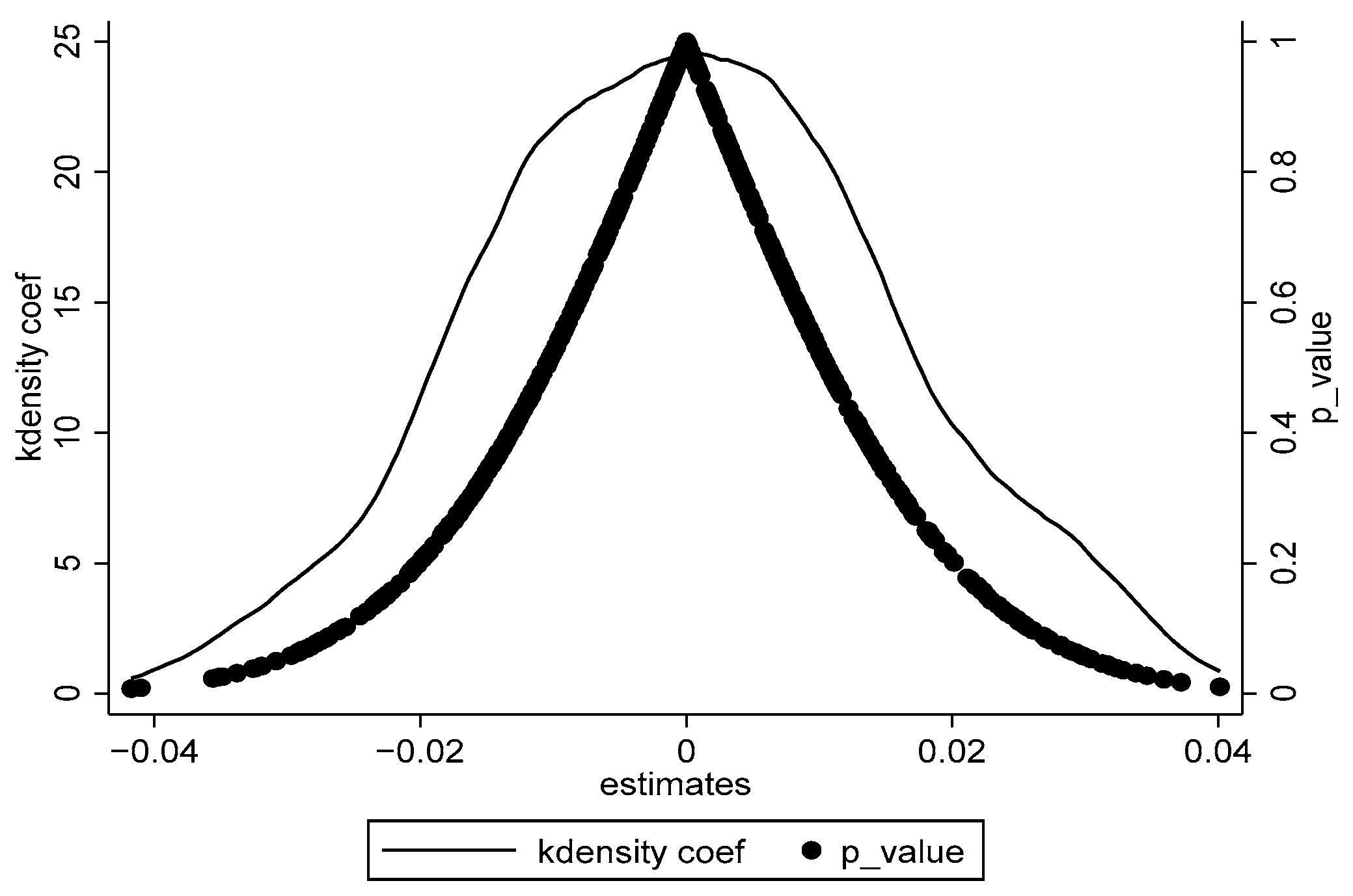
To determine if unobserved factors drive our results, we performed a placebo test based on random sampling. If omitted variables were driving the peer effects, they would remain when peer enterprises are randomly assigned to focal enterprises. Accordingly, we randomly reassigned peer enterprises within each year and reran the regression 500 times. Figure 2 presents the distribution of placebo coefficients, which approximates a normal distribution centered at zero, with all absolute values smaller than the observed coefficient. This result indicates that randomly selected peers exert no statistically significant influence on focal enterprises’ dual-integration levels, confirming the robustness of our findings.

4.2.2. Inclusion of Peer Characterization Variables

We include peer characterization variables to account for common attributes of peer enterprises that may affect focal enterprises’ decision-making. Specifically, we include the following peer characterization variables: peer enterprises’ age (peer_Age), size (peer_Size), leverage ratio (peer_Lev), Tobin’s Q (peer_Tobin), return on equity (peer_Roe), book-to-market ratio (peer_MBratio), cash holdings ratio (peer_Cash), largest shareholder ownership concentration (peer_Top1), and operating income growth rate (peer_Growth). The results in Table 5 confirm that the peer effects remain robust after controlling for these characteristics. The attenuation of the peer_D coefficient in Table 5, compared to Table 4, is expected, as controlling for peer characteristics isolates the direct peer influence from confounders related to shared firm attributes, yielding a more refined estimate.

4.2.3. Substitution of Core Variables

To further test the robustness of our findings, we employ alternative measures for intelligentization and greenization. Following Li and Wang [26], we proxy intelligentization by the frequency of AI-related keywords in enterprises’ annual reports. Following Dai and Yang [29], we measure greenization using the inverses of energy consumption intensity and pollution emission intensity from the perspective of input and output. Columns (1)–(2) of Table 6 report regressions using the inverse of energy consumption intensity, while Columns (3)–(4) use the inverse of pollution emission intensity. In all specifications, the peer_D coefficient remains positive and significant at the 1% level, further confirming our results’ robustness.

4.2.4. Exclude Sample Selection Interference

To mitigate potential biases from the COVID-19 pandemic, we follow Liu et al. [18] and exclude observations from 2019 onward. Columns (1)–(2) of Table 7 report these results, showing that the coefficient on coordinated development index of intelligentization and greenization remains significantly positive. We then additionally exclude enterprises in information technology-related industries, where baseline technological levels may be higher, and report the results in Columns (3)–(4). The peer effects persist in these specifications, confirming the robustness of our results.

4.2.5. Dynamic Effects Test

As enterprises’ intelligentization and greenization evolve, the integrated development of intelligentization and greenization may also change dynamically, thus causing corresponding changes in peer enterprises. To examine whether changes in peer enterprises’ coordinated development level of intelligentization and greenization lead to corresponding changes in focal enterprises, we introduce delta_peer_D, the year-on-year change in peer enterprises’ integration, as an additional robustness check. The regression results in Table 8 show that the increase in peer enterprises’ coordinated development of intelligentization and greenization significantly and positively affects the corresponding increase in focal enterprises, further confirming the robustness of our findings.

4.3. Endogenous Treatment

To mitigate potential endogeneity, specifically, that focal and peer enterprises’ similar behaviors may stem from a shared institutional or policy environment rather than true peer influence, we employ an instrumental variable (IV) approach. Following Gyimah et al. [40], we use peer enterprises’ idiosyncratic stock returns (mean_returns) as an instrument for peer_D, since these returns are plausibly exogenous to the focal enterprise’s own dual-integration yet correlated with peer integration.
In the first stage, mean_returns exhibits a positive and highly significant coefficient at the 1% level, confirming its validity as an instrument. The Cragg–Donald Wald F statistic of 350.20 substantially exceeds the Stock–Yogo weak instrument threshold of 16.38, indicating no weak instrument concern. In the second stage, the IV-corrected coefficient on peer_D remains positive and significant at the 5% level, demonstrating that controlling for endogeneity does not alter our baseline finding of peer effects in intelligentization–greenization integration (Table 9).

5. Analysis of Impact Mechanisms

5.1. The Perspective of Intelligentization Empowering Greenization

Theoretical analysis suggests that enterprise intelligentization not only facilitates greenization but also diffuses more readily across upstream–downstream industrial chains and among enterprises with similar characteristics. This dual nature implies a credible mechanism for peer effects in coordinated development of intelligentization and greenization, whereby the combined influence of intelligentization peer effects and the empowering effects of intelligentization on greenization drives the process. Accordingly, we construct the following model following Chen et al. [22]:
I n t i t = α 0 + α 1 p e e r _ I n t i t + α k C o n t r o l s + φ c + δ t + λ r + ε i t
G r e e n i t = β 0 + β 1 I n t i t + β k C o n t r o l s + φ c + δ t + λ r + ε i t
where Intit is the intelligentization level of the focal enterprise, peer_Intit is the average intelligentization level of peer enterprises, and Greenit is the greenization level of the focal enterprise.
Columns (1) and (2) of Table 10 present the regression results testing the intelligentization peer effects: the coefficient on peer_Int is positive and significant at the 1% level, providing robust evidence of this effect. Columns (3) and (4) report the impact of enterprise intelligentization on greenization. Considering that greenization may have counter-effects on intelligentization, Columns (5) and (6) include a one-period lag of the greenization variable. Both Green and Greent+1 coefficients remain positive and significant at the 1% level, indicating that higher levels of intelligentization significantly promote greenization. These results demonstrate that the intelligentization peer effects enhance focal enterprises’ intelligentization, which in turn facilitates their greenization, thereby validating Hypothesis 2.

5.2. The Perspective of Intra-Industry Competition Effect

According to the theoretical analysis, industries with higher internal competitive pressure may exhibit stronger peer effects. We measure industry competitive pressure using the Herfindahl–Hirschman Index (HHI): a higher HHI implies lower competitive pressure and greater market concentration, whereas a lower HHI indicates stronger competition. To test the impact of industry competitive pressure, we include an interaction term between HHI and peer_D in the econometric model. The regression results are presented in Table 11. The coefficient on the HHI × peer_D interaction term is significantly negative, suggesting that in more competitive industries, peer enterprises’ dual-integration exerts a stronger influence on the focal enterprise. This finding supports Hypothesis 3.

5.3. The Perspective of Lead–Follow Learning Effect

The high exploration threshold of intelligentization–greenization integration fosters a leader–follower learning dynamic between large enterprises and SMEs. Following Lu et al. [25], we classify enterprises into leaders (top 30%) and followers (bottom 30%) based on the following: (1) market share (enterprise operating revenue as a proportion of industry revenue); (2) enterprise size (natural log of total assets); and (3) annual R&D expenditures. For each focal enterprise, cohort averages exclude its own observation. Table 12 reports that followers’ integration levels respond significantly to leaders’ integration, while the reverse effect is negligible. This asymmetry reflects followers’ tendency to emulate leaders’ dual-integration strategies to secure late-mover advantages, whereas leaders’ superior innovation capacity and market power insulate them from follower influence. These findings support Hypothesis 4.

6. Further Discussion

6.1. Tests Based on Different Enterprise Attributes

6.1.1. Classified by Ownership Type

To examine whether ownership structure affects the peer effects in the coordinated development of intelligentization and greenization, we split the sample into state-owned enterprises (SOEs) and non-SOEs. Columns (1) and (2) of Table 13 present the results for SOEs and non-SOEs, respectively. The peer effects are significantly stronger among SOEs than among non-SOEs. This disparity likely reflects SOEs’ superior policy support and wider access to resources, which afford ample financial backing and favorable regulations for intelligentization and greenization. Additionally, SOEs’ societal mandate may drive them to lead dual-integration efforts more proactively.

6.1.2. Classified by Factor Intensity Type

Considering the differing requirements of enterprises across factor intensity categories, we classify industries as labor-intensive, capital-intensive, or technology-intensive based on the China Securities Regulatory Commission’s 2012 standards [36]. Columns (3)–(5) of Table 13 reveal that only technology-intensive enterprises exhibit significant peer effects, while capital-intensive and labor-intensive enterprises show weak or insignificant effects. This difference likely arises because technology-intensive enterprises have both the capacity and incentive to pursue systematic intelligentization–greenization integration, and they often lead technological and industrial innovations. In contrast, labor- and capital-intensive enterprises, which are predominantly in traditional sectors, face higher costs and structural barriers to dual transformation. These enterprises often face the dilemma of being unable, unwilling, or reluctant to transform, thereby lagging in their coordinated development of intelligentization and greenization.

6.2. Tests Based on Different Spatial Dimensions

Redefining peer enterprises by geographic proximity, we first classify them based on whether they operate in the same province. Column (1) of Table 14 shows that enterprises headquartered in the same province exhibit significant peer effects in intelligentization–greenization integration. This finding likely reflects shared provincial policy support, common infrastructure, and access to the same talent pool, all of which create a consistent implementation environment from policy design to execution. Moreover, intra-provincial market integration and economic linkages tend to be stronger, further facilitating enterprise-to-enterprise learning and imitation [41].
Next, to capture urban-scale heterogeneity, we classify cities as large-scale or small- and medium-scale according to national criteria. Columns (2) and (3) of Table 14 reveal that the peer effects are significant in large-scale cities but insignificant in small- and medium-scale cities. Large cities typically support mature industrial clusters, dense upstream–downstream linkages, and advanced infrastructure, all of which accelerate knowledge spillovers and the diffusion of transformation practices. In contrast, smaller cities often lack clustered industry bases and sufficient external resources to sustain dual-integration [42].

6.3. Tests Based on Different Industrial Organizational Structures

Industrial organizational structures may influence peer effects. We examine the impact of industrial organizational structures on the peer effects using interlocking director networks as a proxy variable. We extract director positions from the director and supervisor database and use each director’s unique ID to construct a director–enterprise incidence matrix. Directors appearing on two or more boards create enterprise–enterprise links, producing a yearly adjacency matrix of interlocks. Peer enterprises are then defined as those connected to the focal enterprise via at least one shared director. Table 15 reports that the coefficient on the cohort integration variable remains positive and significant under this specification, indicating that interlocking director ties amplify the peer effects in the coordinated development of intelligentization and greenization. This amplification likely arises because interlocking directors transfer transformation experience across enterprises and facilitate efficient resource sharing, information exchange, and imitation within the network [43].

7. Conclusions, Policy Recommendations, and Limitations

7.1. Conclusions

The coordinated development of intelligentization and greenization is emerging as a critical strategic direction for enterprises pursuing sustainable development amid global environmental and technological challenges. While Chinese manufacturing firms have made initial progress—evidenced by a steadily improving coupling between the two dimensions—their overall coordination remains at an early stage, with intelligentization generally lagging behind greenization.
Our analysis provides robust evidence of significant peer effects. Firms are more likely to advance their own synergy when their peers do so, a pattern confirmed by multiple robustness checks. As detailed in Section 5, these peer effects operate through interconnected channels, including the enabling role of intelligentization in facilitating green practices, competitive pressures within industry groups, and knowledge spillovers from leading to follower firms. Moreover, such effects are stronger among firms located in the same province or major city or connected through interlocking director networks—highlighting the importance of geographic and governance proximity in shaping collective sustainability behavior.

7.2. Policy Recommendations

Based on these findings, we propose the following policy implications:
Firstly, promote AI integration in manufacturing to systematically improve the coordinated development of intelligentization and greenization. Our findings indicate that intelligentization lags behind greenization, and there is still considerable room for improvement in the integration of these two transformations. To bridge this gap, enterprises should accelerate AI adoption in green production, integrate it into environmental governance across R&D and implementation, and increase investment in AI tools for pollution control, energy management, and resource optimization.
Secondly, foster industrial clusters that combine AI with environmental sustainability. AI applications in manufacturing could be replicated across enterprises, thus fostering extensive peer effects. They can also generate scale-based spillovers in large cities, which further accelerate the deep integration of intelligentization and greenization. Accordingly, promoting intelligent–green integration should leverage AI to expand diverse application scenarios and develop an industrial Internet ecosystem.
Thirdly, enhancing market mechanisms and industrial organizational structures is crucial to scaling the coordinated development of intelligentization and greenization. Empirical evidence indicates that highly competitive industries exhibit stronger tendencies toward intelligentization–greenization integration. Consequently, policymakers should optimize market frameworks to reinforce efficient resource allocation and bolster enterprises’ internal capacities for coordinated transformation. Moreover, industry leaders exert substantial influence on their peers, particularly when organizational ties are strong. By encouraging leading enterprises to pilot transformation models and by establishing robust digital platforms connecting upstream and downstream enterprises, stakeholders can foster collaborative innovation and replicate best practices across the value chain.

7.3. Limitations

Despite its comprehensive analysis of peer effects on enterprise intelligentization and greenization integration, this study has some limitations. First, due to the availability of publicly accessible data, our sample is limited to Chinese A-share enterprises from 2007 to 2022, which may constrain the generalizability of findings to other markets or more recent technological developments. Second, although the instrumental variable strategy and extensive robustness checks mitigate endogeneity concerns, residual bias may persist from unobserved factors such as enterprise-specific managerial practices or informal networks. Third, our definition of peer enterprises based on industry, geography, and director networks may overlook alternative spillover channels, such as supply chain partnerships or digital platform affiliations. Future research could explore these dimensions using richer datasets and extend the analysis to emerging economies and digital ecosystems.

Author Contributions

Conceptualization, L.H. and Z.J.; Methodology, L.H.; Software, X.L.; Validation, X.L.; Formal Analysis, L.H.; Investigation, L.H. and X.L.; Resources, X.L.; Data Curation, X.L.; Writing—Original Draft Preparation, X.L.; Writing—Reviewing and Editing, L.H.; Visualization, X.L.; Supervision, L.H. and Z.J.; Project Administration, L.H. and Z.J.; Funding Acquisition, L.H. All authors have read and agreed to the published version of the manuscript.

Funding

This research was funded by the National Social Science Fund of China (grant number 23BGL017) and General Project of Philosophy and Social Sciences Research in Universities of Jiangsu Province (grant number 2023SJYB1430).

Institutional Review Board Statement

Not applicable.

Informed Consent Statement

Not applicable.

Data Availability Statement

The raw data supporting the conclusions of this article will be made available by the authors on request.

Conflicts of Interest

The authors declare no conflicts of interest.

References

  1. Ye, Z.; Yang, J.; Zhong, N.; Tu, X.; Jia, J.; Wang, J. Tackling environmental challenges in pollution controls using artificial intelligence: A review. Sci. Total Environ. 2020, 699, 134279. [Google Scholar] [CrossRef] [PubMed]
  2. Yuan, L.; Wang, W.; Wang, G. Intelligentized reconstruction and green transformation of enterprises: A study based on micro data of imported industrial robots. Econ. Perspect. 2024, 3, 44–60. [Google Scholar]
  3. Sheng, D.; Bu, W. The usage of robots and enterprises’ pollution emissions in China. J. Quant. Technol. Econ. 2022, 39, 157–176. [Google Scholar]
  4. Acemoglu, D.; Restrepo, P. Robots and jobs: Evidence from US labor markets. J. Political Econ. 2020, 128, 2188–2244. [Google Scholar] [CrossRef]
  5. Yang, Y.; Tang, M. Analysis of the impact mechanisms of the digital economy and executive risk preference on the intelligent transformation of enterprises. Int. Rev. Econ. Financ. 2025, 102, 104389. [Google Scholar] [CrossRef]
  6. Lin, X.; Liu, Q.; Feng, G. Intelligent manufacturing and green development: From the perspective of Chinese industrial firms importing robots. J. World Econ. 2023, 46, 3–31. [Google Scholar]
  7. Biswanath, B.; Puspanjali, B.; Ugur, K.; Litu, S.; Narayan, S. Artificial intelligence-driven green innovation for sustainable development: Empirical insights from India’s renewable energy transition. J. Environ. Manag. 2025, 389, 126285. [Google Scholar]
  8. Leary, M.T.; Roberts, M.R. Do peer firms affect corporate financial policy. J. Financ. 2014, 69, 139–178. [Google Scholar] [CrossRef]
  9. Yang, X.; Liu, Y.; Wang, Q. Peer effect on the integration of industrial-financial capital: Empirical evidence from A-share listed companies. Nankai Bus. Rev. 2024, 27, 15–25. [Google Scholar]
  10. Li, Z.; Li, Z. Research on peer effect of enterprise ESG information disclosure. Nankai Bus. Rev. 2023, 26, 126–138. [Google Scholar]
  11. Foucault, T.; Fresard, L. Learning from peers’ stock prices and corporate investment. Soc. Sci. Electron. Publ. 2014, 111, 554–577. [Google Scholar] [CrossRef]
  12. Lian, Y.; Peng, Z.; Cai, J.; Yang, H. Peer effect of capital structure in business cycle. Account. Res. 2020, 11, 85–97. [Google Scholar]
  13. Du, Y.; Lou, J.; Hu, H. Peer effect of enterprise digital transformation in the network constructed by supply chain common-ownership. China Ind. Econ. 2023, 4, 136–155. [Google Scholar]
  14. Wang, X.; Chu, X. Research on the peer group effect of green technology innovation in manufacturing enterprises: Reference function based on multi-level situation. Nankai Bus. Rev. 2022, 25, 68–81. [Google Scholar]
  15. Lu, X.; Hu, Y. Digital peer effects and the resilience of industrial and supply chains. Ind. Econ. Res. 2024, 5, 44–56. [Google Scholar]
  16. Goldfarb, A.; Tucker, C. Digital economics. J. Econ. Lit. 2019, 57, 3–43. [Google Scholar] [CrossRef]
  17. Kou, M.; Wang, Y.; Liang, Y. The peer effect of digital transformation and enterprise breakthrough innovation: Based on the perspective of interlocking directorate network. Sci. Sci. Manag. S. T 2025, 46, 3–20. [Google Scholar]
  18. Liu, Y.; Hu, S.; Wang, C. How does peer effect of digital transformation influence the depth of enterprise internationalization? evidence from A-share listed enterprises. East China Econ. Manag. 2024, 38, 1–13. [Google Scholar]
  19. Huang, G.; He, L.; Lin, X. Robot adoption and energy performance: Evidence from Chinese industrial firms. Energy Econ. 2022, 107, 105837. [Google Scholar] [CrossRef]
  20. Meng, F.; Zhao, Y.; Feng, Y.; Xin, K. Impact of AI patent networks on the intelligent development of enterprises. Sci. Res. Manag. 2024, 45, 118–126. [Google Scholar]
  21. Wan, L.; Liang, C.; Rao, J. Industry peer effect in M&A decisions of China’s listed companies. Nankai Bus. Rev. 2016, 19, 11. [Google Scholar]
  22. Chen, Q.; Wang, Y.; Wan, M. Research on peer effect of enterprise digital transformation and influencing factors. Chin. J. Manag. 2021, 18, 653–663. [Google Scholar]
  23. Du, Y.; Liu, T.; Li, N. Financial asset allocation peer effect and stock price crash risk under the Co-analyst network. Account. Res. 2023, 7, 103–117. [Google Scholar]
  24. Wu, N.; Bai, Y.; An, Y. Active imitation or passive reaction: Research on the peer effect on trade credit. Nankai Bus. Rev. 2022, 25, 149–161. [Google Scholar] [CrossRef]
  25. Lu, R.; Wang, C.; Deng, M. “Peer effect” in capital structure of China’s listed firms. Bus. Manag. J. 2017, 39, 181–194. [Google Scholar]
  26. Li, W.; Wang, F. Intelligent transformation, cost stickiness and enterprise performance—An empirical study based on traditional manufacturing enterprises. Stud. Sci. Sci. 2022, 40, 91–102. [Google Scholar]
  27. Shi, Q.; Niu, Y.; Xu, H. Research on the mechanism of the impact of enterprise data element utilization level on investment efficiency—Using data elements to activate the intermediary role of redundant resources. J. Cent. Univ. Financ. Econ. 2023, 11, 105–115. [Google Scholar]
  28. Wang, Y.; Dong, W. How the rise of robots has affected China’s labor market: Evidence from China’s listed manufacturing firms. Econ. Res. J. 2020, 55, 159–175. [Google Scholar]
  29. Dai, X.; Yang, S. Digital empowerment, source of digital input and green manufacturing. China Ind. Econ. 2022, 9, 83–101. [Google Scholar]
  30. Wang, H.; Liu, J.; Zhang, L. Carbon emissions and assets pricing—Evidence from Chinese listed firms. China J. Econ. 2022, 9, 28–75. [Google Scholar] [CrossRef]
  31. Mao, J.; Guo, Y.; Cao, J.; Xu, J. Local government financing vehicle debt and environmental pollution control. J. Manag. World 2022, 38, 96–118. [Google Scholar]
  32. Zhang, Q.; Zheng, Y.; Kong, D. Local environmental governance pressure, executive’s working experience and enterprise investment in environmental protection: A quasi-natural experiment based on China’s “Ambient Air Quality Standards 2012”. Econ. Res. J. 2019, 54, 183–198. [Google Scholar]
  33. Xie, H.; Lyu, X. Responsible multinational investment: ESG and Chinese OFDI. Econ. Res. J. 2022, 57, 83–99. [Google Scholar]
  34. Dong, F.; Li, W. Research on the coupling coordination degree of “upstream-midstream-downstream” of China’ s wind power industry chain. J. Clean. Prod. 2021, 283, 124633. [Google Scholar] [CrossRef]
  35. Zhao, H.; Meng, Y. Coupling coordination measurement and evaluation of urban digital economy and green technology innovation in China. China Soft Sci. 2022, 9, 97–107. [Google Scholar]
  36. Available online: http://www.csrc.gov.cn/csrc/c101864/c1024632/content.shtml (accessed on 5 December 2025).
  37. Wang, L.; Zhang, P.; Zhang, S. Peer effects in corporate cash dividends policy. Syst. Eng. Theory Pract. 2021, 41, 1–14. [Google Scholar]
  38. Chen, H.; Lin, S.; Shi, Z.; Wang, S. Research on the peer effect of listed companies’ leverage manipulation. Chin. J. Manag. 2025, 22, 1774–1782. [Google Scholar]
  39. Qian, Q.; Chen, L.; Xie, G.; Zhai, Z.; Zhao, L. The community structure of interlocking directors network and corporate green innovation peer effects. Manag. Rev. 2025, 37, 84–96. [Google Scholar]
  40. Gyimah, D.; Machokoto, M.; Sikochi, A. Peer influence on trade credit. J. Corp. Financ. 2020, 64, 101685. [Google Scholar] [CrossRef]
  41. Li, Z.; Su, C.; Li, H.; Kong, D. Excess leverage and region—Based corporate peer effects. J. Financ. Res. 2018, 9, 74–90. [Google Scholar]
  42. Hao, L.; Li, X.; Li, S. Urban system structure evolution, dynamic industrial agglomeration and synergistic spatial efficiency improvement. J. Chongqing Univ. (Soc. Sci. Ed.) 2023, 29, 70–87. [Google Scholar]
  43. Li, X.; Fung, H.; Zhu, Q.; Liu, Z. Interlocking directorate networks, financial constraints and the social responsibility of private enterprises. Chin. J. Manag. 2020, 17, 1208–1217. [Google Scholar]
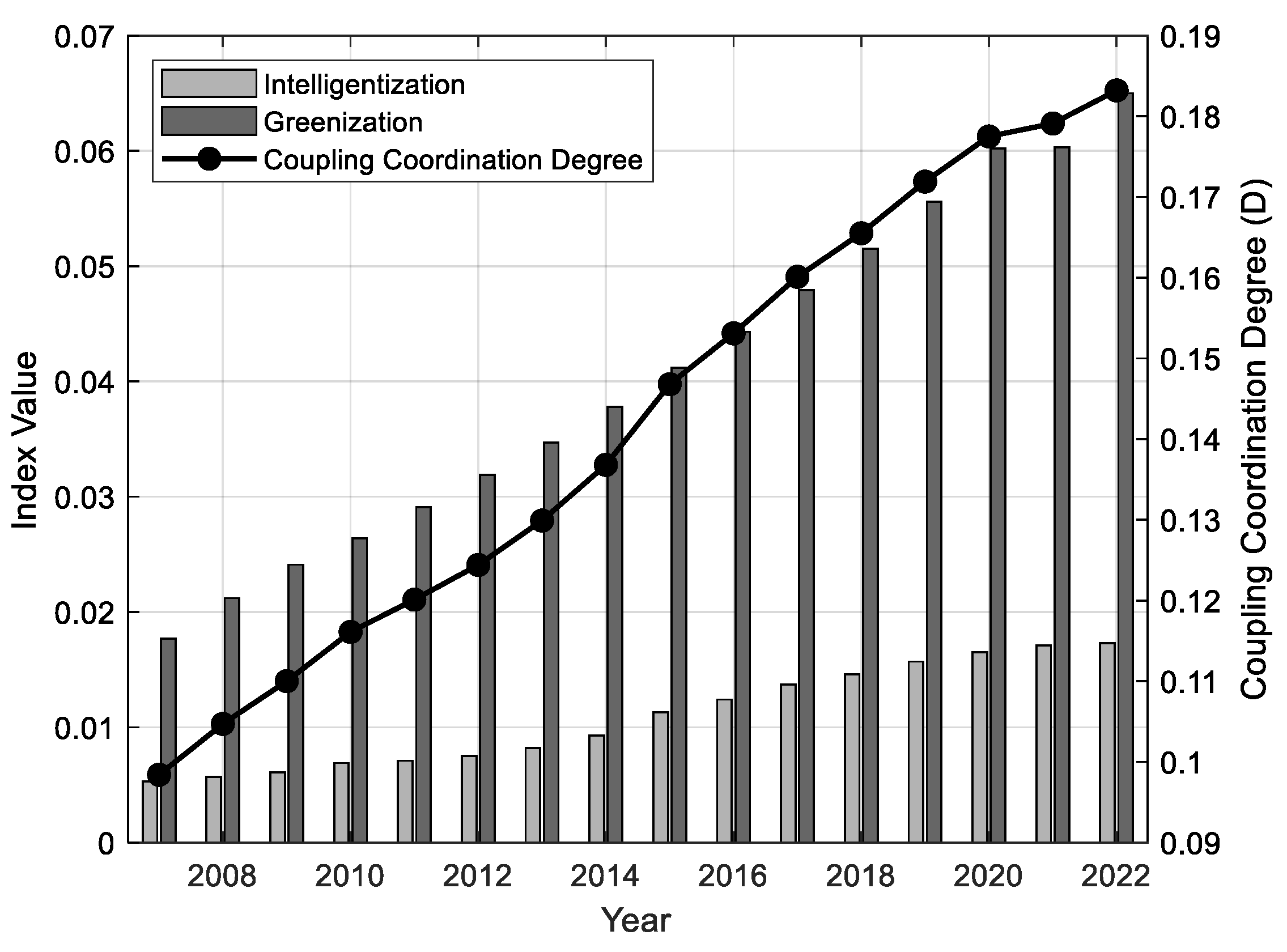
Figure 1. Trends in intelligentization, greenization, and their coupling coordination degree.
Sustainability 17 11013 g001
Figure 2. Placebo test.
Sustainability 17 11013 g002
Table 1. Indicator measurement system of enterprise intelligentization and greenization.
System LevelStandardized LayerSpecific IndicatorsMeasurementWeight Value
IntelligentizationBasic supportSoftware investmentRatio of intelligent software investment to total investment0.092
Hardware investmentRatio of intelligent hardware investment to total investment0.129
Degree of penetrationAI word frequencyFrequency of AI-related keywords in annual reports0.133
Utilization of data elementsNumber of disclosures of five indicators in annual reports0.102
Robotics applicationsIndustrial robot penetration0.015
Innovation environmentInnovative inputsTotal R&D expenditures0.117
R&D staffNumber of R&D staff0.112
Digital technology innovationNumber of digital economy patent filings0.198
Economic impactOperational efficiencyInventory turnover (=cost of goods sold/average inventory)0.102
GreenizationGreen InnovationGreen invention patentTotal number of green invention patent applications0.342
Green new patentTotal green utility model patent applications0.396
EmissionsCarbon emissionsCalculated carbon emissions from enterprises’ reports0.020
Air pollutionLog of combined air pollution equivalent0.026
Water contaminationLogarithm of combined water body pollution equivalent0.001
Energy consumptionWater consumption, electricity consumption, etc.Converted to standard coal equivalents 0.025
Environmental investmentEnvironmental investmentTotal environmental protection expenditures0.181
Social responsibilityESG ratingAssign ESG ratings from 1 to 9 in descending order0.009
Table 2. Classification of coupling coordination degree.
Range of Coupling Coordination DegreeCoupling Coordination Level
0 ≤ D ≤ 0.3Low coupling coordination
0.3 < D ≤ 0.5Medium coupling coordination
0.5 < D ≤ 0.8High coupling coordination
0.8 < D ≤ 1Extreme coupling coordination
Table 3. Descriptive statistics for key variables.
VariantObsMeanStd. Dev.MinMax
D24,7530.1100.0240.0590.205
Peer_D24,7530.1100.0070.0590.172
Age24,75310.4727.1881.00027.000
Size24,75322.3381.31620.08126.408
Lev24,7530.4330.1990.0610.887
Tobin24,7531.9781.2010.8407.780
Roe24,7530.0600.127−0.6670.327
MBratio24,7530.6320.2490.1291.190
Cash24,7530.1830.1240.0170.598
Top124,75334.82514.7478.85074.660
Growth24,7530.1670.365−0.4752.250
Table 4. Benchmark regression results.
Variables(1)(2)(3)
DDD
peer_D0.902 ***0.865 ***0.409 ***
(0.021)(0.019)(0.048)
Age −0.001 ***−0.001
(0.001)(0.001)
Size 0.010 ***0.008 ***
(0.000)(0.000)
Lev −0.003 ***−0.003 **
(0.001)(0.001)
Tobin −0.0010.001
(0.001)(0.001)
Roe −0.003 ***−0.002 **
(0.001)(0.001)
MBratio −0.011 ***−0.002 **
(0.001)(0.001)
Cash 0.015 ***−0.000
(0.001)(0.001)
Top1 −0.001 ***−0.001
(0.001)(0.001)
Growth −0.001 ***−0.001 *
(0.000)(0.000)
_cons0.011 ***−0.191 ***−0.092 ***
(0.002)(0.003)(0.012)
YearNONOYES
IndustryNONOYES
AreaNONOYES
N24,75324,75323,806
R20.0700.2570.093
Standard errors in parentheses. * p < 0.1, ** p < 0.05, *** p < 0.01.
Table 5. Robustness test: inclusion of peer characterization variables.
Variables(1)(2)(3)(4)
DDDD
peer_D0.841 ***0.850 ***0.202 ***0.197 ***
(0.028)(0.025)(0.055)(0.054)
peer_Age−0.000 **−0.000−0.001 **−0.001 **
(0.000)(0.000)(0.000)(0.000)
peer_Size0.000−0.009 ***−0.002−0.001
(0.001)(0.001)(0.002)(0.002)
peer_Lev0.0040.006 **0.0040.005
(0.003)(0.003)(0.008)(0.008)
peer_Tobin0.0010.0010.0020.002 *
(0.001)(0.001)(0.001)(0.001)
peer_Roe−0.014 *−0.003−0.013−0.015 *
(0.008)(0.007)(0.008)(0.008)
peer_MBratio0.0030.011 **0.0110.013 *
(0.006)(0.005)(0.007)(0.007)
peer_Cash−0.011 **−0.023 ***−0.060 ***−0.053 ***
(0.005)(0.005)(0.010)(0.010)
peer_Top1−0.000−0.000−0.001 ***−0.001 ***
(0.000)(0.000)(0.000)(0.000)
peer_Growth0.0030.0030.0030.003
(0.002)(0.002)(0.002)(0.002)
_cons0.016−0.0130.159 ***−0.024
(0.012)(0.010)(0.033)(0.034)
ControlsNOYESNOYES
YearNONOYESYES
IndustryNONOYESYES
AreaNONOYESYES
N24,75324,75323,80623,806
R20.0710.2850.0670.097
Standard errors in parentheses. * p < 0.1, ** p < 0.05, *** p < 0.01.
Table 6. Robustness tests: substitution of core variables.
Variables(1)(2)(3)(4)
D1D1D2D2
peer_D10.724 ***0.669 ***
(0.022)(0.022)
peer_D2 0.724 ***0.669 ***
(0.022)(0.022)
_cons0.063 ***−0.417 ***0.063 ***−0.417 ***
(0.018)(0.028)(0.018)(0.028)
ControlsNOYESNOYES
YearYESYESYESYES
IndustryYESYESYESYES
AreaYESYESYESYES
N36,96736,96736,96736,967
R20.3050.3180.3050.318
Standard errors in parentheses. *** p < 0.01.
Table 7. Robustness tests: excluding sample selection interference.
Variables(1)(2)(3)(4)
DDDD
peer_D0.660 ***0.261 ***0.668 ***0.287 ***
(0.029)(0.063)(0.029)(0.063)
_cons−0.150 ***−0.009−0.150 ***−0.010
(0.005)(0.047)(0.005)(0.047)
ControlsYESYESYESYES
YearNOYESYESYES
IndustryNOYESYESYES
AreaNOYESYESYES
N14,88914,80614,85814,775
R20.2030.0680.2040.067
Standard errors in parentheses. *** p < 0.01.
Table 8. Robustness test: dynamic effects test.
Variables(1)(2)(3)(4)
delta_Ddelta_Ddelta_Ddelta_D
delta_peer_D0.605 ***0.526 ***0.587 ***0.402 ***
(0.035)(0.043)(0.035)(0.048)
_cons−0.0000.001−0.008 ***−0.019
(0.000)(0.017)(0.003)(0.020)
ControlsNONOYESYES
AreaNOYESNOYES
IndustryNOYESNOYES
N21,98521,07521,98521,075
R20.0130.0110.0170.016
Standard errors in parentheses. *** p < 0.01.
Table 9. Endogenous treatments.
Variables(1)(2)
peer_DD
mean_returns0.007 ***
(0.000)
peer_D 0.917 **
(0.436)
_cons0.109 ***−0.191 ***
(0.002)(0.049)
Cragg–Donald Wald F350.202
[16.380]
ControlsYESYES
YearYESYES
IndustryYESYES
AreaYESYES
N14,75514,755
R20.6500.087
Standard errors in parentheses. ** p < 0.05, *** p < 0.01.
Table 10. Mechanism analysis based on the combined influence of intelligentization peer effects and the empowering effects of intelligentization on greenization.
Variables(1)(2)(3)(4)(5)(6)
IntIntGreenGreenGreent + 1Greent + 1
peer_Int0.869 ***0.834 ***
(0.045)(0.045)
Int 0.680 ***0.683 ***0.617 ***0.623 ***
(0.010)(0.010)(0.011)(0.011)
_cons0.002−0.040 ***0.052 ***0.049 ***0.049 ***0.058 ***
(0.003)(0.004)(0.005)(0.006)(0.007)(0.009)
ControlsNOYESNOYESNOYES
YearYESYESYESYESYESYES
IndustryYESYESYESYESYESYES
AreaYESYESYESYESYESYES
N23,80623,80623,82623,82620,46220,462
R20.1760.1890.5580.5600.5150.518
Standard errors in parentheses. *** p < 0.01.
Table 11. Mechanism analysis based on the driving effect of intra-industry competition.
Variables(1)(2)
DD
peer_D0.630 ***0.568 ***
(0.068)(0.067)
HHI0.095 ***0.078 ***
(0.025)(0.024)
HHI × peer_D−0.888 ***−0.744 ***
(0.223)(0.219)
_cons0.057 ***−0.115 ***
(0.012)(0.014)
ControlsNOYES
YearYESYES
IndustryYESYES
AreaYESYES
N22,01422,014
R20.0480.080
Standard errors in parentheses. *** p < 0.01.
Table 12. Mechanism analysis based on the learning effect of followers on leaders.
VariablesIndustry Followers React to LeadersIndustry Leaders React to Followers
Market ShareEnterprise SizeTechnical AdvantagesMarket ShareEnterprise SizeTechnical Advantages
(1)(2)(3)(4)(5)(6)
peer_D0.562 ***0.717 ***0.218 ***−0.0230.0770.247 *
(0.081)(0.090)(0.065)(0.191)(0.110)(0.139)
_cons−0.125 ***−0.264 ***−0.034 *0.726 ***0.011−0.044
(0.026)(0.024)(0.019)(0.198)(0.027)(0.036)
ControlsYESYESYESYESYESYES
YearYESYESYESYESYESYES
IndustryYESYESYESYESYESYES
AreaYESYESYESYESYESYES
N7256711313,11425871866789
R20.1960.2210.0680.3690.0570.078
Standard errors in parentheses. * p < 0.1, *** p < 0.01.
Table 13. Tests based on different enterprise attributes.
VariablesOwnership TypeFactor Intensity Type
SOEsNon-SOEsLabor-IntensiveCapital-IntensiveTechnology-Intensive
(1)(2)(3)(4)(5)
peer_D0.401 ***0.260 ***0.1010.227 **0.704 ***
(0.070)(0.057)(0.075)(0.110)(0.103)
_cons−0.085 ***−0.094 ***−0.012−0.103 ***−0.185 ***
(0.018)(0.013)(0.022)(0.025)(0.017)
ControlsYESYESYESYESYES
YearYESYESYESYESYES
IndustryYESYESYESYESYES
AreaYESYESYESYESYES
Between-group coefficient5.86 (p = 0.015)19.64 (p = 0.000)
N935014,4566931547711,296
R20.0920.1090.0520.0680.133
Standard errors in parentheses. ** p < 0.05, *** p < 0.01.
Table 14. Peer effects test based on different spatial dimensions.
VariablesProvince Peer EffectsCity Peer Effects
Large-Scale CitiesSmall- and Medium-Sized Cities
(1)(2)(3)
peer_D0.108 ***0.046 **0.016
(0.040)(0.022)(0.029)
_cons−0.062 ***−0.065 ***−0.044
(0.012)(0.013)(0.028)
ControlsYESYESYES
YearYESYESYES
IndustryYESYESYES
AreaYESYESYES
N23,81619,0712635
R20.0900.0910.101
Standard errors in parentheses. ** p < 0.05, *** p < 0.01.
Table 15. Peer effects test based on interlocking director networks.
Variables(1)(2)(3)(4)
DDDD
peer_D0.178 ***0.014 ***0.101 ***0.011 ***
(0.005)(0.004)(0.004)(0.004)
_cons0.092 ***0.115 ***−0.133 ***−0.070 ***
(0.001)(0.008)(0.002)(0.009)
ControlsNONOYESYES
YearNOYESNOYES
IndustryNOYESNOYES
AreaNOYESNOYES
N46,89545,21246,89545,212
R20.0260.0630.2560.095
Standard errors in parentheses. *** p < 0.01.
Disclaimer/Publisher’s Note: The statements, opinions and data contained in all publications are solely those of the individual author(s) and contributor(s) and not of MDPI and/or the editor(s). MDPI and/or the editor(s) disclaim responsibility for any injury to people or property resulting from any ideas, methods, instructions or products referred to in the content.