1. Introduction
The low-carbon development of the energy supply chain plays a positive role in combating global warming and promoting sustainable development, as acknowledged by the Sustainable Development Goals (SDGs) [
1] and the Paris Agreement [
2]. Carbon footprint accounting based on life cycle assessments is an effective means of identifying high carbon emissions in the supply chain for carbon reduction [
3]. Thus, accurate accounting of the carbon footprint of energy products provides a foundation for building a low-carbon energy supply chain.
Coal is a vital global energy source. Since 2020, driven by the post-COVID-19 economic recovery and global energy crisis, global coal production, consumption, and trade and coal-fired power generation have increased significantly. Global coal demand grew to 8790 Mt in 2024 [
4], marking four consecutive years of growth since 2021, an increase of 17.9% compared to 2020 [
5] and 15.2% compared to pre-pandemic 2019 [
6]. China, India, and ASEAN countries are the primary sources of coal demand growth. As an upstream product for basic industrial products and energy supply, such as electricity, cement, and steel, the carbon footprint of the product (CFP) of hard coal is transmitted through the supply chain to numerous downstream goods.
With China, as well as other countries in Asia, becoming global manufacturing centers, the CFP of hard coal, particularly in Asia, influences the CFP of industrial products worldwide. Therefore, accurate accounting of the CFP of hard coal is crucial for ensuring the accuracy of carbon emission accounting in global supply chains.
Currently, mature methodologies for product CFP quantification exist internationally, with standards issued by the International Organization for Standardization [
7] (ISO), the British Standards Institution [
8] (BSI), the World Resources Institute [
9] (WRI), and the European Union [
10], etc. However, Product Category Rules (PCRs) for energy products such as hard coal are still lacking, though researchers have conducted research on the CFP of hard coal. Existing studies commonly use life cycle assessment (LCA) methods, focusing on one or more representative coal mines in specific countries. Research has covered major global coal producers such as China [
11,
12,
13,
14,
15,
16,
17,
18], the United States [
19,
20,
21,
22,
23], Indonesia [
24,
25], and Australia [
26].
Due to different research objectives and data availability, system boundaries vary significantly among studies. Most studies adopt a “cradle-to-gate” boundary, covering only greenhouse gas (GHG) emissions from the coal mining and preparation stages, including direct emissions from fossil fuel combustion, GHG fugitive emissions, and indirect emissions from purchased electricity and heat. Furthermore, all processes and flows that are attributable to the analyzed system should be included according to LCA theory, including emissions from the upstream production processes of fuels, auxiliary consumables, and equipment. As the CFP involves numerous processes and flows, accounting for all of them may lead to excessively high calculation costs. Therefore, reasonable cut-off criteria must be adopted. An individual material or energy flows can be excluded only if they are found to be insignificant (e.g., they account for less than 1% of the total emissions) to the CFP. It should also be ensured that the total excluded process emissions do not exceed a particular threshold (e.g., 3% or 5% of the total emissions).
However, in terms of practical quantification, most current studies only consider the production emissions of common auxiliary consumables, such as water, fuels (diesel, gasoline, and coal), and explosives, and limited categories of other consumables. Ghadimi et al. included gasoline, diesel, water, steel, cement, and wood in the system boundary [
15]. Aguirre-Villegas et al. took diesel, gasoline, heavy fuel oil, and water treatment chemicals into account [
24]. Ditsele et al. [
21] and Day et al. [
26] only considered fuels and explosives. Restrepo considered water, explosives, diesel, and limestone [
27]. Silva et al. considered diesel, explosives, limestone, and fertilizer [
28]. Burchart-Korol et al. considered other consumables such as timber, steel supports, and shield supports, in addition to fuels and explosives [
29]. It is important to note that the hard coal mining process involves thousands of types of auxiliary consumables, such as fuel, support, construction, and transportation materials, resulting in a considerable workload for CFP accounting. At present, the contributions of auxiliary consumables to the CFP remain unknown, as well as which types of auxiliary consumables should be considered. Therefore, in the CFP quantification of hard coal products, determining whether and which auxiliary consumables can be cut off to ensure the completeness of the research and avoid unnecessary work has become a significant issue.
China is the world’s largest coal producer and consumer [
30]. The CFP of China’s hard coal has good representativeness for that of global hard coal products. To assess the impact of mining auxiliary consumables on the CFP and solve the scientific issue regarding whether and which auxiliary consumables should be involved in the system boundary, a typical surface mine and a typical underground mine in China were selected as the research objects. The aim was to demonstrate the hypothesis that, in accordance with recognized cut-off criteria, some types of other auxiliary materials need to be included in the CFP quantification of hard coal.
2. Materials and Methods
2.1. Case Study Mines
Both coal mines under study are located in the Shenfu-Dongsheng Coalfield, which is one of the largest coalfields in China and is famous worldwide. The underground coal mine under investigation is a low-gas underground mine that adopts comprehensive coal mining technology. The production capacity of low-gas underground coal mines accounts for over 70% of all underground coal mines in China; thus, the research object has good representativeness in terms of coal seam characteristics. Furthermore, after decades of development, the current comprehensive mining technology has become the mainstream technology for underground coal mining in China, making this case highly technology representative. The surface mine under investigation utilizes the most common mining technology in China and has good technology representativeness.
By conducting a life cycle inventory analysis of the hard coal products from these two typical coal mines using different CFP calculation methods for auxiliary consumables, the most suitable quantification method and the impact of auxiliary consumables can be determined. Moreover, based on the results of the case study and the reference information from international standards, this study provides a list that need to be prioritized when quantifying the CFP of hard coal.
2.2. Production Process and System Boundary for Hard Coal
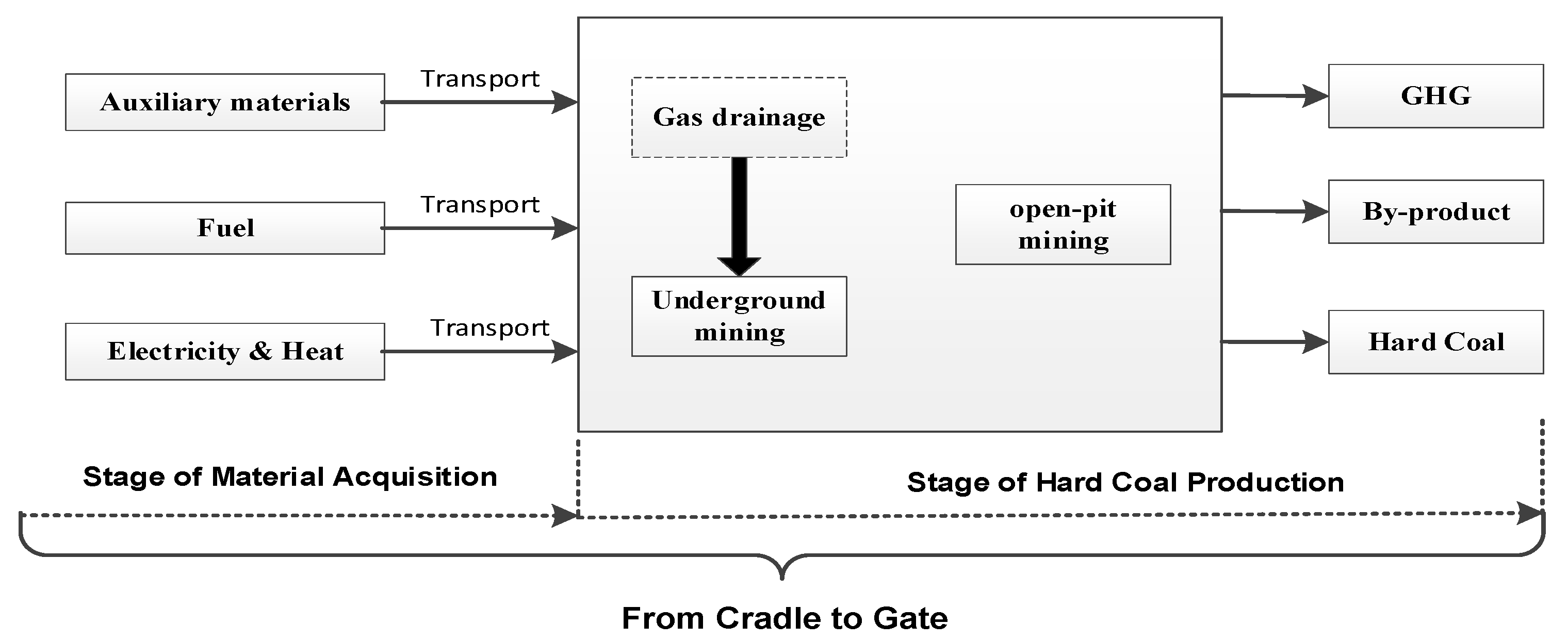
The full life cycle of hard coal includes coal mining, coal processing, and coal utilization. Quantification of the life cycle CFP (from cradle to grave) can allow for an assessment of the potential climate change impact of a single coal product and provide a reference for clean production and utilization throughout the coal life cycle. However, it cannot provide the coal product CFP information required by downstream enterprises. For hard coal, studying the partial CFP is more practical and feasible. According to research, both raw and washed clean coal can be sold as commercial coal from underground and surface coal mines. Considering that some enterprises directly purchase raw coal produced by coal mines, the system boundary selected in this research did not include the coal washing stage, making the results more widely applicable. When it is necessary to calculate the CFP of clean coal, a separate accounting unit for the coal washing process can be established, with raw coal as the raw material input and clean coal as the output product. The system boundary is shown in
Figure 1.
Coal mining can be divided into underground mining and surface mining. Underground mining involves digging shafts and roadways to reach the coal seam, using specific roadway layouts, extracting the coal seam through manual blasting or mechanical means, and transporting it to the surface via transport and hoisting machinery. Its processes include driving, coal mining, transportation, hoisting, ventilation, and drainage. For seams with a high gas content, pre-drainage of gas should be conducted before mining. Surface mining involves removing the overburden above the coal seam for extraction when coal resources are shallowly buried. Its processes include drilling, blasting, loading, transportation, and waste dumping.
2.3. Declared Unit
The functional unit or declared unit is the reference unit used for quantifying the function of the product system and should be determined based on the product’s function or purpose. Coal is a basic industrial product used for power generation, industrial combustion, coal chemical raw materials, etc. Its functions during the use stage include providing heat, chemical feedstocks, etc. For hard coal, a declared unit should be used. As coal production statistics, sales, and utilization commonly use tons, and past studies often use the weight unit of coal as the declared unit, this study used “production of 1 ton of hard coal in as-received basis” as the declared unit.
2.4. CFP Calculation
Emissions within the cradle-to-gate boundary for hard coal products include direct emissions, emissions from purchased electricity and heat, and supply chain emissions. All emissions are allocated to the declared unit.
2.4.1. Direct Emissions
Direct emission sources in the hard coal production process include fossil fuel combustion emissions and fugitive GHG emissions. Fossil fuel combustion emissions only calculated the amount of carbon dioxide produced by combustion. Fossil fuels burned in coal mines include coal, gasoline, diesel, and natural gas. The calculation formula is
Here, FC is fossil fuel consumption, NCV is the average net calorific value of the fuel, CC is the carbon content per unit calorific value, OF is the carbon oxidation rate of the fuel, and 44/12 is the molecular weight ratio of CO
2 to C. The default parameters for the fuels involved in the case calculations are shown in
Table 1.
Fugitive GHG emissions during hard coal mining include methane and carbon dioxide. In the underground mine case, online monitoring data are used for methane fugitive emissions, and data from ventilation ten-day reports are used for CO
2 fugitive emissions. In the surface mine case, the global high methane emission factor recommended by the IPCC [
32] (Tier 1) is used for the fugitive GHG emissions.
Direct GHG emissions are converted to the CO
2 equivalent using GWP100. The GWP100 values for CH
4 and CO
2 are 27.9 and 1 [
33], respectively.
2.4.2. Emissions from Purchased Electricity and Heat
Both case study mines use raw hard coal mined on-site for heating, and no heat is purchased. Heating emissions are included in the fossil fuel combustion emissions. Emissions from purchased electricity are calculated as
Here, Eelec is the CFP of purchased electricity, E is the amount of purchased electricity, and EF is the mixed-grid average electricity CFP factor for the region where the mine is located.
2.4.3. Supply Chain Emissions
Emissions from the Supply Chain of Auxiliary Consumables
Due to the excessive variety of consumables used in coal mine production, finding CFP data for each type individually is impractical. Therefore, a method using the CFP of the primary material of the product is chosen. For auxiliaries with process-based LCIs in the Ecoinvent database, LCI data are used to calculate the emissions from the supply chain. When LCI data are not available, the following formula is used:
Here, ADai is the amount of auxiliary consumables used (converted to weight units), and EFai is the CFP factor of the consumable’s primary material.
Emissions from the Construction of Coal Mines
Emissions from the construction of coal mines refer to emissions from shaft and surface building construction before formal production begins, including emissions from energy and raw/auxiliary material acquisition and fuel combustion. The inclusion of capital goods (e.g., machinery, equipment, and buildings) in the system boundary is debated in relevant standards and research. ISO 14067 [
7] does not specify clear requirements; PAS 2050 [
8] states that GHG emissions and removals from the production of capital goods used in the product life cycle can be excluded if they do not significantly contribute to the CFP. The EU PEF [
10] also indicates that capital goods and their end-of-life treatment should be excluded from the system boundary and that a clear and sufficient justification and explanation are required if they are included. Although mine construction falls under the life cycle of capital goods and is not directly related to coal production, it is its foundation. In this study, capital goods were included in the system boundary and were analyzed during life cycle inventory analysis.
Most existing Chinese coal mines were built long ago, making data on energy consumption and material inputs during construction difficult to obtain. Therefore, data from the Ecoinvent database (v3.11) [
34] were used to calculate emissions from the construction phase, amortized annually based on the mine’s service life, which was 79 and 45 years in the underground and surface mine cases, respectively.
Supply Chain Emissions from Equipment
Supply chain emissions of coal mine equipment, which also form part of the embodied emissions of capital goods, refer to emissions from the production and transportation of mining equipment. To ensure the completeness of the CFP, this study calculated them, amortizing the emissions of major equipment annually based on their service life. The calculation formula is
Here, Ed is the CFP of coal mine equipment; ADdi is the activity data for the i-th piece of equipment; Yi is the service life of the i-th piece of equipment, in years; and EFdi is the emission factor for the i-th piece of equipment.
2.5. Data Collection and Quality Control
2.5.1. Data Collection
Data from the case study mines for the entire year of 2023 were collected for CFP calculations. Company-specific data were used for hard coal product output, methane and CO
2 fugitive emissions, fossil fuel combustion emissions, purchased electricity, and the number of auxiliary consumables used. Data from the Ecoinvent database were used for the upstream CFPs of other fuels (besides coal), electricity, auxiliary consumables, and equipment used in the mining process [
34]. Default values were used for the average net calorific value, carbon content per unit calorific value, and carbon oxidation rate for calculating the combustion of fossil fuels other than coal (
Table 1). Measured values were used for all coal parameters.
2.5.2. Data Quality Control
During data collection, calibration reports for measuring instruments, such as electricity meters, track scales, and belt scales, were checked to ensure measurement accuracy within standard limits. Data such as the average net calorific value of coal and carbon content per unit calorific value were verified against original laboratory test data to ensure accuracy. The data quality of each input data was evaluated in accordance with the Data Quality Index (DQI) proposed by Huang et al. [
35], and then Monte Carlo simulations were used to conduct an uncertainty analysis on the calculation results.
3. Results and Discussion
3.1. Determining the Principle for Cut-Off Criteria for Auxiliary Consumables
Auxiliary consumables were identified and categorized. The underground mine used 2567 types of auxiliary consumables in 2023, including support materials (rock bolts, anchor cables, grouting agents, and plates), construction materials (cement, sand, and various steels), transportation system materials (idlers and conveyor belts), and oil materials (diesel, lubricating oil, hydraulic oil, and emulsified oil), as well as various cables, mining equipment spare parts, paint, etc. The surface mine used 14,034 types of auxiliary consumables, far more than the underground mine. This was due to the wide variety of spare parts used for maintaining mining vehicles and machinery, including drilling equipment parts, tires and tire parts, excavation equipment parts, and draglines. Additionally, surface mining requires large quantities of explosives, diesel, dust suppression nets, cables, etc. The consumable consumption data of the two coal mines from 2021 to 2023 were compared, and it was found that more than 80% of the consumables appeared repeatedly in the three-year data. The most frequently used consumables, such as tires, lubricating/grease materials, and anchor cable steel strands, were used annually, with little difference in the consumption per unit of coal product.
The multitude of consumables used in coal production makes the selection of which auxiliary consumables to include an important issue. To address this issue, it is first necessary to select an appropriate consumable screening method. Thus, analyses based on the economic cost and weight of the consumables were conducted. A total of 2357 pieces of auxiliary consumable data from the case underground coal mine on the weight, cost, and carbon footprint, which were calculated using the method in Section Emissions from the Supply Chain of Auxiliary Consumables, were used for this analysis.
3.1.1. Cut-Off Based on Economic Cost of Auxiliary Consumables
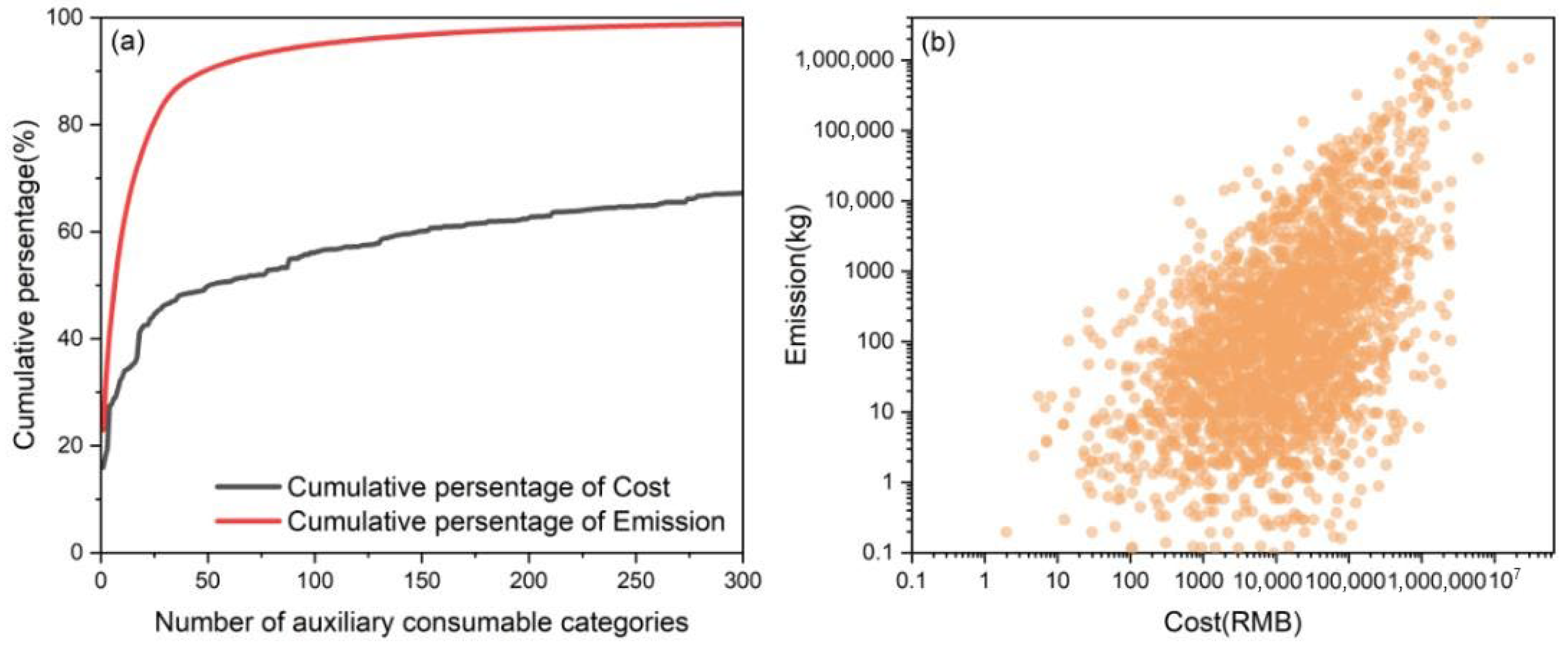
The economic cost of auxiliary consumables was the most readily available data, requiring no additional processing. Thus, attempts were made to use it as a cut-off criterion. All consumables were ranked in descending order of emission contribution, and a cumulative emission curve was plotted. Simultaneously, the corresponding cumulative cost curve was plotted, as shown in
Figure 2a. The results show that, when the number of included consumables reached 300, the cumulative emissions approached nearly 100% of the total consumable emissions, while the cumulative cost only reached about 60% of the total cost. Furthermore, as shown in
Figure 2b, although a significant correlation existed between the cost of consumables and their emission contribution, the correlation was poor (Spearman correlation coefficient 0.473,
p = 0.000). The economic cost of a consumable does not adequately reflect the magnitude of its emissions. Therefore, using the economic cost of consumables as the basis for the cut-off criterion is not reasonable.
3.1.2. Cut-Off Based on Weight of Auxiliary Consumables
Referring to relevant descriptions in ISO 14040 [
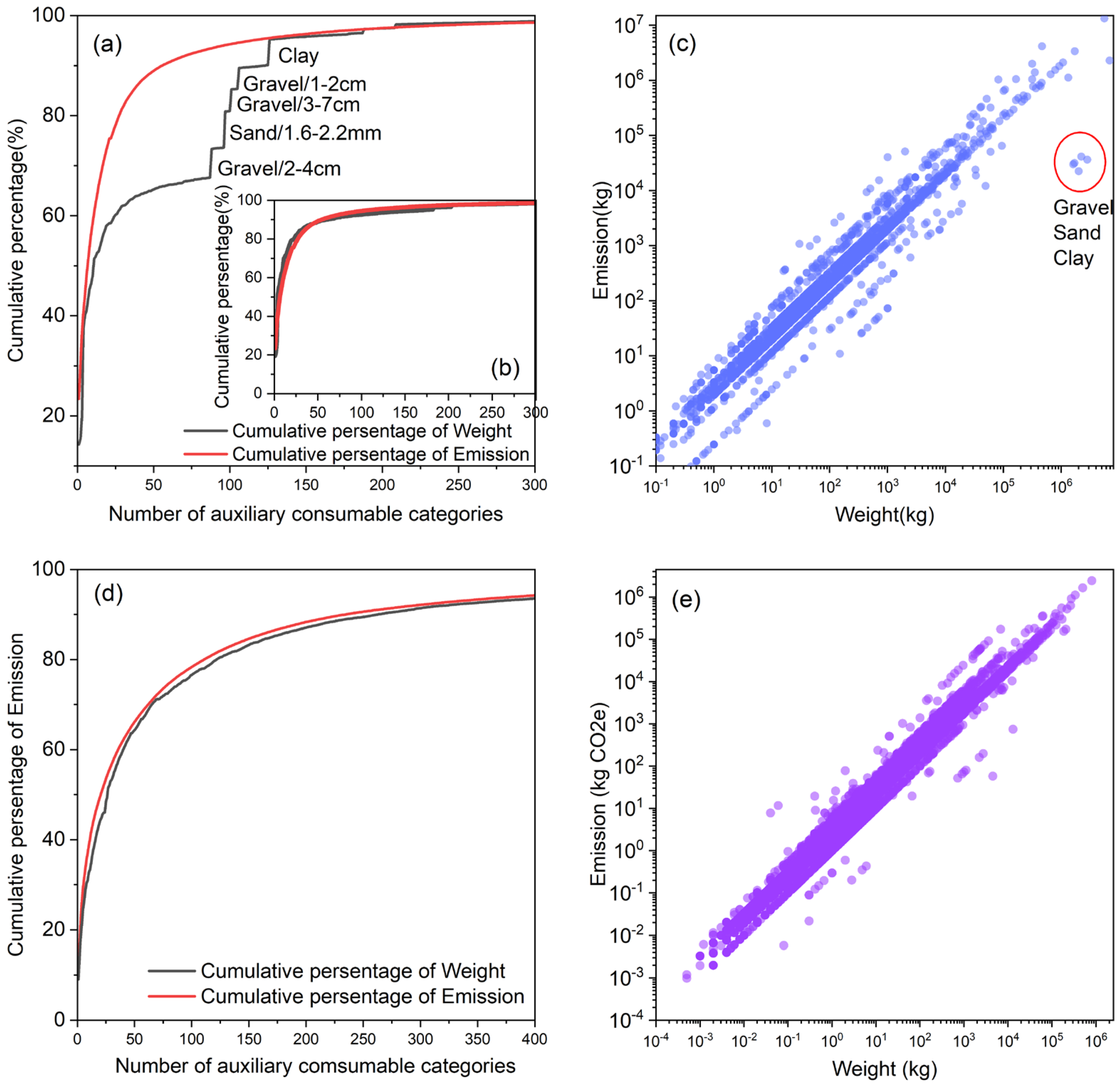
36], attempts were made to use a physical method for consumable selection. The proportion of weight of each consumable on the cumulative emission curve relative to the total weight was calculated, forming a weight cumulative curve, which was compared to the emission cumulative curve, as shown in
Figure 3a. The cumulative weight curve shows a significant jump at 67.6%, indicating that some consumables had a large weight but contributed little to emissions. Further research identified these as gravel, sand, and clay used in mine support. After excluding these three types and re-plotting, it was found that the cumulative weight and emission curves coincided well (
Figure 3b). The cumulative weight and emission curves for the surface mine (
Figure 3d) also showed good consistency. A strong positive correlation existed between consumable weight and emission for both underground and surface mines (
Figure 3c,e), with Spearman correlation coefficients of 0.976 (
p = 0.000) and 0.971 (
p = 0.000), respectively. Comparatively, using consumable weight as the benchmark for the cut-off criterion is more reasonable.
3.2. Coal Mine CFP Calculation Results
3.2.1. Surface Mine
The CFP calculation results for the surface mine case are shown in
Table 2. The CFP of the hard coal in the surface mine case was 62.70 ± 4.63 kg CO
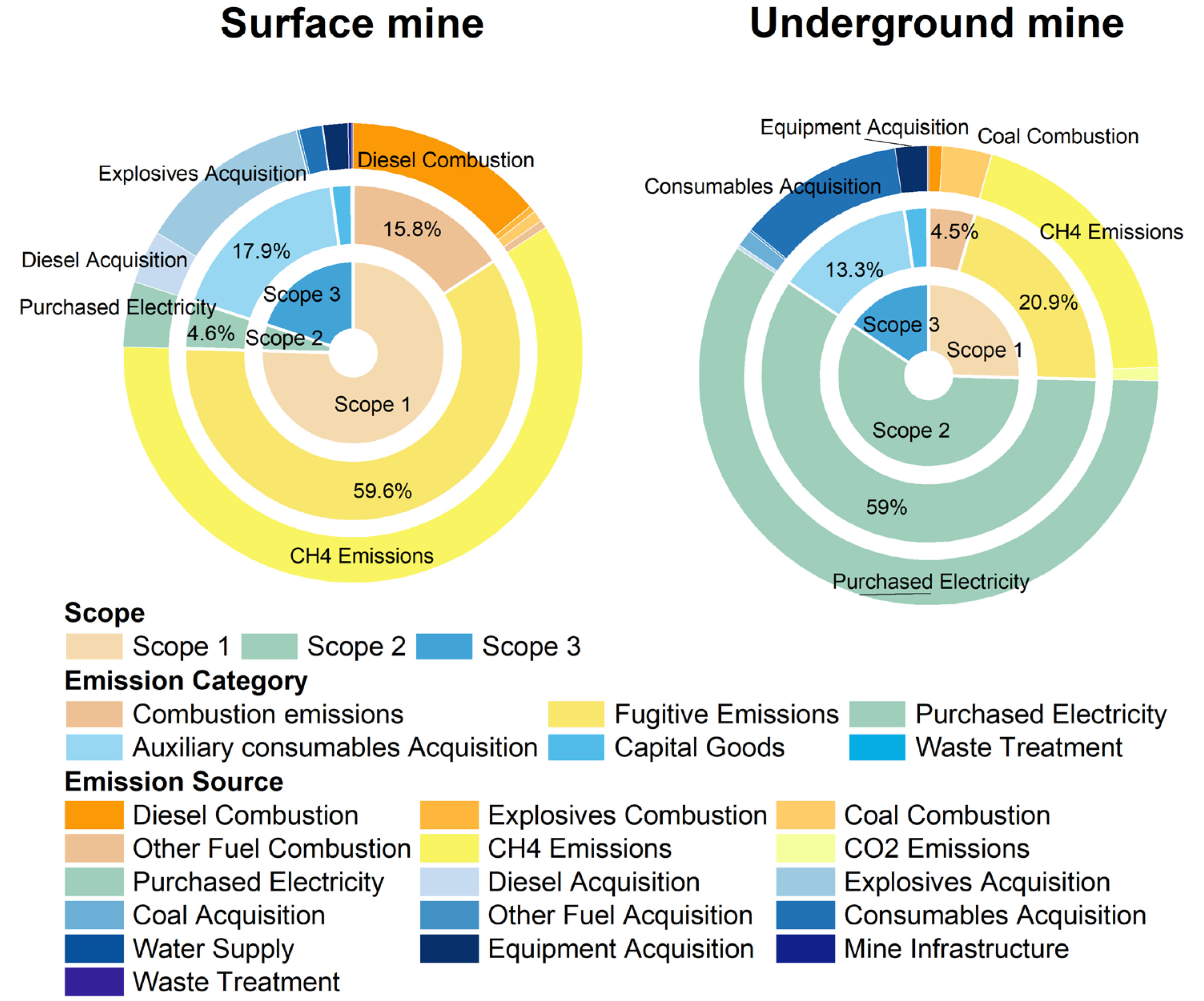
2e/t. Methane fugitive emissions were the largest emission source, accounting for 59.45 ± 3.22% (
Figure 4). Besides methane, mining processes also included fugitive emissions from sources such as CO
2, which is used as a shielding gas for welding, but these were minimal compared to methane fugitive emissions. Due to the lack of monitoring equipment, surface mine methane fugitive emissions were calculated using emission factors, potentially overestimating them compared to the real situation. The upstream emissions of auxiliary consumables constituted the second largest source, accounting for 19.52 ± 3.86% of the total emissions. The supply chain emissions of explosives accounted for 12.24 ± 2.35%, while those of diesel and other fuels accounted for 5.60 ± 1.00%. Other auxiliary consumables (OACs) acquisition accounted for 1.64 ± 0.50%, slightly lower than in the low-gas underground mine. Fuel combustion was the third largest source for the surface mine (15.89 ± 1.36%), with 88.6% coming from diesel combustion, as onsite equipment such as mine trucks primarily use diesel.
The results of this study were compared with those of previous coal product CFP studies, and it was found that the calculated CFP for the surface mine case in this study is relatively consistent with that in studies in China (73.32 kg CO
2e/t) [
13] and Arizona, USA (62.2 kg CO
2e/t) [
21]. It is higher than that in studies in Brazil (32.9 kg CO
2e/t) [
28] and the US (37.10 kg CO
2e/t) [
19] but lower than that in an Indonesian mine study (288.43 kg CO
2e/t) [
25].
3.2.2. Underground Mine
The CFP of the underground mine hard coal product was 24.841 ± 1.738 kg CO
2e/t, as shown in
Table 3. Unlike the surface mine, the indirect emissions of purchased electricity were the most significant source for the underground mine, accounting for 58.95 ± 3.24%. CH
4 fugitive emissions were the second largest source, accounting for 20.04 ± 1.41%, with a methane emission intensity of 4.962 ± 0.000 kg CO
2e/t. Traditional calculation methods use data from ten-day ventilation reports to determine gas fugitive emissions in coal mines, and the monthly average is calculated to represent the average flow per day in one month. Using this method, the methane fugitive emissions for this underground mine would be 11.889 ± 0.297 kg CO
2e/t, 139.6% higher than the result of this study. The surveyed low-gas mine is equipped with a continuous emission monitoring system (CEMS) for return airways, enabling minute-by-minute monitoring with higher accuracy. The methane fugitive emissions calculated based on this better reflected the actual situation than those calculated using the ten-day ventilation reports. The third largest emission source was the auxiliary consumables’ upstream emissions, which accounted for 13.23 ± 3.31% of the total. Among them, the upstream emissions of fuels, such as diesel oil and coal, accounted for 1.60 ± 0.14%, and those of OACs accounted for 11.63 ± 3.17%.
The underground mine CFP was lower than that in previous studies [
14,
17,
19,
27,
29,
37]. There are three possible reasons for this: Firstly, this study adopted a cradle-to-mine-gate boundary, excluding the coal washing stage, which cut off some emissions. Secondly, the studied mine uses comprehensive mining technology, which may have lower energy costs and thus lower emissions. Thirdly, the studied mine uses a CEMS for methane fugitive emissions and has inherently low methane concentrations in return airways, resulting in lower methane emissions.
3.3. Consumables That Need to Be Included in CFP Quantification
According to the cut-off criteria of ISO 14067 [
7] and PEF [
10], an individual material can be excluded only when their emissions account for less than 1% of the total emissions. As the accounting cost of fuel and explosive consumables was relatively low, and they played an important role in coal mining, the discussion on cut-off criteria focuses on OACs. In the surface coal mine, the upstream emissions of OACs accounted for 1.64 ± 0.50% of the total, and in the underground coal mine, they accounted for 11.63 ± 3.17% of the total. If ten-day ventilation reports are used to calculate methane fugitive emissions, the proportion would be 9.17 ± 2.52%. Therefore, the impact of auxiliary consumables cannot be ignored in the carbon footprint quantification of coal products from both underground and surface coal mines. In the surface mine, the upstream emissions of cut-off auxiliary consumables should be no more than 51.5% of the upstream emissions of other consumables, which means that at least 48.5% of the emissions should be included. Similarly, in underground mines, at least 94.2% of the upstream emissions of OACs should be included.
When the upstream emissions of auxiliary consumables are not available, weight data can be used to determine the cut-off criteria for consumables. However, for coal mines without detailed management records of the weight and footprint of consumables, collecting the weight of each consumable item to obtain the total weight requires a substantial amount of work. Based on three years of auxiliary consumable requisition records from the surveyed mines, data on the most commonly used OACs for underground and surface coal mines were statistically compiled. Consumables with similar uses or used for maintaining the same equipment were categorized. The selection process comprehensively considered the environmental impact and the difficulty of information acquisition. If the upstream emissions of the consumables in
Table 4 and
Table 5 were calculated, 50.93% and 94.25% of the total emissions of OACs would be included, and the cut-off proportion would be less than 1%. The information in
Table 4 and
Table 5 can serve as a reference for determining the cut-off criteria for the system boundary of the carbon footprint of hard coal products. “Emission Share” in the tables refers to the proportion of the upstream emissions of auxiliary consumables relative to all OACs.
4. Conclusions and Prospects
4.1. Conclusions
By investigating the carbon footprint of coal products in typical surface and underground mines in China, this study confirms the important impact of consumables on hard coal products. Confronted with the challenge of accounting for thousands of types of auxiliary consumables, this study clarifies that economic cost is not a reliable criterion for identifying high-impact consumables, whereas the weight of consumables can provide a robust and rational basis for cut-off decisions. By quantifying the CFP of hard coal in two typical coal mines, the significant contribution of OACs’ upstream emissions, which was 1.64 ± 0.50% for surface mines and 11.63 ± 3.17% for underground mines, is confirmed. It is also suggested that at least 48.5% of OACs in surface mines and 94.2% of OACs in underground mines should be included in the quantification of CFP. By analyzing three years of consumable requisition data, this study provides a reference list of the OACs that should be considered, including the most commonly used consumables, such as tires, lubricants, anchor cable steel strands, steel strips in drilling, etc. The list can serve as a reference for determining the cut-off criteria for the system boundary of the carbon footprint of hard coal products.
4.2. Prospects
Despite its findings, this study has limitations that provide directions for future research.
Firstly, the case study was based on only one surface mine and one underground mine. This small sample size means that the findings and the proposed consumable lists may have limitations in their generalizability. Factors such as different coal seam characteristics (e.g., high-gas vs. low-gas mines) and mining technologies could influence the consumption of consumables and their contribution to the CFP. Consequently, when applying the reference list proposed in this paper, attention should be paid to whether the mine types and mining technology are consistent with those in the case studies. In the future, when conditions permit, we will continue to study coal mine cases in other regions and gradually increase the number of samples.
Secondly, the lack of methane monitoring technology in surface mines and the differences in methane fugitive emission measurement technologies among underground mines may lead to significant uncertainty in the CFP of hard coal, which, in turn, will affect the proportions of consumable upstream emissions. Therefore, identifying cut-off criteria under different methane emissions and promoting more accurate and unified methods for monitoring and quantifying methane fugitive emissions are crucial for enhancing the accuracy and comparability of hard coal CFP results in future studies.
Future research will focus on expanding the scope to include diverse mine types and quantifying the impact of uncertainty caused by methane fugitive emissions on the cut-off criteria for consumables. Research on coal mine auxiliary consumables will improve the credibility of hard coal’s CFP, thereby promoting the entry of necessary consumables into low-carbon supply chain management systems. The research results will play a guiding role in industry carbon reduction and sustainable management practices.