You are currently viewing a new version of our website. To view the old version click .
Sustainability
  • Article
  • Open Access

8 December 2025

Enhancing Anaerobic Digestion of Kitchen Waste via Functional Microbial Granular Sludge Addition

,
,
and
1
Jiangxi Academy of Eco-Environmental Sciences and Planning, Nanchang 330039, China
2
Jiangxi Provincial Key Laboratory of Environmental Pollution Control, Nanchang 330039, China
3
School of Civil Engineering and Architecture, East China Jiaotong University, Nanchang 330013, China
4
Nanchang Urban Planning and Design Institute Group Co., Ltd., Nanchang 330038, China

Abstract

Given the sustainable increase in kitchen waste production, the treatment of organic waste is quite important for both alleviating environmental risks and recovering biomass energy. Anaerobic digestion (AD) could achieve the goals of both organic stabilization and the green energy production of biogas. However, AD conducted at a high organic loading rate can easily suffer from low treatment efficiency due to the accumulation of volatile fatty acids and an imbalance in the microbial community. This study investigated the functional microbial enhancement strategy for enhancing AD performance. The results suggested that adding 10 g of granular sludge every 5 days could enhance AD efficiency. In that case, the daily average methane production rate was increased by 43.21% compared to that in the control group, and the pH and ammonia nitrogen concentration were maintained at the optimal level. Humic acid production was strengthened; it served as an electron shuttle, which facilitated direct interspecies electron transfer. Both Cloacimonadota and Methanobacterium were enriched in the system inoculated with the granular sludge. Metabolomics indicated that the acetyl–CoA conversion was strengthened, and that energy metabolism (complex I and archaeal ATPase) was also enhanced. The granular sludge inoculation also activated the archaeal genetic information processing system. This technology could promote the generation of green energy, which is more conducive to sustainable resource development. This study provides the theoretical basis for a microbial enhancement strategy that can enhance kitchen waste AD.

1. Introduction

The production of kitchen waste is increasing gradually. This not only poses sanitary risks to the environment but also leads to massive organic resource waste [1]. The traditional methods for treating and disposing of kitchen waste include landfilling and composting, but these methods have significant drawbacks; specifically, they can emit greenhouse gases, which can contribute to climate change [2]. Additionally, the organic content in kitchen waste is quite high, and traditional methods cannot recycle the relative bioenergy [3].
Resource recycling of kitchen waste is essential for both enhancing biomass energy recycling and protecting the environment. Anaerobic digestion (AD) can not only achieve the removal of organics from kitchen waste; it can also recycle biogas, a clean energy, making it a noteworthy treatment approach [4]. In the AD process, some bottlenecks still exist. The excessive accumulation of volatile fatty acids (VFAs) can lead to system acidification, which can then result in a low methane production rate and poor operation stability [5]. Furthermore, acidification and ammonia inhibition easily occur during practical engineering, and the process of regulating kitchen waste AD has both scientific and engineering significance.
At a high organic loading rate, the operational stability and process performance of the AD of kitchen waste are prone to collapse. The key reason for this tendency is that the microbial community structure in the AD system at high organic waste levels risks metabolic imbalance [6]. An externally supplemented functional microbial could optimize the microbial structure in the AD of kitchen waste. Six different inocula (activated sludge, three types of AD residues, and two kinds of animal manure) were utilized to enhance the AD of corn stover in Chen’s study [7]. The results indicated that the methane production rate of the experiment group, which was inoculated with the AD residue to treat rice straw, was significantly higher than that of the other groups (10.2–72.5%). Furthermore, the quantitative PCR analysis indicated that the bacterial and archaeal populations in the group inoculated with rice straw AD residue were significantly higher than those in other groups. Gong et al. [8] added P. chrysosporium to an AD system containing 4-CP, and the results indicated that methane production was increased by 182.3 mL compared with the control group. The addition of P. chrysosporium enhanced the relative abundance of Methanobacterium, Acetoanaerobium, Mangroviflexus, and Trichococcus.
The granular sludge was generated from the industrial upflow anaerobic sludge blanket (UASB) treating wastewater, and it contains a large amount of functional microbial organisms [9]. The addition of the granular sludge could enhance the organic conversion efficiency [10]. However, the available research has usually only focused on the influence of a single parameter (inoculation dosage or inoculation frequency); the synergistic mechanism of both parameters has not yet been studied. Therefore, the dosing strategy of granular sludge functional microbiota to enhance the AD of kitchen waste is of both theoretical significance and practical value.
In this way, the impact of the synergistic mechanism of both inoculation dosage and inoculation frequency on the performance of the semi-continuous AD system was studied. The main research objectives are as follows: (1) to reveal the organic removal performance, methane production, and stability characteristics under different operational conditions; (2) to investigate the key organic matter metabolic pathways in the AD of kitchen waste; (3) to analyze energy metabolism and genetic information processing.

2. Materials and Methods

2.1. Inoculum and Substrate

Simulated kitchen waste was used in this study, comprising meat, rice, vegetables, and oil (35:8:50:7 based on wet weight) [11]. The simulated kitchen waste was crushed and stored at −18 °C before the experiment. The inoculum was originally collected from a rabbit manure anaerobic digester in Suzhou City, Anhui Province. In this study, granular sludge was produced in a UASB reactor treating citric acid wastewater and used as the functional microbial organism. The granular sludge was collected from the UASB reactor treating citric acid wastewater, and was not pretreated before utilization. It has been reported that the bacterial composition of granular sludge at a phylum level usually includes Bacteroidetes, Patescibacteria, Desulfobacterota, Actinobacteria, and Firmicutes. The archaea at the genus level were predominated by Methanosaeta, Methanolinea, and Methanofastidiosum [12]. The original pH was regulated by both the kitchen waste and the inoculum; no external buffer solution was utilized. The total solid (TS), volatile solid (VS), ammonia nitrogen (NH3-N) concentrations, and chemical oxygen demand (COD) concentrations of kitchen waste, inoculum, and granular sludge are presented in Table 1.
Table 1. Physicochemical properties of kitchen waste, rabbit manure, AD sludge, and granular sludge.

2.2. Experiment Setup

In this study, the inoculum dosage and inoculum frequency were determined based on the literature and our previous experiments. The inoculum dosage in the kitchen waste AD system was essential to ensure there was an abundance of microbial organisms in the initial reactor. Additionally, the dosage should be controlled to a certain amount to avoid substrate competition. Based on this, inoculum dosages of 10 g and 20 g were chosen to explore the effect of different inoculum dosages on the reaction process. The inoculum frequency was selected as once every 1, 3, and 5 days based on a previous study [13], where inoculating once every 5 days was the operating condition. The reactor, which operated at different inoculum frequencies, was investigated to identify the relationship between the substrate supply and microbial metabolic efficiency.
This experiment used semi-continuous anaerobic reactors (see Figure S1 in the Supplementary Material), which had a volume of 1.3 L (an effective volume of 1 L). The reactor was designed by our research group and manufactured by the factory. The effects of inoculum dosage (10 g and 20 g) and dosage frequency (once every 1, 3, and 5 days) on the AD of kitchen waste were investigated. The experiments were named based on the inoculum dosage and dosage frequency (e.g., the groups inoculated with 10 g/20 g granular sludge each day were named 1–10/1–20, respectively, and the groups inoculated with 10 g/20 g granular sludge every 3 days/5 days were named 3–10, 3–20/5–10, 5–20, respectively), and “C” denotes the control group without granular sludge addition. The reactor was fed and discharged daily. The organic loading rate of the AD system was 2.40 g VS/(L·d). The reactor temperature was maintained at 35 ± 1 °C using a circulating water bath, and the waste was mixed at a rotating speed of 80 rpm (1.5 min operation/1.5 min pause). Samples were collected every 3 days to measure pH and NH3-N concentrations.

2.3. Analytic Methods

TS, VS, NH3-N, and COD were determined according to the APHA [14] measurement method. An automatic point titrator (ZD-2, Rayleigh) was used to determine the pH of the anaerobic digester systems. The biogas components were determined using a gas chromatograph (Shandong Tenghai Analytical Instrument Co., Ltd., GC6890, Jinan, China). Three-dimensional fluorescence spectrum analysis was conducted using a fluorescence spectrophotometer (Hitachi High-Tech Corporation, HITACHI F4500, Tokyo, Japan). The scope of the excitation wavelength was 200–650 nm, and its interval was 10 nm. The range of the emission wavelength was 200–650 nm, and its interval was 5 nm. The scanning speed was 2400 nm/min, and the excitation/emission slit was 5 nm.

2.4. Metagenomic Analysis

The digestate samples from the control group (C) and the group that exhibited the optimal methane production performance were collected and stored at −18 °C for microbial analysis. These samples were then entrusted to Beijing Saiao Jinnuo Biotechnology Co., Ltd. (Beijing, China) for metagenomic sequencing.
First of all, the DNA of the samples was extracted using the genomic DNA extraction kit of TGuide S96. Then, the genomic DNA was sonicated using the Covaris ultrasonic crushing instrument. The genomic DNA was randomly broken, and the library was established through key steps such as terminal repair, the addition of an adenine tail, the ligation of sequencing adapters, purification treatment, and PCR amplification. Afterwards, Qubit2.0 was used to preliminarily quantify the library and dilute it to a concentration of 2 ng/μL. Then, the length of the insert size in the library was verified using the Agilent 2100 biological analyzer. Subsequently, the library was accurately quantified using Q-PCR to ensure quality, and PE150 sequencing was performed. The raw data obtained were preprocessed after sequencing, and gene predictions were generated using MetaGeneMark to build a gene catalog. Finally, the obtained gene catalogue was compared with the Micro _ NR and the Kyoto Encyclopedia of Genes and Genomes (KEGG) databases to determine the relative abundance of samples at different functional levels.

3. Results and Discussion

3.1. Performance of the AD System

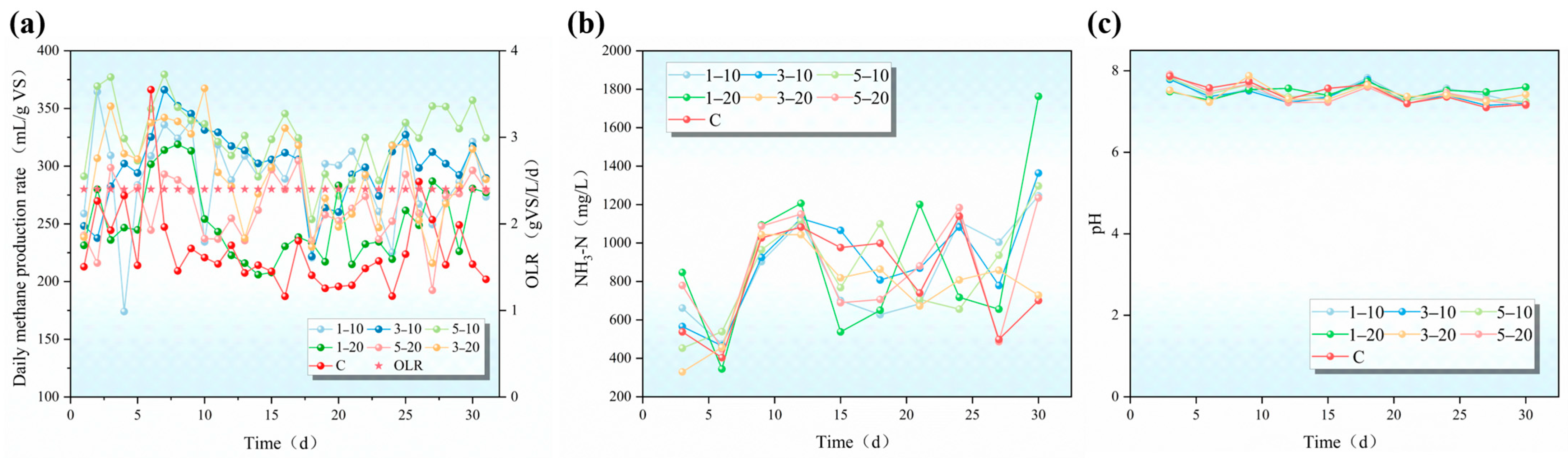
Figure 1a indicates that inoculum dosage and dosage frequency both significantly affect the methane production rate of AD. The daily average methane production rates of 1–10, 3–10, 5–10, 1–20, 3–20, and 5–20 were 289.39 mL/g VS, 301.12 mL/g VS, 325.24 mL/g VS, 251.58 mL/g VS, 292.75 mL/g VS, and 263.33 mL/g VS, respectively, and that of the C group was 227.11 mL/g VS. The daily average methane production rates of the experiments with a low dosage frequency (inoculation once every 5 days) were all higher than those of the C group. Among them, the 5–10 group exhibited the highest daily methane production rate, increasing by 43.21% compared with the C group. The daily methane production rate of the 1–20 group was close to that of the C group. This may possibly relate to the fact that the high inoculation frequency (once every day) and large inoculum dosage (20 g) led to microbial metabolic disorders, which offset the potential advantages of a high inoculation dosage. The poor methane production in the 1–20 group was possibly related to the introduction of excess exogenous microorganisms. Substrate competition occurred between the exogenous and original microorganisms. This inhibited the growth of acclimated microorganisms. For example, He et al. [15] found that bioaugmentation would change the archaeal community structure in the bioaugmentation-enhanced chicken manure anaerobic digestion, but the bioaugmentation efficiency was not the highest in the group with the highest inoculum dosage. Because inoculating with 10 g of granular sludge every 5 days presented a much better operating performance than the other groups, and the operating costs were relatively low, it was therefore selected as the optimal operating condition.
Figure 1. Effect of inoculum dosage and dosage frequency of functional microbial communities on daily methane production rate from AD (a), effect of inoculum dosage and dosage frequency of functional microbial communities on ammonia nitrogen (b), and pH (c).
The variations of NH3-N concentration in the AD process are presented in Figure 1b. An increase in NH3-N concentrations in all experimental groups was revealed at the termination period compared to the initial period. These results suggest that NH3-N accumulation occurred during AD. The accumulation phenomenon can be attributed to both the degradation of nitrogenous organic compounds and the low utilization rates of NH3-N. It is worth noting that the measured NH3-N concentrations in all experimental groups were below the NH3-N inhibition threshold range (3000–6000 mg/L). The possible explanation for the ammonia inhibition was not observed in the system from two perspectives: (1) the inoculum of granular sludge usually contained abundant hydrogenotrophic methanogens (Methanolinea [16]). Li et al. [17] reported that hydrogenotrophic methanogens had higher ammonia tolerance and could enhance methane production. (2) The reactor that was rotated with the paddle-type impeller achieved good mixing efficiency and small dead volume. This was beneficial for protein metabolism and alleviated ammonia accumulation. Consequently, it can be concluded that NH3-N accumulation did not significantly inhibit AD performance.
The pH variation is presented in Figure 1c. The impact of different inoculum dosages and dosage frequencies of granular sludge on pH values was not significant; the pH in all experimental groups remained between 7.1 and 7.91 during the process. As reported in previous studies, the optimal pH ranges are 4.0–8.5 for hydrolytic acidogenic bacteria and 6.5–7.8 for methanogenic archaea [18]. The pH ranges observed in the experiment were considered suitable for supporting the growth and metabolic activities of key anaerobic microorganisms in AD.

3.2. Three-Dimensional Fluorescence Spectral Analysis

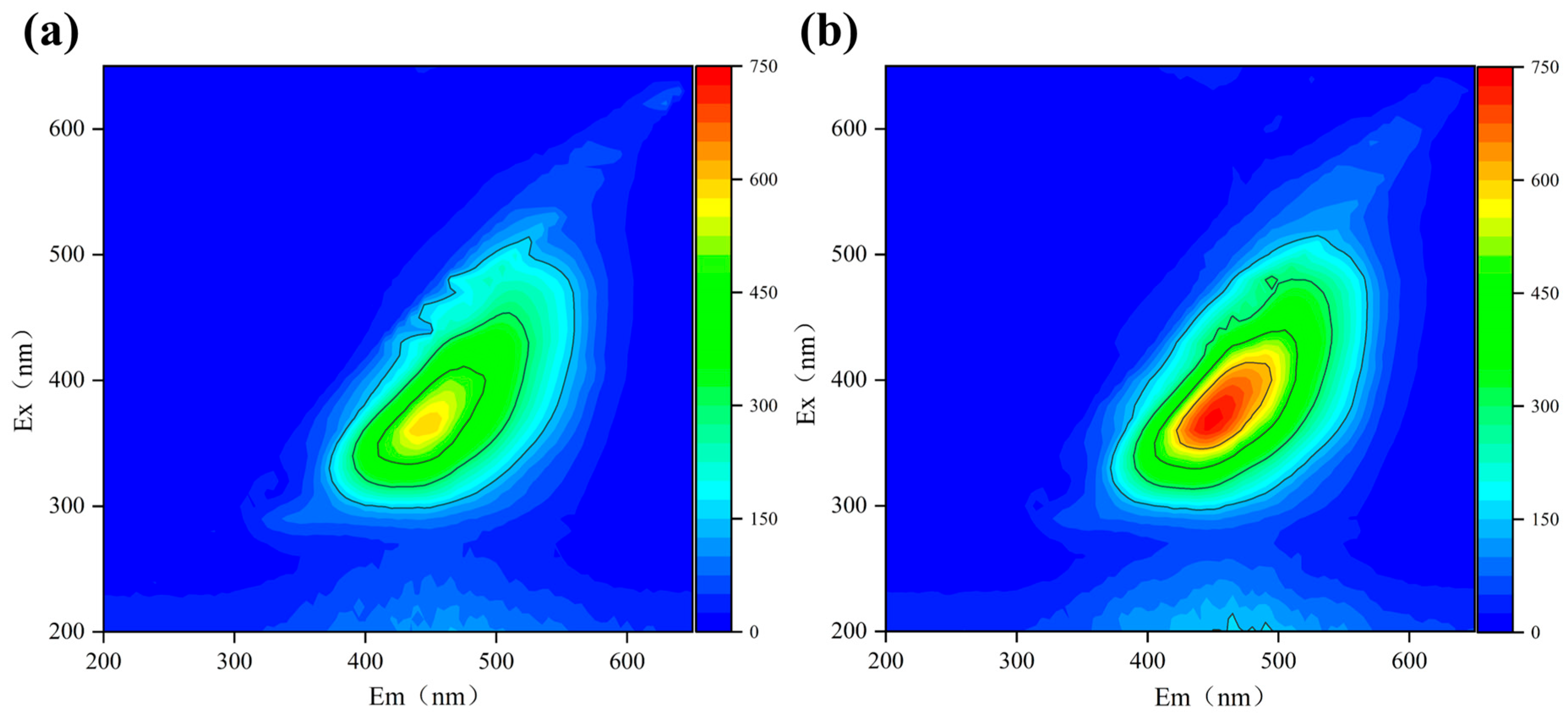
Figure 2 presents the three-dimensional fluorescence spectroscopy of the C group and the 5–10 group. The characteristic fluorescence peaks in the excitation (Ex) wavelength range of 300–500 nm and an emission (Em) wavelength range of 350–600 nm were observed in both the C group (Figure 2a) and the 5–10 group (Figure 2b). Notably, the 5–10 group exhibited higher fluorescence intensity than the C group in the characteristic spectral region of humic acid-like substances (Ex 250–450 nm/Em 380–550 nm) [19]. This result indicated that the 5–10 group generated more humic acid-like substances. It is worth noting that the humic acid-like substances function as electron shuttles [20], thereby further facilitating the direct interspecies electron transfer among microorganisms in AD. Yuan. Y et al. [21] found that some humic substances could act as terminal electron acceptors, accepting and transferring electrons between the acidogenic bacteria and methanogens. One study [22] indicated that quinone groups were the main electron transfer groups in humic substances that enhance the DIET pathway. It was reported that the concentrations of humic substances and redox functional groups determined the electron transfer capacity, with optimal concentrations of 5–10 mg/L [23]. Three-dimensional fluorescence results indicated that the concentration of humic substances in the 5–10 group was higher than that in the C group. This enhancement was likely related to the inoculated granular sludge, which stimulated the synthesis of humic acid-like substances, thereby strengthening the electron transfer network between bacteria and archaea. Humic substances could act as electron acceptors, further facilitating electron transfer between acidogenic bacteria and methanogens, and further enhancing methane production. This indicates that the addition of granular sludge was beneficial for the production of humic substances. The three-dimensional fluorescence results were consistent with the finding that the daily methane production rate of the 5–10 group was higher than that of the C group.
Figure 2. Three-dimensional fluorescence spectra of digestate in group C (a) and group 5–10 (b).

3.3. Functional Microbial Community Structure

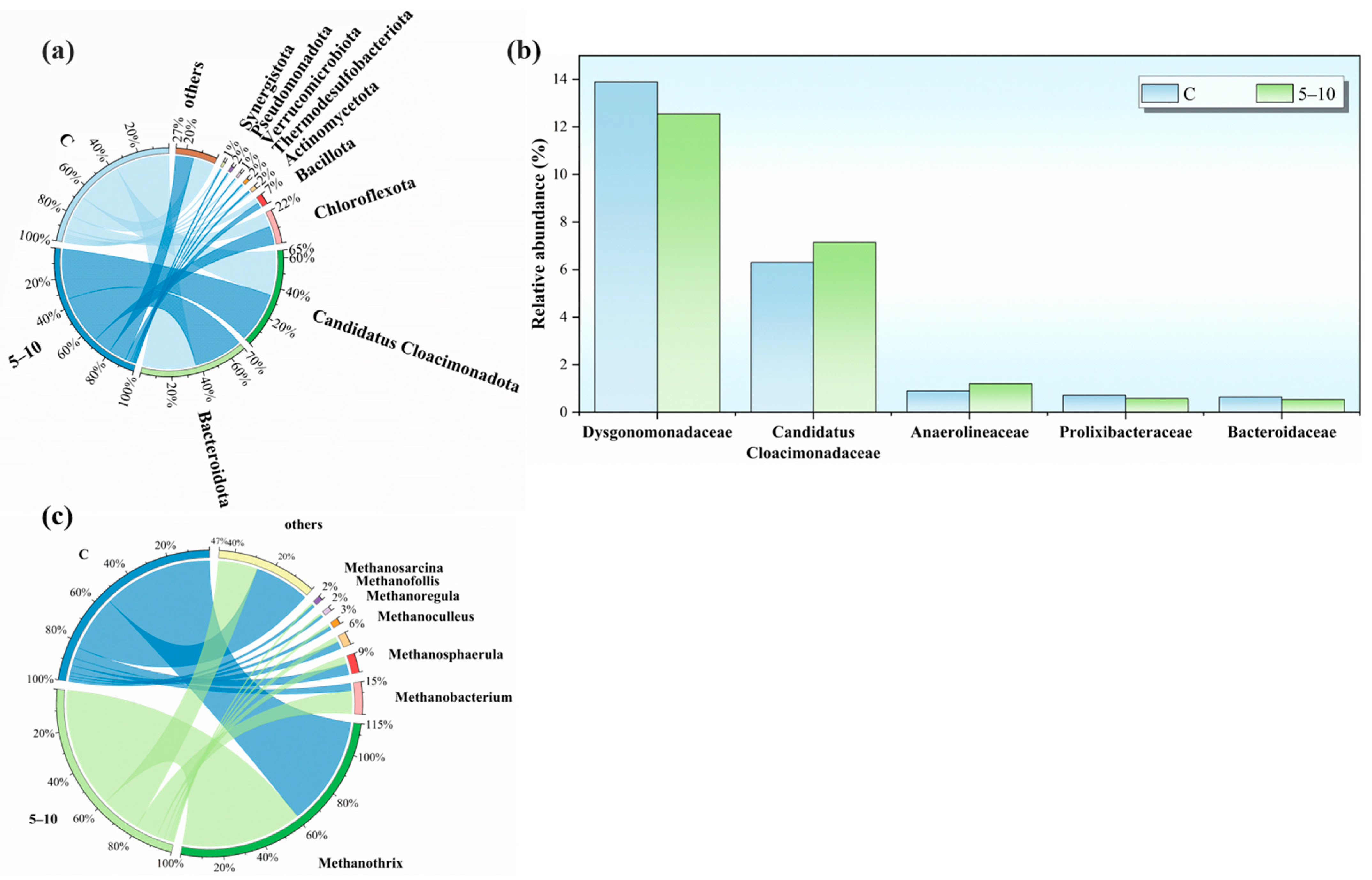
As shown in Figure 3a, the bacterial community at the phylum level in the AD system was mainly composed of three major phyla: Bacteroidota, Candidatus Cloacimonadota, and Chloroflexota. Significant changes in community structure were observed between the 5–10 group and the C group. Compared to the C group, the relative abundances of Candidatus Cloacimonadota and Chloroflexota increased by 13.97% and 25.79% respectively, while that of Bacteroidota decreased from 36.62% to 33.42%. Bacteroidota contribute to the acidification of complex organic matter and could convert it into acetate and propionate [24]. In addition, the electron transfer from NADH to coenzyme Q was possibly related to the NADH dehydrogenase secreted by Bacteroidota [25]. Chloroflexota is involved in the decomposition of macromolecular organic matter, such as proteins and carbohydrates [26]. It is worth noting that Candidatus Cloacimonadota increased significantly, and this increase has been confirmed in previous studies. Candidatus Cloacimonadota was reported to have a positive promoting effect on AD [27], and may have advantages in terms of degrading lipid-rich substrates [28]. Candidatus Cloacimonadota and Chloroflexota could promote the rapid hydrolysis of organics. In addition, other phyla, such as Actinomycetota, Thermodesulfobacteriota, Verrucomicrobiota, and Pseudomonadota were also detected in the system. Actinomycetota, which is composed of various Gram-positive bacteria, was reported to play a non-negligible role in the complex polysaccharides degradation [29]. These changes in community structure indicated the significant impact of granular sludge inoculation on the AD system.
Figure 3. Community distribution at the bacterial phylum level (a) bacterial family level, bacterial family level (b,c) archaeal genus level.
Figure 3b illustrates the bacterial community at the family level. The predominant bacterial families in the system were Dysgonomonadaceae, Candidatus Cloacimonadaceae, Anaerolineaceae, Prolixibacteraceae, and Bacteroidaceae. Notably, compared to the C group, the relative abundance of Dysgonomonadaceae in the 5–10 group decreased from 13.89% to 12.54%. Dysgonomonadaceae was reported to have the capability to degrade carbohydrates into VFAs. The metabolic activity of Dysgonomonadaceae typically presented a positive correlation with VFA degradation [11]. Compared to the C group, the relative abundances of Candidatus Cloacimonadaceae and Anaerolineaceae in the 5–10 group increased by 13.27% and 33.35%, respectively. Candidatus Cloacimonadaceae (affiliated to the phylum Candidatus Cloacimonadota) was reported to primarily participate in amino acid and propionate degradation [30]. Anaerolineaceae (belonging to the Chloroflexi phylum) was reported to establish direct interspecies electron transfer (DIET) with electroactive microorganisms such as Methanosaeta [31].
Figure 3c displays the archaeal community composition at the genus level. Methanothrix was the dominant genus in both the C and 5–10 groups, with relative abundances of 54.86% and 60.23%, respectively. Methanothrix is the only genus of Methanotrichaceae [29]. Methanothrix is a strictly acetoclastic methanogen that exclusively utilizes acetate for methane production [32]. The previous literature also indicated its potential DIET with Geobacter [33]. Notably, Methanobacterium showed significant enrichment in the 5–10 group. Its relative abundance increased from 3.78% to 11.32%. This genus is a typical hydrogenotrophic methanogen that generates methane via hydrogenotrophic metabolism [34]. Other hydrogenotrophic methanogens (Methanosphaerula, Methanoculleus, and Methanosarcina [35]) decreased slightly in the 5–10 group.

3.4. Expression of Functional Genes in Key Organic Matter Metabolic Pathways

3.4.1. Pyruvate Conversion and Production

It is commonly recognized that pyruvic acid is the critical intermediate product in the conversion of organic matter to VFAs; the conversion of pyruvic acid to acetate, propionate, and butyrate was analyzed, as well as the functional enzyme-coding genes involved.
(1)
Acetate production
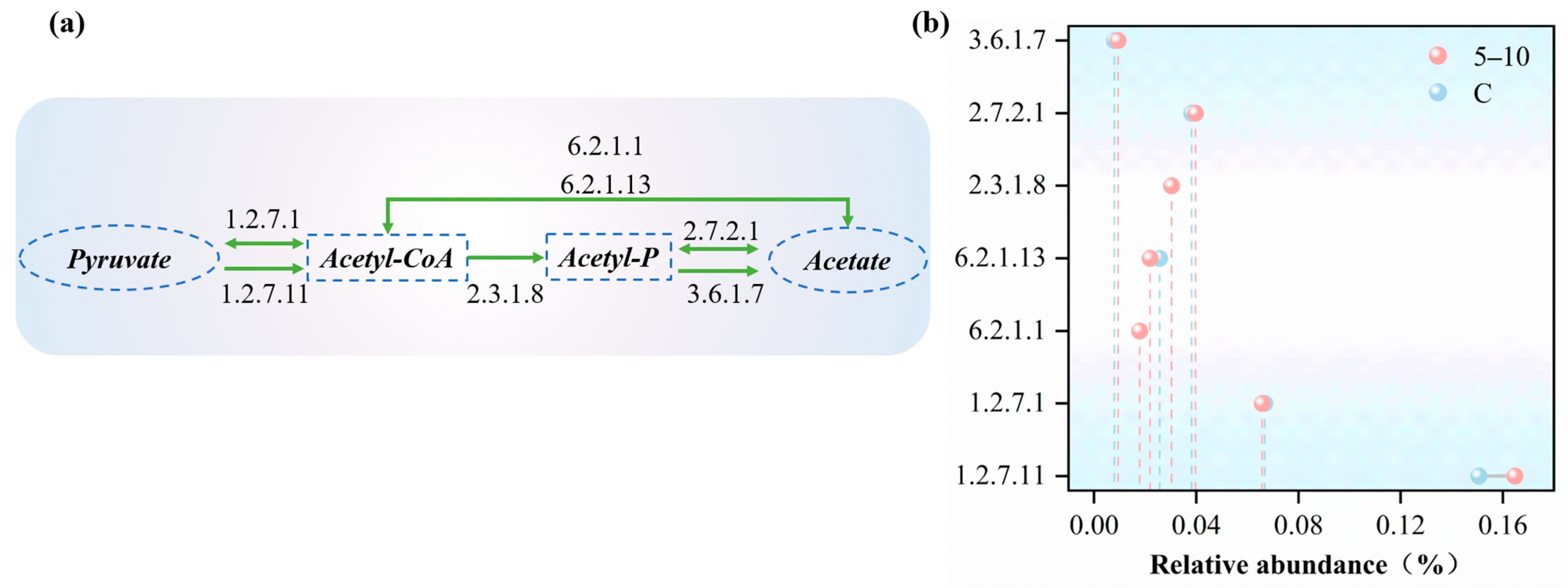
The key enzymatic genes involved in the acetate biosynthesis pathway are presented in Figure 4a, and the relative abundance of their enzyme-encoding genes is shown in Figure 4b. Pyruvate is converted to acetate through two pathways, both of which require its initial transformation into acetyl-CoA. This transformation step was catalyzed by either 2-oxoacid oxidoreductase (EC: 1.2.7.11) or pyruvate ferredoxin oxidoreductase (EC: 1.2.7.1). It should be especially noted that the relative abundance of EC: 1.2.7.11 in the 5–10 group was 9.38% higher than in the C group, while EC: 1.2.7.1 remained at a stable level. The differential expression between EC: 1.2.7.1 and EC: 1.2.7.11 indicated that the irreversible reaction catalyzed by EC: 1.2.7.11 drives unidirectional metabolic flux, whereas the reversible reaction mediated by EC: 1.2.7.1 remains at a stable level. The irreversible enzyme EC: 1.2.7.11 in the generation of acetyl-CoA from pyruvate was upregulated, while the reversible enzyme EC: 1.2.7.1 was at a stable level. More acetyl-CoA was produced in this process, providing additional precursor for acetate generation. It could be concluded that granular sludge inoculation may enhance acetyl-CoA production efficiency through selective reinforcement of the irreversible pathway catalyzed by EC: 1.2.7.11.
Figure 4. Acetate production process (a,b) relative abundance of genes encoding functional enzymes.
Acetyl-CoA is converted to acetate through two metabolic pathways (Figure 4a). The first pathway is the direct transformation catalyzed by either acetyl-CoA synthetase (EC: 6.2.1.1) or acetate-CoA ligase (EC: 6.2.1.13). The second pathway contains two sequential steps: the conversion of acetyl-CoA to acetyl-P by EC: 2.3.1.8, then the transformation to acetate via either acylphosphatase (EC: 3.6.1.7) or acetate kinase (EC: 2.7.2.1). The enzymatic regulation patterns in the 5–10 group were as follows: genes involved in direct conversion enzymes (EC: 6.2.1.1 and EC: 6.2.1.13) decreased, while the relative enzymes in the indirect pathway (EC: 2.7.2.1, and EC: 3.6.1.7) presented a significant increment of 3.77%, and 18.46%, respectively, compared to the C group. Irreversible enzymes (EC: 3.6.1.7) that participated in the conversion of acetyl-CoA to acetate were also upregulated, and could promote acetate generation. This provided more substrate for acetotrophic methanogens and generated more methane. It should be noted that the significantly upregulated enzymes (EC: 1.2.7.11, EC: 2.3.1.8, and EC: 3.6.1.7) all participated in the irreversible reactions, while those that changed slightly (EC: 6.2.1.1 and EC: 6.2.1.13) participated in the reversible reactions. These findings indicate that the granular sludge inoculation enhances the irreversible reaction pathways, thereby improving the efficiency of acetate biosynthesis in AD.
(2)
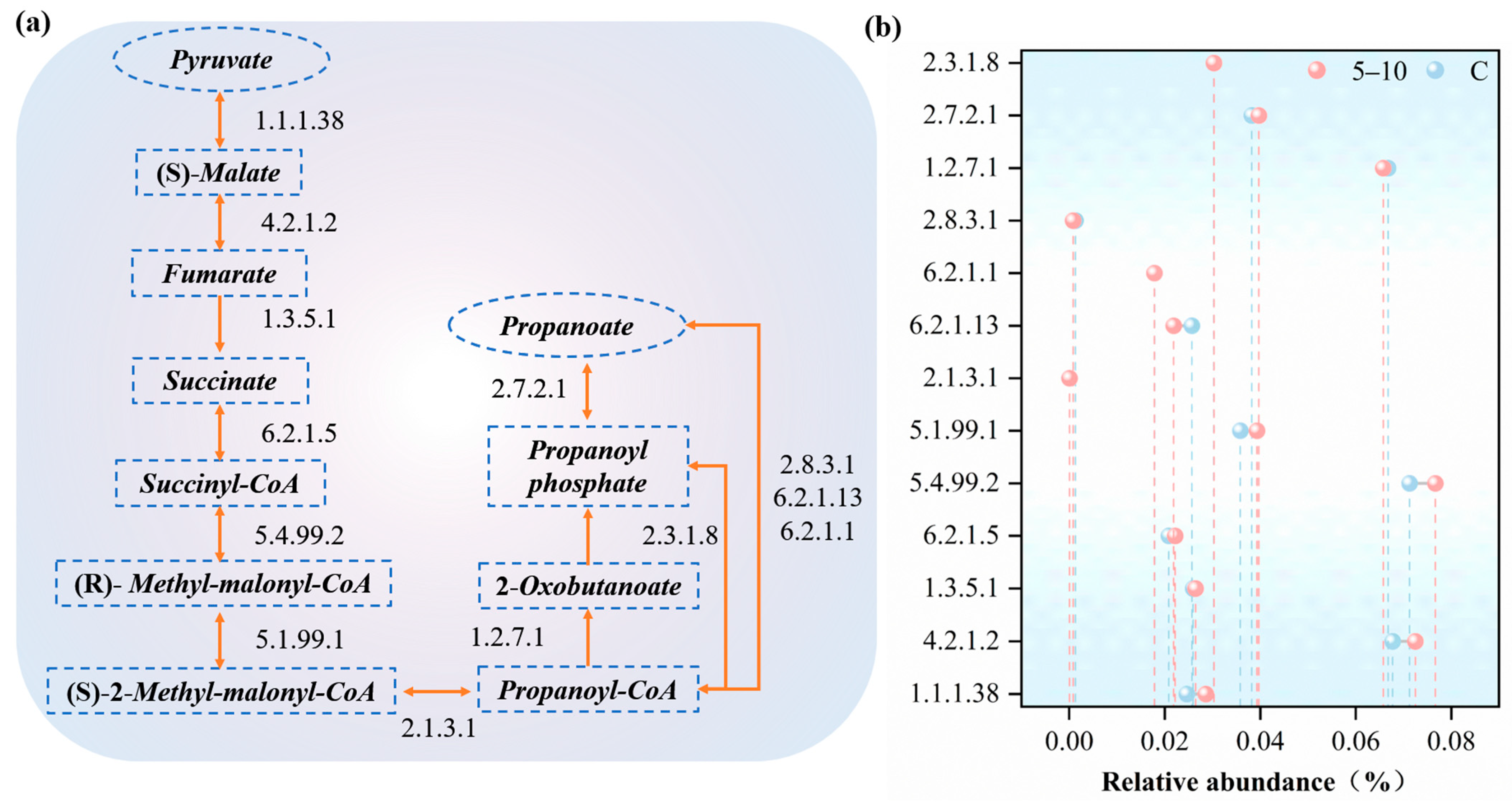
Propionate production
The propionate biosynthesis pathway and the relative abundance of its enzyme-encoding genes are shown in Figure 5a,b. Propionyl-CoA, which is a key intermediate in the conversion of pyruvate to propionate, is synthesized through multiple enzymatic steps. Pyruvate is first converted to succinate via the catalytic actions of malate dehydrogenase (EC: 1.1.1.38), fumarate hydratase (EC: 4.2.1.2), and succinate dehydrogenase (EC: 1.3.5.1). Then, succinate is converted to propionyl-CoA by succinyl-CoA synthetase (EC: 6.2.1.5), methylmalonyl-CoA mutase (EC: 5.4.99.2), methylmalonyl-CoA/ethylmalonyl-CoA epimerase (EC: 5.1.99.1), and methylmalonyl-CoA carboxyltransferase 5S subunit (EC: 2.1.3.1). As shown in Figure 5b, the relative abundance of the above enzyme-encoding genes was significantly higher in the 5–10 group than in the C group, with increases of 16.15%, 6.98%, 1.86%, 6.37%, 7.53%, 9.75%, and 94.64%, respectively. Notably, the relative abundance of EC: 2.1.3.1 increased by 94.64%, suggesting it may be the critical factor in promoting the propionate biosynthesis pathway.
Figure 5. Propionate production process (a,b) relative abundance of genes encoding functional enzymes.
Propionyl-CoA can be converted to propionate through three pathways: (1) direct catalysis to propionate by propionate CoA-transferase (EC: 2.8.3.1), acetate-CoA ligase (EC: 6.2.1.13), or acetyl-CoA synthetase (EC: 6.2.1.1); (2) generation of propionyl phosphate via phosphate acetyltransferase (EC: 2.3.1.8) followed by the conversion to propionate catalyzed by acetate kinase (EC: 2.7.2.1); or (3) transformation into 2-oxobutyrate through pyruvate ferredoxin oxidoreductase (EC: 1.2.7.1), with the originated propionyl phosphate subsequently converted to propionate by acetate kinase (EC: 2.7.2.1). Compared to the C group, the relative abundances of EC: 2.8.3.1, EC: 6.2.1.13, and EC: 6.2.1.1 in the 5–10 group showed a slight decrease, while EC: 2.7.2.1 increased by 3.77%. The variation in the abundance of EC: 2.3.1.8 and EC: 1.2.7.1 could be neglected. Overall, the upregulated enzyme gene abundances involved in the pyruvate-to-propionate metabolic pathway in the 5–10 group indicated that propionate biosynthesis was strengthened.
The propionate production is a key step in carbohydrate metabolism. Propionate production may lead to the accumulation of VFAs, causing system acidification that inhibits methane production [36]. At the same time, propionate can be transferred to acetate, which could be utilized by the methanogens, and was beneficial for methane production to some extent. Before conducting this AD experiment, the sludge was acclimated, which was beneficial for microorganism degradation. This system was rotated with the paddle stirrer, and achieved sufficient substrate–microorganism contact; the VFAs could then be degraded rapidly. It should be noted that the system pH ranged from 7.1 to 7.91, indicating that acid inhibition did not occur.
(3)
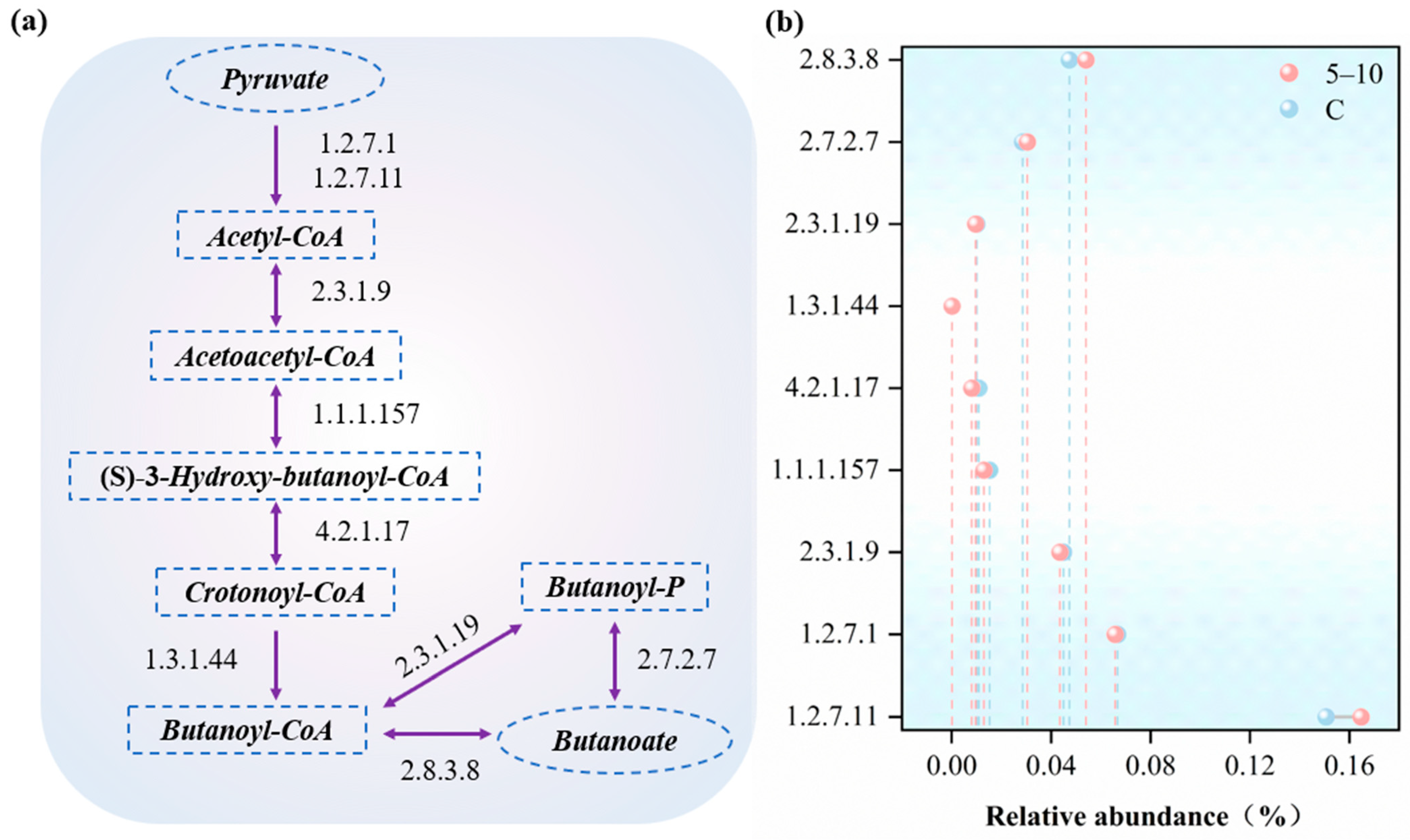
Butyric acid production
The butyrate production process and the relative abundance of the enzyme-encoding genes in the butyrate biosynthesis pathway are presented in Figure 6a and Figure 6b, respectively. Pyruvate is first converted to acetyl-CoA via 2-oxoacid oxidoreductase (EC: 1.2.7.11) or pyruvate ferredoxin oxidoreductase (EC: 1.2.7.1) (a detailed description of enzyme characteristics was provided in the acetate production section). Then, acetyl-CoA is converted to butyryl-CoA by acetyl-CoA C-acetyltransferase (EC: 2.3.1.9), 3-hydroxybutyryl-CoA dehydrogenase (EC: 1.1.1.157), enoyl-CoA hydratase (EC: 4.2.1.17), and trans-2-enoyl-CoA reductase (EC: 1.3.1.44). It is worth noting that despite the upregulation of EC: 1.3.1.44 and EC: 1.2.7.11 in the 5–10 group, the other genes decreased slightly (Figure 6b). Butyryl-CoA can be converted to butyrate through the following two pathways: (1) sequential catalysis by phosphate butyryltransferase (EC: 2.3.1.19) and butyrate kinase (EC: 2.7.2.7)—the former abundance was downregulated and the latter was upregulated; (2) direct conversion via acetate CoA/acetoacetate CoA-transferase (EC: 2.8.3.8), which increased from 0.0473% in the C group to 0.054% in the 5–10 group. It should be noted that the differential regulation of butyrate synthesis-related enzyme genes by granular sludge has limited regulatory effects.
Figure 6. Butyrate production process (a) and relative abundance of genes encoding functional enzymes (b).
Butyrate metabolism is an important pathway for the conversion and production of pyruvate. In this study, the inoculum of granular sludge was not proven to upgrade the most enzymes in butyrate metabolism. This indicated that the granular sludge inoculum could not enhance butyrate metabolism. However, the addition of granular sludge can enhance the acetate and propionate metabolism. Furthermore, it has been reported that butyrate generation can be inhibited under high hydrogen partial pressure [37]. Granular sludge could strengthen the hydrolysis of kitchen waste, generating higher hydrogen partial pressure. This may have been the reason butyrate metabolism was not strengthened.

3.4.2. Methanogenesis Stage’s Metabolism

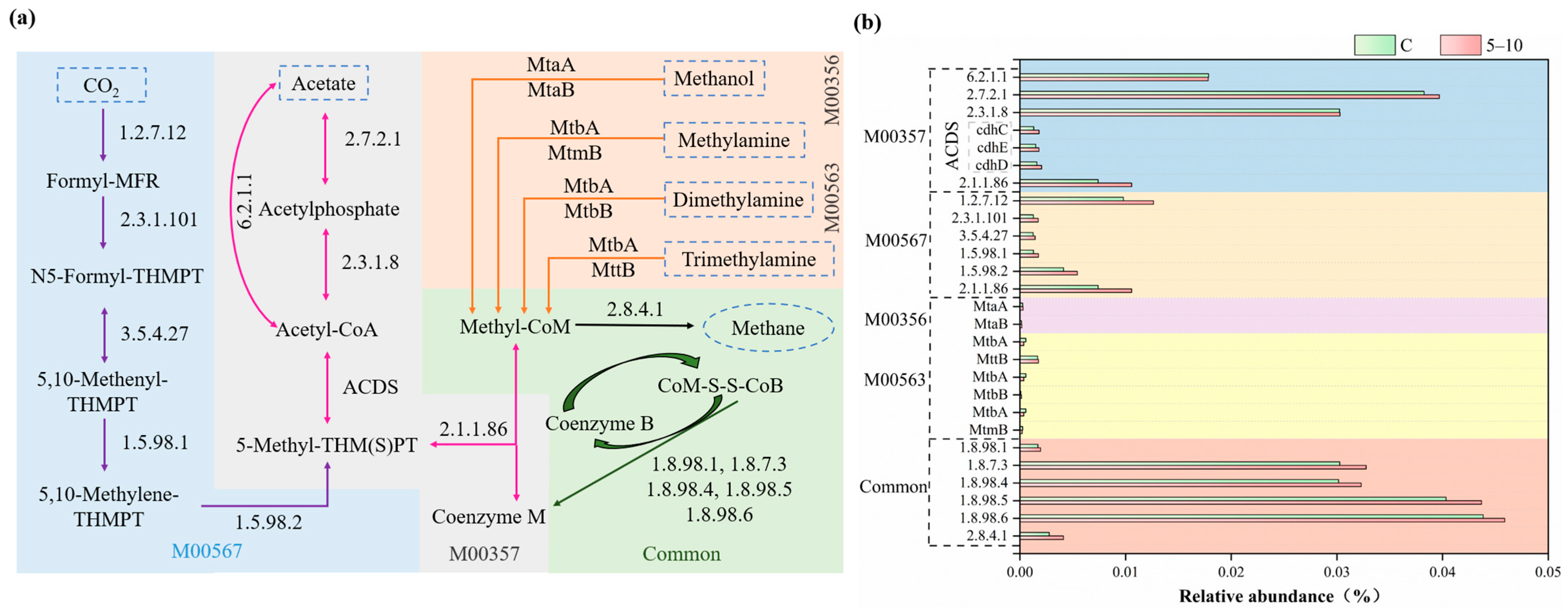
Acetate, CO2, H2, and methyl compounds are used for methane generation through the metabolism of methanogenic archaea. Methane formation involves three distinct pathways (Figure 7a): hydrogenotrophic methanogenesis (M00567), acetoclastic methanogenesis (M00357), and methylotrophic methanogenesis (M00356, M00563). The relative abundance of enzyme-encoding genes is shown in Figure 7b. The changes in the abundance of key enzymes involved in the methanogenesis process are provided in Table S1.
Figure 7. Methanogenic metabolic pathway (a) and relative abundance of genes encoding functional enzymes (b) in the methanogenic process. The dashed box indicates that the module contains relevant coding genes.
In the acetoclastic methanogenesis pathway, acetate is converted to acetyl-CoA through two pathways, as described in Section 3.4.1. Acetyl-CoA is subsequently converted to 5-methyl-tetrahydromethanopterin by acetyl-CoA decarbonylase/synthase (ACDS); the relative abundances of enzymes were upregulated in the 5–10 group. Afterwards, the methane was generated via tetrahydromethanopterin S-methyltransferase (EC: 2.1.1.86) and methyl-coenzyme M reductase (EC: 2.8.4.1). The relative abundance of EC: 2.1.1.86 and EC: 2.8.4.1 in the 5–10 group was upgraded by 42.74% and 48.69% respectively, compared to the C group. The byproduct coenzyme M-S-S-coenzyme B was converted into functional coenzyme M and coenzyme B through heterodisulfide reductases (EC: 1.8.7.3, EC: 1.8.98.1/98.4/98.5/98.6), and the relative abundance of heterodisulfide reductases was upregulated by 4.66%–15.23% in the 5–10 group. To summarize, the acetoclastic methanogenesis was enhanced.
In the hydrogenotrophic methanogenesis pathway, CO2 was converted to 5-methyl-tetrahydromethanopterin via formylmethanofuran dehydrogenase (EC: 1.2.7.12), formylmethanofuran-tetrahydromethanopterin N-formyltransferase (EC: 2.3.1.101), methenyltetrahydromethanopterin cyclohydrolase (EC: 3.5.4.27), methylenetetrahydromethanopterin dehydrogenase (EC: 1.5.98.1), and 5,10-methylenetetrahydromethanopterin reductase (EC: 1.5.98.2). The relative abundances of genes encoding these enzymes in the 5–10 group were 29.04%, 36.59%, 14.91%, 37.47%, and 31.84% higher than those in the C group, respectively. Compared with the C group, most hydrogenotrophic methanogenesis in the 5–10 group was enhanced. At the same time, the microbial structure indicated that the relative abundance of hydrogenotrophic methanogens (Methanobacterium) increased. These findings indicate that the granular inoculum could enhance the hydrogenotrophic pathway and further facilitate the conversion of H2/CO2 to methane.
In the methylotrophic methanogenesis pathway, substrates such as methanol, methylamine, dimethylamine, and trimethylamine are directly converted to the methane precursor methyl-coenzyme M and further generate methane. It should be noted that the relative abundance of genes encoding methanol-metabolizing enzymes—methanol-5-hydroxybenzimidazolylcobamide, Co-methyltransferase (MtaB), and coenzyme M methyltransferase (MtaA)—in the 5–10 group showed significant upregulation of 12.52% and 11.38% compared to the C group, respectively. For other methyl compounds, the relative abundance of genes involved in their methanogenic conversion was observed to increase or decrease (Figure 7b).

3.5. Expression of Energy Metabolism Functional Genes

The oxidative phosphorylation process is accomplished by five protein complexes, and the more detailed subunit-level gene data of the five protein complexes are provided in Tables S2–S7. Complex I (NADH-coenzyme Q oxidoreductase) catalyzes the oxidation of NADH, transferring electrons to coenzyme Q while simultaneously pumping protons to establish a transmembrane gradient. It should be noted that the gene abundance of the K00330 and K00340 subunits of Complex I was decreased in the 5–10 group, while the other 13 subunits (K00331, K00332, K00333, K13378, K00334, K00335, K00336, K00337, K00338, K00339, K00341, K00342, K00343) increased significantly in the range of 2.00%–23.03%. After the addition of granular sludge to the AD system, K00337 and K00341 showed the highest increment of 19.96% and 23.03%, respectively. Complex II (succinate dehydrogenase) catalyzes the oxidation of succinate to fumarate and transfers electrons to coenzyme Q. In the 5–10 group, some of Complex II’s relative abundance increased, and the others decreased. This was the result of subunit function and metabolic adaptability and reflected the self-regulation capacity of the anaerobic digestion system in a complex environment. Complex III (cytochrome bc1 complex) transfers electrons from coenzyme Q to cytochrome c, and further pumps protons. K00411 and K00413 were detected with the relative abundances of 3.20 × 10⁻⁷ and 3.33 × 10⁻⁷ in the 5–10 group, respectively. However, K00411 and K00413 were not detected in the C group. Complex IV (cytochrome c oxidase) catalyzes the oxidation of cytochrome c. K02258, K00404, and K00405 were observed with the relative abundances of 1.87 × 10⁻⁷, 1.43 × 10⁻⁶, and 1.87 × 10⁻⁷ in the 5–10 group, respectively, but the enzyme was not detected in the C group. The relative abundance of certain subunits of Complex I and Complex IV in the 5–10 group was upregulated; the enhancement might be beneficial for more ATP production and could promote the hydrolytic acidogenic process [19,38]. Concurrently, the relative abundance of Candidatus Cloacimonadota and Chloroflexota at the bacterial phylum level increased compared to the C group. The relative abundance of related hydrolytic acidogenic bacteria increased, and more ATP was generated. This accelerated the hydrolysis of the kitchen waste organics and further enhanced the methane production. This was consistent with the observation that the daily methane production rate in the 5–10 group was higher than that in the C group.
Methane production in AD relied on synergistic metabolism, with oxidative phosphorylation, dominated by bacteria, as the key nexus, connecting the substrate degradation to generate the precursor for methane production. The increment in the abundance of the genes involved in K00337 and K00341 indicated that Complex I potentially exhibited higher activity in the 5–10 group. The fermentative bacteria degrade the substrate and generate a large amount of NADH. NADH could be transferred to NAD+, thereby facilitating the rapid degradation of the substrate. The relative abundance of some subunit genes in Complex IV was increased in the 5–10 group, which might also regulate the redox potential in the AD system. It was conducive to strengthening the AD performance and increasing methane production.
The above results indicate that the oxidative phosphorylation system in the 5–10 group was quite different from that in the C group; the enhancement of Complex I and Complex IV might particularly enhance the relative process. It is noteworthy that Complex V (ATP synthase) catalyzes the conversion of ADP and Pi to ATP. The ATP synthesis system in bacteria and archaea was quite different: bacteria predominantly relied on the F-type ATPase (M00157), whereas archaea utilized V/A-type ATPase (M00159). The results indicated that the relative abundance of the F-type ATPase-related gene decreased in the 5–10 group. In contrast, an increment of 3.04%–22.70% was observed in archaeal V/A-type ATPase in the 5–10 group. The increments observed in K02122 and K02107 were the highest, at 22.7% and 19.12% respectively. Furthermore, it should be noted that H+-translocating ATPase (K01535), which was critical for the synthesis of ATP, showed a 37.14% increase in the 5–10 group.
Tripolyphosphate (PPPi) is degraded to diphosphate (PPi) by polyphosphate kinases, including K00937 and K22468. In the 5–10 group, the relative abundance of the gene encoding K00937 decreased, while that of K22468 increased. Subsequently, Diphosphate (PPi) was further transformed into phosphate (Pi) by diphosphatase. In the 5–10 group, the relative abundance of genes related to diphosphatase (K01507, K15986, K06019) was changed with the ratios of 15.69%, 18.22%, and −30.26%, respectively, compared to the C group.

3.6. Regulation of Genetic Information Processing

Genetic information processing is critical for cellular life activities, and the synthesis of all enzymes requires the replication, transcription, and translation of genetic material. Consequently, detailed information on DNA replication, transcription, and translation was analyzed.

3.6.1. DNA Replication

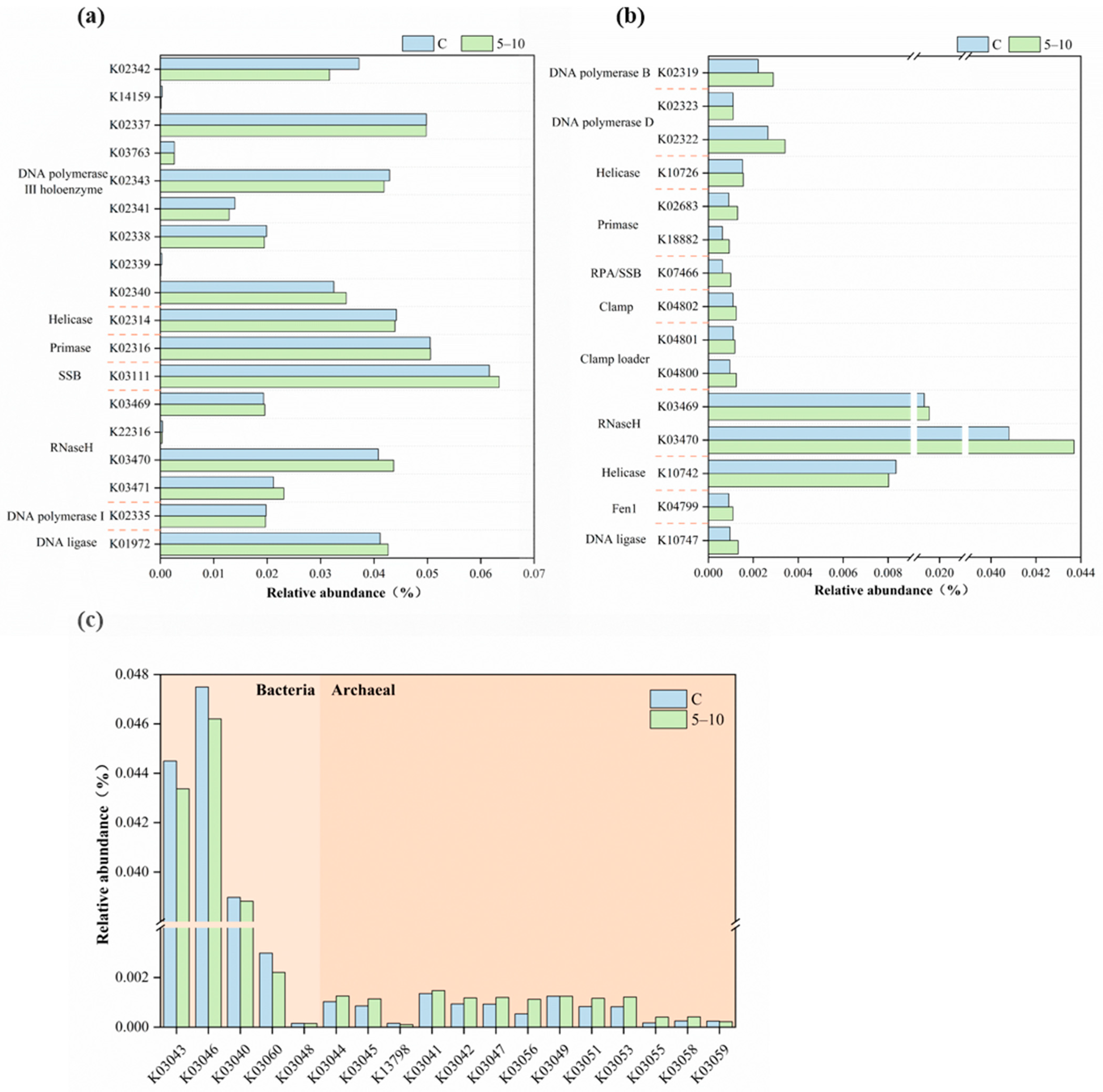
Figure 8a presents the relative abundance of genes encoding the enzymes that were essential for bacterial DNA replication. The double helix structure is unwound by helicase (K02314) during the initiation phase of DNA replication. The relative abundance of K02314 was 0.0442% and 0.0439% in the C and 5–10 groups, respectively. After the unwinding of the DNA, the association of single-strand binding proteins (SSB) and the exposed single-stranded DNA could prevent reannealing. The relative abundance of the SSB-encoding gene (K03111) in the 5–10 group was 2.98% higher than that in the C group. Furthermore, the primase (K02316) utilizes the single-stranded DNA template to generate RNA primers in the subsequent primer synthesis stage. The relative abundance of K02316 was 0.0506% in the 5–10 group and 0.0505% in the C group.
Figure 8. Relative abundance of genes encoding functional enzymes in bacterial DNA replication (a), functional enzymes in archaeal DNA replication (b), and subunits constituting RNA polymerases in bacteria and archaea (c). The dashed lines indicate that the module contains relevant coding genes.
During the DNA replication stage, a complex was formed with the DNA clamp and the DNA polymerase. Then, the new DNA fragments were synthesized by the continuous addition of deoxynucleotides following the principle of complementary base pairing. The results indicate that only the relative abundance of the DNA polymerase K02340 was slightly higher in the 5–10 group than that in the C group. The relative abundance of other DNA polymerase genes and the DNA clamp gene (K02338) was lower than that in the C group. Notably, the relative abundance of the DNA ligase (K01972) in the 5–10 group was 3.69% higher than that in the C group.
RNA–DNA hybrid molecules were formed by the combination of both RNA primers and the unwound single-stranded DNA. In this way, the action of ribonucleases (RNases) was required to hydrolyze these RNA–DNA hybrid molecules, and thus proper single-stranded DNA templates were generated for the continuous DNA strand elongation catalyzed by DNA polymerases. In the 5–10 group, the abundance of K22316 was lower than that in the C group, while K03469, K03470, and K03471 were 1.13%, 7.10% and 9.32% higher than in the C group. To summarize, compared to the C group, the abundance of most genes involved in bacterial DNA replication was lower in the 5–10 group, indicating the limited promotion of bacterial DNA replication by the introduction of granular sludge.
Archaeal DNA replication required the incorporation of DNA polymerase, helicase, primase, ribonuclease, and DNA ligase; the relative abundance can be seen in Figure 8b. It was found that despite the slight decrement in relative abundance of the K10742 (0.00835% in the C group and 0.00802% in the 5–10 group), the other encoding genes of DNA replication exhibited increased abundance compared to the C group. Metagenomics indicated that most enzymes involved in archaeal DNA replication in the 5–10 group increased compared to the C group. This indicated that the granular sludge inoculum could strengthen the archaeal DNA replication and promote methanogen proliferation. This may have been the reason the highest methane production rate was observed in the 5–10 group.

3.6.2. Gene Transcription

Transcription is a crucial process for transferring genetic information from DNA to RNA, and is catalyzed by RNA polymerase. It can be seen in Figure 8c that the bacterial RNA polymerase in the 5–10 group decreased at different levels. As for the archaea, although the relative abundance of K13798, K03049, and K03059 decreased, the relative abundance of other RNA polymerase subunit genes all increased. The relative abundances of K03044, K03045, K03041, K03042, K03047, K03056, K03051, K03053, K03055, and K03058 in the 5–10 group increased by 22.44%, 33.42%, 8.78%, 26.19%, 28.99%, 108.93%, 40.37%, 48.23%, 130.33%, and 67.85%, respectively. These results suggest that the introduction of granular sludge may selectively enhance the transcription process in archaea. The relative abundance of K03055 and K03056 in the 5–10 group was 130.33% and 108.93% higher than that in the C group. The K03055 and K03056 were the subunits of archaeal RNA polymerase. K03055 was an important catalytic core and component of the RNA polymerase. It participated in the unwinding and ensured that the RNA strand was elongated along the DNA template in the transcription process. K03055 and K03056 function cooperatively; K03056 mainly participates in nucleotide recognition and selection, and further ensures the high efficiency and accuracy of RNA transcription. The relative abundance of the enzymes involved in RNA transcription increased, indicating that granular sludge inoculum facilitated more mRNA synthesis and produced more functional enzymes. This further enhanced methane production in the 5–10 group, consistent with the results presented in Section 3.4.2. Higher methane production was observed in the 5–10 group, and the pathways for both acetoclastic methanogenesis and hydrogenotrophic methanogenesis were strengthened. This may alleviate acid inhibition, reduce hydrogen partial pressure, and enhance system stability.

3.6.3. Protein Translation

The expression of genetic information in mRNA is achieved through the translation process, and this process is mediated by ribosomes. Ribosomes consist of both large and small subunits, and their function relies on their dynamic dissociation and reassembly. The small subunit first recognizes and binds to the mRNA start codon before the large subunit takes part in tRNA positioning, peptide bond formation, and translocation.
In bacteria, the relative abundance of some bacterial ribosomal proteins was decreased (14 out of 33 large subunit proteins and 9 out of 21 small subunit proteins were downregulated, as shown in Tables S8 and S9). In contrast, a lower reduction was observed in archaeal ribosomes, with only 6 out of 35 large subunit proteins and 7 out of 25 small subunit proteins decreasing (as shown in Tables S10 and S11). The decrease in nearly half of the bacterial ribosomal proteins potentially indicates impaired translation efficiency. Meanwhile, only about 20% of archaeal ribosomal proteins decreased, and the majority increased compared to the C group. These results indicate that the introduction of granular sludge might selectively enhance the archaeal translation system, while its impact on bacterial translation was limited.

4. Conclusions

This study investigated the regulatory mechanism of granular sludge addition in the AD of kitchen waste. The results indicated that the inoculation of granular sludge at 10 g every 5 days could enhance the methane production rate by 43.21%, while maintaining pH and NH3-N concentrations in the optimal range at <3000 mg/L. The three-dimensional fluorescence spectroscopy results indicated that humic acid substances potentially serve as an electron shuttle, which facilitates the DIET. The microbial community structure analysis indicated that the enrichment of both Cloacimonadota and Methanobacterium was possibly beneficial for organic degradation and methane production. At the molecular level, the irreversible metabolic pathways were strengthened, thereby enhancing the transformation of acetyl-CoA. Furthermore, the MtaA/MtaB genes in the methylotrophic methanogenesis pathway were upregulated. With respect to energy metabolism, both complex I and the archaeal V/A-type ATPase enhanced energy conversion efficiency. Additionally, the inoculation of granular sludge activated the archaeal genetic information processing system, further demonstrating its regulatory effect on the metabolic network of archaea. These findings provide a theoretical basis for a microbial enhancement strategy for kitchen waste AD.

Supplementary Materials

The following supporting information can be downloaded at: https://www.mdpi.com/article/10.3390/su172410956/s1, Figure S1: Reaction device diagram of this experiment; Table S1: The relative abundance of genes encoding involved in methanogenesis metabolism (bolding the larger of 5-10 and C); Table S2: The relative abundance of genes encoding Complex I (M00144) involved in energy metabolism (bolding the larger of 5-10 and C); Table S3: The relative abundance of genes encoding Complex Ⅱ (M00149) involved in energy metabolism (bolding the larger of 5-10 and C); Table S4: The relative abundance of genes encoding Complex Ⅲ involved in energy metabolism (bolding the larger of 5-10 and C); Table S5: The relative abundance of genes encoding Complex Ⅳ involved in energy metabolism (bolding the larger of 5-10 and C); Table S6: The relative abundance of genes encoding Complex Ⅴ involved in energy metabolism (bolding the larger of 5-10 and C); Table S7: The relative abundance of coding genes involved in ATP synthesis in energy metabolism (bolding the larger of 5-10 and C); Table S8: Relative abundance of genes encoding large subunits in bacterial ribosomes (bolding the larger of 5-10 and C); Table S9: Relative abundance of genes encoding small subunits in bacterial ribosomes (bolding the larger of 5-10 and C); Table S10: Relative abundance of genes encoding large subunits in archaeal ribosomes (bolding the larger of 5-10 and C); Table S11: Relative abundance of genes encoding small subunits in archaeal ribosomes (bolding the larger of 5-10 and C).

Author Contributions

Data curation, X.W. and N.F.; Funding acquisition, Z.L.; Investigation, X.W. and Y.H.; Project administration, Y.H.; Resources, Z.L.; Software, X.W.; Supervision, Y.H.; Writing—original draft, Y.H., X.W. and N.F.; Writing—review & editing, N.F. All authors have read and agreed to the published version of the manuscript.

Funding

This research was supported by the “Ganpo Juncai Support Program—Training Program for Academic and Technical Leaders in Major Disciplines (20243BCE51137)” and the “Open Research Fund of Jiangxi Provincial Key Laboratory of Environmental Pollution Control (HJWRFZ-Z-2024-08)”.

Institutional Review Board Statement

Not applicable.

Data Availability Statement

The data presented in this study are available on request from the first author.

Conflicts of Interest

All authors declare that the research was conducted in the absence of any commercial or financial relationships that could be construed as a potential conflict of interest.

References

  1. Gao, B.; Xue, Y.; Li, S.; Yang, J.; Dou, M.; Li, X. Modified ultrafiltration membrane to improve organic matter conversion in anaerobic digestion of kitchen waste: Performance and separation mechanism. J. Environ. Chem. Eng. 2025, 13, 118078. [Google Scholar] [CrossRef]
  2. Prepilková, V.; Poništ, J.; Schwarz, M.; Samešová, D. Challenges and opportunities for kitchen waste treatment—A review. Environ. Rev. 2023, 31, 632–642. [Google Scholar] [CrossRef]
  3. Wang, Z.; Li, L.; Hong, Y. Trilogy of comprehensive treatment of kitchen waste by bacteria-microalgae-fungi combined system: Pretreatment, water purification and resource utilization, and biomass harvesting. Sci. Total Environ. 2024, 949, 175160. [Google Scholar] [CrossRef]
  4. Hu, Y.; Wang, X.; Zhang, S.; Liu, S.; Hu, T.; Wang, X.; Wang, C.; Wu, J.; Xu, L.; Xu, G.; et al. Microbial response behavior to powdered activated carbon in high-solids anaerobic digestion of kitchen waste: Metabolism and functional prediction analysis. J. Environ. Manag. 2023, 337, 117756. [Google Scholar]
  5. Chen, L.; Li, S.; Zhang, J.; Zhen, F.; Shang, Z.; Yan, M.; Zhang, Y.; Zhang, P.; Sun, Y.; Li, Y. A critical review on bioaugmentation assisted anaerobic digestion for methane production: Performances, microbiome-functionalities and challenges. J. Environ. Manag. 2025, 380, 125127. [Google Scholar] [CrossRef]
  6. Fang, X.; Li, X.; Li, X.; Fan, J.; Yan, Y.; Tu, J. Characterization and quantitively analysis on the high solid anaerobic digestion in the large scale Stirred Tank Reactor. Renew. Energy 2025, 241, 122326. [Google Scholar] [CrossRef]
  7. Chen, W.; Bian, S.; Zhou, X.; Jia, R.; Li, X.; Yuan, H.; Zuo, X. Effect of the inoculum from different substrates on anaerobic digestion performance of corn stover and the microbial mechanisms analysis. Fuel 2024, 366, 131302. [Google Scholar] [CrossRef]
  8. Gong, Y.; Jin, Z.; Wang, X.; Zhang, Y. Improving methane production and 4-chlorophenol removal in anaerobic digestion of corn straw by adding Phanerochaete chrysosporium and biochar under microaerobic conditions. Water Res. 2025, 270, 122845. [Google Scholar] [CrossRef]
  9. Dohdoh, A.M.; Aboulfotoh, A.M. Hydrodynamic characteristics of UASB granular sludge produced from combined anaerobic/aerobic treatment systems. Desalination Water Treat. 2018, 124, 232–239. [Google Scholar] [CrossRef]
  10. Cui, P.; Ge, J.; Chen, Y.; Zhao, Y.; Wang, S.; Su, H. The Fe3O4 nanoparticles-modified mycelium pellet-based anaerobic granular sludge enhanced anaerobic digestion of food waste with high salinity and organic load. Renew. Energy 2022, 185, 376–385. [Google Scholar] [CrossRef]
  11. Zhang, S.; Hu, Y.; Fu, N.; Wu, J.; Wei, Q.; Wang, X.; Wang, X.; Hu, F. Enhancing kitchen waste anaerobic digestion by recycled aluminum industry waste: Alkali treatment and potential electron transfer mechanism. J. Environ. Chem. Eng. 2024, 12, 112409. [Google Scholar] [CrossRef]
  12. Zhang, A.; Gao, C.; Chen, T.; Xie, Y.; Wang, X. Treatment of fracturing wastewater by anaerobic granular sludge: The short-term effect of salinity and its mechanism. Bioresour. Technol. 2022, 345, 126538. [Google Scholar] [CrossRef]
  13. Jiang, J.; Li, L.; Li, Y.; He, Y.; Wang, C.; Sun, Y. Bioaugmentation to enhance anaerobic digestion of food waste: Dosage, frequency and economic analysis. Bioresour. Technol. 2020, 307, 123256. [Google Scholar] [CrossRef]
  14. Americal Publish Health Association. Standard Methods for the Examination of Water and Wastewater; Americal Publish Health Association: Washington, DC, USA, 2005. [Google Scholar]
  15. Linsong, H.; Lianhua, L.; Ying, L.; Changrui, W.; Yongming, S. Bioaugmentation with methanogenic culture to improve methane production from chicken manure in batch anaerobic digestion. Chemosphere 2022, 303, 135127. [Google Scholar] [CrossRef] [PubMed]
  16. Wang, X.; Li, X.; Xie, Y.; Zhang, J.; Ran, J.; Zhang, M.; Zhang, L.; Zhang, A.; Zhu, C. Enhancing anaerobic digestion of actual papermaking wastewater with addition of Fenton sludge. J. Water Process Eng. 2024, 63, 105520. [Google Scholar] [CrossRef]
  17. Li, Z.-Y.; Inoue, D.; Ike, M. Mitigating ammonia-inhibition in anaerobic digestion by bioaugmentation: A review. J. Water Process Eng. 2023, 52, 103506. [Google Scholar] [CrossRef]
  18. Wang, K.; Yun, S.; Ke, T.; An, J.; Abbas, Y.; Liu, X.; Zou, M.; Liu, L.; Liu, J. Use of bag-filter gas dust in anaerobic digestion of cattle manure for boosting the methane yield and digestate utilization. Bioresour. Technol. 2022, 348, 126729. [Google Scholar] [CrossRef]
  19. Jiang, X.; Li, Z.; Lin, K.; Zhao, Y.; Su, L.; Wu, T.; Zhou, T. Enhancement of anaerobic digestion from food waste via inert substances based on metagenomic analysis: Oxidative phosphorylation and metabolism. Environ. Res. 2024, 246, 118033. [Google Scholar] [CrossRef] [PubMed]
  20. Wang, X.; Han, M.; Li, W.; Liu, X.; Lv, L.; Gao, W.; Liu, X.; Sun, L.; Liang, J.; Zhang, G.; et al. Enhanced anaerobic digestion of landfill leachate based on a novel redox mediator: Synergistic mechanism of enhancing extracellular electron transfer. Chem. Eng. J. 2024, 490, 151649. [Google Scholar] [CrossRef]
  21. Yuan, Y.; Cai, X.; Wang, Y.; Zhou, S. Electron transfer at microbe-humic substances interfaces: Electrochemical, microscopic and bacterial community characterizations. Chem. Geol. 2017, 456, 1–9. [Google Scholar] [CrossRef]
  22. He, Z.-W.; Wang, F.; Zou, Z.-S.; Tang, C.-C.; Zhou, A.-J.; Liu, W.; Ren, Y.-X.; Li, Z.; Wang, A. Recent advances and perspectives in roles of humic acid in anaerobic digestion of waste activated sludge. Chem. Eng. J. 2023, 466, 143081. [Google Scholar] [CrossRef]
  23. Jiang, J.; Kappler, A. Kinetics of Microbial and Chemical Reduction of Humic Substances: Implications for Electron Shuttling. Environ. Sci. Technol. 2008, 42, 3563–3569. [Google Scholar] [CrossRef]
  24. Liu, Y.; Ying, L.; Li, H.; Awasthi, M.K.; Tian, D.; He, J.; Zou, J.; Lei, Y.; Shen, F. Allophane improves anaerobic digestion of chicken manure by alleviating ammonia inhibition and intensifying direct interspecies electron transfer. Bioresour. Technol. 2024, 400, 130692. [Google Scholar] [CrossRef]
  25. Wang, L.; He, Y.; Zhu, Y.; Ping, Q.; Li, Y. Insight into using hydrochar to alleviate ammonia nitrogen inhibition during anaerobic digestion of waste activated sludge: Performance, metagenomic and metabolomic signatures. Sci. Total Environ. 2024, 916, 170196. [Google Scholar] [CrossRef]
  26. Wang, R.; Li, C.; Lv, N.; Pan, X.; Cai, G.; Ning, J.; Zhu, G. Deeper insights into effect of activated carbon and nano-zero-valent iron addition on acidogenesis and whole anaerobic digestion. Bioresour. Technol. 2021, 324, 124671. [Google Scholar] [CrossRef]
  27. Yu, C.; Dongsu, B.; Tao, Z.; Zhe, K.; Xintong, J.; Siqi, W.; Ming, C.; Zheng, S.; Yalei, Z. Anaerobic co-digestion of PBAT/PLA/starch commercial bio-plastic bags with food waste: Effects on methane production and microbial community structure. Biochem. Eng. J. 2023, 199, 109072. [Google Scholar] [CrossRef]
  28. Hu, Y.; Wei, Q.; Wang, X.; Zhang, S.; Liu, S.; Fu, N.; Liu, Z.; Zou, Z.; Wu, J.; Wang, C. Enhancing High Solid Anaerobic Digestion of Kitchen Waste with Red Mud Addition: Performance and Microbial Community. Water Air Soil Pollut. 2024, 235, 34. [Google Scholar] [CrossRef]
  29. Öztep, G.; Güngören-Madenoğlu, T.; Özdemir, G.; Işık, E.; Serez, H.; Kabay, N.; Yüksel, M. Optimization and microbial community analysis for anaerobic digestion of water hyacinth (Eichhornia crassipes) with waste sludge at different solid contents and temperatures. Environ. Technol. Innov. 2023, 32, 103395. [Google Scholar] [CrossRef]
  30. Sakaveli, F.; Petala, M.; Tsiridis, V.; Karas, P.A.; Karpouzas, D.G.; Darakas, E. Effect of attapulgite on anaerobic digestion of primary sludge and downstream valorization of produced biosolids. Renew. Energy 2023, 217, 119211. [Google Scholar] [CrossRef]
  31. Yang, J.; Liu, K.; Yi, W.; Si, B.; Tian, C.; Yang, G. Effects of biochar, granular activated carbon, and magnetite on the electron transfer of microbials during the anaerobic digestion process: Insights into nitrogen heterocyclic compounds degradation. Fuel 2024, 358, 130079. [Google Scholar] [CrossRef]
  32. Hu, P.; Xiao, M.; Wang, N.; Zhang, S.; Shi, J.; Shi, J.; Tang, T.; Liu, L. Metagenome reveals the possible mechanism that microbial strains promote methanogenesis during anaerobic digestion of food waste. Environ. Res. 2024, 251, 118723. [Google Scholar] [CrossRef]
  33. Rotaru, A.-E.; Shrestha, P.M.; Liu, F.; Shrestha, M.; Shrestha, D.; Embree, M.; Zengler, K.; Wardman, C.; Nevin, K.P.; Lovley, D.R. A new model for electron flow during anaerobic digestion: Direct interspecies electron transfer to Methanosaeta for the reduction of carbon dioxide to methane. Energy Environ. Sci. 2014, 7, 408–415. [Google Scholar] [CrossRef]
  34. Zhong, Y.; He, J.; Zhang, P.; Zou, X.; Pan, X.; Zhang, J. Effects of different particle size of zero-valent iron (ZVI) during anaerobic digestion: Performance and mechanism from genetic level. Chem. Eng. J. 2022, 435, 134977. [Google Scholar] [CrossRef]
  35. Zhang, W.; Kong, T.; Xing, W.; Li, R.; Yang, T.; Yao, N.; Lv, D. Links between carbon/nitrogen ratio, synergy and microbial characteristics of long-term semi-continuous anaerobic co-digestion of food waste, cattle manure and corn straw. Bioresour. Technol. 2022, 343, 126094. [Google Scholar] [CrossRef] [PubMed]
  36. Rahimieh, A.; Akhavan, G.; Mousazadehgavan, M.; Mehriar, M.; Javadi, A. Propionate production and degradation in the biological wastewater treatment: A mini review on the role of additives in anaerobic digestion. Desalination Water Treat. 2024, 319, 100555. [Google Scholar] [CrossRef]
  37. Shi, X.; Yasuda, S.; Wang, Z.; Hu, Y.; Wu, G.; Lens, P.; Zhan, X. Microbial transitions and degradation pathways driven by butyrate concentration in mesophilic and thermophilic anaerobic digestion under low hydrogen partial pressure. Bioresour. Technol. 2025, 419, 132012. [Google Scholar] [CrossRef]
  38. Li, Y.; Park, J.-S.; Deng, J.-H.; Bai, Y. Cytochrome c oxidase subunit IV is essential for assembly and respiratory function of the enzyme complex. J. Bioenerg. Biomembr. 2006, 38, 283–291. [Google Scholar] [CrossRef]
Disclaimer/Publisher’s Note: The statements, opinions and data contained in all publications are solely those of the individual author(s) and contributor(s) and not of MDPI and/or the editor(s). MDPI and/or the editor(s) disclaim responsibility for any injury to people or property resulting from any ideas, methods, instructions or products referred to in the content.

Article Metrics

Citations

Article Access Statistics

Multiple requests from the same IP address are counted as one view.