1. Introduction
With the continuous escalation of global warming, climate change has become a major long-term global risk, significantly increasing the frequency and severity of disasters, posing a serious threat to economic and social activities [
1,
2]. The frequency of extreme heat events in China has increased significantly since the 20th century.
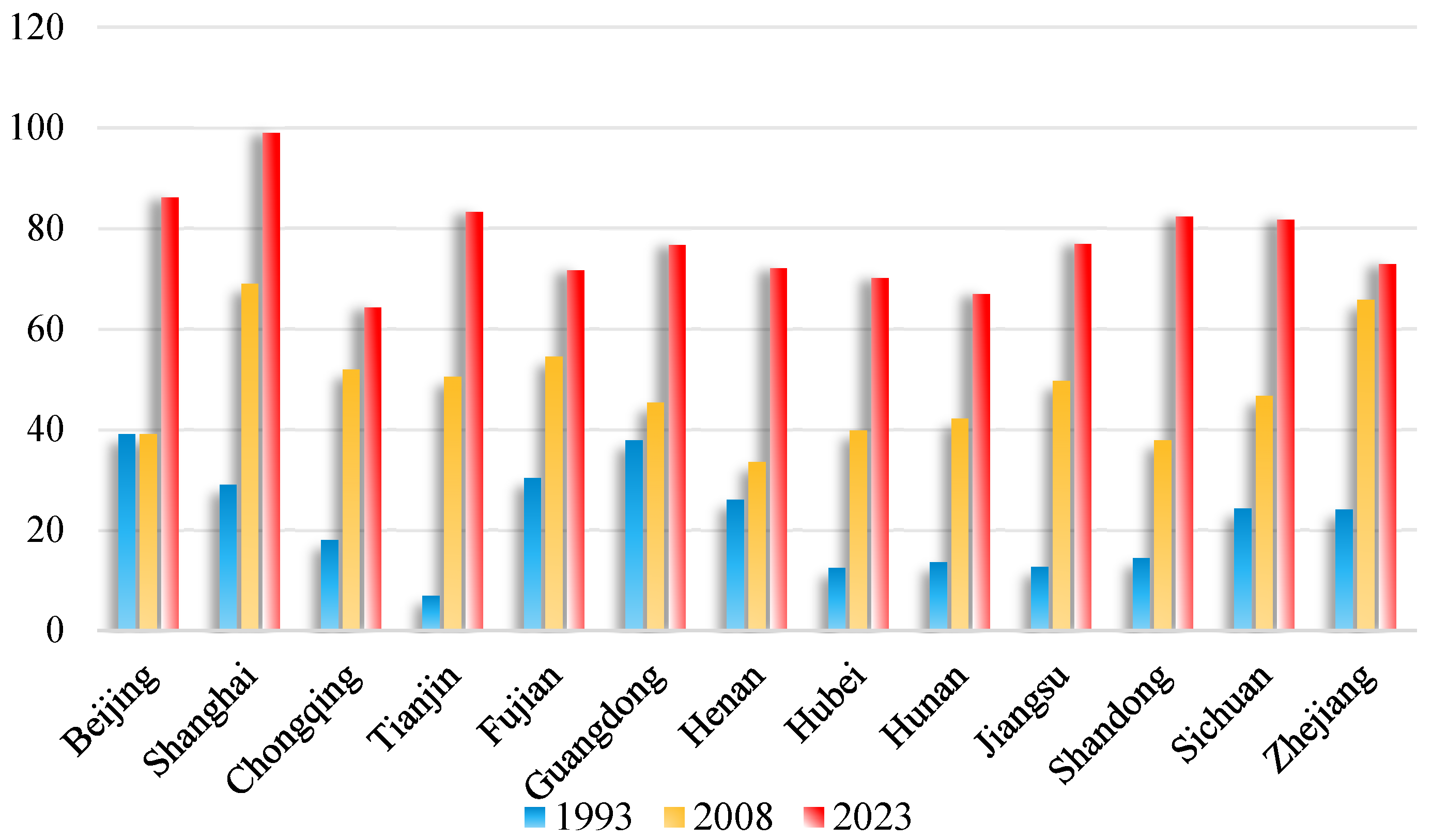
Figure 1 shows the number of extreme hot days in China’s municipalities directly under the central government and the top 10 cities by GDP. Since 1993, extreme weather events in these economic centers have become increasingly intense, posing a potential risk to social development. Therefore, it is urgently necessary to enhance climate adaptability and environmental governance comprehensively. Green innovation (GI) is essential to create sustainable momentum [
3]. It provides crucial support for enterprises to effectively cope with climate change fluctuations [
4]. By using green technologies, enterprises can significantly reduce pollutant emissions and environmental risks. Therefore, research on strategies for improving the quantity and quality of enterprises’ green innovation (Q&Q) should be given attention.
Existing studies have extensively researched the factors influencing enterprises’ Q&Q. Although there are still apparent controversies, these influencing factors involve both firms’ internal and external aspects, including not only internal elements such as the firm’s management strategy [
5] and corporate culture [
6] but also external aspects such as the market environment [
7] and social expectations [
8]. Although existing studies have provided in-depth analyses of the impact factors of corporate green innovation, in the context of increasing extreme climate risks, limited research has explored the role of climate risk perception (CRP) on firms’ green innovation, particularly in relation to intrinsic motivation. Unlike climate risk exposure (where enterprises objectively face climate events) and climate risk response (a series of direct measures taken by enterprises to address climate risks in the short term), climate risk perception refers to the subjective understanding, interpretation, and degree of attention that management attaches to these risks. It is more likely to have an impact on enterprises from the perspectives of decision-making and long-term interests.
According to prospect theory, the psychological impact of losses is usually twice that of the impact of the same-value gains. This loss aversion enables enterprises to respond more quickly and intensely when facing climate risks—whether it is potential environmental damage or sudden policy tightening—and even invest excess resources to avoid possible losses. In fact, when enterprises become aware of the risks associated with climate uncertainty, they are likely to take measures to prevent potential losses and stimulate a range of green behaviours, such as reducing pollution emissions, increasing environmental governance costs, and actively disclosing ecological conditions [
9,
10]. Specifically, CRP may first encourage firms to hire more managers with environmental backgrounds, who may be more inclined to engage in ecological behaviors. Second, CRP may allow firms to make preventive green investments, promote environmental restoration, and reduce pollution emissions to mitigate possible climate risk events. Third, the response of different firms to climate change shocks varies according to their exposure to climate risk and their perceptions of the environment [
11]. Therefore, only by incorporating CRP into the analytical framework can heterogeneous leaps in the Q&Q be accurately identified.
Therefore, we collect the companies listed in dataset from the past decade to investigate how firms’ climate risk perception impacts the Q&Q. Specifically, we adopt a two-way fixed effects panel model to examine the relationship of CRP and Q&Q. We adopt the mediating effect model to examine the mechanism channels, including the effect of the proportion of executives with environmental backgrounds, and green investment. Furthermore, the model provides evidence of moderating effects of external digital integration and executives’ internal experience in overseas management. In addition, group regressions are employed according to the degree of pollution and technological characteristics to test heterogeneous effects.
This study provides three potential contributions: First, we innovatively construct a firm-level CRP index by combining textual analysis and machine learning. The existing literature rarely considers that Chinese enterprises face climate change when constructing alternatives to mitigate climate risks. Therefore, this study utilizes the Word2Vec model to expand the climate risk vocabulary to a Chinese context, thereby building the CRP index for listed enterprises. Second, we add to the literature by exploring the effect of improvement of Q&Q from a climate risk perspective. Most scholars tend to explore green innovation from the viewpoint of external policies [
12], internal enterprise resources [
13], and management [
14]; few studies have considered the dual effects of CPR on the Q&Q. Third, this paper takes the Porter hypothesis as the entry point to explore the innovation compensation effect, further expanding the mechanism of corporate green innovation. Most of the existing literature examines policies or corporate finance [
15,
16], but has not yet focused on the potential mediating role of the environmental background of senior executives and green investment. Furthermore, this paper examines the moderating effects of internal digital integration and senior executives’ external experience in overseas management.
The subsequent text is arranged as follows:
Section 2 summarizes the existing research,
Section 3 integrates theories to inform our research hypotheses,
Section 4 builds models and introduces the data,
Section 5 interprets the empirical results, and
Section 6 concludes.
2. Literature Review
Existing research primarily focuses on the economic impact of climate change at both the macro and micro levels. At the macro level, the effects of climate change on national finance and the economy are very significant, including on the return rate of stocks in the same period [
17], stock price volatility [
15], bond price volatility [
16], green index volatility [
18], and energy market risk transmission [
19]. For example, Mukherjee and Ouattara (2021) argue that the impact of temperature could lead to market inflation [
20]. Shang et al. (2022) propose that climate policy uncertainty has reduced demand for traditional energy sources in the US energy market [
21]. These studies highlight the macroeconomic impact of climate change risk and provide profound insights into the interaction between the two.
At the micro level, climate change risk, as an external variable beyond the control of firms [
22], has important implications for firm operations and decision-making, for example, cash requirements [
23], capital debt structure [
24], optimization and reform of firms’ production network [
25], cross-regional investment risk decisions [
26], daily operational cost control [
27], and green innovation [
28]. Moreover, the effects include both positive and negative effects. For example, Li and Zhang [
24] believe that firms could reduce financial leverage in the face of climate uncertainty. Gong et al. [
29] argued that a firm’s exposure to climate change is positively correlated with return volatility. In summary, assessing climate change risk at the micro level is complex, posing financial and operational challenges and potential growth opportunities for firms.
Meanwhile, some scholars mainly explore the factors influencing the Q&Q from internal and external aspects. The internal factors include corporate environmental responsibility [
30], digital transformation [
31], ESG performance [
32], and management turnover [
33]. External factors include environmental legislation [
34], carbon trading policies [
35], green finance policies [
7,
36], the digital economy [
37], and other relevant factors. For example, Song et al. [
37] propose that the digital economy can enhance the quantity and quality of green innovation. Although the existing literature about green innovation is quite rich, few scholars have analyzed issues related to corporate green innovation from the perspective of firms’ CRP.
To summarize, three research gaps remain that require further exploration. First, exploration of the micro-effects of climate risks has primarily been limited to the financial and operational dimensions. Few studies have examined the impact of climate risks on green innovation, a key strategic asset. Second, the internal mechanism of how CRP drives the quantitative expansion and qualitative leapgrowth of green innovation remains a black box. Third, potential transmission paths, from climate risk perception and executive environmental background to preventive green investment, have not yet been systematically identified and tested, and urgently require supplementation and expansion.
3. Theoretical Analysis and Research Hypotheses
As Schumpeter proposed initially in the theory of innovation, enterprise innovation constitutes a creative response to market disequilibrium. When firms recognize the physical and transitional risks associated with climate change, such awareness disrupts existing technological equilibria and prompts the reallocation of resources toward green technologies [
38]. First, risk perception lowers the threshold for adopting green technologies and accelerates the development and diffusion of clean technologies [
39]. At the strategic level, the recognition of both physical and transition risks motivates firms to adjust their technological trajectories and increase investment in environmentally sustainable innovations. From the perspectives of talent acquisition and capital allocation, perceived risks signal emerging opportunities. This awareness encourages enterprises to attract personnel with expertise in green technologies and to increase the share of investments dedicated to environmental initiatives, thereby establishing a foundation for long-term sustainability [
40].
Second, drawing on the theory of path dependence, firms may develop entrenched reliance on polluting technologies due to historical experience; however, heightened risk perception can mitigate this inertia, enabling a shift toward cleaner alternatives and fostering sustainable development [
41]. Under pressure from environmental regulations, firms face long-term financial penalties for continuing to use traditional, high-emission technologies. They are incentivized to restructure internal production processes, reduce their dependence on carbon-intensive products, and develop low-carbon product lines, thereby generating sustained demand for green innovation [
42].
Third, grounded in the theory of innovation ecosystems, CRP can reshape corporate innovation frameworks. With forward-looking strategic planning, increased awareness of climate risks leads firms to place greater emphasis on external collaboration and knowledge exchange during the innovation process. Consequently, firms are more likely to form strategic alliances with universities and research institutions specializing in green technologies. This open innovation model enhances both the speed and quality of innovation output [
43], allowing firms to accelerate the advancement of green technologies. Therefore, only by integrating CRP into long-term strategic planning—rather than by treating it as a short-term compliance obligation—can firms achieve sustained, high-quality green innovation. Therefore, we propose the following:
Hypothesis 1:
The CRP can boost green innovation, and quantity promotion is more obvious.
According to Porter’s hypothesis, green innovation initiatives undertaken by enterprises can generate compensatory advantages, encompassing both product and process improvements. Product-related benefits arise as corporate innovation and the development of environmentally products enhance a firm’s reputation and market competitiveness. Process-related gains stem from reductions in per-unit production costs and improved economic performance. At the strategic level, companies increasingly prioritise the recruitment and advancement of executives with environmental expertise, who leverage their specialized knowledge to manage environmental risks and crises effectively [
44]. The environmental competence of senior management not only enhances organizational capacity to understand and respond to climate transition risks but also guides the realignment of strategic priorities, reinforcing green innovation as a source of long-term competitive advantage [
45]. Such executives’ long-term orientation facilitates the formulation of sustainable development strategies, reduces dependence on traditional, high-pollution technologies, and promotes sustained investment in green innovation, thereby enhancing green innovation performance [
46].
At the financial level, escalating climate volatility drives firms to allocate greater resources toward green technologies and sustainable production. This shift represents not merely incremental capital adjustment but a fundamental realignment of corporate strategic focus. Green investments meet the necessary conditions and capital requirements to foster green innovation [
47]. Consequently, enterprises treat green investment as a core strategic response, systematically channeling funds into areas such as renewable energy adoption, energy efficiency enhancement, and pollution control. These investments modernize production infrastructure and, more importantly, cultivate a robust and sustainable green R&D capability. For example, clean energy installations provide platforms for testing emerging technologies, energy-saving equipment upgrades foster innovations in complementary processes, and investments in environmental governance catalyze breakthroughs in circular economy technologies. The resulting knowledge accumulation enables firms to transition from passive regulatory compliance to proactive innovation. Over time, this leads to significant advancements in green technology patents and eco-friendly product development, culminating in a strategic evolution from risk adaptation to innovation leadership [
48]. Therefore, we propose the following:
Hypothesis 2:
The CRP can enhance Q&Q by leveraging executives with corporate environmental backgrounds and green investment expertise.
The digital integration of external and international management experience of internal executives can contribute to the role of CRP in driving green innovation. From the perspective of external digitalization, first, the systematic application and integration of digital technologies can enhance enterprises’ identification accuracy and response speed of climate risks and transform ambiguous climate threats into specific emission reduction and innovation demands, which improve the pertinence of GI [
49]; second, digital integration enhances operational efficiency and frees up more research and development (R&D) resources, enabling enterprises to increase the Q&Q.
From the perspective of internal executives, those with overseas management experience are more familiar with international climate governance practices and can make systematic, innovative decisions by keenly transforming CRP [
26]. This global perspective prompts enterprises to prioritize the layout of technologies with international compatibility when pursuing patents, rather than simply complying with environmental regulations. Additionally, the cognitive flexibility gained from overseas experience can help mitigate the tendency toward defensive innovation. The signal theory suggests that the overseas experience of senior executives, as a reliable signal of capability, can not only effectively attract the attention of domestic and foreign investors and partners [
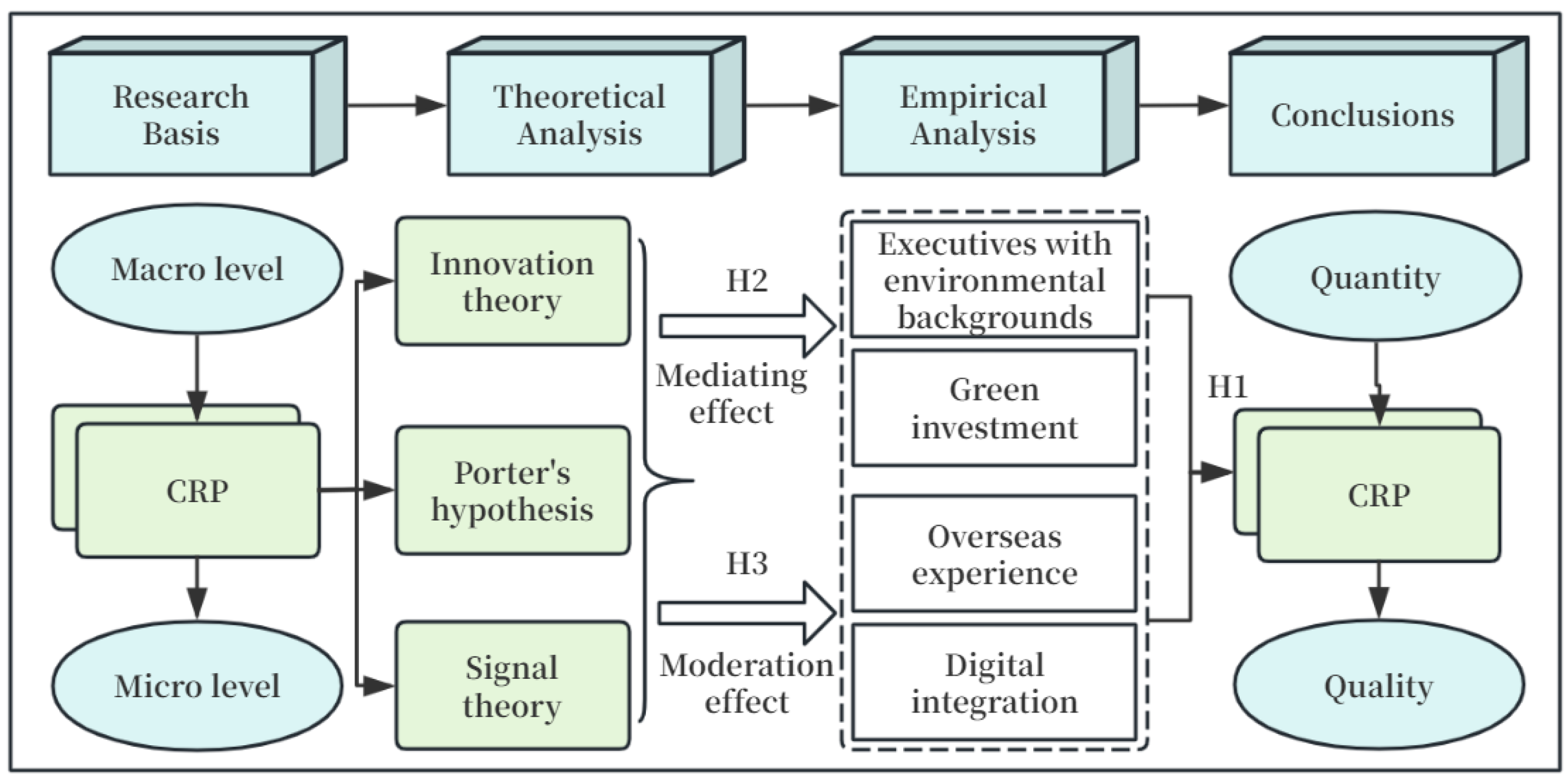
50] but also help enterprises obtain better opportunities for green technology cooperation. In conclusion, the primary structure of this paper is depicted in
Figure 2. Therefore, we propose the following:
Hypothesis 3:
The internal executives’ overseas management experience and external digital integration positively strengthen the role of CRP on Q&Q.
Figure 2.
The research framework.
Figure 2.
The research framework.
6. Conclusions
This study first constructs a Chinese firm-level CRP index to quantify enterprises’ responses to climate change-related risks. Then, we assess its impact on enterprises’ green innovation behavior. The results indicate that CRP can significantly enhance the Q&Q, and the promoting effect on quantity is greater than on quality. The CRP primarily promotes green innovation through two channels: increasing the proportion of managers with an environmental background and encouraging green investment. In addition, both the degree of external digital integration and the executives’ overseas management experience positively moderated the promoting effect. Furthermore, CRP has a larger promoting effect on both the Q&Q in highly polluting and high-tech enterprises, while its effect on the quality in low-polluting and non-high-tech enterprises is insignificant.
There are several limitations to this study. First, the differences in production modes and impact mechanisms in various industries may not have been fully accounted for. Given the significant heterogeneity in characteristics and innovation drivers among industries, this study primarily focuses on the quantity and quality of green innovation at the firm level but does not provide an in-depth analysis of green innovation dynamics within distinct industry contexts. Second, the study uses the number of green invention patents as a proxy for the quality of green innovation. However, this metric alone may not adequately capture the broader value of such innovations, as it fails to reflect tangible outcomes such as environmental improvements and economic benefits. Therefore, future studies should be conducted from an industry classification perspective to explore CRP’s role in further promoting green innovation in various industries. Third, with advancements in technologies such as machine learning, future research can harness these tools to improve the accuracy and reliability of analyses, enabling a more in-depth exploration of the potential nonlinear relationships between the two variables. For instance, big data analytics could enable more precise tracking of corporate green innovation trends, while machine learning techniques could help identify key determinants of green innovation, offering novel perspectives and deeper insights. Finally, future studies could employ targeted surveys or richer datasets with expanded variables to further investigate how executive characteristics and investment decisions interact and co-evolve, thereby enhancing understanding of the underlying mechanisms of the dual pathways.
Therefore, we can extract the following policy implications: Firstly, strengthen enterprises’ climate risk perception capabilities and promote the coordinated improvement of both the quantity and quality of green innovation. The results of this paper show that climate risk perception significantly encourages the quantity of green innovation in enterprises, but its role in quality improvement is relatively limited. Therefore, policy-making should systematically enhance enterprises’ capabilities to respond to climate risks and promote a leap in green innovation from “quantity” to “quality”. It is suggested that the government take the lead in establishing an “Enterprise Climate Risk Monitoring and Disclosure Platform”, integrating data on climate, physical, and transition risks, to provide enterprises with dynamic and actionable risk information. Meanwhile, through fiscal and tax incentives and financial tools, enterprises are guided to combine climate risk response strategies with high-quality green technology R&D. In particular, enterprises should be encouraged to focus on key areas such as low-carbon processes, circular economy technologies, and carbon-neutral solutions, rather than merely pursuing a large number of patents. In addition, a special project on “Climate Risk and Green Innovation” can be established within the national Key Research And Development Program to support enterprises and research institutions in collaborating on common technology breakthroughs, thereby enhancing the green innovation.
Secondly, we should deepen the integration of green governance and digitalization, and activate the dual-channel roles of managers and investors. CRP promotes green innovation by enhancing the role of environmental background managers and increasing the level of green investment, indicating that internal governance and resource allocation mechanisms are vital. Policies should encourage enterprises to incorporate climate risks into the strategic agendas of their boards and performance evaluations, promote the establishment of Chief Sustainability Officers or environmental professional committees, and prioritize appointing senior executives with backgrounds in environmental management. For small and medium-sized enterprises, they can be supported in introducing external environmental expert advisors by receiving “green governance subsidies.” On the other hand, efforts should be made to accelerate the deep integration of digitalization and greenization. By leveraging the “external digital integration” regulatory effect discovered through research, industry-level industrial Internet platforms and green supply chain management systems should be established to help enterprises achieve real-time collection, analysis, and optimization. In terms of green investment, we suggest expanding the scale of green industry funds, exploring a linkage mechanism between climate risk insurance and green investment, reducing the risks of enterprise transformation, and guiding financial institutions to develop financing products based on CRP ratings so that funds can flow more precisely to high-quality green innovation projects.
Thirdly, differentiated policy guidance should be implemented to support high-pollution and high-tech enterprises, thereby strengthening industry collaboration. The heterogeneous results of this paper suggest that policies should focus on precision and industry heterogeneity. For highly polluting industries, strict control over the total amount and intensity of carbon emissions should be implemented. The carbon market pricing mechanism and environmental protection law enforcement should be utilised to compel enterprises to transform CRP into substantive, innovative actions. At the same time, special funds should be allocated to support research and development of low-carbon alternative technologies. High-tech enterprises can rely on national high-tech zones and key laboratories to establish a “Climate Technology Innovation Alliance,” thereby accelerating the commercialisation and application of green patents. Policies should focus on awakening risk awareness and building basic capabilities for low-pollution and non-high-tech enterprises. For instance, free climate risk assessment, green technology directories, and transformation path guidelines can be provided through a pilot program for the green transformation of small and medium-sized enterprises.