Article

Spatiotemporal Distribution of Cross-Platform Public Opinion in the 2023 Dezhou Earthquake: Implications for Disaster-Resilient Emergency Management


School of Earth Science and Engineering, Hebei University of Engineering, Handan 056038, China
*
Author to whom correspondence should be addressed.
These authors contributed equally to this work.
Sustainability 2025, 17(24), 10937; https://doi.org/10.3390/su172410937
Submission received: 13 October 2025 / Revised: 4 December 2025 / Accepted: 5 December 2025 / Published: 7 December 2025

Abstract

Social media platforms have emerged as a critical infrastructure for disaster communication and emergency management. However, how public opinion varies across platforms during earthquake events and how such differences can inform resilient disaster strategies remain underexplored. This study analyzes public opinion responses to the 2023 M5.5 Dezhou earthquake across three major Chinese social media platforms—Sina Weibo, Bilibili, and Douyin—based on 28,557 posts. By combining Latent Dirichlet Allocation (LDA), Word2Vec, and Convolutional Neural Networks (CNNs), we examine the temporal, spatial, thematic, and emotional patterns of public discourse. The results show (1) a bimodal public attention pattern within 24 h of the earthquake, with platform-specific response timings; (2) spatial clustering of public concern in the epicenter (Shandong) and historically high-risk regions (Sichuan–Chongqing); (3) differentiated topic preferences reflecting platform functions—emotional expression (Weibo), science popularization (Bilibili), and real-time impact sharing (Douyin); and (4) a predominance of positive/neutral sentiment, influenced by user demographics and algorithmic content curation. This study proposes a resilience-oriented public opinion analysis framework aligned with the disaster lifecycle and offers recommendations for platform-specific risk communication, psychological support, and policy planning. Findings contribute to digital disaster governance and the integration of social media analytics into sustainable emergency management.

1. Introduction

Earthquakes are among the most frequent and damaging natural disasters in China, characterized by suddenness, destructive power, and unpredictability [1,2]. In 2023, China experienced 18 earthquakes with magnitudes exceeding 5.0. These earthquakes led to the damage or collapse of a total of 423,900 houses, resulting in 151 fatalities, 983 injuries, and direct economic losses amounting to RMB 14.852 billion [3]. These staggering losses not only reflect the severe impact of earthquakes on society and the economy but also highlight the urgency of enhancing the resilience of disaster emergency management systems. Recent studies have shown that social media platforms act as real-time sensors of disaster impacts and public risk perception, providing rapid, user-generated information that supports emergency decision-making [4]. When an earthquake occurs, people in disaster-stricken areas often share personal experiences and views on the disaster or the relief processes on social media [5]. Such instant communication has been proven essential for early situation awareness and public risk interpretation during disasters [6]. The popularity and content of disaster-related topics on social media not only reflect public perception of disaster risk but also provide real-time input for adjusting disaster-resilient emergency measures, such as optimizing information dissemination timelines and targeting high-risk regions [7]. Therefore, social media plays a dual role as both a reflection of public sentiment and a mechanism for guiding emergency actions, which is increasingly critical in modern disaster management.
In China, the social media platform, the short-video platform and the long-video-sharing platform with the largest numbers of users are Sina Weibo, Douyin, and Bilibili, respectively [8,9]. The M5.5 Dezhou earthquake was the strongest seismic event in Shandong Province in the past decade and the most socially impactful earthquake in northern China in 2023. At 02:33 on 6 August 2023, a magnitude 5.5 earthquake struck Pingyuan County, Dezhou City, Shandong Province (37.16° N, 116.34° E), with a focal depth of 10 km, generating strong tremors felt across multiple regions. Despite occurring after midnight, the event triggered rapid information dissemination across multiple platforms, reflecting the differentiated responsiveness of platform ecosystems [10]. This makes the event a representative case for examining platform-specific public opinion dynamics during earthquakes. Statistical data indicated that the Sina Weibo Index and Baidu Index reached over 300,000 on the day of the M5.5 Dezhou earthquake. The Internet search volume for this earthquake exceeded that of other earthquake events during the first half of the year. A total of fifty-six aftershocks were recorded, with one aftershock measuring 3.0 or above. Twenty-one people were injured during the Dezhou earthquake, and more than 2900 houses were damaged; the total direct economic losses caused by the earthquake amounted to 2.4 billion CNY [3]. As an earthquake with a wide impact area, high losses, and strong public concern, the M5.5 Dezhou earthquake is a viable case for studying the role of social media in disaster emergency management.

2. Related Work

2.1. Research Progress on Disaster-Related Public Opinion

In recent years, scholars have begun to use social media data to assess post-disaster public opinion patterns and sentiment [11,12,13]. They have shown that these patterns differ significantly across social media platforms. This growing body of research has laid the foundation for understanding the unique characteristics of public expression on various social platforms in the aftermath of disasters. For risk perception regarding the Zhengzhou 7.20 extreme rainstorm event, Sina Weibo demonstrates distinct emotional phases and geographic disparities: during the early warning period, anxiety accounted for 38.7% of sentiments, while disaster-zone users expressed demands at a rate of 67.5% [14]. Meanwhile, recent studies indicate that short-video platforms such as Douyin tend to amplify emotional content and accelerate its diffusion due to algorithmic reinforcement mechanisms [10]. These findings suggest that platform-specific architectures and interaction patterns substantially shape disaster-related public opinion dynamics.

2.2. Theoretical Foundations and Research Progress of Cross-Platform Social Media and Disaster Public Opinion

Current research on public opinion in the wake of disasters expressed via social media mainly relies on the media ecology theory and the uses and gratifications theory: the former emphasizes that the technical characteristics of different platforms (such as text interaction, short-video visualization, and in-depth long-video interpretation) shape distinct information dissemination ecosystems [15,16], while the latter points out that users choose platforms based on their information needs (such as real-time disaster information acquisition, emotional catharsis, and rescue requests), thereby influencing the generation of public opinion content [17]. In addition, recent studies highlight that risk perception theory provides an important behavioral basis for interpreting emotional and cognitive responses during disasters [18]. Together with risk perception theory, which links public opinion to disaster response behaviors, these two theories form a theoretical basis for cross-platform public opinion analysis. However, most existing studies apply these theories independently rather than in an integrated manner, resulting in insufficient theoretical linkage between platform-specific public opinion differences and resilience-oriented emergency management requirements [19].

2.3. Multi-Platform Characteristics and Research Gap

Understanding variations in post-disaster public opinion and sentiment across different social media platforms is essential, as user attitudes and risk preferences influence disaster mitigation behaviors [20], recovery planning [21], and future preparedness [22]. Although prior studies have recognized platform-specific characteristics, such as Sina Weibo’s emotional transitions [11] or Douyin’s attributional framing [23], most remain descriptive and focus on isolated dimensions such as content type or sentiment polarity. These fragmented approaches seldom link cross-platform public opinion dynamics to actionable strategies in emergency management, nor do they adequately capture the spatiotemporal synchronization or emotional divergence needed to support resilient response. Recent research highlights that disaster communication is shaped by platform affordances and user demographics [24,25,26], yet a unified analytical framework that integrates temporal rhythms, spatial clustering, thematic differentiation, and emotional variation remains underdeveloped. For example, the timing of attention peaks across platforms could inform phase-specific risk communication. Spatial overlap in discussion hotspots might also guide localized interventions [27,28]. Relying solely on one platform risks overlooking complementary information; for example, Douyin’s video-based sharing may miss Weibo’s real-time textual feedback, while Bilibili’s scientific discourse might neglect emotional support expressed elsewhere.
To address these gaps, this study proposes a comprehensive analytical framework for cross-platform earthquake public opinion analysis that integrates spatial, temporal, thematic, and emotional dimensions and combines Latent Dirichlet Allocation (LDA) topic modeling, Word2Vec semantic similarity, and Convolutional Neural Networks (CNN)-based sentiment classification. Focusing on Sina Weibo, Bilibili, and Douyin, we investigate how different platform structures and user behaviors shape public opinion dynamics before, during, and after the 2023 M5.5 Dezhou earthquake. On this basis, the study pursues three interrelated aims: (1) to characterize the temporal and spatial evolution of earthquake-related public opinion across the three platforms; (2) to identify platform-specific differences in topic structures and sentiment patterns over the pre-, during-, and post-disaster stages; and (3) to translate these spatiotemporal and cross-platform patterns into evidence-based recommendations for resilience-oriented emergency management across the disaster lifecycle. In doing so, the study reveals multi-dimensional patterns in the evolution of public opinion and provides empirically grounded suggestions for optimizing risk communication, emotional support, and targeted resilience strategies throughout the disaster lifecycle.

3. Data and Methodology

3.1. Framework for Earthquake Disaster Public Opinion Analysis

To support sustainable Disaster Risk Reduction (DRR), this study proposes an integrated framework linking social media public opinion with resilience management across the disaster lifecycle: pre-disaster, in-disaster, and post-disaster. The framework combines core geographical and communication theories: the Second Law of Geography provides insights into the spatial aggregation and diffusion of public opinion, guiding region-specific risk response and communication strategies [29,30]; the media ecology theory explains how platform-specific affordances (e.g., text, short video) affect public expression and opinion dynamics; and the uses and gratifications theory clarifies how changing user needs (e.g., early warning, emotional support, recovery inquiry) shape public discourse over time [15,16,17].
This framework (Table 1. Framework for earthquake disaster public opinion analysis) provides a multi-dimensional map of public opinion patterns and resilience goals: (1) pre-disaster, the focus is placed on monitoring early-warning topics and vulnerable regions to facilitate targeted preparedness communication; (2) in-disaster, real-time topic and emotional surges, along with spatial concern shifts, are used to guide timely emergency messaging and response allocation; (3) post-disaster, shifts in sentiment and attention are analyzed to support recovery planning and public reassurance. This structure enables a dynamic, platform-sensitive, and geographically grounded approach to resilient disaster communication and decision-making.

3.2. Overall Technical Process

Building on the framework for earthquake disaster public opinion analysis (Table 1. Framework for earthquake disaster public opinion analysis), the research process comprises four key phases: data acquisition and preprocessing; public opinion analysis (including analysis of the temporal–spatial changes in public opinion volume and sentiment); cross-platform comparison; and the development of recommendations for disaster resilience management (Figure 1. Integrated framework). In practice, the analytical workflow proceeds from data acquisition to management-oriented interpretation as follows. First, under the “Shandong Dezhou earthquake” event framework, posts are collected from three major social media platforms (Sina Weibo, Bilibili, and Douyin) using event-related keywords to construct a unified corpus, which is then subjected to standardized preprocessing, including removal of numbers, punctuation, and symbols, Chinese word segmentation and part-of-speech tagging, stopword filtering, and user geocoding via the Gaode API. Second, on this cleaned corpus, core NLP models are built: a Word2Vec model is trained to obtain word and document vectors, which are fed into a CNN to extract sentiment information (positive, neutral, negative) and iteratively optimized through accuracy assessment; in parallel, LDA topic modeling, supported by Word2Vec-based semantic representations, produces document–topic and topic–keyword distributions, and the optimal number of topics is selected using coherence and perplexity metrics. Third, the temporal and spatial characteristics of public opinion are derived: for the temporal dimension, posts are segmented by platform and time to construct cross-platform time series that describe the evolution of public opinion volume during the earthquake process; for the spatial dimension, user locations and post counts are combined and mapped via kernel density estimation (KDE) to identify spatial clusters of online attention. Fourth, integrating topic information, sentiment results, public opinion volume, and spatiotemporal indicators, a cross-platform comparison of online sentiment regarding earthquakes is conducted, using spatiotemporal analysis to reveal platform-specific differences and interpret their underlying causes; finally, these joint insights from platform, thematic, sentiment, and spatiotemporal analyses are translated into targeted recommendations for disaster resilience management.
To ensure transparency and reproducibility, we summarize the key dataset characteristics, preprocessing procedures, and model configurations used in this study. Table 2. Dataset characteristics and key model parameters for analyzing cross-platform public opinion following the 2023 M5.5 Dezhou earthquake present the main parameters for data cleaning, feature extraction, topic modeling, word embedding training, sentiment classification, and robustness validation, which collectively form the methodological foundation of our cross-platform public opinion analysis.

3.3. Information Extraction from Social Media

3.3.1. Data Collection

In this study, using the keyword “Shandong Dezhou earthquake,” Python 3.8 crawler scripts were employed to collect posts and comments on Sina Weibo [31], Douyin [32], and Bilibili [33] after the M5.5 Dezhou earthquake. To ensure consistency in the data collection time across the three platforms and to capture the majority of public opinion information, the web crawler was set to collect data from one hour before the earthquake to twenty-four hours after the earthquake. Examples of the crawled raw data (originally in Chinese) are shown in Table 3. Examples of three social media platforms’ crawl results (originally published in Chinese).

3.3.2. Data Preprocessing

A total of 8775 Weibo entries, 12,219 Bilibili entries, and 7563 Douyin entries were obtained after coordinate transformation and noise reduction, totaling 28,557 entries. The data collection process in this study complies with the user agreements of the respective platforms and national laws and regulations on data privacy protection. All collected data have undergone anonymization and are only used for academic research that does not involve the disclosure of personal identity information. The data were sorted and geocoded using the Gaode Map API Version 4.2.0 [34]. Based on disaster-specific vocabulary and the stopword list developed by Harbin Institute of Technology [35], we constructed a customized feature word list and an adjusted stopword list. The dataset retained key fields such as anonymized usernames, comments, posting times, and geographical locations. Subsequently, the Jieba word segmentation tool was used to extract the public opinion features from the social media posts.

3.4. Topic Clustering Model Combining LDA and Word2Vec

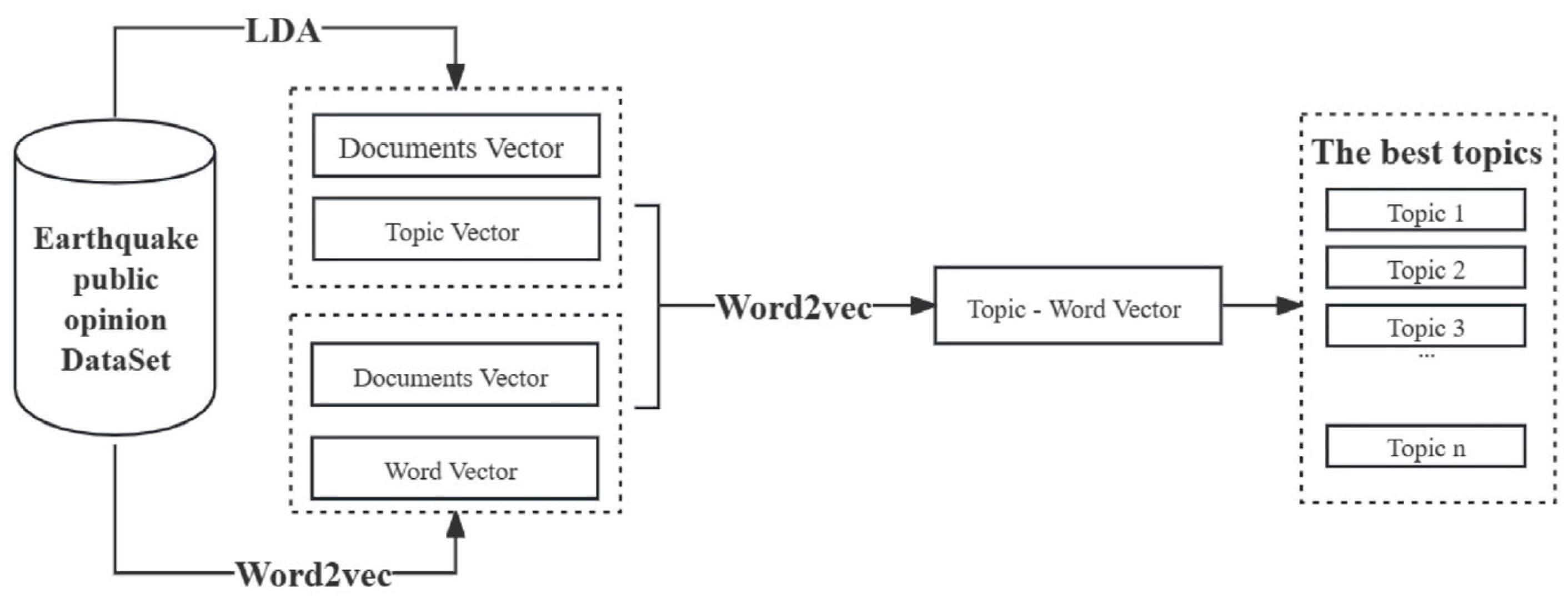
Constructing an effective topic clustering model is essential for extracting meaningful insights from public opinion during earthquakes. Given the limitations of traditional topic modeling for short, noisy, and context-fragmented social media text, in this study, we adopt a hybrid approach by combining Latent Dirichlet Allocation (LDA) and Word2Vec (Figure 2). LDA excels in identifying latent topic distributions from large-scale unstructured text, while Word2Vec captures semantic associations by embedding words into a continuous vector space. This integration is particularly valuable in disaster scenarios where users express emotions in diverse, informal language. The Word2Vec model compensates for the semantic sparsity of standard LDA by grouping semantically similar but lexically different expressions (e.g., “strong shaking,” “felt a tremor,” “scared,” “terrified”) under coherent topics. Furthermore, Word2Vec enhances topic interpretability by allowing more contextually grounded labeling, which is critical for handling heterogeneous vocabulary and regional phrasing across different platforms. The combined LDA–Word2Vec model thus improves coherence, robustness, and the fine-grained detection of public concerns, making it especially suited for platform-specific and resilience-oriented disaster opinion analysis.

3.4.1. Topic Extraction

Latent Dirichlet Allocation (LDA) is an unsupervised clustering algorithm proposed by Blei based on Bayesian distribution [36]. It is widely used in research such as text analysis, topic clustering, and keyword extraction. The structure of LDA features three layers: words, topics, and documents. Both topics and words appear in the form of a multinomial probability distribution. Each document is composed of multiple topics, and each topic contains multiple words. In the LDA, each topic generates a topic–keyword distribution, and each document generates a document–topic distribution. The joint probability distribution formula is as follows:
P w d = P w t P t d
where w is the probability of the word, d is its appearance in the document, and t represents the topic.
To evaluate the generalization ability of the topic model and determine the optimal number of topics K, this study used the Perplexity metric, which reflects the log-likelihood of held-out data. A lower perplexity value indicates better predictive performance and model fit. The calculation formula is as follows:
P e r p l e x i t y ( D ) = e x p d = 1 D l o g 2 p w d d = 1 D N d
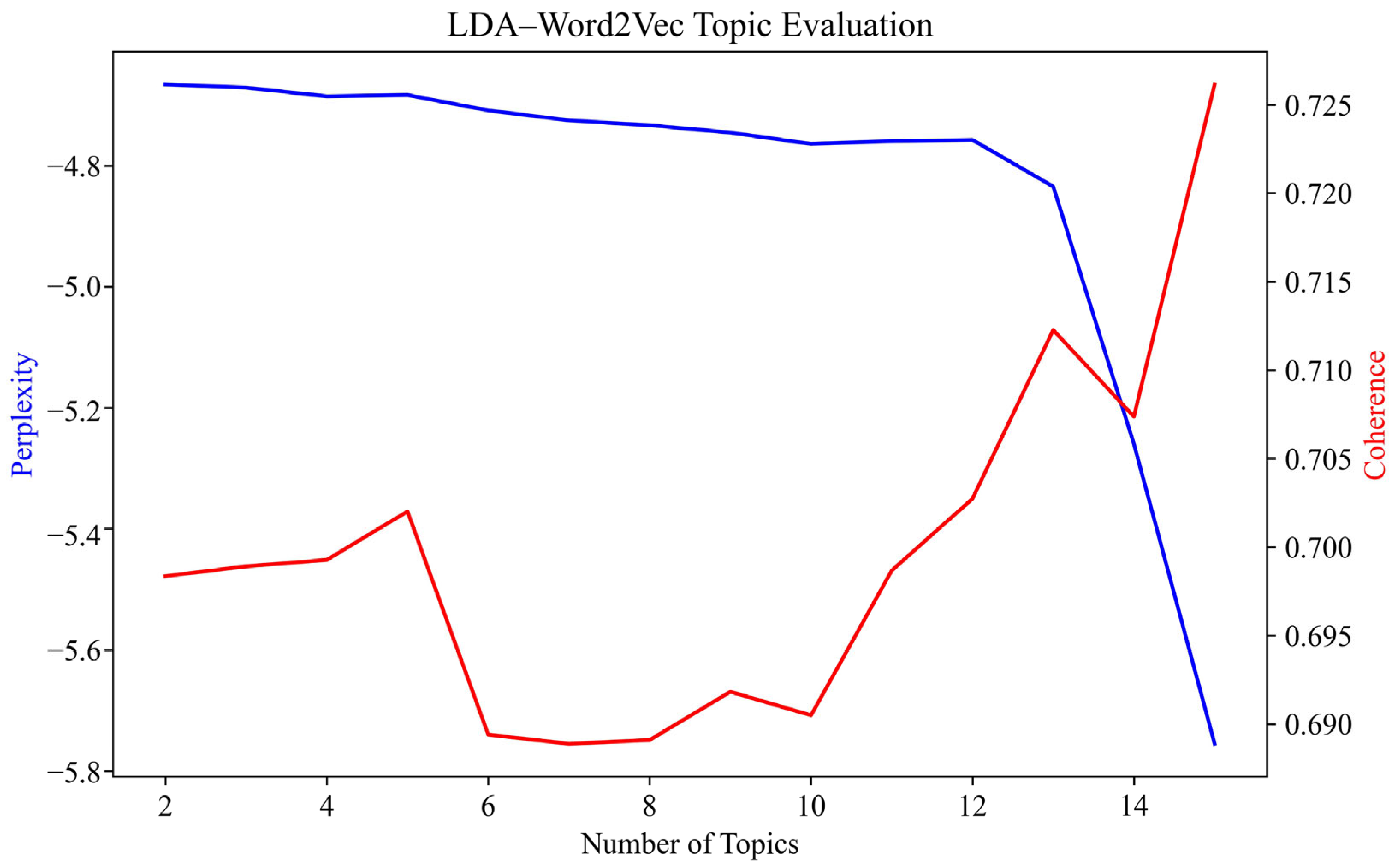
where D represents the total number of documents in the corpus, d represents the d -th document, N d represents the total number of words in document d , and w represents the content of that document. We tested values of K ranging from 2 to 15 and selected the value with the lowest perplexity and highest semantic coherence (see Section 3.4.3 and Figure 3. Optimization of topic number (K) based on perplexity and semantic coherence of the LDA–Word2Vec model). This process ensured both the statistical validity and interpretability of the topic structure.

3.4.2. Topic Clustering

Word2Vec is a word vector model that converts words into vectors and rapidly identifies semantic features within text. The model is capable of analyzing the contextual relationships of the current word, calculating the probability of similarity between words in the window, and concatenating non-adjacent units through language recursion. This study uses the Word2Vec model to predict words that are similar to the current feature word. To predict the probability of context words, given a target word, the calculation formula is as follows:
P w t w j = exp μ ν i T V w j n = 1 N exp μ n T V w j V w
where w t is the target word. For the given word sequence, the task of Skip-gram is to maximize the function for n target words. Let w be the input word vector, V w be the output word vector, and N be the dictionary size.
Then, the word vectors and their dimensions were calculated. The calculation formula is as follows:
cos A i , B i = i = 1 b n A i B i i = 1 n A i 2 i = 1 n B i 2
where A and B represent the word vectors, n represents the dimensions, and A i and B i represent the values of the word vectors in dimension i .
To quantitatively assess the interpretability of the topics, this study adopted a semantic coherence measure based on Word2Vec embeddings, which evaluates the intra-topic semantic consistency among the top-ranked words. For each topic, the coherence score was calculated as the average pairwise cosine similarity between the Word2Vec vectors of the top n (here, n = 25) high-probability keywords:
C w 2 v T k = 2 n ( n 1 ) i < j cos v w i , v w j
where v w i denotes the Word2Vec embedding vector of the word w i .
The overall model coherence is obtained by averaging the per-topic coherence across all topics K :
C w 2 v = 1 K k = 1 K C w 2 v ( T k )
A higher C w 2 v value indicates greater semantic cohesion within topics, implying that the words co-occur in semantically meaningful contexts in the embedding space. This metric complements perplexity by incorporating distributed semantic representation into topic quality evaluation.
Based on the feature keywords pertaining to the M5.5 Dezhou earthquake extracted from three platforms, an earthquake-related feature word list (Table 4. Representative feature words for public opinion categories in the Dezhou earthquake corpus) was constructed by incorporating disaster-specific characteristics and referencing the stop word list developed by Harbin Institute of Technology. The public opinion information of the M5.5 Dezhou earthquake was classified based on these characteristic words. Based on the Word2Vec-enhanced LDA model, five dominant topics were identified, corresponding to the key aspects of public attention during the M5.5 Dezhou earthquake. Each topic was verified through intra-topic semantic coherence and representative posts, ensuring that the interpretation was data-driven and semantically consistent rather than subjective.

3.4.3. Model Validation

The optimal number of topics, K, was jointly determined using both perplexity (for statistical model fit) and Word2Vec-based coherence (for semantic interpretability). As shown in Figure 3. For the optimization of topic number (K) based on perplexity and semantic coherence of the LDA–Word2Vec model, the perplexity curve (blue) exhibited a declining and stabilizing trend around K = 5, while the semantic coherence curve (red) reached a relatively high and stable level at the same point. When K > 10, coherence values increased sharply—likely due to topic fragmentation and overfitting—despite decreasing perplexity. Therefore, K = 5 was identified as the optimal configuration, striking a balance between low perplexity and high semantic consistency. To validate model robustness, we repeated the LDA–Word2Vec model training under five different random seeds [11, 22, 33, 44, 55]. The resulting coherence scores ranged narrowly from 0.69 to 0.73 (with a coefficient of variation below 3%), confirming the stability and convergence of the topic structure. To further reduce subjectivity in topic interpretation, we combined statistical modeling with expert review. Each topic was interpreted based on (1) its top 25 keywords, (2) their semantic similarity in the embedding space, and (3) representative text samples with the highest topic probabilities. The semantic coherence scores served as an objective validation to ensure alignment between human interpretation and model-derived structure. Final topic labels were discussed and confirmed by a group of three researchers to enhance interpretive consistency.

3.5. Sentiment Classification and Accuracy Validation

Establishing a robust classification system is imperative in sentiment analysis research. The Sentiment Ontology Library developed by Dalian University of Technology [37] has been applied in numerous studies. It comprises 7 primary sentiment categories and 21 subcategories. Sentiments are further grouped into three overarching categories: positive, neutral, and negative. According to the classification system, a Convolutional Neural Network (CNN) model was used as the sentiment classifier for public opinion. Furthermore, spatial analysis of public opinion across different platforms was conducted by incorporating user geographical locations.
The model performance was evaluated using Accuracy, Precision, Recall, and F1, as defined in Equations (7)–(10).
A c c u r a c y = T P + T N T P + T N + F P + F N
P r e c i s i o n = T P T P + F P
R e c a l l = T P T P + F N
F 1 = 2 P r e c i s i o n R e c a l l P r e c i s i o n + R e c a l l
where true positive ( T P ) indicates that the correct category i is predicted as a category i . False positive ( F P ) indicates that the correct category j is predicted as category i .
We manually labeled 2400 comments from the three platforms as training samples. The dataset is divided into a training set, a verification set, and a test set at a ratio of 6:2:2. Model optimization is an important step in neural network training, seeking the most suitable parameters through several iterations. In the CNN, the vocabulary size is 10,000, the maximum sequence length is 100, the batch size is 128, the dropout is 0.3, and the stride is 1; while in Word2Vec, the vector size is 120, the window size is 5, the min word is 5, and the workers (parameter) is set to 4. The F1 value is between the Accuracy and the Recall rate, reaching 86.31%, with the overall Accuracy reaching 86.88%, indicating that the model has a certain effect in earthquake sentiment classification.

3.6. Analysis of the Spatial Agglomeration Characteristics of Public Opinion

Kernel Density Estimation (KDE) is a commonly used spatial statistical method in Geographic Information Systems (GISs) to determine the distribution density of point or line features in space. It calculates the relative density of points within a neighboring area by applying kernel function around each observed point. The overall spatial differences in public opinion across different social media platforms were examined using Kernel Density Estimation (KDE). Specifically, this spatial analysis across different platforms was conducted by incorporating the user geographical locations from the dataset constructed in Section 3.3. The formula for KDE is as follows:
f ^ h x = 1 n i = 1 n K k x x i = 1 n h i = 1 n K x x i h
where f ^ x is the kernel density estimate, h is the bandwidth, K x x i h is the kernel function, n is the number of earthquake-related posts on a given platform, and x x i represents the distance from the location point x to the event point x i .

4. Results

4.1. Spatiotemporal Characteristics of Public Opinion

To address the first research aim of characterizing the spatiotemporal evolution of earthquake-related public opinion, this subsection examines both the temporal (Section 4.1.1) and spatial (Section 4.1.2) patterns of online public opinion across Sina Weibo, Bilibili, and Douyin in the first 24 h following the Dezhou M5.5 earthquake.

4.1.1. Temporal Characteristics of Public Opinion

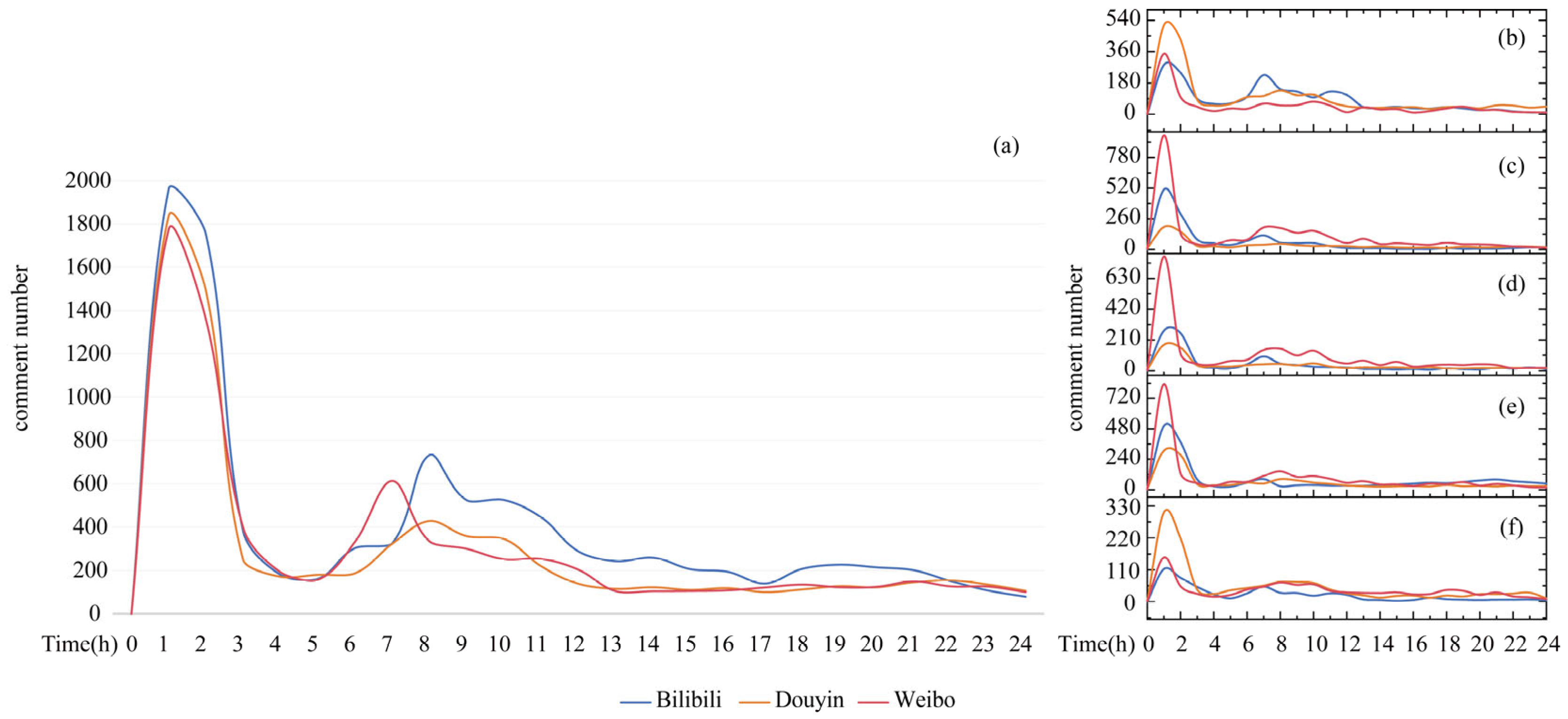
After the Dezhou M5.5 earthquake, a substantial amount of public opinion data was disseminated on social media platforms. We analyzed these data by constructing hourly time series curves for the three platforms (Figure 4) to reveal how public opinion evolved over time. The results show that the time change characteristics of public opinion on the three platforms have a strong phase 24 h after the earthquake. Two hours after the earthquake, the public opinion regarding the Dezhou M5.5 earthquake on all three platforms reached its first peak, and a second peak in public opinion emerged around five–seven hours after the earthquake. Among the three platforms, the second peak of public opinion was the most intense on the Douyin platform, while the second peak on the Bilibili platform was the least intense. The second peak of public opinion leveled off around the 13th hour after the earthquake, and by 24 h post-quake, there were only minor fluctuations in public opinion.
The M5.5 Dezhou earthquake occurred at 3 a.m., and not only were the people in the affected area awakened by the tremors, but netizens in other regions were alerted by the earthquake warnings. They shared their experiences online, generating a significant amount of public opinion information. Therefore, the online public opinion reached its peak about two hours after the M5.5 Dezhou earthquake. Due to the earthquake occurring in the middle of the night, most netizens in non-affected areas went to sleep or prepared for work after discussing it; therefore, the online public opinion quickly decreased within 2–4 h after the earthquake. Within 5–12 h after the earthquake, as it entered the morning working hours, relevant departments released announcements regarding the earthquake situation, disaster losses, casualties, and other related information. During this period, netizens continued to initiate discussions about the earthquake situation, as well as their personal experiences and feelings, thus leading to a second peak in online public opinion. From 12 to 24 h after the earthquake, the online public opinion showed a fluctuating decreasing trend. The fluctuations in public opinion during this period were related to aftershocks and trending topics on Sina Weibo.
The temporal evolution of public opinion following the Dezhou M5.5 earthquake is highly consistent with the life-cycle theory and crisis communication frameworks commonly applied in disaster research. According to the disaster public-opinion evolution model proposed by [38], online public opinion after an earthquake generally progresses through three stages: outbreak, amplification, and attenuation. These stages are shaped by the interaction among the event itself, media reporting, public participation, and governmental responses. The initial peak observed approximately two hours after the earthquake corresponds to the outbreak stage, during which public attention rapidly concentrates and emotional expression dominates online discussions. Timely media intervention, particularly through official information releases, plays a pivotal role in amplifying and sustaining the second wave of discourse. The secondary peak identified around seven to nine hours after the earthquake, coinciding with the dissemination of official updates, aligns well with the “amplification” phase described in [38]. Subsequently, the gradual decline in public opinion observed within 12–24 h after the earthquake reflects the attenuation stage, when public interest naturally subsides. Overall, this study extends existing theoretical frameworks by demonstrating that although post-disaster public opinion generally follows a “burst–amplification–decay” trajectory, the specific timing and magnitude of each stage are jointly influenced by institutional communication strategies and the structural characteristics of individual platforms.

4.1.2. Spatial Characteristics of Public Opinion

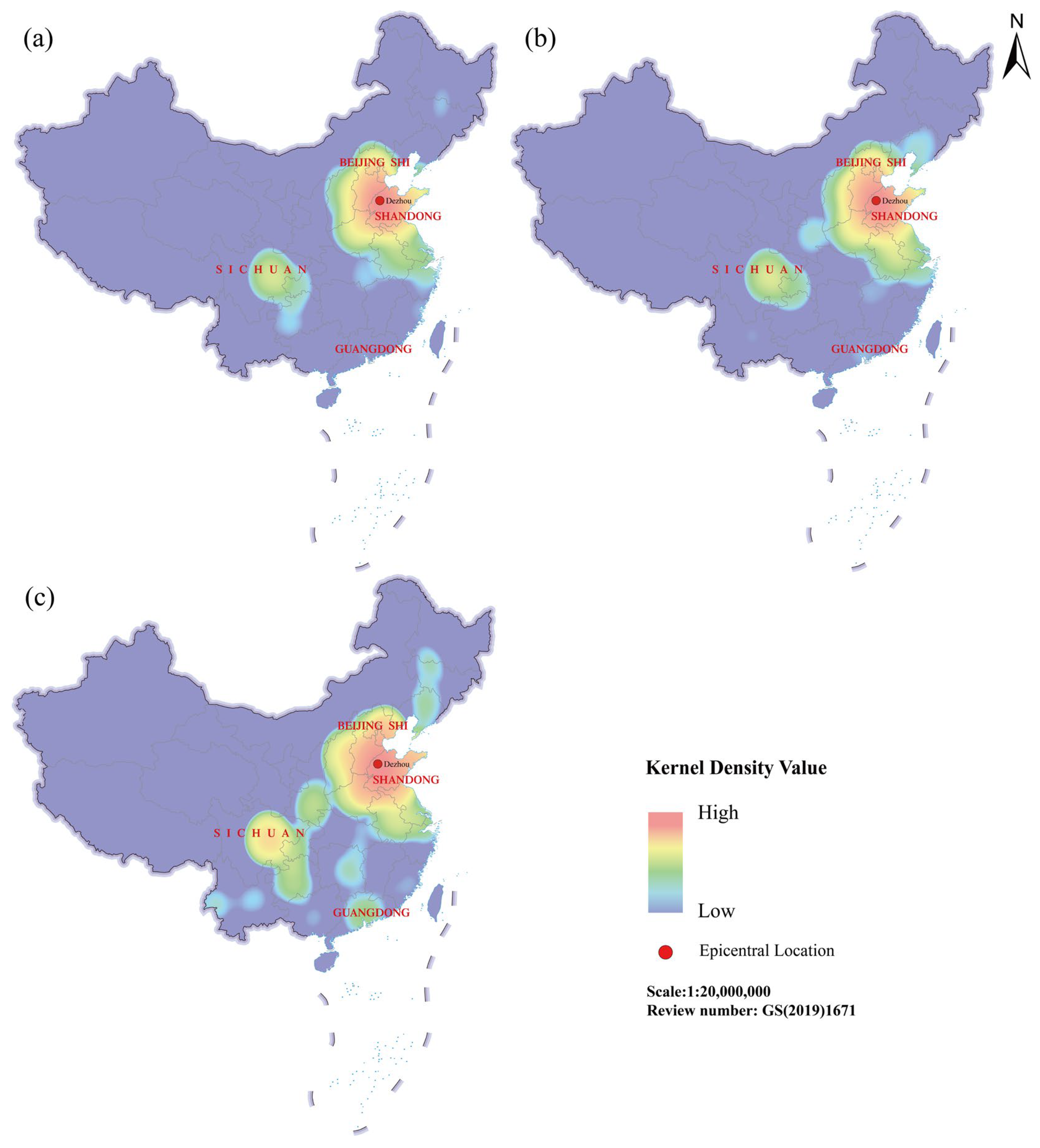
The spatial agglomeration characteristics of public opinion volume across the three platforms were calculated using the Kernel Density Estimation (KDE) method and visualized in the form of a map (Figure 5), which shows the kernel density distribution of the number of comments regarding the M5.5 Dezhou earthquake on the (a) Sina Weibo platform, (b) Bilibili platform, and (c) Douyin platform. The maps were created using ArcGIS 10.8 software, with the base maps adopted from the standard maps of China’s “National Platform for Common GeoSpatial Information Services” (https://www.tianditu.gov.cn/). In the map, color gradients represent the intensity of spatial agglomeration: red indicates the most prominent spatial agglomeration, corresponding to regions with the largest and most concentrated public opinion volume, while blue indicates the least prominent spatial agglomeration. The spatial distribution of the volume of public opinion regarding the M5.5 Dezhou earthquake across the three platforms showed a trend of being most concentrated in Shandong Province and gradually decreasing towards the surrounding areas. Overall, Shandong Province and the Beijing–Tianjin–Hebei region were the high-value areas of public opinion, followed by Henan, Jiangsu, and Sichuan provinces. The online public opinion regarding the M5.5 Dezhou earthquake was higher in the earthquake-prone Sichuan and Chongqing regions than in provinces such as Shanxi, Shaanxi, and Hubei, which were closer to Shandong. A comparison of the public opinion on the M5.5 Dezhou earthquake across different platforms revealed that the Bilibili platform had a higher concentration of online public opinion in Shandong Province, the Beijing–Tianjin–Hebei region, and neighboring provinces, while the Douyin platform had the widest distribution of online public opinion.
The spatial distribution characteristics of public opinion following the Dezhou M5.5 earthquake indicate that disaster-related social media discourse is not evenly distributed across geographical space but tends to concentrate in specific “hotspot” areas. These findings are consistent with recent empirical studies that have employed spatial analysis techniques to trace post-earthquake public opinion patterns. This pattern suggests that proximity to the epicenter alone is not the sole factor determining the intensity of online public opinion. Instead, multiple factors such as population distribution and mobility [39], as well as the presence of earthquake-prone regions with prior seismic experiences [40], may jointly contribute to the observed spatial clustering. Such spatial heterogeneity highlights that treating “social media” as a homogeneous and uniform communication channel may overlook critical regional variations. The results of this study therefore provide empirical support for advancing disaster-related public opinion research toward a more refined and geographically differentiated analytical perspective.

4.2. Differences in and Reasons for Earthquake-Related Online Public Opinion Across the Three Platforms

To address the second research aim of identifying platform-specific differences in topic structures and sentiment patterns, this subsection analyzes how earthquake-related themes and emotions are distributed across Sina Weibo, Bilibili, and Douyin. To analyze platform differences in earthquake-related themes, we examined the proportion of each topic category on the three platforms. Table 5. The number of topics and proportion of emotional polarity concerning online public opinion on the Dezhou M5.5 earthquake. The proportion of each category is calculated by dividing the number of entries in that category by the total number of entries on the platform. reveals significant disparities in the proportion of each topic and sentiment polarity across different platforms.
The differences in public opinion across Sina Weibo, Bilibili, and Douyin are shaped by a combination of platform functions, user characteristics, and content dissemination mechanisms. Sina Weibo, as a text-dominant, real-time news and opinion aggregation platform, tends to concentrate emotional expressions and societal concern. This explains its higher proportion of psychological-state content (26.7%). Bilibili, with its long-form and educational video content, attracts a younger, knowledge-oriented user base (with 56% under age 24), leading to a greater emphasis on earthquake science and personal experiences, accounting for 10.6% and 24.8% of topics, respectively. Douyin’s short video format and algorithm-driven content recommendation model are particularly effective at quickly amplifying emotional resonance. This helps explain its highest share of positive wishes (29.1%) and positive sentiment (40.5%) among the three platforms.
User demographics further contribute to these differences. Douyin users, primarily aged 24–35, often engage with emotionally charged, scenario-based content. In contrast, Bilibili’s users are mostly college students under 24, favoring logical discussion and science popularization, while Sina Weibo maintains a cross-generational mix that fosters broad public debate. These patterns suggest that emotional expression on Douyin is more spontaneous and amplified by short-form video consumption habits, while Bilibili and Weibo reflect more deliberate cognitive and informational responses. Additionally, Douyin’s recommendation algorithm plays a significant role. Its personalized distribution system uses users’ browsing behavior and preferences to efficiently push positive-energy videos—such as touching rescue scenes or volunteer contributions—to likely viewers. This increases the visibility of emotionally uplifting content and facilitates positive emotional contagion in public discourse [1,41].
Furthermore, cross-platform public opinion dynamics are partially shaped by spatial factors. As noted in the transport geography literature [42], mobility flows after an earthquake, such as evacuation routes and volunteer movements, can influence where and how public opinion surges occur. Content shared from transport hubs like Jinan and Tianjin showed greater visibility on Douyin due to on-site, real-time video posts. This suggests that spatial accessibility intersects with platform mechanisms in shaping the reach and emotional tone of disaster-related discourse.

5. Discussion

This section builds directly on the empirical results presented earlier, which revealed clear spatiotemporal patterns (e.g., bimodal public attention peaks), platform-specific topic structures (e.g., Douyin focusing on impact scenes, Bilibili on science popularization), and distinct emotional landscapes (e.g., Sina Weibo showing a higher share of psychological-state expressions). The geospatial concentration of public opinion around Dezhou and in the Sichuan–Chongqing region further highlighted uneven public concern across regions. These findings provide a data-driven basis for theoretical reflection and practical implications. Accordingly, the following sections (Section 5.1 and Section 5.2) discuss how the results contribute to theoretical advancements in disaster communication, digital transformation, and organizational learning. They also examine how the findings inform differentiated platform strategies, emotional guidance, and spatial resilience planning.

5.1. The Contributions of This Study to Existing Theories

In the context of advancing global disaster resilience and digital governance, this study contributes to three key theoretical domains by analyzing cross-platform public opinion dynamics during the 2023 M5.5 Dezhou earthquake. Using empirical evidence from temporal patterns, thematic distributions, spatial clustering, and sentiment polarity, we extend existing theory in the following ways:
First, in terms of sustainable innovation theory, this study demonstrates that cross-platform public opinion can serve as a non-technical yet impactful innovation element in disaster management. Specifically, we show that temporal differences in platform response, such as Douyin’s earlier peak in user engagement, can inform phase-specific emergency communication timelines. Likewise, spatial clustering of public opinion around both the epicenter (Shandong) and the historically earthquake-prone Sichuan–Chongqing region highlights how digital discourse can guide targeted resource deployment and localized resilience strategies [24,30].
Second, from the perspective of digitalization theory, this study introduces a multi-source analytical system that integrates Latent Dirichlet Allocation (LDA), Word2Vec, Convolutional Neural Networks (CNN), and Kernel Density Estimation (KDE) to uncover the spatiotemporal, thematic and emotional characteristics of public opinion. The observed sentiment distribution (78.3% positive or neutral) validates the utility of this system in mapping digital risk perception and enhancing the responsiveness of emergency communication strategies [9,23,41].
Third, regarding organizational learning theory, the findings illustrate how public organizations can shift from passive internal knowledge accumulation to proactive external learning by interpreting platform-specific public opinion signals. For example, the high share of psychological-state content on Sina Weibo (26.7%) points to its potential in delivering emotional support, while Bilibili’s focus on science popularization (10.6%) positions it as an effective channel for disaster education [43,44,45]. These insights demonstrate how platform-specific roles can be integrated into long-term organizational adaptation and resilience planning.

5.2. Implications for Resilience Management Across Disaster Phases

To address the third research aim of translating spatiotemporal and cross-platform public opinion patterns into actionable guidance for resilience-oriented emergency management, this subsection discusses how the temporal, spatial, and content characteristics of public opinion on different social media platforms can inform more targeted strategies across the disaster lifecycle. As shown in Table 1 (Framework for earthquake disaster public opinion analysis), we align public opinion features with actionable insights for the pre-disaster prevention, in-disaster response, and post-disaster recovery phases.

5.2.1. Pre-Disaster: Public Sentiment Monitoring and Risk Communication Preparedness

Prior to an earthquake, public opinion monitoring should focus on early-warning-related discourse and emotional preparedness. By analyzing regular discussions on seismic risk, emergency readiness, and science popularization, especially on platforms like Bilibili, which has a relatively high share of educational content (10.6%), authorities can identify vulnerable groups and regions that require tailored preparedness communication. Mapping attention hotspots and tracking baseline sentiment levels also helps refine targeted awareness campaigns before disasters strike.

5.2.2. In-Disaster: Real-Time Emotional Dynamics and Emergency Response Optimization

During the immediate disaster response window, platform-specific public opinion patterns provide valuable real-time signals for emergency actions. For instance, Douyin’s short-video ecosystem exhibits a sharp rise in user activity within 0–2 h of the earthquake, particularly in the form of positive sentiment content (40.5%). This pattern can be attributed to its recommendation algorithms, which amplify uplifting messages and volunteer videos [1,41]. This suggests that emergency bulletins and rescue updates should be prioritized on Douyin during this golden window to reduce panic and foster collective morale. Simultaneously, Sina Weibo—characterized by its 26.7% share of psychological-state topics—offers a space to monitor public anxiety and address information gaps about aftershocks, rescue logistics, and relief supply distribution. Public concerns expressed in trending hashtags (e.g., #Dezhou Earthquake Relief#) can be analyzed every 30 min for sentiment shifts, enabling rapid official response and psychological reassurance.

5.2.3. Post-Disaster: Regional Sentiment Divergence and Adaptive Psychological Support

In the recovery phase, it is crucial to detect shifting public sentiment and spatial attention patterns to guide psychological and policy support. As Section 4.1.2 reveals, post-earthquake public opinion not only concentrates around the epicenter but also shows significant engagement from historically earthquake-prone areas such as Sichuan–Chongqing. This aligns with prior studies in transport geography suggesting that population mobility routes and prior trauma influence regional emotional responses [26,42]. Accordingly, resilience management should incorporate differentiated psychological counseling efforts: for example, launching persistent mental health services on Sina Weibo (e.g., daily consultations under #PsychologicalSupport topics) and publishing emotional regulation videos on Douyin every 48 h. Furthermore, establishing cross-regional coordination mechanisms to share emotional support resources between Dezhou and Sichuan–Chongqing can help address shared trauma and strengthen long-term social resilience.

6. Conclusions

The unique contribution of this study lies in developing an integrated, cross-platform analytical framework that combines LDA topic modeling, Word2Vec semantic analysis, and CNN-based sentiment classification to reveal the spatiotemporal distribution and emotional dynamics of public opinion on Sina Weibo, Bilibili, and Douyin during the 2023 Dezhou M5.5 earthquake. Building on this framework, the study proposes platform-specific strategies for monitoring, psychological support, and emergency information dissemination, providing empirical evidence for the digital transformation of sustainable disaster risk governance and related SDGs. It also advances the interdisciplinary integration of communication theory, spatial science, and resilience research.
Nevertheless, this study has several theoretical and practical limitations. First, it focuses only on three mainstream platforms, excluding smaller or region-specific social networks that may contain valuable grassroots insights. Second, although advanced models such as LDA and CNN were employed, the interpretability of topics and sentiments still relies partially on human judgment, which may introduce subjectivity. Third, data collection was limited to a single event, which may affect the generalizability of findings.
Future research should expand to include multimodal data (e.g., images, videos), conduct comparative studies across different disaster events, and explore the integration of real-time data streams for dynamic emergency decision support. Furthermore, refining model interpretability and integrating user interaction patterns could enhance the predictive power and actionable relevance of public opinion analysis in disaster contexts.

Author Contributions

C.L., data curation, writing—original draft; X.W., formal analysis, visualization; Y.Y., writing—review and editing. All authors have read and agreed to the published version of the manuscript.

Funding

Funded by Science Research Project of Hebei Education Department (No. BJK2023088).

Institutional Review Board Statement

Not applicable.

Informed Consent Statement

Not applicable.

Data Availability Statement

Data will be made available on request.

Acknowledgments

We want to express our sincere thanks to the editor and the reviewers for their valuable comments and suggestions.

Conflicts of Interest

The authors declare no conflicts of interest.

References

  1. Bi, X.; Tang, C.; Xiao, Q. Short Video Social Media Public Opinion Crisis Prevention. Library 2019, 6, 74–80+87. [Google Scholar] [CrossRef]
  2. Yuan, Q.; Fang, W.; Sun, R.; Hu, J. Risk Assessment and Survey of the Public Opinion on Three Earthquakes in Sichuan in 2022. J. Seismol. Res. 2024, 47, 263–272. [Google Scholar] [CrossRef]
  3. The Emergency Management Department of the Office of the National Disaster Prevention, Reduction and Relief Commission Released the Basic Situation of Natural Disasters in 2023. Available online: https://www.mem.gov.cn/xw/yjglbgzdt/202401/t20240120_475697.shtml (accessed on 20 January 2024).
  4. Chu, M.; Song, W.; Zhao, Z.; Chen, T.; Chiang, Y.-C. Emotional contagion on social media and the simulation of intervention strategies after a disaster event: A modeling study. Humanit. Soc. Sci. Commun. 2024, 11, 968. [Google Scholar] [CrossRef]
  5. Tang, J.; Yang, S.; Wang, W. Social media-based disaster research: Development, trends, and obstacles. Int. J. Disaster Risk Reduct. 2021, 55, 102095. [Google Scholar] [CrossRef]
  6. Ferrara, E.; Yang, Z. Measuring emotional contagion in social media. PLoS ONE 2015, 10, e0142390. [Google Scholar] [CrossRef] [PubMed]
  7. Tang, J.; Yang, S.; Liu, Y.; Yao, K.; Wang, G. Typhoon Risk Perception: A Case Study of Typhoon Lekima in China. Int. J. Disaster Risk Sci. 2022, 13, 261–274. [Google Scholar] [CrossRef]
  8. Meng, J.; Zhao, H.; Gu, Z.; Chen, X. Videolised Society; Springer: Berlin/Heidelberg, Germany, 2024. [Google Scholar]
  9. Yao, K.; Yang, S.; Tang, J. Rapid assessment of seismic intensity based on Sina Weibo—A case study of the changning earthquake in Sichuan Province, China. Int. J. Disaster Risk Reduct. 2021, 58, 102217. [Google Scholar] [CrossRef]
  10. Albalawi, R.; Yeap, T.H.; Benyoucef, M. Using topic modeling methods for short-text data: A comparative analysis. Front. Artif. Intell. 2020, 3, 42. [Google Scholar] [CrossRef]
  11. Lin, S.; Liu, B.; Li, J.; Liu, X.; Qin, K.; Guo, G. Social media information classification of earthquake disasters based on BERT transfer learning model. Geomat. Inf. Sci. Wuhan Univ. 2024, 49, 1661–1671. [Google Scholar] [CrossRef]
  12. Zhu, H.; Liu, K. Temporal, Spatial, and Socioeconomic Dynamics in Social Media Thematic Emphases during Typhoon Mangkhut. Sustainability 2021, 13, 7435. [Google Scholar] [CrossRef]
  13. Liu, Y.; Liu, W.; Zhang, W.; Wei, B.; Zheng, G.; Feng, X.J. Spatiotemporal characteristics of public opinion and emotion analysis of Ms 6.4 Yunnan Yangbi earthquake based on Sina Weibo data. J. Nat. Disasters 2022, 31, 68–178. [Google Scholar] [CrossRef]
  14. Wang, W.; Zhu, X.; Lu, P.; Zhao, Y.; Chen, Y.; Zhang, S. Spatio-temporal evolution of public opinion on urban flooding: Case study of the 7.20 Henan extreme flood event. Int. J. Disaster Risk Reduct. 2024, 100, 104175. [Google Scholar] [CrossRef]
  15. Mu, D.; Shao, Q.; Yang, X.; Peng, H.; Bi, Q. Research on Operating Pattern of Network Public Opinion of Public Emergency from the Perspective of Information Ecology. Mod. Inf. 2022, 42, 22–30. [Google Scholar] [CrossRef]
  16. Xie, Y.; Li, B. Information Perception Model of Network Public Opinion Risk of Environmental Emergencies in New Media Environment. Mod. Inf. 2023, 43, 158–165. [Google Scholar] [CrossRef]
  17. Cao, S.; Chang, J. Research on the Influencing Factors of Information Credibility of Public Health Emergencies in Social Media—Take Wechat as an Example. J. Mod. Inf. 2020, 40, 3–14. [Google Scholar] [CrossRef]
  18. Turgay, S.; Aydin, A. Improving decision making under uncertainty with data analytics: Bayesian networks, reinforcement learning, and risk perception feedback for disaster management. J. Decis. Anal. Intell. Comput. 2025, 5, 25–51. [Google Scholar] [CrossRef]
  19. Egger, R.; Yu, J. A topic modeling comparison between lda, nmf, top2vec, and bertopic to demystify twitter posts. Front. Sociol. 2022, 7, 886498. [Google Scholar] [CrossRef] [PubMed]
  20. Gotham, K.F.; Campanella, R.; Lauve-Moon, K.; Powers, B. Hazard experience, geophysical vulnerability, and flood risk perceptions in a postdisaster city, the case of New Orleans. Risk Anal. 2018, 38, 345–356. [Google Scholar] [CrossRef] [PubMed]
  21. Albrecht, R.; Jarecki, J.B.; Meier, D.S.; Rieskamp, J. Risk preferences and risk perception affect the acceptance of digital contact tracing. Humanit. Soc. Sci. Commun. 2021, 8, 195. [Google Scholar] [CrossRef]
  22. Harman, J.L.; Weinhardt, J.M.; Beck, J.W.; Mai, I. Interpreting time-series COVID data: Reasoning biases, risk perception, and support for public health measures. Sci. Rep. 2021, 11, 15585. [Google Scholar] [CrossRef]
  23. Zhang, Q. Research on the Emotional Sentiment of TikTok Public Opinion in Response to Sudden Natural Disasters—A Case Study of the Zhengzhou Severe Rainstorm Disaster. Master’s Thesis, Zhengzhou University of Aeronautics, Zhengzhou, China, 2024. [Google Scholar] [CrossRef]
  24. Ruan, T.; Kong, Q.; McBride, S.K.; Sethjiwala, A.; Lv, Q. Cross-platform analysis of public responses to the 2019 Ridgecrest earthquake sequence on Twitter and Reddit. Sci. Rep. 2022, 12, 1634. [Google Scholar] [CrossRef]
  25. Dvir-Gvirsman, S.; Sude, D.; Raisman, G. Unpacking news engagement through the perceived affordances of social media: A cross-platform, cross-country approach. New Media Soc. 2024, 26, 6487–6509. [Google Scholar] [CrossRef]
  26. Lee, M.-J.; Lee, T.-R.; Lee, S.-J.; Jang, J.-S.; Kim, E.J. Machine learning-based data mining method for sentiment analysis of the Sewol Ferry disaster’s effect on social stress. Front. Psychiatry 2020, 11, 505673. [Google Scholar] [CrossRef]
  27. Li, H.; Han, Y.; Wang, X.; Li, Z. Risk perception and resilience assessment of flood disasters based on social media big data. Int. J. Disaster Risk Reduct. 2024, 101, 104249. [Google Scholar] [CrossRef]
  28. Shan, S.; Zhao, F. Social media-based urban disaster recovery and resilience analysis of the Henan deluge. Nat. Hazards. 2023, 118, 377–405. [Google Scholar] [CrossRef]
  29. Wang, J.; Zhang, X.; Liu, W.; Li, P. Spatiotemporal pattern evolution and influencing factors of online public opinion—Evidence from the early-stage of COVID-19 in China. Heliyon 2023, 9, e20080. [Google Scholar] [CrossRef] [PubMed]
  30. Pagliacci, F.; Russo, M. Socioeconomic effects of an earthquake: Does spatial heterogeneity matter? Reg. Stud. 2019, 53, 490–502. [Google Scholar] [CrossRef]
  31. Zhang, Y.; Sun, X.; Pu, Z.; Zhu, Q. Influencing Factors of Microblog Public Opinion Dissemination: Based on the Perspective of Information Source Characteristic and Information Form. Inf. Doc. Serv. 2014, 35, 59–64. [Google Scholar] [CrossRef]
  32. Shao, Z. Analysis of the Characteristics, Challenges and Future Development Trends of Tik Tok. Mod. Educ. Technol. 2018, 28, 80–86. [Google Scholar] [CrossRef]
  33. Pu, Z.; Li, S. Influence of Video Comments Characteristics on Viewers’Commenting Behaviors—Taking Bilibili as an Example. Lib. Inf. Serv. 2022, 66, 130–140. [Google Scholar] [CrossRef]
  34. AutoNavi Open Platform. Available online: https://lbs.amap.com/api/webservice/guide/api/georegeo (accessed on 29 October 2025).
  35. Text Analysis-Stop Words Set. Available online: https://download.csdn.net/download/cymlancy/10651346 (accessed on 29 October 2025).
  36. Blei, D.M.; Ng, A.Y.; Jordan, M.I. Latent dirichlet allocation. J. Mach. Learn. Res. 2003, 3, 993–1022. [Google Scholar]
  37. Xu, L.; Lin, H.; Pan, Y.; Ren, H.; Chen, J. Constructing the Affective Lexicon Ontology. J. Chin. Soc. Sci. Tech. Inf. 2008, 27, 180–185. [Google Scholar] [CrossRef]
  38. Liu, J.; Zhu, S.; Wang, Z.; Chen, S. The evolution of online public opinion on earthquakes: A system dynamics approach. Humanit. Soc. Sci. Commun. 2024, 11, 1636. [Google Scholar] [CrossRef]
  39. Wang, C.; Zhang, X.; Liu, L.; Wu, J. Public perception of earthquake events: Evidence from social media—A case study of the 2025 Dingri earthquake. Geomat. Nat. Hazards Risk. 2025, 16, 2542196. [Google Scholar] [CrossRef]
  40. Wang, C.; Ye, Y.; Qiu, Y.; Li, C.; Du, M. Evolution and spatiotemporal analysis of earthquake public opinion based on social media data. Earthq. Sci. 2024, 37, 387–406. [Google Scholar] [CrossRef]
  41. Chen, W.; Zhou, Y. An empirical study on factors influencing dissemination effect of short videos in popular science journals in China: Focusing on 50 Chinese outstanding popular science journals in 2020. Chin. J. Sci. Technol. Period. 2023, 34, 1616–1622. [Google Scholar] [CrossRef]
  42. Yang, Y.; Huang, H.; Li, G.; Han, B.; Yuan, Z.; Ma, H. A systematic review of resilience assessment and enhancement of urban integrated transportation networks. J. Transp. Geogr. 2025, 129, 104420. [Google Scholar] [CrossRef]
  43. 2023 New Media Ecological Insight: The Scale of Industry Users Is 1.088 Billion, and User Flow and Diversion Have Entered a New Stage. Available online: https://www.jiemian.com/article/10422640.html (accessed on 29 October 2025).
  44. Li, S.; Shen, Y.; Wang, L.; Chen, Y. Construction and Evolution Analysis of an Event Evolutionary Graph for Online Public Opinion on Mycoplasma Pneumonia. Inf. Sci. 2024, 43, 107–116+128. [Google Scholar] [CrossRef]
  45. Jin, H. How Chinese user perceives ‘Positive Energy’ through short-form video platform Douyin. In Proceedings of the 2023 3rd International Conference on Social Development and Media Communication (SDMC 2023), Hangzhou, China, 3–5 November 2023; Atlantis Press: Paris, France, 2023; pp. 335–346. [Google Scholar] [CrossRef]
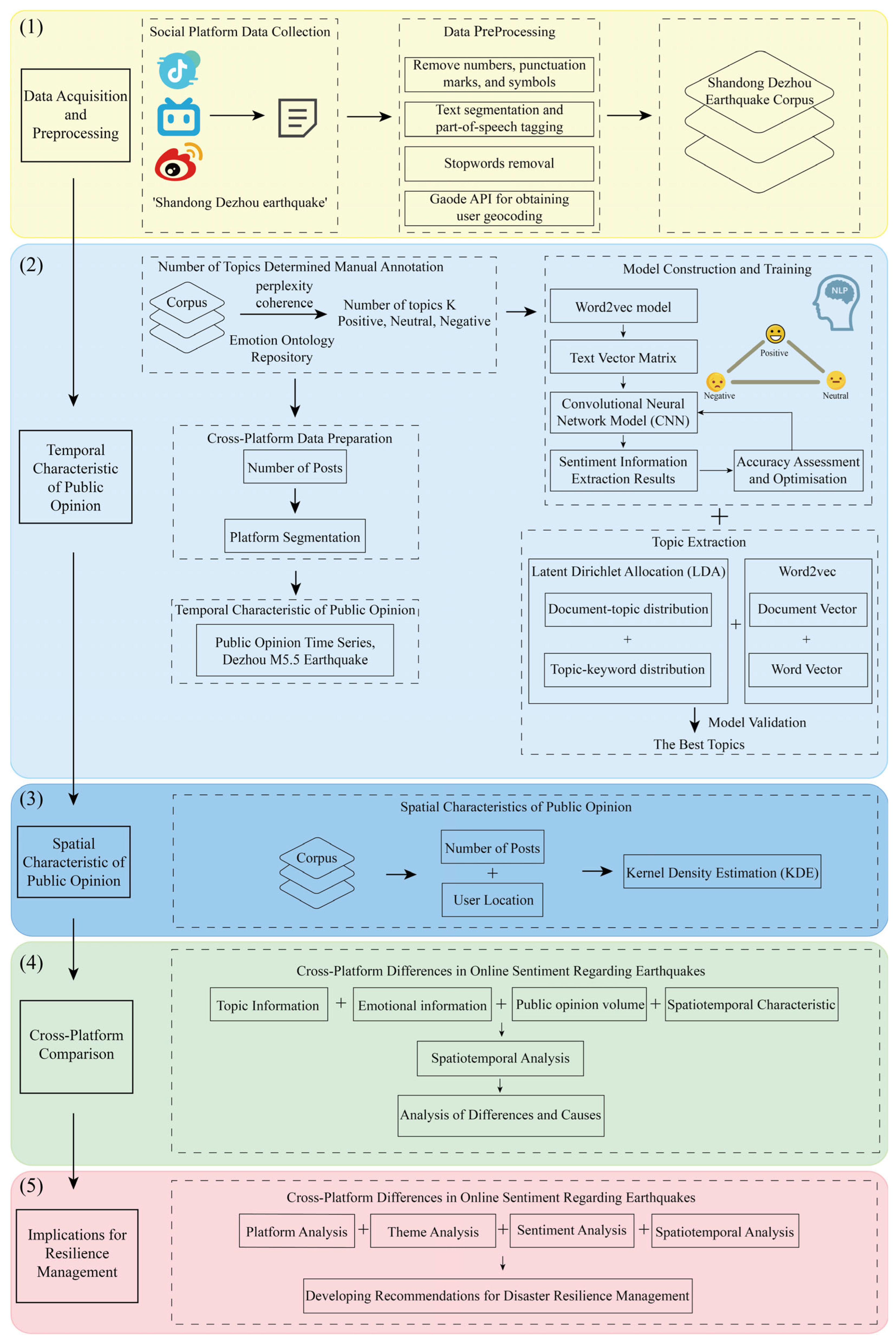
Figure 1. Integrated framework and analytical workflow.
Sustainability 17 10937 g001
Figure 2. LDA–Word2Vec model structure used for clustering earthquake-related topics across Sina Weibo, Bilibili, and Douyin posts.
Sustainability 17 10937 g002
Figure 3. Optimization of topic number (K) based on perplexity and semantic coherence of the LDA–Word2Vec model.
Sustainability 17 10937 g003
Figure 4. Time series of public opinion posts and topics on the Dezhou M5.5 earthquake. The vertical axis represents the number of online comments, and the horizontal axis represents (a) time, (b) psychological states, (c) positive wishes, (d) earthquake experience, (e) earthquake information, and (f) science popularization.
Sustainability 17 10937 g004
Figure 5. Kernel density distribution of the number of comments regarding the M5.5 Dezhou earthquake on the (a) Sina Weibo platform, (b) Bilibili platform, and (c) Douyin platform. The maps were created using ArcGIS software, with the base maps adopted from the standard maps of China’s “National Platform for Common GeoSpatial Information Services” (https://www.tianditu.gov.cn/).
Sustainability 17 10937 g005
Table 1. Framework for earthquake disaster public opinion analysis.
Disaster PhaseTemporal Characteristic of Public OpinionSpatial Characteristic of Public OpinionImplications for Resilience Management
Pre-Disaster Prevention PhaseMonitor routine early-warning topics and emotional preparednessMap pre-event attention hotspots and population vulnerability areasDevelop public education campaigns and preparedness communication strategies tailored to at-risk regions
In-Disaster Response PhaseAnalyze real-time emotional shifts and topic surges during key hoursTrack spatial concern to inform response focusGuide emergency info release and shape public opinion trajectory
Post-Disaster Recovery PhaseMonitor shifts in sentiment and topicsIdentify continued high-concern areas and regional differences in public opinionSupport adaptive recovery planning and targeted communication interventions
Table 2. Dataset characteristics and key model parameters for analyzing cross-platform public opinion following the 2023 M5.5 Dezhou earthquake.
CategoryDescription
DatasetEarthquake-related posts from Sina Weibo (8775), Bilibili (12,219), and Douyin (7563) following the 2023 M5.5 Dezhou earthquake
Data CleaningRemoval of URLs, emojis, and punctuation; Chinese word segmentation (Jieba); stopword filtering; duplicate removal
Feature ExtractionCountVectorizer default
Latent Dirichlet Allocation (LDA) ParametersK = 5; inference = variational Bayes; iter = 50
Word2Vec Parametersvector_size = 120; window = 5; min_count = 5; sg = 1; workers = 4; epochs = 30; seed = 42; hs = 1
negative = 0
Convolutional Neural Networks (CNNs) Parametersvocabulary size = 10,000; maximum sequence length = 100; batch size = 128; dropout rate = 0.3; stride = 1
Robustness Checksseeds = [11, 22, 33, 44, 55]; passes = 15 (final model training passes)
Validation Metricscoherence = ‘c_w2v’ (Word2Vec semantic coherence); perplexity (perplexity metric); optimal_k selection (select optimal topics based on max coherence)
Table 3. Examples of three social media platforms’ crawl results (originally published in Chinese). The asterisks (*) in the usernames represent the hidden letters of the original usernames, which is intended to protect user privacy.
SourceUsernamePost TimeCommentsLocation
WeiboLi*ting6 August 2023 18:41I am based in Jinan City. The earthquake woke me up. Squatting on the bed, I felt the whole earth shaking. A five-or-so-pound fan fell (later found).Jinan
Bilibiliisca*iii6 August 2023 11:15In Pingyuan County, Dezhou City, I was very scared and numb because I didn’t expect an earthquake.Dezhou
Douyinzhon*ao6 August 2023 8:59I’m from Dezhou City. I slept in my car when the earthquake happened last night.Dezhou
Table 4. Representative feature words for public opinion categories in the Dezhou earthquake corpus.
CategoryFeature Words
Earthquake
Experience
Obvious, Strong, Shocking, Shaking, Sensation, Dizzy, Bed Shaking, Awake from Shaking, Real, Awakened, Slight, Very Strong, Intense, Vibrating, Awakened by Shaking, Building, Swaying, Trembling, Violent
Science
Popularization
Disaster Self-rescue, Knowledge, Evacuation Guide, Swift, Mastery, Scientific, Escape, Popular Science, Methods, History, Seismological Bureau, Region, Unusual Sky, S-waves, Geology, Fault Zone, Prediction, Technology, Seismic Resistance, Phenomenon, Trigger, Destructive, Meteorology, Formation, Construction, Tectonic Plate
Positive
wishes
Safe and Sound, Hope, Safe and Well, Well-being, Blessing, Health, Safety Awareness, National Peace, Divine Protection, Prayers, Everyone, People, Fellow Countrymen, Wishing for Safety
Earthquake
Information
Alarm, Mobile Phone, Reminder, Notification, Wake-up Call, Activate, Early Warning, Advance, Countdown, Function, Woken Up, Frenzy, Emergency Services, Safety, Natural Disasters, Steward, Push, Urgency, Heard, Emergency
Psychological StateDazed, Scared to Death, Startled Awake, Hallucination, Confused, Fearful, Anxious, Panic, Nauseous, Nervous, Excited, Stimulated, Lingering Fear, Terrifying, Nightmares, Dizzy, Haunted, Unexpected, Comfortable, Scared, Sudden Death, Tired, Baffled
Table 5. The number of topics and proportion of emotional polarity concerning online public opinion on the Dezhou M5.5 earthquake. The proportion of each category is calculated by dividing the number of entries in that category by the total number of entries on the platform.
Topic
Category
Platform
Sina Weibo
(Entries)
Proportion
(%)
Bilibili
(Entries)
Proportion
(%)
Douyin
(Entries)
Proportion
(%)
Science Popularization6877.8 129010.6 119315.8
Psychological States234626.7 263921.6 126316.7
Earthquake information124314.2 256421.0 7529.9
Earthquake Experience170519.4 302924.8 6789.0
Positive Wishes218324.9 140911.5 219829.1
Positive3325 37.9 3946 32.33061 40.5
Neutral3755 42.8 5571 45.62845 37.6
Negative1693 19.3 2700 22.11560 20.6
Disclaimer/Publisher’s Note: The statements, opinions and data contained in all publications are solely those of the individual author(s) and contributor(s) and not of MDPI and/or the editor(s). MDPI and/or the editor(s) disclaim responsibility for any injury to people or property resulting from any ideas, methods, instructions or products referred to in the content.