Article

Multisource Remote Sensing and Machine Learning for Spatio-Temporal Drought Assessment in Northeast Syria

1
Geomatics Engineering Program, Graduate School, Istanbul Technical University, 34469 Istanbul, Türkiye
2
Department of Civil Engineering, Faculty of Engineering and Architecture, Recep Tayyip Erdogan University, 53100 Rize, Türkiye
3
Department of Geography, College of Arts and Social Sciences, Sultan Qaboos University, Muscat 123, Oman
4
Department of Geomatics Engineering, Faculty of Civil Engineering, Istanbul Technical University, 34469 Istanbul, Türkiye
*
Author to whom correspondence should be addressed.
Sustainability 2025, 17(24), 10933; https://doi.org/10.3390/su172410933
Submission received: 22 October 2025 / Revised: 28 November 2025 / Accepted: 1 December 2025 / Published: 7 December 2025

Abstract

Increasing aridity across the Middle East Region has intensified concerns about the impacts of drought in conflict-affected Northeast Syria (NES). In this study, drought dynamics and their drivers from 2000 to 2023 were analyzed by integrating ERA5-Land meteorological data, MODIS land-surface indicators, FLDAS soil moisture, and ISRIC soil properties at 250 m resolution. The integration of these multisource datasets contributes to a more comprehensive understanding of drought dynamics by combining information on weather conditions, vegetation status, and soil characteristics. The proposed drought analysis framework clarifies independent controls on meteorological, agricultural, and hydrological drought, underscoring the role of land-atmosphere feedback through soil temperature. This workflow provides a transferable approach for drought monitoring and hypothesis generation in arid regions. For this purpose, different XGBoost models were trained for the vegetation health index (VHI), the standardized precipitation-evapotranspiration index (SPEI), and surface soil-moisture anomalies, excluding target-related variables to prevent data leakage. Model interpretability was achieved using SHAP, complemented by time-series, trend, clustering, and spatial autocorrelation analyses. The models performed well (R2 = 0.86–0.90), identifying soil temperature, SPEI, relative humidity, precipitation, and soil-moisture anomalies as key predictors. Regionally, soil temperature rose (+0.069 °C yr−1), while rainfall (−1.203 mm yr−1) and relative humidity (−0.075% yr−1) declined. Spatial analyses demonstrated expanding heat hotspots and persistent soil moisture deficits. Although 2018–2019 were anomalously wet, recent years (2021–2023) exhibited severe drought.

1. Introduction

Drought is one of the most complex and extensive natural hazards, significantly impacting ecosystems, economies, and human societies worldwide [1,2]. Unlike other natural disasters, it evolves gradually and persists over prolonged periods. Although various types of droughts have been identified, the primary categories of droughts are meteorological, agricultural, hydrological, and socio-economic [3,4]. Climate change is a primary cause of drought, affecting its frequency, intensity, and spatial distribution [5]. Rising temperatures increase atmospheric evaporative demand, which removes more moisture from soils and vegetation even during regular rainfall periods [6]. Recent analyses indicate that heightened atmospheric evaporative demand has contributed approximately 40% globally to the intensification of drought over the past few decades, with particularly severe impacts observed from 2018 to 2022. During this period, the global land area affected by drought was approximately 74% larger than the long-term average, reaching its peak in 2022, when 30% of the world’s land experienced moderate to extreme drought [7].
The environmental and socio-economic implications of drought are extensive and interconnected. Ecologically, droughts reduce carbon absorption in terrestrial ecosystems and trigger widespread vegetation mortality, compromising biodiversity and ecosystem services [8,9]. Moreover, in the agricultural sector, they cause crop failures, reduced yields, and degraded soil health, threatening food security, particularly in rain-fed systems where smallholder farmers lack access to adaptation resources [10,11]. At the economic level, the impacts also include sharp increases in food prices, reduced hydropower generation, and increased wildfire risk. Recent severe drought events have been linked to billions of financial losses and humanitarian crises across multiple continents [12].
Considering the broad impacts of drought, reliable monitoring and assessment methods are crucial. Among these, meteorological indicators, particularly the Standardized Precipitation Index (SPI), which measures precipitation anomalies over multiple timescales, have long been central to conventional drought evaluations [3,13]. However, recognition of temperature’s role in drought development has led to the development of more comprehensive indices. The Standardized Precipitation Evapotranspiration Index (SPEI) incorporates Potential Evapotranspiration (PET) alongside precipitation, capturing water balance more comprehensively than precipitation-only indices [14,15]. The sensitivity of SPEI to temperature fluctuations makes it particularly well-suited for detecting droughts in warming climates, where water stress during near-normal precipitation periods is intensified by increasing PET demand [1].
In addition to meteorological indices, integrating hydrological and ecological variables that highlight the cascading impacts of water deficit is essential for a comprehensive drought assessment. Soil moisture is a vital link between meteorological drought and agricultural impacts, providing direct measurements of plant-available water [16,17]. However, ground-based observations are often costly and logistically challenging to sustain over large areas. In this context, remote sensing technologies have fundamentally shifted drought monitoring away from reliance on traditional site-based measurements, enabling the observation and estimation of key drought-related variables over larger temporal and spatial scales, by using satellite spectral bands and derived vegetation indices providing continuous and detailed evaluations of vegetation health [18,19]. The Normalized Difference Vegetation Index (NDVI) is a commonly utilized indicator of vegetation greenness, generally declining under drought conditions when plants undergo water stress [20,21]. Beyond NDVI, advanced indices include the Vegetation Condition Index (VCI), which normalizes NDVI relative to historical extremes, and the Vegetation Health Index (VHI), which combines VCI with thermal stress indicators. A comprehensive drought monitoring system can be enhanced by incorporating additional remote sensing indicators, such as the Normalized Difference Water Index (NDWI), which detects vegetation moisture stress by responding to leaf water content [22]. Land Surface Temperature (LST) data complement Vegetation Indices (VI) by providing information on the surface energy balance, with elevated temperatures indicating water stress and reduced PET [23]. Additionally, Relative Humidity (RH) and atmospheric moisture variables influence ecosystem drought responses regardless of rainfall levels, with reduced humidity worsening drought impacts even when soil moisture is sufficient [24,25].
While these impacts highlight the global significance of drought, understanding its implications also requires consideration of regional vulnerability. Complex interactions among climatic conditions, water resources, agricultural dependence, and adaptive capacity shape such vulnerability. The Mediterranean basin, Sub-Saharan Africa, the southwestern United States, and southeastern Australia have experienced unprecedented drought conditions with profound ecological and economic consequences [26]. As one of the world’s most water-scarce regions, the Middle East and North Africa (MENA) region exhibits extreme vulnerability, with rising temperatures and declining precipitation increasing the frequency and severity of droughts [1].
Despite advancements in drought monitoring techniques, assessing drought is challenging due to its dynamic nature and the nonlinear interactions with environmental systems. This limitation has led to growing interest in Machine Learning (ML) methods, which can handle large datasets, identify complex relationships, and generate insights from data [27,28,29]. Recent studies have demonstrated the effectiveness of ML for drought detection, severity assessment, spatial mapping, temporal forecasting, and impact evaluation across various climate regions [30,31]. The most widely adopted ML algorithms are Random Forest (RF), Support Vector Machine (SVM), and Extreme Gradient Boosting (XGBoost). RF exhibits notable strength in handling multi-source data, while SVM shows effectiveness for classification problems with limited training data [32].
On the other hand, XGBoost has been prominent in environmental modeling among ML techniques due to its combination of predictive performance, computational efficiency, and interpretability features. XGBoost utilizes an ensemble approach, building sequential decision trees in each iteration to rectify previous errors while maintaining computational feasibility for large datasets. The algorithm’s built-in regularization prevents overfitting, while its ability to handle missing data, mixed variable types, and different feature scales makes it suitable for environmental applications with varying data quality [33]. A notable attribute of XGBoost is its ability to provide quantitative evaluations of feature importance, facilitating the identification of the most impactful elements in drought progression. For instance, Ahmad et al. [34] utilized the XGBoost to enhance urban remote sensing applications through a data fusion approach integrating the optical images of Landsat-8 satellite and the Synthetic Aperture Radar (SAR) data from Sentinel-1 satellite.
Recent years have witnessed remarkable advances in machine learning applications for drought monitoring. For example, Li et al. [21] examined the severity and the spatiotemporal patterns of drought in Southwest China using multiple remote sensing based drought indicators and meteorological drought indices, applying ML methods like RF and XGBoost. While Zhao et al. [35] tried to reproduce the standard precipitation evapotranspiration index (SPEI) based on seven remote sensing drought impact factors by applying different ML algorithms like RF, SVM, and XGBoost. Recent studies have demonstrated that XAI-enhanced drought models not only improve stakeholder trust but also reveal unexpected drivers of drought variability, such as the compound effects of soil moisture memory and atmospheric teleconnections [36]. Furthermore, the fusion of multi-source remote sensing data (optical, thermal, microwave) with reanalysis products through ML frameworks has substantially improved drought characterization in heterogeneous landscapes, with studies reporting 20–30% improvement in drought detection accuracy compared to single-source approaches [37].
In this study, an ML-based framework was proposed to analyze drought progress in Northeast Syria (NES) from 2000 to 2023. To investigate different aspects of drought, separate XGBoost models were developed for three widely used indicators: VHI, SPEI, and soil moisture anomalies. These models rely on a diverse set of environmental inputs, including meteorological variables, VIs, soil moisture estimates, salinity data, and static soil properties. To avoid internal dependency and ensure that the models capture external climatic and ecological drivers, variables used in the calculation of each indicator were excluded from the regression inputs. This approach enables the independent evaluation of interactions among climatic variables, soil characteristics, and vegetation responses during periods of water stress.
Additionally, the study adopted a three-phase chronological structure that corresponds to significant shifts in the region’s socio-political transition. These periods, defined as pre-conflict, conflict, and post-conflict, provide a framework for interpreting drought patterns in relation to institutional and social disruption. To improve model interpretability, SHapley Additive Explanations (SHAP) was used to assess the contribution of each environmental variable. Spatial autocorrelation and trend analysis further support this by tracking the evolution of drought-related factors and their changing spatial distribution over time. Taken together, these components illustrate that ML serves not only as a forecasting tool but also as an analytical means to reveal the underlying relationships that govern drought in environmentally and politically fragile regions.
By integrating multi-source climate indicators with machine-learning-based spatial analysis, this study contributes to filling important knowledge gaps in the understanding of drought dynamics in conflict-affected areas. In this way, it is possible to gain a more detailed understanding of how droughts develop under conditions of disrupted agricultural systems, damaged irrigation infrastructure, and limited monitoring of the environment. Despite the heightened vulnerability of such regions, there are few high-resolution, long-term, and systematically validated drought assessments available in the existing studies. Combining SPEI, soil-moisture anomalies, vegetation health indices, and predictive modeling provides a more robust empirical basis for identifying drought hotspots and understanding their temporal behavior despite data scarcity and conflict-related constraints. Thus, the study advances the development of methods for drought assessment in fragile environments and provides a replicable framework for regions where conventional monitoring systems are weak or unreliable.

2. Materials and Methods

2.1. Study Area

The Northeast Syria (NES) is situated between latitudes 34° and 37° N and longitudes 38° and 42° E. It covers around 50,000 km2 and represents approximately 27% of Syria’s total area of 185,180 km2. The region is bordered by Türkiye to the north, by Iraq to the east, and by the Euphrates River to the west (Figure 1a).
NES demonstrates a moderate relief, characterized mainly by a low-lying plateau interspersed with several spatially restricted highlands. NES ranges from approximately 148 m in the southeastern parts to nearly 920 m in the more rugged northern and central uplands, with an average elevation of about 343 m. The lowest areas are mostly found along the riverbanks and the southern and southeastern boundaries, forming broad, gently sloping plains. As one moves inland, the terrain gradually rises, giving way to prominent uplands or mountainous zones exceeding 900 m above sea level (Figure 1b). This region is shaped by a complex interplay of geological, climatic, and hydrological factors, which significantly influence agricultural activities, water availability, and socio-economic conditions.
The NES climate is characterized by warm summers and cool, rainy winters. Over time, the region exhibited a declining trend in overall precipitation, particularly after 2000, along with considerable interannual variability [38]. On the other hand, a net warming trend is evident, with a long-term average temperature (1980–2023) of 19.65 °C. 2010 stands out as the hottest, and since then, high-temperature years have occurred more frequently [39]. Additionally, this region is distinguished by ethnic and religious diversity. Its population is approximately 4 million people, and it has long been considered one of Syria’s main agricultural hubs. Historically known as the country’s breadbasket, it is due to its extensive arable land and grain production, particularly wheat and barley, which are crucial for ensuring Syria’s food security [40]. However, since 2011, the combined impacts of ongoing drought and armed conflict have severely disrupted agricultural activities, resulting in sharp declines in the yields of nearly all major crops. Rising temperatures and reduced rainfall have further exacerbated the situation, contributing to a significant drop in vegetation moisture content, particularly in rainfed farming zones [41,42].

2.2. Dataset

This study employed multiple datasets from different sources, including meteorological data, VIs, drought indicator, LST, soil moisture, soil salinity, and additional soil properties parameters (Table 1).

2.2.1. Meteorological Data

The ECMWF ReAnalysis version 5—Land component (ERA5-Land) meteorological parameters, including air temperature, precipitation, dewpoint temperature, solar radiation, thermal radiation, surface pressure, soil temperature level 1, evaporation, RH, 10 m u-component of wind, and 10 m v-component of wind, were utilized at a monthly scale from 2000 to 2023 across 489 grid points.
ERA5-Land was developed by the European Centre for Medium-Range Weather Forecasts (ECMWF). This publicly accessible dataset provides high temporal (hourly) and spatial (0.1°) resolution on a global scale [42]. RH is vital for indicating drought events through its influence on biodiversity and ecosystem reactions to drought, particularly due to its direct effect on the PET rates and vegetation stress [43]. However, the ERA5-Land datasets do not provide direct RH measurements. Therefore, the RH was calculated by applying the Magnus-Tetens approximation based on air temperature and dewpoint temperature measurements [44].

2.2.2. Land Surface Temperature

The Moderate Resolution Imaging Spectroradiometer (MODIS) instrument on the Terra satellite provides daily LST measurements throughout the MOD11A1 product, during the day and night, at a resolution of 1000 m [45]. MOD11A1 offers two different bands for LST measurements, daytime and nighttime. The daily LST was calculated as the average of daytime and nighttime measurements. Then, the monthly data were aggregated based on the daily measurements of each parameter, including daytime, nighttime, and overall daily data.

2.2.3. Vegetation Indices

MODIS also provides VIs through the MOD13Q1 product, at 250 m spatial resolution and 16-day temporal resolution, including key indices like NDVI and Enhanced Vegetation Index (EVI), in addition to the bands 1 (Red), 2 (NIR), 3 (Blue), and 7 (MIR) [46]. Based on the bands of the MOD13Q1, monthly measurements of NDVI, EVINDWI, and the normalized difference drought index (NDDI) were generated between 2000 and 2023.

2.2.4. Soil Moisture

The Famine Early Warning Systems Network Land Data Assimilation System (FLDAS) provides a monthly global series of land surface and hydrological parameters at the spatial resolution of 0.1°. This dataset includes information on a wide range of climate-related factors, such as soil moisture, total precipitation rate, average soil temperature, humidity, evapotranspiration, and more [47]. For this study, the soil moisture was measured at two levels, the root zone (10–40 cm) and the surface level (0–10 cm). The anomaly for each level was generated using a baseline from 2000 to 2023.

2.2.5. Soil Salinity

The soil salinity measurements were collected from the Global Soil Salinity Map dataset provided by the International Soil Reference and Information Centre (ISRIC). This dataset includes layers for 1986, 1992, 2000, 2002, 2005, 2009, and 2016, at a global scale and 250 m spatial resolution. A variety of publicly accessible and harmonized global soil datasets on soil chemical and physical properties were provided by the ISRIC data hub [48].

2.2.6. Soil Properties

Based on ML techniques and extensive soil profile data, ISRIC also developed SoilGrids as a high-resolution and global digital soil mapping system. SoilGrids offers comprehensive information about several soil parameters, such as soil organic carbon, nitrogen, pH, bulk density, and more, with a 250 m spatial resolution and across multiple depth levels up to 200 cm [49]. Several parameters from SoilGrids at the surface level from 0 to 5 cm were used, including bulk density, citation exchange capacity at pH7, coarse fragments volumetric, clay content, nitrogen, soil pH in water, sand content, silt content, soil organic carbon content, soil organic carbon stock, and organic carbon densities.

2.2.7. Data Aggregation

The study focuses on NES from 2000 to 2023, using spatial data at 250 m resolution. Data from 2000 to 2020 were used for training and validation. The period from 2021 to 2023 was allocated for an independent evaluation of the model. The dataset’s high spatial and temporal resolution makes direct ML training feasible. Therefore, a data aggregation and stratified sampling strategy reduces computational requirements while maintaining representativeness of the study area.
All variables used in this study were resampled to a spatial resolution of 250 m to ensure spatial consistency. This requirement aligns with the native resolution of MODIS-derived vegetation indices (e.g., NDVI, EVI, VHI), which form the basis of the dynamic dataset. It was necessary to downscale coarser-resolution data (e.g., meteorological and soil variables) to preserve the fine-scale spatial signals essential for drought analysis. The resample tool in ArcGIS Pro software (version 3.1) was used to downscale all data to a 250 m resolution with the MODIS data as reference data, and nearest neighbor as resampling technique. While downscaling may introduce spatial uncertainty, the 250 m resolution provides a practical balance between spatial detail and representativeness at the regional scale. Furthermore, NDVI-based stratified sampling reduced potential aggregation bias and enhanced the model’s ability to capture spatial variability effectively across the study area.
Each pixel was first evaluated based on its maximum NDVI value across the full time series and classified into two vegetation density classes. Pixels with a maximum NDVI of 0.4 or higher were labeled as dense vegetation, whereas pixels with lower values below 0.4 were assigned to low-vegetation areas. This classification was used as the primary stratification criterion for sampling. A total of 2000 pixels were selected from the low-NDVI class and 18,000 from the dense-vegetation class. This designed oversampling of the less common low-NDVI class aimed to improve model performance for underrepresented vegetation types while preserving the spatial representativeness of the dataset. Using the same NDVI-based stratification and spatial structure, the dataset was then divided into training and validation sets using an 85:15 ratio.

2.2.8. Exploratory Data

The dataset contains variables related to the climatic conditions, vegetation characteristics, and soil properties of NES. Descriptive statistics for each variable are presented in Table 1. A warm and predominantly semi-arid climate can characterize this region. Specifically, the mean daytime LST is 33.5 °C, while the nighttime mean is 13.3 °C which contributes to increased evaporative demand. The low mean precipitation (0.73 mm) and low relative humidity (44%) further enhance the dry conditions in the atmosphere. VIs (NDVI, NDWI, and NDDI) record low mean values. The mean VHI is 32.7 with a standard deviation of 20.0, indicating substantial spatial and temporal variability. Due to a lack of greenness and moisture in the region, the vegetation health is consistently poor throughout the region. The SPEI has a mean close to zero and ranges from −3.5 to 3.8. The range reflects both periods of dry and wet weather.
In addition to climatic and vegetation characteristics, the soil conditions in Northeast Syria further highlight the region’s limited resilience to drought. In areas with irregular rain events, fine-textured soils with a high clay (347 g/kg) and silt content (445 g/kg) could restrict water infiltration and increase surface runoff. A moderate bulk density (145 cg cm−3) and a low organic carbon content (128 dg kg−1) indicate a reduced water-holding capacity. Although average soil salinity remains low (0.45 dS m−1), it may still pose risks under prolonged dry conditions. In combination with low precipitation, extreme temperatures, sparse vegetation cover, and physically constrained soils, these factors contribute to a highly drought-prone environment. As a result of such conditions, the landscape is susceptible to both acute drought events and long-term degradation over time.
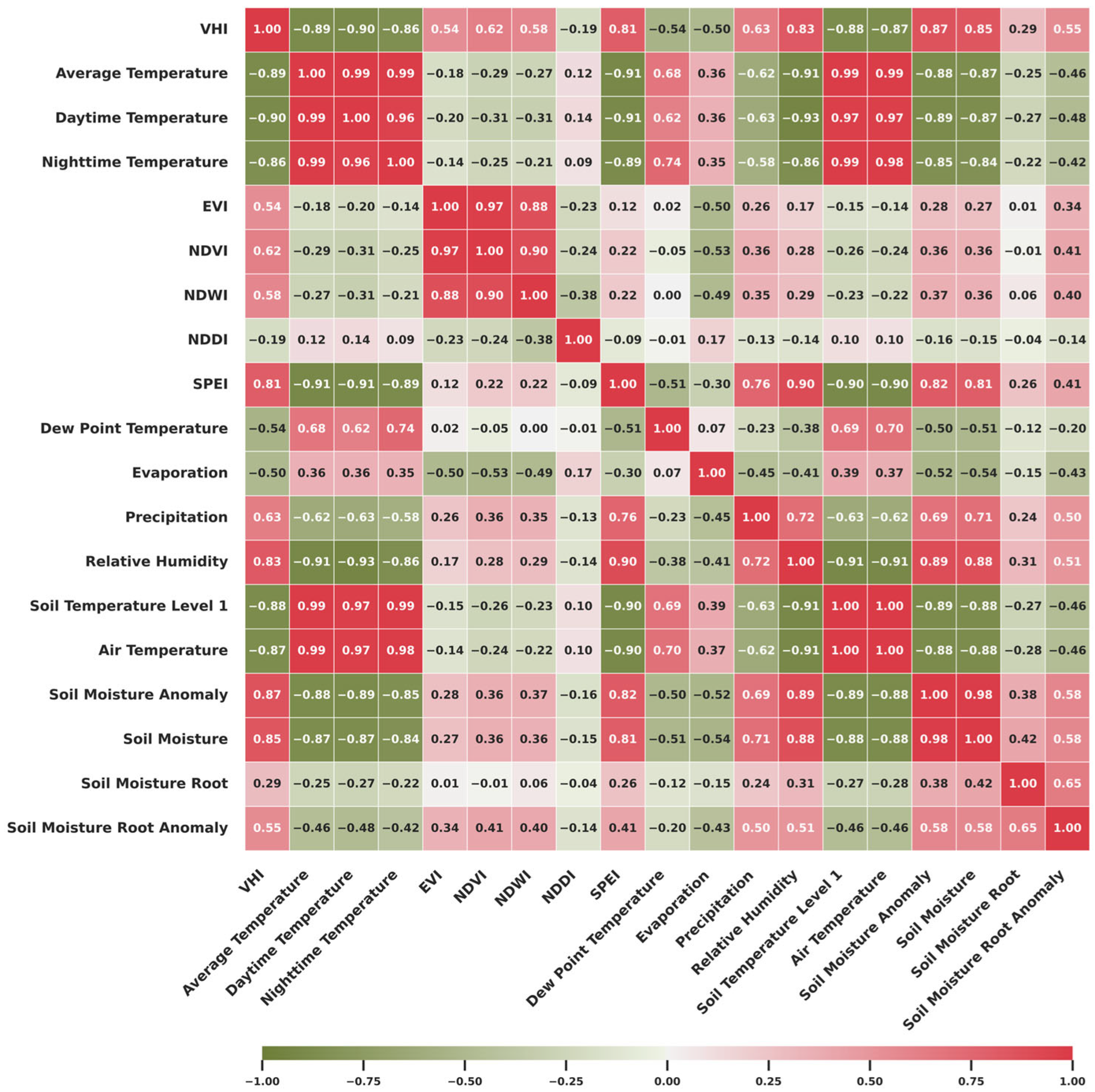
This dataset also includes primary drought indicators such as VHI, SPEI, and Soil Moisture Anomaly. Figure 2 provides the correlation matrix for assessing intra-group and inter-group relationships. Notably, VHI shows strong negative correlations with these LST metrics (−0.86 to −0.90), a relationship consistent with declining vegetation health at higher surface temperatures. This likely reflects increased evaporative demand and thermal stress, which are particularly relevant in semi-arid and arid ecosystems. VHI shows moderate positive correlations with vegetation indices (NDVI, NDWI, EVI), indicating that areas with higher greenness and leaf-level water content generally exhibit better vegetation conditions. In general, while elevated surface temperatures are consistently linked to declines in vegetation health, vegetation indices provide complementary information by capturing changes in greenness and canopy conditions. These changes are positively related to vegetation conditions and can help explain how plants respond to heat stress.
Several strong correlations are observed in the SPEI group, highlighting the close relationship between atmospheric moisture conditions, temperature dynamics, and near-surface soil thermal regimes. The negative correlation between SPEI and air temperature as well as soil temperature at level 1 reflects the sensitivity of drought conditions to thermal anomalies, which increase evaporative losses and suppress soil moisture recharge. In contrast, the strong positive links with RH and precipitation underscore SPEI’s ability to integrate moisture inputs alongside atmospheric demand. Together, these patterns show that SPEI effectively reflects the combined influence of temperature-driven evaporative stress and atmospheric moisture conditions. This makes it a reliable metric for characterizing drought variability in regions where seasonal thermal fluctuations strongly shape hydrological processes.
Within the Soil Moisture Anomaly group, soil moisture anomaly and bulk soil moisture are almost strongly correlated, while root-zone soil moisture is not. However, the root-zone soil moisture anomaly shows a moderately strong relationship (0.65) with root-zone soil moisture. In particular, connections between different soil depths are weak. Specifically, Soil Moisture Anomaly is weakly correlated with Soil Moisture Root (0.38) but has a moderate correlation with Soil Moisture Root Anomaly (0.58), pointing to differences in soil water variations with depth. Furthermore, across all features, soil moisture anomalies showed positive associations with precipitation and RH. In contrast, they are negatively related to air temperature and evaporation, highlighting the sensitivity of soil water reserves to atmospheric drying processes. These correlations together indicate that surface and root-zone soil moisture respond differently to climatic drivers, with surface layers responding more strongly to short-term atmospheric conditions. Therefore, when assessing drought impacts, it is necessary to provide depth-specific soil moisture information.
In terms of correlation patterns, it appears that the VHI, soil moisture conditions, and drought indices are all closely related to major climatic drivers such as the SPEI. Additionally, rising temperatures reduce the health of vegetation and soil water availability. On the other hand, increased humidity and precipitation enhance plant growth and restore soil moisture. These results demonstrate that vegetation and soil indicators alone cannot adequately capture drought dynamics. Instead, they require a combined perspective that integrates climate, soil, and vegetation processes.

2.3. Methodology

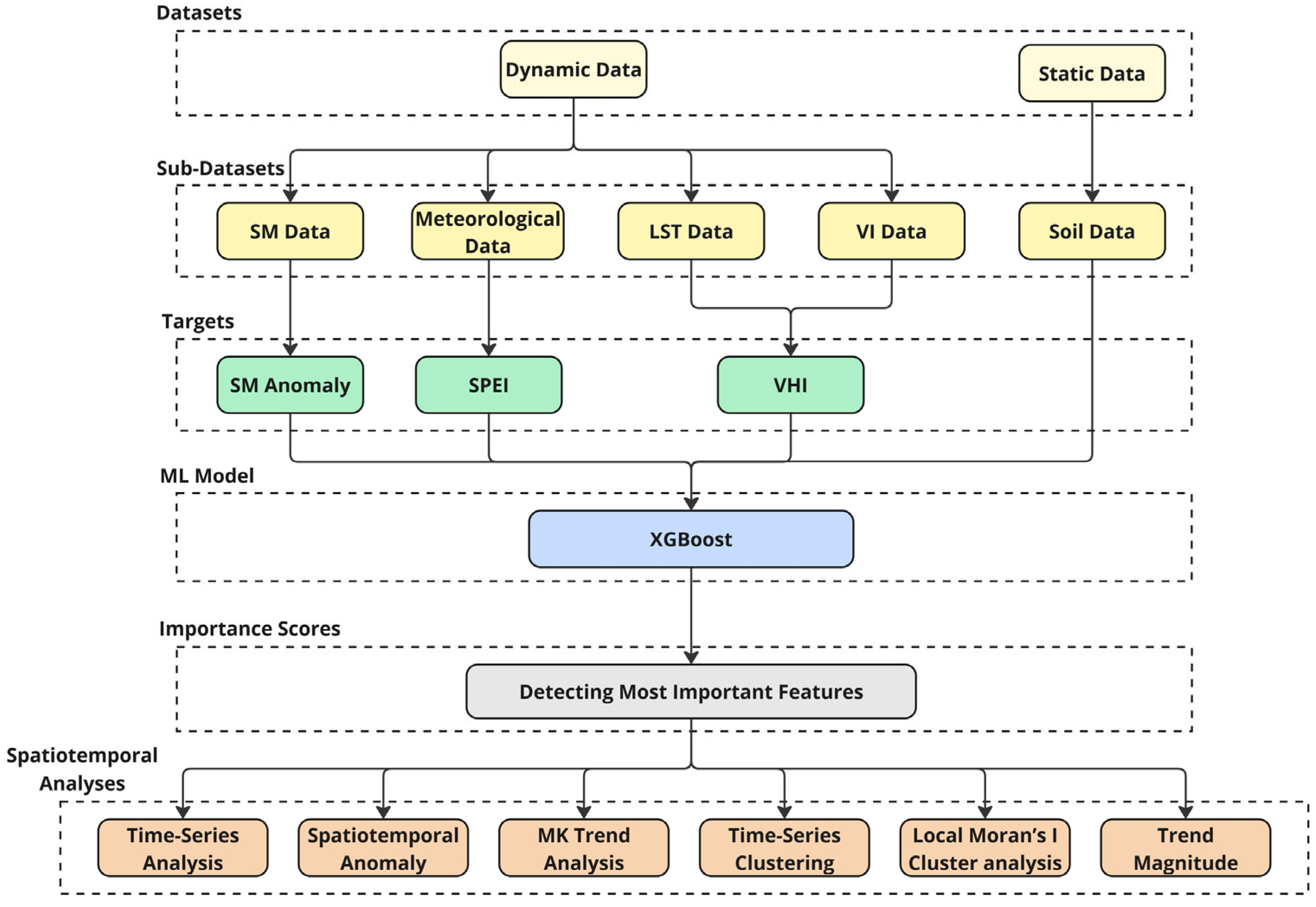
This study examines drought characteristics and their drivers in NES using an XGBoost ML model and a multi-source dataset. The influence of each variable on model predictions was quantified. Data were categorized as dynamic and static. The dynamic subset consisted of meteorological variables, VIs, soil moisture, and LST for daytime and nighttime. The static subset included soil properties and soil salinity.
All data were transformed to the same projection and downscaled to the exact spatial resolution of 250 m. Then, the model was trained 3 times. In the first, the target was VHI, in the second, the target was SPEI, and the surface-level soil moisture anomaly was the third target. The feature importance scores of these models were combined, and the most important features were detected. Several spatiotemporal analyses were performed on the selected features to investigate how they varied over time and to examine their relationships. These analyses included time series analysis and clustering, Mann–Kendall (MK) trend analysis and trend magnitude mapping, probability density function, and local spatial autocorrelation (Figure 3).
In this approach, the ML model was used as a pre-processing step for the spatiotemporal analyses. At the same time, the most important parameters were explored in detail through a variety of spatial and temporal analyses. This methodology trains the XGboost model multiple times with different targets while excluding all parameters involved in generating those targets. For example, when the target was SPEI, all meteorological parameters combined to form the SPEI were left out. This method enabled us to investigate how other parameters affect the SPEI. Instead of serving solely as a predictive tool, the ML model functioned as an exploratory instrument. The results provided a data-driven foundation for identifying environmental variables that meaningfully to drought dynamics in the study area. The analytical steps that followed were designed and interpreted in the light of these findings.
SHAP values were computed to interpret the trained models and identify influential predictors. SHAP provides an accurate estimate of each variable’s contribution to model predictions that is consistent and locally accurate. To determine which predictors were most consistently associated with drought and vegetation variability across the three target-specific models, SHAP values were compared. After SHAP analysis identified the most influential variables, several spatiotemporal analyses were conducted, including time series analysis, clustering, MK trend testing, trend magnitude estimation, and local spatial autocorrelation. To better understand the relationship between the selected variables and varying drought conditions, these techniques were applied to investigate how these variables developed over time and space.
The modeling framework was used not only for predictive purposes but also as a tool for exploratory analysis. It provided a data-driven basis for identifying which variables, or combinations of variables, were most strongly associated with drought impacts in the study area. These insights informed further time-series and spatial analyses in the subsequent stages of the research.

2.3.1. Target Preparation and ML Model Parameters

SPEI is a commonly utilized drought indicator, especially suitable for arid and semi-arid regions due to its increased sensitivity to global warming and variations in PET [50]. It was introduced in 2010 by [14] through incorporating air temperature into the SPI, thereby accounting for the impact of temperature on the evolution of drought. This integration of various meteorological elements, such as precipitation and evapotranspiration, has made SPEI a more effective and reliable drought index, notably in its ability to reflect shifts in the climatic water balance [51,52].
The ERA5-Land monthly averaged reanalysis parameters were utilized to generate the SPEI at a 12-month scale from 2000 to 2023. The Penman-Monteith method and the Pearson III distribution were used to calculate the SPEI values. Penman-Monteith is a well-known and reliable method for calculating evapotranspiration. It is also recommended by the Food and Agriculture Organization (FAO) for its accuracy and physical basis, and it is frequently referred to FAO-56 Penman-Monteith [53]. Whereas the Pearson III distribution was employed due to its fit, performance, and superiority over other distributions, such as the Gamma, generalized logistic, and generalized extreme value distributions [54].
VHI is a widely used remote sensing drought monitoring index. It is an essential tool for assessing water stress levels in vegetation. VHI is considered an improved version of NDVI since it can identify both drought and non-drought conditions [55]. VHI is combined from two primary components, the Temperature Condition Index (TCI) and the VCI. Whereas the VCI is derived from the monthly NDVI measurements, the TCI is mainly based on the monthly LST observations [56].
Anomalies are vital in various environmental applications and studies, especially in drought and climatic research. Short-term drying and wetting events due to anomalous precipitation and temperature can be captured using SM anomalies [57]. SM anomalies were generated using the entire period 2000–2023 as a baseline.

2.3.2. XGBoost (eXtreme Gradient Boosting) and Bayesian Optimization

XGBoost is a scalable and end-to-end tree boosting system, capable of performing tree-based analysis on large datasets while effectively capturing complex patterns and interactions. XGBoost achieves high computational efficiency with minimal cluster resources. In comparison to many commonly used ML models, it offers significant improvements in processing time [58].
In this study, all machine learning procedures were implemented in Python (version 3.12.12). XGBoost (version 3.1.1) was employed to train regression models to predict three drought-related indicators. These indicators were the VHI, the SPEI, and the Soil Moisture Anomaly. To prevent data leakage and maintain the integrity of the model, variables involved in the definition or determination of each drought indicator were excluded from the corresponding input features. This ensured that the models were not influenced by information already embedded in the targets. For example, several VIs such as NDVI, NDWI, and NDDI were removed from the feature set when predicting VHI. In the case of SPEI models, meteorological variables such as precipitation and temperature were excluded. Similarly, the input features for soil moisture models did not contain any soil moisture-related variables. This approach allowed the models to learn from independent information, rather than being biased by data that could inflate their predictive performance.
Hyperparameter optimization was performed using Optuna (version 4.6.0) [59], which is a Bayesian optimization framework. The objective was to maximize the coefficient of determination (R2) on a separate validation set. The training data, covering the years 2000 to 2020, were split into 85% for training and 15% for validation. To ensure a fair comparison and avoid data leakage, the period from 2021 to 2023 was reserved as an independent test set. This test set was not used in any part of the training or tuning process. For each drought indicator, a total of 250 optimization trials were conducted. The hyperparameter search space included values for maximum tree depth in the range of 3 to 12, minimum child weight from 1 to 250, subsample ratio from 0.1 to 1.0, column sampling ratio from 0.5 to 1.0, number of estimators from 0 to 120, and L2 regularization from 0.001 to 25. In each trial, an XGBoost regressor was trained with GPU acceleration, and its R2 score was evaluated using the validation subset. After hyperparameter optimization, the best-performing model was retrained using the complete training data.

2.3.3. Evaluation Metrics

The three most important metrics used to evaluate the performance of the regression models are the coefficient of determination (R2), root mean square error (RMSE) and mean absolute error (MAE).
R 2 = 1 i = 1 n y i y i ^ 2 i = 1 n y i y ¯ 2
RMSE = 1 n i = 1 n y i y i ^ 2
MAE = 1 n i = 1 n y i y i ^
where n is the total number of observations used for evaluation, y i denotes the observed value of the drought indicator for the i -th observation, y i ^ represents the predicted value obtained from the regression model, and y ¯ indicates the mean of the observed values across all samples.

2.3.4. SHAP (SHapley Additive Explanation)

ML approaches, often referred to as black-box models, can produce highly accurate results. However, relying solely on statistical outputs limits their applicability across diverse problem domains. Given the nonlinear relationships among parameters influencing drought indicators and the high dimensionality of the feature space, it becomes essential to justify the predictions generated by such models. Understanding why a model makes a particular prediction not only enhances its reliability but also increases its potential for generalization to different contexts.
The SHAP method [60], which has gained considerable attention in recent years and is rooted in cooperative game theory, aims to improve the interpretability of ML models. SHAP computes the contribution of each input feature to the model’s prediction using Shapley values. These values are based on the principle of fair distribution in cooperative games, representing the marginal contribution of each player to the overall outcome. By attributing an importance score to each feature for a specific prediction, SHAP provides a transparent framework for interpreting the inner workings of complex models. This is achieved by calculating the marginal contribution of each feature across all possible permutations and then averaging these contributions.
The SHAP framework unifies six different feature attribution methods under a common theoretical model, ensuring both consistency and enhanced alignment with human intuition. This unification has enabled the development of novel interpretation techniques that offer improved theoretical soundness and more intuitive explanations. The mathematical expression of the SHAP value is given as follows:
ϕ i = S F { i } S ! F S 1 ! F ! f S { i } x S { i } f S x S
where F denotes the set of all input features, ϕ i represents the contribution of feature i , and S F i   indicates all subsets of features that exclude feature i . The term f S x S denotes the model’s prediction when using only the subset S, based on the corresponding input values x S .
Furthermore, SHAP employs a binary representation of input variables as the foundation of an additive feature attribution model, which is expressed as follows:
g z = ϕ 0 + i = 1 M ϕ i z i
This formulation expresses the simplified binary representation of the input features, where M denotes the total number of features. The term ϕ 0 corresponds to the model output when no features are present, whereas each ϕ i represents the contribution of the feature i to the final prediction. By decomposing the model prediction into individual interpretable components, this linear model provides a transparent and human-understandable explanation of the model’s decision-making process.

2.3.5. Feature Importance Assessment and Spatiotemporal Analyses

An evaluation of the importance of input features is based on their mean absolute SHAP values in the XGBoost model. The interrelationships among the most influential features are examined to better understand potential dependencies better. During the feature selection process, both the frequency of the parameters and their SHAP contribution scores are considered. After selecting the important features, a time-series analysis is performed, followed by time-series clustering to identify regions that exhibit similar temporal patterns. Furthermore, to explore the spatiotemporal dynamics of each feature, K-Means clustering is applied, and the results are visualized using cluster centroids and spatial distribution maps.
Given that the NES is a conflict-affected region, a spatiotemporal anomaly analysis was performed on the selected features across three distinct time periods, namely the pre-conflict period (2000–2011), the conflict period (2012–2017), and the post-conflict period (2018–2023). Based on major political and security developments in the region, a temporal division was applied. The 2018–2023 period is referred to as post-conflict, indicating a decrease in large-scale conflict operations, while acknowledging the persistence of regional instability and localized tensions. The anomalies were spatially distributed and plotted as annual time series plots.
Two non-parametric trend analysis approaches, Sen’s slope estimator and the MK test, were used to evaluate the trend direction, significance, and magnitude in the selected parameters at the pixel level [61,62]. These methods are extensively employed to detect trends in time series data. The MK determines the trend direction of a variable, whether it is upward or downward over time, with statistical significance evidenced by a p-value below 0.05. Sen’s slope, on the other hand, offers a quantitative assessment of trend magnitude by estimating the annual rate of change in the parameter.
The Local Moran’s I statistic was applied to examine the spatial structure and clustering patterns of the selected features. This approach allowed the detection of statistically significant spatial clusters, such as hotspots of consistently high anomalies, cold spots of consistently low anomalies, and spatial outliers [63].

3. Results

3.1. Regression Model Performance

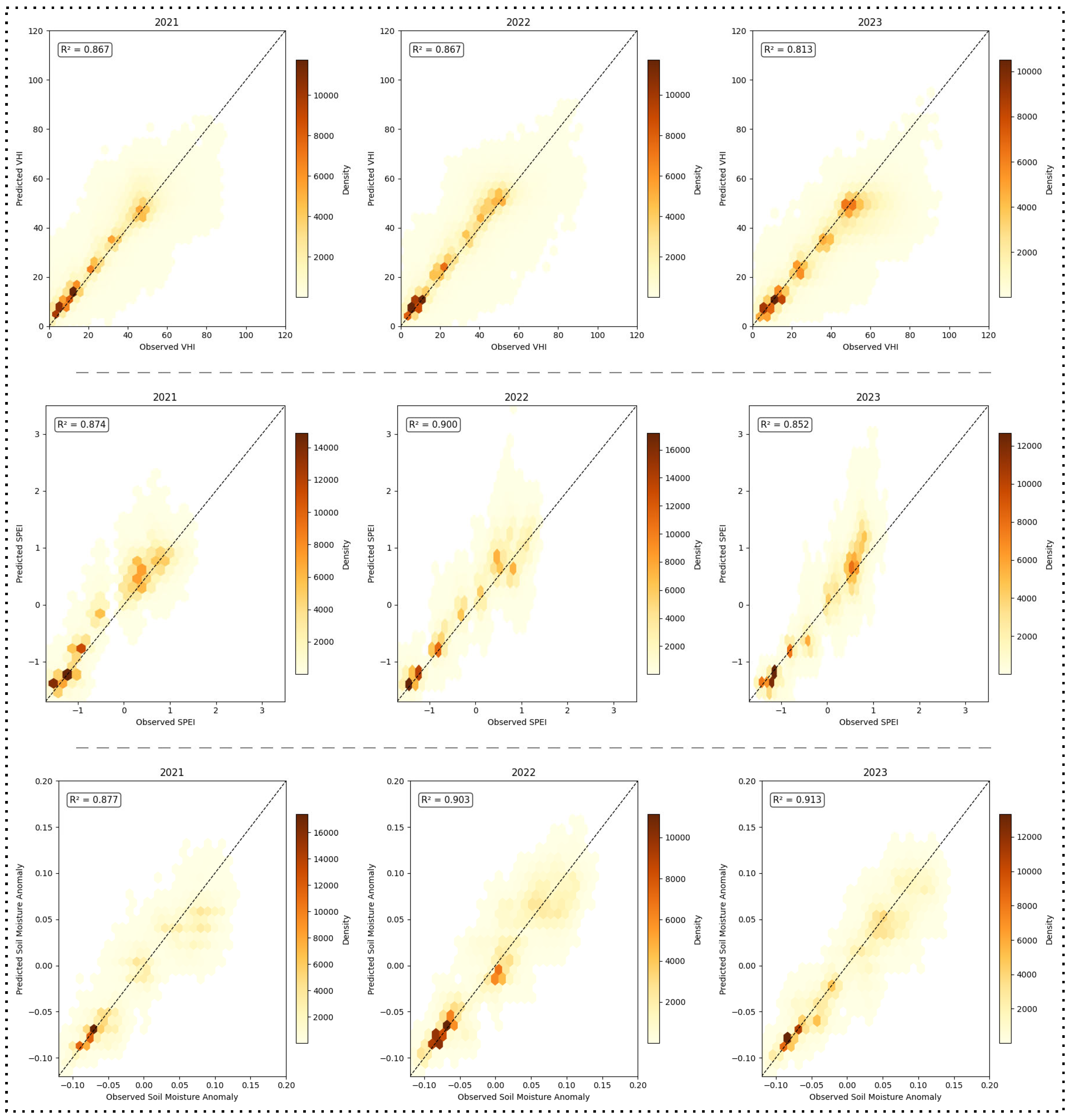
The results of all drought indicators are provided in Table 2 for the annual prediction of the model’s performance. High predictive accuracy was achieved across all targets and years, with peak performance in 2022. With R2 values of 0.90 and low RMSE and MAE scores, SPEI and Soil Moisture Anomaly show particularly strong prediction performance. Despite VHI’s relatively lower accuracy than other indicators, its R2 remained above 0.86, indicating stable and reliable predictions. Especially for soil moisture anomalies and SPEI, these results validate the model’s robust performance over the years.
The scatter density plots in Figure 4 confirm the strong predictive performance shown by evaluation metrics. Across all pixels from the 2021–2023 test period, the predicted and observed values cluster along the diagonal, in line with the high R2 scores in Table 2. This pattern demonstrates that the model accurately captures spatial and temporal variability, with particularly close alignment for SPEI and Soil Moisture Anomaly. According to its high performance in 2022, the model successfully reproduced VHI patterns. However, its predictive accuracy was lower than other indicators.

3.2. Identification of Significant Features

Regression models were trained for predicting three primary drought indicators, VHI, SPEI, and Soil Moisture Anomaly. In order to prevent data leakage, variables used to calculate each indicator were excluded from the training process. This approach enabled models to estimate the target variables independently of their derived parameters. For example, in the VHI model, components such as NDVI, NDWI, NDDI, and day and night surface temperatures were excluded. In the SPEI model, variables such as evaporation, precipitation, dew point temperature, humidity, and surface temperature were removed. Similarly, soil moisture measurements acquired at various depths were omitted from the training dataset in the Soil Moisture Anomaly model.
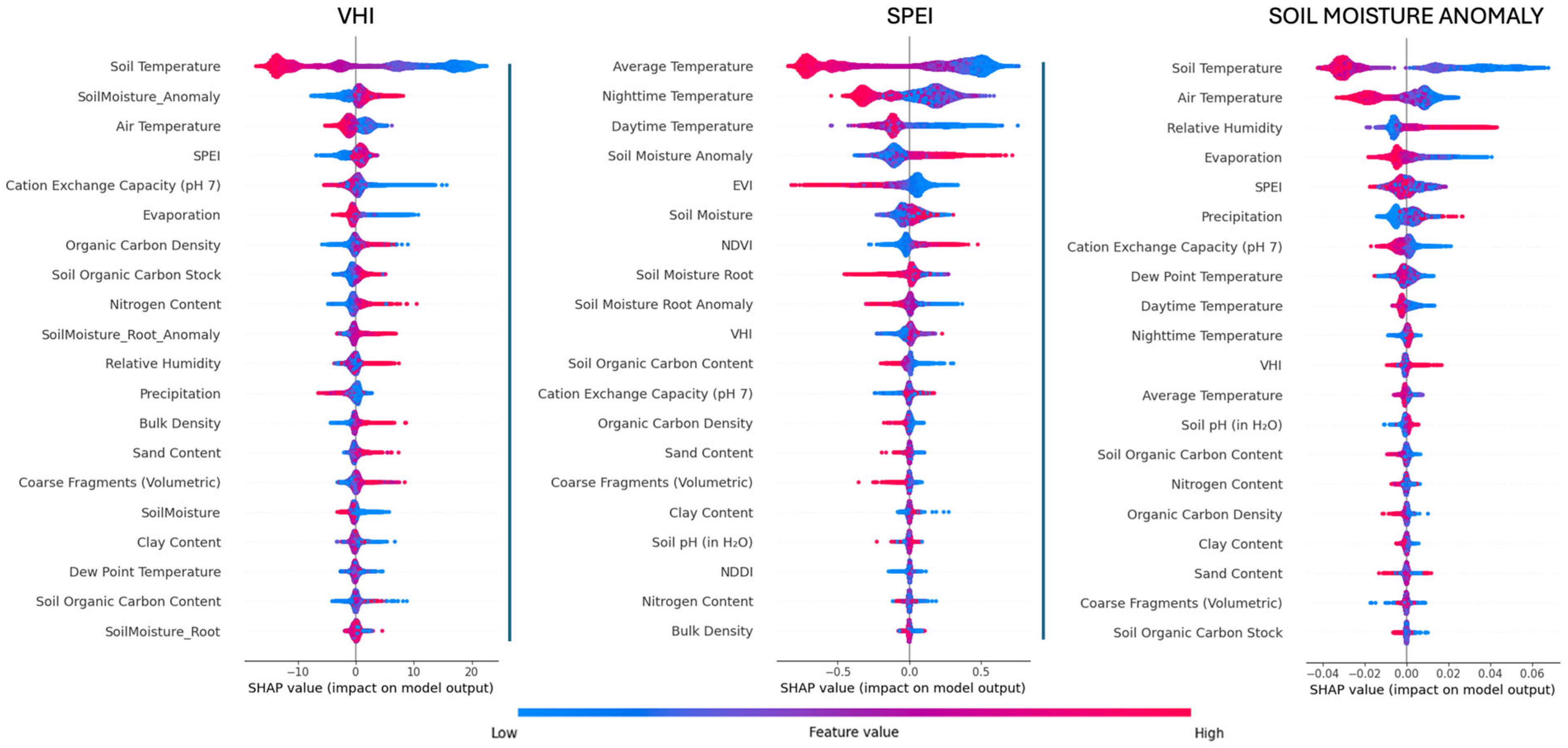
SHAP summary plots for the three target variables are presented in Figure 5. This figure illustrates the relative importance and direction of influence of each input feature on the model predictions. For VHI, the most influential variables were soil temperature, soil moisture anomaly, and air temperature. That demonstrates a strong relation between vegetation health and surface thermal dynamics. Regarding SPEI, temperature-related variables and soil moisture indicators are the most dominant. This describes the importance of atmospheric and hydrological balance. When predicting soil moisture anomaly, soil temperature, air temperature, and RH have the highest impact. These variables reflect the physical soil-climate interactions. The findings indicate that the models effectively identify the most influential features driving variations in each drought indicator.
A comparison of the SHAP analysis results among the drought indicators highlights that the most influential features for VHI are soil temperature, soil moisture anomaly, and air temperature. In the SPEI model, temperature-related variables (average, daytime, and nighttime temperatures) and soil moisture anomaly make a substantial contribution, as evidenced by their high SHAP values. For predicting Soil Moisture Anomaly, soil temperature, air temperature, and RH are identified as the most influential input variables. Consequently, the SHAP analyses indicate that RH, soil temperature, SPEI, soil moisture anomaly, and precipitation have a significant temporal influence on drought indicators.

3.3. Temporal Trends and Spatial Patterns of the Most Important Features

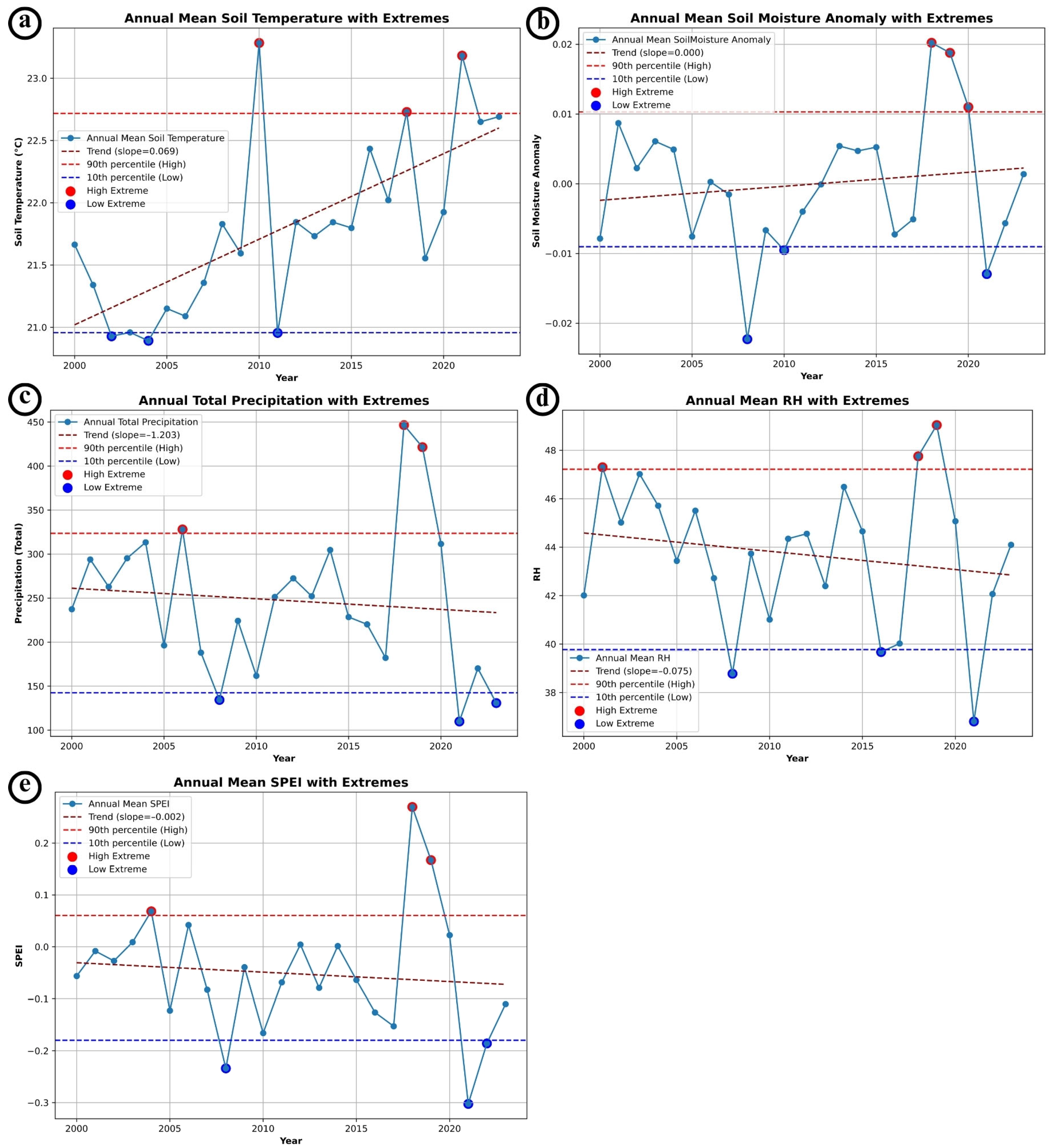
The annual mean soil temperature exhibited a statistically positive trend with a slope of 0.069 °C/year, indicative of a persistent warming pattern over the last two decades. Notably, in recent years, the frequency of high extreme temperatures that are closing or surpassing the 90th percentile has increased. In contrast, the low extreme temperatures, which fell below the 10th percentile, have almost disappeared since 2011 (Figure 6a). Conversely, the soil moisture anomalies generally fluctuated around the zero baseline, reflecting that there was no significant long-term trend (slope ≈ 0). However, years such as 2008 and 2010 surpassed the low moisture anomaly threshold, whereas 2018, 2019, and 2020 experienced strong positive anomalies, denoting exceptionally wet years (Figure 6b).
Annual precipitation demonstrated a significant downward trend with a slope of −1.203 mm/year, highlighting an overall trend of increasing aridity. Although some years, such as 2018 and 2019, experienced substantial rainfall events, recent years have been marked by significant precipitation deficits, falling below the 10th percentile (Figure 6c). A similar declining trend (slope = −0.075% per year) was observed in RH, which is consistent with the warming pattern and reductions in precipitation. High RH extremes were observed in 2001, 2018, and 2019, while 2008, 2016, and 2021 recorded RH values below the 10th percentile, indicating dry conditions (Figure 6d). However, the SPEI time series analysis indicated a mildly negative trend (slope = −0.002/year), suggesting a gradual increase in arid conditions, albeit with considerable interannual variability. Even though the years 2018 and 2019 were recorded as exceptionally wet years, recent years demonstrate extreme drought conditions (Figure 6e).
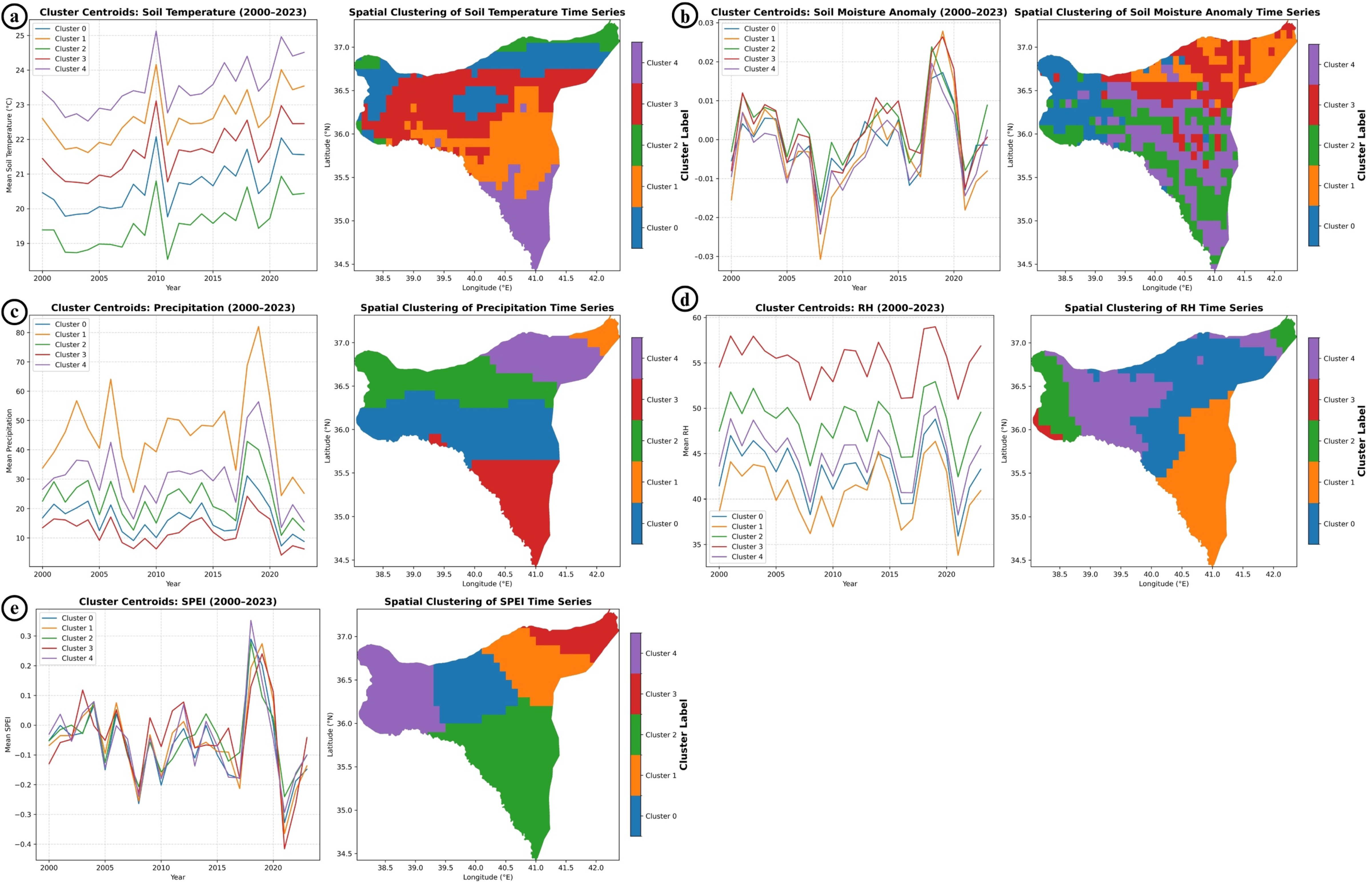
On the other hand, four cluster validity metrics, including Inertia (Elbow method), Silhouette score, Calinski–Harabasz index, and Davies–Bouldin score, were performed to evaluate the optimal number of clusters (k) using the K-Means algorithm by testing cluster counts from 2 to 10 [64]. The results of the tests indicated that 5 is the optimal number of clusters.
Soil temperature manifests clear temporal stratification, characterized by a marked warming trend. The hottest trajectory (cluster 4) predominated in the southern and southeastern areas, whereas cooler clusters predominated in the northern regions. Although there was a noticeable increasing trend across all clusters, a pronounced temperature increase was evident in 2010, possibly linked to regional heatwaves (Figure 7a). Contrary to soil temperature, soil moisture anomaly clusters reveal minor temporal variations alongside significant spatial heterogeneity. No clear increasing or decreasing pattern is apparent in centroids, which aligns with previous findings that indicate weak long-term trends in soil moisture. However, the northeastern areas present relatively higher anomalies compared to the drier clusters in the southern areas. This heterogeneity likely reflects the influence of localized factors such as land use practices, topographical features, and irrigation regimes (Figure 7b).
The precipitation clusters show distinct inter-cluster divergence, with cluster 1 exhibiting the highest precipitation levels, particularly during peak rainfall years of 2018 and 2019. Spatially, clusters with higher precipitation rates were concentrated in the northeast and east parts of the NES, while the southern regions were consistently associated with lower precipitation levels, as represented by Cluster 3 (Figure 7c). This is consistent with RH cluster results, where the low RH rates (cluster 1) are demonstrated in the south, reflecting the overall drying trajectory identified in the RH time series, while cluster 3 maintains consistently high humidity levels throughout the study period. This cluster is spatially restricted to the west corner, adjacent to Lake Assad, Syria’s largest lake (Figure 7d).
Meanwhile, the SPEI clustering exposes coherent drought-sensitive trajectories, with cluster centroids effectively reflecting significant drought episodes, such as those in 2008, 2010, 2021, and 2022. There is no clear negative or positive long-term trend within the cluster centroids. However, the clusters are clearly distinct spatially, with cluster 3, which is characterized by the wettest conditions for most of the study period, restricted to the northeast corner (Figure 7e).
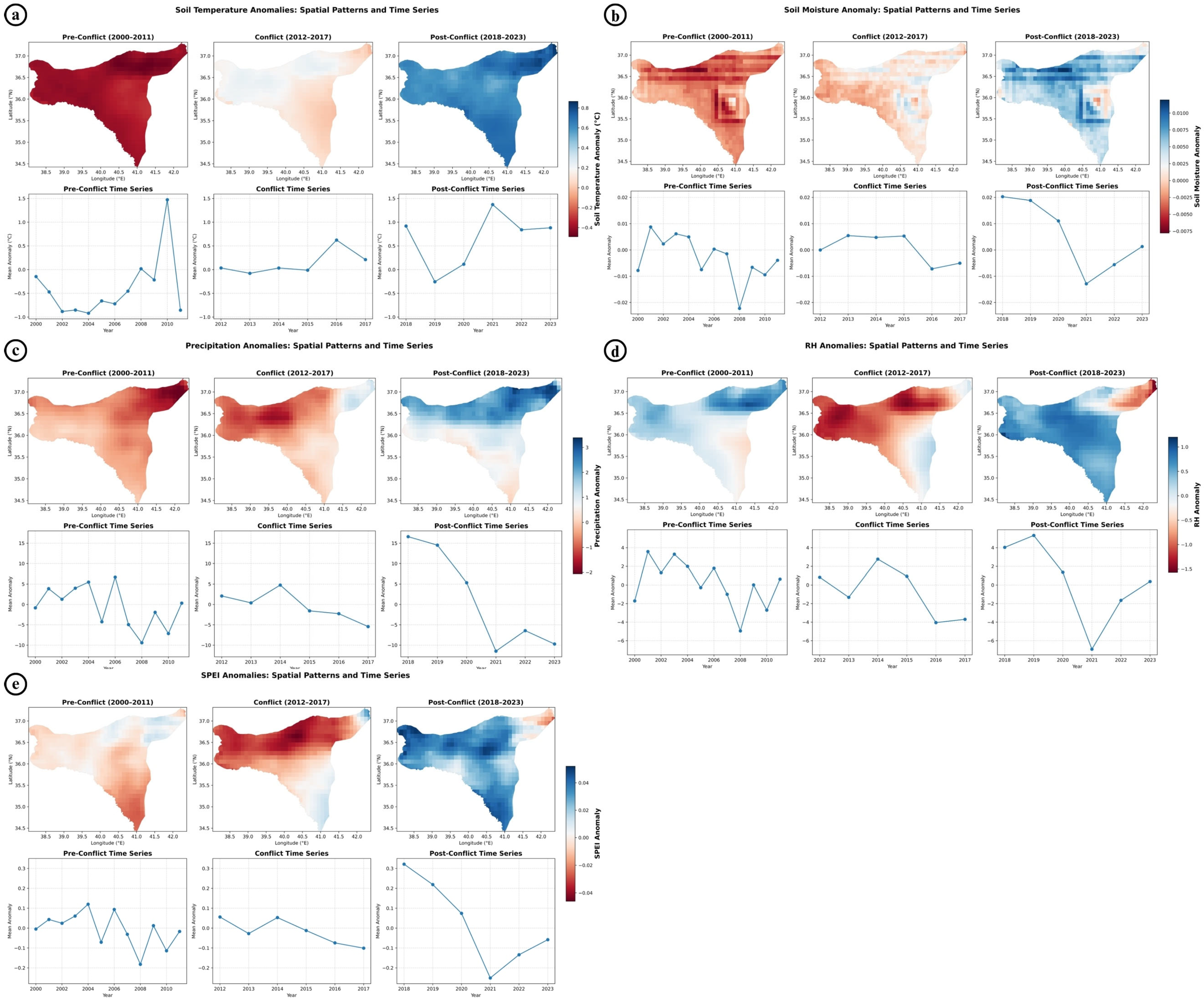
Moreover, a comprehensive analysis of spatiotemporal anomaly patterns and their evolution across three subperiods, pre-conflict (2000–2011), conflict (2012–2017), and post-conflict (2018–2023), was conducted for the selected variables.
Soil temperature anomalies exhibit a distinct warming trend over time. This trend is characterized by predominantly negative anomalies in the pre-conflict period, followed by neutral to slightly positive anomalies during the conflict period, and strong positive anomalies in the post-conflict years. The post-conflict spatial distribution map reveals widespread warming, particularly in the northeastern region, aligning with the time series trend and clustering analysis (Figure 8a). In contrast to the uniform spatial patterns of the soil temperature anomalies, soil moisture anomalies unveil spatial heterogeneity, characterized by negative anomalies in the pre-conflict period and predominantly neutral conditions during the conflict period. The post-conflict period experienced a rise in the soil moisture anomalies, notably within the central-northern region, reflecting the heightened precipitation levels in 2018 and 2019 (Figure 8b).
The time series plots of precipitation anomalies indicate a progressive drying trend across each subperiod. However, the spatial distribution maps illustrate a strong negative anomaly in the pre-conflict years that continued during the conflict period for almost all NES except for the northeast area. However, during the post-conflict years, strong positive anomalies were observed in the northern areas and neutral to slightly negative in the south, aligning with the exceptional years of 2018 and 2019 (Figure 8c). In contrast, the RH showed positive anomalies throughout the pre-conflict years, while a significant reduction occurred during the conflict period. Then, there was a shift back to widespread positive anomalies post-conflict, most likely due to the high precipitation levels early post-conflict, except in the northeast corner, where negative anomalies were observed (Figure 8d). In the meantime, the SPEI during the pre-conflict period was predominantly neutral to slightly dry, with more intensive drought in the southern areas. However, during the conflict years, the central and northern regions experienced severe drought conditions. Widespread strong positive anomalies were observed in the post-conflict period, except for the northeast area, most likely due to the extremely high temperature in this area (Figure 8e).

3.4. Local Moran’s I Spatial Cluster Analysis

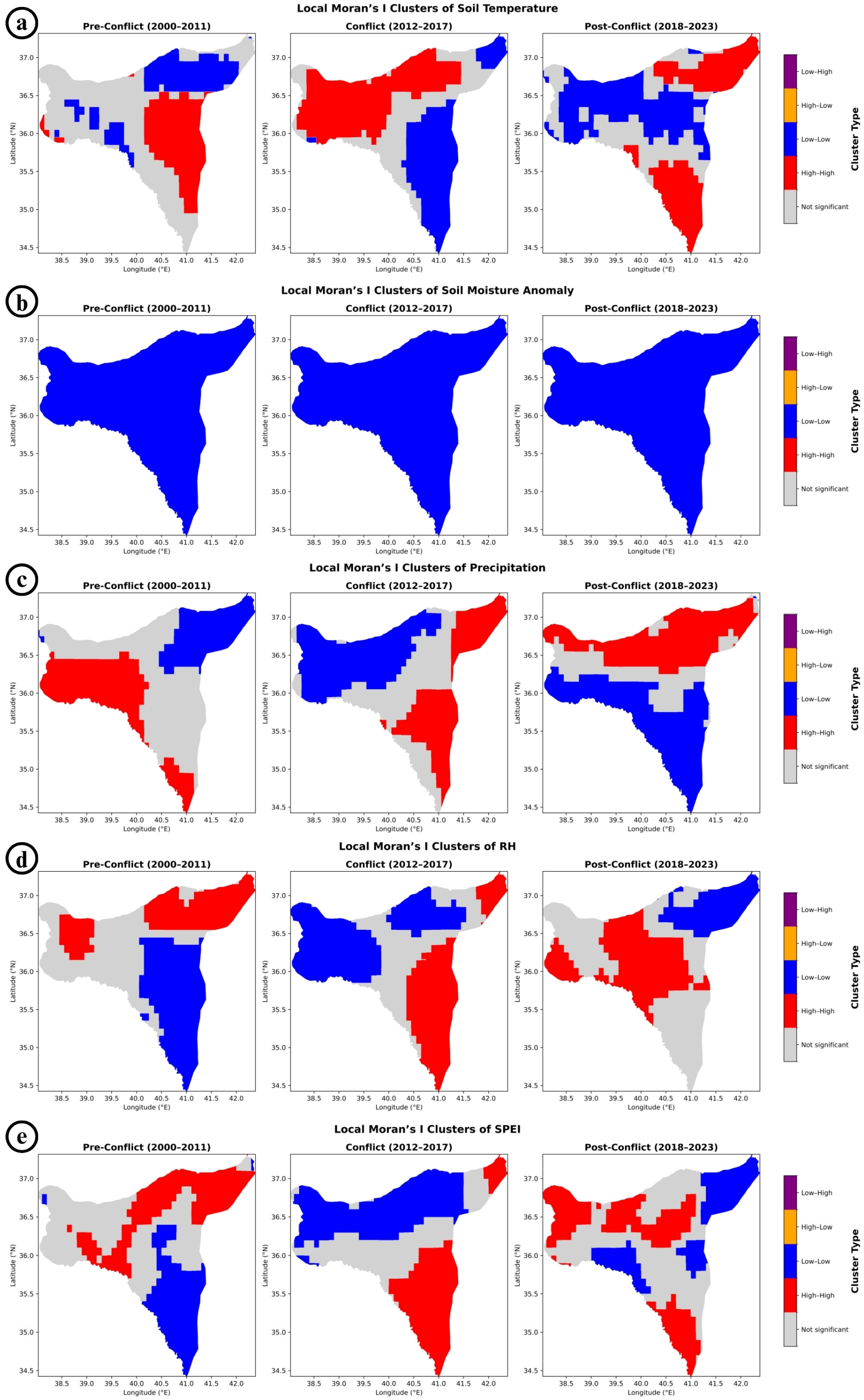
The Local Moran’s I spatial cluster analysis of the selected variables was conducted across the three subperiods. The maps distinguish four types of statistically significant spatial clusters: High–High (hotspots), Low–Low (cold spots), High–Low, and Low–High, which are outliers.
The spatial clustering analysis of soil temperature demonstrates a notable expansion of High–High (hotspot) zones over time, a trend most pronounced in the northeastern and southern areas during the post-conflict period. During the conflict years, cold spots dominated the northwest, which later shifted to hotspot clusters post the conflict. This transition highlights an expanding spatial footprint of warming (Figure 9a). On the other hand, the soil moisture anomalies exhibit persistent Low–Low clustering across all examined periods, suggesting the sustained presence of spatially coherent drought conditions. The lack of variation across these subperiods suggests that the long-term soil moisture deficits prevail regardless of the conflict phase, highlighting both the severity and spatial entrenchment of soil desiccation in the NES (Figure 9b). Conversely, the spatial configuration of precipitation clusters indicates marked temporal shifts over time. During the pre-conflict period, hotspot clusters dominated the central and western areas, illustrating wetter conditions. Whereas, the post-conflict years were characterized by a pronounced expansion of cold spot clusters into the central and southern areas, revealing an increasing spatial concentration of precipitation deficits. These evolving patterns are consistent with the documented drying trends in the time series and anomaly maps (Figure 9c).
Furthermore, the clustering analysis of RH discloses fluctuating patterns, characterized by alternating hotspot and cold spot zones, particularly across the northern areas of NES. During the post-conflict period, there was a significant shift from High-High clusters to Low-Low clusters, particularly in the northeast region. This shift aligned with increased temperatures and reduced soil moisture, signifying the prevailing trend toward more severe drought conditions (Figure 9d). Correspondingly, the spatial clustering of SPEI illustrated consistent transitions from High-High clusters to Low-Low clusters from one period to another. Obviously, there was a shift from dry conditions in the pre-conflict period to wet conditions post-conflict. This pattern reflects a deepening and spatial expansion of drought severity, particularly in the northeast areas, driven by the combined impacts of diminished precipitation and increased PET (Figure 9e).

3.5. Spatial Intensification of Warming and Drying Trends in NES

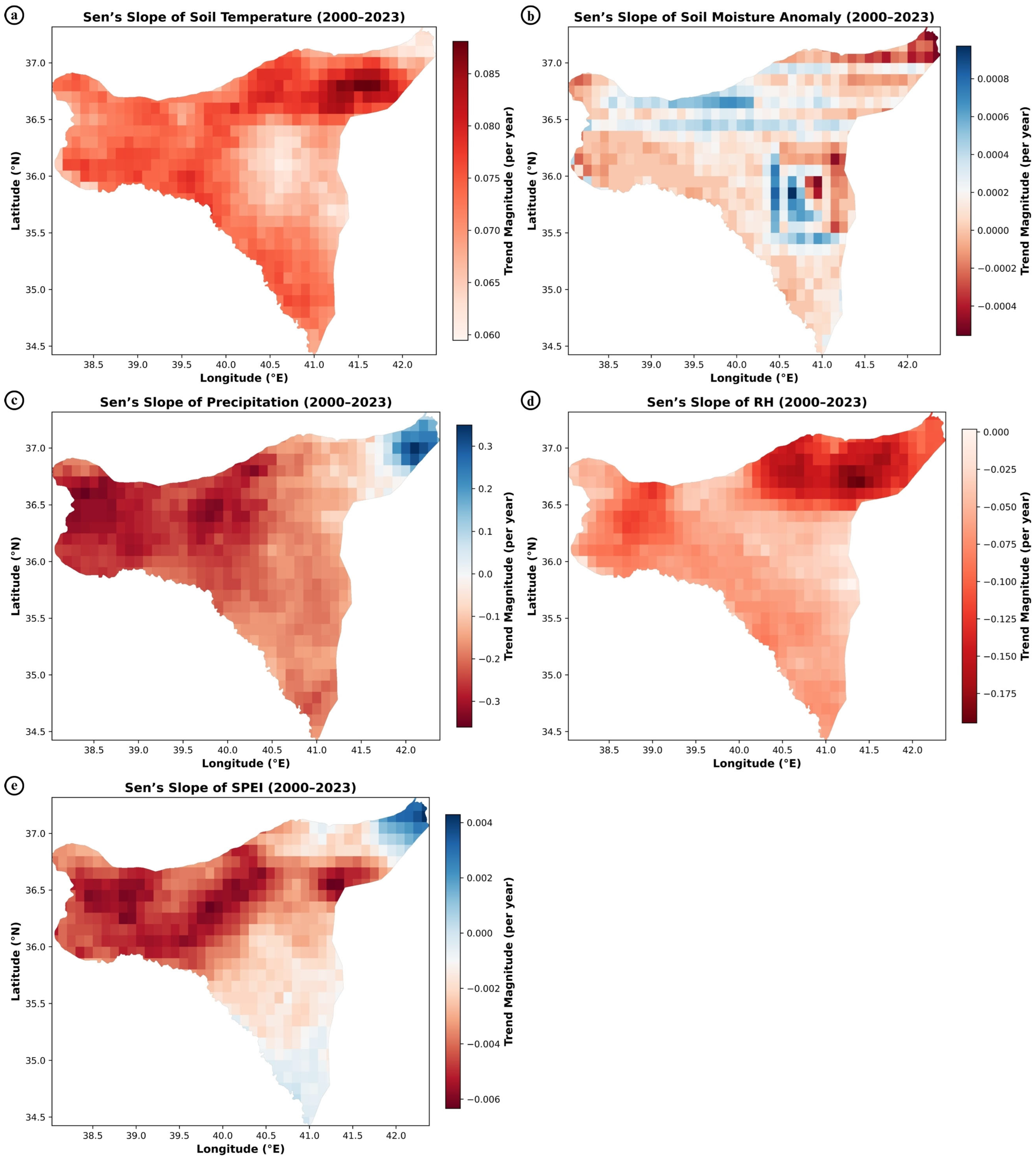
The MK trend analysis and the Sen’s Slope estimator were conducted on the selected important feature throughout the study period (2000–2023). The MK test revealed that for the soil moisture anomalies, precipitation, RH, and SPEI, there was no trend. While an increasing trend was observed across all NES, aligning with the previously performed spatiotemporal analyses. Moreover, the Sen’s slope estimates of the soil temperature indicate a widespread and consistent warming trend throughout the NES region. The trend magnitudes surpass +0.085 °C per year, particularly in the northeastern and central zones. This spatially dominant increase reflects intensifying land surface heating, which is likely associated with broader regional climatic variations, land degradation processes, and reductions in vegetative cover (Figure 10a).
Contrary to the soil temperature, the trends in Soil moisture anomalies exhibit spatial heterogeneity, with modest positive trends concentrated in the central-southern areas, particularly around areas with known agricultural practices. Meanwhile, patches of decline were observed in certain northeastern zones. Overall, these patterns signify increasing soil desiccation, mainly in hotspots experiencing the most intense warming (Figure 10b). On the other hand, the slope estimator of precipitation shows overwhelmingly negative trends across almost all NES, with substantial areas of the western and central regions undergoing declines exceeding −0.3 mm per year, highlighting long-term drought stress. Only a limited area in the northeastern corner demonstrates a weak positive trend. These findings align with the observed temporal trend of the time series analysis and support the conclusion that the NES is experiencing considerable hydroclimatic stress (Figure 10c).
RH trends parallel those observed for temperature and precipitation, with uniform negative trends across the region. The northern and northeastern areas are experiencing the most significant declines, with trend magnitudes reaching –0.15% per year. The simultaneous decrease in RH alongside rising temperatures suggests a compound drying effect, further exacerbating PET rates and accelerating moisture depletion (Figure 10d). Predominantly, the western and central regions exhibit negative SPEI trends, referring to escalating drought severity. Conversely, the northeastern areas illustrate slight improvement, potentially attributable to localized precipitation influences. Collectively, the widespread downward trend in SPEI underscores a sustained long-term progression toward intensified drought conditions (Figure 10e).

4. Discussion

The use of XGBoost and similar ML models in drought research is part of a broader trend of integrating artificial intelligence with earth science. The continuous improvement in computational tools has enabled the processing of big data from remote sensing and reanalysis products, allowing for the extraction of patterns that might be difficult to discern through manual analysis. However, while ML models can fit complex patterns, careful attention must be paid to avoid overfitting and to ensure physical interpretability of the results. Techniques such as model optimization (which we employ for hyperparameter tuning and model evaluation) and feature importance analysis are critical in this regard [21]. Recent drought studies report excellent performance of XGBoost-based models. For example, Ahmad et al. [34] utilized the XGBoost ML algorithm to extract urban impervious surfaces in four global cities, such as New York, Paris, Tokyo, and London, by integrating Sentinel-1 SAR data and Landsat-8 optical imagery. Their fusion approach achieved an accuracy of 86% using random validation points, holding a potential for new applications with implications for the environment and ecosystem. Also, Li et al. [21] achieved over 85% agreement between an XGBoost drought monitoring model and observed station-based drought classifications in their study area. Similarly, other studies have demonstrated accuracy rates exceeding 90% in classifying drought severity using boosting algorithms, underlining their efficacy [65]. These outcomes give confidence that ML approaches can distill meaningful signals from noisy environmental data. In our case, by utilizing XGBoost to integrate NES’s multidimensional dataset, we aim to identify key drivers of drought and vegetation variability. For example, quantifying the relative importance of precipitation vs. temperature vs. soil factors in explaining vegetation health, or determining whether indices like NDVI or SPEI are more influenced by antecedent climate or by land surface conditions. The insights drawn from the ML model will form the basis for a detailed discussion on how climate change and water scarcity interact with local environmental factors to shape drought and vegetation health in NES. Ultimately, this data-driven approach contributes to a more detailed literature on drought in dryland regions, bridging the gap between large-scale climate trends and local environmental responses.
Compared with other research models, our model offers robust and competitive predictive capabilities. According to Zhang et al. [66], the XGBoost model achieved an R2 of 0.726, whereas the RMSE and MAE were 0.559 and 0.422, respectively. Their best-performing model, ConvLSTM, achieved an R2 of 0.874, with RMSE and MAE values of 0.365 and 0.265. Relative to these results, our model maintained R2 values above 0.87 and achieved RMSE and MAE values below 0.3 during 2021 to 2023, reflecting strong predictive performance in all metrics. These results show that our model captures the SPEI variable relationships effectively and performs at a competitive level. High predictive performance was also achieved in predicting soil moisture anomaly, with R2 values ranging from 0.87 to 0.90 and RMSE values remaining stable at 0.02 for all years. Accordingly, Ontel et al. [67] investigated soil moisture anomalies indirectly by analyzing correlations between SPI, NDVI, and LST anomalies. However, the analysis remained correlation-based and did not involve direct prediction, although moderate to strong associations were reported, particularly with NDVI and LST anomalies during July to September.
According to the SHAP analysis from our XGBoost model, SPI-derived SPEI contributes significantly to soil moisture anomaly prediction. LST-related variables also play a crucial role, whereas NDVI exhibits relatively low predictive significance. This model-driven and interpretable assessment offers a more robust and transparent representation of variable contributions than correlation-based approaches, enabling nonlinear interactions to be captured more effectively. Thus, the present model provides a direct and more robust estimation of soil moisture anomalies. It shows consistent performance over periods, avoiding correlation-based drought indicators. In addition to SPEI and soil moisture, the model consistently performed well in predicting VHI. It achieved R2 values of 0.87, 0.88, and 0.86 for 2021, 2022, and 2023, respectively. The present model demonstrated a higher predictive performance than Bui et al. [68], who utilized a limited number of lag predictors such as soil moisture and SPEI1-SPEI5. Their MLR model reached an adjusted R2 of 0.74, and their XGBoost implementation showed performance similar to the MLR model. Moreover, our model incorporates a wide range of climate-related and soil-related variables, which contributes to more accurate and stable predictions. As can be seen from the RMSE values for our VHI predictions, ranging from 5.49 to 6.42, the model performs well under a variety of climatic conditions. The models demonstrated consistently high predictive performance over three consecutive years and for multiple drought-related indices, including SPEI, VHI and soil moisture anomaly. These results indicate that the proposed framework successfully captures the nonlinear relationship between remote sensing-based drought indicators and climatic variables. Moreover, it provides a strong and interpretable alternative to more complex and computationally demanding approaches.
The MENA region is currently experiencing significant impacts from climate change on drought patterns, resulting in increased aridity and extreme heat events [1]. Our findings accentuated a substantial rise in soil temperatures alongside decreasing precipitation levels, which resulted in declining RH and intensifying SPEI rates. While the soil moisture anomalies exhibit strong interannual fluctuations, the last few years have shown frequent negative extremes, indicating intensified drought conditions. The co-occurrence of elevated soil temperatures, reduced RH, and diminished precipitation, particularly in recent years, underscores a compound climate hazard scenario [39,42,69]. These trends signal a gradual transition toward hotter, drier, and more drought-prone conditions, posing profound implications for the region’s environmental stability, water resources availability, and agricultural sustainability. Several recent works showed similar results. For example, [70] conducted a study utilizing multi-sourced datasets to explore climate change and its effects on the recent drought in Syria. Their results emphasized a decrease in precipitation combined with a warming trend. Mathbout et al. [69] highlighted the increase in iPET due to rising temperatures and decreased precipitation, which intensifies water stress, consistent with our SPEI analysis findings. While Mohammed et al. [71] noted that high temperatures and strong evaporative demand, particularly in arid environments like NES, necessarily exacerbate soil moisture deficiency, which influences crop productivity and water supply. This supports our results on the soil moisture anomalies, which showed significant variations affected by precipitation rates. Years such as 2018 and 2019, characterized by exceptionally high rainfall, corresponded to positive soil moisture anomalies.
Additionally, Aydin-Kandemir & Yıldız [72] studied the drought, water conflicts, and spatiotemporal changes in land use in NES. They found that SPEI provides clear evidence that NES has undergone its most severe and prolonged long-term drought in modern history since 2000. This trend is particularly pronounced in the northeastern zones of NES, which agree with the results of this study, as demonstrated by the clustered time series and anomaly analyses.
The spatiotemporal anomaly analysis across the selected variables reveals distinct climatic patterns over the three conflict-defined periods. The pre-conflict period was characterized by severe climatic stress, whereas the conflict years experienced fluctuations in drought conditions. However, the high precipitation levels in the early post-conflict period, particularly in 2018 and 2019, positively impacted almost all variables, except for soil temperature, which shows a compound and persistent increase. Sukkar et al. [42] explored the relationship between climatic variation and armed conflict in NES, as well as its impacts on drought and vegetation cover from 2000 to 2023. Their results highlighted the significant increase in temperature and decrease in RH, particularly in the northeastern areas of NES, which led to a reduction in agricultural cover. This area has experienced the most severe drought conditions in Syria [73]. Moreover, Chen et al. [74] used the EVI to understand the impact of climate change and human activities on terrestrial vegetation. They found a general statistically significant decline in vegetation cover across Syria from 2001 to 2018, specifically in the NES region and its northeast part. This decline was correlated with both a decrease in precipitation and an increase in temperature. These findings were further confirmed by Eklund et al. [75], who found that the drought caused significant reductions in agricultural productivity, particularly in the northeast. They performed a Moran’s I clustering to examine spatial autocorrelation in fallow land areas across Syria. They identified notable clustering of fallow land during drought years (e.g., 2000, 2007–2009, 2014), indicating that regions of abandoned or uncultivated agriculture were spatially concentrated. The agricultural collapse is not only caused by climatic stress but also by anthropogenic factors (e.g., armed conflict, human activities, farming practices, and long-term resource mismanagement). The Syrian regime’s failure over the last 50 years to address agricultural development and water management [76]. This failure resulted in reduced subsidies, unsustainable farming practices [75], and reliance on groundwater for irrigation, which set the stage for water depletion, land salinization, and worsening drought effects [73,77].
The Local Moran’s I clustering analysis shows clear spatial autocorrelation among the selected key features. The emerging patterns highlight an increasing geographic concentration of climate extremes in NES. The results emphasized the significant role of temperature in the progression of drought in NES, indicating that higher temperatures lead to more severe droughts. For example, during the pre-conflict period in the northeastern zones of the NES, soil temperature and precipitation demonstrate Low-Low clusters, which are reflected in High-High clusters in RH and SPEI. However, in the southeast, when the soil temperature showed High-High clusters, RH and SPEI exhibited Low-Low clusters. During the conflict and post-conflict periods, the role of temperature becomes more apparent. Low-Low soil temperature clusters mean High-High RH and SPEI clusters. In contrast, High-High soil temperature clusters led to Low-Low RH and SPEI clusters, even though the precipitation reflected High-High clusters. These findings foreground that the SPEI is a superior indicator for characterizing drought in Syria, especially given the increasing impact of temperature and PET in the area [78]. Altogether, these spatial clustering analyses underscore a critical transformation toward localized and compounding climate stress zones, which are expected to experience the most severe impacts on agricultural productivity, water resources availability, and socio-environmental resilience. This led to an increasing trend in the severity and intensity of the drought [42].
The spatial trend analysis based on Sen’s Slope estimator exposes a consistent pattern of intensifying drought stress across NES between 2000 and 2023 (Figure 10). Soil temperature shows a strong and widespread positive trend, notably pronounced in the northeastern zones, signifying persistent surface warming, which is accompanied by declining RH and precipitation. The SPEI distribution map reflected these combined changes, underscoring a broad spatial intensification of drought conditions. Although the soil moisture anomaly trends demonstrate greater spatial heterogeneity, localized decreases correspond spatially with regions exhibiting strong warming and drying trends. The Sen’s Slope maps emphasized the trends of amplified warming, atmospheric drying, and diminishing water availability, reinforcing the evidence of an advancing hotter and drier climate across the NES. Several recent studies underscored these findings. For example, Homsi et al. [39] employed Sen’s Slope and a modified MK test to assess the significance of trends in meteorological variables, including precipitation, temperature, and PET. While Mohammed et al. [71] used the modified MK test to evaluate the drought stress utilizing the SPI. Even though both studies used different meteorological datasets, they highlighted a significant increasing trend in temperature and PET, and a declining trend in precipitation. These trends in precipitation, temperature, and PET have led to declining soil moisture levels, remarkably affecting the northeast [79]. However, our findings showed some spatial heterogeneity with minor positive trends mostly in the central-southern areas. In addition, Mathbout et al. [78], conducted a study on drought projections using CMIP6 models in Syria, they found that the Drought risk is projected to intensify in the coming decades, characterized by prolonged and increasingly severe droughts, especially in the northern, eastern, and northeastern regions, as a result of elevated temperatures and less precipitation.
Since the 1970s, drought monitoring approaches have been shifted from the traditional in situ observations to the utilization of advances in remote sensing technologies due to the higher temporal and spatial resolutions. These technologies allowed for developing a variety of drought indicators, through combining different datasets to monitor the drought propagation. However, the understanding of drought phenomena is still affected by multiple anthropogenic factors such as agronomic practices, irrigation systems, water management [18,19]. Therefore, considering the limitations and conditions in NES, additional work that integrates these results with the agricultural activities in this area could provide highly valuable insights about the drought in NES.

5. Conclusions

This study examined multi-source earth observation data and soil characteristics influencing drought phenomena in NES from 2000 to 2023. ML, which offers robust modeling capabilities, was utilized for these multi-source datasets. This facilitated the acquisition of more comprehensive spatial and temporal insights derived from climatic, hydrological, and ecological factors. Additionally, techniques such as trend analysis and clustering were employed to evaluate the interconnected relationships between the most effective parameters in the drought. The study also evaluated anthropogenic influences on drought across different conflict-related periods, demonstrating that such factors are not the sole contributors to drought conditions.
This study illustrates that the carefully designed ML frameworks are powerful hypothesis-generating tools for understanding complex environmental relations. The ML models demonstrated strong predictive performance across all targets, substantiating the efficacy of the multi-target modeling technique and verifying that the identified environmental factors capture the fundamental dynamics of drought. Additionally, the analysis shows a consistent and intensifying pattern of climatic stress on NES, characterized by statistically significant warming trends, declining precipitation, and decreasing RH. SHAP-based feature importance analysis identified soil temperature, soil moisture anomaly, precipitation, RH, and SPEI as the dominant drivers of drought variability, with soil temperature emerging as a particularly critical factor.
The spatiotemporal analysis across conflict-defined periods reveals distinct drought dynamics influenced by both climatic variability and socio-political disruptions. The pre-conflict period illustrated severe climatic stress with predominantly negative precipitation anomalies, while the conflict years showed fluctuating conditions with intensified drought in central and northern regions. Although the early post-conflict period experienced exceptionally high precipitation in 2018 and 2019, these wet years failed to fully offset the compound effects of elevated temperatures, particularly in the northeastern areas.
This study emphasizes the power of remote sensing technologies, particularly in regions such as the NES, which lacks in situ data. Additionally, it demonstrated that integrating ML approaches with these data can yield high metrics without requiring ground truth data validation. The findings have significant implications for drought monitoring and adaptive resource management policies in regions already facing difficulties in water supply. Future research should extend this approach by integrating socio-economic variables, land use change dynamics, and high-resolution satellite data to elucidate the complex interactions between natural climate variability, human activities, and drought impacts in conflict-affected regions.

Author Contributions

Conceptualization, A.S. and O.O.; methodology, AS.; software, A.S. and O.O.; validation, A.A. and D.Z.S.; formal analysis, A.S. and O.O.; investigation, A.S. and O.O.; resources, A.S.; data curation, A.S.; writing—original draft preparation, A.S. and O.O.; writing—review and editing, A.A. and D.Z.S.; visualization, A.S. and O.O.; supervision, D.Z.S. All authors have read and agreed to the published version of the manuscript.

Funding

This research received no external funding.

Institutional Review Board Statement

Not applicable.

Informed Consent Statement

Not applicable.

Data Availability Statement

The ERA5-Land Meteorological dataset used in this study is available from the Copernicus Climate Data Store at https://cds.climate.copernicus.eu/datasets (accessed 15 October 2025). The Land Surface Temperature, Vegetation Indices, and Soil Moisture datasets used in this study are available from the Google Earth Engine (GEE) data catalog at https://developers.google.com/earth-engine/datasets (accessed 15 October 2025). The soil salinity and soil properties datasets used in this study are available from the ISRIC Data Hub at https://data.isric.org/geonetwork/srv/eng/catalog.search#/home (accessed 15 October 2025).

Conflicts of Interest

The authors declare no conflicts of interest.

Abbreviations

The following abbreviations are used in this manuscript:
NESNortheast Syria
ERA5-LandECMWF ReAnalysis version 5—Land component
MODISModerate Resolution Imaging Spectroradiometer
FLDASFamine Early Warning Systems Network (FEWS NET) Land Data Assimilation System
ISRICInternational Soil Reference and Information Centre
SARSynthetic Aperture Radar
MLMachine Learning
XGBoosteXtreme Gradient Boosting
SHAPSHapley Additive exPlanations
VHIVegetation Health Index
SPEIStandardized Precipitation-Evapotranspiration Index
RHRelative Humidity
NDVINormalized Difference Vegetation Index
VCIVegetation Condition Index
NDWINormalized Difference Water Index
ECMWFEuropean Centre for Medium-Range Weather Forecasts
LSTLand Surface Temperature
EVIEnhanced Vegetation Index
NDDINormalized Difference Drought Index
VIVegetation Indices
PETEvapotranspiration
SPIStandardized Precipitation Index
FAOFood and Agriculture Organization
TCITemperature Condition Index
RMSERoot Mean Square Error
MAEMean Absolute Error
R2Coefficient of Determination
MKMann–Kendall Test
MENAMiddle East and North Africa

References

  1. Kenawy, A.E.; Al-Awadhi, T.; Abdullah, M.; Ostermann, F.O.; Abulibdeh, A. A Multidecadal Assessment of Drought Intensification in the Middle East and North Africa: The Role of Global Warming and Rainfall Deficit. Earth Syst. Environ. 2025, 1–20. [Google Scholar] [CrossRef]
  2. Gebrechorkos, S.H.; Sheffield, J.; Vicente-Serrano, S.M.; Funk, C.; Miralles, D.G.; Peng, J.; Dyer, E.; Talib, J.; Beck, H.E.; Singer, M.B.; et al. Warming Accelerates Global Drought Severity. Nature 2025, 642, 628–635. [Google Scholar] [CrossRef]
  3. Richardson, D.; Fowler, H.J.; Kilsby, C.G.; Neal, R. A New Precipitation and Drought Climatology Based on Weather Patterns. Int. J. Climatol. 2018, 38, 630–648. [Google Scholar] [CrossRef]
  4. Spinoni, J.; Barbosa, P.; De Jager, A.; McCormick, N.; Naumann, G.; Vogt, J.V.; Magni, D.; Masante, D.; Mazzeschi, M. A New Global Database of Meteorological Drought Events from 1951 to 2016. J. Hydrol. Reg. Stud. 2019, 22, 100593. [Google Scholar] [CrossRef]
  5. Maity, S.S.; Maity, R. Changing Pattern of Intensity–Duration–Frequency Relationship of Precipitation Due to Climate Change. Water Resour. Manag. 2022, 36, 5371–5399. [Google Scholar] [CrossRef]
  6. Dai, A. Hydroclimatic Trends during 1950–2018 over Global Land. Clim. Dyn. 2021, 56, 4027–4049. [Google Scholar] [CrossRef]
  7. Bakke, S.J.; Ionita, M.; Tallaksen, L.M. Recent European Drying and Its Link to Prevailing Large-Scale Atmospheric Patterns. Sci. Rep. 2023, 13, 21921. [Google Scholar] [CrossRef] [PubMed]
  8. Thom, D.; Jentsch, A.; Seidl, R. Disturbances and Ecosystem Services. In Disturbance Ecology; Wohlgemuth, T., Jentsch, A., Seidl, R., Eds.; Landscape Series; Springer: Cham, Switzerland, 2022; Volume 32, pp. 413–434. [Google Scholar]
  9. Zeng, Z.; Wu, W.; Li, Y.; Huang, C.; Zhang, X.; Peñuelas, J.; Zhang, Y.; Gentine, P.; Li, Z.; Wang, X.; et al. Increasing Meteorological Drought under Climate Change Reduces Terrestrial Ecosystem Productivity and Carbon Storage. One Earth 2023, 6, 1326–1339. [Google Scholar] [CrossRef]
  10. Seleiman, M.F.; Al-Suhaibani, N.; Ali, N.; Akmal, M.; Alotaibi, M.; Refay, Y.; Dindaroglu, T.; Abdul-Wajid, H.H.; Battaglia, M.L. Drought Stress Impacts on Plants and Different Approaches to Alleviate Its Adverse Effects. Plants 2021, 10, 259. [Google Scholar] [CrossRef]
  11. Orimoloye, I.R.; Belle, J.A.; Orimoloye, Y.M.; Olusola, A.O.; Ololade, O.O. Drought: A Common Environmental Disaster. Atmosphere 2022, 13, 111. [Google Scholar] [CrossRef]
  12. Karume, K.; Mondo, J.M.; Kiyala, J.C.K. Drought, the War in Europe and Its Impacts on Food Insecurity in Sub-Saharan Africa, East Africa. In Climate Change and Socio-Political Violence in Sub-Saharan Africa in the Anthropocene; Kiyala, J.C.K., Chivasa, N., Eds.; The Anthropocene: Politik—Economics—Society—Science; Springer: Cham, Switzerland, 2024; Volume 37, pp. 91–111. [Google Scholar]
  13. Abdullah, M.; Abulibdeh, A.; Ghanimeh, S.; Hamdi, H.; Al-Awah, H.; Al-Awadhi, T.; Mohan, M.; Al-Ali, Z.; Sukkar, A.; El Kenawy, A.M. Characterizing the Dynamics of Climate and Native Desert Plants in Qatar. J. Arid. Environ. 2024, 225, 105274. [Google Scholar] [CrossRef]
  14. Vicente-Serrano, S.M.; Beguería, S.; López-Moreno, J.I. A Multiscalar Drought Index Sensitive to Global Warming: The Standardized Precipitation Evapotranspiration Index. J. Clim. 2010, 23, 1696–1718. [Google Scholar] [CrossRef]
  15. Lee, S.; Moriasi, D.N.; Danandeh Mehr, A.; Mirchi, A. Sensitivity of Standardized Precipitation and Evapotranspiration Index (SPEI) to the Choice of SPEI Probability Distribution and Evapotranspiration Method. J. Hydrol. Reg. Stud. 2024, 53, 101761. [Google Scholar] [CrossRef]
  16. Zhou, K.; Li, J.; Zhang, T.; Kang, A. The Use of Combined Soil Moisture Data to Characterize Agricultural Drought Conditions and the Relationship among Different Drought Types in China. Agric. Water Manag. 2021, 243, 106479. [Google Scholar] [CrossRef]
  17. Martínez-Fernández, J.; González-Zamora, A.; Sánchez, N.; Gumuzzio, A.; Herrero-Jiménez, C.M. Satellite Soil Moisture for Agricultural Drought Monitoring: Assessment of the SMOS Derived Soil Water Deficit Index. Remote Sens. Environ. 2016, 177, 277–286. [Google Scholar] [CrossRef]
  18. Giannico, V.; Garofalo, S.P.; Brillante, L.; Sciusco, P.; Elia, M.; Lopriore, G.; Camposeo, S.; Lafortezza, R.; Sanesi, G.; Vivaldi, G.A. Temporal Vine Water Status Modeling Through Machine Learning Ensemble Technique and Sentinel-2 Multispectral Images Under Semi-Arid Conditions. Remote Sens. 2024, 16, 4784. [Google Scholar] [CrossRef]
  19. West, H.; Quinn, N.; Horswell, M. Remote Sensing for Drought Monitoring & Impact Assessment: Progress, Past Challenges and Future Opportunities. Remote Sens. Environ. 2019, 232, 111291. [Google Scholar] [CrossRef]
  20. Abulibdeh, A.; Pirasteh, S.; Mafi-Gholami, D.; Kucukvar, M.; Onat, N.C.; Zaidan, E. Unveiling the Nexus Between Land Use, Land Surface Temperature, and Carbon Footprint: A Multi-Scale Analysis of Building Energy Consumption in Arid Urban Areas. Earth Syst. Environ. 2025, 9, 2563–2601. [Google Scholar] [CrossRef]
  21. Li, X.; Jia, H.; Wang, L. Remote Sensing Monitoring of Drought in Southwest China Using Random Forest and EXtreme Gradient Boosting Methods. Remote Sens. 2023, 15, 4840. [Google Scholar] [CrossRef]
  22. Hashemzadeh Ghalhari, M.; Vafakhah, M.; Damavandi, A.A. Agricultural Drought Assessment Using Vegetation Indices Derived from MODIS Time Series in Tehran Province. Arab. J. Geosci. 2022, 15, 412. [Google Scholar] [CrossRef]
  23. Cammalleri, C.; Vogt, J. On the Role of Land Surface Temperature as Proxy of Soil Moisture Status for Drought Monitoring in Europe. Remote Sens. 2015, 7, 16849–16864. [Google Scholar] [CrossRef]
  24. Wei, Q.; Xu, J.; Liao, L.; Yu, Y.; Liu, W.; Zhou, J.; Ding, Y. Indicators for Evaluating Trends of Air Humidification in Arid Regions under Circumstance of Climate Change: Relative Humidity (RH) vs. Actual Water Vapour Pressure (Ea). Ecol. Indic. 2021, 121, 107043. [Google Scholar] [CrossRef]
  25. Jiao, K.; Gao, J.; Liu, Z. Precipitation Drives the NDVI Distribution on the Tibetan Plateau While High Warming Rates May Intensify Its Ecological Droughts. Remote Sens. 2021, 13, 1305. [Google Scholar] [CrossRef]
  26. Vicente-Serrano, S.M.; Tramblay, Y.; Reig, F.; González-Hidalgo, J.C.; Beguería, S.; Brunetti, M.; Kalin, K.C.; Patalen, L.; Kržič, A.; Lionello, P.; et al. High Temporal Variability Not Trend Dominates Mediterranean Precipitation. Nature 2025, 639, 658–666. [Google Scholar] [CrossRef]
  27. Nandgude, N.; Singh, T.P.; Nandgude, S.; Tiwari, M. Drought Prediction: A Comprehensive Review of Different Drought Prediction Models and Adopted Technologies. Sustainability 2023, 15, 11684. [Google Scholar] [CrossRef]
  28. Oyarzabal, R.S.; Santos, L.B.L.; Cunningham, C.; Broedel, E.; de Lima, G.R.T.; Cunha-Zeri, G.; Peixoto, J.S.; Anochi, J.A.; Garcia, K.; Costa, L.C.O.; et al. Forecasting Drought Using Machine Learning: A Systematic Literature Review. Nat. Hazards 2025, 121, 9823–9851. [Google Scholar] [CrossRef]
  29. Isik, M.S.; Ozturk, O.; Celik, M.F. Kolmogorov–Arnold Networks for Interpretable Crop Yield Prediction Across the U.S. Corn Belt. Remote Sens. 2025, 17, 2500. [Google Scholar] [CrossRef]
  30. Başakın, E.E.; Stoy, P.C.; Demirel, M.C.; Ozdogan, M.; Otkin, J.A. Combined Drought Index Using High-Resolution Hydrological Models and Explainable Artificial Intelligence Techniques in Türkiye. Remote Sens. 2024, 16, 3799. [Google Scholar] [CrossRef]
  31. Iban, M.C.; Aksu, O. SHAP-Driven Explainable Artificial Intelligence Framework for Wildfire Susceptibility Mapping Using MODIS Active Fire Pixels: An In-Depth Interpretation of Contributing Factors in Izmir, Türkiye. Remote Sens. 2024, 16, 2842. [Google Scholar] [CrossRef]
  32. Tyagi, S.; Zhang, X.; Saraswat, D.; Sahany, S.; Mishra, S.K.; Niyogi, D. Flash Drought: Review of Concept, Prediction and the Potential for Machine Learning, Deep Learning Methods. Earths Future 2022, 10, e2022EF002723. [Google Scholar] [CrossRef]
  33. Abulibdeh, A. Analysis of Mode Choice Affects from the Introduction of Doha Metro Using Machine Learning and Statistical Analysis. Transp. Res. Interdiscip. Perspect. 2023, 20, 100852. [Google Scholar] [CrossRef]
  34. Ahmad, M.N.; Shao, Z.; Javed, A.; Ahmad, I.; Islam, F.; Skilodimou, H.D.; Bathrellos, G.D. Optical–SAR Data Fusion Based on Simple Layer Stacking and the XGBoost Algorithm to Extract Urban Impervious Surfaces in Global Alpha Cities. Remote Sens. 2024, 16, 873. [Google Scholar] [CrossRef]
  35. Zhao, Y.; Zhang, J.; Bai, Y.; Zhang, S.; Yang, S.; Henchiri, M.; Seka, A.M.; Nanzad, L. Drought Monitoring and Performance Evaluation Based on Machine Learning Fusion of Multi-Source Remote Sensing Drought Factors. Remote Sens. 2022, 14, 6398. [Google Scholar] [CrossRef]
  36. Dikshit, A.; Pradhan, B.; Huete, A. An Improved SPEI Drought Forecasting Approach Using the Long Short-Term Memory Neural Network. J. Environ. Manag. 2021, 283, 111979. [Google Scholar] [CrossRef] [PubMed]
  37. Shen, R.; Huang, A.; Li, B.; Guo, J. Construction of a Drought Monitoring Model Using Deep Learning Based on Multi-Source Remote Sensing Data. Int. J. Appl. Earth Obs. Geoinf. 2019, 79, 48–57. [Google Scholar] [CrossRef]
  38. Hole, F. Drivers of Unsustainable Land Use in the Semi-Arid Khabur River Basin, Syria. Geogr. Res. 2009, 47, 4–14. [Google Scholar] [CrossRef]
  39. Homsi, R.; Shahid, S.; Iqbal, Z.; Ali, A.M.; Ziarh, G.F. Historical Trends in Crop Water Demand over Semiarid Region of Syria. Theor. Appl. Climatol. 2021, 146, 555–566. [Google Scholar] [CrossRef]
  40. FAO. Special Report: 2021 FAO Crop and Food Supply Assessment Mission to the Syrian Arab Republic—December 2021; FAO: Rome, Italy, 2021; ISBN 978-92-5-135514-5. [Google Scholar]
  41. Humanitarian Data Exchange (HDX). Northern Syria Population Tracking. Available online: https://data.humdata.org/dataset/population-displacement-and-return-movements-in-northern-syria (accessed on 28 November 2025).
  42. Sukkar, A.; Abulibdeh, A.; Essoussi, S.; Seker, D.Z. Investigating the Impacts of Climate Variations and Armed Conflict on Drought and Vegetation Cover in Northeast Syria (2000–2023). J. Arid. Environ. 2024, 225, 105278. [Google Scholar] [CrossRef]
  43. Aguirre, B.A.; Hsieh, B.; Watson, S.J.; Wright, A.J. The Experimental Manipulation of Atmospheric Drought: Teasing out the Role of Microclimate in Biodiversity Experiments. J. Ecol. 2021, 109, 1986–1999. [Google Scholar] [CrossRef]
  44. Alduchov, O.A.; Eskridge, R.E. Improved Magnus Form Approximation of Saturation Vapor Pressure. J. Appl. Meteorol. 1996, 35, 601–609. [Google Scholar] [CrossRef]
  45. Wan, Z.; Hook, S.; Hulley, G. MODIS/Terra Land Surface Temperature/Emissivity Daily L3 Global 1km SIN Grid V061 2021; NASA: Washington, DC, USA, 2021.
  46. Didan, K. MODIS/Terra Vegetation Indices 16-Day L3 Global 250 m SIN Grid V061 2021; NASA Land Processes Distributed Active Archive Center: Sioux Falls, SD, USA, 2021.
  47. McNally, A. FLDAS Noah Land Surface Model L4 Global Monthly 0.1 × 0.1 Degree (MERRA-2 and CHIRPS) 2018; Famine Early Warning Systems Network (FEWS NET) Land Data Assimilation System (FLDAS): Greenbelt, MD, USA, 2018.
  48. Ivushkin, K.; Bartholomeus, H.; Bregt, A.K.; Pulatov, A.; Kempen, B.; de Sousa, L. Global Mapping of Soil Salinity Change. Remote Sens. Environ. 2019, 231, 111260. [Google Scholar] [CrossRef]
  49. Poggio, L.; de Sousa, L.M.; Batjes, N.H.; Heuvelink, G.B.M.; Kempen, B.; Ribeiro, E.; Rossiter, D. SoilGrids 2.0: Producing Soil Information for the Globe with Quantified Spatial Uncertainty. SOIL 2021, 7, 217–240. [Google Scholar] [CrossRef]
  50. World Meteorological Organization (WMO); Global Water Partnership (GWP). Handbook of Drought Indicators and Indices; Svoboda, M., Fuchs, B.A., Eds.; Integrated Drought Management Tools and Guidelines Series 2; WMO: Geneva, Switzerland, 2016; ISBN 978-92-63-11173-9. [Google Scholar]
  51. Sun, H.; Hu, H.; Wang, Z.; Lai, C. Temporal Variability of Drought in Nine Agricultural Regions of China and the Influence of Atmospheric Circulation. Atmosphere 2020, 11, 990. [Google Scholar] [CrossRef]
  52. Vicente-Serrano, S.M.; Gouveia, C.; Camarero, J.J.; Beguería, S.; Trigo, R.; López-Moreno, J.I.; Azorín-Molina, C.; Pasho, E.; Lorenzo-Lacruz, J.; Revuelto, J.; et al. Response of Vegetation to Drought Time-Scales across Global Land Biomes. Proc. Natl. Acad. Sci. USA 2013, 110, 52–57. [Google Scholar] [CrossRef]
  53. Lang, D.; Zheng, J.; Shi, J.; Liao, F.; Ma, X.; Wang, W.; Chen, X.; Zhang, M. A Comparative Study of Potential Evapotranspiration Estimation by Eight Methods with FAO Penman–Monteith Method in Southwestern China. Water 2017, 9, 734. [Google Scholar] [CrossRef]
  54. Tam, B.Y.; Cannon, A.J.; Bonsal, B.R. Standardized Precipitation Evapotranspiration Index (SPEI) for Canada: Assessment of Probability Distributions. Can. Water Resour. J. Rev. Can. Des. Ressour. Hydr. 2023, 48, 283–299. [Google Scholar] [CrossRef]
  55. Zeng, J.; Zhang, R.; Qu, Y.; Bento, V.A.; Zhou, T.; Lin, Y.; Wu, X.; Qi, J.; Shui, W.; Wang, Q. Improving the Drought Monitoring Capability of VHI at the Global Scale via Ensemble Indices for Various Vegetation Types from 2001 to 2018. Weather Clim. Extrem. 2022, 35, 100412. [Google Scholar] [CrossRef]
  56. Hang, Q.; Guo, H.; Meng, X.; Wang, W.; Cao, Y.; Liu, R.; De Maeyer, P.; Wang, Y. Optimizing the Vegetation Health Index for Agricultural Drought Monitoring: Evaluation and Application in the Yellow River Basin. Remote Sens. 2024, 16, 4507. [Google Scholar] [CrossRef]
  57. Wu, Z.; Feng, H.; He, H.; Zhou, J.; Zhang, Y. Evaluation of Soil Moisture Climatology and Anomaly Components Derived From ERA5-Land and GLDAS-2.1 in China. Water Resour. Manag. 2021, 35, 629–643. [Google Scholar] [CrossRef]
  58. Chen, T.; Guestrin, C. XGBoost: A Scalable Tree Boosting System. In Proceedings of the 22nd ACM SIGKDD International Conference on Knowledge Discovery and Data Mining, San Francisco, CA, USA, 13–17 August 2016; ACM: New York, NY, USA; pp. 785–794.
  59. Akiba, T.; Sano, S.; Yanase, T.; Ohta, T.; Koyama, M. Optuna: A Next-Generation Hyperparameter Optimization Framework. In Proceedings of the 25th ACM SIGKDD International Conference on Knowledge Discovery & Data Mining, Anchorage, AK, USA, 4–8 August 2019; ACM: New York, NY, USA; pp. 2623–2631.
  60. Lundberg, S.M.; Lee, S.-I. A Unified Approach to Interpreting Model Predictions. arXiv 2017, arXiv:1705.07874. [Google Scholar] [CrossRef]
  61. Yue, S.; Pilon, P. A Comparison of the Power of the t Test, Mann-Kendall and Bootstrap Tests for Trend Detection/Une Comparaison de La Puissance Des Tests t de Student, de Mann-Kendall et Du Bootstrap Pour La Détection de Tendance. Hydrol. Sci. J. 2004, 49, 21–37. [Google Scholar] [CrossRef]
  62. Hamed, K.H. Trend Detection in Hydrologic Data: The Mann–Kendall Trend Test under the Scaling Hypothesis. J. Hydrol. 2008, 349, 350–363. [Google Scholar] [CrossRef]
  63. Anselin, L.; Syabri, I.; Kho, Y. GeoDa: An Introduction to Spatial Data Analysis. Geogr. Anal. 2006, 38, 5–22. [Google Scholar] [CrossRef]
  64. Arbelaitz, O.; Gurrutxaga, I.; Muguerza, J.; Pérez, J.M.; Perona, I. An Extensive Comparative Study of Cluster Validity Indices. Pattern Recognit. 2013, 46, 243–256. [Google Scholar] [CrossRef]
  65. Halder, K.; Srivastava, A.K.; Ghosh, A.; Nabik, R.; Pan, S.; Chatterjee, U.; Bisai, D.; Pal, S.C.; Zeng, W.; Ewert, F.; et al. Application of Bagging and Boosting Ensemble Machine Learning Techniques for Groundwater Potential Mapping in a Drought-Prone Agriculture Region of Eastern India. Environ. Sci. Eur. 2024, 36, 155. [Google Scholar] [CrossRef]
  66. Zhang, Y.; Xie, D.; Tian, W.; Zhao, H.; Geng, S.; Lu, H.; Ma, G.; Huang, J.; Choy Lim Kam Sian, K.T. Construction of an Integrated Drought Monitoring Model Based on Deep Learning Algorithms. Remote Sens. 2023, 15, 667. [Google Scholar] [CrossRef]
  67. Ontel, I.; Irimescu, A.; Boldeanu, G.; Mihailescu, D.; Angearu, C.-V.; Nertan, A.; Craciunescu, V.; Negreanu, S. Assessment of Soil Moisture Anomaly Sensitivity to Detect Drought Spatio-Temporal Variability in Romania. Sensors 2021, 21, 8371. [Google Scholar] [CrossRef] [PubMed]
  68. Luong, V.V.; Bui, D.H. Evaluation of Models and Drought-Wetness Factors Contributing to Predicting the Vegetation Health Index in Dak Nong Province, Vietnam. Environ. Res. Commun. 2024, 6, 045005. [Google Scholar] [CrossRef]
  69. Mathbout, S.; Lopez-Bustins, J.A.; Martin-Vide, J.; Bech, J.; Rodrigo, F.S. Spatial and Temporal Analysis of Drought Variability at Several Time Scales in Syria during 1961–2012. Atmos. Res. 2018, 200, 153–168. [Google Scholar] [CrossRef]
  70. Kelley, C.P.; Mohtadi, S.; Cane, M.A.; Seager, R.; Kushnir, Y. Climate Change in the Fertile Crescent and Implications of the Recent Syrian Drought. Proc. Natl. Acad. Sci. USA 2015, 112, 3241–3246. [Google Scholar] [CrossRef]
  71. Mohammed, S.; Alsafadi, K.; Al-Awadhi, T.; Sherief, Y.; Harsanyie, E.; El Kenawy, A.M. Space and Time Variability of Meteorological Drought in Syria. Acta Geophys. 2020, 68, 1877–1898. [Google Scholar] [CrossRef]
  72. Aydın-Kandemir, F.; Yıldız, D. Water Conflicts and the Spatiotemporal Changes in Land Use, Irrigation, and Drought in Northeast Syria with Future Estimations. Int. J. Water Manag. Dipl. 2022, 1, 5–36. [Google Scholar]
  73. Selby, J.; Dahi, O.S.; Fröhlich, C.; Hulme, M. Climate Change and the Syrian Civil War Revisited. Polit. Geogr. 2017, 60, 232–244. [Google Scholar] [CrossRef]
  74. Chen, T.; Guo, R.; Yan, Q.; Chen, X.; Zhou, S.; Liang, C.; Wei, X.; Dolman, H. Land Management Contributes Significantly to Observed Vegetation Browning in Syria during 2001–2018. Biogeosciences 2022, 19, 1515–1525. [Google Scholar] [CrossRef]
  75. Eklund, L.; Theisen, O.M.; Baumann, M.; Forø Tollefsen, A.; Kuemmerle, T.; Østergaard Nielsen, J. Societal Drought Vulnerability and the Syrian Climate-Conflict Nexus Are Better Explained by Agriculture than Meteorology. Commun. Earth Environ. 2022, 3, 85. [Google Scholar] [CrossRef]
  76. De Châtel, F. The Role of Drought and Climate Change in the Syrian Uprising: Untangling the Triggers of the Revolution. Middle East. Stud. 2014, 50, 521–535. [Google Scholar] [CrossRef]
  77. Ülker, D.; Ergüven, O.; Gazioğlu, C. Socio-Economic Impacts in a Changing Climate: Case Study Syria. Int. J. Environ. Geoinformatics 2018, 5, 84–93. [Google Scholar] [CrossRef]
  78. Mathbout, S.; Martin-Vide, J.; Bustins, J.A.L. Drought Characteristics Projections Based on CMIP6 Climate Change Scenarios in Syria. J. Hydrol. Reg. Stud. 2023, 50, 101581. [Google Scholar] [CrossRef]
  79. Mathbout, S.; Boustras, G.; Papazoglou, P.; Martin Vide, J.; Raai, F. Integrating Climate Indices and Land Use Practices for Comprehensive Drought Monitoring in Syria: Impacts and Implications. Environ. Sustain. Indic. 2025, 26, 100631. [Google Scholar] [CrossRef]
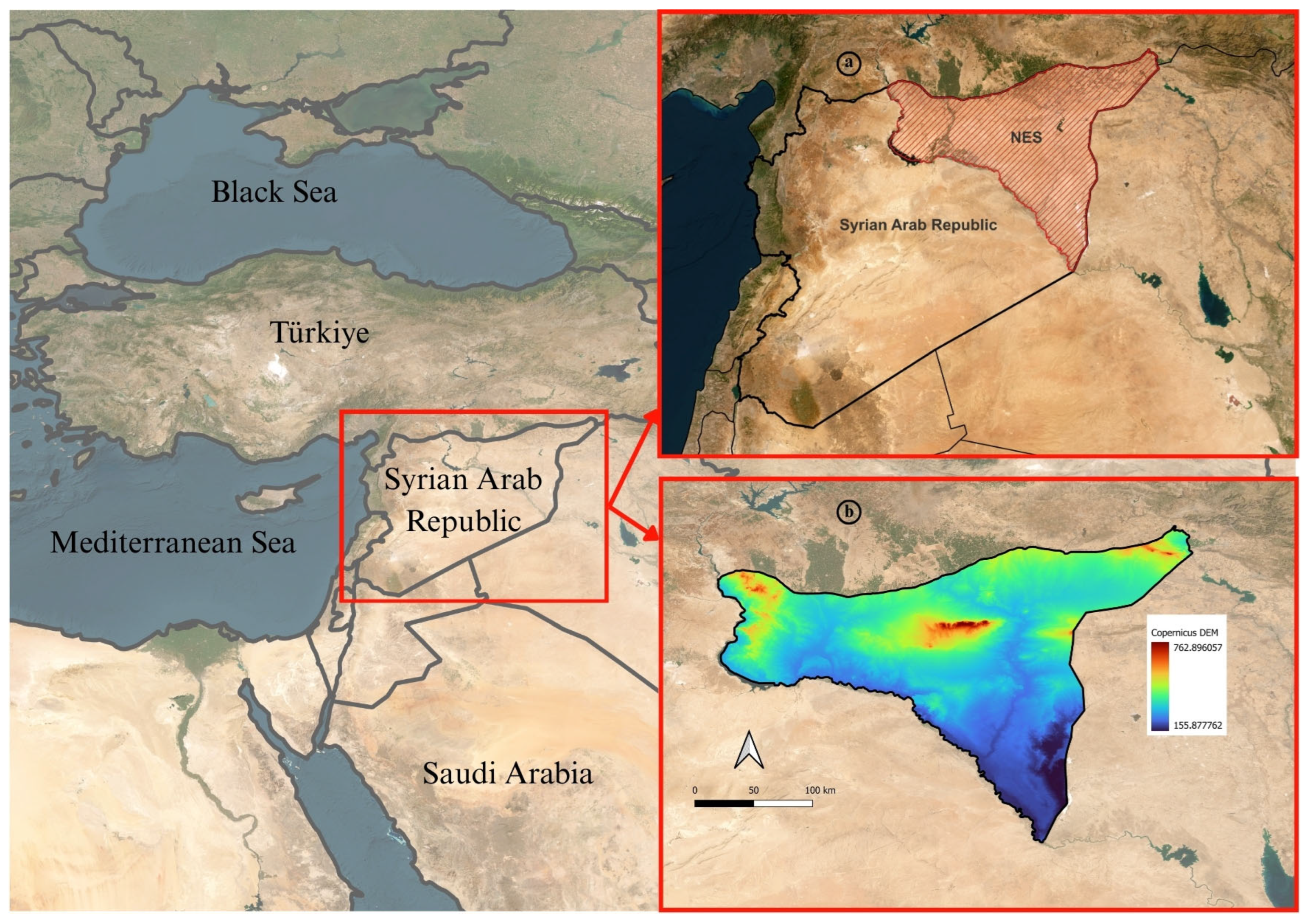
Figure 1. (a) The study area. (b) Digital Elevation Model (DEM) illustrating the borders and elevation of NES.
Sustainability 17 10933 g001
Figure 2. Correlation matrix of dynamic drought indicators.
Sustainability 17 10933 g002
Figure 3. The framework of the methodology used.
Sustainability 17 10933 g003
Figure 4. Scatter density plots showing observed vs. predicted values for VHI (top row), SPEI (middle row), and Soil Moisture Anomaly (bottom row) across 2021, 2022, and 2023. (Points clustered along the 1:1 line indicates strong agreement between predictions and observations).
Sustainability 17 10933 g004
Figure 5. SHAP summary plots for the prediction of VHI (left), SPEI (center), and soil moisture anomaly (right).
Sustainability 17 10933 g005
Figure 6. Annual trends and extremes for the selected features: (a) soil temperature, (b) soil moisture anomaly, (c) precipitation, (d) RH, and (e) SPEI.
Sustainability 17 10933 g006
Figure 7. Cluster centroids of the annual time series (left) and their corresponding spatial distribution (right) for (a) soil temperature, (b) soil moisture anomaly, (c) precipitation, (d) RH, and (e) SPEI.
Sustainability 17 10933 g007
Figure 8. Spatiotemporal anomalies of the selected variables across three conflict-related subperiods in NES: (a) soil temperature, (b) soil moisture anomaly, (c) precipitation, (d) RH, and (e) SPEI.
Sustainability 17 10933 g008
Figure 9. Local Moran’s I spatial clustering of the selected variables across three conflict-related subperiods in NES: (a) soil temperature, (b) soil moisture anomaly, (c) precipitation, (d) RH, and (e) SPEI.
Sustainability 17 10933 g009
Figure 10. Sen’s Slope trend magnitude maps of the selected variables in NES from 2000 to 2023: (a) soil temperature, (b) soil moisture anomaly, (c) precipitation, (d) RH, and (e) SPEI.
Sustainability 17 10933 g010
Table 1. Summary statistics of all features.
FeatureUnitMinMaxMeanStd
VHI-0.0095.8332.6620.01
Average Temperature°C−0.2745.5023.4011.47
Daytime Temperature°C−0.2560.1233.4813.78
Nighttime Temperature°C−7.4532.3313.329.40
EVI-−0.080.800.130.09
NDVI-−0.160.900.190.13
NDWI-−0.390.920.080.13
NDDI-−33.0033.000.921.66
SPEI-−3.503.83−0.060.98
Dew Point Temperature°C−6.7318.395.733.58
Evaporationmm−7.64-0.02−0.760.69
Precipitationmm0.0010.620.730.97
Relative Humidity%13.1986.5144.0319.19
Soil Temperature Level 1°C1.1640.2021.6410.49
Air Temperature°C0.8437.1620.079.58
Soil Moisture Anomaly-−0.120.170.000.07
Soil Moisture Root Anomaly-−0.130.160.000.03
Soil Moisturem3 m−30.140.420.220.07
Soil Moisture Rootm3 m−30.140.420.300.05
Bulk Densitycg cm−3119.00154.00145.083.45
Cation Exchange Capacity (at pH 7)Mmol (c)/kg98.00413.00254.8363.64
Clay Contentg kg−1165.00576.00346.9075.58
Coarse Fragments (Volumetric)cm3 dm−38.00265.0086.1135.60
Nitrogen Contentcg kg−161.00494.00175.5554.51
Organic Carbon Densityhg m−3111.00411.00201.2950.75
Sand Contentg kg−135.00478.00207.8849.71
Silt Contentg kg−1309.00645.00445.2242.20
Soil Organic Carbon Contentdg kg−147.001111.00128.3457.50
Soil Organic Carbon Stockt ha−114.0051.0027.396.40
Soil pH in H2OpH6.808.407.702.01
Soil SalinitydS m−10.004.000.450.57
Table 2. Annual prediction performance of the model for each drought indicator.
TargetYearR2RMSEMAE
VHI20210.876.424.34
20220.885.493.69
20230.866.034.10
SPEI20210.870.310.23
20220.900.290.21
20230.880.310.23
Soil Moisture Anomaly20210.870.020.02
20220.900.020.01
20230.880.020.02
Disclaimer/Publisher’s Note: The statements, opinions and data contained in all publications are solely those of the individual author(s) and contributor(s) and not of MDPI and/or the editor(s). MDPI and/or the editor(s) disclaim responsibility for any injury to people or property resulting from any ideas, methods, instructions or products referred to in the content.