Energetic and Economic Assessment of a Solar Thermally Driven Innovative Tri-Generation Unit for Different Use Cases and Climates




Abstract
1. Introduction
- Single-generation: 1 Output.
- Cogeneration: 2 Outputs.
- Tri-generation: 3 Outputs.
2. Materials and Methods
2.1. Modelling of Tri-Generation Unit
2.2. Types of End Users
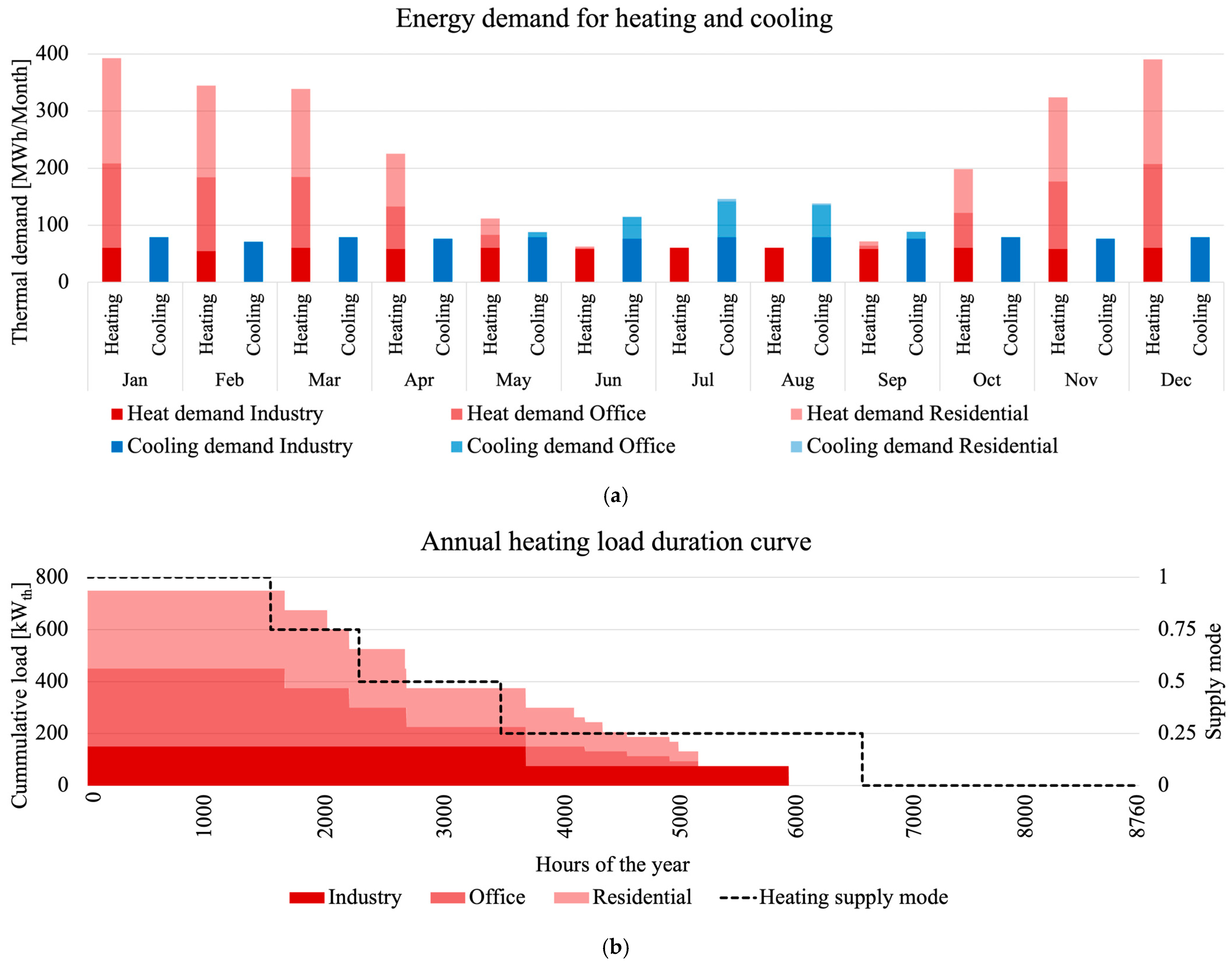
- Industrial site: Manufacturing industry that requires mainly heat, but also cold. It is characterized by daily operation, and the heat/cold demand is independent from the ambient temperature. A batch process is applied for both heat and cold demand.
- Residential user: This use case represents typical residential users, applicable for both single family and multifamily houses. Heating and cooling demand depends on the outdoor temperature and is mainly operated during daytime. During nighttime, both demands are reduced.
- Office user: The office use case represents the typical day-use office. Thermal energy demand depends on the outdoor temperature. Heating is required at cold temperatures, whereas cooling is required for hot outdoor temperature.
- Retail and commercial user: This case represents shops and supermarkets, with heating demand based on the outdoor climate. Cooling demand is always on for the storing of fresh products, with peaks in the morning and in the afternoon for filling fresh products.
- Industrial area: The industrial area combines the manufacturing industry and the office of industrial companies. The thermal energy demand of this use case is mainly driven by the constant demand of the industrial manufacturing. In addition to that, climate dependent peaks from the company’s office buildings influence the total thermal demand.
- Central urban district: This use case can be found in various city centres. It is a combination of the office and retail user types. The thermal energy demand of this use case is mainly driven by the climate, with cooling demand in hot season and heating demand in cold season.
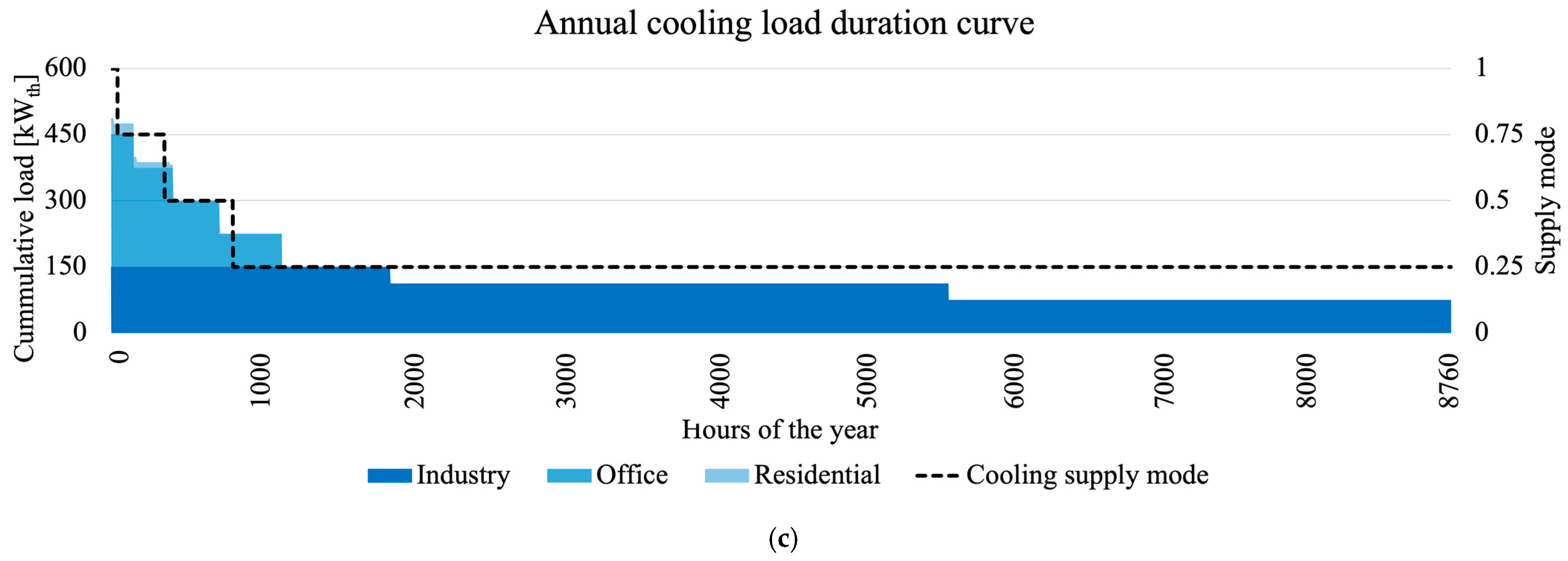
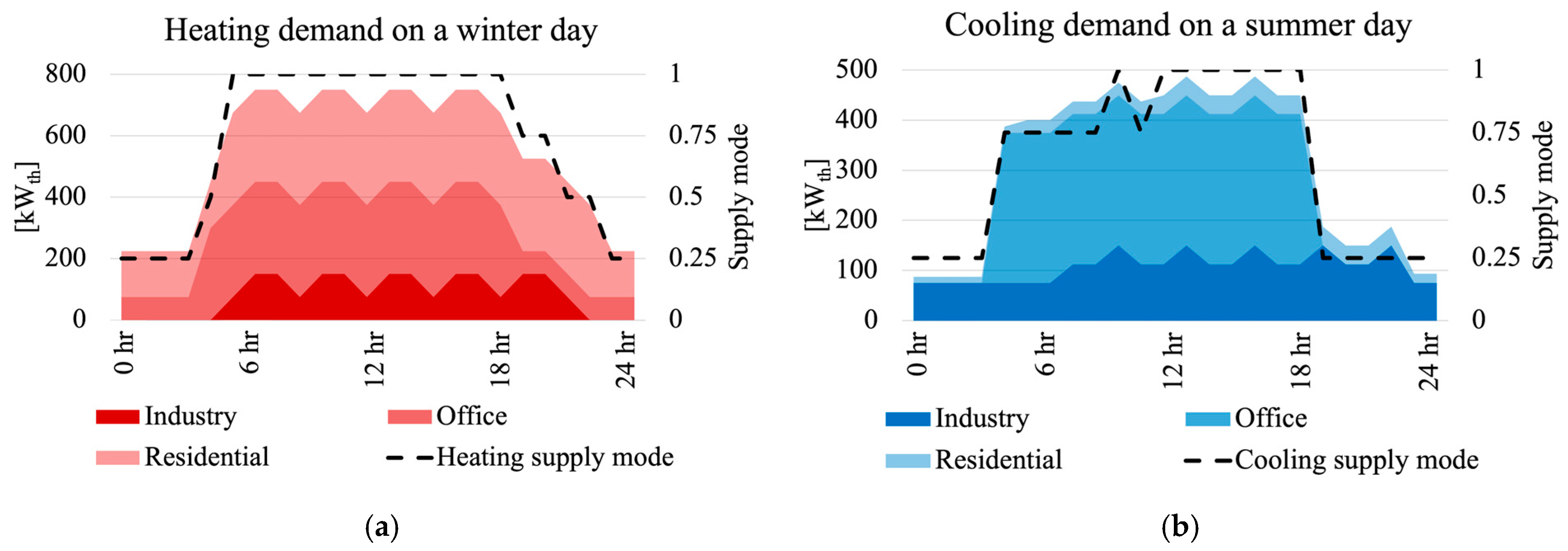
- “Berlin Mix”: This use case combines the industrial, office, and residential user types. “Berlin Mix” is a type of urban structure named after the sector combination that can be historically found in Berlin. The energy demand in this combined use case is dependent on the climate on the one side, but also strongly affected by the demand in the industrial sector. The structure of the “Berlin mix” becomes more significant in modern city planning typologies where mixed used structures with urban manufacturing and the target of gaining new residential space becomes a key solution [18].
- Rural municipality: The rural municipality combines industrial retail user types with residential user types. It represents the combination that can be found in villages, where supermarkets and manufacturing SMEs are located close to residential areas.
2.3. Economic Data
2.4. Solar Thermal Collector
2.5. Climate and Weather Data
3. Results
3.1. Dynamic Performance of Tri-Generation Unit
3.2. Energetic Analysis
3.3. Climate Analysis and Solar Thermal Heat Supply
3.4. Economic Analysis
4. Discussion
5. Conclusions
- Initial assumptions were used to develop a dynamic calculation model of the heat, cold, and electricity supply from the tri-generation unit and applied for annual simulations.
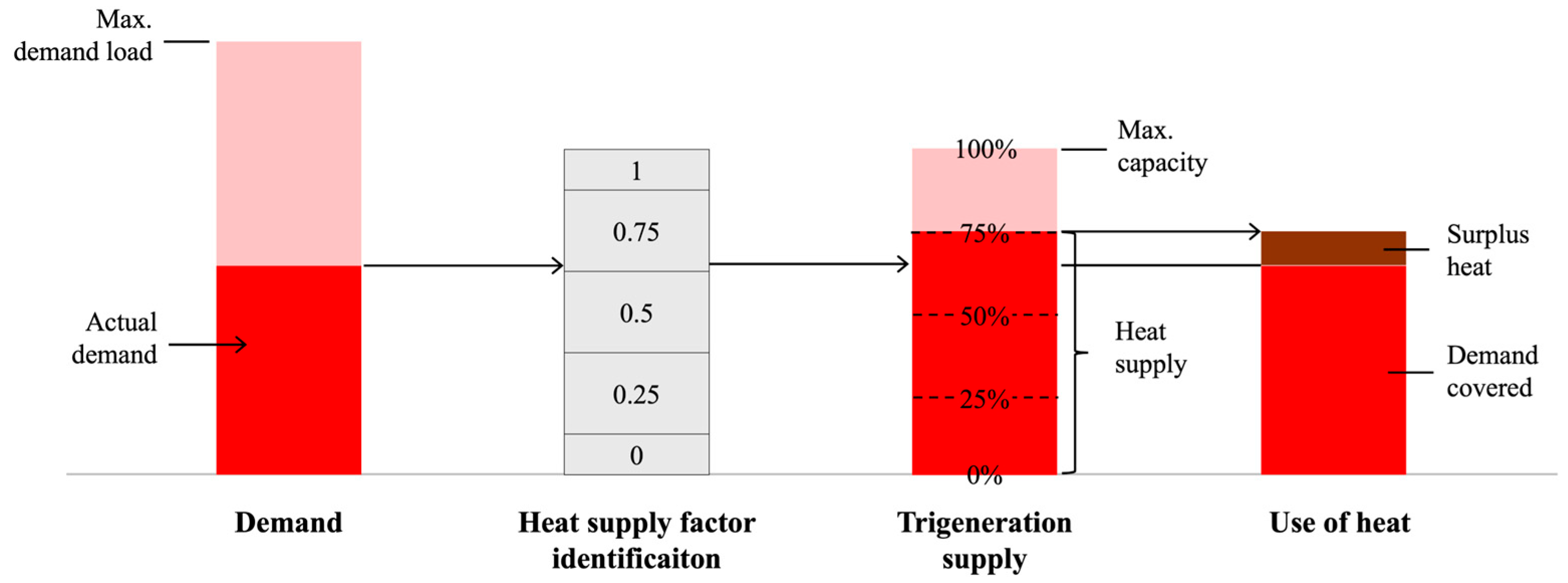
- The developed control strategy allows to adapt the unit’s heat and cold supply in 25% steps based on the users’ demand.
- Four use cases were identified, and the performance of the tri-generation unit in each case was analyzed.
- The Energy Utilization Factor (EUF) is highest for industrial sites and rural municipalities, due to the thermal demand of industry and retail throughout the year.
- Climate influences both user demand and the performance of the unit.
- Selling electricity is a significant aspect in the economic performance of the tri-generation unit.
Author Contributions
Funding
Institutional Review Board Statement
Informed Consent Statement
Data Availability Statement
Conflicts of Interest
Abbreviations
| CCHP | Combined Cooling, Heating, and Power |
| CHP | Combined Heating and Power |
| COP | Coefficient of Performance |
| CST | Concentrating Solar Thermal |
| EER | Energy Efficiency Ratio |
| EPW | Energy Plus Weather |
| EUF | Energy Utilization Factor |
| GWP | Global Warming Potential |
| PTC | Parabolic Trough Collector |
| SME | Small and Medium sized Enterprises |
| TES | Thermal Energy Storage |
| TRL | Technology Readiness Level |
References
- WMO Report Documents Spiralling Weather and Climate Impacts. Available online: https://wmo.int/news/media-centre/wmo-report-documents-spiralling-weather-and-climate-impacts (accessed on 25 September 2025).
- European Green Deal. Available online: https://www.consilium.europa.eu/en/policies/european-green-deal/?utm_source=chatgpt.com (accessed on 25 September 2025).
- Renewable Energy Targets—European Commission. Available online: https://energy.ec.europa.eu/topics/renewable-energy/renewable-energy-directive-targets-and-rules/renewable-energy-targets_en (accessed on 25 September 2025).
- Cogeneration of Heat and Power. Available online: https://energy.ec.europa.eu/topics/energy-efficiency/cogeneration-heat-and-power_en (accessed on 25 September 2025).
- Dupuy, A.; Percembli, A.A.; Grosu, L.; Tran, K.-H.; Dobrovicescu, A. Trigeneration Systems: A State-of-the-Art Review. Energies 2025, 18, 2594. [Google Scholar] [CrossRef]
- Dobre, C.; Costin, M.; Constantin, M. A Review of Available Solutions for Implementation of Small–Medium Combined Heat and Power (CHP) Systems. Inventions 2024, 9, 82. [Google Scholar] [CrossRef]
- Jiménez-García, J.C.; Ruiz, A.; Pacheco-Reyes, A.; Rivera, W. A Comprehensive Review of Organic Rankine Cycles. Processes 2023, 11, 1982. [Google Scholar] [CrossRef]
- Briola, S. Plant and Method for the Supply of Electric Power and/or Mechanical Power, Heating, Power and/or Cooling Power. International Publication Number WO 2017/158511 A1, 21 September 2017. [Google Scholar]
- Leclercq, N.; Bederna, B.G.; Lemort, V. Experimental study of a retrofitted scroll compressor for operation with two-phase refrigerant flows. Int. J. Refrig. 2025, 177, 219–231. [Google Scholar] [CrossRef]
- Lyu, W.; Luzi, G.; Delgado, A.; Schellin, T.E. CFD Analysis of lab-scale prototypes two-phase fluid flow twin-scroll compressor and expander. Energy 2025, 314, 134192. [Google Scholar] [CrossRef]
- Leclercq, N.; Lemort, V. Modeling and Simulation of a Two-Phase Scroll Compressor. In Proceedings of the 26th International Compressor Engineering Conference at Purdue, West Lafayette, IN, USA, 10–14 June 2022. [Google Scholar]
- Briola, S.; Di Marco, P.; Gabbrielli, R. Thermodynamic sensitivity analysis of a novel trigeneration thermodynamic cycle with two-phase expanders and two-phase compressors. Energy 2017, 127, 335–350. [Google Scholar] [CrossRef]
- Piña-Martinez, A.; Lasala, S.; Privat, R.; Falk, V.; Jaubert, J.-N. Design of Promising Working Fluids for Emergent Combined Cooling, Heating, and Power (CCHP) Systems. ACS Sustain. Chem. Eng. 2021, 9, 11807–11824. [Google Scholar] [CrossRef]
- Leclercq, N.; Stoeckel, K.; Thomas, C.; Lemort, V. Modeling and Experimental Validation of the Thermophysical Properties of a POE+R1233zd(E) Mixture. In Proceedings of the International Compressor Engineering Conference, West Lafayette, IN, USA, 15–18 July 2024. [Google Scholar]
- Strobel, M. Modelling and Analysis of a Two-Phase CCHP Unit Using Software-Based Dynamic Simulations; Leipzig University of Applied Sciences: Leipzig, Germany, 2021. [Google Scholar]
- Bianchi, G.; Kennedy, S.; Zaher, O.; Tassou, S.A.; Miller, J.; Jouhara, H. Numerical modeling of a two-phase twin-screw expander for Trilateral Flash Cycle applications. Int. J. Refrig. 2018, 88, 248–259. [Google Scholar] [CrossRef]
- Ferreira, C.A.I.; Zaytsev, D.; Zamfirescu, C. Wet Compression of Pure Refrigerants; Purdue University: West Lafayette, IN, USA, 2006. [Google Scholar]
- Erbstößer, A.-C. Produktion in der Stadt: Berliner Mischung 2.0; Technologie Stiftung Berlin: Berlin, Germany, 2016. [Google Scholar]
- Yu, Q.; Hao, Y.; Ali, K.; Hua, Q.; Sun, L. Techno-economic analysis of hydrogen pipeline network in China based on levelized cost of transportation. Energy Convers. Manag. 2024, 301, 118025. [Google Scholar] [CrossRef]
- Electricity Price Statistics. Available online: https://ec.europa.eu/eurostat/statistics-explained/index.php?title=Electricity_price_statistics (accessed on 26 September 2025).
- Consumer Advocates Want Upper Limit for District Heating Prices. Available online: https://www.bayern-innovativ.de/emagazin/detail/verbraucherschuetzer-wollen-obergrenze-fuer-fernwaermepreise (accessed on 26 September 2025).
- Réseaux de Froid Urbains: Rafraîchir Les Bâtiments en Consommant Moins d’énergie. L’exemple de Paris. Available online: https://www.adaptaville.fr/rafraichir-les-batiments-en-consommant-moins-d-energie-grace-aux (accessed on 26 September 2025).
- Abbas, R.; Montes, M.J.; Rovira, A.; Martínez-Val, J.M. Parabolic trough collector or linear Fresnel collector? A comparison of optical features including thermal quality based on commercial solutions. Sol. Energy 2016, 124, 198–215. [Google Scholar] [CrossRef]
- BMWK Germany. Informationsblatt CO2-Faktoren; German Federal Ministry for Economics and Climate Action: Eschborn, Germany, 2024. [Google Scholar]





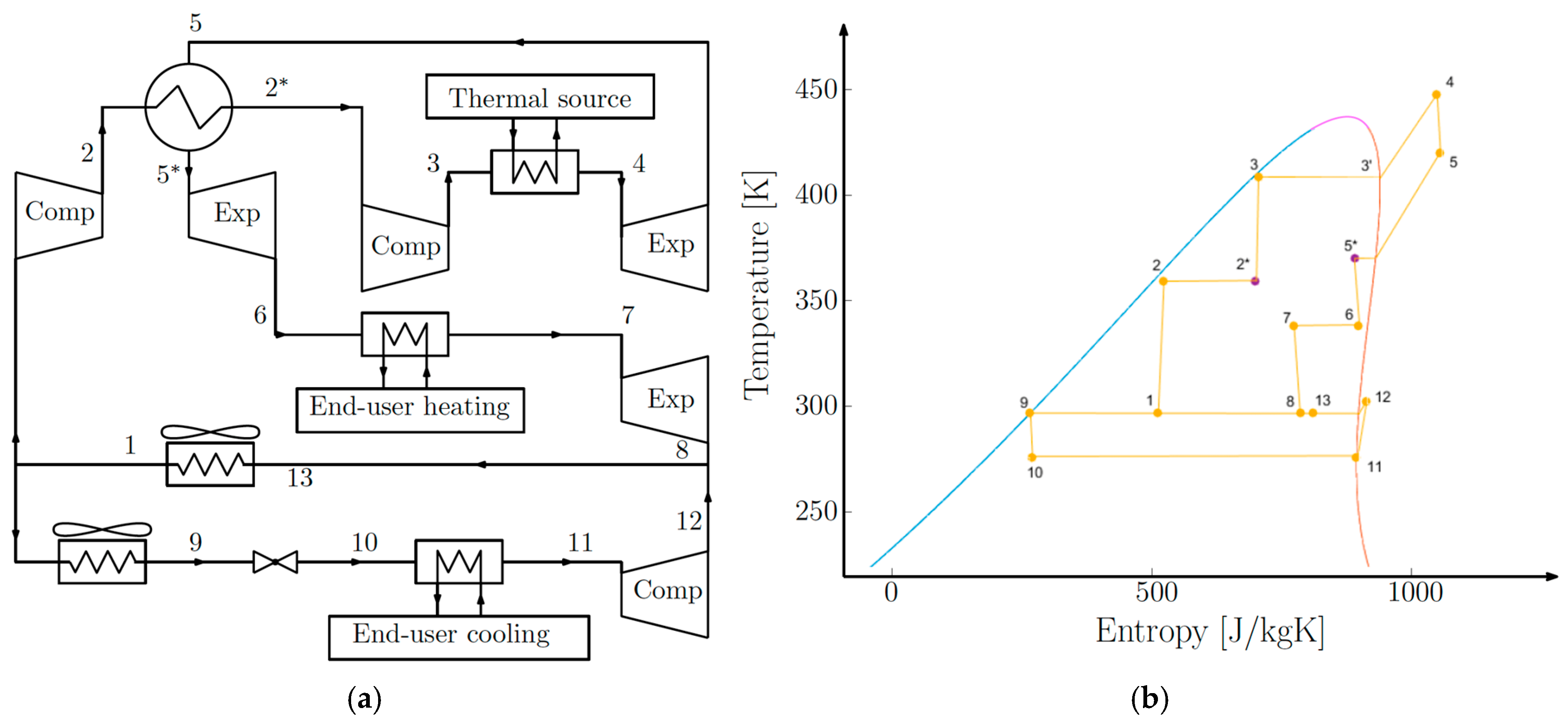
| Step | Description |
|---|---|
| 1–2 | Compression; rise in temperature, pressure, and entropy |
| 2–2* | Heat transfer, heat absorption; isothermal, rise in entropy |
| 2*–3 | Compression; rise in temperature, pressure, and entropy |
| 3–4 | Heat absorption from ext. heat source; superheating, rise in temperature, and entropy |
| 4–5 | Expansion (power generation via generator); reduction in temperature and pressure, rise in entropy |
| 5–5* | Heat transfer, heat disposal; reduction in temperature and entropy |
| 5*–6 | Expansion (power generation via generator); reduction in temperature and pressure, rise in entropy |
| 6–7 | Condenser (heat supply to user); isothermal heat rejection, entropy loss |
| 7–8 | Expansion (power generation via generator); reduction in temperature and pressure, rise in entropy |
| 8–13 | Mix with state 12 to state 13 |
| 1–9 | Heat rejection to ambient; isothermal loss of heat, entropy reduction |
| 9–10 | Expansion; reduction in temperature and pressure, rise in entropy |
| 10–11 | Evaporation (cold supply to user); isothermal heat absorption, rise in entropy |
| 11–12 | Compression; rise in temperature, pressure, and entropy |
| 12–13 | Mix with state 8 to state 13 |
| 13–1 | Heat rejection to ambient; isothermal loss of heat, entropy reduction |
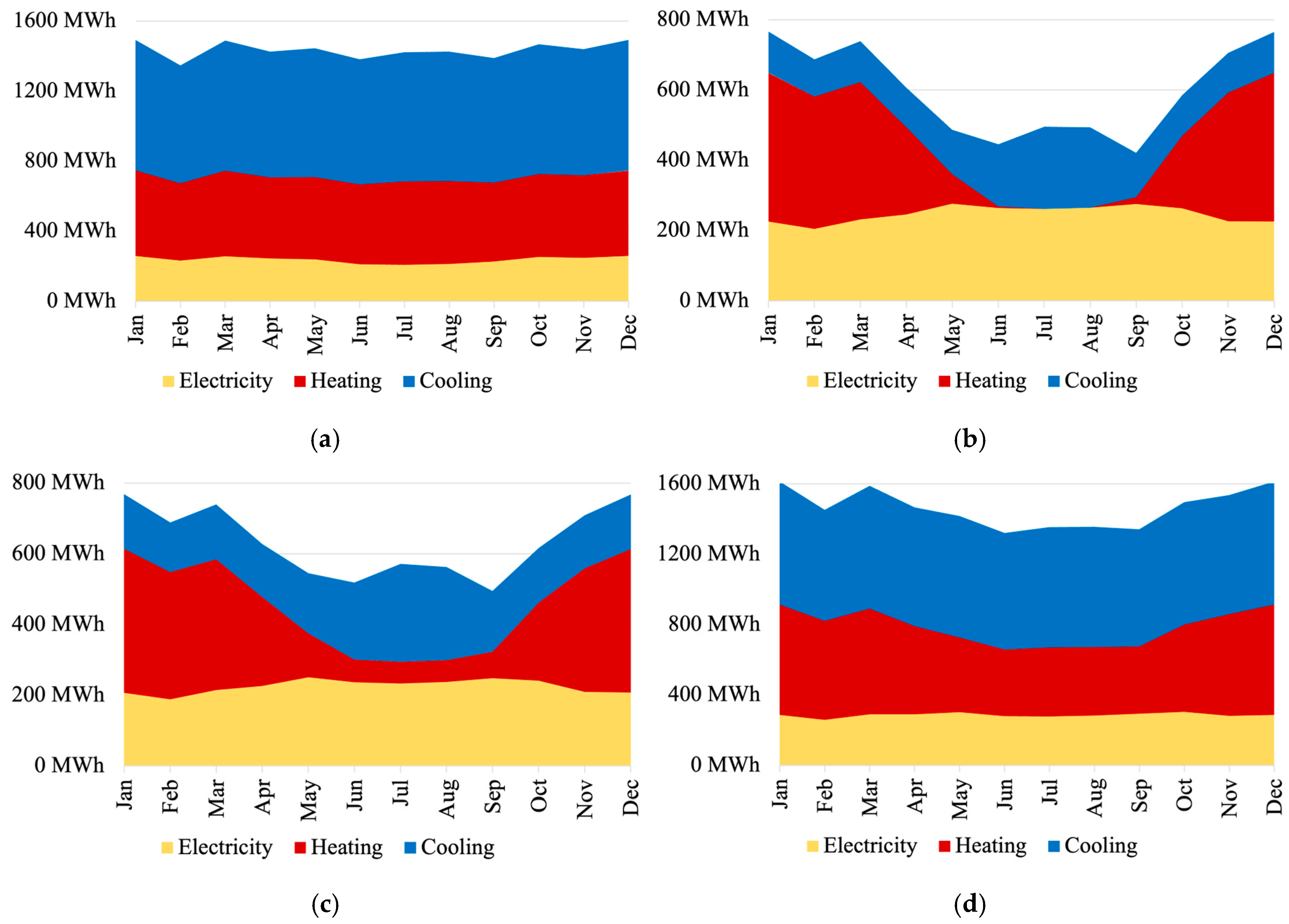
| 1: Industrial Site | 2: Urban Central District | 3: “Berlin Mix” | 4: Rural Municipality | |
|---|---|---|---|---|
| Case description | Industry: | Office: | Industry: | Industry: |
| Heating: 800 kW | Heating: 500 kW | Heating: 150 kW | Heating: 600 kW | |
| Cooling: 800 kW | Cooling: 700 kW | Cooling: 150 kW | Cooling: 600 kW | |
| Office: | Retail: | Office: | Retail: | |
| Heating: 200 kW | Heating: 200 kW | Heating: 300 kW | Heating: 150 kW | |
| Cooling: 200 kW | Cooling: 400 kW | Cooling: 300 kW | Cooling: 300 kW | |
| Residential: | Residential: | |||
| Heating: 300 kW | Heating: 350 kW | |||
| Cooling: 300 kW | Cooling: 70 kW | |||
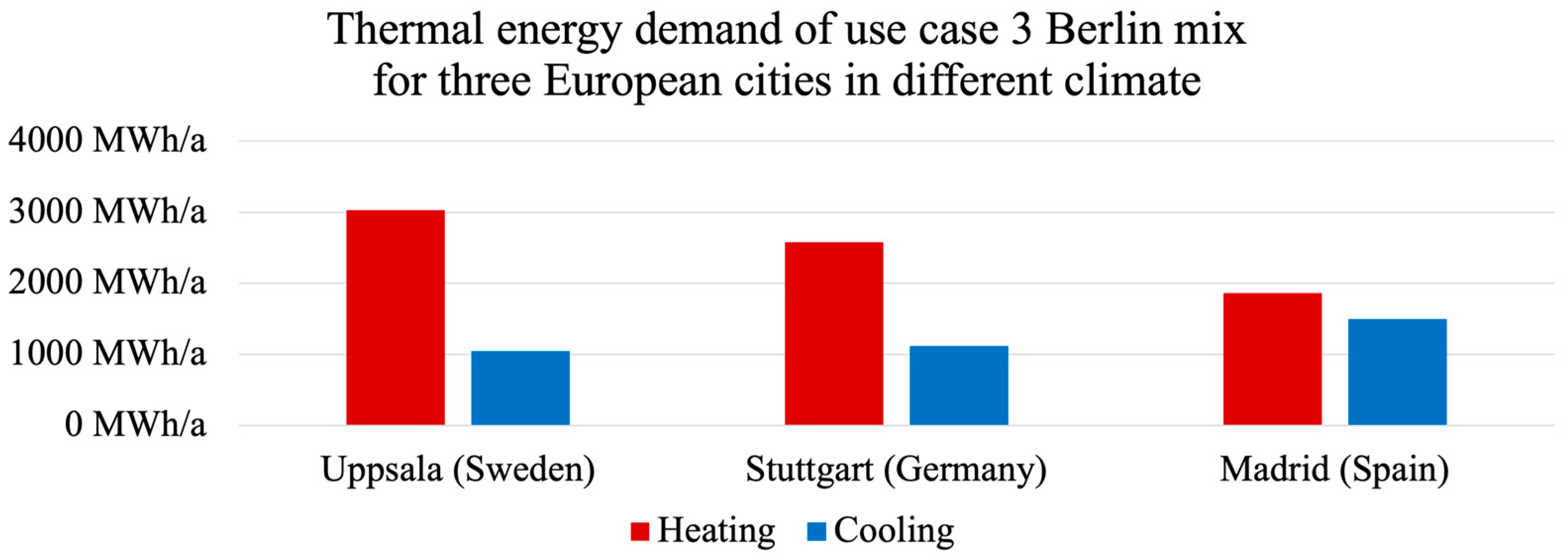
| Heating demand | 4352 MWh/a | 1896 MWh/a | 2582 MWh/a | 4435 MWh/a |
| Cooling demand | 5143 MWh/a | 1277 MWh/a | 1117 MWh/a | 4379 MWh/a |
| Dimensioned heat source capacity of the CCHP plant | 2898 kW | 2060 kW | 2183 kW | 3290 kW |
| 1: Industrial Site | 2: Urban Central District | 3: “Berlin Mix” | 4: Rural Municipality | ||
|---|---|---|---|---|---|
| Heat | Demand | 4352 MWh/a | 1896 MWh/a | 2582 MWh/a | 4435 MWh/a |
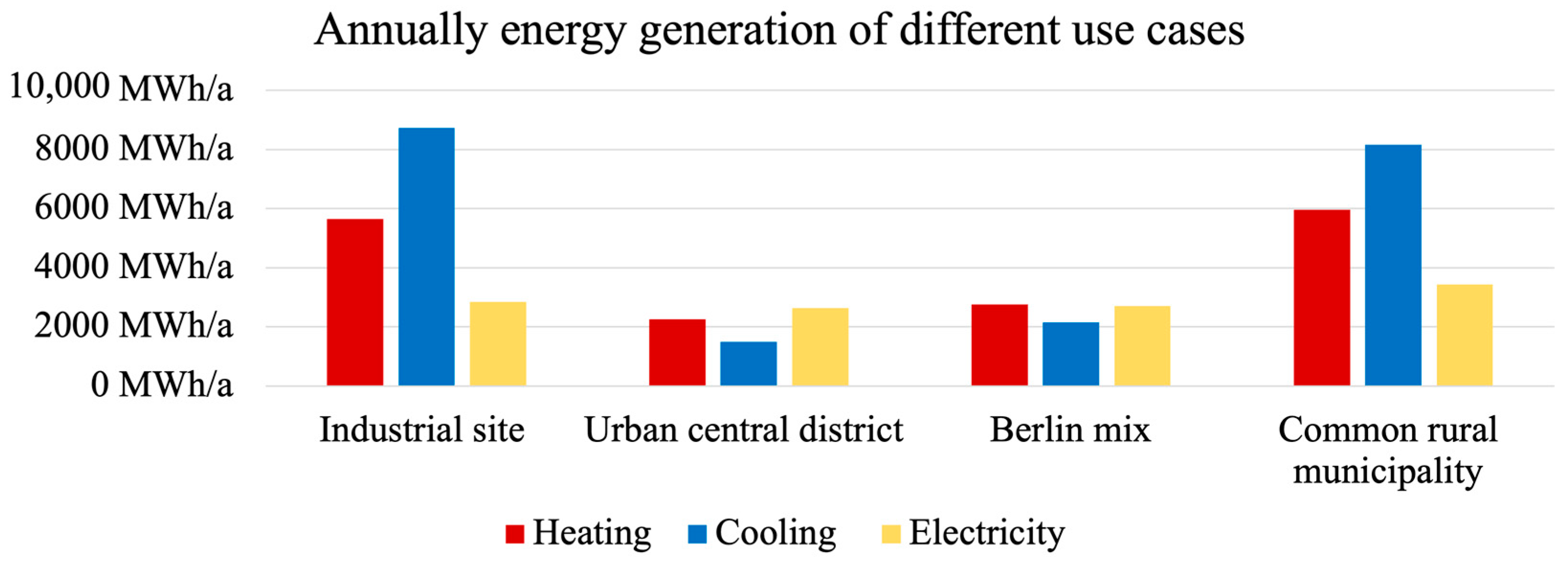
| Generation | 5640 MWh/a | 2256 MWh/a | 2753 MWh/a | 5953 MWh/a | |
| Balance | +1288 MWh/a +29.6% | +360 MWh/a +18.99% | +171 MWh/a +6.62% | +1518 MWh/a +34.23% | |
| Cold | Demand | 5143 MWh/a | 1277 MWh/a | 1117 MWh/a | 4379 MWh/a |
| Generation | 8723 MWh/a | 1497 MWh/a | 2155 MWh/a | 8160 MWh/a | |
| Balance | +3580 MWh/a +69.61% | +220 MWh/a +17.23% | +1038 MWh/a +92.93% | +3781 MWh/a +86.34% | |
| Electricity | Generation | 2842 MWh/a | 2630 MWh/a | 2701 MWh/a | 3433 MWh/a |
| Dimensioned heat source capacity of the CCHP plant | 2898 kW | 2898 kW | 2060 kW | 2183 kW | |
| Heat source demand | 25,392 MWh/a | 18,046 MWh/a | 19,123 MWh/a | 28,821 MWh/a | |
| Total energy generation | 17,205 MWh/a | 6383 MWh/a | 7609 MWh/a | 17,545 MWh/a | |
| EUF | 67.8% | 35.4% | 39.8% | 60.9% | |
| Uppsala (Sweden) | Stuttgart (Germany) | Madrid (Spain) | |
|---|---|---|---|
| Dimensioned heat source capacity of the tri-generation unit | 2232 kW | 2183 kW | 1986 kW |
| EUF | 41.2% | 39.8% | 42.5% |
| Annual heat source demand | 19,554 MWh/a | 19,123 MWh/a | 17,399 MWh/a |
| Balance Period | Uppsala (Sweden) | Stuttgart (Germany) | Madrid (Spain) | |
|---|---|---|---|---|
| Mean ambient temperature | 7.51 °C | 9.55 °C | 14.71 °C | |
| Global horizontal radiation (GHI) | 960 kWh/m2a | 1182 kWh/m2a | 1722 kWh/m2a | |
| Energy demand Heat Source | 11,034 MWh/a | 9921 MWh/a | 9071 MWh/a | |
| Collector Field size (no. of collectors in array × number of arrays) aperture area | Year | 367 × 10 37,700 m2 | 320 × 10 32,900 m2 | 114 × 10 11,700 m2 |
| January | - | 8215 × 10 842,900 m2 | 513 × 10 52,700 m2 | |
| July | 86 × 10 8900 m2 | 100 × 10 10,300 m2 | 57 × 10 5900 m2 | |
| Hours of solar only operation | Year | 1504 h (17%) | 1548 h (18%) | 2393 h (27%) |
| Solar energy generation | Year | 11.05 GWh/a | 9.91 GWh/a | 9.06 GWh/a |
| Uppsala (Sweden) | Stuttgart (Germany) | Madrid (Spain) | |
|---|---|---|---|
| Collector field size | 3000 m2 | 3000 m2 | 3000 m2 |
| Total solar energy yield | 564 MWh/a | 603 MWh/a | 1384 MWh/a |
| Solar surplus heat (not used) | 50 MWh/a | 45 MWh/a | 86 MWh/a |
| Solar energy directly used | 514 MWh/a (5%) | 558 MWh/a (6%) | 1298 MWh/a (14%) |
| Energy from back-up supply | 10,519 MWh/a (95%) | 9362 MWh/a (94%) | 7773 MWh/a (86%) |
| Hours when back-up boiler needed | 8585 h (98%) | 8578 h (98%) | 8465 h (97%) |
| GHG emission savings | 114.8 tCO2-eq | 124.6 tCO2-eq | 289.9 tCO2-eq |
| Uppsala (Sweden) | Stuttgart (Germany) | Madrid (Spain) | |
|---|---|---|---|
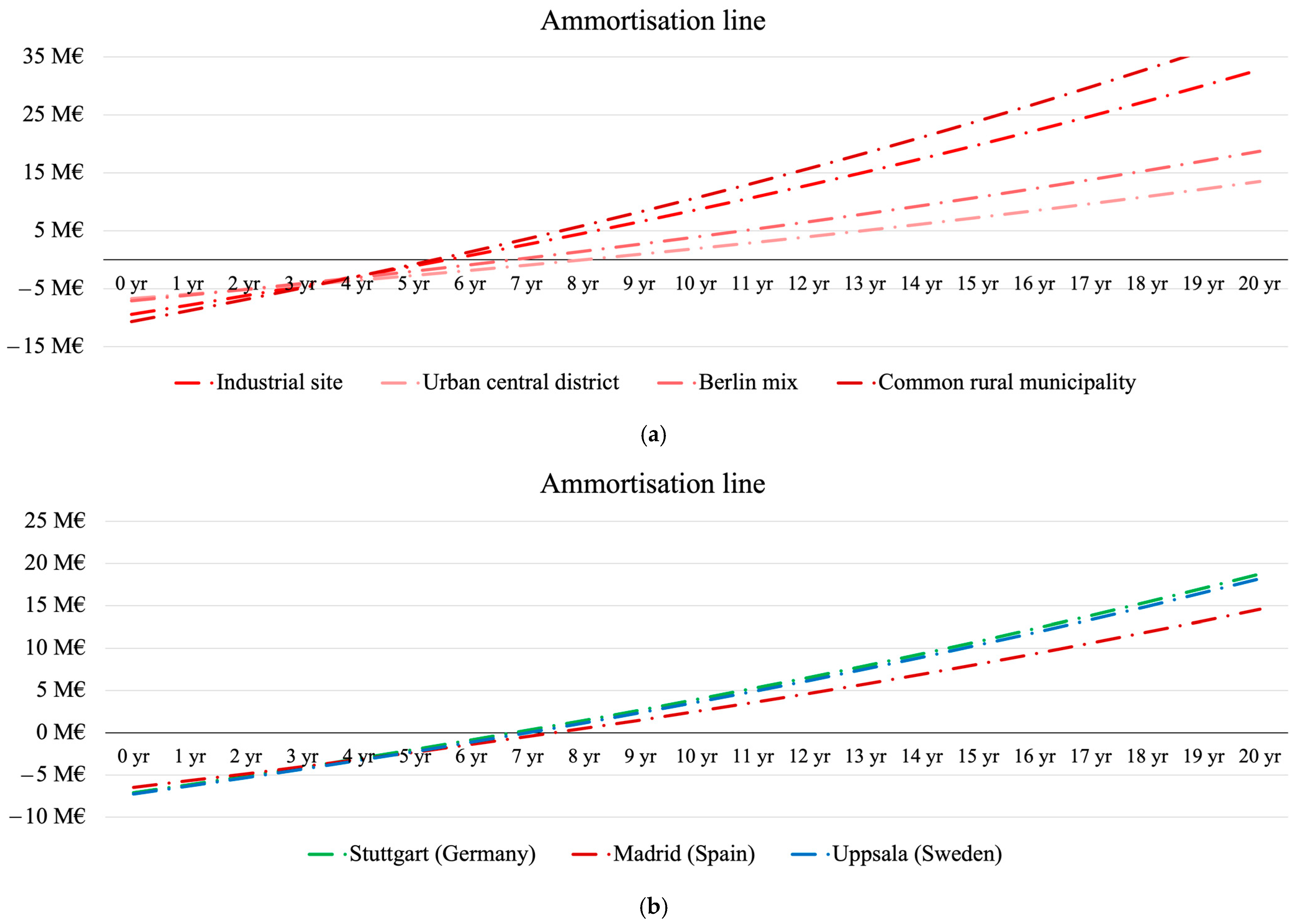
| Investment | 7415 k€ | 7095 k€ | 6455 k€ |
| Ø 20 yrs sale of energy earnings | 822 k€/a | 845 k€/a | 720 k€/a |
| Ø 20 yrs energy savings | 903 k€/a | 827 k€/a | 693 k€/a |
| Ø 20 yrs missing energy costs | −89 k€/a | −47 k€/a | −50 k€/a |
| Ø 20 yrs maintenance and replacement | −292 k€/a | −286 k€/a | −260 k€/a |
| Ø 20 yrs annual balance | 1273 k€ | 1293 k€ | 1053 k€ |
| Amortization time | 7.0 yrs | 6.8 yrs | 7.5 yrs |
Disclaimer/Publisher’s Note: The statements, opinions and data contained in all publications are solely those of the individual author(s) and contributor(s) and not of MDPI and/or the editor(s). MDPI and/or the editor(s) disclaim responsibility for any injury to people or property resulting from any ideas, methods, instructions or products referred to in the content. |
© 2025 by the authors. Licensee MDPI, Basel, Switzerland. This article is an open access article distributed under the terms and conditions of the Creative Commons Attribution (CC BY) license (https://creativecommons.org/licenses/by/4.0/).
Share and Cite
Jakob, U.; Strobel, M.; Ziegele, L. Energetic and Economic Assessment of a Solar Thermally Driven Innovative Tri-Generation Unit for Different Use Cases and Climates. Sustainability 2025, 17, 10924. https://doi.org/10.3390/su172410924
Jakob U, Strobel M, Ziegele L. Energetic and Economic Assessment of a Solar Thermally Driven Innovative Tri-Generation Unit for Different Use Cases and Climates. Sustainability. 2025; 17(24):10924. https://doi.org/10.3390/su172410924
Chicago/Turabian StyleJakob, Uli, Michael Strobel, and Luca Ziegele. 2025. "Energetic and Economic Assessment of a Solar Thermally Driven Innovative Tri-Generation Unit for Different Use Cases and Climates" Sustainability 17, no. 24: 10924. https://doi.org/10.3390/su172410924
APA StyleJakob, U., Strobel, M., & Ziegele, L. (2025). Energetic and Economic Assessment of a Solar Thermally Driven Innovative Tri-Generation Unit for Different Use Cases and Climates. Sustainability, 17(24), 10924. https://doi.org/10.3390/su172410924