1. Introduction
Overloaded trucks are widely acknowledged as the primary driver of pavement deterioration and escalating maintenance costs. Excess axle loads impose abnormal stresses that accelerate plastic deformation and significantly shorten infrastructure service life. Although overloaded trucks often constitute a minor proportion of traffic (18–25%), previous studies consistently identify them as the source of 35–70% of fatigue damage, and nearly 60% of total Pavement Management System (PMS) costs [
1,
2]. Indeed, overloading levels of up to 20% can halve the fatigue life of asphalt pavements, whereas a 10% reduction in such traffic could extend service life by 4–6 years [
2].
The economic implications are severe. Research indicates that overloaded trucks can more than double pavement maintenance costs compared to legally loaded vehicles [
3], with specific annual losses estimated at approximately 20–30 million dollars in some regions [
4]. At the network level, regular overloading pushes PMS costs to more than 100% beyond legal limits [
3] and can reduce service life by up to 80%, necessitating thicker overlays that drive costs over 20% higher [
5]. Recent large-scale assessments confirm this burden: a 2023 Texas study attributed
$300 million annually specifically to oversize/overloaded trucks [
6], while Indonesia reported infrastructure losses reaching
$3 billion in 2018 [
7]. Bridges are similarly compromised, as a 15% increase in gross vehicle weight can double fatigue-related damage [
8].
Beyond infrastructure damage, overloading significantly aggravates vehicle energy consumption and greenhouse gas (GHG) emissions. This impact is twofold. First, increased road roughness from deterioration raises rolling resistance, boosting fuel consumption by up to 22%; case studies show that this generates an additional 22–54 tons of CO
2 per kilometer annually [
9]. Second, heavy engine loads cause fully loaded trucks to emit nearly 96% more CO
2 at low speeds compared to unloaded conditions [
10]. Regional assessments estimate that these factors combined could add tens of thousands of metric tons of CO
2 over a 20-year horizon [
11], directly undermining climate mitigation efforts.
In response to these adverse effects, various enforcement strategies have been implemented to discourage overloading. Stationary weigh stations equipped with high- and low-speed axle load scales, as well as mobile enforcement using portable weighing devices, represent traditional approaches. Among these, weigh-in-motion (WIM) technology has emerged as a more efficient alternative, enabling continuous monitoring of vehicle weight and axle load through embedded road sensors. WIM systems avoid traffic delays while collecting valuable data such as vehicle type, axle configuration, and speed that can be integrated with driver information [
12]. Case studies have demonstrated the effectiveness of such measures: for example, annual pavement damage costs in Montana were reduced by about USD 700,000 when WIM enforcement was applied on the most deteriorated road sections [
13]. However, universal deployment of WIM systems is not feasible, and one study has shown that on bypass routes, a significant portion (11–14%) of trucks are overloaded [
14]. This highlights the need for strategic WIM placement to maximize both enforcement efficiency and compliance with legal load restrictions.
Most previous studies on WIM placement have primarily optimized sensor locations to minimize pavement damage and enforcement costs, often overlooking broader sustainability considerations. To address this gap, this study develops a unified bi-level optimization framework that simultaneously minimizes PMS costs and GHG emissions, thereby reframing WIM enforcement as a strategic component of sustainable transportation planning. The remainder of this paper consists of a literature review, methodology, numerical study, and conclusion.
2. Literature Review
Determining optimal locations for weigh-in-motion (WIM) systems can be formulated as a flow capturing problem (FCP), in which facilities are located to intercept flow-based users traveling between origin and destination nodes [
15]. While the FCP framework is widely applied to locate commercial and enforcement facilities [
15,
16,
17], Jinyu et al. note that traditional approaches often rely on the restrictive assumption that vehicle routes are fixed and drivers are neutral to enforcement [
18]. This limits their applicability in contexts where drivers actively seek to evade inspection.
To address this limitation, the Evasive Flow Capturing Problem (EFCP) emerged, explicitly accounting for drivers’ ability to alter routes. Research in this domain has evolved through various optimization paradigms: from binary integer programming focused on maximizing flow capture [
12] to multi-period stochastic and bi-level formulations [
19,
20,
21]. More recent studies have refined these models by incorporating bounded rationality and duality-based transformations [
22]. Notably, Lu et al. (2023) demonstrated that a bi-level EFCP model jointly determining WIM locations and truck-prohibited roads could achieve greater cost-effectiveness than single-measure strategies [
23].
Subsequent studies have emphasized the interaction between enforcement placement and driver route choice. Several models define the upper-level problem as WIM location selection and the lower level as route choice, aimed at eliminating evasion paths [
24,
25]. Advancing this, Jung et al. (2025) [
26] introduced a utility-based framework where overloaded drivers may switch to legal loading if the expected penalty exceeds the benefits of overloading. Their bi-level optimization integrated demand shifts into user equilibrium assignment to minimize pavement damage (ESAL-km) and network disruption under budget constraints [
26].
Despite these advancements, most prior studies still assume that overloaded drivers select alternative routes within a deviation tolerance while maintaining their overloading behavior [
12,
19,
20,
21,
22,
23]. In reality, however, drivers also weigh schedule constraints, contractual penalties, and delivery commitments when deciding whether to overload, detour, or comply. These temporal and behavioral considerations critically influence compliance outcomes. Our previous work [
26,
27] partially addressed these aspects by integrating driver utility and demand shifts into WIM placement, focusing primarily on minimizing physical pavement damage (ESAL-km) and congestion effects. The present study significantly advances this framework by (1) explicitly incorporating schedule adherence into driver decision-making to capture realistic logistics constraints, and (2) integrating monetized PMS costs and GHG emissions into the optimization process. This comprehensive formulation enables broader cost internalization, positioning WIM enforcement not merely as an infrastructure control mechanism but as a cornerstone of sustainable freight management and climate policy. The primary contribution of this work is the simultaneous minimization of travel, PMS, and GHG costs within a behaviorally realistic framework, offering actionable strategies that balance economic efficiency with national climate objectives.
3. Methods
This study defines two primary objectives for WIM system installation: (1) reducing overloaded trucks by encouraging compliance, and (2) minimizing network-wide social costs, including direct PMS costs, GHG emissions, and travel costs, under realistic budget constraints. To achieve these objectives, a bi-level optimization framework is developed.
At the upper level, the problem is formulated as minimizing the total network cost, which integrates PMS deterioration cost, GHG emission cost, and travel cost, subject to a budget constraint on WIM installations. To ensure a consistent optimization framework, all objective function components, PMS deterioration, GHG emissions, and travel time, are converted into a unified monetary unit (USD). Specifically, GHG emissions are monetized using the Social Cost of Carbon (SCC), while travel time is converted using the Value of Time (VOT). At the lower level, a multi-class traffic assignment model captures the demand shift and route choice behavior of different vehicle types in response to enforcement. This hierarchical structure enables comparison between the default (no-WIM) condition and alternative enforcement scenarios where WIM systems are installed on selected links, thereby identifying the most cost-effective and sustainable deployment strategy.
We consider a roadway network graph , comprising nodes N and arcs A. The nodes and arcs are indexed by and , respectively, and each arc has a length denoted by [km]. A WIM system can be installed on certain candidate arcs, denoted by . The decision variable is the set of arcs where WIM is installed, represented as . Accordingly, we define binary variables , where indicates that a WIM is installed on candidate arc , and otherwise. In this network, we consider three types of vehicles: overloaded trucks (), non-overloaded trucks (), and regular vehicles (), respectively. The traffic flow of each link with a certain WIM strategy is denoted by [veh/hour].
3.1. Upper-Level Problem
3.1.1. PMS Cost
The upper-level problem aims to determine the optimal locations for WIM installations that minimize the total network cost, including direct PMS, GHG emissions, and travel costs, subject to a given budget constraint. From Jung and Lee (2024), we calculate the PMS cost for each link, considering the single rehabilitation cost as follows [
27]:
where
is the number of lane;
is undiscounted prorated pavement management costs with single rehabilitation costs on lane
of link
[
$/lane];
is vehicle-group-specific ESALs parameters;
is predetermined pavement condition threshold for initiating a rehabilitation activity defined in International Roughness Index (IRI) [m/km];
is the condition right after rehabilitation [m/km];
is a positive parameter in [hour
−1]; and
is a positive parameter in [(ESALs·hour)
−1];
is the rehabilitation cost for each lane of link
[
$/km/lane].
3.1.2. PMS GHG Cost
PMS activities like rehabilitation generate not only direct monetary costs but also significant GHG emissions. These emissions originate from various stages of the PMS process, including the manufacturing of materials, on-site construction activities, the transportation of materials to the site, and indirect emissions from traffic detours caused by work zones [
28]. To maintain a focused and computationally efficient framework, this study concentrates on the two primary sources directly resulting from the rehabilitation work: GHG emissions from Material Production and On-site Construction. Material transportation is excluded under the assumption that materials are sourced locally from facilities adjacent to the network nodes, thereby minimizing transport-related emissions. Furthermore, indirect emissions from work zone traffic delays are considered negligible, as rehabilitation activities are assumed to be scheduled during off-peak hours (e.g., nighttime) when traffic volumes are significantly lower. While acknowledging other sources, this scope allows the model to capture the most direct environmental impacts of the physical rehabilitation activity. The PMS emissions and cost from rehabilitation are then expressed as
where
is the pavement rehabilitation cycle [hour];
is the GHG emissions cost generated during the manufacturing of rehabilitation materials, such as the production of asphalt mixtures;
emissions produced by the machinery and equipment used during the on-site construction process itself;
is the lane width [km];
is the depth of rehabilitation activities [km];
is the material emission factor [ton/
];
is the equipment emission factor [ton/
].
3.1.3. Vehicle Operation GHG Cost
GHG emissions from vehicle operations are estimated separately for CO
2 and non-CO
2 gases. In this paper, we consider CH
4 and N
2O. These three gases are selected as they represent the primary direct GHG emissions from mobile combustion sources in transportation. Including CH
4 and N
2O alongside CO
2 is crucial for a comprehensive environmental cost assessment, as their high global warming potentials (GWP) contribute significantly to the total climate impact despite their lower emission volumes. The total CO
2 emissions are calculated as follows [
29]:
where
is the vehicle kilometers traveled by vehicle
i at a given WIM installation [km];
is the average fuel consumption rate of category
i [L/km];
is the fuel-based emission factor for
[g/L]. This represents direct CO
2 emissions, determined by fuel consumption and the carbon content of the fuel.
Non-CO
2 gases are estimated using an energy-based approach. The total emissions of a gas
g are expressed as follows [
30]:
where
is the distance-based emission factor of gas
for category
i [mg/km];
is the energy consumption per kilometer for category
i [MJ/km];
is the energy-based emission factor of gas
for the fuel used in category
i [mg/MJ];
the heating value of the fuel used in category
i [MJ/L].
3.1.4. Total GHG Cost
In summary, CO
2 emissions are derived directly from fuel consumption and fuel-specific emission factors, while CH
4 and N
2O emissions are obtained by converting fuel consumption into energy units and applying pollutant-specific emission intensities. The GHG emission from vehicles is given following mathematical programming:
where
is the dimensionless index that converts other GHGs to an equivalent CO
2 value.
The total GHG emission costs from PMS and vehicles are as follows:
where
is the carbon price [
$/ton].
3.1.5. Total Travel Cost
The total network travel costs are as follows:
where
is the value of time of category
i [
$/hour];
is the travel time of link
a for category
i [hour];
is the fuel fee for category
i [
$/L].
3.1.6. Upper-Level Problem Mathematical Model
In summary, the upper-level problem is given as the following Mathematical Programming with the WIM number constraint limited by
, which indicates a separate budget for WIM installation:
subject to
3.2. Lower-Level Traffic Assignment Problem
Each vehicle follows the User Equilibrium (UE) routing strategy, minimizing its own travel costs within the network. Overloaded trucks are prohibited from using links where WIM systems are installed and take alternative routes to avoid enforcement. From the previous research [
27], overweight trucks can be converted to non-overloaded trucks based on their utility from a net-cost perspective. This is determined by comparing the additional profit gained from the overloading against the losses incurred from selecting an alternative route. Furthermore, since freight trucks operate under transport contracts, they face penalties for late arrivals. These can include direct monetary fines like detention charges, as well as long-term business losses resulting from a loss of trust. Considering this, the criteria for a truck’s demand shift (overloaded truck to non-overloaded truck) are defined as follows:
where
and
are the lowest-cost path travel time for trucks and overloaded trucks between
to
given WIM strategy
;
and
are the lowest-cost path distance for trucks and overloaded trucks between
to
given WIM strategy
[km];
is the extra income from overloading between
and
[
$];
is the additional profit from overloading [
$/km];
is the rate of buffer time to consider driving schedule.
We use the following BPR functions [
31] for estimating the travel times for trucks (
and
) and regular vehicles (
) on arc
as functions of multi-group traffic
:
where
and
are the free-flow travel times of arc
for trucks and regular vehicles, respectively, [hour];
is the capacity of arc
for mixed traffic [veh/hour]; and
is the passenger car unit to convert truck traffic to regular traffic. We assume that the free-flow speed and impact on the traffic environment of non-overloaded and overloaded trucks are the same.
A key behavioral component of the lower-level model is the endogenous demand shift, where drivers react to the enforcement landscape. Governed by the utility and schedule adherence conditions previously defined, an overloaded truck operator may opt to switch to a non-overloaded, legal operation. For any given origin-destination pair (, ), the volume of this modal shift, denoted by , is adjusted until an equilibrium is achieved where no operator can gain further benefit by changing their mode.
A foundational premise is that overloaded trucks will strictly avoid any link equipped with a WIM system. This avoidance is not a choice but a constraint, enforced by a prohibitively high penalty (Δ) for violations. This penalty is conceptualized to include not only severe monetary fines but also significant non-monetary impacts (e.g., license suspension), making it an economically irrational decision to pass the WIM-monitored link. We implement this constraint numerically by adding a prohibitively large penalty () to the generalized travel cost for overloaded trucks on WIM-installed links, as formulated in Equation (26). In path-finding logic (shortest path algorithm), this huge penalty acts as an infinite cost, thereby ensuring that WIM-equipped links are automatically excluded from the feasible route set for overloaded trucks.
The multi-class UE assignment, which integrates these dynamic mode choice decisions, is then formulated as the following optimization problem for a given WIM configuration
W and demand shift
y:
subject to
where
is the overloading penalty that occurs when an overloaded truck passes a WIM;
,
, and
are the flows on path
between nodes
and
for three vehicle groups;
,
, and
are the O-D pair from node
to node
without WIM installation;
,
, and
are binary variables indicating if arc
is included in path
between nodes
and
. Equation (26) is to satisfy Wardrop’s equilibrium conditions [
32], and Constraints (27)–(31) ensure flow conservation and non-negativity.
The lower-level problem models the reaction of drivers to a given WIM enforcement scenario determined by the upper level. It finds the UE traffic pattern by simulating two key driver decisions: demand shift and route choice (traffic assignment). Subsequently, the upper-level problem is solved using a complete enumeration search (exhaustive search). Given the discrete nature of the candidate sites and the budget constraint, this approach evaluates all feasible combinations to guarantee the global optimal solution (Algorithm 1).
| Algorithm 1 Multi-class Assignment with Endogenous Demand Shift |
Input Data- -
Network data (nodes, links, length, capacity) - -
OD demand by class (Regular, Truck, Overloaded Truck) - -
Candidate WIM links & budget - -
Parameters’ Information
|
| Procedure: |
| Output: link flow and link cost for each vehicle. |
4. Numerical Study
To validate the proposed bi-level framework, a numerical study is conducted on the Sioux Falls network, consisting of 24 nodes and 76 links (
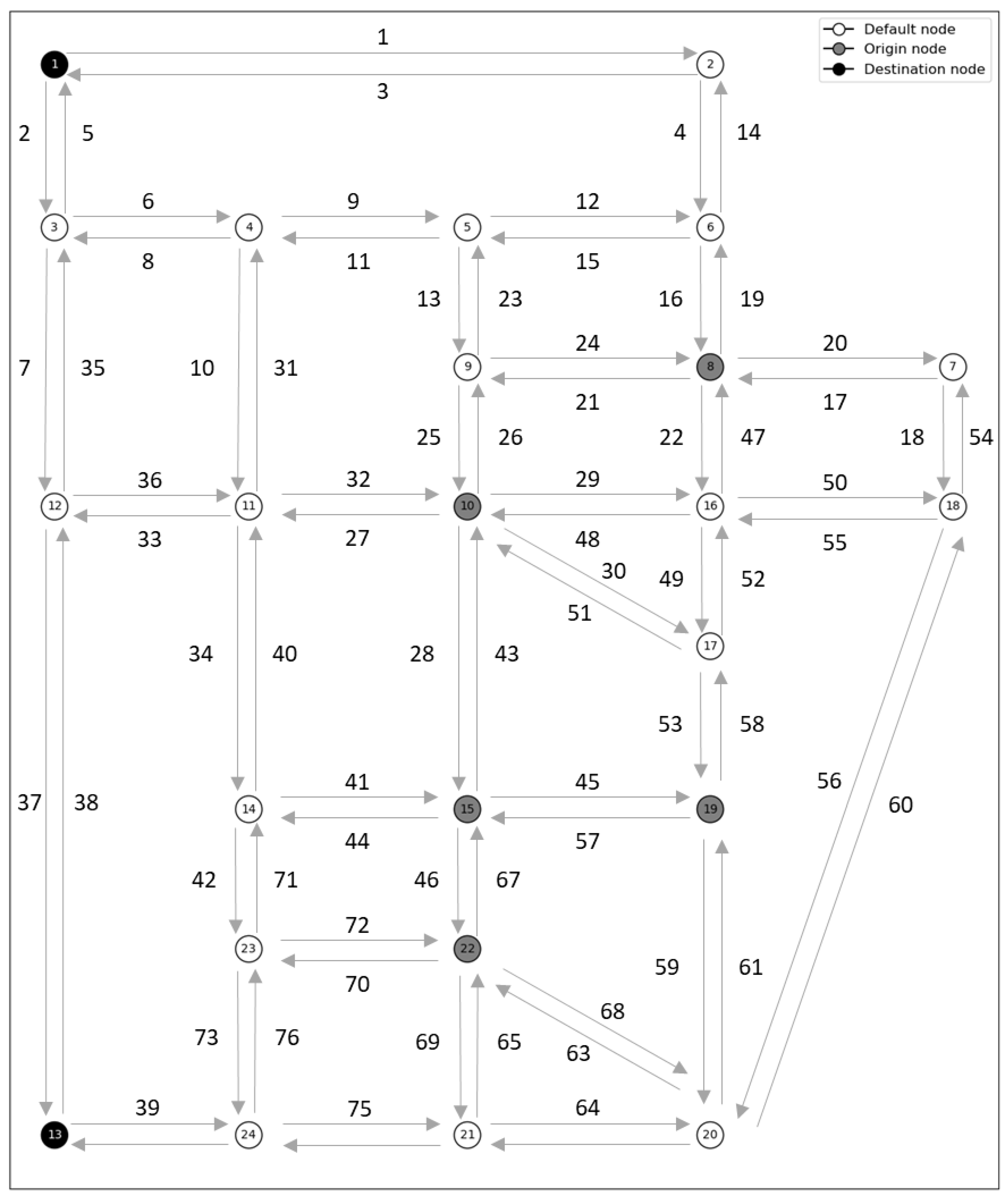
Table A1). Freight demand is structured to replicate a real-world hub-and-spoke logistics system, connecting five origin nodes (8, 10, 15, 19, 22) to two destination nodes (1, 13) as illustrated in
Figure 1. Initial hourly demands for compliant trucks, overloaded trucks, and regular vehicles are detailed in
Table 1 and
Table A2.
Overloaded trucks are modeled with a payload 1.5 times that of compliant vehicles (11 tons). Key parameters for the upper-level and lower-level problems are provided in
Table 2 and
Table 3 [
26,
29,
30,
33]. The analysis focuses on two deployment scenarios constrained by a maximum budget of two units: single versus dual WIM installation. In each case, the optimal solution is defined as the configuration that minimizes the aggregate objective function of the upper-level problem. All computational experiments were implemented in Python 3.12.7 on an Intel Core i7 system with 16 GB RAM. The average execution time was approximately 0.5 to 1.2 s per individual traffic assignment step, resulting in a total convergence time of 20 to 30 s per scenario to achieve the demand shift equilibrium.
In the default scenario (no enforcement), overloaded truck flows are heavily concentrated on major freight corridors connecting origins to destinations, as shown in
Table 4. This spatial concentration leads to accelerated PMS deterioration and localized GHG emissions on specific links. However, simply targeting the busiest links does not guarantee the best enforcement outcomes. It is essential to predict how drivers will react, as they often detour to avoid detection. Such evasion behavior shifts traffic to alternative routes, fundamentally changing where pavement damage and costs occur within the network.
System-level cost variations are detailed in
Table 5 and
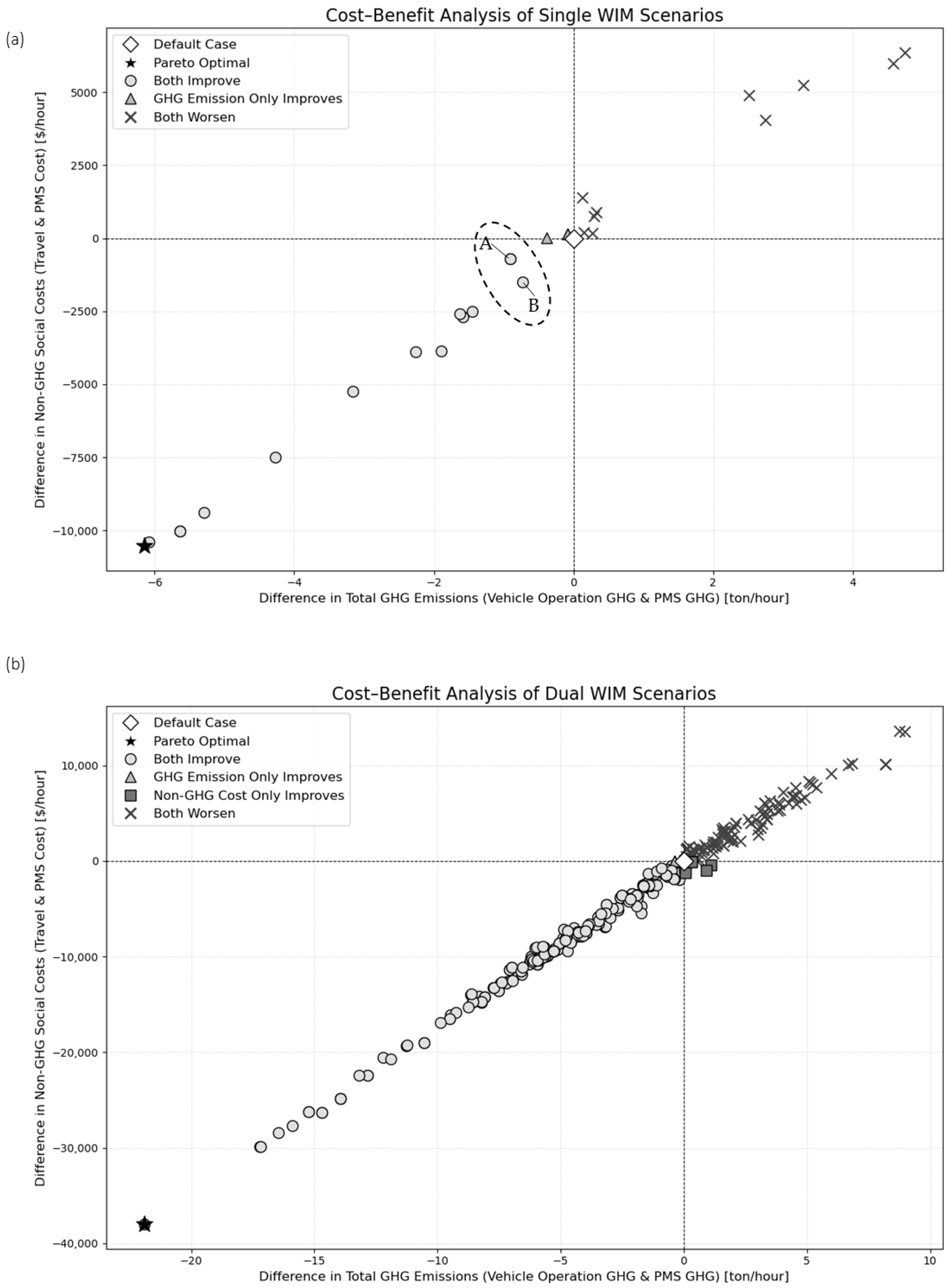
Figure 2. Compared with the default case, the optimal single-WIM scenario reduces total PMS cost by approximately 0.4% and total GHG cost by 0.36% as shown in
Figure 2a. The optimal dual-WIM scenario achieves larger reductions of around 1.5% and 1.3%, respectively, as shown in
Figure 2b. Notably, travel costs also exhibit a downward trend, decreasing from
$263,148 in the default case to
$262,345 in the dual-WIM scenario. This simultaneous decline across all cost categories indicates that strategic enforcement induces more efficient traffic patterns without imposing network inefficiencies or congestion. Consequently, the proposed framework achieves a synergistic improvement in infrastructure sustainability, environmental impact, and operational efficiency.
However, as illustrated in
Figure 2, not all installation combinations yield positive results. In some cases, both PMS and GHG costs increase due to the detouring behavior of overloaded trucks, which redistributes heavy freight flows to alternative routes. This finding underscores the necessity of strategic site selection to ensure that WIM installations deliver system-wide improvements rather than merely shifting cost burdens to other parts of the network.
Furthermore, trade-offs between objectives may arise depending on the network context, as exemplified by Cases A (Link 56) and B (Link 63) in
Figure 2a. Case B is preferable when prioritizing environmental mitigation (GHG reduction), whereas Case A is superior if infrastructure preservation (PMS cost reduction) is the primary objective. This distinction highlights that the optimal deployment strategy depends heavily on the relative weighting of economic versus environmental policy goals.
To further understand which type of vehicle drives these outcomes,
Table 6 presents cost compositions by vehicle type.
Table 6 is composed of travel, PMS, and GHG cost components for both non-overloaded and overloaded trucks across the default, optimal single, and optimal dual WIM scenarios. For overloaded trucks, PMS cost decreases by approximately 18% in the single WIM case and by 60% in the dual WIM case. PMS-related GHG emissions follow a similar trend, confirming that enforcement effectively reduces direct PMS cost and PMS-associated emissions.
In contrast, non-overloaded trucks experience an increase of roughly 30% in their travel, PMS, and GHG costs. This rise reflects a demand shift, where freight previously transported by overloaded vehicles is transferred to legal trucks, thereby increasing the operational volume and aggregate pavement loading of the compliant fleet. Crucially, this represents a redistribution of the logistics burden rather than a loss of efficiency. Meanwhile, regular vehicle costs remain virtually unchanged, indicating that WIM interventions specifically target freight behavior without disrupting passenger traffic.
Ultimately, the network achieves a net cost reduction because the savings from mitigated overloading damage far outweigh the incremental costs incurred by the increased compliant traffic. This outcome demonstrates that strategically installed WIM systems can achieve a balanced improvement, reducing infrastructure and environmental burdens without compromising travel efficiency at the system level.
Table 7 summarizes the demand shifts between overloaded and non-overloaded trucks. The total shifted demand in the dual-WIM scenario is more than three times that of the single-WIM case, revealing that compliance improves substantially when multiple enforcement points cover critical OD routes. This behavioral adjustment serves as a key mechanism for reducing overall costs. By explicitly modeling driver utility, schedule adherence, and detour trade-offs, the framework captures a more realistic behavioral response. While multiple installations entail higher costs, their marginal benefits outweigh these expenditures when WIMs are strategically located, maximizing compliance and minimizing both PMS and GHG costs.
Sensitivity Analysis
To validate the robustness of the proposed framework, a sensitivity analysis was performed on the BT coefficient (0.1, 0.3, 0.5), which dictates drivers’ schedule adherence. The results, summarized in
Table 8, demonstrate remarkable stability in model performance. While the optimal WIM locations shifted slightly due to changes in route choices, the Total Social Cost varied by less than 0.1% across all scenarios (ranging from approximately 3.038 to 3.040 million USD/hour). This stability is attributed to the complementary nature of the dual-criteria demand shift mechanism. Even when a relaxed schedule constraint (BT = 0.5) allows for longer detours, the utility-based net cost condition (Equations (18)–(20)) effectively captures the economic disadvantage of such detours, thereby inducing compliance. Consequently, the framework proves to be robust against parameter uncertainties, providing reliable decision support for policymakers.
5. Discussion
This study aimed to propose an optimal strategy for WIM system installation that addresses the dual challenges of PMS costs and GHG emissions. To achieve this, a bi-level optimization framework is developed that simultaneously captures the administrator’s objective of minimizing social costs and the route choice behavior of freight drivers. The framework endogenously incorporates drivers’ demand-shift behavior, allowing them to switch from overloading to legal operations based on the combined effects of overloading profits, detour costs, and schedule adherence. This behavioral integration enhances the model’s real-world applicability compared with conventional formulations.
The numerical results underscore the critical importance of strategic deployment. While optimal WIM placement significantly lowers network-wide PMS and GHG costs, suboptimal locations can inadvertently increase total costs by triggering evasive detours without inducing compliance. The analysis reveals that the primary driver of cost reduction is a substantial decline in overloaded traffic (e.g., a 60% reduction in PMS costs for overloaded trucks), which effectively offsets the marginal cost increases from compliant traffic. Notably, the dual-WIM scenario generated a demand shift three times greater than the single-WIM case, demonstrating that fostering voluntary compliance is a more effective mechanism for network sustainability than mere punitive enforcement.
These findings offer significant academic and practical contributions. Theoretically, the framework bridges the gap between infrastructure engineering and environmental economics by unifying PMS and GHG objectives. Practically, it provides policymakers with a quantitative decision-support tool to minimize social costs under budget constraints. Crucially, the results suggest a paradigm shift: WIM enforcement should evolve from a passive infrastructure protection measure into a proactive component of sustainable transportation and national carbon reduction strategies.
Nevertheless, this study has several limitations. First, the current estimation of PMS-related emissions focuses on material production and construction, excluding indirect emissions from material transport and construction-related traffic delays. Second, the installation and maintenance costs of WIM systems were not explicitly modeled in the objective function. Third, the Sioux Falls network, while a standard benchmark, is a simplified representation of reality. Moreover, while the complete enumeration method used in this study ensures global optimality for smaller networks, it poses scalability challenges for larger systems. Future research should, therefore, explore advanced optimization techniques, such as meta-heuristics or decomposition methods, to solve the bi-level problem efficiently at a metropolitan scale. Consequently, future studies should incorporate life cycle GHG assessments and calibrate the model using empirical data from large-scale urban freight networks, such as the metropolitan road network of Seoul, Korea. Additionally, analyzing complementary strategies, such as mobile enforcement and load-based tolling, could offer deeper insights into synergistic policy designs for sustainable freight regulation.