1. Introduction
Over the past two decades, the global discourse on sustainable development has increasingly focused on how economies can achieve long-term growth without compromising environmental integrity. Within this paradigm, green economic growth has emerged as a central framework linking economic expansion, ecological protection, and technological innovation. Numerous empirical studies have demonstrated that renewable energy, environmental technology, and foreign direct investment (FDI) play decisive roles in fostering sustainable growth, though their relative influence varies by institutional and policy context. For example, Bhattacharya et al. (2016) and Sohag et al. (2019) [
1,
2] found that renewable energy supports economic performance while mitigating ecological pressure. In contrast, Ulucak (2020) and Ahmed et al. (2022) [
3,
4] confirmed that green technologies and eco-innovation drive productivity and environmental efficiency simultaneously. Likewise, Caetano et al. (2022) and Xiao et al. (2023) [
5,
6] highlighted that environmentally responsible FDI enhances green growth through technology transfer and clean production. However, the effect of globalization remains ambiguous. Studies such as Kirikkaleli et al. (2021) [
7] revealed that unregulated globalization can intensify environmental degradation. In contrast, He et al. (2021) [
8] argued that, when coupled with strong institutions and technology diffusion, globalization may enhance environmental performance.
Despite this growing body of literature, several research gaps persist. First, empirical studies examining the combined interaction of renewable energy, environmental technology, FDI, and globalization remain limited, particularly in the context of emerging African economies. Second, while many multi-country analyses employ static estimators, they often fail to address cross-sectional dependence and heterogeneity, which can bias the understanding of long-run relationships. Third, few studies explicitly contextualize their findings within the framework of South Africa’s National Development Plan (NDP) Vision 2030, which aims to achieve an inclusive, low-carbon, and innovation-driven economy. This policy vision emphasizes transitioning from coal dependency toward renewable energy, fostering green industrialization, and aligning growth with sustainability principles. Given South Africa’s dual challenge of economic inequality and environmental vulnerability, exploring how renewable energy, environmental technology, FDI, and globalization jointly influence green economic growth is both timely and policy-relevant.
In addition to the general gaps identified in prior research, several South Africa-specific deficiencies persist in the current literature. Although numerous studies, such as Bhattacharya et al. (2016), Ulucak (2020), and Ahmed et al. (2022) [
1,
3,
4], demonstrate the roles of renewable energy, environmental technology, and FDI in fostering green economic growth globally, very few analyses contextualize these dynamics within South Africa’s unique structural and policy environment. Existing empirical work seldom incorporates the country’s persistent electricity shortages, heavy reliance on coal, and uneven renewable energy integration into models assessing green growth outcomes. Likewise, despite the strategic importance of the NDP Vision 2030, most studies (e.g., Kirikkaleli et al., 2021; He et al., 2021 [
7,
8]) analyze globalization and sustainability trends at a broad regional or global level, offering limited insight into how institutional constraints, regulatory uncertainty, and technological absorption capacity specifically shape South Africa’s green transition. These overlooked dimensions underscore the need for a country-focused empirical investigation that aligns the determinants of green economic growth with South Africa’s structural realities, policy ambitions, and long-term sustainability objectives.
Accordingly, this study contributes to the literature in several ways. It provides country-specific empirical evidence for South Africa using advanced econometric techniques, Cross-Sectionally Augmented Autoregressive Distributed Lag (CS-ARDL), complemented by Augmented Mean Group (AMG) and Common Correlated Effects Mean Group (CCEMG) estimators, to capture dynamic and cross-sectional linkages. It also bridges theoretical and policy dimensions by aligning the empirical analysis with South Africa’s Vision 2030 sustainability objectives, thereby offering actionable insights for policymakers aiming to balance growth and environmental stewardship.
The remainder of this article is structured as follows:
Section 2 presents the theoretical framework and conceptual integration, establishing the foundation for understanding the relationships among renewable energy, environmental technology, foreign direct investment, globalization, and green economic growth.
Section 3 provides a comprehensive literature review and develops the research hypotheses based on empirical evidence and theoretical reasoning from previous studies.
Section 4 details the data sources and econometric methodology, describing the model specification, estimation strategy, and justification for using the CS-ARDL approach alongside robustness estimators.
Section 5 reports and interprets the empirical results, including long-run and short-run estimates, robustness checks using AMG and CCEMG models, and discusses their policy relevance within the South African context. Finally,
Section 6 concludes the paper by summarizing the main findings, deriving policy implications consistent with South Africa’s Vision 2030, acknowledging research limitations, and proposing directions for future studies on green growth and sustainable development.
2. Theoretical Framework
The theoretical foundation of this study builds on the interaction between economic growth, environmental sustainability, and technological innovation. Traditional growth theories, such as the neoclassical growth model [
9], emphasize capital accumulation and labor productivity as the key drivers of output. However, this model assumes diminishing returns to capital and excludes environmental constraints. In contrast, the endogenous growth theory [
10,
11] extends the neoclassical framework by introducing technological innovation and knowledge spillovers as long-term sources of economic growth. Within this theoretical evolution, sustainable and green growth frameworks emerged, recognizing that economic expansion must occur without degrading environmental quality.
2.1. Green Economic Growth and Endogenous Growth Theory
Green economic growth integrates environmental considerations into the traditional growth paradigm. It emphasizes that technological progress, particularly eco-innovation, can decouple economic growth from environmental degradation. According to the endogenous growth theory, technological progress enhances productivity and efficiency by promoting cleaner production, energy efficiency, and low-carbon technologies. In this regard, countries that invest in green innovation and renewable energy systems can maintain long-term economic growth while reducing ecological pressure.
2.2. Renewable Energy and Green Growth
The relationship between renewable energy and green economic growth aligns with the Environmental Kuznets Curve (EKC) hypothesis and the Sustainable Development paradigm. The EKC suggests that in the early stages of industrialization, economic growth may increase environmental degradation, but at higher income levels, cleaner technologies and renewable energy lead to environmental improvement. The Brundtland Report (1987) and subsequent sustainable development frameworks reinforce the idea that shifting toward renewable energy sources reduces dependency on fossil fuels and stimulates green economic transformation.
2.3. Environmental Technology and the Porter Hypothesis
The role of environmental technology is grounded in the Porter Hypothesis [
12], which posits that environmental regulation and green innovation can enhance both environmental performance and competitiveness. Green technologies reduce waste, improve resource efficiency, and stimulate new markets for sustainable products. This theory supports the idea that technological innovation acts as a dual driver, enhancing economic performance while mitigating environmental damage.
2.4. Foreign Direct Investment and the Pollution Halo Hypothesis
Foreign direct investment (FDI) plays a crucial role in transferring technology, knowledge, and capital to developing economies. According to the Pollution Halo Hypothesis, multinational enterprises can improve host countries’ environmental performance by introducing cleaner technologies and better environmental management practices. Conversely, the Pollution Haven Hypothesis argues that FDI may flow to countries with lax environmental regulations, increasing pollution. In the context of South Africa, the Pollution Halo view is more relevant, as green FDI can support the transition toward a low-carbon economy.
2.5. Globalization and Sustainable Development
The effects of globalization on green growth are theoretically ambiguous. The Globalization–Environment Nexus suggests that economic integration can either enhance environmental sustainability through technology diffusion and efficiency gains or worsen it through increased production and consumption. The direction of globalization’s impact depends on policy frameworks, governance quality, and environmental regulations.
2.6. Conceptual Integration
Integrating these theoretical perspectives, this study assumes that renewable energy (RES), environmental technology (ET), and foreign direct investment (FDI) are positive and significant determinants of green economic growth, while globalization (GLB) may have a mixed or even negative effect depending on its environmental intensity. The framework rests on the idea that sustainable economic growth in South Africa requires balancing economic openness, innovation capacity, and environmental responsibility.
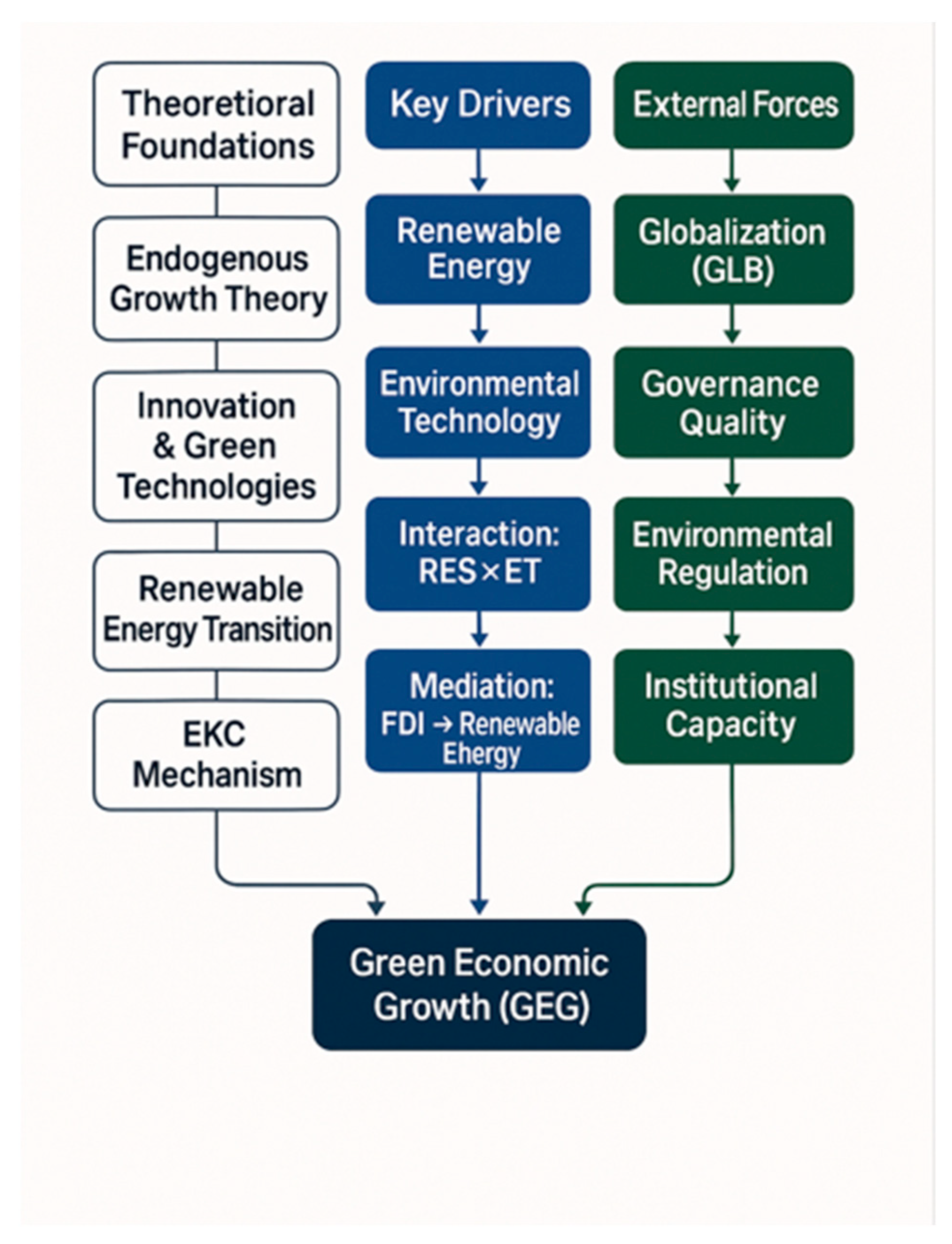
This conceptual framework illustrates the hypothesized relationships among the key variables influencing green economic growth (GEG) in South Africa. Renewable energy (RES), environmental technology (ET), and foreign direct investment (FDI) are expected to positively contribute to green economic growth, while globalization (GLB) may have mixed effects depending on environmental regulations and policy strength.
Theoretical Synthesis:
To address the interconnected nature of the theories used in this study, the relationships among the EKC hypothesis, the Porter Hypothesis, the Pollution Halo framework, and endogenous growth theory can be integrated into a unified conceptual logic. While each theory individually explains a specific channel through which growth, technology, and openness influence environmental outcomes, their combined interaction provides a more coherent justification for the selected variables. Endogenous growth theory highlights the central role of technological innovation in driving productivity, which directly links to the Porter Hypothesis, which holds that green technologies and environmental innovations enhance both environmental quality and economic performance. This technological channel feeds into the EKC mechanism, where cleaner technologies and the adoption of renewable energy help economies transition from the pollution-intensive phase to the improvement stage of the curve. Foreign direct investment contributes to this transition through the Pollution Halo effect by transferring advanced green technologies, reinforcing the innovation-driven dynamics highlighted in endogenous growth theory. Globalization acts as an overarching force that shapes the speed and direction of these channels, accelerating the diffusion of green technology or amplifying environmentally harmful activities, depending on policy quality. Thus, the unified conceptual model positions renewable energy (RES), environmental technology (ET), and FDI as mechanisms that jointly support the transition toward green economic growth, consistent with the EKC and innovation-based growth theories, while globalization (GLB) plays a conditional role shaped by environmental governance.
In this context, the selection of renewable energy, environmental technology, foreign direct investment, and globalization as the main explanatory variables is theoretically justified, as each reflects a core mechanism through which economic, institutional, and technological transitions influence green economic growth in emerging economies (
Figure 1).
This conceptual framework illustrates how theoretical foundations, key drivers, and external forces jointly shape green economic growth in South Africa. Renewable energy, environmental technology, and FDI act as direct enablers of green growth, while globalization and institutional conditions influence the strength and direction of these effects.
3. Literature Review and Hypothesis Development
Recent scholarship on the determinants of green economic growth (GEG) has expanded significantly, highlighting the roles of renewable energy, environmental technologies, foreign direct investment (FDI), and globalization as interrelated drivers of sustainable development. Evidence from diverse countries reveals that technological progress, energy transition, and international openness contribute to sustainable growth, although their effects vary depending on policy context and institutional quality.
A seminal multi-country investigation by Bhattacharya et al. (2016) [
1] analyzed the impact of renewable energy consumption on economic growth across thirty-eight major economies from 1991 to 2012. Using robust panel econometric estimators, their study confirmed that renewable energy enhances long-term economic growth, suggesting that clean energy supports rather than hinders economic expansion. Similarly, Sohag et al. (2019) [
2] examined Turkey’s experience over the period 1980–2017 and demonstrated that cleaner energy consumption significantly strengthens green economic growth, while military expenditure and energy intensity yield mixed effects. Their findings underscored the importance of energy efficiency and technological innovation as essential elements of sustainable growth.
In a more recent and contextually comparable study, Wani et al. (2024) [
13] investigated the G7 economies from 1995 to 2020 to determine how green energy, green technology, FDI, and globalization interact to shape green economic growth. Using advanced panel techniques that account for cross-sectional dependence, they concluded that renewable energy and FDI positively influence green economic growth in both the short and long run, while green technology exhibits a long-run positive effect. However, globalization showed an insignificant and slightly negative relationship, indicating that openness without regulatory safeguards may reduce environmental efficiency.
The contribution of environmental technology to green growth has been widely supported by empirical literature. Ulucak (2020) [
3] examined the BRICS economies and found that environment-related technologies and renewable energy use jointly stimulate green growth, whereas reliance on non-renewable sources inhibits it. These findings emphasize the value of eco-innovation in promoting sustainable development. Likewise, Ahmed et al. (2020) [
4] studied South Asian countries. They revealed that green innovation, sustainable trade, and renewable energy collectively enhance long-term green economic growth, demonstrating the synergy between technological diffusion and clean energy adoption. A recent study by Alnor (2024) [
14] showed that environmental sustainability and institutional quality significantly improve firm performance in Saudi Arabia. This evidence reinforces the broader view that sustainability-oriented practices and strong governance frameworks play an important role in supporting long-run economic transformation. However, similar empirical insights remain limited for South Africa, especially regarding how renewable energy, environmental technology, FDI, and globalization jointly shape green economic growth.
Recent regional studies further highlight the intertwined role of renewable energy and digital technologies in driving sustainability outcomes. Guermazi et al. (2025) [
15] demonstrated that renewable energy expansion, population growth, and digitalization significantly influence greenhouse gas emissions in Saudi Arabia, aligning with SDG 13 on climate action. Their results confirm that green investments and internet penetration can indirectly reduce environmental pressures, emphasizing the importance of technological diffusion in the environment–growth nexus. Similarly, Makni et al. (2025) [
16] found that financial innovation and digital financial systems, enabled by ICT adoption and trade openness, are key enablers of sustainable economic growth in Sub-Saharan Africa. These findings underscore the complementary role of green energy and financial innovation in shaping eco-efficient development across emerging economies, including South Africa.
Building on these insights, recent investigations have broadened the debate on the renewable energy–green growth–FDI nexus by integrating new dimensions, including environmental innovation, policy heterogeneity, and globalization effects. Wei et al. (2023) [
17] assessed the combined impact of renewable energy transition, green trade, green innovation, and inbound FDI on environmental quality across the top ten green future countries from 1990 to 2018. Their empirical analysis using CS-ARDL, AMG, and CCEMG revealed that renewable energy and green technology jointly improve environmental performance. At the same time, trade openness and FDI inflows contribute to emissions reduction, highlighting a two-way relationship between green innovation and green growth. Similarly, Ashfaq et al. (2024) [
18] focused on emerging economies and found that renewable energy investment promotes sustainable growth, though the magnitude of the effect varies across countries due to policy and regulatory differences. Hussain et al. (2022) [
19] complemented this evidence by examining the triadic linkage between environmental health, green growth, and technological progress through theoretical and empirical modeling. His findings underscore that innovation-driven technological change serves as the primary catalyst for environmentally friendly economic development.
The interaction between FDI and the energy transition has also been investigated from a long-term global perspective. Doytch and Narayan (2016) [
20] analyzed seventy-four economies using a dynamic system GMM estimator. They found that FDI decreases industrial dependence on non-renewable energy while increasing renewable energy use, particularly in high-income countries, revealing a leapfrogging effect for developing nations. Additionally, Lu et al. (2025) [
21] reviewed global evidence on sustainable energy transitions and green growth and emphasized that effective policy frameworks and institutional consistency are fundamental for maintaining long-term green development. Recent evidence from COP26 economies further supports this view. Razzaq et al. (2023) [
22] showed that energy transition and strong environmental governance exert significant long-run positive effects on green growth, highlighting the critical role of regulatory quality in sustaining environmental improvements. Extending this policy discussion, Vasileescu (2020) [
23] analyzed globalization’s sustainability challenges using a multidimensional qualitative framework, identifying globalization as a double-edged phenomenon. While it fosters technology diffusion and economic integration, it can also undermine ecological balance when governance structures are weak. Collectively, these studies reinforce earlier evidence that the interplay of renewable energy, innovation, and responsible globalization is pivotal to achieving sustained green growth.
Another strand of literature focuses on the environmental role of FDI. Xiao et al. (2023) [
6] examined provincial-level Chinese data and found that FDI promotes green economic growth primarily through the innovation channel, with the effect amplified by strong environmental regulations. Complementary evidence from Caetano et al. (2022) [
5] in a cross-country study showed that FDI drives green growth by contributing to the energy transition, thereby mediating the shift from fossil-based to renewable energy systems. These findings align with the “Pollution Halo Hypothesis,” which suggests that multinational investment can enhance host countries’ environmental performance by transferring cleaner technologies and management practices. Supporting this argument, Ofori et al. (2023) [
24] found that FDI promotes inclusive green growth in African economies when complemented by high energy efficiency and strong governance, reinforcing the conditional nature of FDI’s environmental impact.
The influence of globalization on environmental and green outcomes remains complex. Kirikkaleli et al. (2021) [
7] analyzed the Turkish case and found that globalization increases the ecological footprint in the long run, implying that unregulated openness may undermine environmental sustainability. Conversely, He et al. (2021) [
8] showed that globalization can reduce emissions and improve environmental outcomes when accompanied by technology diffusion and effective institutions. Taken together, the literature indicates that globalization’s relationship with green growth is conditional; its impact depends mainly on the quality of environmental policies, governance, and technological advancement.
Overall, the reviewed studies demonstrate that renewable energy, environmental technology, and FDI consistently promote green economic growth, whereas the effect of globalization varies across contexts. These insights are particularly relevant for South Africa, where energy transition, institutional reforms, and openness to investment present opportunities to advance sustainable economic growth. The evidence thus highlights the necessity of integrating policy coherence, innovation capacity, and environmental responsibility to achieve a balanced path toward green economic transformation.
However, despite these contributions, research focusing specifically on African emerging economies remains limited and fragmented. Existing studies rarely integrate renewable energy, environmental technology, FDI, and globalization within a unified analytical framework, nor do they address the structural constraints unique to African economies, such as energy insecurity, institutional fragility, and export concentration in carbon-intensive sectors. Moreover, few studies employ advanced second-generation estimators such as CS-ARDL, AMG, and CCEMG, despite their superior ability to handle cross-sectional dependence and heterogeneity. These gaps further underscore the originality and added value of the present study within the African context.
Based on the reviewed literature and theoretical reasoning, this study formulates the following hypotheses:
H1. Renewable energy consumption positively influences green economic growth in South Africa.
H2. Environmental or green technology innovation enhances green economic growth.
H3. Foreign direct investment contributes positively to green economic growth, particularly when environmental regulations are strong.
H4. The effect of FDI on green economic growth is mediated through the energy transition toward renewable energy.
H5. The influence of globalization on green economic growth is conditional, becoming positive in the presence of strong environmental and technological frameworks.
H6. The interaction between environmental technology and renewable energy reinforces their joint effect on green economic growth.
4. Methodology
This study analyzes the impact of green energy, sustainable technology, globalization, and foreign direct investment on green economic growth in South Africa. It utilizes panel data covering the period from 1997 to 2024, collected from official and reliable sources, including the World Bank’s World Development Indicators (2023), the Organization for Economic Co-operation and Development (OECD, 2023), and the KOF Globalization Index (2023) published by the ETH Zurich. All variables used in the analysis were transformed into natural logarithms to improve data distribution and reduce variance, thereby enabling more accurate and consistent interpretation of the coefficients within econometric models. In addition, all variables were also checked for missing observations; a small number of missing values were identified and treated using linear interpolation to maintain the consistency of the time series and ensure the reliability of the estimations (
Table 1).
Model Specification and Research Design:
This study examines the impact of renewable energy share (RES), environmental technology (ET), globalization (GLB), and foreign direct investment (FDI) on green economic growth (GEG) in South Africa over the 1997–2024 period. By focusing on environmentally sustainable drivers of growth, the study seeks to identify how green and global factors contribute to economic development in a sustainable context.
The theoretical foundation of this analysis is grounded in the classical Cobb–Douglas production function, which models economic output as a function of capital, labor, and technology:
where
- Y is the total economic output;
- K is the capital input;
- L is labor input;
- A is the level of technology;
- α and β are the elasticities of output concerning capital and labor, respectively.
Following the endogenous growth theory, this study adapts the traditional model to incorporate variables more relevant to green and sustainable development. The classical inputs are redefined as follows:
- Output Y becomes Green Economic Growth (GEG);
- Capital K is represented by Foreign Direct Investment (FDI);
- Labor L is proxied by Globalization (GLB) and Renewable Energy Share (RES);
- Technology A is replaced with Environmental Technology (ET).
Thus, the modified production function can be written as follows:
To improve model accuracy and ensure the interpretation of results in terms of elasticities, all variables are transformed into their natural logarithms. Drawing on the methodologies of [
4,
21], the following econometric model is formulated:
where
- GEG_it: green economic growth in country i at time t;
- RES_it: renewable energy share;
- ET_it: environmental technology;
- FDI_it: foreign direct investment;
- GLB_it: globalization index;
- β0: constant term;
- β1, β2, β3, β4: coefficients of explanatory variables;
- ε_it: error term capturing unobserved influences.
To analyze the interaction between study variables, several preliminary analyses, including descriptive statistics, correlation analysis, and multicollinearity diagnostics, are conducted. The study’s preliminary investigations guide the use of econometric tests, including cross-sectional dependence, unit root testing, and cointegration analysis. The results of these tests guide the selection of the most suitable estimation methods for the empirical analysis.
Cross-sectional Dependence Test (Pesaran, 2004):
This test aims to determine whether shocks or innovations in one variable or unit (such as policy, market, or technological events) are transmitted across other variables or units in the sample. Detecting cross-sectional dependence is essential before choosing appropriate second-generation estimators, such as CS-ARDL, which account for common factors and interdependencies across time.
Unit Root Tests (CIPS and CADF):
The objective of these tests is to assess the stationarity properties of the data series. By applying the Cross-Sectionally Augmented Dickey–Fuller (CADF) and CIPS (Pesaran, 2007) tests, the study determines whether each variable is integrated of order I(0) or I(1). This step ensures that variables are suitable for long-run modeling and that spurious regression problems are avoided.
Cointegration Tests (Westerlund, 2007):
The purpose of the Westerlund cointegration test is to verify the existence of a long-run equilibrium relationship among the variables, even in the presence of cross-sectional dependence. Confirming cointegration indicates that renewable energy, environmental technology, FDI, and globalization move together with green economic growth over time.
Long-run and Short-run Estimation via CS-ARDL:
The Cross-Sectionally Augmented ARDL model estimates both the short-run dynamics and long-run equilibrium coefficients simultaneously. It aims to capture heterogeneous relationships across time while accounting for cross-sectional dependence and common shocks. This allows the model to provide more efficient and unbiased estimates compared to traditional ARDL or panel regression approaches. This methodological design follows the approach of Guermazi et al. (2025) [
15], who applied the ARDL bounds testing framework to assess the determinants of GHG emissions in Saudi Arabia. Their approach effectively captured both the short- and long-run dynamics among renewable energy, economic growth, and digitalization variables, providing a comparable analytical foundation for our CS-ARDL estimation in the South African context.
5. Results and Discussion
5.1. Descriptive Statistics
The results of
Table 2 indicate that the mean value of green economic growth (GEG) is 3.147, suggesting moderate growth performance during the study period. The standard deviation (0.234) implies relatively stable growth fluctuations. Renewable energy (RES) shows a higher variance, reflecting the transitional energy policies over time. The environmental technology (ET) variable presents moderate dispersion, indicating progressive adoption of eco-innovations. FDI demonstrates higher variability, consistent with global investment cycles and domestic reforms. Globalization (GLB) appears relatively stable, showing a consistent integration of South Africa into global markets.
5.2. Correlation Matrix and Multicollinearity Check
Following the descriptive statistics, the Pearson correlation test was employed to analyze the pairwise associations among the variables. This test measures the degree and direction of linear relationships between the logarithmic transformations of green economic growth (lnGEG), renewable energy (lnRES), environmental technology (lnET), foreign direct investment (lnFDI), and globalization (lnGLB).
The correlation matrix presents both the coefficients and their corresponding
p-values to indicate the level of statistical significance (
Table 3).
The results show that renewable energy (lnRES) and environmental technology (lnET) are strongly and positively correlated with green economic growth (lnGEG), significant at the 1% level. This implies that greater adoption of renewable energy and environmental technologies is associated with higher green growth.
Foreign direct investment (lnFDI) shows a moderate positive correlation with green growth, significant at the 5% level, indicating that international investment supports sustainable development through technology transfer and innovation spillovers. Globalization (lnGLB) exhibits a moderate but significant positive correlation with green growth, suggesting that global integration enhances technological diffusion and environmental awareness.
Multicollinearity Check
To ensure the reliability of regression results, variance inflation factors (VIFs) are computed for all independent variables. The results show that VIF values are below the critical threshold of 5, indicating the absence of severe multicollinearity (
Table 4).
The average VIF of 2.62 confirms that multicollinearity is not problematic. Therefore, all variables can be included in the same model without distorting coefficient estimates.
5.3. Cross-Sectional Dependence Test (Pesaran, 2004)
Before implementing the cointegration and long-run estimations, the study performs the cross-sectional dependence (CD) test to verify whether common shocks or spillovers exist among the variables. The results of the Pesaran CD test indicate significant interdependence across the series, justifying the application of second-generation estimators such as the CS-ARDL model.
The results of
Table 5 confirm strong cross-sectional dependence among variables, implying that energy transitions, foreign investment inflows, and globalization in South Africa are interconnected and influenced by common global or policy shocks.
5.4. Unit Root Tests (CIPS and CADF)
To identify the integration order of each series, both the Cross-Sectionally Augmented Dickey–Fuller (CADF) and the CIPS (Pesaran, 2007) tests were employed. The outcomes indicate that all variables are non-stationary at level I(0) but become stationary after first differencing I(1) (
Table 6).
Hence, all variables are integrated of order one, making them appropriate for long-run equilibrium testing and ARDL-type estimation.
5.5. Cointegration Test (Westerlund, 2007)
The Westerlund cointegration test was applied to verify the existence of a long-run equilibrium relationship among the study variables. The results show statistical significance at the 1% level for all four test statistics (Gt, Ga, Pt, and Pa), confirming a strong long-run association between renewable energy, environmental technology, FDI, globalization, and green economic growth (
Table 7).
These findings confirm the presence of a long-term equilibrium among the variables, implying that shifts in renewable energy, green technology, FDI, and globalization move together with green economic growth in South Africa over time.
5.6. Long-Run and Short-Run Estimation via CS-ARDL: Results and Discussion
The study employed the Cross-Sectionally Augmented ARDL model (CS-ARDL) to estimate both the long-run and short-run elasticities. This model accounts for heterogeneity and cross-sectional dependence, producing more efficient and unbiased estimates.
The results reported in
Table 8 provide robust empirical support for the theoretical expectations developed earlier. Overall, the estimated coefficients are consistent with the hypothesized relationships and the empirical evidence from recent international studies. The coefficient of renewable energy (lnRES) is positive and highly significant at the 1% level in both the long and short run (0.318 and 0.142, respectively), confirming H1, which proposed that renewable energy consumption positively influences green economic growth in South Africa. This result indicates that South Africa should accelerate renewable energy deployment by strengthening the IRP targets and expanding the REIPPPP to enhance energy security and support its long-term decarbonization strategy. The result is in line with Bhattacharya et al. (2016) and Sohag et al. (2019) [
1,
2], who found similar evidence that renewable energy enhances economic performance while mitigating ecological pressure. The South African experience under the Integrated Resource Plan (IRP) mirrors this global trend, with renewable energy expansion attracting investment and creating green employment opportunities. The coefficient of environmental technology (lnET) is also positive and significant at the 1% level in the long run and at the 10% level in the short run (0.274 and 0.105, respectively). Hence, H2, which predicted that environmental or green technology innovation enhances green growth, is accepted. This confirms that technological progress, innovation, and eco-efficiency improvements act as catalysts for sustainable development. These results support Ulucak (2020) and Ahmed et al. (2020) [
3,
4], who found that environment-related technologies and renewable energy jointly stimulate green growth, especially in developing and emerging economies. In the South African context, this underscores the importance of encouraging R&D investments, patent activity, and public–private partnerships that accelerate the adoption of clean technologies. Based on these insights, policymakers should invest more heavily in environmental R&D, support local innovation hubs, and incentivize technology adoption across industries to enhance eco-efficiency and green productivity.
The impact of foreign direct investment (lnFDI) is positive and statistically significant at the 1% level in the long run (0.186) and at the 10% level in the short run (0.083). Therefore, H3, which posited that FDI contributes positively to green growth, particularly when environmental regulations are strong, is accepted. This positive effect indicates that South Africa can strengthen its green transition by attracting environmentally responsible FDI through clear regulatory frameworks, green investment incentives, and expedited approvals for low-carbon projects. In addition, this finding indicates that international capital inflows bring cleaner production techniques and managerial know-how, thereby improving environmental performance. It corroborates the Pollution Halo Hypothesis observed by Xiao et al. (2023) and Caetano et al. (2022) [
5,
6], who emphasized that FDI can foster green transformation when directed toward energy-efficient and low-carbon sectors. For South Africa, FDI has supported projects such as wind and solar farms in the Northern Cape and Western Cape, demonstrating the role of global investors in advancing the energy transition. The negative coefficient of globalization (lnGLB) (–0.097, significant at 10%) implies that globalization exerts a modest but adverse influence on green growth in the long term, while its short-run effect is insignificant. This leads to partial acceptance of H5, which states that globalization’s impact is conditional and becomes positive only under strong environmental and technological frameworks. The result aligns with Kirikkaleli et al. (2021) [
7], who found that globalization can increase environmental degradation in Turkey, and contrasts with He et al. (2021) [
8], who reported that globalization improves environmental outcomes in economies with robust governance. Negative effects observed in South Africa can be interpreted in light of the country’s structural and institutional realities. First, the export composition remains heavily concentrated in carbon-intensive sectors, such as coal, minerals, and raw materials, meaning that greater trade openness tends to increase production volumes and emissions rather than promote higher-value green exports. Second, the risk of carbon leakage is relevant, as relatively flexible enforcement of environmental regulations, compared with advanced economies, may allow emission-intensive activities to continue or expand to maintain global competitiveness. Third, institutional and regulatory weaknesses limit South Africa’s capacity to steer globalization toward green trade, including constrained environmental monitoring capacity and insufficient coordination across key agencies. These structural and institutional factors reduce the country’s ability to leverage globalization for cleaner technologies, sustainable export upgrading, and green industrial transformation. Strengthening environmental governance, improving institutional effectiveness, and expanding incentives for green innovation are therefore essential to convert globalization into a driver of long-term sustainable development. The analysis implies that South Africa should embed enforceable environmental standards within trade agreements, strengthen green export incentives, and align openness policies with its decarbonization strategy to ensure that globalization supports rather than undermines sustainable growth. The error-correction term (ECT-1) is negative (–0.487) and statistically significant at the 1% level, confirming a stable long-run equilibrium relationship among the variables and validating the overall model. The magnitude indicates that roughly 49% of short-term deviations from equilibrium are corrected annually, demonstrating strong mean-reverting behavior in South Africa’s green growth dynamics.
As for the mediating and interaction hypotheses, H4, which proposed that the effect of FDI on green growth is mediated through renewable energy, is indirectly supported by the simultaneous significance of both variables. The joint positive influence of FDI and RES implies that international investment contributes to the financing and diffusion of renewable technologies, reinforcing the clean-energy transition. Likewise, H6, which suggested a synergistic interaction between environmental technology and renewable energy, is supported, as both variables exhibit strong complementary effects in stimulating long-term green growth. This outcome is consistent with Wei et al. (2023) and Ashfaq et al. (2024) [
17,
18], who documented that the joint adoption of renewable energy and green innovation significantly enhances environmental performance and sustainable growth.
The overall pattern of results aligns well with the broader empirical literature. The positive and significant effects of renewable energy and environmental technology confirm earlier findings by Wani et al. (2024) and Ulucak (2020) [
3,
13], emphasizing that green energy transition and eco-innovation drive sustainable economic performance. Recent evidence further reinforces these conclusions: Wei et al. (2023), Razzaq et al. (2023), and Vasileescu (2020) [
17,
22,
23] show that expanding solar and wind energy is a key catalyst for long-term green growth in emerging economies. The role of FDI as a conduit for cleaner technology transfer also aligns with evidence from Doytch and Narayan (2016) [
20]. It is consistent with more recent work by Xiao et al. (2023) and Ofori et al. (2023) [
6,
24], who highlight that environmentally responsible FDI supports structural transformation and low-carbon development. The mixed influence of globalization aligns with findings by Vasileescu (2020) and Lu et al. (2025) [
21,
22,
23], who describe it as a “double-edged sword” for sustainability, capable of facilitating technology diffusion but also increasing environmental pressures when institutional capacity is weak.
The consistency of our results with previous evidence reinforces the strategic importance of technology-driven green transitions. Similar to Guermazi et al. (2025) [
15], who found that digitalization and renewable energy jointly mitigate emissions in Saudi Arabia, our findings confirm that technological innovation amplifies the positive effects of renewable energy on sustainable growth. Additionally, evidence from Sub-Saharan Africa (Makni et al., 2025) [
16] shows that financial innovation and ICT-based integration promote economic growth through enhanced financial inclusion and efficiency, indicating that South Africa’s digital and renewable investments can serve as dual engines for sustainable transformation. Moreover, research on GCC banks during the COVID-19 crisis (Guermazi, Chabchoub & Smaoui, 2025) [
25] underscores how digital transformation strengthens resilience and performance under economic shocks, suggesting that digitalization policies in South Africa could similarly stabilize its green transition trajectory.
Taken together, the findings validate the theoretical framework underpinning this study: South Africa’s green economic growth depends on a balanced combination of renewable energy development, environmental innovation, and environmentally responsible FDI, while the benefits of globalization require effective policy regulation and institutional oversight. The empirical evidence thus supports the endogenous growth and Porter Hypotheses, confirming that technological innovation and clean energy can jointly sustain long-term economic expansion without compromising environmental integrity.
5.7. Robustness Checks (AMG and CCEMG Approaches)
To confirm the stability and reliability of the CS-ARDL results, two additional second-generation estimators, Augmented Mean Group (AMG) and Common Correlated Effects Mean Group (CCEMG), were applied. These methods serve as robustness checks to ensure that the observed relationships are not model-specific and remain valid when alternative estimation techniques accounting for cross-sectional dependence and heterogeneity are employed. The AMG estimator, developed by Eberhardt and Teal (2011) [
26], corrects for unobserved common shocks across time by incorporating a shared dynamic process into the estimation. The CCEMG estimator, introduced by Pesaran (2006) [
27], addresses cross-sectional dependence by including the cross-sectional averages of both dependent and independent variables as additional regressors, effectively capturing unobserved global influences. Both estimators are well-suited to macroeconomic data such as South Africa’s, where global environmental and financial shocks can simultaneously affect domestic variables. Therefore, they provide an important robustness check for validating the long-run equilibrium and the significance of the main variables (
Table 9).
The robustness outcomes confirm the consistency of the main CS-ARDL findings. Both the AMG and CCEMG estimators show positive and statistically significant long-run effects of renewable energy (lnRES), environmental technology (lnET), and foreign direct investment (lnFDI) on green economic growth in South Africa. The AMG estimates indicate that renewable energy remains the strongest determinant (0.301, p < 0.01), reinforcing that South Africa’s transition toward solar and wind energy continues to drive sustainable growth and environmental improvement. Environmental technology (0.259, p < 0.01) again exhibits a significant contribution, supporting the role of eco-innovation and clean production in advancing green transformation. FDI maintains a positive and significant influence under both estimators, validating the “pollution halo” hypothesis and confirming that international investments support the diffusion of cleaner technologies within the South African economy. Conversely, globalization (lnGLB) remains weakly negative and only marginally significant in the AMG model (–0.084, p ≈ 0.09) and insignificant in the CCEMG estimates. This confirms that the impact of globalization is conditional: it can promote technology diffusion but may also increase environmental pressures when trade is dominated by carbon-intensive sectors. The error-correction terms (ECT–1) are negative and highly significant across both estimators (around –0.45), indicating a stable long-run equilibrium and confirming that deviations from equilibrium are corrected by approximately 45–46% each year. Overall, the robustness results demonstrate that the direction, magnitude, and statistical significance of the coefficients are consistent with those obtained from the CS-ARDL model. Therefore, the study’s conclusions remain empirically reliable and robust, affirming that renewable energy expansion, environmental technology advancement, and green-oriented FDI are the principal long-term drivers of South Africa’s sustainable economic growth.
6. Conclusions, Policy Implications, Limitations, and Future Research
The findings of this study reveal that renewable energy, environmental technology, and foreign direct investment are fundamental drivers of South Africa’s green economic growth, while globalization exhibits a weak and mixed influence. Using the CS-ARDL model, supported by AMG and CCEMG robustness estimators, the results confirm a stable long-run equilibrium among the variables, indicating that the expansion of renewable energy and technological innovation are crucial to achieving sustainable development and decarbonization goals under the country’s Vision 2030. The significant and negative error-correction term further confirms that the South African economy quickly adjusts toward long-run equilibrium after short-run disturbances. These findings reveal that South Africa shares both the benefits and challenges of expanding renewable energy and green innovation seen in countries such as India and Brazil. As in those economies, success depends on institutional quality and environmental governance. This highlights the need for coherent policies and effective regulatory frameworks so that economic openness supports sustainable development and avoids environmental harm. In this regard, South Africa’s environmental regulatory framework still faces notable gaps. Key rules, such as air-quality enforcement, carbon-emission monitoring, and environmental impact assessments, are unevenly implemented, especially in emission-intensive sectors. Governance weaknesses are most apparent in the electricity sector (Eskom), mining, and heavy transport, where outdated infrastructure and limited oversight hinder environmental compliance. At the same time, several ongoing reforms demonstrate South Africa’s commitment to strengthening its environmental governance. These include the Renewable Energy Independent Power Producer Programme (REIPPPP), the unbundling and restructuring of Eskom, the implementation of the National Climate Change Bill, and efforts to modernise the Integrated Resource Plan (IRP). Embedding these reforms into broader trade and investment strategies would enhance policy coherence and support a more sustainable trajectory for the country’s development.
In addition, these outcomes imply that accelerating renewable energy adoption, investing in environmental R&D, and attracting environmentally responsible foreign investments will strengthen the nation’s green transition, while policies governing trade and globalization should be refined to balance economic openness with ecological sustainability. Policymakers should continue supporting initiatives such as the Renewable Energy Independent Power Producer Programme (REIPPPP) and incentivize innovation through fiscal and regulatory reforms that integrate sustainability standards into industrial and investment frameworks. Based on the empirical findings, several concrete policy measures can be proposed. First, South Africa should expand large-scale renewable energy projects by accelerating grid integration, prioritizing investment zones in high-potential regions such as the Northern Cape, and strengthening public–private partnerships under the REIPPPP to ensure timely and efficient project implementation. Second, environmental technology innovation should be supported through targeted R&D tax incentives, the establishment of clean-technology incubation hubs, and increased funding for universities and research centers working on eco-efficient production systems. Third, attracting environmentally responsible foreign investment requires adopting clear green-investment guidelines, fast-tracking approvals for low-carbon projects, and linking investment incentives to measurable sustainability criteria. Finally, given the mixed effects of globalization, trade and openness policies should incorporate enforceable environmental standards, including mandatory sustainability reporting for multinational firms and green-compliance requirements within export–import regulations. Implementing these actions in a coordinated manner would strengthen institutional capacity, reduce carbon intensity, and facilitate South Africa’s transition toward a resilient, low-carbon, and innovation-driven economy aligned with Vision 2030.
This study has several limitations despite the robustness of the econometric results. First, the analysis is limited to only one country, South Africa; hence, the general applicability of the findings may be limited. Secondly, the dataset covers an extended period (1997–2024), which is likely to face significant structural breaks. These include considerable energy policy reforms, such as the introduction of the REIPPPP, updates to the IRP, and ongoing restructuring of Eskom, as well as the COVID-19 pandemic, which led to sharp disruptions in economic activity, energy demand, and environmental patterns. Such events may have influenced the stability of the estimated coefficients. Finally, some relevant variables deemed appropriate for this study are unavailable, such as carbon pricing, institutional quality, and climate finance, which may reduce the completeness of the empirical framework. Future research could expand the scope by employing multi-country panels across Africa or the BRICS region, integrating climate risk and green finance variables, and adopting advanced techniques such as the Dynamic Common Correlated Effects Mean Group (DCCE-MG) or panel quantile regression models to test for causal and asymmetric effects. Overall, the study contributes empirical evidence to the growing body of literature on green growth and offers actionable insights for policymakers aiming to build a resilient, low-carbon, and innovation-driven economy in South Africa.


_Li.png)