
Spatio-Temporal Evolution and Policy Drivers of Land Resource Carrying Capacity in Xuchang City, Central China (2000–2020)

Abstract
1. Introduction
2. Study Area and Data
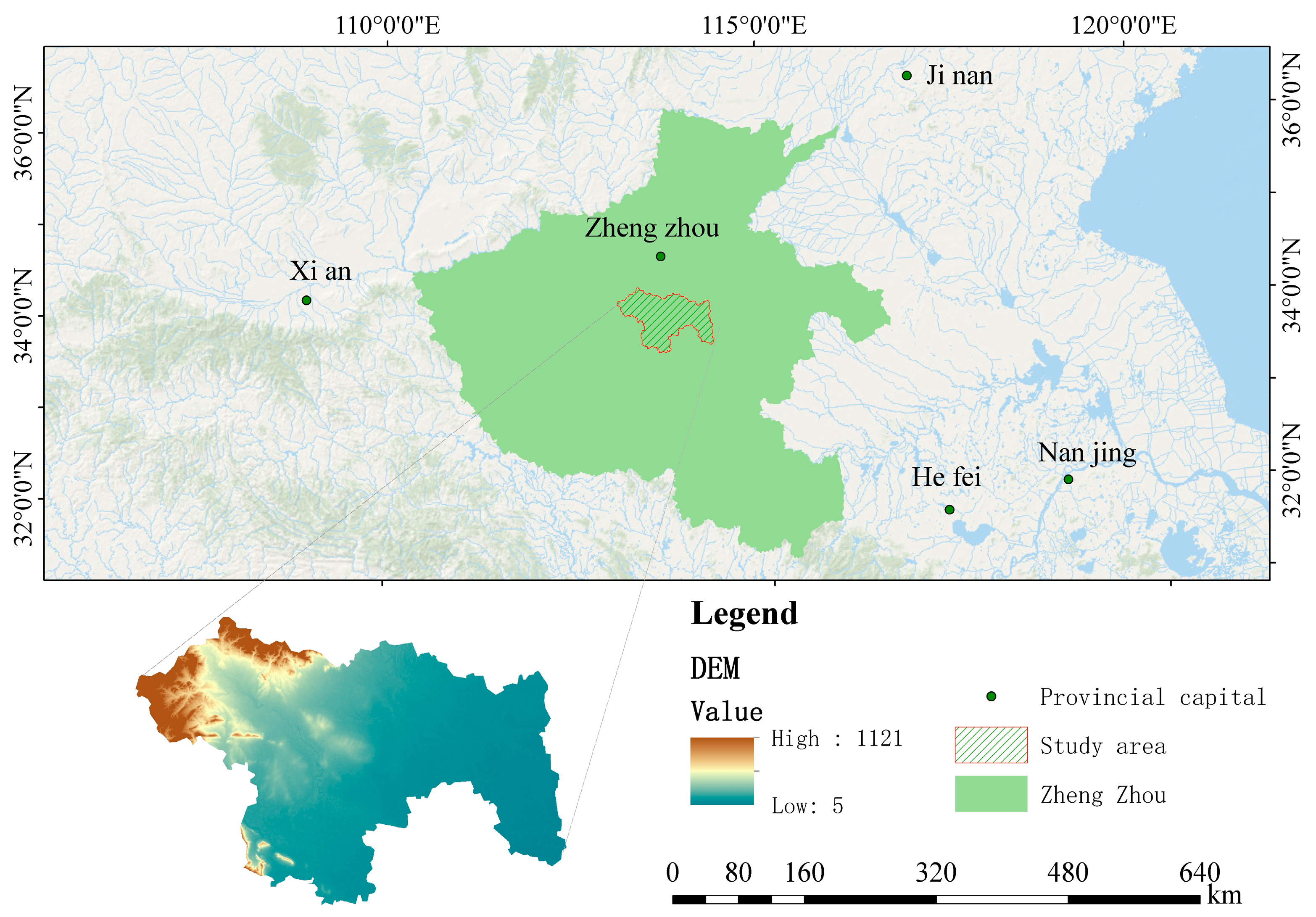
2.1. Study Area and Description
2.2. Data Sources
- Radiometric calibration;
- Atmospheric correction using LaSRC (for OLI) and LEDAPS (for TM/ETM+);
- Geometric rectification to WGS84 geographic (EPSG:4326);
- Cloud masking using the Fmask algorithm;
- Gap filling for SLC-off Landsat 7 data using temporal interpolation with adjacent-date imagery.
3. Methodology
3.1. Evaluation Framework of LRCC
3.2. Entropy Weighting and Composite Index Construction
3.3. Benchmarking and Validation
3.4. GIS-Based Spatio-Temporal Analysis
3.4.1. LUCC Analysis
3.4.2. Spatial Interpolation of LRCC Values
3.4.3. Temporal Comparison and Change Mapping
3.5. Policy Variables, Measurement, and Driver Analysis
3.6. Scenario Evaluation Protocol and Working Example
4. Results
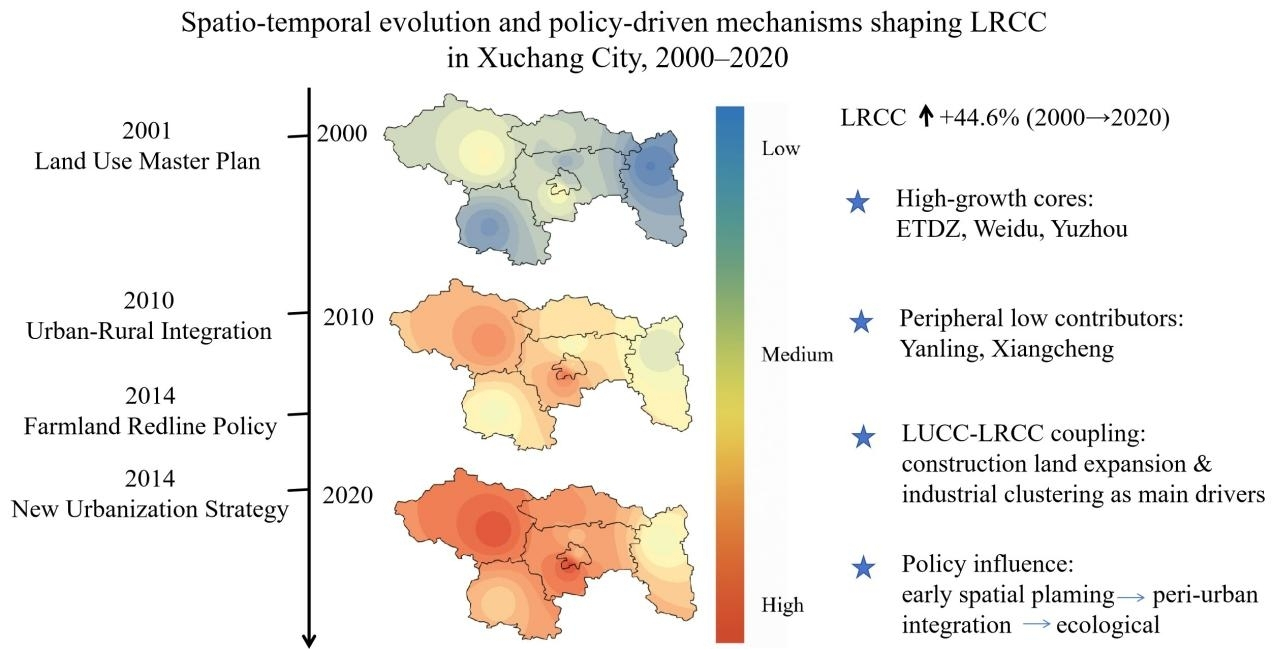
4.1. Spatio-Temporal Changes in LRCC (2000–2020)
4.1.1. 2000: Low Baseline and Pronounced Core–Periphery Divide
4.1.2. 2000–2010: Rapid Urban-Driven Growth
4.1.3. 2010–2020: Slowing Growth and Emerging Constraints
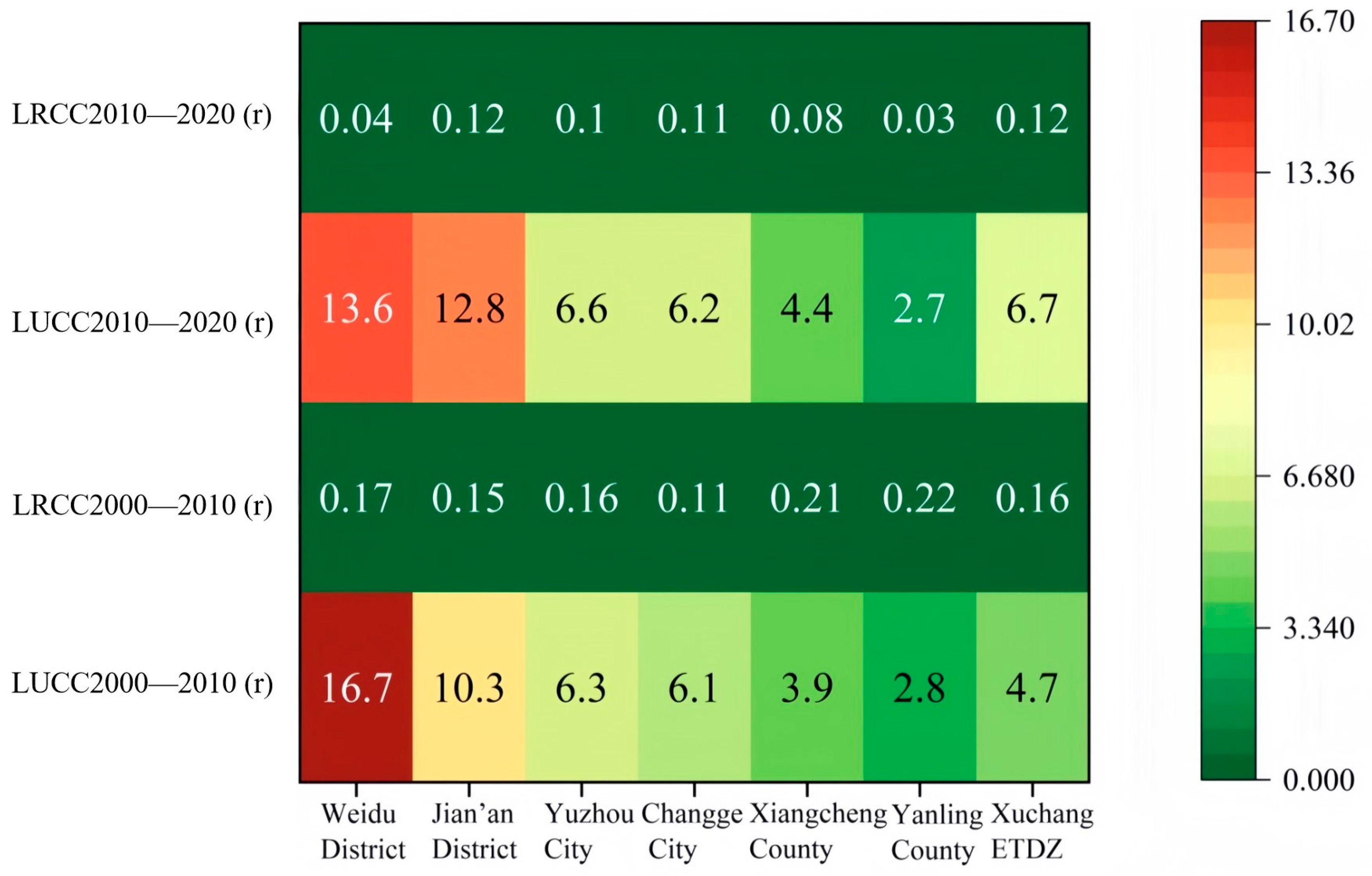
4.1.4. Spatio-Temporal Divergence and LUCC-LRCC Coupling
4.2. Policy Impact Analysis
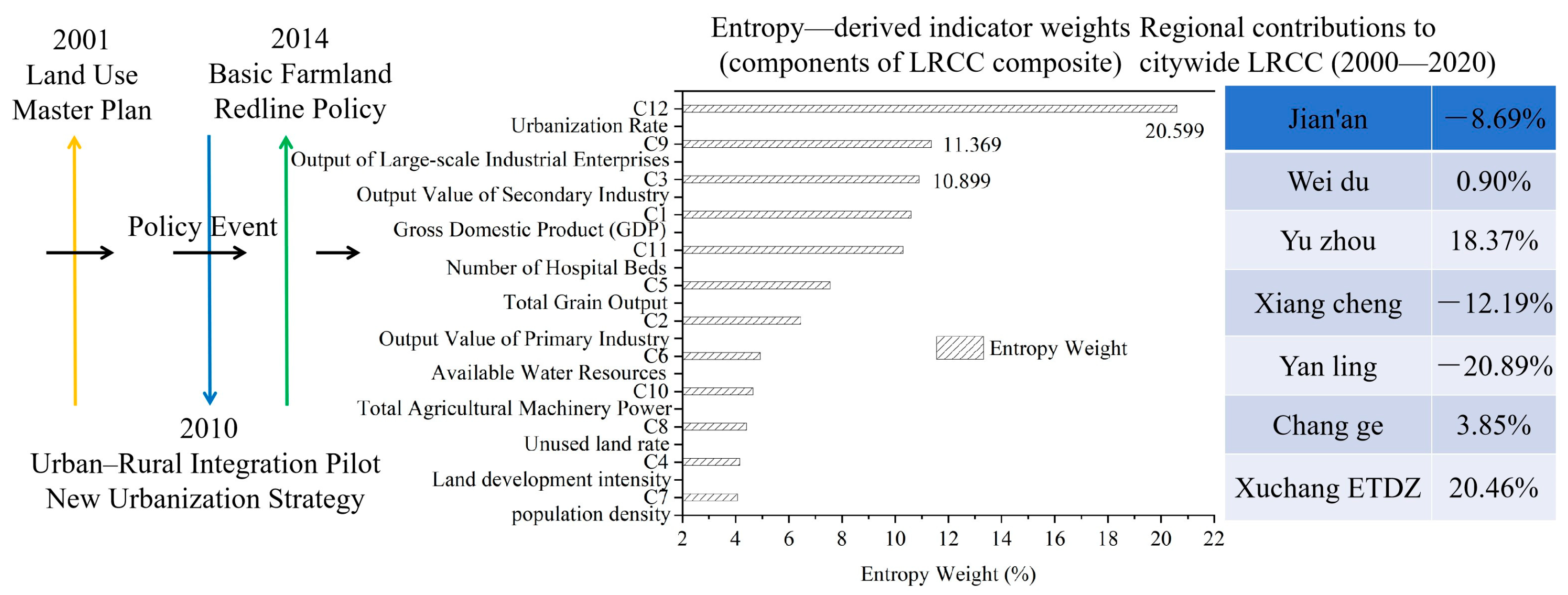
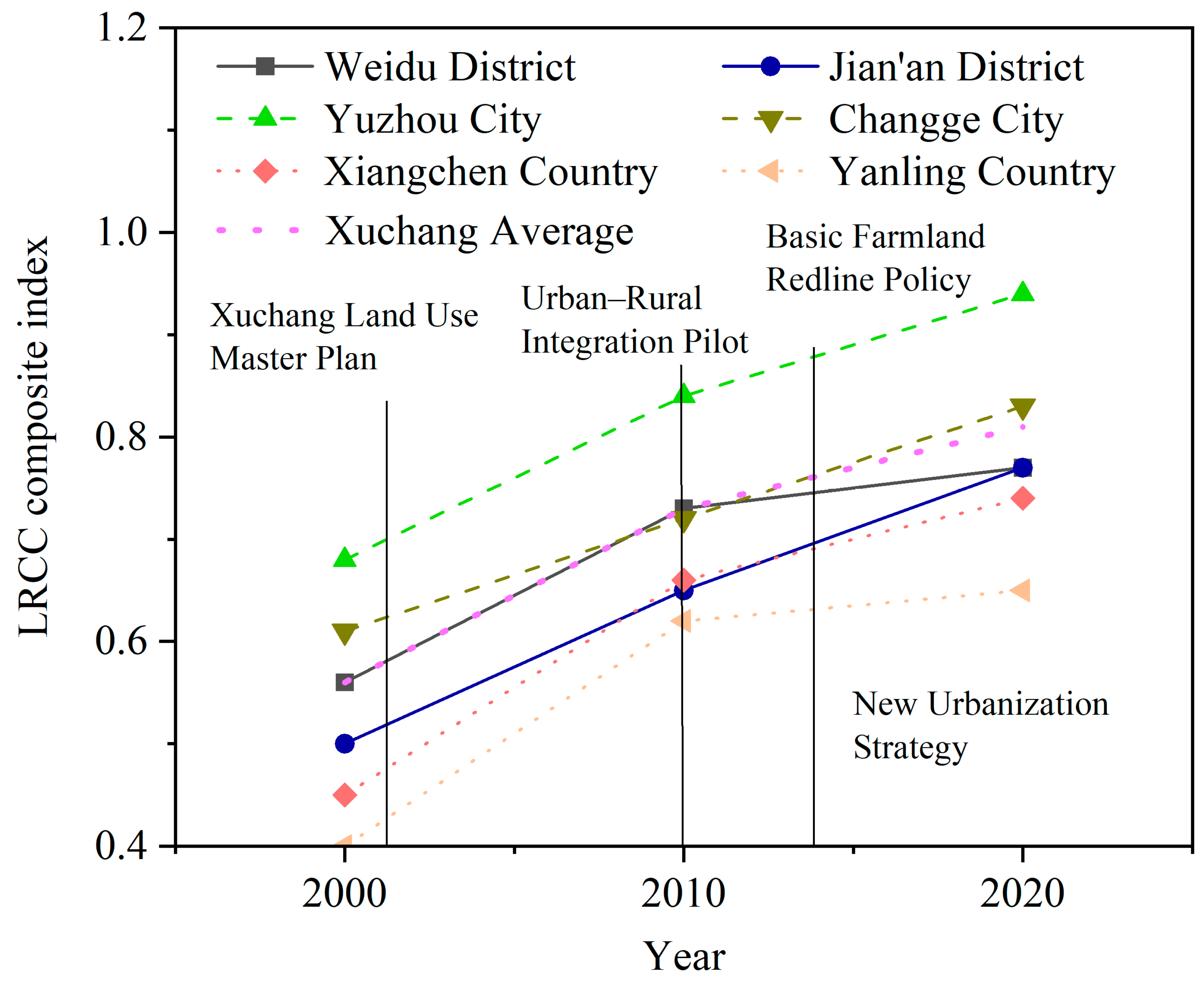
4.2.1. Temporal Alignment Between Policy Implementation and LRCC Shifts
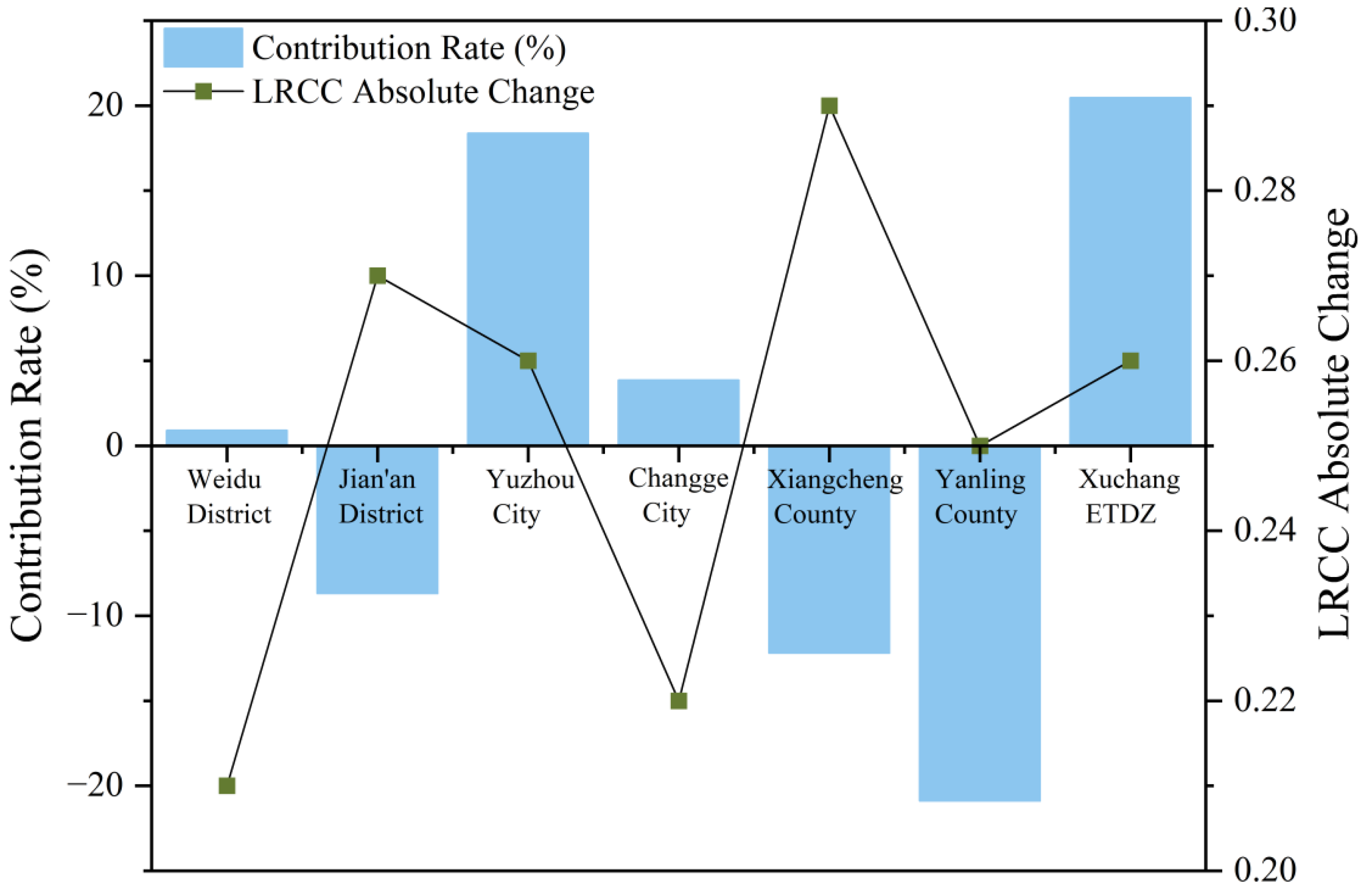
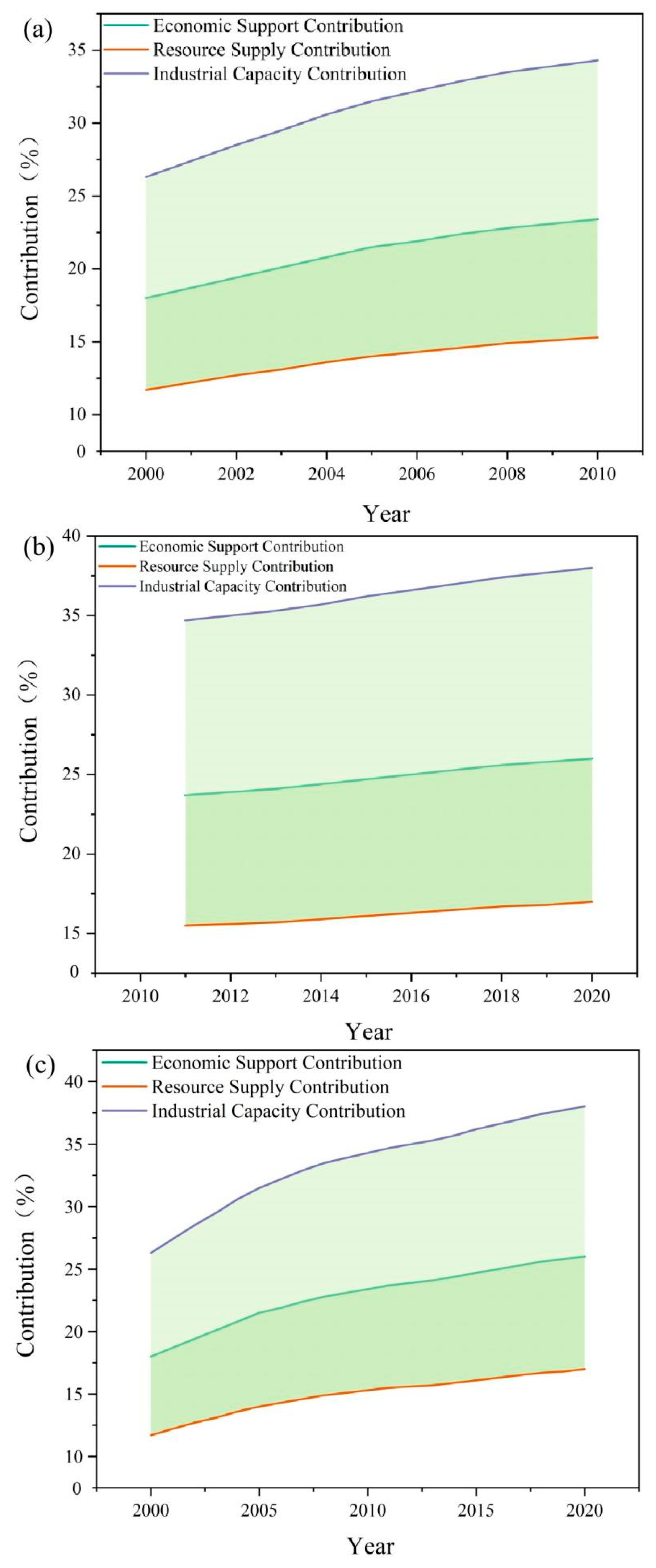
4.2.2. Divergent Contribution Rates and the Role of Indicator Weights
4.2.3. Spatial Heterogeneity in Policy Responsiveness
4.2.4. Synthesis and Future Directions
4.3. Weighting Robustness and Surface Validation
5. Discussion
5.1. Broader Patterns of Spatial Heterogeneity in LRCC Dynamics
5.2. Policy Mechanisms, LUCC–LRCC Coupling, and Design-Based Triangulation
5.3. Methodological and Temporal Considerations
5.4. Policy Implications and Scenario-Based Evaluation
5.5. Operational Scenario Validation and Policy Prioritization
6. Conclusions
Supplementary Materials
Author Contributions
Funding
Institutional Review Board Statement
Informed Consent Statement
Data Availability Statement
Conflicts of Interest
Abbreviations
| LRCC | Land Resource Carrying Capacity |
| LUCC | land-use and land-cover change |
| LULC | Land-use/land-cover |
References
- Huang, A.; Tian, L.; Li, Q.; Li, Y.; Yu, J.; Gao, Y.; Xia, J. Land-Use Planning Serves as a Critical Tool for Improving Resources and Environmental Carrying Capacity: A Review of Evaluation Methods and Application. Int. J. Environ. Res. Public Health 2023, 20, 2370. [Google Scholar] [CrossRef]
- Peng, T.; Deng, H. Evaluating urban resource and environment carrying capacity by using an innovative indicator system based on eco-civilization—A case study of Guiyang. Environ. Sci. Pollut. Res. 2021, 28, 6941–6955. [Google Scholar] [CrossRef] [PubMed]
- Tong, S.; Zhiming, F.; Yanzhao, Y.; Yumei, L.; Yanjuan, W. Research on Land Resource Carrying Capacity: Progress and Prospects. J. Resour. Ecol. 2018, 9, 331–340. [Google Scholar] [CrossRef]
- Jiang, B.; Tang, W.; Li, M.; Yang, G.; Deng, X.; Cui, L. Assessing Land Resource Carrying Capacity in China’s Main Grain-Producing Areas: Spatial–Temporal Evolution, Coupling Coordination, and Obstacle Factors. Sustainability 2023, 15, 16699. [Google Scholar] [CrossRef]
- Wang, S.; Zhang, Y.; Fan, J.; Zhang, H.; Fang, H. Comprehensive Sustainability Indicator for Land Resource-Carrying Capacity in a Farming-Pastoral Region. Remote Sens. 2023, 15, 3726. [Google Scholar] [CrossRef]
- Gao, J.; Zhao, R.; Song, G.; Zhan, Y.; Zhu, Y. Spatial–Temporal Evolution Patterns and Regulatory Strategies for Land Resource Carrying Capacity of China’s Major Grain-Producing Areas. Land 2022, 11, 2127. [Google Scholar] [CrossRef]
- Luo, W.; Jin, C.; Shen, L. The Evolution of Land Resource Carrying Capacity in 35 Major Cities in China. Sustainability 2022, 14, 5178. [Google Scholar] [CrossRef]
- Zhang, Q.; Shen, J. Spatiotemporal Heterogeneity and Driving Factors of Water Resource and Environment Carrying Capacity under High-Quality Economic Development in China. Int. J. Environ. Res. Public Health 2022, 19, 10929. [Google Scholar] [CrossRef]
- Li, C.; Cai, G.; Sun, Z. Urban Land-Use Efficiency Analysis by Integrating LCRPGR and Additional Indicators. Sustainability 2021, 13, 13518. [Google Scholar] [CrossRef]
- Han, C.; Lu, B.; Zheng, J. Analysis and Prediction of Land Resources’ Carrying Capacity in 31 Provinces of China from 2008 to 2016. Sustainability 2021, 13, 13383. [Google Scholar] [CrossRef]
- Cui, J.; Kong, X.; Chen, J.; Sun, J.; Zhu, Y. Spatially Explicit Evaluation and Driving Factor Identification of Land Use Conflict in Yangtze River Economic Belt. Land 2021, 10, 43. [Google Scholar] [CrossRef]
- Gomez, D.; Lauilhe, T.; Hutasavi, S.; Schwob, C.; Mezeix, L. Impact of Thailand’s Eastern Economic Corridor (EEC) Policy on Land Use: Prediction Up to 2040 by Combining CNN Land Cover and Machine Learning Methods on Socio-Economic Data. Appl. Spat. Anal. Policy 2025, 18, 65. [Google Scholar] [CrossRef]
- Zhou, W.; Elshkaki, A.; Zhong, S.; Shen, L. Study on Relative Carrying Capacity of Land Resources and Its Zoning in 31 Provinces of China. Sustainability 2021, 13, 1459. [Google Scholar] [CrossRef]
- Lu, J.; Yang, G.-S. A Review of Research Methods of Land Resources Carrying Capacity. Front. Sustain. Dev. 2023, 3, 79–88. [Google Scholar] [CrossRef]
- Feng, Z.; Yang, Y.; You, Z. The Population and Water and Land Resource Carrying Capacity of Xiongan New Area. Bull. Chin. Acad. Sci. 2017, 32, 1216–1223. [Google Scholar] [CrossRef]
- Tan, S.; Liu, Q.; Han, S. Spatial-temporal evolution of coupling relationship between land development intensity and resources environment carrying capacity in China. J. Environ. Manag. 2022, 301, 113778. [Google Scholar] [CrossRef]
- Xu, M.; Chen, C.; Lin, S.; Shen, D. Research on the Spatial-Temporal Variation of Resources and Environmental Carrying Capacity and the Impact of Supply-Side Reform on Them: Evidence from Provincial-Level Data in China. Land 2023, 12, 1584. [Google Scholar] [CrossRef]
- Yang, Y.; Zhang, H.; Qiao, X.; Liu, L.; Zheng, J. Urban Expansion in Major Grain Producing Area from 1978 to 2017: A Case Study of Zhengzhou Metropolitan Area, China. Chin. Geogr. Sci. 2023, 33, 1–20. [Google Scholar] [CrossRef]
- Xuchang Statistical Bureau. Xuchang Statistical Yearbook; China Statistics Press: Beijing, China, 2001–2021. (In Chinese) [Google Scholar]
- Gan, R.; Chen, C.; Tao, J.; Shi, Y. Hydrological Process Simulation of Sluice-Controlled Rivers in the Plains Area of China Based on an Improved SWAT Model. Water Resour. Manag. 2021, 35, 1817–1835. [Google Scholar] [CrossRef]
- Jia, J.; Wang, X.; Hersi, N.A.M.; Zhao, W.; Liu, Y. Flood-Risk Zoning Based on Analytic Hierarchy Process and Fuzzy Variable Set Theory. Natural Hazards Review 2019, 20, 04019006. [Google Scholar] [CrossRef]
- Wang, S.-F.; Xu, X.-M.; Lei, L.-W. The evolution of spatial and temporal distribution of rainfall erosivity in Henan Province, central China. Sci. Rep. 2024, 14, 25606. [Google Scholar] [CrossRef]
- Lu, H.; Shang, Z.; Ruan, Y.; Jiang, L. Study on Urban Expansion and Population Density Changes Based on the Inverse S-Shaped Function. Sustainability 2023, 15, 10464. [Google Scholar] [CrossRef]
- Xu, G.; Liu, J.; Zhang, M. Land Property Rights, Spatial Form, and Land Performance: A Framework of Policy Performance Evaluation on Collective-Owned Construction Land and Evidence from Rural China. Land 2024, 13, 956. [Google Scholar] [CrossRef]
- Liu, Y.; Li, J.; Yang, Y. Strategic adjustment of land use policy under the economic transformation. Land Use Policy 2018, 74, 5–14. [Google Scholar] [CrossRef]
- Zhang, X.; Gou, P.; Chen, W.; Li, G.; Huang, Y.; Zhou, T.; Liu, Y.; Nie, W. Spatiotemporal distribution characteristics of ecosystem health and the synergetic impact of its driving factors in the Yangtze River Delta, China. Environ. Sci. Pollut. Res. 2023, 30, 85184–85197. [Google Scholar] [CrossRef] [PubMed]
- Zhang, Y.; Yang, Z.; Li, W. Analyses of urban ecosystem based on information entropy. Ecol. Model. 2006, 197, 1–12. [Google Scholar] [CrossRef]
- Chen, L.; Wang, X.; Wang, Y.; Gao, P. Improved entropy weight methods and their comparisons in evaluating the high-quality development of Qinghai, China. Open Geosci. 2023, 15, 20220570. [Google Scholar] [CrossRef]
- Fan, Y.; Yu, G.; He, Z.; Yu, H.; Bai, R.; Yang, L.; Wu, D. Entropies of the Chinese Land Use/Cover Change from 1990 to 2010 at a County Level. Entropy 2017, 19, 51. [Google Scholar] [CrossRef]
- Xu, C.; Yang, L. Evaluation of land resources carrying capacity based on entropy weight and cloud similarity. Sci. Rep. 2024, 14, 9050. [Google Scholar] [CrossRef] [PubMed]
- Kumar, R.; Singh, S.; Bilga, P.S.; Jatin; Singh, J.; Singh, S.; Scutaru, M.-L.; Pruncu, C.I. Revealing the benefits of entropy weights method for multi-objective optimization in machining operations: A critical review. J. Mater. Res. Technol. 2021, 10, 1471–1492. [Google Scholar] [CrossRef]
- Yin, S.; Li, J.; Liang, J.; Jia, K.; Yang, Z.; Wang, Y. Optimization of the Weighted Linear Combination Method for Agricultural Land Suitability Evaluation Considering Current Land Use and Regional Differences. Sustainability 2020, 12, 10134. [Google Scholar] [CrossRef]
- Liu, J.; Zhang, L.; Zhang, Q. The Development Simulation of Urban Green Space System Layout Based on the Land Use Scenario: A Case Study of Xuchang City, China. Sustainability 2020, 12, 326. [Google Scholar] [CrossRef]
- Wu, G.X.; Pan, C.C.; Shen, H.F. Research on Land use change of Xuchang City based on RS and GIS. In Proceedings of the 2011 International Symposium on Water Resource and Environmental Protection, Xi’an, China, 20–22 May 2011; pp. 2447–2450. Available online: https://ieeexplore.ieee.org/abstract/document/5893370/ (accessed on 16 June 2011).
- Yang, Y.; Li, T.; Zhang, T.; Yang, W. Understanding the utilization characteristics of bicycle-sharing systems in underdeveloped cities: A case study in Xuchang City, China. Transp. Res. Rec. J. Transp. Res. Board 2017, 2634, 78–85. [Google Scholar] [CrossRef]
- Liu, J.; Zhou, J.; He, Q. Impact of China’s Permanent Basic Farmland Protection Redline and Ecological Protection Redline on Water Conservation in the Loess Gully Region. Land 2024, 13, 1424. [Google Scholar] [CrossRef]
- Gao, J.; Wang, Y.; Zou, C.; Xu, D.; Lin, N.; Wang, L.; Zhang, K. China’s ecological conservation redline: A solution for future nature conservation. Ambio 2020, 49, 1519–1529. [Google Scholar] [CrossRef]
- Yelery, A. The national development reform commission’s report at the 4th session of 12th national people’s congress: A review. China Rep. 2016, 52, 228–234. [Google Scholar] [CrossRef]
- Li, Z.-T.; Hu, M.-M.; Li, M.; Jiao, M.-Y.; Xia, B.-C. Identification and countermeasures of limiting factors of regional sustainable development: A case study in the Pearl River Delta of China. Environ. Dev. Sustain. 2020, 22, 4209–4224. [Google Scholar] [CrossRef]
- Wu, W.; Zhang, T.; Xie, X.; Huang, Z. Regional low carbon development pathways for the Yangtze River Delta region in China. Energy Policy 2021, 151, 112172. [Google Scholar] [CrossRef]
- Lu, X.-H.; Ke, S.-G. Evaluating the effectiveness of sustainable urban land use in China from the perspective of sustainable urbanization. Habitat Int. 2018, 77, 90–98. [Google Scholar] [CrossRef]
- Zhang, Z.; Zhang, Y.; Zhang, X. The spatiotemporal evolution and threshold effect of new quality productive forces and territorial space ecological restoration scale in China. Environ. Dev. Sustain. 2025. [Google Scholar] [CrossRef]
- Wu, Z.; Su, Y.; Xiong, M. Land comprehensive carrying capacity and spatio-temporal analysis of the guangdong-Hong Kong-Macau Greater Bay Area. Front. Environ. Sci. 2022, 10, 964211. [Google Scholar] [CrossRef]
- Deng, Y.; Cai, W.; Hou, M.; Zhang, X.; Xu, S.; Yao, N.; Guo, Y.; Li, H.; Yao, S. How Eco-Efficiency Is the Forestry Ecological Restoration Program? The Case of the Sloping Land Conversion Program in the Loess Plateau, China. Land 2022, 11, 712. [Google Scholar] [CrossRef]
- Yin, Y.; Pierce, J.T. Integrated resource assessment and sustainable land use. Environ. Manag. 1993, 17, 319–327. [Google Scholar] [CrossRef]
- Zhu, W.; Jiang, Z.; Cen, L.; Wu, H. Evaluation, simulation, and optimization of land use spatial patterns for high-quality development: A case study of Zhengzhou city, China. J. Geogr. Sci. 2023, 33, 266–288. [Google Scholar] [CrossRef]
- Wang, J.; Lü, Y.; Zeng, Y.; Zhao, Z.; Zhang, L.; Fu, B. Spatial heterogeneous response of land use and landscape functions to ecological restoration: The case of the Chinese loess hilly region. Environ. Earth Sci. 2014, 72, 2683–2696. [Google Scholar] [CrossRef]
- Wang, Z.; Lin, L.; Zhang, B.; Xu, H.; Xue, J.; Fu, Y.; Zeng, Y.; Li, F. Sustainable urban development based on an adaptive cycle model: A coupled social and ecological land use development model. Ecol. Indic. 2023, 154, 110666. [Google Scholar] [CrossRef]
- Houska, T.R. EarthExplorer. U.S. Geological Survey General Information Product 136; U.S. Geological Survey: Reston, VA, USA, 2012. Available online: https://earthexplorer.usgs.gov/ (accessed on 16 June 2011).
- Google LLC. Google Earth Pro. Available online: https://earth.google.com/ (accessed on 16 June 2011).
- U.S. Geological Survey. Landsat Collection 2 Level-1 Data; U.S. Geological Survey: Reston, VA, USA, 2020. Available online: https://www.usgs.gov/landsat-missions/landsat-collection-2-level-1-data (accessed on 16 June 2011).

| Subsystem | Indicator | Unit | Attribute (Positive+/Negative−) | Justification |
|---|---|---|---|---|
| Economic Support | GDP | CNY 100 million | + | Higher economic capacity supports a larger population |
| Primary industry output | CNY 100 million | + | Reflects food and resource supply capacity | |
| Secondary industry output | CNY 100 million | + | Indicates industrial productivity and living standards | |
| Land development intensity | % | − | Excessive development reduces ecological resilience | |
| Resource Supply | Total Grain Output | Tons | + | Greater food production enhances population support capacity |
| Available Water Resources | 10,000 m3 | + | More water availability strengthens LRCC | |
| population density | Person/km2 | − | High density increases pressure on land resources | |
| Unused land rate | % | − | Large unused areas reduce effective land utilization | |
| Industrial Capacity | Output of large-scale industries | CNY 100 million | + | Stronger industry improves employment and economic output |
| Total power of agricultural machinery | 10,000 kilowatts | + | Higher mechanization improves farming efficiency | |
| Number of hospital beds | Beds | + | Indicates better healthcare and urban service capacity | |
| Urbanization Rate | % | + | Reflects stronger development of secondary and tertiary sectors |
| Subsystem | Indicator Name | Attribute (±) | Indicator Code | Entropy Weight (%) | Coefficient of Variation (CV) (%) |
|---|---|---|---|---|---|
| Economic Support | Gross Domestic Product (GDP) | + | C1 | 10.602 | 33.852 |
| Primary Industry Output | + | C2 | 6.449 | 15.566 | |
| Secondary Industry Output | + | C3 | 10.899 | 51.879 | |
| Land development intensity | − | C4 | 4.153 | 20.945 | |
| Resource Supply | Total Grain Output | + | C5 | 7.562 | 41.732 |
| Available Water Resources | + | C6 | 4.927 | 40.439 | |
| population density | − | C7 | 4.073 | 13.927 | |
| Unused land rate | − | C8 | 4.409 | 116.07 | |
| Industrial Capacity | Large-scale Industrial Enterprises Output | + | C9 | 11.369 | 71.163 |
| Total Agricultural Machinery Power | + | C10 | 4.656 | 12.082 | |
| Number of Hospital Beds | + | C11 | 10.302 | 38.455 | |
| Urbanization Rate | + | C12 | 20.599 | 39.541 |
| Indicator (Code) | +0.10 Normalized → ∆LRCC |
|---|---|
| GDP (C1) | 0.0106 |
| Primary industry (C2) | 0.0064 |
| Secondary industry (C3) | 0.0109 |
| Land development intensity (C4, lower is better) | 0.0042 |
| Total grain (C5) | 0.0076 |
| Water resources (C6) | 0.0049 |
| Population density (C7, lower is better) | 0.0041 |
| Unused land rate (C8, lower is better) | 0.0044 |
| Large-scale industrial output (C9) | 0.0114 |
| Agri machinery power (C10) | 0.0047 |
| Hospital beds (C11) | 0.0103 |
| Urbanization rate (C12) | 0.0206 |
| Administrative Region | LRCC (2000) | LRCC (2010) | LRCC (2020) | Δ2000–2010 | Δ2010–2020 | Δ2000–2020 | Growth Rate (%) | Standard Deviation (SD) |
|---|---|---|---|---|---|---|---|---|
| Weidu District | 0.56 | 0.73 | 0.77 | 0.17 | 0.04 | 0.21 | +37.5 | 0.0910 |
| Jian’an District | 0.5 | 0.65 | 0.77 | 0.15 | 0.12 | 0.27 | +54.0 | 0.1105 |
| Yuzhou City | 0.68 | 0.84 | 0.94 | 0.16 | 0.1 | 0.26 | +38.2 | 0.1071 |
| Changge City | 0.61 | 0.72 | 0.83 | 0.11 | 0.11 | 0.22 | +36.1 | 0.0898 |
| Xiangcheng County | 0.45 | 0.66 | 0.74 | 0.21 | 0.08 | 0.29 | +64.4 | 0.1223 |
| Yanling County | 0.4 | 0.62 | 0.65 | 0.22 | 0.03 | 0.25 | +62.5 | 0.1115 |
| Xuchang ETDZ | 0.69 | 0.87 | 0.95 | 0.18 | 0.08 | 0.26 | +37.7 | 0.1087 |
| Xuchang Average | 0.56 | 0.73 | 0.81 | 0.17 | 0.08 | 0.25 | +44.6 | 0.1035 |
| Policy Event | Core Objective(s) | Spatial Coverage | Potential Impact on LRCC |
|---|---|---|---|
| Xuchang Land Use Master Plan 2001 | Introduced spatial zoning and allocated quotas for construction and farmland use | Entire city | Guided structured land expansion; preserved cultivated land [33,34] |
| Urban–Rural Integration Pilot 2010 | Coordinated land development between urban and peri-urban zones | Yuzhou, Changge | Improved land-use efficiency and reduced fragmentation [28,35] |
| Basic Farmland Redline Policy 2014 | Designated permanent protection zones for basic farmland | Especially Yanling County | Restricted farmland loss; constrained urban expansion [36,37] |
| New Urbanization Strategy 2014 | Promoted compact, intensive, and green urban development | Urban districts and suburbs | Boosted urban carrying capacity and sustainable land use [1,38] |
| Group (Members) | ΔLRCC 2000–2010 (Mean) | ΔLRCC 2010–2020 (Mean) |
|---|---|---|
| Urban/industrial core (ETDZ, Weidu, Jian’an, Yuzhou) | 0.165 | 0.085 |
| Peri-urban (Changge) | 0.110 | 0.110 |
| Agricultural-constraint (Xiangcheng, Yanling) | 0.215 | 0.055 |
Disclaimer/Publisher’s Note: The statements, opinions and data contained in all publications are solely those of the individual author(s) and contributor(s) and not of MDPI and/or the editor(s). MDPI and/or the editor(s) disclaim responsibility for any injury to people or property resulting from any ideas, methods, instructions or products referred to in the content. |
© 2025 by the authors. Licensee MDPI, Basel, Switzerland. This article is an open access article distributed under the terms and conditions of the Creative Commons Attribution (CC BY) license (https://creativecommons.org/licenses/by/4.0/).
Share and Cite
Liu, J.; Mi, M. Spatio-Temporal Evolution and Policy Drivers of Land Resource Carrying Capacity in Xuchang City, Central China (2000–2020). Sustainability 2025, 17, 10858. https://doi.org/10.3390/su172310858
Liu J, Mi M. Spatio-Temporal Evolution and Policy Drivers of Land Resource Carrying Capacity in Xuchang City, Central China (2000–2020). Sustainability. 2025; 17(23):10858. https://doi.org/10.3390/su172310858
Chicago/Turabian StyleLiu, Jia, and Mengbo Mi. 2025. "Spatio-Temporal Evolution and Policy Drivers of Land Resource Carrying Capacity in Xuchang City, Central China (2000–2020)" Sustainability 17, no. 23: 10858. https://doi.org/10.3390/su172310858
APA StyleLiu, J., & Mi, M. (2025). Spatio-Temporal Evolution and Policy Drivers of Land Resource Carrying Capacity in Xuchang City, Central China (2000–2020). Sustainability, 17(23), 10858. https://doi.org/10.3390/su172310858