Article

Climate-Driven Changes in Air Quality: Trends Across Emission and Socioeconomic Pathways

1
Centre for Environmental and Marine Studies (CESAM), Department of Environment and Planning, University of Aveiro, 3810-193 Aveiro, Portugal
2
Centre for Environmental and Marine Studies (CESAM), Department of Physics, University of Aveiro, 3810-193 Aveiro, Portugal
*
Author to whom correspondence should be addressed.
Sustainability 2025, 17(23), 10857; https://doi.org/10.3390/su172310857 (registering DOI)
Submission received: 3 November 2025 / Revised: 24 November 2025 / Accepted: 29 November 2025 / Published: 4 December 2025

Abstract

Climate change (CC) and air pollution are closely interlinked environmental challenges that significantly affect human health and quality of life, especially in urban and industrialized regions. This study conducted a comprehensive investigation on how future climate scenarios may affect air quality and related human impacts, using a Southern European country (Portugal) for illustration. The study employed the most up-to-date future climate projections (Shared Socioeconomic Pathways—SSP) that were dynamically downscaled for Portugal. High-resolution simulations were carried out using the Weather Research & Forecasting (WRF) model, providing data for relevant meteorological variables that most affect air quality, for three future climate scenarios: fossil-fueled development (SSP5-8.5), regional inequality (SSP3-7.0), and a middle-of-the-road future (SSP2-4.5). Current and future air quality was simulated with the CHIMERE chemical transport model driven by WRF downscaled data and future emissions from the SSP v2.0 database. Results show that CC will impact nitrogen oxides (NO2), ozone (O3), and particulate matter (PM) concentrations over Portugal, with only agricultural emissions increasing in all scenarios. PM and NO2 will decrease in urban areas, over the short and long term, mainly for more conservative scenarios (SSP2-4.5 and SSP3-7.0), while O3 will increase over mainland Portugal (except for coastal/urban areas). Regarding human health, premature deaths are expected to be highest in urban areas, with reductions projected for NO2 and PM2.5 under SSP2-4.5 and increases in O3-related mortality under SSP5-8.5. Overall, SSP2-4.5 presents the most sustainable outcomes, highlighting the importance of integrating air quality management and health impact assessments into climate adaptation strategies to promote long-term environmental sustainability in southern Europe, consistent with the United Nations Sustainable Development Goals (SDGs).

1. Introduction

In recent years, scientific research on human health and the well-being of populations in industrial and urban areas has predominantly focused on climate change and air pollution [1,2]. Climate change can affect the population through several associated phenomena, including more frequent and more intense episodes of extreme heat and cold, changes in precipitation patterns, and a rise in extreme weather events (e.g., tornadoes) [3,4,5]. Measurement records indicate a consistent increase in ambient temperature levels, particularly in extreme values, with heatwaves becoming longer, more intense, and more frequent [6]. Although many studies have examined the influence of climate change and air pollution on population mortality and morbidity, only a limited number have explored how these two environmental factors interact [7,8,9].
Climate change and air pollution are strongly interlinked because burning fossil fuels represents the primary driver of global warning and also significantly drives air quality degradation. Combustion sources release both Greenhouse Gases (GHGs) and critical pollutants (e.g., particulate matter—PM), into the atmosphere [10], while important pollutants such as ozone (O3) and PM respond strongly to climate conditions, which are capable of affecting chemical reactions, natural emissions, background concentrations, and both wet and dry deposition [11,12]. Meanwhile, variations in atmospheric emissions influenced by the European climate and energy policies aimed at reducing air pollution, including the commitment to achieve climate neutrality by 2050 [13], result in shifts in air quality, highlighting the need for realistic and up-to-date emission scenarios [14,15].
Recent scientific evidence shows that atmospheric pollutants such as nitrogen dioxide (NO2), O3, and PM pose human health risks even at concentrations currently recorded in several cities of developed countries [16]. This recognition is reflected by the most updated World Health Organization (WHO) Air Quality Guidelines (AQGs) [17], which influenced the 2024 proposal for the new European Air Quality Directive, introducing more restrictive limit values, although still not as strict as those recommended by the WHO AQG (Directive 2024/2881) [18].
Numerical modeling has become an import approach for evaluating how future climate conditions may affect air pollution levels and for supporting related management strategies [19]. Many existing studies rely solely on the Intergovernmental Panel on Climate Change (IPCC) Representative Concentration Pathways (RCP) scenarios, which were developed more than a decade ago, while others have also considered emission projections [20,21]. Updating assessments of climate impacts using the more recent Shared Socioeconomic Pathways (SSP) is essential, as these scenarios integrate socioeconomic development trajectories together with emission trends and therefore provide a more comprehensive view of potential climate impacts under varying global development pathways.
In this study, numerical simulations are conducted at a high spatial resolution, to assess how the WHO AQGs are fulfilled, using a Southern European country (Portugal) as a case study, for a baseline (2006), mid-term (2050), and long-term (2100) scenario, accounting for changes in both climate and projected emissions due to their joint influence on air quality. Portugal provides a relevant context not only due to its climate vulnerability, characterized by increasingly frequent heat waves and droughts [22], but also due to its specific socioeconomic structure, which is mainly service-based, with services contributing to roughly 62% of national the Gross Domestic Product (GDP) per capita, while industrial and energy activities (e.g., paper and paper pulp production) account for approximately 14% and agriculture (e.g., wine production) around 2% [23]. The Portuguese GDP and Gross National Income (GNI) have been steadily increasing (by an average of 40%), reaching approximately €27,063 M and €283,973 M, respectively, in 2024, placing Portugal in a mid-position at the European level (GDP = 19th, GNI = 14th) [24,25].
This paper is organized as follows. Section 2.1 outlines the selected SSP climate scenarios along with the associated emission projections. Section 2.2 describes the modeling system and the simulation setup for both baseline and future periods. The modeling outcomes are analyzed and discussed in Section 3, which covers air quality (Section 3.1), mortality (Section 3.2), and limitations, future perspectives, and police recommendations. Finally, Section 4 presents the study’s concluding remarks.

2. Materials and Methods

2.1. The Climate Scenarios

Future climate projections developed as part of the Coupled Model Intercomparison Project Phase 6 (CMIP6) were derived from five new generation scenarios that outline distinct potential pathways for societal and environmental change (i.e., SSPs) [26,27]. These scenarios provided narrative frameworks reflecting plausible human development strategies, which give rise to a wide range of future challenges for addressing both climate-related and implementing strategies for mitigation and adaptation [28]. Each SSP scenario included quantified projections of key socioeconomic and environmental drivers, such as the population [29], urbanization [30], economic growth [31,32,33], energy system [34], land use changes [35], and atmospheric emissions [36], and the five SSP narratives were described in [26] as follows:
  • SSP1 (Sustainability—Taking the Green Road) focused on international cooperation, eco-friendly technologies, renewable energy, and low-resource lifestyles, assuming high economic growth, which results in relatively low challenges for climate mitigation and adaptation.
  • SSP2 (Middle of the Road) followed a “business-as-usual” approach with modest technological progress, environmental improvements, and reduced energy/resource intensity, which resulted in intermediate challenges that varied between countries.
  • SSP3 (Regional Rivalry—A Rocky Road) focused on high fossil-fuel dependence, resource intensiveness, and limited international cooperation due to nationalism, and slow technological development and economic growth create substantial challenges for climate mitigation and adaption.
  • SSP4 (Inequality—A Road Divided) considered growing inequalities due to uneven investments in human capital, with some regions developing low-carbon technologies and integrating political/business elites, which led to low mitigation challenges, while other regions faced high adaptation challenges due to a lack of access to resources.
  • SSP5 (Fossil-fueled Development—Taking the Highway) was characterized by extensive fossil fuel exploitation together with energy-intensive lifestyles and substantial investment in health, education, and institutions, which resulted in significant challenges despite strong economic growth and development.
Chen et al. [37] indicated that the five SSP narratives correspond to distinct possible levels of global radiative forcing that arise from the evolution of carbon dioxide (CO2), non-CO2 GHG, atmospheric aerosols, and land-use patterns. This framework extends the forcing trajectories originally defined in the four CMIP5 RCPs (RCP2.6, RCP4.5, RCP6.0 and RCP8.5), which reach 2.6, 4.5, 6.0, and 8.5 W/m2, respectively, by the end of the twenty-first century. Furthermore, new forcing pathways were introduced, which [38] highlighted as particularly relevant for the climate science community
The five SSPs combined with different levels of climate forcing created a framework of integrated scenarios, as described by [39,40]. Using this framework, [38] highlighted priority scenarios for climate modeling, with SSP2-4.5 representing a middle-of-the-road pathway, SSP3-7.0 representing a context dominated by regional competition, and SSP5-8.5 representing a trajectory driven primarily by intensive fossil-fuel use, which this study focused on.

2.2. The AQ Modeling System

This section outlines the air quality modeling approach applied in this study, which includes the emission input data, modeling structure, and setup.

2.2.1. Atmospheric Pollutant Emissions

The atmospheric emissions were determined for the baseline, short-term (2050 year), and long-term (2100 year) periods. For the baseline scenario, data provided by the European Monitoring and Evaluation (EMEP) emission inventory were used, which provided quantitative information for key atmospheric variables, such as coarse particles (PM10), fine particles (PM2.5), sulfur dioxide (SOx), ammonia (NH3), Non-Methane Volatile Organic Compounds (NMVOCs), nitrogen oxides (NOx), and carbon monoxide (CO), with total emissions reported by activity sectors according to the Gridded Nomenclature For Reporting (GNFR) guidelines. For future scenarios, emissions were projected by applying the approach defined by [41] together with scenario-specific projections from [36] for each SSP narrative.
Figure 1 shows the emission projections obtained for NOx, PM10, and PM2.5 across the sectors under the three scenarios considered, SSP2-4.5, SSP3-7.0 and SSP5-8.5, for mid- and long-term timeframes, relative to the baseline. Emissions trends vary by pollutant, scenario, and sector, with NOx generally showing the largest increases or smallest reductions. SSP5-8.5 exhibits the most significant increases, particularly in sectors like “Road Transport” and “Fugitive,” reflecting its high-growth and high-energy demand assumptions. Conversely, SSP2-4.5 shows more moderate changes, suggesting a pathway aligned with stronger climate mitigation. Long-term projections indicate greater deviations from the baseline, emphasizing the growing impact of policy decisions over time.

2.2.2. Air Quality Modeling and Setup

An atmospheric modeling framework combining the Weather Research & Forecasting (WRF, version 4.2.2) and the CHIMERE (version v2020r1) chemical transport model was selected for simulations of the baseline and future scenarios over Portugal.
The WRF model was applied to downscale global climate outputs from the CMIP6 General Circulation Model (GCM) developed by the Max Planck Institute for Meteorology (MPI-M). This specific version, 1.2, is known as the High-Resolution Earth System Model (MPI-M-ESM-1.2-HR), a comprehensive global atmosphere–land–ocean climate system described in [42]. The modeling employed a two-way nesting scheme, using a 30 km horizontal resolution for the outer domain (D1) and a higher-resolution 6 km grid for the inner domain (D2) covering mainland Portugal.
Three future CMIP6 climate scenarios from ScenarioMIP Tier 1 were downscaled over Portugal, representing three distinct societal development pathways. The first scenario, SSP2-4.5, represented the middle-of-the-road scenario and assumed effective greenhouse gas (GHG) reductions but still faced some challenges, with CO2 emissions increasing until around 2040 and then gradually declining, leading to a radiative forcing of 4.5 W/m2 by the end of the century (2100) and an associated global mean temperature rise of 2.5 °C relative to pre-industrial levels (1.5 °C relative to present-day values). The second scenario, SSP3-7.0, a gap-filling baseline scenario, assumed steadily increasing CO2 emissions throughout the century, resulting in a radiative forcing level reaching 7.0 W/m2 by 2100 and causing a global mean temperature increase of 4 °C above pre-industrial levels (3 °C relative to current values). The last scenario, SSP5-8.5, represented a fossil-fueled development pathway and assumed minimal mitigation actions, leading to strong CO2 emissions growth until approximately 2080 followed by a gradual decrease toward 2100, reaching a radiative forcing of 8.5 W/m2 and producing a global temperature rise of 5 °C above pre-industrial levels (4 °C above current values). A complete description of all SSPs can be found in [43].
WRF modeling simulations were performed for three 20-year reference periods defined by the IPCC Assessment Report 6 (AR6), including 1995–2014 as the historical baseline, 2046–2065 as the mid-term future, and 2081–2100 as the long-term future, with all three periods (i.e., baseline, mid-term future, and long-term future) simulated for each climate scenario (i.e., SSP2-4.5, SSP3-7.0, and SSP5-8.5). From the WRF simulations, one representative year for the baseline and each of the future scenarios (i.e., mid-term future, and long-term future) was selected as input for the CHIMERE chemical transport model. The representative year selection process relied on an analysis of anomalies in precipitation, wind speed, solar radiation, and temperature by comparing the annual average values of each WRF simulation with the 20-year average for each variable and then selecting the year that presented the lowest difference (Table 1).
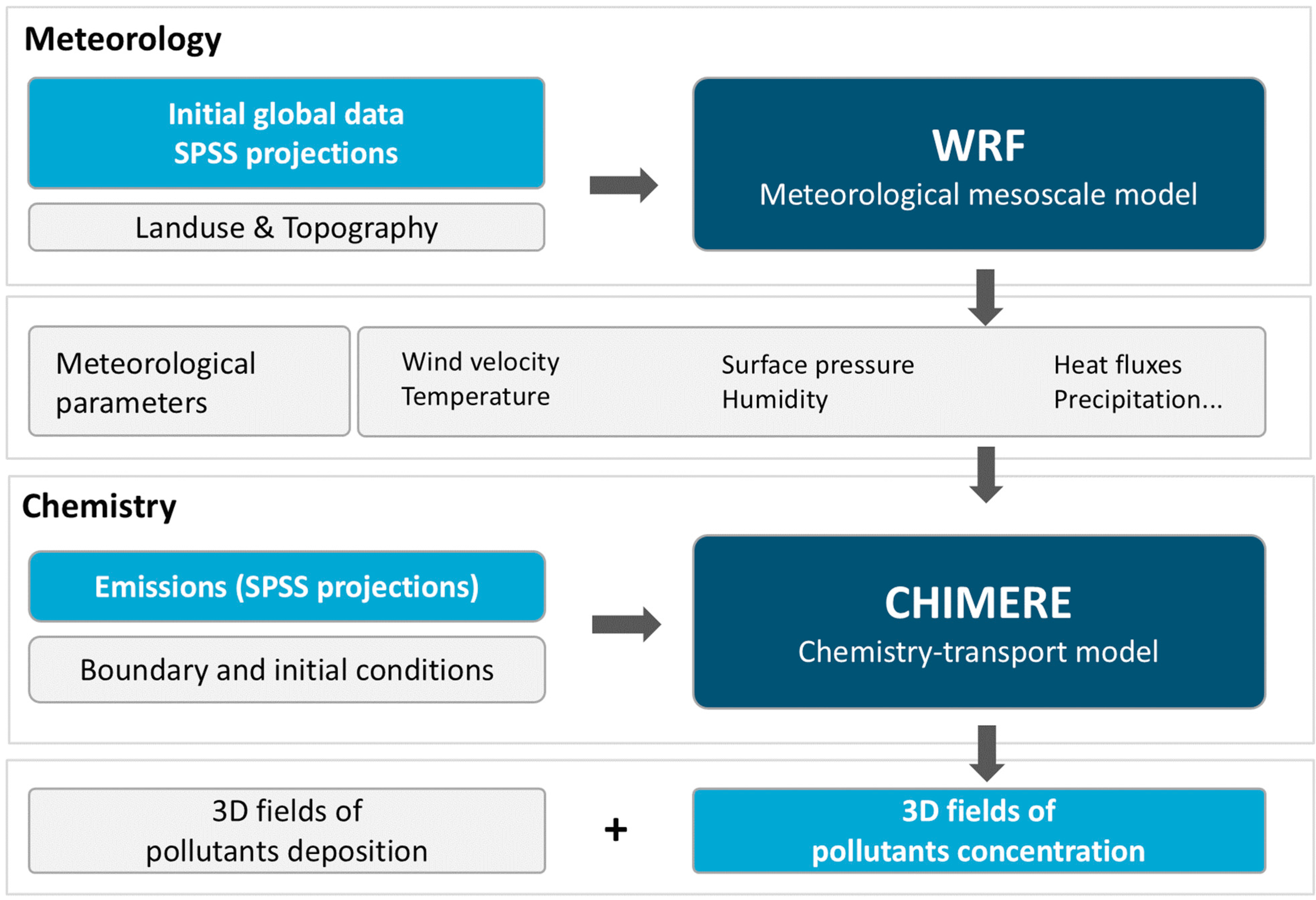
For the air quality simulations, the CHIMERE chemical-transport model, a Eulerian photochemical model that simulates atmospheric emissions, their transport, chemical transformation, and removal processes in the troposphere by solving the pollutant continuity equation for each chemical species, was selected [44]. Figure 2 presents the flowchart describing the modeling approach followed by this study.
The WRF-CHIMERE modeling system has been evaluated in several previous studies [45] and is continuously assessed for operational daily forecasting using the DELTA tool, created within the Forum for Air quality Modelling (FAIRMODE) framework [46]. Model evaluations indicated that the system accurately simulates concentrations of key atmospheric pollutants such as NO2, O3, and PM10, meeting the Model Quality Objectives (MQO) [47] for both daily and annual time periods.

2.3. Human Health Impacts

The long-term effects on health from exposure to PM2.5, NO2, and O3 have been widely investigated in epidemiological and toxicological research. PM2.5 exposure is linked to impaired lung function, systemic inflammation, and disruptions in the heart’s electrical activity, as well as established connections to mortality from cardiovascular and cardiorespiratory causes [48,49,50]. Similarly, long-term NO2 exposure is linked to respiratory and cardiovascular mortality, with effects on natural and cause-specific mortality comparable to those of PM2.5, as evidenced by several cohort studies [51,52,53,54]. For O3, long-term exposure has been shown, in cohort analyses, to affect mortality from respiratory or cardiorespiratory causes, particularly in individuals with underlying health conditions [52,55,56].
The mortality health outcomes of these pollutants were analyzed using the approach employed by the European Environment Agency (EEA), as described in [57], and considering CHIMERE-modeled pollutant concentrations per grid cell, together with age- and sex-stratified population data [58]. Comprehensive details on the health impact assessment are provided in [59]. The concentration-response functions (CRFs) methodologies from [60] for PM2.5 and [61] for NO2 and O3 were applied following the most recent recommendations from the WHO air quality guidelines [17]. Table 2 provides comprehensive information on the Relative Risk (RR) with a 95% confidence interval (CI) for each pollutant and health outcome and the sources of the health data considered.

3. Results and Discussion

3.1. Air Quality in Future Climate Change Scenarios

The following figures (Figure 3, Figure 4, Figure 5 and Figure 6) show the modeling results obtained for the baseline and both mid-term (2050) and long-term period (2100) climate change scenarios (SSP2-4.5, SSP4-7.0, and SSP5-8.5). The pollutants explored here are NO2, O3, PM10, and PM2.5. For each pollutant, the results for the baseline are shown along with the delta expected for each scenario concerning the limit values proposed in the revised Air Quality Directive (Directive 2024/2881, [18]), the difference in annual averages, or the SOMO35 (i.e., the sum of daily maximum 8 h means exceeding 35 ppb) values in the case of O3.
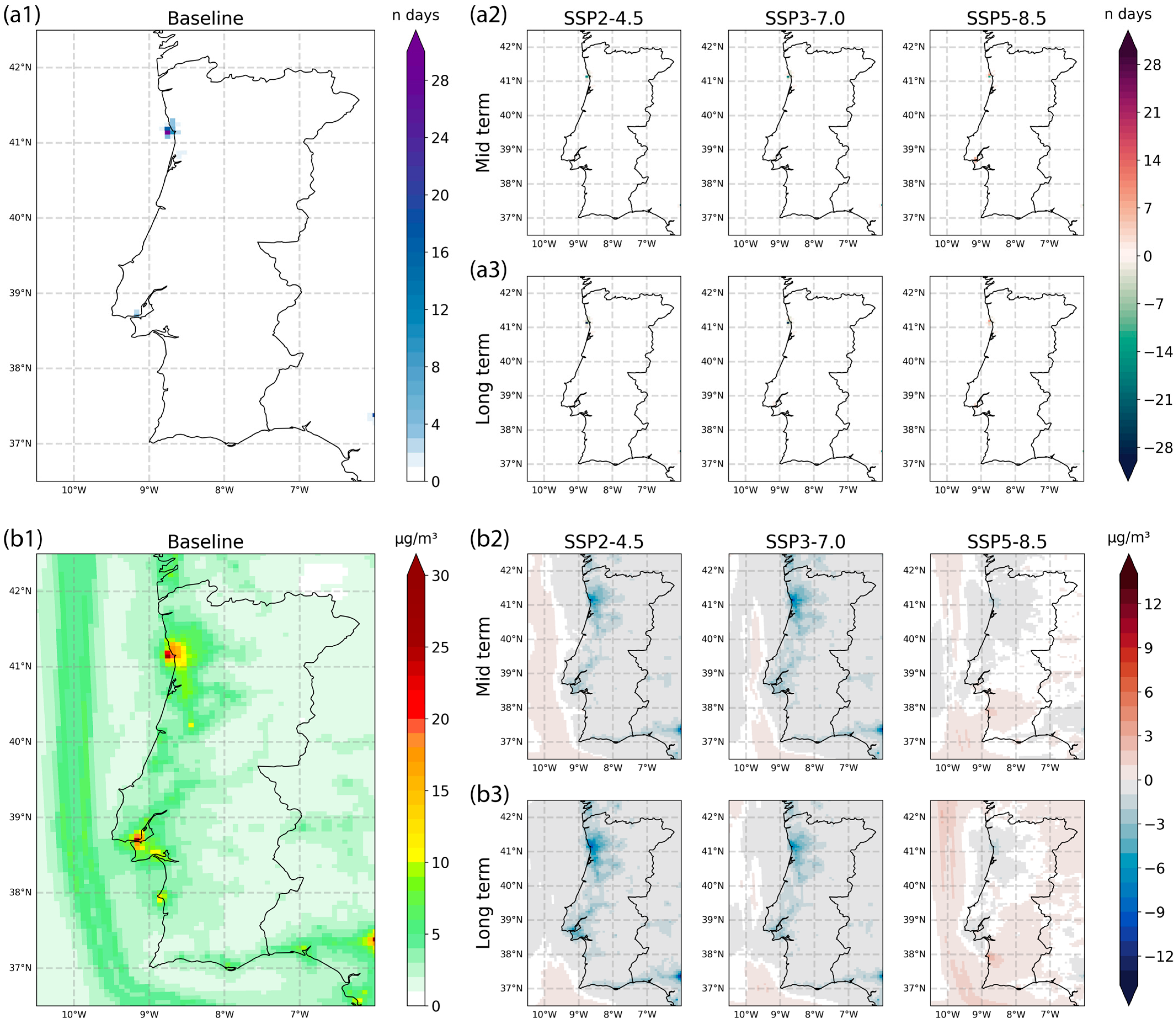
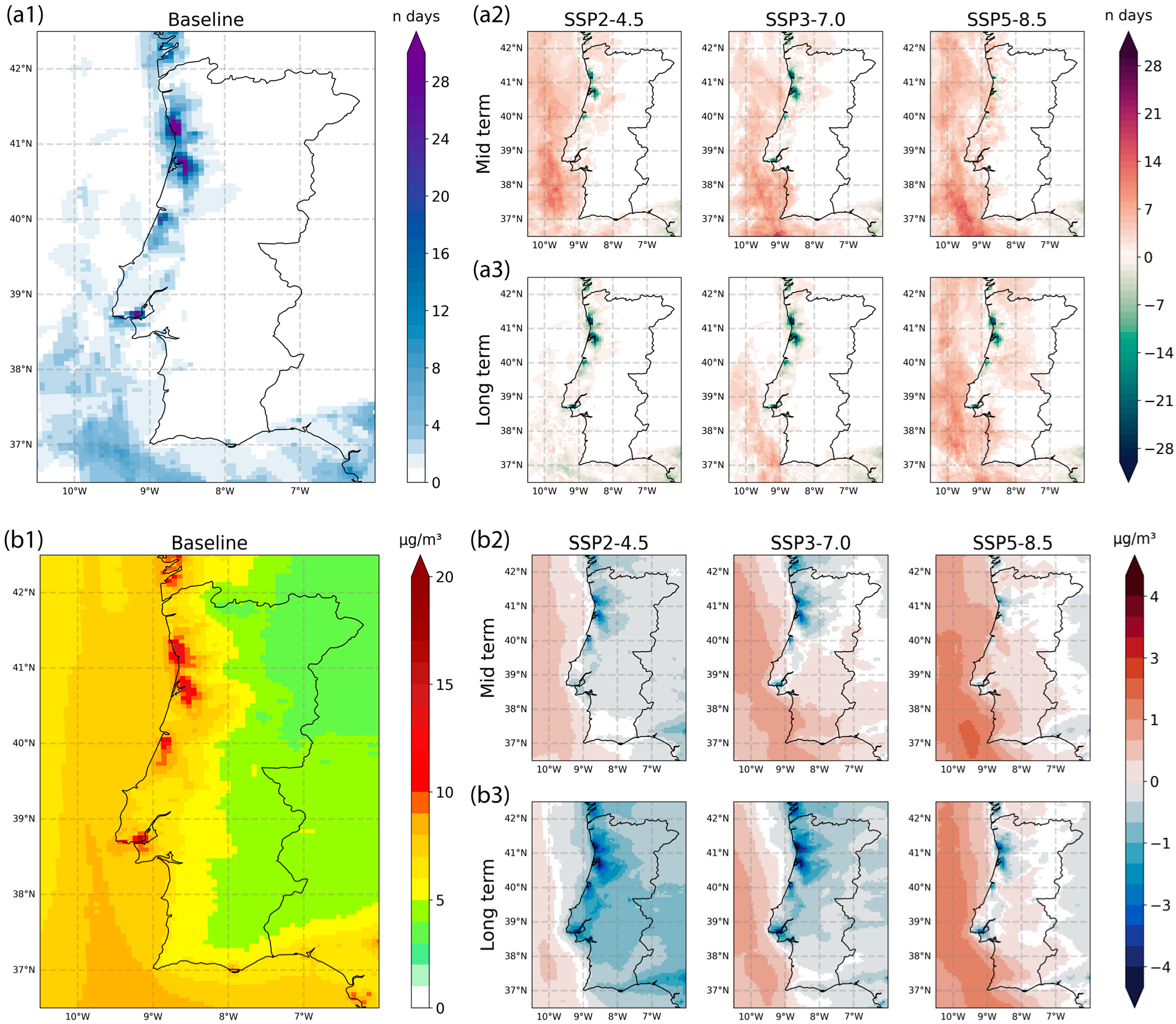
Starting with NO2 (Figure 3), the results are expressed in terms of the number of days in exceedance to the daily mean limit value (50 µg/m3, a1) and annual mean limit value (20 µg/m3, b1), as well as the differences in the number of exceedances (a2 and a3) and annual average concentrations (b2 and b3) between the baseline and climate change scenarios (SSP2-4.5, SSP3-7.0, and SSP5-8.5) for both mid-term (2050) and long-term (2100) projections. It is of note that for the WHO guideline, these thresholds are halved, with 25 µg/m3 for daily means and 10 µg/m3 for the annual mean.
The baseline scenario shows exceedances of both the daily (a1) and annual mean (b1) limit values over the urban areas of Porto and Lisbon, with more than 20 days above the daily limit and annual averages reaching 30 µg/m3. These exceedances illustrate the persistent influence of urban road transport emissions in densely populated areas, as well as the contribution of maritime emissions near the main Portuguese ports, particularly in Porto and Lisbon. The spatial extent of the exceedances further indicates that both land-based mobility and port-related activities played a significant role in shaping local NO2 patterns. Regarding the future projections, the NO2 concentrations are projected to decrease in the less fossil fuel-intensive scenarios (SSP2-4.5 and SSP4-7.0) for both short (daily averages) and long-term (annual) periods, suggesting that exceedances in these scenarios would be lower or non-existence. However, in the case of the SSP5-8.5 scenario, daily exceedances are projected to increase by an additional 20–30 days in the Porto region (a2,a3), along with a rise of 1–5 µg/m3 in the annual mean (b2,b3). Overall, the contrasting behaviors across scenarios demonstrates that future NO2 levels are strongly driven by emission policies and urban planning choices (Figure 1).
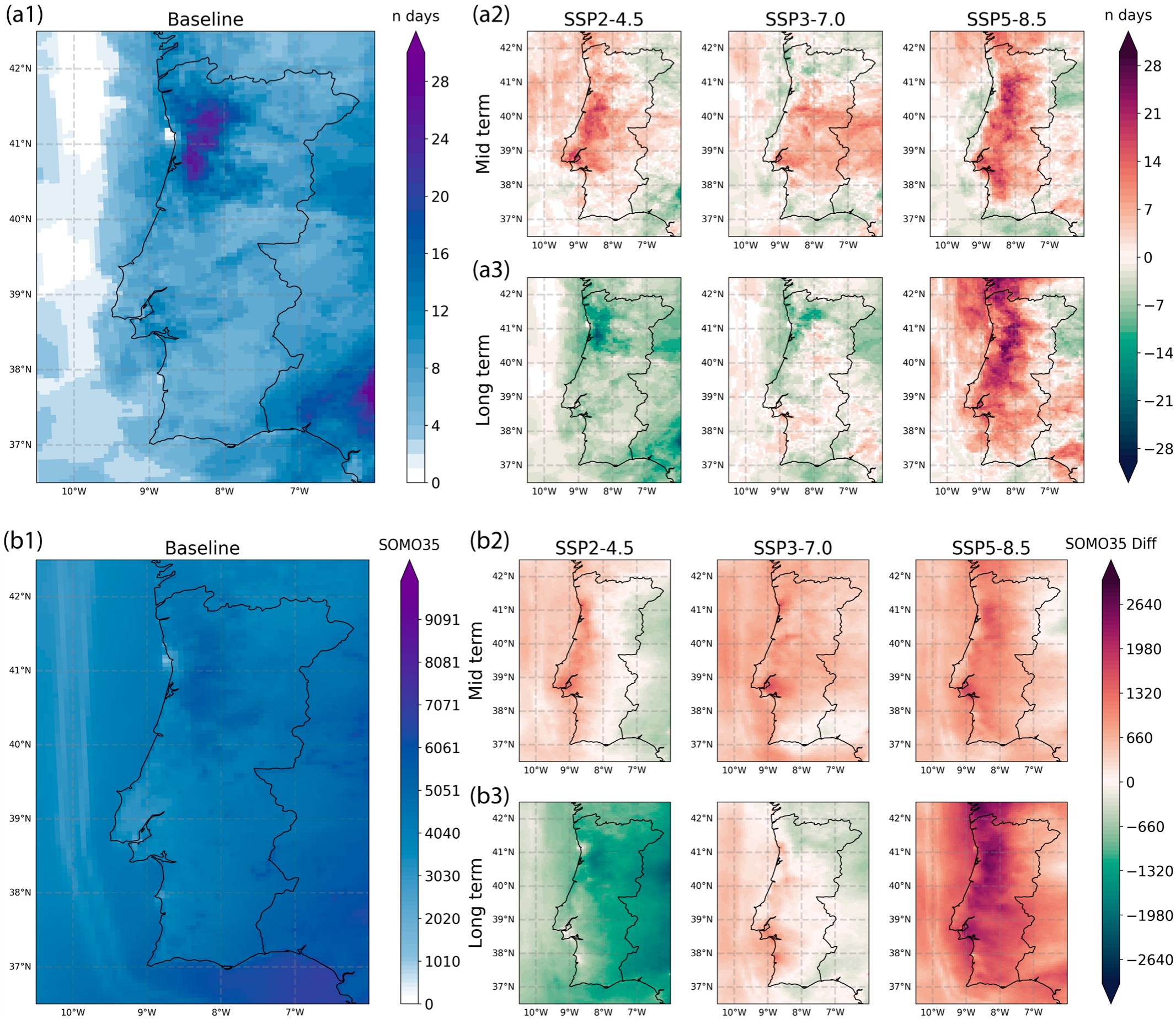
Regarding O3 (Figure 4), the results are expressed in terms of number of days in exceedance to the 8 h maximum daily mean limit value (120 µg/m3, a1) and the annually accumulated ozone 8 h maximum daily mean in excess of 70 µg/m3 (SOMO35, b2), as well as the differences in the number of exceedances (a2 and a3) and SOMO35 (b2 and b3) between the baseline and climate change scenarios (SSP2-4.5, SSP3-7.0, and SSP5-8.5) for both mid-term (2050) and long-term (2100) projections. It should be noted that the WHO recommends this threshold value as 100 µg/m3.
The results for O3 exhibit patterns distinct from those of its precursor, NO2, with the non-daily maximum 8 h mean limit value exceedances at locations with the highest NO2 exceedances, while daily exceedances of the threshold for the protection of human health are projected throughout the study domain, mainly over the inland area east of the Porto region in the North, reflecting favorable conditions for photochemical O3 formation (Figure 4(a1)). Future projections indicate that the O3 concentrations are expected to increase in inland regions of Portugal under all scenarios in the mid-term (Figure 4(a2)), while for the long-term projections, reductions in exceedances are anticipated under SSP2-4.5 and SSP3-7.0, whereas the SSP5-8.5 scenario shows the largest increase in exceedances, by 20 to 30 days (Figure 4(a3)). These differences can be explained by sector-specific emission trends, with SSP2-4.5 and SSP3-7.0 showing reductions in most sectors except agriculture and SSP5-8.5 showing increases across all sectors (Figure 1), which amplifies photochemical O3 formation. Regarding the SOMO35, although it does not have an established limit value and does not present a simple relationship with O3 exceedances, a value of 6000 to 8000 µg/m3/day is considered the threshold for discussion related to population exposures, based on the guidelines and typical ranges reported by the European Environment Agency (EEA) in their air quality status report [63]. Baseline results show that most of the country has annual accumulated SOMO35 values below this threshold, with the exception of inland areas adjacent to large northern urban centers (i.e., Porto and Braga) and the waterways to the south of the study domain (Figure 4(b1)). For the projected scenarios, SOMO35 is projected to increase throughout the entire country in the mid-term (Figure 4(b2)), while the spatial distribution of long-term increases tended to favor coastal areas rather than inland regions (Figure 4(b3)), likely due to a combination of meteorological factors such as onshore winds and air mass transport from inland regions, lower deposition rates, and less favorable conditions for photochemical O3 formation along the coast [64,65]. Once again, the scenario with the highest increase compared to the baseline remains SSP5-8.5, with SSP2-4.5 showing promising results for the long-term, with decreases projected across the entire domain.
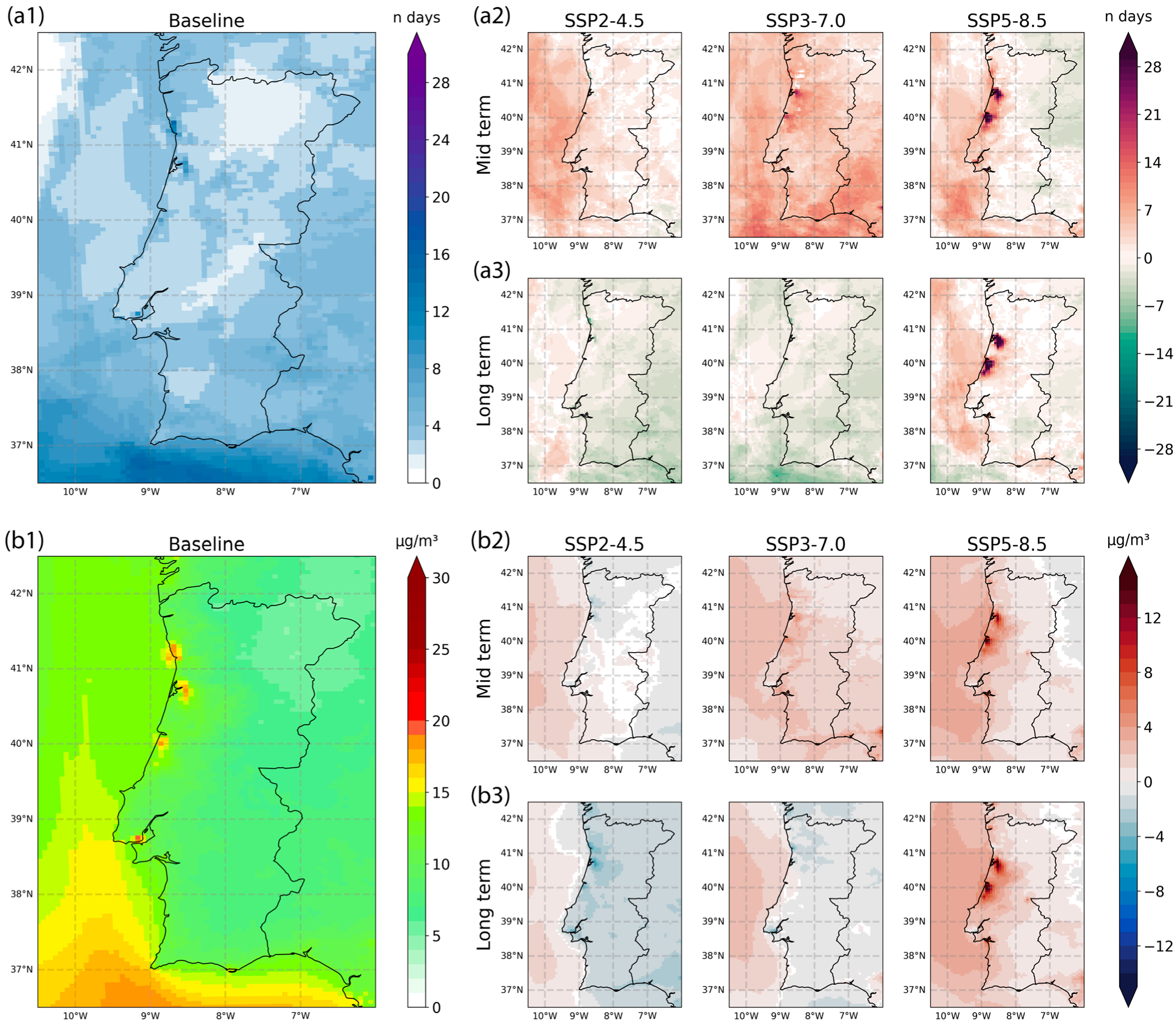
Finally, concerning PM10 (Figure 5) and PM2.5 (Figure 6), the results are expressed in terms of number of days exceeding the daily mean limit value (45 µg/m3 for PM10 and 25 µg/m3 for PM2.5, Figure 5 and Figure 6(a1)) and annual mean limit value (20 µg/m3 for PM10 and 10 µg/m3 for PM2.5, Figure 5 and Figure 6(b1)), as well as differences in the number of exceedances (a2 and a3) and annual average concentrations (b2 and b3) between the baseline and climate change scenarios (SSP2-4.5, SSP3-7.0, and SSP5-8.5) for both mid-term (2050) and long-term (2100) projections. The WHO guidelines for PM10 are set to the same limit value for daily averages but have a more stringent recommendation for annual averages (15 µg/m3). For PM2.5, both the daily and annual averages are stricter for WHO guidelines: 15 µg/m3 for daily mean and 5 µg/m3 for annual values.
For PM10, the baseline scenario shows exceedances of the daily limit value across mainland Portugal, which can be attributed to the strong influence and high frequency of Saharan dust episodes [66] (Figure 5(a1)). In terms of the annual average, the exceedances are located in the urban centers of Porto and Lisbon, as well as in major industrial areas where there are facilities such as public power plants and paper and paper pulp are located [67] (Figure 5(b1)). Future projections reveal that the PM10 problem would only be alleviated in the long-term period under more sustainable climate change scenarios (i.e., SSP2-4.5, and SSP3-7.0) (Figure 5(a3,b3)), mainly due to substantial reductions in primary PM10 emissions and in precursor emissions from key activities such as road transport, industry (including energy), and other stationary combustion (e.g., residential combustion) (Figure 1). In contrast, the SSP5-8.5 scenario revealed a critical situation for PM10 levels, with more than 30 additional days surpassing the daily limit value per year and an increase in the annual average PM10 concentration exceeding 10 µg/m3 in specific areas (Figure 5(a2,a3,b2,b3)), mainly due to the increase in emissions from public power activities (Figure 1).
Regarding PM2.5, the baseline results indicate that exceedances of the limit values occurred only in the main urban centers along the coast, where more than 20 days per year surpass the daily limit value and the annual average exceeded 10 µg/m3 (Figure 6(a1,b1)). Unlike PM10, Saharan dust does not significantly contribute to PM2.5 concentrations because desert dust is mainly composed of coarse particles [66], so PM2.5 levels are primarily influenced by local anthropogenic sources such as road transport, industries, and other small combustion activities [68]. Future perspectives show a general decrease in PM2.5 concentrations over the main critical areas, which could not be enough to fulfil the established legislated limit values, in particular for the SSP5-8.5 scenario (Figure 6(a2,a3,b2,b3)). In this case, the deterioration is less pronounced than for PM10 because the increase in emissions from public power activities under SSP5-8.5 are comparatively smaller for PM2.5 (Figure 1), resulting in a more moderate impact on fine particulate concentrations.
The following Table 3 is the total yearly sum of the daily exceedances for each pollutant and scenario, considering the grid cells that are within the boundaries of mainland Portugal. This provides some information at a glance regarding the evolution of exceedances for the studied periods.
A pollutant-specific evaluation of exceedances in mainland Portugal reveals distinct behaviors across projection scenarios and time horizons. For NO2, mid-term projections show a decrease in exceedances under SSP2-4.5 and SSP3-7.0 compared with the baseline, reflecting the reduction in human-made emissions driven by the adoption of cleaner technologies in these pathways (Figure 1). However, SSP5-8.5 displays a pronounced increase in mid-term exceedances, rising from 15 (baseline) to 44. This deterioration is consistent with the emission patterns of SSP5-8.5, which involve substantial increases in NO2 emissions from sources such as agriculture and public power, ultimately intensifying NO2 concentrations. In the long-term, SSP2-4.5 maintains the most favorable outcome with only one exceedance, while SSP3-7.0 and SSP5-8.5 present higher values (10 and 18, respectively), with the persistence of these elevated exceedance levels largely driven by increased agricultural emissions (Figure 1).
The behavior of O3 differs significantly from the other pollutants, with all mid-term scenarios projecting a rise in exceedances, particularly under SSP2-4.5 (29,737 exceedances) and SSP5-8.5 (34,755 exceedances). This increase is consistent with the sensitivity of ozone formation to temperature, sunlight, and precursor emissions, so that even when some precursors decline, climate-driven enhancements in photochemical activity can intensify O3 levels [2,3]. In the long-term, only SSP5-8.5 experiences a substantial increase in O3 exceedances (40,589 exceedances), while SSP2-4.5 (4545 exceedances) and SSP3-7.0 (14,365 exceedances) show slightly improved levels, and the markedly high exceedances under SSP5-8.5 reflect the combined effect of increased precursor emissions and more favorable climatic conditions for ozone formation.
For PM10, mid-term exceedances rise across all scenarios, driven by increased emissions from agriculture (Figure 1). By the long-term, however, SSP2-4.5 (654 exceedances) and SSP3-7.0 (817 exceedances) reflect improvements, suggesting effective emission reductions and mitigation measures in these pathways. In contrast, SSP5-8.5 remains problematic, maintaining very high exceedance levels (8884 exceedances) due to limited emission controls and intensified anthropogenic activity (Figure 1). A similar pattern is observed for PM2.5, although the mid-term projections vary across scenarios, with exceedances increasing under SSP2-4.5 (1944 exceedances) and SSP5-8.5 (2684 exceedances), possibly due to higher NO2 emissions from the agriculture livestock sector (Figure 1) contributing to secondary PM2.5 formation [69], while under SSP3-7.0 (1395 exceedances) exceedances decrease because of reductions in key combustion-related sectors (Figure 1). In the long-term, both SSP2-4.5 (188 exceedances) and SSP3-7.0 (186 exceedances) show a strong decline in exceedances, reflecting effective reductions in combustion-related emissions and secondary particle formation (Figure 1), whereas SSP5-8.5 remains the worst-case scenario, maintaining elevated levels (2515 exceedances) due to continued fossil fuel use (Figure 1).
Overall, the pollutant-specific analysis indicates that mitigation-oriented scenarios, particularly SSP2-4.5, generally reduce exceedances of NO2 and particulate matter in the long term, while ozone remains challenging due to its strong dependence on climatic and photochemical conditions, and SSP5-8.5 consistently produces the highest exceedances across all pollutants, highlighting the risks of fossil-fuel-intensive development pathways for future air quality in mainland Portugal.

3.2. Premature Deaths

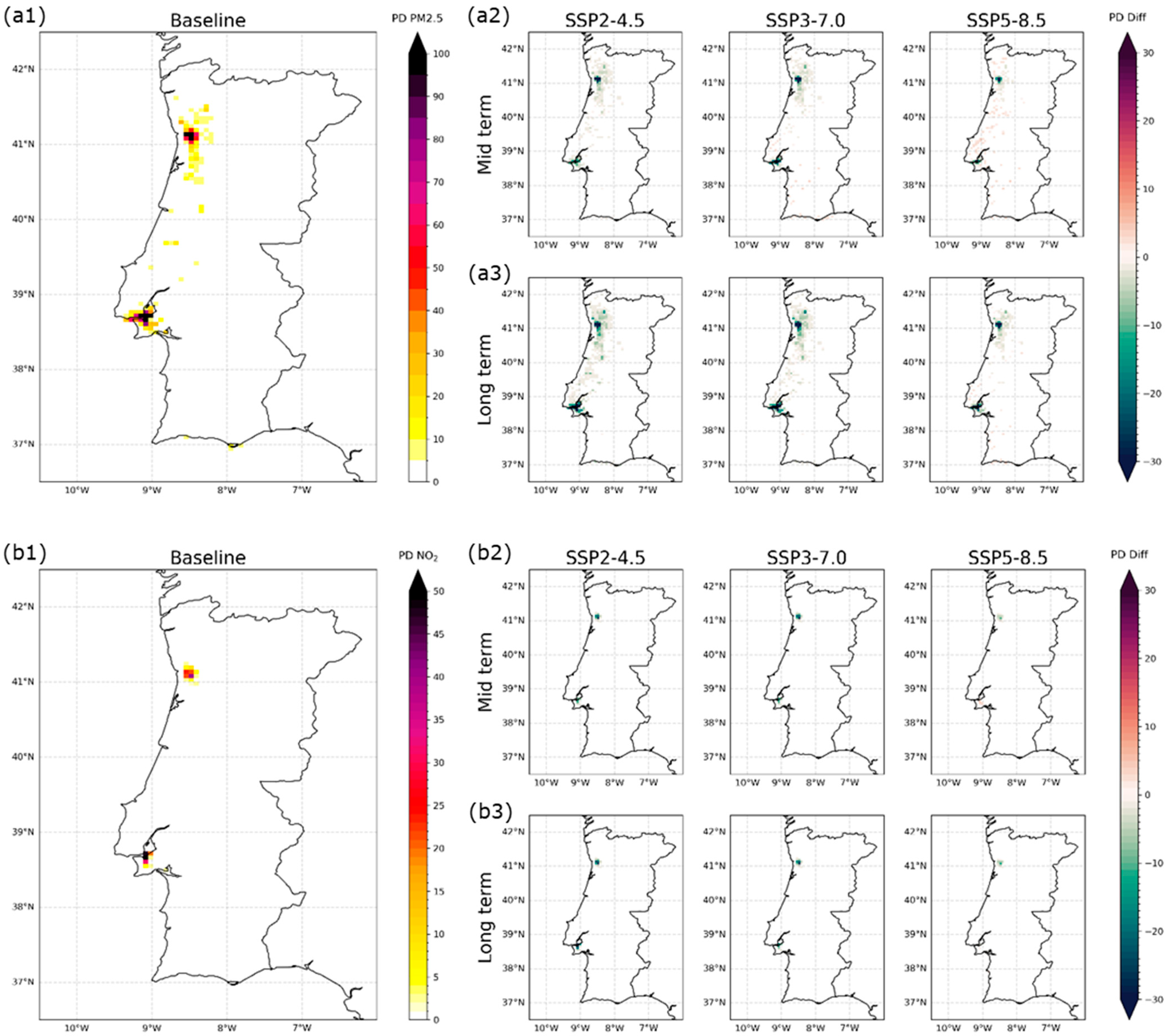
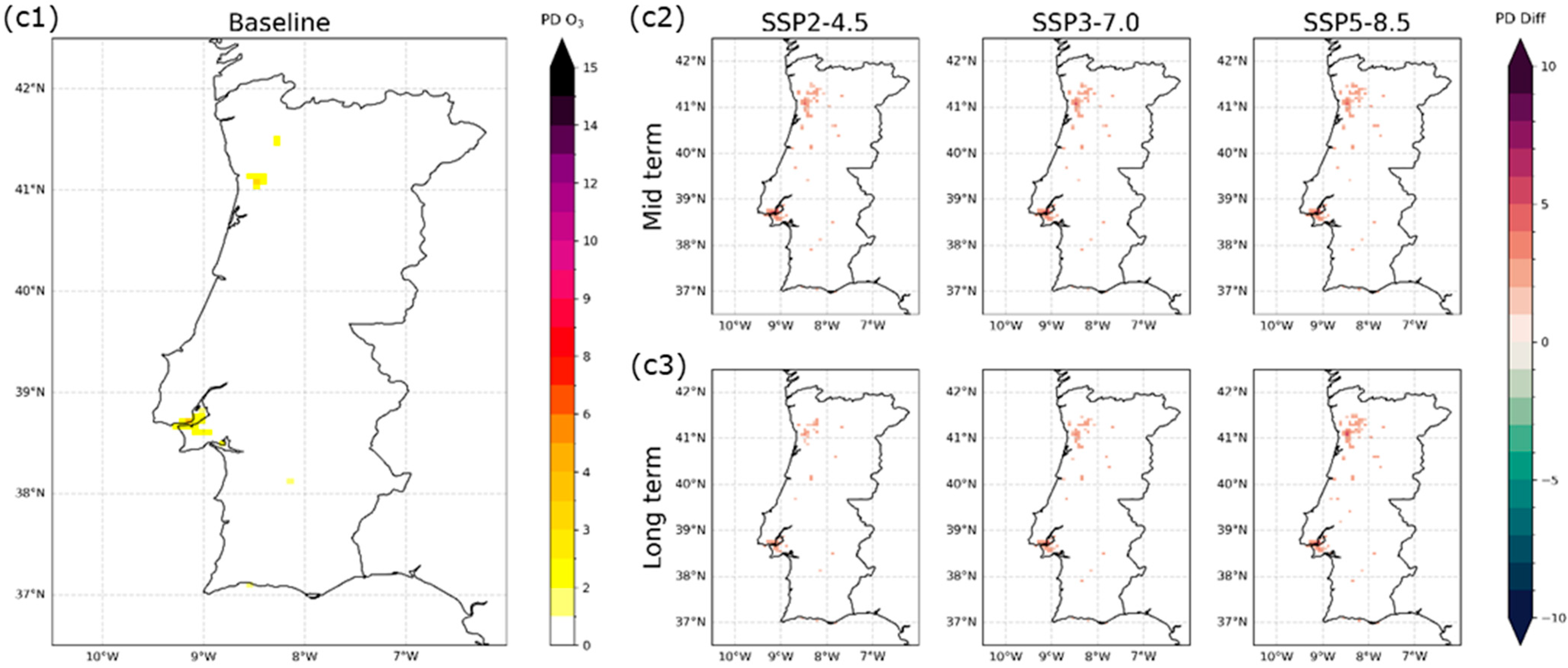
The mortality indicator, expressed as the number of premature deaths due to PM2.5, NO2, and O3 long-term exposure, for the mid- and long-term future climate and the baseline, are shown in Figure 7 and Table 4.
According to Figure 7, premature deaths based on both baseline and future projections due to PM2.5, NO2, and O3 long-term exposure are concentrated near the coastline, particularly in densely populated urban areas such as the Porto and Lisbon metropolitan regions [70]. This spatial pattern reflects the combined effect of a higher population density and greater pollutant exposure in these areas. For PM2.5, the largest reductions in premature deaths are projected in major urban centers, likely resulting from anticipated emission decreases in transport and industrial sectors, while smaller increases in surrounding regions may be attributed to pollutant transport and residual local emissions from agricultural sources (Figure 1). For NO2, the Porto metropolitan area exhibits the most substantial reductions across all scenarios and periods, possibly due to local emission controls, whereas the Lisbon metropolitan area shows reductions only under SSP2-4.5 and SSP3-7.0, with increases under SSP5-8.5 consistent with the fossil-fuel-intensive trajectory of this scenario (Figure 1). In contrast, O3-related premature deaths are expected to increase across all scenarios and periods, reflecting the non-linear photochemistry of ozone formation, which is enhanced under higher temperatures and reduced NOx conditions [71].
Regarding the national total, in the future, estimates show that NO2 and PM2.5 long-term exposure will lead to a decrease in the total number of premature deaths in both mid- and long-term future periods, as shown in Table 4. For NO2 and PM2.5, the highest reductions are expected by the end of the century, representing approximately 77% and 66% of premature deaths avoided, respectively, under the SSP2-4.5 scenario. The long-term SSP5-8.5 period, is the one with smaller reductions, only accounting for 9% (NO2) and 7% (PM2.5) of premature deaths avoided when compared to the baseline. On the other hand, long-term exposure to O3 will lead to an increase in the number of premature deaths in the future, for both periods. The highest increases are expected in the long-term future for SSP5-8.5, with about 354% more premature deaths, when compared with baseline, in line with the previously discussed sensitivity of ozone formation to temperature and NOx levels [70].
Overall, the projected changes in premature deaths indicate that mitigation-oriented scenarios such as SSP2-4.5 can substantially reduce the health burden associated with PM2.5 and NO2, particularly in densely populated urban areas, whereas high-emission pathways like SSP5-8.5 offer minimal reductions or even increases, as observed for O3. These results highlight the critical importance of implementing stringent air quality and climate policies to protect public health, with particular attention to urban hotspots where exposure and population density are highest.

3.3. Limitations, Future Perspectives, and Police Recommendations

Despite the robustness of the modeling framework, several limitations should be considered. The EMEP inventory, developed based on emissions reported by European Member States, was used, but recent studies have highlighted inaccuracies in the spatial allocation of emissions across sectors, which may affect the accuracy of the modeling results [72]. The same spatial distribution from the baseline emissions was applied to the future projection scenarios, potentially amplifying these inaccuracies. Temporal emission profiles were not adjusted for future conditions, meaning that the seasonal and daily variation patterns from the baseline year were assumed for each activity sector, which may not accurately represent future human activity patterns. Episodic sources, such as wildfires, were not considered, which could introduce additional variability, particularly in a country like Portugal that is frequently affected by large wildfires [73]. Additionally, the same population distribution from the 2021 census was used for both the baseline and future projections, which does not account for expected demographic changes such as population growth or decline, aging, or migration patterns [74], potentially affecting the calculation of health impacts. Uncertainty is also associated with the concentration-response functions used to estimate health impacts. These functions assume that the relationship between pollutant exposure and health outcomes remains constant over time and across different populations. However, changes in population susceptibility, healthcare systems, or co-exposure to other pollutants could alter this relationship, potentially leading to either the underestimation or overestimation of future premature deaths.
Future research should focus on urban-scale modeling based on temporally dynamic and high-resolution atmospheric inventories, in order to better capture temporal variability and fine-scale spatial patterns. Although the current model already accounts for natural sources such as biogenic and desert dust emissions, incorporating episodic sources such as wildfires could further improve projections, particularly in regions frequently affected by such events. Finally, integrating dynamic population projections and vulnerability indicators would also enhance the assessment of future health burdens.
From a policy perspective, the projected exceedances and premature deaths indicate the need for targeted interventions to protect public health. The reductions in NO2 and PM concentrations under SSP2-4.5 suggest that measures based on the transport sector could be effective in urban centers, where exposure and population density are highest. The persistent high PM10 levels under SSP5-8.5, particularly influencing power generation activities, highlight the value of early-warning systems and public health protocols to mitigate episodic pollution events. For inland regions where O3-related premature deaths are projected to increase, the results emphasize the need for both emission mitigation and adaptive strategies to reduce exposure. Overall, the findings support the alignment of air quality management with long-term climate mitigation, demonstrating how scenario-specific interventions could influence future health outcomes.

4. Summary and Conclusions

The objective this study was to investigate how climate change scenarios (mid-term (2050) and long-term (2100) affect air quality and associated human impacts, with a focus on Portugal and the fulfilment of the new WHO air quality guidelines, using high-resolution numerical simulations.
The modeling results reveal that the baseline scenario indicates exceedances in NO2 daily and annual mean limit values in urban areas such as Porto and Lisbon. However, future perspectives suggest that NO2 concentrations are expected to decrease in less fossil-fuel-intensive scenarios (SSP2-4.5 and SSP4-7.0), while scenario SSP5-8.5 predicts continued exceedances and increases in NO2 levels. In the case of O3, the baseline shows exceedances primarily in inland areas east of Porto. Future scenarios indicate increases in O3 concentrations, particularly under scenario SSP5-8.5. The SOMO35 values suggest higher O3 concentrations in inland areas, shifting to coastal regions for the long-term period.
As for PM10 and PM2.5, the baseline shows exceedances in daily limit values across mainland Portugal due to Saharan dust episodes, with urban and industrial areas also exceeding annual mean limits. Long-term improvements in PM10 levels are projected under scenarios SSP2-4.5 and SSP3-7.0, while scenario SSP5-8.5 shows significant increases. PM2.5 levels show decreases in future scenarios but may still not meet legislated limits, especially for scenario SSP5-8.5.
Regarding health impacts, long-term exposure to PM2.5, NO2, and O3 has been associated with a range of adverse health effects, including cardiovascular and respiratory mortality. Premature deaths are expected to be highest in urban areas like Porto and Lisbon. Projected reductions in premature deaths are expected for NO2 and PM2.5, particularly under scenario SSP2-4.5. Conversely, long-term O3 exposure is projected to result in increased premature deaths, especially under scenario SSP5-8.5.
Overall, scenario SSP2-4.5 presents the most positive outcomes for the long-term, with significant reductions in pollutant levels and associated health impacts. On the other hand, scenario SSP5-8.5 shows the worst outcomes, with increases in pollutant levels and premature deaths due to its focus on fossil fuels. The study indicates that while more sustainable climate change scenarios may result in substantial enhancements in air quality and health outcomes, Portugal faces considerable challenges in meeting stricter air quality standards, particularly under more fossil-fuel-intensive scenarios. These findings highlight the importance of integrating air quality management and health impact assessments into climate adaptation strategies to promote long-term environmental sustainability in southern Europe, consistent with the United Nations Sustainable Development Goals (SDGs).

Author Contributions

Conceptualization, A.M. and D.C.; methodology, A.M. and D.C.; software, M.R. and D.C.; formal analysis, M.R. and S.C.; data curation, M.R., S.C. and D.C.; writing—original draft preparation, A.M., M.R., S.C., D.L. and D.C.; writing—review and editing, A.M., M.R., S.C., D.L. and D.C.; visualization, M.R. and S.C.; supervision, A.M. and D.C.; funding acquisition, D.C. All authors have read and agreed to the published version of the manuscript.

Funding

Thanks are due to FCT/MCTES for the financial support to CESAM by FCT, under the project/grant UID/50006 + LA/P/0094/2020 (DOI: 10.54499/LA/P/0094/2020), and for the contract grants of M. Russo (2023.05938.CEECIND, DOI: 10.54499/2023.05938.CEECIND/CP2840/CT0010) and D. Carvalho (CEECIND/2020/00563). This work was financed by National Funds through the FCT—Fundação para a Ciência e Tecnologia (Portuguese Foundation for Science and Technology) under the project ClimACT (DOI: 10.54499/2022.01896.PTDC). It was also co-financed by FEDER Funds through COMPETE 2030 in the framework of the project COMPETE2030-FEDER-00883200 (AIRTIP, Ref. FCT: 15169).

Institutional Review Board Statement

Not applicable.

Informed Consent Statement

Not applicable.

Data Availability Statement

The raw data supporting the conclusions of this article will be made available by the authors on request.

Conflicts of Interest

The authors declare no conflicts of interest.

Abbreviations

The following abbreviations are used in this manuscript:
AQGAir Quality Guidelines
CCClimate Change
CMIP6Coupled Model Intercomparison Project Phase 6
EMEPEuropean Monitoring and Evaluation Programme
FAIRMODEForum for Air quality Modelling
GCMGeneral Circulation Model
GHGGreenhouse Gases
GNFRGridded Nomenclature For Reporting
IPCCIntergovernmental Panel on Climate Change
MQOModel Quality Objectives
MPI-MMax Planck Institute for Meteorology
MPI-M-ESM-1.2-HRHigh-Resolution Earth System Model
SDGSustainable Development Goals
SSPShared Socioeconomic Pathways
WHOWorld Health Organization
WRFWeather Research & Forecasting

References

  1. Dimitriou, K.; Kassomenos, P. The Covariance of Air Quality Conditions in Six Cities in Southern Germany—The Role of Meteorology. Sci. Total Environ. 2017, 574, 1611–1621. [Google Scholar] [CrossRef] [PubMed]
  2. Dean, A.; Green, D. Climate Change, Air Pollution and Human Health in Sydney, Australia: A Review of the Literature. Environ. Res. Lett. 2018, 13, 053003. [Google Scholar] [CrossRef]
  3. Hou, P.; Wu, S. Long-Term Changes in Extreme Air Pollution Meteorology and the Implications for Air Quality. Sci. Rep. 2016, 6, 23792. [Google Scholar] [CrossRef]
  4. Giorgio, G.A.; Ragosta, M.; Telesca, V. Climate Variability and Industrial-Suburban Heat Environment in a Mediterranean Area. Sustainability 2017, 9, 775. [Google Scholar] [CrossRef]
  5. Yang, J.; Shao, M. Impacts of Extreme Air Pollution Meteorology on Air Quality in China. J. Geophys. Res. Atmos. 2021, 126, e2020JD033210. [Google Scholar] [CrossRef]
  6. Zittis, G.; Hadjinicolaou, P.; Fnais, M.; Lelieveld, J. Projected Changes in Heat Wave Characteristics in the Eastern Mediterranean and the Middle East. Reg. Environ. Change 2016, 16, 1863–1876. [Google Scholar] [CrossRef]
  7. D’Amato, G.; Baena-Cagnani, C.E.; Cecchi, L.; Annesi-Maesano, I.; Nunes, C.; Ansotegui, I.; D’Amato, M.; Liccardi, G.; Sofia, M.; Canonica, W.G. Climate Change, Air Pollution and Extreme Events Leading to Increasing Prevalence of Allergic Respiratory Diseases. Multidiscip. Respir. Med. 2013, 8, 12. [Google Scholar] [CrossRef]
  8. Zhang, H.; Wang, Y.; Park, T.W.; Deng, Y. Quantifying the Relationship between Extreme Air Pollution Events and Extreme Weather Events. Atmos. Res. 2017, 188, 64–79. [Google Scholar] [CrossRef]
  9. Ragosta, M.; D’emilio, M.; Casaletto, L.; Telesca, V. A Statistical Procedure for Analyzing the Behavior of Air Pollutants during Temperature Extreme Events: The Case Study of Emilia-Romagna Region (Northern Italy). Appl. Sci. 2021, 11, 8266. [Google Scholar] [CrossRef]
  10. De Sario, M.; Katsouyanni, K.; Michelozzi, P. Climate Change, Extreme Weather Events, Air Pollution and Respiratory Health in Europe. Eur. Respir. J. 2013, 42, 826–843. [Google Scholar] [CrossRef]
  11. Jacob, D.J.; Winner, D.A. Effect of Climate Change on Air Quality. Atmos. Environ. 2009, 43, 51–63. [Google Scholar] [CrossRef]
  12. Fu, T.M.; Tian, H. Climate Change Penalty to Ozone Air Quality: Review of Current Understandings and Knowledge Gaps. Curr. Pollut. Rep. 2019, 5, 159–171. [Google Scholar] [CrossRef]
  13. EC (European Commission). European Climate Law. Available online: https://climate.ec.europa.eu/eu-action/european-climate-law_en (accessed on 20 November 2025).
  14. Penrod, A.; Zhang, Y.; Wang, K.; Wu, S.Y.; Leung, L.R. Impacts of Future Climate and Emission Changes on U.S. Air Quality. Atmos. Environ. 2014, 89, 533–547. [Google Scholar] [CrossRef]
  15. Zlatev, Z.; Moseholm, L. Impact of Climate Changes on Pollution Levels in Denmark. Ecol. Model. 2008, 217, 305–319. [Google Scholar] [CrossRef]
  16. Krzyzanowski, M.; Cohen, A. Update of WHO Air Quality Guidelines. Air Qual. Atmos. Health 2008, 1, 7–13. [Google Scholar] [CrossRef]
  17. WHO. WHO Global Air Quality Guidelines: Particulate Matter (PM2.5 and PM10), Ozone, Nitrogen Dioxide, Sulfur Dioxide and Carbon Monoxide; WHO: Geneva, Switzerland, 2021. [Google Scholar]
  18. Directive (EU) 2024/2881 of the European Parliament and of the Council of 23 October 2024 on Ambient Air Quality and Cleaner Air for Europe (Recast). Official Journal of the European Union, OJ L. 20 November 2024. Available online: https://environment.ec.europa.eu/publications/revision-eu-ambient-air-quality-legislation_en (accessed on 28 November 2025).
  19. Coelho, S.; Rafael, S.; Lopes, D.; Miranda, A.I.; Ferreira, J. How Changing Climate May Influence Air Pollution Control Strategies for 2030? Sci. Total Environ. 2021, 758, 143911. [Google Scholar] [CrossRef] [PubMed]
  20. Dentener, F.; Stevenson, D.; Cofala, J.; Mechler, R.; Amann, M.; Bergamaschi, P.; Raes, F.; Derwent, R. The Impact of Air Pollutant and Methane Emission Controls on Tropospheric Ozone and Radiative Forcing: CTM Calculations for the Period 1990–2030. Atmos. Chem. Phys. 2005, 5, 1731–1755. [Google Scholar] [CrossRef]
  21. Kelly, J.; Makar, P.A.; Plummer, D.A. Projections of Mid-Century Summer Air-Quality for North America: Effects of Changes in Climate and Precursor Emissions. Atmos. Chem. Phys. 2012, 12, 5367–5390. [Google Scholar] [CrossRef]
  22. MedECC. Climate and Environmental Change in the Mediterranean Basin–Current Situation and Risks for the Future. First Mediterranean Assessment Report; Cramer, W., Guiot, J., Marini, K., Eds.; Union for the Mediterranean, Plan Bleu, UNEP/MAP: Marseille, France, 2020; 632p, ISBN 978-2-9577416-0-1. [Google Scholar] [CrossRef]
  23. INE, (Instituto Nacional de Estatística) Em 2024, o Produto Interno Bruto Ascendeu a 289,4 Mil Milhões de Euros—2023/2024. Available online: https://www.ine.pt (accessed on 20 November 2025).
  24. PORDATA. Produto Interno Bruto (PIB) per Capita. Available online: https://www.pordata.pt/pt/estatisticas/economia/crescimento-e-produtividade/produto-interno-bruto-pib (accessed on 20 November 2025).
  25. PORDATA. Rendimento Nacional Bruto. Available online: https://www.pordata.pt/pt/estatisticas/economia/rendimento-e-poupanca/rendimento-nacional-bruto (accessed on 20 November 2025).
  26. O’Neill, B.C.; Kriegler, E.; Ebi, K.L.; Kemp-Benedict, E.; Riahi, K.; Rothman, D.S.; van Ruijven, B.J.; van Vuuren, D.P.; Birkmann, J.; Kok, K.; et al. The Roads Ahead: Narratives for Shared Socioeconomic Pathways Describing World Futures in the 21st Century. Glob. Environ. Change 2017, 42, 169–180. [Google Scholar] [CrossRef]
  27. Riahi, K.; van Vuuren, D.P.; Kriegler, E.; Edmonds, J.; O’Neill, B.C.; Fujimori, S.; Bauer, N.; Calvin, K.; Dellink, R.; Fricko, O.; et al. The Shared Socioeconomic Pathways and Their Energy, Land Use, and Greenhouse Gas Emissions Implications: An Overview. Glob. Environ. Change 2017, 42, 153–168. [Google Scholar] [CrossRef]
  28. van Vuuren, D.P.; Riahi, K.; Calvin, K.; Dellink, R.; Emmerling, J.; Fujimori, S.; KC, S.; Kriegler, E.; O’Neill, B. The Shared Socio-Economic Pathways: Trajectories for Human Development and Global Environmental Change. Glob. Environ. Change 2017, 42, 148–152. [Google Scholar] [CrossRef]
  29. KC, S.; Lutz, W. The Human Core of the Shared Socioeconomic Pathways: Population Scenarios by Age, Sex and Level of Education for All Countries to 2100. Glob. Environ. Change 2017, 42, 181–192. [Google Scholar] [CrossRef]
  30. Jiang, L.; O’Neill, B.C. Global Urbanization Projections for the Shared Socioeconomic Pathways. Glob. Environ. Change 2017, 42, 193–199. [Google Scholar] [CrossRef]
  31. Crespo Cuaresma, J. Income Projections for Climate Change Research: A Framework Based on Human Capital Dynamics. Glob. Environ. Change 2017, 42, 226–236. [Google Scholar] [CrossRef]
  32. Dellink, R.; Chateau, J.; Lanzi, E.; Magné, B. Long-Term Economic Growth Projections in the Shared Socioeconomic Pathways. Glob. Environ. Change 2017, 42, 200–214. [Google Scholar] [CrossRef]
  33. Leimbach, M.; Kriegler, E.; Roming, N.; Schwanitz, J. Future Growth Patterns of World Regions—A GDP Scenario Approach. Glob. Environ. Change 2017, 42, 215–225. [Google Scholar] [CrossRef]
  34. Bauer, N.; Calvin, K.; Emmerling, J.; Fricko, O.; Fujimori, S.; Hilaire, J.; Eom, J.; Krey, V.; Kriegler, E.; Mouratiadou, I.; et al. Shared Socio-Economic Pathways of the Energy Sector—Quantifying the Narratives. Glob. Environ. Change 2017, 42, 316–330. [Google Scholar] [CrossRef]
  35. Popp, A.; Calvin, K.; Fujimori, S.; Havlik, P.; Humpenöder, F.; Stehfest, E.; Bodirsky, B.L.; Dietrich, J.P.; Doelmann, J.C.; Gusti, M.; et al. Land-Use Futures in the Shared Socio-Economic Pathways. Glob. Environ. Change 2017, 42, 331–345. [Google Scholar] [CrossRef]
  36. Rao, S.; Klimont, Z.; Smith, S.J.; Van Dingenen, R.; Dentener, F.; Bouwman, L.; Riahi, K.; Amann, M.; Bodirsky, B.L.; van Vuuren, D.P.; et al. Future Air Pollution in the Shared Socio-Economic Pathways. Glob. Environ. Change 2017, 42, 346–358. [Google Scholar] [CrossRef]
  37. Chen, D.; Rojas, M.; Samset, B.H.; Cobb, K.; Diongue Niang, A.; Edwards, P.; Emori, S.; Faria, S.H.; Hawkins, E.; Hope, P.; et al. Framing, Context, and Methods. In Climate Change 2021: The Physical Science Basis. Contribution of Working Group I to the Sixth Assessment Report of the Intergovernmental Panel on Climate Change; Masson-Delmotte, V., Zhai, P., Pirani, A., Connors, S.L., Péan, C., Berger, S., Caud, N., Chen, Y., Goldfarb, L., Gomis, M.I., et al., Eds.; Cambridge University Press: Cambridge, UK; New York, NY, USA, 2021; pp. 147–286. [Google Scholar]
  38. O’Neill, B.C.; Tebaldi, C.; van Vuuren, D.P.; Eyring, V.; Friedlingstein, P.; Hurtt, G.; Knutti, R.; Kriegler, E.; Lamarque, J.-F.; Lowe, J.; et al. The Scenario Model Intercomparison Project (ScenarioMIP) for CMIP6. Geosci. Model Dev. 2016, 9, 3461–3482. [Google Scholar] [CrossRef]
  39. Kriegler, E.; O’Neill, B.C.; Hallegatte, S.; Kram, T.; Lempert, R.J.; Moss, R.H.; Wilbanks, T. The Need for and Use of Socio-Economic Scenarios for Climate Change Analysis: A New Approach Based on Shared Socio-Economic Pathways. Glob. Environ. Change 2012, 22, 807–822. [Google Scholar] [CrossRef]
  40. van Vuuren, D.P.; Kriegler, E.; O, B.C.; Ebi, K.L.; Riahi, K.; Carter, T.R.; Edmonds, J.; Hallegatte, S.; Kram, T.; Mathur, R.; et al. A New Scenario Framework for Climate Change Research: Scenario Matrix Architecture. Clim. Change 2014, 122, 373–386. [Google Scholar] [CrossRef]
  41. Sa, E.; Ferreira, J.; Carvalho, A.; Borrego, C. Development of Current and Future Pollutant Emissions for Portugal. Atmos. Pollut. Res. 2015, 6, 849–857. [Google Scholar] [CrossRef]
  42. Mauritsen, T.; Bader, J.; Becker, T.; Behrens, J.; Bittner, M.; Brokopf, R.; Brovkin, V.; Claussen, M.; Crueger, T.; Esch, M.; et al. Developments in the MPI-M Earth System Model Version 1.2 (MPI-ESM1.2) and Its Response to Increasing CO2. J. Adv. Model. Earth Syst. 2019, 11, 998–1038. [Google Scholar] [CrossRef]
  43. Eyring, V.; Bony, S.; Meehl, G.A.; Senior, C.A.; Stevens, B.; Stouffer, R.J.; Taylor, K.E. Overview of the Coupled Model Intercomparison Project Phase 6 (CMIP6) Experimental Design and Organization. Geosci. Model Dev. 2016, 9, 1937–1958. [Google Scholar] [CrossRef]
  44. Menut, L.; Cholakian, A.; Pennel, R.; Siour, G.; Mailler, S.; Valari, M.; Lugon, L.; Meurdesoif, Y. The CHIMERE Chemistry-Transport Model V2023r1. Geosci. Model Dev. 2024, 17, 5431–5457. [Google Scholar] [CrossRef]
  45. Gama, C.; Relvas, H.; Lopes, M.; Monteiro, A. The Impact of COVID-19 on Air Quality Levels in Portugal: A Way to Assess Traffic Contribution. Environ. Res. 2020, 193, 110515. [Google Scholar] [CrossRef] [PubMed]
  46. Monteiro, A.; Durka, P.; Flandorfer, C.; Georgieva, E.; Guerreiro, C.; Kushta, J.; Malherbe, L.; Maiheu, B.; Miranda, A.I.; Santos, G.; et al. Strengths and Weaknesses of the FAIRMODE Benchmarking Methodology for the Evaluation of Air Quality Models. Air Qual. Atmos. Health 2018, 11, 373–383. [Google Scholar] [CrossRef]
  47. Janssen, S.; Thunis, P. FAIRMODE Guidance Document on Modelling Quality Objectives and Benchmarking (Version 3.3), EUR 31068 EN; Publications Office of the European Union: Luxembpurg, 2022. [Google Scholar]
  48. Amnuaylojaroen, T.; Parasin, N.; Limsakul, A. Health Risk Assessment of Exposure Near-Future PM2.5 in Northern Thailand. Air Qual. Atmos. Health 2022, 15, 1963–1979. [Google Scholar] [CrossRef]
  49. Brook, R.D.; Rajagopalan, S.; Pope, C.A.; Brook, J.R.; Bhatnagar, A.; Diez-Roux, A.V.; Holguin, F.; Hong, Y.; Luepker, R.V.; Mittleman, M.A.; et al. Particulate Matter Air Pollution and Cardiovascular Disease: An Update to the Scientific Statement from the American Heart Association. Circulation 2010, 121, 2331–2378. [Google Scholar] [CrossRef]
  50. Næss, Ø.; Nafstad, P.; Aamodt, G.; Claussen, B.; Rosland, P. Relation between Concentration of Air Pollution and Cause-Specific Mortality: Four-Year Exposures to Nitrogen Dioxide and Particulate Matter Pollutants in 470 Neighborhoods in Oslo, Norway. Am. J. Epidemiol. 2007, 165, 435–443. [Google Scholar] [CrossRef]
  51. WHO. Recommendations for Concentration–Response Functions for Cost–Benefit Analysis of Particulate Matter, Ozone and Nitrogen Dioxide, Health Risks of Air Pollution in Europe—HRAPIE Project; World Health Organization: Copenhagen, Denmark, 2013. [Google Scholar]
  52. Marmett, B.; Carvalho, R.B.; Nunes, R.B.; Rhoden, C.R. Exposure to O3 and NO2 in Physically Active Adults: An Evaluation of Physiological Parameters and Health Risk Assessment. Environ. Geochem. Health 2022, 44, 4269–4284. [Google Scholar] [CrossRef]
  53. Brunekreef, B. Health Effects of Air Pollution Observed in Cohort Studies in Europe. J. Expo. Sci. Environ. Epidemiol. 2007, 17, S61–S65. [Google Scholar] [CrossRef]
  54. Cesaroni, G.; Badaloni, C.; Gariazzo, C.; Stafoggia, M.; Sozzi, R.; Davoli, M.; Forastiere, F. Long-Term Exposure to Urban Air Pollution and Mortality in a Cohort of More than a Million Adults in Rome. Environ. Health Perspect. 2013, 121, 324–331. [Google Scholar] [CrossRef]
  55. Soares, A.R.; Silva, C. Review of Ground-Level Ozone Impact in Respiratory Health Deterioration for the Past Two Decades. Atmosphere 2022, 13, 434. [Google Scholar] [CrossRef]
  56. Lipfert, F.W.; Wyzga, R.E.; Baty, J.D.; Miller, J.P. Traffic Density as a Surrogate Measure of Environmental Exposures in Studies of Air Pollution Health Effects: Long-Term Mortality in a Cohort of US Veterans. Atmos. Environ. 2006, 40, 154–169. [Google Scholar] [CrossRef]
  57. Soares, J.; Horálek, J.; Ortiz, A.G.; Guerreiro, C.; Gsella, A. ETC/ATNI Report 13/2019: Health Risk Assessment of Air Pollution in Europe. Methodology Description and 2017 Results; European Environmental Agency: Kjeller, Norway, 2019. [Google Scholar]
  58. INE Resident Population (No.) by Place of Residence, Sex and Age Group; Decennial—Statistics Portugal, Population and Housing Census—2021. Available online: https://www.ine.pt/xportal/xmain?xpid=INE&xpgid=ine_indicadores&indOcorrCod=0012338&contexto=bd&selTab=tab2 (accessed on 10 July 2025).
  59. Coelho, S.; Ferreira, J.; Carvalho, D.; Lopes, M. Health Impact Assessment of Air Pollution under a Climate Change Scenario: Methodology and Case Study Application. Sustainability 2022, 14, 14309. [Google Scholar] [CrossRef]
  60. Chen, J.; Hoek, G. Long-Term Exposure to PM and All-Cause and Cause-Specific Mortality: A Systematic Review and Meta-Analysis. Environ. Int. 2020, 143, 105974. [Google Scholar] [CrossRef]
  61. Huangfu, P.; Atkinson, R. Long-Term Exposure to NO2 and O3 and All-Cause and Respiratory Mortality: A Systematic Review and Meta-Analysis. Environ. Int. 2020, 144, 105998. [Google Scholar] [CrossRef]
  62. WHO. WHO Mortality Database. Available online: https://www.who.int/data/data-collection-tools/who-mortality-database (accessed on 10 July 2025).
  63. Nilu, P.S.; Chmi, D.D. Interim European Air Quality Maps for 2021. 2022. Available online: https://www.eionet.europa.eu/etcs/all-etc-reports (accessed on 24 November 2025).
  64. Evtyugina, M.G.Ã.; Pio, C.; Nunes, T.; Pinho, P.G.; Costa, C.S. Photochemical Ozone Formation at Portugal West Coast under Sea Breeze Conditions as Assessed by Master Chemical Mechanism Model. Atmos. Environ. 2007, 41, 2171–2182. [Google Scholar] [CrossRef]
  65. Alves, C.; Vicente, A.; Oliveira, A.R.; Candeias, C.; Vicente, E.; Nunes, T.; Cerqueira, M.; Evtyugina, M.; Rocha, F.; Almeida, S.M. Fine Particulate Matter and Gaseous Compounds in Kitchens and Outdoor Air of Different Dwellings. Int. J. Environ. Res. Public Health 2020, 17, 5256. [Google Scholar] [CrossRef] [PubMed]
  66. Gama, C.; Pio, C.; Monteiro, A.; Russo, M.; Fernandes, A.P.; Borrego, C.; Baldasano, J.M.; Tchepel, O. Comparison of Methodologies for Assessing Desert Dust Contribution to Regional PM10 and PM2.5 Levels: A One-Year Study over Portugal. Atmosphere 2020, 11, 134. [Google Scholar] [CrossRef]
  67. Lopes, D.; Graça, D.; Rafael, S.; Rosa, M.; Relvas, H.; Ferreira, J.; Reis, J.; Lopes, M. An Exploratory Approach to Estimate Point Emission Sources. Atmos. Environ. 2023, 312, 120026. [Google Scholar] [CrossRef]
  68. APA (Agência Portuguesa do Ambiente). National Informative Inventory Report 2023 Portugal. Submission under the NEC Directive (EU) 2016/2284 and the UNECE Convention on Long-Range Transboundary Air Pollution; APA: Amadora, Portugal, 2024. [Google Scholar]
  69. Thunis, P.; Clappier, A.; Beekmann, M.; Putaud, J.P.; Cuvelier, C.; Madrazo, J.; De Meij, A.; De Paris, U.; Créteil, U.P.; Paris, F. Non-Linear Response of PM2.5 to Changes in NOx and NH3 Emissions in the Po Basin (Italy): Consequences for Air Quality Plans. Atmos. Chem. Phys. 2021, 21, 9309–9327. [Google Scholar] [CrossRef]
  70. INE (Instituto Nacional de Estatística). Statistics Portugal, 2021. CENSUS, 2021—Statistical Data for Portugal. Available online: http://censos.ine.pt (accessed on 28 April 2022).
  71. Ribeiro, I.; Monteiro, A.; Gama, C.; Marta, C.; Carvalho, D.; Lopes, M. Investigating Ozone High Levels and the Role of Sea Breeze on Its Transport. Atmos. Pollut. Res. 2016, 7, 339–347. [Google Scholar] [CrossRef]
  72. Lopes, D.; Rosa, M.; Graça, D.; Rafael, S.; Ferreira, J.; Lopes, M. Enhancing Multi-Mode Transport Emission Inventories: Combining Open-Source Data with Traditional Approaches. Urban Clim. 2024, 57, 102097. [Google Scholar] [CrossRef]
  73. Tarín-Carrasco, P.; Augusto, S.; Palacios-Penã, L.; Ratola, N.; Jiménez-Guerrero, P. Impact of Large Wildfires on PM10 Levels and Human Mortality in Portugal. Nat. Hazards Earth Syst. Sci. 2021, 21, 2867–2880. [Google Scholar] [CrossRef]
  74. Wang, X.; Meng, X.; Long, Y. Projecting 1 Km-Grid Population Distributions from 2020 to 2100 Globally under Shared Socioeconomic Pathways. Sci. Data 2022, 9, 563. [Google Scholar] [CrossRef]
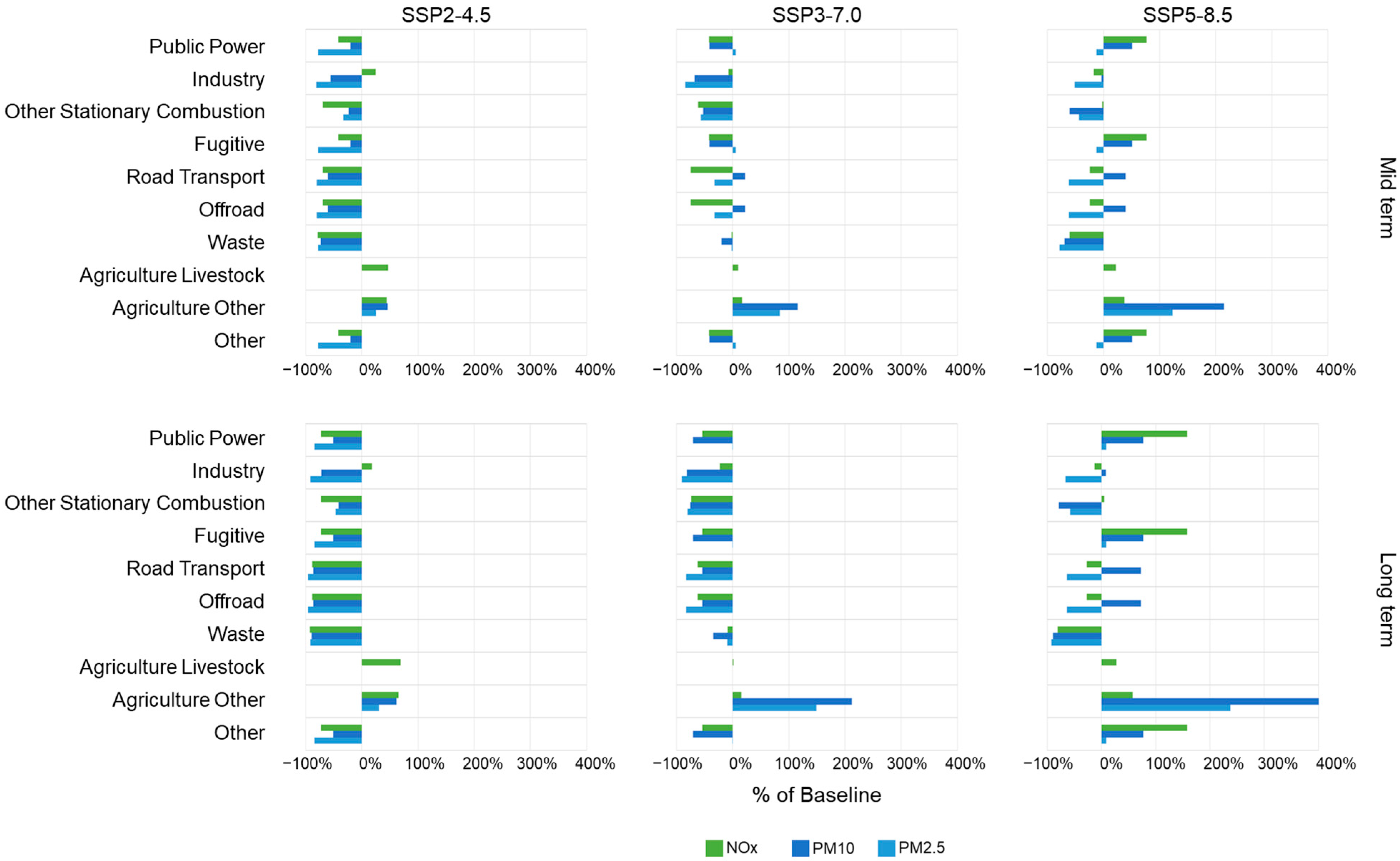
Figure 1. Emission projections per sector for the three climate change scenarios (SSP2-4.5, SSP4-7.0, and SSP5-8.5) and three pollutants (green = NOx, dark blue = PM10, blue = PM2.5), expressed in % of the baseline total emissions.
Sustainability 17 10857 g001
Figure 2. Flowchart of the modeling approach applied in this study.
Sustainability 17 10857 g002
Figure 3. Modeling results for the pollutant NO2 showing the number of exceedances of the daily limit value (a1) and annual average concentrations (b1) for the baseline scenario, with the remaining panels showing the differences in the number of exceedances (a2,a3) and annual average concentrations (b2,b3) between the baseline and climate change scenarios (SSP2-4.5, SSP3-7.0, and SSP5-8.5) for both mid-term (2050) and long-term (2100) projections.
Sustainability 17 10857 g003
Figure 4. Modeling results for the pollutant O3 showing the number of exceedances of the daily maximum 8 h mean limit value (a1) and SOMO35 in µg/m3/day (b1) for the baseline scenario, with the remaining panels showing the differences in the number of exceedances (a2,a3) and SOMO35 (b2,b3) between the baseline and climate change scenarios (SSP2-4.5, SSP3-7.0, and SSP5-8.5) for both mid-term (2050) and long-term (2100) projections.
Sustainability 17 10857 g004
Figure 5. Modeling results for the pollutant PM10 showing the number of exceedances of the daily limit value (a1) and annual average concentrations (b1) for the baseline scenario, with the remaining panels showing the differences in the number of exceedances (a2,a3) and annual average concentrations (b2,b3) between the baseline and climate change scenarios (SSP2-4.5, SSP3-7.0, and SSP5-8.5) for both mid-term (2050) and long-term (2100) projections.
Sustainability 17 10857 g005
Figure 6. Modeling results for the pollutant PM2.5 showing the number of exceedances of the daily limit value (a1) and annual average concentrations (b1) for the baseline scenario, with the remaining panels showing the differences in the number of exceedances (a2,a3) and annual average concentrations (b2,b3) between the baseline and climate change scenarios (SSP2-4.5, SSP3-7.0, and SSP5-8.5) for both mid-term (2050) and long-term (2100) projections.
Sustainability 17 10857 g006
Figure 7. Modeling results of premature deaths (PDs) attributable to long-term exposure to PM2.5 (a1), NO2 (b1), and O3 (c1) under the baseline scenario, with the remaining panels (a2,a3,b2,b3,c2,c3) displaying the differences in premature deaths (PD diff) between the baseline and climate change scenarios (SSP2-4.5, SSP3-7.0, and SSP5-8.5) for both mid-term (2050) and long-term (2100) projections.
Sustainability 17 10857 g007aSustainability 17 10857 g007b
Table 1. Selected WRF year for CHIMERE simulations, for the baseline and each SSP scenario.
ScenarioSelected Year
Baseline (1995–2014)2006
SSP2-4.5 (2046–2065)2050
SSP3-7.0 (2046–2065)2050
SSP5-8.5 (2046–2065)2061
SSP2-4.5 (2081–2100)2091
SSP3-7.0 (2081–2100)2091
SSP5-8.5 (2081–2100)2097
Table 2. CRF applied for each pollutant and health outcome in accordance with WHO [17] guidelines.
PollutantRR per 10 µg/m3
(95% CI)
Baseline
Concentration (C0)
Source of
Mortality Data
Health
Outcome
PM2.5,
annual mean
1.08 (1.06; 1.09), in [60]>5 µg/m3European Mortality database in [62], ICD-10: A-RMortality, all-cause (natural), age 30+ years
NO2,
annual mean
1.02 (1.01; 1.04), in [61]>10 µg/m3
O3,
SOMO35 1
1.01 (1.00; 1.02), in [61]>70 µg/m3European Mortality database in [62], ICD-10: J00-J99Mortality, respiratory diseases, age 30+ years
1 Summer months (April–September), average of daily maximum 8 h mean over 35 ppb.
Table 3. Yearly sum of daily exceedances for mainland Portugal for each pollutant and scenario.
ScenarioBaselineMid-TermLong-Term
SSP2-4.5SSP3-7.0SSP5-8.5SSP2-4.5SSP3-7.0SSP5-8.5
NO215104411018
O320,64129,73726,24134,755454514,36540,589
PM106410947318,09190646548178884
PM2.517681944139526841881862515
Table 4. Premature deaths, due to PM2.5, NO2, and O3 long-term exposure, for baseline and mid- and long-term future periods. Premature deaths considering the 95% confidence interval are shown in brackets.
PollutantHealth
Outcome
BaselineMid-TermLong-Term
SSP2-4.5SSP3-7.0SSP5-8.5SSP2-4.5SSP3-7.0SSP5-8.5
PM2.5,
annual mean
Premature Deaths3366
(2525; 3770)
2443
(1821; 2737)
2416
(1810; 2718)
3145
(2358; 3530)
1156
(858; 1313)
1203
(870; 1351)
2302
(1698; 2574)
NO2,
annual mean
302
(145; 593)
136
(69; 272)
129
(66; 259)
275
(133; 541)
69
(36; 145)
133
(65; 260)
250
(127; 495)
O3,
SOMO35 1
50
(0; 169)
202
(0; 480)
206
(0; 498)
215
(0; 511)
138
(0; 355)
177
(0; 438)
227
(0; 540)
1 Summer months (April–September), average of daily maximum 8 h mean over 35 ppb.
Disclaimer/Publisher’s Note: The statements, opinions and data contained in all publications are solely those of the individual author(s) and contributor(s) and not of MDPI and/or the editor(s). MDPI and/or the editor(s) disclaim responsibility for any injury to people or property resulting from any ideas, methods, instructions or products referred to in the content.